Garbage Collection
Introduction, Methods
& Java implementations
POP QUIZ #1
What is the first language runtime with Garbage
Collection?
POP QUIZ #1
What is the first language runtime with Garbage
Collection?
LISP
By John McCarthy in 1959
This talk is about?
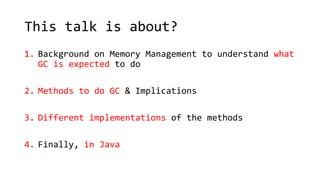
1. Background on Memory Management to understand what
GC is expected to do
2. Methods to do GC & Implications
3. Different implementations of the methods
4. Finally, in Java
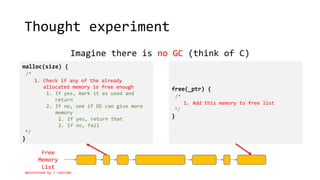
Thought experiment
Imagine there is no GC (think of C)
Thought experiment
Imagine there is no GC (think of C)
malloc(size) {
POP QUIZ #2
What does it do?
}
Thought experiment
Imagine there is no GC (think of C)
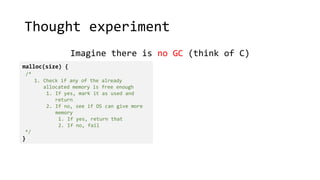
malloc(size) {
/*
1. Check if any of the already
allocated memory is free enough
1. If yes, mark it as used and
return
2. If no, see if OS can give more
memory
1. If yes, return that
2. If no, fail
*/
}
Thought experiment
Imagine there is no GC (think of C)
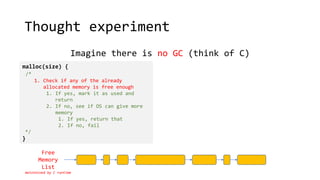
malloc(size) {
/*
1. Check if any of the already
allocated memory is free enough
1. If yes, mark it as used and
return
2. If no, see if OS can give more
memory
1. If yes, return that
2. If no, fail
*/
}
Free
Memory
List
maintained by C runtime
Thought experiment
Imagine there is no GC (think of C)
malloc(size) {
/*
1. Check if any of the already
allocated memory is free enough
1. If yes, mark it as used and
return
2. If no, see if OS can give more
memory
1. If yes, return that
2. If no, fail
*/
}
Free
Memory
List
maintained by C runtime
free(_ptr) {
/*
1. Add this memory to free list
*/
}
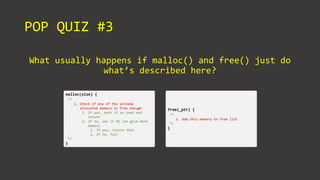
POP QUIZ #3
What usually happens if malloc() and free() just do
what’s described here?
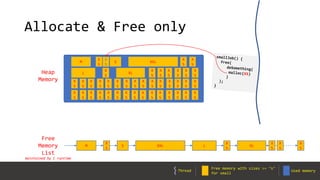
Allocate & Free only
Free
Memory
List
M
X
S
S XXL L
X
S
XL
maintained by C runtime
M
X
S
S XXL
L
X
S
XL
X
S
X
S
X
S
X
S
X
S
X
S
X
S
X
S
X
S
X
S
X
S
X
S
X
S
X
S
X
S
X
S
X
S
X
S
X
S
X
S
X
S
X
S
X
S
X
S
X
S
X
S
X
S
X
S
X
S
X
S
X
S
X
S
X
S
X
S
X
S
X
S
X
S
X
S
X
S
X
S
X
S
Heap
Memory
X
S
Free memory with sizes >= ‘s’
for small
Used memoryThread
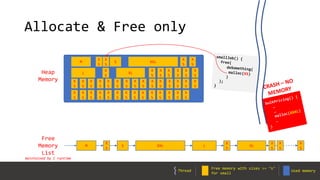
Allocate & Free only
Free
Memory
List
M
X
S
S XXL L
X
S
XL
maintained by C runtime
M
X
S
S XXL
L
X
S
XL
X
S
X
S
X
S
X
S
X
S
X
S
X
S
X
S
X
S
X
S
X
S
X
S
X
S
X
S
X
S
X
S
X
S
X
S
X
S
X
S
X
S
X
S
X
S
X
S
X
S
X
S
X
S
X
S
X
S
X
S
X
S
X
S
X
S
X
S
X
S
X
S
X
S
X
S
X
S
X
S
Heap
Memory
X
S
X
S
Free memory with sizes >= ‘s’
for small
Used memory
Free memory with sizes >= ‘s’
for small
Used memoryThread
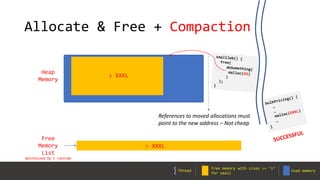
Allocate & Free + Compaction
Free
Memory
List
M
X
S
S XXL L
X
S
XL
maintained by C runtime
M
X
S
S XXL
L
X
S
XL
X
S
X
S
X
S
X
S
X
S
X
S
X
S
X
S
X
S
X
S
X
S
X
S
X
S
X
S
X
S
X
S
X
S
X
S
X
S
X
S
X
S
X
S
X
S
X
S
X
S
X
S
X
S
X
S
X
S
X
S
X
S
X
S
X
S
X
S
X
S
X
S
X
S
X
S
X
S
X
S
Heap
Memory
> XXXL
> XXXL
References to moved allocations must
point to the new address – Not cheap
Free memory with sizes >= ‘s’
for small
Used memoryThread
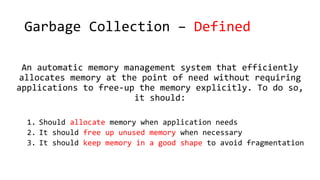
Garbage Collection – Defined
An automatic memory management system that efficiently
allocates memory at the point of need without requiring
applications to free-up the memory explicitly. To do so,
it should:
1. Should allocate memory when application needs
2. It should free up unused memory when necessary
3. It should keep memory in a good shape to avoid fragmentation
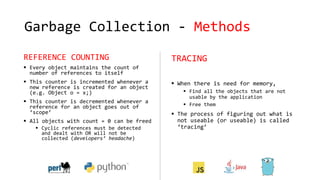
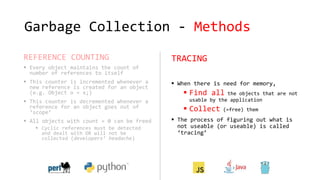
Garbage Collection - Methods
REFERENCE COUNTING
 Every object maintains the count of
number of references to itself
 This counter is incremented whenever a
new reference is created for an object
(e.g. Object o = x;)
 This counter is decremented whenever a
reference for an object goes out of
‘scope’
 All objects with count = 0 can be freed
 Cyclic references must be detected
and dealt with OR will not be
collected (developers’ headache)
TRACING
 When there is need for memory,
 Find all the objects that are not
usable by the application
 Free them
 The process of figuring out what is
not useable (or useable) is called
‘tracing’
Garbage Collection - Methods
REFERENCE COUNTING
 Every object maintains the count of
number of references to itself
 This counter is incremented whenever a
new reference is created for an object
(e.g. Object o = x;)
 This counter is decremented whenever a
reference for an object goes out of
‘scope’
 All objects with count = 0 can be freed
 Cyclic references must be detected
and dealt with OR will not be
collected (developers’ headache)
TRACING
 When there is need for memory,
 Find all the objects that are not
usable by the application
 Free them
 The process of figuring out what is
not useable (or useable) is called
‘tracing’
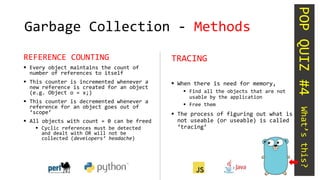
POPQUIZ#4What’sthis?
Garbage Collection - Methods
REFERENCE COUNTING
 Every object maintains the count of
number of references to itself
 This counter is incremented whenever a
new reference is created for an object
(e.g. Object o = x;)
 This counter is decremented whenever a
reference for an object goes out of
‘scope’
 All objects with count = 0 can be freed
 Cyclic references must be detected
and dealt with OR will not be
collected (developers’ headache)
TRACING
 When there is need for memory,
 Find all the objects that are not
usable by the application
 Collect (=free) them
 The process of figuring out what is
not useable (or useable) is called
‘tracing’
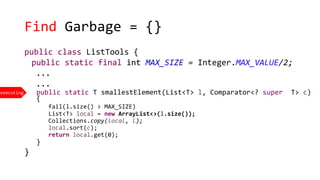
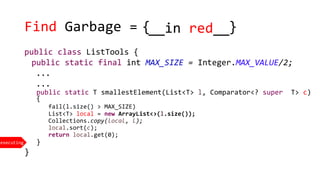
Find Garbage = {}
public class ListTools {
public static final int MAX_SIZE = Integer.MAX_VALUE/2;
...
...
public static T smallestElement(List<T> l, Comparator<? super T> c)
{
fail(l.size() > MAX_SIZE)
List<T> local = new ArrayList<>(l.size());
Collections.copy(local, l);
local.sort(c);
return local.get(0);
}
}
executing
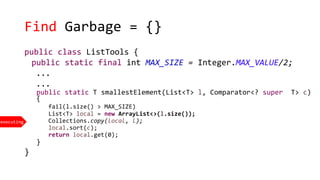
Find Garbage = {}
executing
public class ListTools {
public static final int MAX_SIZE = Integer.MAX_VALUE/2;
...
...
public static T smallestElement(List<T> l, Comparator<? super T> c)
{
fail(l.size() > MAX_SIZE)
List<T> local = new ArrayList<>(l.size());
Collections.copy(local, l);
local.sort(c);
return local.get(0);
}
}
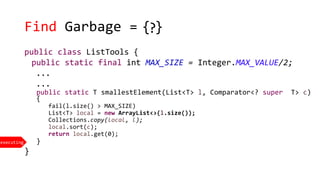
Find Garbage =
executing
{ }?
public class ListTools {
public static final int MAX_SIZE = Integer.MAX_VALUE/2;
...
...
public static T smallestElement(List<T> l, Comparator<? super T> c)
{
fail(l.size() > MAX_SIZE)
List<T> local = new ArrayList<>(l.size());
Collections.copy(local, l);
local.sort(c);
return local.get(0);
}
}
Find Garbage =
executing
{ }__in red__
public class ListTools {
public static final int MAX_SIZE = Integer.MAX_VALUE/2;
...
...
public static T smallestElement(List<T> l, Comparator<? super T> c)
{
fail(l.size() > MAX_SIZE)
List<T> local = new ArrayList<>(l.size());
Collections.copy(local, l);
local.sort(c);
return local.get(0);
}
}
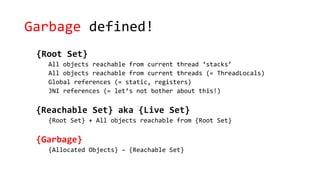
Garbage defined!
{Root Set}
All objects reachable from current thread ‘stacks’
All objects reachable from current threads (= ThreadLocals)
Global references (= static, registers)
JNI references (= let’s not bother about this!)
{Reachable Set} aka {Live Set}
{Root Set} + All objects reachable from {Root Set}
{Garbage}
{Allocated Objects} – {Reachable Set}
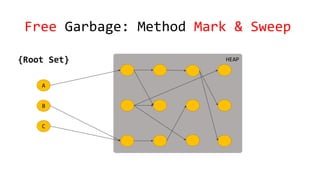
HEAP
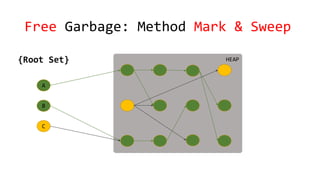
Free Garbage: Method Mark & Sweep
{Root Set}
A
B
C
HEAP
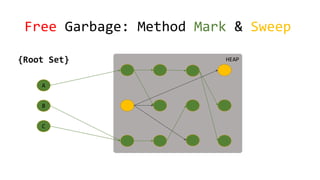
Free Garbage: Method Mark & Sweep
{Root Set}
A
B
C
HEAP
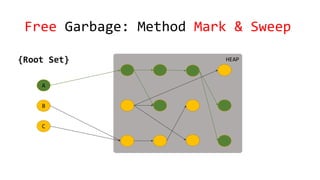
Free Garbage: Method Mark & Sweep
{Root Set}
A
B
C
HEAP
Free Garbage: Method Mark & Sweep
{Root Set}
A
B
C
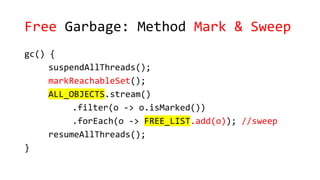
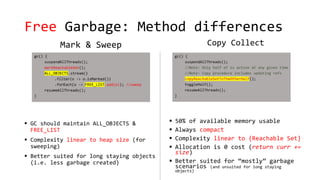
Free Garbage: Method Mark & Sweep
gc() {
suspendAllThreads();
markReachableSet();
ALL_OBJECTS.stream()
.filter(o -> o.isMarked())
.forEach(o -> FREE_LIST.add(o)); //sweep
resumeAllThreads();
}
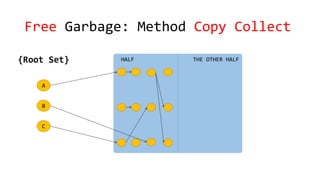
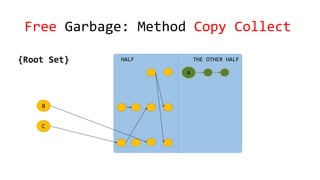
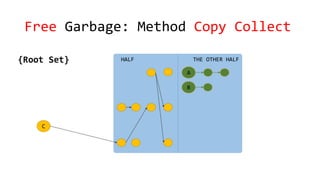
Free Garbage: Method Copy Collect
HALF THE OTHER HALF{Root Set}
A
B
C
Free Garbage: Method Copy Collect
HALF THE OTHER HALF{Root Set}
A
B
C
Free Garbage: Method Copy Collect
HALF THE OTHER HALF{Root Set}
A
C
B
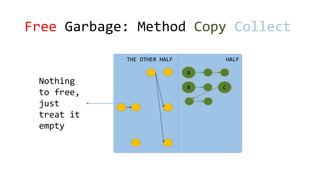
Free Garbage: Method Copy Collect
THE OTHER HALF HALF
A
B C
Nothing
to free,
just
treat it
empty
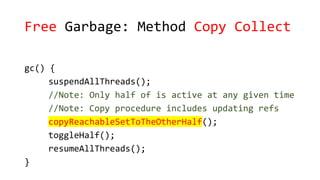
Free Garbage: Method Copy Collect
gc() {
suspendAllThreads();
//Note: Only half of is active at any given time
//Note: Copy procedure includes updating refs
copyReachableSetToTheOtherHalf();
toggleHalf();
resumeAllThreads();
}
POP QUIZ #5
Spot as many differences (data structures,
performance characteristics etc.) between the two
methods?
Free Garbage: Method differences
Mark & Sweep
 GC should maintain ALL_OBJECTS &
FREE_LIST
 Complexity linear to heap size (for
sweeping)
 Better suited for long staying objects
(i.e. less garbage created)
Copy Collect
 50% of available memory usable
 Always compact
 Complexity linear to {Reachable Set}
 Allocation is 0 cost (return curr +=
size)
 Better suited for “mostly” garbage
scenarios (and unsuited for long staying
objects)
POP QUIZ #6
‘concurrent’ vs ‘parallel’ GC?
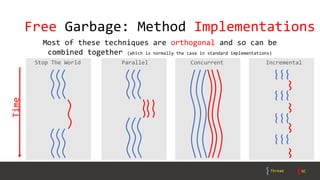
Free Garbage: Method Implementations
Stop The World
Time
Parallel Concurrent
Thread GC
Incremental
Most of these techniques are orthogonal and so can be
combined together (which is normally the case in standard implementations)
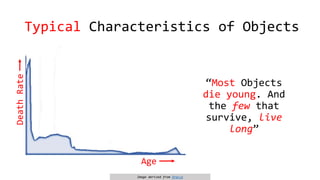
Typical Characteristics of Objects
“Most Objects
die young. And
the few that
survive, live
long”
Age
DeathRate
Image derived from Oracle
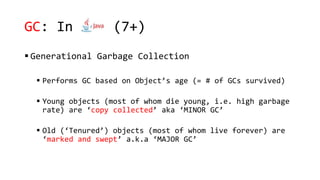
GC: In java(7+)
 Generational Garbage Collection
 Performs GC based on Object’s age (= # of GCs survived)
 Young objects (most of whom die young, i.e. high garbage
rate) are ‘copy collected’ aka ‘MINOR GC’
 Old (‘Tenured’) objects (most of whom live forever) are
‘marked and swept’ a.k.a ‘MAJOR GC’
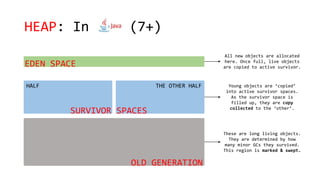
HEAP: In java(7+)
EDEN SPACE
All new objects are allocated
here. Once full, live objects
are copied to active survivor.
HALF THE OTHER HALF
SURVIVOR SPACES
Young objects are ‘copied’
into active survivor spaces.
As the survivor space is
filled up, they are copy
collected to the ‘other’.
These are long living objects.
They are determined by how
many minor GCs they survived.
This region is marked & swept.
OLD GENERATION
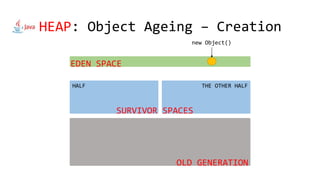
HEAP: Object Ageing – Creation
EDEN SPACE
HALF THE OTHER HALF
SURVIVOR SPACES
OLD GENERATION
new Object()
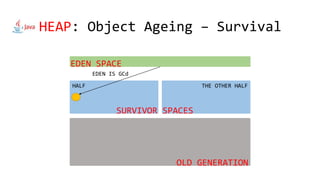
HEAP: Object Ageing – Survival
HALF THE OTHER HALF
EDEN IS GCd
EDEN SPACE
SURVIVOR SPACES
OLD GENERATION
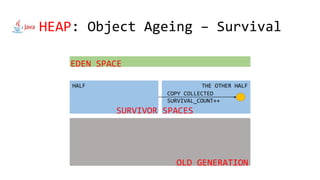
HEAP: Object Ageing – Survival
HALF THE OTHER HALF
COPY COLLECTED
SURVIVAL_COUNT++
EDEN SPACE
SURVIVOR SPACES
OLD GENERATION
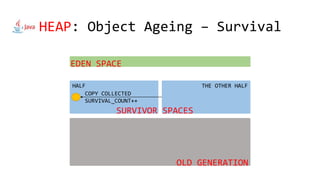
HEAP: Object Ageing – Survival
HALF THE OTHER HALF
COPY COLLECTED
SURVIVAL_COUNT++
EDEN SPACE
SURVIVOR SPACES
OLD GENERATION
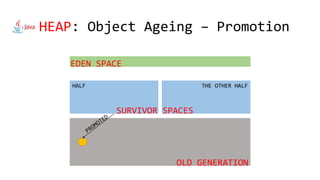
HEAP: Object Ageing – Promotion
HALF THE OTHER HALF
EDEN SPACE
SURVIVOR SPACES
OLD GENERATION
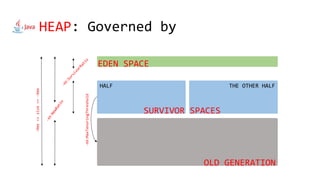
HEAP: Governed by
HALF THE OTHER HALF
EDEN SPACE
SURVIVOR SPACES
OLD GENERATION
-Xms<=size<=-Xmx
-XX:MaxTenuringThreshold
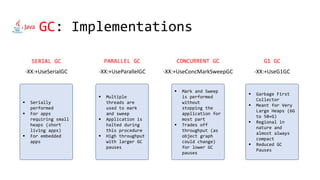
GC: Implementations
-XX:+UseSerialGC
SERIAL GC
-XX:+UseParallelGC
PARALLEL GC
-XX:+UseConcMarkSweepGC
CONCURRENT GC
-XX:+UseG1GC
G1 GC
 Serially
performed
 For apps
requiring small
heaps (short
living apps)
 For embedded
apps
 Multiple
threads are
used to mark
and sweep
 Application is
halted during
this procedure
 High throughput
with larger GC
pauses
 Mark and Sweep
is performed
without
stopping the
application for
most part
 Trades off
throughput (as
object graph
could change)
for lower GC
pauses
 Garbage First
Collector
 Meant for Very
Large Heaps (6G
to 50+G)
 Regional in
nature and
almost always
compact
 Reduced GC
Pauses
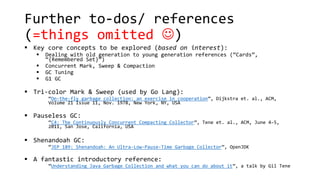
Further to-dos/ references
(=things omitted )
 Key core concepts to be explored (based on interest):
 Dealing with old generation to young generation references (“Cards”,
“{Remembered Set}”)
 Concurrent Mark, Sweep & Compaction
 GC Tuning
 G1 GC
 Tri-color Mark & Sweep (used by Go Lang):
“On-the-fly garbage collection: an exercise in cooperation”, Dijkstra et. al., ACM,
Volume 21 Issue 11, Nov. 1978, New York, NY, USA
 Pauseless GC:
“C4: The Continuously Concurrent Compacting Collector”, Tene et. al., ACM, June 4–5,
2011, San Jose, California, USA
 Shenandoah GC:
“JEP 189: Shenandoah: An Ultra-Low-Pause-Time Garbage Collector”, OpenJDK
 A fantastic introductory reference:
“Understanding Java Garbage Collection and what you can do about it”, a talk by Gil Tene

Garbage collection

  • 1.
  • 2.
    POP QUIZ #1 Whatis the first language runtime with Garbage Collection?
  • 3.
    POP QUIZ #1 Whatis the first language runtime with Garbage Collection? LISP By John McCarthy in 1959
  • 4.
    This talk isabout? 1. Background on Memory Management to understand what GC is expected to do 2. Methods to do GC & Implications 3. Different implementations of the methods 4. Finally, in Java
  • 5.
    Thought experiment Imagine thereis no GC (think of C)
  • 6.
    Thought experiment Imagine thereis no GC (think of C) malloc(size) { POP QUIZ #2 What does it do? }
  • 7.
    Thought experiment Imagine thereis no GC (think of C) malloc(size) { /* 1. Check if any of the already allocated memory is free enough 1. If yes, mark it as used and return 2. If no, see if OS can give more memory 1. If yes, return that 2. If no, fail */ }
  • 8.
    Thought experiment Imagine thereis no GC (think of C) malloc(size) { /* 1. Check if any of the already allocated memory is free enough 1. If yes, mark it as used and return 2. If no, see if OS can give more memory 1. If yes, return that 2. If no, fail */ } Free Memory List maintained by C runtime
  • 9.
    Thought experiment Imagine thereis no GC (think of C) malloc(size) { /* 1. Check if any of the already allocated memory is free enough 1. If yes, mark it as used and return 2. If no, see if OS can give more memory 1. If yes, return that 2. If no, fail */ } Free Memory List maintained by C runtime free(_ptr) { /* 1. Add this memory to free list */ }
  • 10.
    POP QUIZ #3 Whatusually happens if malloc() and free() just do what’s described here?
  • 11.
    Allocate & Freeonly Free Memory List M X S S XXL L X S XL maintained by C runtime M X S S XXL L X S XL X S X S X S X S X S X S X S X S X S X S X S X S X S X S X S X S X S X S X S X S X S X S X S X S X S X S X S X S X S X S X S X S X S X S X S X S X S X S X S X S X S Heap Memory X S Free memory with sizes >= ‘s’ for small Used memoryThread
  • 12.
    Allocate & Freeonly Free Memory List M X S S XXL L X S XL maintained by C runtime M X S S XXL L X S XL X S X S X S X S X S X S X S X S X S X S X S X S X S X S X S X S X S X S X S X S X S X S X S X S X S X S X S X S X S X S X S X S X S X S X S X S X S X S X S X S Heap Memory X S X S Free memory with sizes >= ‘s’ for small Used memory Free memory with sizes >= ‘s’ for small Used memoryThread
  • 13.
    Allocate & Free+ Compaction Free Memory List M X S S XXL L X S XL maintained by C runtime M X S S XXL L X S XL X S X S X S X S X S X S X S X S X S X S X S X S X S X S X S X S X S X S X S X S X S X S X S X S X S X S X S X S X S X S X S X S X S X S X S X S X S X S X S X S Heap Memory > XXXL > XXXL References to moved allocations must point to the new address – Not cheap Free memory with sizes >= ‘s’ for small Used memoryThread
  • 14.
    Garbage Collection –Defined An automatic memory management system that efficiently allocates memory at the point of need without requiring applications to free-up the memory explicitly. To do so, it should: 1. Should allocate memory when application needs 2. It should free up unused memory when necessary 3. It should keep memory in a good shape to avoid fragmentation
  • 15.
    Garbage Collection -Methods REFERENCE COUNTING  Every object maintains the count of number of references to itself  This counter is incremented whenever a new reference is created for an object (e.g. Object o = x;)  This counter is decremented whenever a reference for an object goes out of ‘scope’  All objects with count = 0 can be freed  Cyclic references must be detected and dealt with OR will not be collected (developers’ headache) TRACING  When there is need for memory,  Find all the objects that are not usable by the application  Free them  The process of figuring out what is not useable (or useable) is called ‘tracing’
  • 16.
    Garbage Collection -Methods REFERENCE COUNTING  Every object maintains the count of number of references to itself  This counter is incremented whenever a new reference is created for an object (e.g. Object o = x;)  This counter is decremented whenever a reference for an object goes out of ‘scope’  All objects with count = 0 can be freed  Cyclic references must be detected and dealt with OR will not be collected (developers’ headache) TRACING  When there is need for memory,  Find all the objects that are not usable by the application  Free them  The process of figuring out what is not useable (or useable) is called ‘tracing’ POPQUIZ#4What’sthis?
  • 17.
    Garbage Collection -Methods REFERENCE COUNTING  Every object maintains the count of number of references to itself  This counter is incremented whenever a new reference is created for an object (e.g. Object o = x;)  This counter is decremented whenever a reference for an object goes out of ‘scope’  All objects with count = 0 can be freed  Cyclic references must be detected and dealt with OR will not be collected (developers’ headache) TRACING  When there is need for memory,  Find all the objects that are not usable by the application  Collect (=free) them  The process of figuring out what is not useable (or useable) is called ‘tracing’
  • 18.
    Find Garbage ={} public class ListTools { public static final int MAX_SIZE = Integer.MAX_VALUE/2; ... ... public static T smallestElement(List<T> l, Comparator<? super T> c) { fail(l.size() > MAX_SIZE) List<T> local = new ArrayList<>(l.size()); Collections.copy(local, l); local.sort(c); return local.get(0); } } executing
  • 19.
    Find Garbage ={} executing public class ListTools { public static final int MAX_SIZE = Integer.MAX_VALUE/2; ... ... public static T smallestElement(List<T> l, Comparator<? super T> c) { fail(l.size() > MAX_SIZE) List<T> local = new ArrayList<>(l.size()); Collections.copy(local, l); local.sort(c); return local.get(0); } }
  • 20.
    Find Garbage = executing {}? public class ListTools { public static final int MAX_SIZE = Integer.MAX_VALUE/2; ... ... public static T smallestElement(List<T> l, Comparator<? super T> c) { fail(l.size() > MAX_SIZE) List<T> local = new ArrayList<>(l.size()); Collections.copy(local, l); local.sort(c); return local.get(0); } }
  • 21.
    Find Garbage = executing {}__in red__ public class ListTools { public static final int MAX_SIZE = Integer.MAX_VALUE/2; ... ... public static T smallestElement(List<T> l, Comparator<? super T> c) { fail(l.size() > MAX_SIZE) List<T> local = new ArrayList<>(l.size()); Collections.copy(local, l); local.sort(c); return local.get(0); } }
  • 22.
    Garbage defined! {Root Set} Allobjects reachable from current thread ‘stacks’ All objects reachable from current threads (= ThreadLocals) Global references (= static, registers) JNI references (= let’s not bother about this!) {Reachable Set} aka {Live Set} {Root Set} + All objects reachable from {Root Set} {Garbage} {Allocated Objects} – {Reachable Set}
  • 23.
    HEAP Free Garbage: MethodMark & Sweep {Root Set} A B C
  • 24.
    HEAP Free Garbage: MethodMark & Sweep {Root Set} A B C
  • 25.
    HEAP Free Garbage: MethodMark & Sweep {Root Set} A B C
  • 26.
    HEAP Free Garbage: MethodMark & Sweep {Root Set} A B C
  • 27.
    Free Garbage: MethodMark & Sweep gc() { suspendAllThreads(); markReachableSet(); ALL_OBJECTS.stream() .filter(o -> o.isMarked()) .forEach(o -> FREE_LIST.add(o)); //sweep resumeAllThreads(); }
  • 28.
    Free Garbage: MethodCopy Collect HALF THE OTHER HALF{Root Set} A B C
  • 29.
    Free Garbage: MethodCopy Collect HALF THE OTHER HALF{Root Set} A B C
  • 30.
    Free Garbage: MethodCopy Collect HALF THE OTHER HALF{Root Set} A C B
  • 31.
    Free Garbage: MethodCopy Collect THE OTHER HALF HALF A B C Nothing to free, just treat it empty
  • 32.
    Free Garbage: MethodCopy Collect gc() { suspendAllThreads(); //Note: Only half of is active at any given time //Note: Copy procedure includes updating refs copyReachableSetToTheOtherHalf(); toggleHalf(); resumeAllThreads(); }
  • 33.
    POP QUIZ #5 Spotas many differences (data structures, performance characteristics etc.) between the two methods?
  • 34.
    Free Garbage: Methoddifferences Mark & Sweep  GC should maintain ALL_OBJECTS & FREE_LIST  Complexity linear to heap size (for sweeping)  Better suited for long staying objects (i.e. less garbage created) Copy Collect  50% of available memory usable  Always compact  Complexity linear to {Reachable Set}  Allocation is 0 cost (return curr += size)  Better suited for “mostly” garbage scenarios (and unsuited for long staying objects)
  • 35.
    POP QUIZ #6 ‘concurrent’vs ‘parallel’ GC?
  • 36.
    Free Garbage: MethodImplementations Stop The World Time Parallel Concurrent Thread GC Incremental Most of these techniques are orthogonal and so can be combined together (which is normally the case in standard implementations)
  • 37.
    Typical Characteristics ofObjects “Most Objects die young. And the few that survive, live long” Age DeathRate Image derived from Oracle
  • 38.
    GC: In java(7+) Generational Garbage Collection  Performs GC based on Object’s age (= # of GCs survived)  Young objects (most of whom die young, i.e. high garbage rate) are ‘copy collected’ aka ‘MINOR GC’  Old (‘Tenured’) objects (most of whom live forever) are ‘marked and swept’ a.k.a ‘MAJOR GC’
  • 39.
    HEAP: In java(7+) EDENSPACE All new objects are allocated here. Once full, live objects are copied to active survivor. HALF THE OTHER HALF SURVIVOR SPACES Young objects are ‘copied’ into active survivor spaces. As the survivor space is filled up, they are copy collected to the ‘other’. These are long living objects. They are determined by how many minor GCs they survived. This region is marked & swept. OLD GENERATION
  • 40.
    HEAP: Object Ageing– Creation EDEN SPACE HALF THE OTHER HALF SURVIVOR SPACES OLD GENERATION new Object()
  • 41.
    HEAP: Object Ageing– Survival HALF THE OTHER HALF EDEN IS GCd EDEN SPACE SURVIVOR SPACES OLD GENERATION
  • 42.
    HEAP: Object Ageing– Survival HALF THE OTHER HALF COPY COLLECTED SURVIVAL_COUNT++ EDEN SPACE SURVIVOR SPACES OLD GENERATION
  • 43.
    HEAP: Object Ageing– Survival HALF THE OTHER HALF COPY COLLECTED SURVIVAL_COUNT++ EDEN SPACE SURVIVOR SPACES OLD GENERATION
  • 44.
    HEAP: Object Ageing– Promotion HALF THE OTHER HALF EDEN SPACE SURVIVOR SPACES OLD GENERATION
  • 45.
    HEAP: Governed by HALFTHE OTHER HALF EDEN SPACE SURVIVOR SPACES OLD GENERATION -Xms<=size<=-Xmx -XX:MaxTenuringThreshold
  • 46.
    GC: Implementations -XX:+UseSerialGC SERIAL GC -XX:+UseParallelGC PARALLELGC -XX:+UseConcMarkSweepGC CONCURRENT GC -XX:+UseG1GC G1 GC  Serially performed  For apps requiring small heaps (short living apps)  For embedded apps  Multiple threads are used to mark and sweep  Application is halted during this procedure  High throughput with larger GC pauses  Mark and Sweep is performed without stopping the application for most part  Trades off throughput (as object graph could change) for lower GC pauses  Garbage First Collector  Meant for Very Large Heaps (6G to 50+G)  Regional in nature and almost always compact  Reduced GC Pauses
  • 47.
    Further to-dos/ references (=thingsomitted )  Key core concepts to be explored (based on interest):  Dealing with old generation to young generation references (“Cards”, “{Remembered Set}”)  Concurrent Mark, Sweep & Compaction  GC Tuning  G1 GC  Tri-color Mark & Sweep (used by Go Lang): “On-the-fly garbage collection: an exercise in cooperation”, Dijkstra et. al., ACM, Volume 21 Issue 11, Nov. 1978, New York, NY, USA  Pauseless GC: “C4: The Continuously Concurrent Compacting Collector”, Tene et. al., ACM, June 4–5, 2011, San Jose, California, USA  Shenandoah GC: “JEP 189: Shenandoah: An Ultra-Low-Pause-Time Garbage Collector”, OpenJDK  A fantastic introductory reference: “Understanding Java Garbage Collection and what you can do about it”, a talk by Gil Tene