Gamma Rays
By: Vance Leyva
Per. 1
Defined:
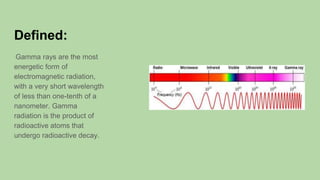
Gamma rays are the most
energetic form of
electromagnetic radiation,
with a very short wavelength
of less than one-tenth of a
nanometer. Gamma
radiation is the product of
radioactive atoms that
undergo radioactive decay.
History :
The first gamma ray source
to be discovered was the
radioactive decay process
called gamma decay. Paul
Villard a French chemist and
physicist, discovered gamma
radiation in 1900, while
studying radiation emitted
from radium. Villard knew his
described radiation was
more powerful than the
previously described alpha
and beta rays already found.
Defined (cont.)
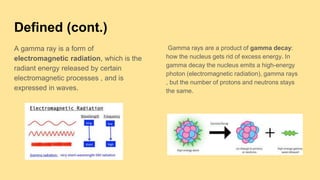
A gamma ray is a form of
electromagnetic radiation, which is the
radiant energy released by certain
electromagnetic processes , and is
expressed in waves.
Gamma rays are a product of gamma decay:
how the nucleus gets rid of excess energy. In
gamma decay the nucleus emits a high-energy
photon (electromagnetic radiation), gamma rays
, but the number of protons and neutrons stays
the same.
Characteristics:
A gamma ray has a typical
frequency of 10^19 Hz and
wavelengths of around 10^-
11 meter. Gamma rays are
now usually distinguished by
their origin; x-rays are
emitted by electrons outside
the nucleus while gamma
rays are emitted by the
nucleus
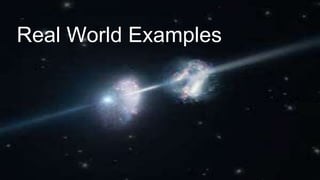
Real World Examples
Lightning Strikes
Terrestrial gamma ray flashes
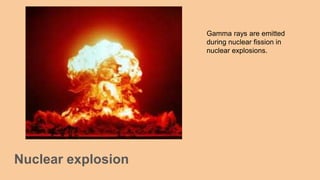
Nuclear explosion
Gamma rays are emitted
during nuclear fission in
nuclear explosions.
Biological:
Gamma rays cause damage at a cellular level and are penetrating, causing severe
damage throughout the body.
Low levels of Gama radiation = cancer induction / genetic damage
High levels of Gama radiation = varying severity of are cute tissue damage
Works Cited:
www.wikipedia.org/gama_rays
www.NASA.gov/gammarays
www.livescience.com/50215-gamma-rays

Gamma rays

  • 1.
  • 2.
    Defined: Gamma rays arethe most energetic form of electromagnetic radiation, with a very short wavelength of less than one-tenth of a nanometer. Gamma radiation is the product of radioactive atoms that undergo radioactive decay.
  • 3.
    History : The firstgamma ray source to be discovered was the radioactive decay process called gamma decay. Paul Villard a French chemist and physicist, discovered gamma radiation in 1900, while studying radiation emitted from radium. Villard knew his described radiation was more powerful than the previously described alpha and beta rays already found.
  • 4.
    Defined (cont.) A gammaray is a form of electromagnetic radiation, which is the radiant energy released by certain electromagnetic processes , and is expressed in waves. Gamma rays are a product of gamma decay: how the nucleus gets rid of excess energy. In gamma decay the nucleus emits a high-energy photon (electromagnetic radiation), gamma rays , but the number of protons and neutrons stays the same.
  • 5.
    Characteristics: A gamma rayhas a typical frequency of 10^19 Hz and wavelengths of around 10^- 11 meter. Gamma rays are now usually distinguished by their origin; x-rays are emitted by electrons outside the nucleus while gamma rays are emitted by the nucleus
  • 6.
  • 7.
  • 8.
  • 10.
    Nuclear explosion Gamma raysare emitted during nuclear fission in nuclear explosions.
  • 11.
    Biological: Gamma rays causedamage at a cellular level and are penetrating, causing severe damage throughout the body. Low levels of Gama radiation = cancer induction / genetic damage High levels of Gama radiation = varying severity of are cute tissue damage
  • 12.