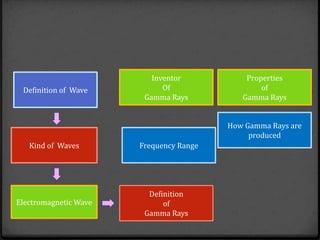
Definition of Wave

Inventor
Of
Gamma Rays

Properties
of
Gamma Rays
How Gamma Rays are
produced

Kind of Waves

Electromagnetic Wave

Frequency Range

Definition
of
Gamma Rays
DEFINITION of WAVE
Wave is the propagation of vibration or disturbance
symptoms from one location to another by transferring
energy.
KIND of WAVE
0 Based on their medium :
1. Mechanical waves
2. Electromagnetic wave
0 Based on the direction of vibration against the

direction of its propagation :
1. Tranverse waves
2. Longitudinal waves
ELECTROMAGNETIC WAVE
0 Electromagnetic wave is the propagation symptom of

electric and magnetic fields which are perpendicular to
each other and change periodically

0 Electomagnetic waves :

- radio waves
- mikrowave
- Infrared rays
- Visible light
- Ultarviolet rays
- X-ray

- Gamma Rays
DEFINITION of GAMMA RAYS
Gamma rays ( often denoted by the Greek letter
gamma, γ) is an energetic form of electromagnetic
radiation produced by radioactivity or nuclear or
subatomic processes such as electron-positron
destruction.
INVENTOR of GAMMA RAYS
Paul Ulrich Villard, a French chemist and
physicist, discovered gamma radiation in
1900, while studying radiation emitted
from radium. Villard knew that his described
radiation was more powerful than previously
described rays from radium, but did not
consider naming them as a different
fundamental type.
FREQUENCY RANGE
0 Gamma rays
• Wavelength
• Frequency

: 10-11 meter - 10-14 meter
: 1018 - 1022 Hz

0 Gamma rays are electromagnetic wave which have the

the highest frequency and the shortest wave

0 This wave has the big energy and can through metal

and concrete
PROPERTIES OF GAMMA RAYS
0 Sources

: radio-isotopes, nuclear reactions, the core an
unstable atom

0 Description : Electromagnetic radiation
0 Energy

: up to a few MeV

0 Permeability : a very large
0 Wavelength : 10-11 to 10-14 m

0 Gamma rays have the shortest wavelength and highest frequency of all EM

radiation

0 Didn’t have a mass
0 Gamma rays are produced in areas of extremely high temperature, density

and magnetic fields

0
0
0
0
0

The penetration of very large
It can not be deflected by electric and magnetic fields
Has the shortest wavelength
Energy is very large and very destructive
Less ionize
How Gamma Rays Produced
Gamma rays can be produced in labs through the
process of nuclear collision and also through the
artificial radioactivity that accompanies these
interactions. The high-energy nuclei needed for the
collisions are accelerated by devices such as the
cyclotron and synchrotron.
USES of GAMMA RAYS
0 Medicine

Gamma rays are used in medicine to kill and treat certain types of cancers and tumors.
Gamma rays passing through tissue of the body produce ionization in tissue. Gamma rays can
harm the cells in our body. The rays can also detect brain and cardiovascular abnormalities.
0 Industry

Gamma rays can be used to examine metallic castings or welds in oil pipelines for weak
points. The rays pass through the metal and darken a photographic film at places opposite the
weak points. In industry, gamma rays are used for detecting internal defects in metal castings
and in welded structures. Gamma rays are used to kill pesticides and bugs in food. Gamma rays
are also used in nuclear reactors and atomic bombs.
0 Consumer goods

Gamma rays are often used in the food industry. The radioisotopes preserve foods. Although
the rays never come in contact with food, beta radiation kills various organisms, such as
bacteria, yeast, and insects.
0 Science

Gamma rays can be used to detect beryllium. They also played a very important role in the
development of the atom bomb.
DANGERS of GAMMA RAYS
Gamma rays bombard our bodies constantly.
They come from the naturally radioactive materials in
rocks and the soil. We take some of these materials
into our bodies from the air we breathe and the water
we drink. Gamma rays passing through our body
produce ionization in tissue. High levels of gamma
rays can produce dangerous ionization of the tissue
and can cause skin cancer.
What is the difference between gamma
rays and X-rays ?
The key difference between gamma rays and X-rays
is how they are produced. Gamma rays originate from
the nucleus of a radionuclide after radioactive decay
whereas X-rays are produced when electrons strike a
target or when electrons are rearranged within an
atom. Cosmic rays also include high-energy photons and
these are also called gamma-rays whether or not they
originated from nuclear decay or reaction.
CONCLUSION
Gamma ray is an electromagnetic waves which have :
 The shortest wavelenght, and
 The highest frequency

Sinar Agama

  • 2.
    Definition of Wave Inventor Of GammaRays Properties of Gamma Rays How Gamma Rays are produced Kind of Waves Electromagnetic Wave Frequency Range Definition of Gamma Rays
  • 3.
    DEFINITION of WAVE Waveis the propagation of vibration or disturbance symptoms from one location to another by transferring energy.
  • 4.
    KIND of WAVE 0Based on their medium : 1. Mechanical waves 2. Electromagnetic wave 0 Based on the direction of vibration against the direction of its propagation : 1. Tranverse waves 2. Longitudinal waves
  • 5.
    ELECTROMAGNETIC WAVE 0 Electromagneticwave is the propagation symptom of electric and magnetic fields which are perpendicular to each other and change periodically 0 Electomagnetic waves : - radio waves - mikrowave - Infrared rays - Visible light - Ultarviolet rays - X-ray - Gamma Rays
  • 6.
    DEFINITION of GAMMARAYS Gamma rays ( often denoted by the Greek letter gamma, γ) is an energetic form of electromagnetic radiation produced by radioactivity or nuclear or subatomic processes such as electron-positron destruction.
  • 7.
    INVENTOR of GAMMARAYS Paul Ulrich Villard, a French chemist and physicist, discovered gamma radiation in 1900, while studying radiation emitted from radium. Villard knew that his described radiation was more powerful than previously described rays from radium, but did not consider naming them as a different fundamental type.
  • 8.
    FREQUENCY RANGE 0 Gammarays • Wavelength • Frequency : 10-11 meter - 10-14 meter : 1018 - 1022 Hz 0 Gamma rays are electromagnetic wave which have the the highest frequency and the shortest wave 0 This wave has the big energy and can through metal and concrete
  • 9.
    PROPERTIES OF GAMMARAYS 0 Sources : radio-isotopes, nuclear reactions, the core an unstable atom 0 Description : Electromagnetic radiation 0 Energy : up to a few MeV 0 Permeability : a very large 0 Wavelength : 10-11 to 10-14 m 0 Gamma rays have the shortest wavelength and highest frequency of all EM radiation 0 Didn’t have a mass 0 Gamma rays are produced in areas of extremely high temperature, density and magnetic fields 0 0 0 0 0 The penetration of very large It can not be deflected by electric and magnetic fields Has the shortest wavelength Energy is very large and very destructive Less ionize
  • 10.
    How Gamma RaysProduced Gamma rays can be produced in labs through the process of nuclear collision and also through the artificial radioactivity that accompanies these interactions. The high-energy nuclei needed for the collisions are accelerated by devices such as the cyclotron and synchrotron.
  • 11.
    USES of GAMMARAYS 0 Medicine Gamma rays are used in medicine to kill and treat certain types of cancers and tumors. Gamma rays passing through tissue of the body produce ionization in tissue. Gamma rays can harm the cells in our body. The rays can also detect brain and cardiovascular abnormalities. 0 Industry Gamma rays can be used to examine metallic castings or welds in oil pipelines for weak points. The rays pass through the metal and darken a photographic film at places opposite the weak points. In industry, gamma rays are used for detecting internal defects in metal castings and in welded structures. Gamma rays are used to kill pesticides and bugs in food. Gamma rays are also used in nuclear reactors and atomic bombs. 0 Consumer goods Gamma rays are often used in the food industry. The radioisotopes preserve foods. Although the rays never come in contact with food, beta radiation kills various organisms, such as bacteria, yeast, and insects. 0 Science Gamma rays can be used to detect beryllium. They also played a very important role in the development of the atom bomb.
  • 12.
    DANGERS of GAMMARAYS Gamma rays bombard our bodies constantly. They come from the naturally radioactive materials in rocks and the soil. We take some of these materials into our bodies from the air we breathe and the water we drink. Gamma rays passing through our body produce ionization in tissue. High levels of gamma rays can produce dangerous ionization of the tissue and can cause skin cancer.
  • 13.
    What is thedifference between gamma rays and X-rays ? The key difference between gamma rays and X-rays is how they are produced. Gamma rays originate from the nucleus of a radionuclide after radioactive decay whereas X-rays are produced when electrons strike a target or when electrons are rearranged within an atom. Cosmic rays also include high-energy photons and these are also called gamma-rays whether or not they originated from nuclear decay or reaction.
  • 14.
    CONCLUSION Gamma ray isan electromagnetic waves which have :  The shortest wavelenght, and  The highest frequency