


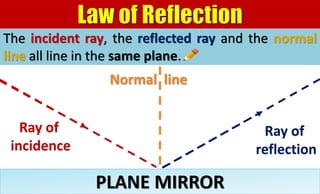
The incident ray, the reflected ray and the normal
line all line in the same plane.
PLANE MIRROR
Ray of
incidence
Ray of
reflection
Normal line
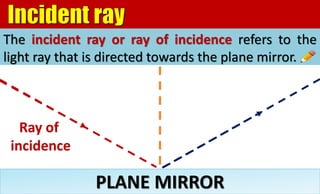
The incident ray or ray of incidence refers to the
light ray that is directed towards the plane mirror.
PLANE MIRROR
Ray of
incidence
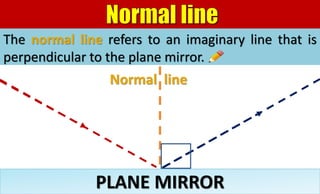
The normal line refers to an imaginary line that is
perpendicular to the plane mirror.
PLANE MIRROR
Normal line
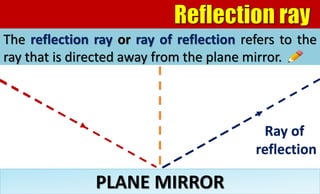
The reflection ray or ray of reflection refers to the
ray that is directed away from the plane mirror.
PLANE MIRROR
Ray of
reflection
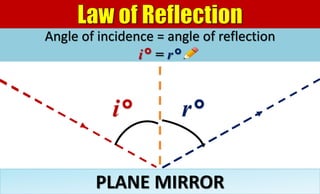
PLANE MIRROR
Angle of incidence = angle of reflection
i° = r°
i° r°
PLANE MIRROR
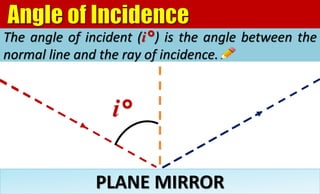
The angle of incident (i°) is the angle between the
normal line and the ray of incidence.
i°
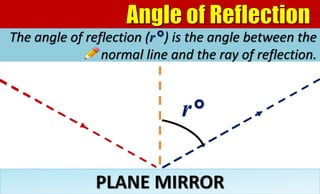
PLANE MIRROR
r°
The angle of reflection (r°) is the angle between the
normal line and the ray of reflection.
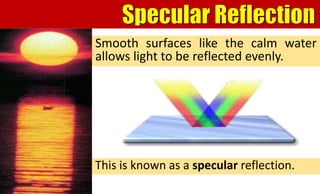
Smooth surfaces like the calm water
allows light to be reflected evenly.
This is known as a specular reflection.
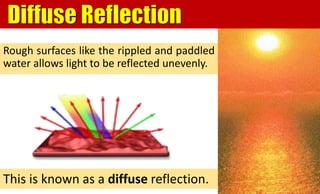
Rough surfaces like the rippled and paddled
water allows light to be reflected unevenly.
This is known as a diffuse reflection.
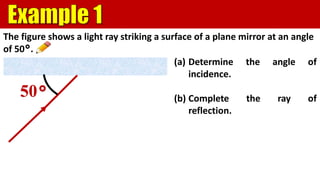
The figure shows a light ray striking a surface of a plane mirror at an angle
of 50°.
50°
(a) Determine the angle of
incidence.
(b) Complete the ray of
reflection.
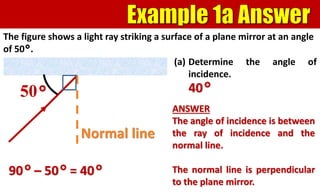
The figure shows a light ray striking a surface of a plane mirror at an angle
of 50°.
50°
(a) Determine the angle of
incidence.
ANSWER
The angle of incidence is between
the ray of incidence and the
normal line.
The normal line is perpendicular
to the plane mirror.
90° – 50° = 40°
40°
Normal line
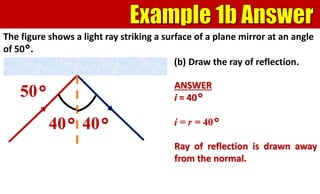
The figure shows a light ray striking a surface of a plane mirror at an angle
of 50°.
50°
(b) Draw the ray of reflection.
40° 40°
ANSWER
i = 40°
i = r = 40°
Ray of reflection is drawn away
from the normal.
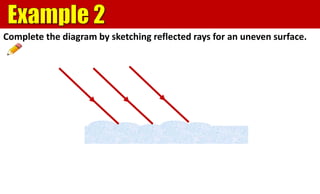
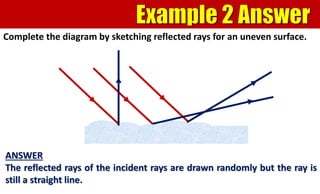
Complete the diagram by sketching reflected rays for an uneven surface.
ANSWER
The reflected rays of the incident rays are drawn randomly but the ray is
still a straight line.
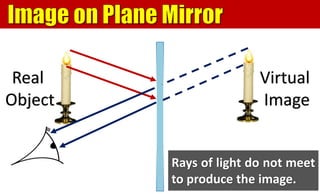
Real
Object
Virtual
Image
Rays of light do not meet
to produce the image.
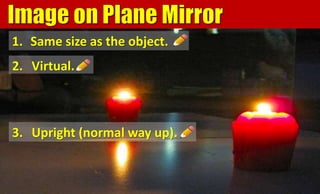
3. Upright (normal way up).
1. Same size as the object.
2. Virtual.
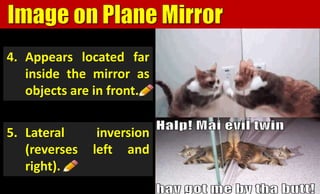
4. Appears located far
inside the mirror as
objects are in front.
5. Lateral inversion
(reverses left and
right).

9 PS Light II AO

  • 4.
    The incident ray,the reflected ray and the normal line all line in the same plane. PLANE MIRROR Ray of incidence Ray of reflection Normal line
  • 5.
    The incident rayor ray of incidence refers to the light ray that is directed towards the plane mirror. PLANE MIRROR Ray of incidence
  • 6.
    The normal linerefers to an imaginary line that is perpendicular to the plane mirror. PLANE MIRROR Normal line
  • 7.
    The reflection rayor ray of reflection refers to the ray that is directed away from the plane mirror. PLANE MIRROR Ray of reflection
  • 8.
    PLANE MIRROR Angle ofincidence = angle of reflection i° = r° i° r°
  • 9.
    PLANE MIRROR The angleof incident (i°) is the angle between the normal line and the ray of incidence. i°
  • 10.
    PLANE MIRROR r° The angleof reflection (r°) is the angle between the normal line and the ray of reflection.
  • 11.
    Smooth surfaces likethe calm water allows light to be reflected evenly. This is known as a specular reflection.
  • 12.
    Rough surfaces likethe rippled and paddled water allows light to be reflected unevenly. This is known as a diffuse reflection.
  • 13.
    The figure showsa light ray striking a surface of a plane mirror at an angle of 50°. 50° (a) Determine the angle of incidence. (b) Complete the ray of reflection.
  • 14.
    The figure showsa light ray striking a surface of a plane mirror at an angle of 50°. 50° (a) Determine the angle of incidence. ANSWER The angle of incidence is between the ray of incidence and the normal line. The normal line is perpendicular to the plane mirror. 90° – 50° = 40° 40° Normal line
  • 15.
    The figure showsa light ray striking a surface of a plane mirror at an angle of 50°. 50° (b) Draw the ray of reflection. 40° 40° ANSWER i = 40° i = r = 40° Ray of reflection is drawn away from the normal.
  • 16.
    Complete the diagramby sketching reflected rays for an uneven surface.
  • 17.
    Complete the diagramby sketching reflected rays for an uneven surface. ANSWER The reflected rays of the incident rays are drawn randomly but the ray is still a straight line.
  • 18.
    Real Object Virtual Image Rays of lightdo not meet to produce the image.
  • 19.
    3. Upright (normalway up). 1. Same size as the object. 2. Virtual.
  • 20.
    4. Appears locatedfar inside the mirror as objects are in front. 5. Lateral inversion (reverses left and right).