SHARE UPDATE 
CASRAI Canada ReConnect14 
19 November 2014 
Judy Ruttenberg, Association of Research Libraries 
Eric Celeste, SHARE Technical Director
WHO & WHAT IS SHARE? 
A higher education and research 
community initiative to ensure the 
widest possible preservation of, access 
to, and reuse of research outputs
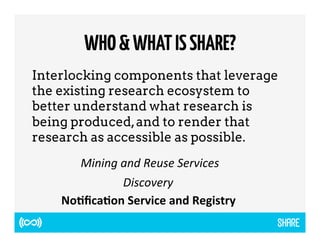
WHO & WHAT IS SHARE? 
Interlocking components that leverage 
the existing research ecosystem to 
better understand what research is 
being produced, and to render that 
research as accessible as possible. 
Mining 
and 
Reuse 
Services 
Discovery 
No#fica#on 
Service 
and 
Registry
WHO & WHAT IS SHARE? 
Advisory Board 
Director, small operations group 
Repository, Workflow, Technical, and 
Communications Working Groups
FUNDING 
$1,000,000 to develop Notification Service 
and long term SHARE vision 
March, 2014 through September, 2015
MISSION 
“Research universities are long-lived and 
are mission-driven to generate, make 
accessible, and preserve over time new 
knowledge and understanding. “ 
SHared Access Research Ecosystem, June 7, 2013 
“The best way to predict the future is to 
invent it.” 
Alan Kay
INSTITUTIONAL CONTEXT 
US federal agencies join growing 
international trend to require public 
access to funded research 
Measurable proliferation of institutional 
and disciplinary repositories 
Premium on impact and visibility in HE
RESEARCH CONTEXT 
o “Scholarly outcomes are contextualized 
by materials generated in the process 
and aftermath of scholarly inquiry. 
o The research process generates 
materials covering methods employed, 
evidence used, and formative discussion. 
o The research aftermath generates 
materials covering discussion, revision, 
and reuse of scholarly outcomes.” 
(Lavoie, et al, OCLC Research, 2014)
RESEARCH CONTEXT 
o “Scholarly outcomes are contextualized 
by materials generated in the process 
and aftermath of scholarly inquiry. 
o The research process generates 
materials covering methods employed, 
evidence used, and formative discussion. 
o The research aftermath generates 
materials covering discussion, revision, 
and reuse of scholarly outcomes.” 
(Lavoie, et al, OCLC Research, 2014)
RESEARCH CONTEXT 
o “Scholarly outcomes are contextualized 
by materials generated in the process 
and aftermath of scholarly inquiry. 
o The research process generates 
materials covering methods employed, 
evidence used, and formative discussion. 
o The research aftermath generates 
materials covering discussion, revision, 
and reuse of scholarly outcomes.” 
(Lavoie, et al, OCLC Research, 2014)
RESEARCH LIBRARIES 
collaboration among institutions 
shift from collections as products to 
collections as components of the 
academy’s knowledge resources. 
library is supporting and embedded 
within the processes of scholarship.
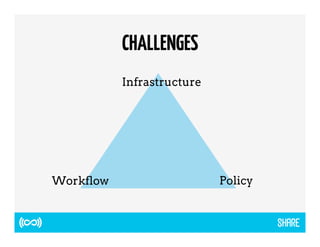
CHALLENGES 
Infrastructure 
Workflow Policy
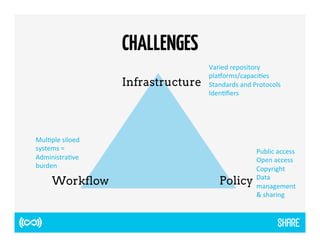
CHALLENGES 
Infrastructure 
Varied 
repository 
pla.orms/capaci2es 
Standards 
and 
Protocols 
Iden2fiers 
Workflow Policy 
Public 
access 
Open 
access 
Copyright 
Data 
management 
& 
sharing 
Mul2ple 
siloed 
systems 
= 
Administra2ve 
burden
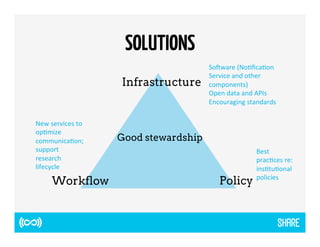
SOLUTIONS 
Infrastructure 
Good stewardship 
SoDware 
(No2fica2on 
Service 
and 
other 
components) 
Open 
data 
and 
APIs 
Encouraging 
standards 
Workflow Policy 
Best 
prac2ces 
re: 
ins2tu2onal 
policies 
New 
services 
to 
op2mize 
communica2on; 
support 
research 
lifecycle
STATEMENTS OF SUPPORT 
15
IMMEDIATE PROBLEM SPACE 
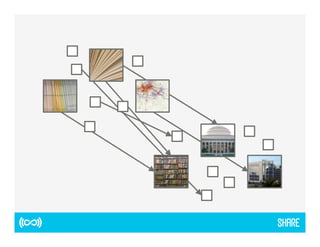
Knowing who is producing what, and 
under whose auspices, is critical to a 
wide range of stakeholders—funders, 
sponsored research offices, government 
agencies, tenure and promotion 
committees, repository managers, and 
the research community.
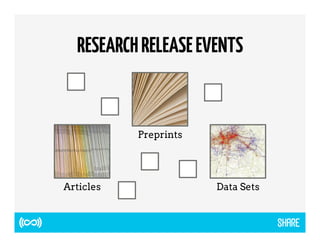
RESEARCH RELEASE EVENTS 
Preprints 
Articles Data Sets
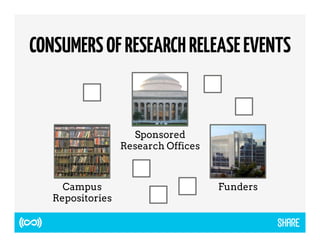
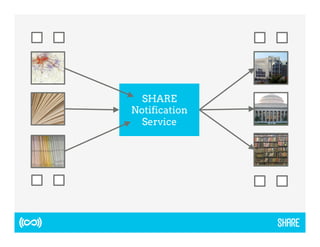
CONSUMERS OF RESEARCH RELEASE EVENTS 
Sponsored 
Research Offices 
Campus Funders 
Repositories
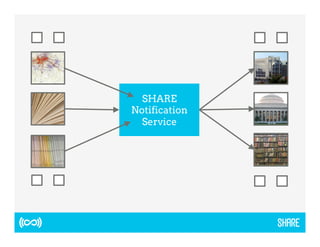
SHARE 
Notification 
Service
CENTER FOR OPEN SCIENCE 
“We foster openness, integrity, 
and reproducibility of scientific research” 
centerforopenscience.org & osf.io
THE TEAM AT COS
SHARE 
Notification 
Service
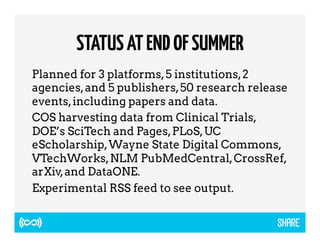
STATUS AT END OF SUMMER 
Planned for 3 platforms, 5 institutions, 2 
agencies, and 5 publishers, 50 research release 
events, including papers and data. 
COS harvesting data from Clinical Trials, 
DOE’s SciTech and Pages, PLoS, UC 
eScholarship, Wayne State Digital Commons, 
VTechWorks, NLM PubMedCentral, CrossRef, 
arXiv, and DataONE. 
Experimental RSS feed to see output.
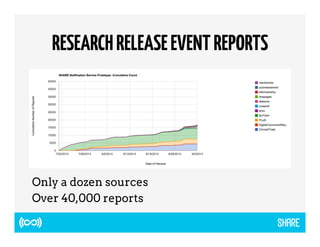
RESEARCH RELEASE EVENT REPORTS 
Only a dozen sources 
Over 40,000 reports
PROTOTYPE PLANS 
Plans for prototype expansion include: 
10 more campus sites from DuraSpace 
and bepress; 
More data, perhaps Data Management 
Plans; 
At least one more agency; 
150 more research release events.
NEXT STEPS 
Push protocol 
Creation of a “push API” to make participation simpler for some 
sources. 
Consumption of notifications 
Provide subscription methods 
Recruit trial subscribers 
Public release 
Early 2015 beta release 
Fall 2015 first full release
SOME EARLY LESSONS 
Clarity about intent to share. 
Some sites not sure about their right to, for example, share 
abstracts. 
Encourage collection of vital metadata. 
Most of our sources do not even collect email addresses of 
authors, much less universal identifiers such as ORCID or ISNI. 
Most sources make no effort to collect funding information or 
grant award numbers. This data needs to be collected and 
distributed to make effective notifications. 
Importance of the SHARE Registry. 
Some consumers will want the enhanced records it will provide.
Request Response 
GET https://frogworld. 
com/api/frogs 
[ 
{ 
name: Kermit, 
color: green, 
type: felt 
}, 
{ 
name: Travis, 
color: green, 
type: tree 
} 
]
Request Response 
POST https://osf.io/api/share 
{ 
title: Easy Being Green?, 
contributors: [ 
Kermit, 
Travis 
], 
source: frogworld, 
id: 10.100/frogworld.102 
} 
Success
Resource 1 Resource 2 
{ 
title: Easy Being Green?, 
contributors: [ 
Kermit, 
Travis 
], 
source: frogworld, 
id: 10.100/frogworld.102 
} 
{ 
title: Easy Being Green?, 
contributors: [ 
Kermit, 
Travis 
], 
origin: frogworld, 
id: 10.100/frogworld.102, 
description: 
Exploring greenness. 
}
Resource 1 Resource 2 
{ 
title: Easy Being Green?, 
contributors: [ 
Kermit, 
Travis 
], 
source: frogworld, 
id: 10.100/frogworld.102 
} 
{ 
name: Easy Being Green?, 
contributors: [ 
Frog Scientists Intl, 
Amphibians United, 
], 
origin: frogworld, 
doi: 10.100/frogworld.102 
}
Resource 1 Resource 2 
{ 
title: Easy Being Green?, 
contributors: [ 
Kermit, 
Travis 
], 
source: frogworld, 
id: 10.100/frogworld.102 
} 
{ 
title: Easy Being Green?, 
contributors: [ 
No Contributors 
], 
source: frogworld, 
id: 10.100/frogworld.102 
}
VARIETY VS. AVAILABILITY 
• We accept that we will have a variety 
of providers with a variety of 
expressions. 
• But we need some key identifiers to be 
available in order to create effective 
notifications.
PRIORITY 1: INCLUSION 
• Researcher identifiers such as ORCID, 
ISNI, and so on. 
• Funding identifier such as FundRef. 
• Grant award identifiers. 
• Further metadata elements 
encouraged by CASRAI and others.
PRIORITY 2: CONSISTENCY 
• We can manage the variety. 
…however… 
• Consistency reduces errors. 
• Consistency simplifies preparing for 
new providers. 
• Consistency will be required for push 
reporting.
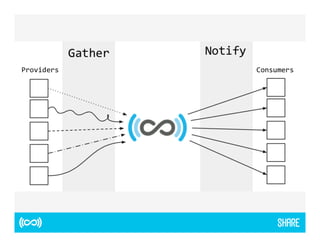
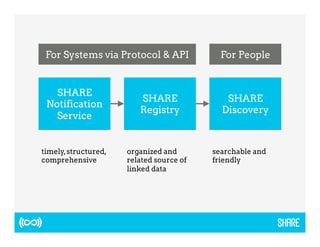
For Systems via Protocol & API For People 
SHARE 
Notification 
Service 
SHARE 
Registry 
SHARE 
Discovery 
timely, structured, 
comprehensive 
organized and 
related source of 
linked data 
searchable and 
friendly
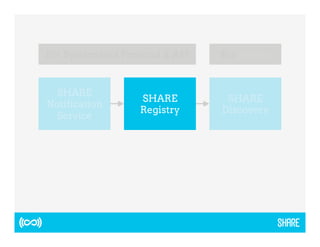
For Systems via Protocol & API For People 
SHARE 
Notification 
Service 
SHARE 
Registry 
SHARE 
Discovery
CHALLENGES 
• Adoption of key identifiers just getting 
underway, requires international 
collaboration, 
• Inferences prone to error, 
• Duplicate detection difficult, 
• Scale quite large, not well understood, 
• This is a never-ending task requiring 
sustainable funding and governance.
BENEFITS 
• Researchers can keep everyone 
informed by keeping anyone 
informed, 
• Institutions can assemble more 
comprehensive record of impact, 
• Open access advocates can hold 
publishers accountable for promises, 
• Other systems can count on 
consistency of metadata from SHARE.
HOW CASRAI HELPS 
Dictionaries and identifiers 
• Participants, CASRAI ID 
• Activity Info, Activity ID 
• Funding Requests, Funding Source ID 
• Outputs, what is research? 
International Interoperability 
• COAR blueprint
LOOKING FORWARD 
Business planning: agile governance and 
institutional sustainability 
Strengthening international 
partnerships 
Workflow pilots and prototypes with 
several institutions
LOOKING FORWARD 
Identifiers and platforms for new, 
hybrid, and more granular forms of 
research output 
Contributor roles & other research 
administration data 
Higher education policies on non-exclusive 
copyrights
CONTACT US 
www.arl.org/share 
www.facebook.com/SHARE.research 
www.twitter.com/share_research 
share@arl.org

L&P Eric Celeste - SHARE

  • 1.
    SHARE UPDATE CASRAICanada ReConnect14 19 November 2014 Judy Ruttenberg, Association of Research Libraries Eric Celeste, SHARE Technical Director
  • 2.
    WHO & WHATIS SHARE? A higher education and research community initiative to ensure the widest possible preservation of, access to, and reuse of research outputs
  • 3.
    WHO & WHATIS SHARE? Interlocking components that leverage the existing research ecosystem to better understand what research is being produced, and to render that research as accessible as possible. Mining and Reuse Services Discovery No#fica#on Service and Registry
  • 4.
    WHO & WHATIS SHARE? Advisory Board Director, small operations group Repository, Workflow, Technical, and Communications Working Groups
  • 5.
    FUNDING $1,000,000 todevelop Notification Service and long term SHARE vision March, 2014 through September, 2015
  • 6.
    MISSION “Research universitiesare long-lived and are mission-driven to generate, make accessible, and preserve over time new knowledge and understanding. “ SHared Access Research Ecosystem, June 7, 2013 “The best way to predict the future is to invent it.” Alan Kay
  • 7.
    INSTITUTIONAL CONTEXT USfederal agencies join growing international trend to require public access to funded research Measurable proliferation of institutional and disciplinary repositories Premium on impact and visibility in HE
  • 8.
    RESEARCH CONTEXT o“Scholarly outcomes are contextualized by materials generated in the process and aftermath of scholarly inquiry. o The research process generates materials covering methods employed, evidence used, and formative discussion. o The research aftermath generates materials covering discussion, revision, and reuse of scholarly outcomes.” (Lavoie, et al, OCLC Research, 2014)
  • 9.
    RESEARCH CONTEXT o“Scholarly outcomes are contextualized by materials generated in the process and aftermath of scholarly inquiry. o The research process generates materials covering methods employed, evidence used, and formative discussion. o The research aftermath generates materials covering discussion, revision, and reuse of scholarly outcomes.” (Lavoie, et al, OCLC Research, 2014)
  • 10.
    RESEARCH CONTEXT o“Scholarly outcomes are contextualized by materials generated in the process and aftermath of scholarly inquiry. o The research process generates materials covering methods employed, evidence used, and formative discussion. o The research aftermath generates materials covering discussion, revision, and reuse of scholarly outcomes.” (Lavoie, et al, OCLC Research, 2014)
  • 11.
    RESEARCH LIBRARIES collaborationamong institutions shift from collections as products to collections as components of the academy’s knowledge resources. library is supporting and embedded within the processes of scholarship.
  • 12.
  • 13.
    CHALLENGES Infrastructure Varied repository pla.orms/capaci2es Standards and Protocols Iden2fiers Workflow Policy Public access Open access Copyright Data management & sharing Mul2ple siloed systems = Administra2ve burden
  • 14.
    SOLUTIONS Infrastructure Goodstewardship SoDware (No2fica2on Service and other components) Open data and APIs Encouraging standards Workflow Policy Best prac2ces re: ins2tu2onal policies New services to op2mize communica2on; support research lifecycle
  • 15.
  • 16.
    IMMEDIATE PROBLEM SPACE Knowing who is producing what, and under whose auspices, is critical to a wide range of stakeholders—funders, sponsored research offices, government agencies, tenure and promotion committees, repository managers, and the research community.
  • 17.
    RESEARCH RELEASE EVENTS Preprints Articles Data Sets
  • 18.
    CONSUMERS OF RESEARCHRELEASE EVENTS Sponsored Research Offices Campus Funders Repositories
  • 20.
  • 21.
    CENTER FOR OPENSCIENCE “We foster openness, integrity, and reproducibility of scientific research” centerforopenscience.org & osf.io
  • 22.
  • 23.
  • 31.
    STATUS AT ENDOF SUMMER Planned for 3 platforms, 5 institutions, 2 agencies, and 5 publishers, 50 research release events, including papers and data. COS harvesting data from Clinical Trials, DOE’s SciTech and Pages, PLoS, UC eScholarship, Wayne State Digital Commons, VTechWorks, NLM PubMedCentral, CrossRef, arXiv, and DataONE. Experimental RSS feed to see output.
  • 32.
    RESEARCH RELEASE EVENTREPORTS Only a dozen sources Over 40,000 reports
  • 33.
    PROTOTYPE PLANS Plansfor prototype expansion include: 10 more campus sites from DuraSpace and bepress; More data, perhaps Data Management Plans; At least one more agency; 150 more research release events.
  • 34.
    NEXT STEPS Pushprotocol Creation of a “push API” to make participation simpler for some sources. Consumption of notifications Provide subscription methods Recruit trial subscribers Public release Early 2015 beta release Fall 2015 first full release
  • 35.
    SOME EARLY LESSONS Clarity about intent to share. Some sites not sure about their right to, for example, share abstracts. Encourage collection of vital metadata. Most of our sources do not even collect email addresses of authors, much less universal identifiers such as ORCID or ISNI. Most sources make no effort to collect funding information or grant award numbers. This data needs to be collected and distributed to make effective notifications. Importance of the SHARE Registry. Some consumers will want the enhanced records it will provide.
  • 36.
    Request Response GEThttps://frogworld. com/api/frogs [ { name: Kermit, color: green, type: felt }, { name: Travis, color: green, type: tree } ]
  • 37.
    Request Response POSThttps://osf.io/api/share { title: Easy Being Green?, contributors: [ Kermit, Travis ], source: frogworld, id: 10.100/frogworld.102 } Success
  • 38.
    Resource 1 Resource2 { title: Easy Being Green?, contributors: [ Kermit, Travis ], source: frogworld, id: 10.100/frogworld.102 } { title: Easy Being Green?, contributors: [ Kermit, Travis ], origin: frogworld, id: 10.100/frogworld.102, description: Exploring greenness. }
  • 39.
    Resource 1 Resource2 { title: Easy Being Green?, contributors: [ Kermit, Travis ], source: frogworld, id: 10.100/frogworld.102 } { name: Easy Being Green?, contributors: [ Frog Scientists Intl, Amphibians United, ], origin: frogworld, doi: 10.100/frogworld.102 }
  • 40.
    Resource 1 Resource2 { title: Easy Being Green?, contributors: [ Kermit, Travis ], source: frogworld, id: 10.100/frogworld.102 } { title: Easy Being Green?, contributors: [ No Contributors ], source: frogworld, id: 10.100/frogworld.102 }
  • 41.
    VARIETY VS. AVAILABILITY • We accept that we will have a variety of providers with a variety of expressions. • But we need some key identifiers to be available in order to create effective notifications.
  • 42.
    PRIORITY 1: INCLUSION • Researcher identifiers such as ORCID, ISNI, and so on. • Funding identifier such as FundRef. • Grant award identifiers. • Further metadata elements encouraged by CASRAI and others.
  • 43.
    PRIORITY 2: CONSISTENCY • We can manage the variety. …however… • Consistency reduces errors. • Consistency simplifies preparing for new providers. • Consistency will be required for push reporting.
  • 44.
    For Systems viaProtocol & API For People SHARE Notification Service SHARE Registry SHARE Discovery timely, structured, comprehensive organized and related source of linked data searchable and friendly
  • 45.
    For Systems viaProtocol & API For People SHARE Notification Service SHARE Registry SHARE Discovery
  • 46.
    CHALLENGES • Adoptionof key identifiers just getting underway, requires international collaboration, • Inferences prone to error, • Duplicate detection difficult, • Scale quite large, not well understood, • This is a never-ending task requiring sustainable funding and governance.
  • 47.
    BENEFITS • Researcherscan keep everyone informed by keeping anyone informed, • Institutions can assemble more comprehensive record of impact, • Open access advocates can hold publishers accountable for promises, • Other systems can count on consistency of metadata from SHARE.
  • 48.
    HOW CASRAI HELPS Dictionaries and identifiers • Participants, CASRAI ID • Activity Info, Activity ID • Funding Requests, Funding Source ID • Outputs, what is research? International Interoperability • COAR blueprint
  • 49.
    LOOKING FORWARD Businessplanning: agile governance and institutional sustainability Strengthening international partnerships Workflow pilots and prototypes with several institutions
  • 50.
    LOOKING FORWARD Identifiersand platforms for new, hybrid, and more granular forms of research output Contributor roles & other research administration data Higher education policies on non-exclusive copyrights
  • 51.
    CONTACT US www.arl.org/share www.facebook.com/SHARE.research www.twitter.com/share_research share@arl.org