8/27/2016
Dr. Joey Lee
Elliot Hu-Au
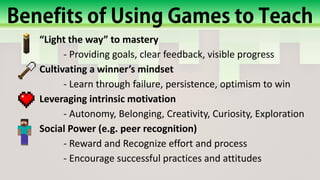
“Light the way” to mastery
- Providing goals, clear feedback, visible progress
Cultivating a winner’s mindset
- Learn through failure, persistence, optimism to win
Leveraging intrinsic motivation
- Autonomy, Belonging, Creativity, Curiosity, Exploration
Social Power (e.g. peer recognition)
- Reward and Recognize effort and process
- Encourage successful practices and attitudes
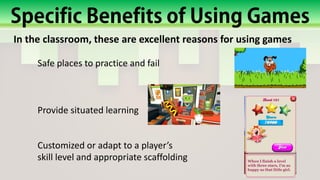
In the classroom, these are excellent reasons for using games
Safe places to practice and fail
Provide situated learning
Customized or adapt to a player’s
skill level and appropriate scaffolding
In the classroom, these are excellent reasons for using games
Can provide drill exercises and repeated practice
Provide immediate feedback
Allow players to view new perspectives
Can motivate desired behaviors
On website
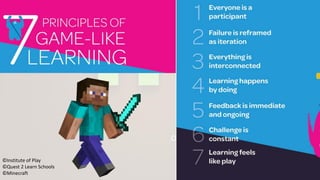
©Institute of Play
©Quest 2 Learn Schools
©Minecraft
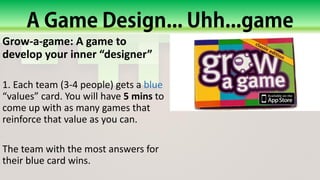
Grow-a-game: A game to
develop your inner “designer”
1. Each team (3-4 people) gets a blue
“values” card. You will have 5 mins to
come up with as many games that
reinforce that value as you can.
The team with the most answers for
their blue card wins.
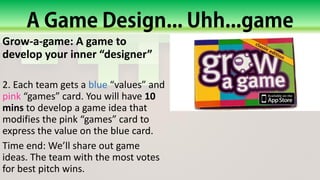
Grow-a-game: A game to
develop your inner “designer”
2. Each team gets a blue “values” and
pink “games” card. You will have 10
mins to develop a game idea that
modifies the pink “games” card to
express the value on the blue card.
Time end: We’ll share out game
ideas. The team with the most votes
for best pitch wins.
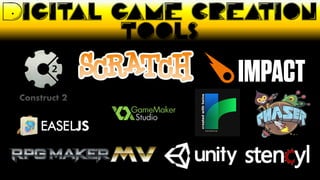
Digital game creation
tools
1. Choose a game/VR/AR as a tool for learning or
assessment and play it!
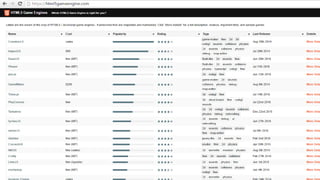
2. Go through a tutorial in an html5 game engine
(like Construct2 or Stencyl) to become familiar
with it.
3. Game design and creation: Begin designing or
creating your own game (board/strategy/digital)
that you can use with your students.
As you play…
Choose a board or digital game to play. Think about the MDA
framework for your particular game. Choose and stick with one game
for the entire time.
M – Mechanics - What do you do in the game?
D – Dynamics - What happens in the game?
A – Aesthetics - What makes the game fun?
Would this be a useful game to play in your classroom?
As a learning tool? Or an assessment piece?

Game-based Learning

  • 1.
  • 2.
    “Light the way”to mastery - Providing goals, clear feedback, visible progress Cultivating a winner’s mindset - Learn through failure, persistence, optimism to win Leveraging intrinsic motivation - Autonomy, Belonging, Creativity, Curiosity, Exploration Social Power (e.g. peer recognition) - Reward and Recognize effort and process - Encourage successful practices and attitudes
  • 3.
    In the classroom,these are excellent reasons for using games Safe places to practice and fail Provide situated learning Customized or adapt to a player’s skill level and appropriate scaffolding
  • 4.
    In the classroom,these are excellent reasons for using games Can provide drill exercises and repeated practice Provide immediate feedback Allow players to view new perspectives Can motivate desired behaviors
  • 5.
    On website ©Institute ofPlay ©Quest 2 Learn Schools ©Minecraft
  • 6.
    Grow-a-game: A gameto develop your inner “designer” 1. Each team (3-4 people) gets a blue “values” card. You will have 5 mins to come up with as many games that reinforce that value as you can. The team with the most answers for their blue card wins.
  • 7.
    Grow-a-game: A gameto develop your inner “designer” 2. Each team gets a blue “values” and pink “games” card. You will have 10 mins to develop a game idea that modifies the pink “games” card to express the value on the blue card. Time end: We’ll share out game ideas. The team with the most votes for best pitch wins.
  • 8.
  • 10.
    1. Choose agame/VR/AR as a tool for learning or assessment and play it! 2. Go through a tutorial in an html5 game engine (like Construct2 or Stencyl) to become familiar with it. 3. Game design and creation: Begin designing or creating your own game (board/strategy/digital) that you can use with your students.
  • 12.
    As you play… Choosea board or digital game to play. Think about the MDA framework for your particular game. Choose and stick with one game for the entire time. M – Mechanics - What do you do in the game? D – Dynamics - What happens in the game? A – Aesthetics - What makes the game fun? Would this be a useful game to play in your classroom? As a learning tool? Or an assessment piece?