wheregoodideascomefrom
// Gabriel Stancu,Amber, 2016
about
Bogdan Dinca
Nick Skillicorn
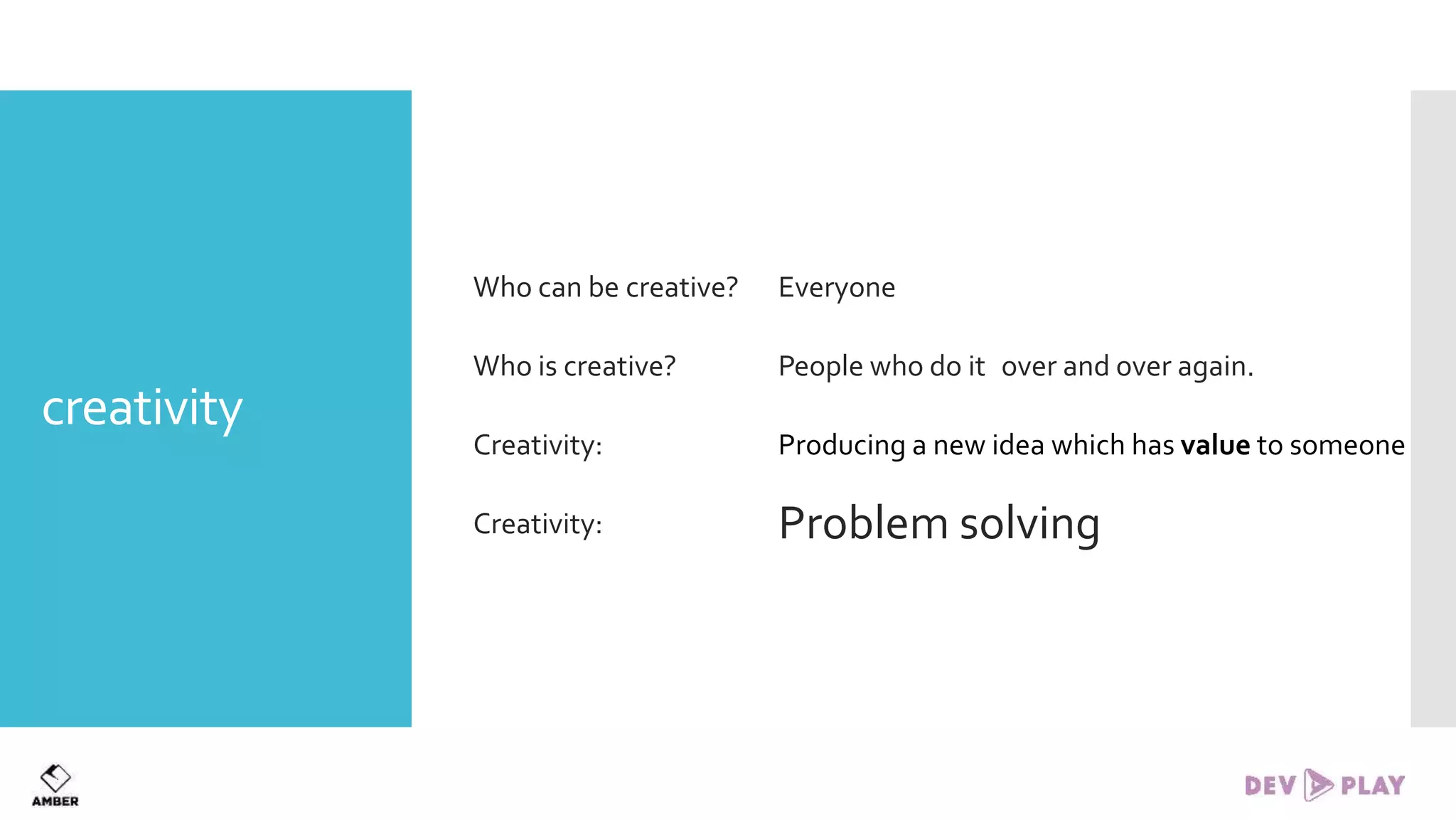
creativity
Who can be creative? Everyone
Who is creative? People who do it over and over again.
Creativity: Producing a new idea which has value to someone
Creativity: Problem solving
good ideas?
memories
mimetics
special
ideas
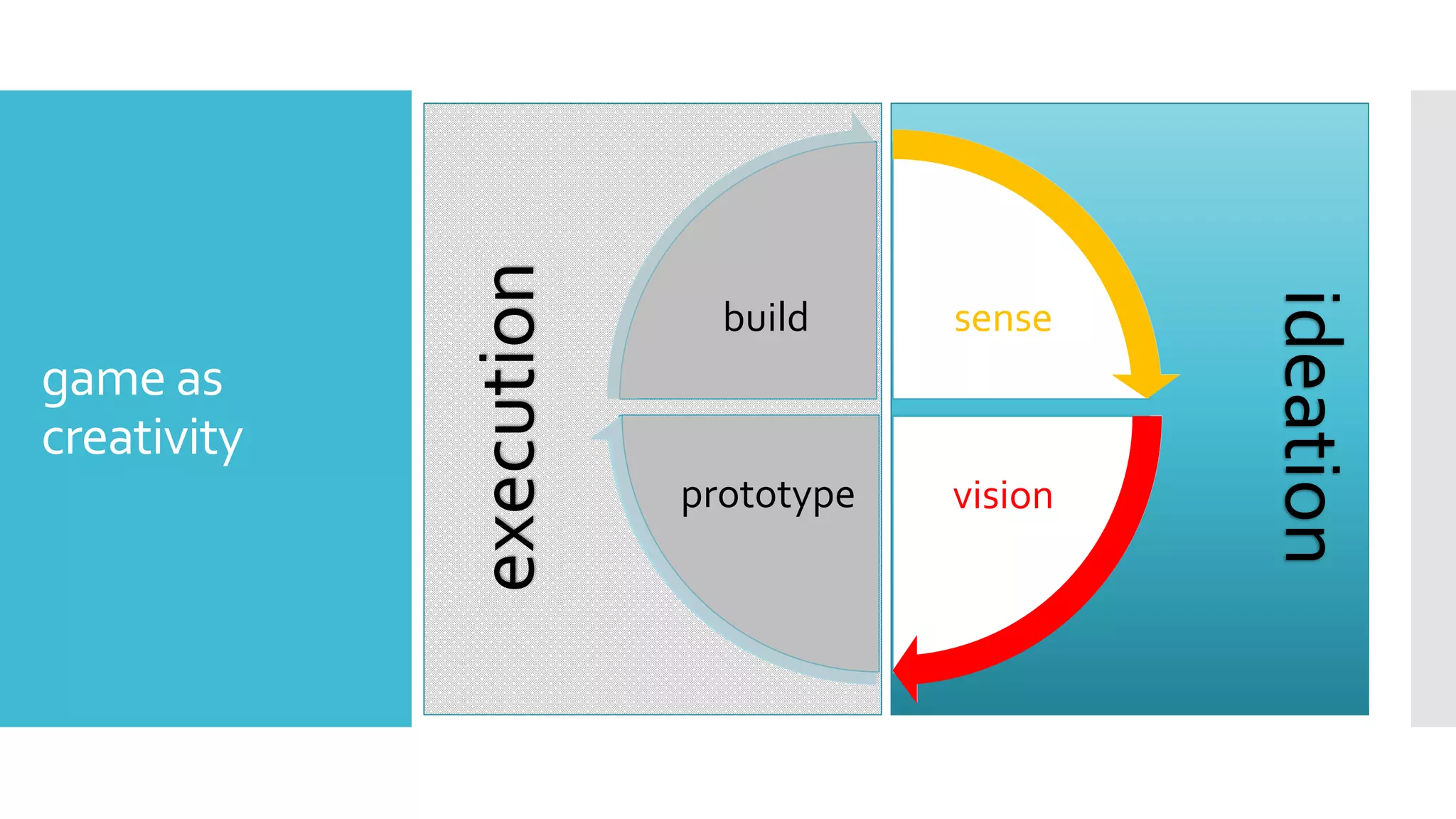
ideation
execution
game as
creativity
sense
visionprototype
build sense
visionprototype
build
„Even in modern art, artists have used methods based on
calculation, in as much as these elements, alongside those of a
more personal and emotional nature, give balance and harmony
to any work of art.”
-Max Bill
sensing
You and your team will go through a process of
expantion.You will be conducting a wide
exploration of the topic you are tackling.
Your tools will be rational analysis and an intuitive
and associative set of processes that will give you
INSIGHTS.This is not about solving the problem but
rather about making it your own.
step1:
kick off
You need to have a problem and a team
Be prepared to answer the following questions:
Build your Ideation team.
Keep in mind this is problem solving
• What is your game making vision.
• Why does this game making vision intrigue you.
• Why does this game making vision matter to you.
• How will this make your world a better place.
Share with your team and agree on a joint mission
Collaborate: Share every bit of info from now on.
step2:
explore and
consume
Collect data to dispel myths, discover surprise
opportunities and surface weak signals
Develop a board to provide direction to the research
• This is research, look to compile trees of rich data-driven visuals
from various sources of games / products that fascinate you
• Pages should be easy to review. Focus on infographics, charts, tables,etc
• Use tools like Pintrest / Google Drive to make your life easier
• Identify weak signals: look for patterns that dont define the
subject but do recur proeminently.
• Create INSIGHTS
Create a Fact Pack:
When you have the Fact Pack :
step3:
play like your
gamer
Deeply understand your audience by playing like
them for a while
Develop empathy for your audience
• Understand who they are, what their expectations and
culture is. Document this and try walking in their shoes by
playing the games they are playing
• Document your experience. Capture video and screenshots
of your memorable moments and add them to your Fact
Pack
• Identify Pain Points and add the to your Insights
Document your findings in a Mind Map
step4:
identify user
relations
Understand the dynamics between gamers,
communities and game makers for more insights
• Map the types of audience, stakeholders and
key factors that create the microsystem
arround similar games
• Identify the prevailing dynamics in the
system surrounding the ecosystem you are
building your game for.
• Document your insights in a Mind Map
step5:
connect the
dots
Cluster your insights for a handful of original
sparks to emerge Sparks
• This is where you use your Insights: surround yourself with
harvested clues and pictures
• Pick Insights that inspire you and combine
them into multiple Sparks
• Gather your emergent sparks to and
prepare for the Big Question.
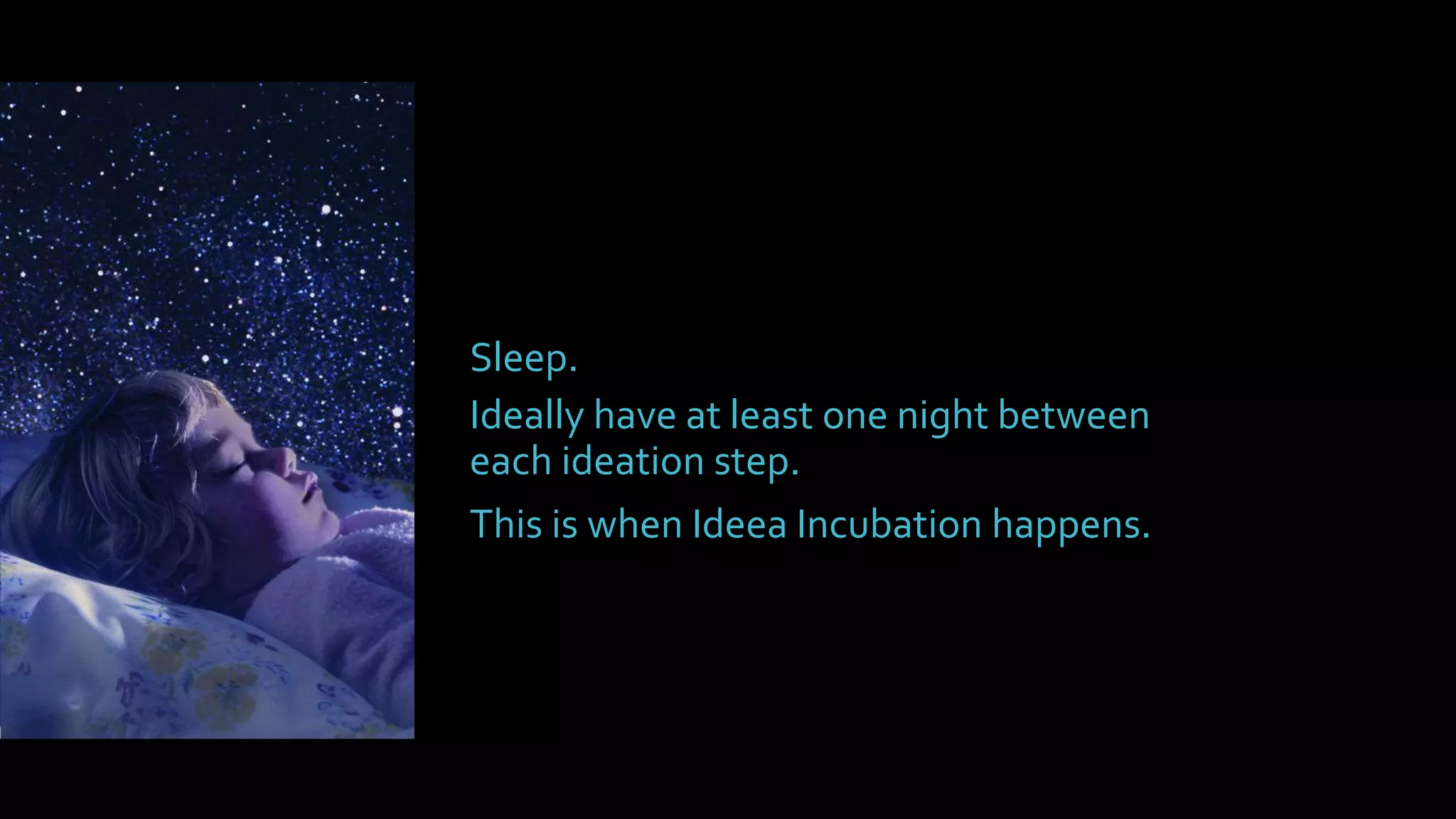
Ideally have at least one night between
each ideation step.
This is when Ideea Incubation happens.
Sleep.
part 2:
visioning
In this phase the team members ideate new
concepts; they develop, cluster, and select
different ideas for potential big breakthroughs.
step6:
the Big
Question
Gives a direction and even paints the contours
of a ‘solution space’.
Formulate a Question that your game will answer to:
The Formula:
“How can we [ActionVerb] for a [User] who
[Insight] and/or with [Need].”
step6:
the Big
Question
Some examples of the questions we have been
asking ourselves:
• How can we create an addictive compelling community
driven game for mobile users?
• How can we give any mobile gamer an engaging role inside
a virtual community?
• How can we emphasize user experience in a community
driven mobile game?
step7:
back to the
fact pack
Go backwards. Randomly.
Once you have the Question you want new ideas for:
Go through your Fact Pack again and identify Insights that are relevant
Brainstorm around these and try to answer the question.
Map everything.
step6:
what would
Mother do?
Switch roles for a bit. It might give you
interesting points of view.
Once you have the Question do some role playing:
Agree on a role play relevant to your problem (IE RR Martin if you are building a
narrative game). Use prompt questions to answer your Question in different ways
Take 5 minutes per prompt to write down every idea that
comes to mind, don’t be selective; the team should create a
long list.
Share with your team. Jolt down the ideas that caught
your eye. Find the essence behind the crazy idea and
convert it into a fitting solution to yourQuestion.
step7:
bright stars
and
revelations
Its time to pick the roses from the weeds
Create 2x2 matrix: ‘Success’ and ‘Will have an
impact’
Label categories: Bright Stars;Wild Cards; Low Hanging
Fruit;Wet Blankets
Work with your team and center the most appealing idea on
the map in the Bright Stars orWild Cards category.
Grow your central idea! Expand it by enriching it with elements
from the other ideas in the matrix that were initially
dismissed.
step8:
the elevator
pitch
This is it!
Contract you idea to a meaning full short
narrative
Keep in mind all key ingredients like: what is the vision, who is
the target, what are the needs, market, competition, etc.
Keep it short and to the point
We made some mistakes so you don’t have to!
nobody is
perfect
4 is a party. 5 is a crowd.
Chemistry matters.
Use the right people. Execution is not creativity.
Criticism: New ideas are rough and they are not always the
right answers.
Don’t rush this process. Aim for 2-3 weeks. Incubation is
critical.
Now you just have to build it :)
Gabriel Stancu
Game Director
Gabriel@amberstudio.com

Where Good Ideas Come From - Dev Play 2016

  • 1.
  • 2.
  • 3.
    creativity Who can becreative? Everyone Who is creative? People who do it over and over again. Creativity: Producing a new idea which has value to someone Creativity: Problem solving
  • 4.
  • 5.
  • 6.
    „Even in modernart, artists have used methods based on calculation, in as much as these elements, alongside those of a more personal and emotional nature, give balance and harmony to any work of art.” -Max Bill
  • 7.
    sensing You and yourteam will go through a process of expantion.You will be conducting a wide exploration of the topic you are tackling. Your tools will be rational analysis and an intuitive and associative set of processes that will give you INSIGHTS.This is not about solving the problem but rather about making it your own.
  • 8.
    step1: kick off You needto have a problem and a team Be prepared to answer the following questions: Build your Ideation team. Keep in mind this is problem solving • What is your game making vision. • Why does this game making vision intrigue you. • Why does this game making vision matter to you. • How will this make your world a better place. Share with your team and agree on a joint mission Collaborate: Share every bit of info from now on.
  • 9.
    step2: explore and consume Collect datato dispel myths, discover surprise opportunities and surface weak signals Develop a board to provide direction to the research • This is research, look to compile trees of rich data-driven visuals from various sources of games / products that fascinate you • Pages should be easy to review. Focus on infographics, charts, tables,etc • Use tools like Pintrest / Google Drive to make your life easier • Identify weak signals: look for patterns that dont define the subject but do recur proeminently. • Create INSIGHTS Create a Fact Pack: When you have the Fact Pack :
  • 10.
    step3: play like your gamer Deeplyunderstand your audience by playing like them for a while Develop empathy for your audience • Understand who they are, what their expectations and culture is. Document this and try walking in their shoes by playing the games they are playing • Document your experience. Capture video and screenshots of your memorable moments and add them to your Fact Pack • Identify Pain Points and add the to your Insights Document your findings in a Mind Map
  • 11.
    step4: identify user relations Understand thedynamics between gamers, communities and game makers for more insights • Map the types of audience, stakeholders and key factors that create the microsystem arround similar games • Identify the prevailing dynamics in the system surrounding the ecosystem you are building your game for. • Document your insights in a Mind Map
  • 12.
    step5: connect the dots Cluster yourinsights for a handful of original sparks to emerge Sparks • This is where you use your Insights: surround yourself with harvested clues and pictures • Pick Insights that inspire you and combine them into multiple Sparks • Gather your emergent sparks to and prepare for the Big Question.
  • 13.
    Ideally have atleast one night between each ideation step. This is when Ideea Incubation happens. Sleep.
  • 14.
    part 2: visioning In thisphase the team members ideate new concepts; they develop, cluster, and select different ideas for potential big breakthroughs.
  • 15.
    step6: the Big Question Gives adirection and even paints the contours of a ‘solution space’. Formulate a Question that your game will answer to: The Formula: “How can we [ActionVerb] for a [User] who [Insight] and/or with [Need].”
  • 16.
    step6: the Big Question Some examplesof the questions we have been asking ourselves: • How can we create an addictive compelling community driven game for mobile users? • How can we give any mobile gamer an engaging role inside a virtual community? • How can we emphasize user experience in a community driven mobile game?
  • 17.
    step7: back to the factpack Go backwards. Randomly. Once you have the Question you want new ideas for: Go through your Fact Pack again and identify Insights that are relevant Brainstorm around these and try to answer the question. Map everything.
  • 18.
    step6: what would Mother do? Switchroles for a bit. It might give you interesting points of view. Once you have the Question do some role playing: Agree on a role play relevant to your problem (IE RR Martin if you are building a narrative game). Use prompt questions to answer your Question in different ways Take 5 minutes per prompt to write down every idea that comes to mind, don’t be selective; the team should create a long list. Share with your team. Jolt down the ideas that caught your eye. Find the essence behind the crazy idea and convert it into a fitting solution to yourQuestion.
  • 19.
    step7: bright stars and revelations Its timeto pick the roses from the weeds Create 2x2 matrix: ‘Success’ and ‘Will have an impact’ Label categories: Bright Stars;Wild Cards; Low Hanging Fruit;Wet Blankets Work with your team and center the most appealing idea on the map in the Bright Stars orWild Cards category. Grow your central idea! Expand it by enriching it with elements from the other ideas in the matrix that were initially dismissed.
  • 20.
    step8: the elevator pitch This isit! Contract you idea to a meaning full short narrative Keep in mind all key ingredients like: what is the vision, who is the target, what are the needs, market, competition, etc. Keep it short and to the point
  • 21.
    We made somemistakes so you don’t have to!
  • 22.
    nobody is perfect 4 isa party. 5 is a crowd. Chemistry matters. Use the right people. Execution is not creativity. Criticism: New ideas are rough and they are not always the right answers. Don’t rush this process. Aim for 2-3 weeks. Incubation is critical.
  • 23.
    Now you justhave to build it :)
  • 24.