Haderslev, November 3rd 2014 
Digital games as a powerful 
tool in learning 
Anne Isholdt, pedagogical it-consultant at VUC Storstrøm
We learn through play... 
…by imitating, experimenting and practicing 
Computer games provide immersive, realistic & meaningful environments 
in which learners use information to develop knowledge, attitudes 
and skills.
What is a game? 
”A game is a series of interesting choices” 
Sid Meyer – creator of Civilization 
“A game is a rule-based formal system with a variable 
and quantifiable outcome, where different outcomes 
are assigned different values, the player exerts effort in 
order to influence the outcome, the player feels 
attached to the outcome, and the consequences of the 
activity are optional and negotiable.” 
Jesper Juul – game researcher
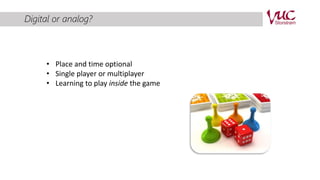
Digital or analog? 
• Place and time optional 
• Single player or multiplayer 
• Learning to play inside the game
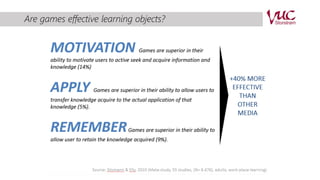
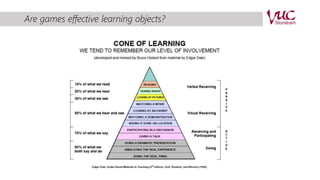
Are games effective learning objects?
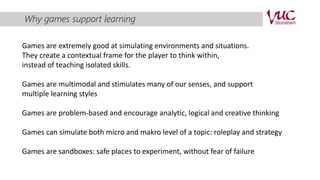
Why games support learning 
Games are extremely good at simulating environments and situations. 
They create a contextual frame for the player to think within, 
instead of teaching isolated skills. 
Games are multimodal and stimulates many of our senses, and support 
multiple learning styles 
Games are problem-based and encourage analytic, logical and creative thinking 
Games can simulate both micro and makro level of a topic: roleplay and strategy 
Games are sandboxes: safe places to experiment, without fear of failure
Why games are motivating 
Players fail 85 % of the time they are playing! 
• Clear and reachable goals – often one main goal and some smaller 
• Immidiate feedback 
• Meaningful choices with different consequenses 
• Clear rules 
• Reward systems that gives the player credit for involvement and certain 
behaviour/actions 
• Adjustment – difficulty and other player preferences
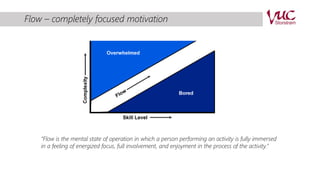
Flow – completely focused motivation 
“Flow is the mental state of operation in which a person performing an activity is fully immersed 
in a feeling of energized focus, full involvement, and enjoyment in the process of the activity.”
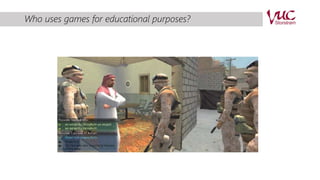
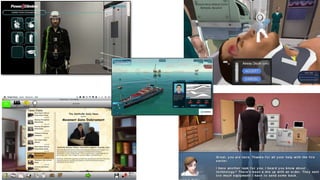
Who uses games for educational purposes?
The context of gamebased learning 
• Some knowledge before gameplay 
• Assistance availible during gameplay(person, in game or manual etc.) 
• Debriefing – overall feedback + corrections of misunderstandings 
• Reflection – evaluate own experience 
• Conceptualisation – putting the experience into a larger framework, supplementing 
with other ressources and apply to other settings 
• Social aspect – share knowledge or work with co-learners
A good learning game 
• The game objectives match the learning objectives 
• The player is encouraged to try again if he/she fails 
• The goals are clear and meaningful 
• It’s possible to adjust level of difficulty 
• The player gets clear feedback on progres 
• The players actions have different consequenses
Constructionism 
Should the learner engage in the construction of the game, the content or both? 
• ”Just” a player 
• Working with game mechanics and looking into the ”machinery” 
• Contributing with content 
Different learning outcomes - Pros and cons: 
If you are working behind the sceene you are not experiencing, experimenting or making hypothesis 
But you may gain insight into the structures and processes surrounding the area of content, and also get a 
clearer overview of the main points of the topic. 
The possible level of involvement in the construction is dependent of the player skills
Digital games as a powerful tool in learning 0.1

Digital games as a powerful tool in learning 0.1

  • 1.
    Haderslev, November 3rd2014 Digital games as a powerful tool in learning Anne Isholdt, pedagogical it-consultant at VUC Storstrøm
  • 2.
    We learn throughplay... …by imitating, experimenting and practicing Computer games provide immersive, realistic & meaningful environments in which learners use information to develop knowledge, attitudes and skills.
  • 3.
    What is agame? ”A game is a series of interesting choices” Sid Meyer – creator of Civilization “A game is a rule-based formal system with a variable and quantifiable outcome, where different outcomes are assigned different values, the player exerts effort in order to influence the outcome, the player feels attached to the outcome, and the consequences of the activity are optional and negotiable.” Jesper Juul – game researcher
  • 4.
    Digital or analog? • Place and time optional • Single player or multiplayer • Learning to play inside the game
  • 5.
    Are games effectivelearning objects?
  • 6.
    Are games effectivelearning objects?
  • 7.
    Why games supportlearning Games are extremely good at simulating environments and situations. They create a contextual frame for the player to think within, instead of teaching isolated skills. Games are multimodal and stimulates many of our senses, and support multiple learning styles Games are problem-based and encourage analytic, logical and creative thinking Games can simulate both micro and makro level of a topic: roleplay and strategy Games are sandboxes: safe places to experiment, without fear of failure
  • 8.
    Why games aremotivating Players fail 85 % of the time they are playing! • Clear and reachable goals – often one main goal and some smaller • Immidiate feedback • Meaningful choices with different consequenses • Clear rules • Reward systems that gives the player credit for involvement and certain behaviour/actions • Adjustment – difficulty and other player preferences
  • 9.
    Flow – completelyfocused motivation “Flow is the mental state of operation in which a person performing an activity is fully immersed in a feeling of energized focus, full involvement, and enjoyment in the process of the activity.”
  • 10.
    Who uses gamesfor educational purposes?
  • 12.
    The context ofgamebased learning • Some knowledge before gameplay • Assistance availible during gameplay(person, in game or manual etc.) • Debriefing – overall feedback + corrections of misunderstandings • Reflection – evaluate own experience • Conceptualisation – putting the experience into a larger framework, supplementing with other ressources and apply to other settings • Social aspect – share knowledge or work with co-learners
  • 13.
    A good learninggame • The game objectives match the learning objectives • The player is encouraged to try again if he/she fails • The goals are clear and meaningful • It’s possible to adjust level of difficulty • The player gets clear feedback on progres • The players actions have different consequenses
  • 14.
    Constructionism Should thelearner engage in the construction of the game, the content or both? • ”Just” a player • Working with game mechanics and looking into the ”machinery” • Contributing with content Different learning outcomes - Pros and cons: If you are working behind the sceene you are not experiencing, experimenting or making hypothesis But you may gain insight into the structures and processes surrounding the area of content, and also get a clearer overview of the main points of the topic. The possible level of involvement in the construction is dependent of the player skills

Editor's Notes

  • #4 A rulebased system with quantifiable autcome & player feels attachment to outcome
  • #5 Many types of games can support learning. In regard to this project 1+ 2 important
  • #6 Not for all situations. Depending on the teachers, the learners, the learning objective. Research shows different results… ADULT learning
  • #7 One of the reasons: The learner has a central ACTIVE role, and gets to interact with the content
  • #8 Quests – History: Cause effect + managment - deduce
  • #9 Opens new challenges/content/develops character
  • #10 Loose time, dont want it to stop, hard work
  • #11 Military, healthcare, primary schools, highschools, Organisations, companys, factorys
  • #15 Scenariocompetence. Teaching others/didactic design/ depends on the level of complexity in the game/ more creative ideas may come from the scenario competence?