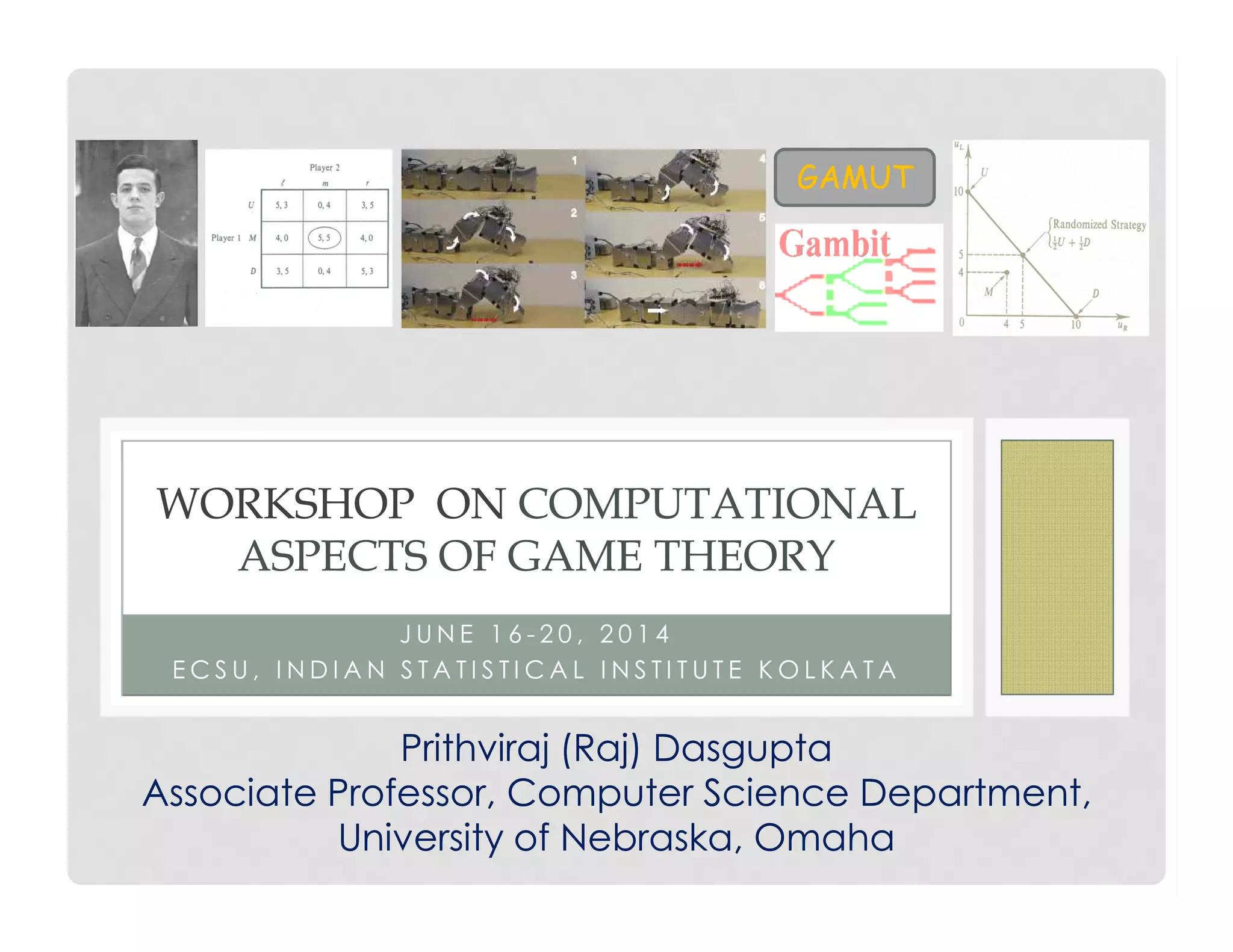
GAMUTGAMUT
WORKSHOP ONWORKSHOP ON COMPUTATIONALCOMPUTATIONAL
ASPECTS OF GAME THEORYASPECTS OF GAME THEORY
J U N E 1 6 - 2 0 , 2 0 1 4
E C S U , I N D I A N S T A T I S T I C A L I N S T I T U T E K O L K A T A
PrithvirajPrithviraj (Raj)(Raj) DasguptaDasgupta
AssociateAssociate Professor, ComputerProfessor, Computer ScienceScience Department,Department,
UniversityUniversity of Nebraska, Omahaof Nebraska, Omaha
SPEAKER’S BACKGROUND
• Associate Professor, Computer Science, University of
Nebraska, Omaha (2001- present)
• Director, CMANTIC Lab (robotics, computational
economics)
• Ph.D. (2001) Univ. of California, Santa Barbara• Ph.D. (2001) Univ. of California, Santa Barbara
• Computational economics using software agents
• B.C.S.E (1995) – Jadavpur University
• 1994: Summer internship at I.S.I
June 16-20, 2014 2Game Theory Workshop - Raj Dasgupta
UNIVERSITY OF NEBRASKA, OMAHA
• Founded in 1908
• Computer Science
program started in
early 80s
• Department since early
90s90s
• 18 full-time faculty
• ~400 undergrad, 125
Masters and 15 Ph.D.
students
• Research areas: AI,
Database/Data mining,
Networking, Systems
June 16-20, 2014 Game Theory Workshop - Raj Dasgupta 3
C-MANTIC GROUP
• http://cmantic.unomaha.edu
• Research Topics:
• Multi-robot systems path and task planning
• Multi-robot/agent systems coordination using game
theory-based techniques
• Modular robotic systems, Information aggregation using
prediction markets, Agent-based crowd simulation, etc.prediction markets, Agent-based crowd simulation, etc.
• Established by Raj Dasgupta in 2004
• Received over $3 million as PI in external funding from
DoD Navair, ONR, NASA; over 80 publications in top-tier
conferences and journals
• Currently 8 members including
• 2 post-doctoral researchers with Ph.D. in robotics
(electrical, control, mechanical engineering) and vision
• 4 graduate students (computer science)
• 1 undergraduate students (computer engineering,
computer science)
• Collaborations with faculty from Mechanical engg,
Computer science (UN-Lincoln, U. Southern Mississippi),
Mathematics (UNO)
6/16/2014 Raj Dasgupta, CMANTIC Lab, UNO 4
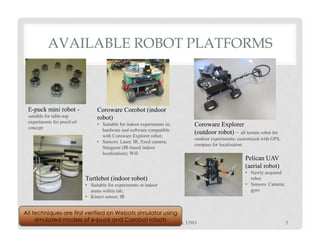
AVAILABLE ROBOT PLATFORMS
E-puck mini robot -
suitable for table-top
experiments for proof-of-
Coroware Corobot (indoor
robot)
• Suitable for indoor experiments in; Coroware Explorer
6/16/2014 Raj Dasgupta, CMANTIC Lab, UNO 5
experiments for proof-of-
concept
• Suitable for indoor experiments in;
hardware and software compatible
with Coroware Explorer robot;
• Sensors: Laser, IR, fixed camera;
Stargazer (IR-based indoor
localization); Wifi
Coroware Explorer
(outdoor robot) – all terrain robot for
outdoor experiments; customized with GPS,
compass for localization
All techniques are first verified on Webots simulator using
simulated models of e-puck and Corobot robots
Turtlebot (indoor robot)
• Suitable for experiments in indoor
arena within lab;
• Kinect sensor; IR
Pelican UAV
(aerial robot)
• Newly acquired
robot
• Sensors: Camera;
gyro
RESEARCH PROBLEM
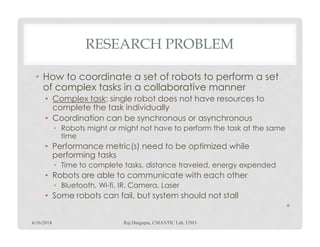
• How to coordinate a set of robots to perform a set
of complexcomplex tasks in a collaborativecollaborative manner
• Complex task: single robot does not have resources to
complete the task individually
• Coordination can be synchronous or asynchronous
Robots might or might not have to perform the task at the same• Robots might or might not have to perform the task at the same
time
• Performance metric(s) need to be optimized while
performing tasks
• Time to complete tasks, distance traveled, energy expended
• Robots are able to communicate with each other
• Bluetooth, Wi-fi, IR, Camera, Laser
• Some robots can fail, but system should not stall
6/16/2014 Raj Dasgupta, CMANTIC Lab, UNO
6
APPLICATIONS
• Humanitarian de-mining (COMRADES)
• Autonomous exploration for planetary surfaces
(ModRED)
• Automatic Target Recognition (ATR) for search and
recon (COMSTAR)recon (COMSTAR)
• Unmanned Search and Rescue
• Civlian and domestic applications like agriculture,
vaccum cleaning, etc.
6/16/2014 Raj Dasgupta, CMANTIC Lab, UNO
7
GAME THEORY WORKSHOP
DAY 1
June 16-20, 2014 Game Theory Workshop - Raj Dasgupta 8
OBJECTIVE
• Introduction to game theory from a computer
science perspective
• Learn the fundamental concepts in game theory
• Mathematical solution concepts
• Algorithms used to solve games• Algorithms used to solve games
• Applications of game theory in different application
domains
• Google Adwords
• Trading Agent Competition (Lemonade Stand Game)
• Develop programming tools for solving game theory
problems and preparation for advanced graduate
coursework
June 16-20, 2014 9Game Theory Workshop - Raj Dasgupta
OUTCOMES
• Write software for algorithms for
• Supply chain management – energy market, travel
booking, warehouse inventory management
• Auctions (e-bay, etc)
• Ad-placement (ad-auctions) for Internet search engines,• Ad-placement (ad-auctions) for Internet search engines,
Youtube, etc.
• Applications that require coordination between people or
software agents
• Social networks – information aggregation
• Robotics – distributed robot systems
June 16-20, 2014 Game Theory Workshop - Raj Dasgupta 10
ADX GAME
• An Ad Network
bids for display
ads
opportunities
• Fulfill advertising
contracts atcontracts at
minimum cost
• High quality
targeting
• Sustain and
attract
advertisers
• https://sites.google.c
om/site/gameadx/
June 16-20, 2014 Game Theory Workshop - Raj Dasgupta 11
POWER-TAC GAME
• Agents act as retail brokers in a local power
distribution region
• Purchasing power from wholesale market and local sources
• Sell power to local customers and into the wholesale
market.market.
• Solve a supply-chain problem
• Product is infinitely perishable
• Supply and demand must be exactly balanced at all times
• http://www.powertac.org
June 16-20, 2014 Game Theory Workshop - Raj Dasgupta 12
TOPICS TO BE COVERED
• Day 1: Introduction to game theory – normal form
games
• Day 2: Solution concepts for normal form games
(math)
Day 3: Bayesian games; applications of games• Day 3: Bayesian games; applications of games
• Day 4: Mechanism design and auctions
• Day 5: Coalition games and student presentations
June 16-20, 2014 Game Theory Workshop - Raj Dasgupta 13
STUDENT PRESENTATIONS
• Pick a topic on game theory that is covered in class
• Research on the Internet on your topic and find at least
one problem or challenge related to this problem
• Prepare a 10 minute presentation with slides (about 10-
12 slides)
• Give overview of topic• Give overview of topic
• Discuss the problem or challenge on the topic you have found
on the Internet
• Mention the most interesting or appealing concept that you
learned from the course and why it is interesting to you
• Presentation should reflect your understanding of the
topic
• Presentation schedule: reverse-alphabetical by last
name, Friday after lunch
June 16-20, 2014 Game Theory Workshop - Raj Dasgupta 14
DAY 1: OUTLINE
• Introduction
• Some classic 2-player games
• Solving 2-players games
• Dominated strategies and iterated dominance
• Pareto optimality and Nash equilibrium• Pareto optimality and Nash equilibrium
• Mixed Strategies
• Software packages for solving games
• Generating games using GAMUT
• Solving games using Gambit
• Correlated Equilibrium
June 16-20, 2014 15Game Theory Workshop - Raj Dasgupta
HISTORY OF GAME THEORY
• 19th century and earlier: mathematical formulations to solve
taxation problems, profits, etc.
• First half of 20th century:
• Von Neumann formalizes utility theory, lays down mathematical
foundations for analyzing two player games; early work starts
• 1950s onwards: Nash theoremNash theorem, analysis of different types of
games, beyond two players, relaxing simplifying assumptionsgames, beyond two players, relaxing simplifying assumptions
(e.g., complete knowledge), more complex settings
• 1970s onwards: evolutionary game theory (applying biological
concepts in games), learning in games, mechanism design
• 1990s onwards:
• computational implementation of game theory algorithms, complexity
results (n players),
• game theory software, programming competitions,
• applications to real-life domains (auctions, network bandwidth
sharing, resource allocation, etc.)
June 16-20, 2014 16Game Theory Workshop - Raj Dasgupta
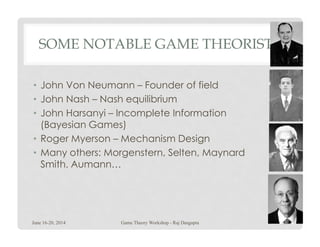
SOME NOTABLE GAME THEORISTS
• John Von Neumann – Founder of field
• John Nash – Nash equilibrium
• John Harsanyi – Incomplete Information
(Bayesian Games)(Bayesian Games)
• Roger Myerson – Mechanism Design
• Many others: Morgenstern, Selten, Maynard
Smith, Aumann…
June 16-20, 2014 17Game Theory Workshop - Raj Dasgupta
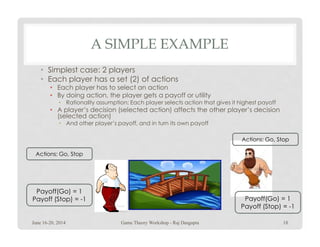
A SIMPLE EXAMPLE
• Simplest case: 2 players
• Each player has a set (2) of actions
• Each player has to select an action
• By doing action, the player gets a payoff or utility
• Rationality assumption: Each player selects action that gives it highest payoff
• A player’s decision (selected action) affects the other player’s decision
(selected action)
• And other player’s payoff, and in turn its own payoff• And other player’s payoff, and in turn its own payoff
Actions: Go, Stop
Payoff(Go) = 1
Payoff (Stop) = -1
Actions: Go, Stop
Payoff(Go) = 1
Payoff (Stop) = -1
June 16-20, 2014 18Game Theory Workshop - Raj Dasgupta
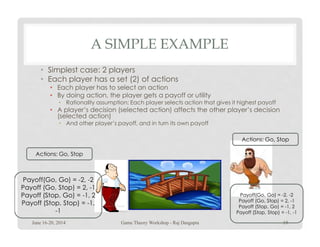
A SIMPLE EXAMPLE
• Simplest case: 2 players
• Each player has a set (2) of actions
• Each player has to select an action
• By doing action, the player gets a payoff or utility
• Rationality assumption: Each player selects action that gives it highest payoff
• A player’s decision (selected action) affects the other player’s decision
(selected action)
• And other player’s payoff, and in turn its own payoff• And other player’s payoff, and in turn its own payoff
Actions: Go, Stop
Actions: Go, Stop
Payoff(Go, Go) = -2, -2
Payoff (Go, Stop) = 2, -1
Payoff (Stop, Go) = -1, 2
Payoff (Stop, Stop) = -1, -1
Payoff(Go, Go) = -2, -2
Payoff (Go, Stop) = 2, -1
Payoff (Stop, Go) = -1, 2
Payoff (Stop, Stop) = -1,
-1
June 16-20, 2014 19Game Theory Workshop - Raj Dasgupta
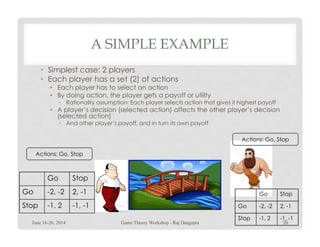
A SIMPLE EXAMPLE
• Simplest case: 2 players
• Each player has a set (2) of actions
• Each player has to select an action
• By doing action, the player gets a payoff or utility
• Rationality assumption: Each player selects action that gives it highest payoff
• A player’s decision (selected action) affects the other player’s decision
(selected action)
• And other player’s payoff, and in turn its own payoff• And other player’s payoff, and in turn its own payoff
20
Actions: Go, Stop
Actions: Go, Stop
Go Stop
Go -2, -2 2, -1
Stop -1, 2 -1, -1
Go Stop
Go -2, -2 2, -1
Stop -1, 2 -1, -1
June 16-20, 2014 Game Theory Workshop - Raj Dasgupta
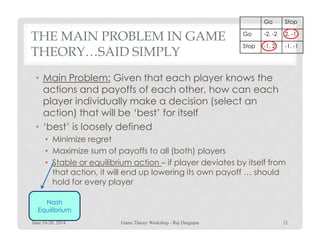
THE MAIN PROBLEM IN GAME
THEORY…SAID SIMPLY
• Main Problem: Given that each player knows the
actions and payoffs of each other, how can each
player individually make a decision (select an
action) that will be ‘best’ for itself
• ‘best’ is loosely defined
Go Stop
Go -2, -2 2, -1
Stop -1, 2 -1, -1
• ‘best’ is loosely defined
• Minimize regret
• Maximize sum of payoffs to all (both) players
• Stable or equilibrium action – if player deviates by itself from
that action, it will end up lowering its own payoff … should
hold for every player
Nash
Equilibrium
June 16-20, 2014 21Game Theory Workshop - Raj Dasgupta
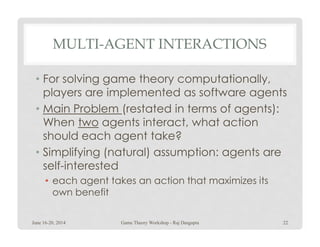
MULTI-AGENT INTERACTIONS
• For solving game theory computationally,
players are implemented as software agents
• Main Problem (restated in terms of agents):
When two agents interact, what actionWhen two agents interact, what action
should each agent take?
• Simplifying (natural) assumption: agents are
self-interested
• each agent takes an action that maximizes its
own benefit
June 16-20, 2014 22Game Theory Workshop - Raj Dasgupta
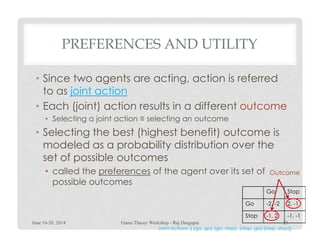
PREFERENCES AND UTILITY
• Since two agents are acting, action is referred
to as joint action
• Each (joint) action results in a different outcome
• Selecting a joint action ≡ selecting an outcome
• Selecting the best (highest benefit) outcome is
modeled as a probability distribution over the
set of possible outcomes
• called the preferences of the agent over its set of
possible outcomes
Go Stop
Go -2, -2 2, -1
Stop -1, 2 -1, -1
Outcome
Joint actions: { (go, go) (go, stop), (stop, go) (stop, stop)}
June 16-20, 2014 23Game Theory Workshop - Raj Dasgupta
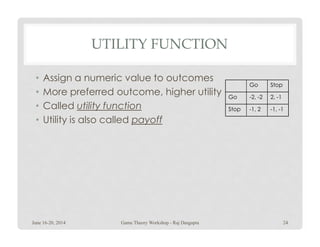
UTILITY FUNCTION
• Assign a numeric value to outcomes
• More preferred outcome, higher utility
• Called utility function
• Utility is also called payoff
Go Stop
Go -2, -2 2, -1
Stop -1, 2 -1, -1
• Utility is also called payoff
June 16-20, 2014 24Game Theory Workshop - Raj Dasgupta
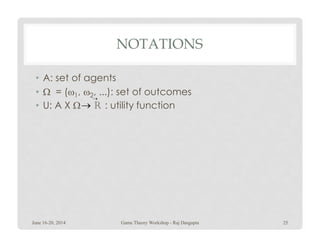
NOTATIONS
• A: set of agents
• Ω = (ω1, ω2, ...): set of outcomes
• U: A X Ω R : utility function
→
→
June 16-20, 2014 25Game Theory Workshop - Raj Dasgupta
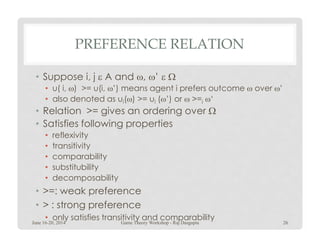
PREFERENCE RELATION
• Suppose i, j ε A and ω, ω’ ε Ω
• u( i, ω) >= u(i, ω’) means agent i prefers outcome ω over ω’
• also denoted as ui(ω) >= ui (ω’) or ω >=i ω‘
• Relation >= gives an ordering over Ω
• Satisfies following properties• Satisfies following properties
• reflexivity
• transitivity
• comparability
• substitubility
• decomposability
• >=: weak preference
• > : strong preference
• only satisfies transitivity and comparability
June 16-20, 2014 26Game Theory Workshop - Raj Dasgupta
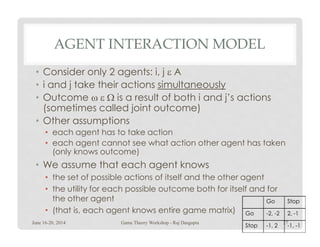
AGENT INTERACTION MODEL
• Consider only 2 agents: i, j ε A
• i and j take their actions simultaneously
• Outcome ω ε Ω is a result of both i and j’s actions
(sometimes called joint outcome)
• Other assumptions• Other assumptions
• each agent has to take action
• each agent cannot see what action other agent has taken
(only knows outcome)
• We assume that each agent knows
• the set of possible actions of itself and the other agent
• the utility for each possible outcome both for itself and for
the other agent
• (that is, each agent knows entire game matrix)
Go Stop
Go -2, -2 2, -1
Stop -1, 2 -1, -1
June 16-20, 2014 27Game Theory Workshop - Raj Dasgupta
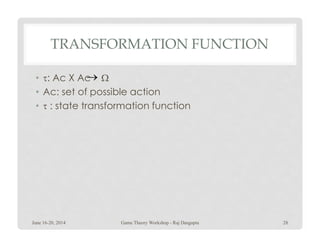
TRANSFORMATION FUNCTION
• τ: Ac X Ac Ω
• Ac: set of possible action
• τ : state transformation function
→
June 16-20, 2014 28Game Theory Workshop - Raj Dasgupta
EXAMPLE
• Let Ac = {C, D} for both agents
• Let τ(C,C) = ω1, τ(C,D) = ω2, τ(D,C) = ω3,
τ(D,D) = ω4
• Let ui(ω1)=4, ui(ω2)=4, ui(ω3)=1, ui(ω4)=1
• Let uj(ω1)=4, uj(ω2)=1, uj(ω3)=4, uj(ω4)=1
• Since each pair of joint actions gives one• Since each pair of joint actions gives one
specific joint outcome, we can write
• ui(C,c)=4, ui(C,d)=4, ui(D,c)=1, ui(D,d)=1
• uj(C,c)=4, uj(C,d)=1, uj(D,c)=4, uj(D,d)=1
• For agent i, the preference over outcomes
is
(C,c) >= i (C, d) > i (D,c) >=i (D,d)
June 16-20, 2014 29Game Theory Workshop - Raj Dasgupta
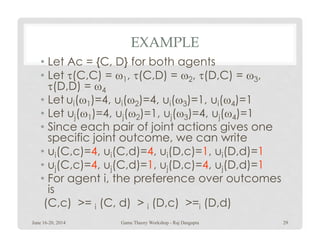
PAYOFF MATRIX
4, 4,C
dc
1, 1,
4,
D
Agent i
• Each entry gives (utility to agent i, utility to agent j)
June 16-20, 2014 30Game Theory Workshop - Raj Dasgupta
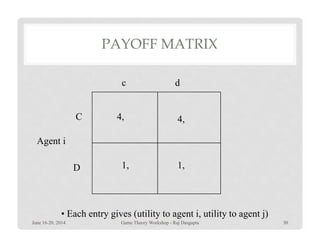
PAYOFF MATRIX
4,4 4,1C
dc
Agent j
1,4 1,1
4,1
D
Agent i
• Each entry gives (utility to agent i, utility to agent j)
June 16-20, 2014 31Game Theory Workshop - Raj Dasgupta
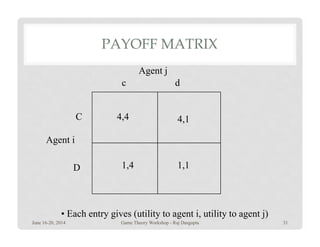
PAYOFF MATRIX
4,4 4,1C
dc
Agent j
1,4 1,1
4,1
D
Agent i
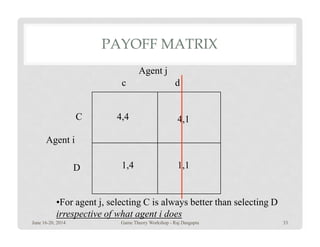
•For agent i, selecting C is always better than selecting D
irrespective of what agent j does
June 16-20, 2014 32Game Theory Workshop - Raj Dasgupta
PAYOFF MATRIX
4,4 4,1C
dc
Agent j
1,4 1,1
4,1
D
Agent i
•For agent j, selecting C is always better than selecting D
irrespective of what agent i does
June 16-20, 2014 33Game Theory Workshop - Raj Dasgupta
PAYOFF MATRIX
4,4 4,1C
dc
Agent j
1,4 1,1
4,1
D
Agent i
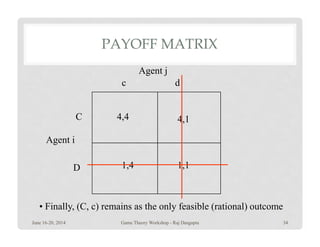
• Finally, (C, c) remains as the only feasible (rational) outcome
June 16-20, 2014 34Game Theory Workshop - Raj Dasgupta
DOMINANT STRATEGIES
• Let Ω={ω1, ω2, ω3, ω4}: be the set of possible
outcomes
• Let Ω1 and Ω2 be two proper subsets of Ω
such that Ω1={ω1, ω2} and Ω2={ω3, ω4}1 1 2 2 3 4
• Suppose that for some agent k, ω1 =k ω2 >k
ω3 =k ω4
• For agent k, every outcome in Ω1 is preferred
over every outcome in Ω2
• We say, for agent k, Ω1strongly dominates Ω2
June 16-20, 2014 35Game Theory Workshop - Raj Dasgupta
STRATEGIES
• Actions of agents are also called strategies
• Outcome of playing strategy s denoted by
s*
• For e.g.: (from previous example)• For e.g.: (from previous example)
• For agent i, C* = {ω3, ω4} and D* = {ω1, ω2}
• Using this notation, strategy s1 dominates
strategy s2 if every outcome in s1
* dominates
every outcome in s2
*
• For e.g, in previous example, C dominates D
for agent i (also for agent j)
June 16-20, 2014 36Game Theory Workshop - Raj Dasgupta
SOLVING A GAME WITH DOMINANT
STRATEGIES
• Solving a game means finding the outcome of
the game
• Procedure
1. Inspect strategies one at a time
2. If a strategy is strongly dominated by another strategy,2. If a strategy is strongly dominated by another strategy,
remove the dominated strategy
3. If the agent ends up with only one strategy by applying
step 2 repeatedly, then the remaining strategy is the
dominant strategy
June 16-20, 2014 37Game Theory Workshop - Raj Dasgupta
WEAKLY DOMINATED STRATEGY
• Let s1 and s2 be two strategies
• s1 weakly dominates s2 if every outcome in s1
* is >=
every outcome in s2
*
June 16-20, 2014 38Game Theory Workshop - Raj Dasgupta
NASH EQUILIBRIUM
PRISONER’S DILEMMA GAME
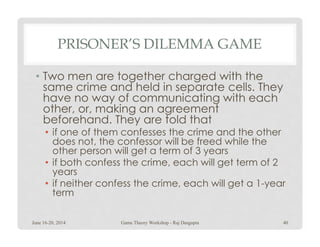
• Two men are together charged with the
same crime and held in separate cells. They
have no way of communicating with each
other, or, making an agreement
beforehand. They are told thatbeforehand. They are told that
• if one of them confesses the crime and the other
does not, the confessor will be freed while the
other person will get a term of 3 years
• if both confess the crime, each will get term of 2
years
• if neither confess the crime, each will get a 1-year
term
June 16-20, 2014 40Game Theory Workshop - Raj Dasgupta
PRISONER’S DILEMMA GAME
• Each person (player) has two strategies
• confess (C)
• don’t confess (D)
• Which strategy should each player play?
Remember each player is a self-interested utility• Remember each player is a self-interested utility
maximizer
June 16-20, 2014 41Game Theory Workshop - Raj Dasgupta
PD GAME: PAYOFF MATRIX
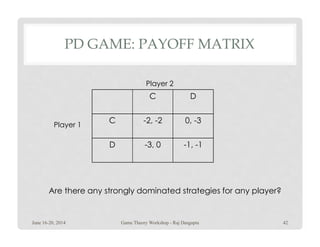
C D
C -2, -2 0, -3
Player 1
Player 2
Are there any strongly dominated strategies for any player?
C -2, -2 0, -3
D -3, 0 -1, -1
Player 1
June 16-20, 2014 42Game Theory Workshop - Raj Dasgupta
PD GAME REASONING
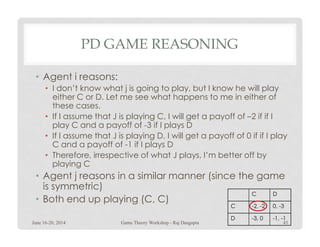
• Agent i reasons:
• I don’t know what j is going to play, but I know he will play
either C or D. Let me see what happens to me in either of
these cases.
• If I assume that J is playing C, I will get a payoff of –2 if if I
play C and a payoff of -3 if I plays Dplay C and a payoff of -3 if I plays D
• If I assume that J is playing D, I will get a payoff of 0 if if I play
C and a payoff of -1 if I plays D
• Therefore, irrespective of what J plays, I’m better off by
playing C
• Agent j reasons in a similar manner (since the game
is symmetric)
• Both end up playing (C, C)
C D
C -2, -2 0, -3
D -3, 0 -1, -1
June 16-20, 2014 43Game Theory Workshop - Raj Dasgupta
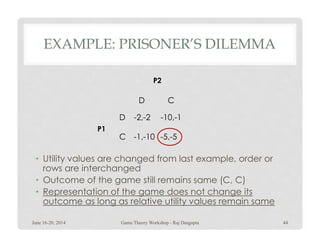
EXAMPLE: PRISONER’S DILEMMA
CD
D -2,-2 -10,-1
P2
• Utility values are changed from last example, order or
rows are interchanged
• Outcome of the game still remains same (C, C)
• Representation of the game does not change its
outcome as long as relative utility values remain same
C -1,-10 -5,-5
P1
June 16-20, 2014 44Game Theory Workshop - Raj Dasgupta
NASH EQUILIBRIUM
• Two strategies s1 and s2 are in Nash equilibrium
when
• under assumption agent i plays s1, agent j can do no better
than play s2
• under assumption agent j plays s2, agent i can do no better• under assumption agent j plays s2, agent i can do no better
than play s1
• Neither agent has any incentive to deviate from a
Nash equilibrium
June 16-20, 2014 45Game Theory Workshop - Raj Dasgupta
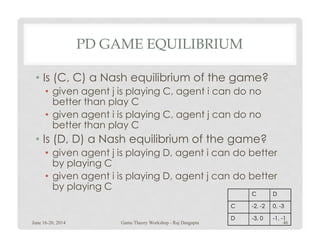
PD GAME EQUILIBRIUM
• Is (C, C) a Nash equilibrium of the game?
• given agent j is playing C, agent i can do no
better than play C
• given agent i is playing C, agent j can do no
better than play Cbetter than play C
• Is (D, D) a Nash equilibrium of the game?
• given agent j is playing D, agent i can do better
by playing C
• given agent i is playing D, agent j can do better
by playing C
C D
C -2, -2 0, -3
D -3, 0 -1, -1
June 16-20, 2014 46Game Theory Workshop - Raj Dasgupta
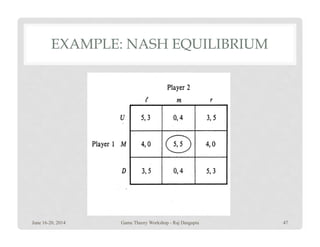
EXAMPLE: NASH EQUILIBRIUM
June 16-20, 2014 47Game Theory Workshop - Raj Dasgupta
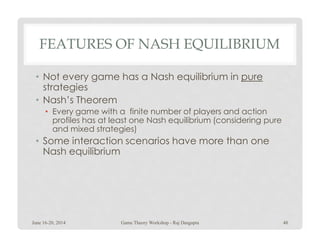
FEATURES OF NASH EQUILIBRIUM
• Not every game has a Nash equilibrium in pure
strategies
• Nash’s Theorem
• Every game with a finite number of players and action
profiles has at least one Nash equilibrium (considering pureprofiles has at least one Nash equilibrium (considering pure
and mixed strategies)
• Some interaction scenarios have more than one
Nash equilibrium
June 16-20, 2014 48Game Theory Workshop - Raj Dasgupta
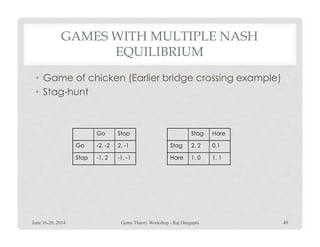
GAMES WITH MULTIPLE NASH
EQUILIBRIUM
• Game of chicken (Earlier bridge crossing example)
• Stag-hunt
Go Stop
Go -2, -2 2, -1
Stop -1, 2 -1, -1
Stag Hare
Stag 2, 2 0,1
Hare 1, 0 1, 1
June 16-20, 2014 49Game Theory Workshop - Raj Dasgupta
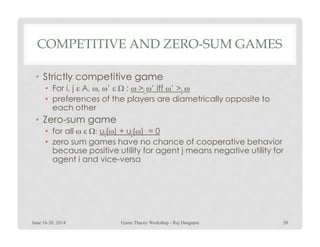
COMPETITIVE AND ZERO-SUM GAMES
• Strictly competitive game
• For i, j ε A, ω, ω’ ε Ω : ω >i ω’ iff ω’ >j ω
• preferences of the players are diametrically opposite to
each other
• Zero-sum game• Zero-sum game
• for all ω ε Ω: ui(ω) + uj(ω) = 0
• zero sum games have no chance of cooperative behavior
because positive utility for agent j means negative utility for
agent i and vice-versa
June 16-20, 2014 50Game Theory Workshop - Raj Dasgupta
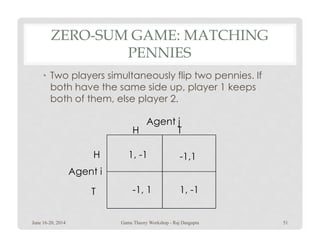
ZERO-SUM GAME: MATCHING
PENNIES
• Two players simultaneously flip two pennies. If
both have the same side up, player 1 keeps
both of them, else player 2.
Agent j
1, -1
-1, 1 1, -1
-1,1H
T
TH
Agent i
Agent j
June 16-20, 2014 51Game Theory Workshop - Raj Dasgupta
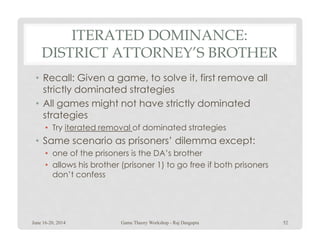
ITERATED DOMINANCE:
DISTRICT ATTORNEY’S BROTHER
• Recall: Given a game, to solve it, first remove all
strictly dominated strategies
• All games might not have strictly dominated
strategies
• Try iterated removal of dominated strategies• Try iterated removal of dominated strategies
• Same scenario as prisoners’ dilemma except:
• one of the prisoners is the DA’s brother
• allows his brother (prisoner 1) to go free if both prisoners
don’t confess
June 16-20, 2014 52Game Theory Workshop - Raj Dasgupta
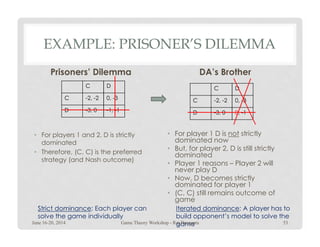
EXAMPLE: PRISONER’S DILEMMA
Prisoners’ Dilemma DA’s Brother
C D
C -2, -2 0, -3
D -3, 0 -1, -1
C D
C -2, -2 0, -3
D -3, 0 0, -1
• For players 1 and 2, D is strictly
dominated
• Therefore, (C, C) is the preferred
strategy (and Nash outcome)
• For player 1 D is not strictly
dominated now
• But, for player 2, D is still strictly
dominated
• Player 1 reasons – Player 2 will
never play D
• Now, D becomes strictly
dominated for player 1
• (C, C) still remains outcome of
game
Strict dominance: Each player can
solve the game individually
Iterated dominance: A player has to
build opponent’s model to solve the
gameJune 16-20, 2014 53Game Theory Workshop - Raj Dasgupta
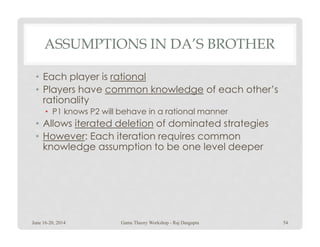
ASSUMPTIONS IN DA’S BROTHER
• Each player is rational
• Players have common knowledge of each other’s
rationality
• P1 knows P2 will behave in a rational manner
• Allows iterated deletion of dominated strategies• Allows iterated deletion of dominated strategies
• However: Each iteration requires common
knowledge assumption to be one level deeper
June 16-20, 2014 54Game Theory Workshop - Raj Dasgupta
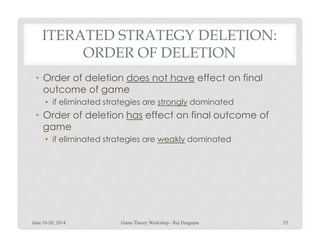
ITERATED STRATEGY DELETION:
ORDER OF DELETION
• Order of deletion does not have effect on final
outcome of game
• if eliminated strategies are strongly dominated
• Order of deletion has effect on final outcome of
gamegame
• if eliminated strategies are weakly dominated
June 16-20, 2014 55Game Theory Workshop - Raj Dasgupta
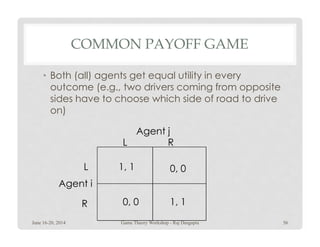
COMMON PAYOFF GAME
• Both (all) agents get equal utility in every
outcome (e.g., two drivers coming from opposite
sides have to choose which side of road to drive
on)
1, 1
0, 0 1, 1
0, 0L
R
RL
Agent i
Agent j
June 16-20, 2014 56Game Theory Workshop - Raj Dasgupta
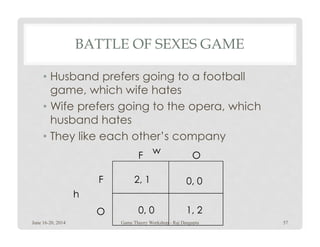
BATTLE OF SEXES GAME
• Husband prefers going to a football
game, which wife hates
• Wife prefers going to the opera, which
husband hateshusband hates
• They like each other’s company
2, 1
0, 0 1, 2
0, 0F
O
OF
h
w
June 16-20, 2014 57Game Theory Workshop - Raj Dasgupta
DEFINITION: NORMAL FORM GAME
• For a game with I players, the normal form
representation of the game ΓN specifies for
each player i, a set of strategies Si (with si Є Si)
and a payoff or utility function ui(s1, s2, s3,
s …s) giving the utility associated with thes4…sI) giving the utility associated with the
outcome of the game corresponding to the
joint strategy profile (s1, s2, s3, s4…sI).
• Formal notation:
ΓN =[ I, {Si}, {ui(.)}]
June 16-20, 2014 58Game Theory Workshop - Raj Dasgupta
DEFINITION:
STRICTLY DOMINATED STRATEGY
• A strategy si Є Si is strictly dominated for player I in
game ΓN =[ I, {Si}, {ui(.)}] if there exists another
strategy si
‘ Є Si such that for all s-i Є S-i
ui(si
‘,s-i) > ui(si,s-i)ui(si
‘,s-i) > ui(si,s-i)
• In this case we say that strategy si
‘ strictly
dominates strategy si
June 16-20, 2014 59Game Theory Workshop - Raj Dasgupta
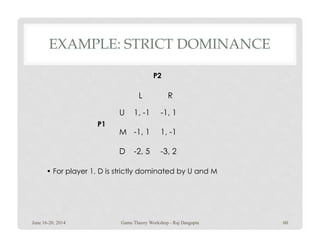
EXAMPLE: STRICT DOMINANCE
RL
U 1, -1 -1, 1
P1
P2
D
M -1, 1 1, -1
-2, 5 -3, 2
P1
• For player 1, D is strictly dominated by U and M
June 16-20, 2014 60Game Theory Workshop - Raj Dasgupta
DEFINITION:
WEAKLY DOMINATED STRATEGY
• A strategy si Є Si is weakly dominated for player I in
game ΓN =[ I, {Si}, {ui(.)}] if there exists another
strategy si
‘ Є Si such that for all s-i Є S-i
ui(si
‘,s-i) >= ui(si,s-i)i i -i i i -i
• with strict inequality for some s-i. In this case,
we say that strategy si
‘ weakly dominates
strategy si
• A strategy is a weakly dominant strategy for
player I in game ΓN =[ I, {Si}, {ui(.)}] if it weakly
dominates every other strategy in Si
June 16-20, 2014 61Game Theory Workshop - Raj Dasgupta
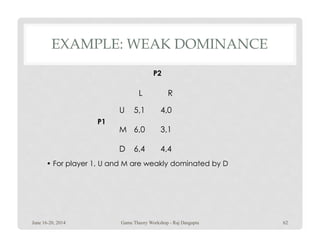
EXAMPLE: WEAK DOMINANCE
RL
U 5,1 4,0
P1
P2
D
M 6,0 3,1
6,4 4,4
P1
• For player 1, U and M are weakly dominated by D
June 16-20, 2014 62Game Theory Workshop - Raj Dasgupta
MIXED STRATEGIES
ZERO-SUM GAME: MATCHING
PENNIES
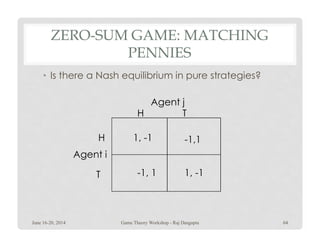
• Is there a Nash equilibrium in pure strategies?
TH
Agent j
1, -1
-1, 1 1, -1
-1,1H
T
Agent i
June 16-20, 2014 64Game Theory Workshop - Raj Dasgupta
MIXED STRATEGY NASH EQUILIBRIUM
• Objective
• Each player randomizes over its own strategies in a way
such that its opponents’ choice becomes independent of it
actions
June 16-20, 2014 65Game Theory Workshop - Raj Dasgupta
SOLVING MIXED STRATEGY NASH
EQUILIBRIUM (1)
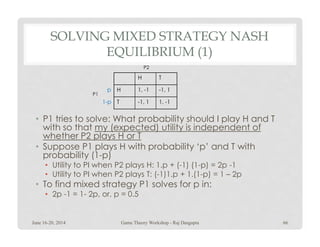
• P1 tries to solve: What probability should I play H and T
with so that my (expected) utility is independent of
H T
H 1, -1 -1, 1
T -1, 1 1, -1
P1
P2
p
1-p
• P1 tries to solve: What probability should I play H and T
with so that my (expected) utility is independent of
whether P2 plays H or T
• Suppose P1 plays H with probability ‘p’ and T with
probability (1-p)
• Utility to PI when P2 plays H: 1.p + (-1) (1-p) = 2p -1
• Utility to PI when P2 plays T: (-1)1.p + 1.(1-p) = 1 – 2p
• To find mixed strategy P1 solves for p in:
• 2p -1 = 1- 2p, or, p = 0.5
June 16-20, 2014 66Game Theory Workshop - Raj Dasgupta
SOLVING MIXED STRATEGY NASH
EQUILIBRIUM (2)
H T
H 1, -1 -1, 1
T -1, 1 1, -1
P1
P2
1-qq
0.5
0.5
0.5 0.5
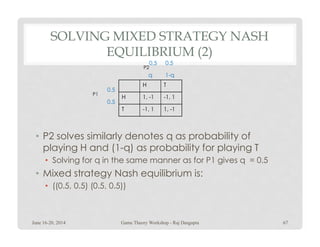
• P2 solves similarly denotes q as probability of
playing H and (1-q) as probability for playing T
• Solving for q in the same manner as for P1 gives q = 0.5
• Mixed strategy Nash equilibrium is:
• ((0.5, 0.5) (0.5, 0.5))
June 16-20, 2014 67Game Theory Workshop - Raj Dasgupta
EXAMPLE: MEETING IN NY GAME:
MIXED STRATEGY NASH
EQUILIBRIUM
June 16-20, 2014 68Game Theory Workshop - Raj Dasgupta
EXAMPLE: MEETING IN NY GAME:
MIXED STRATEGY NASH
EQUILIBRIUM (2)
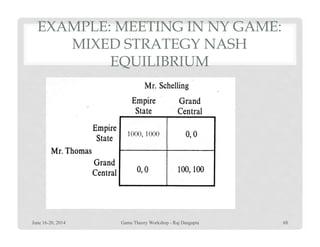
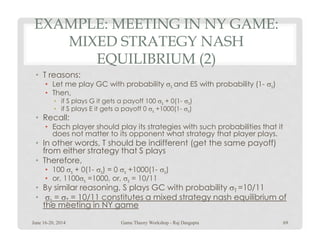
• T reasons:
• Let me play GC with probability σs and ES with probability (1- σs)
• Then,
• if S plays G it gets a payoff 100 σs + 0(1- σs)
• if S plays E it gets a payoff 0 σs +1000(1- σs)
• Recall:
• Each player should play its strategies with such probabilities that it• Each player should play its strategies with such probabilities that it
does not matter to its opponent what strategy that player plays.
• In other words, T should be indifferent (get the same payoff)
from either strategy that S plays
• Therefore,
• 100 σs + 0(1- σs) = 0 σs +1000(1- σs)
• or, 1100σs =1000, or, σs = 10/11
• By similar reasoning, S plays GC with probability σT =10/11
• σs = σT = 10/11 constitutes a mixed strategy nash equilibrium of
the meeting in NY game
June 16-20, 2014 69Game Theory Workshop - Raj Dasgupta
BATTLE OF SEXES GAME
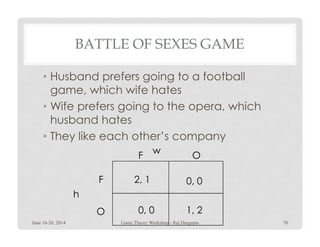
• Husband prefers going to a football
game, which wife hates
• Wife prefers going to the opera, which
husband hateshusband hates
• They like each other’s company
2, 1
0, 0 1, 2
0, 0F
O
OF
h
w
June 16-20, 2014 70Game Theory Workshop - Raj Dasgupta
DEFINITION: MIXED STRATEGY
• Given player i’s (finite) pure strategy set Si, a
mixed strategy for player i , σi: Si → [0,1],
assigns to each pure strategy si Є Si a
probability σi(si) >=0 that it will be played,
where Σ si Є Si σi(si) =1where Σ si Є Si σi(si) =1
• The set of all mixed strategies for player i is
denoted by ∆(Sj)={(σ1,σ2,σ3,... ,σMi) Є RM: σmi >0
for all m = 1...M and Σm=1
Μ σmi=1
• ∆(Sj) is called the mixed strategy profile
• si is called the support of the mixed strategy
σi(si)
June 16-20, 2014 71Game Theory Workshop - Raj Dasgupta
DEFINITION: STRICT DOMINATION
IN MIXED STRATEGIES
• A strategy σi Є ∆(Si) is strictly dominated for player i
in game ΓN =[ I, {∆(Si)}, {ui(.)}] if there exists
another strategy σi
‘ Є ∆(Si) such that for all σ-i Є Π
j<>i ∆(Sj)
ui(σi
‘, σ-i) > ui(σi, σ-i)ui(σi
‘, σ-i) > ui(σi, σ-i)
• In this case we say that strategy σi
‘ strictly
dominates strategy σi
• A strategy σi is a strictly dominant strategy
for player i in game ΓN =[ I, {∆(Si)}, {ui(.)}] if it
strictly dominates every other strategy in
∆(Sj)
June 16-20, 2014 72Game Theory Workshop - Raj Dasgupta
PURE VS. MIXED STRATEGY
• Player i’s pure strategy is strictly dominated in game
ΓN =[ I, {∆(Si)}, {ui(.)}] if and only if there exists
another strategy σi
‘ Є ∆(Si) such that
ui(σi
‘, s-i) > ui(si, s-i)ui(σi , s-i) > ui(si, s-i)
for all s-i Є S-i
June 16-20, 2014 73Game Theory Workshop - Raj Dasgupta
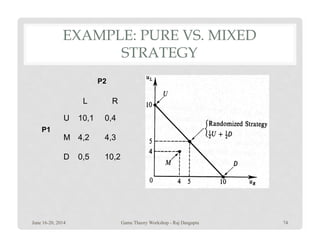
EXAMPLE: PURE VS. MIXED
STRATEGY
RL
U 10,1 0,4
P2
D
M 4,2 4,3
0,5 10,2
P1
June 16-20, 2014 74Game Theory Workshop - Raj Dasgupta
BEST RESPONSE AND
NASH EQUILIBRIUM
• In a game ΓN =[ I, {∆(Si)}, {ui(.)}] , strategy s*
i is
a best response for player i to its opponents’
strategies s-i if
ui(s*
i, s-i) >= ui(si, s-i)ui(s*
i, s-i) >= ui(si, s-i)
for all si ε ∆(Si).
• A strategy profile s = (s*
1 ,s*
2 … s*
N) is a Nash
equilibrium if s*
i is a best response for all
players i= 1…N
June 16-20, 2014 75Game Theory Workshop - Raj Dasgupta
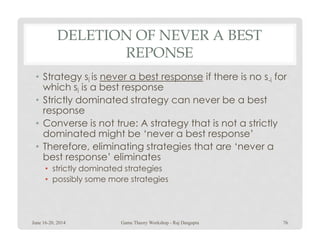
DELETION OF NEVER A BEST
REPONSE
• Strategy si is never a best response if there is no s-i for
which si is a best response
• Strictly dominated strategy can never be a best
response
• Converse is not true: A strategy that is not a strictly• Converse is not true: A strategy that is not a strictly
dominated might be ‘never a best response’
• Therefore, eliminating strategies that are ‘never a
best response’ eliminates
• strictly dominated strategies
• possibly some more strategies
June 16-20, 2014 76Game Theory Workshop - Raj Dasgupta
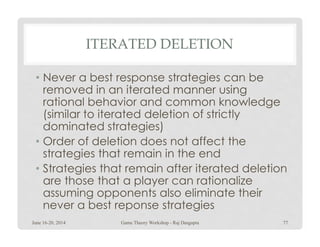
ITERATED DELETION
• Never a best response strategies can be
removed in an iterated manner using
rational behavior and common knowledge
(similar to iterated deletion of strictly
dominated strategies)dominated strategies)
• Order of deletion does not affect the
strategies that remain in the end
• Strategies that remain after iterated deletion
are those that a player can rationalize
assuming opponents also eliminate their
never a best reponse strategies
June 16-20, 2014 77Game Theory Workshop - Raj Dasgupta
RATIONALIZABLE STRATEGIES
• In game ΓN =[ I, {∆(Si)}, {ui(.)}], the strategies in ∆(Si)
that survive the iterated removal of strategies that
are never a best response are known as player i’s
rationalizable strategies.
June 16-20, 2014 78Game Theory Workshop - Raj Dasgupta
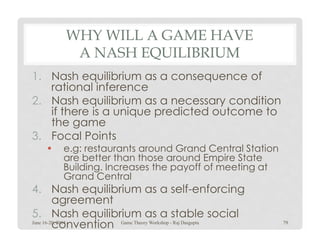
WHY WILL A GAME HAVE
A NASH EQUILIBRIUM
1. Nash equilibrium as a consequence of
rational inference
2. Nash equilibrium as a necessary condition
if there is a unique predicted outcome to
the gamethe game
3. Focal Points
• e.g: restaurants around Grand Central Station
are better than those around Empire State
Building. Increases the payoff of meeting at
Grand Central
4. Nash equilibrium as a self-enforcing
agreement
5. Nash equilibrium as a stable social
conventionJune 16-20, 2014 79Game Theory Workshop - Raj Dasgupta
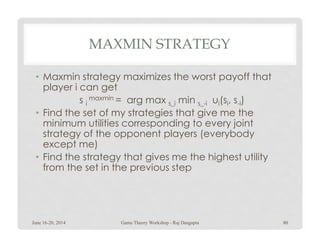
MAXMIN STRATEGY
• Maxmin strategy maximizes the worst payoff that
player i can get
s i
maxmin = arg max s_i min s_-i ui(si, s-i)
• Find the set of my strategies that give me the
minimum utilities corresponding to every jointminimum utilities corresponding to every joint
strategy of the opponent players (everybody
except me)
• Find the strategy that gives me the highest utility
from the set in the previous step
June 16-20, 2014 80Game Theory Workshop - Raj Dasgupta
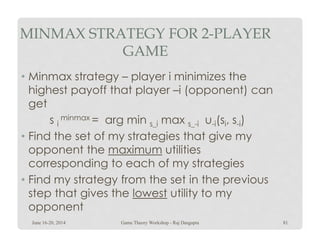
MINMAX STRATEGY FOR 2-PLAYER
GAME
• Minmax strategy – player i minimizes the
highest payoff that player –i (opponent) can
get
s i
minmax = arg min s_i max s_-i u-i(si, s-i)s i = arg min s_i max s_-i u-i(si, s-i)
• Find the set of my strategies that give my
opponent the maximum utilities
corresponding to each of my strategies
• Find my strategy from the set in the previous
step that gives the lowest utility to my
opponent
June 16-20, 2014 81Game Theory Workshop - Raj Dasgupta
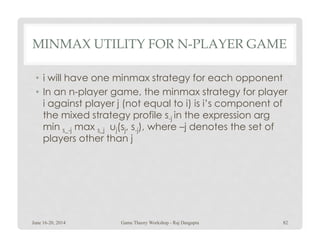
MINMAX UTILITY FOR N-PLAYER GAME
• i will have one minmax strategy for each opponent
• In an n-player game, the minmax strategy for player
i against player j (not equal to i) is i’s component of
the mixed strategy profile s-j in the expression arg
min max u(s, s ), where –j denotes the set ofmin s_-j max s_j uj(sj, s-j), where –j denotes the set of
players other than j
June 16-20, 2014 82Game Theory Workshop - Raj Dasgupta
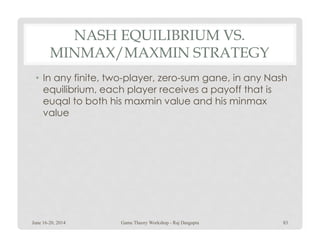
NASH EQUILIBRIUM VS.
MINMAX/MAXMIN STRATEGY
• In any finite, two-player, zero-sum gane, in any Nash
equilibrium, each player receives a payoff that is
euqal to both his maxmin value and his minmax
value
June 16-20, 2014 83Game Theory Workshop - Raj Dasgupta
REGRET
• An agent i’s regret for playing an strategy si if the
other agent’s joint strategy profile is s-i is defined as
[max s’_i ε S_i ui(si’, s-i)] - ui(si, s-i)
• An agent i’s max regret is defined as
max s_-i’ ε S_-i [max s’_i ε S_i ui(si’, s-i)] - ui(si, s-i)
• An agent i’s minimax regret is defined as
arg min s_i ε S_i (max s_-i’ ε S_-i [max s’_i ε S_i ui(si’, s-i)] - ui(si, s-
i))
June 16-20, 2014 84Game Theory Workshop - Raj Dasgupta

1 intro game-theory

  • 1.
    GAMUTGAMUT WORKSHOP ONWORKSHOP ONCOMPUTATIONALCOMPUTATIONAL ASPECTS OF GAME THEORYASPECTS OF GAME THEORY J U N E 1 6 - 2 0 , 2 0 1 4 E C S U , I N D I A N S T A T I S T I C A L I N S T I T U T E K O L K A T A PrithvirajPrithviraj (Raj)(Raj) DasguptaDasgupta AssociateAssociate Professor, ComputerProfessor, Computer ScienceScience Department,Department, UniversityUniversity of Nebraska, Omahaof Nebraska, Omaha
  • 2.
    SPEAKER’S BACKGROUND • AssociateProfessor, Computer Science, University of Nebraska, Omaha (2001- present) • Director, CMANTIC Lab (robotics, computational economics) • Ph.D. (2001) Univ. of California, Santa Barbara• Ph.D. (2001) Univ. of California, Santa Barbara • Computational economics using software agents • B.C.S.E (1995) – Jadavpur University • 1994: Summer internship at I.S.I June 16-20, 2014 2Game Theory Workshop - Raj Dasgupta
  • 3.
    UNIVERSITY OF NEBRASKA,OMAHA • Founded in 1908 • Computer Science program started in early 80s • Department since early 90s90s • 18 full-time faculty • ~400 undergrad, 125 Masters and 15 Ph.D. students • Research areas: AI, Database/Data mining, Networking, Systems June 16-20, 2014 Game Theory Workshop - Raj Dasgupta 3
  • 4.
    C-MANTIC GROUP • http://cmantic.unomaha.edu •Research Topics: • Multi-robot systems path and task planning • Multi-robot/agent systems coordination using game theory-based techniques • Modular robotic systems, Information aggregation using prediction markets, Agent-based crowd simulation, etc.prediction markets, Agent-based crowd simulation, etc. • Established by Raj Dasgupta in 2004 • Received over $3 million as PI in external funding from DoD Navair, ONR, NASA; over 80 publications in top-tier conferences and journals • Currently 8 members including • 2 post-doctoral researchers with Ph.D. in robotics (electrical, control, mechanical engineering) and vision • 4 graduate students (computer science) • 1 undergraduate students (computer engineering, computer science) • Collaborations with faculty from Mechanical engg, Computer science (UN-Lincoln, U. Southern Mississippi), Mathematics (UNO) 6/16/2014 Raj Dasgupta, CMANTIC Lab, UNO 4
  • 5.
    AVAILABLE ROBOT PLATFORMS E-puckmini robot - suitable for table-top experiments for proof-of- Coroware Corobot (indoor robot) • Suitable for indoor experiments in; Coroware Explorer 6/16/2014 Raj Dasgupta, CMANTIC Lab, UNO 5 experiments for proof-of- concept • Suitable for indoor experiments in; hardware and software compatible with Coroware Explorer robot; • Sensors: Laser, IR, fixed camera; Stargazer (IR-based indoor localization); Wifi Coroware Explorer (outdoor robot) – all terrain robot for outdoor experiments; customized with GPS, compass for localization All techniques are first verified on Webots simulator using simulated models of e-puck and Corobot robots Turtlebot (indoor robot) • Suitable for experiments in indoor arena within lab; • Kinect sensor; IR Pelican UAV (aerial robot) • Newly acquired robot • Sensors: Camera; gyro
  • 6.
    RESEARCH PROBLEM • Howto coordinate a set of robots to perform a set of complexcomplex tasks in a collaborativecollaborative manner • Complex task: single robot does not have resources to complete the task individually • Coordination can be synchronous or asynchronous Robots might or might not have to perform the task at the same• Robots might or might not have to perform the task at the same time • Performance metric(s) need to be optimized while performing tasks • Time to complete tasks, distance traveled, energy expended • Robots are able to communicate with each other • Bluetooth, Wi-fi, IR, Camera, Laser • Some robots can fail, but system should not stall 6/16/2014 Raj Dasgupta, CMANTIC Lab, UNO 6
  • 7.
    APPLICATIONS • Humanitarian de-mining(COMRADES) • Autonomous exploration for planetary surfaces (ModRED) • Automatic Target Recognition (ATR) for search and recon (COMSTAR)recon (COMSTAR) • Unmanned Search and Rescue • Civlian and domestic applications like agriculture, vaccum cleaning, etc. 6/16/2014 Raj Dasgupta, CMANTIC Lab, UNO 7
  • 8.
    GAME THEORY WORKSHOP DAY1 June 16-20, 2014 Game Theory Workshop - Raj Dasgupta 8
  • 9.
    OBJECTIVE • Introduction togame theory from a computer science perspective • Learn the fundamental concepts in game theory • Mathematical solution concepts • Algorithms used to solve games• Algorithms used to solve games • Applications of game theory in different application domains • Google Adwords • Trading Agent Competition (Lemonade Stand Game) • Develop programming tools for solving game theory problems and preparation for advanced graduate coursework June 16-20, 2014 9Game Theory Workshop - Raj Dasgupta
  • 10.
    OUTCOMES • Write softwarefor algorithms for • Supply chain management – energy market, travel booking, warehouse inventory management • Auctions (e-bay, etc) • Ad-placement (ad-auctions) for Internet search engines,• Ad-placement (ad-auctions) for Internet search engines, Youtube, etc. • Applications that require coordination between people or software agents • Social networks – information aggregation • Robotics – distributed robot systems June 16-20, 2014 Game Theory Workshop - Raj Dasgupta 10
  • 11.
    ADX GAME • AnAd Network bids for display ads opportunities • Fulfill advertising contracts atcontracts at minimum cost • High quality targeting • Sustain and attract advertisers • https://sites.google.c om/site/gameadx/ June 16-20, 2014 Game Theory Workshop - Raj Dasgupta 11
  • 12.
    POWER-TAC GAME • Agentsact as retail brokers in a local power distribution region • Purchasing power from wholesale market and local sources • Sell power to local customers and into the wholesale market.market. • Solve a supply-chain problem • Product is infinitely perishable • Supply and demand must be exactly balanced at all times • http://www.powertac.org June 16-20, 2014 Game Theory Workshop - Raj Dasgupta 12
  • 13.
    TOPICS TO BECOVERED • Day 1: Introduction to game theory – normal form games • Day 2: Solution concepts for normal form games (math) Day 3: Bayesian games; applications of games• Day 3: Bayesian games; applications of games • Day 4: Mechanism design and auctions • Day 5: Coalition games and student presentations June 16-20, 2014 Game Theory Workshop - Raj Dasgupta 13
  • 14.
    STUDENT PRESENTATIONS • Picka topic on game theory that is covered in class • Research on the Internet on your topic and find at least one problem or challenge related to this problem • Prepare a 10 minute presentation with slides (about 10- 12 slides) • Give overview of topic• Give overview of topic • Discuss the problem or challenge on the topic you have found on the Internet • Mention the most interesting or appealing concept that you learned from the course and why it is interesting to you • Presentation should reflect your understanding of the topic • Presentation schedule: reverse-alphabetical by last name, Friday after lunch June 16-20, 2014 Game Theory Workshop - Raj Dasgupta 14
  • 15.
    DAY 1: OUTLINE •Introduction • Some classic 2-player games • Solving 2-players games • Dominated strategies and iterated dominance • Pareto optimality and Nash equilibrium• Pareto optimality and Nash equilibrium • Mixed Strategies • Software packages for solving games • Generating games using GAMUT • Solving games using Gambit • Correlated Equilibrium June 16-20, 2014 15Game Theory Workshop - Raj Dasgupta
  • 16.
    HISTORY OF GAMETHEORY • 19th century and earlier: mathematical formulations to solve taxation problems, profits, etc. • First half of 20th century: • Von Neumann formalizes utility theory, lays down mathematical foundations for analyzing two player games; early work starts • 1950s onwards: Nash theoremNash theorem, analysis of different types of games, beyond two players, relaxing simplifying assumptionsgames, beyond two players, relaxing simplifying assumptions (e.g., complete knowledge), more complex settings • 1970s onwards: evolutionary game theory (applying biological concepts in games), learning in games, mechanism design • 1990s onwards: • computational implementation of game theory algorithms, complexity results (n players), • game theory software, programming competitions, • applications to real-life domains (auctions, network bandwidth sharing, resource allocation, etc.) June 16-20, 2014 16Game Theory Workshop - Raj Dasgupta
  • 17.
    SOME NOTABLE GAMETHEORISTS • John Von Neumann – Founder of field • John Nash – Nash equilibrium • John Harsanyi – Incomplete Information (Bayesian Games)(Bayesian Games) • Roger Myerson – Mechanism Design • Many others: Morgenstern, Selten, Maynard Smith, Aumann… June 16-20, 2014 17Game Theory Workshop - Raj Dasgupta
  • 18.
    A SIMPLE EXAMPLE •Simplest case: 2 players • Each player has a set (2) of actions • Each player has to select an action • By doing action, the player gets a payoff or utility • Rationality assumption: Each player selects action that gives it highest payoff • A player’s decision (selected action) affects the other player’s decision (selected action) • And other player’s payoff, and in turn its own payoff• And other player’s payoff, and in turn its own payoff Actions: Go, Stop Payoff(Go) = 1 Payoff (Stop) = -1 Actions: Go, Stop Payoff(Go) = 1 Payoff (Stop) = -1 June 16-20, 2014 18Game Theory Workshop - Raj Dasgupta
  • 19.
    A SIMPLE EXAMPLE •Simplest case: 2 players • Each player has a set (2) of actions • Each player has to select an action • By doing action, the player gets a payoff or utility • Rationality assumption: Each player selects action that gives it highest payoff • A player’s decision (selected action) affects the other player’s decision (selected action) • And other player’s payoff, and in turn its own payoff• And other player’s payoff, and in turn its own payoff Actions: Go, Stop Actions: Go, Stop Payoff(Go, Go) = -2, -2 Payoff (Go, Stop) = 2, -1 Payoff (Stop, Go) = -1, 2 Payoff (Stop, Stop) = -1, -1 Payoff(Go, Go) = -2, -2 Payoff (Go, Stop) = 2, -1 Payoff (Stop, Go) = -1, 2 Payoff (Stop, Stop) = -1, -1 June 16-20, 2014 19Game Theory Workshop - Raj Dasgupta
  • 20.
    A SIMPLE EXAMPLE •Simplest case: 2 players • Each player has a set (2) of actions • Each player has to select an action • By doing action, the player gets a payoff or utility • Rationality assumption: Each player selects action that gives it highest payoff • A player’s decision (selected action) affects the other player’s decision (selected action) • And other player’s payoff, and in turn its own payoff• And other player’s payoff, and in turn its own payoff 20 Actions: Go, Stop Actions: Go, Stop Go Stop Go -2, -2 2, -1 Stop -1, 2 -1, -1 Go Stop Go -2, -2 2, -1 Stop -1, 2 -1, -1 June 16-20, 2014 Game Theory Workshop - Raj Dasgupta
  • 21.
    THE MAIN PROBLEMIN GAME THEORY…SAID SIMPLY • Main Problem: Given that each player knows the actions and payoffs of each other, how can each player individually make a decision (select an action) that will be ‘best’ for itself • ‘best’ is loosely defined Go Stop Go -2, -2 2, -1 Stop -1, 2 -1, -1 • ‘best’ is loosely defined • Minimize regret • Maximize sum of payoffs to all (both) players • Stable or equilibrium action – if player deviates by itself from that action, it will end up lowering its own payoff … should hold for every player Nash Equilibrium June 16-20, 2014 21Game Theory Workshop - Raj Dasgupta
  • 22.
    MULTI-AGENT INTERACTIONS • Forsolving game theory computationally, players are implemented as software agents • Main Problem (restated in terms of agents): When two agents interact, what actionWhen two agents interact, what action should each agent take? • Simplifying (natural) assumption: agents are self-interested • each agent takes an action that maximizes its own benefit June 16-20, 2014 22Game Theory Workshop - Raj Dasgupta
  • 23.
    PREFERENCES AND UTILITY •Since two agents are acting, action is referred to as joint action • Each (joint) action results in a different outcome • Selecting a joint action ≡ selecting an outcome • Selecting the best (highest benefit) outcome is modeled as a probability distribution over the set of possible outcomes • called the preferences of the agent over its set of possible outcomes Go Stop Go -2, -2 2, -1 Stop -1, 2 -1, -1 Outcome Joint actions: { (go, go) (go, stop), (stop, go) (stop, stop)} June 16-20, 2014 23Game Theory Workshop - Raj Dasgupta
  • 24.
    UTILITY FUNCTION • Assigna numeric value to outcomes • More preferred outcome, higher utility • Called utility function • Utility is also called payoff Go Stop Go -2, -2 2, -1 Stop -1, 2 -1, -1 • Utility is also called payoff June 16-20, 2014 24Game Theory Workshop - Raj Dasgupta
  • 25.
    NOTATIONS • A: setof agents • Ω = (ω1, ω2, ...): set of outcomes • U: A X Ω R : utility function → → June 16-20, 2014 25Game Theory Workshop - Raj Dasgupta
  • 26.
    PREFERENCE RELATION • Supposei, j ε A and ω, ω’ ε Ω • u( i, ω) >= u(i, ω’) means agent i prefers outcome ω over ω’ • also denoted as ui(ω) >= ui (ω’) or ω >=i ω‘ • Relation >= gives an ordering over Ω • Satisfies following properties• Satisfies following properties • reflexivity • transitivity • comparability • substitubility • decomposability • >=: weak preference • > : strong preference • only satisfies transitivity and comparability June 16-20, 2014 26Game Theory Workshop - Raj Dasgupta
  • 27.
    AGENT INTERACTION MODEL •Consider only 2 agents: i, j ε A • i and j take their actions simultaneously • Outcome ω ε Ω is a result of both i and j’s actions (sometimes called joint outcome) • Other assumptions• Other assumptions • each agent has to take action • each agent cannot see what action other agent has taken (only knows outcome) • We assume that each agent knows • the set of possible actions of itself and the other agent • the utility for each possible outcome both for itself and for the other agent • (that is, each agent knows entire game matrix) Go Stop Go -2, -2 2, -1 Stop -1, 2 -1, -1 June 16-20, 2014 27Game Theory Workshop - Raj Dasgupta
  • 28.
    TRANSFORMATION FUNCTION • τ:Ac X Ac Ω • Ac: set of possible action • τ : state transformation function → June 16-20, 2014 28Game Theory Workshop - Raj Dasgupta
  • 29.
    EXAMPLE • Let Ac= {C, D} for both agents • Let τ(C,C) = ω1, τ(C,D) = ω2, τ(D,C) = ω3, τ(D,D) = ω4 • Let ui(ω1)=4, ui(ω2)=4, ui(ω3)=1, ui(ω4)=1 • Let uj(ω1)=4, uj(ω2)=1, uj(ω3)=4, uj(ω4)=1 • Since each pair of joint actions gives one• Since each pair of joint actions gives one specific joint outcome, we can write • ui(C,c)=4, ui(C,d)=4, ui(D,c)=1, ui(D,d)=1 • uj(C,c)=4, uj(C,d)=1, uj(D,c)=4, uj(D,d)=1 • For agent i, the preference over outcomes is (C,c) >= i (C, d) > i (D,c) >=i (D,d) June 16-20, 2014 29Game Theory Workshop - Raj Dasgupta
  • 30.
    PAYOFF MATRIX 4, 4,C dc 1,1, 4, D Agent i • Each entry gives (utility to agent i, utility to agent j) June 16-20, 2014 30Game Theory Workshop - Raj Dasgupta
  • 31.
    PAYOFF MATRIX 4,4 4,1C dc Agentj 1,4 1,1 4,1 D Agent i • Each entry gives (utility to agent i, utility to agent j) June 16-20, 2014 31Game Theory Workshop - Raj Dasgupta
  • 32.
    PAYOFF MATRIX 4,4 4,1C dc Agentj 1,4 1,1 4,1 D Agent i •For agent i, selecting C is always better than selecting D irrespective of what agent j does June 16-20, 2014 32Game Theory Workshop - Raj Dasgupta
  • 33.
    PAYOFF MATRIX 4,4 4,1C dc Agentj 1,4 1,1 4,1 D Agent i •For agent j, selecting C is always better than selecting D irrespective of what agent i does June 16-20, 2014 33Game Theory Workshop - Raj Dasgupta
  • 34.
    PAYOFF MATRIX 4,4 4,1C dc Agentj 1,4 1,1 4,1 D Agent i • Finally, (C, c) remains as the only feasible (rational) outcome June 16-20, 2014 34Game Theory Workshop - Raj Dasgupta
  • 35.
    DOMINANT STRATEGIES • LetΩ={ω1, ω2, ω3, ω4}: be the set of possible outcomes • Let Ω1 and Ω2 be two proper subsets of Ω such that Ω1={ω1, ω2} and Ω2={ω3, ω4}1 1 2 2 3 4 • Suppose that for some agent k, ω1 =k ω2 >k ω3 =k ω4 • For agent k, every outcome in Ω1 is preferred over every outcome in Ω2 • We say, for agent k, Ω1strongly dominates Ω2 June 16-20, 2014 35Game Theory Workshop - Raj Dasgupta
  • 36.
    STRATEGIES • Actions ofagents are also called strategies • Outcome of playing strategy s denoted by s* • For e.g.: (from previous example)• For e.g.: (from previous example) • For agent i, C* = {ω3, ω4} and D* = {ω1, ω2} • Using this notation, strategy s1 dominates strategy s2 if every outcome in s1 * dominates every outcome in s2 * • For e.g, in previous example, C dominates D for agent i (also for agent j) June 16-20, 2014 36Game Theory Workshop - Raj Dasgupta
  • 37.
    SOLVING A GAMEWITH DOMINANT STRATEGIES • Solving a game means finding the outcome of the game • Procedure 1. Inspect strategies one at a time 2. If a strategy is strongly dominated by another strategy,2. If a strategy is strongly dominated by another strategy, remove the dominated strategy 3. If the agent ends up with only one strategy by applying step 2 repeatedly, then the remaining strategy is the dominant strategy June 16-20, 2014 37Game Theory Workshop - Raj Dasgupta
  • 38.
    WEAKLY DOMINATED STRATEGY •Let s1 and s2 be two strategies • s1 weakly dominates s2 if every outcome in s1 * is >= every outcome in s2 * June 16-20, 2014 38Game Theory Workshop - Raj Dasgupta
  • 39.
  • 40.
    PRISONER’S DILEMMA GAME •Two men are together charged with the same crime and held in separate cells. They have no way of communicating with each other, or, making an agreement beforehand. They are told thatbeforehand. They are told that • if one of them confesses the crime and the other does not, the confessor will be freed while the other person will get a term of 3 years • if both confess the crime, each will get term of 2 years • if neither confess the crime, each will get a 1-year term June 16-20, 2014 40Game Theory Workshop - Raj Dasgupta
  • 41.
    PRISONER’S DILEMMA GAME •Each person (player) has two strategies • confess (C) • don’t confess (D) • Which strategy should each player play? Remember each player is a self-interested utility• Remember each player is a self-interested utility maximizer June 16-20, 2014 41Game Theory Workshop - Raj Dasgupta
  • 42.
    PD GAME: PAYOFFMATRIX C D C -2, -2 0, -3 Player 1 Player 2 Are there any strongly dominated strategies for any player? C -2, -2 0, -3 D -3, 0 -1, -1 Player 1 June 16-20, 2014 42Game Theory Workshop - Raj Dasgupta
  • 43.
    PD GAME REASONING •Agent i reasons: • I don’t know what j is going to play, but I know he will play either C or D. Let me see what happens to me in either of these cases. • If I assume that J is playing C, I will get a payoff of –2 if if I play C and a payoff of -3 if I plays Dplay C and a payoff of -3 if I plays D • If I assume that J is playing D, I will get a payoff of 0 if if I play C and a payoff of -1 if I plays D • Therefore, irrespective of what J plays, I’m better off by playing C • Agent j reasons in a similar manner (since the game is symmetric) • Both end up playing (C, C) C D C -2, -2 0, -3 D -3, 0 -1, -1 June 16-20, 2014 43Game Theory Workshop - Raj Dasgupta
  • 44.
    EXAMPLE: PRISONER’S DILEMMA CD D-2,-2 -10,-1 P2 • Utility values are changed from last example, order or rows are interchanged • Outcome of the game still remains same (C, C) • Representation of the game does not change its outcome as long as relative utility values remain same C -1,-10 -5,-5 P1 June 16-20, 2014 44Game Theory Workshop - Raj Dasgupta
  • 45.
    NASH EQUILIBRIUM • Twostrategies s1 and s2 are in Nash equilibrium when • under assumption agent i plays s1, agent j can do no better than play s2 • under assumption agent j plays s2, agent i can do no better• under assumption agent j plays s2, agent i can do no better than play s1 • Neither agent has any incentive to deviate from a Nash equilibrium June 16-20, 2014 45Game Theory Workshop - Raj Dasgupta
  • 46.
    PD GAME EQUILIBRIUM •Is (C, C) a Nash equilibrium of the game? • given agent j is playing C, agent i can do no better than play C • given agent i is playing C, agent j can do no better than play Cbetter than play C • Is (D, D) a Nash equilibrium of the game? • given agent j is playing D, agent i can do better by playing C • given agent i is playing D, agent j can do better by playing C C D C -2, -2 0, -3 D -3, 0 -1, -1 June 16-20, 2014 46Game Theory Workshop - Raj Dasgupta
  • 47.
    EXAMPLE: NASH EQUILIBRIUM June16-20, 2014 47Game Theory Workshop - Raj Dasgupta
  • 48.
    FEATURES OF NASHEQUILIBRIUM • Not every game has a Nash equilibrium in pure strategies • Nash’s Theorem • Every game with a finite number of players and action profiles has at least one Nash equilibrium (considering pureprofiles has at least one Nash equilibrium (considering pure and mixed strategies) • Some interaction scenarios have more than one Nash equilibrium June 16-20, 2014 48Game Theory Workshop - Raj Dasgupta
  • 49.
    GAMES WITH MULTIPLENASH EQUILIBRIUM • Game of chicken (Earlier bridge crossing example) • Stag-hunt Go Stop Go -2, -2 2, -1 Stop -1, 2 -1, -1 Stag Hare Stag 2, 2 0,1 Hare 1, 0 1, 1 June 16-20, 2014 49Game Theory Workshop - Raj Dasgupta
  • 50.
    COMPETITIVE AND ZERO-SUMGAMES • Strictly competitive game • For i, j ε A, ω, ω’ ε Ω : ω >i ω’ iff ω’ >j ω • preferences of the players are diametrically opposite to each other • Zero-sum game• Zero-sum game • for all ω ε Ω: ui(ω) + uj(ω) = 0 • zero sum games have no chance of cooperative behavior because positive utility for agent j means negative utility for agent i and vice-versa June 16-20, 2014 50Game Theory Workshop - Raj Dasgupta
  • 51.
    ZERO-SUM GAME: MATCHING PENNIES •Two players simultaneously flip two pennies. If both have the same side up, player 1 keeps both of them, else player 2. Agent j 1, -1 -1, 1 1, -1 -1,1H T TH Agent i Agent j June 16-20, 2014 51Game Theory Workshop - Raj Dasgupta
  • 52.
    ITERATED DOMINANCE: DISTRICT ATTORNEY’SBROTHER • Recall: Given a game, to solve it, first remove all strictly dominated strategies • All games might not have strictly dominated strategies • Try iterated removal of dominated strategies• Try iterated removal of dominated strategies • Same scenario as prisoners’ dilemma except: • one of the prisoners is the DA’s brother • allows his brother (prisoner 1) to go free if both prisoners don’t confess June 16-20, 2014 52Game Theory Workshop - Raj Dasgupta
  • 53.
    EXAMPLE: PRISONER’S DILEMMA Prisoners’Dilemma DA’s Brother C D C -2, -2 0, -3 D -3, 0 -1, -1 C D C -2, -2 0, -3 D -3, 0 0, -1 • For players 1 and 2, D is strictly dominated • Therefore, (C, C) is the preferred strategy (and Nash outcome) • For player 1 D is not strictly dominated now • But, for player 2, D is still strictly dominated • Player 1 reasons – Player 2 will never play D • Now, D becomes strictly dominated for player 1 • (C, C) still remains outcome of game Strict dominance: Each player can solve the game individually Iterated dominance: A player has to build opponent’s model to solve the gameJune 16-20, 2014 53Game Theory Workshop - Raj Dasgupta
  • 54.
    ASSUMPTIONS IN DA’SBROTHER • Each player is rational • Players have common knowledge of each other’s rationality • P1 knows P2 will behave in a rational manner • Allows iterated deletion of dominated strategies• Allows iterated deletion of dominated strategies • However: Each iteration requires common knowledge assumption to be one level deeper June 16-20, 2014 54Game Theory Workshop - Raj Dasgupta
  • 55.
    ITERATED STRATEGY DELETION: ORDEROF DELETION • Order of deletion does not have effect on final outcome of game • if eliminated strategies are strongly dominated • Order of deletion has effect on final outcome of gamegame • if eliminated strategies are weakly dominated June 16-20, 2014 55Game Theory Workshop - Raj Dasgupta
  • 56.
    COMMON PAYOFF GAME •Both (all) agents get equal utility in every outcome (e.g., two drivers coming from opposite sides have to choose which side of road to drive on) 1, 1 0, 0 1, 1 0, 0L R RL Agent i Agent j June 16-20, 2014 56Game Theory Workshop - Raj Dasgupta
  • 57.
    BATTLE OF SEXESGAME • Husband prefers going to a football game, which wife hates • Wife prefers going to the opera, which husband hateshusband hates • They like each other’s company 2, 1 0, 0 1, 2 0, 0F O OF h w June 16-20, 2014 57Game Theory Workshop - Raj Dasgupta
  • 58.
    DEFINITION: NORMAL FORMGAME • For a game with I players, the normal form representation of the game ΓN specifies for each player i, a set of strategies Si (with si Є Si) and a payoff or utility function ui(s1, s2, s3, s …s) giving the utility associated with thes4…sI) giving the utility associated with the outcome of the game corresponding to the joint strategy profile (s1, s2, s3, s4…sI). • Formal notation: ΓN =[ I, {Si}, {ui(.)}] June 16-20, 2014 58Game Theory Workshop - Raj Dasgupta
  • 59.
    DEFINITION: STRICTLY DOMINATED STRATEGY •A strategy si Є Si is strictly dominated for player I in game ΓN =[ I, {Si}, {ui(.)}] if there exists another strategy si ‘ Є Si such that for all s-i Є S-i ui(si ‘,s-i) > ui(si,s-i)ui(si ‘,s-i) > ui(si,s-i) • In this case we say that strategy si ‘ strictly dominates strategy si June 16-20, 2014 59Game Theory Workshop - Raj Dasgupta
  • 60.
    EXAMPLE: STRICT DOMINANCE RL U1, -1 -1, 1 P1 P2 D M -1, 1 1, -1 -2, 5 -3, 2 P1 • For player 1, D is strictly dominated by U and M June 16-20, 2014 60Game Theory Workshop - Raj Dasgupta
  • 61.
    DEFINITION: WEAKLY DOMINATED STRATEGY •A strategy si Є Si is weakly dominated for player I in game ΓN =[ I, {Si}, {ui(.)}] if there exists another strategy si ‘ Є Si such that for all s-i Є S-i ui(si ‘,s-i) >= ui(si,s-i)i i -i i i -i • with strict inequality for some s-i. In this case, we say that strategy si ‘ weakly dominates strategy si • A strategy is a weakly dominant strategy for player I in game ΓN =[ I, {Si}, {ui(.)}] if it weakly dominates every other strategy in Si June 16-20, 2014 61Game Theory Workshop - Raj Dasgupta
  • 62.
    EXAMPLE: WEAK DOMINANCE RL U5,1 4,0 P1 P2 D M 6,0 3,1 6,4 4,4 P1 • For player 1, U and M are weakly dominated by D June 16-20, 2014 62Game Theory Workshop - Raj Dasgupta
  • 63.
  • 64.
    ZERO-SUM GAME: MATCHING PENNIES •Is there a Nash equilibrium in pure strategies? TH Agent j 1, -1 -1, 1 1, -1 -1,1H T Agent i June 16-20, 2014 64Game Theory Workshop - Raj Dasgupta
  • 65.
    MIXED STRATEGY NASHEQUILIBRIUM • Objective • Each player randomizes over its own strategies in a way such that its opponents’ choice becomes independent of it actions June 16-20, 2014 65Game Theory Workshop - Raj Dasgupta
  • 66.
    SOLVING MIXED STRATEGYNASH EQUILIBRIUM (1) • P1 tries to solve: What probability should I play H and T with so that my (expected) utility is independent of H T H 1, -1 -1, 1 T -1, 1 1, -1 P1 P2 p 1-p • P1 tries to solve: What probability should I play H and T with so that my (expected) utility is independent of whether P2 plays H or T • Suppose P1 plays H with probability ‘p’ and T with probability (1-p) • Utility to PI when P2 plays H: 1.p + (-1) (1-p) = 2p -1 • Utility to PI when P2 plays T: (-1)1.p + 1.(1-p) = 1 – 2p • To find mixed strategy P1 solves for p in: • 2p -1 = 1- 2p, or, p = 0.5 June 16-20, 2014 66Game Theory Workshop - Raj Dasgupta
  • 67.
    SOLVING MIXED STRATEGYNASH EQUILIBRIUM (2) H T H 1, -1 -1, 1 T -1, 1 1, -1 P1 P2 1-qq 0.5 0.5 0.5 0.5 • P2 solves similarly denotes q as probability of playing H and (1-q) as probability for playing T • Solving for q in the same manner as for P1 gives q = 0.5 • Mixed strategy Nash equilibrium is: • ((0.5, 0.5) (0.5, 0.5)) June 16-20, 2014 67Game Theory Workshop - Raj Dasgupta
  • 68.
    EXAMPLE: MEETING INNY GAME: MIXED STRATEGY NASH EQUILIBRIUM June 16-20, 2014 68Game Theory Workshop - Raj Dasgupta
  • 69.
    EXAMPLE: MEETING INNY GAME: MIXED STRATEGY NASH EQUILIBRIUM (2) • T reasons: • Let me play GC with probability σs and ES with probability (1- σs) • Then, • if S plays G it gets a payoff 100 σs + 0(1- σs) • if S plays E it gets a payoff 0 σs +1000(1- σs) • Recall: • Each player should play its strategies with such probabilities that it• Each player should play its strategies with such probabilities that it does not matter to its opponent what strategy that player plays. • In other words, T should be indifferent (get the same payoff) from either strategy that S plays • Therefore, • 100 σs + 0(1- σs) = 0 σs +1000(1- σs) • or, 1100σs =1000, or, σs = 10/11 • By similar reasoning, S plays GC with probability σT =10/11 • σs = σT = 10/11 constitutes a mixed strategy nash equilibrium of the meeting in NY game June 16-20, 2014 69Game Theory Workshop - Raj Dasgupta
  • 70.
    BATTLE OF SEXESGAME • Husband prefers going to a football game, which wife hates • Wife prefers going to the opera, which husband hateshusband hates • They like each other’s company 2, 1 0, 0 1, 2 0, 0F O OF h w June 16-20, 2014 70Game Theory Workshop - Raj Dasgupta
  • 71.
    DEFINITION: MIXED STRATEGY •Given player i’s (finite) pure strategy set Si, a mixed strategy for player i , σi: Si → [0,1], assigns to each pure strategy si Є Si a probability σi(si) >=0 that it will be played, where Σ si Є Si σi(si) =1where Σ si Є Si σi(si) =1 • The set of all mixed strategies for player i is denoted by ∆(Sj)={(σ1,σ2,σ3,... ,σMi) Є RM: σmi >0 for all m = 1...M and Σm=1 Μ σmi=1 • ∆(Sj) is called the mixed strategy profile • si is called the support of the mixed strategy σi(si) June 16-20, 2014 71Game Theory Workshop - Raj Dasgupta
  • 72.
    DEFINITION: STRICT DOMINATION INMIXED STRATEGIES • A strategy σi Є ∆(Si) is strictly dominated for player i in game ΓN =[ I, {∆(Si)}, {ui(.)}] if there exists another strategy σi ‘ Є ∆(Si) such that for all σ-i Є Π j<>i ∆(Sj) ui(σi ‘, σ-i) > ui(σi, σ-i)ui(σi ‘, σ-i) > ui(σi, σ-i) • In this case we say that strategy σi ‘ strictly dominates strategy σi • A strategy σi is a strictly dominant strategy for player i in game ΓN =[ I, {∆(Si)}, {ui(.)}] if it strictly dominates every other strategy in ∆(Sj) June 16-20, 2014 72Game Theory Workshop - Raj Dasgupta
  • 73.
    PURE VS. MIXEDSTRATEGY • Player i’s pure strategy is strictly dominated in game ΓN =[ I, {∆(Si)}, {ui(.)}] if and only if there exists another strategy σi ‘ Є ∆(Si) such that ui(σi ‘, s-i) > ui(si, s-i)ui(σi , s-i) > ui(si, s-i) for all s-i Є S-i June 16-20, 2014 73Game Theory Workshop - Raj Dasgupta
  • 74.
    EXAMPLE: PURE VS.MIXED STRATEGY RL U 10,1 0,4 P2 D M 4,2 4,3 0,5 10,2 P1 June 16-20, 2014 74Game Theory Workshop - Raj Dasgupta
  • 75.
    BEST RESPONSE AND NASHEQUILIBRIUM • In a game ΓN =[ I, {∆(Si)}, {ui(.)}] , strategy s* i is a best response for player i to its opponents’ strategies s-i if ui(s* i, s-i) >= ui(si, s-i)ui(s* i, s-i) >= ui(si, s-i) for all si ε ∆(Si). • A strategy profile s = (s* 1 ,s* 2 … s* N) is a Nash equilibrium if s* i is a best response for all players i= 1…N June 16-20, 2014 75Game Theory Workshop - Raj Dasgupta
  • 76.
    DELETION OF NEVERA BEST REPONSE • Strategy si is never a best response if there is no s-i for which si is a best response • Strictly dominated strategy can never be a best response • Converse is not true: A strategy that is not a strictly• Converse is not true: A strategy that is not a strictly dominated might be ‘never a best response’ • Therefore, eliminating strategies that are ‘never a best response’ eliminates • strictly dominated strategies • possibly some more strategies June 16-20, 2014 76Game Theory Workshop - Raj Dasgupta
  • 77.
    ITERATED DELETION • Nevera best response strategies can be removed in an iterated manner using rational behavior and common knowledge (similar to iterated deletion of strictly dominated strategies)dominated strategies) • Order of deletion does not affect the strategies that remain in the end • Strategies that remain after iterated deletion are those that a player can rationalize assuming opponents also eliminate their never a best reponse strategies June 16-20, 2014 77Game Theory Workshop - Raj Dasgupta
  • 78.
    RATIONALIZABLE STRATEGIES • Ingame ΓN =[ I, {∆(Si)}, {ui(.)}], the strategies in ∆(Si) that survive the iterated removal of strategies that are never a best response are known as player i’s rationalizable strategies. June 16-20, 2014 78Game Theory Workshop - Raj Dasgupta
  • 79.
    WHY WILL AGAME HAVE A NASH EQUILIBRIUM 1. Nash equilibrium as a consequence of rational inference 2. Nash equilibrium as a necessary condition if there is a unique predicted outcome to the gamethe game 3. Focal Points • e.g: restaurants around Grand Central Station are better than those around Empire State Building. Increases the payoff of meeting at Grand Central 4. Nash equilibrium as a self-enforcing agreement 5. Nash equilibrium as a stable social conventionJune 16-20, 2014 79Game Theory Workshop - Raj Dasgupta
  • 80.
    MAXMIN STRATEGY • Maxminstrategy maximizes the worst payoff that player i can get s i maxmin = arg max s_i min s_-i ui(si, s-i) • Find the set of my strategies that give me the minimum utilities corresponding to every jointminimum utilities corresponding to every joint strategy of the opponent players (everybody except me) • Find the strategy that gives me the highest utility from the set in the previous step June 16-20, 2014 80Game Theory Workshop - Raj Dasgupta
  • 81.
    MINMAX STRATEGY FOR2-PLAYER GAME • Minmax strategy – player i minimizes the highest payoff that player –i (opponent) can get s i minmax = arg min s_i max s_-i u-i(si, s-i)s i = arg min s_i max s_-i u-i(si, s-i) • Find the set of my strategies that give my opponent the maximum utilities corresponding to each of my strategies • Find my strategy from the set in the previous step that gives the lowest utility to my opponent June 16-20, 2014 81Game Theory Workshop - Raj Dasgupta
  • 82.
    MINMAX UTILITY FORN-PLAYER GAME • i will have one minmax strategy for each opponent • In an n-player game, the minmax strategy for player i against player j (not equal to i) is i’s component of the mixed strategy profile s-j in the expression arg min max u(s, s ), where –j denotes the set ofmin s_-j max s_j uj(sj, s-j), where –j denotes the set of players other than j June 16-20, 2014 82Game Theory Workshop - Raj Dasgupta
  • 83.
    NASH EQUILIBRIUM VS. MINMAX/MAXMINSTRATEGY • In any finite, two-player, zero-sum gane, in any Nash equilibrium, each player receives a payoff that is euqal to both his maxmin value and his minmax value June 16-20, 2014 83Game Theory Workshop - Raj Dasgupta
  • 84.
    REGRET • An agenti’s regret for playing an strategy si if the other agent’s joint strategy profile is s-i is defined as [max s’_i ε S_i ui(si’, s-i)] - ui(si, s-i) • An agent i’s max regret is defined as max s_-i’ ε S_-i [max s’_i ε S_i ui(si’, s-i)] - ui(si, s-i) • An agent i’s minimax regret is defined as arg min s_i ε S_i (max s_-i’ ε S_-i [max s’_i ε S_i ui(si’, s-i)] - ui(si, s- i)) June 16-20, 2014 84Game Theory Workshop - Raj Dasgupta