In many ways the grand-daddy of Real Time
Strategy, console RPGs, MMORPGs, MUDs,
LARPing, Cosplay and teenage alienation,
Dungeons & Dragons, one of the proverbial
dice games of a generation and the
inspiration for roughly a third of the games
we’ve played in class (WoW, LoL, Card
Hunter) was the brainchild of a gentleman
named Gary Gygax, conceived as a way to
keep his beloved war-gaming from fading
away.
"Our initial rule sets were entirely based on what the
figure looked like…If a soldier was carrying a mace but
had no armor, then he fought under a particular rule
set; if the figure had armor and a crossbow, his attack
and defense ratings were totally different." Initially, the
rules were set up in traditional wargaming fashion: 1
plastic soldier representing 20 men. To break up the
monotony a bit, they occasionally played using rules for
1-to-1 combat, where each figure represented one man
in small, squad-level skirmishes.”

From: http://pc.gamespy.com/articles/538/538262p2.html

-Gary Gygax
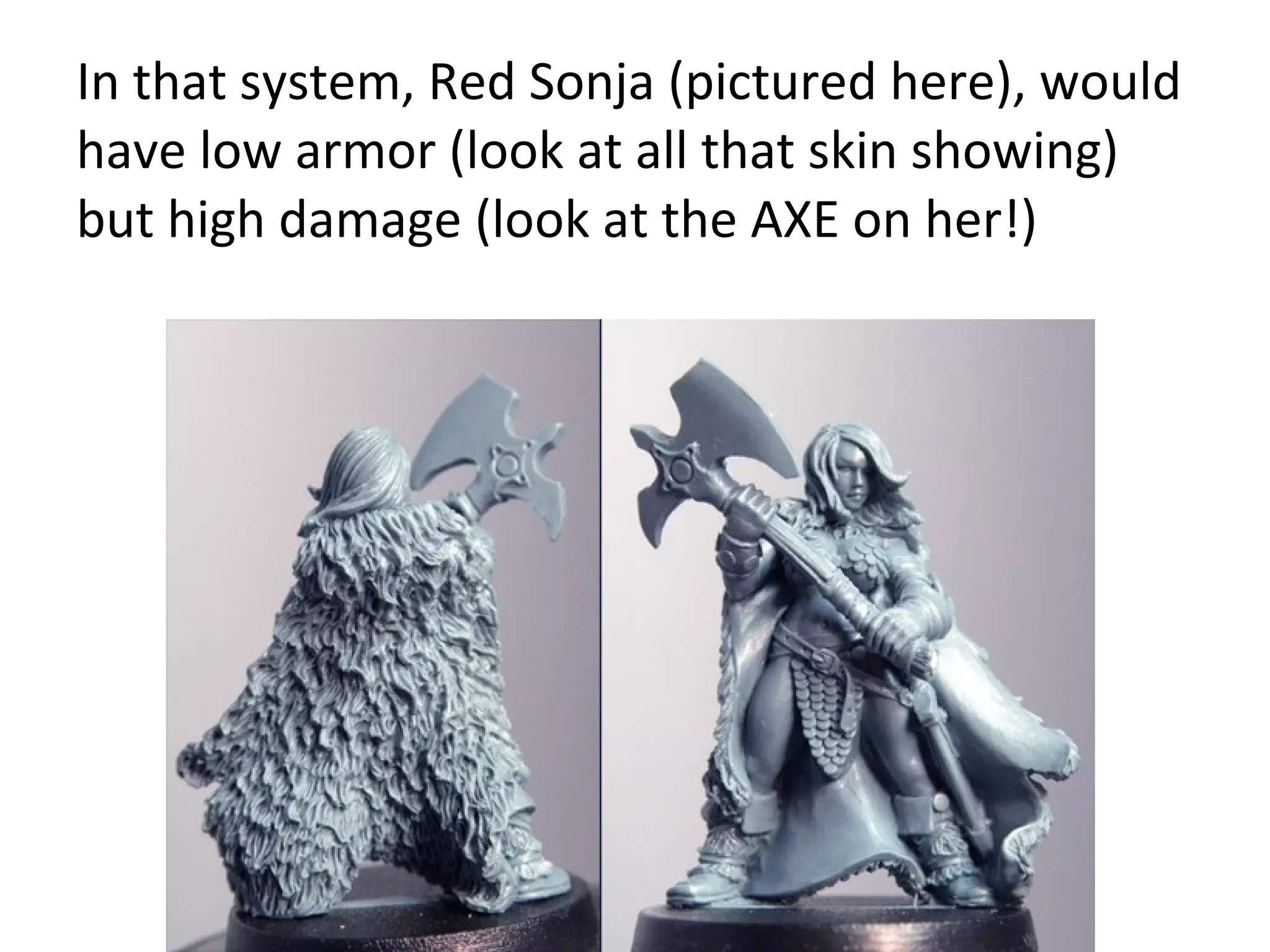
In that system, Red Sonja (pictured here), would
have low armor (look at all that skin showing)
but high damage (look at the AXE on her!)
But Gary Gygax had a problem.
As much as he loved castles and
sieges and war games and rolling dice
and strategy…
People were leaving his gaming club.
It was getting a little boring.
"I figured why not add a few fantasy
elements to the game -- instead of a
catapult. Why not have one figure
represent a wizard who could cast a
fireball whose rules, not coincidentally,
were exactly the same as the catapult?"
From: http://pc.gamespy.com/articles/538/538262p2.html

-Gary Gygax
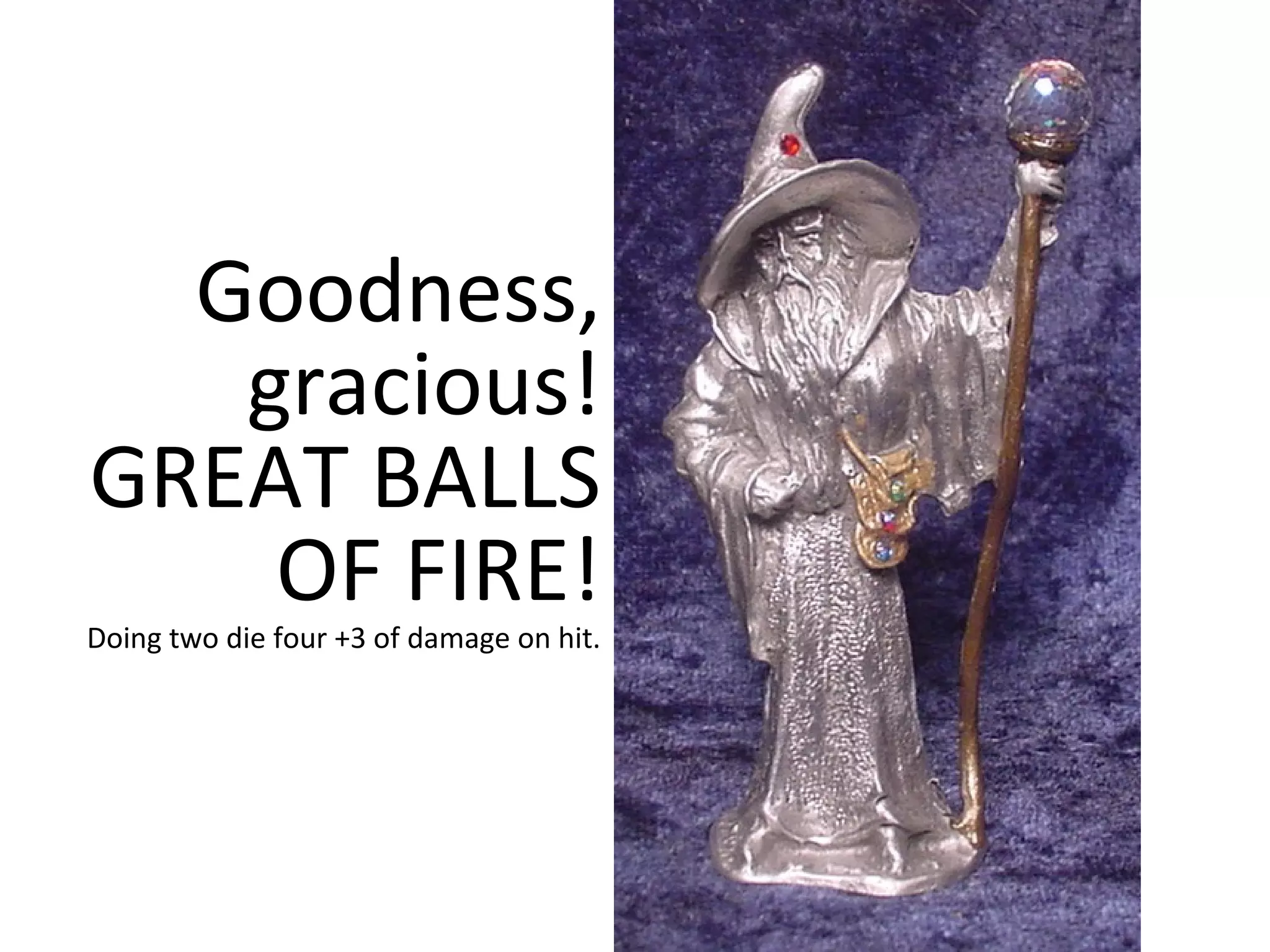
Goodness,
gracious!
GREAT BALLS
OF FIRE!

Doing two die four +3 of damage on hit.
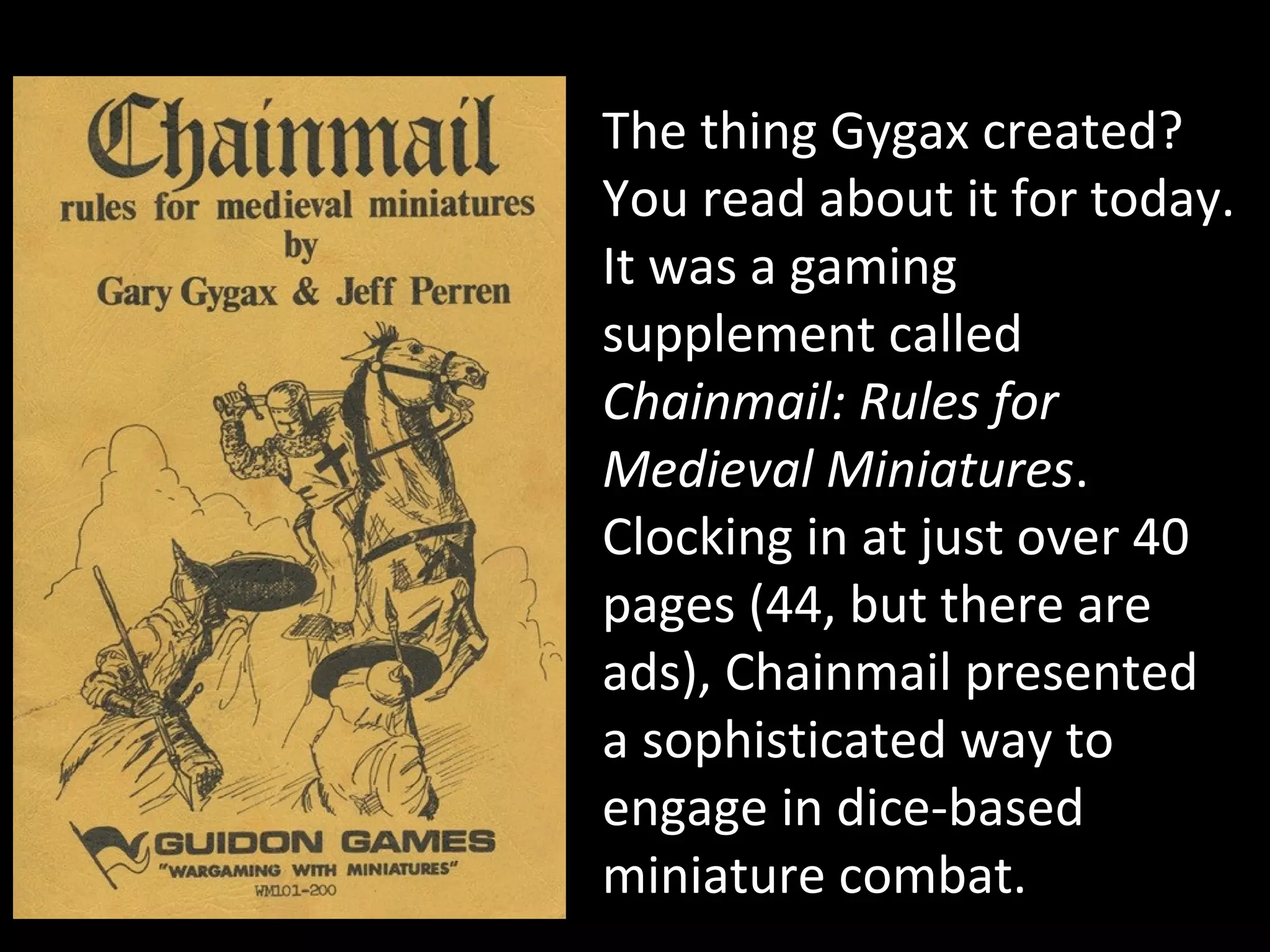
The thing Gygax created?
You read about it for today.
It was a gaming
supplement called
Chainmail: Rules for
Medieval Miniatures.
Clocking in at just over 40
pages (44, but there are
ads), Chainmail presented
a sophisticated way to
engage in dice-based
miniature combat.
Chainmail hit the scene in 1970, with widespread
availability in 1971. But for as cool as Chainmail
was, it was just rules for combat. It wasn’t until
GenCon in 1971 that
Dave Arneson, a friend of Gygax and avid gamer,
ceated a “stealth” one-on-one combat mission that
gamers raved forced them to really play out the role of
the attacker or defender.
Role, you say?
Play, you say?
Gygax and Arneson started to pool resources to
make the game more robust. They called it “The
Fantasy Game,” and they started trying to market
it, even as people commented on the similarities to
The Lord of the Rings and other fantasy novels.
In 1974, Gygax and Arneson started a company
with friends Dan Kaye and Kevin Blume, Tactical
Studies Rules (TSR). They finally found the money
to publish the game Gygax’s wife had renamed
from The Fantasy Game to Dungeons & Dragons.
Dungeons & Dragons led a game superstar’s
life for quite some time. It sold in numbers
unheard of for a strategy game. Almost
everyone involved– including Gygax– has
personal problems as TSR lurched through
reformation and financial problems. But soon
the game was on the shelves of every
bookstore in the country. And then… things
got a little rocky in the PR world.
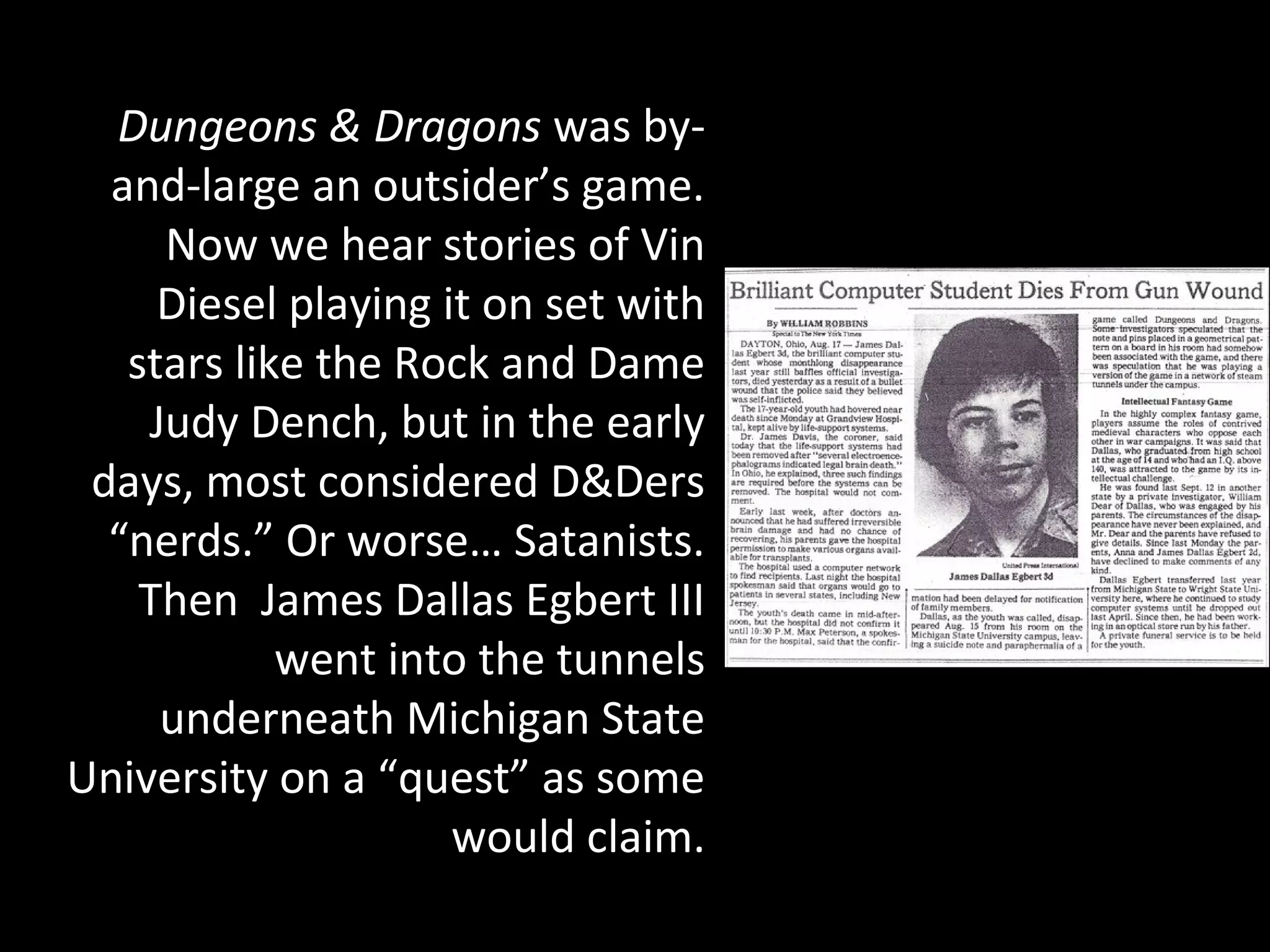
Dungeons & Dragons was byand-large an outsider’s game.
Now we hear stories of Vin
Diesel playing it on set with
stars like the Rock and Dame
Judy Dench, but in the early
days, most considered D&Ders
“nerds.” Or worse… Satanists.
Then James Dallas Egbert III
went into the tunnels
underneath Michigan State
University on a “quest” as some
would claim.
The blowback from that and other incidents,
wherein a media convinced that games were
bad for kids took every chance to attack D&D
(imagine if every videogame you know were
just a single game– that’s what D&D was at
that point) would last into the 1990s. Over a
decade was devoted to decrying a game as a
tool of the devil. Yet more and more kids
bought books and dice.
Gary Gygax left TSR in 1985.
He went on the make many other games, though
none ever touched the juggernaut of his beloved
D&D.
TSR continued to produce Dungeons & Dragons in
its many forms until it ended up in financial ruin in
1996 and sold out to Wizards of the Coast, makers
of Magic the Gathering.
Wizards of the Coast, consequently, sold to
Hasbro, Inc. in 1999.
Hasbro, using the Wizards of the Coast imprint, still
produces Dungeons & Dragons to this day.
Interesting tidbits:
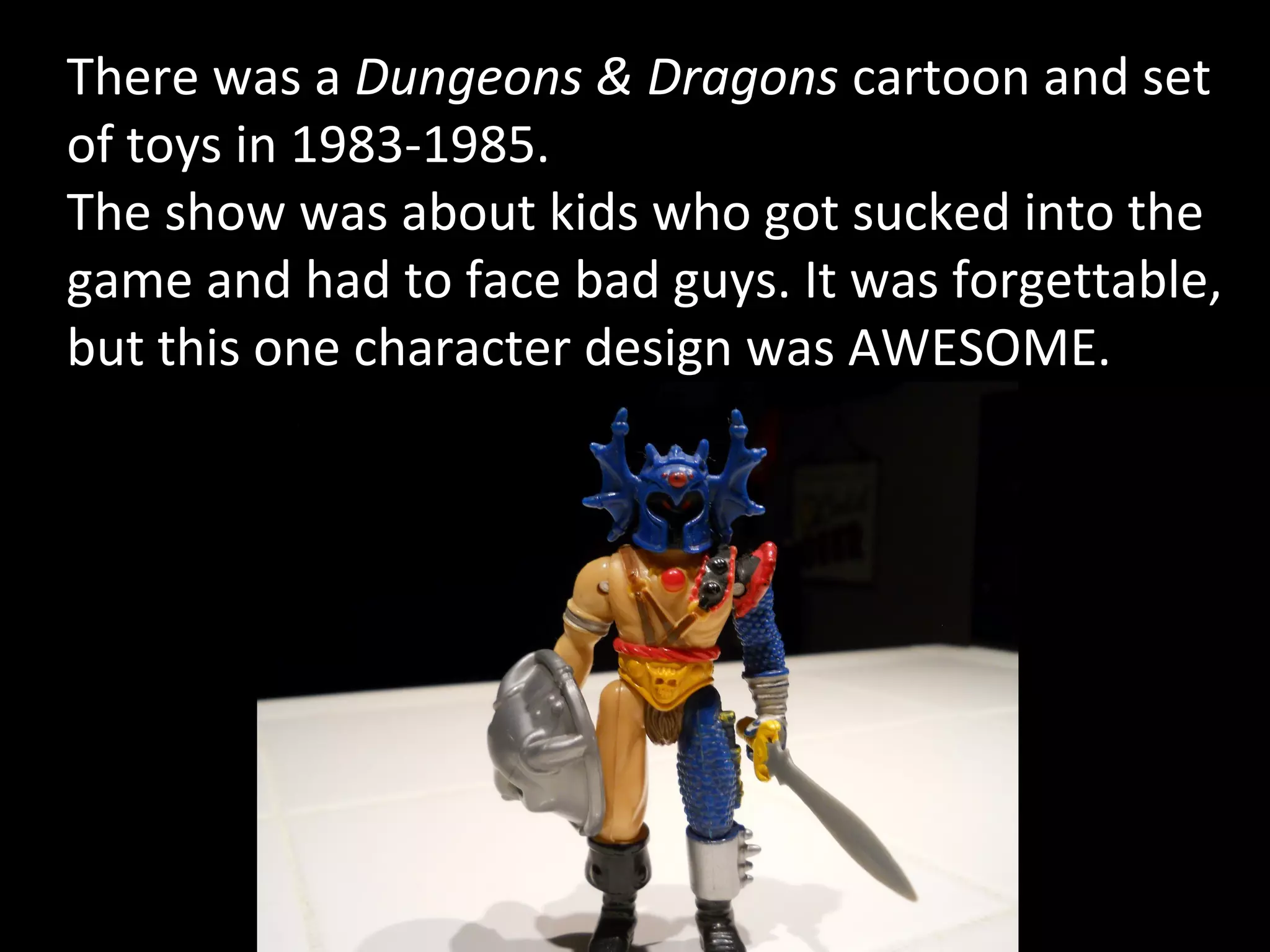
There was a Dungeons & Dragons cartoon and set
of toys in 1983-1985.
The show was about kids who got sucked into the
game and had to face bad guys. It was forgettable,
but this one character design was AWESOME.
During TSR’s rise in the 1990s, there was a great
diversification with the Forgotten Realms and
Ravenloft campaign settings appearing (among
others). These became a boon for he company
because of popular novels about characters like
Strahd Van Zarovich (the D&D Dracula) and Drizzt
Do’Urden, a reformed Drow (dark elf) with a huge
series of books by R.A. Salvatore.
Ravenloft was one of the original D&D modules. I
made a PDF of it available to you.
Activity:
In your teams, obtain what you
need to make it happen from the
gaming kit at the front of the
room and play a few rounds of
Chainmail.

Game Design, November 7th, 2013

  • 3.
    In many waysthe grand-daddy of Real Time Strategy, console RPGs, MMORPGs, MUDs, LARPing, Cosplay and teenage alienation, Dungeons & Dragons, one of the proverbial dice games of a generation and the inspiration for roughly a third of the games we’ve played in class (WoW, LoL, Card Hunter) was the brainchild of a gentleman named Gary Gygax, conceived as a way to keep his beloved war-gaming from fading away.
  • 5.
    "Our initial rulesets were entirely based on what the figure looked like…If a soldier was carrying a mace but had no armor, then he fought under a particular rule set; if the figure had armor and a crossbow, his attack and defense ratings were totally different." Initially, the rules were set up in traditional wargaming fashion: 1 plastic soldier representing 20 men. To break up the monotony a bit, they occasionally played using rules for 1-to-1 combat, where each figure represented one man in small, squad-level skirmishes.” From: http://pc.gamespy.com/articles/538/538262p2.html -Gary Gygax
  • 6.
    In that system,Red Sonja (pictured here), would have low armor (look at all that skin showing) but high damage (look at the AXE on her!)
  • 7.
    But Gary Gygaxhad a problem. As much as he loved castles and sieges and war games and rolling dice and strategy… People were leaving his gaming club. It was getting a little boring.
  • 9.
    "I figured whynot add a few fantasy elements to the game -- instead of a catapult. Why not have one figure represent a wizard who could cast a fireball whose rules, not coincidentally, were exactly the same as the catapult?" From: http://pc.gamespy.com/articles/538/538262p2.html -Gary Gygax
  • 10.
    Goodness, gracious! GREAT BALLS OF FIRE! Doingtwo die four +3 of damage on hit.
  • 11.
    The thing Gygaxcreated? You read about it for today. It was a gaming supplement called Chainmail: Rules for Medieval Miniatures. Clocking in at just over 40 pages (44, but there are ads), Chainmail presented a sophisticated way to engage in dice-based miniature combat.
  • 12.
    Chainmail hit thescene in 1970, with widespread availability in 1971. But for as cool as Chainmail was, it was just rules for combat. It wasn’t until GenCon in 1971 that Dave Arneson, a friend of Gygax and avid gamer, ceated a “stealth” one-on-one combat mission that gamers raved forced them to really play out the role of the attacker or defender. Role, you say? Play, you say?
  • 13.
    Gygax and Arnesonstarted to pool resources to make the game more robust. They called it “The Fantasy Game,” and they started trying to market it, even as people commented on the similarities to The Lord of the Rings and other fantasy novels. In 1974, Gygax and Arneson started a company with friends Dan Kaye and Kevin Blume, Tactical Studies Rules (TSR). They finally found the money to publish the game Gygax’s wife had renamed from The Fantasy Game to Dungeons & Dragons.
  • 14.
    Dungeons & Dragonsled a game superstar’s life for quite some time. It sold in numbers unheard of for a strategy game. Almost everyone involved– including Gygax– has personal problems as TSR lurched through reformation and financial problems. But soon the game was on the shelves of every bookstore in the country. And then… things got a little rocky in the PR world.
  • 15.
    Dungeons & Dragonswas byand-large an outsider’s game. Now we hear stories of Vin Diesel playing it on set with stars like the Rock and Dame Judy Dench, but in the early days, most considered D&Ders “nerds.” Or worse… Satanists. Then James Dallas Egbert III went into the tunnels underneath Michigan State University on a “quest” as some would claim.
  • 16.
    The blowback fromthat and other incidents, wherein a media convinced that games were bad for kids took every chance to attack D&D (imagine if every videogame you know were just a single game– that’s what D&D was at that point) would last into the 1990s. Over a decade was devoted to decrying a game as a tool of the devil. Yet more and more kids bought books and dice.
  • 17.
    Gary Gygax leftTSR in 1985. He went on the make many other games, though none ever touched the juggernaut of his beloved D&D. TSR continued to produce Dungeons & Dragons in its many forms until it ended up in financial ruin in 1996 and sold out to Wizards of the Coast, makers of Magic the Gathering. Wizards of the Coast, consequently, sold to Hasbro, Inc. in 1999. Hasbro, using the Wizards of the Coast imprint, still produces Dungeons & Dragons to this day.
  • 18.
  • 19.
    There was aDungeons & Dragons cartoon and set of toys in 1983-1985. The show was about kids who got sucked into the game and had to face bad guys. It was forgettable, but this one character design was AWESOME.
  • 20.
    During TSR’s risein the 1990s, there was a great diversification with the Forgotten Realms and Ravenloft campaign settings appearing (among others). These became a boon for he company because of popular novels about characters like Strahd Van Zarovich (the D&D Dracula) and Drizzt Do’Urden, a reformed Drow (dark elf) with a huge series of books by R.A. Salvatore. Ravenloft was one of the original D&D modules. I made a PDF of it available to you.
  • 21.
    Activity: In your teams,obtain what you need to make it happen from the gaming kit at the front of the room and play a few rounds of Chainmail.