KPMG INTERNATIONAL
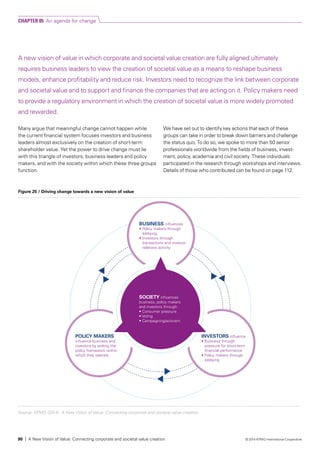
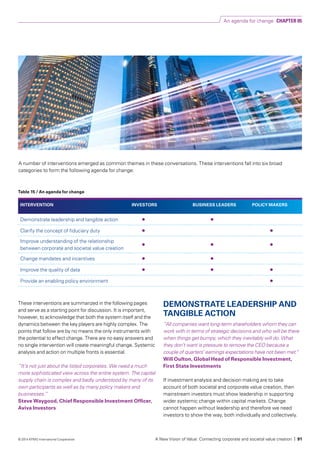
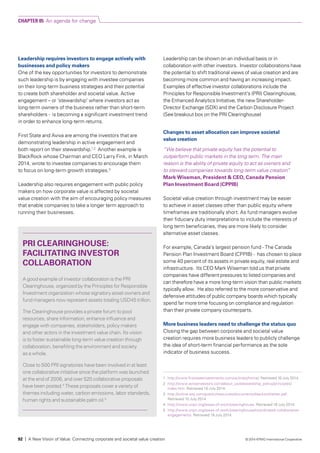
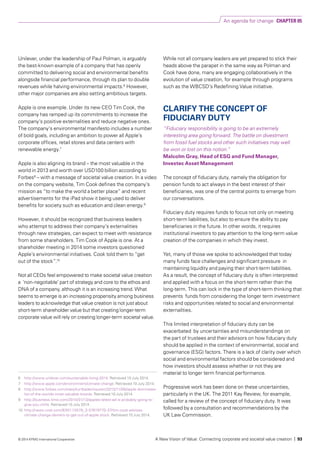
A New Vision
of Value
Connecting corporate
and societal value creation
kpmg.com
2 | A New Vision of Value: Connecting corporate and societal value creation © 2014 KPMG International Cooperative
CONTENTS
EXTERNALITIES: the age
of internalization is here
FOREWORD	4
INTRODUCTION: about this report	6
KPMG’S TRUE VALUE
METHODOLOGY: building
corporate and societal value
AN AGENDA FOR CHANGE:	 89
accelerating progress towards
a new vision of value
Step 1: Assess the company’s ‘true’ earnings	 42
Step 2: Understand future earnings at risk	 48
Step 3: Create corporate and societal value	 51
Underground gold mine, Witwatersrand, South Africa	60
Brewery, Maharashtra, India	69
LDPE plastics plant, Texas, US	76
Holcim/Ambuja Cement Limited, India	 83
THREE KEY DRIVERS:
increasing the rate of internalization
CASE STUDIES: applying the
KPMG True Value methodology in
practice
01
BIBLIOGRAPHY	 106
ACKNOWLEDGMENTS	 110
ABOUT KPMG’S TRUE VALUE SERVICES 	 114
03
05
02
04
9
39
15
57
A New Vision of Value: Connecting corporate and societal value creation | 3© 2014 KPMG International Cooperative
1	http://www.jm.com/content/dam/jm/global/
en/general-documents/sustainability/
2011JMSustainabilityReport.pdf
	 Retrieved 25 August 2014.
Companies have always created
societal value in the course of doing
business. They provide people with
the goods and services they need.
They contribute taxes to the economy.
They create jobs and wealth, and by
doing so, they have played a significant
part in helping to lift hundreds of
millions out of poverty.
Yet that positive contribution to society
comes at a price. In the course of doing
business, companies also draw on the
natural resources of the planet and can
have negative effects on people and
the environment.
As a result, the role of business is
increasingly being scrutinized, debated
and challenged. This is happening all
the more as the world globalizes and
people become wealthier and more
connected. As a business community,
we need to be aware of this trend and
respond to it.
We also need to be aware of the social
and environmental megaforces at work,
including our growing global population,
the increasing scarcity of water and
other resources, and changing weather
patterns.
A company’s creation, or reduction, of
societal value increasingly has a direct
impact on the drivers of its corporate
value, namely revenues, costs and
risk. It is the phenomenon that we at
KPMG describe as ‘the disappearing
disconnect’ between corporate and
societal value creation.
Berkshire Hathaway’s Chairman
Warren Buffet described it well in a
recent company report: “Today our
world is changing faster than ever
before –economic, geopolitical and
environmental challenges abound.
A company must invest in the key
ingredients of profitability: its people,
communities and the environment.”1
Yet this investment entails far more
than corporate philanthropy, CSR
projects or ‘green’ initiatives—worthy
and important though these may
be. To do well in today’s business
environment, you increasingly have to
measure, understand and proactively
manage the value you create, or reduce,
for society and the environ­ment as
well as for shareholders.
To do so, companies need to better
understand their so called ‘externa­lities’.
That is because what was ‘external’
is rapidly being internalized, whether
through regulation such as taxes or
pricing, changing market dynamics
including resource shortages, or more
frequent and impactful stakeholder
pressure.
FOREWORD
RECONNECTING WITH
WHAT WE VALUE
FOREWORD
John Veihmeyer
Global Chairman,
KPMG International
4 | A New Vision of Value: Connecting corporate and societal value creation © 2014 KPMG International Cooperative
FOREWORD
What executives need is a method
to understand and quantify their
externalities and the likelihood they
will affect their company’s earning
capability and risk profile in the
future.
As the old adage goes, what you
can’t measure, you can’t manage.
KPMG firms—with their experience in
accounting, tax and other business
advisory services—can help. In this
report, we introduce a methodology,
called KPMG True Value, to help
businesses combine financial earnings
data with monetized externality
data and quantify the likelihood and
potential impact of the latter coming
to influence the former.
Ultimately, we need a standardized
approach to measure societal value
creation. While there is still work to be
done, I believe we have broken new
ground in providing a way for executives
to better understand externalities
and the opportunities and risks of
internalization and to take more
informed decisions that help build both
corporate and societal value.
As corporate and societal value creation
become increasingly interlinked, I hope
this report provides executives with
useful food for thought and a means to
explore the implications for their own
organizations.
A New Vision of Value: Connecting corporate and societal value creation | 5© 2014 KPMG International Cooperative
INTRODUCTION
Historically, externalities have had little
or no impact on the cash flows or risk
profiles of most companies. Companies
have not been fully rewarded for their
positive externalities and have also not
paid for much of the damage they cause
through negative externalities such as
carbon emissions or the social effects
of poor working conditions.
For this reason, externalities have been
largely excluded from the measurement
of corporate value. But this disconnect
between corporate and societal value is
disappearing.
Globalization, digital connectivity, the
financial crisis, population growth, the
explosion of the global middle class,
climate change and other economic,
social and environmental megaforces
are transforming the operating
landscape for business.
As a result, externalities are increa­-­
singly being internalized, bringing
new opportunities and new risks with
significant implications for corporate
value creation in the 21st century.
In short, externalities are now part of
every company’s value creation story.
Business leaders and investors need
to understand these new dynamics
and their consequences in order to
unlock value creation opportunities.
They need to identify and quantify
externalities, recognize what is driving
internalization, and understand the
potential effects on corporate value.
Equipped with this understanding they
will be in a stronger position to develop
effective response strategies that
protect and create value, both for
shareholders and for society.
Readers of this report will learn:
•	 how new regulations, growing
stakeholder influence and changing
market dynamics are driving the
internalization of business
externalities at an increasing rate
• 	how companies can protect and create
both corporate and societal value in
the age of internalization using the
KPMG True Value methodology
• 	what is needed from investors,
business leaders and policy makers
in order to achieve closer alignment
between the creation of corporate
and societal value.
INTRODUCTION:
ABOUT THIS
REPORT
Value creation is the goal of all companies, but corporate value creation
is not always aligned with value creation for society as a whole.
6 | A New Vision of Value: Connecting corporate and societal value creation © 2014 KPMG International Cooperative
INTRODUCTION
TERMS USED IN THIS REPORT
The following terms are used widely in this report. While there is a general understanding of these terms in the business
and financial worlds, precise definitions vary and are debated. In this report, they are taken to mean the following:
CORPORATE VALUE Shareholder value (i.e. market capitalization) and/or enterprise value (i.e. total
business value)
SOCIETAL VALUE Economic, social or environmental value created or reduced for society in the
course of doing business
POSITIVE EXTERNALITY An economic, social or environmental benefit that a company creates for society
for which it is not directly or fully rewarded in the price of its goods and services
NEGATIVE EXTERNALITY An economic, social or environmental cost that a company inflicts on society for
which it does not directly pay a price
INTERNALIZATION Processes through which a company’s externalities become internalized (i.e. through
which a company is more fully rewarded for the societal benefits it creates and/or
pays for more of the costs it inflicts on society). Regulation, such as pricing, is one
driver of internalization, with direct effects on corporate value creation. However,
other interconnected factors, including stakeholder action and market dynamics, are
also at work (see page 15).
	
A New Vision of Value: Connecting corporate and societal value creation | 7© 2014 KPMG International Cooperative
8 | A New Vision of Value: Connecting corporate and societal value creation © 2014 KPMG International Cooperative
EXTERNALITIES:
the age of internalization is dawning
01
EXTERNALITIES:
the age of internalization is here
01
A New Vision of Value: Connecting corporate and societal value creation | 9© 2014 KPMG International Cooperative
E
xternalities have existed for as long as business itself.
Throughout history, companies have both created
benefits for society for which they have not been
fully compensated (positive externalities) and have imposed
costs on society for which they have not fully paid (negative
externalities).
Yet, although externalities have always existed, they have
(until relatively recently), not been included in considerations
of corporate value creation in any systematic way. The reason
for this is straightforward: it is simply because externalities
have, for the most part, had little or no impact on the key
drivers of corporate value: revenues, costs and risk. They
have, in short, been external. Societal value creation and
corporate value creation have been largely separate concepts.
But this is changing for a number of reasons. Firstly, the effects
of negative externalities such as pollution, carbon emissions
and ecosystem damage are becoming impossible to ignore as
population growth and wealth growth drive consumption ever
higher. An example of this is the extreme level of air pollution
in many Chinese cities, which a senior Chinese scientist has
described as being “at an unbearable stage”.1
Secondly, public awareness and understanding of corporate
externalities is growing as more information becomes
available and that information, thanks to digital connectivity,
spreads more widely and rapidly than ever before.
Public awareness is growing partly due to the growing number
of studies that quantify corporate externalities. One of these is
KPMG’s 2012 report Expect the Unexpected, which found that
the cost of environmental damage caused by 11 key industry
sectors in 2010 was equivalent to 41 percent of their pre-tax
profits. Some sectors, such as food producers, would have
no profits left if they had to pay the full cost of their negative
environmental externalities and took no mitigating actions.2
(See Figure 1).
1	 http://www.hngn.com/articles/25180/20140225/adviser-tells-china-to-cut-coal-use-air-pollution-on-unbearable-stage.htm. Retrieved 21 July 2014.
2	 KPMG (2012). Expect the Unexpected: building business value in a changing world.
0
100
200
300
400
500
600
700
Airlines
22
153
84
100
223
89 97
26
134
670
482
52%
22% 42% 43%
87% 224%
71%
59%
64%
23%
2.5%
Automobiles Beverages Chemicals Electricity Food
producers
Industrial
metals
Marine
transportation
Mining Oil & gas
producers
Tele-
communications
& internet
Source: KPMG (2012). Expect the Unexpected: building business value in a changing world.
2010 EBITDA (billion USD) 2010 total environmental costs as percentage of EBITDA
Figure 1 / Negative environmental externalities across 11 sectors
InUSD(Billions)CHAPTER 01 Externalities
10 | A New Vision of Value: Connecting corporate and societal value creation © 2014 KPMG International Cooperative
Thirdly, a number of factors are at work that are internalizing
corporate externalities at a rapid rate. Companies are finding
that by increasing their positive externalities and decreasing
the negative they can actually grow revenues, cut costs and
reduce risk.
These drivers of internalization include greater levels of
regulation, which can offer financial incentives for companies
to create positive externalities or impose direct costs on them
for their negative externalities.
Actions taken by stakeholders such as workers, communities,
NGOs and consumers over negative corporate externalities
are also becoming more frequent, high profile and impactful.
Such actions can have direct implications for cash flows and
risk and as a result are driving more companies to look closer
at their externalities and how they can be managed better.
Market dynamics, such as changing operating environments,
resource pressures and market disruptions are also bringing
new opportunities and risks related to externalities.
These drivers of internalization have always existed. What is
different today is that companies are seeing a rapid
acceleration and intensification of these drivers on multiple
fronts.
This trend means that companies in all sectors are finding
that their externalities have increasing implications for their
corporate value creation. The disconnect between corporate
value and societal value is disappearing.
In the following section of this report we analyze the
drivers of internalization in more depth. (See page 15).
We then go on to present a practical approach that
businesses, and their investors, can use to understand their
externalities, anticipate the effects of internalization on
corporate value and develop response strategies that protect
and build corporate value while also enhancing societal value
creation. (See page 39).
We conclude the report by exploring how the current
dynamics between companies, their investors, policy makers
and society are holding back alignment between corporate
and societal value creation and what can be done to
accelerate progress. (See page 89).
Externalities CHAPTER 01
A New Vision of Value: Connecting corporate and societal value creation | 11© 2014 KPMG International Cooperative
1	 KPMG, IDH and INFACT (2013). Business Case
Analysis for Responsible Electronics Manufacturing.
	 The report can be downloaded from
kpmg.com/sustainability
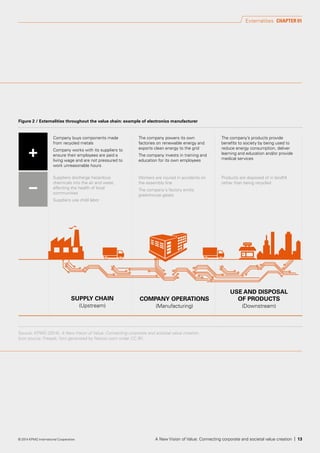
All companies create externalities,
both positive and negative, at
all points in their value chain:
upstream in their supply chain,
through their own direct operations
and downstream through the use
and disposal of their products and
services.
The example in Figure 2 illustrates - in simple terms - some of the externalities
that could be created by an electronics company that sources electronic
components from suppliers, assembles them into devices such as tablets,
laptops and mobile phones and then sells them on to retailers and institutions
such as schools and hospitals.
Supply chain (upstream)
The company might create positive externalities by buying components made
with metals that have been recycled from discarded mobile phones that would
otherwise have gone to landfill. At the same time, it might create negative
externalities if its suppliers’ factories discharge hazardous chemicals that affect
the health of local communities.
Company operations
Positive externalities would be created if the company invests in education
and training for its workforce, thereby creating a more skilled society.
Negative externalities would be created if workers were injured in accidents
on the assembly line.
Use and disposal of products (downstream)
The company’s products could create positive externalities, for example:
if they were used for energy efficiency, education and learning or medical
purposes. On the other hand, if the devices the company manufactures are
disposed of in landfill sites rather than being recycled, this would create
negative externalities because of the detrimental effects on land use and
potential ground and water pollution.
A more in-depth discussion of one of the externalities of the electronics
industry can be found in KPMG’s 2013 report Business case analysis for
responsible electronics manufacturing, which analyzes the business case for
investing in improving working conditions in the electronics manufacturing
industry in the Pearl River Delta, China.1
CHAPTER 01 Externalities
EXTERNALITIES THROUGHOUT THE VALUE CHAIN
12 | A New Vision of Value: Connecting corporate and societal value creation © 2014 KPMG International Cooperative
Source: KPMG (2014). A New Vision of Value: Connecting corporate and societal value creation.
Icon source: Freepik, font generated by flaticon.com under CC BY.
Figure 2 / Externalities throughout the value chain: example of electronics manufacturer
Company buys components made
from recycled metals
Company works with its suppliers to
ensure their employees are paid a
living wage and are not pressured to
work unreasonable hours
Suppliers discharge hazardous
chemicals into the air and water,
affecting the health of local
communities
Suppliers use child labor
The company powers its own
factories on renewable energy and
exports clean energy to the grid
The company invests in training and
education for its own employees
Workers are injured in accidents on
the assembly line
The company's factory emits
greenhouse gases
The company’s products provide
benefits to society by being used to
reduce energy consumption, deliver
learning and education and/or provide
medical services
Products are disposed of in landfill
rather than being recycled
SUPPLY CHAIN
(Upstream)
COMPANY OPERATIONS
(Manufacturing)
USE AND DISPOSAL
OF PRODUCTS
(Downstream)
Externalities CHAPTER 01
A New Vision of Value: Connecting corporate and societal value creation | 13© 2014 KPMG International Cooperative
14 | A New Vision of Value: Connecting corporate and societal value creation © 2014 KPMG International Cooperative
THREE KEY
DRIVERS:
increasing the rate
of internalization
02
A New Vision of Value: Connecting corporate and societal value creation | 15© 2014 KPMG International Cooperative
C
ompanies today are seeing an acceleration in the rate
and intensity of internalization with direct implications
for the cash flows and risk profiles that drive corporate
value creation.
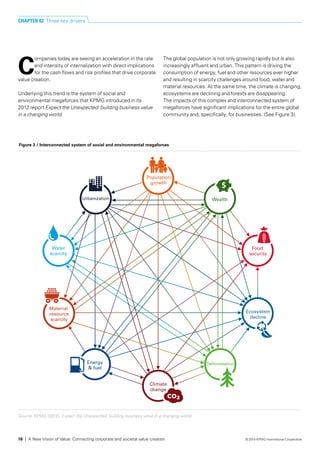
Underlying this trend is the system of social and
environmental megaforces that KPMG introduced in its
2012 report Expect the Unexpected: building business value
in a changing world.
The global population is not only growing rapidly but is also
increasingly affluent and urban. This pattern is driving the
consumption of energy, fuel and other resources ever higher
and resulting in scarcity challenges around food, water and
material resources. At the same time, the climate is changing,
ecosystems are declining and forests are disappearing.
The impacts of this complex and interconnected system of
megaforces have significant implications for the entire global
community and, specifically, for businesses. (See Figure 3).
Source: KPMG (2012). Expect the Unexpected: building business value in a changing world.
Figure 3 / Interconnected system of social and environmental megaforces
Water
scarcity
Material
resource
scarcity
Ecosystem
decline
Energy
& fuel
Food
security
Wealth
Population
growth
Urbanization
Deforestation
Climate
change
CHAPTER 02 Three key drivers
16 | A New Vision of Value: Connecting corporate and societal value creation © 2014 KPMG International Cooperative
1.	 REGULATIONS & STANDARDS:
such as government legislation, tax instruments and pricing mechanisms.
A growing number of reporting and disclosure regulations and certification
standards are also increasing corporate transparency, which is driving
internalization indirectly.
2.	 STAKEHOLDER ACTION:
awareness of corporate externalities is growing and stakeholders - such
as NGOs, civil society groups, communities and workers - are increasingly
acting to protect their interests.
3.	 MARKET DYNAMICS:
resource scarcity, extreme weather events and new or transformed markets
are driving internationalization by disrupting historical patterns of supply and
demand.
Social and environmental megaforces
do not function in isolation from each
other or in predictable ways. They act as
a complex and unpredictable system,
feeding, amplifying or ameliorating the
effects of others. Figure 3 shows just
some of the relationships between the
megaforces.
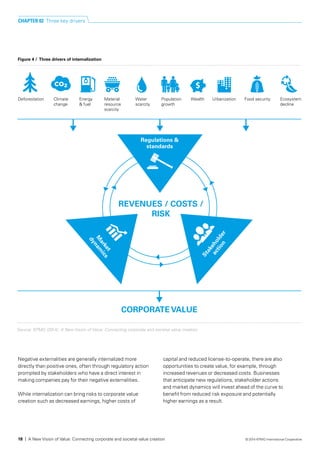
While the megaforces are the underlying
cause of much internalization, the actual
drivers of internalization fall into three
broad categories:
Three key drivers CHAPTER 02
A New Vision of Value: Connecting corporate and societal value creation | 17© 2014 KPMG International Cooperative
Negative externalities are generally internalized more
directly than positive ones, often through regulatory action
prompted by stakeholders who have a direct interest in
making companies pay for their negative externalities.
While internalization can bring risks to corporate value
creation such as decreased earnings, higher costs of
capital and reduced license-to-operate, there are also
opportunities to create value, for example, through
increased revenues or decreased costs. Businesses
that anticipate new regulations, stakeholder actions
and market dynamics will invest ahead of the curve to
benefit from reduced risk exposure and potentially
higher earnings as a result.
Figure 4 / Three drivers of internalization
CORPORATE VALUE
REVENUES / COSTS /
RISK
Regulations &
standards
M
arket
dynam
ics
Stakeholder
action
Source: KPMG (2014). A New Vision of Value: Connecting corporate and societal value creation.
Deforestation Climate
change
Energy
& fuel
Material
resource
scarcity
Water
scarcity
Population
growth
Wealth Urbanization Food security Ecosystem
decline
CHAPTER 02 Three key drivers
18 | A New Vision of Value: Connecting corporate and societal value creation © 2014 KPMG International Cooperative
Just as the megaforces underlying them are interconnected,
so are the three drivers of internalization. For example,
stakeholder pressure (such as public protest) can encourage
regulators to create or strengthen legislation which, in turn,
changes market dynamics. Market dynamics (such as
resource shortages) can trigger stakeholder pressure
such as community unrest, which can prompt authorities
to legislate. Figure 5 illustrates the interconnections
between the drivers of internalization in the cocoa and
chocolate sector.
Low incomes can also prevent
farmers from investing in soil quality,
replacing old trees and tackling pests
and diseases, which in turn reduces
productivity. Over the past 15 years,
however, action has been taken,
driven by the interplay between the
three drivers of internalization:
1) 	Stakeholder action: NGOs, the
media and government organiza­-
tions have called for chocolate
manufac­turers and traders to remove
child labor from their cocoa supply
chains. This stakeholder action has
led to government regulations and
industry-wide initiatives to improve
sourcing practices and invest in
cocoa certification schemes.
2) 	Regulations and standards:
The Harkin-Engel protocol was
intro­duced in the US in 2001 as a
response to stakeholder pressure
and required companies to use
external standards to mitigate the
use of child labor in the cocoa supply
chain.1
This was followed in 2012 by
the Abidjan declaration, a roadmap
of action, agreed to by governments
of cocoa-producing countries, major
confectionery companies and cocoa
traders.2
Independent certification standards
have also emerged, creating inter­
nationally-accepted guidelines for
sustainable cocoa production. Many
manufacturers have committed to
use only certified cocoa in the future.
3) 	Market dynamics: Megaforce
effects on market dynamics are also
prompting confectionery companies
to address the externalities of cocoa
production. Climate change threatens
to reduce cocoa supply from key
producing countries at the same time
as population growth and increasing
wealth boost global demand.3
Some companies fear that cocoa
may become a scarce raw material
and business continuity may be
threatened as cocoa prices soar.4
These dynamics are one reason why
companies are investing USD800
million in improving farmer produc­
tivity and embedding sustainable
production practices.5
THE DRIVERS OF
INTERNALIZATION
ARE INTERCONNECTED
DRIVERS OF INTERNALIZATION IN THE COCOA
AND CHOCOLATE SECTOR
Some cocoa production has
been criticized for its negative
externalities. When chocolate
companies pay low prices for
cocoa, it can increase the
likelihood that farmers will use
child labor to cut costs and
stay in business.
1	 http://responsiblecocoa.com/about-us/
the-harkin-engel-protocol. Retrieved 25
August 2014.
2	http://www.icco.org/about-us/icco-
news/206-abidjan-declaration-climaxes-
the-world-cocoa-conference.html.
Retrieved 25 August 2014.
3	 The Climate Change, Agriculture & Food
Security Partnership and the International
Center for Tropical Agriculture (2011).
Predicting the impact of climate change on
the cocoa-growing regions in Ghana and
Côte d’Ivoire.
4	http://www.confectionerynews.com/
Commodities/Cocoa-shortage-by-2020-
unless-industry-acts-now-warns-Mars.
Retrieved 30 July 2014.
5	 KPMG (2014). A Taste of the Future: the
trends that could transform the chocolate
industry.
Three key drivers CHAPTER 02
A New Vision of Value: Connecting corporate and societal value creation | 19© 2014 KPMG International Cooperative
Figure 5 / Drivers of internalization in the cocoa sector
Climate change
reducing arable areas in major
cocoa-producing countries
Growing population
increasing demand for
chocolate
Growing middle class and
emerging economies
leading to higher demand for chocolate
Source: KPMG (2014). A New Vision of Value: Connecting corporate and societal value creation.
CORPORATE VALUE
REVENUES / COSTS /
RISK
M
arket
dynam
ics
Regulations &
standards
Stakeholder
action
Climate
change
Population
growth
Wealth
Cocoa prices affected
by increasing demand
from population growth
and growing middle
class, along with
potential cocoa scarcity
as climate change
affects cocoa-growing
countries
Increased pressure for
sustainable practices in
cocoa production
1
2
3
Regulations to eliminate
child labor. Guidelines to
set standards for social
and environmental practices
in cocoa farming
CHAPTER 02 Three key drivers
20 | A New Vision of Value: Connecting corporate and societal value creation © 2014 KPMG International Cooperative
REGULATIONS &
STANDARDS
DRIVERS OF INTERNALIZATION EXPLANATION EXAMPLE
Government regulations
and product standards
National, regional or local regulations and industry-
specific performance standards designed to change
corporate behavior
Laws that limit branding and promotion
of tobacco products
Product standards such as energy
efficiency standards for appliances and
emissions standards for cars
Pricing Mechanisms that put a direct cost on negative externalities Carbon pricing mechanisms
Subsidies Removal of subsidies that support the creation
of negative externalities or the introduction of subsidies
which incentivize the creation of positive externalities
Removal of fossil fuel subsidies
Taxes Fiscal incentives that encourage positive externalities,
penalties that discourage negative externalities
Tax incentives for renewable energy or
electric vehicles
Disclosure regulations Requirements for companies to be transparent
about their value creation
Reporting requirements on conflict
minerals in the US
Certification standards Industry collaboration and voluntary action to address
externalities and improve societal value creation
The Roundtable on Responsible
Palm Oil
Table 1 / Key types of regulations and standards driving internalization
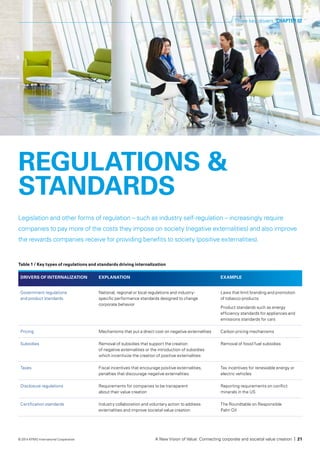
Legislation and other forms of regulation – such as industry self-regulation – increasingly require
companies to pay more of the costs they impose on society (negative externalities) and also improve
the rewards companies receive for providing benefits to society (positive externalities).
Three key drivers CHAPTER 02
A New Vision of Value: Connecting corporate and societal value creation | 21© 2014 KPMG International Cooperative
Government regulations and product standards
New forms of regulation aimed at increasing societal value
can impact a company’s capability to create corporate value,
for instance, by requiring companies to change the way
they make or sell products or how they re-invest their profits.
Recent examples include:
•	 a requirement by the Indian Government for all large
companies, irrespective of sector, to invest in corporate
social responsibility (CSR) programs. The 2013 Companies
Act mandates companies to reinvest 2 percent of after-tax
profits on CSR6
•	 a potential ban on the advertising of alcohol products in
South Africa where the Cabinet has approved a draft bill.
The public health costs of alcohol-related harm in South
Africa have been estimated at approximately ZAR38 billion
(USD3.5 billion) a year7
•	 a requirement in Australia for tobacco products to be
sold in plain packaging without branding. Ireland has
announced its intention to be the second country to
implement this policy and the governments of New
Zealand, France and the UK have also signaled that similar
laws will be introduced.8,9
These types of regulations have clear implications for
corporate value creation in the food, beverage and tobacco
industries, potentially cutting revenues and increasing risk
as well as changing the nature of products, markets and
reputations.
Industry-specific performance standards, such as standards
for vehicle CO2
emissions or the energy performance of
buildings, are also proliferating.
Pricing
Pricing mechanisms are the most direct, and perhaps most
familiar regulatory driver of internalization. When there is a
direct price on a negative externality, companies have no
choice but to internalize the cost of that externality, at least
in part.
Carbon pricing, for example, was once limited to a handful of
Western-European countries, but has spread to become an
international policy tool. Carbon pricing mechanisms, whether
trading systems or taxes, now cover around 20 percent of the
world’s emissions and will cover approximately 50 percent if
China, Brazil, Chile and other emerging economies go ahead
with their proposals.10
6	 http://www.mondaq.com/india/x/302204/Corporate+Commercial+Law/
Corporate+Social+Responsibility+Now+A+Mandated+Responsibility.
Retrieved 21 July 2014.
7	 http://www.bdlive.co.za/national/health/2013/12/24/department-to-assess-
effects-of-mooted-alcohol-ad-ban. Retrieved 15 June 2014.
8	 www.theguardian.com/society/2014/jun/26/plain-cigarette-packaging-
regulations-announced. Retrieved 10 June 2014.
9	 http://health.gov.ie/blog/press-release/minister-reilly-aims-for-a-tobacco-
free-ireland-by-2025. Retrieved 10 June 2014.
10	 Carbon Finance at the World Bank. 2013. Mapping Carbon Pricing Initiatives.
This estimate does not reflect the repeal of Australia’s carbon tax in July 2014.
CHAPTER 02 Three key drivers
22 | A New Vision of Value: Connecting corporate and societal value creation © 2014 KPMG International Cooperative
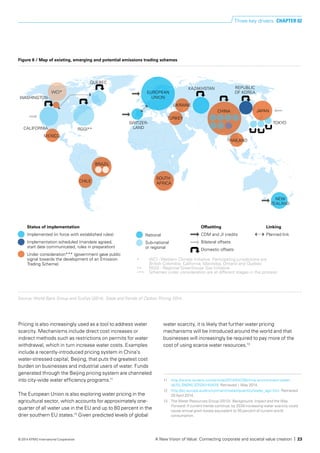
Pricing is also increasingly used as a tool to address water
scarcity. Mechanisms include direct cost increases or
indirect methods such as restrictions on permits for water
withdrawal, which in turn increase water costs. Examples
include a recently-introduced pricing system in China’s
water-stressed capital, Beijing, that puts the greatest cost
burden on businesses and industrial users of water. Funds
generated through the Beijing pricing system are channeled
into city-wide water efficiency programs.11
The European Union is also exploring water pricing in the
agricultural sector, which accounts for approximately one-
quarter of all water use in the EU and up to 80 percent in the
drier southern EU states.12
Given predicted levels of global
water scarcity, it is likely that further water pricing
mechanisms will be introduced around the world and that
businesses will increasingly be required to pay more of the
cost of using scarce water resources.13
Source: World Bank Group and Ecofys (2014). State and Trends of Carbon Pricing 2014.
Figure 6 / Map of existing, emerging and potential emissions trading schemes
WCI - Western Climate Initiative. Participating jurisdictions are
British Colombia, California, Manitoba, Ontario and Quebec
RGGI - Regional Greenhouse Gas Initiative
Schemes under consideration are at different stages in the process
*
**
***
SOUTH
AFRICA
QUEBEC
KAZAKHSTAN
RGGI**
BRAZIL
CHILE
TURKEY
UKRAINE
TOKYO
JAPANCHINA
NEW
ZEALAND
EUROPEAN
UNION
REPUBLIC
OF KOREA
SWITZER-
LANDCALIFORNIA
MEXICO
WCI*
Status of implementation
Implemented (in force with established rules)
Implementation scheduled (mandate agreed,
start date communicated, rules in preparation)
Under consideration*** (government gave public
signal towards the development of an Emission
Trading Scheme)
Offsetting
CDM and JI credits
Bilateral offsets
Domestic offsets
Linking
Planned linkNational
Sub-national
or regional
WASHINGTON
THAILAND
11 	 http://www.reuters.com/article/2014/04/29/china-environment-water-
idUSL3N0NL3ZN20140429. Retrieved 1 May 2014.
12	 http://ec.europa.eu/environment/water/quantity/water_agri.htm. Retrieved
20 April 2014.
13 	 The Water Resources Group (2012). Background, Impact and the Way
Forward. If current trends continue, by 2030 increasing water scarcity could
cause annual grain losses equivalent to 30 percent of current world
consumption.
Three key drivers CHAPTER 02
A New Vision of Value: Connecting corporate and societal value creation | 23© 2014 KPMG International Cooperative
Subsidies
Businesses in some sectors have traditionally been
protected from bearing the cost of negative externalities by
government subsidies. Removing subsidies has a direct
impact on corporate value creation as businesses have to
operate in less favorable financial conditions.
In some sectors where externalities can be high, such as
the oil sector, businesses have had their value to society
distorted by subsidies, although such subsidies have also
helped to protect vulnerable consumers from the full price
of energy or fuel.
Worldwide, subsidies for the production and consumption of
fossil fuels were estimated to be USD544 billion in 2012.14
However, governments around the world are now beginning
to remove fossil fuel subsidies: in 2009, leaders of the G20
agreed to phase them out and a number of countries
including Brazil, France and India have already taken action
to do so.15,16
This has implications for oil and gas companies as
they may lose government funding that currently lowers the
cost of production and the cost of energy for consumers.
Subsidies can also drive the creation of positive externalities.
For example, the feed-in-tariff policy, a form of subsidy first
introduced in 1990, has led to significant growth of renewable
energy in countries like Germany. The tariff incentivizes
energy producers to invest in renewable technology, such
as solar and wind power, and is thought to have played a
significant part in Germany reaching the point of generating
27 percent of its energy needs from renewables in the first
quarter of 2014.17
Taxes
Governments worldwide are increasingly using tax incentives
and penalties to encourage positive corporate externalities
and discourage negative ones, for example, there are some
200 green tax incentives and penalties in place across
21 countries, according to the KPMG Green Tax Index 2013.18
Examples of tax incentives and penalties that address
corporate externalities include:
•	 a groundbreaking 10 percent tax on sugar-sweetened
beverages in Mexico, which can be seen as an attempt
by the government to tackle the negative externality of
public health problems. Around one-third of the population
in Mexico is obese and 14 percent of the population has
diabetes19
•	 the US wind energy production tax credit (PTC), which
has been widely credited with playing a key role in the
development of the US wind energy industry by improving
the returns for investors and enabling wind power to
compete in the market. Between 1992, when the PTC
was first implemented, and the end of 2011, US wind
power capacity grew 30-fold to account for 4 percent of
the country’s total power generation capacity20
•	 the landfill tax in the UK, introduced in 1996, which puts
a price per ton on material sent to landfill. It has been
credited with achieving a 38 percent reduction in waste
to landfill by 2013 and increasing UK recycling rates from
7 percent to 43 percent in the same period.21
Disclosure regulations
Worldwide there is an increasing amount of regulation
that requires companies to be more transparent about
their societal value creation. While this does not directly
drive internalization of externalities, it does make it easier
for stakeholders to scrutinize corporate externalities, which
can in turn encourage companies to address them.
A 2013 study by the Global Reporting Initiative (GRI), in
collaboration with KPMG and other partners, identified
180 corporate responsibility reporting initiatives across
45 countries. Close to three-quarters of these (72 percent)
are mandatory, a significant increase since 2006 when
58 percent of reporting policies were mandatory.22
An important example of new disclosure requirements is
the EU Commission’s directive on non-financial reporting,
adopted in April 2014. It requires nearly 6,000 public entities
(both listed and non-listed) to report on environmental,
social, employee and human rights issues.23
14	 International Energy Agency World Energy Outlook. (2013).
15	 http://www.reuters.com/article/2009/09/26/us-g20-energy-
idUSTRE58O18U20090926. Retrieved 17 July 2014.
16 	 http://www.iisd.org/gsi/analysis-g-20-and-apec-progress.
Retrieved 17 July 2014.
17	 http://thinkprogress.org/climate/2014/05/13/3436923/germany-energy-
records. Retrieved 29 July 2014.
18	 KPMG (2013). The KPMG Green Tax Index 2013.
19	 http://www.theguardian.com/world/2014/jan/16/mexico-soda-tax-sugar-
obesity-health. Retrieved 10 June 2014.
20 	 KPMG (2013). The KPMG Green Tax Index 2013.
21 	 http://www.businessgreen.com/bg/opinion/2257821/lessons-from-the-
quiet-success-of-the-landfill-tax. Retrieved 29 July 2014.
22	 KPMG, UNEP, Global Reporting Initiative and Unit for Corporate Governance
in Africa (2013). Carrots and Sticks: sustainability reporting policies worldwide.
23	 The directive was adopted on 15 April 2014 and requires companies to report
on their ‘environmental, social and employee related matters, respect for
human rights, anti-corruption and bribery matters’. See here for more details:
http://ec.europa.eu/internal_market/accounting/non-financial_reporting/
index_en.htm. Retrieved 2 May 2014.
CHAPTER 02 Three key drivers
24 | A New Vision of Value: Connecting corporate and societal value creation © 2014 KPMG International Cooperative
Disclosure regulations sometimes focus on specific
elements of societal value creation. For example, the 2010
Dodd-Frank Wall Street Reform and Consumer Protection
Act requires US companies to report whether or not their
products contain minerals sourced from conflict-ridden areas
in Africa. As a result, many US companies have disclosed
information and taken action. These include Hewlett-
Packard, which published a list of smelters in its supply
chain and has committed to achieve a conflict-free supply
chain, and Intel which, in 2013, announced that all its
microprocessors were produced with conflict-free
minerals.24,25
Certification standards
Businesses, industry organizations and NGOs have
initiated voluntary certification schemes as a form of
self-regulation. Examples include:
•	 the Roundtable on Sustainable Palm Oil (RSPO),
which started in 2004 to promote sustainable palm
oil production; since the standard for sustainable palm
oil was set in 2007, significant progress has been
made, with more than 9 million tons of palm oil, or
14 percent of the world’s total production, certified
sustainable26
•	 the Electronic Industry Citizenship Coalition (EICC), which
sets responsible supply chain standards for its members,
requiring electronics companies to protect the wellbeing of
workers, communities and the environment27
•	 the Forest Stewardship Council (FSC), which brings together
800 global businesses, NGOs, forest owners and managers,
and timber processing companies to promote responsible
forest management; around 180 million hectares, equivalent
to 7 percent of the world’s forested area, are FSC certified28
•	 the Marine Stewardship Council (MSC), which promotes
sustainable fishing practices with certified standards; almost
200 fisheries have been certified to the MSC standard,
representing 7 percent of wild caught seafood worldwide.29
24	 http://www.triplepundit.com/2013/04/hps-conflict-free-supply-chain-
initiative-industry-first/. Retrieved 10 May 2014.
25	 http://www.bbc.com/news/technology-25636001. Retrieved 2 May 2014.
26 	 http://wwf.panda.org/?206572/RSPO-has-much-to-celebrate-much-to-do-
at-critical-10th-Anniversary-meeting. Retrieved 15 June 2014.
27	 http://www.eiccoalition.org/. Retrieved 31 July 2014.
28	 http://www.greenpeace.org/international/en/campaigns/forests/solutions/
alternatives-to-forest-destruc/. Retrieved 15 June 2014.
29	 http://www.msc.org/documents/msc-brochures/annual-report-archive/
annual-report-2012-13-english. Retrieved 15 June 2014.
Three key drivers CHAPTER 02
A New Vision of Value: Connecting corporate and societal value creation | 25© 2014 KPMG International Cooperative
STAKEHOLDER
ACTION
With the advent of digital technology and social media, people are more aware of what companies
are doing and have channels through which to voice their opinions and take action. Furthermore, as
wealth and living standards increase, people feel more empowered to stand up for their own interests.
Other social trends, such as plummeting trust in business and increasing anger over financial
inequality, are also increasing public scrutiny of companies.
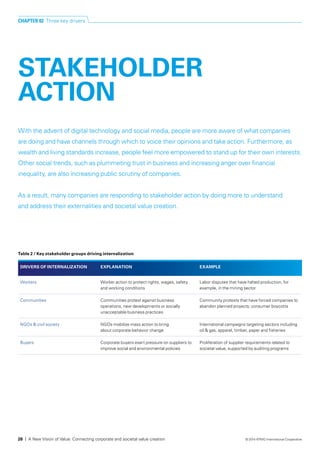
As a result, many companies are responding to stakeholder action by doing more to understand
and address their externalities and societal value creation.
DRIVERS OF INTERNALIZATION EXPLANATION EXAMPLE
Workers Worker action to protect rights, wages, safety
and working conditions
Labor disputes that have halted production, for
example, in the mining sector
Communities Communities protest against business
operations, new developments or socially
unacceptable business practices
Community protests that have forced companies to
abandon planned projects; consumer boycotts
NGOs & civil society NGOs mobilize mass action to bring
about corporate behavior change
International campaigns targeting sectors including
oil & gas, apparel, timber, paper and fisheries
Buyers Corporate buyers exert pressure on suppliers to
improve social and environmental policies
Proliferation of supplier requirements related to
societal value, supported by auditing programs
Table 2 / Key stakeholder groups driving internalization
CHAPTER 02 Three key drivers
26 | A New Vision of Value: Connecting corporate and societal value creation © 2014 KPMG International Cooperative
Workers
Labor disputes and resulting production stoppages can
be costly. Recent examples include:
• a five-month strike in 2013/14 by platinum miners in South
Africa over wages and benefits: the action cost three major
mining companies more than USD2 billion in lost revenue
	 and affected 45 percent of the global platinum supply,
	 according to reports.30,31
• 	a 2013 campaign to raise the minimum wage in the US
retail and fast food sectors.
Companies that support their workers have an opportunity
to enhance their reputation and increase employee
engagement which has been found to result in improved
workforce satisfaction, higher levels of customer service and
increased revenues. Starbucks, for example, pays for a large
proportion of its employees to attend distance learning
courses and ultimately earn college degrees.32
Communities
Social license-to-operate is crucial to the creation of corporate
value. A business is not an island: community protest can cut
production, prevent projects from going ahead and deter
investors from providing capital. Examples of community
action affecting corporate value creation include:
•	 a 2013 protest in Romania against proposals to open
Europe’s largest open-pit gold mine, which constituted
the biggest civil movement in Romania since the 1989
revolution that overthrew the communist regime;
thousands of people demonstrated against the relocation
of families, loss of ecosystems and use of cyanide in the
extraction process. In November 2013, Romania’s
parliament rejected revisions to the mining law that
would have permitted the mine.33
•	 in China, reports of community protests against industrial
development have become increasingly common. One of
the latest examples is the shelving of plans for a large-scale
waste incinerator in Yuhang after protests by local people
turned violent.34
It has been reported that there are some
90,000 protests each year in China over corruption,
pollution, illegal land grabs and other grievances.35
Investing in projects that strengthen social license-to-
operate creates positive externalities which can be
internalized not only through reduced risk but also through
strengthened brand value and increased customer and
employee loyalty.
30 	 http://online.wsj.com/articles/south-africa-platinum-strike-continues-as-
union-rejects-latest-offer-1401867774. Retrieved 6 June 2014.
31	 http://www.bbc.com/news/business-27981977. Retrieved 10 June 2014.
32 	 http://chronicle.com/article/Starbucks-Will-Send-Thousands/147151/.
Retrieved 6 June 2014.
33	 http://www.independent.co.uk/news/world/europe/gabriel-resources-gold-
plans-suffer-setback-as-romanian-parliament-rejects-mining-law-8999817.
html. Retrieved 6 June 2014.
34	 http://www.reuters.com/article/2014/05/11/us-china-protests-
idUSBREA4904320140511. Retrieved 6 June 2014.
35	 http://www.reuters.com/article/2014/05/10/us-china-protests-
idUSBREA4904320140510. Retrieved 21 July 2014.
Three key drivers CHAPTER 02
A New Vision of Value: Connecting corporate and societal value creation | 27© 2014 KPMG International Cooperative
NGOs and civil society
NGOs and civil society campaigners are increasingly
pressuring companies to address their externalities and
improve their societal value creation. Often, campaigners
seek to influence other stakeholders, such as consumers
or regulators, in order to mobilize public opinion.
Examples of civil society action with implications for
corporate value creation include:
•	 in recent years NGOs have encouraged IT and internet
companies to power their data centers with renewable
energy. A number of the best known technology, social
networking and internet search brands have since made
significant commitments in that direction36
•	 a 2013 campaign against a number of corporations that
had been criticized for avoiding taxes on British sales37
•	 pressure from NGOs as well as communities, unions,
governments and progressive peers led to more than
100 global apparel brands signing a legally-binding
agreement to improve worker safety in Bangladesh,
following the tragic collapse of the Rana Plaza factory
in 2013.38
Buyers
Buyers at many global brands are responding to pressure
from civil society and governments by introducing
requirements for their suppliers to address their own
externalities. Many are increasing their monitoring of supplier
compliance with social and environmental policies and
working closely with their suppliers to help them improve.
Efforts are going deeper into the supply chain, beyond
primary suppliers to suppliers of raw materials at the start
of the value chain. Examples include:
•	 IBM has required first-tier suppliers to establish social and
environmental management systems and to cascade this
requirement to their suppliers39
•	 Hewlett-Packard has implemented a Supply Chain
Responsibility (SCR) program that requires its suppliers to
meet strict social and environmental criteria and an audit
program to assess supplier progress40
•	 buyers in some sectors work together to set consistent
expectations for suppliers’ social and environmental
performance; these initiatives include the Electronic Industry
Citizenship Coalition (EICC), the Pharmaceutical Supply Chain
Initiative (PSCI) and Together for Sustainability (Tfs), the
chemical industry’s initiative for sustainable supply chains.
36	 http://greenpeaceblogs.org/2014/04/01/9-victories-greener-internet.
Retrieved 26 August 2014.
37	 http://www.bbc.co.uk/news/magazine-20560359. Retrieved 29 July 2014.
38	 http://www.nytimes.com/2013/05/14/business/global/hm-agrees-to-
bangladesh-safety-plan.html. Retrieved 6 June 2014.
39	 http://www.ibm.com/ibm/environment/supply/evaluations.shtml. Retrieved
29 July 2014.
40	 http://www8.hp.com/us/en/hp-information/global-citizenship/society/
supplychain.html. Retrieved 29 July 2014.
CHAPTER 02 Three key drivers
28 | A New Vision of Value: Connecting corporate and societal value creation © 2014 KPMG International Cooperative
DRIVERS OF INTERNALIZATION EXPLANATION EXAMPLE
Scarcity & pricing Many commodities are increasingly scarce, which
affects corporate profitability as prices rise or
production is halted because key inputs are
unavailable
Megaforces including water scarcity and
climate change can affect supplies of crop-
based commodities such as grain and cotton;
population growth and wealth increase demand
for commodities of all kinds, putting stress on
supply
Extreme weather More frequent occurrences of extreme weather can
impact company operations and disrupt supply
chains and distribution networks
Storms and floods can put production facilities
out of action
New markets The need to increase positive and reduce negative
externalities, along with the increasing scarcity of
resources, is giving rise to markets for new products
and services
New markets are developing for products that
use energy and resources more efficiently and
improve quality of life in a changing world
Market dynamics can be seen as drivers of internalization in that they offer companies financial
incentives to increase their positive externalities and reduce their negative ones. For example,
companies can profit by tapping into new markets for products and services that create societal value,
such as low-carbon technologies. At the same time, market dynamics such as commodity scarcity
are increasing the cost to companies of behavior that reduces societal value. Some companies are
anticipating these market dynamics and investing ahead of the curve to develop new markets and gain
competitive edge. They are also addressing their own negative externalities to reduce exposure to
legislation, stakeholder action and commodity price rises. In effect, the opportunities and risks of
these market dynamics are encouraging companies to internalize their own externalities.
MARKET
DYNAMICS
Table 3 / Key market dynamics driving internalization
Three key drivers CHAPTER 02
A New Vision of Value: Connecting corporate and societal value creation | 29© 2014 KPMG International Cooperative
Scarcity & pricing dynamics
As commodities become more scarce,
companies can struggle to secure the
supplies they require to satisfy customer
demand and supplies that are available
are inevitably more expensive. This
market dynamic has clear implications
for corporate value creation.
The supply of some agricultural
commodities will face particular
pressure in coming years. Global crop
production needs to double within the
next generation to satisfy increasing
demand for food and biofuels.41
At the same time, the climate change
megaforce is increasing uncertainty in
terms of both supply and price for many
key agricultural inputs, such as soy and
sugar.42
The water scarcity megaforce
is also affecting commodities, including
sugar and cotton. Sugar is especially 
susceptible to drought and global sugar
prices reached a 28-year high in 2010,
partly because drought in India had
drastically reduced yields in previous
years.43
Beyond agricultural commodities,
there are scarcity issues around some
minerals and metals. For example, there
is a high risk of shortages of rare earth
metals used in the manufacturing of
low-carbon technologies. One of these
metals, dysprosium, is in especially high
demand, with the EU alone expected to
require 25 percent of predicted world
supply to 2030 to meet its demand for
hybrid and electric vehicles and wind
turbines.44
41	 Ray, D.K. et al (2013). Yield Trends Are
Insufficient to Double Global Crop Production by
2050. PLoS ONE, 8(6).
42	 Intergovernmental Panel on Climate Change
(2013). Climate Change 2013: Summary for
Policymakers.
43	 Ceres (2010). Murky Waters? Corporate reporting
on water risk.
44	 http://ec.europa.eu/dgs/jrc/index.
cfm?id=1410&dt_code=NWS&obj_
id=18230&ori=RSS. Retrieved 2 May 2014.
CHAPTER 02 Three key drivers
30 | A New Vision of Value: Connecting corporate and societal value creation © 2014 KPMG International Cooperative
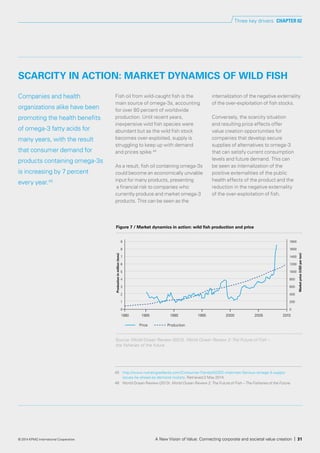
SCARCITY IN ACTION: MARKET DYNAMICS OF WILD FISH
Source: World Ocean Review (2013). World Ocean Review 2: The Future of Fish –
the fisheries of the future
Figure 7 / Market dynamics in action: wild fish production and price
1980
Productioninmillion(tons)
Marketprice(USDperton)
1985 1990 1995 2000 2005 2010
Price Production
9
8
7
6
5
4
3
2
1
0
1800
1600
1400
1200
1000
800
600
400
200
0
Companies and health
organizations alike have been
promoting the health benefits
of omega-3 fatty acids for
many years, with the result
that consumer demand for
products containing omega-3s
is increasing by 7 percent
every year.45
Fish oil from wild-caught fish is the
main source of omega-3s, accounting
for over 80 percent of worldwide
production. Until recent years,
inexpensive wild fish species were
abundant but as the wild fish stock
becomes over-exploited, supply is
struggling to keep up with demand
and prices spike.46
As a result, fish oil containing omega-3s
could become an economically unviable
input for many products, presenting
a financial risk to companies who
currently produce and market omega-3
products. This can be seen as the
internalization of the negative externa­lity
of the over-exploitation of fish stocks.
Conversely, the scarcity situation
and resulting price effects offer
value creation opportunities for
companies that develop secure
supplies of alternatives to omega-3
that can satisfy current consumption
levels and future demand. This can
be seen as internalization of the
positive externalities of the public
health effects of the product and the
reduction in the negative externality
of the over-exploitation of fish.
45	http://www.nutraingredients.com/Consumer-Trends/GOED-chairman-Serious-omega-3-supply-
issues-lie-ahead-as-demand-rockets. Retrieved 2 May 2014.
46	 World Ocean Review (2013). World Ocean Review 2: The Future of Fish – The Fisheries of the Future.
Three key drivers CHAPTER 02
A New Vision of Value: Connecting corporate and societal value creation | 31© 2014 KPMG International Cooperative
Extreme weather
The impacts of increasing extreme weather on corporate
value creation can be seen as an indirect internalization of the
negative externality of carbon emissions and climate change.
Natural disasters are occurring more frequently and with
greater severity, and insured losses from weather-related
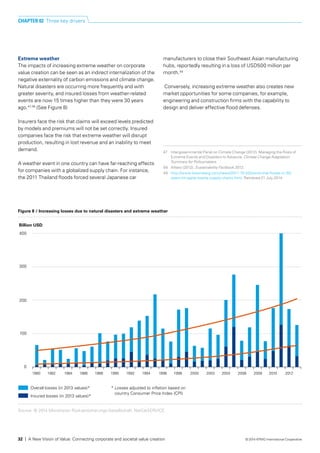
events are now 15 times higher than they were 30 years
ago.47,48
(See Figure 8)
Insurers face the risk that claims will exceed levels predicted
by models and premiums will not be set correctly. Insured
companies face the risk that extreme weather will disrupt
production, resulting in lost revenue and an inability to meet
demand.
A weather event in one country can have far-reaching effects
for companies with a globalized supply chain. For instance,
the 2011 Thailand floods forced several Japanese car
manufacturers to close their Southeast Asian manufacturing
hubs, reportedly resulting in a loss of USD500 million per
month.49
Conversely, increasing extreme weather also creates new
market opportunities for some companies, for example,
engineering and construction firms with the capability to
design and deliver effective flood defenses.
Source: © 2014 Münchener Rückversicherungs-Gesellschaft, NatCatSERVICE
Figure 8 / Increasing losses due to natural disasters and extreme weather
1980 1982 1984 1986 1988 1990 1992 1994 1996 1998 2000 2002 2004 2006 2008 2010 2012
400
Billion USD
300
200
100
0
Overall losses (in 2013 values)*
Insured losses (in 2013 values)*
* Losses adjusted to inflation based on
country Consumer Price Index (CPI)
CHAPTER 02 Three key drivers
32 | A New Vision of Value: Connecting corporate and societal value creation
47	 Intergovernmental Panel on Climate Change (2012). Managing the Risks of
Extreme Events and Disasters to Advance; Climate Change Adaptation:
Summary for Policymakers.
48	 Allianz (2012). Sustainability Factbook 2012.
49	 http://www.bloomberg.com/news/2011-10-20/worst-thai-floods-in-50-
years-hit-apple-toyota-supply-chains.html. Retrieved 21 July 2014.
© 2014 KPMG International Cooperative
New markets
New markets can be seen as an indirect driver of
internalization in that they offer companies the opportunity
to profit from products and services that mitigate negative
externalities, or create or increase positive ones.
As the megaforces present major social and environmental
challenges, there is vast corporate value creation potential in
new markets that focus specifically on societal value creation.
Such value creation opportunities have been highlighted in
many recent reports.
For example, circular supply chains could generate over
USD1 trillion a year by 2025 and create 100,000 jobs within
the next five years, according to the World Economic Forum
and Ellen Macarthur Foundation.50
Similarly, the global market
for smart city solutions and the services required to deploy
them has been valued at over USD400 billion by 2020.51
The worldwide market for energy efficient retrofits of
commercial and public buildings is expected to grow by
almost 90 percent to USD127.5 billion by 2023, and it is
predicted that over USD8 trillion of asset finance will be
spent on renewables to 2030.52,53
(See Figure 9).
Businesses are increasingly aware of these value creation
opportunities and, in some cases, act themselves to create
or accelerate the development of new markets. An example
is the German car retailer, BMW, which not only invested
ahead of the curve in electric vehicles, but is also developing
premium car-sharing services in cities.54
50 	 World Economic Forum and Ellen Macarthur Foundation (2014). Towards the
Circular Economy: Accelerating the scale-up across global supply chains.
51	 UK Department for Business Innovation and Skills (2013). The Smart City
Market: Opportunities for the UK.
52	 Navigant Research (2014). Energy Efficiency Retrofits for Commercial and
Public Buildings.
53	 Bloomberg New Energy Finance (2013). Global Renewable Energy Market
Outlook 2013.
54	 KPMG (2010). The Transformation of the Automotive Industry:
The Environmental Regulation Effect.
Source:
i World Economic Forum and Ellen Macarthur Foundation (2014). Towards the Circular Economy:
Accelerating the scale-up across global supply chains.
ii UK Department for Business Innovation and Skills (2013). The Smart City Market: Opportunities for the UK.
iii Navigant Research (2014). Energy Efficiency Retrofits for Commercial and Public Buildings.
iv Bloomberg New Energy Finance (2013). Global Renewable Energy Market Outlook 2013.
Figure 9 / Commercial opportunities from societal value creation
USD1trillioni
billionii
billioniii
RenewablesEnergy efficient
retrofits
Smart city
solutions
Circular
supply chains
trillioniv
USD400 USD8USD128
Three key drivers CHAPTER 02
A New Vision of Value: Connecting corporate and societal value creation | 33© 2014 KPMG International Cooperative
MARKET DYNAMICS AT WORK: STRANDED ASSETS
Market dynamics can drive the
internalization of externalities
in complex and unpredictable
ways. An example of this is the
much-debated risk of asset
stranding in the oil and gas
industries.
The International Energy Agency
(IEA) has confirmed that two-thirds
of existing fossil fuel reserves cannot
be burned and emissions released
if the international community is
to meet its goal of limiting global
temperature increases to less than
2 degrees centigrade above
pre-industrial levels.63,64
This finding has the potential to
transform the energy market, either
by accelerating the development of
effective carbon capture and storage
solutions or by bringing into question
the value of the fundamental
resources or assets the industry
relies on. If companies are unable to
exploit their fossil fuel reserves, the
market for their product effectively
ceases to exist and those assets
become ‘stranded’.
This is a significant challenge for
investors, including pension funds,
because the valuation of energy
companies is tied closely to their
proven energy reserves, which could
lose much or all of their value if they
become ‘stranded’ in the future.
One effect of the debate over asset
stranding is that global investors are
starting to query energy companies’
business plans, encouraging a better
assessment of the financial risks
posed by current investments in
high-carbon assets.65
63	 United Nations Framework Convention
on Climate Change (2009).
The Copenhagen Accord.
64	 International Energy Agency (2013).
World Energy Outlook: Redrawing the
Energy-Climate Map.
65	 http://www.carbontracker.org/site/
investors-challenge-fossil-fuel-companies.
Retrieved 14 July 2014.
In other cases, companies proactively push for regulation that
creates the right market dynamics to create corporate value
from increased positive and reduced negative externalities.
For example, Philips created an alliance with NGOs,
retailers and others to put energy efficient lighting firmly on
government agendas and lobbied through organizations
such as the European Lamp Companies Federation (ELC).
This action, in part, led to legislation banning incandescent
lights in Europe and the US.55, 56
Swedish retailer, IKEA,
showed it was possible to transform its product portfolio and
stay ahead of the regulatory curve by becoming the first
major retailer to drop incandescent bulbs from its portfolio
in 2011.57
These investments have paid off, with LEDs and LED-
compatible lights now making up 29 percent of Philips total
lighting sales and 51 percent of IKEA’s lighting product sales
in 2013.58,59
Brands that adopt societal value creation as their key brand
attribute are also seeing increasing success. An example of
this is the Fairtrade movement: sales of Fairtrade products
grew by 500 percent, to around USD6.5 billion between
2004 and 2102.60
European chocolate producer, Tony’s
Chocolonely, is another example. The company was founded
in 2005 with the goal of reaching a 100 percent “slave-free”
chocolate industry. Its revenues increased 63 percent
between 2012 and 2013, a growth rate 10 times higher than
the 6 percent industry average.61,62
55	 http://www.theguardian.com/environment/2012/aug/31/lightbulbs-
incandescent-europe. Retrieved 14 July 2014.
56	 http://energyblog.nationalgeographic.com/2013/12/31/u-s-phase-out-of-
incandescent-light-bulbs-continues-in-2014-with-40-60-watt-varieties/.
Retrieved 14 July 2014.
57	 http://www.ikea.com/us/en/about_ikea/newsitem/IKEA_pulls_the_plug_
on_incandescent_light_bulbs_press_release. Retrieved 21 July 2014.
58	 Philips (2013). Annual Report 2013.
59	 Ikea (2013). Sustainability Report 2013.
60	 http://www.statista.com/statistics/247491/estimated-retail-sales-of-
fairtrade-products-worldwide/. Retrieved 31 July 2014.
61	 Tony Chocolonely (2013). JaarFAIRslag 2013.
62	 KPMG (2014). A Taste of the Future: The trends that could transform the
chocolate industry.
CHAPTER 02 Three key drivers
34 | A New Vision of Value: Connecting corporate and societal value creation © 2014 KPMG International Cooperative
The message to chief executive
and chief financial officers is that
momentum is building around this
issue and that companies are advised
to understand the implications for
their own business models.
The landscape of initiatives around
value creation is somewhat fragmented.
See tables 4 and 5 for some of the
programs in progress today. Many
of the current initiatives aim to help
companies measure their social and
environmental impacts and some
focus primarily on negative impacts.
While this is a valuable first step,
KPMG has identified a need for an
approach that is better balanced and
helps enable companies to go further.
This means valuing positive externalities
as well as negative, and – importantly
- understanding the risk of those
externalities being internalized and
how that internalization might affect
value creation. Such a tool also needs
to provide a lens through which
investments can be assessed for their
potential to create both corporate and
societal value.
In order to address this need, we have
developed the KPMG True Value
methodology and piloted it with a
number of member firm clients. It is
our contribution to the ongoing value
creation debate. In the next section of
this report we present the KPMG True
Value methodology and illustrate it in
action through a number of case studies.
MOMENTUM
IS GROWING
TOWARDS A NEW
VISION OF VALUE
A great deal of work is
being done to explore the
nexus between corporate
and societal value creation,
as pressure grows on
companies to understand and
manage their externalities
more effectively.
Three key drivers CHAPTER 02
A New Vision of Value: Connecting corporate and societal value creation | 35© 2014 KPMG International Cooperative
CURRENT INITIATIVES ON CORPORATE AND SOCIETAL VALUE CREATION
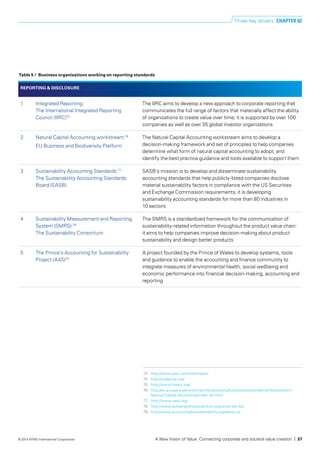
MEASUREMENT AND MANAGEMENT
1 B Impact Assessment66
Standards, benchmarks and tools enabling companies to assess,
compare and improve their social and environmental impacts over time
2 Environmental Profit & Loss (EP&L)
Statement:67
First-ever EP&L in 1990 by IT company
BSO/Origin (Eckart Wintzen)
Followed by Puma (Jochen Zeitz) in 2010
Pioneering development of a means of placing a monetary value on the
environmental impacts along the supply chain of a business
3 KPMG True Value:68
KPMG
A three-step methodology that enables companies to i) assess their
‘true’ earnings including externalities, ii) understand future earnings at
risk and iii) develop business cases that create both corporate and
societal value
4 Natural Capital Protocol:69
Natural Capital Coalition
(formerly TEEB for Business)
A harmonized framework for valuing natural capital in investor decision
- making
5 Redefining Value:70
World Business Council for
Sustainable Development (WBCSD)
A work-program that aims to help WBCSD member firms to
standardize tools to measure and manage their impact on society and
the environment
6 Shared Value:71
Shared Value Initiative
A management strategy focused on creating business value by
identifying and addressing social problems
7 Social Return on
Investment (SROI):72
SROI Network
A framework based on generally-accepted accounting principles used
to help manage and understand an organization’s social, economic and
environmental outcomes
8 Total Impact Measurement &
Management (TIMM):73
PwC
A new language to assist companies in understanding the overall
impact of their activities
9 True Price74
A social enterprise that helps organizations – multinationals, SMEs,
NGOs, governments – quantify and valuate their economic,
environmental and social impacts, particularly on a product level
Table 4 / Current initiatives on corporate and societal value creation
66	 http://bimpactassessment.net/
67	 http://about.puma.com/puma-completes-first-environmental-profit-and-loss-account-
which-values-impacts-at-e-145-million/
68	 kpmg.com/newvision
69	 http://www.naturalcapitalcoalition.org/about/how/natural-capital-protocol.html
70	 http://www.wbcsd.org
71	 www.sharedvalue.org
72	 http://www.thesroinetwork.org/
CHAPTER 02 Three key drivers
36 | A New Vision of Value: Connecting corporate and societal value creation © 2014 KPMG International Cooperative
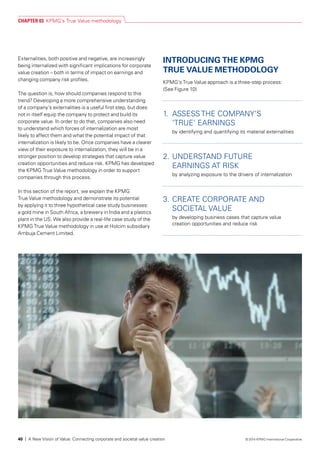
Table 5 / Business organizations working on reporting standards
REPORTING & DISCLOSURE
1 Integrated Reporting:
The International Integrated Reporting
Council (IIRC)75
The IIRC aims to develop a new approach to corporate reporting that
communicates the full range of factors that materially affect the ability
of organizations to create value over time; it is supported by over 100
companies as well as over 35 global investor organizations
2 Natural Capital Accounting workstream:76
EU Business and Biodiversity Platform
The Natural Capital Accounting workstream aims to develop a
decision-making framework and set of principles to help companies
determine what form of natural capital accounting to adopt, and
identify the best practice guidance and tools available to support them
3 Sustainability Accounting Standards:77
The Sustainability Accounting Standards
Board (SASB)
SASB’s mission is to develop and disseminate sustainability
accounting standards that help publicly-listed companies disclose
material sustainability factors in compliance with the US Securities
and Exchange Commission requirements; it is developing
sustainability accounting standards for more than 80 industries in
10 sectors
4 Sustainability Measurement and Reporting
System (SMRS):78
The Sustainability Consortium
The SMRS is a standardized framework for the communication of
sustainability-related information throughout the product value chain:
it aims to help companies improve decision-making about product
sustainability and design better products
5 The Prince’s Accounting for Sustainability
Project (A4S)79
A project founded by the Prince of Wales to develop systems, tools
and guidance to enable the accounting and finance community to
integrate measures of environmental health, social wellbeing and
economic performance into financial decision-making, accounting and
reporting
73	 http://www.pwc.com/totalimpact
74	 http://trueprice.org/
75	 http://www.theiirc.org/
76	 http://ec.europa.eu/environment/biodiversity/business/workstreams/Workstream1-
Natural-Capital-Accounting/index_en.html
77	 http://www.sasb.org/
78	 http://www.sustainabilityconsortium.org/what-we-do/
79	 http://www.accountingforsustainability.org/about-us
Three key drivers CHAPTER 02
A New Vision of Value: Connecting corporate and societal value creation | 37© 2014 KPMG International Cooperative
38 | A New Vision of Value: Connecting corporate and societal value creation
KPMG’S
TRUE VALUE
METHODOLOGY:
building corporate and
societal value
03
A New Vision of Value: Connecting corporate and societal value creation | 39
Externalities, both positive and negative, are increasingly
being internalized with significant implications for corporate
value creation – both in terms of impact on earnings and
changing company risk profiles.
The question is, how should companies respond to this
trend? Developing a more comprehensive understanding
of a company’s externalities is a useful first step, but does
not in itself equip the company to protect and build its
corporate value. In order to do that, companies also need
to understand which forces of internalization are most
likely to affect them and what the potential impact of that
internalization is likely to be. Once companies have a clearer
view of their exposure to internalization, they will be in a
stronger position to develop strategies that capture value
creation opportunities and reduce risk. KPMG has developed
the KPMG True Value methodology in order to support
companies through this process.
In this section of the report, we explain the KPMG
True Value methodology and demonstrate its potential
by applying it to three hypothetical case study businesses:
a gold mine in South Africa, a brewery in India and a plastics
plant in the US. We also provide a real-life case study of the
KPMG True Value methodology in use at Holcim subsidiary
Ambuja Cement Limited.
INTRODUCING THE KPMG
TRUE VALUE METHODOLOGY
KPMG’s True Value approach is a three-step process:
(See Figure 10)
1. 	ASSESS THE COMPANY’S
‘TRUE’ EARNINGS
by identifying and quantifying its material externalities
2. 	UNDERSTAND FUTURE
EARNINGS AT RISK
by analyzing exposure to the drivers of internalization
3.	CREATE CORPORATE AND
SOCIETAL VALUE
by developing business cases that capture value
creation opportunities and reduce risk
CHAPTER 03 KPMG’s True Value methodology
40 | A New Vision of Value: Connecting corporate and societal value creation © 2014 KPMG International Cooperative
WORKING TOWARDS A STANDARDIZED APPROACH
We fully support the work being done by the World
Business Council for Sustainable Development (WBCSD),
International Integrated Reporting Council (IIRC),
Natural Capital Coalition (NCC) and others to achieve a
standardized approach. We offer KPMG’s True Value
methodology as our contribution to that exploratory
process. Having piloted the methodology with clients of
KPMG member firms, we believe it can provide a useful
catalyst for new thinking within companies about corporate
and societal value creation.
Source: KPMG (2014). A New Vision of Value: Connecting corporate and societal value creation.
Figure 10 / KPMG’s three stepTrue Value methodology
Drivers of
internalization
Strategic response
• Regulations & standards
• Stakeholder action
• Market dynamics
• Investment opportunities
to grow revenue and cut costs
• Reduce risk
• Increase positive externalities
• Reduce negative externalities
Externalities
Social Social
Environmental Environmental
Economic Economic
Risk
Revenue Cost Investment
Cash
flow/
earnings
Corporate value
Identify and quantify
positive and negative
externalities to assess the
company's 'true' earnings1
Analyze drivers of internaliza-
tion to understand risks to
future earnings2
Develop business cases to
build corporate and societal
value3
KPMG’s True Value methodology CHAPTER 03
A New Vision of Value: Connecting corporate and societal value creation | 41© 2014 KPMG International Cooperative
STEP 1
Assess the company’s
’true’ earnings
Benefits:
Provides a clearer view of the
company’s externalities
Enables a more balanced conversation
with stakeholders on value creation,
exploring positive as well as negative
societal value created
Provides a strategic lens of corporate
and societal value creation
KPMG TRUE VALUE
42 | A New Vision of Value: Connecting corporate and societal value creation © 2014 KPMG International Cooperative
We then combine that information
with the company’s financial earnings
data to provide a holistic view of the
company’s corporate and societal
value creation.
Identifying externalities
KPMG has developed a framework
to identify a company’s externalities
(see Table 6). In this framework,
externalities are classified as either
economic, social or environmental,
and as either positive or negative.
This framework is a guideline
designed to capture the most
significant externalities for companies
in most sectors; the framework
can be amended to add further
externalities relevant to specific
companies.
EXTERNALITY TYPE EXTERNALITY FURTHER DESCRIPTION
EC+: Positive Economic Taxes Contribution to the economy via taxes of all kinds
Shareholder dividends Contribution to societal wealth via returns to shareholders
Interest on loans Contribution to health of the financial services sector via loan interest
Wages Provision of sustainable incomes and quality of life for workers
EC-: Negative Economic Avoided taxes Loss to the economy by not paying fair share of taxes
Corruption Contribution to inefficiency in economies
S+: Positive Social Infrastructure Provision of infrastructure (such as roads, energy generation) that deliver improved
quality of life and economic opportunity
Healthcare Provision of healthcare, for example to workers or communities, or via health and fitness
products and services. Creates value for society through improved health and life quality
Education Provision of education, for example to workers or communities, or via educational
products and services. Creates value for society through improved earning capacity and
life quality
S-: Negative Social Low wages Failure to provide workers with a sustainable livelihood and good quality of life through
underinvestment in living wages or through poor working conditions. Use of child labor
Health & safety Damage to health, injury or death caused by underinvestment in health and safety
safeguards
Pollution Damage to the health of workers and communities through air, water or noise pollution
E+: Positive
Environmental
Renewable energy Displacement of carbon intensive energy and greenhouse gas (GHG) savings through
generating renewable energy (for company operations and/or supplying to the grid )
Land stewardship Reforestation and other regenerative practices that improve ecosystems and habitats
Recycling Avoidance of waste to landfill or incineration by reusing waste materials (whether
produced by the company or sourced from elsewhere)
E-: Negative
Environmental
Waste Environmental damage caused by gaseous, liquid or solid waste. Includes GHG
emissions resulting from landfill and incineration of waste
Ecosystems Degradation of ecosystem services
GHGs and energy Contribution to climate change and the resulting costs for society and the environment
through energy use and GHG emissions.
Water Damage to ecosystems and communities by withdrawing water in areas of water
shortage
Raw materials Usage of raw materials for production process resulting in environmental damage and
resource scarcity
The first step in KPMG’s
True Value methodology is
to identify the company’s
positive and negative
externalities and to monetize
them, i.e. to quantify them in
financial terms.
Table 6 / Framework to identify and quantify material externalities
KPMG’s True Value methodology CHAPTER 03
A New Vision of Value: Connecting corporate and societal value creation | 43© 2014 KPMG International Cooperative
ACKNOWLEDGING ECONOMIC
VALUE-ADD
There is a rich tradition of companies publishing value-added
statements in their annual reports. These statements cover the
wages, taxes, dividends and interest paid by the company1
.
We recognize that economic value-add does not adhere
strictly to accepted definitions of externalities because it is
reflected in financial statements and it represents direct
transactions between the company and certain stakeholders.
However, we have chosen to include value-add as a positive
economic externality in our methodology because its
components, i.e. wages and tax create wider societal value
through a multiplier effect.2
Monetization provides a common
metric through which a company can
more easily understand, compare and
contrast the magnitude of its various
externalities. Furthermore, given that
the ultimate goal is to develop strategies
that create both societal and corporate
value, then there are clear advantages in
using the same metrics to express both.
Perhaps most importantly, the use of
financial metrics to quantify externalities
enables social and environmental
factors to be brought into decision
making in terms that business
managers are already familiar with.
There are challenges in seeking to
quantify externalities in financial terms.
For example, it is not an exact science
and the results should therefore be
considered as an indication or approxi­
mation. Additionally, monetization
cannot fully express ethical aspects of
externalities such as human rights or
health and safety. However, while
we acknowledge the limitations of
monetization, we believe that it is
the method that currently offers the
most potential to bring considerations
of societal value into corporate
decision making.
Monetization is becoming more
widely accepted as an approach to help
companies understand, measure and
manage their externalities, thanks
partly to the increasing number and
reliability of data sources.
The concept is not perfect, and the
data is not yet as reliable as that used
for financial reporting.
However, monetization does offer a
useful means to draw comparisons of
scale between a company’s various
externalities and identify which of them
are most material both to the business
and to society.
We believe it is the best approach
available right now and for this reason,
monetization forms the starting point
of KPMG’s True Value methodology
as well as initiatives from other
organizations.
However, monetization is not
necessarily the ultimate solution. We
might end up with a more complex and
multi-lensed approach to evaluating
business performance, in which case
the goal must be to develop a standar­
dized approach that aligns more closely
with the elegance of the double-entry
financial accounting system.
The double-entry system, in which
every debit must have a credit and
every credit a debit, continues as the
basis of financial accounting even
though standards have been added
over time to define particular debits
and credits.
That is why we should aim, eventually,
to adopt the same system when
accounting for societal value creation.
The International Integrated Reporting
Council’s (IIRC) framework gives us
a good point of departure in that it
identifies six types of capital (or ‘
stores of value’) that a company
requires in order to create corporate
value: finan­cial capital, manufactured
capital, intellectual capital, human
capital, social and relationship capital,
and natural capital.
A NOTE ON MONETIZATION
1 	 See for example
	 Arangies, G. et al. (2008): The value-added statement: An appeal for
standardisation. Management Dynamics, 17 (1), pp. 31-43.
2 	 Throughout this report, for simplicity we use a multiplier of 1 for economic
value-add externalities.
In practice, this multiplier can differ for countries and sectors.
Looking to the long term: the goal of
double-entry accounting for all capitals
CHAPTER 03 KPMG’s True Value methodology
44 | A New Vision of Value: Connecting corporate and societal value creation © 2014 KPMG International Cooperative
Some of these capitals are already
measured in accepted currencies, for
example, financial capital is obviously
measured in financial currency as is
manufactured capital, i.e the physical
assets and inventory that a company
owns (or, technically, stewards on
behalf of the real owners, namely the
shareholders).
However, developing a currency that
accurately expresses the value of
the other capitals is more complex.
Take, for example, human capital or
the stock of employee knowledge
and capabilities that a company has
access to but is actually owned by the
employees in question. In an ideal
world, there would be an accepted
way to measure the value of that
human capital that takes into account
the experience, skills, values and
motivation of employees.
A profit and loss account for human
capital would be able to demonstrate
whether the company has either
increased or devalued its stock of
human capital over the year by
increasing or devaluing the experience,
skills, values and motivation of its
people. Similar standard currencies
would need to be further developed
for the other capitals - that would be
accounted for as liabilities when a
company depletes natural resources
or generates air emissions.
For example, a currency for natural
capital will need to take into account the
accessibility, resilience and quality of
the natural assets a company uses such
as the air, waterways and ecosystems.
Again, a profit and loss account in that
currency would show whether the
company has increased or decreased
the stock of natural capital. A currency
for social and relationship capital will
need to value the strength and resilience
of customer loyalty, consumer approval,
and community license-to-operate
among other relationships. This is
important because until we achieve
such a system it will continue to be
possible for businesses to report
reductions in their environmental and
social impacts while continuing to
deplete stocks of human, natural and
social capital.
Ultimately, a new vision of value
must be one in which a company’s
management accounts for its
stewardship not only of financial,
manufactured and intellectual capital,
but also of human, social and natural
capital. Globally agreed measurement
standards are needed to enable
the comparison of one company’s
stewardship with another’s. Once
clarity is achieved on what the currency
for each capital should be, methods can
be explored to translate each of them
into financial currency for ease of
comparison and management.
The challenge is both complex and
fascinating. We know where we need
to get to but it will take time. While the
basics of bookkeeping have remained
constant, the details have evolved over
hundreds of years. In comparison,
accounting for societal value creation
can be considered relatively new.
While our sights are ultimately on a
double-entry accounting system for
all six capitals, we believe that KPMG’s
True Value methodology, using
monetization of externalities as a
foundation, provides a solid start in
helping companies to understand and
act upon the disappearing disconnect
between corporate and societal value
creation.
KPMG’s True Value methodology CHAPTER 03
A New Vision of Value: Connecting corporate and societal value creation | 45© 2014 KPMG International Cooperative
Scope
The methodology can be applied to the entire
company or to specific operating units or projects.
Similarly, it can be applied only to the company’s
direct operations or can be expanded to cover
upstream externalities in the supply chain and
downstream externalities related to the use and
disposal of the company’s products and services.
Materiality
Only those externalities that are material to the
company, its stakeholders, society and the
environment should be included.
Baseline
A suitable baseline for assessment should be
defined. This will include the time period for
which externalities are to be calculated.
Data
The most appropriate data for quantification must
be selected from both within the company and
from outside sources. Similarly, the most relevant
quantification methods must be selected from a
range of options, including company valuation
techniques, economic impact analysis and
environmental economics.
CONSIDERATIONS IN
QUANTIFYING
EXTERNALITIES
The following factors should be
considered when using this
framework to identify and monetize
a company’s externalities:
Prominent economists, including Arthur Pigou,
Ronald Coase and Elinor Ostrom, have explored
the concept of externalities throughout the 20th
and 21st
centuries. Governments also employ the
concept when assessing the social costs and
benefits of policy options.
There is now a wide range of disciplines, tools, techniques and
data sources that are becoming more well established and enable
us to estimate the value of social and environmental externalities.
Techniques include economic impact analysis, environmental
economics and healthcare economics.
Data sources include The Economics of Ecosystems and
Biodiversity (TEEB)*
for environmental externalities and the World
Bank, Organisation for Economic Co-operation and Development
(OECD) and Social Return on Investment (SROI) Network for social
externalities. These sources provide price data for social and
environmental externalities. Multiplying these prices with volumes
data from within companies enables us to calculate the value of
the externalities. Reporting of these volumes, such as the amount
of GHG emissions, water usage, occupational health and safety
data and community investment is common practice for most
companies in integrated or sustainability reporting processes.
EXTERNALITY
QUANTIFICATION
methods and data sources
* Please note that TEEB is now known as the Natural Capital Coalition.
CHAPTER 03 KPMG’s True Value methodology
46 | A New Vision of Value: Connecting corporate and societal value creation © 2014 KPMG International Cooperative
The financial earnings reflected by conventional company
reporting are key drivers of corporate value creation.
However, this reporting does not provide a view of the
externalities the company generates in the course of doing
business.
By combining financial and monetized externality data, we
can form a broader view of the company’s value creation that
includes both corporate and societal value. In KPMG’s True
Value methodology we do this by presenting the information
in a ‘true’ earnings bridge. (See Figure 11)
The ‘true’ earnings bridge helps business managers to
visualize the company’s most significant positive and
negative externalities and understand where the company’s
actions may be creating or reducing societal value.
By looking through this lens, a company can gain insights into
opportunities to increase its societal value creation.
The ‘true’ earnings shown at the far right hand side of the
bridge illustrate what the company’s ‘true’ earnings would be
if all of its significant positive and negative externalities were
fully internalized. However, the actual likelihood and extent
of internalization for each externality will be influenced
by how the drivers of internalization play out for that particular
company.
The next step of the KPMG True Value methodology is to
assess the risk of internalization of each of these externalities
and the potential impact on the company’s earnings.
Source: KPMG (2014). A New Vision of Value: Connecting corporate and societal value creation.
Figure 11 / A generic ‘true’ earnings bridge
EarningsCostRevenue ‘True’
earnings
Social
positive
Social
negative
Environ-
mental
positive
Environ-
mental
negative
Economic
positive
Economic
negative
EARNINGS
SOCIAL
EXTERNALITIES
ENVIRONMENTAL
EXTERNALITIES
‘TRUE’
EARNINGS
ECONOMIC
VALUE-ADD
BUILDING A ‘TRUE’ EARNINGS BRIDGE
KPMG’s True Value methodology CHAPTER 03
A New Vision of Value: Connecting corporate and societal value creation | 47© 2014 KPMG International Cooperative
Understand future
earnings at risk
Benefits:
Enables understanding of the
company’s exposure to internalization
of its negative externalities
Quantifies potential risks to earnings
through reduced revenues, increased
costs or increasing investment
requirements
Provides information to guide
risk-reduction strategies
STEP 2
KPMG TRUE VALUE
48 | A New Vision of Value: Connecting corporate and societal value creation © 2014 KPMG International Cooperative
The next step is to understand how the externalities identified
in Step 1 may be internalized by the three drivers of regulations
and standards, stakeholder action and market dynamics and
the extent to which those drivers could affect earnings.
Table 7 shows some of the key ways in which the drivers of
internalization present risks to earnings, either by increasing a
company’s costs, reducing revenues or changing investment
profiles.
FORCE RISKS TO EARNINGS EXPLANATION
Regulations and
standards
Taxes/fines/
compensation
Government may apply taxes or fines to negative externalities, for example, water
scarcity taxes
Lost production Production may be interrupted if legislation is contravened, for example, a plant shut
down due to the discovery of child labor
Increased cost
of permitting
More stringent regulation on permits can increase costs for the permit process and
subsequent mitigation measures can cause delays, resulting in additional costs - for
example, a mining company operating in areas with high levels of biodiversity might
need to delay its activities due to difficulties in securing permits
Stakeholder actions Lost production Stakeholder pressure such as consumer boycotts, community protests or labor
unrest may halt production
Increased cost
of production
Production costs may increase due to stakeholder pressure, for example, community
protests may block a permit for a new site, resulting in resources having to be sourced
from farther afield
Revenue loss More stringent sustainability criteria set by customers may result in lost revenues if
competitors are better able to meet those criteria
Cost of capital The cost of capital may change due to a ratings change or changing investor
perceptions of risk
Market dynamics Lost production Shortages of key inputs may halt production
Increased cost
of production
Cost increases of key inputs, such as scarcity, may increase the cost of production
Insurance fees Insurance fees may increase if insurers perceive increased risk, for example, from
extreme weather
Table 7 / Forces of internalization: key risks to earnings
KPMG’s True Value methodology CHAPTER 03
A New Vision of Value: Connecting corporate and societal value creation | 49© 2014 KPMG International Cooperative
This step begins with the ‘true’ earnings bridge from
Step 1, in which the company’s material externalities have
been identified. We then perform a risk analysis on these
externalities by overlaying the drivers of internalization as
set out in Table 7. This risk analysis should be performed with
a medium to long-term view, because, in general, the drivers
of internalization intensify over time and therefore the risks of
internalization increase as the time horizon extends.
Where we find that there is a high risk of internalization,
we can get a clearer view of the potential impact on the
company’s earnings by using financial modeling techniques
and appropriate sector and location-specific scenario
assumptions. For example, in the case studies that follow,
we have modeled risks on a scenario timeline of 2030 and
assumed economic, political, social and environmental
conditions that we believe are reasonable for South Africa,
India and the US run on in that year. (See page 62)
It is likely that most companies will seek to protect and
create corporate value by reducing risk and by unlocking
opportunities for future growth. Those that anticipate and
prepare proactively are more likely to protect corporate value
than those that react to internalization as it happens.
Some internalization happens with notice, such as regulations
and taxes, but some happens unexpectedly, such as supply
failures or community action. The third step in KPMG’s True
Value methodology provides guidance for companies to act
on the information gained in the first two steps.
CHAPTER 03 KPMG’s True Value methodology
50 | A New Vision of Value: Connecting corporate and societal value creation © 2014 KPMG International Cooperative
STEP 3
Create corporate and
societal value
Benefits:
Provides a more complete view of the
potential value creation of an investment
Quantifies the Net Present Value (NPV) of
investments, including likely internalization
of externalities
Provides insights to make balanced
investment decisions on the basis of
both corporate and societal value
KPMG TRUE VALUE
KPMG’s True Value methodology CHAPTER 03
A New Vision of Value: Connecting corporate and societal value creation | 51© 2014 KPMG International Cooperative
In the previous two steps of the KPMG
True Value methodology we have set
out how companies, and their investors,
can better understand externalities,
anticipate drivers of internalization and
assess earnings at risk.
Step 3 helps companies to build business
cases for investments that create both
corporate and societal value in the most
cost effective way possible.Managing
for both corporate and societal value
creation can increase resilience and
reduce volatility in long-term earnings.
Identifying potential investments
This step begins by identifying potential
investments that can deliver both
corporate and societal value creation.
There are two broad approaches to
achieve this.
•	Invest in reducing negative
externalities which can reduce the
risk of costs resulting from regulatory
changes, stakeholder action and
changes in market dynamics. This
can include adapting the supply chain,
changing operations or shifting the
focus of key markets, including
changing customer behaviors.
•	 Invest in increasing positive
externalities which can yield returns
in the form of regulatory tools such
as tax incentives, stakeholder action
such as labor stability and market
dynamics such as competitive
advantage and brand enhancement.
Investments can include developing
new products and services and
identifying new operating models
and routes to market.
These two investment approaches
are not mutually exclusive and can be
implemented simultaneously.
In the following example, we look at
potential investments for a soft drink
producer. We have assumed that the
company has applied the first two steps
of the KPMG True Value methodology.
Through this process it has identified
its water withdrawal and the negative
health effects of its sugary beverages
as the two externalities with significant
potential to affect its future earnings
and corporate value.
INVESTMENT CORPORATE VALUE CREATION SOCIETAL VALUE CREATION
Rainwater harvesting and distribution
technologies
Improved water efficiency at the plant
Water recycling technologies
Product innovation that use less
water (e.g. syrups that are reconstituted
with water at the point of sale)
Direct financial returns
Reduction in water costs (offset against investment
costs)
Returns from internalization of externalities
Avoid future government charges related to water
scarcity such as taxes, price increases or quotas
Secure competitive advantage by inviting stricter
regulation on water usage
Avoid or reduce production stoppages caused by
insufficient availability of water supplies
Avoid or reduce production stoppages caused by
community protest over competition for water supplies
Decrease negative environmental
externalities
Reduced negative effect on local
groundwater supplies
Increase positive social and
environmental externalities
Improved health and wellbeing of local
community from increased water supplies
provided by company’s rainwater
harvesting investment
Development of healthier beverages Direct financial returns
Increased sales by introduction of new products
Returns from internalization of externalities
Avoid or reduce exposure to future government action
such as “soda taxes”
Competitive advantage by acting early to anticipate
governments, moves to limit high-sugar beverages
Avoid exposure to stakeholder campaigns against
high-sugar beverages
Decrease negative social externalities
Reduced contribution to public health
problems of obesity and diabetes
Table 8 / Potential value creation of investments for a soft drink producer
CHAPTER 03 KPMG’s True Value methodology
52 | A New Vision of Value: Connecting corporate and societal value creation © 2014 KPMG International Cooperative
Source: KPMG (2014). A New Vision of Value: Connecting corporate and societal value creation.
Figure 12 /True value NPV calculation
NPV including returns from internalized externalities
Direct financial returns
NPV($)
Direct
financial
returns
Investment
Market
dynamics
returns
NPV of
investment
including
internalized
externalities
Social
value
created
(NPV)
Environ-
mental
value
created
(NPV)
Total
financial
and societal
returns
(NPV)
Drivers of internalization
increase investment
returns due to avoided
costs or increased
earnings
Total investment returns
more positive based on
more complete
assessment
Investment creates
societal value by
increasing positive or
reducing negative
externalities
2
Total corporate and
societal value created
by investment
5
Stakeholder
action
returns
Regulatory
returns
Once possible investments have been
identified, the Net Present Value (NPV) for
each business case can be calculated to
include the direct, financial returns to the
business, the potential future returns
through the drivers of internalization and
the additional value created for society.
This provides a more complete view of the
potential value creation of an investment.
(See Figure 12)
CALCULATING THE TRUE
VALUE BUSINESS CASE
KPMG’s True Value methodology CHAPTER 03
A New Vision of Value: Connecting corporate and societal value creation | 53© 2014 KPMG International Cooperative
By understanding how investments might enhance
future earnings, the company is in a stronger
position to undertake projects that create long-term
corporate and societal value. Companies that restrict
their NPV project calculations to direct financial
returns only would not invest in many projects
which offer broader value creation opportunities.
A note of caution is required here. It would be
unwise for a company to undertake projects based
on loose assumptions of potential future returns
through forces of internalization.
A rigorous process is advised, including extensive
data analysis and sensitivity testing to accurately
determine the parameters under which the project
is likely to deliver acceptable total returns and to
provide the confidence level required to make the
investment. Some companies may have already
integrated some form of internalization into their
investment decision-making process, such as
carbon costs, landfill taxes or changing societal
expectations. The KPMG True Value
methodology builds on this and aims to provide a
more complete approach to help companies
prepare for the future.
COMPARING THE TRUE VALUE
OF POTENTIAL INVESTMENTS
Companies can compare the True Value
business cases of potential investments by
developing a Marginal True Value Curve.
(See Figure 13).
Such a curve provides a comparative view of the
returns provided by each project, both with and
without the likely internalization of externalities.
It also demonstrates the relative societal value
creation of each potential project, enabling
companies to select projects on the basis of their
societal as well as corporate value creation.
Projects plotted in a Marginal True Value Curve will
broadly fall into three categories:
•	 those that deliver positive NPV in terms of
direct financial returns, regardless of any future
benefit from the internalization externalities
•	 those that will deliver a positive NPV if the
likely future returns from internalized
externalities are taken into account
•	 those that are unlikely to deliver positive NPV,
even when internalized externalities are taken
into account, but may create significant
societal value.
The Marginal True Value Curve enables companies
to prioritize projects according to
a range of criteria, whether the objective is to
maximize corporate value, societal value or
both. This tool can also be used, for example,
to ensure that projects implemented under
mandatory CSR or social investment legislation
(seen, for example, in India) deliver maximum
corporate and societal value.
CHAPTER 03 KPMG’s True Value methodology
54 | A New Vision of Value: Connecting corporate and societal value creation © 2014 KPMG International Cooperative
Source: KPMG (2014). A New Vision of Value: Connecting corporate and societal value creation.
Figure 13 / MarginalTrue Value Curve
NPV including returns from internalized externalities
Direct financial returns
Projects deliver a positive return
regardless of potential returns from
internalization of externalities
Projects deliver positive
returns if potential returns
from internalized externalities
are taken into account
Projects do not deliver positive
returns but may be considered on
the basis of their societal value
creation e.g. social investments
NPV($)
Societal value (NPV)
Example: investing in an energy
reduction project
Example: investing in water
saving projects
Example: investing in
community development
direct savings from reduced energy result
in positive returns
internalization returns from avoided
carbon tax increase total NPV
direct savings from water
reduction results in negative
NPV
internalization returns of
avoided lost production turns
NPV into positive
internalization returns from avoided
community unrest increase NPV
significant societal value created
•
•
•
•
•
•
KPMG’s True Value methodology CHAPTER 03
A New Vision of Value: Connecting corporate and societal value creation | 55© 2014 KPMG International Cooperative
56 | A New Vision of Value: Connecting corporate and societal value creation © 2014 KPMG International Cooperative
CASE STUDIES:
applying the KPMG True Value
methodology in practice
04
A New Vision of Value: Connecting corporate and societal value creation | 57© 2014 KPMG International Cooperative
T
he extent to which the
internalization of externalities
can affect earnings,corporate
value and response strategies
depends on the business in question,
its sector and geographic location.
No two business will have exactly
the same asset base, type or degree
of expo­sure to risk or response
options.
In order to illustrate this, and to
further develop the approach and
test its versatility, KPMG sector teams
have applied the KPMG True Value
methodology to three hypothetical
businesses: a gold mine in South Africa,
a brewery in India and a plastics plant
(low-density polyethylene) in the US.
In addition, we have piloted the
methodology with KPMG member
firm clients, including Ambuja Cement
Limited (ACL), an Indian subsidiary
of global cement company Holcim.
A case study on our KPMG True
Value work with ACL can be found
on page 90 of this report.
For each of the three case studies we
have followed the three-step process
explained in the previous pages:
1. Assess the company’s ‘true’
earnings by identifying and
quantifying its material externalities
2. Understand future earnings at risk
by analyzing exposure to the forces
of internalization
3. Create corporate and societal
value by developing business
cases that capture value creation
opportunities and reduce risk.
For the risk analysis of forces of
internalization, we have set a timeline
of 2030 and made economic, political,
social and environmental assumptions
relevant to each country. These are
detailed in each case study. We have
modeled only one set of scenario
assumptions in this report for illustrative
purposes. These assumptions could be
varied and the model rerun to produce
multiple scenarios for comparison.
•	 The operating models and
earnings before interest, taxes,
depreciation and amortization
(EBITDA) margins we have used
for these case studies are based
on knowledge of similar compa­
nies and the economic, social and
environmental issues they face.
The businesses are, however,
hypothetical and are provided as
illustrative examples only.
•	 For clarity we have applied the
2030 scenarios to the companies’
current operating models,
assuming that the companies
have not yet acted to mitigate
financial impacts.
•	 Costs such as carbon prices
have been modelled at 2014
equivalent levels in real terms.
•	 The level of sales and the prices
of the companies’ products in
each sector have been assumed
to remain constant in real terms,
e.g. we have assumed that the
companies absorb cost increases
and lost production rather than
passing them on to customers.
•	 In a more wide ranging exercise
we would apply a range of
scenarios that would explore
additional variables such as
increased revenue driven by
growing demand for the
companies’ products and a
broader range of financial key
performance indicators (KPIs)
that are based on the balance
sheet (here we modeled the
income statement only).
NOTES ON THE
CASE STUDIES:
CHAPTER 04 Case studies
58 | A New Vision of Value: Connecting corporate and societal value creation © 2014 KPMG International Cooperative
The plastics plant in the US delivers
‘true’ earnings roughly equivalent to
its financial earnings, but both the
gold mine and the brewery have ‘true’
earnings significantly less than their
financial earnings.
In the next step we analyzed the
likelihood of material externalities
being internalized and the likely extent
of internalization. We then modeled
the potential impact on earnings
using a 2030 scenario. This exercise
suggests that drivers of internalization
could render two of the case study
businesses – the Indian brewery
and the South African gold mine –
financially unsustainable.
The brewery goes from a positive
EBITDA margin of 5 percent into a
negative margin of -4 percent in our
models. Likely internalization of
environmental externalities (GHGs,
energy and water) account for the bulk
of this potential EBITDA impact.
The mine sees its EBITDA margin drop
to a level at which it would be unable
to service the debt on its capital
investment. Internalization of social
externalities (wages and health &
safety) together account for the greatest
potential impact on the mine’s EBITDA
margin.By contrast, the EBITDA margin
of the US plastics plant is better
protected because it is less exposed
to internali­zation of externalities due
to its location and country specific
conditions. We modeled a potential
dip in the EBITDA margin due primarily
to price increases of its key feedstock,
driven by increasing demand, although
in reality it is likely that the plant would
be able to pass on some or all of these
costs to its customers.
In order for the companies to act on
this potential loss of EBITDA margin,
we have estimated the business case
for several initiatives to build both
corporate and societal value and have
shown the results in Marginal True
Value Curves.
KEY FINDINGS:
Internalization of externalities could render the gold
mine and brewery financially unsustainable
We have constructed a
‘true’ earnings bridge for all
three companies to compare
their financial earnings with
their ‘true’ earnings if their
externalities were fully
internalized.
Case studies CHAPTER 04
A New Vision of Value: Connecting corporate and societal value creation | 59© 2014 KPMG International Cooperative
KEY FACTS AND ASSUMPTIONS
LOCATION South Africa was ranked as the fifth-largest gold producer in the world.1
In 2014
the country accounted for just 6 percent of global production - the country’s
worst year for production since 1905.2
The industry’s recent decline is due to
numerous factors, including increasing pressure on the cost-base due to rapidly
rising input costs, and prolonged labor disputes that have led to long periods
of lost production.
PROCESSTYPE Underground mine: gold mines in South Africa are typically underground due
to the depth of the deposits.
PRODUCTION VOLUMES 500,000 tons of ore, translating to approximately 881,850 ounces of gold.
EBITDA MARGIN This mine currently generates an EBITDA margin of approximately 29 percent.
The ‘break-even’ EBITDA margin is considered to be 23 percent, which the mine
requires in order to service the debt on its initial capital investment.
CASE STUDY 1:
UNDERGROUND
GOLD MINE,
WITWATERSRAND,
SOUTH AFRICA
1 	 http://www.forbes.com/sites/kitconews/2014/06/20/worlds-largest-gold-producing-countries-south-
africa. Retrieved 31 July 2014.
2 	 http://goldinvestingnews.com/36495/2012-top-gold-producing-countries.html. Retrieved 9 June 2014.
CHAPTER 04 Case studies
60 | A New Vision of Value: Connecting corporate and societal value creation © 2014 KPMG International Cooperative
True earnings
In this hypothetical case, the gold
mine’s ‘true’ earnings are approximately
half of its financial earnings.
Material positive externalities
The most material elements of the mine’s
positive externalities are econo­mic in that
the mine is a significant source of jobs
and tax revenues. The mine’s positive
externalities in terms of its financial
contributions to local infrastructure,
education and healthcare services are
also significant. The mine generates
some positive environmental externalities
from renewable energy generated on
site, which avoids some emissions that
would have otherwise occurred through
conventional power generation. It also
generates positive environmental
externali­ties by the reuse of waste
materials from the production process.
Material negative externalities
Elements of negative externalities for
attention include the impact of low wage
levels on workers, many of whom are
migrants and do not earn living wages
and experience poor living conditions.
Health and safety is also an issue, with
some deaths and injuries during the
year as well as ill health among workers
due to silicosis, a lung disease caused
by the inhala­tion of silica dust. High
investments are required by the mine
to reduce or eliminate these negative
external externalities. Corruption is also
an issue within the mining sector in
South Africa.
The most mate­rial negative
environmental exter­nalities are GHG
emissions and the mine’s pollution of
water resources, due to acid water
drainage from mine operations.
STEP 1 / Assess the company’s ‘true’ earnings
Figure 14 / ‘True’ earnings bridge for gold mine in South Africa
EarningsCostRevenue ‘True’
earnings
Social
positive
Social
negative
Environ-
mental
positive
Environ-
mental
negative
Economic
positive
Economic
negative
Source: KPMG (2014). A New Vision of Value: Connecting corporate and societal value creation.
EARNINGS
SOCIAL
EXTERNALITIES
ENVIRONMENTAL
EXTERNALITIES
‘TRUE’
EARNINGS
ECONOMIC
VALUE-ADD
Corruption
Infrastructure
Low wages
Renewables Waste
Ecosystems
GHGs &
energy
Water
Raw
materials
Recycling
Health
& safety
Healthcare
Education
Taxes &
wages
Pollution
Downstream externalities
This value bridge could be extended to
include the downstream externalities
of the gold that the mine produces. In
the mine’s case, the gold could create
socie­tal value when used in
components for medical, clean energy
and water purification technolo­gies.
These positive externalities could be
modeled in a full lifecycle analysis of
the mine’s exter­na­lities and value
creation.
Case studies CHAPTER 04
A New Vision of Value: Connecting corporate and societal value creation | 61© 2014 KPMG International Cooperative
In Step 2 we assess to what extent
internalization of the externalities could
affect the mine’s earnings. We do this by
assessing how likely it is that the various
externalities will be internalized through
the three forces of internali­zation and
whether that internalization poses a high,
medium or low risk to earnings.
Table 9 shows the full analysis for
the gold mine.
STEP 2 / Understand future earnings at risk
EXTERNALITIES DRIVERS OF INTERNALIZATION RISK OF
INTERNA-
LIZATIONREGULATIONS &
STANDARDS
STAKEHOLDER
ACTION
MARKET
DYNAMICS
Corruption Labor unrest over
bribery and corruption
Infrastructure, healthcare and
education spending outside
of company
Government mandates
increased investment in local
communities
Increased investment in
local communities forced
by community action
Education of employees Government imposes or
increases minimum level of
investment in employee
education
Labor unrest over low
levels
of employee education
Low wages Government mandates wage
increases for workers
Labor unrest over pay
or working conditions
Health & safety More stringent health and
safety regulations
Labor unrest or consumer
protest over unsafe
working conditions
Pollution Increased taxes or fines for
groundwater pollution
Community protest over
pollution
Renewable energy
to grid
Government imposes
renewable energy targets
Recycling Government imposes
recycling targets
Waste Government imposes or
increases waste taxes
Ecosystem services Government imposes more
stringent environmental
rehabilitation requirements
Critical ecosystems fail,
resulting in loss of production
GHGs and energy Carbon tax imposed Increases in fuel and
electricity costs
Increasing power outages
Extreme weather events lead
to lost days of production
Water Increased provision for
post-closure water liabilities
Community protest over
acid mine drainage
Water shortage increases
water price
Use of raw materials Cost increase of mining spare
parts due to price rise of nickel,
steel and copper
Table 9 / Gold mine: internalization risk assessment
Low Medium High
CHAPTER 04 Case studies
62 | A New Vision of Value: Connecting corporate and societal value creation © 2014 KPMG International Cooperative
GOLD MINE: SUMMARY
OF INTER­NALIZATION
RISKS
Externalities identified as at high risk of
internalization are:
• 	Current low wages (social negative)
- labor unrest or government action
could increase wage costs
• Investment in community healthcare,
infrastructure and education
investment (social positive) –
compulsory investment levels could
be increased by government
legislation
• 	Use of raw materials (environmental
negative) – scarcity of raw materials
could increase the costs of metals for
spare parts
• 	GHGs and energy (environmental
negative) - exposure to carbon tax,
increased fuel and electricity prices,
extreme weather impacts and
instability of power supply could
increase costs of the mine company.
Externalities identified as at medium
risk of internalization are:
• 	Water (environmental negative)
- although the Witwatersrand is a
water-stressed area, water scarcity
is not generally an issue for the
underground gold mines in this region
due to their access to ground water
reserves. The contamination of water
from acid mine drainage could,
however, be a risk for internalization
• 	Health and safety (social negative)
– more stringent health and safety
requirements could be imposed for
the poor working conditions in the
mine
• 	Ecosystem services (environmental
negative) – stringent environmental
legislation could create significantly
higher costs.
Case studies CHAPTER 04
A New Vision of Value: Connecting corporate and societal value creation | 63© 2014 KPMG International Cooperative
3	 The Department of Energy of the Republic of South Africa (2011). Integrated
Resource Plan for Electricity 2010-2030.
SCENARIO ASSUMPTIONS
In order to model the financial value at risk, we set the following
scenario assumptions based on a 2030 timeline.
Low wages
•	 In 2030, South African workers have intensified their
demands for fair wages and wages have risen by
50 percent in real terms.
•	 Ongoing labor unrest over pay and working conditions
results in 48 days of production stoppages during the year.
Healthcare, infrastructure and education
•	 The South African government has increased the
mandatory community investment spend for mining
companies to 6 percent of after-tax profit from the current
requirement of 1 percent.
Raw materials
•	 The price of metals used to manufacture mining equipment
has increased by 10 percent in 2030. Market conditions allow
suppliers of mining equipment to pass 30 percent of that
additional cost on to the mining company.
GHGs and energy
•	 South Africa has continued to experience significant
electricity and fuel price increases. In 2030, electricity
prices have increased by 84 percent3
from present-day
levels, and liquid fuel prices have increased by 77 percent.
•	 Supplies of power in South Africa are still constrained in
2030 as new power capacity has struggled to keep pace
with demand. Power outages result in 10 days of lost
production for the gold mine.
•	 South Africa is experiencing more frequent and more
severe storms. Underground mine operations are relatively
sheltered from the worst effects, but still suffer from five
days of lost production during the year due to adverse
weather conditions.
•	 The South African government has implemented a
moderate carbon tax which is charged at ZAR146 (USD14)
per ton of CO2
-equivalent in 2030.
In Figure 15, we have modeled the potential impact of
internalization on earnings under the scenario assumptions
outlined above.
CHAPTER 04 Case studies
64 | A New Vision of Value: Connecting corporate and societal value creation © 2014 KPMG International Cooperative
The biggest impacts to the mine’s
bottom line come from increases in
electricity prices, wage increases and
unrest in the labor force.
The cumulative effect of externalities
being internalized could almost wipe
out the gold mine’s EBITDA margin
in a 2030 scenario, reducing it from
29 percent to less than 1 percent.
The break-even EBITDA margin for
a mine of this type is considered to
be 23 percent , due to the high-capital
intensity of the operations.
This suggests that, assuming that
increases in gold prices do not
compensate for the increased costs
and lost production, in this scenario,
the mine’s operations could become
financially unsustainable unless
effective action is taken.
Source: KPMG (2014). A New Vision of Value: Connecting corporate and societal value creation.
Figure 15 / Effects of internalization on gold mine's EBITDA margin
%
40
35
30
25
20
15
10
5
0
Infrastructure,
healthcare &
education
GHGs & energy Low wages Remaining
EBITDA margin
28.6%
0.7%
Community
spend
(-1%)
Electricity
supply
constraints
(-1.2%) Wage costs
(-7.5%)
Labor
unrest
(-5.8%)
Metals
prices
(-0.4%)
Carbon tax results
in a direct liability on
emissions, and an
indirect cost through
the electricity tariff, as
electricity producers
are likely to pass the
tax cost on to
consumers
Extreme weather
events lead to
five days of lost
production,
increasing the
average cash cost
of the mine
High electricity and
fuel price increases
have a direct impact
on operating expenses
due to heavy energy
consumption
Power outages lead
to lost production,
increasing the average
cash cost of the mine
EBITDA margin
Carbon price
(-2%)
3
Extreme
weather
(-0.6%)
Energy
prices
(-9.4%)
2
The mandatory
community
investment spend
for mining companies
in South Africa rises
to 6 percent of
after-tax profit
1
Wage increases and
lost production due
to labor unrest over
pay and working
conditions
Cost increase of mining
spare parts due to price
rises of nickel, steel and
copper
76
Use of raw
materials
4 5
POTENTIAL EFFECTS: EBITDA MARGIN COULD DISAPPEAR
Case studies CHAPTER 04
A New Vision of Value: Connecting corporate and societal value creation | 65© 2014 KPMG International Cooperative
INVESTMENT CORPORATE VALUE CREATION SOCIETAL VALUE CREATION
Increase on-site generation
of renewable energy
Direct financial returns
Reduction in energy costs (offset
against investment costs)
Surplus energy sold into grid
Returns from internalization of
externalities
Avoid costs of carbon tax and expected
increase of energy price by producing
energy on site: reducing external
energy demand
Receive subsidies from the government
to produce renewable energy
Decrease negative environmental
externalities
Decrease in contribution to climate
change and its associated social and
environmental impacts
Increase positive environmental
externalities
Surplus of clean energy is delivered
to the grid
Improve working conditions
and increase wages of workers
Direct financial returns
None as this investment increases costs
Returns from internalization of
externalities
Avoid production stoppages through
reduced risk of labor disputes and unrest
Avoid costs of workers on sick leave
Decrease negative social
externalities
Decrease negative impact on health
and safety of workers
Increase positive economic and
reduce social negative externalities
Increase in wages to living wages
improves worker livelihoods
Increase community spend to
manage, anticipate and avert
community disputes
Direct financial returns
None as this investment increases costs
Returns from internalization of
externalities
Reduction in risk of production
stoppages caused by community protests
Enhance brand value and reputation
Increase positive social
externalities
Increase in wellbeing of communities
Table 10 / Potential investments for the gold mine
The mine could consider various
investments which would increase
direct financial returns, reduce its
corporate value at risk, increase returns
from positive externalities and
simultaneously increase its societal
value creation. The natural focus would
be to address the biggest impacts on
EBITDA from Step 2: energy prices,
labor unrest and wage costs. This helps
the mine to address the potential
impacts of carbon and energy prices.
STEP 3 / Create corporate and societal value
CHAPTER 04 Case studies
66 | A New Vision of Value: Connecting corporate and societal value creation © 2014 KPMG International Cooperative
INVESTMENT CORPORATE VALUE CREATION SOCIETAL VALUE CREATION
Improvements in energy and
carbon efficiency
Direct financial returns
Reduce energy costs
Returns from internalization of
externalities
Avoid costs of carbon tax and
expected increase of energy prices
Decrease negative social and
environmental social externalities
Decrease in contribution to climate
change and its associated social and
environmental impacts
Replace current metal spare parts
with alternative materials that are
less vulnerable to scarcity and are
longer lasting
Direct financial returns
Avoid costs if alternatives are more
cost effective in the longer term
Returns from internalization of
externalities
Avoid cost increases of metals
Decrease negative
environmental externalities
Decrease impacts of metal mining
equipment usage if alternative has a
better environmental or social
footprint
Invest in development of products
and services that require gold to
deliver social and environmental
benefits (such as medical and clean
energy equipment)
Direct financial returns
Increased market demand for gold
Increase environmental and
social positive externalities
Increase the downstream societal
value of the company by improving
wellbeing of people using the medical
and clean energy equipment
Case studies CHAPTER 04
A New Vision of Value: Connecting corporate and societal value creation | 67© 2014 KPMG International Cooperative
Source: KPMG (2014). A New Vision of Value: Connecting corporate and societal value creation.
Figure 16 / MarginalTrue Value Curve for potential gold mine investments
NPV including returns from internalization of externalities
Direct financial returns
Make investment: positive
direct return is improved by
returns from expected
internalization of externalities
Consider investment:
NPV becomes positive
with expected return
from internalization
Consider investment to
increase societal value
creation, although NPV
is not positive
Renewable energy
investment
Increasing
wages and
improving
working
conditions
Increasing
community
investment
Societal
value (NPV)
NPV($)
BUSINESS CASE
CALCULATIONS
We have estimated the business cases
for three of these potential projects
and plotted them in a Marginal True
Value Curve to illustrate how the
methodology might be applied in this
case. (See Figure 16).
•	 In this hypothetical case, increasing
on-site generation of renewable
energy delivers a positive direct return
in NPV terms. The NPV increases
when the likely internalization of
externalities is taken into account:
payment from the government for
the energy produced, avoided
carbon tax and avoided increase in
energy price. This project also
creates societal value through
reduced CO2
emissions and clean
energy exported to the grid. In this
example, this project creates the
most societal value (shown by the
width of the graph).
•	 Increasing wages and improving
working conditions has a negative
NPV in terms of direct financial
returns. However, when expected
returns from internalization are
included, such as reduced labor
unrest and reduced sick leave, the
expected NPV becomes positive.
The initiative creates societal value
through increased wages and
improved working conditions for
miners.
•	 The third potential investment is
increased community spend.
The NPV is not positive even when
the expected internalization of
reduced community disputes and
brand enhancement is factored in.
However, the project would create
societal value that may provide
the company with competitive
advantage, for example, by
enhancing relationships.
CHAPTER 04 Case studies
68 | A New Vision of Value: Connecting corporate and societal value creation © 2014 KPMG International Cooperative
CASE STUDY 2:
BREWERY,
MAHARASHTRA,
INDIA
KEY FACTS AND ASSUMPTIONS
BREWERY LOCATION Maharashtra State is a major beer producing area in India due to the high-quality
water sources and proximity to local markets. Recent monsoon seasons have been
record breaking. Climate projections for Maharashtra indicate an increase in severe
monsoon rainfall events, which can severely damage crops and reduce transport
access across the region. Outside the monsoon season, Maharashtra is expected
to be a water-stressed area. India currently has a relatively small beer market, but
the beer industry in Maharashtra is seen as a growth sector due to a growing young
population, urbanization, rising income levels and tourism.
TYPE OF FACILITY Integrated: the production process encompasses the value chain from brewing to
bottling, packaging and distribution.
ANNUAL PRODUCTION
VOLUMES
500,000 hectolitres of beer.
EBITDA MARGIN The brewery generates an EBITDA margin of approximately 5 percent
of sales.
Case studies CHAPTER 04
A New Vision of Value: Connecting corporate and societal value creation | 69© 2014 KPMG International Cooperative
STEP 1 / Assess the company’s ‘true’ earnings
Figure 17 / ‘True’ earnings bridge for brewery in India
Source: KPMG (2014). A New Vision of Value: Connecting corporate and societal value creation.
EarningsCostRevenue ‘True’
earnings
Social
positive
Social
negative
Environ-
mental
positive
Environ-
mental
negative
Economic
positive
Economic
negative
EARNINGS
SOCIAL
EXTERNALITIES
ENVIRONMENTAL
EXTERNALITIES
‘TRUE’
EARNINGS
ECONOMIC
VALUE-ADD
Corruption
Infrastructure Low wages
Renewables Waste
Ecosystems
GHGs &
energy
Water
Raw
materials
Recycling
Pollution
Health & safetyHealthcare
Education
Taxes &
wages
True earnings
In this hypothetical case, the ‘true’
earnings of the brewery are 30 percent
lower than its financial earnings.
(See Figure 17).
Material positive externalities
The brewery’s material positive
externalities (aside from its economic
contributions in the form of wages and
taxes) come from its education of
barley farmers, which enables them to
be more productive and results in
increased farmer income and quality of
life. Positive environmental externalities
are also generated by the brewery’s use
of agricultural waste as biomass to
generate clean electricity, with the
excess being supplied to the grid.
Material negative externalities
The brewery’s most material negative
externality is its GHG emissions.
The second most material negative
externality is its impact on scarce
water resources, both through water
used to irrigate the barley crop and the
water required to brew the beer.
Downstream externalities
This value creation bridge could be
extended to include the downstream
externalities of the brewery’s key
product: beer. These are most likely to be
in the form of negative social externalities
such as health effects of alcohol
consumption and alcohol-driven social
problems.
CHAPTER 04 Case studies
70 | A New Vision of Value: Connecting corporate and societal value creation © 2014 KPMG International Cooperative
STEP 2 / Understand future earnings at risk
In Step 2 we assess the extent to
which internalization of the externalities
iden­ti­fied in Step 1 could affect the
brewery’s earnings. We do this by
assessing the likelihood that the
various externalities will be interna-
lized through the three forces of
internalization (regulations and
standards, market dynamics and
stakeholder pressure) and whether
that internalization poses a high,
medium or low risk to earnings.
Table 11 shows the full analysis for
the brewery.
Table 11 / Brewery: internalization risk assessment
EXTERNALITIES DRIVERS OF INTERNALIZATION RISK OF
INTERNA-
LIZATIONREGULATIONS & STANDARDS STAKEHOLDER ACTION MARKET DYNAMICS
Corruption Labor unrest over bribery and
corruption
Infrastructure, healthcare
and education spending
outside of company
Government mandates increased
investment in local communities
Increased investment in local
communities forced by
community action
Education of employees Government imposes or increases
minimum level of spend for
employers on employee education
Labor unrest over low levels of
employee education
Low wages Government mandates wage
increases for workers
Labor unrest over pay or
working conditions
Health & safety More stringent health and safety
regulations
Labor unrest or consumer
protest over unsafe working
conditions
Pollution Increases in taxes or fines for
pollution
Production halted by com­mu­
nity unrest due to pollution
Renewable energy
to grid
Government imposes renewable
energy targets
Recycling Government imposes recycling
targets
Waste Government imposes or increases
waste taxes
Ecosystem services Government imposes more
stringent environmental
rehabilitation requirements
Critical ecosystems fail resulting
in loss of production
GHGs and energy Carbon tax imposed Increases in fuel and electricity costs
Increasing power outages
Scarcity of power (supply constraint)
Scarcity of fossil fuels
Increases in fuel costs
Extreme weather events lead to
lost days of production
Water Government imposes water taxes Water shortage increases water price
Use of raw materials Cost increase of agricultural inputs
Low Medium High
Case studies CHAPTER 04
A New Vision of Value: Connecting corporate and societal value creation | 71© 2014 KPMG International Cooperative
BREWERY:
SUMMARY OF INTER-
NA­LIZATION RISKS
Externalities identified as at high risk of
internalization are:
•	 Use of raw materials (environmental
negative) – increases in costs of
agricultural inputs can lead to
increased costs
•	 GHGs and energy (environmental
negative) - exposure to increased
electricity prices, instability of
power supply and possible carbon
taxes could increase costs
•	 Water (environmental negative)
– increased risk of water scarcity can
affect production at the brewery, as
water is one of the major ingredients
for producing beer. Water scarcity
could reduce or even stop production.
There are no externalities identified as
medium risk of internalization.
SCENARIO
ASSUMPTIONS
Once we have identified the
externalities that are most likely to be
internalized, we can look more closely
at how the brewery’s earnings could
be affected should the internalization
occur. In order to model the earnings
at risk we set the following scenario
assumptions based on a 2030 timeline.
Raw materials
•	 The price of barley has increased
by 20 percent due to increasing
competition in India for agricultural
land, damage from extreme weather
events and increased demand for
barley as a feed for livestock.
The growth of India’s middle class
is fueling a rise in demand for meat
and dairy products, which increases
demand for crops and puts pressure
CHAPTER 04 Case studies
72 | A New Vision of Value: Connecting corporate and societal value creation © 2014 KPMG International Cooperative
Source: KPMG (2014). A New Vision of Value: Connecting corporate and societal value creation.
Figure 18 / Effects of internalization on brewery's EBITDA margin
%
6.0
4.0
2.0
0.0
-2.0
-4.0
-6.0
Water GHGs & energy Raw
materials
Remaining
EBITDA margin
5.3%
Water
scarcity
(-3%)
Energy prices
(-3.6%)
-3.8%
Severe water stress in
Maharashtra may result
in brewery shutdowns
and lost production for
extended periods
India enforces a
moderate carbon tax
Electricity prices
increase at a moderate
rate, having a direct
impact on the brewery’s
cost base
Barley prices rise
sharply both locally and
internationally
EBITDA
margin
Carbon price
(-1.1%)
2
Barley prices
(-1.3%)
1 43
on agricultural land. Food prices
are a significant issue in India and
perceptions that the brewery’s use
of barley is pushing up food prices
for people could result in community
unrest.
GHGs and energy
•	 India has adapted its carbon pricing
policy from a tax on coal to a tax on
carbon emissions, reaching INR1,
186 (USD20) per ton.
•	 The cost of bottles has increased as
the brewery’s suppliers pass on the
costs of carbon pricing.
•	 In 2030, Indian electricity prices
have increased by 61 percent in real
terms over 2014 levels, having a direct
impact on the brewery’s cost base.
Water
•	 The brewery suffers 14 days of lost
production during the year 2030 due
to water shortages. Severe water
short­ages occur in Maharashtra
out­-side of the monsoon season and
have caused beverages plants to shut
down tempo­rarily, or even permanently.
In addition, community and NGO
pressure is growing over industrial use
of scarce drinking water supplies.
POTENTIAL EFFECTS:
FROM POSITIVE TO
NEGA­TIVE EBITDA MARGIN
In Figure 18, we have modeled the
potential impact of internalization on
EBITDA margin under the scenario
assumptions outlined above. The
risks associated with the brewery’s
externalities being internalized could
result in a drop of EBITDA margin
from around +5 percent to -4 percent.
The greatest impact on EBITDA margin
is seen from lost production due to
water scarcity,and increases in the
cost of electricity and barley.
Case studies CHAPTER 04
A New Vision of Value: Connecting corporate and societal value creation | 73© 2014 KPMG International Cooperative
The brewery could consider various
investments which would increase
direct financial returns, reduce its
corporate value at risk, increase returns
from positive externalities and
simultaneously increase its societal
value creation.
The natural focus would be to address
the biggest impacts on EBITDA margin
from Step 2: increased electricity price
and water scarcity. This helps them
address the potential impacts of energy
prices and production stoppages.
INVESTMENT CORPORATE VALUE CREATION SOCIETAL VALUE CREATION
Increase combustion of
agricultural waste to
generate energy
Direct financial returns
Reduction in energy costs (offset against
investment costs)
Returns from internalization of externalities
Reduction in exposure to carbon tax, energy tax
and price rises
Reduce negative environmental
externalities
Decrease GHG emissions and associated
social and environmental impacts
Reduce negative environmental and
social externalities
Decrease waste produced and associated
social and environmental impacts
Installation of a heat
exchanger
Direct financial returns
Reduction in energy costs (offset against
investment costs)
Returns from internalization of externalities
Reduction in exposure to carbon tax, energy tax
and price rises
Reduce negative environmental
externalities
Decrease GHG emissions
and associated social and environmental
impacts
Generation of biogas from
residues of brewing and
waste-water treatment
process
Direct financial returns
Reduction in energy costs
Returns from internalization of externalities
Reduction in exposure to carbon tax, energy tax
and price rises
Reduce negative environmental
externalities
Decrease GHG emissions and associated
social and environmental impacts
Shared initiatives with local
farmers to replenish water
resources and to grow
drought-resistant barley
that requires less water
Direct financial returns
Reduction in water costs by using less water
Returns from internalization of externalities
Reduce potential costs of increased water and
barley prices due to drought
Improve positive environmental
externalities
Increase availability of water for
communities and therefore improve
livelihoods
Table 12 / Potential investments for the brewery
STEP 3 / Create corporate and societal value
CHAPTER 04 Case studies
74 | A New Vision of Value: Connecting corporate and societal value creation © 2014 KPMG International Cooperative
Source: KPMG (2014). A New Vision of Value: Connecting corporate and societal value creation.
Figure 19 / MarginalTrue Value Curve for potential brewery investments
NPV including returns from internalization of externalities
Direct financial returns
Make investment: positive
NPV improved by returns
from internalization
Combustion of agricultural
waste to generate energy
Installation of heat
exchanger
Generation of
biogas
Cultivation
of drought-
resistant barley
Consider investment based on
expected return from internalization
and societal value creation
Societal value
(NPV)
NPV($)
BUSINESS CASE
CALCULATIONS
We have estimated the business cases
for four of these potential projects
and plotted them in a Marginal True
Value Curve to illustrate how the
methodology might be applied in this
case. (See Figure 19).
•	 Three initiatives (combustion of
agricultural waste for energy,
installation of a heat exchanger and
the generation and usage of biogas
from residues of brewing in the
waste-water treatment process)
have a positive NPV in terms of
direct financial returns. Internaliza-
tion of externalities is expected to
increase the NPV due to avoided
energy taxes, carbon tax and
energy price rises.
•	 These initiatives also create
societal value because of the
energy saved and reduction in
GHGs and other emissions.
Societal value creation is shown
on the horizontal axis.
•	 The shared initiative with local
farmers to replenish water
resources and to grow drought-
resistant barley has a negative NPV
due to the high investment costs.
However, the NPV becomes
positive if returns from the forces
of internalization are factored
in because the company avoids
increases in water and barley
prices. This initiative also creates
significant societal value by
reducing water usage, and thereby
increasing water availability for
local farmers and communities.
Case studies CHAPTER 04
A New Vision of Value: Connecting corporate and societal value creation | 75© 2014 KPMG International Cooperative
CASE STUDY 3:
PLASTICS PLANT
(LDPE), TEXAS, US
KEY FACTS AND ASSUMPTIONS
SUB-SECTOR Low-density polyethylene (LDPE) is a commonly produced polymer
used in the production of a wide range of plastic products such as trays, milk
and juice containers, packaging wraps and computer hardware, such as disc
drives and CDs.
PLANT LOCATION Brazos River Basin, Texas – one of the world’s major polyethylene producing
areas due to its proximity to sources of feedstock from the local oil and gas
industry. Ethane feedstock in the form of natural gas is available in such
abundance that this region currently benefits from one of the lowest cash costs
of production for polymers in the world. Diminishing water supplies and rapid
population growth are critical issues in Texas, as reservoirs are limited and have
high evaporation rates. Rising temperatures will lead to increased demand for
water and energy.
PROCESSTYPE Tubular reactor following the typical structure of an LDPE plant: compression,
reaction, separation and extrusion.
PLANT ANNUAL
PRODUCTION VOLUMES
700,000 tons of ethylene, of which 60 percent is converted into polyethylene.
The remaining 40 percent is used in the production of other products.
EBITDA MARGIN The LDPE plant generates an EBITDA margin of around 36 percent of sales.
© 2014 KPMG International Cooperative
CHAPTER 04 Case studies
76 | A New Vision of Value: Connecting corporate and societal value creation
True earnings
In this hypothetical case, the LDPE plant
has ‘true’ earnings almost equal to its
financial earnings.
Material positive externalities
The most material element of the LDPE
plant’s positive externalities (aside from
economic contributions) is the skills
training provided to plant workers.
There is also a significant contribution
of positive environmental externalities
through the use of waste-heat recovery
for energy generation, which allows the
plant to create a surplus of energy
which it can deliver to the grid.
Material negative externalities
The most significant element of
negative externalities is pollution from
the production of polyethylene (such as
SOx, NOx and dust emissions) which
can affect the health of the communities
surrounding the plant. The carbon
intensity of this LDPE plant is also
relatively high due to the energy used in
production. Since the plant recycles its
water, water usage is relatively low and
therefore does not constitute a material
negative externality.
STEP 1 / Assess the company’s ‘true’ earnings
Figure 20 / 'True' earnings bridge for LDPE plant in the US
Source: KPMG (2014). A New Vision of Value: Connecting corporate and societal value creation.
EarningsCostRevenue ‘True’
earnings
Social
positive
Social
negative
Environ-
mental
positive
Environ-
mental
negative
Economic
positive
Economic
negative
EARNINGS
SOCIAL
EXTERNALITIES
ENVIRONMENTAL
EXTERNALITIES
‘TRUE’
EARNINGS
ECONOMIC
VALUE-ADD
Corruption
Infrastructure Low wages
Renewables Waste
Ecosystems
GHGs &
energy
Water
Raw materials
Recycling
Pollution
Health & safetyHealthcare
Education
Taxes &
wages
Downstream externalities
This value creation bridge could be
extended to include the downstream
externalities of the LDPE plant’s key
product: polyethylene plastic. In the
plant’s case, positive downstream
externalities would include the use of
polyethylene in other products such as
components for renewable energy
equipment, medical products and
insulation materials. Negative down­
stream externalities would include the
effects of plastic waste on the
environment, such as birds and sea
creatures.
Case studies CHAPTER 04
A New Vision of Value: Connecting corporate and societal value creation | 77© 2014 KPMG International Cooperative
In Step 2 we assess the extent to which
internalization of the externalities
identified in Step 1 could affect the LDPE
plant’s earnings. We do this by assessing
the likelihood that the various externa­
lities will be internalized through the
three drivers of internalization (regula­
tions and standards, stakeholder action
and market dynamics) and whether that
internalization poses a high, medium or
low risk to earnings. Table 13 shows the
full analysis for the LDPE plant.	
EXTERNALITIES DRIVERS OF INTERNALIZATION RISK OF
INTERNA-
LIZATIONREGULATIONS & STANDARDS STAKEHOLDER ACTION MARKET DYNAMICS
Corruption Labor unrest over bribery and
corruption
Infrastructure, healthcare
and education spending
outside of company
Government mandates increased
investment in local communities
Increased investment in local
communities forced by
community action
Education of employees Government imposes or increases
minimum level of spend for
employers on employee education
Labor unrest over low levels of
employee education
Low wages Government mandates wage
increases for workers
Labor unrest over pay or working
conditions
Health & safety More stringent health and safety
regulations
Pollution Increased penalties for health
effects of emissions of LDPE plant
Production halted by community
unrest due to unacceptable
production methods which
produce pollution
Renewable energy
to grid
Government imposes renewable
energy targets
Recycling Government imposes recycling
targets
Waste Government imposes or
increases waste taxes
Ecosystem services Government imposes more
stringent environmental
rehabilitation requirements
Critical ecosystems fail resulting
in loss of production
GHGs and energy Carbon tax imposed Increases in electricity costs
Increase in power outages/
scarcity of power
Scarcity of fossil fuels
Increases in fuel costs
Water Government imposes water taxes Water shortage increases water price
Use of raw materials Increase in cost of ethylene feed-
stock due to extreme weather events
and as a result of carbon pricing
Table 13 / LDPE plant: internalization risk assessment
STEP 2 / Understand future earnings at risk
Low Medium High
CHAPTER 04 Case studies
78 | A New Vision of Value: Connecting corporate and societal value creation © 2014 KPMG International Cooperative
LDPE PLANT: SUMMARY
OF INTERNA­LIZATION
RISKS
There are no externalities identified
at high risk of internalization.
Externalities identified as at medium
risk of internalization are:
•	 Use of raw materials (environmental
negative) - extreme weather events,
such as cyclones and hurricanes in
the Gulf of Mexico, could cause some
lost production due to disruption of
the plant’s supply chain, infrastructure
and services impacting supplies of
ethylene feedstock
•	 GHGs and energy (environmental
negative). A future US carbon price
is expected to be passed on in the
prices of electricity and ethylene
feedstock, as well as being applied
to the company’s own operations
•	 Water (environmental negative) – there
is a risk of water shortages in Texas;
however, increased water pricing does
not have a high impact on the LDPE
plant because water is relatively easy
to recycle in the LDPE production
process and so the plant is reasonably
well protected from shortages.
Externalities assessed as having a
relatively low risk of internalization
include health and safety (social
nega­tive)– although the plant does have
incidents and accidents, current health
and safety standards fulfill the highest
modern standards and, therefore,
there is a low risk of internalization.
Scenario assumptions
Once we have identified the externali­ties
that are most likely to be interna­lized, we
can look more closely to understand
how the LDPE plant’s earnings could be
affected should the internalization occur.
In order to model the earnings at risk, we
set the following scenario assumptions
based on a 2030 timeline:
Raw materials
•	 Ethylene feedstock prices have
increased by 10 percent in real terms
since 2014 due to increased demand.
GHGs and energy
•	 In 2030, Texas has experienced more
moderate electricity and fuel price
increases compared with other
regions, due to ample security of
supply and the abundance of natural
gas due to shale development in the
Permian and Eagleford basins. 2030
electricity prices are modeled here at
an increase of 57 percent in real terms
from 2014 prices.
•	 The US government has implemented
a moderate carbon price which, in
2030, stands at today’s equivalent of
USD33 per ton. The LDPE plant itself
has negligible direct carbon emissions
as the bulk of the carbon in the
production process remains contained
within the final product. The plant
does, however, face an indirect carbon
cost due to the carbon intensity of
electricity and the ethylene feedstock
used in production. For this case study
we have assumed that utilities pass on
part of their carbon costs in electricity
tariffs. Ethylene feedstock production
and LDPE production businesses are
generally integrated within the same
groups and so we would expect the
full cost of the carbon price to be
passed on in the cost of the feedstock.
•	 In 2030 the Brazos River basin is
experiencing increasingly frequent
and severe storms, but the LPDE
plant operations are relatively
sheltered from damage due to the
plant’s design specifications. We
have, however, assumed five days of
lost production due to storm damage
to the plant’s supply chain. Supply
chain impacts will include damage
to oil and gas production and delivery
infrastructure and impacts on natural
gas and electricity markets in the US.
Water
•	 In June 2014, most of the Brazos
River basin was classified as suffering
either severe or extreme drought.4
In 2030 the pattern of drought is
expected to have continued or
worsened. The LDPE plant is protec­
ted because water is relatively easy
to recycle in its production process,
but there could be some impact on
earnings from prolonged water
shortages. For the purposes of this
case study we have assumed five
days of lost production due to water
shortages in the year 2030.
4	 http://www.brazos.org/DroughtStatus.asp.
Retrieved 9 June 2014.
Case studies CHAPTER 04
A New Vision of Value: Connecting corporate and societal value creation | 79© 2014 KPMG International Cooperative
In Figure 21, we have modeled the
potential impact of internalization on
EBITDA margin under the scenario
assumptions outlined above. The plant’s
gross EBITDA margin could be eroded
by 7 percentage points from
36.4 percent to 29.5 percent, primarily
because of the increased ethylene
price driven by market dynamics
such as an increase in demand.
Source: KPMG (2014). A New Vision of Value: Connecting corporate and societal value creation.
Figure 21 / Effects of internalization on LDPE plant’s EBITDA margin
%
40
35
30
25
20
15
10
5
0
Water GHGs & energy Raw
materials
Remaining
EBITDA margin
36.4%
Water
scarcity
(-0.1%)
Energy prices
(-1.7%)
29.5%
At times of severe
drought the plant may
face losses in production
A price on carbon
increases the costs of
ethylene feedstock and
electricity for the LDPE
plant. The plant has
minimal direct emissions
subject to a carbon price
as the carbon content of
the ethylene feedstock is
contained in the final
polyethylene product
Moderate increases in
the price of electricity
have a direct impact on
operating expenses
Extreme weather events
lead to five days of lost
production due to
damage to the oil and
gas infrastructure that
transports the feedstock
3
EBITDA
margin
Carbon price
(-0.5%)
2
Extreme
weather
(-0.1%)
Ethylene
price (-4.5%)
1 4
Moderate increases in
the ethylene price are
expected to have a direct
price impact on the
feedstock line item
5
POTENTIAL EFFECTS:
EBITDA MARGIN ERODED BUT NOT DESTROYED
CHAPTER 04 Case studies
80 | A New Vision of Value: Connecting corporate and societal value creation © 2014 KPMG International Cooperative
The LDPE plant could consider various
investments which would increase
direct financial returns, reduce its
corporate value at risk, increase returns
from positive externalities and
simultaneously increase its societal
value creation. The natural focus would
be to address the biggest impacts on
EBITDA margin from Step 2: increased
electricity price and increased ethylene
price. This helps the plant address the
impacts of energy prices, carbon tax
and increased costs of feedstock.
STEP 3 / Create corporate and societal value
INVESTMENT CORPORATE VALUE CREATION SOCIETAL VALUE CREATION
Increased use of
non-fossil-based feedstock
derived from biomass
Direct financial returns
Potential reduction in feedstock costs in the
longer term
Returns from internalization of externalities
Avoid cost increase of ethylene feedstock
Reduce negative environmental
externalities
Decrease usage of natural resources and
its associated social and environmental
impacts
Recycle/reuse waste
plastics from the
production process
Direct financial returns
Reduce costs by reducing amount of feedstock
required
Returns from internalization of externalities
Avoid cost increase of ethylene
Reduce negative environmental
externalities
Decrease in waste and decrease in use of
raw materials
Improve water efficiency
of the plant or use of
alternative water supplies
including groundwater
development and
purchasing water rights
Direct financial returns
Reduction in water usage results in reduced
water costs
Returns from internalization of externalities
Prevent costs of plant shutdowns resulting from
water scarcity
Reduce negative environmental
externalities
Decrease water scarcity level in area,
therefore creating positive environmental
externalities
Diversify energy sources
toward renewable sources
Direct financial returns
Potential reduction in energy costs
Returns from internalization of externalities
Reduction in exposure to carbon tax and price
rises of electricity
Reduce negative environmental
externalities
Decrease in contribution to climate change
and its associated social and environmental
impacts
Table 14 / Potential investments for the LDPE plant
Case studies CHAPTER 04
A New Vision of Value: Connecting corporate and societal value creation | 81© 2014 KPMG International Cooperative
Source: KPMG (2014). A New Vision of Value: Connecting corporate and societal value creation.
Figure 22 / MarginalTrue Value Curve for potential LDPE plant investments
NPV including returns from internalization of externalities
Direct financial returns
Make investment: positive direct return.
Returns from internalization improve NPV
Consider investment based on returns from
internalization: avoided costs from expected
increase in electricity/ethylene prices
Development of products
that prevent energy losses
through insulation
Recycling/reusing
waste plastics from the
production process
Increased use of non-fossil
fuel-based feedstocks derived from
biomass avoiding carbon tax
Societal value
(NPV)
NPV($)
BUSINESS CASE
CALCULATIONS
We have estimated the business
cases for three of these potential
projects and plotted them in a Marginal
True Value Curve to illustrate how the
methodology might be applied in this
case. (see Figure 22).
•	 The development of new products
which prevent energy losses has a
positive NPV due to the extra sales
it creates. Internalization returns
from received innovation subsidies
increase the NPV. The new products
create significant societal value
(shown by the width of the column)
because of the energy saved as a
result of their use.
•	 Two initiatives (increased use of
biomass as a feedstock and recycling
of waste plastics from the production
process) have a negative NPV in
direct financial terms. However, the
expected internalization returns from
avoided increase in ethylene feedstock
costs result in a positive NPV and
these initia­ti­ves also create positive
societal value, due to decreased use
of raw materials.
CHAPTER 04 Case studies
82 | A New Vision of Value: Connecting corporate and societal value creation © 2014 KPMG International Cooperative
Ambuja is one of India’s leading
cement manufacturers. The company
has been operating for over 25 years
and sustainability is at the core of its
operations and philosophy.
At Ambuja, sustainability and business
go hand in hand. In the company’s
most recent Sustainable Development
report, Ambuja’s Chairman Narotam
Sekhsaria emphasizes the fact that his
company has a strong social
responsibility and argues that
sustainability is one of the most
powerful answers to society’s
challenges.
He also understands that a positive
interaction with the company’s broader
operating environment is critical to
future-proofing the company’s
profitability.
It is the ambition to secure long-term
corporate value that is behind the
company’s drive to review its
operations through the KPMG True
Value approach. Ambuja started its true
value project in 2012 with support from
KPMG as its knowledge partner. The
project’s aim was two-pronged: firstly
to take into account the company’s
effects on society and the
environment, and secondly to
maximize future profitability.
In line with KPMG’s True Value
methodology, Ambuja went through
three steps:
1. Assess Ambuja’s ‘true’ earnings
2. Understand future earnings at risk
from the drivers of internalization
3. Identify strategic initiatives to create
corporate and societal value.
KPMG’s True Value
methodology has been
developed, piloted and refined
with a number of clients
of KPMG member firms
including Ambuja Cement
Limited, a subsidiary of global
conglomerate Holcim.
“Ambuja Cement is proud to be
the first company to estimate its
True Value.”
Ajay Kapur, CEO Ambuja
A New Vision of Value: Connecting corporate and societal value creation | 83
HOLCIM SUBSIDIARY AMBUJA
CEMENT TAKES A BROADER VIEW
ON VALUE
Case studies CHAPTER 04
© 2014 KPMG International Cooperative
Ambuja has been recognized as one
of the pioneers of sustainability and
corporate responsibility in India. By
continuously reducing the resource
intensity of its manufacturing process
and investing in the communities in
which it operates, Ambuja has made
significant strides towards its long-term
ambition of leaving no trace behind.
The ‘true’ earnings bridge, which
combines the company’s financial profits
with its monetized positive and negative
externalities, fits neatly into this
ambition. The calculation of Ambuja’s
‘true’ earnings showed that, on balance,
Ambuja generated net-positive socio-
environmental value in 2012, that is to
say its ‘true’ earnings were greater than
its financial profit alone. (See Figure 23).
Examples of Ambuja’s positive
externalities include:
•	 Harvesting more water than it uses in
its manufacturing (‘Water Positive’),
through check dams, river linking,
and turning former quarries into
manmade lakes or wetlands
•	 Using waste from other industries in
its manufacturing process, avoiding
the need for landfill disposal
•	 Supporting income-generating
activities for members of the local
community
Examples of Ambuja’s negative
externalities include:
•	 Emissions of greenhouse gases
•	 Other emissions such as fine particles
•	 Extracting groundwater
To ensure that this new approach to
understanding company performance
was broadly supported, and to generate
ideas for improving the ‘true earnings’
of the company over time, senior staff
across the company were involved
throughout the process.
AMBUJA CEMENT
FOUNDATION’S SOCIAL
RETURN ON INVESTMENT
Ambuja invests in the communities
in which it operates through the
Ambuja Cement Foundation. The
Foundation’s activities range from
helping farmers increase their incomes
by promoting agriculture-based
livelihoods, micro-irrigation and water
resource management to providing
healthcare and education for the
families living around the company’s
production sites.
Inspired by the KPMG True Value
methodology, Ambuja asked KPMG
to help it develop a ‘true’ earnings
calculation for the Foundation. The
results confirmed the Foundation’s
important contribution to the compa­
ny’s CSR strategy: for every rupee
spent in 2012, 8.5 rupees of socio-
environmental value were created.
Source: Ambuja Cements Limited (2014). Sustainable Development Report 2013.
Figure 23 / Ambuja's 2012 ‘true’ earnings exceeded its financial earnings alone
Earnings Rain water harvesting
Alternative raw
materials and fuels
Quarry restoration
Renewable energy
Water saving at
customer end
Gaseous emissions
Water extraction
Land disturbed
Economic value added
Value created for
society through CSR
initiative
Human health 'True'
earnings
Environmental externalities Economic value-add & social externalities
STEP 1 / Ambuja delivers positive ‘true’ earnings
CHAPTER 04 Case studies
84 | A New Vision of Value: Connecting corporate and societal value creation © 2014 KPMG International Cooperative
Source: Ambuja Cements Limited (2014). Sustainable Development Report 2013.
Figure 24 / Key externalities prioritized by likelihood of internalization
'True'
earnings
Earnings Negative externalities Positive externalities
+
-
0
Highly likely Likely Unlikely
The calculation of Ambuja’s ‘true’
earnings in Step 1 formed the starting
point for a strategic discussion about
the company’s future profitability.
Detailed analysis of each of the
company’s key externalities revealed
that the negative externalities were
more likely to be internalized than the
positive externalities. (See Figure 24).
Drivers of internalization for Ambuja
include increasing water scarcity in India
and the introduction of regulation to
increase industrial energy efficiency
and reduce greenhouse gases and
other emissions. These drivers were
assessed both qualitatively and
quantitatively to understand their
potential impact on Ambuja’s future
profitability.
STEP 2 / Impact of internalization on
profitability assessed
Case studies CHAPTER 04
A New Vision of Value: Connecting corporate and societal value creation | 85© 2014 KPMG International Cooperative
Ambuja is a major player with an
11 percent share of the fast-growing
USD13 billion Indian cement market.
The cement industry is highly capital
intensive and the company has to select
investments carefully in order to main-
­tain profitability and competitiveness.
The KPMG True Value methodology
enabled Ambuja to make a
comprehensive assessment of return-
on-investment that included returns
resulting from the likely internalization of
externalities as well as direct financial
returns. By taking this approach, Ambuja
identified a number of financially
attractive, positive NPV projects that
would benefit local communities, society
and the environment, and boost future
profitability. In effect, the company is
taking ‘value creation at risk’ and turning
it into a source of competitive advantage.
The projects identified include
measures to reduce greenhouse gas
emissions that will also cut costs and
capital outlays by reducing fuel intensity
and the use of limestone. Other projects
will see Ambuja reduce its use of scarce
and increasingly expensive water.
Additionally, its on-going investment in
communities and the local environment
could secure its license-to-operate,
enhance talent attraction, and facilitate
access to new mining sites.
If all identified projects are implemented,
Ambuja could boost its ‘true’ earnings
substantially above the baseline scenario
by 2020.
Taking true value forward
Going through the KPMG True Value
methodology has been a powerful
process for Ambuja. Bringing together
the numbers and presenting them in
such a visual manner provided valuable
insights, which helped to get company
staff engaged in discussing.
The process has helped Ambuja in its
decision-making and the company plans
to fully integrate the KPMG True Value
approach in its business processes.
The company’s ambition is to
continuously increase its ‘true’
earnings. It will do this by reducing its
negative externalities, but also by
creating more positive societal value.
The water harvesting program is a good
example of the latter, but the company
could go further by developing products
that help its customers to improve their
own socio-environmental footprints.
Ambuja realizes that it cannot achieve
this ambition in isolation, so it will be
pro-actively engaging stakeholders –
such as customers and the government
– in discussions to communicate the
results of the project and to explore how
they can work together to create more
socio-environmental value.
This approach mirrors the ambition of
its parent company Holcim, which has
recently published its Sustainable
Development Ambition 2030. As part
of this ambition Holcim will be working
with a wide range of interested
stakeholders to develop ‘sustainability
enhanced solutions’ (products with
proven sustainability benefits) and
create shared value. Clearly, both
Ambuja and its parent Holcim are
taking a broader and longer-term view
on value.
STEP 3 / Future investments prioritized to create
societal value as well as corporate value
“In the quest to create value beyond
business, our people are focused on
creating enduring results in all three
aspects of our future – social,
environmental and economic.”
Narotam Sekhsaria
Chairman, Ambuja Cement
CHAPTER 04 Case studies
86 | A New Vision of Value: Connecting corporate and societal value creation © 2014 KPMG International Cooperative
“True Value has a place in today’s corporate world, and it’s right at the top. Times have changed but most companies haven’t.
In the modern world, it’s important that a company broadens its view on the value it brings to the world.”
Ajay Kapur, CEO Ambuja Cement
Cautionary note: The Social and Environmental Profit and Loss Statement (SEP&L) is intended to raise awareness of externalities that may or may not affect Ambuja/
Holcim’s business and to assess their relative importance. It contains preliminary considerations which may be subject to change. Furthermore, the SEP&L may also
change, for example, as valuation techniques and methodologies evolve. It should be considered as indicative and it does neither represent any final factual conclusions
nor is it intended to assert any factual admission by any person regarding the impact of Ambuja/Holcim or any of its related parties on environment or society.
Case studies CHAPTER 04
A New Vision of Value: Connecting corporate and societal value creation | 87© 2014 KPMG International Cooperative
88 | A New Vision of Value: Connecting corporate and societal value creation © 2014 KPMG International Cooperative
AN AGENDA
FOR CHANGE:
accelerating progress towards
a new vision of value
05
An agenda for change CHAPTER 05
A New Vision of Value: Connecting corporate and societal value creation | 89© 2014 KPMG International Cooperative
Many argue that meaningful change cannot happen while
the current financial system focuses investors and business
leaders almost exclusively on the creation of short-term
shareholder value. Yet the power to drive change must lie
with this triangle of investors, business leaders and policy
makers, and with the society within which these three groups
function.
We have set out to identify key actions that each of these
groups can take in order to break down barriers and challenge
the status quo. To do so, we spoke to more than 50 senior
professionals worldwide from the fields of business, invest­
ment, policy, academia and civil society. These individuals
participated in the research through workshops and interviews.
Details of those who contributed can be found on page 112.
Figure 25 / Driving change towards a new vision of value
SOCIETY influences
business, policy makers
and investors through:
• Consumer pressure
• Voting
• Campaigning/activism
POLICY MAKERS
influence business and
investors by setting the
policy framework within
which they operate
BUSINESS influences
• Policy makers through
lobbying
• Investors through
transactions and investor
relations activity
INVESTORS influence
• Business through
pressure for short-term
financial performance
• Policy makers through
lobbying
Source: KPMG (2014). A New Vision of Value: Connecting corporate and societal value creation.
A new vision of value in which corporate and societal value creation are fully aligned ultimately
requires business leaders to view the creation of societal value as a means to reshape business
models, enhance profitability and reduce risk. Investors need to recognize the link between corporate
and societal value and to support and finance the companies that are acting on it. Policy makers need
to provide a regulatory environment in which the creation of societal value is more widely promoted
and rewarded.
CHAPTER 05 An agenda for change
90 | A New Vision of Value: Connecting corporate and societal value creation © 2014 KPMG International Cooperative
These interventions are summarized in the following pages
and serve as a starting point for discussion. It is important,
however, to acknowledge that both the system itself and the
dynamics between the key players are highly complex. The
points that follow are by no means the only instruments with
the potential to effect change. There are no easy answers and
no single intervention will create meaningful change. Systemic
analysis and action on multiple fronts is essential.
“It’s not just about the listed corporates. We need a much
more sophisticated view across the entire system. The capital
supply chain is complex and badly understood by many of its
own participants as well as by many policy makers and
businesses.”
Steve Waygood, Chief Responsible Investment Officer,
Aviva Investors
DEMONSTRATE LEADERSHIP AND
TANGIBLE ACTION
“All companies want long-term shareholders whom they can
work with in terms of strategic decisions and who will be there
when things get bumpy, which they inevitably will do. What
they don’t want is pressure to remove the CEO because a
couple of quarters’ earnings expectations have not been met.”
Will Oulton, Global Head of Responsible Investment,
First State Investments
If investment analysis and decision making are to take
account of both societal and corporate value creation, then
mainstream investors must show leadership in supporting
wider systemic change within capital markets. Change
cannot happen without leadership and therefore we need
investors to show the way, both individually and collectively.
A number of interventions emerged as common themes in these conversations. These interventions fall into six broad
categories to form the following agenda for change:
INTERVENTION INVESTORS BUSINESS LEADERS POLICY MAKERS
Demonstrate leadership and tangible action • •
Clarify the concept of fiduciary duty • •
Improve understanding of the relationship
between corporate and societal value creation
• • •
Change mandates and incentives • •
Improve the quality of data • • •
Provide an enabling policy environment •
Table 15 / An agenda for change
An agenda for change CHAPTER 05
A New Vision of Value: Connecting corporate and societal value creation | 91© 2014 KPMG International Cooperative
Leadership requires investors to engage actively with
businesses and policy makers
One of the key opportunities for investors to demonstrate
such leadership is by engaging with investee companies
on their long-term business strategies and their potential
to create both shareholder and societal value. Active
engagement – or ‘stewardship’ where investors act as
long-term owners of the business rather than short-term
shareholders - is becoming a significant investment trend
in order to enhance long-term returns.
First State and Aviva are among the investors that are
demonstrating leadership in active engagement and
both report on their stewardship.1,2
Another example is
BlackRock whose Chairman and CEO Larry Fink, in March
2014, wrote to investee companies to encourage them
to focus on long-term growth strategies.3
Leadership also requires engagement with public policy
makers on how corporate value is affected by societal
value creation with the aim of encouraging policy measures
that enable companies to take a longer term approach to
running their businesses.
Leadership can be shown on an individual basis or in
collaboration with other investors. Investor collaborations have
the potential to shift traditional views of value creation and are
becoming more common and having an increasing impact.
Examples of effective investor collaborations include the
Principles for Responsible Investment’s (PRI) Clearinghouse,
the Enhanced Analytics Initiative, the new Shareholder-
Director Exchange (SDX) and the Carbon Disclosure Project
(See breakout box on the PRI Clearinghouse)
Changes to asset allocation can improve societal
value creation
“We believe that private equity has the potential to
outperform public markets in the long term. The main
reason is the ability of private equity to act as owners and
to steward companies towards long-term value creation”
Mark Wiseman, President & CEO, Canada Pension
Plan Investment Board (CPPIB)
Societal value creation through investment may be easier
to achieve in asset classes other than public equity where
timeframes are traditionally short. As fund managers evolve
their fiduciary duty interpretations to include the interests of
long term beneficiaries, they are more likely to consider
alternative asset classes.
For example, Canada’s largest pension fund - The Canada
Pension Plan Investment Board (CPPIB) - has chosen to place
some 40 percent of its assets in private equity, real estate and
infrastructure. Its CEO Mark Wiseman told us that private
companies have different pressures to listed companies and
can therefore have a more long-term vision than public markets
typically allow. He also referred to the more conservative and
defensive attitudes of public company boards which typically
spend far more time focusing on compliance and regulation
than their private company counterparts.
More business leaders need to challenge the status quo
Closing the gap between corporate and societal value
creation requires more business leaders to publicly challenge
the idea of short-term financial performance as the sole
indicator of business success.
PRI CLEARINGHOUSE:
FACILITATING INVESTOR
COLLABORATION
A good example of investor collaboration is the PRI
Clearinghouse, organized by the Principles for Responsible
Investment organization whose signatory asset owners and
fund managers now represent assets totaling USD45 trillion.
The Clearinghouse provides a private forum to pool
resources, share information, enhance influence and
engage with companies, stakeholders, policy makers
and other actors in the investment value chain. Its vision
is to foster sustainable long-term value creation through
collaboration, benefiting the environment and society
as a whole.
Close to 500 PRI signatories have been involved in at least
one collaborative initiative since the platform was launched
at the end of 2006, and over 520 collaborative proposals
have been posted.4
These proposals cover a variety of
themes including water, carbon emissions, labor standards,
human rights and sustainable palm oil.5
1	 http://www.firststateinvestments.com/uk/insto/home/. Retrieved 10 July 2014.
2	http://www.avivainvestors.com/about_us/stewardship_policy/principles/
index.htm. Retrieved 10 July 2014.
3	 http://online.wsj.com/public/resources/documents/blackrockletter.pdf.
Retrieved 10 July 2014.
4	 http://www.unpri.org/areas-of-work/clearinghouse. Retrieved 18 July 2014.
5	 http://www.unpri.org/areas-of-work/clearinghouse/coordinated-collaborative-
engagements. Retrieved 18 July 2014.
CHAPTER 05 An agenda for change
92 | A New Vision of Value: Connecting corporate and societal value creation © 2014 KPMG International Cooperative
Unilever, under the leadership of Paul Polman, is arguably
the best-known example of a company that has openly
committed to delivering social and environmental benefits
alongside financial performance, through its plan to double
revenues while halving environmental impacts.6
However,
other major companies are also setting ambitious targets.
Apple is one example. Under its new CEO Tim Cook, the
company has ramped up its commitments to increase the
company’s positive externalities and reduce negative ones.
The company’s environmental manifesto includes a number
of bold goals, including an ambition to power all Apple’s
corporate offices, retail stores and data centers with
renewable energy.7
Apple is also aligning its brand – the most valuable in the
world in 2013 and worth over USD100 billion according to
Forbes8
– with a message of societal value creation. In a video
on the company website, Tim Cook defines the company’s
mission as “to make the world a better place” and recent
advertisements for the iPad show it being used to deliver
benefits for society such as education and clean energy.9
However, it should be recognized that business leaders
who attempt to address their company’s externalities
through new strategies, can expect to meet with resistance
from some shareholders. Tim Cook of Apple is one. At a
shareholder meeting in 2014 some investors questioned
Apple’s environmental initiatives. Cook told them to “get
out of the stock”.10
Not all CEOs feel empowered to make societal value creation
a ‘non-negotiable’ part of strategy and core to the ethos and
DNA of a company, although it is an increasing trend. What
seems to emerge is an increasing propensity among business
leaders to acknowledge that value creation is not just about
short-term shareholder value but that creating longer-term
corporate value will rely on creating longer-term societal value.
While not all company leaders are yet prepared to stick their
heads above the parapet in the same way as Polman and
Cook have done, many are engaging collaboratively in the
evolution of value creation, for example through programs
such as the WBCSD’s Redefining Value initiative.
CLARIFY THE CONCEPT OF
FIDUCIARY DUTY
“Fiduciary responsibility is going to be an extremely
interesting area going forward. The battle on divestment
from fossil fuel stocks and other such initiatives may well
be won or lost on this notion.”
Malcolm Gray, Head of ESG and Fund Manager,
Investec Asset Management
The concept of fiduciary duty, namely the obligation for
pension funds to act always in the best interest of their
beneficiaries, was one of the central points to emerge from
our conversations.
Fiduciary duty requires funds to focus not only on meeting
short-term liabilities, but also to ensure the ability to pay
beneficiaries in the future. In other words, it requires
institutional investors to pay attention to the long-term value
creation of the companies in which they invest.
Yet, many of those we spoke to acknowledged that today
many funds face challenges and significant pressure in
maintaining liquidity and paying their short-term liabilities.
As a result, the concept of fiduciary duty is often interpreted
and applied with a focus on the short-term rather than the
long-term. This can lock in the type of short-term thinking that
prevents funds from considering the longer term investment
risks and opportunities related to social and environmental
externalities.
This limited interpretation of fiduciary duty can be
exacerbated by uncertainties and misunderstandings on
the part of trustees and their advisors on how fiduciary duty
should be applied in the context of environmental, social and
governance (ESG) factors. There is a lack of clarity over which
social and environmental factors should be considered and
how investors should assess whether or not they are
material to longer term financial performance.
Progressive work has been done on these uncertainties,
particularly in the UK. The 2011 Kay Review, for example,
called for a review of the concept of fiduciary duty. It was
followed by a consultation and recommendations by the
UK Law Commission.
6	 http://www.unilever.com/sustainable-living-2014. Retrieved 10 July 2014.
7	 http://www.apple.com/environment/climate-change. Retrieved 10 July 2014.
8	 http://www.forbes.com/sites/kurtbadenhausen/2013/11/06/apple-dominates-
list-of-the-worlds-most-valuable-brands. Retrieved 10 July 2014.
9	 http://business.time.com/2014/01/13/apples-latest-ad-is-probably-going-to-
give-you-chills. Retrieved 10 July 2014.
10 	http://news.cnet.com/8301-13579_3-57619770-37/tim-cook-advises-
climate-change-deniers-to-get-out-of-apple-stock. Retrieved 10 July 2014.
An agenda for change CHAPTER 05
A New Vision of Value: Connecting corporate and societal value creation | 93© 2014 KPMG International Cooperative
The Commission stopped short of recommending that
consideration of ESG issues should be written into law as
part of fiduciary duty, but did determine that trustees should
take into account longer-term risks and opportunities related
to ESG factors where they are financially material.11,12
This clarification on fiduciary duty is likely to accelerate
the alignment between corporate and societal value
creation in investment processes and decision making.
Some funds are already acting on this broader interpretation
of fiduciary duty. One of them is the California Public
Employees Retirement System (CalPERS) which manages
retirement benefits for over 1.5 million members. In 2013,
CalPERS adopted a new set of investment beliefs which
commits the fund to favor investment strategies that “create
long-term, sustainable value” and sets out the fund’s belief
that “strong governance, along with effective management
of environmental and human capital factors, increases the
likelihood that companies will perform over the long-term
and manage risk effectively”.13
This in effect acknowledges that fiduciary duty extends to
future as well as current beneficiaries, opens the door to
changes in investment practice and allocations, and sets
an example that other asset owners can follow.
IMPROVE UNDERSTANDING OF
THE RELATIONSHIP BETWEEN
CORPORATE AND SOCIETAL VALUE
“The most difficult thing to do is to create the right culture in
which employees fully understand and appreciate our goals
surrounding sustainable value creation and what this means
for their jobs.”
Manuel Lewin, Head of Responsible Investment, Zurich
Insurance Group
While interpretations of fiduciary duty are likely to evolve
towards a longer-term and broader view of value creation,
the fact remains that today only a relatively small number
of ESG-oriented investors take issues of societal value
creation into account. The relationship between corporate
and societal value is not yet high on the agenda across
much of the investment world.
This is partly due to a lack of common standards to assess
the materiality of ESG issues and a lack of skills to apply
such standards. A shortage of clear data on the effects
of corporate sustainability strategies on the financial
performance of companies also plays a part in perpetuating
the problem.
Some of those we spoke to suggested that the investment
industry would benefit from a recognized process or
certification for financial institutions to consider in developing
strategy and capacity.
Similarly, business leaders need to improve their
understanding of the relationship between corporate and
societal value so they can communicate it more effectively
to their investors. Business schools can play a role here
by teaching these subjects in a more integrated fashion,
certainly when it comes to combining externalities,
investment strategy, and value creation outcomes.
SOUTH AFRICA’S REGULATION 28
Some countries are driving the evolution of fiduciary
duty through law. One of these is South Africa which
in 2011 revised Regulation 28 of its Pension Fund Act.
The revised regulation states that a pension fund and its
board must comply with a series of principles including
“appropriate consideration to any factor which may
materially affect the sustainable long-term performance
of a fund’s assets, including factors of an ESG
character.”14
“Regulation 28 helps in South Africa, and this might
be a model worth considering elsewhere.”
Jon Duncan, Head of Sustainability Research and
Engagement, Old Mutual Investment Group
11	 https://www.gov.uk/government/consultations/the-kay-review-of-uk-equity-
markets-and-long-term-decision-making. Retrieved 29 July 2014.
12 	 http://lawcommission.justice.gov.uk/areas/fiduciary_duties.htm. Retrieved
29 July 2014.
13 	 http://www.calpers.ca.gov/eip-docs/about/press/news/invest-corp/
board-offsite.pdf. Retrieved 29 July 2014.
14	 http://www.totrust.co.za/30112012_investment1.htm. Retrieved 10 July
2014.
CHAPTER 05 An agenda for change
94 | A New Vision of Value: Connecting corporate and societal value creation © 2014 KPMG International Cooperative
CHANGE MANDATES AND
INCENTIVES
An improved understanding of the relationship between
corporate and societal value creation cannot, in itself,
drive change unless the nature of investor and executive
mandates and incentives is also addressed.
Investment mandates are critical levers
“Mandates often simply don’t contain a long-term
perspective, and this is the key driver in my view. Portfolio
managers can be interested in the long-term question, but
if it’s not in the mandate, the returns expectations always
come first.”
Jon Duncan, Head of Sustainability Research and
Engagement, Old Mutual Investment Group
Fund managers need to comply with the mandates given
by asset owners and are therefore often incentivized primarily
on the achievement of short-term financial results. These
dynamics can create a situation where short-term shareholder
value creation is prioritized at the expense of longer-term
societal value creation.
Mandates and incentive structures are therefore critical levers
in driving change. The Principles for Responsible Investment
(PRI) is undertaking work in this area and some funds, such
as the UK’s Environment Agency Pension Fund, provide
examples of how mandates can be designed to create
societal value.
Practical solutions to incentivization of fund managers are
challenging and require innovative thinking around how
performance fees can be extended across longer periods
or replaced altogether by alternative incentive structures.
While a complete end to short-term financially-based
incentives is perhaps unrealistic, a more likely scenario is
for some form of performance metrics that focus on
longer-term and broader value creation and sit alongside
rather replace established financial KPIs. Such new metrics
could be included in investment mandates.
USING INVESTMENT MANDATES
TO CREATE SOCIETAL VALUE
Investment mandates are effectively the instructions
that asset owners, such as pension funds, give to
their appointed investment managers on how they
are expected to manage the fund. The Principles for
Responsible Investment (PRI) has identified mandates as
a key tool that could drive a more sustainable financial
system and is conducting ongoing research on this issue.
One fund that uses its mandates to create societal value
alongside financial returns is the UK’s Environment
Agency Pension Fund (EAPF). EAPF’s mandates have
included requirements to:
•	 manage assets in accordance with ESG strategies
and policies
•	 demonstrate in-depth ESG knowledge, capabilities
and resources
•	 identify, analyze and integrate ESG-related financial
risks.15
Working under these mandates has not prevented
EAPF’s fund managers from turning in strong financial
returns. In fact, EAPF has reported that its external
fund managers outperformed their benchmarks by an
average of almost 7 percent.1615	 http://www.unpri.org/viewer/?file=wp-content/uploads/
ESthemedinvestingcasestudy_EAPF.pdf. Retrieved 22 July 2014.
16	 Environment Agency Pension Fund (2014). Active Pension Fund. Annual
Report and Financial Statements 2013-2014.
An agenda for change CHAPTER 05
A New Vision of Value: Connecting corporate and societal value creation | 95© 2014 KPMG International Cooperative
Innovative approaches to executive incentives are needed
“If we are to change the system then we need to restructure
executive incentives. Achieving this can be difficult in practical
terms but that’s not to say we shouldn’t try.”
Helene Winch, Director of Policy and Research,
Principles for Responsible Investment
In many large companies, executives are incentivized to
deliver short-term financial performance and, in large part,
this is due to similar incentive structures in the investment
world as discussed above. However, a growing number
of large businesses have developed innovative incentive
structures that tie remuneration more closely to longer-term
and broader-based value creation.
DSM, a Netherlands-based multinational life sciences
and materials sciences company, is one. The company
has adopted as its core value the pursuit of economic
performance, environmental quality and social responsibility.
The company’s performance management and incentive
structure includes both short and long-term incentives
based on key performance indicators (KPIs), of which, on
average, 50 percent are non-financial.17
Another example is Steinhoff, a global diversified group
with interests in industrial businesses in southern Africa.
The firm’s strategy is based on managing the long-term
sustainability of the business and, to support this strategy,
the group’s remuneration policy states that incentive-based
awards are earned “with due regard for the sustainable
wellbeing of all stakeholders over the short, medium and
long term.”18
This, and other guiding principles of the
remuneration policy, help to support the group’s strategy
to create long-term stakeholder value.
Innovation in terms of non-financial and longer-term
incentives for executives is to be welcomed and was seen
by those we spoke to for this report as a key focus for the
business world to address. However, it is not without its
challenges, not least because many business leaders have
a self-interest in retaining short-term financial incentives
that offer more immediate payoffs and greater certainty
than bonuses based on longer-term and broader-based
performance. There are also practical problems involved in
trying to lengthen the incentive horizon for senior executives,
especially since CEO tenure has fallen to an average of
3 to 4 years in recent years.19,20
IMPROVE THE QUALITY OF DATA
It is clear that new metrics are required for companies to
quantify their societal value creation and communicate
the potential impacts of that societal value on financial
performance. Without such metrics, investors do not have
enough information to make a robust link between corporate
and societal value creation.
Leading investors therefore have a role to play – either
individually or collaboratively – in assisting companies to
move beyond short-term financial reporting and to develop
metrics which will provide a more complete view of value
creation. Investors can also encourage companies to
demonstrate how their corporate strategies will create
shareholder value in the long term and how megaforces
such as population growth, resource scarcity and climate
change might impact the execution of those strategies
and the creation of corporate value.
Furthermore, there is an opportunity for investors to
encourage companies to communicate their short-term
performance in the context of their medium and long-term
strategies and value creation objectives.
17	 DSM (2013). Annual Report 2013.
18	 http://www.steinhoffinternational.com/3-remuneration-report-02.php.
Retrieved 21 July 2014.
19 	 McClelland, J. et al. (2012). CEO career horizon and tenure: Future
performance implications under different contingencies. Journal of Business
Research, 65 (9), pp. 1387-1393
20	 Matta, E. and Beamish, P. W. (2008). The accentuated CEO career horizon
problem: evidence from international acquisitions. Strategic Management
Journal, 29, pp. 683–700.
21	 KPMG (2013). The KPMG Survey of Corporate Responsibility Reporting 2013.
The survey found that almost all (93 per cent) of the world’s 250 largest
companies produce a corporate responsibility or sustainability report.
22	 http://www.aodproject.net/news/61-global-investors-on-track-for-climate-
fall.html. Retrieved 10 July 2014.
CHAPTER 05 An agenda for change
96 | A New Vision of Value: Connecting corporate and societal value creation © 2014 KPMG International Cooperative
Increased reporting by investors could be a catalyst
for change
“More narrative would help as far as how funds are looking
to manage risk and take advantage of opportunities.”
Catherine Howarth, CEO, ShareAction
Sustainability reporting by companies is now the global
norm but few funds currently disclose the societal value
created by their investments.21
Most investors do not report on these issues qualitatively
and disclosure of quantitative impacts is even more rare.
This is illustrated by a recent report from the Asset Owners
Disclosure Project (AODP), which found that around 80
percent of the world’s largest asset owners take very little
or no action to factor the risks and opportunities of climate
change into their investment strategies.22
An increase of investor reporting on the societal value
creation of their investments could act as a catalyst for
progress towards a new vision of value. More reporting could
enable asset owners to monitor more closely how their fund
managers factor in longer term social and environmental risks
and opportunities. In addition, it could help asset owners to
manage their ESG-related risk exposure more effectively,
optimize their longer-term investment performance, and
meet their fiduciary duties.
There is a potential role for government to drive change by
mandating fuller disclosure of societal value creation by
pension funds to their members and beneficiaries. Requiring
funds to communicate this information to their members
would have knock-on effects in that funds would in turn
require the information to be provided by the companies in
which they invest. Such disclosure is increasingly possible
with the development of new methodologies such as
KPMG’s True Value.
Dialogue on long-term investment strategies is likely to
increase between pension fund members, trustees and
managers as pension fund members become better informed
about where their money is being invested and the societal
value it is creating.
Participants in KPMG’s research for this report broadly
agreed that increased transparency from pension funds on
investment strategies and value creation would be a positive
step. However, there were some caveats raised around the
fact that fund members and beneficiaries also need to
understand the pressures trustees are under in order to
meet their commitments to pay out in the short term.
Some interviewees suggested that some funds are
deliberately opaque in communicating their investment
beliefs and strategies precisely to avoid such discussion
with members and beneficiaries.
Business leaders need to take a proactive approach to
disclosure
“Companies are making progress but have not yet fully
translated sustainability issues into business risk and
opportunity in a way that investors can use.”
Murray Birt, Office to the Vice Chairman, Deutsche Bank
Many businesses claim that investors simply don’t ask them
about their externalities. In fact, one corporate participant
interviewed for this report claimed that analysts had never
asked a single question about sustainability at any of the
numerous presentations he had attended.
However, there appears to be a growing consensus that
companies should be more proactive in communicating social
and environmental information to investors. Several investors
we spoke to said they are more likely to invest in companies
that don’t wait to be asked but volunteer information that
explains what they are doing with regard to externalities and
how that impacts their value creation.
Unilever CEO Paul Polman is an example of a business leader
who invests time in communicating effectively with investors
on these issues. In an interview with the Harvard Business
Review, he said, “We spent a disproportionate amount of
time with our shareholders explaining what we’re doing.
We spent a disproportionate amount of time discussing our
longer term strategy, which actually has become easier now
because we don’t do the quarterly reporting. And we tend to
spend a disproportionate amount of time in attracting the
right shareholder base.”23
However, issuing more information more often does not
necessarily result in better and more usable data for
investors. It is important that information is material, focused
and relevant. Many investors we spoke to said that much of
the sustainability data published by companies today is not
material and that the last thing they need is more data.
What is needed instead are tools that help companies
demonstrate to investors that addressing their externalities
improves cash flows and reduces risk.
23	http://blogs.hbr.org/2012/05/unilevers-ceo-on-making-respon. Retrieved 10
July 2014.
An agenda for change CHAPTER 05
A New Vision of Value: Connecting corporate and societal value creation | 97© 2014 KPMG International Cooperative
NEW BRITAIN PALM OIL:
COMMUNICATING MATERIAL
ADVANTAGE
New Britain Palm Oil was highlighted during our research
as a company that is doing better than many others at
communicating its value creation story to investors.
The company’s vision is to demonstrate that palm oil can be
produced and consumed responsibly and sustainably and it
is working with Greenpeace among others on a variety of
initiatives.
Neil Brown, Fund Manager at Alliance Trust said, “We look
at all the things they are doing on sustainable agriculture,
worker treatment, renewable energy, and the like and we
calculate how this impacts their fresh fruit bunch yield per
hectare, their oil extraction rates from those bunches and
similar. We see a material advantage emerging from their
practices increasing their value as a company and an
investment, and are further engaging with them to report
on these benefits they have experienced specifically.”
While many other corporations are also members of the
Roundtable on Sustainable Palm Oil and are working on the
issue through commitments and strategies, many are
arguably not pushing the envelope as much as New Britain
Palm Oil on transparency, accountability and process: all
steps aimed at maximizing societal and corporate value
creation.
LEARNING THE LANGUAGE OF
THE INVESTOR: ALLIANCE BOOTS
In 2007, KKR, one of the world’s largest private equity
firms bought Boots, the UK’s largest pharmacy chain which
was publicly traded prior to the acquisition. At the time,
concern was raised that the progress Boots had been
making on environmental initiatives might be lost. In fact,
the opposite occurred.
Richard Ellis, previously head of CSR for Boots and now
for the larger Alliance Boots organization, wanted to ensure
that KKR would understand the financial implications of
the environmental and social initiatives at Boots.
He said, “I had to learn their language, the language of
the investor, and once I’d learned their language and under­
stood what they were looking for it all became so much easier.
KKR can now understand that by pursuing our CSR policies
they are enhancing the long-term value of the business.”
Through a process of learning and communication,
KKR has recognized the potential financial benefit of
accelerating investments that pay off in the longer term,
such as retrofitting stores to higher environmental
standards. Ellis argues that it would have been much
harder, if not impossible, to achieve these investments
at all if the company had been still publicly traded given
external investor pressures to maximize short-term
cash flow and dividend targets.
CHAPTER 05 An agenda for change
98 | A New Vision of Value: Connecting corporate and societal value creation © 2014 KPMG International Cooperative
Society has a role in encouraging more complete
disclosure on value creation
Society at large has the potential to play a significant role
by encouraging fuller disclosure of societal value creation
by both investors and businesses.
People can become disconnected from their own money
once they hand it over to financial institutions in the form
of pension contributions and savings. Most people who
pay into a pension fund are not aware of what happens to
their money afterwards, claimed many of those we spoke
to for this report.
However, if people demand a greater say in how their
money is used, they have the potential to exert significant
influence over institutional investors and the companies in
which they invest.
An example of consumer pressure at work in the investment
world is the fossil fuel divestment movement that aims to
persuade or coerce pension funds into divesting fossil fuel
stocks. The movement began as a student campaign in the
US, targeting the pension funds of educational institutions.
Its support has since broadened to other regions and other
stakeholder groups, including religious networks.24,25
These campaigns have had some success. Some asset
owners and managers, such as Dutch bank Rabobank and
Norwegian pension fund and insurance company Storebrand,
have divested from fossil fuel companies.26
Others, including
Norway’s USD840 billion sovereign wealth fund – the world’s
largest sovereign wealth fund and itself funded by Norway’s
oil revenues – are seriously considering doing so. This has
been seen by some as proof of inherent financial risks in
fossil fuel investments and has provided important fuel for
campaigning organizations.27
Opinion varies on whether such campaigns can ever
generate sufficient critical mass to effect real change.
Some commentators also dispute the assumption that
divesting fossil fuel shares will in fact achieve the
desired aim of shifting the global energy supply to
greener sources.28
Whatever the outcome, the noise around fossil fuel
divestment continues and asset owners would be
wise to expect further pressure and debate on this and
other issues of societal value creation in the future.
PROVIDE AN ENABLING POLICY
ENVIRONMENT
The actions outlined earlier apply primarily to investors and
business leaders, however policy makers also play a critical
role by providing a policy environment that enables these
groups to align corporate and societal value creation more
closely. Policy makers have multiple tools at their disposal
to do so. In particular, they can:
•	 set international, national or local ambitions for societal
value creation
•	 correct market failures
•	 provide strong and consistent policy signals
•	 use their public purchasing power
•	 create and support innovative investment vehicles.
Set ambition for societal value creation
“What kind of society are we trying to build? Unless one
begins to address that, you really can’t answer questions
about how to align societal and corporate value.”
James Featherby, Chairman, Church of England
Investment Advisory Group
A new vision of value, in which corporate and societal
value creation are fully aligned, requires a macroeconomic
environment that recognizes social and environmental as
well as economic progress. This is largely missing today
because the prominent indicator of progress in use for the
last 80 years has been gross domestic product (GDP).
Much has been written about the weaknesses of GDP as a
measure. Sometimes it is criticized on economic grounds in
that it can be a misleading or inaccurate short-term indicator
of economic health. However, many argue that its biggest
failing is simply that it all but ignores social and environmental
wellbeing. GDP does not capture the quality of life for people
within an economy, such as how healthy, well educated or
happy they are, or the health of the ecosystems on which
they depend.
24	http://www.theguardian.com/environment/2014/apr/10/desmond-tutu-anti-
apartheid-style-boycott-fossil-fuel-industry. Retrieved 20 April 2014.
25	 http://www.theguardian.com/environment/2014/apr/16/pope-francis-back-
fossil-fuel-divestment-campaign-religions-groups. Retrieved 20 April 2014.
26	http://www.euractiv.com/energy/rabobank-storebrand-boost-fossil-
news-529155. Retrieved 19 August 2014.
27	 http://business.financialpost.com/2014/03/03/norway-to-study-pulling-
wealth-fund-investment-from-oil-gas-coal. Retrieved 21 July 2014.
28	 http://www.theinternational.org/articles/345-does-the-math-add-up-in-
fossil-fuel-dives. Retrieved 21 July 2014.
An agenda for change CHAPTER 05
A New Vision of Value: Connecting corporate and societal value creation | 99© 2014 KPMG International Cooperative
While there is a broad correlation between economic output
and quality of life, this is not a direct linear relationship.
As Figure 33 below shows, initial economic growth generates
steep increases in social progress but, after a certain point
(approximately USD30,000 GDP per capita), further GDP
growth makes little difference to social progress.29
The figure below also shows that levels of overall wellbeing
can be quite different between countries that have similar
levels of GDP. Brazil and Iran, for example, have similar levels
of GDP per capita but Brazil has a significantly higher level of
social progress.
Source: © The Economist Newspaper Limited, London 8 April, 2014. Adapted from Social Progress
Imperative (2014). Social Progress Index 2014.
Figure 26 / Social Progress Index and GDP per person
0
20
30
40
Socialprogressindex,2014
GDP per person, 2012, $ at PPP*
* Purchasing-Power Parity, 2005 prices
50
60
70
Philippines
Jamaica
Brazil
Costa Rica
Russia
Greece Italy
Korea
France Japan
Britain
Germany Canada
Switzerland
Norway
United States
United Arab
Emirates
Israel
Saudi Arabia
Kuwait
IranChina
India
Angola
Chad
80
90
10,000 20,000 30,000 40,000 50,000
Policy makers can therefore drive change by adopting new
indicators to inform and guide policy development and public
investment decisions in order to maximize societal value
creation.
There are a number of initiatives around the world that
seek to replace or supplement GDP with a broader view
of economic, social and environmental performance.
These include the OECD’s Better Life Index30
, the UN’s
Human Development Index31
, the Social Progress Index32
,
Bhutan’s Gross National Happiness Index33
, the Index of
Sustainable Economic Welfare34
, and the Canadian Index
of Wellbeing35
. However, these have yet to gain any
widespread acceptance among the governments of
the world.
If we are to fully close the gap between corporate and
societal value creation, then policy makers must play a
fundamental role in setting the national ambition and vision,
agreeing appropriate measures of social and environmental,
as well as economic, progress, and providing an enabling
policy framework.
29 	 For more details on how the Social Progress Imperative defined social
progress, which is based on numerous factors in the categories of basic
needs, foundations of wellbeing and opportunity, please see:
http://www.socialprogressimperative.org/data/spi. Retrieved 1 May 2014.
30	 http://www.oecdbetterlifeindex.org
31	 http://hdr.undp.org/en/data
32	 http://www.socialprogressimperative.org/data/spi
33	 http://www.grossnationalhappiness.com
34	 http://www.foe.co.uk/community/tools/isew
35	 https://uwaterloo.ca/canadian-index-wellbeing
CHAPTER 05 An agenda for change
100 | A New Vision of Value: Connecting corporate and societal value creation © 2014 KPMG International Cooperative
Correct market failures
“When you have markets that aren’t working the way we
would like them to work and private and social interests
don’t seem to be aligned, it is the government that is
expected to do something about that.”
Paul Ekins, Professor of Resources & Environmental
Policy, University College London
Governments use a number of tools to counter market
failures including the pricing of negative externalities, the
provision of fiscal incentives and subsidies to encourage
positive externalities, and the removal of harmful subsidies.
Such regulatory approaches form one of the key drivers
that are currently internalizing business externalities and are
discussed earlier in this report. (See page 21)
Pricing externalities
Pricing is one of the most effective policy levers because
it factors negative externalities directly into traditional
corporate value drivers of cost and risk. When implemented
properly, pricing externalities can deliver good results.
A text-book example of this is the Sox-NOx cap-and-trade
market established in the US in 1990 as part of the Clean
Air program. It reduced annual sulphur dioxide emissions
by 80 percent between 1990 and 2012 and nitrogen oxide
emissions by 74 percent.39
Regional preferences dictate the nature of pricing
mechanisms. For example, when it comes to pricing carbon,
Sweden uses a tax while the EU and China opted for trading
systems. Similarly, the choice of pricing tool is, to a certain
extent, dictated by the nature of the externality the policy
seeks to address. A tax, for example, is easier to implement
on diffuse sources such as cars.
Strong prices set for the long term are critical success factors.
This is where the EU ETS is struggling: the EU carbon price
of less than USD10/tCO2 is in stark contrast to the Swedish
carbon tax of USD160/tCO2.40
Some policy makers are concerned about the potential impact
that a high pricing of negative externalities may have on their
economy and constituents may prefer to subsidize positive
action rather than imposing penalties.
However, according to a recent OECD study on carbon
pricing, subsidies can be much more costly than explicit and
direct pricing mechanisms.41
Remove harmful subsidies
“There are things we just shouldn’t do, such as subsidizing
fossil fuels with hundreds of billions of dollars – that just
doesn’t make sense”.
David Bresch, Head of Sustainability & Political Risk
Management Unit, Swiss Re
Another major barrier to alignment between corporate and
societal value creation is the presence of harmful subsidies
and, in particular, fossil fuel subsidies which, according to the
IEA amounted to half a trillion dollars (USD544 billion) in 2012.42
Such subsidies distort the allocation of resources, increase
the vulnerability of energy importing countries to energy
price fluctuations and deepen inequalities within the very
society they are meant to help.43
THE USE OF THE GENUINE
PROGRESS INDICATOR IN US
STATES
The Genuine Progress Indicator (GPI) is an index for
economic wellbeing that also takes into account social
and environmental impacts. It measures 26 variables
including the costs of unemployment, pollution, climate
change and crime, and the positive value of factors such
as home working, education and volunteer work.36
The US states of Vermont and Maryland both use the
Genuine Progress Indicator to inform policy making and
the approach is spreading to other US states including
Oregon and Washington.37
In Vermont, for example, the
GPI has highlighted the impact of income inequality in
holding back ‘genuine progress’.38
36	 http://www.newrepublic.com/article/116461/gpi-better-gdp-measuring-
united-states-progress. Retrieved 15 July 2014.
37 	 http://www.newrepublic.com/article/116461/gpi-better-gdp-measuring-
united-states-progress. Retrieved 15 July 2014.
38 	 http://www.demos.org/publication/whats-missing-gdp. Retrieved 15 July
2014.
39 	 EPA (2012). 2012 Progress Report: Clean Air Interstate Rule, Acid Rain
Program and Former NOx Budget Trading Program.
40	 OECD (2013). Climate and Carbon: Aligning prices and policies.
41	 OECD (2013). Climate and Carbon: Aligning prices and policies.
42	 These subsidies include both consumption and production subsidies. In the
former the consumer faces a lower price, while in the latter the producer
benefits form a mark up to what the normal price would be. http://www.
worldenergyoutlook.org/resources/energysubsidies. Retrieved 15 July 2014.
43 	 Examples include fossil fuel subsidies or irrigation subsidies.
An agenda for change CHAPTER 05
A New Vision of Value: Connecting corporate and societal value creation | 101© 2014 KPMG International Cooperative
For example, since energy consumption grows with income,
most of the money spent on fossil fuel subsidies ends up
benefiting the wealthy. Because of this - and as a result of the
negative externalities associated with increased consumption
- the true cost of harmful subsidies is much more than the
money spent on the subsidies themselves.44
According to the
IMF, this brought the cost of fossil fuel subsidies to USD1.9
trillion in 2011, around four times the direct amount spent on
subsidizing fossil fuels that year.45
When seen in this context,
it seems clear that these subsidies should be a priority for
policy makers to address, but failed attempts to abruptly
phase out fossil fuel subsidies illustrate the importance of
an inclusive and gradual approach.46,47
Provide strong and consistent policy signals
“There are governments that will tinker with policy on a
regular basis. That pushes up the cost of capital and can stop
projects going ahead.”
Ian Farmer, former CEO, Lonmin
Unpredictable and inconsistent policy signals will slow or
stop investment. While investors and business leaders will
accept a certain amount of policy risk, ongoing volatility in
policy inevitably affects their willingness to engage.
A study from the IEA, for example, has found that uncertainty
over carbon pricing put a higher value on maintaining old
inefficient coal power plants than on refurbishing them.48
Similarly, uncertainty over the continuation of the US production
tax credit (a policy tool used for supporting wind energy
development) has led to volatile investment flows in the US.
A strong, predictable and reliable policy signal also plays
a role in driving innovation. A good example is the Kyoto
Protocol, the enactment of which helped drive innovation
in clean energy as illustrated in Figure 33 below.
Providing a clear and long-term policy signal requires policy
makers to find a balance between committing to the long
term and being able to adjust to new, short term realities as
they appear – such as the global financial crisis, socio-political
events or natural disasters.
This kind of flexibility can be achieved in different ways, for
example by evaluating the ambition of the policy on a regular
basis or by defining triggers or thresholds that enable the
revision of the policy.49
It also requires a strengthening of the
connections between policy, and corporate and societal value
creation by setting value creation targets that are measurable,
reportable and verifiable.
Source: OECD (2013). Climate and Carbon: Aligning Prices and Policies, OECD Environment Policy Papers, No. 1, OECD Publishing.
Figure 27 /The role of the policy signal in driving innovation
0.0
1.0
2.0
3.0
4.0
5.0
6.0
7.0
8.0
1978
1980
1982
1984
1986
1988
1990
1992
1994
1996
1998
2000
2002
2004
2006
Solar PV
Wind
Biofuels
Hydro/Marine
Geothermal
Fossil & Nuclear Energy
All tech fields (TOTAL)
The Kyoto Protocol was
adopted in December 1997
Vertical axis represents total
patenting, using 1978 as benchmark
(i.e. 1978=1).
44	 In the case of fossil fuel subsidies, these externalities include greenhouse gas
emissions, increased air pollution as well as the impacts that result from
these, such as health impacts, and impacts associated with increased use of
the resource, including congestion and road traffic accidents.
45 	 IMF (2013). Energy Subsidy Reform: lessons and implications.
46 	 Nigeria, for example decided to abruptly phase out fossil fuel subsidies during a
holiday weekend, leading to protests that lasted for weeks, eventually resulting
in the subsidy being reinstated. http://www.theguardian.com/world/2012/
jan/02/nigerian-motorists-angry-fuel-subsidies. Retrieved 15 July 2014.
47	http://www.ft.com/cms/s/0/565be45c-6e9d-11e1-a82d-00144feab49a.html.
Retrieved 15 July 2014.
48	 Blythe, W. and the IEA (2010). The economics of transition in the power sector.
CHAPTER 05 An agenda for change
102 | A New Vision of Value: Connecting corporate and societal value creation © 2014 KPMG International Cooperative
Public procurement
The power of public procurement to drive change should
not be underestimated given that procurement spending
represents up to 19 percent of a nation’s GDP.50
While most OECD and BRICS countries now use sustainable
procurement practices to some extent, they differ widely in
terms of scale (for example, national vs local government
procurement) as well as in the scope of products covered.51
Japan, for example, requires all levels of government to
engage in sustainable public procurement practice.52
For public procurement policy to be effective in driving
societal value creation at scale, it needs to be transparent,
non-discriminatory and competitive. Governments also need
to ensure full disclosure of how the policies are applied and
their impacts. More reporting would be a positive step as only
a few countries such as Japan or Sweden currently require
such reporting on their sustainable public procurement.53
Create and support new investment vehicles
A number of public-led financial innovations have appeared
in recent years aimed at delivering societal value along with
attractive financial returns. Among the most notable of
these are green bonds. Green bonds, originally issued by
multilateral institutions such as the World Bank, aim to raise
capital specifically for projects that create societal and
environmental value. The market for green bonds has grown
rapidly to reach USD346 billion in March 2013 and is
particularly suited for long-tem investors.54
Green bonds are also an increasingly attractive fund raising
option for companies, such as energy companies; corporates
represented over half (55 percent) of green bond issuance in
the first half of 2014.55
Policy makers can support the growing
interest in the green bond space by working with the private
sector to establish standards, and reporting and verification
mechanisms for green bonds.
Bonds can not only be used for environmental projects but have
also been used successfully in the field of public health (see
breakout box). Governments can also combine financial
innovation with fiscal tools such as taxes. Although there have
been early struggles, new forms of financing retain promise.
The US, for example, has Property Assessed Clean Energy
(PACE) mechanisms whereby municipalities issue bonds to
raise funds which they then use to finance energy efficient
property retrofits through loans to property owners.56
The debts
are repaid over periods of up to 20 years by adjusting property
taxes for the buildings where the retrofits are undertaken.57,58
While the financial tools described above are not necessarily
new in themselves, the innovation comes from using
accepted financial instruments in new ways.
BONDS FOR PUBLIC HEALTH:
THE INTERNATIONAL FINANCE
FACILITY FOR IMMUNISATION
In 2006 the International Finance Facility for
Immunisation (IFFIm) issued its inaugural triple A-rated
bonds to raise funds for health and immunization
programs in 70 of the world’s poorest countries around
the world. The initiative, which aimed to raise USD4
billion over 10 years and save as many as 10 million lives,
was driven by then UK prime minister Gordon Brown and
backed by the governments of the UK, France, Italy,
Norway, Spain and Sweden.59
“You need leadership, political leadership. It was long
term budgetary allocations from six governments that
really made it happen.”
Abyd Karmali, Managing Director, Climate Finance,
Bank of America Merrill Lynch
49	 This is the case for example of the UK’s carbon budget, which set four legally
binding carbon budget periods (2008-2012, 2013-2017, 2018-2022, 2023-2027)
with the objective to half UK’s greenhouse gas emissions by 2027 - relative to
1990 levels. On the upside, this enables the ambition of a given period to be
reassessed in view of the progress achieved in the previous one. On the
downside, it also creates uncertainty as the ambition may be revised on the
upside or the downside. For more details, please see: Parliament of the United
Kingdom (2008). Climate Change Act 2008.
50	 http://trade.ec.europa.eu/doclib/press/index.cfm?id=788. Retrieved 17 April 2014.
51 	 UNEP (2013). Sustainable Public Procurement: A global review.
52 	 Most countries do not require mandatory reporting on the achievement of
procurement targets, making tracking of sustainable procurement a challenge.
UNEP (2013). Sustainable Public Procurement: A global review.
53 	 UNEP (2013). Sustainable Public Procurement: A global review.
54 	 A compound annual growth rate of 55 percent since 2008. Climate Bonds
Initiative (2013). Bonds and Climate Change. The State of the Market in 2013.
55 	 http://www.theguardian.com/environment/2014/jul/17/green-bonds-climate-
initiave-low-carbon-economy. Retrieved 21 July 2014.
56 	 http://pacenow.org/about-pace/what-is-pace. Retrieved 17 April 2014.
57 	 Two challenges for financing energy efficiency are upfront investment costs and
split incentives - whereby the one who makes the investment is not necessarily
the one who benefits from it. This, for example, applies to the situation in which
an owner may invest in energy efficiency but sell the house before investments
have been recouped. PACE addresses that challenge by having the public sector
finance energy efficiency upfront (via bond issuance) and recoup the investment
by adjusting the property tax (so that the debt obligation remains with the asset
irrespective of the asset owner).
58	 The Rockefeller Foundation and DB Climate Change Advisors (2012). United
States Building Energy Efficiency Retrofits: Market Sizing and Financing Models.
59 	 http://web.worldbank.org/WBSITE/EXTERNAL/NEWS/0,,date:2006-10-03~
menuPK:34461~pagePK:34392~piPK:64256810~theSitePK:4607,00.html.
Retrieved 22 July 2014.
An agenda for change CHAPTER 05
A New Vision of Value: Connecting corporate and societal value creation | 103© 2014 KPMG International Cooperative
104 | A New Vision of Value: Connecting corporate and societal value creation © 2014 KPMG International Cooperative
APPENDIX
A New Vision of Value: Connecting corporate and societal value creation | 105© 2014 KPMG International Cooperative
AccountAbility and the UN Global
Compact (2005). Towards responsible
lobbying. Leadership and public policy.
Allianz (2012). Sustainability Factbook
2012.
Andriessen, D. (2004). Making sense
of intellectual capital: designing a
method for the valuation of intangibles.
Routledge: New York.
Arangies, G. et al. (2008): The
value-added statement: An appeal
for standardisation. Management
Dynamics, 17 (1), pp. 31-43.
Association of Chartered Certified
Accountants (2013). Carbon
Avoidance? Accounting for the
emissions hidden in reserves.
Ballinger, J. & Olsson, C. (eds.)
(1997). Behind the swoosh : the
struggle of Indonesians making
Nike shoes. Global Publications
Foundation: Uppsala.
Bloomberg New Energy Finance
(2013). Global Renewable Energy
Market Outlook 2013.
Blowfield, M. & Johnson, L. (2013).
Turnaround Challenge: Business and
the City of the Future. Oxford University
Press: Oxford.
Blowfield, M.E. (2005). Does society
want business leadership? An overview
of attitudes and thinking. Boston
College Center for Corporate
Citizenship: Chestnut Hill, MA.
Blythe, W. and the International
Energy Agency (2010). The economics
of Transition in the power sector.
Bradfield Moody, J. and Nogrady,
B. (2010). The Sixth Wave: How to
Succeed in a Resource-Limited World.
Random House Australia: Melbourne.
Brossard, O., Lavigne, S. & Sakinç,
M.E. (2013). Ownership structures and
R&D in Europe: the good institutional
investors, the bad and ugly impatient
shareholders. Industrial and Corporate
Change, 22 (4), pp. 1031-1068.
Caldecott, B., and McDaniels,
J. (2014). Stranded Generation Assets:
Implications for European Capacity
Mechanisms, Energy Markets and
Climate Policy.
Carbon Tracker Initiative (2013).
Unburnable carbon 2013: Wasted
capital and stranded assets.
Carbon Finance at the World Bank
(2013). Mapping Carbon Pricing
Initiatives.
Celik , S., & Isaksson, M. (2013).
Institutional investors as owners.
OECD Publishing: Paris.
Ceres (2014). Investor listing standards
proposal: recommendations for stock
exchange requirements on corporate
sustainability reporting.
Ceres (2010). Murky Waters?
Corporate reporting on water risk.
Christensen, H.B. & Nikolaev, V.V.
(2013). Does fair value accounting for
non-financial assets pass the market
test? Review of Accounting Studies,
18 (3), pp. 734-775.
Citi Research (2013). Global Oil
Demand Growth – The End Is Nigh.
Citi Research (2013). The Unimaginable:
Peak Coal Demand in China.
Climate Bonds Initiative (2013).
Bonds and Climate Change. The State
of the Market in 2013.
Commission on the Measurement of
Economic Performance and Social
Progress (2011). Survey of Existing
Approaches to Measuring
Socioeconomic Progress.
Connelly, B.L., Tihanyi, L., Certo,
S.T. & Hitt, M.A. (2010). Marching
to the beat of different drummers:
The influence of institutional owners
on competitive actions. Academy of
Management Journal, 53 (4), pp.
723-742.
Curcio, V. (2013). Henry Ford. Oxford
University Press: New York.
DB Climate Change Advisors &
Rockefeller Foundation (2012).
United States Building Energy Efficiency
Retrofits. Market Sizing and Financing
Models.
Deutsche Bank Research (2011).
Solvency II and Basel III. Reciprocal
effects should not be ignored.
Drescher, S. (2009). Abolition :
a history of slavery and antislavery.
Cambridge University Press:
Cambridge.
DSM (2013). Annual Report 2013.
Environment Agency Pension Fund
(2014). Active Pension Fund: Annual
Report and Financial Statements
2013-2014.
BIBLIOGRAPHY
BIBLIOGRAPHY
106 | A New Vision of Value: Connecting corporate and societal value creation © 2014 KPMG International Cooperative
EPA (2012). Clean Air Interstate Rule,
Acid Rain Program and Former NOx
Budget Trading Program 2012 Progress
Report.
Esty, D.C. (2009). Green to gold : how
smart companies use environmental
strategy to innovate, create value, and
build a competitive advantage. Rev.
and updated edn. John Wiley & Sons:
Hoboken, NJ.
ExxonMobil (2014). Energy and
Carbon - Managing the Risks.
Fama E.F. (1969). Efficient Capital
Markets: A Review of Theory and
Empirical Work. The Journal of Finance,
(25) 2, pp. 383-417
First State Investments (2014).
Responsible Investment and
Stewardship. Annual Report 2013.
Greenpeace (2014). Locked in the
Past: Why Europe’s Big Energy
Companies Fear Change.
Hemmati, M. (2002). Multi-stakeholder
Processes for Governance and
Sustainability: Beyond deadlock and
conflict.
Hibbert, C. (1974). Rise and fall of the
house of Medici. Allen Lane: London.
Holt, D.B., Quelch, J.A. & Taylor,
E.L. (2004). How global brands
compete. Harvard Business Review,
82 (9), pp. 68-75.
HSBC (2014). Coal and Carbon Revisited.
HSBC Climate Change Centre.
Hubbard, D.W. (2010). How to
measure anything: Finding the value of
intangibles in business. John Wiley &
Sons: Hoboken, NJ.
IEA (2013). Energy Policies of IEA
Countries – Germany.
IEA (2013). Tracking Clean Energy
Progress 2013.
IEA (2013). World Energy Outlook 2013.
IFMA Foundation (2012). The
Economics of Sustainability in Real
Estate.
IKEA (2013). Sustainability Report 2013.
IMF (2013). Energy Subsidy Reform:
Lessons and implications.
Institute of Directors in Southern
Africa (2011). Code for Responsible
Investing in South Africa.
International Federation of
Accountants (2013). Stranded Assets
and Reserve Accounting.
Intergovernmental Panel on Climate
Change (2013). Climate Change 2013:
Summary for Policymakers.
Intergovernmental Panel on Climate
Change (2012). Managing the Risks of
Extreme Events and Disasters to
Advance; Climate Change Adaptation:
Summary for Policymakers.
Investment Company Institute
(2013). 2013 Investment Company Fact
Book: A Review of Trends and Activities
in the U.S. Investment Company
Industry.
Jaeger, C.C., Paroussos,
L., Mangalagiu, D., Kupers, R. et al.
(2011). A New Growth Path for Europe:
Synthesis Report.
Kaminker , C., Kawanishi,
O., Stewart, F. et al. (2013).
Institutional Investors and Green
Infrastructure Investments: Selected
Case Studies. OECD Working Papers
on Finance, Insurance and Private
Pensions, 35.
Keefer, P. and Khemani, S. (2005).
Understanding political incentives for
providing public services. World Bank
Research Observer, 20 (1), pp. 1-27.
KPMG (2012). Expect the Unexpected:
Building business value in a changing
world.
KPMG (2013). Green Tax Index 2013.
KPMG (2011). Integrated Reporting:
Performance insight through better
business reporting.
KPMG (2011). Integrated Reporting:
Understanding the requirements.
KPMG (2013). The KPMG Survey of
Corporate Responsibility Reporting
2013.
KPMG (2014). A Taste of the Future:
The trends that could transform the
chocolate industry.
KPMG (2010). The Transformation of
the Automotive Industry: The
environmental regulation effect.
KPMG, UNEP, GRI and Unit for
Corporate Governance in Africa
(2013). Carrots and Sticks: Sustainability
reporting policies worldwide.
Krosinsky, C. (2013). The Short
Guide to Sustainable Investing.
DoSustainability: London.
BIBLIOGRAPHY
A New Vision of Value: Connecting corporate and societal value creation | 107© 2014 KPMG International Cooperative
Krosinsky, C., Robins, N. and
Viederman, S. (2011). Evolutions in
Sustainable Investing: Strategies,
Funds and Thought Leadership.
John Wiley & Sons: New York.
Krosinsky, C. and Robins, N. (2008),
Sustainable investing: the art of long-
term performance. Taylor & Francis:
London.
Kubiszewski, I., Costanza, R.,
Franco, C. et al. (2013). Beyond GDP:
Measuring and achieving global genuine
progress. Ecological Economics,
93, pp. 57-68.
Locke, R., Kochan, T., Romis,
M. & Qin, F. (2007). Beyond corporate
codes of conduct: Work organization
and labour standards at Nike’s
suppliers. International Labour Review,
146 (1-2), pp. 21-40.
Mackay, C. (1852). Memoirs of
extraordinary popular delusions and
the madness of crowds. Office of the
National Illustrated Library: London.
Marlay, R. & Neher, C.D. (1999).
Patriots and tyrants : ten Asian leaders.
Rowman & Littlefield Publishers:
Lanham, MD.
Martenson, C. (2011). The crash
course : the unsustainable future of our
economy, energy, and environment.
John Wiley & Sons: Hoboken, NJ.
Matta, E. & Beamish, P.W. (2008).
The accentuated CEO career horizon
problem: Evidence from international
acquisitions. Strategic Management
Journal, 29 (7), pp. 683-700.
McClelland, P.L., Barker III, V.L. &
Oh, W. (2012). CEO career horizon and
tenure: Future performance implications
under different contingencies. Journal
of Business Research, 65 (9),
pp. 1387-1393.
McDonough, W. & Braungart,
M. (2002). Cradle to cradle: remaking
the way we make things. North Point
Press: New York.
McKinsey Global Institute (2011).
Mapping Global Capital Markets.
McLean, B. & Elkind, P. (2003).
The smartest guys in the room : the
amazing rise and scandalous fall of
Enron. Portfolio: New York.
Milanovic, B. (2013). Global Income
Inequality in Numbers: in History and
Now. Global Policy, 4 (2), pp. 198-208.
Moss, L.S. (ed.) (1996). Joseph
A. Schumpeter, historian of economics.
Routledge: New York.
Nachmany, M., Fankhauser,
S., Townshend, T. et al., GLOBE
International and the Grantham
Research Institute on Climate
Change and the Environment at
LSE (2014). The GLOBE Climate
Legislation Study: A Review of Climate
Change Legislation in 66 Countries.
Navigant Research (2014). Energy
Efficiency Retrofits for Commercial
and Public Buildings.
Network for Business Sustainability
(2013). Sustainability through
Partnerships. Executive Report.
Network for Sustainable Financial
Markets (2012). The Systemic Nature
of Ownership 2013. White Paper.
Newell, P. & Paterson, M. (2010).
Climate capitalism: global warming
and the transformation of the global
economy. Cambridge University Press:
Cambridge.
OECD (2013). Climate and carbon:
Aligning prices and policies.
OECD (2012). OECD Environmental
Outlook to 2050: The consequences of
inaction.
Palma, J.G. (2009). The revenge of the
market on the rentiers. Why neo-liberal
reports of the end of history turned out
to be premature. Cambridge Journal
of Economics, 33 (4), pp. 829-869.
Perez, C. (2009). The double bubble at
the turn of the century: technological
roots and structural implications.
Cambridge Journal of Economics,
33 (4), pp. 779-805.
Perez, C. (2012). Innovation systems
and policy: not only for the rich? Tallinn
University of Technology, Working
Papers in Technology Governance and
Economic Dynamics, 42.
Philips (2013). Annual Report 2013.
Phillips, K. (2006). American theocracy
: the peril and politics of radical religion,
oil, and borrowed money in the 21st
century. Viking: New York.
BIBLIOGRAPHY
108 | A New Vision of Value: Connecting corporate and societal value creation © 2014 KPMG International Cooperative
Prager, J. (2013). The Financial Crisis
Of 2007/8: Misaligned Incentives,
Bank Mismanagement, And Troubling
Policy Implications. Economics,
Management, and Financial Markets,
2/2013, pp. 11-56.
Porter, M.E. (1992). Capital choices:
Changing the way America invests in
industry. Journal of Applied Corporate
Finance, 5 (2), pp. 4-16.
Ray, D.K. et al (2013). Yield Trends
Are Insufficient to Double Global Crop
Production by 2050. PLoS ONE, 8(6).
Reinhart, C.M. (2009). This time is
different : eight centuries of financial
folly. Princeton University Press:
Princeton, NJ.
Robèrt, K. (2002). The natural step
story : seeding a quiet revolution. New
Society Publishers: Gabriola Island, BC.
Roberts, P. (2009). The end of food :
the coming crisis in the world food
industry. Bloomsbury: London.
Robins, N. (2011). The Corporation
That Changed The World: How the East
India Company Shaped the Modern
Multinational. Pluto Press: London
Robins, N. (2007). The imperious
company. Journal of Corporate
Citizenship, 25, pp. 31-42.
Scoones, I., University of Sussex
and the Institute of Development
Studies (1998). Sustainable rural
livelihoods : a framework for analysis.
Shiller, R. and Akerlof, G. (2010).
Animal Spirits. Princeton University
Press: Princeton, NJ.
Solow, R.M. (1956). A contribution
to the theory of economic growth.
The Quarterly Journal of Economics,
70 (1), pp. 65-94.
Soros, G. (1987). The Alchemy of
Finance. Simon & Schuster: New York.
Stern, N. (2006). Stern Review:
The Economics of Climate Change.
Sullivan, R. & MacKenzie, C. (eds.)
2006. Responsible investment.
Greenleaf Publishing: Sheffield.
Taleb, N.N. (2007). The black swan :
the impact of the highly improbable.
Random House: New York.
TIAA-CREF (2013). Leadership in
Responsible Investing.
Tilman, D., Socolow, R., Foley,
J.A. et al. (2009). Beneficial biofuels
—the food, energy, and environment
trilemma. Science, 325 (5938),
pp. 270-271.
Tony Chocolonely (2013).
JaarFAIRslag 2013.
UN’s High-Level Panel of Eminent
Persons on the Post-2015
Development Agenda (2013).
A new global partnership: eradicate
poverty and transform economies
through sustainable development.
UNEP (2011). The provision of
international environmental public
goods.
UNEP (2013). Sustainable Public
Procurement: A global review.
UNEP Financial Initiative (2005).
A Legal Framework for the Integration of
ESG Issues into Institutional Investment.
UNEP Financial Initiative (2011).
Universal Ownership: Why
Environmental Externalities Matter
to Institutional Investors.
UNFCCC (2009). The Copenhagen
Accord.
Union of Concerned Scientists
(2012). Water Dependence Risks
for America’s Aging Coal Fleet.
UK Department for Business
Innovation and Skills (2013). The
Smart City Market: Opportunities for
the UK.
Water Resources Group (2012).
Background, Impact and the Way
Forward.
WEF & Accenture (2012). More with
less: scaling sustainable consumption
and efficiency.
WEF & Deloitte (2011). The
Consumption Dilemma: leverage points
for accelerating sustainable growth.
WEF and Ellen Macarthur
Foundation (2014). Towards the
circular economy: Accelerating the
scale-up across global supply chains.
World Ocean Review (2013). World
Ocean Review 2: The Future of Fish –
The Fisheries of the Future.
BIBLIOGRAPHY
A New Vision of Value: Connecting corporate and societal value creation | 109© 2014 KPMG International Cooperative
ACKNOWLEDGMENTS
Rohitesh Dhawan	
Global Mining Leader, Climate Change &
Sustainability Services	
KPMG in South Africa
rohitesh.dhawan@kpmg.co.uk
Marijke Vermaak
Manager, Climate Change &
Sustainability Services
KPMG in South Africa
marijke.vermaak@kpmg.co.za
Janne Dietz
Consultant, Climate Change &
Sustainability Services
KPMG in the Netherlands
dietz.janne@kpmg.nl
Frits Klaver
Consultant, Climate Change &
Sustainability Services
KPMG in the Netherlands
klaver.frits@kpmg.nl
Barend van Bergen
Global Head of Sustainability Advisory
KPMG Global Center of Excellence for
Climate Change and Sustainability
vanbergen.barend@kpmg.nl
Lead authors
KPMG project team and supporting authors
Martin Koning
Associate, Transactions & Restructuring -
Corporate Finance
KPMG in the Netherlands
koning.martin2@kpmg.nl
Erik Wedershoven
Consultant, Climate Change &
Sustainability Services
KPMG in the Netherlands
wedershoven.erik@kpmg.nl
Ellie Austin
Global Thought Leadership Manager
KPMG Global Center of Excellence for
Climate Change and Sustainability
austin.ellie@kpmg.nl
James Mackintosh	
Director, Transactions & Restructuring 	
KPMG in the Netherlands	
mackintosh.james@kpmg.nl
Mark McKenzie
Global Thought Leadership Director	
KPMG Global Center of Excellence for
Climate Change and Sustainability	
mmckenzie@kpmg.com
ACKNOWLEDGMENTS
110 | A New Vision of Value: Connecting corporate and societal value creation © 2014 KPMG International Cooperative
Project sponsor
Cary Krosinsky
Adjunct and Coordinator
The Earth Institute,
Columbia University
Dr. Elie Chachoua
Interdisciplinary Global
Development Group 
KPMG editorial advisory teamCo-authors
Barry van Bergen	
Director, Strategy Group
KPMG in the UK
barry.vanbergen@kpmg.co.uk
Wim Bartels
Global Head of Sustainability
Reporting & Assurance
KPMG Global Center of Excellence for
Climate Change and Sustainability
bartels.wim@kpmg.nl
Katherine Blue
Managing Director, Climate Change &
Sustainability Services
KPMG in the US
kblue@kpmg.com
Arjan de Draaijer
Partner, Climate Change &
Sustainability Services
KPMG in the Netherlands
dedraaijer.arjan@kpmg.nl
Paul Harnick
Global COO, Chemicals and
Performance Technologies
KPMG in the US
paulharnick@kpmg.com
Santhosh Jayaram
Technical Director, Climate Change &
Sustainability Services
KPMG in India
santhoshj@kpmg.com
Neil Morris
Partner, Financial Risk Management
KPMG in South Africa
neil.morris@kpmg.co.za
Vincent Neate
Head of Climate Change &
Sustainability Services
KPMG in the UK
vincent.neate@kpmg.co.uk
Ben Wielgus
Associate Director, Climate Change &
Sustainability Services
KPMG in the UK
ben.wielgus@kpmg.co.uk
Chi Woo
Partner, Climate Change &
Sustainability Services
KPMG in Australia
chiwoo@kpmg.com.au
Prof. Gordon Clark
Director 	
Dr. Mick Blowfield
Visiting Fellow		
Dr. Caitlin McElroy
Research and Teaching Fellow
Ben Caldecott
Programme Director	
Patrick McSharry
Senior Research Fellow	
Jeremy McDaniels
Researcher	
James Tilbury
Researcher	
Adrian King	
Global Head, Climate Change &
Sustainability Services
KPMG Global Center of Excellence for
Climate Change and Sustainability
avking@kpmg.com.au
The Smith School of
Enterprise and the Environment,
University of Oxford
ACKNOWLEDGMENTS
A New Vision of Value: Connecting corporate and societal value creation | 111© 2014 KPMG International Cooperative
KPMG would like to thank the following who
participated in workshops and interviews as
part of the research process for this report:	
Peter Bakker
President and CEO
WBCSD	
Rob Bernard
Chief Environmental
Strategist and Head of
Sustainability
Microsoft	
Murray Birt
Office to the Vice Chairman
Deutsche Bank	
David Bresch
Head of Sustainability &
Political Risk Management
Unit
Swiss Re	
Neil Brown
SRI Fund Manager
Alliance Trust Investments	
Jeremy Burke
Finance Director
UK Green Investment Bank	
Ann Byrne
Former CEO
Australian Council of
Superannuation Investors	
Mark Campanale
Executive Director
Carbon Tracker Initiative	
Kate Carmichael
Manager, Social and
Economic Development
International Council on
Mining & Metals
Matt Chapman
Senior Manager, Better
Business Reporting Group
KPMG in the UK	
Jason Clay
Senior Vice President of
Market Transformation
World Wildlife Fund	
Mandy Cormack
Visiting Fellow
Cranfield School of Management	
Felicidad Cristobal
Former CEO
ArcellorMittal Foundation	
Yvo de Boer
Director-General
Global Green Growth Institute
Paul Druckman
CEO
International Integrated
Reporting Council
Jon Duncan
Head of Sustainability
Research and Engagement
Old Mutual Investment Group
Robert G. Eccles
Professor of Management
Practice
Harvard Business School	
Michelle Edkins
Managing Director
BlackRock	
Prof. Paul Ekins
Professor of Resources &
Environmental Policy
University College London	
Richard Ellis
Group Head of CSR
Alliance Boots	
Ian Farmer
Former CEO
Lonmin	
Alexandra Dawe
Global Communications
Manager
KPMG Global Center of
Excellence for Climate
Change and Sustainability	
Catalina Iorga
Global Communications
Coordinator
KPMG Global Center of
Excellence for Climate
Change and Sustainability	
Marina Schurr
Advisory Services
Development Manager
KPMG Global Center of
Excellence for Climate
Change and Sustainability	
Petra van Soelen-
Zwaneveld
Management Assistant
KPMG Global Center of
Excellence for Climate
Change and Sustainability	
Adam Davis
Associate Director, Climate
Change & Sustainability
Services
KPMG in Australia	
Karine Basso
Consultant, Climate Change
& Sustainability Services
KPMG in the Netherlands	
Joost Notenboom
Consultant, Climate Change
& Sustainability Services
KPMG in the Netherlands	
The project team would like to thank
the following for their assistance in
producing this report:	
Harmeet Singh Katari
Associate Director,
Management Consulting
KPMG in South Africa	
Charlotte de Koker
Manager, Climate Change &
Sustainability Services
KPMG in South Africa
Lars Kurznack
Manager, Climate Change &
Sustainabilty Services
KPMG in the Netherlands
Yvo de Boer
Michiel Lenstra		
	
Masechaba Mabilu
Egon Verheijden	
ACKNOWLEDGMENTS
112 | A New Vision of Value: Connecting corporate and societal value creation © 2014 KPMG International Cooperative
James Featherby
Chairman
Church of England’s
Ethical Investment
Advisory Group
Sam Gill
CEO
Environmental
Investment Organisation	
Mark Gough
Head of Sustainability
The Crown Estate	
Malcolm Gray
Head of ESG and Fund
Manager
Investec Asset Management
Cameron Hepburn
Professor of Environmental
Economics
University of Oxford	
Catherine Howarth
CEO
ShareAction	
John Hutton
Head of Sustainability
BAM Nuttall	
Sherman Indhul
Executive Manager for
Climate Change - Policy
and Sustainability
Transnet	
Yiannis Ioannou
Assistant Professor of
Strategy and
Entrepreneurship
London Business School	
Christopher Kaminker
Economist
OECD	
Abyd Karmali
Managing Director of
Climate Finance
Bank of America
Merrill Lynch
Piet Klop
Senior Advisor Responsible
Investment
PGGM Investments	
Claudia Kruse
Managing Director,
Head of Governance &
Sustainability
APG	
Brice Lalonde
Special Advisor on
Sustainable Development
UN Global Compact	
Manuel Lewin
Head of Responsible
Investment
Zurich Insurance Group	
Bindu N. Lohani
Vice-President for
Knowledge Management
and Sustainable
Developmen
Asian Development Bank	
Tony Manwaring
Chief Executive
Tomorrow’s Company	
Maria Netto
Financial Institutions
Specialist
Inter-American
Development Bank	
Will Oulton
Global Head of Responsible
Investment
First State Investments	
Emma Price-Thomas
Head of Sustainability
Strategy
Business in the Community
Neil Sachdev
Former Property Director
Sainsbury’s	
Paul Simpson
CEO
Carbon Disclosure Project	
Lauren Smart
Executive Director, Global
Head of Financial Services
Business
Trucost	
Harry Verhaar
Head of Global Public &
Government Affairs
Philips Lighting	
Vedant Walia
Associate Director,
Sustainability
Barclays	
Steve Waygood
Chief Responsible
Investment Officer
Aviva Investors	
Femke Weijtens
Executive Vice President,
Corporate Affairs
DSM	
Christopher Wells
Environmental and Social
Risk Manager
Banco Santander Brasil	
John R. Wells
Professor of Management
Practice
Harvard Business School	
Chris Whitehead
Head of Risk, Innovation
& Sustainability
Balfour Beatty	
Fokko Wientjes
Director, Corporate
Sustainability & Public
Private Partnerships
DSM	
Helen Wildsmith
Head of Ethical &
Responsible Investment
CCLA Investment
Management
Peter Willis
Director
University of Cambridge
Programme for
Sustainability Leadership	
Helene Winch
Director Policy and
Research
UNPRI	
Mark Wiseman
President & CEO
CPP Investment Board	
Weijun Xie
General Manager
China Minmetals
Corporation
Kaveh Zahedi
Regional Director and
Representative for Asia
and the Pacific
United Nations
Environment Programme	
ACKNOWLEDGMENTS
A New Vision of Value: Connecting corporate and societal value creation | 113© 2014 KPMG International Cooperative
KPMG is one of the pioneers of sustainability consulting –
some KPMG member firms first offered sustainability
services over 20 years ago – which gives KPMG’s network
a level of experience few can match. Today our member
firms employ several hundred sustainability professionals
located in around 60 countries.
Local knowledge, global experience
Our global network means KPMG firm professionals
have in-depth understanding of the economic, political,
environmental and social landscapes wherever your
organization may operate. At the same time, our member
firms are closely connected through our global Center of
Excellence. This means that, whatever challenge you
face, we can put together a team with international
experience to help you.
Sustainability Plus
We don’t work in a sustainability vacuum. We work
side-by-side with KPMG firm professionals from tax, audit
and advisory including sector specialists, management
consultants, tax accountants and experts in IT, supply
chain, infrastructure, international development and more.
You won’t receive generic advice and one-size-fits all
solutions, instead you can benefit from a hand-picked
multi-disciplinary team.
Results-driven
KPMG firms help clients to develop future-fit business
strategies based on solid understanding of the issues.
We strive to think big and challenge convention, but
with implementation in mind, working with you to find
practical solutions that can create success and growth
through change.
Foresight needs insight
Our global Center of Excellence focuses on thought-
provoking research, analyzing drivers of global change
and developing practical business responses that you
can apply within your own organization.
CONTACT
KPMG’s Global Center of Excellence for
Climate Change & Sustainability
sustainabilityservices@kpmg.com
ABOUT KPMG’S TRUE VALUE SERVICES
ABOUT
114 | A New Vision of Value: Connecting corporate and societal value creation © 2014 KPMG International Cooperative
HOW WE CAN HELP:
KPMG’S TRUE VALUE SERVICES
KPMG’s True Value methodology
is a three step process that enables
you to understand how your
organization’s externalities, both
positive and negative, may be
internalized and what the implications
are for your corporate value creation.
KPMG firm professionals can work
with you to develop your response
strategy to capture opportunities
and reduce risk from the drivers of
internalization.
A detailed explanation of the metho­
dology can be found in Part 3 of this
report (page 40) and the case studies
in Part 4 (page 58) demonstrate
how it can be applied in practice.
KPMG’s True Value methodology
can help your organization to:
•	 Better understand and articulate
the connection between your
company’s corporate and societal
value creation
•	 Quantify and monetize your
company’s positive and
negative externalities (in a ‘true’
earnings bridge) and understand
where your company is creating
or reducing societal value
•	 Identify which drivers are
most likely to internalize your
organization’s externalities and
understand how this could
affect your profitability and
where your value is at risk
•	 Develop risk reduction
strategies which will help
your organization make more
informed investment decisions
•	 Develop strategies to build
corpo­rate value while also
enhancing societal value
•	 Have a more fact-based and
balanced conversation with
stakeholders on corporate
and societal value creation
•	 Improve your annual reporting
processes and corporate
disclosures.
ABOUT
A New Vision of Value: Connecting corporate and societal value creation | 115© 2014 KPMG International Cooperative
The information contained herein is of a general nature and is not intended to address the circumstances of any particular individual
or entity. Although we endeavor to provide accurate and timely information, there can be no guarantee that such information is
accurate as of the date it is received or that it will continue to be accurate in the future. No one should act on such information
without appropriate professional advice after a thorough examination of the particular situation.
© 2014 KPMG International Cooperative (“KPMG International”), a Swiss entity. Member firms of the KPMG network of independent
firms are affiliated with KPMG International. KPMG International provides no client services. No member firm has any authority to
obligate or bind KPMG International or any other member firm vis-à-vis third parties, nor does KPMG International have any such
authority to obligate or bind any member firm. All rights reserved.The KPMG name, logo and “cutting through complexity” are
registered trademarks or trademarks of KPMG International.
Publication name: A NewVision ofValue: Connecting corporate and societal value creation
Publication number: 131620
Publication date: September 2014
Printed in the Netherlands
Argentina	
Martin Mendivelzua	
mmendivelzua@kpmg.com.ar
Australia	
Adrian V. King	
avking@kpmg.com.au
Chi Mun Woo
chiwoo@kpmg.com.au
Austria	
Peter Ertl	
pertl@kpmg.at
Azerbaijan	
Vugar Aliyev	
valiyev@kpmg.az
Baltics	
Gregory Rubinchik	
grubinchik@kpmg.com
Belgium
Mike Boonen	
mboonen@kpmg.com
Brazil	
Sidney Ito	
sito@kpmg.com.br
Bulgaria	
Emmanuel Totev	
etotev@kpmg.com
Canada	
Bill J. Murphy	
billmurphy@kpmg.ca
Chile	
Luis Felipe Encina	
lencina@kpmg.com
China	
Leah Jin
leah.jin@kpmg.com
Colombia	
Ignacio Cortes	
ignaciocortes1@kpmg.com
Cyprus	
Iacovos Ghalanos	
iacovos.ghalanos@kpmg.com.cy
Czech Republic	
Michal Bares	
mbares@kpmg.cz
Denmark	
Christian Honoré	
chhonore@kpmg.com
Finland	
Tomas Otterström	
tomas.otterstrom@kpmg.fi
France	
Philippe Arnaud	
parnaud@kpmg.fr
Germany	
Simone Fischer	
simonefischer@kpmg.com
Greece	
George Raounas	
graounas@kpmg.gr
Hungary
István Szabó
istvan.szabo@kpmg.hu
India	
Santhosh Jayaram	
santhoshj@kpmg.com
Indonesia	
Iwan Atmawidjaja	
iwan.atmawidjaja@kpmg.co.id
Ireland	
Eoin O’Lideadha	
eoin.olideadha@kpmg.ie
Israel	
Oren Grupi	
ogrupi@kpmg.com
Italy	
Piermario Barzaghi	
pbarzaghi@kpmg.it
Japan	
Kazuhiko Saito	
kazuhiko.saito@jp.kpmg.com
Kazakhstan	
Gregor Mowat	
gmowat@kpmg.ru
Luxembourg	
Jane Wilkinson	
jane.wilkinson@kpmg.lu
Malaysia	
Lamsang Hewlee	
hewlee@kpmg.com.my
Mexico	
Jesus Gonzalez	
jesusgonzalez@kpmg.com.mx
Netherlands	
Barend van Bergen
vanbergen.barend@kpmg.nl
Bernd Hendriksen	
hendriksen.bernd@kpmg.nl
New Zealand	
Gabrielle Wyborn
gwyborn@kpmg.co.nz
Nigeria	
Tomi Adepoju	
t.adepoju@kpmg.com
Norway	
Per Sundbye
per.sundbye@kpmg.no
Philippines	
Henry D.	Antonio	
hantonio@kpmg.com
Poland	
Krzysztof Radziwon	
kradziwon@kpmg.pl
Portugal	
Filipa Rodrigues	
filiparodrigues@kpmg.com
Romania	
Gheorghita Diaconu	
gdiaconu@kpmg.com
Russia, Ukraine,
Georgia & Armenia	
Igor Korotetskiy	
ikorotetskiy@kpmg.ru
Singapore	
Sharad Somani	
sharadsomani@kpmg.com.sg
Slovakia	
Quentin Crossley	
qcrossley@kpmg.sk
South Africa	
Neil Morris	
neil.morris@kpmg.co.za
Shireen Naidoo
Shireen.Naidoo@kpmg.co.za
Contact your local KPMG member firm professional
South Korea	
Sungwoo Kim	
sungwookim@kr.kpmg.com
Spain	
Jose Luis Blasco Vazquez	
jblasco@kpmg.es
Sri Lanka	
Ranjani Joseph	
ranjanijoseph@kpmg.com
Sweden	
Ase Bäckström	
ase.backstrom@kpmg.se
Switzerland	
Silvan Jurt	
sjurt@kpmg.com
Taiwan	
Charles Chen	
charleschen@kpmg.com.tw
Niven Huang	
nivenhuang@kpmg.com.tw
Thailand	
Paul Flipse	
pflipse1@kpmg.co.th
U.A.E.	
Sudhir Arvind	
sarvind@kpmg.com
U.A.E. and Oman (Lower Gulf)	
Andrew Robinson	
arobinson1@kpmg.com
UK	
Vincent Neate	
vincent.neate@kpmg.co.uk
US	
John R. Hickox	
jhickox@kpmg.com
Venezuela	
Jose O. Rodrigues	
jrodrigues@kpmg.com
Vietnam & Cambodia	
Paul Bahnisch	
pbahnisch1@kpmg.com.vn
KPMG’s Global Center of
Excellence for Climate Change
and Sustainability
sustainabilityservices@kpmg.com
kpmg.com/socialmedia
kpmg.com/app

KPMG_ANewVisionofValue_web

  • 1.
    KPMG INTERNATIONAL A NewVision of Value Connecting corporate and societal value creation kpmg.com
  • 2.
    2 | ANew Vision of Value: Connecting corporate and societal value creation © 2014 KPMG International Cooperative
  • 3.
    CONTENTS EXTERNALITIES: the age ofinternalization is here FOREWORD 4 INTRODUCTION: about this report 6 KPMG’S TRUE VALUE METHODOLOGY: building corporate and societal value AN AGENDA FOR CHANGE: 89 accelerating progress towards a new vision of value Step 1: Assess the company’s ‘true’ earnings 42 Step 2: Understand future earnings at risk 48 Step 3: Create corporate and societal value 51 Underground gold mine, Witwatersrand, South Africa 60 Brewery, Maharashtra, India 69 LDPE plastics plant, Texas, US 76 Holcim/Ambuja Cement Limited, India 83 THREE KEY DRIVERS: increasing the rate of internalization CASE STUDIES: applying the KPMG True Value methodology in practice 01 BIBLIOGRAPHY 106 ACKNOWLEDGMENTS 110 ABOUT KPMG’S TRUE VALUE SERVICES 114 03 05 02 04 9 39 15 57 A New Vision of Value: Connecting corporate and societal value creation | 3© 2014 KPMG International Cooperative
  • 4.
    1 http://www.jm.com/content/dam/jm/global/ en/general-documents/sustainability/ 2011JMSustainabilityReport.pdf Retrieved 25August 2014. Companies have always created societal value in the course of doing business. They provide people with the goods and services they need. They contribute taxes to the economy. They create jobs and wealth, and by doing so, they have played a significant part in helping to lift hundreds of millions out of poverty. Yet that positive contribution to society comes at a price. In the course of doing business, companies also draw on the natural resources of the planet and can have negative effects on people and the environment. As a result, the role of business is increasingly being scrutinized, debated and challenged. This is happening all the more as the world globalizes and people become wealthier and more connected. As a business community, we need to be aware of this trend and respond to it. We also need to be aware of the social and environmental megaforces at work, including our growing global population, the increasing scarcity of water and other resources, and changing weather patterns. A company’s creation, or reduction, of societal value increasingly has a direct impact on the drivers of its corporate value, namely revenues, costs and risk. It is the phenomenon that we at KPMG describe as ‘the disappearing disconnect’ between corporate and societal value creation. Berkshire Hathaway’s Chairman Warren Buffet described it well in a recent company report: “Today our world is changing faster than ever before –economic, geopolitical and environmental challenges abound. A company must invest in the key ingredients of profitability: its people, communities and the environment.”1 Yet this investment entails far more than corporate philanthropy, CSR projects or ‘green’ initiatives—worthy and important though these may be. To do well in today’s business environment, you increasingly have to measure, understand and proactively manage the value you create, or reduce, for society and the environ­ment as well as for shareholders. To do so, companies need to better understand their so called ‘externa­lities’. That is because what was ‘external’ is rapidly being internalized, whether through regulation such as taxes or pricing, changing market dynamics including resource shortages, or more frequent and impactful stakeholder pressure. FOREWORD RECONNECTING WITH WHAT WE VALUE FOREWORD John Veihmeyer Global Chairman, KPMG International 4 | A New Vision of Value: Connecting corporate and societal value creation © 2014 KPMG International Cooperative
  • 5.
    FOREWORD What executives needis a method to understand and quantify their externalities and the likelihood they will affect their company’s earning capability and risk profile in the future. As the old adage goes, what you can’t measure, you can’t manage. KPMG firms—with their experience in accounting, tax and other business advisory services—can help. In this report, we introduce a methodology, called KPMG True Value, to help businesses combine financial earnings data with monetized externality data and quantify the likelihood and potential impact of the latter coming to influence the former. Ultimately, we need a standardized approach to measure societal value creation. While there is still work to be done, I believe we have broken new ground in providing a way for executives to better understand externalities and the opportunities and risks of internalization and to take more informed decisions that help build both corporate and societal value. As corporate and societal value creation become increasingly interlinked, I hope this report provides executives with useful food for thought and a means to explore the implications for their own organizations. A New Vision of Value: Connecting corporate and societal value creation | 5© 2014 KPMG International Cooperative
  • 6.
    INTRODUCTION Historically, externalities havehad little or no impact on the cash flows or risk profiles of most companies. Companies have not been fully rewarded for their positive externalities and have also not paid for much of the damage they cause through negative externalities such as carbon emissions or the social effects of poor working conditions. For this reason, externalities have been largely excluded from the measurement of corporate value. But this disconnect between corporate and societal value is disappearing. Globalization, digital connectivity, the financial crisis, population growth, the explosion of the global middle class, climate change and other economic, social and environmental megaforces are transforming the operating landscape for business. As a result, externalities are increa­-­ singly being internalized, bringing new opportunities and new risks with significant implications for corporate value creation in the 21st century. In short, externalities are now part of every company’s value creation story. Business leaders and investors need to understand these new dynamics and their consequences in order to unlock value creation opportunities. They need to identify and quantify externalities, recognize what is driving internalization, and understand the potential effects on corporate value. Equipped with this understanding they will be in a stronger position to develop effective response strategies that protect and create value, both for shareholders and for society. Readers of this report will learn: • how new regulations, growing stakeholder influence and changing market dynamics are driving the internalization of business externalities at an increasing rate • how companies can protect and create both corporate and societal value in the age of internalization using the KPMG True Value methodology • what is needed from investors, business leaders and policy makers in order to achieve closer alignment between the creation of corporate and societal value. INTRODUCTION: ABOUT THIS REPORT Value creation is the goal of all companies, but corporate value creation is not always aligned with value creation for society as a whole. 6 | A New Vision of Value: Connecting corporate and societal value creation © 2014 KPMG International Cooperative
  • 7.
    INTRODUCTION TERMS USED INTHIS REPORT The following terms are used widely in this report. While there is a general understanding of these terms in the business and financial worlds, precise definitions vary and are debated. In this report, they are taken to mean the following: CORPORATE VALUE Shareholder value (i.e. market capitalization) and/or enterprise value (i.e. total business value) SOCIETAL VALUE Economic, social or environmental value created or reduced for society in the course of doing business POSITIVE EXTERNALITY An economic, social or environmental benefit that a company creates for society for which it is not directly or fully rewarded in the price of its goods and services NEGATIVE EXTERNALITY An economic, social or environmental cost that a company inflicts on society for which it does not directly pay a price INTERNALIZATION Processes through which a company’s externalities become internalized (i.e. through which a company is more fully rewarded for the societal benefits it creates and/or pays for more of the costs it inflicts on society). Regulation, such as pricing, is one driver of internalization, with direct effects on corporate value creation. However, other interconnected factors, including stakeholder action and market dynamics, are also at work (see page 15). A New Vision of Value: Connecting corporate and societal value creation | 7© 2014 KPMG International Cooperative
  • 8.
    8 | ANew Vision of Value: Connecting corporate and societal value creation © 2014 KPMG International Cooperative
  • 9.
    EXTERNALITIES: the age ofinternalization is dawning 01 EXTERNALITIES: the age of internalization is here 01 A New Vision of Value: Connecting corporate and societal value creation | 9© 2014 KPMG International Cooperative
  • 10.
    E xternalities have existedfor as long as business itself. Throughout history, companies have both created benefits for society for which they have not been fully compensated (positive externalities) and have imposed costs on society for which they have not fully paid (negative externalities). Yet, although externalities have always existed, they have (until relatively recently), not been included in considerations of corporate value creation in any systematic way. The reason for this is straightforward: it is simply because externalities have, for the most part, had little or no impact on the key drivers of corporate value: revenues, costs and risk. They have, in short, been external. Societal value creation and corporate value creation have been largely separate concepts. But this is changing for a number of reasons. Firstly, the effects of negative externalities such as pollution, carbon emissions and ecosystem damage are becoming impossible to ignore as population growth and wealth growth drive consumption ever higher. An example of this is the extreme level of air pollution in many Chinese cities, which a senior Chinese scientist has described as being “at an unbearable stage”.1 Secondly, public awareness and understanding of corporate externalities is growing as more information becomes available and that information, thanks to digital connectivity, spreads more widely and rapidly than ever before. Public awareness is growing partly due to the growing number of studies that quantify corporate externalities. One of these is KPMG’s 2012 report Expect the Unexpected, which found that the cost of environmental damage caused by 11 key industry sectors in 2010 was equivalent to 41 percent of their pre-tax profits. Some sectors, such as food producers, would have no profits left if they had to pay the full cost of their negative environmental externalities and took no mitigating actions.2 (See Figure 1). 1 http://www.hngn.com/articles/25180/20140225/adviser-tells-china-to-cut-coal-use-air-pollution-on-unbearable-stage.htm. Retrieved 21 July 2014. 2 KPMG (2012). Expect the Unexpected: building business value in a changing world. 0 100 200 300 400 500 600 700 Airlines 22 153 84 100 223 89 97 26 134 670 482 52% 22% 42% 43% 87% 224% 71% 59% 64% 23% 2.5% Automobiles Beverages Chemicals Electricity Food producers Industrial metals Marine transportation Mining Oil & gas producers Tele- communications & internet Source: KPMG (2012). Expect the Unexpected: building business value in a changing world. 2010 EBITDA (billion USD) 2010 total environmental costs as percentage of EBITDA Figure 1 / Negative environmental externalities across 11 sectors InUSD(Billions)CHAPTER 01 Externalities 10 | A New Vision of Value: Connecting corporate and societal value creation © 2014 KPMG International Cooperative
  • 11.
    Thirdly, a numberof factors are at work that are internalizing corporate externalities at a rapid rate. Companies are finding that by increasing their positive externalities and decreasing the negative they can actually grow revenues, cut costs and reduce risk. These drivers of internalization include greater levels of regulation, which can offer financial incentives for companies to create positive externalities or impose direct costs on them for their negative externalities. Actions taken by stakeholders such as workers, communities, NGOs and consumers over negative corporate externalities are also becoming more frequent, high profile and impactful. Such actions can have direct implications for cash flows and risk and as a result are driving more companies to look closer at their externalities and how they can be managed better. Market dynamics, such as changing operating environments, resource pressures and market disruptions are also bringing new opportunities and risks related to externalities. These drivers of internalization have always existed. What is different today is that companies are seeing a rapid acceleration and intensification of these drivers on multiple fronts. This trend means that companies in all sectors are finding that their externalities have increasing implications for their corporate value creation. The disconnect between corporate value and societal value is disappearing. In the following section of this report we analyze the drivers of internalization in more depth. (See page 15). We then go on to present a practical approach that businesses, and their investors, can use to understand their externalities, anticipate the effects of internalization on corporate value and develop response strategies that protect and build corporate value while also enhancing societal value creation. (See page 39). We conclude the report by exploring how the current dynamics between companies, their investors, policy makers and society are holding back alignment between corporate and societal value creation and what can be done to accelerate progress. (See page 89). Externalities CHAPTER 01 A New Vision of Value: Connecting corporate and societal value creation | 11© 2014 KPMG International Cooperative
  • 12.
    1 KPMG, IDHand INFACT (2013). Business Case Analysis for Responsible Electronics Manufacturing. The report can be downloaded from kpmg.com/sustainability All companies create externalities, both positive and negative, at all points in their value chain: upstream in their supply chain, through their own direct operations and downstream through the use and disposal of their products and services. The example in Figure 2 illustrates - in simple terms - some of the externalities that could be created by an electronics company that sources electronic components from suppliers, assembles them into devices such as tablets, laptops and mobile phones and then sells them on to retailers and institutions such as schools and hospitals. Supply chain (upstream) The company might create positive externalities by buying components made with metals that have been recycled from discarded mobile phones that would otherwise have gone to landfill. At the same time, it might create negative externalities if its suppliers’ factories discharge hazardous chemicals that affect the health of local communities. Company operations Positive externalities would be created if the company invests in education and training for its workforce, thereby creating a more skilled society. Negative externalities would be created if workers were injured in accidents on the assembly line. Use and disposal of products (downstream) The company’s products could create positive externalities, for example: if they were used for energy efficiency, education and learning or medical purposes. On the other hand, if the devices the company manufactures are disposed of in landfill sites rather than being recycled, this would create negative externalities because of the detrimental effects on land use and potential ground and water pollution. A more in-depth discussion of one of the externalities of the electronics industry can be found in KPMG’s 2013 report Business case analysis for responsible electronics manufacturing, which analyzes the business case for investing in improving working conditions in the electronics manufacturing industry in the Pearl River Delta, China.1 CHAPTER 01 Externalities EXTERNALITIES THROUGHOUT THE VALUE CHAIN 12 | A New Vision of Value: Connecting corporate and societal value creation © 2014 KPMG International Cooperative
  • 13.
    Source: KPMG (2014).A New Vision of Value: Connecting corporate and societal value creation. Icon source: Freepik, font generated by flaticon.com under CC BY. Figure 2 / Externalities throughout the value chain: example of electronics manufacturer Company buys components made from recycled metals Company works with its suppliers to ensure their employees are paid a living wage and are not pressured to work unreasonable hours Suppliers discharge hazardous chemicals into the air and water, affecting the health of local communities Suppliers use child labor The company powers its own factories on renewable energy and exports clean energy to the grid The company invests in training and education for its own employees Workers are injured in accidents on the assembly line The company's factory emits greenhouse gases The company’s products provide benefits to society by being used to reduce energy consumption, deliver learning and education and/or provide medical services Products are disposed of in landfill rather than being recycled SUPPLY CHAIN (Upstream) COMPANY OPERATIONS (Manufacturing) USE AND DISPOSAL OF PRODUCTS (Downstream) Externalities CHAPTER 01 A New Vision of Value: Connecting corporate and societal value creation | 13© 2014 KPMG International Cooperative
  • 14.
    14 | ANew Vision of Value: Connecting corporate and societal value creation © 2014 KPMG International Cooperative
  • 15.
    THREE KEY DRIVERS: increasing therate of internalization 02 A New Vision of Value: Connecting corporate and societal value creation | 15© 2014 KPMG International Cooperative
  • 16.
    C ompanies today areseeing an acceleration in the rate and intensity of internalization with direct implications for the cash flows and risk profiles that drive corporate value creation. Underlying this trend is the system of social and environmental megaforces that KPMG introduced in its 2012 report Expect the Unexpected: building business value in a changing world. The global population is not only growing rapidly but is also increasingly affluent and urban. This pattern is driving the consumption of energy, fuel and other resources ever higher and resulting in scarcity challenges around food, water and material resources. At the same time, the climate is changing, ecosystems are declining and forests are disappearing. The impacts of this complex and interconnected system of megaforces have significant implications for the entire global community and, specifically, for businesses. (See Figure 3). Source: KPMG (2012). Expect the Unexpected: building business value in a changing world. Figure 3 / Interconnected system of social and environmental megaforces Water scarcity Material resource scarcity Ecosystem decline Energy & fuel Food security Wealth Population growth Urbanization Deforestation Climate change CHAPTER 02 Three key drivers 16 | A New Vision of Value: Connecting corporate and societal value creation © 2014 KPMG International Cooperative
  • 17.
    1. REGULATIONS &STANDARDS: such as government legislation, tax instruments and pricing mechanisms. A growing number of reporting and disclosure regulations and certification standards are also increasing corporate transparency, which is driving internalization indirectly. 2. STAKEHOLDER ACTION: awareness of corporate externalities is growing and stakeholders - such as NGOs, civil society groups, communities and workers - are increasingly acting to protect their interests. 3. MARKET DYNAMICS: resource scarcity, extreme weather events and new or transformed markets are driving internationalization by disrupting historical patterns of supply and demand. Social and environmental megaforces do not function in isolation from each other or in predictable ways. They act as a complex and unpredictable system, feeding, amplifying or ameliorating the effects of others. Figure 3 shows just some of the relationships between the megaforces. While the megaforces are the underlying cause of much internalization, the actual drivers of internalization fall into three broad categories: Three key drivers CHAPTER 02 A New Vision of Value: Connecting corporate and societal value creation | 17© 2014 KPMG International Cooperative
  • 18.
    Negative externalities aregenerally internalized more directly than positive ones, often through regulatory action prompted by stakeholders who have a direct interest in making companies pay for their negative externalities. While internalization can bring risks to corporate value creation such as decreased earnings, higher costs of capital and reduced license-to-operate, there are also opportunities to create value, for example, through increased revenues or decreased costs. Businesses that anticipate new regulations, stakeholder actions and market dynamics will invest ahead of the curve to benefit from reduced risk exposure and potentially higher earnings as a result. Figure 4 / Three drivers of internalization CORPORATE VALUE REVENUES / COSTS / RISK Regulations & standards M arket dynam ics Stakeholder action Source: KPMG (2014). A New Vision of Value: Connecting corporate and societal value creation. Deforestation Climate change Energy & fuel Material resource scarcity Water scarcity Population growth Wealth Urbanization Food security Ecosystem decline CHAPTER 02 Three key drivers 18 | A New Vision of Value: Connecting corporate and societal value creation © 2014 KPMG International Cooperative
  • 19.
    Just as themegaforces underlying them are interconnected, so are the three drivers of internalization. For example, stakeholder pressure (such as public protest) can encourage regulators to create or strengthen legislation which, in turn, changes market dynamics. Market dynamics (such as resource shortages) can trigger stakeholder pressure such as community unrest, which can prompt authorities to legislate. Figure 5 illustrates the interconnections between the drivers of internalization in the cocoa and chocolate sector. Low incomes can also prevent farmers from investing in soil quality, replacing old trees and tackling pests and diseases, which in turn reduces productivity. Over the past 15 years, however, action has been taken, driven by the interplay between the three drivers of internalization: 1) Stakeholder action: NGOs, the media and government organiza­- tions have called for chocolate manufac­turers and traders to remove child labor from their cocoa supply chains. This stakeholder action has led to government regulations and industry-wide initiatives to improve sourcing practices and invest in cocoa certification schemes. 2) Regulations and standards: The Harkin-Engel protocol was intro­duced in the US in 2001 as a response to stakeholder pressure and required companies to use external standards to mitigate the use of child labor in the cocoa supply chain.1 This was followed in 2012 by the Abidjan declaration, a roadmap of action, agreed to by governments of cocoa-producing countries, major confectionery companies and cocoa traders.2 Independent certification standards have also emerged, creating inter­ nationally-accepted guidelines for sustainable cocoa production. Many manufacturers have committed to use only certified cocoa in the future. 3) Market dynamics: Megaforce effects on market dynamics are also prompting confectionery companies to address the externalities of cocoa production. Climate change threatens to reduce cocoa supply from key producing countries at the same time as population growth and increasing wealth boost global demand.3 Some companies fear that cocoa may become a scarce raw material and business continuity may be threatened as cocoa prices soar.4 These dynamics are one reason why companies are investing USD800 million in improving farmer produc­ tivity and embedding sustainable production practices.5 THE DRIVERS OF INTERNALIZATION ARE INTERCONNECTED DRIVERS OF INTERNALIZATION IN THE COCOA AND CHOCOLATE SECTOR Some cocoa production has been criticized for its negative externalities. When chocolate companies pay low prices for cocoa, it can increase the likelihood that farmers will use child labor to cut costs and stay in business. 1 http://responsiblecocoa.com/about-us/ the-harkin-engel-protocol. Retrieved 25 August 2014. 2 http://www.icco.org/about-us/icco- news/206-abidjan-declaration-climaxes- the-world-cocoa-conference.html. Retrieved 25 August 2014. 3 The Climate Change, Agriculture & Food Security Partnership and the International Center for Tropical Agriculture (2011). Predicting the impact of climate change on the cocoa-growing regions in Ghana and Côte d’Ivoire. 4 http://www.confectionerynews.com/ Commodities/Cocoa-shortage-by-2020- unless-industry-acts-now-warns-Mars. Retrieved 30 July 2014. 5 KPMG (2014). A Taste of the Future: the trends that could transform the chocolate industry. Three key drivers CHAPTER 02 A New Vision of Value: Connecting corporate and societal value creation | 19© 2014 KPMG International Cooperative
  • 20.
    Figure 5 /Drivers of internalization in the cocoa sector Climate change reducing arable areas in major cocoa-producing countries Growing population increasing demand for chocolate Growing middle class and emerging economies leading to higher demand for chocolate Source: KPMG (2014). A New Vision of Value: Connecting corporate and societal value creation. CORPORATE VALUE REVENUES / COSTS / RISK M arket dynam ics Regulations & standards Stakeholder action Climate change Population growth Wealth Cocoa prices affected by increasing demand from population growth and growing middle class, along with potential cocoa scarcity as climate change affects cocoa-growing countries Increased pressure for sustainable practices in cocoa production 1 2 3 Regulations to eliminate child labor. Guidelines to set standards for social and environmental practices in cocoa farming CHAPTER 02 Three key drivers 20 | A New Vision of Value: Connecting corporate and societal value creation © 2014 KPMG International Cooperative
  • 21.
    REGULATIONS & STANDARDS DRIVERS OFINTERNALIZATION EXPLANATION EXAMPLE Government regulations and product standards National, regional or local regulations and industry- specific performance standards designed to change corporate behavior Laws that limit branding and promotion of tobacco products Product standards such as energy efficiency standards for appliances and emissions standards for cars Pricing Mechanisms that put a direct cost on negative externalities Carbon pricing mechanisms Subsidies Removal of subsidies that support the creation of negative externalities or the introduction of subsidies which incentivize the creation of positive externalities Removal of fossil fuel subsidies Taxes Fiscal incentives that encourage positive externalities, penalties that discourage negative externalities Tax incentives for renewable energy or electric vehicles Disclosure regulations Requirements for companies to be transparent about their value creation Reporting requirements on conflict minerals in the US Certification standards Industry collaboration and voluntary action to address externalities and improve societal value creation The Roundtable on Responsible Palm Oil Table 1 / Key types of regulations and standards driving internalization Legislation and other forms of regulation – such as industry self-regulation – increasingly require companies to pay more of the costs they impose on society (negative externalities) and also improve the rewards companies receive for providing benefits to society (positive externalities). Three key drivers CHAPTER 02 A New Vision of Value: Connecting corporate and societal value creation | 21© 2014 KPMG International Cooperative
  • 22.
    Government regulations andproduct standards New forms of regulation aimed at increasing societal value can impact a company’s capability to create corporate value, for instance, by requiring companies to change the way they make or sell products or how they re-invest their profits. Recent examples include: • a requirement by the Indian Government for all large companies, irrespective of sector, to invest in corporate social responsibility (CSR) programs. The 2013 Companies Act mandates companies to reinvest 2 percent of after-tax profits on CSR6 • a potential ban on the advertising of alcohol products in South Africa where the Cabinet has approved a draft bill. The public health costs of alcohol-related harm in South Africa have been estimated at approximately ZAR38 billion (USD3.5 billion) a year7 • a requirement in Australia for tobacco products to be sold in plain packaging without branding. Ireland has announced its intention to be the second country to implement this policy and the governments of New Zealand, France and the UK have also signaled that similar laws will be introduced.8,9 These types of regulations have clear implications for corporate value creation in the food, beverage and tobacco industries, potentially cutting revenues and increasing risk as well as changing the nature of products, markets and reputations. Industry-specific performance standards, such as standards for vehicle CO2 emissions or the energy performance of buildings, are also proliferating. Pricing Pricing mechanisms are the most direct, and perhaps most familiar regulatory driver of internalization. When there is a direct price on a negative externality, companies have no choice but to internalize the cost of that externality, at least in part. Carbon pricing, for example, was once limited to a handful of Western-European countries, but has spread to become an international policy tool. Carbon pricing mechanisms, whether trading systems or taxes, now cover around 20 percent of the world’s emissions and will cover approximately 50 percent if China, Brazil, Chile and other emerging economies go ahead with their proposals.10 6 http://www.mondaq.com/india/x/302204/Corporate+Commercial+Law/ Corporate+Social+Responsibility+Now+A+Mandated+Responsibility. Retrieved 21 July 2014. 7 http://www.bdlive.co.za/national/health/2013/12/24/department-to-assess- effects-of-mooted-alcohol-ad-ban. Retrieved 15 June 2014. 8 www.theguardian.com/society/2014/jun/26/plain-cigarette-packaging- regulations-announced. Retrieved 10 June 2014. 9 http://health.gov.ie/blog/press-release/minister-reilly-aims-for-a-tobacco- free-ireland-by-2025. Retrieved 10 June 2014. 10 Carbon Finance at the World Bank. 2013. Mapping Carbon Pricing Initiatives. This estimate does not reflect the repeal of Australia’s carbon tax in July 2014. CHAPTER 02 Three key drivers 22 | A New Vision of Value: Connecting corporate and societal value creation © 2014 KPMG International Cooperative
  • 23.
    Pricing is alsoincreasingly used as a tool to address water scarcity. Mechanisms include direct cost increases or indirect methods such as restrictions on permits for water withdrawal, which in turn increase water costs. Examples include a recently-introduced pricing system in China’s water-stressed capital, Beijing, that puts the greatest cost burden on businesses and industrial users of water. Funds generated through the Beijing pricing system are channeled into city-wide water efficiency programs.11 The European Union is also exploring water pricing in the agricultural sector, which accounts for approximately one- quarter of all water use in the EU and up to 80 percent in the drier southern EU states.12 Given predicted levels of global water scarcity, it is likely that further water pricing mechanisms will be introduced around the world and that businesses will increasingly be required to pay more of the cost of using scarce water resources.13 Source: World Bank Group and Ecofys (2014). State and Trends of Carbon Pricing 2014. Figure 6 / Map of existing, emerging and potential emissions trading schemes WCI - Western Climate Initiative. Participating jurisdictions are British Colombia, California, Manitoba, Ontario and Quebec RGGI - Regional Greenhouse Gas Initiative Schemes under consideration are at different stages in the process * ** *** SOUTH AFRICA QUEBEC KAZAKHSTAN RGGI** BRAZIL CHILE TURKEY UKRAINE TOKYO JAPANCHINA NEW ZEALAND EUROPEAN UNION REPUBLIC OF KOREA SWITZER- LANDCALIFORNIA MEXICO WCI* Status of implementation Implemented (in force with established rules) Implementation scheduled (mandate agreed, start date communicated, rules in preparation) Under consideration*** (government gave public signal towards the development of an Emission Trading Scheme) Offsetting CDM and JI credits Bilateral offsets Domestic offsets Linking Planned linkNational Sub-national or regional WASHINGTON THAILAND 11 http://www.reuters.com/article/2014/04/29/china-environment-water- idUSL3N0NL3ZN20140429. Retrieved 1 May 2014. 12 http://ec.europa.eu/environment/water/quantity/water_agri.htm. Retrieved 20 April 2014. 13 The Water Resources Group (2012). Background, Impact and the Way Forward. If current trends continue, by 2030 increasing water scarcity could cause annual grain losses equivalent to 30 percent of current world consumption. Three key drivers CHAPTER 02 A New Vision of Value: Connecting corporate and societal value creation | 23© 2014 KPMG International Cooperative
  • 24.
    Subsidies Businesses in somesectors have traditionally been protected from bearing the cost of negative externalities by government subsidies. Removing subsidies has a direct impact on corporate value creation as businesses have to operate in less favorable financial conditions. In some sectors where externalities can be high, such as the oil sector, businesses have had their value to society distorted by subsidies, although such subsidies have also helped to protect vulnerable consumers from the full price of energy or fuel. Worldwide, subsidies for the production and consumption of fossil fuels were estimated to be USD544 billion in 2012.14 However, governments around the world are now beginning to remove fossil fuel subsidies: in 2009, leaders of the G20 agreed to phase them out and a number of countries including Brazil, France and India have already taken action to do so.15,16 This has implications for oil and gas companies as they may lose government funding that currently lowers the cost of production and the cost of energy for consumers. Subsidies can also drive the creation of positive externalities. For example, the feed-in-tariff policy, a form of subsidy first introduced in 1990, has led to significant growth of renewable energy in countries like Germany. The tariff incentivizes energy producers to invest in renewable technology, such as solar and wind power, and is thought to have played a significant part in Germany reaching the point of generating 27 percent of its energy needs from renewables in the first quarter of 2014.17 Taxes Governments worldwide are increasingly using tax incentives and penalties to encourage positive corporate externalities and discourage negative ones, for example, there are some 200 green tax incentives and penalties in place across 21 countries, according to the KPMG Green Tax Index 2013.18 Examples of tax incentives and penalties that address corporate externalities include: • a groundbreaking 10 percent tax on sugar-sweetened beverages in Mexico, which can be seen as an attempt by the government to tackle the negative externality of public health problems. Around one-third of the population in Mexico is obese and 14 percent of the population has diabetes19 • the US wind energy production tax credit (PTC), which has been widely credited with playing a key role in the development of the US wind energy industry by improving the returns for investors and enabling wind power to compete in the market. Between 1992, when the PTC was first implemented, and the end of 2011, US wind power capacity grew 30-fold to account for 4 percent of the country’s total power generation capacity20 • the landfill tax in the UK, introduced in 1996, which puts a price per ton on material sent to landfill. It has been credited with achieving a 38 percent reduction in waste to landfill by 2013 and increasing UK recycling rates from 7 percent to 43 percent in the same period.21 Disclosure regulations Worldwide there is an increasing amount of regulation that requires companies to be more transparent about their societal value creation. While this does not directly drive internalization of externalities, it does make it easier for stakeholders to scrutinize corporate externalities, which can in turn encourage companies to address them. A 2013 study by the Global Reporting Initiative (GRI), in collaboration with KPMG and other partners, identified 180 corporate responsibility reporting initiatives across 45 countries. Close to three-quarters of these (72 percent) are mandatory, a significant increase since 2006 when 58 percent of reporting policies were mandatory.22 An important example of new disclosure requirements is the EU Commission’s directive on non-financial reporting, adopted in April 2014. It requires nearly 6,000 public entities (both listed and non-listed) to report on environmental, social, employee and human rights issues.23 14 International Energy Agency World Energy Outlook. (2013). 15 http://www.reuters.com/article/2009/09/26/us-g20-energy- idUSTRE58O18U20090926. Retrieved 17 July 2014. 16 http://www.iisd.org/gsi/analysis-g-20-and-apec-progress. Retrieved 17 July 2014. 17 http://thinkprogress.org/climate/2014/05/13/3436923/germany-energy- records. Retrieved 29 July 2014. 18 KPMG (2013). The KPMG Green Tax Index 2013. 19 http://www.theguardian.com/world/2014/jan/16/mexico-soda-tax-sugar- obesity-health. Retrieved 10 June 2014. 20 KPMG (2013). The KPMG Green Tax Index 2013. 21 http://www.businessgreen.com/bg/opinion/2257821/lessons-from-the- quiet-success-of-the-landfill-tax. Retrieved 29 July 2014. 22 KPMG, UNEP, Global Reporting Initiative and Unit for Corporate Governance in Africa (2013). Carrots and Sticks: sustainability reporting policies worldwide. 23 The directive was adopted on 15 April 2014 and requires companies to report on their ‘environmental, social and employee related matters, respect for human rights, anti-corruption and bribery matters’. See here for more details: http://ec.europa.eu/internal_market/accounting/non-financial_reporting/ index_en.htm. Retrieved 2 May 2014. CHAPTER 02 Three key drivers 24 | A New Vision of Value: Connecting corporate and societal value creation © 2014 KPMG International Cooperative
  • 25.
    Disclosure regulations sometimesfocus on specific elements of societal value creation. For example, the 2010 Dodd-Frank Wall Street Reform and Consumer Protection Act requires US companies to report whether or not their products contain minerals sourced from conflict-ridden areas in Africa. As a result, many US companies have disclosed information and taken action. These include Hewlett- Packard, which published a list of smelters in its supply chain and has committed to achieve a conflict-free supply chain, and Intel which, in 2013, announced that all its microprocessors were produced with conflict-free minerals.24,25 Certification standards Businesses, industry organizations and NGOs have initiated voluntary certification schemes as a form of self-regulation. Examples include: • the Roundtable on Sustainable Palm Oil (RSPO), which started in 2004 to promote sustainable palm oil production; since the standard for sustainable palm oil was set in 2007, significant progress has been made, with more than 9 million tons of palm oil, or 14 percent of the world’s total production, certified sustainable26 • the Electronic Industry Citizenship Coalition (EICC), which sets responsible supply chain standards for its members, requiring electronics companies to protect the wellbeing of workers, communities and the environment27 • the Forest Stewardship Council (FSC), which brings together 800 global businesses, NGOs, forest owners and managers, and timber processing companies to promote responsible forest management; around 180 million hectares, equivalent to 7 percent of the world’s forested area, are FSC certified28 • the Marine Stewardship Council (MSC), which promotes sustainable fishing practices with certified standards; almost 200 fisheries have been certified to the MSC standard, representing 7 percent of wild caught seafood worldwide.29 24 http://www.triplepundit.com/2013/04/hps-conflict-free-supply-chain- initiative-industry-first/. Retrieved 10 May 2014. 25 http://www.bbc.com/news/technology-25636001. Retrieved 2 May 2014. 26 http://wwf.panda.org/?206572/RSPO-has-much-to-celebrate-much-to-do- at-critical-10th-Anniversary-meeting. Retrieved 15 June 2014. 27 http://www.eiccoalition.org/. Retrieved 31 July 2014. 28 http://www.greenpeace.org/international/en/campaigns/forests/solutions/ alternatives-to-forest-destruc/. Retrieved 15 June 2014. 29 http://www.msc.org/documents/msc-brochures/annual-report-archive/ annual-report-2012-13-english. Retrieved 15 June 2014. Three key drivers CHAPTER 02 A New Vision of Value: Connecting corporate and societal value creation | 25© 2014 KPMG International Cooperative
  • 26.
    STAKEHOLDER ACTION With the adventof digital technology and social media, people are more aware of what companies are doing and have channels through which to voice their opinions and take action. Furthermore, as wealth and living standards increase, people feel more empowered to stand up for their own interests. Other social trends, such as plummeting trust in business and increasing anger over financial inequality, are also increasing public scrutiny of companies. As a result, many companies are responding to stakeholder action by doing more to understand and address their externalities and societal value creation. DRIVERS OF INTERNALIZATION EXPLANATION EXAMPLE Workers Worker action to protect rights, wages, safety and working conditions Labor disputes that have halted production, for example, in the mining sector Communities Communities protest against business operations, new developments or socially unacceptable business practices Community protests that have forced companies to abandon planned projects; consumer boycotts NGOs & civil society NGOs mobilize mass action to bring about corporate behavior change International campaigns targeting sectors including oil & gas, apparel, timber, paper and fisheries Buyers Corporate buyers exert pressure on suppliers to improve social and environmental policies Proliferation of supplier requirements related to societal value, supported by auditing programs Table 2 / Key stakeholder groups driving internalization CHAPTER 02 Three key drivers 26 | A New Vision of Value: Connecting corporate and societal value creation © 2014 KPMG International Cooperative
  • 27.
    Workers Labor disputes andresulting production stoppages can be costly. Recent examples include: • a five-month strike in 2013/14 by platinum miners in South Africa over wages and benefits: the action cost three major mining companies more than USD2 billion in lost revenue and affected 45 percent of the global platinum supply, according to reports.30,31 • a 2013 campaign to raise the minimum wage in the US retail and fast food sectors. Companies that support their workers have an opportunity to enhance their reputation and increase employee engagement which has been found to result in improved workforce satisfaction, higher levels of customer service and increased revenues. Starbucks, for example, pays for a large proportion of its employees to attend distance learning courses and ultimately earn college degrees.32 Communities Social license-to-operate is crucial to the creation of corporate value. A business is not an island: community protest can cut production, prevent projects from going ahead and deter investors from providing capital. Examples of community action affecting corporate value creation include: • a 2013 protest in Romania against proposals to open Europe’s largest open-pit gold mine, which constituted the biggest civil movement in Romania since the 1989 revolution that overthrew the communist regime; thousands of people demonstrated against the relocation of families, loss of ecosystems and use of cyanide in the extraction process. In November 2013, Romania’s parliament rejected revisions to the mining law that would have permitted the mine.33 • in China, reports of community protests against industrial development have become increasingly common. One of the latest examples is the shelving of plans for a large-scale waste incinerator in Yuhang after protests by local people turned violent.34 It has been reported that there are some 90,000 protests each year in China over corruption, pollution, illegal land grabs and other grievances.35 Investing in projects that strengthen social license-to- operate creates positive externalities which can be internalized not only through reduced risk but also through strengthened brand value and increased customer and employee loyalty. 30 http://online.wsj.com/articles/south-africa-platinum-strike-continues-as- union-rejects-latest-offer-1401867774. Retrieved 6 June 2014. 31 http://www.bbc.com/news/business-27981977. Retrieved 10 June 2014. 32 http://chronicle.com/article/Starbucks-Will-Send-Thousands/147151/. Retrieved 6 June 2014. 33 http://www.independent.co.uk/news/world/europe/gabriel-resources-gold- plans-suffer-setback-as-romanian-parliament-rejects-mining-law-8999817. html. Retrieved 6 June 2014. 34 http://www.reuters.com/article/2014/05/11/us-china-protests- idUSBREA4904320140511. Retrieved 6 June 2014. 35 http://www.reuters.com/article/2014/05/10/us-china-protests- idUSBREA4904320140510. Retrieved 21 July 2014. Three key drivers CHAPTER 02 A New Vision of Value: Connecting corporate and societal value creation | 27© 2014 KPMG International Cooperative
  • 28.
    NGOs and civilsociety NGOs and civil society campaigners are increasingly pressuring companies to address their externalities and improve their societal value creation. Often, campaigners seek to influence other stakeholders, such as consumers or regulators, in order to mobilize public opinion. Examples of civil society action with implications for corporate value creation include: • in recent years NGOs have encouraged IT and internet companies to power their data centers with renewable energy. A number of the best known technology, social networking and internet search brands have since made significant commitments in that direction36 • a 2013 campaign against a number of corporations that had been criticized for avoiding taxes on British sales37 • pressure from NGOs as well as communities, unions, governments and progressive peers led to more than 100 global apparel brands signing a legally-binding agreement to improve worker safety in Bangladesh, following the tragic collapse of the Rana Plaza factory in 2013.38 Buyers Buyers at many global brands are responding to pressure from civil society and governments by introducing requirements for their suppliers to address their own externalities. Many are increasing their monitoring of supplier compliance with social and environmental policies and working closely with their suppliers to help them improve. Efforts are going deeper into the supply chain, beyond primary suppliers to suppliers of raw materials at the start of the value chain. Examples include: • IBM has required first-tier suppliers to establish social and environmental management systems and to cascade this requirement to their suppliers39 • Hewlett-Packard has implemented a Supply Chain Responsibility (SCR) program that requires its suppliers to meet strict social and environmental criteria and an audit program to assess supplier progress40 • buyers in some sectors work together to set consistent expectations for suppliers’ social and environmental performance; these initiatives include the Electronic Industry Citizenship Coalition (EICC), the Pharmaceutical Supply Chain Initiative (PSCI) and Together for Sustainability (Tfs), the chemical industry’s initiative for sustainable supply chains. 36 http://greenpeaceblogs.org/2014/04/01/9-victories-greener-internet. Retrieved 26 August 2014. 37 http://www.bbc.co.uk/news/magazine-20560359. Retrieved 29 July 2014. 38 http://www.nytimes.com/2013/05/14/business/global/hm-agrees-to- bangladesh-safety-plan.html. Retrieved 6 June 2014. 39 http://www.ibm.com/ibm/environment/supply/evaluations.shtml. Retrieved 29 July 2014. 40 http://www8.hp.com/us/en/hp-information/global-citizenship/society/ supplychain.html. Retrieved 29 July 2014. CHAPTER 02 Three key drivers 28 | A New Vision of Value: Connecting corporate and societal value creation © 2014 KPMG International Cooperative
  • 29.
    DRIVERS OF INTERNALIZATIONEXPLANATION EXAMPLE Scarcity & pricing Many commodities are increasingly scarce, which affects corporate profitability as prices rise or production is halted because key inputs are unavailable Megaforces including water scarcity and climate change can affect supplies of crop- based commodities such as grain and cotton; population growth and wealth increase demand for commodities of all kinds, putting stress on supply Extreme weather More frequent occurrences of extreme weather can impact company operations and disrupt supply chains and distribution networks Storms and floods can put production facilities out of action New markets The need to increase positive and reduce negative externalities, along with the increasing scarcity of resources, is giving rise to markets for new products and services New markets are developing for products that use energy and resources more efficiently and improve quality of life in a changing world Market dynamics can be seen as drivers of internalization in that they offer companies financial incentives to increase their positive externalities and reduce their negative ones. For example, companies can profit by tapping into new markets for products and services that create societal value, such as low-carbon technologies. At the same time, market dynamics such as commodity scarcity are increasing the cost to companies of behavior that reduces societal value. Some companies are anticipating these market dynamics and investing ahead of the curve to develop new markets and gain competitive edge. They are also addressing their own negative externalities to reduce exposure to legislation, stakeholder action and commodity price rises. In effect, the opportunities and risks of these market dynamics are encouraging companies to internalize their own externalities. MARKET DYNAMICS Table 3 / Key market dynamics driving internalization Three key drivers CHAPTER 02 A New Vision of Value: Connecting corporate and societal value creation | 29© 2014 KPMG International Cooperative
  • 30.
    Scarcity & pricingdynamics As commodities become more scarce, companies can struggle to secure the supplies they require to satisfy customer demand and supplies that are available are inevitably more expensive. This market dynamic has clear implications for corporate value creation. The supply of some agricultural commodities will face particular pressure in coming years. Global crop production needs to double within the next generation to satisfy increasing demand for food and biofuels.41 At the same time, the climate change megaforce is increasing uncertainty in terms of both supply and price for many key agricultural inputs, such as soy and sugar.42 The water scarcity megaforce is also affecting commodities, including sugar and cotton. Sugar is especially  susceptible to drought and global sugar prices reached a 28-year high in 2010, partly because drought in India had drastically reduced yields in previous years.43 Beyond agricultural commodities, there are scarcity issues around some minerals and metals. For example, there is a high risk of shortages of rare earth metals used in the manufacturing of low-carbon technologies. One of these metals, dysprosium, is in especially high demand, with the EU alone expected to require 25 percent of predicted world supply to 2030 to meet its demand for hybrid and electric vehicles and wind turbines.44 41 Ray, D.K. et al (2013). Yield Trends Are Insufficient to Double Global Crop Production by 2050. PLoS ONE, 8(6). 42 Intergovernmental Panel on Climate Change (2013). Climate Change 2013: Summary for Policymakers. 43 Ceres (2010). Murky Waters? Corporate reporting on water risk. 44 http://ec.europa.eu/dgs/jrc/index. cfm?id=1410&dt_code=NWS&obj_ id=18230&ori=RSS. Retrieved 2 May 2014. CHAPTER 02 Three key drivers 30 | A New Vision of Value: Connecting corporate and societal value creation © 2014 KPMG International Cooperative
  • 31.
    SCARCITY IN ACTION:MARKET DYNAMICS OF WILD FISH Source: World Ocean Review (2013). World Ocean Review 2: The Future of Fish – the fisheries of the future Figure 7 / Market dynamics in action: wild fish production and price 1980 Productioninmillion(tons) Marketprice(USDperton) 1985 1990 1995 2000 2005 2010 Price Production 9 8 7 6 5 4 3 2 1 0 1800 1600 1400 1200 1000 800 600 400 200 0 Companies and health organizations alike have been promoting the health benefits of omega-3 fatty acids for many years, with the result that consumer demand for products containing omega-3s is increasing by 7 percent every year.45 Fish oil from wild-caught fish is the main source of omega-3s, accounting for over 80 percent of worldwide production. Until recent years, inexpensive wild fish species were abundant but as the wild fish stock becomes over-exploited, supply is struggling to keep up with demand and prices spike.46 As a result, fish oil containing omega-3s could become an economically unviable input for many products, presenting a financial risk to companies who currently produce and market omega-3 products. This can be seen as the internalization of the negative externa­lity of the over-exploitation of fish stocks. Conversely, the scarcity situation and resulting price effects offer value creation opportunities for companies that develop secure supplies of alternatives to omega-3 that can satisfy current consumption levels and future demand. This can be seen as internalization of the positive externalities of the public health effects of the product and the reduction in the negative externality of the over-exploitation of fish. 45 http://www.nutraingredients.com/Consumer-Trends/GOED-chairman-Serious-omega-3-supply- issues-lie-ahead-as-demand-rockets. Retrieved 2 May 2014. 46 World Ocean Review (2013). World Ocean Review 2: The Future of Fish – The Fisheries of the Future. Three key drivers CHAPTER 02 A New Vision of Value: Connecting corporate and societal value creation | 31© 2014 KPMG International Cooperative
  • 32.
    Extreme weather The impactsof increasing extreme weather on corporate value creation can be seen as an indirect internalization of the negative externality of carbon emissions and climate change. Natural disasters are occurring more frequently and with greater severity, and insured losses from weather-related events are now 15 times higher than they were 30 years ago.47,48 (See Figure 8) Insurers face the risk that claims will exceed levels predicted by models and premiums will not be set correctly. Insured companies face the risk that extreme weather will disrupt production, resulting in lost revenue and an inability to meet demand. A weather event in one country can have far-reaching effects for companies with a globalized supply chain. For instance, the 2011 Thailand floods forced several Japanese car manufacturers to close their Southeast Asian manufacturing hubs, reportedly resulting in a loss of USD500 million per month.49 Conversely, increasing extreme weather also creates new market opportunities for some companies, for example, engineering and construction firms with the capability to design and deliver effective flood defenses. Source: © 2014 Münchener Rückversicherungs-Gesellschaft, NatCatSERVICE Figure 8 / Increasing losses due to natural disasters and extreme weather 1980 1982 1984 1986 1988 1990 1992 1994 1996 1998 2000 2002 2004 2006 2008 2010 2012 400 Billion USD 300 200 100 0 Overall losses (in 2013 values)* Insured losses (in 2013 values)* * Losses adjusted to inflation based on country Consumer Price Index (CPI) CHAPTER 02 Three key drivers 32 | A New Vision of Value: Connecting corporate and societal value creation 47 Intergovernmental Panel on Climate Change (2012). Managing the Risks of Extreme Events and Disasters to Advance; Climate Change Adaptation: Summary for Policymakers. 48 Allianz (2012). Sustainability Factbook 2012. 49 http://www.bloomberg.com/news/2011-10-20/worst-thai-floods-in-50- years-hit-apple-toyota-supply-chains.html. Retrieved 21 July 2014. © 2014 KPMG International Cooperative
  • 33.
    New markets New marketscan be seen as an indirect driver of internalization in that they offer companies the opportunity to profit from products and services that mitigate negative externalities, or create or increase positive ones. As the megaforces present major social and environmental challenges, there is vast corporate value creation potential in new markets that focus specifically on societal value creation. Such value creation opportunities have been highlighted in many recent reports. For example, circular supply chains could generate over USD1 trillion a year by 2025 and create 100,000 jobs within the next five years, according to the World Economic Forum and Ellen Macarthur Foundation.50 Similarly, the global market for smart city solutions and the services required to deploy them has been valued at over USD400 billion by 2020.51 The worldwide market for energy efficient retrofits of commercial and public buildings is expected to grow by almost 90 percent to USD127.5 billion by 2023, and it is predicted that over USD8 trillion of asset finance will be spent on renewables to 2030.52,53 (See Figure 9). Businesses are increasingly aware of these value creation opportunities and, in some cases, act themselves to create or accelerate the development of new markets. An example is the German car retailer, BMW, which not only invested ahead of the curve in electric vehicles, but is also developing premium car-sharing services in cities.54 50 World Economic Forum and Ellen Macarthur Foundation (2014). Towards the Circular Economy: Accelerating the scale-up across global supply chains. 51 UK Department for Business Innovation and Skills (2013). The Smart City Market: Opportunities for the UK. 52 Navigant Research (2014). Energy Efficiency Retrofits for Commercial and Public Buildings. 53 Bloomberg New Energy Finance (2013). Global Renewable Energy Market Outlook 2013. 54 KPMG (2010). The Transformation of the Automotive Industry: The Environmental Regulation Effect. Source: i World Economic Forum and Ellen Macarthur Foundation (2014). Towards the Circular Economy: Accelerating the scale-up across global supply chains. ii UK Department for Business Innovation and Skills (2013). The Smart City Market: Opportunities for the UK. iii Navigant Research (2014). Energy Efficiency Retrofits for Commercial and Public Buildings. iv Bloomberg New Energy Finance (2013). Global Renewable Energy Market Outlook 2013. Figure 9 / Commercial opportunities from societal value creation USD1trillioni billionii billioniii RenewablesEnergy efficient retrofits Smart city solutions Circular supply chains trillioniv USD400 USD8USD128 Three key drivers CHAPTER 02 A New Vision of Value: Connecting corporate and societal value creation | 33© 2014 KPMG International Cooperative
  • 34.
    MARKET DYNAMICS ATWORK: STRANDED ASSETS Market dynamics can drive the internalization of externalities in complex and unpredictable ways. An example of this is the much-debated risk of asset stranding in the oil and gas industries. The International Energy Agency (IEA) has confirmed that two-thirds of existing fossil fuel reserves cannot be burned and emissions released if the international community is to meet its goal of limiting global temperature increases to less than 2 degrees centigrade above pre-industrial levels.63,64 This finding has the potential to transform the energy market, either by accelerating the development of effective carbon capture and storage solutions or by bringing into question the value of the fundamental resources or assets the industry relies on. If companies are unable to exploit their fossil fuel reserves, the market for their product effectively ceases to exist and those assets become ‘stranded’. This is a significant challenge for investors, including pension funds, because the valuation of energy companies is tied closely to their proven energy reserves, which could lose much or all of their value if they become ‘stranded’ in the future. One effect of the debate over asset stranding is that global investors are starting to query energy companies’ business plans, encouraging a better assessment of the financial risks posed by current investments in high-carbon assets.65 63 United Nations Framework Convention on Climate Change (2009). The Copenhagen Accord. 64 International Energy Agency (2013). World Energy Outlook: Redrawing the Energy-Climate Map. 65 http://www.carbontracker.org/site/ investors-challenge-fossil-fuel-companies. Retrieved 14 July 2014. In other cases, companies proactively push for regulation that creates the right market dynamics to create corporate value from increased positive and reduced negative externalities. For example, Philips created an alliance with NGOs, retailers and others to put energy efficient lighting firmly on government agendas and lobbied through organizations such as the European Lamp Companies Federation (ELC). This action, in part, led to legislation banning incandescent lights in Europe and the US.55, 56 Swedish retailer, IKEA, showed it was possible to transform its product portfolio and stay ahead of the regulatory curve by becoming the first major retailer to drop incandescent bulbs from its portfolio in 2011.57 These investments have paid off, with LEDs and LED- compatible lights now making up 29 percent of Philips total lighting sales and 51 percent of IKEA’s lighting product sales in 2013.58,59 Brands that adopt societal value creation as their key brand attribute are also seeing increasing success. An example of this is the Fairtrade movement: sales of Fairtrade products grew by 500 percent, to around USD6.5 billion between 2004 and 2102.60 European chocolate producer, Tony’s Chocolonely, is another example. The company was founded in 2005 with the goal of reaching a 100 percent “slave-free” chocolate industry. Its revenues increased 63 percent between 2012 and 2013, a growth rate 10 times higher than the 6 percent industry average.61,62 55 http://www.theguardian.com/environment/2012/aug/31/lightbulbs- incandescent-europe. Retrieved 14 July 2014. 56 http://energyblog.nationalgeographic.com/2013/12/31/u-s-phase-out-of- incandescent-light-bulbs-continues-in-2014-with-40-60-watt-varieties/. Retrieved 14 July 2014. 57 http://www.ikea.com/us/en/about_ikea/newsitem/IKEA_pulls_the_plug_ on_incandescent_light_bulbs_press_release. Retrieved 21 July 2014. 58 Philips (2013). Annual Report 2013. 59 Ikea (2013). Sustainability Report 2013. 60 http://www.statista.com/statistics/247491/estimated-retail-sales-of- fairtrade-products-worldwide/. Retrieved 31 July 2014. 61 Tony Chocolonely (2013). JaarFAIRslag 2013. 62 KPMG (2014). A Taste of the Future: The trends that could transform the chocolate industry. CHAPTER 02 Three key drivers 34 | A New Vision of Value: Connecting corporate and societal value creation © 2014 KPMG International Cooperative
  • 35.
    The message tochief executive and chief financial officers is that momentum is building around this issue and that companies are advised to understand the implications for their own business models. The landscape of initiatives around value creation is somewhat fragmented. See tables 4 and 5 for some of the programs in progress today. Many of the current initiatives aim to help companies measure their social and environmental impacts and some focus primarily on negative impacts. While this is a valuable first step, KPMG has identified a need for an approach that is better balanced and helps enable companies to go further. This means valuing positive externalities as well as negative, and – importantly - understanding the risk of those externalities being internalized and how that internalization might affect value creation. Such a tool also needs to provide a lens through which investments can be assessed for their potential to create both corporate and societal value. In order to address this need, we have developed the KPMG True Value methodology and piloted it with a number of member firm clients. It is our contribution to the ongoing value creation debate. In the next section of this report we present the KPMG True Value methodology and illustrate it in action through a number of case studies. MOMENTUM IS GROWING TOWARDS A NEW VISION OF VALUE A great deal of work is being done to explore the nexus between corporate and societal value creation, as pressure grows on companies to understand and manage their externalities more effectively. Three key drivers CHAPTER 02 A New Vision of Value: Connecting corporate and societal value creation | 35© 2014 KPMG International Cooperative
  • 36.
    CURRENT INITIATIVES ONCORPORATE AND SOCIETAL VALUE CREATION MEASUREMENT AND MANAGEMENT 1 B Impact Assessment66 Standards, benchmarks and tools enabling companies to assess, compare and improve their social and environmental impacts over time 2 Environmental Profit & Loss (EP&L) Statement:67 First-ever EP&L in 1990 by IT company BSO/Origin (Eckart Wintzen) Followed by Puma (Jochen Zeitz) in 2010 Pioneering development of a means of placing a monetary value on the environmental impacts along the supply chain of a business 3 KPMG True Value:68 KPMG A three-step methodology that enables companies to i) assess their ‘true’ earnings including externalities, ii) understand future earnings at risk and iii) develop business cases that create both corporate and societal value 4 Natural Capital Protocol:69 Natural Capital Coalition (formerly TEEB for Business) A harmonized framework for valuing natural capital in investor decision - making 5 Redefining Value:70 World Business Council for Sustainable Development (WBCSD) A work-program that aims to help WBCSD member firms to standardize tools to measure and manage their impact on society and the environment 6 Shared Value:71 Shared Value Initiative A management strategy focused on creating business value by identifying and addressing social problems 7 Social Return on Investment (SROI):72 SROI Network A framework based on generally-accepted accounting principles used to help manage and understand an organization’s social, economic and environmental outcomes 8 Total Impact Measurement & Management (TIMM):73 PwC A new language to assist companies in understanding the overall impact of their activities 9 True Price74 A social enterprise that helps organizations – multinationals, SMEs, NGOs, governments – quantify and valuate their economic, environmental and social impacts, particularly on a product level Table 4 / Current initiatives on corporate and societal value creation 66 http://bimpactassessment.net/ 67 http://about.puma.com/puma-completes-first-environmental-profit-and-loss-account- which-values-impacts-at-e-145-million/ 68 kpmg.com/newvision 69 http://www.naturalcapitalcoalition.org/about/how/natural-capital-protocol.html 70 http://www.wbcsd.org 71 www.sharedvalue.org 72 http://www.thesroinetwork.org/ CHAPTER 02 Three key drivers 36 | A New Vision of Value: Connecting corporate and societal value creation © 2014 KPMG International Cooperative
  • 37.
    Table 5 /Business organizations working on reporting standards REPORTING & DISCLOSURE 1 Integrated Reporting: The International Integrated Reporting Council (IIRC)75 The IIRC aims to develop a new approach to corporate reporting that communicates the full range of factors that materially affect the ability of organizations to create value over time; it is supported by over 100 companies as well as over 35 global investor organizations 2 Natural Capital Accounting workstream:76 EU Business and Biodiversity Platform The Natural Capital Accounting workstream aims to develop a decision-making framework and set of principles to help companies determine what form of natural capital accounting to adopt, and identify the best practice guidance and tools available to support them 3 Sustainability Accounting Standards:77 The Sustainability Accounting Standards Board (SASB) SASB’s mission is to develop and disseminate sustainability accounting standards that help publicly-listed companies disclose material sustainability factors in compliance with the US Securities and Exchange Commission requirements; it is developing sustainability accounting standards for more than 80 industries in 10 sectors 4 Sustainability Measurement and Reporting System (SMRS):78 The Sustainability Consortium The SMRS is a standardized framework for the communication of sustainability-related information throughout the product value chain: it aims to help companies improve decision-making about product sustainability and design better products 5 The Prince’s Accounting for Sustainability Project (A4S)79 A project founded by the Prince of Wales to develop systems, tools and guidance to enable the accounting and finance community to integrate measures of environmental health, social wellbeing and economic performance into financial decision-making, accounting and reporting 73 http://www.pwc.com/totalimpact 74 http://trueprice.org/ 75 http://www.theiirc.org/ 76 http://ec.europa.eu/environment/biodiversity/business/workstreams/Workstream1- Natural-Capital-Accounting/index_en.html 77 http://www.sasb.org/ 78 http://www.sustainabilityconsortium.org/what-we-do/ 79 http://www.accountingforsustainability.org/about-us Three key drivers CHAPTER 02 A New Vision of Value: Connecting corporate and societal value creation | 37© 2014 KPMG International Cooperative
  • 38.
    38 | ANew Vision of Value: Connecting corporate and societal value creation
  • 39.
    KPMG’S TRUE VALUE METHODOLOGY: building corporateand societal value 03 A New Vision of Value: Connecting corporate and societal value creation | 39
  • 40.
    Externalities, both positiveand negative, are increasingly being internalized with significant implications for corporate value creation – both in terms of impact on earnings and changing company risk profiles. The question is, how should companies respond to this trend? Developing a more comprehensive understanding of a company’s externalities is a useful first step, but does not in itself equip the company to protect and build its corporate value. In order to do that, companies also need to understand which forces of internalization are most likely to affect them and what the potential impact of that internalization is likely to be. Once companies have a clearer view of their exposure to internalization, they will be in a stronger position to develop strategies that capture value creation opportunities and reduce risk. KPMG has developed the KPMG True Value methodology in order to support companies through this process. In this section of the report, we explain the KPMG True Value methodology and demonstrate its potential by applying it to three hypothetical case study businesses: a gold mine in South Africa, a brewery in India and a plastics plant in the US. We also provide a real-life case study of the KPMG True Value methodology in use at Holcim subsidiary Ambuja Cement Limited. INTRODUCING THE KPMG TRUE VALUE METHODOLOGY KPMG’s True Value approach is a three-step process: (See Figure 10) 1. ASSESS THE COMPANY’S ‘TRUE’ EARNINGS by identifying and quantifying its material externalities 2. UNDERSTAND FUTURE EARNINGS AT RISK by analyzing exposure to the drivers of internalization 3. CREATE CORPORATE AND SOCIETAL VALUE by developing business cases that capture value creation opportunities and reduce risk CHAPTER 03 KPMG’s True Value methodology 40 | A New Vision of Value: Connecting corporate and societal value creation © 2014 KPMG International Cooperative
  • 41.
    WORKING TOWARDS ASTANDARDIZED APPROACH We fully support the work being done by the World Business Council for Sustainable Development (WBCSD), International Integrated Reporting Council (IIRC), Natural Capital Coalition (NCC) and others to achieve a standardized approach. We offer KPMG’s True Value methodology as our contribution to that exploratory process. Having piloted the methodology with clients of KPMG member firms, we believe it can provide a useful catalyst for new thinking within companies about corporate and societal value creation. Source: KPMG (2014). A New Vision of Value: Connecting corporate and societal value creation. Figure 10 / KPMG’s three stepTrue Value methodology Drivers of internalization Strategic response • Regulations & standards • Stakeholder action • Market dynamics • Investment opportunities to grow revenue and cut costs • Reduce risk • Increase positive externalities • Reduce negative externalities Externalities Social Social Environmental Environmental Economic Economic Risk Revenue Cost Investment Cash flow/ earnings Corporate value Identify and quantify positive and negative externalities to assess the company's 'true' earnings1 Analyze drivers of internaliza- tion to understand risks to future earnings2 Develop business cases to build corporate and societal value3 KPMG’s True Value methodology CHAPTER 03 A New Vision of Value: Connecting corporate and societal value creation | 41© 2014 KPMG International Cooperative
  • 42.
    STEP 1 Assess thecompany’s ’true’ earnings Benefits: Provides a clearer view of the company’s externalities Enables a more balanced conversation with stakeholders on value creation, exploring positive as well as negative societal value created Provides a strategic lens of corporate and societal value creation KPMG TRUE VALUE 42 | A New Vision of Value: Connecting corporate and societal value creation © 2014 KPMG International Cooperative
  • 43.
    We then combinethat information with the company’s financial earnings data to provide a holistic view of the company’s corporate and societal value creation. Identifying externalities KPMG has developed a framework to identify a company’s externalities (see Table 6). In this framework, externalities are classified as either economic, social or environmental, and as either positive or negative. This framework is a guideline designed to capture the most significant externalities for companies in most sectors; the framework can be amended to add further externalities relevant to specific companies. EXTERNALITY TYPE EXTERNALITY FURTHER DESCRIPTION EC+: Positive Economic Taxes Contribution to the economy via taxes of all kinds Shareholder dividends Contribution to societal wealth via returns to shareholders Interest on loans Contribution to health of the financial services sector via loan interest Wages Provision of sustainable incomes and quality of life for workers EC-: Negative Economic Avoided taxes Loss to the economy by not paying fair share of taxes Corruption Contribution to inefficiency in economies S+: Positive Social Infrastructure Provision of infrastructure (such as roads, energy generation) that deliver improved quality of life and economic opportunity Healthcare Provision of healthcare, for example to workers or communities, or via health and fitness products and services. Creates value for society through improved health and life quality Education Provision of education, for example to workers or communities, or via educational products and services. Creates value for society through improved earning capacity and life quality S-: Negative Social Low wages Failure to provide workers with a sustainable livelihood and good quality of life through underinvestment in living wages or through poor working conditions. Use of child labor Health & safety Damage to health, injury or death caused by underinvestment in health and safety safeguards Pollution Damage to the health of workers and communities through air, water or noise pollution E+: Positive Environmental Renewable energy Displacement of carbon intensive energy and greenhouse gas (GHG) savings through generating renewable energy (for company operations and/or supplying to the grid ) Land stewardship Reforestation and other regenerative practices that improve ecosystems and habitats Recycling Avoidance of waste to landfill or incineration by reusing waste materials (whether produced by the company or sourced from elsewhere) E-: Negative Environmental Waste Environmental damage caused by gaseous, liquid or solid waste. Includes GHG emissions resulting from landfill and incineration of waste Ecosystems Degradation of ecosystem services GHGs and energy Contribution to climate change and the resulting costs for society and the environment through energy use and GHG emissions. Water Damage to ecosystems and communities by withdrawing water in areas of water shortage Raw materials Usage of raw materials for production process resulting in environmental damage and resource scarcity The first step in KPMG’s True Value methodology is to identify the company’s positive and negative externalities and to monetize them, i.e. to quantify them in financial terms. Table 6 / Framework to identify and quantify material externalities KPMG’s True Value methodology CHAPTER 03 A New Vision of Value: Connecting corporate and societal value creation | 43© 2014 KPMG International Cooperative
  • 44.
    ACKNOWLEDGING ECONOMIC VALUE-ADD There isa rich tradition of companies publishing value-added statements in their annual reports. These statements cover the wages, taxes, dividends and interest paid by the company1 . We recognize that economic value-add does not adhere strictly to accepted definitions of externalities because it is reflected in financial statements and it represents direct transactions between the company and certain stakeholders. However, we have chosen to include value-add as a positive economic externality in our methodology because its components, i.e. wages and tax create wider societal value through a multiplier effect.2 Monetization provides a common metric through which a company can more easily understand, compare and contrast the magnitude of its various externalities. Furthermore, given that the ultimate goal is to develop strategies that create both societal and corporate value, then there are clear advantages in using the same metrics to express both. Perhaps most importantly, the use of financial metrics to quantify externalities enables social and environmental factors to be brought into decision making in terms that business managers are already familiar with. There are challenges in seeking to quantify externalities in financial terms. For example, it is not an exact science and the results should therefore be considered as an indication or approxi­ mation. Additionally, monetization cannot fully express ethical aspects of externalities such as human rights or health and safety. However, while we acknowledge the limitations of monetization, we believe that it is the method that currently offers the most potential to bring considerations of societal value into corporate decision making. Monetization is becoming more widely accepted as an approach to help companies understand, measure and manage their externalities, thanks partly to the increasing number and reliability of data sources. The concept is not perfect, and the data is not yet as reliable as that used for financial reporting. However, monetization does offer a useful means to draw comparisons of scale between a company’s various externalities and identify which of them are most material both to the business and to society. We believe it is the best approach available right now and for this reason, monetization forms the starting point of KPMG’s True Value methodology as well as initiatives from other organizations. However, monetization is not necessarily the ultimate solution. We might end up with a more complex and multi-lensed approach to evaluating business performance, in which case the goal must be to develop a standar­ dized approach that aligns more closely with the elegance of the double-entry financial accounting system. The double-entry system, in which every debit must have a credit and every credit a debit, continues as the basis of financial accounting even though standards have been added over time to define particular debits and credits. That is why we should aim, eventually, to adopt the same system when accounting for societal value creation. The International Integrated Reporting Council’s (IIRC) framework gives us a good point of departure in that it identifies six types of capital (or ‘ stores of value’) that a company requires in order to create corporate value: finan­cial capital, manufactured capital, intellectual capital, human capital, social and relationship capital, and natural capital. A NOTE ON MONETIZATION 1 See for example Arangies, G. et al. (2008): The value-added statement: An appeal for standardisation. Management Dynamics, 17 (1), pp. 31-43. 2 Throughout this report, for simplicity we use a multiplier of 1 for economic value-add externalities. In practice, this multiplier can differ for countries and sectors. Looking to the long term: the goal of double-entry accounting for all capitals CHAPTER 03 KPMG’s True Value methodology 44 | A New Vision of Value: Connecting corporate and societal value creation © 2014 KPMG International Cooperative
  • 45.
    Some of thesecapitals are already measured in accepted currencies, for example, financial capital is obviously measured in financial currency as is manufactured capital, i.e the physical assets and inventory that a company owns (or, technically, stewards on behalf of the real owners, namely the shareholders). However, developing a currency that accurately expresses the value of the other capitals is more complex. Take, for example, human capital or the stock of employee knowledge and capabilities that a company has access to but is actually owned by the employees in question. In an ideal world, there would be an accepted way to measure the value of that human capital that takes into account the experience, skills, values and motivation of employees. A profit and loss account for human capital would be able to demonstrate whether the company has either increased or devalued its stock of human capital over the year by increasing or devaluing the experience, skills, values and motivation of its people. Similar standard currencies would need to be further developed for the other capitals - that would be accounted for as liabilities when a company depletes natural resources or generates air emissions. For example, a currency for natural capital will need to take into account the accessibility, resilience and quality of the natural assets a company uses such as the air, waterways and ecosystems. Again, a profit and loss account in that currency would show whether the company has increased or decreased the stock of natural capital. A currency for social and relationship capital will need to value the strength and resilience of customer loyalty, consumer approval, and community license-to-operate among other relationships. This is important because until we achieve such a system it will continue to be possible for businesses to report reductions in their environmental and social impacts while continuing to deplete stocks of human, natural and social capital. Ultimately, a new vision of value must be one in which a company’s management accounts for its stewardship not only of financial, manufactured and intellectual capital, but also of human, social and natural capital. Globally agreed measurement standards are needed to enable the comparison of one company’s stewardship with another’s. Once clarity is achieved on what the currency for each capital should be, methods can be explored to translate each of them into financial currency for ease of comparison and management. The challenge is both complex and fascinating. We know where we need to get to but it will take time. While the basics of bookkeeping have remained constant, the details have evolved over hundreds of years. In comparison, accounting for societal value creation can be considered relatively new. While our sights are ultimately on a double-entry accounting system for all six capitals, we believe that KPMG’s True Value methodology, using monetization of externalities as a foundation, provides a solid start in helping companies to understand and act upon the disappearing disconnect between corporate and societal value creation. KPMG’s True Value methodology CHAPTER 03 A New Vision of Value: Connecting corporate and societal value creation | 45© 2014 KPMG International Cooperative
  • 46.
    Scope The methodology canbe applied to the entire company or to specific operating units or projects. Similarly, it can be applied only to the company’s direct operations or can be expanded to cover upstream externalities in the supply chain and downstream externalities related to the use and disposal of the company’s products and services. Materiality Only those externalities that are material to the company, its stakeholders, society and the environment should be included. Baseline A suitable baseline for assessment should be defined. This will include the time period for which externalities are to be calculated. Data The most appropriate data for quantification must be selected from both within the company and from outside sources. Similarly, the most relevant quantification methods must be selected from a range of options, including company valuation techniques, economic impact analysis and environmental economics. CONSIDERATIONS IN QUANTIFYING EXTERNALITIES The following factors should be considered when using this framework to identify and monetize a company’s externalities: Prominent economists, including Arthur Pigou, Ronald Coase and Elinor Ostrom, have explored the concept of externalities throughout the 20th and 21st centuries. Governments also employ the concept when assessing the social costs and benefits of policy options. There is now a wide range of disciplines, tools, techniques and data sources that are becoming more well established and enable us to estimate the value of social and environmental externalities. Techniques include economic impact analysis, environmental economics and healthcare economics. Data sources include The Economics of Ecosystems and Biodiversity (TEEB)* for environmental externalities and the World Bank, Organisation for Economic Co-operation and Development (OECD) and Social Return on Investment (SROI) Network for social externalities. These sources provide price data for social and environmental externalities. Multiplying these prices with volumes data from within companies enables us to calculate the value of the externalities. Reporting of these volumes, such as the amount of GHG emissions, water usage, occupational health and safety data and community investment is common practice for most companies in integrated or sustainability reporting processes. EXTERNALITY QUANTIFICATION methods and data sources * Please note that TEEB is now known as the Natural Capital Coalition. CHAPTER 03 KPMG’s True Value methodology 46 | A New Vision of Value: Connecting corporate and societal value creation © 2014 KPMG International Cooperative
  • 47.
    The financial earningsreflected by conventional company reporting are key drivers of corporate value creation. However, this reporting does not provide a view of the externalities the company generates in the course of doing business. By combining financial and monetized externality data, we can form a broader view of the company’s value creation that includes both corporate and societal value. In KPMG’s True Value methodology we do this by presenting the information in a ‘true’ earnings bridge. (See Figure 11) The ‘true’ earnings bridge helps business managers to visualize the company’s most significant positive and negative externalities and understand where the company’s actions may be creating or reducing societal value. By looking through this lens, a company can gain insights into opportunities to increase its societal value creation. The ‘true’ earnings shown at the far right hand side of the bridge illustrate what the company’s ‘true’ earnings would be if all of its significant positive and negative externalities were fully internalized. However, the actual likelihood and extent of internalization for each externality will be influenced by how the drivers of internalization play out for that particular company. The next step of the KPMG True Value methodology is to assess the risk of internalization of each of these externalities and the potential impact on the company’s earnings. Source: KPMG (2014). A New Vision of Value: Connecting corporate and societal value creation. Figure 11 / A generic ‘true’ earnings bridge EarningsCostRevenue ‘True’ earnings Social positive Social negative Environ- mental positive Environ- mental negative Economic positive Economic negative EARNINGS SOCIAL EXTERNALITIES ENVIRONMENTAL EXTERNALITIES ‘TRUE’ EARNINGS ECONOMIC VALUE-ADD BUILDING A ‘TRUE’ EARNINGS BRIDGE KPMG’s True Value methodology CHAPTER 03 A New Vision of Value: Connecting corporate and societal value creation | 47© 2014 KPMG International Cooperative
  • 48.
    Understand future earnings atrisk Benefits: Enables understanding of the company’s exposure to internalization of its negative externalities Quantifies potential risks to earnings through reduced revenues, increased costs or increasing investment requirements Provides information to guide risk-reduction strategies STEP 2 KPMG TRUE VALUE 48 | A New Vision of Value: Connecting corporate and societal value creation © 2014 KPMG International Cooperative
  • 49.
    The next stepis to understand how the externalities identified in Step 1 may be internalized by the three drivers of regulations and standards, stakeholder action and market dynamics and the extent to which those drivers could affect earnings. Table 7 shows some of the key ways in which the drivers of internalization present risks to earnings, either by increasing a company’s costs, reducing revenues or changing investment profiles. FORCE RISKS TO EARNINGS EXPLANATION Regulations and standards Taxes/fines/ compensation Government may apply taxes or fines to negative externalities, for example, water scarcity taxes Lost production Production may be interrupted if legislation is contravened, for example, a plant shut down due to the discovery of child labor Increased cost of permitting More stringent regulation on permits can increase costs for the permit process and subsequent mitigation measures can cause delays, resulting in additional costs - for example, a mining company operating in areas with high levels of biodiversity might need to delay its activities due to difficulties in securing permits Stakeholder actions Lost production Stakeholder pressure such as consumer boycotts, community protests or labor unrest may halt production Increased cost of production Production costs may increase due to stakeholder pressure, for example, community protests may block a permit for a new site, resulting in resources having to be sourced from farther afield Revenue loss More stringent sustainability criteria set by customers may result in lost revenues if competitors are better able to meet those criteria Cost of capital The cost of capital may change due to a ratings change or changing investor perceptions of risk Market dynamics Lost production Shortages of key inputs may halt production Increased cost of production Cost increases of key inputs, such as scarcity, may increase the cost of production Insurance fees Insurance fees may increase if insurers perceive increased risk, for example, from extreme weather Table 7 / Forces of internalization: key risks to earnings KPMG’s True Value methodology CHAPTER 03 A New Vision of Value: Connecting corporate and societal value creation | 49© 2014 KPMG International Cooperative
  • 50.
    This step beginswith the ‘true’ earnings bridge from Step 1, in which the company’s material externalities have been identified. We then perform a risk analysis on these externalities by overlaying the drivers of internalization as set out in Table 7. This risk analysis should be performed with a medium to long-term view, because, in general, the drivers of internalization intensify over time and therefore the risks of internalization increase as the time horizon extends. Where we find that there is a high risk of internalization, we can get a clearer view of the potential impact on the company’s earnings by using financial modeling techniques and appropriate sector and location-specific scenario assumptions. For example, in the case studies that follow, we have modeled risks on a scenario timeline of 2030 and assumed economic, political, social and environmental conditions that we believe are reasonable for South Africa, India and the US run on in that year. (See page 62) It is likely that most companies will seek to protect and create corporate value by reducing risk and by unlocking opportunities for future growth. Those that anticipate and prepare proactively are more likely to protect corporate value than those that react to internalization as it happens. Some internalization happens with notice, such as regulations and taxes, but some happens unexpectedly, such as supply failures or community action. The third step in KPMG’s True Value methodology provides guidance for companies to act on the information gained in the first two steps. CHAPTER 03 KPMG’s True Value methodology 50 | A New Vision of Value: Connecting corporate and societal value creation © 2014 KPMG International Cooperative
  • 51.
    STEP 3 Create corporateand societal value Benefits: Provides a more complete view of the potential value creation of an investment Quantifies the Net Present Value (NPV) of investments, including likely internalization of externalities Provides insights to make balanced investment decisions on the basis of both corporate and societal value KPMG TRUE VALUE KPMG’s True Value methodology CHAPTER 03 A New Vision of Value: Connecting corporate and societal value creation | 51© 2014 KPMG International Cooperative
  • 52.
    In the previoustwo steps of the KPMG True Value methodology we have set out how companies, and their investors, can better understand externalities, anticipate drivers of internalization and assess earnings at risk. Step 3 helps companies to build business cases for investments that create both corporate and societal value in the most cost effective way possible.Managing for both corporate and societal value creation can increase resilience and reduce volatility in long-term earnings. Identifying potential investments This step begins by identifying potential investments that can deliver both corporate and societal value creation. There are two broad approaches to achieve this. • Invest in reducing negative externalities which can reduce the risk of costs resulting from regulatory changes, stakeholder action and changes in market dynamics. This can include adapting the supply chain, changing operations or shifting the focus of key markets, including changing customer behaviors. • Invest in increasing positive externalities which can yield returns in the form of regulatory tools such as tax incentives, stakeholder action such as labor stability and market dynamics such as competitive advantage and brand enhancement. Investments can include developing new products and services and identifying new operating models and routes to market. These two investment approaches are not mutually exclusive and can be implemented simultaneously. In the following example, we look at potential investments for a soft drink producer. We have assumed that the company has applied the first two steps of the KPMG True Value methodology. Through this process it has identified its water withdrawal and the negative health effects of its sugary beverages as the two externalities with significant potential to affect its future earnings and corporate value. INVESTMENT CORPORATE VALUE CREATION SOCIETAL VALUE CREATION Rainwater harvesting and distribution technologies Improved water efficiency at the plant Water recycling technologies Product innovation that use less water (e.g. syrups that are reconstituted with water at the point of sale) Direct financial returns Reduction in water costs (offset against investment costs) Returns from internalization of externalities Avoid future government charges related to water scarcity such as taxes, price increases or quotas Secure competitive advantage by inviting stricter regulation on water usage Avoid or reduce production stoppages caused by insufficient availability of water supplies Avoid or reduce production stoppages caused by community protest over competition for water supplies Decrease negative environmental externalities Reduced negative effect on local groundwater supplies Increase positive social and environmental externalities Improved health and wellbeing of local community from increased water supplies provided by company’s rainwater harvesting investment Development of healthier beverages Direct financial returns Increased sales by introduction of new products Returns from internalization of externalities Avoid or reduce exposure to future government action such as “soda taxes” Competitive advantage by acting early to anticipate governments, moves to limit high-sugar beverages Avoid exposure to stakeholder campaigns against high-sugar beverages Decrease negative social externalities Reduced contribution to public health problems of obesity and diabetes Table 8 / Potential value creation of investments for a soft drink producer CHAPTER 03 KPMG’s True Value methodology 52 | A New Vision of Value: Connecting corporate and societal value creation © 2014 KPMG International Cooperative
  • 53.
    Source: KPMG (2014).A New Vision of Value: Connecting corporate and societal value creation. Figure 12 /True value NPV calculation NPV including returns from internalized externalities Direct financial returns NPV($) Direct financial returns Investment Market dynamics returns NPV of investment including internalized externalities Social value created (NPV) Environ- mental value created (NPV) Total financial and societal returns (NPV) Drivers of internalization increase investment returns due to avoided costs or increased earnings Total investment returns more positive based on more complete assessment Investment creates societal value by increasing positive or reducing negative externalities 2 Total corporate and societal value created by investment 5 Stakeholder action returns Regulatory returns Once possible investments have been identified, the Net Present Value (NPV) for each business case can be calculated to include the direct, financial returns to the business, the potential future returns through the drivers of internalization and the additional value created for society. This provides a more complete view of the potential value creation of an investment. (See Figure 12) CALCULATING THE TRUE VALUE BUSINESS CASE KPMG’s True Value methodology CHAPTER 03 A New Vision of Value: Connecting corporate and societal value creation | 53© 2014 KPMG International Cooperative
  • 54.
    By understanding howinvestments might enhance future earnings, the company is in a stronger position to undertake projects that create long-term corporate and societal value. Companies that restrict their NPV project calculations to direct financial returns only would not invest in many projects which offer broader value creation opportunities. A note of caution is required here. It would be unwise for a company to undertake projects based on loose assumptions of potential future returns through forces of internalization. A rigorous process is advised, including extensive data analysis and sensitivity testing to accurately determine the parameters under which the project is likely to deliver acceptable total returns and to provide the confidence level required to make the investment. Some companies may have already integrated some form of internalization into their investment decision-making process, such as carbon costs, landfill taxes or changing societal expectations. The KPMG True Value methodology builds on this and aims to provide a more complete approach to help companies prepare for the future. COMPARING THE TRUE VALUE OF POTENTIAL INVESTMENTS Companies can compare the True Value business cases of potential investments by developing a Marginal True Value Curve. (See Figure 13). Such a curve provides a comparative view of the returns provided by each project, both with and without the likely internalization of externalities. It also demonstrates the relative societal value creation of each potential project, enabling companies to select projects on the basis of their societal as well as corporate value creation. Projects plotted in a Marginal True Value Curve will broadly fall into three categories: • those that deliver positive NPV in terms of direct financial returns, regardless of any future benefit from the internalization externalities • those that will deliver a positive NPV if the likely future returns from internalized externalities are taken into account • those that are unlikely to deliver positive NPV, even when internalized externalities are taken into account, but may create significant societal value. The Marginal True Value Curve enables companies to prioritize projects according to a range of criteria, whether the objective is to maximize corporate value, societal value or both. This tool can also be used, for example, to ensure that projects implemented under mandatory CSR or social investment legislation (seen, for example, in India) deliver maximum corporate and societal value. CHAPTER 03 KPMG’s True Value methodology 54 | A New Vision of Value: Connecting corporate and societal value creation © 2014 KPMG International Cooperative

  • 55.
    Source: KPMG (2014).A New Vision of Value: Connecting corporate and societal value creation. Figure 13 / MarginalTrue Value Curve NPV including returns from internalized externalities Direct financial returns Projects deliver a positive return regardless of potential returns from internalization of externalities Projects deliver positive returns if potential returns from internalized externalities are taken into account Projects do not deliver positive returns but may be considered on the basis of their societal value creation e.g. social investments NPV($) Societal value (NPV) Example: investing in an energy reduction project Example: investing in water saving projects Example: investing in community development direct savings from reduced energy result in positive returns internalization returns from avoided carbon tax increase total NPV direct savings from water reduction results in negative NPV internalization returns of avoided lost production turns NPV into positive internalization returns from avoided community unrest increase NPV significant societal value created • • • • • • KPMG’s True Value methodology CHAPTER 03 A New Vision of Value: Connecting corporate and societal value creation | 55© 2014 KPMG International Cooperative
  • 56.
    56 | ANew Vision of Value: Connecting corporate and societal value creation © 2014 KPMG International Cooperative
  • 57.
    CASE STUDIES: applying theKPMG True Value methodology in practice 04 A New Vision of Value: Connecting corporate and societal value creation | 57© 2014 KPMG International Cooperative
  • 58.
    T he extent towhich the internalization of externalities can affect earnings,corporate value and response strategies depends on the business in question, its sector and geographic location. No two business will have exactly the same asset base, type or degree of expo­sure to risk or response options. In order to illustrate this, and to further develop the approach and test its versatility, KPMG sector teams have applied the KPMG True Value methodology to three hypothetical businesses: a gold mine in South Africa, a brewery in India and a plastics plant (low-density polyethylene) in the US. In addition, we have piloted the methodology with KPMG member firm clients, including Ambuja Cement Limited (ACL), an Indian subsidiary of global cement company Holcim. A case study on our KPMG True Value work with ACL can be found on page 90 of this report. For each of the three case studies we have followed the three-step process explained in the previous pages: 1. Assess the company’s ‘true’ earnings by identifying and quantifying its material externalities 2. Understand future earnings at risk by analyzing exposure to the forces of internalization 3. Create corporate and societal value by developing business cases that capture value creation opportunities and reduce risk. For the risk analysis of forces of internalization, we have set a timeline of 2030 and made economic, political, social and environmental assumptions relevant to each country. These are detailed in each case study. We have modeled only one set of scenario assumptions in this report for illustrative purposes. These assumptions could be varied and the model rerun to produce multiple scenarios for comparison. • The operating models and earnings before interest, taxes, depreciation and amortization (EBITDA) margins we have used for these case studies are based on knowledge of similar compa­ nies and the economic, social and environmental issues they face. The businesses are, however, hypothetical and are provided as illustrative examples only. • For clarity we have applied the 2030 scenarios to the companies’ current operating models, assuming that the companies have not yet acted to mitigate financial impacts. • Costs such as carbon prices have been modelled at 2014 equivalent levels in real terms. • The level of sales and the prices of the companies’ products in each sector have been assumed to remain constant in real terms, e.g. we have assumed that the companies absorb cost increases and lost production rather than passing them on to customers. • In a more wide ranging exercise we would apply a range of scenarios that would explore additional variables such as increased revenue driven by growing demand for the companies’ products and a broader range of financial key performance indicators (KPIs) that are based on the balance sheet (here we modeled the income statement only). NOTES ON THE CASE STUDIES: CHAPTER 04 Case studies 58 | A New Vision of Value: Connecting corporate and societal value creation © 2014 KPMG International Cooperative
  • 59.
    The plastics plantin the US delivers ‘true’ earnings roughly equivalent to its financial earnings, but both the gold mine and the brewery have ‘true’ earnings significantly less than their financial earnings. In the next step we analyzed the likelihood of material externalities being internalized and the likely extent of internalization. We then modeled the potential impact on earnings using a 2030 scenario. This exercise suggests that drivers of internalization could render two of the case study businesses – the Indian brewery and the South African gold mine – financially unsustainable. The brewery goes from a positive EBITDA margin of 5 percent into a negative margin of -4 percent in our models. Likely internalization of environmental externalities (GHGs, energy and water) account for the bulk of this potential EBITDA impact. The mine sees its EBITDA margin drop to a level at which it would be unable to service the debt on its capital investment. Internalization of social externalities (wages and health & safety) together account for the greatest potential impact on the mine’s EBITDA margin.By contrast, the EBITDA margin of the US plastics plant is better protected because it is less exposed to internali­zation of externalities due to its location and country specific conditions. We modeled a potential dip in the EBITDA margin due primarily to price increases of its key feedstock, driven by increasing demand, although in reality it is likely that the plant would be able to pass on some or all of these costs to its customers. In order for the companies to act on this potential loss of EBITDA margin, we have estimated the business case for several initiatives to build both corporate and societal value and have shown the results in Marginal True Value Curves. KEY FINDINGS: Internalization of externalities could render the gold mine and brewery financially unsustainable We have constructed a ‘true’ earnings bridge for all three companies to compare their financial earnings with their ‘true’ earnings if their externalities were fully internalized. Case studies CHAPTER 04 A New Vision of Value: Connecting corporate and societal value creation | 59© 2014 KPMG International Cooperative
  • 60.
    KEY FACTS ANDASSUMPTIONS LOCATION South Africa was ranked as the fifth-largest gold producer in the world.1 In 2014 the country accounted for just 6 percent of global production - the country’s worst year for production since 1905.2 The industry’s recent decline is due to numerous factors, including increasing pressure on the cost-base due to rapidly rising input costs, and prolonged labor disputes that have led to long periods of lost production. PROCESSTYPE Underground mine: gold mines in South Africa are typically underground due to the depth of the deposits. PRODUCTION VOLUMES 500,000 tons of ore, translating to approximately 881,850 ounces of gold. EBITDA MARGIN This mine currently generates an EBITDA margin of approximately 29 percent. The ‘break-even’ EBITDA margin is considered to be 23 percent, which the mine requires in order to service the debt on its initial capital investment. CASE STUDY 1: UNDERGROUND GOLD MINE, WITWATERSRAND, SOUTH AFRICA 1 http://www.forbes.com/sites/kitconews/2014/06/20/worlds-largest-gold-producing-countries-south- africa. Retrieved 31 July 2014. 2 http://goldinvestingnews.com/36495/2012-top-gold-producing-countries.html. Retrieved 9 June 2014. CHAPTER 04 Case studies 60 | A New Vision of Value: Connecting corporate and societal value creation © 2014 KPMG International Cooperative
  • 61.
    True earnings In thishypothetical case, the gold mine’s ‘true’ earnings are approximately half of its financial earnings. Material positive externalities The most material elements of the mine’s positive externalities are econo­mic in that the mine is a significant source of jobs and tax revenues. The mine’s positive externalities in terms of its financial contributions to local infrastructure, education and healthcare services are also significant. The mine generates some positive environmental externalities from renewable energy generated on site, which avoids some emissions that would have otherwise occurred through conventional power generation. It also generates positive environmental externali­ties by the reuse of waste materials from the production process. Material negative externalities Elements of negative externalities for attention include the impact of low wage levels on workers, many of whom are migrants and do not earn living wages and experience poor living conditions. Health and safety is also an issue, with some deaths and injuries during the year as well as ill health among workers due to silicosis, a lung disease caused by the inhala­tion of silica dust. High investments are required by the mine to reduce or eliminate these negative external externalities. Corruption is also an issue within the mining sector in South Africa. The most mate­rial negative environmental exter­nalities are GHG emissions and the mine’s pollution of water resources, due to acid water drainage from mine operations. STEP 1 / Assess the company’s ‘true’ earnings Figure 14 / ‘True’ earnings bridge for gold mine in South Africa EarningsCostRevenue ‘True’ earnings Social positive Social negative Environ- mental positive Environ- mental negative Economic positive Economic negative Source: KPMG (2014). A New Vision of Value: Connecting corporate and societal value creation. EARNINGS SOCIAL EXTERNALITIES ENVIRONMENTAL EXTERNALITIES ‘TRUE’ EARNINGS ECONOMIC VALUE-ADD Corruption Infrastructure Low wages Renewables Waste Ecosystems GHGs & energy Water Raw materials Recycling Health & safety Healthcare Education Taxes & wages Pollution Downstream externalities This value bridge could be extended to include the downstream externalities of the gold that the mine produces. In the mine’s case, the gold could create socie­tal value when used in components for medical, clean energy and water purification technolo­gies. These positive externalities could be modeled in a full lifecycle analysis of the mine’s exter­na­lities and value creation. Case studies CHAPTER 04 A New Vision of Value: Connecting corporate and societal value creation | 61© 2014 KPMG International Cooperative
  • 62.
    In Step 2we assess to what extent internalization of the externalities could affect the mine’s earnings. We do this by assessing how likely it is that the various externalities will be internalized through the three forces of internali­zation and whether that internalization poses a high, medium or low risk to earnings. Table 9 shows the full analysis for the gold mine. STEP 2 / Understand future earnings at risk EXTERNALITIES DRIVERS OF INTERNALIZATION RISK OF INTERNA- LIZATIONREGULATIONS & STANDARDS STAKEHOLDER ACTION MARKET DYNAMICS Corruption Labor unrest over bribery and corruption Infrastructure, healthcare and education spending outside of company Government mandates increased investment in local communities Increased investment in local communities forced by community action Education of employees Government imposes or increases minimum level of investment in employee education Labor unrest over low levels of employee education Low wages Government mandates wage increases for workers Labor unrest over pay or working conditions Health & safety More stringent health and safety regulations Labor unrest or consumer protest over unsafe working conditions Pollution Increased taxes or fines for groundwater pollution Community protest over pollution Renewable energy to grid Government imposes renewable energy targets Recycling Government imposes recycling targets Waste Government imposes or increases waste taxes Ecosystem services Government imposes more stringent environmental rehabilitation requirements Critical ecosystems fail, resulting in loss of production GHGs and energy Carbon tax imposed Increases in fuel and electricity costs Increasing power outages Extreme weather events lead to lost days of production Water Increased provision for post-closure water liabilities Community protest over acid mine drainage Water shortage increases water price Use of raw materials Cost increase of mining spare parts due to price rise of nickel, steel and copper Table 9 / Gold mine: internalization risk assessment Low Medium High CHAPTER 04 Case studies 62 | A New Vision of Value: Connecting corporate and societal value creation © 2014 KPMG International Cooperative
  • 63.
    GOLD MINE: SUMMARY OFINTER­NALIZATION RISKS Externalities identified as at high risk of internalization are: • Current low wages (social negative) - labor unrest or government action could increase wage costs • Investment in community healthcare, infrastructure and education investment (social positive) – compulsory investment levels could be increased by government legislation • Use of raw materials (environmental negative) – scarcity of raw materials could increase the costs of metals for spare parts • GHGs and energy (environmental negative) - exposure to carbon tax, increased fuel and electricity prices, extreme weather impacts and instability of power supply could increase costs of the mine company. Externalities identified as at medium risk of internalization are: • Water (environmental negative) - although the Witwatersrand is a water-stressed area, water scarcity is not generally an issue for the underground gold mines in this region due to their access to ground water reserves. The contamination of water from acid mine drainage could, however, be a risk for internalization • Health and safety (social negative) – more stringent health and safety requirements could be imposed for the poor working conditions in the mine • Ecosystem services (environmental negative) – stringent environmental legislation could create significantly higher costs. Case studies CHAPTER 04 A New Vision of Value: Connecting corporate and societal value creation | 63© 2014 KPMG International Cooperative
  • 64.
    3 The Departmentof Energy of the Republic of South Africa (2011). Integrated Resource Plan for Electricity 2010-2030. SCENARIO ASSUMPTIONS In order to model the financial value at risk, we set the following scenario assumptions based on a 2030 timeline. Low wages • In 2030, South African workers have intensified their demands for fair wages and wages have risen by 50 percent in real terms. • Ongoing labor unrest over pay and working conditions results in 48 days of production stoppages during the year. Healthcare, infrastructure and education • The South African government has increased the mandatory community investment spend for mining companies to 6 percent of after-tax profit from the current requirement of 1 percent. Raw materials • The price of metals used to manufacture mining equipment has increased by 10 percent in 2030. Market conditions allow suppliers of mining equipment to pass 30 percent of that additional cost on to the mining company. GHGs and energy • South Africa has continued to experience significant electricity and fuel price increases. In 2030, electricity prices have increased by 84 percent3 from present-day levels, and liquid fuel prices have increased by 77 percent. • Supplies of power in South Africa are still constrained in 2030 as new power capacity has struggled to keep pace with demand. Power outages result in 10 days of lost production for the gold mine. • South Africa is experiencing more frequent and more severe storms. Underground mine operations are relatively sheltered from the worst effects, but still suffer from five days of lost production during the year due to adverse weather conditions. • The South African government has implemented a moderate carbon tax which is charged at ZAR146 (USD14) per ton of CO2 -equivalent in 2030. In Figure 15, we have modeled the potential impact of internalization on earnings under the scenario assumptions outlined above. CHAPTER 04 Case studies 64 | A New Vision of Value: Connecting corporate and societal value creation © 2014 KPMG International Cooperative
  • 65.
    The biggest impactsto the mine’s bottom line come from increases in electricity prices, wage increases and unrest in the labor force. The cumulative effect of externalities being internalized could almost wipe out the gold mine’s EBITDA margin in a 2030 scenario, reducing it from 29 percent to less than 1 percent. The break-even EBITDA margin for a mine of this type is considered to be 23 percent , due to the high-capital intensity of the operations. This suggests that, assuming that increases in gold prices do not compensate for the increased costs and lost production, in this scenario, the mine’s operations could become financially unsustainable unless effective action is taken. Source: KPMG (2014). A New Vision of Value: Connecting corporate and societal value creation. Figure 15 / Effects of internalization on gold mine's EBITDA margin % 40 35 30 25 20 15 10 5 0 Infrastructure, healthcare & education GHGs & energy Low wages Remaining EBITDA margin 28.6% 0.7% Community spend (-1%) Electricity supply constraints (-1.2%) Wage costs (-7.5%) Labor unrest (-5.8%) Metals prices (-0.4%) Carbon tax results in a direct liability on emissions, and an indirect cost through the electricity tariff, as electricity producers are likely to pass the tax cost on to consumers Extreme weather events lead to five days of lost production, increasing the average cash cost of the mine High electricity and fuel price increases have a direct impact on operating expenses due to heavy energy consumption Power outages lead to lost production, increasing the average cash cost of the mine EBITDA margin Carbon price (-2%) 3 Extreme weather (-0.6%) Energy prices (-9.4%) 2 The mandatory community investment spend for mining companies in South Africa rises to 6 percent of after-tax profit 1 Wage increases and lost production due to labor unrest over pay and working conditions Cost increase of mining spare parts due to price rises of nickel, steel and copper 76 Use of raw materials 4 5 POTENTIAL EFFECTS: EBITDA MARGIN COULD DISAPPEAR Case studies CHAPTER 04 A New Vision of Value: Connecting corporate and societal value creation | 65© 2014 KPMG International Cooperative
  • 66.
    INVESTMENT CORPORATE VALUECREATION SOCIETAL VALUE CREATION Increase on-site generation of renewable energy Direct financial returns Reduction in energy costs (offset against investment costs) Surplus energy sold into grid Returns from internalization of externalities Avoid costs of carbon tax and expected increase of energy price by producing energy on site: reducing external energy demand Receive subsidies from the government to produce renewable energy Decrease negative environmental externalities Decrease in contribution to climate change and its associated social and environmental impacts Increase positive environmental externalities Surplus of clean energy is delivered to the grid Improve working conditions and increase wages of workers Direct financial returns None as this investment increases costs Returns from internalization of externalities Avoid production stoppages through reduced risk of labor disputes and unrest Avoid costs of workers on sick leave Decrease negative social externalities Decrease negative impact on health and safety of workers Increase positive economic and reduce social negative externalities Increase in wages to living wages improves worker livelihoods Increase community spend to manage, anticipate and avert community disputes Direct financial returns None as this investment increases costs Returns from internalization of externalities Reduction in risk of production stoppages caused by community protests Enhance brand value and reputation Increase positive social externalities Increase in wellbeing of communities Table 10 / Potential investments for the gold mine The mine could consider various investments which would increase direct financial returns, reduce its corporate value at risk, increase returns from positive externalities and simultaneously increase its societal value creation. The natural focus would be to address the biggest impacts on EBITDA from Step 2: energy prices, labor unrest and wage costs. This helps the mine to address the potential impacts of carbon and energy prices. STEP 3 / Create corporate and societal value CHAPTER 04 Case studies 66 | A New Vision of Value: Connecting corporate and societal value creation © 2014 KPMG International Cooperative
  • 67.
    INVESTMENT CORPORATE VALUECREATION SOCIETAL VALUE CREATION Improvements in energy and carbon efficiency Direct financial returns Reduce energy costs Returns from internalization of externalities Avoid costs of carbon tax and expected increase of energy prices Decrease negative social and environmental social externalities Decrease in contribution to climate change and its associated social and environmental impacts Replace current metal spare parts with alternative materials that are less vulnerable to scarcity and are longer lasting Direct financial returns Avoid costs if alternatives are more cost effective in the longer term Returns from internalization of externalities Avoid cost increases of metals Decrease negative environmental externalities Decrease impacts of metal mining equipment usage if alternative has a better environmental or social footprint Invest in development of products and services that require gold to deliver social and environmental benefits (such as medical and clean energy equipment) Direct financial returns Increased market demand for gold Increase environmental and social positive externalities Increase the downstream societal value of the company by improving wellbeing of people using the medical and clean energy equipment Case studies CHAPTER 04 A New Vision of Value: Connecting corporate and societal value creation | 67© 2014 KPMG International Cooperative
  • 68.
    Source: KPMG (2014).A New Vision of Value: Connecting corporate and societal value creation. Figure 16 / MarginalTrue Value Curve for potential gold mine investments NPV including returns from internalization of externalities Direct financial returns Make investment: positive direct return is improved by returns from expected internalization of externalities Consider investment: NPV becomes positive with expected return from internalization Consider investment to increase societal value creation, although NPV is not positive Renewable energy investment Increasing wages and improving working conditions Increasing community investment Societal value (NPV) NPV($) BUSINESS CASE CALCULATIONS We have estimated the business cases for three of these potential projects and plotted them in a Marginal True Value Curve to illustrate how the methodology might be applied in this case. (See Figure 16). • In this hypothetical case, increasing on-site generation of renewable energy delivers a positive direct return in NPV terms. The NPV increases when the likely internalization of externalities is taken into account: payment from the government for the energy produced, avoided carbon tax and avoided increase in energy price. This project also creates societal value through reduced CO2 emissions and clean energy exported to the grid. In this example, this project creates the most societal value (shown by the width of the graph). • Increasing wages and improving working conditions has a negative NPV in terms of direct financial returns. However, when expected returns from internalization are included, such as reduced labor unrest and reduced sick leave, the expected NPV becomes positive. The initiative creates societal value through increased wages and improved working conditions for miners. • The third potential investment is increased community spend. The NPV is not positive even when the expected internalization of reduced community disputes and brand enhancement is factored in. However, the project would create societal value that may provide the company with competitive advantage, for example, by enhancing relationships. CHAPTER 04 Case studies 68 | A New Vision of Value: Connecting corporate and societal value creation © 2014 KPMG International Cooperative
  • 69.
    CASE STUDY 2: BREWERY, MAHARASHTRA, INDIA KEYFACTS AND ASSUMPTIONS BREWERY LOCATION Maharashtra State is a major beer producing area in India due to the high-quality water sources and proximity to local markets. Recent monsoon seasons have been record breaking. Climate projections for Maharashtra indicate an increase in severe monsoon rainfall events, which can severely damage crops and reduce transport access across the region. Outside the monsoon season, Maharashtra is expected to be a water-stressed area. India currently has a relatively small beer market, but the beer industry in Maharashtra is seen as a growth sector due to a growing young population, urbanization, rising income levels and tourism. TYPE OF FACILITY Integrated: the production process encompasses the value chain from brewing to bottling, packaging and distribution. ANNUAL PRODUCTION VOLUMES 500,000 hectolitres of beer. EBITDA MARGIN The brewery generates an EBITDA margin of approximately 5 percent of sales. Case studies CHAPTER 04 A New Vision of Value: Connecting corporate and societal value creation | 69© 2014 KPMG International Cooperative
  • 70.
    STEP 1 /Assess the company’s ‘true’ earnings Figure 17 / ‘True’ earnings bridge for brewery in India Source: KPMG (2014). A New Vision of Value: Connecting corporate and societal value creation. EarningsCostRevenue ‘True’ earnings Social positive Social negative Environ- mental positive Environ- mental negative Economic positive Economic negative EARNINGS SOCIAL EXTERNALITIES ENVIRONMENTAL EXTERNALITIES ‘TRUE’ EARNINGS ECONOMIC VALUE-ADD Corruption Infrastructure Low wages Renewables Waste Ecosystems GHGs & energy Water Raw materials Recycling Pollution Health & safetyHealthcare Education Taxes & wages True earnings In this hypothetical case, the ‘true’ earnings of the brewery are 30 percent lower than its financial earnings. (See Figure 17). Material positive externalities The brewery’s material positive externalities (aside from its economic contributions in the form of wages and taxes) come from its education of barley farmers, which enables them to be more productive and results in increased farmer income and quality of life. Positive environmental externalities are also generated by the brewery’s use of agricultural waste as biomass to generate clean electricity, with the excess being supplied to the grid. Material negative externalities The brewery’s most material negative externality is its GHG emissions. The second most material negative externality is its impact on scarce water resources, both through water used to irrigate the barley crop and the water required to brew the beer. Downstream externalities This value creation bridge could be extended to include the downstream externalities of the brewery’s key product: beer. These are most likely to be in the form of negative social externalities such as health effects of alcohol consumption and alcohol-driven social problems. CHAPTER 04 Case studies 70 | A New Vision of Value: Connecting corporate and societal value creation © 2014 KPMG International Cooperative
  • 71.
    STEP 2 /Understand future earnings at risk In Step 2 we assess the extent to which internalization of the externalities iden­ti­fied in Step 1 could affect the brewery’s earnings. We do this by assessing the likelihood that the various externalities will be interna- lized through the three forces of internalization (regulations and standards, market dynamics and stakeholder pressure) and whether that internalization poses a high, medium or low risk to earnings. Table 11 shows the full analysis for the brewery. Table 11 / Brewery: internalization risk assessment EXTERNALITIES DRIVERS OF INTERNALIZATION RISK OF INTERNA- LIZATIONREGULATIONS & STANDARDS STAKEHOLDER ACTION MARKET DYNAMICS Corruption Labor unrest over bribery and corruption Infrastructure, healthcare and education spending outside of company Government mandates increased investment in local communities Increased investment in local communities forced by community action Education of employees Government imposes or increases minimum level of spend for employers on employee education Labor unrest over low levels of employee education Low wages Government mandates wage increases for workers Labor unrest over pay or working conditions Health & safety More stringent health and safety regulations Labor unrest or consumer protest over unsafe working conditions Pollution Increases in taxes or fines for pollution Production halted by com­mu­ nity unrest due to pollution Renewable energy to grid Government imposes renewable energy targets Recycling Government imposes recycling targets Waste Government imposes or increases waste taxes Ecosystem services Government imposes more stringent environmental rehabilitation requirements Critical ecosystems fail resulting in loss of production GHGs and energy Carbon tax imposed Increases in fuel and electricity costs Increasing power outages Scarcity of power (supply constraint) Scarcity of fossil fuels Increases in fuel costs Extreme weather events lead to lost days of production Water Government imposes water taxes Water shortage increases water price Use of raw materials Cost increase of agricultural inputs Low Medium High Case studies CHAPTER 04 A New Vision of Value: Connecting corporate and societal value creation | 71© 2014 KPMG International Cooperative
  • 72.
    BREWERY: SUMMARY OF INTER- NA­LIZATIONRISKS Externalities identified as at high risk of internalization are: • Use of raw materials (environmental negative) – increases in costs of agricultural inputs can lead to increased costs • GHGs and energy (environmental negative) - exposure to increased electricity prices, instability of power supply and possible carbon taxes could increase costs • Water (environmental negative) – increased risk of water scarcity can affect production at the brewery, as water is one of the major ingredients for producing beer. Water scarcity could reduce or even stop production. There are no externalities identified as medium risk of internalization. SCENARIO ASSUMPTIONS Once we have identified the externalities that are most likely to be internalized, we can look more closely at how the brewery’s earnings could be affected should the internalization occur. In order to model the earnings at risk we set the following scenario assumptions based on a 2030 timeline. Raw materials • The price of barley has increased by 20 percent due to increasing competition in India for agricultural land, damage from extreme weather events and increased demand for barley as a feed for livestock. The growth of India’s middle class is fueling a rise in demand for meat and dairy products, which increases demand for crops and puts pressure CHAPTER 04 Case studies 72 | A New Vision of Value: Connecting corporate and societal value creation © 2014 KPMG International Cooperative
  • 73.
    Source: KPMG (2014).A New Vision of Value: Connecting corporate and societal value creation. Figure 18 / Effects of internalization on brewery's EBITDA margin % 6.0 4.0 2.0 0.0 -2.0 -4.0 -6.0 Water GHGs & energy Raw materials Remaining EBITDA margin 5.3% Water scarcity (-3%) Energy prices (-3.6%) -3.8% Severe water stress in Maharashtra may result in brewery shutdowns and lost production for extended periods India enforces a moderate carbon tax Electricity prices increase at a moderate rate, having a direct impact on the brewery’s cost base Barley prices rise sharply both locally and internationally EBITDA margin Carbon price (-1.1%) 2 Barley prices (-1.3%) 1 43 on agricultural land. Food prices are a significant issue in India and perceptions that the brewery’s use of barley is pushing up food prices for people could result in community unrest. GHGs and energy • India has adapted its carbon pricing policy from a tax on coal to a tax on carbon emissions, reaching INR1, 186 (USD20) per ton. • The cost of bottles has increased as the brewery’s suppliers pass on the costs of carbon pricing. • In 2030, Indian electricity prices have increased by 61 percent in real terms over 2014 levels, having a direct impact on the brewery’s cost base. Water • The brewery suffers 14 days of lost production during the year 2030 due to water shortages. Severe water short­ages occur in Maharashtra out­-side of the monsoon season and have caused beverages plants to shut down tempo­rarily, or even permanently. In addition, community and NGO pressure is growing over industrial use of scarce drinking water supplies. POTENTIAL EFFECTS: FROM POSITIVE TO NEGA­TIVE EBITDA MARGIN In Figure 18, we have modeled the potential impact of internalization on EBITDA margin under the scenario assumptions outlined above. The risks associated with the brewery’s externalities being internalized could result in a drop of EBITDA margin from around +5 percent to -4 percent. The greatest impact on EBITDA margin is seen from lost production due to water scarcity,and increases in the cost of electricity and barley. Case studies CHAPTER 04 A New Vision of Value: Connecting corporate and societal value creation | 73© 2014 KPMG International Cooperative
  • 74.
    The brewery couldconsider various investments which would increase direct financial returns, reduce its corporate value at risk, increase returns from positive externalities and simultaneously increase its societal value creation. The natural focus would be to address the biggest impacts on EBITDA margin from Step 2: increased electricity price and water scarcity. This helps them address the potential impacts of energy prices and production stoppages. INVESTMENT CORPORATE VALUE CREATION SOCIETAL VALUE CREATION Increase combustion of agricultural waste to generate energy Direct financial returns Reduction in energy costs (offset against investment costs) Returns from internalization of externalities Reduction in exposure to carbon tax, energy tax and price rises Reduce negative environmental externalities Decrease GHG emissions and associated social and environmental impacts Reduce negative environmental and social externalities Decrease waste produced and associated social and environmental impacts Installation of a heat exchanger Direct financial returns Reduction in energy costs (offset against investment costs) Returns from internalization of externalities Reduction in exposure to carbon tax, energy tax and price rises Reduce negative environmental externalities Decrease GHG emissions and associated social and environmental impacts Generation of biogas from residues of brewing and waste-water treatment process Direct financial returns Reduction in energy costs Returns from internalization of externalities Reduction in exposure to carbon tax, energy tax and price rises Reduce negative environmental externalities Decrease GHG emissions and associated social and environmental impacts Shared initiatives with local farmers to replenish water resources and to grow drought-resistant barley that requires less water Direct financial returns Reduction in water costs by using less water Returns from internalization of externalities Reduce potential costs of increased water and barley prices due to drought Improve positive environmental externalities Increase availability of water for communities and therefore improve livelihoods Table 12 / Potential investments for the brewery STEP 3 / Create corporate and societal value CHAPTER 04 Case studies 74 | A New Vision of Value: Connecting corporate and societal value creation © 2014 KPMG International Cooperative
  • 75.
    Source: KPMG (2014).A New Vision of Value: Connecting corporate and societal value creation. Figure 19 / MarginalTrue Value Curve for potential brewery investments NPV including returns from internalization of externalities Direct financial returns Make investment: positive NPV improved by returns from internalization Combustion of agricultural waste to generate energy Installation of heat exchanger Generation of biogas Cultivation of drought- resistant barley Consider investment based on expected return from internalization and societal value creation Societal value (NPV) NPV($) BUSINESS CASE CALCULATIONS We have estimated the business cases for four of these potential projects and plotted them in a Marginal True Value Curve to illustrate how the methodology might be applied in this case. (See Figure 19). • Three initiatives (combustion of agricultural waste for energy, installation of a heat exchanger and the generation and usage of biogas from residues of brewing in the waste-water treatment process) have a positive NPV in terms of direct financial returns. Internaliza- tion of externalities is expected to increase the NPV due to avoided energy taxes, carbon tax and energy price rises. • These initiatives also create societal value because of the energy saved and reduction in GHGs and other emissions. Societal value creation is shown on the horizontal axis. • The shared initiative with local farmers to replenish water resources and to grow drought- resistant barley has a negative NPV due to the high investment costs. However, the NPV becomes positive if returns from the forces of internalization are factored in because the company avoids increases in water and barley prices. This initiative also creates significant societal value by reducing water usage, and thereby increasing water availability for local farmers and communities. Case studies CHAPTER 04 A New Vision of Value: Connecting corporate and societal value creation | 75© 2014 KPMG International Cooperative
  • 76.
    CASE STUDY 3: PLASTICSPLANT (LDPE), TEXAS, US KEY FACTS AND ASSUMPTIONS SUB-SECTOR Low-density polyethylene (LDPE) is a commonly produced polymer used in the production of a wide range of plastic products such as trays, milk and juice containers, packaging wraps and computer hardware, such as disc drives and CDs. PLANT LOCATION Brazos River Basin, Texas – one of the world’s major polyethylene producing areas due to its proximity to sources of feedstock from the local oil and gas industry. Ethane feedstock in the form of natural gas is available in such abundance that this region currently benefits from one of the lowest cash costs of production for polymers in the world. Diminishing water supplies and rapid population growth are critical issues in Texas, as reservoirs are limited and have high evaporation rates. Rising temperatures will lead to increased demand for water and energy. PROCESSTYPE Tubular reactor following the typical structure of an LDPE plant: compression, reaction, separation and extrusion. PLANT ANNUAL PRODUCTION VOLUMES 700,000 tons of ethylene, of which 60 percent is converted into polyethylene. The remaining 40 percent is used in the production of other products. EBITDA MARGIN The LDPE plant generates an EBITDA margin of around 36 percent of sales. © 2014 KPMG International Cooperative CHAPTER 04 Case studies 76 | A New Vision of Value: Connecting corporate and societal value creation
  • 77.
    True earnings In thishypothetical case, the LDPE plant has ‘true’ earnings almost equal to its financial earnings. Material positive externalities The most material element of the LDPE plant’s positive externalities (aside from economic contributions) is the skills training provided to plant workers. There is also a significant contribution of positive environmental externalities through the use of waste-heat recovery for energy generation, which allows the plant to create a surplus of energy which it can deliver to the grid. Material negative externalities The most significant element of negative externalities is pollution from the production of polyethylene (such as SOx, NOx and dust emissions) which can affect the health of the communities surrounding the plant. The carbon intensity of this LDPE plant is also relatively high due to the energy used in production. Since the plant recycles its water, water usage is relatively low and therefore does not constitute a material negative externality. STEP 1 / Assess the company’s ‘true’ earnings Figure 20 / 'True' earnings bridge for LDPE plant in the US Source: KPMG (2014). A New Vision of Value: Connecting corporate and societal value creation. EarningsCostRevenue ‘True’ earnings Social positive Social negative Environ- mental positive Environ- mental negative Economic positive Economic negative EARNINGS SOCIAL EXTERNALITIES ENVIRONMENTAL EXTERNALITIES ‘TRUE’ EARNINGS ECONOMIC VALUE-ADD Corruption Infrastructure Low wages Renewables Waste Ecosystems GHGs & energy Water Raw materials Recycling Pollution Health & safetyHealthcare Education Taxes & wages Downstream externalities This value creation bridge could be extended to include the downstream externalities of the LDPE plant’s key product: polyethylene plastic. In the plant’s case, positive downstream externalities would include the use of polyethylene in other products such as components for renewable energy equipment, medical products and insulation materials. Negative down­ stream externalities would include the effects of plastic waste on the environment, such as birds and sea creatures. Case studies CHAPTER 04 A New Vision of Value: Connecting corporate and societal value creation | 77© 2014 KPMG International Cooperative
  • 78.
    In Step 2we assess the extent to which internalization of the externalities identified in Step 1 could affect the LDPE plant’s earnings. We do this by assessing the likelihood that the various externa­ lities will be internalized through the three drivers of internalization (regula­ tions and standards, stakeholder action and market dynamics) and whether that internalization poses a high, medium or low risk to earnings. Table 13 shows the full analysis for the LDPE plant. EXTERNALITIES DRIVERS OF INTERNALIZATION RISK OF INTERNA- LIZATIONREGULATIONS & STANDARDS STAKEHOLDER ACTION MARKET DYNAMICS Corruption Labor unrest over bribery and corruption Infrastructure, healthcare and education spending outside of company Government mandates increased investment in local communities Increased investment in local communities forced by community action Education of employees Government imposes or increases minimum level of spend for employers on employee education Labor unrest over low levels of employee education Low wages Government mandates wage increases for workers Labor unrest over pay or working conditions Health & safety More stringent health and safety regulations Pollution Increased penalties for health effects of emissions of LDPE plant Production halted by community unrest due to unacceptable production methods which produce pollution Renewable energy to grid Government imposes renewable energy targets Recycling Government imposes recycling targets Waste Government imposes or increases waste taxes Ecosystem services Government imposes more stringent environmental rehabilitation requirements Critical ecosystems fail resulting in loss of production GHGs and energy Carbon tax imposed Increases in electricity costs Increase in power outages/ scarcity of power Scarcity of fossil fuels Increases in fuel costs Water Government imposes water taxes Water shortage increases water price Use of raw materials Increase in cost of ethylene feed- stock due to extreme weather events and as a result of carbon pricing Table 13 / LDPE plant: internalization risk assessment STEP 2 / Understand future earnings at risk Low Medium High CHAPTER 04 Case studies 78 | A New Vision of Value: Connecting corporate and societal value creation © 2014 KPMG International Cooperative
  • 79.
    LDPE PLANT: SUMMARY OFINTERNA­LIZATION RISKS There are no externalities identified at high risk of internalization. Externalities identified as at medium risk of internalization are: • Use of raw materials (environmental negative) - extreme weather events, such as cyclones and hurricanes in the Gulf of Mexico, could cause some lost production due to disruption of the plant’s supply chain, infrastructure and services impacting supplies of ethylene feedstock • GHGs and energy (environmental negative). A future US carbon price is expected to be passed on in the prices of electricity and ethylene feedstock, as well as being applied to the company’s own operations • Water (environmental negative) – there is a risk of water shortages in Texas; however, increased water pricing does not have a high impact on the LDPE plant because water is relatively easy to recycle in the LDPE production process and so the plant is reasonably well protected from shortages. Externalities assessed as having a relatively low risk of internalization include health and safety (social nega­tive)– although the plant does have incidents and accidents, current health and safety standards fulfill the highest modern standards and, therefore, there is a low risk of internalization. Scenario assumptions Once we have identified the externali­ties that are most likely to be interna­lized, we can look more closely to understand how the LDPE plant’s earnings could be affected should the internalization occur. In order to model the earnings at risk, we set the following scenario assumptions based on a 2030 timeline: Raw materials • Ethylene feedstock prices have increased by 10 percent in real terms since 2014 due to increased demand. GHGs and energy • In 2030, Texas has experienced more moderate electricity and fuel price increases compared with other regions, due to ample security of supply and the abundance of natural gas due to shale development in the Permian and Eagleford basins. 2030 electricity prices are modeled here at an increase of 57 percent in real terms from 2014 prices. • The US government has implemented a moderate carbon price which, in 2030, stands at today’s equivalent of USD33 per ton. The LDPE plant itself has negligible direct carbon emissions as the bulk of the carbon in the production process remains contained within the final product. The plant does, however, face an indirect carbon cost due to the carbon intensity of electricity and the ethylene feedstock used in production. For this case study we have assumed that utilities pass on part of their carbon costs in electricity tariffs. Ethylene feedstock production and LDPE production businesses are generally integrated within the same groups and so we would expect the full cost of the carbon price to be passed on in the cost of the feedstock. • In 2030 the Brazos River basin is experiencing increasingly frequent and severe storms, but the LPDE plant operations are relatively sheltered from damage due to the plant’s design specifications. We have, however, assumed five days of lost production due to storm damage to the plant’s supply chain. Supply chain impacts will include damage to oil and gas production and delivery infrastructure and impacts on natural gas and electricity markets in the US. Water • In June 2014, most of the Brazos River basin was classified as suffering either severe or extreme drought.4 In 2030 the pattern of drought is expected to have continued or worsened. The LDPE plant is protec­ ted because water is relatively easy to recycle in its production process, but there could be some impact on earnings from prolonged water shortages. For the purposes of this case study we have assumed five days of lost production due to water shortages in the year 2030. 4 http://www.brazos.org/DroughtStatus.asp. Retrieved 9 June 2014. Case studies CHAPTER 04 A New Vision of Value: Connecting corporate and societal value creation | 79© 2014 KPMG International Cooperative
  • 80.
    In Figure 21,we have modeled the potential impact of internalization on EBITDA margin under the scenario assumptions outlined above. The plant’s gross EBITDA margin could be eroded by 7 percentage points from 36.4 percent to 29.5 percent, primarily because of the increased ethylene price driven by market dynamics such as an increase in demand. Source: KPMG (2014). A New Vision of Value: Connecting corporate and societal value creation. Figure 21 / Effects of internalization on LDPE plant’s EBITDA margin % 40 35 30 25 20 15 10 5 0 Water GHGs & energy Raw materials Remaining EBITDA margin 36.4% Water scarcity (-0.1%) Energy prices (-1.7%) 29.5% At times of severe drought the plant may face losses in production A price on carbon increases the costs of ethylene feedstock and electricity for the LDPE plant. The plant has minimal direct emissions subject to a carbon price as the carbon content of the ethylene feedstock is contained in the final polyethylene product Moderate increases in the price of electricity have a direct impact on operating expenses Extreme weather events lead to five days of lost production due to damage to the oil and gas infrastructure that transports the feedstock 3 EBITDA margin Carbon price (-0.5%) 2 Extreme weather (-0.1%) Ethylene price (-4.5%) 1 4 Moderate increases in the ethylene price are expected to have a direct price impact on the feedstock line item 5 POTENTIAL EFFECTS: EBITDA MARGIN ERODED BUT NOT DESTROYED CHAPTER 04 Case studies 80 | A New Vision of Value: Connecting corporate and societal value creation © 2014 KPMG International Cooperative
  • 81.
    The LDPE plantcould consider various investments which would increase direct financial returns, reduce its corporate value at risk, increase returns from positive externalities and simultaneously increase its societal value creation. The natural focus would be to address the biggest impacts on EBITDA margin from Step 2: increased electricity price and increased ethylene price. This helps the plant address the impacts of energy prices, carbon tax and increased costs of feedstock. STEP 3 / Create corporate and societal value INVESTMENT CORPORATE VALUE CREATION SOCIETAL VALUE CREATION Increased use of non-fossil-based feedstock derived from biomass Direct financial returns Potential reduction in feedstock costs in the longer term Returns from internalization of externalities Avoid cost increase of ethylene feedstock Reduce negative environmental externalities Decrease usage of natural resources and its associated social and environmental impacts Recycle/reuse waste plastics from the production process Direct financial returns Reduce costs by reducing amount of feedstock required Returns from internalization of externalities Avoid cost increase of ethylene Reduce negative environmental externalities Decrease in waste and decrease in use of raw materials Improve water efficiency of the plant or use of alternative water supplies including groundwater development and purchasing water rights Direct financial returns Reduction in water usage results in reduced water costs Returns from internalization of externalities Prevent costs of plant shutdowns resulting from water scarcity Reduce negative environmental externalities Decrease water scarcity level in area, therefore creating positive environmental externalities Diversify energy sources toward renewable sources Direct financial returns Potential reduction in energy costs Returns from internalization of externalities Reduction in exposure to carbon tax and price rises of electricity Reduce negative environmental externalities Decrease in contribution to climate change and its associated social and environmental impacts Table 14 / Potential investments for the LDPE plant Case studies CHAPTER 04 A New Vision of Value: Connecting corporate and societal value creation | 81© 2014 KPMG International Cooperative
  • 82.
    Source: KPMG (2014).A New Vision of Value: Connecting corporate and societal value creation. Figure 22 / MarginalTrue Value Curve for potential LDPE plant investments NPV including returns from internalization of externalities Direct financial returns Make investment: positive direct return. Returns from internalization improve NPV Consider investment based on returns from internalization: avoided costs from expected increase in electricity/ethylene prices Development of products that prevent energy losses through insulation Recycling/reusing waste plastics from the production process Increased use of non-fossil fuel-based feedstocks derived from biomass avoiding carbon tax Societal value (NPV) NPV($) BUSINESS CASE CALCULATIONS We have estimated the business cases for three of these potential projects and plotted them in a Marginal True Value Curve to illustrate how the methodology might be applied in this case. (see Figure 22). • The development of new products which prevent energy losses has a positive NPV due to the extra sales it creates. Internalization returns from received innovation subsidies increase the NPV. The new products create significant societal value (shown by the width of the column) because of the energy saved as a result of their use. • Two initiatives (increased use of biomass as a feedstock and recycling of waste plastics from the production process) have a negative NPV in direct financial terms. However, the expected internalization returns from avoided increase in ethylene feedstock costs result in a positive NPV and these initia­ti­ves also create positive societal value, due to decreased use of raw materials. CHAPTER 04 Case studies 82 | A New Vision of Value: Connecting corporate and societal value creation © 2014 KPMG International Cooperative
  • 83.
    Ambuja is oneof India’s leading cement manufacturers. The company has been operating for over 25 years and sustainability is at the core of its operations and philosophy. At Ambuja, sustainability and business go hand in hand. In the company’s most recent Sustainable Development report, Ambuja’s Chairman Narotam Sekhsaria emphasizes the fact that his company has a strong social responsibility and argues that sustainability is one of the most powerful answers to society’s challenges. He also understands that a positive interaction with the company’s broader operating environment is critical to future-proofing the company’s profitability. It is the ambition to secure long-term corporate value that is behind the company’s drive to review its operations through the KPMG True Value approach. Ambuja started its true value project in 2012 with support from KPMG as its knowledge partner. The project’s aim was two-pronged: firstly to take into account the company’s effects on society and the environment, and secondly to maximize future profitability. In line with KPMG’s True Value methodology, Ambuja went through three steps: 1. Assess Ambuja’s ‘true’ earnings 2. Understand future earnings at risk from the drivers of internalization 3. Identify strategic initiatives to create corporate and societal value. KPMG’s True Value methodology has been developed, piloted and refined with a number of clients of KPMG member firms including Ambuja Cement Limited, a subsidiary of global conglomerate Holcim. “Ambuja Cement is proud to be the first company to estimate its True Value.” Ajay Kapur, CEO Ambuja A New Vision of Value: Connecting corporate and societal value creation | 83 HOLCIM SUBSIDIARY AMBUJA CEMENT TAKES A BROADER VIEW ON VALUE Case studies CHAPTER 04 © 2014 KPMG International Cooperative
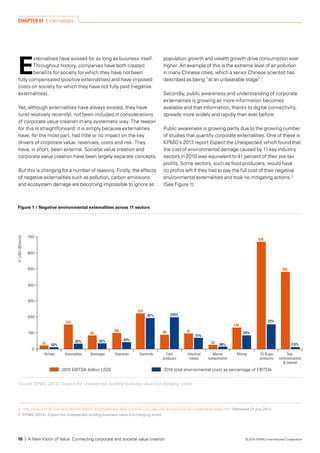
  • 84.
    Ambuja has beenrecognized as one of the pioneers of sustainability and corporate responsibility in India. By continuously reducing the resource intensity of its manufacturing process and investing in the communities in which it operates, Ambuja has made significant strides towards its long-term ambition of leaving no trace behind. The ‘true’ earnings bridge, which combines the company’s financial profits with its monetized positive and negative externalities, fits neatly into this ambition. The calculation of Ambuja’s ‘true’ earnings showed that, on balance, Ambuja generated net-positive socio- environmental value in 2012, that is to say its ‘true’ earnings were greater than its financial profit alone. (See Figure 23). Examples of Ambuja’s positive externalities include: • Harvesting more water than it uses in its manufacturing (‘Water Positive’), through check dams, river linking, and turning former quarries into manmade lakes or wetlands • Using waste from other industries in its manufacturing process, avoiding the need for landfill disposal • Supporting income-generating activities for members of the local community Examples of Ambuja’s negative externalities include: • Emissions of greenhouse gases • Other emissions such as fine particles • Extracting groundwater To ensure that this new approach to understanding company performance was broadly supported, and to generate ideas for improving the ‘true earnings’ of the company over time, senior staff across the company were involved throughout the process. AMBUJA CEMENT FOUNDATION’S SOCIAL RETURN ON INVESTMENT Ambuja invests in the communities in which it operates through the Ambuja Cement Foundation. The Foundation’s activities range from helping farmers increase their incomes by promoting agriculture-based livelihoods, micro-irrigation and water resource management to providing healthcare and education for the families living around the company’s production sites. Inspired by the KPMG True Value methodology, Ambuja asked KPMG to help it develop a ‘true’ earnings calculation for the Foundation. The results confirmed the Foundation’s important contribution to the compa­ ny’s CSR strategy: for every rupee spent in 2012, 8.5 rupees of socio- environmental value were created. Source: Ambuja Cements Limited (2014). Sustainable Development Report 2013. Figure 23 / Ambuja's 2012 ‘true’ earnings exceeded its financial earnings alone Earnings Rain water harvesting Alternative raw materials and fuels Quarry restoration Renewable energy Water saving at customer end Gaseous emissions Water extraction Land disturbed Economic value added Value created for society through CSR initiative Human health 'True' earnings Environmental externalities Economic value-add & social externalities STEP 1 / Ambuja delivers positive ‘true’ earnings CHAPTER 04 Case studies 84 | A New Vision of Value: Connecting corporate and societal value creation © 2014 KPMG International Cooperative
  • 85.
    Source: Ambuja CementsLimited (2014). Sustainable Development Report 2013. Figure 24 / Key externalities prioritized by likelihood of internalization 'True' earnings Earnings Negative externalities Positive externalities + - 0 Highly likely Likely Unlikely The calculation of Ambuja’s ‘true’ earnings in Step 1 formed the starting point for a strategic discussion about the company’s future profitability. Detailed analysis of each of the company’s key externalities revealed that the negative externalities were more likely to be internalized than the positive externalities. (See Figure 24). Drivers of internalization for Ambuja include increasing water scarcity in India and the introduction of regulation to increase industrial energy efficiency and reduce greenhouse gases and other emissions. These drivers were assessed both qualitatively and quantitatively to understand their potential impact on Ambuja’s future profitability. STEP 2 / Impact of internalization on profitability assessed Case studies CHAPTER 04 A New Vision of Value: Connecting corporate and societal value creation | 85© 2014 KPMG International Cooperative
  • 86.
    Ambuja is amajor player with an 11 percent share of the fast-growing USD13 billion Indian cement market. The cement industry is highly capital intensive and the company has to select investments carefully in order to main- ­tain profitability and competitiveness. The KPMG True Value methodology enabled Ambuja to make a comprehensive assessment of return- on-investment that included returns resulting from the likely internalization of externalities as well as direct financial returns. By taking this approach, Ambuja identified a number of financially attractive, positive NPV projects that would benefit local communities, society and the environment, and boost future profitability. In effect, the company is taking ‘value creation at risk’ and turning it into a source of competitive advantage. The projects identified include measures to reduce greenhouse gas emissions that will also cut costs and capital outlays by reducing fuel intensity and the use of limestone. Other projects will see Ambuja reduce its use of scarce and increasingly expensive water. Additionally, its on-going investment in communities and the local environment could secure its license-to-operate, enhance talent attraction, and facilitate access to new mining sites. If all identified projects are implemented, Ambuja could boost its ‘true’ earnings substantially above the baseline scenario by 2020. Taking true value forward Going through the KPMG True Value methodology has been a powerful process for Ambuja. Bringing together the numbers and presenting them in such a visual manner provided valuable insights, which helped to get company staff engaged in discussing. The process has helped Ambuja in its decision-making and the company plans to fully integrate the KPMG True Value approach in its business processes. The company’s ambition is to continuously increase its ‘true’ earnings. It will do this by reducing its negative externalities, but also by creating more positive societal value. The water harvesting program is a good example of the latter, but the company could go further by developing products that help its customers to improve their own socio-environmental footprints. Ambuja realizes that it cannot achieve this ambition in isolation, so it will be pro-actively engaging stakeholders – such as customers and the government – in discussions to communicate the results of the project and to explore how they can work together to create more socio-environmental value. This approach mirrors the ambition of its parent company Holcim, which has recently published its Sustainable Development Ambition 2030. As part of this ambition Holcim will be working with a wide range of interested stakeholders to develop ‘sustainability enhanced solutions’ (products with proven sustainability benefits) and create shared value. Clearly, both Ambuja and its parent Holcim are taking a broader and longer-term view on value. STEP 3 / Future investments prioritized to create societal value as well as corporate value “In the quest to create value beyond business, our people are focused on creating enduring results in all three aspects of our future – social, environmental and economic.” Narotam Sekhsaria Chairman, Ambuja Cement CHAPTER 04 Case studies 86 | A New Vision of Value: Connecting corporate and societal value creation © 2014 KPMG International Cooperative
  • 87.
    “True Value hasa place in today’s corporate world, and it’s right at the top. Times have changed but most companies haven’t. In the modern world, it’s important that a company broadens its view on the value it brings to the world.” Ajay Kapur, CEO Ambuja Cement Cautionary note: The Social and Environmental Profit and Loss Statement (SEP&L) is intended to raise awareness of externalities that may or may not affect Ambuja/ Holcim’s business and to assess their relative importance. It contains preliminary considerations which may be subject to change. Furthermore, the SEP&L may also change, for example, as valuation techniques and methodologies evolve. It should be considered as indicative and it does neither represent any final factual conclusions nor is it intended to assert any factual admission by any person regarding the impact of Ambuja/Holcim or any of its related parties on environment or society. Case studies CHAPTER 04 A New Vision of Value: Connecting corporate and societal value creation | 87© 2014 KPMG International Cooperative
  • 88.
    88 | ANew Vision of Value: Connecting corporate and societal value creation © 2014 KPMG International Cooperative
  • 89.
    AN AGENDA FOR CHANGE: acceleratingprogress towards a new vision of value 05 An agenda for change CHAPTER 05 A New Vision of Value: Connecting corporate and societal value creation | 89© 2014 KPMG International Cooperative
  • 90.
    Many argue thatmeaningful change cannot happen while the current financial system focuses investors and business leaders almost exclusively on the creation of short-term shareholder value. Yet the power to drive change must lie with this triangle of investors, business leaders and policy makers, and with the society within which these three groups function. We have set out to identify key actions that each of these groups can take in order to break down barriers and challenge the status quo. To do so, we spoke to more than 50 senior professionals worldwide from the fields of business, invest­ ment, policy, academia and civil society. These individuals participated in the research through workshops and interviews. Details of those who contributed can be found on page 112. Figure 25 / Driving change towards a new vision of value SOCIETY influences business, policy makers and investors through: • Consumer pressure • Voting • Campaigning/activism POLICY MAKERS influence business and investors by setting the policy framework within which they operate BUSINESS influences • Policy makers through lobbying • Investors through transactions and investor relations activity INVESTORS influence • Business through pressure for short-term financial performance • Policy makers through lobbying Source: KPMG (2014). A New Vision of Value: Connecting corporate and societal value creation. A new vision of value in which corporate and societal value creation are fully aligned ultimately requires business leaders to view the creation of societal value as a means to reshape business models, enhance profitability and reduce risk. Investors need to recognize the link between corporate and societal value and to support and finance the companies that are acting on it. Policy makers need to provide a regulatory environment in which the creation of societal value is more widely promoted and rewarded. CHAPTER 05 An agenda for change 90 | A New Vision of Value: Connecting corporate and societal value creation © 2014 KPMG International Cooperative
  • 91.
    These interventions aresummarized in the following pages and serve as a starting point for discussion. It is important, however, to acknowledge that both the system itself and the dynamics between the key players are highly complex. The points that follow are by no means the only instruments with the potential to effect change. There are no easy answers and no single intervention will create meaningful change. Systemic analysis and action on multiple fronts is essential. “It’s not just about the listed corporates. We need a much more sophisticated view across the entire system. The capital supply chain is complex and badly understood by many of its own participants as well as by many policy makers and businesses.” Steve Waygood, Chief Responsible Investment Officer, Aviva Investors DEMONSTRATE LEADERSHIP AND TANGIBLE ACTION “All companies want long-term shareholders whom they can work with in terms of strategic decisions and who will be there when things get bumpy, which they inevitably will do. What they don’t want is pressure to remove the CEO because a couple of quarters’ earnings expectations have not been met.” Will Oulton, Global Head of Responsible Investment, First State Investments If investment analysis and decision making are to take account of both societal and corporate value creation, then mainstream investors must show leadership in supporting wider systemic change within capital markets. Change cannot happen without leadership and therefore we need investors to show the way, both individually and collectively. A number of interventions emerged as common themes in these conversations. These interventions fall into six broad categories to form the following agenda for change: INTERVENTION INVESTORS BUSINESS LEADERS POLICY MAKERS Demonstrate leadership and tangible action • • Clarify the concept of fiduciary duty • • Improve understanding of the relationship between corporate and societal value creation • • • Change mandates and incentives • • Improve the quality of data • • • Provide an enabling policy environment • Table 15 / An agenda for change An agenda for change CHAPTER 05 A New Vision of Value: Connecting corporate and societal value creation | 91© 2014 KPMG International Cooperative
  • 92.
    Leadership requires investorsto engage actively with businesses and policy makers One of the key opportunities for investors to demonstrate such leadership is by engaging with investee companies on their long-term business strategies and their potential to create both shareholder and societal value. Active engagement – or ‘stewardship’ where investors act as long-term owners of the business rather than short-term shareholders - is becoming a significant investment trend in order to enhance long-term returns. First State and Aviva are among the investors that are demonstrating leadership in active engagement and both report on their stewardship.1,2 Another example is BlackRock whose Chairman and CEO Larry Fink, in March 2014, wrote to investee companies to encourage them to focus on long-term growth strategies.3 Leadership also requires engagement with public policy makers on how corporate value is affected by societal value creation with the aim of encouraging policy measures that enable companies to take a longer term approach to running their businesses. Leadership can be shown on an individual basis or in collaboration with other investors. Investor collaborations have the potential to shift traditional views of value creation and are becoming more common and having an increasing impact. Examples of effective investor collaborations include the Principles for Responsible Investment’s (PRI) Clearinghouse, the Enhanced Analytics Initiative, the new Shareholder- Director Exchange (SDX) and the Carbon Disclosure Project (See breakout box on the PRI Clearinghouse) Changes to asset allocation can improve societal value creation “We believe that private equity has the potential to outperform public markets in the long term. The main reason is the ability of private equity to act as owners and to steward companies towards long-term value creation” Mark Wiseman, President & CEO, Canada Pension Plan Investment Board (CPPIB) Societal value creation through investment may be easier to achieve in asset classes other than public equity where timeframes are traditionally short. As fund managers evolve their fiduciary duty interpretations to include the interests of long term beneficiaries, they are more likely to consider alternative asset classes. For example, Canada’s largest pension fund - The Canada Pension Plan Investment Board (CPPIB) - has chosen to place some 40 percent of its assets in private equity, real estate and infrastructure. Its CEO Mark Wiseman told us that private companies have different pressures to listed companies and can therefore have a more long-term vision than public markets typically allow. He also referred to the more conservative and defensive attitudes of public company boards which typically spend far more time focusing on compliance and regulation than their private company counterparts. More business leaders need to challenge the status quo Closing the gap between corporate and societal value creation requires more business leaders to publicly challenge the idea of short-term financial performance as the sole indicator of business success. PRI CLEARINGHOUSE: FACILITATING INVESTOR COLLABORATION A good example of investor collaboration is the PRI Clearinghouse, organized by the Principles for Responsible Investment organization whose signatory asset owners and fund managers now represent assets totaling USD45 trillion. The Clearinghouse provides a private forum to pool resources, share information, enhance influence and engage with companies, stakeholders, policy makers and other actors in the investment value chain. Its vision is to foster sustainable long-term value creation through collaboration, benefiting the environment and society as a whole. Close to 500 PRI signatories have been involved in at least one collaborative initiative since the platform was launched at the end of 2006, and over 520 collaborative proposals have been posted.4 These proposals cover a variety of themes including water, carbon emissions, labor standards, human rights and sustainable palm oil.5 1 http://www.firststateinvestments.com/uk/insto/home/. Retrieved 10 July 2014. 2 http://www.avivainvestors.com/about_us/stewardship_policy/principles/ index.htm. Retrieved 10 July 2014. 3 http://online.wsj.com/public/resources/documents/blackrockletter.pdf. Retrieved 10 July 2014. 4 http://www.unpri.org/areas-of-work/clearinghouse. Retrieved 18 July 2014. 5 http://www.unpri.org/areas-of-work/clearinghouse/coordinated-collaborative- engagements. Retrieved 18 July 2014. CHAPTER 05 An agenda for change 92 | A New Vision of Value: Connecting corporate and societal value creation © 2014 KPMG International Cooperative
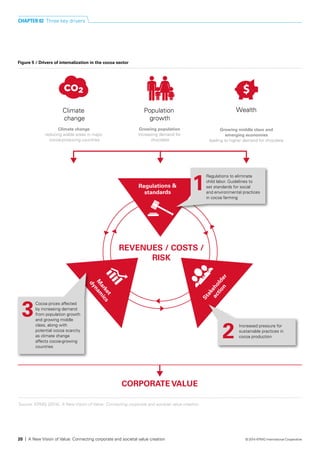
  • 93.
    Unilever, under theleadership of Paul Polman, is arguably the best-known example of a company that has openly committed to delivering social and environmental benefits alongside financial performance, through its plan to double revenues while halving environmental impacts.6 However, other major companies are also setting ambitious targets. Apple is one example. Under its new CEO Tim Cook, the company has ramped up its commitments to increase the company’s positive externalities and reduce negative ones. The company’s environmental manifesto includes a number of bold goals, including an ambition to power all Apple’s corporate offices, retail stores and data centers with renewable energy.7 Apple is also aligning its brand – the most valuable in the world in 2013 and worth over USD100 billion according to Forbes8 – with a message of societal value creation. In a video on the company website, Tim Cook defines the company’s mission as “to make the world a better place” and recent advertisements for the iPad show it being used to deliver benefits for society such as education and clean energy.9 However, it should be recognized that business leaders who attempt to address their company’s externalities through new strategies, can expect to meet with resistance from some shareholders. Tim Cook of Apple is one. At a shareholder meeting in 2014 some investors questioned Apple’s environmental initiatives. Cook told them to “get out of the stock”.10 Not all CEOs feel empowered to make societal value creation a ‘non-negotiable’ part of strategy and core to the ethos and DNA of a company, although it is an increasing trend. What seems to emerge is an increasing propensity among business leaders to acknowledge that value creation is not just about short-term shareholder value but that creating longer-term corporate value will rely on creating longer-term societal value. While not all company leaders are yet prepared to stick their heads above the parapet in the same way as Polman and Cook have done, many are engaging collaboratively in the evolution of value creation, for example through programs such as the WBCSD’s Redefining Value initiative. CLARIFY THE CONCEPT OF FIDUCIARY DUTY “Fiduciary responsibility is going to be an extremely interesting area going forward. The battle on divestment from fossil fuel stocks and other such initiatives may well be won or lost on this notion.” Malcolm Gray, Head of ESG and Fund Manager, Investec Asset Management The concept of fiduciary duty, namely the obligation for pension funds to act always in the best interest of their beneficiaries, was one of the central points to emerge from our conversations. Fiduciary duty requires funds to focus not only on meeting short-term liabilities, but also to ensure the ability to pay beneficiaries in the future. In other words, it requires institutional investors to pay attention to the long-term value creation of the companies in which they invest. Yet, many of those we spoke to acknowledged that today many funds face challenges and significant pressure in maintaining liquidity and paying their short-term liabilities. As a result, the concept of fiduciary duty is often interpreted and applied with a focus on the short-term rather than the long-term. This can lock in the type of short-term thinking that prevents funds from considering the longer term investment risks and opportunities related to social and environmental externalities. This limited interpretation of fiduciary duty can be exacerbated by uncertainties and misunderstandings on the part of trustees and their advisors on how fiduciary duty should be applied in the context of environmental, social and governance (ESG) factors. There is a lack of clarity over which social and environmental factors should be considered and how investors should assess whether or not they are material to longer term financial performance. Progressive work has been done on these uncertainties, particularly in the UK. The 2011 Kay Review, for example, called for a review of the concept of fiduciary duty. It was followed by a consultation and recommendations by the UK Law Commission. 6 http://www.unilever.com/sustainable-living-2014. Retrieved 10 July 2014. 7 http://www.apple.com/environment/climate-change. Retrieved 10 July 2014. 8 http://www.forbes.com/sites/kurtbadenhausen/2013/11/06/apple-dominates- list-of-the-worlds-most-valuable-brands. Retrieved 10 July 2014. 9 http://business.time.com/2014/01/13/apples-latest-ad-is-probably-going-to- give-you-chills. Retrieved 10 July 2014. 10 http://news.cnet.com/8301-13579_3-57619770-37/tim-cook-advises- climate-change-deniers-to-get-out-of-apple-stock. Retrieved 10 July 2014. An agenda for change CHAPTER 05 A New Vision of Value: Connecting corporate and societal value creation | 93© 2014 KPMG International Cooperative
  • 94.
    The Commission stoppedshort of recommending that consideration of ESG issues should be written into law as part of fiduciary duty, but did determine that trustees should take into account longer-term risks and opportunities related to ESG factors where they are financially material.11,12 This clarification on fiduciary duty is likely to accelerate the alignment between corporate and societal value creation in investment processes and decision making. Some funds are already acting on this broader interpretation of fiduciary duty. One of them is the California Public Employees Retirement System (CalPERS) which manages retirement benefits for over 1.5 million members. In 2013, CalPERS adopted a new set of investment beliefs which commits the fund to favor investment strategies that “create long-term, sustainable value” and sets out the fund’s belief that “strong governance, along with effective management of environmental and human capital factors, increases the likelihood that companies will perform over the long-term and manage risk effectively”.13 This in effect acknowledges that fiduciary duty extends to future as well as current beneficiaries, opens the door to changes in investment practice and allocations, and sets an example that other asset owners can follow. IMPROVE UNDERSTANDING OF THE RELATIONSHIP BETWEEN CORPORATE AND SOCIETAL VALUE “The most difficult thing to do is to create the right culture in which employees fully understand and appreciate our goals surrounding sustainable value creation and what this means for their jobs.” Manuel Lewin, Head of Responsible Investment, Zurich Insurance Group While interpretations of fiduciary duty are likely to evolve towards a longer-term and broader view of value creation, the fact remains that today only a relatively small number of ESG-oriented investors take issues of societal value creation into account. The relationship between corporate and societal value is not yet high on the agenda across much of the investment world. This is partly due to a lack of common standards to assess the materiality of ESG issues and a lack of skills to apply such standards. A shortage of clear data on the effects of corporate sustainability strategies on the financial performance of companies also plays a part in perpetuating the problem. Some of those we spoke to suggested that the investment industry would benefit from a recognized process or certification for financial institutions to consider in developing strategy and capacity. Similarly, business leaders need to improve their understanding of the relationship between corporate and societal value so they can communicate it more effectively to their investors. Business schools can play a role here by teaching these subjects in a more integrated fashion, certainly when it comes to combining externalities, investment strategy, and value creation outcomes. SOUTH AFRICA’S REGULATION 28 Some countries are driving the evolution of fiduciary duty through law. One of these is South Africa which in 2011 revised Regulation 28 of its Pension Fund Act. The revised regulation states that a pension fund and its board must comply with a series of principles including “appropriate consideration to any factor which may materially affect the sustainable long-term performance of a fund’s assets, including factors of an ESG character.”14 “Regulation 28 helps in South Africa, and this might be a model worth considering elsewhere.” Jon Duncan, Head of Sustainability Research and Engagement, Old Mutual Investment Group 11 https://www.gov.uk/government/consultations/the-kay-review-of-uk-equity- markets-and-long-term-decision-making. Retrieved 29 July 2014. 12 http://lawcommission.justice.gov.uk/areas/fiduciary_duties.htm. Retrieved 29 July 2014. 13 http://www.calpers.ca.gov/eip-docs/about/press/news/invest-corp/ board-offsite.pdf. Retrieved 29 July 2014. 14 http://www.totrust.co.za/30112012_investment1.htm. Retrieved 10 July 2014. CHAPTER 05 An agenda for change 94 | A New Vision of Value: Connecting corporate and societal value creation © 2014 KPMG International Cooperative
  • 95.
    CHANGE MANDATES AND INCENTIVES Animproved understanding of the relationship between corporate and societal value creation cannot, in itself, drive change unless the nature of investor and executive mandates and incentives is also addressed. Investment mandates are critical levers “Mandates often simply don’t contain a long-term perspective, and this is the key driver in my view. Portfolio managers can be interested in the long-term question, but if it’s not in the mandate, the returns expectations always come first.” Jon Duncan, Head of Sustainability Research and Engagement, Old Mutual Investment Group Fund managers need to comply with the mandates given by asset owners and are therefore often incentivized primarily on the achievement of short-term financial results. These dynamics can create a situation where short-term shareholder value creation is prioritized at the expense of longer-term societal value creation. Mandates and incentive structures are therefore critical levers in driving change. The Principles for Responsible Investment (PRI) is undertaking work in this area and some funds, such as the UK’s Environment Agency Pension Fund, provide examples of how mandates can be designed to create societal value. Practical solutions to incentivization of fund managers are challenging and require innovative thinking around how performance fees can be extended across longer periods or replaced altogether by alternative incentive structures. While a complete end to short-term financially-based incentives is perhaps unrealistic, a more likely scenario is for some form of performance metrics that focus on longer-term and broader value creation and sit alongside rather replace established financial KPIs. Such new metrics could be included in investment mandates. USING INVESTMENT MANDATES TO CREATE SOCIETAL VALUE Investment mandates are effectively the instructions that asset owners, such as pension funds, give to their appointed investment managers on how they are expected to manage the fund. The Principles for Responsible Investment (PRI) has identified mandates as a key tool that could drive a more sustainable financial system and is conducting ongoing research on this issue. One fund that uses its mandates to create societal value alongside financial returns is the UK’s Environment Agency Pension Fund (EAPF). EAPF’s mandates have included requirements to: • manage assets in accordance with ESG strategies and policies • demonstrate in-depth ESG knowledge, capabilities and resources • identify, analyze and integrate ESG-related financial risks.15 Working under these mandates has not prevented EAPF’s fund managers from turning in strong financial returns. In fact, EAPF has reported that its external fund managers outperformed their benchmarks by an average of almost 7 percent.1615 http://www.unpri.org/viewer/?file=wp-content/uploads/ ESthemedinvestingcasestudy_EAPF.pdf. Retrieved 22 July 2014. 16 Environment Agency Pension Fund (2014). Active Pension Fund. Annual Report and Financial Statements 2013-2014. An agenda for change CHAPTER 05 A New Vision of Value: Connecting corporate and societal value creation | 95© 2014 KPMG International Cooperative
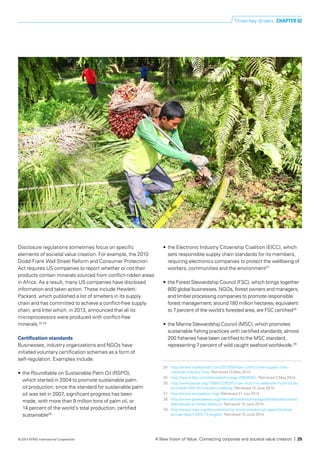
  • 96.
    Innovative approaches toexecutive incentives are needed “If we are to change the system then we need to restructure executive incentives. Achieving this can be difficult in practical terms but that’s not to say we shouldn’t try.” Helene Winch, Director of Policy and Research, Principles for Responsible Investment In many large companies, executives are incentivized to deliver short-term financial performance and, in large part, this is due to similar incentive structures in the investment world as discussed above. However, a growing number of large businesses have developed innovative incentive structures that tie remuneration more closely to longer-term and broader-based value creation. DSM, a Netherlands-based multinational life sciences and materials sciences company, is one. The company has adopted as its core value the pursuit of economic performance, environmental quality and social responsibility. The company’s performance management and incentive structure includes both short and long-term incentives based on key performance indicators (KPIs), of which, on average, 50 percent are non-financial.17 Another example is Steinhoff, a global diversified group with interests in industrial businesses in southern Africa. The firm’s strategy is based on managing the long-term sustainability of the business and, to support this strategy, the group’s remuneration policy states that incentive-based awards are earned “with due regard for the sustainable wellbeing of all stakeholders over the short, medium and long term.”18 This, and other guiding principles of the remuneration policy, help to support the group’s strategy to create long-term stakeholder value. Innovation in terms of non-financial and longer-term incentives for executives is to be welcomed and was seen by those we spoke to for this report as a key focus for the business world to address. However, it is not without its challenges, not least because many business leaders have a self-interest in retaining short-term financial incentives that offer more immediate payoffs and greater certainty than bonuses based on longer-term and broader-based performance. There are also practical problems involved in trying to lengthen the incentive horizon for senior executives, especially since CEO tenure has fallen to an average of 3 to 4 years in recent years.19,20 IMPROVE THE QUALITY OF DATA It is clear that new metrics are required for companies to quantify their societal value creation and communicate the potential impacts of that societal value on financial performance. Without such metrics, investors do not have enough information to make a robust link between corporate and societal value creation. Leading investors therefore have a role to play – either individually or collaboratively – in assisting companies to move beyond short-term financial reporting and to develop metrics which will provide a more complete view of value creation. Investors can also encourage companies to demonstrate how their corporate strategies will create shareholder value in the long term and how megaforces such as population growth, resource scarcity and climate change might impact the execution of those strategies and the creation of corporate value. Furthermore, there is an opportunity for investors to encourage companies to communicate their short-term performance in the context of their medium and long-term strategies and value creation objectives. 17 DSM (2013). Annual Report 2013. 18 http://www.steinhoffinternational.com/3-remuneration-report-02.php. Retrieved 21 July 2014. 19 McClelland, J. et al. (2012). CEO career horizon and tenure: Future performance implications under different contingencies. Journal of Business Research, 65 (9), pp. 1387-1393 20 Matta, E. and Beamish, P. W. (2008). The accentuated CEO career horizon problem: evidence from international acquisitions. Strategic Management Journal, 29, pp. 683–700. 21 KPMG (2013). The KPMG Survey of Corporate Responsibility Reporting 2013. The survey found that almost all (93 per cent) of the world’s 250 largest companies produce a corporate responsibility or sustainability report. 22 http://www.aodproject.net/news/61-global-investors-on-track-for-climate- fall.html. Retrieved 10 July 2014. CHAPTER 05 An agenda for change 96 | A New Vision of Value: Connecting corporate and societal value creation © 2014 KPMG International Cooperative
  • 97.
    Increased reporting byinvestors could be a catalyst for change “More narrative would help as far as how funds are looking to manage risk and take advantage of opportunities.” Catherine Howarth, CEO, ShareAction Sustainability reporting by companies is now the global norm but few funds currently disclose the societal value created by their investments.21 Most investors do not report on these issues qualitatively and disclosure of quantitative impacts is even more rare. This is illustrated by a recent report from the Asset Owners Disclosure Project (AODP), which found that around 80 percent of the world’s largest asset owners take very little or no action to factor the risks and opportunities of climate change into their investment strategies.22 An increase of investor reporting on the societal value creation of their investments could act as a catalyst for progress towards a new vision of value. More reporting could enable asset owners to monitor more closely how their fund managers factor in longer term social and environmental risks and opportunities. In addition, it could help asset owners to manage their ESG-related risk exposure more effectively, optimize their longer-term investment performance, and meet their fiduciary duties. There is a potential role for government to drive change by mandating fuller disclosure of societal value creation by pension funds to their members and beneficiaries. Requiring funds to communicate this information to their members would have knock-on effects in that funds would in turn require the information to be provided by the companies in which they invest. Such disclosure is increasingly possible with the development of new methodologies such as KPMG’s True Value. Dialogue on long-term investment strategies is likely to increase between pension fund members, trustees and managers as pension fund members become better informed about where their money is being invested and the societal value it is creating. Participants in KPMG’s research for this report broadly agreed that increased transparency from pension funds on investment strategies and value creation would be a positive step. However, there were some caveats raised around the fact that fund members and beneficiaries also need to understand the pressures trustees are under in order to meet their commitments to pay out in the short term. Some interviewees suggested that some funds are deliberately opaque in communicating their investment beliefs and strategies precisely to avoid such discussion with members and beneficiaries. Business leaders need to take a proactive approach to disclosure “Companies are making progress but have not yet fully translated sustainability issues into business risk and opportunity in a way that investors can use.” Murray Birt, Office to the Vice Chairman, Deutsche Bank Many businesses claim that investors simply don’t ask them about their externalities. In fact, one corporate participant interviewed for this report claimed that analysts had never asked a single question about sustainability at any of the numerous presentations he had attended. However, there appears to be a growing consensus that companies should be more proactive in communicating social and environmental information to investors. Several investors we spoke to said they are more likely to invest in companies that don’t wait to be asked but volunteer information that explains what they are doing with regard to externalities and how that impacts their value creation. Unilever CEO Paul Polman is an example of a business leader who invests time in communicating effectively with investors on these issues. In an interview with the Harvard Business Review, he said, “We spent a disproportionate amount of time with our shareholders explaining what we’re doing. We spent a disproportionate amount of time discussing our longer term strategy, which actually has become easier now because we don’t do the quarterly reporting. And we tend to spend a disproportionate amount of time in attracting the right shareholder base.”23 However, issuing more information more often does not necessarily result in better and more usable data for investors. It is important that information is material, focused and relevant. Many investors we spoke to said that much of the sustainability data published by companies today is not material and that the last thing they need is more data. What is needed instead are tools that help companies demonstrate to investors that addressing their externalities improves cash flows and reduces risk. 23 http://blogs.hbr.org/2012/05/unilevers-ceo-on-making-respon. Retrieved 10 July 2014. An agenda for change CHAPTER 05 A New Vision of Value: Connecting corporate and societal value creation | 97© 2014 KPMG International Cooperative
  • 98.
    NEW BRITAIN PALMOIL: COMMUNICATING MATERIAL ADVANTAGE New Britain Palm Oil was highlighted during our research as a company that is doing better than many others at communicating its value creation story to investors. The company’s vision is to demonstrate that palm oil can be produced and consumed responsibly and sustainably and it is working with Greenpeace among others on a variety of initiatives. Neil Brown, Fund Manager at Alliance Trust said, “We look at all the things they are doing on sustainable agriculture, worker treatment, renewable energy, and the like and we calculate how this impacts their fresh fruit bunch yield per hectare, their oil extraction rates from those bunches and similar. We see a material advantage emerging from their practices increasing their value as a company and an investment, and are further engaging with them to report on these benefits they have experienced specifically.” While many other corporations are also members of the Roundtable on Sustainable Palm Oil and are working on the issue through commitments and strategies, many are arguably not pushing the envelope as much as New Britain Palm Oil on transparency, accountability and process: all steps aimed at maximizing societal and corporate value creation. LEARNING THE LANGUAGE OF THE INVESTOR: ALLIANCE BOOTS In 2007, KKR, one of the world’s largest private equity firms bought Boots, the UK’s largest pharmacy chain which was publicly traded prior to the acquisition. At the time, concern was raised that the progress Boots had been making on environmental initiatives might be lost. In fact, the opposite occurred. Richard Ellis, previously head of CSR for Boots and now for the larger Alliance Boots organization, wanted to ensure that KKR would understand the financial implications of the environmental and social initiatives at Boots. He said, “I had to learn their language, the language of the investor, and once I’d learned their language and under­ stood what they were looking for it all became so much easier. KKR can now understand that by pursuing our CSR policies they are enhancing the long-term value of the business.” Through a process of learning and communication, KKR has recognized the potential financial benefit of accelerating investments that pay off in the longer term, such as retrofitting stores to higher environmental standards. Ellis argues that it would have been much harder, if not impossible, to achieve these investments at all if the company had been still publicly traded given external investor pressures to maximize short-term cash flow and dividend targets. CHAPTER 05 An agenda for change 98 | A New Vision of Value: Connecting corporate and societal value creation © 2014 KPMG International Cooperative
  • 99.
    Society has arole in encouraging more complete disclosure on value creation Society at large has the potential to play a significant role by encouraging fuller disclosure of societal value creation by both investors and businesses. People can become disconnected from their own money once they hand it over to financial institutions in the form of pension contributions and savings. Most people who pay into a pension fund are not aware of what happens to their money afterwards, claimed many of those we spoke to for this report. However, if people demand a greater say in how their money is used, they have the potential to exert significant influence over institutional investors and the companies in which they invest. An example of consumer pressure at work in the investment world is the fossil fuel divestment movement that aims to persuade or coerce pension funds into divesting fossil fuel stocks. The movement began as a student campaign in the US, targeting the pension funds of educational institutions. Its support has since broadened to other regions and other stakeholder groups, including religious networks.24,25 These campaigns have had some success. Some asset owners and managers, such as Dutch bank Rabobank and Norwegian pension fund and insurance company Storebrand, have divested from fossil fuel companies.26 Others, including Norway’s USD840 billion sovereign wealth fund – the world’s largest sovereign wealth fund and itself funded by Norway’s oil revenues – are seriously considering doing so. This has been seen by some as proof of inherent financial risks in fossil fuel investments and has provided important fuel for campaigning organizations.27 Opinion varies on whether such campaigns can ever generate sufficient critical mass to effect real change. Some commentators also dispute the assumption that divesting fossil fuel shares will in fact achieve the desired aim of shifting the global energy supply to greener sources.28 Whatever the outcome, the noise around fossil fuel divestment continues and asset owners would be wise to expect further pressure and debate on this and other issues of societal value creation in the future. PROVIDE AN ENABLING POLICY ENVIRONMENT The actions outlined earlier apply primarily to investors and business leaders, however policy makers also play a critical role by providing a policy environment that enables these groups to align corporate and societal value creation more closely. Policy makers have multiple tools at their disposal to do so. In particular, they can: • set international, national or local ambitions for societal value creation • correct market failures • provide strong and consistent policy signals • use their public purchasing power • create and support innovative investment vehicles. Set ambition for societal value creation “What kind of society are we trying to build? Unless one begins to address that, you really can’t answer questions about how to align societal and corporate value.” James Featherby, Chairman, Church of England Investment Advisory Group A new vision of value, in which corporate and societal value creation are fully aligned, requires a macroeconomic environment that recognizes social and environmental as well as economic progress. This is largely missing today because the prominent indicator of progress in use for the last 80 years has been gross domestic product (GDP). Much has been written about the weaknesses of GDP as a measure. Sometimes it is criticized on economic grounds in that it can be a misleading or inaccurate short-term indicator of economic health. However, many argue that its biggest failing is simply that it all but ignores social and environmental wellbeing. GDP does not capture the quality of life for people within an economy, such as how healthy, well educated or happy they are, or the health of the ecosystems on which they depend. 24 http://www.theguardian.com/environment/2014/apr/10/desmond-tutu-anti- apartheid-style-boycott-fossil-fuel-industry. Retrieved 20 April 2014. 25 http://www.theguardian.com/environment/2014/apr/16/pope-francis-back- fossil-fuel-divestment-campaign-religions-groups. Retrieved 20 April 2014. 26 http://www.euractiv.com/energy/rabobank-storebrand-boost-fossil- news-529155. Retrieved 19 August 2014. 27 http://business.financialpost.com/2014/03/03/norway-to-study-pulling- wealth-fund-investment-from-oil-gas-coal. Retrieved 21 July 2014. 28 http://www.theinternational.org/articles/345-does-the-math-add-up-in- fossil-fuel-dives. Retrieved 21 July 2014. An agenda for change CHAPTER 05 A New Vision of Value: Connecting corporate and societal value creation | 99© 2014 KPMG International Cooperative
  • 100.
    While there isa broad correlation between economic output and quality of life, this is not a direct linear relationship. As Figure 33 below shows, initial economic growth generates steep increases in social progress but, after a certain point (approximately USD30,000 GDP per capita), further GDP growth makes little difference to social progress.29 The figure below also shows that levels of overall wellbeing can be quite different between countries that have similar levels of GDP. Brazil and Iran, for example, have similar levels of GDP per capita but Brazil has a significantly higher level of social progress. Source: © The Economist Newspaper Limited, London 8 April, 2014. Adapted from Social Progress Imperative (2014). Social Progress Index 2014. Figure 26 / Social Progress Index and GDP per person 0 20 30 40 Socialprogressindex,2014 GDP per person, 2012, $ at PPP* * Purchasing-Power Parity, 2005 prices 50 60 70 Philippines Jamaica Brazil Costa Rica Russia Greece Italy Korea France Japan Britain Germany Canada Switzerland Norway United States United Arab Emirates Israel Saudi Arabia Kuwait IranChina India Angola Chad 80 90 10,000 20,000 30,000 40,000 50,000 Policy makers can therefore drive change by adopting new indicators to inform and guide policy development and public investment decisions in order to maximize societal value creation. There are a number of initiatives around the world that seek to replace or supplement GDP with a broader view of economic, social and environmental performance. These include the OECD’s Better Life Index30 , the UN’s Human Development Index31 , the Social Progress Index32 , Bhutan’s Gross National Happiness Index33 , the Index of Sustainable Economic Welfare34 , and the Canadian Index of Wellbeing35 . However, these have yet to gain any widespread acceptance among the governments of the world. If we are to fully close the gap between corporate and societal value creation, then policy makers must play a fundamental role in setting the national ambition and vision, agreeing appropriate measures of social and environmental, as well as economic, progress, and providing an enabling policy framework. 29 For more details on how the Social Progress Imperative defined social progress, which is based on numerous factors in the categories of basic needs, foundations of wellbeing and opportunity, please see: http://www.socialprogressimperative.org/data/spi. Retrieved 1 May 2014. 30 http://www.oecdbetterlifeindex.org 31 http://hdr.undp.org/en/data 32 http://www.socialprogressimperative.org/data/spi 33 http://www.grossnationalhappiness.com 34 http://www.foe.co.uk/community/tools/isew 35 https://uwaterloo.ca/canadian-index-wellbeing CHAPTER 05 An agenda for change 100 | A New Vision of Value: Connecting corporate and societal value creation © 2014 KPMG International Cooperative
  • 101.
    Correct market failures “Whenyou have markets that aren’t working the way we would like them to work and private and social interests don’t seem to be aligned, it is the government that is expected to do something about that.” Paul Ekins, Professor of Resources & Environmental Policy, University College London Governments use a number of tools to counter market failures including the pricing of negative externalities, the provision of fiscal incentives and subsidies to encourage positive externalities, and the removal of harmful subsidies. Such regulatory approaches form one of the key drivers that are currently internalizing business externalities and are discussed earlier in this report. (See page 21) Pricing externalities Pricing is one of the most effective policy levers because it factors negative externalities directly into traditional corporate value drivers of cost and risk. When implemented properly, pricing externalities can deliver good results. A text-book example of this is the Sox-NOx cap-and-trade market established in the US in 1990 as part of the Clean Air program. It reduced annual sulphur dioxide emissions by 80 percent between 1990 and 2012 and nitrogen oxide emissions by 74 percent.39 Regional preferences dictate the nature of pricing mechanisms. For example, when it comes to pricing carbon, Sweden uses a tax while the EU and China opted for trading systems. Similarly, the choice of pricing tool is, to a certain extent, dictated by the nature of the externality the policy seeks to address. A tax, for example, is easier to implement on diffuse sources such as cars. Strong prices set for the long term are critical success factors. This is where the EU ETS is struggling: the EU carbon price of less than USD10/tCO2 is in stark contrast to the Swedish carbon tax of USD160/tCO2.40 Some policy makers are concerned about the potential impact that a high pricing of negative externalities may have on their economy and constituents may prefer to subsidize positive action rather than imposing penalties. However, according to a recent OECD study on carbon pricing, subsidies can be much more costly than explicit and direct pricing mechanisms.41 Remove harmful subsidies “There are things we just shouldn’t do, such as subsidizing fossil fuels with hundreds of billions of dollars – that just doesn’t make sense”. David Bresch, Head of Sustainability & Political Risk Management Unit, Swiss Re Another major barrier to alignment between corporate and societal value creation is the presence of harmful subsidies and, in particular, fossil fuel subsidies which, according to the IEA amounted to half a trillion dollars (USD544 billion) in 2012.42 Such subsidies distort the allocation of resources, increase the vulnerability of energy importing countries to energy price fluctuations and deepen inequalities within the very society they are meant to help.43 THE USE OF THE GENUINE PROGRESS INDICATOR IN US STATES The Genuine Progress Indicator (GPI) is an index for economic wellbeing that also takes into account social and environmental impacts. It measures 26 variables including the costs of unemployment, pollution, climate change and crime, and the positive value of factors such as home working, education and volunteer work.36 The US states of Vermont and Maryland both use the Genuine Progress Indicator to inform policy making and the approach is spreading to other US states including Oregon and Washington.37 In Vermont, for example, the GPI has highlighted the impact of income inequality in holding back ‘genuine progress’.38 36 http://www.newrepublic.com/article/116461/gpi-better-gdp-measuring- united-states-progress. Retrieved 15 July 2014. 37 http://www.newrepublic.com/article/116461/gpi-better-gdp-measuring- united-states-progress. Retrieved 15 July 2014. 38 http://www.demos.org/publication/whats-missing-gdp. Retrieved 15 July 2014. 39 EPA (2012). 2012 Progress Report: Clean Air Interstate Rule, Acid Rain Program and Former NOx Budget Trading Program. 40 OECD (2013). Climate and Carbon: Aligning prices and policies. 41 OECD (2013). Climate and Carbon: Aligning prices and policies. 42 These subsidies include both consumption and production subsidies. In the former the consumer faces a lower price, while in the latter the producer benefits form a mark up to what the normal price would be. http://www. worldenergyoutlook.org/resources/energysubsidies. Retrieved 15 July 2014. 43 Examples include fossil fuel subsidies or irrigation subsidies. An agenda for change CHAPTER 05 A New Vision of Value: Connecting corporate and societal value creation | 101© 2014 KPMG International Cooperative
  • 102.
    For example, sinceenergy consumption grows with income, most of the money spent on fossil fuel subsidies ends up benefiting the wealthy. Because of this - and as a result of the negative externalities associated with increased consumption - the true cost of harmful subsidies is much more than the money spent on the subsidies themselves.44 According to the IMF, this brought the cost of fossil fuel subsidies to USD1.9 trillion in 2011, around four times the direct amount spent on subsidizing fossil fuels that year.45 When seen in this context, it seems clear that these subsidies should be a priority for policy makers to address, but failed attempts to abruptly phase out fossil fuel subsidies illustrate the importance of an inclusive and gradual approach.46,47 Provide strong and consistent policy signals “There are governments that will tinker with policy on a regular basis. That pushes up the cost of capital and can stop projects going ahead.” Ian Farmer, former CEO, Lonmin Unpredictable and inconsistent policy signals will slow or stop investment. While investors and business leaders will accept a certain amount of policy risk, ongoing volatility in policy inevitably affects their willingness to engage. A study from the IEA, for example, has found that uncertainty over carbon pricing put a higher value on maintaining old inefficient coal power plants than on refurbishing them.48 Similarly, uncertainty over the continuation of the US production tax credit (a policy tool used for supporting wind energy development) has led to volatile investment flows in the US. A strong, predictable and reliable policy signal also plays a role in driving innovation. A good example is the Kyoto Protocol, the enactment of which helped drive innovation in clean energy as illustrated in Figure 33 below. Providing a clear and long-term policy signal requires policy makers to find a balance between committing to the long term and being able to adjust to new, short term realities as they appear – such as the global financial crisis, socio-political events or natural disasters. This kind of flexibility can be achieved in different ways, for example by evaluating the ambition of the policy on a regular basis or by defining triggers or thresholds that enable the revision of the policy.49 It also requires a strengthening of the connections between policy, and corporate and societal value creation by setting value creation targets that are measurable, reportable and verifiable. Source: OECD (2013). Climate and Carbon: Aligning Prices and Policies, OECD Environment Policy Papers, No. 1, OECD Publishing. Figure 27 /The role of the policy signal in driving innovation 0.0 1.0 2.0 3.0 4.0 5.0 6.0 7.0 8.0 1978 1980 1982 1984 1986 1988 1990 1992 1994 1996 1998 2000 2002 2004 2006 Solar PV Wind Biofuels Hydro/Marine Geothermal Fossil & Nuclear Energy All tech fields (TOTAL) The Kyoto Protocol was adopted in December 1997 Vertical axis represents total patenting, using 1978 as benchmark (i.e. 1978=1). 44 In the case of fossil fuel subsidies, these externalities include greenhouse gas emissions, increased air pollution as well as the impacts that result from these, such as health impacts, and impacts associated with increased use of the resource, including congestion and road traffic accidents. 45 IMF (2013). Energy Subsidy Reform: lessons and implications. 46 Nigeria, for example decided to abruptly phase out fossil fuel subsidies during a holiday weekend, leading to protests that lasted for weeks, eventually resulting in the subsidy being reinstated. http://www.theguardian.com/world/2012/ jan/02/nigerian-motorists-angry-fuel-subsidies. Retrieved 15 July 2014. 47 http://www.ft.com/cms/s/0/565be45c-6e9d-11e1-a82d-00144feab49a.html. Retrieved 15 July 2014. 48 Blythe, W. and the IEA (2010). The economics of transition in the power sector. CHAPTER 05 An agenda for change 102 | A New Vision of Value: Connecting corporate and societal value creation © 2014 KPMG International Cooperative
  • 103.
    Public procurement The powerof public procurement to drive change should not be underestimated given that procurement spending represents up to 19 percent of a nation’s GDP.50 While most OECD and BRICS countries now use sustainable procurement practices to some extent, they differ widely in terms of scale (for example, national vs local government procurement) as well as in the scope of products covered.51 Japan, for example, requires all levels of government to engage in sustainable public procurement practice.52 For public procurement policy to be effective in driving societal value creation at scale, it needs to be transparent, non-discriminatory and competitive. Governments also need to ensure full disclosure of how the policies are applied and their impacts. More reporting would be a positive step as only a few countries such as Japan or Sweden currently require such reporting on their sustainable public procurement.53 Create and support new investment vehicles A number of public-led financial innovations have appeared in recent years aimed at delivering societal value along with attractive financial returns. Among the most notable of these are green bonds. Green bonds, originally issued by multilateral institutions such as the World Bank, aim to raise capital specifically for projects that create societal and environmental value. The market for green bonds has grown rapidly to reach USD346 billion in March 2013 and is particularly suited for long-tem investors.54 Green bonds are also an increasingly attractive fund raising option for companies, such as energy companies; corporates represented over half (55 percent) of green bond issuance in the first half of 2014.55 Policy makers can support the growing interest in the green bond space by working with the private sector to establish standards, and reporting and verification mechanisms for green bonds. Bonds can not only be used for environmental projects but have also been used successfully in the field of public health (see breakout box). Governments can also combine financial innovation with fiscal tools such as taxes. Although there have been early struggles, new forms of financing retain promise. The US, for example, has Property Assessed Clean Energy (PACE) mechanisms whereby municipalities issue bonds to raise funds which they then use to finance energy efficient property retrofits through loans to property owners.56 The debts are repaid over periods of up to 20 years by adjusting property taxes for the buildings where the retrofits are undertaken.57,58 While the financial tools described above are not necessarily new in themselves, the innovation comes from using accepted financial instruments in new ways. BONDS FOR PUBLIC HEALTH: THE INTERNATIONAL FINANCE FACILITY FOR IMMUNISATION In 2006 the International Finance Facility for Immunisation (IFFIm) issued its inaugural triple A-rated bonds to raise funds for health and immunization programs in 70 of the world’s poorest countries around the world. The initiative, which aimed to raise USD4 billion over 10 years and save as many as 10 million lives, was driven by then UK prime minister Gordon Brown and backed by the governments of the UK, France, Italy, Norway, Spain and Sweden.59 “You need leadership, political leadership. It was long term budgetary allocations from six governments that really made it happen.” Abyd Karmali, Managing Director, Climate Finance, Bank of America Merrill Lynch 49 This is the case for example of the UK’s carbon budget, which set four legally binding carbon budget periods (2008-2012, 2013-2017, 2018-2022, 2023-2027) with the objective to half UK’s greenhouse gas emissions by 2027 - relative to 1990 levels. On the upside, this enables the ambition of a given period to be reassessed in view of the progress achieved in the previous one. On the downside, it also creates uncertainty as the ambition may be revised on the upside or the downside. For more details, please see: Parliament of the United Kingdom (2008). Climate Change Act 2008. 50 http://trade.ec.europa.eu/doclib/press/index.cfm?id=788. Retrieved 17 April 2014. 51 UNEP (2013). Sustainable Public Procurement: A global review. 52 Most countries do not require mandatory reporting on the achievement of procurement targets, making tracking of sustainable procurement a challenge. UNEP (2013). Sustainable Public Procurement: A global review. 53 UNEP (2013). Sustainable Public Procurement: A global review. 54 A compound annual growth rate of 55 percent since 2008. Climate Bonds Initiative (2013). Bonds and Climate Change. The State of the Market in 2013. 55 http://www.theguardian.com/environment/2014/jul/17/green-bonds-climate- initiave-low-carbon-economy. Retrieved 21 July 2014. 56 http://pacenow.org/about-pace/what-is-pace. Retrieved 17 April 2014. 57 Two challenges for financing energy efficiency are upfront investment costs and split incentives - whereby the one who makes the investment is not necessarily the one who benefits from it. This, for example, applies to the situation in which an owner may invest in energy efficiency but sell the house before investments have been recouped. PACE addresses that challenge by having the public sector finance energy efficiency upfront (via bond issuance) and recoup the investment by adjusting the property tax (so that the debt obligation remains with the asset irrespective of the asset owner). 58 The Rockefeller Foundation and DB Climate Change Advisors (2012). United States Building Energy Efficiency Retrofits: Market Sizing and Financing Models. 59 http://web.worldbank.org/WBSITE/EXTERNAL/NEWS/0,,date:2006-10-03~ menuPK:34461~pagePK:34392~piPK:64256810~theSitePK:4607,00.html. Retrieved 22 July 2014. An agenda for change CHAPTER 05 A New Vision of Value: Connecting corporate and societal value creation | 103© 2014 KPMG International Cooperative


  • 104.
    104 | ANew Vision of Value: Connecting corporate and societal value creation © 2014 KPMG International Cooperative
  • 105.
    APPENDIX A New Visionof Value: Connecting corporate and societal value creation | 105© 2014 KPMG International Cooperative
  • 106.
    AccountAbility and theUN Global Compact (2005). Towards responsible lobbying. Leadership and public policy. Allianz (2012). Sustainability Factbook 2012. Andriessen, D. (2004). Making sense of intellectual capital: designing a method for the valuation of intangibles. Routledge: New York. Arangies, G. et al. (2008): The value-added statement: An appeal for standardisation. Management Dynamics, 17 (1), pp. 31-43. Association of Chartered Certified Accountants (2013). Carbon Avoidance? Accounting for the emissions hidden in reserves. Ballinger, J. & Olsson, C. (eds.) (1997). Behind the swoosh : the struggle of Indonesians making Nike shoes. Global Publications Foundation: Uppsala. Bloomberg New Energy Finance (2013). Global Renewable Energy Market Outlook 2013. Blowfield, M. & Johnson, L. (2013). Turnaround Challenge: Business and the City of the Future. Oxford University Press: Oxford. Blowfield, M.E. (2005). Does society want business leadership? An overview of attitudes and thinking. Boston College Center for Corporate Citizenship: Chestnut Hill, MA. Blythe, W. and the International Energy Agency (2010). The economics of Transition in the power sector. Bradfield Moody, J. and Nogrady, B. (2010). The Sixth Wave: How to Succeed in a Resource-Limited World. Random House Australia: Melbourne. Brossard, O., Lavigne, S. & Sakinç, M.E. (2013). Ownership structures and R&D in Europe: the good institutional investors, the bad and ugly impatient shareholders. Industrial and Corporate Change, 22 (4), pp. 1031-1068. Caldecott, B., and McDaniels, J. (2014). Stranded Generation Assets: Implications for European Capacity Mechanisms, Energy Markets and Climate Policy. Carbon Tracker Initiative (2013). Unburnable carbon 2013: Wasted capital and stranded assets. Carbon Finance at the World Bank (2013). Mapping Carbon Pricing Initiatives. Celik , S., & Isaksson, M. (2013). Institutional investors as owners. OECD Publishing: Paris. Ceres (2014). Investor listing standards proposal: recommendations for stock exchange requirements on corporate sustainability reporting. Ceres (2010). Murky Waters? Corporate reporting on water risk. Christensen, H.B. & Nikolaev, V.V. (2013). Does fair value accounting for non-financial assets pass the market test? Review of Accounting Studies, 18 (3), pp. 734-775. Citi Research (2013). Global Oil Demand Growth – The End Is Nigh. Citi Research (2013). The Unimaginable: Peak Coal Demand in China. Climate Bonds Initiative (2013). Bonds and Climate Change. The State of the Market in 2013. Commission on the Measurement of Economic Performance and Social Progress (2011). Survey of Existing Approaches to Measuring Socioeconomic Progress. Connelly, B.L., Tihanyi, L., Certo, S.T. & Hitt, M.A. (2010). Marching to the beat of different drummers: The influence of institutional owners on competitive actions. Academy of Management Journal, 53 (4), pp. 723-742. Curcio, V. (2013). Henry Ford. Oxford University Press: New York. DB Climate Change Advisors & Rockefeller Foundation (2012). United States Building Energy Efficiency Retrofits. Market Sizing and Financing Models. Deutsche Bank Research (2011). Solvency II and Basel III. Reciprocal effects should not be ignored. Drescher, S. (2009). Abolition : a history of slavery and antislavery. Cambridge University Press: Cambridge. DSM (2013). Annual Report 2013. Environment Agency Pension Fund (2014). Active Pension Fund: Annual Report and Financial Statements 2013-2014. BIBLIOGRAPHY BIBLIOGRAPHY 106 | A New Vision of Value: Connecting corporate and societal value creation © 2014 KPMG International Cooperative
  • 107.
    EPA (2012). CleanAir Interstate Rule, Acid Rain Program and Former NOx Budget Trading Program 2012 Progress Report. Esty, D.C. (2009). Green to gold : how smart companies use environmental strategy to innovate, create value, and build a competitive advantage. Rev. and updated edn. John Wiley & Sons: Hoboken, NJ. ExxonMobil (2014). Energy and Carbon - Managing the Risks. Fama E.F. (1969). Efficient Capital Markets: A Review of Theory and Empirical Work. The Journal of Finance, (25) 2, pp. 383-417 First State Investments (2014). Responsible Investment and Stewardship. Annual Report 2013. Greenpeace (2014). Locked in the Past: Why Europe’s Big Energy Companies Fear Change. Hemmati, M. (2002). Multi-stakeholder Processes for Governance and Sustainability: Beyond deadlock and conflict. Hibbert, C. (1974). Rise and fall of the house of Medici. Allen Lane: London. Holt, D.B., Quelch, J.A. & Taylor, E.L. (2004). How global brands compete. Harvard Business Review, 82 (9), pp. 68-75. HSBC (2014). Coal and Carbon Revisited. HSBC Climate Change Centre. Hubbard, D.W. (2010). How to measure anything: Finding the value of intangibles in business. John Wiley & Sons: Hoboken, NJ. IEA (2013). Energy Policies of IEA Countries – Germany. IEA (2013). Tracking Clean Energy Progress 2013. IEA (2013). World Energy Outlook 2013. IFMA Foundation (2012). The Economics of Sustainability in Real Estate. IKEA (2013). Sustainability Report 2013. IMF (2013). Energy Subsidy Reform: Lessons and implications. Institute of Directors in Southern Africa (2011). Code for Responsible Investing in South Africa. International Federation of Accountants (2013). Stranded Assets and Reserve Accounting. Intergovernmental Panel on Climate Change (2013). Climate Change 2013: Summary for Policymakers. Intergovernmental Panel on Climate Change (2012). Managing the Risks of Extreme Events and Disasters to Advance; Climate Change Adaptation: Summary for Policymakers. Investment Company Institute (2013). 2013 Investment Company Fact Book: A Review of Trends and Activities in the U.S. Investment Company Industry. Jaeger, C.C., Paroussos, L., Mangalagiu, D., Kupers, R. et al. (2011). A New Growth Path for Europe: Synthesis Report. Kaminker , C., Kawanishi, O., Stewart, F. et al. (2013). Institutional Investors and Green Infrastructure Investments: Selected Case Studies. OECD Working Papers on Finance, Insurance and Private Pensions, 35. Keefer, P. and Khemani, S. (2005). Understanding political incentives for providing public services. World Bank Research Observer, 20 (1), pp. 1-27. KPMG (2012). Expect the Unexpected: Building business value in a changing world. KPMG (2013). Green Tax Index 2013. KPMG (2011). Integrated Reporting: Performance insight through better business reporting. KPMG (2011). Integrated Reporting: Understanding the requirements. KPMG (2013). The KPMG Survey of Corporate Responsibility Reporting 2013. KPMG (2014). A Taste of the Future: The trends that could transform the chocolate industry. KPMG (2010). The Transformation of the Automotive Industry: The environmental regulation effect. KPMG, UNEP, GRI and Unit for Corporate Governance in Africa (2013). Carrots and Sticks: Sustainability reporting policies worldwide. Krosinsky, C. (2013). The Short Guide to Sustainable Investing. DoSustainability: London. BIBLIOGRAPHY A New Vision of Value: Connecting corporate and societal value creation | 107© 2014 KPMG International Cooperative
  • 108.
    Krosinsky, C., Robins,N. and Viederman, S. (2011). Evolutions in Sustainable Investing: Strategies, Funds and Thought Leadership. John Wiley & Sons: New York. Krosinsky, C. and Robins, N. (2008), Sustainable investing: the art of long- term performance. Taylor & Francis: London. Kubiszewski, I., Costanza, R., Franco, C. et al. (2013). Beyond GDP: Measuring and achieving global genuine progress. Ecological Economics, 93, pp. 57-68. Locke, R., Kochan, T., Romis, M. & Qin, F. (2007). Beyond corporate codes of conduct: Work organization and labour standards at Nike’s suppliers. International Labour Review, 146 (1-2), pp. 21-40. Mackay, C. (1852). Memoirs of extraordinary popular delusions and the madness of crowds. Office of the National Illustrated Library: London. Marlay, R. & Neher, C.D. (1999). Patriots and tyrants : ten Asian leaders. Rowman & Littlefield Publishers: Lanham, MD. Martenson, C. (2011). The crash course : the unsustainable future of our economy, energy, and environment. John Wiley & Sons: Hoboken, NJ. Matta, E. & Beamish, P.W. (2008). The accentuated CEO career horizon problem: Evidence from international acquisitions. Strategic Management Journal, 29 (7), pp. 683-700. McClelland, P.L., Barker III, V.L. & Oh, W. (2012). CEO career horizon and tenure: Future performance implications under different contingencies. Journal of Business Research, 65 (9), pp. 1387-1393. McDonough, W. & Braungart, M. (2002). Cradle to cradle: remaking the way we make things. North Point Press: New York. McKinsey Global Institute (2011). Mapping Global Capital Markets. McLean, B. & Elkind, P. (2003). The smartest guys in the room : the amazing rise and scandalous fall of Enron. Portfolio: New York. Milanovic, B. (2013). Global Income Inequality in Numbers: in History and Now. Global Policy, 4 (2), pp. 198-208. Moss, L.S. (ed.) (1996). Joseph A. Schumpeter, historian of economics. Routledge: New York. Nachmany, M., Fankhauser, S., Townshend, T. et al., GLOBE International and the Grantham Research Institute on Climate Change and the Environment at LSE (2014). The GLOBE Climate Legislation Study: A Review of Climate Change Legislation in 66 Countries. Navigant Research (2014). Energy Efficiency Retrofits for Commercial and Public Buildings. Network for Business Sustainability (2013). Sustainability through Partnerships. Executive Report. Network for Sustainable Financial Markets (2012). The Systemic Nature of Ownership 2013. White Paper. Newell, P. & Paterson, M. (2010). Climate capitalism: global warming and the transformation of the global economy. Cambridge University Press: Cambridge. OECD (2013). Climate and carbon: Aligning prices and policies. OECD (2012). OECD Environmental Outlook to 2050: The consequences of inaction. Palma, J.G. (2009). The revenge of the market on the rentiers. Why neo-liberal reports of the end of history turned out to be premature. Cambridge Journal of Economics, 33 (4), pp. 829-869. Perez, C. (2009). The double bubble at the turn of the century: technological roots and structural implications. Cambridge Journal of Economics, 33 (4), pp. 779-805. Perez, C. (2012). Innovation systems and policy: not only for the rich? Tallinn University of Technology, Working Papers in Technology Governance and Economic Dynamics, 42. Philips (2013). Annual Report 2013. Phillips, K. (2006). American theocracy : the peril and politics of radical religion, oil, and borrowed money in the 21st century. Viking: New York. BIBLIOGRAPHY 108 | A New Vision of Value: Connecting corporate and societal value creation © 2014 KPMG International Cooperative
  • 109.
    Prager, J. (2013).The Financial Crisis Of 2007/8: Misaligned Incentives, Bank Mismanagement, And Troubling Policy Implications. Economics, Management, and Financial Markets, 2/2013, pp. 11-56. Porter, M.E. (1992). Capital choices: Changing the way America invests in industry. Journal of Applied Corporate Finance, 5 (2), pp. 4-16. Ray, D.K. et al (2013). Yield Trends Are Insufficient to Double Global Crop Production by 2050. PLoS ONE, 8(6). Reinhart, C.M. (2009). This time is different : eight centuries of financial folly. Princeton University Press: Princeton, NJ. Robèrt, K. (2002). The natural step story : seeding a quiet revolution. New Society Publishers: Gabriola Island, BC. Roberts, P. (2009). The end of food : the coming crisis in the world food industry. Bloomsbury: London. Robins, N. (2011). The Corporation That Changed The World: How the East India Company Shaped the Modern Multinational. Pluto Press: London Robins, N. (2007). The imperious company. Journal of Corporate Citizenship, 25, pp. 31-42. Scoones, I., University of Sussex and the Institute of Development Studies (1998). Sustainable rural livelihoods : a framework for analysis. Shiller, R. and Akerlof, G. (2010). Animal Spirits. Princeton University Press: Princeton, NJ. Solow, R.M. (1956). A contribution to the theory of economic growth. The Quarterly Journal of Economics, 70 (1), pp. 65-94. Soros, G. (1987). The Alchemy of Finance. Simon & Schuster: New York. Stern, N. (2006). Stern Review: The Economics of Climate Change. Sullivan, R. & MacKenzie, C. (eds.) 2006. Responsible investment. Greenleaf Publishing: Sheffield. Taleb, N.N. (2007). The black swan : the impact of the highly improbable. Random House: New York. TIAA-CREF (2013). Leadership in Responsible Investing. Tilman, D., Socolow, R., Foley, J.A. et al. (2009). Beneficial biofuels —the food, energy, and environment trilemma. Science, 325 (5938), pp. 270-271. Tony Chocolonely (2013). JaarFAIRslag 2013. UN’s High-Level Panel of Eminent Persons on the Post-2015 Development Agenda (2013). A new global partnership: eradicate poverty and transform economies through sustainable development. UNEP (2011). The provision of international environmental public goods. UNEP (2013). Sustainable Public Procurement: A global review. UNEP Financial Initiative (2005). A Legal Framework for the Integration of ESG Issues into Institutional Investment. UNEP Financial Initiative (2011). Universal Ownership: Why Environmental Externalities Matter to Institutional Investors. UNFCCC (2009). The Copenhagen Accord. Union of Concerned Scientists (2012). Water Dependence Risks for America’s Aging Coal Fleet. UK Department for Business Innovation and Skills (2013). The Smart City Market: Opportunities for the UK. Water Resources Group (2012). Background, Impact and the Way Forward. WEF & Accenture (2012). More with less: scaling sustainable consumption and efficiency. WEF & Deloitte (2011). The Consumption Dilemma: leverage points for accelerating sustainable growth. WEF and Ellen Macarthur Foundation (2014). Towards the circular economy: Accelerating the scale-up across global supply chains. World Ocean Review (2013). World Ocean Review 2: The Future of Fish – The Fisheries of the Future. BIBLIOGRAPHY A New Vision of Value: Connecting corporate and societal value creation | 109© 2014 KPMG International Cooperative
  • 110.
    ACKNOWLEDGMENTS Rohitesh Dhawan Global MiningLeader, Climate Change & Sustainability Services KPMG in South Africa rohitesh.dhawan@kpmg.co.uk Marijke Vermaak Manager, Climate Change & Sustainability Services KPMG in South Africa marijke.vermaak@kpmg.co.za Janne Dietz Consultant, Climate Change & Sustainability Services KPMG in the Netherlands dietz.janne@kpmg.nl Frits Klaver Consultant, Climate Change & Sustainability Services KPMG in the Netherlands klaver.frits@kpmg.nl Barend van Bergen Global Head of Sustainability Advisory KPMG Global Center of Excellence for Climate Change and Sustainability vanbergen.barend@kpmg.nl Lead authors KPMG project team and supporting authors Martin Koning Associate, Transactions & Restructuring - Corporate Finance KPMG in the Netherlands koning.martin2@kpmg.nl Erik Wedershoven Consultant, Climate Change & Sustainability Services KPMG in the Netherlands wedershoven.erik@kpmg.nl Ellie Austin Global Thought Leadership Manager KPMG Global Center of Excellence for Climate Change and Sustainability austin.ellie@kpmg.nl James Mackintosh Director, Transactions & Restructuring KPMG in the Netherlands mackintosh.james@kpmg.nl Mark McKenzie Global Thought Leadership Director KPMG Global Center of Excellence for Climate Change and Sustainability mmckenzie@kpmg.com ACKNOWLEDGMENTS 110 | A New Vision of Value: Connecting corporate and societal value creation © 2014 KPMG International Cooperative
  • 111.
    Project sponsor Cary Krosinsky Adjunctand Coordinator The Earth Institute, Columbia University Dr. Elie Chachoua Interdisciplinary Global Development Group  KPMG editorial advisory teamCo-authors Barry van Bergen Director, Strategy Group KPMG in the UK barry.vanbergen@kpmg.co.uk Wim Bartels Global Head of Sustainability Reporting & Assurance KPMG Global Center of Excellence for Climate Change and Sustainability bartels.wim@kpmg.nl Katherine Blue Managing Director, Climate Change & Sustainability Services KPMG in the US kblue@kpmg.com Arjan de Draaijer Partner, Climate Change & Sustainability Services KPMG in the Netherlands dedraaijer.arjan@kpmg.nl Paul Harnick Global COO, Chemicals and Performance Technologies KPMG in the US paulharnick@kpmg.com Santhosh Jayaram Technical Director, Climate Change & Sustainability Services KPMG in India santhoshj@kpmg.com Neil Morris Partner, Financial Risk Management KPMG in South Africa neil.morris@kpmg.co.za Vincent Neate Head of Climate Change & Sustainability Services KPMG in the UK vincent.neate@kpmg.co.uk Ben Wielgus Associate Director, Climate Change & Sustainability Services KPMG in the UK ben.wielgus@kpmg.co.uk Chi Woo Partner, Climate Change & Sustainability Services KPMG in Australia chiwoo@kpmg.com.au Prof. Gordon Clark Director Dr. Mick Blowfield Visiting Fellow Dr. Caitlin McElroy Research and Teaching Fellow Ben Caldecott Programme Director Patrick McSharry Senior Research Fellow Jeremy McDaniels Researcher James Tilbury Researcher Adrian King Global Head, Climate Change & Sustainability Services KPMG Global Center of Excellence for Climate Change and Sustainability avking@kpmg.com.au The Smith School of Enterprise and the Environment, University of Oxford ACKNOWLEDGMENTS A New Vision of Value: Connecting corporate and societal value creation | 111© 2014 KPMG International Cooperative
  • 112.
    KPMG would liketo thank the following who participated in workshops and interviews as part of the research process for this report: Peter Bakker President and CEO WBCSD Rob Bernard Chief Environmental Strategist and Head of Sustainability Microsoft Murray Birt Office to the Vice Chairman Deutsche Bank David Bresch Head of Sustainability & Political Risk Management Unit Swiss Re Neil Brown SRI Fund Manager Alliance Trust Investments Jeremy Burke Finance Director UK Green Investment Bank Ann Byrne Former CEO Australian Council of Superannuation Investors Mark Campanale Executive Director Carbon Tracker Initiative Kate Carmichael Manager, Social and Economic Development International Council on Mining & Metals Matt Chapman Senior Manager, Better Business Reporting Group KPMG in the UK Jason Clay Senior Vice President of Market Transformation World Wildlife Fund Mandy Cormack Visiting Fellow Cranfield School of Management Felicidad Cristobal Former CEO ArcellorMittal Foundation Yvo de Boer Director-General Global Green Growth Institute Paul Druckman CEO International Integrated Reporting Council Jon Duncan Head of Sustainability Research and Engagement Old Mutual Investment Group Robert G. Eccles Professor of Management Practice Harvard Business School Michelle Edkins Managing Director BlackRock Prof. Paul Ekins Professor of Resources & Environmental Policy University College London Richard Ellis Group Head of CSR Alliance Boots Ian Farmer Former CEO Lonmin Alexandra Dawe Global Communications Manager KPMG Global Center of Excellence for Climate Change and Sustainability Catalina Iorga Global Communications Coordinator KPMG Global Center of Excellence for Climate Change and Sustainability Marina Schurr Advisory Services Development Manager KPMG Global Center of Excellence for Climate Change and Sustainability Petra van Soelen- Zwaneveld Management Assistant KPMG Global Center of Excellence for Climate Change and Sustainability Adam Davis Associate Director, Climate Change & Sustainability Services KPMG in Australia Karine Basso Consultant, Climate Change & Sustainability Services KPMG in the Netherlands Joost Notenboom Consultant, Climate Change & Sustainability Services KPMG in the Netherlands The project team would like to thank the following for their assistance in producing this report: Harmeet Singh Katari Associate Director, Management Consulting KPMG in South Africa Charlotte de Koker Manager, Climate Change & Sustainability Services KPMG in South Africa Lars Kurznack Manager, Climate Change & Sustainabilty Services KPMG in the Netherlands Yvo de Boer Michiel Lenstra Masechaba Mabilu Egon Verheijden ACKNOWLEDGMENTS 112 | A New Vision of Value: Connecting corporate and societal value creation © 2014 KPMG International Cooperative
  • 113.
    James Featherby Chairman Church ofEngland’s Ethical Investment Advisory Group Sam Gill CEO Environmental Investment Organisation Mark Gough Head of Sustainability The Crown Estate Malcolm Gray Head of ESG and Fund Manager Investec Asset Management Cameron Hepburn Professor of Environmental Economics University of Oxford Catherine Howarth CEO ShareAction John Hutton Head of Sustainability BAM Nuttall Sherman Indhul Executive Manager for Climate Change - Policy and Sustainability Transnet Yiannis Ioannou Assistant Professor of Strategy and Entrepreneurship London Business School Christopher Kaminker Economist OECD Abyd Karmali Managing Director of Climate Finance Bank of America Merrill Lynch Piet Klop Senior Advisor Responsible Investment PGGM Investments Claudia Kruse Managing Director, Head of Governance & Sustainability APG Brice Lalonde Special Advisor on Sustainable Development UN Global Compact Manuel Lewin Head of Responsible Investment Zurich Insurance Group Bindu N. Lohani Vice-President for Knowledge Management and Sustainable Developmen Asian Development Bank Tony Manwaring Chief Executive Tomorrow’s Company Maria Netto Financial Institutions Specialist Inter-American Development Bank Will Oulton Global Head of Responsible Investment First State Investments Emma Price-Thomas Head of Sustainability Strategy Business in the Community Neil Sachdev Former Property Director Sainsbury’s Paul Simpson CEO Carbon Disclosure Project Lauren Smart Executive Director, Global Head of Financial Services Business Trucost Harry Verhaar Head of Global Public & Government Affairs Philips Lighting Vedant Walia Associate Director, Sustainability Barclays Steve Waygood Chief Responsible Investment Officer Aviva Investors Femke Weijtens Executive Vice President, Corporate Affairs DSM Christopher Wells Environmental and Social Risk Manager Banco Santander Brasil John R. Wells Professor of Management Practice Harvard Business School Chris Whitehead Head of Risk, Innovation & Sustainability Balfour Beatty Fokko Wientjes Director, Corporate Sustainability & Public Private Partnerships DSM Helen Wildsmith Head of Ethical & Responsible Investment CCLA Investment Management Peter Willis Director University of Cambridge Programme for Sustainability Leadership Helene Winch Director Policy and Research UNPRI Mark Wiseman President & CEO CPP Investment Board Weijun Xie General Manager China Minmetals Corporation Kaveh Zahedi Regional Director and Representative for Asia and the Pacific United Nations Environment Programme ACKNOWLEDGMENTS A New Vision of Value: Connecting corporate and societal value creation | 113© 2014 KPMG International Cooperative
  • 114.
    KPMG is oneof the pioneers of sustainability consulting – some KPMG member firms first offered sustainability services over 20 years ago – which gives KPMG’s network a level of experience few can match. Today our member firms employ several hundred sustainability professionals located in around 60 countries. Local knowledge, global experience Our global network means KPMG firm professionals have in-depth understanding of the economic, political, environmental and social landscapes wherever your organization may operate. At the same time, our member firms are closely connected through our global Center of Excellence. This means that, whatever challenge you face, we can put together a team with international experience to help you. Sustainability Plus We don’t work in a sustainability vacuum. We work side-by-side with KPMG firm professionals from tax, audit and advisory including sector specialists, management consultants, tax accountants and experts in IT, supply chain, infrastructure, international development and more. You won’t receive generic advice and one-size-fits all solutions, instead you can benefit from a hand-picked multi-disciplinary team. Results-driven KPMG firms help clients to develop future-fit business strategies based on solid understanding of the issues. We strive to think big and challenge convention, but with implementation in mind, working with you to find practical solutions that can create success and growth through change. Foresight needs insight Our global Center of Excellence focuses on thought- provoking research, analyzing drivers of global change and developing practical business responses that you can apply within your own organization. CONTACT KPMG’s Global Center of Excellence for Climate Change & Sustainability sustainabilityservices@kpmg.com ABOUT KPMG’S TRUE VALUE SERVICES ABOUT 114 | A New Vision of Value: Connecting corporate and societal value creation © 2014 KPMG International Cooperative
  • 115.
    HOW WE CANHELP: KPMG’S TRUE VALUE SERVICES KPMG’s True Value methodology is a three step process that enables you to understand how your organization’s externalities, both positive and negative, may be internalized and what the implications are for your corporate value creation. KPMG firm professionals can work with you to develop your response strategy to capture opportunities and reduce risk from the drivers of internalization. A detailed explanation of the metho­ dology can be found in Part 3 of this report (page 40) and the case studies in Part 4 (page 58) demonstrate how it can be applied in practice. KPMG’s True Value methodology can help your organization to: • Better understand and articulate the connection between your company’s corporate and societal value creation • Quantify and monetize your company’s positive and negative externalities (in a ‘true’ earnings bridge) and understand where your company is creating or reducing societal value • Identify which drivers are most likely to internalize your organization’s externalities and understand how this could affect your profitability and where your value is at risk • Develop risk reduction strategies which will help your organization make more informed investment decisions • Develop strategies to build corpo­rate value while also enhancing societal value • Have a more fact-based and balanced conversation with stakeholders on corporate and societal value creation • Improve your annual reporting processes and corporate disclosures. ABOUT A New Vision of Value: Connecting corporate and societal value creation | 115© 2014 KPMG International Cooperative
  • 116.
    The information containedherein is of a general nature and is not intended to address the circumstances of any particular individual or entity. Although we endeavor to provide accurate and timely information, there can be no guarantee that such information is accurate as of the date it is received or that it will continue to be accurate in the future. No one should act on such information without appropriate professional advice after a thorough examination of the particular situation. © 2014 KPMG International Cooperative (“KPMG International”), a Swiss entity. Member firms of the KPMG network of independent firms are affiliated with KPMG International. KPMG International provides no client services. No member firm has any authority to obligate or bind KPMG International or any other member firm vis-à-vis third parties, nor does KPMG International have any such authority to obligate or bind any member firm. All rights reserved.The KPMG name, logo and “cutting through complexity” are registered trademarks or trademarks of KPMG International. Publication name: A NewVision ofValue: Connecting corporate and societal value creation Publication number: 131620 Publication date: September 2014 Printed in the Netherlands Argentina Martin Mendivelzua mmendivelzua@kpmg.com.ar Australia Adrian V. King avking@kpmg.com.au Chi Mun Woo chiwoo@kpmg.com.au Austria Peter Ertl pertl@kpmg.at Azerbaijan Vugar Aliyev valiyev@kpmg.az Baltics Gregory Rubinchik grubinchik@kpmg.com Belgium Mike Boonen mboonen@kpmg.com Brazil Sidney Ito sito@kpmg.com.br Bulgaria Emmanuel Totev etotev@kpmg.com Canada Bill J. Murphy billmurphy@kpmg.ca Chile Luis Felipe Encina lencina@kpmg.com China Leah Jin leah.jin@kpmg.com Colombia Ignacio Cortes ignaciocortes1@kpmg.com Cyprus Iacovos Ghalanos iacovos.ghalanos@kpmg.com.cy Czech Republic Michal Bares mbares@kpmg.cz Denmark Christian Honoré chhonore@kpmg.com Finland Tomas Otterström tomas.otterstrom@kpmg.fi France Philippe Arnaud parnaud@kpmg.fr Germany Simone Fischer simonefischer@kpmg.com Greece George Raounas graounas@kpmg.gr Hungary István Szabó istvan.szabo@kpmg.hu India Santhosh Jayaram santhoshj@kpmg.com Indonesia Iwan Atmawidjaja iwan.atmawidjaja@kpmg.co.id Ireland Eoin O’Lideadha eoin.olideadha@kpmg.ie Israel Oren Grupi ogrupi@kpmg.com Italy Piermario Barzaghi pbarzaghi@kpmg.it Japan Kazuhiko Saito kazuhiko.saito@jp.kpmg.com Kazakhstan Gregor Mowat gmowat@kpmg.ru Luxembourg Jane Wilkinson jane.wilkinson@kpmg.lu Malaysia Lamsang Hewlee hewlee@kpmg.com.my Mexico Jesus Gonzalez jesusgonzalez@kpmg.com.mx Netherlands Barend van Bergen vanbergen.barend@kpmg.nl Bernd Hendriksen hendriksen.bernd@kpmg.nl New Zealand Gabrielle Wyborn gwyborn@kpmg.co.nz Nigeria Tomi Adepoju t.adepoju@kpmg.com Norway Per Sundbye per.sundbye@kpmg.no Philippines Henry D. Antonio hantonio@kpmg.com Poland Krzysztof Radziwon kradziwon@kpmg.pl Portugal Filipa Rodrigues filiparodrigues@kpmg.com Romania Gheorghita Diaconu gdiaconu@kpmg.com Russia, Ukraine, Georgia & Armenia Igor Korotetskiy ikorotetskiy@kpmg.ru Singapore Sharad Somani sharadsomani@kpmg.com.sg Slovakia Quentin Crossley qcrossley@kpmg.sk South Africa Neil Morris neil.morris@kpmg.co.za Shireen Naidoo Shireen.Naidoo@kpmg.co.za Contact your local KPMG member firm professional South Korea Sungwoo Kim sungwookim@kr.kpmg.com Spain Jose Luis Blasco Vazquez jblasco@kpmg.es Sri Lanka Ranjani Joseph ranjanijoseph@kpmg.com Sweden Ase Bäckström ase.backstrom@kpmg.se Switzerland Silvan Jurt sjurt@kpmg.com Taiwan Charles Chen charleschen@kpmg.com.tw Niven Huang nivenhuang@kpmg.com.tw Thailand Paul Flipse pflipse1@kpmg.co.th U.A.E. Sudhir Arvind sarvind@kpmg.com U.A.E. and Oman (Lower Gulf) Andrew Robinson arobinson1@kpmg.com UK Vincent Neate vincent.neate@kpmg.co.uk US John R. Hickox jhickox@kpmg.com Venezuela Jose O. Rodrigues jrodrigues@kpmg.com Vietnam & Cambodia Paul Bahnisch pbahnisch1@kpmg.com.vn KPMG’s Global Center of Excellence for Climate Change and Sustainability sustainabilityservices@kpmg.com kpmg.com/socialmedia kpmg.com/app