GAIT PATTERNS IN HIP
DISORDERS
DISORDERS
DEPARTMENT OF ORTHOPAEDICS
VELS MEDICAL COLLEGE AND
HOSPITAL
HOSPITAL
Normal gait
Normal gait Definition
Definition
Gait analysis
Gait analysis
Pathological gait
Pathological gait Spastic gait
Spastic gait
Antalgic gait
Antalgic gait
Trendelenberg gait
Trendelenberg gait
Short limb gait
Short limb gait
Gluteus maximus gait
gait in bilateral hip problems
Normal Gait
Normal Gait
Definition
Definition
Human gait is bipedal,
biphasic,
biphasic,
forward propulsion
forward propulsion
of centre of gravity
of centre of gravity,
,
in which there is alternate
sinuous movement of head and
body,
body, with least expenditure of
with least expenditure of
energy
energy
Normal Gait
Normal Gait
Definition
Definition
Human gait is bipedal, biphasic,
forward propulsion of centre of
gravity, in which there is alternate
sinuous movement of head and body,
with least expenditure of energy.
Normal walking
Normal walking
requirements
requirements
Equilibrium
Equilibrium-ability to assume upright
-ability to assume upright
posture and maintain balance.
Locomotion
Locomotion-ability to initiate and maintain
-ability to initiate and maintain
rhythmic stepping.
rhythmic stepping.
Muskuloskeletal
Muskuloskeletal integrity
integrity-
-normal bone
normal bone
joint and muscle function.
Neurological
Neurological control
control-
-visual ,auditory
visual ,auditory
vestibular and sensory motor input
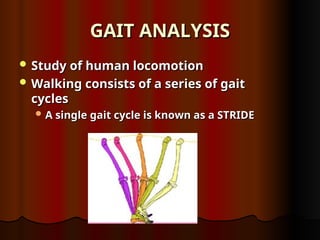
GAIT ANALYSIS
GAIT ANALYSIS
 Study of human locomotion
Study of human locomotion
 Walking consists of a series of gait
Walking consists of a series of gait
cycles
cycles
 A single gait cycle is known as a STRIDE
A single gait cycle is known as a STRIDE
GAIT CYCLE
GAIT CYCLE
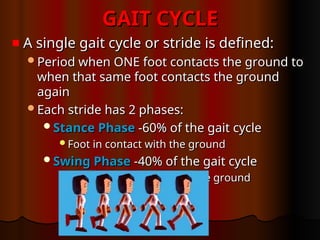
A single gait cycle or stride is defined:
Period when ONE foot contacts the ground to
Period when ONE foot contacts the ground to
when that same foot contacts the ground
again
again
Each stride has 2 phases:
Each stride has 2 phases:
Stance Phase
Stance Phase -60% of the gait cycle
-60% of the gait cycle
Foot in contact with the ground
Foot in contact with the ground
Swing Phase
Swing Phase -40% of the gait cycle
-40% of the gait cycle
Foot NOT in contact with the ground
Foot NOT in contact with the ground
Stance Phase of Gait
When the foot is in
When the foot is in
contact with the ground
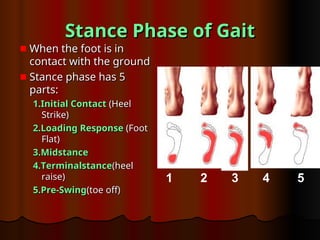
Stance phase has 5
Stance phase has 5
parts:
parts:
1.Initial Contact
1.Initial Contact (Heel
(Heel
Strike)
Strike)
2.Loading Response
2.Loading Response (Foot
(Foot
Flat)
Flat)
3.Midstance
3.Midstance
4.Terminalstance
4.Terminalstance(heel
(heel
raise)
raise)
5.Pre-Swing
5.Pre-Swing(toe off)
(toe off)
1 2 3 4 5
Initial Contact
Initial Contact
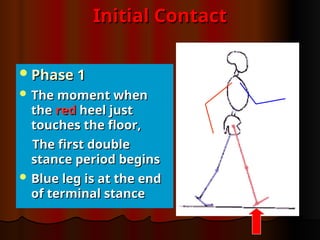
Phase 1
Phase 1
 The moment when
The moment when
the
the red
red heel just
heel just
touches the floor,
touches the floor,
The first double
The first double
stance period begins
 Blue leg is at the end
Blue leg is at the end
of terminal stance
of terminal stance
Loading Response
Loading Response
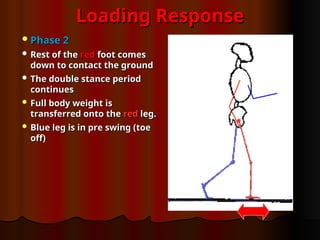
Phase 2
Phase 2
 Rest of the
Rest of the red
red foot comes
foot comes
down to contact the ground
 The double stance period
The double stance period
continues
continues
 Full body weight is
Full body weight is
transferred onto the
transferred onto the red
red leg.
leg.
 Blue leg is in pre swing (toe
Blue leg is in pre swing (toe
off)
off)
Midstance
Midstance
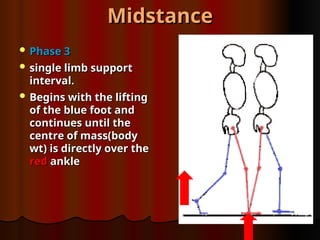
 Phase 3
Phase 3
 single limb support
single limb support
interval.
interval.
 Begins with the lifting
Begins with the lifting
of the blue foot and
continues until the
continues until the
centre of mass(body
centre of mass(body
wt) is directly over the
red
red ankle
ankle
Terminal Stance
Terminal Stance
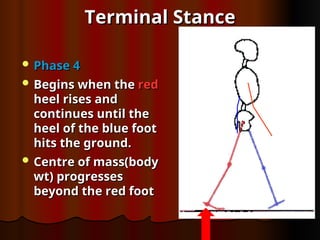
 Phase 4
Phase 4
 Begins when the
Begins when the red
red
heel rises and
heel rises and
continues until the
continues until the
heel of the blue foot
hits the ground.
hits the ground.
 Centre of mass(body
Centre of mass(body
wt) progresses
wt) progresses
beyond the red foot
beyond the red foot
Pre swing
Pre swing
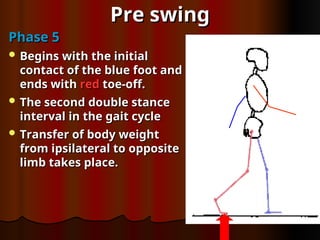
Phase 5
Phase 5
 Begins with the initial
Begins with the initial
contact of the blue foot and
ends with
ends with red
red toe-off.
toe-off.
 The second double stance
The second double stance
interval in the gait cycle
 Transfer of body weight
Transfer of body weight
from ipsilateral to opposite
limb takes place.
limb takes place.
Stance Phase Characteristics
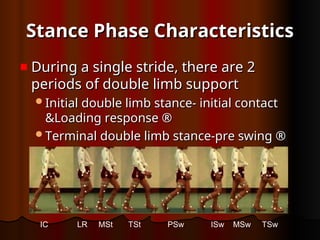
During a single stride, there are 2
periods of double limb support
Initial double limb stance- initial contact
Initial double limb stance- initial contact
&Loading response ®
&Loading response ®
Terminal double limb stance-pre swing ®
Terminal double limb stance-pre swing ®
IC LR MSt TSt PSw ISw MSw TSw
Swing Phase
Swing Phase
When foot is NOT contacting the
ground
ground
Limb advancement phase
3 parts of swing phase:
-Initial swing
-Initial swing
-Midswing
-Midswing
-Terminal swing
-Terminal swing
Initial Swing
Initial Swing
Phase 6
Phase 6
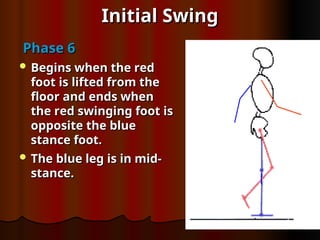
 Begins when the red
Begins when the red
foot is lifted from the
floor and ends when
floor and ends when
the red swinging foot is
opposite the blue
opposite the blue
stance foot.
stance foot.
 The blue leg is in mid-
The blue leg is in mid-
stance.
stance.
Midswing
Midswing
Phase 7
Phase 7
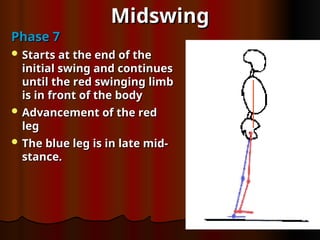
 Starts at the end of the
Starts at the end of the
initial swing and continues
until the red swinging limb
is in front of the body
 Advancement of the red
Advancement of the red
leg
leg
 The blue leg is in late mid-
The blue leg is in late mid-
stance.
stance.
Terminal Swing
Terminal Swing
Phase 8
Phase 8
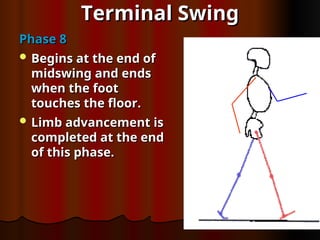
 Begins at the end of
Begins at the end of
midswing and ends
midswing and ends
when the foot
when the foot
touches the floor.
touches the floor.
 Limb advancement is
Limb advancement is
completed at the end
of this phase.
of this phase.
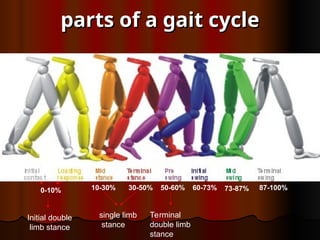
parts of a gait cycle
0-10% 10-30% 30-50% 50-60% 60-73% 73-87% 87-100%
Initial double
limb stance
single limb
stance
Terminal
double limb
stance
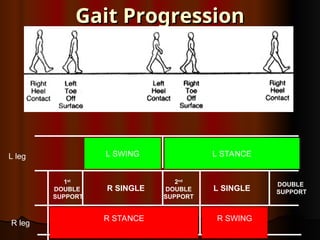
Gait Progression
Gait Progression
R leg
L leg
R STANCE
L SINGLE
1st
DOUBLE
SUPPORT
2nd
DOUBLE
SUPPORT
DOUBLE
SUPPORT
R SINGLE
L SWING L STANCE
R SWING
R STANCE
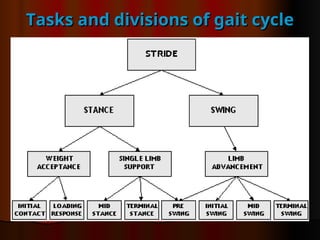
Tasks and divisions of gait cycle
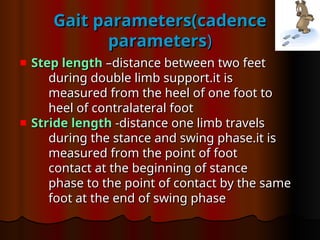
Gait parameters(cadence
parameters
parameters)
)
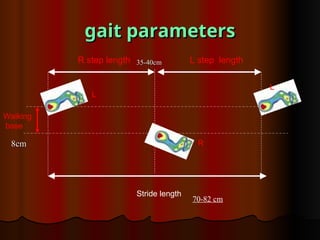
Step length
Step length –distance between two feet
–distance between two feet
during double limb support.it is
measured from the heel of one foot to
heel of contralateral foot
Stride length
Stride length -distance one limb travels
-distance one limb travels
during the stance and swing phase.it is
measured from the point of foot
contact at the beginning of stance
phase to the point of contact by the same
foot at the end of swing phase
gait parameters
gait parameters
Stride length
L step length
R step length
L
L
R
Walking
base
8cm
8cm
70-82 cm
35-40cm
35-40cm
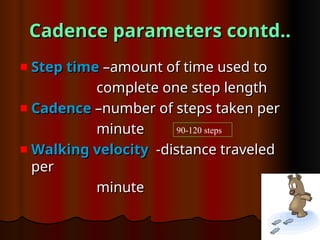
Cadence parameters contd..
Step time
Step time –amount of time used to
–amount of time used to
complete one step length
Cadence
Cadence –number of steps taken per
–number of steps taken per
minute
minute
Walking velocity
Walking velocity -distance traveled
-distance traveled
per
per
minute
minute
90-120 steps
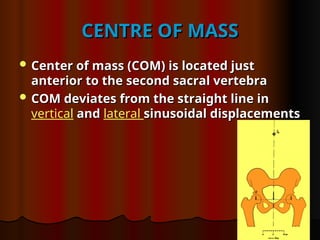
CENTRE OF MASS
CENTRE OF MASS
 Center of mass (COM) is located just
Center of mass (COM) is located just
anterior to the second sacral vertebra
 COM deviates from the straight line in
COM deviates from the straight line in
vertical and
and lateral sinusoidal displacements
sinusoidal displacements
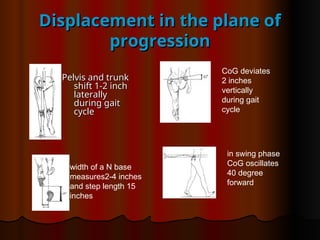
Displacement in the plane of
progression
progression
Pelvis and trunk
Pelvis and trunk
shift 1-2 inch
shift 1-2 inch
laterally
laterally
during gait
during gait
cycle
cycle
width of a N base
measures2-4 inches
and step length 15
inches
CoG deviates
2 inches
vertically
during gait
cycle
in swing phase
CoG oscillates
40 degree
forward
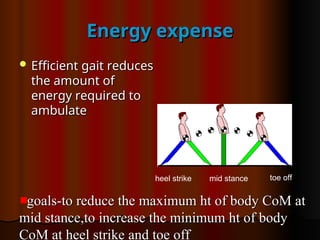
Energy expense
Energy expense
 Efficient gait reduces
Efficient gait reduces
the amount of
the amount of
energy required to
energy required to
ambulate
ambulate
heel strike mid stance toe off
goals-to reduce the maximum ht of body CoM at
mid stance,to increase the minimum ht of body
CoM at heel strike and toe off
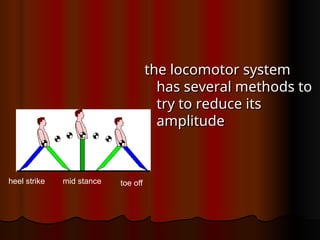
the locomotor system
has several methods to
try to reduce its
try to reduce its
amplitude
amplitude
heel strike mid stance toe off
Determinants of gait
Pelvic rotation
Pelvic rotation
Pelvic tilt
Pelvic tilt
Stance phase knee flexion
Transverse rotation of leg segment
Normal valgus alignment of knee
Ankle rockers
Ankle rockers
Muscle activity during gait
Concentric contraction-generates
power and accelerates body forward
-gastrocsoleus contracts to lift the
heel off the ground
heel off the ground
-iliopsoas contracts flexing the hip
and pulling the stance phase limb
off the ground
off the ground
Muscle activity during gait
Eccentric contraction-slows down and
stabilises joint motion
-tibialis anterior-contracts at initial
contact ,firing during plantar flexion
as the foot is lowered to ground.
so the foot is gently lowered to ground
-gastrocsoleus-contracts eccentrically
through the stance phase controlling the
rate of dorsiflexion of ankle
KINEMATICS
KINEMATICS
Denotes the motion observed and
measured at pelvis,hip,knee,ankle and
foot
foot
Done in three planes
-sagittal plane-hip flexion ,extension
-coronal plane-hip abduction,adduction
-transverse plane-rotation hip,tibia,feet
CLINICAL GAIT ANALYSIS
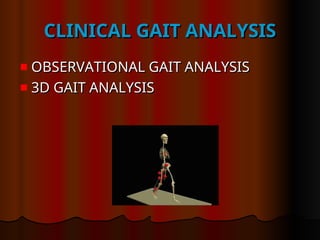
OBSERVATIONAL GAIT ANALYSIS
3D GAIT ANALYSIS
3D GAIT ANALYSIS
Obsevational gait analysis
Pt should be viewed from the front,
side, and behind
side, and behind
hyperlordosis . ankle plantarflexion
dorsi flexion, knee flexion extension,
and hip flexion extension. pelvic
abduction or adduction.
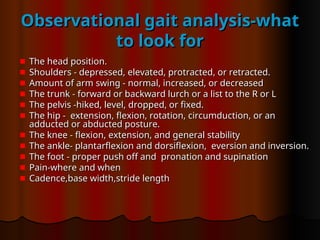
Observational gait analysis-what
to look for
to look for
The head position.
The head position.
Shoulders - depressed, elevated, protracted, or retracted.
Amount of arm swing - normal, increased, or decreased
The trunk - forward or backward lurch or a list to the R or L
The pelvis -hiked, level, dropped, or fixed.
The hip - extension, flexion, rotation, circumduction, or an
adducted or abducted posture.
The knee - flexion, extension, and general stability
The ankle- plantarflexion and dorsiflexion, eversion and inversion.
The foot - proper push off and pronation and supination
Pain-where and when
Pain-where and when
Cadence,base width,stride length
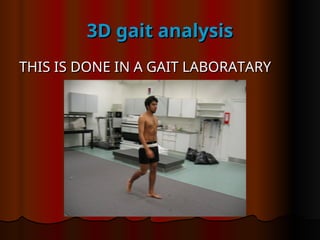
3D gait analysis
3D gait analysis
THIS IS DONE IN A GAIT LABORATARY
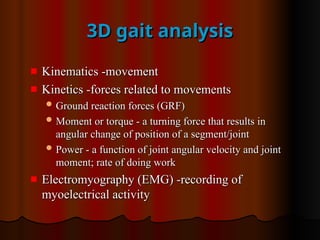
3D gait analysis
3D gait analysis
Kinematics -movement
Kinetics -forces related to movements
 Ground reaction forces (GRF)
Ground reaction forces (GRF)
 Moment or torque - a turning force that results in
Moment or torque - a turning force that results in
angular change of position of a segment/joint
 Power - a function of joint angular velocity and joint
Power - a function of joint angular velocity and joint
moment; rate of doing work
Electromyography (EMG) -recording of
myoelectrical activity
Gait Patterns in Cerebral Palsy
Geographic classification
Geographic classification
Hemiplegia (one side; UL>LL)
Hemiplegia (one side; UL>LL)
Diplegia (both sides; LL>UL)
Diplegia (both sides; LL>UL)
Triplegia (both LL+1UL)
Triplegia (both LL+1UL)
Quadriplegia (both UL+both
Quadriplegia (both UL+both
LL+trunk)
LL+trunk)
Common: Spastic hemiplegia or
Common: Spastic hemiplegia or
diplegia(91%)
diplegia(91%)
Cerebral Palsy
Cerebral Palsy
Spastic Diplegia /quadriplegia
(Sutherlands and Davids)
 True Equinus
True Equinus -distal spasticity
-distal spasticity
Gastrosoleus spasticity Equinus
±Genu recurvatum
±Genu recurvatum
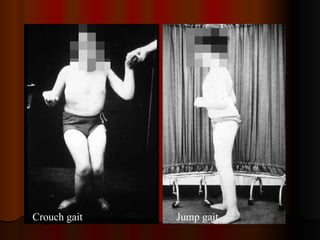
 Jump Gait
Jump Gait
Spasticity of hamstrings and hip flexors and calf
Equinus +hip and knee in flexion ,ant. pelvic tilt
+ exaggerated lumbar lordosis+ knee stiff (rectus femoris)
 Crouch gait
Crouch gait
Excessive dorsiflexion or calcaneus at ankle +excessive flexion at knee
and hip +ant. pelvic tilt
may be
may be Iatrogenic
Iatrogenic due to isolated lengthening of TA (w/o correcting
due to isolated lengthening of TA (w/o correcting
hamstring & iliopsoas spasm
hamstring & iliopsoas spasm)
)
Crouch gait Jump gait
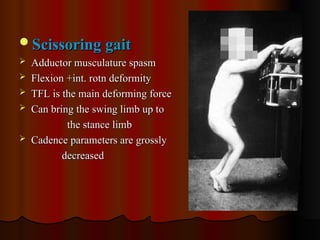
Scissoring gait
Scissoring gait
 Adductor musculature spasm
Adductor musculature spasm
 Flexion +int. rotn deformity
Flexion +int. rotn deformity
 TFL is the main deforming force
TFL is the main deforming force
 Can bring the swing limb up to
Can bring the swing limb up to
the stance limb
the stance limb
 Cadence parameters are grossly
Cadence parameters are grossly
decreased
decreased
ANTALGIC GAIT
ANTALGIC GAIT
Pain in
Pain in
lower limb
lower limb
back
back
--
--hip pain
hip pain Lurch to affected side
Lurch to affected side
Reduce abductor force on hip
No pelvic drop
No pelvic drop
No gluteal weakness
No gluteal weakness
ANTALGIC GAIT
ANTALGIC GAIT
 Short stepping
Short stepping
 Asymmetrical step length
Asymmetrical step length
 Step length on affected side less
Step length on affected side less
 Unaffected limb is brought forward
Unaffected limb is brought forward
more quickly than normal in swing
phase
phase
 Duration of stance phase increased
Duration of stance phase increased
on normal side
on normal side
ANTALGIC GAIT
ANTALGIC GAIT
Infective
Infective
Inflammatory
Inflammatory
Early perthes
Early perthes
Acute silp
Acute silp
Trauma
Trauma
Abductor muscle function
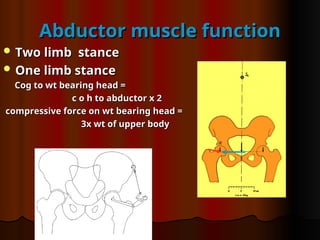
 Two limb stance
Two limb stance
 One limb stance
One limb stance
Cog to wt bearing head =
c o h to abductor x 2
compressive force on wt bearing head =
3x wt of upper body
3x wt of upper body
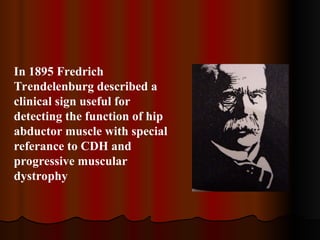
In 1895 Fredrich
Trendelenburg described a
clinical sign useful for
detecting the function of hip
abductor muscle with special
referance to CDH and
progressive muscular
dystrophy
TRENDELENBERG GAIT
TRENDELENBERG GAIT
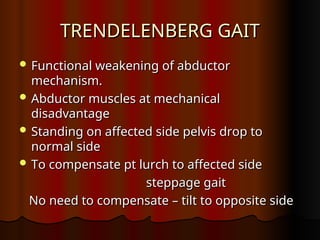
 Functional weakening of abductor
Functional weakening of abductor
mechanism.
mechanism.
 Abductor muscles at mechanical
Abductor muscles at mechanical
disadvantage
disadvantage
 Standing on affected side pelvis drop to
Standing on affected side pelvis drop to
normal side
normal side
 To compensate pt lurch to affected side
To compensate pt lurch to affected side
steppage gait
steppage gait
No need to compensate – tilt to opposite side
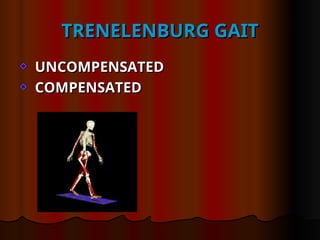
TRENELENBURG GAIT
TRENELENBURG GAIT
UNCOMPENSATED
UNCOMPENSATED
COMPENSATED
COMPENSATED
TRENDELENBERG GAIT
TRENDELENBERG GAIT
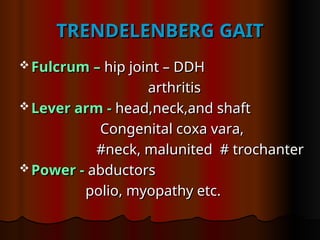
 Fulcrum –
Fulcrum – hip joint – DDH
hip joint – DDH
arthritis
arthritis
 Lever arm -
Lever arm - head,neck,and shaft
head,neck,and shaft
Congenital coxa vara,
#neck, malunited # trochanter
 Power -
Power - abductors
abductors
polio, myopathy etc.
SHORT LEG GAIT
SHORT LEG GAIT
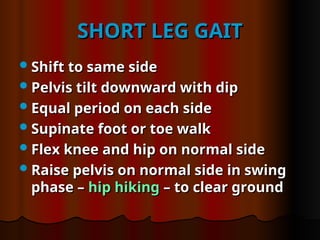
Shift to same side
Shift to same side
Pelvis tilt downward with dip
Pelvis tilt downward with dip
Equal period on each side
Equal period on each side
Supinate foot or toe walk
Supinate foot or toe walk
Flex knee and hip on normal side
Flex knee and hip on normal side
Raise pelvis on normal side in swing
Raise pelvis on normal side in swing
phase –
phase – hip hiking
hip hiking – to clear ground
– to clear ground
GL. MAXIMUS
GL. MAXIMUS WEAKNESS GAIT
WEAKNESS GAIT
 GL. MAXIMUS
GL. MAXIMUS

Terminal swing- opposite side – gluteus maximus
locks hip in extension on wt bearing side
 Weakness-
Weakness-
pelvis thrust forward and trunk backward
shift COG backwards–
no force GM need to lock
 increased lordosis
increased lordosis
lurch back &forth over the hips
Gowers’ sign
Gowers’ sign
Gait after arthrodesis
Pt will not tilt to side
Pt will not tilt to side
Body moves forwards & backwards
Body moves forwards & backwards
Excessive anterior pelvic tilt & lumbar lordosis
Excessive anterior pelvic tilt & lumbar lordosis
were necessary to extend the femur on the involved
side while the normal limb was being advanced
Transverse pelvic rotation about the
Transverse pelvic rotation about the
contralateral hip increased
walking speed 84 per cent of normal
walking speed 84 per cent of normal
Gait in bilateral hip diseases
Waddling gait
Waddling gait
Bilateral trendelenberg
CDH
CDH
COXA VARA
COXA VARA
Gait in bilateral ankylosis
Ankylosis in abduction
Ankylosis in abduction
 Weight on one side
Weight on one side
 Lift other side
Lift other side
 Foot as fulcrum
Foot as fulcrum
 Rotate the whole body
Rotate the whole body
 Advance opp leg
Advance opp leg
 Repeat on other side
Repeat on other side
‘
‘a curious clockwork gait’–
a curious clockwork gait’– Herbert Sedden
Herbert Sedden
Ankylosis in adduction
Ankylosis in adduction
Knee close
cannot lift leg
walking not possible
Gait in bilateral ankylosis
Thank You
Thank You

GAIT ANALYSIS - Normal Gait, Abnormal walking styles

  • 1.
    GAIT PATTERNS INHIP GAIT PATTERNS IN HIP DISORDERS DISORDERS DEPARTMENT OF ORTHOPAEDICS DEPARTMENT OF ORTHOPAEDICS VELS MEDICAL COLLEGE AND VELS MEDICAL COLLEGE AND HOSPITAL HOSPITAL
  • 2.
    Normal gait Normal gaitDefinition Definition Gait analysis Gait analysis Pathological gait Pathological gait Spastic gait Spastic gait Antalgic gait Antalgic gait Trendelenberg gait Trendelenberg gait Short limb gait Short limb gait Gluteus maximus gait Gluteus maximus gait gait in bilateral hip problems gait in bilateral hip problems
  • 3.
    Normal Gait Normal Gait Definition Definition Humangait is bipedal, Human gait is bipedal, biphasic, biphasic, forward propulsion forward propulsion of centre of gravity of centre of gravity, , in which there is alternate in which there is alternate sinuous movement of head and sinuous movement of head and body, body, with least expenditure of with least expenditure of energy energy
  • 4.
    Normal Gait Normal Gait Definition Definition Humangait is bipedal, biphasic, Human gait is bipedal, biphasic, forward propulsion of centre of forward propulsion of centre of gravity, in which there is alternate gravity, in which there is alternate sinuous movement of head and body, sinuous movement of head and body, with least expenditure of energy. with least expenditure of energy.
  • 5.
    Normal walking Normal walking requirements requirements Equilibrium Equilibrium-abilityto assume upright -ability to assume upright posture and maintain balance. posture and maintain balance. Locomotion Locomotion-ability to initiate and maintain -ability to initiate and maintain rhythmic stepping. rhythmic stepping. Muskuloskeletal Muskuloskeletal integrity integrity- -normal bone normal bone joint and muscle function. joint and muscle function. Neurological Neurological control control- -visual ,auditory visual ,auditory vestibular and sensory motor input vestibular and sensory motor input
  • 6.
    GAIT ANALYSIS GAIT ANALYSIS Study of human locomotion Study of human locomotion  Walking consists of a series of gait Walking consists of a series of gait cycles cycles  A single gait cycle is known as a STRIDE A single gait cycle is known as a STRIDE
  • 7.
    GAIT CYCLE GAIT CYCLE Asingle gait cycle or stride is defined: A single gait cycle or stride is defined: Period when ONE foot contacts the ground to Period when ONE foot contacts the ground to when that same foot contacts the ground when that same foot contacts the ground again again Each stride has 2 phases: Each stride has 2 phases: Stance Phase Stance Phase -60% of the gait cycle -60% of the gait cycle Foot in contact with the ground Foot in contact with the ground Swing Phase Swing Phase -40% of the gait cycle -40% of the gait cycle Foot NOT in contact with the ground Foot NOT in contact with the ground
  • 8.
    Stance Phase ofGait Stance Phase of Gait When the foot is in When the foot is in contact with the ground contact with the ground Stance phase has 5 Stance phase has 5 parts: parts: 1.Initial Contact 1.Initial Contact (Heel (Heel Strike) Strike) 2.Loading Response 2.Loading Response (Foot (Foot Flat) Flat) 3.Midstance 3.Midstance 4.Terminalstance 4.Terminalstance(heel (heel raise) raise) 5.Pre-Swing 5.Pre-Swing(toe off) (toe off) 1 2 3 4 5
  • 9.
    Initial Contact Initial Contact Phase1 Phase 1  The moment when The moment when the the red red heel just heel just touches the floor, touches the floor, The first double The first double stance period begins stance period begins  Blue leg is at the end Blue leg is at the end of terminal stance of terminal stance
  • 10.
    Loading Response Loading Response Phase2 Phase 2  Rest of the Rest of the red red foot comes foot comes down to contact the ground down to contact the ground  The double stance period The double stance period continues continues  Full body weight is Full body weight is transferred onto the transferred onto the red red leg. leg.  Blue leg is in pre swing (toe Blue leg is in pre swing (toe off) off)
  • 11.
    Midstance Midstance  Phase 3 Phase3  single limb support single limb support interval. interval.  Begins with the lifting Begins with the lifting of the blue foot and of the blue foot and continues until the continues until the centre of mass(body centre of mass(body wt) is directly over the wt) is directly over the red red ankle ankle
  • 12.
    Terminal Stance Terminal Stance Phase 4 Phase 4  Begins when the Begins when the red red heel rises and heel rises and continues until the continues until the heel of the blue foot heel of the blue foot hits the ground. hits the ground.  Centre of mass(body Centre of mass(body wt) progresses wt) progresses beyond the red foot beyond the red foot
  • 13.
    Pre swing Pre swing Phase5 Phase 5  Begins with the initial Begins with the initial contact of the blue foot and contact of the blue foot and ends with ends with red red toe-off. toe-off.  The second double stance The second double stance interval in the gait cycle interval in the gait cycle  Transfer of body weight Transfer of body weight from ipsilateral to opposite from ipsilateral to opposite limb takes place. limb takes place.
  • 14.
    Stance Phase Characteristics StancePhase Characteristics During a single stride, there are 2 During a single stride, there are 2 periods of double limb support periods of double limb support Initial double limb stance- initial contact Initial double limb stance- initial contact &Loading response ® &Loading response ® Terminal double limb stance-pre swing ® Terminal double limb stance-pre swing ® IC LR MSt TSt PSw ISw MSw TSw
  • 15.
    Swing Phase Swing Phase Whenfoot is NOT contacting the When foot is NOT contacting the ground ground Limb advancement phase Limb advancement phase 3 parts of swing phase: 3 parts of swing phase: -Initial swing -Initial swing -Midswing -Midswing -Terminal swing -Terminal swing
  • 16.
    Initial Swing Initial Swing Phase6 Phase 6  Begins when the red Begins when the red foot is lifted from the foot is lifted from the floor and ends when floor and ends when the red swinging foot is the red swinging foot is opposite the blue opposite the blue stance foot. stance foot.  The blue leg is in mid- The blue leg is in mid- stance. stance.
  • 17.
    Midswing Midswing Phase 7 Phase 7 Starts at the end of the Starts at the end of the initial swing and continues initial swing and continues until the red swinging limb until the red swinging limb is in front of the body is in front of the body  Advancement of the red Advancement of the red leg leg  The blue leg is in late mid- The blue leg is in late mid- stance. stance.
  • 18.
    Terminal Swing Terminal Swing Phase8 Phase 8  Begins at the end of Begins at the end of midswing and ends midswing and ends when the foot when the foot touches the floor. touches the floor.  Limb advancement is Limb advancement is completed at the end completed at the end of this phase. of this phase.
  • 19.
    parts of agait cycle parts of a gait cycle 0-10% 10-30% 30-50% 50-60% 60-73% 73-87% 87-100% Initial double limb stance single limb stance Terminal double limb stance
  • 20.
    Gait Progression Gait Progression Rleg L leg R STANCE L SINGLE 1st DOUBLE SUPPORT 2nd DOUBLE SUPPORT DOUBLE SUPPORT R SINGLE L SWING L STANCE R SWING R STANCE
  • 21.
    Tasks and divisionsof gait cycle Tasks and divisions of gait cycle
  • 22.
    Gait parameters(cadence Gait parameters(cadence parameters parameters) ) Steplength Step length –distance between two feet –distance between two feet during double limb support.it is during double limb support.it is measured from the heel of one foot to measured from the heel of one foot to heel of contralateral foot heel of contralateral foot Stride length Stride length -distance one limb travels -distance one limb travels during the stance and swing phase.it is during the stance and swing phase.it is measured from the point of foot measured from the point of foot contact at the beginning of stance contact at the beginning of stance phase to the point of contact by the same phase to the point of contact by the same foot at the end of swing phase foot at the end of swing phase
  • 23.
    gait parameters gait parameters Stridelength L step length R step length L L R Walking base 8cm 8cm 70-82 cm 35-40cm 35-40cm
  • 24.
    Cadence parameters contd.. Cadenceparameters contd.. Step time Step time –amount of time used to –amount of time used to complete one step length complete one step length Cadence Cadence –number of steps taken per –number of steps taken per minute minute Walking velocity Walking velocity -distance traveled -distance traveled per per minute minute 90-120 steps
  • 25.
    CENTRE OF MASS CENTREOF MASS  Center of mass (COM) is located just Center of mass (COM) is located just anterior to the second sacral vertebra anterior to the second sacral vertebra  COM deviates from the straight line in COM deviates from the straight line in vertical and and lateral sinusoidal displacements sinusoidal displacements
  • 26.
    Displacement in theplane of Displacement in the plane of progression progression Pelvis and trunk Pelvis and trunk shift 1-2 inch shift 1-2 inch laterally laterally during gait during gait cycle cycle width of a N base measures2-4 inches and step length 15 inches CoG deviates 2 inches vertically during gait cycle in swing phase CoG oscillates 40 degree forward
  • 27.
    Energy expense Energy expense Efficient gait reduces Efficient gait reduces the amount of the amount of energy required to energy required to ambulate ambulate heel strike mid stance toe off goals-to reduce the maximum ht of body CoM at goals-to reduce the maximum ht of body CoM at mid stance,to increase the minimum ht of body mid stance,to increase the minimum ht of body CoM at heel strike and toe off CoM at heel strike and toe off
  • 28.
    the locomotor system thelocomotor system has several methods to has several methods to try to reduce its try to reduce its amplitude amplitude heel strike mid stance toe off
  • 29.
    Determinants of gait Determinantsof gait Pelvic rotation Pelvic rotation Pelvic tilt Pelvic tilt Stance phase knee flexion Stance phase knee flexion Transverse rotation of leg segment Transverse rotation of leg segment Normal valgus alignment of knee Normal valgus alignment of knee Ankle rockers Ankle rockers
  • 30.
    Muscle activity duringgait Muscle activity during gait Concentric contraction-generates Concentric contraction-generates power and accelerates body forward power and accelerates body forward -gastrocsoleus contracts to lift the -gastrocsoleus contracts to lift the heel off the ground heel off the ground -iliopsoas contracts flexing the hip -iliopsoas contracts flexing the hip and pulling the stance phase limb and pulling the stance phase limb off the ground off the ground
  • 31.
    Muscle activity duringgait Muscle activity during gait Eccentric contraction-slows down and Eccentric contraction-slows down and stabilises joint motion stabilises joint motion -tibialis anterior-contracts at initial -tibialis anterior-contracts at initial contact ,firing during plantar flexion contact ,firing during plantar flexion as the foot is lowered to ground. as the foot is lowered to ground. so the foot is gently lowered to ground so the foot is gently lowered to ground -gastrocsoleus-contracts eccentrically -gastrocsoleus-contracts eccentrically through the stance phase controlling the through the stance phase controlling the rate of dorsiflexion of ankle rate of dorsiflexion of ankle
  • 32.
    KINEMATICS KINEMATICS Denotes the motionobserved and Denotes the motion observed and measured at pelvis,hip,knee,ankle and measured at pelvis,hip,knee,ankle and foot foot Done in three planes Done in three planes -sagittal plane-hip flexion ,extension -sagittal plane-hip flexion ,extension -coronal plane-hip abduction,adduction -coronal plane-hip abduction,adduction -transverse plane-rotation hip,tibia,feet -transverse plane-rotation hip,tibia,feet
  • 33.
    CLINICAL GAIT ANALYSIS CLINICALGAIT ANALYSIS OBSERVATIONAL GAIT ANALYSIS OBSERVATIONAL GAIT ANALYSIS 3D GAIT ANALYSIS 3D GAIT ANALYSIS
  • 34.
    Obsevational gait analysis Obsevationalgait analysis Pt should be viewed from the front, Pt should be viewed from the front, side, and behind side, and behind hyperlordosis . ankle plantarflexion hyperlordosis . ankle plantarflexion dorsi flexion, knee flexion extension, dorsi flexion, knee flexion extension, and hip flexion extension. pelvic and hip flexion extension. pelvic abduction or adduction. abduction or adduction.
  • 35.
    Observational gait analysis-what Observationalgait analysis-what to look for to look for The head position. The head position. Shoulders - depressed, elevated, protracted, or retracted. Shoulders - depressed, elevated, protracted, or retracted. Amount of arm swing - normal, increased, or decreased Amount of arm swing - normal, increased, or decreased The trunk - forward or backward lurch or a list to the R or L The trunk - forward or backward lurch or a list to the R or L The pelvis -hiked, level, dropped, or fixed. The pelvis -hiked, level, dropped, or fixed. The hip - extension, flexion, rotation, circumduction, or an The hip - extension, flexion, rotation, circumduction, or an adducted or abducted posture. adducted or abducted posture. The knee - flexion, extension, and general stability The knee - flexion, extension, and general stability The ankle- plantarflexion and dorsiflexion, eversion and inversion. The ankle- plantarflexion and dorsiflexion, eversion and inversion. The foot - proper push off and pronation and supination The foot - proper push off and pronation and supination Pain-where and when Pain-where and when Cadence,base width,stride length Cadence,base width,stride length
  • 36.
    3D gait analysis 3Dgait analysis THIS IS DONE IN A GAIT LABORATARY THIS IS DONE IN A GAIT LABORATARY
  • 37.
    3D gait analysis 3Dgait analysis Kinematics -movement Kinematics -movement Kinetics -forces related to movements Kinetics -forces related to movements  Ground reaction forces (GRF) Ground reaction forces (GRF)  Moment or torque - a turning force that results in Moment or torque - a turning force that results in angular change of position of a segment/joint angular change of position of a segment/joint  Power - a function of joint angular velocity and joint Power - a function of joint angular velocity and joint moment; rate of doing work moment; rate of doing work Electromyography (EMG) -recording of Electromyography (EMG) -recording of myoelectrical activity myoelectrical activity
  • 38.
    Gait Patterns inCerebral Palsy Gait Patterns in Cerebral Palsy
  • 39.
    Geographic classification Geographic classification Hemiplegia(one side; UL>LL) Hemiplegia (one side; UL>LL) Diplegia (both sides; LL>UL) Diplegia (both sides; LL>UL) Triplegia (both LL+1UL) Triplegia (both LL+1UL) Quadriplegia (both UL+both Quadriplegia (both UL+both LL+trunk) LL+trunk) Common: Spastic hemiplegia or Common: Spastic hemiplegia or diplegia(91%) diplegia(91%) Cerebral Palsy Cerebral Palsy
  • 40.
    Spastic Diplegia /quadriplegia SpasticDiplegia /quadriplegia (Sutherlands and Davids) (Sutherlands and Davids)  True Equinus True Equinus -distal spasticity -distal spasticity Gastrosoleus spasticity Equinus Gastrosoleus spasticity Equinus ±Genu recurvatum ±Genu recurvatum  Jump Gait Jump Gait Spasticity of hamstrings and hip flexors and calf Spasticity of hamstrings and hip flexors and calf Equinus +hip and knee in flexion ,ant. pelvic tilt Equinus +hip and knee in flexion ,ant. pelvic tilt + exaggerated lumbar lordosis+ knee stiff (rectus femoris) + exaggerated lumbar lordosis+ knee stiff (rectus femoris)  Crouch gait Crouch gait Excessive dorsiflexion or calcaneus at ankle +excessive flexion at knee Excessive dorsiflexion or calcaneus at ankle +excessive flexion at knee and hip +ant. pelvic tilt and hip +ant. pelvic tilt may be may be Iatrogenic Iatrogenic due to isolated lengthening of TA (w/o correcting due to isolated lengthening of TA (w/o correcting hamstring & iliopsoas spasm hamstring & iliopsoas spasm) )
  • 41.
  • 42.
    Scissoring gait Scissoring gait Adductor musculature spasm Adductor musculature spasm  Flexion +int. rotn deformity Flexion +int. rotn deformity  TFL is the main deforming force TFL is the main deforming force  Can bring the swing limb up to Can bring the swing limb up to the stance limb the stance limb  Cadence parameters are grossly Cadence parameters are grossly decreased decreased
  • 43.
    ANTALGIC GAIT ANTALGIC GAIT Painin Pain in lower limb lower limb back back -- --hip pain hip pain Lurch to affected side Lurch to affected side Reduce abductor force on hip Reduce abductor force on hip No pelvic drop No pelvic drop No gluteal weakness No gluteal weakness
  • 44.
    ANTALGIC GAIT ANTALGIC GAIT Short stepping Short stepping  Asymmetrical step length Asymmetrical step length  Step length on affected side less Step length on affected side less  Unaffected limb is brought forward Unaffected limb is brought forward more quickly than normal in swing more quickly than normal in swing phase phase  Duration of stance phase increased Duration of stance phase increased on normal side on normal side
  • 45.
    ANTALGIC GAIT ANTALGIC GAIT Infective Infective Inflammatory Inflammatory Earlyperthes Early perthes Acute silp Acute silp Trauma Trauma
  • 46.
    Abductor muscle function Abductormuscle function  Two limb stance Two limb stance  One limb stance One limb stance Cog to wt bearing head = Cog to wt bearing head = c o h to abductor x 2 c o h to abductor x 2 compressive force on wt bearing head = compressive force on wt bearing head = 3x wt of upper body 3x wt of upper body
  • 47.
    In 1895 Fredrich Trendelenburgdescribed a clinical sign useful for detecting the function of hip abductor muscle with special referance to CDH and progressive muscular dystrophy
  • 48.
    TRENDELENBERG GAIT TRENDELENBERG GAIT Functional weakening of abductor Functional weakening of abductor mechanism. mechanism.  Abductor muscles at mechanical Abductor muscles at mechanical disadvantage disadvantage  Standing on affected side pelvis drop to Standing on affected side pelvis drop to normal side normal side  To compensate pt lurch to affected side To compensate pt lurch to affected side steppage gait steppage gait No need to compensate – tilt to opposite side No need to compensate – tilt to opposite side
  • 49.
  • 50.
    TRENDELENBERG GAIT TRENDELENBERG GAIT Fulcrum – Fulcrum – hip joint – DDH hip joint – DDH arthritis arthritis  Lever arm - Lever arm - head,neck,and shaft head,neck,and shaft Congenital coxa vara, Congenital coxa vara, #neck, malunited # trochanter #neck, malunited # trochanter  Power - Power - abductors abductors polio, myopathy etc. polio, myopathy etc.
  • 51.
    SHORT LEG GAIT SHORTLEG GAIT Shift to same side Shift to same side Pelvis tilt downward with dip Pelvis tilt downward with dip Equal period on each side Equal period on each side Supinate foot or toe walk Supinate foot or toe walk Flex knee and hip on normal side Flex knee and hip on normal side Raise pelvis on normal side in swing Raise pelvis on normal side in swing phase – phase – hip hiking hip hiking – to clear ground – to clear ground
  • 52.
    GL. MAXIMUS GL. MAXIMUSWEAKNESS GAIT WEAKNESS GAIT  GL. MAXIMUS GL. MAXIMUS  Terminal swing- opposite side – gluteus maximus Terminal swing- opposite side – gluteus maximus locks hip in extension on wt bearing side locks hip in extension on wt bearing side  Weakness- Weakness- pelvis thrust forward and trunk backward pelvis thrust forward and trunk backward shift COG backwards– shift COG backwards– no force GM need to lock no force GM need to lock  increased lordosis increased lordosis lurch back &forth over the hips lurch back &forth over the hips Gowers’ sign Gowers’ sign
  • 53.
    Gait after arthrodesis Gaitafter arthrodesis Pt will not tilt to side Pt will not tilt to side Body moves forwards & backwards Body moves forwards & backwards Excessive anterior pelvic tilt & lumbar lordosis Excessive anterior pelvic tilt & lumbar lordosis were necessary to extend the femur on the involved were necessary to extend the femur on the involved side while the normal limb was being advanced side while the normal limb was being advanced Transverse pelvic rotation about the Transverse pelvic rotation about the contralateral hip increased contralateral hip increased walking speed 84 per cent of normal walking speed 84 per cent of normal
  • 54.
    Gait in bilateralhip diseases Gait in bilateral hip diseases Waddling gait Waddling gait Bilateral trendelenberg Bilateral trendelenberg CDH CDH COXA VARA COXA VARA
  • 55.
    Gait in bilateralankylosis Gait in bilateral ankylosis Ankylosis in abduction Ankylosis in abduction  Weight on one side Weight on one side  Lift other side Lift other side  Foot as fulcrum Foot as fulcrum  Rotate the whole body Rotate the whole body  Advance opp leg Advance opp leg  Repeat on other side Repeat on other side ‘ ‘a curious clockwork gait’– a curious clockwork gait’– Herbert Sedden Herbert Sedden
  • 56.
    Ankylosis in adduction Ankylosisin adduction Knee close cannot lift leg walking not possible Gait in bilateral ankylosis Gait in bilateral ankylosis
  • 57.

Editor's Notes

  • #46 This system can break down in several ways