Gait Analysis Definitions

        PTHE 1581
Objectives
 Define the terms for gait analysis as described by Rancho Los
  Amigos Observational Gait Analysis
 Briefly describe what is happening in the lower limbs during
  each phase of gait
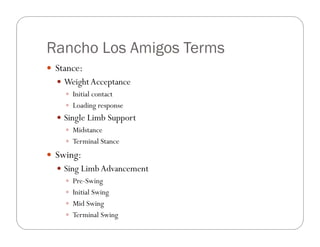
Rancho Los Amigos Terms
 Stance:
   Weight Acceptance
     Initial contact
     Loading response
              g p
   Single Limb Support
     Midstance
     TTerminal Stance
              lS
 Swing:
   Sing Limb Advancement
     Pre-Swing
     Initial Swing
     MdS
       Mid Swing
     Terminal Swing
Other Terms (from Oatis)
        Rancho Los Amigos terms are in parentheses; they do not
         correlate perfectly
              lt      f tl
        Stance:
              Ground contact (initial contact)
                                (               )
              Foot flat (loading response to midstance)
              Heel off (midstance to terminal stance)
              Contralateral ground contact (terminal stance)
               C      l      l      d         (    i l      )
              Toe off (pre-swing)
        Swing:
             g
            Early swing (initial swing)
            Mid swing (Mid swing)
            L t swing (T
             Late i (Terminal swing)
                                i l i )
*** We will NOT be using this terminology in class, this information is for your reference only ***
Phases of Gait
 The following slides give a brief description of what happens
  at the hip, knee, and ankle during NORMAL gait
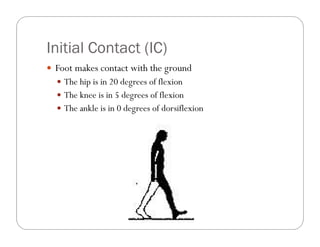
Initial Contact (IC)
 Foot makes contact with the ground
   The hip is in 20 degrees of flexion
   The knee is in 5 degrees of flexion
   The ankle is in 0 degrees of dorsiflexion
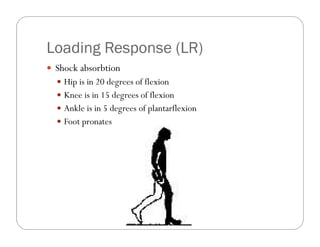
Loading Response (LR)
 Shock absorbtion
   Hip is in 20 degrees of flexion
   Knee is in 15 degrees of flexion
   Ankle is in 5 degrees of plantarflexion
   Foot pronates
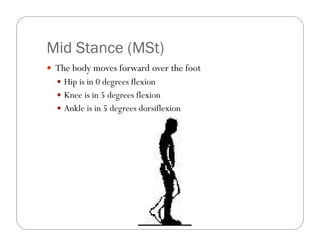
Mid Stance (MSt)
 The body moves forward over the foot
   Hip is in 0 degrees flexion
   Knee is in 5 degrees flexion
   Ankle is in 5 degrees dorsiflexion
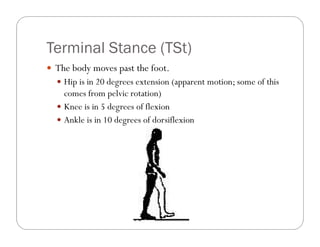
Terminal Stance (TSt)
 The body moves past the foot.
   Hip is in 20 degrees extension (apparent motion; some of this
    comes from pelvic rotation)
   Knee is in 5 degrees of flexion
   Ankle is in 10 degrees of dorsiflexion
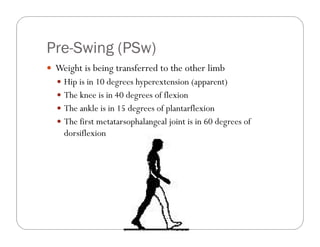
Pre-Swing
Pre Swing (PSw)
 Weight is being transferred to the other limb
   Hip is in 10 degrees hyperextension (apparent)
   The knee is in 40 degrees of flexion
   The ankle is in 15 degrees of plantarflexion
   The first metatarsophalangeal joint is in 60 degrees of
    dorsiflexion
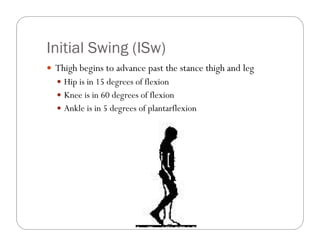
Initial Swing (ISw)
 Thigh begins to advance past the stance thigh and leg
   Hip is in 15 degrees of flexion
   Knee is in 60 degrees of flexion
   Ankle is in 5 degrees of plantarflexion
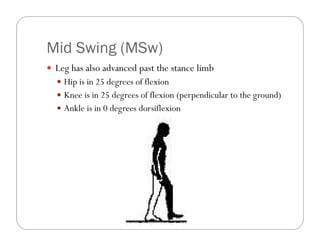
Mid Swing (MSw)
 Leg has also advanced past the stance limb
   Hip is in 25 degrees of flexion
   Knee is in 25 degrees of flexion (perpendicular to the ground)
   Ankle is in 0 degrees dorsiflexion
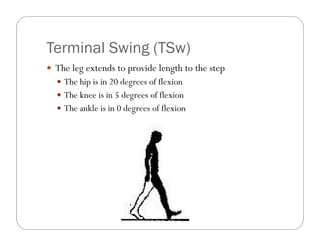
Terminal Swing (TSw)
 The leg extends to provide length to the step
   The hip is in 20 degrees of flexion
   The knee is in 5 degrees of flexion
   The ankle is in 0 degrees of flexion

Gait analysis definitions

  • 1.
  • 2.
    Objectives  Define theterms for gait analysis as described by Rancho Los Amigos Observational Gait Analysis  Briefly describe what is happening in the lower limbs during each phase of gait
  • 3.
    Rancho Los AmigosTerms  Stance:  Weight Acceptance  Initial contact  Loading response g p  Single Limb Support  Midstance  TTerminal Stance lS  Swing:  Sing Limb Advancement  Pre-Swing  Initial Swing  MdS Mid Swing  Terminal Swing
  • 4.
    Other Terms (fromOatis)  Rancho Los Amigos terms are in parentheses; they do not correlate perfectly lt f tl  Stance:  Ground contact (initial contact) ( )  Foot flat (loading response to midstance)  Heel off (midstance to terminal stance)  Contralateral ground contact (terminal stance) C l l d ( i l )  Toe off (pre-swing)  Swing: g  Early swing (initial swing)  Mid swing (Mid swing)  L t swing (T Late i (Terminal swing) i l i ) *** We will NOT be using this terminology in class, this information is for your reference only ***
  • 5.
    Phases of Gait The following slides give a brief description of what happens at the hip, knee, and ankle during NORMAL gait
  • 6.
    Initial Contact (IC) Foot makes contact with the ground  The hip is in 20 degrees of flexion  The knee is in 5 degrees of flexion  The ankle is in 0 degrees of dorsiflexion
  • 7.
    Loading Response (LR) Shock absorbtion  Hip is in 20 degrees of flexion  Knee is in 15 degrees of flexion  Ankle is in 5 degrees of plantarflexion  Foot pronates
  • 8.
    Mid Stance (MSt) The body moves forward over the foot  Hip is in 0 degrees flexion  Knee is in 5 degrees flexion  Ankle is in 5 degrees dorsiflexion
  • 9.
    Terminal Stance (TSt) The body moves past the foot.  Hip is in 20 degrees extension (apparent motion; some of this comes from pelvic rotation)  Knee is in 5 degrees of flexion  Ankle is in 10 degrees of dorsiflexion
  • 10.
    Pre-Swing Pre Swing (PSw) Weight is being transferred to the other limb  Hip is in 10 degrees hyperextension (apparent)  The knee is in 40 degrees of flexion  The ankle is in 15 degrees of plantarflexion  The first metatarsophalangeal joint is in 60 degrees of dorsiflexion
  • 11.
    Initial Swing (ISw) Thigh begins to advance past the stance thigh and leg  Hip is in 15 degrees of flexion  Knee is in 60 degrees of flexion  Ankle is in 5 degrees of plantarflexion
  • 12.
    Mid Swing (MSw) Leg has also advanced past the stance limb  Hip is in 25 degrees of flexion  Knee is in 25 degrees of flexion (perpendicular to the ground)  Ankle is in 0 degrees dorsiflexion
  • 13.
    Terminal Swing (TSw) The leg extends to provide length to the step  The hip is in 20 degrees of flexion  The knee is in 5 degrees of flexion  The ankle is in 0 degrees of flexion