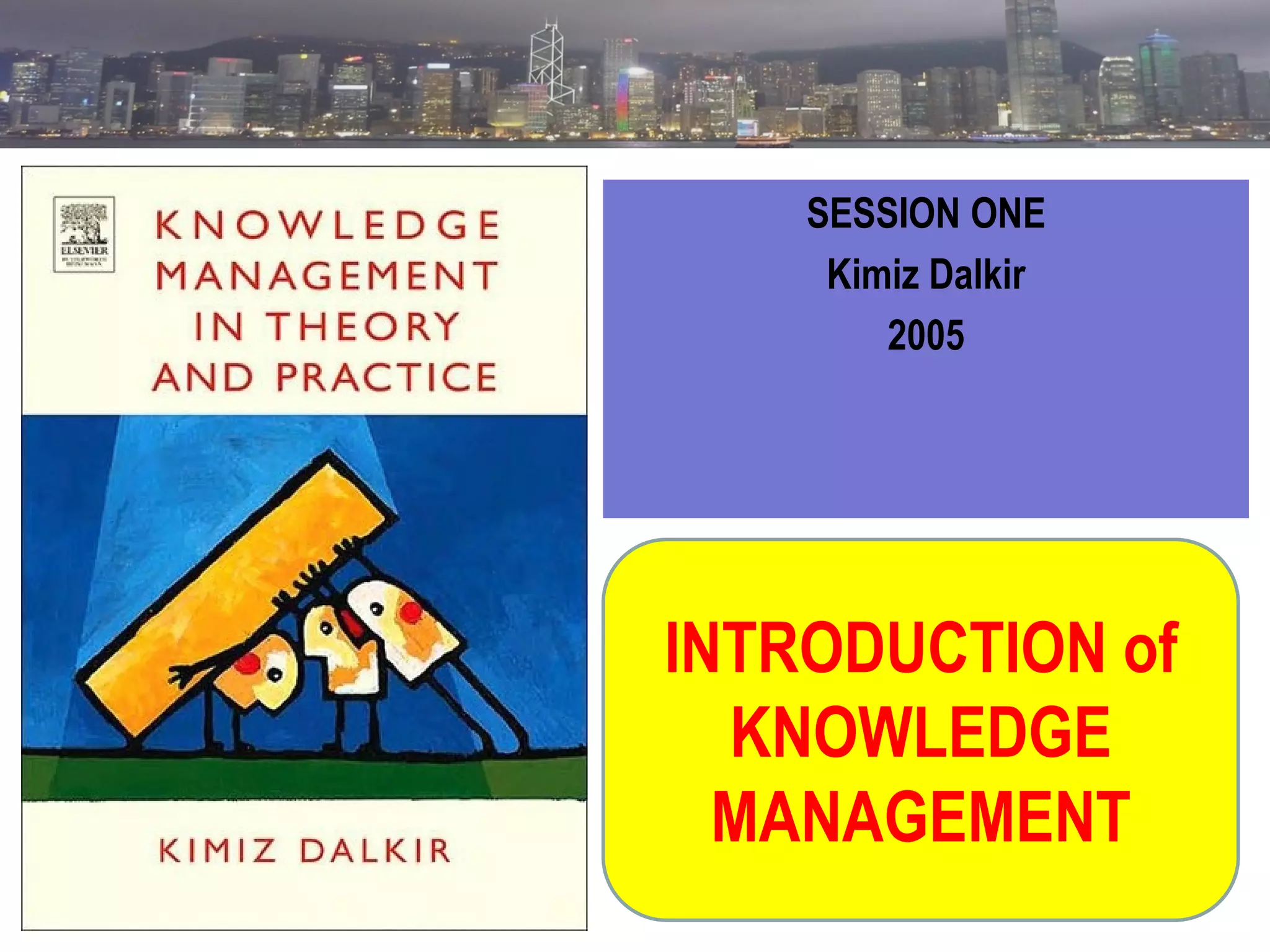
SESSION ONE
Kimiz Dalkir
2005

INTRODUCTION of
KNOWLEDGE
MANAGEMENT
OBJECTIVE
Understand and explain the basic of
Knowledge Management and the
importance of Knowledge Management
for individual, community/group, and
organizations

09 Nopember 2013

Partono - TELKOM University 2013
KNOWLEDGE

Regards
as an
intellectual
assets

09 Nopember 2013

• Using it will not consume it. It always
will be there for re-use
• Knowledge transfer will not loose it
• Abundant in supply but not easy to
use or scarce of the ability in using it
• Could be lost from the
entity/organization memory if it is not
preserve well

Partono - TELKOM University 2013
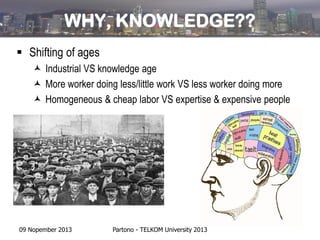
WHY, KNOWLEDGE??
 Shifting of ages
 Industrial VS knowledge age
 More worker doing less/little work VS less worker doing more
 Homogeneous & cheap labor VS expertise & expensive people

09 Nopember 2013

Partono - TELKOM University 2013
KNOWLEDGE BASED ORG.
 Organizations which learns, remembers, and act based
upon the best available information, knowledge, & knowhow
 (Davenport & Prusack, 1998), continous improvement of the
organization can be obtained from :
 What is/are collectively known inside organization and its people
 How efficient the organization use what they know
 How fast the organization absorb and use the new knowledge

09 Nopember 2013

Partono - TELKOM University 2013
KM DEFINITION
 Procces of applying systematic approach to capture,
structure, management, & dissemination of knowledge
throughout an organization in order to work faster, reuse
best practises, and reduce costly rework from project to
project (Nonaka & Takeuchi, 1995)
 Systemic coordination of an organization’s people,
technology, processes, & org structure to add value thru
reuse & innovation.

09 Nopember 2013

Partono - TELKOM University 2013
KNOWLEDGE MANAGEMENT
 Save it, it may prove useful sometime in the future
 Intellectual Capital Management Concept
 Focus on the knowledge which have value for the business
 Include paten, copyright, know-how, experiences, expertise
 Less content, filtered and chosen

09 Nopember 2013

Partono - TELKOM University 2013
BASIC OBJECTIVE of KM

To leverage knowledge
to the organization’s
advantages (Nickols,
2000)
09 Nopember 2013

Partono - TELKOM University 2013
OBJECTIVE of KM
 Facilitate smooth transition from retiring and/or resign
employee to their successor
 Minimize corporate memory loss from attrition & retirement
 Identify critical areas & resources of knowledge, so the
company knows what it know and does it well
 Build toolkits and method to stem the potential of intellectual
capital loss

09 Nopember 2013

Partono - TELKOM University 2013
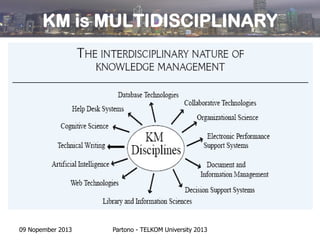
KM is MULTIDISCIPLINARY

09 Nopember 2013

Partono - TELKOM University 2013
MEMAHAMI KM
 Multidisipliner Knowledge Management memiliki dua sisi ;
 Positif  orang mudah memahami Knowledge Management dari
latar belakang keilmuannya sendiri
 Negatif  dipandang sebagai sesuatu yang bukan
bidang/disiplin ilmu yang khusus. Knowledge Management lebih
merupakan praktek bisnis saja

 KM mengelola pengetahuan & informasi. Pengetahuan
adalah cara untuk mengetahui yang didasarkan pada
pengalaman, nilai, persepsi dr individu.
 Please translate the above sentences in English

09 Nopember 2013

Partono - TELKOM University 2013
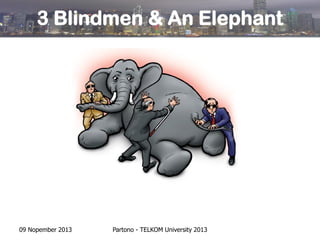
3 Blindmen & An Elephant

09 Nopember 2013

Partono - TELKOM University 2013
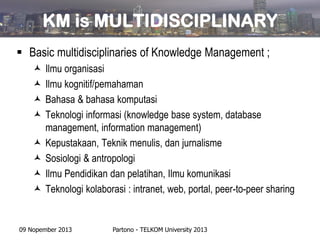
KM is MULTIDISCIPLINARY
 Basic multidisciplinaries of Knowledge Management ;









Ilmu organisasi
Ilmu kognitif/pemahaman
Bahasa & bahasa komputasi
Teknologi informasi (knowledge base system, database
management, information management)
Kepustakaan, Teknik menulis, dan jurnalisme
Sosiologi & antropologi
Ilmu Pendidikan dan pelatihan, Ilmu komunikasi
Teknologi kolaborasi : intranet, web, portal, peer-to-peer sharing

09 Nopember 2013

Partono - TELKOM University 2013
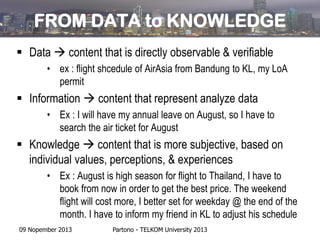
FROM DATA to KNOWLEDGE
 Data  content that is directly observable & verifiable
• ex : flight shcedule of AirAsia from Bandung to KL, my LoA
permit

 Information  content that represent analyze data
• Ex : I will have my annual leave on August, so I have to
search the air ticket for August

 Knowledge  content that is more subjective, based on
individual values, perceptions, & experiences
• Ex : August is high season for flight to Thailand, I have to
book from now in order to get the best price. The weekend
flight will cost more, I better set for weekday @ the end of the
month. I have to inform my friend in KL to adjust his schedule
09 Nopember 2013

Partono - TELKOM University 2013
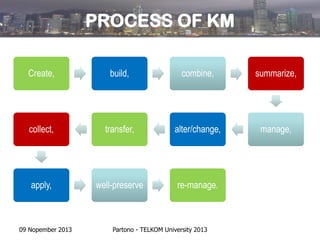
PROCESS OF KM
Create,

build,

combine,

summarize,

collect,

transfer,

alter/change,

manage,

apply,

well-preserve

re-manage.

09 Nopember 2013

Partono - TELKOM University 2013
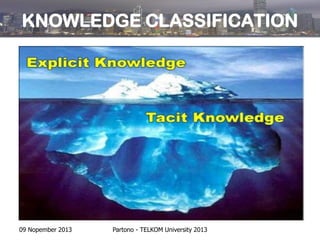
KNOWLEDGE CLASSIFICATION

09 Nopember 2013

Partono - TELKOM University 2013
KNOWLEDGE CLASSIFICATION
 Tacit knowledge. Difficult to articualte, put in words, text, or
drwaings
 Reside in the mind of the owner
 What is easly understood by one person, can be differ & difficult
to understand by others

 Explicit knowledge. Represent content that has been
captured in tangible forms such video, audio, pictures
 Contain in tangible or easy to understand media

09 Nopember 2013

Partono - TELKOM University 2013
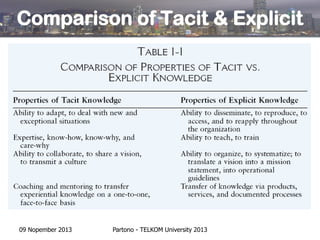
Comparison of Tacit & Explicit

09 Nopember 2013

Partono - TELKOM University 2013
KNOWLEDGE






The harder to understand the more precious the knowledge
The more difficult the knowledge, it has more value
Explicit knowledge is end product.
As of tacit is the process to produce that knowledge
Misconceptions : Knowledge Management only focus in
changing tacit into explicit and then preserved it

09 Nopember 2013

Partono - TELKOM University 2013
KNOWLEDGE
 More appropriate :





Convert tacit into explicit
Preserve it
Give added value (complete, sort, perfection)
Share and use it

09 Nopember 2013

Partono - TELKOM University 2013
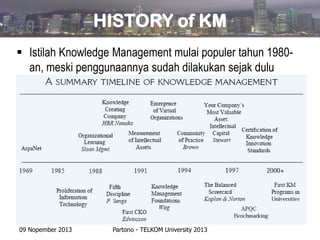
HISTORY of KM
 Istilah Knowledge Management mulai populer tahun 1980an, meski penggunaannya sudah dilakukan sejak dulu

09 Nopember 2013

Partono - TELKOM University 2013
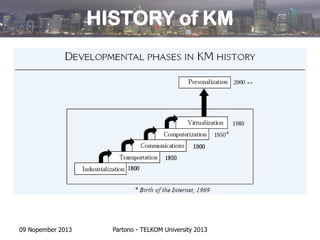
HISTORY of KM

09 Nopember 2013

Partono - TELKOM University 2013
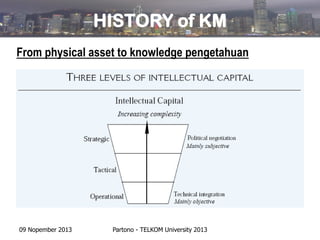
HISTORY of KM
From physical asset to knowledge pengetahuan

09 Nopember 2013

Partono - TELKOM University 2013
ORG PERSPECTIVE on KM
 Business
 Pada bagian mana, mengapa, & sejauh mana organisasi harus
berinvestasi dlm pengetahuan

 Management
 Fokus pada penentuan, pengelolaan, pelaksanaan, evaluasi
terhadap praktek & kegiatan pengetahuan yang dilakukan untuk
mencapai tujuan bisnis

 Practise
 Menerapkan keahlian untuk menjalankan tugas yang berkaitan
dengan pengetahuan explicit

09 Nopember 2013

Partono - TELKOM University 2013
WHY KM IMPORTANT





The Era of Globalization (location, language, concept)
Learning organization (intelligent, faster, more)
Minimize Corporate amnesia
Technological advances

09 Nopember 2013

Partono - TELKOM University 2013
MENGAPA KM PENTING
 Knowledge Management answer the flood of information of
work environment
 They do not know that They do not know
 They do not know what is the neccesary knowledge they should
know

 Snowden, 2002, 3 generation of Knowledge Management
 Focus on knowledge & information technology
 Focus on the people who have the knowledge
 Focus on share & distribute the content of knowledge

09 Nopember 2013

Partono - TELKOM University 2013
WHY KM IMPORTANT
Benefit Knowledge Management for individu
 Help to do their job
 Safe time/energy
 Better decision making & problem solving
 Build a sense of community bond
 Keep up to date
 Challenges & opportunitties to contribute

09 Nopember 2013

Partono - TELKOM University 2013
WHY KM IMPORTANT
Benefit Knowledge Management for community
 Develop professional skills
 Promote peer to peer mentoring
 Facilitate networking and collaboration
 Develop code of ethic
 Create a common language to avoid misunderstanding

09 Nopember 2013

Partono - TELKOM University 2013
WHY KM IMPORTANT
Benefit Knowledge Management for organization
 Drive to develop strategy
 Faster problem solving
 Distribute or share the best practises
 Improving knowledge that embedded in product/service
 Encouraging innovation
 Better competitive advantages
 Building the organization memory

09 Nopember 2013

Partono - TELKOM University 2013
SOURCES of KNOWLEDGE
 http://www.eknowledgecenter.com/articles/1010/1010.htm
 http://www.ahg.com/absolutely%20knowledge%20management%20s
ystem.htm
 http://www.prescientdigital.com/articles/content-management/contentmanagement-in-a-knowledge-management-context/
 http://www.lc-stars.com/knowledge.html
 http://peterpaulperez.wordpress.com/2011/04/18/knowledgemanagement-in-the-call-center-industry/
 http://www.ugc.edu.hk/tlqpr01/site/abstracts/098_hui.htm
 http://www.ilo.org/public/english/employment/mifacility/activities/knowl
edge.htm
09 Nopember 2013

Partono - TELKOM University 2013
 http://www.hcklab.org/research/knowledgemanagement/tacit-explicitknowledge.htm
 http://www.cognitivedesignsolutions.com/KM/ExplicitTacit.htm
 http://serbaserbikm.blogspot.com/2010/07/2-macam-tipe-knowledgeyaitu.html
 http://www.systems-thinking.org/kmbh/kmbh.htm
 http://www.kmnetwork.com/WhatIsKM.html

09 Nopember 2013

Partono - TELKOM University 2013
DRESSED 4 SUCCESS
 Review singkat materi perkuliahan ini minimal 1 kali setiap
minggu.
 Selesaikan penugasan2, baik yang dikumpulkan atau yang tidak.
 Membuat catatan kecil (rangkuman) yang mudah dipelajari saat
menghadapi UTS/UAS (bukan untuk ‘contekan’).
 Setidaknya baca & pahami materi secara lengkap pada buku
panduan utama.
 Perhatikan pokok bahasan yang diberikan penegasan oleh
dosen beserta contoh2-nya.
 Cari materi dari dosen lain dengan pokok bahasan yang sama.

09 Nopember 2013

Partono - TELKOM University 2013

Sesi 01 km english version

  • 1.
  • 2.
    OBJECTIVE Understand and explainthe basic of Knowledge Management and the importance of Knowledge Management for individual, community/group, and organizations 09 Nopember 2013 Partono - TELKOM University 2013
  • 3.
    KNOWLEDGE Regards as an intellectual assets 09 Nopember2013 • Using it will not consume it. It always will be there for re-use • Knowledge transfer will not loose it • Abundant in supply but not easy to use or scarce of the ability in using it • Could be lost from the entity/organization memory if it is not preserve well Partono - TELKOM University 2013
  • 4.
    WHY, KNOWLEDGE??  Shiftingof ages  Industrial VS knowledge age  More worker doing less/little work VS less worker doing more  Homogeneous & cheap labor VS expertise & expensive people 09 Nopember 2013 Partono - TELKOM University 2013
  • 5.
    KNOWLEDGE BASED ORG. Organizations which learns, remembers, and act based upon the best available information, knowledge, & knowhow  (Davenport & Prusack, 1998), continous improvement of the organization can be obtained from :  What is/are collectively known inside organization and its people  How efficient the organization use what they know  How fast the organization absorb and use the new knowledge 09 Nopember 2013 Partono - TELKOM University 2013
  • 6.
    KM DEFINITION  Proccesof applying systematic approach to capture, structure, management, & dissemination of knowledge throughout an organization in order to work faster, reuse best practises, and reduce costly rework from project to project (Nonaka & Takeuchi, 1995)  Systemic coordination of an organization’s people, technology, processes, & org structure to add value thru reuse & innovation. 09 Nopember 2013 Partono - TELKOM University 2013
  • 7.
    KNOWLEDGE MANAGEMENT  Saveit, it may prove useful sometime in the future  Intellectual Capital Management Concept  Focus on the knowledge which have value for the business  Include paten, copyright, know-how, experiences, expertise  Less content, filtered and chosen 09 Nopember 2013 Partono - TELKOM University 2013
  • 8.
    BASIC OBJECTIVE ofKM To leverage knowledge to the organization’s advantages (Nickols, 2000) 09 Nopember 2013 Partono - TELKOM University 2013
  • 9.
    OBJECTIVE of KM Facilitate smooth transition from retiring and/or resign employee to their successor  Minimize corporate memory loss from attrition & retirement  Identify critical areas & resources of knowledge, so the company knows what it know and does it well  Build toolkits and method to stem the potential of intellectual capital loss 09 Nopember 2013 Partono - TELKOM University 2013
  • 10.
    KM is MULTIDISCIPLINARY 09Nopember 2013 Partono - TELKOM University 2013
  • 11.
    MEMAHAMI KM  MultidisiplinerKnowledge Management memiliki dua sisi ;  Positif  orang mudah memahami Knowledge Management dari latar belakang keilmuannya sendiri  Negatif  dipandang sebagai sesuatu yang bukan bidang/disiplin ilmu yang khusus. Knowledge Management lebih merupakan praktek bisnis saja  KM mengelola pengetahuan & informasi. Pengetahuan adalah cara untuk mengetahui yang didasarkan pada pengalaman, nilai, persepsi dr individu.  Please translate the above sentences in English 09 Nopember 2013 Partono - TELKOM University 2013
  • 12.
    3 Blindmen &An Elephant 09 Nopember 2013 Partono - TELKOM University 2013
  • 13.
    KM is MULTIDISCIPLINARY Basic multidisciplinaries of Knowledge Management ;         Ilmu organisasi Ilmu kognitif/pemahaman Bahasa & bahasa komputasi Teknologi informasi (knowledge base system, database management, information management) Kepustakaan, Teknik menulis, dan jurnalisme Sosiologi & antropologi Ilmu Pendidikan dan pelatihan, Ilmu komunikasi Teknologi kolaborasi : intranet, web, portal, peer-to-peer sharing 09 Nopember 2013 Partono - TELKOM University 2013
  • 14.
    FROM DATA toKNOWLEDGE  Data  content that is directly observable & verifiable • ex : flight shcedule of AirAsia from Bandung to KL, my LoA permit  Information  content that represent analyze data • Ex : I will have my annual leave on August, so I have to search the air ticket for August  Knowledge  content that is more subjective, based on individual values, perceptions, & experiences • Ex : August is high season for flight to Thailand, I have to book from now in order to get the best price. The weekend flight will cost more, I better set for weekday @ the end of the month. I have to inform my friend in KL to adjust his schedule 09 Nopember 2013 Partono - TELKOM University 2013
  • 15.
  • 16.
    KNOWLEDGE CLASSIFICATION 09 Nopember2013 Partono - TELKOM University 2013
  • 17.
    KNOWLEDGE CLASSIFICATION  Tacitknowledge. Difficult to articualte, put in words, text, or drwaings  Reside in the mind of the owner  What is easly understood by one person, can be differ & difficult to understand by others  Explicit knowledge. Represent content that has been captured in tangible forms such video, audio, pictures  Contain in tangible or easy to understand media 09 Nopember 2013 Partono - TELKOM University 2013
  • 18.
    Comparison of Tacit& Explicit 09 Nopember 2013 Partono - TELKOM University 2013
  • 19.
    KNOWLEDGE      The harder tounderstand the more precious the knowledge The more difficult the knowledge, it has more value Explicit knowledge is end product. As of tacit is the process to produce that knowledge Misconceptions : Knowledge Management only focus in changing tacit into explicit and then preserved it 09 Nopember 2013 Partono - TELKOM University 2013
  • 20.
    KNOWLEDGE  More appropriate:     Convert tacit into explicit Preserve it Give added value (complete, sort, perfection) Share and use it 09 Nopember 2013 Partono - TELKOM University 2013
  • 21.
    HISTORY of KM Istilah Knowledge Management mulai populer tahun 1980an, meski penggunaannya sudah dilakukan sejak dulu 09 Nopember 2013 Partono - TELKOM University 2013
  • 22.
    HISTORY of KM 09Nopember 2013 Partono - TELKOM University 2013
  • 23.
    HISTORY of KM Fromphysical asset to knowledge pengetahuan 09 Nopember 2013 Partono - TELKOM University 2013
  • 24.
    ORG PERSPECTIVE onKM  Business  Pada bagian mana, mengapa, & sejauh mana organisasi harus berinvestasi dlm pengetahuan  Management  Fokus pada penentuan, pengelolaan, pelaksanaan, evaluasi terhadap praktek & kegiatan pengetahuan yang dilakukan untuk mencapai tujuan bisnis  Practise  Menerapkan keahlian untuk menjalankan tugas yang berkaitan dengan pengetahuan explicit 09 Nopember 2013 Partono - TELKOM University 2013
  • 25.
    WHY KM IMPORTANT     TheEra of Globalization (location, language, concept) Learning organization (intelligent, faster, more) Minimize Corporate amnesia Technological advances 09 Nopember 2013 Partono - TELKOM University 2013
  • 26.
    MENGAPA KM PENTING Knowledge Management answer the flood of information of work environment  They do not know that They do not know  They do not know what is the neccesary knowledge they should know  Snowden, 2002, 3 generation of Knowledge Management  Focus on knowledge & information technology  Focus on the people who have the knowledge  Focus on share & distribute the content of knowledge 09 Nopember 2013 Partono - TELKOM University 2013
  • 27.
    WHY KM IMPORTANT BenefitKnowledge Management for individu  Help to do their job  Safe time/energy  Better decision making & problem solving  Build a sense of community bond  Keep up to date  Challenges & opportunitties to contribute 09 Nopember 2013 Partono - TELKOM University 2013
  • 28.
    WHY KM IMPORTANT BenefitKnowledge Management for community  Develop professional skills  Promote peer to peer mentoring  Facilitate networking and collaboration  Develop code of ethic  Create a common language to avoid misunderstanding 09 Nopember 2013 Partono - TELKOM University 2013
  • 29.
    WHY KM IMPORTANT BenefitKnowledge Management for organization  Drive to develop strategy  Faster problem solving  Distribute or share the best practises  Improving knowledge that embedded in product/service  Encouraging innovation  Better competitive advantages  Building the organization memory 09 Nopember 2013 Partono - TELKOM University 2013
  • 30.
    SOURCES of KNOWLEDGE http://www.eknowledgecenter.com/articles/1010/1010.htm  http://www.ahg.com/absolutely%20knowledge%20management%20s ystem.htm  http://www.prescientdigital.com/articles/content-management/contentmanagement-in-a-knowledge-management-context/  http://www.lc-stars.com/knowledge.html  http://peterpaulperez.wordpress.com/2011/04/18/knowledgemanagement-in-the-call-center-industry/  http://www.ugc.edu.hk/tlqpr01/site/abstracts/098_hui.htm  http://www.ilo.org/public/english/employment/mifacility/activities/knowl edge.htm 09 Nopember 2013 Partono - TELKOM University 2013
  • 31.
     http://www.hcklab.org/research/knowledgemanagement/tacit-explicitknowledge.htm  http://www.cognitivedesignsolutions.com/KM/ExplicitTacit.htm http://serbaserbikm.blogspot.com/2010/07/2-macam-tipe-knowledgeyaitu.html  http://www.systems-thinking.org/kmbh/kmbh.htm  http://www.kmnetwork.com/WhatIsKM.html 09 Nopember 2013 Partono - TELKOM University 2013
  • 32.
    DRESSED 4 SUCCESS Review singkat materi perkuliahan ini minimal 1 kali setiap minggu.  Selesaikan penugasan2, baik yang dikumpulkan atau yang tidak.  Membuat catatan kecil (rangkuman) yang mudah dipelajari saat menghadapi UTS/UAS (bukan untuk ‘contekan’).  Setidaknya baca & pahami materi secara lengkap pada buku panduan utama.  Perhatikan pokok bahasan yang diberikan penegasan oleh dosen beserta contoh2-nya.  Cari materi dari dosen lain dengan pokok bahasan yang sama. 09 Nopember 2013 Partono - TELKOM University 2013