EMPOWERING GRASSROOTS
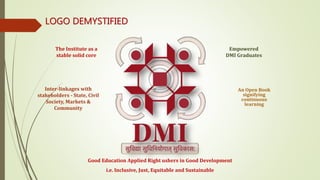
LOGO DEMYSTIFIED
An Open Book
signifying
continuous
learning
The Institute as a
stable solid core
Inter-linkages with
stakeholders - State, Civil
Society, Markets &
Community
Empowered
DMI Graduates
Good Education Applied Right ushers in Good Development
i.e. Inclusive, Just, Equitable and Sustainable
 Development Management Institute (DMI) was set
up on February 13, 2014 pursuant to a desire of
the Government of Bihar to establish a High
Performing Knowledge Institution (HPKI) patterned
on the founding vision of Institute of Rural
Management Anand (IRMA)
 The Mission of DMI is “To empower and usher in
participatory governance and management of
institutions, enterprises and resources for
enhancing livelihoods and sustainable
development”
 DMI strives to realize its vision and achieve its
mission through empowering grassroots
ORIGIN and MISSION
DMI endeavours to empower grassroots through:
 Creation of a cadre of Development Management
Professionals, through post-graduate academic
teaching programmes;
 Enhancement of competencies for Development
Management Praxis, through Competencies
Enhancement Programmes (CEP);
 Orientation of Vision, Values and Leadership Practices
towards Good Governance, by working with
organisations and institutions at different levels; and
 Engagement in networked trans-disciplinary Action
Research and Policy Advocacy, through its
Collaborative Action Research and Education (CARE)
centres.
EMPOWERING GRASSROOTS
 Development refers to a process of changes in growth
and capabilities over time, as function of both maturation
of social, political, economic and cultural systems and
interactions with the environment. Development is a
relentless and continuous pursuit towards establishing an
equitable and just society on a sustainable basis.
 Inadequacies in implementation often mar most well-
meaning development interventions.
 Good governance and participatory management of
resources, enterprises and institutions can significantly
contribute to sustainable development.
 Development management professionals of high quality,
motivation and commitment can make a difference.
WHAT IS DEVELOPMENT MANAGEMENT
Post Graduate Programme in Development
Management (PDM)
The pioneering activity of DMI is its two-year full-time Post-graduate Programme in Development
Management (PDM) which aims at preparing its graduates to achieve:
 Personal growth by widening perspectives through interactive learning from perspective-building,
foundational, functional and integrative courses, and enriched by learning by doing and reflective
dialoguing process; and
 Transformation into Development Management Professionals by exposure to contextual realities
during immersion, enterprise learning and apprenticeship modules, mediated by experiential
learning from first-hand living and working in situ.
 The curriculum is a fine mix of mutually reinforcing classroom learning and hands-on experiential
learning through a network of diverse institutional partners of DMI.
 The programme also offers opportunity to working executives and officials sponsored by DMI's
associate organisations.
POST GRADUATE PROGRAMME IN DEVELOPMENT
MANAGEMENT (PDM) – approved by AICTE
 Personally Meaningful and Professionally Rewarding Career
 Personal Growth by widening perspectives through interactive Classroom Learning in Five terms
 Foundation, Functional and Integrative Core and Elective Courses in Management, Social and Decision Sciences
 Transformation by Praxis-oriented Experiential Learning and exposure through
 Development Immersion
 Enterprise Learning
 Management Internship
 Scholar Support linked to academic performance, with scope for 100% fee waiver
 Assured Placement in Development Organisations/ Development Support Organisations/ Collective
Enterprises
WHY PDM AT DMI
DMI PEDAGOGY PROCESS
Professionalization
Nurturing
Competencies
Trans-disciplinary
Comprehending
Complexity
Conscientisation
Critical
Consciousness
Integral learning
Reflective
Dialoguing
DMI Values
Excellence,
Innovation,
Integrity and
Participation
PDM DESIGN
Induction
(2 Weeks)
Classroom
Learning
Term I
(12 Weeks/
6 Credits)
Classroom
Learning
Term II
(12 Weeks/
6 Credits)
Classroom
Learning
Term III
(12 Weeks/
6 Credits)
Vacation 1
(1 Week)
Development
Immersion
(6 Weeks/
3 Credits)
Enterprise
Learning
(8 Weeks/
4 Credits)
Classroom
Learning
Term IV
(12 Weeks/
6 Credits)
Vacation 2
(1 Week)
Vacation 3
(1 Week)
Management
Internship
(12 Weeks/ 5
Credits)
Classroom
Learning
Term V
(12 Weeks/6
Credits)
.
Placement
(1 Week)
 DMI envisions creating personally meaningful
and professionally rewarding career opportunities
for its participants.
 DMI strives to ensure that its graduates are
offered challenging careers and competitive
remuneration.
 The associate organizations of DMI also provide
active support and facilitate conduct of
experiential learning components.
 On successful completion of PDM, a world of
personally rewarding and professionally fulfilling
career opportunities opens up in Development
Organisations, Development Support
Organisations, Collective Enterprises, CSR units
and NGOs.
PLACEMENT OPPORTUNITIES
Eligibility
 Minimum 50% marks or equivalent (45% marks or equivalent for SC/ST candidates) in Graduation.
 Valid Score in any AICTE-approved Management Admission Test 2016, i.e. CAT, XAT, GMAT, CMAT, MAT,
ATMA.
Application Process
 Register for CAT / XAT / GMAT / CMAT / MAT / ATMA for 2016 admissions.
 Fill in the application form ONLINE available at www.dmi.ac.in during Sep. 01, 2015 – Feb. 15, 2016.
 Download the filled in form and send it, so as to reach DMI latest by Feb. 29, 2016, at the following
address: Development Management Institute, Second Floor, Udyog Bhawan Campus, East Gandhi Maidan,
Patna – 800 004.
ADMISSION PROCESS
Neither IIMs nor any other institution has any role in selection
process for admission or in the conduct of the PDM at DMI
ADMISSION PROCESS
Management Admission
Test (CAT/ XAT/ MAT/ CMAT/
GMAT/ ATMA) Score- 25%
Development Management
Aptitude Test (DMAT)
Score- 25%
Group Exercises- 25%
Personal Interview- 25%
Collaborative Action Research and
Education (CARE) Centres
In pursuit of its mission and vision, DMI is establishing three Collaborative Action Research and Education
(CARE) Centres in the following areas:
 Well-being and Livelihoods
 Collectives and Commons
 Leadership and Governance
These centres serve as hubs for innovation and incubation. The broad activities of the above centres revolve
around:
 Knowledge Management including co-creation, and establishing eco-system for propagation of best
practices;
 Life Cycle Management Guidance and Support for institutions, programmes, and projects;
 Multi-stakeholder Interactive Learning; Collaborative Action Research; and Evidence based Policy
Advocacy; and
 Certificate Courses in collaboration with leading academic / research institutions.
CARE CENTRES
RESOURCES
 Prof. K V Raju - PGDRM, IRM, Anand
 Prof. G. Krishnamurthi - PGDM , IIM-B
 Prof. E N Reddy - PGDRM, IRM, Anand
 Prof. Surya Bhushan - Ph.D, MA Economics, JNU
 Prof. S Telidevara - Ph.D, State University of New York
 Prof. Piyush K. Singh - FPM, IIM Indore
 Prof. Aditi Thakur - M.A Psychology, CUB
 Prof. Jaya Kritika Ojha - Ph.D, IIT- Roorkee
 Prof. Amrita Dhiman - Ph.D, University of Reading, UK
FACULTY MEMBERS
VISITING FACULTY
 Mr. Anindo Banerjee - PRAXIS
 Prof. Mala N Reddy - TERI Univ.
 Prof. M V Shiju - TERI Univ.
 Mr. Ashutosh Dutt - Consultant
 Ms. S. Ghose - Consultant
 Mr. R K Anil - UNDP
Classroom
 Equipped with the latest multimedia
facilities, DMI classrooms provide a natural
and conducive ambience for learning. The
classrooms are fully air-conditioned with
dedicated student space
INFRASTRUCTURE
Library
 state-of-the-art library with more
than 2,300 volumes including text-
books, reference books and journals.
 The fully air-conditioned library is
equipped with multimedia facilities
for students and active access to
prominent databases like EBSCO, J-
GATE and PROQUEST and EMERALD
containing articles from reputed e-
Journals (like HBR, MIT Sloan
Review, Academy of Management
Journal, California Management
Review, Decision, Vikalpa, etc)
INFRASTRUCTURE
Computer Centre
 With more than 60 dedicated
personal computers available for
students, DMI provides a strong
platform for students to excel in
technology-driven learning.
 The campus is equipped with high
speed internet connection.
INFRASTRUCTURE
Auditorium/Seminar Hall
 DMI has a fully air-conditioned
Auditorium with a seating capacity
of more than 200. Equipped with the
latest in audio-visual aids, the
auditorium can host a plethora of
events including cultural
programmes, guest lectures and
seminars.
INFRASTRUCTURE
INFRASTRUCTURE
DMI FAMILY
Govt. of Bihar
 Rural Development Dept.
 Planning & Development Dept.
 Finance Dept.
 Panchayati Raj Dept.
 Urban Development & Housing Dept.
 Dept. of Animal Husbandry & Fisheries
 Cooperatives Dept.
Jeevika (BRLPS)
 A World Bank supported Project (Bihar Rural Livelihood Promotion Society)
COMFED
 COMFED (Bihar State Milk Co-operative Federation Ltd.)
ASSOCIATE ORGANISATIONS
Development Management Institute (DMI)
Second Floor, Udyog Bhawan
East Gandhi Maidan, Patna, Bihar – 800 004
Phone: +91 612 321 2762
Email: admissions@dmi.ac.in / support@dmi.ac.in
www.dmi.ac.in
CONTACT US

DMI-PPT

  • 1.
  • 2.
    LOGO DEMYSTIFIED An OpenBook signifying continuous learning The Institute as a stable solid core Inter-linkages with stakeholders - State, Civil Society, Markets & Community Empowered DMI Graduates Good Education Applied Right ushers in Good Development i.e. Inclusive, Just, Equitable and Sustainable
  • 3.
     Development ManagementInstitute (DMI) was set up on February 13, 2014 pursuant to a desire of the Government of Bihar to establish a High Performing Knowledge Institution (HPKI) patterned on the founding vision of Institute of Rural Management Anand (IRMA)  The Mission of DMI is “To empower and usher in participatory governance and management of institutions, enterprises and resources for enhancing livelihoods and sustainable development”  DMI strives to realize its vision and achieve its mission through empowering grassroots ORIGIN and MISSION
  • 4.
    DMI endeavours toempower grassroots through:  Creation of a cadre of Development Management Professionals, through post-graduate academic teaching programmes;  Enhancement of competencies for Development Management Praxis, through Competencies Enhancement Programmes (CEP);  Orientation of Vision, Values and Leadership Practices towards Good Governance, by working with organisations and institutions at different levels; and  Engagement in networked trans-disciplinary Action Research and Policy Advocacy, through its Collaborative Action Research and Education (CARE) centres. EMPOWERING GRASSROOTS
  • 5.
     Development refersto a process of changes in growth and capabilities over time, as function of both maturation of social, political, economic and cultural systems and interactions with the environment. Development is a relentless and continuous pursuit towards establishing an equitable and just society on a sustainable basis.  Inadequacies in implementation often mar most well- meaning development interventions.  Good governance and participatory management of resources, enterprises and institutions can significantly contribute to sustainable development.  Development management professionals of high quality, motivation and commitment can make a difference. WHAT IS DEVELOPMENT MANAGEMENT
  • 6.
    Post Graduate Programmein Development Management (PDM)
  • 7.
    The pioneering activityof DMI is its two-year full-time Post-graduate Programme in Development Management (PDM) which aims at preparing its graduates to achieve:  Personal growth by widening perspectives through interactive learning from perspective-building, foundational, functional and integrative courses, and enriched by learning by doing and reflective dialoguing process; and  Transformation into Development Management Professionals by exposure to contextual realities during immersion, enterprise learning and apprenticeship modules, mediated by experiential learning from first-hand living and working in situ.  The curriculum is a fine mix of mutually reinforcing classroom learning and hands-on experiential learning through a network of diverse institutional partners of DMI.  The programme also offers opportunity to working executives and officials sponsored by DMI's associate organisations. POST GRADUATE PROGRAMME IN DEVELOPMENT MANAGEMENT (PDM) – approved by AICTE
  • 8.
     Personally Meaningfuland Professionally Rewarding Career  Personal Growth by widening perspectives through interactive Classroom Learning in Five terms  Foundation, Functional and Integrative Core and Elective Courses in Management, Social and Decision Sciences  Transformation by Praxis-oriented Experiential Learning and exposure through  Development Immersion  Enterprise Learning  Management Internship  Scholar Support linked to academic performance, with scope for 100% fee waiver  Assured Placement in Development Organisations/ Development Support Organisations/ Collective Enterprises WHY PDM AT DMI
  • 9.
  • 10.
    PDM DESIGN Induction (2 Weeks) Classroom Learning TermI (12 Weeks/ 6 Credits) Classroom Learning Term II (12 Weeks/ 6 Credits) Classroom Learning Term III (12 Weeks/ 6 Credits) Vacation 1 (1 Week) Development Immersion (6 Weeks/ 3 Credits) Enterprise Learning (8 Weeks/ 4 Credits) Classroom Learning Term IV (12 Weeks/ 6 Credits) Vacation 2 (1 Week) Vacation 3 (1 Week) Management Internship (12 Weeks/ 5 Credits) Classroom Learning Term V (12 Weeks/6 Credits) . Placement (1 Week)
  • 11.
     DMI envisionscreating personally meaningful and professionally rewarding career opportunities for its participants.  DMI strives to ensure that its graduates are offered challenging careers and competitive remuneration.  The associate organizations of DMI also provide active support and facilitate conduct of experiential learning components.  On successful completion of PDM, a world of personally rewarding and professionally fulfilling career opportunities opens up in Development Organisations, Development Support Organisations, Collective Enterprises, CSR units and NGOs. PLACEMENT OPPORTUNITIES
  • 12.
    Eligibility  Minimum 50%marks or equivalent (45% marks or equivalent for SC/ST candidates) in Graduation.  Valid Score in any AICTE-approved Management Admission Test 2016, i.e. CAT, XAT, GMAT, CMAT, MAT, ATMA. Application Process  Register for CAT / XAT / GMAT / CMAT / MAT / ATMA for 2016 admissions.  Fill in the application form ONLINE available at www.dmi.ac.in during Sep. 01, 2015 – Feb. 15, 2016.  Download the filled in form and send it, so as to reach DMI latest by Feb. 29, 2016, at the following address: Development Management Institute, Second Floor, Udyog Bhawan Campus, East Gandhi Maidan, Patna – 800 004. ADMISSION PROCESS
  • 13.
    Neither IIMs norany other institution has any role in selection process for admission or in the conduct of the PDM at DMI ADMISSION PROCESS Management Admission Test (CAT/ XAT/ MAT/ CMAT/ GMAT/ ATMA) Score- 25% Development Management Aptitude Test (DMAT) Score- 25% Group Exercises- 25% Personal Interview- 25%
  • 14.
    Collaborative Action Researchand Education (CARE) Centres
  • 15.
    In pursuit ofits mission and vision, DMI is establishing three Collaborative Action Research and Education (CARE) Centres in the following areas:  Well-being and Livelihoods  Collectives and Commons  Leadership and Governance These centres serve as hubs for innovation and incubation. The broad activities of the above centres revolve around:  Knowledge Management including co-creation, and establishing eco-system for propagation of best practices;  Life Cycle Management Guidance and Support for institutions, programmes, and projects;  Multi-stakeholder Interactive Learning; Collaborative Action Research; and Evidence based Policy Advocacy; and  Certificate Courses in collaboration with leading academic / research institutions. CARE CENTRES
  • 16.
  • 17.
     Prof. KV Raju - PGDRM, IRM, Anand  Prof. G. Krishnamurthi - PGDM , IIM-B  Prof. E N Reddy - PGDRM, IRM, Anand  Prof. Surya Bhushan - Ph.D, MA Economics, JNU  Prof. S Telidevara - Ph.D, State University of New York  Prof. Piyush K. Singh - FPM, IIM Indore  Prof. Aditi Thakur - M.A Psychology, CUB  Prof. Jaya Kritika Ojha - Ph.D, IIT- Roorkee  Prof. Amrita Dhiman - Ph.D, University of Reading, UK FACULTY MEMBERS VISITING FACULTY  Mr. Anindo Banerjee - PRAXIS  Prof. Mala N Reddy - TERI Univ.  Prof. M V Shiju - TERI Univ.  Mr. Ashutosh Dutt - Consultant  Ms. S. Ghose - Consultant  Mr. R K Anil - UNDP
  • 18.
    Classroom  Equipped withthe latest multimedia facilities, DMI classrooms provide a natural and conducive ambience for learning. The classrooms are fully air-conditioned with dedicated student space INFRASTRUCTURE
  • 19.
    Library  state-of-the-art librarywith more than 2,300 volumes including text- books, reference books and journals.  The fully air-conditioned library is equipped with multimedia facilities for students and active access to prominent databases like EBSCO, J- GATE and PROQUEST and EMERALD containing articles from reputed e- Journals (like HBR, MIT Sloan Review, Academy of Management Journal, California Management Review, Decision, Vikalpa, etc) INFRASTRUCTURE
  • 20.
    Computer Centre  Withmore than 60 dedicated personal computers available for students, DMI provides a strong platform for students to excel in technology-driven learning.  The campus is equipped with high speed internet connection. INFRASTRUCTURE
  • 21.
    Auditorium/Seminar Hall  DMIhas a fully air-conditioned Auditorium with a seating capacity of more than 200. Equipped with the latest in audio-visual aids, the auditorium can host a plethora of events including cultural programmes, guest lectures and seminars. INFRASTRUCTURE
  • 22.
  • 23.
  • 24.
    Govt. of Bihar Rural Development Dept.  Planning & Development Dept.  Finance Dept.  Panchayati Raj Dept.  Urban Development & Housing Dept.  Dept. of Animal Husbandry & Fisheries  Cooperatives Dept. Jeevika (BRLPS)  A World Bank supported Project (Bihar Rural Livelihood Promotion Society) COMFED  COMFED (Bihar State Milk Co-operative Federation Ltd.) ASSOCIATE ORGANISATIONS
  • 25.
    Development Management Institute(DMI) Second Floor, Udyog Bhawan East Gandhi Maidan, Patna, Bihar – 800 004 Phone: +91 612 321 2762 Email: admissions@dmi.ac.in / support@dmi.ac.in www.dmi.ac.in CONTACT US