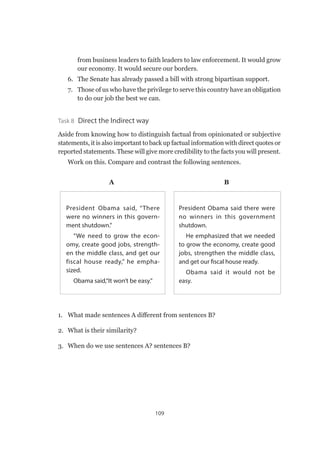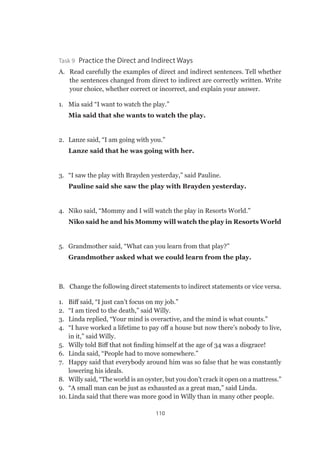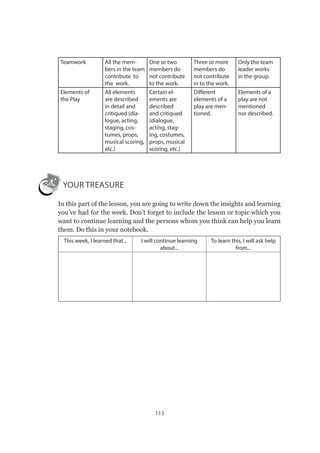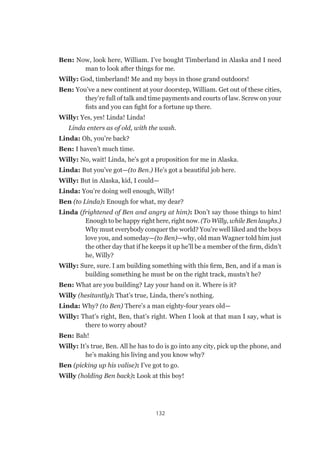

Compilation by Ben: r_borres@yahoo.com        


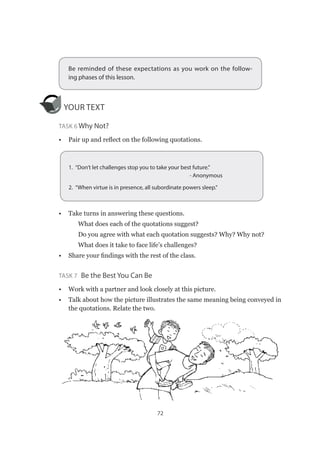
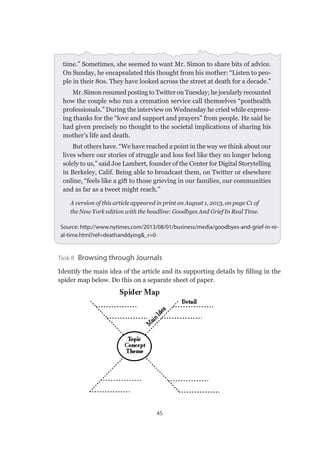
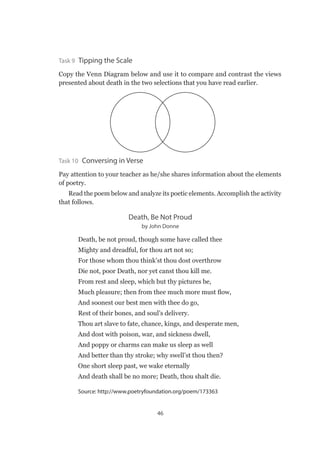
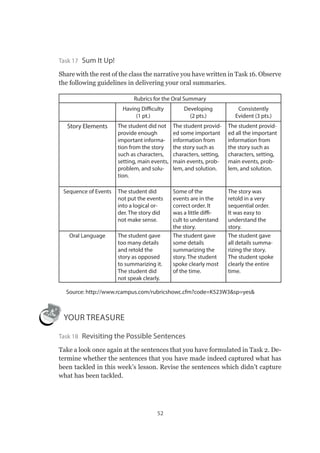
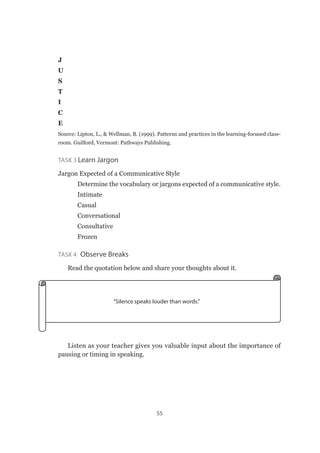
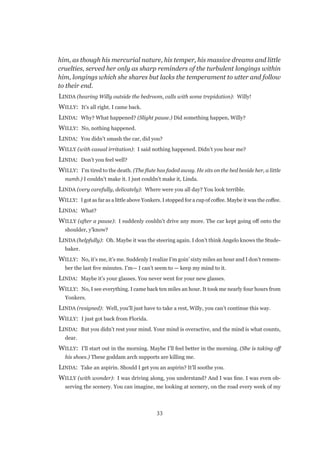
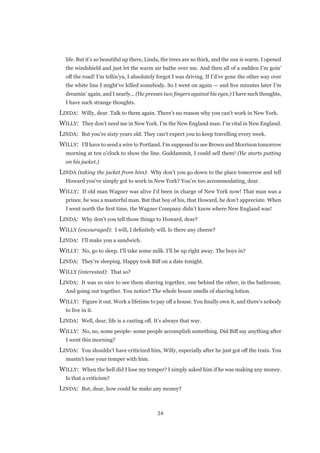
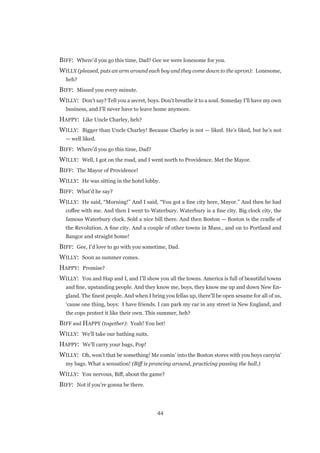
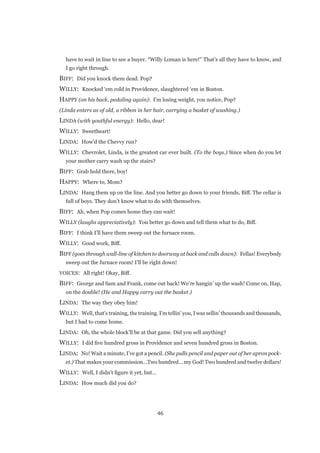
GRADE 9 
Learning Module 
 
ENGLISH 
(Qtr 1 to 4) 
 
 
This instructional material was collaboratively developed and reviewed
by educators from public and private schools, colleges, and/or universi-
ties. We encourage teachers and other education stakeholders to email
their feedback, comments, and recommendations to the Department of
Education at action@deped.gov.ph.
We value your feedback and recommendations.
Department of Education
Republic of the Philippines
A Journey through
Anglo-American Literature
(Learner’s Material for English)
9
ii
A Journey through Anglo-American Literature – Grade 9
Learner’s Material
First Edition, 2014
ISBN:
Republic Act 8293, section 176 states that: No copyright shall subsist in any work
of the Government of the Philippines. However, prior approval of the government
agency or office wherein the work is created shall be necessary for exploitation of
such work for profit. Such agency or office may, among other things, impose as a
condition the payment of royalties.
Borrowed materials (i.e., songs, stories, poems, pictures, photos, brand names,
trademarks, etc.) included in this book are owned by their respective copyright
holders. Every effort has been exerted to locate and seek permission to use these
materials from their respective copyright owners. The publisher and authors do
not represent nor claim ownership over them.
Published by the Department of Education
Secretary: Br. Armin A. Luistro FSC
Undersecretary: Dr. Dina S. Ocampo
Development Team of the Learner’s Material
Consultants: Prof. Marla Papango, Dr. Edison Fermin
Authors: Liza Almonte, Adelle Chua Soliaban, Lerma Flandez, Nedia Lagustan, Henone
de Paz-Langutan, Dreamrose Malayo, Liberty Mangaluz, Elenita R. Miranda,
Lito Palomar, and Grace Annette Barradas-Soriano
Reviewers: Prof. Ruth Alido, Elizabeth Meneses, Rebecca Sagot, Maricar Caberos
Language Editor: Dr. Ma. Antoinette C. Montealegre
Dr. Carla M. Pacis
ProductionTeam: Dir. Joyce DR. Andaya, Dr. Jose D.Tuguinayo Jr., Dr. Melinda P. Rivera, Mr. Ricardo
Ador G. Dionisio, Mr. Peter Tentoco, III
Content Reviewer: Dr. Elena C. Cutiongco
Illustrators:
Layout Artists:
Department of Education-Instructional Materials Council Secretariat (DepEd-IMCS)
Office Address:	 5th Floor Mabini Building, DepEd Complex
Meralco Avenue, Pasig City
Philippines 1600
Telefax:	 (02) 634-1054 or 634-1072
E-mail Address:	 imcsetd@yahoo.com
iii
Table of Contents
Module 1  Enhancing the Self����������������������������������������������������������1
Lesson 1:  Recognizing Roles in Life������������������������������������������������������������������2
YOUR JOURNEY�������������������������������������������������������������������������� 2
YOUR OBJECTIVES����������������������������������������������������������������������� 2
YOUR INITIAL TASKS��������������������������������������������������������������������� 3
Task 1 (Three-minute Letter Search Riddle Game)����������������������������3
Task 2 (All For the Best)����������������������������������������������������������������������3
Task 3 (Inspirations)����������������������������������������������������������������������������4
Task 4 (Effective? Partially...Ineffective?)�������������������������������������������5
Task 5 (Looking Back)��������������������������������������������������������������������������5
Task 6 (Focus Questions)���������������������������������������������������������������������6
Task 7 (What Do I Expect/Need/Hope to Learn?)�����������������������������6
YOUR TEXT
The Seven Ages of Man (William Shakespeare)
Task 8 (Ten-minutes Image Talk)�������������������������������������������������������7
Task 9 (For Significant Human Experience)��������������������������������������8
Task 10 (SGDW)���������������������������������������������������������������������������������10
Task 11 (On Using Expressions Appropriate to Situations)�������������16
Task 12 (On Using Capitalization and Punctuation Marks)�������������18
YOUR DISCOVERY TASKS
Task 13 (Involvement)���������������������������������������������������������������������� 20
Task 14 (Give Me Eight)���������������������������������������������������������������������21
YOUR FINAL TASK
Community Services Brochure���������������������������������������������������������24
YOUR TREASURE������������������������������������������������������������������������27
iv
Lesson 2:  Maximizing My Strength����������������������������������������������������������������29
YOUR JOURNEY������������������������������������������������������������������������ 29
YOUR OBJECTIVES��������������������������������������������������������������������� 29
YOUR INITIAL TASKS������������������������������������������������������������������� 30
Task 1 (Hit the Hints)�����������������������������������������������������������������������������
Task 2 (Say That Again)���������������������������������������������������������������������31
YOUR TEXT
The Battle with Grendel (from Beowulf translated by Burton Raffel)
Task 3 (Attack Those Words)������������������������������������������������������������33
Task 4 (Say Yes or No)�����������������������������������������������������������������������39
Task 5 (Illustrate the Creations)��������������������������������������������������������39
Task 6 (Compare and Contrast)������������������������������������������������������� 40
Task 7 (Into the Hero)����������������������������������������������������������������������� 40
Task 8 (Epic vs. Lyric)������������������������������������������������������������������������41
YOUR DISCOVERY TASKS
Task 9 (Spot the Signals and Punctuation Marks)���������������������������42
Task 10 (Mark the Punctuations)������������������������������������������������������43
Task 11 (Introduce the Characters)���������������������������������������������������44
Task 12 (Type the Text)����������������������������������������������������������������������45
YOUR FINAL TASK
Task 13 (Rap Meant for a Hero)������������������������������������������������������� 48
YOUR TREASURE���������������������������������������������������������������������������������������������������������������������49
Task 14 (Share Your Life’s Lessons)��������������������������������������������������49
Lesson 3:  Leaving a Legacy�����������������������������������������������������������������������������50
YOUR JOURNEY������������������������������������������������������������������������ 50
YOUR OBJECTIVES��������������������������������������������������������������������� 50
YOUR INITIAL TASKS������������������������������������������������������������������� 50
Task 1 (The H.O.M.E.)���������������������������������������������������������������������� 50
v
Task 2�������������������������������������������������������������������������������������������������� 51
Task 3 (Lend Me an Ear)������������������������������������������������������������������� 51
Task 4 (In a Capsule)������������������������������������������������������������������������� 51
YOUR TEXT
The Day of Destiny (from Morte D’Arthur - Sir Thomas Malory)
Task 5 (What’s in a Word?)���������������������������������������������������������������52
Task 6 (A Hero in You)����������������������������������������������������������������������52
Task 7 (The Mirage)�������������������������������������������������������������������������� 60
Task 8 (Mull Over in Groups)����������������������������������������������������������� 60
Task 9 (Group Activity)����������������������������������������������������������������������61
Task 10 (Plotting Them All)���������������������������������������������������������������61
Task 11 (Weigh Up!)���������������������������������������������������������������������������61
Task 12 (Bite the Dash)����������������������������������������������������������������������62
Task 13 (Write a Dash)�����������������������������������������������������������������������62
Task 14 (Type the Hype)��������������������������������������������������������������������62
Task 15 (Let’s Hype!)��������������������������������������������������������������������������63
YOUR DISCOVERY TASKS
Task 16 (Me-Metaphors)��������������������������������������������������������������������63
YOUR FINAL TASKS
Task 17 (Sharing Other People’s Perspectives)���������������������������������65
Task 18 (Viva Voce!)���������������������������������������������������������������������������66
YOUR TREASURE������������������������������������������������������������������������67
Lesson 4:  Coping with Challenges������������������������������������������������������������������ 68
YOUR JOURNEY������������������������������������������������������������������������ 68
YOUR OBJECTIVES��������������������������������������������������������������������� 68
YOUR INITIAL TASKS������������������������������������������������������������������� 69
Task 1 (Twisters)��������������������������������������������������������������������������������69
Task 2 (Constant Recall)��������������������������������������������������������������������70
Task 3 (Make a Synonym Match Challenge)�������������������������������������70
Task 4 (Highlighting the Focus Question)���������������������������������������� 71
Task 5 (What Do I Expect/Need/Hope to Learn?)��������������������������� 71
vi
YOUR TEXT
Mother to Son (Langston Hughes)
Task 6 (Why Not?)�����������������������������������������������������������������������������72
Task 7 (Be the Best You Can Be)��������������������������������������������������������72
Task 8 (Meaningful Life)�������������������������������������������������������������������73
Task 9 (Small Group Differentiated Work)���������������������������������������73
Task 10 (On Using Contractions)�����������������������������������������������������78
YOUR DISCOVERY TASKS
Task 11 (An Advice)����������������������������������������������������������������������������79
Task 12 (Advice Collage)��������������������������������������������������������������������79
Task 13 (Nominee)���������������������������������������������������������������������������� 80
Task 14 (Musically Yours)����������������������������������������������������������������� 80
YOUR FINAL TASKS
Task 15 (Magic 8)������������������������������������������������������������������������������ 80
Task 16 (The Best Info-Ad Campaign)����������������������������������������������81
YOUR TREASURE����������������������������������������������������������������������� 83
Task 17 (How Are You Doing?)��������������������������������������������������������� 84
Lesson 5:  Living with a Purpose����������������������������������������������������������������������85
YOUR JOURNEY������������������������������������������������������������������������ 85
YOUR OBJECTIVES��������������������������������������������������������������������� 85
YOUR INITIAL TASKS������������������������������������������������������������������� 86
Task 1 (Squeezed)������������������������������������������������������������������������������ 86
Task 2 (How Do You Look at Life?)������������������������������������������������� 86
Task 3 (Why Not?)���������������������������������������������������������������������������� 86
Task 4 (Core Question)����������������������������������������������������������������������87
Task 5 (Remember the Focus Question)�������������������������������������������87
Task 6 (What Do I Expect/Need/Hope to Learn?)������������������������� 88
YOUR TEXT
A Psalm of Life (Henry Wadsworth Longfellow)
Task 7 (My Resolve)�������������������������������������������������������������������������� 88
Task 8 (Fusion of Sounds and Sense)���������������������������������������������� 89
vii
Task 9 (Small Group Differentiated Work)���������������������������������������91
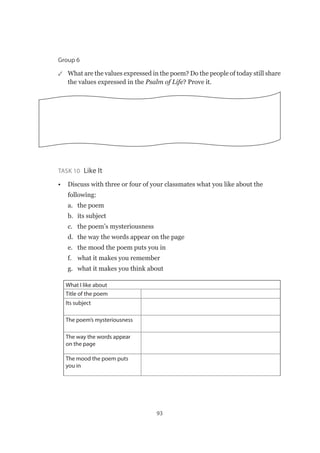
Task 10 (Like It)���������������������������������������������������������������������������������93
Task 11 (Comparing and Contrasting)�����������������������������������������������94
Task 12 (On Using Quotation Marks)�����������������������������������������������94
YOUR DISCOVERY TASKS
Task 13 (Strive)�����������������������������������������������������������������������������������96
Task 14 (Sharing with the Persona)���������������������������������������������������96
Task 15 (Your Turn)���������������������������������������������������������������������������96
YOUR FINAL TASKS
YOUR TREASURE����������������������������������������������������������������������� 98
Lesson 6:  Celebrating Self-worth������������������������������������������������������������������100
YOUR JOURNEY�����������������������������������������������������������������������100
YOUR OBJECTIVES��������������������������������������������������������������������100
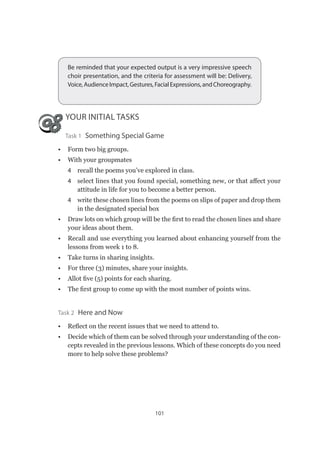
YOUR INITIAL TASKS������������������������������������������������������������������ 101
Task 1 (Something Special Game)��������������������������������������������������� 101
Task 2 (Here and Now)�������������������������������������������������������������������� 101
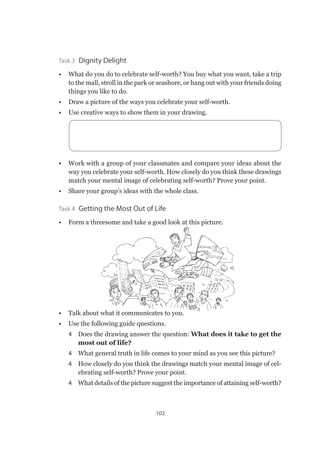
Task 3 (Dignity Delight)�������������������������������������������������������������������102
Task 4 (Getting the Most…Out of Life)�������������������������������������������102
Task 5 (Focus Question)������������������������������������������������������������������103
Task 6 (Setting Expectations)����������������������������������������������������������103
YOUR TEXT
If (Rudyard Kipling)
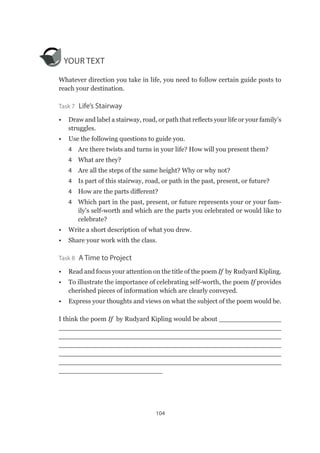
Task 7 (Life’s Stairway)��������������������������������������������������������������������104
Task 8 (A Time to Project)���������������������������������������������������������������104
Task 9 (A Golden Door)�������������������������������������������������������������������105
Task 10 (What’s It…?)����������������������������������������������������������������������105
Task 11 (Vocabulary Game)�������������������������������������������������������������107
Task 12 (SGDW)�������������������������������������������������������������������������������107
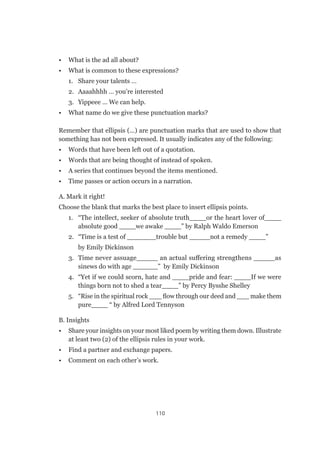
Task 13 (On Using Ellipsis)��������������������������������������������������������������109
YOUR DISCOVERY TASKS
Task 14 (The Big Four)����������������������������������������������������������������������111
viii
YOUR FINAL TASKS
Connect��������������������������������������������������������������������������������������������� 113
A Working Script������������������������������������������������������������������������������ 113
The Fair Plan������������������������������������������������������������������������������������ 114
Rehearse, Rehearse, Rehearse!������������������������������������������������������� 114
YOUR TREASURE�����������������������������������������������������������������������115
ix
Introduction
Welcome to trails in Grade 9 English. This learner’s material is specially designed to provide you
roads to cooperative, collaborative, and independent learning of the target themes, concepts, and
competencies that follow the development of your 21st century real-life based skills.This is basically
anchored on the general principles, goals, and objectives of the K-12 Basic Education Program for
junior high school that centers on the development of every student, like you, to be a functionally
literate individual.
This learner’s material provides variety of texts, particularly Anglo-American literary pieces that
are both relevant and meaningful to your life. This offers opportunities for you to engage yourself
in varied, interesting, challenging, and meaningful tasks that tie together, further develop, and im-
prove your listening, viewing, reading, speaking, writing, vocabulary, literary, and grammar skills.This
integration of literature and language skills will help you demonstrate your understanding of how
you can enrich and enhance your life through valuing the self, other people’s lives, and the world.
There are four modules that comprise this learning material. Each module builds
around a particular text for you to explore meaningfully through engaging yourself in a
variety of integrated, challenging, interesting tasks or activities.
Module 1.  Enhancing the Self
Module 2.  Valuing Other People and Their Circumstances
Module 3.  Connecting to the World
Module 4.  Unchanging Values in a Changing World
There are nine lessons for each module, wherein each lesson is comprised of seven parts:
1.	 Your Journey – provides an overview of what you should understand in the lesson.
This includes the clear directions and purpose of the lesson at hand.
2.	 Your Objectives – state the expectations in line with what you should know, understand, and
be able to do, produce, and perform as evidence or transfer of learning.
3.	 Your Initial Tasks – diagnose and activate your prior knowledge; and prepare you
for higher level tasks.
4.	 Your Text – presents the main reading or literary text and the activities/tasks that will lead
you to acquire knowledge, make sense, and construct meaning out of the information and
experiences contained therein.
5.	 Your Discovery Tasks – call for activities that expand, enrich, enhance, and broaden your
understanding of the target concepts and skills.
6.	 Your Final Task – presents the real-life based product or performance task as final
output for the lesson that serves as evidence of understanding or transfer of learn-
ing of the target concepts and skills. This is an enabling task for the main real-life
based product or performance task covering the entire module.
x
7.	 My Treasure - enables you to express your insights, learning, and realizations on
the lesson. This part contains prompts and other graphic organizers that will help
you to sum up and to synthesize what you have learned.
This learner’s material includes formal pre and post assessments by module in both written
response and multiple-choice formats.
Hopefully with this material, you will be provided with successful, meaningful learning experi-
ences and relevant competencies necessary for you to meet the demands of the 21st century.
The Authors and Developers
2
YOUR JOURNEY
You, like others, have important roles to play that make you interested in
shaping yourself to become a healthy and developed young adult. Learning how
to recognize and to perform your roles effectively is a good indicator that you’re
a responsible individual using even your past experiences to make a difference
in your life. This can enhance your understanding of the world. Somehow you
have to continue finding out just what it is that fits you. So whatever it is that
you do of significance, willingly and graciously, you have to prove to yourself
and to others that you can excel. Try your best. Concentrate on ways to perform
well. You’ll surely feel better if you do.
In this lesson, you will find a poem, an informative article, and tasks/activities
that will build your understanding of the value of recognizing and performing
roles in life, at the same time, develop your listening, speaking, reading,
writing, viewing, grammar and literary skills. Hopefully, these can be demon-
strated through a Community Services Brochure.
YOUR OBJECTIVES
Charting the course of your journey in this lesson, you are expected to:
•	 share prior knowledge about the topic
•	 process information mentioned in the text you have heard
•	 perform tasks by following instructions
•	 infer thoughts, feelings, and intentions in the material to view
•	 provide words or expressions appropriate for a given situation
•	 analyse literature as a means of discovering the self
•	 point out the distinguishing features of a poem
•	 determine the features of informative writing
•	 use the appropriate stress in delivering lines of poetry and prose
•	 use capitalization and punctuations correctly
•	 present a well-prepared Community Services Brochure
Lesson 1
RECOGNIZING ROLES IN LIFE
3
YOUR INITIAL TASKS
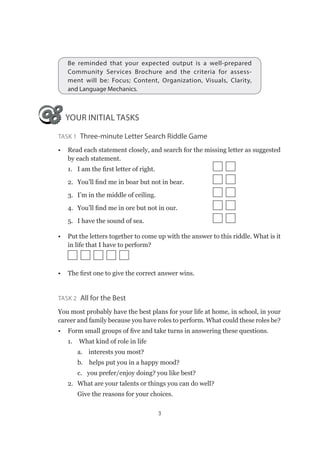
Task 1  Three-minute Letter Search Riddle Game
•	 Read each statement closely, and search for the missing letter as suggested
by each statement.
1.	 I am the first letter of right.	  
2.	 You’ll find me in boar but not in bear.	  
3.	 I’m in the middle of ceiling.	  
4.	 You’ll find me in ore but not in our.	  
5.	 I have the sound of sea.	  
•	 Put the letters together to come up with the answer to this riddle. What is it
in life that I have to perform?
       
•	 The first one to give the correct answer wins.
Task 2  All for the Best
You most probably have the best plans for your life at home, in school, in your
career and family because you have roles to perform. What could these roles be?
•	 Form small groups of five and take turns in answering these questions.
1.	 What kind of role in life
a.	 interests you most?
b.	 helps put you in a happy mood?
c.	 you prefer/enjoy doing? you like best?
2.	 What are your talents or things you can do well?
Give the reasons for your choices.
Be reminded that your expected output is a well-prepared
Community Services Brochure and the criteria for assess-
ment will be: Focus; Content, Organization, Visuals, Clarity,
and Language Mechanics.
4
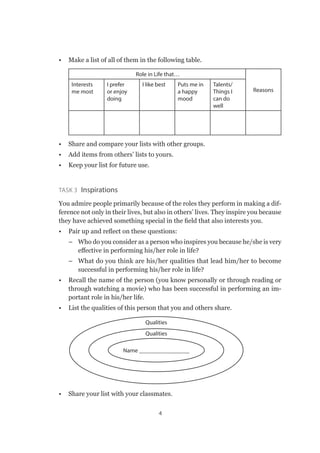
•	 Make a list of all of them in the following table.
Role in Life that…
Reasons
Interests
me most
I prefer
or enjoy
doing
I like best Puts me in
a happy
mood
Talents/
Things I
can do
well
•	 Share and compare your lists with other groups.
•	 Add items from others’ lists to yours.
•	 Keep your list for future use.
Task 3 Inspirations
You admire people primarily because of the roles they perform in making a dif-
ference not only in their lives, but also in others’ lives. They inspire you because
they have achieved something special in the field that also interests you.
•	 Pair up and reflect on these questions:
–	 Who do you consider as a person who inspires you because he/she is very
effective in performing his/her role in life?
–	 What do you think are his/her qualities that lead him/her to become
successful in performing his/her role in life?
•	 Recall the name of the person (you know personally or through reading or
through watching a movie) who has been successful in performing an im-
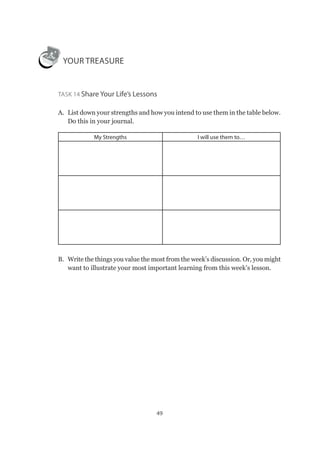
portant role in his/her life.
•	 List the qualities of this person that you and others share.
•	 Share your list with your classmates.
Qualities
Qualities
Name _________________
5
Task 4  Effective? Partially… Ineffective?
•	 Interview at least five classmates and find out how they perform their roles
in life.
•	 Note their responses.
•	 Copy the chart shown below and plot it with the entries called for.
Ways to Perform Life Roles
Ineffective Partially Effective Effective
•	 Share your findings with the class.
Task 5  Looking Back
Obviously, you are aware that life is a continuous journey. Your present plans
have something to do with your past experiences and your plans for the future.
Why don’t you
•	 look back at the roles you played before and zero in on the most important
one for you.
•	 think of how it differs from the role you are playing now.
•	 plot the roles you played before, what roles you are playing now, and what
you hope to play in the future.
•	 specify how you feel about it and how you fare in performing it.
Role in Life that I…
ReasonsPlayed
before
How I felt
about it
Am play-
ing now
How I feel
about it
Hope/wish
to play in
the future
•	 Look back at the ideas you listed in All for the Best phase. Find out which
of them you’ll change or add to the ones in the chart.
•	 Share and compare your ideas with a partner.
•	 Report back to the class.
6
Task 6  Focus Questions
Hopefully, through your understanding of the overriding and underlying con-
cepts plus the tasks/activities you’ve been engaged in in this lesson you’ll surely
be able to answer the FOCUS (BIG) Questions:
•	 What roles can I perform that will make a difference in my life?
•	 Why is it important to recognize my roles in life?
•	 How can I perform my roles in life effectively?
Remember these questions as you work on the phases of this lesson.
•	 List logical temporary answers to the focus questions. Answering them will
surely help you make a difference in your life. Copy the chart shown below
and fill it out with your responses.
Task 7  What Do I Expect/Need/Hope to Learn?
•	 Write what you expect/need/hope to learn in this lesson.
What I expect/need/hope to learn
________________________________________________
________________________________________________
________________________________________________
________________________________________________
________________________________________________
________________________________________________
7
•	 As you explore this lesson, you can add/answer the questions and consider
how the tasks will not only help you understand the language and literary
concepts, but also help you shape your life.
Be reminded of these expectations as you work on the following phases of this
lesson.
YOUR TEXT
This phase will crystallize your knowledge and understanding of your target
concepts and skills through deeper exploration of the poem in focus.
Doubtlessly, you know that appreciating a poem is like appreciating a picture,
photo, illustration, or drawing.
Task 8  Ten-minute Image Talk
Although it is never stated, you as a reader/viewer can infer thoughts, feelings,
and intention based on the details of information presented in the photo/picture
or drawing. You can focus on the lines, angles, colors, or even on the shapes of
the objects/images presented and relate them to real-life experiences for you to
understand their message/meaning.
•	 Pair up and look closely at the drawing.
8
•	 Talk about/discuss what it communicates to you.
•	 Use the following guide questions.
4	 What do you think the drawing wants/intends you to believe?
4	 Does it suggest/answer the question: What roles can I perform that
will make a difference in my life?
4	 How closely do you think/believe the drawing matches your mental image
of recognizing and performing roles in life? Prove your point.
4	 What details of the drawing tell you about recognizing and performing
roles in life?
4	 How well do you think/believe the drawing/illustration fits the value of
recognizing and performing roles in life?
4	 How does the picture make you feel about recognizing and performing
roles in life?
•	 After 10 minutes, convene and share your responses.
•	 Find common grounds about your ideas.
Task 9  For Significant Human Experiences
Reading a poem paves the way to making meaning in life. It allows you to share
certain experiences. Oftentimes, you find you share something more in com-
mon with the poem’s content than you originally thought; this makes the poem
meaningful.
Now, find out how the poem The Seven Ages of Man from the comedy As
You Like It by William Shakespeare provides cherished pieces of information
about the human condition.
•	 Listen to your teacher read the poem.
•	 As you listen to your teacher read the poem, read it silently and watch out for
words which are difficult for you to understand. List them in your vocabulary
notebook and have them as entries in your word bank.
9
THE SEVEN AGES OF MAN
(from: As You Like It ) by William Shakespeare
All the world’s a stage,
And all the men and women are merely players;
They have their exits and entrances,
And one man in his time plays many parts
5
	 His acts being seven ages. At first the infant,
Mewling and puking in the nurse’s arms;
And then the whining school boy, with his satchel
And shining morning face, creeping like snail
Unwillingly to school. And then the lover,
10
	 Sighing like furnace, with a woeful ballad
Made to his mistress’ eyebrow. Then a soldier
Full of strange oaths, and bearded like a pard,
Jealous in honor, sudden and quick in quarrel,
Seeking the bubble reputation
15
	 Even in the cannon’s mouth. And then the justice,
In fair round belly with good caper lined,
With eyes severe and beard of formal cut,
Full of white saws and modern instances;
And so he plays his part. The sixth age shifts
20
	 Into the lean and slippered pantaloons,
With spectacles on nose and pouch on side;
His youthful hose well saved, a world too wide
For his shrunk shank; and his big manly voice,
Turning again toward childish treble, pipes
25
	 And whistles in his sound. Last scene of all,
That ends this strange eventful history,
Is second childishness and mere oblivion,
Sans teeth, sans eyes, sans taste, sans everything.
10
Poetry is a personal type of writing where words flow and carry you along
the realms of beautiful thought. What really contribute to the poem’s meaning?
Doubtlessly, you know that the orchestration of sounds, story, sense, and form
brings about “life” in a poem you read. That absolutely drives you to “feel” life in it.
Some poems are full of words that are fun to say aloud. You can express
the meaning of the words by reading them aloud and you can use your voice to
express their meaning.
•	 In small groups of five, read aloud the poem The Seven Ages of Man from
the comedy As You Like It by William Shakespeare.
•	 Decide who will be the first, second, third, fourth, and fifth readers.
•	 Try to make the meaning of the words come alive through using good ex-
pressions.
•	 Remember to produce the correct critical consonant sounds in words like:
in /s/- s, z, sh, or zh.
e.g.,	 sooth -/s/	 zoo -/z/	 shoe -/sh/	 sure -/zh/
•	 Watch out for words in the poem that have the same sounds.
•	 Also think back on the importance of using appropriate stress to words you’ll
read to convey meaning.
e.g.,	SEven	 PLAYers	 MEWling	 INfant	 PANtaloons
Ages	sPECtacles	obLIvion
•	 Remember that the parts in capital letters receive the primary stress /'/.
Stress the words properly.
•	 Read the poem aloud again. Use the appropriate stress and produce the
correct sounds of the letters that make up the words.
Task 10  Small Group Differentiated Works (SGDW)
Form eight (8) small groups and perform your assigned tasks.
Group 1.  Looking for rhymes
Remember that rhyme is part of what we mean when we say poetry is musical.
When the ending sounds of words are repeated, we call it rhyme. Rhyming words
do not appear only at the end of the lines (end rhyme) in poems, but they may
appear within the line (internal rhyme).
e.g.,	“I think that I shall never see
A poem as lovely as a tree.” [ see-tree] — end rhyme
“the crows in boughs throws endless brawls” — internal rhyme
11
Some poems rhyme; others don’t. But one thing is sure, each poem captures
moments in time, feeling, thoughts, and experiences. Though this poem is a
sample of blank verse (poetry with an unrhymed iambic pentameter lines)
that was widely used by Shakespeare, it contains internal rhyme.
•	 Read the poem once more and spot the words that rhyme.
•	 Make a list of these rhyming words and determine which are examples
of internal rhyme and end rhyme.
•	 Copy the table as shown below, and fill it out with the appropriate entries.
Rhyming Words in The Seven Ages of Man
End Rhyme Internal Rhyme
•	 Share your findings with the other groups.
Group 2.  The best clue
The poet uses words that suggest sounds at the same time describe actions be-
ing made. Onomatopoeia is a sound device used by poets to suggest actions,
movements, and meanings.
e.g.,	The hissing of the snake made me shoo it away.
The bubbling brook breaks.
•	 Read the poem aloud once more, and watch out for words that suggest
sounds of movements, actions, and meaning.
•	 Find examples of onomatopoeia in the poem.
•	 Picture each word in your mind and try to bring each image in clear focus.
•	 Use the following questions to guide you.
4	 What does it look like?
4	 What kind of sounds does it make?
4	 How does it move?
12
•	 List them in the table shown below.
Onomatopoeia in The Seven Ages of Man
Sample line/
words
It looks like
The sound it
makes
How it moves
•	 Share your findings with the other groups.
Group 3.  Alliteration, Assonance, and Consonance (A2
 C)
Other interesting features of a poem that make it musical is the presence of
sound devices like alliteration, assonance, and consonance.
Alliteration is the repetition of consonant sounds at the beginning of the words
like:
	doubting, drearing dreams no mortal
	enter dared to dream before.
	 — Edgar Allan Poe, from The Raven
Assonance is the repetition of vowel sounds within words;
e.g. 	 along the window sill, the lipstick stabs
	glittered in their steel shells.
	 – Rita Dove, from Adolescence III
Consonance is the repetition of consonant sounds within and at the end of
the words.
e.g. 	 Some late visitor entreating entrance at
	 my chamber door
	—E.A. Poe, from The Raven
•	 Read the poem again and look out for words or lines that sound like they
are examples of alliteration, assonance, and consonance.
13
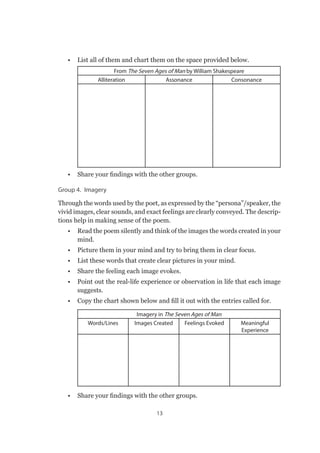
•	 List all of them and chart them on the space provided below.
From The Seven Ages of Man by William Shakespeare
Alliteration Assonance Consonance
•	 Share your findings with the other groups.
Group 4. Imagery
Through the words used by the poet, as expressed by the “persona”/speaker, the
vivid images, clear sounds, and exact feelings are clearly conveyed. The descrip-
tions help in making sense of the poem.
•	 Read the poem silently and think of the images the words created in your
mind.
•	 Picture them in your mind and try to bring them in clear focus.
•	 List these words that create clear pictures in your mind.
•	 Share the feeling each image evokes.
•	 Point out the real-life experience or observation in life that each image
suggests.
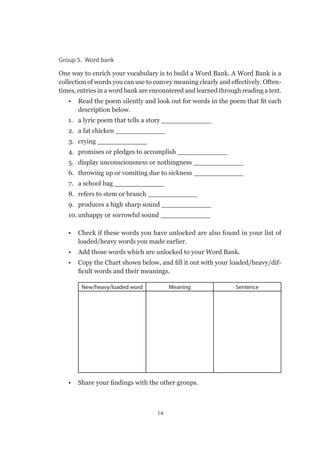
•	 Copy the chart shown below and fill it out with the entries called for.
Imagery in The Seven Ages of Man
Words/Lines Images Created Feelings Evoked Meaningful
Experience
•	 Share your findings with the other groups.
14
Group 5.  Word bank
One way to enrich your vocabulary is to build a Word Bank. A Word Bank is a
collection of words you can use to convey meaning clearly and effectively. Often-
times, entries in a word bank are encountered and learned through reading a text.
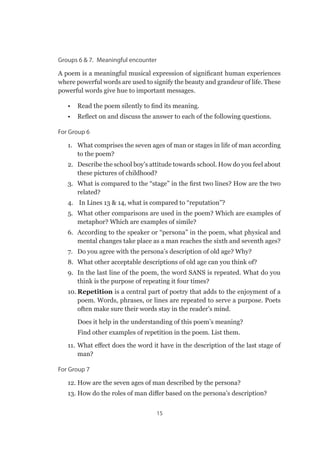
•	 Read the poem silently and look out for words in the poem that fit each
description below.
1.	 a lyric poem that tells a story ____________
2.	 a fat chicken ____________
3.	 crying ____________
4.	 promises or pledges to accomplish ____________
5.	 display unconsciousness or nothingness ____________
6.	 throwing up or vomiting due to sickness ____________
7.	 a school bag ____________
8.	 refers to stem or branch ____________
9.	 produces a high sharp sound ____________
10.	unhappy or sorrowful sound ____________
•	 Check if these words you have unlocked are also found in your list of
loaded/heavy words you made earlier.
•	 Add those words which are unlocked to your Word Bank.
•	 Copy the Chart shown below, and fill it out with your loaded/heavy/dif-
ficult words and their meanings.
New/heavy/loaded word Meaning Sentence
•	 Share your findings with the other groups.
15
Groups 6  7.  Meaningful encounter
A poem is a meaningful musical expression of significant human experiences
where powerful words are used to signify the beauty and grandeur of life. These
powerful words give hue to important messages.
•	 Read the poem silently to find its meaning.
•	 Reflect on and discuss the answer to each of the following questions.
For Group 6
1.	 What comprises the seven ages of man or stages in life of man according
to the poem?
2.	 Describe the school boy’s attitude towards school. How do you feel about
these pictures of childhood?
3.	 What is compared to the “stage” in the first two lines? How are the two
related?
4.	 In Lines 13  14, what is compared to “reputation”?
5.	 What other comparisons are used in the poem? Which are examples of
metaphor? Which are examples of simile?
6.	 According to the speaker or “persona” in the poem, what physical and
mental changes take place as a man reaches the sixth and seventh ages?
7.	 Do you agree with the persona’s description of old age? Why?
8.	 What other acceptable descriptions of old age can you think of?
9.	 In the last line of the poem, the word SANS is repeated. What do you
think is the purpose of repeating it four times?
10.	Repetition is a central part of poetry that adds to the enjoyment of a
poem. Words, phrases, or lines are repeated to serve a purpose. Poets
often make sure their words stay in the reader’s mind.
Does it help in the understanding of this poem’s meaning?
Find other examples of repetition in the poem. List them.
11.	What effect does the word it have in the description of the last stage of
man?
For Group 7
12. 	How are the seven ages of man described by the persona?
13. 	How do the roles of man differ based on the persona’s description?
16
14.	Do you think the persona has a great understanding of the universal ex-
perience of man performing a role in each stage? Explain.
15.	Which lines describe the roles in life that man performs?
16.	Under what circumstances may it be better to be young rather than be
old or vice versa in performing roles in life?
17.	How does the poem make you feel about the importance of recognizing
and performing a role in life effectively?
18.	Why is it acceptable/better to recognize and perform your role in life?
19.	How does the poem make you think of the importance of recognizing and
performing a role in life effectively?
20.	What are the advantages and disadvantages of not recognizing and per-
forming your roles in life?
21.	What would be the most effective way of performing your role in life?
•	 Share your responses with the other groups.
Group 8.  Connect to life
•	 Answer the following guide questions:
4	 Which part makes/drives you to think of someone/something in real
life?
4	 What kind of roles in life are conveyed in the poem?
4	 What line(s) suggest how one can be effective in performing one’s
role?
4	 Is the message of the poem worthwhile? Prove your point.
4	 How important is the poem’s message in your life?
•	 Share your responses with the other groups.
Task 11  On Using Expressions Appropriate to Situations
A.	
•	 Read the poem once more to answer these questions.
4	 Do you agree with the persona’s description of the last age of man in
the last two lines of the poem? Why?
4	 Do you agree when he says that the last stage is “second childhood
without everything?” Prove your point.
17
Remember that there are many ways you can express agreement
or disagreement. There are special words/expressions that clearly
indicate the intention and their appropriateness to the situation.
These words/expressions can be formal or informal but the sit-
uation dictates their specific functions.
e.g. 	 Consider your possible responses to the aforementioned guide ques-
tions.
	 Of course, I agree with the persona’s description of the last age of
man.
	No, seriously, I believe otherwise.
4	 Which words express agreement? Disagreement?
4	 Can you give other examples of agreement? disagreement?
Read these sample mini dialogues aloud and spot the presence of words/expressions
indicating agreement or disagreement.
1.	 Angelo: You’re the only person who knows what really happened.
	 Malee: That’s not quite true. Sam was there, too.
2.	 May: Hey, that’s right. I remember he solved the problem for us.
	 Joe: That’s good to know. We’ll give him a call.
3.	 Erick: We can play the game now.
	 Andrei: Okay, but I’m not good at it.
4.	 Bam: That’s what they say!
	 Rom: No, seriously. I haven’t played very well at all.
5.	 Connie: Do come. Can you stay for lunch?
	 Vangie: I’m afraid not. We have to go somewhere .
6.	 Rina: But you have time for coffee, don’t you?
	 Tess: That would be nice.
7.	 Milette: There’s something I have to tell you.
	 Mila: Can’t it wait?
	 Milette: Not really. It’s pretty important.
18
8.	 Lucille: Should I forget it all?
	 Annie: No, just listen carefully.
9.	 Sonny: Okay, I guess I’m ready.
	 Leif: Good. Now, concentrate.
B.	 Positive Roles
•	 Reread the poem The Seven Ages of Man and pair up.
•	 Find lines that suggest man has to perform roles in life.
•	 Specify which lines clearly point out positive sign of performing roles in life.
	 Talk about which of them you agree or disagree with. Explain.
•	 Use words/expressions indicating your purpose.
•	 Share your ideas with the class.
Task 12  On Using Capitalization and Punctuation Marks
When you read poems, you don’t pause or stop at the end of the lines, but you
watch out for commas or periods to guide you. Use punctuation marks to help
you find the sensible meaning of what you’re reading. Clarity of expressions in
poetry or prose composition exists if the sentences are appropriately punctuated
and the words are properly capitalized.
A.	 Connect
•	 Consider this sample informative article about punctuation.
A Short History of Punctuation
by: Polly M. Robertus
EARLYGREEKSHAD HARDLYANYPUNCTUATION
FONOITCERIDEHTDEGNAHCNEVEDNA*
THEIRWRITINGATTHEENDOFEACHLINELATER
GNITIRWFOYAWAOTDEGNAHCYEHT*
THATFAVOREDRIGHTHANDEDPEOPLEANDSHOWED
WHEREANEWPARAGRAPHBEGANBYUNDERLINING
THEFIRSTLINEOFITLATERTHEGREEKPLAYWRIGHT
ARISTOPHANES . INVERTEDMARKSTOSHOW . WHERE
19
THEREADERSSHOULDTAKEBREATH:
THE . ROMANS . MADE . WRITING . MUCH . EASIER .
TO . READ . BY . PUTTING . DOTS . BETWEEN . WORDS .
AND . BY . MOVING . THE . FIRST . LETTER . OF. A .
PARAGRAPH . INTO . THE . LEFT . MARGIN: THEY .
ADAPTED . SOME . OF . THE . GREEK . MARKS . SUCH . AS .
THE . COLON . MARK . TO . INDICATE . PHRASE . ENDINGS:
INTHEEARLYMIDDLEAGESTHISSYSTEMOFPUNCTUATION
BROKEDOWNBECAUSEVERYFEWPEOPLECOULDREAD
ANDWRITE BUTWRITERSKEPTASPACEATTHEENDOF
ASENTENCEANDCONTINUEDTOMARKPARAGRAPHS
EVENTUALLY WORDS WERESEPARATED AGAIN AND
NEW SENTENCES BEGAN WITH A LARGER LETTER
*Hint: Try reading from right to left.
The educational reforms of Charlemagne led to the invention of lowercase letters
which could be written and read much faster. Phrases and sentence endings were
indicated either by ... or by a slash (/).
As time went on writers looked for more ways to clarify meaning/In medi-
eval music notation they found a way to indicate how a voice should rise or fall
at the end of a sentence or phrase. Can you hear your voice rise at the end of
a question? Our question mark came directly from medieval music notation.
When a long sentence broke in the middle  they put a new mark that became
our semi colon and colon. The hyphen appeared as two lines (=) instead of one.
Around A.D. 1500 the indented paragraph appeared, as did the comma and
period as we know them. Printers of the Renaissance invented new marks like the
exclamation points and quotation marks. By that time, people were commonly
reading silently, and punctuation came to depend more on grammatical groups
than breath groups. (Parentheses and dashes appeared with the advent of printing.)
By the end of the seventeenth century, our punctuation system was in place
for the most part, though sometimes details varied. Just think, though: After
only a few lessons in school—and with lots of practice reading and writing—you
can boast that you’ve mastered a system that took westerners many centuries
to develop.
20
•	 Discuss your answers to the following questions.
4	 What have you observed as unusual in the informative article?
4	 What is it all about?
4	 What punctuation marks are described in the article?
4	 What problems in writing and reading are caused by improper use of
capitalization and punctuation marks?
4	 Are these problems applicable even in today’s world?
4	 How do we solve such problems?
B.	 Sensible Role Plan
•	 Imagine yourself two to four years from now. What kind of career/role
do you think you might have? Will the computer or new inventions be
part of your job?
•	 Research for facts about it.
•	 Write a short informative composition highlighting your role and the
invention you will use as part of your job.
•	 Remember to observe correct capitalization and to use correct punctua-
tions.
•	 Share your informative composition with the class.
Since you have several impressive ideas on recognizing and performing roles
in life, you have to keep in mind that it can inspire you to practice habits of
doing things well. You can always consider it as a special gift for you to prove
your worth as a unique human being. Obviously, you are now ready to prove
your understanding of how this valued concepts can be realized through getting
involved in real-life tasks.
YOUR DISCOVERY TASKS
Task 13 Involvement
•	 Form small groups of six and discuss the answer to the question:
	 What can I do to perform my role effectively?
•	 List the ways in which you have already contributed, are contributing,
and predict the ways in which you’ll contribute to the world in the future.
21
•	 Copy the chart as shown below and fill it out with entries called for.
The Contributions
I made I can make I will make
•	 Share your ideas with your classmates.
Task 14 Give me Eight
Form eight (8) small groups and choose one from the following tasks to work on.
Group 1.  Yes, it’s simple but it’s too good to miss
•	 Form a tableau.
•	 Position your body to form a tableau that depicts a scene from the poem.
•	 Find out if the other groups can identify the scene and each person’s part
in it.
Group 2.  Fan letter to a role model
You look up to your parents, grandparents, teachers, relatives, or friends because
they inspire you to perform roles in life effectively. You regard them as good role
models who help you along the way.
•	 Choose an inspirational person and write a fan letter to him/her.
•	 Include a request for some meaningful object or symbol and for some tips
of their success.
•	 Explain in your letter why you admire this person and why you consider
him/her as your role model.
•	 Also mention how he/she helps you and why you want the object.
•	 Read your letter to your classmates.
22
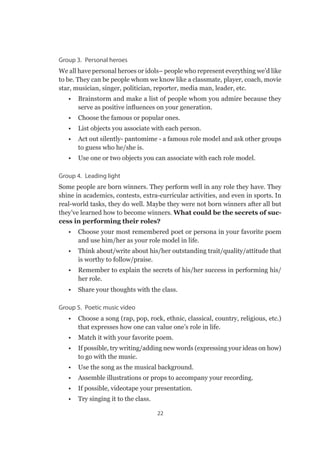
Group 3.  Personal heroes
We all have personal heroes or idols– people who represent everything we’d like
to be. They can be people whom we know like a classmate, player, coach, movie
star, musician, singer, politician, reporter, media man, leader, etc.
•	 Brainstorm and make a list of people whom you admire because they
serve as positive influences on your generation.
•	 Choose the famous or popular ones.
•	 List objects you associate with each person.
•	 Act out silently- pantomime - a famous role model and ask other groups
to guess who he/she is.
•	 Use one or two objects you can associate with each role model.
Group 4.  Leading light
Some people are born winners. They perform well in any role they have. They
shine in academics, contests, extra-curricular activities, and even in sports. In
real-world tasks, they do well. Maybe they were not born winners after all but
they’ve learned how to become winners. What could be the secrets of suc-
cess in performing their roles?
•	 Choose your most remembered poet or persona in your favorite poem
and use him/her as your role model in life.
•	 Think about/write about his/her outstanding trait/quality/attitude that
is worthy to follow/praise.
•	 Remember to explain the secrets of his/her success in performing his/
her role.
•	 Share your thoughts with the class.
Group 5.  Poetic music video
•	 Choose a song (rap, pop, rock, ethnic, classical, country, religious, etc.)
that expresses how one can value one’s role in life.
•	 Match it with your favorite poem.
•	 If possible, try writing/adding new words (expressing your ideas on how)
to go with the music.
•	 Use the song as the musical background.
•	 Assemble illustrations or props to accompany your recording.
•	 If possible, videotape your presentation.
•	 Try singing it to the class.
23
Group 6.  Dance duo
•	 Recall as many songs as you can about the importance of playing roles in
life.
•	 Choose a music that you think conveys the feeling and the meaning of or
the one that represents the poem, The Seven Ages of Man.
•	 Sing it and use appropriate movements that suggest the meaning of the
poem.
•	 Interpret your chosen lines from the poem through dance steps/movements.
•	 Rehearse a performance of the poem and dance.
•	 Present it to the class.
Group 7.  Roles and concerns
•	 With your groupmates, discuss how you’ll squarely come up with any of
the following:
4	What recent world issues/problems can be solved if people recognize
and perform their roles effectively?
4	 How are our lives different or similar to people who have been suc-
cessful?
•	 Discuss a major change in your life.
•	 Use the following guide questions:
4	 What was difficult about playing that role?
4	 How did the situation improve?
4	 How would you handle the role successfully?
•	 Remember to share your responses/ideas with other groups.
•	 Set time for feedback.
Group 8.  High/low points
The roles you perform in life drive you to experience high points and low points.
•	 What are these high points and low points you experienced? Explain.
•	 Make sure you share these points you experience as you perform your
role in your past and present life.
•	 Post these high and low points in your FB or Twitter Wall or send them
to your friends through e-mail.
•	 Invite them to give comments, suggestions, or reactions.
24
You’re doing great! How do you feel about it? Do you want to
add more proof of your understanding on the target concepts
and to hone your communication skills?
YOUR FINAL TASK
As evidence of your understanding and learning the target concepts and
enhancing the target skills, you have to try your hand on your major output for
this lesson– making a Community Services Brochure. The criteria for as-
sessment will be: Focus, Content, Organization, Supports, Visuals, Clarity, and
Language Mechanics. You will do this by groups.
•	 Form five big groups and perform your assigned tasks.
Here are some ideas for the preparation and presentation of a Community
Services Brochure. Look them over before you plunge into it. Keep these
points in mind as you go through the process.
You probably know of clubs, organizations, centers, or even key persons of-
fering services in your barangay/community. Consider them as those who have
performed extraordinary roles in life.
•	 Scout for and present sample brochures.
•	 Bear in mind that a brochure like a letter, report, speech, review, instruc-
tion pamphlet, and any other form of informative writing presents factual
information and details.
•	 Discuss the answer to the following questions:
4	 What is the brochure all about?
4	 What do you think is the purpose of this brochure?
4	 Who do you think is the target audience of this brochure?
4	 What are the information or basic features contained in the brochure?
4	 Is the information based on facts?
4	 How is the basic information presented in the brochure?
4	 Which of the following methods (description, enumeration, compari-
son/contrast, or exemplification) were used in the presentation of the
information?
25
4	 What is the basic structure of a brochure?
4	 What makes the brochure interesting?
4	 What words capture your attention?
4	 What help/support/advantages does the brochure offer?
Planning Stage
•	 Conduct a meeting and plan for the preparation of the brochure where
the following points should be covered.
4	 Assign a specific role to each member. e.g., a leader, researcher, il-
lustrator, compiler, layout artist, writer, interviewer, editor, concept
artist, presenter.
4	 Clarify the functions of each member.
4	 Clarify the main requirements for the brochure which are the topic,
purpose, and audience.
4	 Identify the topic for the brochure.
4	 Clarify the purpose of the brochure. Answer these questions: Why
are we writing/composing this brochure? Who will be interested in
reading it? Who needs it?
4	 Identify the key persons, clubs, organizations, centers, and the services
that will be highlighted in the brochure.
Gathering Information
•	 Look for the key persons, clubs, centers, and organizations in the barangay
that offer services that make a difference.
•	 Prepare questions and put them in a logical order.
•	 Call or visit and interview at least three (3) people whom you consider
successful in performing their roles to learn more about their services.
•	 Make a list of their accomplishments/achievements and specialization.
•	 Find out what they consider important to their success.
•	 Collect photos, drawings, illustrations, or videos (if possible) showing
ordinary people making a difference by performing their roles in life
willingly and graciously.
26
Drafting
•	 Consolidate the information you have gathered, and choose the ones you
will use in your brochure.
•	 Use few, simple, short, catchy but meaningful sentences.
•	 Think of the order you will use to organize the factual information.
•	 Point out the help, support, and benefits the organization, club, or key
persons receive as well as the specialization or services they offer.
•	 Explain the significance of the services to the target readers.
•	 Through speaking and writing, report the services and needs of the
	organization.
•	 Use photos and charts in the presentation.
Writing and Presenting
•	 Ask other schoolmates to read and evaluate your brochure.
•	 Ask for comments and suggestions.
•	 Look over the first draft and rewrite it.
•	 Polish your draft incorporating the suggestions made by your evaluators.
•	 Do the finishing touches and present your Community Services Brochure.
•	 Consider and be guided by the following criteria:
4	 Focus and Content
4 	 Organization
4	Supports
4	Visuals
4	Clarity
4	 Language Mechanics
•	 Check your progress.
27
YOUR TREASURE
Clearly, you’ve actively engaged in various tasks that helped you improve your
understanding of the target concepts, at the same time, develop your language
communication and literary skills.
Your Community Services Brochure informing the public of the ser-
vices available in your community serves as a major proof/evidence of your
understanding of concepts and skills.
To further prove your successful and exciting learning experiences that you
obviously enjoyed learning, it is just but fitting that you think back and focus
on the following essential points.
Which task/activity have you
enjoyed? _________________________________________________
found helpful? _____________________________________________
would like to work on further? _________________________________
________________________________________________________
Keep a record of all of these and add your answers to the following questions:
1.	 What new and special way about recognizing your roles in life have you
learned?
2.	 What approach to/attitude in life do you think can help you chart your
course in life?
3.	 How will it help you to become a better person?
4.	 What did you find most difficult in this lesson?
5.	 What will you do to do away with these difficulties?
6.	 Write at least three possible ways/steps you can adopt to solve these
difficulties.
7.	 What do you hope to strengthen in the next lesson/s?
28
•	 Complete the chart as shown with entries called for.
New and special way Attitude in life How will it help me
Part of the lesson that
I enjoyed are helpful I consider
most
difficult
provide-
ways to get
away with
the most
difficult
I hope/
expect to
improve/
strengthen
in the next
lesson
I would like
to work
further on
29
Lesson 2
Maximizing My Strength
YOUR JOURNEY
“Character cannot be developed in ease and quiet.
Only through experience of trial and suffering
can the soul be strengthened,
ambition inspired and success achieved.”
-	 Hellen Keller
Maximizing means “making the best use of” and this is what you must do with
your strength. This happens when you focus on the areas you are most skilled,
talented, and strong in while avoiding your weaknesses.
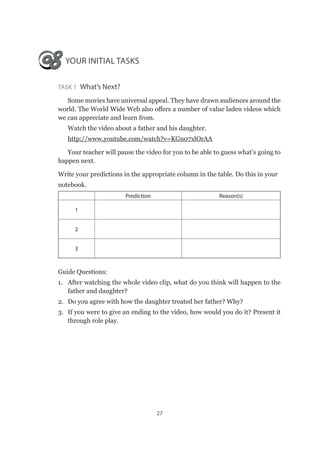
This week’s lesson will unfold one’s greatness and heroic acts which will lead
you to discover your hidden potentials and develop skills for the realization of
the world’s ultimate goal – positive transformation.
YOUR OBJECTIVES
Following the track of your journey, you are to be guided by the following ob-
jectives:
•	 share thoughts, feelings, and intentions in the material viewed
•	 restate the ideas conveyed by the text listened to
•	 explain how words are derived from names of persons and places
•	 explain how the words used in the poem work together and contribute to the
	 theme of the selection
•	 analyze how literature helps in discovering oneself
•	 take note of sequence signals or connectors to establish the patterns of idea
	 development in a text
•	 use appropriate punctuation marks in writing descriptive paragraphs
•	 use appropriate stress, intonation, pitch, pronunciation, and gestures in
	 delivering a poem
•	 convey a message to a hero through a rap
30
YOUR INITIAL TASKS
Let’s begin the lesson by working on the first two activities to guide you in your
journey throughout the lesson.
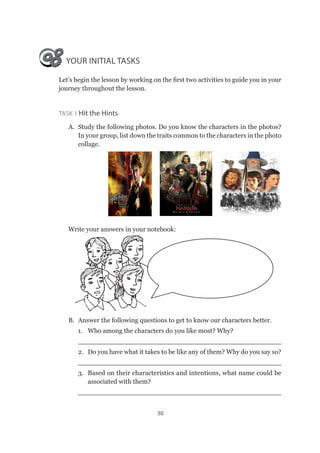
Task 1 Hit the Hints
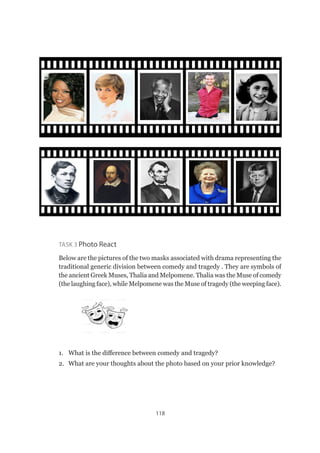
A.	 Study the following photos. Do you know the characters in the photos?
In your group, list down the traits common to the characters in the photo
collage.
Write your answers in your notebook:
B.	 Answer the following questions to get to know our characters better.
1.	 Who among the characters do you like most? Why?
__________________________________________________
2.	 Do you have what it takes to be like any of them? Why do you say so?
_________________________________________________
3.	 Based on their characteristics and intentions, what name could be
associated with them?
_________________________________________________
31
Task 2 Say that Again
A.	 Listen as your teacher plays a recorded song three times. Write down at least
three lines from the song that captured your attention. Once you’ve written
them, work with a partner and discuss how you understood each line.
Lines from the Song What do those lines mean to you?
Rewriting lines from songs, poems, stories, and other articles
is one way of paraphrasing. Paraphrasing is often defined as
putting into your own words texts that are originally from
the author. It will make us own our ideas as inspired by other
people’s work and will keep us from plagiarizing others’works.
Here are examples of paraphrasing taken from Harry Potter, Chronicles of
Narnia, and The Lord of the Rings.
Original Paraphrased
“Happiness can be found, even in the
darkest of times, if one only remembers
to turn on the light.”
Harry Potter and the Prisoner of Azka-
ban
Quote by Albus Dumbledore
There is happiness even during the most
challenging times and we only need to
look at the bright side.
32
“To the glistening eastern sea, I give
you Queen Lucy the Valiant. To the
great western woods, King Edmund
the Just. To the radiant southern sun,
Queen Susan the Gentle. And to the
clear northern skies, I give you King
Peter the Magnificent. Once a king
or queen of Narnia, always a king or
queen of Narnia. May your wisdom
grace us until the stars rain down from
the heavens.” 
Chronicles of Narnia
Quote by Aslan
Presenting the kings and queens of Narnia:
Queen Lucy the Valiant, King Edmund the
Just, Queen Susan the Gentle, and King Peter
the Magnificent. They will forever be Kings
and Queens of Narnia and may their wisdom
be with us until the end of the world.
In the common tongue it reads,“One
Ring to Rule Them All. One Ring to Find
Them. One Ring to Bring Them All and
In The Darkness Bind Them.”
The Lord of the Rings
Quote by Gandalf
There is one ring to rule, to find, to
bring, and to bind all evil.
C.	 With the tips and examples given to you on paraphrasing, be ready to listen
to another recorded song, write down two lines from it which you like the
most, and paraphrase them.
Lines from the Song Your Paraphrase
1.
2.
33
YOUR TEXT
Task 3 Attack Those Words
Beowulf is admired for the richness of its poetry. About a third of the words in
Beowulf are words known as Kennings. Kennings combine two words to create
an evocative and imaginative alternative word.
Form groups of four. Explain the Kennings in this tic-tac-toe board. Choose
three Kennings in a row to explain. You must all do those in the center.
TIC-TAC-TOE
1
battle-sweat
slaughter-dew
2
evil-doer
life-evil
3
horrible hermit
devil from hell
sin-stained demon
4
battle-dress
mail-shirt
fighting-gear
5
dragon-slayer
war trooper’s leader
chief of the strangers
6
ring giver
gold giver
7
wave floater
swirling surf
8
light of battle
9
whale road
whale’s way
swan road
As you read the poem, list down more examples of Kennings or word derivations
from Beowulf to add to your vocabulary list.
______________________________________________________
______________________________________________________
______________________________________________________
34
Read the epic poem Beowulf which deals with war and adventure. It is said to be
the greatest poem ever written in a modern European language four centuries
before the Norman Conquest. Beowulf shows an interplay of Christian and pagan
beliefs. The original writer remains unknown.
It has been said that Burton Raffel’s translation from the original Old English is
the most celebrated and most read by students and general readers alike.
THE BATTLE WITH GRENDEL 
from Beowulf 
translated by Burton Raffel 
Epic 4
	 Out from the marsh, from the foot of misty 
Hills and bogs, bearing God’s hatred, 
Grendel came, hoping to kill
395
	 Anyone he could trap on this trip to high Herot.
He moved quickly through the cloudy night,
Up from his swampland, sliding silently
Toward that gold-shining hall. He had visited Hrothgar’s
Home before, knew the way—
400	
But never, before nor after that night,
Found Herot defended so firmly, his reception
So harsh. He journeyed, forever joyless,
Straight to the door, then snapped it open,
Tore its iron fasteners with a touch
405
	 And rushed angrily over the threshold.
He strode quickly across the inlaid
Floor, snarling and fierce: His eyes
Gleamed in the darkness, burned with a gruesome
Light. Then he stopped, seeing the hall
410
	 Crowded with sleeping warriors, stuffed
With rows of young soldiers resting together.
And his heart laughed, he relished the sight,
Intended to tear the life from those bodies
By morning; the monster’s mind was hot
35
415
	 With the thought of food and the feasting his belly
Would soon know. But fate, that night, intended
Grendel to gnaw the broken bones
Of his last human supper. Human
Eyes were watching his evil steps,
420
	 Waiting to see his swift hard claws.
Grendel snatched at the first Geat
He came to, ripped him apart, cut
His body to bits with powerful jaws,
Drank the blood from his veins, and bolted
425
	 Him down, hands and feet; death
And Grendel’s great teeth came together,
Snapping life shut. Then he stepped to another
Still body, clutched at Beowulf with his claws,
Grasped at a strong-hearted wakeful sleeper
430
	 —And was instantly seized himself, claws
Bent back as Beowulf leaned up on one arm.
That shepherd of evil, guardian of crime,
Knew at once that nowhere on earth
Had he met a man whose hands were harder;
435
	 His mind was flooded with fear—but nothing
Could take his talons and himself from that tight
Hard grip. Grendel’s one thought was to run
From Beowulf, flee back to his marsh and hide there:
This was a different Herot than the hall he had emptied.
440	
But Higlac’s follower remembered his final
Boast and, standing erect, stopped
The monster’s flight, fastened those claws
In his fists till they cracked, clutched Grendel
Closer. The infamous killer fought
445
	 For his freedom, wanting no flesh but retreat,
Desiring nothing but escape; his claws
Had been caught, he was trapped. That trip to Herot
Was a miserable journey for the writhing monster!
The high hall rang, its roof boards swayed,
36
450
	 And Danes shook with terror. Down
The aisles the battle swept, angry
And wild. Herot trembled, wonderfully
Built to withstand the blows, the struggling
Great bodies beating at its beautiful walls;
455
	 Shaped and fastened with iron, inside
And out, artfully worked, the building
Stood firm. Its benches rattled, fell
To the floor, gold-covered boards grating
As Grendel and Beowulf battled across them.
460
	 Hrothgar’s wise men had fashioned Herot
To stand forever; only fire,
They had planned, could shatter what such skill had put
Together, swallow in hot flames such splendor
Of ivory and iron and wood. Suddenly
465
	 The sounds changed, the Danes started
In new terror, cowering in their beds as the terrible 
Screams of the Almighty’s enemy sang
In the darkness, the horrible shrieks of pain 
And defeat, the tears torn out of Grendel’s 
470	
Taut throat, hell’s captive caught in the arms
Of him who of all the men on earth
Was the strongest.
9  That mighty protector of men
Meant to hold the monster till its life
Leaped out, knowing the fiend was no use
475
	 To anyone in Denmark. All of Beowulf’s
Band had jumped from their beds, ancestral
Swords raised and ready, determined
To protect their prince if they could. Their courage
Was great but all wasted: They could hack at Grendel
480
	 From every side, trying to open
A path for his evil soul, but their points
Could not hurt him, the sharpest and hardest iron
Could not scratch at his skin, for that sin-stained demon
Had bewitched all men’s weapons, laid spells
37
485
	 That blunted every mortal man’s blade.
And yet his time had come, his days
Were over, his death near; down
To hell he would go, swept groaning and helpless
To the waiting hands of still worse fiends.
490
	 Now he discovered—once the afflictor
Of men, tormentor of their days—what it meant
To feud with Almighty God: Grendel
Saw that his strength was deserting him, his claws
Bound fast, Higlac’s brave follower tearing at
495
	 His hands. The monster’s hatred rose higher,
But his power had gone. He twisted in pain,
And the bleeding sinews deep in his shoulder
Snapped, muscle and bone split
And broke. The battle was over, Beowulf
500
	 Had been granted new glory: Grendel escaped,
But wounded as he was could flee to his den,
His miserable hole at the bottom of the marsh,
Only to die, to wait for the end
Of all his days. And after that bloody
505
	 Combat the Danes laughed with delight.
He who had come to them from across the sea,
Bold and strong-minded, had driven affliction 
Off, purged Herot clean. He was happy,
Now, with that night’s fierce work; the Danes
510
	 Had been served as he’d boasted he’d serve them; Beowulf,
A prince of the Geats, had killed Grendel,
Ended the grief, the sorrow, the suffering
Forced on Hrothgar’s helpless people
By a bloodthirsty fiend. No Dane doubted
515
	 The victory, for the proof, hanging high
From the rafters where Beowulf had hung it, was the monster’s 
Arm, claw and shoulder and all.
10 And then, in the morning, crowds surrounded
Herot, warriors coming to that hall 
38
520
	 From faraway lands, princes and leaders
Of men hurrying to behold the monster’s
Great staggering tracks. They gaped with no sense
Of sorrow, felt no regret for his suffering,
Went tracing his bloody footprints, his beaten
525
	 And lonely flight, to the edge of the lake
Where he’d dragged his corpselike way, doomed
And already weary of his vanishing life.
The water was bloody, steaming and boiling
In horrible pounding waves, heat
530
	 Sucked from his magic veins; but the swirling
Surf had covered his death, hidden
Deep in murky darkness his miserable
End, as hell opened to receive him.
Then old and young rejoiced, turned back
535
	 From that happy pilgrimage, mounted their hard-hooved
Horses, high-spirited stallions, and rode them
Slowly toward Herot again, retelling
Beowulf’s bravery as they jogged along.
And over and over they swore that nowhere
540
	 On earth or under the spreading sky
Or between the seas, neither south nor north,
Was there a warrior worthier to rule over men.
(But no one meant Beowulf’s praise to belittle
Hrothgar, their kind and gracious king!) . . .
39
Task 4 Say Yes or No
Write Yes or No to the given statement. Be sure to support your answer with
details from the text.
1.	 Grendel was a greedy monster.	 _______
2.	 He was considered the foul enemy of God.	 _______
3.	 Beowulf and Grendel had enormous strength.	 _______
4.	 The weapons of the warriors could easily kill the monster.	 _______
5.	 Grendel was afraid of Hrothgar.	 _______
6.	 Grendel swallowed his victims.	 _______
7.	 The Danes were not allowed to celebrate the defeat of Grendel.	 _______
8.	 Grendel was able to escape from Beowulf’s hands.	 _______
9.	 Hrothgar gave Beowulf gifts._ 	_______
10.	Beowulf was considered the hero of Heorot.	 _______
Task 5 Illustrate the Creations
Based on the poem, how do you imagine the entities in the poem? Describe each
based on what is said in the text and based on how you imagined each. Write
your answers in your notebook.
Entities Description from the Text Your Own Description
Heorot
Hrothgar
Grendel
Beowulf
40
Task 6 Compare and Contrast
Fill out the Venn Diagram to show the similarities and differences of Beowulf
and Grendel.
Task 7 Into the Hero…
After getting to know the two major characters, Beowulf and Grendel, get to
know the poem better by answering the questions that follow.
1.	 Why did Beowulf go to Heorot?
2.	 Did he achieve his goal? Prove your point.
3.	 What happened to Grendel after the fight?
4.	 What did King Hrothgar do to Beowulf?
5.	 How did this part of the epic poem Beowulf end?
41
6.	 If you were one of the Geats, what would you tell or give Beowulf? Why?
7.	 Who among our present superheroes would you liken Beowulf to? Why?
8.	 What strengths did Beowulf put to use in this epic poem?
9.	 What are your strengths? How do you use them?
10.	Give at least three reasons why you like or not like the epic poem Beowulf.
Task 8 Epic vs. Lyric
You have learned that there are different types of poetry. All the World’s a Stage
is an example of lyric poetry while Beowulf is an epic poem. After reading the
two poems, what are the similarities and differences of the two types of poetry?
Lyric
Epic
42
Answer these questions in your journal:
1.	 Which type of poetry did you enjoy reading more?
2.	 Name other examples of lyric or epic poetry that you have learned in your
previous lessons.
3.	 Which among the stories or poems you’ve learned do you like most and why?
YOUR DISCOVERY TASKS
Task 9 Spot the Signals and Punctuation Marks
A.	 Scan the poem Beowulf. List down the sequence signals you can spot. Illus-
trate how these words are used in the selection by filling out the grid below.
Sequence Signals Function in the Sentence
e.g., then To show additional action/s or follow–up dispo-
sition
43
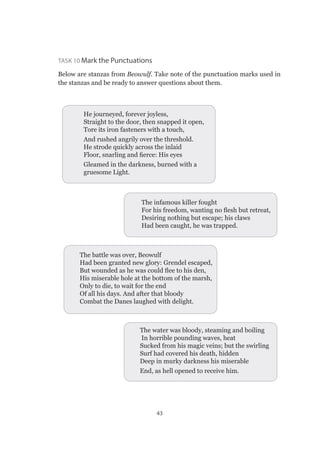
Task 10 Mark the Punctuations
Below are stanzas from Beowulf. Take note of the punctuation marks used in
the stanzas and be ready to answer questions about them.
He journeyed, forever joyless, 
Straight to the door, then snapped it open, 
Tore its iron fasteners with a touch, 
And rushed angrily over the threshold. 
He strode quickly across the inlaid 
Floor, snarling and fierce: His eyes 
Gleamed in the darkness, burned with a
gruesome Light.
The infamous killer fought 
For his freedom, wanting no flesh but retreat, 
 Desiring nothing but escape; his claws 
 Had been caught, he was trapped.
The battle was over, Beowulf 
Had been granted new glory: Grendel escaped, 
But wounded as he was could flee to his den, 
His miserable hole at the bottom of the marsh, 
Only to die, to wait for the end 
Of all his days. And after that bloody 
Combat the Danes laughed with delight. 
The water was bloody, steaming and boiling 
 In horrible pounding waves, heat 
Sucked from his magic veins; but the swirling 
Surf had covered his death, hidden 
Deep in murky darkness his miserable 
End, as hell opened to receive him. 
44
Answer these questions to know more about punctuation marks.
1.	 What punctuation marks are highlighted in the given stanzas?
_____________________________________________________
2.	 What is the meaning conveyed when these punctuation marks are used?
_____________________________________________________
3.	 When do we use them?
_____________________________________________________
Task 11 Introduce the Characters
A.	 Using the sequence signals, punctuation marks you learned, and the descrip-
tions from your Venn diagram, write a speech balloon to introduce Beowulf
and Grendel using the cartoon strips below.
45
B.	 While you take turns introducing Beowulf and Grendel, have you noticed the
way you speak and deliver your lines? What are your suggestions in effectively
delivering lines of poems?
__________________________________________________
__________________________________________________
__________________________________________________
__________________________________________________
__________________________________________________
C.	 Let’s try those tips on correct stress, intonation and juncture in reading
Beowulf. Each group will take turns reading specific stanzas from Beowulf.
Task 12 Type the Text
A.	 In your previous lessons you learned about the different text types. Let’s see
how well you remember them. Identify the text type of the following articles
as journalistic, informative, or literary.
Articles Type of Text
So the thing to do when working on a motorcycle, as in
any other task, is to cultivate the peace of mind which does
not separate one’s self from one’s surroundings. When that
is done successfully then everything else follows naturally.
Peace of mind produces right values, right values produce
right thoughts. Right thoughts produce right actions and
right actions produce work which will be a material reflec-
tion for others to see of the serenity at the center of it all.  
 —Robert M. Pirsig, Zen and the Art of Motorcycle Maintenance
46
With an artistic drama, we empathize with one or more of its char-
acters, but there’s also a distance between us and their situation—a
safety valve that allows us to express a range of emotions, but also
to say,“It’s only a movie,”“It’s only a play,”“It’s only a novel.”Work is
based upon problem solving, how to eliminate conflict and get the
job done. Episodic is fine for work. We want day-by-day not confron-
tational trauma—even if it would lead to life-changing revelation.
But drama exaggerates conflict, pushes situations to their extreme,
and leads us to a big turning point.
In a poem entitled Four Great Poets, Robert Francis puts his
finger on the heart of Frost’s greatness:“His head carved
out of granite O / His hair wayward drifts of snow / He wor-
shipped the great God of Flow / By holding on and letting
go.”  Here’s an example from part of one of Frost’s lesser
known pieces, For Once, Then, Something. In the first half
he says friends rebuke him for looking into a well and see-
ing only himself, reflected in the water godlike in a wreath
of ferns and cloud puffs. It’s a criticism that could be aimed
at any writer, but what is as interesting as the meaning of
Frost’s reply is this sense of movement that carries the read-
er forward to the climatic end.
http://lehmaninfo.wordpress.com/sample-business-liter-
ary-articles/
DHAKA: Hosts Bangladesh will meet Pakistan in the opening
match of the four-nation Asia Cup cricket tournament start-
ing in Dhaka in March, an official said on Monday.
Old rivals Pakistan and India will meet in a mouth-watering
clash on March 18. The Sher-e-Bangla National stadium will
host all the matches, including the inaugural tie on March
12 and the final on March 22, Asian Cricket Council chief
executive Syed Ashraful Huq said.“All teams including India
and Pakistan have confirmed their participation,”he said.
India won the last edition of the tournament in Dambulla in
Sri Lanka in June 2010.
http://www.paper-articles.com/
47
From Beowulf
           And then, in the morning, crowds surrounded 
           Herot, warriors coming to that hall 
520     From faraway lands, princes and leaders 
           Of men hurrying to behold the monster’s 
           Great staggering tracks. They gaped with no sense 
           Of sorrow, felt no regret for his suffering, 
           Went tracing his bloody footprints, his beaten 
525     And lonely flight, to the edge of the lake 
           Where he’d dragged his corpselike way, doomed 
           And already weary of his vanishing life. 
           The water was bloody, steaming and boiling 
           In horrible pounding waves, heat 
530     Sucked from his magic veins; but the swirling 
           Surf had covered his death, hidden 
           Deep in murky darkness his miserable 
           End, as hell opened to receive him. 
           Then old and young rejoiced, turned back 
535     From that happy pilgrimage, mounted their hard-
           hooved Horses, high-spirited stallions, and rode them 
           Slowly toward Heorot again, retelling 
           Beowulf’s bravery as they jogged along. 
B.	 Based on your answers, what do you think are the:
•	 features of a literary text; and
•	 tips in reading literary texts.
Write your ideas about the features and tips in the thought balloon.
48
YOUR FINAL TASKS
Task 13 Rap Meant for a Hero
A.	 Write meaningful sentences about a hero in your life. Include the sequence
signals you have learned such as colons and semi-colons. You may go back to
the introduction you wrote and presented in your previous activity. Be sure
to use the right descriptive words and some examples of Kennings in your
paragraph.
__________________________________________________
__________________________________________________
__________________________________________________
__________________________________________________
__________________________________________________
B.	 Go back to your previous activity, Task 11 entitled, “Introduce the Characters.”
Present your output to the class by rapping.
Be guided by the tips on doing the rap as follows:
	 1. Make sure there’s rhyme in the material you will rap. Rhyme matters in rap
as in any poetic form.
2.	 Perform rap in time to a beat
3.	 Don’t say anything that will offend people. 
4.	 Craft your own style.
5.	 Have fun while rapping.
6.	 Practice. Practice. Practice.
C.	 It’s your chance to rap now.
	 Your school’s dramatic guild is in search of a rapper who will introduce the
lead character/hero through a rap. You’ve been asked to try out for the part.
You will render a one-minute rap about the hero in your life in front of your
class with your English teacher and class adviser. Be reminded of the rhyme,
rhythm, and beat when you do the rap.
49
YOUR Treasure
Task 14 Share Your Life’s Lessons
A.	 List down your strengths and how you intend to use them in the table below.
Do this in your journal.
My Strengths I will use them to…
B.	 Write the things you value the most from the week’s discussion. Or, you might
want to illustrate your most important learning from this week’s lesson.
50
YOUR JOURNEY
A life well lived cannot be easily forgotten. Not when you have left a mark so
noteworthy that enables people to make a difference not only in their lives but
more so in the lives of others. How would you like to be remembered? What
legacy would you like to leave behind?
This lesson will allow you to learn how the legacies of the past shaped the
way you are now and how your legacy could dictate the future of others.
YOUR OBJECTIVES
Following the track of your journey, you are to be guided by the following
objectives:
•	 agree or disagree with the ideas of the author
•	 summarize the contents of the materials viewed
•	 explain word meanings and origins
•	 examine sample texts representative of each type
•	 express appreciation for sensory images used
•	 analyze literature in enhancing one’s self
•	 use the correct pitch, juncture, stress, intonation, rate of speech, volume and
projection in delivering lines of prose and poetry
•	 scan sequence signals or connectors used in a text
•	 compare and contrast text types
•	 use hyphens and dashes correctly
YOUR INITIAL TASKS
Task 1  The Harmony of Man and Environment (H.O.M.E.)
Watch as the camera tracks the lives of the youths like you. How would you rise
to the challenges presented? What do you think motivated them to do this video?
Lesson 3
LEAVING A LEGACY
51
Task 2
Look at the picture. What could be the cause of this phenomenon?
Task 3  Lend Me an Ear…
Listen as the video runs for the second time. Take note of the ideas presented
below and indicate whether you agree or disagree with them.
Task 4  In a Capsule
As you have viewed the video twice, summarize its contents using appropriate
sequence signals.
Harmony of Man and Environment (H.O.M.E.) Launching 2009
52
YOUR TEXT
Task 5  What’s in a Word?
Match the words in Column A with their correct meaning in Column B. Be ready
to use the words in sentences. Write your answers on your notebook.
Column A	 Column B
1.	 betwixt	 (ME)	 a.	 to signify ; to indicate
2.	 holden	 (ME)	 b.	 that is to say; namely
3.	 betokens	 (ME)	 c.	 between
4.	 tomorn	 (ME)	 d.	 to think of; to expect; to hope
5.	 weened	 (OE)	 e.	 Jesus
6.	 Jesu	 (LL)	 f.	 tomorrow
Task 6  A Hero in You!
What does it take to be a great man?
The Day of Destiny
from Morte D’Arthur by Sir Thomas Malory
Sir Thomas Malory’s Morte D’Arthur is the most complete single version of the tales of
King Arthur and his court that has been written in English.
“The Day of Destiny,” an excerpt from this work, describes the end of King Arthur’s reign
and the dissolution of the order which he, along with his Knights of the Round Table, has estab-
lished. This end grows out of the corruption within the royal court itself. Arthur’s illegitimate
son Mordred knows of the secret love affair between Arthur’s wife, Queen Guinevere, and his
best friend, Sir Lancelot. One night Mordred leads a band of knights to Guinevere’s chamber,
where they find the Queen with Lancelot.
Although he is reluctant, Arthur feels obligated to obey the law of the land and burn his
wife at the stake. However, at the last minute Lancelot rescues her, killing two knights who are
guarding her. Lancelot subsequently flees to a castle in France and Arthur forgives Guinevere.
Sir Gawain, the brother of the dead knights, demands vengeance on Lancelot. His hatred forces
Arthur to lead his men on an attack against Lancelot’s French fortress. In the ensuing battles
Lancelot seriously wounds Gawain but refuses to kill him.
53
A
nd quickly King Arthur moved himself with his army along the coastline
westward, toward Salisbury. And there was a day assigned betwixt King
Arthur and Sir Mordred that they should not meet upon a field beside
Salisbury and not far from the coast. And this day so assigned as Monday after
Trinity Sunday (the eighth Sunday after Easter), whereof King Arthur was passing
glad that he might be avenged upon Sir Mordred.
So upon Trinity Sunday at night King Arthur dreamed a wonderful dream,
and in his dream it seemed to him that he saw upon a platform a chair, and the
chair was fast to a wheel, and thereupon sat King Arthur in the richest cloth of
gold that might be made. And the King thought there was under him, far from
him, and hideous deep black water, and therein was all manner of serpents, and
worms, and wild beasts, foul and horrible. And suddenly the King thought that
the wheel turned upside down, and he fell among the serpents, and every beast
took him by a limb. And then the King cried as he lay in his bed, “Help, Help!”
And then knights, squires, and yeomen awaked the King, and then he was so
amazed that he knew not where he was. And then so he awaked until it was night
day, and then he fell on slumbering again, not sleeping nor thoroughly waking.
So it seemed to the King that there came Sir Gawain unto him with a number
of fair ladies with him. So when King Arthur saw him, he said, “Welcome, my
sister’s son. I weened ye had been dead. And now I see thee on – live, much am
I beholden unto Almighty Jesu. Ah, fair nephew and my sister’s son, what been
these ladies that hither be come with you?”
“Sir,” said Sir Gawain, “all these be ladies for whom I have fought for when I
was man living. And all these are those that I did battle for in righteous quarrels,
and God had given them that grace, at their great prayer, because I did battle
for them for their right, that they should bring me hither unto you . Thus much
had given leave God, for to warn you of your death. If you fight tomorrow with
Sir Modred, as ye both have assigned, doubt ye not ye must be slain, and the
most party of your people on both parties. And for the great grace and goodness
Meanwhile, Mordred senses his chance. With Arthur away in France, he leads a rebellion
in England, claiming the throne and trying to seize Guinevere as his queen. She flees to the
Tower of London. Arthur, returning to defend his crown, battles Mordred for the first time at
Dover, where Gawain is fatally wounded. Before his death, Gawain writes a letter to Lancelot
ending their feud and asking Lancelot to return to England to help Arthur. After a second,
inconclusive battle with Mordred’s forces, Arthur regroups his men and moves westward…
54
that Almighty Jesu had unto you, and for pity of you and many more other good
men there shall be slain, God had sent me to you of his special grace to give you
warning that in no wise ye do battle as tomorn, but that ye take a treaty fora
month from today. And you make generous offers , so that tomorn ye put in a
delay. For within a month shall come Sir Lancelot with all his noble knights and
rescue you worshipfully and slay Sir Modred and all that ever will hold with him.
Then, Sir Gawain and all the ladies vanished. And anon the King called upon
his knights, squires, and yeomen, and charged them quickly to fetch his noble
lords and wise bishops unto him. And when they were come the King told them
of his dream, that Sir Gawain had told him and warned him that, and he fought
on the morn, he should be slain. Then the King commanded Sir Lucan the Butler
and his brother Sir Bedivere the Bold, with two bishops with them, and charged
them in any wise to take a treaty for a month from today with Sir Modred. “And
spare not: proffer him lands and goods as much as ye think reasonable.”
So then they departed and came to Sir Modred where he had a grim host of
a hundred thousand, and there they entreated Sir Modred long time. And at
the last Sir Modred was agreed for to have Cornwall and Kent by King Ar-
thur’s days, and after that, all England, after the days of King Arthur.
Then they ageed that King Arthur and Sir Modred should meet betwixt both
their hosts, and each of them should bring fourteen persons. And so they came
with this word unto Arthur. Then said he, “I am glad that this is done,” so he
went into the field.
And when King Arthur should depart, he warned all his host that, and they see
any sword drawn, “Look ye come on fiercely and slay that traitor Sir Modred,
for I in no wise trust him.” In like wise Sir Modred warned his host that “ And
ye see any manner of sword drawn, look that ye come on fiercely, and so slay
all that ever before you standeth, for in no wise I will not trust for this treaty .”
And in the same wise said Sir Modred unto his host, “For I know well my father
will be avanged upon me.”
And so they met as their arrangement was and were agreed and accorded thor-
oughly. And wine was fetched and they drank together. Right so came and
adder out of a little heathbush, and it stung a knight in the foot. And so when
the knight felt him so stung, he looked down and saw the adder. And anon he
drew his sword to slay the adder, and thought none other harm. And when the
host on both parties saw that sword drawn, then they blew beams, horns, and
shouted grimly. And so both hosts dressed them together. And King Arthur took
his horse and said, “Alas, this unhappy day!” and so rode to his party, and Sir
55
Modred in like wise.
And never since was there never seen a more dolefuller battle in no Christian
land, for there was but rushing and riding, lunging and striking; and many a
deadly stroke. But ever King Arthur rode throughout the battalion of Sir Modred
many times and did full nobly, as a noble should do, and at all times he fainted
never. And Sir Modred did his devoir that day and put himself in great peril.
And thus they fought all the long day, and never stopped till the noble knights
were laid to the cold earth. And ever they fought still it was near night, and then
was there a hundred thousand laid dead upon the down. Then was King Arthur
wild with rage out of measure when he saw his people so slain from him. And
so he looked about him and could see no more of all his host, and good knights
left no more on – live, but two knights: the t’one was Sir Lucan the Butler and
the other his brother Sir Bedivere. And yet they were full sore wounded.
“Jesu, mercy,” said the King, “where are all my noble knights become? Alas that
ever I should see this doleful day! For now,” said King Arthur. “I am come to
mine end. But would to God.” Said he , “that I wist now where were that traitor
Sir Modred that has caused all this mischief.”
Then King Arthur looked about and was ware where stood Sir Modred leaning
upon his sword among a great heap of dead men.
“Now give me my spear,” said King Arthur unto Sir Lucan. “For yonder I have
espied the traitor that all this woe hath wrought.”
“Sir, let him be,” said Sir Lucan, “for he is unhappy. And if ye pass this unhappy
day ye shall be right well revenged upon him. And, good lord, remember ye of
your night’s dream, and what the spirit of Sir Gawain told you tonight, and yet
God of his great goodness had preserved you hitherto. And for God’s sake, my
lord, leave off by this, for, blessed be God, ye have won the field: for yet we been
here three on – live, and with Sir Modred is not one on – live. And therefore if
ye leave off now, this wicked day of destiny is past.”
“Now, befall me death, tide me life,” said the King, “now I see him yonder alone,
he shall never escape mine hands. For at a better avail shall I never have him.”
“God speed you well!” said Sir Bedivere.
Then the King got his spear in both his hands and ran toward his Modred, crying
and saying, “ Traitor. Now is thy deathday come!”
And when Sir Modred saw King Arthur, he ran until him with his sword drawn
56
in his hand, and there King Arthur smote Sir Modred under the shield, with
a thrust of his spear, throughout the body more than a fathom. And when Sir
Modred felt that he had his death’s wound, he thrust himself with the might that
he had up to hand guard of King Arthur’s spear, and right so he smote his father
King Arthur with his sword holden in both his hands, upon the side of the head,
that the sword pierced the helmet and the casting of the brain. And therewith
Sir Modred dashed down stark dead to the earth.
And noble King Arthur fell in a swough to the earth, and there he swooned often-
times, and Sir Lucan and Sir Bedivere oftentimes heaved him up. And so, weakly
betwixt them, they led him to a little chapel not far from the seaside, and when
the King was there, him thought him reasonably eased. Then heard they people
cry in the field. “Now go thou, Sir Lucan,” said the King, “and let me know what
betokens that noise in the field.”
So Sir Lucan departed, for he was grievously wounded in many places. And so as
he walked he saw and harkened by the moonlight how that pillagers and robbers
were come into the field to pill and to rob many a full noble knight of brooches
and bracelets and of many a good ring and many a rich jewel. And who that were
not dead all out there they slew them for their harness and their riches. When Sir
Lucan understood this work, he came to the King as soon as he might and told
him all what he had heard and seen. “Therefore by my advice,” said Sir Lucan,
“it is best that we bring you to some town.”
“I would it were so,” said the King, “but I may not stand, my head works so.
Ah, Sir Lancelot,” said King Arthur, “this day have I sore missed thee. And alas
that ever I was against thee, for now have I my death, whereof Sir Gawain me
warned in my dream.”
57
Then Sir Lucan took up the King the t’one side and Sir Bedivere the other party;
and in the lifting Sir Lucan fell in a swoon that part of his guts fell out of his body,
and therewith the noble knight’s heart burst. And when the King awoke he beheld
Sir Lucan how he lay foaming at the mouth and part of his guts lay at his feet.
“Alas,” said the King, “this is to me a full heavy sight to see this noble duke so
die for my sake, for he would have helped me that had more need of help than
I. Alas that he would not complain him for his heart was so set to help me. Now
Jesu have mercy upon his soul.”
Then Sir Bedivere wept for the death of his brother.
“Now leave this morning and weeping, gentle knight,” said the King, “for all
this will not avail me. For wit thou well, and I might live myself, the death of Sir
Lucan would grieve me evermore. But my time passeth on fast,” said the King.
“Therefore,” said King Arthur unto Sir Bedivere, “take thou here Excalibur my
good sword and go with it to yonder water’s side: and when thou comest there
I charge thee throw my sword in that water and come again and tell me what
thou saw there.”
“My lord,” said Bedivere, “ your commandment shall be done, and I shall quickly
bring your sword again.”
So, Sir Bedevere departed. And by the way he beheld that noble sword, that the
hilt and hand guard was all precious stones. And then he said to himself, “If I
throw this rich sword in the water, thereof shall never come good, but harm and
loss.” And then Sir Bedivere hid Excalibur under a tree. And so, as soon as he
might, he came again unto the King and said he had been at the water and had
thrown the sword into the water.
“What did you see there?” said the King.
“Sir,” he said, “I saw nothing but waves and winds.”
“That is untruly said of you,” said the King. “And therefore you go quickly again
and do my commandment: as you are to me loved and dear, spare not, but throw
it in.”
Then Sir Bedeivere returned again and took the sword in his hand. And yet he
thought sin and shame to throw away that noble sword. And so again he hid the
sword and returned again and told the King, that he had been at the water and
done his commandment.
“What did you see there?” said the King.
58
“Sir,” he said, “I saw nothing but waters lap and waves grow.”
“Ah, traitor unto me and untrue,” said King Arthur, “now you have betrayed me
twice. Who would have weened that you have been to me so loved and dear, and
you are named a noble knight, and would betray me for the riches of this sword.
But now go again lightly, for you long tarrying put me in great jeopardy of my life,
for I have taken cold. And but if you do now as I bid you, if ever I may see you I
shall slay you with my own hands, for you would for my rich sword see me dead”.
Then Sir Bedivere departed and went to the sword and lightly took it up, and
so he went to the water’s side; and there he bound the girdle about the hilts,
and threw the sword as far into the water as he might. And there came an arm
and a hand above the water and took it and clutched it , and shook it thrice and
brandished; and then vanished away the hand with the sword into the water. So
Sir Bedivere came again to the King and told him what he saw.
“Alas,” said the King, “help me hence, for I dread me I have tarried overlong.”
Then Sir Bedivere took the King upon his back and so went with him to that
water’s side, even closer, by the bank floated a little barge with many fair ladies
in it; and among them all was a queen; and all they had black hoods, and all they
wept and shrieked when they saw King Arthur.
“Now put me into that barge,” said the King; and so he did softly. And there
received him three ladies with great mourning, and so they set them down. And
in one of their laps King Arthur laid his head, and then the queen said, “Ah, my
dear brother, why have ye tarried so long from me? Alas, this wound on your
head had caught over much cold.” And anon they rowed fromward the land, and
Sir Bedivere beheld all the ladies go forward him.”
Then Sir Bedivere cried and said, “Ah, my lord Arthur, what shall become of me,
now you go from me and leave me here alone among my enemies?”
“Comfort yourself,” said the King, “and do as well as you may, for in me is no
trust in. For I must into the legendary valley to heal me of my grievous wound.
And if you hear nevermore of me, pray for my soul.”
For ever the queen and ladies wept and shrieked, that it was pity to hear. And as
soon as Sir Bedivere had lost sight of the barge he wept and wailed, and so took
the forest and went all that night.
And in the morning he was ware, betwixt two bare woods, of a chapel and a
hermitage. Then was Sir Bedivere glad, and thither he went, and when he came
into the chapel he saw where lay a hermit groveling on all fours, close thereby a
59
tomb was new dug. When the hermit saw Sir Bedivere he knew him well, for he
was but little before Bishop of Canterbury, that Sir Modred put to flight.
“Sir,” said Sir Bedivere, “what man is there here interred that you pray so fast for?”
“Fair son,” said the hermit. “I wot not verily but by guessing. But this same night,
at midnight, here came a number of ladies and brought here a dead corpse and
prayed me to inter him. And here they offered a hundred tapers, and gave me a
thousand gold coins.”
“Alas,” said Sir Bedivere,” that was my lord King Arthur, which laid here buried
in this chapel.”
Then Sir Bedivere swooned, and when he awoke he prayed the hermit that he
might abide with him still, there to live with fasting and prayers:
“For from hence will I never go,” said Sir Bedivere,” by my
will, but all the days of my life here to pray for my lord Arthur.”
“Sir, you are welcome to me,” said the hermit, “for I know you better than you
think that I do: for you are Sir Bedivere the Bold, and the full noble duke Sir
Lucan the Butler was your brother.”
Then Sir Bedivere told the hermit all as you have heard before, and so he stayed
with the hermit that was beforehand Bishop of Canterbury. And there Sir Bedi-
vere put upon him poor clothes, and served the hermit full lowly in fasting and
in prayers.
Thus of Arthur I find no more written in books that been authorized, neither
more of the very certainty of his death heard I nor read, but thus was he led away
in a ship wherein were three queens; that one was King Arthur’s sister, Queen
Morgan le Fay, the other was the Queen of North Galis, and the third was the
Queen of the Waste Lands.
Now more of the death of King Arthur could I never find, but that these ladies
brought him to his grave, and such one was interred there which the hermit
bare witness that was once Bishop of Canterbury. But yet the hermit knew not
in certain that he was verily the body of King Arthur; for this tale Sir Bedivere,
a knight of the Table Round, made it to be written.
Yet some men say in many parts of England that King Arthur is not dead, but
carried by the will of our Lord Jesu into another place; and men say that he shall
come again, and he shall win the Holy Cross. Yet I will not say that it shall be so,
but rather I would say: here in this world he changed his life. And many men say
that there is written upon the tomb this:
60
Hic iacet Arthurus, Rex
Quondam, Rexque futurus
(Here lies Arthur, who was once king and king will be again)
Task 7  The Mirage
Writers paint word pictures or images that appeal to our senses of sight, sound,
smell, taste, and touch in poetry and in prose composition. Look for the images
that you have located in the text. Copy the chart below on your notebook and
write down the details in the appropriate column.
Sight Sound Smell Taste Touch
1.
2.
3.
4.
5
Task 8  Mull Over in Groups!
Discuss and answer the questions below in groups. Write your answer on one
whole sheet of paper.
1.	 How would you describe King Arthur as a king? Locate a part in the story
that will support your answer.
2.	 What hope is given to people in his tomb saying Arthur is the “once king and
king that will be”?
3.	 Why do you think some men say in many parts of England that King Arthur
is not dead, but carried by the will of our Lord Jesus into another place; and
that he shall come again, and he shall win the Holy Cross?
4.	 What great deed did King Arthur achieve as he lived his life? What was his
greatest legacy?
5.	 What pattern is used to develop the idea of the text? Point out the sequence
signals or connectors in the text.
61
6.	 How do images or word pictures help you experience a scene in the excerpt
The Day of Destiny?
Task 9  Group Activity
You will be grouped by your teacher into three (3). Each group will be given an
article to read in 10 minutes. Once done reading, listen to your teacher’s further
instructions.
Task 10  Plotting Them All
Examine how the three (3) articles were written using the following criteria:
Criteria UNESCO sends
experts to
Tubbataha Reefs
How to Maintain
Cultural Identity
The Courage that My
Mother Had
Purpose
Format
Features
Language Use
Task 11  Weigh Up!
Examine the following examples of texts. Indicate the type of reading text they are.
1.	 Men in great places are thrice servants:
servants of the sovereign or state,
servants of fame, and servants of business
“Of Great Place”
2.	 NASA is proposing another space project. The agency’s budget request,
announced today, included a plan to send another person to the moon.
3.	 Those that have tenacity will not quit when confronted by obstacles or when
failing. In a game or in life, tenacity wants to win, and tenacity lives by the
credo, “Failure is not an option.”
62
4.	 Three passions (simple but overwhelmingly strong) have governed my life:
the longing for love, the search for knowledge, and the unbearable pity for
the suffering of mankind.
5.	 Director Steven Spielberg launched a Germany-wide contest Sunday designed
to promote tolerance through students’ intercultural interaction.
6.	 If you can dream – and not make your dreams your master;
7.	 An earthquake is a shaking or rolling movement of great masses of rocks on
the earth’s uppermost layer or crust.
Task 12  Bite the Dash--
Study the following sentences below. Notice that they are punctuated with a
dash (-).
1.	 When in 1960 the stockpile was sold off – indeed, dumped as surplus- natural
rubber sales were hard hit.-Barry Commoner
2.	 The presentations–and especially the one by Ms. Ramos-impressed the au-
dience.
3.	 Oil, steel, and wheat–these are the sinews of industrialization.
4.	 My foot is on my native heath…–Sir Walter Scott
5.	 Your question-it was your question, wasn’t it, Mr. Jones?–just can’t be
answered.
Task 13 Write a Dash
Punctuate the sentences below with a dash (–).
1.	 I am under the impression that she has no instruction at all and doesn’t need
any.
2.	 Strauss favors as does Sotto voce, the Administration is early admission of
Russia to the International Monetary Fund.
3.	 To feed, clothe, and find shelter for the needy these are real achievements.
4.	 The motion was then tabled that is, removed indefinitely from consideration.
5.	 If we don’t succeed and the critics say we won’t then the whole projects is in
jeopardy.
Task 14  Type the Hype
63
The words below are punctuated with a hyphen (-). Study the words carefully.
1.	 anti-inflationary
2.	over-the-counter
3.	 a come-as-you-are party
4.	 a six- or eight-cylinder engine
5.	 the ruling-passion of his life
6.	 one hundred thirty-eight
7.	 a two-thirds majority of the vote
8.	 pages 40-98
9.	 the New York-Paris flight
Task 15 Let’s Hype!
Punctuate the words/phrases below with a hyphen.
1.	 co-opted
2.	 good for nothing
3.	 She has gray green eyes
4.	 pre and post adolescent trauma
5.	 forty five
YOUR DISCOVERY TASK
Task 16 Me-Metaphors
Task 16.1  One with Others
•	 Do you consider the Tubbataha Reefs as nature’s legacy to mankind? What
connections do you share with Tubbataha Reefs?
_____________________________________________________
_____________________________________________________
____________________________________________________
____________________________________________________
•	 Do you consider cultural heritage as your forefathers’ legacy? What is your
64
role in the preservation of culture in the country?
_____________________________________________________
_____________________________________________________
____________________________________________________
____________________________________________________
•	 What is your mother’s greatest legacy? Do you consider this legacy worthy
of passing on to your children?
_____________________________________________________
_____________________________________________________
____________________________________________________
____________________________________________________
Task 16.2  My Legacies
What would your legacy be? Accomplish the chart below.
_______________________________________
_______________________________________
_______________________________________
_______________________________________
_______________________________________
_______________________________________
_______________________________________
_______________________________________
_______________________________________
_______________________________________
_______________________________________
_______________________________________
My legacy to
Mother Earth
My legacy to my
people
My legacy to my
family
65
YOUR FINAL TASK
The local government is planning to convert your town’s rice fields into an
industrial park. One of the bridges with historical value will be demolished.
Most of the residents disagree with this plan, some agree, and a few remain
undecided. If you were in the shoes of each of the people enumerated be-
low, what would you say about the plan?
Remember that you are to perform a choral recitation at the end of the quar-
ter. The following tasks will help you (1) empathize with the characters’ opinions
and feelings and understand where the speakers are coming from and (2) make
use of appropriate speech features to make your performance successful.
Task 17  Sharing Other People’s Perspectives (SHOPP)
Municipal Engineer _______________________________________
Business Man ____________________________________________
Teacher ________________________________________________
Vendor ________________________________________________
Street Sweeper ___________________________________________
Student ________________________________________________
Mother ________________________________________________
Historian _______________________________________________
66
Rubrics:
Criteria 5 points 3 points 1 point
Completeness All blanks were
filled in.
Only 5-7 blanks
were filled in.
Only 1–4 blanks
were filled in.
Stand point All responses
strongly expressed
agreement or dis-
agreement.
Only 5-7 responses
strongly expressed
agreement or dis-
agreement.
Only 1–4 responses
strongly expressed
agreement or dis-
agreement.
Form All responses used
capitalization, punc-
tuations, and inter-
jection correctly.
Only 5-7 responses
used capitalization,
punctuations, and
interjection correct-
ly.
Only 1–4 responses
used capitalization,
punctuations, and
interjection correct-
ly.
Task 18  Viva Voce!
Choose your favorite part of the text, The Day of Destiny. With a partner,
read the part aloud using the correct pitch, juncture, stress, intonation, rate of
speech, volume, and projection.
Rubrics:
Features 3 2 1
Pitch Student’s pitch
does not change
the meaning of the
word/phrase.
Student’s pitch
changes the mean-
ing of at least two
(2) words/phrases.
Student’s pitch
changes the mean-
ing of all the words/
phrases.
Juncture Student pauses
in all periods and
commas.
Student pauses in at
least two (2 ) peri-
ods or commas.
Student pauses in
one (1) period or
comma.
Stress Student emphasizes
all words and sylla-
bles correctly.
Student emphasiz-
es at least two (2)
words or syllables
correctly.
Student emphasiz-
es one (1) word or
syllable correctly.
Intonation Student observes all
possible intonation
patterns correctly.
Student observes at
least two (2) pos-
sible intonation pat-
terns correctly.
Student observes
one (1) possible
intonation pattern
correctly.
Rate of Speech Student reads at an
average speed.
Student reads at a
speed just enough
to be understood.
Student reads very
fast and incomprehen-
sible.
67
Volume Student applies the
correct volume in
reading.
Student applies only
two (2) correct vol-
umes in reading.
Student applies only
one (1) correct vol-
ume in reading.
Projection Student reads the
text loudly and
clearly.
Student reads some
text loudly and
clearly.
Student‘s reading is
not loud and clear.
YOUR TREASURE
“We learn much from the past to understand the present. We shape and live
the present to send a message to the future – a LEGACY – which could be a key
to understanding the SELF”
My journey through this lesson enabled me to learn
_____________________________________________________
_____________________________________________________
_____________________________________________________
______________________________________________________
It made me realize that
_____________________________________________________
_____________________________________________________
_____________________________________________________
______________________________________________________
I therefore commit to
_____________________________________________________
_____________________________________________________
_____________________________________________________
______________________________________________________
68
Lesson 4
COPING WITH CHALLENGES
YOUR JOURNEY
Normally you hear from people who care say, “Don’t be your own roadblock
to success!” This is the challenge you need to attend to amidst difficulties and
sufferings you may experience. This simply means you need to be aware of, face,
and then remove the setbacks, burdens, and difficulties which at time upset you.
To fear them is alright but you have to face these fears and live with them coura-
geously. They are parts of the games you have to play to make your life better. It
is always in your hands for you to start making the most out of these challenges.
	This lesson begins with learning to cope with challenges to enhance yourself.
Further on, you’ll confirm that you read poems not only for the exploration of
target concepts, but also for enjoyment and for the help it gives you to
under stand yourself as well as the people anywhere, anytime. Most importantly,
the enhancement of your communication and literary skills are on top of all of
these. The overriding and underlying concepts plus the tasks you’ll engage in in this
lesson will surely guide you to answer the BIG Question: How do I cope with
challenges in life?
YOUR OBJECTIVES
Going through the process of discovering the answers to this essential question,
you are expected to:
•	 make connection between the present text and the previously read text
•	 assess the relevance and worth of ideas presented in the material viewed
•	 draw generalizations and conclusions from the material listened to
•	 use synonyms of words to clarify meanings
•	 explain how the tone of the poem helps clarify its meaning
•	 use contractions proficiently
•	 make use of lyric poem’s feature in an advertising campaign
•	 use effective ways of coping with challenges to enhance one’s self
•	 show appreciation for the significant human experiences highlighted and
shared during the discussion
69
YOUR INITIAL TASKS
Task 1  Twisters
•	 Interview three of your classmates as to the questions you have about coping
with challenges.
•	 Write at least three (3) questions (in line with coping with challenges) you
hope to answer later.
Be reminded that your expected output will be an Advocacy
Campaign on Using Positive Ways to Cope with Challenges,
and the criteria for assessment will be: focus, content, visuals,
clarity of purpose, and language convention.
Since your direction is clear, you are now ready for –
Questions I have about coping with challenges
•	 Work with your peers and reflect on this: What do you consider as your
challenges in life?
•	 Make a list of at least ten (10) challenges experienced by students like you.
•	 Copy the chart as shown, and fill it up with the entries called for.
Challenges being met by students
________________________________________________
________________________________________________
________________________________________________
________________________________________________
________________________________________________
________________________________________________
70
•	 Rank them in their order of difficulty. Rank 1 the most challenging and 10 as
the least challenging.
•	 Ask them to decide what the most effective method of coping with challenges
is.
•	 Rank them in their order of effectiveness. Rank 1 the most effective and 10
as the least effective.
•	 Share your findings with the class.
Task 2  Constant Recall
One challenge you need to face is how to unfold and show appreciation for the
meaning of a poem.
•	 Work in groups of five and think back on the salient points, aspects, and
elements of poetry to be given attention to in unfolding its meaning.
•	 Clarify the WHAT, WHY, and HOW of these aspects.
•	 Point out which of these elements (subject, theme, poetic devices, sounds,
tone, significant experience), you have yet
✔✔ to touch on
✔✔ to explore
✔✔ to understand
✔✔ to master
•	 Emphasize which ones you need to give more attention to.
•	 Report your findings in class.
Task 3 Make a Synonym Match Challenge
•	 Fill each blank with a single letter to form these pairs of words into
synonyms. Example :  __ACTUAL __RUE
	 FACTUAL TRUE
1.	 _ COLD _ HIDE
2.	 _ EARNING _ RAVING
3.	 _ ALLY _ CORE
4.	 _ AVER _ ALTER
5.	 _ ROUND _ OIL
71
6.	 _ ARROW _ LENDER
7.	 _ LIMB _ SCENT
8.	 _ TUMBLE _ RIP
9.	 _ INDICATE _ LEAR
10.	_ WELLING _ BODE
•	 Use these pairs in your own sentences.
Task 4  Highlighting the Focus Question
Remember the FOCUS QUESTION:
How do I cope with challenges in life?
•	 List logical temporary answers to the focus question.
•	 Share your list with your classmates.
Task 5  What Do I Expect, Need, and Hope to learn?
Write your targets on what you expect, need, and hope to learn in this lesson.
72
Be reminded of these expectations as you work on the follow-
ing phases of this lesson.
YOUR TEXT
Task 6 Why Not?
•	 Pair up and reflect on the following quotations.
•	 Take turns in answering these questions.
✔✔ What does each of the quotations suggest?
✔✔ Do you agree with what each quotation suggests? Why? Why not?
✔✔ What does it take to face life’s challenges?
•	 Share your findings with the rest of the class.
Task 7  Be the Best You Can Be
•	 Work with a partner and look closely at this picture.
•	 Talk about how the picture illustrates the same meaning being conveyed in
the quotations. Relate the two.
1.  “Don’t let challenges stop you to take your best future.”
- Anonymous
2.  “When virtue is in presence, all subordinate powers sleep.”
73
✔✔ How closely do you think the drawing matches your mental image of
coping with challenges? Prove your point.
•	 Share your findings with the rest of the class.
Task 8  Meaningful Life
Reflect on these questions:
✔✔ To what can you compare life?
✔✔ Do words have the power to help a person get through hard/difficult times?
•	 Find out how a poem written by Langston Hughes will help you achieve in-
sights about difficult times.
•	 Listen to your teacher read the poem Mother to Son by Langston Hughes.
It’s high time for you to focus on the context of the poem. Try this.
Task 9 Small Group Differentiated Work
•	 Work in ten (10) small groups.
•	 With your groupmates, read the poem aloud and perform your assigned task.
Group 1. Words, words, words
•	 As you read the poem, list the words that you find difficult.
•	 Use a dictionary to find the synonyms and antonyms of each word.
•	 Share your findings with the class.
Discover how the details in the poem help a story.
Group 2. Meaningful significant experience
When you read a poem, you get to know the experience of other people. This
gives you a better perspective on your relationship with others and how you’ll
react to challenges in life.
74
•	 Answer the following guide questions
1.	 Who is the speaker/persona in the poem?
2.	 To what does the speaker compare her life?
3.	 What is the speaker doing?
4.	 What kind of stairway is it?
5.	 What kind of stairway is the mother’s life different from?
6.	 What does the mother tell her son?
•	 Copy the illustration of the stairs as shown and fill it up with entries called
for.
6
5
4
3
2
1
Group  3. Salient points
•	 Discover the answers to these questions.
✔✔ What is the poem about?
✔✔ The poem is divided into three parts. Which lines of the poem talk
about hardships? Responses to hardships? Mother’s advice to keep?
Use the following table for your responses.
Hardships Responses to hardships Mother’s advice to keep
✔✔ Which is the most interesting phrase in the poem? Why?
✔✔ Which part makes you think of someone in true to life experience?
✔✔ What do you think is the most probable purpose of the writer in writing
this poem?
75
•	 Share your findings with the class.
Group 4. Message for you
•	 With your groupmates, discuss the answers to the following questions:
✔✔ What poetic devices are used in the poem?
✔✔ Which one helps clarify the message more?
✔✔ Which part do you like best? Why?
✔✔ What do you think might have motivated the mother to advise her son?
✔✔ Is the message of the poem worthwhile? Prove your point.
✔✔ How important is the poem’s message in your life?
✔✔ What have you learned from it?
•	 Share your findings with the class.
Group 5.Qualities and attitudes displayed (QA)
•	 What approach to life do you think the persona intended to show in
the poem? Make a list of them. Plot them in the chart.
Persona’s
Attitude Mixture
Good Not Good Good Not Good
✔✔ What new and special way does the poem give you?
✔✔ How will it help you to become a better person?
•	 Share your findings with the class.
Group 6. More challenges
•	 Talk about how the speaker/ persona feels about the challenges in life.
•	 Explain her reactions to such challenges.
•	 Point out the lines or phrases that shed light on these.
•	 Use a table like the one shown below for your responses.
Persona’s feeling Reason Lines or phrases as
supports
•	 Share your findings with the class.
76
Group 7. A key to…
The speaker’s/persona’s attitude towards the subject can be gleaned from the
quality of the language the poet used. This is called the tone which can either
be formal or informal, serious or light. In most cases, tone is suggested by the
quality of the language used by the poet.
•	 Choose from the list the tone used by the speaker/persona.
approving  admiring  critical  fearing  playful  serious  light  mimic 
calm mocking  polite  angry  persuasive  envious  anxious  afraid 
mysterious  confused  triumphant  defeated  cynical  hopeful  defiant
hostile  sorrowful  happy  doubtful  forgiving  inspiring
•	 Note the words that reflect the poet’s or speaker’s attitude toward the
subject.
•	 Select a single word (adjective) to identify the speaker’s tone.
•	 Explain
PERSONA
Word Choices
✔✔ how the tone changes in the poem’s last part
✔✔ the effect of the change
✔✔ the way the poet uses tone to emphasize the importance of coping
with challenges to enhance one’s self.
•	 Report back to class.
Group 8. Extended metaphor
An extended metaphor is a feature of a lyric poem that presents comparison
over several lines throughout the poem. Remember that a lyric poem is a highly
musical verse of the observations and feelings of a single speaker.
77
•	 Notice how the speaker or the persona makes many comparisons from
the first to the end line of the poem. Make a list of these comparisons.
Life Compared to
•	 Describe what the image of the crystal stairway suggests.
Crystal stairway’s image What it suggests
•	 Share your findings with the class.
Group 9. Drawing conclusions
•	 Discuss which illustrates the persona’s state of mind at the end of the
poem.
•	 Make a list of the choices offered to her.
•	 Consider the choice she made. What can you conclude as to the kind of
choice she made?
•	 Find evidence to support your conclusion.
•	 Share your ideas with the class.
Group 10. Types of poetry
•	 Think back and recall the three (3) types of poetry.
✔✔ How do they differ?
✔✔ Which of them:
➢➢ tells a story?
➢➢ expresses vivid thoughts and feelings?
➢➢ uses dramatic technique like speaker, conflict, and story?
•	 Mother to Son can be categorized under what type?
78
•	 Recall the other poems you’ve explored in class and decide to what type
each belongs.
•	 Share your ideas with the class.
Task 10 On Using Contractions
A.  Find a partner and mull on how the following quotation relates to the message
of Mother to Son by Langston Hughes.
•	 “Our struggles, efforts to face difficulties in life, sacrifices, charity and
fervent prayers are the seeds of our success. To be strong for storms that
last not fore’er as seasons change with God in control keep us standin’.”
•	 Pay attention to the two underlined words.
✔✔ What do they have in common?
✔✔ What punctuation mark is used in each of them?
✔✔ What term do we use to identify the expressions that use apostrophe
in place of omitted letter/s?
✔✔ Why do some poets use this form of expression?
•	 Reread the poem, Mother to Son by Langston Hughes and look for samples
of poetic contractions (contractions used in a poem to suggest a different
culture, language use, etc.).
•	 State the effect of these contractions to the tone and message of the poem.
B.  To use or not to use…
In five (5) minutes, correct each error in the use of contraction and possessive
pronoun.
1.	 Who’se it’s author?
2.	 Have you accepted they’re opinion about coping challenges?
3.	 Their here to demonstrate they’re understanding.
4.	 Its too late for you to go they’re.
5.	 They’re here to stay and its about time too.
C.  Contractions Game
•	 Form three (3) groups and play this game.
•	 Write each of these verbs in the index cards or slips of paper. ( will, could,
is, have, do, does, did, can, are, was, etc.), and place the cards or slips of
paper in a pile.
•	 Take turns in turning each verb into a contraction with the word NOT.
79
•	 Each player tells and spells the contraction aloud, then uses it in a sen-
tence.
•	 Players get 5 points for each correct and complete answer.
•	 Consider the group with the most number of points as the winner.
D.  Try It Out
•	 Imagine two personas, poets (from the two poems you like or find inter-
esting) meet and have a meal together.
•	 Imagine how each one shares their thoughts on how to face challenges in
life.
•	 Make up few lines of dialogue showing their sharing of ideas.
•	 Remember to use contractions.
Keep in mind these discoveries, new ideas, and new developments you have as you continue
on the next phase. This clearly shows that you are ready to do some practical application as an
extension of your understanding of the key concepts. Using your communication and literary
skills learned, try the following.
YOUR DISCOVERY TASKS
Task 11	An Advice
•	 Discuss how to work with a student who has been disappointed to the
point of disillusionment because of a problem.
•	 What advice would you offer adults who work with young people
	 like this disillusioned adolescent.
•	 Prepare a brief oral report about it.
•	 Share your ideas with others.
•	 Give comments and suggestions.
Task 12	Advice Collage
•	 Create a collage based on your chosen lines or images from the poem.
•	 Create photos or drawings that illustrate the message you want to convey.
•	 Design the layout of your collage.
•	 Use the internet and other forms of technology to enhance your collage.
80
Task 13	Nominee
•	 Imagine that an international agency is going to give a Medal of Honor
Award to anyone who is able to inspire a lot of people through his/her
poem.
•	 Write a letter to the head of the agency and nominate your favorite poet
for the award.
•	 Remember to highlight the reasons for your choice.
•	 Read your letter in class.
Task 14	Musically Yours
•	 Scout for songs that express any or some of the following experiences.
 poverty prejudice loss of loved ones failures setbacks
 hope perseverance sound decisions charity
 courage faith courage dtermination
•	 Play the tape or sing the song.
•	 Talk about its connection to the poem.
You’re doing great! How do you like it? Do you want to add more proof
of your understanding of the target concepts and to hone your communi-
cation skills?
YOUR FINAL TASK
Obviously, you’re all set to try this next phase of the lesson that will show you how
you can present an Info-Advocacy Campaign on Using Positive Ways to Cope with
Challenges.The criteria for assessment will be: Focus, Content,Visuals, Clarity of pur-
pose, and Language convention.
Task 15	Magic 8
•	 Work in groups of five and find out how familiar you are with these MAGIC
8 ways.
➢➢ See hardships as challenges rather than insurmountable obstacles.
➢➢ Focus on the positive rather than the negative effects.
➢➢ Take comfort in the love and support of the family.
➢➢ Look for and take comfort in small pleasures.
➢➢ Develop a greater sense of pride or accomplishment from the
challenges or decision made.
81
➢➢ Offer opportunities to all who can provide solutions.
➢➢ Increase tolerance under extreme conditions.
➢➢ Act and think like what you do makes a difference.
•	 Point out which of them you already have experienced as you faced the
challenges of everyday life and as the basis for self-improvement.
•	 Jot down your thoughts about how your experiences have given you a
second chance for self-enhancement.
•	 Share your thoughts with your peers, groupmates, and others.
Task 16	The Best Info-Ad Campaign
•	 Imagine that you are a famous or influential person who is committed to
promote ways to cope with challenges through using all forms of media;
you could also imagine that you are a government official who will help
in the promotion and information drive to educate and help teenagers in
coping with challenges.
A.	 Setting Up
•	 Set up a special meeting for you to brainstorm, discuss, and decide on
the following:
✔✔ Objectives
✔✔ Different Committees
✔✔ Activities
✔✔ Plans
1.	 Plan the concept, features, and modes of presenting the Info–Ad.
2.	 Prepare the script, technological aids, musical background, and materials
needed.
B.	 Gathering Information
1.	 Research and gather information about the topic for the ad.
2.	 Create a questionnaire designed to gather information you may need about
the qualities and features of an ad campaign that would attract people.
3.	 Ask and answer questions on how they will present the ad.
4.	 Interview groupmates on the specific topic for the Info-Ad you want to
work on.
(an Info-Ad/Advocacy Campaign on using
positive ways to cope with challenges )
Programs you need to produce
your major tasks
82
5.	 Arrive at a group consensus and rank them.
6.	 Decide on and choose the most preferred topic by the majority.
7.	 Use note cards for gathered information.
8.	 Share findings with the group.
C.	 Radio Script
1.	 Prepare a radio script highlighting your chosen magic ways from Magic
8 activity.
2.	 Focus on the important issues confronting teenagers today.
3.	 Choose the best ads that present the concerns of the majority in
	 the groups.
4.	 Analyze the structure, format, contents, style, and strategies used in
	 the ads.
5.	 Choose members of the group who will form the cast, including the
	 narrator and the leading character.
6.	 Rehearse, polish, record, and share your radio script with the class.
7.	 Set time for feedback.
D.	 Music/Jingle
1.	 Find and choose contemporary songs that reveal some of the same emo-
tions conveyed in the radio script.
2.	 Share the songs with your classmates.
3.	 Talk about how it relates to the message of the radio script.
4.	 Record the background music and sound effects that you might use.
5.	 Put together, relate, and use the musical recordings and the radio script
ready for the rehearsals.
6.	 Rehearse and shoot for the Info-Ad.
7.	 Conduct peer checking.
8.	 Present, review, edit, and polish the Info-Ad based on the comments and
suggestions made by your peers.
9.	 Answer the following questions:
✔	 Are there other changes they want to make on your Info-Ad?
✔	 Is there anything included that you would like to remove?
83
✔	 Is there any information/idea that you need to add?
✔	 Are there other changes they thought could have been made?
✔	 Is there anything included that they would have taken out?
✔	 Is there any information that they would have elaborated on?
10.	Make the necessary changes and modifications.
E.	 Presentation
1.	 Use appropriate technology aids in your oral presentation of your Info-Ad.
2.	 Present your Info-Ad/Advocacy Campaign on Using Positive Ways to
Cope with Challenges
3.	 Post it in your Facebook wall, Twitter, or blog.
4.	 Invite the public especially your friends to share their comments and
suggestions through FB, Twitter wall, or e-mail.
5.	 Assess the Info-Ad/ Advocacy Campaign on Using Positive Ways to Cope
with Challenges based on the following criteria: Focus, Content, Purpose,
Organization and Development, Relevance, Clarity, Style, Impact, and
ICT integration.
YOUR TREASURE
You’ve learned that in your life’s journey, simple or complicated changes keep
coming. These changes bring a lot of trials or challenges. Sometimes they bring
happiness, at times depression. Just the same, you have to cherish these changes
that bring challenges because they push you either up or down. Hence, you must
react positively by looking for ways to make your life better if not the best.
84
Task 17 How are you doing?
•	 Think back on the activities, tasks you’ve finished, and concepts you’ve learned.
•	 Reflect on and answer the following questions:
1.	 What is it that you found most enjoyable and most difficult in this lesson?
2.	 How do you plan to do away with these difficulties?
3.	 Write at least three (3) possible ways or steps you can adopt for you to
solve these difficulties.
4.	 What skills do you hope to improve or strengthen in the next lessons?
•	 Plot your responses in your Learning Log.
My Learning Log
_____________________________________________________________________________
_____________________________________________________________________________
_____________________________________________________________________________
_____________________________________________________________________________
_____________________________________________________________________________
_____________________________________________________________________________
_____________________________________________________________________________
_____________________________________________________________________________
_____________________________________________________________________________
_____________________________________________________________________________
_____________________________________________________________________________
_____________________________________________________________________________
_____________________________________________________________________________
_____________________________________________________________________________
_____________________________________________________________________________
_____________________________________________________________________________
YOUR JOURNEY
Most probably by this time, you can see for yourself why there are changes you
are experiencing that are best for you and how they will make you feel great after
all. Your physical, social, emotional, and moral changes may lead to your personal
strengths and weaknesses. The BIG Question: How can I have a purpose
driven life? This will serve as the gravitational core of the ideas you’ll share.
The discussion you’ll engage in in this lesson will naturally tie together the infor-
mation carried in the varied activities supporting the overall theme: Enhancing
the Self. The elements of the poem you’ll revisit and explore more fully gravitate
around the sub-theme living with a purpose.
YOUR OBJECTIVES
Going through the process of discovering the answers to the BIG question, you
are expected to:
•	 show appreciation for the significant human experiences highlighted and
shared during the discussion or presentation
•	 compare and contrast information listened to
•	 draw generalizations and conclusions from the materials viewed
•	 use antonyms to arrive at the meaning of words
•	 draw similarities and differences of the featured selections in relation to the
theme
•	 use quotation marks effectively
•	 write a script for a poetry reading
•	 use the appropriate and effective speech conventions in poetry reading
❖	 It is expected that in this lesson, you are to demonstrate how your language
communication and literary skills can be continuously developed as you ex-
plore the chosen poem highlighting the importance of living with a purpose.
❖	 Be reminded that your expected output will be a poetry reading, and the cri-
teria for assessment will be: Delivery, Voice, Gestures, Facial Expression, and
Eye Contact.
Lesson 5
LIVING WITH A PURPOSE
86
YOUR INITIAL TASKS
Task 1 Squeezed
Are you fond of listening to music? Listening to music is the same as looking
closely at an illustration just as it is like reading a poem to unfold its meaning.
What problem do you have in unfolding the meaning of a poem?
What will you do to improve in this area?
Remember these questions as you work on the phases of this lesson.
Task 2  How Do You Look at Life?
•	 Read the following quotations.
“To be what we are, and to become what we are capable of becoming is the
only end of life.” – Robert Louis Stevenson
“Life is a big sea full of many fish. I let down my nets and pull.” – Langston
Hughes
•	 Compare them and look for what they have in common.
•	 Do you agree with what each suggests? Why?
Task 3  Why Not?
•	 Listen to the song Where Are You Going To.
•	 Reflect and share answers to these questions:
✓	 What emotion does this song evoke? Explain.
✓	 How does the song’s message relate to your life?
✓	 What is the best way to live life according to the song?
✓	 Do you believe in the importance of personal achievement on earth and
look to one another as well as God for inspiration?
✓	 What do I already know about living with a purpose?
✓	 What do I want to know more about living with a purpose?
87
Task 4  Core Question
•	 Pair up and take turns in asking questions you have about how to live with
a purpose.
•	 Write at least three (3) questions (in line with living with a purpose) you hope
to answer later.
Questions I have about living with a purpose
•	 Share your ideas with others.
•	 Come up with a focus question and check it against this one:
How can I have a purpose driven life?
Task 5  Remember the Focus Question
❖	 List logical temporary answers to the focus question.
88
Task 6  What do I Expect, Need, or Hope to Learn?
❖	 Write your targets on what you expect, need, or hope to learn in this lesson.
You are now ready for the next phase of the lesson.
YOUR TEXT
Task 7  My Resolve
•	 Pair up and look closely on the following picture.
What I expect, need, or hope to learn
_ _ _ _ _ _ _ _ _ _ _ _ _ _ _ _ _ _ _ _ _ _ _ _ _ _ _ _ _ _ _ _ _ _ _ _ _ _ _ _
_ _ _ _ _ _ _ _ _ _ _ _ _ _ _ _ _ _ _ _ _ _ _ _ _ _ _ _ _ _ _ _ _ _ _ _ _ _ _ _
_ _ _ _ _ _ _ _ _ _ _ _ _ _ _ _ _ _ _ _ _ _ _ _ _ _ _ _ _ _ _ _ _ _ _ _ _ _ _ _
_ _ _ _ _ _ _ _ _ _ _ _ _ _ _ _ _ _ _ _ _ _ _ _ _ _ _ _ _ _ _ _ _ _ _ _ _ _ _ _
_ _ _ _ _ _ _ _ _ _ _ _ _ _ _ _ _ _ _ _ _ _ _ _ _ _ _ _ _ _ _ _ _ _ _ _ _ _ _ _
_ _ _ _ _ _ _ _ _ _ _ _ _ _ _ _ _ _ _ _ _ _ _ _ _ _ _ _ _ _ _ _ _ _ _ _ _ _ _ _
_ _ _ _ _ _ _ _ _ _ _ _ _ _ _ _ _ _ _ _ _ _ _ _ _ _ _ _ _ _ _ _ _ _ _ _ _ _ _ _
_ _ _ _ _ _ _ _ _ _ _ _ _ _ _ _ _ _ _ _ _ _ _ _ _ _ _ _ _ _ _ _ _ _ _ _ _ _ _ _
•	 Take turns in answering these questions.
✓	 Who do you remember and what situation in life do you remember as you
look at the drawing?
✓	 What general observation in life is suggested in the drawing?
✓	 How closely do you think the drawing matches your mental image of living
a life with purpose? Prove your point.
89
✓	 What is your overall impression of this drawing?
✓	 How does the picture make you feel?
✓	 What other visuals can you think of to illustrate living with a purpose?
Prove your point.
•	 Share your findings with the rest of the class.
At this point, you should try–
Task 8  Fusions of Sounds and Sense
What really contribute to the poem’s meaning? Doubtlessly, you know that
the orchestration of sounds, story, sense, and form brings about “life” in a poem
you read. That absolutely drives you to “feel” life in it. Through the words used
by the poet, as expressed by the persona/speaker, the vivid images, clear sounds,
and exact feelings are clearly conveyed.
Now, do you really care to find out how you can live a purpose driven life?
To find out
•	 Listen to your teacher read the poem as you read it silently.
Focus on the context of the poem. Try this.
•	 Make a list of words, phrases, and lines that convey sound, feeling, and
meaning.
A Psalm of Life
by Henry Wadsworth Longfellow
Tell me not, in mournful numbers,
Life is but an empty dream! 
For the soul is dead that slumbers,
And things are not what they seem.
Life is real! Life is earnest! 
And the grave is not its goal; 
Dust thou art, to dust returnest,
Was not spoken of the soul.
90
Not enjoyment, and not sorrow,
Is our destined end or way; 
But to act, that each to-morrow
Finds us farther than to-day.
Art is long, and Time is fleeting,
And our hearts, though stout and brave,
Still, like muffled drums, are beating
Funeral marches to the grave.
In the world’s broad field of battle,
In the bivouac of Life,
Be not like dumb, driven cattle! 
Be a hero in the strife! 
Trust no Future, howe’er pleasant! 
Let the dead Past bury its dead! 
Act,— act in the living Present! 
Heart within, and God o’erhead! 
Lives of great men all remind us
We can make our lives sublime,
And, departing, leave behind us
Footprints on the sands of time; 
Footprints, that perhaps another,
Sailing o’er life’s solemn main,
A forlorn and shipwrecked brother,
Seeing, shall take heart again.
Let us, then, be up and doing,
With a heart for any fate; 
Still achieving, still pursuing,
Learn to labor and to wait.
91
Task 9  Small Group Differentiated Work
•	 Work in six (6) small groups.
•	 With your groupmates, read the poem aloud, and perform your assigned
task.
Group 1.The opposites
Look for words in the poem which are opposite in meaning to each of the following.
1.	 Open	 =	 -------------	 6.	 Cheerful	 =	 -------------
2.	Harmony	 =	 -------------	 7.	Moves	 =	 -------------
3.	 Ridiculous	=	 -------------	 8.	 Insincere	 =	 -------------
4.	Uncertain	=	 -------------	 9.	Loud	 =	 -------------
5.	 Built	 =	 -------------           10.	Permanent     =	 -------------
Group 2
•	 Discuss your answers to the following questions.
✓	 What according to the poem is our “destined end” or purpose?
✓	 Is the poem morally uplifting and sentimental? Prove your point.
✓	 How can one be a man according to Longfellow?
✓	 What conditions are suggested by the persona/ speaker in order for any-
one to become a man? Recite lines that illustrate each condition.
Group 3
•	 Think about
✓	 what the speaker says life is not.
✓	 the command “Act, act in the living present.”
✓	 the last four lines of the poem.
✓	 the quotation you choose as closest to your philosophy in life.
✓	 why the poem is an inspirational one.
✓	 how the poem celebrates the gift of life.
92
Group 4
•	 Which of the lines suggests:
✓	 People should continue to appreciate life on earth as very important and
real
✓	 A time to act is NOW, to make spiritual, moral, and intellectual marks in
this world
✓	 People not to waste the short time that they have
✓	 Act as heroes amidst the earth’s strife
✓	 Work toward personal achievement
•	 Report back to class.
Group 5. I believe
•	 Share your answers to the following questions:
✓	 Do you believe that Longfellow has a strong view of life?
✓	 How does Longfellow’s view of life compare with your own view?
✓	 Point out the lines in the poem that
➣	 show Longfellow has a strong and optimistic view of life
➣	 you think young people might or might not agree with.
Philosophy in Life
Longfellow’s view My view Results
93
Group 6
✓	 What are the values expressed in the poem? Do the people of today still share
the values expressed in the Psalm of Life? Prove it.
Task 10  Like It
•	 Discuss with three or four of your classmates what you like about the
following:
a.	 the poem
b.	 its subject
c.	 the poem’s mysteriousness
d.	 the way the words appear on the page
e.	 the mood the poem puts you in
f.	 what it makes you remember
g.	 what it makes you think about
What I like about
Title of the poem
Its subject
The poem’s mysteriousness
The way the words appear
on the page
The mood the poem puts
you in
94
What it makes you remem-
ber
What it makes you think
about ( theme or general
truth in life)
•	 Share your findings with the class.
Task 11  Comparing and Contrasting
Finding similarities and recognizing differences can help you understand your
reaction to different persons and information you listened to.
•	 Work in small groups of four.
•	 Recall another poem you explored in class that you found interesting.
•	 Compare it with A Psalm of Life by Henry Wadsworth Longfellow.
•	 Choose the basic categories such as: subject, the mood/tone, and viewpoint
on general truth in life.
•	 Compare the specific points that are similar enough to enable you to draw
effective comparison.
•	 Plot your answers in the chart below.
Poem # 1 Poem # 2
Title of the poem
Subject
The mood / tone
Theme or general truth observed
in life
Task 12  On Using Quotation Marks
A.
Remember that even in poems, especially in dramatic or narrative poems, quo-
tation marks (“ ”) are used to enclose the exact words of the speaker/persona.
Consider these lines from the poems:
95
•	 With three or four of your classmates, discuss your answers to the following
questions:
✓	 How are the quotation marks used in verse no. 1? In verse no. 2?
✓	 Where are they (open and close quotation marks) positioned in the sen-
tences?
✓	 What are enclosed in quotation marks?
✓	 How do the uses of the quotation marks in verse no.1 differ from verse
no.2?
✓	 When do we use a set of single quotation marks (‘  ’)?
✓	 What are the other uses of quotation marks?
•	 Report back to class and share your findings.
B.  Quote Me
•	 Recall your most liked or interesting lines (at least three) from the poems
explored in class.
•	 Imagine the persona/poet is personally talking to you.
•	 Report directly what the persona/poet is saying by writing these lines
using quotation marks.
They say, “Time assuages.”
from: Verse 13 by Emily Dickinson
He met a pilgrim shadow-
“Shadow,” said he,
“where it can be-
This land of El Dorado?”
from: El Dorado by Edgar Allan Poe
1.
2.
96
C.  You Said It
•	 With a partner, create a brief conversation you would have about how to
have a purpose driven life.
•	 Create a discussion between the poet/persona and you about it.
•	 Act out a conversation and present a written copy of the conversation or
dialogue.
•	 Use quotation marks in your dialogue.
YOUR DISCOVERY TASKS
To expand your experiences on the message of the poem, you need to do the
following:
Task 13 Strive
•	 Pair up and share ideas and thoughts on how a poem can help young people
who are having trouble.
•	 Report back to class.
Task 14  Sharing with the Persona
•	 Work in groups of five, imagine you meet the persona.
•	 Share which of the persona’s
✓	 insights you would like to discuss with him/her
✓	 experiences made him/her change his/her mind and strengthened his/
her resolve about something or see something about himself/herself and
others in a new light.
•	 Report back to class.
Task 15  Your Turn
•	 Imagine you are a poet receiving the Medal of Honor Award for the inspira-
tional poem you shared.
•	 Write a speech about how grateful you are for the award.
•	 Explain why you came up with the masterpiece.
•	 Deliver the speech.
97
•	 Use correct phrasing, pausing, voice projection, facial expression, eye contact
and gestures.
•	 Talk about
✓	 how you may apply the advice given by Longfellow in the poem.
✓	 what might your life be like if you were prevented from pursuing your
dreams or goals.
✓	 which personal qualities are needed to hold on to dreams in the face of
adversity.
•	 Report back to class.
Do you want to add more proof of your understanding on how to live a purpose
driven life?
YOUR FINAL TASK
One good way to show your appreciation of the poem you read and explored
is through giving justice when reading it orally. You surely can prove your
understanding of the poem’s message through oral reading. This is when you
communicate the private, personal, unique experience of the poet/ persona to
your audience.
It is clear that your final output is poetry reading. When you get ready for it keep
in mind the following points:
•	 Your first job is to find a poem you feel a connection with and you want to
enjoy reading in public.
•	 Think about your purpose; that is, your desire to share the “feeling” and the
“experience” of the poem.
•	 Second, review the text to check the difficult and unfamiliar words.
•	 Third, make a working script where you need to have the copy of the poem.
✓	 Identify the speaker and what he/she is trying to say.
✓	 Point out the tone of voice to be used.
✓	 Note where his/her tone might change to slow, fast, soft, or loud.
•	 When you read, do not come to a full pause but read on to the next line to
complete the thought.
•	 Plan and rehearse.
98
✓	 Memorize and understand the text.
✓	 Plan your movements.
•	 Consider these criteria as you read the poem aloud:
✓	 Voice (quality, projection, volume, pitch)
✓	 Delivery (phrasing, pausing, intonation, stress)
✓	 Facial expression, gestures, eye contact
•	 Practice reading aloud.
•	 Read according to punctuation. Break down the parts into subject and its
meaning.
•	 Read groups of words for meaning rather than reading single words.
•	 Change the tone of your voice to add meaning to the work.
•	 Be guided by the criteria: Delivery, Voice, Gestures, and Facial expressions.
•	 Read the poem to the class.
Congratulations! How do you feel about it? Amazing, is it not?
YOUR TREASURE
In this lesson, you obviously enjoyed learning. Think back on the activities,
tasks you’ve just finished, concepts you’ve learned. Reflect on and answer these
questions.
1.	 What is it you found most enjoyable? Most difficult in this lesson?
2.	 What would you do to do away with these difficulties?
3.	 Write at least three (3) possible ways you can adopt to solve these difficulties.
4.	 What do you hope to strengthen in the next lesson/s?
99
Name: __________________ 	 Grade/ Section ___________
Quarter ____	 Lesson __________________
Part of the lesson that I consider
Most enjoyable Most difficult
Ways to get
away with the
most difficult
Hope/expect
to improve/
strengthen in the
next lesson
•	 Complete the chart as shown with entries called for.
100
Lesson 6
CELEBRATING SELF-WORTH
YOUR JOURNEY
This lesson marks the first major stop of your itineraries in Grade 9 English.
Here, you’ll demonstrate your understanding of all the important self-concepts
alongside the essential literary concepts and language communication skills
needed for you to celebrate your self-worth as you positively raise your self-es-
teem. This is made possible through a speech choir presentation as evidence of
your understanding.
This lesson is drawn from the baseline celebrating self-worth. In this lesson, you
will be able to explore some important concepts leading to self enhancement.
Hopefully, through your understanding of the overriding and underlying con-
cepts plus the activities you’ll be engaged in in this lesson you’ll surely be able
to answer the BIG Questions: How can I attain self-worth? What does it take
to get the most out of life?
In totality, you’ll prove that reading poems can really help uplift your sense of
self-worth. Parallel to this, taking active control of all the language communi-
cation skills you’ve learned in this quarter marks your understanding of the
lessons. Hopefully, this can be demonstrated through a very impressive speech
choir presentation.
YOUR OBJECTIVES
These are your objectives for this lesson. You are expected to
•	 draw generalizations and conclusions from the material viewed
•	 summarize information from the text listened to
•	 prove that title serves as a big clue to project on the meaning of the poem
•	 use definition to arrive at meaning of words
•	 explain how a poem is influenced by culture and other factors
•	 use literary devices and techniques to craft poetic forms
•	 use the appropriate and effective speech conventions expected of speech choir
presentations
101
Be reminded that your expected output is a very impressive speech
choir presentation, and the criteria for assessment will be: Delivery,
Voice,AudienceImpact,Gestures,FacialExpressions,andChoreography.
YOUR INITIAL TASKS
Task 1 Something Special Game
•	 Form two big groups.
•	 With your groupmates
4 	 recall the poems you’ve explored in class.
4 	 select lines that you found special, something new, or that affect your
attitude in life for you to become a better person.
4 	 write these chosen lines from the poems on slips of paper and drop them
in the designated special box
•	 Draw lots on which group will be the first to read the chosen lines and share
your ideas about them.
•	 Recall and use everything you learned about enhancing yourself from the
lessons from week 1 to 8.
•	 Take turns in sharing insights.
•	 For three (3) minutes, share your insights.
•	 Allot five (5) points for each sharing.
•	 The first group to come up with the most number of points wins.
Task 2  Here and Now
•	 Reflect on the recent issues that we need to attend to.
•	 Decide which of them can be solved through your understanding of the con-
cepts revealed in the previous lessons. Which of these concepts do you need
more to help solve these problems?
102
Task 3  Dignity Delight
•	 What do you do to celebrate self-worth? You buy what you want, take a trip
to the mall, stroll in the park or seashore, or hang out with your friends doing
things you like to do.
•	 Draw a picture of the ways you celebrate your self-worth.
•	 Use creative ways to show them in your drawing.
•	 Work with a group of your classmates and compare your ideas about the
way you celebrate your self-worth. How closely do you think these drawings
match your mental image of celebrating self-worth? Prove your point.
•	 Share your group’s ideas with the whole class.
Task 4  Getting the Most Out of Life
•	 Form a threesome and take a good look at this picture.
•	 Talk about what it communicates to you.
•	 Use the following guide questions.
4 	 Does the drawing answer the question: What does it take to get the
most out of life?
4 	 What general truth in life comes to your mind as you see this picture?
4 	 How closely do you think the drawings match your mental image of cel-
ebrating self-worth? Prove your point.
4 	 What details of the picture suggest the importance of attaining self-worth?
103
4 	 How well do you think the drawings fit the value of celebrating self-worth?
4 	 What is your overall impression of this drawing?
4 	 How does the picture make you feel about self-worth?
4 	 What other visuals can you think of to illustrate your sense of self-worth?
Prove your point.
•	 After ten minutes, convene and keep a record of these findings (in line with
celebrating self-worth).
•	 Share your findings with the class.
•	 Find common ground about your ideas.
Task 5  Focus Question
Remember the focus question: How can I attain self-worth?
•	 List logical temporary answers to the focus question.
Task 6 Setting Expectations
Answer this question: What do I expect or need or hope to learn?
•	 Write your targets on what you expect or need or hope to learn in this lesson.
What I expect/need/hope to learn
________________________________________________
________________________________________________
________________________________________________
________________________________________________
________________________________________________
You are now ready for the next phase of the lesson.
104
YOUR TEXT
Whatever direction you take in life, you need to follow certain guide posts to
reach your destination.
Task 7  Life’s Stairway
•	 Draw and label a stairway, road, or path that reflects your life or your family’s
struggles.
•	 Use the following questions to guide you.
4	 Are there twists and turns in your life? How will you present them?
4	 What are they?
4	 Are all the steps of the same height? Why or why not?
4	 Is part of this stairway, road, or path in the past, present, or future?
4	 How are the parts different?
4	 Which part in the past, present, or future represents your or your fam-
ily’s self-worth and which are the parts you celebrated or would like to
celebrate?
•	 Write a short description of what you drew.
•	 Share your work with the class.
Task 8  A Time to Project
•	 Read and focus your attention on the title of the poem If by Rudyard Kipling.
•	 To illustrate the importance of celebrating self-worth, the poem If provides
cherished pieces of information which are clearly conveyed.
•	 Express your thoughts and views on what the subject of the poem would be.
I think the poem If by Rudyard Kipling would be about _______________
______________________________________________________
______________________________________________________
______________________________________________________
______________________________________________________
______________________________________________________
_________________________
105
Task 9  A Golden Door
•	 Form a small group of three and take turns in sharing your thoughts, feelings,
and experiences that relate to the following quotation.
“React positively to life by looking for ways to make your
life better if not the best.”
•	 Share your findings with the rest of the class.
Task 10  What’s it?
•	 Find out how the poem If written by Rudyard Kipling will help you achieve
more insights on how to make life better if not the best.
•	 As you listen to your teacher read the poem If, read it silently and watch out
for words which are difficult for you to understand.
If—
by Rudyard Kipling
If you can keep your head when all about you
Are losing theirs and blaming it on you;
If you can trust yourself when all men doubt you,
But make allowance for their doubting too;
If you can wait and not be tired by waiting,
Or, being lied about, don’t deal in lies,
Or, being hated, don’t give way to hating,
And yet don’t look too good, nor talk too wise;
If you can dream--and not make dreams your master;
If you can think--and not make thoughts your aim;
If you can meet with triumph and disaster
And treat those two impostors just the same;
If you can bear to hear the truth you’ve spoken
106
Twisted by knaves to make a trap for fools,
Or watch the things you gave your life to broken,
And stoop and build ‘em up with wornout tools;
If you can make one heap of all your winnings
And risk it on one turn of pitch-and-toss,
And lose, and start again at your beginnings
And never breathe a word about your loss;
If you can force your heart and nerve and sinew
To serve your turn long after they are gone,
And so hold on when there is nothing in you
Except the Will which says to them: “Hold on”;
If you can talk with crowds and keep your virtue,
Or walk with kings--nor lose the common touch;
If neither foes nor loving friends can hurt you;
If all men count with you, but none too much;
If you can fill the unforgiving minute
With sixty seconds’ worth of distance run--
Yours is the Earth and everything that’s in it,
And--which is more--you’ll be a Man, my son!
By now, you have developed a variety of strategies to help you figure out the
meaning of unfamiliar words.
When you find hints to the meaning of a word in the words or sentences that
surround it, you know you have context clues. These context clues can help
you expand your vocabulary all the more.
One simple strategy is through definition or restatement clues. Here, you
must watch out for words like or, that is, in other words, also called as
that often signal definition or restatement.
107
Task 11  Vocabulary Game
•	 Form two (2) big groups.
•	 Go over your list and find out which of them are clearly described by the
following definitions.
1.	 It means “misfortune” or “bad luck.”
2. 	 In other words, they are your “enemies” or “opponents.”
3. 	 It means “stack” or “bundle.”
4. 	 They are called “pretenders” or “fakes.”
5. 	 They are also called the “playing cards.”
6. 	 It means “strength.”
7.	 This means “ to bow” or “to bend.”
8.	 It is a “ trick” or “setup” or “deception.”
9.	 This calls for “good quality” or “morally good.”
10.	In other words, these are your “achievements,” “accomplishments,” or
“successes.”
•	 Take turns in identifying each of these words in a minute.
•	 Each correct answer will be given a corresponding point.
•	 The group to come up with the most number of points wins.
Task 12 Small Group Differentiated Works (SGDW)
Group 1. Gearing up!
•	 Read the poem once more to find its meaning.
•	 Remember that the poem is divided into four parts. Find out how each part
suggests something or someone in real life.
•	 Pick out lines that clearly suggest such.
•	 Complete the following table with entries called for.
Part of the poem What it suggests Words, phrases, or lines
that clearly suggest
108
Group 2. Always do the positive
The poem sets conditions that serve as positive signs for success or attainment
of self-worth. Check out which of these signs are conveyed in the poem.
1. 	Overcome challenges and obstacles in life; don’t let them beat
you.
2. 	 Follow your dreams and set your goals.
3.	 Be realistic.
4.	 Continue, keep going; don’t stop even if there are many chal-
lenges in your way.
5.	 We are all equal and no one is above anyone else.
6.	 Do not waste time. Use every minute of your time wisely.
7.	 Be true to oneself.
8.	 Understand people who think differently from you and provoke
you to do evil actions.
9.	 Always do what is right and just.
10.	Know the value of self-worth without being too proud of your
own qualities.
11.	Do what is best.
12.	Have hope in life even if life is hard.
13.	Don’t give up.
•	 Discuss by specifying which part, stanza, or lines clearly point out each pos-
itive sign.
•	 Talk about which of them you agree or disagree with. Explain.
•	 Share your ideas with the class.
Group 3. Firming up the value of self-worth
•	 Answer the following guide questions:
4	 Which part makes you think of someone or something in real life?
4	 What kind of roadmap in life is conveyed in the poem?
4	 How can one be a man according to R. Kipling?
4	 What conditions are stated in each stanza?
109
4	 Is the message of the poem worthwhile? Prove your point.
4	 How important is the poem’s message in your life?
Group 4. Summarizing
•	 Think back on what you usually do to summarize points in a text you read or
ideas you listened to. Giving the summary helps clarify your understanding
of the key information in a reading or listening or literary piece. When you
summarize, you condense the ideas you read or listened to. As you summarize
you restate the main ideas and the most important details in a few words and
sentences.
•	 Use the following questions as your guide:
4	 What have you learned from it?
4	 What approach to life do you think the poet intended to show and share
in the poem?
4	 What new and special way does the poem give you of enhancing yourself
that can be celebrated?
4	 How will it help you to become a better person?
Task 13 On Using Ellipsis
A. Ellipsis is also a part of everyday conversation. It’s normal that one speaker 	
may cut off what he/she is saying, another speaker may trail off, or his/her 	
train of thought may wander. The use of ellipsis makes the conversation
natural and realistic even in poems.
•	 Look closely at the following Info-Ad.
Are you going to join our Speech and Drama Club?
		 Experience challenges
		 Share your talents …
Be a part of our group.
	 Aaaahhhh … you’re interested
Yippeee … We can help. Pls. Contact Anne at 0916...
110
•	 What is the ad all about?
•	 What is common to these expressions?
1.	 Share your talents …
2.	 Aaaahhhh … you’re interested
3.	 Yippeee … We can help.
•	 What name do we give these punctuation marks?
Remember that ellipsis (…) are punctuation marks that are used to show that
something has not been expressed. It usually indicates any of the following:
•	 Words that have been left out of a quotation.
•	 Words that are being thought of instead of spoken.
•	 A series that continues beyond the items mentioned.
•	 Time passes or action occurs in a narration.
A. Mark it right!
Choose the blank that marks the best place to insert ellipsis points.
1.	 “The intellect, seeker of absolute truth____or the heart lover of____
absolute good ____we awake ____” by Ralph Waldo Emerson
2.	 “Time is a test of _______trouble but _____not a remedy ____”
	 by Emily Dickinson
3.	 Time never assuage_____ an actual suffering strengthens _____as
sinews do with age ______” by Emily Dickinson
4.	 “Yet if we could scorn, hate and ____pride and fear: ____If we were
things born not to shed a tear____” by Percy Bysshe Shelley
5.	 “Rise in the spiritual rock ___ flow through our deed and ___ make them
pure____ “ by Alfred Lord Tennyson
B. Insights
•	 Share your insights on your most liked poem by writing them down. Illustrate
at least two (2) of the ellipsis rules in your work.
•	 Find a partner and exchange papers.
•	 Comment on each other’s work.
111
C. Best of Roundup
•	 Talk about your family, your friend, your classmate, and yourself.
•	 List special abilities that you, your family, and your peers have as well as the
reasons why you feel great because of them.
•	 Present a write up of this sharing.
•	 Remember to use ellipsis whenever necessary.
D. Ellipsis Patrol
•	 Find a stack of old newspapers and magazines. Scout for and choose articles
of your interest.
•	 Look for and encircle all the ellipsis used in the articles.
•	 Discover who in the class can find the most number of articles with ellipsis.
At this stage, you should have several impressive ideas on why you need to cele-
brate self-worth. Eventually, you are ready to prove your understanding of how
this valued concept can be realized through getting involved in real-life tasks
like that you’ll activate on...
YOUR DISCOVERY TASKS
Task 14  The Big Four
•	 Form four (4) big groups and choose one from the following tasks to work
on.
•	 With your groupmates, discuss how you’ll squarely come up with any of the
following.
Group 1. An advice poem
•	 Write a poem that offers advice to a friend, relative, classmate, schoolmate,
or someone else.
•	 Use these words and phrases in any order.
4 Remember	 4 Forget	
4 Do	 4 Do not
4 Seek	 4 Watch out for
•	 Remember to use rhyme, rhythm, repetition, and imagery in your poem.
•	 Present your poem to other groups or to the class.
112
Group 2. Advice column
•	 Read advice columns from newspapers, magazines, or comics.
•	 Look at print, billboards, email ads, posts on FB or Twitter, listen to the radio,
or watch TV talk shows or TV commercials that persuade people to do or not
to do something in order to celebrate self-worth.
•	 Look for advice for those who have problems with their self-worth.
•	 Collect them.
•	 Exchange your collection with your groupmates.
•	 Note the words you read or hear and images that you see. How do the ads
persuade you?
•	 Find out if humor is used in the ads.
•	 Watch out for what these pieces of advice have in common.
•	 Report your findings to other groups.
Group 3. Look up the hero
•	 Choose your most remembered poet/persona in your favorite poem and use
him/her as your role model in life.
•	 Writeabouthis/heroutstandingtraitorattitudethatisworthytofolloworpraise.
•	 Remember the lines conveying such trait or attitude and use them as possible
words of wisdom.
•	 Share your thoughts with the class.
Group 4. Musical beat
•	 Choose a song (rap, pop, rock, ethnic, classical, country, religious, etc.).
•	 Match it with your favorite poem.
•	 Try writing new words (expressing your ideas on how to celebrate self-worth)
to go with the music.
•	 Use rhymes, repetition, imagery, figures of speech, and rhythm.
•	 Try singing it to class.
You’ve finished the enabling activities at this point.Think about, look over,
andthenconsolidatewhatyou’velearnedonthemajorandsub-concepts,
literary and language communication skills. How do you like them? Does
it feel right to you? What will you do next?
113
YOUR FINAL TASK
Finally, you are ready to try your hand at your major task for the first quarter: a
speech choir presentation. Have you ever wanted to be on stage while you’re
with a group reciting a poem? Here’s your chance.
Luckily, you will perform with your classmates, in a speech choir presentation.
Remember, you have everything you need to come up with a very impressive
performance. For you to make it as best as you can, you must undergo a process.
Here are some grand ideas for the performance of your speech
choir presentation. Look them over before you plunge into it. Keep
these points in mind as you go through the process.
A.  Connect
•	 Form three big groups.
•	 From the poems you have explored in class, choose one that
4	 interests the majority of the group members;
4	 is most liked;
4	 you feel a close connection with;
4	 you want to read; and
4	 you enjoy reading in public.
•	 Decide which poem is the best for speech choir presentation.
B.  A Working Script
Have a copy of the poem and use it as a working script where you’ll
4	 underline the parts you find most dramatic like words, phrases, images,
sounds, and rhythm.
4	 mark the parts where you’ll go slowly, speak up, or pause.
4	 do not end with a line but with a punctuation mark.
4	 make notes describing the speaker/persona and characters and consider
his/her
•	 age
•	 feeling expressed in the poem ( Is there a change in his/her feeling as
the poem goes on?)
4	 clarify the tone (thoughtful, tender, serious, sarcastic, sad, happy) you’ll
convey.
114
4	 decide
•	 whether the poem should be read by:
—alternating lines
—several voices or single voice
•	 how you will use your voice to convey your tone and
•	 what single impression you want your audience to get from your
reading.
C.  The Fair Plan
•	 Understand the text thoroughly before you memorize it.
•	 Plan your movements.
4	 Specify the posture and the movements that will be used including
the entrance and exit.
4	 Act out some parts especially the key parts of the poem.
•	 Decide on and be creative in your choice of props, costumes, scenery,
sound effects, or other forms of musical background.
D.  Rehearse, Rehearse, Rehearse!
•	 Practice reading aloud.
•	 Read according to punctuation.
•	 Break down long sentences into subject and their meaning.
•	 Read group of words for meaning rather than reading single words.
•	 Don’t come to a full pause but read on to the next line to complete the
thought.
•	 Read with expression. (Change the tone of your voice to add meaning
to the word.)
•	 Use the tone of your voice, eye movement, facial expressions and
minimal gestures to emphasize key words and phrases.
•	 Read aloud into the tape recorder and listen to it to note accuracy and
expression.
•	 Read aloud and share feedback with a partner first then with the rest
of the group.
•	 As you rehearse, you must be open for comments and suggestions for
improving your performance.
115
•	 Have eye contact with your audience.
•	 Consider and be guided by the following criteria in your speech choir
presentation.
4	 Delivery (phrasing, pausing, intonation, stress)
4	 Voice (quality, projection, volume, pitch, and tone)
4	 Facial expression, eye contact, gestures
4	 Choreography (movement)
4	 Costumes, props, background music, and sounds
•	 Check your progress.
YOUR TREASURE
For your first quarter final appraisal, it is safe to integrate and weigh the concepts
you’ve learned and the skills you’ve developed in the course of the first quarter.
Again, it is timely for you to think back, reflect, and focus on the following es-
sential points that you
•	 enjoyed
•	 found helpful
•	 would like to work on further
Keep a record of all of these and add your answers to the following questions.
1.	 What did you find most difficult in this lesson?
2.	 What would you do to overcome these difficulties?
3.	 Write at least (3) three possible ways that you can adopt to solve them.
116
4.	 What do you hope to strengthen in the next lesson/s?
•	 Complete the chart as shown with entries called for.
Part of the lesson that
I enjoyable I find
helpful
I consider
most
difficult
suggests
ways to get
away with
the most
difficult
I hope/
expect to
improve/
strengthen
in the next
lesson
I would like
to work
further on
This instructional material was collaboratively developed and reviewed
by educators from public and private schools, colleges, and/or universi-
ties. We encourage teachers and other education stakeholders to email
their feedback, comments, and recommendations to the Department of
Education at action@deped.gov.ph.
We value your feedback and recommendations.
Department of Education
Republic of the Philippines
A Journey through
Anglo-American Literature
(Learner’s Material for English)
9
ii
A Journey through Anglo-American Literature – Grade 9
Learner’s Material
First Edition, 2014
ISBN:
Republic Act 8293, section 176 states that: No copyright shall subsist in any work
of the Government of the Philippines. However, prior approval of the government
agency or office wherein the work is created shall be necessary for exploitation of
such work for profit. Such agency or office may, among other things, impose as a
condition the payment of royalties.
Borrowed materials (i.e., songs, stories, poems, pictures, photos, brand names,
trademarks, etc.) included in this book are owned by their respective copyright
holders. Every effort has been exerted to locate and seek permission to use these
materials from their respective copyright owners. The publisher and authors do
not represent nor claim ownership over them.
Published by the Department of Education
Secretary: Br. Armin A. Luistro FSC
Undersecretary: Dr. Dina S. Ocampo
Development Team of the Learner’s Material
Consultants: Prof. Marla Papango, Dr. Edison Fermin
Authors: Liza Almonte, Adelle Chua Soliaban, Lerma Flandez, Nedia Lagustan, Henone
de Paz-Langutan, Dreamrose Malayo, Liberty Mangaluz, Elenita R. Miranda,
Lito Palomar, and Grace Annette Barradas-Soriano
Reviewers: Prof. Ruth Alido, Elizabeth Meneses, Rebecca Sagot, Maricar Caberos
Language Editor: Dr. Ma. Antoinette C. Montealegre
Dr. Carla M. Pacis
ProductionTeam: Dir. Joyce DR. Andaya, Dr. Jose D.Tuguinayo Jr., Dr. Melinda P. Rivera, Mr. Ricardo
Ador G. Dionisio, Mr. Peter Tentoco, III
Content Reviewer: Dr. Elena C. Cutiongco
Illustrators:
Layout Artists:
Department of Education-Instructional Materials Council Secretariat (DepEd-IMCS)
Office Address:	 5th Floor Mabini Building, DepEd Complex
Meralco Avenue, Pasig City
Philippines 1600
Telefax:	 (02) 634-1054 or 634-1072
E-mail Address:	 imcsetd@yahoo.com
iii
Table of Contents
Module 2 – Valuing Others and Their Circumstances�����������������������������1
Lesson 1:  Finding Other’s Greatness����������������������������������������������������������������2
YOUR JOURNEY�������������������������������������������������������������������������������������������������������������������������2
YOUR OBJECTIVES�������������������������������������������������������������������������������������������������������������������2
YOUR INITIAL TASKS����������������������������������������������������������������������������������������������������������������3
Task 1 (Methinks)���������������������������������������������������������������������������������3
Task 2 (Connecting Lives)�������������������������������������������������������������������3
YOUR TEXT
Auld Lang Syne (Robert Burns); I Think Continually of
Those Who Were Truly Great (Stephen Spender)
Task 3 (Finding Similarities and Differences)������������������������������������7
Task 4 (Greatness Delivered)��������������������������������������������������������������8
Task 5 (Greatness Revisited)���������������������������������������������������������������8
Task 6 (Uncovering Greatness)�����������������������������������������������������������9
Task 7 (Controlled Practice)��������������������������������������������������������������10
Task 8 (Greatness Recounted)�����������������������������������������������������������11
Task 9 (Writeshop)�����������������������������������������������������������������������������12
Task 10 (Three-Minute Pause)����������������������������������������������������������14
YOUR FINAL TASK
Task 11 (The Search for Greatness)��������������������������������������������������� 15
YOUR TREASURE������������������������������������������������������������������������16
Task 12 (My Final Thoughts)�������������������������������������������������������������16
Lesson 2:  Observing Other’s Circumstances�������������������������������������������������� 17
YOUR JOURNEY������������������������������������������������������������������������� 17
YOUR OBJECTIVES���������������������������������������������������������������������� 17
YOUR INITIAL TASKS��������������������������������������������������������������������18
iv
Task 1 (Social Lens)����������������������������������������������������������������������������18
Task 2 (Casual Conversations)����������������������������������������������������������18
YOUR TEXT
The Man with the Hoe (Edwin Markham);
Sonnet 29 (George Santayana)
Task 3 (Spot the Difference)��������������������������������������������������������������22
Task 4 (Music to My Ears)�����������������������������������������������������������������22
YOUR DISCOVERY TASKS
Task 5 (Mind Your Manners!)�����������������������������������������������������������23
Task 6 (Controlled Practice)��������������������������������������������������������������25
Task 7 (Writeshop)�����������������������������������������������������������������������������26
YOUR FINAL TASK
Task 8 (6 Words, 1 Story)�������������������������������������������������������������������26
YOUR TREASURE������������������������������������������������������������������������27
Task 9 (My Revised Thoughts)����������������������������������������������������������27
Lesson 3:  Feeling for Others����������������������������������������������������������������������������28
YOUR JOURNEY������������������������������������������������������������������������ 28
YOUR objectives�������������������������������������������������������������������� 28
YOUR INITIAL TASKS������������������������������������������������������������������� 29
Task 1 (Scrutinize and Speculate)������������������������������������������������������29
Task 2 (Possible Sentences)���������������������������������������������������������������29
Task 3 (Piece by Piece)���������������������������������������������������������������������� 30
YOUR TEXT
The Lottery (Shirley Jackson)
Task 4 (Make a Mind Movie)�������������������������������������������������������������32
Task 5 (Share Your Mind Movies)�����������������������������������������������������41
Task 6 (Picking Out Optical Illusions)����������������������������������������������42
YOUR DISCOVERY TASKS
Task 7 (Prose in Process)�������������������������������������������������������������������42
v
Task 8 (Browsing Through Journals)�����������������������������������������������45
Task 9 (Tipping the Scale)�����������������������������������������������������������������46
Task 10 (Conversing in Verse)�����������������������������������������������������������46
Task 11 (Comparing and Contrasting Poetry and Prose)���������������� 48
Task 12 (Qualifying Matters)������������������������������������������������������������ 48
Task 13 (Fill In the Gap)��������������������������������������������������������������������49
Task 14 (Producing Gliding Vowels)�������������������������������������������������49
Task 15 (Drill It On)��������������������������������������������������������������������������� 51
YOUR FINAL TASK
Task 16 (Creating Catchy Chronicles)����������������������������������������������� 51
Task 17 (Sum It Up!)��������������������������������������������������������������������������52
YOUR TREASURE������������������������������������������������������������������������52
Task 18 (Revisiting the Possible Sentences)�������������������������������������52
Lesson 4:  Supporting Others’ Advocacies�������������������������������������������������������53
YOUR JOURNEY�������������������������������������������������������������������������53
YOUR OBJECTIVES����������������������������������������������������������������������53
YOUR INITIAL TASKS��������������������������������������������������������������������54
Task 1 (Worth Contemplating)����������������������������������������������������������54
Task 2 (The First Word)���������������������������������������������������������������������54
Task 3 (Learn Jargon)������������������������������������������������������������������������55
Task 4 (Observe Breaks)��������������������������������������������������������������������55
YOUR TEXT
Ida B. Wells-Barnett and Her Passion for Justice (Lee D. Baker)
Task 5 (Crafting a Timeline)������������������������������������������������������������� 60
YOUR DISCOVERY TASKS
Task 6 (Single It Out)������������������������������������������������������������������������ 60
Task 7 (Texts or Figures)������������������������������������������������������������������ 60
Task 8 (Learn Grammar)�������������������������������������������������������������������62
Task 9 (Lend a Hand)������������������������������������������������������������������������62
vi
Task 10 (Learn Grammar)�����������������������������������������������������������������63
YOUR FINAL TASK
Task 11 (Express It in Prose)��������������������������������������������������������������66
YOUR TREASURE������������������������������������������������������������������������67
Task 12 (Shaping Up Review)������������������������������������������������������������67
Lesson 5:  Seeking Justice for Others������������������������������������������������������������� 68
YOUR JOURNEY������������������������������������������������������������������������ 68
YOUR OBJECTIVES��������������������������������������������������������������������� 68
YOUR INITIAL TASKS������������������������������������������������������������������� 69
Task 1 (Black Out!)�����������������������������������������������������������������������������69
Task 2 (Imagine)��������������������������������������������������������������������������������69
YOUR TEXT
I Have a Dream (Martin Luther King Jr.)
Task 3 (Four Pictures, One Idea)�������������������������������������������������������70
Task 4 (Dream Catcher)��������������������������������������������������������������������74
Task 5 (Device Delivered)�����������������������������������������������������������������74
Task 6 (In His Shoes)�������������������������������������������������������������������������75
Task 7 (Conditioning Conditionals)��������������������������������������������������76
YOUR DISCOVERY TASKS
Task 8 (Parts and Parcel��������������������������������������������������������������������77
Task 9 (Merciful Portia)���������������������������������������������������������������������78
Task 10 (A Poet’s Poem, A Fan’s Prose)��������������������������������������������78
Task 11 (Lights On)�����������������������������������������������������������������������������78
Task 12 (Numb on Numbers)������������������������������������������������������������79
YOUR FINAL TASK
Task 13 (A Glimpse from the Past)����������������������������������������������������81
Task 14 (Signs and Symbols)������������������������������������������������������������ 82
YOUR TREASURE
vii
Lesson 6:  Overcoming Indifference����������������������������������������������������������������83
YOUR JOURNEY
YOUR OBJECTIVES
YOUR INITIAL TASKS
Task 1 (Unlikely Raffle)��������������������������������������������������������������������� 83
Task 2 (Time Pod)����������������������������������������������������������������������������� 84
Task 3 (Hands Do the Talking)��������������������������������������������������������� 84
YOUR TEXT
By the Railway Side (Alice Maynell)
Task 4 (Vocabulary Development)����������������������������������������������������85
Task 5 (Drain in a Train)������������������������������������������������������������������� 86
Task 6 (In Line with the Text)���������������������������������������������������������� 88
Task 7 (What a Feeling)�������������������������������������������������������������������� 88
Task 8 (What If?)������������������������������������������������������������������������������ 89
Task 9 (If Only)��������������������������������������������������������������������������������� 90
Task 10 (“If”Salad)���������������������������������������������������������������������������� 90
YOUR DISCOVERY TASKS
Task 11 (Much Ado About What to Do)���������������������������������������������91
Task 12 (Vogue Vignette)�������������������������������������������������������������������92
Task 13 (Nosy News)��������������������������������������������������������������������������93
Task 14 (Mix and Match)�������������������������������������������������������������������95
Task 15 (Case Closed)�������������������������������������������������������������������������95
Task 16 (A President in a Day)�����������������������������������������������������������96
Task 17 (Vignette Vigilance)��������������������������������������������������������������97
Task 18 (Enduring Understanding)��������������������������������������������������97
YOUR FINAL TASK
YOUR TREASURE����������������������������������������������������������������������� 98
viii
Lesson 7:  Working with Others�����������������������������������������������������������������������99
YOUR JOURNEY
YOUR OBJECTIVES
YOUR INITIAL TASKS
Task 1 (Bundle of Joy)����������������������������������������������������������������������100
Task 2 (A Matter of Perspective)�����������������������������������������������������100
Task 3 (Kindness Begets Kindness)������������������������������������������������ 101
YOUR TEXT
“ThankYou Ma’am”(Langston Hughes)
Task 4 (Word Climb)������������������������������������������������������������������������102
Task 5 (One with the Text)���������������������������������������������������������������106
Task 6 (Group Thought)������������������������������������������������������������������106
Task 7 (Of Choices and Bases)���������������������������������������������������������107
Task 8 (Sto-Reteller)������������������������������������������������������������������������108
YOUR DISCOVERY TASKS
Task 9 (Cross Over)��������������������������������������������������������������������������108
Task 10 (Conditional Logic)�������������������������������������������������������������108
Task 11 (Hippity-Hoppity-Toe)�������������������������������������������������������109
Task 12 (Elementals)�������������������������������������������������������������������������111
Task 13 (Post It!)�������������������������������������������������������������������������������111
Task 14 (Working in Context)���������������������������������������������������������� 112
Task 15 (A Piece to Read)����������������������������������������������������������������� 113
YOUR FINAL TASK
Task 16 (Grand Performance)��������������������������������������������������������� 114
YOUR TREASURE�����������������������������������������������������������������������115
ix
Introduction
Welcome to trails in Grade 9 English. This learner’s material is specially designed to provide you
roads to cooperative, collaborative, and independent learning of the target themes, concepts, and
competencies that follow the development of your 21st century real-life based skills.This is basically
anchored on the general principles, goals, and objectives of the K-12 Basic Education Program for
junior high school that centers on the development of every student, like you, to be a functionally
literate individual.
This learner’s material provides variety of texts, particularly Anglo-American literary pieces that
are both relevant and meaningful to your life. This offers opportunities for you to engage yourself
in varied, interesting, challenging, and meaningful tasks that tie together, further develop, and im-
prove your listening, viewing, reading, speaking, writing, vocabulary, literary, and grammar skills.This
integration of literature and language skills will help you demonstrate your understanding of how
you can enrich and enhance your life through valuing the self, other people’s lives, and the world.
There are four modules that comprise this learning material. Each module builds
around a particular text for you to explore meaningfully through engaging yourself in a
variety of integrated, challenging, interesting tasks or activities.
Module 1.  Enhancing the Self
Module 2.  Valuing Other People and Their Circumstances
Module 3.  Connecting to the World
Module 4.  Unchanging Values in a Changing World
There are nine lessons for each module, wherein each lesson is comprised of seven parts:
1.	 Your Journey – provides an overview of what you should understand in the lesson.
This includes the clear directions and purpose of the lesson at hand.
2.	 Your Objectives – state the expectations in line with what you should know, understand, and
be able to do, produce, and perform as evidence or transfer of learning.
3.	 Your Initial Tasks – diagnose and activate your prior knowledge; and prepare you
for higher level tasks.
4.	 Your Text – presents the main reading or literary text and the activities/tasks that will lead
you to acquire knowledge, make sense, and construct meaning out of the information and
experiences contained therein.
5.	 Your Discovery Tasks – call for activities that expand, enrich, enhance, and broaden your
understanding of the target concepts and skills.
6.	 Your Final Task – presents the real-life based product or performance task as final
output for the lesson that serves as evidence of understanding or transfer of learn-
ing of the target concepts and skills. This is an enabling task for the main real-life
x
based product or performance task covering the entire module.
7.	 My Treasure - enables you to express your insights, learning, and realizations on
the lesson. This part contains prompts and other graphic organizers that will help
you to sum up and to synthesize what you have learned.
This learner’s material includes formal pre and post assessments by module in both written
response and multiple-choice formats.
Hopefully with this material, you will be provided with successful, meaningful learning experi-
ences and relevant competencies necessary for you to meet the demands of the 21st century.
The Authors and Developers
2
Lesson 1
FINDING OTHERS’GREATNESS
YOUR JOURNEY
We forge lasting relationships with others when we recognize their greatness
instead of their weaknesses. This is an essential step in becoming connected with
them. As the lesson unfolds, think of the question, “What is greatness?”
With the help of the tasks and chosen poems you’ll explore in this lesson,
you’ll surely hone your communication skills and improve your understanding
of the target concepts and sub-themes.
YOUR OBECTIVES
As you continue on your journey, you are expected to:
•	 compare and contrast similar information presented in different texts
•	 shift from one listening strategy to another based on topic, purpose, and level 	
            of difficulty of the persuasive text
•	 establish connections of events and how these lead to the ending of a material
•	 give the appropriate communicative style for an intimate situation
•	 analyze literature as a means of valuing other people and their various
circumstances in life
•	 distinguish the features present in poetry and prose
•	 employ varied verbal and non-verbal strategies to create impact on the                            
audience while delivering lines in a Reader’s Theater or in a Chamber
Theater and
•	 use adverbs in narration
3
YOUR INITIAL TASKS
Task 1: Methinks!
Explore Shakespeare’s thoughts about greatness. Think about what he means
by the quote in the thought bubble.
Write your answers in your notebook.
My Initial Thoughts
Be not afraid of greatness;
some are born great, some
achieve greatness, and others
have…greatness thrust upon
them.
Task 2: Connecting Lives
Consider this situation: A student received academic recognition from the
school. How do you think a supportive parent would speak to the child? Would
others, such as a friend or a teacher, speak to the child in the same manner?
Copy and use the table below to create possible dialogues between the following:
student-parent, student-friend, and student-teacher. Brainstorm on what each
one would say to the student.
Child/Student
Parent Friend Teacher
4
Questions to answer:
1.	 What is the degree of formality in each conversation? Place a check mark on
the column which corresponds with your answer.
Degree of Formality LOW HIGH
Student-Parent
Student-Friend
Student-Teacher
2.	 How does our relationship with others influence the way we communicate
with them?
YOUR TEXTS
Read the two texts and think about ways that you celebrate the greatness of the
people around you.
READING TEXT 1
Motive Question: How do we celebrate the “greatness” of the people we know?
Auld Lang Syne Lyrics
English Version
Should old acquaintance be forgot,
and never brought to mind?
Should old acquaintance be forgot,
and old lang syne?
For auld lang syne, my dear,
for auld lang syne,
we’ll take a cup of kindness yet,
for auld lang syne.
And surely you’ll buy your pint cup!
and surely I’ll buy mine !
5
And we’ll take a cup o’ kindness yet,
for auld lang syne.
We two have run about the slopes,
and picked the daisies fine ;
But we’ve wandered many a weary foot,
since auld lang syne.
We two have paddled in the stream,
from morning sun till dine ;
But seas between us broad have roared
since auld lang syne.
And there’s a hand my trusty friend!
And give us a hand o’ thine !
And we’ll take a right good-will draught,
for auld lang syne.
Questions to answer:
1.	 When is Auld Lang Syne usually sung?
2.	 Who is being referred to in the song?
3.	 What makes the persona’s friends unforgettable?
4.	 What experiences have they gone through?
5.	 Why do Filipinos love to sing this song during a New Year’s celebration?
6
READING TEXT 2
Motive Question: Who do we consider truly great?
I Think Continually of Those Who Were Truly Great
Stephen Spender
I think continually of those who were truly great.
Who, from the womb, remembered the soul’s history
Through corridors of light where the hours are suns
Endless and singing. Whose lovely ambition
Was that their lips, still touched with fire,
Should tell of the Spirit clothed from head to foot in song.
And who hoarded from the Spring branches
The desires falling across their bodies like blossoms.
What is precious is never to forget
The essential delight of the blood drawn from ageless springs
Breaking through rocks in worlds before our earth.
Never to deny its pleasure in the morning simple light
Nor its grave evening demand for love.
Never to allow gradually the traffic to smother
With noise and fog the flowering of the spirit.
Near the snow, near the sun, in the highest fields
See how these names are fêted by the waving grass
And by the streamers of white cloud
And whispers of wind in the listening sky.
The names of those who in their lives fought for life
Who wore at their hearts the fire’s center.
Born of the sun they traveled a short while towards the sun,
And left the vivid air signed with their honor.
Questions to answer:
1.	 What distinct quality of those who are great does the persona mention in the
first stanza?
2.	 Based on the 2nd stanza, what should not be forgotten?
3.	 What is the legacy of those who are great?
7
Task 3 Finding Similarities and Differences
A.	 Copy and study the statements below. Check the statement that refers to both
poems. If the statement refers to the first poem, write 1. Otherwise, write 2.
1. Nature pays tribute to persons of valor.
2. The persona recounts old memories of friendship.
3. The text is marked with vivid imagery.
4. Personification is utilized by the author.
5. The text talks about what endures through time.
B.	 Read the poems again. Note the similarities and differences between the two
in terms of the use of figurative language and its content. Copy and use the
Venn diagram to note your answer.
Text 1 Text 2
C. 	Think about this question:
Dramatic poetry is marked by the expression of feelings or emotions. Do the two
poems fall under this genre? Justify your answer.
8
TASK 4: Greatness Delivered
Listen as your teacher read the poem. Observe how facial expression and ges-
tures are used to deliver the lines with impact. Copy and fill out the table below
to record your observation.
Facial Expression
Gestures
Task 5: Greatness Revisited
Learn more about greatness through the life of Martin Luther King Jr. While
listening, watch out for signposts that signal the main idea of the speaker in any
of the links below. Fill out the table then answer the questions that follow. Do
this in your notebook.
Weblinks
•	 http://www.karmatube.org/videos.php?id=2959
•	 http://www.hollywoodreporter.com/live-feed/oprah-winfrey-reflects-mar-
tin-luther-616824
SPEAKER SIGNPOSTS AND KEY WORDS MAIN IDEA
TOPIC
PURPOSE
AUDIENCE
9
Questions to answer:
1.	 Who was Martin Luther King Jr.?
2.	 According to him, who has the potential to be great?
3.	 How does Oprah Winfrey pay tribute to the greatness of Martin Luther King
Jr.?
4.	 How does she persuade her audience to take the path towards greatness?
5.	 How do the signposts and key words aid you in determining the main idea
of the speech?
6.	 How do these details aid you in comprehending the speech better?
Task 6: Uncovering Greatness
Read this infographic excerpt and pay attention to the highlighted words. Also,
BA
take note of the list of adverbs found below.
Photo credit: http://yoganonymous.com/infographic-a-lifetime-of-change-martin-luther-
king-jr-s-lasting-legacy/
Questions to answer:
1.	 What elements are used in the infographic?
2.	 Is knowledge easily understood when represented in an infographic? Why?
3.	 Take note of the word, Later. What does it signify as used in the sentence
in Infographic A?
10
4.	 Observe how the phrase, in the White House, is used in Infographic B. What
does the phrase signify?
Language in Focus
Adverbs of time signify when. Adverbs of place indicate location.
For example:
Later that year, MLK JR. is awarded the
Nobel Peace Prize…
Later is an adverb of time. It signifies when
the event took place.
For example:
But the life of Martin Luther King Jr.
inspired unprecedented equality in
education, the economy and in the
White House.
in the White House signifies where the
situation occurred.
after
already
during
finally
just
last
later
next
recently
soon
then
yesterday
abroad
anywhere
downstairs
here
home
in
nowhere
out
outside
somewhere
there
underground
Task 7: Controlled Practice
A.	 Determine whether or not the sentences below use the adverbs correctly.
Place a √ or × on the space provided before each sentence.
1.	 Martin Luther King Jr. received in 1948 from Morehouse College his B.A.
degree.
2.	 He enrolled in graduate studies at Boston College.
3.	 In 1954 at Montgomery, Alabama, he became the pastor of the Dexter Avenue
Baptist Church.
4.	 He was chosen by Time Magazine as the Man of the Year in 1963.
11
5.	 He was on the evening of April 4, 1968 assassinated in Tennessee.
B.	 Rewrite each sentence with the adverb/s in its/their correct position.
1.	 Martin Luther King Jr.’s supporters waited patiently. (for 10 ten minutes)
2.	 He arrived at the auditorium. (this morning)
3.	 The crowd dispersed. (at 4 o’clock)
4.	 They congregated. (yesterday, at the stadium)
5.	 He talked. (for an hour, at the rally)
Task 8: Greatness Recounted
Read this paragraph and determine its parts.
Good Deed
I learned about the joy of helping others when I was in kindergarten. One of
my classmates had forgotten his snack, so he had nothing to eat during recess.
Nobody wanted to share with him because we were all very hungry and it was
really his own fault that he would have to go without. That day my mother had
packed my favorite treat: a chocolate and peanut butter cup. I wanted it all for
myself, but my mother had often told me that I should share, so I broke my
chocolate and peanut butter cup in half and gave my forgetful classmate half. He
nearly fell over in surprise. Then he smiled the biggest smile I had ever seen and
I suddenly felt the greatest happiness I had ever felt. After that, I always looked
for chances to help people, because it always made them and me feel good.
Source: http://marsdenarenglish.wordpress.com/academic-paragraphs/mod-
el-narrative-paragraphs/
Questions to answer:
1.	 What does the writer articulate in the first sentence?
2.	 How does the writer develop this idea in the sentences that follow?
3.	 How does the paragraph end? What is signified in the last sentence?
4.	 What are the parts of the paragraph?
5.	 How does the character in the paragraph manifest greatness?
6.	 Compare this paragraph with the two poems in YOUR TEXT. What makes
it different from the two?
12
Task 9: Writeshop
Recount your experience. Was there an instance that you or a person you know
responded to the call of greatness? Before you do that, read more details about
how to write a narrative paragraph.
A narrative paragraph tells a story. It shows readers what happened at a partic-
ular place and time.
Use this link, http://classroom.synonym.com/write-one-welldeveloped-narra-
tive-paragraph-4475.html, to know more about how to write a narrative paragraph.
Brainstorming
Get started by jotting down ideas following the question prompts below.
Who are involved?
What happened?
When did it happen?
Why did it happen?
How did it happen?
Drafting
Brainstorm. Use your ideas to craft your narrative paragraph.
13
Revising Checklist
Revise with your head.
Is the paragraph interesting? What makes it so?
Is the topic sentence clearly stated at the be-
ginning of the paragraph? If there is no topic
sentence, suggest one.
Do the rest of the sentences support the topic
sentence?
Is there a concluding sentence? If there is none,
suggest one.
Are adverbs used to signify time and place? If
there are none, suggest where they could be
appropriately incorporated.
Self- Assessment Checklist
Answer the questions below:
What was easy for me?
What have I learned?
How do I improve my work?
What other adverbs can I use in my narrative
paragraph?
14
WORK IN PROGRESS!
Get ready to incorporate more adverbs in your narrative paragraph as you go
through the language focus activities in Lessons 2 and 3.
TASK 10: Three-Minute Pause
Take a breather from the previous activities by doing the following:
1.	 Summarize Key Points So Far
	_____________________________________________________
_____________________________________________________
_____________________________________________________
2.	 Add Your Own Thoughts
	_____________________________________________________
_____________________________________________________
_____________________________________________________
3.	 Pose Clarifying Questions
	 _____________________________________________________
_____________________________________________________
_____________________________________________________
15
YOUR FINAL TASK
Task 11: The Search for Greatness
Go back to the poem I Think Continually of Those Who Were Truly Great. What
are the traits of those who were truly great according to the author? Look for
a person who exemplifies these qualities. Create a simple infographic such as
the samples found in Task 6. Your infographic must be accurate, attractive and
well-written. Read the rubrics below to guide you on how your teacher will grade
your work.
4 3 2 1
Accurate At least four
accurate facts are
displayed in the
infographic.
Three accurate
facts are displayed
in the infographic.
Two accurate facts
are displayed in
the infographic.
Less than two
accurate facts are
displayed in the
infographic.
Attractive The infographic
is exceptional-
ly attractive in
terms of design,
layout, and
neatness.
The infographic
is attractive in
terms of design,
layout, and
neatness.
The infographic
is acceptably at-
tractive through
it may be a bit
messy.
The infographic
is distractingly
messy or very
poorly de-
signed. It is not
attractive.
Well-written There are no
grammatical
mistakes in the
infographic.
There is one gram-
matical mistake in
the infographic.
There are two
grammatical
mistakes in the
infographic.
There are more
than two gram-
matical mistakes
in the infographic.
Well-written Capitalization
and punctua-
tion are correct
throughout the
infographic.
There is one error
in capitalization or
punctuation.
There are two
errors in capital-
ization or punctu-
ation.
There are more
than two errors in
capitalization or
punctuation.
Rubric source: http://www.truwebs.com/csu/ete567/webquest/docs/Infographic_Rubric.
pdf
16
YOUR TREASURE
Task 12: My Final Thoughts
•	 Go back to your initial concept of greatness. Finalize your answer to the
question, “What is greatness?” Write your response in your notebook.
•	 Make the presentation of your insights more creative through Wordle.com.
•	 Click the link, http://www.wordle.net/create.
•	 Copy and paste your insights in the box. Click Go and then Submit.
•	 Import a print screen of your generated wordle to the box found below.
Lesson 2
Observing Others’Circumstances
YOUR JOURNEY
In the previous lesson, you have explored the concept on greatness. As you
engage in the tasks in this lesson, ask yourself, “How do I view other people’s
circumstances?”
The chosen poems you’ll explore in this lesson will inspire you all the more for
you to further develop your understanding of the target concepts, themes, and
enhance your communication skills.
YOUR OBJECTIVES
Going through the process of observing other people’s circumstances in life, you
are expected to:
•	 get information from print media
•	 make inferences from what was said
•	 summarize the information contained in the viewed material
•	 give the appropriate communicative styles for a casual situation
•	 explain how the elements specific to a selection build the theme
•	 distinguish the features present in the selected text
•	 employ varied verbal and non-verbal strategies to create impact on the au-
dience while delivering lines in a Readers Theater and
•	 use adverbs of manner in narration
18
YOUR INITIAL TASKS
Task 1  Social Lens
Take a look at the pictures and write a 1-minute essay based on your observation.
Do this in your notebook.
Task 2  Casual Conversations
As a teenager, how do you converse with your parents? With your peers? Focusing
on the theme of this lesson, create a dialogue between
Teenager and Parents Teenager and Peers
Afterwards, use the third row to jot down the differences between the two dia-
logues. Take note of expressions and type of register (intimate or casual) used.
19
YOUR TEXT
READING TEXT 1
Motive Question: What circumstance is the persona faced with?
Read the texts and answer the activities that follow.
The Man with the Hoe
by Edwin Markham
Bowed by the weight of centuries he leans
Upon his hoe and gazes on the ground,
The emptiness of ages in his face,
And on his back the burden of the world.
Who made him dead to rapture and despair,
A thing that grieves not and that never hopes,
Stolid and stunned, a brother to the ox?
Who loosened and let down this brutal jaw?
Whose was the hand that slanted back this brow?
Whose breath blew out the light within this brain?
Is this the Thing the Lord God made and gave
To have dominion over sea and land;
To trace the stars and search the heavens for power;
To feel the passion of Eternity?
Is this the Dream He dreamed who shaped the suns
And marked their ways upon the ancient deep?
Down all the stretch of Hell to its last gulf
There is no shape more terrible than this—
More tongued with censure of the world’s blind greed—
More filled with signs and portents for the soul—
More fraught with danger to the universe.
20
What gulfs between him and the seraphim!
Slave of the wheel of labor, what to him
Are Plato and the swing of Pleiades?
What the long reaches of the peaks of song,
The rift of dawn, the reddening of the rose?
Through this dread shape the suffering ages look;
Time’s tragedy is in that aching stoop;
Through this dread shape humanity betrayed,
Plundered, profaned and disinherited,
Cries protest to the Judges of the World,
A protest that is also prophecy.
O masters, lords and rulers in all lands,
is this the handiwork you give to God,
This monstrous thing distorted and soul-quenched?
How will you ever straighten up this shape;
Touch it again with immortality;
Give back the upward looking and the light;
Rebuild in it the music and the dream;
Make right the immemorial infamies,
Perfidious wrongs, immedicable woes?
O masters, lords and rulers in all lands,
How will the Future reckon with this Man?
How answer his brute question in that hour
When whirlwinds of rebellion shake the world?
How will it be with kingdoms and with kings—
With those who shaped him to the thing he is—
When this dumb Terror shall reply to God
After the silence of the centuries?
21
Questions to answer:
1.	 What is the image of the man with the hoe?
2.	 How does the poet describe him?
3.	 What is meant by the line, “What to him are Plato and the swing of Pleaia-
des?”
4.	 What does the bent body of the man with the hoe signify?
5.	 According to the poet, who is responsible for the condition or state of the
man with the hoe?
6.	 As a child of the “future,” how would you respond to the question, “How
will the Future reckon with this Man?” posed by the persona?
7.	 Who are the modern “man with the hoe”?
8.	 How does the society treat them?
READING TEXT 2
Motive Question: How does the persona deal with the circum-
stance he is in?
Sonnet 29
GEORGE SANTAYANA (1863-1952)
 SOURCE: http://www.rrb3.com/breaker/poetry/poems%20by%20others/sonnet_29.htm
What riches have you that you deem me poor,
Or what large comfort that you call me sad?
Tell me what makes you so exceeding glad:
Is your earth happy or your heaven sure?
I hope for heaven, since the stars endure
And bring such tidings as our fathers had.
I know no deeper doubt to make me mad,
I need no brighter love to keep me pure.
To me the faiths of old are daily bread;
I bless their hope, I bless their will to save,
 And my deep heart still meaneth what they said.
It makes me happy that the soul is brave,
And, being so much kinsman to the dead,
I walk contented to the peopled grave.
22
Questions to answer:
1.	 What does the opening line of the poem mean?
2.	 Who is being addressed by the poet?
3.	 Why does the poet consider the faiths of old his daily bread?
4.	 What makes the persona happy?
5.	 How do you view the persona’s circumstance?
Task 3  Spot the Difference
Illustrate the man with the hoe based on two perspectives. You may also use mag-
azine cutouts to illustrate the subject. Illustration A should be an interpretation
of how the persona of the poem perceives him. Illustration B should show how
God intends him to be. Use the 2nd column to cite lines from the text to support
your illustration. Write on the 3rd column your interpretation of the cited lines.
Do this on a separate sheet of paper.
Illustration Citation Explanation
A
B
Task 4 Music to My Ears
A.	 Use the 1st column to write the last word of each line in Sonnet 29. Write on
the 2ndcolumn the rhyme scheme used by the poet. The first one is done for
you. Lastly, answer the questions on the last column. Do this in your notebook
23
Rhyme Scheme
What is the main message of the octet or the 1st 8
lines?
poor A
Rhyme Scheme
What is the main message of the sestet or the last 6
lines?
B.	Take note of how your teacher reads the sonnet. Observe how the effective
use of voice conveys the meaning of the poem. Write your observation in
your notebook.
SOURCE http://www.worldbank.org/en/news/feature/2013/09/13/infographic--the-philippine-
jobs-challenge-creating-more-and-better-jobs
KEY FINDINGS
•	 The Philippines faces an enor-
mous challenge of creating more
and better jobs in the country.
•	 With, strong macroeconomic
fundamentals, the country is in
a good position to accelerate re-
forms that will help create good
jobs.
•	 Meeting the jobs challenge re-
quires that all sector work to-
gether on a package of reforms.
YOUR DISCOVERY TASKS
Task 5  How did you do it?
Relate the experience of the persona in the poems with that of the modern man’s
situation. Read the informational text below. Focus your attention on the high-
lighted words and determine their use in the sentence.
24
Addressing this jobs challenge requires meeting a dual challenge: expanding
formal sector employment even faster while rapidly raising the incomes of
those informally employed.
Questions to answer:
1.	 What does the informational material say about the economic situation
of the country?
2.	 How can the generation of more jobs influence the Filipino workers?
3.	 How should the jobs challenge be addressed?
4.	 How do the words, rapidly and informally, function in the sentence
above?
5.	 What kind of adverbs are these?
Language in Focus
An adverb of manner describes how an action or activity is performed.
accidentally
angrily
anxiously
awkwardly
badly
beautifully
blindly
boldly
bravely
brightly
busily
calmly
carefully
carelessly
cautiously
cheerfully
clearly
closely
correctly
courageously
hard
hastily
healthily
honestly
hungrily
hurriedly
inadequately
ingeniously
innocently
inquisitively
irritably
joyously
justly
kindly
lazily
loosely
loudly
madly
mortally
mysteriously
politely
poorly
powerfully
promptly
punctually
quickly
quietly
rapidly
rarely
really
recklessly
regularly
reluctantly
repeatedly
rightfully
roughly
rudely
sadly
safely
selfishly
seriously
sharply
shyly
silently
sleepily
slowly
smoothly
so
softly
solemnly
speedily
stealthily
sternly
straight
stupidly
successfully
suddenly
suspiciously
swiftly
tenderly
25
cruelly
daringly
deliberately
doubtfully
eagerly
easily
elegantly
enormously
enthusiastically
equally
eventually
exactly
neatly
nervously
noisily
obediently
openly
painfully
patiently
perfectly
sensibly
seriously
sharply
shyly
silently
sleepily
slowly
smoothly
tensely
thoughtfully
tightly
truthfully
unexpectedly
victoriously
violently
vivaciously
SOURCE: http://www.englishclub.com/vocabulary/adverbs-manner.htm
Task 6: Controlled Practice
Choose the best word to complete each sentence.
1.	 The worker walked (careful, carefully) on the platform.
2.	 The man painted the room (skillful, skilfully).
3.	 Tomas does not really work (hard, hardly).
4.	 Sometimes, he arrives (late, lately) for work.
5.	 He is walking too (fast, fastly).
6.	 Mara works (hardly, the hardest) in the cannery.
7.	 The farmers have to finish their work (quick, quickly).
8.	 They have to speak (quiet, quietly) or else the other crew members would
be disturbed.
9.	 It was raining too (hard, hardly) that work was cancelled.
10.	It is important to work (seriously, serious) on tasks assigned to you.
26
Task 7 Writeshop
A.	 Revise your narrative paragraph and incorporate adverbs of manner as you
deem necessary.
B.	 Assess your output using the Output Satisfaction Worksheet found below.
Output Satisfaction Worksheet
I am most satisfied with…
I am least satisfied with…
I am having problems with…
I can do better by…
YOUR FINAL TASK
Task 8 Six Words, One Story
Watch this video and summarize its main idea in six words. Use this URL to
access the video on the Internet: http://www.worldbank.org/en/news/vid-
eo/2013/09/13/creating-more-and-better-jobs-in-the-philippines-views-from-
the-man-on-the-street. Write your answer in your notebook.
27
YOUR TREASURE
Task 9  My Revised Thoughts
Trace the development in your thinking. Use the graphic organizer below to jot
down your initial and final perspective concerning other people’s circumstances.
Do this in your notebook.
28
Lesson 3
Feeling for others
YOUR JOURNEY
We gain a lot of insights from the experiences of other people. Our lives become
richer and more meaningful because of what we can learn from them. At this
point, you will be exposed to opportunities wherein you will try to put yourself
in other people’s shoes and imagine yourself undergoing their struggles and
predicaments. As the lesson develops, think of the question, “Why do you need
to understand the relationship of empathy, fairness, and justice in dealing with
others?”
The target concepts and themes are clearly presented in the selections to be
explored in this lesson. They gravitate around the core and will help develop
your language and literary skills further.
YOUR OBJECTIVES
In your attempt to develop valuing others and their circumstances, you are to
be guided by the following to:
•	 get information from various print media like periodicals
•	 anticipate the points that will be made based on the speaker’s purpose
•	 agree or disagree with the ideas presented in the material viewed
•	 give the appropriate communicative styles for consultative situations
•	 analyze literature as a means of valuing other people and their various cir-
cumstances in life
•	 express appreciation for sensory images used
•	 distinguish the features present in poetry and in prose
•	 use the correct production of sounds in English such as diphthongs and
•	 use adverbs in narration
29
YOUR INITIAL TASKS
Task 1 Scrutinize and Speculate
Study the picture featuring the movie, The Hunger Games. Based on the picture,
tell briefly what you think the story is all about.
Task 2 Possible Sentences
Write five possible sentences that will capture the essence of this week’s lesson.
Use two words from the list below in each sentence.
adverbs	poetry
communication 	 periodicals
prose	consultative
sounds	consonant
sensory 	 value
Possible Sentences for
Lesson 3 – Feeling for Others
Name of Topic
Word Box
30
_____ 1. _______________________________________________
	 __________________________________________________
	 __________________________________________________
_____2. _______________________________________________
	 __________________________________________________
	 __________________________________________________
_____ 3. ______________________________________________
	 __________________________________________________
	 __________________________________________________
_____ 4. _______________________________________________
	 __________________________________________________
	 __________________________________________________
_____ 5. _______________________________________________
	 __________________________________________________
	 __________________________________________________
Task 3  Piece by Piece
I.  Fill in the boxes with the missing letters to come up with the word being 	
defined. Write the whole word in your notebook.
Column A 	 Column B
1. 	 - smiled very happily
2. 	 - held tightly
3.	 - noisy and active
4. 	 - end without being renewed
5. 	 - delicately, in a lady-like fashion
l a e
b e e d
c u g
o s e r u st
d ni t y
31
6. 	 - with unreasonable irritation
7. 	 - a contest in which tickets are dis-
tributed or sold; the winning ticket
or tickets are selected in a chance
drawing
8. 	 - equipment
Joos in his book Five Clocks states that a consultative style is typically a dia-
logue, though formal enough that words are chosen with some care. Business
transactions, doctor-patient conversations, and the like are usually consultative
in nature.
II.  Choose the most appropriate word in Column B to be used in a consultative
communication style in replacement for each word in Column A.
Column A 	 Column B
BEAM 	 grin	 laugh	 smirk	 smile
CLING	 hug	 embrace	grip	 clasp
BOISTEROUS	 loud	 rollicking	rowdy	 uproarious
DAINTILY 	 lightly 	 softly	 deftly 	 elegantly
PARAPHERNALIA 	 gear 	 machinery	 regalia	 equipment
ep u n l yl
o t e r
a a e n l ap h
32
YOUR TEXT
Use the URL below to independently access the audio recording of The Lottery
in the Internet.
http://www.mrcoia.com/school/sound/lottery.mp3
(audio of The Lottery)
Task 4  Make a Mind Movie
Read the story, The Lottery, silently as you listen to its audio recording. Then
close your eyes and visualize the story. How does the setting look like?
Draw what you have visualized on a separate sheet of paper. Indicate the
paragraph number/s of the lines from the text you are sketching. Follow the
format provided below.
Visualization Sketches
Sketch 1 The line from the text that I am sketching is on paragraph ________.
Sketch 2 The line from the text that I am sketching is on paragraph ________.
33
The Lottery
by Shirley Jackson
(1) 	 The morning of June 27th was clear and sunny, with the fresh warmth of
a full-summer day; the flowers were blossoming profusely and the grass
was richly green. The people of the village began to gather in the square,
between the post office and the bank, around ten o’clock; in some towns
there were so many people that the lottery took two days and had to be
started on June 20th, but in this village, where there were only about
three hundred people, the whole lottery took less than two hours, so it
could begin at ten o’clock in the morning and still be through in time to
allow the villagers to get home for noon dinner.
(2) 	 The children assembled first, of course. School was recently over for the
summer, and the feeling of liberty sat uneasily on most of them; they tend-
ed to gather together quietly for a while before they broke into boisterous
play, and their talk was still of the classroom and the teacher, of books and
reprimands. Bobby Martin had already stuffed his pockets full of stones,
and the other boys soon followed his example, selecting the smoothest
and roundest stones; Bobby and Harry Jones and Dickie Delacroix—the
villagers pronounced this name “Dellacroy”—eventually made a great pile
of stones in one corner of the square and guarded it against the raids of
the other boys. The girls stood aside, talking among themselves, looking
over their shoulders at the boys, and the very small children rolled in the
dust or clung to the hands of their older brothers or sisters.
(3) 	 Soon the men began to gather, surveying their own children, speaking of
planting and rain, tractors and taxes. They stood together, away from the
pile of stones in the corner, and their jokes were quiet and they smiled rather
than laughed. The women, wearing faded house dresses and sweaters, came
shortly after their menfolk. They greeted one another and exchanged bits
of gossip as they went to join their husbands. Soon the women, standing
by their husbands, began to call to their children, and the children came
reluctantly, having to be called four or five times. Bobby Martin ducked
under his mother’s grasping hand and ran, laughing, back to the pile of
stones. His father spoke up sharply, and Bobby came quickly and took
his place between his father and his oldest brother.
(4) 	 The lottery was conducted—as were the square dances, the teen club, the
Halloween program—by Mr. Summers, who had time and energy to devote
to civic activities. He was a round-faced, jovial man and he ran the coal
34
business, and people were sorry for him because he had no children and
his wife was a scold. When he arrived in the square, carrying the black
wooden box, there was a murmur of conversation among the villagers,
and he waved and called. “Little late today, folks. ” The postmaster, Mr.
Graves, followed him, carrying a three-legged stool, and the stool was put
in the center of the square and Mr. Summers set the black box down on
it. The villagers kept their distance, leaving a space between themselves
and the stool, and when Mr. Summers said, “Some of you fellows want to
give me a hand?” there was a hesitation before two men. Mr. Martin and
his oldest son, Baxter, came forward to hold the box steady on the stool
while Mr. Summers stirred up the papers inside it.
(5) 	 The original paraphernalia for the lottery had been lost long ago, and
the black box now resting on the stool had been put into use even before
Old Man Warner, the oldest man in town, was born. Mr. Summers spoke
frequently to the villagers about making a new box, but no one liked to
upset even as much tradition as was represented by the black box. There
was a story that the present box had been made with some pieces of the
box that had preceded it, the one that had been constructed when the first
people settled down to make a village here. Every year, after the lottery,
Mr. Summers began talking again about a new box, but every year the
subject was allowed to fade off without anything being done. The black
box grew shabbier each year: by now it was no longer completely black
but splintered badly along one side to show the original wood color, and
in some places faded or stained.
(6) 	 Mr. Martin and his oldest son, Baxter, held the black box securely on
the stool until Mr. Summers had stirred the papers thoroughly with his
hand. Because so much of the ritual had been forgotten or discarded, Mr.
Summers had been successful in having slips of paper substituted for the
chips of wood that had been used for generations. Chips of wood, Mr.
Summers had argued, had been all very well when the village was tiny,
but now that the population was more than three hundred and likely to
keep on growing, it was necessary to use something that would fit more
easily into the black box. The night before the lottery, Mr. Summers and
Mr. Graves made up the slips of paper and put them in the box, and it was
then taken to the safe of Mr. Summers’ coal company and locked up until
Mr. Summers was ready to take it to the square next morning. The rest of
the year, the box was put way, sometimes one place, sometimes another;
it had spent one year in Mr. Graves’s barn and another year underfoot in
35
the post office; and sometimes it was set on a shelf in the Martin grocery
and left there. There was a great deal of fussing to be done before Mr.
Summers declared the lottery open. There were the lists to make up–of
heads of families, heads of households in each family, members of each
household in each family. There was the proper swearing-in of Mr. Sum-
mers by the postmaster, as the official of the lottery; at one time, some
people remembered, there had been a recital of some sort, performed
by the official of the lottery, a perfunctory, tuneless chant that had been
rattled off duly each year; some people believed that the official of the
lottery used to stand just so when he said or sang it, others believed that
he was supposed to walk among the people, but years and years ago this
part of the ritual had been allowed to lapse. There had been, also, a ritual
salute, which the official of the lottery had had to use in addressing each
person who came up to draw from the box, but this also had changed with
time, until now it was felt necessary only for the official to speak to each
person approaching. Mr. Summers was very good at all this; in his clean
white shirt and blue jeans, with one hand resting carelessly on the black
box, he seemed very proper and important as he talked interminably to
Mr. Graves and the Martins.
(7) 	 Just as Mr. Summers finally left off talking and turned to the assembled
villagers, Mrs. Hutchinson came hurriedly along the path to the square,
her sweater thrown over her shoulders, and slid into place in the back
of the crowd. “Clean forgot what day it was,” she said to Mrs. Delacroix,
who stood next to her, and they both laughed softly. “Thought my old
man was out back stacking wood,” Mrs. Hutchinson went on, “and then
I looked out the window and the kids was gone, and then I remembered
it was the twenty-seventh and came a-running. ” She dried her hands on
her apron, and Mrs. Delacroix said, “You’re in time, though. They’re still
talking away up there.”
(8) 	 Mrs. Hutchinson craned her neck to see through the crowd and found her
husband and children standing near the front. She tapped Mrs. Delacroix
on the arm as a farewell and began to make her way through the crowd.
The people separated good-humoredly to let her through: two or three
people said, in voices just loud enough to be heard across the crowd,
“Here comes your, Missus, Hutchinson,” and “Bill, she made it after all.
” Mrs. Hutchinson reached her husband, and Mr. Summers, who had
been waiting, said cheerfully. “Thought we were going to have to get on
without you, Tessie.” Mrs. Hutchinson said, grinning, “Wouldn’t have
36
me leave m’dishes in the sink, now, would you, Joe?” and soft laughter
ran through the crowd as the people stirred back into position after Mrs.
Hutchinson’s arrival.
(9) 	 “Well, now. ” Mr. Summers said soberly, “guess we better get started, get
this over with, so’s we can go back to work. Anybody ain’t here?”
(10) 	 “Dunbar, ” several people said. “Dunbar. Dunbar.”
(11) 	 Mr. Summers consulted his list. “Clyde Dunbar, ” he said. “That’s right.
He’s broke his leg, hasn’t he? Who’s drawing for him?”
(12) 	 “Me. I guess,” a woman said, and Mr. Summers turned to look at her. “Wife
draws for her husband,” Mr. Summers said. “Don’t you have a grown boy
to do it for you, Janey?” Although Mr. Summers and everyone else in the
village knew the answer perfectly well, it was the business of the official
of the lottery to ask such questions formally. Mr. Summers waited with
an expression of polite interest while Mrs. Dunbar answered.
(13) 	 “Horace’s not but sixteen yet,” Mrs. Dunbar said regretfully. “Guess I
gotta fill in for the old man this year.”
(14) 	 “Right. ” Mr. Summers said. He made a note on the list he was holding.
Then he asked, “Watson boy drawing this year?”
(15) 	 A tall boy in the crowd raised his hand. “Here,” he said. “I’m drawing for
my mother and me. ” He blinked his eyes nervously and ducked his head
as several voices in the crowd said things like “Good fellow, lack. ” and
“Glad to see your mother’s got a man to do it. “
(16) 	 “Well,” Mr. Summers said, “guess that’s everyone. Old Man Warner make
it?”
(17) 	 “Here,” a voice said, and Mr. Summers nodded.
(18) 	 A sudden hush fell on the crowd as Mr. Summers cleared his throat and
looked at the list. “All ready?” he called. “Now, I’ll read the names–heads
of families first–and the men come up and take a paper out of the box.
Keep the paper folded in your hand without looking at it until everyone
has had a turn. Everything clear?”
(19) 	 The people had done it so many times that they only half listened to
the directions: most of them were quiet, wetting their lips, not looking
around. Then Mr. Summers raised one hand high and said, “Adams. ” A
37
man disengaged himself from the crowd and came forward. “Hi. Steve. ”
Mr. Summers said, and Mr. Adams said. “Hi, Joe.”
(20) 	 They grinned at one another humorlessly and nervously. Then Mr. Ad-
ams reached into the black box and took out a folded paper. He held it
firmly by one corner as he turned and went hastily back to his place in the
crowd, where he stood a little apart from his family, not looking down at
his hand.
(21) 	 “Allen,” Mr. Summers said. “Anderson… Bentham. “
(22) 	 “Seems like there’s no time at all between lotteries any more. ” Mrs. Dela-
croix said to Mrs. Graves in the back row.
(23) 	 “Seems like we got through with the last one only last week. “
(24) 	 “Time sure goes fast” Mrs. Graves said.
(25) 	 “Clark… Delacroix. “
(26) 	 “There goes my old man. ” Mrs. Delacroix said. She held her breath while
her husband went forward.
(27) 	 “Dunbar,” Mr. Summers said, and Mrs. Dunbar went steadily to the box
while one of the women said. “Go on, Janey,” and another said, “There
she goes. “
(28) 	 “We’re next,” Mrs. Graves said. She watched while Mr. Graves came around
from the side of the box, greeted Mr. Summers gravely and selected a slip
of paper from the box. By now, all through the crowd there were men
holding the small folded papers in their large hand, turning them over
and over nervously. Mrs. Dunbar and her two sons stood together, Mrs.
Dunbar holding the slip of paper.
(29) 	 “Harburt… Hutchinson. “
(30) “Get up there, Bill,” Mrs. Hutchinson said, and the people near her laughed.
(31) 	 “Jones. “
(32) 	 “They do say,” Mr. Adams said to Old Man Warner, who stood next to him,
“that over in the north village they’re talking of giving up the lottery.”
(33) 	 Old Man Warner snorted. “Pack of crazy fools,” he said. “Listening to the
young folks, nothing’s good enough for them. Next thing you know, they’ll
38
be wanting to go back to living in caves, nobody work any more, live hat
way for a while. Used to be a saying about Lottery in June, corn be heavy
soon. ‘ First thing you know, we’d all be eating stewed chickweed and
acorns. There’s always been a lottery,” he added petulantly. “Bad enough
to see young Joe Summers up there joking with everybody.”
(34) 	 “Some places have already quit lotteries,” Mrs. Adams said.
(35) 	 “Nothing but trouble in that,” Old Man Warner said stoutly. “Pack of
young fools.”
(36) 	 “Martin. ” And Bobby Martin watched his father go forward. “Overdyke…
Percy.”
(37) 	 “I wish they’d hurry,” Mrs. Dunbar said to her older son. “I wish they’d
hurry.”
(38) 	 “They’re almost through,” her son said.
(39) 	 “You get ready to run tell Dad,” Mrs. Dunbar said.
(40) 	 Mr. Summers called his own name and then stepped forward precisely
and selected a slip from the box. Then he called, “Warner. “
(41) 	 “Seventy-seventh year I been in the lottery,” Old Man Warner said as he
went through the crowd. “Seventy-seventh time.”
(42) 	 “Watson.” The tall boy came awkwardly through the crowd. Someone
said, “Don’t be nervous, Jack,” and Mr. Summers said, “Take your time,
son.”
(43) 	 “Zanini.”
(44) 	 After that, there was a long pause, a breathless pause, until Mr. Summers,
holding his slip of paper in the air, said, “All right, fellows. ” For a minute,
no one moved, and then all the slips of paper were opened. Suddenly, all
the women began to speak at once, saving. “Who is it?,” “Who’s got it?,”
“Is it the Dunbars?,” “Is it the Watsons?” Then the voices began to say,
“It’s Hutchinson. It’s Bill,” “Bill Hutchinson’s got it.”
(45) 	 “Go tell your father,” Mrs. Dunbar said to her older son.
(46) 	 People began to look around to see the Hutchinsons. Bill Hutchinson was
standing quiet, staring down at the paper in his hand. Suddenly, Tessie
Hutchinson shouted to Mr. Summers. “You didn’t give him time enough
to take any paper he wanted. I saw you. It wasn’t fair!”
39
(47) 	 “Be a good sport, Tessie,” Mrs. Delacroix called, and Mrs. Graves said,
“All of us took the same chance. “
(48) 	 “Shut up, Tessie,” Bill Hutchinson said.
(49) 	 “Well, everyone,” Mr. Summers said, “that was done pretty fast, and now
we’ve got to be hurrying a little more to get done in time. ” He consulted
his next list. “Bill,” he said, “you draw for the Hutchinson family. You got
any other households in the Hutchinsons?”
	 “There’s Don and Eva,” Mrs. Hutchinson yelled. “Make them take their
chance!”
	 “Daughters draw with their husbands’ families, Tessie,” Mr. Summers
said gently. “You know that as well as anyone else. “
(50) 	 “It wasn’t fair,” Tessie said.
(51) 	 “I guess not, Joe,” Bill Hutchinson said regretfully. “My daughter draws
with her husband’s family; that’s only fair. And I’ve got no other family
except the kids. “
(52) 	 “Then, as far as drawing for families is concerned, it’s you,” Mr. Summers
said in explanation, “and as far as drawing for households is concerned,
that’s you, too. Right?”
(53) 	 “Right,” Bill Hutchinson said.
(54) 	 “How many kids, Bill?” Mr. Summers asked formally.
(55) 	 “Three,” Bill Hutchinson said.
(56) 	 “There’s Bill, Jr., and Nancy, and little Dave. And Tessie and me.”
(57) 	 “All right, then,” Mr. Summers said. “Harry, you got their tickets back?”
(58) 	 Mr. Graves nodded and held up the slips of paper. “Put them in the box,
then,” Mr. Summers directed. “Take Bill’s and put it in. “
(59) 	 “I think we ought to start over,” Mrs. Hutchinson said, as quietly as she
could. “I tell you it wasn’t fair. You didn’t give him time enough to choose.
Everybody saw that.”
(60) 	 Mr. Graves had selected the five slips and put them in the box, and he
dropped all the papers but those onto the ground, where the breeze caught
them and lifted them off.
40
(61) 	 “Listen, everybody,” Mrs. Hutchinson was saying to the people around
her.
(62) 	 “Ready, Bill?” Mr. Summers asked, and Bill Hutchinson, with one quick
glance around at his wife and children, nodded.
(63) 	 “Remember,” Mr. Summers said, “take the slips and keep them folded
until each person has taken one. Harry, you help little Dave. ” Mr. Graves
took the hand of the little boy, who came willingly with him up to the
box. “Take a paper out of the box, Davy,” Mr. Summers said. Davy put
his hand into the box and laughed. “Take just one paper. ” Mr. Summers
said. “Harry, you hold it for him. ” Mr. Graves took the child’s hand and
removed the folded paper from the tight fist and held it while little Dave
stood next to him and looked up at him wonderingly.
(64) 	 “Nancy next,” Mr. Summers said. Nancy was twelve, and her school friends
breathed heavily as she went forward switching her skirt, and took a slip
daintily from the box “Bill, Jr. ,” Mr. Summers said, and Billy, his face red
and his feet overlarge, near knocked the box over as he got a paper out.
“Tessie,” Mr. Summers said. She hesitated for a minute, looking around
defiantly, and then set her lips and went up to the box. She snatched a
paper out and held it behind her.
(65) 	 “Bill,” Mr. Summers said, and Bill Hutchinson reached into the box and
felt around, bringing his hand out at last with the slip of paper in it.
(66) 	 The crowd was quiet. A girl whispered, “I hope it’s not Nancy,” and the
sound of the whisper reached the edges of the crowd.
(67) 	 “It’s not the way it used to be,” Old Man Warner said clearly. “People ain’t
the way they used to be.”
(68) 	 “All right,” Mr. Summers said. “Open the papers. Harry, you open little
Dave’s.”
(69) 	 Mr. Graves opened the slip of paper and there was a general sigh through
the crowd as he held it up and everyone could see that it was blank. Nan-
cy and Bill, Jr. , opened theirs at the same time, and both beamed and
laughed, turning around to the crowd and holding their slips of paper
above their heads.
(70) 	 “Tessie,” Mr. Summers said. There was a pause, and then Mr. Summers
looked at Bill Hutchinson, and Bill unfolded his paper and showed it. It
was blank.
41
(71) 	 “It’s Tessie,” Mr. Summers said, and his voice was hushed. “Show us her
paper, Bill. “
(72) 	 Bill Hutchinson went over to his wife and forced the slip of paper out
of her hand. It had a black spot on it, the black spot Mr. Summers had
made the night before with the heavy pencil in the coal company office.
Bill Hutchinson held it up, and there was a stir in the crowd.
(73) 	 “All right, folks,” Mr. Summers said. “Let’s finish quickly. “
(74) 	 Although the villagers had forgotten the ritual and lost the original black
box, they still remembered to use stones. The pile of stones the boys had
made earlier was ready; there were stones on the ground with the blowing
scraps of paper that had come out of the box Delacroix selected a stone so
large she had to pick it up with both hands and turned to Mrs. Dunbar.
“Come on,” she said. “Hurry up. “
(75) 	 Mrs. Dunbar had small stones in both hands, and she said, gasping for
breath. “I can’t run at all. You’ll have to go ahead and I’ll catch up with
you.”
(76) 	 The children had stones already. And someone gave little Davy Hutchinson
a few pebbles.
(77) 	 Tessie Hutchinson was in the center of a cleared space by now, and she
held her hands out desperately as the villagers moved in on her. “It isn’t
fair,” she said. A stone hit her on the side of the head. Old Man Warner
was saying, “Come on, come on, everyone. ” Steve Adams was in the front
of the crowd of villagers, with Mrs. Graves beside him.
(78) 	 “It isn’t fair, it isn’t right,” Mrs. Hutchinson screamed, and then they were
upon her.
Task 5 Share Your Mind Movies
In small groups, discuss your mental pictures of the story, The Lottery. Describe
the setting, the characters, and the important events in the story.
42
Task 6  Picking Out Optical Illusions
In small groups, identify the sensory images in the story, The Lottery. Explain
how these images help make the story realistic.
Source: http://www.wayland.k12.ma.us/UserFiles/Servers/Server_1036352/File/Curric-
ulum/Units%20of%20Study/Unit%20of%20Study%20-%20Sensory%20Images.pdf
YOUR DISCOVERY TASKS
Task 7  Prose in Process
Listen as your teacher gives you additional inputs about the elements of prose.
Identify the elements of the short story that you have read by filling in the
graphic organizer below. Copy the table in your notebook and write your answers
there.
Elements of Prose
Setting:
Plot:
43
Conflict:
Characters:
Point of View:
Theme:
Listen as your teacher gives you information about periodicals.
A vast amount of information can be gleaned from online periodicals. Read
the news article showing a journalist’s feelings regarding his mother’s death.
Then accomplish the activity that follows.
Goodbyes and Grief in Real Time
by BRIAN STELTER
Published: July 31, 2013
Scott Simon’s first Twitter message about his mother, dated July 16, squeezed
a universal story involving heartbreak and humor into 21 words. He wrote:
“Mother called: ‘I can’t talk. I’m surrounded by handsome men.’ Emergency
surgery. If you can hold a thought for her now ... ”
The ellipsis hinted that he’d have more to say later, and he did. “We never
stop learning from our mothers, do we?” he asked on July 25. By then his
mother, Patricia Lyons Simon Newman, 84, had spent several nights in the
intensive care unit of a Chicago-area hospital. And Twitter users around the
world were getting to know her, thanks to the short bursts of commentary
by Mr. Simon, the host of “Weekend Edition Saturday” on NPR.
The tweets captured the attention of a significant portion of the so-
cial-media world for days.
44
Mr. Simon wrote on Monday morning that “her passing might come
any moment,” and that evening it did, when she died after being treated
for cancer. Borrowing from Romeo and Juliet, he wrote, “She will make the
face of heaven shine so fine that all the world will be in love with night,”
and then stopped tweeting for half a day.
“When I began to tweet, I had almost no thought that this was going
to be my mother’s deathbed,” Mr. Simon said in a telephone interview on
Wednesday, after the outpouring of emotion — his Twitter audience’s as
well as his own — had made national headlines. His mother, he said, had
originally gone into the hospital for a blood test.
“As it got more serious, she was just so marvelously entertaining and
insightful,” he said. “I found it irresistible.”
In the past he might have done that through a book or a recorded seg-
ment for his radio program. (Mr. Simon commented on the deaths of his
father and stepfather in his 2000 memoir, “Home and Away.”) But the
Internet enabled him to celebrate his mother and mourn her in real time,
creating the sense this week that an online community was collectively
grieving with him.
The online reactions were overwhelmingly positive; some people thanked
Mr. Simon for letting them get to know Ms. Newman and described what she
had in common with their own mothers. A smattering of online comments,
he said, were critical, suggesting that sharing such intimate moments was
inappropriate. “Exploiting his mother’s last days for ratings and fame,” read
one comment accompanying an ABC News article about Mr. Simon’s tweets.
“Social media is most poignant when it gives us a window on stories that
would otherwise go untold,” said Burt Herman, a co-founder of Storify, an
Internet company that markets what it calls social storytelling tools. “The
stories can be voyeuristic, like a couple fighting at a Burger King. But at
their best, these stories give us a deeply personal view into life’s inflection
points, whether it’s a revolution abroad or an intimate moment between a
mother and son.”
Mr. Simon said he wanted people to know that “I wasn’t holding my
mother in my arms and tweeting with my free hand.”
He added: “As you may know, an incurable illness like this is a lot like
war. There are moments of panic and anxiety, separated by hours of tedium.”
Sometimes Ms. Newman gave Mr. Simon, and by extension some of his
1.2 million Twitter followers, a reason to smile or chuckle: “Believe me,” she
told him on Saturday, “those great deathbed speeches are written ahead of
45
time.” Sometimes, she seemed to want Mr. Simon to share bits of advice.
On Sunday, he encapsulated this thought from his mother: “Listen to peo-
ple in their 80s. They have looked across the street at death for a decade.”
Mr. Simon resumed posting to Twitter on Tuesday; he jocularly recounted
how the couple who run a cremation service call themselves “posthealth
professionals.” During the interview on Wednesday he cried while express-
ing thanks for the “love and support and prayers” from people. He said he
had given precisely no thought to the societal implications of sharing his
mother’s life and death.
But others have. “We have reached a point in the way we think about our
lives where our stories of struggle and loss feel like they no longer belong
solely to us,” said Joe Lambert, founder of the Center for Digital Storytelling
in Berkeley, Calif. Being able to broadcast them, on Twitter or elsewhere
online, “feels like a gift to those grieving in our families, our communities
and as far as a tweet might reach.”
A version of this article appeared in print on August 1, 2013, on page C1 of
the New York edition with the headline: Goodbyes And Grief In Real Time.
Source: http://www.nytimes.com/2013/08/01/business/media/goodbyes-and-grief-in-re-
al-time.html?ref=deathanddying_r=0
Task 8  Browsing through Journals
Identify the main idea of the article and its supporting details by filling in the
spider map below. Do this on a separate sheet of paper.
46
Task 9 Tipping the Scale
Copy the Venn Diagram below and use it to compare and contrast the views
presented about death in the two selections that you have read earlier.
Task 10  Conversing in Verse
Pay attention to your teacher as he/she shares information about the elements
of poetry.
Read the poem below and analyze its poetic elements. Accomplish the activity
that follows.
Death, Be Not Proud
by John Donne
Death, be not proud, though some have called thee
Mighty and dreadful, for thou art not so;
For those whom thou think’st thou dost overthrow
Die not, poor Death, nor yet canst thou kill me.
From rest and sleep, which but thy pictures be,
Much pleasure; then from thee much more must flow,
And soonest our best men with thee do go,
Rest of their bones, and soul’s delivery.
Thou art slave to fate, chance, kings, and desperate men,
And dost with poison, war, and sickness dwell,
And poppy or charms can make us sleep as well
And better than thy stroke; why swell’st thou then?
One short sleep past, we wake eternally
And death shall be no more; Death, thou shalt die.
Source: http://www.poetryfoundation.org/poem/173363
47
1.  Determine the rhyme scheme of the poem. Copy the graphic organizer in your
notebook. Write the last word of each line in the table. Then mark a star next
to the words that rhyme.
Line 1
Line 2
Line 3
Line 4
Line 5
Line 6
Line 7
Line 8
Line 9
Line 10
Line 11
Line 12
Line 13
Line 14
What is the rhyme scheme of the poem?
______________________________________________________
______________________________________________________
2. Describe other elements that appear in the poem.
Images and imagery (colorful language, figures of speech)
______________________________________________________
______________________________________________________
Sound (rhythm, repetition, etc.)
______________________________________________________
______________________________________________________
Meaning (symbols, etc.)
______________________________________________________
______________________________________________________
What is the message of the poem?
______________________________________________________
______________________________________________________
Source: http://3.bp.blogspot.com/-QWvjGhr_YhU/TVtpAyt46wI/AAAAAAAAABg/A1Qkq-
jezmT8/s1600/EDRG++604+Analyze+Poetry+jpg.png
48
Task 11  Comparing and Contrasting Poetry and Prose
Compare and contrast the elements of poetry and prose. Copy the graphic orga-
nizer in your notebook and write your answers in the table.
Poetry Prose Poetry and Prose
Source: www.d11.org/.../Unit%20of%20Study%206%20Poetry/Unit%20of%20S...
Task 12  Qualifying Matters
Study the sentences taken from the story that you have read. Take note of
the underlined words. Then answer the questions that follow.
The people of the village began to gather in the square, between the post
office and the bank, around ten o’clock; in some towns there were so many
people that the lottery took two days and had to be started on June 20th.
School was recently over for the summer, and the feeling of liberty
sat uneasily on most of them; they tended to gather together quietly for a
while before they broke into boisterous play, and their talk was still of the
classroom and the teacher, of books and reprimands.
Mr. Summers spoke frequently to the villagers about making a new
box, but no one liked to upset even as much tradition as was represented
by the black box.
Chips of wood, Mr. Summers had argued, had been all very well when
the village was tiny, but now that the population was more than three hun-
dred and likely to keep on growing, it was necessary to use something that
would fit more easily into the black box.
1. What are the underlined words called?
2. What questions do the underlined words answer about the words they describe?
3. How do the underlined words enhance writing?
49
Task 13  Fill in the Gap
Complete the sentences with the best adverb. Use the adverbs inside the box.
Do this in your notebook.
usually 	 unequally 	 often	 overly
closely	equally	 interchangeably	
more than two thousand year ago 	 widely
Justice and fairness are (1) __________ related terms that are (2) __________
used today (3) __________.
While justice (4) __________ has been used with reference to a standard of
rightness, fairness often has been used with regard to an ability to judge without
reference to one’s feelings or interests; fairness has also been used to refer to
the ability to make judgments that are not (5) __________ general but that
are concrete and specific to a particular case.
The most fundamental principle of justice—one that has been (6) __________
accepted since it was first defined by Aristotle (7) __________ —is the principle
that “equals should be treated (8) __________ and unequals (9) __________.”
Adapted from: Justice and Fairness
Developed by Manuel Velasquez, Claire Andre,
Thomas Shanks, S.J., and Michael J. Meyer
http://www.scu.edu/ethics/practicing/decision/justice.html
Task 14  Producing Gliding Vowels
It is also important that you pay attention to how well you produce sounds in
English. Read the text about diphthongs and try to practice the sounds on your
own. Ask your teacher’s guidance as you practice.
50
DIPHTHONGS
Source: http://www2.vobs.at/ludescher/pdf%20files/Pronunciation%20exercises.pdf
51
Task 15  Drill It On
Deliver the dialogue below with a partner. Make sure to produce the correct
sounds.
Source: http://www2.vobs.at/ludescher/pdf%20files/Pronunciation%20exercises.pdf
YOUR FINAL TASK
Task 16  Creating Catchy Chronicles
In groups, choose a story that you like the most and write a brief summary of
it. Make your narrative more exciting by describing the actions accurately. You
can do that by using adverbs.
52
Task 17 Sum It Up!
Share with the rest of the class the narrative you have written in Task 16. Observe
the following guidelines in delivering your oral summaries.
Rubrics for the Oral Summary
Having Difficulty
(1 pt.)
Developing
(2 pts.)
Consistently
Evident (3 pts.)
Story Elements The student did not
provide enough
important informa-
tion from the story
such as characters,
setting, main events,
problem, and solu-
tion.
The student provid-
ed some important
information from
the story such as
characters, setting,
main events, prob-
lem, and solution.
The student provid-
ed all the important
information from
the story such as
characters, setting,
main events, prob-
lem, and solution.
Sequence of Events The student did
not put the events
into a logical or-
der. The story did
not make sense.
Some of the
events are in the
correct order. It
was a little diffi-
cult to understand
the story.
The story was
retold in a very
sequential order.
It was easy to
understand the
story.
Oral Language The student gave
too many details
and retold the
story as opposed
to summarizing it.
The student did
not speak clearly.
The student gave
some details
summarizing the
story. The student
spoke clearly most
of the time.
The student gave
all details summa-
rizing the story.
The student spoke
clearly the entire
time.
Source: http://www.rcampus.com/rubricshowc.cfm?code=K523W3sp=yes
YOUR TREASURE
Task 18 Revisiting the Possible Sentences
Take a look once again at the sentences that you have formulated in Task 2. De-
termine whether the sentences that you have made indeed captured what has
been tackled in this week’s lesson. Revise the sentences which didn’t capture
what has been tackled.
Lesson 4
Supporting Others’Advocacies
YOUR JOURNEY
Concerned and active citizens of a community usually champion certain pol-
icies for the good of society. Their cry for help would be heard more forcibly and
acted upon with urgency if they could solicit the support of the greater majority.
This is where the support of every individual would count much. As the lesson
develops think of the question, “How can you support others’ advocacies?”
Your understanding of the target concepts and themes can be manifested in
your expected output in this lesson, which is: a short commercial ad asking for
support for a certain advocacy. Hence, your communication skills are also to be
equally honed.
YOUR OBJECTIVES
You are expected to accomplish the following objectives:
•	 sense the difference between linear and non-linear texts
•	 draw conclusions based on the text listened to
•	 share personal opinion about the ideas presented in the material viewed
•	 determine the vocabulary or jargons expected of a communicative style
•	 analyze literature as a means of valuing other people and their various cir-
cumstances in life
•	 determine the tone, mood, technique, and purpose of the author
•	 compose forms of literary writing
•	 identify types and features of short prose
•	 use the appropriate prosodic features of speech (pausing) when delivering
lines of a quotation
•	 use fallacies in expressing arguments
54
YOUR INITIAL TASKS
Task 1  Worth Contemplating
1.	 Watch the video clip about justice.
2.	 Share with the class your personal opinion about the ideas presented in the
video clip.
(Video Clip about justice)
Source: http://www.youtube.com/watch?v=JDaJa8LansM
Task 2 The First Word
1.	 Work on the concept of justice to be written vertically down the side of a
page.
2.	 In small groups, generate a short phrase or sentence that begins with each
letter of the word and offers important or key characteristics about the topic.
3.	 Illustrate your “First Words” for posting around the classroom.
Sharing “First Words” will allow students to identify important concepts that
may have been left out of their own work.
Sample First Word:
Sun is the star at the center of the solar system.
Orbits are the paths that planets take around the Sun.
Lunar eclipses occur when the Moon is blocked by the Earth.
Asteroids are big rocks that orbit the Sun.
Rings-- the planet Saturn has them
Saturn is the sixth planet from the Sun.
You can see some planets with your naked eye.
Some other planets are: Earth, Venus, Mars, Jupiter, Pluto, and Neptune
The Earth is the only planet with life on it.
Every year, the Earth orbits the Sun once.
Mercury is the planet closest to the Sun.
55
J
U
S
T
I
C
E
Source: Lipton, L.,  Wellman, B. (1999). Patterns and practices in the learning-focused class-
room. Guilford, Vermont: Pathways Publishing.
Task 3 Learn Jargon
Jargon Expected of a Communicative Style
	 Determine the vocabulary or jargons expected of a communicative style.
Intimate
Casual
Conversational
Consultative
Frozen
Task 4 Observe Breaks
	 Read the quotation below and share your thoughts about it.
“Silence speaks louder than words.”
Listen as your teacher gives you valuable input about the importance of
pausing or timing in speaking.
56
II.	 Deliver the following quotations about supporting or helping others. Observe
proper pausing. Incorporate what you have learned in the previous lessons
about stress and intonation as well.
“My friends and family are my support system. They tell me what I need to
hear, not what I want to hear and they are there for me in the good and bad
times. Without them I have no idea where I would be and I know that their
love for me is what’s keeping my head above the water.” – Kelly Clarkson
Source: http://www.brainyquote.com/quotes/quotes/k/kellyclark436800.html
“In a relationship each person should support the other; they should lift each
other up.” – Taylor Swift
Source: http://www.brainyquote.com/quotes/quotes/t/taylorswif414927.html
“Be true to yourself, help others, make each day your masterpiece, make
friendship a fine art, drink deeply from good books - especially the Bible,
build a shelter against a rainy day, give thanks for your blessings and pray
for guidance every day.” – John Wooden
Source: http://www.brainyquote.com/quotes/quotes/j/johnwooden446989.html
“We are all here on earth to help others; what on earth the others are here
for I don’t know.” – W. H. Auden
Source: http://www.brainyquote.com/quotes/quotes/w/whauden161273.html
“Help others and give something back. I guarantee you will discover that
while public service improves the lives and the world around you, its greatest
reward is the enrichment and new meaning it will bring your own life.” –
Arnold Schwarzenegger
Source: http://www.brainyquote.com/quotes/quotes/a/arnoldschw167615.html
57
YOUR TEXT
Ida B. Wells-Barnett and Her Passion for Justice
Lee D. Baker
Ida B. Wells-Barnett was a fearless anti-lynching crusader, suffragist, women’s
rights advocate, journalist, and speaker. She stands as one of our nation’s most
uncompromising leaders and most ardent defenders of democracy. She was
born in Holly Springs, Mississippi in 1862 and died in Chicago, Illinois in 1931
at the age of sixty-nine.
Although enslaved prior to the Civil War, her parents
were able to support their seven children because
her mother was a “famous” cook and her father was
a skilled carpenter. When Ida was only fourteen,
a tragic epidemic of Yellow Fever swept through
Holly Springs and killed her parents and youngest
sibling. Emblematic of the righteousness, responsi-
bility, and fortitude that characterized her life, she
kept the family together by securing a job teaching.
She managed to continue her education by attend-
ing nearby Rust College. She eventually moved to
Memphis to live with her aunt and help raise her
younger sisters.
It was in Memphis where she first began to fight
(literally) for racial and gender justice. In 1884 she
was asked by the conductor of the Chesapeake  Ohio Railroad Company to
give up her seat on the train to a white man and ordered her into the smoking
or “Jim Crow” car, which was already crowded with other passengers. Despite
the 1875 Civil Rights Act banning discrimination on the basis of race, creed, or
color, in theaters, hotels, transports, and other public accommodations, several
railroad companies defied this congressional mandate and racially segregated
its passengers. It is important to realize that her defiant act was before Plessy v.
Ferguson (1896), the U.S. Supreme Court decision that established the fallacious
doctrine of “separate but equal,” which constitutionalized racial segregation.
Wells wrote in her autobiography:
I refused, saying that the forward car [closest to the locomotive] was a smoker,
and as I was in the ladies’ car, I proposed to stay. . . [The conductor] tried to
drag me out of the seat, but the moment he caught hold of my arm I fastened
58
my teeth in the back of his hand. I had braced my feet against the seat in front
and was holding to the back, and as he had already been badly bitten he didn’t
try it again by himself. He went forward and got the baggage man and another
man to help him and of course they succeeded in dragging me out.
Wells was forcefully removed from the train and the other passengers--all
whites--applauded. When Wells returned to Memphis, she immediately hired
an attorney to sue the railroad. She won her case in the local circuit courts,
but the railroad company appealed to the Supreme Court of Tennessee, and
it reversed the lower court’s ruling. This was the first of many struggles Wells
engaged, and from that moment forward, she worked tirelessly and fearlessly
to overturn injustices against women and people of color.
Her suit against the railroad company also sparked her career as a journalist.
Many papers wanted to hear about the experiences of the 25-year-old school
teacher who stood up against white supremacy. Her writing career blossomed
in papers geared to African American and Christian audiences.
In 1889 Wells became a partner in the Free Speech and Headlight. The paper was
also owned by Rev. R. Nightingale-- the pastor of Beale Street Baptist Church.
He “counseled” his large congregation to subscribe to the paper and it flourished,
allowing her to leave her position as an educator.
In 1892 three of her friends were lynched –Thomas Moss, Calvin McDowell, and
Henry Stewart. These three men were owners of People’s Grocery Company, and
their small grocery had taken away customers from competing white businesses.
A group of angry white men thought they would “eliminate” the competition so
they attacked People’s grocery, but the owners fought back, shooting one of the
attackers. The owners of People’s Grocery were arrested, but a lynch-mob broke
into the jail, dragged them away from town, and brutally murdered all three.
Again, this atrocity galvanized her mettle. She wrote in The Free Speech.
The city of Memphis has demonstrated that neither character nor standing avails
the Negro if he dares to protect himself against the white man or become his
rival. There is nothing we can do about the lynching now, as we are outnumbered
and without arms. The white mob could help itself to ammunition without pay,
but the order is rigidly enforced against the selling of guns to Negroes. There
is therefore only one thing left to do; save our money and leave a town which
will neither protect our lives and property, nor give us a fair trial in the courts,
but takes us out and murders us in cold blood when accused by white persons.
Many people took the advice Wells penned in her paper and left town; other
members of the Black community organized a boycott of white owned business
to try to stem the terror of lynchings. Her newspaper office was destroyed as a
59
result of the muckraking and investigative journalism she pursued after the killing
of her three friends. She could not return to Memphis, so she moved to Chicago.
She however continued her blistering journalistic attacks on Southern injustices,
being especially active in investigating and exposing the fraudulent “reasons”
given to lynch Black men, which by now had become a common occurrence.
In Chicago, she helped develop numerous African American women and reform
organizations, but she remained diligent in her anti-lynching crusade, writing
Southern Horrors: Lynch Law in All Its Phases. She also became a tireless
worker for women’s suffrage, and happened to march in the famous 1913 march
for universal suffrage in Washington, D.C. Not able to tolerate injustice of any
kind, Ida B. Wells-Barnett, along with Jane Addams, successfully blocked the
establishment of segregated schools in Chicago.
In 1895 Wells married the editor of one of Chicago’s early Black newspapers.
She wrote: “I was married in the city of Chicago to Attorney F. L. Barnett, and
retired to what I thought was the privacy of a home.” She did not stay retired
long and continued writing and organizing. In 1906, she joined with William
E.B. DuBois and others to further the Niagara Movement, and she was one of
two African American women to sign “the call” to form the NAACP in 1909. Al-
though Ida B. Wells was one of the founding members of the National Association
for the Advancement of Colored People (NAACP), she was also among the few
Black leaders to explicitly oppose Booker T. Washington and his strategies. As
a result, she was viewed as one the most radical of the so-called “radicals” who
organized the NAACP and marginalized from positions within its leadership. As
late as 1930, she became disgusted by the nominees of the major parties to the
state legislature, so Wells-Barnett decided to run for the Illinois State legisla-
ture, which made her one of the first Black women to run for public office in the
United States. A year later, she passed away after a lifetime crusading for justice.
Lee D. Baker, April 1996. (ldbaker at acpub.duke.edu) Source: Franklin, Vincent
P. 1995 Living Our Stories, Telling Our Truths: Autobiography and the Making
of African American Intellectual Tradition. 1995: Oxford University Press.
Source: http://people.duke.edu/~ldbaker/classes/AAIH/caaih/ibwells/ibwbkgrd.html
60
Task 5 Crafting a Timeline
1.	 Construct a timeline of significant events in the life of Ida B. Wells.
2.	 Identify various civil rights issues that concerned Miss Wells.
3.	 Examine and evaluate Miss Wells’ responses to discrimination.
4.	 Analyze the impact a single person can have on history.
(Source: http://mshistorynow.mdah.state.ms.us/articles/49/index.php?s=lesson-plansid=50)
YOUR DISCOVERY TASKS
In the previous lessons, you have learned about the features of short prose.
This time, listen as your teacher gives you information about the different types
of short prose.
Task 6 Single It Out
Look at the selection, Ida B. Wells-Barnett and Her Passion for Justice once
again. Analyze what kind of short prose it is. Explain your answer.
Task 7 Texts or Figures?
Study how information about natural disasters in the Philippines is presented
in the texts below. Accomplish the activity that follows.
Number of Natural Disasters in the Philippines
2000-2012
Year Drought
Earth-
quake
(seismic
activity)
Epidemic Flood
Mass
move-
ment dry
Mass
move-
ment wet Storm Volcano Total
2000 0 0 1 3 1 1 6 1 13
2001 0 0 0 3 0 0 6 2 11
2002 1 1 0 4 0 0 6 0 12
2003 0 0 1 1 0 1 8 0 11
2004 0 0 1 3 0 1 8 0 13
2005 0 0 0 2 0 0 2 0 4
61
2006 0 0 0 6 0 3 10 1 20
2007 1 0 0 5 0 0 9 1 16
2008 0 0 0 8 0 0 11 0 19
2009 0 1 0 8 0 0 14 1 24
2010 0 0 1 9 0 0 3 1 14
2011 0 1 3 15 0 0 12 2 33
2012 0 3 1 5 0 1 7 0 17
Total 2 6 8 72 1 7 102 9 207
Source: Emergency Events Database (EM-DAT): The Office of U.S. Foreign Disaster Assistance
(OFDA)/CRED International Disaster Database.
The Center for Research on the Epidemiology of Disasters (CRED) recorded
207 significant damaging natural disasters in the Philippines from 2000-2012.
Tropical storms and floods were the principal disasters with 102 and 72 occur-
rences, respectively. The most disastrous year was observed in 2011 with 33
disaster events mostly attributed to tropical storms and floods.
The teacher will give you information about how information is presented in
linear and non-linear texts.
Copy the Venn Diagram in your notebook. Use it to compare and contrast
how information is presented in linear and non-linear texts.
Source: http://www.senate.gov.ph/publications/AAG%202013-04%20-%20Natural%20Di-
sasters_final.pdf
62
Task 8 Learn Grammar
Use conditionals in expressing arguments and fallacies.
Task 9  Lend a Hand
Read the essay about helping others. Then do the activity that follows.
The Time to Help Is Now
Maria Zapetis - Miami, Florida
As heard on The Bob Edwards Show, August 10, 2012
Last year my beliefs changed.
Until last summer I had a very comfortable life: winter vacations skiing and
summer cruises. My parents spent a lot of money on a private prep school, so
they could get me into a competitive middle school, followed by the uberexpen-
sive high school. Everything was about tomorrow, next year, my graduation. We
never had to worry about today.
Before last summer I never thought much about the people in the world who live
day to day, every day, whose lives are controlled by poverty and hunger. Then
I enrolled in a two-week intensive program sponsored by Heifer International.
We lived in a “Tribal Village,” in a hot, dry open grassland in Arkansas. I know it
was only a simulation, that I could go back to my regular life, but the experience
gave birth to a belief in helping others. Today.
I am a tribal member in Mozambique. Every meal, I make the fire for my family,
and feel the flames lick up my nostrils as I blow to keep the fuel alive. I cook
mush with vegetables. This is all my family is ever given.
I feed the hen and three rabbits their dinner. I grow attached to the rabbits, even
though I know I shouldn’t. I name them.
We are living in a house that feels like an oven with no air conditioning like I
am used to, and even though water is available, everyone is too hot and tired to
move. I go to the kitchen — an area of dirt floor — to make the fire for breakfast.
Again I stir and eat the same unfulfilling mush. It’s a bad dream, over and over
and over again. My lungs fill up with smoke, ash blocks my vision, and I can
almost see through the eyes of people who really live like this every single day
with no hope for change.
63
I’m not getting enough to eat; it’s time to decide whether or not to kill the rabbits.
I feel pain but it’s a privileged child’s pain because I know I will soon be eating
again. That’s not true for a lot of other children around the world.
Growing up comfortably in the U.S., I’ve never had to worry about my dinner,
and even though this whole process was only a simulation, it changed my life.
Now I believe in doing whatever I can to help find practical ways to defeat hun-
ger. Today.
So I’ve become president of Roots and Shoots, a group working to improve local
environments for people and animals. I’m also working to create a program at
my high school called the “Safe Passage” trip, to help young people in the Gua-
temala City dump. And I’ve got plans to do more.
If I ever feel lethargic, I remember laboring in the hot sun and think of the mil-
lions who still do. Now, I try to live for today and stop worrying so much about
the future. When I eat or feel full, I am grateful for this fortunate life and want
to extend the same feeling to others.
I believe in offering help to those who need it. Right now.
Maria Zapetis attended Miami Country Day School in Miami, Fla. In addition
to her school activities and theatrical productions, Maria works to fight poverty
and hunger in her community and around the world.
Independently produced by Jay Allison and Dan Gediman with John Gregory
and Viki Merrick.
Source: http://thisibelieve.org/essay/43395/
Answer the following:
What is the essay all about?
How did the writer develop her main point?
Task 10 Learn Grammar
Use conditionals in expressing arguments and fallacies.
Hasty generalization
Definition: Making assumptions about a whole group or range of cases based on
a sample that is inadequate (usually because it is atypical or too small). Stereo-
types about people (“librarians are shy and smart,” “wealthy people are snobs,”
etc.) are a common example of the principle underlying hasty generalization.
64
Example: “My roommate said her philosophy class was hard, and the one I’m
in is hard, too. All philosophy classes must be hard!” Two people’s experiences
are, in this case, not enough on which to base a conclusion.
Missing the point
Definition: The premises of an argument do support a particular conclusion—but
not the conclusion that the arguer actually draws.
Example: “The seriousness of a punishment should match the seriousness of the
crime. Right now, the punishment for drunk driving may simply be a fine. But
drunk driving is a very serious crime that can kill innocent people. So the death
penalty should be the punishment for drunk driving.” The argument actually
supports several conclusions—“The punishment for drunk driving should be very
serious,” in particular—but it doesn’t support the claim that the death penalty,
specifically, is warranted.
Post hoc (also called false cause)
This fallacy gets its name from the Latin phrase “post hoc, ergo propter hoc,”
which translates as “after this, therefore because of this.”
Definition: Assuming that because B comes after A, A caused B. Of course, some-
times one event really does cause another one that comes later—for example,
if I register for a class, and my name later appears on the roll, it’s true that the
first event caused the one that came later. But sometimes two events that seem
related in time aren’t really related as cause and event. That is, correlation isn’t
the same thing as causation.
Examples: “President Jones raised taxes, and then the rate of violent crime went
up. Jones is responsible for the rise in crime.” The increase in taxes might or
might not be one factor in the rising crime rates, but the argument hasn’t shown
us that one caused the other.
Slippery slope
Definition: The arguer claims that a sort of chain reaction, usually ending in some
dire consequence, will take place, but there’s really not enough evidence for that
assumption. The arguer asserts that if we take even one step onto the “slippery
slope,” we will end up sliding all the way to the bottom; he or she assumes we
can’t stop partway down the hill.
Example: “Animal experimentation reduces our respect for life. If we don’t re-
spect life, we are likely to be more and more tolerant of violent acts like war and
murder. Soon our society will become a battlefield in which everyone constantly
65
fears for their lives. It will be the end of civilization. To prevent this terrible
consequence, we should make animal experimentation illegal right now.” Since
animal experimentation has been legal for some time and civilization has not
yet ended, it seems particularly clear that this chain of events won’t necessarily
take place. Even if we believe that experimenting on animals reduces respect for
life, and loss of respect for life makes us more tolerant of violence, that may be
the spot on the hillside at which things stop—we may not slide all the way down
to the end of civilization. And so we have not yet been given sufficient reason
to accept the arguer’s conclusion that we must make animal experimentation
illegal right now.
Like post hoc, slippery slope can be a tricky fallacy to identify, since sometimes
a chain of events really can be predicted to follow from a certain action. Here’s
an example that doesn’t seem fallacious: “If I fail English 101, I won’t be able
to graduate. If I don’t graduate, I probably won’t be able to get a good job, and
I may very well end up doing temp work or flipping burgers for the next year.”
Weak analogy
Definition: Many arguments rely on an analogy between two or more objects,
ideas, or situations. If the two things that are being compared aren’t really alike
in the relevant respects, the analogy is a weak one, and the argument that relies
on it commits the fallacy of weak analogy.
Example: “Guns are like hammers—they’re both tools with metal parts that could
be used to kill someone. And yet it would be ridiculous to restrict the purchase
of hammers—so restrictions on purchasing guns are equally ridiculous.” While
guns and hammers do share certain features, these features (having metal parts,
being tools, and being potentially useful for violence) are not the ones at stake
in deciding whether to restrict guns. Rather, we restrict guns because they can
easily be used to kill large numbers of people at a distance. This is a feature
hammers do not share—it would be hard to kill a crowd with a hammer. Thus,
the analogy is weak, and so is the argument based on it.
If you think about it, you can make an analogy of some kind between almost any
two things in the world: “My paper is like a mud puddle because they both get
bigger when it rains (I work more when I’m stuck inside) and they’re both kind
of murky.” So the mere fact that you can draw an analogy between two things
doesn’t prove much, by itself.
Arguments by analogy are often used in discussing abortion—arguers frequently
compare fetuses with adult human beings, and then argue that treatment that
would violate the rights of an adult human being also violates the rights of
66
fetuses. Whether these arguments are good or not depends on the strength of
the analogy: do adult humans and fetuses share the properties that give adult
humans rights? If the property that matters is having a human genetic code or
the potential for a life full of human experiences, adult humans and fetuses do
share that property, so the argument and the analogy are strong; if the property
is being self-aware, rational, or able to survive on one’s own, adult humans and
fetuses don’t share it, and the analogy is weak.
Appeal to authority
Definition: Often we add strength to our arguments by referring to respected
sources or authorities and explaining their positions on the issues we’re dis-
cussing. If, however, we try to get readers to agree with us simply by impressing
them with a famous name or by appealing to a supposed authority who really
isn’t much of an expert, we commit the fallacy of appeal to authority.
Example: “We should abolish the death penalty. Many respected people, such
as actor Guy Handsome, have publicly stated their opposition to it.” While Guy
Handsome may be an authority on matters having to do with acting, there’s no
particular reason why anyone should be moved by his political opinions—he is
probably no more of an authority on the death penalty than the person writing
the paper.
Source: http://writingcenter.unc.edu/handouts/fallacies/
YOUR FINAL TASK
Task 11 Express It in Prose
Create a short commercial/advertisement asking support for a certain advocacy.
67
Your TREASURE
Task 12  Shaping Up Review
1.	 Accomplish the Shaping Up Review worksheet by pairs.
2.	 In the upper left-hand corner, “The Heart,” write one thing that you loved
learning in the lesson.
3.	 In the upper right-hand corner, “The Square,” write four things that you feel
are important concepts from the lesson. One concept should be placed in
each corner.
4.	 In the lower left-hand corner, “The Triangle,” write the three most important
facts that you learned from the lesson. One fact should go in each corner.
5.	 In the lower right-hand corner, “The Circle,” write one, all-encompassing
(global – like the circle) statement that summarizes all of the important
concepts and facts learned in the lesson.
Shaping Up Review Activity Sheet
from Instructional Strategies for Engaging Learners
Guilford County Schools TF, 2002
68
Lesson 5
SEEKING JUSTICE FOR OTHERS
YOUR JOURNEY
How do we seek justice for others? Who will seek justice for them? When is the
right time to liberate our brothers from injustices and discrimination?
“Now is the time to make real the promises of democracy. Now is the time to
rise from the dark and desolate valley of segregation to the sunlit path of racial
justice. Now is the time to open the doors of opportunity to all of God’s children.
Now is the time to lift our nation from the quick sands of racial injustice to the
solid rock of brotherhood.”
― Martin Luther King Jr., I Have a Dream
YOUR OBJECTIVES
Following the track of your journey, you are to be guided by these objectives:
•	 react and share your personal opinion about a viewed video and ideas listened to
•	 determine word and word meanings through pictures
•	 distinguish prose from poetry
•	 identify the mood, tone, technique, and purpose of the author in writing a speech
•	 single out types and features of short prose
•	 use conditionals in expressing arguments about social and environmental issues
•	 interpret diagrams and charts about social conditions/issues and
•	 use appropriate and effective non-verbal communication to convey meaning in a read-
ers’ theater
69
YOUR INITIAL TASKS
Task 1  Black Out!
Two friends were trapped in the school library for twelve hours without light.
Think of five things the two friends might be deprived of. Write your answer in
your notebook.
Task 2 Imagine
View and listen to the song Imagine by John Lennon. List five (5) lines from
the song and five (5) photos from the video that strike you the most. Cite your
opinion about these lines.
Imagine - John Lennon (Lyrics)
70
YOUR TEXT
Task 3  Four Pictures, One Idea
Identify the words being described by the photos below. All of these words
have to do with social injustice.
How do you contribute to an equitable, respectful and just society for
everyone?
I HAVE A DREAM
Martin Luther King Jr.
I am happy to join with you today in what will go down in history as the
greatest demonstration for freedom in the history of our nation.
Five score years ago, a great American in whose symbolic shadow we stand
today, signed the Emancipation Proclamation. This momentous decree came
as a great beacon light of hope to millions of Negro slaves who had been seared
in the flames of withering injustice. It came as a joyous daybreak to end the
long night of their captivity. But one hundred years later, the Negro still is not
free. One hundred years later, the life of the Negro is still sadly crippled by the
manacles of segregation and the chains of discrimination. One hundred years
later, the Negro lives on a lonely island of poverty in the midst of a vast ocean
of material prosperity. One hundred years later, the Negro is still languished in
the corners of American society and finds himself an exile in his own land. And
so we’ve come here today to dramatize a shameful condition.
71
In a sense we’ve come to our nation’s capital to cash a check. When the ar-
chitects of our Republic wrote the magnificent words of the Constitution and
the Declaration of Independence, they were signing a promissory note to which
every American was to fall heir. This note was a promise that all men, yes, black
men as well as white men, would be guaranteed the unalienable rights of life,
liberty and the pursuit of happiness. It is obvious today that America has de-
faulted on this promissory note, insofar as her citizens of color are concerned.
Instead of honoring this sacred obligation, America has given the Negro people
a bad check, a check which has come back marked “insufficient funds.”
But we refuse to believe that the bank of justice is bankrupt. We refuse to
believe that there are insufficient funds in the great vaults of opportunity of this
nation. And so, we’ve come to cash this check, a check that will give us upon
demand the riches of freedom and the security of justice.
We have also come to this hallowed spot to remind America of the fierce
urgency of now. This is no time to engage in the luxury of cooling off or to take
the tranquilizing drug of gradualism. Now is the time to make real the promises
of democracy. Now is the time to rise from the dark and desolate valley of segre-
gation to the sunlit path of racial justice. Now is the time to lift our nation from
the quicksands of racial injustice to the solid rock of brotherhood.
Now is the time to make justice a reality for all of God’s children. It would
be fatal for the nation to overlook the urgency of the moment. This sweltering
summer of the Negro’s legitimate discontent will not pass until there is an in-
vigorating autumn of freedom and equality–1963 is not an end but a beginning.
Those who hope that the Negro needed to blow off steam and will now be content
will have a rude awakening if the nation returns to business as usual.
There will be neither rest nor tranquility in America until the Negro is granted
his citizenship rights. The whirlwinds of revolt will continue to shake the foun-
dations of our nation until the bright days of justice emerge.
Do you have any idea how it feels to be an exile in your own land?
Can you imagine what could possibly happen if their efforts for
change would generate physical violence in the process?
72
And that is something that I must say to my people who stand on the worn
threshold which leads into the palace of justice. In the process of gaining our
rightful place we must not be guilty of wrongful deeds. Let us not seek to satisfy
our thirst for freedom by drinking from the cup of bitterness and hatred.
We must forever conduct our struggle on the high plane of dignity and
discipline. We must not allow our creative protests to degenerate into physi-
cal violence. Again and again we must rise to the majestic heights of meeting
physical force with soul force. The marvelous new militancy which has engulfed
the Negro community must not lead us to distrust of all white people, for many
of our white brothers, as evidenced by their presence here today, have come to
realize that their destiny is tied up with our destiny.
They have come to realize that their freedom is inextricably bound to our
freedom.We cannot walk alone. And as we walk we must make the pledge that we
shall always march ahead.We cannot turn back. There are those who are asking
the devotees of civil rights, “When will you be satisfied?” We can never be satisfied
as long as the Negro is the victim of the unspeakable horrors of police brutality.
We can never be satisfied as long as our bodies, heavy with the fatigue of travel,
cannot gain lodging in the motels of the highways and the hotels of the cities.
We cannot be satisfied as long as the Negro’s basic mobility is from a small-
er ghetto to a larger one. We can never be satisfied as long as our children are
stripped of their adulthood and robbed of their dignity by signs stating “For
Whites Only.”
We cannot be satisfied as long as the Negro in Mississippi cannot vote and
the Negro in New York believes he has nothing for which to vote.
No, no, we are not satisfied, and we will not be satisfied until justice rolls
down like waters, and righteousness like a mighty stream.
How can you make justice roll down like waters, and
righteousness like a mighty stream?
I am not unmindful that some of you have come here out of great trials and
tribulations. Some of you have come fresh from narrow jail cells. And some of
you have come from areas where your quest for freedom left you battered by the
storms of persecution and staggered by the winds of police brutality. You have
been the veterans of creative suffering.
Continue to work with the faith that unearned suffering is redemptive. Go
back to Mississippi, go back to Alabama, go back to South Carolina, go back to
73
Georgia, go back to Louisiana, go back to the slums and ghettos of our Northern
cities, knowing that somehow this situation can and will be changed. Let us not
wallow in the valley of despair.
I say to you today, my friends, though, even though we face the difficulties
of today and tomorrow, I still have a dream. It is a dream deeply rooted in the
American dream. I have a dream that one day this nation will rise up, live out
the true meaning of its creed: “We hold these truths to be self-evident, that all
men are created equal.”
I have a dream that one day on the red hills of Georgia sons of former slaves
and the sons of former slave-owners will be able to sit down together at the table
of brotherhood. I have a dream that one day even the state of Mississippi, a state
sweltering with the heat of injustice, sweltering with the heat of oppression, will
be transformed into an oasis of freedom and justice.
I have a dream that my four little children will one day live in a nation where
they will not be judged by the color of their skin but by the content of their char-
acter. I have a dream...I have a dream that one day in Alabama, with its vicious
racists, with its governor having his lips dripping with the words of interposition
and nullification, one day right there in Alabama little black boys and black girls
Have you been mistakenly judged before because of your
physical appearance?
will be able to join hands with little white boys and white girls as sisters and
brothers.
I have a dream today...I have a dream that one day every valley shall be ex-
alted, and every hill and mountain shall be made low. The rough places will be
made plain, and the crooked places will be made straight. And the glory of the
Lord shall be revealed, and all flesh shall see it together. This is our hope. This is
the faith that I go back to the South with. With this faith we will be able to hew
out of the mountain of despair a stone of hope. With this faith, we will be able
to transform the jangling discords of our nation into a beautiful symphony of
brotherhood. With this faith, we will be able to work together, to pray together,
to struggle together, to go to jail together, to stand up for freedom together,
knowing that we will be free one day.
This will be the day when all of God’s children will be able to sing with new
meaning. “My country, ‘tis of thee, sweet land of liberty, of thee I sing. Land
where my fathers died, land of the Pilgrim’s pride, from every mountainside,
let freedom ring.” And if America is to be a great nation, this must become true.
74
So let freedom ring from the prodigious hilltops of New Hampshire. Let free-
dom ring from the mighty mountains of New York. Let freedom ring from the
heightening Alleghenies of Pennsylvania. Let freedom ring from the snowcapped
Rockies of Colorado. Let freedom ring from the curvaceous slopes of California.
But not only that. Let freedom ring from Stone Mountain of Georgia. Let
freedom ring from Lookout Mountain of Tennessee. Let freedom ring from every
hill and molehill of Mississippi, from every mountainside. Let freedom ring...
When we allow freedom ring–when we let it ring from every city and every
hamlet, from every state and every city, we will be able to speed up that day
when all of God’s children, black men and white men, Jews and Gentiles, Prot-
estants and Catholics, will be able to join hands and sing in the words of the old
Negro spiritual, “Free at last, Free at last! Great God a-mighty, We are free at last.”
Task 4  Dream Catcher
Catch Martin Luther King’s Dream in a graphic organizer. Highlight his most
important dreams about change, liberation, and social justice. Listen to your
teacher’s further instructions.
Task 5  Device Delivered
Task 5.1  A.
Scan the text I Have a Dream once again. Locate the following literary devices
used in the text. Write your answers on the spaces provided. Do this in your
notebook.
Literary Devices Examples stated in the text
Repetition
Parallelism
Metaphor
Analogy
How does it feel to be free? Can you say you are free?
75
Task 5.1  B. Geogra-ture (Geography and Literature)
Notice how Martin Luther King Jr. used geographical orientations as vehicles
of idea. Match Column A with Column B to complete King’s characterization of
social injustice in his time.
Column A	 Column B
1.	 island	 A.	 (of poverty)
2.	 ocean	 B.	 (of racial justice);
3.	 valley	 C.	 (despair);
4.	 sunlit path	 D.	 (of prosperity);
5.	 quick sands	 E.	 (of racial injustice);
6.	 rock	 F.	 (justice);
7.	 waters	 G.	 (of brotherhood);
8.	 a mighty stream	 H.	 (of freedom and justice);
9.	 an oasis	 I.	 (righteousness);
10.	mountain	 J. (of segregation and later, of despair);
Task 6  In His Shoes
Read the speech once again. Determine tone, mood, technique, and purpose of
the author.
Technique of my speech… My purpose in writing is…
Tone of my speech… Mood of my speech…
76
Task 7  Conditioning Conditionals
Task 7.1
Below are three important social and environmental issues today. We all know
for a fact that in one way or another, these issues do not only benefit people, but
also bring harm to others. What is your stand in each of the illustrated issues
below? Use REAL PRESENT CONDITIONALS in presenting your arguments.
Mining
______________________________________________
_____________________________________________
_____________________________________________
_____________________________________________
Oil exploration
______________________________________________
_____________________________________________
_____________________________________________
_____________________________________________
Quarrying
______________________________________________
_____________________________________________
_____________________________________________
_____________________________________________
Task 7.2
Below are optimistic expressions of the status of social justice today. Do you
agree or disagree with the expressions below? Present your arguments using
PRESENT UNREAL CONDITIONALS.
1.	 We live in a fair and just society. I agree/disagree because
____________________________________________________
___________________________________________________
2.	 It is important to treat others with justice and fairness. I agree/disagree
because
_____________________________________________________
____________________________________________________
77
3.	 Revenge can sometimes be justified. I agree/disagree because
_____________________________________________________
_____________________________________________________
4. There is justice and fairness in my school. I agree/disagree because
_____________________________________________________
_____________________________________________________
YOUR DISCOVERY TASKS
Task 8  Parts and Parcel
Read Krystie Lee Yandoli’s commentary entitled 13 Lessons about Social
Justice from Harry Potter. Identify the features of this short prose.
Features Description
Type of passage
(Narrative, Descriptive, Dramatic, etc.)
Main Idea
Structure
(Delineated, Subordinated, etc.)
Stylistic Features
(enumeration, interrogation, apostrophe,
exclamation, or other)
Tone
(playful, melancholic, languid, ironic, tragic,
etc.)
Devices
(simile, metaphor, periphrasis, understatement,
hyperbole, symbolism, etc.)
Commentary is a kind of prose. It is an exercise in the close reading of a
text, involving detailed analysis and appreciation of its significance and
form, and a reader or listener. A good commentary will always explain,
rather than merely summarise, paraphrase, or list effects.
78
	 Task 9  Merciful Portia
You will be given by your teacher copies of the poem Mercy Portia’s soliloquy
in The Merchant of Venice by William Shakespeare. Identify the act of mercy
Portia did in the poem. Cite lines from the poem to justify your answer.
Task 10  A Poet’s Poem, A Fan’s Prose
Go back to Yandoli’s commentary on Social Justice from Harry Potter Series
and Shakespeare’s Mercy from The Merchant of Venice. Examine how prose and
poetry differ from one another. Accomplish the chart below:
Criteria Poetry Prose
Structure
Measurement
Language Use
Rhyme
Task 11  Lights On
Remember the two friends caught in a black out. The lights are now on and
their identities are revealed. They are Portia from The Merchant of Venice and
Hermione Granger from the Harry Potter series. Play on these characters and
write a short paragraph about how Portia could seek justice on discriminations
against Hermione.
79
Task 12 Numb on Numbers
Below are statistics on the state of social injustice and discrimination against
women, children, the poor, and the marginalized in the Philippines. Interpret
the tables and write their implications to our democracy.
Processing:
We go back to our motive question before reading Martin Luther King’s
Speech. Now is the time to answer the question: How do you contribute to the
equitable, respectful, and just society for everyone?
_______________________________________________________
http://www.census.gov.ph/sites/default/files/attachments/hsd/pressre-
lease/Table%201%20Children%205%20to%2017%20Years%20Old%20
by%20Sex%2C%20Age%20Group%20and%20Region%20Whether%20
Working%20or%20Not%20Working%20-%202011.pdf
80
http://www.pcw.gov.ph/statistics/201304/statistics-violence-against-filipino-women
http://www.census.gov.ph/sites/default/files/attachments/hsd/pressrelease/
PRAPIS2011-83TAB1.pdf
81
YOUR FINAL TASK
Remember that you are to perform a Readers’ Theater at the end of the quar-
ter. The following tasks will help you (1) meet people in history who can teach
you how to be firm about a side you chose to be in, (2) learn how to collaborate
with a group, and (3) make use of appropriate non-verbal communication to
help you convey what you truly mean.
http://www.nscb.gov.ph/secstat/d_income.asp
Task 13  A Glimpse from the Past
Research an example from history about a person or a group of people who
worked toward achieving social justice. Prepare a presentation for the class on
the person or group. Be sure to include responses to the following questions:
•	 What was this person or group fighting for?
•	 What were some of the efforts they used for achieving social justice?
•	 Were these efforts successful? Why or why not?
•	 How was this success measured? •Are they still pursuing these ideals? If
not, has someone else or another organization continued to pursue their
work?
82
Task 14 Signs and Symbols
Consider Martin Luther King’s I Have a Dream as a sample piece for a
Reader’s Theater. Draw two (2) columns in your notebook. Pick ten (10) lines or
sentences which you would like to deliver. Write these lines on the left column
of your notebook and indicate on the right column nonverbal communication
tools such as facial expressions, gestures, and poses appropriate to these lines.
Your TREASURE
Complete the following in your notebook.
1. My journey through this lesson enabled me to learn
2. It made me realize that
3. I therefore commit to
“We are our brothers’ keepers. Understanding other’s life challenges, building
relationship with them and collaborating with them to effect change in the
life of another is the secret of building a community with equality and social
justice.”
83
YOUR JOURNEY
Sometimes that which hinders harmonious relationship among people is not
just the lack of trust, communication, or time. It’s simple indifference. The
human relationship that has real difficulty surviving is when people have gone
into the “me, myself, and I” mode and become indifferent toward each other.
Indifference is not caring about what the other person does - a challenge we all
have to overcome.
In this lesson, you will learn how your indifference can adversely affect the
life of another and how caring for someone can be a means to peace.
YOUR OBJECTIVES
To pave the road on your journey, you have to be guided by the following objectives:
•	 match diagrams with their corresponding write-ups
•	 analyze a persuasive text and the feeling it coveys
•	 make a judgment on circumstances that may be encountered in school, home,
or community
•	 use context clues to find the meaning of a word
•	 draw similarities and differences of a vignette and other kinds of prose
•	 make use of literary devices and techniques in writing a vignette
•	 incorporate speech symbols in a chamber theater/reader’s theater piece
•	 use past conditionals to express arguments
YOUR INITIAL TASKS
Task 1  Unlikely Raffle
•	 Imagine that life is no longer possible on Earth. A rocket ship has been built
to carry six people to another planet and start a new life. A raffle was done
Lesson 6
Overcoming Indifference
84
to select the final ten people whom you can choose the final six from. Which
six would you take and which four would you leave behind and why?
1.	 A classmate who bullies you since grade school		  
2.	 Your teacher whom you find terrible		  
3.	 Your snobbish crush		  
4.	 A corrupt politician		  
5.	 Your family doctor with a fake professional license	  
6.	 Your nagging neighbor		  
7.	 A famous terrorist		  
8.	 A former convict		  
9.	 Your stubborn sister or brother		  
10.	Your lazy best friend		  
Task 2  Time Pod
Our indifference today can create an unknown impact in
the future. This task will give you a taste of that future.
Work in groups as instructed by your teacher. The
group will decide on what they would like to upload in
their TIME POD that, when opened in 3,000 years, would
let the future know what our present society was like.
Task 3  Hands Do the Talking
Say something about the picture. Have
you ever encountered the same experi-
ence in school, at home or in your com-
munity? Find a partner and share your
stories.
Listen as your teacher processes this
activity.
Insert a photo/
drawing of a time
pod or time ma-
chine
85
Task 4  Vocabulary Development
Context Clues: Pick out the word which does not belong to the group.
1.	 The man was shouting blasphemous ideas about different religions.
a. authentic	 b. nonsense		 c. distracting		 d. humiliating
	
2.	 The audience ignored the man’s clamor for change on social injustice.
a. yell		 b. cry			 c. scream		 d. silence
3.	 They were spoken by a man who had false ideas as to what is convincing in
elocution.
a. delivery	 b. inarticulate	 c. expression		 d. utterance
4.	 The lawyers could not easily counterfeit his arguments.
a. simulate	 b. reverse		 c. imitate		 d. fabricate
5.	 The lady was wearing a bourgeois dress just like any other woman in their
locale.
a. traditional	 b. common		 c. original		 d. conservative
6.	 He can never forget the entreaties made which was agreed upon for quite
some time.
a. answer		 b. petition		 c. request		 d. appeal
86
Task 5 Drain in a Train
Read the text below entitled By the Railway Side by Alice Meynell and reflect
on the questions enclosed in boxes.
	 How can your character affect others?
By the Railway Side
by Alice Meynell
My train drew near to the Via Reggio platform on a day between two of the har-
vests of a hot September; the sea was burning blue, and there were a sombreness
and a gravity in the very excesses of the sun as his fires brooded deeply over the
serried, hardy, shabby, seaside ilex-woods. I had come out of Tuscany and was
on my way to the Genovesato: the steep country with its profiles, bay by bay, of
successive mountains grey with olive-trees, between the flashes of the Mediter-
ranean and the sky; the country through the which there sounds the twanging
Genoese language, a thin Italian mingled with a little Arabic, more Portuguese,
and much French.
I was regretful at leaving the elastic Tuscan speech, canorous in its vowels set
in emphatic L’s and m’s and the vigorous soft spring of the double consonants.
But as the train arrived its noises were drowned by a voice declaiming in the
tongue I was not to hear again for months--good Italian.
The voice was so loud that one looked for the audience: Whose ears was it
seeking to reach by the violence done to every syllable, and whose feelings would
it touch by its insincerity? The tones were insincere, but there was passion behind
them; and most often passion acts its own true character poorly, and consciously
enough to make good judges think it a mere counterfeit.
Hamlet, being a little mad, feigned madness. It is when I am angry that I
pretend to be angry, so as to present the truth in an obvious and intelligible form.
Thus even before the words were distinguishable it was manifest that they were
spoken by a man in serious trouble who had false ideas as to what is convincing
in elocution.
What would you do if you were in that train?
87
When the voice became audibly articulate, it proved to be shouting blasphemies
from the broad chest of a middle-aged man--an Italian of the type that grows
stout and wears whiskers. The man was in bourgeois dress, and he stood with
his hat off in front of the small station building, shaking his thick fist at the sky.
No one was on the platform with him except the railway officials, who seemed
in doubt as to their duties in the matter, and two women.
Of one of these there was nothing to remark except her distress. She wept
as she stood at the door of the waiting-room. Like the second woman, she wore
the dress of the shopkeeping class throughout Europe, with the local black lace
veil in place of a bonnet over her hair. It is of the second woman--O unfortunate
creature!--that this record is made--a record without sequel, without consequence;
but there is nothing to be done in her regard except so to remember her. And thus
much I think I owe after having looked, from the midst of the negative happiness
that is given to so many for a space of years, at some minutes of her despair. She
was hanging on the man’s arm in her entreaties that he would stop the drama
he was enacting. She had wept so hard that her face was disfigured. Across her
nose was the dark purple that comes with overpowering fear. Haydon saw it on
the face of a woman whose child had just been run over in a London street.
I remembered the note in his journal as the woman at Via Reggio, in her
intolerable hour, turned her head my way, her sobs lifting it. She was afraid
that the man would throw himself under the train. She was afraid that he would
be damned for his blasphemies; and as to this her fear was mortal fear. It was
horrible, too, that she was humpbacked and a dwarf.
Not until the train drew away from the station did we lose the clamour. No
one had tried to silence the man or to soothe the woman’s horror. But has any
one who saw it forgotten her face? To me for the rest of the day it was a sensible
rather than a merely mental image.
Constantly a red blur rose before my eyes for a background, and against it
appeared the dwarf’s head, lifted with sobs, under the provincial black lace veil.
And at night what emphasis it gained on the boundaries of sleep! Close to my
hotel there was a roofless theatre crammed with people, where they were giving
Offenbach. The operas of Offenbach still exist in Italy, and the little town was
placarded with announcements of La Bella Elena.
What would you feel if you were in that woman’s shoes?
88
The peculiar vulgar rhythm of the music jigged audibly through half the hot
night, and the clapping of the town’s-folk filled all its pauses. But the persistent
noise did but accompany, for me, the persistent vision of those three figures at
the Via Reggio station in the profound sunshine of the day.
Task 6  In Line with the Text
Answer the following questions:
1.	 What is implied by these lines found in the first paragraph - “the sea was
burning blue and there were sombreness and a gravity in the very excesses
of the sun.”
2.	 How is the setting described?
3.	 Why was the man speaking at the top of his voice in the station? What
was his purpose?
4.	 How do you think people reacted to him? What do they feel and why?
5.	 Who do you think was the woman trying to stop the man from talking
nonsense?
6.	 Based on the dialogue, actions, and attitude of the man, what can you say
about his character?
7.	 If that man was a known person, for example, he is a politician, a priest,
or a teacher, do you think people would listen to him? Why?
8.	 What would make a person be more credible to be given such attention?
9.	 How does the author describe her journey in the essay? What emotions
are evident?
10.	If you were one of the passengers on that train who saw the incident, how
would you react? Explain your answer.
11.	What specific literary devices were used by the author to make the story
more interesting?
Task 7  What a Feeling?
Scan the text once again and list at least three (3) people in the train. Analyze
how the author described how they felt as they witnessed what happened. Write
your answers in your notebook by copying the chart provided below:
89
Character Description of how they felt Analysis in terms of
implications to real life
Task 8  What if?
Complete the sentences with the correct form of past conditional verbs in pa-
rentheses:
1.	 If Rodrigo (exert) more effort, he (pass) the test.
2.	 If Daisy (go) on ahead, you (be) able to reserve seats for all of us.
3.	 If they only (ask) Jane, she (give) the tickets to the ballgame.
4.	 If money not (blind) Jean, she (marry) her childhood sweetheart.
5.	 If Shakespeare (write) nothing but this sonnet, he still (become) one of En-
gland’s greatest poets.
6.	 If Girlie (follow) the doctor’s advice, she still (be) alive today.
7.	 If Cris (walk) more slowly, he not (stumble)
8.	 If Nelson (campaign) more vigorously, he (win).
9.	 If freedom of speech not (be) curtailed, incidence of graft (report) by the
press.
10.	If Francis not (offend) Ms. San Diego, his teacher, he (go) home sooner.
90
Task 9  If Only
Complete the phrases below.
1.	 If Luisa had eaten less, …
2.	 If Joanne had watered the plants, …
3.	 If Shiela had gone home early, …
4.	 If cooler heads had not intervened, ...
5.	 If conditions had not been different, …
Complete these phrases to form sentences.
1.	 The swimming would have been more enjoyable if …
2.	 We would not have been late if …
3.	 The business would have prospered if …
4.	 The house would have been completely demolished …
Task 10  “If”Salad
This is a mastery test on the conditional sentence - the future, present, and past
conditional. Complete the sentence with the correct form of the verb in paren-
theses.
1.	 If I like the book, (buy) you it for me?
2.	 How would you feel if someone (treat) you like trash?
3.	 If Nelson had asserted himself, he not (feel) so bad.
4.	 If you exercise and not overeat, you (live) longer.
5.	 If he had borrowed the magazine, you (lend) it to him?
6.	 You (allow) me to attend the school dance if I (promise) to come home early?
91
7.	 It would have been better if she not (give) up.
8.	 If you treated unfairly, how you (respond)?
9.	 If the worst possible thing had happened to you, how you (feel)?
10.	If you knew that smoking causes lung cancer, heart disease, and emphysema,
you still (go) ahead and smoke?
YOUR DISCOVERY TASKS
Task 11 Much Ado about What to Do
Task 11.1 Read the situations presented. Create bubble strips or comic strips
to explain what you would say if given the chance to confront the person who
committed the wrong deed. Use past conditionals in expressing your answers.
92
1.	 A classmate who was suspended for etching his name on a wooden arm chair
2.	 A student who was sent to the guidance office for asking for excessive change
in the school canteen
3.	 A friend who was caught by the librarian trying to steal a journal from the
library
4.	 Your sibling who was scolded by your parents for cutting classes and playing
online games instead
5.	 A classmate who was reprimanded for creating hearsays about a teacher
Task 11.2. Explain why you should not get involved in any of the following
situations:
1.	 Two students beating up a classmate
2.	 Cheating in the periodical examinations that you have witnessed
3.	 A classmate you saw stealing another’s purse
4.	 A gang smoking inside the school premises
5.	 A student vandalizing school property
Task 12 Vogue Vignette
By the Railway Side by Alice Meynell is a kind of prose called “vignette.”
Scan the text once again and compare it to any one from the following texts you
have previously discussed. Draw a venn diagram to illustrate your comparison
of the two text types in terms of length, topic, writing style, and tone.
1.	 The Man with the Hoe by Edwin Markham
2.	 The Lottery by Shirley Jackson
3.	 Chief Seattle’s Message
4.	 Ida B. Wells-Barnett and Her Passion for Justice by Lee D. Baker
How does a vignette differ from other prose? Do you find it interesting or
not? Explain your answer.
93
Task 13 Nosy News
Read the news article below and answer the questions that follow.
His Name Is Reynaldo Carcillar
The pedicab driver whose death has sparked
debate and introspection
by Bernard Testa, InterAksyon.com
In a few hours, while transporting a passenger on his pedicab - which he chris-
tened “John and Denver” - Carcillar would suffer either a heart attack or a stroke.
In 2009, Carmencita said Reynaldo had his first heart attack. He almost died
in his sleep. That night four years ago, he was pale and cold and apparently clin-
ically dead for half an hour, she told InterAksyon.com. Without proper training
in CPR, however, she instinctively and desperately pumped her husband’s chest
until he regained consciousness. 
Carcillar was not to be so lucky the second time around. 
“Wala po siyang sinasabi na may sakit siya sa puso. Nag meryenda po
siya ng 5 o’clock kasama ng asawa niya at mga anak. Nagbibiruan pa muna
kami dito bago siya umalis,” Jennifer Liro, wife of Carcillar’s nephew, Melchor,
recounted, after the pedicab driver left that afternoon. “May isinakay siyang
pasahero papuntang San Andres o Estrada. OK pa daw siya noon. Nang sa
may tapat ng La Salle, may isang estudyante na nakapansin, akala lang
lasing lang po. Tapos may guard na nakakakita na nahihirapan na siya, so
tinulungan siya.” 
(He didn’t mention anything about his heart condition. He had merienda
with his family. We were even joking around before he left. He took a passenger
who was going to either San Andres or Estrada. He seemed alright at that time.
But when he arrived in front of La Salle, a student noticed that he was slumped
on his pedicab and thought that he was just drunk. Then a security guard saw
him and helped him.)
Carcillar lay on a sidewalk right across the south gate of the De La Salle Uni-
versity (DLSU) in Manila for some time before help arrived. 
“May tumawag sa akin dito, hindi namin kilala,” Melchor Liro, the husband
of Jennifer and Carcillar’s nephew, told InterAksyon.com. “Si Tito Naldo daw
inatake. Punta kami dun sa Estrada. Nakahiga si Tito Naldo sa may gutter
ng island.” 
94
(A stranger went to our place and told us that Uncle Naldo suffered from a
heart attack. So we went to Estrada [a street right by DLSU]. He was lying right
by a gutter.) 
Liro continued: “Pumapara ako ng taxi, walang pumapara, may hawak nga
akong kadena para pumara lang, yung ibang tricycle ayaw ding magsakay,
buti nalang si Agot nakuha ko.”
(I was trying to hail a taxicab but none stopped. I even had a chain which
I used to get a cab. Some of the tricycles also refused us. Good thing we were
helped by Agot Perez, a tanod at Barangay 729.)
It was around seven o’ clock in the evening, Liro said, adding he was in a
hurry to get a cab because he could still feel his uncle’s pulse. 
“Isang guardiya lang ang umaasikaso sa kaniya ng abutan ko,” Liro said. 
(One security guard was taking care of him when I arrived.)
For his part, Barangay Tanod Perez said: “Nung tinawag niya po ako, nakita
ko na nakabulagta si Naldo, walang magsakay na taxi, kaya ako na po ang
nagtakbo sa Ospital ng Maynila. May dumaang pulis Pasay na mobile pero
hindi isinakay.” 
(When Melchor called me, I saw Carcillar already lying on the sidewalk. Taxi-
cabs refused to take him. That’s why I took it upon myself to bring him to the
Ospital ng Maynila. A Pasay City police car passed by but didn’t offer us a ride.)
Perez said he was surprised when Carcillar’s wife arrived at the hospital. 
“Iniwanan ko na po sila doon, may mga sumigaw na ibang pedicab driver
na ‘pangalawang stroke na niya yan,” Perez said. “Sa pakiwari ko dahil mainit
noong umaga at tanghali tapos umulan ng hapon at gabi kaya na stroke siya.”
(I left both of them there. I also heard some pedicab drivers shout that it was
already his second stroke. I guess the heat in the morning and afternoon, then
the rains in the evening, must have triggered it.) 
When he was brought to the Ospital ng Maynila, “wala na daw pong pulso,
patay na daw po,” Carmencita told InterAksyon.com.   
(They told us he no longer had any pulse. He was dead.) 
InterAksyon.com looked for - but failed - to reach the DLSU security guard
who helped Carcillar. However, another security guard witnessed the incident. 
“I was inside the Henry Sy building of the De La Salle University along Taft
Avenue, when I heard the radio alert about the motionless man on the pavement
in front of the north gate of the university,” said the guard, who requested an-
onymity. He and “several of my colleagues tried to help and give CPR because
we have Red Cross training,” the guard added in Filipino. But it was too late.
95
Answer the following questions:
1.	 How was indifference shown in the news article?
2.	 What would you have done if you were in the situation?
3.	 How can your group help change indifference of the people involved in the
accident?
Task 14 Mix and Match
Task 14.1 Go back to the selection By the Railway Side by Alice Meynell and His
Name Is Reynaldo Carcillar by Bernard Testa. Based on the nature of the text,
match the correct diagram with the title of the texts and explain your answer.
1.	 By the Railway Side
2.	 His Name Is Reynaldo Carcillar
Task 14.2 Pick a text from task 14.2 and its corresponding diagram. Supply the
diagram with the details from the text.
Task 15 Case Closed
You will work in groups. Your teacher will assign a task for each group to work on.
Case 1 Analyze the nutritional facts of the food
on the left. It is to be served by a mother to her
six-month old baby. Would you recommend this
food to her? Why or why not? Justify your an-
swer.
96
Case 2 A neighbor has recommended this bottle
of medicine to your brother. Scan the informa-
tion and decide if there is a need to warn your
brother about the medicine or none.
Case 3 You and your friends have been waiting
for the sequel of your most favorite movie-series.
However, you found out that the movie is now re-
stricted to an audience 18 years and above. Your
friends who are all under 18 presented fake IDs
just to see the movie. Would you go with them?
Case 4 You have volunteered in the relief op-
erations of your school organization. Since the
goods are limited. You have to give one pack of
goods per family. You have noticed that a mother
has asked her eight children to fall in line so that
each one of them would get one pack of goods
each. What would you do?
Task 16 A President in a Day
Form a small group of five to six members. Think of a Philippine president who
has left an indelible mark on the history of our nation. Share your ideas with
the group. As a group, decide on one person and discuss what you would have
done had you been that person. Choose a rapporteur to report the group’s ideas
to the whole class.
97
Task 17 Vignette Vigilance
Remember what a vignette is and its elements. Write your own vignette about
any incident you have seen or experienced which you could have changed or
improved if you only had the courage to do so. Incorporate literary devices as
parallelism, tone, mood, and imagery.
Task 18 Enduring Understanding
Go back to our motive question posted before reading By the Railway Side by
Alice Meynell. After accomplishing several activities in this lesson, it’s now time
to answer this question: How can your character affect others?
YOUR FINAL TASK
You have one more lesson before finally performing your Reader’s Theatre or
Chamber Theater. Work with your group in choosing the piece you would like
to perform. Discuss how the piece could be delivered. Use symbols of prosodic
features of speech such as tone, stress, and intonation illustrated below to edit
your piece.
98
Your work will be evaluated using the following rubrics:
Features of Speech 3 2 1
Tone Used three (3)
correct symbols for
tone
Used at least two
(2) correct symbols
for tone
Used only one (1)
correct symbol for
tone
Stress Used three (3)
correct symbols for
tone
Used at least two
(2) correct symbols
for stress
Used only one (1)
correct symbol for
stress
Intonation Used three (3)
correct symbols for
tone
Used at least two
(2) correct symbols
for intonation
Used only one (1)
correct symbol for
intonation
Have fun!
YOUR TREASURE
“Building relationship helps us not only to show how we care for someone, but
more importantly to see how we grow as persons. It teaches us lessons about
life that otherwise would be difficult to learn, lessons about communication,
listening, compromise, and giving selflessly of ourselves and expecting nothing
in return - the fruit of overcoming indifference.”
Complete the following in your notebook.
1. My journey through this lesson enabled me to learn
2. It made me realize that
3. I therefore commit to
YOUR JOURNEY
What makes a community strong and stable is its people. It is the willingness
to work with others that has helped the human race survive the ever changing
world. It is the willingness to create a positive impact on somebody else’s life
that makes us humans, unique of all creations.
This lesson will introduce you to real-life experiences and make you realize
how working with others helps you accomplish your tasks a lot easier.
YOUR OBJECTIVES
In your journey to work well with others, you need to be guided by the following
objectives:
•	 analyze an editorial cartoon
•	 judge the relevance and worth of ideas presented in the video
•	 write a cycle map out of the material viewed
•	 identify the meaning of the words taken from a literary text
•	 discuss a short story and identify its features as a form of prose
•	 understand how literary texts are influenced by one’s culture, status, and
environment.
•	 craft a synopsis using appropriate literary techniques and devices
•	 use conditionals to complete the meaning of a sentence
•	 use appropriate prosodic features of speech in delivering a reader’s theater.
Lesson 7
WORKING WITH OTHERS
100
YOUR INITIAL TASKS
Task 1 Bundle of Joy
What can a bundle do? Write your thoughts about the illustrations below and
explain why it is better if they come in a bundle or group.
Task 2 A Matter of Perspective
Look at the editorial cartoon below. What can you say about the cartoon? What
general idea does it convey?
 insert an editorial cartoon about helping each other 
Guide Questions
1.	 What issue is this political cartoon about?
2.	 What do you think is the cartoonist’s opinion on this issue?
3.	 What other opinion can you imagine another person have on this issue?
4.	 Did you find this cartoon persuasive? Why or why not?
5.	 What other techniques could the cartoonist have used to make this cartoon
more persuasive?
101
Task 3 Kindness Begets Kindness
View the video entitled Life Vest Inside - Kindness Boomerang through this link
http://www.youtube.com/watch?v=nwAYpLVyeFU.
Guide Questions:
1.	 What is the video all about?
2.	 In what way was “working with others” shown in the video?
3.	 Why is it entitled Kindness Boomerang?
4.	 Do you believe that people nowadays can actually help and work with each
other with kindness?
4	 Based on the video, draw a cycle map about how kindness begets kindness.
102
YOUR TEXT
Task 4 Word Climb
Each of the numbered vocabulary words appears in Hughes’s story. Look at the
four suggested definitions for each word and circle the correct one.
1. 	 tug	 a. force	 b. pull	 c. steal	 d. shoot
2. 	 permit	 a. allow	 b. keep 	 c. push 	 d. worry
3.	 stoop	 a. forget 	 b. run away	 c. bend over 	 d. fool
4. 	 frail	 a. strong 	 b. tall	 c. athletic 	 d. delicate
5. 	 bothering	 a. whispering 	 b. annoying	 c. stealing 	 d. meeting
6. 	 sweat	 a. perspiration 	 b. cake 	 c. dessert 	 d.blasphemy
7. 	 snatch	 a. trick 	 b. watch	 c grab 	 d. follow
8. 	 frowned	 a. grimaced 	 b. discovered	 c. smiled 	 d. laughed
Who should be responsible for the moral education of a child? Parents? Society?
Schools? Or Everyone?
Thank You, Ma’am
Langston Hughes
She was a large woman with a large purse that had everything in it but hammer
and nails. It had a long strap, and she carried it slung across her shoulder. It
was about eleven o’clock at night, and she was walking alone, when a boy ran up
behind her and tried to snatch her purse. The strap broke with the single tug the
boy gave it from behind. But the boy’s weight and the weight of the purse com-
bined caused him to lose his balance so, instead of taking off full blast as he had
hoped, the boy fell on his back on the sidewalk, and his legs flew up. The large
woman simply turned around and kicked him right square in his blue-jeaned
sitter. Then she reached down, picked the boy up by his shirt front, and shook
him until his teeth rattled.
After that the woman said, “Pick up my pocketbook, boy, and give it here.”
She still held him. But she bent down enough to permit him to stoop and pick
up her purse.
103
Then she said, “Now ain’t you ashamed of yourself?”
Firmly gripped by his shirt front, the boy said, “Yes’m.”
The woman said, “What did you want to do it for?”
The boy said, “I didn’t aim to.”
She said, “You a lie!”
By that time two or three people passed, stopped, turned to look, and some
stood watching.
“If I turn you loose, will you run?” asked the woman.
“Yes’m,” said the boy.
“Then I won’t turn you loose,” said the woman. She did not release him.
“I’m very sorry, lady, I’m sorry,” whispered the boy.
“Um-hum! And your face is dirty. I got a great mind to wash your face for you.
Ain’t you got nobody home to tell you to wash your face?”
“No’m,” said the boy.
“Then it will get washed this evening,” said the large woman starting up the
street, dragging the frightened boy behind her.
He looked as if he were fourteen or fifteen, frail and willow-wild, in tennis
shoes and blue jeans.
The woman said, “You ought to be my son. I would teach you right from
wrong. Least I can do right now is to wash your face. Are you hungry?”
If you were Roger, would you trust Mrs. Jones right away?
“No’m,” said the being dragged boy. “I just want you to turn me loose.”
“Was I bothering you when I turned that corner?” asked the woman.
“No’m.”
“But you put yourself in contact with me,” said the woman. “If you think
that that contact is not going to last awhile, you got another thought coming.
When I get through with you, sir, you are going to remember Mrs. Luella Bates
Washington Jones.”
Sweat popped out on the boy’s face and he began to struggle. Mrs. Jones
stopped, jerked him around in front of her, put a half-nelson about his neck, and
continued to drag him up the street. When she got to her door, she dragged the
104
boy inside, down a hall, and into a large kitchenette-furnished room at the rear
of the house. She switched on the light and left the door open. The boy could
hear other roomers laughing and talking in the large house. Some of their doors
were open, too, so he knew he and the woman were not alone. The woman still
had him by the neck in the middle of her room.
She said, “What is your name?”
“Roger,” answered the boy.
“Then, Roger, you go to that sink and wash your face,” said the woman,
whereupon she turned him loose—at last. Roger looked at the door—looked at
the woman—looked at the door—and went to the sink.
Let the water run until it gets warm,” she said. “Here’s a clean towel.”
“You gonna take me to jail?” asked the boy, bending over the sink.
“Not with that face, I would not take you nowhere,” said the woman. “Here
I am trying to get home to cook me a bite to eat and you snatch my pocketbook!
Maybe, you ain’t been to your supper either, late as it be. Have you?”
“There’s nobody home at my house,” said the boy.
“Then we’ll eat,” said the woman, “I believe you’re hungry—or been hungry—to
try to snatch my pocketbook.”
“I wanted a pair of blue suede shoes,” said the boy.
“Well, you didn’t have to snatch my pocketbook to get some suede shoes,”
said Mrs. Luella Bates Washington Jones. “You could of asked me.”
“M’am?”
The water dripping from his face, the boy looked at her. There was a long
pause. A very long pause. After he had dried his face and not knowing what else
to do dried it again, the boy turned around, wondering what next. The door was
open. He could make a dash for it down the hall. He could run, run, run, run, run!
If you were Roger, would you run?
The woman was sitting on the day-bed. After a while she said, “I were young
once and I wanted things I could not get.”
There was another long pause. The boy’s mouth opened. Then he frowned,
but not knowing he frowned.
The woman said, “Um-hum! You thought I was going to say but, didn’t you?
You thought I was going to say, but I didn’t snatch people’s pocketbooks. Well,
105
I wasn’t going to say that.” Pause. Silence.
“I have done things, too, which I would not tell you, son—neither tell God,
if he didn’t already know. So you set down while I fix us something to eat. You
might run that comb through your hair so you will look presentable.”
Remember the most recent act of kindness you did for someone.
Why did you do it?
What did Roger feel at this moment?
In another corner of the room behind a screen was a gas plate and an icebox.
Mrs. Jones got up and went behind the screen. The woman did not watch the
boy to see if he was going to run now, nor did she watch her purse which she
left behind her on the day-bed. But the boy took care to sit on the far side of the
room where he thought she could easily see him out of the corner of her eye,
if she wanted to. He did not trust the woman not to trust him. And he did not
want to be mistrusted now.
“Do you need somebody to go to the store,” asked the boy, “maybe to get
some milk or something?”
“Don’t believe I do,” said the woman, “unless you just want sweet milk your-
self. I was going to make cocoa out of this canned milk I got here.”
“That will be fine,” said the boy.
She heated some lima beans and ham she had in the icebox, made the cocoa,
and set the table. The woman did not ask the boy anything about where he lived,
or his folks, or anything else that would embarrass him.
Instead, as they ate, she told him about her job in a hotel beauty-shop that
stayed open late, what the work was like, and how all kinds of women came in
and out, blondes, red-heads, and Spanish. Then she cut him a half of her ten-
cent cake.
“Eat some more, son,” she said.
When they were finished eating she got up and said, “Now, here, take this ten
dollars and buy yourself some blue suede shoes. And next time, do not make the
mistake of latching onto my pocketbook nor nobody else’s—because shoes come
by devilish like that will burn your feet. I got to get my rest now. But I wish you
would behave yourself, son, from here on in.”
106
She led him down the hall to the front door and opened it. “Good-
night! Behave yourself, boy!” she said, looking out into the street.
The boy wanted to say something else other than “Thank you, m’am” to Mrs.
Luella Bates Washington Jones, but he couldn’t do so as he turned at the barren
stoop and looked back at the large woman in the door. He barely managed to say
“Thank you” before she shut the door. And he never saw her again.
Task 5 One with the Text
Get a partner and discuss your common response to each question.
1.	 How did Mrs. Jones react when Roger try to steal her purse?
2.	 Was her reaction believable? Why or why not?
3.	 When they arrived at the boarding house, what do you think Roger was
planning to do?
4.	 Did Mrs. Jones like the boy? Why? Why not?
5.	 Do you think Roger’s encounter with Mrs. Jones altered his life? In what
way?
6.	 Why did Hughes title the story, Thank You, Ma’am?
7.	 In what way did the characters show what they had accomplished at the end
of the story?
Task 6 Group Thought
Your teacher will group you into four (4). Listen to her/his further instruction.
Group 1. Continue the story, assuming that the characters meet again. Write a
dialogue between Roger and Mrs. Jones. Describe their second encounter – a
week later, a month later, or a year later.
107
Group 2. Write a different ending to the story.
	 Group 3. Have you ever had a purse or wallet stolen from you? Discuss the things
one must do after losing his/her wallet.
Step 1: ________________________________________________
Step 2: ________________________________________________
Step 3: ________________________________________________
Step 4: ________________________________________________
Step 5: ________________________________________________
Group 4. Juvenile crime can be a problem anywhere in the world. Discuss the
current problems.
	 Group 5. The chance encounter between Roger and Mrs Jones is likely to change
the course of his life. What would Roger become in the future?
	
Task 7 Of Choices and Bases
Roger and Mrs Jones have choices as to whether to do what they did in the story
or otherwise. While choosing, they have come up with reasons and justifications.
What factors could have influenced their decisions? Copy and accomplish the
chart below and find out what these factors are.
Characters Choices
made
How does their eco-
nomic status influ-
ence their decision?
How does their cul-
ture influence their
decision?
How does their en-
vironment influence
their decision?
Roger 1.
2.
3.
Mrs. Jones 1.
2.
3.
108
Task 8 Sto-Reteller
In three to four paragraphs, write your own synopsis of Thank you, Ma’am using
any of the following literary devices:
•	 Foreshadowing
•	 Flashback
•	 Media Res
YOUR DISCOVERY TASKS
Task 9 Cross Over
Task 9.1 Think back of how Rudyard Kipling in his poem If inspired us in lead-
ing a life with purpose (Module 1 Lesson 6). Imagine that Roger in Thank You,
Ma’am and Rudyard Kipling meet. If the two spoke about how to work well with
others, what could be the topic of their conversation? Now, create a dialogue
between Rudyard Kipling and Roger about helping other people no matter what
the consequences are.
Task 10 Conditional Logic
Task 10.1 Complete these lines to create PRESENT conditional sentences.
1.	 If Mrs. Jones (be) more assertive, …
2.	 If Roger (steal) more often, ...
3.	 If they (go) speaking with me, …
4.	 If he only (know), …
5.	 If the author (be) alive, …
Task 10.2 Complete these lines to create PAST conditional sentences.
1.	 If all men had counted on you...
2.	 If you had forced your heart...
3.	 If you had made one heap of all your winnings…
4.	 If you had waited…
5.	 If you had kept your head…
109
Task 10.3 Make five (5) syllogisms using the following concepts/ideas:
1.	 Rudyard and Roger
2.	 kindness and cooperation
3.	 pickpocketing, lying
4.	 man and son
5.	 teaching, helping
Task 11 Hippity-Hoppity-Toe
Read the synopsis of George Miller’s Happy Feet and accomplish the task that
follows.
Happy Feet
George Miller
Deep in Antarctica is a community of penguins. They are used to cultures and
traditions which they have inherited from their forefathers. They may all be
flightless birds, but they are all superb song birds. In that great nation of singing
penguins, you’re nobody unless you can sing -- which is unfortunate for Mumble,
who is the worst singer in the group.
His being different can be traced back during the time of his incubation.
Memphis, Mumble’s father, accidentally let go of him and exposed him to ex-
treme temperature. When all the eggs of his batch hatched, Mumble is the only
penguin born dancing to his own tune - tap dancing.
Though Mumble’s mom, Norma Jean, thinks this little habit is cute, his dad,
Memphis, says “it just ain’t penguin.” Besides, they both know that without a
Heartsong, Mumble may never find true love.
As fate would have it, his one friend, Gloria happens to be the best singer
around. Mumble and Gloria have a connection from the moment they hatch,
but she struggles with his strange “hippity-hoppity” ways.
Mumble is just too different -- especially for Noah the Elder, the stern leader
of Emperor Land. Just as when the ocean which gave them all the food they need
ran out of fish, Noah casts him out of the community thinking that Mumble is
cursed and he is the one who brought such plague in the village.
Away from home for the first time, Mumble meets a posse of decidedly un-
Emperor-like penguins -- the Adelie Amigos. Led by Ramon, the Adelies instantly
embrace Mumble’s cool dance moves and invite him to party with them.
110
In Adelie Land, Mumble seeks the counsel of Lovelace the Guru, a crazy-feath-
ered Rockhopper penguin who will answer any of life’s questions for the price
of a pebble.
Lovelace, whose neck is trapped in a soda carrier, showed Mumble the place
where he got the trap. Upon reaching the place, they were beckoned by huge
fishing vessels.
Mumble thought that these vessels are the ones taking their fish. They waited
until the ship sets back to US. Mumble only has one thing in his mind, to follow
the vessel and bring back what the vessels have taken from them.
Together with Lovelace and the Amigos, Mumble sets out across vast land-
scapes for some epic encounters to investigate why the ocean is running out of
fish and of course, to prove himself that he is worth something.
In his quest to find out what causes the problem, a group of fishermen caught
them and placed them in a zoo. Bored with such limited place and things to do in
their cage, Mumble finally communicated with a child who was then viewing him
from a deck. He tapped his feet to call the attention of the child and eventually
called the attention of all the people in the zoo.
Mumble’s dancing called the attention of the media and triggered a discus-
sion amongst the leaders of the United Nations. Mumble was finally sent back
to Antarctica. The moment he set foot on his village, he immediately encouraged
his family and friends to tap dance and sent human beings a statement – that
they inhabit the land and humans should stop taking all their fish.
The United Nation then banned fishing in the area to protect the ecosystem of
penguins and other organisms that greatly depend on the resources of the ocean.
Mumble and his friends proved that by being true to yourself and working
with others, you can make all the difference in the world.
Guide Questions
1.	 Describe what each character looks like and how they are different.
2.	 Describe the characters’:
a.	Voice
b.	Actions
c.	 Facial expressions
d.	 Thoughts and feelings
e.	 Personality – angry, happy, accepting etc
111
3.	 Where in the text do we see representations of multiculturalism?
4.	 Is one species of penguin superior to another? Where can we see evidence
of this?
Task 12 Elementals
Complete the chart below using George Miller’s Happy Feet.
Task 13 Post It!
Task 13.1 Scan the posters of well known movies below. Based on the images
and details in each poster, what could the movie be all about?
______________________________________________
______________________________________________
______________________________________________
______________________________________________
______________________________________________
_____________________________________________
_____________________________________________
______________________________________________
______________________________________________
______________________________________________
_____________________________________________
______________________________________________
______________________________________________
_____________________________________________
Elements of the Story
Conflict
Man vs man
Man vs himself
Man vs nature
Flat Characters Round characters
Setting DenoumentCharacters Climax
112
______________________________________________
______________________________________________
______________________________________________
______________________________________________
______________________________________________
______________________________________________
______________________________________________
Task 13.2 Organize information about the movies listed above using the dia-
gram below.
HARRY
POTTER
UP
EPIC
Task 14 Working in Context
As a teenager, what is your stand on each of the following issues? How can you
work with others to help support these concerns?
113
YOUR FINAL TASK
Task 15 A Piece to Read
Compose a short prose piece for a Readers Theater or Chamber Theater using
appropriate and creative use of adverbs and conditionals:
Main topic Main idea sen-
tences are clear,
correctly placed,
and are restated
in the closing sen-
tence.
Main idea sen-
tences are either
unclear or incor-
rectly placed, and
are restated in the
closing sentence.
Main idea sen-
tence are unclear
and incorrectly
placed, and restat-
ed in the closing
sentence.
Main idea sen-
tences are unclear
and incorrectly
placed, and are
not restated in the
closing sentence.
Supporting
Sentences
Paragraph(s) have
three or more sup-
porting sentences
that relate back to
the main idea.
Paragraph(s) have
two supporting
sentences that
relate back to the
main idea.
Paragraph(s) have
one supporting
sentence that
relate back to the
main idea.
Paragraph(s) have
no supporting
sentences that
relate back to the
main idea.
Elaborating
Details
Each supporting
sentence has sev-
eral elaborating
detail sentences.
Each supporting
sentence has at
least two elab-
orating detail
sentences.
Each supporting
sentence has one
elaborating detail
sentence.
Each supporting
sentence has no
elaborating detail
sentence.
Coherence Ideas are very
clear.
Ideas are quite
clear.
Ideas are fairly
clear.
Ideas are not
clear.
Mechanics
and Gram-
mar
Paragraph has no
errors in the use
of adverbs, con-
ditionals, punctu-
ation, capitaliza-
tion, and spelling. 
Paragraph has one
or two adverbs,
conditionals,
punctuation,
capitalization, and
spelling errors.
Paragraph has
three to five ad-
verbs, condition-
als, punctuation,
capitalization, and
spelling errors.
Paragraph has six
or more adverbs,
conditionals,
punctuation,
capitalization, and
spelling errors.
114
Task 16 Grand Performance
You will deliver your written piece for a Readers Theater or Chamber Theater.
Listen to your teacher’s further instructions. Let the rubrics below be your guide
in performing the culminating activity.
Chamber Theater Presentation
4 3 2 1 Mark
Beginner Satisfactory Proficient Excellent
Vocal/Verbal
Expression
Little verbal
or vocal use.
Expression
monotone or
difficult to
hear.
Occasionally
demonstrates
variety in one
or two of the
criteria.
Expression is
mostly under-
standable.
Demonstrates
variety in
volume, tone,
pitch and voice
quality.
Expression is
interesting and
understand-
able.
Demonstrates
variety in
volume, tone,
pitch and voice
quality ap-
propriate to
character.
Expression en-
hances charac-
ter/ situation.
Effect on Audi-
ence
Audience is
confused.
Audience
follows
performance
politely.
Audience
clearly enjoys
performance.
Audience is
deeply en-
gaged, eager to
follow per-
formance and
responds enthu-
siastically.
Focus Performance
inconsistent.
Performance
mostly consis-
tent and rela-
tively smooth.
Flashes of
spontaneity
and style
enliven solid
performance.
Performance
is alive and
explores the
bounds of form.
Enunciation
And Volume
Words are
not clearly
enunciated.
Presentation
is incompre-
hensible.
Voice is inau-
dible.
Some words
are clearly
enunciated.
Some of the
presentation
is comprehen-
sible.
Volume is too
low.
Most words
are clearly
enunciated.
Most of the
presentation
is comprehen-
sible.
Volume is ade-
quate
All words are
clearly enunci-
ated.
Presentation is
easily under-
stood.
Volume projects
well.
All audience
members can
easily hear the
presentation.
115
Preparedness
and Profession-
alism
Students
have not
practiced
and/or
planned
presentation
thoroughly.
Attendance for
rehearsals and
performances
consistently
late or not at
all
Students have
practiced and
a general out-
line with some
details are in
place.
Attendance for
every rehearsal
and perfor-
mances late at
times
Students have
practiced and
the outline
is clear and
ordered.
Most details
are planned
ahead.
Attend nearly
every rehearsals
and every per-
formance
Students are
well prepared.
It is obvious
from the polish
and ease of the
performance
that much prac-
tice and plan-
ning has taken
place.
On time in all
rehearsals and
performances
Total
COMMENTS:	
Each category is worth up to 3 points for a maximum of 15 points total
Beginniner: 2.00
Satisfactory: 2.25
Proficient: 2.50
Excellent: 3.00
YOUR TREASURE
	 Lord Alfred Tennyson once said, “I am a part of all I have met.”
What you are and what you will become, therefore, is significantly
linked with the people you worked with.
My journey through this lesson enabled me to learn
It made me realize that
I therefore commit to
This instructional material was collaboratively developed and reviewed
by educators from public and private schools, colleges, and/or universi-
ties. We encourage teachers and other education stakeholders to email
their feedback, comments, and recommendations to the Department of
Education at action@deped.gov.ph.
We value your feedback and recommendations.
Department of Education
Republic of the Philippines
A Journey through
Anglo-American Literature
(Learner’s Material for English)
9
A Journey through Anglo-American Literature – Grade 9
Learner’s Material
First Edition, 2014
ISBN:
Republic Act 8293, section 176 states that: No copyright shall subsist in any work
of the Government of the Philippines. However, prior approval of the government
agency or office wherein the work is created shall be necessary for exploitation of
such work for profit. Such agency or office may, among other things, impose as a
condition the payment of royalties.
Borrowed materials (i.e., songs, stories, poems, pictures, photos, brand names,
trademarks, etc.) included in this book are owned by their respective copyright
holders. Every effort has been exerted to locate and seek permission to use these
materials from their respective copyright owners. The publisher and authors do
not represent nor claim ownership over them.
Published by the Department of Education
Secretary: Br. Armin A. Luistro FSC
Undersecretary: Dr. Dina S. Ocampo
Development Team of the Learner’s Material
Consultants: Prof. Marla Papango, Dr. Edison Fermin
Authors: Liza Almonte, Adelle Chua Soliaban, Lerma Flandez, Nedia Lagustan, Henone
de Paz-Langutan, Dreamrose Malayo, Liberty Mangaluz, Elenita R. Miranda,
Lito Palomar, and Grace Annette Barradas-Soriano
Reviewers: Prof. Ruth Alido, Elizabeth Meneses, Rebecca Sagot, Maricar Caberos
Language Editor: Dr. Ma. Antoinette C. Montealegre
Dr. Carla M. Pacis
ProductionTeam: Dir. Joyce DR. Andaya, Dr. Jose D.Tuguinayo Jr., Dr. Melinda P. Rivera, Mr. Ricardo
Ador G. Dionisio, Mr. Peter Tentoco, III
Content Reviewer: Dr. Elena C. Cutiongco
Illustrators:
Layout Artists:
Department of Education-Instructional Materials Council Secretariat (DepEd-IMCS)
Office Address:	 5th Floor Mabini Building, DepEd Complex
Meralco Avenue, Pasig City
Philippines 1600
Telefax:	 (02) 634-1054 or 634-1072
E-mail Address:	 imcsetd@yahoo.com
iii
Table of Contents
Module 3 – Connecting to the World��������������������������������������������������������������������� 1
Lesson 1:  Through Technology�������������������������������������������������������������������������2
YOUR JOURNEY�������������������������������������������������������������������������� 2
YOUR OBJECTIVES����������������������������������������������������������������������� 2
YOUR INITIAL TASKS��������������������������������������������������������������������� 3
Task 1 (Looking Up)�����������������������������������������������������������������������������3
Task 2 (Touching You, Touching Me)�������������������������������������������������4
Task 3 (Linking Together)�������������������������������������������������������������������4
Task 4 (Breaking Barriers)�������������������������������������������������������������������5
Task 5 (Bonding Together)������������������������������������������������������������������6
Task 6 (Extracting Information)���������������������������������������������������������7
YOUR TEXT
Sorry, Wrong Number (A Radio Play)
Task 7 (Getting the Chill)�������������������������������������������������������������������19
Task 8 (Crossing Difficulties)����������������������������������������������������������� 20
Task 9 (Tuning In)���������������������������������������������������������������������������� 20
Task 10 (Delving Deeper)����������������������������������������������������������������� 20
Task 11 (Firming Up)�������������������������������������������������������������������������� 21
Task 12 (Sounding Words Correctly)������������������������������������������������22
Task 13 (Enjoying My Passion)����������������������������������������������������������23
YOUR DISCOVERY TASKS
Task 14 (Getting into the World of Laughter and Tears)�����������������25
Task 15 (Connecting Lives)����������������������������������������������������������������26
YOUR FINAL TASK
Task 16 (Connecting Lives)����������������������������������������������������������������26
Task 17 (Getting a Clear Picture)�������������������������������������������������������27
iv
YOUR TREASURE����������������������������������������������������������������������� 28
Lesson 2:  Making a Difference������������������������������������������������������������������������29
YOUR JOURNEY������������������������������������������������������������������������ 29
YOUR OBJECTIVES��������������������������������������������������������������������� 29
YOUR INITIAL TASKS������������������������������������������������������������������� 30
Task 1 (Promoting Advocacy)����������������������������������������������������������� 30
Task 2 (Messaging Electronically)���������������������������������������������������� 30
Task 3 (Emulating Accomplished People)���������������������������������������� 31
YOUR TEXT
For Conversation, Press #1 (Michael Alvear)
Task 4 (Considering Options)������������������������������������������������������������32
Task 5 (Figuring It Out)���������������������������������������������������������������������32
Task 6 (Stimulating Responsibilities)�����������������������������������������������33
Task 7 (Understanding the Text)�������������������������������������������������������34
Task 8 (Enriching Your Experience)�������������������������������������������������35
Task 9 (Recalling Events: Throwback Mode)�����������������������������������37
YOUR DISCOVERY TASKS
Task 10 (Delving Deeper)������������������������������������������������������������������37
Task 11 (Firming Up)������������������������������������������������������������������������� 38
YOUR FINAL TASK
Task 12 (Enriching Your Experience)���������������������������������������������� 38
Task 13 (Sounding Words Correctly)������������������������������������������������39
Task 14 (Sharing My World)������������������������������������������������������������� 40
Task 15 (Going into the World of Acting)�����������������������������������������43
Task 16 (Getting Immersed)��������������������������������������������������������������45
YOUR TREASURE����������������������������������������������������������������������� 48
Lesson 3:  Despite Differences in Points of View��������������������������������������������49
YOUR JOURNEY������������������������������������������������������������������������ 49
v
YOUR OBJECTIVES��������������������������������������������������������������������� 49
YOUR INITIAL TASKS������������������������������������������������������������������� 50
Task 1 (Logic, Facts, or Appeal)�������������������������������������������������������� 50
Task 2 (Be Wise)�������������������������������������������������������������������������������� 50
Task 3 (A Time for Us).��������������������������������������������������������������������� 51
Task 4 (Unscrambled the Letters)�����������������������������������������������������52
YOUR TEXT
The Story of Romeo and Juliet (based on the play
by William Shakespeare, as told by Bart Marks)
Task 5 (Search and Match)����������������������������������������������������������������54
Task 6 (Making Connections)������������������������������������������������������������61
Task 7 (Connect and Kinect)��������������������������������������������������������������62
Task 8 (Language in Use)������������������������������������������������������������������64
Task 9 (Act and Communicate)���������������������������������������������������������65
YOUR DISCOVERY TASKS
Task 10 (Life’s Linkages)��������������������������������������������������������������������69
YOUR FINAL TASK
Task 11 (Write Now)���������������������������������������������������������������������������70
Task 12 (Lights Camera Action!)�������������������������������������������������������70
YOUR TREASURE������������������������������������������������������������������������70
Lesson 4:  With Fortitude and Determination������������������������������������������������73
YOUR JOURNEY�������������������������������������������������������������������������73
YOUR OBJECTIVES����������������������������������������������������������������������73
YOUR INITIAL TASKS��������������������������������������������������������������������74
Task 1 (Listen, Think, and Reach)�����������������������������������������������������74
Task 2 (Audience Point of View)�������������������������������������������������������74
YOUR TEXT
Romeo and Juliet (William Shakespeare)
Task 3 (Factual Recount)�������������������������������������������������������������������78
vi
Task 4 (Shaping Interpretations)������������������������������������������������������79
Task 5 (Connecting with the Text)��������������������������������������������������� 80
Task 6 (Language at Work)�������������������������������������������������������������� 83
Task 7 (Speak Up)����������������������������������������������������������������������������� 83
Task 8 (Figuring It Out)���������������������������������������������������������������������87
YOUR FINAL TASK
Task 9 (Shanty Craft)������������������������������������������������������������������������ 88
Task 10 (Modern Revision)��������������������������������������������������������������� 88
Task 11 (A Twist)������������������������������������������������������������������������������� 88
YOUR TREASURE����������������������������������������������������������������������� 90
Lesson 5:  Across Time�������������������������������������������������������������������������������������92
YOUR JOURNEY������������������������������������������������������������������������ 92
YOUR OBJECTIVES��������������������������������������������������������������������� 92
YOUR INITIAL TASKS������������������������������������������������������������������� 93
Task 1 (Read On)��������������������������������������������������������������������������������93
Task 2 (Tune In)���������������������������������������������������������������������������������94
YOUR TEXT
Romeo and Juliet (William Shakespeare)
Task 3 (Think Through)�������������������������������������������������������������������107
Task 4 (Talk Back)����������������������������������������������������������������������������108
Task 5 (Panel Forum)����������������������������������������������������������������������108
Task 6 (Grammar in Focus)������������������������������������������������������������109
Task 7 (Word-Hoard)����������������������������������������������������������������������� 110
Task 8 (Take Down Game)���������������������������������������������������������������111
YOUR DISCOVERY TASKS
Task 9 (SGD)������������������������������������������������������������������������������������ 112
YOUR FINAL TASK
Task 10 (Director’s Promptbook)���������������������������������������������������� 113
vii
YOUR TREASURE�����������������������������������������������������������������������114
Lesson 6:  Despite Differences in Social Class������������������������� 116
YOUR JOURNEY������������������������������������������������������������������������116
YOUR OBJECTIVES���������������������������������������������������������������������116
YOUR INITIAL TASKS�������������������������������������������������������������������117
Task 1 (Activate Your Mind)�������������������������������������������������������������117
Task 2 (Observe and Imitate)�����������������������������������������������������������117
Task 3 (Photo React)������������������������������������������������������������������������ 118
Task 4 (From Mind to Pictures: Share What you Know)���������������120
YOUR TEXT
While the Auto Waits by O. Henry (adapted for the stage by Walter Wykes)
Task 5 (What’s the Word)����������������������������������������������������������������128
Task 6 (Recognizing Literary Device)���������������������������������������������129
Task 7 (Play in Progress)������������������������������������������������������������������129
Task 8 (Plot Diagram)���������������������������������������������������������������������� 131
Task 9 (The O’ Henry Twist)������������������������������������������������������������132
Task 10 (Pair Work)�������������������������������������������������������������������������133
Task 11 (Cartoon Talk)���������������������������������������������������������������������134
YOUR DISCOVERY TASKS
Task 12 (Connection with Oppression)������������������������������������������� 135
Task 13 (Social Class Exploration)�������������������������������������������������� 135
Task 14 (Silent Movie)����������������������������������������������������������������������136
Task 15 (Writing Your Own)������������������������������������������������������������ 137
YOUR FINAL TASK
Task 16 (Writing a Character Sketch)��������������������������������������������� 137
YOUR TREASURE���������������������������������������������������������������������� 139
Lesson 7:  Despite Racial Differences��������������������������������������������������������������������� 140
YOUR JOURNEY�����������������������������������������������������������������������140
viii
YOUR OBJECTIVES��������������������������������������������������������������������140
YOUR INITIAL TASKS�������������������������������������������������������������������141
Task 1 (Meet New Words)���������������������������������������������������������������� 141
Task 2 (Checkpoint)�������������������������������������������������������������������������142
Task 3 (Look Who’s Talking?)���������������������������������������������������������143
YOUR TEXT
Driving Miss Daisy – excerpt (Alfred Uhry)
Task 4 (Sequencing Events)�������������������������������������������������������������159
Task 5 (Character Traits)�����������������������������������������������������������������159
Task 6 (Bridging the Gap)����������������������������������������������������������������160
Task 7 (Hashtags – Level of Utterance)�����������������������������������������160
Task 8 (Writer’s Block)�������������������������������������������������������������������� 161
Task 9 (Learn Grammar)����������������������������������������������������������������� 161
YOUR DISCOVERY TASKS
Task 10 (Getting Deeper)�����������������������������������������������������������������164
Task 11 (Memory Lane)�������������������������������������������������������������������166
Task 12 (Group Differentiated Task)����������������������������������������������� 167
Task 13 (Recognizing Literary Device)�������������������������������������������� 167
YOUR FINAL TASK
Task 14 (Writing on Your Own)�������������������������������������������������������169
YOUR TREASURE���������������������������������������������������������������������� 170
Lesson 8:  Transcending Differences��������������������������������������������������������������171
YOUR JOURNEY
YOUR OBJECTIVES
YOUR INITIAL TASKS
ix
Task 1 (Theater Vocabulary)������������������������������������������������������������ 172
Task 2 (Verbalize Your Thoughts)��������������������������������������������������� 173
Task 3 (Level Up)����������������������������������������������������������������������������� 174
Task 4 (equencing Events)���������������������������������������������������������������178
YOUR TEXT
Driving Miss Daisy – Part II (Alfred Uhry)
Task 5 (Establishing Links)������������������������������������������������������������� 179
Task 6 (Revisit and Connect)����������������������������������������������������������� 179
Task 7 (Learn Grammar)����������������������������������������������������������������180
YOUR DISCOVERY TASKS
Task 8 (News in the Inbox)��������������������������������������������������������������183
Task 9 (Let’s Talk)����������������������������������������������������������������������������184
Task 10 (Film Review)���������������������������������������������������������������������185
Task 11 (Recognizing Literary Device)�������������������������������������������185
Task 12 (Examples of Play Script)���������������������������������������������������187
Task 13 (Driving Ms. Daisy, The Movie)����������������������������������������188
Task 14 (Composing a Plot Synopsis)���������������������������������������������188
YOUR FINAL TASK
Task 15 (The Write and Act Stuff)���������������������������������������������������190
YOUR TREASURE����������������������������������������������������������������������190
x
Introduction
Welcome to trails in Grade 9 English. This learner’s material is specially designed to provide you
roads to cooperative, collaborative, and independent learning of the target themes, concepts, and
competencies that follow the development of your 21st century real-life based skills.This is basically
anchored on the general principles, goals, and objectives of the K-12 Basic Education Program for
junior high school that centers on the development of every student, like you, to be a functionally
literate individual.
This learner’s material provides variety of texts, particularly Anglo-American literary pieces that
are both relevant and meaningful to your life. This offers opportunities for you to engage yourself
in varied, interesting, challenging, and meaningful tasks that tie together, further develop, and im-
prove your listening, viewing, reading, speaking, writing, vocabulary, literary, and grammar skills.This
integration of literature and language skills will help you demonstrate your understanding of how
you can enrich and enhance your life through valuing the self, other people’s lives, and the world.
There are four modules that comprise this learning material. Each module builds
around a particular text for you to explore meaningfully through engaging yourself in a
variety of integrated, challenging, interesting tasks or activities.
Module 1.  Enhancing the Self
Module 2.  Valuing Other People and Their Circumstances
Module 3.  Connecting to the World
Module 4.  Unchanging Values in a Changing World
There are nine lessons for each module, wherein each lesson is comprised of seven parts:
1.	 Your Journey – provides an overview of what you should understand in the lesson.
This includes the clear directions and purpose of the lesson at hand.
2.	 Your Objectives – state the expectations in line with what you should know, understand, and
be able to do, produce, and perform as evidence or transfer of learning.
3.	 Your Initial Tasks – diagnose and activate your prior knowledge; and prepare you
for higher level tasks.
4.	 Your Text – presents the main reading or literary text and the activities/tasks that will lead
you to acquire knowledge, make sense, and construct meaning out of the information and
experiences contained therein.
5.	 Your Discovery Tasks – call for activities that expand, enrich, enhance, and broaden your
understanding of the target concepts and skills.
6.	 Your Final Task – presents the real-life based product or performance task as final output for
the lesson that serves as evidence of understanding or transfer of learning of the target con-
cepts and skills. This is an enabling task for the main real-life based product or performance
task covering the entire module.
7.	 My Treasure - enables you to express your insights, learning, and realizations on the lesson.
This part contains prompts and other graphic organizers that will help you to sum up and to
synthesize what you have learned.
xi
This learner’s material includes formal pre and post assessments by module in both written
response and multiple-choice formats.
Hopefully with this material, you will be provided with successful, meaningful learning expe-
riences and relevant competencies necessary for you to meet the demands of the 21st century.
The Authors and Developers
2
Lesson 1
Through Technology
YOUR JOURNEY:
Distance is being defied by information technology. Through this latest technol-
ogy, you can virtually travel or reach other places and connect to people around
the globe. Thus, you can transfer
messages very fast through the
primary means of communica-
tion—the telephone or cell phone.
This lesson allows you to
discover the extent to which you
can connect to other people with
different personalities and needs.
Do you care to extend a lifeline to
somebody in distress no matter
how risky the situation? How else
can you be a channel of hope for
those in need?
YOUR OBJECTIVES
For you to answer these core questions, and for you to be on the right track of
your journey, you have to realize the following:
•	 analyze a one-act radio play
•	 employ appropriate listening strategies suited to a one-act play
•	 extract important information from argumentative/persuasive texts
•	 produce the vowel sounds correctly
•	 analyze a radio play as a means of connecting to the world
•	 be familiar with the technical terms and stage layout for drama and theater
•	 recognize gerund and its uses
3
•	 identify features of a one-act play
•	 explain how the elements specific to a one-act play contribute to the devel-
opment of its theme
•	 enhance experience through the library’s information sources
YOUR INITIAL TASKS
Task 1.  Looking Up
How do you respond to an emergency situation? Whom do you call for help?
For each critical situation below, indicate your life-saving solution. Cite your
opinion for giving such a solution
Critical situation Life-saving solution
1.	Your neighbor’s house is on fire.
2.	 A woman’s purse is snatched in front
of you inside a jeepney.
3.	Somebody in fear and in panic calls on
your cell phone asking for your help.
4.	Your mother complains of dizziness
and falls to the ground unconscious.
5.	 A hazardous chemical in the Chemis-
try Lab spills producing smoke and a
suffocating scent.
4
Task 2. Touching You, Touching Me
View this Power Point presentation and respond to it by interpreting the
meaning expressed in the song excerpt “Take That-Reach Out.”
Slide 1_______________________________________________________________________
______________________________________________________________________
Slide 2_______________________________________________________________________
______________________________________________________________________
Slide 3_______________________________________________________________________
______________________________________________________________________
Slide 4_______________________________________________________________________
______________________________________________________________________
Slide 5_______________________________________________________________________
______________________________________________________________________
Task 3.  Linking Together
1.	 What is your most important use of a cell phone? Have you used it to call
for help?
2.	 The word maze contains three sets of synonymous words. Write beside
each other the words with almost the same meaning.
5
Task 4  Breaking Barriers
Reading of the text:
a.	 by the teacherS
b.	 by the students
The Telephone
by Edward Field
My happiness depends on an electric appliance
And I do not mind giving it so much credit
With life in this city being what it is
Each person separated from friends
By a tangle of subways and buses
Yes my telephone is my joy
It tells me that I am in the world and wanted
It rings and I am alerted to love or gossip
I go comb my hair which begins to sparkle
Without it I was like a bear in a cave
Drowsing through a shadowy winter
It rings and spring has come
I stretch and amble out into the sunshine
Hungry again as I pick up the receiver
For the human voice and the good news of friends
The Telephone by Edward Field, from Counting Myself
Lucky. © Black Sparrow Press, 1992.
drowsingamble appreciation
running credit slow walk sleeping
6
Task 5  Bonding Together
Students work in groups of 7 to 10 to discuss the message of the poem.
Group 1.  Gratitude
My happiness depends on an electric appliance.
And I do not mind giving it so much credit.
Guide questions:
What is the predominant feeling of the speaker in these lines? Why does
he feel that way?
Group 2. Obstacle
With life in this city being what it is
Each person separated from friends
By a tangle of subways and buses
Guide question:
Why are friends disconnected?
Group 3 Pleasure
Yes my telephone is my joy
It tells me that I am in the world and wanted
It rings and I am alerted to love or gossip
I go comb my hair which begins to sparkle
Guide question:
How does the speaker justify his joy of having a telephone?
Group 4. Spring
Without it I was like a bear in a cave
Drowsing through a shadowy winter
It rings and spring has come
Guide questions:
a.	 To what did the speaker compare man’s situation before the advent of
the telephone?
7
b.	 What value do people give to the telephone when he has the access to it?
c. What literary device is used here?
Group 5. Connection
I stretch and amble out into the sunshine
Hungry again as I pick up the receiver
For the human voice and the good news of friends
Guide questions:
What does the speaker hunger for? Was he able to connect to the world?	
Explain.
Task 6 Extracting Information
Through technology, you are able read, watch to, and listen to a lot of informa-
tion. These information may influence you to believe certain ideas and push
you to take some form of action. Some information may also dissuade you from
believing or doing other things.
Many writers use argumentative texts to persuade the readers to agree
to their points of view. Writers do so, not just by presenting information, but
by showing the pros and cons of an issue. In extracting information from an ar-
gumentative text, you must be able to note the issue and the supporting (pros)
and opposing (cons) opinions about the issue.
TOPIC:___________________________________________________
Reasons Details
Processing the information:
1.	 What are the reasons for not allowing students to bring mobile phones
to school?
2.	 What facts are used to support the argument? Are these convincing?
3.	 Do you agree with the writer?
4.	 What kind of writing is this?
8
YOUR TEXT
Sorry,
Wrong Number
(A Radio Play) by Lucille Fletche
CAST
Mrs. Stevenson	Sergeant Duffy
Operator	 Third Operator
First Man 	 Woman at Henchley Hospital
Second Man (George)	 Western Union Clerk
Chief Operator	 Information Operator
Second Operator
(Sound: Number being dialed on phone; busy signal.)
Mrs. Stevenson: (a querulous, self-centered neurotic) Oh—dear! (Slams
down receiver. Dials Operator. )
Operator: Your call, please?
Mrs. Stevenson: Operator? I’ve been dialing Murray Hill 4-0098 now
for the last three-quarters of an hour, and the line is always busy. But I
don’t see how it could be busy that long. Will you try it for me, please?
Operator: Murray Hill 4-0098? One moment, please.
Mrs. Stevenson: I don’t see how it could be busy all the time. It’s my
husband’s office. He’s working late tonight, and I’m all alone here in
the house. My health is very poor—and I’ve been feeling so nervous
all day—
Operator: Ringing Murray Hill 4-0098.
	 (Sound: Phone buzz. It rings three times. Receiver is picked up at the
other end.)
Man: Hello.
Mrs. Stevenson: Hello? (a little puzzled) Hello. (louder) Hello.
9
Man: (into phone, as though he had not heard) Hello. (louder) Hello.
Second Man: (slow, heavy quality, faintly foreign accent) Hello.
First Man: Hello. George?
George: Yes, sir.
Mrs. Stevenson: (louder and more imperious, to phone) Hello. Who’s
this? What number am I calling, please?
First Man: We have heard from our client. He says the coast is clear
for tonight.
George: Yes, sir.
First Man: Where are you now?
George: In a phone booth.
First Man: Okay. You know the address. At eleven o’clock the private
patrolman goes around to the bar on Second Avenue for a beer. Be
sure that all the lights downstairs are out. There should be only one
light visible from the street. At eleven fifteen a subway train crosses
the bridge. It makes a noise in case her window is open and she should
	 scream.
Mrs. Stevenson: (shocked) Oh—hello! What number is this, please?
George: Okay, I understand.
First Man: Make it quick. As little blood as possible. Our client does not
wish to make her suffer long.
George: A knife okay, sir?
First Man: Yes, a knife will be okay. And remember—remove the rings
and bracelets, and the jewelry in the bureau drawer. Our client wishes
it to look like simple robbery.
George: Okay, I get— (sound: a bland buzzing signal)
Mrs. Stevenson: (clicking phone) Oh! (Bland buzzing signal continues.
She hangs up.) How awful! How unspeakably— (sound of dialing;
phone buzz)
Operator: Your call, Please?
Mrs. Stevenson. (unnerved and breathless, into phone) Operator,
I—I’ve just been cut off.
Operator: I’m sorry, madam. What number were you calling?
10
Mrs. Stevenson: Why—It was supposed to be Murray Hill 4-0098,
but it wasn’t. Some wires must have crossed—I was cut into a wrong
number—and—I’ve just heard the most dreadful thing—-a—a mur-
der—and— (imperiously) Operator, you’ll simply have to retrace that
call at once.
Operator: I beg your pardon, madam—I don’t quite—
Mrs. Stevenson: Oh—I know it was a wrong number, and I had no busi-
ness listening—but hese two men—they were cold-blooded fiends—some
poor innocent woman—who was all alone—in a house near a bridge.
And we’ve got to stop them—we’ve got to—
Operator: (patiently) What number were you calling, madam?
Mrs. Stevenson: That doesn’t matter. This was a wrong number. And
you dialed it. And we’ve got to find out what it was—immediately!
Operator: But—madam—
Mrs. Stevenson: Oh, why are you so stupid? Look it was obviously a case
of some little slip of the finger. I told you to try Murray Hill 4-0098
for me—you dialed it—but your finger must have slipped—and I was
connected with some other number—and I could hear them, but they
couldn’t hear me. Now, I simply fail to see why you couldn’t make that
same mistake again—on purpose—why you couldn’t try to dial Murray
Hill 4-0098 in thesame careless sort of way—
Operator: (quickly) Murray Hill 4-0098? I will try to get it for you,
madam.
Mrs. Stevenson: (sarcastically) Thank you. (sound of ringing, busy
signal)
Operator: I am sorry. Murray Hill 4-0098 is busy.
Mrs. Stevenson: (frantically clicking receiver) Operator. Operator.
Operator: . Yes, madam.
Mrs. Stevenson: (angrily) You didn’t try to get that wrong number at
all. I asked explicitly. And all you did was dial correctly.
Operator: I am sorry. What number were you calling?
Mrs. Stevenson: Can’t you, for once, forget what number I was calling,
and do something specific? Now I want to trace that call. It’s my civic
duty—it’s your civic duty—to tracethat call—and to apprehend those
dangerous killers—and if you won’t—
Operator: . I will connect you with the Chief Operator.
11
Mrs. Stevenson: Please!(sound of ringing)
Chief Operator: (coolly and professionally) This is the Chief Operator.
Mrs. Stevenson: Chief Operator? I want you to trace a call. A telephone
call. Immediately. I don’t know where it came from, or who was mak-
ing it, but it’s absolutely necessary that it be tracked down. Because
it was about a murder. Yes, a terrible cold-blooded murder of a poor
innocent woman—tonight—at eleven fifteen.
Chief Operator: I see.
Mrs. Stevenson: (high-strung, demanding) Can you trace it for me?
Can you track down those men?
Chief Operator: It depends, madam.
Mrs. Stevenson: Depends on what?
Chief Operator: It depends on whether the call is still going on. If it’s
a live call, we can trace it on the equipment. If it’s been disconnected,
we can’t.
Mrs. Stevenson: Disconnected!
Chief Operator: If the parties stopped talking to each other.
Mrs. Stevenson: Oh—but—but of course they must have stopped talking
to each other by now. That was at least five minutes ago—and they
didn’t sound like the type who would make a long call.
Chief Operator: Well, I can try tracing it. Now—what is your name,
madam?
Mrs. Stevenson: Mrs. Stevenson. Mrs. Elbert Stevenson. But—listen—
Chief Operator: (writing it down) And your telephone number?
Mrs. Stevenson: (more irritated) Plaza 4-2295. But if you go on wasting
all this time--
Chief Operator: And what is your reason for wanting this call traced?
Mrs. Stevenson: My reason? Well—for heaven’s sake—isn’t it obvious?
I overheard two men—they’re killers—they’re planning to murder this
woman—it’s a matter for the police.
Chief Operator: Have you told the police?
Mrs. Stevenson: No. How could I?
Chief Operator: You’re making this check into a private call purely as
a private individual?
Mrs. Stevenson: Yes. But meanwhile—
12
Chief Operator: Well, Mrs. Stevenson—I seriously doubt whether we
could make this check for you at this time just on your say-so as a
private individual. We’d have to have something more official.
Mrs. Stevenson: Oh, for heaven’s sake! You mean to tell me I can’t
report a murder without getting tied up in all this red tape? Why, it’s
perfectly idiotic. All right, then, I will call the police. (She slams down
receiver) Ridiculous! (sound of dialing)
Second Operator: Your call, please?
Mrs. Stevenson: (very annoyed) The Police Department—please.
Second Operator: Ringing the Police Department.
(Rings twice. Phone is picked up.)
Sergeant Duffy: Police Department. Precinct 43. Duffy speaking.
Mrs. Stevenson: Police Department? Oh. This is Mrs. Stevenson—Mrs.
Elbert Smythe Stevenson of 53 North Sutton Place. I’m calling to
report a murder.
Sergeant Duffy: Eh?
Mrs. Stevenson: I mean— the murder hasn’t been committed yet. I just
overheard plans for it over the telephone… over wrong number that
the operator gave me. I’ve been trying to trace down the call myself,
but everybody is so stupid—and I guess in the end you’re the only
people who could do anything.
Duffy: (not too impressed) Yes, ma’am.
Mrs. Stevenson: (trying to impress him) It was a perfectly definite
murder. I heard their plans distinctly. Two men were talking and they
were going to murder some woman at eleven fifteen tonight—she lived
in a house near a bridge.
Duffy: Yes ma‘am.
Mrs. Stevenson: And there was a private patrolman on the street. He
was going to go around for a beer on second Avenue. And there was
some third man–a client–who was paying to have this poor woman
murdered–They were going to take her rings and bracelets—and use
a knife— Well, it’s unnerved me dreadfully— and I’m not well—
Duffy: I see. When was all this, ma’am?
Mrs. Stevenson: About eight minutes go. Oh…(relieved) then you can
do something? You do understand—
Duffy: And what is your name, ma’am?
13
Mrs. Stevenson: (impatiently) Mrs. Stevenson. Mrs. Elbert Stevenson.
Duffy: And your address?
Mrs. Stevenson: 53 North Sutton Place. That’s near a bridge, the
Queensborough Bridge, you know—and we have a private patrolman
on our street—and Second Avenue—
Duffy: And what was that number you were calling?
Mrs. Stevenson: Murray Hill 4-0098. But –-that wasn’t the number I
overheard. I mean Murray Hill 4-0098 is my husband’s office. He’s
working late tonight, and I was trying to reach him to ask him to come
home. I’m an invalid, you know— and it’s the maid’s night off—and I
hate to be alone— even though he says I’m perfectly safe as long as I
have the telephone right beside my bed.
Duffy: (stolidly) Well, we’ll look into it Mrs. Stevenson, and see if we can
check it with the telephone company.
Mrs. Stevenson: (getting impatient) But the telephone company said
they couldn’t check the call if the parties had stopped talking. I’ve
taken care of that.
Duffy: Oh, yes?
Mrs. Stevenson: (highhanded) Personally I feel you ought to do some-
thing far more immediate and drastic than just check the call. What
good does checking the call do, if they’ve stopped talking? By the time
you track it down, they’ll already have committedthe murder.
Duffy: Well, we’ll take care of it, lady. Don’t worry.
Mrs. Stevenson: I’d say the whole thing calls for a search—a complete
and thorough search of the whole city. I’m very near a bridge, and I’m
not far from Second Avenue. And I know I’d feel a whole lot better if
you sent a radio car to this neighborhood at once.
Duffy: And what makes you think the murder’s going to be committed
in your neighborhood, ma’am?
Mrs. Stevenson: Oh, I don’t know. This coincidence is so horrible.
Second Avenue—the patrolman—the bridge—
Duffy: Second Avenue is a long street, ma’am. And do you happen to
know how many bridges there are in the city of New York alone? Not
to mention Brooklyn, Staten Island, Queens, and the Bronx? And how
do you know there isn’t some little house out on Staten Island—on
some little Second Avenue you’ve never heard about? How do you
14
	 know they were even talking about New York at all?
Mrs. Stevenson: But I heard the call on the New York dialing system.
Duffy: How do you know it wasn’t a long-distance call you overheard?
Telephones are funny things. Look, lady, why don’t you look at it this
way? Supposing you hadn’t broken in on that telephone call? Supposing
you’d got your husband the way you always do? Would this murder
have made any difference to you then?
Mrs. Stevenson: I suppose not. But it’s so inhuman—so cold-blooded—
Duffy: A lot of murders are committed in this city every day, ma’am. If
we could do something to stop ‘em, we would. But a clue of this kind
that’s so vague isn’t much more use to us than no clue at all.
Mrs. Stevenson: But surely—
Duffy: Unless, of course, you have some reason for thinking this call is
phony—and that someone may be planning to murder you?
Mrs. Stevenson: Me? Oh, no, I hardly think so. I—I mean— why should
anybody? I’m alone all day and night—I see nobody except my maid
Eloise—she’s a big two-hundred pounder—she’s too lazy to bring up my
breakfast tray—and the only other person is my husband Elbert—he’s
crazy about me—adores me—waits on me hand and foot—he’s scarcely
left my side since I took sick twelve years ago—
Duffy: Well, then, there’s nothing for you to worry about, is there? And
now, if you’ll just leave the rest to us--
Mrs. Stevenson: But what will you do? It’s so late—it’s nearly eleven
o’clock.
Duffy: (firmly) We’ll take care of it, lady.
Mrs. Stevenson: Will you broadcast it all over the city? And send out
squads? And warn your radio cars to watch out—especially in suspi-
cious neighborhoods like mine?
Duffy: (more firmly) Lady, I said we’d take care of it. Just now I’ve got a
couple of other matters here on my desk that require my immediate—
Mrs. Stevenson: Oh! (She slams down receiver hard.) Idiot. (looking
at phone nervously) Now, why did I do that? Now he’ll think I am a
fool. Oh, why doesn’t Elbert come home?Why doesn’t he? (sound of
dialing operator)
Operator: Your call, please?
15
Mrs. Stevenson: Operator, for heaven’s sake, will you ring that Murray
Hill 4-0098 again? I can’t think what’s keeping him so long.
Operator: Ringing Murray Hill 4-0098. (Rings. Busy signal) The line
is busy. Shall I—
Mrs. Stevenson: (nastily) I can’t hear it. You don’t have to tell me. I
know it’s busy. (slams down receiver) If I could only get out of this
bed for a little while. If I could get a breath of fresh air—or just lean
out the window—and see the street—(The phone rings. She darts for
it instantly.) Hello. Elbert? Hello. Hello. Hello. Oh, what’s the matter
with this phone? Hello? Hello? (slams down receiver) (The phone rings
again, once. She picks it up.) Hello? Hello—Oh, for heaven’s sake, who
is this? Hello. Hello. Hello. (slams down receiver. Dials operator.)
Third Operator: Your call, please?
Mrs. Stevenson: (very annoyed and imperious) Hello, operator. I don’t
know what’s the matter with this telephone tonight, but it’s positively
driving me crazy. I’ve never seen such inefficient, miserable service.
Now, look. I’m an invalid, and I’m very nervous, and I’m not supposed
to be annoyed. But if this keeps on much longer—
Third Operator: (a young sweet type) What seems to be the trouble,
madam?
Mrs. Stevenson: Well, everything’s wrong. The whole world could be
murdered, for all you people care. And now, my phone keeps ringing—
Operator: Yes, madam?
Mrs. Stevenson: Ringing and ringing and ringing every five seconds or
so, and when I pick it up, there’s no one there.
Operator: I’m sorry, madam. If you will hang up, I will test it for you.
Mrs. Stevenson: I don’t want you to test it for me. I want you to put
through that call—whatever it is –at once.
Operator: (gently) I am afraid that is not possible, madam.
Mrs. Stevenson: (storming) Not possible? And why, may I ask?
Operator: The system is automatic, madam. If someone is trying to
dial your number, there is no way to check whether the call is coming
through the system or not—unless the person who is trying to reach
you complains to his particular operator—
Mrs. Stevenson: Well, of all the stupid, complicated--! And meanwhile
I’ve got to sit here in my bed, suffering every time that phone rings,
16
imagining everything—
Operator: I will try to check it for you, madam.
Mrs. Stevenson: Check it! Check it! That’s all anybody can do. Of all the
stupid, idiotic…! (She hangs up) Oh—what’s the use…(Instantly Mrs.
Stevenson’s phone rings again. She picks up the receiver. Wildly.)
Hello, HELLO. Stop ringing, do you hear me? Answer me? What do
you want? Do you realize you’re driving me crazy? Stark, staring—
Man: (dull, flat voice) Hello. Is this Plaza 4-2295?
Mrs. Stevenson: (Catching her breath) Yes. Yes. This is Plaza 4-2295.
Man: This is Western Union. I have a telegram here for Mrs. Elbert Ste-
venson. Is there anyone there to receive the message?
Mrs. Stevenson: (trying to calm herself) I am Mrs. Stevenson.
Western Union: (reading flatly) The telegram is as follows: “Mrs. El-
bert Stevenson. 53 North Sutton Place, New York, New York. Darling.
Terribly sorry. Tried to get you for last hour, but line busy. Leaving for
Boston 11 P.M. tonight on urgent business. Back tomorrow afternoon.
Keep happy. Love. Signed, Elbert.
Mrs. Stevenson: (breathing, aghast to herself) Oh—no—
Western Union: That is all, madam. Do you wish us to deliver a copy
of the message?
Mrs. Stevenson: No—no, thank you.
Western Union: Thank you, madam. Good night. (He hangs up phone.)
Mrs. Stevenson: (mechanically, to phone) Good night. (She hangs
up slowly, suddenly bursting into tears.) No—no—it isn’t true! He
couldn’t do it. Not when he knows I’ll be all alone. It’s some trick—
some fiendish—(She dials operator.)
Operator: (coolly) Your call, please?
Mrs. Stevenson: Operator—try that Murray Hill 4-0098 number for
me just once more, please.
Operator: Ringing Murray Hill 4-0098 (Call goes through. We hear
ringing at the other end. Ring after ring.)
Mrs. Stevenson: He’s gone. Oh, Elbert, how could you? How could
you—? (She hangs up phone, sobbing pityingly to herself, turning
restlessly.) But I can’t be alone tonight. I can’t. If I’m alone one more
second—I don’t care what he says—or what the expense is—I’m a sick
17
woman—I’m entitled—(She dials Information.)
Information: This is Information.
Mrs. Stevenson: I want the telephone number of Henchley Hospital.
Information: Henchley Hospital? Do you have the address, madam?
Mrs. Stevenson: No. It’s somewhere in the seventies, though. It’s a
very small, private, and exclusive hospital where I had my appendix
out two years ago. Henchley, H-E-N-C--
Information: One moment, please.
Mrs. Stevenson: Please—hurry. And please—what is the time?
Information: I do not know, madam. You may find out the time by
dialing Meridian 7-1212.
Mrs. Stevenson: (Irritated) Oh, for heaven’s sake! Couldn’t you--?
Information: The number of Henchley Hospital is Butterfield 7-0105,
madam.
Mrs. Stevenson: Butterfield 7-0105. (She hangs up before she finishes
speaking, and immediately dials number as she repeats it.) (Phone
rings.)
Woman: (middle-aged, solid, firm, practical) Henchley Hospital, good
evening.
Mrs. Stevenson: Nurses’ Registry.
Woman: Who was it you wished to speak to, please?
Mrs. Stevenson: (highhanded) I want the Nurses’ Registry at once. I
want a trained nurse. I want to hire her immediately. For the night.
Woman: I see. And what is the nature of the case, madam?
Mrs. Stevenson: Nerves. I’m very nervous. I need soothing—and com-
panionship. My husband is away-- and I’m—
Woman: Have you been recommended to us by any doctor in particular,
madam?
Mrs. Stevenson: No. But I really don’t seem why all this catechizing is
necessary. I want a trained nurse. I was a patient in your hospital two
years ago. And after all, I do expect to pay this person—
Woman: We quite understand that, madam. But registered nurses are
very scarce just now—and our superintendent has asked us to send
people out only on cases where the physician in charge feels it is ab-
18
solutely necessary.
Mrs. Stevenson: (growing hysterical) Well, it is absolutely necessary.
I’m a sick woman. I–-I’m very upset. Very. I’m alone in this house—
and I’m an invalid and tonight I overheard a telephone conversation
that upset me dreadfully. About a murder—a poor woman who was
going to be murdered at eleven fifteen tonight—in fact, if someone
doesn’t come at once— I’m afraid I’ll go out of my mind (almost off
handle by now)
Woman: (calmly) I see. Well, I’ll speak to Miss Phillips as soon as she
comes in. And what is your name, madam?
Mrs. Stevenson: Miss Phillips. And when do you expect her in?
Woman: I really don’t know, madam. She went out to supper at eleven
o’clock.
Mrs. Stevenson: Eleven o’clock. But it’s not eleven yet. (She cries out.)
Oh, my clock has stopped. I thought it was running down. What time
is it?
Woman: Just fourteen minutes past eleven.
	 (Sound of phone receiver being lifted on same line as Mrs. Steven-
son’s. A click.)
Mrs. Stevenson: (crying out) What’s that?
Woman: What was what, madam?
Mrs. Stevenson: That—that click just now—in my own telephone? As
though someone had lifted the receiver off the hook of the extension
phone downstairs—
Woman: I didn’t hear it, madam. Now—about this—
Mrs. Stevenson: (scared) But I did. There’s someone in this house.
Someone downstairs in the kitchen. And they’re listening to me now.
They’re—Hangs up phone. In a suffocated voice.) I won’t pick it up. I
won’t let them hear me. I’ll be quiet—and they’ll think—(with grow-
ing terror) But if I don’t call someone now—while they’re still down
	 there—there’ll be no time. (She picks up receiver. Bland buzzing sig-
nal. She dials operator. Ring twice.)
Operator: (fat and lethargic) Your call, please?
Mrs. Stevenson: (a desperate whisper) Operator, I—I’m in desperate
trouble—I—
Operator: I cannot hear you, madam. Please speak louder.
19
Mrs. Stevenson: (Still whispering) I don’t dare. I—there’s someone
listening. Can you hear me now?
Operator: Your call, please? What number are you calling, madam?
Mrs. Stevenson: (desperately) You’ve got to hear me. Oh, please. You’ve
got to help me. There’s someone in this house. Someone who’s going to
murder me. And you’ve got to get in touch with the—(Click of receiver
being put down in Mrs. Stevenson’s line. Bursting out wildly.) Oh,
there it is—he’s put it down—he’s put down the extension—he’s com-
ing—(She screams.) He’s coming up the stairs—(hoarsely) Give me the
Police Department—(screaming) The police!
Operator: Ringing the Police Department.
	 (Phone is rung. We hear sound of a train beginning to fade in. On
second ring, Mrs. Stevenson screams again, but roaring of train
drowns out her voice. For a few seconds we hear nothing but roaring
of train, then dying away, phone at police headquarters ringing.)
Duffy. Police Department. Precinct 43. Duffy speaking. (pause) Police
Department. Duffy speaking.
George. Sorry, wrong number. (hangs up)
Task 7 Getting the Chill
Arrange the movies in the Chill Factor Chart according to how they powerfully
affect you: suspenseful, frightening, horrifying, terrifying.
Chill Factor Chart
Movie Effect
The Conjuring
You’re Next
The Exorcist
Insidious
Anaconda suspenseful
Describe a time when you’ve experienced something frightening or suspenseful.
20
Task 8 Crossing Difficulties
Give the meaning of the underlined words in these sentences. Choose your an-
swers from the synonyms in the box.
1.	 Mrs. Stevenson is identified as a querulous and self-centered neurotic.
2.	 She became imperious when she could not connect to the number she
dialled.
3.	 When she dialled again, she only got a bland buzzing signal and heard
the conversation on the cross line.
4.	 The telephone operator’s failed attempts to connect to her husband’s
office number unnerved her.
5.	 She gave a highhanded reply when she sensed Sgt. Duffy did not take
action on her complaint.
Task 9  Tuning In
a.	 Listen to the radio play as you read the text excerpt.
b.	 Notice the delivery of the lines, the tone of voice of the characters, and
the sound effects used.
Task 10  Delving Deeper
Form groups of ten and work on any of the given tasks below.
A.	 Tracking events
Arrange the events according to their occurrence in the play. Enter your
answer in the box, then explain the acceptability of your arrangement
1. 2. 3. 4. 5.
a.	She accidentally overheard a conversation between two men
planning a murder.
b. Desperate to prevent the crime, she began a series of calls--to the
operator, to the police, and others.
21
c. Mrs. Stevenson is an invalid confined to her bed and her only life-
line was the telephone.
d. One night, while she was waiting for her husband to return home, she
picked up the phone and called his office.
e. Her conversation with Sgt. Duffy made her realize the description of the
crime scene and victim.
B.	 Discovering traits
Describe the characters by putting traits on the strands.
Mrs. Stenvenson
Sgt. Duffy
C.	 Gathering leads to suspense
Based on the script, point out the parts in the play that help build tension,
including the pace.
D.	 Releasing features
Focus on the features of a one-act radio play--delivery of the lines, the
tone of voice of the characters, and the sound effects used. Explain their
importance to the play.
Task 11  Firming Up
Answer the following questions:
a. Which parts of the story can you find heightened tension and suspense?
What is its effect on you?
b. Was Mrs. Stevenson able to connect to get help? How?
c. Would you be willing enough to face danger just to help somebody in
trouble? Explain your answer.
22
Task 12   Sounding Words Correctly
In performing a radio play, the voice carries the tone and emotion of the char-
acters. Hence, it is important that words have to be sounded correctly.
a.	 These are some critical vowel sounds. Pronounce the words correctly
[a] [æ] [e] [∑]
art, arc, clam,
guardian,
sardine, father,
hard, olive,
lobby, bond,
barter, locket
at, ask, accent,
attic, badge,
gas, patch,
hang, bache-
lor, cabin, lass,
baffle, ash
age, acre, alias,
fame, jade,
matrix, chaos,
atrium, maze,
pathos
ebb, elbow,
says, bread,
weather,
weapon, peas-
ant, meant,
heavy, steady
send, check,
pepper
b.	 Practicing the sounds
Work in four groups. Each group must work on one short vowel sound,
then present the output to the class.
Group 1. [e]   The agent was able to close the deal.
A sailboat waits on the bay.
A plate of bacon and eggs is on the table.
Group 2. [∑] Eddy and Eli are best friends forever.
Many peasants are ready to fill the land.
It’s festive weather for a picnic in the meadow
Group 3. [æ]  The captain is a bachelor.
The land map was accurate.
He brought ham and apples.
Group 4. [a] The office staff waited at the lobby.
She won a carpet at the lottery.
The doll had a lovely locket.
He offered us sardines with olives.
23
Task 13 Enjoying My Passion
People engage in different activities to keep them involved in the community
and at the same time help others. Do you do this, too?
a.	 Read the sentences below and answer the questions that follow.
1.	 Studying and excelling in many extra-curricular programs and my church
youth group have given me many opportunities to improve my school as
well as help the community.
2.	 Some activities that make me happy are doing volunteer work and pur-
suing my career.
3.	 I am confident in saying that I am well-adapted and prepared to succeed
and be involved in the community.
4.	 I enjoyed volunteering at the Parish Rest House, making beds, cleaning
windows, and mopping floors.
5.	 My passion, helping people, gives me satisfaction.
Processing:
1.	 What do you notice about the underlined words?
2.	 What do you call a word derived from a verb?
3.	 What name do we give to a verbal ending in –ing used as a noun?
4.	 How is a gerund used in each sentence?
KEY POINTS
A gerund is usually defined as a word ending in –ing that is formed
from a verb and that functions as a noun specifically used as a subject,
a subjective complement, an object of the preposition, a direct object,
and an appositive.
Examples:
Subject: Exercising is good for our health.
Subjective complement: Lyka’s favorite exercise is jogging.
Object of a preposition: Merla keeps herself in good shape by dancing.
Direct object: Lester does boxing in the gym twice a week.
Appositive: My only exercise, walking, is not taxing.
24
B.	 Giving it a try.
Study the paragraph. Identify the use of the underlined gerunds by choosing the
letter of your answer from the box.
Helping people is a responsibility of every citizen, I believe. And I used to
help everyone I could. I enjoyed the feeling I got when I reversed a stranger’s
awful day and turned it into something good. I’ve learned better since then. Don’t
get me wrong; I still agree with and practice the concept, but I’m much more
adept at it now that I have gained experience. Even though I was the rescuer,
it seemed like I always had to pay a personal price for being kind to people.
After suffering much heartache, embarrassing episodes, and personal loss, I’ve
learned that giving help to my fellow human beings can be a risky endeavour if
not approached correctly.
C.	 Honing skills
Write the gerunds. Then, explain its use in each sentence.
1.	 Helping a friend is an automatic yes in your book.
2.	 Helping others with a favour is dangerous and should be avoided.
3.	 When it comes to helping, ultimately, it’s not even about expecting money
or just helping friends out.
4.	 Take time getting used to refusing people’s requests.
5.	 Although simple, it is similar to the rules that prevent people from bump-
ing into others in the streets.
6.	 Won’t people see you as a jerk in refusing to help them?
7.	 Individuals may even get mad for saying no to them.
8.	 You can boil this down as the difference of needing vs. wanting help.
9.	 One way to deal with this is by giving your closest friends and family a
higher priority.
10.	You can’t stand still watching others in need, but at the same time you
can’t assist everyone to your own detriment.
A.  Subject	 D.  Direct object
B. Subjective complement	E. Appositive
C. Object of a preposition
25
D.	 Mastering it!
Work with a partner. Convert the following verbs to gerund and construct
sentences using its varied functions.
1.  run	 6.  beat
2.  buy	 7.  sit
3.  sell	 8.  let
4.  ask	 9.  see
5.  wait	 10.  cook
E.	 Describing a photo: Pair work
Share a picture with your partner and talk about it using a gerund.
Example: I remember taking this picture. It was a weekend in July. My
family was at the beach. I remember asking my sister to take the
picture quickly because the sun was in my eyes. It was a beautiful,
sunny day.
YOUR DISCOVERY TASKS
Task 14. Getting into the World of Laughter and Tears
A.	 Agreeing-Disagreeing
Put a check mark ✔ if you agree with the statement; X if you disagree. Explain
your answer to a partner.
1. Theater is the same as theatre.
2. Drama is different from a play.
3. A script is the written conversation in a play.
4. A change in time is one scene in a play.
5. A one-act play has all the elements of drama.
B. Familiarizing Yourself with the stage
1. With a partner, study the stage layout. Make directions from the perspective
of the actor (facing the audience) and of the audience (facing the stage).
Examples: Downstage Rght (DR)
	 Downstage Left Center (DLC)
26
Task 15. Revisiting the Radio Play
Refer to the one-act radio play script to answer these questions:
1.	 Is Sorry, Wrong Number a one-act play?
2.	 The elements of a one-act play are found in the script. Fill-in the grid
below with the needed information.
Elements of one-act play Details
1.	Setting
2.	 Plot and plot structure
3.	Character and characterization
4.	Conflict
5.	Theme
6.	Suspense and atmosphere
Task 16  Connecting Lives
When do you dial a friend?
You have a civic obligation to help others. Would you be willing enough to take
the risk of helping others in need?
27
Using a sheet of paper, write a paragraph on the topic: helping others at my own
risk. Choose one from the possible situations below.
Possible situations:
1.	 A friend is habitually absent and asks you to cover up his being hooked
to computer games.
2.	 You witness a hit and run vehicular accident and the victim needs your
help.
3.	 Your classmate’s cell phone was confiscated because he was watching
pornography, and he wants you to help him get his cell phone.
4.	 Your neighbor badly needs money, but the only money you have got is
your weekly allowance.
5.	 A close friend runs away from home and asks you to let him stay in your
house.
YOUR FINAL TASKS
Task 17. Getting a Clear Picture
Direction: Evaluate the plot summary according to/against the guidelines
Plot Summary/Synopsis Guidelines
Mrs. Stevenson is sick and
confined to her bed. Her only
lifeline is the telephone. One
night, while waiting for her
husband to return home, she
impatiently tries to locate
him. She picks up the phone
and accidentally overhears
a conversation through a
cross-line, between two men
planning to murder a woman
who lives near a bridge on
Second Avenue at 11:15 at
night on that day. She begins
a series of calls--to the opera-
tor, to the police, and others,
desperate to prevent the
crime.
Guidelines to Writing a Good Plot Summary
1.	 The time and place should be indicated at
the beginning of the synopsis
2.	 A brief description of the main charac-
ters should be given as they appear in the
story
3.	 The synopsis should begin at the opening
of the story and told in the same order as
the play, and end at the play’s conclusion
4.	 Dramatic scenes that propel the story for-
ward, including climatic scenes should be
described within the synopsis
5.	 The synopsis must be no longer than 250
words long
6.	 The story must be told in the present tense
and in the third person
7.	 When telling the story, dialogue should not
be included. The story should be related in
an informal way.
28
Processing:
Give your reasons for following the guidelines on writing a synopsis.
YOur TREASURE
http://www.searchquotes.com/quotes/about/Helpfulness/
Complete each clause in your notebook.
Summing up what I learned in my journey through this lesson, it enables me to
________________________________________________________________________
________________________________________________________________________
________________________________________________________________________
It made me realize that_____________________________________________________
________________________________________________________________________
________________________________________________________________________
I therefore commit to ______________________________________________________
________________________________________________________________________
________________________________________________________________________
29
Lesson 2
Making a difference
YOUR JOURNEY
In many ways your life has been made easier and more efficient with technology
that enables you to keep in touch. With just a click
of a button (or a mouse) you have email, Facebook,
Twitter, blogs, online fora, list-servs and threads, vir-
tual reality, webcasts and webinars, instant messaging
(IM), text messaging (and many other features of
technology) and you are able to connect to the world.
This lesson allows you to further explore the
world and see how people make a difference in the
lives of other people by making use of their time,
talent, and heart. Your involvement in making connections is an enriching and
empowering experience.
YOUR OBJECTIVES
For you to clarify the path of your journey in making valuable contributions to
the world, you are expected to:
•	 interpret ideas presented in a poster
•	 reflect on the message conveyed in the material viewed
•	 analyze literature as a means of connecting to the world
•	 produce the critical consonant sounds correctly
•	 use gerunds and gerund phrases in expressing ways on how to shape the
world
•	 reflect on how to manage the use of ICT gadgets without deviating from hu-
man interaction
•	 recognize the structures and types of stages for stage plays
•	 finalize content of plot synopsis
•	 enhance the experience through the library’s information sources
30
YOUR INITIAL TASKS
Task 1  Promoting Advocacy
Study the poster and evaluate its message. What is in the poster that would make
you accept the invitation to join the conference?
http://www.youthmakingadifference.ca/conference/conference2012/poster/
Task 2  Messaging Electronically
1.	 Why do you use a computer? Why do you create a Facebook account?
2.	 Give other examples of the latest gadgets for messaging.
31
Task 3 Emulating Accomplished People
Some people do ordinary things that produce amazing results, making them
different from the rest. One of them is Bill Gates whose curiosity led to a revo-
lutionized information technology.
Prepare yourselves for a Power Point presentation. Take note of the infor-
mation that will complete the grid below.
Personalities Nationality Advocacy
Melinda Gates American
Ghalib Khalil
Efren Peñaflorida Educate street children through a push
cart classroom.
Mark Hyman
Arnel Pineda Filipino
Evans Wadongo
Narayanan Krishnan
Julia‘Butterfly’Hill
A.	 Be able to explain the significance of the material shown.
1.	 What qualities make these people extraordinary?
2.	 What has prompted them to make a difference in other people’s lives?
3.	 What impact have they made on the people around them?
4.	 Simple people like Arnel Pineda, Efren Peñaflorida, and Ghalib Khalil have
become extraordinary. Does it mean you can also be an extraordinary
person? Explain.
B.	 What have you realized?
You have learned about these extraordinary people’s advocacies that made
a significant impact on others. This time write your reflections on these on
a ½ sheet of paper.
32
Task 4 Considering Options
I’ve got a cell phone, email,
and voice mail.
But why am I so lonely?
1.	 This man has all the modern gadgets, yet he is still lonely. Why do you think
this is so?
2.	 What general truth in life is being depicted?
Task 5 Figuring It Out
Match the italicized words in Column A with their meanings in Column B. Write
the number of your answer in the magic square.
A B
C D
E F
	 A	B
1. Evidently, the untethered electronic voice is pref-
erable to human contact.
a. hindrance
2. The driver shushed us because he could not hear
the person on the other end of his cell phone
b. one who opposes
technological change
3. Every advance in communications technology is a
setback to the intimacy of human interaction
c. unlimited resources or
endurance
4. I am no Luddite. I own a cellphone, an ATM card, and an
email account.
d. ordered to be silent
5. The communications revolution makes us stop
talking to one another. This makes me cringe.
e. shrink in fear
6. I’ve put myself on technology restriction: no
instant messaging to people near me.
f. limit
g. to wish or long for
33
Task 6 Stimulating Responsibilities
1.	 Work in four groups and read the selection that follows.
2.	 Formulate questions and answers out of it.
3.	 For each question and answer given, the group gains a smiley that is to be
entered in the score board.
4.	 The group with the most entries or the highest score is the winner.
Score board for the group activity
GroupsScores Questions
(Scores)
Answer
(Scores)
Total
Score
1
2
3
4
For Conversation, Press # 1
by Michael Alvear
A funny thing happened in the way to communications revolution: we
stopped talking to one another.
I was walking in the park with a friend recently, and his cell phone
rang, interrupting our conversation. There we were, walking and talking
on a beautiful sunny day and—poof! ---I became invisible, absent from the
conversation because of a gadget designed to make communication easier.
The park was filled with people talking on their cell phones. They were
passing other people without looking at them, saying hello, noticing their
babies or stopping to pet their puppies. Evidently, the untethered electronic
voice is preferable to human contact.
The telephone used to connect you to the absent. Now it makes people
sitting next to you feel absent.
Why is it that the more connected we get, the more disconnected I feel?
Every advance in communications technology is a setback to the intimacy of
human interaction. With e-mail and instant messaging over the Internet, we
can now communicate without seeing or talking to one another. In making
34
deposit at the bank, you can just insert your card into the ATM. With voice
mail, you can conduct entire conversations without ever reaching anyone.
If my mom has a question, I just leave the answer on her machine.
As almost every conceivable contact between human beings gets auto-
mated, the alienation index goes up.
I am no Luddite. I own a cell phone, an ATM card, a voice-mail system,
and an e-mail account. Giving them up isn’t an option---they’re great for
what they’re intended to do. It’s their unintended consequences that make
me cringe.
So I’ve put myself on technology restriction: no instant messaging with
people who live near me, no cell-phoning in the presence of friends, no
letting the voice mail pick up when I’m home.
Readers Digest, pp. 143-145, July 2000
Task 7  Understanding the Text
Choose the correct answer to each item.
1.	 The author’s purpose in writing the article is to make us realize that ________.
a. communications technology is interfering with human contact
b. people are communicating less than they did in the past
c. the advances in communications technology are unnecessary
d. people are forgetting how to communicate with others
2.	 The question “Why is it that the more connected we get, the more discon-
nected I feel?” _____________.
a. reveals the author’s confusion about technology
b. invites the reader to disagree with the author
c. highlights the author’s examples and arguments
d. challenges the reader to find answers to problems
3.	 The author’s tone throughout the selection is _________.
a. amusement	 c. hostility
b. criticism	 d. indifference
35
4.	 The third and fourth paragraphs give emphasis on how a cell phone ______.
a. provides convenience	 c. isolates people
b. threatens safety	 d. efficiently works
5.	 The idea that bothers the author most about the effect of communications
technology on his life is _______________.
a. limited communication with strangers
b. lack of social formula
c. extreme preference for cell phones
d. deviation from meaningful interaction
Task 8 Enriching Your Experience
1. Go back to the text For Conversation, Press # 1. Aside from the communications
technology cited by the author, what other technological advances in commu-
nication deviate from human interaction? Reflect on the author’s concern and
how you use your ICT gadgets without neglecting human interaction. Write
your reflections in your notebook.
My Reflections
2. Form five groups to work on the activities below.
Group 1 - Actors
In a role play, show the proper etiquette when using a cell phone and telephone.
(How should we deal with a phone call or text message when we are talking with
someone?)
Group 2 - Dancers
Through a dance, interpret a song that discusses the author’s desire to have 	
human contact rather than the use of technology in communication.
36
Group 3 - Mathematicians
Make a computation of how much your weekly expenses allotted for load and
phone bills amount to. Think of how you can still use the technology but lessen
the expenses.
Group 4 - Researchers
List the advantages and disadvantages of communications technology. Use the
chart below.
Communications Technology
Unit Advantages Disadvantages
Telephone
Cell phone
Fax machine
E-mail
Voice mail
Group 5 - Singers
Compose a jingle about communications technology highlighting its importance
but not losing interaction with others, then sing it.
YOUR TEXT
Sorry, Wrong Number
(a radio play, excerpted)
by Lucille Fletcher
37
Task 9  Recalling Events: Throwback Mode
1.	 Volunteer students read parts of the play. Find out the reason for the char-
acter’s actions – their motivation.
2.	 Listen to the characters read their parts on the radio conversations.
Note:  The teacher stops the student who is reading, asks some questions,
and he will answer in character.
Questions for:
a. 	Mrs. Stevenson
Why are you so arrogant and irritable?
b. 	Sgt. Duffy
Why did you not send some policemen to Mrs. Stevenson’s area to verify
her statements?
c. 	Operator
Why do you seem to be cool and patient with irate callers?
d. 	George
Why did you have to kill Mrs. Stevenson?
Task 10  Delving Deeper	
Working in six groups, read the remaining parts of a one-act radio play and be
ready to do your task.
Group 1 - Third operator
For whom is Mrs. Stevenson’s call?
Group 2 - Western Union
Why should Mrs. Stevenson call Western Union?
Group 3 - Information
What does Mrs. Stevenson want from the Information?
Group 4 - Henchley Hospital
Was she able to get the help from a nurse?
38
Group 5 - Woman
What made Mrs. Stevenson so scared?
Group 6 - Sgt. Duffy and George
Why should George tell Sgt. Duffy “Sorry, wrong number”?
Task 11  Firming Up
1.	 What makes the story suspenseful?
2.	 Why is Mrs. Stevenson not able to get help?
3.	 Mrs. Stevenson has already sensed that she is the woman to be murdered.
What would you do if you were in her place?
4.	 What is the most interesting thing you learned about the play?
5.	 How could you be of help to people in danger like Mrs. Stevenson?
Task 12  Enriching Your Experience
Form five groups to work on the activities below.
A.	 Tracking Emotions
With a partner, create a line graph illustrating the rise and fall of a reader’s
emotion from the beginning up to the end of the play.
B.	 A Scene After
As the play ends, George answers the phone, “Sorry, wrong number.” Make
a different ending by writing a script for this scene and act it out.
C.	 Dance Mania
Choreograph a dance that interprets the message of the play using a song
that fits it.
D.	 Vote a Quote
List quotations from established literary authors, or proverbs, or well- known
sayings which would be engraved on your tombstone (epitaph). It should
express a key feature of your own personality.
E.	 Sketch a scene
Draw a picture of the area where Mrs. Stevenson lives.
39
Task 13  Sounding Words Correctly
A clear and good voice of the performers in a play is necessary for a good delivery
of lines. Thus, words have to be pronounced correctly.
[θ] [ð] [b] [v] [p] [f]
thin
thick
thaw
thud
theory
theater
ether
method
author
nothing
athlete
they
thus
them
weather
clothing
fathom
breathe
lathe
scythe
tithe
bequeath
bat
back
bun
boat
big
beam
bet
bog
club
nab
sob
vat
vote
value
vanity
vital
velvet
avail
avid
cove
save
love
pat
pen
pint
pear
post
play
prey
posture
puncture
clap
grip
fat
fame
font
fur
foot
fabric
fortune
foggy
flour
safe
café
These are some critical consonant sounds. Pronounce them correctly.
A.	 Practicing the sounds
1. Work in five groups. Each group works on one vowel sound, then presents
output to the class.
Group1. [θ]
[t] - [θ]
tin-thin
team-theme
tie-thigh
tiff-thief
Group 3. [b]
[b]-[v]
ban-van
boat-vote
best-vest
bile-vile
buy-vie
curbing-curving
habit-have it
Group 5 . [f]
[p]-[f]
pact-fact
part-fart
pay-fay
pace-face
pail-fail
peal-feel
pull-full
pool-fool
pry-fry
40
Group 2. [ð]
[d]-[ð]
day-they
dot-that
dose-those
wordy-worthy
weed-width
Group 4. [v]
[v]- [b]
vase- base
vote-boat
vend-bend
veil-bail
vague-big
2.	 Read the sentences below for more practice.
•	 Both of them went to the theater.
•	 There are those who loathe to work.
•	 The cold weather bothers me a lot.
•	 They went by boat to vote.
•	 Let us bind the vines with ropes.
•	 The vase had a crack at the base.
•	 She is fond of waiting at the pond.
•	 The panel is connected at the funnel.
Task 14 Sharing My World
A.	 Volunteering One’s Self
Read and study the sentences.
1.	 I heard of Marlon’s having an advocacy to connect deeply with others.
2.	 I was not surprised to hear of his travelling to Kenya as a volunteer worker.
3. 	 Because of my being busy, I was not able to send him off.
4.	 What is the impact of Marlon’s going away?
5.	 We are very certain of his being appreciated by the community.
Processing:
1.	 What word introduces the phrase in italics? What do you call this phrase?
2.	 What word comes before the gerund in each sentence? What is the func-
tion of the noun or pronoun in relation to the gerund?
41
B.	 Living with Others
Work with a partner in completing each sentence. Supply the possessive form
of the word in parenthesis.
(Lara)	 1 .	 Because of __________ welcoming gesture, her companions
felt at ease.
(she)	 2.	 ______________ joining the group inspired them.
(she)	 3.	 The group knew of __________ being cheerful.
(I)	 4.	 Please excuse ____________ being over-excited.
(we)	 5. The old woman did not appreciate __________being noisy.
(you)	 6.	 ____________ taking the blame has made us respect you.
(they)	 7.	 The leader gave suggestions about __________ having a
new project .
(members)	 8.	 The ___________ being confident in her boosted her mo-
rale.
(you)	 9.	 What is the use of ____________having strong supporters?
(he)	 10.	Lara understood ________ saying no to the proposal.	
C.	 Shaping My World
With a partner, read the paragraph carefully then underline the gerund and
gerundial phrases.
A blank piece of paper represents my world. I draw a stick figure to represent
myself. Around the paper, I start writing significant things in my life and I
draw lines between them; my world is full of connections. The connections I have
with people, my community, and the earth itself. The connections I built shape my
dreams of marketing, law, and fashion, and I color my world with numerous shades.
Coloring it gives me excitement.
The connections I evolved with people are like lands in my world; theyare dif-
ferent and necessary. Every one of them affected my life in some way, but some of
them shaped my dreams and aspirations more than other people. Two such people
are my father and my boss at a company I work for. My father explained to me
how marketing is the basis of every business. Even when we were just shopping,
he would teach me marketing skills, such as branding. He helped me discover
marketing as my fascination. 
42
My boss at a company where I am interning recently shaped my dream as well.
She is the one who connected me with a new field of business; legal marketing.
She taught me how marketing and law are necessities for every business in this
world and it is also a creative side of business. I am not sure how many people I
met in 19 years of my life but all of them influenced me and I find the connections
I have with people are priceless. 
D.	 Asking the Expert
Divide the class into five groups. Write a response and give the letter sender
advice. You must use five gerunds in the phrases in your letter.
Dear Nicole,
I don’t know what to do. I want to invite my friend to do things
like we used to do. I want some time for just us girls, but she keeps
bringing her new boyfriend along. He’s not a bad person, but he
does talk a lot. It’s hard to feel close to my girlfriend when he’s al-
ways around. Do you think I should ask my friend to stop bringing
her boyfriend along when I invite her somewhere? I want her to be
happy with this guy, but I want to spend time with her, too.  
— Missing my best friend
Sample advice:
Dear Missing My Best Friend,
Stop feeling guilty. It isn’t a bad thing to want girl time with your
best friend. Try telling her exactly what you told me. You want her
to be happy, you think her boyfriend is a good guy, but you miss
spending time with her.
— Nicole
43
YOUR DISCOVERY TASKS
Task 15 Going into the World of Acting
A.	 Warming up: Improvisation
Telephone Chain. ( pair work)
Student A calls any student (Student B). They will create a quick and telephone
conversation. After that, student B will call another student to do the same.
The conversation will keep going as needed or as wished for.
B.	 Familiarizing yourself with the types of stage
When you’re devising a drama, you’ll need to think about how to stage your
performance, and what type of stage to use. With a partner, study the four
types of stage.
Thrust stage
The thrust configuration is the oldest known fixed type of staging in the world,
and it is thousands of years old.
Stage
Audience
Audience
Audience
Wall
44
Proscenium stage
Astagewheretheaudiencesitsononesideonlyiscalleda proscenium stage.The
audience faces one side of the stage directly, and normally sits at a lower height.
In-the-round stage
An in-the-round stage is positioned at the center of the audience - i.e., there
is audience around the whole stage. This type of stage creates quite an inti-
mate atmosphere, and is good for drama that needs audience involvement.
Traverse stage
A stage where the audience sits on two sides is called a traverse stage. Also,
this type of stage is good for creating an intimate atmosphere.
45
C.	 Thinking it over
Work in groups of four. Recall a place where you have seen a stage. Draw the
picture of the stage and identify its type.
D.	 Gaining more information about the stage
Get a partner and discuss the different stage area boundaries, the backdrops,
and other things relative to the materials on and off the stage.
YOUR FINAL TASKS
Task 16 Getting Immersed
In the previous lesson, you learned the guidelines to writing a good plot synopsis
or summary. Now, you will read some synopses for analysis.
a. Starwars
by Susan Dennard
Long ago, in a galaxy far away, a controlling gov-
ernment called the Empire takes control of plan-
ets, systems, and people. Anyone who resists is
obliterated.
Luke Skywalker, a naïve farm boy with a knack
for robotics, dreams of one day escaping his desert
homeland. When he buys two robots, he finds one
has a message on it – a message from a princess
begging for help. She has plans to defeat the Em-
pire, and she begs someone to deliver these plans to a distant planet. Luke
goes to his friend and mentor, the loner Ben Kenobi, for help.
Ben tells Luke about a world where the Empire rules and Rebels fight
back, where Jedi Knights wield a magic called the Force, and how Luke
must face Darth Vader – the man who killed Luke’s father and now seeks
to destroy Luke too. Luke refuses, but when he goes back to his farm, he
finds his family has been killed. He has no choice but to join Ben.
To escape the desert planet, Ben and Luke hire a low-life pilot and the
pilot’s hairy, alien friend. Luke, Ben, Luke’s robots, the pilot, and the hairy
46
friend leave the planet and fly to the Death Star, Darth Vader’s home and
the Empire’s main base. Once on board the Death Star, Luke discovers the
princess is being held as a hostage. He and the group set out to find the
princess, while Ben sets out to find a way for them to escape the base.
After rescuing the princess, Luke and the group try to escape. Ben sac-
rifices himself so they can flee, and Darth Vader kills Ben. The group flees
the Death Star on their own ship. Luke is devastated over Ben’s death, and
he is more determined to fight Darth Vader and help the Rebels defeat the
Empire. Luke joins the Rebel army, and helps them plan an attack on the
Death Star’s only weakness.
The Death Star arrives in space near the Rebels, and the attack begins.
Luke joins the assault team of fighter ships. The Rebels suffer heavy losses,
and soon Luke is one of the few remaining pilots and ships. He takes his
chance and initiates the final attack. Guided by Ben’s voice and the Force,
he manages to fire the single, critical shot to explode the Death Star.
With the Death Star destroyed and the Empire severely damaged, the
Rebels hold a grand ceremony to honor Luke and his friends. The princess
awards them with medals for heroism. Though Luke is still sad over the
loss of Ben and his family, he has found a place among the Rebels, and with
them, he will continue to fight the Empire.
b. A Drama with Multi Media
by Ian Walker
Meadowland received its World Premiere with
Second Wind Productions, January 9-31st at The
Phoenix Theatre in San Francisco. A small town
sheriff, the ghost of a brother who died under
shadowed circumstances, a forbidden love, and a
missing woman weave a tapestry of mystery and
deceit. The play follows two brothers: one who
chose a more righteous path to become sheriff
of their small town, the other, more rebellious
sibling who married the sheriff’s childhood love and then joined the army
to find bigger adventures. The younger brother has already been dead for
two years; the exact nature of his death a mystery. Unwilling to move on
from this world, he has proven to be something of a pesky spirit until he
brings his brother an unsolved murder: a body in the woods, a missing
47
woman, and a secret that may hold the key to his own unsolved death. But
as the inquiry deepens, it becomes clear that the Sheriff is actually the un-
named Investigator of Rashomon, and the message the brother is trying to
communicate lies closer to heart.
Meadowland explores the back story of Akutagawa’s In A Grove in
much the same way that Tom Stoppard’s masterpiece, Rosencrantz and
Guildenstern are Dead explores the tale of Hamlet. The play delves into
the intrigue and mystery behind the central characters, creating a visually
stunning and emotionally haunting portrait of honor, truth, and passion
within a small community. The script is a unique blend of theatrical media,
incorporating elements of dance, music, and live and pre-recorded video.
Meadowland is a play deeply rooted in cultural sensibility. The actors
may be from any single ethnicity: Japanese, Middle Eastern, Native Ameri-
can, African, or any other culture with well-defined social norms. They may
also be cast from several ethnicities as long as the actors represent cultures
with robust social values and roles. It utilizes nine actors (7M, 2F), and a
single, multi-use set.
Processing:
1.	 Refer to the guidelines on writing a synopsis as you analyze the texts.
2.	 How many characters are mentioned in the synopses?
3.	 Is the ending of the play or movie shared in the synopses? Do you think it is
necessary to include it? Why?
Task 17 Getting the Whole Picture
This time, you will revise and improve the summary of the radio play, Sorry
Wrong Number. Use the guidelines and accomplish this on a whole sheet of paper.
Mrs. Stevenson is sick and confined to her bed. Her only lifeline is the
telephone. One night, while waiting for her husband to return home, she
impatiently tries to locate him. She picks up the phone and accidentally
overhears a conversation through a cross-line, between two men planning
to murder a woman who lives near a bridge on Second Avenue at 11:15 at
night on that day. She begins a series of calls--to the operator, to the police,
and others, desperate to prevent the crime.
48
YOUR TREASURE
“To make a difference in this world, you start it within your heart.
Ask yourself“What can I do
to make this world a better place for me and for you?”
Your journey through this lesson has been an additional experience. Write what
this lesson enables you to learn in the heart shape; what it made you realize in
the circle; and what you commit to do in the diamond.
Lesson 3
DESPITE DIFFERENCES IN POINT
OF VIEW
YOUR JOURNEY
This lesson allows you to go on a journey that will create better understanding
and connection between individuals with a diversity of beliefs or non-beliefs in
order to promote openness and transparency as a venue to share and connect
to the world. We all strive to maintain a sense of well-being. Various things that
happen in our lives can have impact on how we feel, both positively and negatively. 
“A man does what he must - in spite of personal consequences, in spite of ob-
stacles and dangers and pressures - and that is the basis of all human morality.”
̴ Winston Churchill ̴
Read more at http://www.brainyquote.com/quotes/quotes/w/winstonchu162486.html#gKzA-
PYK7FKQbC18H.99
YOUR OBJECTIVES
For you to attain a more satisfying exploration of this lesson, you have to be
guided to:
•	 recognize faulty logic, unsupported facts, and emotional appeal
•	 analyze the information contained in the material viewed
•	 analyze literature as a means of connecting to the world
•	 express appreciation of sensory images and explain the literary devices used
•	 use infinitives correctly
•	 compose forms of literary writing
•	 use the appropriate prosodic features of speech when delivering lines in a one-
act play
•	 become familiar with the technical vocabulary for drama and theater (acting
vocabulary)
50
YOUR INITIAL TASKS
Task 1  Logic, Facts, or Appeal
Logic is the process of drawing conclusions. Often, writers and speakers,
whether intentionally or otherwise, misuse logic to arrive at the conclusion they
prefer. Faulty logic occurs when you use words with connotations that make
a false connection between a person or an idea and the word’s connotation,
whether it be positive or negative. Faulty logic occurs when you use words with
connotations that make a false connection between a person or an idea and the
word’s connotation, whether it be positive or negative.
Read the sentences and choose from the word pool below the appropriate words
that describe someone’s clothing in place of the words in capital letters.
•	 Your choice of APPAREL is very interesting.
•	 Where did you get that GET-UP?
•	 His GARB is unfamiliar to us.
•	 I changed into my WORK GEAR.
•	 He wore real fancy DUDS.
•	 Her UNDERGARMENTS fit closely.
•	 Is FORMAL ATTIRE required?
•	 His RAIMENT bore the mark of a nobleman.
Task 2  Be Wise
In everything you do and say you have to be wise. You should choose whether
it is something to believe or not. Let us test your critical thinking skill to deter-
mine the worth of ideas.
medieval	 archaic	 elegance	 delicate	 very polite
western wear	 a costume	 tools
51
Listen to the statements that your teacher will read to you. Then, using the
checklist below, check the box which states faulty logic, unsupported facts,
emotional appeal.
1.
2.
3.
4.
5.
Task 3  A Time for Us
People are part of the natural world
and everything is connected.
Watch a music video from a popu-
lar romantic tragic play. Then do the
following activities.
Type A Time For Us
http://www.youtube.com/watch?v=4FH-
pmn-KYec
A.	 Write one scene that presents the following:
1.	 faulty logic
2.	 unsupported facts
3.	 emotional appeal
FAULTY LOGIC UNSUPPORTED
FACTS
EMOTIONAL
APPEAL
52
B.	 Analyze the information contained in the material viewed  as your guide. Use
the Visualization Plot Worksheet below.
Task 4  Unscramble the Letters
Who are you?
In this lesson you’ll learn vocabulary in acting. You’ll learn words about the
persons involved in the performance of a play. This will help you understand
the terms used in a stage play.
Visualizing Plot
Fill in the required information in each section as indicated below.
Be as specific as you can in each section.
The story begins with...
A problem that character has is...
They try to solve the problem by...
They finally solve the problem when...
53
Arrange the letters on the right to define what is being described on the left.
GSATE WECR
___________________
T R S A I T
___________________
C R E O R D T I
___________________
B N S E L N E M
___________________
The backstage technical crew responsi-
ble for running the show. In small the-
ater companies the same persons build
the set and handle the load-in. Then,
during performances, they change the
scenery and handle the curtain.
A male or female person who performs
a role in a play, television, or movie
The person who oversees the
entire process of staging a
production.
A group of theatrical artists
working together to create a theat-
rical production.
54
YOUR TEXT
Task 5 Search and Match
A.	 Look for the word in the chart that matches its meaning below.
P E R N I C I O U S
U W R D S A H T S T
N D R Q L S F G W A
I S P I I L X C B B
S B E N V G J L M W
H F A D E A M O O Q
M B F D G G L E D P
E L D N M O S L S E
N A L T O M B E R S
T L S M O P Q R S T
1.	 send away from a country or place as an official punishment
2.	 a wound produced by a pointed object or weapon
3.	 causing great harm or damage often in a way that is not easily seen or noticed
4.	 a penalty inflicted on an offender through judicial procedure
B.	 Group yourselves into two. Get one card and act out the conversation in the
given situation. Give your feedback after the presentation.
55
The Story of ROMEO  JULIET
Based on the play by William Shakespeare, as told by Bart Marks
	 In the town of Verona lived two families, the Capulets and the Mon-
tagues, engaged in a bitter feud. Among the Montagues was Romeo, a
hot-blooded lad with an eye for the ladies.
	 One day, Romeo was recounting for his friends his love for Rosaline,
a haughty beauty from a well-to-do family. Romeo’s friends chided him for
his “love of love” but agreed to a plan to attend the feast of the Capulets’, a
costume party where Rosaline was expected to make an appearance. The
disguises would provide Romeo and his friends a bit of sport and the op-
portunity to gaze undetected upon the fair Rosaline. Once there, however,
Romeo’s eyes fell upon Juliet, and he thought of Rosaline no more.
	 Asking around to learn the identity of Juliet, Romeo’s voice is recog-
nized by Tybalt, a member of the Capulet clan. Tybalt calls for his sword, but
the elder Capulet intervenes, insisting that no blood be shed in his home.
So Romeo is tolerated long enough to find an opportunity to speak to Juliet
alone, still unaware of her identity.
56
A hall in Capulet’s house.
Musicians waiting. Enter Serv-
ingmen with napkins.
First Servant
Where’s Potpan, that he helps not
to take away? He shift a trencher? he
scrape a trencher!
Second Servant
When good manners shall lie all
in one or two men’s hands and they
unwashed too, ‘tis a foul thing.
First Servant
Away with the joint-stools, remove
the court-cupboard, look to the plate.
Good thou, save me a piece of march-
pane; and, as thou lovest me, let the
porter let in Susan Grindstone and
Nell.
Antony, and Potpan!
Second Servant
Ay, boy, ready.
First Servant
You are looked for and called for,
asked for and sought for, in the great
chamber.
Second Servant
We cannot be here and there too.
Cheerly, boys; be brisk awhile, and
the longer liver take all.
Enter CAPULET, with JULIET and
others of his house, meeting the
Guests and Maskers
CAPULET
Welcome, gentlemen! ladies that have
their toes
Unplagued with corns will have a bout
with you.
Ah ha, my mistresses! which of you all
Will now deny to dance? she that
makes dainty,
She, I’ll swear, hath corns; am I come
near ye now?
Welcome, gentlemen! I have seen the
day
That I have worn a visor and could tell
A whispering tale in a fair lady’s ear,
Such as would please: ‘tis gone, ‘tis
gone, ‘tis gone:
You are welcome, gentlemen! come,
musicians, play.
A hall, a hall! give room! and foot it,
girls.
Music plays, and they dance
More light, you knaves; and turn the
tables up,
And quench the fire, the room is
grown too hot.
Ah, sirrah, this unlook’d-for sport
comes well.
Nay, sit, nay, sit, good cousin Capulet;
For you and I are past our dancing
days:
How long is’t now since last yourself
and I
Were in a mask?
57
Second Capulet
‘Tis more, ‘tis more, his son is el-
der, sir;
His son is thirty.
CAPULET
Will you tell me that?
His son was but a ward two years
ago.
ROMEO
[To a Servingman] What lady is
that, which doth enrich the hand
Of yonder knight?
Servant
I know not, sir.
ROMEO
O, she doth teach the torches to
burn bright!
It seems she hangs upon the cheek
Second Capulet
By’r lady, thirty years.
CAPULET
What, man! ‘tis not so much, ‘tis not
so much:
‘Tis since the nuptials of Lucentio,
Come pentecost as quickly as it will,
Some five and twenty years; and then
we mask’d.
Did my heart love till now? for-
swear it, sight!
For I ne’er saw true beauty till this
night.
TYBALT
This, by his voice, should be a
Montague.
Fetch me my rapier, boy. What
dares the slave
Come hither, cover’d with an antic
face,
To fleer and scorn at our solem-
nity?
Now, by the stock and honour of
my kin,
To strike him dead, I hold it not
a sin.
CAPULET
Why, how now, kinsman! where-
fore storm you so?
TYBALT
Uncle, this is a Montague, our foe, 
A villain that is hither come in
spite,
To scorn at our solemnity this
night.
CAPULET
Young Romeo is it?
TYBALT
‘Tis he, that villain Romeo.
CAPULET
Content thee, gentle coz, let him
As yonder lady o’er her fellows shows.
The measure done, I’ll watch her
place of stand,
And, touching hers, make blessed
my rude hand.
58
alone;
He bears him like a portly gentleman;
And, to say truth, Verona brags of him
To be a virtuous and well-govern’d
youth:
I would not for the wealth of all the
town
Here in my house do him disparage-
ment:
Therefore be patient, take no note of
him:
It is my will, the which if thou respect,
Show a fair presence and put off these
frowns,
And ill-beseeming semblance for a feast.
TYBALT
It fits, when such a villain is a guest:
I’ll not endure him.
CAPULET
He shall be endured:	
What, goodman boy! I say, he shall:
go to;
Am I the master here, or you? go to.
You’ll not endure him! God shall mend
my soul!
You’ll make a mutiny among my guests!
You will set cock-a-hoop! you’ll be the
man!
YBALT
Why, uncle, ‘tis a shame.
CAPULET
Go to, go to;
You are a saucy boy: is’t so, indeed?
This trick may chance to scathe you,
I know what:
You must contrary me! marry, ‘tis
time
.Well said, my hearts! You are a prin-
cox; go:
Be quiet, or--More light, more light!
For shame!
I’ll make you quiet. What, cheerly,
my hearts!
TYBALT
Patience perforce with wilful choler
meeting
Makes my flesh tremble in their dif-
ferent greeting.
I will withdraw: but this intrusion
shall
Now seeming sweet convert to bitter
gall.
Exit
ROMEO
[To JULIET] If I profane with my un-
worthiest hand
This holy shrine, the gentle fine is this:
My lips, two blushing pilgrims, ready
stand
To smooth that rough touch with a
tender kiss.
JULIET
Good pilgrim, you do wrong your hand
too much,
Which mannerly devotion shows in
this;
59
For saints have hands that pilgrims’
hands do touch,
And palm to palm is holy palmers’
kiss
ROMEO
Have not saints lips, and holy palm-
ers too?
JULIET
Ay, pilgrim, lips that they must use in
prayer.
ROMEO
O, then, dear saint, let lips do what hands
do;
They pray, grant thou, lest faith turn to
despair.
JULIET
Saints do not move, though grant for
prayers’ sake.
ROMEO
Then move not, while my prayer’s effect
I take.
Thus from my lips, by yours, my sin is
purged.
JULIET
Then have my lips the sin that they have
took.
ROMEO
Sin from thy lips? O trespass sweetly
urged!
Give me my sin again.
JULIET
You kiss by the book.
Nurse
Madam, your mother craves a word with
you.
ROMEO
What is her mother?
Nurse
Marry, bachelor,
Her mother is the lady of the house,
And a good lady, and a wise and virtuous
I nursed her daughter, that you talk’d
withal;
I tell you, he that can lay hold of her
Shall have the chinks.
ROMEO
Is she a Capulet?
O dear account! my life is my foe’s debt.
BENVOLIO 
Away, begone; the sport is at the
best.
ROMEO
Ay, so I fear; the more is my unrest
CAPULET
Nay, gentlemen, prepare not to be
gone;
60
We have a trifling foolish banquet
towards.
Is it e’en so? why, then, I thank you
all
I thank you, honest gentlemen; good
night.
More torches here! Come on then,
let’ s to bed.
Ah, sirrah, by my fay, it waxes late:
I’ll to my rest
Exeunt all but JULIET and Nurse
JULIET
Come hither, nurse. What is yond
gentleman?
Nurse
The son and heir of old Tiberio.
JULIET
What’s he that now is going out of
door?
Nurse
Marry, that, I think, be young Petru-
cio.
JULIET
What’s he that follows there, that
would not dance?
Nurse
I know not.
JULIET
Go ask his name: if he be married.
My grave is like to be my wedding
bed.
Nurse
His name is Romeo, and a Mon-
tague;
The only son of your great enemy.
JULIET
My only love sprung from my only
hate!
Too early seen unknown, and
known too late!
Prodigious birth of love it is to me,
That I must love a loathed enemy.
Nurse
What’s this? what’s this?
JULIET
A rhyme I learn’d even now
Of one I danced withal.
One calls within ‘Juliet.’
Nurse
Anon, anon!
Come, let’s away; the strangers all
are gone.
61
TASK 6  Making Connections
A.	 What the Text Says
Group yourselves into five, then choose one question word below to discuss.
Your teacher will give the complete question once you’ve already chosen your
question word.
WHAT
WHENWHERE
WHO WHY
B.	 What the Text Mean
Answer the questions below.
•	 Discuss the relationships between parents and children in Romeo and
Juliet. How do Romeo and Juliet interact with their parents? Are they
rebellious, in the modern sense? Explain your answer. How do their par-
ents feel about them?
•	 What is Romeo’s fear? What does the line “some consequence, yet hanging
in the stars” has to do with his feeling of dread? What does it convey?
•	 The feud between the families seems to be an ever-present concern for
the characters. How do the characters manifest this feud?
C.	 Take to Mean
Who said the following lines and why?
a.	 “Is she a Capulet? O, dear, account, my lie is a foe of debt!”
b.	 “My only love sprung from my only hate. Too early seen unknown and
known too late.”
62
Task 7  Connect and Kinect
A.	 Sensory Images
From the excerpted play of Romeo and Juliet identify the scenes that appeal
to the senses. Fill in the space of the map below. Use another sheet of paper
for this task.
sight
smell
hearing
taste
touch
B.	 In the Know
The English language encompasses a host of literary devices that make it so
rich and expressive. They provide a broad structure under which all the types of
literature are classified, studied, and understood. The importance of literature in
the portrayal of human emotions is best understood by the application of these
devices.
Literary devices are common structures used in writing. These devices
can be either literary elements or literary techniques.
Here are some literary devices from the story Romeo and Juliet.
•	 Similes are one of the most commonly used literary devices; referring to the
practice of drawing parallels or comparisons between two unrelated and dis-
similar things, people, beings, places, and concepts. Similes are marked by the
use of the words‘as’or‘such as’or‘like.’
Example:
He is like a mouse in front of the teacher.
63
•	 Foreshadowing refers to the use of indicative words/phrases and hints that
set the stage for a story to unfold and give the reader a hint of something
that is going to happen without revealing the story or spoiling the suspense.
Foreshadowing is used to suggest an upcoming outcome to the story.
Example:
He had no idea of the disastrous chain of events to follow.
•	 Rhyme scheme is the practice of rhyming words placed at the end of the
lines in prose or poetry. Rhyme scheme refers to the order in which particular
words rhyme. If the alternate words rhyme, it is an“a-b-a-b”rhyme scheme,
which means“a”is the rhyme for the lines 1 and 3 and“b”is the rhyme affect-
ed in the lines 2 and 4.
Example:
Roses are red (a)
Violets are blue (b)
Beautiful they all may be (c)
But I love you (b)
The above is an“a-b-c-b”rhyme scheme.
•	 Repetition is just the simple repetition of a word, within a sentence
or a poetical line, with no particular placement of the words. This is
such a common literary device that it is almost never even noted as
a figure of speech.
Example:
Today, as never before, the fates of men are so intimately linked.
•	 Oxymoron is an significant literary device as it allows the author to use con-
tradictory, contrasting concepts placed together in a manner that actually
ends up making sense in a strange, and slightly complex manner. An oxy-
moron is an interesting literary device because it helps to perceive a deeper
level of truth and explore different layers of semantics while writing.
Examples:
Sometimes we cherish things of little value.
He possessed a cold fire in his eyes.
•	 Metaphors are one of the most extensively used by way of another.
In a metaphor, one subject is implied to be another so as to draw a
comparison between their similarities and shared traits.
Example:
Henry was a lion on the battlefield.
64
Match the literary devices on the left with its appropriate example line on the
right.
TASK 8  Language in Use
Infinitives at Work
Infinitives are the “to” form of the verb. The infinitive form of “learn” is “to
learn.” You can also use an infinitive as the subject, the complement, or the
object of a sentence.
A.	 Read the following lines from the play Romeo and Juliet and underline the
infinitives.
To strike him dead, I hold it not a sin.
To scorn at our solemnity this night.
To be a virtuous and well governed youth.
To smooth the rough touch with tender kiss.
Simile
Foreshadowing
Rhyme
Repetition
Oxymoron
Metaphor
Parting is such a sweet sorrow
Oh loving hate
Romeo, Romeo
Where art thou Romeo?
My life is a foe of debt!
“And to ‘thy go like lightning”
Romeo: By some vile forfeit of the
untimely death
65
B.	 Complete the sentences by using infinitives as subjects.
1.	 _____________ is enjoyable.
2.	 _____________ exhilarating.
3.	 _____________ is his principle in life.
4.	 _____________ takes time and effort.
5.	 _____________ even after all that trouble.
C.	 Look for a partner and ask each other the following questions using infinitives.
1.	 What do you hope to accomplish in five years?
2.	 What are you willing to sacrifice for your family?
3.	 What are you proud of? What do you take pride in doing?
4.	 As a youth leader, what are you willing to do?
5.	 Whom would you like to see in the youth congress?
Task 9  Act and Communicate
English speakers tend to store vocabulary items according to their stress
patterns. (Brown 1990; Levelt 1989). Therefore, a stress error is particularly
damaging to communication. Only a little imagination is needed to real-
ize that the failure to hear and produce stress patterns accurately could
cause confusion between words such as those in the following pairs:
dessert/desert foreign/for rain his story/history
It might seem that context would clarify any confusion over
words like these but in fact stress errors rarely exist in isolation
from other pronunciation or grammatical problems. The combi-
nation of stress errors with other types of errors seriously disrupt
communication.
66
Group Differentiated Activity
Group 1  Matching: Opposites. (Target consonant / e /. Find a word in Column 2 with
the opposite meaning in Column 1.)
Column 1
(helper cue)
positive
remember
alive
sickness
dry
worst
answer
east
more
entrance
buy
no
tomorrow
Column 2
(list of choices)
wet
exit
less
west
yes
best
dead
yesterday
sell
question
negative
forget
health
Group 2 Variations
Choose word with approximately the same meaning as the cue word.
a.	 synonyms (/iy/)
inexpensive (cheap)
bad (evil)
to yell (scream)
to stop (cease)
67
b.	 categories (learners choose all the words that match a category)
(/ w / - / v /): natural features (river, valley, waterfall)
appliances (dishwasher, stove, vacuum cleaner)
states in U.S. (West Virginia, Nevada, Wisconsin)
occupations (waitress, taxi driver, veterinarian)
c.	 place and activities (plural noun endings)
post office (mail packages)
bank (cash checks)
supermarket (buy groceries)
Group 3  Sentence Matching
Target : / ey / and / e /
Group yourselves into two. The first group will read the sentences from the first
column and the second group will locate the appropriate response from the
second column.
1.	 What are you taking to Ed’s
party?
2.	 My favorite bakery is on Second
Street.
3.	 I always get up too late to eat
breakfast.
4.	 Fresh vegetables are on sale today
at the corner market.
5.	 Have you tried the new restaurant
on Main Street?
a.	 You can pick up bagels and coffee
at that new deli on Race Street.
b.	 Is that the place where they have
really good steaks and a salad bar
with lots of veggies?
c.	 I hear they make really good cakes
and their whole wheat bread is
fantastic.
d.	 A bag of potato chips, a bag of pretzels,
and a bottle of Pepsi
e.	 We could use some lettuce and
maybe also a few tomatoes.
68
Group 4  Sequencing sentences
(Target: / s /, / z /, and / cz / verb endings
Read the sentences as written and then rearrange them into a logical sequence
and read them again.
He puts the letter in an envelope.
He mails the letter.
He puts a stamp on the envelope.
He seals the envelope.
He writes a letter.
He addresses the envelope.
Group 5  Sentence Construction
Construct sentences using the words provided below and supply additional words
as needed. Present the sentences to the class.
(Target: / b / - / v /)
Example: Bill / Dave / movies
Possible answers: Bill and Dave are at the movies.
Bill and Dave like to watch old movies.
Are Bill and Dave going to the movies?
1.	 gloves / brown
2.	 vase / valuable
3.	 vacation / November 17
4.	 beets / favorite vegetables
5.	 movie / begins / 7:05
69
YOUR DISCOVERY TASKS
Task 10  Life’s Linkages
The Capulets wanted Juliet to enter an arranged marriage – they wanted her to
marry someone they decided would be a good husband for her. Paris was an
important man, with plenty of money and powerful friends. He also loved Juliet.
Therefore Lord and Lady Capulet thought he would make a good husband for her.
Juliet, however, didn’t want to marry someone she didn’t know. She wanted to
marry someone she knew and loved – a love marriage. Both love marriages and
arranged marriages are common throughout the world.
A.	 Think of three advantages and three disadvantages of each type of marriage?
In groups, complete this chart.
advantages disadvantages
Arranged Marriage
1.
2.
3.
1.
2.
3.
Love Marriage
1.
2.
3.
1.
2.
3.
B.	 Discuss in groups:
Romeo and Juliet was written 500 years ago in England, when society was a very
different place from here and now. Are there any similarities between the fol-
lowing?
The problems Romeo and Juliet faced and problems that people in modern
Myanmar face
-	 Do many parents try to arrange marriages for their children?
-	 Do many young people want to marry when they are thirteen?
-	 Can young people marry freely or do their parents have to agree?
-	 When or why would parents not allow their children to marry someone they
love?
70
YOUR FINAL TASK
TASK 11  Write Now
Group yourselves into three and write a dialogue based on the given scene of
Romeo and Juliet.
Romeo Montague is in love with Rosaline. He goes to a party and meets Juliet,
and immediately falls in love with her instead. (She is supposed to marry Paris.)
He later finds out that she is a Capulet, the rival family of the Montagues. They
agree to get married the next day. Friar Lawrence agrees to marry them in an
effort to end the fighting between the families.
Task 12  Lights Camera Action!
Apply what you have learned in Task 9 through the given activity below.
•	 Group yourselves into three, act out the first part of the play Romeo and
Juliet.
•	 You could reduce the number of actors in Shakespeare company, if you don’t
have the right number of people, or find another way.
•	 For example, one person may take on several small roles or a puppet or other
inanimate object may become a character. 
•	 You are given time to work on a rough script (15 minutes) and then to practice
(15 minutes).
•	 You must write out the dialogue (in modern English). Refer to your text.
Your TREASURE
Seeing things in a different way can be an avenue to success and understand-
ing. Most of us based our understanding on our personal set of values, experi-
ences, and a wide variety of other factors, and develop a unique view of whatever
we come in contact with. We see things a little differently. In those differences
lies tremendous value to ourselves and to others. It can be our greatest strength.
Complete the following clauses in your notebook.
1. My journey through this lesson made me realize that
________________________________________________________
________________________________________________________
_______________________________________________________
71
2. In a loving world, I want my family to
_______________________________________________________
_______________________________________________________
______________________________________________________
3. In order to understand others despite differences in points of view I promise
myself that
_______________________________________________________
_______________________________________________________
_______________________________________________________
Role Playing Rubric
Descriptors 4 3 2 1
Content Dialogue and
script showed
excellent com-
prehension of the
unit studied.
Dialogue and
script showed
comprehension
of the unit stud-
ied.
Dialogue and
script showed
some compre-
hension of the
unit studied.
Dialogue and
script showed no
comprehension
or was irrelevant
to the unit stud-
ied
Content Dialogue and
script of content
was well thought
out, interesting,
and held the
interest of the
audience.
Dialogue was
interesting and
held the interest
of the audience.
Dialogue was
minimal and be-
gan to bore the
audience.
Dialogue was
inappropriate.
Content Situations and
dialogue were
imaginative, rele-
vant, and in good
taste
Situations and
dialogue were
relevant and in
good taste.
Situations and
dialogue were
of questionable
relevance and
taste.
Situations and
dialogue were
not relevant and
showed poor
taste.
Presentation Creative use of
costumes and
props to por-
tray characters
Use of cos-
tumes and
props to por-
tray characters
Little use of
costumes and
props to por-
tray characters
No costumes
were used to por-
tray characters.
72
Presentation Student used
excellent volume,
clarity of voice,
and enunciation
to enhance pre-
sentation.
Student used
adequate vol-
ume, clarity, and
enunciation.
Volume and
clarity were
difficult to hear
and understand
Student could
not be heard and
presentation was
not clear.
Assignment
Responsibility
Role-play was 3
minutes or longer
and presented on
time.
Role-play was
shorter than 3
minutes but pre-
sented on time.
Role-play was
shorter than 2
minutes or pre-
sented late.
Role-play was not
presented.
Participation All members con-
tributed equally.
Most members
contributed
equally.
Some members
contributed.
Not all members
participated.
73
Lesson 4
WITH FORTITUDE AND
DETERMINATION
YOUR JOURNEY
Have you always made the best decisions? What would your life be if you had
decided differently? What if you were consistently able to make wise decisions,
wouldn’t the quality of your life improve? Whether you are now in the process
of making an important decision or just want to hone your skills, you will find
something valuable in this lesson.
In this journey you will be able link yourself from the past to the modern times
to be able to evade making decisions at fast pace.
YOUR OBJECTIVES
For you to follow the trails of your journey squarely, you have to:
•	 provide appropriate and critical feedback to a specific context or specific
situation
•	 analyze the information contained in the material viewed
•	 analyze literature as a means of connecting to the world
•	 analyze a one-act play
•	 express appreciation for sensory images used
•	 explain literary device used
•	 use infinitives correctly
•	 get familiar with the technical vocabulary for drama and theater vocab-
ulary
•	 use the appropriate prosodic features of speech when delivering lines in
a one-act play
•	 compose forms of literary writing
74
YOUR INITIAL TASKS
Task 1  Listen, Think, and React
Whether the text is a piece of writing, an advertisement, a painting, a per-
formance, or a film, it can convey information to us, but usually when we read a
text we do not respond to the information (or facts). A critical response means
interacting with ideas. A critical response to a literary or other artistic work
means using the skills of close textual analysis.
Listen to the dialogue taken from Act 1 of the play Romeo and Juliet, paying
close attention to HOW the text makes meaning. How is ambiguity achieved?
Give your critical reaction in few sentences.
BACKLASH!
1.
2.
3.
4.
5.
Task 2 Audience Point of View
Viewing is not only done through the use of videos or slide shares. It could also
be achieved through a photo gallery. Photos convey stories, through them we
can connect to what they are trying to impart to us. Let us analyze the content
of the pictures and make a vivid representation through story telling.
Group yourselves into 3. There are five pictures. Analyze them carefully and
create a story out of them. Arrange the pictures according to their occurrence
in order to have a vivid representation of a story. Then, share your story in front
of the class.
75
Romeo and Juliet Photo Gallery
What’s the Word
76
A. Fill the gaps in the lines by choosing from the words inside the box.
together die stars true eyes love forever live endless
1. Her ____________ are like ___________.
2. We shall be ___________ forever.
3. I’d rather ________ than to _________ without your love.
4. My __________ for you is ___________.
5. This is too good to be ___________.
The Past
In Lesson 4 the story of Romeo and Juliet was introduced to you.
Salient points like how Romeo met Juliet and how they fell in love with each
other were put into light.
How much do you know Romeo and Juliet? Complete the character map below.
Juliet, like other young women from wealthy families, has been carefully pre-
pared for courtship and marriage. She has been trained to hide her real feelings.
She also is expected to be shy and modest with men. Only men are allowed to
JULIET
be bold and outgoing during courtship.
However, in Scene 2, Juliet does not behave as she has been taught. Notice
how her behavior is different from what is expected of young women of that time.
The next scene you are about to read is called the balcony scene, which is
very famous. Romeo secretly enters the Capulet orchard. Juliet comes out on her
balcony alone. Romeo and Juliet then speak of their love for each other. Before
the lovers part, they will say goodnight “a thousand times.”
77
YOUR TEXT
See attached file of the Romeo and Juliet comics
78
Task 3  Factual Recount
Where does Romeo hide while
talking to Juliet?
What proof of his love does
Juliet ask from Romeo?
How does Romeo react to what
Juliet said?
What is Juliet worried about
while they are talking at the
balcony?
Where does Romeo hide
while talking to Juliet?
Who knows what they
are talking secretly at the
balcony?
What does Romeo do when
he leaves Juliet?
First Thoughts
79
TASK 4 Shaping Interpretations
As we finish reading Romeo and Juliet, we need to ponder what it is about this
play that has somehow struck a chord in the world concerning amorous love.
Importantly, in Romeo and Juliet, Shakespeare explores how much of roman-
tic love, as we understand it, is theatrical. After the party, Romeo heads home,
but cannot tear himself away from the house where Juliet lives. He turns back
and climbs over the wall into the Capulets’ yard. This time, let us go beyond the
meaning of the text at the balcony scene.
A. Smart Shapes of the Smart Minds
Group yourselves into five and discuss the following  questions using the map
below.
Romeo
and
Juliet
Shakespeare uses images of light and brightness to
create certain feelings. Notice how Romeo uses these
kinds of images when he talks to Juliet. Cite three lines
in which Romeo compares Juliet’s beauty to something
that is light. Discuss these lines in your group.
Why does Juliet say“I have no joy
of this contract tonight.”What are
her fears?
Have you ever had an experience
like Romeo’s or Juliet’s ? Do you
think teenagers nowadays fall in love
easily? Prove your answer.
How does the story of Romeo
and Juliet connect to the lives of
teenagers today? Can you relate to
their situation? Share your answer.
80
B. Reminisce and Schematize
Arrange the sequence of the following events by writing your answer in the op-
posite column. The ending is already given.
Juliet’s nurse calls her. 1.
Romeo tells Juliet to contact him
by nine o’clock.
2.
Juliet calls Romeo’s name. 3.
Romeo leaves and Juliet goes to
bed.
4.
Romeo enters the garden below
Juliet’s window.
5.
Juliet tells Romeo that she loves
him.
6.
Juliet says goodnight and Romeo
climbs back down.
7.
Juliet hears Romeo and he climbs
up to her balcony.
8. Romeo leaves and Juliet goes to bed.
Task 5  Connecting with the Text
A.  Imagery Tree
In almost all literary texts, the author uses imagery which calls for images cre-
ated in your head from a very detailed description of something. Oftentimes,
this requires using more than one of the five senses (sight, smell, taste, touch,
and hearing.
Let us identify the imagery used by William Shakespeare in the balcony scene
of Romeo and Juliet by completing the imagery tree.
81
B.   Figurative Languages
Shakespeare’s characters often use figurative language to elaborate ideas 	
and amplify imagery. In this lesson you will learn some of the figurative
language  which were used in the story Romeo and Juliet.
1.	 Apostrophe is an address to someone who is absent and cannot hear
the speaker, or to something nonhuman that cannot understand what is
said. An apostrophe allows the speaker to think aloud, and reveals those
thoughts to the audience.
2. 	 Metaphor is a comparison of two things that are basically dissimilar in
which one is described in terms of the other.
3. 	 Personification is a figure of speech in which an object, abstract idea,
or animal is given human characteristics.
4. 	 Hyperbole is exaggeration for emphasis; overstatement.
5. 	 Understatement is the opposite of hyperbole, to make little of something
important.
82
Let us apply what you have learned.
Write each sample line to its appropriate literary device in the graphic organizer
below.
“Come, night; come, Romeo; come, thou day in night.”
“I am no pilot; yet, wert thou as far/As that vast shore wash’d with the
farthest sea,/I would adventure1 for such merchandise.”
“Every cat and dog/And little mouse, every unworthy thing, Live here in
heaven and may look upon/her.”
“So tedious is this day/As is the night before some festival/To an impa-
tient child…”
_________________________
_________________________
_________________________	
_________________________
_________________________
_________________________	
_________________________
_________________________
_________________________	
_________________________
_________________________
_________________________	
FIGURATIVE
LANGUAGES
personification
understatement metaphor
hyperbole
83
But, soft! what light through yonder window breaks?It is the east, and
Juliet is the sun.
Mercurio tells Romeo that his wound is “a scratch, a scratch”
TASK 6  Language at Work
Making Use of Infinitives
In the previous lesson you learned about infinitives as the subject in the sentence.
This time you will learn how infinitives work as the object in the sentence.
A. Read and take note how the infinitives to + verb work in each sentence.
I know not how to tell thee who I am:
I don’t want to say my name because you hate me.
I want to take back the words but I can’t.
I’d like to pull you back like a bird in a string.
I don’t want them to find you here.
B. Complete the following sentences using the infinitive as the object.
1. Elsa wants ________________
2. She loves _________________
3. Everybody likes ____________
4. The teacher reminds us ___________
5. The priest requests the townspeople ____________
C. Get a partner and tell each other about the following using infinitives as a
direct object.
1. your family plan for Christmas
2. what you intend to do on Valentine’s Day
3. what gift you have decided to give your teacher.
4. what you will not forget to do
5. what you hope to hear from your special someone
Task 7 Speak Up
What would be an utterance without intonation?
Intonation makes it easier for the listener to understand what the speakeri s
trying to convey. Intonation is used to carry a variety of different kinds of
84
information. It signals grammatical structure, though not in a one-to-one way;
whilst the end of a complete intonation pattern will normally coincide with the
end of a grammatical structure such as a sentence or clause. Even major gram-
matical boundaries may lack intonation marking, particularly if the speech is fast.
You will work in groups to perform the intonation activities for oral fluency.
Group 1  Practice the dialogue with appropriate intonation, substituting the words
below
Police! Police!
Waiter! Waiter!
Mommy! Mommy!
Daddy! Daddy!
Teacher! Teacher!
Help! Help!
Jimmy! Jimmy!
Mr. Hopkins!
Waitress! Waitress!
Ms.Chivous!
Principal!
Mrs. Harper!
Grandma! Grandma!
Teacher! Teacher!
Grandpa! Grandpa!
Uncle George!
Aunt Martha!
Mr. Lee! Mr. Lee!
Tammy! Tammy!
There’s a rhinoceros in my backyard!
There’s a spider in my spaghetti!
There’s a kangaroo in the living room!
There’s a gorilla in the garage!
There’s a scorpion in my school bag!
There’s a hippopotamus in the bathtub!
There’s a lizard in my slipper!
There’s a crocodile in the cafeteria!
There’s a worm in my hamburger!
There’s a fish in the cash register!
There’s a giraffe in the gymnasium!
There’s a snake in the snack bar!
There’s a rabbit in the refrigerator!
There’s a rat in my backpack!
There’s a bird in the attic!
There’s a stork in the auditorium
There’s a pig in the parlor!
There’s a bull in the china shop!
There’s a bat in the belfry!
http://www.eslgold.com/pronunciation/intonation_practice.html ESLgold.com
85
Group 2  Read aloud each of the sentences below. Pay special attention to the into-
nation patterns.
1. Is that John over there?
2. You know it as well as I do.
3. This room is more expensive than that one.
4. Do you know John, dear?
5. Good morning, Mr. Smith!
6. Young man, we’ll see you later.
7. My friend, I want to tell you something.
8. You want a chair, don’t you?
9. Shall we meet here, or in your room?
10. I looked down, and there were my keys.
Group 3  Read aloud the sentences below as naturally as possible. Pay special
attention to the weak pronunciation of some words and the intonation of each
sentence.
1. I ordered an apple, not a pear.
2. Pass me the onion near the sugar bowl.
3. Are you coming to our party?
4. Is he the man you talked to me about?
5. I already know him, but I haven’t met him yet.
6. Ask them all the questions you want.
7. Where were your glasses?
8. John’ll do the work for you?
9. I was cleaning the house when he arrived.
10. There are eighteen students in my class.
Group 4  Read the following passage aloud.Concentrate on its intonation and weak
pronunciation.
There’s a little game I want us to play that I used to play at school. It’s
called Forget-Me-Not. I’m going to call out some words - just anything at
all and as I say each word, you’re all to write down the first thing that
comes to your mind. Is that clear? For instance, if I should say “grass,”
86
you might write “it’s green,” or anything else you think of. Or if I call out
“bridge,” you might write down “a card game.” It’s an interesting game
because it shows the reactions of people to different things and tells you a
lot about the people themselves. You see how simple and easy it is?
Group 5  Read the following sketch. Pay special attention to its intonation and weak
pronunciation.
The Terrible Horrible Giant
Act 1
QUEEN: Eat your egg, King Egbert.
KING: I’m too tired, Queen Bess. That terrible horrible giant roared all night.
I didn’t sleep at all.
GIANT (from far away): Ooooh! Oooooh!
(King jumps under a chair.)
QUEEN: Just listen to that terrible horrible noise. Where are you, dear?
KING: I’m here under the chair, Bess.
GIANT: Oooooh! Oooooh!
QUEEN: That noise has to stop. You are the king, so you must do something
about it.
(King gets up. Princess runs in.)
PRINCESS: Oh, Mother! Do you hear those terrible horrible noises?
QUEEN: Don’t worry, Daughter. Your father will do something about it.
KING: I will? What?
QUEEN: Something! You must think of something, because you are the king.
KING: That’s so. All right, quiet, Bess. I am going to think.
(King stands on his head to think, but keeps falling over.)
KING: I have it, I have it!
QUEEN and PRINCESS: What is it?
KING: I’ll ask the Wizard to tell me what to do.
PRINCESS: Oh, please don’t do that. He gets things mixed up. Once I asked
him to make a flying horse for me. Do you know what he made for me?
A crying horse.
87
GIANT (very loudly): Ooooooooh!
KING: That noise must stop! Daughter, go get the Wizard.
(Princess goes out of the room.)
KING: Well, what do you think, Bess?
QUEEN: Oh, yes, dear. It always makes me proud when you do that.
KING: Thank you, Queen Bess.
(The Princess and the Wizard come in. The Wizard carries a book.)
Reference: Universidad de Los Andes
Facultad de Humanidades y Educación
Escuela de IdiomasModernos
Prof. Argenis A. Zapata
Fonética y FonologíaInglesa I
Semestre B-2009
http://webdelprofesor.ula.ve/humanidades/azapata/materias/phonetics_1/intonation_exercises.pdf
Task 8  Figure It Out
Moving About
Fill up the boxes with the missing letters to form a word related to theater based
on the definition on the right.
b k g
r s
s t n
A movement from one part of the
stage to another
The direction an actor is facing rel-
ative to the audience, but from the
actor’s perspective
The planning and working out
of the movements of actors on
stage
88
g s r
b e u
YOUR DISCOVERY TASKS
Task 9  Shanty Craft
Group yourselves into five and compose a two stanza song using different figu-
rative language.
Group 1	 Metaphor Song
Group 2	 Apostrophe Song
Group 3 	 Hyperbole Song
Group 4	 Personification Song
Group 5	 Simile Song
Task 10  Modern Revision
Group yourselves into three. Rewrite the balcony scene in everyday speech or
modern dialogue. Be sure to preserve the original intent and meaning of the
balcony scene.
Task 11  A Twist
Group yourselves into three (3). Re-enact the balcony scene of Romeo and Juliet
using the modern dialogue you have written. Your classmates may best under-
stand the information and action of your scene if you give it a twist.
An expressive movement of the
body or limbs
A silent and motionless de-
piction of a scene created by
actors, often from a picture
89
Group 1 Melodrama / Soap Opera - perform your scene as over
the top as Got to Believe
Group 2 Disco - bell bottoms and a whole lot of grooviness
Group 3 Musical- the singing and dancing version of this classic
love story
YOUR FINAL TASK
TASK 12  Get It on Paper
Flipbook
A flip book or flick book is a book with
a series of pictures that vary gradually
from one page to the next, so that when
the pages are turned rapidly, the pictures
appear to animate by simulating motion
or some other change.
Flip books are often illustrated books
for children, but may also be geared to-
wards adults and employ a series of photographs rather than drawings. Flip books
are not always separate books, but may appear as an added feature in ordinary
books or magazines, often in the page corners. Software packages and websites
are also available that convert digital video files into custom-made flip books.
90
Group yourselves into five and do the following activity
•	 Create a comic book for the balcony scene in the modern times.
•	 Your comic book should have pictures and captions for each scene from
the play.
•	 Make sure to select an important moment of each scene, and include your
own dialogue that might be spoken in that scene.
•	 The comic books should be creatively done and in color.
•	 Use short bond paper and present it in class.
YOUR TREASURE
Every day you meet different challenges which you either learn or fail. The
hardest journey is often the one that requires looking inside yourself and being
honest about what you find. In this lesson you have learned to relate your present
situation from what was happened in the past.
Based on the lesson you have learned in this module. Describe an experience,
event, or change in your practice or practices significant to you.
____________________________________________________
____________________________________________________
____________________________________________________
____________________________________________________
Based on what you described above, what were your strengths that you need
to enhance or weaknesses you need to improve.
____________________________________________________
____________________________________________________
____________________________________________________
____________________________________________________
91
Flip Book Rubric
Student Name: ________________________________________
CATEGORY 4 - Excellent 3 - Satisfactory
2 - Needs
Improve-
ment
1 - Not Yet
Accuracy All facts in the flip-
book are accurate.
99-90% of the facts
in the flipbook are
accurate.
89-80% of the
facts in the
flipbook are
accurate.
Fewer than 80%
of the facts in
the flipbook are
accurate.
Citation Citation is accu-
rate.
Citation is incom-
plete.
Citation is
inaccurate.
No citation listed.
Spelling 
Proofread-
ing
No spelling errors. Less than 4 spelling
errors, but they
do not distract the
reader.
5-8 spelling
errors; some
distraction due
to errors
9 or more spelling
errors cause major
distraction to the
reader.
Research 5 fact bullets per
page
4 fact bullets per
page
3 fact bullets
per page
Less than 3 fact
bullets per page
Titles and
Labels
All titles and labels
are present.
All pages have
either title or label.
Some
pages have
missing titles or
labels.
No titles or labels
are present.
Score:
Flip book rubric - Comcast.net
home.comcast.net/~winklerj/Archive/Flip%20book%20rubric.doc‎
92
YOUR JOURNEY
In this journey, you will be able to rec-
ognize that people’s lives are shaped
by the circumstances of the time and
place in which they live (family and
social mores, religion, power rela-
tions, etc.). Likewise, this will make
you aware of the extent you can con-
trol the direction and final outcomes
of your lives. Circumstances of life
change us and mold us.
“In the long run, we shape our lives, and we shape ourselves. The process
never ends until we die.  And the choices we make are ultimately our own re-
sponsibility.”
~Eleanor Roosevelt~
YOUR OBJECTIVES
For you to follow the trail of your valuable journey, you have to be guided to:
•	 analyze a one-act play
•	 express appreciation for sensory images used
•	 explain the literary device used
•	 provide appropriate and critical feedback/reaction to a specific context or
situation
•	 analyze literature as a means of connecting to the world
•	 analyze the information contained in the material viewed
•	 use verbals; infinitives (adjective  adverb)
•	 get familiar with the technical vocabulary for drama and theater (voice)
•	 use effective and appropriate non-verbal communication strategies
•	 compose forms of literary writing
Lesson 5
ACROSS TIME
93
YOUR INITIAL TASKS
Task 1  Read On
A.	 Sensation and Perception
•	 Identify what sense the following sentences appeal to. Write whether they
appeal to the sense of sight, hearing, smell, taste, or touch.
1 . . . chain me with roaring bears, or hide me nightly in a charnel house,
o’ercovered quite with dead men’s rattling bones, with reeky shanks and
yellow chapless skulls . . .
2. Take thou this vial, being then in bed, and this distilling liquor drink
	 thou off . . .
3 . . . . the roses in thy lips and cheeks shall fade to wanny ashes . . .
4. Romeo, I come! this do I drink to thee.
ACT V
5. They call for dates and quinces in the pastry.
6. The second cock hath crowed, the curfew bell hath rung, ‘tis three
o’clock.
7. Alack, alack, what blood is this which stains the stony entrance of
this sepulcher?
8. O the people in the street cry ‘Romeo,’ some ‘Juliet,’ and some
‘Paris’; and all run, with open outcry, toward our monument.
B. Literary Analysis	
1. Form small groups of five and read the following excerpt from
94
	 Romeo and Juliet.
2. Have a focused discussion about the presence of figures of
	speech.
3. Copy the chart in your notebook and fill it out with entries called for.
Excerpt from: Romeo and Juliet (Balcony Scene)
Line No. Figures of Speech Used
3
7
4
8
5
4. Present your findings to the class.
5. Give each correct entry a corresponding point
6. Consider the group with the most number of points as the winner.
Task 2  Tune In
Group yourselves into five (5) and choose an audio device from the given choic-
es below. Each device corresponds to a quotation taken from the play, Romeo
and Juliet. Listen as your teacher reads the quotation and discus its meaning
with your group members. Provide appropriate feedback as to the context of the
quotation. Be ready to present it in class.
95
Find Your Match 2.
Match the word in column A with the definition given in column B.
Use the sentences below as your clues.
Juliet my dear, something terrible happened.
The Prince is not going to execute you.
I’ll be in the tomb, with dead bodies around me.
Oh, you Montagues and Capulets, what a stupid argument.
He goes to a cupboard and takes out a bottle.
96
YOUR TEXT
It was a joyous event that was celebrated by many friends
and relatives. After the ceremony, the guests followed
the couple through the streets to the home of the bride
or groom. Then a wedding feast was held that lasted into the night. Notice how
different Juliet’s wedding is from a typical ceremony of the day.
Act Two, Scene Four: A Secret Wedding
Father Lawrence’s house. Father Lawrence and Romeo are talking.
Romeo: Juliet will be here very soon. I’ll be very happy when we’re married.
Father Lawrence: Listen, Romeo. You only loved Rosaline for a few weeks.
Remember, if you marry Juliet, you must love her, and stay with her, for the
rest of your life.
Romeo: Yes Father, I understand. I’ll always love her. (Juliet enters, and kisses
Romeo.)
Juliet: The Nurse told me to meet you here. She said that Father Lawrence
would marry us.
Father Lawrence: And I will. Come with me.
Act Three, Scene One: More Trouble
A busy street in Verona. Some people are walking along the street. Mercutio and
Benvolio are talking.
Benvolio: It’s hot today, isn’t it? I don’t like this weather. People feel angry
when it’s so hot. (Tybalt and some friends enter.)
Mercutio: Look! It’s the Capulets – over there!
Benvolio: Don’t start an argument, we don’t want trouble.
Mercutio: I’m not afraid of Tybalt.
Tybalt: Where is Romeo? He’s your friend, isn’t he?
Mercutio: That’s none of your business.
97
Tybalt: I’m looking for him. And I’m going to find him.
Mercutio: Are you looking for a fight?
Benvolio: Stop it, you two! (Romeo enters.)
Tybalt: There he is! Romeo! Come here! (He pulls out his sword.) You came
to our house last night, didn’t you? Well, we don’t want the Montagues in our
house. I’m going to teach you a lesson. Come on, get out your sword and fight!
Romeo: Tybalt, I’m not your enemy! (Laughing) The Montagues and Capulets
are going to be good friends. Something wonderful has happened.
Tybalt: What are you talking about?
Mercutio: Why won’t you fight with him, Romeo? (He pulls out his sword.)
Well, I’ll fight. Come on! (Mercutio and Tybalt start fighting.)
Romeo: Stop fighting! Don’t you remember what Prince Escalus said? Benvo-
lio, help me to stop them. (Benvolio and Romeo try to stop them. Tybalt stabs
Mercutio and runs away. Mercutio falls.)
Mercutio: Why did you stand between us? I – I’m hurt!
Romeo: I’m sorry, Mercutio – I was trying to help.
Mercutio: I need a doctor. Oh, you Montagues and Capulets, what a stupid
argument! You’re both wrong, to fight, and hate, and fight again like this! Ah –
I’m dying!
(Mercutio dies.)
Romeo: Mercutio! He’s dead! Tybalt! Come back! (He pulls out his sword
angrily.) You’ve killed my friend. Now I’m going to kill you! (Tybalt enters again.
They fight, and Romeo kills him. Some people who are watching start shouting.)
Benvolio: This is terrible! Romeo, run away! You’ll be in trouble if the Prince
finds you here!
Romeo: Oh, no! What have I done? (He runs away.)
16
(Prince Escalus, Lord and Lady Montague, Lord and Lady Capulet, servants, and
others enter.)
Prince Escalus: What’s happened? How did these men die?
Benvolio: Tybalt killed Mercutio, sir. Mercutio was Romeo’s friend. Romeo
was very angry, and he killed Tybalt.
Lady Capulet: Romeo must die! He’s a murderer! He killed my nephew Tybalt!
Prince Escalus: But Tybalt was a murderer too, Lady Capulet.
98
Lady Capulet: No, he wasn’t! That’s what Benvolio says, but he’s a Montague.
Romeo must die!
Lord Montague: Sir, our son is not a murderer. He killed Tybalt because he
was angry.
Prince Escalus: Listen, all of you. I have decided not to execute Romeo. But
he must leave Verona, and he can never come back. Tell him that he must leave
immediately. If he ever comes back to Verona, he will die. Now go home, and keep
the peace.
Act Three, Scene Two: Another Message
Juliet is alone in her room.
Juliet: I’m so excited! Romeo is going to be with me
tonight! We’re married now, but the only people who
know are Father Lawrence and my Nurse. Here she
is now. (The Nurse enters.)
Nurse: Juliet, my dear, something terrible has hap-
pened. (She starts crying.) He’s dead, he’s dead.
Juliet: Who’s dead? Not Romeo? Not my husband?
Nurse: No, Tybalt is dead.
Juliet: Oh, no! My cousin Tybalt! How did he die?
Nurse: There was a fight, and Romeo killed him.
Juliet: It can’t be true! Romeo never fights.
Nurse: But it is true. Tybalt killed Romeo’s friend Mercutio, and Romeo was
very angry. The two of them started fighting, and Romeo killed Tybalt.
Juliet: Where’s Romeo now? And what’s going to happen to him?
Nurse: Romeo is hiding in Father Lawrence’s house. The Prince has told Lord
Montague that Romeo must leave Verona and never come back.
Juliet: So I’ll never see him again! (She starts crying.)
Nurse: Don’t cry, my dear. Listen. I’ll go to Father Lawrence’s house and tell
Romeo to come here secretly tonight, to say goodbye to you.
Juliet: Thank you, Nurse. You’re very kind. Wait – take this ring. (She gives
her a ring.) Give it to Romeo, and tell him that I love him.
Act Three, Scene Three: Bad News for Romeo
99
Father Lawrence’s house. Romeo is hiding. Father Lawrence enters.
Father Lawrence: Romeo – where are you? It’s me, Father Lawrence. (Romeo
comes out.)
Romeo: What did Prince Escalus say? Am I going to die?
Father Lawrence: No. Killing Tybalt was wrong. But the Prince is not going
to execute you. He said that you must leave Verona immediately, and never
come back.
Romeo: This is terrible! (He starts crying.) Leaving Juliet is worse than dying.
17
Father Lawrence: Just listen, Romeo! You are lucky. The Prince has been
kind to you.
Romeo: But I want to die! I can’t live without Juliet! (There is a knock on the
door.)
Father Lawrence: Hide, Romeo! If anyone finds you here, there will be trouble!
Romeo: It doesn’t matter. I want to die. (The Nurse enters.)
Father Lawrence: I’m happy to see you, Nurse. Have you been with Juliet?
Nurse: Yes. I saw her a few minutes ago, crying and shaking, just like Romeo
here.
Romeo: But I killed her cousin. Does she still love me?
Nurse: Yes, of course she does. (She gives Romeo Juliet’s ring.) She sends you
this ring.
Father Lawrence: Listen, Romeo. You can go to see Juliet tonight. But then you
must leave Verona. Later, I will tell everybody that you and Juliet are married,
and I will ask the Prince to think again. Perhaps you can come back to Verona
soon. But you have to leave Verona tonight and go to Mantua. Do you agree to
do that?
Romeo: Yes, Father. How long must I stay in Mantua?
Father Lawrence: I’m not sure. Stay there until I send you a message. Don’t
come back until you hear from me. Now go and say goodbye to Juliet.
Act Three, Scene Four: Lord Capulet’s Plan
The Capulets’ house. Lord and Lady Capulet and Paris are talking.
Lord Capulet: Paris, my daughter is very unhappy. Her cousin Tybalt died this
morning. Lord Montague’s son killed him.
100
Paris: I’m sorry to hear that. Can I talk to Juliet?
Lady Capulet: Not at this moment, Paris. She is in her room. It’s very late,
and she needs to rest.
Lord Capulet: Listen. I’ve just thought of something. I want Juliet to forget
about Tybalt’s death. I think that she’ll be happy when she marries. I know that
you love Juliet, and that you would like to marry her. The two of you must marry
as soon as possible. What day is it today?
Paris: It’s Monday night, sir.
Lord Capulet: Right. The wedding will be on Thursday.
Paris: That’s wonderful.
Lord Capulet: (To his wife) Go and tell Juliet what I have decided, my dear.
We must hurry! Don’t forget, Paris – the wedding will be in three days!
Paris: I won’t forget, sir.
Act Three, Scene Five: Trouble for Juliet
Juliet’s room. Romeo and Juliet are together.
Romeo: I’m sorry, my love, but I have to go. Look outside – it’s nearly morning.
Juliet: Please don’t say that. I want you to stay with me. You are my husband
now. You needn’t go.
Romeo: You know that I have to go. If anyone finds me here, the Prince will
execute me.
I’m going to stay in Mantua. Father Lawrence is going to talk to our families,
and to the Prince. Then I’ll be back soon.
Juliet: I hope so. Romeo, my only love! (There is a knock at the door.)
Romeo: Kiss me! Goodbye, my love. (He climbs out of the window.)
Lady Capulet: (Entering) Juliet – you’re already out of bed. It’s very early.
Juliet: I know. I can’t sleep.
18
Lady Capulet: You’re still very unhappy about your cousin Tybalt. Don’t worry,
my dear. We’ll find Romeo. And when we find him, he’ll die. Now listen, I have
some exciting news. Your father has said that Paris and you can marry. And the
wedding will be on Thursday. (Juliet screams.)
Juliet: I won’t marry Paris. It’s just not possible!
Lady Capulet: What do you mean? (Lord Capulet and the Nurse enter.)
Lord Capulet: Have you told her the news?
101
Lady Capulet: She says that she won’t marry Paris.
Lord Capulet: What? Why not? Listen, Juliet. Paris is a good, kind man. He’s an
important man, too, and a friend of the Prince’s. You are a very lucky girl!
Juliet: Father, listen. I know that you’re trying to help me, but I will never marry
Paris. I don’t love him. I don’t even know him.
Lord Capulet: That doesn’t matter. You will marry him on Thursday. Do you
understand? (Lord and Lady Capulet leave.)
Juliet: This is terrible. What shall I do? They don’t know that I’ve married Romeo!
Nurse: Listen, my dear. Romeo is in Mantua. Perhaps you’ll never see him
again. Your mother and father are right, you know. Paris is a kind man, and
good-looking too. He’ll be a better husband than Romeo. Marry him. Forget
about Romeo. That’s the best thing to do. (She leaves.)
Juliet: I will never listen to my Nurse again. I thought that she would help me,
but she won’t. I’m going to see Father Lawrence. Perhaps he can help me.
Act Four, Scene One: Father Lawrence’s Medicine
Father Lawrence’s house. Paris and Father Lawrence are talking.
Father Lawrence: What! On Thursday! That’s in two days. This is very sudden!
Paris: I know. I’m very excited. I’ve loved Juliet for a long time, and soon we’ll be
married!
Father Lawrence: But you don’t know her very well. You wait, Paris. Thursday
is too soon.
Paris: But her father has already decided. I’m very happy!
Juliet: (Entering) Good morning, Paris.
Paris: Hello, Juliet, my love. (Laughing) You’ll soon be my wife.
Juliet: Perhaps. I’ve come to talk to the priest.
Paris: Are you going to tell him how much you love me?
Juliet: I’ve come to talk to him alone.
Father Lawrence: Can you leave us, please, Paris?
Paris: Of course, Father. Goodbye, my love. (He kisses Juliet.) We’ll be married
soon! (He leaves.)
Juliet: What shall I do? (She starts crying.) I want to die.
Father Lawrence: You must marry Paris. What else can you do?
102
Juliet: Father, I’ll never marry Paris. Don’t you understand? I love Romeo. He
is my husband. Look, I have a knife. (She pulls out a knife.) If you tell me to
marry Paris, I’ll kill myself.
Father Lawrence: Stop! Put down the knife. Listen, Juliet, I’ve just thought of
something. (He goes to a cupboard and takes out a bottle.)
Juliet: What’s that? Is it poison? Will you kill me?
19
Father Lawrence: No, Juliet, it’s not poison, but it’s a very, very strong medicine.
Anyone who drinks this will sleep for two days.
Juliet: What do you want me to do?
Father Lawrence: I want you to drink this medicine the night before your
wedding. You’ll sleep very, very deeply, and it won’t be possible to wake you up.
You will be cold and still. Everyone will think that you are dead.
Juliet: What’ll happen then?
Father Lawrence: They will put your body in your family’s tomb, next to your
cousin Tybalt. Later, you’ll wake up. (Juliet screams.) Don’t worry, I’ll send a
message to Romeo in Mantua and tell him to come back to Verona when it’s dark,
I’ll tell him to go to the tomb and open it at night. Then the two of you can run
away together to Mantua. Will you do it? It’s very dangerous, but if you don’t do
this, you have to marry Paris.
Juliet: Yes, Father, I’ll do it. I’ll do anything to be with Romeo. Thank you,
Father. (Juliet takes the bottle and leaves.)
Father Lawrence: Father John! Father John! (Father John enters. Father
Lawrence quickly writes a message and gives it to him.) Take this message to
Romeo in Mantua. It’s very, very important.
Act Four, Scene Two: Another Wedding
The Capulets’ house. Lord and Lady Capulet, the Nurse and servants
are all busy.
Lord Capulet: (To a servant) Go and ask all our friends to come to the wed-
ding. (To another servant) Go and find the best cooks in Verona. This will be a
very special wedding. (To the Nurse) Where’s Juliet?
Nurse: She’s with the priest, sir. She’ll be back soon. Look, here she is now.
She looks very happy.
103
Juliet: (Entering) I’m sorry, father.
Lord Capulet: What?
Juliet: You told me to marry Paris, and you were right. I’m not going to cry any
more. He is the right man for me. I’m sorry that I didn’t agree at first.
Lord Capulet: This is wonderful news! Oh, I’m so happy! Listen, everybody! The
wedding will be tomorrow morning. Go and tell Paris.
Lady Capulet: Tomorrow? But tomorrow is Wednesday. You said that the
wedding would be on Thursday. We won’t be ready tomorrow!
Lord Capulet: That doesn’t matter. Juliet and Paris must marry as soon as
possible. Hurry,hurry! Nobody will sleep tonight – we’re all going to be too busy.
Nurse – go and help Juliet with her wedding-dress! Oh, I’m so happy!
Act Four, Scene Three: Juliet Drinks the Medicine
Juliet’s room. Juliet is wearing her wedding-dress. The Nurse and
Lady Capulet are with her.
Nurse: You look beautiful, my dear.
Lady Capulet: You must go to bed now, Juliet. It’s very late, and you need to rest.
Good night. (The Nurse and Lady Capulet leave.)
Juliet: They think that I’m going to marry Paris tomorrow, but they’re wrong,
(She takes out Father Lawrence’s bottle.) When I drink this, I’ll fall asleep. They’ll
think I’m 20 dead. Oh, I’m so afraid! I won’t wake up for two days. When I wake
up, I’ll be in the tomb, with dead bodies around me. But I must do it. Romeo
will come and find me, and we’ll be together again! (She drinks the medicine
and lies down on her bed.)
Act Four, Scene Four: The Capulets Find Juliet
The Capulets’ house. It is early in the morning, and Lord and Lady
Capulet, the Nurse, servants and cooks are all moving around busily.
Lady Capulet: We need more food! And more tables and chairs!
Lord Capulet: Bring those flowers over here! Hurry up, there isn’t much time
left!
Nurse: Why don’t you go to bed, sir? It’s very late.
104
Lord Capulet: I can’t sleep – I’m too excited! My daughter is going to marry
Paris in the morning! After the wedding, we’re going to have a party. It’ll be the
best party I’ve ever had!
Lady Capulet: Paris will be here soon. Nurse – go and wake Juliet up. (The
Nurse goes out.)
Lord Capulet: I can hear music. Paris is coming, with his musicians. (The
musicians play outside.)
Nurse: Help! Help! (Some servants run to help her.)
Lady Capulet: What’s the matter? (The Nurse and servants come back, car-
rying Juliet. They are crying.)
Nurse: She is dead! (Everyone stops moving.)
Lady Capulet: Juliet! My only child! (Holding Juliet) Please, wake up! Oh,
she’s cold! She’s dead!
Lord Capulet: She was the sweetest child in the world. She was only thirteen,
and now she’s dead. (Father Lawrence, Paris and the musicians enter. The
musicians are still playing.)
Paris: I’ve come here to take Juliet to church! (They see Juliet’s body. The
musicians stop playing.)
Lady Capulet: She was our only child. Now our lives are empty. We will never
be happy again.
Paris: Juliet – dead? This is the worst day of my life.
Father Lawrence: Carry her to the church. We will put her in your family’s
tomb, next to her cousin. Put flowers on her body. (They put flowers on her
body and carry her out.)
Act Five, Scene One: News from Verona
Romeo is walking along a street
in Mantua. There are some shops
in the street.
Romeo: Oh, I’m so lonely without Ju-
liet I want to go back to Verona, but
I can’t go back yet.I must wait until
Father Lawrence sends a message. I’ll
hear some news soon, I hope. (One of
Lord Montague’s servants enters.) Did Father Lawrence send you?
105
Servant: No, but I’ve got some news. It’s bad news, I’m afraid. Juliet is dead.
I saw them put her body in the Capulets’ tomb yesterday.
Romeo: What! I must go back, I must find out what’s happened.
Servant: Wait, my lord. Don’t go back yet. Wait until Father Lawrence sends
some news.
Romeo: No! I’m going to Verona now. Leave me alone. (The servant leaves)
If Juliet is dead, I want to die too. I’m going to see Juliet once more, and then
I’m going to die.
21
I need some poison. Where can I find some poison? I remember seeing a shop near
here. Where was it? Here it is. (He stops outside a shop.) You! You sell medicines,
don’t you?
Shopkeeper: Yes, sir.
Romeo: I want some poison. It must be strong. Do you understand?
Shopkeeper: Sir, I sell medicines to help people, not poison to kill them.
Romeo: Here. (He takes some gold from his pocket.) I will give you as much
gold as you want. You look poor and hungry.
Shopkeeper: Yes, sir, I am. (He goes to a cupboard and takes out a bottle.) I
have some poison. It is very dangerous. Anyone who drinks this will die imme-
diately. But I can’t sell it to you, I’ll be in trouble.
Romeo: Don’t worry. I won’t tell anyone that it came from your shop. (He takes
some more gold from his pocket.) Here, have all my gold. I don’t need it. (The
shopkeeper gives him the bottle, and Romeo leaves.)
Father John: (Entering) Where’s Romeo? I’ve got a message for him. It’s from
Father Lawrence. He said that the message was very important. (Running up and
down the street) Romeo! Romeo! Where are you? Romeo! Oh, no! He’s not here!
Act Five, Scene Two: Together Again
A garden outside a church. It is late at night. Paris is standing near
the Capulets’ tomb. It is a very large tomb with a big, heavy door.
Paris: Oh, Juliet! I loved you more than anyone else in the world. I wanted you
to be my wife, but now you’re dead. (Putting flowers on the tomb) I’m going
to come to your tomb every night. What’s that noise? Someone’s coming! (He
hides. Romeo enters.)
106
Romeo: Juliet – I must see your sweet face again! (Paris comes out. Romeo
opens the door of the tomb.)
Paris: Stop! You’re Romeo, aren’t you? You’re the one of the Montagues. What
are you doing to Juliet’s tomb?
Romeo: Who are you? Leave me alone! (The two men fight, and Romeo kills
Paris. Romeo goes into the tomb, and takes the bottle of the poison out of his
pocket.) Juliet, my love, my wife! You are dead, but you are still beautiful. This
will be our last kiss. (He kisses her, then drinks the poison.) So with a kiss, he
dies. (He dies.)
Father Lawrence: (Entering) Juliet will wake up very soon. Where’s Romeo!
Father John took a message to him, and the message told him to meet me here.
Romeo! (He goes to the tomb.) The door’s open! What’s happened?
Juliet: (Waking up) Father Lawrence! It’s good to see you. Where’s Romeo?
Father Lawrence: Juliet – something terrible has happened. Romeo is lying
next to you, but he’s dead! Quickly – get out of the tomb, and come with me. If
anyone finds us here, there will be trouble!
Juliet: No, Father, I want to be with Romeo. (Father Lawrence runs away.)
Romeo, my love, what’s happened? (She sees the bottle of poison.) He’s killed
himself! Well, I’m going to die, too. I can’t live without him. Romeo, perhaps
there’s poison on your lips. (She kisses him.) I’m still alive, but I want to die. I’m
not afraid of death. (She takes out a knife, stabs herself and dies. Some people
enter.)
People: (Shouting) What’s happened? Look, here’s Paris – he’s dead! And
Romeo’s dead, too! Someone’s opened the tomb! Find the Prince! Find the
Capulets and the Montagues! (Prince Escalus, the Capulets, Montagues, and
servants enter.)
22
Prince Escalus: Dead! Romeo and Juliet?(Some more people enter, with Father
Lawrence.) Father Lawrence, do you know anything about this?
Father Lawrence: Just a few days ago, Romeo married Juliet. (Everyone
shouts in surprise, and Lady Capulet starts crying.) I married them secretly,
because the Capulets and Montagues are enemies. Juliet didn’t want to marry
Paris, so I told her to take some special medicine. She wasn’t dead, she was
asleep. I wanted to send a message to Romeo in Mantua, but he didn’t get the
message. And they have both killed themselves.
Prince Escalus: Lord Capulet, Lord Montague – come here. (They stand in front
of the Prince.)This has happened because you are enemies. Romeo, Juliet, Paris,
107
Mercutio and Tybalt are all dead.
Lord Capulet: Sir, our arguments have finished. We’re friends now, and we
will never fight again. (They shake hands unhappily.)
Lord Montague: We’ll build a statue of Romeo and Juliet. It will be made of
gold. No one will ever forget them.
Prince Escalus: Perhaps Verona will be peaceful now. (He looks up at the
sky.) There is no sun this morning. Go home now, all of you, and remember this
unhappy story of Juliet and her Romeo.
Factual Recount
Answer the following questions from the context of the story.
1. Who are Romeo and Juliet? What is going on between the families of the two?
2. Where is Romeo exiled? Why does Romeo feel that banishment is worse than
death?
3. How does Lord Capulet react to Juliet’s refusal? What ultimatum does he
give her?
4. Why is there such a rush to see Juliet married?
Task 3 Think Through
A.	 Act in Response
Group yourselves into five and discuss the following. The first question will be
for group 5, second will be group 4, third will be group 3, fourth will be group
2,and fifth will be group 1.
1. Friar Lawrence gives this advice to Romeo and Juliet: “Love moderately; long
love doth so.” What is he telling the young lovers? Do you agree with him?
Should he have given them any other advice?
2. What could have been done to prevent this tragedy from occurring?
3. What would have happened to Romeo and Juliet if they hadn’t died? Is their
relationship sustainable over time? Do they have anything to offer each other
once the initial burst of passion calmed down? Would Romeo move on from
Juliet as quickly as he moved on from Rosaline?
4. In what ways do the young adopt the beliefs of the old, and in what ways do
they ignore them or fight against them?
5. Should Romeo and Juliet’s relationship be viewed as a rebellion of the young
against the old? In other words, is this play’s motto, “Kids these days,” or
“Move over, Grandpa”?
108
B.	 Visual interpretation
With the same groupings, present a live portrait of a particular scene that depicts
a particular character or theme of the play.
Task 4. Talk Back
Clockwise Vibes
From the visual interpretation made by each group, take turns in giving feedback.
Give your reaction based on the choice of color, medium, and texture of the pic-
ture or based on the chosen theme, character, or event. Follow the cycle below.
Task 5 Panel Forum
Group yourselves into three and present a short Panel Forum on the topic “What
drives students to suicide?”
	 Group 1	 Hosts
	 Group 2 	 Guests (Psychologist, Teacher, Guidance Counselor, Father, 		
		 Mother, Priest, etc.)
	 Group 3	 Audience/Students
Group 1
Group 2
Group 3
Group 4
Group 5
109
Task 6 Grammar in Focus
In lesson 4 you have learned that infinitives are used as nouns in the sentence.
Now, let us find out the other functions of infinitives.
A.	 Try It On
Read the following sentences and identify the use of the infinitive in each sentence.
Uncle, this is a Montague, our foe; a villain, that is hither come in
Spite to scorn at our solemnity this night.
I must another way, to fetch a ladder, by the which your love must climb a bird’s
nest soon when it is dark.
These times of woe afford no times to woo.
Come, is the bride ready to go to church?
Here is a friar, and slaughtered Romeo’s man, with instruments upon them fit
to open these dead men’s tombs.
B.	 Fit and Right
Write the infinitive in each sentence. Then, beside each write ADJ if it is used
as an adjective and ADV if it is used as an adverb.
1. The choir was ready to perform.
2. He worked to get ahead in the ladder of education.
3. He gave me a book to read.
4. The passage from the Bible is hard to translate.
5. The boys are coming this weekend to play tennis.
C.	 Big League
Complete the following sentences with the infinitive used as indicated inside the
parentheses. Do this in your notebook.
1. Here is the lesson _____________ . (adjective)
2. The team was ready ___________ . (adverb)
110
3. My friends were sorry __________ . (adjective)
4. She promised never __________ it again. (adverb)
5. I don’t have time _____________. (adjective)
Task 7 Word-Hoard
Four-Pics One Word
Guess the word hinted/suggested in the pictures. Fill in the blanks with the
correct letters based on the description inside the box. Do this in your notebook.
_____ _____ _____ _____ _____ _____ _____
_____ _____ _____ _____ _____
_____ _____ _____ _____ _____ _____ _____
	
___ ___ ___ ___ ___ ___ ___ ___ ___ ___
The characteristics of a voice, such as shrill, nasal,
raspy, breathy, booming, and so forth
The placement and delivery of volume, clarity, and distinctness
of voice for communicating to an audience
The degree of loudness or intensity of
111
			
___ ___ ___ ___ ___
__ ___ ___ ___ ___ ___ ___ ___ ___ ___ ___
Task 8 Take Down Game
•	 Work in small groups of five.
•	 Read the entries carefully.
•	 Determine the correct order of events as presented in the text.
•	 Arrange them following their order of presentation.
•	 Write the most appropriate letter that represents each event in the designated
box.
•	 Present your findings to the rest of the group.
•	 Allot corresponding points for each correct entry.
•	 Consider the group with the most number of points as the winner.
a. Romeo and Juliet meet.
b. Juliet fakes her death.
c. Romeo’s heart is broken by Rosaline.
d. Juliet stabs herself.
e. Romeo kills Tybalt.
The highness or lowness of voice
The clear and precise pronunciation of words
112
f. Romeo buys a poison.
g. Juliet’s father threatens to disown Juliet if she does not marry Paris.
h. Juliet’s family gives a feast.
i. Romeo is banished.
j. Romeo and Juliet are married.
YOUR DISCOVERY TASKS
Task 9 SGD
Group yourselves into five and do the following activity
A. News Flash
Suppose you were a reporter and your beat is to cover a crime report. You decid-
ed to make a news report about the Tragedy in Verona concerning the ill-fated
lovers Romeo and Juliet.
B. Dance
Design a costume, select the music, and perform an interpretive dance about a
secret wedding. Turn in a paragraph explaining what you are trying to convey
(How does your costume, music and choreography capture important events
and themes of the act?).
C. Song performance
Write and perform an original rap or song, including lyrics and music, for the
wedding of Romeo and Juliet.
.———
1
.———
2
.———
3
.———
4
.———
5
.———
6
.———
7
.———
8
.———
9
.———
10
113
D. Mural Painting
Create a timeline highlighting the feud between the two families resulting in the
untimely death of the two young lovers.
E. Push a Pencil
Reorganize the summary of the last scene of the play, Romeo and Juliet. Write
it in a different form like a newspaper article, a novel chapter, a diary entry, a
sonnet, or a letter.
YOUR FINAL TASK
Task 10 Director’s Promptbook
SGD
Group 1 Act Three, Scene One: More Trouble
Group 2 Act Four, Scene One: Father Lawrence’s Medicine
Group 3 Act Three, Scene Four: Lord Capulet’s Plan
Group 4 Act Five, Scene One: News from Verona
Group 5 Act Four, Scene Three: Juliet Drinks the Medicine
•	 Photocopy the scene and write specific stage directions onto it. These should
include choices for directing actors’ sound (emphasis, volume, pacing) and
movement (gesture, posture and stance, blocking).
•	 Write 2-3 paragraphs (“A Note to the Actor Playing Romeo,” for example)
as if you are a director of a scene to give general guidelines about the perfor-
mance of these characters.
•	 Actors need themes, or big ideas, to follow—don’t just give them lots of little
tasks. Start each paragraph with a topic sentence in which you make a state-
ment about the character’s personality.
•	 Then, provide supporting details from the text to show why the actor should
perform this way.
•	 Present it to the class.
114
your TREASURE
The real challenge is the tough part of determining values which comes in the
choices we have to make in setting our priorities, in deciding which values we
will give up or trade off when we face inevitable contradictions. Moreover, it is
important to know what personal values we want to achieve in life.
Determining My True Life Values
The most important
value/s I will prioritize
Is/are….. Because..
The least important
value/s
Is/are.. Because..
115
Director’s Promptbook Rubric
 
Scene: _________ Date submitted: ______________________
 
Criteria Points
Cover (3)
• cover page
• table of contents
• cast of characters
 
Introduction (4)
• explanation of director’s
vision of the scene (ap-
proach and interpretation)
 
Notes (4)
• justifications for omitted
lines
• marginal notes on ex-
pression and auditory cues
 
Effects (3)
• music
• soundscape
• special sound effects
 
14  Total:  
 
 
Teacher’s Comments:
 
 
http://users.bergen.org/kenmay/whirly/tempest/prompt_rubric05.htmdirector’s
116
YOUR JOURNEY
Traveling to distant lands and meeting people from different places are enriching
and enjoyable for the mind. However, going on a world tour is costly. Fortunately,
you can travel through reading.
This lesson will take you on a wonderful journey to places you have never been
and will deepen your understanding of other people’s culture and history. You
will discover how your view of life can be enriched through constant interaction
with people despite differences in social class.
YOUR OBJECTIVES
Clearing the path of your journey, you are expected to:
•	 be familiar with the technical vocabulary for drama and theater
•	 share a personal opinion about the ideas listened to
•	 provide critical feedback to the idea presented in the material viewed
•	 determine tone, mood, technique, and purpose of the author
•	 analyze literature as a means of connecting to the world
•	 use literary devices and techniques to craft a play synopsis
•	 use participles effectively
•	 use effective and appropriate non-verbal communication strategies
•	 write a character sketch
Lesson 6
DESPITE DIFFERENCES IN
SOCIAL CLASS
117
YOUR INITIAL TASKS
Task 1 Activate Your Mind
There are countless people who have changed the world. These are men and
women who have touched and made a difference in the lives of others with their
determination, selflessness, and commitment to serve.
Can you name some of them?
Is there any famous or influential person you know and admire?
Task 2 Observe and Imitate
Famous and influential men and women have changed the world with their ideas
and actions that shaped the world. Some of them include statesmen, leaders,
political thinkers, inventors, scientists, artists, writers, actors, sportspersons
and achievers. This activity will help you recognize these important individuals.
Form two (2) groups and do the following tasks:
GROUP 2 Choose at least two of the fa-
mous people from the sets of pictures
and present a sample of their famous
speeches.
GROUP 1 Identify the names of the fa-
mous and influential people who have
made a difference in the world. Share
some vital information about them.
118
Task 3 Photo React
Below are the pictures of the two masks associated with drama representing the
traditional generic division between comedy and tragedy . They are symbols of
the ancient Greek Muses, Thalia and Melpomene. Thalia was the Muse of comedy
(the laughing face), while Melpomene was the Muse of tragedy (the weeping face).
1.	 What is the difference between comedy and tragedy?
2.	 What are your thoughts about the photo based on your prior knowledge?
119
Guess the right words from the jumbled words that will lead you to arrive at the
definition of a one-act play.
A one-act play is a play
with only one _______.
An act is a part of a
_______ defined by
__________such as rising
action, ___________, and
___________.
1. tac
2. pyla
3. lementes
5. sorelution
4. maclix
Clues:
1.	 A division or unit of a drama
2.	 A dramatic performance
3.	 The simplest or essential parts
4.	 The most exciting and important part of a play
5.	 The part of the story’s plot line in which the problem of the story is resolved
Write your answers in your notebook.
1.	 _____________
2.	 _____________
3.	 _____________
4.	 _____________
5.	 _____________
120
Task 4 From Mind to Pictures: Share What You Know
Watch the video clip http://www.youtube.com/watch?v=ZRTuslMz2Rw-
to be presented to you by your teacher. Listen carefully then share your
personal opinion about the materials viewed.
The video gives an overview of how to write a one-act play. It says that writing
a one-act play is a good exercise to develop your writing skills.
Enumerate some of the tips mentioned in the video, share your thoughts and
react whether you agree or disagree.
1.	 _____________________________________________
2.	 _____________________________________________
3.	 _____________________________________________
4.	 _____________________________________________
5.	 _____________________________________________
Pre-reading task
Have you ever been tempted to pretend that you were someone else? Do you
think people will respect you more if they think you are rich? Can you judge
people by their appearance?
In this short one-act play, adapted from the classic short story by O. Henry, a
young man and woman meet in a public park and instantly fall for one another
but neither of them is what they seem. Read the text below and answer the
questions that follow.
121
YOUR TEXT
While the Auto Waits
by O. Henry
adapted for the stage by Walter Wykes
[Twilight. The quiet corner of a city park. A GIRL in gray sits alone on a bench,
reading her book. A large-meshed veil hangs over her face, which nevertheless
shines through with a calm and unconscious beauty. When she turns a page, the
book slips from her hand, and a YOUNG MAN, who has been hovering nearby,
pounces upon it. He returns it to her with a gallant and hopeful air.]
GIRL: Oh, thank you.
YOUNG MAN: Nice weather we’re having.
GIRL: Yes.
[Pause.]
YOUNG MAN: Well …
GIRL: You may sit down, if you like.
YOUNG MAN: [Eagerly.] Are you sure? I don’t want to interrupt your reading.
GIRL: Really, sit. I would like very much to have you do so. The light is too
bad for reading. I would prefer to talk.
YOUNG MAN: Well, if you insist. [He slides hopefully onto the seat next to
her.] You know, you’ve got to be the stunningest girl I’ve ever seen. Honest. I
had my eye on you since yesterday.
CHARACTERS
Girl
Young Man
Waitress
Chauffer
Time
1920s
122
GIRL: Yesterday?
YOUNG MAN: Didn’t know somebody was bowled over by those pretty
lamps of yours, did you, honeysuckle?
GIRL: Whoever you are, you must remember that I am a lady. I will
excuse the remark you have just made because the mistake was,
doubtless, not an unnatural one—in your circle. I asked you to sit
down; if the invitation must constitute me your honeysuckle,
consider it withdrawn.
YOUNG MAN: Sorry. I’m sorry. I didn’t mean to offend you. I just thought
… well, I mean, there are girls in parks, you know—that is, of
course, you don’t know, but—
GIRL: Abandon the subject, if you please. Of course I know.
YOUNG MAN: Right.
GIRL: Now, tell me about these people passing and crowding, each way,
along these paths. Where are they going?
Why do they hurry so? Are they happy?
YOUNG MAN: It is interesting to watch them—isn’t it? The wonderful
drama of life. Some are going to supper and some to—er—other
places. One can’t help but wonder what their histories are.
GIRL: Yes! How fascinating they seem to me—rushing about with their
petty little dreams and their common worries! I come here to sit
because here, only, can I be near the great, common, throbbing
heart of humanity. My part in life is cast where its beating is never
felt. Can you surmise why I spoke to you, Mr.—?
YOUNG MAN: Parkenstacker. And your name…?
[He waits, eager and hopeful, but she only holds up a slender finger
and smiles slightly.]
GIRL: No, you would recognize it immediately. It is simply impossible to
keep one’s name out of the papers. Or even one’s portrait. This
veil and this hat—my maid’s, of course—are my only protection.
They furnish me with an incog. You should have seen the
123
chauffeur staring when he thought I did not see. Candidly, there
are five or six names that belong in the holy of holies, and mine, by
the accident of birth, is one of them. I spoke to you Mr. Stackenpot
YOUNG MAN: Parkenstacker.
GIRL: Mr. Parkenstacker, because I wanted to talk, for once, with a natural
man—a real man—one unspoiled by the despicable gloss of wealth and
supposed social superiority. Oh! You have no idea how weary I am of
it—money, money, money! And of the men who surround me, dancing
like little marionettes all cut from the same pattern. I am sick of pleasure,
of jewels, of travel, of society, of luxuries of all kinds!
YOUNG MAN: I always had the idea that money must be a pretty good thing.
GIRL: A competence is to be desired, certainly. But when you have so many
millions that—! [She concludes the sentence with a gesture of despair.]
It is the monotony of it that palls. Drives, dinners, theatres, balls, suppers,
balls, dinners, more balls, followed of course by dinners and suppers, with
the gilding of superfluous wealth over it all. Sometimes the very tinkle of
the ice in my champagne glass nearly drives me mad.
YOUNG MAN: You know …I’ve always liked to read up on the habits and
customs of the wealthy class. I consider myself a bit of a connoisseur on
the subject. But I like to have my information accurate. Now, I had formed
the opinion that champagne is cooled in the bottle and not by placing ice
in the glass.
[The GIRL gives a musical laugh of genuine amusement.]
GIRL: You must understand that we of the non-useful class depend for our
amusement upon departure from precedent. Just now it is a fad to put ice
in champagne. The idea was originated by a visiting Prince of Tartary
while dining at the Waldorf. It will soon give way to some other whim. Just
as, at a dinner party this week on Madison Avenue, a green kid glove was
laid by the plate of each guest to be put on and used while eating olives.
YOUNG MAN: [Humbly.] I see.
GIRL: These special diversions of the inner circle do not become familiar to the
common public, of course.
124
YOUNG MAN: Of course. It’s all quite fascinating. I’ve always wanted to
participate in, or at least witness first hand, the rituals of the elite.
GIRL: We are drawn to that which we do not understand.
YOUNG MAN: I guess that’s true.
GIRL: For my part, I have always thought that if I should ever love a man it would
be one of lowly station. One who is a worker and not a drone. But, doubtless, the
claims of caste and wealth will prove stronger than my inclination. Just now I am
besieged by two suitors. One is Grand Duke of a German principality. I think he
has, or has had, a wife, somewhere, driven mad by his intemperance and cruelty.
The other is an English Marquis, so cold and mercenary that I prefer even the
diabolical nature of the Duke. What is it that impels me to tell you these things,
Mr. Packenwacker?
YOUNG MAN: Parkenstacker.
GIRL: Of course.
YOUNG MAN: I don’t know why you should bare your soul to a common man like
me, but you can’t know how much I appreciate your confidences.
[The girl contemplates him with the calm, impersonal regard that befits
the difference in their stations.]
GIRL: What is your line of business, if you don’t mind my asking?
YOUNG MAN: A very humble one. But I hope to rise in the world someday.
GIRL: You have aspirations?
YOUNG MAN: Oh, yes. There’s so much I want to do.
GIRL: I admire your enthusiasm. I, myself, can find very little to be
enthused about, burdened, as I am, by the constant pleasures and
diversions of my class.
YOUNG MAN: Did you really mean it,
before, when you said you
could love a man of lowly
station?
GIRL: Indeed I did. But I said “might.”
YOUNG MAN: Why only “might?”
GIRL: Well, there is the Grand Duke and the Marquis to think of, you know.
YOUNG MAN: But you’ve said yourself— they’re so cold.
125
GIRL: I am sure you understand when I say there are certain expectations of a
young lady in my position. It would be such a disappointment to certain members
of my family if I were to marry a commoner as we like to call them. You simply
cannot imagine the scandal it would cause. All the magazines would remark upon
it. I might even be cut off from the family fortune. And yet … no calling could be
too humble were the man I loved all that I wish him to be.
YOUNG MAN: I work in a restaurant. [The girl shrinks slightly.]
GIRL: Not as a waiter? Labor is noble, but personal attendance, you know—
valets and—
YOUNG MAN: Not a waiter. I’m a cashier in … in that restaurant over there.
GIRL: [With a strange, suspicious look.] That … that one there? [He nods.]
That one?
YOUNG MAN: Yes.
GIRL: [Confused.] Are you sure?
YOUNG MAN: Quite sure.
GIRL: But—
[Suddenly the GIRL consults a tiny watch set in a bracelet of rich
design upon her wrist. She rises with a start.]
GIRL: Oh!
YOUNG MAN: What is it? What’s wrong?
GIRL: I … I am late for an important engagement.
YOUNG MAN: An engagement?
GIRL: Yes!
YOUNG MAN: Some sort of ball or—
GIRL: Yes, yes!
YOUNG MAN: Will I see you again?
GIRL: I do not know. Perhaps—but the whim may not seize me again. I must go
quickly now. There is a dinner, and a box at the play—and, oh! The same
old round! Perhaps you noticed an automobile at the upper corner of the
park as you came. One with a white body.
YOUNG MAN: [Knitting his brow strangely.] And red running gear?
GIRL: Yes. I always come in that. Pierre waits for me there. He supposes me to
be shopping in the department store across the square. Conceive of the
126
bondage of the life wherein we must deceive even our chauffeurs. Good-
night.
YOUNG MAN: Wait! It’s getting dark, and the park is full of questionable
characters. Can’t I walk you to your—
GIRL: [Quickly.] No! I mean … no. If you have the slightest regard for my wishes,
you will remain on this bench for ten minutes after I have left. I do not mean to
question your intentions, but you are probably aware that autos generally bear
the monogram of their owner. Again, good-night.
	 [Suddenly a WAITRESS approaches, wearing a soiled, dirty uniform—
evidently just coming off her shift.]
WAITRESS: Mary-Jane! Mary-Jane Parker! What on earth are you doing out
here? Don’t you know what time it is?!
GIRL: [A little flustered.] To whom are you speaking, Madame?
WAITRESS: To whom am I … to you! Who do you think, you ninny?!
GIRL: Then I’m sure I don’t know what you’re talking about.
WAITRESS: You’re shift started fifteen minutes ago! Mr. Witherspoon’s in a
rage! This is the third time this month you’ve been late! You’d better get yourself
over there and into uniform before he cuts you loose for good!
GIRL: I—
WAITRESS: Go on, now! I know you can’t afford to miss a paycheck!
GIRL: [Attempting to maintain her dignity.]
You must have me confused with—with someone else.
WAITRESS: Confused with—why, Mary-Jane Parker, we’ve known each other
for three years! We swap shifts! Have you been drinking?! Why are you
wearing that ridiculous hat?!
GIRL: [To the YOUNG MAN.] I … I’m sorry, Mr. Porkenblogger—
YOUNG MAN: Parkenstacker.
GIRL: Parkenstacker.
WAITRESS: Parkenstacker?
YOUNG MAN: Yes, Parkenstacker.
WAITRESS: As in The Parkenstackers?! From the society pages?!
GIRL: The society pages?
YOUNG MAN: If only I were so fortunate.
127
GIRL: You … you must excuse me. My chauffeur is waiting.
WAITRESS: Chauffeur?! What kind of crazy airs are you putting on?!
You’ve never had a chauffeur in your life! You don’t even own an
automobile!
GIRL: I do so!
WAITRESS: Since when?!
GIRL: Since … Oh, get away from me! I don’t know you!
WAITRESS: Don’t know me?! You have been drinking! I’m going to tell
your mother!
[The GIRL rushes off, followed closely by the WAITRESS. The YOUNG
MAN picks up her book where she has dropped it.]
YOUNG MAN: Wait! You forgot your—
[But they are gone. After a few moments, a CHAUFFEUR approaches
cautiously.]
CHAUFFEUR: Begging your pardon, sir.
YOUNG MAN: Yes, Henri?
CHAUFFEUR: I don’t mean to intrude, but your dinner reservation—shall I
cancel or—
YOUNG MAN: No … I’m coming.
CHAUFFEUR: Very good, sir. The auto is waiting.
[The CHAUFFEUR exits and leaves the YOUNG MAN standing alone for
a moment as the lights fade.]
Process Questions:
1.	 Who met at the park? Describe how the characters reacted on their first
meeting.
2.	 What do you think are the intentions of the characters for not revealing their
true status in life?
3.	 Would you consider the situations of the characters a “white lie?” Why or
why not?
4.	 What does the last sentence of the story tell us about the young man?
5.	 What do you think is the implication of the story to human lives?
128
6.	 If you were the author, how would you end the play?
Task 5 What’s the Word
Guess the words hidden in the constellation of letters. Use the description as
a clue.
Clues:
1.	 The most exciting and important part of a play
2.	 A dramatic performance
3.	 People involved in the story
4.	 Words the characters say to each other
5.	 Place where the story happened
6.	 Platform on which the actors perform
1._____________
4._____________
2._____________
5._____________
3._____________
6._____________
C
L
M
X
I
L
D
A
E
O
I
G
U
S
I T
N
A
G
S
E
T
G
T
E
A
L
A
P Y
T C
H
R
C
R
E
S
A
A
129
Which of these ways are used in the play, While the Auto Waits?
________________________________________________________
________________________________________________________
Task 7 Play in Process
A. Story Grammar
Complete the story grammar below by writing the details about the play, While
the Auto Waits.
B. Character Analysis
Fill out the character analysis sketch to give characterization to the characters
Task 6 Recognizing Literary Device
Characterization
In literature, you learn about a person’s character traits through different ways
including the following:
1.	 The way the character speaks and acts, his and her achievements and failures,
manner of dressing, and values upheld;
2.	 What other characters say about him or her;
3.	 The way he or she is described by an author; and
4.	 The way he or she is described by a narrator.
Episodes
a.______________
b.______________
c.______________
d.______________
1. ___________
2. ___________
3.___________
4. ___________
time …….when
____________
location…where
_____________
While the Auto Waits
Who
a. ___________
b.___________
c.____________
Characters Plot Setting Conflict
130
of the play, While the Auto Waits.
C. Describing a Character
Character 1
Character 2
Character 3
Part of the play where it
was revealed
Part of the play where it
was revealed
Part of the play where it
was revealed
Evidence
Evidence
Evidence
Which words and expressions best describe the girl in gray?
Write 3 words that describe the
lady in gray
1. ________
2. ________
3. ________
simple, proud,
honest, liar, gloomy,
good-natured,
dishonest, cheerful,
with a good sense of
humor
131
THINK IT OVER
What can you say about the play, While the Auto Waits? Did you find information
that helped you understand it? The following activities will help you deepen your
understanding.
Task 8 Plot Diagram
A.	 The plot diagram shows how the main events in the play are organized into
a plot. Come up with a plot diagram as to the presentation of the character’s
thoughts, feelings, and actions.
A.	 Introduction or Exposition: explains the situation with which the
story begins.
B.	 Rising Action or Involution: complication is presented.
C.	 Climax: highest point of interest, usually a question is raised.
D.	 Falling Action or Resolution: solutions to the problem are presented.
E.	 Conclusion: situation with which the story ends.
132
Task 9 The O’Henry Twist
	 O’ Henry is famous for surprise endings or “twists” in his stories. In the play,
While the Auto Waits…. how does the play illustrate O. Henry’s ability to
invent and work out a clever plot? What clues to the ending are given?
________________________________________________
________________________________________________
________________________________________________
________________________________________________
Identifying Participles
Study the following sentences based on the play you have read in this lesson.
Pay attention to the underlined word in each sentence. Be able to say how it
functions in a sentence.
1.	 A large-meshed veil hangs over her face.
2.	 Suddenly, a waitress approaches, wearing a soiled, dirty uniform—evidently
just coming off her shift.
3.	 I come here to sit because only here, can I be near the great, common, throb-
bing heart of humanity.
Note that the underlined words – meshed, soiled, and throbbing describe the
nouns that came after them. They function as adjectives.
What is the base word of each adjective? Note that meshed and soiled are the
past participle forms of mesh and soil while throbbing is the present participle
of throb.
These underlined words belong to a special group of words called verbals. The
verbals in the sample sentences are called participles.
133
The participle is a verbal used as an adjective.
A participle may make use of the past participle of the verb
or its present participle (-ing form). The one-word participle
comes before the noun it modifies
pour	 laugh	 amuse	invigorate
Interest	care	 learn	 talk
try	 dance	 sparkle	play
What is a participle? What is the position of a one-word participle?
Write the participle in each of the sentences that follow.
1.	 The crying baby had a wet diaper.
2.	 A shouting crowd greeted us.
3.	 The cracked vase cannot be repaired.
4.	 The burning log fell off the fire.
5.	 Smiling, she hugged the panting dog.
6.	 We remind him of his forgotten promise.
7.	 The overloaded car gathered speed slowly.
8.	 The plumber drained the clogged sink in the kitchen.
9.	 He held out his bitten finger.
10.	The captured rebel died after a few days.
Task 10 Pair Work
	 Work with a partner. Choose five words from those listed below. Change them
to become participles and use them in meaningful sentences. An example
has been done for you.
Example: The pouring rain forced us to stay indoors.
134
Task 11 Cartoon Talk
Make a comic strip by filling in the textbox. Make sure to use participles.
Share your output in class.
	 ___________________________________________________
	 ___________________________________________________
	 ___________________________________________________
	 ___________________________________________________
	 ___________________________________________________
	 ___________________________________________________
135
YOUR DISCOVERY TASKS
Task 12 Connection with Oppression
Journal Entry
	 Write or draw a picture about a situation in which you have felt op-
pressed and how it made you feel.
_________________________________________________
_________________________________________________
_________________________________________________
Task 13 Social Class Exploration
	 How well do you know yourself and your social status? This activity will help
you become aware of the privileges and /or oppressions you have experienced
because of your social background. Answer the questions as honestly as you
can. Complete the table that follows.
136
Home Education Health
Current Class
Status
1._____________
2._____________
3._____________
1._____________
2._____________
3._____________
1._____________
2._____________
3._____________
1._____________
2._____________
3._____________
Task 14 Silent Movie
(NonVerbal messages)
Form two (2) groups. The first group will be screenwriters and the other group
will be actors. Roles will switch for the second half. Follow the instructions below.
Remember that the new
characters could be ani-
mals, burglars, children,
salesmen, etc.
A physical commotion
takes place. The problem is
resolved. The acting groups
will perform the script(s).
Everyone sits back to enjoy
the show! Popcorn is a
good addition.
Divide students into two.
For the first half of class,
some students will be
screenwriters and other
students will be actors.
Roles will switch for the
second half.
The screenwriter students
will write a silent movie
scene.
This scene is interrupted
when a second actor
enters the scene. The
appearance of the new
actor has a big impact.
The screenwriter will
start the scene with a
person doing an obvious
task, like cleaning the
house or rowing a boat.
137
Identify the show and write the cast of characters. List the characters
in their approximate order of importance. List only the characters
who appear regularly.
Exchange your cast list with a classmate who watches the same show.
Ask if your classmates agrees with your choice of characters and their
descriptions. If not, work together to decide how to improve your list.
For each character on the cast list, write no more than two sentences
describing him or her. Be sure to mention the character’s most striking
characteristics – both good and bad.
TASK 15 Writing Your Own
A one-act play usually has a small number of characters who are a part of the
story. In this task, you will use what you have learned in the lesson to draw up a
cast of characters for a show that you watch regularly. Here are the steps:
YOUR FINAL TASK
Task 16 Writing a Character Sketch
Can you draw your friend IN WORDS?
Writers need to describe people believably and realistically. They need to
describe characters in such detail readers can actually feel they know them.
A character sketch is a way to put people on paper. It goes beyond just
describing a person’s physical characteristics. Character sketches are most
effective when they reveal “telling” details that capture the essence of someone’s
personality.
You are going to write a character sketch for someone you know. It could be
a friend, family member, or anybody you know well.
138
Here’s a list of things to include in your character sketch.
•	 opening – introduce the topic (your friend)
•	 explain how you met
•	 give a physical description – appearance, clothes, voice, habits,
mannerisms, etc.
•	 personality trait #1, and supporting evidence
•	 personality trait #2, and supporting evidence
•	 personality trait #3, and supporting evidence
•	 closing comment – try to reconnect to your friend
Sample character sketch – My Friend Liz
My friend Liz is the most amazing friend anybody could ask for. We’ve been
through so much together, we’re basically like sisters. We met on the first day of
school in sixth grade, both of us terrified by the massive size of the middle school.
She had the locker right above mine. I told her I didn’t know anybody in our
class and she said “You do now.” We’ve been friends ever since.
Most boys think Liz is cute. She has long red hair, cascading over her shoulders.
She laughs about everything and when she does, you see about a hundred white
teeth – so bright, you almost need sunglasses. When she laughs, her eyes grow
wide, glowing emerald green. Liz likes to dress kind of skater-ish, in camouflage
pants, sweatshirts, and wristbands. But, she’s unpredictable, too.
Sometimes she’ll wear overalls or a fancy dress. She must have three closets
full of clothes, because she barely ever wears the same outfit twice.
Liz is the most lively, animated character I’ve ever known. She’s always rush-
ing around, trying to get the latest scoop on everybody. It’s like she’s in the FBI.
Right before she shares important news, Liz tosses back her hair, takes a deep
breath, and quickly looks side to side, to be sure the coast is clear. She never
says anything mean about people, she just wants to know what’s going on. She
always supports me in everything I want to do. Not many girls in our group of
friends play sports, but when I told Liz I wanted to go out for basketball, she said
“Go for it.” Now, she comes to see almost every game I play and cheer me on.
139
Not only is Liz a tremendous supporter, she also trusts me to give her my
honest opinion and to say what I feel. Last year, she thought Mrs. Jones gave
her a lower math grade than she deserved. I told her the truth – that Liz handed
everything in late and what did she expect? Next marking period, Liz got her
work in on time, and pulled off an A-. Thanks to me, she said. Liz is a wonderful
listener.
She lets me tell her all my problems and she never diminishes the importance
of my worries. I can tell she’s really listening, too, because she looks directly in
my eyes the whole time, like she’s trying to see inside my head and figure me out.
We don’t always agree on everything, and sometimes we even fight like sisters.
But, in the end, we always stick together.
Source: http://new.schoolnotes.com/files/egrahamj1/character%20sketch%20directions%20
with%20liz%20example.pdf
Write your character sketch in your notebook.
Your TREASURE
In this lesson, you engaged in various tasks that helped you improve your un-
derstanding of the concepts and at the same time enhance your literary, verbal
and nonverbal communication skills.
Think back on the tasks you have just finished and answer the following
questions.
Write your answers in your notebook.
1.	 What did you find most interesting and enjoyable in this
lesson?
2.	 Which of the activities have helped you make a connection
with other people despite differences in social class?
3.	 How does it influence you?
4.	 What skills do you expect to improve in the next lesson?
140
Lesson 7
DESPITE RACIAL DIFFERENCES
YOUR JOURNEY
In today’s world of high speed Internet, video games, and social media, many
new relationships are made every day however, nothing compares to getting out
and meeting people face to face.
It is in this personal interaction that one can form and solidify a real, deep,
and meaningful connection.
Reaching out, and touching somebody’s hand can be the secret for getting
along well with others. It doesn’t mean physically touching the other’s person’s
hand; but it means fostering a close and harmonious relationship between you
and others.
In this lesson, you will read about reaching out, gaining friends, and bridging
the gaps. You will respond to the ideas of others, react critically to points raised
in a discussion, and give convincing explanations.
YOUR OBJECTIVES
Following the track of your exciting journey, you need to:
•	 be familiar with the technical vocabulary for drama and theater
•	 provide critical feedback to the idea presented in the material viewed
•	 analyze literature as a means of connecting to the world
•	 explain how a selection may be influenced by culture, history, environ-
ment, or other factors
•	 use appropriate multi-media resources to accompany the oral delivery of
lines
•	 analyze the content and feeling levels of utterances in persuasive texts
•	 determine tone, mood, technique, and purpose of the author
•	 use participles effectively
•	 use literary devices and techniques to craft a play synopsis
•	 compose a dialogue
141
YOUR INITIAL TASKS
Task 1 Meet New Words
There are eight  hidden words in the puzzle below. Use the descriptions as clues
to figure out the words which you will find in the play you are about to read.
Some letters are given for additional clues.
1.	 I am another word for “storeroom.”
2.	 I am “a hand tool.”
3. I am the opposite of “generous.”
4. I mean “gravestone.”
5.	 I mean “annoy.”
6.	 I am “employed to
drive a private car.”
7.	 I am a “car for hire.”
8.	 I mean “rude and disrespectful.”
P T
T R W ;
S I G Y
T O B T E
C H A F F
P S R U R
A X C B
A S Y
142
Task 2 Checkpoint
How much do you know about drama and theater lingo?
Complete the puzzle by filling in the boxes with the letters of the words defined
below the puzzle.
1 2
3
4 5
6
7
Across
1.  The actions of a play printed in the script by the publisher
4.  The stage representation of an action or a story
5.  The conversation between actors on stage
7.  A theatrical work that is intentionally humorous
Down
1.	 The distinctive and unique manner in which a writer arranges words to
achieve particular effects
2.	 A play that demonstrates a character’s fall from grace, power, position, or moral
standing through his/her own actions
3.	 The main types of literary form
6. Printed words, including dialogue and the stage directions for a script
143
Task 3  Look Who’s Talking?
A.	 Look at the illustration that follows. If the character in the picture could talk,
what would he say? Write your answer in the bubble callout.
What are you reminded of by this illustration? What message does this illustra-
tion convey? Do you enjoy reading plays? With a partner, share your thoughts
about plays.
________________________________________________
________________________________________________
B.	 Dyadic Work
What is your idea of friendship? How do you choose your friends? Work with
a partner and discuss the meaning of the following quote.
A friend in need is a friend in deed.
________________________________________________
________________________________________________
________________________________________________
Previewing the Text
Seventy-two-year-old Daisy Werthan, a Jewish widow, can no longer
operate a car safely. In her last driving outing, she demolished her new
144
car, a garage, and a shed. Her son Boolie decides that Daisy needs a
chauffeur to drive her around her hometown of Atlanta, Georgia. Daisy
disagrees violently, saying that she is capable of driving herself. Ignoring
his mother’s protests, Boolie hires a 60-year-old African-American driver
named Hoke Coleburn to be Daisy’s chauffeur.
Driving Miss Daisy is the story of how Daisy and Hoke learn to get
along and value each other over a 25-year period. Their relationship
grows to the point where, near the end of the play, Daisy can say to
Hoke, “You’re my best friend.”
Playwright Alfred Uhry based the main characters, Daisy and Hoke, on his
grandmother and her African-American driver, Will Coleman.
Driving Miss Daisy won the Pulitzer Prize in 1988, and in 1989 Uhry wrote the
screenplay for the movie version. The film, starring Morgan Freeman as Hoke,
Jessica Tandy as Daisy, and Dan Ackroyd as Boolie, won four Academy Awards.
YOUR TEXT
Driving Miss Daisy
by Alfred Uhry (Excerpt)
SCENE   In the dark we hear a car ignition turn on, and then a horrible crash.
Bangs and booms and wood splintering. When the noise is very loud,
it stops suddenly and the lights come up on Daisy Werthan’s living
room, or a portion thereof. Daisy, age 72, is wearing a summer dress
and high heeled shoes. Her hair, her clothes, her walk, everything about
her suggests bristle and feist1
and high energy. She appears to be in ex-
cellent health. Her son, Boolie Werthan, 40, is a businessman, Junior
Chamber of Commerce style. He has a strong, capable air. The Werthans
are Jewish, but they have strong Atlanta accents.
DAISY:   No!
BOOLIE:  Mama!
Cast of Characters
Daisy Werthan – a widow
Hoke Coleburn – her chauffeur
Boolie Werthan – her son
145
DAISY:   No!
BOOLIE:  Mama!
DAISY:  I said no, Boolie, and that’s the end of it.
BOOLIE:  It’s a miracle you’re not laying in Enory Hospital – or decked out at the
funeral home. Look at you! You didn’t even break your glasses.
DAISY:  It was the car’s fault.
BOOLIE:  Mama, the car didn’t just back over the driveway and land on the Pol-
lard’s garage all by itself. You had it in the wrong gear.
DAISY:  I did not!
BOOLIE:  You put it in reverse instead of drive. The police report shows that.
DAISY:  You should have let me keep my La Salle.
BOOLIE:  Your La Salle was eight years old.
DAISY:   I don’t care. It never would have behaved this way. And you know it.
BOOLIE:  Mama, cars, don’t behave. They are behaved upon. The fact is you, all
by yourself, demolished that Packard.
DAISY:  Think what you want. I know the truth.
BOOLIE:  The truth is you shouldn’t be allowed to drive a car any more.
DAISY:  No.
BOOLIE:  Mama, we are just going to have to hire somebody to drive you.
DAISY:   No, we are not. This is my business.
BOOLIE:  Your insurance policy is written so that they are going to have to give
you a brand new car.
DAISY:  Not another Packard. I hope.
BOOLIE:  Lord Almighty! Don’t you see what I’m saying?
DAISY:   Quit talking so ugly to your mother.
BOOLIE:  Mama, you are seventy-two years old and you just cost the insurance
company twenty-seven hundred dollars. You are a terrible risk. Nobody
is going to issue you a policy after this.
DAISY:  You’re just saying that to be hateful.
BOOLIE:  O.k. Yes. Yes I am. I’m making it all up. Every insurance company in
America is lined up in the driveway waving their fountain pens and falling
all over themselves to get you to sign on. Everybody wants Daisy Werthan,
the only woman in the history of driving to demolish a three week old
Packard, a two car garage and a free standing tool shed in one fell swoop!
146
DAISY:   You talk so foolish sometimes, Boolie.
BOOLIE:  And even if you could get a policy somewhere, it wouldn’t be safe. I’d
worry all the time. Look at how many of your friends have men to drive
them. Miss Ida Jacobs, Miss Ethel Hess, Aunt Nonie–
DAISY:  They’re all rich.
BOOLIE:  Daddy left you plenty enough for this. I’ll do the interviewing at the
plant. Oscar in the freight elevator knows every colored man in Atlanta
worth talking about. I’m sure in two weeks time I can find you somebody
perfectly–
DAISY:  No!
BOOLIE:  You won’t even have to do anything, Mama. I told you. I’ll do all the
interviewing, all the reference checking, all the–
DAISY:  No. Now stop running your mouth! I am seventy-two years old as you
gallantly reminded me and I am a widow, but unless they rewrote the
Constitution and didn’t tell me, I still have rights. And one of my rights is
the right to invite who I want–not who you want–into my house. You do
accept the fact that this is my house? What I do not want–and absolutely
will not have is some– (She gropes for a bad enough word.) some chauf-
feur sitting in my kitchen, gobbling my food, running up my phone bill.
Oh, I hate all that in my house!
BOOLIE:  You have Idella.
DAISY:  Idella is different. She’s been coming to me three times a week since you
were in the eighth grade and we know how to stay out of each other’s way.
And even so there are nicks and chips in most of my wedding china and
I’ve seen her throw silver forks in the garbage more than once.
BOOLIE:  Do you think Idella has a vendetta 2
against your silverware?
DAISY:  Stop being sassy. You know what I mean. I was brought up to do myself.
On Forsyth Street we couldn’t afford them and we did for ourselves. That’s
still the best way, if you ask me.
BOOLIE:  Them! You sound like Governor Talmadge.
DAISY:   Why, Boolie! What a thing to say! I’m not prejudiced! Aren’t you
ashamed?
BOOLIE:  I’ve got to go home. Florine’ll be having a fit.
DAISY:   Y’all must have plans tonight.
BOOLIE:  Going to the Ansleys for a dinner party.
147
DAISY:   I see.
BOOLIE:   You see what?
DAISY:  The Ansleys. I’m sure Florine bought another new dress. This is her idea
of heaven on earth, isn’t it?
BOOLIE: What?
DAISY:  Socializing with Episcopalians.
BOOLIE:  You’re a doodle, Mama. I guess Aunt Nonie can run you anywhere you
need to go for the time being.
DAISY:  I’ll be fine.
BOOLIE:  I’ll stop by tomorrow evening.
DAISY:  How do you know I’ll be here? I’m certainly not dependent on you for
company.
BOOLIE:  Fine. I’ll call first. And I still intend to interview colored men.
DAISY:  No!
BOOLIE:  Mama!
DAISY:  (singing to end discussion)
After the ball is over
After the break of morn
After the dancers leaving
After the stars are gone
Many a heart is aching
If you could read them all –
(Lights fade on her as she sings and come up on Bollie at his desk at the Werthan
Company. He sits at a desk piled with papers, and speaks into an intercom.)
BOOLIE:  Ok, Miss McClatchey. Send him on in. (He continues working at his
desk. Hoke Coleburn enters, a black man of about 60, dressed in a
somewhat shiny suit and carrying a fedora, a man clearly down on his
luck but anxious to keep up appearances.) Yes, Hoke, isn’t it?
HOKE:    Yassuh. Hoke Coleburn.
BOOLIE:  Have a seat there. I’ve got to sign these letters. I don’t want Miss Mc-
Clatchey fussing at me.
HOKE:  Keep right on with it. I got all the time in the worl’.
BOOLIE:  I see. How long you been out of work?
HOKE:  Since back befo’ las November.
148
BOOLIE:  Long time.
HOKE:  Well, Mist’ Werthan, you try bein’ me and looking for work.
They hirin’ young if they hirin’ colored, an’ they ain’ even hirin’ much
young, seems like. (Boolie is involved with his paperwork.) Mist’
Werthan? Y’all people Jewish, ain’ you?
BOOLIE:  Yes we are. Why do you ask?
HOKE:  I’d druther drive for Jews. People always talkin’ bout they stingy and they
cheap, but don’ say none of that ‘roun’ me.
BOOLIE:  Good to know you feel that way. Now, tell me where you worked
before.
HOKE:  Yassuh. That’s what I’m getting at. One time I workin’ for this woman over
near Little Five Points. What was that woman’s name? I forget. Anyway,
she president of the Ladies Auxiliary over yonder to the Ponce De Leon
Baptist Church and seem like she always bringing up God and Jesus and
do unto others. You know what I’m talkin ‘bout?
BOOLIE:  I’m not sure. Go on.
HOKE:  Well, one day, Mist’ Werthan, one day that woman say to me, she say
“Hoke, come on back in the back wid me. I got something for you.” And
we go on back yonder and, Lawd have mercy, she have all these old shirts
and collars be on the bed, yellow, you know, and nasty like they been stuck
off in a chiffarobe and forgot about. Thass’ right. And she say “Ain’ they
nice? They b’long to my daddy befo he pass and we fixin’ to sell ‘em to you
for twenty five cent apiece.
BOOLIE:  What was her name?
HOKE:  Thass’ what I’m thinkin’. What was that woman’s name?
Anyway, as I was goin’ on to say, any fool see the whole bunch of them
collars and shirts together ain’ worth a nickel! Them’s the people das cal-
lin’ Jews cheap! So I say “Yassum, I think about it” and I get me another
job fas’ as I can.
BOOLIE:  Where was that?
HOKE:  Mist’ Harold Stone, Jewish gentlemen jes like you. Judge, live over yonder
on Lullwater Road.
BOOLIE:  I knew Judge Stone.
HOKE:  You doan’ say! He done give me this suit when he finish wid it. An’ this
necktie too.
149
BOOLIE:  You drove for Judge Stone?
HOKE:  Seven years to the day nearabout. An’ I be there still if he din’ die, and Miz
Stone decide to close up the house and move to her people in Savannah.
And she say “Come on down to Savannah wid’ me, Hoke.” Cause my wife
dead by then and I say “ No thank you.” I didn’t want to leave my grand-
babies and I don’ get along with that Geechee trash they got down there.
BOOLIE:  Judge Stone was a friend of my father’s.
HOKE:  You doan’ mean! Oscar say you need a driver for yo’ family.
What I be doin’? Runnin’ yo children to school and yo’ wife to the beauty
parlor and like dat?
BOOLIE:  I don’t have any children. But tell me–
HOKE:  Thass’ a shame! My daughter bes ‘ thing ever happen to me. But you young
yet. I wouldn’t worry none.
BOOLIE:  I won’t. Thank you. Did you have a job after Judge Stone?
HOKE:  I drove a milk truck for the Avondale Dairy thru the whole war–the one
jes’ was.
BOOLIE:  Hoke, what I am looking for is somebody to drive my mother around.
HOKE:  Excuse me for askin’, but how come she ain’ hire fo’ herself?
BOOLIE:  Well, it’s a delicate situation.
HOKE:  Mmmm Hmm. She done gone ‘roun’ the bend a little? That’ll happen
when they get on.
BOOLIE:  Oh no. Nothing like that. She’s all there. Too much there is the problem.
It just isn’t safe for her to drive any more. She knows it, but she won’t admit
it. I’ll be frank with you. I’m a little desperate.
HOKE:  I know what you mean ‘bout dat. Once I was outta work my wife said to
me “Oooooh, Hoke, you ain’ gon get noun nother job.” And I say “What
you talkin’ bout, woman?” And the very next week I go to work for that
woman in Little Five Points. Cahill! Ms. Frances Cahill. And then I go to
Judge Stone and they the reason I happy to hear you Jews.
BOOLIE:  Hoke, I want you to understand, my mother is a little high-strung. She
doesn’t want anybody driving her. But the fact is you’d be working for me,
She can say anything she likes but she can’t fire for you. You understand?
HOKE:  Sho’I do. Don’t worry none about it. I hold on no matter what way she run
me. When I nothin’ but a little boy down there on the farm above Macon, I
use to wrastle hogs to the ground at killin’ time, and ain’ no hog get away
from me yet.
150
BOOLIE:  How does twenty dollars a week sound?
HOKE:  Soun’ like you got yo’ Mama a chauffeur. (Lights fade on them and come
up on Daisy who enters her living room with the morning paper. She
reads with interest. Hoke enters the living room. He carries a chauffeur’s
cap instead of his hat. Daisy’s concentration on the paper becomes fierce
when she senses Hoke’s presence.) Mornin’, Miz Daisy.
DAISY:  Good morning.
HOKE:  Right cool in the night, wadn’t it?
DAISY:  I wouldn’t know. I was asleep.
HOKE:  Yassum. What yo plans today?
DAISY: That’s my business.
HOKE:  You right about dat. Idella say we runnin’ outa coffee and Dutch Cleanser.
DAISY:  We?
HOKE:  She say we low on silver polish too.
DAISY: Thank you. I will go to the Piggly Wiggly on the trolley this afternoon.
HOKE:  Now, Miz Daisy, how come you doan’ let me carry you?
DAISY:  No, thank you.
HOKE:  Aint dat what Mist’ Werthan hire me for?
DAISY:  That’s his problem.
HOKE:  All right den. I find something to do. I tend yo zinnias.
DAISY: Leave my flower bed alone.
HOKE:  Yassum. You got a nice place back beyond the garage ain’ doin’ nothin’ but
sittin’ there. I could put you in some butterbeans and some tomatoes and
even some Irish potatoes could we get some ones with good eyes.
DAISY:  If I want a vegetable garden. I’ll plant it for myself.
HOKE:  Well, I go out and set in the kitchen, then, like I been doin’ all week.
DAISY:  Don’t talk to Idella. She has work to do.
HOKE:  Nome, I jes sit there till five o’clock.
DAISY:  That’s your affair.
HOKE:  Seem a shame, do. That fine Oldsmobile settin out there in the garage.
Ain’t move a inch from when Mist’ Werthan rode it over here from Mitchell
Motors. Only got nineteen miles on it. Seem like that insurance company
give you a whole new car for nothin’.
151
DAISY:  That’s your opinion.
HOKE:  Yassum. And my other opinion is a fine rich Jewish lady like you doan
b’long draggin’ up the steps of no bus, luggin’ no grocery store bags. I come
along and carry them fo’ you.
DAISY:  I don’t need you. I don’t want you. And I don’t like you saying I’m rich.
HOKE:  I won’t say it, then.
DAISY:  Is that what you and Idella talk about in the kitchen? Oh, I hate this! I hate
being discussed behind my back in my own house! I was born on Forsyth Street
and, believe me, I knew the value of penny. My brother Manny brought
home a white cat one day and Papa said we couldn’t keep it because we
couldn’t afford to feed it. My sisters saved up money so I could go to school
and be a teacher. We didn’t have anything!
HOKE:  Yassum, but look like you doin’ all right now.
DAISY:  And I’ve ridden the trolley with groceries plenty of times!
HOKE:  Yassum, but I feel bad takin’ Mist’ Werthan’s money for doin’ nothin’. You
understand? (She cut him off in the speech.)
DAISY:  How much does he pay you?
HOKE:  That between me and him, Miz Daisy.
DAISY:  Anything over seven dollars a week is robbery. Highway robbery!
HOKE:  Specially when I doan do nothin’ but sit on a stool in the kitchen all day
long. Tell you what, while you goin on the trolley to the Piggly Wiggly, I
hose down yo’ front steps. (Daisy is putting on her hat.)
DAISY:  All right.
HOKE:  All right I hose yo steps?
DAISY:  All right the Piggly Wiggly. And then home. Nowhere else.
HOKE:  Yassum.
DAISY:  Wait. You don’t know how to run the Oldsmobile!
HOKE:  Miz Daisy, a gear shift like a third arm to me. Anyway, thissun automatic.
Any fool can run it.
DAISY:  Any fool but me, apparently.
HOKE:  Ain’ no need to be so hard on yoseff now. You cain’ drive but you probably
do alota things I cain’ do. It all work out.
DAISY:  (calling offstage) I’m gone to the market, Idella.
HOKE:  (also calling) And I right behind her! (Hoke puts on his cap and helps
152
Daisy into the car. He sits at the wheel and backs the car down the drive-
way. Daisy, in the rear, is in full bristle.) I love a new car smell. Doan’
you? ( Daisy slides over to the other side of the seat.)
DAISY:  I’m nobody’s fool, Hoke.
HOKE:  Nome.
DAISY:  I can see the speedometer as well as you can.
HOKE:  I see dat.
DAISY:  My husband taught me how to run a car.
HOKE:  Yassum.
DAISY:  I still remember everything he said. So don’t you even think for a second
that you can–Wait! You’re speeding! I see it!
HOKE:  We ain goin’ but nineteen miles an hour.
DAISY:  I like to go under the speed limit.
HOKE:  Speed limit thirty five here.
DAISY:  The slower you go, the more you save on gas. My husband told
me that.
HOKE:  We barely movin’. Might as well walk to the Piggly Wiggly.
DAISY:  Is this your car?
HOKE:  Nome.
DAISY:  Do you pay for the gas?
HOKE:  Nome.
DAISY:  All right then. My fine son may think I’m losing my abilities, but I am still
in control of what goes on in my car. Where are you going?
HOKE:  To the grocery store.
DAISY:  Then why didn’t you turn on Highland Avenue?
HOKE:  Piggly Wiggly ain’ on Highland Avenue. It on Euclid down there near–
DAISY:  I know where it is and I want to go to it the way I always go. On Highland
Avenue.
HOKE:  That three blocks out of the way, Miz Daisy.
DAISY:  Go back! Go back this minute!
HOKE:  We in the wrong lane! I cain’ jes–
 DAISY: Go back I said! If you don’t, I’ll get out of this car and walk!
HOKE:  We movin’! You cain’ open the do’!
153
DAISY:  This is wrong! Where are you taking me?
HOKE:  The sto’.
DAISY:  This is wrong. You have to go back to Highland Avenue!
HOKE:  Mmmm Hmmmm.
DAISY:  I’ve been driving to the Piggly Wiggly since the day they put it up and
opened it for business. This isn’t the way! Go back! Go back this minute!
HOKE:  Yonder the Piggly Wiggly.
DAISY:  Get ready to turn now.
HOKE:  Yassum
DAISY:  Look out! There’s a little boy behind that shopping cart!
HOKE:  I see dat.
DAISY:  Pull in next to the blue car.
HOKE:  We closer to the do’ right here.
DAISY:  Next to the blue car! I don’t park in the sun! It fades the
upholstery.
HOKE:  Yassum. (He pulls in, and gets out as Daisy springs out of the
back seat.)
DAISY:  Wait a minute. Give me the car keys.
HOKE:  Yassum.
DAISY:  Stay right here by the car. And you don’t have to tell everybody my business.
HOKE:  Nome. Don’ forget the Dutch Cleanser now. (She fixes him with a look
meant to kill and exits. Hoke waits by the car for a minute, then hurries
to the phone booth at the corner.) Hello? Miz McClatchey? Hoke Cole-
burn here. Can I speak to him? (pause) Mornin sir, Mist’ Werthan. Guess
where I’m at? I’m at dishere phone booth on Euclid Avenue right next to
the Piggly Wiggly. I jes drove yo’ Mama to the market. (pause) She flap a
little on the way. But she all right. She in the store. Uh oh, Miz Daisy look
out the store window and doan’ see me, she liable to throw a fit right there
by the checkout. (pause) Yassuh, only took six days. Same time it take the
Lawd to make the worl’. (Lights out on him. We hear a choir singing.)
CHOIR
May the words of my mouth
154
And the meditations of my heart
Be acceptable in Thy sight, O Lord
My strength and my redeemer, Amen.
(Light up on Hoke waiting by the car, looking at a newspaper. Daisy enters in a
different hat and a fur piece.)
HOKE:  How yo’ Temple this mornin’, Miz Daisy?
DAISY:  Why are you here?
HOKE:  I bring you to de Temple like you tell me. (He is helping her into the car.)
DAISY:  I can get myself in. Just go. (She makes a tight little social smile and a
wave out the window.) Hurry up out of here! (Hoke starts up the car.)
HOKE:  Yassum.
DAISY:  I didn’t say speed. I said get me away from here.
HOKE:  Somethin’ wrong back yonder?
DAISY:  No.
HOKE:  Somethin’ I done?
DAISY:  No. (a beat) Yes.
HOKE:  I ain’ done nothin’!
DAISY:  You had the car right in front of the front door of the Temple! Like I was
Queen of Romania! Everybody saw you! Didn’t I tell you to wait for me
in the back?
HOKE:  I jes trying’ to be nice. They two other chauffeurs right behind me.
DAISY:  You made me look like a fool. A g.d. fool!
HOKE:  Lawd knows you ain’ no fool, Miz Daisy.
DAISY:  Slow down. Miriam and Beulah and them, I could see what they were
thinking when we came out of services.
HOKE:  What that?
DAISY:  That I’m trying to pretend I’m rich.
HOKE:  You is rich, Miz Daisy!
DAISY:  No I’m not! And nobody can ever say I put on airs. On Forsyth Street we
only had meat once a week. We made a meal off of grits and gravy, I taught
the fifth grade at the Crew Street School! I did without plenty of times. I
can tell you.
HOKE:  And now you doin’ with. What so terrible in that?
DAISY:  You! Why do I talk to you? You don’t understand me.
155
HOKE:  Nome, I don’t. I truly don’t. Cause if I ever was to get ahold of what you
got I be shakin it around for everybody in the world to see.
DAISY:  That’s vulgar3
. Don’t talk to me! (Hoke mutters something under his
breath,) What? What did you say? I heard that!
HOKE:  Miz Daisy, you need a chauffeur and Lawd know, I need a job. Let’s jes
leave it at dat. (Light out on them and up on Boolie, in his shirtsleeves.
He has a phone to his ear.)
BOOLIE:  Good morning, Mama. What’s the matter? (pause) What? Mama, you’re
talking so fast I… What? All right. All right. I’ll come by on my way to work.
I’ll be there as soon as I can. (Light out on him and up on Daisy, pacing
around her house in a winter bathrobe. Boolie enters in a topcoat and
scarf.) I didn’t expect to find you in one piece.
DAISY:  I wanted you to be here when he comes. I wanted you to hear it for yourself.
BOOLIE:  Hear what? What’s going on?
DAISY:  He’s stealing from me!
BOOLIE:  Hoke? Are you sure?
DAISY:  I don’t make empty accusations. I have proof!
BOOLIE:  What proof?
DAISY:  This! (She triumphantly pulls an empty can of salmon out of her robe
pocket.) I caught him red handed! I found this hidden in the garbage pail
under some coffee grounds.
BOOLIE:  You mean he stole a can of salmon?
DAISY:  Here it is! Oh I knew. I knew something was funny. They all take things,
you know. So I counted.
BOOLIE:  You counted?
DAISY:  The silverware first and the linen dinner napkins and then I went into the
pantry. I turned on the light and the first thing that caught my eye was a
hole behind the corned beef. And I knew right away. There were only eight
cans of salmon. I had nine. Three for a dollar on sale.
BOOLIE:  Very clever, Mama. You made me miss my breakfast and be late for a
meeting at the bank for a thirty-three cent can of salmon. (He jams his
hand in his pocket and pulls out some bills.) Here! You want thirty-three
cents? Here’s a dollar! Here’s ten dollars! Buy a pantry full of salmon!
DAISY:  Why, Boolie! The idea! Waving money at me like I don’t know what! I
don’t want the money. I want my things!
156
BOOLIE:  One can of salmon?
DAISY:  It was mine. I bought it and I put it there and he went into my pantry
and took it and he never said a word. I leave him plenty of food everyday
and I always tell him exactly what it is. They are like having little children
in the house. They want something so they just take it. Not a smidgin of
manners. No conscience. He’ll never admit this. “Nome,” he’ll say, “I doan
know nothin’ bout that.” And I don’t like it! I don’t like living this way! I
have no privacy.
BOOLIE:  Mama!
DAISY:  Go ahead. Defend him. You always do.
BOOLIE:  All right. I give up. You want to drive yourself again, you just go ahead
and arrange it with the insurance company. Take your blessed trolley. Buy
yourself a taxicab. Anything you want. Just leave me out of it.
DAISY:  Boolie… (Hoke enters in an overcoat)
HOKE:  Mornin, Miz daisy. I b’leve it fixin’ to clear up. S’cuse me, I didn’t
know you was here Mist’ Werthan.
BOOLIE:  Hoke, I think we have to have a talk.
HOKE:  Jes’ a minute. Lemme put my coat away. I be right back. (He pulls a brown
paper bag out of his overcoat.) Oh., Miz Daisy. Yestiddy when you out
with yo sister I ate a can o’your salmon. I know you say eat the leff over
pork chops, but they stiff. Here, I done buy you another can. You want me
to put it in the pantry fo’ you?
DAISY:  Yes. Thank you, Hoke.
HOKE:  I’ll be right wit you Mist’ Wertham. (Hoke exits. Daisy looks at the empty
can in her hand.)
DAISY:  (trying for dignity) I’ve got to get dressed now. Goodbye, son. (She pecks
his cheek and exits. Lights out on him. We hear sounds of birds twitter-
ing. Lights come up brightly–hot sun. Daisy, in light dress, is kneeling,
a trowel in her hand, working by a gravestone. Hoke, jacket in hand,
sleeves rolled up, stands nearby.)
HOKE:  I jess thinkin’, Miz Daisy. We bin out heah to the cemetery three times dis
mont already and ain’ even the twentieth yet.
DAISY:  It’s good to come in nice weather.
HOKE:  Yassum. Mist’ Sig’s grave mighty well tended. I b’leve you the best widow
in the state of Georgia.
DAISY:  Boolie’s always pestering me to let the staff out here tend to this plot.
157
Perpetual care they call it.
HOKE:  Doan’ you do it. It right to have somebody from the family lookin’
after you.
DAISY:  I’ll certainly never have that. Boolie will have me in perpetual care before
I’m cold.
HOKE:  Come on now, Miz Daisy.
DAISY:  Hoke, run back to the car and get that pot of azaleas for me and set it on
Leo Bauer’s grave.
HOKE:  Miz Rose Bauer’s husband?
DAISY:  That’s right. She asked me to bring it out here for her. She’s not very good
about coming. And I believe today would’ve been Leo’s birthday.
HOKE:  Yassum. Where the grave at?
DAISY:  I’m not exactly sure. But I know it’s over that way on the other side of the
weeping cherry. You’ll see the headstone. Bauer.
HOKE:  Yassum.
DAISY:  What’s the matter?
HOKE:  Nothin’ the matter. (He exits. She works with her trowel. In a moment
Hoke returns with flowers.) Miz Daisy…
DAISY:  I told you it’s over on the other side of the weeping cherry. It says Bauer
on the headstone.
HOKE:  How’d that look?
DAISY:  What are you talking about?
HOKE:  (deeply embarrassed) I’m talkin’ bout I cain’ read.
DAISY:  What?
HOKE:  I cain’ read.
DAISY:  That’s ridiculous. Anybody can read.
HOKE:  Nome. Not me.
DAISY:  Then how come I see you looking at the paper all the time?
HOKE:  That’s it. Jes lookin’. I dope out what’s happening from the pictures.
DAISY:  You know your letters, don’t you?
HOKE:  My ABC’s? Yassum, pretty good. I jes’ cain’ read.
DAISY:  Stop saying that. It’s making me mad. If you know your letters then you
can read. You just don’t know you can read. I taught some of the stupidest
children God ever put on the face of this earth and all of them could read
158
enough to find a name on a tombstone. The name is Bauer, Buh buh buh
buh Bauer. What does that buh letter sound like?
HOKE:  Sound like a B.
DAISY:  Of course. Buh Bauer. Er er er er er. BauER. That’s the last part. What
letter sounds like er?
HOKE:  R?
DAISY:  So the first letter is a–
HOKE:  B.
DAISY:  And the last letter is an–
HOKE:  R.
DAISY:  B-R. B-R. B-R. Brr. Brr. Brr. It even sounds like Bauer, doesn’t it?
HOKE:  Sho’do Miz Daisy. Thass it?
DAISY:  That’s it. Now go over there like I told you in the first place and look for a
headstone with a B at the beginning and an R the end and that will be Bauer.
HOKE:  We ain’ gon’ worry ‘bout what come n’ the middle?
DAISY:  Not right now. This will be enough for you to find it. Go on now.
HOKE:  Yassum.
DAISY:  And don’t come back here telling me you can’t do it. You can.
HOKE:  Miz Daisy…
DAISY:  What now?
HOKE:  I ‘preciate this, Miz Daisy.
DAISY:  Don’t be ridiculous! I didn’t do anything. Now would you please hurry
up? I’m burning up out here.
____________________________________________________
Source: Best Plays Middle Level by Thomas, Brandon, Susan Glaspell
Contemporary Publishing Group Incorporated, 1998
Discussion Guides
1.	 Who is Daisy? How old is she?
159
2.	 What event led her to have a personal driver?
3.	 Who is Hoke? What did you observe about his personality and the manner
of his speaking?
4.	 At the end of the play, what did Miss Daisy discover about Hoke? How
did she react to that?
5.	 What kind of relationship would they have if Miss Daisy continued to be
impolite to Hoke?
6.	 Explain how important education is to man. As a student, what can you
do in order to help or assist people like Hoke?
Task 4 Sequencing Events
Arrange the following events according to sequence. Write 1 for the first event,
2 for the second, 3 for the third, and so on.
1. Miss Daisy accused Hoke of stealing one can of salmon from her 		
pantry.
2. Miss Daisy taught Hoke how to read.
3. Miss Daisy resented Hoke’ s presence as she believed that he would do
nothing but sit around.
4. Daisy refused to let Hoke drive her anywhere.
5. Hoke spent his time sitting in the kitchen.
6. Miss Daisy crashed her brand-new car while backing it out of the garage.
7. Miss Daisy found out that Hoke was illiterate.
8. Boolie hired Hoke Coleburn to drive her around her hometown.
Task 5  Character Traits
Motivation is the reason a character acts in a certain way. A character’s motiva-
tion may be stated directly or indirectly.
Fill in the chart with the necessary information. Also, write the trait of each
character.
160
Characters Decisions Motivations Traits Evidence
Ms. Daisy
Hoke Coleburn
Bollie Werthan
Task 6  Bridging the gap
Think about what action or trait of the playwright can best help bridge the gap
among different cultures, religion, race, or language. Explain your answer.
culture culture
religion religion
race race
language language
Task 7  Hashtags - Level of Utterance
Have you ever wondered how powerful words are? Only the unwise disregard
what words can do. Words changed the lives of men, the social order, and the
course of histories of nations.
Words found in newspapers and magazines, on billboards, and even in the
Internet may influence or persuade you to take some kind of action.
161
Read the quotes of well-known people and discover the power of words.
Analyze each and give your reactions whether you agree or disagree.
Farewell my parents, my brothers –
fragments of my soul – Jose Rizal
In war, Revolution, in defeat,
Defiance, in victory, Magnanimity
–Winston Churchill
“Ask not what your country can do for
you, ask what you can do for your coun-
try.”
- John Fitzgerald Kennedy
“ Is life so dear, or peace so sweet,
as to be purchased at the price of
chains and slavery?
Forbit it, Almighty God!
I know not what course others may
take but as for me.
give me liberty
or give me death!”
- Patrich Henry
Task 8  Writer’s Block
Form groups of four (4). Choose dialogues or lines from the play that show
the following:
Task 9  Learn Grammar
Group 1
mood of the writer
Group 2
tone of the writer
Group 3
techniques of the writer
Group 4
purpose of the writer
Forming and Using Participial Phrases
In the previous lesson, you learned that a participle makes use of the past par-
ticiple of the verb or its present participle (-ing form). Both present and past
participles of a verb are used as adjectives.
162
A participial phrase consists of a participle plus its modifiers and its comple-
ments. The whole phrase functions as an adjective.
Examples:   Present Participle (verb + -ing)
Jumping happily, the orphans received their toys.
Past Participle ( verb + -d or –ed in regular verb or other forms, in ir-
regular verbs)
The girl saw the memo attached to the box.
In the above examples, the participial phrase, jumping happily, modifies the
orphans; and the participial phrase, attached to the box, modifies the memo.
Word Modifier
a. sleeping baby
b. the crucified God
A.	 Below are participles used before the noun. Convert each participle into a
phrase. Then use the word group in a sentence.
Example:  broken heart
A heart broken by a loved one’s infidelity is eventually healed
by time.
1. spoken language
2. fascinating voice
3. cheering crowd
4. frightened dogs
5. tired farmer
6. crowded field
7. written promise
8. broken glass
9. haunted house
10. sparkling jewels
B.	 Work with a partner. Combine the pair of sentences into one so that the
second becomes a participle / participial phrase modifying the underlined
word.
163
Example: The employee is Miss Santos. She is crossing the street.
The employee crossing the street is Miss Santos.
1.	 The essay did not win any prize in the contest. It was hurriedly written.
_______________________________________________
2.	 We saw an Indie movie. It was filmed in Palawan.
_______________________________________________
3.	 Alice watched her favorite TV program. She forgot her appointment.
_______________________________________________
4.	 The teacher waved to the students. They were dancing.
_______________________________________________
5.	 I saw the vase. It was broken.
_______________________________________________
6.	 Joey dashed out of the door. He grabbed his jacket.
_______________________________________________
7.	 Johnny appeared on the stage. He was dressed like a king.
_______________________________________________
8.	 The little girl bowed gracefully. She was smiling at the audience.
_______________________________________________
9.	 The clerk did overtime work. He hoped to get promoted.
_______________________________________________
10.	Miss Santos exempted us from the test. She was pleased with our perfor-
mance.
_______________________________________________
YOUR DISCOVERY TASKS
Think It Over
What can you say about the play, Driving Miss Daisy? Did you find information
that helped you understand it. The following activities will help you deepen your
understanding.
164
Task 10  Getting Deeper
A.	 Read the following passage and answer the questions that follow.
DAISY:	I don’t need you. I don’t want you. And I don’t like you saying
I’m rich.
HOKE: 	I won’t say it, then.
DAISY: Is that what you and Idella talk about in the kitchen? Oh,
I hate this! I hate being discussed behind my back in my
own house! I was born on Forsyth Street and, believe me, I
knew the value of penny. My brother Manny brought home a
white cat one day and Papa said we couldn’t keep it because
we couldn’t afford to feed it. My sisters saved up money so I
could go to school and be a teacher. We didn’t have anything!
HOKE: 	Yassum, but look like you doin’ all right now.
DAISY:	And I’ve ridden the trolley with groceries plenty of times!
HOKE:	 You is rich, Miz Daisy!
DAISY:	No I’m not! And nobody can ever say I put on airs. On
Forsyth Street we only had meat once a week. We made
a meal off grits and gravy, I taught the fifth grade at the
Crew Street School! I did without plenty of times. I can
tell you.
HOKE:	 And now you doin’ with. What so terrible in that?
DAISY:	You! Why do I talk to you? You don’t understand me.
1.	 How did Daisy describe the economic conditions in which she grew up?
__________________________________________________
2.	 Did Daisy’s upbringing help explain her attitude toward Hoke and the idea
of having a chauffeur?
__________________________________________________
B.	 Read the following passage in which Daisy and Hoke discuss Daisy’s wealth.
Answer the questions that follow.
165
1.	 Why is it important to Daisy that she not been seen as “putting on airs”?
2.	 Hoke has usually given in to Daisy’s fits of temper and her
rudeness. How does he show that she has finally pushed him too far?
C.	 Read the following passage in which Daisy has called up Boolie to demand
that he should fire Hoke for stealing a can of salmon from her pantry. Answer
the questions that follow.
HOKE:	 Nome, I don’t. I truly don’t. Cause if I ever was to get ahold
of what you got I be shakin’ it around for everybody in the
world to see.
DAISY:	That’s vulgar. Don’t talk to me! (Hoke mutters something
under his breath,) What? What did you say? I heard that!
HOKE:	 Miz Daisy, you need a chauffeur and Lawd know, I need a
job. Let’s jes leave it at dat.
DAISY:	It was mine. I bought it and I put it there and he went into
my pantry and took it and he never said a word. I leave him
plenty of food every day and I always tell him exactly what it
is. They are like having little children in the house. They want
something so they just take it. Not a smidgin of manners. No
conscience. He’ll never admit this. (Hoke enters in an over-
coat.)
HOKE:	 Mornin, Miz Daisy. I b’leve it fixin’ to clear up. S’cuse me, I
didn’t know you was here Mist’ Werthan.
BOOLIE: Hoke, I think we have to have a talk.
HOKE:	 Jes’ a minute. Lemme put my coat away. I be right back.
(He pulls a brown paper bag out of his overcoat.) Oh., Miz
Daisy. Yestiddy when you out with yo sister I ate a can o’your
salmon. I know you say eat the leff over pork chops, but they
stiff. Here, I done buy you another can. You want me to put
166
1.	 How did Daisy describe Hoke’s honesty?
2.	 Describe Daisy by the time Hoke exits. What does she feel about herself after
realizing her wrong judgment of others?
Task 11  Memory Lane
Write about how your relationship with your elderly friend or relative changed
over time.
Follow these steps:
1.	 Fold a clean sheet of paper into two columns. At the top of the first column,
write “When I Was Younger...” and on the top of the second column, write
“When I Get Older...”
2.	 Think about what you thought, felt, or did with your elderly friend or
relative when you were younger and now that you are older. Write these
in both columns and compare how they have changed.
it in the pantry fo’ you?
DAISY:	Yes. Thank you, Hoke.
HOKE:	 I’ll be right wit you Mist’ Wertham. (Hoke exits.
Daisy looks at the empty can in her hand.)
DAISY:	(trying for dignity) I’ve got to get dressed now.
Goodbye, son. (She pecks his Vvcheek and exits.).
167
Example:
When I Was Younger… When I Get Older…
I cried and ran to my grandfather when
I fell down.
I go to my grandfather for advice
when I need help.
Task 12  Group Differentiated Tasks
Divide the class into four and assign each to perform the following tasks by using
different multi-media resources.
Group 1:
Choose a scene or excerpt
from Driving Miss Daisy and
perform it in a radio play.
Group 2:
Write an open letter to
Hoke persuading him to
study even if he is already
old.
Group 3:
Draw a picture showing
the most interesting scene
of the play.
Group 4:
Compose a song depicting
the theme of the play.
Task 13  Recognizing Literary Device
Recall the play again. Note that the entire story is told through dialogue or con-
versations among the characters. The reader or audience learns what happens
from what the characters say to each other. In the written script for a play, the
words said by a character are printed after the character’s name. No quotation
marks are used.
168
Read the excerpt again, then do the following:
1.	 How do the characters’ words and actions help them reveal their own
personalities, as well as the personalities of the other characters?
2.	 How does the playwright show the change that takes place in the charac-
ters and in their relationships to each other?
YOUR FINAL TASK
One of the most enjoyable elements in Driving Miss Daisy is the naturalness of
the dialogue. The playwright uses familiar patterns of speech (Anything over
seven dollars is robbery. Highway robbery) and references to real-life places
(the grocery store). Reading or hearing this dialogue makes the situation au-
thentic and believable.
Dialogue is a conversational passage in a play used to advance the plot or develop
the characters. For the fiction writer, the challenge is to create dialogue that
advances the plot and sounds realistic. Awkward or forced dialogue will pull the
reader away from the story.
Writing good dialogues takes practice and patience. Here are some tips to
improve how you write your dialogue.
1.	 Dialogue should sound real. You don’t need all the Hellos, Goodbyes, and
boring small talk of daily life.
2.	 Good dialogue should move the story forward. The best place to see great
dialogue is by attending (or reading) plays, watching movies, or even just
switching on the TV.
3.	 Learn how to write the correct punctuation for speech. It will be a useful
tool for you as a writer, making it easier for you to write the dialogue
you want.
4.	 Have people argue with people, or have people saying surprising, contrary
things.
5.	 Think about how each of your characters sounds. Make each voice distinct
– this can be subtle or dramatic.
6.	 People don’t have to answer each other directly.
169
Task 14 Writing on Your Own
With a partner, develop a two- or three-minute conversation that you might hear
in the cafeteria or on a bus. Make the conversation real and believable. Then
present the dialogue to the class.
Oral Communication Dialogue
This rubric reflects performing the dialogue
Criteria Level 1 Level 2 Level 3 Level 4
Knowledge/Under-
standing
(Grammar)
Grammar
and vocab-
ulary show
limited
accuracy and
effectiveness
Grammar
and vocab-
ulary show
some accura-
cy and effec-
tiveness
Grammar
and vocab-
ulary show
considerable
accuracy and
effectiveness
Grammar
and vocabu-
lary show a
high degree
of accuracy
and effec-
tiveness
Communication
(accuracy of oral lan-
guage; pronunciation,
intonation)
(fluency and expres-
sion)
Speaks the
language
with many
errors in pro-
nunciation
and intona-
tion
Limited
fluency and
expression
Speaks the
language
with fre-
quent errors
in pronun-
ciation and
intonation
Some flu-
ency and
expression
Speaks the
language
with occa-
sional errors
in pronun-
ciation and
intonation
Considerable
fluency and
expression
Speaks the
language
with few or
no
errors in pro-
nunciation
and intona-
tion
A high
degree of
fluency and
expression
Application
(conveyance of mean-
ing with non-verbal
cues; voice, gestures)
Conveys
meaning us-
ing non-ver-
bal cues
with limited
effectiveness
Conveys
meaning us-
ing non-ver-
bal cues with
moderate
effectiveness
Conveys
meaning us-
ing non-ver-
bal cues with
considerable
effectiveness
Conveys
meaning us-
ing non-ver-
bal cues
with a high
degree of
effectiveness
170
Thinking and Inquiry
(Creativity)
Shows little
creativity
Shows some
creativity
Shows signif-
icant creativ-
ity
Shows
incredible
creativity
Source:Doctoc,OralCommunicationDialogueRubric,http://www.docstoc.com/docs/26236458/,Public
Domain
Your TREASURE
In this lesson, you engaged in various tasks that helped you strengthen your
understanding of the concepts and at the same time improve your literary skills.
Think back on the tasks you have just finished and state what you learned and
how you learned it.
What I learned… How I learned it…
Write your reflection in your notebook.
171
Lesson 8
TRANSCENDING DIFFERENCES
YOUR JOURNEY
People broaden their horizon by understanding other people - their history,
culture, and environment. As they explore and widen their experience, their
knowledge of the world expands, and their outlook in life progresses. Then they
start to see things in their wider perspectives, and they learn to understand life’s
intricacies.
In this lesson, you will learn more about dramatic works that have the power
to change the way people see and feel about things. This will help you grow in
awareness and in understanding the power of literary works.
YOUR OBJECTIVES
Paving the road of your journey, you have to:
•	 be familiar with the technical vocabulary for drama and theater
•	 judge the relevance and worth of information and ideas
•	 form decisions based on the ideas mentioned
•	 provide critical feedback on the idea presented in the material viewed
•	 analyze literature as a means of connecting to the world
•	 use appropriate multi-media resources to accompany the oral delivery of lines
•	 determine tone, mood, technique, and purpose of the author
•	 use participial phrases correctly
•	 use literary devices and techniques to craft a play synopsis
•	 perform a one-act play
172
YOUR INITIAL TASKS
Task 1  Theater Vocabulary
Solve the puzzle below. Guess the words defined by the given clues.
1 2
3
4
5
6 7
8
9
Across
1.	 The central or main figure of a story
5.	 A person or a situation that opposes the protagonist’s goals or desires
6.	 Opposition of persons or forces giving rise to dramatic action
8.	 The point of greatest dramatic tension in a theatrical work
9.	 Detailed information revealing the facts of a plot
Down
2.	 The part of a plot consisting of complications and discoveries that create
conflict
3.	 The clear and precise pronunciation of words
4.	 The ordered structure of a play as the action progresses through the story
7. 	 A decisive point in the plot of a play on which the outcome of the remaining
action depends
173
Task 2  Verbalize Your Thoughts
Listen carefully as your teacher reads a text about Nelson Mandela.
(Nelson Mandela was the President of South Africa. He was jailed for 27 years for
opposing Africa’s policy of racial separation known as apartheid. He was freed
in 1990 and won the Nobel Peace Prize in 1993. He remains an absolute icon of
the African renaissance and an icon transcending differences.).
Transcript of the Listening Activity can be found in the Teacher’s Guide.
Small Group Dynamics (SGD)
Form four groups and perform the following tasks.
Group 1
Give your insights regarding the
sufferings of people who attempt-
ed to live as human beings.
Education is the most powerful
weapon which you can use to
change the world.
—Nelson Mandela
Cite situations that prove the
relevance and worth of this quote.
Group 2
174
Group 3
Analyze the editorial cartoon
No Bullying
Anything in life that we don’t ac-
cept will simply make trouble for us
until we make peace with it.
—Shakti Gawain
Have you ever experienced being
bullied in school, at home, or in
your community? Share your
stories.
Prejudice is a burden that confuses the past,
threatens the future and renders the present
inaccessible.
—Maya Angelou
Group 4
Task 3  Level Up
With a partner, read and give your reaction to this quotation.
1.	 What idea flashes to your mind as you read the quotation?
2.	 Who do you think of as you read this quotation? Why?
175
Look closely at the picture below.
What are you reminded of by this illustration?
What message does this illustration convey?
What could be the social problem depicted in the picture?
What is your idea of racism?
Where do racism and discrimination take place the most?
YOUR TEXT
Driving Miss Daisy
by Alfred Uhry (Part II)
Cast of Characters
Daisy Werthan – a widow
Hoke Coleburn – her chauffeur
Boolie Werthan – her son
176
Plot Synopsis
The play spans a period of twenty-five years in an unbroken series of seg-
ments. At the beginning of the play, Daisy Werthan, a seventy-two-year old,
southern Jewish widow, has just crashed her brand new car while backing
it out of the garage.
After the accident, her son Boolie insists that she is not capable of driv-
ing. Over her protests, he hires a driver — Hoke Coleburn, an uneducated
African American who is sixty.
At first, Daisy wants nothing to do with Hoke. She is afraid of giving
herself the airs of a rich person, even though Boolie is paying Hoke’s salary.
She strongly values her independence, so she also resents having someone
around her house.
For the first week or so of Hoke’s employment, Daisy refuses to let him
drive her anywhere. He spends his time sitting in the kitchen. One day,
however, he points out that a lady such as herself should not be taking the
bus. He also points out that he is taking her son’s money for doing nothing.
Daisy responds by reminding Hoke that she does not come from a wealthy
background, but she relents and allows him to drive her to the grocery store.
She insists on maintaining control, however, telling him where to turn and
how fast to drive. On another outing, she gets upset when he parks in front
of the temple to pick her up, afraid that people will think she is giving her-
self airs.
One morning Boolie comes over after Daisy calls him up, extremely upset.
She has discovered that Hoke is stealing from her – a can of salmon. She
wants Boolie to fire Hoke right away. Her words also show her prejudice
against African Americans. Boolie, at last gives up. When Hoke arrives, Boo-
lie calls him aside for a talk. First, however, Hoke wants to give something
to Daisy – a can of salmon to replace the one he ate the day before. Daisy,
trying to regain her dignity, says goodbye to Boolie. Hoke continues to drive
for Daisy. She also teaches him to read and write. When she gets a new car,
he buys her old one from the dealer.
When Daisy is in her eighties, she makes a trip by car to Alabama for a
family birthday party. She is upset that Boolie will not accompany her, but
he and his wife are going to New York and already have theater tickets. On
the trip, Daisy learns that this is Hoke’s first time leaving Georgia. Suddenly,
Daisy realizes that Hoke has taken a wrong turn. She gets frantic and wishes
aloud that she had taken the train instead. The day is very long. It is after
nightfall that they near Mobile. Hoke wants to stop to urinate, but Daisy
177
forbids him from doing so as they are already late. At first Hoke obeys her,
but then he pulls over to the side of the road. Daisy exclaims at his imper-
tinence, but Hoke does not back down.
Hoke is exceedingly loyal to Daisy, but not so loyal that he does not use
another job offer as leverage to get a pay raise. He tells Boolie how much
he enjoys being fought over. One winter morning, there is an ice storm.
The power has gone out and the roads are frozen over. On the telephone,
Boolie tells Daisy he will be over as soon as the roads are clear. Right away,
however, Hoke comes in. He has experience driving on icy roads from his
days as a deliveryman. When Boolie calls back, Daisy tells him not to worry
about coming over because Hoke is with her.
In the next segment, Daisy is on her way to the temple, but there is a
bad traffic jam. Hoke tells her that the temple has been bombed. Daisy is
shocked and distressed. She says the temple is Reformed and can’t under-
stand why it was bombed. Hoke tells his own story of seeing his friend’s
father hanging from a tree, when he was just a boy. Daisy doesn’t see why
Hoke tells the story—it has nothing to do with the temple—and she doesn’t
even believe that Hoke got the truth. She refuses to see Hoke’s linkage of
prejudice against Jews and African Americans. Though she is quite upset
by what has happened, she tries to deny it.
Another ten years or so has passed. Daisy and Boolie get into an argument
about a Jewish organization’s banquet for Martin Luther King Jr. Daisy as-
sumes Boolie will go with her, but he doesn’t want to. He says it will hurt his
business. Daisy plans on going, nonetheless. Hoke drives her to the dinner.
At the last minute, she offhandedly invites Hoke to the dinner, but he
refuses because she didn’t ask him beforehand, like she would anyone else.
As Daisy gets older, she begins to lose her reason. One day Hoke must
call Boolie because Daisy is having a delusion. She thinks she is a school-
teacher and she is upset because she can’t find her students’ papers. Before
Boolie’s arrival, she has a moment of clarity, and she tells Hoke that he is
her best friend.
In the play’s final segment, Daisy is ninety-seven and Hoke is eighty-five.
Hoke no longer drives; instead, he relies on his granddaughter to get around.
Boolie is about to sell Daisy’s house—she has been living in a nursing home
for two years. Hoke and Boolie go to visit her on Thanksgiving. She doesn’t
say much to either of them, but when Boolie starts talking she asks him to
178
leave, reminding him that Hoke came to see her. She tries to pick up her
fork and eat her pie. Hoke takes the plate and the fork from her and feeds
her a small bite of pie.
Task 4 Sequencing Events
Arrange the following events according to sequence. Write 1 for the first event,
2 for the second, 3 for the third, and so on.
1. When Daisy found out that Hoke was illiterate, she taught him how to read.
2. Daisy told Hoke that he was her best friend.
3. Boolie hired a driver — Hoke Coleburn, an uneducated African- American.
4.  Daisy was on her way to the temple, but there was a bad  traffic jam.
5. Daisy refused to let Hoke drive her anywhere.
6. As Miss Daisy and Hoke spent time together, she gained an appreciation for
his many skills and the two became friends.
7. Hoke told Daisy that the temple had been bombed.
8. As Daisy got older, she began to lose her reason.
9. Daisy accused Hoke of stealing a can of salmon from her pantry.
10. Daisy showed signs of dementia.
11. Boolie arranged for Miss Daisy to enter a nursing home.
12. Hoke and Boolie visited her on Thanksgiving.
179
Task 5  Establishing Links
Answer the following questions:
1.	 What is the play about?
2.	 How did the writer present a moving description of the characters? Cite parts
of the play that could prove this.
3.	 What interesting details did the writer share in the play?
Interesting Details
Task 6  Revisit and Connect
After reading the play, you probably thought about your family, friends, and
people in your community and around the world.
What connections can you make between the selection and what is
happening to the world?
180
Task 7  Learn Grammar
Five Forms of the Participle
1. Present Participle, active- ends in –ing. It is often used when we want
to express an active action. 
	 Example: Her smiling face made everyone happy.
2. Present Participle, passive- uses being with the past participle. It is
often used when we want to express a passive action.
Example: Being frightened, the child cried loudly.
(Being frightened is the present participle passive modifying child.)
3. Past Participle- is the third principal part of a verb used with a helping
verb to make the perfect tenses in the active voice and all the tenses in
the passive voice
Example: The girl saw the broken glass.
(Broken is the past participle modifying glass.)
4. Perfect Participle, active- uses having with the past participle.
Having may be called the sign of the perfect active participle
Example: Having read the book, the boy came out of the room.
(Having read the book is the participial phrase modifying boy, with having read
as the perfect active form.)
5.Perfect Participle, passive-useshaving beenwiththe past participle.
Having been may be called the sign of the perfect passive participle
Example: Having been fed, the dog settled down to sleep.
(Having been fed is the perfect passive participle modifying dog.)
Correct Use of Participial Phrases
Since the participial phrase is used as an adjective, it should be placed near the
noun or pronoun it modifies.
Example: Having worked for the whole day, Gina felt very tired.
(Having worked for the whole day modifies Gina.)
181
The boy being taken to the hospital is our neighbor.
(Being taken to the hospital modifies the boy.)
Avoiding Dangling Participial Participles
A participial phrase is said to dangle when it is not connected to the word it
should modify. It modifies a word not clearly stated in the sentence.
The following sentences have dangling participles.
Example: Hurrying down the aisle, the books were dropped by the boy.
(Who was hurrying down the aisle?)
Looking outside the house, a loud noise was heard.
(Who was looking outside the house?)
Two ways of correcting dangling participles:
1.	 In order to correct dangling participles, supply the doer or receiver of the action
implied and place the participle / participial phrase before or next to it.
Hurrying down the aisle, the books were dropped by the boy.
Hurrying down the aisle, the boy dropped the books.
Looking outside the house, a loud noise was heard.
Looking outside the house, I heard a loud noise.
A. 	Skill Building
Construct sentences using three different forms of the same verb. Use the
underlined word in parentheses as subjects.
His song is boring to hear.
His song bores me.
I am bored to hear his song.
1.	 frightening, frighten, frightened ( thunder)
2.	 interesting, interest, interested (movie)
3.	 depressing, depress, depressed ( result of the test)
182
4.	 irritating, irritate, irritated ( manners)
5.	 amazing, amaze, amazed ( attitude)
B.	 Test Your Knowledge!
Determine whether the following sentences are dangling or not.
1.	 Leaking blue ink everywhere, the teacher threw away the broken pen.
2.	 Filled with desperate hunger, the homeless children stole some food.
3.	 Taking three licks to get to the center, the owl took a chunk out of the lol-
lipop.
4.	 Scared of venomous squirrels, the car was Billy’s only escape.
5.	 Having hidden really well, the Sorianos gave up on looking for Bob.
6.	 Tired of teaching about plagiarism, Ernest set the papers on fire.
7.	 Wishing doom on her co-worker, secret thoughts travelled through Sophia’s
mind.
8.	 Procrastinating from doing actual work, Harry Potter is discussed among
the staff.
9.	 Flying low to the ground, Jim saw the crop-duster zip across the field.
10.	Rising on the horizon, the blazing sun signaled a brand new sky.
C.  Don’t Dangle Your Participles!
Work with a partner and rewrite the following sentences to correct the dan-
gling or misplaced participial phrase.
1.	 Having finished the assignment, the TV was turned on.
2.	 Placed in a tiny bundle, we left the newspapers at the door.
3.	 Grazing on the grass, the women observed the cows.
4.	 Wishing I could sing, the high notes seemed to taunt me.
5.	 Hiking the trail, the birds chirped loudly.
6.	 Trying to avert an accident, the car was driven into the ditch.
183
7.	 Offered a ride to the beach, the offer was refused by the picnickers.
8.	 Returning to our camp after a day of salmon fishing, a bear had eaten our
food.
9.	 Reading the newspaper by the window, my cat jumped into my lap.
10.	Growling, I fed my hungry dog.
Vol. 2 No. 115 THE WORLD’S FAVORITE NEWSPAPER SINCE 1930
After winning a Pulitzer for Driving Miss Daisy,
Alfred Uhry emerges as theater’s new king
By John Stark
Alfred Fox Uhry, an American playwright, screenwriter, and member of the
Fellowship of Southern Writers, is one of very few writers to receive an Acad-
emy Award, Tony Award (2), and the Pulitzer Prize for dramatic writing, Driv-
ing Miss Daisy.
In an interview with Uhry, he said that this is his first play and he
was overwhelmed by the praises he received from his colleagues.
The play’s success hasn’t gone to Uhry’s head. “I don’t plan to wave
my Pulitzer around,” he says. He feels the prize comes with a re-
sponsibility.
“With Miss Daisy I wrote a play that says warmth and dignity can be
yours until the very end,” he says. “I think I owe the Pulitzer com-
mittee at least one more.
When I’m writing a play I’m in the play. I have to see it to write it: the charac-
ters move around, walk, talk, and I’m the audience. I’m watching the play in
my head when I write.”
T H E D A I LY NE W S
YOUR DISCOVERY TASKS
Task 8 News in the Inbox
Read this news about Alfred Uhry’s winning a Pulitzer Prize for his play, Driving
Miss Daisy. Find a partner and discuss the playwright’s style and technique.
Source: People Magazine originally published 5/23/1988
Write your thoughts in your notebook.
184
Task 9  Let’s Talk
Work in pairs. Read the model dialogues. Remember to use appropriate into-
nation and pronunciation when you act out the dialogues.
Use appropriate multi-media resources to accompany the oral delivery of lines.
own house! I was born on Forsyth Street and, believe you
me, I knew the value of penny. My brother Manny brought
home a white cat one day and Papa said we couldn’t keep
it because we couldn’t afford to feed it. My sisters saved up
money so I could go to school and be a teacher. We didn’t
have anything!
HOKE: 	 Yassum, but look like you doin’ all right now.
DAISY:	 And I’ve ridden the trolley with groceries plenty of times!
HOKE:	 You is rich, Miz Daisy!
DAISY:	 No I’m not! And nobody can ever say I put on airs. On  
Forsyth Street we only had meat once a week. We made
a meal off grits and gravy, I taught the fifth grade  at the
Crew Street School! I did without plenty of times.  I can
tell you.
HOKE:	 And now you doin’ with. What so terrible in that?
DAISY:	 You! Why do I talk to you? You don’t understand me.
HOKE:	 Nome, I don’t. I truly don’t. Cause if I ever was to get  ahold
of what you got I be shakin’ it around for everybody in the
world to see.
DAISY:	 That’s vulgar. Don’t talk to me! (Hoke mutters something
under his breath,)  What? What did you say? I heard that!
HOKE:	 Miz Daisy, you need a chauffeur and Lawd know, I  need
a job. Let’s jes leave it at dat. jes leave it at dat.
DAISY:	 I don’t need you. I don’t want you. And I don’t like you
saying I’m rich.
HOKE: 	 I won’t say it, then.
DAISY: 	 Is that what you and Idella talk about in the kitchen? Oh,
I hate this! I hate being discussed behind my back in my
185
DRAMATIC CONVENTIONS
Conventions are the established ways of working in drama
and are used to represent and organize dramatic ideas. They
strengthen and enhance the performance piece. They assist in
the telling of a story and offer insight into the character’s past,
present, and even future.
1.	 Work in groups with five members. Recall and choose a movie that you have
seen in a theater or on television and take turns in narrating the stories.
2.	 Make an outline of the movie by completing the form given below
Title of the Movie
Characters: (Who)
Setting: Place (Where)
Time (When)
Problem: (What? Why?)
Resolution: How is the problem solved?
3.	 Select a memorable episode in the film and write about your feelings when
you were watching it. Share it with your members and consolidate all your
outputs.
Task 11  Recognizing Literary Device
Task 10  Film Review
186
A.	 Match the dramatic convention with its meaning on the right column. Write
the letters only.
1. soliloquy a. a technique whereby one or more performers speak
directly to the audience to tell a story
2. improvisation b. spontaneous invention and development of drama
from within a role
3. conscience alley c. telling of a story without words
4. archetype d. technique for exploring any kind of dilemma faced by
a character
5. stock character e. This is where the actor speaks to another person who
is not in the performance space.
6. fourth wall f. relies heavily on cultural types or stereotypes for its
personality and manner of speech
7. interior
monologue
g. This is where the actor speaks as if to himself or her-
self.
8. exterior
monologue
h. an act of speaking one’s thoughts aloud when alone
or regardless of any hearers
9. narration i. the imaginary invisible wall at the front of the stage
through which the audience sees the action
10. pantomime j. idealized model of a person or concept from which
similar instances are copied or emulated expressions
187
DRAMATIC CONVENTIONS
Driving Miss Daisy
B. Dramatic Conventions
Group yourselves into five  and work together to accomplish the graphic
organizer presented below. Do this in 15 minutes and be ready to present
your output in class.
Task 12 Examples of Play Script
Study and analyze the parts of the play script. Share your thoughts with your
classmates.
Character
description
Dialogue
Stage
directions
Character’s
name
188
Task 13  Driving Ms. Daisy, The Movie
Watch the film, Driving Ms. Daisy, on youtube, http://www.youtube.com/
watch?v=RqUC-KP2YYs, directed by Bruce Beresford. With Morgan Freeman,
Jessica Tandy, Dan Aykroyd, and Patti LuPone.
Share your observation about the characters’ conversation in the video.
YOUR FINAL TASK
Task 14  Composing a Plot Synopsis
In this task, you will use what you have learned in the lesson to compose a plot
synopsis.
Composing a plot synopsis is essential as it will demonstrate your under-
standing of the play.
Here are the steps that will help you craft a good synopsis.
1.	Start with a hook.
2.	 Introduce the characters.
189
	 Introduce the main characters. Cite their motivation, conflict, and
goals.  Stay away from detailed physical descriptions.
3.	 Construct the body of your synopsis.
	 Write the high points of your story in chronological order.  Keep
these paragraphs tight, don’t give every little detail. Each scene
should include action, reaction, and a decision.
4. 	Use three or four paragraphs to write the crisis and resolution.
	 Keep this simple, but make sure you show your main characters’
reactions. Your synopsis must include the resolution to your story.
5.	Rewrite
	 Rewrite until each sentence is polished to the point of perfec-
tion.   Use strong adjectives and verbs, and always write in the
present tense.
Guidelines in Writing a Plot Synopsis
1.	The time and place should be indicated at the beginning of
synopsis.
2.	 A brief description of the main characters should be given as
they appear in the story.
3.	 The synopsis should begin at the opening of the story and told
in the same order as the play, and end at the play’s conclusion.
4.	 Dramatic scenes that propel the story forward, including climactic
scenes should be described within the synopsis.
5.	 The synopsis must be no longer than 250 words long.
6.	 The story must be told in the present tense and in the third per-
son.
190
Task 15  The Write and Act Stuff
GRASPS in a Flash
This task will make use of what you have learned in the lesson to write a plot
synopsis and perform a one-act play.
G ------ 	your goal is to incorporate the elements, features and style, and the most
appropriate language forms in composing an impressive play synopsis
and performing a one-act play using appropriate dramatic conventions,
multi-media resources, verbal and nonverbal strategies.
R -------	the role that you will assume is that of a creative scriptwriter of urban
theater.
A -------	the target audience is the urban theater avid viewers.
S ------- 	the situation that provides the context is a one-act play writing con-
ference.
P ------- 	the product is a play synopsis and presentation of one-act play.
S -------	the standard from which the product will be judged include organiza-
tion, creativity, structure, and dramatic convention.
your TREASURE
1. 	What is the implication of the lesson in your life?
2. 	How will it make you a better person?
3. 	Write your reflection in your notebook.
“ I believe that two people are connected at the heart,
and it doesn’t matter what you do, or who you are or
where you live; there are no boundaries or barriers if two
people are destined to be together.”
—Julia Roberts
191
Plot Synopsis Rubric
CATEGORY 4 3 2 1
Circle Plot
Organization
The story is a very
well-organized circu-
lar story. One idea or
scene follows another
in a logical sequence
with clear transitions,
returning to the be-
ginning point.
The story is circular
. One idea or scene
may seem out of
place, but the story
does return to the
beginning point. Clear
transitions are used.
The story is a little
hard to follow.
The transitions
are sometimes not
clear; however, the
story does begin
and end in the
same place.
Ideas and scenes
seem to be ran-
domly arranged.
The story is not
a circular story. It
does not return to
its beginning point.
Creativity The story’s plot fo-
cuses on a creative
series of events that
contributes to the
reader’s enjoyment.
The author has re-
ally used his or her
imagination.
The story’s plot con-
tains a few creative
events that contrib-
ute to the reader’s
enjoyment. The
author has used his
or her imagination.
The story’s plot con-
tains a few creative
events, but they
distract from the
story. The author
has tried to use his
or her imagination.
There is little evi-
dence of creativity
in the story. The au-
thor does not seem
to have used much
imagination.
Sentence
Structure
The sentence
structure uses
matching or similar
words, that es-
tablish a clear,
consistent pattern
that is maintained
throughout the
entire story.
The sentence
structure uses
matching or similar
words, that estab-
lish a clear pattern
that is maintained
throughout the
entire story.
Some sentences use
matching or similar
words, but the
pattern is not main-
tained throughout
the entire story.
Sentences do not
use matching or
similar words. The
sentence structure
distracts from the
story’s circular plot.
Spelling,
Punctuation,
and
Grammar
There are no spell-
ing, punctuation,
or grammar errors
in the final draft.
There is one spell-
ing, punctuation,
or grammar error
in the final draft.
There are 2 to 3 spell-
ing, punctuation, or
grammar errors in
the final draft.
The final draft has
more than 3 spelling,
punctuation, or
grammar errors.
One-Act Play Rubric
 
unacceptable
0 pt.
does not yet meet
expectations
1 pt.
minimally meets
expectations
2 pts
meets expectations
3 pts.
exceeds expectations
4 pts.
Non-ver-
bal Ex-
pression
8 pts
No move-
ment of body 
Actor’s head,
eye, and hand
movements do
not match the
script or engage
the audience.
Actor’s move-
ments are min-
imal and under
rehearsed. Some
evidence of ei-
ther eye contact
with others or
gestures.
Actor performs
with confidence;
head, eye,
and hand
movements
engage audience
and enhance
characterization
Actor’s performance
reflects well re-
hearsed, expressive
movements, enthu-
siastic rendering
of character. Head,
eye, and hand
movements engage
audience throughout
performance and
show exceptional
characterization
192
Voice Ex-
pression 
Volume
8 pts
Monotone
voice; audi-
ence could
not under-
stand most
of actor’s
dialogue.
Voice pace,
expression, and
volume gives
“flat”delivery
with little regard
to emotion.
Voice is barely
audible.
Voice pace,
expression, and
volume com-
municate one
emotion. Voice
is either too
soft or too loud,
but is audible
throughout per-
formance.
Actor’s voice
shows under-
standing of
character. Pace,
expression, and
volume vary
to accurately
demonstrate
character’s
emotions. Voice
is clearly audi-
ble throughout
performance.
Actor’s voice thor-
oughly masters the
characterization.
Pace, expression, and
volume vary dramat-
ically and skillfully
demonstrate charac-
ter’s emotions. Voice
is clearly audible
throughout perfor-
mance.
Dialogue
Fluency
8 pts
Read directly
from script
throughout
performance.
Required
frequent line
prompts or read
much of the
lines from the
script during the
performance.
Lines were
memorized, but
required 3 to 5 line
prompts.
Lines were well
memorized, but
required 1to 2 line
prompts.
Perfect memoriza-
tion and delivery of
lines
Costume 
8 pts
No costume. Costume does
not fit the
personality of
the character or
match the script.
Actor dressed
like self, but has
added 1 piece
for costume;
costume piece
fits the charac-
ter’s personality
and matches the
script.
Actor dressed
like self, but
has added at
least 2 pieces
for costume;
costume pieces
fit the charac-
ter’s personality
and matches the
script.
Actor completely
dressed in costume
and makeup to
look like character.
Costume matches the
script well. Costume
makes character
more believable. 
Props 
4 pts
No props
used in the
play.
Play uses at least 1
prop, but is not a
high quality, hand-
made item.
Play uses at least 2
props that help au-
dience understand
the plot of the
play, but may not
be high quality,
hand-made items.
Play uses at least
3 props that help
audience under-
stand the plot of
the play. At least
one of the props
is a high quality,
hand-made item.
Plays uses 6 or more
different props that
enhance audience un-
derstanding of plot. At
least half of the props
are high quality, hand-
made items.
Backdrop
Flat 
4 pts
No backdrop
flat used in
play.
Play uses one 4 x
8 backdrop; does
not match the
script.
Play uses one 4 x 8
backdrop; flat that
suggests setting.
Scenery is painted
somewhat neatly
on the flat.
Play uses one 4x
8 backdrop flat
that helps audi-
ence understand
setting of play.
Flat has neatly
painted scenery.
Play uses one 4 x 8
backdrop flat that
makes the play set-
ting instantly recog-
nizable. Flat has
neatly and creatively
painted scenery.
Source: http://www.rcampus.com/rubricshowc.cfm?code=T538WWsp=yes
This instructional material was collaboratively developed and reviewed
by educators from public and private schools, colleges, and/or universi-
ties. We encourage teachers and other education stakeholders to email
their feedback, comments, and recommendations to the Department of
Education at action@deped.gov.ph.
We value your feedback and recommendations.
Department of Education
Republic of the Philippines
A Journey through
Anglo-American Literature
(Learner’s Material for English)
9
A Journey through Anglo-American Literature – Grade 9
Learner’s Material
First Edition, 2014
ISBN:
Republic Act 8293, section 176 states that: No copyright shall subsist in any work
of the Government of the Philippines. However, prior approval of the government
agency or office wherein the work is created shall be necessary for exploitation of
such work for profit. Such agency or office may, among other things, impose as a
condition the payment of royalties.
Borrowed materials (i.e., songs, stories, poems, pictures, photos, brand names,
trademarks, etc.) included in this book are owned by their respective copyright
holders. Every effort has been exerted to locate and seek permission to use these
materials from their respective copyright owners. The publisher and authors do
not represent nor claim ownership over them.
Published by the Department of Education
Secretary: Br. Armin A. Luistro FSC
Undersecretary: Dr. Dina S. Ocampo
Development Team of the Learner’s Material
Consultants: Prof. Marla Papango, Dr. Edison Fermin
Authors: Liza Almonte, Adelle Chua Soliaban, Lerma Flandez, Nedia Lagustan, Henone
de Paz-Langutan, Dreamrose Malayo, Liberty Mangaluz, Elenita R. Miranda,
Lito Palomar, and Grace Annette Barradas-Soriano
Reviewers: Prof. Ruth Alido, Elizabeth Meneses, Rebecca Sagot, Maricar Caberos
Language Editor: Dr. Ma. Antoinette C. Montealegre
Dr. Carla M. Pacis
ProductionTeam: Dir. Joyce DR. Andaya, Dr. Jose D.Tuguinayo Jr., Dr. Melinda P. Rivera, Mr. Ricardo
Ador G. Dionisio, Mr. Peter Tentoco, III
Content Reviewer: Dr. Elena C. Cutiongco
Illustrators:
Layout Artists:
Department of Education-Instructional Materials Council Secretariat (DepEd-IMCS)
Office Address:	 5th Floor Mabini Building, DepEd Complex
Meralco Avenue, Pasig City
Philippines 1600
Telefax:	 (02) 634-1054 or 634-1072
E-mail Address:	 imcsetd@yahoo.com
iii
Table of Contents
Module 4 – Unchanging Values in a Changing World�����������������������������1
Lesson 1:  Holding on to a Dream in a Changing World����������������������������������2
YOUR JOURNEY�������������������������������������������������������������������������� 2
YOUR OBJECTIVES����������������������������������������������������������������������� 2
YOUR INITIAL TASKS��������������������������������������������������������������������� 3
Task 1 (The River of Dreams)��������������������������������������������������������������3
Task 2 (Peek at the Note)���������������������������������������������������������������������3
YOUR TEXT
A Raisin in the Sun (Lorraine Hansberry)
Task 3 (Perm Term)�����������������������������������������������������������������������������5
Task 4 (Try to Connect)�����������������������������������������������������������������������8
Task 5 (Grasp It!)������������������������������������������������������������������������������� 13
Task 6 (Predict a Dream)�������������������������������������������������������������������14
Task 7 (Text Hub)�������������������������������������������������������������������������������16
YOUR DISCOVERY TASKS
Task 8 (The Voice)����������������������������������������������������������������������������� 17
Task 9 (On Location)�������������������������������������������������������������������������18
Task 10 (The Voice in Action!)�����������������������������������������������������������18
Task 11 (The Dream Route)���������������������������������������������������������������18
YOUR FINAL TASK
Task 12 (Play President)��������������������������������������������������������������������19
Task 13 (Review, Analyze, Reflect)��������������������������������������������������� 20
Task 14 (Tippable Tips)���������������������������������������������������������������������� 21
Task 14 (Deliver the Goods)��������������������������������������������������������������� 21
YOUR TREASURE������������������������������������������������������������������������25
iv
Lesson 2:  Ensuring Family Security����������������������������������������������������������������26
YOUR JOURNEY������������������������������������������������������������������������ 26
YOUR OBJECTIVES��������������������������������������������������������������������� 26
YOUR INITIAL TASKS��������������������������������������������������������������������27
Task 1 (What’s Next?)������������������������������������������������������������������������27
Task 2 (Take a Stand)������������������������������������������������������������������������ 28
Task 3 (Take Two)����������������������������������������������������������������������������� 28
YOUR TEXT
The Death of a Salesman (Henry Miller)
Task 4 (World of Words)�������������������������������������������������������������������29
Task 5 (Lit to Read)���������������������������������������������������������������������������� 31
Task 6 (Name the Character)������������������������������������������������������������ 68
Task 7 (Guess the Message)���������������������������������������������������������������69
Task 8 (Talk Me In!)���������������������������������������������������������������������������70
YOUR DISCOVERY TASKS
Task 9 (Speak and Act)����������������������������������������������������������������������70
Task 10 (Set the Style)������������������������������������������������������������������������72
Task 11 (Get that Issue!)���������������������������������������������������������������������73
Task 12 (Model Your Modals)������������������������������������������������������������74
Task 13 (Hello Obligation!)����������������������������������������������������������������75
YOUR FINAL TASK
Task 14 (Review that Play)�����������������������������������������������������������������76
Task 15 (Review Take Two)���������������������������������������������������������������77
YOUR TREASURE������������������������������������������������������������������������78
Lesson 3:  Learning from Others����������������������������������������������������������������������79
YOUR JOURNEY�������������������������������������������������������������������������79
YOUR OBJECTIVES����������������������������������������������������������������������79
YOUR INITIAL TASKS������������������������������������������������������������������� 80
Task 1 (What’s in a Pic?)������������������������������������������������������������������� 80
Task 2 (Watch and Learn!)����������������������������������������������������������������81
v
Task 3 (Listen to Make a Decision!)��������������������������������������������������81
Task 4 (Game and Play!)������������������������������������������������������������������� 82
YOUR TEXT
Death of a Saleman, Act I (Arthur Miller)
Task 5 (Elements Galore)����������������������������������������������������������������� 83
Task 6 (Make a Statement)��������������������������������������������������������������� 84
Task 7 (Play versus Short Story)��������������������������������������������������������85
Task 8 (Decipher the Symbols)�������������������������������������������������������� 86
YOUR DISCOVERY TASKS
Task 9 (Go “Less with Words”)����������������������������������������������������������87
Task 10 (Mind the Issues)����������������������������������������������������������������� 89
Task 11 (Cause + Effect)���������������������������������������������������������������������92
Task 12 (Share Your Prohibitions)����������������������������������������������������93
Task 13 (Use Your Prohibitions)��������������������������������������������������������94
Task 14 (Share Your Prohibitions)����������������������������������������������������95
Task 15 (Mind Your Words)���������������������������������������������������������������95
YOUR FINAL TASK
Task 16 (Review Rewind)�������������������������������������������������������������������96
Task 17 (Time to Review)������������������������������������������������������������������ 98
YOUR TREASURE����������������������������������������������������������������������� 98
Lesson 4:  Discerning Future Opportunities���������������������������������������������������99
YOUR JOURNEY������������������������������������������������������������������������ 99
YOUR OBJECTIVES.�������������������������������������������������������������������� 99
YOUR INITIAL TASKS������������������������������������������������������������������100
Task 1 (Nancy Drew or Tintin?)�������������������������������������������������������100
Task 2 (What’s in a Play?)���������������������������������������������������������������� 101
Task 3 (Speak with Feelings...)��������������������������������������������������������102
YOUR TEXT
Death of a Saleman, Act I (Arthur Miller)
Task 4 (Plot the Events)�������������������������������������������������������������������103
Task 5 (Know Your Purpose…)��������������������������������������������������������105
vi
YOUR DISCOVERY TASKS
Task 6 (Justify Ideas)�����������������������������������������������������������������������106
Task 7 (Validate Info)�����������������������������������������������������������������������108
Task 8 (Direct the Indirect Way)�����������������������������������������������������109
Task 9 (Practice the Direct and Indirect Ways)������������������������������ 110
YOUR FINAL TASK
Task 10 (Play and Review!)���������������������������������������������������������������111
YOUR TREASURE�����������������������������������������������������������������������113
Lesson 5:  Rectifying One’s Mistakes
YOUR JOURNEY������������������������������������������������������������������������114
YOUR OBJECTIVES���������������������������������������������������������������������114
YOUR INITIAL TASKS�������������������������������������������������������������������115
Task 1 (Standing Up for Good)���������������������������������������������������������115
Task 2 (Relating the Truth)������������������������������������������������������������� 116
Task 3 (Digging for Details)������������������������������������������������������������� 116
Task 4 (Critiquing One’s Style)�������������������������������������������������������� 118
YOUR TEXT
Death of a Saleman, Act II (Arthur Miller)
Task 5 (Twisting the Meaning)��������������������������������������������������������120
Task 6 (Preparing to Read)��������������������������������������������������������������120
Task 7 (Exploring the Text)������������������������������������������������������������� 121
YOUR DISCOVERY TASKS
Task 8 (Firming One’s Act)��������������������������������������������������������������169
Task 9 (Determining Tone, Mood, and the Author’s Technique)��169
Task 10 (Restyling the Write-Up)����������������������������������������������������170
Task 11 (Diversifying the Lines)������������������������������������������������������� 172
Task 12 (Comprehending the Text)������������������������������������������������� 175
Task 13 (Determining the Character’s Desire��������������������������������� 175
Task 14 (Judging One’s Desire)������������������������������������������������������� 176
YOUR FINAL TASK
Task 15 (Play Bill Making)���������������������������������������������������������������184
vii
YOUR TREASURE���������������������������������������������������������������������� 184
Lesson 6  Taking a Stand���������������������������������������������������������������������������������185
YOUR JOURNEY��������������������������������������������������������������������������������������������������������������������185
YOUR OBJECTIVES��������������������������������������������������������������������������������������������������������������185
YOUR INITIAL TASKS�����������������������������������������������������������������������������������������������������������186
Task 1 (Assessing the Trait’s Value)������������������������������������������������186
Task 2 (Charading a Word)�������������������������������������������������������������187
YOUR TEXT
Death of a Saleman, Requiem (Arthur Miller)
Task 3 (Exploring the World of Expressions)���������������������������������187
Task 4 (Sketching an Expression)���������������������������������������������������187
Task 5 (Silent Reading of the Text)�������������������������������������������������188
Task 6 (Checking Your Comprehension)����������������������������������������190
Task 7 (Justifying One’s Acts)���������������������������������������������������������� 191
YOUR DISCOVERY TASKS
Task 8 (Immersing into the Author’s Craft)�����������������������������������192
Task 9 (Message Twisting)��������������������������������������������������������������193
Task 10 (Seeing the Other Side of a Character)������������������������������194
Task 11 (Digesting the Text)�������������������������������������������������������������199
Task 12 (Comparing and Contrasting One’s Value System)����������199
Task 13 (Familiarizing the Theater’s Territory)�����������������������������200
Task 14 (A Renewed Character)����������������������������������������������������� 202
Task 15 (Be Acquainted with the Stars)����������������������������������������� 202
Task 16 (Free-Style Feedbacking)�������������������������������������������������� 203
YOUR FINAL TASK
Task 17 (Blurbing the Tone, Mood, and Message of the Text)������ 204
YOUR TREASURE����������������������������������������������������������������������206
viii
Introduction
Welcome to trails in Grade 9 English. This learner’s material is specially designed to provide you
roads to cooperative, collaborative, and independent learning of the target themes, concepts, and
competencies that follow the development of your 21st century real-life based skills.This is basically
anchored on the general principles, goals, and objectives of the K-12 Basic Education Program for
junior high school that centers on the development of every student, like you, to be a functionally
literate individual.
This learner’s material provides variety of texts, particularly Anglo-American literary pieces that
are both relevant and meaningful to your life. This offers opportunities for you to engage yourself
in varied, interesting, challenging, and meaningful tasks that tie together, further develop, and im-
prove your listening, viewing, reading, speaking, writing, vocabulary, literary, and grammar skills.This
integration of literature and language skills will help you demonstrate your understanding of how
you can enrich and enhance your life through valuing the self, other people’s lives, and the world.
There are four modules that comprise this learning material. Each module builds
around a particular text for you to explore meaningfully through engaging yourself in a
variety of integrated, challenging, interesting tasks or activities.
Module 1.  Enhancing the Self
Module 2.  Valuing Other People and Their Circumstances
Module 3.  Connecting to the World
Module 4.  Unchanging Values in a Changing World
There are nine lessons for each module, wherein each lesson is comprised of seven parts:
1.	 Your Journey – provides an overview of what you should understand in the lesson. This in-
cludes the clear directions and purpose of the lesson at hand.
2.	 Your Objectives – state the expectations in line with what you should know, understand, and
be able to do, produce, and perform as evidence or transfer of learning.
3.	 Your Initial Tasks – diagnose and activate your prior knowledge; and prepare you
for higher level tasks.
4.	 Your Text – presents the main reading or literary text and the activities/tasks that will lead
you to acquire knowledge, make sense, and construct meaning out of the information and
experiences contained therein.
5.	 Your Discovery Tasks – call for activities that expand, enrich, enhance, and broaden your
understanding of the target concepts and skills.
6.	 Your Final Task – presents the real-life based product or performance task as final output for
the lesson that serves as evidence of understanding or transfer of learning of the target con-
cepts and skills. This is an enabling task for the main real-life based product or performance
task covering the entire module.
7.	 My Treasure - enables you to express your insights, learning, and realizations on the lesson.
This part contains prompts and other graphic organizers that will help you to sum up and to
synthesize what you have learned.
ix
This learner’s material includes formal pre and post assessments by module in both written
response and multiple-choice formats.
Hopefully with this material, you will be provided with successful, meaningful learning expe-
riences and relevant competencies necessary for you to meet the demands of the 21st century.
The Authors and Developers
2
YOUR JOURNEY
Life gets even harder for people who do not dream of making it a little better.
Keep reaching for your dreams; keep reaching for your goals which you have
created with your heart and soul. And every time you fail, hold on to it tightly;
never let it go. It may get harder every day but every step you put forward is a
great leap towards triumph. After all, chances are, the life you try to redefine is
just right there at the corner.
This unit focuses on Drama as a unique form of literature and as a means for
you to understand unchanging values in a changing world.
YOUR OBJECTIVES
This lesson is designed to help you achieve the following objectives:
•	 determine the relevance and the truthfulness of the ideas presented in the
picture
•	 relate text content to particular social issues, concerns, or dispositions in real
life
•	 analyze literature as a means of understanding unchanging values in a chang-
ing world
•	 analyze dialogue as one of the elements in building the theme of a play
•	 locate dialogues in the text according to their function
•	 be familiar with the technical terms related to drama and theater
•	 prepare one’s self to compose a play review
•	 use the active and passive voices of the verb correctly
•	 deliver lines effectively in a full length play
Lesson 1
HOLDING ON TO A DREAM IN A
CHANGING WORLD
3
YOUR INITIAL TASKS
Task 1  The River of Dreams
•	 Listen attentively to the lyrics of the song, The River of Dreams. Be ready to
answer the following questions.
1.	 What issues about life are confronting the speaker in the song?
2.	 Among these issues, what do you think he values the most? Why do you
say so?
3.	 If you were him, how would you resolve the issue?
***Discuss your answers with a partner, then share them with the class.
Task 2  Peek at the Note
As the song goes,	 “Ebony and Ivory, live together in perfect harmony
			 Side by side on my piano, keyboard, Oh Lord
			Why don’t we?”
Can you determine the underlying meaning of the lyrics of the song?
4
Analyze the pictures below.
1.	 What idea is presented by the pictures?
2.	 How would you relate the pictures to issues on social context?
Accomplish the chart below with forms of social injustice as depicted by the
pictures. Be able to give resolutions for each situation.
Forms of Discrimination/Prejudice Resolutions
http://www.crystalgraphics.com/powerpictures/images.photos.asp?ss=prejudice
5
YOUR TEXT
Task 3  Perm Term
To gain better understanding and appreciation of drama, it helps to be familiar
with the terminologies related to it. Accomplish the puzzle on page 441 on a
separate sheet of paper. Choose your answers from the word pool.
Word pool
	prompt book			valence			hazer
	green room			shotgun mic			set dressing
	woofer			false proscenium		backlight
	boom stand			douser			casters
	crossfader			jackknife platform		wing space
	call board			house right			stock scenery
	 front of house		 floorplan			 audience blinders
	personal props		subwoofer			masking
Across__________________
3.	 The lever on a lighting control console that simultaneously dims all the chan-
nels from one cut to the next
5.	 The book compiled by the stage manager, containing all the pertinent infor-
mation about the show
7.	 A platform that pivots on one corner
11.	A small drapery that runs across the top of the grand drape and hides the
hardware that suspends it
12.	The space on the stage that is not visible to the audience
13.	A device that creates a thin mist of fog throughout the stage
15.	The backstage bulletin board where announcement, schedules, and other 	
information are posted
16.	A common area where performers wait until it is time to go on stage
17.	The right side of the auditorium from the audience’s point of view
6
20.	A microphone designed to pick up sound only directly in front of it
23.	Flats and platforms that are stored and used for many different productions
24.	Decorations that have no function on a set, but are merely placed there to
look good
Down___________________________
1.	 Anything in the house, rather than onstage
2.	 A speaker element that reproduces the low-end frequencies
4.	 The diagram showing the placement of the scenery as viewed from above
6.	 A portal that gives the set its own “picture frame”
8.	 A bank of small PAR cans all mounted in the same fixture. Used to create a
bright wash of light on the audience
9.	 Light coming from upstage of an actor
10.	Items that are carried onstage by the actor during the performance
14.	A microphone with a horizontal attachment that can reach over a keyboard 	
or other musical instrument
18.	A speaker designed to play very low, almost inaudible frequencies
19.	The control on a follow spot that fades out the light by slowly closing a set of
doors
21.	The draperies or flats that hide backstage from the audience
22.	The wheels on a platform
431
8
Task 4  Try to Connect…
Reflect on this poem written by Langston Hughes. How do you associate it to
the story, The Raisin in the Sun?
Dreams Deferred
What happens to a dream deferred?
Does it dry up
Like a raisin in the sun?
Or fester like a sore—
And then run?
Does it stink like rotten meat?
Or crust and sugar over—
Like a syrupy sweet?
Maybe it just sags
Like a heavy load,
Or does it explode?
LANGSTON HUGHES
9
A Raisin in the Sun
Lorraine Hansberry
Characters
(In Order of Appearance)
Ruth Younger
Travis Younger
Walter Lee Younger (Brother)
Beneatha Younger
Lena Younger (Mama)
Joseph Asagai
George Murchison
Karl Lindner
Bobo
Moving Men
The action of the play is set in Chicago’s Southside, sometime between World
War II and the present.
Act I
Scene One: Friday Morning
Scene Two: The following morning
(RUTH comes in forlornly and pulls off her coat with dejection. Mama and
Beneatha both turn to look at her.)
RUTH (dispiritedly): Well, I guess from all the happy faces—everybody knows.
BENEATHA: You pregnant?
MAMA: Lord have mercy, I sure hope it’s a little old girl. Travis ought to have
a sister.
10
(BENEATHA and RUTH give her a hopeless look for this grandmotherly en-
thusiasm).
BENEATHA: How far along are you?
RUTH: Two months
BENEATHA: Did you mean to? I mean did
you plan it or was it an accident?
MAMA: What do you know about planning
or not planning?
BENEATHA: Oh, Mama.
RUTH (wearily): She’s twenty years old, Lena.
BENEATHA: Did you plan it, Ruth?
RUTH: Mind your own business.
BENEATHA: It is my business—where is he going to live, on the roof? (There is
silence following the remark as the three women react to the sense of it.) Gee—I
didn’t mean that, Ruth, honest. Gee, I don’t feel like that at all. I—I think it is
wonderful.
RUTH (dully): Wonderful.
BENEATHA: Yes—really.
MAMA (looking at RUTH, worried): Doctor say everything is going to be all right?
RUTH (far away): Yes—she says everything is going to be fine…
MAMA (immediately suspicious): “She”—What doctor you went to?
(RUTH folds over, near hysteria)
MAMA (worriedly hovering over RUTH): Ruth honey—what’s the matter with
you—you sick?
(RUTH has her fist clenched on her thighs and is fighting hard to suppress a
scream that seems to be rising in her)
I ain’t never stop trusting
you. Like I ain’t never stop
loving you.
11
BENEATHA: What’s the matter with her, Mama?
MAMA (working her fingers in RUTH’s shoulders to relax her): She be all right.
Women gets right depressed sometimes when they get her way. (Speaking softly,
expertly, rapidly). Now you just relax. That’s right…just lean back, don’t think
‘bout nothing at all…nothing at all—
RUTH: I’m all right…
(The glassy-eyed look melts and then she collapses into a fit of heavy sobbing.
The bell rings.)
(The front door opens slowly, interrupting him, and TRAVIS peeks his head
in, less than hopefully)
TRAVIS (to his mother): Mama, I—
RUTH: “Mama I” nothing! You’re going to get it, boy! Get on in that bedroom,
and get yourself ready!
TRAVIS: But I—
MAMA: Why don’t you all never let the child explain hisself
RUTH: Keep out of it now, Lena.
(Mama clamps her lips together, and RUTH advances toward her son men-
acingly.)
RUTH: A thousand times I have told you not
to go off like that—
MAMA (holding out her arms to her grand-
son): Well—at least let me tell him something.
I want him to be the first one to hear… Come
here, Travis. (The boy obeys, gladly.) Travis—(She takes him by the shoulder
and looks into his face)—you know that money we got in the mail this morning?
How is Hansberry’s play a comment on the Langston Hughes
poem that she uses as her epigraph?
Once upon a time freedom
used to be life—now its
money.
12
TRAVIS: Yes ‘m---
MAMA: Well—What you think your grandma gone and done with that money?
TRAVIS: I don’t know, Grandmama.
MAMA (putting her fingers on his nose for emphasis): She went out and bought
you a house! (The explosion comes from WALTER at the end of the revelation
and he jumps up and turns away from all of them in a fury. MAMA continues,
to TRAVIS) You glad about the house? It’s going to be yours when you get to be
a man.
TRAVIS: Yeah—I always wanted to live in a house.
MAMA (She takes an envelope out of her handbag and puts it in front of him
and he watches her without speaking or moving.) I paid the man thirty-five
hundred dollars down on the house. That leaves sixty-five hundred dollars. Mon-
day morning I want you to take this money
and take three thousand dollars and put it
in a savings account for Beneatha’s medical
schooling. The rest you put in a checking ac-
count—with your name on it. And from now
on, any penny that come out of it or that go in it is for you to look after. For you
to decide. (She drops her hand a little helplessly.) It ain’t much, but it’s all I got
in the world and I’m putting it in your hands. I’m telling you to be the head of
this family from now on like you supposed to be.
WALTER (stares at the money): You trust me like that, Mama?
MAMA: I ain’t never stop trusting you. Like I ain’t never stop loving you.
(She goes out, and WALTER sits looking at the money on the table. Finally, in
a decisive gesture, he gets up, and, in mingled joy and desperation, picks up
the money.)
“One for Whom Bread—
Food—is Not Enough”.
13
Summary:
The rising action of the play reveals the pregnancy of Ruth. Mama (Lena)
has paid the initial amount for a house in Clybourne Park. Then, she hands the
remaining money to Walter to put it in a savings account for Beneatha’s medical
schooling. The rest of the money shall be put in a checking account in Walter’s
name. However, Walter intends to invest the money in a liquor business which
Mama does not approve of.	
Task 5 Grasp it!
1.	 What is Mama’s greatest dream for her family? Illustrate it in the box. State
her reasons behind it.
Mama’s Greatest Dream Reasons
14
2.	 How does the dream of every member of the Younger family differ and agree
with one another? Accomplish the bubble map below then discuss your an-
swer.
Mama
(house)
Walter
(business)
Beneatha
(doctor)
Dream
3.	 What does Walter want to do with the insurance check? Discuss his motive.
Why do you think Mama does not approve of it?
4.	 Does any of the characters in the play remind you of someone? How does
that someone plan his course of action to realize his dream?
5.	 Would you have dreamt of the same thing for your family? Why?
Task 6 Predict a Dream
From the story, Mama dreams of moving into a house with lawn—where Travis
could play -- a part of her great “American Dream” which she nurtures with
her husband. Walter dreams of putting up a business and Beneatha dreams of
finishing a medical course.
15
In reality, most people likewise hold on to a dream. Take a good look at the
illustrations below. In the given predicament, can you tell what they dream
about? Write your answers in your notebook.
16
Task 7 Text Hub
Walter Lee								Lena (Mama)
One of the elements of drama is the dialogue. It is the conversation that
takes place among characters in a drama. Dialogue can reveal events,
actions, and settings as well as the character’s thoughts and feelings.
Dialogue has three major functions: to advance the plot, to establish
setting, to reveal the character.
I ain’t never stop trust-
ing you. Like I ain’t
never stop loving you.You trust me like that,
Mama?
17
1.	 Spot and copy two lines from the story which indicate where the characters
are.
2.	 Spot and copy two lines from the story which indicate a character’s feelings.
3. Spot and copy two lines in the story which indicate what a character is doing.
	
Task 8 The Voice
Verbs have two voices. The active voice and the passive voice. Study the given
examples in the chart and cite how they differ in form and function.
Active Voice Passive Voice
* The voice of the verb is active, when
the subject performs the action.
* The voice of the verb is passive,
when the subject is acted upon by the
object of the verb.
Here are examples of Active (A) versus Passive (P) voice in the six main tenses:
Tenses Active Voice Passive Voice
Present Tense The article discusses the ef-
fects of unemployment.
The effects of unemploy-
ment are discussed in the
article.
Present Perfect Tense The class has decided that every-
one should get an“A.”
It has been decided by the
class that everyone should
get an“A.”
Past Tense The company made a huge
profit.
A huge profit was made
by the company.
Past Perfect Tense We had reached an agree-
ment when they presented
the plan.	
The agreement had been
reached (by us) when the
plan was presented.	
Future Tense We will mail our proposal
next week.
Our proposal will be
mailed next week.
18
Task 9 On Location
Read the summary of A Raisin in the Sun again. Locate at least five sentences
in the active voice, then transpose it to the passive voice or vice-versa. Do it on
a half sheet of paper.
Task 10 The Voice in Action!
How do you transpose an active construction to a passive construction? Write
sentences in the active voice, then change them to the passive voice. Note the
remarkable changes that take place in the sentences. Do this in your notebook.
Active Voice Passive Voice Changes in the Sentence
YOUR DISCOVERY TASKS
Task 11 The Dream Route
Design a board game that represents a real-life journey—about a dream or goal
you’ve pursued. You may use the icons to represent the challenges you encounter
along the way in the context of society. Make your icons more prominent to the
point where you overcome those challenges. Mark it with a trait or value that
19
you believe you possess and that enables you to leap over it. You may illustrate
the game board with pictures appropriate to the journey you have chosen.
Task 12 Play President
Let us suppose that you are the President of the country. How would you have
addressed or resolved the following social issues and concerns affecting the
values of your countrymen? Discuss your answer on a separate sheet of paper.
Use the active voice whenever possible. Frequent use of the active voice makes
your writing stronger, livelier, and less wordy.
Prejudice
Unemployment
Underemployment
Child trafficking and
Prostitution
Graft and Corruption/
Malversation of Public Funds/
Pork Barrel Fund Scam
20
YOUR final TASKS
Task 13 Review, Analyze, Reflect
You will be tasked to compose a play review at the end of the sixth week lesson.
But prior to that you must be equipped with the know-how of composing a play
review.
To review a play is to study, analyze, and render a rational judgment. Your
tone is very important in making your review reliable and valid.
Consider the preliminaries of the play, A Raisin in the Sun.
	 Title of the Play:
	 Name of the Playwright:
	 Background of the Playwright:
	 (Include pertinent information about the play and the author.)
	 (Include works similar with the play and other works written by the
author.)
	 Background of the Play (if any) :
	 Discuss how a play differs from other literary forms:
21
Task 14 Tippable Tips
This final task helps you achieve what is expected of you at the end of the unit.
See to it that you will be producing the English pronunciation effectively. Your
performance will be assessed using the rubrics on the next page.
Be guided by the tips to help you dramatize a play.
1. Put yourself in your character’s shoes. Is your character angry, proud, or con
fident? Decide why your character would act in a certain way.
2. Use your speaking voice. Change the volume, rate, pitch, and tone of your
voice to express your character’s feelings.
3. Use facial expressions. For example, closing your eyes while speaking could
show deep thought or impatience.
4. Use gestures. A fist, a pointed finger, and an open hand all give different signals.
5. Enunciate. Be sure all of your audience can hear and understand you, even
when your character speaks softly.
6. Practice reading your lines. You may want to practice with a partner or in front
of a mirror to improve your facial expressions and gestures.
Task 15 Deliver the Goods
•	 Choose a part of a story or a play. Dramatize it by exchanging dialogues.
•	 Follow the tips as you practice your dialogues.
•	 Practice! Practice!
•	 Be ready to perform for the class.
Then, ponder on the situations below.
•	 What was your character’s mood?
•	 In what ways did you change your voice to express the meaning of different 	
words?
•	 Was the audience engaged? Were they able to understand and hear your 	
words?
22
Dramatic Performance Assessment 
 
Master
100 pts
Student
possesses
exemplary skill
and mastery of
all techniques
needed for a
successfully
delivered
dramatic
performance.
Apprentice
85 pts
Student
possesses
sufficient skill
and mastery of
all techniques
needed for a
successfully
delivered
dramatic
performance.
Stage Hand
75 pts
Student is
in need of
additional skills
and mastery of
the techniques
needed for a
successfully
delivered
dramatic
performance.
My Review:
Preparation  Master
*Student’s lines
are delivered
flawlessly.
*Student fluidly
delivers her/his
lines while hit-
ting their marks
confidently.
*Student ob-
viously spent
a significant
amount of time
on project and
came to class
ready and pre-
pared. 
Apprentice
*Student de-
livers lines and
hits marks well
and with few
errors. *Student
spent an appro-
priate amount
of time prepar-
ing for project.
Stage Hand
*Student has
trouble deliver-
ing lines.
*Student lacks
fluidity in
movement and
delivery of lines;
did not spend
enough time in
preparation. 
My Review:
23
Voice  Master
*Student con-
sistently uses
his voice ex-
pressively and
articulately.
*Student proj-
ects his voice
clearly.
*Student utiliz-
es his voice to
include varia-
tions of pitch,
rate, volume,
and tone con-
sistent to their
character. 
Apprentice
*Student enun-
ciates clearly.
*Student var-
ies voice pitch
and tone, and
reflects some
level of expres-
siveness. 
Stage Hand
*Student tries
to enunciate
and add vari-
ations, but
overall effect is
flimsy - due to
too little ex-
pression. 
My Review:
Fluency  Master
Through all of
the story the
readers are
thorough and
correct when
reading the di-
alogue, making
less than five
mistakes. 
Apprentice
Through most
of the story
the readers are
thorough and
correct when
reading the di-
alogue, making
between five
and nine mis-
takes. 
Stage Hand
Through most
of the story the
readers have
made frequent,
more than ten,
mistakes when
reading the
dialogue. 
My Review:
24
Movement  Master
*Student em-
ploys phenom-
enal use of
physicality to
enhance char-
acter with body
movements and
facial expres-
sions.
*Student uses
a variety of
blocking to add
interest to the
piece.
*Student’s
movements
always reflect
purpose.
Apprentice
*Student em-
ploys appro-
priate use of
physicality to
enhance char-
acter with body
movement and
facial expres-
sion.
*Student uses
an appropri-
ate amount of
blocking to add
interest to the
piece.
*Student’s
movements
usually reflect
purpose.
Stage Hand
*Student tries to
employ appropri-
ate use of physi-
cality, but overall
effect is flimsy.
*Student’s
movements
rarely reflect
purpose.
My Review:
Focus  Master
*Student stays
completely
immersed inhis/
her character
throughout the
entire perfor-
mance.
*Student never
breaks focus,
even during
missed lines or
cues. 
Apprentice
*Student slightly
weaves in and
out of character
throughout per-
formance.
*Student subtly
breaks focus
when thinking
of next line or
cue or out of
obvious ner-
vousness. 
Stage Hand
*Student never
truly immerses
enough into
his character
to produce any
kind of believ-
ability.
*Student lacks
focus and seems
unprepared. 
My Review:
25
Teamwork  Master
*Student’s aware-
ness and empathy
towards other
cast members are
very apparent.
*Student’s
attainment of
teamwork and
of goal to work
effectively with
the group is
superlative. 
Apprentice
*Student’s aware-
ness and empathy
towards other
cast members are
acceptable.
*Student’s at-
tainment of
teamwork and
fruition of goal to
work effectively
with the group is
acceptable. 
Stage Hand
*Student’s
awareness and
empathy to-
wards other
cast members is
weak.
*Student seems
to have little
concept of
how to work in
team. 
My Review:
your treasure
“Dare to live the life you have dreamed for
yourself. Go forward and make your dreams come true.”
					 ― Ralph Waldo Emerson
Reflect on the message of the quotation.
How do the characters in the story pursue their dream?
How does a dream motivate them to go forward?
Do you have the same courage to pursue your dream?
Reflect on your strengths. Complete the clause below.
I believe I can realize my dream because _________________________
_____________________________________________________
_____________________________________________________.
26
YOUR JOURNEY
“A family in harmony will prosper in everything”
-  Chinese Proverb
The lesson prepared for you this week will highlight universal human values
that remain the same throughout the years. This will guide you in your journey
through life and will help you realize that no matter how different you might
become in the future, your value system should remain intact.
Furthermore, this week’s lesson will help you understand that life is made
more meaningful through literary pieces, reading selections, viewing materials
that are filled with worthwhile values.
YOUR OBJECTIVES
For you to continue in your meaningful journey, you are expected to:
•	 analyze the stand of the speaker based on explicitly stated ideas
•	 formulate predictions on materials viewed
•	 identify meanings of words based on contextual clues
•	 be familiar with the technical vocabulary for drama and theater
•	 analyze literature as a means of understanding unchanging values in a chang-
ing world
•	 explain the literary devices used
•	 relate text content to particular social issues, concerns, or dispositions in real
life
•	 employ effective and appropriate non-verbal communication strategies
•	 express obligation in statements in oral and written forms
•	 compose an introduction for a play review
Lesson 2
Ensuring Family Security
27
YOUR INITIAL TASKS
Task 1  What’s Next?
Some movies have universal appeal. They have drawn audiences around the
world. The World Wide Web also offers a number of value laden videos which
we can appreciate and learn from.
Watch the video about a father and his daughter.
http://www.youtube.com/watch?v=KGn07xlOrAA
Your teacher will pause the video for you to be able to guess what’s going to
happen next.
Write your predictions in the appropriate column in the table. Do this in your
notebook.
Prediction Reason(s)
1
2
3
Guide Questions:
1.	 After watching the whole video clip, what do you think will happen to the
father and daughter?
2.	 Do you agree with how the daughter treated her father? Why?
3.	 If you were to give an ending to the video, how would you do it? Present it
through role play.
28
Task 2  Take a Stand
Listen to your classmates as they present their own version of the video’s
ending through role play. Analyze their statements on the issue and be able to
agree or disagree on their stand.
Groups Agree/Disagree Statement Made
What helped you in analyzing the stand of each group?
Why is it important to analyze the stand of a speaker or a group of people?
Task 3  Take Two
Advertisements are all around us. We see and read them on television, bill-
boards, magazines and hear them over the radio. We can also download them
from the internet. They serve many purposes like campaigning for a candidate.
Here is an example of that campaign ad. As you watch, listen to how the
speaker gives a stand on an issue.
It’s Morning Again in America!
StandoftheSpeaker:  _______________________________________
Facts:
29
Biases:
Yourstand:  _____________________________________________
___________________________________________________
___________________________________________________
________________
YOUR TEXT
Task 4  World of Words
Before venturing into the world of our featured literary piece, work with your
partner and write as many words as you can that are associated with the word
in the circle.
salesman
30
B.	 In the middle of each Word Chart are words found in the selection. With
your partner, give the definition of the word in focus. Then, give examples
of words with similar meanings (SYNONYMS) and words that have opposite
meanings (ANTONYMS). Finally, use the word in a sentence. Write your
sentence in your notebook.
Definition
Definition
Definition
Definition
SYNONYMS
SYNONYMS
SYNONYMS
SYNONYMS
ANTONYMS
ANTONYMS
ANTONYMS
ANTONYMS
mercurial
laconic
philandering
remiss
31
C.	 Here are other words from the play. Match the words in column A with their
meanings in column B. Work on it with a partner.
A B
1.	idealist a.	 held spellbound; captivated
2.	enthralled b.	 beginning to exist
3.	incipient c.	 likely at risk of experiencing some-
thing unpleasant
4.	liable d.	 disturbance, annoyance
5.	incarnate e.	 one who sees the best in things; a
dreamer; unrealistic
6.	trepidation f.	 tender, romantic, or nostalgic feeling
7.	dispel g.	 enthusiastically, with great interest
8.	agitation h.	 made less intense, toned down,
softer
9.	avidly i.	 becomes introduced gradually
10.	subdued j.	 personified, given a human form
D.	 As you read the play:
1.	 pick out lines where each word is used;
2.	 write them down in your notebook; and
3.	 use each word in your own sentence.
Task 5  Lit to Read
Arthur Miller who was born in New York City started writing plays after he
graduated from the University of Michigan in 1938. Among his famous works
is Death of a Salesman which gave him a Pulitzer Prize in 1949 and was made
into a film in 1952. Death of a Salesman is divided into two Acts and a Requiem.
Read the full version of Act I of Death of a Salesman.
32
Death of a Salesman, ACT ONE
By Arthur Miller
A melody is heard, played upon a flute. It is small and fine, telling of grass
and trees and the horizon. The curtain rises. Before us is the Salesman’s house.
We are aware of towering, angular shapes behind it, surrounding it on all
sides. Only the blue light of the sky falls upon the house and forestage; the sur-
rounding area shows an angry glow of orange. As more light appears, we see
a solid vault of apartment houses around the small, fragile-seeming home. An
air of the dream dings to the place, a dream rising out of reality. The kitchen
at center seems actual enough, for there is a kitchen table with three chairs,
and a refrigerator. But no other fixtures are seen. At the back of the kitchen
there is a draped entrance, which leads to the living room. To the right of the
kitchen, on a level raised two feet, is a bedroom furnished only with a brass
bedstead and a straight chair.
On a shelf over the bed a silver athletic trophy stands. A window opens onto
the apartment house at the side. Behind the kitchen, on a level raised six and
a half feet, is the boys’ bedroom, at present barely visible. Two beds are dimly
seen, and at the back of the room a dormer window. (This bedroom is above
the unseen living room.) At the left a stairway curves up to it from the kitchen.
The entire setting is wholly or, in some places, partially transparent. The roof-
line of the house is one-dimensional; under and over it we see the apartment
buildings. Before the house lies an apron, curving beyond the forestage into
the orchestra. This forward area serves as the backyard as well as the locale
of all Willy’s imaginings and of his city scenes. Whenever the action is in the
present, the actors observe the imaginary wall-lines, entering the house only
through its door at the left. But in the scenes of the past these boundaries are
broken, and characters enter or leave a room by stepping “through” a wall
onto the forestage.
From the right, Willy Loman, the Salesman, enters, carrying two large
sample cases. The flute plays on. He hears but is not aware of it. He is past sixty
years of age, dressed quietly. Even as he crosses the stage to the doorway of the
house, his exhaustion is apparent. He unlocks the door, comes into the kitchen,
and thankfully lets his burden down, feeling the soreness of his palms. A word-
sigh escapes his lips — it might be “Oh, boy, oh, boy.” He closes the door, then
carries his cases out into the living room, through the draped kitchen doorway.
Linda, his wife, has stirred in her bed at the right. She gets out and puts
on a robe, listening. Most often jovial, she has developed an iron repression
of her exceptions to Willy’s behavior — she more than loves him, she admires
33
him, as though his mercurial nature, his temper, his massive dreams and little
cruelties, served her only as sharp reminders of the turbulent longings within
him, longings which she shares but lacks the temperament to utter and follow
to their end.
LINDA (hearing Willy outside the bedroom, calls with some trepidation): Willy!
WILLY:  It’s all right. I came back.
LINDA:  Why? What happened? (Slight pause.) Did something happen, Willy?
WILLY:  No, nothing happened.
LINDA:  You didn’t smash the car, did you?
WILLY (with casual irritation):  I said nothing happened. Didn’t you hear me?
LINDA:  Don’t you feel well?
WILLY:  I’m tired to the death. (The flute has faded away. He sits on the bed beside her, a little
numb.) I couldn’t make it. I just couldn’t make it, Linda.
LINDA (very carefully, delicately):  Where were you all day? You look terrible.
WILLY:  I got as far as a little above Yonkers. I stopped for a cup of coffee. Maybe it was the coffee.
LINDA:  What?
WILLY (after a pause):  I suddenly couldn’t drive any more. The car kept going off onto the
shoulder, y’know?
LINDA (helpfully):  Oh. Maybe it was the steering again. I don’t think Angelo knows the Stude-
baker.
WILLY:  No, it’s me, it’s me. Suddenly I realize I’m goin’ sixty miles an hour and I don’t remem-
ber the last five minutes. I’m— I can’t seem to — keep my mind to it.
LINDA:  Maybe it’s your glasses. You never went for your new glasses.
WILLY:  No, I see everything. I came back ten miles an hour. It took me nearly four hours from
Yonkers.
LINDA (resigned):  Well, you’ll just have to take a rest, Willy, you can’t continue this way.
WILLY:  I just got back from Florida.
LINDA:  But you didn’t rest your mind. Your mind is overactive, and the mind is what counts,
dear.
WILLY:  I’ll start out in the morning. Maybe I’ll feel better in the morning. (She is taking off
his shoes.) These goddam arch supports are killing me.
LINDA:  Take an aspirin. Should I get you an aspirin? It’ll soothe you.
WILLY (with wonder):  I was driving along, you understand? And I was fine. I was even ob-
serving the scenery. You can imagine, me looking at scenery, on the road every week of my
34
life. But it’s so beautiful up there, Linda, the trees are so thick, and the sun is warm. I opened
the windshield and just let the warm air bathe over me. And then all of a sudden I’m goin’
off the road! I’m tellin’ya, I absolutely forgot I was driving. If I’d’ve gone the other way over
the white line I might’ve killed somebody. So I went on again — and five minutes later I’m
dreamin’ again, and I nearly... (He presses two fingers against his eyes.) I have such thoughts,
I have such strange thoughts.
LINDA:  Willy, dear. Talk to them again. There’s no reason why you can’t work in New York.
WILLY:  They don’t need me in New York. I’m the New England man. I’m vital in New England.
LINDA:  But you’re sixty years old. They can’t expect you to keep travelling every week.
WILLY:  I’ll have to send a wire to Portland. I’m supposed to see Brown and Morrison tomorrow
morning at ten o’clock to show the line. Goddammit, I could sell them! (He starts putting
on his jacket.)
LINDA (taking the jacket from him):  Why don’t you go down to the place tomorrow and tell
Howard you’ve simply got to work in New York? You’re too accommodating, dear.
WILLY:  If old man Wagner was alive I’d been in charge of New York now! That man was a
prince, he was a masterful man. But that boy of his, that Howard, he don’t appreciate. When
I went north the first time, the Wagner Company didn’t know where New England was!
LINDA:  Why don’t you tell those things to Howard, dear?
WILLY (encouraged):  I will, I definitely will. Is there any cheese?
LINDA:  I’ll make you a sandwich.
WILLY:  No, go to sleep. I’ll take some milk. I’ll be up right away. The boys in?
LINDA:  They’re sleeping. Happy took Biff on a date tonight.
WILLY (interested):  That so?
LINDA:  It was so nice to see them shaving together, one behind the other, in the bathroom.
And going out together. You notice? The whole house smells of shaving lotion.
WILLY:  Figure it out. Work a lifetime to pay off a house. You finally own it, and there’s nobody
to live in it.
LINDA:  Well, dear, life is a casting off. It’s always that way.
WILLY:  No, no, some people- some people accomplish something. Did Biff say anything after
I went this morning?
LINDA:  You shouldn’t have criticized him, Willy, especially after he just got off the train. You
mustn’t lose your temper with him.
WILLY:  When the hell did I lose my temper? I simply asked him if he was making any money.
Is that a criticism?
LINDA:  But, dear, how could he make any money?
35
WILLY (worried and angered):  There’s such an undercurrent in him. He became a moody
man. Did he apologize when I left this morning?
LINDA:  He was crestfallen, Willy. You know how he admires you. I think if he finds himself,
then you’ll both be happier and not fight any more.
WILLY:  How can he find himself on a farm? Is that a life? A farmhand? In the beginning, when
he was young, I thought, well, a young man, it’s good for him to tramp around, take a lot of
different jobs. But it’s more than ten years now and he has yet to make thirty-five dollars a week!
LINDA:  He’s finding himself, Willy.
WILLY:  Not finding yourself at the age of thirty-four is a disgrace!
LINDA:  Shh!
WILLY:  The trouble is he’s lazy, goddammit!
LINDA:  Willy, please!
WILLY:  Biff is a lazy bum!
LINDA:  They’re sleeping. Get something to eat. Go on down.
WILLY:  Why did he come home? I would like to know what brought him home.
LINDA:  I don’t know. I think he’s still lost, Willy. I think he’s very lost.
WILLY:  Biff Loman is lost. In the greatest country in the world a young man with such — personal
attractiveness, gets lost. And such a hard worker. There’s one thing about Biff — he’s not lazy.
LINDA:  Never.
WILLY (with pity and resolve):  I’ll see him in the morning; I’ll have a nice talk with him. I’ll
get him a job selling. He could be big in no time. My God! Remember how they used to follow
him around in high school? When he smiled at one of them their faces lit up. When he walked
down the street... (He loses himself in reminiscences.)
LINDA (trying to bring him out of it):  Willy, dear, I got a new kind of American-type cheese
today. It’s whipped.
WILLY:  Why do you get American when I like Swiss?
LINDA:  I just thought you’d like a change...
WILLY:  I don’t want a change! I want Swiss cheese. Why am I always being contradicted?
LINDA (with a covering laugh):  I thought it would be a surprise.
WILLY:  Why don’t you open a window in here, for God’s sake?
LINDA (with infinite patience):  They’re all open, dear.
WILLY:  The way they boxed us in here. Bricks and windows, windows and bricks.
LINDA:  We should’ve bought the land next door.
WILLY:  The street is lined with cars. There’s not a breath of fresh air in the neighborhood. The
36
grass don’t grow anymore, you can’t raise a carrot in the backyard. They should’ve had a law
against apartment houses. Remember those two beautiful elm trees out there? When I and
Biff hung the swing between them?
LINDA:  Yeah, like being a million miles from the city.
WILLY:  They should’ve arrested the builder for cutting those down. They massacred the
neighborhood. (Lost.) More and more I think of those days, Linda. This time of year it was
lilac and wisteria. And then the peonies would come out, and the daffodils. What fragrance
in this room!
LINDA:  Well, after all, people had to move somewhere.
WILLY:  No, there’s more people now.
LINDA:  I don’t think there’s more people. I think.
WILLY:  There’s more people! That’s what’s ruining this country! Population is getting out of
control. The competition is maddening! Smell the stink from that apartment house! And
another one on the other side... How can they whip cheese? (On Willy’s last line, Biff and
Happy raise themselves up in their beds, listening.)
LINDA:  Go down, try it. And be quiet.
WILLY (turning to Linda, guiltily):  You’re not worried about me, are you, sweetheart?
BIFF:  What’s the matter?
HAPPY:  Listen!
LINDA:  You’ve got too much on the ball to worry about.
WILLY:  You’re my foundation and my support, Linda.
LINDA:  Just try to relax, dear. You make mountains out of molehills.
WILLY:  I won’t fight with him anymore. If he wants to go back to Texas, let him go.
LINDA:  He’ll find his way.
WILLY:  Sure. Certain men just don’t get started till later in life. Like Thomas Edison; I think.
Or B. F. Goodrich. One of them was deaf. (He starts for the bedroom doorway.) I’ll put my
money on Biff.
LINDA:  And Willy — if it’s warm Sunday we’ll drive in the country. And we’ll open the wind-
shield, and take lunch.
WILLY:  No, the windshields don’t open on the new cars.
LINDA:  But you opened it today.
WILLY:  Me? I didn’t. (He stops.) Now isn’t that peculiar! Isn’t that a remarkable... (He breaks
off in amazement and fright as the flute is heard distantly.)
LINDA:  What, darling?
37
WILLY:  That is the most remarkable thing.
LINDA:  What, dear?
WILLY:  I was thinking of the Chevvy. (Slight pause.) Nineteen twenty-eight ... when I had
that red Chevvy... (Breaks off.) That funny? I coulda sworn I was driving that Chevvy today.
LINDA:  Well, that’s nothing. Something must’ve reminded you.
WILLY:  Remarkable. Ts. Remember those days? The way Biff used to simonize that car? The
dealer refused to believe there was eighty thousand miles on it. (He shakes his head.) Heh!
(To Linda.) Close your eyes, I’ll be right up. (He walks out of the bedroom.)
HAPPY (to Biff):  Jesus, maybe he smashed up the car again!
LINDA (calling after Willy):  Be careful on the stairs, dear! The cheese is on the middle shelf.
(She turns, goes over to the bed, takes his jacket, and goes out of the bedroom. Light has
risen on the boys’ room. Unseen, Willy is heard talking to himself, “eighty thousand miles,”
and a little laugh. Biff gets out of bed, comes downstage a bit, and stands attentively. Biff
is two years older than his brother Happy, well built, but in these days bears a worn air
and seems less self-assured. He has succeeded less, and his dreams are stronger and less
acceptable than Happy’s. Happy is tall, powerfully made. Sexuality is like a visible color
on him, or a scent that many women have discovered. He, like his brother, is lost, but in a
different way, for he has never allowed himself to turn his face toward defeat and is thus
more confused and hard-skinned, although seemingly more content.)
HAPPY (getting out of bed):  He’s going to get his license taken away if he keeps that up. I’m
getting nervous about him, y’know, Biff?
BIFF:  His eyes are going.
HAPPY:  I’ve driven with him. He sees all right. He just doesn’t keep his mind on it. I drove
into the city with him last week. He stops at a green light and then it turns red and he goes.
(He laughs.)
BIFF:  Maybe he’s color-blind.
HAPPY:  Pop? Why he’s got the finest eye for color in the business. You know that.
BIFF (sitting down on his bed):  I’m going to sleep.
HAPPY:  You’re not still sour on Dad, are you, Biff?
BIFF:  He’s all right, I guess.
WILLY (underneath them, in the living room):  Yes, sir, eighty thousand miles — eighty-two
thousand!
BIFF:  You smoking?
HAPPY (holding out a pack of cigarettes):  Want one?
BIFF (taking a cigarette):  I can never sleep when I smell it.
38
WILLY:  What a simonizing job, heh?
HAPPY (with deep sentiment):  Funny, Biff, y’know? Us sleeping in here again? The old beds. (He
pats his bed affectionately.) All the talk that went across those two beds, huh? Our whole lives.
BIFF:  Yeah. Lotta dreams and plans.
HAPPY (with a deep and masculine laugh):  About five hundred women would like to know
what was said in this room. (They share a soft laugh.)
BIFF:  Remember that big Betsy something — what the hell was her name — over on Bushwick
Avenue?
HAPPY (combing his hair):  With the collie dog!
BIFF:  That’s the one. I got you in there, remember?
HAPPY:  Yeah, that was my first time — I think. Boy, there was a pig. (They laugh, almost
crudely.) You taught me everything I know about women. Don’t forget that.
BIFF:  I bet you forgot how bashful you used to be. Especially with girls.
HAPPY:  Oh, I still am, Biff.
BIFF:  Oh, go on.
HAPPY:  I just control it, that’s all. I think I got less bashful and you got more so. What hap-
pened, Biff? Where’s the old humor, the old confidence? (He shakes Biffs knee. Biff gets up
and moves restlessly about the room.) What’s the matter?
BIFF:  Why does Dad mock me all the time?
HAPPY:  He’s not mocking you, he...
BIFF:  Everything I say there’s a twist of mockery on his face. I can’t get near him.
HAPPY:  He just wants you to make good, that’s all. I wanted to talk to you about Dad for a long
time, Biff. Something’s — happening to him. He — talks to himself.
BIFF:  I noticed that this morning. But he always mumbled.
HAPPY:  But not so noticeable. It got so embarrassing I sent him to Florida. And you know
something? Most of the time he’s talking to you.
BIFF:  What’s he say about me?
HAPPY:  I can’t make it out.
BIFF:  What’s he say about me?
HAPPY:  I think the fact that you’re not settled, that you’re still kind of up in the air...
BIFF:  There’s one or two other things depressing him, Happy.
HAPPY:  What do you mean?
BIFF:  Never mind. Just don’t lay it all to me.
HAPPY:  But I think if you just got started — I mean — is there any future for you out there?
39
BIFF:  I tell ya, Hap, I don’t know what the future is. I don’t know — what I’m supposed to want.
HAPPY:  What do you mean?
BIFF:  Well, I spent six or seven years after high school trying to work myself up. Shipping clerk,
salesman, business of one kind or another. And it’s a measly manner of existence. To get on
that subway on the hot mornings in summer. To devote your whole life to keeping stock, or
making phone calls, or selling or buying. To suffer fifty weeks of the year for the sake of a two
week vacation, when all you really desire is to be outdoors, with your shirt off. And always to
have to get ahead of the next fella. And still — that’s how you build a future.
HAPPY:  Well, you really enjoy it on a farm? Are you content out there?
BIFF (with rising agitation):  Hap, I’ve had twenty or thirty different kinds of jobs since I left
home before the war, and it always turns out the same. I just realized it lately. In Nebraska
when I herded cattle, and the Dakotas, and Arizona, and now in Texas. It’s why I came home
now, I guess, because I realized it. This farm I work on, it’s spring there now, see? And they’ve
got about fifteen new colts. There’s nothing more inspiring or — beautiful than the sight of
a mare and a new colt. And it’s cool there now, see? Texas is cool now, and it’s spring. And
whenever spring comes to where I am, I suddenly get the feeling, my God, I’m not gettin’
anywhere! What the hell am I doing, playing around with horses, twenty-eight dollars a
week! I’m thirty-four years old, I oughta be makin’ my future. That’s when I come running
home. And now, I get here, and I don’t know what to do with myself. (After a pause.) I’ve
always made a point of not wasting my life, and everytime I come back here I know that all
I’ve done is to waste my life.
HAPPY:  You’re a poet, you know that, Biff? You’re a — you’re an idealist!
BIFF:  No, I’m mixed up very bad. Maybe I oughta get married. Maybe I oughta get stuck into
something. Maybe that’s my trouble. I’m like a boy. I’m not married, I’m not in business, I
just — I’m like a boy. Are you content, Hap? You’re a success, aren’t you? Are you content?
HAPPY:  Hell, no!
BIFF:  Why? You’re making money, aren’t you?
HAPPY (moving about with energy, expressiveness):  All I can do now is wait for the merchandise
manager to die. And suppose I get to be merchandise manager? He’s a good friend of mine,
and he just built a terrific estate on Long Island. And he lived there about two months and
sold it, and now he’s building another one. He can’t enjoy it once it’s finished. And I know
that’s just what I would do. I don’t know what the hell I’m workin’ for. Sometimes I sit in my
apartment — all alone. And I think of the rent I’m paying. And it’s crazy. But then, it’s what
I always wanted. My own apartment, a car, and plenty of women. And still, goddammit, I’m
lonely.
BIFF (with enthusiasm):  Listen, why don’t you come out West with me?
HAPPY:  You and I, heh?
40
BIFF:  Sure, maybe we could buy a ranch. Raise cattle, use our muscles. Men built like we are
should be working out in the open.
HAPPY (avidly):  The Loman Brothers, heh?
BIFF (with vast affection):  Sure, we’d be known all over the counties!
HAPPY (enthralled):  That’s what I dream about, Biff. Sometimes I want to just rip my clothes
off in the middle of the store and outbox that goddam merchandise manager. I mean I can
outbox, outrun, and outlift anybody in that store, and I have to take orders from those com-
mon, petty sons-of-bitches till I can’t stand it any more.
BIFF:  I’m tellin’ you, kid, if you were with me I’d be happy out there.
HAPPY (enthused):  See, Biff, everybody around me is so false that I’m constantly lowering my
ideals...
BIFF:  Baby, together we’d stand up for one another, we’d have someone to trust.
HAPPY:  If I were around you...
BIFF:  Hap, the trouble is we weren’t brought up to grub for money. I don’t know how to do it.
HAPPY:  Neither can I!
BIFF:  Then let’s go!
HAPPY:  The only thing is — what can you make out there?
BIFF:  But look at your friend. Builds an estate and then hasn’t the peace of mind to live in it.
HAPPY:  Yeah, but when he walks into the store the waves part in front of him. That’s fifty-two
thousand dollars a year coming through the revolving door, and I got more in my pinky finger
than he’s got in his head.
BIFF:  Yeah, but you just said...
HAPPY:  I gotta show some of those pompous, self-important executives over there that Hap
Loman can make the grade. I want to walk into the store the way he walks in. Then I’ll go
with you, Biff. We’ll be together yet, I swear. But take those two we had tonight. Now weren’t
they gorgeous creatures?
BIFF:  Yeah, yeah, most gorgeous I’ve had in years.
HAPPY:  I get that any time I want, Biff. Whenever I feel disgusted. The only trouble is, it gets
like bowling or something. I just keep knockin’ them over and it doesn’t mean anything. You
still run around a lot?
BIFF:  Naa. I’d like to find a girl — steady, somebody with substance.
HAPPY:  That’s what I long for.
BIFF:  Go on! You’d never come home.
HAPPY:  I would! Somebody with character, with resistance! Like Mom, y’know? You’re gonna
call me a bastard when I tell you this. That girl Charlotte I was with tonight is engaged to be
41
married in five weeks. (He tries on his new hat.)
BIFF:  No kiddin’!
HAPPY:  Sure, the guy’s in line for the vice-presidency of the store. I don’t know what gets into
me, maybe I just have an overdeveloped sense of competition or something, but I went and
ruined her, and furthermore I can’t get rid of her. And he’s the third executive I’ve done that
to. Isn’t that a crummy characteristic? And to top it all, I go to their weddings! (Indignantly,
but laughing.) Like I’m not supposed to take bribes. Manufacturers offer me a hundred-dollar
bill now and then to throw an order their way. You know how honest I am, but it’s like this
girl, see. I hate myself for it. Because I don’t want the girl, and still, I take it and — I love it!
BIFF:  Let’s go to sleep.
HAPPY:  I guess we didn’t settle anything, heh?
BIFF:  I just got one idea that I think I’m going to try.
HAPPY:  What’s that?
BIFF:  Remember Bill Oliver?
HAPPY:  Sure, Oliver is very big now. You want to work for him again?
BIFF:  No, but when I quit he said something to me. He put his arm on my shoulder, and he
said, “Biff, if you ever need anything, come to me.”
HAPPY:  I remember that. That sounds good.
BIFF:  I think I’ll go to see him. If I could get ten thousand or even seven or eight thousand
dollars I could buy a beautiful ranch.
HAPPY:  I bet he’d back you. Cause he thought highly of you, Biff. I mean, they all do. You’re
well liked, Biff. That’s why I say to come back here, and we both have the apartment. And
I’m tellin’ you, Biff, any babe you want...
BIFF:  No, with a ranch I could do the work I like and still be something. I just wonder though.
I wonder if Oliver still thinks I stole that carton of basketballs.
HAPPY:  Oh, he probably forgot that long ago. It’s almost ten years. You’re too sensitive. Any-
way, he didn’t really fire you.
BIFF:  Well, I think he was going to. I think that’s why I quit. I was never sure whether he knew
or not. I know he thought the world of me, though. I was the only one he’d let lock up the place.
WILLY (below):  You gonna wash the engine, Biff?
HAPPY:  Shh! (Biff looks at Happy, who is gazing down, listening. Willy is mumbling in the
parlor.)
HAPPY:  You hear that? (They listen. Willy laughs warmly.)
BIFF (growing angry):  Doesn’t he know Mom can hear that?
WILLY:  Don’t get your sweater dirty, Biff! (A look of pain crosses Biff’s face.)
42
HAPPY:  Isn’t that terrible? Don’t leave again, will you? You’ll find a job here. You gotta stick
around. I don’t know what to do about him, it’s getting embarrassing.
WILLY:  What a simonizing job!
BIFF:  Mom’s hearing that!
WILLY:  No kiddin’, Biff, you got a date? Wonderful!
HAPPY:  Go on to sleep. But talk to him in the morning, will you?
BIFF (reluctantly getting into bed):  With her in the house. Brother!
HAPPY (getting into bed):  I wish you’d have a good talk with him. (The light of their room
begins to fade.)
BIFF (to himself in bed):  That selfish, stupid...
HAPPY:  Sh... Sleep, Biff. (Their light is out. Well before they have finished speaking, Willy’s
form is dimly seen below in the darkened kitchen. He opens the refrigerator, searches in
there, and takes out a bottle of milk. The apartment houses are fading out, and the entire
house and surroundings become covered with leaves. Music insinuates itself as the leaves
appear.)
WILLY:  Just wanna be careful with those girls, Biff, that’s all. Don’t make any promises. No
promises of any kind. Because a girl, y’know, they always believe what you tell ‘em, and you’re
very young, Biff, you’re too young to be talking seriously to girls.
	 (Light rises on the kitchen. Willy, talking, shuts the refrigerator door and comes downstage
to the kitchen table. He pours milk into a glass. He is totally immersed in himself, smiling
faintly.)
WILLY:  Too young entirely, Biff. You want to watch your schooling first. Then when you’re all
set, there’ll be plenty of girls for a boy like you. (He smiles broadly at a kitchen chair.) That
so? The girls pay for you? (He laughs) Boy, you must really be makin’ a hit.
	 (Willy is gradually addressing — physically — a point offstage, speaking through the wall
of the kitchen, and his voice has been rising in volume to that of a normal conversation.)
WILLY:  I been wondering why you polish the car so careful. Ha! Don’t leave the hubcaps, boys.
Get the chamois to the hubcaps. Happy, use newspaper on the windows, it’s the easiest thing.
Show him how to do it, Biff! You see, Happy? Pad it up, use it like a pad. That’s it, that’s it, good
work. You’re doin’ all right, Hap. (He pauses, then nods in approbation for a few seconds,
then looks upward.) Biff, first thing we gotta do when we get time is clip that big branch over
the house. Afraid it’s gonna fall in a storm and hit the roof. Tell you what. We get a rope and
sling her around, and then we climb up there with a couple of saws and take her down. Soon
as you finish the car, boys, I wanna see ya. I got a surprise for you, boys.
BIFF (offstage):  Whatta ya got, Dad?
WILLY:  No, you finish first. Never leave a job till you’re finished — remember that. (Looking
43
toward the “big trees”.) Biff, up in Albany I saw a beautiful hammock. I think I’ll buy it
next trip, and we’ll hang it right between those two elms. Wouldn’t that be something? Just
swingin’ there under those branches. Boy, that would be... (Young Biff and Young Happy
appear from the direction Willy was addressing. Happy carries rags and a pail of water.
Biff, wearing a sweater with a block “S”, carries a football.)
BIFF (pointing in the direction of the car offstage):  How’s that, Pop, professional?
WILLY:  Terrific. Terrific job, boys. Good work, Biff.
HAPPY:  Where’s the surprise, Pop?
WILLY:  In the back seat of the car.
HAPPY:  Boy! (He runs off.)
BIFF:  What is it, Dad? Tell me, what’d you buy?
WILLY (laughing, cuffs him):  Never mind, something I want you to have.
BIFF (turns and starts off):  What is it, Hap?
HAPPY (offstage):  It’s a punching bag!
BIFF:  Oh, Pop!
WILLY:  It’s got Gene Tunney’s signature on it! (Happy runs onstage with a punching bag.)
BIFF:  Gee, how’d you know we wanted a punching bag?
WILLY:  Well, it’s the finest thing for the timing.
HAPPY (lies down on his back and pedals with his feet):  I’m losing weight, you notice, Pop?
WILLY (to Happy):  Jumping rope is good too.
BIFF:  Did you see the new football I got?
WILLY (examining the ball):  Where’d you get a new ball?
BIFF:  The coach told me to practice my passing.
WILLY:  That so? And he gave you the ball, heh?
BIFF:  Well, I borrowed it from the locker room. (He laughs confidentially.)
WILLY (laughing with him at the theft):  I want you to return that.
HAPPY:  I told you he wouldn’t like it!
BIFF (angrily):  Well, I’m bringing it back!
WILLY (stopping the incipient argument, to Happy):  Sure, he’s gotta practice with a regulation
ball, doesn’t he? (To Biff.) Coach’ll probably congratulate you on your initiative!
BIFF:  Oh, he keeps congratulating my initiative all the time, Pop.
WILLY:  That’s because he likes you. If somebody else took that ball, there’d be an uproar. So
what’s the report, boys, what’s the report?
44
BIFF:  Where’d you go this time, Dad? Gee we were lonesome for you.
WILLY (pleased, puts an arm around each boy and they come down to the apron): Lonesome,
heh?
BIFF:  Missed you every minute.
WILLY:  Don’t say? Tell you a secret, boys. Don’t breathe it to a soul. Someday I’ll have my own
business, and I’ll never have to leave home anymore.
HAPPY:  Like Uncle Charley, heh?
WILLY:  Bigger than Uncle Charley! Because Charley is not — liked. He’s liked, but he’s not
— well liked.
BIFF:  Where’d you go this time, Dad?
WILLY:  Well, I got on the road, and I went north to Providence. Met the Mayor.
BIFF:  The Mayor of Providence!
WILLY:  He was sitting in the hotel lobby.
BIFF:  What’d he say?
WILLY:  He said, “Morning!” And I said, “You got a fine city here, Mayor.” And then he had
coffee with me. And then I went to Waterbury. Waterbury is a fine city. Big clock city, the
famous Waterbury clock. Sold a nice bill there. And then Boston — Boston is the cradle of
the Revolution. A fine city. And a couple of other towns in Mass., and on to Portland and
Bangor and straight home!
BIFF:  Gee, I’d love to go with you sometime, Dad.
WILLY:  Soon as summer comes.
HAPPY:  Promise?
WILLY:  You and Hap and I, and I’ll show you all the towns. America is full of beautiful towns
and fine, upstanding people. And they know me, boys, they know me up and down New En-
gland. The finest people. And when I bring you fellas up, there’ll be open sesame for all of us,
‘cause one thing, boys:  I have friends. I can park my car in any street in New England, and
the cops protect it like their own. This summer, heh?
BIFF and HAPPY (together):  Yeah! You bet!
WILLY:  We’ll take our bathing suits.
HAPPY:  We’ll carry your bags, Pop!
WILLY:  Oh, won’t that be something! Me comin’ into the Boston stores with you boys carryin’
my bags. What a sensation! (Biff is prancing around, practicing passing the ball.)
WILLY:  You nervous, Biff, about the game?
BIFF:  Not if you’re gonna be there.
45
WILLY:  What do they say about you in school, now that they made you captain?
HAPPY:  There’s a crowd of girls behind him everytime the classes change.
BIFF (taking Willy’s hand):  This Saturday, Pop, this Saturday — just for you, I’m going to break
through for a touchdown.
HAPPY:  You’re supposed to pass.
BIFF:  I’m takin’ one play for Pop. You watch me, Pop, and when I take off my helmet, that
means I’m breakin’ out. Then you watch me crash through that line!
WILLY (kisses Biff):  Oh, wait’ll I tell this in Boston! (Bernard enters in knickers. He is younger
than Biff, earnest and loyal, a worried boy).
BERNARD:  Biff, where are you? You’re supposed to study with me today.
WILLY:  Hey, looka Bernard. What’re you lookin’ so anemic about, Bernard?
BERNARD:  He’s gotta study, Uncle Willy. He’s got Regents next week.
HAPPY (tauntingly, spinning Bernard around):  Let’s box, Bernard!
BERNARD:  Biff! (He gets away from Happy.) Listen, Biff, I heard Mr. Birnbaum say that if
you don’t start studyin’ math he’s gonna flunk you, and you won’t graduate. I heard him!
WILLY:  You better study with him, Biff. Go ahead now.
BERNARD:  I heard him!
BIFF:  Oh, Pop, you didn’t see my sneakers! (He holds up a foot for Willy to look at.)
WILLY:  Hey, that’s a beautiful job of printing!
BERNARD (wiping his glasses):  Just because he printed University of Virginia on his sneakers
doesn’t mean they’ve got to graduate him. Uncle Willy!
WILLY (angrily):  What’re you talking about? With scholarships to three universities they’re
gonna flunk him?
BERNARD:  But I heard Mr. Birnbaum say...
WILLY:  Don’t be a pest, Bernard! (To his boys.) What an anemic!
BERNARD:  Okay, I’m waiting for you in my house, Biff. (Bernard goes off. The Lomans laugh.)
WILLY:  Bernard is not well liked, is he?
BIFF:  He’s liked, but he’s not well liked.
HAPPY:  That’s right, Pop.
WILLY:  That’s just what I mean. Bernard can get the best marks in school, y’understand, but
when he gets out in the business world, y’understand, you are going to be five times ahead
of him. That’s why I thank Almighty God you’re both built like Adonises. Because the man
who makes an appearance in the business world, the man who creates personal interest, is
the man who gets ahead. Be liked and you will never want. You take me, for instance. I never
46
have to wait in line to see a buyer. “Willy Loman is here!” That’s all they have to know, and
I go right through.
BIFF:  Did you knock them dead. Pop?
WILLY:  Knocked ‘em cold in Providence, slaughtered ‘em in Boston.
HAPPY (on his back, pedaling again):  I’m losing weight, you notice, Pop?
(Linda enters as of old, a ribbon in her hair, carrying a basket of washing.)
LINDA (with youthful energy):  Hello, dear!
WILLY:  Sweetheart!
LINDA:  How’d the Chevvy run?
WILLY:  Chevrolet, Linda, is the greatest car ever built. (To the boys.) Since when do you let
your mother carry wash up the stairs?
BIFF:  Grab hold there, boy!
HAPPY:  Where to, Mom?
LINDA:  Hang them up on the line. And you better go down to your friends, Biff. The cellar is
full of boys. They don’t know what to do with themselves.
BIFF:  Ah, when Pop comes home they can wait!
WILLY (laughs appreciatively):  You better go down and tell them what to do, Biff.
BIFF:  I think I’ll have them sweep out the furnace room.
WILLY:  Good work, Biff.
BIFF (goes through wall-line of kitchen to doorway at back and calls down):  Fellas! Everybody
sweep out the furnace room! I’ll be right down!
VOICES:  All right! Okay, Biff.
BIFF:  George and Sam and Frank, come out back! We’re hangin’ up the wash! Come on, Hap,
on the double! (He and Happy carry out the basket.)
LINDA:  The way they obey him!
WILLY:  Well, that’s training, the training. I’m tellin’ you, I was sellin’ thousands and thousands,
but I had to come home.
LINDA:  Oh, the whole block’ll be at that game. Did you sell anything?
WILLY:  I did five hundred gross in Providence and seven hundred gross in Boston.
LINDA:  No! Wait a minute, I’ve got a pencil. (She pulls pencil and paper out of her apron pock-
et.) That makes your commission...Two hundred... my God! Two hundred and twelve dollars!
WILLY:  Well, I didn’t figure it yet, but...
LINDA:  How much did you do?
47
WILLY:  Well, I — I did — about a hundred and eighty gross in Providence. Well, no — it came
to — roughly two hundred gross on the whole trip.
LINDA (without hesitation):  Two hundred gross. That’s... (She figures.)
WILLY:  The trouble was that three of the stores were half-closed for inventory in Boston.
Otherwise I woulda broke records.
LINDA:  Well, it makes seventy dollars and some pennies. That’s very good.
WILLY:  What do we owe?
LINDA:  Well, on the first there’s sixteen dollars on the refrigerator
WILLY:  Why sixteen?
LINDA:  Well, the fan belt broke, so it was a dollar eighty.
WILLY:  But it’s brand new.
LINDA:  Well, the man said that’s the way it is. Till they work themselves in, y’know.
(They move through the wall-line into the kitchen.)
WILLY:  I hope we didn’t get stuck on that machine.
LINDA:  They got the biggest ads of any of them!
WILLY:  I know, it’s a fine machine. What else?
LINDA:  Well, there’s nine-sixty for the washing machine. And for the vacuum cleaner there’s
three and a half due on the fifteenth. Then the roof, you got twenty-one dollars remaining.
WILLY:  It don’t leak, does it?
LINDA:  No, they did a wonderful job. Then you owe Frank for the carburetor.
WILLY:  I’m not going to pay that man! That goddam Chevrolet, they ought to prohibit the
manufacture of that car!
LINDA:  Well, you owe him three and a half. And odds and ends, comes to around a hundred
and twenty dollars by the fifteenth.
WILLY:  A hundred and twenty dollars! My God, if business don’t pick up I don’t know what
I’m gonna do!
LINDA:  Well, next week you’ll do better.
WILLY:  Oh, I’ll knock ‘em dead next week. I’ll go to Hartford. I’m very well liked in Hartford. You
know, the trouble is, Linda, people don’t seem to take to me. (They move onto the forestage.)
LINDA:  Oh, don’t be foolish.
WILLY:  I know it when I walk in. They seem to laugh at me.
LINDA:  Why? Why would they laugh at you? Don’t talk that way, Willy.
(Willy moves to the edge of the stage. Linda goes into the kitchen and starts to darn stockings.)
48
WILLY:  I don’t know the reason for it, but they just pass me by. I’m not noticed.
LINDA:  But you’re doing wonderful, dear. You’re making seventy to a hundred dollars a week.
WILLY:  But I gotta be at it ten, twelve hours a day. Other men — I don’t know — they do it
easier. I don’t know why — I can’t stop myself — I talk too much. A man oughta come in with
a few words. One thing about Charley. He’s a man of few words, and they respect him.
LINDA:  You don’t talk too much, you’re just lively.
WILLY (smiling):  Well, I figure, what the hell, life is short, a couple of jokes. (To himself.) I
joke too much (The smile goes.)
LINDA:  Why? You’re...
WILLY:  I’m fat. I’m very — foolish to look at, Linda. I didn’t tell you, but Christmas time I
happened to be calling on F. H. Stewarts, and a salesman I know, as I was going in to see the
buyer I heard him say something about — walrus. And I — I cracked him right across the face.
I won’t take that. I simply will not take that. But they do laugh at me. I know that.
LINDA:  Darling...
WILLY:  I gotta overcome it. I know I gotta overcome it. I’m not dressing to advantage, maybe.
LINDA:  Willy, darling, you’re the handsomest man in the world...
WILLY:  Oh, no, Linda.
LINDA:  To me you are. (Slight pause.) The handsomest. (From the darkness is heard the
laughter of a woman. Willy doesn’t turn to it, but it continues through Linda’s lines.)
LINDA:  And the boys, Willy. Few men are idolized by their children the way you are.
(Music is heard as behind a scrim, to the left of the house; The Woman, dimly seen, is dressing.)
WILLY (with great feeling):  You’re the best there is, Linda, you’re a pal, you know that? On the
road — on the road I want to grab you sometimes and just kiss the life outa you.
(The laughter is loud now, and he moves into a brightening area at the left, where The Woman
has come from behind the scrim and is standing, putting on her hat, looking into a mirror
and laughing.)
WILLY:  Cause I get so lonely — especially when business is bad and there’s nobody to talk
to. I get the feeling that I’ll never sell anything again, that I won’t make a living for you, or a
business, a business for the boys. (He talks through The Woman’s subsiding laughter; The
Woman primps at the mirror.) There’s so much I want to make for...
THE WOMAN:  Me? You didn’t make me, Willy. I picked you.
WILLY (pleased):  You picked me?
THE WOMAN:  (who is quite proper-looking, Willy’s age):  I did. I’ve been sitting at that desk
watching all the salesmen go by, day in, day out. But you’ve got such a sense of humor, and
we do have such a good time together, don’t we?
49
WILLY:  Sure, sure. (He takes her in his arms.) Why do you have to go now?
THE WOMAN:  It’s two o’clock...
WILLY:  No, come on in! (He pulls her.)
THE WOMAN:... my sisters’ll be scandalized. When’ll you be back?
WILLY:  Oh, two weeks about. Will you come up again?
THE WOMAN:  Sure thing. You do make me laugh. It’s good for me. (She squeezes his arm,
kisses him.) And I think you’re a wonderful man.
WILLY:  You picked me, heh?
THE WOMAN:  Sure. Because you’re so sweet. And such a kidder.
WILLY:  Well, I’ll see you next time I’m in Boston.
THE WOMAN:  I’ll put you right through to the buyers.
WILLY (slapping her bottom):  Right. Well, bottoms up!
THE WOMAN (slaps him gently and laughs):  You just kill me, Willy. (He suddenly grabs her
and kisses her roughly.) You kill me. And thanks for the stockings. I love a lot of stockings.
Well, good night.
WILLY:  Good night. And keep your pores open!
THE WOMAN:  Oh, Willy! (The Woman bursts out laughing, and Linda’s laughter blends in.
The Woman disappears into the dark. Now the area at the kitchen table brightens. Linda is
sitting where she was at the kitchen table, but now is mending a pair of her silk stockings.)
LINDA:  You are, Willy. The handsomest man. You’ve got no reason to feel that...
WILLY (corning out of The Woman’s dimming area and going over to Linda):  I’ll make it all
up to you, Linda, I’ll...
LINDA:  There’s nothing to make up, dear. You’re doing fine, better than...
WILLY (noticing her mending):  What’s that?
LINDA:  Just mending my stockings. They’re so expensive...
WILLY (angrily, taking them from her):  I won’t have you mending stockings in this house!
Now throw them out! (Linda puts the stockings in her pocket.)
BERNARD (entering on the run):  Where is he? If he doesn’t study!
WILLY (moving to the forestage, with great agitation):  You’ll give him the answers!
BERNARD:  I do, but I can’t on a Regents! That’s a state exam! They’re liable to arrest me!
WILLY:  Where is he? I’ll whip him, I’ll whip him!
LINDA:  And he’d better give back that football, Willy, it’s not nice.
WILLY:  Biff! Where is he? Why is he taking everything?
50
LINDA:  He’s too rough with the girls, Willy. All the mothers are afraid of him!
WILLY:  I’ll whip him!
BERNARD:  He’s driving the car without a license! (The Woman’s laugh is heard.)
WILLY:  Shut up!
LINDA:  All the mothers...
WILLY:  Shut up!
BERNARD (backing quietly away and out):  Mr. Birnbaum says he’s stuck up.
WILLY:  Get outa here!
BERNARD:  If he doesn’t buckle down he’ll flunk math! (He goes off.)
LINDA:  He’s right, Willy, you’ve gotta...
WILLY (exploding at her):  There’s nothing the matter with him! You want him to be a worm
like Bernard? He’s got spirit, personality (As he speaks, Linda, almost in tears, exits into
the living room. Willy is alone in the kitchen, wilting and staring. The leaves are gone. It is
night again, and the apartment houses look down from behind.)
WILLY:  Loaded with it. Loaded! What is he stealing? He’s giving it back, isn’t he? Why is he
stealing? What did I tell him? I never in my life told him anything but decent things. (Happy
in pajamas has come down the stairs; Willy suddenly becomes aware of Happy’s presence.)
HAPPY:  Let’s go now, come on.
WILLY (sitting down at the kitchen table):  Huh! Why did she have to wax the floors herself?
Everytime she waxes the floors she keels over. She knows that!
HAPPY:  Shh! Take it easy. What brought you back tonight?
WILLY:  I got an awful scare. Nearly hit a kid in Yonkers. God! Why didn’t I go to Alaska with
my brother Ben that time! Ben! That man was a genius, that man was success incarnate!
What a mistake! He begged me to go.
HAPPY:  Well, there’s no use in...
WILLY:  You guys! There was a man started with the clothes on his back and ended up with
diamond mines!
HAPPY:  Boy, someday I’d like to know how he did it.
WILLY:  What’s the mystery? The man knew what he wanted and went out and got it! Walked
into a jungle, and comes out, the age of twenty-one, and he’s rich! The world is an oyster, but
you don’t crack it open on a mattress!
HAPPY:  Pop, I told you I’m gonna retire you for life.
WILLY:  You’ll retire me for life on seventy goddam dollars a week? And your women and your
car and your apartment, and you’ll retire me for life! Christ’s sake, I couldn’t get past Yonkers
today! Where are you guys, where are you? The woods are burning! I can’t drive a car!
51
(Charley has appeared in the doorway. He is a large man, slow of speech, laconic, immovable.
In all he says, despite what he says, there is pity, and, now, trepidation. He has a robe over
pajamas, slippers on his feet. He enters the kitchen.)
CHARLEY:  Everything all right?
HAPPY:  Yeah, Charley, everything’s...
WILLY:  What’s the matter?
CHARLEY:  I heard some noise. I thought something happened. Can’t we do something about
the walls? You sneeze in here, and in my house hats blow off.
HAPPY:  Let’s go to bed, Dad. Come on. (Charley signals to Happy to go.)
WILLY:  You go ahead, I’m not tired at the moment.
HAPPY (to Willy):  Take it easy, huh? (He exits.)
WILLY:  What’re you doin’ up?
CHARLEY (sitting down at the kitchen table opposite Willy):  Couldn’t sleep good. I had a
heartburn.
WILLY:  Well, you don’t know how to eat.
CHARLEY:  I eat with my mouth.
WILLY:  No, you’re ignorant. You gotta know about vitamins and things like that.
CHARLEY:  Come on, let’s shoot. Tire you out a little.
WILLY (hesitantly):  All right. You got cards?
CHARLEY (taking a deck from his pocket):  Yeah, I got them. Some place. What is it with those
vitamins?
WILLY (dealing):  They build up your bones. Chemistry.
CHARLEY:  Yeah, but there’s no bones in a heartburn.
WILLY:  What are you talkin’ about? Do you know the first thing about it?
CHARLEY:  Don’t get insulted.
WILLY:  Don’t talk about something you don’t know anything about. (They are playing. Pause.)
CHARLEY:  What’re you doin’ home?
WILLY:  A little trouble with the car.
CHARLEY:  Oh. (Pause.) I’d like to take a trip to California.
WILLY:  Don’t say.
CHARLEY:  You want a job?
WILLY:  I got a job, I told you that. (After a slight pause.) What the hell are you offering me
a job for?
52
CHARLEY:  Don’t get insulted.
WILLY:  Don’t insult me.
CHARLEY:  I don’t see no sense in it. You don’t have to go on this way.
WILLY:  I got a good job. (Slight pause.) What do you keep comin’ in here for?
CHARLEY:  You want me to go?
WILLY (after a pause, withering):  I can’t understand it. He’s going back to Texas again. What
the hell is that?
CHARLEY:  Let him go.
WILLY:  I got nothin’ to give him, Charley, I’m clean, I’m clean.
CHARLEY:  He won’t starve. None a them starve. Forget about him.
WILLY:  Then what have I got to remember?
CHARLEY:  You take it too hard. To hell with it. When a deposit bottle is broken you don’t get
your nickel back.
WILLY:  That’s easy enough for you to say.
CHARLEY:  That ain’t easy for me to say.
WILLY:  Did you see the ceiling I put up in the living room?
CHARLEY:  Yeah, that’s a piece of work. To put up a ceiling is a mystery to me. How do you do it?
WILLY:  What’s the difference?
CHARLEY:  Well, talk about it.
WILLY:  You gonna put up a ceiling?
CHARLEY:  How could I put up a ceiling?
WILLY:  Then what the hell are you bothering me for?
CHARLEY:  You’re insulted again.
WILLY:  A man who can’t handle tools is not a man. You’re disgusting.
CHARLEY:  Don’t call me disgusting, Willy. (Uncle Ben, carrying a valise and an umbrella,
enters the forestage from around the right corner of the house. He is a stolid man, in his
sixties, with a mustache and an authoritative air. He is utterly certain of his destiny, and
there is an aura of far places about him. He enters exactly as Willy speaks.)
WILLY:  I’m getting awfully tired, Ben. (Ben’s music is heard. Ben looks around at everything.)
CHARLEY:  Good, keep playing; you’ll sleep better. Did you call me Ben?
(Ben looks at his watch.)
WILLY:  That’s funny. For a second there you reminded me of my brother Ben.
53
BEN:  I only have a few minutes. (He strolls, inspecting the place. Willy and Charley continue
playing.)
CHARLEY:  You never heard from him again, heh? Since that time?
WILLY:  Didn’t Linda tell you? Couple of weeks ago we got a letter from his wife in Africa. He died.
CHARLEY:  That so.
BEN (chuckling):  So this is Brooklyn, eh?
CHARLEY:  Maybe you’re in for some of his money.
WILLY:  Naa, he had seven sons. There’s just one opportunity I had with that man...
BEN:  I must make a tram, William. There are several properties I’m looking at in Alaska.
WILLY:  Sure, sure! If I’d gone with him to Alaska that time, everything would’ve been totally
different.
CHARLEY:  Go on, you’d froze to death up there.
WILLY:  What’re you talking about?
BEN:  Opportunity is tremendous in Alaska, William. Surprised you’re not up there.
WILLY:  Sure, tremendous.
CHARLEY:  Heh?
WILLY:  There was the only man I ever met who knew the answers.
CHARLEY:  Who?
BEN:  How are you all?
WILLY (taking a pot, smiling):  Fine, fine.
CHARLEY:  Pretty sharp tonight.
BEN:  Is Mother living with you?
WILLY:  No, she died a long time ago.
CHARLEY:  Who?
BEN:  That’s too bad. Fine specimen of a lady, Mother.
WILLY (to Charley): Heh?
BEN:  I’d hoped to see the old girl.
CHARLEY:  Who died?
BEN:  Heard anything from Father, have you?
WILLY (unnerved):  What do you mean, who died?
CHARLEY (taking a pot):  What’re you talkin’ about?
BEN (looking at his watch):  William, it’s half past eight!
WILLY (as though to dispel his confusion he angrily stops Charley’s hand). That’s my build!
54
CHARLEY:  I put the ace...
WILLY:  If you don’t know how to play the game I’m not gonna throw my money away on you!
CHARLEY (rising):  It was my ace, for God’s sake!
WILLY:  I’m through, I’m through!
BEN:  When did Mother die?
WILLY:  Long ago. Since the beginning you never knew how to play cards.
CHARLEY (picks up the cards and goes to the door):  All right! Next time I’ll bring a deck with
five aces.
WILLY:  I don’t play that kind of game!
CHARLEY (turning to him):  You ought to be ashamed of yourself!
WILLY:  Yeah?
CHARLEY:  Yeah! (he goes out.)
WILLY (slamming the door after him): Ignoramus!
BEN (as Willy comes toward him through the wall-line of the kitchen):  So you’re William.
WILLY (shaking Ben’s hand):  Ben! I’ve been waiting for you so long! What’s the answer? How
did you do it?
BEN:  Oh, there’s a story in that. (Linda enters the forestage, as of old, carrying the wash basket.)
LINDA:  Is this Ben?
BEN (gallantly):  How do you do, my dear.
LINDA:  Where’ve you been all these years? Willy’s always wondered why you...
WILLY (pulling Ben away from her impatiently):  Where is Dad? Didn’t you follow him? How
did you get started?
BEN:  Well, I don’t know how much you remember.
WILLY:  Well, I was just a baby, of course, only three or four years old...
BEN:  Three years and eleven months.
WILLY:  What a memory, Ben!
BEN:  I have many enterprises, William, and I have never kept books.
WILLY:  I remember I was sitting under the wagon in — was it Nebraska?
BEN:  It was South Dakota, and I gave you a bunch of wild flowers.
WILLY:  I remember you walking away down some open road.
BEN (laughing):  I was going to find Father in Alaska.
WILLY:  Where is he?
55
BEN:  At that age I had a very faulty view of geography, William. I discovered after a few days
that I was heading due south, so instead of Alaska, I ended up in Africa.
LINDA:  Africa!
WILLY:  The Gold Coast!
BEN:  Principally diamond mines.
LINDA:  Diamond mines!
BEN:  Yes, my dear. But I’ve only a few minutes...
WILLY:  No! Boys! Boys! (Young Biff and Happy appear.) Listen to this. This is your Uncle
Ben, a great man! Tell my boys, Ben!
BEN:  Why, boys, when I was seventeen I walked into the jungle, and when I was twenty-one
I walked out. (He laughs.) And by God I was rich.
WILLY (to the boys):  You see what I been talking about? The greatest things can happen!
BEN (glancing at his watch):  I have an appointment in Ketchikan Tuesday week.
WILLY:  No, Ben! Please tell about Dad. I want my boys to hear. I want them to know the kind
of stock they spring from. All I remember is a man with a big beard, and I was in Mamma’s
lap, sitting around a fire, and some kind of high music.
BEN:  His flute. He played the flute.
WILLY:  Sure, the flute, that’s right! (New music is heard, a high, rollicking tune.)
BEN:  Father was a very great and a very wild-hearted man. We would start in Boston, and he’d
toss the whole family into the wagon, and then he’d drive the team right across the country;
through Ohio, and Indiana, Michigan, Illinois, and all the Western states. And we’d stop in
the towns and sell the flutes that he’d made on the way. Great inventor, Father. With one
gadget he made more in a week than a man like you could make in a lifetime.
WILLY:  That’s just the way I’m bringing them up, Ben — rugged, well liked, all-around.
BEN:  Yeah? (To Biff.) Hit that, boy — hard as you can. (He pounds his stomach.)
BIFF:  Oh, no, sir!
BEN (taking boxing stance):  Come on, get to me! (He laughs)
WILLY:  Go to it, Biff! Go ahead, show him!
BIFF:  Okay! (He cocks his fists and starts in.)
LINDA (to Willy):  Why must he fight, dear?
BEN (sparring with Biff):  Good boy! Good boy!
WILLY:  How’s that, Ben, heh?
HAPPY:  Give him the left, Biff!
LINDA:  Why are you fighting?
56
BEN:  Good boy! (Suddenly comes in, trips Biff, and stands over him, the point of his umbrella
poised over Biffs eye.)
LINDA:  Look out, Biff!
BIFF:  Gee!
BEN (Patting Biffs knee):  Never fight fair with a stranger, boy. You’ll never get out of the jungle
that way. (Taking Linda’s hand and bowing.) It was an honor and a pleasure to meet you,
Linda.
LINDA (withdrawing her hand coldly, frightened):  Have a nice trip.
BEN (to Willy):  And good luck with your — what do you do?
WILLY:  Selling.
BEN:  Yes. Well... (He raises his hand in farewell to all.)
WILLY:  No, Ben, I don’t want you to think... (He takes Ben’s arm to show him) It’s Brooklyn,
I know, but we hunt too.
BEN:  Really, now.
WILLY:  Oh, sure, there’s snakes and rabbits and — that’s why I moved out here. Why Biff
can fell any one of these trees in no time! Boys! Go right over to where they’re building the
apartment house and get some sand. We’re gonna rebuild the entire front stoop right now!
Watch this, Ben!
BIFF:  Yes, sir! On the double, Hap!
HAPPY (as he and Biff run off):  I lost weight, Pop, you notice?
(Charley enters in knickers, even before the boys are gone.)
CHARLEY:  Listen, if they steal any more from that building the watchman’ll put the cops on
them!
LINDA (to Willy):  Don’t let Biff... (Ben laughs lustily.)
WILLY:  You shoulda seen the lumber they brought home last week. At least a dozen six-by-
tens worth all kinds a money.
CHARLEY:  Listen, if that watchman...
WILLY:  I gave them hell, understand. But I got a couple of fearless characters there.
CHARLEY:  Willy, the jails are full of fearless characters.
BEN (clapping Willy on the back, with a laugh at Charley):  And the stock exchange, friend!
WILLY (joining in Ben’s laughter):  Where are the rest of your pants?
CHARLEY:  My wife bought them.
WILLY:  Now all you need is a golf club and you can go upstairs and go to sleep. (To Ben.) Great
athlete! Between him and his son Bernard they can’t hammer a nail!
57
BERNARD (rushing in):  The watchman’s chasing Biff!
WILLY (angrily):  Shut up! He’s not stealing anything!
LINDA (alarmed, hurrying off left):  Where is he? Biff, dear! (She exits.)
WILLY (moving toward the left, away from Ben):  There’s nothing wrong. What’s the matter
with you?
BEN:  Nervy boy. Good!
WILLY (laughing):  Oh, nerves of iron, that Biff!
CHARLEY:  Don’t know what it is. My New England man comes back and he’s bleeding, they
murdered him up there.
WILLY:  It’s contacts, Charley, I got important contacts!
CHARLEY (sarcastically):  Glad to hear it, Willy. Come in later, we’ll shoot a little casino. I’ll
take some of your Portland money. (He laughs at Willy and exits.)
WILLY (turning to Ben):  Business is bad, it’s murderous. But not for me, of course.
BEN:  I’ll stop by on my way back to Africa.
WILLY (longingly):  Can’t you stay a few days? You’re just what I need, Ben, because I — I have
a fine position here, but I — well, Dad left when I was such a baby and I never had a chance
to talk to him and I still feel — kind of temporary about myself.
BEN:  I’ll be late for my train. (They are at opposite ends of the stage.)
WILLY:  Ben, my boys — can’t we talk? They’d go into the jaws of hell for me see, but I...
BEN:  William, you’re being first-rate with your boys. Outstanding, manly chaps!
WILLY (hanging on to his words):  Oh, Ben, that’s good to hear! Because sometimes I’m afraid
that I’m not teaching them the right kind of — Ben, how should I teach them?
BEN (giving great weight to each word, and with a certain vicious audacity):  William, when
I walked into the jungle, I was seventeen. When I walked out I was twenty-one. And, by God,
I was rich! (He goes off into darkness around the right corner of the house.)
WILLY:  ...was rich! That’s just the spirit I want to imbue them with! To walk into a jungle! I
was right! I was right! I was right! (Ben is gone, but Willy is still speaking to him as Linda,
in nightgown and robe, enters the kitchen, glances around for Willy, then goes to the door
of the house, looks out and sees him. Comes down to his left. He looks at her.)
LINDA:  Willy, dear? Willy?
WILLY:  I was right!
LINDA:  Did you have some cheese? (He can’t answer.) It’s very late, darling. Come to bed, heh?
WILLY (looking straight up):  Gotta break your neck to see a star in this yard.
LINDA:  You coming in?
58
WILLY:  Whatever happened to that diamond watch fob? Remember? When Ben came from
Africa that time? Didn’t he give me a watch fob with a diamond in it?
LINDA:  You pawned it, dear. Twelve, thirteen years ago. For Biffs radio correspondence course.
WILLY:  Gee, that was a beautiful thing. I’ll take a walk.
LINDA:  But you’re in your slippers.
WILLY (starting to go around the house at the left):  I was right! I was! (Half to Linda, as he
goes, shaking his head.) What a man! There was a man worth talking to. I was right!
LINDA (calling after Willy):  But in your slippers, Willy!
(Willy is almost gone when Biff, in his pajamas, comes down the stairs and enters the kitchen.)
BIFF:  What is he doing out there?
LINDA:  Sh!
BIFF:  God Almighty. Mom, how long has he been doing this?
LINDA:  Don’t, he’ll hear you.
BIFF:  What the hell is the matter with him?
LINDA:  It’ll pass by morning.
BIFF:  Shouldn’t we do anything?
LINDA:  Oh, my dear, you should do a lot of things, but there’s nothing to do, so go to sleep.
(Happy comes down the stair and sits on the steps.)
HAPPY:  I never heard him so loud, Mom.
LINDA:  Well, come around more often; you’ll hear him. (She sits down at the table and mends
the lining of Willy’s jacket.)
BIFF:  Why didn’t you ever write me about this, Mom?
LINDA:  How would I write to you? For over three months you had no address.
BIFF:  I was on the move. But you know I thought of you all the time. You know that, don’t
you, pal?
LINDA:  I know, dear, I know. But he likes to have a letter. Just to know that there’s still a
possibility for better things.
BIFF:  He’s not like this all the time, is he?
LINDA:  It’s when you come home he’s always the worst.
BIFF:  When I come home?
LINDA:  When you write you’re coming, he’s all smiles, and talks about the future, and — he’s
just wonderful. And then the closer you seem to come, the more shaky he gets, and then, by
the time you get here, he’s arguing, and he seems angry at you. I think it’s just that maybe he
can’t bring himself to — to open up to you. Why are you so hateful to each other? Why is that?
59
BIFF (evasively):  I’m not hateful, Mom.
LINDA:  But you no sooner come in the door than you’re fighting!
BIFF:  I don’t know why. I mean to change. I’m tryin’, Mom, you understand?
LINDA:  Are you home to stay now?
BIFF:  I don’t know. I want to look around, see what’s doin’.
LINDA:  Biff, you can’t look around all your life, can you?
BIFF:  I just can’t take hold, Mom. I can’t take hold of some kind of a life.
LINDA:  Biff, a man is not a bird, to come and go with the springtime.
BIFF:  Your hair... (He touches her hair.) Your hair got so gray.
LINDA:  Oh, it’s been gray since you were in high school. I just stopped dyeing it, that’s all.
BIFF:  Dye it again, will ya? I don’t want my pal looking old. (He smiles.)
LINDA:  You’re such a boy! You think you can go away for a year and... You’ve got to get it into
your head now that one day you’ll knock on this door and there’ll be strange people here...
BIFF:  What are you talking about? You’re not even sixty, Mom.
LINDA:  But what about your father?
BIFF (lamely):  Well, I meant him too.
HAPPY:  He admires Pop.
LINDA:  Biff, dear, if you don’t have any feeling for him, then you can’t have any feeling for me.
BIFF:  Sure I can, Mom.
LINDA:  No. You can’t just come to see me, because I love him. (With a threat, but only a threat,
of tears.) He’s the dearest man in the world to me, and I won’t have anyone making him feel
unwanted and low and blue. You’ve got to make up your mind now, darling, there’s no leeway
any more. Either he’s your father and you pay him that respect, or else you’re not to come
here. I know he’s not easy to get along with — nobody knows that better than me — but...
WILLY (from the left, with a laugh):  Hey, hey, Biffo!
BIFF (starting to go out after Willy):  What the hell is the matter with him? (Happy stops him.)
LINDA:  Don’t — don’t go near him!
BIFF:  Stop making excuses for him! He always, always wiped the floor with you. Never had an
ounce of respect for you.
HAPPY:  He’s always had respect for...
BIFF:  What the hell do you know about it?
HAPPY (surlily):  Just don’t call him crazy!
BIFF:  He’s got no character — Charley wouldn’t do this. Not in his own house — spewing out
that vomit from his mind.
60
HAPPY:  Charley never had to cope with what he’s got to.
BIFF:  People are worse off than Willy Loman. Believe me, I’ve seen them!
LINDA:  Then make Charley your father, Biff. You can’t do that, can you? I don’t say he’s a great
man. Willy Loman never made a lot of money. His name was never in the paper. He’s not the
finest character that ever lived. But he’s a human being, and a terrible thing is happening to
him. So attention must be paid. He’s not to be allowed to fall into his grave like an old dog.
Attention, attention must be finally paid to such a person. You called him crazy...
BIFF:  I didn’t mean...
LINDA:  No, a lot of people think he’s lost his — balance. But you don’t have to be very smart
to know what his trouble is. The man is exhausted.
HAPPY:  Sure!
LINDA:  A small man can be just as exhausted as a great man. He works for a company thirty-six
years this March, opens up unheard- of territories to their trademark, and now in his old age
they take his salary away.
HAPPY (indignantly):  I didn’t know that, Mom.
LINDA:  You never asked, my dear! Now that you get your spending money someplace else you
don’t trouble your mind with him.
HAPPY:  But I gave you money last...
LINDA:  Christmas time, fifty dollars! To fix the hot water it cost ninety-seven fifty! For five
weeks he’s been on straight commission, like a beginner, an unknown!
BIFF:  Those ungrateful bastards!
LINDA:  Are they any worse than his sons? When he brought them business, when he was
young, they were glad to see him. But now his old friends, the old buyers that loved him so
and always found some order to hand him in a pinch — they’re all dead, retired. He used to
be able to make six, seven calls a day in Boston. Now he takes his valises out of the car and
puts them back and takes them out again and he’s exhausted. Instead of walking he talks
now. He drives seven hundred miles, and when he gets there no one knows him any more,
no one welcomes him. And what goes through a man’s mind, driving seven hundred miles
home without having earned a cent? Why shouldn’t he talk to himself? Why? When he has
to go to Charley and borrow fifty dollars a week and pretend to me that it’s his pay? How
long can that go on? How long? You see what I’m sitting here and waiting for? And you tell
me he has no character?
	 The man who never worked a day but for your benefit? When does he get the medal for that?
Is this his reward — to turn around at the age of sixty-three and find his sons, who he loved
better than his life, one a philandering bum...
HAPPY:  Mom!
61
LINDA:  That’s all you are, my baby! (To Biff.) And you! What happened to the love you had for
him? You were such pals! How you used to talk to him on the phone every night! How lonely
he was till he could come home to you!
BIFF:  All right, Mom. I’ll live here in my room, and I’ll get a job. I’ll keep away from him, that’s all.
LINDA:  No, Biff. You can’t stay here and fight all the time.
BIFF:  He threw me out of this house, remember that.
LINDA:  Why did he do that? I never knew why.
BIFF:  Because I know he’s a fake and he doesn’t like anybody around who knows!
LINDA:  Why a fake? In what way? What do you mean?
BIFF:  Just don’t lay it all at my feet. It’s between me and him — that’s all I have to say. I’ll chip
in from now on. He’ll settle for half my pay check. He’ll be all right. I’m going to bed. (He
starts for the stairs.)
LINDA:  He won’t be all right.
BIFF (turning on the stairs, furiously):  I hate this city and I’ll stay here. Now what do you want?
LINDA:  He’s dying, Biff. (Happy turns quickly to her, shocked.)
BIFF (after a pause):  Why is he dying?
LINDA:  He’s been trying to kill himself.
BIFF (with great horror): How?
LINDA:  I live from day to day.
BIFF:  What’re you talking about?
LINDA:  Remember I wrote you that he smashed up the car again? In February?
BIFF:  Well?
LINDA:  The insurance inspector came. He said that they have evidence. That all these accidents
in the last year — weren’t — weren’t — accidents.
HAPPY:  How can they tell that? That’s a lie.
LINDA:  It seems there’s a woman... (She takes a breath as:)
BIFF (sharply but contained):  What woman?
LINDA (simultaneously):... and this woman...
LINDA:  What?
BIFF:  Nothing. Go ahead.
LINDA:  What did you say?
BIFF:  Nothing, I just said what woman?
HAPPY:  What about her?
62
LINDA:  Well, it seems she was walking down the road and saw his car. She says that he wasn’t
driving fast at all, and that he didn’t skid. She says he came to that little bridge, and then delib-
erately smashed into the railing, and it was only the shallowness of the water that saved him.
BIFF:  Oh, no, he probably just fell asleep again.
LINDA:  I don’t think he fell asleep.
BIFF:  Why not?
LINDA:  Last month... (With great difficulty.) Oh, boys, it’s so hard to say a thing like this!
He’s just a big stupid man to you, but I tell you there’s more good in him than in many other
people. (She chokes, wipes her eyes.) I was looking for a fuse. The lights blew out, and I went
down the cellar. And behind the fuse box — it happened to fall out — was a length of rubber
pipe — just short.
HAPPY:  No kidding!
LINDA:  There’s a little attachment on the end of it. I knew right away. And sure enough, on
the bottom of the water heater there’s a new little nipple on the gas pipe.
HAPPY (angrily):  That — jerk.
BIFF:  Did you have it taken off?
LINDA:  I’m — I’m ashamed to. How can I mention it to him? Every day I go down and take
away that little rubber pipe. But, when he comes home, I put it back where it was. How can I
insult him that way? I don’t know what to do. I live from day to day, boys. I tell you, I know
every thought in his mind. It sounds so old-fashioned and silly, but I tell you he put his whole
life into you and you’ve turned your backs on him. (She is bent over in the chair, weeping,
her face in her hands.) Biff, I swear to God! Biff, his life is in your hands!
HAPPY (to Biff):  How do you like that damned fool!
BIFF (kissing her):  All right, pal, all right. It’s all settled now. I’ve been remiss. I know that,
Mom. But now I’ll stay, and I swear to you, I’ll apply myself. (Kneeling in front of her, in a
fever of self-reproach.) It’s just — you see, Mom, I don’t fit in business. Not that I won’t try.
I’ll try, and I’ll make good.
HAPPY:  Sure you will. The trouble with you in business was you never tried to please people.
BIFF:  I know, I...
HAPPY:  Like when you worked for Harrison’s. Bob Harrison said you were tops, and then you
go and do some damn fool thing like whistling whole songs in the elevator like a comedian.
BIFF (against Happy):  So what? I like to whistle sometimes.
HAPPY:  You don’t raise a guy to a responsible job who whistles in the elevator!
LINDA:  Well, don’t argue about it now.
63
HAPPY:  Like when you’d go off and swim in the middle of the day instead of taking the line
around.
BIFF (his resentment rising):  Well, don’t you run off? You take off sometimes, don’t you? On
a nice summer day?
HAPPY:  Yeah, but I cover myself!
LINDA:  Boys!
HAPPY:  If I’m going to take a fade the boss can call any number where I’m supposed to be and
they’ll swear to him that I just left. I’ll tell you something that I hate so say, Biff, but in the
business world some of them think you’re crazy.
BIFF (angered):  Screw the business world!
HAPPY:  All right, screw it! Great, but cover yourself!
LINDA:  Hap, Hap.
BIFF:  I don’t care what they think! They’ve laughed at Dad for years, and you know why?
Because we don’t belong in this nuthouse of a city! We should be mixing cement on some
open plain or — or carpenters. A carpenter is allowed to whistle! (Willy walks in from the
entrance of the house, at left.)
WILLY:  Even your grandfather was better than a carpenter. (Pause. They watch him.) You
never grew up. Bernard does not whistle in the elevator, I assure you.
BIFF (as though to laugh Willy out of it):  Yeah, but you do, Pop.
WILLY:  I never in my life whistled in an elevator! And who in the business world thinks I’m
crazy?
BIFF:  I didn’t mean it like that, Pop. Now don’t make a whole thing out of it, will ya?
WILLY:  Go back to the West! Be a carpenter, a cowboy, enjoy yourself!
LINDA:  Willy, he was just saying...
WILLY:  I heard what he said!
HAPPY (trying to quiet Willy):  Hey, Pop, come on now...
WILLY (continuing over Happy’s line):  They laugh at me, heh? Go to Filene’s, go to the Hub,
go to Slattery’s, Boston. Call out the name Willy Loman and see what happens! Big shot!
BIFF:  All right, Pop.
WILLY:  Big!
BIFF:  All right!
WILLY:  Why do you always insult me?
BIFF:  I didn’t say a word. (To Linda.) Did I say a word?
LINDA:  He didn’t say anything, Willy.
64
WILLY (going to the doorway of the living room):  All right, good night, good night.
LINDA:  Willy, dear, he just decided...
WILLY (to Biff):  If you get tired hanging around tomorrow, paint the ceiling I put up in the
living room.
BIFF:  I’m leaving early tomorrow.
HAPPY:  He’s going to see Bill Oliver, Pop.
WILLY (interestedly):  Oliver? For what?
BIFF (with reserve, but trying, trying):  He always said he’d stake me. I’d like to go into busi-
ness, so maybe I can take him up on it.
LINDA:  Isn’t that wonderful?
WILLY:  Don’t interrupt. What’s wonderful about it? There’s fifty men in the City of New York
who’d stake him. (To Biff.) Sporting goods?
BIFF:  I guess so. I know something about it and...
WILLY:  He knows something about it! You know sporting goods better than Spalding, for God’s
sake! How much is he giving you?
BIFF:  I don’t know, I didn’t even see him yet, but...
WILLY:  Then what’re you talkin’ about?
BIFF (getting angry):  Well, all I said was I’m gonna see him, that’s all!
WILLY (turning away):  Ah, you’re counting your chickens again.
BIFF (starting left for the stairs.):  Oh, Jesus, I’m going to sleep!
WILLY (calling after him):  Don’t curse in this house!
BIFF (turning):  Since when did you get so clean?
HAPPY (trying to stop them):  Wait a...
WILLY:  Don’t use that language to me! I won’t have it!
HAPPY (grabbing Biff, shouts):  Wait a minute! I got an idea. I got a feasible idea. Come here,
Biff, let’s talk this over now, let’s talk some sense here. When I was down in Florida last time,
I thought of a great idea to sell sporting goods. It just came back to me. You and I, Biff — we
have a line, the Loman Line. We
train a couple of weeks, and put on a couple of exhibitions, see?
WILLY:  That’s an idea!
HAPPY:  Wait! We form two basketball teams, see? Two waterpolo teams. We play each other.
It’s a million dollars’ worth of publicity. Two brothers, see? The Loman Brothers. Displays in
the Royal Palms — all the hotels. And banners over the ring and the basketball court:  »Loman
Brothers«. Baby, we could sell sporting goods!
65
WILLY:  That is a one-million-dollar idea!
LINDA:  Marvelous!
BIFF:  I’m in great shape as far as that’s concerned.
HAPPY:  And the beauty of it is, Biff, it wouldn’t be like a business. We’d be out playin’ ball again...
BIFF (enthused):  Yeah, that’s...
WILLY:  Million-dollar...
HAPPY:  And you wouldn’t get fed up with it, Biff. It’d be the family again. There’d be the old
honor, and comradeship, and if you wanted to go off for a swim or somethin’ — well, you’d
do it! Without some smart cooky gettin’ up ahead of you!
WILLY:  Lick the world! You guys together could absolutely lick the civilized world.
BIFF:  I’ll see Oliver tomorrow. Hap, if we could work that out...
LINDA:  Maybe things are beginning to...
WILLY (wildly enthused, to Linda):  Stop interrupting! (To Biff.) But don’t wear sport jacket
and slacks when you see Oliver.
BIFF:  No, I’ll...
WILLY:  A business suit, and talk as little as possible, and don’t crack any jokes.
BIFF:  He did like me. Always liked me.
LINDA:  He loved you!
WILLY (to Linda):  Will you stop! (To Biff.) Walk in very serious. You are not applying for a
boy’s job. Money is to pass. Be quiet, fine, and serious. Everybody likes a kidder, but nobody
lends him money.
HAPPY:  I’ll try to get some myself, Biff. I’m sure I can.
WILLY:  I see great things for you kids, I think your troubles are over. But remember, start big
and you’ll end big. Ask for fifteen. How much you gonna ask for?
BIFF:  Gee, I don’t know...
WILLY:  And don’t say »Gee«. »Gee« is a boy’s word. A man walking in for fifteen thousand
dollars does not say »Gee!«
BIFF:  Ten, I think, would be top though.
WILLY:  Don’t be so modest. You always started too low. Walk in with a big laugh. Don’t look
worried. Start off with a couple of your good stones to lighten things up. It’s not what you
say, it’s how you say it — because personality always wins the day.
LINDA:  Oliver always thought the highest of him...
WILLY:  Will you let me talk?
66
BIFF:  Don’t yell at her, Pop, will ya?
WILLY (angrily):  I was talking, wasn’t I?
BIFF:  I don’t like you yelling at her all the time, and I’m tellin’ you, that’s all.
WILLY:  What’re you, takin’ over this house?
LINDA:  Willy...
WILLY (turning to her):  Don’t take his side all the time, goddammit!
BIFF (furiously):  Stop yelling at her!
WILLY (suddenly pulling on his cheek, beaten down, guilt ridden):  Give my best to Bill Oliver
— he may remember me. (He exits through the living room doorway.)
LINDA (her voice subdued):  What’d you have to start that for? (Biff turns away.) You see how
sweet he was as soon as you talked hopefully? (She goes over to Biff.) Come up and say good
night to him. Don’t let him go to bed that way.
HAPPY:  Come on, Biff, let’s buck him up.
LINDA:  Please, dear. Just say good night. It takes so little to make him happy. Come. (She
goes through the living room doorway, calling upstairs from within the living room.) Your
pajamas are hanging in the bathroom, Willy!
HAPPY (looking toward where Linda went out):  What a woman! They broke the mold when
they made her. You know that, Biff?
BIFF:  He’s off salary. My God, working on commission!
HAPPY:  Well, let’s face it:  he’s no hot-shot selling man. Except that sometimes, you have to
admit, he’s a sweet personality.
BIFF (deciding):  Lend me ten bucks, will ya? I want to buy some new ties.
HAPPY:  I’ll take you to a place I know. Beautiful stuff. Wear one of my striped shirts tomorrow.
BIFF:  She got gray. Mom got awful old. Gee, I’m gonna go in to Oliver tomorrow and knock
him for a...
HAPPY:  Come on up. Tell that to Dad. Let’s give him a whirl. Come on.
BIFF (steamed up):  You know, with ten thousand bucks, boy!
HAPPY (as they go into the living room):  That’s the talk, Biff, that’s the first time I’ve heard
the old confidence out of you! (From within the living room, fading off.) You’re gonna live
with me, kid, and any babe you want just say the word... (The last lines are hardly heard.
They are mounting the stairs to their parents’ bedroom.)
LINDA (entering her bedroom and addressing Willy, who is in the bathroom. She is straight-
ening the bed for him):  Can you do anything about the shower? It drips.
67
WILLY (from the bathroom):  All of a sudden everything falls to pieces. Goddam plumbing, oughta
be sued, those people. I hardly finished putting it in and the thing... (His words rumble off.)
LINDA:  I’m just wondering if Oliver will remember him. You think he might?
WILLY (coming out of the bathroom in his pajamas):  Remember him? What’s the matter with
you, you crazy? If he’d’ve stayed with Oliver he’d be on top by now! Wait’ll Oliver gets a look
at him. You don’t know the average caliber any more. The average young man today — (he
is getting into bed) — is got a caliber of zero. Greatest thing in the world for him was to bum
around. (Biff and Happy enter the bedroom. Slight pause.)
WILLY (stops short, looking at Biff):  Glad to hear it, boy.
HAPPY:  He wanted to say good night to you, sport.
WILLY (to Biff):  Yeah. Knock him dead, boy. What’d you want to tell me?
BIFF:  Just take it easy, Pop. Good night. (He turns to go.)
WILLY (unable to resist):  And if anything falls off the desk while you’re talking to him — like
a package or something — don’t you pick it up. They have office boys for that.
LINDA:  I’ll make a big breakfast...
WILLY:  Will you let me finish? (To Biff.) Tell him you were in the business in the West. Not
farm work.
BIFF:  All right, Dad.
LINDA:  I think everything...
WILLY (going right through her speech):  And don’t undersell yourself. No less than fifteen
thousand dollars.
BIFF (unable to bear him):  Okay. Good night, Mom. (He starts moving.)
WILLY:  Because you got a greatness in you, Biff, remember that. You got all kinds a greatness...
(He lies back, exhausted. Biff walks out.)
LINDA (calling after Biff):  Sleep well, darling!
HAPPY:  I’m gonna get married, Mom. I wanted to tell you.
LINDA:  Go to sleep, dear.
HAPPY (going):  I just wanted to tell you.
WILLY:  Keep up the good work. (Happy exits.) God... remember that Ebbets Field game? The
championship of the city?
LINDA:  Just rest. Should I sing to you?
WILLY:  Yeah. Sing to me. (Linda hums a soft lullaby.) When that team came out — he was
the tallest, remember?
68
LINDA:  Oh, yes. And in gold. (Biff enters the darkened kitchen, takes a cigarette, and leaves
the house. He comes downstage into a golden pool of light. He smokes, staring at the night.)
WILLY:  Like a young god. Hercules — something like that. And the sun, the sun all around
him. Remember how he waved to me? Right up from the field, with the representatives of
three colleges standing by? And the buyers I brought, and the cheers when he came out —
Loman, Loman, Loman! God Almighty, he’ll be great yet. A star like that, magnificent, can
never really fade away! (The light on Willy is fading. The gas heater begins to glow through
the kitchen wall, near the stairs, a blue flame beneath red coils.)
LINDA (timidly):  Willy dear, what has he got against you?
WILLY:  I’m so tired. Don’t talk any more. (Biff slowly returns to the kitchen. He stops, stares
toward the heater.)
LINDA:  Will you ask Howard to let you work in New York?
WILLY:  First thing in the morning. Everything’ll be all right. (Biff reaches behind the heater and
draws out a length of rubber tubing. He is horrified and turns his head toward Willy’s room,
still dimly lit, from which the strains of Linda’s desperate but monotonous humming rise.)
WILLY (staring through the window into the moonlight):  Gee, look at the moon moving be-
tween the buildings! (Biff wraps the tubing around his hand and quickly goes up the stairs.)
Task 6  Name the Character…
Match the names of the characters in column A with their descriptions in
column B.
A B
1.	 Willy
a.	 one of the Loman’s boys who was largely ignored when
the two boys were growing up. He was not very respon-
sible.
2.	 Linda
b.	 the eldest of the Loman’s boys who had difficulty
finding a stable job
3.	 Biff	
c.	 someone who had an indecent affair with Willy at
one time in one of his business trips
4.	 Happy d.	 Willy’s patient and loving wife
5.	 The Woman
e.	 a salesman who worked for thirty-four years
with a company, who was laid off and was going
through some personal and financial difficulties
69
6.	 Ben f.	 Charley’s son, friend of the Loman boys
7.	 Charley
g.	 Willy’s brother who was successful at a young age
when he went to Alaska
8.	 Bernard
h.	 a long time friend of Willy who became successful
in work and in life
Guide Questions:
1.	 Who is the protagonist in the story, the one who undergoes some sort of
change throughout the play?
2.	 Who is the antagonist? He/she could be one or more of the characters that
provide the obstacle(s) for the protagonist.
3.	 From among the characters, who do you like best? Like least? What values
does she/he have that have drawn you to him/her?
Task 7 Guess the Message
A play shares with the readers one or more important messages. Decide
whether each of the statements below could be considered a message or a theme
conveyed by the play. Write A if you Agree and D if you Disagree. Explain your
answer.
1.	 To succeed in business or in life, one needs only to have a likable person-
ality.
2.	 Two brothers create sibling rivalry.
3.	 A broken family creates tension and tears the family apart.
4.	 One man losses his identity and is unable to accept change within himself
and his society.
5.	 There is danger in working just to earn a living.
6.	 The struggle to provide financial security for the family after years of
working as a salesman highlights the falsity of the American dream.
70
Task 8  Talk Me In!
Did you notice how Willy Loman would daydream? The author made use of
interior monologue or conversation with oneself to dramatize inner conflicts.
Did it help you:
•	 appreciate the main character;
•	 understand the play better; and
•	 draw connections with real-life experiences?
Write your answers in the thought bubble. Be sure to give reasons for your
answers.
YOUR DISCOVERY TASKS
Task 9  Speak and Act
Here are lines taken from Act 1 of the play Death of a Salesman. Internalize
the lines by feeling for the characters. Practice with your groupmates and be
ready to share with the class. You and your classmates will have to take turns
presenting.
Dialogue 1
Linda (trying to bring him out of the topic):  Willy, dear, I got a new kind of
American-type cheese today. It’s whipped.
71
WILLY:  Why do you get American when I like Swiss?
LINDA:  I just thought you’d like a change ----
Willy :  I don’t want change! I want Swiss cheese. Why am I always being con-
tradicted?
Linda (covering her mouth to suppress her laugh):  I thought it would be a
surprise.
WILLY:  Why don’t you open a window in here, for God’s sake?
Linda (with infinite patience) :  They’re all open dear.
Dialogue 2
BERNARD:  Biff, where are you? You’re supposed to study with me today.
WILLY:  Hey, looka Bernard. What’re you lookin’ so anemic about, Bernard?
BERNARD:  He’s gotta study Uncle Willy. He’s got Regents next week.
HAPPY (tauntingly spinning Bernard around):  Let’s box Bernard!
BERNARD:  Biff! (He gets away from Happy.) Listen, Biff, I heard Mr. Birn-
baum say that if you don’t start studying math he’s gonna flunk you, and you
won’t graduate. I heard him!
Dialogue 3
WILLY:  You better study with him, Biff. Go ahead now.
BERNARD:  I heard him!
BIFF:  Oh, Pop, you didn’t see my sneakers! (he holds up a foot for Willy to
look at.)
WILLY:  Hey, there’s a beautiful job of printing!
BERNARD (wiping his glasses):  Just because he printed University of Virginia
on his sneakers doesn’t mean they’ve got to graduate him, Uncle Willy!
WILLY: (angrily) What’re you talking about? With scholarships to three uni-
versities they’re gonna flunk him?
BERNARD:  But I heard Mr. Birnbaum say -----
WILLY:  Don’t be a pest, Bernard! (To his boys.) What an anemic!
BERNARD:  Okay, I’m waiting for you in my house, Biff.
72
Guide Questions:
1.	 What do the words enclosed in parentheses in each dialogue express?
2.	 Did they help give meaning to the dialogues? How?
3.	 Did these expressions help the author in getting the message across? Give
examples.
Remember: Communication includes listening and observing. In terms
of observable body language, non-verbal (non-spoken) signals are
being exchanged whether these signals are accompanied by spoken
words or not.
http://www.businessballs.com/body-language.htm#eyes-body-language
Task 10  Set the Style
There are words used in theater. You have learned some of them in your
previous lessons. Learn more by identifying the theater style described in each
item. Choose from the treasure box the different theater styles.
1.	 ____________ is a spontaneous style of theater through which scenes are
created without advance rehearsal or a script.
2.	 ____________ is a dramatic form popular in the 1800s and characterized
by an emphasis on plot and physical action (versus charac-
terization), cliff-hanging events, heart- tugging emotional
appeals, the celebration of virtue, and a strongly moralistic
tone.
3.	 ____________ is an incident art form based on pantomime in which con-
ventionalized gestures are used to express ideas rather than
represent actions.
4.	 ____________ type of entertainment containing music, songs, and, usually,
dance.
•	 Melodrama•	 Improvisation
•	 Mime •	 Musical Theater
73
Task 11 Get that Issue!
Read the article provided for you here. Find out what the article is all about.
What should make up a strong family that possesses good family values? It
is the family that sustains its members, that supports and nourishes each other
throughout the span of that family. A strong family unit has to create a safe,
positive, and supportive place for all members to thrive. They are able to utilize
resources and to live together in a fairly healthy manner.
The adults in a strong family set the tone. They are good role models that lead
by example. They reach out to friends and community and teach their children
the importance of doing the same – and that becomes part of who the children
are. They work together to solve problems, and they pass their skills on to the
next generation. Some important elements of a strong family system are family
cohesion, family flexibility, and family communication.
Cohesion- In families, cohesion would be defined as the feeling of being loved, of
belonging to the group and being nurtured by it. Although closeness is good in a
family unit, there must be a balance between being together and being separate.
A person must be able to develop their individuality, while being supported and
confident within the family. A few things that bring a family together are the
commitment of other family members, and the spending of time together.
Flexibility- There must be a structure in a family or it will become chaotic and
will not be a peaceful setting for a family. Conversely, there must be flexibility
or the family becomes rigid and the authority figures are resented. We could
compare a successful family to a democracy. There are leaders, but the whole
group is involved in the decision making process. Although the leaders are in
charge all members develop the ability to cope with stress, and at times lead.
While the family works to avoid stressful situations they work together to solve
problems, without blaming, criticizing, and finding fault with each other. Fam-
ilies that tend to have a strong spiritual base seem to have a sense of well-being
that facilitates this working together in times of stress.
Communication- Ever hear the saying, “What we have here is a failure to
communicate?” A lack of communication can rip a family apart and destroy
them. Things that facilitate communication are the things mentioned so far­—
family closeness, flexibility, time spent together, spirituality. All members must
feel a freedom within the group to express themselves freely.
Another very important factor is the relationship between the “head” cou-
ple. In a family that is parented by a happily married couple, people are able
to express themselves more freely. What they might say isn’t filtered through
the problems of the “guardians.” A happy marriage seems to set the tone in the
house. It spills over from the family to the community and a healthy family will
74
be reaching out to help others. They do not tend to isolate themselves from the
rest of the world.
A very important thing for families to teach their children is how to make
good decisions. If they have watched their parents making well thought out
decisions over the years, they will tend to be good decision makers themselves.
A healthy, happy family benefits our whole society. Among the children of
strong families there is less crime, less divorce and less emotional problems.
They tend to go on and have strong, healthy families of their own, having learned
from their folk’s example.
Source: http://www.essortment.com/family-values-39982.html
Find out how you have understood the article. Fill out the 3-2-1+1 chart below.
3Things You Found Out
2Interesting Things You
Discovered
1Question You Still Want
to Ask
1Issue You have
Discovered from the Text
Task 12 Model Your Modals
Below are sentences taken from the article you have just read.
1.	 A strong family unit has to create a safe, positive, and supportive place for
all members to thrive.
2.	There must be a structure in a family or it will become chaotic and will not
be a peaceful setting for a family.
3.	 All members must feel the freedom to express themselves freely within the
group.
75
Task 13  Hello Obligation!
Use must, have to, should, and ought to correctly in the following sentences.
1.	 Children __________ obey their parents.
2.	 Parents ___________ respect their children, too.
3.	 Challenges ___________ not keep us from achieving our dreams.
4.	 Parents ___________ send their children to school.
5.	 Before, one talks about an issue, he/she ___________ read about it first.
6.	 Family members __________ understand that they have important roles
to perform in keeping the family strong.
7.	 Friends __________ be carefully chosen for the influence they can have.
8.	 The school, as a second home, _________ constantly nurture and protect
the rights of children.
4.	 A person must be able to develop his individuality by gaining support and
trust from the family.
Answer the following questions:
What do the words in bold face do in
the statements?
What do they express?
When do we usually use them? What
are they called?
Remember: There are two types of modal verbs of obligation; those
that primarily express a firm obligation or necessity -must and have
to - and those that express a recommendation or moral obligation -
should and ought to.
Source: http://linguapress.com/grammar/modal-obligation.htm
76
YOUR FINAL TASK
Task 14  Review that Play
A.	 Based on how your classmates read selected lines using non-verbal techniques
from Death of a Salesman, what do you suggest they improve on? Give your
advice using the modals.
B.	 You have seen the video One Act play version of Romeo and Juliet in your
previous lesson. Before watching the video again, fill out the table below with
the information about the One Act play version of Romeo and Juliet.
Title of the Play
Name of the Playwright
Pertinent Historical Information
about the Play or the Playwright
(other similar works from this peri-
od by this writer).
C.	 While you watch the play, think about your answers to the play review work-
sheet provided here.
What is the theme of the play?
What is your general impression of
the play/story? This will serve as the
thesis of your review.
Did Romeo play his part well? How
about Juliet? What suggestions can
you make in regards to their
acting?
D.	 This time, write in paragraph form your answer to the two play review sheets.
Combine them to make a meaningful paragraph. (Give your paragraph a title)
Guide Questions:
After writing your paragraph for a play review, answer the following questions:
1.	 What did you consider in rewriting your play review sheet into paragraph
form?
77
2.	 What should be included in a play review?
3.	 What benefits can be derived from writing a play review?
Task 15  Review Take Two
With your group, write a play review of Friday, a short play in one act by
Rebecca Black.
In your review, focus on the following:
•	 title of the play,
•	 name of the playwright,
•	 general impression of the play,
•	 theme/message of the play, and
•	 the acting of the main characters.
Your play review will be presented to your teachers to convince them of your
skills in reviewing plays since your school is planning to stage a school play.
Here is the standard that they will use to gauge your skills in doing play review.
Criteria 10 pts. 7 pts. 5 pts. 3 pts.
Understanding
There is at least
one paragraph
that mentions the
theme of the play
and has identi-
fied at least three
names of the char-
acters and their
descriptions.
There is at least
one paragraph
that mentions the
theme of the play
and included two
names of the char-
acters and their
descriptions.
The theme of
the play is partly
mentioned in
the paragraph
and included
only one char-
acter.
There is little ev-
idence to show
understanding
of what the play
was about.
Opinion
At least three
reasons are given
why the group
likes or does not
like the play using
appropriate words
At least two
reasons are given
why the group
likes or does not
like the play.
At least one rea-
son is given why
the group likes or
does not like the
play.
An opinion is
given without
no real
reason.
78
Conventions
The work is free
(almost free) of
grammar and
spelling errors.
The work has
few grammar
and spelling
errors.
The work needs
editing for many
grammar and
spelling errors.
The work has
many errors in
grammar and
spelling and it
interferes with
meaning.
Teamwork
All the members
in the team
contributed to
the work.
One or two
members did
not contribute
to the work.
Three or more
members did
not contribute
to the work.
Only the team
leader works in
the group.
your Treasure
To culminate the week’s tasks, do the Plus, Minus, and Interesting PMI activ-
ity. Write under the Plus column the important learning you’ve had for the week,
while on the Minus column write down topics that you have difficulty learning.
In the interesting column, you may write about the topic that interests you most
or you might want to suggest another topic related to the lesson.
Idea:……………………………….
Plus Minus Interesting
79
Lesson 3
Learning From Others
YOUR JOURNEY
“ A little more persistence,
a little more effort,
and what seemed hopeless failure
may turn to glorious success.”
-  Elbert Hubbard
Great men and women who have succeeded in life claim that they have experienced
a certain degree of suffering, persecution, and frustrations at certain points in
their lives. But these have not stopped them from achieving their dreams. They
persevered and won.
This lesson begins with motivational video clips to guide you in making wise
decisions that will eventually lead you to success. Furthermore, an important
article on economy, literary devices and symbols are included here to help you
discover that values and high ideals are embraced by people around the world.
YOUR OBJECTIVES
Keeping track of your valuable journey, you are expected to:
•	 formulate predictions based on the material viewed
•	 compare and contrast ideas listened to
•	 make a decision by comparing and contrasting ideas
•	 relate text content to particular social issues, concerns, or dispositions in life
•	 get familiar with the technical vocabulary for drama and theater (like stage
directions)
•	 analyze literature as a means of understanding unchanging values in a chang-
ing world
•	 explain the literary devices used
•	 employ effective and appropriate non-verbal communication strategies
•	 express permission, obligation, and prohibition
•	 compose a play review
80
YOUR INITIAL TASKS
Task 1  What’s in a Pic?
Here are captured images from three video clips. Can you predict what each
video is all about? Copy the prediction boxes opposite each picture and write
your answers on your paper
The video is about…
because…
because…
because…
The video is about…
The video is about…
81
Task 2  Watch and Learn!
Let’s find out if your prediction about each video is the same as the actual con-
tent of the videos. Watch as your teacher plays the three video clips. Tick the
corresponding like or unlike column for each message. Don’t forget to write your
reasons for liking or disliking the message of each video.
Message of the Video WHY?
1
2
3
Task 3  Listen to Make a Decision!
Go over the video clips again. Listen for the overall message of each video
clip. Write it on the corresponding box. Then, compare and contrast each of the
messages. Write down the strong and weak points of each message under the pros
and cons box. Write the message that you choose to follow in the decision box.
Video 1
+Pros +Pros +Pros+Cons +Cons +Cons
Video 2
Decision:
Video 3
How do I become successful
in life?
82
Task 4 Game and Play!
You’re given a free ticket to view either Phantom of the Opera or Grease. Which
would you watch? Here are the playbills and synopsis of these two well-known
musicals to help you decide. Write your reasons in your notebook.
Phantom of the Opera
Based on the novel Le Fantome de L’Opera
by Gaston Leroux, Andrew Lloyd Webber’s
musical depicts a disfigured musical genius
who haunts the catacombs beneath the
Paris Opera and exerts strange control over
a lovely young soprano.
http://www.playbillvault.com/Show/Detail/7818/The-
Phantom-of-the-Opera
Grease is a 1971 musical by Jim Jacobs
and Warren Casey. The musical is named
for the 1950s United States working-class
youth subculture known as greasers. The
musical, set in 1959 at fictional Rydell
High School (loosely based on William
Howard Taft School), follows ten work-
ing-class teenagers as they navigate the
complexities of love. The score attempts
to recreate the sounds of early rock and
roll.
http://www.wikipedia.org/wiki/Grease_(musical)
83
YOUR TEXT
Death of a Salesman, Act I
Arthur Miller (continuation)
Task 5 Elements Galore
Plays like other narratives have elements, too. They make for good and
true-to-life situations. Work on the graphic organizer for the elements of a play
with your group.
In the space provided, explain the major elements of a play.
Title of the Play:	 ________________________________________
SETTING/STAGING
THEME
THEME
CHARACTERS POINT OF VIEW
Rising Action
Problem Situation
Falling Action
84
Task 6 Make a Statement
Whether you agree or disagree with the statements about the setting, charac-
terization, and plot of The Death of a Salesman, Act 1. Be ready to explain your
answer. Then, identify the element of the play reflected in each statement.
1.	 The play evolved in part through the mind and memory of Willy Loman.
Element of a Play:
2.	 The play is made to show the happiness and hopes of the past and how these
aspects of the past contribute to the problems of the present.
Element of a Play:
3.	 Major characters in the play include Ben Loman, Linda Loman, Biff Loman,
and Happy Loman.
Element of a Play:
4.	 The protagonists of the play are Biff Loman and Linda Loman.
Element of a Play:
5.	 The belief that having a pleasant personality will make someone successful
is one of the themes of the play.
Element of a Play:
6.	 All throughout the play, we could feel a sense of happiness among the mem-
bers of the family.
85
Task 7  Play versus Short Story
You have read several short stories. Have you noticed the way short stories are
written? This time you are reading full length plays. What do you think are the
similarities and differences between short stories and plays? Fill in the space
provided for your answers.
Short Story
Play
86
Task 8  Decipher the Symbols
There are symbols and metaphors in the play. Analyze them to find out how they
could help in understanding the entirety of the play.
Willy Loman compared his boys to Adonis.
What does he mean by that? How does this affect
the lives of his children?
Willy Loman was angered when he saw Linda mend-
ing her stockings and immediately went back to
daydreaming of that night in Boston with the Wom-
an.
Why is the stocking so important to the play? What
does it symbolize?
Can you pick out other symbols in the play used by the author to drive home a
message? List them down in your notebook.
Symbols	Meaning
___________________ 	 ________________________
___________________ 	 ________________________
___________________ 	 ________________________
___________________ 	 ________________________
Can you name any object, idea, or place that symbolizes an unforgettable event
in your life? What does it mean to you?
87
YOUR DISCOVERY TASKS
Task 9 Go“Less with Words”
One of the elements of a play is performance. Because a play is meant to be staged,
characters should make an extra effort on their performance. In your group,
discuss how you will perform and present lines from the play. Do the following:
•	 assign each member a character to play
•	 select a part where the character muses or thinks about his/her life without
dialogue
•	 provide speaking lines to the character
•	 speak the lines with appropriate non-verbal strategies: facial expression
and gesture
•	 present the speech bubble to the class
•	 let other groups grade your presentation using the rubric provided
THEATER ARTS
4 pts Exceeds
Expectations
3 pts Meets
Expectations
2 pts Minimally
Meets
Expectations
1 pt Does Not
MeetExpectations
Projection
Speaks so lines are
clearly understood
4
All lines are
clear and un-
derstandable.
3
At least 7 lines
are clear and un-
derstandable .
2
At least 5 lines
are clear and
understand-
able.
1
Only two lines
are clear and
understandable.
Facial Expres-
sion/Gesture
Puts expression
into their lines -
brings life to the
character. Does
more than just
read lines from
script.
Facial expressions
and gestures
complement the
performance
4
All members
of the group
put on facial
expressions
and gestures
suitable to
their lines
while pre-
senting or
even when
not deliver-
ing lines.
3
Only three
members put
on facial ex-
pressions and
gestures suit-
able to their
lines while
presenting or
even when not
delivering lines.
2
Only two
members put
on facial ex-
pressions and
gestures suit-
able to their
lines while
presenting or
even when
not deliver-
ing lines.
1
No one from
the group puts
on facial ex-
pressions and
gestures suit-
able to their
lines while
presenting or
even when
not delivering
lines.
Total Grade of
the Group
88
Willy Linda
Biff Happy
89
The Wall Street Crash had a major impact on the U.S. and
world economy, and it has been the source of intense ac-
ademic debate-historical, economic and political – from
its aftermath until the present day. Some people believed
that abuses by utility holding companies contributed
to Wall Street Crash of 1929 and the Depression that
followed. Many people blamed the crash on commercial
banks that were too eager to put deposits at risk on the
stock market.
Task 10 Mind the Issues
Read an article about the US economic crisis, the Wall Street Crash and the Great
Depression. Find out how it connects with the Death of a Salesman.
The Worst Depression of Modern History
http://en.wikipedia.org/wiki/File:UnemployedMarch.jpg
Together, the 1929 stock market crash and the Great Depression formed the
largest financial crisis of the 20th century. The panic of October 1929 has
come to serve as a symbol of the economic contraction that gripped the world
during the next decade. The falls in share prices on October 24 and 29, 1929
were practically instantaneous in all financial markets, except Japan.
The 1929 crash brought the Roaring Twenties to a shuddering halt. As ten-
tatively expressed by economic historian Charles Kindleberger, in 1929 there
was no lender of last resort effectively present, which, if it had existed and were
properly exercised, would have been key in shortening the business slowdown[s]
that normally follows financial crises. The crash marked the beginning of wide-
spread and long-lasting consequences for the United States. Historians still
debate the question: did the 1929 Crash spark The Depression, or did it merely
coincide with the bursting of a loose credit-inspired economic bubble? Only 16%
of American households were invested in the stock market within the United
States during the period leading up to the depression, suggesting that the crash
carried somewhat less of a weight in causing the depression.
However, the psychological effects of the crash reverberated across the nation
as business became aware of the difficulties in securing capital markets invest-
ments for new projects and expansions. Business uncertainty naturally affects
90
job security for employees, and as the American worker (the consumer) faced
uncertainty with regards to income, naturally the propensity to consume declined.
The decline in stock prices caused bankruptcies and severe macroeconomic diffi-
culties including contraction of credit, business closures, firing of workers, bank
failures, decline of the money supply, and other economic depressing events.
The resultant rise of mass unemployment is seen as a result of the crash,
although the crash is by no means the sole event that contributed to the de-
pression. The Wall Street Crash is usually seen as having the greatest impact
on the events that followed and therefore is widely regarded as signaling the
downward economic slide that initiated the Great Depression. True or not, the
consequences were dire for almost everybody. Most academic experts agree on
one aspect of the crash: It wiped out billions of dollars of wealth in one day, and
this immediately depressed consumer buying.
The failure set off a worldwide run on US gold deposits (i.e., the dollar), and
forced the Federal Reserve to raise interest rates into the slump. Some 4,000
banks and other lenders ultimately failed. Also, the uptick rule, which allowed
short selling only when the last tick in a stock’s price was positive, was imple-
mented after the 1929 market crash to prevent short sellers from driving the
price of a stock down in a bear raid.
Economists and historians disagree as to what role the crash played in sub-
sequent economic, social, and political events. The Economist argued in a 1998
article that the Depression did not start with the stock market crash. Nor was it
clear at the time of the crash that a depression was starting. They asked, “Can a
very serious Stock Exchange collapse produce a serious setback to industry when
industrial production is for the most part in a healthy and balanced condition?”
They argued that there must be some setback, but there was not yet sufficient
evidence to prove that it will be long or that it need go to the length of producing
a general industrial depression.
But The Economist also cautioned that some bank failures are also to be ex-
pected and some banks may not have any reserves left for financing commercial
and industrial enterprises. They concluded that the position of the banks is the
key to the situation, but what was going to happen could not have been foreseen.”
Academics see the Wall Street Crash of 1929 as part of a historical process
that was a part of the new theories of boom and bust. According to economists
such as Joseph Schumpeter and Nikolai Kondratieff and Charles E. Mitchell, the
crash was merely a historical event in the continuing process known as economic
cycles. The impact of the crash was merely to increase the speed at which the
cycle proceeded to its next level.
91
Milton Friedman’s A Monetary History of the United States, co-written with
Anna Schwartz, advances the argument that what made the “great contraction”
so severe was not the downturn in the business cycle, protectionism, or the 1929
stock market crash in themselves - but instead, according to Friedman, what
plunged the country into a deep depression was the collapse of the banking
system during three waves of panics over the 1930-33 period.
Guide Questions:
1.	 What is the Wall Street Crash? What is another term synonymous with
Wall Street?
2.	 What happened during the Great Depression?
3.	 What is meant by the line “the Roaring Twenties” was put to a halt because
of the Great Depression?
4.	 Does the article say that the Wall Street Crash caused the Depression?
Explain your answer.
5.	 Is this economic phenomenon still happening today in the US? Give ex-
amples.
6.	 In the history of the Philippines, has there been a similar event like the
Wall Street Crash and Great Depression?
7.	 In the Death of a Salesman, Willy Loman is a salesman who depended on
sales to earn a living. How is his being a salesman affected by the Great
Depression?
8.	 How will this article help explain the financial difficulty experienced by
the Lomans?
9.	 How does the Great Depression connect with the American Dream?
92
Task 11  Cause + Effect
Copy the cause-effect chart. Fill in the chart with the correct answer from the
article.
CAUSE	EFFECTS
WALL STREET CRASH
EFFECTS
GREAT DEPRESSION
CAUSE
93
Task 12  Share Your Prohibitions
The Wall Street Crash and the Great Depression have their causes and effects.
What do you think can be done to prevent this from happening again? Complete
the sentences below.
To be ready for an economic
crisis,
To win over an economic crisis,
I can… I can’t ….
We can … I mustn’t…
We can’t
We mustn’t
A.	 Study the following sentences. What do the underlined words in each sentence
suggest? How do we call these underlined words?
1.	 Can you speak louder when delivering your lines?
2.	You can take a deep breath before rendering your speech.
3.	 Other speakers mustn’t make noise while one speaker is on stage.
4.	You can’t speak before a big audience if you are nervous.
Remember: Can is a modal often used to ask for and give permission. It means
something is allowed and can be done.
Both can’t and mustn’t are modals used to show that something is
prohibited – its not allowed.
Can’t tells us that something is against the rules. Mustn’t is usually used when
the obligation comes from the person who is speaking.
Source: http://learnenglish.britishcouncil.org/en/grammar-reference/modals-1
94
Task 13  Use Your Prohibitions
Read the following sentences. Use the correct modals of prohibitions in each of
the sentences.
1.	 _______ I stay with the group?
2.	 You _______ park here, ma’am. The parking lot is full.
3.	 You ______ wear shirts but you _____ wear jeans in the pool.
4.	 You _____ use Mandela’s speech to inspire the youth.
5.	 You _______ make noise while the session is on going.
B.	 Write down five things you would prohibit performers from doing during a
presentation or a delivery of a speech. You may also include the prohibitions
for the audience.
Performers can’t… Audience mustn’t…
C.	 This time, you can now suggest to the production staff the props for the play.
List them down in the table below. Give reasons for using them.
Props Needed for the Play Reasons for Using Them
95
Task 14 Share Your Prohibitions
Do you still remember the presentations done by all the groups? Go over the
scores you have given the other groups. What do you think can they do to im-
prove their performance? Write your sentences in your notebook. Focus on the
use of mustn’t and can’t.
To: Group ______
From: Group ______
Subject: Points for Improvement
On projection:
On the use of facial expression:
Task 15 Mind Your Words
Here are some terms which you should remember as you prepare for the staging
of your play. You must try to find out the meaning of some terms pertaining to
theater. Write True if you think the statement is the right definition of the given
terms and False, if not. Be sure to support your answer.
1.	 Dress rehearsal is a reading of a script done by actors who have not
previously reviewed the play.
2.	 Cold reading means rehearsals where technical elements such as sound
and lighting are added to the show.
3.	Pacing is the final few rehearsals just prior to opening night in which
the show is run with full technical elements. Full costumes and makeup
are worn.
4.	 Tech rehearsal is the tempo of an entire theatrical performance.
5.	 Informal theater focuses on public performance in front of an audience
and in which the final production is most important. __________
6.	 Formal theater focuses on small presentations, such as one taking place
in a classroom setting. Usually, it is not intended for public view.
96
YOUR FINAL TASK
Task 16 Review Rewind
There are some things performers and audiences are prohibited from doing
during a performance. Reviewers of the play will always see through what is
going on in a play.
Analyze this sample play review. Then, accomplish the checklist for writing
a play review.
Sample High School Play Review
Come out and support your theater department performing the high
energy classic, Grease! It’s fun from beginning to end, and you’ll see just
how talented Cleveland High is.
The show starts out with the school year beginning once again, as Danny
(senior John Jones) and new student Sandy (senior Leslie Smith) retell
their summer love through song. They soon realize that they’re both at the
same school and can potentially continue their love affair. Seniors Mark
Kim, Rick Lanford, Aaron Burns, and Junior Paul Rodriguez play the
“T-Birds,” the fun-loving, toe-tapping, greaser gang that Danny belongs to.
And seniors Anne Porter, Samantha Lilith, sophomore Rhonda Jen, and
freshman Mandy Cane play the sassy “Pink Ladies.” Both groups are full
of talent, although some voices are much stronger than others.
The costume design, by senior Missy Taylor, assisted by freshmen Lily
Rand and Johnny Good, consists of classic ‘50s poodle skirts and letterman
jackets. The set design is courtesy of senior Mark Williams, who was assisted
by sophomore Kelly McCoy and junior Ray Chen, and those with a keen
eye might recognize some Cleveland High landmarks in the background.
The play is directed by Mrs. Wilson, head of the theater department,
and she clearly knows a thing or two about directing a musical! Each actor,
from the smallest role to the largest, has their moments and knows exactly
what they’re supposed to be doing. The choreography, created by junior
Marissa Strauss, is simple enough for each actor to perform it well, yet
97
diverse enough to hold the audience’s attention.
I’ve seen Grease done many times by teenagers, and this has been one
of my favorite productions! I found myself smiling throughout and want-
ing to sing along to my favorite songs. With only one more weekend left
of this short run, I suggest you dance your way to the auditorium so you
don’t miss it!
http://www.wikihow.com/Sample/High-School-Play-Review
Fill out the play review checklist with your partner.
Points to Consider Your Response
(Yes/No)
Your Reason(s)
Is the sample play review inter-
esting to read?
Does the review include a brief
summary of the play?
Does it give a clear idea of what
the play is about?
Does the play review talk about
the acting of the cast?
Does the play review mention
the technical aspects (props,
music, production) of the play?
Based on all your answers, what do you think should be considered when writing
a play review?
98
Task 17 Time to Review
Your teacher will show the class a video clip of a play. Using the tips you’ve
learned in writing a play review, come up with your group’s play review to in-
clude the following:
•	 introduction
•	 summary statement of the play (what the play is all about)
•	 acting of the cast
•	 technical aspect of the production (props, improvisation, background
music)
This is all part of your request to the PTA whom you’ve been persuading to
invest in your school production. You need to practice writing your play review
so you’ll be prepared to sell your play to other stakeholders.
Your TREASURE
In this part of the lesson, you are going to write down the insights and learning
you’ve had for the week. Don’t forget to include the lesson or topic which you want
to continue learning and the persons whom you think can help you learn them.
This week, I learned
that...
I will continue learning
about...
To learn this, I will seek
help from...
99
Lesson 4
Discerning Future Opportunities
YOUR JOURNEY
It is an exciting world out there. A lot of new things are emerging in our ever
changing world. It is our responsibility to discern what to follow and what to
believe in. While we enjoy the changes the world has to offer, we should still be
grounded on the values that shape our being. They will guide us in our journey
through life and our quest for a better future for ourselves and for others.
This week opens up with sample playbills that are enjoyed by play enthusiasts
around the world. A speech excerpt that highlights a social issue makes for an
insightful read in the succeeding part of the lesson. Opportunities to hone your
skills are provided through the various activities.
YOUR OBJECTIVES
To keep track of your valuable journey, you are expected to:
•	 formulate predictions based on the material viewed
•	 differentiate biases from prejudices
•	 use the appropriate suprasegmentals: pitch, stress, intonation, juncture, etc.
•	 be familiar with the technical vocabulary for drama and theater (like stage
directions)
•	 analyze literature as a means of understanding unchanging values in a chang-
ing world
•	 determine tone, mood, technique, and purpose of the author
•	 judge the relevance and worth of ideas, soundness of author’s reasoning, and
the effectiveness of the presentation
•	 change direct speech to indirect speech and vice versa
•	 compose a play review
•	 perform a one-act play
“We are made wise not by the recollection
of our past but by the responsibility of our future.”
—George Bernard Shaw
100
YOUR INITIAL TASKS
Task 1 Nancy Drew or Tintin?
All plays performed on stage have playbills. The playbill contains the names of
characters, the playwright, production staff, and the synopsis. Look closely at the
sample playbills of different plays provided. Through the playbill’s cover and the
play’s title, predict what the play is all about. Write down your reason for your
answer. Check if your prediction is right by listening to the synopsis of the play
to be read by your teacher. For every correct prediction, give yourself five points.
I think Mamma Mia is about _____________
_________________________________________
________________________________________
My reasons are__________________________
________________________________________
________________________________________
_________________________________________
I think Wicked is about ___________________
_________________________________________
__________________________________
My reasons are _________________________
_________________________________________
_________________________________________
________________________________________
I think Hairspray is about _______________
_______________________________________
________________________________________
My reasons are _________________________
_________________________________________
_________________________________________
________________________________________
If you scored 15 points, it’s confirmed! You have the making of a detective. You
could be the next Nancy Drew (the girl detective in a mystery fiction series ) or
Tintin (the adventurer and hero of the comic series The Adventures of Tintin).
Keep predicting and develop your critical thinking skills.
101
Task 2  What’s in a Play?
You have read the play Death of a Salesman, Act I. Do you think this 1950 playbill
cover of Death of a Salesman captures the message of the play? Why?
This time, you will not just read or look at the playbill cover of Death of a Sales-
man. You will watch the video of Death of a Salesman, Act I from Longmont
High School Drama Club from www.youtube.com/watch?v=xDgpeV3D7XE.
After watching, be ready to accomplish the grid.
Guess the events that would take place
in Act II  Requiem
Your reasons …
1
2
3
Did you enjoy watching the video? Don’t forget your answers as you will validate
them when you read Act II and Requiem of Death of a Salesman.
Also, in this activity you made reasonable guesses. You have predicted pos-
sible events that could take place in the play. You backed up your predictions
with reasons or justifications.
102
Can you name events or happenings in your life wherein your prediction
actually happened? Write your answer in your notebook.
Task 3 Speak with Feelings…
Practice reading the following lines from Act I of Death of a Salesman. Use
non-verbal strategies in delivering your lines. Be guided by the following tips:
Project
Speak in a clear and appropriate manner so lines are clearly under-
stood	
Express
Put expression into your lines - bring life to the character. Do more
than just read lines from the script.
Observe proper juncture.
Pause when necessary. Use the right stress and pitch in your voice to
deliver your lines well.
Try this scene
Linda: 	 (trying to bring him out of the topic): Willy, dear, I got a new kind of
American-type cheese today. It’s whipped.
Willy: 	 Why do you get American when I like Swiss?
Linda: 	 I just thought you’d like a change ----
Willy : 	 I don’t want change! I want Swiss cheese. Why am I always being con-
tradicted?
Linda:	 (with a covering laugh) I thought it would be a surprise.
Willy: 	 Why don’t you open a window in here, for God’s sake?
Linda:	 (with infinite patience) They’re all open dear.
After trying out this scene, be able to do the following:
•	 form your group
•	 select your favorite scene from the play
•	 assign each member a character to play
•	 practice delivering the lines following the given tips
103
•	 present your chosen scene to the class
•	 get feedback from the class; and as soon as you’re done presenting
•	 be able to give feedback to the other groups
YOUR TEXT
Death of a Salesman, Act I
Arthur Miller
Task 4  Plot the Events
Arrange the events according to how they happened in the play. Write first for
the first event, for the second event, and so on.
Events	Order
Willy yells at Biff. Happy tries to change the topic
by suggesting that he and Biff enter the sporting
goods business. Willy likes the idea and gives Biff
tips on how to be successful at it.
Tired from an unsuccessful sales trip, Willy Loman
returned to his home one night.
Willy has the habit of talking to himself in the
kitchen. While he was doing this, Biff and his
younger brother Happy who happens to be also
visiting, remember their growing up years to-
gether. They talk about their father’s babbling
too which always lead to Willy’s dissatisfaction
over what happened to Biff’s life career.
Events	Order
Willy talks about a successful sales trip but Linda
makes him admit that his trip was not success-
ful. As Linda consoles him, Willy engages in yet
104
another daydream, he hears the laughter of his
mistress whom he has given brand new stockings.
He continues with his flashback, this time with
Linda in the kitchen mending her stockings. This
angers Willy and orders Linda to throw her stock-
ings away.
The daydream ends but Willy continues to whisper
to himself. Happy tries to quiet him. But Willy
shouts his regrets for not going to Alaska with
his brother Ben.
Charley comes in having heard the noise. They
play cards together with Charley offering him a
job. Willy calls Charley Ben several times which
agitates him. Charley leaves.
In yet another flashback, young Linda enters and
meets Ben who talks about his travels and his
fortune in Alaska. Willy continues the daydream
with Charley and Bernard telling him that Biff
and Happy have stolen lumber. Ben leaves but
Willy continues to talk to him.
Reality sets in, Linda finds Willy outside. Mother
and sons discuss Willy’s condition, scolds Biff for
arguing with his father. Biff tells her Willy is a
fake but does not explain why. Linda tells them
that Willy has tried to kill himself. Happy rebukes
Biff for not making it big in the business world.
105
Task 5  Know Your Purpose
Answer the following questions about our featured play, Death of a Salesman.
1.	 One of the major characters in the play, Willy Loman, did some daydreaming
and slipped back to the past in the middle of a present conversation with his
family. It happened in several scenes in the play. What do you call this type
of literary technique?
2.	 What is the prevailing mood in the play? Describe it.
3.	 What are the symbols used by the author in Act 1? What do these symbols
stand for?
4.	 What is the theme or message of the play prevalent in Act 1?
5.	 The author, Arthur Miller, wrote the play during the height of American cap-
italism. What do you think is his purpose for writing Death of a Salesman?
6.	 Death of a Salesman is acclaimed by critics as the great American tragedy.
What does this mean?
7.	 American forefathers defined American Dream with a moral vision of liberty,
equality and truth. Compare and contrast the American Dream of America’s
founders with that of Arthur Miller in Death of a Salesman?
106
YOUR DISCOVERY TASKS
Task 6  Justify Ideas
Read the video transcript of America’s President Barack Obama. Find out the
issue he has presented in his message to the American people.
Hi everybody. This week, because Democrats and responsible Re-
publicans came together, the government was reopened, and the
threat of default was removed from our economy.
There’s been a lot of discussion lately of the politics of this
shutdown. But the truth is, there were no winners in this. At a time
when our economy needs more growth and more jobs, the man-
ufactured crises of these last few weeks actually harmed jobs and
growth. And it’s understandable that your frustration with what
goes on in Washington has never been higher.
The way business is done in Washington has to change. Now
that these clouds of crisis and uncertainty have lifted, we need to
focus on what the majority of Americans sent us here to do – grow
the economy, create good jobs, strengthen the middle class, lay the
foundation for broad-based prosperity, and get our fiscal house in
order for the long haul.
It won’t be easy. But we can make progress. Specifically, there
are three places where I believe that Democrats and Republicans
can work together right away.
First, we should sit down and pursue a balanced approach
to a responsible budget, one that grows our economy faster and
shrinks our long-term deficits further. There is no choice between
growth and fiscal responsibility – we need both. So we’re making
Obama:‘There Were No Winners
In This’Government Shutdown
President Barack Obama’s Address to the Americans
http://www.huffingtonpost.com
107
a serious mistake if a budget doesn’t focus on what you’re focused
on: creating more good jobs that pay better wages. If we’re going
to free up resources for the things that help us grow – education,
infrastructure, research – we should cut what we don’t need, and
close corporate tax loopholes that don’t help create jobs. This
shouldn’t be as difficult as it has been in past years. Remember, our
deficits are shrinking – not growing.
Second, we should finish the job of fixing our broken immi-
gration system. There’s already a broad coalition across America
that’s behind this effort, from business leaders to faith leaders to
law enforcement. It would grow our economy. It would secure our
borders. The Senate has already passed a bill with strong bipartisan
support. Now the House should, too. The majority of Americans
thinks this is the right thing to do. It can and should get done by
the end of this year.
Third, we should pass a farm bill – one that America’s farmers
and ranchers can depend on, one that protects vulnerable children
and adults in times of need, and one that gives rural communities
opportunities to grow and the longer-term certainty they deserve.
We won’t suddenly agree on everything now that the cloud
of crisis has passed. But we shouldn’t hold back on places where
we do agree, just because we don’t think it’s good politics, or just
because the extremes in our parties don’t like compromise. I’ll look
for willing partners from either party to get important work done.
There’s no good reason why we can’t govern responsibly, without
lurching from manufactured crisis to manufactured crisis. Because
that isn’t governing – it’s just hurting the people we were sent
here to serve.
Those of us who have the privilege to serve this country have an
obligation to do our job the best we can. We come from different
parties, but we’re Americans first. And our obligations to you must
compel all of us, Democrats and Republicans, to cooperate, and
compromise, and act in the best interests of this country we love.
Thanks everybody, and have a great weekend.
108
Answer the following questions about President Obama’s address.
1.	 What is the issue presented in the speech?
2.	 Are the terms used clearly defined and applied throughout the message?
3.	 Is the thesis (the point to be made) clearly and directly stated? What is the
thesis statement?
4.	 Are facts provided as evidence? If so, identify them.
5.	 Is the reasoning sound and logical? (Does one point follow from another?)
6.	 What persuasive devices or propaganda techniques does the author use (ex-
amples: appeal to emotions, name-calling, appeal to authority)?
7.	 Does the author succeed in persuading you to accept his argument?
8.	 Is there an issue similar to the one presented here in the Philippines? Explain
your answer.
9.	 How is this article related with the Wall Street Crash and Great Depression
of the 1930s in America?
Task 7  Validate Info
Statements below are taken from President Obama’s There Were No Winners…
address. Identify which among the statements contain factual information (state-
ments that can be verified or proven to be true or false) or subjective content
(involves judgment, feeling, opinion, intuition, or emotion rather than factual
information). Write F for factual and S for subjective.
1. 	 There were no winners in this government shutdown.
2. 	 At a time when our economy needs more growth and more jobs, the man-
ufactured crises of these last few weeks actually harmed jobs and growth.
3. 	 The way business is done in Washington has to change.
4. 	 First, we should sit down and pursue a balanced approach to a responsible
budget, one that grows our economy faster and shrinks our long-term
deficits further.
5. 	 Second, we should finish the job of fixing our broken immigration system.
There’s already a broad coalition across America that’s behind this effort,
109
from business leaders to faith leaders to law enforcement. It would grow
our economy. It would secure our borders.
6. 	 The Senate has already passed a bill with strong bipartisan support.
7. 	 Those of us who have the privilege to serve this country have an obligation
to do our job the best we can.
Task 8  Direct the Indirect way
Aside from knowing how to distinguish factual from opinionated or subjective
statements, it is also important to back up factual information with direct quotes or
reported statements. These will give more credibility to the facts you will present.
Work on this. Compare and contrast the following sentences.
A	B
President Obama said there were
no winners in this government
shutdown.
He emphasized that we needed
to grow the economy, create good
jobs, strengthen the middle class,
and get our fiscal house ready.
Obama said it would not be
easy.
President Obama said, “There
were no winners in this govern-
ment shutdown.”
“We need to grow the econ-
omy, create good jobs, strength-
en the middle class, and get our
fiscal house ready,” he empha-
sized.
Obama said,“It won’t be easy.”
1.	 What made sentences A different from sentences B?
2.	 What is their similarity?
3.	 When do we use sentences A? sentences B?
110
Task 9 Practice the Direct and Indirect Ways
A. 	 Read carefully the examples of direct and indirect sentences. Tell whether
the sentences changed from direct to indirect are correctly written. Write
your choice, whether correct or incorrect, and explain your answer.
1.	 Mia said “I want to watch the play.”
Mia said that she wants to watch the play.
2.	 Lanze said, “I am going with you.”
Lanze said that he was going with her.
3.	 “I saw the play with Brayden yesterday,” said Pauline.
Pauline said she saw the play with Brayden yesterday.
4.	 Niko said, “Mommy and I will watch the play in Resorts World.”
Niko said he and his Mommy will watch the play in Resorts World
5.	 Grandmother said, “What can you learn from that play?”
Grandmother asked what we could learn from the play.
B. 	 Change the following direct statements to indirect statements or vice versa.
1.	 Biff said, “I just can’t focus on my job.”
2.	 “I am tired to the death,” said Willy.
3.	 Linda replied, “Your mind is overactive, and the mind is what counts.”
4.	 “I have worked a lifetime to pay off a house but now there’s nobody to live,
in it,” said Willy.
5.	 Willy told Biff that not finding himself at the age of 34 was a disgrace!
6.	 Linda said, “People had to move somewhere.”
7.	 Happy said that everybody around him was so false that he was constantly
lowering his ideals.
8.	 Willy said, “The world is an oyster, but you don’t crack it open on a mattress.”
9.	 “A small man can be just as exhausted as a great man,” said Linda.
10.	Linda said that there was more good in Willy than in many other people.
111
Task 10 Time for Theater
Remember the terms pertaining to theater we discussed in the previous lesson?
Let’s see how well you could define the following terms used in theater.
1.	 Dress rehearsal
2.	 Cold reading means
3.	Pacing
4.	 Tech rehearsal
5.	 Informal theatre
6.	 Formal theatre
7.	 Mime
8.	Improvisation	
9.	 Melodrama	
10.	Musical Theater
11.	Playbill
YOUR FINAL TASK
Task 11 Play and Review!
You are given another opportunity to watch Act 1 of Death of a Salesman on
video. This time get yourself ready to write a play review about it. Be guided by
the parts of the play review.
•	 Introduction
•	 Thesis Statement and Summary
•	 Body of the Paper: The Review (including the performance of the cast and
the technical aspect of production)
•	 Conclusion (recommendation)
112
Remember that the play review you will write will serve as basis for the PTA’s
funding approval. The Organization is willing to fund your production if they will
be impressed by your review. You should not make your review very long. You
need to practice writing your play review so you’ll be prepared to sell your play
to other stakeholders. Take note of the standard for scoring your play review.
Criteria 10 pts. 7 pts. 5 pts. 3 pts.
Understanding There is at
least one
paragraph
that mentions
the theme of
the play and
has identified
all the names
of the charac-
ters and their
description.
There is at
least one
paragraph
that mentions
the theme of
the play and
included three
names of the
characters and
their descrip-
tions.
The theme
of the play is
partly men-
tioned in the
paragraph
and included
only two char-
acters.
There is little
evidence to
show under-
standing of
what the play
is about. Only
one character
is identified
and described.
Opinion At least five
reasons are
given why the
group does or
does not like
the play using
appropriate
words.
At least three
reasons are
given why the
group does or
does not like
the play.
At least two
reasons are
given why the
group does or
does not like
the play.
An opinion is
given with no
real reason.
Conventions The work is
free (almost
free) of gram-
mar and spell-
ing errors.
The work has
few grammar
and spelling
errors.
The work
needs edit-
ing for many
grammar
and spelling
errors.
The work has
many errors in
grammar and
spelling and
it interferes
with meaning.
113
Teamwork All the mem-
bers in the team
contribute to
the work.
One or two
members do
not contribute
to the work.
Three or more
members do
not contribute
in to the work.
Only the team
leader works
in the group.
Elements of
the Play
All elements
are described
in detail and
critiqued (dia-
logue, acting,
staging, cos-
tumes, props,
musical scoring,
etc.)
Certain el-
ements are
described
and critiqued
(dialogue,
acting, stag-
ing, costumes,
props, musical
scoring, etc.)
Different
elements of a
play are men-
tioned.
Elements of a
play are not
mentioned
nor described.
Your TREASURE
In this part of the lesson, you are going to write down the insights and learning
you’ve had for the week. Don’t forget to include the lesson or topic which you
want to continue learning and the persons whom you think can help you learn
them. Do this in your notebook.
This week, I learned that... I will continue learning
about...
To learn this, I will ask help
from...
114
Lesson 5
Rectifying One’s Mistakes
YOUR JOURNEY
Committing mistakes is innate to all people and hence inevitable. Errors which
are varied in nature sometimes hurt us, our family, and our community which
eventually make us feel guilty. Corrective measures can be taken to regain re-
demption of our dignity in the place we live in.
This week’s episode will help you become assertive by taking a stand pertain-
ing to a critical issue that affects your decision as a student and as an individual
citizen. Values which we hold dear will be revealed and emphasized to enhance
our thinking capacity and emotional stability.
YOUR objectives
To be able to shape you into a clever discerning individual, your hands-on les-
sons must aim to:
•	 take a stand on critical issues brought up in the material viewed
•	 judge the relevance and truthfulness of the ideas listened to
•	 judge the relevance and worth of ideas, soundness of author’s reasoning, and
the effectiveness of the presentation
•	 use the appropriate pitch, stress, juncture, and intonation
•	 analyze literature as a means of understanding unchanging values in a
changing world
•	 determine tone, mood, technique, and purpose of the author
•	 change direct speech to indirect speech and vice-versa
•	 familiarize technical vocabulary for drama and theater (like stage directions)
•	 compose a play review (make a playbill)
115
YOUR INITIAL TASKS
Let’s start your episodic engagement with the interesting activities wherein you
will be expected to make a stand about a particular issue which you should be
aware of. This may not be so easy for you but if you will be patient and concen-
trate on the details, you will be able to accomplish the tasks.
Task 1 Standing Up for Good
Study the ads below, and then decide whether you will be in favor or against a
particular issue being raised. Answer the following questions:
NO to PORK BARREL
A. B.
NO to MATERIALISM
1.	 What is your stand?
2.	 What helped you decide?
3.	 What did you use as a basis in decision-making?
4.	 If you would be given the opportunity to talk to someone regarding the issues
of materialism and pork barrel, whom would you talk to? Why?
5.	 What would you tell him/her? Write your answers in your notebook.
116
Task 2  Relating the Truth
Listen as your teacher play a recorded news article and then, take note of the
important details for you to be able to fill–out the table of the facts mentioned
in the text.
The Issue The Speaker’s
Stand
The Problem The Proposed
Solution
A.
B.
Task 3  Digging for Details (SGD)
Form a small group to come up with a panel of discussants to tackle the
issues in Task 2 “Relating the Truth.” Use the data that you gathered from
this activity in digging for the relevance and truthfulness of the ideas
presented. Consider the following tips:
Guidelines for Conducting a Panel Discussion
A panel discussion is designed to provide an opportunity for a group to hear several
people knowledgeable about a specific issue or topic, present information, and
discuss personal views. A panel discussion may help the audience further clarify
and evaluate their positions regarding specific issues or topics being discussed
and increase their understanding of the positions of others.
How to Proceed
Identify, or help participants identify, an issue or topic that involves an import-
ant conflict in values and/or interests. The issue or topic may be set forth as a
topical question, a hypothetical incident, a student experience, or an actual case.
1.	 Select panelists who are well informed about and have specific points
of view regarding the issue or topic. A panel that includes three to five
panelists is usually the most workable. Select a leader or moderator.
2.	 Indicate to the panelists the objectives of the panel discussion which is
designed to promote and allow-time for panel members to prepare for
117
the discussion. In some situations ten or fifteen minutes may be sufficient
time for preparation while in other situations, panel members may need
to prepare several weeks in advance of the scheduled discussion.
3.	 Decide upon the format the panel discussion will follow. Various formats
are appropriate. The following procedures have been used effectively:
a.	 The leader or moderator introduces the topic and the panelists present
their views and opinions regarding the issue or topic for a set amount
of time.
b.	 The panelists discuss the issue or topic with each other by asking ques-
tions or reacting to the views and opinions of other panel members.
A specific amount of time should be established.
c.	 The leader or moderator closes the discussion and provides a summary
of panel presentations and discussion.
d.	 The leader or moderator calls for a forum period during which the
members of the class may participate by addressing questions to
various panel members or by voicing their views and opinions. The
forum period should be conducted by the panel leader or moderator.
Principal Responsibilities of the Instructor
1.	 Identify, or help participants identify, issues or topics upon which to base
a panel discussion.
2.	 Insure that all panelists and the moderator are familiar with the proce-
dures for a panel discussion in advance so that they will be able to fulfill
the responsibilities of their roles.
3.	 Assist panelists and participants (when necessary) in preparation for the
discussion by directing them to various source materials, authorities in
the field, etc.
4.	 Help participants understand the need for fair procedures in discussing
an issue or topic, e.g., the freedom to discuss an issue, the obligation to
listen to other points of view, the need for orderly, courteous discussion,
etc. http://www2.maxwell.syr.edu/plegal/crit3/a7.html
a.	 List down the roles of your panel members. Write your answers in
your notebook.
118
Task 4 Critiquing One’s Style (SGD)
As you watch the panel discussion of the other group’s output, you may have
noticed some strong and weak points of the participants. Be able to identify
them and share your observations for improvement. You may use the rubrics in
evaluating a panel discussion indicated on the next page. Write your evaluation
in your notebook following the note pad prepared for you.
Our Observation
Name of Group Who Critiqued:______________________
Name of Group Being Critiqued:_____________________
Strong Points:
_______________________________________________________
_______________________________________________________
_______________________________________________________
Weak Points:
_______________________________________________________
_______________________________________________________
_______________________________________________________
Suggestions for improvement:
_______________________________________________________
_______________________________________________________
_______________________________________________________
My Panel Role
Rapporteur:
Member:
Member:
Member:
119
Rubrics for Evaluating a Panel Discussion
Communication Beginning Developing Good Skills Excellent Skills
Correct sentence
construction
Coherence of
argument suf-
fers from many
grammatical
errors.
Still requires a
lot of work on
the part of the
listener to un-
derstand
Errors do not
interfere with
the meaning –
listening stress is
less.
Few grammat-
ical errors and
no stress on
the part of the
listener
 Pronunciation Errors interfere
strongly with
meaning. Very
difficult to
follow.
Errors still
require a lot of
work on the part
of the listener to
understand.
Errors do not
interfere with
the meaning –
listening stress is
less.
Pronunciation is
good with few
or no errors.
Easy to listen to.
Appropriate
vocabulary
Speaker is un-
able to find ap-
propriate words
to convey clear
meanings.
 
Speaker is still
grasping at use
of appropriate
vocabulary.
Speaker has
enough word
attack to convey
general mean-
ing.
Speaker is able
to find appropri-
ate vocabulary
with ease.
Well organized
oral text with
staging
Arguments not
staged – no
logical develop-
ment
 
Arguments par-
tially staged, but
sequencing is
still confusing
Arguments
staged well, and
most developed
logically
Arguments well
staged and de-
veloped logically
Gives information
with supporting
evidence
Rarely supports
argument with
evidence
Sometimes sup-
ports argument
with evidence
 
Usually supports
argument with
evidence
 Always supports
argument with
evidence
Demonstrates
understanding of
other panelists’
views/able to
clarify
Never asks oth-
er panelists for
clarification, or
makes a com-
ment on their
argument
 
Makes short,
simple com-
ments on other
panelists’argu-
ments
Attempts more
detailed clar-
ification or
comments on
other panelists’
arguments
Can formu-
late precise
comments and
clarification of
other panelists’
arguments
Source: http://www.users.on.net/~katef/detention/panel.htm
120
YOUR TEXT
Task 5 Twisting the Meaning (Dyads)
You are about to discover the climax of the play which you have started reading.
But before you start, explore the meaning of expressions taken from the text and
then give them your own interpretation. Write your answers in a grid below.
Expressions My Twisted Meaning
Got to pull his own weight
Screw on your fists
Sky is the limit
End up worth more dead than alive
Drink us under the table
The questions under “preparing to read” will help you in understanding the
Death of a Salesman better. Read and brainstorm with your group mates the
answer to these questions for you to be able to solicit other ideas.
Task 6  Preparing to Read
1.	 How is the American Dream characteristic of American ideals and phi-
losophy?
2.	 What is the difference between the materialistic and the idealistic values
associated with the American Dream?
3.	 What was happening economically and socially in the United States in
1949? Was it fairly easy or difficult to get a job? What was America’s
standing in the world?
4.	 What is your definition of a salesman? How is a salesman different from
someone in another occupation? What attitudes do you think a salesman
should have to be successful? What attitudes would hinder him?
5.	 What effect do the expectations of parents have on the behavior of their
children? In what ways might parental expectations be beneficial? In what
ways might they be detrimental?
121
Task 7  Exploring the Text
Read the text silently but as you do it, try to find the answers to the following
questions. Be able to determine which paragraph gives you the answer.
1.	 Why is Willy’s mood upbeat at the start of Act II? What does he expect
to happen?
2.	 Why does Willy tell Howard about Dave Singleman? Describe the dramatic
effect when Howard listens to the voices of his family while Willy tries
to talk business. Why does Howard tell Willy to drop off his samples and
forbid him to go to Boston? Why is this such a blow to Willy?
3.	 What is Willy’s philosophy? How does Biff as a football hero embody his
father’s dreams? Why does Charley say Willy hasn’t grown up?
4.	 What is Willy’s impression of Bernard when he sees him in his father’s
office? Why does Willy exaggerate Biff ’s importance? Why does Bernard
ask what happened after the game at Ebbets Field?
5.	 Why won’t Willy work for Charley? Why is Willy able to ask Charley for
money? How is Charley’s view of what a salesman needs different from
Willy’s view?
6. 	 In the restaurant, how does Happy reflect Willy’s values? Why does the
author Miller have the girls come in?
7.	 How does Biff ’s realization that his life is a lie underline the theme of the
play? Why does Biff take Bill Oliver’s fountain pen? Why can’t he tell his
father what happened to Bill Oliver? Why do Biff and Happy leave Willy
at the restaurant?
8. Why did Biff go to Boston? What does he discover when he sees the
Woman? Why is it that Biff never went to summer school? Why can’t he
believe his father?
9. Why does Linda tell the boys, “Get out of here, both of you, and don’t
come back!”?
10. Why does Willy keep planting seeds where they’ve never grown before?
Why does Willy think Biff will be impressed with his funeral? Why does
Ben say that Biff will call Willy a fool?
122
11. Why doesn’t Willy want to see Linda? Why does he think Biff is spiting on
him? Why does Biff show him the rubber hose? Why does Biff confront
Willy and Happy?
12. What does Biff do that elates Willy? How does Happy try to attract Willy’s
attention? How does Ben influence Willy at this point?
Death of a Salesman
Arthur Miller
Act II
Music is heard, gay and bright. The curtain rises as the music fades away.
Willy, in shirt sleeves, is sitting at the kitchen table, sipping coffee, his hat in his
lap. Linda is filling his cup when she can.
Willy: Wonderful coffee. Meal in itself
Linda: Can I make you some eggs?
Willy: No. Take a break.
Linda: You look so rested, dear.
Willy: I slept like a dead one. First time in months. Imagine, sleeping till ten
on a Tuesday morning. Boys left nice and early, heh?
Linda: They were out of here by eight o’clock.
Willy: Good work!
Linda: It was so thrilling to see them leaving together. I can’t get over the shav-
ing lotion in this house.
Willy (smiling): Mmm------
Linda: Biff was really changed this morning. His whole attitude seemed to be
hopeful. He couldn’t wait to get downtown to see Oliver.
Willy: He’s heading for a change. There’s no question, there simply are certain
men that take longer to get—solidified. How did he dress?
Linda: His blue suit. He’s so handsome in that suit. He could be a—anything
in that suit!
Willy gets up from the table. Linda holds his jacket for him.
Willy: There’s no question, no question at all. Gee, on the way home tonight
I’d like to buy some seeds.
123
Linda (laughing): That’d be wonderful. But not enough sun gets back there.
Nothing’ll grow anymore.
Willy: You wait, kid, before it’s all over we’re gonna get a little place out in the
country, and I’ll raise some vegetables, a couple of chickens . . .
Linda: You’ll do it yet. Willy walks out his jacket. Linda follows him.
Willy: And they’ll get married, and come for a weekend. I’d build a little guest
house. ‘Cause I got so many fine tools, all I’d need would be a little
lumber and some peace of mind.
Linda (joyful): I sewed the lining . . .
Willy: I could build two guest houses, so they’d both come. Did he decide how
much he’s going to ask Oliver for?
Linda (getting him into the jacket): He didn’t mention it, but I imagine ten or
fifteen thousand. You going to talk to Howard today?
Willy: Yeah. I’ll put it to him straight and simple. He’ll just have to take me off
the road.
Linda: And Willy, don’t forget to ask for a little advance, because we’ve got the
insurance premium. It’s the grace period now.
Willy: That’s hundred…?
Linda: A hundred and eight, sixty-eight. Because we’re a little short again.
Willy: Why are we short?
Linda: Well, you had the motor job on the car . . .
Willy: That goddam Studebaker!
Linda: And you got one more payment on the refrigerator . . .
Willy: But it just broke again!
Linda: Well, it’s old, dear.
Willy: I told you we should’ve brought a well-advertised machine. Charley
bought a General Electric and it’s twenty years old and it’s still good,
that son-of-a-bitch.
Linda: But, Willy-----
Willy: Whoever heard of a Hastings refrigerator? Once in my life I would like
to own something outright before it’s broken! I’m always in a race with
the junkyard! I just finished paying for the car and it’s on its last legs.
The refrigerator consumes belt like a goddam maniac. They time those
things. They time them so when you finally paid for them, they’re used
up.
124
Linda: (buttoning up his jacket as he unbuttons it) All told, about two hundred
dollars would carry us, dear. But that includes the last payment on the
mortgage. After this payment, Willy, the house belongs to us.
Willy: It’s twenty-five years!
Linda: Biff was nine years old when we bought it.
Willy: Well, that’s a great thing. To weather twenty-five year mortgage is-----
Linda: It’s an accomplishment.
Willy: All the cement, the lumber, the reconstruction I put it in this house!
There ain’t crack to be found in it anymore.
Linda: Well, it served its purpose.
Willy: What purpose? Some stranger’ll come along, move in, and that’s that.
If only Biff would take this house, and raise a family . . . (He starts to
go.) Good-by, I’m late.
Linda (suddenly remembering): Oh, I forgot! You’re supposed to meet them
for dinner.
Willy: Me?
Linda: At Frank’s Chop House on Forty-eight near Sixth Avenue.
Willy: Is that so! How about you?
Linda: No, just the three of you. They’re gonna blow you to a big meal!
Willy: Don’t say! Who thought of that?
Linda: Biff came to me this morning, Willy. You and your two boys are going
to have dinner.
Willy: Gee whiz! That’s really something’. I’m gonna knock Howard for a loop,
kid. I’ll get an advance, and I’ll come home with a New York job. God-
dammit, now I’m gonna do it!
Linda: Oh, that’s the spirit, Willy!
Willy: I will never get behind a wheel the rest of my life!
Linda: It’s changing, Willy, I can feel it changing!
Willy: Beyond a question. G’by, I’m late. (He starts to go again.)
Linda (calling after him as she runs to the kitchen table for a handkerchief):
You got your glasses?
Willy (feels for them, then comes back in) Yeah, yeah, got my glasses.
Linda (giving him the handkerchief): And a handkerchief.
Willy: Yeah, handkerchief.
125
Linda: And your saccharine?
Willy: Yeah, my saccharine.
Linda: Be careful on the subway stairs.
She kisses him, and a silk stocking is seen hanging from her hand. Willy
notices it.
Willy: Will you stop mending stockings? At least while I’m in the house. It gets
me nervous. I can’t tell you. Please.
Linda hides the stocking in her hand as she follows Willy across the fore-
stage in front of the house.
Linda: Remember, Frank’s Chop House.
Willy (passing the apron): Maybe beets would grow out there.
Linda (laughing): But you tried so many times.
Willy: Yeah. Well, don’t work hard today. (He disappears around the right
corner of the house.)
Linda: Be careful!
As Willy vanishes, Linda waves to him. Suddenly the phone rings. She runs
across the stage and into the kitchen and lifts it.
Linda: Hello? Oh, Biff! I’m so glad you called, I just . . . Yes, sure, I just told him.
Yes, he’ll be there for a dinner at six o’clock, I didn’t forget. Listen, I was
just dying to tell you. You…that little rubber pipe I told you about? That
he connected to the gas heater? I finally decided to go down the cellar
this morning and take it away and destroy it. But it’s gone! Imagine?
He took it away himself, it isn’t there! (She listens.) When? Oh, then
you took it. Oh --- nothing, it’s just that I’d hope he’d taken it away
himself. Oh, I’m not worried, darling, because this morning he left in
such high spirits, it was like the old days! I’m not afraid anymore. Did
Mr. Oliver see you? . . . Well, you wait there then. And make a nice
impression on him, darling. Just don’t perspire too much before you
see him. And have a nice time with Dad. He may have big news too! .
. . That’s right, a New York job. And be sweet to him tonight, dear. Be
loving to him. Because he’s only a little boat looking for harbor. (She is
trembling with sorrow and joy.) Oh, that’s wonderful, Biff, you’ll save
his life. Thanks, darling. Just put your arm around him when he comes
into the restaurant. Give him a smile. That’s the boy . . . Good-by, dear
. . .You got your comb? . . . That’s fine. Good-by, Biff dear.
126
In the middle of her speech, Howard Wagner, thirty-six, wheels in a small
typewriter table on which is a wire-recording machine proceed to plug it in.
This is on the left forestage. Light slowly fades on Linda as it rises on Howard.
Howard is intent on threading the machine and only glances over his shoulder
as Willy appears.
Willy: Pst! Pst!
Howard: Hello, Willy, come in.
Willy: Like to have a little talk with you, Howard.
Howard: Sorry to keep you waiting. I’ll be with you in a minute.
Willy: What’s that, Howard?
Howard: Didn’t you ever see one of these? Wire recorder.
Willy: Oh. Can we talk a minute?
Howard: Records things. Just got delivery yesterday. Been driving me crazy,
the most terrific machine I ever saw in my life. I was up all night with it.
Willy: What do you do with it?
Howard: I bought it for dictation, but you can do anything with it. Listen to
this. I had it home last night. Listen to what I picked up. The first one
is my daughter. Get this. (He flicks the switch and Roll out the Barrel
is heard being whistled.) Listen to that kid whistle.
Willy: That is lifelike, isn’t it?
Howard: Seven years old. Get that one.
Willy: Ts, ts. Like to ask a little favor if you . . .
The whistling breaks off, and the voice of Howard’s daughter is heard.
Daughter: “Now you, Daddy.”
Howard: She’s crazy for me! (again the same song is whistled.) That’s me!
Ha! (He winks.)
Willy: You’re very good!
The whistling breaks off again. The machine runs silent for a moment.
Howard: Sh! Get this now, this is my son.
His Son: The capital of Alabama is Montgomery; the capital of Arizona is Phoe-
nix; the capital of Arkansas is Little Rock; the capital of California is
Sacramento . . . (And on, and on.)
Howard (holding up five fingers): Five years old, Willy!
Willy: He’ll make an announcer some day!
127
His Son: (continuing) The Capital . . .
Howard: Get that---alphabetical order! (the machine breaks off suddenly.)
Wait a minute. The maid kicked the plug out.
Willy: It certainly is a---
Howard: Sh, for God’s sake!
His Son: It’s nine o’clock, Bulova watch time. So I have to go to sleep.
Willy: That really is----
Howard: Wait a minute! The next is my wife.
They wait.
Howard’s voice: Go on, say something. (pause) Well, you gonna talk?
His Wife: I can’t think of anything.
Howard’s voice: Well, talk---it’s turning.
His Wife (shyly, beaten): Hello. (Silence.) Oh, Howard, I can’t talk into this. . .
Howard (snapping the machine off): That was my wife.
Willy: That is a wonderful machine. Can we----
Howard: I tell you, Willy, I’m gonna take my camera, and my bandsaw, and all
my hobbies, and out they go. This is the most fascinating relaxation I
ever found.
Willy: I think I’ll get one myself.
Howard: Sure, they’re only a hundred and half. You can’t do without it. Sup-
posing you wanna hear Jack Benny, see? But you can’t be at home at
that hour. So you tell the maid to turn the radio on when Jack Benny
comes on, and this automatically goes on with the radio . . .
Willy: And when you come home . . .
Howard: You can come home twelve o’clock, one o’clock any time you like, and
you get yourself a Coke and sit yourself down, throw the switch, and
there’s Jack Benny’s program in the middle of the night!
Willy: I’m definitely going to get one. Because lots of time I’m on the road, and
I think to myself, what I must be missing on the radio!
Howard: Don’t you have a radio in the car?
Willy: Well, yeah, but who ever thinks of turning it on?
Howard: Say, aren’t you supposed to be in Boston?
Willy: That’s what I want to talk to you about, Howard. You got a minute?
He draws a chair in from a wing.
128
Howard: What happened? What’re you doing here?
Willy: Well. . .
Howard: You didn’t crack up again, did you?
Willy: Oh, no. No . . .
Howard: Geez, you had me worried there for a minute. What’s the trouble?
Willy: Well, to tell you the truth, Howard, I’ve come to the decision that I’d
rather not travel anymore.
Howard: Not travel! Well, what’ll you do?
Willy: Remember, Christmas time, when you had the party here? You said you’d
try to think some spot for me here in town.
Howard: With us?
Willy: Well, sure.
Howard: Oh, yeah , yeah. I remember. Well, I couldn’t think of anything for
you, Willy.
Willy: I tell ya, Howard. The kids are all grown up, y’know. I don’t need much
anymore. If I could take home---well sixty-five dollars a week, I could
swing it.
Howard: Yeah, but Willy, see I---
Willy: I tell ya why, Howard. Speaking frankly and between the two of us,
y’know----I’m just a little tired.
Howard: Oh, I could understand that, Willy. But you’re a road man, Willy,
and we do a road business. We’ve only got a half-dozen salesmen on
the floor here.
Willy: God knows, Howard, I never asked a favor of any man. But I was with
the firm when your father used to carry you in here in his arms.
Howard: I know that, Willy, but----
Willy: Your father came to me the day you were born and asked me what I
thought of the name of Howard, may he rest in peace.
Howard: I appreciate that, Willy, but there is just no spot here for you. If I had
a spot I’d slam you right in, but I just don’t have a single, solitary spot.
He looks at his lighter. Willy has picked it up and gives it to him. Pause.
Willy (with increasing anger): Howard, all I need to set my table is fifty dollars
a week.
Howard: But where am I going to put you, kid?
Willy: Look, it isn’t a question of whether I can sell merchandise, is it?
129
Howard: No, but it’s a business, kid, and everybody’s gotta pull his own weight.
Willy (desperately): Just let me tell you a story, Howard----
Howard: ‘Cause you gotta admit, business is business.
Willy (angrily): Business is definitely business, but just listen for a minute. You
don’t understand this. When I was a boy---eighteen, nineteen---I was
already on the road. And there was a question in my mind as to whether
selling had a future for me. Because in those days I had a yearning to
go to Alaska. See, there were three gold strikes in one month in Alaska,
and I felt like going out. Just for the ride, you might say.
Howard (barely interested): Don’t say.
Willy: Oh, yeah, my father lived many years in Alaska. He was an adventur-
ous man. We’ve got quite a little streak of self-reliance in our family.
I thought I’d go out with my older brother and try to locate him, and
maybe settle in the North with the old man. And I was almost decided
to go, when I met a salesman in the Parker House. His name was Dave
Singleman. And he was eighty-four years old, and he’d drummed mer-
chandise in thirty-one states. And old Dave, he’d go up to his room,
y’understand, put on his green velvet slippers---I’ll never forget---and
pick up his phone and call the buyers, and without ever leaving his
room, at the age of eighty-four, he made his living. And when I saw
that, I realized that selling was the greatest career a man could want.
‘Cause what could be more satisfying than to be able to go, at the age of
eighty-four, into twenty or thirty different cities, and pick up a phone,
and be remembered and loved and helped by so many different people?
Do you know? When he died---and by the way he died the death of a
salesman, in his green velvet slippers in the smoker of the New York,
New Haven and Hartford, going into Boston—when he died, hundreds
of salesmen and buyers were at his funeral. Things were sad on a lotta
trains for months after that. (He stands up. Howard has not looked
at him.) In those days there was personality in it, Howard. There was
respect, and comradeship, and gratitude in it. Today, it’s all cut and
dried, and there’s no chance for bringing friendship to bear---or per-
sonality. You see what I mean? They don’t know me anymore.
Howard (moving away, to the right): That’s just the thing, Willy.
Willy: If I had forty dollars a week---that’s all I’d need. Forty dollars, Howard.
Howard: Kid, I can’t take blood from a stone, I------
Willy (desperation is on him now): Howard, the year Al Smith was nominated,
your father came to me and----
130
Howard (starting to go off): I’ve got to see people, kid.
Willy (stopping him): I’m talking about your father! There where promises
made across this desk! You mustn’t tell me you’ve got people to see---I
put thirty-four years into this firm, Howard, and now I can’t pay my
insurance! You can’t eat the orange and throw and peel away—a man is
not a piece of fruit! (after a pause.) Now pay attention. Your father—in
1928 I had a big year. I averaged a hundred and seventy dollars a week
in commissions.
Howard (impatiently): Now, Willy, you never averaged—
Willy (banging his head on the desk): I averaged a hundred and seventy dollars
a week in the year of 1928! And your father came to me—or rather, I
was in the office here—it was right over this desk—and he put his hand
on my shoulder—
Howard (getting up): You’ll have to excuse me, Willy, I gotta see some people.
Pull yourself together. (Going out.) I’ll be back in a little while.
On Howard’s exit, the light on his chair grows very bright and strange.
Willy: Pull yourself together! What the hell did I say to him? My God, I was yell-
ing at him! How could I! (Willy breaks off, staring at the light, which
occupies the chair, animating it. He approaches this chair, standing
across the desk from it.) Frank, Frank, don’t you remember what you
told me that time? How you put your hand on my shoulder, and Frank
. . . (he leans on the desk and as he speaks the dead man’s name he
accidentally switches on the recorder, and instantly--)
Howard’s Son: . . . of New York is Albany. The capital of Ohio is Cincinnati,
the capital of Rhode Island is . . . (The recitation continues.)
Willy (leaping away with fright, shooting): Ha! Howard! Howard! Howard!
Howard (rushing): What happened?
Willy (pointing at the machine, which continues nasally, childishly, with the
capital cities): Shut if off! Shut it off!
Howard (pulling the plug out): Look, Willy . . .
Willy (pressing his hands to his eyes): I gotta get myself some coffee. I’ll get
some coffee . . .
Willy starts to walk out. Howard stops him.
Howard (rolling up the cord): Willy, look . . .
Willy: I’ll go to Boston.
Howard: Willy, you can’t go to Boston for us.
131
Willy: Why can’t I go?
Howard: I don’t want you to represent us. I’ve been meaning to tell you for a
long time now.
Willy: Howard, are you firing me?
Howard: I think you need a good lone rest, Willy.
Willy: Howard—
Howard: And when you feel better, come back, and we’ll see if we can work
something out.
Willy: But I gotta earn money, Howard. I’m in no position—
Howard: Where are your sons? Why don’t your sons give you a hand?
Willy: They’re working on a very big deal.
Howard: This is no time for false pride, Willy. You go to your sons and tell them
that you’re tired. You’ve got two great boys, haven’t you?
Willy: Oh, no question, no question, but in the meantime . . .
Howard: Then that’s that, heh?
Willy: I can’t throw myself on my sons, I’m not a cripple!
Howard: Look, kid, I’m busy this morning.
Willy (hard, keeping himself under control): I’ve got a line of people to see this
morning. Sit down, take five minutes, and pull yourself together, and
then go home, will ya? I need the office, Willy. (He starts to go, turns,
remembering the recorder, starts to push off the table holding the
recorder.) Oh, yeah. Whenever you can this week, stop by and drop
off the samples. You’ll feel better, Willy, and then come back we’ll talk.
Pull yourself together, kid, there’s people outside.
Howard exits, pushing the table off left. Willy stared into the space, exhaust-
ed. Now the music is heard—Ben’s music—first distantly, then closer, closer. As
Willy speaks, Ben enters from the right. He carries valise and umbrella.
Willy: Oh, Ben, how did you do it? What is the answer? Did you wind up the
Alaska deal already?
Ben: Doesn’t take much time if you know what you’re doing. Just a short busi-
ness trip. Boarding ship in an hour. Wanted to say good-by.
Willy: Ben, I’ve got to talk to you.
Ben (glancing at his watch): Haven’t the time, William.
Willy (crossing the apron to Ben): Ben, nothings working out. I don’t know
what to do.
132
Ben: Now, look here, William. I’ve bought Timberland in Alaska and I need
man to look after things for me.
Willy: God, timberland! Me and my boys in those grand outdoors!
Ben: You’ve a new continent at your doorstep, William. Get out of these cities,
they’re full of talk and time payments and courts of law. Screw on your
fists and you can fight for a fortune up there.
Willy: Yes, yes! Linda! Linda!
Linda enters as of old, with the wash.
Linda: Oh, you’re back?
Ben: I haven’t much time.
Willy: No, wait! Linda, he’s got a proposition for me in Alaska.
Linda: But you’ve got—(to Ben.) He’s got a beautiful job here.
Willy: But in Alaska, kid, I could—
Linda: You’re doing well enough, Willy!
Ben (to Linda): Enough for what, my dear?
Linda (frightened of Ben and angry at him): Don’t say those things to him!
Enough to be happy right here, right now. (To Willy, while Ben laughs.)
Why must everybody conquer the world? You’re well liked and the boys
love you, and someday—(to Ben)—why, old man Wagner told him just
the other day that if he keeps it up he’ll be a member of the firm, didn’t
he, Willy?
Willy: Sure, sure. I am building something with this firm, Ben, and if a man is
building something he must be on the right track, mustn’t he?
Ben: What are you building? Lay your hand on it. Where is it?
Willy (hesitantly): That’s true, Linda, there’s nothing.
Linda: Why? (to Ben) There’s a man eighty-four years old—
Willy: That’s right, Ben, that’s right. When I look at that man I say, what is
there to worry about?
Ben: Bah!
Willy: It’s true, Ben. All he has to do is go into any city, pick up the phone, and
he’s making his living and you know why?
Ben (picking up his valise): I’ve got to go.
Willy (holding Ben back): Look at this boy!
133
Biff, in his high school sweater, enters carrying suitcase. Happy carries
Biff’s shoulder guards, gold helmet, and football pants.
Willy: Without a penny to his name, three great universities are begging for
him, and from there the sky’s the limit, because it’s not what you do,
Ben. It’s who you know and the smile on your face! It’s contacts, Ben,
contacts! The whole wealth of Alaska passes over the lunch table at the
Commodore Hotel, and that’s the wonder, the wonder of this country,
that a man can end with diamonds here on the basis of being liked!
(He turns to Biff.) And that’s why when you get out on that field today
it’s important. Because thousands of people will be rooting for you and
loving you. (To Ben, who has again begun to leave.) And Ben! When
he walks into a business office, his name will sound out like a bell and
all the doors will open to him! I’ve seen it, Ben, I’ve seen it a thousand
times! You can’t feel it with your hand like timber, but it’s there!
Ben: Good-by, William.
Willy: Ben, am I right? Don’t you think I’m right? I value your advice.
Ben: There’s a new continent at your doorstep, William. You could walk out
rich. Rich. (He is gone.)
Willy: We’ll do it here, Ben! Your hear me? We’re gonna do it here!
Young Bernard rushes in. The gay music of the boys is heard.
Bernard: Oh, gee, I was afraid you left already!
Willy: Why? What time is it?
Bernard: It’s half-past one!
Willy: Well, come on, everybody! Ebbets field next stop! Where’s the pennants?
(He rushes through the wall-line of the kitchen and out into the livingroom.)
Linda (to Biff): Did you pack fresh underwear?
Biff (who has been limbering up): I want to go!
Bernard: Biff, I’m carrying your helmet, ain’t I?
Happy: No, I’m carrying the helmet.
Bernard: Oh, Biff, you promised me.
Happy: I’m carrying the helmet.
Bernard: How am I going to get in the locker room?
Linda: Let him carry the shoulder guards. (She puts her coat and hat on in the
kitchen.)
Bernard: Can I, Biff? Cause I told everybody I’m going to be in the locker room.
134
Happy: In Ebbets Field it’s the clubhouse.
Bernard: I meant the clubhouse, Biff!
Happy: Biff!
Biff (grandly, after a slight pause): Let him carry the shoulder guards.
Happy (as he gives Bernard the shoulder guards): Stay close to us now.
Willy rushes in with the pennants.
Willy (handing them out): Everybody wave when Biff comes out on the field.
(Happy and Bernard run off.) You set now, boy?
The music has died away.
Biff: Ready to go, Pop. Every muscle is ready.
Willy (at the edge of the apron): You realize what this means?
Biff: That’s right, Pop.
Willy (feeling Biff’s muscles): You’re coming home this afternoon captain of the
All Scholastic Championship Team of the City of New York.
Biff: I got it, Pop. And remember, pal, when I take off my helmet, that touch-
down is for you.
Willy: Let’s go! (He is starting out, with his arm around Biff, when Charley
enters, as of old, in knickers.) I got no room for you Charley.
Charley: Room? For what?
Willy: In the car.
Charley: You goin’ for a ride? I wanted to shoot some casino.
Willy (furiously): Casino! (Incredulously) Don’t you realize what today is?
Linda: Oh, he knows, Willy. He’s just kidding you.
Willy: That’s nothing to kid about!
Charley: No, Linda, what’s goin’ on?
Linda: He’s playing in Ebbets Fields.
Charley: Baseball in this weather?
Willy: Don’t talk to him. Come on, come on! (He pushing them out.)
Willy: Wait a minute, didn’t you hear the news?
Willy: What?
Charley: Don’t you listen to the radio? Ebbets Field just blew up.
Willy: You go to hell! (Charley laughs. Pushing them out.) Come on, come on!
We’re late.
135
Charley (as they go): Knock a homer, Biff, knock a homer!
Willy (the last to leave, turning to Charley): I don’t think that was funny, Char-
ley. This is the greatest day of his life.
Charley: Willy, when are you going to grow up?
Willy: Yeah, heh? When this game is over, Charley, you’ll be laughing out of
the other side of your face. They’ll be calling him another Red Grange.
Twenty-five thousand a year.
Charley (kidding): Is that so?
Willy: Yeah, that’s so.
Charley: Well, then, I’m sorry, Willy. But tell me something.
Willy: What?
Charley: Who is Red Grange?
Willy: Put up your hands. Goddam you, put up your hands!
Charley, chuckling, shakes his head and walks away, around the left corner
of the stage. Willy follows him. The music rises to a mocking frenzy.
Willy: Who the hell do you think you are, better than everybody else? You don’t
know everything, you big, ignorant, stupid . . . Put up your hands!
Light rises, on the right side of the forestage, on a small table in the recep-
tion room of Charley’s office. Traffic sounds are heard. Bernard, now mature,
sits whistling to himself. A pair of tennis rackets and an overnight bag are on
the floor beside him.
Willy (offstage): What are you walking away for? Don’t walk away! If you’re going
to say something say it to my face! I know you laugh at me behind my
back. You’ll laugh out of the other side of your goddam face after this
game. Touchdown! Touchdown! Eighty thousand people! Touchdown!
Right between the goal posts.
Bernard is quite, earnest, but self-assured young man. Willy’s voice is com-
ing from right upstage now. Bernard lowers his feet off the table and listens.
Jenny, his father’s secretary, enters.
Jenny (distressed): Say, Bernard, will you go out in the hall?
Bernard:  What is that noise? Who is it?
Jenny: Mr. Loman. He just got off the elevator.
Bernard (getting up): Who’s he arguing with?
136
Jenny: Nobody. There’s nobody with him. I can’t deal with him anymore, and
your father gets all upset every time he comes. I’ve got a lot of typing
to do, and your father’s waiting to sign it. Will you see him?
Willy (entering): Touchdown! Touch—(He sees Jenny.) Jenny, Jenny, good to
see you. How’re ya? Workin? Or still honest?
Jenny: Fine. How’ve you been feeling?
Willy: Not much anymore, Jenny. Ha, ha! (He is surprised to see the rackets.)
Bernard: Hello, Uncle Willy.
Willy (almost shocked): Bernard! Well, look who’s here! (He comes quickly,
guilty to Bernard and warmly shakes his hand.)
Bernard: How are you? Good to see you.
Willy: What are you doing here?
Bernard: Oh, just stopped by to see Pop. Get off my feet till my train leaves.
I’m going to Washington in a few minutes.
Willy: Is he in?
Bernard: Yes, he’s in his office with the accountant. Sit down.
Willy (sitting down): What’re you going to do in Washington?
Bernard: Oh, just a case I’ve got the—, Willy.
Willy: That so? (indicating the rackets.) You going to play tennis there?
Bernard: I’m staying with a friend who’s got a court.
Willy: Don’t say. His own tennis court. Must be fine people, I bet.
Bernard: They are, very nice. Dad tells me Biff’s in town.
Willy (with a big smile): Yeah, Biff’s in. Working on a very big deal, Bernard.
Bernard: What’s Biff doing?
Willy: Well he’s been doing very big things in the West. But he decided to es-
tablish himself here. Very big. We’re having dinner. Did I hear your
wife had a boy?
Bernard: That’s right. Our second.
Willy: Two boys! What do you know!
Bernard: What kind of deal has Biff got?
Willy: Well, Bill Oliver—very big sporting-goods man—he wants Biff very bad-
ly. Called him in from the West. Long distance, carte blanche, special
deliveries. Your friends have their own private tennis court?
Bernard: What is it, Willy?
137
Willy (small and alone): What—what’s the secret?
Bernard: What secret?
Willy (confidentially, desperately): You were his friend, his boyhood friend.
There’s something I don’t understand about it. His life ended after
that Ebbets Fields game. From the age of seventeen nothing good ever
happened to him.
Bernard: He never trained himself for anything.
Willy: But he did, he did. After high school he took so many correspondence
courses. Radio mechanics; television; God knows what, and never made
the slightest mark.
Bernard (taking off his glasses): Willy, do you want to talk candidly?
Willy (rising, faces Bernard): I regard you as a very brilliant man, Bernard. I
value your advice.
Bernard: Oh, the hell with the advice, Willy. I couldn’t advise you. There’s just
one thing I’ve always wanted to ask you. When he was supposed to
graduate, and the math teacher flunked him—
Willy: Oh, that son-of-a-bitch ruined his life.
Bernard: Yeah, but, Willy all he had to do was go to summer school and make
up that subject.
Willy: That’s right, that’s right.
Bernard: Then why wouldn’t he go?
Willy: Why? Why! Bernard, that question has been thrilling me like a ghost for
the last fifteen years. He flunked the subject, and laid down and died
like a hammer hit him!
Bernard: Take it easy, kid.
Willy: Let me talk to you—I got nobody to talk to. Bernard, Bernard, was it my
fault? Y’see? It keeps going around in my mind, maybe I did something
to him. I got nothing to give him.
Bernard: Don’t take it so hard.
Willy: Why did he lay down? What is the story there? You were his friend!
Bernard: Willy, I remember, it was June, and our grades came out. And he’d
flunked math.
Willy: That son-of-a-bitch!
Bernard: No, it wasn’t right then. Biff just got very angry, I remember, and he
was ready to enroll in summer school.
138
Willy (surprised): He was?
Bernard: He wasn’t beaten by it at all. But then, Willy, he disappeared from
the block for almost a month. And I got the idea that he’d gone up to
New England to see you. Did he have a talk with you then?
Willy stares in silence.
Bernard: Willy?
Willy (with a strong edge of resentment in his voice): Yeah, he came to Boston.
What about it?
Bernard: Well, just that when he came back—I’ll never forget this, it always
mystifies me. Because I’d thought so well of Biff, even though he’d al-
ways taken advantage of me. I loved him, Willy, y’know? And he came
back after the month and took his sneakers—remember those sneakers
with “University of Virginia” printed on them? He was so proud of
those, wore them every day. And he took them down in the cellar, and
burned them up in the furnace. We had a fist fight. It lasted at least half
an hour. Just the two of us, punching each other down the cellar, and
crying right through it. I’ve often thought of how strange it was that I
knew he’d given up his life. What happened in Boston, Willy?
Willy looks at him as at an intruder.
Bernard: I just bring it up because you asked me.
Willy (angrily): Nothing. What do you mean, “What happened?” What’s that
got to do with anything?
Bernard: Well, don’t get sore.
Willy: What are you trying to do, blame it on me? If a boy lays down is that my
fault?
Bernard: Now, Willy, don’t get—
Willy: Well, don’t—don’t talk to me that way! What does that mean, “What
happened?”
Charley enters. He is in his vest, and he carries a bottle of bourbon.
Charley: Hey, you’re going to miss that train. (He waves the bottle.)
Bernard: Yeah, I’m going. (He takes the bottle.) Thanks Pop. (He picks up his
rackets and bag.) Good-by, Willy, and don’t worry about it. You know,
“If at first you don’t succeed . . .”
Willy: Yes, I believe in that.
Bernard: But sometimes, Willy, it’s better for a man just to walk away.
139
Willy: Walk away?
Bernard: That’s right.
Willy: But if you can’t walk away?
Bernard (after a slight pause): I guess that’s when it’s tough. (Extending his
hand.) Good-by, Willy.
Willy (shaking Bernard’s hand): Good-by, boy.
Charley (an arm on Bernard’s shoulder): How do you like this kid? Gonna
argue a case in front of the Supreme Court.
Bernard (protesting): Pop!
Willy (genuinely shocked, pained, and happy): No! The Supreme Court!
Bernard: I gotta run. By Dad!
Charley: Knock ‘em dead, Bernard!
Bernard goes off.
Willy (as Charley takes out his wallet): The Supreme Court! And he didn’t
even mention it!
Charley (counting out money on the desk): He don’t have to—he’s gonna do it.
Willy: And you never told him what to do, did you? You never took any interest
in him.
Charley: My salvation is that I never took any interest in anything. There’s
some money—fifty dollars. I got an accountant inside.
Willy: Charley, look . . . (With difficulty.) I got my insurance to pay. If you can
manage it—I need a hundred and ten dollars.
Charley doesn’t reply for a moment; merely stops moving.
Willy: I’d draw it from my bank but Linda would know, and I . . .
Charley: Sit down, Willy.
Willy (moving toward the chair): I’m keeping an account of everything remem-
ber. I’ll pay every penny back. (He sits.)
Charley: Now listen to me, Willy.
Willy: I want you to know I appreciate . . .
Charley (sitting down on the table): Willy, what’re you doin’? What the hell is
goin’ on in your head?
Willy: Why? I’m simply . . .
Charley: I offered you a job. You can have fifty dollars a week. And I won’t send
you on the road.
140
Willy: I’ve got a job.
Charley: Without pay? What kind of job is a job without pay? (He rises.) Now,
look, kid enough is enough I’m no genius but I know when I’m being
insulted.
Willy: Insulted!
Charley: Why don’t you want to work for me?
Willy: What’s the matter with you? I’ve got a job.
Charley: Then what’re you walkin, in here every week for?
Willy (getting up): Well, if you don’t want me to walk in here—
Charley: I am offering you a job.
Willy: I don’t want your goddam job! Charley. When the hell are you going to
grow up?
Willy (furiously): You big ignoramus, if you say that to me again I’ll rap you
one! I don’t care how big you are! (He’s ready to fight.)
Pause.
Charley (kindly, going to him): How much do you need, Willy?
Willy: Charley, I’m strapped. I’m strapped. I don’t know what to do. I was just
fired .
Charley: Howard fired you?
Willy: That snotnose. Imagine that? I named him. I named him Howard.
Charley: Willy when’re you gonna realize that the things don’t mean anything?
You named him Howard, but you can’t sell that. The only thing you got
in this world is what you can sell. And the funny thing is that you’re a
salesman, and you don’t know that.
Willy: I’ve always tried to think otherwise, I guess. I always felt that if a man
was impressive, and well liked, that nothing—
Charley: Why must everybody like you? Who liked J.P. Morgan? Was he
impressive? In a Turkish bath he’d look like a butcher. But with his
pockets on he was very well liked. Now, listen Willy, I know you don’t
like me, and nobody can say I’m in love with you, but I’ll give you a job
because—just for the hell of it, put it that way. Now what do you say?
Willy: I—I just can’t work for you, Charley.
Charley: What’re you, jealous of me?
Willy: I can’t work for you, that’s all, don’t ask me why.
141
Charley (angered, takes out more bills): You been jealous of me all your life,
you damned fool! Here, pay your insurance. (He puts the money in
Willy’s hand.)
Willy: I’m keeping strict accounts.
Charley: I’ve got some work to do. Take care of yourself. And pay your insurance.
Willy (moving to the right): Funny, y’know? After all the highways, and the
trains, and the appointments, and the years, you end up worth more
dead than alive.
Charley: Willy, nobody’s worth nothin’ dead. (After a slight pause.) Did you
hear what I said?
Willy stand still, dreaming.
Charley: Willy!
Willy: Apologize to Bernard for me when you see him. I didn’t mean to argue with
him. He’s a fine boy. They’re all fine boys, and they’ll end up big—all of
them. Someday they’ll all play tennis together. Wish me luck, Charley.
He saw Bill Oliver today.
Charley: Good luck.
Willy (on the verge of tears): Charley, you’re the only friend I got. Isn’t that a
remarkable thing? (He goes out.)
Charley: Jesus!
Charley stares at him a moment and follows. All light blacks out. Suddenly
raucous music is heard, and a red glow rises behind the screen at right. Stanley,
a young waiter, appears, carrying a table, followed by Happy, who is carrying
two chairs.
Stanley (putting the table down): That’s all right, Mr. Loman I can handle it
myself. (He turns and takes the chairs from Happy and places them
at the table.)
Stanley: Sure, in the front there you’re in the middle of all kinds a noise. When-
ever you got a party, Mr. Loman you just tell me and I’ll put you back
here. Y’know, there’s a lotta people they don’t like it private, because
when they go out they like to see a lotta action around them because
they’re sick and tired to stay in the house by their self. But I know you,
you ain’t from Hackensack. You know what I mean?
Happy (sitting down): So how’s it coming, Stanley?
Stanley: Ah, it’s a dog’s life. I only wish during the war they’d a took me in the
Army. I coulda bee dead by now.
142
Happy: My brother’s back, Stanley.
Stanley: Oh, he come back, heh? From the Far West.
Happy: Yeah, big cattle man, my brother, so treat him right. And my father’s
coming too.
Stanley: Oh, your father too!
Happy: You got a couple of nice lobsters?
Stanley: Hundred percent, big.
Happy: I want them with the claws.
Stanley: Don’t worry, I don’t give you no mice. (Happy laughs.) How about
some wine? It’ll put a head on the meal.
Happy: No. you remember, Stanley, that recipe I brought you from overseas?
With the champagne in it?
Stanley: Oh, yeah, sure. I still got it tacked up yet in the kitchen. But that’ll have
a cost a buck a piece anyways.
Happy: That’s alright.
Stanley: What’d you, hit a number or somethin’?
Happy: No, it’s a little celebration. My brother is—I think he pulled off a big
deal today. I think we’re going into business together.
Stanley: Great! That’s the best for you. Because a family business, you know
what I mean?—that’s the best.
Happy: That’s what I think.
Stanley: ‘Cause what’s the difference? Somebody steals? It’s in the family. Know
what I mean? (Sotto voce.) Like this bartender here. The boss is goin’
crazy what kinda leak he’s got in the cash register. You put it in but it
don’t come out.
Happy (raising his head): Sh!
Stanley: What?
Happy: You notice I wasn’t lookin’ right or left, was I!
Stanley: No.
Happy: And my eyes are closed.
Stanley: So what’s the--?
Happy: Strudel’s comin’.
Stanley (catching on, looks around): Ah, no there’s no—
143
He breaks off as a furred, lavishly dressed Girl enters and sits at the next
table. Both follow her with their eyes.
Stanley: Geez, how’d ya know?
Happy: I got radar or something. (Staring directly at her profile.) Oooooooo
. . . Stanley.
Stanley: I think that’s for you, Mr. Loman.
Happy: Look at that mouth. Oh, God. And the binoculars.
Stanley: Geez, you got a life, Mr. Loman.
Happy: Wait on her.
Stanley (going to the Girl’s table): Would you like a menu, ma’am?
Girl: I’m expecting someone, but I’d like a—
Happy: Why don’t you bring her—excuse me, miss, do you mind? I see sell
champagne, and I’d like you to try my brand. Bring her champagne,
Stanley.
Girl: That’s awfully nice of you.
Happy: Don’t mention it. It’s all company money. (He laughs.)
Girl: That’s a charming product to be selling, isn’t it?
Happy: Oh, gets to be like everything else. Selling is selling, y’know.
Girl: I suppose.
Happy: You don’t happen to sell, do you?
Girl: No, I don’t sell.
Happy: Would you object to a compliment from a stranger? You ought to be
on a magazine cover?
Girl (looking at him a little archly): I have been.
Stanley comes in with a glass of champagne.
Happy: What’d I say before, Stanley? You see? She’s a cover girl.
Stanley: Oh, I could see, I could see.
Happy (to the Girl): What magazine?
Girl: Oh, a lot of them. (She takes the drink.) Thank you.
Happy: You know what they say in France, don’t you? “Champagne is the drink
of the complexion”—Hya, Biff!
Stanley comes in with a glass of champagne.
Biff: Hello, kid. Sorry I’m late.
144
Happy: I just got here. Uh, Miss--?
Girl: Forsythe.
Happy: Miss Forsythe, this is my brother.
Biff: Is Dad here?
Happy: His name is Biff. You might’ve heard of him. Great football player.
Girl: Really? What team?
Happy: Are you familiar with football?
Girl: No, I’m afraid I’m not.
Happy: Biff is quarterback with the New York Giants.
Girl: Well, that nice, isn’t it? (She drinks.)
Happy: Good health.
Girl: I’m happy to meet you.
Happy: That’s my name. Hap. It’s really Harold, but as West Point they called
me Happy.
Girl (now really impressed): Oh, I see. How do you do? (She turns her profile.)
Biff: Isn’t Dad coming?
Happy: You want her?
Biff: Oh, I could never make that.
Happy: I remember the time that idea would never come into your head. Where’s
the old confidence, Biff?
Biff: I just saw Oliver—
Happy: Wait a minute, I’ve got to see that old confidence again. Do you want
her? She’s on call.
Biff: Oh, no. (He turns to look at the Girl.)
Happy: I’m telling you. Watch this. (Turning to the Girl.) Honey? (She turns
to him.) Are you busy?
Girl: Well, I am . . . but I could make a phone call.
Happy: Do that, will you, honey? And see if you can get a friend. We’ll be here
for a while. Biff is one of the greatest football players in the country.
Girl (standing up): Well, I’m certainly happy to meet you.
Happy: Come back soon.
Girl: I’ll try.
Happy: Don’t worry, honey, try hard.
145
The Girl exits. Stanley follows, shaking his head in bewildered admiration.
Happy: Isn’t that a shame now? A beautiful girl like that? That’s why I can’t get
married. There’s not a good woman in a thousand. New York is loaded
with them, kid!
Biff: Hap, look—
Happy: I told you she was on call!
Biff (strangely unnerved): Cut it out, will ya? I want to say something to you.
Happy: Did you see Oliver?
Biff: I saw him all right. Now look, I want to tell Dad a couple of things and I
want to you to help me.
Happy: What? Is he going to back?
Biff: Are you crazy? You’re out of your goddam head, you know that?
Happy: Why? What happened?
Biff (breathlessly): I did a terrible thing today, Hap. It’s been the strangest day
I ever went through. I’m all numb, I swear.
Happy: You mean he wouldn’t see you?
Biff: Well, I waited six hours for him, see? All day. Kept sending my name in.
Even tried to date his secretary so she’d get me to him, but no soap.
Happy: Because you’re not showin’ the old confidence, Biff. He remembered
you, didn’t he?
Biff (stopping Happy with a gesture): Finally, about five o’clock, he comes out.
Didn’t remember who I was or anything. I felt like such an idiot, Hap.
Happy: Did you tell him my Florida idea?
Biff: He walked away. I saw him for one minute. I got so mad I could’ve torn
the walls down! How the hell did I ever get the idea I was salesman
there? I even believed myself that I’d been a salesman for him! And
then he gave me one look and—I realized what a ridiculous lie my
whole life has been! We’ve been talking in a dream for fifteen years. I
was shipping clerk.
Happy: What’d you do?
Biff (with great tension and wonder): Well, he left, see. And the secretary
went out. I was all alone in the waiting-room. I don’t know what came
over me, Hap. The next thing I know I’m in his office—paneled walls,
everything. I can’t explain it. I—Hap, I took his fountain pen.
Happy: Geez, did he catch you?
146
Biff: I ran out. I ran down all eleven flights. I ran and ran and ran.
Happy: That was an awful dumb—what’d you do that for?
Biff (agonized): I don’t know, I just—wanted to take something, I don’t know.
You gotta help me, Hap. I’m gonna tell Pop.
Happy: You crazy! What for?
Biff: Hap, he’s got to understand that I’m not the man somebody lends that kind
of. He thinks I’ve been spitting him all these years and it’s eating him up.
Happy: That’s just it. You tell him something nice.
Biff: I can’t.
Happy: Say you got a lunch date with Oliver tomorrow.
Biff: So what do I do tomorrow?
Happy: You leave the house tomorrow and come back at night and say Oliver
is thinking it over. And he thinks it over for a couple of weeks, and
gradually if fades away and nobody’s the worse.
Biff: But I’ll go on forever!
Happy: Dad is never so happy as when he’s looking forward to something!
Willy enters.
Happy: Hello, scout!
Willy: Gee, I haven’t been here in years!
Stanley has followed Willy in and sets a chair for him. Stanley starts off
but Happy stops him.
Happy: Stanley!
Stanley stands by, waiting for an order.
Biff (going to Willy with guilt, as to an invalid): Sit down, Pop. You want a drink?
Willy: Sure, I don’t mind.
Biff: Let’s get a load on.
Willy: You look worried.
Biff: N—no. (To Stanley.) Scotch all around. Make it doubles.
Stanley: Doubles, right. (He goes.)
Willy: You had a couple already, didn’t you?
Biff: Just a couple, yeah.
Willy: Well, what happened, boy? (Nothing affirmatively, with a smile.) Ev-
erything go all right?
147
Biff (takes a breath, then reaches out and grasps Willy’s hand): Pal . . . (He is
smiling bravely, and Willy is smiling too.) I had an experience today.
Happy: Terrific, Pop.
Willy: That so? What happened?
Biff (high, slightly alcoholic, above the earth): I’m going to tell you everything
from first to last. It’s been a strange day. (Silence. He looks around,
composes himself as best he can, but his breath keeps breaking the
rhythm of his voice.) I had to wait quite a while for him, and—
Willy: Oliver?
Biff: Yeah, Oliver. All day, as a matter of cold fact. And a lot of—instances—facts,
Pop, facts about my life came back to me. Who was it, Pop? Who ever
said I was a salesman with Oliver?
Willy: Well, you were.
Biff: No, Dad, I was shipping clerk.
Willy: But you were practically—
Biff (with determination): Dad, I don’t know who said it first, but I was never
a salesman for Bill Oliver.
Willy: What’re you talking about?
Biff: Let’s hold on to the facts tonight, Pop. We’re not going to get anywhere
bullin’ around. I was a shipping clerk.
Willy (angrily): All right, now listen to me—
Biff: Why don’t you let me finish?
Willy: I’m not interested in stories about the past or any crap of that kind be-
cause the woods are burning, boys, you understand? There’s a big blaze
going on all around. I was fired today.
Biff (shocked): How could you be?
Willy: I was fired, and I’m looking for a little good news to tell your mother,
because the woman has waited and the woman has suffered. The gist
of it is that I haven’t got a story left in my head, Biff. So don’t give me
a lecture about facts and aspects. I am not interested. Now what’ve
you got to say to me?
Stanley enters with three drinks. They wait until he leaves.
Willy: Did you see Oliver?
Biff: Jesus, Dad!
148
Willy: You mean you didn’t go up there?
Happy: Sure he went up there.
Biff: I did. I—saw him. How could they fire you?
Willy (on the edge of his chair): What kind of a welcome did he give you?
Biff: He won’t even let you work on commission?
Willy: I’m out! (Driving.) So tell me, he gave you a warm welcome?
Happy: Sure, Pop, sure!
Biff (driven): Well, it was kind of—
Willy: I was wondering if he’d remember you. (To Happy.) Imagine, man doesn’t
see him for ten, twelve years and gives him that kind of a welcome!
Happy (trying to return to the offensive): Pop, loll—
Willy: You know why he remembered you, don’t you? Because you impressed
him in those days.
Biff: Let’s talk quietly and get this down to the facts, huh?
Willy (as though Biff had been interrupting): Well, what happened? It’s great
news, Biff. Did he take you into his office or’d you talk in the waiting
room?
Biff: Well, he came in, see, and—
Will (with a big smile): What’d he say? Betcha threw his arm around you.
Biff: Well, he kinda—
Willy: He’s a fine man. (To Happy.) Very hard man to see, y’know.
Happy (agreeing): Oh, I know.
Willy (to Biff): Is that where you had the drink?
Biff: Yeah, he gave a couple of—no, no!
Happy (cutting in): He told him my Florida idea.
Willy: Don’t interrupt. (To Biff.) How’d he react to the Florida idea?
Biff: Dad, will you give me a minute to explain?
Willy: I’ve been waiting for you to explain since I sat down here! What hap-
pened? He took you into his office and what?
Biff: Well—I talked. And—and he listened, see.
Willy: Famous for the way he listens, y’know. What was his answer?
Biff: His answer was—(He breaks off, suddenly angry.) Dad, you’re not letting
me tell you what I want to tell you!
149
Willy (accusing angered): You didn’t see him, did you?
Biff: I did see him!
Willy: What’d you insult him or something? You insulted him, didn’t you?
Biff: Listen, will you let me out of it, will you just let me out of it!
Happy: What the hell!
Willy: Tell me what happened!
Biff (to Happy): I can’t talk to him!
A single trumpet note the jars ears. The light of green leaves stains the house,
which holds the air of night and a dream. Young Bernard enters and knocks
on the door of the house.
Young Bernard (frantically): Mrs. Loman, Mrs, Loman!
Happy: Tell him what happened!
Biff (to Happy): Shut up and leave me alone!
Willy: No, no! you had to go and flunk math!
Biff: What math? What’re you talking about?
Young Bernard: Mrs. Loman, Mrs. Loman
Linda: appears in the house, as of old.
Willy (wildly): Math, math, math!
Biff: Take it easy, Pop!
Young Bernard: Mrs. Loman!
Willy (furiously): If you hadn’t flunked you’d’ve been set by now!
Biff: Now, look. I’m gonna tell you what happened, and you’re going to listen
to me.
Young Bernard: Mrs. Loman!
Biff: I waited six hours—
Happy: What the hell are you saying?
Biff: I kept sending in my name but he wouldn’t see me. So finally he . . . (He
continues unheard as light fades low on the restaurant.)
Young Bernard: Biff flunked math!
Linda: No!
Young Bernard: Birnbaum flunked him! They won’t graduate him!
Linda: But they have to. He’s gotta go to the university. Where is he? Biff! Biff!
Young Bernard: No, he left. He went to grand Central.
150
Linda: Grand—You mean he went to Boston!
Young Bernard: Is Uncle Willy in Boston?
Linda: Oh, maybe Willy can talk to the teacher. Oh, the poor, poor boy!
Light on house area snaps out.
Biff (at the table, now audible, holding up a good fountain pen): . . . so I’m
washed up with Oliver, you understand? Are you listening to me?
Willy (at a loss): Yeah, sure. If you hadn’t flunked—
Biff: Flunked what? What’re you talking about?
Willy: Don’t blame everything on me! I didn’t flunk math—you did! What pen?
Happy: That was awful dumb, Biff, a pen like that is worth—
Willy (seeing the pen for the first time): You took Oliver’s pen?
Biff (weakening): Dad, I just explained it to you.
Willy: You stole Bill Oliver’s fountain pen!
Biff: I didn’t exactly steal it! That’s just what I’ve been explaining to you!
Happy: He had it in his hand just then Oliver walked in, so he got nervous and
stuck it in his pocket!
Willy: My God, Biff!
Biff: I never intended to do it, Dad!
Operator’s Voice: Standish Arms, good evening!
Willy (shouting): I’m not in my room!
Biff (frightened): Dad, what’s the matter? (He and Happy stand up.)
Operator: Ringing Mr. Loman for you!
Willy: I’m not there, stop it!
Biff (horrified, gets down on one knee before Willy): Dad, I’ll make good, I’ll
make good. (Willy tries to get to his feet, Biff holds him down.) Sit
down now.
Willy: No, you’re no good, you’re no good for anything.
Biff: I am, Dad, I’ll find something else, you understand? Now don’t worry about
anything. (He holds up Willy’s face.) Talk to me, Dad.
Operator: Mr. Loman does not answer. Shall I page him?
Willy (attempting to stand, as though to rush and silence the Operator): No,
no, no!
Willy: No, no . . .
151
Biff (desperately standing over Willy): Pop, listen! Listen to me! I’m telling
you something good. Oliver talked to his partner about the Florida
idea. You listening? He—he talked to his partner, and he came to me .
. . I’m going to be all right, your hear? Dad, listen to me, he said it was
just question of the amount!
Willy: Then you . . . got it?
Happy: He’s gonna be terrific, Pop!
Willy (trying to stand): Then you got it, haven’t you? You got it! You got it!
Biff (agonized, holds Willy down): No, no. Look, Pop. I’m supposed to have
lunch with them tomorrow. I’m just telling you this so you’ll know that
I can still make an impression, Pop. And I’ll make good somewhere,
but I can’t go tomorrow, see?
Willy: Why not? You simply—
Biff: But the pen, Pop!
Willy: You give it to him and tell him it was an oversight!
Happy: Sure, have lunch tomorrow!
Biff: I can’t say that—
Willy: You were doing a crossword puzzle and accidentally used his pen!
Biff: Listen, kid, I took those balls years ago, now I walk in with his fountain
pen? That clinches it, don’t you see? I can’t face him like that! I’ll try
elsewhere.
Page’s Voice: Paging Mr. Loman!
Willy: Pop, how can I go back?
Willy: You don’t want to be anything, is that what’s behind it?
Biff (now angry at Willy for not crediting his sympathy): Don’t take it that way!
You think it was very easy walking into that office after what I’d done
to him? A team of horses couldn’t have dragged me back to Bill Oliver!
Willy: Then why’d you go?
Biff: Why did I go? Why did I go? Look at you! Look at what’s become of you!
Off left, The Woman laughs.
Willy: Biff you’re going to go to that lunch tomorrow, or—
Biff: I can’t go. I’ve got no appointment!
Happy: Biff, for . . . !
Willy: Are you spiting me?
152
Biff: Don’t take it that way! Goddammit!
Willy (strikes Biff and falters away the table): You rotten little louse! Are you
spiting me?
The Woman: Someone’s at the door, Willy!
Biff: I’m no good, can’t you see what I am?
Happy (separating them): Hey, you’re in a restaurant! Now cut it out, both of
you! (The Girls enter.) Hell, girls, sit down.
The Woman laughs, off left.
Miss Forsythe: I guess we might as well. This is Letta.
The Woman: Willy, are you going to wake up?
Biff (ignoring Willy): How’re ya, miss, sit down. What do you drink?
Miss Forsythe: Letta might not be able to stay long.
Letta: I gotta get up very early tomorrow. I got jury duty. I’m so excited! Were
you fellows ever on a jury?
Biff: No, but I been in front of them! (The Girls laugh.) This is my father.
Letta: Isn’t he cute? Sit down with us, Pop.
Happy: Sit him down, Biff!
Biff (going to him): Come on, slugger, drink us under the table. To hell with it!
Come on, sit down, pal.
On Biff’s last insistence, Willy is about to sit.
The Woman (now urgently): Willy, are you going to answer the door!
The Woman’s call pulls Willy back. He starts right, befuddled.
Biff: Hey, where are you going?
Willy: Open the door.
Biff: The door?
Willy: The washroom . . . the door . . . where’s the door?
Biff (leading Willy to the left): Just go straight down.
Willy moves left.
The Woman: Willy, Willy, are you going to get up, get up, get up, get up?
Willy exists left.
Letta: I think it’s sweet bring your daddy along.
Miss Forsythe: Oh, he isn’t really your father!
153
Biff (at left, turning to her resentfully): Miss Forsythe, you’ve just seen a prince
walk by. A fine, troubled prince. A hard-working unappreciated prince.
A pal, you understand? A good champion. Always for his boys.
Letta: That’s so sweet.
Happy: Well, girls what’s the program? We’re wasting time. Come on, Biff.
Gather round. Where would you like to go?
Biff: Why don’t you do something for him?
Happy: Me!
Biff: Don’t give a damn for him, Hap?
Happy: What’re you talking about? I’m the one who—
Biff: I sense it, you don’t give a good goddam about him. (He takes the rolled-
up hose from his pocket and puts it on the table in front of Happy.)
Look what I found in the cellar, for Christ’s sake. How can you bear to
let it go on?
Happy: me? Who goes away? Who runs off and—
Biff: Yeah, but he doesn’t mean anything to you. You could help him—I can’t
don’t you understand what I’m talking about? He’s going to kill himself,
don’t you know that?
Happy: Don’t I know it! Me!
Biff: Hap, help him! Jesus . . . help him . . . Help me, help me, I can’t bear to
look at his face! (Ready to weep, he hurries out, up right.)
Happy (starting after him): Where are you going?
Miss Forsythe: What’s he so mad about?
Happy: Come on, girls, we’ll catch with him.
Miss Forsythe (as Happy pushes her out): Say, I don’t like that temper of his!
Happy: He’s just a little overstrung, he’ll be alright!
Willy (off left, as the Woman laughs): Don’t answer! Don’t answer!
Letta: Don’t you want to tell your father—
Happy: No, that’s not my father. He’s just a guy. Come on, we’ll catch Biff, and,
honey, we’re going to paint this town! Stanley, where’s the check! Hey,
Stanley!
They exist. Stanley looks toward left.
Stanley (calling to Happy indignantly): Mr. Loman! Mr. Loman!
Stanley picks up a chair and follows them off. Knocking is heard off left.
154
The Woman enters, laughing, Willy follows her. She is in a black slip; he is
buttoning his shirt. Raw, sensuous music accompanies their speech.
Willy: Will you stop laughing? Will you stop?
The Woman: Aren’t you going to answer the door? He’ll make the whole hotel.
Willy: I’m not expecting anybody.
The Woman: Whyn’t you have another drink, honey, and stop being so damn
self-centered?
Willy: I’m so lonely.
The Woman: You know you ruined me, Willy? From now on, whenever you,
I’ll see that you go right through the buyers. No waiting at my. Willy.
You ruined me.
Willy: That’s nice of you to say that.
The Woman: Gee, you are self-centered! Why so sad? You are the saddest
self-centered I even did see-saw. (She laughs. He kisses her.) Come
on inside drummer they to be dressing at the middle of the night. (As
knocking is heard.) Aren’t you going to answer the door?
Willy: They’re knocking the wrong door
The Woman: But I felt knocking. And he heard us talking in here. Maybe
Willy (his terror rising): Mistake.
The Woman: Then, tell them to go away!
Willy: There’s nobody here.
The Woman: It’s getting on my nerves, Willy. There’s somebody standing out
and it’s getting on my nerves!
Willy (rushing her away from him): All right, stay in the bathroom here, and
don’t come out. I think there’s law in Massachusetts about it, so don’t
come out. It may be that new room clerk. He looked very mean. So
don’t come out, it’s a mistake, there’s no fire.
The knocking is heard again. He takes a few steps away from her, and she
vanishes into the wing. The light follows him, and now he is facing Young Biff,
who carries a suitcase. Biff steps toward him. The music is gone.
Biff: Why didn’t you answer?
Willy: Biff! What are you doing in Boston?
Biff: Why didn’t you answer? I’ve been knocking for five minutes, I called you
on the phone—
155
Willy: I just heard you. I was in the bathroom and had the door shut. Did any-
thing happen home?
Biff: Dad—I let you down.
Willy: What do you mean?
Biff: Dad . . .
Willy: Biff, what’s this about (Putting his arm around Biff.) Come on let’s go
downstairs and get you a malted.
Biff: Dad, I flunked math
Willy: Not for today?
Biff: The term. I haven’t got enough credits to graduate.
Willy: You mean to say Bernard wouldn’t give you the answers?
Biff: He did, he tried, but only got a sixty-one.
Willy: And they wouldn’t give you four points?
Biff: Birnbaun refused absolutely. I begged him, Pop, but he won’t give me those
points. You gotta talk to him before they close the school. Because if he
saw the kind of man you are, and just talked to him in your way, I’m
sure he’d come through for me. The class came right before practice,
see, and I didn’t go enough. Would you talk to him? He’d like you, Pop.
You know the way you could talk.
Willy: You’re on. We’ll drive back
Biff: Oh, Dad, good work! I’m sure he’ll change it for you!
Willy: Go downstairs and tell the clerk I’m checkin’ out. Go right down.
Biff: Yes, sir! See, the reason he hates me, Pop—one day he was late for class
so I got up at the backboard and imitated him. I crossed my eyes and
talked with a lithp.
Willy (laughing): You did? The kids like it?
Biff: They nearly died laughing!
Willy: Yeah? What’d you do?
Biff: The thquare root of thixthy twee is . . . (Willy burst out laughing; Biff joins
him.) And in the middle of it he walked in!
Willy laughs and The Woman joins in offstage.
Willy (without hesitating): Hurry downstairs and—
Biff: Somebody in there?
Willy: No, that was next door.
156
The Woman laughs offstage.
Biff: Somebody got in your bathroom!
Willy: No, it’s the next room, there’s a party—
The Woman (enters, laughing. She lips this): Can I come in? There’s something
in the bathtub, Willy, and it’s moving!
Willy looks at Biff, who is staring open-mouthed and horrified at The Woman.
Willy: Ah—you better go back to your room. They must be finished painting
by now. They’re painting her room so I let her take a shower here. Go
back, go back . . . (He pushes her.)
The Woman (resisting): But I’ve got to get dressed, Willy, I can’t—
Willy: Get out of here! Go back, go back . . . (Suddenly striving for the ordinary.)
This is Miss Francis, Biff she’s a buyer. They’re painting her room. Go
back, Miss Francis, go back . . .
The Woman: But my clothes, I can’t go out naked in the hall!
Willy (pushing her offstage): Get outta here! Go back, go back!
Biff slowly sits down on his suitcase as the argument continues offstage.
The Woman: Where’s my stockings? You promised me stockings, Willy!
Willy: I have no stockings here!
The Woman: You had two boxes of size nine sheers for me, and want them!
Willy: Here, for God’s sake, will you get outta here!
The Woman (enters holding a box of stockings): I just hope there’s nobody
in the hall. That’s all I hope. (To Biff.) Are you football or baseball?
Biff: Football
The Woman (angry, humiliated): That’s me too. G’night. (She snatches her
clothes from Willy, and walks out.)
Willy (after a pause): Well, better get going. I want to get to the school first
thing in the morning. Get my suits out the closet. I’ll get my valise. (Biff
doesn’t move.) What’s matter? (Biff remains motionless, tears falling.)
She’s a buyer. Buys for J.H. Simmons. She lives down the hall—they’re
painting. You don’t imagine—(He breaks off. After a pause.) Now
listen, pal. She’s just a buyer. She sees merchandise in her room and
they have to keep it looking just so . . . (Pause. Assuming command.)
All right, get my suits. (Biff doesn’t move.) Now stop crying and do as
I say. I gave you an order. Biff, I gave you an order! Is that what you
do when I give you an order? How dare you cry! Now look, Biff when
157
you grow up you’ll understand out these things. You mustn’t—you
mustn’t overemphasize a thing like this. I’ll see Birnbaum first thing
in the morning.
Biff: Never mind.
Willy (getting down beside Biff): Never mind! He’s going to give you those
points. I’ll se to it.
Biff: He would listen to you.
Willy: He certainly will listen to me. You need those points for the U. of Virginia.
Biff: I’m not going there.
Willy: Heh? If I can’t get him to change that mark you’ll make it up in summer
school. You’ve got all summer to—
Biff (his weeping breaking from him): Dad . . .
Willy (infected by it): Oh, my boy . . .
Biff: Dad . . .
Willy: She’s nothing to me, Biff. I was lonely. I was terribly lonely.
Biff: You—you gave her Mama’s stockings! (His tears break through and he
rises to go.)
Willy (grabbing for Biff): I gave an order!
Biff: Don’t touch me, you—liar!
Willy: Apologize for that!
Biff: You fake! You phony little fake! You fake! (Overcome, he turns quickly
and weeping fully goes out with his suitcase. Willy is left on the floor
on his knees.)
Willy: I gave you an order! Biff, come back here or I’ll beat you! Come back
here! I’ll whip you!
Stanley comes quickly in from the right and stands in front of Willy.
Willy (shouts at Stanley): I gave you an order . . .
Stanley: Hey, let’s pick it up, pick it up, Mr. Loman. (He helps Willy to his feet.)
Your boys left with the chippies. They said they’ll see you home.
A second waiter watches some distance away.
Willy: But we were supposed to have dinner together.
Music is heard, Willy’s theme.
Stanley: Can you make it?
158
Willy: I’ll—sure, I can make it. (Stanley concerned about his clothes.) Do I—I
look all right?
Stanley: Sure, you look alright. (He flicks a speck off Willy’s lapel.)
Willy: Here—here’s a dollar.
Stanley: Oh, your son paid me. It’s alright.
Willy (putting it in Stanley’s hand): No, take it. You’re a good boy.
Stanley: Oh, no, you don’t have to . . .
Willy: Here—here’s some more, I don’t need it anymore. (After a single pause.)
Tell me—is there a seed store in the neighborhood?
Stanley: Seeds? You mean you like to plant?
As Willy turns Stanley slips the money back into his jacket pocket.
Willy: Yes. Carrots, pea . . .
Stanley: Well, there’s hardware stores on Sixth Avenue, but it may be too late
now.
Willy (anxiety): Oh, I’d better hurry. I’ve got to get some seeds. (He starts off
to the right.) I’ve got to get some seeds, right away. Nothing planted.
I don’t have a thing in the ground.
Willy hurries out as the light goes down. Stanley moves over to the right
after him, watches him off. The other waiter has been staring at Willy.
Stanley (to the waiter): Well, whatta you looking at?
The waiter picks up the clothes and moves off the right. Stanley rules the table
and follows him. The light fades on this area. There is a long pause, the sound
of the coming over. The light gradually rises on the kitchen, which is empty.
Happy appears at the door of the house, followed by Biff. Happy is carrying
a large bunch of long-stemmed roses. He enters the kitchen, look around for
Linda. Not seeing her, he turns to Biff who is just outside the house door, and
makes a gesture with his hands, indicating “Not here, I guess.” He looks into
the living room and freezes. Inside, Linda, unseen is Willy’s coat on her lap.
She rises ominously and quietly and moves toward Happy, who backs up into
the kitchen, afraid.
Happy: Hey, what’re you doing up? (Linda says nothing but moves toward him
implacably.) Where’s Pop? (He keeps backing to the right, and now
Linda is in full view in the doorway to the living room.) is he sleeping?
Linda: Where were you?
159
Happy (trying to laugh it off): We met two girls, Mom, very fine types. Here,
we brought you some flowers. (Offering them to her.) Put them in your
room, Ma.
She knocks them to the floor at Biff’s feet. He has now come inside and closed
the door behind him. She stares at Biff, silent.
Happy: Now what’d you do that for? Mom, I want you to have some flowers—
Linda (cutting Happy off, violently to Biff): Don’t you care whether he lives
or dies?
Happy (going to the stairs): Come upstairs, Biff.
Biff (with a flare of disgust, to Happy): Go away from me! (To Linda.) What do
you mean, lives or dies? Nobody’s dying around here, pal.
Linda: Get out of my sight! Get out of here!
Biff: I wanna see the Boss.
Linda: You’re not going near him.
Biff: Where is he? (He moves into the living room and Linda follows.)
Linda (shouting after Biff): You invite him for dinner. He looks forward to it all
day-(Biff appears in his parent’s bedroom, looks around, and exists)—
and then you desert him there. There’s no stranger you’d do that to!
Happy: Why? He had a swell time with us. Listen, when i—(Linda comes back
into the kitchen)—desert him I hope I don’t outlive the day!
Linda: Get out of here!
Happy: Now look, Mom . . .
Linda: Did you have to go to women tonight? You and your lousy rotten whores!
Biff re-enters the kitchen.
Happy: Mom, all we did was follow Biff around trying to cheer him up! (To
Biff.) Boy, what a night you gave me!
Linda: Get out of here, both of you, and don’t come back! I don’t want you tor-
menting him anymore. Go on now, get your things together! (To Biff.)
You can sleep in his apartment. (She starts to pick up the flowers and
sleeps herself.) Pick up this stuff, I’m not your maid anymore. Pick it
up, you bum, you!
Happy turns his back to her refusal. Biff slowly moves over and gets down
on his knees, picking up the flowers.
Linda: You’re a pair of animals! Not one, not another living soul would have
had the cruel talk out on that restaurant!
160
Biff: Is that what he said?
Linda: He didn’t have to say anything. He was so humiliated he nearly limped
when he came in.
Happy: But, Mom, he had a great time with us—
Biff (cutting him violently): Shut up!
Without another word, Happy goes upstairs.
Linda: You! You didn’t even go in to see if he was alright!
Biff (still on the floor in front of Linda, the flowers in his hand, with self-loath-
ing): No. Didn’t. Didn’t do a damned thing. How do you like that, heh?
Left him babbling in a toilet.
Linda: You louse. You . . .
Biff: Now you hit it on the nose! (He gets up, throws the flowers in the waste-
basket.) The scum of the earth, and you’re looking at him!
Linda: Get out of here!
Biff: I gotta talk to the boss, Mom. Where is he?
Linda: You’re not going near him. Get out of this house!
Biff (with absolute assurance, determination): No, We’re gonna have an abrupt
conversation, him and me.
Linda: You’re not talking to him!
Hammering his head from outside the house, off right. Biff turns toward
the noise.
Linda (suddenly pleading): Will you please, leave him alone?
Biff: What’s he doing out there?
Linda: He’s planting the garden.
Biff (quietly): Now? Oh, my God!
Biff moves outside, Linda following. The light dies down on them and comes
up on the center of the apron as Willy walks into it. He is carrying a flashlight,
a hoe and a handful of seed packets. He raps the top of the hoe sharply to fix it
firmly, and then moves to the left, measuring off the distance with his foot. He
holds the flashlight to look at the seed packets, reading off the instructions. He
is in the blue of night.
Willy: Carrots . . . quarter-inch apart. Rows . . . one-foot rows. (He measures it
off.) One foot. (He puts down a package and measures off.) Beets. (He
puts down another package and measures again.) Lettuce. (He reads
the package, puts it down.) One foot—(He breaks off as Ben appears
161
at the right and moves slowly down to him.) What a proposition, ts,
ts. Terrific, terrific.’ Cause she’s suffered, Ben the woman has suffered.
You understand me? A man can’t go out the way he came in, Ben, a
man has got to add up to something. You can’t, you can’t—(Ben moves
toward him as though to interrupt.) You gotta consider, now. Don’t
answer so quick. Remember, it’s a guaranteed twenty-thousand-dollar
proposition. Now look, Ben, I want you to go through the ins and outs
of this thing with me. I’ve got nobody to talk to, Ben, and the woman
has suffered, you hear me?
Ben (standing still, considering): What’s the proposition?
Willy: It’s twenty thousand dollars on the barrelhead. Guaranteed, gilt-edged,
you understand?
Ben: You don’t want to make a fool of yourself. They might not honor the policy.
Willy: How can they dare refuse? Didn’t I work like a coolie to meet every pre-
mium on the nose? And now they don’t pay off? Impossible!
Ben: it’s called cowardly thing, William.
Willy: Why? Does it make more guts to stand here the rest of my life ringing
up a zero?
Ben (yielding): That’s a point, William. (He moves, thinking, turns.) And twenty
thousand—that is something one can feel with the hand, it is there.
Willy (now assured, with rising power): Oh, Ben, that’s the whole beauty of
it! I see it like a diamond, shining in the dark, hard and rough, that I
can pick up and touch in my hand. Not like—like an appointment! This
would not be another damned-fool-appointment, Ben, and it changes
all the aspects. Because he thinks I’m nothing, see, and so he spites me.
But the funeral—(Straightening up.) Ben, that funeral will be massive!
They’ll come from Maine, Massachusetts, Vermont, New Hampshire!
All the old-timers with strange license plates—Rhode Island, New York,
New Jersey—I am known, Ben, and he’ll see it with his eyes once and
for all. He’ll see what I am. Ben! He’s in for a shock, that boy!
Ben (coming down to the edge of the garden): He’ll call you a coward.
Willy (suddenly fearful): No, that would be terrible.
Ben: Yes. And a damned fool.
Willy: No, no, he mustn’t, I won’t have that! (He is broken and desperate.)
Ben: He’ll hate you, William.
The gay music of the boys is heard.
162
Willy : Oh, Ben, how do we get back to all the great times? Used to be so full
of light, and comradeship, the sleigh- riding in the winter, and the
ruddiness on his cheeks. And always some kind of good news coming
up, always something nice coming up ahead. And never even let carry
the valises in the house, and simonizing, simonizing that little red car!
Why, why can’t I give him something and not have him hate me?
Ben: Let me think about it. (He glances at his watch.) I still have a little time.
Remarkable proposition, but you’ve got to be sure you’re not making
a fool of yourself.
Ben drifts off upstage and goes out of sight. Biff comes down from the left.
Willy (suddenly conscious of Biff, turns and looks up at him, then begins picking
up the packages of seeds in confusion): Where the hell is that seed?
(Indignantly.) You can’t see nothing out here! They boxed in the whole
goddam neighborhood!
Biff: There are people all around here. Don’t you realize that?
Willy: I’m busy. Don’t bother me.
Biff (taking the hoe from Willy): I’m saying good-by to you, Pop. (Willy looks
at him, silent, unable to move.) I’m not coming back anymore.
Willy: You’re not going to see Oliver tomorrow?
Biff: I’ve go no appointment, Dad.
Willy: He put his arm around you, and you’ve got no appointments?
Biff: Pop, just this now, will you? Everytime I’ve left it’s been a fight that sent
me out of here. Today I realized something about myself and I tried to
explain it to you and I—I think I’m just not smart enough to make any
sense out of it for you. To hell with whose fault it is or anything like
that. (He takes Willy’s arm.) Let’s just wrap it up, heh? Come on in,
we’ll tell Mom. (He gently tries to pull Willy to the left.)
Willy (frozen, immobile, with guilt in his voice): No, I don’t want to see her.
Biff: Come on! (He pulls again, and Willy tries to pull away.)
Willy (highly nervous): No, no, I don’t want to see her.
Biff (tries to look into Willy’s face, as if to find the answer there): Why don’t
you want to see her?
Willy (more harshly now): Don’t bother me, will you?
Biff: What do you mean, you don’t want to see her? You don’t want them calling
you yellow, do you? This isn’t your fault it’s me, I’m a bum. Now come
inside! (Willy strains to get away.) Did you hear what I said to you.
163
Willy pulls away and quickly goes by himself into the house. Biff follows.
Linda (to Willy): Did you plant, dear?
Biff (at the door, to Linda): All right, we had it out. I’m going and I’m not writ-
ing any more.
Linda (going to Willy in the kitchen): I think that’s the best way, dear.
‘Cause there’s no use drawing it out, you’ll just never get along.
Biff: People ask where I am what I’m doing, you don’t know, and you
don’t care. That way it’ll be on your mind and you can start brightening
up again. All right?
Scout? (He extends his hand.) What do you say?
Willy (turning to her, seething with hurt): There’s no necessity to mention the
pen at all, y’know.
Biff (gently): I’ve got no appointment
Willy (erupting fiercely): he put his arm around . . . ?
Biff: Dad, you’re never going to see what I am, so what’s the use of arguing? If
I strike oil I’ll send you a check. Meantime forget I’m alive.
Willy (to Linda): Spite, see?
Biff: Shake hands, Dad.
Willy: Not my hand.
Biff: I was hoping not to go on this way.
Willy: Well, this is the way you’re going. Good-by
Biff looks at him a moment, then turns sharply and goes to the stairs.
Willy (stops him with): May you rot in hell if you leave this house!
Biff: Exactly is that what you want from me?
Willy: I want you to know, on the train, in the mountains, in the valleys, wher-
ever you go, that you cut down your life spirit!
Biff: No, no.
Willy: Spite, spite, is the word of your undoing! And when you’re down and
out, remember what did it. When you’re rotting somewhere beside the
railroad tracks, remember, and don’t you dare blame it on me!
Biff: I’m not blaming it on you!
Willy: I won’t take the rap for this, you hear?
Happy comes down the stairs and stands on the bottom step, watching.
Biff: That’s just what I’m telling you.
164
Willy (sinking into a chair at the table, with full accusation): You’re trying to
put a knife in me—don’t think I don’t know what you’re doing!
Biff: All right, phony! Then let’s lay it on the line. (He whips the rubber out of
his pocket and puts it on the table.)
Happy: You crazy—
Linda: Biff! (She moves to grab the hose, but Biff holds it down with his hand.)
Biff: Leave it here! Don’t move it!
Willy (not looking at it): What is that?
Biff: You know goddam well what that is.
Willy (caged, wanting to escape): I never saw that.
Biff: You saw it. The mice didn’t bring it into the cellar! What is that supposed
to do, make a hero out of you? This supposed to make me sorry for you?
Willy: Never heard of it.
Biff: There’ll be no pity for you, you hear it? No pity!
Willy (to Linda): You hear the spite!
Biff: No, you’re going to hear the truth—what you are and what I am!
Linda: Stop it!
Willy: Spite!
Happy (coming down toward Biff): You cut it now
Biff (to Happy): The man don’t know who we are! The man is gonna know! (To
Willy.) We never told the truth for ten minutes in this house!
Happy: We always told the truth!
Biff (turning on him): You big blow, are you the assistant buyer? You’re one of
the two assistants to the assistant, aren’t you?
Happy: Well, I’m practically—
Biff: You’re practically full of it! We all are! And I’m through with it. (To Willy.)
Now hear this, Willy, this is me.
Willy: I know you!
Biff: You know why I had no address for three months? I stole a suit in Kansas
City and I was in jail. (To Linda, who is sobbing.) Stop crying! I’m
through with it.
Linda turns away from them, her hands covering her face.
Willy: I suppose that’s my fault!
Biff: I stole myself out of every good job since high school!
165
Willy: And whose fault is that?
Biff: And I never got anywhere because you blew me so full of hot air I could
never stand taking orders from anybody! That’s whose fault it is!
Willy: Hear that!
Linda: Don’t, Biff!
Biff: time you heard that! I had to be boss big shot in two weeks, and I’m through
with it!
Willy: Then hang yourself! For spite, hang yourself!
Biff: No! nobody’s hanging himself, Willy? I ran down eleven flights with a pen
in my hand today. And suddenly I stopped, you hear me? And in the
middle of that office building, do you hear this? I stopped in the middle
of that building and I saw—the sky. I saw the things that I love in this
world. The work and the food and time to sit and smoke. And I looked
at the pen and said myself, what the hell am I grabbing this for? Why
I am trying to become what I don’t want to be? What am I doing in an
office, making a contemptuous, begging fool of myself, when all I want
is out there, waiting for the minute I say I know who I am! Why can’t I
say that, Willy? (He tries to make Willy face him, but Willy pulls away
and moves to the left.)
Willy (with hatred, threatening): The door of your life is wide open!
Biff: Pop! I’m a dime a dozen, and so are you!
Willy (turning on him now in an uncontrolled outburst): I am not a dime a
dozen! I am Willy Loman, and you are Biff Loman!
Biff starts for Willy, but is blocked by Happy. In his fury, Biff seems on the
verge of attacking his father.
Biff: I am not a leader of men, Willy, and neither are you. You were never any-
thing but a hard-working drummer who landed in the ash can like all
the rest of them! I’m one dollar an hour, Willy! I tried seven states and
couldn’t raise it. A buck an hour! Do you gather my meaning? I’m not
bringing home any prizes any more, and you’re going to stop waiting
for me to bring them home!
Willy (directly to Biff): You vengeful, spiteful mutt!
Biff breaks from Happy. Willy, in fright, starts up the stairs. Biff grabs him.
Willy (at the peek of his fury): Pop, I’m nothing! I’m nothing, Pop. Can’t you
understand that? There’s no spite in it any more. I’m just what I am,
that’s all.
166
Biff’s fury has spent itself, and he breaks down, sobbing, holding on to Willy,
who dumbly fumbles for Biff’s face.
Willy (astonished): What’re you doing? What’re you doing? (To Linda.) Why
is he crying?
Biff (crying, broken): Will you let me go, for Christ’s sake? Will you take that
phony dream and burn it before something happens? (Straggling to
contain himself, he pulls away and moves to the stairs.) I’ll go in the
morning. Put him—put him to bed. (Exhausted, Biff moves up the
stairs to his room.)
Willy (after a long pause, astonished, elevated): isn’t that remarkable? Biff—he
likes me!
Linda: He loves you, Willy!
Happy (deeply moved): Always did, Pop.
Willy: Oh, Biff! (Staring wildly.) He cried! Cried to me. (He is choking with
his love, and now cries out his promise.) That boy—that boy is going
to be magnificent!
Ben appears in the light just outside the kitchen.
Ben: Yes, outstanding, with twenty thousand behind him.
Linda (sensing the racing of his mind, fearfully, carefully): Now come to bed.
Willy. It’s all settled now.
Willy (finding it difficult not to rush out of the house): Yes, we’ll sleep. Come
on. Go to sleep, Hap.
Ben: And it does take a great kind of man to crack the jungle.
In accents of dread, Ben’s idyllic music starts up.
Happy (his arm around Linda): I’m getting married, Pop, don’t forget it. I’m
changing everything. I’m gonna run that department before the year
is up. You’ll see, Mom (He kisses her.)
Ben: The jungle is dark but full of diamonds, Willy.
Willy turns, moves, listening to Ben.
Linda (his arm around Linda): Be good. You’re both good boys, just act that
way, that’s all.
Happy: ‘Night, Pop. (He goes upstairs.)
Linda (to Willy): Come, dear.
Ben (with greater force): One must go in to fetch a diamond out.
167
Willy (to Linda, as he moves slowly along the edge of the kitchen, toward the
door): I just want to get settled down, Linda. Let me sit alone for a little.
Linda (almost uttering her fear): I want you upstairs.
Willy (taking her in his arms): In a few minutes, Linda. I couldn’t sleep right
now. Go on, you look awful tired. (He kisses her.)
Ben: Not like an appointment at all. A diamond is rough and hard to touch.
Willy: Go on now. I’ll be right up.
Linda: I think this is the only way, Willy.
Willy: Sure, it’s the best thing.
Ben: Best thing!
Willy: The only way. Everything is gonna be—go on, kid, get to bed. You look
so tired.
Linda: Come right up.
Willy: Two minutes.
Linda goes into the living room, then reappears in her bedroom. Willy moves
just outside the kitchen door.
Willy: Loves me. (Wondering.) Always loved me. Isn’t that a remarkable thing?
Ben, he’ll worship me for it!
Ben (with promise): It’s dark there, but full of diamonds.
Willy: Can you imagine that magnificence with twenty thousand dollars in his
pocket?
Linda (calling from her room): Willy! Come up!
Willy (calling from the kitchen): Yes! Yes. Coming! It’s very smart, you realize
that, don’t you sweetheart? Even Ben sees it! I gotta go, baby. By! By!
(Going over to Ben, almost dancing.) Imagine? When the mail comes
he’ll be ahead of Bernard again!
Ben: A perfect proposition all around.
Willy: Did you see how he cried to me? Oh, if I could kiss him, Ben!
Ben: Time, William, time!
Willy: Oh, Ben, I always knew one way or another we were gonna make it, Biff.
Ben (looking at his watch): The boat. We’ll be late. (He moves slowly off into
the darkness.)
Willy (elegiacally, turning to the house): Now when you kick off, boy. I want
a seventy-yard boot, and get right down the field under the ball, and
168
when you hit, hit low and hit hard, because it’s important people in
the stands, and the first thing you know . . . (Suddenly realizing he is
alone.) Ben! Ben, where do I . . .? (He makes a sudden of search.) Ben,
how do I . . .?
Linda (calling): Willy, you coming up?
Willy (uttering a gasp of fear, whirling about as if to quite her): Sh! (He turns
around as if to find his way; sounds, face, coices, seem to be swarming
in upon him and he flicks at them, crying.) Sh! Sh! (Suddenly music,
faint and high, stops him. It rises in intensely, almost to an unbear-
able scream. He goes up and down on his toes, rushes off around the
house.) Shhh!
Linda: Willy?
There is no answer. Linda waits. Biff gets up off his bed. He is still in his
clothes. Happy sits up Biff stands listening.
Linda (with real fear): Willy, answer me! Willy!
There is the sound of the car starting and moving away at full speed.
Linda: No!
Biff (rushing down the stairs): Pop!
As the car speeds off, the music crashes down in a frenzy of sound, which
becomes the soft pulsation of a single cello string, Biff slowly returns to his
bedroom. He and Happy gravely done their jackets. Linda slowly walks out
of her room. The music developed into a dead march. The leaves of day are
appearing over everything. Charley and Bernard, somebody dressed, appear
and knock on the kitchen as Charley and Bernard enter. All stop a moment when
Linda, in clothes of morning, bearing a little bunch of roses, comes through the
draped doorway into the kitchen. She goes to Charley and takes his arm. Now
all move toward the audience, through the wall line of the kitchen. At the limit
of the apron, Linda lays down the flowers, kneels, and sits back on her heels.
All stare down at the grave.
169
YOUR DISCOVERY TASKS
Task 8 Firming One’s Act
Write just if the action of a character is reasonable and unjust if it is not.
1.  Howard fired Willy when he insisted on being transferred to a place where
he didn’t have to travel.
2.  Charley constantly lent Willy an amount of money every week to cover up
for the latter’s inability to earn a living.
3.  Biff and Happy abandoned Willy in the restaurant.
4.  Linda pretended to Willy that she didn’t know anything about his suicide
plans.
5.  Biff told his father, Willy, that he wouldn’t be a hero if he should commit
suicide.
6.  Happy admitted that it is all right to lie for someone’s convenience.
7.  Biff told his father what he really wanted to be for him to stop dreaming
of becoming like him – a salesman.
8.  Linda and Happy assured Willy that Biff loves him as always.
9.  Biff did not push through with his summer class after discovering that
his father had a mistress.
10.  Bernard did not brag of his achievement to Willy.
Task 9  Determining the Tone, Mood, and the Author’s Technique
Difference between tone and mood
Tone and mood are not the same, although variations of the two words
may on occasions be interchangeable terms. The tone of a piece of literature
is the speaker’s or narrator’s attitude towards the subject, rather than what
the reader feels, as in mood. Mood is the general feeling or atmosphere
that a piece of writing creates within the reader. Mood is produced most
effectively through the use of setting, theme, voice, and tone.
http://www.dummies.com/how-to/content/understanding-the-tone-of-a-poem.html
170
Text Tone: Text Mood:
Literary techniques are tools, methods, and a part of author’s style to express and give
more meaning to their writing. Just like character, plot, setting, and theme are critical
aspects of storytelling or novel writing, these are methods used by writers to give depth,
subtlety, and express ideas by fabricating them in words that can convey many things in
just few lines. e.g., metaphor, hyperbole, irony, etc.
1.	 Describe the tone and mood which the play created within the reader.
Write your answers in your notebook.
Act II (Death of a Salesman)
2.	 Identify the literary technique used by the author that is most obvious in
the play. Share your answer with your groupmates.
Author’s Prevailing Technique:
Task 10 Restyling the Write–up
In this section, you will learn the difference between direct and indirect discourse.
Listen as your teacher discusses the mechanics of its conjugation.
a.	 Change the dialogue of the characters into indirect speech.
1.	 Howard: Why don’t your sons give you a hand, Willy?
2.	 Willy: I can’t throw myself on my sons.
171
A	 Discourse can be reported in two ways:
1.	 Direct Speech- when actual words of the speaker are quoted
2.	Indirect Speech- when speaker’s dialogue is reported without quoting his exact
words
3.	 Bernard: Did you tell him not to go to summer school?
4.	 Linda: He loves you, Willy.
5.	 Biff: Let’s talk quietly and let’s get this down to the facts.
b.	 Transform the sentences into direct speech.
1.	 Biff picks up the flower and moves out of the house.
2.	 Bernard and Charley come together and follow him, as Happy called
them.
3.	 Linda said to Willy that she would have the last payment on the house.
4.	 Happy announced that he would be staying right in the city.
5.	 Biff told his father to stop expecting him to be somebody in the future.
The next task will test your skill in reciting the lines of the characters of the play
Death of a Salesman. Read and follow the instructions for you to enjoy the activity.
172
Task 11  Diversifying the Lines
You will be divided into small groups. From each group, the teacher will draw
at least two names of the members to recite one of the lines taken from Task
9-a. The teacher will direct the lucky members the particular emotion which
they should convey. As you recite the lines, observe appropriate pitch, stress,
juncture, and intonation.
Example: Biff, I know you will be successful because you are well-liked. (angry)
The student who is tasked to recite this line should do it in an angry mood.
1.	 Why don’t your sons give you a hand, Willy? (calm)
2.	 I can’t throw myself on my sons. (depressed)
3.	 Did you tell him not to go to summer school? (angry)
4.	 He loves you, Willy. (stern)
5.	 Let’s talk quietly and let’s get down to the facts. (determined)
Note: The mood may be changed depending upon the prompt given.
Our world today faces a lot of obstacles and changes that we are sometimes
confused about what we should do, how we should act, and how we should respond
to others’ expectations which eventually result in misjudgment, misperception,
and misconception of our values. Oftentimes, we are misguided because our
decisions are based on our desires and immediate needs.
Read the text below to determine what kind of desire is best to pursue and
when it is the best time to respond. Then do the tasks that follow.
“The Four Desires”Excerpt
Despite its widespread acceptance and the number of lives it has improved, what
most of us in the West commonly associate with yoga represents only the tip of
the iceberg that is yoga, a tiny fraction of what is a vast and profound science. In
fact, many people, including some who practice yoga, assume that yoga is noth-
ing more than a form of exercise, or they believe that only the physical aspects
of yoga have relevance to their lives. Nothing could be farther from the truth.
When yoga is understood in its totality, it is neither a form of exercise, nor is it
an esoteric philosophy or religion; it is a practical and comprehensive science
for realizing life’s ultimate aims.
The yoga tradition provides one of humankind’s most effective systems for
achieving enrichment and happiness in every aspect of life. In short, in the same
way that the physical practice of yoga so effectively benefits your body and mind,
173
the larger science of yoga is similarly powerful in unlocking Yoga’s most sublime
objective which is to awaken an exalted state of spiritual realization; however,
the tradition also recognizes that this state does not exist in absolute isolation
from the world and worldly matters. Thus, the yoga tradition also addresses
how to live and how to shape your life with a commanding sense of purpose,
capacity and meaning. Ultimately, yoga has less to do with what you can do with
your body or even your mind than it does with the experience of realizing your
full potential. This is the understanding of yoga that was instilled in me by my
teachers -- both of whom were masters. Approaching yoga from this context is
the centerpiece of my teaching -- whether I am teaching asana (yoga postures),
meditation or philosophy -- precisely because it provides such powerful and
practical guidance for the journey toward living your best life.
What does “living your best life” mean to you? Does it mean accumulating
wealth and fulfilling all your material wants? Or, does it mean turning away
from the material world in order to fully realize the gift of spirit? We often tend
to think of these objectives as being mutually exclusive: material fulfillment or
spiritual fulfillment, not both together. A little exposure to the philosophy of
many Eastern spiritual traditions -- including yoga -- could easily lead you to
conclude that if you aspire to achieve goals in the material world you cannot fulfill
yourself spiritually, or vice versa. However, since all of us, at some level, long for
fulfillment in all aspects of our life, it is essential to understand that these two
aims are not mutually exclusive. Indeed, the yoga tradition asserts that lasting
happiness is dependent on prospering both materially and spiritually.
If yoga is about life, this means all of life, not just part of it. Together, the
spiritual and material comprise the whole you, the whole of the experience of
being human and the nature of the universe in which you live. There may be no
more important step to achieving ultimate fulfillment than accepting what the
Vedas, the scriptural source of yoga, teach us about desires -- that some desires
are inspired by your soul.
The Four Desires
According to the Vedas, your soul has four distinct desires, which collectively
are described as purushartha, “for the purpose of the soul.” The first of these
four desires is dharma, the desire to fully become who you were meant to be.
It is the longing to achieve your highest state of well-being – in other words,
to thrive and, in the process, to fulfill your unique purpose, your destiny. The
second desire is artha, the desire for the means (like money, security, health) to
help you fulfill your dharma. The third desire is kama, the longing for pleasure
in any and all forms. The fourth is moksha, the desire to be free from the bur-
174
dens of the world, even as you participate fully in it. Moksha is the longing to
experience spirit, essence or God, to abide in lasting peace and to realize a state
beyond the reach of the other three desires.
These four desires are inherent aspects of your soul or essence. Your soul
uses them for the purpose of fulfilling its unique potential. Learning to honor all
four of your soul’s desires compels you to thrive at every level, leads to lasting
happiness as well as a complete and balanced life. Perhaps most significantly,
this teaching from the yoga tradition on the four desires is the touchstone to
achieving real and lasting happiness and, in the process, to making your most
meaningful and beneficial contribution to the world.
Of course, not all desires lead to happiness. Desires can and do lead to pain
and frustration. However, according to the ancient tradition, it is attachment to
desire, not desire itself, that is the underlying cause of practically all of our pain
and suffering. It’s vital to understand that while you are alive there is no end to
desire, since the seed of your every thought and your every action is a desire.
Thus, when it comes to desire, it’s not a matter of avoiding desire, but rather
learning to discern, those desires that are helpful and necessary for your growth
-- those that serve your soul and help you continue to thrive -- from those that
do not. The critical question when it comes to desire is, how do you differentiate
what Buddha referred to as “wholesome” from “unwholesome” desires, or what
the yoga tradition describes as helpful (shreya) desires from simply pleasant
(preya) desires?
Admittedly, being able to recognize which of your desires are vital to pursue
and which ones are not is often less than easy. This is precisely why the ancient
sages counseled that we practice yoga. Their point was a very practical one: You
are best able to discern which of your many desires should (and should not) be
responded to when your mind is calm and tranquil. From this perspective, clear
perception is the cornerstone and an absolute necessity for living your best life
-- and that’s exactly what the focus of a yoga practice should be all about.
Yoga’s ultimate intent is to achieve something far deeper and more meaning-
ful than just a better body or less stress and tension. Its ultimate aim is to help
you hear your soul’s call so that you can be consistently guided to make the best
decisions -- the ones that serve your highest state of well-being. In the process
of doing so, you will necessarily be made more whole and act in such a way as to
support the larger world of which you are a part. It will also lead you to a truly
fulfilled, meaningful, and purposeful life.
175
Task 12 Comprehending the Text	
Answer the following questions pertaining to the selection you just read.
1.	 What is the relevance of yoga to one’s ultimate aims?
2.	 What are the benefits that we can derive from yoga?
3. 	What does the yoga tradition claim with regard to the world and worldly
matters?
4. 	 What does yoga want us to realize?
5.	 Based on the text, how can we live our best life?
6.	 What are the desires that need to be encouraged and what are those that
need not? Explain.
7.	 What is the importance of knowing these desires?
8.	 According to the text, when is the best time to discern? Why?
9.	 What do you think is the purpose of the author in writing the article?
Task 13  Determining the Characters’Desire
The text helped you realize that not all desires should be dealt with. Using the
pointers enumerated in the text, identify the kind of desire which the charac-
ters from Death of a Salesman tried to pursue. Draw a symbol or icon for each
character’s desire at the left side, then opposite the name write the desire and
its type. Copy the graphic organizer in your notebook.
Willy Loman:
Linda:
176
Task 14  Judging One’s Desire
Based on the desire of the characters you enumerated in Task 13, decide which
should be pursued or not. Explain your answer. Write your draft in your note-
book. After finishing your draft, go to your group members, and then brainstorm
on the best desire as well as the values that will be developed if this is realized.
After reading Act I and II of the Death of a Salesman, it’s high time to prepare you for a
more challenging experience – Playbill Making. In the meantime, let’s find out how you
will fair in knowing the technical devices used in a play. Do the following activity:
a. puppetry
b. melodrama
c. mime
d. musical theater
Biff:
Happy
Task 15 Being Acquainted with the World of the Play
Match the phrases in column A with their meanings in column B.
Column A	 Column B
1	 an outfit worn to create the appearance of
a particular period, person, place, or thing
2.	 a form of theater that combines songs, spoken
dialogue, acting, and dance
177
3	 musical comedy stage production, designed
for families styles
4.	 acting out a story through body motions,
without use of speech
5. a state of being and creating action without
pre-planning conventions
6. a form of theater or performance that involves
the manipulation of puppets	
7. characteristics of a play that reflect conven
tional practice
8. a practical device used by the playwright or
director to help tell the story of the play
9. the genre which includes works, language,
behavior, or events which resemble them 	
	
YOUR FINAL TASK
As a week’s culminating activity, you will be tasked to create and submit a playbill
as your output. Thus, there is a need for you to learn the rudiments of technical
and visual requirements of a play production. Read and understand the process
of making a playbill.
What is a playbill? It is a poster, pamphlet, or flier that advertises a stage play.
Procedure in making a playbill
1.	 Gather the information. Without the information, you only have bland
design pages. This information includes:
•	 Who plays what character
•	 Who needs to be thanked
•	 Who directed the play
•	 Who wrote the play
•	 (If it applies) Who wrote the music
•	 (If it applies) Who directed the orchestra
e. theater
f. pantomime
g. theatrical
h. playbill
i. poster
178
•	 When and where the performances are
•	 Who is presenting (performing) the play
2.	 Brainstorm. All plays have themes. Whether it’s cowboys, detectives,
hippies, or stars, it’ll be the base of the designing process.
3.	 Choose the size. For most off-Broadway plays, a simple playbill can be
designed. This is usually 4 pages of design fitted onto a piece of paper.
The front and back covers on one side, which will be the outside of the
playbill, and the thank yous and cast page on the other side, which will
be the inside of the playbill. This is usually the best option if you have a
low budget. If you have a bigger budget and have a lot of things to cover,
you can add more pages as you see fit. (We will cover the simpler design
for now.)
4.	 Begin small. The beginning is sometimes the easiest if you have a lot
of ideas, but you might want to start out with the simplest and easiest of
pages to get you into the mood. This page is the Back Cover, or the Auto-
graphs Page.
•	 Open up your graphics design program (GIMP, Photoshop, Paintshop,
etc.) and start a new page with the dimensions: 612 (width) x 792
(height). This is the standard size of printing paper converted into
pixels. Be sure that the background is white.
•	 You may want to use a simple, small, space-saving design to put along
the bottom of the page. Open up a new layer, and set it to ‘transparent.’
This saves you the hassle if you need to update anything between now
and the performance.
•	 Choose your design. Any color can be used, but if it’s a very bold de-
sign, you might want to set it to 70% opacity. This makes it less of an
eye-sore and more viewer-friendly.
•	 The text. You may want to use a font fancier than Arial, but you may
want it to remain subtle and readable. See tips for a free text download
website (completely safe). Your program should automatically bring
up a new layer for the text, but if it doesn’t, create a new layer before
adding the text. The text should be a large size, but be sure to keep it
at the top of the page and space-saving. The autographs page is made
so that audience members can get the cast to sign it for them. That
means you need a lot of room. If need be, increase the space between
letters until the word “Autographs” fully covers the span of the top
without you having to increase the size. (By increasing the spacing
179
between letters, you can make the word grow width-wise without
growing length-wise. A very useful feature.)
•	 If you want, you can add in smaller words at the bottom “Designed
by: (Your name),” but some designers choose not to for the humble
aspect.
•	 Save the image in the format of your program. For example, GIMP
2.0’s format is .xcf. Be sure to save it in your program’s format so that
you can edit it later if needed.
•	 Save the image again, this time in your desired format (.jpg, .gif, .png,
etc.).
•	 You’re done with the first page!
5.	 Cast Page. This is by far the most complicated page. It seems easy enough
at first but it is deceitful. You forget names, characters, misspell names.
Some people like their names spelled a certain way, and sometimes peo-
ple drop out. The extras are constantly changing and all the while you’re
trying to make more room on the page! Tread carefully, my friend, for
you tread on a minefield.
•	 Get the list of names. You can ask the director, co-director, or anyone
in charge of this. It’d be wisest to ask if they have a list of who plays
who. Be sure to confirm this list with multiple persons. (It ends up
wrong most of the time.)
•	 Open up your graphics program. Create a new image with the dimen-
sions: 612 x 792. Be sure that the background is white. Create a new
transparent layer.
•	 Start with the background design. It doesn’t have to be very flashy
because the cast page is all about the cast and that pretty much covers
the entire page. However, if you do choose to make a background,
lower the opacity as you see fit so that it doesn’t out flash the words
in front of it. As I am doing a detective play with a smaller cast (18
people), I made it look as if the cast page was part of a newspaper and
at the bottom I had a bit of the newspaper “ripped off” to give it an
authentic feel. When you have a smaller cast, you usually have a space
at the bottom. You can fill this with a design.
•	 The title. At the top of the page, over to the left side, add the text. This
can be as simple and straight forward as “The Cast” or, if you’re very
creative and the opportunity arises, adjust it to the theme of the play.
Examples: The Suspects (detective), The Groovy Gang (hippies), The
180
Riders (cowboys), The Stars (Hollywood). This text can be the same
size and font as that of the autographs and thank you titles, as this
gives it a nice consistency, but it doesn’t have to be. (NOTE: You will
most likely not be playing with the letter spacing, as we want this text
to reach a little more than half way across the page. If it doesn’t with
the spacing at normal, adjust it. Do not let the text reach all the way
across the page! It is very important, as if you do this, it’ll look very
awkward.)
•	 Start another text layer underneath the title. It usually starts at about
half way down the title text, or at about the quarter way point on the
page, but this can be adjusted to the text length and what you find most
appealing. This text will be smaller than the title text, and perhaps a
lighter version of the title color. It can be a different font if you want.
It will usually read (“in order of appearance”), (“in order of speaking”),
or (“in alphabetical order”), but you’ll adjust it according to the order.
See tips for additional information about the cast page’s text.
•	 Now it is time to add the cast. On the left side of the page, a little down
from the bottom of the text at the top, begin a text layer. Write down
all the names of the characters in the play, starting a new line as you
finish each. Now, if you’ll be adding the ...’s leading from the charac-
ter name to the actor’s name, you’ll only be adding one text layer. Be
sure to balance out the text so that all the names line up on either end
(this can be done by adding an extra ‘.’ or taking away an extra ‘.’) but
if it just doesn’t line up exactly, switch it so that it aligns not left but
center.
•	 If you are not doing the ...’s leading to each name, you will have to
start a new layer after you finish typing the characters. This layer has
to start directly across from where you started the last layer. Be sure
to start it near the middle so that you have room to type longer names.
Edit it so that it aligns not left but right. Then type out the names of
the actors who play the character directly across from their name.
•	 Check this over. Read it through to check for errors in spelling, and
then read it again, comparing it word for word against the list you
acquired. Check again that all the characters are there, and check an-
other time that all the cast is there. Compare the cast page you have
with the cast page in the script, and then compare the cast page in the
script with the characters on your image. This seems excessive, but
it must be done. I checked my cast page over again and again, and I
thought it was good. Turns out I completely forgot a character.
181
•	 Save this page with the extension of your program (For example, GIMP
is .xcf).
•	 Save this page again with the extension you wish to use (.jpg, .gif, .png,
etc.).
•	 Print out the cast page and show it to a few people in charge. After
this, get the entire cast to check it over. The cast will have the best
eye, as they are the ones on the page and they’ll notice if their name
or character is misspelled or missing.
•	 If it all passes approval, you are done with the cast page.
6.	 Thank Yous. You are half way finished designing your playbill. Now it’s
time to complete the inside by working on the Thank Yous.
•	 First find out who you have to thank. Usually, you thank the actors,
choreographers, technical crew, the director and co-director, the place
which you are performing in, the place you practiced in (which some-
times the same place you perform), and, finally, the audience. Most
likely your thank you will be slightly different. You have to thank the
actors and (if it applies) the people who drove them. You must thank
people who handled the technical aspects and those who designed
the set. The director, of course, and anyone else who worked with
them (co-director, stage director, etc.). The place you practiced at
and performed, as well as where you got your costumes. If it applies,
who choreographed the play and who wrote the music. Finally, your
audience, because really, what is a play without the audience?
•	 Open your graphics program, and create a new image with the di-
mensions: 612 x 792. Make the background white, then create a new
transparent layer.
•	 Make the text layer. If you want consistency, you’ll have the same font
and size as you had on the cast and autographs page, but it doesn’t
have to be this way if you don’t want it to be. Start the layer at the top
of the page. What you type is up to you, but make it similar to “Thank
you,” “We’d like to thank...,” or “A thank you to...” Adjust the letter
spacing until it reaches across the span of the page.
•	 Add the Thank Yous. You should keep a simple, readable text at a
reasonable size for this. Be sure that if your program does not start a
new layer when you add text, that you add a new layer before adding
more text.
•	 Create a new transparent layer. There will most likely be a space un-
derneath the thank yous. If this is the case, you’re step will be easy.
182
Create the design underneath the text. Lower opacity to 70% so that
it is viewer-friendly.
•	 However, if there isn’t a space underneath, you have to go back to the
layer you first added in the beginning. (No, it wasn’t a mistake formed
by the habit of typing ‘add new transparent layer’. There was a point
to it.) Getting back to that layer might vary from program to program,
but trusting that you know your program well, go back to that layer.
If your program is like GIMP, you will go to the bottom layer then go
up a layer. You can design from here without covering the text you
have just typed.
•	 Create your design. It should be related to the theme of the play. Clowns
do not belong to a playbill relating to pirates. Lower the opacity to
your taste. Remember, you want the text to pop out from the design.
•	 Save this page with the extension of your program (For example, GIMP
is .xcf).
•	 Save this page again with the extension you wish to use (.jpg, .gif, .png,
etc.).
•	 You’ve finished the thank-you page!
7.	 The Front Cover. Possibly the hardest part in the designing process is
the front cover. The Cast Page is complicated, but can be conquered with
lots of reviewing and checking. The Front Cover requires creativity, and
it’s likely to stump you.
•	 Consider your theme again. What can relate to this theme? For ex-
ample, I have a detective theme. What are related to it? I might write
cities, cases, cops, Polaroid’s, fedoras, newspapers. Do you think I
might write cows? Absolutely not. The Front Cover has to reflect the
play, and a cow will not say ‘detective’ to the audience.
•	 Open your graphics program. Create a new image with the dimensions:
612 x 792. Make the background white and create a new transparent
layer.
•	 Design. So long as you stick to the theme, you can create anything on
the front cover. Don’t hold back. Bold and beautiful are the designs of
the cover. Make it so eye-catching that it’s breath-taking! You really
have to rely on your creativity here. I cannot teach you how to do this.
If needed, get the opinion of a friend, preferably someone artistic. Just
remember to leave some white space for the information.
•	 Create a new text layer. It’s time for the title text. This can go anywhere
on the front cover, so long as it stands out, as unlike the titles of the
183
previous pages, it doesn’t have to always be at the top. Make sure the
text is big, bold, and eye-catching. It’s the title of the play! It has to be
the most eye-catching words on the playbill.
•	 Create another new text layer. Add the other basic information. This
should be a plainer, simpler font, which will be smaller than the title.
Information such as “Directed by ~”, “Written by ~”, and “Performed
by ~” will go here.
•	 You might have to put the performance information on here as well.
Such things like the performance dates, times, and where it is at. You
can probably discuss this with someone in charge if you feel it’d be best
if this wasn’t on it. Seeing as it is a playbill, it shouldn’t be necessary.
•	 Save this page with the extension of your program (For example, GIMP
is .xcf).
•	 Save this page again with the extension you wish to use (.jpg, .gif, .png,
etc.).
•	 You’re done with the Front Cover!
•	 Good job! You are done with your playbill. Email the designs to who-
ever needs them (Whoever’s checking them, printing them, etc.).
8.	 If you are printing them yourself, be sure the order is as follows:
Outside - Autographs page on the left, Front Cover on the right when
looking directly at it. Inside - Thank Yous on the left, Cast page on the
right when looking directly at it. It looks best if you print it in Full Bleed.
Take note that normal printer paper usually print the playbill, properly as
it will show through the other side. Fold it in half to complete the playbill.
9.	 Good work and here’s hoping it’s an amazing performance!
Sample Playbill:
http://www.wikihow.com/Design-a-Playbill
184
Task 15  Playbill Making
You are now equipped with the knowledge for making a playbill. Follow the
step- by-step process in order to attain a better output. See the sample shown.
Your TREASURE
A Symbol of Love
It is human nature to commit mistakes and to fall short in fulfilling our duties
and responsibilities. On the other hand, the offender has the obligation to express
remorse and ask forgiveness from the offended party.
As a child, how will you express your respect and love to your parents in spite
of their shortcomings? These values have to be retained in order to establish a
harmonious relationship among the members of the family. You may draw a
symbol or cut and paste photos to represent them or you may write your thoughts
and plans to visualize them. Do this in your notebook.
My Symbol of Respect and Love
Expressing My Thoughtfulness and Love
_____________________________________________________
_____________________________________________________
_____________________________________________________
_____________________________________________________
_____________________________________________________
_______________
YOUR JOURNEY
Expressing our opinion about an issue is very difficult for us to do as there are
times that our ideas are against a trend or culture. However, due to its necessity,
we are forced to push through with it because we believe that our position has
to do with the welfare of the majority. We have to take a stand no matter how
unpopular it is because doing so brings an incomparable change.
Your academic engagement in this lesson will prepare you to embrace innova-
tions through more complex tasks. Your peers as well as the society will influence
you to become knowledgeable and skillful in the world of stage play production
for a better appreciation of realistic literary arts and craftsmanship. As a result,
you will be trained to make decisions and take a stand about something that has
to do with your future performances.
YOUR objectives
Enhancing knowledge and honing one’s skills entails time, effort, and commit-
ment. Thus, to concretize this concept of development, you must aim to:
•	 take a stand on critical issues brought up in the material viewed
•	 judge the validity of the evidence listened to
•	 judge the relevance and worth of ideas, soundness of author’s reasoning, and
the effectiveness of the presentation
•	 analyze literature as a means of understanding values in a changing world
•	 draw similarities and differences of the featured selections in relation to the 	
theme
•	 be familiar with the technical vocabulary for drama and theater (like stage
directions)
•	 use words to express evaluation
•	 compose a play review (make a poster blurb)
•	 use appropriate multi-media resources appropriately, effectively, and effi
ciently
Lesson 6
Taking a Stand
186
YOUR INITIAL TASKS
As 21st century learners, you are influenced by the global trends that greatly
affect you as a person and as a citizen. Changes are everywhere which occur in
a very fast pace. At times you find yourself behind which somehow forces you
to hasten. In some cases, you will be obliged to make decisions or make a stand
about issues that have implications in your daily life.
For you to be prepared in these circumstances, let’s begin your involvement by
doing the following activities:
Task 1 Assessing the Trait’s Value
a.	 Watch the video clip, and then take note of the important points being raised.
Fill-out the grid below with details extracted from the material viewed. Do
this in your notebook.
Trait or Values Mentioned Description My Comments
b.	 After stating the details and your comments regarding the above mentioned
traits, make a stand as to the right disposition in order to attain a better
change. Write your decision below in your notebook.
c.	 Based on the material viewed and listened to, pick out valid and acceptable
rites which can be adapted or enhanced for the preservation of the values
mentioned.
My Values Assessment
Valid Action/
Acceptable Rites/
Traits
Valid Reasoning
187
Task 2 Charading a Word
Your class will be divided into small groups. In your own group choose a leader
who will pick a task from the previously prepared ones. These tasks are written
on strips of paper which will be uncovered only during the drawing of lots. After
knowing your task, brainstorm with your group the necessary actions which you
have to employ for your output to be successful. Be ready for the feedback which
your classmates and teachers will give you.
YOUR TEXT
Task 3 Exploring the World of Expressions
You are about to discover the culmination of the previous play which you have
read. But before you start, explore the meaning of expressions taken from the
text and then give your own interpretation. Write your answers in your notebook
following the grid below.
Expressions My Interpretation
put a bolt to a nut
making the stoop in finishing the cellar
no rock bottom to the life
riding on a smile and a shoeshine
get yourself a couple of spots on your hat
Task 4 Sketching an Expression (Individual)
From the five expressions in Task 3, choose one, then make a sketch or illustration
of its real meaning. Use a short bond paper, crayons, pastel, colored pencil/pen,
or any art materials that will vividly describe the expression you have chosen.
Be ready to share your output with the entire class.
188
Task 5 Silent Reading of the Text
How prepared are you to face a failure in life?
REQUIEM ( Death of a Salesman)
CHARLEY: It’s getting dark, Linda. (Linda doesn’t react. She stares at the
grave.)
BIFF: How about it, Mom? Better get some rest, heh? They’ll be closing the gate
soon. (Linda makes no move. Pause)
HAPPY: (deeply angered): He had no right to do that! There was no necessity
for it. We would’ve helped him.
CHARLEY: (grunting): hmmm,
BIFF: Come along, Mom.
LINDA: Why didn’t anybody come?
CHARLEY: It was a very nice funeral.
LINDA: But where are all the people he knew? Maybe they blame him.
CHARLEY: Naa, It’s a rough world Linda. They wouldn’t blame him.
LINDA: I can’t understand it. At this time especially. First time in thirty–five
years, we were just about free and clear. He only needed a little salary. He was
even finished with the dentist.
CHARLEY: No man needs only a little salary.
LINDA: I can’t understand it.
BIFF: There were a lot of nice days. When he’d come home from a trip; or on
Sundays making the stoop; finishing the cellar; putting on the new porch; when
he built the extra bathroom; and pat up the garage. You know something, Char-
ley, there’s more of him in that front stoop than in all the sales he ever made.
CHARLEY: Yeah. He was a happy man with a batch of cement.
LINDA: He was so wonderful with his hands.
BIFF: He had the wrong dreams. All, all, wrong.
HAPPY (almost ready to fight Biff): Don’t say that!
BIFF: He never knew who he was.
CHARLEY: (Stopping HAPPY’s movement and reply. To Biff) Nobody dast
189
blame this man. You don’t understand: Willy was a salesman. And for a salesman,
there is no rock bottom to the life. He don’t put a bolt to a nut, he don’t tell you
the law or give you medicine. He’s a man out there in the blue, riding on a smile
and a shoeshine. And when they start not smiling back---- an earthquake. And
then you get yourself a couple of spots on your hat, and you’re finished. Nobody
dast blame this man. A salesman is got to dream, boy. It comes with the territory.
BIFF: Charley, the man didn’t know who he was.
HAPPY: (infuriated): Don’t say that!
BIFF: Why don’t you come with me, Happy?
HAPPY: I’m not licked that easily. I’m staying right at this city, and I’m gonna
beat this racket! (He looks at BIFF, his chin set.) The Loman Brothers!
BIFF: I know who I am, kid.
HAPPY: All right, boy. I’m gonna show you and everybody else that Willy Loman
did not die in vain. He had a good dream. It’s the only dream you can have---- to
come out number – one man. He fought it out here, and this is where I’m gonna
win it for him.
BIFF: (with a hopeless glance at HAPPY, bends toward his mother) Let’s go,
Mom.
LINDA: I’ll be with you in a minute. Go on, Charley. (He hesitates.) I want to,
just for a minute. I never had the chance to say good–by.
(Charley moves away, followed by HAPPY. BIFF remains a slight distance up
and left of LINDA. She sits there, summoning herself. The flute begins, no far
away, playing behind her speech.)
LINDA: Forgive me, dear. I can’t cry. I don’t know what it is, but I can’t cry.
I don’t understand it. Why did you ever do that? Help me, Willy, I can’t cry. It
seems to me that you’re just on another trip. I keep expecting you. Willy, dear,
I can’t cry. Why did you do it? I search and search and I search , and I can’t
understand it, Willy. I made the last payment on the house today. Today, dear.
And there’ll be nobody home. (A sob rises in her throat.) We’re free and clear.
(Sobbing more fully, released.) We’re free. (BIFF comes slowly toward her.)
We’re free… We’re free…
(BIFF lifts her to her feet and moves out up right with her in his arms. LINDA
sobs quietly. BERNARD and CHARLEY come together and follow them, fol-
190
lowed by HAPPY. Only the music of the flute is left on the darkening stage as
over the house the hard towers of the apartment buildings rise into a sharp
focus, and-----)
Curtain
Task 6 Checking Your Comprehension
The text which you have just read is quite complex and difficult to understand.
Thus, to help you comprehend it, guide questions are provided below. Read and
answer them for the clarification of its details.
1.	 Who suffers most from Willy’s delusions? Why?
2.	 What is Willy’s dream? What is he searching for throughout the play? Why
doesn’t he find it? Did he have a chance of fulfilling it? Did he have the wrong
dream? Inappropriate attitudes? Is he a born loser, or does he stand in his
own way to success? Explain.
3.	 Does Biff ’s antagonism cause Willy’s failure or merely intensify the failure
he already experiences?
4.	 How does what Biff learn in Boston influence his life? Why can’t Biff be what
his father wants him to be? Why does Biff steal things? Does Biff use Willy’s
behavior as an excuse for his own waywardness? What does he say to Willy
about the way he wants to live and what Willy expects of him?
5.	 Compare the way Biff treats his father with the way Happy does. Why is it
hard for Biff to tell Willy the truth? Why doesn’t Happy want him to?
6.	 From the author’s description at the start of the play, what do we know about
Linda? What can we guess? Does she know about the Woman in Boston?
What makes you think she does or doesn’t? Why does she repeatedly enter
with a load of wash?
7.	 How does Ben affect Willy? How does he influence the events in the play?
8.	 Willy is proud of putting up the living-room ceiling and making a cement
porch. How is the image of working with his hands carried through the play?
9.	 In what ways does Willy not fit into the definition of an average working man
building a secure home for his family?
191
10.	What is the turning point in Willy’s life? Is Willy the main character in this
play or is it Biff? Why? What does Biff discover about himself? How does
this discovery affect his relationship with Willy? How is Biff ’s self-realization
dramatic? What is the climax of the play?
11.	How is Willy’s killing himself for the insurance money symptomatic of the
way he has lived? What legacy does Willy leave his family?
Source:RANDEANETETU,CoordinatorofDevelopmentalLanguageSkills,MiddlesexCommunityCollege,
Middletown, CT. Deathsalesman.pdf
Task 7 Justifying One’s Acts (SGD)
After reading the text, you are now ready to digest what you have discovered. In
your group, discuss the causes of the characters’ actions or dialogues based on
your understanding and come up with a positive disposition which you should
undertake so as to establish a good relationship among the members of your
family. Explain the values which will be instilled or developed once the dispo-
sition is being done.
Characters’Actions/
Dialogues
Causes
Positive Disposition to
Be Undertaken
BIFF: He had the wrong
dreams. All, all, wrong.
HAPPY: All right, boy.
I’m gonna show you
and everybody else
that Willy Loman did
not die in vain.
CHARLEY: No man
needs only a little sal-
ary.
LINDA: Forgive me,
dear. I can’t cry. I don’t
know what it is, but I
can’t cry.
192
YOUR DISCOVERY
Task 8 Immersing into the Author’s Craft
Understanding literature entails knowing the world of the writers. Thus, in order
to grasp what they really want to convey in their texts, you should be ready to join
the encounters worth cherishing through sharing your honest opinion regarding
how the actions, dialogues, and thoughts of the characters are presented.
In your group, discuss the answers to the following questions and then, choose
a reporter to present them in class for further comments.
1.	 Biff and Happy were presented as Willy’s sons with different personalities.
Biff was dynamic while Happy was static. Explain how the writer brought
out these differences.
2.	 How did Arthur Miller, the author show the consequences of Willy’s infidelity?
3.	 Willy associated happiness and success to money. What do you think is the
purpose of the author? Is the ending reasonable? Explain.
4.	 Linda’s faithfulness and loyalty to Willy during his ups and downs are admi-
rable characteristics; however, these traits were also the causes of her inability
to balance her relationship with her children. What American values do you
think the author wanted to convey, keep, or modify? How do American values
differ from what you have as Filipinos? Justify your answer.
5.	 How will you relate Willy’s dialogue “Can you imagine that magnificence with
twenty thousand dollars in his pocket?” to the American dream?
6.	 How is Willy’s dream similar or contradictory to what the author tries to
imply?
7.	 Why does Miller let us know in the title that Willy’s death is coming? Why
doesn’t he make it a surprise? Is Willy’s death in a car more or less appro-
priate than a suicide using the rubber hose on the water heater would be?
Why? What harm does Willy’s death do? What good?
8.	 Discuss the symbolism of the two heavy sample cases and the stockings. How
does Miller use the characters’ names as symbols? What do they mean? What
is the significance of Loman? Why Willy instead of Bill? What other symbols
does Miller use and for what purpose?
193
Task 9 Message Twisting
After understanding the text and the literary craftsmanship, you are now aware of
the message and the author’s purpose in writing the text. This time, form another
small group, then in poetry style, write down the lesson which the play tried to
convey to the readers. Practice reading it in chorus, then present it in front of
the class. You may reproduce the copy of your original poem for the use of each
member of the group. Use the rubric indicated below to serve as your guide.
Choral Reading
Poor
1 pt
Fair
2 pts
Good
3 pts
Excellent
5 pts
Pronunciation
 Punctuation
Student
pronounced most
words and used
most punctuations
incorrectly.
Student
pronounced some
words and used
some punctuations
correctly.
Student
pronounced most
words and used
most punctuations
correctly.
Student
pronounced all
words and used
all punctuations
correctly.
Volume 
Clarity
Student’s voice was
never clear, and the
audience could not
hear it.
Student’s voice was
rarely clear, and
most of the audience
could not hear it.
Student spoke
in a mostly clear
voice, and could
be heard by the
majority of the
audience.
Student spoke very
clearly, and was
heard by all of the
audience.
Phrasing,
Timing
Student was not
understood by the
audience because
the student sped
through his/her lines.
Student needs to
improve on timing
and phrasing.
Part/role was hard
to understand
because the
student spoke too
quickly.
Student used
good timing and
phrasing. Part/
role was spoken
in a voice that was
usually steady.
Student spoke
slightly too fast.
Student used
excellent timing
and phrasing. Part/
role was spoken
in a steady voice.
Student did not
speak too quickly.
Getting into
Character
Student did not
use gestures, voice
fluctuations, or
facial expressions.
Student tried a
few gestures, voice
fluctuations, and
facial expressions.
Student did not
make the audience
believe that they
really were the
character.
Student used some
gestures, voice
fluctuations, and
facial expressions
to enhance
meaning of the
part played.
Student worked
toward getting
into character.
Student used
gestures, voice
fluctuations, and
facial expressions
to enhance
meaning of the
part played.
Student made
others believe that
he/she really was
the character.
http://www.rcampus.com/rubricshowc.cfm?code=W73393sp=true
194
Task 10 Seeing the Other Side of a Character
A.	 Choose the best actor/actress in your group, then have a short reenactment
showing the real dream of Biff through his statements “I stopped in the mid-
dle of that building and I saw — the sky. I saw the things that I love in this
world.” Act this out showing the happiness and contentment of a well-loved
son instead of a rebel one.
B.	 Using the same groupings, evaluate the reenactment of your classmates from
the other groups which your teacher will assign to you. Describe your feelings
and realization pertaining to the activity. You may use the suggested words
below for a more interesting description.
Our Observation
The Reenactment (Describe the acting,
dialogue, facial expression, and gestures
of the actor/actress.)
Our Feelings and Thoughts (What did
you feel and think after watching the
reenactment?)
Our Realization (What did you realize
after watching the reenactment?)
There are two kinds of descriptive words: an adjective and an
adverb. An adjective describes a noun or a pronoun. It clear-
ly defines the noun or pronoun if it answers the questions
what kind, how many, or which one. An adverb describes
an adjective, a verb, or another adverb. It tells how, when,
where, or to what extent about the words they modify.
Use of Adjectives
1.	The old vehicle requires on overhaul repair.
2.	She saved money for his two baseball bats.
3.	 Hand me the pencil, please.
Use of Adverbs
1.	They talked happily.
2.	The Olympic delegates arrived in the country last night.
3.	The athlete practices quite often.
195
Dying is something that almost everybody is scared about. Hence, when people
have the chance to know the death of a person due to his terminal illness, the
relatives and loved ones optimize the remaining time to finding the cure or pro-
longing the life of the sick. This ordinary way of treating the ill relative is however,
contradictory to the physicians’ point of view. Read the following text, and then
analyze how they attain dignity in their death. Be ready also to compare this with
how the salesman, Willy, in the play Death of a Salesman–Requiem part differ.
Death with Dignity: How Doctors Die
Doctors routinely administer intensive care to patients who say they want it,
but many refuse lifesaving treatment themselves.
Readmorehttp://www.utne.com/mind-and-body/death-with-dignity-zm0z12mjzros.aspx#ixzz-
2jzngTUcx
Suggested Adjectives to be used in Modifying Movies and
Stage Plays
These words are given to give viewers a wide array of ad-
jectives which are more suitable to use especially when
describing acting, stage drama, play, or movies.
Boring, Comical, Confused, Dramatic, Dreadful, Dull, Enjoy-
able, Entertaining, Excellent, Exciting, Fascinating, Fast-Mov-
ing, Flawed, Funny, Imaginative, Incredibly Tiresome, In-
sightful, Inspirational, Intriguing, Lasting, Ordinary, Original,
Outdated, Pleasant, Powerful, Predictable, Romantic, Sad,
Satirical, Senseless, Sensitive, Sentimental, Silly, Slow, Static,
Surprising, Suspenseful, Thought Provoking, Tired, Uneven,
Uninteresting, Unpretentious, Uplifting, Uproarious, Violent,
Wacky, Weak.
http://descriptivewords.org/descriptive-words-for-movie-reviews.html
196
Medical Overtreatment: A Broken System
How has it come to this—that doctors administer so much care that they wouldn’t
want for themselves? The simple, or not-so-simple, answer is this: patients,
doctors, and the system.
To see how patients play a role, imagine a scenario in which someone has
lost consciousness and been admitted to an emergency room. As is so often the
case, no one has made a plan for this situation, and scared family members find
themselves caught up in a maze of choices. When doctors ask if they want “every-
thing” done, they answer yes, often meaning “do everything that’s reasonable.”
The problem is that they may not know what’s reasonable. For their part, doctors
who are told to do “everything” will do it, whether it is reasonable or not.
This scenario is a common one. Feeding into the problem are unrealistic
expectations of what doctors can accomplish. Many people think of CPR as a
reliable lifesaver when, in fact, the results are usually poor. If a patient suffers
from severe illness, old age, or a terminal disease, the odds of a good outcome
from CPR are infinitesimal, while the odds of suffering are overwhelming. Poor
knowledge and misguided expectations lead to a lot of bad decisions.
But of course it’s not just patients making these things happen. Doctors play
an enabling role, too. The trouble is that even doctors who hate to administer
futile care must find a way to address the wishes of patients and families. Imag-
ine, once again, the emergency room with those grieving family members. They
do not know the doctor. Establishing trust under such circumstances is a very
197
delicate thing. People are prepared to think the doctor is acting out of base mo-
tives, trying to save time, or money, or effort, especially if the doctor is advising
against further treatment.
In many ways, doctors and patients are simply victims of a larger system
that encourages excessive treatment. In some unfortunate cases, doctors use
the fee-for-service model to do everything they can, no matter how pointless, to
make money. More commonly, though, doctors fear litigation and do whatever
they’re asked, with little feedback, to avoid getting in trouble.
Even when the right preparations have been made, the system can still swal-
low people up. One of my patients was a man named Jack, a 78-year-old who
had been ill for years and undergone about 15 major surgical procedures. He
explained to me that he never, under any circumstances, wanted to be placed
on life support machines again. One Saturday, however, Jack suffered a massive
stroke and got admitted to the emergency room unconscious, without his wife.
Doctors did everything possible to resuscitate him and put him on life support
in the ICU. This was Jack’s worst nightmare. When I arrived at the hospital
and took over Jack’s care, I spoke to his wife and to hospital staff about his care
preferences. Then I turned off the life support machines and sat with him. He
died two hours later.
Although he had thoroughly documented his wishes, Jack hadn’t died as he’d
hoped. The system had intervened. One of the nurses, I later found out, even
reported my actions as a possible homicide. Nothing came of it, of course; Jack’s
wishes had been spelled out explicitly, and he’d left the paperwork to prove it. But
the prospect of a police investigation is terrifying for any physician. I could far
more easily have left Jack on life support, prolonging his life, and his suffering,
a few more weeks. I would even have made a little more money, and Medicare
would have ended up with an additional $500,000 bill. It’s no wonder many
doctors err on the side of overtreatment.
But doctors still don’t overtreat themselves. Almost anyone can find a way to
die in peace at home, and pain can be managed better than ever. Hospice care,
which focuses on providing terminally ill patients with comfort and dignity, pro-
vides most people with much better final days. Amazingly, studies have found that
people placed in hospice care often live longer than people seeking active cures.
198
Death With Dignity
Several years ago, my older cousin Torch (born at home by the light of a flashlight,
or torch) had a seizure that turned out to be the result of lung cancer that had
gone to his brain. I arranged for him to see various specialists, and we learned
that with aggressive treatment, including three to five chemo-therapy sessions
a week, he would live perhaps four months. Ultimately, Torch decided against
any treatment and simply took pills for brain swelling. He moved in with me.
We spent the next eight months doing a bunch of things that he enjoyed,
having fun together like we hadn’t in decades. We went to Disneyland, his first
time. We’d hang out at home. Torch was a sports nut, and he was very happy
to watch games and eat my cooking. He even gained a bit of weight, eating his
favorite foods rather than hospital meals. He had no serious pain, and he re-
mained high-spirited. One day, he didn’t wake up. He spent the next three days
in a coma like sleep and then died. The cost of his medical care for those eight
months, for the one drug he was taking, was about $20.
Torch was no doctor, but he knew he wanted a life of quality, not just quan-
tity. Don’t most of us? If there is a state of the art of end-of-life care, it is this:
death with dignity. As for me, my physician has my choices. They were easy to
make, as they are for most physicians. There will be no heroics, and I will go
gentle into that good night. Like my mentor Charlie. Like my cousin Torch. Like
my fellow doctors.
Ken Murray is clinical assistant professor of family medicine at the University
of Southern California. Excerpted from Zócalo Public Square (November 30,
2011), a project of the Center for Social Cohesion.
Readmore: http://www.utne.com/mind-and-body/death-with-dignity-zm0z12mjzros.aspx#ixzz-
2jzpBdhXw
199
Task 11 Digesting the Text
Let us find out how you understood the selection you have just read. Answer the
questions to check your comprehension.
1.	 What do the patients’ relatives usually ask doctors to do when the former is
taken to a hospital unconscious?
2.	 What is CPR? How do physicians perceive it?
3.	 What is the usual reaction of the patients’ relatives if doctors advise against
further medical treatment?
4.	 Based on the selection, how can one die with dignity? Are you amenable to
it? Why?
5.	 What values does the text want to instill in us? Do you agree that these values
are to be retained or preserved among others? Why?
Task 12 Comparing and Contrasting One’s Value System
Willy Loman in Death of a Salesman died with only his family and a few friends
attending the funeral. What can you say about the value system of the Americans
in the play? How do you compare this with your own value system? Be able to
identify the possible causes of these differences. Write your ideas on the fish
bone. Indicate on the problem box a particular value and identify the major
causes and sub-causes of your disagreement. Explain what needs to be retained
or changed in the value system you enumerated.
The Play’s Characters’Value System
200
My Own Value System
Having read the text in full, you now understand how the actions and dialogues
will affect your future stage play production. However, there is still need to dis-
cuss further some technical terms essential for its success. Consider the following
activity for the familiarization of these words.
Task 13 Familiarizing the Theater’s Territory
Technical Terms:
wagon - informal abstaining
props - a property, commonly shortened to prop (plural:
props), an object used on stage or on screen by actors during
a performance or screen production
set piece - realistic piece of stage scenery constructed to
stand by itself
mask - an object normally worn on the face, typically for
protection, disguise, performance, or entertainment.
makeup - products adapted to all makeup styles - foundations,
eye shadows, lipsticks, gloss, body makeup, eyeliner pencils, loose
costume - wardrobe and dress in general, or to the dis-
201
Fill-in the blanks with the appropriate words to complete the sentence. Choose
your answers from the technical terms.
1.	 She designed a ________________ for her stage performance.
2.	 The artists wore heavy ______________ for the evening show.
3.	 The summit delegates were requested to wear their national _____________
for the cultural presentation.
4.	 ___________ are essential in making a play production more realistic.
5.	 A ____________ is worn by an artist especially in comedy or horror to
add impact to a movie or play.
6.	 She wrote a nice ____________ to advertise her next theatrical production.
7.	 Why don’t you join the ____________ of performers?
8.	 The ____________ of a recently produced play was catchy and realistic.
To prepare you for your ultimate performance, the following activities are craft-
ed for the development of your skills or hidden potentials. Be open in sharing
what you want to do or accomplish as this will help you discover something new
about you.
tinctive style of dress of a particular people, class, or period
poster blurb - brief advertisement or announcement, es-
pecially a laudatory one
playbill - a poster announcing a theatrical performance
stage production - any work of theater, such as a staged
play, musical, comedy, or drama produced from a written
book or script
202
Task 14 A Renewed Character
The characters in the play which you have read are flawed. In your group, (as-
signed by the teacher) discuss the changes which the characters have to under-
go in order to establish a harmonious relationship among themselves. Assign
members of the group act as director, makeup artist, props men, technical crew,
actors or actresses, and a script writer. Then present a short skit depicting these
changes. Use costumes, makeup, sounds, lightings, and props appropriate for
your mini-play.
Task 15 Be Acquainted with the Stars
To get to know the people who crafted and portrayed the characters in the mini–
play, other groups (assigned by the teacher) will present a talk show where all
the mini-play crew and stars will be the guests. To do this better, consider the
following guidelines.
1.	 Gather the members of the group, then assign a specific role or task for each
member (e.g., host, co-host, avid fan, technical men, product endorser for
the commercial, and pre-assigned audience to ask questions for the guests.)
2.	 Prepare a script for a smooth flow of the talk show, particularly the questions
to be asked by the host and co-host to the guests.
3.	 Prepare an advertisement informing the public of the prominent guests in
your talk show.
4.	 Inform your guests (the crew and the stars of the mini-play) for them to be
prepared for the talk show.
203
Task 16 Free–Style Feedbacking
Groups are assigned to present their feedbacks pertaining to the two previous
presentations (mini-play and the talk show) should take down notes of their
observations during the conduct of the activities. Observations may be listed
down based on the perceptions of the observers to give them freedom to air what
they would like to say (free-style). To guide the group in noting their feedbacks,
a few pointers are suggested.
1.	 Comment on the strong and weak points of the following:
•	 Delivery of the lines
•	 Facial expressions
•	 Clarity of voice
•	 Appropriateness of pitch, gestures, conjuncture
•	 Costume, sounds, lightings, makeup
•	 Blockings
•	 Overall projections
•	 Setting (props/sets)
•	 Characterization
•	 Overall presentation
2.	 Give suggestions for improvement
204
Your Final Task
Making your ultimate performance in Grade 9 the best among your engagement
activities entails a lot of effort, commitment, and a gradual accomplishment of
the essential requirement. Thus, to help realize your dream and develop your
hidden potentials, you will be tasked to do the following.
Task 17 Blurbing the Tone, Mood, and Message of the Text
A.	 Recall the play which you have read Death of a Salesman and then, make a
poster blurb to emphasize its climax, tone, mood, and message. Keep your
output as this will be used as stage background or design for your stage play.
You may use any material whether authentic or electronic (tarpaulin type)
in nature depending upon the class’ decision based on the needs of the stage
play. See the samples below.
Calling Freedom Posters
by Nico Optical
Dr. Jeykl  Mr. Hyde Play Act
Vaudeville
http://www.zazzle.co.nz/blurb+posters
Goodbye Nana Poster
Designed by Dreaming Again
205
Vintage Poster THE SHOEMAKER DRAMA
Stage Set for Act III of
‘Le Chateau Loch
Stage Design for
Ostrovsky’s play Paint
http://www.zazzle.com/stage+play+posters
206
Your Treasure
For Whom I Need to Change
The ending of the play Death of a Salesman depicted that to focus on money as
the only measure of success, instead of fulfilling our obligation to our loved ones
and to our society will not bring us happiness and contentment.
As a student, a child, and a good patriotic citizen, what can you suggest in order
to leave a remarkable contribution for a family and societal reform? Express
them by completing the phrases in your notebook.
The habits which I should discard are the following:
I intend to change them for…..
My Friends: _______________________________________________
My Family: ________________________________________________
My Country: _______________________________________________
207
Grade 9 ENGLISH
MODULE 1
PRE-ASSESSMENT TEST
Name:_______________________________		Year  Section:___________
School:______________________________		Date: _________________
Part 1 Reading and Literature
Read the poem carefully. Copy the letter of the word or group of words that best
complete each numbered item.
SONG OF THE SKY LOOM
by TEWA group of Pueblo American Indian
1 	 Oh our Mother the Earth, Oh our Father the Sky
	 Your children are we, and with tired backs
	 We bring you gifts that you love.
4 	 Then weave for us garments of brightness,
	 May the warp be the white light of morning,
	 May the weft be the red light of evening
	 May the border be the standing rainbows.
8 	 Then weave for us garments of brightness
	 That we may walk fittingly where birds sing,
	 That we may walk fittingly where grass is green,
	 Oh our Mother the Earth, Oh our father the Sky!
208
1.	 The pronoun we in the song refers to the ____________.
	 a. birds	 b. garments	 c. rainbows	 d. singers
2.	 The word in the song that refers to threads that run lengthwise in the woven
fabric is the ____________________.
	 a. border	 b. warp	 c. weave	 d. weft
3.	 The word in the song that refers to threads that are interlaced at the right angle
through the warp thread in the woven fabric is the ____________________.
	 a. border	 b. warp	 c. weave	 d. weft
4.	 In the song, the opposite of the word withdraw or move away is _________.
	 a. bring	 b. loom	 c. love	 d. weave
5.	 The children’s feelings for nature can best be described as ___________.
	 a. fondness	 b. intimacy	 c. kindness	 d. sympathy
6.	 The poet’s attitude toward nature is more of ___________________.
	 a. admiration	 b. mysterious	 c. reverence	 d. triumphant
Sensory Impressions for Nos. 7 to 9
(Choices: a. feeling	 b. sight	 c. smell	 d. sound)
7.	 Lines 5 to 8 appeal primarily to the sense of ____________.
8.	 Line no. 9 best appeals to the sense of ______________.
9.	 The predominant sensory impression in the song is the sense of ________.
10.	Line no. 4 is an example of _____________.
	 a. hyperbole	 b. metaphor	 c. personification	 d. simile
11.	The last line of the song is an example of ___________________.
	 a. alliteration	 b. connotation	 c. denotation	 d. interjection
12.	The predominant poetic device used in the song is ______________.
	 a. alliteration	 b. onomatopoeia	 c. repetition	 d. symbolism
209
13.	The examples of inverted order of words in the song can be found in what
lines? _________.
	 a. 2 and 3	 b. 2 and 5	 c. 3 and 4	 d. 10 and 11
14.	The Song of the Sky Loom tells us about the importance of ______________.
	 a. intimacy to God	 b. intimacy to nature
	 c. reverence to nature	 d. reverence and intimacy to God through nature
Part II Using Punctuations
Read the mini-dialogue carefully. Choose from the following pool for the most ap-
propriate punctuation mark for each numbered blank.
A. comma ( , )	 B. dash ( - )	 C. ellipsis (…)
D. exclamation point ( ! )	 E. period ( . )	 F. quotation mark ( “ )
15
17
18
19
20
16“ Yes ____ now somebody give me an example of a person____you,
Vick Rush.”
“ Teresa,” Vick said automatically.
“ What if____ never mind.”
Ben shouted, “ Bingo____you really had a crush on her.”
“ Ok, I had enough. ____
Vick whispered, “ Quit shouting too much ____I’m tired of it.”
210
Grade 9 ENGLISH
Module 1 Post Test
QUARTER 3
PRE-ASSESSMENT TEST
Name:_______________________________		Year  Section:___________
School:______________________________		Date: _________________
Part 1 Reading/ Literature
Read the poem carefully. Copy the letter of the word or group of words that best
completes each numbered item.
From: ULYSSES
by: Alfred Lord Tennyson
1	 …Come my friends,
	 ‘Tis not too late to seek a newer world.
	 Push off, and sitting well in order smite
4	 The surrounding furrows; for my purpose hold.
	 To sail beyond the sunset and the bathe
	 Of all the western stars, until I die.
	 It maybe we shall touch the Happy Isles,
8	 And see Achilles, whom I’ve know.
	 …move weak by time and fate but strong in will
	 To strive, to seek, to find, and not to yield.
211
1.	 The poem issues a/an ____________.
	 a. command	 b. invitation	 c. plea	 d. request
2.	 The word in the song that means the same as strike or hit is ___________.
	 a. find	 b. push	 c. seek	 d. smite
3.	 The word in the song that refers to potholes or ruts is _______________.
	 a. bathe	 b. fate	 c. furrows	 d. isles
4.	 Line no. 2 contains a _________.
	 a. contraction	 b. ellipsis	 c. hyphen	 d. quotation mark
5.	 The emotion that the persona in the poem describes is more of ___________.
	 a. confidence	 b. fearlessness	 c. pride	 d. vibrance
6.	 The poem’s tone is more of a/an ___________________.
	 a. admiration	 b. approval	 c. persuasion	 d. triumph
7.	 The predominant sensory impression in the poem is the sense of ________.
	 a. feeling	 b. sight	 c. smell	 d. sound
8.	 Lines no. 5  6 are examples of _______________.
	 a. allusion	 b. hyperbole	 c. metonymy	 d. paradox
9.	 Lines no. 7  8 are examples of _____________.
	 a.allusion	 b. metonymy	 c. paradox	 d. synecdoche
10.	Line no. 9 contains a/an ___________________.
	 a. contraction	 b. ellipsis	 c. hyphen	 d. quotation mark
11.	The predominant poetic device used in the poem is ______________.
	 a. alliteration	 b. onomatopoeia	 c. repetition	 d. symbolism
12. The attitude in life that the poem intends to share is to ______________.
	 a. be strong
	 b. have faith
	 c. have purpose in life
	 d. be strong in order to attain a purposeful and meaningful life
212
Poetic Devices
Read the following verses carefully. Choose the letter of the poetic device employed
in each numbered verse.
A. alliteration	 B. onomatopoeia
C. symbolism	 D. synecdoche
13.	“The shrieking of the mindless wind.
	 The moving tree boughs swaying blind.”
	 — John Greenleaf Whittier
14.	“I hold on to a faded dream
	 Sauntering on a deserted road.
	 …An immense cold blankness all around
	 I know it’s evening.”
	—from: The Journey
15. “ …with the Indians in the forest
	 And collected the feathers that fell from the flying eagles.”
	—from: Self-Portrait
Part II Using Punctuation Marks
Read the following verses carefully. Spot and supply the missing punctuation mark for
each numbered verse.
16.	I’m going away to the Great House Farm!
	 O, yeah! O, Yea O!
	 —Frederick Douglas
17.	Tomorrow! Well. “why tomorrow? I may be
	 Myself with yesterday’s Seven Thousand Years.”
—from Rubaiyat of Omar Khayam by Edward Fitzgerald
213
18.	I remember
	 January, 1968
	 It’s snow.
	—from On Destiny by Mae Jackson
19.	Fogs hang in the horizon
	 Suddenly, New York and Times Square
	 …under this sky.
	—from Under This Sky by Zea Hyder
20.	And indeed there will be time
	 To wonder, “Do I dare? I said, Do I dare?”
	 Time to turn back and descend the stair,
	—from The Love Song of J. Alfred Prufrock by T.S. Eliot

Grade 9 Learning Module in English - Complete

  • 1.
    Compilation by Ben: r_borres@yahoo.com              GRADE 9  Learning Module    ENGLISH  (Qtr 1 to 4)     
  • 2.
    This instructional materialwas collaboratively developed and reviewed by educators from public and private schools, colleges, and/or universi- ties. We encourage teachers and other education stakeholders to email their feedback, comments, and recommendations to the Department of Education at action@deped.gov.ph. We value your feedback and recommendations. Department of Education Republic of the Philippines A Journey through Anglo-American Literature (Learner’s Material for English) 9
  • 3.
    ii A Journey throughAnglo-American Literature – Grade 9 Learner’s Material First Edition, 2014 ISBN: Republic Act 8293, section 176 states that: No copyright shall subsist in any work of the Government of the Philippines. However, prior approval of the government agency or office wherein the work is created shall be necessary for exploitation of such work for profit. Such agency or office may, among other things, impose as a condition the payment of royalties. Borrowed materials (i.e., songs, stories, poems, pictures, photos, brand names, trademarks, etc.) included in this book are owned by their respective copyright holders. Every effort has been exerted to locate and seek permission to use these materials from their respective copyright owners. The publisher and authors do not represent nor claim ownership over them. Published by the Department of Education Secretary: Br. Armin A. Luistro FSC Undersecretary: Dr. Dina S. Ocampo Development Team of the Learner’s Material Consultants: Prof. Marla Papango, Dr. Edison Fermin Authors: Liza Almonte, Adelle Chua Soliaban, Lerma Flandez, Nedia Lagustan, Henone de Paz-Langutan, Dreamrose Malayo, Liberty Mangaluz, Elenita R. Miranda, Lito Palomar, and Grace Annette Barradas-Soriano Reviewers: Prof. Ruth Alido, Elizabeth Meneses, Rebecca Sagot, Maricar Caberos Language Editor: Dr. Ma. Antoinette C. Montealegre Dr. Carla M. Pacis ProductionTeam: Dir. Joyce DR. Andaya, Dr. Jose D.Tuguinayo Jr., Dr. Melinda P. Rivera, Mr. Ricardo Ador G. Dionisio, Mr. Peter Tentoco, III Content Reviewer: Dr. Elena C. Cutiongco Illustrators: Layout Artists: Department of Education-Instructional Materials Council Secretariat (DepEd-IMCS) Office Address: 5th Floor Mabini Building, DepEd Complex Meralco Avenue, Pasig City Philippines 1600 Telefax: (02) 634-1054 or 634-1072 E-mail Address: imcsetd@yahoo.com
  • 4.
    iii Table of Contents Module1  Enhancing the Self����������������������������������������������������������1 Lesson 1:  Recognizing Roles in Life������������������������������������������������������������������2 YOUR JOURNEY�������������������������������������������������������������������������� 2 YOUR OBJECTIVES����������������������������������������������������������������������� 2 YOUR INITIAL TASKS��������������������������������������������������������������������� 3 Task 1 (Three-minute Letter Search Riddle Game)����������������������������3 Task 2 (All For the Best)����������������������������������������������������������������������3 Task 3 (Inspirations)����������������������������������������������������������������������������4 Task 4 (Effective? Partially...Ineffective?)�������������������������������������������5 Task 5 (Looking Back)��������������������������������������������������������������������������5 Task 6 (Focus Questions)���������������������������������������������������������������������6 Task 7 (What Do I Expect/Need/Hope to Learn?)�����������������������������6 YOUR TEXT The Seven Ages of Man (William Shakespeare) Task 8 (Ten-minutes Image Talk)�������������������������������������������������������7 Task 9 (For Significant Human Experience)��������������������������������������8 Task 10 (SGDW)���������������������������������������������������������������������������������10 Task 11 (On Using Expressions Appropriate to Situations)�������������16 Task 12 (On Using Capitalization and Punctuation Marks)�������������18 YOUR DISCOVERY TASKS Task 13 (Involvement)���������������������������������������������������������������������� 20 Task 14 (Give Me Eight)���������������������������������������������������������������������21 YOUR FINAL TASK Community Services Brochure���������������������������������������������������������24 YOUR TREASURE������������������������������������������������������������������������27
  • 5.
    iv Lesson 2:  MaximizingMy Strength����������������������������������������������������������������29 YOUR JOURNEY������������������������������������������������������������������������ 29 YOUR OBJECTIVES��������������������������������������������������������������������� 29 YOUR INITIAL TASKS������������������������������������������������������������������� 30 Task 1 (Hit the Hints)����������������������������������������������������������������������������� Task 2 (Say That Again)���������������������������������������������������������������������31 YOUR TEXT The Battle with Grendel (from Beowulf translated by Burton Raffel) Task 3 (Attack Those Words)������������������������������������������������������������33 Task 4 (Say Yes or No)�����������������������������������������������������������������������39 Task 5 (Illustrate the Creations)��������������������������������������������������������39 Task 6 (Compare and Contrast)������������������������������������������������������� 40 Task 7 (Into the Hero)����������������������������������������������������������������������� 40 Task 8 (Epic vs. Lyric)������������������������������������������������������������������������41 YOUR DISCOVERY TASKS Task 9 (Spot the Signals and Punctuation Marks)���������������������������42 Task 10 (Mark the Punctuations)������������������������������������������������������43 Task 11 (Introduce the Characters)���������������������������������������������������44 Task 12 (Type the Text)����������������������������������������������������������������������45 YOUR FINAL TASK Task 13 (Rap Meant for a Hero)������������������������������������������������������� 48 YOUR TREASURE���������������������������������������������������������������������������������������������������������������������49 Task 14 (Share Your Life’s Lessons)��������������������������������������������������49 Lesson 3:  Leaving a Legacy�����������������������������������������������������������������������������50 YOUR JOURNEY������������������������������������������������������������������������ 50 YOUR OBJECTIVES��������������������������������������������������������������������� 50 YOUR INITIAL TASKS������������������������������������������������������������������� 50 Task 1 (The H.O.M.E.)���������������������������������������������������������������������� 50
  • 6.
    v Task 2�������������������������������������������������������������������������������������������������� 51 Task3 (Lend Me an Ear)������������������������������������������������������������������� 51 Task 4 (In a Capsule)������������������������������������������������������������������������� 51 YOUR TEXT The Day of Destiny (from Morte D’Arthur - Sir Thomas Malory) Task 5 (What’s in a Word?)���������������������������������������������������������������52 Task 6 (A Hero in You)����������������������������������������������������������������������52 Task 7 (The Mirage)�������������������������������������������������������������������������� 60 Task 8 (Mull Over in Groups)����������������������������������������������������������� 60 Task 9 (Group Activity)����������������������������������������������������������������������61 Task 10 (Plotting Them All)���������������������������������������������������������������61 Task 11 (Weigh Up!)���������������������������������������������������������������������������61 Task 12 (Bite the Dash)����������������������������������������������������������������������62 Task 13 (Write a Dash)�����������������������������������������������������������������������62 Task 14 (Type the Hype)��������������������������������������������������������������������62 Task 15 (Let’s Hype!)��������������������������������������������������������������������������63 YOUR DISCOVERY TASKS Task 16 (Me-Metaphors)��������������������������������������������������������������������63 YOUR FINAL TASKS Task 17 (Sharing Other People’s Perspectives)���������������������������������65 Task 18 (Viva Voce!)���������������������������������������������������������������������������66 YOUR TREASURE������������������������������������������������������������������������67 Lesson 4:  Coping with Challenges������������������������������������������������������������������ 68 YOUR JOURNEY������������������������������������������������������������������������ 68 YOUR OBJECTIVES��������������������������������������������������������������������� 68 YOUR INITIAL TASKS������������������������������������������������������������������� 69 Task 1 (Twisters)��������������������������������������������������������������������������������69 Task 2 (Constant Recall)��������������������������������������������������������������������70 Task 3 (Make a Synonym Match Challenge)�������������������������������������70 Task 4 (Highlighting the Focus Question)���������������������������������������� 71 Task 5 (What Do I Expect/Need/Hope to Learn?)��������������������������� 71
  • 7.
    vi YOUR TEXT Mother toSon (Langston Hughes) Task 6 (Why Not?)�����������������������������������������������������������������������������72 Task 7 (Be the Best You Can Be)��������������������������������������������������������72 Task 8 (Meaningful Life)�������������������������������������������������������������������73 Task 9 (Small Group Differentiated Work)���������������������������������������73 Task 10 (On Using Contractions)�����������������������������������������������������78 YOUR DISCOVERY TASKS Task 11 (An Advice)����������������������������������������������������������������������������79 Task 12 (Advice Collage)��������������������������������������������������������������������79 Task 13 (Nominee)���������������������������������������������������������������������������� 80 Task 14 (Musically Yours)����������������������������������������������������������������� 80 YOUR FINAL TASKS Task 15 (Magic 8)������������������������������������������������������������������������������ 80 Task 16 (The Best Info-Ad Campaign)����������������������������������������������81 YOUR TREASURE����������������������������������������������������������������������� 83 Task 17 (How Are You Doing?)��������������������������������������������������������� 84 Lesson 5:  Living with a Purpose����������������������������������������������������������������������85 YOUR JOURNEY������������������������������������������������������������������������ 85 YOUR OBJECTIVES��������������������������������������������������������������������� 85 YOUR INITIAL TASKS������������������������������������������������������������������� 86 Task 1 (Squeezed)������������������������������������������������������������������������������ 86 Task 2 (How Do You Look at Life?)������������������������������������������������� 86 Task 3 (Why Not?)���������������������������������������������������������������������������� 86 Task 4 (Core Question)����������������������������������������������������������������������87 Task 5 (Remember the Focus Question)�������������������������������������������87 Task 6 (What Do I Expect/Need/Hope to Learn?)������������������������� 88 YOUR TEXT A Psalm of Life (Henry Wadsworth Longfellow) Task 7 (My Resolve)�������������������������������������������������������������������������� 88 Task 8 (Fusion of Sounds and Sense)���������������������������������������������� 89
  • 8.
    vii Task 9 (SmallGroup Differentiated Work)���������������������������������������91 Task 10 (Like It)���������������������������������������������������������������������������������93 Task 11 (Comparing and Contrasting)�����������������������������������������������94 Task 12 (On Using Quotation Marks)�����������������������������������������������94 YOUR DISCOVERY TASKS Task 13 (Strive)�����������������������������������������������������������������������������������96 Task 14 (Sharing with the Persona)���������������������������������������������������96 Task 15 (Your Turn)���������������������������������������������������������������������������96 YOUR FINAL TASKS YOUR TREASURE����������������������������������������������������������������������� 98 Lesson 6:  Celebrating Self-worth������������������������������������������������������������������100 YOUR JOURNEY�����������������������������������������������������������������������100 YOUR OBJECTIVES��������������������������������������������������������������������100 YOUR INITIAL TASKS������������������������������������������������������������������ 101 Task 1 (Something Special Game)��������������������������������������������������� 101 Task 2 (Here and Now)�������������������������������������������������������������������� 101 Task 3 (Dignity Delight)�������������������������������������������������������������������102 Task 4 (Getting the Most…Out of Life)�������������������������������������������102 Task 5 (Focus Question)������������������������������������������������������������������103 Task 6 (Setting Expectations)����������������������������������������������������������103 YOUR TEXT If (Rudyard Kipling) Task 7 (Life’s Stairway)��������������������������������������������������������������������104 Task 8 (A Time to Project)���������������������������������������������������������������104 Task 9 (A Golden Door)�������������������������������������������������������������������105 Task 10 (What’s It…?)����������������������������������������������������������������������105 Task 11 (Vocabulary Game)�������������������������������������������������������������107 Task 12 (SGDW)�������������������������������������������������������������������������������107 Task 13 (On Using Ellipsis)��������������������������������������������������������������109 YOUR DISCOVERY TASKS Task 14 (The Big Four)����������������������������������������������������������������������111
  • 9.
    viii YOUR FINAL TASKS Connect���������������������������������������������������������������������������������������������113 A Working Script������������������������������������������������������������������������������ 113 The Fair Plan������������������������������������������������������������������������������������ 114 Rehearse, Rehearse, Rehearse!������������������������������������������������������� 114 YOUR TREASURE�����������������������������������������������������������������������115
  • 10.
    ix Introduction Welcome to trailsin Grade 9 English. This learner’s material is specially designed to provide you roads to cooperative, collaborative, and independent learning of the target themes, concepts, and competencies that follow the development of your 21st century real-life based skills.This is basically anchored on the general principles, goals, and objectives of the K-12 Basic Education Program for junior high school that centers on the development of every student, like you, to be a functionally literate individual. This learner’s material provides variety of texts, particularly Anglo-American literary pieces that are both relevant and meaningful to your life. This offers opportunities for you to engage yourself in varied, interesting, challenging, and meaningful tasks that tie together, further develop, and im- prove your listening, viewing, reading, speaking, writing, vocabulary, literary, and grammar skills.This integration of literature and language skills will help you demonstrate your understanding of how you can enrich and enhance your life through valuing the self, other people’s lives, and the world. There are four modules that comprise this learning material. Each module builds around a particular text for you to explore meaningfully through engaging yourself in a variety of integrated, challenging, interesting tasks or activities. Module 1.  Enhancing the Self Module 2.  Valuing Other People and Their Circumstances Module 3.  Connecting to the World Module 4.  Unchanging Values in a Changing World There are nine lessons for each module, wherein each lesson is comprised of seven parts: 1. Your Journey – provides an overview of what you should understand in the lesson. This includes the clear directions and purpose of the lesson at hand. 2. Your Objectives – state the expectations in line with what you should know, understand, and be able to do, produce, and perform as evidence or transfer of learning. 3. Your Initial Tasks – diagnose and activate your prior knowledge; and prepare you for higher level tasks. 4. Your Text – presents the main reading or literary text and the activities/tasks that will lead you to acquire knowledge, make sense, and construct meaning out of the information and experiences contained therein. 5. Your Discovery Tasks – call for activities that expand, enrich, enhance, and broaden your understanding of the target concepts and skills. 6. Your Final Task – presents the real-life based product or performance task as final output for the lesson that serves as evidence of understanding or transfer of learn- ing of the target concepts and skills. This is an enabling task for the main real-life based product or performance task covering the entire module.
  • 11.
    x 7. My Treasure- enables you to express your insights, learning, and realizations on the lesson. This part contains prompts and other graphic organizers that will help you to sum up and to synthesize what you have learned. This learner’s material includes formal pre and post assessments by module in both written response and multiple-choice formats. Hopefully with this material, you will be provided with successful, meaningful learning experi- ences and relevant competencies necessary for you to meet the demands of the 21st century. The Authors and Developers
  • 13.
    2 YOUR JOURNEY You, likeothers, have important roles to play that make you interested in shaping yourself to become a healthy and developed young adult. Learning how to recognize and to perform your roles effectively is a good indicator that you’re a responsible individual using even your past experiences to make a difference in your life. This can enhance your understanding of the world. Somehow you have to continue finding out just what it is that fits you. So whatever it is that you do of significance, willingly and graciously, you have to prove to yourself and to others that you can excel. Try your best. Concentrate on ways to perform well. You’ll surely feel better if you do. In this lesson, you will find a poem, an informative article, and tasks/activities that will build your understanding of the value of recognizing and performing roles in life, at the same time, develop your listening, speaking, reading, writing, viewing, grammar and literary skills. Hopefully, these can be demon- strated through a Community Services Brochure. YOUR OBJECTIVES Charting the course of your journey in this lesson, you are expected to: • share prior knowledge about the topic • process information mentioned in the text you have heard • perform tasks by following instructions • infer thoughts, feelings, and intentions in the material to view • provide words or expressions appropriate for a given situation • analyse literature as a means of discovering the self • point out the distinguishing features of a poem • determine the features of informative writing • use the appropriate stress in delivering lines of poetry and prose • use capitalization and punctuations correctly • present a well-prepared Community Services Brochure Lesson 1 RECOGNIZING ROLES IN LIFE
  • 14.
    3 YOUR INITIAL TASKS Task1  Three-minute Letter Search Riddle Game • Read each statement closely, and search for the missing letter as suggested by each statement. 1. I am the first letter of right.   2. You’ll find me in boar but not in bear.   3. I’m in the middle of ceiling.   4. You’ll find me in ore but not in our.   5. I have the sound of sea.   • Put the letters together to come up with the answer to this riddle. What is it in life that I have to perform?         • The first one to give the correct answer wins. Task 2  All for the Best You most probably have the best plans for your life at home, in school, in your career and family because you have roles to perform. What could these roles be? • Form small groups of five and take turns in answering these questions. 1. What kind of role in life a. interests you most? b. helps put you in a happy mood? c. you prefer/enjoy doing? you like best? 2. What are your talents or things you can do well? Give the reasons for your choices. Be reminded that your expected output is a well-prepared Community Services Brochure and the criteria for assess- ment will be: Focus; Content, Organization, Visuals, Clarity, and Language Mechanics.
  • 15.
    4 • Make alist of all of them in the following table. Role in Life that… Reasons Interests me most I prefer or enjoy doing I like best Puts me in a happy mood Talents/ Things I can do well • Share and compare your lists with other groups. • Add items from others’ lists to yours. • Keep your list for future use. Task 3 Inspirations You admire people primarily because of the roles they perform in making a dif- ference not only in their lives, but also in others’ lives. They inspire you because they have achieved something special in the field that also interests you. • Pair up and reflect on these questions: – Who do you consider as a person who inspires you because he/she is very effective in performing his/her role in life? – What do you think are his/her qualities that lead him/her to become successful in performing his/her role in life? • Recall the name of the person (you know personally or through reading or through watching a movie) who has been successful in performing an im- portant role in his/her life. • List the qualities of this person that you and others share. • Share your list with your classmates. Qualities Qualities Name _________________
  • 16.
    5 Task 4  Effective?Partially… Ineffective? • Interview at least five classmates and find out how they perform their roles in life. • Note their responses. • Copy the chart shown below and plot it with the entries called for. Ways to Perform Life Roles Ineffective Partially Effective Effective • Share your findings with the class. Task 5  Looking Back Obviously, you are aware that life is a continuous journey. Your present plans have something to do with your past experiences and your plans for the future. Why don’t you • look back at the roles you played before and zero in on the most important one for you. • think of how it differs from the role you are playing now. • plot the roles you played before, what roles you are playing now, and what you hope to play in the future. • specify how you feel about it and how you fare in performing it. Role in Life that I… ReasonsPlayed before How I felt about it Am play- ing now How I feel about it Hope/wish to play in the future • Look back at the ideas you listed in All for the Best phase. Find out which of them you’ll change or add to the ones in the chart. • Share and compare your ideas with a partner. • Report back to the class.
  • 17.
    6 Task 6  FocusQuestions Hopefully, through your understanding of the overriding and underlying con- cepts plus the tasks/activities you’ve been engaged in in this lesson you’ll surely be able to answer the FOCUS (BIG) Questions: • What roles can I perform that will make a difference in my life? • Why is it important to recognize my roles in life? • How can I perform my roles in life effectively? Remember these questions as you work on the phases of this lesson. • List logical temporary answers to the focus questions. Answering them will surely help you make a difference in your life. Copy the chart shown below and fill it out with your responses. Task 7  What Do I Expect/Need/Hope to Learn? • Write what you expect/need/hope to learn in this lesson. What I expect/need/hope to learn ________________________________________________ ________________________________________________ ________________________________________________ ________________________________________________ ________________________________________________ ________________________________________________
  • 18.
    7 • As youexplore this lesson, you can add/answer the questions and consider how the tasks will not only help you understand the language and literary concepts, but also help you shape your life. Be reminded of these expectations as you work on the following phases of this lesson. YOUR TEXT This phase will crystallize your knowledge and understanding of your target concepts and skills through deeper exploration of the poem in focus. Doubtlessly, you know that appreciating a poem is like appreciating a picture, photo, illustration, or drawing. Task 8  Ten-minute Image Talk Although it is never stated, you as a reader/viewer can infer thoughts, feelings, and intention based on the details of information presented in the photo/picture or drawing. You can focus on the lines, angles, colors, or even on the shapes of the objects/images presented and relate them to real-life experiences for you to understand their message/meaning. • Pair up and look closely at the drawing.
  • 19.
    8 • Talk about/discusswhat it communicates to you. • Use the following guide questions. 4 What do you think the drawing wants/intends you to believe? 4 Does it suggest/answer the question: What roles can I perform that will make a difference in my life? 4 How closely do you think/believe the drawing matches your mental image of recognizing and performing roles in life? Prove your point. 4 What details of the drawing tell you about recognizing and performing roles in life? 4 How well do you think/believe the drawing/illustration fits the value of recognizing and performing roles in life? 4 How does the picture make you feel about recognizing and performing roles in life? • After 10 minutes, convene and share your responses. • Find common grounds about your ideas. Task 9  For Significant Human Experiences Reading a poem paves the way to making meaning in life. It allows you to share certain experiences. Oftentimes, you find you share something more in com- mon with the poem’s content than you originally thought; this makes the poem meaningful. Now, find out how the poem The Seven Ages of Man from the comedy As You Like It by William Shakespeare provides cherished pieces of information about the human condition. • Listen to your teacher read the poem. • As you listen to your teacher read the poem, read it silently and watch out for words which are difficult for you to understand. List them in your vocabulary notebook and have them as entries in your word bank.
  • 20.
    9 THE SEVEN AGESOF MAN (from: As You Like It ) by William Shakespeare All the world’s a stage, And all the men and women are merely players; They have their exits and entrances, And one man in his time plays many parts 5 His acts being seven ages. At first the infant, Mewling and puking in the nurse’s arms; And then the whining school boy, with his satchel And shining morning face, creeping like snail Unwillingly to school. And then the lover, 10 Sighing like furnace, with a woeful ballad Made to his mistress’ eyebrow. Then a soldier Full of strange oaths, and bearded like a pard, Jealous in honor, sudden and quick in quarrel, Seeking the bubble reputation 15 Even in the cannon’s mouth. And then the justice, In fair round belly with good caper lined, With eyes severe and beard of formal cut, Full of white saws and modern instances; And so he plays his part. The sixth age shifts 20 Into the lean and slippered pantaloons, With spectacles on nose and pouch on side; His youthful hose well saved, a world too wide For his shrunk shank; and his big manly voice, Turning again toward childish treble, pipes 25 And whistles in his sound. Last scene of all, That ends this strange eventful history, Is second childishness and mere oblivion, Sans teeth, sans eyes, sans taste, sans everything.
  • 21.
    10 Poetry is apersonal type of writing where words flow and carry you along the realms of beautiful thought. What really contribute to the poem’s meaning? Doubtlessly, you know that the orchestration of sounds, story, sense, and form brings about “life” in a poem you read. That absolutely drives you to “feel” life in it. Some poems are full of words that are fun to say aloud. You can express the meaning of the words by reading them aloud and you can use your voice to express their meaning. • In small groups of five, read aloud the poem The Seven Ages of Man from the comedy As You Like It by William Shakespeare. • Decide who will be the first, second, third, fourth, and fifth readers. • Try to make the meaning of the words come alive through using good ex- pressions. • Remember to produce the correct critical consonant sounds in words like: in /s/- s, z, sh, or zh. e.g., sooth -/s/ zoo -/z/ shoe -/sh/ sure -/zh/ • Watch out for words in the poem that have the same sounds. • Also think back on the importance of using appropriate stress to words you’ll read to convey meaning. e.g., SEven PLAYers MEWling INfant PANtaloons Ages sPECtacles obLIvion • Remember that the parts in capital letters receive the primary stress /'/. Stress the words properly. • Read the poem aloud again. Use the appropriate stress and produce the correct sounds of the letters that make up the words. Task 10  Small Group Differentiated Works (SGDW) Form eight (8) small groups and perform your assigned tasks. Group 1.  Looking for rhymes Remember that rhyme is part of what we mean when we say poetry is musical. When the ending sounds of words are repeated, we call it rhyme. Rhyming words do not appear only at the end of the lines (end rhyme) in poems, but they may appear within the line (internal rhyme). e.g., “I think that I shall never see A poem as lovely as a tree.” [ see-tree] — end rhyme “the crows in boughs throws endless brawls” — internal rhyme
  • 22.
    11 Some poems rhyme;others don’t. But one thing is sure, each poem captures moments in time, feeling, thoughts, and experiences. Though this poem is a sample of blank verse (poetry with an unrhymed iambic pentameter lines) that was widely used by Shakespeare, it contains internal rhyme. • Read the poem once more and spot the words that rhyme. • Make a list of these rhyming words and determine which are examples of internal rhyme and end rhyme. • Copy the table as shown below, and fill it out with the appropriate entries. Rhyming Words in The Seven Ages of Man End Rhyme Internal Rhyme • Share your findings with the other groups. Group 2.  The best clue The poet uses words that suggest sounds at the same time describe actions be- ing made. Onomatopoeia is a sound device used by poets to suggest actions, movements, and meanings. e.g., The hissing of the snake made me shoo it away. The bubbling brook breaks. • Read the poem aloud once more, and watch out for words that suggest sounds of movements, actions, and meaning. • Find examples of onomatopoeia in the poem. • Picture each word in your mind and try to bring each image in clear focus. • Use the following questions to guide you. 4 What does it look like? 4 What kind of sounds does it make? 4 How does it move?
  • 23.
    12 • List themin the table shown below. Onomatopoeia in The Seven Ages of Man Sample line/ words It looks like The sound it makes How it moves • Share your findings with the other groups. Group 3.  Alliteration, Assonance, and Consonance (A2 C) Other interesting features of a poem that make it musical is the presence of sound devices like alliteration, assonance, and consonance. Alliteration is the repetition of consonant sounds at the beginning of the words like: doubting, drearing dreams no mortal enter dared to dream before. — Edgar Allan Poe, from The Raven Assonance is the repetition of vowel sounds within words; e.g. along the window sill, the lipstick stabs glittered in their steel shells. – Rita Dove, from Adolescence III Consonance is the repetition of consonant sounds within and at the end of the words. e.g. Some late visitor entreating entrance at my chamber door —E.A. Poe, from The Raven • Read the poem again and look out for words or lines that sound like they are examples of alliteration, assonance, and consonance.
  • 24.
    13 • List allof them and chart them on the space provided below. From The Seven Ages of Man by William Shakespeare Alliteration Assonance Consonance • Share your findings with the other groups. Group 4. Imagery Through the words used by the poet, as expressed by the “persona”/speaker, the vivid images, clear sounds, and exact feelings are clearly conveyed. The descrip- tions help in making sense of the poem. • Read the poem silently and think of the images the words created in your mind. • Picture them in your mind and try to bring them in clear focus. • List these words that create clear pictures in your mind. • Share the feeling each image evokes. • Point out the real-life experience or observation in life that each image suggests. • Copy the chart shown below and fill it out with the entries called for. Imagery in The Seven Ages of Man Words/Lines Images Created Feelings Evoked Meaningful Experience • Share your findings with the other groups.
  • 25.
    14 Group 5.  Wordbank One way to enrich your vocabulary is to build a Word Bank. A Word Bank is a collection of words you can use to convey meaning clearly and effectively. Often- times, entries in a word bank are encountered and learned through reading a text. • Read the poem silently and look out for words in the poem that fit each description below. 1. a lyric poem that tells a story ____________ 2. a fat chicken ____________ 3. crying ____________ 4. promises or pledges to accomplish ____________ 5. display unconsciousness or nothingness ____________ 6. throwing up or vomiting due to sickness ____________ 7. a school bag ____________ 8. refers to stem or branch ____________ 9. produces a high sharp sound ____________ 10. unhappy or sorrowful sound ____________ • Check if these words you have unlocked are also found in your list of loaded/heavy words you made earlier. • Add those words which are unlocked to your Word Bank. • Copy the Chart shown below, and fill it out with your loaded/heavy/dif- ficult words and their meanings. New/heavy/loaded word Meaning Sentence • Share your findings with the other groups.
  • 26.
    15 Groups 6 7.  Meaningful encounter A poem is a meaningful musical expression of significant human experiences where powerful words are used to signify the beauty and grandeur of life. These powerful words give hue to important messages. • Read the poem silently to find its meaning. • Reflect on and discuss the answer to each of the following questions. For Group 6 1. What comprises the seven ages of man or stages in life of man according to the poem? 2. Describe the school boy’s attitude towards school. How do you feel about these pictures of childhood? 3. What is compared to the “stage” in the first two lines? How are the two related? 4. In Lines 13 14, what is compared to “reputation”? 5. What other comparisons are used in the poem? Which are examples of metaphor? Which are examples of simile? 6. According to the speaker or “persona” in the poem, what physical and mental changes take place as a man reaches the sixth and seventh ages? 7. Do you agree with the persona’s description of old age? Why? 8. What other acceptable descriptions of old age can you think of? 9. In the last line of the poem, the word SANS is repeated. What do you think is the purpose of repeating it four times? 10. Repetition is a central part of poetry that adds to the enjoyment of a poem. Words, phrases, or lines are repeated to serve a purpose. Poets often make sure their words stay in the reader’s mind. Does it help in the understanding of this poem’s meaning? Find other examples of repetition in the poem. List them. 11. What effect does the word it have in the description of the last stage of man? For Group 7 12. How are the seven ages of man described by the persona? 13. How do the roles of man differ based on the persona’s description?
  • 27.
    16 14. Do you thinkthe persona has a great understanding of the universal ex- perience of man performing a role in each stage? Explain. 15. Which lines describe the roles in life that man performs? 16. Under what circumstances may it be better to be young rather than be old or vice versa in performing roles in life? 17. How does the poem make you feel about the importance of recognizing and performing a role in life effectively? 18. Why is it acceptable/better to recognize and perform your role in life? 19. How does the poem make you think of the importance of recognizing and performing a role in life effectively? 20. What are the advantages and disadvantages of not recognizing and per- forming your roles in life? 21. What would be the most effective way of performing your role in life? • Share your responses with the other groups. Group 8.  Connect to life • Answer the following guide questions: 4 Which part makes/drives you to think of someone/something in real life? 4 What kind of roles in life are conveyed in the poem? 4 What line(s) suggest how one can be effective in performing one’s role? 4 Is the message of the poem worthwhile? Prove your point. 4 How important is the poem’s message in your life? • Share your responses with the other groups. Task 11  On Using Expressions Appropriate to Situations A. • Read the poem once more to answer these questions. 4 Do you agree with the persona’s description of the last age of man in the last two lines of the poem? Why? 4 Do you agree when he says that the last stage is “second childhood without everything?” Prove your point.
  • 28.
    17 Remember that thereare many ways you can express agreement or disagreement. There are special words/expressions that clearly indicate the intention and their appropriateness to the situation. These words/expressions can be formal or informal but the sit- uation dictates their specific functions. e.g. Consider your possible responses to the aforementioned guide ques- tions. Of course, I agree with the persona’s description of the last age of man. No, seriously, I believe otherwise. 4 Which words express agreement? Disagreement? 4 Can you give other examples of agreement? disagreement? Read these sample mini dialogues aloud and spot the presence of words/expressions indicating agreement or disagreement. 1. Angelo: You’re the only person who knows what really happened. Malee: That’s not quite true. Sam was there, too. 2. May: Hey, that’s right. I remember he solved the problem for us. Joe: That’s good to know. We’ll give him a call. 3. Erick: We can play the game now. Andrei: Okay, but I’m not good at it. 4. Bam: That’s what they say! Rom: No, seriously. I haven’t played very well at all. 5. Connie: Do come. Can you stay for lunch? Vangie: I’m afraid not. We have to go somewhere . 6. Rina: But you have time for coffee, don’t you? Tess: That would be nice. 7. Milette: There’s something I have to tell you. Mila: Can’t it wait? Milette: Not really. It’s pretty important.
  • 29.
    18 8. Lucille: ShouldI forget it all? Annie: No, just listen carefully. 9. Sonny: Okay, I guess I’m ready. Leif: Good. Now, concentrate. B. Positive Roles • Reread the poem The Seven Ages of Man and pair up. • Find lines that suggest man has to perform roles in life. • Specify which lines clearly point out positive sign of performing roles in life. Talk about which of them you agree or disagree with. Explain. • Use words/expressions indicating your purpose. • Share your ideas with the class. Task 12  On Using Capitalization and Punctuation Marks When you read poems, you don’t pause or stop at the end of the lines, but you watch out for commas or periods to guide you. Use punctuation marks to help you find the sensible meaning of what you’re reading. Clarity of expressions in poetry or prose composition exists if the sentences are appropriately punctuated and the words are properly capitalized. A. Connect • Consider this sample informative article about punctuation. A Short History of Punctuation by: Polly M. Robertus EARLYGREEKSHAD HARDLYANYPUNCTUATION FONOITCERIDEHTDEGNAHCNEVEDNA* THEIRWRITINGATTHEENDOFEACHLINELATER GNITIRWFOYAWAOTDEGNAHCYEHT* THATFAVOREDRIGHTHANDEDPEOPLEANDSHOWED WHEREANEWPARAGRAPHBEGANBYUNDERLINING THEFIRSTLINEOFITLATERTHEGREEKPLAYWRIGHT ARISTOPHANES . INVERTEDMARKSTOSHOW . WHERE
  • 30.
    19 THEREADERSSHOULDTAKEBREATH: THE . ROMANS. MADE . WRITING . MUCH . EASIER . TO . READ . BY . PUTTING . DOTS . BETWEEN . WORDS . AND . BY . MOVING . THE . FIRST . LETTER . OF. A . PARAGRAPH . INTO . THE . LEFT . MARGIN: THEY . ADAPTED . SOME . OF . THE . GREEK . MARKS . SUCH . AS . THE . COLON . MARK . TO . INDICATE . PHRASE . ENDINGS: INTHEEARLYMIDDLEAGESTHISSYSTEMOFPUNCTUATION BROKEDOWNBECAUSEVERYFEWPEOPLECOULDREAD ANDWRITE BUTWRITERSKEPTASPACEATTHEENDOF ASENTENCEANDCONTINUEDTOMARKPARAGRAPHS EVENTUALLY WORDS WERESEPARATED AGAIN AND NEW SENTENCES BEGAN WITH A LARGER LETTER *Hint: Try reading from right to left. The educational reforms of Charlemagne led to the invention of lowercase letters which could be written and read much faster. Phrases and sentence endings were indicated either by ... or by a slash (/). As time went on writers looked for more ways to clarify meaning/In medi- eval music notation they found a way to indicate how a voice should rise or fall at the end of a sentence or phrase. Can you hear your voice rise at the end of a question? Our question mark came directly from medieval music notation. When a long sentence broke in the middle they put a new mark that became our semi colon and colon. The hyphen appeared as two lines (=) instead of one. Around A.D. 1500 the indented paragraph appeared, as did the comma and period as we know them. Printers of the Renaissance invented new marks like the exclamation points and quotation marks. By that time, people were commonly reading silently, and punctuation came to depend more on grammatical groups than breath groups. (Parentheses and dashes appeared with the advent of printing.) By the end of the seventeenth century, our punctuation system was in place for the most part, though sometimes details varied. Just think, though: After only a few lessons in school—and with lots of practice reading and writing—you can boast that you’ve mastered a system that took westerners many centuries to develop.
  • 31.
    20 • Discuss youranswers to the following questions. 4 What have you observed as unusual in the informative article? 4 What is it all about? 4 What punctuation marks are described in the article? 4 What problems in writing and reading are caused by improper use of capitalization and punctuation marks? 4 Are these problems applicable even in today’s world? 4 How do we solve such problems? B. Sensible Role Plan • Imagine yourself two to four years from now. What kind of career/role do you think you might have? Will the computer or new inventions be part of your job? • Research for facts about it. • Write a short informative composition highlighting your role and the invention you will use as part of your job. • Remember to observe correct capitalization and to use correct punctua- tions. • Share your informative composition with the class. Since you have several impressive ideas on recognizing and performing roles in life, you have to keep in mind that it can inspire you to practice habits of doing things well. You can always consider it as a special gift for you to prove your worth as a unique human being. Obviously, you are now ready to prove your understanding of how this valued concepts can be realized through getting involved in real-life tasks. YOUR DISCOVERY TASKS Task 13 Involvement • Form small groups of six and discuss the answer to the question: What can I do to perform my role effectively? • List the ways in which you have already contributed, are contributing, and predict the ways in which you’ll contribute to the world in the future.
  • 32.
    21 • Copy thechart as shown below and fill it out with entries called for. The Contributions I made I can make I will make • Share your ideas with your classmates. Task 14 Give me Eight Form eight (8) small groups and choose one from the following tasks to work on. Group 1.  Yes, it’s simple but it’s too good to miss • Form a tableau. • Position your body to form a tableau that depicts a scene from the poem. • Find out if the other groups can identify the scene and each person’s part in it. Group 2.  Fan letter to a role model You look up to your parents, grandparents, teachers, relatives, or friends because they inspire you to perform roles in life effectively. You regard them as good role models who help you along the way. • Choose an inspirational person and write a fan letter to him/her. • Include a request for some meaningful object or symbol and for some tips of their success. • Explain in your letter why you admire this person and why you consider him/her as your role model. • Also mention how he/she helps you and why you want the object. • Read your letter to your classmates.
  • 33.
    22 Group 3.  Personalheroes We all have personal heroes or idols– people who represent everything we’d like to be. They can be people whom we know like a classmate, player, coach, movie star, musician, singer, politician, reporter, media man, leader, etc. • Brainstorm and make a list of people whom you admire because they serve as positive influences on your generation. • Choose the famous or popular ones. • List objects you associate with each person. • Act out silently- pantomime - a famous role model and ask other groups to guess who he/she is. • Use one or two objects you can associate with each role model. Group 4.  Leading light Some people are born winners. They perform well in any role they have. They shine in academics, contests, extra-curricular activities, and even in sports. In real-world tasks, they do well. Maybe they were not born winners after all but they’ve learned how to become winners. What could be the secrets of suc- cess in performing their roles? • Choose your most remembered poet or persona in your favorite poem and use him/her as your role model in life. • Think about/write about his/her outstanding trait/quality/attitude that is worthy to follow/praise. • Remember to explain the secrets of his/her success in performing his/ her role. • Share your thoughts with the class. Group 5.  Poetic music video • Choose a song (rap, pop, rock, ethnic, classical, country, religious, etc.) that expresses how one can value one’s role in life. • Match it with your favorite poem. • If possible, try writing/adding new words (expressing your ideas on how) to go with the music. • Use the song as the musical background. • Assemble illustrations or props to accompany your recording. • If possible, videotape your presentation. • Try singing it to the class.
  • 34.
    23 Group 6.  Danceduo • Recall as many songs as you can about the importance of playing roles in life. • Choose a music that you think conveys the feeling and the meaning of or the one that represents the poem, The Seven Ages of Man. • Sing it and use appropriate movements that suggest the meaning of the poem. • Interpret your chosen lines from the poem through dance steps/movements. • Rehearse a performance of the poem and dance. • Present it to the class. Group 7.  Roles and concerns • With your groupmates, discuss how you’ll squarely come up with any of the following: 4 What recent world issues/problems can be solved if people recognize and perform their roles effectively? 4 How are our lives different or similar to people who have been suc- cessful? • Discuss a major change in your life. • Use the following guide questions: 4 What was difficult about playing that role? 4 How did the situation improve? 4 How would you handle the role successfully? • Remember to share your responses/ideas with other groups. • Set time for feedback. Group 8.  High/low points The roles you perform in life drive you to experience high points and low points. • What are these high points and low points you experienced? Explain. • Make sure you share these points you experience as you perform your role in your past and present life. • Post these high and low points in your FB or Twitter Wall or send them to your friends through e-mail. • Invite them to give comments, suggestions, or reactions.
  • 35.
    24 You’re doing great!How do you feel about it? Do you want to add more proof of your understanding on the target concepts and to hone your communication skills? YOUR FINAL TASK As evidence of your understanding and learning the target concepts and enhancing the target skills, you have to try your hand on your major output for this lesson– making a Community Services Brochure. The criteria for as- sessment will be: Focus, Content, Organization, Supports, Visuals, Clarity, and Language Mechanics. You will do this by groups. • Form five big groups and perform your assigned tasks. Here are some ideas for the preparation and presentation of a Community Services Brochure. Look them over before you plunge into it. Keep these points in mind as you go through the process. You probably know of clubs, organizations, centers, or even key persons of- fering services in your barangay/community. Consider them as those who have performed extraordinary roles in life. • Scout for and present sample brochures. • Bear in mind that a brochure like a letter, report, speech, review, instruc- tion pamphlet, and any other form of informative writing presents factual information and details. • Discuss the answer to the following questions: 4 What is the brochure all about? 4 What do you think is the purpose of this brochure? 4 Who do you think is the target audience of this brochure? 4 What are the information or basic features contained in the brochure? 4 Is the information based on facts? 4 How is the basic information presented in the brochure? 4 Which of the following methods (description, enumeration, compari- son/contrast, or exemplification) were used in the presentation of the information?
  • 36.
    25 4 What isthe basic structure of a brochure? 4 What makes the brochure interesting? 4 What words capture your attention? 4 What help/support/advantages does the brochure offer? Planning Stage • Conduct a meeting and plan for the preparation of the brochure where the following points should be covered. 4 Assign a specific role to each member. e.g., a leader, researcher, il- lustrator, compiler, layout artist, writer, interviewer, editor, concept artist, presenter. 4 Clarify the functions of each member. 4 Clarify the main requirements for the brochure which are the topic, purpose, and audience. 4 Identify the topic for the brochure. 4 Clarify the purpose of the brochure. Answer these questions: Why are we writing/composing this brochure? Who will be interested in reading it? Who needs it? 4 Identify the key persons, clubs, organizations, centers, and the services that will be highlighted in the brochure. Gathering Information • Look for the key persons, clubs, centers, and organizations in the barangay that offer services that make a difference. • Prepare questions and put them in a logical order. • Call or visit and interview at least three (3) people whom you consider successful in performing their roles to learn more about their services. • Make a list of their accomplishments/achievements and specialization. • Find out what they consider important to their success. • Collect photos, drawings, illustrations, or videos (if possible) showing ordinary people making a difference by performing their roles in life willingly and graciously.
  • 37.
    26 Drafting • Consolidate theinformation you have gathered, and choose the ones you will use in your brochure. • Use few, simple, short, catchy but meaningful sentences. • Think of the order you will use to organize the factual information. • Point out the help, support, and benefits the organization, club, or key persons receive as well as the specialization or services they offer. • Explain the significance of the services to the target readers. • Through speaking and writing, report the services and needs of the organization. • Use photos and charts in the presentation. Writing and Presenting • Ask other schoolmates to read and evaluate your brochure. • Ask for comments and suggestions. • Look over the first draft and rewrite it. • Polish your draft incorporating the suggestions made by your evaluators. • Do the finishing touches and present your Community Services Brochure. • Consider and be guided by the following criteria: 4 Focus and Content 4 Organization 4 Supports 4 Visuals 4 Clarity 4 Language Mechanics • Check your progress.
  • 38.
    27 YOUR TREASURE Clearly, you’veactively engaged in various tasks that helped you improve your understanding of the target concepts, at the same time, develop your language communication and literary skills. Your Community Services Brochure informing the public of the ser- vices available in your community serves as a major proof/evidence of your understanding of concepts and skills. To further prove your successful and exciting learning experiences that you obviously enjoyed learning, it is just but fitting that you think back and focus on the following essential points. Which task/activity have you enjoyed? _________________________________________________ found helpful? _____________________________________________ would like to work on further? _________________________________ ________________________________________________________ Keep a record of all of these and add your answers to the following questions: 1. What new and special way about recognizing your roles in life have you learned? 2. What approach to/attitude in life do you think can help you chart your course in life? 3. How will it help you to become a better person? 4. What did you find most difficult in this lesson? 5. What will you do to do away with these difficulties? 6. Write at least three possible ways/steps you can adopt to solve these difficulties. 7. What do you hope to strengthen in the next lesson/s?
  • 39.
    28 • Complete thechart as shown with entries called for. New and special way Attitude in life How will it help me Part of the lesson that I enjoyed are helpful I consider most difficult provide- ways to get away with the most difficult I hope/ expect to improve/ strengthen in the next lesson I would like to work further on
  • 40.
    29 Lesson 2 Maximizing MyStrength YOUR JOURNEY “Character cannot be developed in ease and quiet. Only through experience of trial and suffering can the soul be strengthened, ambition inspired and success achieved.” - Hellen Keller Maximizing means “making the best use of” and this is what you must do with your strength. This happens when you focus on the areas you are most skilled, talented, and strong in while avoiding your weaknesses. This week’s lesson will unfold one’s greatness and heroic acts which will lead you to discover your hidden potentials and develop skills for the realization of the world’s ultimate goal – positive transformation. YOUR OBJECTIVES Following the track of your journey, you are to be guided by the following ob- jectives: • share thoughts, feelings, and intentions in the material viewed • restate the ideas conveyed by the text listened to • explain how words are derived from names of persons and places • explain how the words used in the poem work together and contribute to the theme of the selection • analyze how literature helps in discovering oneself • take note of sequence signals or connectors to establish the patterns of idea development in a text • use appropriate punctuation marks in writing descriptive paragraphs • use appropriate stress, intonation, pitch, pronunciation, and gestures in delivering a poem • convey a message to a hero through a rap
  • 41.
    30 YOUR INITIAL TASKS Let’sbegin the lesson by working on the first two activities to guide you in your journey throughout the lesson. Task 1 Hit the Hints A. Study the following photos. Do you know the characters in the photos? In your group, list down the traits common to the characters in the photo collage. Write your answers in your notebook: B. Answer the following questions to get to know our characters better. 1. Who among the characters do you like most? Why? __________________________________________________ 2. Do you have what it takes to be like any of them? Why do you say so? _________________________________________________ 3. Based on their characteristics and intentions, what name could be associated with them? _________________________________________________
  • 42.
    31 Task 2 Saythat Again A. Listen as your teacher plays a recorded song three times. Write down at least three lines from the song that captured your attention. Once you’ve written them, work with a partner and discuss how you understood each line. Lines from the Song What do those lines mean to you? Rewriting lines from songs, poems, stories, and other articles is one way of paraphrasing. Paraphrasing is often defined as putting into your own words texts that are originally from the author. It will make us own our ideas as inspired by other people’s work and will keep us from plagiarizing others’works. Here are examples of paraphrasing taken from Harry Potter, Chronicles of Narnia, and The Lord of the Rings. Original Paraphrased “Happiness can be found, even in the darkest of times, if one only remembers to turn on the light.” Harry Potter and the Prisoner of Azka- ban Quote by Albus Dumbledore There is happiness even during the most challenging times and we only need to look at the bright side.
  • 43.
    32 “To the glisteningeastern sea, I give you Queen Lucy the Valiant. To the great western woods, King Edmund the Just. To the radiant southern sun, Queen Susan the Gentle. And to the clear northern skies, I give you King Peter the Magnificent. Once a king or queen of Narnia, always a king or queen of Narnia. May your wisdom grace us until the stars rain down from the heavens.”  Chronicles of Narnia Quote by Aslan Presenting the kings and queens of Narnia: Queen Lucy the Valiant, King Edmund the Just, Queen Susan the Gentle, and King Peter the Magnificent. They will forever be Kings and Queens of Narnia and may their wisdom be with us until the end of the world. In the common tongue it reads,“One Ring to Rule Them All. One Ring to Find Them. One Ring to Bring Them All and In The Darkness Bind Them.” The Lord of the Rings Quote by Gandalf There is one ring to rule, to find, to bring, and to bind all evil. C. With the tips and examples given to you on paraphrasing, be ready to listen to another recorded song, write down two lines from it which you like the most, and paraphrase them. Lines from the Song Your Paraphrase 1. 2.
  • 44.
    33 YOUR TEXT Task 3Attack Those Words Beowulf is admired for the richness of its poetry. About a third of the words in Beowulf are words known as Kennings. Kennings combine two words to create an evocative and imaginative alternative word. Form groups of four. Explain the Kennings in this tic-tac-toe board. Choose three Kennings in a row to explain. You must all do those in the center. TIC-TAC-TOE 1 battle-sweat slaughter-dew 2 evil-doer life-evil 3 horrible hermit devil from hell sin-stained demon 4 battle-dress mail-shirt fighting-gear 5 dragon-slayer war trooper’s leader chief of the strangers 6 ring giver gold giver 7 wave floater swirling surf 8 light of battle 9 whale road whale’s way swan road As you read the poem, list down more examples of Kennings or word derivations from Beowulf to add to your vocabulary list. ______________________________________________________ ______________________________________________________ ______________________________________________________
  • 45.
    34 Read the epicpoem Beowulf which deals with war and adventure. It is said to be the greatest poem ever written in a modern European language four centuries before the Norman Conquest. Beowulf shows an interplay of Christian and pagan beliefs. The original writer remains unknown. It has been said that Burton Raffel’s translation from the original Old English is the most celebrated and most read by students and general readers alike. THE BATTLE WITH GRENDEL  from Beowulf  translated by Burton Raffel  Epic 4 Out from the marsh, from the foot of misty  Hills and bogs, bearing God’s hatred,  Grendel came, hoping to kill 395 Anyone he could trap on this trip to high Herot. He moved quickly through the cloudy night, Up from his swampland, sliding silently Toward that gold-shining hall. He had visited Hrothgar’s Home before, knew the way— 400 But never, before nor after that night, Found Herot defended so firmly, his reception So harsh. He journeyed, forever joyless, Straight to the door, then snapped it open, Tore its iron fasteners with a touch 405 And rushed angrily over the threshold. He strode quickly across the inlaid Floor, snarling and fierce: His eyes Gleamed in the darkness, burned with a gruesome Light. Then he stopped, seeing the hall 410 Crowded with sleeping warriors, stuffed With rows of young soldiers resting together. And his heart laughed, he relished the sight, Intended to tear the life from those bodies By morning; the monster’s mind was hot
  • 46.
    35 415 With thethought of food and the feasting his belly Would soon know. But fate, that night, intended Grendel to gnaw the broken bones Of his last human supper. Human Eyes were watching his evil steps, 420 Waiting to see his swift hard claws. Grendel snatched at the first Geat He came to, ripped him apart, cut His body to bits with powerful jaws, Drank the blood from his veins, and bolted 425 Him down, hands and feet; death And Grendel’s great teeth came together, Snapping life shut. Then he stepped to another Still body, clutched at Beowulf with his claws, Grasped at a strong-hearted wakeful sleeper 430 —And was instantly seized himself, claws Bent back as Beowulf leaned up on one arm. That shepherd of evil, guardian of crime, Knew at once that nowhere on earth Had he met a man whose hands were harder; 435 His mind was flooded with fear—but nothing Could take his talons and himself from that tight Hard grip. Grendel’s one thought was to run From Beowulf, flee back to his marsh and hide there: This was a different Herot than the hall he had emptied. 440 But Higlac’s follower remembered his final Boast and, standing erect, stopped The monster’s flight, fastened those claws In his fists till they cracked, clutched Grendel Closer. The infamous killer fought 445 For his freedom, wanting no flesh but retreat, Desiring nothing but escape; his claws Had been caught, he was trapped. That trip to Herot Was a miserable journey for the writhing monster! The high hall rang, its roof boards swayed,
  • 47.
    36 450 And Danesshook with terror. Down The aisles the battle swept, angry And wild. Herot trembled, wonderfully Built to withstand the blows, the struggling Great bodies beating at its beautiful walls; 455 Shaped and fastened with iron, inside And out, artfully worked, the building Stood firm. Its benches rattled, fell To the floor, gold-covered boards grating As Grendel and Beowulf battled across them. 460 Hrothgar’s wise men had fashioned Herot To stand forever; only fire, They had planned, could shatter what such skill had put Together, swallow in hot flames such splendor Of ivory and iron and wood. Suddenly 465 The sounds changed, the Danes started In new terror, cowering in their beds as the terrible  Screams of the Almighty’s enemy sang In the darkness, the horrible shrieks of pain  And defeat, the tears torn out of Grendel’s  470 Taut throat, hell’s captive caught in the arms Of him who of all the men on earth Was the strongest. 9  That mighty protector of men Meant to hold the monster till its life Leaped out, knowing the fiend was no use 475 To anyone in Denmark. All of Beowulf’s Band had jumped from their beds, ancestral Swords raised and ready, determined To protect their prince if they could. Their courage Was great but all wasted: They could hack at Grendel 480 From every side, trying to open A path for his evil soul, but their points Could not hurt him, the sharpest and hardest iron Could not scratch at his skin, for that sin-stained demon Had bewitched all men’s weapons, laid spells
  • 48.
    37 485 That bluntedevery mortal man’s blade. And yet his time had come, his days Were over, his death near; down To hell he would go, swept groaning and helpless To the waiting hands of still worse fiends. 490 Now he discovered—once the afflictor Of men, tormentor of their days—what it meant To feud with Almighty God: Grendel Saw that his strength was deserting him, his claws Bound fast, Higlac’s brave follower tearing at 495 His hands. The monster’s hatred rose higher, But his power had gone. He twisted in pain, And the bleeding sinews deep in his shoulder Snapped, muscle and bone split And broke. The battle was over, Beowulf 500 Had been granted new glory: Grendel escaped, But wounded as he was could flee to his den, His miserable hole at the bottom of the marsh, Only to die, to wait for the end Of all his days. And after that bloody 505 Combat the Danes laughed with delight. He who had come to them from across the sea, Bold and strong-minded, had driven affliction  Off, purged Herot clean. He was happy, Now, with that night’s fierce work; the Danes 510 Had been served as he’d boasted he’d serve them; Beowulf, A prince of the Geats, had killed Grendel, Ended the grief, the sorrow, the suffering Forced on Hrothgar’s helpless people By a bloodthirsty fiend. No Dane doubted 515 The victory, for the proof, hanging high From the rafters where Beowulf had hung it, was the monster’s  Arm, claw and shoulder and all. 10 And then, in the morning, crowds surrounded Herot, warriors coming to that hall 
  • 49.
    38 520 From farawaylands, princes and leaders Of men hurrying to behold the monster’s Great staggering tracks. They gaped with no sense Of sorrow, felt no regret for his suffering, Went tracing his bloody footprints, his beaten 525 And lonely flight, to the edge of the lake Where he’d dragged his corpselike way, doomed And already weary of his vanishing life. The water was bloody, steaming and boiling In horrible pounding waves, heat 530 Sucked from his magic veins; but the swirling Surf had covered his death, hidden Deep in murky darkness his miserable End, as hell opened to receive him. Then old and young rejoiced, turned back 535 From that happy pilgrimage, mounted their hard-hooved Horses, high-spirited stallions, and rode them Slowly toward Herot again, retelling Beowulf’s bravery as they jogged along. And over and over they swore that nowhere 540 On earth or under the spreading sky Or between the seas, neither south nor north, Was there a warrior worthier to rule over men. (But no one meant Beowulf’s praise to belittle Hrothgar, their kind and gracious king!) . . .
  • 50.
    39 Task 4 SayYes or No Write Yes or No to the given statement. Be sure to support your answer with details from the text. 1. Grendel was a greedy monster. _______ 2. He was considered the foul enemy of God. _______ 3. Beowulf and Grendel had enormous strength. _______ 4. The weapons of the warriors could easily kill the monster. _______ 5. Grendel was afraid of Hrothgar. _______ 6. Grendel swallowed his victims. _______ 7. The Danes were not allowed to celebrate the defeat of Grendel. _______ 8. Grendel was able to escape from Beowulf’s hands. _______ 9. Hrothgar gave Beowulf gifts._ _______ 10. Beowulf was considered the hero of Heorot. _______ Task 5 Illustrate the Creations Based on the poem, how do you imagine the entities in the poem? Describe each based on what is said in the text and based on how you imagined each. Write your answers in your notebook. Entities Description from the Text Your Own Description Heorot Hrothgar Grendel Beowulf
  • 51.
    40 Task 6 Compareand Contrast Fill out the Venn Diagram to show the similarities and differences of Beowulf and Grendel. Task 7 Into the Hero… After getting to know the two major characters, Beowulf and Grendel, get to know the poem better by answering the questions that follow. 1. Why did Beowulf go to Heorot? 2. Did he achieve his goal? Prove your point. 3. What happened to Grendel after the fight? 4. What did King Hrothgar do to Beowulf? 5. How did this part of the epic poem Beowulf end?
  • 52.
    41 6. If youwere one of the Geats, what would you tell or give Beowulf? Why? 7. Who among our present superheroes would you liken Beowulf to? Why? 8. What strengths did Beowulf put to use in this epic poem? 9. What are your strengths? How do you use them? 10. Give at least three reasons why you like or not like the epic poem Beowulf. Task 8 Epic vs. Lyric You have learned that there are different types of poetry. All the World’s a Stage is an example of lyric poetry while Beowulf is an epic poem. After reading the two poems, what are the similarities and differences of the two types of poetry? Lyric Epic
  • 53.
    42 Answer these questionsin your journal: 1. Which type of poetry did you enjoy reading more? 2. Name other examples of lyric or epic poetry that you have learned in your previous lessons. 3. Which among the stories or poems you’ve learned do you like most and why? YOUR DISCOVERY TASKS Task 9 Spot the Signals and Punctuation Marks A. Scan the poem Beowulf. List down the sequence signals you can spot. Illus- trate how these words are used in the selection by filling out the grid below. Sequence Signals Function in the Sentence e.g., then To show additional action/s or follow–up dispo- sition
  • 54.
    43 Task 10 Markthe Punctuations Below are stanzas from Beowulf. Take note of the punctuation marks used in the stanzas and be ready to answer questions about them. He journeyed, forever joyless,  Straight to the door, then snapped it open,  Tore its iron fasteners with a touch,  And rushed angrily over the threshold.  He strode quickly across the inlaid  Floor, snarling and fierce: His eyes  Gleamed in the darkness, burned with a gruesome Light. The infamous killer fought  For his freedom, wanting no flesh but retreat,   Desiring nothing but escape; his claws   Had been caught, he was trapped. The battle was over, Beowulf  Had been granted new glory: Grendel escaped,  But wounded as he was could flee to his den,  His miserable hole at the bottom of the marsh,  Only to die, to wait for the end  Of all his days. And after that bloody  Combat the Danes laughed with delight.  The water was bloody, steaming and boiling   In horrible pounding waves, heat  Sucked from his magic veins; but the swirling  Surf had covered his death, hidden  Deep in murky darkness his miserable  End, as hell opened to receive him. 
  • 55.
    44 Answer these questionsto know more about punctuation marks. 1. What punctuation marks are highlighted in the given stanzas? _____________________________________________________ 2. What is the meaning conveyed when these punctuation marks are used? _____________________________________________________ 3. When do we use them? _____________________________________________________ Task 11 Introduce the Characters A. Using the sequence signals, punctuation marks you learned, and the descrip- tions from your Venn diagram, write a speech balloon to introduce Beowulf and Grendel using the cartoon strips below.
  • 56.
    45 B. While youtake turns introducing Beowulf and Grendel, have you noticed the way you speak and deliver your lines? What are your suggestions in effectively delivering lines of poems? __________________________________________________ __________________________________________________ __________________________________________________ __________________________________________________ __________________________________________________ C. Let’s try those tips on correct stress, intonation and juncture in reading Beowulf. Each group will take turns reading specific stanzas from Beowulf. Task 12 Type the Text A. In your previous lessons you learned about the different text types. Let’s see how well you remember them. Identify the text type of the following articles as journalistic, informative, or literary. Articles Type of Text So the thing to do when working on a motorcycle, as in any other task, is to cultivate the peace of mind which does not separate one’s self from one’s surroundings. When that is done successfully then everything else follows naturally. Peace of mind produces right values, right values produce right thoughts. Right thoughts produce right actions and right actions produce work which will be a material reflec- tion for others to see of the serenity at the center of it all.    —Robert M. Pirsig, Zen and the Art of Motorcycle Maintenance
  • 57.
    46 With an artisticdrama, we empathize with one or more of its char- acters, but there’s also a distance between us and their situation—a safety valve that allows us to express a range of emotions, but also to say,“It’s only a movie,”“It’s only a play,”“It’s only a novel.”Work is based upon problem solving, how to eliminate conflict and get the job done. Episodic is fine for work. We want day-by-day not confron- tational trauma—even if it would lead to life-changing revelation. But drama exaggerates conflict, pushes situations to their extreme, and leads us to a big turning point. In a poem entitled Four Great Poets, Robert Francis puts his finger on the heart of Frost’s greatness:“His head carved out of granite O / His hair wayward drifts of snow / He wor- shipped the great God of Flow / By holding on and letting go.”  Here’s an example from part of one of Frost’s lesser known pieces, For Once, Then, Something. In the first half he says friends rebuke him for looking into a well and see- ing only himself, reflected in the water godlike in a wreath of ferns and cloud puffs. It’s a criticism that could be aimed at any writer, but what is as interesting as the meaning of Frost’s reply is this sense of movement that carries the read- er forward to the climatic end. http://lehmaninfo.wordpress.com/sample-business-liter- ary-articles/ DHAKA: Hosts Bangladesh will meet Pakistan in the opening match of the four-nation Asia Cup cricket tournament start- ing in Dhaka in March, an official said on Monday. Old rivals Pakistan and India will meet in a mouth-watering clash on March 18. The Sher-e-Bangla National stadium will host all the matches, including the inaugural tie on March 12 and the final on March 22, Asian Cricket Council chief executive Syed Ashraful Huq said.“All teams including India and Pakistan have confirmed their participation,”he said. India won the last edition of the tournament in Dambulla in Sri Lanka in June 2010. http://www.paper-articles.com/
  • 58.
    47 From Beowulf            And then,in the morning, crowds surrounded             Herot, warriors coming to that hall  520     From faraway lands, princes and leaders             Of men hurrying to behold the monster’s             Great staggering tracks. They gaped with no sense             Of sorrow, felt no regret for his suffering,             Went tracing his bloody footprints, his beaten  525     And lonely flight, to the edge of the lake             Where he’d dragged his corpselike way, doomed             And already weary of his vanishing life.             The water was bloody, steaming and boiling             In horrible pounding waves, heat  530     Sucked from his magic veins; but the swirling             Surf had covered his death, hidden             Deep in murky darkness his miserable             End, as hell opened to receive him.             Then old and young rejoiced, turned back  535     From that happy pilgrimage, mounted their hard-            hooved Horses, high-spirited stallions, and rode them             Slowly toward Heorot again, retelling             Beowulf’s bravery as they jogged along.  B. Based on your answers, what do you think are the: • features of a literary text; and • tips in reading literary texts. Write your ideas about the features and tips in the thought balloon.
  • 59.
    48 YOUR FINAL TASKS Task13 Rap Meant for a Hero A. Write meaningful sentences about a hero in your life. Include the sequence signals you have learned such as colons and semi-colons. You may go back to the introduction you wrote and presented in your previous activity. Be sure to use the right descriptive words and some examples of Kennings in your paragraph. __________________________________________________ __________________________________________________ __________________________________________________ __________________________________________________ __________________________________________________ B. Go back to your previous activity, Task 11 entitled, “Introduce the Characters.” Present your output to the class by rapping. Be guided by the tips on doing the rap as follows: 1. Make sure there’s rhyme in the material you will rap. Rhyme matters in rap as in any poetic form. 2. Perform rap in time to a beat 3. Don’t say anything that will offend people.  4. Craft your own style. 5. Have fun while rapping. 6. Practice. Practice. Practice. C. It’s your chance to rap now. Your school’s dramatic guild is in search of a rapper who will introduce the lead character/hero through a rap. You’ve been asked to try out for the part. You will render a one-minute rap about the hero in your life in front of your class with your English teacher and class adviser. Be reminded of the rhyme, rhythm, and beat when you do the rap.
  • 60.
    49 YOUR Treasure Task 14Share Your Life’s Lessons A. List down your strengths and how you intend to use them in the table below. Do this in your journal. My Strengths I will use them to… B. Write the things you value the most from the week’s discussion. Or, you might want to illustrate your most important learning from this week’s lesson.
  • 61.
    50 YOUR JOURNEY A lifewell lived cannot be easily forgotten. Not when you have left a mark so noteworthy that enables people to make a difference not only in their lives but more so in the lives of others. How would you like to be remembered? What legacy would you like to leave behind? This lesson will allow you to learn how the legacies of the past shaped the way you are now and how your legacy could dictate the future of others. YOUR OBJECTIVES Following the track of your journey, you are to be guided by the following objectives: • agree or disagree with the ideas of the author • summarize the contents of the materials viewed • explain word meanings and origins • examine sample texts representative of each type • express appreciation for sensory images used • analyze literature in enhancing one’s self • use the correct pitch, juncture, stress, intonation, rate of speech, volume and projection in delivering lines of prose and poetry • scan sequence signals or connectors used in a text • compare and contrast text types • use hyphens and dashes correctly YOUR INITIAL TASKS Task 1  The Harmony of Man and Environment (H.O.M.E.) Watch as the camera tracks the lives of the youths like you. How would you rise to the challenges presented? What do you think motivated them to do this video? Lesson 3 LEAVING A LEGACY
  • 62.
    51 Task 2 Look atthe picture. What could be the cause of this phenomenon? Task 3  Lend Me an Ear… Listen as the video runs for the second time. Take note of the ideas presented below and indicate whether you agree or disagree with them. Task 4  In a Capsule As you have viewed the video twice, summarize its contents using appropriate sequence signals. Harmony of Man and Environment (H.O.M.E.) Launching 2009
  • 63.
    52 YOUR TEXT Task 5 What’s in a Word? Match the words in Column A with their correct meaning in Column B. Be ready to use the words in sentences. Write your answers on your notebook. Column A Column B 1. betwixt (ME) a. to signify ; to indicate 2. holden (ME) b. that is to say; namely 3. betokens (ME) c. between 4. tomorn (ME) d. to think of; to expect; to hope 5. weened (OE) e. Jesus 6. Jesu (LL) f. tomorrow Task 6  A Hero in You! What does it take to be a great man? The Day of Destiny from Morte D’Arthur by Sir Thomas Malory Sir Thomas Malory’s Morte D’Arthur is the most complete single version of the tales of King Arthur and his court that has been written in English. “The Day of Destiny,” an excerpt from this work, describes the end of King Arthur’s reign and the dissolution of the order which he, along with his Knights of the Round Table, has estab- lished. This end grows out of the corruption within the royal court itself. Arthur’s illegitimate son Mordred knows of the secret love affair between Arthur’s wife, Queen Guinevere, and his best friend, Sir Lancelot. One night Mordred leads a band of knights to Guinevere’s chamber, where they find the Queen with Lancelot. Although he is reluctant, Arthur feels obligated to obey the law of the land and burn his wife at the stake. However, at the last minute Lancelot rescues her, killing two knights who are guarding her. Lancelot subsequently flees to a castle in France and Arthur forgives Guinevere. Sir Gawain, the brother of the dead knights, demands vengeance on Lancelot. His hatred forces Arthur to lead his men on an attack against Lancelot’s French fortress. In the ensuing battles Lancelot seriously wounds Gawain but refuses to kill him.
  • 64.
    53 A nd quickly KingArthur moved himself with his army along the coastline westward, toward Salisbury. And there was a day assigned betwixt King Arthur and Sir Mordred that they should not meet upon a field beside Salisbury and not far from the coast. And this day so assigned as Monday after Trinity Sunday (the eighth Sunday after Easter), whereof King Arthur was passing glad that he might be avenged upon Sir Mordred. So upon Trinity Sunday at night King Arthur dreamed a wonderful dream, and in his dream it seemed to him that he saw upon a platform a chair, and the chair was fast to a wheel, and thereupon sat King Arthur in the richest cloth of gold that might be made. And the King thought there was under him, far from him, and hideous deep black water, and therein was all manner of serpents, and worms, and wild beasts, foul and horrible. And suddenly the King thought that the wheel turned upside down, and he fell among the serpents, and every beast took him by a limb. And then the King cried as he lay in his bed, “Help, Help!” And then knights, squires, and yeomen awaked the King, and then he was so amazed that he knew not where he was. And then so he awaked until it was night day, and then he fell on slumbering again, not sleeping nor thoroughly waking. So it seemed to the King that there came Sir Gawain unto him with a number of fair ladies with him. So when King Arthur saw him, he said, “Welcome, my sister’s son. I weened ye had been dead. And now I see thee on – live, much am I beholden unto Almighty Jesu. Ah, fair nephew and my sister’s son, what been these ladies that hither be come with you?” “Sir,” said Sir Gawain, “all these be ladies for whom I have fought for when I was man living. And all these are those that I did battle for in righteous quarrels, and God had given them that grace, at their great prayer, because I did battle for them for their right, that they should bring me hither unto you . Thus much had given leave God, for to warn you of your death. If you fight tomorrow with Sir Modred, as ye both have assigned, doubt ye not ye must be slain, and the most party of your people on both parties. And for the great grace and goodness Meanwhile, Mordred senses his chance. With Arthur away in France, he leads a rebellion in England, claiming the throne and trying to seize Guinevere as his queen. She flees to the Tower of London. Arthur, returning to defend his crown, battles Mordred for the first time at Dover, where Gawain is fatally wounded. Before his death, Gawain writes a letter to Lancelot ending their feud and asking Lancelot to return to England to help Arthur. After a second, inconclusive battle with Mordred’s forces, Arthur regroups his men and moves westward…
  • 65.
    54 that Almighty Jesuhad unto you, and for pity of you and many more other good men there shall be slain, God had sent me to you of his special grace to give you warning that in no wise ye do battle as tomorn, but that ye take a treaty fora month from today. And you make generous offers , so that tomorn ye put in a delay. For within a month shall come Sir Lancelot with all his noble knights and rescue you worshipfully and slay Sir Modred and all that ever will hold with him. Then, Sir Gawain and all the ladies vanished. And anon the King called upon his knights, squires, and yeomen, and charged them quickly to fetch his noble lords and wise bishops unto him. And when they were come the King told them of his dream, that Sir Gawain had told him and warned him that, and he fought on the morn, he should be slain. Then the King commanded Sir Lucan the Butler and his brother Sir Bedivere the Bold, with two bishops with them, and charged them in any wise to take a treaty for a month from today with Sir Modred. “And spare not: proffer him lands and goods as much as ye think reasonable.” So then they departed and came to Sir Modred where he had a grim host of a hundred thousand, and there they entreated Sir Modred long time. And at the last Sir Modred was agreed for to have Cornwall and Kent by King Ar- thur’s days, and after that, all England, after the days of King Arthur. Then they ageed that King Arthur and Sir Modred should meet betwixt both their hosts, and each of them should bring fourteen persons. And so they came with this word unto Arthur. Then said he, “I am glad that this is done,” so he went into the field. And when King Arthur should depart, he warned all his host that, and they see any sword drawn, “Look ye come on fiercely and slay that traitor Sir Modred, for I in no wise trust him.” In like wise Sir Modred warned his host that “ And ye see any manner of sword drawn, look that ye come on fiercely, and so slay all that ever before you standeth, for in no wise I will not trust for this treaty .” And in the same wise said Sir Modred unto his host, “For I know well my father will be avanged upon me.” And so they met as their arrangement was and were agreed and accorded thor- oughly. And wine was fetched and they drank together. Right so came and adder out of a little heathbush, and it stung a knight in the foot. And so when the knight felt him so stung, he looked down and saw the adder. And anon he drew his sword to slay the adder, and thought none other harm. And when the host on both parties saw that sword drawn, then they blew beams, horns, and shouted grimly. And so both hosts dressed them together. And King Arthur took his horse and said, “Alas, this unhappy day!” and so rode to his party, and Sir
  • 66.
    55 Modred in likewise. And never since was there never seen a more dolefuller battle in no Christian land, for there was but rushing and riding, lunging and striking; and many a deadly stroke. But ever King Arthur rode throughout the battalion of Sir Modred many times and did full nobly, as a noble should do, and at all times he fainted never. And Sir Modred did his devoir that day and put himself in great peril. And thus they fought all the long day, and never stopped till the noble knights were laid to the cold earth. And ever they fought still it was near night, and then was there a hundred thousand laid dead upon the down. Then was King Arthur wild with rage out of measure when he saw his people so slain from him. And so he looked about him and could see no more of all his host, and good knights left no more on – live, but two knights: the t’one was Sir Lucan the Butler and the other his brother Sir Bedivere. And yet they were full sore wounded. “Jesu, mercy,” said the King, “where are all my noble knights become? Alas that ever I should see this doleful day! For now,” said King Arthur. “I am come to mine end. But would to God.” Said he , “that I wist now where were that traitor Sir Modred that has caused all this mischief.” Then King Arthur looked about and was ware where stood Sir Modred leaning upon his sword among a great heap of dead men. “Now give me my spear,” said King Arthur unto Sir Lucan. “For yonder I have espied the traitor that all this woe hath wrought.” “Sir, let him be,” said Sir Lucan, “for he is unhappy. And if ye pass this unhappy day ye shall be right well revenged upon him. And, good lord, remember ye of your night’s dream, and what the spirit of Sir Gawain told you tonight, and yet God of his great goodness had preserved you hitherto. And for God’s sake, my lord, leave off by this, for, blessed be God, ye have won the field: for yet we been here three on – live, and with Sir Modred is not one on – live. And therefore if ye leave off now, this wicked day of destiny is past.” “Now, befall me death, tide me life,” said the King, “now I see him yonder alone, he shall never escape mine hands. For at a better avail shall I never have him.” “God speed you well!” said Sir Bedivere. Then the King got his spear in both his hands and ran toward his Modred, crying and saying, “ Traitor. Now is thy deathday come!” And when Sir Modred saw King Arthur, he ran until him with his sword drawn
  • 67.
    56 in his hand,and there King Arthur smote Sir Modred under the shield, with a thrust of his spear, throughout the body more than a fathom. And when Sir Modred felt that he had his death’s wound, he thrust himself with the might that he had up to hand guard of King Arthur’s spear, and right so he smote his father King Arthur with his sword holden in both his hands, upon the side of the head, that the sword pierced the helmet and the casting of the brain. And therewith Sir Modred dashed down stark dead to the earth. And noble King Arthur fell in a swough to the earth, and there he swooned often- times, and Sir Lucan and Sir Bedivere oftentimes heaved him up. And so, weakly betwixt them, they led him to a little chapel not far from the seaside, and when the King was there, him thought him reasonably eased. Then heard they people cry in the field. “Now go thou, Sir Lucan,” said the King, “and let me know what betokens that noise in the field.” So Sir Lucan departed, for he was grievously wounded in many places. And so as he walked he saw and harkened by the moonlight how that pillagers and robbers were come into the field to pill and to rob many a full noble knight of brooches and bracelets and of many a good ring and many a rich jewel. And who that were not dead all out there they slew them for their harness and their riches. When Sir Lucan understood this work, he came to the King as soon as he might and told him all what he had heard and seen. “Therefore by my advice,” said Sir Lucan, “it is best that we bring you to some town.” “I would it were so,” said the King, “but I may not stand, my head works so. Ah, Sir Lancelot,” said King Arthur, “this day have I sore missed thee. And alas that ever I was against thee, for now have I my death, whereof Sir Gawain me warned in my dream.”
  • 68.
    57 Then Sir Lucantook up the King the t’one side and Sir Bedivere the other party; and in the lifting Sir Lucan fell in a swoon that part of his guts fell out of his body, and therewith the noble knight’s heart burst. And when the King awoke he beheld Sir Lucan how he lay foaming at the mouth and part of his guts lay at his feet. “Alas,” said the King, “this is to me a full heavy sight to see this noble duke so die for my sake, for he would have helped me that had more need of help than I. Alas that he would not complain him for his heart was so set to help me. Now Jesu have mercy upon his soul.” Then Sir Bedivere wept for the death of his brother. “Now leave this morning and weeping, gentle knight,” said the King, “for all this will not avail me. For wit thou well, and I might live myself, the death of Sir Lucan would grieve me evermore. But my time passeth on fast,” said the King. “Therefore,” said King Arthur unto Sir Bedivere, “take thou here Excalibur my good sword and go with it to yonder water’s side: and when thou comest there I charge thee throw my sword in that water and come again and tell me what thou saw there.” “My lord,” said Bedivere, “ your commandment shall be done, and I shall quickly bring your sword again.” So, Sir Bedevere departed. And by the way he beheld that noble sword, that the hilt and hand guard was all precious stones. And then he said to himself, “If I throw this rich sword in the water, thereof shall never come good, but harm and loss.” And then Sir Bedivere hid Excalibur under a tree. And so, as soon as he might, he came again unto the King and said he had been at the water and had thrown the sword into the water. “What did you see there?” said the King. “Sir,” he said, “I saw nothing but waves and winds.” “That is untruly said of you,” said the King. “And therefore you go quickly again and do my commandment: as you are to me loved and dear, spare not, but throw it in.” Then Sir Bedeivere returned again and took the sword in his hand. And yet he thought sin and shame to throw away that noble sword. And so again he hid the sword and returned again and told the King, that he had been at the water and done his commandment. “What did you see there?” said the King.
  • 69.
    58 “Sir,” he said,“I saw nothing but waters lap and waves grow.” “Ah, traitor unto me and untrue,” said King Arthur, “now you have betrayed me twice. Who would have weened that you have been to me so loved and dear, and you are named a noble knight, and would betray me for the riches of this sword. But now go again lightly, for you long tarrying put me in great jeopardy of my life, for I have taken cold. And but if you do now as I bid you, if ever I may see you I shall slay you with my own hands, for you would for my rich sword see me dead”. Then Sir Bedivere departed and went to the sword and lightly took it up, and so he went to the water’s side; and there he bound the girdle about the hilts, and threw the sword as far into the water as he might. And there came an arm and a hand above the water and took it and clutched it , and shook it thrice and brandished; and then vanished away the hand with the sword into the water. So Sir Bedivere came again to the King and told him what he saw. “Alas,” said the King, “help me hence, for I dread me I have tarried overlong.” Then Sir Bedivere took the King upon his back and so went with him to that water’s side, even closer, by the bank floated a little barge with many fair ladies in it; and among them all was a queen; and all they had black hoods, and all they wept and shrieked when they saw King Arthur. “Now put me into that barge,” said the King; and so he did softly. And there received him three ladies with great mourning, and so they set them down. And in one of their laps King Arthur laid his head, and then the queen said, “Ah, my dear brother, why have ye tarried so long from me? Alas, this wound on your head had caught over much cold.” And anon they rowed fromward the land, and Sir Bedivere beheld all the ladies go forward him.” Then Sir Bedivere cried and said, “Ah, my lord Arthur, what shall become of me, now you go from me and leave me here alone among my enemies?” “Comfort yourself,” said the King, “and do as well as you may, for in me is no trust in. For I must into the legendary valley to heal me of my grievous wound. And if you hear nevermore of me, pray for my soul.” For ever the queen and ladies wept and shrieked, that it was pity to hear. And as soon as Sir Bedivere had lost sight of the barge he wept and wailed, and so took the forest and went all that night. And in the morning he was ware, betwixt two bare woods, of a chapel and a hermitage. Then was Sir Bedivere glad, and thither he went, and when he came into the chapel he saw where lay a hermit groveling on all fours, close thereby a
  • 70.
    59 tomb was newdug. When the hermit saw Sir Bedivere he knew him well, for he was but little before Bishop of Canterbury, that Sir Modred put to flight. “Sir,” said Sir Bedivere, “what man is there here interred that you pray so fast for?” “Fair son,” said the hermit. “I wot not verily but by guessing. But this same night, at midnight, here came a number of ladies and brought here a dead corpse and prayed me to inter him. And here they offered a hundred tapers, and gave me a thousand gold coins.” “Alas,” said Sir Bedivere,” that was my lord King Arthur, which laid here buried in this chapel.” Then Sir Bedivere swooned, and when he awoke he prayed the hermit that he might abide with him still, there to live with fasting and prayers: “For from hence will I never go,” said Sir Bedivere,” by my will, but all the days of my life here to pray for my lord Arthur.” “Sir, you are welcome to me,” said the hermit, “for I know you better than you think that I do: for you are Sir Bedivere the Bold, and the full noble duke Sir Lucan the Butler was your brother.” Then Sir Bedivere told the hermit all as you have heard before, and so he stayed with the hermit that was beforehand Bishop of Canterbury. And there Sir Bedi- vere put upon him poor clothes, and served the hermit full lowly in fasting and in prayers. Thus of Arthur I find no more written in books that been authorized, neither more of the very certainty of his death heard I nor read, but thus was he led away in a ship wherein were three queens; that one was King Arthur’s sister, Queen Morgan le Fay, the other was the Queen of North Galis, and the third was the Queen of the Waste Lands. Now more of the death of King Arthur could I never find, but that these ladies brought him to his grave, and such one was interred there which the hermit bare witness that was once Bishop of Canterbury. But yet the hermit knew not in certain that he was verily the body of King Arthur; for this tale Sir Bedivere, a knight of the Table Round, made it to be written. Yet some men say in many parts of England that King Arthur is not dead, but carried by the will of our Lord Jesu into another place; and men say that he shall come again, and he shall win the Holy Cross. Yet I will not say that it shall be so, but rather I would say: here in this world he changed his life. And many men say that there is written upon the tomb this:
  • 71.
    60 Hic iacet Arthurus,Rex Quondam, Rexque futurus (Here lies Arthur, who was once king and king will be again) Task 7  The Mirage Writers paint word pictures or images that appeal to our senses of sight, sound, smell, taste, and touch in poetry and in prose composition. Look for the images that you have located in the text. Copy the chart below on your notebook and write down the details in the appropriate column. Sight Sound Smell Taste Touch 1. 2. 3. 4. 5 Task 8  Mull Over in Groups! Discuss and answer the questions below in groups. Write your answer on one whole sheet of paper. 1. How would you describe King Arthur as a king? Locate a part in the story that will support your answer. 2. What hope is given to people in his tomb saying Arthur is the “once king and king that will be”? 3. Why do you think some men say in many parts of England that King Arthur is not dead, but carried by the will of our Lord Jesus into another place; and that he shall come again, and he shall win the Holy Cross? 4. What great deed did King Arthur achieve as he lived his life? What was his greatest legacy? 5. What pattern is used to develop the idea of the text? Point out the sequence signals or connectors in the text.
  • 72.
    61 6. How doimages or word pictures help you experience a scene in the excerpt The Day of Destiny? Task 9  Group Activity You will be grouped by your teacher into three (3). Each group will be given an article to read in 10 minutes. Once done reading, listen to your teacher’s further instructions. Task 10  Plotting Them All Examine how the three (3) articles were written using the following criteria: Criteria UNESCO sends experts to Tubbataha Reefs How to Maintain Cultural Identity The Courage that My Mother Had Purpose Format Features Language Use Task 11  Weigh Up! Examine the following examples of texts. Indicate the type of reading text they are. 1. Men in great places are thrice servants: servants of the sovereign or state, servants of fame, and servants of business “Of Great Place” 2. NASA is proposing another space project. The agency’s budget request, announced today, included a plan to send another person to the moon. 3. Those that have tenacity will not quit when confronted by obstacles or when failing. In a game or in life, tenacity wants to win, and tenacity lives by the credo, “Failure is not an option.”
  • 73.
    62 4. Three passions(simple but overwhelmingly strong) have governed my life: the longing for love, the search for knowledge, and the unbearable pity for the suffering of mankind. 5. Director Steven Spielberg launched a Germany-wide contest Sunday designed to promote tolerance through students’ intercultural interaction. 6. If you can dream – and not make your dreams your master; 7. An earthquake is a shaking or rolling movement of great masses of rocks on the earth’s uppermost layer or crust. Task 12  Bite the Dash-- Study the following sentences below. Notice that they are punctuated with a dash (-). 1. When in 1960 the stockpile was sold off – indeed, dumped as surplus- natural rubber sales were hard hit.-Barry Commoner 2. The presentations–and especially the one by Ms. Ramos-impressed the au- dience. 3. Oil, steel, and wheat–these are the sinews of industrialization. 4. My foot is on my native heath…–Sir Walter Scott 5. Your question-it was your question, wasn’t it, Mr. Jones?–just can’t be answered. Task 13 Write a Dash Punctuate the sentences below with a dash (–). 1. I am under the impression that she has no instruction at all and doesn’t need any. 2. Strauss favors as does Sotto voce, the Administration is early admission of Russia to the International Monetary Fund. 3. To feed, clothe, and find shelter for the needy these are real achievements. 4. The motion was then tabled that is, removed indefinitely from consideration. 5. If we don’t succeed and the critics say we won’t then the whole projects is in jeopardy. Task 14  Type the Hype
  • 74.
    63 The words beloware punctuated with a hyphen (-). Study the words carefully. 1. anti-inflationary 2. over-the-counter 3. a come-as-you-are party 4. a six- or eight-cylinder engine 5. the ruling-passion of his life 6. one hundred thirty-eight 7. a two-thirds majority of the vote 8. pages 40-98 9. the New York-Paris flight Task 15 Let’s Hype! Punctuate the words/phrases below with a hyphen. 1. co-opted 2. good for nothing 3. She has gray green eyes 4. pre and post adolescent trauma 5. forty five YOUR DISCOVERY TASK Task 16 Me-Metaphors Task 16.1  One with Others • Do you consider the Tubbataha Reefs as nature’s legacy to mankind? What connections do you share with Tubbataha Reefs? _____________________________________________________ _____________________________________________________ ____________________________________________________ ____________________________________________________ • Do you consider cultural heritage as your forefathers’ legacy? What is your
  • 75.
    64 role in thepreservation of culture in the country? _____________________________________________________ _____________________________________________________ ____________________________________________________ ____________________________________________________ • What is your mother’s greatest legacy? Do you consider this legacy worthy of passing on to your children? _____________________________________________________ _____________________________________________________ ____________________________________________________ ____________________________________________________ Task 16.2  My Legacies What would your legacy be? Accomplish the chart below. _______________________________________ _______________________________________ _______________________________________ _______________________________________ _______________________________________ _______________________________________ _______________________________________ _______________________________________ _______________________________________ _______________________________________ _______________________________________ _______________________________________ My legacy to Mother Earth My legacy to my people My legacy to my family
  • 76.
    65 YOUR FINAL TASK Thelocal government is planning to convert your town’s rice fields into an industrial park. One of the bridges with historical value will be demolished. Most of the residents disagree with this plan, some agree, and a few remain undecided. If you were in the shoes of each of the people enumerated be- low, what would you say about the plan? Remember that you are to perform a choral recitation at the end of the quar- ter. The following tasks will help you (1) empathize with the characters’ opinions and feelings and understand where the speakers are coming from and (2) make use of appropriate speech features to make your performance successful. Task 17  Sharing Other People’s Perspectives (SHOPP) Municipal Engineer _______________________________________ Business Man ____________________________________________ Teacher ________________________________________________ Vendor ________________________________________________ Street Sweeper ___________________________________________ Student ________________________________________________ Mother ________________________________________________ Historian _______________________________________________
  • 77.
    66 Rubrics: Criteria 5 points3 points 1 point Completeness All blanks were filled in. Only 5-7 blanks were filled in. Only 1–4 blanks were filled in. Stand point All responses strongly expressed agreement or dis- agreement. Only 5-7 responses strongly expressed agreement or dis- agreement. Only 1–4 responses strongly expressed agreement or dis- agreement. Form All responses used capitalization, punc- tuations, and inter- jection correctly. Only 5-7 responses used capitalization, punctuations, and interjection correct- ly. Only 1–4 responses used capitalization, punctuations, and interjection correct- ly. Task 18  Viva Voce! Choose your favorite part of the text, The Day of Destiny. With a partner, read the part aloud using the correct pitch, juncture, stress, intonation, rate of speech, volume, and projection. Rubrics: Features 3 2 1 Pitch Student’s pitch does not change the meaning of the word/phrase. Student’s pitch changes the mean- ing of at least two (2) words/phrases. Student’s pitch changes the mean- ing of all the words/ phrases. Juncture Student pauses in all periods and commas. Student pauses in at least two (2 ) peri- ods or commas. Student pauses in one (1) period or comma. Stress Student emphasizes all words and sylla- bles correctly. Student emphasiz- es at least two (2) words or syllables correctly. Student emphasiz- es one (1) word or syllable correctly. Intonation Student observes all possible intonation patterns correctly. Student observes at least two (2) pos- sible intonation pat- terns correctly. Student observes one (1) possible intonation pattern correctly. Rate of Speech Student reads at an average speed. Student reads at a speed just enough to be understood. Student reads very fast and incomprehen- sible.
  • 78.
    67 Volume Student appliesthe correct volume in reading. Student applies only two (2) correct vol- umes in reading. Student applies only one (1) correct vol- ume in reading. Projection Student reads the text loudly and clearly. Student reads some text loudly and clearly. Student‘s reading is not loud and clear. YOUR TREASURE “We learn much from the past to understand the present. We shape and live the present to send a message to the future – a LEGACY – which could be a key to understanding the SELF” My journey through this lesson enabled me to learn My journey through this lesson enabled me to learn _____________________________________________________ _____________________________________________________ _____________________________________________________ ______________________________________________________ It made me realize that _____________________________________________________ _____________________________________________________ _____________________________________________________ ______________________________________________________ I therefore commit to _____________________________________________________ _____________________________________________________ _____________________________________________________ ______________________________________________________
  • 79.
    68 Lesson 4 COPING WITHCHALLENGES YOUR JOURNEY Normally you hear from people who care say, “Don’t be your own roadblock to success!” This is the challenge you need to attend to amidst difficulties and sufferings you may experience. This simply means you need to be aware of, face, and then remove the setbacks, burdens, and difficulties which at time upset you. To fear them is alright but you have to face these fears and live with them coura- geously. They are parts of the games you have to play to make your life better. It is always in your hands for you to start making the most out of these challenges. This lesson begins with learning to cope with challenges to enhance yourself. Further on, you’ll confirm that you read poems not only for the exploration of target concepts, but also for enjoyment and for the help it gives you to under stand yourself as well as the people anywhere, anytime. Most importantly, the enhancement of your communication and literary skills are on top of all of these. The overriding and underlying concepts plus the tasks you’ll engage in in this lesson will surely guide you to answer the BIG Question: How do I cope with challenges in life? YOUR OBJECTIVES Going through the process of discovering the answers to this essential question, you are expected to: • make connection between the present text and the previously read text • assess the relevance and worth of ideas presented in the material viewed • draw generalizations and conclusions from the material listened to • use synonyms of words to clarify meanings • explain how the tone of the poem helps clarify its meaning • use contractions proficiently • make use of lyric poem’s feature in an advertising campaign • use effective ways of coping with challenges to enhance one’s self • show appreciation for the significant human experiences highlighted and shared during the discussion
  • 80.
    69 YOUR INITIAL TASKS Task1  Twisters • Interview three of your classmates as to the questions you have about coping with challenges. • Write at least three (3) questions (in line with coping with challenges) you hope to answer later. Be reminded that your expected output will be an Advocacy Campaign on Using Positive Ways to Cope with Challenges, and the criteria for assessment will be: focus, content, visuals, clarity of purpose, and language convention. Since your direction is clear, you are now ready for – Questions I have about coping with challenges • Work with your peers and reflect on this: What do you consider as your challenges in life? • Make a list of at least ten (10) challenges experienced by students like you. • Copy the chart as shown, and fill it up with the entries called for. Challenges being met by students ________________________________________________ ________________________________________________ ________________________________________________ ________________________________________________ ________________________________________________ ________________________________________________
  • 81.
    70 • Rank themin their order of difficulty. Rank 1 the most challenging and 10 as the least challenging. • Ask them to decide what the most effective method of coping with challenges is. • Rank them in their order of effectiveness. Rank 1 the most effective and 10 as the least effective. • Share your findings with the class. Task 2  Constant Recall One challenge you need to face is how to unfold and show appreciation for the meaning of a poem. • Work in groups of five and think back on the salient points, aspects, and elements of poetry to be given attention to in unfolding its meaning. • Clarify the WHAT, WHY, and HOW of these aspects. • Point out which of these elements (subject, theme, poetic devices, sounds, tone, significant experience), you have yet ✔✔ to touch on ✔✔ to explore ✔✔ to understand ✔✔ to master • Emphasize which ones you need to give more attention to. • Report your findings in class. Task 3 Make a Synonym Match Challenge • Fill each blank with a single letter to form these pairs of words into synonyms. Example :  __ACTUAL __RUE FACTUAL TRUE 1. _ COLD _ HIDE 2. _ EARNING _ RAVING 3. _ ALLY _ CORE 4. _ AVER _ ALTER 5. _ ROUND _ OIL
  • 82.
    71 6. _ ARROW_ LENDER 7. _ LIMB _ SCENT 8. _ TUMBLE _ RIP 9. _ INDICATE _ LEAR 10. _ WELLING _ BODE • Use these pairs in your own sentences. Task 4  Highlighting the Focus Question Remember the FOCUS QUESTION: How do I cope with challenges in life? • List logical temporary answers to the focus question. • Share your list with your classmates. Task 5  What Do I Expect, Need, and Hope to learn? Write your targets on what you expect, need, and hope to learn in this lesson.
  • 83.
    72 Be reminded ofthese expectations as you work on the follow- ing phases of this lesson. YOUR TEXT Task 6 Why Not? • Pair up and reflect on the following quotations. • Take turns in answering these questions. ✔✔ What does each of the quotations suggest? ✔✔ Do you agree with what each quotation suggests? Why? Why not? ✔✔ What does it take to face life’s challenges? • Share your findings with the rest of the class. Task 7  Be the Best You Can Be • Work with a partner and look closely at this picture. • Talk about how the picture illustrates the same meaning being conveyed in the quotations. Relate the two. 1.  “Don’t let challenges stop you to take your best future.” - Anonymous 2.  “When virtue is in presence, all subordinate powers sleep.”
  • 84.
    73 ✔✔ How closelydo you think the drawing matches your mental image of coping with challenges? Prove your point. • Share your findings with the rest of the class. Task 8  Meaningful Life Reflect on these questions: ✔✔ To what can you compare life? ✔✔ Do words have the power to help a person get through hard/difficult times? • Find out how a poem written by Langston Hughes will help you achieve in- sights about difficult times. • Listen to your teacher read the poem Mother to Son by Langston Hughes. It’s high time for you to focus on the context of the poem. Try this. Task 9 Small Group Differentiated Work • Work in ten (10) small groups. • With your groupmates, read the poem aloud and perform your assigned task. Group 1. Words, words, words • As you read the poem, list the words that you find difficult. • Use a dictionary to find the synonyms and antonyms of each word. • Share your findings with the class. Discover how the details in the poem help a story. Group 2. Meaningful significant experience When you read a poem, you get to know the experience of other people. This gives you a better perspective on your relationship with others and how you’ll react to challenges in life.
  • 85.
    74 • Answer thefollowing guide questions 1. Who is the speaker/persona in the poem? 2. To what does the speaker compare her life? 3. What is the speaker doing? 4. What kind of stairway is it? 5. What kind of stairway is the mother’s life different from? 6. What does the mother tell her son? • Copy the illustration of the stairs as shown and fill it up with entries called for. 6 5 4 3 2 1 Group  3. Salient points • Discover the answers to these questions. ✔✔ What is the poem about? ✔✔ The poem is divided into three parts. Which lines of the poem talk about hardships? Responses to hardships? Mother’s advice to keep? Use the following table for your responses. Hardships Responses to hardships Mother’s advice to keep ✔✔ Which is the most interesting phrase in the poem? Why? ✔✔ Which part makes you think of someone in true to life experience? ✔✔ What do you think is the most probable purpose of the writer in writing this poem?
  • 86.
    75 • Share yourfindings with the class. Group 4. Message for you • With your groupmates, discuss the answers to the following questions: ✔✔ What poetic devices are used in the poem? ✔✔ Which one helps clarify the message more? ✔✔ Which part do you like best? Why? ✔✔ What do you think might have motivated the mother to advise her son? ✔✔ Is the message of the poem worthwhile? Prove your point. ✔✔ How important is the poem’s message in your life? ✔✔ What have you learned from it? • Share your findings with the class. Group 5.Qualities and attitudes displayed (QA) • What approach to life do you think the persona intended to show in the poem? Make a list of them. Plot them in the chart. Persona’s Attitude Mixture Good Not Good Good Not Good ✔✔ What new and special way does the poem give you? ✔✔ How will it help you to become a better person? • Share your findings with the class. Group 6. More challenges • Talk about how the speaker/ persona feels about the challenges in life. • Explain her reactions to such challenges. • Point out the lines or phrases that shed light on these. • Use a table like the one shown below for your responses. Persona’s feeling Reason Lines or phrases as supports • Share your findings with the class.
  • 87.
    76 Group 7. Akey to… The speaker’s/persona’s attitude towards the subject can be gleaned from the quality of the language the poet used. This is called the tone which can either be formal or informal, serious or light. In most cases, tone is suggested by the quality of the language used by the poet. • Choose from the list the tone used by the speaker/persona. approving  admiring  critical  fearing  playful  serious  light  mimic  calm mocking  polite  angry  persuasive  envious  anxious  afraid  mysterious  confused  triumphant  defeated  cynical  hopeful  defiant hostile  sorrowful  happy  doubtful  forgiving  inspiring • Note the words that reflect the poet’s or speaker’s attitude toward the subject. • Select a single word (adjective) to identify the speaker’s tone. • Explain PERSONA Word Choices ✔✔ how the tone changes in the poem’s last part ✔✔ the effect of the change ✔✔ the way the poet uses tone to emphasize the importance of coping with challenges to enhance one’s self. • Report back to class. Group 8. Extended metaphor An extended metaphor is a feature of a lyric poem that presents comparison over several lines throughout the poem. Remember that a lyric poem is a highly musical verse of the observations and feelings of a single speaker.
  • 88.
    77 • Notice howthe speaker or the persona makes many comparisons from the first to the end line of the poem. Make a list of these comparisons. Life Compared to • Describe what the image of the crystal stairway suggests. Crystal stairway’s image What it suggests • Share your findings with the class. Group 9. Drawing conclusions • Discuss which illustrates the persona’s state of mind at the end of the poem. • Make a list of the choices offered to her. • Consider the choice she made. What can you conclude as to the kind of choice she made? • Find evidence to support your conclusion. • Share your ideas with the class. Group 10. Types of poetry • Think back and recall the three (3) types of poetry. ✔✔ How do they differ? ✔✔ Which of them: ➢➢ tells a story? ➢➢ expresses vivid thoughts and feelings? ➢➢ uses dramatic technique like speaker, conflict, and story? • Mother to Son can be categorized under what type?
  • 89.
    78 • Recall theother poems you’ve explored in class and decide to what type each belongs. • Share your ideas with the class. Task 10 On Using Contractions A.  Find a partner and mull on how the following quotation relates to the message of Mother to Son by Langston Hughes. • “Our struggles, efforts to face difficulties in life, sacrifices, charity and fervent prayers are the seeds of our success. To be strong for storms that last not fore’er as seasons change with God in control keep us standin’.” • Pay attention to the two underlined words. ✔✔ What do they have in common? ✔✔ What punctuation mark is used in each of them? ✔✔ What term do we use to identify the expressions that use apostrophe in place of omitted letter/s? ✔✔ Why do some poets use this form of expression? • Reread the poem, Mother to Son by Langston Hughes and look for samples of poetic contractions (contractions used in a poem to suggest a different culture, language use, etc.). • State the effect of these contractions to the tone and message of the poem. B.  To use or not to use… In five (5) minutes, correct each error in the use of contraction and possessive pronoun. 1. Who’se it’s author? 2. Have you accepted they’re opinion about coping challenges? 3. Their here to demonstrate they’re understanding. 4. Its too late for you to go they’re. 5. They’re here to stay and its about time too. C.  Contractions Game • Form three (3) groups and play this game. • Write each of these verbs in the index cards or slips of paper. ( will, could, is, have, do, does, did, can, are, was, etc.), and place the cards or slips of paper in a pile. • Take turns in turning each verb into a contraction with the word NOT.
  • 90.
    79 • Each playertells and spells the contraction aloud, then uses it in a sen- tence. • Players get 5 points for each correct and complete answer. • Consider the group with the most number of points as the winner. D.  Try It Out • Imagine two personas, poets (from the two poems you like or find inter- esting) meet and have a meal together. • Imagine how each one shares their thoughts on how to face challenges in life. • Make up few lines of dialogue showing their sharing of ideas. • Remember to use contractions. Keep in mind these discoveries, new ideas, and new developments you have as you continue on the next phase. This clearly shows that you are ready to do some practical application as an extension of your understanding of the key concepts. Using your communication and literary skills learned, try the following. YOUR DISCOVERY TASKS Task 11 An Advice • Discuss how to work with a student who has been disappointed to the point of disillusionment because of a problem. • What advice would you offer adults who work with young people like this disillusioned adolescent. • Prepare a brief oral report about it. • Share your ideas with others. • Give comments and suggestions. Task 12 Advice Collage • Create a collage based on your chosen lines or images from the poem. • Create photos or drawings that illustrate the message you want to convey. • Design the layout of your collage. • Use the internet and other forms of technology to enhance your collage.
  • 91.
    80 Task 13 Nominee • Imaginethat an international agency is going to give a Medal of Honor Award to anyone who is able to inspire a lot of people through his/her poem. • Write a letter to the head of the agency and nominate your favorite poet for the award. • Remember to highlight the reasons for your choice. • Read your letter in class. Task 14 Musically Yours • Scout for songs that express any or some of the following experiences.  poverty prejudice loss of loved ones failures setbacks  hope perseverance sound decisions charity  courage faith courage dtermination • Play the tape or sing the song. • Talk about its connection to the poem. You’re doing great! How do you like it? Do you want to add more proof of your understanding of the target concepts and to hone your communi- cation skills? YOUR FINAL TASK Obviously, you’re all set to try this next phase of the lesson that will show you how you can present an Info-Advocacy Campaign on Using Positive Ways to Cope with Challenges.The criteria for assessment will be: Focus, Content,Visuals, Clarity of pur- pose, and Language convention. Task 15 Magic 8 • Work in groups of five and find out how familiar you are with these MAGIC 8 ways. ➢➢ See hardships as challenges rather than insurmountable obstacles. ➢➢ Focus on the positive rather than the negative effects. ➢➢ Take comfort in the love and support of the family. ➢➢ Look for and take comfort in small pleasures. ➢➢ Develop a greater sense of pride or accomplishment from the challenges or decision made.
  • 92.
    81 ➢➢ Offer opportunitiesto all who can provide solutions. ➢➢ Increase tolerance under extreme conditions. ➢➢ Act and think like what you do makes a difference. • Point out which of them you already have experienced as you faced the challenges of everyday life and as the basis for self-improvement. • Jot down your thoughts about how your experiences have given you a second chance for self-enhancement. • Share your thoughts with your peers, groupmates, and others. Task 16 The Best Info-Ad Campaign • Imagine that you are a famous or influential person who is committed to promote ways to cope with challenges through using all forms of media; you could also imagine that you are a government official who will help in the promotion and information drive to educate and help teenagers in coping with challenges. A. Setting Up • Set up a special meeting for you to brainstorm, discuss, and decide on the following: ✔✔ Objectives ✔✔ Different Committees ✔✔ Activities ✔✔ Plans 1. Plan the concept, features, and modes of presenting the Info–Ad. 2. Prepare the script, technological aids, musical background, and materials needed. B. Gathering Information 1. Research and gather information about the topic for the ad. 2. Create a questionnaire designed to gather information you may need about the qualities and features of an ad campaign that would attract people. 3. Ask and answer questions on how they will present the ad. 4. Interview groupmates on the specific topic for the Info-Ad you want to work on. (an Info-Ad/Advocacy Campaign on using positive ways to cope with challenges ) Programs you need to produce your major tasks
  • 93.
    82 5. Arrive ata group consensus and rank them. 6. Decide on and choose the most preferred topic by the majority. 7. Use note cards for gathered information. 8. Share findings with the group. C. Radio Script 1. Prepare a radio script highlighting your chosen magic ways from Magic 8 activity. 2. Focus on the important issues confronting teenagers today. 3. Choose the best ads that present the concerns of the majority in the groups. 4. Analyze the structure, format, contents, style, and strategies used in the ads. 5. Choose members of the group who will form the cast, including the narrator and the leading character. 6. Rehearse, polish, record, and share your radio script with the class. 7. Set time for feedback. D. Music/Jingle 1. Find and choose contemporary songs that reveal some of the same emo- tions conveyed in the radio script. 2. Share the songs with your classmates. 3. Talk about how it relates to the message of the radio script. 4. Record the background music and sound effects that you might use. 5. Put together, relate, and use the musical recordings and the radio script ready for the rehearsals. 6. Rehearse and shoot for the Info-Ad. 7. Conduct peer checking. 8. Present, review, edit, and polish the Info-Ad based on the comments and suggestions made by your peers. 9. Answer the following questions: ✔ Are there other changes they want to make on your Info-Ad? ✔ Is there anything included that you would like to remove?
  • 94.
    83 ✔ Is thereany information/idea that you need to add? ✔ Are there other changes they thought could have been made? ✔ Is there anything included that they would have taken out? ✔ Is there any information that they would have elaborated on? 10. Make the necessary changes and modifications. E. Presentation 1. Use appropriate technology aids in your oral presentation of your Info-Ad. 2. Present your Info-Ad/Advocacy Campaign on Using Positive Ways to Cope with Challenges 3. Post it in your Facebook wall, Twitter, or blog. 4. Invite the public especially your friends to share their comments and suggestions through FB, Twitter wall, or e-mail. 5. Assess the Info-Ad/ Advocacy Campaign on Using Positive Ways to Cope with Challenges based on the following criteria: Focus, Content, Purpose, Organization and Development, Relevance, Clarity, Style, Impact, and ICT integration. YOUR TREASURE You’ve learned that in your life’s journey, simple or complicated changes keep coming. These changes bring a lot of trials or challenges. Sometimes they bring happiness, at times depression. Just the same, you have to cherish these changes that bring challenges because they push you either up or down. Hence, you must react positively by looking for ways to make your life better if not the best.
  • 95.
    84 Task 17 Howare you doing? • Think back on the activities, tasks you’ve finished, and concepts you’ve learned. • Reflect on and answer the following questions: 1. What is it that you found most enjoyable and most difficult in this lesson? 2. How do you plan to do away with these difficulties? 3. Write at least three (3) possible ways or steps you can adopt for you to solve these difficulties. 4. What skills do you hope to improve or strengthen in the next lessons? • Plot your responses in your Learning Log. My Learning Log _____________________________________________________________________________ _____________________________________________________________________________ _____________________________________________________________________________ _____________________________________________________________________________ _____________________________________________________________________________ _____________________________________________________________________________ _____________________________________________________________________________ _____________________________________________________________________________ _____________________________________________________________________________ _____________________________________________________________________________ _____________________________________________________________________________ _____________________________________________________________________________ _____________________________________________________________________________ _____________________________________________________________________________ _____________________________________________________________________________ _____________________________________________________________________________
  • 96.
    YOUR JOURNEY Most probablyby this time, you can see for yourself why there are changes you are experiencing that are best for you and how they will make you feel great after all. Your physical, social, emotional, and moral changes may lead to your personal strengths and weaknesses. The BIG Question: How can I have a purpose driven life? This will serve as the gravitational core of the ideas you’ll share. The discussion you’ll engage in in this lesson will naturally tie together the infor- mation carried in the varied activities supporting the overall theme: Enhancing the Self. The elements of the poem you’ll revisit and explore more fully gravitate around the sub-theme living with a purpose. YOUR OBJECTIVES Going through the process of discovering the answers to the BIG question, you are expected to: • show appreciation for the significant human experiences highlighted and shared during the discussion or presentation • compare and contrast information listened to • draw generalizations and conclusions from the materials viewed • use antonyms to arrive at the meaning of words • draw similarities and differences of the featured selections in relation to the theme • use quotation marks effectively • write a script for a poetry reading • use the appropriate and effective speech conventions in poetry reading ❖ It is expected that in this lesson, you are to demonstrate how your language communication and literary skills can be continuously developed as you ex- plore the chosen poem highlighting the importance of living with a purpose. ❖ Be reminded that your expected output will be a poetry reading, and the cri- teria for assessment will be: Delivery, Voice, Gestures, Facial Expression, and Eye Contact. Lesson 5 LIVING WITH A PURPOSE
  • 97.
    86 YOUR INITIAL TASKS Task1 Squeezed Are you fond of listening to music? Listening to music is the same as looking closely at an illustration just as it is like reading a poem to unfold its meaning. What problem do you have in unfolding the meaning of a poem? What will you do to improve in this area? Remember these questions as you work on the phases of this lesson. Task 2  How Do You Look at Life? • Read the following quotations. “To be what we are, and to become what we are capable of becoming is the only end of life.” – Robert Louis Stevenson “Life is a big sea full of many fish. I let down my nets and pull.” – Langston Hughes • Compare them and look for what they have in common. • Do you agree with what each suggests? Why? Task 3  Why Not? • Listen to the song Where Are You Going To. • Reflect and share answers to these questions: ✓ What emotion does this song evoke? Explain. ✓ How does the song’s message relate to your life? ✓ What is the best way to live life according to the song? ✓ Do you believe in the importance of personal achievement on earth and look to one another as well as God for inspiration? ✓ What do I already know about living with a purpose? ✓ What do I want to know more about living with a purpose?
  • 98.
    87 Task 4  CoreQuestion • Pair up and take turns in asking questions you have about how to live with a purpose. • Write at least three (3) questions (in line with living with a purpose) you hope to answer later. Questions I have about living with a purpose • Share your ideas with others. • Come up with a focus question and check it against this one: How can I have a purpose driven life? Task 5  Remember the Focus Question ❖ List logical temporary answers to the focus question.
  • 99.
    88 Task 6  Whatdo I Expect, Need, or Hope to Learn? ❖ Write your targets on what you expect, need, or hope to learn in this lesson. You are now ready for the next phase of the lesson. YOUR TEXT Task 7  My Resolve • Pair up and look closely on the following picture. What I expect, need, or hope to learn _ _ _ _ _ _ _ _ _ _ _ _ _ _ _ _ _ _ _ _ _ _ _ _ _ _ _ _ _ _ _ _ _ _ _ _ _ _ _ _ _ _ _ _ _ _ _ _ _ _ _ _ _ _ _ _ _ _ _ _ _ _ _ _ _ _ _ _ _ _ _ _ _ _ _ _ _ _ _ _ _ _ _ _ _ _ _ _ _ _ _ _ _ _ _ _ _ _ _ _ _ _ _ _ _ _ _ _ _ _ _ _ _ _ _ _ _ _ _ _ _ _ _ _ _ _ _ _ _ _ _ _ _ _ _ _ _ _ _ _ _ _ _ _ _ _ _ _ _ _ _ _ _ _ _ _ _ _ _ _ _ _ _ _ _ _ _ _ _ _ _ _ _ _ _ _ _ _ _ _ _ _ _ _ _ _ _ _ _ _ _ _ _ _ _ _ _ _ _ _ _ _ _ _ _ _ _ _ _ _ _ _ _ _ _ _ _ _ _ _ _ _ _ _ _ _ _ _ _ _ _ _ _ _ _ _ _ _ _ _ _ _ _ _ _ _ _ _ _ _ _ _ _ _ _ _ _ _ _ _ _ _ _ _ _ _ _ _ _ _ _ _ _ _ _ _ _ _ _ _ _ _ _ _ _ _ _ _ _ _ _ _ _ _ _ _ _ _ _ _ _ _ _ _ _ _ _ _ _ _ _ _ _ _ _ _ _ _ _ _ • Take turns in answering these questions. ✓ Who do you remember and what situation in life do you remember as you look at the drawing? ✓ What general observation in life is suggested in the drawing? ✓ How closely do you think the drawing matches your mental image of living a life with purpose? Prove your point.
  • 100.
    89 ✓ What isyour overall impression of this drawing? ✓ How does the picture make you feel? ✓ What other visuals can you think of to illustrate living with a purpose? Prove your point. • Share your findings with the rest of the class. At this point, you should try– Task 8  Fusions of Sounds and Sense What really contribute to the poem’s meaning? Doubtlessly, you know that the orchestration of sounds, story, sense, and form brings about “life” in a poem you read. That absolutely drives you to “feel” life in it. Through the words used by the poet, as expressed by the persona/speaker, the vivid images, clear sounds, and exact feelings are clearly conveyed. Now, do you really care to find out how you can live a purpose driven life? To find out • Listen to your teacher read the poem as you read it silently. Focus on the context of the poem. Try this. • Make a list of words, phrases, and lines that convey sound, feeling, and meaning. A Psalm of Life by Henry Wadsworth Longfellow Tell me not, in mournful numbers, Life is but an empty dream!  For the soul is dead that slumbers, And things are not what they seem. Life is real! Life is earnest!  And the grave is not its goal;  Dust thou art, to dust returnest, Was not spoken of the soul.
  • 101.
    90 Not enjoyment, andnot sorrow, Is our destined end or way;  But to act, that each to-morrow Finds us farther than to-day. Art is long, and Time is fleeting, And our hearts, though stout and brave, Still, like muffled drums, are beating Funeral marches to the grave. In the world’s broad field of battle, In the bivouac of Life, Be not like dumb, driven cattle!  Be a hero in the strife!  Trust no Future, howe’er pleasant!  Let the dead Past bury its dead!  Act,— act in the living Present!  Heart within, and God o’erhead!  Lives of great men all remind us We can make our lives sublime, And, departing, leave behind us Footprints on the sands of time;  Footprints, that perhaps another, Sailing o’er life’s solemn main, A forlorn and shipwrecked brother, Seeing, shall take heart again. Let us, then, be up and doing, With a heart for any fate;  Still achieving, still pursuing, Learn to labor and to wait.
  • 102.
    91 Task 9  SmallGroup Differentiated Work • Work in six (6) small groups. • With your groupmates, read the poem aloud, and perform your assigned task. Group 1.The opposites Look for words in the poem which are opposite in meaning to each of the following. 1. Open = ------------- 6. Cheerful = ------------- 2. Harmony = ------------- 7. Moves = ------------- 3. Ridiculous = ------------- 8. Insincere = ------------- 4. Uncertain = ------------- 9. Loud = ------------- 5. Built = ------------- 10. Permanent = ------------- Group 2 • Discuss your answers to the following questions. ✓ What according to the poem is our “destined end” or purpose? ✓ Is the poem morally uplifting and sentimental? Prove your point. ✓ How can one be a man according to Longfellow? ✓ What conditions are suggested by the persona/ speaker in order for any- one to become a man? Recite lines that illustrate each condition. Group 3 • Think about ✓ what the speaker says life is not. ✓ the command “Act, act in the living present.” ✓ the last four lines of the poem. ✓ the quotation you choose as closest to your philosophy in life. ✓ why the poem is an inspirational one. ✓ how the poem celebrates the gift of life.
  • 103.
    92 Group 4 • Whichof the lines suggests: ✓ People should continue to appreciate life on earth as very important and real ✓ A time to act is NOW, to make spiritual, moral, and intellectual marks in this world ✓ People not to waste the short time that they have ✓ Act as heroes amidst the earth’s strife ✓ Work toward personal achievement • Report back to class. Group 5. I believe • Share your answers to the following questions: ✓ Do you believe that Longfellow has a strong view of life? ✓ How does Longfellow’s view of life compare with your own view? ✓ Point out the lines in the poem that ➣ show Longfellow has a strong and optimistic view of life ➣ you think young people might or might not agree with. Philosophy in Life Longfellow’s view My view Results
  • 104.
    93 Group 6 ✓ Whatare the values expressed in the poem? Do the people of today still share the values expressed in the Psalm of Life? Prove it. Task 10  Like It • Discuss with three or four of your classmates what you like about the following: a. the poem b. its subject c. the poem’s mysteriousness d. the way the words appear on the page e. the mood the poem puts you in f. what it makes you remember g. what it makes you think about What I like about Title of the poem Its subject The poem’s mysteriousness The way the words appear on the page The mood the poem puts you in
  • 105.
    94 What it makesyou remem- ber What it makes you think about ( theme or general truth in life) • Share your findings with the class. Task 11  Comparing and Contrasting Finding similarities and recognizing differences can help you understand your reaction to different persons and information you listened to. • Work in small groups of four. • Recall another poem you explored in class that you found interesting. • Compare it with A Psalm of Life by Henry Wadsworth Longfellow. • Choose the basic categories such as: subject, the mood/tone, and viewpoint on general truth in life. • Compare the specific points that are similar enough to enable you to draw effective comparison. • Plot your answers in the chart below. Poem # 1 Poem # 2 Title of the poem Subject The mood / tone Theme or general truth observed in life Task 12  On Using Quotation Marks A. Remember that even in poems, especially in dramatic or narrative poems, quo- tation marks (“ ”) are used to enclose the exact words of the speaker/persona. Consider these lines from the poems:
  • 106.
    95 • With threeor four of your classmates, discuss your answers to the following questions: ✓ How are the quotation marks used in verse no. 1? In verse no. 2? ✓ Where are they (open and close quotation marks) positioned in the sen- tences? ✓ What are enclosed in quotation marks? ✓ How do the uses of the quotation marks in verse no.1 differ from verse no.2? ✓ When do we use a set of single quotation marks (‘ ’)? ✓ What are the other uses of quotation marks? • Report back to class and share your findings. B.  Quote Me • Recall your most liked or interesting lines (at least three) from the poems explored in class. • Imagine the persona/poet is personally talking to you. • Report directly what the persona/poet is saying by writing these lines using quotation marks. They say, “Time assuages.” from: Verse 13 by Emily Dickinson He met a pilgrim shadow- “Shadow,” said he, “where it can be- This land of El Dorado?” from: El Dorado by Edgar Allan Poe 1. 2.
  • 107.
    96 C.  You SaidIt • With a partner, create a brief conversation you would have about how to have a purpose driven life. • Create a discussion between the poet/persona and you about it. • Act out a conversation and present a written copy of the conversation or dialogue. • Use quotation marks in your dialogue. YOUR DISCOVERY TASKS To expand your experiences on the message of the poem, you need to do the following: Task 13 Strive • Pair up and share ideas and thoughts on how a poem can help young people who are having trouble. • Report back to class. Task 14  Sharing with the Persona • Work in groups of five, imagine you meet the persona. • Share which of the persona’s ✓ insights you would like to discuss with him/her ✓ experiences made him/her change his/her mind and strengthened his/ her resolve about something or see something about himself/herself and others in a new light. • Report back to class. Task 15  Your Turn • Imagine you are a poet receiving the Medal of Honor Award for the inspira- tional poem you shared. • Write a speech about how grateful you are for the award. • Explain why you came up with the masterpiece. • Deliver the speech.
  • 108.
    97 • Use correctphrasing, pausing, voice projection, facial expression, eye contact and gestures. • Talk about ✓ how you may apply the advice given by Longfellow in the poem. ✓ what might your life be like if you were prevented from pursuing your dreams or goals. ✓ which personal qualities are needed to hold on to dreams in the face of adversity. • Report back to class. Do you want to add more proof of your understanding on how to live a purpose driven life? YOUR FINAL TASK One good way to show your appreciation of the poem you read and explored is through giving justice when reading it orally. You surely can prove your understanding of the poem’s message through oral reading. This is when you communicate the private, personal, unique experience of the poet/ persona to your audience. It is clear that your final output is poetry reading. When you get ready for it keep in mind the following points: • Your first job is to find a poem you feel a connection with and you want to enjoy reading in public. • Think about your purpose; that is, your desire to share the “feeling” and the “experience” of the poem. • Second, review the text to check the difficult and unfamiliar words. • Third, make a working script where you need to have the copy of the poem. ✓ Identify the speaker and what he/she is trying to say. ✓ Point out the tone of voice to be used. ✓ Note where his/her tone might change to slow, fast, soft, or loud. • When you read, do not come to a full pause but read on to the next line to complete the thought. • Plan and rehearse.
  • 109.
    98 ✓ Memorize andunderstand the text. ✓ Plan your movements. • Consider these criteria as you read the poem aloud: ✓ Voice (quality, projection, volume, pitch) ✓ Delivery (phrasing, pausing, intonation, stress) ✓ Facial expression, gestures, eye contact • Practice reading aloud. • Read according to punctuation. Break down the parts into subject and its meaning. • Read groups of words for meaning rather than reading single words. • Change the tone of your voice to add meaning to the work. • Be guided by the criteria: Delivery, Voice, Gestures, and Facial expressions. • Read the poem to the class. Congratulations! How do you feel about it? Amazing, is it not? YOUR TREASURE In this lesson, you obviously enjoyed learning. Think back on the activities, tasks you’ve just finished, concepts you’ve learned. Reflect on and answer these questions. 1. What is it you found most enjoyable? Most difficult in this lesson? 2. What would you do to do away with these difficulties? 3. Write at least three (3) possible ways you can adopt to solve these difficulties. 4. What do you hope to strengthen in the next lesson/s?
  • 110.
    99 Name: __________________ Grade/ Section ___________ Quarter ____ Lesson __________________ Part of the lesson that I consider Most enjoyable Most difficult Ways to get away with the most difficult Hope/expect to improve/ strengthen in the next lesson • Complete the chart as shown with entries called for.
  • 111.
    100 Lesson 6 CELEBRATING SELF-WORTH YOURJOURNEY This lesson marks the first major stop of your itineraries in Grade 9 English. Here, you’ll demonstrate your understanding of all the important self-concepts alongside the essential literary concepts and language communication skills needed for you to celebrate your self-worth as you positively raise your self-es- teem. This is made possible through a speech choir presentation as evidence of your understanding. This lesson is drawn from the baseline celebrating self-worth. In this lesson, you will be able to explore some important concepts leading to self enhancement. Hopefully, through your understanding of the overriding and underlying con- cepts plus the activities you’ll be engaged in in this lesson you’ll surely be able to answer the BIG Questions: How can I attain self-worth? What does it take to get the most out of life? In totality, you’ll prove that reading poems can really help uplift your sense of self-worth. Parallel to this, taking active control of all the language communi- cation skills you’ve learned in this quarter marks your understanding of the lessons. Hopefully, this can be demonstrated through a very impressive speech choir presentation. YOUR OBJECTIVES These are your objectives for this lesson. You are expected to • draw generalizations and conclusions from the material viewed • summarize information from the text listened to • prove that title serves as a big clue to project on the meaning of the poem • use definition to arrive at meaning of words • explain how a poem is influenced by culture and other factors • use literary devices and techniques to craft poetic forms • use the appropriate and effective speech conventions expected of speech choir presentations
  • 112.
    101 Be reminded thatyour expected output is a very impressive speech choir presentation, and the criteria for assessment will be: Delivery, Voice,AudienceImpact,Gestures,FacialExpressions,andChoreography. YOUR INITIAL TASKS Task 1 Something Special Game • Form two big groups. • With your groupmates 4 recall the poems you’ve explored in class. 4 select lines that you found special, something new, or that affect your attitude in life for you to become a better person. 4 write these chosen lines from the poems on slips of paper and drop them in the designated special box • Draw lots on which group will be the first to read the chosen lines and share your ideas about them. • Recall and use everything you learned about enhancing yourself from the lessons from week 1 to 8. • Take turns in sharing insights. • For three (3) minutes, share your insights. • Allot five (5) points for each sharing. • The first group to come up with the most number of points wins. Task 2  Here and Now • Reflect on the recent issues that we need to attend to. • Decide which of them can be solved through your understanding of the con- cepts revealed in the previous lessons. Which of these concepts do you need more to help solve these problems?
  • 113.
    102 Task 3  DignityDelight • What do you do to celebrate self-worth? You buy what you want, take a trip to the mall, stroll in the park or seashore, or hang out with your friends doing things you like to do. • Draw a picture of the ways you celebrate your self-worth. • Use creative ways to show them in your drawing. • Work with a group of your classmates and compare your ideas about the way you celebrate your self-worth. How closely do you think these drawings match your mental image of celebrating self-worth? Prove your point. • Share your group’s ideas with the whole class. Task 4  Getting the Most Out of Life • Form a threesome and take a good look at this picture. • Talk about what it communicates to you. • Use the following guide questions. 4 Does the drawing answer the question: What does it take to get the most out of life? 4 What general truth in life comes to your mind as you see this picture? 4 How closely do you think the drawings match your mental image of cel- ebrating self-worth? Prove your point. 4 What details of the picture suggest the importance of attaining self-worth?
  • 114.
    103 4 Howwell do you think the drawings fit the value of celebrating self-worth? 4 What is your overall impression of this drawing? 4 How does the picture make you feel about self-worth? 4 What other visuals can you think of to illustrate your sense of self-worth? Prove your point. • After ten minutes, convene and keep a record of these findings (in line with celebrating self-worth). • Share your findings with the class. • Find common ground about your ideas. Task 5  Focus Question Remember the focus question: How can I attain self-worth? • List logical temporary answers to the focus question. Task 6 Setting Expectations Answer this question: What do I expect or need or hope to learn? • Write your targets on what you expect or need or hope to learn in this lesson. What I expect/need/hope to learn ________________________________________________ ________________________________________________ ________________________________________________ ________________________________________________ ________________________________________________ You are now ready for the next phase of the lesson.
  • 115.
    104 YOUR TEXT Whatever directionyou take in life, you need to follow certain guide posts to reach your destination. Task 7  Life’s Stairway • Draw and label a stairway, road, or path that reflects your life or your family’s struggles. • Use the following questions to guide you. 4 Are there twists and turns in your life? How will you present them? 4 What are they? 4 Are all the steps of the same height? Why or why not? 4 Is part of this stairway, road, or path in the past, present, or future? 4 How are the parts different? 4 Which part in the past, present, or future represents your or your fam- ily’s self-worth and which are the parts you celebrated or would like to celebrate? • Write a short description of what you drew. • Share your work with the class. Task 8  A Time to Project • Read and focus your attention on the title of the poem If by Rudyard Kipling. • To illustrate the importance of celebrating self-worth, the poem If provides cherished pieces of information which are clearly conveyed. • Express your thoughts and views on what the subject of the poem would be. I think the poem If by Rudyard Kipling would be about _______________ ______________________________________________________ ______________________________________________________ ______________________________________________________ ______________________________________________________ ______________________________________________________ _________________________
  • 116.
    105 Task 9  AGolden Door • Form a small group of three and take turns in sharing your thoughts, feelings, and experiences that relate to the following quotation. “React positively to life by looking for ways to make your life better if not the best.” • Share your findings with the rest of the class. Task 10  What’s it? • Find out how the poem If written by Rudyard Kipling will help you achieve more insights on how to make life better if not the best. • As you listen to your teacher read the poem If, read it silently and watch out for words which are difficult for you to understand. If— by Rudyard Kipling If you can keep your head when all about you Are losing theirs and blaming it on you; If you can trust yourself when all men doubt you, But make allowance for their doubting too; If you can wait and not be tired by waiting, Or, being lied about, don’t deal in lies, Or, being hated, don’t give way to hating, And yet don’t look too good, nor talk too wise; If you can dream--and not make dreams your master; If you can think--and not make thoughts your aim; If you can meet with triumph and disaster And treat those two impostors just the same; If you can bear to hear the truth you’ve spoken
  • 117.
    106 Twisted by knavesto make a trap for fools, Or watch the things you gave your life to broken, And stoop and build ‘em up with wornout tools; If you can make one heap of all your winnings And risk it on one turn of pitch-and-toss, And lose, and start again at your beginnings And never breathe a word about your loss; If you can force your heart and nerve and sinew To serve your turn long after they are gone, And so hold on when there is nothing in you Except the Will which says to them: “Hold on”; If you can talk with crowds and keep your virtue, Or walk with kings--nor lose the common touch; If neither foes nor loving friends can hurt you; If all men count with you, but none too much; If you can fill the unforgiving minute With sixty seconds’ worth of distance run-- Yours is the Earth and everything that’s in it, And--which is more--you’ll be a Man, my son! By now, you have developed a variety of strategies to help you figure out the meaning of unfamiliar words. When you find hints to the meaning of a word in the words or sentences that surround it, you know you have context clues. These context clues can help you expand your vocabulary all the more. One simple strategy is through definition or restatement clues. Here, you must watch out for words like or, that is, in other words, also called as that often signal definition or restatement.
  • 118.
    107 Task 11  VocabularyGame • Form two (2) big groups. • Go over your list and find out which of them are clearly described by the following definitions. 1. It means “misfortune” or “bad luck.” 2. In other words, they are your “enemies” or “opponents.” 3. It means “stack” or “bundle.” 4. They are called “pretenders” or “fakes.” 5. They are also called the “playing cards.” 6. It means “strength.” 7. This means “ to bow” or “to bend.” 8. It is a “ trick” or “setup” or “deception.” 9. This calls for “good quality” or “morally good.” 10. In other words, these are your “achievements,” “accomplishments,” or “successes.” • Take turns in identifying each of these words in a minute. • Each correct answer will be given a corresponding point. • The group to come up with the most number of points wins. Task 12 Small Group Differentiated Works (SGDW) Group 1. Gearing up! • Read the poem once more to find its meaning. • Remember that the poem is divided into four parts. Find out how each part suggests something or someone in real life. • Pick out lines that clearly suggest such. • Complete the following table with entries called for. Part of the poem What it suggests Words, phrases, or lines that clearly suggest
  • 119.
    108 Group 2. Alwaysdo the positive The poem sets conditions that serve as positive signs for success or attainment of self-worth. Check out which of these signs are conveyed in the poem. 1. Overcome challenges and obstacles in life; don’t let them beat you. 2. Follow your dreams and set your goals. 3. Be realistic. 4. Continue, keep going; don’t stop even if there are many chal- lenges in your way. 5. We are all equal and no one is above anyone else. 6. Do not waste time. Use every minute of your time wisely. 7. Be true to oneself. 8. Understand people who think differently from you and provoke you to do evil actions. 9. Always do what is right and just. 10. Know the value of self-worth without being too proud of your own qualities. 11. Do what is best. 12. Have hope in life even if life is hard. 13. Don’t give up. • Discuss by specifying which part, stanza, or lines clearly point out each pos- itive sign. • Talk about which of them you agree or disagree with. Explain. • Share your ideas with the class. Group 3. Firming up the value of self-worth • Answer the following guide questions: 4 Which part makes you think of someone or something in real life? 4 What kind of roadmap in life is conveyed in the poem? 4 How can one be a man according to R. Kipling? 4 What conditions are stated in each stanza?
  • 120.
    109 4 Is themessage of the poem worthwhile? Prove your point. 4 How important is the poem’s message in your life? Group 4. Summarizing • Think back on what you usually do to summarize points in a text you read or ideas you listened to. Giving the summary helps clarify your understanding of the key information in a reading or listening or literary piece. When you summarize, you condense the ideas you read or listened to. As you summarize you restate the main ideas and the most important details in a few words and sentences. • Use the following questions as your guide: 4 What have you learned from it? 4 What approach to life do you think the poet intended to show and share in the poem? 4 What new and special way does the poem give you of enhancing yourself that can be celebrated? 4 How will it help you to become a better person? Task 13 On Using Ellipsis A. Ellipsis is also a part of everyday conversation. It’s normal that one speaker may cut off what he/she is saying, another speaker may trail off, or his/her train of thought may wander. The use of ellipsis makes the conversation natural and realistic even in poems. • Look closely at the following Info-Ad. Are you going to join our Speech and Drama Club? Experience challenges Share your talents … Be a part of our group. Aaaahhhh … you’re interested Yippeee … We can help. Pls. Contact Anne at 0916...
  • 121.
    110 • What isthe ad all about? • What is common to these expressions? 1. Share your talents … 2. Aaaahhhh … you’re interested 3. Yippeee … We can help. • What name do we give these punctuation marks? Remember that ellipsis (…) are punctuation marks that are used to show that something has not been expressed. It usually indicates any of the following: • Words that have been left out of a quotation. • Words that are being thought of instead of spoken. • A series that continues beyond the items mentioned. • Time passes or action occurs in a narration. A. Mark it right! Choose the blank that marks the best place to insert ellipsis points. 1. “The intellect, seeker of absolute truth____or the heart lover of____ absolute good ____we awake ____” by Ralph Waldo Emerson 2. “Time is a test of _______trouble but _____not a remedy ____” by Emily Dickinson 3. Time never assuage_____ an actual suffering strengthens _____as sinews do with age ______” by Emily Dickinson 4. “Yet if we could scorn, hate and ____pride and fear: ____If we were things born not to shed a tear____” by Percy Bysshe Shelley 5. “Rise in the spiritual rock ___ flow through our deed and ___ make them pure____ “ by Alfred Lord Tennyson B. Insights • Share your insights on your most liked poem by writing them down. Illustrate at least two (2) of the ellipsis rules in your work. • Find a partner and exchange papers. • Comment on each other’s work.
  • 122.
    111 C. Best ofRoundup • Talk about your family, your friend, your classmate, and yourself. • List special abilities that you, your family, and your peers have as well as the reasons why you feel great because of them. • Present a write up of this sharing. • Remember to use ellipsis whenever necessary. D. Ellipsis Patrol • Find a stack of old newspapers and magazines. Scout for and choose articles of your interest. • Look for and encircle all the ellipsis used in the articles. • Discover who in the class can find the most number of articles with ellipsis. At this stage, you should have several impressive ideas on why you need to cele- brate self-worth. Eventually, you are ready to prove your understanding of how this valued concept can be realized through getting involved in real-life tasks like that you’ll activate on... YOUR DISCOVERY TASKS Task 14  The Big Four • Form four (4) big groups and choose one from the following tasks to work on. • With your groupmates, discuss how you’ll squarely come up with any of the following. Group 1. An advice poem • Write a poem that offers advice to a friend, relative, classmate, schoolmate, or someone else. • Use these words and phrases in any order. 4 Remember 4 Forget 4 Do 4 Do not 4 Seek 4 Watch out for • Remember to use rhyme, rhythm, repetition, and imagery in your poem. • Present your poem to other groups or to the class.
  • 123.
    112 Group 2. Advicecolumn • Read advice columns from newspapers, magazines, or comics. • Look at print, billboards, email ads, posts on FB or Twitter, listen to the radio, or watch TV talk shows or TV commercials that persuade people to do or not to do something in order to celebrate self-worth. • Look for advice for those who have problems with their self-worth. • Collect them. • Exchange your collection with your groupmates. • Note the words you read or hear and images that you see. How do the ads persuade you? • Find out if humor is used in the ads. • Watch out for what these pieces of advice have in common. • Report your findings to other groups. Group 3. Look up the hero • Choose your most remembered poet/persona in your favorite poem and use him/her as your role model in life. • Writeabouthis/heroutstandingtraitorattitudethatisworthytofolloworpraise. • Remember the lines conveying such trait or attitude and use them as possible words of wisdom. • Share your thoughts with the class. Group 4. Musical beat • Choose a song (rap, pop, rock, ethnic, classical, country, religious, etc.). • Match it with your favorite poem. • Try writing new words (expressing your ideas on how to celebrate self-worth) to go with the music. • Use rhymes, repetition, imagery, figures of speech, and rhythm. • Try singing it to class. You’ve finished the enabling activities at this point.Think about, look over, andthenconsolidatewhatyou’velearnedonthemajorandsub-concepts, literary and language communication skills. How do you like them? Does it feel right to you? What will you do next?
  • 124.
    113 YOUR FINAL TASK Finally,you are ready to try your hand at your major task for the first quarter: a speech choir presentation. Have you ever wanted to be on stage while you’re with a group reciting a poem? Here’s your chance. Luckily, you will perform with your classmates, in a speech choir presentation. Remember, you have everything you need to come up with a very impressive performance. For you to make it as best as you can, you must undergo a process. Here are some grand ideas for the performance of your speech choir presentation. Look them over before you plunge into it. Keep these points in mind as you go through the process. A.  Connect • Form three big groups. • From the poems you have explored in class, choose one that 4 interests the majority of the group members; 4 is most liked; 4 you feel a close connection with; 4 you want to read; and 4 you enjoy reading in public. • Decide which poem is the best for speech choir presentation. B.  A Working Script Have a copy of the poem and use it as a working script where you’ll 4 underline the parts you find most dramatic like words, phrases, images, sounds, and rhythm. 4 mark the parts where you’ll go slowly, speak up, or pause. 4 do not end with a line but with a punctuation mark. 4 make notes describing the speaker/persona and characters and consider his/her • age • feeling expressed in the poem ( Is there a change in his/her feeling as the poem goes on?) 4 clarify the tone (thoughtful, tender, serious, sarcastic, sad, happy) you’ll convey.
  • 125.
    114 4 decide • whetherthe poem should be read by: —alternating lines —several voices or single voice • how you will use your voice to convey your tone and • what single impression you want your audience to get from your reading. C.  The Fair Plan • Understand the text thoroughly before you memorize it. • Plan your movements. 4 Specify the posture and the movements that will be used including the entrance and exit. 4 Act out some parts especially the key parts of the poem. • Decide on and be creative in your choice of props, costumes, scenery, sound effects, or other forms of musical background. D.  Rehearse, Rehearse, Rehearse! • Practice reading aloud. • Read according to punctuation. • Break down long sentences into subject and their meaning. • Read group of words for meaning rather than reading single words. • Don’t come to a full pause but read on to the next line to complete the thought. • Read with expression. (Change the tone of your voice to add meaning to the word.) • Use the tone of your voice, eye movement, facial expressions and minimal gestures to emphasize key words and phrases. • Read aloud into the tape recorder and listen to it to note accuracy and expression. • Read aloud and share feedback with a partner first then with the rest of the group. • As you rehearse, you must be open for comments and suggestions for improving your performance.
  • 126.
    115 • Have eyecontact with your audience. • Consider and be guided by the following criteria in your speech choir presentation. 4 Delivery (phrasing, pausing, intonation, stress) 4 Voice (quality, projection, volume, pitch, and tone) 4 Facial expression, eye contact, gestures 4 Choreography (movement) 4 Costumes, props, background music, and sounds • Check your progress. YOUR TREASURE For your first quarter final appraisal, it is safe to integrate and weigh the concepts you’ve learned and the skills you’ve developed in the course of the first quarter. Again, it is timely for you to think back, reflect, and focus on the following es- sential points that you • enjoyed • found helpful • would like to work on further Keep a record of all of these and add your answers to the following questions. 1. What did you find most difficult in this lesson? 2. What would you do to overcome these difficulties? 3. Write at least (3) three possible ways that you can adopt to solve them.
  • 127.
    116 4. What doyou hope to strengthen in the next lesson/s? • Complete the chart as shown with entries called for. Part of the lesson that I enjoyable I find helpful I consider most difficult suggests ways to get away with the most difficult I hope/ expect to improve/ strengthen in the next lesson I would like to work further on
  • 128.
    This instructional materialwas collaboratively developed and reviewed by educators from public and private schools, colleges, and/or universi- ties. We encourage teachers and other education stakeholders to email their feedback, comments, and recommendations to the Department of Education at action@deped.gov.ph. We value your feedback and recommendations. Department of Education Republic of the Philippines A Journey through Anglo-American Literature (Learner’s Material for English) 9
  • 129.
    ii A Journey throughAnglo-American Literature – Grade 9 Learner’s Material First Edition, 2014 ISBN: Republic Act 8293, section 176 states that: No copyright shall subsist in any work of the Government of the Philippines. However, prior approval of the government agency or office wherein the work is created shall be necessary for exploitation of such work for profit. Such agency or office may, among other things, impose as a condition the payment of royalties. Borrowed materials (i.e., songs, stories, poems, pictures, photos, brand names, trademarks, etc.) included in this book are owned by their respective copyright holders. Every effort has been exerted to locate and seek permission to use these materials from their respective copyright owners. The publisher and authors do not represent nor claim ownership over them. Published by the Department of Education Secretary: Br. Armin A. Luistro FSC Undersecretary: Dr. Dina S. Ocampo Development Team of the Learner’s Material Consultants: Prof. Marla Papango, Dr. Edison Fermin Authors: Liza Almonte, Adelle Chua Soliaban, Lerma Flandez, Nedia Lagustan, Henone de Paz-Langutan, Dreamrose Malayo, Liberty Mangaluz, Elenita R. Miranda, Lito Palomar, and Grace Annette Barradas-Soriano Reviewers: Prof. Ruth Alido, Elizabeth Meneses, Rebecca Sagot, Maricar Caberos Language Editor: Dr. Ma. Antoinette C. Montealegre Dr. Carla M. Pacis ProductionTeam: Dir. Joyce DR. Andaya, Dr. Jose D.Tuguinayo Jr., Dr. Melinda P. Rivera, Mr. Ricardo Ador G. Dionisio, Mr. Peter Tentoco, III Content Reviewer: Dr. Elena C. Cutiongco Illustrators: Layout Artists: Department of Education-Instructional Materials Council Secretariat (DepEd-IMCS) Office Address: 5th Floor Mabini Building, DepEd Complex Meralco Avenue, Pasig City Philippines 1600 Telefax: (02) 634-1054 or 634-1072 E-mail Address: imcsetd@yahoo.com
  • 130.
    iii Table of Contents Module2 – Valuing Others and Their Circumstances�����������������������������1 Lesson 1:  Finding Other’s Greatness����������������������������������������������������������������2 YOUR JOURNEY�������������������������������������������������������������������������������������������������������������������������2 YOUR OBJECTIVES�������������������������������������������������������������������������������������������������������������������2 YOUR INITIAL TASKS����������������������������������������������������������������������������������������������������������������3 Task 1 (Methinks)���������������������������������������������������������������������������������3 Task 2 (Connecting Lives)�������������������������������������������������������������������3 YOUR TEXT Auld Lang Syne (Robert Burns); I Think Continually of Those Who Were Truly Great (Stephen Spender) Task 3 (Finding Similarities and Differences)������������������������������������7 Task 4 (Greatness Delivered)��������������������������������������������������������������8 Task 5 (Greatness Revisited)���������������������������������������������������������������8 Task 6 (Uncovering Greatness)�����������������������������������������������������������9 Task 7 (Controlled Practice)��������������������������������������������������������������10 Task 8 (Greatness Recounted)�����������������������������������������������������������11 Task 9 (Writeshop)�����������������������������������������������������������������������������12 Task 10 (Three-Minute Pause)����������������������������������������������������������14 YOUR FINAL TASK Task 11 (The Search for Greatness)��������������������������������������������������� 15 YOUR TREASURE������������������������������������������������������������������������16 Task 12 (My Final Thoughts)�������������������������������������������������������������16 Lesson 2:  Observing Other’s Circumstances�������������������������������������������������� 17 YOUR JOURNEY������������������������������������������������������������������������� 17 YOUR OBJECTIVES���������������������������������������������������������������������� 17 YOUR INITIAL TASKS��������������������������������������������������������������������18
  • 131.
    iv Task 1 (SocialLens)����������������������������������������������������������������������������18 Task 2 (Casual Conversations)����������������������������������������������������������18 YOUR TEXT The Man with the Hoe (Edwin Markham); Sonnet 29 (George Santayana) Task 3 (Spot the Difference)��������������������������������������������������������������22 Task 4 (Music to My Ears)�����������������������������������������������������������������22 YOUR DISCOVERY TASKS Task 5 (Mind Your Manners!)�����������������������������������������������������������23 Task 6 (Controlled Practice)��������������������������������������������������������������25 Task 7 (Writeshop)�����������������������������������������������������������������������������26 YOUR FINAL TASK Task 8 (6 Words, 1 Story)�������������������������������������������������������������������26 YOUR TREASURE������������������������������������������������������������������������27 Task 9 (My Revised Thoughts)����������������������������������������������������������27 Lesson 3:  Feeling for Others����������������������������������������������������������������������������28 YOUR JOURNEY������������������������������������������������������������������������ 28 YOUR objectives�������������������������������������������������������������������� 28 YOUR INITIAL TASKS������������������������������������������������������������������� 29 Task 1 (Scrutinize and Speculate)������������������������������������������������������29 Task 2 (Possible Sentences)���������������������������������������������������������������29 Task 3 (Piece by Piece)���������������������������������������������������������������������� 30 YOUR TEXT The Lottery (Shirley Jackson) Task 4 (Make a Mind Movie)�������������������������������������������������������������32 Task 5 (Share Your Mind Movies)�����������������������������������������������������41 Task 6 (Picking Out Optical Illusions)����������������������������������������������42 YOUR DISCOVERY TASKS Task 7 (Prose in Process)�������������������������������������������������������������������42
  • 132.
    v Task 8 (BrowsingThrough Journals)�����������������������������������������������45 Task 9 (Tipping the Scale)�����������������������������������������������������������������46 Task 10 (Conversing in Verse)�����������������������������������������������������������46 Task 11 (Comparing and Contrasting Poetry and Prose)���������������� 48 Task 12 (Qualifying Matters)������������������������������������������������������������ 48 Task 13 (Fill In the Gap)��������������������������������������������������������������������49 Task 14 (Producing Gliding Vowels)�������������������������������������������������49 Task 15 (Drill It On)��������������������������������������������������������������������������� 51 YOUR FINAL TASK Task 16 (Creating Catchy Chronicles)����������������������������������������������� 51 Task 17 (Sum It Up!)��������������������������������������������������������������������������52 YOUR TREASURE������������������������������������������������������������������������52 Task 18 (Revisiting the Possible Sentences)�������������������������������������52 Lesson 4:  Supporting Others’ Advocacies�������������������������������������������������������53 YOUR JOURNEY�������������������������������������������������������������������������53 YOUR OBJECTIVES����������������������������������������������������������������������53 YOUR INITIAL TASKS��������������������������������������������������������������������54 Task 1 (Worth Contemplating)����������������������������������������������������������54 Task 2 (The First Word)���������������������������������������������������������������������54 Task 3 (Learn Jargon)������������������������������������������������������������������������55 Task 4 (Observe Breaks)��������������������������������������������������������������������55 YOUR TEXT Ida B. Wells-Barnett and Her Passion for Justice (Lee D. Baker) Task 5 (Crafting a Timeline)������������������������������������������������������������� 60 YOUR DISCOVERY TASKS Task 6 (Single It Out)������������������������������������������������������������������������ 60 Task 7 (Texts or Figures)������������������������������������������������������������������ 60 Task 8 (Learn Grammar)�������������������������������������������������������������������62 Task 9 (Lend a Hand)������������������������������������������������������������������������62
  • 133.
    vi Task 10 (LearnGrammar)�����������������������������������������������������������������63 YOUR FINAL TASK Task 11 (Express It in Prose)��������������������������������������������������������������66 YOUR TREASURE������������������������������������������������������������������������67 Task 12 (Shaping Up Review)������������������������������������������������������������67 Lesson 5:  Seeking Justice for Others������������������������������������������������������������� 68 YOUR JOURNEY������������������������������������������������������������������������ 68 YOUR OBJECTIVES��������������������������������������������������������������������� 68 YOUR INITIAL TASKS������������������������������������������������������������������� 69 Task 1 (Black Out!)�����������������������������������������������������������������������������69 Task 2 (Imagine)��������������������������������������������������������������������������������69 YOUR TEXT I Have a Dream (Martin Luther King Jr.) Task 3 (Four Pictures, One Idea)�������������������������������������������������������70 Task 4 (Dream Catcher)��������������������������������������������������������������������74 Task 5 (Device Delivered)�����������������������������������������������������������������74 Task 6 (In His Shoes)�������������������������������������������������������������������������75 Task 7 (Conditioning Conditionals)��������������������������������������������������76 YOUR DISCOVERY TASKS Task 8 (Parts and Parcel��������������������������������������������������������������������77 Task 9 (Merciful Portia)���������������������������������������������������������������������78 Task 10 (A Poet’s Poem, A Fan’s Prose)��������������������������������������������78 Task 11 (Lights On)�����������������������������������������������������������������������������78 Task 12 (Numb on Numbers)������������������������������������������������������������79 YOUR FINAL TASK Task 13 (A Glimpse from the Past)����������������������������������������������������81 Task 14 (Signs and Symbols)������������������������������������������������������������ 82 YOUR TREASURE
  • 134.
    vii Lesson 6:  OvercomingIndifference����������������������������������������������������������������83 YOUR JOURNEY YOUR OBJECTIVES YOUR INITIAL TASKS Task 1 (Unlikely Raffle)��������������������������������������������������������������������� 83 Task 2 (Time Pod)����������������������������������������������������������������������������� 84 Task 3 (Hands Do the Talking)��������������������������������������������������������� 84 YOUR TEXT By the Railway Side (Alice Maynell) Task 4 (Vocabulary Development)����������������������������������������������������85 Task 5 (Drain in a Train)������������������������������������������������������������������� 86 Task 6 (In Line with the Text)���������������������������������������������������������� 88 Task 7 (What a Feeling)�������������������������������������������������������������������� 88 Task 8 (What If?)������������������������������������������������������������������������������ 89 Task 9 (If Only)��������������������������������������������������������������������������������� 90 Task 10 (“If”Salad)���������������������������������������������������������������������������� 90 YOUR DISCOVERY TASKS Task 11 (Much Ado About What to Do)���������������������������������������������91 Task 12 (Vogue Vignette)�������������������������������������������������������������������92 Task 13 (Nosy News)��������������������������������������������������������������������������93 Task 14 (Mix and Match)�������������������������������������������������������������������95 Task 15 (Case Closed)�������������������������������������������������������������������������95 Task 16 (A President in a Day)�����������������������������������������������������������96 Task 17 (Vignette Vigilance)��������������������������������������������������������������97 Task 18 (Enduring Understanding)��������������������������������������������������97 YOUR FINAL TASK YOUR TREASURE����������������������������������������������������������������������� 98
  • 135.
    viii Lesson 7:  Workingwith Others�����������������������������������������������������������������������99 YOUR JOURNEY YOUR OBJECTIVES YOUR INITIAL TASKS Task 1 (Bundle of Joy)����������������������������������������������������������������������100 Task 2 (A Matter of Perspective)�����������������������������������������������������100 Task 3 (Kindness Begets Kindness)������������������������������������������������ 101 YOUR TEXT “ThankYou Ma’am”(Langston Hughes) Task 4 (Word Climb)������������������������������������������������������������������������102 Task 5 (One with the Text)���������������������������������������������������������������106 Task 6 (Group Thought)������������������������������������������������������������������106 Task 7 (Of Choices and Bases)���������������������������������������������������������107 Task 8 (Sto-Reteller)������������������������������������������������������������������������108 YOUR DISCOVERY TASKS Task 9 (Cross Over)��������������������������������������������������������������������������108 Task 10 (Conditional Logic)�������������������������������������������������������������108 Task 11 (Hippity-Hoppity-Toe)�������������������������������������������������������109 Task 12 (Elementals)�������������������������������������������������������������������������111 Task 13 (Post It!)�������������������������������������������������������������������������������111 Task 14 (Working in Context)���������������������������������������������������������� 112 Task 15 (A Piece to Read)����������������������������������������������������������������� 113 YOUR FINAL TASK Task 16 (Grand Performance)��������������������������������������������������������� 114 YOUR TREASURE�����������������������������������������������������������������������115
  • 136.
    ix Introduction Welcome to trailsin Grade 9 English. This learner’s material is specially designed to provide you roads to cooperative, collaborative, and independent learning of the target themes, concepts, and competencies that follow the development of your 21st century real-life based skills.This is basically anchored on the general principles, goals, and objectives of the K-12 Basic Education Program for junior high school that centers on the development of every student, like you, to be a functionally literate individual. This learner’s material provides variety of texts, particularly Anglo-American literary pieces that are both relevant and meaningful to your life. This offers opportunities for you to engage yourself in varied, interesting, challenging, and meaningful tasks that tie together, further develop, and im- prove your listening, viewing, reading, speaking, writing, vocabulary, literary, and grammar skills.This integration of literature and language skills will help you demonstrate your understanding of how you can enrich and enhance your life through valuing the self, other people’s lives, and the world. There are four modules that comprise this learning material. Each module builds around a particular text for you to explore meaningfully through engaging yourself in a variety of integrated, challenging, interesting tasks or activities. Module 1.  Enhancing the Self Module 2.  Valuing Other People and Their Circumstances Module 3.  Connecting to the World Module 4.  Unchanging Values in a Changing World There are nine lessons for each module, wherein each lesson is comprised of seven parts: 1. Your Journey – provides an overview of what you should understand in the lesson. This includes the clear directions and purpose of the lesson at hand. 2. Your Objectives – state the expectations in line with what you should know, understand, and be able to do, produce, and perform as evidence or transfer of learning. 3. Your Initial Tasks – diagnose and activate your prior knowledge; and prepare you for higher level tasks. 4. Your Text – presents the main reading or literary text and the activities/tasks that will lead you to acquire knowledge, make sense, and construct meaning out of the information and experiences contained therein. 5. Your Discovery Tasks – call for activities that expand, enrich, enhance, and broaden your understanding of the target concepts and skills. 6. Your Final Task – presents the real-life based product or performance task as final output for the lesson that serves as evidence of understanding or transfer of learn- ing of the target concepts and skills. This is an enabling task for the main real-life
  • 137.
    x based product orperformance task covering the entire module. 7. My Treasure - enables you to express your insights, learning, and realizations on the lesson. This part contains prompts and other graphic organizers that will help you to sum up and to synthesize what you have learned. This learner’s material includes formal pre and post assessments by module in both written response and multiple-choice formats. Hopefully with this material, you will be provided with successful, meaningful learning experi- ences and relevant competencies necessary for you to meet the demands of the 21st century. The Authors and Developers
  • 139.
    2 Lesson 1 FINDING OTHERS’GREATNESS YOURJOURNEY We forge lasting relationships with others when we recognize their greatness instead of their weaknesses. This is an essential step in becoming connected with them. As the lesson unfolds, think of the question, “What is greatness?” With the help of the tasks and chosen poems you’ll explore in this lesson, you’ll surely hone your communication skills and improve your understanding of the target concepts and sub-themes. YOUR OBECTIVES As you continue on your journey, you are expected to: • compare and contrast similar information presented in different texts • shift from one listening strategy to another based on topic, purpose, and level of difficulty of the persuasive text • establish connections of events and how these lead to the ending of a material • give the appropriate communicative style for an intimate situation • analyze literature as a means of valuing other people and their various circumstances in life • distinguish the features present in poetry and prose • employ varied verbal and non-verbal strategies to create impact on the audience while delivering lines in a Reader’s Theater or in a Chamber Theater and • use adverbs in narration
  • 140.
    3 YOUR INITIAL TASKS Task1: Methinks! Explore Shakespeare’s thoughts about greatness. Think about what he means by the quote in the thought bubble. Write your answers in your notebook. My Initial Thoughts Be not afraid of greatness; some are born great, some achieve greatness, and others have…greatness thrust upon them. Task 2: Connecting Lives Consider this situation: A student received academic recognition from the school. How do you think a supportive parent would speak to the child? Would others, such as a friend or a teacher, speak to the child in the same manner? Copy and use the table below to create possible dialogues between the following: student-parent, student-friend, and student-teacher. Brainstorm on what each one would say to the student. Child/Student Parent Friend Teacher
  • 141.
    4 Questions to answer: 1. What is the degree of formality in each conversation? Place a check mark on the column which corresponds with your answer. Degree of Formality LOW HIGH Student-Parent Student-Friend Student-Teacher 2. How does our relationship with others influence the way we communicate with them? YOUR TEXTS Read the two texts and think about ways that you celebrate the greatness of the people around you. READING TEXT 1 Motive Question: How do we celebrate the “greatness” of the people we know? Auld Lang Syne Lyrics English Version Should old acquaintance be forgot, and never brought to mind? Should old acquaintance be forgot, and old lang syne? For auld lang syne, my dear, for auld lang syne, we’ll take a cup of kindness yet, for auld lang syne. And surely you’ll buy your pint cup! and surely I’ll buy mine !
  • 142.
    5 And we’ll takea cup o’ kindness yet, for auld lang syne. We two have run about the slopes, and picked the daisies fine ; But we’ve wandered many a weary foot, since auld lang syne. We two have paddled in the stream, from morning sun till dine ; But seas between us broad have roared since auld lang syne. And there’s a hand my trusty friend! And give us a hand o’ thine ! And we’ll take a right good-will draught, for auld lang syne. Questions to answer: 1. When is Auld Lang Syne usually sung? 2. Who is being referred to in the song? 3. What makes the persona’s friends unforgettable? 4. What experiences have they gone through? 5. Why do Filipinos love to sing this song during a New Year’s celebration?
  • 143.
    6 READING TEXT 2 MotiveQuestion: Who do we consider truly great? I Think Continually of Those Who Were Truly Great Stephen Spender I think continually of those who were truly great. Who, from the womb, remembered the soul’s history Through corridors of light where the hours are suns Endless and singing. Whose lovely ambition Was that their lips, still touched with fire, Should tell of the Spirit clothed from head to foot in song. And who hoarded from the Spring branches The desires falling across their bodies like blossoms. What is precious is never to forget The essential delight of the blood drawn from ageless springs Breaking through rocks in worlds before our earth. Never to deny its pleasure in the morning simple light Nor its grave evening demand for love. Never to allow gradually the traffic to smother With noise and fog the flowering of the spirit. Near the snow, near the sun, in the highest fields See how these names are fêted by the waving grass And by the streamers of white cloud And whispers of wind in the listening sky. The names of those who in their lives fought for life Who wore at their hearts the fire’s center. Born of the sun they traveled a short while towards the sun, And left the vivid air signed with their honor. Questions to answer: 1. What distinct quality of those who are great does the persona mention in the first stanza? 2. Based on the 2nd stanza, what should not be forgotten? 3. What is the legacy of those who are great?
  • 144.
    7 Task 3 FindingSimilarities and Differences A. Copy and study the statements below. Check the statement that refers to both poems. If the statement refers to the first poem, write 1. Otherwise, write 2. 1. Nature pays tribute to persons of valor. 2. The persona recounts old memories of friendship. 3. The text is marked with vivid imagery. 4. Personification is utilized by the author. 5. The text talks about what endures through time. B. Read the poems again. Note the similarities and differences between the two in terms of the use of figurative language and its content. Copy and use the Venn diagram to note your answer. Text 1 Text 2 C. Think about this question: Dramatic poetry is marked by the expression of feelings or emotions. Do the two poems fall under this genre? Justify your answer.
  • 145.
    8 TASK 4: GreatnessDelivered Listen as your teacher read the poem. Observe how facial expression and ges- tures are used to deliver the lines with impact. Copy and fill out the table below to record your observation. Facial Expression Gestures Task 5: Greatness Revisited Learn more about greatness through the life of Martin Luther King Jr. While listening, watch out for signposts that signal the main idea of the speaker in any of the links below. Fill out the table then answer the questions that follow. Do this in your notebook. Weblinks • http://www.karmatube.org/videos.php?id=2959 • http://www.hollywoodreporter.com/live-feed/oprah-winfrey-reflects-mar- tin-luther-616824 SPEAKER SIGNPOSTS AND KEY WORDS MAIN IDEA TOPIC PURPOSE AUDIENCE
  • 146.
    9 Questions to answer: 1. Who was Martin Luther King Jr.? 2. According to him, who has the potential to be great? 3. How does Oprah Winfrey pay tribute to the greatness of Martin Luther King Jr.? 4. How does she persuade her audience to take the path towards greatness? 5. How do the signposts and key words aid you in determining the main idea of the speech? 6. How do these details aid you in comprehending the speech better? Task 6: Uncovering Greatness Read this infographic excerpt and pay attention to the highlighted words. Also, BA take note of the list of adverbs found below. Photo credit: http://yoganonymous.com/infographic-a-lifetime-of-change-martin-luther- king-jr-s-lasting-legacy/ Questions to answer: 1. What elements are used in the infographic? 2. Is knowledge easily understood when represented in an infographic? Why? 3. Take note of the word, Later. What does it signify as used in the sentence in Infographic A?
  • 147.
    10 4. Observe howthe phrase, in the White House, is used in Infographic B. What does the phrase signify? Language in Focus Adverbs of time signify when. Adverbs of place indicate location. For example: Later that year, MLK JR. is awarded the Nobel Peace Prize… Later is an adverb of time. It signifies when the event took place. For example: But the life of Martin Luther King Jr. inspired unprecedented equality in education, the economy and in the White House. in the White House signifies where the situation occurred. after already during finally just last later next recently soon then yesterday abroad anywhere downstairs here home in nowhere out outside somewhere there underground Task 7: Controlled Practice A. Determine whether or not the sentences below use the adverbs correctly. Place a √ or × on the space provided before each sentence. 1. Martin Luther King Jr. received in 1948 from Morehouse College his B.A. degree. 2. He enrolled in graduate studies at Boston College. 3. In 1954 at Montgomery, Alabama, he became the pastor of the Dexter Avenue Baptist Church. 4. He was chosen by Time Magazine as the Man of the Year in 1963.
  • 148.
    11 5. He wason the evening of April 4, 1968 assassinated in Tennessee. B. Rewrite each sentence with the adverb/s in its/their correct position. 1. Martin Luther King Jr.’s supporters waited patiently. (for 10 ten minutes) 2. He arrived at the auditorium. (this morning) 3. The crowd dispersed. (at 4 o’clock) 4. They congregated. (yesterday, at the stadium) 5. He talked. (for an hour, at the rally) Task 8: Greatness Recounted Read this paragraph and determine its parts. Good Deed I learned about the joy of helping others when I was in kindergarten. One of my classmates had forgotten his snack, so he had nothing to eat during recess. Nobody wanted to share with him because we were all very hungry and it was really his own fault that he would have to go without. That day my mother had packed my favorite treat: a chocolate and peanut butter cup. I wanted it all for myself, but my mother had often told me that I should share, so I broke my chocolate and peanut butter cup in half and gave my forgetful classmate half. He nearly fell over in surprise. Then he smiled the biggest smile I had ever seen and I suddenly felt the greatest happiness I had ever felt. After that, I always looked for chances to help people, because it always made them and me feel good. Source: http://marsdenarenglish.wordpress.com/academic-paragraphs/mod- el-narrative-paragraphs/ Questions to answer: 1. What does the writer articulate in the first sentence? 2. How does the writer develop this idea in the sentences that follow? 3. How does the paragraph end? What is signified in the last sentence? 4. What are the parts of the paragraph? 5. How does the character in the paragraph manifest greatness? 6. Compare this paragraph with the two poems in YOUR TEXT. What makes it different from the two?
  • 149.
    12 Task 9: Writeshop Recountyour experience. Was there an instance that you or a person you know responded to the call of greatness? Before you do that, read more details about how to write a narrative paragraph. A narrative paragraph tells a story. It shows readers what happened at a partic- ular place and time. Use this link, http://classroom.synonym.com/write-one-welldeveloped-narra- tive-paragraph-4475.html, to know more about how to write a narrative paragraph. Brainstorming Get started by jotting down ideas following the question prompts below. Who are involved? What happened? When did it happen? Why did it happen? How did it happen? Drafting Brainstorm. Use your ideas to craft your narrative paragraph.
  • 150.
    13 Revising Checklist Revise withyour head. Is the paragraph interesting? What makes it so? Is the topic sentence clearly stated at the be- ginning of the paragraph? If there is no topic sentence, suggest one. Do the rest of the sentences support the topic sentence? Is there a concluding sentence? If there is none, suggest one. Are adverbs used to signify time and place? If there are none, suggest where they could be appropriately incorporated. Self- Assessment Checklist Answer the questions below: What was easy for me? What have I learned? How do I improve my work? What other adverbs can I use in my narrative paragraph?
  • 151.
    14 WORK IN PROGRESS! Getready to incorporate more adverbs in your narrative paragraph as you go through the language focus activities in Lessons 2 and 3. TASK 10: Three-Minute Pause Take a breather from the previous activities by doing the following: 1. Summarize Key Points So Far _____________________________________________________ _____________________________________________________ _____________________________________________________ 2. Add Your Own Thoughts _____________________________________________________ _____________________________________________________ _____________________________________________________ 3. Pose Clarifying Questions _____________________________________________________ _____________________________________________________ _____________________________________________________
  • 152.
    15 YOUR FINAL TASK Task11: The Search for Greatness Go back to the poem I Think Continually of Those Who Were Truly Great. What are the traits of those who were truly great according to the author? Look for a person who exemplifies these qualities. Create a simple infographic such as the samples found in Task 6. Your infographic must be accurate, attractive and well-written. Read the rubrics below to guide you on how your teacher will grade your work. 4 3 2 1 Accurate At least four accurate facts are displayed in the infographic. Three accurate facts are displayed in the infographic. Two accurate facts are displayed in the infographic. Less than two accurate facts are displayed in the infographic. Attractive The infographic is exceptional- ly attractive in terms of design, layout, and neatness. The infographic is attractive in terms of design, layout, and neatness. The infographic is acceptably at- tractive through it may be a bit messy. The infographic is distractingly messy or very poorly de- signed. It is not attractive. Well-written There are no grammatical mistakes in the infographic. There is one gram- matical mistake in the infographic. There are two grammatical mistakes in the infographic. There are more than two gram- matical mistakes in the infographic. Well-written Capitalization and punctua- tion are correct throughout the infographic. There is one error in capitalization or punctuation. There are two errors in capital- ization or punctu- ation. There are more than two errors in capitalization or punctuation. Rubric source: http://www.truwebs.com/csu/ete567/webquest/docs/Infographic_Rubric. pdf
  • 153.
    16 YOUR TREASURE Task 12:My Final Thoughts • Go back to your initial concept of greatness. Finalize your answer to the question, “What is greatness?” Write your response in your notebook. • Make the presentation of your insights more creative through Wordle.com. • Click the link, http://www.wordle.net/create. • Copy and paste your insights in the box. Click Go and then Submit. • Import a print screen of your generated wordle to the box found below.
  • 154.
    Lesson 2 Observing Others’Circumstances YOURJOURNEY In the previous lesson, you have explored the concept on greatness. As you engage in the tasks in this lesson, ask yourself, “How do I view other people’s circumstances?” The chosen poems you’ll explore in this lesson will inspire you all the more for you to further develop your understanding of the target concepts, themes, and enhance your communication skills. YOUR OBJECTIVES Going through the process of observing other people’s circumstances in life, you are expected to: • get information from print media • make inferences from what was said • summarize the information contained in the viewed material • give the appropriate communicative styles for a casual situation • explain how the elements specific to a selection build the theme • distinguish the features present in the selected text • employ varied verbal and non-verbal strategies to create impact on the au- dience while delivering lines in a Readers Theater and • use adverbs of manner in narration
  • 155.
    18 YOUR INITIAL TASKS Task1  Social Lens Take a look at the pictures and write a 1-minute essay based on your observation. Do this in your notebook. Task 2  Casual Conversations As a teenager, how do you converse with your parents? With your peers? Focusing on the theme of this lesson, create a dialogue between Teenager and Parents Teenager and Peers Afterwards, use the third row to jot down the differences between the two dia- logues. Take note of expressions and type of register (intimate or casual) used.
  • 156.
    19 YOUR TEXT READING TEXT1 Motive Question: What circumstance is the persona faced with? Read the texts and answer the activities that follow. The Man with the Hoe by Edwin Markham Bowed by the weight of centuries he leans Upon his hoe and gazes on the ground, The emptiness of ages in his face, And on his back the burden of the world. Who made him dead to rapture and despair, A thing that grieves not and that never hopes, Stolid and stunned, a brother to the ox? Who loosened and let down this brutal jaw? Whose was the hand that slanted back this brow? Whose breath blew out the light within this brain? Is this the Thing the Lord God made and gave To have dominion over sea and land; To trace the stars and search the heavens for power; To feel the passion of Eternity? Is this the Dream He dreamed who shaped the suns And marked their ways upon the ancient deep? Down all the stretch of Hell to its last gulf There is no shape more terrible than this— More tongued with censure of the world’s blind greed— More filled with signs and portents for the soul— More fraught with danger to the universe.
  • 157.
    20 What gulfs betweenhim and the seraphim! Slave of the wheel of labor, what to him Are Plato and the swing of Pleiades? What the long reaches of the peaks of song, The rift of dawn, the reddening of the rose? Through this dread shape the suffering ages look; Time’s tragedy is in that aching stoop; Through this dread shape humanity betrayed, Plundered, profaned and disinherited, Cries protest to the Judges of the World, A protest that is also prophecy. O masters, lords and rulers in all lands, is this the handiwork you give to God, This monstrous thing distorted and soul-quenched? How will you ever straighten up this shape; Touch it again with immortality; Give back the upward looking and the light; Rebuild in it the music and the dream; Make right the immemorial infamies, Perfidious wrongs, immedicable woes? O masters, lords and rulers in all lands, How will the Future reckon with this Man? How answer his brute question in that hour When whirlwinds of rebellion shake the world? How will it be with kingdoms and with kings— With those who shaped him to the thing he is— When this dumb Terror shall reply to God After the silence of the centuries?
  • 158.
    21 Questions to answer: 1. What is the image of the man with the hoe? 2. How does the poet describe him? 3. What is meant by the line, “What to him are Plato and the swing of Pleaia- des?” 4. What does the bent body of the man with the hoe signify? 5. According to the poet, who is responsible for the condition or state of the man with the hoe? 6. As a child of the “future,” how would you respond to the question, “How will the Future reckon with this Man?” posed by the persona? 7. Who are the modern “man with the hoe”? 8. How does the society treat them? READING TEXT 2 Motive Question: How does the persona deal with the circum- stance he is in? Sonnet 29 GEORGE SANTAYANA (1863-1952)  SOURCE: http://www.rrb3.com/breaker/poetry/poems%20by%20others/sonnet_29.htm What riches have you that you deem me poor, Or what large comfort that you call me sad? Tell me what makes you so exceeding glad: Is your earth happy or your heaven sure? I hope for heaven, since the stars endure And bring such tidings as our fathers had. I know no deeper doubt to make me mad, I need no brighter love to keep me pure. To me the faiths of old are daily bread; I bless their hope, I bless their will to save,  And my deep heart still meaneth what they said. It makes me happy that the soul is brave, And, being so much kinsman to the dead, I walk contented to the peopled grave.
  • 159.
    22 Questions to answer: 1. What does the opening line of the poem mean? 2. Who is being addressed by the poet? 3. Why does the poet consider the faiths of old his daily bread? 4. What makes the persona happy? 5. How do you view the persona’s circumstance? Task 3  Spot the Difference Illustrate the man with the hoe based on two perspectives. You may also use mag- azine cutouts to illustrate the subject. Illustration A should be an interpretation of how the persona of the poem perceives him. Illustration B should show how God intends him to be. Use the 2nd column to cite lines from the text to support your illustration. Write on the 3rd column your interpretation of the cited lines. Do this on a separate sheet of paper. Illustration Citation Explanation A B Task 4 Music to My Ears A. Use the 1st column to write the last word of each line in Sonnet 29. Write on the 2ndcolumn the rhyme scheme used by the poet. The first one is done for you. Lastly, answer the questions on the last column. Do this in your notebook
  • 160.
    23 Rhyme Scheme What isthe main message of the octet or the 1st 8 lines? poor A Rhyme Scheme What is the main message of the sestet or the last 6 lines? B. Take note of how your teacher reads the sonnet. Observe how the effective use of voice conveys the meaning of the poem. Write your observation in your notebook. SOURCE http://www.worldbank.org/en/news/feature/2013/09/13/infographic--the-philippine- jobs-challenge-creating-more-and-better-jobs KEY FINDINGS • The Philippines faces an enor- mous challenge of creating more and better jobs in the country. • With, strong macroeconomic fundamentals, the country is in a good position to accelerate re- forms that will help create good jobs. • Meeting the jobs challenge re- quires that all sector work to- gether on a package of reforms. YOUR DISCOVERY TASKS Task 5  How did you do it? Relate the experience of the persona in the poems with that of the modern man’s situation. Read the informational text below. Focus your attention on the high- lighted words and determine their use in the sentence.
  • 161.
    24 Addressing this jobschallenge requires meeting a dual challenge: expanding formal sector employment even faster while rapidly raising the incomes of those informally employed. Questions to answer: 1. What does the informational material say about the economic situation of the country? 2. How can the generation of more jobs influence the Filipino workers? 3. How should the jobs challenge be addressed? 4. How do the words, rapidly and informally, function in the sentence above? 5. What kind of adverbs are these? Language in Focus An adverb of manner describes how an action or activity is performed. accidentally angrily anxiously awkwardly badly beautifully blindly boldly bravely brightly busily calmly carefully carelessly cautiously cheerfully clearly closely correctly courageously hard hastily healthily honestly hungrily hurriedly inadequately ingeniously innocently inquisitively irritably joyously justly kindly lazily loosely loudly madly mortally mysteriously politely poorly powerfully promptly punctually quickly quietly rapidly rarely really recklessly regularly reluctantly repeatedly rightfully roughly rudely sadly safely selfishly seriously sharply shyly silently sleepily slowly smoothly so softly solemnly speedily stealthily sternly straight stupidly successfully suddenly suspiciously swiftly tenderly
  • 162.
    25 cruelly daringly deliberately doubtfully eagerly easily elegantly enormously enthusiastically equally eventually exactly neatly nervously noisily obediently openly painfully patiently perfectly sensibly seriously sharply shyly silently sleepily slowly smoothly tensely thoughtfully tightly truthfully unexpectedly victoriously violently vivaciously SOURCE: http://www.englishclub.com/vocabulary/adverbs-manner.htm Task 6:Controlled Practice Choose the best word to complete each sentence. 1. The worker walked (careful, carefully) on the platform. 2. The man painted the room (skillful, skilfully). 3. Tomas does not really work (hard, hardly). 4. Sometimes, he arrives (late, lately) for work. 5. He is walking too (fast, fastly). 6. Mara works (hardly, the hardest) in the cannery. 7. The farmers have to finish their work (quick, quickly). 8. They have to speak (quiet, quietly) or else the other crew members would be disturbed. 9. It was raining too (hard, hardly) that work was cancelled. 10. It is important to work (seriously, serious) on tasks assigned to you.
  • 163.
    26 Task 7 Writeshop A. Reviseyour narrative paragraph and incorporate adverbs of manner as you deem necessary. B. Assess your output using the Output Satisfaction Worksheet found below. Output Satisfaction Worksheet I am most satisfied with… I am least satisfied with… I am having problems with… I can do better by… YOUR FINAL TASK Task 8 Six Words, One Story Watch this video and summarize its main idea in six words. Use this URL to access the video on the Internet: http://www.worldbank.org/en/news/vid- eo/2013/09/13/creating-more-and-better-jobs-in-the-philippines-views-from- the-man-on-the-street. Write your answer in your notebook.
  • 164.
    27 YOUR TREASURE Task 9 My Revised Thoughts Trace the development in your thinking. Use the graphic organizer below to jot down your initial and final perspective concerning other people’s circumstances. Do this in your notebook.
  • 165.
    28 Lesson 3 Feeling forothers YOUR JOURNEY We gain a lot of insights from the experiences of other people. Our lives become richer and more meaningful because of what we can learn from them. At this point, you will be exposed to opportunities wherein you will try to put yourself in other people’s shoes and imagine yourself undergoing their struggles and predicaments. As the lesson develops, think of the question, “Why do you need to understand the relationship of empathy, fairness, and justice in dealing with others?” The target concepts and themes are clearly presented in the selections to be explored in this lesson. They gravitate around the core and will help develop your language and literary skills further. YOUR OBJECTIVES In your attempt to develop valuing others and their circumstances, you are to be guided by the following to: • get information from various print media like periodicals • anticipate the points that will be made based on the speaker’s purpose • agree or disagree with the ideas presented in the material viewed • give the appropriate communicative styles for consultative situations • analyze literature as a means of valuing other people and their various cir- cumstances in life • express appreciation for sensory images used • distinguish the features present in poetry and in prose • use the correct production of sounds in English such as diphthongs and • use adverbs in narration
  • 166.
    29 YOUR INITIAL TASKS Task1 Scrutinize and Speculate Study the picture featuring the movie, The Hunger Games. Based on the picture, tell briefly what you think the story is all about. Task 2 Possible Sentences Write five possible sentences that will capture the essence of this week’s lesson. Use two words from the list below in each sentence. adverbs poetry communication periodicals prose consultative sounds consonant sensory value Possible Sentences for Lesson 3 – Feeling for Others Name of Topic Word Box
  • 167.
    30 _____ 1. _______________________________________________ __________________________________________________ __________________________________________________ _____2. _______________________________________________ __________________________________________________ __________________________________________________ _____ 3. ______________________________________________ __________________________________________________ __________________________________________________ _____ 4. _______________________________________________ __________________________________________________ __________________________________________________ _____ 5. _______________________________________________ __________________________________________________ __________________________________________________ Task 3  Piece by Piece I.  Fill in the boxes with the missing letters to come up with the word being defined. Write the whole word in your notebook. Column A Column B 1. - smiled very happily 2. - held tightly 3. - noisy and active 4. - end without being renewed 5. - delicately, in a lady-like fashion l a e b e e d c u g o s e r u st d ni t y
  • 168.
    31 6. -with unreasonable irritation 7. - a contest in which tickets are dis- tributed or sold; the winning ticket or tickets are selected in a chance drawing 8. - equipment Joos in his book Five Clocks states that a consultative style is typically a dia- logue, though formal enough that words are chosen with some care. Business transactions, doctor-patient conversations, and the like are usually consultative in nature. II.  Choose the most appropriate word in Column B to be used in a consultative communication style in replacement for each word in Column A. Column A Column B BEAM grin laugh smirk smile CLING hug embrace grip clasp BOISTEROUS loud rollicking rowdy uproarious DAINTILY lightly softly deftly elegantly PARAPHERNALIA gear machinery regalia equipment ep u n l yl o t e r a a e n l ap h
  • 169.
    32 YOUR TEXT Use theURL below to independently access the audio recording of The Lottery in the Internet. http://www.mrcoia.com/school/sound/lottery.mp3 (audio of The Lottery) Task 4  Make a Mind Movie Read the story, The Lottery, silently as you listen to its audio recording. Then close your eyes and visualize the story. How does the setting look like? Draw what you have visualized on a separate sheet of paper. Indicate the paragraph number/s of the lines from the text you are sketching. Follow the format provided below. Visualization Sketches Sketch 1 The line from the text that I am sketching is on paragraph ________. Sketch 2 The line from the text that I am sketching is on paragraph ________.
  • 170.
    33 The Lottery by ShirleyJackson (1) The morning of June 27th was clear and sunny, with the fresh warmth of a full-summer day; the flowers were blossoming profusely and the grass was richly green. The people of the village began to gather in the square, between the post office and the bank, around ten o’clock; in some towns there were so many people that the lottery took two days and had to be started on June 20th, but in this village, where there were only about three hundred people, the whole lottery took less than two hours, so it could begin at ten o’clock in the morning and still be through in time to allow the villagers to get home for noon dinner. (2) The children assembled first, of course. School was recently over for the summer, and the feeling of liberty sat uneasily on most of them; they tend- ed to gather together quietly for a while before they broke into boisterous play, and their talk was still of the classroom and the teacher, of books and reprimands. Bobby Martin had already stuffed his pockets full of stones, and the other boys soon followed his example, selecting the smoothest and roundest stones; Bobby and Harry Jones and Dickie Delacroix—the villagers pronounced this name “Dellacroy”—eventually made a great pile of stones in one corner of the square and guarded it against the raids of the other boys. The girls stood aside, talking among themselves, looking over their shoulders at the boys, and the very small children rolled in the dust or clung to the hands of their older brothers or sisters. (3) Soon the men began to gather, surveying their own children, speaking of planting and rain, tractors and taxes. They stood together, away from the pile of stones in the corner, and their jokes were quiet and they smiled rather than laughed. The women, wearing faded house dresses and sweaters, came shortly after their menfolk. They greeted one another and exchanged bits of gossip as they went to join their husbands. Soon the women, standing by their husbands, began to call to their children, and the children came reluctantly, having to be called four or five times. Bobby Martin ducked under his mother’s grasping hand and ran, laughing, back to the pile of stones. His father spoke up sharply, and Bobby came quickly and took his place between his father and his oldest brother. (4) The lottery was conducted—as were the square dances, the teen club, the Halloween program—by Mr. Summers, who had time and energy to devote to civic activities. He was a round-faced, jovial man and he ran the coal
  • 171.
    34 business, and peoplewere sorry for him because he had no children and his wife was a scold. When he arrived in the square, carrying the black wooden box, there was a murmur of conversation among the villagers, and he waved and called. “Little late today, folks. ” The postmaster, Mr. Graves, followed him, carrying a three-legged stool, and the stool was put in the center of the square and Mr. Summers set the black box down on it. The villagers kept their distance, leaving a space between themselves and the stool, and when Mr. Summers said, “Some of you fellows want to give me a hand?” there was a hesitation before two men. Mr. Martin and his oldest son, Baxter, came forward to hold the box steady on the stool while Mr. Summers stirred up the papers inside it. (5) The original paraphernalia for the lottery had been lost long ago, and the black box now resting on the stool had been put into use even before Old Man Warner, the oldest man in town, was born. Mr. Summers spoke frequently to the villagers about making a new box, but no one liked to upset even as much tradition as was represented by the black box. There was a story that the present box had been made with some pieces of the box that had preceded it, the one that had been constructed when the first people settled down to make a village here. Every year, after the lottery, Mr. Summers began talking again about a new box, but every year the subject was allowed to fade off without anything being done. The black box grew shabbier each year: by now it was no longer completely black but splintered badly along one side to show the original wood color, and in some places faded or stained. (6) Mr. Martin and his oldest son, Baxter, held the black box securely on the stool until Mr. Summers had stirred the papers thoroughly with his hand. Because so much of the ritual had been forgotten or discarded, Mr. Summers had been successful in having slips of paper substituted for the chips of wood that had been used for generations. Chips of wood, Mr. Summers had argued, had been all very well when the village was tiny, but now that the population was more than three hundred and likely to keep on growing, it was necessary to use something that would fit more easily into the black box. The night before the lottery, Mr. Summers and Mr. Graves made up the slips of paper and put them in the box, and it was then taken to the safe of Mr. Summers’ coal company and locked up until Mr. Summers was ready to take it to the square next morning. The rest of the year, the box was put way, sometimes one place, sometimes another; it had spent one year in Mr. Graves’s barn and another year underfoot in
  • 172.
    35 the post office;and sometimes it was set on a shelf in the Martin grocery and left there. There was a great deal of fussing to be done before Mr. Summers declared the lottery open. There were the lists to make up–of heads of families, heads of households in each family, members of each household in each family. There was the proper swearing-in of Mr. Sum- mers by the postmaster, as the official of the lottery; at one time, some people remembered, there had been a recital of some sort, performed by the official of the lottery, a perfunctory, tuneless chant that had been rattled off duly each year; some people believed that the official of the lottery used to stand just so when he said or sang it, others believed that he was supposed to walk among the people, but years and years ago this part of the ritual had been allowed to lapse. There had been, also, a ritual salute, which the official of the lottery had had to use in addressing each person who came up to draw from the box, but this also had changed with time, until now it was felt necessary only for the official to speak to each person approaching. Mr. Summers was very good at all this; in his clean white shirt and blue jeans, with one hand resting carelessly on the black box, he seemed very proper and important as he talked interminably to Mr. Graves and the Martins. (7) Just as Mr. Summers finally left off talking and turned to the assembled villagers, Mrs. Hutchinson came hurriedly along the path to the square, her sweater thrown over her shoulders, and slid into place in the back of the crowd. “Clean forgot what day it was,” she said to Mrs. Delacroix, who stood next to her, and they both laughed softly. “Thought my old man was out back stacking wood,” Mrs. Hutchinson went on, “and then I looked out the window and the kids was gone, and then I remembered it was the twenty-seventh and came a-running. ” She dried her hands on her apron, and Mrs. Delacroix said, “You’re in time, though. They’re still talking away up there.” (8) Mrs. Hutchinson craned her neck to see through the crowd and found her husband and children standing near the front. She tapped Mrs. Delacroix on the arm as a farewell and began to make her way through the crowd. The people separated good-humoredly to let her through: two or three people said, in voices just loud enough to be heard across the crowd, “Here comes your, Missus, Hutchinson,” and “Bill, she made it after all. ” Mrs. Hutchinson reached her husband, and Mr. Summers, who had been waiting, said cheerfully. “Thought we were going to have to get on without you, Tessie.” Mrs. Hutchinson said, grinning, “Wouldn’t have
  • 173.
    36 me leave m’dishesin the sink, now, would you, Joe?” and soft laughter ran through the crowd as the people stirred back into position after Mrs. Hutchinson’s arrival. (9) “Well, now. ” Mr. Summers said soberly, “guess we better get started, get this over with, so’s we can go back to work. Anybody ain’t here?” (10) “Dunbar, ” several people said. “Dunbar. Dunbar.” (11) Mr. Summers consulted his list. “Clyde Dunbar, ” he said. “That’s right. He’s broke his leg, hasn’t he? Who’s drawing for him?” (12) “Me. I guess,” a woman said, and Mr. Summers turned to look at her. “Wife draws for her husband,” Mr. Summers said. “Don’t you have a grown boy to do it for you, Janey?” Although Mr. Summers and everyone else in the village knew the answer perfectly well, it was the business of the official of the lottery to ask such questions formally. Mr. Summers waited with an expression of polite interest while Mrs. Dunbar answered. (13) “Horace’s not but sixteen yet,” Mrs. Dunbar said regretfully. “Guess I gotta fill in for the old man this year.” (14) “Right. ” Mr. Summers said. He made a note on the list he was holding. Then he asked, “Watson boy drawing this year?” (15) A tall boy in the crowd raised his hand. “Here,” he said. “I’m drawing for my mother and me. ” He blinked his eyes nervously and ducked his head as several voices in the crowd said things like “Good fellow, lack. ” and “Glad to see your mother’s got a man to do it. “ (16) “Well,” Mr. Summers said, “guess that’s everyone. Old Man Warner make it?” (17) “Here,” a voice said, and Mr. Summers nodded. (18) A sudden hush fell on the crowd as Mr. Summers cleared his throat and looked at the list. “All ready?” he called. “Now, I’ll read the names–heads of families first–and the men come up and take a paper out of the box. Keep the paper folded in your hand without looking at it until everyone has had a turn. Everything clear?” (19) The people had done it so many times that they only half listened to the directions: most of them were quiet, wetting their lips, not looking around. Then Mr. Summers raised one hand high and said, “Adams. ” A
  • 174.
    37 man disengaged himselffrom the crowd and came forward. “Hi. Steve. ” Mr. Summers said, and Mr. Adams said. “Hi, Joe.” (20) They grinned at one another humorlessly and nervously. Then Mr. Ad- ams reached into the black box and took out a folded paper. He held it firmly by one corner as he turned and went hastily back to his place in the crowd, where he stood a little apart from his family, not looking down at his hand. (21) “Allen,” Mr. Summers said. “Anderson… Bentham. “ (22) “Seems like there’s no time at all between lotteries any more. ” Mrs. Dela- croix said to Mrs. Graves in the back row. (23) “Seems like we got through with the last one only last week. “ (24) “Time sure goes fast” Mrs. Graves said. (25) “Clark… Delacroix. “ (26) “There goes my old man. ” Mrs. Delacroix said. She held her breath while her husband went forward. (27) “Dunbar,” Mr. Summers said, and Mrs. Dunbar went steadily to the box while one of the women said. “Go on, Janey,” and another said, “There she goes. “ (28) “We’re next,” Mrs. Graves said. She watched while Mr. Graves came around from the side of the box, greeted Mr. Summers gravely and selected a slip of paper from the box. By now, all through the crowd there were men holding the small folded papers in their large hand, turning them over and over nervously. Mrs. Dunbar and her two sons stood together, Mrs. Dunbar holding the slip of paper. (29) “Harburt… Hutchinson. “ (30) “Get up there, Bill,” Mrs. Hutchinson said, and the people near her laughed. (31) “Jones. “ (32) “They do say,” Mr. Adams said to Old Man Warner, who stood next to him, “that over in the north village they’re talking of giving up the lottery.” (33) Old Man Warner snorted. “Pack of crazy fools,” he said. “Listening to the young folks, nothing’s good enough for them. Next thing you know, they’ll
  • 175.
    38 be wanting togo back to living in caves, nobody work any more, live hat way for a while. Used to be a saying about Lottery in June, corn be heavy soon. ‘ First thing you know, we’d all be eating stewed chickweed and acorns. There’s always been a lottery,” he added petulantly. “Bad enough to see young Joe Summers up there joking with everybody.” (34) “Some places have already quit lotteries,” Mrs. Adams said. (35) “Nothing but trouble in that,” Old Man Warner said stoutly. “Pack of young fools.” (36) “Martin. ” And Bobby Martin watched his father go forward. “Overdyke… Percy.” (37) “I wish they’d hurry,” Mrs. Dunbar said to her older son. “I wish they’d hurry.” (38) “They’re almost through,” her son said. (39) “You get ready to run tell Dad,” Mrs. Dunbar said. (40) Mr. Summers called his own name and then stepped forward precisely and selected a slip from the box. Then he called, “Warner. “ (41) “Seventy-seventh year I been in the lottery,” Old Man Warner said as he went through the crowd. “Seventy-seventh time.” (42) “Watson.” The tall boy came awkwardly through the crowd. Someone said, “Don’t be nervous, Jack,” and Mr. Summers said, “Take your time, son.” (43) “Zanini.” (44) After that, there was a long pause, a breathless pause, until Mr. Summers, holding his slip of paper in the air, said, “All right, fellows. ” For a minute, no one moved, and then all the slips of paper were opened. Suddenly, all the women began to speak at once, saving. “Who is it?,” “Who’s got it?,” “Is it the Dunbars?,” “Is it the Watsons?” Then the voices began to say, “It’s Hutchinson. It’s Bill,” “Bill Hutchinson’s got it.” (45) “Go tell your father,” Mrs. Dunbar said to her older son. (46) People began to look around to see the Hutchinsons. Bill Hutchinson was standing quiet, staring down at the paper in his hand. Suddenly, Tessie Hutchinson shouted to Mr. Summers. “You didn’t give him time enough to take any paper he wanted. I saw you. It wasn’t fair!”
  • 176.
    39 (47) “Bea good sport, Tessie,” Mrs. Delacroix called, and Mrs. Graves said, “All of us took the same chance. “ (48) “Shut up, Tessie,” Bill Hutchinson said. (49) “Well, everyone,” Mr. Summers said, “that was done pretty fast, and now we’ve got to be hurrying a little more to get done in time. ” He consulted his next list. “Bill,” he said, “you draw for the Hutchinson family. You got any other households in the Hutchinsons?” “There’s Don and Eva,” Mrs. Hutchinson yelled. “Make them take their chance!” “Daughters draw with their husbands’ families, Tessie,” Mr. Summers said gently. “You know that as well as anyone else. “ (50) “It wasn’t fair,” Tessie said. (51) “I guess not, Joe,” Bill Hutchinson said regretfully. “My daughter draws with her husband’s family; that’s only fair. And I’ve got no other family except the kids. “ (52) “Then, as far as drawing for families is concerned, it’s you,” Mr. Summers said in explanation, “and as far as drawing for households is concerned, that’s you, too. Right?” (53) “Right,” Bill Hutchinson said. (54) “How many kids, Bill?” Mr. Summers asked formally. (55) “Three,” Bill Hutchinson said. (56) “There’s Bill, Jr., and Nancy, and little Dave. And Tessie and me.” (57) “All right, then,” Mr. Summers said. “Harry, you got their tickets back?” (58) Mr. Graves nodded and held up the slips of paper. “Put them in the box, then,” Mr. Summers directed. “Take Bill’s and put it in. “ (59) “I think we ought to start over,” Mrs. Hutchinson said, as quietly as she could. “I tell you it wasn’t fair. You didn’t give him time enough to choose. Everybody saw that.” (60) Mr. Graves had selected the five slips and put them in the box, and he dropped all the papers but those onto the ground, where the breeze caught them and lifted them off.
  • 177.
    40 (61) “Listen,everybody,” Mrs. Hutchinson was saying to the people around her. (62) “Ready, Bill?” Mr. Summers asked, and Bill Hutchinson, with one quick glance around at his wife and children, nodded. (63) “Remember,” Mr. Summers said, “take the slips and keep them folded until each person has taken one. Harry, you help little Dave. ” Mr. Graves took the hand of the little boy, who came willingly with him up to the box. “Take a paper out of the box, Davy,” Mr. Summers said. Davy put his hand into the box and laughed. “Take just one paper. ” Mr. Summers said. “Harry, you hold it for him. ” Mr. Graves took the child’s hand and removed the folded paper from the tight fist and held it while little Dave stood next to him and looked up at him wonderingly. (64) “Nancy next,” Mr. Summers said. Nancy was twelve, and her school friends breathed heavily as she went forward switching her skirt, and took a slip daintily from the box “Bill, Jr. ,” Mr. Summers said, and Billy, his face red and his feet overlarge, near knocked the box over as he got a paper out. “Tessie,” Mr. Summers said. She hesitated for a minute, looking around defiantly, and then set her lips and went up to the box. She snatched a paper out and held it behind her. (65) “Bill,” Mr. Summers said, and Bill Hutchinson reached into the box and felt around, bringing his hand out at last with the slip of paper in it. (66) The crowd was quiet. A girl whispered, “I hope it’s not Nancy,” and the sound of the whisper reached the edges of the crowd. (67) “It’s not the way it used to be,” Old Man Warner said clearly. “People ain’t the way they used to be.” (68) “All right,” Mr. Summers said. “Open the papers. Harry, you open little Dave’s.” (69) Mr. Graves opened the slip of paper and there was a general sigh through the crowd as he held it up and everyone could see that it was blank. Nan- cy and Bill, Jr. , opened theirs at the same time, and both beamed and laughed, turning around to the crowd and holding their slips of paper above their heads. (70) “Tessie,” Mr. Summers said. There was a pause, and then Mr. Summers looked at Bill Hutchinson, and Bill unfolded his paper and showed it. It was blank.
  • 178.
    41 (71) “It’sTessie,” Mr. Summers said, and his voice was hushed. “Show us her paper, Bill. “ (72) Bill Hutchinson went over to his wife and forced the slip of paper out of her hand. It had a black spot on it, the black spot Mr. Summers had made the night before with the heavy pencil in the coal company office. Bill Hutchinson held it up, and there was a stir in the crowd. (73) “All right, folks,” Mr. Summers said. “Let’s finish quickly. “ (74) Although the villagers had forgotten the ritual and lost the original black box, they still remembered to use stones. The pile of stones the boys had made earlier was ready; there were stones on the ground with the blowing scraps of paper that had come out of the box Delacroix selected a stone so large she had to pick it up with both hands and turned to Mrs. Dunbar. “Come on,” she said. “Hurry up. “ (75) Mrs. Dunbar had small stones in both hands, and she said, gasping for breath. “I can’t run at all. You’ll have to go ahead and I’ll catch up with you.” (76) The children had stones already. And someone gave little Davy Hutchinson a few pebbles. (77) Tessie Hutchinson was in the center of a cleared space by now, and she held her hands out desperately as the villagers moved in on her. “It isn’t fair,” she said. A stone hit her on the side of the head. Old Man Warner was saying, “Come on, come on, everyone. ” Steve Adams was in the front of the crowd of villagers, with Mrs. Graves beside him. (78) “It isn’t fair, it isn’t right,” Mrs. Hutchinson screamed, and then they were upon her. Task 5 Share Your Mind Movies In small groups, discuss your mental pictures of the story, The Lottery. Describe the setting, the characters, and the important events in the story.
  • 179.
    42 Task 6  PickingOut Optical Illusions In small groups, identify the sensory images in the story, The Lottery. Explain how these images help make the story realistic. Source: http://www.wayland.k12.ma.us/UserFiles/Servers/Server_1036352/File/Curric- ulum/Units%20of%20Study/Unit%20of%20Study%20-%20Sensory%20Images.pdf YOUR DISCOVERY TASKS Task 7  Prose in Process Listen as your teacher gives you additional inputs about the elements of prose. Identify the elements of the short story that you have read by filling in the graphic organizer below. Copy the table in your notebook and write your answers there. Elements of Prose Setting: Plot:
  • 180.
    43 Conflict: Characters: Point of View: Theme: Listenas your teacher gives you information about periodicals. A vast amount of information can be gleaned from online periodicals. Read the news article showing a journalist’s feelings regarding his mother’s death. Then accomplish the activity that follows. Goodbyes and Grief in Real Time by BRIAN STELTER Published: July 31, 2013 Scott Simon’s first Twitter message about his mother, dated July 16, squeezed a universal story involving heartbreak and humor into 21 words. He wrote: “Mother called: ‘I can’t talk. I’m surrounded by handsome men.’ Emergency surgery. If you can hold a thought for her now ... ” The ellipsis hinted that he’d have more to say later, and he did. “We never stop learning from our mothers, do we?” he asked on July 25. By then his mother, Patricia Lyons Simon Newman, 84, had spent several nights in the intensive care unit of a Chicago-area hospital. And Twitter users around the world were getting to know her, thanks to the short bursts of commentary by Mr. Simon, the host of “Weekend Edition Saturday” on NPR. The tweets captured the attention of a significant portion of the so- cial-media world for days.
  • 181.
    44 Mr. Simon wroteon Monday morning that “her passing might come any moment,” and that evening it did, when she died after being treated for cancer. Borrowing from Romeo and Juliet, he wrote, “She will make the face of heaven shine so fine that all the world will be in love with night,” and then stopped tweeting for half a day. “When I began to tweet, I had almost no thought that this was going to be my mother’s deathbed,” Mr. Simon said in a telephone interview on Wednesday, after the outpouring of emotion — his Twitter audience’s as well as his own — had made national headlines. His mother, he said, had originally gone into the hospital for a blood test. “As it got more serious, she was just so marvelously entertaining and insightful,” he said. “I found it irresistible.” In the past he might have done that through a book or a recorded seg- ment for his radio program. (Mr. Simon commented on the deaths of his father and stepfather in his 2000 memoir, “Home and Away.”) But the Internet enabled him to celebrate his mother and mourn her in real time, creating the sense this week that an online community was collectively grieving with him. The online reactions were overwhelmingly positive; some people thanked Mr. Simon for letting them get to know Ms. Newman and described what she had in common with their own mothers. A smattering of online comments, he said, were critical, suggesting that sharing such intimate moments was inappropriate. “Exploiting his mother’s last days for ratings and fame,” read one comment accompanying an ABC News article about Mr. Simon’s tweets. “Social media is most poignant when it gives us a window on stories that would otherwise go untold,” said Burt Herman, a co-founder of Storify, an Internet company that markets what it calls social storytelling tools. “The stories can be voyeuristic, like a couple fighting at a Burger King. But at their best, these stories give us a deeply personal view into life’s inflection points, whether it’s a revolution abroad or an intimate moment between a mother and son.” Mr. Simon said he wanted people to know that “I wasn’t holding my mother in my arms and tweeting with my free hand.” He added: “As you may know, an incurable illness like this is a lot like war. There are moments of panic and anxiety, separated by hours of tedium.” Sometimes Ms. Newman gave Mr. Simon, and by extension some of his 1.2 million Twitter followers, a reason to smile or chuckle: “Believe me,” she told him on Saturday, “those great deathbed speeches are written ahead of
  • 182.
    45 time.” Sometimes, sheseemed to want Mr. Simon to share bits of advice. On Sunday, he encapsulated this thought from his mother: “Listen to peo- ple in their 80s. They have looked across the street at death for a decade.” Mr. Simon resumed posting to Twitter on Tuesday; he jocularly recounted how the couple who run a cremation service call themselves “posthealth professionals.” During the interview on Wednesday he cried while express- ing thanks for the “love and support and prayers” from people. He said he had given precisely no thought to the societal implications of sharing his mother’s life and death. But others have. “We have reached a point in the way we think about our lives where our stories of struggle and loss feel like they no longer belong solely to us,” said Joe Lambert, founder of the Center for Digital Storytelling in Berkeley, Calif. Being able to broadcast them, on Twitter or elsewhere online, “feels like a gift to those grieving in our families, our communities and as far as a tweet might reach.” A version of this article appeared in print on August 1, 2013, on page C1 of the New York edition with the headline: Goodbyes And Grief In Real Time. Source: http://www.nytimes.com/2013/08/01/business/media/goodbyes-and-grief-in-re- al-time.html?ref=deathanddying_r=0 Task 8  Browsing through Journals Identify the main idea of the article and its supporting details by filling in the spider map below. Do this on a separate sheet of paper.
  • 183.
    46 Task 9 Tipping theScale Copy the Venn Diagram below and use it to compare and contrast the views presented about death in the two selections that you have read earlier. Task 10  Conversing in Verse Pay attention to your teacher as he/she shares information about the elements of poetry. Read the poem below and analyze its poetic elements. Accomplish the activity that follows. Death, Be Not Proud by John Donne Death, be not proud, though some have called thee Mighty and dreadful, for thou art not so; For those whom thou think’st thou dost overthrow Die not, poor Death, nor yet canst thou kill me. From rest and sleep, which but thy pictures be, Much pleasure; then from thee much more must flow, And soonest our best men with thee do go, Rest of their bones, and soul’s delivery. Thou art slave to fate, chance, kings, and desperate men, And dost with poison, war, and sickness dwell, And poppy or charms can make us sleep as well And better than thy stroke; why swell’st thou then? One short sleep past, we wake eternally And death shall be no more; Death, thou shalt die. Source: http://www.poetryfoundation.org/poem/173363
  • 184.
    47 1.  Determine therhyme scheme of the poem. Copy the graphic organizer in your notebook. Write the last word of each line in the table. Then mark a star next to the words that rhyme. Line 1 Line 2 Line 3 Line 4 Line 5 Line 6 Line 7 Line 8 Line 9 Line 10 Line 11 Line 12 Line 13 Line 14 What is the rhyme scheme of the poem? ______________________________________________________ ______________________________________________________ 2. Describe other elements that appear in the poem. Images and imagery (colorful language, figures of speech) ______________________________________________________ ______________________________________________________ Sound (rhythm, repetition, etc.) ______________________________________________________ ______________________________________________________ Meaning (symbols, etc.) ______________________________________________________ ______________________________________________________ What is the message of the poem? ______________________________________________________ ______________________________________________________ Source: http://3.bp.blogspot.com/-QWvjGhr_YhU/TVtpAyt46wI/AAAAAAAAABg/A1Qkq- jezmT8/s1600/EDRG++604+Analyze+Poetry+jpg.png
  • 185.
    48 Task 11  Comparingand Contrasting Poetry and Prose Compare and contrast the elements of poetry and prose. Copy the graphic orga- nizer in your notebook and write your answers in the table. Poetry Prose Poetry and Prose Source: www.d11.org/.../Unit%20of%20Study%206%20Poetry/Unit%20of%20S... Task 12  Qualifying Matters Study the sentences taken from the story that you have read. Take note of the underlined words. Then answer the questions that follow. The people of the village began to gather in the square, between the post office and the bank, around ten o’clock; in some towns there were so many people that the lottery took two days and had to be started on June 20th. School was recently over for the summer, and the feeling of liberty sat uneasily on most of them; they tended to gather together quietly for a while before they broke into boisterous play, and their talk was still of the classroom and the teacher, of books and reprimands. Mr. Summers spoke frequently to the villagers about making a new box, but no one liked to upset even as much tradition as was represented by the black box. Chips of wood, Mr. Summers had argued, had been all very well when the village was tiny, but now that the population was more than three hun- dred and likely to keep on growing, it was necessary to use something that would fit more easily into the black box. 1. What are the underlined words called? 2. What questions do the underlined words answer about the words they describe? 3. How do the underlined words enhance writing?
  • 186.
    49 Task 13  Fillin the Gap Complete the sentences with the best adverb. Use the adverbs inside the box. Do this in your notebook. usually unequally often overly closely equally interchangeably more than two thousand year ago widely Justice and fairness are (1) __________ related terms that are (2) __________ used today (3) __________. While justice (4) __________ has been used with reference to a standard of rightness, fairness often has been used with regard to an ability to judge without reference to one’s feelings or interests; fairness has also been used to refer to the ability to make judgments that are not (5) __________ general but that are concrete and specific to a particular case. The most fundamental principle of justice—one that has been (6) __________ accepted since it was first defined by Aristotle (7) __________ —is the principle that “equals should be treated (8) __________ and unequals (9) __________.” Adapted from: Justice and Fairness Developed by Manuel Velasquez, Claire Andre, Thomas Shanks, S.J., and Michael J. Meyer http://www.scu.edu/ethics/practicing/decision/justice.html Task 14  Producing Gliding Vowels It is also important that you pay attention to how well you produce sounds in English. Read the text about diphthongs and try to practice the sounds on your own. Ask your teacher’s guidance as you practice.
  • 187.
  • 188.
    51 Task 15  DrillIt On Deliver the dialogue below with a partner. Make sure to produce the correct sounds. Source: http://www2.vobs.at/ludescher/pdf%20files/Pronunciation%20exercises.pdf YOUR FINAL TASK Task 16  Creating Catchy Chronicles In groups, choose a story that you like the most and write a brief summary of it. Make your narrative more exciting by describing the actions accurately. You can do that by using adverbs.
  • 189.
    52 Task 17 Sum ItUp! Share with the rest of the class the narrative you have written in Task 16. Observe the following guidelines in delivering your oral summaries. Rubrics for the Oral Summary Having Difficulty (1 pt.) Developing (2 pts.) Consistently Evident (3 pts.) Story Elements The student did not provide enough important informa- tion from the story such as characters, setting, main events, problem, and solu- tion. The student provid- ed some important information from the story such as characters, setting, main events, prob- lem, and solution. The student provid- ed all the important information from the story such as characters, setting, main events, prob- lem, and solution. Sequence of Events The student did not put the events into a logical or- der. The story did not make sense. Some of the events are in the correct order. It was a little diffi- cult to understand the story. The story was retold in a very sequential order. It was easy to understand the story. Oral Language The student gave too many details and retold the story as opposed to summarizing it. The student did not speak clearly. The student gave some details summarizing the story. The student spoke clearly most of the time. The student gave all details summa- rizing the story. The student spoke clearly the entire time. Source: http://www.rcampus.com/rubricshowc.cfm?code=K523W3sp=yes YOUR TREASURE Task 18 Revisiting the Possible Sentences Take a look once again at the sentences that you have formulated in Task 2. De- termine whether the sentences that you have made indeed captured what has been tackled in this week’s lesson. Revise the sentences which didn’t capture what has been tackled.
  • 190.
    Lesson 4 Supporting Others’Advocacies YOURJOURNEY Concerned and active citizens of a community usually champion certain pol- icies for the good of society. Their cry for help would be heard more forcibly and acted upon with urgency if they could solicit the support of the greater majority. This is where the support of every individual would count much. As the lesson develops think of the question, “How can you support others’ advocacies?” Your understanding of the target concepts and themes can be manifested in your expected output in this lesson, which is: a short commercial ad asking for support for a certain advocacy. Hence, your communication skills are also to be equally honed. YOUR OBJECTIVES You are expected to accomplish the following objectives: • sense the difference between linear and non-linear texts • draw conclusions based on the text listened to • share personal opinion about the ideas presented in the material viewed • determine the vocabulary or jargons expected of a communicative style • analyze literature as a means of valuing other people and their various cir- cumstances in life • determine the tone, mood, technique, and purpose of the author • compose forms of literary writing • identify types and features of short prose • use the appropriate prosodic features of speech (pausing) when delivering lines of a quotation • use fallacies in expressing arguments
  • 191.
    54 YOUR INITIAL TASKS Task1  Worth Contemplating 1. Watch the video clip about justice. 2. Share with the class your personal opinion about the ideas presented in the video clip. (Video Clip about justice) Source: http://www.youtube.com/watch?v=JDaJa8LansM Task 2 The First Word 1. Work on the concept of justice to be written vertically down the side of a page. 2. In small groups, generate a short phrase or sentence that begins with each letter of the word and offers important or key characteristics about the topic. 3. Illustrate your “First Words” for posting around the classroom. Sharing “First Words” will allow students to identify important concepts that may have been left out of their own work. Sample First Word: Sun is the star at the center of the solar system. Orbits are the paths that planets take around the Sun. Lunar eclipses occur when the Moon is blocked by the Earth. Asteroids are big rocks that orbit the Sun. Rings-- the planet Saturn has them Saturn is the sixth planet from the Sun. You can see some planets with your naked eye. Some other planets are: Earth, Venus, Mars, Jupiter, Pluto, and Neptune The Earth is the only planet with life on it. Every year, the Earth orbits the Sun once. Mercury is the planet closest to the Sun.
  • 192.
    55 J U S T I C E Source: Lipton, L., Wellman, B. (1999). Patterns and practices in the learning-focused class- room. Guilford, Vermont: Pathways Publishing. Task 3 Learn Jargon Jargon Expected of a Communicative Style Determine the vocabulary or jargons expected of a communicative style. Intimate Casual Conversational Consultative Frozen Task 4 Observe Breaks Read the quotation below and share your thoughts about it. “Silence speaks louder than words.” Listen as your teacher gives you valuable input about the importance of pausing or timing in speaking.
  • 193.
    56 II. Deliver thefollowing quotations about supporting or helping others. Observe proper pausing. Incorporate what you have learned in the previous lessons about stress and intonation as well. “My friends and family are my support system. They tell me what I need to hear, not what I want to hear and they are there for me in the good and bad times. Without them I have no idea where I would be and I know that their love for me is what’s keeping my head above the water.” – Kelly Clarkson Source: http://www.brainyquote.com/quotes/quotes/k/kellyclark436800.html “In a relationship each person should support the other; they should lift each other up.” – Taylor Swift Source: http://www.brainyquote.com/quotes/quotes/t/taylorswif414927.html “Be true to yourself, help others, make each day your masterpiece, make friendship a fine art, drink deeply from good books - especially the Bible, build a shelter against a rainy day, give thanks for your blessings and pray for guidance every day.” – John Wooden Source: http://www.brainyquote.com/quotes/quotes/j/johnwooden446989.html “We are all here on earth to help others; what on earth the others are here for I don’t know.” – W. H. Auden Source: http://www.brainyquote.com/quotes/quotes/w/whauden161273.html “Help others and give something back. I guarantee you will discover that while public service improves the lives and the world around you, its greatest reward is the enrichment and new meaning it will bring your own life.” – Arnold Schwarzenegger Source: http://www.brainyquote.com/quotes/quotes/a/arnoldschw167615.html
  • 194.
    57 YOUR TEXT Ida B.Wells-Barnett and Her Passion for Justice Lee D. Baker Ida B. Wells-Barnett was a fearless anti-lynching crusader, suffragist, women’s rights advocate, journalist, and speaker. She stands as one of our nation’s most uncompromising leaders and most ardent defenders of democracy. She was born in Holly Springs, Mississippi in 1862 and died in Chicago, Illinois in 1931 at the age of sixty-nine. Although enslaved prior to the Civil War, her parents were able to support their seven children because her mother was a “famous” cook and her father was a skilled carpenter. When Ida was only fourteen, a tragic epidemic of Yellow Fever swept through Holly Springs and killed her parents and youngest sibling. Emblematic of the righteousness, responsi- bility, and fortitude that characterized her life, she kept the family together by securing a job teaching. She managed to continue her education by attend- ing nearby Rust College. She eventually moved to Memphis to live with her aunt and help raise her younger sisters. It was in Memphis where she first began to fight (literally) for racial and gender justice. In 1884 she was asked by the conductor of the Chesapeake Ohio Railroad Company to give up her seat on the train to a white man and ordered her into the smoking or “Jim Crow” car, which was already crowded with other passengers. Despite the 1875 Civil Rights Act banning discrimination on the basis of race, creed, or color, in theaters, hotels, transports, and other public accommodations, several railroad companies defied this congressional mandate and racially segregated its passengers. It is important to realize that her defiant act was before Plessy v. Ferguson (1896), the U.S. Supreme Court decision that established the fallacious doctrine of “separate but equal,” which constitutionalized racial segregation. Wells wrote in her autobiography: I refused, saying that the forward car [closest to the locomotive] was a smoker, and as I was in the ladies’ car, I proposed to stay. . . [The conductor] tried to drag me out of the seat, but the moment he caught hold of my arm I fastened
  • 195.
    58 my teeth inthe back of his hand. I had braced my feet against the seat in front and was holding to the back, and as he had already been badly bitten he didn’t try it again by himself. He went forward and got the baggage man and another man to help him and of course they succeeded in dragging me out. Wells was forcefully removed from the train and the other passengers--all whites--applauded. When Wells returned to Memphis, she immediately hired an attorney to sue the railroad. She won her case in the local circuit courts, but the railroad company appealed to the Supreme Court of Tennessee, and it reversed the lower court’s ruling. This was the first of many struggles Wells engaged, and from that moment forward, she worked tirelessly and fearlessly to overturn injustices against women and people of color. Her suit against the railroad company also sparked her career as a journalist. Many papers wanted to hear about the experiences of the 25-year-old school teacher who stood up against white supremacy. Her writing career blossomed in papers geared to African American and Christian audiences. In 1889 Wells became a partner in the Free Speech and Headlight. The paper was also owned by Rev. R. Nightingale-- the pastor of Beale Street Baptist Church. He “counseled” his large congregation to subscribe to the paper and it flourished, allowing her to leave her position as an educator. In 1892 three of her friends were lynched –Thomas Moss, Calvin McDowell, and Henry Stewart. These three men were owners of People’s Grocery Company, and their small grocery had taken away customers from competing white businesses. A group of angry white men thought they would “eliminate” the competition so they attacked People’s grocery, but the owners fought back, shooting one of the attackers. The owners of People’s Grocery were arrested, but a lynch-mob broke into the jail, dragged them away from town, and brutally murdered all three. Again, this atrocity galvanized her mettle. She wrote in The Free Speech. The city of Memphis has demonstrated that neither character nor standing avails the Negro if he dares to protect himself against the white man or become his rival. There is nothing we can do about the lynching now, as we are outnumbered and without arms. The white mob could help itself to ammunition without pay, but the order is rigidly enforced against the selling of guns to Negroes. There is therefore only one thing left to do; save our money and leave a town which will neither protect our lives and property, nor give us a fair trial in the courts, but takes us out and murders us in cold blood when accused by white persons. Many people took the advice Wells penned in her paper and left town; other members of the Black community organized a boycott of white owned business to try to stem the terror of lynchings. Her newspaper office was destroyed as a
  • 196.
    59 result of themuckraking and investigative journalism she pursued after the killing of her three friends. She could not return to Memphis, so she moved to Chicago. She however continued her blistering journalistic attacks on Southern injustices, being especially active in investigating and exposing the fraudulent “reasons” given to lynch Black men, which by now had become a common occurrence. In Chicago, she helped develop numerous African American women and reform organizations, but she remained diligent in her anti-lynching crusade, writing Southern Horrors: Lynch Law in All Its Phases. She also became a tireless worker for women’s suffrage, and happened to march in the famous 1913 march for universal suffrage in Washington, D.C. Not able to tolerate injustice of any kind, Ida B. Wells-Barnett, along with Jane Addams, successfully blocked the establishment of segregated schools in Chicago. In 1895 Wells married the editor of one of Chicago’s early Black newspapers. She wrote: “I was married in the city of Chicago to Attorney F. L. Barnett, and retired to what I thought was the privacy of a home.” She did not stay retired long and continued writing and organizing. In 1906, she joined with William E.B. DuBois and others to further the Niagara Movement, and she was one of two African American women to sign “the call” to form the NAACP in 1909. Al- though Ida B. Wells was one of the founding members of the National Association for the Advancement of Colored People (NAACP), she was also among the few Black leaders to explicitly oppose Booker T. Washington and his strategies. As a result, she was viewed as one the most radical of the so-called “radicals” who organized the NAACP and marginalized from positions within its leadership. As late as 1930, she became disgusted by the nominees of the major parties to the state legislature, so Wells-Barnett decided to run for the Illinois State legisla- ture, which made her one of the first Black women to run for public office in the United States. A year later, she passed away after a lifetime crusading for justice. Lee D. Baker, April 1996. (ldbaker at acpub.duke.edu) Source: Franklin, Vincent P. 1995 Living Our Stories, Telling Our Truths: Autobiography and the Making of African American Intellectual Tradition. 1995: Oxford University Press. Source: http://people.duke.edu/~ldbaker/classes/AAIH/caaih/ibwells/ibwbkgrd.html
  • 197.
    60 Task 5 Crafting aTimeline 1. Construct a timeline of significant events in the life of Ida B. Wells. 2. Identify various civil rights issues that concerned Miss Wells. 3. Examine and evaluate Miss Wells’ responses to discrimination. 4. Analyze the impact a single person can have on history. (Source: http://mshistorynow.mdah.state.ms.us/articles/49/index.php?s=lesson-plansid=50) YOUR DISCOVERY TASKS In the previous lessons, you have learned about the features of short prose. This time, listen as your teacher gives you information about the different types of short prose. Task 6 Single It Out Look at the selection, Ida B. Wells-Barnett and Her Passion for Justice once again. Analyze what kind of short prose it is. Explain your answer. Task 7 Texts or Figures? Study how information about natural disasters in the Philippines is presented in the texts below. Accomplish the activity that follows. Number of Natural Disasters in the Philippines 2000-2012 Year Drought Earth- quake (seismic activity) Epidemic Flood Mass move- ment dry Mass move- ment wet Storm Volcano Total 2000 0 0 1 3 1 1 6 1 13 2001 0 0 0 3 0 0 6 2 11 2002 1 1 0 4 0 0 6 0 12 2003 0 0 1 1 0 1 8 0 11 2004 0 0 1 3 0 1 8 0 13 2005 0 0 0 2 0 0 2 0 4
  • 198.
    61 2006 0 00 6 0 3 10 1 20 2007 1 0 0 5 0 0 9 1 16 2008 0 0 0 8 0 0 11 0 19 2009 0 1 0 8 0 0 14 1 24 2010 0 0 1 9 0 0 3 1 14 2011 0 1 3 15 0 0 12 2 33 2012 0 3 1 5 0 1 7 0 17 Total 2 6 8 72 1 7 102 9 207 Source: Emergency Events Database (EM-DAT): The Office of U.S. Foreign Disaster Assistance (OFDA)/CRED International Disaster Database. The Center for Research on the Epidemiology of Disasters (CRED) recorded 207 significant damaging natural disasters in the Philippines from 2000-2012. Tropical storms and floods were the principal disasters with 102 and 72 occur- rences, respectively. The most disastrous year was observed in 2011 with 33 disaster events mostly attributed to tropical storms and floods. The teacher will give you information about how information is presented in linear and non-linear texts. Copy the Venn Diagram in your notebook. Use it to compare and contrast how information is presented in linear and non-linear texts. Source: http://www.senate.gov.ph/publications/AAG%202013-04%20-%20Natural%20Di- sasters_final.pdf
  • 199.
    62 Task 8 LearnGrammar Use conditionals in expressing arguments and fallacies. Task 9  Lend a Hand Read the essay about helping others. Then do the activity that follows. The Time to Help Is Now Maria Zapetis - Miami, Florida As heard on The Bob Edwards Show, August 10, 2012 Last year my beliefs changed. Until last summer I had a very comfortable life: winter vacations skiing and summer cruises. My parents spent a lot of money on a private prep school, so they could get me into a competitive middle school, followed by the uberexpen- sive high school. Everything was about tomorrow, next year, my graduation. We never had to worry about today. Before last summer I never thought much about the people in the world who live day to day, every day, whose lives are controlled by poverty and hunger. Then I enrolled in a two-week intensive program sponsored by Heifer International. We lived in a “Tribal Village,” in a hot, dry open grassland in Arkansas. I know it was only a simulation, that I could go back to my regular life, but the experience gave birth to a belief in helping others. Today. I am a tribal member in Mozambique. Every meal, I make the fire for my family, and feel the flames lick up my nostrils as I blow to keep the fuel alive. I cook mush with vegetables. This is all my family is ever given. I feed the hen and three rabbits their dinner. I grow attached to the rabbits, even though I know I shouldn’t. I name them. We are living in a house that feels like an oven with no air conditioning like I am used to, and even though water is available, everyone is too hot and tired to move. I go to the kitchen — an area of dirt floor — to make the fire for breakfast. Again I stir and eat the same unfulfilling mush. It’s a bad dream, over and over and over again. My lungs fill up with smoke, ash blocks my vision, and I can almost see through the eyes of people who really live like this every single day with no hope for change.
  • 200.
    63 I’m not gettingenough to eat; it’s time to decide whether or not to kill the rabbits. I feel pain but it’s a privileged child’s pain because I know I will soon be eating again. That’s not true for a lot of other children around the world. Growing up comfortably in the U.S., I’ve never had to worry about my dinner, and even though this whole process was only a simulation, it changed my life. Now I believe in doing whatever I can to help find practical ways to defeat hun- ger. Today. So I’ve become president of Roots and Shoots, a group working to improve local environments for people and animals. I’m also working to create a program at my high school called the “Safe Passage” trip, to help young people in the Gua- temala City dump. And I’ve got plans to do more. If I ever feel lethargic, I remember laboring in the hot sun and think of the mil- lions who still do. Now, I try to live for today and stop worrying so much about the future. When I eat or feel full, I am grateful for this fortunate life and want to extend the same feeling to others. I believe in offering help to those who need it. Right now. Maria Zapetis attended Miami Country Day School in Miami, Fla. In addition to her school activities and theatrical productions, Maria works to fight poverty and hunger in her community and around the world. Independently produced by Jay Allison and Dan Gediman with John Gregory and Viki Merrick. Source: http://thisibelieve.org/essay/43395/ Answer the following: What is the essay all about? How did the writer develop her main point? Task 10 Learn Grammar Use conditionals in expressing arguments and fallacies. Hasty generalization Definition: Making assumptions about a whole group or range of cases based on a sample that is inadequate (usually because it is atypical or too small). Stereo- types about people (“librarians are shy and smart,” “wealthy people are snobs,” etc.) are a common example of the principle underlying hasty generalization.
  • 201.
    64 Example: “My roommatesaid her philosophy class was hard, and the one I’m in is hard, too. All philosophy classes must be hard!” Two people’s experiences are, in this case, not enough on which to base a conclusion. Missing the point Definition: The premises of an argument do support a particular conclusion—but not the conclusion that the arguer actually draws. Example: “The seriousness of a punishment should match the seriousness of the crime. Right now, the punishment for drunk driving may simply be a fine. But drunk driving is a very serious crime that can kill innocent people. So the death penalty should be the punishment for drunk driving.” The argument actually supports several conclusions—“The punishment for drunk driving should be very serious,” in particular—but it doesn’t support the claim that the death penalty, specifically, is warranted. Post hoc (also called false cause) This fallacy gets its name from the Latin phrase “post hoc, ergo propter hoc,” which translates as “after this, therefore because of this.” Definition: Assuming that because B comes after A, A caused B. Of course, some- times one event really does cause another one that comes later—for example, if I register for a class, and my name later appears on the roll, it’s true that the first event caused the one that came later. But sometimes two events that seem related in time aren’t really related as cause and event. That is, correlation isn’t the same thing as causation. Examples: “President Jones raised taxes, and then the rate of violent crime went up. Jones is responsible for the rise in crime.” The increase in taxes might or might not be one factor in the rising crime rates, but the argument hasn’t shown us that one caused the other. Slippery slope Definition: The arguer claims that a sort of chain reaction, usually ending in some dire consequence, will take place, but there’s really not enough evidence for that assumption. The arguer asserts that if we take even one step onto the “slippery slope,” we will end up sliding all the way to the bottom; he or she assumes we can’t stop partway down the hill. Example: “Animal experimentation reduces our respect for life. If we don’t re- spect life, we are likely to be more and more tolerant of violent acts like war and murder. Soon our society will become a battlefield in which everyone constantly
  • 202.
    65 fears for theirlives. It will be the end of civilization. To prevent this terrible consequence, we should make animal experimentation illegal right now.” Since animal experimentation has been legal for some time and civilization has not yet ended, it seems particularly clear that this chain of events won’t necessarily take place. Even if we believe that experimenting on animals reduces respect for life, and loss of respect for life makes us more tolerant of violence, that may be the spot on the hillside at which things stop—we may not slide all the way down to the end of civilization. And so we have not yet been given sufficient reason to accept the arguer’s conclusion that we must make animal experimentation illegal right now. Like post hoc, slippery slope can be a tricky fallacy to identify, since sometimes a chain of events really can be predicted to follow from a certain action. Here’s an example that doesn’t seem fallacious: “If I fail English 101, I won’t be able to graduate. If I don’t graduate, I probably won’t be able to get a good job, and I may very well end up doing temp work or flipping burgers for the next year.” Weak analogy Definition: Many arguments rely on an analogy between two or more objects, ideas, or situations. If the two things that are being compared aren’t really alike in the relevant respects, the analogy is a weak one, and the argument that relies on it commits the fallacy of weak analogy. Example: “Guns are like hammers—they’re both tools with metal parts that could be used to kill someone. And yet it would be ridiculous to restrict the purchase of hammers—so restrictions on purchasing guns are equally ridiculous.” While guns and hammers do share certain features, these features (having metal parts, being tools, and being potentially useful for violence) are not the ones at stake in deciding whether to restrict guns. Rather, we restrict guns because they can easily be used to kill large numbers of people at a distance. This is a feature hammers do not share—it would be hard to kill a crowd with a hammer. Thus, the analogy is weak, and so is the argument based on it. If you think about it, you can make an analogy of some kind between almost any two things in the world: “My paper is like a mud puddle because they both get bigger when it rains (I work more when I’m stuck inside) and they’re both kind of murky.” So the mere fact that you can draw an analogy between two things doesn’t prove much, by itself. Arguments by analogy are often used in discussing abortion—arguers frequently compare fetuses with adult human beings, and then argue that treatment that would violate the rights of an adult human being also violates the rights of
  • 203.
    66 fetuses. Whether thesearguments are good or not depends on the strength of the analogy: do adult humans and fetuses share the properties that give adult humans rights? If the property that matters is having a human genetic code or the potential for a life full of human experiences, adult humans and fetuses do share that property, so the argument and the analogy are strong; if the property is being self-aware, rational, or able to survive on one’s own, adult humans and fetuses don’t share it, and the analogy is weak. Appeal to authority Definition: Often we add strength to our arguments by referring to respected sources or authorities and explaining their positions on the issues we’re dis- cussing. If, however, we try to get readers to agree with us simply by impressing them with a famous name or by appealing to a supposed authority who really isn’t much of an expert, we commit the fallacy of appeal to authority. Example: “We should abolish the death penalty. Many respected people, such as actor Guy Handsome, have publicly stated their opposition to it.” While Guy Handsome may be an authority on matters having to do with acting, there’s no particular reason why anyone should be moved by his political opinions—he is probably no more of an authority on the death penalty than the person writing the paper. Source: http://writingcenter.unc.edu/handouts/fallacies/ YOUR FINAL TASK Task 11 Express It in Prose Create a short commercial/advertisement asking support for a certain advocacy.
  • 204.
    67 Your TREASURE Task 12 Shaping Up Review 1. Accomplish the Shaping Up Review worksheet by pairs. 2. In the upper left-hand corner, “The Heart,” write one thing that you loved learning in the lesson. 3. In the upper right-hand corner, “The Square,” write four things that you feel are important concepts from the lesson. One concept should be placed in each corner. 4. In the lower left-hand corner, “The Triangle,” write the three most important facts that you learned from the lesson. One fact should go in each corner. 5. In the lower right-hand corner, “The Circle,” write one, all-encompassing (global – like the circle) statement that summarizes all of the important concepts and facts learned in the lesson. Shaping Up Review Activity Sheet from Instructional Strategies for Engaging Learners Guilford County Schools TF, 2002
  • 205.
    68 Lesson 5 SEEKING JUSTICEFOR OTHERS YOUR JOURNEY How do we seek justice for others? Who will seek justice for them? When is the right time to liberate our brothers from injustices and discrimination? “Now is the time to make real the promises of democracy. Now is the time to rise from the dark and desolate valley of segregation to the sunlit path of racial justice. Now is the time to open the doors of opportunity to all of God’s children. Now is the time to lift our nation from the quick sands of racial injustice to the solid rock of brotherhood.” ― Martin Luther King Jr., I Have a Dream YOUR OBJECTIVES Following the track of your journey, you are to be guided by these objectives: • react and share your personal opinion about a viewed video and ideas listened to • determine word and word meanings through pictures • distinguish prose from poetry • identify the mood, tone, technique, and purpose of the author in writing a speech • single out types and features of short prose • use conditionals in expressing arguments about social and environmental issues • interpret diagrams and charts about social conditions/issues and • use appropriate and effective non-verbal communication to convey meaning in a read- ers’ theater
  • 206.
    69 YOUR INITIAL TASKS Task1  Black Out! Two friends were trapped in the school library for twelve hours without light. Think of five things the two friends might be deprived of. Write your answer in your notebook. Task 2 Imagine View and listen to the song Imagine by John Lennon. List five (5) lines from the song and five (5) photos from the video that strike you the most. Cite your opinion about these lines. Imagine - John Lennon (Lyrics)
  • 207.
    70 YOUR TEXT Task 3 Four Pictures, One Idea Identify the words being described by the photos below. All of these words have to do with social injustice. How do you contribute to an equitable, respectful and just society for everyone? I HAVE A DREAM Martin Luther King Jr. I am happy to join with you today in what will go down in history as the greatest demonstration for freedom in the history of our nation. Five score years ago, a great American in whose symbolic shadow we stand today, signed the Emancipation Proclamation. This momentous decree came as a great beacon light of hope to millions of Negro slaves who had been seared in the flames of withering injustice. It came as a joyous daybreak to end the long night of their captivity. But one hundred years later, the Negro still is not free. One hundred years later, the life of the Negro is still sadly crippled by the manacles of segregation and the chains of discrimination. One hundred years later, the Negro lives on a lonely island of poverty in the midst of a vast ocean of material prosperity. One hundred years later, the Negro is still languished in the corners of American society and finds himself an exile in his own land. And so we’ve come here today to dramatize a shameful condition.
  • 208.
    71 In a sensewe’ve come to our nation’s capital to cash a check. When the ar- chitects of our Republic wrote the magnificent words of the Constitution and the Declaration of Independence, they were signing a promissory note to which every American was to fall heir. This note was a promise that all men, yes, black men as well as white men, would be guaranteed the unalienable rights of life, liberty and the pursuit of happiness. It is obvious today that America has de- faulted on this promissory note, insofar as her citizens of color are concerned. Instead of honoring this sacred obligation, America has given the Negro people a bad check, a check which has come back marked “insufficient funds.” But we refuse to believe that the bank of justice is bankrupt. We refuse to believe that there are insufficient funds in the great vaults of opportunity of this nation. And so, we’ve come to cash this check, a check that will give us upon demand the riches of freedom and the security of justice. We have also come to this hallowed spot to remind America of the fierce urgency of now. This is no time to engage in the luxury of cooling off or to take the tranquilizing drug of gradualism. Now is the time to make real the promises of democracy. Now is the time to rise from the dark and desolate valley of segre- gation to the sunlit path of racial justice. Now is the time to lift our nation from the quicksands of racial injustice to the solid rock of brotherhood. Now is the time to make justice a reality for all of God’s children. It would be fatal for the nation to overlook the urgency of the moment. This sweltering summer of the Negro’s legitimate discontent will not pass until there is an in- vigorating autumn of freedom and equality–1963 is not an end but a beginning. Those who hope that the Negro needed to blow off steam and will now be content will have a rude awakening if the nation returns to business as usual. There will be neither rest nor tranquility in America until the Negro is granted his citizenship rights. The whirlwinds of revolt will continue to shake the foun- dations of our nation until the bright days of justice emerge. Do you have any idea how it feels to be an exile in your own land? Can you imagine what could possibly happen if their efforts for change would generate physical violence in the process?
  • 209.
    72 And that issomething that I must say to my people who stand on the worn threshold which leads into the palace of justice. In the process of gaining our rightful place we must not be guilty of wrongful deeds. Let us not seek to satisfy our thirst for freedom by drinking from the cup of bitterness and hatred. We must forever conduct our struggle on the high plane of dignity and discipline. We must not allow our creative protests to degenerate into physi- cal violence. Again and again we must rise to the majestic heights of meeting physical force with soul force. The marvelous new militancy which has engulfed the Negro community must not lead us to distrust of all white people, for many of our white brothers, as evidenced by their presence here today, have come to realize that their destiny is tied up with our destiny. They have come to realize that their freedom is inextricably bound to our freedom.We cannot walk alone. And as we walk we must make the pledge that we shall always march ahead.We cannot turn back. There are those who are asking the devotees of civil rights, “When will you be satisfied?” We can never be satisfied as long as the Negro is the victim of the unspeakable horrors of police brutality. We can never be satisfied as long as our bodies, heavy with the fatigue of travel, cannot gain lodging in the motels of the highways and the hotels of the cities. We cannot be satisfied as long as the Negro’s basic mobility is from a small- er ghetto to a larger one. We can never be satisfied as long as our children are stripped of their adulthood and robbed of their dignity by signs stating “For Whites Only.” We cannot be satisfied as long as the Negro in Mississippi cannot vote and the Negro in New York believes he has nothing for which to vote. No, no, we are not satisfied, and we will not be satisfied until justice rolls down like waters, and righteousness like a mighty stream. How can you make justice roll down like waters, and righteousness like a mighty stream? I am not unmindful that some of you have come here out of great trials and tribulations. Some of you have come fresh from narrow jail cells. And some of you have come from areas where your quest for freedom left you battered by the storms of persecution and staggered by the winds of police brutality. You have been the veterans of creative suffering. Continue to work with the faith that unearned suffering is redemptive. Go back to Mississippi, go back to Alabama, go back to South Carolina, go back to
  • 210.
    73 Georgia, go backto Louisiana, go back to the slums and ghettos of our Northern cities, knowing that somehow this situation can and will be changed. Let us not wallow in the valley of despair. I say to you today, my friends, though, even though we face the difficulties of today and tomorrow, I still have a dream. It is a dream deeply rooted in the American dream. I have a dream that one day this nation will rise up, live out the true meaning of its creed: “We hold these truths to be self-evident, that all men are created equal.” I have a dream that one day on the red hills of Georgia sons of former slaves and the sons of former slave-owners will be able to sit down together at the table of brotherhood. I have a dream that one day even the state of Mississippi, a state sweltering with the heat of injustice, sweltering with the heat of oppression, will be transformed into an oasis of freedom and justice. I have a dream that my four little children will one day live in a nation where they will not be judged by the color of their skin but by the content of their char- acter. I have a dream...I have a dream that one day in Alabama, with its vicious racists, with its governor having his lips dripping with the words of interposition and nullification, one day right there in Alabama little black boys and black girls Have you been mistakenly judged before because of your physical appearance? will be able to join hands with little white boys and white girls as sisters and brothers. I have a dream today...I have a dream that one day every valley shall be ex- alted, and every hill and mountain shall be made low. The rough places will be made plain, and the crooked places will be made straight. And the glory of the Lord shall be revealed, and all flesh shall see it together. This is our hope. This is the faith that I go back to the South with. With this faith we will be able to hew out of the mountain of despair a stone of hope. With this faith, we will be able to transform the jangling discords of our nation into a beautiful symphony of brotherhood. With this faith, we will be able to work together, to pray together, to struggle together, to go to jail together, to stand up for freedom together, knowing that we will be free one day. This will be the day when all of God’s children will be able to sing with new meaning. “My country, ‘tis of thee, sweet land of liberty, of thee I sing. Land where my fathers died, land of the Pilgrim’s pride, from every mountainside, let freedom ring.” And if America is to be a great nation, this must become true.
  • 211.
    74 So let freedomring from the prodigious hilltops of New Hampshire. Let free- dom ring from the mighty mountains of New York. Let freedom ring from the heightening Alleghenies of Pennsylvania. Let freedom ring from the snowcapped Rockies of Colorado. Let freedom ring from the curvaceous slopes of California. But not only that. Let freedom ring from Stone Mountain of Georgia. Let freedom ring from Lookout Mountain of Tennessee. Let freedom ring from every hill and molehill of Mississippi, from every mountainside. Let freedom ring... When we allow freedom ring–when we let it ring from every city and every hamlet, from every state and every city, we will be able to speed up that day when all of God’s children, black men and white men, Jews and Gentiles, Prot- estants and Catholics, will be able to join hands and sing in the words of the old Negro spiritual, “Free at last, Free at last! Great God a-mighty, We are free at last.” Task 4  Dream Catcher Catch Martin Luther King’s Dream in a graphic organizer. Highlight his most important dreams about change, liberation, and social justice. Listen to your teacher’s further instructions. Task 5  Device Delivered Task 5.1  A. Scan the text I Have a Dream once again. Locate the following literary devices used in the text. Write your answers on the spaces provided. Do this in your notebook. Literary Devices Examples stated in the text Repetition Parallelism Metaphor Analogy How does it feel to be free? Can you say you are free?
  • 212.
    75 Task 5.1  B.Geogra-ture (Geography and Literature) Notice how Martin Luther King Jr. used geographical orientations as vehicles of idea. Match Column A with Column B to complete King’s characterization of social injustice in his time. Column A Column B 1. island A. (of poverty) 2. ocean B. (of racial justice); 3. valley C. (despair); 4. sunlit path D. (of prosperity); 5. quick sands E. (of racial injustice); 6. rock F. (justice); 7. waters G. (of brotherhood); 8. a mighty stream H. (of freedom and justice); 9. an oasis I. (righteousness); 10. mountain J. (of segregation and later, of despair); Task 6  In His Shoes Read the speech once again. Determine tone, mood, technique, and purpose of the author. Technique of my speech… My purpose in writing is… Tone of my speech… Mood of my speech…
  • 213.
    76 Task 7  ConditioningConditionals Task 7.1 Below are three important social and environmental issues today. We all know for a fact that in one way or another, these issues do not only benefit people, but also bring harm to others. What is your stand in each of the illustrated issues below? Use REAL PRESENT CONDITIONALS in presenting your arguments. Mining ______________________________________________ _____________________________________________ _____________________________________________ _____________________________________________ Oil exploration ______________________________________________ _____________________________________________ _____________________________________________ _____________________________________________ Quarrying ______________________________________________ _____________________________________________ _____________________________________________ _____________________________________________ Task 7.2 Below are optimistic expressions of the status of social justice today. Do you agree or disagree with the expressions below? Present your arguments using PRESENT UNREAL CONDITIONALS. 1. We live in a fair and just society. I agree/disagree because ____________________________________________________ ___________________________________________________ 2. It is important to treat others with justice and fairness. I agree/disagree because _____________________________________________________ ____________________________________________________
  • 214.
    77 3. Revenge cansometimes be justified. I agree/disagree because _____________________________________________________ _____________________________________________________ 4. There is justice and fairness in my school. I agree/disagree because _____________________________________________________ _____________________________________________________ YOUR DISCOVERY TASKS Task 8  Parts and Parcel Read Krystie Lee Yandoli’s commentary entitled 13 Lessons about Social Justice from Harry Potter. Identify the features of this short prose. Features Description Type of passage (Narrative, Descriptive, Dramatic, etc.) Main Idea Structure (Delineated, Subordinated, etc.) Stylistic Features (enumeration, interrogation, apostrophe, exclamation, or other) Tone (playful, melancholic, languid, ironic, tragic, etc.) Devices (simile, metaphor, periphrasis, understatement, hyperbole, symbolism, etc.) Commentary is a kind of prose. It is an exercise in the close reading of a text, involving detailed analysis and appreciation of its significance and form, and a reader or listener. A good commentary will always explain, rather than merely summarise, paraphrase, or list effects.
  • 215.
    78 Task 9 Merciful Portia You will be given by your teacher copies of the poem Mercy Portia’s soliloquy in The Merchant of Venice by William Shakespeare. Identify the act of mercy Portia did in the poem. Cite lines from the poem to justify your answer. Task 10  A Poet’s Poem, A Fan’s Prose Go back to Yandoli’s commentary on Social Justice from Harry Potter Series and Shakespeare’s Mercy from The Merchant of Venice. Examine how prose and poetry differ from one another. Accomplish the chart below: Criteria Poetry Prose Structure Measurement Language Use Rhyme Task 11  Lights On Remember the two friends caught in a black out. The lights are now on and their identities are revealed. They are Portia from The Merchant of Venice and Hermione Granger from the Harry Potter series. Play on these characters and write a short paragraph about how Portia could seek justice on discriminations against Hermione.
  • 216.
    79 Task 12 Numb onNumbers Below are statistics on the state of social injustice and discrimination against women, children, the poor, and the marginalized in the Philippines. Interpret the tables and write their implications to our democracy. Processing: We go back to our motive question before reading Martin Luther King’s Speech. Now is the time to answer the question: How do you contribute to the equitable, respectful, and just society for everyone? _______________________________________________________ http://www.census.gov.ph/sites/default/files/attachments/hsd/pressre- lease/Table%201%20Children%205%20to%2017%20Years%20Old%20 by%20Sex%2C%20Age%20Group%20and%20Region%20Whether%20 Working%20or%20Not%20Working%20-%202011.pdf
  • 217.
  • 218.
    81 YOUR FINAL TASK Rememberthat you are to perform a Readers’ Theater at the end of the quar- ter. The following tasks will help you (1) meet people in history who can teach you how to be firm about a side you chose to be in, (2) learn how to collaborate with a group, and (3) make use of appropriate non-verbal communication to help you convey what you truly mean. http://www.nscb.gov.ph/secstat/d_income.asp Task 13  A Glimpse from the Past Research an example from history about a person or a group of people who worked toward achieving social justice. Prepare a presentation for the class on the person or group. Be sure to include responses to the following questions: • What was this person or group fighting for? • What were some of the efforts they used for achieving social justice? • Were these efforts successful? Why or why not? • How was this success measured? •Are they still pursuing these ideals? If not, has someone else or another organization continued to pursue their work?
  • 219.
    82 Task 14 Signs andSymbols Consider Martin Luther King’s I Have a Dream as a sample piece for a Reader’s Theater. Draw two (2) columns in your notebook. Pick ten (10) lines or sentences which you would like to deliver. Write these lines on the left column of your notebook and indicate on the right column nonverbal communication tools such as facial expressions, gestures, and poses appropriate to these lines. Your TREASURE Complete the following in your notebook. 1. My journey through this lesson enabled me to learn 2. It made me realize that 3. I therefore commit to “We are our brothers’ keepers. Understanding other’s life challenges, building relationship with them and collaborating with them to effect change in the life of another is the secret of building a community with equality and social justice.”
  • 220.
    83 YOUR JOURNEY Sometimes thatwhich hinders harmonious relationship among people is not just the lack of trust, communication, or time. It’s simple indifference. The human relationship that has real difficulty surviving is when people have gone into the “me, myself, and I” mode and become indifferent toward each other. Indifference is not caring about what the other person does - a challenge we all have to overcome. In this lesson, you will learn how your indifference can adversely affect the life of another and how caring for someone can be a means to peace. YOUR OBJECTIVES To pave the road on your journey, you have to be guided by the following objectives: • match diagrams with their corresponding write-ups • analyze a persuasive text and the feeling it coveys • make a judgment on circumstances that may be encountered in school, home, or community • use context clues to find the meaning of a word • draw similarities and differences of a vignette and other kinds of prose • make use of literary devices and techniques in writing a vignette • incorporate speech symbols in a chamber theater/reader’s theater piece • use past conditionals to express arguments YOUR INITIAL TASKS Task 1  Unlikely Raffle • Imagine that life is no longer possible on Earth. A rocket ship has been built to carry six people to another planet and start a new life. A raffle was done Lesson 6 Overcoming Indifference
  • 221.
    84 to select thefinal ten people whom you can choose the final six from. Which six would you take and which four would you leave behind and why? 1. A classmate who bullies you since grade school   2. Your teacher whom you find terrible   3. Your snobbish crush   4. A corrupt politician   5. Your family doctor with a fake professional license   6. Your nagging neighbor   7. A famous terrorist   8. A former convict   9. Your stubborn sister or brother   10. Your lazy best friend   Task 2  Time Pod Our indifference today can create an unknown impact in the future. This task will give you a taste of that future. Work in groups as instructed by your teacher. The group will decide on what they would like to upload in their TIME POD that, when opened in 3,000 years, would let the future know what our present society was like. Task 3  Hands Do the Talking Say something about the picture. Have you ever encountered the same experi- ence in school, at home or in your com- munity? Find a partner and share your stories. Listen as your teacher processes this activity. Insert a photo/ drawing of a time pod or time ma- chine
  • 222.
    85 Task 4  VocabularyDevelopment Context Clues: Pick out the word which does not belong to the group. 1. The man was shouting blasphemous ideas about different religions. a. authentic b. nonsense c. distracting d. humiliating 2. The audience ignored the man’s clamor for change on social injustice. a. yell b. cry c. scream d. silence 3. They were spoken by a man who had false ideas as to what is convincing in elocution. a. delivery b. inarticulate c. expression d. utterance 4. The lawyers could not easily counterfeit his arguments. a. simulate b. reverse c. imitate d. fabricate 5. The lady was wearing a bourgeois dress just like any other woman in their locale. a. traditional b. common c. original d. conservative 6. He can never forget the entreaties made which was agreed upon for quite some time. a. answer b. petition c. request d. appeal
  • 223.
    86 Task 5 Drain ina Train Read the text below entitled By the Railway Side by Alice Meynell and reflect on the questions enclosed in boxes. How can your character affect others? By the Railway Side by Alice Meynell My train drew near to the Via Reggio platform on a day between two of the har- vests of a hot September; the sea was burning blue, and there were a sombreness and a gravity in the very excesses of the sun as his fires brooded deeply over the serried, hardy, shabby, seaside ilex-woods. I had come out of Tuscany and was on my way to the Genovesato: the steep country with its profiles, bay by bay, of successive mountains grey with olive-trees, between the flashes of the Mediter- ranean and the sky; the country through the which there sounds the twanging Genoese language, a thin Italian mingled with a little Arabic, more Portuguese, and much French. I was regretful at leaving the elastic Tuscan speech, canorous in its vowels set in emphatic L’s and m’s and the vigorous soft spring of the double consonants. But as the train arrived its noises were drowned by a voice declaiming in the tongue I was not to hear again for months--good Italian. The voice was so loud that one looked for the audience: Whose ears was it seeking to reach by the violence done to every syllable, and whose feelings would it touch by its insincerity? The tones were insincere, but there was passion behind them; and most often passion acts its own true character poorly, and consciously enough to make good judges think it a mere counterfeit. Hamlet, being a little mad, feigned madness. It is when I am angry that I pretend to be angry, so as to present the truth in an obvious and intelligible form. Thus even before the words were distinguishable it was manifest that they were spoken by a man in serious trouble who had false ideas as to what is convincing in elocution. What would you do if you were in that train?
  • 224.
    87 When the voicebecame audibly articulate, it proved to be shouting blasphemies from the broad chest of a middle-aged man--an Italian of the type that grows stout and wears whiskers. The man was in bourgeois dress, and he stood with his hat off in front of the small station building, shaking his thick fist at the sky. No one was on the platform with him except the railway officials, who seemed in doubt as to their duties in the matter, and two women. Of one of these there was nothing to remark except her distress. She wept as she stood at the door of the waiting-room. Like the second woman, she wore the dress of the shopkeeping class throughout Europe, with the local black lace veil in place of a bonnet over her hair. It is of the second woman--O unfortunate creature!--that this record is made--a record without sequel, without consequence; but there is nothing to be done in her regard except so to remember her. And thus much I think I owe after having looked, from the midst of the negative happiness that is given to so many for a space of years, at some minutes of her despair. She was hanging on the man’s arm in her entreaties that he would stop the drama he was enacting. She had wept so hard that her face was disfigured. Across her nose was the dark purple that comes with overpowering fear. Haydon saw it on the face of a woman whose child had just been run over in a London street. I remembered the note in his journal as the woman at Via Reggio, in her intolerable hour, turned her head my way, her sobs lifting it. She was afraid that the man would throw himself under the train. She was afraid that he would be damned for his blasphemies; and as to this her fear was mortal fear. It was horrible, too, that she was humpbacked and a dwarf. Not until the train drew away from the station did we lose the clamour. No one had tried to silence the man or to soothe the woman’s horror. But has any one who saw it forgotten her face? To me for the rest of the day it was a sensible rather than a merely mental image. Constantly a red blur rose before my eyes for a background, and against it appeared the dwarf’s head, lifted with sobs, under the provincial black lace veil. And at night what emphasis it gained on the boundaries of sleep! Close to my hotel there was a roofless theatre crammed with people, where they were giving Offenbach. The operas of Offenbach still exist in Italy, and the little town was placarded with announcements of La Bella Elena. What would you feel if you were in that woman’s shoes?
  • 225.
    88 The peculiar vulgarrhythm of the music jigged audibly through half the hot night, and the clapping of the town’s-folk filled all its pauses. But the persistent noise did but accompany, for me, the persistent vision of those three figures at the Via Reggio station in the profound sunshine of the day. Task 6  In Line with the Text Answer the following questions: 1. What is implied by these lines found in the first paragraph - “the sea was burning blue and there were sombreness and a gravity in the very excesses of the sun.” 2. How is the setting described? 3. Why was the man speaking at the top of his voice in the station? What was his purpose? 4. How do you think people reacted to him? What do they feel and why? 5. Who do you think was the woman trying to stop the man from talking nonsense? 6. Based on the dialogue, actions, and attitude of the man, what can you say about his character? 7. If that man was a known person, for example, he is a politician, a priest, or a teacher, do you think people would listen to him? Why? 8. What would make a person be more credible to be given such attention? 9. How does the author describe her journey in the essay? What emotions are evident? 10. If you were one of the passengers on that train who saw the incident, how would you react? Explain your answer. 11. What specific literary devices were used by the author to make the story more interesting? Task 7  What a Feeling? Scan the text once again and list at least three (3) people in the train. Analyze how the author described how they felt as they witnessed what happened. Write your answers in your notebook by copying the chart provided below:
  • 226.
    89 Character Description ofhow they felt Analysis in terms of implications to real life Task 8  What if? Complete the sentences with the correct form of past conditional verbs in pa- rentheses: 1. If Rodrigo (exert) more effort, he (pass) the test. 2. If Daisy (go) on ahead, you (be) able to reserve seats for all of us. 3. If they only (ask) Jane, she (give) the tickets to the ballgame. 4. If money not (blind) Jean, she (marry) her childhood sweetheart. 5. If Shakespeare (write) nothing but this sonnet, he still (become) one of En- gland’s greatest poets. 6. If Girlie (follow) the doctor’s advice, she still (be) alive today. 7. If Cris (walk) more slowly, he not (stumble) 8. If Nelson (campaign) more vigorously, he (win). 9. If freedom of speech not (be) curtailed, incidence of graft (report) by the press. 10. If Francis not (offend) Ms. San Diego, his teacher, he (go) home sooner.
  • 227.
    90 Task 9  IfOnly Complete the phrases below. 1. If Luisa had eaten less, … 2. If Joanne had watered the plants, … 3. If Shiela had gone home early, … 4. If cooler heads had not intervened, ... 5. If conditions had not been different, … Complete these phrases to form sentences. 1. The swimming would have been more enjoyable if … 2. We would not have been late if … 3. The business would have prospered if … 4. The house would have been completely demolished … Task 10  “If”Salad This is a mastery test on the conditional sentence - the future, present, and past conditional. Complete the sentence with the correct form of the verb in paren- theses. 1. If I like the book, (buy) you it for me? 2. How would you feel if someone (treat) you like trash? 3. If Nelson had asserted himself, he not (feel) so bad. 4. If you exercise and not overeat, you (live) longer. 5. If he had borrowed the magazine, you (lend) it to him? 6. You (allow) me to attend the school dance if I (promise) to come home early?
  • 228.
    91 7. It wouldhave been better if she not (give) up. 8. If you treated unfairly, how you (respond)? 9. If the worst possible thing had happened to you, how you (feel)? 10. If you knew that smoking causes lung cancer, heart disease, and emphysema, you still (go) ahead and smoke? YOUR DISCOVERY TASKS Task 11 Much Ado about What to Do Task 11.1 Read the situations presented. Create bubble strips or comic strips to explain what you would say if given the chance to confront the person who committed the wrong deed. Use past conditionals in expressing your answers.
  • 229.
    92 1. A classmatewho was suspended for etching his name on a wooden arm chair 2. A student who was sent to the guidance office for asking for excessive change in the school canteen 3. A friend who was caught by the librarian trying to steal a journal from the library 4. Your sibling who was scolded by your parents for cutting classes and playing online games instead 5. A classmate who was reprimanded for creating hearsays about a teacher Task 11.2. Explain why you should not get involved in any of the following situations: 1. Two students beating up a classmate 2. Cheating in the periodical examinations that you have witnessed 3. A classmate you saw stealing another’s purse 4. A gang smoking inside the school premises 5. A student vandalizing school property Task 12 Vogue Vignette By the Railway Side by Alice Meynell is a kind of prose called “vignette.” Scan the text once again and compare it to any one from the following texts you have previously discussed. Draw a venn diagram to illustrate your comparison of the two text types in terms of length, topic, writing style, and tone. 1. The Man with the Hoe by Edwin Markham 2. The Lottery by Shirley Jackson 3. Chief Seattle’s Message 4. Ida B. Wells-Barnett and Her Passion for Justice by Lee D. Baker How does a vignette differ from other prose? Do you find it interesting or not? Explain your answer.
  • 230.
    93 Task 13 NosyNews Read the news article below and answer the questions that follow. His Name Is Reynaldo Carcillar The pedicab driver whose death has sparked debate and introspection by Bernard Testa, InterAksyon.com In a few hours, while transporting a passenger on his pedicab - which he chris- tened “John and Denver” - Carcillar would suffer either a heart attack or a stroke. In 2009, Carmencita said Reynaldo had his first heart attack. He almost died in his sleep. That night four years ago, he was pale and cold and apparently clin- ically dead for half an hour, she told InterAksyon.com. Without proper training in CPR, however, she instinctively and desperately pumped her husband’s chest until he regained consciousness.  Carcillar was not to be so lucky the second time around.  “Wala po siyang sinasabi na may sakit siya sa puso. Nag meryenda po siya ng 5 o’clock kasama ng asawa niya at mga anak. Nagbibiruan pa muna kami dito bago siya umalis,” Jennifer Liro, wife of Carcillar’s nephew, Melchor, recounted, after the pedicab driver left that afternoon. “May isinakay siyang pasahero papuntang San Andres o Estrada. OK pa daw siya noon. Nang sa may tapat ng La Salle, may isang estudyante na nakapansin, akala lang lasing lang po. Tapos may guard na nakakakita na nahihirapan na siya, so tinulungan siya.”  (He didn’t mention anything about his heart condition. He had merienda with his family. We were even joking around before he left. He took a passenger who was going to either San Andres or Estrada. He seemed alright at that time. But when he arrived in front of La Salle, a student noticed that he was slumped on his pedicab and thought that he was just drunk. Then a security guard saw him and helped him.) Carcillar lay on a sidewalk right across the south gate of the De La Salle Uni- versity (DLSU) in Manila for some time before help arrived.  “May tumawag sa akin dito, hindi namin kilala,” Melchor Liro, the husband of Jennifer and Carcillar’s nephew, told InterAksyon.com. “Si Tito Naldo daw inatake. Punta kami dun sa Estrada. Nakahiga si Tito Naldo sa may gutter ng island.” 
  • 231.
    94 (A stranger wentto our place and told us that Uncle Naldo suffered from a heart attack. So we went to Estrada [a street right by DLSU]. He was lying right by a gutter.)  Liro continued: “Pumapara ako ng taxi, walang pumapara, may hawak nga akong kadena para pumara lang, yung ibang tricycle ayaw ding magsakay, buti nalang si Agot nakuha ko.” (I was trying to hail a taxicab but none stopped. I even had a chain which I used to get a cab. Some of the tricycles also refused us. Good thing we were helped by Agot Perez, a tanod at Barangay 729.) It was around seven o’ clock in the evening, Liro said, adding he was in a hurry to get a cab because he could still feel his uncle’s pulse.  “Isang guardiya lang ang umaasikaso sa kaniya ng abutan ko,” Liro said.  (One security guard was taking care of him when I arrived.) For his part, Barangay Tanod Perez said: “Nung tinawag niya po ako, nakita ko na nakabulagta si Naldo, walang magsakay na taxi, kaya ako na po ang nagtakbo sa Ospital ng Maynila. May dumaang pulis Pasay na mobile pero hindi isinakay.”  (When Melchor called me, I saw Carcillar already lying on the sidewalk. Taxi- cabs refused to take him. That’s why I took it upon myself to bring him to the Ospital ng Maynila. A Pasay City police car passed by but didn’t offer us a ride.) Perez said he was surprised when Carcillar’s wife arrived at the hospital.  “Iniwanan ko na po sila doon, may mga sumigaw na ibang pedicab driver na ‘pangalawang stroke na niya yan,” Perez said. “Sa pakiwari ko dahil mainit noong umaga at tanghali tapos umulan ng hapon at gabi kaya na stroke siya.” (I left both of them there. I also heard some pedicab drivers shout that it was already his second stroke. I guess the heat in the morning and afternoon, then the rains in the evening, must have triggered it.)  When he was brought to the Ospital ng Maynila, “wala na daw pong pulso, patay na daw po,” Carmencita told InterAksyon.com.    (They told us he no longer had any pulse. He was dead.)  InterAksyon.com looked for - but failed - to reach the DLSU security guard who helped Carcillar. However, another security guard witnessed the incident.  “I was inside the Henry Sy building of the De La Salle University along Taft Avenue, when I heard the radio alert about the motionless man on the pavement in front of the north gate of the university,” said the guard, who requested an- onymity. He and “several of my colleagues tried to help and give CPR because we have Red Cross training,” the guard added in Filipino. But it was too late.
  • 232.
    95 Answer the followingquestions: 1. How was indifference shown in the news article? 2. What would you have done if you were in the situation? 3. How can your group help change indifference of the people involved in the accident? Task 14 Mix and Match Task 14.1 Go back to the selection By the Railway Side by Alice Meynell and His Name Is Reynaldo Carcillar by Bernard Testa. Based on the nature of the text, match the correct diagram with the title of the texts and explain your answer. 1. By the Railway Side 2. His Name Is Reynaldo Carcillar Task 14.2 Pick a text from task 14.2 and its corresponding diagram. Supply the diagram with the details from the text. Task 15 Case Closed You will work in groups. Your teacher will assign a task for each group to work on. Case 1 Analyze the nutritional facts of the food on the left. It is to be served by a mother to her six-month old baby. Would you recommend this food to her? Why or why not? Justify your an- swer.
  • 233.
    96 Case 2 Aneighbor has recommended this bottle of medicine to your brother. Scan the informa- tion and decide if there is a need to warn your brother about the medicine or none. Case 3 You and your friends have been waiting for the sequel of your most favorite movie-series. However, you found out that the movie is now re- stricted to an audience 18 years and above. Your friends who are all under 18 presented fake IDs just to see the movie. Would you go with them? Case 4 You have volunteered in the relief op- erations of your school organization. Since the goods are limited. You have to give one pack of goods per family. You have noticed that a mother has asked her eight children to fall in line so that each one of them would get one pack of goods each. What would you do? Task 16 A President in a Day Form a small group of five to six members. Think of a Philippine president who has left an indelible mark on the history of our nation. Share your ideas with the group. As a group, decide on one person and discuss what you would have done had you been that person. Choose a rapporteur to report the group’s ideas to the whole class.
  • 234.
    97 Task 17 VignetteVigilance Remember what a vignette is and its elements. Write your own vignette about any incident you have seen or experienced which you could have changed or improved if you only had the courage to do so. Incorporate literary devices as parallelism, tone, mood, and imagery. Task 18 Enduring Understanding Go back to our motive question posted before reading By the Railway Side by Alice Meynell. After accomplishing several activities in this lesson, it’s now time to answer this question: How can your character affect others? YOUR FINAL TASK You have one more lesson before finally performing your Reader’s Theatre or Chamber Theater. Work with your group in choosing the piece you would like to perform. Discuss how the piece could be delivered. Use symbols of prosodic features of speech such as tone, stress, and intonation illustrated below to edit your piece.
  • 235.
    98 Your work willbe evaluated using the following rubrics: Features of Speech 3 2 1 Tone Used three (3) correct symbols for tone Used at least two (2) correct symbols for tone Used only one (1) correct symbol for tone Stress Used three (3) correct symbols for tone Used at least two (2) correct symbols for stress Used only one (1) correct symbol for stress Intonation Used three (3) correct symbols for tone Used at least two (2) correct symbols for intonation Used only one (1) correct symbol for intonation Have fun! YOUR TREASURE “Building relationship helps us not only to show how we care for someone, but more importantly to see how we grow as persons. It teaches us lessons about life that otherwise would be difficult to learn, lessons about communication, listening, compromise, and giving selflessly of ourselves and expecting nothing in return - the fruit of overcoming indifference.” Complete the following in your notebook. 1. My journey through this lesson enabled me to learn 2. It made me realize that 3. I therefore commit to
  • 236.
    YOUR JOURNEY What makesa community strong and stable is its people. It is the willingness to work with others that has helped the human race survive the ever changing world. It is the willingness to create a positive impact on somebody else’s life that makes us humans, unique of all creations. This lesson will introduce you to real-life experiences and make you realize how working with others helps you accomplish your tasks a lot easier. YOUR OBJECTIVES In your journey to work well with others, you need to be guided by the following objectives: • analyze an editorial cartoon • judge the relevance and worth of ideas presented in the video • write a cycle map out of the material viewed • identify the meaning of the words taken from a literary text • discuss a short story and identify its features as a form of prose • understand how literary texts are influenced by one’s culture, status, and environment. • craft a synopsis using appropriate literary techniques and devices • use conditionals to complete the meaning of a sentence • use appropriate prosodic features of speech in delivering a reader’s theater. Lesson 7 WORKING WITH OTHERS
  • 237.
    100 YOUR INITIAL TASKS Task1 Bundle of Joy What can a bundle do? Write your thoughts about the illustrations below and explain why it is better if they come in a bundle or group. Task 2 A Matter of Perspective Look at the editorial cartoon below. What can you say about the cartoon? What general idea does it convey? insert an editorial cartoon about helping each other Guide Questions 1. What issue is this political cartoon about? 2. What do you think is the cartoonist’s opinion on this issue? 3. What other opinion can you imagine another person have on this issue? 4. Did you find this cartoon persuasive? Why or why not? 5. What other techniques could the cartoonist have used to make this cartoon more persuasive?
  • 238.
    101 Task 3 KindnessBegets Kindness View the video entitled Life Vest Inside - Kindness Boomerang through this link http://www.youtube.com/watch?v=nwAYpLVyeFU. Guide Questions: 1. What is the video all about? 2. In what way was “working with others” shown in the video? 3. Why is it entitled Kindness Boomerang? 4. Do you believe that people nowadays can actually help and work with each other with kindness? 4 Based on the video, draw a cycle map about how kindness begets kindness.
  • 239.
    102 YOUR TEXT Task 4Word Climb Each of the numbered vocabulary words appears in Hughes’s story. Look at the four suggested definitions for each word and circle the correct one. 1. tug a. force b. pull c. steal d. shoot 2. permit a. allow b. keep c. push d. worry 3. stoop a. forget b. run away c. bend over d. fool 4. frail a. strong b. tall c. athletic d. delicate 5. bothering a. whispering b. annoying c. stealing d. meeting 6. sweat a. perspiration b. cake c. dessert d.blasphemy 7. snatch a. trick b. watch c grab d. follow 8. frowned a. grimaced b. discovered c. smiled d. laughed Who should be responsible for the moral education of a child? Parents? Society? Schools? Or Everyone? Thank You, Ma’am Langston Hughes She was a large woman with a large purse that had everything in it but hammer and nails. It had a long strap, and she carried it slung across her shoulder. It was about eleven o’clock at night, and she was walking alone, when a boy ran up behind her and tried to snatch her purse. The strap broke with the single tug the boy gave it from behind. But the boy’s weight and the weight of the purse com- bined caused him to lose his balance so, instead of taking off full blast as he had hoped, the boy fell on his back on the sidewalk, and his legs flew up. The large woman simply turned around and kicked him right square in his blue-jeaned sitter. Then she reached down, picked the boy up by his shirt front, and shook him until his teeth rattled. After that the woman said, “Pick up my pocketbook, boy, and give it here.” She still held him. But she bent down enough to permit him to stoop and pick up her purse.
  • 240.
    103 Then she said,“Now ain’t you ashamed of yourself?” Firmly gripped by his shirt front, the boy said, “Yes’m.” The woman said, “What did you want to do it for?” The boy said, “I didn’t aim to.” She said, “You a lie!” By that time two or three people passed, stopped, turned to look, and some stood watching. “If I turn you loose, will you run?” asked the woman. “Yes’m,” said the boy. “Then I won’t turn you loose,” said the woman. She did not release him. “I’m very sorry, lady, I’m sorry,” whispered the boy. “Um-hum! And your face is dirty. I got a great mind to wash your face for you. Ain’t you got nobody home to tell you to wash your face?” “No’m,” said the boy. “Then it will get washed this evening,” said the large woman starting up the street, dragging the frightened boy behind her. He looked as if he were fourteen or fifteen, frail and willow-wild, in tennis shoes and blue jeans. The woman said, “You ought to be my son. I would teach you right from wrong. Least I can do right now is to wash your face. Are you hungry?” If you were Roger, would you trust Mrs. Jones right away? “No’m,” said the being dragged boy. “I just want you to turn me loose.” “Was I bothering you when I turned that corner?” asked the woman. “No’m.” “But you put yourself in contact with me,” said the woman. “If you think that that contact is not going to last awhile, you got another thought coming. When I get through with you, sir, you are going to remember Mrs. Luella Bates Washington Jones.” Sweat popped out on the boy’s face and he began to struggle. Mrs. Jones stopped, jerked him around in front of her, put a half-nelson about his neck, and continued to drag him up the street. When she got to her door, she dragged the
  • 241.
    104 boy inside, downa hall, and into a large kitchenette-furnished room at the rear of the house. She switched on the light and left the door open. The boy could hear other roomers laughing and talking in the large house. Some of their doors were open, too, so he knew he and the woman were not alone. The woman still had him by the neck in the middle of her room. She said, “What is your name?” “Roger,” answered the boy. “Then, Roger, you go to that sink and wash your face,” said the woman, whereupon she turned him loose—at last. Roger looked at the door—looked at the woman—looked at the door—and went to the sink. Let the water run until it gets warm,” she said. “Here’s a clean towel.” “You gonna take me to jail?” asked the boy, bending over the sink. “Not with that face, I would not take you nowhere,” said the woman. “Here I am trying to get home to cook me a bite to eat and you snatch my pocketbook! Maybe, you ain’t been to your supper either, late as it be. Have you?” “There’s nobody home at my house,” said the boy. “Then we’ll eat,” said the woman, “I believe you’re hungry—or been hungry—to try to snatch my pocketbook.” “I wanted a pair of blue suede shoes,” said the boy. “Well, you didn’t have to snatch my pocketbook to get some suede shoes,” said Mrs. Luella Bates Washington Jones. “You could of asked me.” “M’am?” The water dripping from his face, the boy looked at her. There was a long pause. A very long pause. After he had dried his face and not knowing what else to do dried it again, the boy turned around, wondering what next. The door was open. He could make a dash for it down the hall. He could run, run, run, run, run! If you were Roger, would you run? The woman was sitting on the day-bed. After a while she said, “I were young once and I wanted things I could not get.” There was another long pause. The boy’s mouth opened. Then he frowned, but not knowing he frowned. The woman said, “Um-hum! You thought I was going to say but, didn’t you? You thought I was going to say, but I didn’t snatch people’s pocketbooks. Well,
  • 242.
    105 I wasn’t goingto say that.” Pause. Silence. “I have done things, too, which I would not tell you, son—neither tell God, if he didn’t already know. So you set down while I fix us something to eat. You might run that comb through your hair so you will look presentable.” Remember the most recent act of kindness you did for someone. Why did you do it? What did Roger feel at this moment? In another corner of the room behind a screen was a gas plate and an icebox. Mrs. Jones got up and went behind the screen. The woman did not watch the boy to see if he was going to run now, nor did she watch her purse which she left behind her on the day-bed. But the boy took care to sit on the far side of the room where he thought she could easily see him out of the corner of her eye, if she wanted to. He did not trust the woman not to trust him. And he did not want to be mistrusted now. “Do you need somebody to go to the store,” asked the boy, “maybe to get some milk or something?” “Don’t believe I do,” said the woman, “unless you just want sweet milk your- self. I was going to make cocoa out of this canned milk I got here.” “That will be fine,” said the boy. She heated some lima beans and ham she had in the icebox, made the cocoa, and set the table. The woman did not ask the boy anything about where he lived, or his folks, or anything else that would embarrass him. Instead, as they ate, she told him about her job in a hotel beauty-shop that stayed open late, what the work was like, and how all kinds of women came in and out, blondes, red-heads, and Spanish. Then she cut him a half of her ten- cent cake. “Eat some more, son,” she said. When they were finished eating she got up and said, “Now, here, take this ten dollars and buy yourself some blue suede shoes. And next time, do not make the mistake of latching onto my pocketbook nor nobody else’s—because shoes come by devilish like that will burn your feet. I got to get my rest now. But I wish you would behave yourself, son, from here on in.”
  • 243.
    106 She led himdown the hall to the front door and opened it. “Good- night! Behave yourself, boy!” she said, looking out into the street. The boy wanted to say something else other than “Thank you, m’am” to Mrs. Luella Bates Washington Jones, but he couldn’t do so as he turned at the barren stoop and looked back at the large woman in the door. He barely managed to say “Thank you” before she shut the door. And he never saw her again. Task 5 One with the Text Get a partner and discuss your common response to each question. 1. How did Mrs. Jones react when Roger try to steal her purse? 2. Was her reaction believable? Why or why not? 3. When they arrived at the boarding house, what do you think Roger was planning to do? 4. Did Mrs. Jones like the boy? Why? Why not? 5. Do you think Roger’s encounter with Mrs. Jones altered his life? In what way? 6. Why did Hughes title the story, Thank You, Ma’am? 7. In what way did the characters show what they had accomplished at the end of the story? Task 6 Group Thought Your teacher will group you into four (4). Listen to her/his further instruction. Group 1. Continue the story, assuming that the characters meet again. Write a dialogue between Roger and Mrs. Jones. Describe their second encounter – a week later, a month later, or a year later.
  • 244.
    107 Group 2. Writea different ending to the story. Group 3. Have you ever had a purse or wallet stolen from you? Discuss the things one must do after losing his/her wallet. Step 1: ________________________________________________ Step 2: ________________________________________________ Step 3: ________________________________________________ Step 4: ________________________________________________ Step 5: ________________________________________________ Group 4. Juvenile crime can be a problem anywhere in the world. Discuss the current problems. Group 5. The chance encounter between Roger and Mrs Jones is likely to change the course of his life. What would Roger become in the future? Task 7 Of Choices and Bases Roger and Mrs Jones have choices as to whether to do what they did in the story or otherwise. While choosing, they have come up with reasons and justifications. What factors could have influenced their decisions? Copy and accomplish the chart below and find out what these factors are. Characters Choices made How does their eco- nomic status influ- ence their decision? How does their cul- ture influence their decision? How does their en- vironment influence their decision? Roger 1. 2. 3. Mrs. Jones 1. 2. 3.
  • 245.
    108 Task 8 Sto-Reteller Inthree to four paragraphs, write your own synopsis of Thank you, Ma’am using any of the following literary devices: • Foreshadowing • Flashback • Media Res YOUR DISCOVERY TASKS Task 9 Cross Over Task 9.1 Think back of how Rudyard Kipling in his poem If inspired us in lead- ing a life with purpose (Module 1 Lesson 6). Imagine that Roger in Thank You, Ma’am and Rudyard Kipling meet. If the two spoke about how to work well with others, what could be the topic of their conversation? Now, create a dialogue between Rudyard Kipling and Roger about helping other people no matter what the consequences are. Task 10 Conditional Logic Task 10.1 Complete these lines to create PRESENT conditional sentences. 1. If Mrs. Jones (be) more assertive, … 2. If Roger (steal) more often, ... 3. If they (go) speaking with me, … 4. If he only (know), … 5. If the author (be) alive, … Task 10.2 Complete these lines to create PAST conditional sentences. 1. If all men had counted on you... 2. If you had forced your heart... 3. If you had made one heap of all your winnings… 4. If you had waited… 5. If you had kept your head…
  • 246.
    109 Task 10.3 Makefive (5) syllogisms using the following concepts/ideas: 1. Rudyard and Roger 2. kindness and cooperation 3. pickpocketing, lying 4. man and son 5. teaching, helping Task 11 Hippity-Hoppity-Toe Read the synopsis of George Miller’s Happy Feet and accomplish the task that follows. Happy Feet George Miller Deep in Antarctica is a community of penguins. They are used to cultures and traditions which they have inherited from their forefathers. They may all be flightless birds, but they are all superb song birds. In that great nation of singing penguins, you’re nobody unless you can sing -- which is unfortunate for Mumble, who is the worst singer in the group. His being different can be traced back during the time of his incubation. Memphis, Mumble’s father, accidentally let go of him and exposed him to ex- treme temperature. When all the eggs of his batch hatched, Mumble is the only penguin born dancing to his own tune - tap dancing. Though Mumble’s mom, Norma Jean, thinks this little habit is cute, his dad, Memphis, says “it just ain’t penguin.” Besides, they both know that without a Heartsong, Mumble may never find true love. As fate would have it, his one friend, Gloria happens to be the best singer around. Mumble and Gloria have a connection from the moment they hatch, but she struggles with his strange “hippity-hoppity” ways. Mumble is just too different -- especially for Noah the Elder, the stern leader of Emperor Land. Just as when the ocean which gave them all the food they need ran out of fish, Noah casts him out of the community thinking that Mumble is cursed and he is the one who brought such plague in the village. Away from home for the first time, Mumble meets a posse of decidedly un- Emperor-like penguins -- the Adelie Amigos. Led by Ramon, the Adelies instantly embrace Mumble’s cool dance moves and invite him to party with them.
  • 247.
    110 In Adelie Land,Mumble seeks the counsel of Lovelace the Guru, a crazy-feath- ered Rockhopper penguin who will answer any of life’s questions for the price of a pebble. Lovelace, whose neck is trapped in a soda carrier, showed Mumble the place where he got the trap. Upon reaching the place, they were beckoned by huge fishing vessels. Mumble thought that these vessels are the ones taking their fish. They waited until the ship sets back to US. Mumble only has one thing in his mind, to follow the vessel and bring back what the vessels have taken from them. Together with Lovelace and the Amigos, Mumble sets out across vast land- scapes for some epic encounters to investigate why the ocean is running out of fish and of course, to prove himself that he is worth something. In his quest to find out what causes the problem, a group of fishermen caught them and placed them in a zoo. Bored with such limited place and things to do in their cage, Mumble finally communicated with a child who was then viewing him from a deck. He tapped his feet to call the attention of the child and eventually called the attention of all the people in the zoo. Mumble’s dancing called the attention of the media and triggered a discus- sion amongst the leaders of the United Nations. Mumble was finally sent back to Antarctica. The moment he set foot on his village, he immediately encouraged his family and friends to tap dance and sent human beings a statement – that they inhabit the land and humans should stop taking all their fish. The United Nation then banned fishing in the area to protect the ecosystem of penguins and other organisms that greatly depend on the resources of the ocean. Mumble and his friends proved that by being true to yourself and working with others, you can make all the difference in the world. Guide Questions 1. Describe what each character looks like and how they are different. 2. Describe the characters’: a. Voice b. Actions c. Facial expressions d. Thoughts and feelings e. Personality – angry, happy, accepting etc
  • 248.
    111 3. Where inthe text do we see representations of multiculturalism? 4. Is one species of penguin superior to another? Where can we see evidence of this? Task 12 Elementals Complete the chart below using George Miller’s Happy Feet. Task 13 Post It! Task 13.1 Scan the posters of well known movies below. Based on the images and details in each poster, what could the movie be all about? ______________________________________________ ______________________________________________ ______________________________________________ ______________________________________________ ______________________________________________ _____________________________________________ _____________________________________________ ______________________________________________ ______________________________________________ ______________________________________________ _____________________________________________ ______________________________________________ ______________________________________________ _____________________________________________ Elements of the Story Conflict Man vs man Man vs himself Man vs nature Flat Characters Round characters Setting DenoumentCharacters Climax
  • 249.
    112 ______________________________________________ ______________________________________________ ______________________________________________ ______________________________________________ ______________________________________________ ______________________________________________ ______________________________________________ Task 13.2 Organizeinformation about the movies listed above using the dia- gram below. HARRY POTTER UP EPIC Task 14 Working in Context As a teenager, what is your stand on each of the following issues? How can you work with others to help support these concerns?
  • 250.
    113 YOUR FINAL TASK Task15 A Piece to Read Compose a short prose piece for a Readers Theater or Chamber Theater using appropriate and creative use of adverbs and conditionals: Main topic Main idea sen- tences are clear, correctly placed, and are restated in the closing sen- tence. Main idea sen- tences are either unclear or incor- rectly placed, and are restated in the closing sentence. Main idea sen- tence are unclear and incorrectly placed, and restat- ed in the closing sentence. Main idea sen- tences are unclear and incorrectly placed, and are not restated in the closing sentence. Supporting Sentences Paragraph(s) have three or more sup- porting sentences that relate back to the main idea. Paragraph(s) have two supporting sentences that relate back to the main idea. Paragraph(s) have one supporting sentence that relate back to the main idea. Paragraph(s) have no supporting sentences that relate back to the main idea. Elaborating Details Each supporting sentence has sev- eral elaborating detail sentences. Each supporting sentence has at least two elab- orating detail sentences. Each supporting sentence has one elaborating detail sentence. Each supporting sentence has no elaborating detail sentence. Coherence Ideas are very clear. Ideas are quite clear. Ideas are fairly clear. Ideas are not clear. Mechanics and Gram- mar Paragraph has no errors in the use of adverbs, con- ditionals, punctu- ation, capitaliza- tion, and spelling.  Paragraph has one or two adverbs, conditionals, punctuation, capitalization, and spelling errors. Paragraph has three to five ad- verbs, condition- als, punctuation, capitalization, and spelling errors. Paragraph has six or more adverbs, conditionals, punctuation, capitalization, and spelling errors.
  • 251.
    114 Task 16 GrandPerformance You will deliver your written piece for a Readers Theater or Chamber Theater. Listen to your teacher’s further instructions. Let the rubrics below be your guide in performing the culminating activity. Chamber Theater Presentation 4 3 2 1 Mark Beginner Satisfactory Proficient Excellent Vocal/Verbal Expression Little verbal or vocal use. Expression monotone or difficult to hear. Occasionally demonstrates variety in one or two of the criteria. Expression is mostly under- standable. Demonstrates variety in volume, tone, pitch and voice quality. Expression is interesting and understand- able. Demonstrates variety in volume, tone, pitch and voice quality ap- propriate to character. Expression en- hances charac- ter/ situation. Effect on Audi- ence Audience is confused. Audience follows performance politely. Audience clearly enjoys performance. Audience is deeply en- gaged, eager to follow per- formance and responds enthu- siastically. Focus Performance inconsistent. Performance mostly consis- tent and rela- tively smooth. Flashes of spontaneity and style enliven solid performance. Performance is alive and explores the bounds of form. Enunciation And Volume Words are not clearly enunciated. Presentation is incompre- hensible. Voice is inau- dible. Some words are clearly enunciated. Some of the presentation is comprehen- sible. Volume is too low. Most words are clearly enunciated. Most of the presentation is comprehen- sible. Volume is ade- quate All words are clearly enunci- ated. Presentation is easily under- stood. Volume projects well. All audience members can easily hear the presentation.
  • 252.
    115 Preparedness and Profession- alism Students have not practiced and/or planned presentation thoroughly. Attendancefor rehearsals and performances consistently late or not at all Students have practiced and a general out- line with some details are in place. Attendance for every rehearsal and perfor- mances late at times Students have practiced and the outline is clear and ordered. Most details are planned ahead. Attend nearly every rehearsals and every per- formance Students are well prepared. It is obvious from the polish and ease of the performance that much prac- tice and plan- ning has taken place. On time in all rehearsals and performances Total COMMENTS: Each category is worth up to 3 points for a maximum of 15 points total Beginniner: 2.00 Satisfactory: 2.25 Proficient: 2.50 Excellent: 3.00 YOUR TREASURE Lord Alfred Tennyson once said, “I am a part of all I have met.” What you are and what you will become, therefore, is significantly linked with the people you worked with. My journey through this lesson enabled me to learn It made me realize that I therefore commit to
  • 253.
    This instructional materialwas collaboratively developed and reviewed by educators from public and private schools, colleges, and/or universi- ties. We encourage teachers and other education stakeholders to email their feedback, comments, and recommendations to the Department of Education at action@deped.gov.ph. We value your feedback and recommendations. Department of Education Republic of the Philippines A Journey through Anglo-American Literature (Learner’s Material for English) 9
  • 254.
    A Journey throughAnglo-American Literature – Grade 9 Learner’s Material First Edition, 2014 ISBN: Republic Act 8293, section 176 states that: No copyright shall subsist in any work of the Government of the Philippines. However, prior approval of the government agency or office wherein the work is created shall be necessary for exploitation of such work for profit. Such agency or office may, among other things, impose as a condition the payment of royalties. Borrowed materials (i.e., songs, stories, poems, pictures, photos, brand names, trademarks, etc.) included in this book are owned by their respective copyright holders. Every effort has been exerted to locate and seek permission to use these materials from their respective copyright owners. The publisher and authors do not represent nor claim ownership over them. Published by the Department of Education Secretary: Br. Armin A. Luistro FSC Undersecretary: Dr. Dina S. Ocampo Development Team of the Learner’s Material Consultants: Prof. Marla Papango, Dr. Edison Fermin Authors: Liza Almonte, Adelle Chua Soliaban, Lerma Flandez, Nedia Lagustan, Henone de Paz-Langutan, Dreamrose Malayo, Liberty Mangaluz, Elenita R. Miranda, Lito Palomar, and Grace Annette Barradas-Soriano Reviewers: Prof. Ruth Alido, Elizabeth Meneses, Rebecca Sagot, Maricar Caberos Language Editor: Dr. Ma. Antoinette C. Montealegre Dr. Carla M. Pacis ProductionTeam: Dir. Joyce DR. Andaya, Dr. Jose D.Tuguinayo Jr., Dr. Melinda P. Rivera, Mr. Ricardo Ador G. Dionisio, Mr. Peter Tentoco, III Content Reviewer: Dr. Elena C. Cutiongco Illustrators: Layout Artists: Department of Education-Instructional Materials Council Secretariat (DepEd-IMCS) Office Address: 5th Floor Mabini Building, DepEd Complex Meralco Avenue, Pasig City Philippines 1600 Telefax: (02) 634-1054 or 634-1072 E-mail Address: imcsetd@yahoo.com
  • 255.
    iii Table of Contents Module3 – Connecting to the World��������������������������������������������������������������������� 1 Lesson 1:  Through Technology�������������������������������������������������������������������������2 YOUR JOURNEY�������������������������������������������������������������������������� 2 YOUR OBJECTIVES����������������������������������������������������������������������� 2 YOUR INITIAL TASKS��������������������������������������������������������������������� 3 Task 1 (Looking Up)�����������������������������������������������������������������������������3 Task 2 (Touching You, Touching Me)�������������������������������������������������4 Task 3 (Linking Together)�������������������������������������������������������������������4 Task 4 (Breaking Barriers)�������������������������������������������������������������������5 Task 5 (Bonding Together)������������������������������������������������������������������6 Task 6 (Extracting Information)���������������������������������������������������������7 YOUR TEXT Sorry, Wrong Number (A Radio Play) Task 7 (Getting the Chill)�������������������������������������������������������������������19 Task 8 (Crossing Difficulties)����������������������������������������������������������� 20 Task 9 (Tuning In)���������������������������������������������������������������������������� 20 Task 10 (Delving Deeper)����������������������������������������������������������������� 20 Task 11 (Firming Up)�������������������������������������������������������������������������� 21 Task 12 (Sounding Words Correctly)������������������������������������������������22 Task 13 (Enjoying My Passion)����������������������������������������������������������23 YOUR DISCOVERY TASKS Task 14 (Getting into the World of Laughter and Tears)�����������������25 Task 15 (Connecting Lives)����������������������������������������������������������������26 YOUR FINAL TASK Task 16 (Connecting Lives)����������������������������������������������������������������26 Task 17 (Getting a Clear Picture)�������������������������������������������������������27
  • 256.
    iv YOUR TREASURE����������������������������������������������������������������������� 28 Lesson2:  Making a Difference������������������������������������������������������������������������29 YOUR JOURNEY������������������������������������������������������������������������ 29 YOUR OBJECTIVES��������������������������������������������������������������������� 29 YOUR INITIAL TASKS������������������������������������������������������������������� 30 Task 1 (Promoting Advocacy)����������������������������������������������������������� 30 Task 2 (Messaging Electronically)���������������������������������������������������� 30 Task 3 (Emulating Accomplished People)���������������������������������������� 31 YOUR TEXT For Conversation, Press #1 (Michael Alvear) Task 4 (Considering Options)������������������������������������������������������������32 Task 5 (Figuring It Out)���������������������������������������������������������������������32 Task 6 (Stimulating Responsibilities)�����������������������������������������������33 Task 7 (Understanding the Text)�������������������������������������������������������34 Task 8 (Enriching Your Experience)�������������������������������������������������35 Task 9 (Recalling Events: Throwback Mode)�����������������������������������37 YOUR DISCOVERY TASKS Task 10 (Delving Deeper)������������������������������������������������������������������37 Task 11 (Firming Up)������������������������������������������������������������������������� 38 YOUR FINAL TASK Task 12 (Enriching Your Experience)���������������������������������������������� 38 Task 13 (Sounding Words Correctly)������������������������������������������������39 Task 14 (Sharing My World)������������������������������������������������������������� 40 Task 15 (Going into the World of Acting)�����������������������������������������43 Task 16 (Getting Immersed)��������������������������������������������������������������45 YOUR TREASURE����������������������������������������������������������������������� 48 Lesson 3:  Despite Differences in Points of View��������������������������������������������49 YOUR JOURNEY������������������������������������������������������������������������ 49
  • 257.
    v YOUR OBJECTIVES��������������������������������������������������������������������� 49 YOURINITIAL TASKS������������������������������������������������������������������� 50 Task 1 (Logic, Facts, or Appeal)�������������������������������������������������������� 50 Task 2 (Be Wise)�������������������������������������������������������������������������������� 50 Task 3 (A Time for Us).��������������������������������������������������������������������� 51 Task 4 (Unscrambled the Letters)�����������������������������������������������������52 YOUR TEXT The Story of Romeo and Juliet (based on the play by William Shakespeare, as told by Bart Marks) Task 5 (Search and Match)����������������������������������������������������������������54 Task 6 (Making Connections)������������������������������������������������������������61 Task 7 (Connect and Kinect)��������������������������������������������������������������62 Task 8 (Language in Use)������������������������������������������������������������������64 Task 9 (Act and Communicate)���������������������������������������������������������65 YOUR DISCOVERY TASKS Task 10 (Life’s Linkages)��������������������������������������������������������������������69 YOUR FINAL TASK Task 11 (Write Now)���������������������������������������������������������������������������70 Task 12 (Lights Camera Action!)�������������������������������������������������������70 YOUR TREASURE������������������������������������������������������������������������70 Lesson 4:  With Fortitude and Determination������������������������������������������������73 YOUR JOURNEY�������������������������������������������������������������������������73 YOUR OBJECTIVES����������������������������������������������������������������������73 YOUR INITIAL TASKS��������������������������������������������������������������������74 Task 1 (Listen, Think, and Reach)�����������������������������������������������������74 Task 2 (Audience Point of View)�������������������������������������������������������74 YOUR TEXT Romeo and Juliet (William Shakespeare) Task 3 (Factual Recount)�������������������������������������������������������������������78
  • 258.
    vi Task 4 (ShapingInterpretations)������������������������������������������������������79 Task 5 (Connecting with the Text)��������������������������������������������������� 80 Task 6 (Language at Work)�������������������������������������������������������������� 83 Task 7 (Speak Up)����������������������������������������������������������������������������� 83 Task 8 (Figuring It Out)���������������������������������������������������������������������87 YOUR FINAL TASK Task 9 (Shanty Craft)������������������������������������������������������������������������ 88 Task 10 (Modern Revision)��������������������������������������������������������������� 88 Task 11 (A Twist)������������������������������������������������������������������������������� 88 YOUR TREASURE����������������������������������������������������������������������� 90 Lesson 5:  Across Time�������������������������������������������������������������������������������������92 YOUR JOURNEY������������������������������������������������������������������������ 92 YOUR OBJECTIVES��������������������������������������������������������������������� 92 YOUR INITIAL TASKS������������������������������������������������������������������� 93 Task 1 (Read On)��������������������������������������������������������������������������������93 Task 2 (Tune In)���������������������������������������������������������������������������������94 YOUR TEXT Romeo and Juliet (William Shakespeare) Task 3 (Think Through)�������������������������������������������������������������������107 Task 4 (Talk Back)����������������������������������������������������������������������������108 Task 5 (Panel Forum)����������������������������������������������������������������������108 Task 6 (Grammar in Focus)������������������������������������������������������������109 Task 7 (Word-Hoard)����������������������������������������������������������������������� 110 Task 8 (Take Down Game)���������������������������������������������������������������111 YOUR DISCOVERY TASKS Task 9 (SGD)������������������������������������������������������������������������������������ 112 YOUR FINAL TASK Task 10 (Director’s Promptbook)���������������������������������������������������� 113
  • 259.
    vii YOUR TREASURE�����������������������������������������������������������������������114 Lesson 6: Despite Differences in Social Class������������������������� 116 YOUR JOURNEY������������������������������������������������������������������������116 YOUR OBJECTIVES���������������������������������������������������������������������116 YOUR INITIAL TASKS�������������������������������������������������������������������117 Task 1 (Activate Your Mind)�������������������������������������������������������������117 Task 2 (Observe and Imitate)�����������������������������������������������������������117 Task 3 (Photo React)������������������������������������������������������������������������ 118 Task 4 (From Mind to Pictures: Share What you Know)���������������120 YOUR TEXT While the Auto Waits by O. Henry (adapted for the stage by Walter Wykes) Task 5 (What’s the Word)����������������������������������������������������������������128 Task 6 (Recognizing Literary Device)���������������������������������������������129 Task 7 (Play in Progress)������������������������������������������������������������������129 Task 8 (Plot Diagram)���������������������������������������������������������������������� 131 Task 9 (The O’ Henry Twist)������������������������������������������������������������132 Task 10 (Pair Work)�������������������������������������������������������������������������133 Task 11 (Cartoon Talk)���������������������������������������������������������������������134 YOUR DISCOVERY TASKS Task 12 (Connection with Oppression)������������������������������������������� 135 Task 13 (Social Class Exploration)�������������������������������������������������� 135 Task 14 (Silent Movie)����������������������������������������������������������������������136 Task 15 (Writing Your Own)������������������������������������������������������������ 137 YOUR FINAL TASK Task 16 (Writing a Character Sketch)��������������������������������������������� 137 YOUR TREASURE���������������������������������������������������������������������� 139 Lesson 7:  Despite Racial Differences��������������������������������������������������������������������� 140 YOUR JOURNEY�����������������������������������������������������������������������140
  • 260.
    viii YOUR OBJECTIVES��������������������������������������������������������������������140 YOUR INITIALTASKS�������������������������������������������������������������������141 Task 1 (Meet New Words)���������������������������������������������������������������� 141 Task 2 (Checkpoint)�������������������������������������������������������������������������142 Task 3 (Look Who’s Talking?)���������������������������������������������������������143 YOUR TEXT Driving Miss Daisy – excerpt (Alfred Uhry) Task 4 (Sequencing Events)�������������������������������������������������������������159 Task 5 (Character Traits)�����������������������������������������������������������������159 Task 6 (Bridging the Gap)����������������������������������������������������������������160 Task 7 (Hashtags – Level of Utterance)�����������������������������������������160 Task 8 (Writer’s Block)�������������������������������������������������������������������� 161 Task 9 (Learn Grammar)����������������������������������������������������������������� 161 YOUR DISCOVERY TASKS Task 10 (Getting Deeper)�����������������������������������������������������������������164 Task 11 (Memory Lane)�������������������������������������������������������������������166 Task 12 (Group Differentiated Task)����������������������������������������������� 167 Task 13 (Recognizing Literary Device)�������������������������������������������� 167 YOUR FINAL TASK Task 14 (Writing on Your Own)�������������������������������������������������������169 YOUR TREASURE���������������������������������������������������������������������� 170 Lesson 8:  Transcending Differences��������������������������������������������������������������171 YOUR JOURNEY YOUR OBJECTIVES YOUR INITIAL TASKS
  • 261.
    ix Task 1 (TheaterVocabulary)������������������������������������������������������������ 172 Task 2 (Verbalize Your Thoughts)��������������������������������������������������� 173 Task 3 (Level Up)����������������������������������������������������������������������������� 174 Task 4 (equencing Events)���������������������������������������������������������������178 YOUR TEXT Driving Miss Daisy – Part II (Alfred Uhry) Task 5 (Establishing Links)������������������������������������������������������������� 179 Task 6 (Revisit and Connect)����������������������������������������������������������� 179 Task 7 (Learn Grammar)����������������������������������������������������������������180 YOUR DISCOVERY TASKS Task 8 (News in the Inbox)��������������������������������������������������������������183 Task 9 (Let’s Talk)����������������������������������������������������������������������������184 Task 10 (Film Review)���������������������������������������������������������������������185 Task 11 (Recognizing Literary Device)�������������������������������������������185 Task 12 (Examples of Play Script)���������������������������������������������������187 Task 13 (Driving Ms. Daisy, The Movie)����������������������������������������188 Task 14 (Composing a Plot Synopsis)���������������������������������������������188 YOUR FINAL TASK Task 15 (The Write and Act Stuff)���������������������������������������������������190 YOUR TREASURE����������������������������������������������������������������������190
  • 262.
    x Introduction Welcome to trailsin Grade 9 English. This learner’s material is specially designed to provide you roads to cooperative, collaborative, and independent learning of the target themes, concepts, and competencies that follow the development of your 21st century real-life based skills.This is basically anchored on the general principles, goals, and objectives of the K-12 Basic Education Program for junior high school that centers on the development of every student, like you, to be a functionally literate individual. This learner’s material provides variety of texts, particularly Anglo-American literary pieces that are both relevant and meaningful to your life. This offers opportunities for you to engage yourself in varied, interesting, challenging, and meaningful tasks that tie together, further develop, and im- prove your listening, viewing, reading, speaking, writing, vocabulary, literary, and grammar skills.This integration of literature and language skills will help you demonstrate your understanding of how you can enrich and enhance your life through valuing the self, other people’s lives, and the world. There are four modules that comprise this learning material. Each module builds around a particular text for you to explore meaningfully through engaging yourself in a variety of integrated, challenging, interesting tasks or activities. Module 1.  Enhancing the Self Module 2.  Valuing Other People and Their Circumstances Module 3.  Connecting to the World Module 4.  Unchanging Values in a Changing World There are nine lessons for each module, wherein each lesson is comprised of seven parts: 1. Your Journey – provides an overview of what you should understand in the lesson. This includes the clear directions and purpose of the lesson at hand. 2. Your Objectives – state the expectations in line with what you should know, understand, and be able to do, produce, and perform as evidence or transfer of learning. 3. Your Initial Tasks – diagnose and activate your prior knowledge; and prepare you for higher level tasks. 4. Your Text – presents the main reading or literary text and the activities/tasks that will lead you to acquire knowledge, make sense, and construct meaning out of the information and experiences contained therein. 5. Your Discovery Tasks – call for activities that expand, enrich, enhance, and broaden your understanding of the target concepts and skills. 6. Your Final Task – presents the real-life based product or performance task as final output for the lesson that serves as evidence of understanding or transfer of learning of the target con- cepts and skills. This is an enabling task for the main real-life based product or performance task covering the entire module. 7. My Treasure - enables you to express your insights, learning, and realizations on the lesson. This part contains prompts and other graphic organizers that will help you to sum up and to synthesize what you have learned.
  • 263.
    xi This learner’s materialincludes formal pre and post assessments by module in both written response and multiple-choice formats. Hopefully with this material, you will be provided with successful, meaningful learning expe- riences and relevant competencies necessary for you to meet the demands of the 21st century. The Authors and Developers
  • 265.
    2 Lesson 1 Through Technology YOURJOURNEY: Distance is being defied by information technology. Through this latest technol- ogy, you can virtually travel or reach other places and connect to people around the globe. Thus, you can transfer messages very fast through the primary means of communica- tion—the telephone or cell phone. This lesson allows you to discover the extent to which you can connect to other people with different personalities and needs. Do you care to extend a lifeline to somebody in distress no matter how risky the situation? How else can you be a channel of hope for those in need? YOUR OBJECTIVES For you to answer these core questions, and for you to be on the right track of your journey, you have to realize the following: • analyze a one-act radio play • employ appropriate listening strategies suited to a one-act play • extract important information from argumentative/persuasive texts • produce the vowel sounds correctly • analyze a radio play as a means of connecting to the world • be familiar with the technical terms and stage layout for drama and theater • recognize gerund and its uses
  • 266.
    3 • identify featuresof a one-act play • explain how the elements specific to a one-act play contribute to the devel- opment of its theme • enhance experience through the library’s information sources YOUR INITIAL TASKS Task 1.  Looking Up How do you respond to an emergency situation? Whom do you call for help? For each critical situation below, indicate your life-saving solution. Cite your opinion for giving such a solution Critical situation Life-saving solution 1. Your neighbor’s house is on fire. 2. A woman’s purse is snatched in front of you inside a jeepney. 3. Somebody in fear and in panic calls on your cell phone asking for your help. 4. Your mother complains of dizziness and falls to the ground unconscious. 5. A hazardous chemical in the Chemis- try Lab spills producing smoke and a suffocating scent.
  • 267.
    4 Task 2. TouchingYou, Touching Me View this Power Point presentation and respond to it by interpreting the meaning expressed in the song excerpt “Take That-Reach Out.” Slide 1_______________________________________________________________________ ______________________________________________________________________ Slide 2_______________________________________________________________________ ______________________________________________________________________ Slide 3_______________________________________________________________________ ______________________________________________________________________ Slide 4_______________________________________________________________________ ______________________________________________________________________ Slide 5_______________________________________________________________________ ______________________________________________________________________ Task 3.  Linking Together 1. What is your most important use of a cell phone? Have you used it to call for help? 2. The word maze contains three sets of synonymous words. Write beside each other the words with almost the same meaning.
  • 268.
    5 Task 4  BreakingBarriers Reading of the text: a. by the teacherS b. by the students The Telephone by Edward Field My happiness depends on an electric appliance And I do not mind giving it so much credit With life in this city being what it is Each person separated from friends By a tangle of subways and buses Yes my telephone is my joy It tells me that I am in the world and wanted It rings and I am alerted to love or gossip I go comb my hair which begins to sparkle Without it I was like a bear in a cave Drowsing through a shadowy winter It rings and spring has come I stretch and amble out into the sunshine Hungry again as I pick up the receiver For the human voice and the good news of friends The Telephone by Edward Field, from Counting Myself Lucky. © Black Sparrow Press, 1992. drowsingamble appreciation running credit slow walk sleeping
  • 269.
    6 Task 5  BondingTogether Students work in groups of 7 to 10 to discuss the message of the poem. Group 1.  Gratitude My happiness depends on an electric appliance. And I do not mind giving it so much credit. Guide questions: What is the predominant feeling of the speaker in these lines? Why does he feel that way? Group 2. Obstacle With life in this city being what it is Each person separated from friends By a tangle of subways and buses Guide question: Why are friends disconnected? Group 3 Pleasure Yes my telephone is my joy It tells me that I am in the world and wanted It rings and I am alerted to love or gossip I go comb my hair which begins to sparkle Guide question: How does the speaker justify his joy of having a telephone? Group 4. Spring Without it I was like a bear in a cave Drowsing through a shadowy winter It rings and spring has come Guide questions: a. To what did the speaker compare man’s situation before the advent of the telephone?
  • 270.
    7 b. What valuedo people give to the telephone when he has the access to it? c. What literary device is used here? Group 5. Connection I stretch and amble out into the sunshine Hungry again as I pick up the receiver For the human voice and the good news of friends Guide questions: What does the speaker hunger for? Was he able to connect to the world? Explain. Task 6 Extracting Information Through technology, you are able read, watch to, and listen to a lot of informa- tion. These information may influence you to believe certain ideas and push you to take some form of action. Some information may also dissuade you from believing or doing other things. Many writers use argumentative texts to persuade the readers to agree to their points of view. Writers do so, not just by presenting information, but by showing the pros and cons of an issue. In extracting information from an ar- gumentative text, you must be able to note the issue and the supporting (pros) and opposing (cons) opinions about the issue. TOPIC:___________________________________________________ Reasons Details Processing the information: 1. What are the reasons for not allowing students to bring mobile phones to school? 2. What facts are used to support the argument? Are these convincing? 3. Do you agree with the writer? 4. What kind of writing is this?
  • 271.
    8 YOUR TEXT Sorry, Wrong Number (ARadio Play) by Lucille Fletche CAST Mrs. Stevenson Sergeant Duffy Operator Third Operator First Man Woman at Henchley Hospital Second Man (George) Western Union Clerk Chief Operator Information Operator Second Operator (Sound: Number being dialed on phone; busy signal.) Mrs. Stevenson: (a querulous, self-centered neurotic) Oh—dear! (Slams down receiver. Dials Operator. ) Operator: Your call, please? Mrs. Stevenson: Operator? I’ve been dialing Murray Hill 4-0098 now for the last three-quarters of an hour, and the line is always busy. But I don’t see how it could be busy that long. Will you try it for me, please? Operator: Murray Hill 4-0098? One moment, please. Mrs. Stevenson: I don’t see how it could be busy all the time. It’s my husband’s office. He’s working late tonight, and I’m all alone here in the house. My health is very poor—and I’ve been feeling so nervous all day— Operator: Ringing Murray Hill 4-0098. (Sound: Phone buzz. It rings three times. Receiver is picked up at the other end.) Man: Hello. Mrs. Stevenson: Hello? (a little puzzled) Hello. (louder) Hello.
  • 272.
    9 Man: (into phone,as though he had not heard) Hello. (louder) Hello. Second Man: (slow, heavy quality, faintly foreign accent) Hello. First Man: Hello. George? George: Yes, sir. Mrs. Stevenson: (louder and more imperious, to phone) Hello. Who’s this? What number am I calling, please? First Man: We have heard from our client. He says the coast is clear for tonight. George: Yes, sir. First Man: Where are you now? George: In a phone booth. First Man: Okay. You know the address. At eleven o’clock the private patrolman goes around to the bar on Second Avenue for a beer. Be sure that all the lights downstairs are out. There should be only one light visible from the street. At eleven fifteen a subway train crosses the bridge. It makes a noise in case her window is open and she should scream. Mrs. Stevenson: (shocked) Oh—hello! What number is this, please? George: Okay, I understand. First Man: Make it quick. As little blood as possible. Our client does not wish to make her suffer long. George: A knife okay, sir? First Man: Yes, a knife will be okay. And remember—remove the rings and bracelets, and the jewelry in the bureau drawer. Our client wishes it to look like simple robbery. George: Okay, I get— (sound: a bland buzzing signal) Mrs. Stevenson: (clicking phone) Oh! (Bland buzzing signal continues. She hangs up.) How awful! How unspeakably— (sound of dialing; phone buzz) Operator: Your call, Please? Mrs. Stevenson. (unnerved and breathless, into phone) Operator, I—I’ve just been cut off. Operator: I’m sorry, madam. What number were you calling?
  • 273.
    10 Mrs. Stevenson: Why—Itwas supposed to be Murray Hill 4-0098, but it wasn’t. Some wires must have crossed—I was cut into a wrong number—and—I’ve just heard the most dreadful thing—-a—a mur- der—and— (imperiously) Operator, you’ll simply have to retrace that call at once. Operator: I beg your pardon, madam—I don’t quite— Mrs. Stevenson: Oh—I know it was a wrong number, and I had no busi- ness listening—but hese two men—they were cold-blooded fiends—some poor innocent woman—who was all alone—in a house near a bridge. And we’ve got to stop them—we’ve got to— Operator: (patiently) What number were you calling, madam? Mrs. Stevenson: That doesn’t matter. This was a wrong number. And you dialed it. And we’ve got to find out what it was—immediately! Operator: But—madam— Mrs. Stevenson: Oh, why are you so stupid? Look it was obviously a case of some little slip of the finger. I told you to try Murray Hill 4-0098 for me—you dialed it—but your finger must have slipped—and I was connected with some other number—and I could hear them, but they couldn’t hear me. Now, I simply fail to see why you couldn’t make that same mistake again—on purpose—why you couldn’t try to dial Murray Hill 4-0098 in thesame careless sort of way— Operator: (quickly) Murray Hill 4-0098? I will try to get it for you, madam. Mrs. Stevenson: (sarcastically) Thank you. (sound of ringing, busy signal) Operator: I am sorry. Murray Hill 4-0098 is busy. Mrs. Stevenson: (frantically clicking receiver) Operator. Operator. Operator: . Yes, madam. Mrs. Stevenson: (angrily) You didn’t try to get that wrong number at all. I asked explicitly. And all you did was dial correctly. Operator: I am sorry. What number were you calling? Mrs. Stevenson: Can’t you, for once, forget what number I was calling, and do something specific? Now I want to trace that call. It’s my civic duty—it’s your civic duty—to tracethat call—and to apprehend those dangerous killers—and if you won’t— Operator: . I will connect you with the Chief Operator.
  • 274.
    11 Mrs. Stevenson: Please!(soundof ringing) Chief Operator: (coolly and professionally) This is the Chief Operator. Mrs. Stevenson: Chief Operator? I want you to trace a call. A telephone call. Immediately. I don’t know where it came from, or who was mak- ing it, but it’s absolutely necessary that it be tracked down. Because it was about a murder. Yes, a terrible cold-blooded murder of a poor innocent woman—tonight—at eleven fifteen. Chief Operator: I see. Mrs. Stevenson: (high-strung, demanding) Can you trace it for me? Can you track down those men? Chief Operator: It depends, madam. Mrs. Stevenson: Depends on what? Chief Operator: It depends on whether the call is still going on. If it’s a live call, we can trace it on the equipment. If it’s been disconnected, we can’t. Mrs. Stevenson: Disconnected! Chief Operator: If the parties stopped talking to each other. Mrs. Stevenson: Oh—but—but of course they must have stopped talking to each other by now. That was at least five minutes ago—and they didn’t sound like the type who would make a long call. Chief Operator: Well, I can try tracing it. Now—what is your name, madam? Mrs. Stevenson: Mrs. Stevenson. Mrs. Elbert Stevenson. But—listen— Chief Operator: (writing it down) And your telephone number? Mrs. Stevenson: (more irritated) Plaza 4-2295. But if you go on wasting all this time-- Chief Operator: And what is your reason for wanting this call traced? Mrs. Stevenson: My reason? Well—for heaven’s sake—isn’t it obvious? I overheard two men—they’re killers—they’re planning to murder this woman—it’s a matter for the police. Chief Operator: Have you told the police? Mrs. Stevenson: No. How could I? Chief Operator: You’re making this check into a private call purely as a private individual? Mrs. Stevenson: Yes. But meanwhile—
  • 275.
    12 Chief Operator: Well,Mrs. Stevenson—I seriously doubt whether we could make this check for you at this time just on your say-so as a private individual. We’d have to have something more official. Mrs. Stevenson: Oh, for heaven’s sake! You mean to tell me I can’t report a murder without getting tied up in all this red tape? Why, it’s perfectly idiotic. All right, then, I will call the police. (She slams down receiver) Ridiculous! (sound of dialing) Second Operator: Your call, please? Mrs. Stevenson: (very annoyed) The Police Department—please. Second Operator: Ringing the Police Department. (Rings twice. Phone is picked up.) Sergeant Duffy: Police Department. Precinct 43. Duffy speaking. Mrs. Stevenson: Police Department? Oh. This is Mrs. Stevenson—Mrs. Elbert Smythe Stevenson of 53 North Sutton Place. I’m calling to report a murder. Sergeant Duffy: Eh? Mrs. Stevenson: I mean— the murder hasn’t been committed yet. I just overheard plans for it over the telephone… over wrong number that the operator gave me. I’ve been trying to trace down the call myself, but everybody is so stupid—and I guess in the end you’re the only people who could do anything. Duffy: (not too impressed) Yes, ma’am. Mrs. Stevenson: (trying to impress him) It was a perfectly definite murder. I heard their plans distinctly. Two men were talking and they were going to murder some woman at eleven fifteen tonight—she lived in a house near a bridge. Duffy: Yes ma‘am. Mrs. Stevenson: And there was a private patrolman on the street. He was going to go around for a beer on second Avenue. And there was some third man–a client–who was paying to have this poor woman murdered–They were going to take her rings and bracelets—and use a knife— Well, it’s unnerved me dreadfully— and I’m not well— Duffy: I see. When was all this, ma’am? Mrs. Stevenson: About eight minutes go. Oh…(relieved) then you can do something? You do understand— Duffy: And what is your name, ma’am?
  • 276.
    13 Mrs. Stevenson: (impatiently)Mrs. Stevenson. Mrs. Elbert Stevenson. Duffy: And your address? Mrs. Stevenson: 53 North Sutton Place. That’s near a bridge, the Queensborough Bridge, you know—and we have a private patrolman on our street—and Second Avenue— Duffy: And what was that number you were calling? Mrs. Stevenson: Murray Hill 4-0098. But –-that wasn’t the number I overheard. I mean Murray Hill 4-0098 is my husband’s office. He’s working late tonight, and I was trying to reach him to ask him to come home. I’m an invalid, you know— and it’s the maid’s night off—and I hate to be alone— even though he says I’m perfectly safe as long as I have the telephone right beside my bed. Duffy: (stolidly) Well, we’ll look into it Mrs. Stevenson, and see if we can check it with the telephone company. Mrs. Stevenson: (getting impatient) But the telephone company said they couldn’t check the call if the parties had stopped talking. I’ve taken care of that. Duffy: Oh, yes? Mrs. Stevenson: (highhanded) Personally I feel you ought to do some- thing far more immediate and drastic than just check the call. What good does checking the call do, if they’ve stopped talking? By the time you track it down, they’ll already have committedthe murder. Duffy: Well, we’ll take care of it, lady. Don’t worry. Mrs. Stevenson: I’d say the whole thing calls for a search—a complete and thorough search of the whole city. I’m very near a bridge, and I’m not far from Second Avenue. And I know I’d feel a whole lot better if you sent a radio car to this neighborhood at once. Duffy: And what makes you think the murder’s going to be committed in your neighborhood, ma’am? Mrs. Stevenson: Oh, I don’t know. This coincidence is so horrible. Second Avenue—the patrolman—the bridge— Duffy: Second Avenue is a long street, ma’am. And do you happen to know how many bridges there are in the city of New York alone? Not to mention Brooklyn, Staten Island, Queens, and the Bronx? And how do you know there isn’t some little house out on Staten Island—on some little Second Avenue you’ve never heard about? How do you
  • 277.
    14 know theywere even talking about New York at all? Mrs. Stevenson: But I heard the call on the New York dialing system. Duffy: How do you know it wasn’t a long-distance call you overheard? Telephones are funny things. Look, lady, why don’t you look at it this way? Supposing you hadn’t broken in on that telephone call? Supposing you’d got your husband the way you always do? Would this murder have made any difference to you then? Mrs. Stevenson: I suppose not. But it’s so inhuman—so cold-blooded— Duffy: A lot of murders are committed in this city every day, ma’am. If we could do something to stop ‘em, we would. But a clue of this kind that’s so vague isn’t much more use to us than no clue at all. Mrs. Stevenson: But surely— Duffy: Unless, of course, you have some reason for thinking this call is phony—and that someone may be planning to murder you? Mrs. Stevenson: Me? Oh, no, I hardly think so. I—I mean— why should anybody? I’m alone all day and night—I see nobody except my maid Eloise—she’s a big two-hundred pounder—she’s too lazy to bring up my breakfast tray—and the only other person is my husband Elbert—he’s crazy about me—adores me—waits on me hand and foot—he’s scarcely left my side since I took sick twelve years ago— Duffy: Well, then, there’s nothing for you to worry about, is there? And now, if you’ll just leave the rest to us-- Mrs. Stevenson: But what will you do? It’s so late—it’s nearly eleven o’clock. Duffy: (firmly) We’ll take care of it, lady. Mrs. Stevenson: Will you broadcast it all over the city? And send out squads? And warn your radio cars to watch out—especially in suspi- cious neighborhoods like mine? Duffy: (more firmly) Lady, I said we’d take care of it. Just now I’ve got a couple of other matters here on my desk that require my immediate— Mrs. Stevenson: Oh! (She slams down receiver hard.) Idiot. (looking at phone nervously) Now, why did I do that? Now he’ll think I am a fool. Oh, why doesn’t Elbert come home?Why doesn’t he? (sound of dialing operator) Operator: Your call, please?
  • 278.
    15 Mrs. Stevenson: Operator,for heaven’s sake, will you ring that Murray Hill 4-0098 again? I can’t think what’s keeping him so long. Operator: Ringing Murray Hill 4-0098. (Rings. Busy signal) The line is busy. Shall I— Mrs. Stevenson: (nastily) I can’t hear it. You don’t have to tell me. I know it’s busy. (slams down receiver) If I could only get out of this bed for a little while. If I could get a breath of fresh air—or just lean out the window—and see the street—(The phone rings. She darts for it instantly.) Hello. Elbert? Hello. Hello. Hello. Oh, what’s the matter with this phone? Hello? Hello? (slams down receiver) (The phone rings again, once. She picks it up.) Hello? Hello—Oh, for heaven’s sake, who is this? Hello. Hello. Hello. (slams down receiver. Dials operator.) Third Operator: Your call, please? Mrs. Stevenson: (very annoyed and imperious) Hello, operator. I don’t know what’s the matter with this telephone tonight, but it’s positively driving me crazy. I’ve never seen such inefficient, miserable service. Now, look. I’m an invalid, and I’m very nervous, and I’m not supposed to be annoyed. But if this keeps on much longer— Third Operator: (a young sweet type) What seems to be the trouble, madam? Mrs. Stevenson: Well, everything’s wrong. The whole world could be murdered, for all you people care. And now, my phone keeps ringing— Operator: Yes, madam? Mrs. Stevenson: Ringing and ringing and ringing every five seconds or so, and when I pick it up, there’s no one there. Operator: I’m sorry, madam. If you will hang up, I will test it for you. Mrs. Stevenson: I don’t want you to test it for me. I want you to put through that call—whatever it is –at once. Operator: (gently) I am afraid that is not possible, madam. Mrs. Stevenson: (storming) Not possible? And why, may I ask? Operator: The system is automatic, madam. If someone is trying to dial your number, there is no way to check whether the call is coming through the system or not—unless the person who is trying to reach you complains to his particular operator— Mrs. Stevenson: Well, of all the stupid, complicated--! And meanwhile I’ve got to sit here in my bed, suffering every time that phone rings,
  • 279.
    16 imagining everything— Operator: Iwill try to check it for you, madam. Mrs. Stevenson: Check it! Check it! That’s all anybody can do. Of all the stupid, idiotic…! (She hangs up) Oh—what’s the use…(Instantly Mrs. Stevenson’s phone rings again. She picks up the receiver. Wildly.) Hello, HELLO. Stop ringing, do you hear me? Answer me? What do you want? Do you realize you’re driving me crazy? Stark, staring— Man: (dull, flat voice) Hello. Is this Plaza 4-2295? Mrs. Stevenson: (Catching her breath) Yes. Yes. This is Plaza 4-2295. Man: This is Western Union. I have a telegram here for Mrs. Elbert Ste- venson. Is there anyone there to receive the message? Mrs. Stevenson: (trying to calm herself) I am Mrs. Stevenson. Western Union: (reading flatly) The telegram is as follows: “Mrs. El- bert Stevenson. 53 North Sutton Place, New York, New York. Darling. Terribly sorry. Tried to get you for last hour, but line busy. Leaving for Boston 11 P.M. tonight on urgent business. Back tomorrow afternoon. Keep happy. Love. Signed, Elbert. Mrs. Stevenson: (breathing, aghast to herself) Oh—no— Western Union: That is all, madam. Do you wish us to deliver a copy of the message? Mrs. Stevenson: No—no, thank you. Western Union: Thank you, madam. Good night. (He hangs up phone.) Mrs. Stevenson: (mechanically, to phone) Good night. (She hangs up slowly, suddenly bursting into tears.) No—no—it isn’t true! He couldn’t do it. Not when he knows I’ll be all alone. It’s some trick— some fiendish—(She dials operator.) Operator: (coolly) Your call, please? Mrs. Stevenson: Operator—try that Murray Hill 4-0098 number for me just once more, please. Operator: Ringing Murray Hill 4-0098 (Call goes through. We hear ringing at the other end. Ring after ring.) Mrs. Stevenson: He’s gone. Oh, Elbert, how could you? How could you—? (She hangs up phone, sobbing pityingly to herself, turning restlessly.) But I can’t be alone tonight. I can’t. If I’m alone one more second—I don’t care what he says—or what the expense is—I’m a sick
  • 280.
    17 woman—I’m entitled—(She dialsInformation.) Information: This is Information. Mrs. Stevenson: I want the telephone number of Henchley Hospital. Information: Henchley Hospital? Do you have the address, madam? Mrs. Stevenson: No. It’s somewhere in the seventies, though. It’s a very small, private, and exclusive hospital where I had my appendix out two years ago. Henchley, H-E-N-C-- Information: One moment, please. Mrs. Stevenson: Please—hurry. And please—what is the time? Information: I do not know, madam. You may find out the time by dialing Meridian 7-1212. Mrs. Stevenson: (Irritated) Oh, for heaven’s sake! Couldn’t you--? Information: The number of Henchley Hospital is Butterfield 7-0105, madam. Mrs. Stevenson: Butterfield 7-0105. (She hangs up before she finishes speaking, and immediately dials number as she repeats it.) (Phone rings.) Woman: (middle-aged, solid, firm, practical) Henchley Hospital, good evening. Mrs. Stevenson: Nurses’ Registry. Woman: Who was it you wished to speak to, please? Mrs. Stevenson: (highhanded) I want the Nurses’ Registry at once. I want a trained nurse. I want to hire her immediately. For the night. Woman: I see. And what is the nature of the case, madam? Mrs. Stevenson: Nerves. I’m very nervous. I need soothing—and com- panionship. My husband is away-- and I’m— Woman: Have you been recommended to us by any doctor in particular, madam? Mrs. Stevenson: No. But I really don’t seem why all this catechizing is necessary. I want a trained nurse. I was a patient in your hospital two years ago. And after all, I do expect to pay this person— Woman: We quite understand that, madam. But registered nurses are very scarce just now—and our superintendent has asked us to send people out only on cases where the physician in charge feels it is ab-
  • 281.
    18 solutely necessary. Mrs. Stevenson:(growing hysterical) Well, it is absolutely necessary. I’m a sick woman. I–-I’m very upset. Very. I’m alone in this house— and I’m an invalid and tonight I overheard a telephone conversation that upset me dreadfully. About a murder—a poor woman who was going to be murdered at eleven fifteen tonight—in fact, if someone doesn’t come at once— I’m afraid I’ll go out of my mind (almost off handle by now) Woman: (calmly) I see. Well, I’ll speak to Miss Phillips as soon as she comes in. And what is your name, madam? Mrs. Stevenson: Miss Phillips. And when do you expect her in? Woman: I really don’t know, madam. She went out to supper at eleven o’clock. Mrs. Stevenson: Eleven o’clock. But it’s not eleven yet. (She cries out.) Oh, my clock has stopped. I thought it was running down. What time is it? Woman: Just fourteen minutes past eleven. (Sound of phone receiver being lifted on same line as Mrs. Steven- son’s. A click.) Mrs. Stevenson: (crying out) What’s that? Woman: What was what, madam? Mrs. Stevenson: That—that click just now—in my own telephone? As though someone had lifted the receiver off the hook of the extension phone downstairs— Woman: I didn’t hear it, madam. Now—about this— Mrs. Stevenson: (scared) But I did. There’s someone in this house. Someone downstairs in the kitchen. And they’re listening to me now. They’re—Hangs up phone. In a suffocated voice.) I won’t pick it up. I won’t let them hear me. I’ll be quiet—and they’ll think—(with grow- ing terror) But if I don’t call someone now—while they’re still down there—there’ll be no time. (She picks up receiver. Bland buzzing sig- nal. She dials operator. Ring twice.) Operator: (fat and lethargic) Your call, please? Mrs. Stevenson: (a desperate whisper) Operator, I—I’m in desperate trouble—I— Operator: I cannot hear you, madam. Please speak louder.
  • 282.
    19 Mrs. Stevenson: (Stillwhispering) I don’t dare. I—there’s someone listening. Can you hear me now? Operator: Your call, please? What number are you calling, madam? Mrs. Stevenson: (desperately) You’ve got to hear me. Oh, please. You’ve got to help me. There’s someone in this house. Someone who’s going to murder me. And you’ve got to get in touch with the—(Click of receiver being put down in Mrs. Stevenson’s line. Bursting out wildly.) Oh, there it is—he’s put it down—he’s put down the extension—he’s com- ing—(She screams.) He’s coming up the stairs—(hoarsely) Give me the Police Department—(screaming) The police! Operator: Ringing the Police Department. (Phone is rung. We hear sound of a train beginning to fade in. On second ring, Mrs. Stevenson screams again, but roaring of train drowns out her voice. For a few seconds we hear nothing but roaring of train, then dying away, phone at police headquarters ringing.) Duffy. Police Department. Precinct 43. Duffy speaking. (pause) Police Department. Duffy speaking. George. Sorry, wrong number. (hangs up) Task 7 Getting the Chill Arrange the movies in the Chill Factor Chart according to how they powerfully affect you: suspenseful, frightening, horrifying, terrifying. Chill Factor Chart Movie Effect The Conjuring You’re Next The Exorcist Insidious Anaconda suspenseful Describe a time when you’ve experienced something frightening or suspenseful.
  • 283.
    20 Task 8 Crossing Difficulties Givethe meaning of the underlined words in these sentences. Choose your an- swers from the synonyms in the box. 1. Mrs. Stevenson is identified as a querulous and self-centered neurotic. 2. She became imperious when she could not connect to the number she dialled. 3. When she dialled again, she only got a bland buzzing signal and heard the conversation on the cross line. 4. The telephone operator’s failed attempts to connect to her husband’s office number unnerved her. 5. She gave a highhanded reply when she sensed Sgt. Duffy did not take action on her complaint. Task 9  Tuning In a. Listen to the radio play as you read the text excerpt. b. Notice the delivery of the lines, the tone of voice of the characters, and the sound effects used. Task 10  Delving Deeper Form groups of ten and work on any of the given tasks below. A. Tracking events Arrange the events according to their occurrence in the play. Enter your answer in the box, then explain the acceptability of your arrangement 1. 2. 3. 4. 5. a. She accidentally overheard a conversation between two men planning a murder. b. Desperate to prevent the crime, she began a series of calls--to the operator, to the police, and others.
  • 284.
    21 c. Mrs. Stevensonis an invalid confined to her bed and her only life- line was the telephone. d. One night, while she was waiting for her husband to return home, she picked up the phone and called his office. e. Her conversation with Sgt. Duffy made her realize the description of the crime scene and victim. B. Discovering traits Describe the characters by putting traits on the strands. Mrs. Stenvenson Sgt. Duffy C. Gathering leads to suspense Based on the script, point out the parts in the play that help build tension, including the pace. D. Releasing features Focus on the features of a one-act radio play--delivery of the lines, the tone of voice of the characters, and the sound effects used. Explain their importance to the play. Task 11  Firming Up Answer the following questions: a. Which parts of the story can you find heightened tension and suspense? What is its effect on you? b. Was Mrs. Stevenson able to connect to get help? How? c. Would you be willing enough to face danger just to help somebody in trouble? Explain your answer.
  • 285.
    22 Task 12  Sounding Words Correctly In performing a radio play, the voice carries the tone and emotion of the char- acters. Hence, it is important that words have to be sounded correctly. a. These are some critical vowel sounds. Pronounce the words correctly [a] [æ] [e] [∑] art, arc, clam, guardian, sardine, father, hard, olive, lobby, bond, barter, locket at, ask, accent, attic, badge, gas, patch, hang, bache- lor, cabin, lass, baffle, ash age, acre, alias, fame, jade, matrix, chaos, atrium, maze, pathos ebb, elbow, says, bread, weather, weapon, peas- ant, meant, heavy, steady send, check, pepper b. Practicing the sounds Work in four groups. Each group must work on one short vowel sound, then present the output to the class. Group 1. [e]   The agent was able to close the deal. A sailboat waits on the bay. A plate of bacon and eggs is on the table. Group 2. [∑] Eddy and Eli are best friends forever. Many peasants are ready to fill the land. It’s festive weather for a picnic in the meadow Group 3. [æ]  The captain is a bachelor. The land map was accurate. He brought ham and apples. Group 4. [a] The office staff waited at the lobby. She won a carpet at the lottery. The doll had a lovely locket. He offered us sardines with olives.
  • 286.
    23 Task 13 Enjoying MyPassion People engage in different activities to keep them involved in the community and at the same time help others. Do you do this, too? a. Read the sentences below and answer the questions that follow. 1. Studying and excelling in many extra-curricular programs and my church youth group have given me many opportunities to improve my school as well as help the community. 2. Some activities that make me happy are doing volunteer work and pur- suing my career. 3. I am confident in saying that I am well-adapted and prepared to succeed and be involved in the community. 4. I enjoyed volunteering at the Parish Rest House, making beds, cleaning windows, and mopping floors. 5. My passion, helping people, gives me satisfaction. Processing: 1. What do you notice about the underlined words? 2. What do you call a word derived from a verb? 3. What name do we give to a verbal ending in –ing used as a noun? 4. How is a gerund used in each sentence? KEY POINTS A gerund is usually defined as a word ending in –ing that is formed from a verb and that functions as a noun specifically used as a subject, a subjective complement, an object of the preposition, a direct object, and an appositive. Examples: Subject: Exercising is good for our health. Subjective complement: Lyka’s favorite exercise is jogging. Object of a preposition: Merla keeps herself in good shape by dancing. Direct object: Lester does boxing in the gym twice a week. Appositive: My only exercise, walking, is not taxing.
  • 287.
    24 B. Giving ita try. Study the paragraph. Identify the use of the underlined gerunds by choosing the letter of your answer from the box. Helping people is a responsibility of every citizen, I believe. And I used to help everyone I could. I enjoyed the feeling I got when I reversed a stranger’s awful day and turned it into something good. I’ve learned better since then. Don’t get me wrong; I still agree with and practice the concept, but I’m much more adept at it now that I have gained experience. Even though I was the rescuer, it seemed like I always had to pay a personal price for being kind to people. After suffering much heartache, embarrassing episodes, and personal loss, I’ve learned that giving help to my fellow human beings can be a risky endeavour if not approached correctly. C. Honing skills Write the gerunds. Then, explain its use in each sentence. 1. Helping a friend is an automatic yes in your book. 2. Helping others with a favour is dangerous and should be avoided. 3. When it comes to helping, ultimately, it’s not even about expecting money or just helping friends out. 4. Take time getting used to refusing people’s requests. 5. Although simple, it is similar to the rules that prevent people from bump- ing into others in the streets. 6. Won’t people see you as a jerk in refusing to help them? 7. Individuals may even get mad for saying no to them. 8. You can boil this down as the difference of needing vs. wanting help. 9. One way to deal with this is by giving your closest friends and family a higher priority. 10. You can’t stand still watching others in need, but at the same time you can’t assist everyone to your own detriment. A.  Subject D.  Direct object B. Subjective complement E. Appositive C. Object of a preposition
  • 288.
    25 D. Mastering it! Workwith a partner. Convert the following verbs to gerund and construct sentences using its varied functions. 1.  run 6.  beat 2.  buy 7.  sit 3.  sell 8.  let 4.  ask 9.  see 5.  wait 10.  cook E. Describing a photo: Pair work Share a picture with your partner and talk about it using a gerund. Example: I remember taking this picture. It was a weekend in July. My family was at the beach. I remember asking my sister to take the picture quickly because the sun was in my eyes. It was a beautiful, sunny day. YOUR DISCOVERY TASKS Task 14. Getting into the World of Laughter and Tears A. Agreeing-Disagreeing Put a check mark ✔ if you agree with the statement; X if you disagree. Explain your answer to a partner. 1. Theater is the same as theatre. 2. Drama is different from a play. 3. A script is the written conversation in a play. 4. A change in time is one scene in a play. 5. A one-act play has all the elements of drama. B. Familiarizing Yourself with the stage 1. With a partner, study the stage layout. Make directions from the perspective of the actor (facing the audience) and of the audience (facing the stage). Examples: Downstage Rght (DR) Downstage Left Center (DLC)
  • 289.
    26 Task 15. Revisiting theRadio Play Refer to the one-act radio play script to answer these questions: 1. Is Sorry, Wrong Number a one-act play? 2. The elements of a one-act play are found in the script. Fill-in the grid below with the needed information. Elements of one-act play Details 1. Setting 2. Plot and plot structure 3. Character and characterization 4. Conflict 5. Theme 6. Suspense and atmosphere Task 16  Connecting Lives When do you dial a friend? You have a civic obligation to help others. Would you be willing enough to take the risk of helping others in need?
  • 290.
    27 Using a sheetof paper, write a paragraph on the topic: helping others at my own risk. Choose one from the possible situations below. Possible situations: 1. A friend is habitually absent and asks you to cover up his being hooked to computer games. 2. You witness a hit and run vehicular accident and the victim needs your help. 3. Your classmate’s cell phone was confiscated because he was watching pornography, and he wants you to help him get his cell phone. 4. Your neighbor badly needs money, but the only money you have got is your weekly allowance. 5. A close friend runs away from home and asks you to let him stay in your house. YOUR FINAL TASKS Task 17. Getting a Clear Picture Direction: Evaluate the plot summary according to/against the guidelines Plot Summary/Synopsis Guidelines Mrs. Stevenson is sick and confined to her bed. Her only lifeline is the telephone. One night, while waiting for her husband to return home, she impatiently tries to locate him. She picks up the phone and accidentally overhears a conversation through a cross-line, between two men planning to murder a woman who lives near a bridge on Second Avenue at 11:15 at night on that day. She begins a series of calls--to the opera- tor, to the police, and others, desperate to prevent the crime. Guidelines to Writing a Good Plot Summary 1. The time and place should be indicated at the beginning of the synopsis 2. A brief description of the main charac- ters should be given as they appear in the story 3. The synopsis should begin at the opening of the story and told in the same order as the play, and end at the play’s conclusion 4. Dramatic scenes that propel the story for- ward, including climatic scenes should be described within the synopsis 5. The synopsis must be no longer than 250 words long 6. The story must be told in the present tense and in the third person 7. When telling the story, dialogue should not be included. The story should be related in an informal way.
  • 291.
    28 Processing: Give your reasonsfor following the guidelines on writing a synopsis. YOur TREASURE http://www.searchquotes.com/quotes/about/Helpfulness/ Complete each clause in your notebook. Summing up what I learned in my journey through this lesson, it enables me to ________________________________________________________________________ ________________________________________________________________________ ________________________________________________________________________ It made me realize that_____________________________________________________ ________________________________________________________________________ ________________________________________________________________________ I therefore commit to ______________________________________________________ ________________________________________________________________________ ________________________________________________________________________
  • 292.
    29 Lesson 2 Making adifference YOUR JOURNEY In many ways your life has been made easier and more efficient with technology that enables you to keep in touch. With just a click of a button (or a mouse) you have email, Facebook, Twitter, blogs, online fora, list-servs and threads, vir- tual reality, webcasts and webinars, instant messaging (IM), text messaging (and many other features of technology) and you are able to connect to the world. This lesson allows you to further explore the world and see how people make a difference in the lives of other people by making use of their time, talent, and heart. Your involvement in making connections is an enriching and empowering experience. YOUR OBJECTIVES For you to clarify the path of your journey in making valuable contributions to the world, you are expected to: • interpret ideas presented in a poster • reflect on the message conveyed in the material viewed • analyze literature as a means of connecting to the world • produce the critical consonant sounds correctly • use gerunds and gerund phrases in expressing ways on how to shape the world • reflect on how to manage the use of ICT gadgets without deviating from hu- man interaction • recognize the structures and types of stages for stage plays • finalize content of plot synopsis • enhance the experience through the library’s information sources
  • 293.
    30 YOUR INITIAL TASKS Task1  Promoting Advocacy Study the poster and evaluate its message. What is in the poster that would make you accept the invitation to join the conference? http://www.youthmakingadifference.ca/conference/conference2012/poster/ Task 2  Messaging Electronically 1. Why do you use a computer? Why do you create a Facebook account? 2. Give other examples of the latest gadgets for messaging.
  • 294.
    31 Task 3 Emulating AccomplishedPeople Some people do ordinary things that produce amazing results, making them different from the rest. One of them is Bill Gates whose curiosity led to a revo- lutionized information technology. Prepare yourselves for a Power Point presentation. Take note of the infor- mation that will complete the grid below. Personalities Nationality Advocacy Melinda Gates American Ghalib Khalil Efren Peñaflorida Educate street children through a push cart classroom. Mark Hyman Arnel Pineda Filipino Evans Wadongo Narayanan Krishnan Julia‘Butterfly’Hill A. Be able to explain the significance of the material shown. 1. What qualities make these people extraordinary? 2. What has prompted them to make a difference in other people’s lives? 3. What impact have they made on the people around them? 4. Simple people like Arnel Pineda, Efren Peñaflorida, and Ghalib Khalil have become extraordinary. Does it mean you can also be an extraordinary person? Explain. B. What have you realized? You have learned about these extraordinary people’s advocacies that made a significant impact on others. This time write your reflections on these on a ½ sheet of paper.
  • 295.
    32 Task 4 Considering Options I’vegot a cell phone, email, and voice mail. But why am I so lonely? 1. This man has all the modern gadgets, yet he is still lonely. Why do you think this is so? 2. What general truth in life is being depicted? Task 5 Figuring It Out Match the italicized words in Column A with their meanings in Column B. Write the number of your answer in the magic square. A B C D E F A B 1. Evidently, the untethered electronic voice is pref- erable to human contact. a. hindrance 2. The driver shushed us because he could not hear the person on the other end of his cell phone b. one who opposes technological change 3. Every advance in communications technology is a setback to the intimacy of human interaction c. unlimited resources or endurance 4. I am no Luddite. I own a cellphone, an ATM card, and an email account. d. ordered to be silent 5. The communications revolution makes us stop talking to one another. This makes me cringe. e. shrink in fear 6. I’ve put myself on technology restriction: no instant messaging to people near me. f. limit g. to wish or long for
  • 296.
    33 Task 6 Stimulating Responsibilities 1. Work in four groups and read the selection that follows. 2. Formulate questions and answers out of it. 3. For each question and answer given, the group gains a smiley that is to be entered in the score board. 4. The group with the most entries or the highest score is the winner. Score board for the group activity GroupsScores Questions (Scores) Answer (Scores) Total Score 1 2 3 4 For Conversation, Press # 1 by Michael Alvear A funny thing happened in the way to communications revolution: we stopped talking to one another. I was walking in the park with a friend recently, and his cell phone rang, interrupting our conversation. There we were, walking and talking on a beautiful sunny day and—poof! ---I became invisible, absent from the conversation because of a gadget designed to make communication easier. The park was filled with people talking on their cell phones. They were passing other people without looking at them, saying hello, noticing their babies or stopping to pet their puppies. Evidently, the untethered electronic voice is preferable to human contact. The telephone used to connect you to the absent. Now it makes people sitting next to you feel absent. Why is it that the more connected we get, the more disconnected I feel? Every advance in communications technology is a setback to the intimacy of human interaction. With e-mail and instant messaging over the Internet, we can now communicate without seeing or talking to one another. In making
  • 297.
    34 deposit at thebank, you can just insert your card into the ATM. With voice mail, you can conduct entire conversations without ever reaching anyone. If my mom has a question, I just leave the answer on her machine. As almost every conceivable contact between human beings gets auto- mated, the alienation index goes up. I am no Luddite. I own a cell phone, an ATM card, a voice-mail system, and an e-mail account. Giving them up isn’t an option---they’re great for what they’re intended to do. It’s their unintended consequences that make me cringe. So I’ve put myself on technology restriction: no instant messaging with people who live near me, no cell-phoning in the presence of friends, no letting the voice mail pick up when I’m home. Readers Digest, pp. 143-145, July 2000 Task 7  Understanding the Text Choose the correct answer to each item. 1. The author’s purpose in writing the article is to make us realize that ________. a. communications technology is interfering with human contact b. people are communicating less than they did in the past c. the advances in communications technology are unnecessary d. people are forgetting how to communicate with others 2. The question “Why is it that the more connected we get, the more discon- nected I feel?” _____________. a. reveals the author’s confusion about technology b. invites the reader to disagree with the author c. highlights the author’s examples and arguments d. challenges the reader to find answers to problems 3. The author’s tone throughout the selection is _________. a. amusement c. hostility b. criticism d. indifference
  • 298.
    35 4. The thirdand fourth paragraphs give emphasis on how a cell phone ______. a. provides convenience c. isolates people b. threatens safety d. efficiently works 5. The idea that bothers the author most about the effect of communications technology on his life is _______________. a. limited communication with strangers b. lack of social formula c. extreme preference for cell phones d. deviation from meaningful interaction Task 8 Enriching Your Experience 1. Go back to the text For Conversation, Press # 1. Aside from the communications technology cited by the author, what other technological advances in commu- nication deviate from human interaction? Reflect on the author’s concern and how you use your ICT gadgets without neglecting human interaction. Write your reflections in your notebook. My Reflections 2. Form five groups to work on the activities below. Group 1 - Actors In a role play, show the proper etiquette when using a cell phone and telephone. (How should we deal with a phone call or text message when we are talking with someone?) Group 2 - Dancers Through a dance, interpret a song that discusses the author’s desire to have human contact rather than the use of technology in communication.
  • 299.
    36 Group 3 -Mathematicians Make a computation of how much your weekly expenses allotted for load and phone bills amount to. Think of how you can still use the technology but lessen the expenses. Group 4 - Researchers List the advantages and disadvantages of communications technology. Use the chart below. Communications Technology Unit Advantages Disadvantages Telephone Cell phone Fax machine E-mail Voice mail Group 5 - Singers Compose a jingle about communications technology highlighting its importance but not losing interaction with others, then sing it. YOUR TEXT Sorry, Wrong Number (a radio play, excerpted) by Lucille Fletcher
  • 300.
    37 Task 9  RecallingEvents: Throwback Mode 1. Volunteer students read parts of the play. Find out the reason for the char- acter’s actions – their motivation. 2. Listen to the characters read their parts on the radio conversations. Note:  The teacher stops the student who is reading, asks some questions, and he will answer in character. Questions for: a. Mrs. Stevenson Why are you so arrogant and irritable? b. Sgt. Duffy Why did you not send some policemen to Mrs. Stevenson’s area to verify her statements? c. Operator Why do you seem to be cool and patient with irate callers? d. George Why did you have to kill Mrs. Stevenson? Task 10  Delving Deeper Working in six groups, read the remaining parts of a one-act radio play and be ready to do your task. Group 1 - Third operator For whom is Mrs. Stevenson’s call? Group 2 - Western Union Why should Mrs. Stevenson call Western Union? Group 3 - Information What does Mrs. Stevenson want from the Information? Group 4 - Henchley Hospital Was she able to get the help from a nurse?
  • 301.
    38 Group 5 -Woman What made Mrs. Stevenson so scared? Group 6 - Sgt. Duffy and George Why should George tell Sgt. Duffy “Sorry, wrong number”? Task 11  Firming Up 1. What makes the story suspenseful? 2. Why is Mrs. Stevenson not able to get help? 3. Mrs. Stevenson has already sensed that she is the woman to be murdered. What would you do if you were in her place? 4. What is the most interesting thing you learned about the play? 5. How could you be of help to people in danger like Mrs. Stevenson? Task 12  Enriching Your Experience Form five groups to work on the activities below. A. Tracking Emotions With a partner, create a line graph illustrating the rise and fall of a reader’s emotion from the beginning up to the end of the play. B. A Scene After As the play ends, George answers the phone, “Sorry, wrong number.” Make a different ending by writing a script for this scene and act it out. C. Dance Mania Choreograph a dance that interprets the message of the play using a song that fits it. D. Vote a Quote List quotations from established literary authors, or proverbs, or well- known sayings which would be engraved on your tombstone (epitaph). It should express a key feature of your own personality. E. Sketch a scene Draw a picture of the area where Mrs. Stevenson lives.
  • 302.
    39 Task 13  SoundingWords Correctly A clear and good voice of the performers in a play is necessary for a good delivery of lines. Thus, words have to be pronounced correctly. [θ] [ð] [b] [v] [p] [f] thin thick thaw thud theory theater ether method author nothing athlete they thus them weather clothing fathom breathe lathe scythe tithe bequeath bat back bun boat big beam bet bog club nab sob vat vote value vanity vital velvet avail avid cove save love pat pen pint pear post play prey posture puncture clap grip fat fame font fur foot fabric fortune foggy flour safe café These are some critical consonant sounds. Pronounce them correctly. A. Practicing the sounds 1. Work in five groups. Each group works on one vowel sound, then presents output to the class. Group1. [θ] [t] - [θ] tin-thin team-theme tie-thigh tiff-thief Group 3. [b] [b]-[v] ban-van boat-vote best-vest bile-vile buy-vie curbing-curving habit-have it Group 5 . [f] [p]-[f] pact-fact part-fart pay-fay pace-face pail-fail peal-feel pull-full pool-fool pry-fry
  • 303.
    40 Group 2. [ð] [d]-[ð] day-they dot-that dose-those wordy-worthy weed-width Group4. [v] [v]- [b] vase- base vote-boat vend-bend veil-bail vague-big 2. Read the sentences below for more practice. • Both of them went to the theater. • There are those who loathe to work. • The cold weather bothers me a lot. • They went by boat to vote. • Let us bind the vines with ropes. • The vase had a crack at the base. • She is fond of waiting at the pond. • The panel is connected at the funnel. Task 14 Sharing My World A. Volunteering One’s Self Read and study the sentences. 1. I heard of Marlon’s having an advocacy to connect deeply with others. 2. I was not surprised to hear of his travelling to Kenya as a volunteer worker. 3. Because of my being busy, I was not able to send him off. 4. What is the impact of Marlon’s going away? 5. We are very certain of his being appreciated by the community. Processing: 1. What word introduces the phrase in italics? What do you call this phrase? 2. What word comes before the gerund in each sentence? What is the func- tion of the noun or pronoun in relation to the gerund?
  • 304.
    41 B. Living withOthers Work with a partner in completing each sentence. Supply the possessive form of the word in parenthesis. (Lara) 1 . Because of __________ welcoming gesture, her companions felt at ease. (she) 2. ______________ joining the group inspired them. (she) 3. The group knew of __________ being cheerful. (I) 4. Please excuse ____________ being over-excited. (we) 5. The old woman did not appreciate __________being noisy. (you) 6. ____________ taking the blame has made us respect you. (they) 7. The leader gave suggestions about __________ having a new project . (members) 8. The ___________ being confident in her boosted her mo- rale. (you) 9. What is the use of ____________having strong supporters? (he) 10. Lara understood ________ saying no to the proposal. C. Shaping My World With a partner, read the paragraph carefully then underline the gerund and gerundial phrases. A blank piece of paper represents my world. I draw a stick figure to represent myself. Around the paper, I start writing significant things in my life and I draw lines between them; my world is full of connections. The connections I have with people, my community, and the earth itself. The connections I built shape my dreams of marketing, law, and fashion, and I color my world with numerous shades. Coloring it gives me excitement. The connections I evolved with people are like lands in my world; theyare dif- ferent and necessary. Every one of them affected my life in some way, but some of them shaped my dreams and aspirations more than other people. Two such people are my father and my boss at a company I work for. My father explained to me how marketing is the basis of every business. Even when we were just shopping, he would teach me marketing skills, such as branding. He helped me discover marketing as my fascination. 
  • 305.
    42 My boss ata company where I am interning recently shaped my dream as well. She is the one who connected me with a new field of business; legal marketing. She taught me how marketing and law are necessities for every business in this world and it is also a creative side of business. I am not sure how many people I met in 19 years of my life but all of them influenced me and I find the connections I have with people are priceless.  D. Asking the Expert Divide the class into five groups. Write a response and give the letter sender advice. You must use five gerunds in the phrases in your letter. Dear Nicole, I don’t know what to do. I want to invite my friend to do things like we used to do. I want some time for just us girls, but she keeps bringing her new boyfriend along. He’s not a bad person, but he does talk a lot. It’s hard to feel close to my girlfriend when he’s al- ways around. Do you think I should ask my friend to stop bringing her boyfriend along when I invite her somewhere? I want her to be happy with this guy, but I want to spend time with her, too.   — Missing my best friend Sample advice: Dear Missing My Best Friend, Stop feeling guilty. It isn’t a bad thing to want girl time with your best friend. Try telling her exactly what you told me. You want her to be happy, you think her boyfriend is a good guy, but you miss spending time with her. — Nicole
  • 306.
    43 YOUR DISCOVERY TASKS Task15 Going into the World of Acting A. Warming up: Improvisation Telephone Chain. ( pair work) Student A calls any student (Student B). They will create a quick and telephone conversation. After that, student B will call another student to do the same. The conversation will keep going as needed or as wished for. B. Familiarizing yourself with the types of stage When you’re devising a drama, you’ll need to think about how to stage your performance, and what type of stage to use. With a partner, study the four types of stage. Thrust stage The thrust configuration is the oldest known fixed type of staging in the world, and it is thousands of years old. Stage Audience Audience Audience Wall
  • 307.
    44 Proscenium stage Astagewheretheaudiencesitsononesideonlyiscalleda proscenium stage.The audience facesone side of the stage directly, and normally sits at a lower height. In-the-round stage An in-the-round stage is positioned at the center of the audience - i.e., there is audience around the whole stage. This type of stage creates quite an inti- mate atmosphere, and is good for drama that needs audience involvement. Traverse stage A stage where the audience sits on two sides is called a traverse stage. Also, this type of stage is good for creating an intimate atmosphere.
  • 308.
    45 C. Thinking itover Work in groups of four. Recall a place where you have seen a stage. Draw the picture of the stage and identify its type. D. Gaining more information about the stage Get a partner and discuss the different stage area boundaries, the backdrops, and other things relative to the materials on and off the stage. YOUR FINAL TASKS Task 16 Getting Immersed In the previous lesson, you learned the guidelines to writing a good plot synopsis or summary. Now, you will read some synopses for analysis. a. Starwars by Susan Dennard Long ago, in a galaxy far away, a controlling gov- ernment called the Empire takes control of plan- ets, systems, and people. Anyone who resists is obliterated. Luke Skywalker, a naïve farm boy with a knack for robotics, dreams of one day escaping his desert homeland. When he buys two robots, he finds one has a message on it – a message from a princess begging for help. She has plans to defeat the Em- pire, and she begs someone to deliver these plans to a distant planet. Luke goes to his friend and mentor, the loner Ben Kenobi, for help. Ben tells Luke about a world where the Empire rules and Rebels fight back, where Jedi Knights wield a magic called the Force, and how Luke must face Darth Vader – the man who killed Luke’s father and now seeks to destroy Luke too. Luke refuses, but when he goes back to his farm, he finds his family has been killed. He has no choice but to join Ben. To escape the desert planet, Ben and Luke hire a low-life pilot and the pilot’s hairy, alien friend. Luke, Ben, Luke’s robots, the pilot, and the hairy
  • 309.
    46 friend leave theplanet and fly to the Death Star, Darth Vader’s home and the Empire’s main base. Once on board the Death Star, Luke discovers the princess is being held as a hostage. He and the group set out to find the princess, while Ben sets out to find a way for them to escape the base. After rescuing the princess, Luke and the group try to escape. Ben sac- rifices himself so they can flee, and Darth Vader kills Ben. The group flees the Death Star on their own ship. Luke is devastated over Ben’s death, and he is more determined to fight Darth Vader and help the Rebels defeat the Empire. Luke joins the Rebel army, and helps them plan an attack on the Death Star’s only weakness. The Death Star arrives in space near the Rebels, and the attack begins. Luke joins the assault team of fighter ships. The Rebels suffer heavy losses, and soon Luke is one of the few remaining pilots and ships. He takes his chance and initiates the final attack. Guided by Ben’s voice and the Force, he manages to fire the single, critical shot to explode the Death Star. With the Death Star destroyed and the Empire severely damaged, the Rebels hold a grand ceremony to honor Luke and his friends. The princess awards them with medals for heroism. Though Luke is still sad over the loss of Ben and his family, he has found a place among the Rebels, and with them, he will continue to fight the Empire. b. A Drama with Multi Media by Ian Walker Meadowland received its World Premiere with Second Wind Productions, January 9-31st at The Phoenix Theatre in San Francisco. A small town sheriff, the ghost of a brother who died under shadowed circumstances, a forbidden love, and a missing woman weave a tapestry of mystery and deceit. The play follows two brothers: one who chose a more righteous path to become sheriff of their small town, the other, more rebellious sibling who married the sheriff’s childhood love and then joined the army to find bigger adventures. The younger brother has already been dead for two years; the exact nature of his death a mystery. Unwilling to move on from this world, he has proven to be something of a pesky spirit until he brings his brother an unsolved murder: a body in the woods, a missing
  • 310.
    47 woman, and asecret that may hold the key to his own unsolved death. But as the inquiry deepens, it becomes clear that the Sheriff is actually the un- named Investigator of Rashomon, and the message the brother is trying to communicate lies closer to heart. Meadowland explores the back story of Akutagawa’s In A Grove in much the same way that Tom Stoppard’s masterpiece, Rosencrantz and Guildenstern are Dead explores the tale of Hamlet. The play delves into the intrigue and mystery behind the central characters, creating a visually stunning and emotionally haunting portrait of honor, truth, and passion within a small community. The script is a unique blend of theatrical media, incorporating elements of dance, music, and live and pre-recorded video. Meadowland is a play deeply rooted in cultural sensibility. The actors may be from any single ethnicity: Japanese, Middle Eastern, Native Ameri- can, African, or any other culture with well-defined social norms. They may also be cast from several ethnicities as long as the actors represent cultures with robust social values and roles. It utilizes nine actors (7M, 2F), and a single, multi-use set. Processing: 1. Refer to the guidelines on writing a synopsis as you analyze the texts. 2. How many characters are mentioned in the synopses? 3. Is the ending of the play or movie shared in the synopses? Do you think it is necessary to include it? Why? Task 17 Getting the Whole Picture This time, you will revise and improve the summary of the radio play, Sorry Wrong Number. Use the guidelines and accomplish this on a whole sheet of paper. Mrs. Stevenson is sick and confined to her bed. Her only lifeline is the telephone. One night, while waiting for her husband to return home, she impatiently tries to locate him. She picks up the phone and accidentally overhears a conversation through a cross-line, between two men planning to murder a woman who lives near a bridge on Second Avenue at 11:15 at night on that day. She begins a series of calls--to the operator, to the police, and others, desperate to prevent the crime.
  • 311.
    48 YOUR TREASURE “To makea difference in this world, you start it within your heart. Ask yourself“What can I do to make this world a better place for me and for you?” Your journey through this lesson has been an additional experience. Write what this lesson enables you to learn in the heart shape; what it made you realize in the circle; and what you commit to do in the diamond.
  • 312.
    Lesson 3 DESPITE DIFFERENCESIN POINT OF VIEW YOUR JOURNEY This lesson allows you to go on a journey that will create better understanding and connection between individuals with a diversity of beliefs or non-beliefs in order to promote openness and transparency as a venue to share and connect to the world. We all strive to maintain a sense of well-being. Various things that happen in our lives can have impact on how we feel, both positively and negatively.  “A man does what he must - in spite of personal consequences, in spite of ob- stacles and dangers and pressures - and that is the basis of all human morality.” ̴ Winston Churchill ̴ Read more at http://www.brainyquote.com/quotes/quotes/w/winstonchu162486.html#gKzA- PYK7FKQbC18H.99 YOUR OBJECTIVES For you to attain a more satisfying exploration of this lesson, you have to be guided to: • recognize faulty logic, unsupported facts, and emotional appeal • analyze the information contained in the material viewed • analyze literature as a means of connecting to the world • express appreciation of sensory images and explain the literary devices used • use infinitives correctly • compose forms of literary writing • use the appropriate prosodic features of speech when delivering lines in a one- act play • become familiar with the technical vocabulary for drama and theater (acting vocabulary)
  • 313.
    50 YOUR INITIAL TASKS Task1  Logic, Facts, or Appeal Logic is the process of drawing conclusions. Often, writers and speakers, whether intentionally or otherwise, misuse logic to arrive at the conclusion they prefer. Faulty logic occurs when you use words with connotations that make a false connection between a person or an idea and the word’s connotation, whether it be positive or negative. Faulty logic occurs when you use words with connotations that make a false connection between a person or an idea and the word’s connotation, whether it be positive or negative. Read the sentences and choose from the word pool below the appropriate words that describe someone’s clothing in place of the words in capital letters. • Your choice of APPAREL is very interesting. • Where did you get that GET-UP? • His GARB is unfamiliar to us. • I changed into my WORK GEAR. • He wore real fancy DUDS. • Her UNDERGARMENTS fit closely. • Is FORMAL ATTIRE required? • His RAIMENT bore the mark of a nobleman. Task 2  Be Wise In everything you do and say you have to be wise. You should choose whether it is something to believe or not. Let us test your critical thinking skill to deter- mine the worth of ideas. medieval archaic elegance delicate very polite western wear a costume tools
  • 314.
    51 Listen to thestatements that your teacher will read to you. Then, using the checklist below, check the box which states faulty logic, unsupported facts, emotional appeal. 1. 2. 3. 4. 5. Task 3  A Time for Us People are part of the natural world and everything is connected. Watch a music video from a popu- lar romantic tragic play. Then do the following activities. Type A Time For Us http://www.youtube.com/watch?v=4FH- pmn-KYec A. Write one scene that presents the following: 1. faulty logic 2. unsupported facts 3. emotional appeal FAULTY LOGIC UNSUPPORTED FACTS EMOTIONAL APPEAL
  • 315.
    52 B. Analyze theinformation contained in the material viewed as your guide. Use the Visualization Plot Worksheet below. Task 4  Unscramble the Letters Who are you? In this lesson you’ll learn vocabulary in acting. You’ll learn words about the persons involved in the performance of a play. This will help you understand the terms used in a stage play. Visualizing Plot Fill in the required information in each section as indicated below. Be as specific as you can in each section. The story begins with... A problem that character has is... They try to solve the problem by... They finally solve the problem when...
  • 316.
    53 Arrange the letterson the right to define what is being described on the left. GSATE WECR ___________________ T R S A I T ___________________ C R E O R D T I ___________________ B N S E L N E M ___________________ The backstage technical crew responsi- ble for running the show. In small the- ater companies the same persons build the set and handle the load-in. Then, during performances, they change the scenery and handle the curtain. A male or female person who performs a role in a play, television, or movie The person who oversees the entire process of staging a production. A group of theatrical artists working together to create a theat- rical production.
  • 317.
    54 YOUR TEXT Task 5 Searchand Match A. Look for the word in the chart that matches its meaning below. P E R N I C I O U S U W R D S A H T S T N D R Q L S F G W A I S P I I L X C B B S B E N V G J L M W H F A D E A M O O Q M B F D G G L E D P E L D N M O S L S E N A L T O M B E R S T L S M O P Q R S T 1. send away from a country or place as an official punishment 2. a wound produced by a pointed object or weapon 3. causing great harm or damage often in a way that is not easily seen or noticed 4. a penalty inflicted on an offender through judicial procedure B. Group yourselves into two. Get one card and act out the conversation in the given situation. Give your feedback after the presentation.
  • 318.
    55 The Story ofROMEO JULIET Based on the play by William Shakespeare, as told by Bart Marks In the town of Verona lived two families, the Capulets and the Mon- tagues, engaged in a bitter feud. Among the Montagues was Romeo, a hot-blooded lad with an eye for the ladies. One day, Romeo was recounting for his friends his love for Rosaline, a haughty beauty from a well-to-do family. Romeo’s friends chided him for his “love of love” but agreed to a plan to attend the feast of the Capulets’, a costume party where Rosaline was expected to make an appearance. The disguises would provide Romeo and his friends a bit of sport and the op- portunity to gaze undetected upon the fair Rosaline. Once there, however, Romeo’s eyes fell upon Juliet, and he thought of Rosaline no more. Asking around to learn the identity of Juliet, Romeo’s voice is recog- nized by Tybalt, a member of the Capulet clan. Tybalt calls for his sword, but the elder Capulet intervenes, insisting that no blood be shed in his home. So Romeo is tolerated long enough to find an opportunity to speak to Juliet alone, still unaware of her identity.
  • 319.
    56 A hall inCapulet’s house. Musicians waiting. Enter Serv- ingmen with napkins. First Servant Where’s Potpan, that he helps not to take away? He shift a trencher? he scrape a trencher! Second Servant When good manners shall lie all in one or two men’s hands and they unwashed too, ‘tis a foul thing. First Servant Away with the joint-stools, remove the court-cupboard, look to the plate. Good thou, save me a piece of march- pane; and, as thou lovest me, let the porter let in Susan Grindstone and Nell. Antony, and Potpan! Second Servant Ay, boy, ready. First Servant You are looked for and called for, asked for and sought for, in the great chamber. Second Servant We cannot be here and there too. Cheerly, boys; be brisk awhile, and the longer liver take all. Enter CAPULET, with JULIET and others of his house, meeting the Guests and Maskers CAPULET Welcome, gentlemen! ladies that have their toes Unplagued with corns will have a bout with you. Ah ha, my mistresses! which of you all Will now deny to dance? she that makes dainty, She, I’ll swear, hath corns; am I come near ye now? Welcome, gentlemen! I have seen the day That I have worn a visor and could tell A whispering tale in a fair lady’s ear, Such as would please: ‘tis gone, ‘tis gone, ‘tis gone: You are welcome, gentlemen! come, musicians, play. A hall, a hall! give room! and foot it, girls. Music plays, and they dance More light, you knaves; and turn the tables up, And quench the fire, the room is grown too hot. Ah, sirrah, this unlook’d-for sport comes well. Nay, sit, nay, sit, good cousin Capulet; For you and I are past our dancing days: How long is’t now since last yourself and I Were in a mask?
  • 320.
    57 Second Capulet ‘Tis more,‘tis more, his son is el- der, sir; His son is thirty. CAPULET Will you tell me that? His son was but a ward two years ago. ROMEO [To a Servingman] What lady is that, which doth enrich the hand Of yonder knight? Servant I know not, sir. ROMEO O, she doth teach the torches to burn bright! It seems she hangs upon the cheek Second Capulet By’r lady, thirty years. CAPULET What, man! ‘tis not so much, ‘tis not so much: ‘Tis since the nuptials of Lucentio, Come pentecost as quickly as it will, Some five and twenty years; and then we mask’d. Did my heart love till now? for- swear it, sight! For I ne’er saw true beauty till this night. TYBALT This, by his voice, should be a Montague. Fetch me my rapier, boy. What dares the slave Come hither, cover’d with an antic face, To fleer and scorn at our solem- nity? Now, by the stock and honour of my kin, To strike him dead, I hold it not a sin. CAPULET Why, how now, kinsman! where- fore storm you so? TYBALT Uncle, this is a Montague, our foe,  A villain that is hither come in spite, To scorn at our solemnity this night. CAPULET Young Romeo is it? TYBALT ‘Tis he, that villain Romeo. CAPULET Content thee, gentle coz, let him As yonder lady o’er her fellows shows. The measure done, I’ll watch her place of stand, And, touching hers, make blessed my rude hand.
  • 321.
    58 alone; He bears himlike a portly gentleman; And, to say truth, Verona brags of him To be a virtuous and well-govern’d youth: I would not for the wealth of all the town Here in my house do him disparage- ment: Therefore be patient, take no note of him: It is my will, the which if thou respect, Show a fair presence and put off these frowns, And ill-beseeming semblance for a feast. TYBALT It fits, when such a villain is a guest: I’ll not endure him. CAPULET He shall be endured: What, goodman boy! I say, he shall: go to; Am I the master here, or you? go to. You’ll not endure him! God shall mend my soul! You’ll make a mutiny among my guests! You will set cock-a-hoop! you’ll be the man! YBALT Why, uncle, ‘tis a shame. CAPULET Go to, go to; You are a saucy boy: is’t so, indeed? This trick may chance to scathe you, I know what: You must contrary me! marry, ‘tis time .Well said, my hearts! You are a prin- cox; go: Be quiet, or--More light, more light! For shame! I’ll make you quiet. What, cheerly, my hearts! TYBALT Patience perforce with wilful choler meeting Makes my flesh tremble in their dif- ferent greeting. I will withdraw: but this intrusion shall Now seeming sweet convert to bitter gall. Exit ROMEO [To JULIET] If I profane with my un- worthiest hand This holy shrine, the gentle fine is this: My lips, two blushing pilgrims, ready stand To smooth that rough touch with a tender kiss. JULIET Good pilgrim, you do wrong your hand too much, Which mannerly devotion shows in this;
  • 322.
    59 For saints havehands that pilgrims’ hands do touch, And palm to palm is holy palmers’ kiss ROMEO Have not saints lips, and holy palm- ers too? JULIET Ay, pilgrim, lips that they must use in prayer. ROMEO O, then, dear saint, let lips do what hands do; They pray, grant thou, lest faith turn to despair. JULIET Saints do not move, though grant for prayers’ sake. ROMEO Then move not, while my prayer’s effect I take. Thus from my lips, by yours, my sin is purged. JULIET Then have my lips the sin that they have took. ROMEO Sin from thy lips? O trespass sweetly urged! Give me my sin again. JULIET You kiss by the book. Nurse Madam, your mother craves a word with you. ROMEO What is her mother? Nurse Marry, bachelor, Her mother is the lady of the house, And a good lady, and a wise and virtuous I nursed her daughter, that you talk’d withal; I tell you, he that can lay hold of her Shall have the chinks. ROMEO Is she a Capulet? O dear account! my life is my foe’s debt. BENVOLIO  Away, begone; the sport is at the best. ROMEO Ay, so I fear; the more is my unrest CAPULET Nay, gentlemen, prepare not to be gone;
  • 323.
    60 We have atrifling foolish banquet towards. Is it e’en so? why, then, I thank you all I thank you, honest gentlemen; good night. More torches here! Come on then, let’ s to bed. Ah, sirrah, by my fay, it waxes late: I’ll to my rest Exeunt all but JULIET and Nurse JULIET Come hither, nurse. What is yond gentleman? Nurse The son and heir of old Tiberio. JULIET What’s he that now is going out of door? Nurse Marry, that, I think, be young Petru- cio. JULIET What’s he that follows there, that would not dance? Nurse I know not. JULIET Go ask his name: if he be married. My grave is like to be my wedding bed. Nurse His name is Romeo, and a Mon- tague; The only son of your great enemy. JULIET My only love sprung from my only hate! Too early seen unknown, and known too late! Prodigious birth of love it is to me, That I must love a loathed enemy. Nurse What’s this? what’s this? JULIET A rhyme I learn’d even now Of one I danced withal. One calls within ‘Juliet.’ Nurse Anon, anon! Come, let’s away; the strangers all are gone.
  • 324.
    61 TASK 6  MakingConnections A. What the Text Says Group yourselves into five, then choose one question word below to discuss. Your teacher will give the complete question once you’ve already chosen your question word. WHAT WHENWHERE WHO WHY B. What the Text Mean Answer the questions below. • Discuss the relationships between parents and children in Romeo and Juliet. How do Romeo and Juliet interact with their parents? Are they rebellious, in the modern sense? Explain your answer. How do their par- ents feel about them? • What is Romeo’s fear? What does the line “some consequence, yet hanging in the stars” has to do with his feeling of dread? What does it convey? • The feud between the families seems to be an ever-present concern for the characters. How do the characters manifest this feud? C. Take to Mean Who said the following lines and why? a. “Is she a Capulet? O, dear, account, my lie is a foe of debt!” b. “My only love sprung from my only hate. Too early seen unknown and known too late.”
  • 325.
    62 Task 7  Connectand Kinect A. Sensory Images From the excerpted play of Romeo and Juliet identify the scenes that appeal to the senses. Fill in the space of the map below. Use another sheet of paper for this task. sight smell hearing taste touch B. In the Know The English language encompasses a host of literary devices that make it so rich and expressive. They provide a broad structure under which all the types of literature are classified, studied, and understood. The importance of literature in the portrayal of human emotions is best understood by the application of these devices. Literary devices are common structures used in writing. These devices can be either literary elements or literary techniques. Here are some literary devices from the story Romeo and Juliet. • Similes are one of the most commonly used literary devices; referring to the practice of drawing parallels or comparisons between two unrelated and dis- similar things, people, beings, places, and concepts. Similes are marked by the use of the words‘as’or‘such as’or‘like.’ Example: He is like a mouse in front of the teacher.
  • 326.
    63 • Foreshadowing refersto the use of indicative words/phrases and hints that set the stage for a story to unfold and give the reader a hint of something that is going to happen without revealing the story or spoiling the suspense. Foreshadowing is used to suggest an upcoming outcome to the story. Example: He had no idea of the disastrous chain of events to follow. • Rhyme scheme is the practice of rhyming words placed at the end of the lines in prose or poetry. Rhyme scheme refers to the order in which particular words rhyme. If the alternate words rhyme, it is an“a-b-a-b”rhyme scheme, which means“a”is the rhyme for the lines 1 and 3 and“b”is the rhyme affect- ed in the lines 2 and 4. Example: Roses are red (a) Violets are blue (b) Beautiful they all may be (c) But I love you (b) The above is an“a-b-c-b”rhyme scheme. • Repetition is just the simple repetition of a word, within a sentence or a poetical line, with no particular placement of the words. This is such a common literary device that it is almost never even noted as a figure of speech. Example: Today, as never before, the fates of men are so intimately linked. • Oxymoron is an significant literary device as it allows the author to use con- tradictory, contrasting concepts placed together in a manner that actually ends up making sense in a strange, and slightly complex manner. An oxy- moron is an interesting literary device because it helps to perceive a deeper level of truth and explore different layers of semantics while writing. Examples: Sometimes we cherish things of little value. He possessed a cold fire in his eyes. • Metaphors are one of the most extensively used by way of another. In a metaphor, one subject is implied to be another so as to draw a comparison between their similarities and shared traits. Example: Henry was a lion on the battlefield.
  • 327.
    64 Match the literarydevices on the left with its appropriate example line on the right. TASK 8  Language in Use Infinitives at Work Infinitives are the “to” form of the verb. The infinitive form of “learn” is “to learn.” You can also use an infinitive as the subject, the complement, or the object of a sentence. A. Read the following lines from the play Romeo and Juliet and underline the infinitives. To strike him dead, I hold it not a sin. To scorn at our solemnity this night. To be a virtuous and well governed youth. To smooth the rough touch with tender kiss. Simile Foreshadowing Rhyme Repetition Oxymoron Metaphor Parting is such a sweet sorrow Oh loving hate Romeo, Romeo Where art thou Romeo? My life is a foe of debt! “And to ‘thy go like lightning” Romeo: By some vile forfeit of the untimely death
  • 328.
    65 B. Complete thesentences by using infinitives as subjects. 1. _____________ is enjoyable. 2. _____________ exhilarating. 3. _____________ is his principle in life. 4. _____________ takes time and effort. 5. _____________ even after all that trouble. C. Look for a partner and ask each other the following questions using infinitives. 1. What do you hope to accomplish in five years? 2. What are you willing to sacrifice for your family? 3. What are you proud of? What do you take pride in doing? 4. As a youth leader, what are you willing to do? 5. Whom would you like to see in the youth congress? Task 9  Act and Communicate English speakers tend to store vocabulary items according to their stress patterns. (Brown 1990; Levelt 1989). Therefore, a stress error is particularly damaging to communication. Only a little imagination is needed to real- ize that the failure to hear and produce stress patterns accurately could cause confusion between words such as those in the following pairs: dessert/desert foreign/for rain his story/history It might seem that context would clarify any confusion over words like these but in fact stress errors rarely exist in isolation from other pronunciation or grammatical problems. The combi- nation of stress errors with other types of errors seriously disrupt communication.
  • 329.
    66 Group Differentiated Activity Group1  Matching: Opposites. (Target consonant / e /. Find a word in Column 2 with the opposite meaning in Column 1.) Column 1 (helper cue) positive remember alive sickness dry worst answer east more entrance buy no tomorrow Column 2 (list of choices) wet exit less west yes best dead yesterday sell question negative forget health Group 2 Variations Choose word with approximately the same meaning as the cue word. a. synonyms (/iy/) inexpensive (cheap) bad (evil) to yell (scream) to stop (cease)
  • 330.
    67 b. categories (learnerschoose all the words that match a category) (/ w / - / v /): natural features (river, valley, waterfall) appliances (dishwasher, stove, vacuum cleaner) states in U.S. (West Virginia, Nevada, Wisconsin) occupations (waitress, taxi driver, veterinarian) c. place and activities (plural noun endings) post office (mail packages) bank (cash checks) supermarket (buy groceries) Group 3  Sentence Matching Target : / ey / and / e / Group yourselves into two. The first group will read the sentences from the first column and the second group will locate the appropriate response from the second column. 1. What are you taking to Ed’s party? 2. My favorite bakery is on Second Street. 3. I always get up too late to eat breakfast. 4. Fresh vegetables are on sale today at the corner market. 5. Have you tried the new restaurant on Main Street? a. You can pick up bagels and coffee at that new deli on Race Street. b. Is that the place where they have really good steaks and a salad bar with lots of veggies? c. I hear they make really good cakes and their whole wheat bread is fantastic. d. A bag of potato chips, a bag of pretzels, and a bottle of Pepsi e. We could use some lettuce and maybe also a few tomatoes.
  • 331.
    68 Group 4  Sequencingsentences (Target: / s /, / z /, and / cz / verb endings Read the sentences as written and then rearrange them into a logical sequence and read them again. He puts the letter in an envelope. He mails the letter. He puts a stamp on the envelope. He seals the envelope. He writes a letter. He addresses the envelope. Group 5  Sentence Construction Construct sentences using the words provided below and supply additional words as needed. Present the sentences to the class. (Target: / b / - / v /) Example: Bill / Dave / movies Possible answers: Bill and Dave are at the movies. Bill and Dave like to watch old movies. Are Bill and Dave going to the movies? 1. gloves / brown 2. vase / valuable 3. vacation / November 17 4. beets / favorite vegetables 5. movie / begins / 7:05
  • 332.
    69 YOUR DISCOVERY TASKS Task10  Life’s Linkages The Capulets wanted Juliet to enter an arranged marriage – they wanted her to marry someone they decided would be a good husband for her. Paris was an important man, with plenty of money and powerful friends. He also loved Juliet. Therefore Lord and Lady Capulet thought he would make a good husband for her. Juliet, however, didn’t want to marry someone she didn’t know. She wanted to marry someone she knew and loved – a love marriage. Both love marriages and arranged marriages are common throughout the world. A. Think of three advantages and three disadvantages of each type of marriage? In groups, complete this chart. advantages disadvantages Arranged Marriage 1. 2. 3. 1. 2. 3. Love Marriage 1. 2. 3. 1. 2. 3. B. Discuss in groups: Romeo and Juliet was written 500 years ago in England, when society was a very different place from here and now. Are there any similarities between the fol- lowing? The problems Romeo and Juliet faced and problems that people in modern Myanmar face - Do many parents try to arrange marriages for their children? - Do many young people want to marry when they are thirteen? - Can young people marry freely or do their parents have to agree? - When or why would parents not allow their children to marry someone they love?
  • 333.
    70 YOUR FINAL TASK TASK11  Write Now Group yourselves into three and write a dialogue based on the given scene of Romeo and Juliet. Romeo Montague is in love with Rosaline. He goes to a party and meets Juliet, and immediately falls in love with her instead. (She is supposed to marry Paris.) He later finds out that she is a Capulet, the rival family of the Montagues. They agree to get married the next day. Friar Lawrence agrees to marry them in an effort to end the fighting between the families. Task 12  Lights Camera Action! Apply what you have learned in Task 9 through the given activity below. • Group yourselves into three, act out the first part of the play Romeo and Juliet. • You could reduce the number of actors in Shakespeare company, if you don’t have the right number of people, or find another way. • For example, one person may take on several small roles or a puppet or other inanimate object may become a character.  • You are given time to work on a rough script (15 minutes) and then to practice (15 minutes). • You must write out the dialogue (in modern English). Refer to your text. Your TREASURE Seeing things in a different way can be an avenue to success and understand- ing. Most of us based our understanding on our personal set of values, experi- ences, and a wide variety of other factors, and develop a unique view of whatever we come in contact with. We see things a little differently. In those differences lies tremendous value to ourselves and to others. It can be our greatest strength. Complete the following clauses in your notebook. 1. My journey through this lesson made me realize that ________________________________________________________ ________________________________________________________ _______________________________________________________
  • 334.
    71 2. In aloving world, I want my family to _______________________________________________________ _______________________________________________________ ______________________________________________________ 3. In order to understand others despite differences in points of view I promise myself that _______________________________________________________ _______________________________________________________ _______________________________________________________ Role Playing Rubric Descriptors 4 3 2 1 Content Dialogue and script showed excellent com- prehension of the unit studied. Dialogue and script showed comprehension of the unit stud- ied. Dialogue and script showed some compre- hension of the unit studied. Dialogue and script showed no comprehension or was irrelevant to the unit stud- ied Content Dialogue and script of content was well thought out, interesting, and held the interest of the audience. Dialogue was interesting and held the interest of the audience. Dialogue was minimal and be- gan to bore the audience. Dialogue was inappropriate. Content Situations and dialogue were imaginative, rele- vant, and in good taste Situations and dialogue were relevant and in good taste. Situations and dialogue were of questionable relevance and taste. Situations and dialogue were not relevant and showed poor taste. Presentation Creative use of costumes and props to por- tray characters Use of cos- tumes and props to por- tray characters Little use of costumes and props to por- tray characters No costumes were used to por- tray characters.
  • 335.
    72 Presentation Student used excellentvolume, clarity of voice, and enunciation to enhance pre- sentation. Student used adequate vol- ume, clarity, and enunciation. Volume and clarity were difficult to hear and understand Student could not be heard and presentation was not clear. Assignment Responsibility Role-play was 3 minutes or longer and presented on time. Role-play was shorter than 3 minutes but pre- sented on time. Role-play was shorter than 2 minutes or pre- sented late. Role-play was not presented. Participation All members con- tributed equally. Most members contributed equally. Some members contributed. Not all members participated.
  • 336.
    73 Lesson 4 WITH FORTITUDEAND DETERMINATION YOUR JOURNEY Have you always made the best decisions? What would your life be if you had decided differently? What if you were consistently able to make wise decisions, wouldn’t the quality of your life improve? Whether you are now in the process of making an important decision or just want to hone your skills, you will find something valuable in this lesson. In this journey you will be able link yourself from the past to the modern times to be able to evade making decisions at fast pace. YOUR OBJECTIVES For you to follow the trails of your journey squarely, you have to: • provide appropriate and critical feedback to a specific context or specific situation • analyze the information contained in the material viewed • analyze literature as a means of connecting to the world • analyze a one-act play • express appreciation for sensory images used • explain literary device used • use infinitives correctly • get familiar with the technical vocabulary for drama and theater vocab- ulary • use the appropriate prosodic features of speech when delivering lines in a one-act play • compose forms of literary writing
  • 337.
    74 YOUR INITIAL TASKS Task1  Listen, Think, and React Whether the text is a piece of writing, an advertisement, a painting, a per- formance, or a film, it can convey information to us, but usually when we read a text we do not respond to the information (or facts). A critical response means interacting with ideas. A critical response to a literary or other artistic work means using the skills of close textual analysis. Listen to the dialogue taken from Act 1 of the play Romeo and Juliet, paying close attention to HOW the text makes meaning. How is ambiguity achieved? Give your critical reaction in few sentences. BACKLASH! 1. 2. 3. 4. 5. Task 2 Audience Point of View Viewing is not only done through the use of videos or slide shares. It could also be achieved through a photo gallery. Photos convey stories, through them we can connect to what they are trying to impart to us. Let us analyze the content of the pictures and make a vivid representation through story telling. Group yourselves into 3. There are five pictures. Analyze them carefully and create a story out of them. Arrange the pictures according to their occurrence in order to have a vivid representation of a story. Then, share your story in front of the class.
  • 338.
    75 Romeo and JulietPhoto Gallery What’s the Word
  • 339.
    76 A. Fill thegaps in the lines by choosing from the words inside the box. together die stars true eyes love forever live endless 1. Her ____________ are like ___________. 2. We shall be ___________ forever. 3. I’d rather ________ than to _________ without your love. 4. My __________ for you is ___________. 5. This is too good to be ___________. The Past In Lesson 4 the story of Romeo and Juliet was introduced to you. Salient points like how Romeo met Juliet and how they fell in love with each other were put into light. How much do you know Romeo and Juliet? Complete the character map below. Juliet, like other young women from wealthy families, has been carefully pre- pared for courtship and marriage. She has been trained to hide her real feelings. She also is expected to be shy and modest with men. Only men are allowed to JULIET be bold and outgoing during courtship. However, in Scene 2, Juliet does not behave as she has been taught. Notice how her behavior is different from what is expected of young women of that time. The next scene you are about to read is called the balcony scene, which is very famous. Romeo secretly enters the Capulet orchard. Juliet comes out on her balcony alone. Romeo and Juliet then speak of their love for each other. Before the lovers part, they will say goodnight “a thousand times.”
  • 340.
    77 YOUR TEXT See attachedfile of the Romeo and Juliet comics
  • 341.
    78 Task 3  FactualRecount Where does Romeo hide while talking to Juliet? What proof of his love does Juliet ask from Romeo? How does Romeo react to what Juliet said? What is Juliet worried about while they are talking at the balcony? Where does Romeo hide while talking to Juliet? Who knows what they are talking secretly at the balcony? What does Romeo do when he leaves Juliet? First Thoughts
  • 342.
    79 TASK 4 Shaping Interpretations Aswe finish reading Romeo and Juliet, we need to ponder what it is about this play that has somehow struck a chord in the world concerning amorous love. Importantly, in Romeo and Juliet, Shakespeare explores how much of roman- tic love, as we understand it, is theatrical. After the party, Romeo heads home, but cannot tear himself away from the house where Juliet lives. He turns back and climbs over the wall into the Capulets’ yard. This time, let us go beyond the meaning of the text at the balcony scene. A. Smart Shapes of the Smart Minds Group yourselves into five and discuss the following questions using the map below. Romeo and Juliet Shakespeare uses images of light and brightness to create certain feelings. Notice how Romeo uses these kinds of images when he talks to Juliet. Cite three lines in which Romeo compares Juliet’s beauty to something that is light. Discuss these lines in your group. Why does Juliet say“I have no joy of this contract tonight.”What are her fears? Have you ever had an experience like Romeo’s or Juliet’s ? Do you think teenagers nowadays fall in love easily? Prove your answer. How does the story of Romeo and Juliet connect to the lives of teenagers today? Can you relate to their situation? Share your answer.
  • 343.
    80 B. Reminisce andSchematize Arrange the sequence of the following events by writing your answer in the op- posite column. The ending is already given. Juliet’s nurse calls her. 1. Romeo tells Juliet to contact him by nine o’clock. 2. Juliet calls Romeo’s name. 3. Romeo leaves and Juliet goes to bed. 4. Romeo enters the garden below Juliet’s window. 5. Juliet tells Romeo that she loves him. 6. Juliet says goodnight and Romeo climbs back down. 7. Juliet hears Romeo and he climbs up to her balcony. 8. Romeo leaves and Juliet goes to bed. Task 5  Connecting with the Text A.  Imagery Tree In almost all literary texts, the author uses imagery which calls for images cre- ated in your head from a very detailed description of something. Oftentimes, this requires using more than one of the five senses (sight, smell, taste, touch, and hearing. Let us identify the imagery used by William Shakespeare in the balcony scene of Romeo and Juliet by completing the imagery tree.
  • 344.
    81 B.   FigurativeLanguages Shakespeare’s characters often use figurative language to elaborate ideas and amplify imagery. In this lesson you will learn some of the figurative language which were used in the story Romeo and Juliet. 1. Apostrophe is an address to someone who is absent and cannot hear the speaker, or to something nonhuman that cannot understand what is said. An apostrophe allows the speaker to think aloud, and reveals those thoughts to the audience. 2. Metaphor is a comparison of two things that are basically dissimilar in which one is described in terms of the other. 3. Personification is a figure of speech in which an object, abstract idea, or animal is given human characteristics. 4. Hyperbole is exaggeration for emphasis; overstatement. 5. Understatement is the opposite of hyperbole, to make little of something important.
  • 345.
    82 Let us applywhat you have learned. Write each sample line to its appropriate literary device in the graphic organizer below. “Come, night; come, Romeo; come, thou day in night.” “I am no pilot; yet, wert thou as far/As that vast shore wash’d with the farthest sea,/I would adventure1 for such merchandise.” “Every cat and dog/And little mouse, every unworthy thing, Live here in heaven and may look upon/her.” “So tedious is this day/As is the night before some festival/To an impa- tient child…” _________________________ _________________________ _________________________ _________________________ _________________________ _________________________ _________________________ _________________________ _________________________ _________________________ _________________________ _________________________ FIGURATIVE LANGUAGES personification understatement metaphor hyperbole
  • 346.
    83 But, soft! whatlight through yonder window breaks?It is the east, and Juliet is the sun. Mercurio tells Romeo that his wound is “a scratch, a scratch” TASK 6  Language at Work Making Use of Infinitives In the previous lesson you learned about infinitives as the subject in the sentence. This time you will learn how infinitives work as the object in the sentence. A. Read and take note how the infinitives to + verb work in each sentence. I know not how to tell thee who I am: I don’t want to say my name because you hate me. I want to take back the words but I can’t. I’d like to pull you back like a bird in a string. I don’t want them to find you here. B. Complete the following sentences using the infinitive as the object. 1. Elsa wants ________________ 2. She loves _________________ 3. Everybody likes ____________ 4. The teacher reminds us ___________ 5. The priest requests the townspeople ____________ C. Get a partner and tell each other about the following using infinitives as a direct object. 1. your family plan for Christmas 2. what you intend to do on Valentine’s Day 3. what gift you have decided to give your teacher. 4. what you will not forget to do 5. what you hope to hear from your special someone Task 7 Speak Up What would be an utterance without intonation? Intonation makes it easier for the listener to understand what the speakeri s trying to convey. Intonation is used to carry a variety of different kinds of
  • 347.
    84 information. It signalsgrammatical structure, though not in a one-to-one way; whilst the end of a complete intonation pattern will normally coincide with the end of a grammatical structure such as a sentence or clause. Even major gram- matical boundaries may lack intonation marking, particularly if the speech is fast. You will work in groups to perform the intonation activities for oral fluency. Group 1  Practice the dialogue with appropriate intonation, substituting the words below Police! Police! Waiter! Waiter! Mommy! Mommy! Daddy! Daddy! Teacher! Teacher! Help! Help! Jimmy! Jimmy! Mr. Hopkins! Waitress! Waitress! Ms.Chivous! Principal! Mrs. Harper! Grandma! Grandma! Teacher! Teacher! Grandpa! Grandpa! Uncle George! Aunt Martha! Mr. Lee! Mr. Lee! Tammy! Tammy! There’s a rhinoceros in my backyard! There’s a spider in my spaghetti! There’s a kangaroo in the living room! There’s a gorilla in the garage! There’s a scorpion in my school bag! There’s a hippopotamus in the bathtub! There’s a lizard in my slipper! There’s a crocodile in the cafeteria! There’s a worm in my hamburger! There’s a fish in the cash register! There’s a giraffe in the gymnasium! There’s a snake in the snack bar! There’s a rabbit in the refrigerator! There’s a rat in my backpack! There’s a bird in the attic! There’s a stork in the auditorium There’s a pig in the parlor! There’s a bull in the china shop! There’s a bat in the belfry! http://www.eslgold.com/pronunciation/intonation_practice.html ESLgold.com
  • 348.
    85 Group 2  Readaloud each of the sentences below. Pay special attention to the into- nation patterns. 1. Is that John over there? 2. You know it as well as I do. 3. This room is more expensive than that one. 4. Do you know John, dear? 5. Good morning, Mr. Smith! 6. Young man, we’ll see you later. 7. My friend, I want to tell you something. 8. You want a chair, don’t you? 9. Shall we meet here, or in your room? 10. I looked down, and there were my keys. Group 3  Read aloud the sentences below as naturally as possible. Pay special attention to the weak pronunciation of some words and the intonation of each sentence. 1. I ordered an apple, not a pear. 2. Pass me the onion near the sugar bowl. 3. Are you coming to our party? 4. Is he the man you talked to me about? 5. I already know him, but I haven’t met him yet. 6. Ask them all the questions you want. 7. Where were your glasses? 8. John’ll do the work for you? 9. I was cleaning the house when he arrived. 10. There are eighteen students in my class. Group 4  Read the following passage aloud.Concentrate on its intonation and weak pronunciation. There’s a little game I want us to play that I used to play at school. It’s called Forget-Me-Not. I’m going to call out some words - just anything at all and as I say each word, you’re all to write down the first thing that comes to your mind. Is that clear? For instance, if I should say “grass,”
  • 349.
    86 you might write“it’s green,” or anything else you think of. Or if I call out “bridge,” you might write down “a card game.” It’s an interesting game because it shows the reactions of people to different things and tells you a lot about the people themselves. You see how simple and easy it is? Group 5  Read the following sketch. Pay special attention to its intonation and weak pronunciation. The Terrible Horrible Giant Act 1 QUEEN: Eat your egg, King Egbert. KING: I’m too tired, Queen Bess. That terrible horrible giant roared all night. I didn’t sleep at all. GIANT (from far away): Ooooh! Oooooh! (King jumps under a chair.) QUEEN: Just listen to that terrible horrible noise. Where are you, dear? KING: I’m here under the chair, Bess. GIANT: Oooooh! Oooooh! QUEEN: That noise has to stop. You are the king, so you must do something about it. (King gets up. Princess runs in.) PRINCESS: Oh, Mother! Do you hear those terrible horrible noises? QUEEN: Don’t worry, Daughter. Your father will do something about it. KING: I will? What? QUEEN: Something! You must think of something, because you are the king. KING: That’s so. All right, quiet, Bess. I am going to think. (King stands on his head to think, but keeps falling over.) KING: I have it, I have it! QUEEN and PRINCESS: What is it? KING: I’ll ask the Wizard to tell me what to do. PRINCESS: Oh, please don’t do that. He gets things mixed up. Once I asked him to make a flying horse for me. Do you know what he made for me? A crying horse.
  • 350.
    87 GIANT (very loudly):Ooooooooh! KING: That noise must stop! Daughter, go get the Wizard. (Princess goes out of the room.) KING: Well, what do you think, Bess? QUEEN: Oh, yes, dear. It always makes me proud when you do that. KING: Thank you, Queen Bess. (The Princess and the Wizard come in. The Wizard carries a book.) Reference: Universidad de Los Andes Facultad de Humanidades y Educación Escuela de IdiomasModernos Prof. Argenis A. Zapata Fonética y FonologíaInglesa I Semestre B-2009 http://webdelprofesor.ula.ve/humanidades/azapata/materias/phonetics_1/intonation_exercises.pdf Task 8  Figure It Out Moving About Fill up the boxes with the missing letters to form a word related to theater based on the definition on the right. b k g r s s t n A movement from one part of the stage to another The direction an actor is facing rel- ative to the audience, but from the actor’s perspective The planning and working out of the movements of actors on stage
  • 351.
    88 g s r be u YOUR DISCOVERY TASKS Task 9  Shanty Craft Group yourselves into five and compose a two stanza song using different figu- rative language. Group 1 Metaphor Song Group 2 Apostrophe Song Group 3 Hyperbole Song Group 4 Personification Song Group 5 Simile Song Task 10  Modern Revision Group yourselves into three. Rewrite the balcony scene in everyday speech or modern dialogue. Be sure to preserve the original intent and meaning of the balcony scene. Task 11  A Twist Group yourselves into three (3). Re-enact the balcony scene of Romeo and Juliet using the modern dialogue you have written. Your classmates may best under- stand the information and action of your scene if you give it a twist. An expressive movement of the body or limbs A silent and motionless de- piction of a scene created by actors, often from a picture
  • 352.
    89 Group 1 Melodrama/ Soap Opera - perform your scene as over the top as Got to Believe Group 2 Disco - bell bottoms and a whole lot of grooviness Group 3 Musical- the singing and dancing version of this classic love story YOUR FINAL TASK TASK 12  Get It on Paper Flipbook A flip book or flick book is a book with a series of pictures that vary gradually from one page to the next, so that when the pages are turned rapidly, the pictures appear to animate by simulating motion or some other change. Flip books are often illustrated books for children, but may also be geared to- wards adults and employ a series of photographs rather than drawings. Flip books are not always separate books, but may appear as an added feature in ordinary books or magazines, often in the page corners. Software packages and websites are also available that convert digital video files into custom-made flip books.
  • 353.
    90 Group yourselves intofive and do the following activity • Create a comic book for the balcony scene in the modern times. • Your comic book should have pictures and captions for each scene from the play. • Make sure to select an important moment of each scene, and include your own dialogue that might be spoken in that scene. • The comic books should be creatively done and in color. • Use short bond paper and present it in class. YOUR TREASURE Every day you meet different challenges which you either learn or fail. The hardest journey is often the one that requires looking inside yourself and being honest about what you find. In this lesson you have learned to relate your present situation from what was happened in the past. Based on the lesson you have learned in this module. Describe an experience, event, or change in your practice or practices significant to you. ____________________________________________________ ____________________________________________________ ____________________________________________________ ____________________________________________________ Based on what you described above, what were your strengths that you need to enhance or weaknesses you need to improve. ____________________________________________________ ____________________________________________________ ____________________________________________________ ____________________________________________________
  • 354.
    91 Flip Book Rubric StudentName: ________________________________________ CATEGORY 4 - Excellent 3 - Satisfactory 2 - Needs Improve- ment 1 - Not Yet Accuracy All facts in the flip- book are accurate. 99-90% of the facts in the flipbook are accurate. 89-80% of the facts in the flipbook are accurate. Fewer than 80% of the facts in the flipbook are accurate. Citation Citation is accu- rate. Citation is incom- plete. Citation is inaccurate. No citation listed. Spelling Proofread- ing No spelling errors. Less than 4 spelling errors, but they do not distract the reader. 5-8 spelling errors; some distraction due to errors 9 or more spelling errors cause major distraction to the reader. Research 5 fact bullets per page 4 fact bullets per page 3 fact bullets per page Less than 3 fact bullets per page Titles and Labels All titles and labels are present. All pages have either title or label. Some pages have missing titles or labels. No titles or labels are present. Score: Flip book rubric - Comcast.net home.comcast.net/~winklerj/Archive/Flip%20book%20rubric.doc‎
  • 355.
    92 YOUR JOURNEY In thisjourney, you will be able to rec- ognize that people’s lives are shaped by the circumstances of the time and place in which they live (family and social mores, religion, power rela- tions, etc.). Likewise, this will make you aware of the extent you can con- trol the direction and final outcomes of your lives. Circumstances of life change us and mold us. “In the long run, we shape our lives, and we shape ourselves. The process never ends until we die.  And the choices we make are ultimately our own re- sponsibility.” ~Eleanor Roosevelt~ YOUR OBJECTIVES For you to follow the trail of your valuable journey, you have to be guided to: • analyze a one-act play • express appreciation for sensory images used • explain the literary device used • provide appropriate and critical feedback/reaction to a specific context or situation • analyze literature as a means of connecting to the world • analyze the information contained in the material viewed • use verbals; infinitives (adjective adverb) • get familiar with the technical vocabulary for drama and theater (voice) • use effective and appropriate non-verbal communication strategies • compose forms of literary writing Lesson 5 ACROSS TIME
  • 356.
    93 YOUR INITIAL TASKS Task1  Read On A. Sensation and Perception • Identify what sense the following sentences appeal to. Write whether they appeal to the sense of sight, hearing, smell, taste, or touch. 1 . . . chain me with roaring bears, or hide me nightly in a charnel house, o’ercovered quite with dead men’s rattling bones, with reeky shanks and yellow chapless skulls . . . 2. Take thou this vial, being then in bed, and this distilling liquor drink thou off . . . 3 . . . . the roses in thy lips and cheeks shall fade to wanny ashes . . . 4. Romeo, I come! this do I drink to thee. ACT V 5. They call for dates and quinces in the pastry. 6. The second cock hath crowed, the curfew bell hath rung, ‘tis three o’clock. 7. Alack, alack, what blood is this which stains the stony entrance of this sepulcher? 8. O the people in the street cry ‘Romeo,’ some ‘Juliet,’ and some ‘Paris’; and all run, with open outcry, toward our monument. B. Literary Analysis 1. Form small groups of five and read the following excerpt from
  • 357.
    94 Romeo andJuliet. 2. Have a focused discussion about the presence of figures of speech. 3. Copy the chart in your notebook and fill it out with entries called for. Excerpt from: Romeo and Juliet (Balcony Scene) Line No. Figures of Speech Used 3 7 4 8 5 4. Present your findings to the class. 5. Give each correct entry a corresponding point 6. Consider the group with the most number of points as the winner. Task 2  Tune In Group yourselves into five (5) and choose an audio device from the given choic- es below. Each device corresponds to a quotation taken from the play, Romeo and Juliet. Listen as your teacher reads the quotation and discus its meaning with your group members. Provide appropriate feedback as to the context of the quotation. Be ready to present it in class.
  • 358.
    95 Find Your Match2. Match the word in column A with the definition given in column B. Use the sentences below as your clues. Juliet my dear, something terrible happened. The Prince is not going to execute you. I’ll be in the tomb, with dead bodies around me. Oh, you Montagues and Capulets, what a stupid argument. He goes to a cupboard and takes out a bottle.
  • 359.
    96 YOUR TEXT It wasa joyous event that was celebrated by many friends and relatives. After the ceremony, the guests followed the couple through the streets to the home of the bride or groom. Then a wedding feast was held that lasted into the night. Notice how different Juliet’s wedding is from a typical ceremony of the day. Act Two, Scene Four: A Secret Wedding Father Lawrence’s house. Father Lawrence and Romeo are talking. Romeo: Juliet will be here very soon. I’ll be very happy when we’re married. Father Lawrence: Listen, Romeo. You only loved Rosaline for a few weeks. Remember, if you marry Juliet, you must love her, and stay with her, for the rest of your life. Romeo: Yes Father, I understand. I’ll always love her. (Juliet enters, and kisses Romeo.) Juliet: The Nurse told me to meet you here. She said that Father Lawrence would marry us. Father Lawrence: And I will. Come with me. Act Three, Scene One: More Trouble A busy street in Verona. Some people are walking along the street. Mercutio and Benvolio are talking. Benvolio: It’s hot today, isn’t it? I don’t like this weather. People feel angry when it’s so hot. (Tybalt and some friends enter.) Mercutio: Look! It’s the Capulets – over there! Benvolio: Don’t start an argument, we don’t want trouble. Mercutio: I’m not afraid of Tybalt. Tybalt: Where is Romeo? He’s your friend, isn’t he? Mercutio: That’s none of your business.
  • 360.
    97 Tybalt: I’m lookingfor him. And I’m going to find him. Mercutio: Are you looking for a fight? Benvolio: Stop it, you two! (Romeo enters.) Tybalt: There he is! Romeo! Come here! (He pulls out his sword.) You came to our house last night, didn’t you? Well, we don’t want the Montagues in our house. I’m going to teach you a lesson. Come on, get out your sword and fight! Romeo: Tybalt, I’m not your enemy! (Laughing) The Montagues and Capulets are going to be good friends. Something wonderful has happened. Tybalt: What are you talking about? Mercutio: Why won’t you fight with him, Romeo? (He pulls out his sword.) Well, I’ll fight. Come on! (Mercutio and Tybalt start fighting.) Romeo: Stop fighting! Don’t you remember what Prince Escalus said? Benvo- lio, help me to stop them. (Benvolio and Romeo try to stop them. Tybalt stabs Mercutio and runs away. Mercutio falls.) Mercutio: Why did you stand between us? I – I’m hurt! Romeo: I’m sorry, Mercutio – I was trying to help. Mercutio: I need a doctor. Oh, you Montagues and Capulets, what a stupid argument! You’re both wrong, to fight, and hate, and fight again like this! Ah – I’m dying! (Mercutio dies.) Romeo: Mercutio! He’s dead! Tybalt! Come back! (He pulls out his sword angrily.) You’ve killed my friend. Now I’m going to kill you! (Tybalt enters again. They fight, and Romeo kills him. Some people who are watching start shouting.) Benvolio: This is terrible! Romeo, run away! You’ll be in trouble if the Prince finds you here! Romeo: Oh, no! What have I done? (He runs away.) 16 (Prince Escalus, Lord and Lady Montague, Lord and Lady Capulet, servants, and others enter.) Prince Escalus: What’s happened? How did these men die? Benvolio: Tybalt killed Mercutio, sir. Mercutio was Romeo’s friend. Romeo was very angry, and he killed Tybalt. Lady Capulet: Romeo must die! He’s a murderer! He killed my nephew Tybalt! Prince Escalus: But Tybalt was a murderer too, Lady Capulet.
  • 361.
    98 Lady Capulet: No,he wasn’t! That’s what Benvolio says, but he’s a Montague. Romeo must die! Lord Montague: Sir, our son is not a murderer. He killed Tybalt because he was angry. Prince Escalus: Listen, all of you. I have decided not to execute Romeo. But he must leave Verona, and he can never come back. Tell him that he must leave immediately. If he ever comes back to Verona, he will die. Now go home, and keep the peace. Act Three, Scene Two: Another Message Juliet is alone in her room. Juliet: I’m so excited! Romeo is going to be with me tonight! We’re married now, but the only people who know are Father Lawrence and my Nurse. Here she is now. (The Nurse enters.) Nurse: Juliet, my dear, something terrible has hap- pened. (She starts crying.) He’s dead, he’s dead. Juliet: Who’s dead? Not Romeo? Not my husband? Nurse: No, Tybalt is dead. Juliet: Oh, no! My cousin Tybalt! How did he die? Nurse: There was a fight, and Romeo killed him. Juliet: It can’t be true! Romeo never fights. Nurse: But it is true. Tybalt killed Romeo’s friend Mercutio, and Romeo was very angry. The two of them started fighting, and Romeo killed Tybalt. Juliet: Where’s Romeo now? And what’s going to happen to him? Nurse: Romeo is hiding in Father Lawrence’s house. The Prince has told Lord Montague that Romeo must leave Verona and never come back. Juliet: So I’ll never see him again! (She starts crying.) Nurse: Don’t cry, my dear. Listen. I’ll go to Father Lawrence’s house and tell Romeo to come here secretly tonight, to say goodbye to you. Juliet: Thank you, Nurse. You’re very kind. Wait – take this ring. (She gives her a ring.) Give it to Romeo, and tell him that I love him. Act Three, Scene Three: Bad News for Romeo
  • 362.
    99 Father Lawrence’s house.Romeo is hiding. Father Lawrence enters. Father Lawrence: Romeo – where are you? It’s me, Father Lawrence. (Romeo comes out.) Romeo: What did Prince Escalus say? Am I going to die? Father Lawrence: No. Killing Tybalt was wrong. But the Prince is not going to execute you. He said that you must leave Verona immediately, and never come back. Romeo: This is terrible! (He starts crying.) Leaving Juliet is worse than dying. 17 Father Lawrence: Just listen, Romeo! You are lucky. The Prince has been kind to you. Romeo: But I want to die! I can’t live without Juliet! (There is a knock on the door.) Father Lawrence: Hide, Romeo! If anyone finds you here, there will be trouble! Romeo: It doesn’t matter. I want to die. (The Nurse enters.) Father Lawrence: I’m happy to see you, Nurse. Have you been with Juliet? Nurse: Yes. I saw her a few minutes ago, crying and shaking, just like Romeo here. Romeo: But I killed her cousin. Does she still love me? Nurse: Yes, of course she does. (She gives Romeo Juliet’s ring.) She sends you this ring. Father Lawrence: Listen, Romeo. You can go to see Juliet tonight. But then you must leave Verona. Later, I will tell everybody that you and Juliet are married, and I will ask the Prince to think again. Perhaps you can come back to Verona soon. But you have to leave Verona tonight and go to Mantua. Do you agree to do that? Romeo: Yes, Father. How long must I stay in Mantua? Father Lawrence: I’m not sure. Stay there until I send you a message. Don’t come back until you hear from me. Now go and say goodbye to Juliet. Act Three, Scene Four: Lord Capulet’s Plan The Capulets’ house. Lord and Lady Capulet and Paris are talking. Lord Capulet: Paris, my daughter is very unhappy. Her cousin Tybalt died this morning. Lord Montague’s son killed him.
  • 363.
    100 Paris: I’m sorryto hear that. Can I talk to Juliet? Lady Capulet: Not at this moment, Paris. She is in her room. It’s very late, and she needs to rest. Lord Capulet: Listen. I’ve just thought of something. I want Juliet to forget about Tybalt’s death. I think that she’ll be happy when she marries. I know that you love Juliet, and that you would like to marry her. The two of you must marry as soon as possible. What day is it today? Paris: It’s Monday night, sir. Lord Capulet: Right. The wedding will be on Thursday. Paris: That’s wonderful. Lord Capulet: (To his wife) Go and tell Juliet what I have decided, my dear. We must hurry! Don’t forget, Paris – the wedding will be in three days! Paris: I won’t forget, sir. Act Three, Scene Five: Trouble for Juliet Juliet’s room. Romeo and Juliet are together. Romeo: I’m sorry, my love, but I have to go. Look outside – it’s nearly morning. Juliet: Please don’t say that. I want you to stay with me. You are my husband now. You needn’t go. Romeo: You know that I have to go. If anyone finds me here, the Prince will execute me. I’m going to stay in Mantua. Father Lawrence is going to talk to our families, and to the Prince. Then I’ll be back soon. Juliet: I hope so. Romeo, my only love! (There is a knock at the door.) Romeo: Kiss me! Goodbye, my love. (He climbs out of the window.) Lady Capulet: (Entering) Juliet – you’re already out of bed. It’s very early. Juliet: I know. I can’t sleep. 18 Lady Capulet: You’re still very unhappy about your cousin Tybalt. Don’t worry, my dear. We’ll find Romeo. And when we find him, he’ll die. Now listen, I have some exciting news. Your father has said that Paris and you can marry. And the wedding will be on Thursday. (Juliet screams.) Juliet: I won’t marry Paris. It’s just not possible! Lady Capulet: What do you mean? (Lord Capulet and the Nurse enter.) Lord Capulet: Have you told her the news?
  • 364.
    101 Lady Capulet: Shesays that she won’t marry Paris. Lord Capulet: What? Why not? Listen, Juliet. Paris is a good, kind man. He’s an important man, too, and a friend of the Prince’s. You are a very lucky girl! Juliet: Father, listen. I know that you’re trying to help me, but I will never marry Paris. I don’t love him. I don’t even know him. Lord Capulet: That doesn’t matter. You will marry him on Thursday. Do you understand? (Lord and Lady Capulet leave.) Juliet: This is terrible. What shall I do? They don’t know that I’ve married Romeo! Nurse: Listen, my dear. Romeo is in Mantua. Perhaps you’ll never see him again. Your mother and father are right, you know. Paris is a kind man, and good-looking too. He’ll be a better husband than Romeo. Marry him. Forget about Romeo. That’s the best thing to do. (She leaves.) Juliet: I will never listen to my Nurse again. I thought that she would help me, but she won’t. I’m going to see Father Lawrence. Perhaps he can help me. Act Four, Scene One: Father Lawrence’s Medicine Father Lawrence’s house. Paris and Father Lawrence are talking. Father Lawrence: What! On Thursday! That’s in two days. This is very sudden! Paris: I know. I’m very excited. I’ve loved Juliet for a long time, and soon we’ll be married! Father Lawrence: But you don’t know her very well. You wait, Paris. Thursday is too soon. Paris: But her father has already decided. I’m very happy! Juliet: (Entering) Good morning, Paris. Paris: Hello, Juliet, my love. (Laughing) You’ll soon be my wife. Juliet: Perhaps. I’ve come to talk to the priest. Paris: Are you going to tell him how much you love me? Juliet: I’ve come to talk to him alone. Father Lawrence: Can you leave us, please, Paris? Paris: Of course, Father. Goodbye, my love. (He kisses Juliet.) We’ll be married soon! (He leaves.) Juliet: What shall I do? (She starts crying.) I want to die. Father Lawrence: You must marry Paris. What else can you do?
  • 365.
    102 Juliet: Father, I’llnever marry Paris. Don’t you understand? I love Romeo. He is my husband. Look, I have a knife. (She pulls out a knife.) If you tell me to marry Paris, I’ll kill myself. Father Lawrence: Stop! Put down the knife. Listen, Juliet, I’ve just thought of something. (He goes to a cupboard and takes out a bottle.) Juliet: What’s that? Is it poison? Will you kill me? 19 Father Lawrence: No, Juliet, it’s not poison, but it’s a very, very strong medicine. Anyone who drinks this will sleep for two days. Juliet: What do you want me to do? Father Lawrence: I want you to drink this medicine the night before your wedding. You’ll sleep very, very deeply, and it won’t be possible to wake you up. You will be cold and still. Everyone will think that you are dead. Juliet: What’ll happen then? Father Lawrence: They will put your body in your family’s tomb, next to your cousin Tybalt. Later, you’ll wake up. (Juliet screams.) Don’t worry, I’ll send a message to Romeo in Mantua and tell him to come back to Verona when it’s dark, I’ll tell him to go to the tomb and open it at night. Then the two of you can run away together to Mantua. Will you do it? It’s very dangerous, but if you don’t do this, you have to marry Paris. Juliet: Yes, Father, I’ll do it. I’ll do anything to be with Romeo. Thank you, Father. (Juliet takes the bottle and leaves.) Father Lawrence: Father John! Father John! (Father John enters. Father Lawrence quickly writes a message and gives it to him.) Take this message to Romeo in Mantua. It’s very, very important. Act Four, Scene Two: Another Wedding The Capulets’ house. Lord and Lady Capulet, the Nurse and servants are all busy. Lord Capulet: (To a servant) Go and ask all our friends to come to the wed- ding. (To another servant) Go and find the best cooks in Verona. This will be a very special wedding. (To the Nurse) Where’s Juliet? Nurse: She’s with the priest, sir. She’ll be back soon. Look, here she is now. She looks very happy.
  • 366.
    103 Juliet: (Entering) I’msorry, father. Lord Capulet: What? Juliet: You told me to marry Paris, and you were right. I’m not going to cry any more. He is the right man for me. I’m sorry that I didn’t agree at first. Lord Capulet: This is wonderful news! Oh, I’m so happy! Listen, everybody! The wedding will be tomorrow morning. Go and tell Paris. Lady Capulet: Tomorrow? But tomorrow is Wednesday. You said that the wedding would be on Thursday. We won’t be ready tomorrow! Lord Capulet: That doesn’t matter. Juliet and Paris must marry as soon as possible. Hurry,hurry! Nobody will sleep tonight – we’re all going to be too busy. Nurse – go and help Juliet with her wedding-dress! Oh, I’m so happy! Act Four, Scene Three: Juliet Drinks the Medicine Juliet’s room. Juliet is wearing her wedding-dress. The Nurse and Lady Capulet are with her. Nurse: You look beautiful, my dear. Lady Capulet: You must go to bed now, Juliet. It’s very late, and you need to rest. Good night. (The Nurse and Lady Capulet leave.) Juliet: They think that I’m going to marry Paris tomorrow, but they’re wrong, (She takes out Father Lawrence’s bottle.) When I drink this, I’ll fall asleep. They’ll think I’m 20 dead. Oh, I’m so afraid! I won’t wake up for two days. When I wake up, I’ll be in the tomb, with dead bodies around me. But I must do it. Romeo will come and find me, and we’ll be together again! (She drinks the medicine and lies down on her bed.) Act Four, Scene Four: The Capulets Find Juliet The Capulets’ house. It is early in the morning, and Lord and Lady Capulet, the Nurse, servants and cooks are all moving around busily. Lady Capulet: We need more food! And more tables and chairs! Lord Capulet: Bring those flowers over here! Hurry up, there isn’t much time left! Nurse: Why don’t you go to bed, sir? It’s very late.
  • 367.
    104 Lord Capulet: Ican’t sleep – I’m too excited! My daughter is going to marry Paris in the morning! After the wedding, we’re going to have a party. It’ll be the best party I’ve ever had! Lady Capulet: Paris will be here soon. Nurse – go and wake Juliet up. (The Nurse goes out.) Lord Capulet: I can hear music. Paris is coming, with his musicians. (The musicians play outside.) Nurse: Help! Help! (Some servants run to help her.) Lady Capulet: What’s the matter? (The Nurse and servants come back, car- rying Juliet. They are crying.) Nurse: She is dead! (Everyone stops moving.) Lady Capulet: Juliet! My only child! (Holding Juliet) Please, wake up! Oh, she’s cold! She’s dead! Lord Capulet: She was the sweetest child in the world. She was only thirteen, and now she’s dead. (Father Lawrence, Paris and the musicians enter. The musicians are still playing.) Paris: I’ve come here to take Juliet to church! (They see Juliet’s body. The musicians stop playing.) Lady Capulet: She was our only child. Now our lives are empty. We will never be happy again. Paris: Juliet – dead? This is the worst day of my life. Father Lawrence: Carry her to the church. We will put her in your family’s tomb, next to her cousin. Put flowers on her body. (They put flowers on her body and carry her out.) Act Five, Scene One: News from Verona Romeo is walking along a street in Mantua. There are some shops in the street. Romeo: Oh, I’m so lonely without Ju- liet I want to go back to Verona, but I can’t go back yet.I must wait until Father Lawrence sends a message. I’ll hear some news soon, I hope. (One of Lord Montague’s servants enters.) Did Father Lawrence send you?
  • 368.
    105 Servant: No, butI’ve got some news. It’s bad news, I’m afraid. Juliet is dead. I saw them put her body in the Capulets’ tomb yesterday. Romeo: What! I must go back, I must find out what’s happened. Servant: Wait, my lord. Don’t go back yet. Wait until Father Lawrence sends some news. Romeo: No! I’m going to Verona now. Leave me alone. (The servant leaves) If Juliet is dead, I want to die too. I’m going to see Juliet once more, and then I’m going to die. 21 I need some poison. Where can I find some poison? I remember seeing a shop near here. Where was it? Here it is. (He stops outside a shop.) You! You sell medicines, don’t you? Shopkeeper: Yes, sir. Romeo: I want some poison. It must be strong. Do you understand? Shopkeeper: Sir, I sell medicines to help people, not poison to kill them. Romeo: Here. (He takes some gold from his pocket.) I will give you as much gold as you want. You look poor and hungry. Shopkeeper: Yes, sir, I am. (He goes to a cupboard and takes out a bottle.) I have some poison. It is very dangerous. Anyone who drinks this will die imme- diately. But I can’t sell it to you, I’ll be in trouble. Romeo: Don’t worry. I won’t tell anyone that it came from your shop. (He takes some more gold from his pocket.) Here, have all my gold. I don’t need it. (The shopkeeper gives him the bottle, and Romeo leaves.) Father John: (Entering) Where’s Romeo? I’ve got a message for him. It’s from Father Lawrence. He said that the message was very important. (Running up and down the street) Romeo! Romeo! Where are you? Romeo! Oh, no! He’s not here! Act Five, Scene Two: Together Again A garden outside a church. It is late at night. Paris is standing near the Capulets’ tomb. It is a very large tomb with a big, heavy door. Paris: Oh, Juliet! I loved you more than anyone else in the world. I wanted you to be my wife, but now you’re dead. (Putting flowers on the tomb) I’m going to come to your tomb every night. What’s that noise? Someone’s coming! (He hides. Romeo enters.)
  • 369.
    106 Romeo: Juliet –I must see your sweet face again! (Paris comes out. Romeo opens the door of the tomb.) Paris: Stop! You’re Romeo, aren’t you? You’re the one of the Montagues. What are you doing to Juliet’s tomb? Romeo: Who are you? Leave me alone! (The two men fight, and Romeo kills Paris. Romeo goes into the tomb, and takes the bottle of the poison out of his pocket.) Juliet, my love, my wife! You are dead, but you are still beautiful. This will be our last kiss. (He kisses her, then drinks the poison.) So with a kiss, he dies. (He dies.) Father Lawrence: (Entering) Juliet will wake up very soon. Where’s Romeo! Father John took a message to him, and the message told him to meet me here. Romeo! (He goes to the tomb.) The door’s open! What’s happened? Juliet: (Waking up) Father Lawrence! It’s good to see you. Where’s Romeo? Father Lawrence: Juliet – something terrible has happened. Romeo is lying next to you, but he’s dead! Quickly – get out of the tomb, and come with me. If anyone finds us here, there will be trouble! Juliet: No, Father, I want to be with Romeo. (Father Lawrence runs away.) Romeo, my love, what’s happened? (She sees the bottle of poison.) He’s killed himself! Well, I’m going to die, too. I can’t live without him. Romeo, perhaps there’s poison on your lips. (She kisses him.) I’m still alive, but I want to die. I’m not afraid of death. (She takes out a knife, stabs herself and dies. Some people enter.) People: (Shouting) What’s happened? Look, here’s Paris – he’s dead! And Romeo’s dead, too! Someone’s opened the tomb! Find the Prince! Find the Capulets and the Montagues! (Prince Escalus, the Capulets, Montagues, and servants enter.) 22 Prince Escalus: Dead! Romeo and Juliet?(Some more people enter, with Father Lawrence.) Father Lawrence, do you know anything about this? Father Lawrence: Just a few days ago, Romeo married Juliet. (Everyone shouts in surprise, and Lady Capulet starts crying.) I married them secretly, because the Capulets and Montagues are enemies. Juliet didn’t want to marry Paris, so I told her to take some special medicine. She wasn’t dead, she was asleep. I wanted to send a message to Romeo in Mantua, but he didn’t get the message. And they have both killed themselves. Prince Escalus: Lord Capulet, Lord Montague – come here. (They stand in front of the Prince.)This has happened because you are enemies. Romeo, Juliet, Paris,
  • 370.
    107 Mercutio and Tybaltare all dead. Lord Capulet: Sir, our arguments have finished. We’re friends now, and we will never fight again. (They shake hands unhappily.) Lord Montague: We’ll build a statue of Romeo and Juliet. It will be made of gold. No one will ever forget them. Prince Escalus: Perhaps Verona will be peaceful now. (He looks up at the sky.) There is no sun this morning. Go home now, all of you, and remember this unhappy story of Juliet and her Romeo. Factual Recount Answer the following questions from the context of the story. 1. Who are Romeo and Juliet? What is going on between the families of the two? 2. Where is Romeo exiled? Why does Romeo feel that banishment is worse than death? 3. How does Lord Capulet react to Juliet’s refusal? What ultimatum does he give her? 4. Why is there such a rush to see Juliet married? Task 3 Think Through A. Act in Response Group yourselves into five and discuss the following. The first question will be for group 5, second will be group 4, third will be group 3, fourth will be group 2,and fifth will be group 1. 1. Friar Lawrence gives this advice to Romeo and Juliet: “Love moderately; long love doth so.” What is he telling the young lovers? Do you agree with him? Should he have given them any other advice? 2. What could have been done to prevent this tragedy from occurring? 3. What would have happened to Romeo and Juliet if they hadn’t died? Is their relationship sustainable over time? Do they have anything to offer each other once the initial burst of passion calmed down? Would Romeo move on from Juliet as quickly as he moved on from Rosaline? 4. In what ways do the young adopt the beliefs of the old, and in what ways do they ignore them or fight against them? 5. Should Romeo and Juliet’s relationship be viewed as a rebellion of the young against the old? In other words, is this play’s motto, “Kids these days,” or “Move over, Grandpa”?
  • 371.
    108 B. Visual interpretation Withthe same groupings, present a live portrait of a particular scene that depicts a particular character or theme of the play. Task 4. Talk Back Clockwise Vibes From the visual interpretation made by each group, take turns in giving feedback. Give your reaction based on the choice of color, medium, and texture of the pic- ture or based on the chosen theme, character, or event. Follow the cycle below. Task 5 Panel Forum Group yourselves into three and present a short Panel Forum on the topic “What drives students to suicide?” Group 1 Hosts Group 2 Guests (Psychologist, Teacher, Guidance Counselor, Father, Mother, Priest, etc.) Group 3 Audience/Students Group 1 Group 2 Group 3 Group 4 Group 5
  • 372.
    109 Task 6 Grammarin Focus In lesson 4 you have learned that infinitives are used as nouns in the sentence. Now, let us find out the other functions of infinitives. A. Try It On Read the following sentences and identify the use of the infinitive in each sentence. Uncle, this is a Montague, our foe; a villain, that is hither come in Spite to scorn at our solemnity this night. I must another way, to fetch a ladder, by the which your love must climb a bird’s nest soon when it is dark. These times of woe afford no times to woo. Come, is the bride ready to go to church? Here is a friar, and slaughtered Romeo’s man, with instruments upon them fit to open these dead men’s tombs. B. Fit and Right Write the infinitive in each sentence. Then, beside each write ADJ if it is used as an adjective and ADV if it is used as an adverb. 1. The choir was ready to perform. 2. He worked to get ahead in the ladder of education. 3. He gave me a book to read. 4. The passage from the Bible is hard to translate. 5. The boys are coming this weekend to play tennis. C. Big League Complete the following sentences with the infinitive used as indicated inside the parentheses. Do this in your notebook. 1. Here is the lesson _____________ . (adjective) 2. The team was ready ___________ . (adverb)
  • 373.
    110 3. My friendswere sorry __________ . (adjective) 4. She promised never __________ it again. (adverb) 5. I don’t have time _____________. (adjective) Task 7 Word-Hoard Four-Pics One Word Guess the word hinted/suggested in the pictures. Fill in the blanks with the correct letters based on the description inside the box. Do this in your notebook. _____ _____ _____ _____ _____ _____ _____ _____ _____ _____ _____ _____ _____ _____ _____ _____ _____ _____ _____ ___ ___ ___ ___ ___ ___ ___ ___ ___ ___ The characteristics of a voice, such as shrill, nasal, raspy, breathy, booming, and so forth The placement and delivery of volume, clarity, and distinctness of voice for communicating to an audience The degree of loudness or intensity of
  • 374.
    111 ___ ___ ______ ___ __ ___ ___ ___ ___ ___ ___ ___ ___ ___ ___ Task 8 Take Down Game • Work in small groups of five. • Read the entries carefully. • Determine the correct order of events as presented in the text. • Arrange them following their order of presentation. • Write the most appropriate letter that represents each event in the designated box. • Present your findings to the rest of the group. • Allot corresponding points for each correct entry. • Consider the group with the most number of points as the winner. a. Romeo and Juliet meet. b. Juliet fakes her death. c. Romeo’s heart is broken by Rosaline. d. Juliet stabs herself. e. Romeo kills Tybalt. The highness or lowness of voice The clear and precise pronunciation of words
  • 375.
    112 f. Romeo buysa poison. g. Juliet’s father threatens to disown Juliet if she does not marry Paris. h. Juliet’s family gives a feast. i. Romeo is banished. j. Romeo and Juliet are married. YOUR DISCOVERY TASKS Task 9 SGD Group yourselves into five and do the following activity A. News Flash Suppose you were a reporter and your beat is to cover a crime report. You decid- ed to make a news report about the Tragedy in Verona concerning the ill-fated lovers Romeo and Juliet. B. Dance Design a costume, select the music, and perform an interpretive dance about a secret wedding. Turn in a paragraph explaining what you are trying to convey (How does your costume, music and choreography capture important events and themes of the act?). C. Song performance Write and perform an original rap or song, including lyrics and music, for the wedding of Romeo and Juliet. .——— 1 .——— 2 .——— 3 .——— 4 .——— 5 .——— 6 .——— 7 .——— 8 .——— 9 .——— 10
  • 376.
    113 D. Mural Painting Createa timeline highlighting the feud between the two families resulting in the untimely death of the two young lovers. E. Push a Pencil Reorganize the summary of the last scene of the play, Romeo and Juliet. Write it in a different form like a newspaper article, a novel chapter, a diary entry, a sonnet, or a letter. YOUR FINAL TASK Task 10 Director’s Promptbook SGD Group 1 Act Three, Scene One: More Trouble Group 2 Act Four, Scene One: Father Lawrence’s Medicine Group 3 Act Three, Scene Four: Lord Capulet’s Plan Group 4 Act Five, Scene One: News from Verona Group 5 Act Four, Scene Three: Juliet Drinks the Medicine • Photocopy the scene and write specific stage directions onto it. These should include choices for directing actors’ sound (emphasis, volume, pacing) and movement (gesture, posture and stance, blocking). • Write 2-3 paragraphs (“A Note to the Actor Playing Romeo,” for example) as if you are a director of a scene to give general guidelines about the perfor- mance of these characters. • Actors need themes, or big ideas, to follow—don’t just give them lots of little tasks. Start each paragraph with a topic sentence in which you make a state- ment about the character’s personality. • Then, provide supporting details from the text to show why the actor should perform this way. • Present it to the class.
  • 377.
    114 your TREASURE The realchallenge is the tough part of determining values which comes in the choices we have to make in setting our priorities, in deciding which values we will give up or trade off when we face inevitable contradictions. Moreover, it is important to know what personal values we want to achieve in life. Determining My True Life Values The most important value/s I will prioritize Is/are….. Because.. The least important value/s Is/are.. Because..
  • 378.
    115 Director’s Promptbook Rubric   Scene:_________ Date submitted: ______________________   Criteria Points Cover (3) • cover page • table of contents • cast of characters   Introduction (4) • explanation of director’s vision of the scene (ap- proach and interpretation)   Notes (4) • justifications for omitted lines • marginal notes on ex- pression and auditory cues   Effects (3) • music • soundscape • special sound effects   14  Total:       Teacher’s Comments:     http://users.bergen.org/kenmay/whirly/tempest/prompt_rubric05.htmdirector’s
  • 379.
    116 YOUR JOURNEY Traveling todistant lands and meeting people from different places are enriching and enjoyable for the mind. However, going on a world tour is costly. Fortunately, you can travel through reading. This lesson will take you on a wonderful journey to places you have never been and will deepen your understanding of other people’s culture and history. You will discover how your view of life can be enriched through constant interaction with people despite differences in social class. YOUR OBJECTIVES Clearing the path of your journey, you are expected to: • be familiar with the technical vocabulary for drama and theater • share a personal opinion about the ideas listened to • provide critical feedback to the idea presented in the material viewed • determine tone, mood, technique, and purpose of the author • analyze literature as a means of connecting to the world • use literary devices and techniques to craft a play synopsis • use participles effectively • use effective and appropriate non-verbal communication strategies • write a character sketch Lesson 6 DESPITE DIFFERENCES IN SOCIAL CLASS
  • 380.
    117 YOUR INITIAL TASKS Task1 Activate Your Mind There are countless people who have changed the world. These are men and women who have touched and made a difference in the lives of others with their determination, selflessness, and commitment to serve. Can you name some of them? Is there any famous or influential person you know and admire? Task 2 Observe and Imitate Famous and influential men and women have changed the world with their ideas and actions that shaped the world. Some of them include statesmen, leaders, political thinkers, inventors, scientists, artists, writers, actors, sportspersons and achievers. This activity will help you recognize these important individuals. Form two (2) groups and do the following tasks: GROUP 2 Choose at least two of the fa- mous people from the sets of pictures and present a sample of their famous speeches. GROUP 1 Identify the names of the fa- mous and influential people who have made a difference in the world. Share some vital information about them.
  • 381.
    118 Task 3 PhotoReact Below are the pictures of the two masks associated with drama representing the traditional generic division between comedy and tragedy . They are symbols of the ancient Greek Muses, Thalia and Melpomene. Thalia was the Muse of comedy (the laughing face), while Melpomene was the Muse of tragedy (the weeping face). 1. What is the difference between comedy and tragedy? 2. What are your thoughts about the photo based on your prior knowledge?
  • 382.
    119 Guess the rightwords from the jumbled words that will lead you to arrive at the definition of a one-act play. A one-act play is a play with only one _______. An act is a part of a _______ defined by __________such as rising action, ___________, and ___________. 1. tac 2. pyla 3. lementes 5. sorelution 4. maclix Clues: 1. A division or unit of a drama 2. A dramatic performance 3. The simplest or essential parts 4. The most exciting and important part of a play 5. The part of the story’s plot line in which the problem of the story is resolved Write your answers in your notebook. 1. _____________ 2. _____________ 3. _____________ 4. _____________ 5. _____________
  • 383.
    120 Task 4 FromMind to Pictures: Share What You Know Watch the video clip http://www.youtube.com/watch?v=ZRTuslMz2Rw- to be presented to you by your teacher. Listen carefully then share your personal opinion about the materials viewed. The video gives an overview of how to write a one-act play. It says that writing a one-act play is a good exercise to develop your writing skills. Enumerate some of the tips mentioned in the video, share your thoughts and react whether you agree or disagree. 1. _____________________________________________ 2. _____________________________________________ 3. _____________________________________________ 4. _____________________________________________ 5. _____________________________________________ Pre-reading task Have you ever been tempted to pretend that you were someone else? Do you think people will respect you more if they think you are rich? Can you judge people by their appearance? In this short one-act play, adapted from the classic short story by O. Henry, a young man and woman meet in a public park and instantly fall for one another but neither of them is what they seem. Read the text below and answer the questions that follow.
  • 384.
    121 YOUR TEXT While theAuto Waits by O. Henry adapted for the stage by Walter Wykes [Twilight. The quiet corner of a city park. A GIRL in gray sits alone on a bench, reading her book. A large-meshed veil hangs over her face, which nevertheless shines through with a calm and unconscious beauty. When she turns a page, the book slips from her hand, and a YOUNG MAN, who has been hovering nearby, pounces upon it. He returns it to her with a gallant and hopeful air.] GIRL: Oh, thank you. YOUNG MAN: Nice weather we’re having. GIRL: Yes. [Pause.] YOUNG MAN: Well … GIRL: You may sit down, if you like. YOUNG MAN: [Eagerly.] Are you sure? I don’t want to interrupt your reading. GIRL: Really, sit. I would like very much to have you do so. The light is too bad for reading. I would prefer to talk. YOUNG MAN: Well, if you insist. [He slides hopefully onto the seat next to her.] You know, you’ve got to be the stunningest girl I’ve ever seen. Honest. I had my eye on you since yesterday. CHARACTERS Girl Young Man Waitress Chauffer Time 1920s
  • 385.
    122 GIRL: Yesterday? YOUNG MAN:Didn’t know somebody was bowled over by those pretty lamps of yours, did you, honeysuckle? GIRL: Whoever you are, you must remember that I am a lady. I will excuse the remark you have just made because the mistake was, doubtless, not an unnatural one—in your circle. I asked you to sit down; if the invitation must constitute me your honeysuckle, consider it withdrawn. YOUNG MAN: Sorry. I’m sorry. I didn’t mean to offend you. I just thought … well, I mean, there are girls in parks, you know—that is, of course, you don’t know, but— GIRL: Abandon the subject, if you please. Of course I know. YOUNG MAN: Right. GIRL: Now, tell me about these people passing and crowding, each way, along these paths. Where are they going? Why do they hurry so? Are they happy? YOUNG MAN: It is interesting to watch them—isn’t it? The wonderful drama of life. Some are going to supper and some to—er—other places. One can’t help but wonder what their histories are. GIRL: Yes! How fascinating they seem to me—rushing about with their petty little dreams and their common worries! I come here to sit because here, only, can I be near the great, common, throbbing heart of humanity. My part in life is cast where its beating is never felt. Can you surmise why I spoke to you, Mr.—? YOUNG MAN: Parkenstacker. And your name…? [He waits, eager and hopeful, but she only holds up a slender finger and smiles slightly.] GIRL: No, you would recognize it immediately. It is simply impossible to keep one’s name out of the papers. Or even one’s portrait. This veil and this hat—my maid’s, of course—are my only protection. They furnish me with an incog. You should have seen the
  • 386.
    123 chauffeur staring whenhe thought I did not see. Candidly, there are five or six names that belong in the holy of holies, and mine, by the accident of birth, is one of them. I spoke to you Mr. Stackenpot YOUNG MAN: Parkenstacker. GIRL: Mr. Parkenstacker, because I wanted to talk, for once, with a natural man—a real man—one unspoiled by the despicable gloss of wealth and supposed social superiority. Oh! You have no idea how weary I am of it—money, money, money! And of the men who surround me, dancing like little marionettes all cut from the same pattern. I am sick of pleasure, of jewels, of travel, of society, of luxuries of all kinds! YOUNG MAN: I always had the idea that money must be a pretty good thing. GIRL: A competence is to be desired, certainly. But when you have so many millions that—! [She concludes the sentence with a gesture of despair.] It is the monotony of it that palls. Drives, dinners, theatres, balls, suppers, balls, dinners, more balls, followed of course by dinners and suppers, with the gilding of superfluous wealth over it all. Sometimes the very tinkle of the ice in my champagne glass nearly drives me mad. YOUNG MAN: You know …I’ve always liked to read up on the habits and customs of the wealthy class. I consider myself a bit of a connoisseur on the subject. But I like to have my information accurate. Now, I had formed the opinion that champagne is cooled in the bottle and not by placing ice in the glass. [The GIRL gives a musical laugh of genuine amusement.] GIRL: You must understand that we of the non-useful class depend for our amusement upon departure from precedent. Just now it is a fad to put ice in champagne. The idea was originated by a visiting Prince of Tartary while dining at the Waldorf. It will soon give way to some other whim. Just as, at a dinner party this week on Madison Avenue, a green kid glove was laid by the plate of each guest to be put on and used while eating olives. YOUNG MAN: [Humbly.] I see. GIRL: These special diversions of the inner circle do not become familiar to the common public, of course.
  • 387.
    124 YOUNG MAN: Ofcourse. It’s all quite fascinating. I’ve always wanted to participate in, or at least witness first hand, the rituals of the elite. GIRL: We are drawn to that which we do not understand. YOUNG MAN: I guess that’s true. GIRL: For my part, I have always thought that if I should ever love a man it would be one of lowly station. One who is a worker and not a drone. But, doubtless, the claims of caste and wealth will prove stronger than my inclination. Just now I am besieged by two suitors. One is Grand Duke of a German principality. I think he has, or has had, a wife, somewhere, driven mad by his intemperance and cruelty. The other is an English Marquis, so cold and mercenary that I prefer even the diabolical nature of the Duke. What is it that impels me to tell you these things, Mr. Packenwacker? YOUNG MAN: Parkenstacker. GIRL: Of course. YOUNG MAN: I don’t know why you should bare your soul to a common man like me, but you can’t know how much I appreciate your confidences. [The girl contemplates him with the calm, impersonal regard that befits the difference in their stations.] GIRL: What is your line of business, if you don’t mind my asking? YOUNG MAN: A very humble one. But I hope to rise in the world someday. GIRL: You have aspirations? YOUNG MAN: Oh, yes. There’s so much I want to do. GIRL: I admire your enthusiasm. I, myself, can find very little to be enthused about, burdened, as I am, by the constant pleasures and diversions of my class. YOUNG MAN: Did you really mean it, before, when you said you could love a man of lowly station? GIRL: Indeed I did. But I said “might.” YOUNG MAN: Why only “might?” GIRL: Well, there is the Grand Duke and the Marquis to think of, you know. YOUNG MAN: But you’ve said yourself— they’re so cold.
  • 388.
    125 GIRL: I amsure you understand when I say there are certain expectations of a young lady in my position. It would be such a disappointment to certain members of my family if I were to marry a commoner as we like to call them. You simply cannot imagine the scandal it would cause. All the magazines would remark upon it. I might even be cut off from the family fortune. And yet … no calling could be too humble were the man I loved all that I wish him to be. YOUNG MAN: I work in a restaurant. [The girl shrinks slightly.] GIRL: Not as a waiter? Labor is noble, but personal attendance, you know— valets and— YOUNG MAN: Not a waiter. I’m a cashier in … in that restaurant over there. GIRL: [With a strange, suspicious look.] That … that one there? [He nods.] That one? YOUNG MAN: Yes. GIRL: [Confused.] Are you sure? YOUNG MAN: Quite sure. GIRL: But— [Suddenly the GIRL consults a tiny watch set in a bracelet of rich design upon her wrist. She rises with a start.] GIRL: Oh! YOUNG MAN: What is it? What’s wrong? GIRL: I … I am late for an important engagement. YOUNG MAN: An engagement? GIRL: Yes! YOUNG MAN: Some sort of ball or— GIRL: Yes, yes! YOUNG MAN: Will I see you again? GIRL: I do not know. Perhaps—but the whim may not seize me again. I must go quickly now. There is a dinner, and a box at the play—and, oh! The same old round! Perhaps you noticed an automobile at the upper corner of the park as you came. One with a white body. YOUNG MAN: [Knitting his brow strangely.] And red running gear? GIRL: Yes. I always come in that. Pierre waits for me there. He supposes me to be shopping in the department store across the square. Conceive of the
  • 389.
    126 bondage of thelife wherein we must deceive even our chauffeurs. Good- night. YOUNG MAN: Wait! It’s getting dark, and the park is full of questionable characters. Can’t I walk you to your— GIRL: [Quickly.] No! I mean … no. If you have the slightest regard for my wishes, you will remain on this bench for ten minutes after I have left. I do not mean to question your intentions, but you are probably aware that autos generally bear the monogram of their owner. Again, good-night. [Suddenly a WAITRESS approaches, wearing a soiled, dirty uniform— evidently just coming off her shift.] WAITRESS: Mary-Jane! Mary-Jane Parker! What on earth are you doing out here? Don’t you know what time it is?! GIRL: [A little flustered.] To whom are you speaking, Madame? WAITRESS: To whom am I … to you! Who do you think, you ninny?! GIRL: Then I’m sure I don’t know what you’re talking about. WAITRESS: You’re shift started fifteen minutes ago! Mr. Witherspoon’s in a rage! This is the third time this month you’ve been late! You’d better get yourself over there and into uniform before he cuts you loose for good! GIRL: I— WAITRESS: Go on, now! I know you can’t afford to miss a paycheck! GIRL: [Attempting to maintain her dignity.] You must have me confused with—with someone else. WAITRESS: Confused with—why, Mary-Jane Parker, we’ve known each other for three years! We swap shifts! Have you been drinking?! Why are you wearing that ridiculous hat?! GIRL: [To the YOUNG MAN.] I … I’m sorry, Mr. Porkenblogger— YOUNG MAN: Parkenstacker. GIRL: Parkenstacker. WAITRESS: Parkenstacker? YOUNG MAN: Yes, Parkenstacker. WAITRESS: As in The Parkenstackers?! From the society pages?! GIRL: The society pages? YOUNG MAN: If only I were so fortunate.
  • 390.
    127 GIRL: You …you must excuse me. My chauffeur is waiting. WAITRESS: Chauffeur?! What kind of crazy airs are you putting on?! You’ve never had a chauffeur in your life! You don’t even own an automobile! GIRL: I do so! WAITRESS: Since when?! GIRL: Since … Oh, get away from me! I don’t know you! WAITRESS: Don’t know me?! You have been drinking! I’m going to tell your mother! [The GIRL rushes off, followed closely by the WAITRESS. The YOUNG MAN picks up her book where she has dropped it.] YOUNG MAN: Wait! You forgot your— [But they are gone. After a few moments, a CHAUFFEUR approaches cautiously.] CHAUFFEUR: Begging your pardon, sir. YOUNG MAN: Yes, Henri? CHAUFFEUR: I don’t mean to intrude, but your dinner reservation—shall I cancel or— YOUNG MAN: No … I’m coming. CHAUFFEUR: Very good, sir. The auto is waiting. [The CHAUFFEUR exits and leaves the YOUNG MAN standing alone for a moment as the lights fade.] Process Questions: 1. Who met at the park? Describe how the characters reacted on their first meeting. 2. What do you think are the intentions of the characters for not revealing their true status in life? 3. Would you consider the situations of the characters a “white lie?” Why or why not? 4. What does the last sentence of the story tell us about the young man? 5. What do you think is the implication of the story to human lives?
  • 391.
    128 6. If youwere the author, how would you end the play? Task 5 What’s the Word Guess the words hidden in the constellation of letters. Use the description as a clue. Clues: 1. The most exciting and important part of a play 2. A dramatic performance 3. People involved in the story 4. Words the characters say to each other 5. Place where the story happened 6. Platform on which the actors perform 1._____________ 4._____________ 2._____________ 5._____________ 3._____________ 6._____________ C L M X I L D A E O I G U S I T N A G S E T G T E A L A P Y T C H R C R E S A A
  • 392.
    129 Which of theseways are used in the play, While the Auto Waits? ________________________________________________________ ________________________________________________________ Task 7 Play in Process A. Story Grammar Complete the story grammar below by writing the details about the play, While the Auto Waits. B. Character Analysis Fill out the character analysis sketch to give characterization to the characters Task 6 Recognizing Literary Device Characterization In literature, you learn about a person’s character traits through different ways including the following: 1. The way the character speaks and acts, his and her achievements and failures, manner of dressing, and values upheld; 2. What other characters say about him or her; 3. The way he or she is described by an author; and 4. The way he or she is described by a narrator. Episodes a.______________ b.______________ c.______________ d.______________ 1. ___________ 2. ___________ 3.___________ 4. ___________ time …….when ____________ location…where _____________ While the Auto Waits Who a. ___________ b.___________ c.____________ Characters Plot Setting Conflict
  • 393.
    130 of the play,While the Auto Waits. C. Describing a Character Character 1 Character 2 Character 3 Part of the play where it was revealed Part of the play where it was revealed Part of the play where it was revealed Evidence Evidence Evidence Which words and expressions best describe the girl in gray? Write 3 words that describe the lady in gray 1. ________ 2. ________ 3. ________ simple, proud, honest, liar, gloomy, good-natured, dishonest, cheerful, with a good sense of humor
  • 394.
    131 THINK IT OVER Whatcan you say about the play, While the Auto Waits? Did you find information that helped you understand it? The following activities will help you deepen your understanding. Task 8 Plot Diagram A. The plot diagram shows how the main events in the play are organized into a plot. Come up with a plot diagram as to the presentation of the character’s thoughts, feelings, and actions. A. Introduction or Exposition: explains the situation with which the story begins. B. Rising Action or Involution: complication is presented. C. Climax: highest point of interest, usually a question is raised. D. Falling Action or Resolution: solutions to the problem are presented. E. Conclusion: situation with which the story ends.
  • 395.
    132 Task 9 TheO’Henry Twist O’ Henry is famous for surprise endings or “twists” in his stories. In the play, While the Auto Waits…. how does the play illustrate O. Henry’s ability to invent and work out a clever plot? What clues to the ending are given? ________________________________________________ ________________________________________________ ________________________________________________ ________________________________________________ Identifying Participles Study the following sentences based on the play you have read in this lesson. Pay attention to the underlined word in each sentence. Be able to say how it functions in a sentence. 1. A large-meshed veil hangs over her face. 2. Suddenly, a waitress approaches, wearing a soiled, dirty uniform—evidently just coming off her shift. 3. I come here to sit because only here, can I be near the great, common, throb- bing heart of humanity. Note that the underlined words – meshed, soiled, and throbbing describe the nouns that came after them. They function as adjectives. What is the base word of each adjective? Note that meshed and soiled are the past participle forms of mesh and soil while throbbing is the present participle of throb. These underlined words belong to a special group of words called verbals. The verbals in the sample sentences are called participles.
  • 396.
    133 The participle isa verbal used as an adjective. A participle may make use of the past participle of the verb or its present participle (-ing form). The one-word participle comes before the noun it modifies pour laugh amuse invigorate Interest care learn talk try dance sparkle play What is a participle? What is the position of a one-word participle? Write the participle in each of the sentences that follow. 1. The crying baby had a wet diaper. 2. A shouting crowd greeted us. 3. The cracked vase cannot be repaired. 4. The burning log fell off the fire. 5. Smiling, she hugged the panting dog. 6. We remind him of his forgotten promise. 7. The overloaded car gathered speed slowly. 8. The plumber drained the clogged sink in the kitchen. 9. He held out his bitten finger. 10. The captured rebel died after a few days. Task 10 Pair Work Work with a partner. Choose five words from those listed below. Change them to become participles and use them in meaningful sentences. An example has been done for you. Example: The pouring rain forced us to stay indoors.
  • 397.
    134 Task 11 CartoonTalk Make a comic strip by filling in the textbox. Make sure to use participles. Share your output in class. ___________________________________________________ ___________________________________________________ ___________________________________________________ ___________________________________________________ ___________________________________________________ ___________________________________________________
  • 398.
    135 YOUR DISCOVERY TASKS Task12 Connection with Oppression Journal Entry Write or draw a picture about a situation in which you have felt op- pressed and how it made you feel. _________________________________________________ _________________________________________________ _________________________________________________ Task 13 Social Class Exploration How well do you know yourself and your social status? This activity will help you become aware of the privileges and /or oppressions you have experienced because of your social background. Answer the questions as honestly as you can. Complete the table that follows.
  • 399.
    136 Home Education Health CurrentClass Status 1._____________ 2._____________ 3._____________ 1._____________ 2._____________ 3._____________ 1._____________ 2._____________ 3._____________ 1._____________ 2._____________ 3._____________ Task 14 Silent Movie (NonVerbal messages) Form two (2) groups. The first group will be screenwriters and the other group will be actors. Roles will switch for the second half. Follow the instructions below. Remember that the new characters could be ani- mals, burglars, children, salesmen, etc. A physical commotion takes place. The problem is resolved. The acting groups will perform the script(s). Everyone sits back to enjoy the show! Popcorn is a good addition. Divide students into two. For the first half of class, some students will be screenwriters and other students will be actors. Roles will switch for the second half. The screenwriter students will write a silent movie scene. This scene is interrupted when a second actor enters the scene. The appearance of the new actor has a big impact. The screenwriter will start the scene with a person doing an obvious task, like cleaning the house or rowing a boat.
  • 400.
    137 Identify the showand write the cast of characters. List the characters in their approximate order of importance. List only the characters who appear regularly. Exchange your cast list with a classmate who watches the same show. Ask if your classmates agrees with your choice of characters and their descriptions. If not, work together to decide how to improve your list. For each character on the cast list, write no more than two sentences describing him or her. Be sure to mention the character’s most striking characteristics – both good and bad. TASK 15 Writing Your Own A one-act play usually has a small number of characters who are a part of the story. In this task, you will use what you have learned in the lesson to draw up a cast of characters for a show that you watch regularly. Here are the steps: YOUR FINAL TASK Task 16 Writing a Character Sketch Can you draw your friend IN WORDS? Writers need to describe people believably and realistically. They need to describe characters in such detail readers can actually feel they know them. A character sketch is a way to put people on paper. It goes beyond just describing a person’s physical characteristics. Character sketches are most effective when they reveal “telling” details that capture the essence of someone’s personality. You are going to write a character sketch for someone you know. It could be a friend, family member, or anybody you know well.
  • 401.
    138 Here’s a listof things to include in your character sketch. • opening – introduce the topic (your friend) • explain how you met • give a physical description – appearance, clothes, voice, habits, mannerisms, etc. • personality trait #1, and supporting evidence • personality trait #2, and supporting evidence • personality trait #3, and supporting evidence • closing comment – try to reconnect to your friend Sample character sketch – My Friend Liz My friend Liz is the most amazing friend anybody could ask for. We’ve been through so much together, we’re basically like sisters. We met on the first day of school in sixth grade, both of us terrified by the massive size of the middle school. She had the locker right above mine. I told her I didn’t know anybody in our class and she said “You do now.” We’ve been friends ever since. Most boys think Liz is cute. She has long red hair, cascading over her shoulders. She laughs about everything and when she does, you see about a hundred white teeth – so bright, you almost need sunglasses. When she laughs, her eyes grow wide, glowing emerald green. Liz likes to dress kind of skater-ish, in camouflage pants, sweatshirts, and wristbands. But, she’s unpredictable, too. Sometimes she’ll wear overalls or a fancy dress. She must have three closets full of clothes, because she barely ever wears the same outfit twice. Liz is the most lively, animated character I’ve ever known. She’s always rush- ing around, trying to get the latest scoop on everybody. It’s like she’s in the FBI. Right before she shares important news, Liz tosses back her hair, takes a deep breath, and quickly looks side to side, to be sure the coast is clear. She never says anything mean about people, she just wants to know what’s going on. She always supports me in everything I want to do. Not many girls in our group of friends play sports, but when I told Liz I wanted to go out for basketball, she said “Go for it.” Now, she comes to see almost every game I play and cheer me on.
  • 402.
    139 Not only isLiz a tremendous supporter, she also trusts me to give her my honest opinion and to say what I feel. Last year, she thought Mrs. Jones gave her a lower math grade than she deserved. I told her the truth – that Liz handed everything in late and what did she expect? Next marking period, Liz got her work in on time, and pulled off an A-. Thanks to me, she said. Liz is a wonderful listener. She lets me tell her all my problems and she never diminishes the importance of my worries. I can tell she’s really listening, too, because she looks directly in my eyes the whole time, like she’s trying to see inside my head and figure me out. We don’t always agree on everything, and sometimes we even fight like sisters. But, in the end, we always stick together. Source: http://new.schoolnotes.com/files/egrahamj1/character%20sketch%20directions%20 with%20liz%20example.pdf Write your character sketch in your notebook. Your TREASURE In this lesson, you engaged in various tasks that helped you improve your un- derstanding of the concepts and at the same time enhance your literary, verbal and nonverbal communication skills. Think back on the tasks you have just finished and answer the following questions. Write your answers in your notebook. 1. What did you find most interesting and enjoyable in this lesson? 2. Which of the activities have helped you make a connection with other people despite differences in social class? 3. How does it influence you? 4. What skills do you expect to improve in the next lesson?
  • 403.
    140 Lesson 7 DESPITE RACIALDIFFERENCES YOUR JOURNEY In today’s world of high speed Internet, video games, and social media, many new relationships are made every day however, nothing compares to getting out and meeting people face to face. It is in this personal interaction that one can form and solidify a real, deep, and meaningful connection. Reaching out, and touching somebody’s hand can be the secret for getting along well with others. It doesn’t mean physically touching the other’s person’s hand; but it means fostering a close and harmonious relationship between you and others. In this lesson, you will read about reaching out, gaining friends, and bridging the gaps. You will respond to the ideas of others, react critically to points raised in a discussion, and give convincing explanations. YOUR OBJECTIVES Following the track of your exciting journey, you need to: • be familiar with the technical vocabulary for drama and theater • provide critical feedback to the idea presented in the material viewed • analyze literature as a means of connecting to the world • explain how a selection may be influenced by culture, history, environ- ment, or other factors • use appropriate multi-media resources to accompany the oral delivery of lines • analyze the content and feeling levels of utterances in persuasive texts • determine tone, mood, technique, and purpose of the author • use participles effectively • use literary devices and techniques to craft a play synopsis • compose a dialogue
  • 404.
    141 YOUR INITIAL TASKS Task1 Meet New Words There are eight hidden words in the puzzle below. Use the descriptions as clues to figure out the words which you will find in the play you are about to read. Some letters are given for additional clues. 1. I am another word for “storeroom.” 2. I am “a hand tool.” 3. I am the opposite of “generous.” 4. I mean “gravestone.” 5. I mean “annoy.” 6. I am “employed to drive a private car.” 7. I am a “car for hire.” 8. I mean “rude and disrespectful.” P T T R W ; S I G Y T O B T E C H A F F P S R U R A X C B A S Y
  • 405.
    142 Task 2 Checkpoint How muchdo you know about drama and theater lingo? Complete the puzzle by filling in the boxes with the letters of the words defined below the puzzle. 1 2 3 4 5 6 7 Across 1.  The actions of a play printed in the script by the publisher 4.  The stage representation of an action or a story 5.  The conversation between actors on stage 7.  A theatrical work that is intentionally humorous Down 1. The distinctive and unique manner in which a writer arranges words to achieve particular effects 2. A play that demonstrates a character’s fall from grace, power, position, or moral standing through his/her own actions 3. The main types of literary form 6. Printed words, including dialogue and the stage directions for a script
  • 406.
    143 Task 3  LookWho’s Talking? A. Look at the illustration that follows. If the character in the picture could talk, what would he say? Write your answer in the bubble callout. What are you reminded of by this illustration? What message does this illustra- tion convey? Do you enjoy reading plays? With a partner, share your thoughts about plays. ________________________________________________ ________________________________________________ B. Dyadic Work What is your idea of friendship? How do you choose your friends? Work with a partner and discuss the meaning of the following quote. A friend in need is a friend in deed. ________________________________________________ ________________________________________________ ________________________________________________ Previewing the Text Seventy-two-year-old Daisy Werthan, a Jewish widow, can no longer operate a car safely. In her last driving outing, she demolished her new
  • 407.
    144 car, a garage,and a shed. Her son Boolie decides that Daisy needs a chauffeur to drive her around her hometown of Atlanta, Georgia. Daisy disagrees violently, saying that she is capable of driving herself. Ignoring his mother’s protests, Boolie hires a 60-year-old African-American driver named Hoke Coleburn to be Daisy’s chauffeur. Driving Miss Daisy is the story of how Daisy and Hoke learn to get along and value each other over a 25-year period. Their relationship grows to the point where, near the end of the play, Daisy can say to Hoke, “You’re my best friend.” Playwright Alfred Uhry based the main characters, Daisy and Hoke, on his grandmother and her African-American driver, Will Coleman. Driving Miss Daisy won the Pulitzer Prize in 1988, and in 1989 Uhry wrote the screenplay for the movie version. The film, starring Morgan Freeman as Hoke, Jessica Tandy as Daisy, and Dan Ackroyd as Boolie, won four Academy Awards. YOUR TEXT Driving Miss Daisy by Alfred Uhry (Excerpt) SCENE   In the dark we hear a car ignition turn on, and then a horrible crash. Bangs and booms and wood splintering. When the noise is very loud, it stops suddenly and the lights come up on Daisy Werthan’s living room, or a portion thereof. Daisy, age 72, is wearing a summer dress and high heeled shoes. Her hair, her clothes, her walk, everything about her suggests bristle and feist1 and high energy. She appears to be in ex- cellent health. Her son, Boolie Werthan, 40, is a businessman, Junior Chamber of Commerce style. He has a strong, capable air. The Werthans are Jewish, but they have strong Atlanta accents. DAISY:   No! BOOLIE:  Mama! Cast of Characters Daisy Werthan – a widow Hoke Coleburn – her chauffeur Boolie Werthan – her son
  • 408.
    145 DAISY:   No! BOOLIE: Mama! DAISY:  I said no, Boolie, and that’s the end of it. BOOLIE:  It’s a miracle you’re not laying in Enory Hospital – or decked out at the funeral home. Look at you! You didn’t even break your glasses. DAISY:  It was the car’s fault. BOOLIE:  Mama, the car didn’t just back over the driveway and land on the Pol- lard’s garage all by itself. You had it in the wrong gear. DAISY:  I did not! BOOLIE:  You put it in reverse instead of drive. The police report shows that. DAISY:  You should have let me keep my La Salle. BOOLIE:  Your La Salle was eight years old. DAISY:   I don’t care. It never would have behaved this way. And you know it. BOOLIE:  Mama, cars, don’t behave. They are behaved upon. The fact is you, all by yourself, demolished that Packard. DAISY:  Think what you want. I know the truth. BOOLIE:  The truth is you shouldn’t be allowed to drive a car any more. DAISY:  No. BOOLIE:  Mama, we are just going to have to hire somebody to drive you. DAISY:   No, we are not. This is my business. BOOLIE:  Your insurance policy is written so that they are going to have to give you a brand new car. DAISY:  Not another Packard. I hope. BOOLIE:  Lord Almighty! Don’t you see what I’m saying? DAISY:   Quit talking so ugly to your mother. BOOLIE:  Mama, you are seventy-two years old and you just cost the insurance company twenty-seven hundred dollars. You are a terrible risk. Nobody is going to issue you a policy after this. DAISY:  You’re just saying that to be hateful. BOOLIE:  O.k. Yes. Yes I am. I’m making it all up. Every insurance company in America is lined up in the driveway waving their fountain pens and falling all over themselves to get you to sign on. Everybody wants Daisy Werthan, the only woman in the history of driving to demolish a three week old Packard, a two car garage and a free standing tool shed in one fell swoop!
  • 409.
    146 DAISY:   Youtalk so foolish sometimes, Boolie. BOOLIE:  And even if you could get a policy somewhere, it wouldn’t be safe. I’d worry all the time. Look at how many of your friends have men to drive them. Miss Ida Jacobs, Miss Ethel Hess, Aunt Nonie– DAISY:  They’re all rich. BOOLIE:  Daddy left you plenty enough for this. I’ll do the interviewing at the plant. Oscar in the freight elevator knows every colored man in Atlanta worth talking about. I’m sure in two weeks time I can find you somebody perfectly– DAISY:  No! BOOLIE:  You won’t even have to do anything, Mama. I told you. I’ll do all the interviewing, all the reference checking, all the– DAISY:  No. Now stop running your mouth! I am seventy-two years old as you gallantly reminded me and I am a widow, but unless they rewrote the Constitution and didn’t tell me, I still have rights. And one of my rights is the right to invite who I want–not who you want–into my house. You do accept the fact that this is my house? What I do not want–and absolutely will not have is some– (She gropes for a bad enough word.) some chauf- feur sitting in my kitchen, gobbling my food, running up my phone bill. Oh, I hate all that in my house! BOOLIE:  You have Idella. DAISY:  Idella is different. She’s been coming to me three times a week since you were in the eighth grade and we know how to stay out of each other’s way. And even so there are nicks and chips in most of my wedding china and I’ve seen her throw silver forks in the garbage more than once. BOOLIE:  Do you think Idella has a vendetta 2 against your silverware? DAISY:  Stop being sassy. You know what I mean. I was brought up to do myself. On Forsyth Street we couldn’t afford them and we did for ourselves. That’s still the best way, if you ask me. BOOLIE:  Them! You sound like Governor Talmadge. DAISY:   Why, Boolie! What a thing to say! I’m not prejudiced! Aren’t you ashamed? BOOLIE:  I’ve got to go home. Florine’ll be having a fit. DAISY:   Y’all must have plans tonight. BOOLIE:  Going to the Ansleys for a dinner party.
  • 410.
    147 DAISY:   Isee. BOOLIE:   You see what? DAISY:  The Ansleys. I’m sure Florine bought another new dress. This is her idea of heaven on earth, isn’t it? BOOLIE: What? DAISY:  Socializing with Episcopalians. BOOLIE:  You’re a doodle, Mama. I guess Aunt Nonie can run you anywhere you need to go for the time being. DAISY:  I’ll be fine. BOOLIE:  I’ll stop by tomorrow evening. DAISY:  How do you know I’ll be here? I’m certainly not dependent on you for company. BOOLIE:  Fine. I’ll call first. And I still intend to interview colored men. DAISY:  No! BOOLIE:  Mama! DAISY:  (singing to end discussion) After the ball is over After the break of morn After the dancers leaving After the stars are gone Many a heart is aching If you could read them all – (Lights fade on her as she sings and come up on Bollie at his desk at the Werthan Company. He sits at a desk piled with papers, and speaks into an intercom.) BOOLIE:  Ok, Miss McClatchey. Send him on in. (He continues working at his desk. Hoke Coleburn enters, a black man of about 60, dressed in a somewhat shiny suit and carrying a fedora, a man clearly down on his luck but anxious to keep up appearances.) Yes, Hoke, isn’t it? HOKE:    Yassuh. Hoke Coleburn. BOOLIE:  Have a seat there. I’ve got to sign these letters. I don’t want Miss Mc- Clatchey fussing at me. HOKE:  Keep right on with it. I got all the time in the worl’. BOOLIE:  I see. How long you been out of work? HOKE:  Since back befo’ las November.
  • 411.
    148 BOOLIE:  Long time. HOKE: Well, Mist’ Werthan, you try bein’ me and looking for work. They hirin’ young if they hirin’ colored, an’ they ain’ even hirin’ much young, seems like. (Boolie is involved with his paperwork.) Mist’ Werthan? Y’all people Jewish, ain’ you? BOOLIE:  Yes we are. Why do you ask? HOKE:  I’d druther drive for Jews. People always talkin’ bout they stingy and they cheap, but don’ say none of that ‘roun’ me. BOOLIE:  Good to know you feel that way. Now, tell me where you worked before. HOKE:  Yassuh. That’s what I’m getting at. One time I workin’ for this woman over near Little Five Points. What was that woman’s name? I forget. Anyway, she president of the Ladies Auxiliary over yonder to the Ponce De Leon Baptist Church and seem like she always bringing up God and Jesus and do unto others. You know what I’m talkin ‘bout? BOOLIE:  I’m not sure. Go on. HOKE:  Well, one day, Mist’ Werthan, one day that woman say to me, she say “Hoke, come on back in the back wid me. I got something for you.” And we go on back yonder and, Lawd have mercy, she have all these old shirts and collars be on the bed, yellow, you know, and nasty like they been stuck off in a chiffarobe and forgot about. Thass’ right. And she say “Ain’ they nice? They b’long to my daddy befo he pass and we fixin’ to sell ‘em to you for twenty five cent apiece. BOOLIE:  What was her name? HOKE:  Thass’ what I’m thinkin’. What was that woman’s name? Anyway, as I was goin’ on to say, any fool see the whole bunch of them collars and shirts together ain’ worth a nickel! Them’s the people das cal- lin’ Jews cheap! So I say “Yassum, I think about it” and I get me another job fas’ as I can. BOOLIE:  Where was that? HOKE:  Mist’ Harold Stone, Jewish gentlemen jes like you. Judge, live over yonder on Lullwater Road. BOOLIE:  I knew Judge Stone. HOKE:  You doan’ say! He done give me this suit when he finish wid it. An’ this necktie too.
  • 412.
    149 BOOLIE:  You drovefor Judge Stone? HOKE:  Seven years to the day nearabout. An’ I be there still if he din’ die, and Miz Stone decide to close up the house and move to her people in Savannah. And she say “Come on down to Savannah wid’ me, Hoke.” Cause my wife dead by then and I say “ No thank you.” I didn’t want to leave my grand- babies and I don’ get along with that Geechee trash they got down there. BOOLIE:  Judge Stone was a friend of my father’s. HOKE:  You doan’ mean! Oscar say you need a driver for yo’ family. What I be doin’? Runnin’ yo children to school and yo’ wife to the beauty parlor and like dat? BOOLIE:  I don’t have any children. But tell me– HOKE:  Thass’ a shame! My daughter bes ‘ thing ever happen to me. But you young yet. I wouldn’t worry none. BOOLIE:  I won’t. Thank you. Did you have a job after Judge Stone? HOKE:  I drove a milk truck for the Avondale Dairy thru the whole war–the one jes’ was. BOOLIE:  Hoke, what I am looking for is somebody to drive my mother around. HOKE:  Excuse me for askin’, but how come she ain’ hire fo’ herself? BOOLIE:  Well, it’s a delicate situation. HOKE:  Mmmm Hmm. She done gone ‘roun’ the bend a little? That’ll happen when they get on. BOOLIE:  Oh no. Nothing like that. She’s all there. Too much there is the problem. It just isn’t safe for her to drive any more. She knows it, but she won’t admit it. I’ll be frank with you. I’m a little desperate. HOKE:  I know what you mean ‘bout dat. Once I was outta work my wife said to me “Oooooh, Hoke, you ain’ gon get noun nother job.” And I say “What you talkin’ bout, woman?” And the very next week I go to work for that woman in Little Five Points. Cahill! Ms. Frances Cahill. And then I go to Judge Stone and they the reason I happy to hear you Jews. BOOLIE:  Hoke, I want you to understand, my mother is a little high-strung. She doesn’t want anybody driving her. But the fact is you’d be working for me, She can say anything she likes but she can’t fire for you. You understand? HOKE:  Sho’I do. Don’t worry none about it. I hold on no matter what way she run me. When I nothin’ but a little boy down there on the farm above Macon, I use to wrastle hogs to the ground at killin’ time, and ain’ no hog get away from me yet.
  • 413.
    150 BOOLIE:  How doestwenty dollars a week sound? HOKE:  Soun’ like you got yo’ Mama a chauffeur. (Lights fade on them and come up on Daisy who enters her living room with the morning paper. She reads with interest. Hoke enters the living room. He carries a chauffeur’s cap instead of his hat. Daisy’s concentration on the paper becomes fierce when she senses Hoke’s presence.) Mornin’, Miz Daisy. DAISY:  Good morning. HOKE:  Right cool in the night, wadn’t it? DAISY:  I wouldn’t know. I was asleep. HOKE:  Yassum. What yo plans today? DAISY: That’s my business. HOKE:  You right about dat. Idella say we runnin’ outa coffee and Dutch Cleanser. DAISY:  We? HOKE:  She say we low on silver polish too. DAISY: Thank you. I will go to the Piggly Wiggly on the trolley this afternoon. HOKE:  Now, Miz Daisy, how come you doan’ let me carry you? DAISY:  No, thank you. HOKE:  Aint dat what Mist’ Werthan hire me for? DAISY:  That’s his problem. HOKE:  All right den. I find something to do. I tend yo zinnias. DAISY: Leave my flower bed alone. HOKE:  Yassum. You got a nice place back beyond the garage ain’ doin’ nothin’ but sittin’ there. I could put you in some butterbeans and some tomatoes and even some Irish potatoes could we get some ones with good eyes. DAISY:  If I want a vegetable garden. I’ll plant it for myself. HOKE:  Well, I go out and set in the kitchen, then, like I been doin’ all week. DAISY:  Don’t talk to Idella. She has work to do. HOKE:  Nome, I jes sit there till five o’clock. DAISY:  That’s your affair. HOKE:  Seem a shame, do. That fine Oldsmobile settin out there in the garage. Ain’t move a inch from when Mist’ Werthan rode it over here from Mitchell Motors. Only got nineteen miles on it. Seem like that insurance company give you a whole new car for nothin’.
  • 414.
    151 DAISY:  That’s youropinion. HOKE:  Yassum. And my other opinion is a fine rich Jewish lady like you doan b’long draggin’ up the steps of no bus, luggin’ no grocery store bags. I come along and carry them fo’ you. DAISY:  I don’t need you. I don’t want you. And I don’t like you saying I’m rich. HOKE:  I won’t say it, then. DAISY:  Is that what you and Idella talk about in the kitchen? Oh, I hate this! I hate being discussed behind my back in my own house! I was born on Forsyth Street and, believe me, I knew the value of penny. My brother Manny brought home a white cat one day and Papa said we couldn’t keep it because we couldn’t afford to feed it. My sisters saved up money so I could go to school and be a teacher. We didn’t have anything! HOKE:  Yassum, but look like you doin’ all right now. DAISY:  And I’ve ridden the trolley with groceries plenty of times! HOKE:  Yassum, but I feel bad takin’ Mist’ Werthan’s money for doin’ nothin’. You understand? (She cut him off in the speech.) DAISY:  How much does he pay you? HOKE:  That between me and him, Miz Daisy. DAISY:  Anything over seven dollars a week is robbery. Highway robbery! HOKE:  Specially when I doan do nothin’ but sit on a stool in the kitchen all day long. Tell you what, while you goin on the trolley to the Piggly Wiggly, I hose down yo’ front steps. (Daisy is putting on her hat.) DAISY:  All right. HOKE:  All right I hose yo steps? DAISY:  All right the Piggly Wiggly. And then home. Nowhere else. HOKE:  Yassum. DAISY:  Wait. You don’t know how to run the Oldsmobile! HOKE:  Miz Daisy, a gear shift like a third arm to me. Anyway, thissun automatic. Any fool can run it. DAISY:  Any fool but me, apparently. HOKE:  Ain’ no need to be so hard on yoseff now. You cain’ drive but you probably do alota things I cain’ do. It all work out. DAISY:  (calling offstage) I’m gone to the market, Idella. HOKE:  (also calling) And I right behind her! (Hoke puts on his cap and helps
  • 415.
    152 Daisy into thecar. He sits at the wheel and backs the car down the drive- way. Daisy, in the rear, is in full bristle.) I love a new car smell. Doan’ you? ( Daisy slides over to the other side of the seat.) DAISY:  I’m nobody’s fool, Hoke. HOKE:  Nome. DAISY:  I can see the speedometer as well as you can. HOKE:  I see dat. DAISY:  My husband taught me how to run a car. HOKE:  Yassum. DAISY:  I still remember everything he said. So don’t you even think for a second that you can–Wait! You’re speeding! I see it! HOKE:  We ain goin’ but nineteen miles an hour. DAISY:  I like to go under the speed limit. HOKE:  Speed limit thirty five here. DAISY:  The slower you go, the more you save on gas. My husband told me that. HOKE:  We barely movin’. Might as well walk to the Piggly Wiggly. DAISY:  Is this your car? HOKE:  Nome. DAISY:  Do you pay for the gas? HOKE:  Nome. DAISY:  All right then. My fine son may think I’m losing my abilities, but I am still in control of what goes on in my car. Where are you going? HOKE:  To the grocery store. DAISY:  Then why didn’t you turn on Highland Avenue? HOKE:  Piggly Wiggly ain’ on Highland Avenue. It on Euclid down there near– DAISY:  I know where it is and I want to go to it the way I always go. On Highland Avenue. HOKE:  That three blocks out of the way, Miz Daisy. DAISY:  Go back! Go back this minute! HOKE:  We in the wrong lane! I cain’ jes–  DAISY: Go back I said! If you don’t, I’ll get out of this car and walk! HOKE:  We movin’! You cain’ open the do’!
  • 416.
    153 DAISY:  This iswrong! Where are you taking me? HOKE:  The sto’. DAISY:  This is wrong. You have to go back to Highland Avenue! HOKE:  Mmmm Hmmmm. DAISY:  I’ve been driving to the Piggly Wiggly since the day they put it up and opened it for business. This isn’t the way! Go back! Go back this minute! HOKE:  Yonder the Piggly Wiggly. DAISY:  Get ready to turn now. HOKE:  Yassum DAISY:  Look out! There’s a little boy behind that shopping cart! HOKE:  I see dat. DAISY:  Pull in next to the blue car. HOKE:  We closer to the do’ right here. DAISY:  Next to the blue car! I don’t park in the sun! It fades the upholstery. HOKE:  Yassum. (He pulls in, and gets out as Daisy springs out of the back seat.) DAISY:  Wait a minute. Give me the car keys. HOKE:  Yassum. DAISY:  Stay right here by the car. And you don’t have to tell everybody my business. HOKE:  Nome. Don’ forget the Dutch Cleanser now. (She fixes him with a look meant to kill and exits. Hoke waits by the car for a minute, then hurries to the phone booth at the corner.) Hello? Miz McClatchey? Hoke Cole- burn here. Can I speak to him? (pause) Mornin sir, Mist’ Werthan. Guess where I’m at? I’m at dishere phone booth on Euclid Avenue right next to the Piggly Wiggly. I jes drove yo’ Mama to the market. (pause) She flap a little on the way. But she all right. She in the store. Uh oh, Miz Daisy look out the store window and doan’ see me, she liable to throw a fit right there by the checkout. (pause) Yassuh, only took six days. Same time it take the Lawd to make the worl’. (Lights out on him. We hear a choir singing.) CHOIR May the words of my mouth
  • 417.
    154 And the meditationsof my heart Be acceptable in Thy sight, O Lord My strength and my redeemer, Amen. (Light up on Hoke waiting by the car, looking at a newspaper. Daisy enters in a different hat and a fur piece.) HOKE:  How yo’ Temple this mornin’, Miz Daisy? DAISY:  Why are you here? HOKE:  I bring you to de Temple like you tell me. (He is helping her into the car.) DAISY:  I can get myself in. Just go. (She makes a tight little social smile and a wave out the window.) Hurry up out of here! (Hoke starts up the car.) HOKE:  Yassum. DAISY:  I didn’t say speed. I said get me away from here. HOKE:  Somethin’ wrong back yonder? DAISY:  No. HOKE:  Somethin’ I done? DAISY:  No. (a beat) Yes. HOKE:  I ain’ done nothin’! DAISY:  You had the car right in front of the front door of the Temple! Like I was Queen of Romania! Everybody saw you! Didn’t I tell you to wait for me in the back? HOKE:  I jes trying’ to be nice. They two other chauffeurs right behind me. DAISY:  You made me look like a fool. A g.d. fool! HOKE:  Lawd knows you ain’ no fool, Miz Daisy. DAISY:  Slow down. Miriam and Beulah and them, I could see what they were thinking when we came out of services. HOKE:  What that? DAISY:  That I’m trying to pretend I’m rich. HOKE:  You is rich, Miz Daisy! DAISY:  No I’m not! And nobody can ever say I put on airs. On Forsyth Street we only had meat once a week. We made a meal off of grits and gravy, I taught the fifth grade at the Crew Street School! I did without plenty of times. I can tell you. HOKE:  And now you doin’ with. What so terrible in that? DAISY:  You! Why do I talk to you? You don’t understand me.
  • 418.
    155 HOKE:  Nome, Idon’t. I truly don’t. Cause if I ever was to get ahold of what you got I be shakin it around for everybody in the world to see. DAISY:  That’s vulgar3 . Don’t talk to me! (Hoke mutters something under his breath,) What? What did you say? I heard that! HOKE:  Miz Daisy, you need a chauffeur and Lawd know, I need a job. Let’s jes leave it at dat. (Light out on them and up on Boolie, in his shirtsleeves. He has a phone to his ear.) BOOLIE:  Good morning, Mama. What’s the matter? (pause) What? Mama, you’re talking so fast I… What? All right. All right. I’ll come by on my way to work. I’ll be there as soon as I can. (Light out on him and up on Daisy, pacing around her house in a winter bathrobe. Boolie enters in a topcoat and scarf.) I didn’t expect to find you in one piece. DAISY:  I wanted you to be here when he comes. I wanted you to hear it for yourself. BOOLIE:  Hear what? What’s going on? DAISY:  He’s stealing from me! BOOLIE:  Hoke? Are you sure? DAISY:  I don’t make empty accusations. I have proof! BOOLIE:  What proof? DAISY:  This! (She triumphantly pulls an empty can of salmon out of her robe pocket.) I caught him red handed! I found this hidden in the garbage pail under some coffee grounds. BOOLIE:  You mean he stole a can of salmon? DAISY:  Here it is! Oh I knew. I knew something was funny. They all take things, you know. So I counted. BOOLIE:  You counted? DAISY:  The silverware first and the linen dinner napkins and then I went into the pantry. I turned on the light and the first thing that caught my eye was a hole behind the corned beef. And I knew right away. There were only eight cans of salmon. I had nine. Three for a dollar on sale. BOOLIE:  Very clever, Mama. You made me miss my breakfast and be late for a meeting at the bank for a thirty-three cent can of salmon. (He jams his hand in his pocket and pulls out some bills.) Here! You want thirty-three cents? Here’s a dollar! Here’s ten dollars! Buy a pantry full of salmon! DAISY:  Why, Boolie! The idea! Waving money at me like I don’t know what! I don’t want the money. I want my things!
  • 419.
    156 BOOLIE:  One canof salmon? DAISY:  It was mine. I bought it and I put it there and he went into my pantry and took it and he never said a word. I leave him plenty of food everyday and I always tell him exactly what it is. They are like having little children in the house. They want something so they just take it. Not a smidgin of manners. No conscience. He’ll never admit this. “Nome,” he’ll say, “I doan know nothin’ bout that.” And I don’t like it! I don’t like living this way! I have no privacy. BOOLIE:  Mama! DAISY:  Go ahead. Defend him. You always do. BOOLIE:  All right. I give up. You want to drive yourself again, you just go ahead and arrange it with the insurance company. Take your blessed trolley. Buy yourself a taxicab. Anything you want. Just leave me out of it. DAISY:  Boolie… (Hoke enters in an overcoat) HOKE:  Mornin, Miz daisy. I b’leve it fixin’ to clear up. S’cuse me, I didn’t know you was here Mist’ Werthan. BOOLIE:  Hoke, I think we have to have a talk. HOKE:  Jes’ a minute. Lemme put my coat away. I be right back. (He pulls a brown paper bag out of his overcoat.) Oh., Miz Daisy. Yestiddy when you out with yo sister I ate a can o’your salmon. I know you say eat the leff over pork chops, but they stiff. Here, I done buy you another can. You want me to put it in the pantry fo’ you? DAISY:  Yes. Thank you, Hoke. HOKE:  I’ll be right wit you Mist’ Wertham. (Hoke exits. Daisy looks at the empty can in her hand.) DAISY:  (trying for dignity) I’ve got to get dressed now. Goodbye, son. (She pecks his cheek and exits. Lights out on him. We hear sounds of birds twitter- ing. Lights come up brightly–hot sun. Daisy, in light dress, is kneeling, a trowel in her hand, working by a gravestone. Hoke, jacket in hand, sleeves rolled up, stands nearby.) HOKE:  I jess thinkin’, Miz Daisy. We bin out heah to the cemetery three times dis mont already and ain’ even the twentieth yet. DAISY:  It’s good to come in nice weather. HOKE:  Yassum. Mist’ Sig’s grave mighty well tended. I b’leve you the best widow in the state of Georgia. DAISY:  Boolie’s always pestering me to let the staff out here tend to this plot.
  • 420.
    157 Perpetual care theycall it. HOKE:  Doan’ you do it. It right to have somebody from the family lookin’ after you. DAISY:  I’ll certainly never have that. Boolie will have me in perpetual care before I’m cold. HOKE:  Come on now, Miz Daisy. DAISY:  Hoke, run back to the car and get that pot of azaleas for me and set it on Leo Bauer’s grave. HOKE:  Miz Rose Bauer’s husband? DAISY:  That’s right. She asked me to bring it out here for her. She’s not very good about coming. And I believe today would’ve been Leo’s birthday. HOKE:  Yassum. Where the grave at? DAISY:  I’m not exactly sure. But I know it’s over that way on the other side of the weeping cherry. You’ll see the headstone. Bauer. HOKE:  Yassum. DAISY:  What’s the matter? HOKE:  Nothin’ the matter. (He exits. She works with her trowel. In a moment Hoke returns with flowers.) Miz Daisy… DAISY:  I told you it’s over on the other side of the weeping cherry. It says Bauer on the headstone. HOKE:  How’d that look? DAISY:  What are you talking about? HOKE:  (deeply embarrassed) I’m talkin’ bout I cain’ read. DAISY:  What? HOKE:  I cain’ read. DAISY:  That’s ridiculous. Anybody can read. HOKE:  Nome. Not me. DAISY:  Then how come I see you looking at the paper all the time? HOKE:  That’s it. Jes lookin’. I dope out what’s happening from the pictures. DAISY:  You know your letters, don’t you? HOKE:  My ABC’s? Yassum, pretty good. I jes’ cain’ read. DAISY:  Stop saying that. It’s making me mad. If you know your letters then you can read. You just don’t know you can read. I taught some of the stupidest children God ever put on the face of this earth and all of them could read
  • 421.
    158 enough to finda name on a tombstone. The name is Bauer, Buh buh buh buh Bauer. What does that buh letter sound like? HOKE:  Sound like a B. DAISY:  Of course. Buh Bauer. Er er er er er. BauER. That’s the last part. What letter sounds like er? HOKE:  R? DAISY:  So the first letter is a– HOKE:  B. DAISY:  And the last letter is an– HOKE:  R. DAISY:  B-R. B-R. B-R. Brr. Brr. Brr. It even sounds like Bauer, doesn’t it? HOKE:  Sho’do Miz Daisy. Thass it? DAISY:  That’s it. Now go over there like I told you in the first place and look for a headstone with a B at the beginning and an R the end and that will be Bauer. HOKE:  We ain’ gon’ worry ‘bout what come n’ the middle? DAISY:  Not right now. This will be enough for you to find it. Go on now. HOKE:  Yassum. DAISY:  And don’t come back here telling me you can’t do it. You can. HOKE:  Miz Daisy… DAISY:  What now? HOKE:  I ‘preciate this, Miz Daisy. DAISY:  Don’t be ridiculous! I didn’t do anything. Now would you please hurry up? I’m burning up out here. ____________________________________________________ Source: Best Plays Middle Level by Thomas, Brandon, Susan Glaspell Contemporary Publishing Group Incorporated, 1998 Discussion Guides 1. Who is Daisy? How old is she?
  • 422.
    159 2. What eventled her to have a personal driver? 3. Who is Hoke? What did you observe about his personality and the manner of his speaking? 4. At the end of the play, what did Miss Daisy discover about Hoke? How did she react to that? 5. What kind of relationship would they have if Miss Daisy continued to be impolite to Hoke? 6. Explain how important education is to man. As a student, what can you do in order to help or assist people like Hoke? Task 4 Sequencing Events Arrange the following events according to sequence. Write 1 for the first event, 2 for the second, 3 for the third, and so on. 1. Miss Daisy accused Hoke of stealing one can of salmon from her pantry. 2. Miss Daisy taught Hoke how to read. 3. Miss Daisy resented Hoke’ s presence as she believed that he would do nothing but sit around. 4. Daisy refused to let Hoke drive her anywhere. 5. Hoke spent his time sitting in the kitchen. 6. Miss Daisy crashed her brand-new car while backing it out of the garage. 7. Miss Daisy found out that Hoke was illiterate. 8. Boolie hired Hoke Coleburn to drive her around her hometown. Task 5  Character Traits Motivation is the reason a character acts in a certain way. A character’s motiva- tion may be stated directly or indirectly. Fill in the chart with the necessary information. Also, write the trait of each character.
  • 423.
    160 Characters Decisions MotivationsTraits Evidence Ms. Daisy Hoke Coleburn Bollie Werthan Task 6  Bridging the gap Think about what action or trait of the playwright can best help bridge the gap among different cultures, religion, race, or language. Explain your answer. culture culture religion religion race race language language Task 7  Hashtags - Level of Utterance Have you ever wondered how powerful words are? Only the unwise disregard what words can do. Words changed the lives of men, the social order, and the course of histories of nations. Words found in newspapers and magazines, on billboards, and even in the Internet may influence or persuade you to take some kind of action.
  • 424.
    161 Read the quotesof well-known people and discover the power of words. Analyze each and give your reactions whether you agree or disagree. Farewell my parents, my brothers – fragments of my soul – Jose Rizal In war, Revolution, in defeat, Defiance, in victory, Magnanimity –Winston Churchill “Ask not what your country can do for you, ask what you can do for your coun- try.” - John Fitzgerald Kennedy “ Is life so dear, or peace so sweet, as to be purchased at the price of chains and slavery? Forbit it, Almighty God! I know not what course others may take but as for me. give me liberty or give me death!” - Patrich Henry Task 8  Writer’s Block Form groups of four (4). Choose dialogues or lines from the play that show the following: Task 9  Learn Grammar Group 1 mood of the writer Group 2 tone of the writer Group 3 techniques of the writer Group 4 purpose of the writer Forming and Using Participial Phrases In the previous lesson, you learned that a participle makes use of the past par- ticiple of the verb or its present participle (-ing form). Both present and past participles of a verb are used as adjectives.
  • 425.
    162 A participial phraseconsists of a participle plus its modifiers and its comple- ments. The whole phrase functions as an adjective. Examples:   Present Participle (verb + -ing) Jumping happily, the orphans received their toys. Past Participle ( verb + -d or –ed in regular verb or other forms, in ir- regular verbs) The girl saw the memo attached to the box. In the above examples, the participial phrase, jumping happily, modifies the orphans; and the participial phrase, attached to the box, modifies the memo. Word Modifier a. sleeping baby b. the crucified God A. Below are participles used before the noun. Convert each participle into a phrase. Then use the word group in a sentence. Example:  broken heart A heart broken by a loved one’s infidelity is eventually healed by time. 1. spoken language 2. fascinating voice 3. cheering crowd 4. frightened dogs 5. tired farmer 6. crowded field 7. written promise 8. broken glass 9. haunted house 10. sparkling jewels B. Work with a partner. Combine the pair of sentences into one so that the second becomes a participle / participial phrase modifying the underlined word.
  • 426.
    163 Example: The employeeis Miss Santos. She is crossing the street. The employee crossing the street is Miss Santos. 1. The essay did not win any prize in the contest. It was hurriedly written. _______________________________________________ 2. We saw an Indie movie. It was filmed in Palawan. _______________________________________________ 3. Alice watched her favorite TV program. She forgot her appointment. _______________________________________________ 4. The teacher waved to the students. They were dancing. _______________________________________________ 5. I saw the vase. It was broken. _______________________________________________ 6. Joey dashed out of the door. He grabbed his jacket. _______________________________________________ 7. Johnny appeared on the stage. He was dressed like a king. _______________________________________________ 8. The little girl bowed gracefully. She was smiling at the audience. _______________________________________________ 9. The clerk did overtime work. He hoped to get promoted. _______________________________________________ 10. Miss Santos exempted us from the test. She was pleased with our perfor- mance. _______________________________________________ YOUR DISCOVERY TASKS Think It Over What can you say about the play, Driving Miss Daisy? Did you find information that helped you understand it. The following activities will help you deepen your understanding.
  • 427.
    164 Task 10  GettingDeeper A. Read the following passage and answer the questions that follow. DAISY: I don’t need you. I don’t want you. And I don’t like you saying I’m rich. HOKE: I won’t say it, then. DAISY: Is that what you and Idella talk about in the kitchen? Oh, I hate this! I hate being discussed behind my back in my own house! I was born on Forsyth Street and, believe me, I knew the value of penny. My brother Manny brought home a white cat one day and Papa said we couldn’t keep it because we couldn’t afford to feed it. My sisters saved up money so I could go to school and be a teacher. We didn’t have anything! HOKE: Yassum, but look like you doin’ all right now. DAISY: And I’ve ridden the trolley with groceries plenty of times! HOKE: You is rich, Miz Daisy! DAISY: No I’m not! And nobody can ever say I put on airs. On Forsyth Street we only had meat once a week. We made a meal off grits and gravy, I taught the fifth grade at the Crew Street School! I did without plenty of times. I can tell you. HOKE: And now you doin’ with. What so terrible in that? DAISY: You! Why do I talk to you? You don’t understand me. 1. How did Daisy describe the economic conditions in which she grew up? __________________________________________________ 2. Did Daisy’s upbringing help explain her attitude toward Hoke and the idea of having a chauffeur? __________________________________________________ B. Read the following passage in which Daisy and Hoke discuss Daisy’s wealth. Answer the questions that follow.
  • 428.
    165 1. Why isit important to Daisy that she not been seen as “putting on airs”? 2. Hoke has usually given in to Daisy’s fits of temper and her rudeness. How does he show that she has finally pushed him too far? C. Read the following passage in which Daisy has called up Boolie to demand that he should fire Hoke for stealing a can of salmon from her pantry. Answer the questions that follow. HOKE: Nome, I don’t. I truly don’t. Cause if I ever was to get ahold of what you got I be shakin’ it around for everybody in the world to see. DAISY: That’s vulgar. Don’t talk to me! (Hoke mutters something under his breath,) What? What did you say? I heard that! HOKE: Miz Daisy, you need a chauffeur and Lawd know, I need a job. Let’s jes leave it at dat. DAISY: It was mine. I bought it and I put it there and he went into my pantry and took it and he never said a word. I leave him plenty of food every day and I always tell him exactly what it is. They are like having little children in the house. They want something so they just take it. Not a smidgin of manners. No conscience. He’ll never admit this. (Hoke enters in an over- coat.) HOKE: Mornin, Miz Daisy. I b’leve it fixin’ to clear up. S’cuse me, I didn’t know you was here Mist’ Werthan. BOOLIE: Hoke, I think we have to have a talk. HOKE: Jes’ a minute. Lemme put my coat away. I be right back. (He pulls a brown paper bag out of his overcoat.) Oh., Miz Daisy. Yestiddy when you out with yo sister I ate a can o’your salmon. I know you say eat the leff over pork chops, but they stiff. Here, I done buy you another can. You want me to put
  • 429.
    166 1. How didDaisy describe Hoke’s honesty? 2. Describe Daisy by the time Hoke exits. What does she feel about herself after realizing her wrong judgment of others? Task 11  Memory Lane Write about how your relationship with your elderly friend or relative changed over time. Follow these steps: 1. Fold a clean sheet of paper into two columns. At the top of the first column, write “When I Was Younger...” and on the top of the second column, write “When I Get Older...” 2. Think about what you thought, felt, or did with your elderly friend or relative when you were younger and now that you are older. Write these in both columns and compare how they have changed. it in the pantry fo’ you? DAISY: Yes. Thank you, Hoke. HOKE: I’ll be right wit you Mist’ Wertham. (Hoke exits. Daisy looks at the empty can in her hand.) DAISY: (trying for dignity) I’ve got to get dressed now. Goodbye, son. (She pecks his Vvcheek and exits.).
  • 430.
    167 Example: When I WasYounger… When I Get Older… I cried and ran to my grandfather when I fell down. I go to my grandfather for advice when I need help. Task 12  Group Differentiated Tasks Divide the class into four and assign each to perform the following tasks by using different multi-media resources. Group 1: Choose a scene or excerpt from Driving Miss Daisy and perform it in a radio play. Group 2: Write an open letter to Hoke persuading him to study even if he is already old. Group 3: Draw a picture showing the most interesting scene of the play. Group 4: Compose a song depicting the theme of the play. Task 13  Recognizing Literary Device Recall the play again. Note that the entire story is told through dialogue or con- versations among the characters. The reader or audience learns what happens from what the characters say to each other. In the written script for a play, the words said by a character are printed after the character’s name. No quotation marks are used.
  • 431.
    168 Read the excerptagain, then do the following: 1. How do the characters’ words and actions help them reveal their own personalities, as well as the personalities of the other characters? 2. How does the playwright show the change that takes place in the charac- ters and in their relationships to each other? YOUR FINAL TASK One of the most enjoyable elements in Driving Miss Daisy is the naturalness of the dialogue. The playwright uses familiar patterns of speech (Anything over seven dollars is robbery. Highway robbery) and references to real-life places (the grocery store). Reading or hearing this dialogue makes the situation au- thentic and believable. Dialogue is a conversational passage in a play used to advance the plot or develop the characters. For the fiction writer, the challenge is to create dialogue that advances the plot and sounds realistic. Awkward or forced dialogue will pull the reader away from the story. Writing good dialogues takes practice and patience. Here are some tips to improve how you write your dialogue. 1. Dialogue should sound real. You don’t need all the Hellos, Goodbyes, and boring small talk of daily life. 2. Good dialogue should move the story forward. The best place to see great dialogue is by attending (or reading) plays, watching movies, or even just switching on the TV. 3. Learn how to write the correct punctuation for speech. It will be a useful tool for you as a writer, making it easier for you to write the dialogue you want. 4. Have people argue with people, or have people saying surprising, contrary things. 5. Think about how each of your characters sounds. Make each voice distinct – this can be subtle or dramatic. 6. People don’t have to answer each other directly.
  • 432.
    169 Task 14 Writingon Your Own With a partner, develop a two- or three-minute conversation that you might hear in the cafeteria or on a bus. Make the conversation real and believable. Then present the dialogue to the class. Oral Communication Dialogue This rubric reflects performing the dialogue Criteria Level 1 Level 2 Level 3 Level 4 Knowledge/Under- standing (Grammar) Grammar and vocab- ulary show limited accuracy and effectiveness Grammar and vocab- ulary show some accura- cy and effec- tiveness Grammar and vocab- ulary show considerable accuracy and effectiveness Grammar and vocabu- lary show a high degree of accuracy and effec- tiveness Communication (accuracy of oral lan- guage; pronunciation, intonation) (fluency and expres- sion) Speaks the language with many errors in pro- nunciation and intona- tion Limited fluency and expression Speaks the language with fre- quent errors in pronun- ciation and intonation Some flu- ency and expression Speaks the language with occa- sional errors in pronun- ciation and intonation Considerable fluency and expression Speaks the language with few or no errors in pro- nunciation and intona- tion A high degree of fluency and expression Application (conveyance of mean- ing with non-verbal cues; voice, gestures) Conveys meaning us- ing non-ver- bal cues with limited effectiveness Conveys meaning us- ing non-ver- bal cues with moderate effectiveness Conveys meaning us- ing non-ver- bal cues with considerable effectiveness Conveys meaning us- ing non-ver- bal cues with a high degree of effectiveness
  • 433.
    170 Thinking and Inquiry (Creativity) Showslittle creativity Shows some creativity Shows signif- icant creativ- ity Shows incredible creativity Source:Doctoc,OralCommunicationDialogueRubric,http://www.docstoc.com/docs/26236458/,Public Domain Your TREASURE In this lesson, you engaged in various tasks that helped you strengthen your understanding of the concepts and at the same time improve your literary skills. Think back on the tasks you have just finished and state what you learned and how you learned it. What I learned… How I learned it… Write your reflection in your notebook.
  • 434.
    171 Lesson 8 TRANSCENDING DIFFERENCES YOURJOURNEY People broaden their horizon by understanding other people - their history, culture, and environment. As they explore and widen their experience, their knowledge of the world expands, and their outlook in life progresses. Then they start to see things in their wider perspectives, and they learn to understand life’s intricacies. In this lesson, you will learn more about dramatic works that have the power to change the way people see and feel about things. This will help you grow in awareness and in understanding the power of literary works. YOUR OBJECTIVES Paving the road of your journey, you have to: • be familiar with the technical vocabulary for drama and theater • judge the relevance and worth of information and ideas • form decisions based on the ideas mentioned • provide critical feedback on the idea presented in the material viewed • analyze literature as a means of connecting to the world • use appropriate multi-media resources to accompany the oral delivery of lines • determine tone, mood, technique, and purpose of the author • use participial phrases correctly • use literary devices and techniques to craft a play synopsis • perform a one-act play
  • 435.
    172 YOUR INITIAL TASKS Task1  Theater Vocabulary Solve the puzzle below. Guess the words defined by the given clues. 1 2 3 4 5 6 7 8 9 Across 1. The central or main figure of a story 5. A person or a situation that opposes the protagonist’s goals or desires 6. Opposition of persons or forces giving rise to dramatic action 8. The point of greatest dramatic tension in a theatrical work 9. Detailed information revealing the facts of a plot Down 2. The part of a plot consisting of complications and discoveries that create conflict 3. The clear and precise pronunciation of words 4. The ordered structure of a play as the action progresses through the story 7. A decisive point in the plot of a play on which the outcome of the remaining action depends
  • 436.
    173 Task 2  VerbalizeYour Thoughts Listen carefully as your teacher reads a text about Nelson Mandela. (Nelson Mandela was the President of South Africa. He was jailed for 27 years for opposing Africa’s policy of racial separation known as apartheid. He was freed in 1990 and won the Nobel Peace Prize in 1993. He remains an absolute icon of the African renaissance and an icon transcending differences.). Transcript of the Listening Activity can be found in the Teacher’s Guide. Small Group Dynamics (SGD) Form four groups and perform the following tasks. Group 1 Give your insights regarding the sufferings of people who attempt- ed to live as human beings. Education is the most powerful weapon which you can use to change the world. —Nelson Mandela Cite situations that prove the relevance and worth of this quote. Group 2
  • 437.
    174 Group 3 Analyze theeditorial cartoon No Bullying Anything in life that we don’t ac- cept will simply make trouble for us until we make peace with it. —Shakti Gawain Have you ever experienced being bullied in school, at home, or in your community? Share your stories. Prejudice is a burden that confuses the past, threatens the future and renders the present inaccessible. —Maya Angelou Group 4 Task 3  Level Up With a partner, read and give your reaction to this quotation. 1. What idea flashes to your mind as you read the quotation? 2. Who do you think of as you read this quotation? Why?
  • 438.
    175 Look closely atthe picture below. What are you reminded of by this illustration? What message does this illustration convey? What could be the social problem depicted in the picture? What is your idea of racism? Where do racism and discrimination take place the most? YOUR TEXT Driving Miss Daisy by Alfred Uhry (Part II) Cast of Characters Daisy Werthan – a widow Hoke Coleburn – her chauffeur Boolie Werthan – her son
  • 439.
    176 Plot Synopsis The playspans a period of twenty-five years in an unbroken series of seg- ments. At the beginning of the play, Daisy Werthan, a seventy-two-year old, southern Jewish widow, has just crashed her brand new car while backing it out of the garage. After the accident, her son Boolie insists that she is not capable of driv- ing. Over her protests, he hires a driver — Hoke Coleburn, an uneducated African American who is sixty. At first, Daisy wants nothing to do with Hoke. She is afraid of giving herself the airs of a rich person, even though Boolie is paying Hoke’s salary. She strongly values her independence, so she also resents having someone around her house. For the first week or so of Hoke’s employment, Daisy refuses to let him drive her anywhere. He spends his time sitting in the kitchen. One day, however, he points out that a lady such as herself should not be taking the bus. He also points out that he is taking her son’s money for doing nothing. Daisy responds by reminding Hoke that she does not come from a wealthy background, but she relents and allows him to drive her to the grocery store. She insists on maintaining control, however, telling him where to turn and how fast to drive. On another outing, she gets upset when he parks in front of the temple to pick her up, afraid that people will think she is giving her- self airs. One morning Boolie comes over after Daisy calls him up, extremely upset. She has discovered that Hoke is stealing from her – a can of salmon. She wants Boolie to fire Hoke right away. Her words also show her prejudice against African Americans. Boolie, at last gives up. When Hoke arrives, Boo- lie calls him aside for a talk. First, however, Hoke wants to give something to Daisy – a can of salmon to replace the one he ate the day before. Daisy, trying to regain her dignity, says goodbye to Boolie. Hoke continues to drive for Daisy. She also teaches him to read and write. When she gets a new car, he buys her old one from the dealer. When Daisy is in her eighties, she makes a trip by car to Alabama for a family birthday party. She is upset that Boolie will not accompany her, but he and his wife are going to New York and already have theater tickets. On the trip, Daisy learns that this is Hoke’s first time leaving Georgia. Suddenly, Daisy realizes that Hoke has taken a wrong turn. She gets frantic and wishes aloud that she had taken the train instead. The day is very long. It is after nightfall that they near Mobile. Hoke wants to stop to urinate, but Daisy
  • 440.
    177 forbids him fromdoing so as they are already late. At first Hoke obeys her, but then he pulls over to the side of the road. Daisy exclaims at his imper- tinence, but Hoke does not back down. Hoke is exceedingly loyal to Daisy, but not so loyal that he does not use another job offer as leverage to get a pay raise. He tells Boolie how much he enjoys being fought over. One winter morning, there is an ice storm. The power has gone out and the roads are frozen over. On the telephone, Boolie tells Daisy he will be over as soon as the roads are clear. Right away, however, Hoke comes in. He has experience driving on icy roads from his days as a deliveryman. When Boolie calls back, Daisy tells him not to worry about coming over because Hoke is with her. In the next segment, Daisy is on her way to the temple, but there is a bad traffic jam. Hoke tells her that the temple has been bombed. Daisy is shocked and distressed. She says the temple is Reformed and can’t under- stand why it was bombed. Hoke tells his own story of seeing his friend’s father hanging from a tree, when he was just a boy. Daisy doesn’t see why Hoke tells the story—it has nothing to do with the temple—and she doesn’t even believe that Hoke got the truth. She refuses to see Hoke’s linkage of prejudice against Jews and African Americans. Though she is quite upset by what has happened, she tries to deny it. Another ten years or so has passed. Daisy and Boolie get into an argument about a Jewish organization’s banquet for Martin Luther King Jr. Daisy as- sumes Boolie will go with her, but he doesn’t want to. He says it will hurt his business. Daisy plans on going, nonetheless. Hoke drives her to the dinner. At the last minute, she offhandedly invites Hoke to the dinner, but he refuses because she didn’t ask him beforehand, like she would anyone else. As Daisy gets older, she begins to lose her reason. One day Hoke must call Boolie because Daisy is having a delusion. She thinks she is a school- teacher and she is upset because she can’t find her students’ papers. Before Boolie’s arrival, she has a moment of clarity, and she tells Hoke that he is her best friend. In the play’s final segment, Daisy is ninety-seven and Hoke is eighty-five. Hoke no longer drives; instead, he relies on his granddaughter to get around. Boolie is about to sell Daisy’s house—she has been living in a nursing home for two years. Hoke and Boolie go to visit her on Thanksgiving. She doesn’t say much to either of them, but when Boolie starts talking she asks him to
  • 441.
    178 leave, reminding himthat Hoke came to see her. She tries to pick up her fork and eat her pie. Hoke takes the plate and the fork from her and feeds her a small bite of pie. Task 4 Sequencing Events Arrange the following events according to sequence. Write 1 for the first event, 2 for the second, 3 for the third, and so on. 1. When Daisy found out that Hoke was illiterate, she taught him how to read. 2. Daisy told Hoke that he was her best friend. 3. Boolie hired a driver — Hoke Coleburn, an uneducated African- American. 4. Daisy was on her way to the temple, but there was a bad traffic jam. 5. Daisy refused to let Hoke drive her anywhere. 6. As Miss Daisy and Hoke spent time together, she gained an appreciation for his many skills and the two became friends. 7. Hoke told Daisy that the temple had been bombed. 8. As Daisy got older, she began to lose her reason. 9. Daisy accused Hoke of stealing a can of salmon from her pantry. 10. Daisy showed signs of dementia. 11. Boolie arranged for Miss Daisy to enter a nursing home. 12. Hoke and Boolie visited her on Thanksgiving.
  • 442.
    179 Task 5  EstablishingLinks Answer the following questions: 1. What is the play about? 2. How did the writer present a moving description of the characters? Cite parts of the play that could prove this. 3. What interesting details did the writer share in the play? Interesting Details Task 6  Revisit and Connect After reading the play, you probably thought about your family, friends, and people in your community and around the world. What connections can you make between the selection and what is happening to the world?
  • 443.
    180 Task 7  LearnGrammar Five Forms of the Participle 1. Present Participle, active- ends in –ing. It is often used when we want to express an active action.  Example: Her smiling face made everyone happy. 2. Present Participle, passive- uses being with the past participle. It is often used when we want to express a passive action. Example: Being frightened, the child cried loudly. (Being frightened is the present participle passive modifying child.) 3. Past Participle- is the third principal part of a verb used with a helping verb to make the perfect tenses in the active voice and all the tenses in the passive voice Example: The girl saw the broken glass. (Broken is the past participle modifying glass.) 4. Perfect Participle, active- uses having with the past participle. Having may be called the sign of the perfect active participle Example: Having read the book, the boy came out of the room. (Having read the book is the participial phrase modifying boy, with having read as the perfect active form.) 5.Perfect Participle, passive-useshaving beenwiththe past participle. Having been may be called the sign of the perfect passive participle Example: Having been fed, the dog settled down to sleep. (Having been fed is the perfect passive participle modifying dog.) Correct Use of Participial Phrases Since the participial phrase is used as an adjective, it should be placed near the noun or pronoun it modifies. Example: Having worked for the whole day, Gina felt very tired. (Having worked for the whole day modifies Gina.)
  • 444.
    181 The boy beingtaken to the hospital is our neighbor. (Being taken to the hospital modifies the boy.) Avoiding Dangling Participial Participles A participial phrase is said to dangle when it is not connected to the word it should modify. It modifies a word not clearly stated in the sentence. The following sentences have dangling participles. Example: Hurrying down the aisle, the books were dropped by the boy. (Who was hurrying down the aisle?) Looking outside the house, a loud noise was heard. (Who was looking outside the house?) Two ways of correcting dangling participles: 1. In order to correct dangling participles, supply the doer or receiver of the action implied and place the participle / participial phrase before or next to it. Hurrying down the aisle, the books were dropped by the boy. Hurrying down the aisle, the boy dropped the books. Looking outside the house, a loud noise was heard. Looking outside the house, I heard a loud noise. A. Skill Building Construct sentences using three different forms of the same verb. Use the underlined word in parentheses as subjects. His song is boring to hear. His song bores me. I am bored to hear his song. 1. frightening, frighten, frightened ( thunder) 2. interesting, interest, interested (movie) 3. depressing, depress, depressed ( result of the test)
  • 445.
    182 4. irritating, irritate,irritated ( manners) 5. amazing, amaze, amazed ( attitude) B. Test Your Knowledge! Determine whether the following sentences are dangling or not. 1. Leaking blue ink everywhere, the teacher threw away the broken pen. 2. Filled with desperate hunger, the homeless children stole some food. 3. Taking three licks to get to the center, the owl took a chunk out of the lol- lipop. 4. Scared of venomous squirrels, the car was Billy’s only escape. 5. Having hidden really well, the Sorianos gave up on looking for Bob. 6. Tired of teaching about plagiarism, Ernest set the papers on fire. 7. Wishing doom on her co-worker, secret thoughts travelled through Sophia’s mind. 8. Procrastinating from doing actual work, Harry Potter is discussed among the staff. 9. Flying low to the ground, Jim saw the crop-duster zip across the field. 10. Rising on the horizon, the blazing sun signaled a brand new sky. C.  Don’t Dangle Your Participles! Work with a partner and rewrite the following sentences to correct the dan- gling or misplaced participial phrase. 1. Having finished the assignment, the TV was turned on. 2. Placed in a tiny bundle, we left the newspapers at the door. 3. Grazing on the grass, the women observed the cows. 4. Wishing I could sing, the high notes seemed to taunt me. 5. Hiking the trail, the birds chirped loudly. 6. Trying to avert an accident, the car was driven into the ditch.
  • 446.
    183 7. Offered aride to the beach, the offer was refused by the picnickers. 8. Returning to our camp after a day of salmon fishing, a bear had eaten our food. 9. Reading the newspaper by the window, my cat jumped into my lap. 10. Growling, I fed my hungry dog. Vol. 2 No. 115 THE WORLD’S FAVORITE NEWSPAPER SINCE 1930 After winning a Pulitzer for Driving Miss Daisy, Alfred Uhry emerges as theater’s new king By John Stark Alfred Fox Uhry, an American playwright, screenwriter, and member of the Fellowship of Southern Writers, is one of very few writers to receive an Acad- emy Award, Tony Award (2), and the Pulitzer Prize for dramatic writing, Driv- ing Miss Daisy. In an interview with Uhry, he said that this is his first play and he was overwhelmed by the praises he received from his colleagues. The play’s success hasn’t gone to Uhry’s head. “I don’t plan to wave my Pulitzer around,” he says. He feels the prize comes with a re- sponsibility. “With Miss Daisy I wrote a play that says warmth and dignity can be yours until the very end,” he says. “I think I owe the Pulitzer com- mittee at least one more. When I’m writing a play I’m in the play. I have to see it to write it: the charac- ters move around, walk, talk, and I’m the audience. I’m watching the play in my head when I write.” T H E D A I LY NE W S YOUR DISCOVERY TASKS Task 8 News in the Inbox Read this news about Alfred Uhry’s winning a Pulitzer Prize for his play, Driving Miss Daisy. Find a partner and discuss the playwright’s style and technique. Source: People Magazine originally published 5/23/1988 Write your thoughts in your notebook.
  • 447.
    184 Task 9  Let’sTalk Work in pairs. Read the model dialogues. Remember to use appropriate into- nation and pronunciation when you act out the dialogues. Use appropriate multi-media resources to accompany the oral delivery of lines. own house! I was born on Forsyth Street and, believe you me, I knew the value of penny. My brother Manny brought home a white cat one day and Papa said we couldn’t keep it because we couldn’t afford to feed it. My sisters saved up money so I could go to school and be a teacher. We didn’t have anything! HOKE: Yassum, but look like you doin’ all right now. DAISY: And I’ve ridden the trolley with groceries plenty of times! HOKE: You is rich, Miz Daisy! DAISY: No I’m not! And nobody can ever say I put on airs. On Forsyth Street we only had meat once a week. We made a meal off grits and gravy, I taught the fifth grade at the Crew Street School! I did without plenty of times. I can tell you. HOKE: And now you doin’ with. What so terrible in that? DAISY: You! Why do I talk to you? You don’t understand me. HOKE: Nome, I don’t. I truly don’t. Cause if I ever was to get ahold of what you got I be shakin’ it around for everybody in the world to see. DAISY: That’s vulgar. Don’t talk to me! (Hoke mutters something under his breath,) What? What did you say? I heard that! HOKE: Miz Daisy, you need a chauffeur and Lawd know, I need a job. Let’s jes leave it at dat. jes leave it at dat. DAISY: I don’t need you. I don’t want you. And I don’t like you saying I’m rich. HOKE: I won’t say it, then. DAISY: Is that what you and Idella talk about in the kitchen? Oh, I hate this! I hate being discussed behind my back in my
  • 448.
    185 DRAMATIC CONVENTIONS Conventions arethe established ways of working in drama and are used to represent and organize dramatic ideas. They strengthen and enhance the performance piece. They assist in the telling of a story and offer insight into the character’s past, present, and even future. 1. Work in groups with five members. Recall and choose a movie that you have seen in a theater or on television and take turns in narrating the stories. 2. Make an outline of the movie by completing the form given below Title of the Movie Characters: (Who) Setting: Place (Where) Time (When) Problem: (What? Why?) Resolution: How is the problem solved? 3. Select a memorable episode in the film and write about your feelings when you were watching it. Share it with your members and consolidate all your outputs. Task 11  Recognizing Literary Device Task 10  Film Review
  • 449.
    186 A. Match thedramatic convention with its meaning on the right column. Write the letters only. 1. soliloquy a. a technique whereby one or more performers speak directly to the audience to tell a story 2. improvisation b. spontaneous invention and development of drama from within a role 3. conscience alley c. telling of a story without words 4. archetype d. technique for exploring any kind of dilemma faced by a character 5. stock character e. This is where the actor speaks to another person who is not in the performance space. 6. fourth wall f. relies heavily on cultural types or stereotypes for its personality and manner of speech 7. interior monologue g. This is where the actor speaks as if to himself or her- self. 8. exterior monologue h. an act of speaking one’s thoughts aloud when alone or regardless of any hearers 9. narration i. the imaginary invisible wall at the front of the stage through which the audience sees the action 10. pantomime j. idealized model of a person or concept from which similar instances are copied or emulated expressions
  • 450.
    187 DRAMATIC CONVENTIONS Driving MissDaisy B. Dramatic Conventions Group yourselves into five and work together to accomplish the graphic organizer presented below. Do this in 15 minutes and be ready to present your output in class. Task 12 Examples of Play Script Study and analyze the parts of the play script. Share your thoughts with your classmates. Character description Dialogue Stage directions Character’s name
  • 451.
    188 Task 13  DrivingMs. Daisy, The Movie Watch the film, Driving Ms. Daisy, on youtube, http://www.youtube.com/ watch?v=RqUC-KP2YYs, directed by Bruce Beresford. With Morgan Freeman, Jessica Tandy, Dan Aykroyd, and Patti LuPone. Share your observation about the characters’ conversation in the video. YOUR FINAL TASK Task 14  Composing a Plot Synopsis In this task, you will use what you have learned in the lesson to compose a plot synopsis. Composing a plot synopsis is essential as it will demonstrate your under- standing of the play. Here are the steps that will help you craft a good synopsis. 1. Start with a hook. 2. Introduce the characters.
  • 452.
    189 Introduce themain characters. Cite their motivation, conflict, and goals.  Stay away from detailed physical descriptions. 3. Construct the body of your synopsis. Write the high points of your story in chronological order.  Keep these paragraphs tight, don’t give every little detail. Each scene should include action, reaction, and a decision. 4. Use three or four paragraphs to write the crisis and resolution. Keep this simple, but make sure you show your main characters’ reactions. Your synopsis must include the resolution to your story. 5. Rewrite Rewrite until each sentence is polished to the point of perfec- tion.   Use strong adjectives and verbs, and always write in the present tense. Guidelines in Writing a Plot Synopsis 1. The time and place should be indicated at the beginning of synopsis. 2. A brief description of the main characters should be given as they appear in the story. 3. The synopsis should begin at the opening of the story and told in the same order as the play, and end at the play’s conclusion. 4. Dramatic scenes that propel the story forward, including climactic scenes should be described within the synopsis. 5. The synopsis must be no longer than 250 words long. 6. The story must be told in the present tense and in the third per- son.
  • 453.
    190 Task 15  TheWrite and Act Stuff GRASPS in a Flash This task will make use of what you have learned in the lesson to write a plot synopsis and perform a one-act play. G ------ your goal is to incorporate the elements, features and style, and the most appropriate language forms in composing an impressive play synopsis and performing a one-act play using appropriate dramatic conventions, multi-media resources, verbal and nonverbal strategies. R ------- the role that you will assume is that of a creative scriptwriter of urban theater. A ------- the target audience is the urban theater avid viewers. S ------- the situation that provides the context is a one-act play writing con- ference. P ------- the product is a play synopsis and presentation of one-act play. S ------- the standard from which the product will be judged include organiza- tion, creativity, structure, and dramatic convention. your TREASURE 1. What is the implication of the lesson in your life? 2. How will it make you a better person? 3. Write your reflection in your notebook. “ I believe that two people are connected at the heart, and it doesn’t matter what you do, or who you are or where you live; there are no boundaries or barriers if two people are destined to be together.” —Julia Roberts
  • 454.
    191 Plot Synopsis Rubric CATEGORY4 3 2 1 Circle Plot Organization The story is a very well-organized circu- lar story. One idea or scene follows another in a logical sequence with clear transitions, returning to the be- ginning point. The story is circular . One idea or scene may seem out of place, but the story does return to the beginning point. Clear transitions are used. The story is a little hard to follow. The transitions are sometimes not clear; however, the story does begin and end in the same place. Ideas and scenes seem to be ran- domly arranged. The story is not a circular story. It does not return to its beginning point. Creativity The story’s plot fo- cuses on a creative series of events that contributes to the reader’s enjoyment. The author has re- ally used his or her imagination. The story’s plot con- tains a few creative events that contrib- ute to the reader’s enjoyment. The author has used his or her imagination. The story’s plot con- tains a few creative events, but they distract from the story. The author has tried to use his or her imagination. There is little evi- dence of creativity in the story. The au- thor does not seem to have used much imagination. Sentence Structure The sentence structure uses matching or similar words, that es- tablish a clear, consistent pattern that is maintained throughout the entire story. The sentence structure uses matching or similar words, that estab- lish a clear pattern that is maintained throughout the entire story. Some sentences use matching or similar words, but the pattern is not main- tained throughout the entire story. Sentences do not use matching or similar words. The sentence structure distracts from the story’s circular plot. Spelling, Punctuation, and Grammar There are no spell- ing, punctuation, or grammar errors in the final draft. There is one spell- ing, punctuation, or grammar error in the final draft. There are 2 to 3 spell- ing, punctuation, or grammar errors in the final draft. The final draft has more than 3 spelling, punctuation, or grammar errors. One-Act Play Rubric   unacceptable 0 pt. does not yet meet expectations 1 pt. minimally meets expectations 2 pts meets expectations 3 pts. exceeds expectations 4 pts. Non-ver- bal Ex- pression 8 pts No move- ment of body  Actor’s head, eye, and hand movements do not match the script or engage the audience. Actor’s move- ments are min- imal and under rehearsed. Some evidence of ei- ther eye contact with others or gestures. Actor performs with confidence; head, eye, and hand movements engage audience and enhance characterization Actor’s performance reflects well re- hearsed, expressive movements, enthu- siastic rendering of character. Head, eye, and hand movements engage audience throughout performance and show exceptional characterization
  • 455.
    192 Voice Ex- pression Volume 8pts Monotone voice; audi- ence could not under- stand most of actor’s dialogue. Voice pace, expression, and volume gives “flat”delivery with little regard to emotion. Voice is barely audible. Voice pace, expression, and volume com- municate one emotion. Voice is either too soft or too loud, but is audible throughout per- formance. Actor’s voice shows under- standing of character. Pace, expression, and volume vary to accurately demonstrate character’s emotions. Voice is clearly audi- ble throughout performance. Actor’s voice thor- oughly masters the characterization. Pace, expression, and volume vary dramat- ically and skillfully demonstrate charac- ter’s emotions. Voice is clearly audible throughout perfor- mance. Dialogue Fluency 8 pts Read directly from script throughout performance. Required frequent line prompts or read much of the lines from the script during the performance. Lines were memorized, but required 3 to 5 line prompts. Lines were well memorized, but required 1to 2 line prompts. Perfect memoriza- tion and delivery of lines Costume  8 pts No costume. Costume does not fit the personality of the character or match the script. Actor dressed like self, but has added 1 piece for costume; costume piece fits the charac- ter’s personality and matches the script. Actor dressed like self, but has added at least 2 pieces for costume; costume pieces fit the charac- ter’s personality and matches the script. Actor completely dressed in costume and makeup to look like character. Costume matches the script well. Costume makes character more believable.  Props  4 pts No props used in the play. Play uses at least 1 prop, but is not a high quality, hand- made item. Play uses at least 2 props that help au- dience understand the plot of the play, but may not be high quality, hand-made items. Play uses at least 3 props that help audience under- stand the plot of the play. At least one of the props is a high quality, hand-made item. Plays uses 6 or more different props that enhance audience un- derstanding of plot. At least half of the props are high quality, hand- made items. Backdrop Flat  4 pts No backdrop flat used in play. Play uses one 4 x 8 backdrop; does not match the script. Play uses one 4 x 8 backdrop; flat that suggests setting. Scenery is painted somewhat neatly on the flat. Play uses one 4x 8 backdrop flat that helps audi- ence understand setting of play. Flat has neatly painted scenery. Play uses one 4 x 8 backdrop flat that makes the play set- ting instantly recog- nizable. Flat has neatly and creatively painted scenery. Source: http://www.rcampus.com/rubricshowc.cfm?code=T538WWsp=yes
  • 456.
    This instructional materialwas collaboratively developed and reviewed by educators from public and private schools, colleges, and/or universi- ties. We encourage teachers and other education stakeholders to email their feedback, comments, and recommendations to the Department of Education at action@deped.gov.ph. We value your feedback and recommendations. Department of Education Republic of the Philippines A Journey through Anglo-American Literature (Learner’s Material for English) 9
  • 457.
    A Journey throughAnglo-American Literature – Grade 9 Learner’s Material First Edition, 2014 ISBN: Republic Act 8293, section 176 states that: No copyright shall subsist in any work of the Government of the Philippines. However, prior approval of the government agency or office wherein the work is created shall be necessary for exploitation of such work for profit. Such agency or office may, among other things, impose as a condition the payment of royalties. Borrowed materials (i.e., songs, stories, poems, pictures, photos, brand names, trademarks, etc.) included in this book are owned by their respective copyright holders. Every effort has been exerted to locate and seek permission to use these materials from their respective copyright owners. The publisher and authors do not represent nor claim ownership over them. Published by the Department of Education Secretary: Br. Armin A. Luistro FSC Undersecretary: Dr. Dina S. Ocampo Development Team of the Learner’s Material Consultants: Prof. Marla Papango, Dr. Edison Fermin Authors: Liza Almonte, Adelle Chua Soliaban, Lerma Flandez, Nedia Lagustan, Henone de Paz-Langutan, Dreamrose Malayo, Liberty Mangaluz, Elenita R. Miranda, Lito Palomar, and Grace Annette Barradas-Soriano Reviewers: Prof. Ruth Alido, Elizabeth Meneses, Rebecca Sagot, Maricar Caberos Language Editor: Dr. Ma. Antoinette C. Montealegre Dr. Carla M. Pacis ProductionTeam: Dir. Joyce DR. Andaya, Dr. Jose D.Tuguinayo Jr., Dr. Melinda P. Rivera, Mr. Ricardo Ador G. Dionisio, Mr. Peter Tentoco, III Content Reviewer: Dr. Elena C. Cutiongco Illustrators: Layout Artists: Department of Education-Instructional Materials Council Secretariat (DepEd-IMCS) Office Address: 5th Floor Mabini Building, DepEd Complex Meralco Avenue, Pasig City Philippines 1600 Telefax: (02) 634-1054 or 634-1072 E-mail Address: imcsetd@yahoo.com
  • 458.
    iii Table of Contents Module4 – Unchanging Values in a Changing World�����������������������������1 Lesson 1:  Holding on to a Dream in a Changing World����������������������������������2 YOUR JOURNEY�������������������������������������������������������������������������� 2 YOUR OBJECTIVES����������������������������������������������������������������������� 2 YOUR INITIAL TASKS��������������������������������������������������������������������� 3 Task 1 (The River of Dreams)��������������������������������������������������������������3 Task 2 (Peek at the Note)���������������������������������������������������������������������3 YOUR TEXT A Raisin in the Sun (Lorraine Hansberry) Task 3 (Perm Term)�����������������������������������������������������������������������������5 Task 4 (Try to Connect)�����������������������������������������������������������������������8 Task 5 (Grasp It!)������������������������������������������������������������������������������� 13 Task 6 (Predict a Dream)�������������������������������������������������������������������14 Task 7 (Text Hub)�������������������������������������������������������������������������������16 YOUR DISCOVERY TASKS Task 8 (The Voice)����������������������������������������������������������������������������� 17 Task 9 (On Location)�������������������������������������������������������������������������18 Task 10 (The Voice in Action!)�����������������������������������������������������������18 Task 11 (The Dream Route)���������������������������������������������������������������18 YOUR FINAL TASK Task 12 (Play President)��������������������������������������������������������������������19 Task 13 (Review, Analyze, Reflect)��������������������������������������������������� 20 Task 14 (Tippable Tips)���������������������������������������������������������������������� 21 Task 14 (Deliver the Goods)��������������������������������������������������������������� 21 YOUR TREASURE������������������������������������������������������������������������25
  • 459.
    iv Lesson 2:  EnsuringFamily Security����������������������������������������������������������������26 YOUR JOURNEY������������������������������������������������������������������������ 26 YOUR OBJECTIVES��������������������������������������������������������������������� 26 YOUR INITIAL TASKS��������������������������������������������������������������������27 Task 1 (What’s Next?)������������������������������������������������������������������������27 Task 2 (Take a Stand)������������������������������������������������������������������������ 28 Task 3 (Take Two)����������������������������������������������������������������������������� 28 YOUR TEXT The Death of a Salesman (Henry Miller) Task 4 (World of Words)�������������������������������������������������������������������29 Task 5 (Lit to Read)���������������������������������������������������������������������������� 31 Task 6 (Name the Character)������������������������������������������������������������ 68 Task 7 (Guess the Message)���������������������������������������������������������������69 Task 8 (Talk Me In!)���������������������������������������������������������������������������70 YOUR DISCOVERY TASKS Task 9 (Speak and Act)����������������������������������������������������������������������70 Task 10 (Set the Style)������������������������������������������������������������������������72 Task 11 (Get that Issue!)���������������������������������������������������������������������73 Task 12 (Model Your Modals)������������������������������������������������������������74 Task 13 (Hello Obligation!)����������������������������������������������������������������75 YOUR FINAL TASK Task 14 (Review that Play)�����������������������������������������������������������������76 Task 15 (Review Take Two)���������������������������������������������������������������77 YOUR TREASURE������������������������������������������������������������������������78 Lesson 3:  Learning from Others����������������������������������������������������������������������79 YOUR JOURNEY�������������������������������������������������������������������������79 YOUR OBJECTIVES����������������������������������������������������������������������79 YOUR INITIAL TASKS������������������������������������������������������������������� 80 Task 1 (What’s in a Pic?)������������������������������������������������������������������� 80 Task 2 (Watch and Learn!)����������������������������������������������������������������81
  • 460.
    v Task 3 (Listento Make a Decision!)��������������������������������������������������81 Task 4 (Game and Play!)������������������������������������������������������������������� 82 YOUR TEXT Death of a Saleman, Act I (Arthur Miller) Task 5 (Elements Galore)����������������������������������������������������������������� 83 Task 6 (Make a Statement)��������������������������������������������������������������� 84 Task 7 (Play versus Short Story)��������������������������������������������������������85 Task 8 (Decipher the Symbols)�������������������������������������������������������� 86 YOUR DISCOVERY TASKS Task 9 (Go “Less with Words”)����������������������������������������������������������87 Task 10 (Mind the Issues)����������������������������������������������������������������� 89 Task 11 (Cause + Effect)���������������������������������������������������������������������92 Task 12 (Share Your Prohibitions)����������������������������������������������������93 Task 13 (Use Your Prohibitions)��������������������������������������������������������94 Task 14 (Share Your Prohibitions)����������������������������������������������������95 Task 15 (Mind Your Words)���������������������������������������������������������������95 YOUR FINAL TASK Task 16 (Review Rewind)�������������������������������������������������������������������96 Task 17 (Time to Review)������������������������������������������������������������������ 98 YOUR TREASURE����������������������������������������������������������������������� 98 Lesson 4:  Discerning Future Opportunities���������������������������������������������������99 YOUR JOURNEY������������������������������������������������������������������������ 99 YOUR OBJECTIVES.�������������������������������������������������������������������� 99 YOUR INITIAL TASKS������������������������������������������������������������������100 Task 1 (Nancy Drew or Tintin?)�������������������������������������������������������100 Task 2 (What’s in a Play?)���������������������������������������������������������������� 101 Task 3 (Speak with Feelings...)��������������������������������������������������������102 YOUR TEXT Death of a Saleman, Act I (Arthur Miller) Task 4 (Plot the Events)�������������������������������������������������������������������103 Task 5 (Know Your Purpose…)��������������������������������������������������������105
  • 461.
    vi YOUR DISCOVERY TASKS Task6 (Justify Ideas)�����������������������������������������������������������������������106 Task 7 (Validate Info)�����������������������������������������������������������������������108 Task 8 (Direct the Indirect Way)�����������������������������������������������������109 Task 9 (Practice the Direct and Indirect Ways)������������������������������ 110 YOUR FINAL TASK Task 10 (Play and Review!)���������������������������������������������������������������111 YOUR TREASURE�����������������������������������������������������������������������113 Lesson 5:  Rectifying One’s Mistakes YOUR JOURNEY������������������������������������������������������������������������114 YOUR OBJECTIVES���������������������������������������������������������������������114 YOUR INITIAL TASKS�������������������������������������������������������������������115 Task 1 (Standing Up for Good)���������������������������������������������������������115 Task 2 (Relating the Truth)������������������������������������������������������������� 116 Task 3 (Digging for Details)������������������������������������������������������������� 116 Task 4 (Critiquing One’s Style)�������������������������������������������������������� 118 YOUR TEXT Death of a Saleman, Act II (Arthur Miller) Task 5 (Twisting the Meaning)��������������������������������������������������������120 Task 6 (Preparing to Read)��������������������������������������������������������������120 Task 7 (Exploring the Text)������������������������������������������������������������� 121 YOUR DISCOVERY TASKS Task 8 (Firming One’s Act)��������������������������������������������������������������169 Task 9 (Determining Tone, Mood, and the Author’s Technique)��169 Task 10 (Restyling the Write-Up)����������������������������������������������������170 Task 11 (Diversifying the Lines)������������������������������������������������������� 172 Task 12 (Comprehending the Text)������������������������������������������������� 175 Task 13 (Determining the Character’s Desire��������������������������������� 175 Task 14 (Judging One’s Desire)������������������������������������������������������� 176 YOUR FINAL TASK Task 15 (Play Bill Making)���������������������������������������������������������������184
  • 462.
    vii YOUR TREASURE���������������������������������������������������������������������� 184 Lesson6  Taking a Stand���������������������������������������������������������������������������������185 YOUR JOURNEY��������������������������������������������������������������������������������������������������������������������185 YOUR OBJECTIVES��������������������������������������������������������������������������������������������������������������185 YOUR INITIAL TASKS�����������������������������������������������������������������������������������������������������������186 Task 1 (Assessing the Trait’s Value)������������������������������������������������186 Task 2 (Charading a Word)�������������������������������������������������������������187 YOUR TEXT Death of a Saleman, Requiem (Arthur Miller) Task 3 (Exploring the World of Expressions)���������������������������������187 Task 4 (Sketching an Expression)���������������������������������������������������187 Task 5 (Silent Reading of the Text)�������������������������������������������������188 Task 6 (Checking Your Comprehension)����������������������������������������190 Task 7 (Justifying One’s Acts)���������������������������������������������������������� 191 YOUR DISCOVERY TASKS Task 8 (Immersing into the Author’s Craft)�����������������������������������192 Task 9 (Message Twisting)��������������������������������������������������������������193 Task 10 (Seeing the Other Side of a Character)������������������������������194 Task 11 (Digesting the Text)�������������������������������������������������������������199 Task 12 (Comparing and Contrasting One’s Value System)����������199 Task 13 (Familiarizing the Theater’s Territory)�����������������������������200 Task 14 (A Renewed Character)����������������������������������������������������� 202 Task 15 (Be Acquainted with the Stars)����������������������������������������� 202 Task 16 (Free-Style Feedbacking)�������������������������������������������������� 203 YOUR FINAL TASK Task 17 (Blurbing the Tone, Mood, and Message of the Text)������ 204 YOUR TREASURE����������������������������������������������������������������������206
  • 463.
    viii Introduction Welcome to trailsin Grade 9 English. This learner’s material is specially designed to provide you roads to cooperative, collaborative, and independent learning of the target themes, concepts, and competencies that follow the development of your 21st century real-life based skills.This is basically anchored on the general principles, goals, and objectives of the K-12 Basic Education Program for junior high school that centers on the development of every student, like you, to be a functionally literate individual. This learner’s material provides variety of texts, particularly Anglo-American literary pieces that are both relevant and meaningful to your life. This offers opportunities for you to engage yourself in varied, interesting, challenging, and meaningful tasks that tie together, further develop, and im- prove your listening, viewing, reading, speaking, writing, vocabulary, literary, and grammar skills.This integration of literature and language skills will help you demonstrate your understanding of how you can enrich and enhance your life through valuing the self, other people’s lives, and the world. There are four modules that comprise this learning material. Each module builds around a particular text for you to explore meaningfully through engaging yourself in a variety of integrated, challenging, interesting tasks or activities. Module 1.  Enhancing the Self Module 2.  Valuing Other People and Their Circumstances Module 3.  Connecting to the World Module 4.  Unchanging Values in a Changing World There are nine lessons for each module, wherein each lesson is comprised of seven parts: 1. Your Journey – provides an overview of what you should understand in the lesson. This in- cludes the clear directions and purpose of the lesson at hand. 2. Your Objectives – state the expectations in line with what you should know, understand, and be able to do, produce, and perform as evidence or transfer of learning. 3. Your Initial Tasks – diagnose and activate your prior knowledge; and prepare you for higher level tasks. 4. Your Text – presents the main reading or literary text and the activities/tasks that will lead you to acquire knowledge, make sense, and construct meaning out of the information and experiences contained therein. 5. Your Discovery Tasks – call for activities that expand, enrich, enhance, and broaden your understanding of the target concepts and skills. 6. Your Final Task – presents the real-life based product or performance task as final output for the lesson that serves as evidence of understanding or transfer of learning of the target con- cepts and skills. This is an enabling task for the main real-life based product or performance task covering the entire module. 7. My Treasure - enables you to express your insights, learning, and realizations on the lesson. This part contains prompts and other graphic organizers that will help you to sum up and to synthesize what you have learned.
  • 464.
    ix This learner’s materialincludes formal pre and post assessments by module in both written response and multiple-choice formats. Hopefully with this material, you will be provided with successful, meaningful learning expe- riences and relevant competencies necessary for you to meet the demands of the 21st century. The Authors and Developers
  • 466.
    2 YOUR JOURNEY Life getseven harder for people who do not dream of making it a little better. Keep reaching for your dreams; keep reaching for your goals which you have created with your heart and soul. And every time you fail, hold on to it tightly; never let it go. It may get harder every day but every step you put forward is a great leap towards triumph. After all, chances are, the life you try to redefine is just right there at the corner. This unit focuses on Drama as a unique form of literature and as a means for you to understand unchanging values in a changing world. YOUR OBJECTIVES This lesson is designed to help you achieve the following objectives: • determine the relevance and the truthfulness of the ideas presented in the picture • relate text content to particular social issues, concerns, or dispositions in real life • analyze literature as a means of understanding unchanging values in a chang- ing world • analyze dialogue as one of the elements in building the theme of a play • locate dialogues in the text according to their function • be familiar with the technical terms related to drama and theater • prepare one’s self to compose a play review • use the active and passive voices of the verb correctly • deliver lines effectively in a full length play Lesson 1 HOLDING ON TO A DREAM IN A CHANGING WORLD
  • 467.
    3 YOUR INITIAL TASKS Task1  The River of Dreams • Listen attentively to the lyrics of the song, The River of Dreams. Be ready to answer the following questions. 1. What issues about life are confronting the speaker in the song? 2. Among these issues, what do you think he values the most? Why do you say so? 3. If you were him, how would you resolve the issue? ***Discuss your answers with a partner, then share them with the class. Task 2  Peek at the Note As the song goes, “Ebony and Ivory, live together in perfect harmony Side by side on my piano, keyboard, Oh Lord Why don’t we?” Can you determine the underlying meaning of the lyrics of the song?
  • 468.
    4 Analyze the picturesbelow. 1. What idea is presented by the pictures? 2. How would you relate the pictures to issues on social context? Accomplish the chart below with forms of social injustice as depicted by the pictures. Be able to give resolutions for each situation. Forms of Discrimination/Prejudice Resolutions http://www.crystalgraphics.com/powerpictures/images.photos.asp?ss=prejudice
  • 469.
    5 YOUR TEXT Task 3 Perm Term To gain better understanding and appreciation of drama, it helps to be familiar with the terminologies related to it. Accomplish the puzzle on page 441 on a separate sheet of paper. Choose your answers from the word pool. Word pool prompt book valence hazer green room shotgun mic set dressing woofer false proscenium backlight boom stand douser casters crossfader jackknife platform wing space call board house right stock scenery front of house floorplan audience blinders personal props subwoofer masking Across__________________ 3. The lever on a lighting control console that simultaneously dims all the chan- nels from one cut to the next 5. The book compiled by the stage manager, containing all the pertinent infor- mation about the show 7. A platform that pivots on one corner 11. A small drapery that runs across the top of the grand drape and hides the hardware that suspends it 12. The space on the stage that is not visible to the audience 13. A device that creates a thin mist of fog throughout the stage 15. The backstage bulletin board where announcement, schedules, and other information are posted 16. A common area where performers wait until it is time to go on stage 17. The right side of the auditorium from the audience’s point of view
  • 470.
    6 20. A microphone designedto pick up sound only directly in front of it 23. Flats and platforms that are stored and used for many different productions 24. Decorations that have no function on a set, but are merely placed there to look good Down___________________________ 1. Anything in the house, rather than onstage 2. A speaker element that reproduces the low-end frequencies 4. The diagram showing the placement of the scenery as viewed from above 6. A portal that gives the set its own “picture frame” 8. A bank of small PAR cans all mounted in the same fixture. Used to create a bright wash of light on the audience 9. Light coming from upstage of an actor 10. Items that are carried onstage by the actor during the performance 14. A microphone with a horizontal attachment that can reach over a keyboard or other musical instrument 18. A speaker designed to play very low, almost inaudible frequencies 19. The control on a follow spot that fades out the light by slowly closing a set of doors 21. The draperies or flats that hide backstage from the audience 22. The wheels on a platform
  • 471.
  • 472.
    8 Task 4  Tryto Connect… Reflect on this poem written by Langston Hughes. How do you associate it to the story, The Raisin in the Sun? Dreams Deferred What happens to a dream deferred? Does it dry up Like a raisin in the sun? Or fester like a sore— And then run? Does it stink like rotten meat? Or crust and sugar over— Like a syrupy sweet? Maybe it just sags Like a heavy load, Or does it explode? LANGSTON HUGHES
  • 473.
    9 A Raisin inthe Sun Lorraine Hansberry Characters (In Order of Appearance) Ruth Younger Travis Younger Walter Lee Younger (Brother) Beneatha Younger Lena Younger (Mama) Joseph Asagai George Murchison Karl Lindner Bobo Moving Men The action of the play is set in Chicago’s Southside, sometime between World War II and the present. Act I Scene One: Friday Morning Scene Two: The following morning (RUTH comes in forlornly and pulls off her coat with dejection. Mama and Beneatha both turn to look at her.) RUTH (dispiritedly): Well, I guess from all the happy faces—everybody knows. BENEATHA: You pregnant? MAMA: Lord have mercy, I sure hope it’s a little old girl. Travis ought to have a sister.
  • 474.
    10 (BENEATHA and RUTHgive her a hopeless look for this grandmotherly en- thusiasm). BENEATHA: How far along are you? RUTH: Two months BENEATHA: Did you mean to? I mean did you plan it or was it an accident? MAMA: What do you know about planning or not planning? BENEATHA: Oh, Mama. RUTH (wearily): She’s twenty years old, Lena. BENEATHA: Did you plan it, Ruth? RUTH: Mind your own business. BENEATHA: It is my business—where is he going to live, on the roof? (There is silence following the remark as the three women react to the sense of it.) Gee—I didn’t mean that, Ruth, honest. Gee, I don’t feel like that at all. I—I think it is wonderful. RUTH (dully): Wonderful. BENEATHA: Yes—really. MAMA (looking at RUTH, worried): Doctor say everything is going to be all right? RUTH (far away): Yes—she says everything is going to be fine… MAMA (immediately suspicious): “She”—What doctor you went to? (RUTH folds over, near hysteria) MAMA (worriedly hovering over RUTH): Ruth honey—what’s the matter with you—you sick? (RUTH has her fist clenched on her thighs and is fighting hard to suppress a scream that seems to be rising in her) I ain’t never stop trusting you. Like I ain’t never stop loving you.
  • 475.
    11 BENEATHA: What’s thematter with her, Mama? MAMA (working her fingers in RUTH’s shoulders to relax her): She be all right. Women gets right depressed sometimes when they get her way. (Speaking softly, expertly, rapidly). Now you just relax. That’s right…just lean back, don’t think ‘bout nothing at all…nothing at all— RUTH: I’m all right… (The glassy-eyed look melts and then she collapses into a fit of heavy sobbing. The bell rings.) (The front door opens slowly, interrupting him, and TRAVIS peeks his head in, less than hopefully) TRAVIS (to his mother): Mama, I— RUTH: “Mama I” nothing! You’re going to get it, boy! Get on in that bedroom, and get yourself ready! TRAVIS: But I— MAMA: Why don’t you all never let the child explain hisself RUTH: Keep out of it now, Lena. (Mama clamps her lips together, and RUTH advances toward her son men- acingly.) RUTH: A thousand times I have told you not to go off like that— MAMA (holding out her arms to her grand- son): Well—at least let me tell him something. I want him to be the first one to hear… Come here, Travis. (The boy obeys, gladly.) Travis—(She takes him by the shoulder and looks into his face)—you know that money we got in the mail this morning? How is Hansberry’s play a comment on the Langston Hughes poem that she uses as her epigraph? Once upon a time freedom used to be life—now its money.
  • 476.
    12 TRAVIS: Yes ‘m--- MAMA:Well—What you think your grandma gone and done with that money? TRAVIS: I don’t know, Grandmama. MAMA (putting her fingers on his nose for emphasis): She went out and bought you a house! (The explosion comes from WALTER at the end of the revelation and he jumps up and turns away from all of them in a fury. MAMA continues, to TRAVIS) You glad about the house? It’s going to be yours when you get to be a man. TRAVIS: Yeah—I always wanted to live in a house. MAMA (She takes an envelope out of her handbag and puts it in front of him and he watches her without speaking or moving.) I paid the man thirty-five hundred dollars down on the house. That leaves sixty-five hundred dollars. Mon- day morning I want you to take this money and take three thousand dollars and put it in a savings account for Beneatha’s medical schooling. The rest you put in a checking ac- count—with your name on it. And from now on, any penny that come out of it or that go in it is for you to look after. For you to decide. (She drops her hand a little helplessly.) It ain’t much, but it’s all I got in the world and I’m putting it in your hands. I’m telling you to be the head of this family from now on like you supposed to be. WALTER (stares at the money): You trust me like that, Mama? MAMA: I ain’t never stop trusting you. Like I ain’t never stop loving you. (She goes out, and WALTER sits looking at the money on the table. Finally, in a decisive gesture, he gets up, and, in mingled joy and desperation, picks up the money.) “One for Whom Bread— Food—is Not Enough”.
  • 477.
    13 Summary: The rising actionof the play reveals the pregnancy of Ruth. Mama (Lena) has paid the initial amount for a house in Clybourne Park. Then, she hands the remaining money to Walter to put it in a savings account for Beneatha’s medical schooling. The rest of the money shall be put in a checking account in Walter’s name. However, Walter intends to invest the money in a liquor business which Mama does not approve of. Task 5 Grasp it! 1. What is Mama’s greatest dream for her family? Illustrate it in the box. State her reasons behind it. Mama’s Greatest Dream Reasons
  • 478.
    14 2. How doesthe dream of every member of the Younger family differ and agree with one another? Accomplish the bubble map below then discuss your an- swer. Mama (house) Walter (business) Beneatha (doctor) Dream 3. What does Walter want to do with the insurance check? Discuss his motive. Why do you think Mama does not approve of it? 4. Does any of the characters in the play remind you of someone? How does that someone plan his course of action to realize his dream? 5. Would you have dreamt of the same thing for your family? Why? Task 6 Predict a Dream From the story, Mama dreams of moving into a house with lawn—where Travis could play -- a part of her great “American Dream” which she nurtures with her husband. Walter dreams of putting up a business and Beneatha dreams of finishing a medical course.
  • 479.
    15 In reality, mostpeople likewise hold on to a dream. Take a good look at the illustrations below. In the given predicament, can you tell what they dream about? Write your answers in your notebook.
  • 480.
    16 Task 7 TextHub Walter Lee Lena (Mama) One of the elements of drama is the dialogue. It is the conversation that takes place among characters in a drama. Dialogue can reveal events, actions, and settings as well as the character’s thoughts and feelings. Dialogue has three major functions: to advance the plot, to establish setting, to reveal the character. I ain’t never stop trust- ing you. Like I ain’t never stop loving you.You trust me like that, Mama?
  • 481.
    17 1. Spot andcopy two lines from the story which indicate where the characters are. 2. Spot and copy two lines from the story which indicate a character’s feelings. 3. Spot and copy two lines in the story which indicate what a character is doing. Task 8 The Voice Verbs have two voices. The active voice and the passive voice. Study the given examples in the chart and cite how they differ in form and function. Active Voice Passive Voice * The voice of the verb is active, when the subject performs the action. * The voice of the verb is passive, when the subject is acted upon by the object of the verb. Here are examples of Active (A) versus Passive (P) voice in the six main tenses: Tenses Active Voice Passive Voice Present Tense The article discusses the ef- fects of unemployment. The effects of unemploy- ment are discussed in the article. Present Perfect Tense The class has decided that every- one should get an“A.” It has been decided by the class that everyone should get an“A.” Past Tense The company made a huge profit. A huge profit was made by the company. Past Perfect Tense We had reached an agree- ment when they presented the plan. The agreement had been reached (by us) when the plan was presented. Future Tense We will mail our proposal next week. Our proposal will be mailed next week.
  • 482.
    18 Task 9 OnLocation Read the summary of A Raisin in the Sun again. Locate at least five sentences in the active voice, then transpose it to the passive voice or vice-versa. Do it on a half sheet of paper. Task 10 The Voice in Action! How do you transpose an active construction to a passive construction? Write sentences in the active voice, then change them to the passive voice. Note the remarkable changes that take place in the sentences. Do this in your notebook. Active Voice Passive Voice Changes in the Sentence YOUR DISCOVERY TASKS Task 11 The Dream Route Design a board game that represents a real-life journey—about a dream or goal you’ve pursued. You may use the icons to represent the challenges you encounter along the way in the context of society. Make your icons more prominent to the point where you overcome those challenges. Mark it with a trait or value that
  • 483.
    19 you believe youpossess and that enables you to leap over it. You may illustrate the game board with pictures appropriate to the journey you have chosen. Task 12 Play President Let us suppose that you are the President of the country. How would you have addressed or resolved the following social issues and concerns affecting the values of your countrymen? Discuss your answer on a separate sheet of paper. Use the active voice whenever possible. Frequent use of the active voice makes your writing stronger, livelier, and less wordy. Prejudice Unemployment Underemployment Child trafficking and Prostitution Graft and Corruption/ Malversation of Public Funds/ Pork Barrel Fund Scam
  • 484.
    20 YOUR final TASKS Task13 Review, Analyze, Reflect You will be tasked to compose a play review at the end of the sixth week lesson. But prior to that you must be equipped with the know-how of composing a play review. To review a play is to study, analyze, and render a rational judgment. Your tone is very important in making your review reliable and valid. Consider the preliminaries of the play, A Raisin in the Sun. Title of the Play: Name of the Playwright: Background of the Playwright: (Include pertinent information about the play and the author.) (Include works similar with the play and other works written by the author.) Background of the Play (if any) : Discuss how a play differs from other literary forms:
  • 485.
    21 Task 14 TippableTips This final task helps you achieve what is expected of you at the end of the unit. See to it that you will be producing the English pronunciation effectively. Your performance will be assessed using the rubrics on the next page. Be guided by the tips to help you dramatize a play. 1. Put yourself in your character’s shoes. Is your character angry, proud, or con fident? Decide why your character would act in a certain way. 2. Use your speaking voice. Change the volume, rate, pitch, and tone of your voice to express your character’s feelings. 3. Use facial expressions. For example, closing your eyes while speaking could show deep thought or impatience. 4. Use gestures. A fist, a pointed finger, and an open hand all give different signals. 5. Enunciate. Be sure all of your audience can hear and understand you, even when your character speaks softly. 6. Practice reading your lines. You may want to practice with a partner or in front of a mirror to improve your facial expressions and gestures. Task 15 Deliver the Goods • Choose a part of a story or a play. Dramatize it by exchanging dialogues. • Follow the tips as you practice your dialogues. • Practice! Practice! • Be ready to perform for the class. Then, ponder on the situations below. • What was your character’s mood? • In what ways did you change your voice to express the meaning of different words? • Was the audience engaged? Were they able to understand and hear your words?
  • 486.
    22 Dramatic Performance Assessment    Master 100pts Student possesses exemplary skill and mastery of all techniques needed for a successfully delivered dramatic performance. Apprentice 85 pts Student possesses sufficient skill and mastery of all techniques needed for a successfully delivered dramatic performance. Stage Hand 75 pts Student is in need of additional skills and mastery of the techniques needed for a successfully delivered dramatic performance. My Review: Preparation  Master *Student’s lines are delivered flawlessly. *Student fluidly delivers her/his lines while hit- ting their marks confidently. *Student ob- viously spent a significant amount of time on project and came to class ready and pre- pared.  Apprentice *Student de- livers lines and hits marks well and with few errors. *Student spent an appro- priate amount of time prepar- ing for project. Stage Hand *Student has trouble deliver- ing lines. *Student lacks fluidity in movement and delivery of lines; did not spend enough time in preparation.  My Review:
  • 487.
    23 Voice  Master *Student con- sistentlyuses his voice ex- pressively and articulately. *Student proj- ects his voice clearly. *Student utiliz- es his voice to include varia- tions of pitch, rate, volume, and tone con- sistent to their character.  Apprentice *Student enun- ciates clearly. *Student var- ies voice pitch and tone, and reflects some level of expres- siveness.  Stage Hand *Student tries to enunciate and add vari- ations, but overall effect is flimsy - due to too little ex- pression.  My Review: Fluency  Master Through all of the story the readers are thorough and correct when reading the di- alogue, making less than five mistakes.  Apprentice Through most of the story the readers are thorough and correct when reading the di- alogue, making between five and nine mis- takes.  Stage Hand Through most of the story the readers have made frequent, more than ten, mistakes when reading the dialogue.  My Review:
  • 488.
    24 Movement  Master *Student em- ploysphenom- enal use of physicality to enhance char- acter with body movements and facial expres- sions. *Student uses a variety of blocking to add interest to the piece. *Student’s movements always reflect purpose. Apprentice *Student em- ploys appro- priate use of physicality to enhance char- acter with body movement and facial expres- sion. *Student uses an appropri- ate amount of blocking to add interest to the piece. *Student’s movements usually reflect purpose. Stage Hand *Student tries to employ appropri- ate use of physi- cality, but overall effect is flimsy. *Student’s movements rarely reflect purpose. My Review: Focus  Master *Student stays completely immersed inhis/ her character throughout the entire perfor- mance. *Student never breaks focus, even during missed lines or cues.  Apprentice *Student slightly weaves in and out of character throughout per- formance. *Student subtly breaks focus when thinking of next line or cue or out of obvious ner- vousness.  Stage Hand *Student never truly immerses enough into his character to produce any kind of believ- ability. *Student lacks focus and seems unprepared.  My Review:
  • 489.
    25 Teamwork  Master *Student’s aware- nessand empathy towards other cast members are very apparent. *Student’s attainment of teamwork and of goal to work effectively with the group is superlative.  Apprentice *Student’s aware- ness and empathy towards other cast members are acceptable. *Student’s at- tainment of teamwork and fruition of goal to work effectively with the group is acceptable.  Stage Hand *Student’s awareness and empathy to- wards other cast members is weak. *Student seems to have little concept of how to work in team.  My Review: your treasure “Dare to live the life you have dreamed for yourself. Go forward and make your dreams come true.” ― Ralph Waldo Emerson Reflect on the message of the quotation. How do the characters in the story pursue their dream? How does a dream motivate them to go forward? Do you have the same courage to pursue your dream? Reflect on your strengths. Complete the clause below. I believe I can realize my dream because _________________________ _____________________________________________________ _____________________________________________________.
  • 490.
    26 YOUR JOURNEY “A familyin harmony will prosper in everything” -  Chinese Proverb The lesson prepared for you this week will highlight universal human values that remain the same throughout the years. This will guide you in your journey through life and will help you realize that no matter how different you might become in the future, your value system should remain intact. Furthermore, this week’s lesson will help you understand that life is made more meaningful through literary pieces, reading selections, viewing materials that are filled with worthwhile values. YOUR OBJECTIVES For you to continue in your meaningful journey, you are expected to: • analyze the stand of the speaker based on explicitly stated ideas • formulate predictions on materials viewed • identify meanings of words based on contextual clues • be familiar with the technical vocabulary for drama and theater • analyze literature as a means of understanding unchanging values in a chang- ing world • explain the literary devices used • relate text content to particular social issues, concerns, or dispositions in real life • employ effective and appropriate non-verbal communication strategies • express obligation in statements in oral and written forms • compose an introduction for a play review Lesson 2 Ensuring Family Security
  • 491.
    27 YOUR INITIAL TASKS Task1  What’s Next? Some movies have universal appeal. They have drawn audiences around the world. The World Wide Web also offers a number of value laden videos which we can appreciate and learn from. Watch the video about a father and his daughter. http://www.youtube.com/watch?v=KGn07xlOrAA Your teacher will pause the video for you to be able to guess what’s going to happen next. Write your predictions in the appropriate column in the table. Do this in your notebook. Prediction Reason(s) 1 2 3 Guide Questions: 1. After watching the whole video clip, what do you think will happen to the father and daughter? 2. Do you agree with how the daughter treated her father? Why? 3. If you were to give an ending to the video, how would you do it? Present it through role play.
  • 492.
    28 Task 2  Takea Stand Listen to your classmates as they present their own version of the video’s ending through role play. Analyze their statements on the issue and be able to agree or disagree on their stand. Groups Agree/Disagree Statement Made What helped you in analyzing the stand of each group? Why is it important to analyze the stand of a speaker or a group of people? Task 3  Take Two Advertisements are all around us. We see and read them on television, bill- boards, magazines and hear them over the radio. We can also download them from the internet. They serve many purposes like campaigning for a candidate. Here is an example of that campaign ad. As you watch, listen to how the speaker gives a stand on an issue. It’s Morning Again in America! StandoftheSpeaker:  _______________________________________ Facts:
  • 493.
    29 Biases: Yourstand:  _____________________________________________ ___________________________________________________ ___________________________________________________ ________________ YOUR TEXT Task4  World of Words Before venturing into the world of our featured literary piece, work with your partner and write as many words as you can that are associated with the word in the circle. salesman
  • 494.
    30 B. In themiddle of each Word Chart are words found in the selection. With your partner, give the definition of the word in focus. Then, give examples of words with similar meanings (SYNONYMS) and words that have opposite meanings (ANTONYMS). Finally, use the word in a sentence. Write your sentence in your notebook. Definition Definition Definition Definition SYNONYMS SYNONYMS SYNONYMS SYNONYMS ANTONYMS ANTONYMS ANTONYMS ANTONYMS mercurial laconic philandering remiss
  • 495.
    31 C. Here areother words from the play. Match the words in column A with their meanings in column B. Work on it with a partner. A B 1. idealist a. held spellbound; captivated 2. enthralled b. beginning to exist 3. incipient c. likely at risk of experiencing some- thing unpleasant 4. liable d. disturbance, annoyance 5. incarnate e. one who sees the best in things; a dreamer; unrealistic 6. trepidation f. tender, romantic, or nostalgic feeling 7. dispel g. enthusiastically, with great interest 8. agitation h. made less intense, toned down, softer 9. avidly i. becomes introduced gradually 10. subdued j. personified, given a human form D. As you read the play: 1. pick out lines where each word is used; 2. write them down in your notebook; and 3. use each word in your own sentence. Task 5  Lit to Read Arthur Miller who was born in New York City started writing plays after he graduated from the University of Michigan in 1938. Among his famous works is Death of a Salesman which gave him a Pulitzer Prize in 1949 and was made into a film in 1952. Death of a Salesman is divided into two Acts and a Requiem. Read the full version of Act I of Death of a Salesman.
  • 496.
    32 Death of aSalesman, ACT ONE By Arthur Miller A melody is heard, played upon a flute. It is small and fine, telling of grass and trees and the horizon. The curtain rises. Before us is the Salesman’s house. We are aware of towering, angular shapes behind it, surrounding it on all sides. Only the blue light of the sky falls upon the house and forestage; the sur- rounding area shows an angry glow of orange. As more light appears, we see a solid vault of apartment houses around the small, fragile-seeming home. An air of the dream dings to the place, a dream rising out of reality. The kitchen at center seems actual enough, for there is a kitchen table with three chairs, and a refrigerator. But no other fixtures are seen. At the back of the kitchen there is a draped entrance, which leads to the living room. To the right of the kitchen, on a level raised two feet, is a bedroom furnished only with a brass bedstead and a straight chair. On a shelf over the bed a silver athletic trophy stands. A window opens onto the apartment house at the side. Behind the kitchen, on a level raised six and a half feet, is the boys’ bedroom, at present barely visible. Two beds are dimly seen, and at the back of the room a dormer window. (This bedroom is above the unseen living room.) At the left a stairway curves up to it from the kitchen. The entire setting is wholly or, in some places, partially transparent. The roof- line of the house is one-dimensional; under and over it we see the apartment buildings. Before the house lies an apron, curving beyond the forestage into the orchestra. This forward area serves as the backyard as well as the locale of all Willy’s imaginings and of his city scenes. Whenever the action is in the present, the actors observe the imaginary wall-lines, entering the house only through its door at the left. But in the scenes of the past these boundaries are broken, and characters enter or leave a room by stepping “through” a wall onto the forestage. From the right, Willy Loman, the Salesman, enters, carrying two large sample cases. The flute plays on. He hears but is not aware of it. He is past sixty years of age, dressed quietly. Even as he crosses the stage to the doorway of the house, his exhaustion is apparent. He unlocks the door, comes into the kitchen, and thankfully lets his burden down, feeling the soreness of his palms. A word- sigh escapes his lips — it might be “Oh, boy, oh, boy.” He closes the door, then carries his cases out into the living room, through the draped kitchen doorway. Linda, his wife, has stirred in her bed at the right. She gets out and puts on a robe, listening. Most often jovial, she has developed an iron repression of her exceptions to Willy’s behavior — she more than loves him, she admires
  • 497.
    33 him, as thoughhis mercurial nature, his temper, his massive dreams and little cruelties, served her only as sharp reminders of the turbulent longings within him, longings which she shares but lacks the temperament to utter and follow to their end. LINDA (hearing Willy outside the bedroom, calls with some trepidation): Willy! WILLY:  It’s all right. I came back. LINDA:  Why? What happened? (Slight pause.) Did something happen, Willy? WILLY:  No, nothing happened. LINDA:  You didn’t smash the car, did you? WILLY (with casual irritation):  I said nothing happened. Didn’t you hear me? LINDA:  Don’t you feel well? WILLY:  I’m tired to the death. (The flute has faded away. He sits on the bed beside her, a little numb.) I couldn’t make it. I just couldn’t make it, Linda. LINDA (very carefully, delicately):  Where were you all day? You look terrible. WILLY:  I got as far as a little above Yonkers. I stopped for a cup of coffee. Maybe it was the coffee. LINDA:  What? WILLY (after a pause):  I suddenly couldn’t drive any more. The car kept going off onto the shoulder, y’know? LINDA (helpfully):  Oh. Maybe it was the steering again. I don’t think Angelo knows the Stude- baker. WILLY:  No, it’s me, it’s me. Suddenly I realize I’m goin’ sixty miles an hour and I don’t remem- ber the last five minutes. I’m— I can’t seem to — keep my mind to it. LINDA:  Maybe it’s your glasses. You never went for your new glasses. WILLY:  No, I see everything. I came back ten miles an hour. It took me nearly four hours from Yonkers. LINDA (resigned):  Well, you’ll just have to take a rest, Willy, you can’t continue this way. WILLY:  I just got back from Florida. LINDA:  But you didn’t rest your mind. Your mind is overactive, and the mind is what counts, dear. WILLY:  I’ll start out in the morning. Maybe I’ll feel better in the morning. (She is taking off his shoes.) These goddam arch supports are killing me. LINDA:  Take an aspirin. Should I get you an aspirin? It’ll soothe you. WILLY (with wonder):  I was driving along, you understand? And I was fine. I was even ob- serving the scenery. You can imagine, me looking at scenery, on the road every week of my
  • 498.
    34 life. But it’sso beautiful up there, Linda, the trees are so thick, and the sun is warm. I opened the windshield and just let the warm air bathe over me. And then all of a sudden I’m goin’ off the road! I’m tellin’ya, I absolutely forgot I was driving. If I’d’ve gone the other way over the white line I might’ve killed somebody. So I went on again — and five minutes later I’m dreamin’ again, and I nearly... (He presses two fingers against his eyes.) I have such thoughts, I have such strange thoughts. LINDA:  Willy, dear. Talk to them again. There’s no reason why you can’t work in New York. WILLY:  They don’t need me in New York. I’m the New England man. I’m vital in New England. LINDA:  But you’re sixty years old. They can’t expect you to keep travelling every week. WILLY:  I’ll have to send a wire to Portland. I’m supposed to see Brown and Morrison tomorrow morning at ten o’clock to show the line. Goddammit, I could sell them! (He starts putting on his jacket.) LINDA (taking the jacket from him):  Why don’t you go down to the place tomorrow and tell Howard you’ve simply got to work in New York? You’re too accommodating, dear. WILLY:  If old man Wagner was alive I’d been in charge of New York now! That man was a prince, he was a masterful man. But that boy of his, that Howard, he don’t appreciate. When I went north the first time, the Wagner Company didn’t know where New England was! LINDA:  Why don’t you tell those things to Howard, dear? WILLY (encouraged):  I will, I definitely will. Is there any cheese? LINDA:  I’ll make you a sandwich. WILLY:  No, go to sleep. I’ll take some milk. I’ll be up right away. The boys in? LINDA:  They’re sleeping. Happy took Biff on a date tonight. WILLY (interested):  That so? LINDA:  It was so nice to see them shaving together, one behind the other, in the bathroom. And going out together. You notice? The whole house smells of shaving lotion. WILLY:  Figure it out. Work a lifetime to pay off a house. You finally own it, and there’s nobody to live in it. LINDA:  Well, dear, life is a casting off. It’s always that way. WILLY:  No, no, some people- some people accomplish something. Did Biff say anything after I went this morning? LINDA:  You shouldn’t have criticized him, Willy, especially after he just got off the train. You mustn’t lose your temper with him. WILLY:  When the hell did I lose my temper? I simply asked him if he was making any money. Is that a criticism? LINDA:  But, dear, how could he make any money?
  • 499.
    35 WILLY (worried andangered):  There’s such an undercurrent in him. He became a moody man. Did he apologize when I left this morning? LINDA:  He was crestfallen, Willy. You know how he admires you. I think if he finds himself, then you’ll both be happier and not fight any more. WILLY:  How can he find himself on a farm? Is that a life? A farmhand? In the beginning, when he was young, I thought, well, a young man, it’s good for him to tramp around, take a lot of different jobs. But it’s more than ten years now and he has yet to make thirty-five dollars a week! LINDA:  He’s finding himself, Willy. WILLY:  Not finding yourself at the age of thirty-four is a disgrace! LINDA:  Shh! WILLY:  The trouble is he’s lazy, goddammit! LINDA:  Willy, please! WILLY:  Biff is a lazy bum! LINDA:  They’re sleeping. Get something to eat. Go on down. WILLY:  Why did he come home? I would like to know what brought him home. LINDA:  I don’t know. I think he’s still lost, Willy. I think he’s very lost. WILLY:  Biff Loman is lost. In the greatest country in the world a young man with such — personal attractiveness, gets lost. And such a hard worker. There’s one thing about Biff — he’s not lazy. LINDA:  Never. WILLY (with pity and resolve):  I’ll see him in the morning; I’ll have a nice talk with him. I’ll get him a job selling. He could be big in no time. My God! Remember how they used to follow him around in high school? When he smiled at one of them their faces lit up. When he walked down the street... (He loses himself in reminiscences.) LINDA (trying to bring him out of it):  Willy, dear, I got a new kind of American-type cheese today. It’s whipped. WILLY:  Why do you get American when I like Swiss? LINDA:  I just thought you’d like a change... WILLY:  I don’t want a change! I want Swiss cheese. Why am I always being contradicted? LINDA (with a covering laugh):  I thought it would be a surprise. WILLY:  Why don’t you open a window in here, for God’s sake? LINDA (with infinite patience):  They’re all open, dear. WILLY:  The way they boxed us in here. Bricks and windows, windows and bricks. LINDA:  We should’ve bought the land next door. WILLY:  The street is lined with cars. There’s not a breath of fresh air in the neighborhood. The
  • 500.
    36 grass don’t growanymore, you can’t raise a carrot in the backyard. They should’ve had a law against apartment houses. Remember those two beautiful elm trees out there? When I and Biff hung the swing between them? LINDA:  Yeah, like being a million miles from the city. WILLY:  They should’ve arrested the builder for cutting those down. They massacred the neighborhood. (Lost.) More and more I think of those days, Linda. This time of year it was lilac and wisteria. And then the peonies would come out, and the daffodils. What fragrance in this room! LINDA:  Well, after all, people had to move somewhere. WILLY:  No, there’s more people now. LINDA:  I don’t think there’s more people. I think. WILLY:  There’s more people! That’s what’s ruining this country! Population is getting out of control. The competition is maddening! Smell the stink from that apartment house! And another one on the other side... How can they whip cheese? (On Willy’s last line, Biff and Happy raise themselves up in their beds, listening.) LINDA:  Go down, try it. And be quiet. WILLY (turning to Linda, guiltily):  You’re not worried about me, are you, sweetheart? BIFF:  What’s the matter? HAPPY:  Listen! LINDA:  You’ve got too much on the ball to worry about. WILLY:  You’re my foundation and my support, Linda. LINDA:  Just try to relax, dear. You make mountains out of molehills. WILLY:  I won’t fight with him anymore. If he wants to go back to Texas, let him go. LINDA:  He’ll find his way. WILLY:  Sure. Certain men just don’t get started till later in life. Like Thomas Edison; I think. Or B. F. Goodrich. One of them was deaf. (He starts for the bedroom doorway.) I’ll put my money on Biff. LINDA:  And Willy — if it’s warm Sunday we’ll drive in the country. And we’ll open the wind- shield, and take lunch. WILLY:  No, the windshields don’t open on the new cars. LINDA:  But you opened it today. WILLY:  Me? I didn’t. (He stops.) Now isn’t that peculiar! Isn’t that a remarkable... (He breaks off in amazement and fright as the flute is heard distantly.) LINDA:  What, darling?
  • 501.
    37 WILLY:  That isthe most remarkable thing. LINDA:  What, dear? WILLY:  I was thinking of the Chevvy. (Slight pause.) Nineteen twenty-eight ... when I had that red Chevvy... (Breaks off.) That funny? I coulda sworn I was driving that Chevvy today. LINDA:  Well, that’s nothing. Something must’ve reminded you. WILLY:  Remarkable. Ts. Remember those days? The way Biff used to simonize that car? The dealer refused to believe there was eighty thousand miles on it. (He shakes his head.) Heh! (To Linda.) Close your eyes, I’ll be right up. (He walks out of the bedroom.) HAPPY (to Biff):  Jesus, maybe he smashed up the car again! LINDA (calling after Willy):  Be careful on the stairs, dear! The cheese is on the middle shelf. (She turns, goes over to the bed, takes his jacket, and goes out of the bedroom. Light has risen on the boys’ room. Unseen, Willy is heard talking to himself, “eighty thousand miles,” and a little laugh. Biff gets out of bed, comes downstage a bit, and stands attentively. Biff is two years older than his brother Happy, well built, but in these days bears a worn air and seems less self-assured. He has succeeded less, and his dreams are stronger and less acceptable than Happy’s. Happy is tall, powerfully made. Sexuality is like a visible color on him, or a scent that many women have discovered. He, like his brother, is lost, but in a different way, for he has never allowed himself to turn his face toward defeat and is thus more confused and hard-skinned, although seemingly more content.) HAPPY (getting out of bed):  He’s going to get his license taken away if he keeps that up. I’m getting nervous about him, y’know, Biff? BIFF:  His eyes are going. HAPPY:  I’ve driven with him. He sees all right. He just doesn’t keep his mind on it. I drove into the city with him last week. He stops at a green light and then it turns red and he goes. (He laughs.) BIFF:  Maybe he’s color-blind. HAPPY:  Pop? Why he’s got the finest eye for color in the business. You know that. BIFF (sitting down on his bed):  I’m going to sleep. HAPPY:  You’re not still sour on Dad, are you, Biff? BIFF:  He’s all right, I guess. WILLY (underneath them, in the living room):  Yes, sir, eighty thousand miles — eighty-two thousand! BIFF:  You smoking? HAPPY (holding out a pack of cigarettes):  Want one? BIFF (taking a cigarette):  I can never sleep when I smell it.
  • 502.
    38 WILLY:  What asimonizing job, heh? HAPPY (with deep sentiment):  Funny, Biff, y’know? Us sleeping in here again? The old beds. (He pats his bed affectionately.) All the talk that went across those two beds, huh? Our whole lives. BIFF:  Yeah. Lotta dreams and plans. HAPPY (with a deep and masculine laugh):  About five hundred women would like to know what was said in this room. (They share a soft laugh.) BIFF:  Remember that big Betsy something — what the hell was her name — over on Bushwick Avenue? HAPPY (combing his hair):  With the collie dog! BIFF:  That’s the one. I got you in there, remember? HAPPY:  Yeah, that was my first time — I think. Boy, there was a pig. (They laugh, almost crudely.) You taught me everything I know about women. Don’t forget that. BIFF:  I bet you forgot how bashful you used to be. Especially with girls. HAPPY:  Oh, I still am, Biff. BIFF:  Oh, go on. HAPPY:  I just control it, that’s all. I think I got less bashful and you got more so. What hap- pened, Biff? Where’s the old humor, the old confidence? (He shakes Biffs knee. Biff gets up and moves restlessly about the room.) What’s the matter? BIFF:  Why does Dad mock me all the time? HAPPY:  He’s not mocking you, he... BIFF:  Everything I say there’s a twist of mockery on his face. I can’t get near him. HAPPY:  He just wants you to make good, that’s all. I wanted to talk to you about Dad for a long time, Biff. Something’s — happening to him. He — talks to himself. BIFF:  I noticed that this morning. But he always mumbled. HAPPY:  But not so noticeable. It got so embarrassing I sent him to Florida. And you know something? Most of the time he’s talking to you. BIFF:  What’s he say about me? HAPPY:  I can’t make it out. BIFF:  What’s he say about me? HAPPY:  I think the fact that you’re not settled, that you’re still kind of up in the air... BIFF:  There’s one or two other things depressing him, Happy. HAPPY:  What do you mean? BIFF:  Never mind. Just don’t lay it all to me. HAPPY:  But I think if you just got started — I mean — is there any future for you out there?
  • 503.
    39 BIFF:  I tellya, Hap, I don’t know what the future is. I don’t know — what I’m supposed to want. HAPPY:  What do you mean? BIFF:  Well, I spent six or seven years after high school trying to work myself up. Shipping clerk, salesman, business of one kind or another. And it’s a measly manner of existence. To get on that subway on the hot mornings in summer. To devote your whole life to keeping stock, or making phone calls, or selling or buying. To suffer fifty weeks of the year for the sake of a two week vacation, when all you really desire is to be outdoors, with your shirt off. And always to have to get ahead of the next fella. And still — that’s how you build a future. HAPPY:  Well, you really enjoy it on a farm? Are you content out there? BIFF (with rising agitation):  Hap, I’ve had twenty or thirty different kinds of jobs since I left home before the war, and it always turns out the same. I just realized it lately. In Nebraska when I herded cattle, and the Dakotas, and Arizona, and now in Texas. It’s why I came home now, I guess, because I realized it. This farm I work on, it’s spring there now, see? And they’ve got about fifteen new colts. There’s nothing more inspiring or — beautiful than the sight of a mare and a new colt. And it’s cool there now, see? Texas is cool now, and it’s spring. And whenever spring comes to where I am, I suddenly get the feeling, my God, I’m not gettin’ anywhere! What the hell am I doing, playing around with horses, twenty-eight dollars a week! I’m thirty-four years old, I oughta be makin’ my future. That’s when I come running home. And now, I get here, and I don’t know what to do with myself. (After a pause.) I’ve always made a point of not wasting my life, and everytime I come back here I know that all I’ve done is to waste my life. HAPPY:  You’re a poet, you know that, Biff? You’re a — you’re an idealist! BIFF:  No, I’m mixed up very bad. Maybe I oughta get married. Maybe I oughta get stuck into something. Maybe that’s my trouble. I’m like a boy. I’m not married, I’m not in business, I just — I’m like a boy. Are you content, Hap? You’re a success, aren’t you? Are you content? HAPPY:  Hell, no! BIFF:  Why? You’re making money, aren’t you? HAPPY (moving about with energy, expressiveness):  All I can do now is wait for the merchandise manager to die. And suppose I get to be merchandise manager? He’s a good friend of mine, and he just built a terrific estate on Long Island. And he lived there about two months and sold it, and now he’s building another one. He can’t enjoy it once it’s finished. And I know that’s just what I would do. I don’t know what the hell I’m workin’ for. Sometimes I sit in my apartment — all alone. And I think of the rent I’m paying. And it’s crazy. But then, it’s what I always wanted. My own apartment, a car, and plenty of women. And still, goddammit, I’m lonely. BIFF (with enthusiasm):  Listen, why don’t you come out West with me? HAPPY:  You and I, heh?
  • 504.
    40 BIFF:  Sure, maybewe could buy a ranch. Raise cattle, use our muscles. Men built like we are should be working out in the open. HAPPY (avidly):  The Loman Brothers, heh? BIFF (with vast affection):  Sure, we’d be known all over the counties! HAPPY (enthralled):  That’s what I dream about, Biff. Sometimes I want to just rip my clothes off in the middle of the store and outbox that goddam merchandise manager. I mean I can outbox, outrun, and outlift anybody in that store, and I have to take orders from those com- mon, petty sons-of-bitches till I can’t stand it any more. BIFF:  I’m tellin’ you, kid, if you were with me I’d be happy out there. HAPPY (enthused):  See, Biff, everybody around me is so false that I’m constantly lowering my ideals... BIFF:  Baby, together we’d stand up for one another, we’d have someone to trust. HAPPY:  If I were around you... BIFF:  Hap, the trouble is we weren’t brought up to grub for money. I don’t know how to do it. HAPPY:  Neither can I! BIFF:  Then let’s go! HAPPY:  The only thing is — what can you make out there? BIFF:  But look at your friend. Builds an estate and then hasn’t the peace of mind to live in it. HAPPY:  Yeah, but when he walks into the store the waves part in front of him. That’s fifty-two thousand dollars a year coming through the revolving door, and I got more in my pinky finger than he’s got in his head. BIFF:  Yeah, but you just said... HAPPY:  I gotta show some of those pompous, self-important executives over there that Hap Loman can make the grade. I want to walk into the store the way he walks in. Then I’ll go with you, Biff. We’ll be together yet, I swear. But take those two we had tonight. Now weren’t they gorgeous creatures? BIFF:  Yeah, yeah, most gorgeous I’ve had in years. HAPPY:  I get that any time I want, Biff. Whenever I feel disgusted. The only trouble is, it gets like bowling or something. I just keep knockin’ them over and it doesn’t mean anything. You still run around a lot? BIFF:  Naa. I’d like to find a girl — steady, somebody with substance. HAPPY:  That’s what I long for. BIFF:  Go on! You’d never come home. HAPPY:  I would! Somebody with character, with resistance! Like Mom, y’know? You’re gonna call me a bastard when I tell you this. That girl Charlotte I was with tonight is engaged to be
  • 505.
    41 married in fiveweeks. (He tries on his new hat.) BIFF:  No kiddin’! HAPPY:  Sure, the guy’s in line for the vice-presidency of the store. I don’t know what gets into me, maybe I just have an overdeveloped sense of competition or something, but I went and ruined her, and furthermore I can’t get rid of her. And he’s the third executive I’ve done that to. Isn’t that a crummy characteristic? And to top it all, I go to their weddings! (Indignantly, but laughing.) Like I’m not supposed to take bribes. Manufacturers offer me a hundred-dollar bill now and then to throw an order their way. You know how honest I am, but it’s like this girl, see. I hate myself for it. Because I don’t want the girl, and still, I take it and — I love it! BIFF:  Let’s go to sleep. HAPPY:  I guess we didn’t settle anything, heh? BIFF:  I just got one idea that I think I’m going to try. HAPPY:  What’s that? BIFF:  Remember Bill Oliver? HAPPY:  Sure, Oliver is very big now. You want to work for him again? BIFF:  No, but when I quit he said something to me. He put his arm on my shoulder, and he said, “Biff, if you ever need anything, come to me.” HAPPY:  I remember that. That sounds good. BIFF:  I think I’ll go to see him. If I could get ten thousand or even seven or eight thousand dollars I could buy a beautiful ranch. HAPPY:  I bet he’d back you. Cause he thought highly of you, Biff. I mean, they all do. You’re well liked, Biff. That’s why I say to come back here, and we both have the apartment. And I’m tellin’ you, Biff, any babe you want... BIFF:  No, with a ranch I could do the work I like and still be something. I just wonder though. I wonder if Oliver still thinks I stole that carton of basketballs. HAPPY:  Oh, he probably forgot that long ago. It’s almost ten years. You’re too sensitive. Any- way, he didn’t really fire you. BIFF:  Well, I think he was going to. I think that’s why I quit. I was never sure whether he knew or not. I know he thought the world of me, though. I was the only one he’d let lock up the place. WILLY (below):  You gonna wash the engine, Biff? HAPPY:  Shh! (Biff looks at Happy, who is gazing down, listening. Willy is mumbling in the parlor.) HAPPY:  You hear that? (They listen. Willy laughs warmly.) BIFF (growing angry):  Doesn’t he know Mom can hear that? WILLY:  Don’t get your sweater dirty, Biff! (A look of pain crosses Biff’s face.)
  • 506.
    42 HAPPY:  Isn’t thatterrible? Don’t leave again, will you? You’ll find a job here. You gotta stick around. I don’t know what to do about him, it’s getting embarrassing. WILLY:  What a simonizing job! BIFF:  Mom’s hearing that! WILLY:  No kiddin’, Biff, you got a date? Wonderful! HAPPY:  Go on to sleep. But talk to him in the morning, will you? BIFF (reluctantly getting into bed):  With her in the house. Brother! HAPPY (getting into bed):  I wish you’d have a good talk with him. (The light of their room begins to fade.) BIFF (to himself in bed):  That selfish, stupid... HAPPY:  Sh... Sleep, Biff. (Their light is out. Well before they have finished speaking, Willy’s form is dimly seen below in the darkened kitchen. He opens the refrigerator, searches in there, and takes out a bottle of milk. The apartment houses are fading out, and the entire house and surroundings become covered with leaves. Music insinuates itself as the leaves appear.) WILLY:  Just wanna be careful with those girls, Biff, that’s all. Don’t make any promises. No promises of any kind. Because a girl, y’know, they always believe what you tell ‘em, and you’re very young, Biff, you’re too young to be talking seriously to girls. (Light rises on the kitchen. Willy, talking, shuts the refrigerator door and comes downstage to the kitchen table. He pours milk into a glass. He is totally immersed in himself, smiling faintly.) WILLY:  Too young entirely, Biff. You want to watch your schooling first. Then when you’re all set, there’ll be plenty of girls for a boy like you. (He smiles broadly at a kitchen chair.) That so? The girls pay for you? (He laughs) Boy, you must really be makin’ a hit. (Willy is gradually addressing — physically — a point offstage, speaking through the wall of the kitchen, and his voice has been rising in volume to that of a normal conversation.) WILLY:  I been wondering why you polish the car so careful. Ha! Don’t leave the hubcaps, boys. Get the chamois to the hubcaps. Happy, use newspaper on the windows, it’s the easiest thing. Show him how to do it, Biff! You see, Happy? Pad it up, use it like a pad. That’s it, that’s it, good work. You’re doin’ all right, Hap. (He pauses, then nods in approbation for a few seconds, then looks upward.) Biff, first thing we gotta do when we get time is clip that big branch over the house. Afraid it’s gonna fall in a storm and hit the roof. Tell you what. We get a rope and sling her around, and then we climb up there with a couple of saws and take her down. Soon as you finish the car, boys, I wanna see ya. I got a surprise for you, boys. BIFF (offstage):  Whatta ya got, Dad? WILLY:  No, you finish first. Never leave a job till you’re finished — remember that. (Looking
  • 507.
    43 toward the “bigtrees”.) Biff, up in Albany I saw a beautiful hammock. I think I’ll buy it next trip, and we’ll hang it right between those two elms. Wouldn’t that be something? Just swingin’ there under those branches. Boy, that would be... (Young Biff and Young Happy appear from the direction Willy was addressing. Happy carries rags and a pail of water. Biff, wearing a sweater with a block “S”, carries a football.) BIFF (pointing in the direction of the car offstage):  How’s that, Pop, professional? WILLY:  Terrific. Terrific job, boys. Good work, Biff. HAPPY:  Where’s the surprise, Pop? WILLY:  In the back seat of the car. HAPPY:  Boy! (He runs off.) BIFF:  What is it, Dad? Tell me, what’d you buy? WILLY (laughing, cuffs him):  Never mind, something I want you to have. BIFF (turns and starts off):  What is it, Hap? HAPPY (offstage):  It’s a punching bag! BIFF:  Oh, Pop! WILLY:  It’s got Gene Tunney’s signature on it! (Happy runs onstage with a punching bag.) BIFF:  Gee, how’d you know we wanted a punching bag? WILLY:  Well, it’s the finest thing for the timing. HAPPY (lies down on his back and pedals with his feet):  I’m losing weight, you notice, Pop? WILLY (to Happy):  Jumping rope is good too. BIFF:  Did you see the new football I got? WILLY (examining the ball):  Where’d you get a new ball? BIFF:  The coach told me to practice my passing. WILLY:  That so? And he gave you the ball, heh? BIFF:  Well, I borrowed it from the locker room. (He laughs confidentially.) WILLY (laughing with him at the theft):  I want you to return that. HAPPY:  I told you he wouldn’t like it! BIFF (angrily):  Well, I’m bringing it back! WILLY (stopping the incipient argument, to Happy):  Sure, he’s gotta practice with a regulation ball, doesn’t he? (To Biff.) Coach’ll probably congratulate you on your initiative! BIFF:  Oh, he keeps congratulating my initiative all the time, Pop. WILLY:  That’s because he likes you. If somebody else took that ball, there’d be an uproar. So what’s the report, boys, what’s the report?
  • 508.
    44 BIFF:  Where’d yougo this time, Dad? Gee we were lonesome for you. WILLY (pleased, puts an arm around each boy and they come down to the apron): Lonesome, heh? BIFF:  Missed you every minute. WILLY:  Don’t say? Tell you a secret, boys. Don’t breathe it to a soul. Someday I’ll have my own business, and I’ll never have to leave home anymore. HAPPY:  Like Uncle Charley, heh? WILLY:  Bigger than Uncle Charley! Because Charley is not — liked. He’s liked, but he’s not — well liked. BIFF:  Where’d you go this time, Dad? WILLY:  Well, I got on the road, and I went north to Providence. Met the Mayor. BIFF:  The Mayor of Providence! WILLY:  He was sitting in the hotel lobby. BIFF:  What’d he say? WILLY:  He said, “Morning!” And I said, “You got a fine city here, Mayor.” And then he had coffee with me. And then I went to Waterbury. Waterbury is a fine city. Big clock city, the famous Waterbury clock. Sold a nice bill there. And then Boston — Boston is the cradle of the Revolution. A fine city. And a couple of other towns in Mass., and on to Portland and Bangor and straight home! BIFF:  Gee, I’d love to go with you sometime, Dad. WILLY:  Soon as summer comes. HAPPY:  Promise? WILLY:  You and Hap and I, and I’ll show you all the towns. America is full of beautiful towns and fine, upstanding people. And they know me, boys, they know me up and down New En- gland. The finest people. And when I bring you fellas up, there’ll be open sesame for all of us, ‘cause one thing, boys:  I have friends. I can park my car in any street in New England, and the cops protect it like their own. This summer, heh? BIFF and HAPPY (together):  Yeah! You bet! WILLY:  We’ll take our bathing suits. HAPPY:  We’ll carry your bags, Pop! WILLY:  Oh, won’t that be something! Me comin’ into the Boston stores with you boys carryin’ my bags. What a sensation! (Biff is prancing around, practicing passing the ball.) WILLY:  You nervous, Biff, about the game? BIFF:  Not if you’re gonna be there.
  • 509.
    45 WILLY:  What dothey say about you in school, now that they made you captain? HAPPY:  There’s a crowd of girls behind him everytime the classes change. BIFF (taking Willy’s hand):  This Saturday, Pop, this Saturday — just for you, I’m going to break through for a touchdown. HAPPY:  You’re supposed to pass. BIFF:  I’m takin’ one play for Pop. You watch me, Pop, and when I take off my helmet, that means I’m breakin’ out. Then you watch me crash through that line! WILLY (kisses Biff):  Oh, wait’ll I tell this in Boston! (Bernard enters in knickers. He is younger than Biff, earnest and loyal, a worried boy). BERNARD:  Biff, where are you? You’re supposed to study with me today. WILLY:  Hey, looka Bernard. What’re you lookin’ so anemic about, Bernard? BERNARD:  He’s gotta study, Uncle Willy. He’s got Regents next week. HAPPY (tauntingly, spinning Bernard around):  Let’s box, Bernard! BERNARD:  Biff! (He gets away from Happy.) Listen, Biff, I heard Mr. Birnbaum say that if you don’t start studyin’ math he’s gonna flunk you, and you won’t graduate. I heard him! WILLY:  You better study with him, Biff. Go ahead now. BERNARD:  I heard him! BIFF:  Oh, Pop, you didn’t see my sneakers! (He holds up a foot for Willy to look at.) WILLY:  Hey, that’s a beautiful job of printing! BERNARD (wiping his glasses):  Just because he printed University of Virginia on his sneakers doesn’t mean they’ve got to graduate him. Uncle Willy! WILLY (angrily):  What’re you talking about? With scholarships to three universities they’re gonna flunk him? BERNARD:  But I heard Mr. Birnbaum say... WILLY:  Don’t be a pest, Bernard! (To his boys.) What an anemic! BERNARD:  Okay, I’m waiting for you in my house, Biff. (Bernard goes off. The Lomans laugh.) WILLY:  Bernard is not well liked, is he? BIFF:  He’s liked, but he’s not well liked. HAPPY:  That’s right, Pop. WILLY:  That’s just what I mean. Bernard can get the best marks in school, y’understand, but when he gets out in the business world, y’understand, you are going to be five times ahead of him. That’s why I thank Almighty God you’re both built like Adonises. Because the man who makes an appearance in the business world, the man who creates personal interest, is the man who gets ahead. Be liked and you will never want. You take me, for instance. I never
  • 510.
    46 have to waitin line to see a buyer. “Willy Loman is here!” That’s all they have to know, and I go right through. BIFF:  Did you knock them dead. Pop? WILLY:  Knocked ‘em cold in Providence, slaughtered ‘em in Boston. HAPPY (on his back, pedaling again):  I’m losing weight, you notice, Pop? (Linda enters as of old, a ribbon in her hair, carrying a basket of washing.) LINDA (with youthful energy):  Hello, dear! WILLY:  Sweetheart! LINDA:  How’d the Chevvy run? WILLY:  Chevrolet, Linda, is the greatest car ever built. (To the boys.) Since when do you let your mother carry wash up the stairs? BIFF:  Grab hold there, boy! HAPPY:  Where to, Mom? LINDA:  Hang them up on the line. And you better go down to your friends, Biff. The cellar is full of boys. They don’t know what to do with themselves. BIFF:  Ah, when Pop comes home they can wait! WILLY (laughs appreciatively):  You better go down and tell them what to do, Biff. BIFF:  I think I’ll have them sweep out the furnace room. WILLY:  Good work, Biff. BIFF (goes through wall-line of kitchen to doorway at back and calls down):  Fellas! Everybody sweep out the furnace room! I’ll be right down! VOICES:  All right! Okay, Biff. BIFF:  George and Sam and Frank, come out back! We’re hangin’ up the wash! Come on, Hap, on the double! (He and Happy carry out the basket.) LINDA:  The way they obey him! WILLY:  Well, that’s training, the training. I’m tellin’ you, I was sellin’ thousands and thousands, but I had to come home. LINDA:  Oh, the whole block’ll be at that game. Did you sell anything? WILLY:  I did five hundred gross in Providence and seven hundred gross in Boston. LINDA:  No! Wait a minute, I’ve got a pencil. (She pulls pencil and paper out of her apron pock- et.) That makes your commission...Two hundred... my God! Two hundred and twelve dollars! WILLY:  Well, I didn’t figure it yet, but... LINDA:  How much did you do?
  • 511.
    47 WILLY:  Well, I— I did — about a hundred and eighty gross in Providence. Well, no — it came to — roughly two hundred gross on the whole trip. LINDA (without hesitation):  Two hundred gross. That’s... (She figures.) WILLY:  The trouble was that three of the stores were half-closed for inventory in Boston. Otherwise I woulda broke records. LINDA:  Well, it makes seventy dollars and some pennies. That’s very good. WILLY:  What do we owe? LINDA:  Well, on the first there’s sixteen dollars on the refrigerator WILLY:  Why sixteen? LINDA:  Well, the fan belt broke, so it was a dollar eighty. WILLY:  But it’s brand new. LINDA:  Well, the man said that’s the way it is. Till they work themselves in, y’know. (They move through the wall-line into the kitchen.) WILLY:  I hope we didn’t get stuck on that machine. LINDA:  They got the biggest ads of any of them! WILLY:  I know, it’s a fine machine. What else? LINDA:  Well, there’s nine-sixty for the washing machine. And for the vacuum cleaner there’s three and a half due on the fifteenth. Then the roof, you got twenty-one dollars remaining. WILLY:  It don’t leak, does it? LINDA:  No, they did a wonderful job. Then you owe Frank for the carburetor. WILLY:  I’m not going to pay that man! That goddam Chevrolet, they ought to prohibit the manufacture of that car! LINDA:  Well, you owe him three and a half. And odds and ends, comes to around a hundred and twenty dollars by the fifteenth. WILLY:  A hundred and twenty dollars! My God, if business don’t pick up I don’t know what I’m gonna do! LINDA:  Well, next week you’ll do better. WILLY:  Oh, I’ll knock ‘em dead next week. I’ll go to Hartford. I’m very well liked in Hartford. You know, the trouble is, Linda, people don’t seem to take to me. (They move onto the forestage.) LINDA:  Oh, don’t be foolish. WILLY:  I know it when I walk in. They seem to laugh at me. LINDA:  Why? Why would they laugh at you? Don’t talk that way, Willy. (Willy moves to the edge of the stage. Linda goes into the kitchen and starts to darn stockings.)
  • 512.
    48 WILLY:  I don’tknow the reason for it, but they just pass me by. I’m not noticed. LINDA:  But you’re doing wonderful, dear. You’re making seventy to a hundred dollars a week. WILLY:  But I gotta be at it ten, twelve hours a day. Other men — I don’t know — they do it easier. I don’t know why — I can’t stop myself — I talk too much. A man oughta come in with a few words. One thing about Charley. He’s a man of few words, and they respect him. LINDA:  You don’t talk too much, you’re just lively. WILLY (smiling):  Well, I figure, what the hell, life is short, a couple of jokes. (To himself.) I joke too much (The smile goes.) LINDA:  Why? You’re... WILLY:  I’m fat. I’m very — foolish to look at, Linda. I didn’t tell you, but Christmas time I happened to be calling on F. H. Stewarts, and a salesman I know, as I was going in to see the buyer I heard him say something about — walrus. And I — I cracked him right across the face. I won’t take that. I simply will not take that. But they do laugh at me. I know that. LINDA:  Darling... WILLY:  I gotta overcome it. I know I gotta overcome it. I’m not dressing to advantage, maybe. LINDA:  Willy, darling, you’re the handsomest man in the world... WILLY:  Oh, no, Linda. LINDA:  To me you are. (Slight pause.) The handsomest. (From the darkness is heard the laughter of a woman. Willy doesn’t turn to it, but it continues through Linda’s lines.) LINDA:  And the boys, Willy. Few men are idolized by their children the way you are. (Music is heard as behind a scrim, to the left of the house; The Woman, dimly seen, is dressing.) WILLY (with great feeling):  You’re the best there is, Linda, you’re a pal, you know that? On the road — on the road I want to grab you sometimes and just kiss the life outa you. (The laughter is loud now, and he moves into a brightening area at the left, where The Woman has come from behind the scrim and is standing, putting on her hat, looking into a mirror and laughing.) WILLY:  Cause I get so lonely — especially when business is bad and there’s nobody to talk to. I get the feeling that I’ll never sell anything again, that I won’t make a living for you, or a business, a business for the boys. (He talks through The Woman’s subsiding laughter; The Woman primps at the mirror.) There’s so much I want to make for... THE WOMAN:  Me? You didn’t make me, Willy. I picked you. WILLY (pleased):  You picked me? THE WOMAN:  (who is quite proper-looking, Willy’s age):  I did. I’ve been sitting at that desk watching all the salesmen go by, day in, day out. But you’ve got such a sense of humor, and we do have such a good time together, don’t we?
  • 513.
    49 WILLY:  Sure, sure.(He takes her in his arms.) Why do you have to go now? THE WOMAN:  It’s two o’clock... WILLY:  No, come on in! (He pulls her.) THE WOMAN:... my sisters’ll be scandalized. When’ll you be back? WILLY:  Oh, two weeks about. Will you come up again? THE WOMAN:  Sure thing. You do make me laugh. It’s good for me. (She squeezes his arm, kisses him.) And I think you’re a wonderful man. WILLY:  You picked me, heh? THE WOMAN:  Sure. Because you’re so sweet. And such a kidder. WILLY:  Well, I’ll see you next time I’m in Boston. THE WOMAN:  I’ll put you right through to the buyers. WILLY (slapping her bottom):  Right. Well, bottoms up! THE WOMAN (slaps him gently and laughs):  You just kill me, Willy. (He suddenly grabs her and kisses her roughly.) You kill me. And thanks for the stockings. I love a lot of stockings. Well, good night. WILLY:  Good night. And keep your pores open! THE WOMAN:  Oh, Willy! (The Woman bursts out laughing, and Linda’s laughter blends in. The Woman disappears into the dark. Now the area at the kitchen table brightens. Linda is sitting where she was at the kitchen table, but now is mending a pair of her silk stockings.) LINDA:  You are, Willy. The handsomest man. You’ve got no reason to feel that... WILLY (corning out of The Woman’s dimming area and going over to Linda):  I’ll make it all up to you, Linda, I’ll... LINDA:  There’s nothing to make up, dear. You’re doing fine, better than... WILLY (noticing her mending):  What’s that? LINDA:  Just mending my stockings. They’re so expensive... WILLY (angrily, taking them from her):  I won’t have you mending stockings in this house! Now throw them out! (Linda puts the stockings in her pocket.) BERNARD (entering on the run):  Where is he? If he doesn’t study! WILLY (moving to the forestage, with great agitation):  You’ll give him the answers! BERNARD:  I do, but I can’t on a Regents! That’s a state exam! They’re liable to arrest me! WILLY:  Where is he? I’ll whip him, I’ll whip him! LINDA:  And he’d better give back that football, Willy, it’s not nice. WILLY:  Biff! Where is he? Why is he taking everything?
  • 514.
    50 LINDA:  He’s toorough with the girls, Willy. All the mothers are afraid of him! WILLY:  I’ll whip him! BERNARD:  He’s driving the car without a license! (The Woman’s laugh is heard.) WILLY:  Shut up! LINDA:  All the mothers... WILLY:  Shut up! BERNARD (backing quietly away and out):  Mr. Birnbaum says he’s stuck up. WILLY:  Get outa here! BERNARD:  If he doesn’t buckle down he’ll flunk math! (He goes off.) LINDA:  He’s right, Willy, you’ve gotta... WILLY (exploding at her):  There’s nothing the matter with him! You want him to be a worm like Bernard? He’s got spirit, personality (As he speaks, Linda, almost in tears, exits into the living room. Willy is alone in the kitchen, wilting and staring. The leaves are gone. It is night again, and the apartment houses look down from behind.) WILLY:  Loaded with it. Loaded! What is he stealing? He’s giving it back, isn’t he? Why is he stealing? What did I tell him? I never in my life told him anything but decent things. (Happy in pajamas has come down the stairs; Willy suddenly becomes aware of Happy’s presence.) HAPPY:  Let’s go now, come on. WILLY (sitting down at the kitchen table):  Huh! Why did she have to wax the floors herself? Everytime she waxes the floors she keels over. She knows that! HAPPY:  Shh! Take it easy. What brought you back tonight? WILLY:  I got an awful scare. Nearly hit a kid in Yonkers. God! Why didn’t I go to Alaska with my brother Ben that time! Ben! That man was a genius, that man was success incarnate! What a mistake! He begged me to go. HAPPY:  Well, there’s no use in... WILLY:  You guys! There was a man started with the clothes on his back and ended up with diamond mines! HAPPY:  Boy, someday I’d like to know how he did it. WILLY:  What’s the mystery? The man knew what he wanted and went out and got it! Walked into a jungle, and comes out, the age of twenty-one, and he’s rich! The world is an oyster, but you don’t crack it open on a mattress! HAPPY:  Pop, I told you I’m gonna retire you for life. WILLY:  You’ll retire me for life on seventy goddam dollars a week? And your women and your car and your apartment, and you’ll retire me for life! Christ’s sake, I couldn’t get past Yonkers today! Where are you guys, where are you? The woods are burning! I can’t drive a car!
  • 515.
    51 (Charley has appearedin the doorway. He is a large man, slow of speech, laconic, immovable. In all he says, despite what he says, there is pity, and, now, trepidation. He has a robe over pajamas, slippers on his feet. He enters the kitchen.) CHARLEY:  Everything all right? HAPPY:  Yeah, Charley, everything’s... WILLY:  What’s the matter? CHARLEY:  I heard some noise. I thought something happened. Can’t we do something about the walls? You sneeze in here, and in my house hats blow off. HAPPY:  Let’s go to bed, Dad. Come on. (Charley signals to Happy to go.) WILLY:  You go ahead, I’m not tired at the moment. HAPPY (to Willy):  Take it easy, huh? (He exits.) WILLY:  What’re you doin’ up? CHARLEY (sitting down at the kitchen table opposite Willy):  Couldn’t sleep good. I had a heartburn. WILLY:  Well, you don’t know how to eat. CHARLEY:  I eat with my mouth. WILLY:  No, you’re ignorant. You gotta know about vitamins and things like that. CHARLEY:  Come on, let’s shoot. Tire you out a little. WILLY (hesitantly):  All right. You got cards? CHARLEY (taking a deck from his pocket):  Yeah, I got them. Some place. What is it with those vitamins? WILLY (dealing):  They build up your bones. Chemistry. CHARLEY:  Yeah, but there’s no bones in a heartburn. WILLY:  What are you talkin’ about? Do you know the first thing about it? CHARLEY:  Don’t get insulted. WILLY:  Don’t talk about something you don’t know anything about. (They are playing. Pause.) CHARLEY:  What’re you doin’ home? WILLY:  A little trouble with the car. CHARLEY:  Oh. (Pause.) I’d like to take a trip to California. WILLY:  Don’t say. CHARLEY:  You want a job? WILLY:  I got a job, I told you that. (After a slight pause.) What the hell are you offering me a job for?
  • 516.
    52 CHARLEY:  Don’t getinsulted. WILLY:  Don’t insult me. CHARLEY:  I don’t see no sense in it. You don’t have to go on this way. WILLY:  I got a good job. (Slight pause.) What do you keep comin’ in here for? CHARLEY:  You want me to go? WILLY (after a pause, withering):  I can’t understand it. He’s going back to Texas again. What the hell is that? CHARLEY:  Let him go. WILLY:  I got nothin’ to give him, Charley, I’m clean, I’m clean. CHARLEY:  He won’t starve. None a them starve. Forget about him. WILLY:  Then what have I got to remember? CHARLEY:  You take it too hard. To hell with it. When a deposit bottle is broken you don’t get your nickel back. WILLY:  That’s easy enough for you to say. CHARLEY:  That ain’t easy for me to say. WILLY:  Did you see the ceiling I put up in the living room? CHARLEY:  Yeah, that’s a piece of work. To put up a ceiling is a mystery to me. How do you do it? WILLY:  What’s the difference? CHARLEY:  Well, talk about it. WILLY:  You gonna put up a ceiling? CHARLEY:  How could I put up a ceiling? WILLY:  Then what the hell are you bothering me for? CHARLEY:  You’re insulted again. WILLY:  A man who can’t handle tools is not a man. You’re disgusting. CHARLEY:  Don’t call me disgusting, Willy. (Uncle Ben, carrying a valise and an umbrella, enters the forestage from around the right corner of the house. He is a stolid man, in his sixties, with a mustache and an authoritative air. He is utterly certain of his destiny, and there is an aura of far places about him. He enters exactly as Willy speaks.) WILLY:  I’m getting awfully tired, Ben. (Ben’s music is heard. Ben looks around at everything.) CHARLEY:  Good, keep playing; you’ll sleep better. Did you call me Ben? (Ben looks at his watch.) WILLY:  That’s funny. For a second there you reminded me of my brother Ben.
  • 517.
    53 BEN:  I onlyhave a few minutes. (He strolls, inspecting the place. Willy and Charley continue playing.) CHARLEY:  You never heard from him again, heh? Since that time? WILLY:  Didn’t Linda tell you? Couple of weeks ago we got a letter from his wife in Africa. He died. CHARLEY:  That so. BEN (chuckling):  So this is Brooklyn, eh? CHARLEY:  Maybe you’re in for some of his money. WILLY:  Naa, he had seven sons. There’s just one opportunity I had with that man... BEN:  I must make a tram, William. There are several properties I’m looking at in Alaska. WILLY:  Sure, sure! If I’d gone with him to Alaska that time, everything would’ve been totally different. CHARLEY:  Go on, you’d froze to death up there. WILLY:  What’re you talking about? BEN:  Opportunity is tremendous in Alaska, William. Surprised you’re not up there. WILLY:  Sure, tremendous. CHARLEY:  Heh? WILLY:  There was the only man I ever met who knew the answers. CHARLEY:  Who? BEN:  How are you all? WILLY (taking a pot, smiling):  Fine, fine. CHARLEY:  Pretty sharp tonight. BEN:  Is Mother living with you? WILLY:  No, she died a long time ago. CHARLEY:  Who? BEN:  That’s too bad. Fine specimen of a lady, Mother. WILLY (to Charley): Heh? BEN:  I’d hoped to see the old girl. CHARLEY:  Who died? BEN:  Heard anything from Father, have you? WILLY (unnerved):  What do you mean, who died? CHARLEY (taking a pot):  What’re you talkin’ about? BEN (looking at his watch):  William, it’s half past eight! WILLY (as though to dispel his confusion he angrily stops Charley’s hand). That’s my build!
  • 518.
    54 CHARLEY:  I putthe ace... WILLY:  If you don’t know how to play the game I’m not gonna throw my money away on you! CHARLEY (rising):  It was my ace, for God’s sake! WILLY:  I’m through, I’m through! BEN:  When did Mother die? WILLY:  Long ago. Since the beginning you never knew how to play cards. CHARLEY (picks up the cards and goes to the door):  All right! Next time I’ll bring a deck with five aces. WILLY:  I don’t play that kind of game! CHARLEY (turning to him):  You ought to be ashamed of yourself! WILLY:  Yeah? CHARLEY:  Yeah! (he goes out.) WILLY (slamming the door after him): Ignoramus! BEN (as Willy comes toward him through the wall-line of the kitchen):  So you’re William. WILLY (shaking Ben’s hand):  Ben! I’ve been waiting for you so long! What’s the answer? How did you do it? BEN:  Oh, there’s a story in that. (Linda enters the forestage, as of old, carrying the wash basket.) LINDA:  Is this Ben? BEN (gallantly):  How do you do, my dear. LINDA:  Where’ve you been all these years? Willy’s always wondered why you... WILLY (pulling Ben away from her impatiently):  Where is Dad? Didn’t you follow him? How did you get started? BEN:  Well, I don’t know how much you remember. WILLY:  Well, I was just a baby, of course, only three or four years old... BEN:  Three years and eleven months. WILLY:  What a memory, Ben! BEN:  I have many enterprises, William, and I have never kept books. WILLY:  I remember I was sitting under the wagon in — was it Nebraska? BEN:  It was South Dakota, and I gave you a bunch of wild flowers. WILLY:  I remember you walking away down some open road. BEN (laughing):  I was going to find Father in Alaska. WILLY:  Where is he?
  • 519.
    55 BEN:  At thatage I had a very faulty view of geography, William. I discovered after a few days that I was heading due south, so instead of Alaska, I ended up in Africa. LINDA:  Africa! WILLY:  The Gold Coast! BEN:  Principally diamond mines. LINDA:  Diamond mines! BEN:  Yes, my dear. But I’ve only a few minutes... WILLY:  No! Boys! Boys! (Young Biff and Happy appear.) Listen to this. This is your Uncle Ben, a great man! Tell my boys, Ben! BEN:  Why, boys, when I was seventeen I walked into the jungle, and when I was twenty-one I walked out. (He laughs.) And by God I was rich. WILLY (to the boys):  You see what I been talking about? The greatest things can happen! BEN (glancing at his watch):  I have an appointment in Ketchikan Tuesday week. WILLY:  No, Ben! Please tell about Dad. I want my boys to hear. I want them to know the kind of stock they spring from. All I remember is a man with a big beard, and I was in Mamma’s lap, sitting around a fire, and some kind of high music. BEN:  His flute. He played the flute. WILLY:  Sure, the flute, that’s right! (New music is heard, a high, rollicking tune.) BEN:  Father was a very great and a very wild-hearted man. We would start in Boston, and he’d toss the whole family into the wagon, and then he’d drive the team right across the country; through Ohio, and Indiana, Michigan, Illinois, and all the Western states. And we’d stop in the towns and sell the flutes that he’d made on the way. Great inventor, Father. With one gadget he made more in a week than a man like you could make in a lifetime. WILLY:  That’s just the way I’m bringing them up, Ben — rugged, well liked, all-around. BEN:  Yeah? (To Biff.) Hit that, boy — hard as you can. (He pounds his stomach.) BIFF:  Oh, no, sir! BEN (taking boxing stance):  Come on, get to me! (He laughs) WILLY:  Go to it, Biff! Go ahead, show him! BIFF:  Okay! (He cocks his fists and starts in.) LINDA (to Willy):  Why must he fight, dear? BEN (sparring with Biff):  Good boy! Good boy! WILLY:  How’s that, Ben, heh? HAPPY:  Give him the left, Biff! LINDA:  Why are you fighting?
  • 520.
    56 BEN:  Good boy!(Suddenly comes in, trips Biff, and stands over him, the point of his umbrella poised over Biffs eye.) LINDA:  Look out, Biff! BIFF:  Gee! BEN (Patting Biffs knee):  Never fight fair with a stranger, boy. You’ll never get out of the jungle that way. (Taking Linda’s hand and bowing.) It was an honor and a pleasure to meet you, Linda. LINDA (withdrawing her hand coldly, frightened):  Have a nice trip. BEN (to Willy):  And good luck with your — what do you do? WILLY:  Selling. BEN:  Yes. Well... (He raises his hand in farewell to all.) WILLY:  No, Ben, I don’t want you to think... (He takes Ben’s arm to show him) It’s Brooklyn, I know, but we hunt too. BEN:  Really, now. WILLY:  Oh, sure, there’s snakes and rabbits and — that’s why I moved out here. Why Biff can fell any one of these trees in no time! Boys! Go right over to where they’re building the apartment house and get some sand. We’re gonna rebuild the entire front stoop right now! Watch this, Ben! BIFF:  Yes, sir! On the double, Hap! HAPPY (as he and Biff run off):  I lost weight, Pop, you notice? (Charley enters in knickers, even before the boys are gone.) CHARLEY:  Listen, if they steal any more from that building the watchman’ll put the cops on them! LINDA (to Willy):  Don’t let Biff... (Ben laughs lustily.) WILLY:  You shoulda seen the lumber they brought home last week. At least a dozen six-by- tens worth all kinds a money. CHARLEY:  Listen, if that watchman... WILLY:  I gave them hell, understand. But I got a couple of fearless characters there. CHARLEY:  Willy, the jails are full of fearless characters. BEN (clapping Willy on the back, with a laugh at Charley):  And the stock exchange, friend! WILLY (joining in Ben’s laughter):  Where are the rest of your pants? CHARLEY:  My wife bought them. WILLY:  Now all you need is a golf club and you can go upstairs and go to sleep. (To Ben.) Great athlete! Between him and his son Bernard they can’t hammer a nail!
  • 521.
    57 BERNARD (rushing in): The watchman’s chasing Biff! WILLY (angrily):  Shut up! He’s not stealing anything! LINDA (alarmed, hurrying off left):  Where is he? Biff, dear! (She exits.) WILLY (moving toward the left, away from Ben):  There’s nothing wrong. What’s the matter with you? BEN:  Nervy boy. Good! WILLY (laughing):  Oh, nerves of iron, that Biff! CHARLEY:  Don’t know what it is. My New England man comes back and he’s bleeding, they murdered him up there. WILLY:  It’s contacts, Charley, I got important contacts! CHARLEY (sarcastically):  Glad to hear it, Willy. Come in later, we’ll shoot a little casino. I’ll take some of your Portland money. (He laughs at Willy and exits.) WILLY (turning to Ben):  Business is bad, it’s murderous. But not for me, of course. BEN:  I’ll stop by on my way back to Africa. WILLY (longingly):  Can’t you stay a few days? You’re just what I need, Ben, because I — I have a fine position here, but I — well, Dad left when I was such a baby and I never had a chance to talk to him and I still feel — kind of temporary about myself. BEN:  I’ll be late for my train. (They are at opposite ends of the stage.) WILLY:  Ben, my boys — can’t we talk? They’d go into the jaws of hell for me see, but I... BEN:  William, you’re being first-rate with your boys. Outstanding, manly chaps! WILLY (hanging on to his words):  Oh, Ben, that’s good to hear! Because sometimes I’m afraid that I’m not teaching them the right kind of — Ben, how should I teach them? BEN (giving great weight to each word, and with a certain vicious audacity):  William, when I walked into the jungle, I was seventeen. When I walked out I was twenty-one. And, by God, I was rich! (He goes off into darkness around the right corner of the house.) WILLY:  ...was rich! That’s just the spirit I want to imbue them with! To walk into a jungle! I was right! I was right! I was right! (Ben is gone, but Willy is still speaking to him as Linda, in nightgown and robe, enters the kitchen, glances around for Willy, then goes to the door of the house, looks out and sees him. Comes down to his left. He looks at her.) LINDA:  Willy, dear? Willy? WILLY:  I was right! LINDA:  Did you have some cheese? (He can’t answer.) It’s very late, darling. Come to bed, heh? WILLY (looking straight up):  Gotta break your neck to see a star in this yard. LINDA:  You coming in?
  • 522.
    58 WILLY:  Whatever happenedto that diamond watch fob? Remember? When Ben came from Africa that time? Didn’t he give me a watch fob with a diamond in it? LINDA:  You pawned it, dear. Twelve, thirteen years ago. For Biffs radio correspondence course. WILLY:  Gee, that was a beautiful thing. I’ll take a walk. LINDA:  But you’re in your slippers. WILLY (starting to go around the house at the left):  I was right! I was! (Half to Linda, as he goes, shaking his head.) What a man! There was a man worth talking to. I was right! LINDA (calling after Willy):  But in your slippers, Willy! (Willy is almost gone when Biff, in his pajamas, comes down the stairs and enters the kitchen.) BIFF:  What is he doing out there? LINDA:  Sh! BIFF:  God Almighty. Mom, how long has he been doing this? LINDA:  Don’t, he’ll hear you. BIFF:  What the hell is the matter with him? LINDA:  It’ll pass by morning. BIFF:  Shouldn’t we do anything? LINDA:  Oh, my dear, you should do a lot of things, but there’s nothing to do, so go to sleep. (Happy comes down the stair and sits on the steps.) HAPPY:  I never heard him so loud, Mom. LINDA:  Well, come around more often; you’ll hear him. (She sits down at the table and mends the lining of Willy’s jacket.) BIFF:  Why didn’t you ever write me about this, Mom? LINDA:  How would I write to you? For over three months you had no address. BIFF:  I was on the move. But you know I thought of you all the time. You know that, don’t you, pal? LINDA:  I know, dear, I know. But he likes to have a letter. Just to know that there’s still a possibility for better things. BIFF:  He’s not like this all the time, is he? LINDA:  It’s when you come home he’s always the worst. BIFF:  When I come home? LINDA:  When you write you’re coming, he’s all smiles, and talks about the future, and — he’s just wonderful. And then the closer you seem to come, the more shaky he gets, and then, by the time you get here, he’s arguing, and he seems angry at you. I think it’s just that maybe he can’t bring himself to — to open up to you. Why are you so hateful to each other? Why is that?
  • 523.
    59 BIFF (evasively):  I’mnot hateful, Mom. LINDA:  But you no sooner come in the door than you’re fighting! BIFF:  I don’t know why. I mean to change. I’m tryin’, Mom, you understand? LINDA:  Are you home to stay now? BIFF:  I don’t know. I want to look around, see what’s doin’. LINDA:  Biff, you can’t look around all your life, can you? BIFF:  I just can’t take hold, Mom. I can’t take hold of some kind of a life. LINDA:  Biff, a man is not a bird, to come and go with the springtime. BIFF:  Your hair... (He touches her hair.) Your hair got so gray. LINDA:  Oh, it’s been gray since you were in high school. I just stopped dyeing it, that’s all. BIFF:  Dye it again, will ya? I don’t want my pal looking old. (He smiles.) LINDA:  You’re such a boy! You think you can go away for a year and... You’ve got to get it into your head now that one day you’ll knock on this door and there’ll be strange people here... BIFF:  What are you talking about? You’re not even sixty, Mom. LINDA:  But what about your father? BIFF (lamely):  Well, I meant him too. HAPPY:  He admires Pop. LINDA:  Biff, dear, if you don’t have any feeling for him, then you can’t have any feeling for me. BIFF:  Sure I can, Mom. LINDA:  No. You can’t just come to see me, because I love him. (With a threat, but only a threat, of tears.) He’s the dearest man in the world to me, and I won’t have anyone making him feel unwanted and low and blue. You’ve got to make up your mind now, darling, there’s no leeway any more. Either he’s your father and you pay him that respect, or else you’re not to come here. I know he’s not easy to get along with — nobody knows that better than me — but... WILLY (from the left, with a laugh):  Hey, hey, Biffo! BIFF (starting to go out after Willy):  What the hell is the matter with him? (Happy stops him.) LINDA:  Don’t — don’t go near him! BIFF:  Stop making excuses for him! He always, always wiped the floor with you. Never had an ounce of respect for you. HAPPY:  He’s always had respect for... BIFF:  What the hell do you know about it? HAPPY (surlily):  Just don’t call him crazy! BIFF:  He’s got no character — Charley wouldn’t do this. Not in his own house — spewing out that vomit from his mind.
  • 524.
    60 HAPPY:  Charley neverhad to cope with what he’s got to. BIFF:  People are worse off than Willy Loman. Believe me, I’ve seen them! LINDA:  Then make Charley your father, Biff. You can’t do that, can you? I don’t say he’s a great man. Willy Loman never made a lot of money. His name was never in the paper. He’s not the finest character that ever lived. But he’s a human being, and a terrible thing is happening to him. So attention must be paid. He’s not to be allowed to fall into his grave like an old dog. Attention, attention must be finally paid to such a person. You called him crazy... BIFF:  I didn’t mean... LINDA:  No, a lot of people think he’s lost his — balance. But you don’t have to be very smart to know what his trouble is. The man is exhausted. HAPPY:  Sure! LINDA:  A small man can be just as exhausted as a great man. He works for a company thirty-six years this March, opens up unheard- of territories to their trademark, and now in his old age they take his salary away. HAPPY (indignantly):  I didn’t know that, Mom. LINDA:  You never asked, my dear! Now that you get your spending money someplace else you don’t trouble your mind with him. HAPPY:  But I gave you money last... LINDA:  Christmas time, fifty dollars! To fix the hot water it cost ninety-seven fifty! For five weeks he’s been on straight commission, like a beginner, an unknown! BIFF:  Those ungrateful bastards! LINDA:  Are they any worse than his sons? When he brought them business, when he was young, they were glad to see him. But now his old friends, the old buyers that loved him so and always found some order to hand him in a pinch — they’re all dead, retired. He used to be able to make six, seven calls a day in Boston. Now he takes his valises out of the car and puts them back and takes them out again and he’s exhausted. Instead of walking he talks now. He drives seven hundred miles, and when he gets there no one knows him any more, no one welcomes him. And what goes through a man’s mind, driving seven hundred miles home without having earned a cent? Why shouldn’t he talk to himself? Why? When he has to go to Charley and borrow fifty dollars a week and pretend to me that it’s his pay? How long can that go on? How long? You see what I’m sitting here and waiting for? And you tell me he has no character? The man who never worked a day but for your benefit? When does he get the medal for that? Is this his reward — to turn around at the age of sixty-three and find his sons, who he loved better than his life, one a philandering bum... HAPPY:  Mom!
  • 525.
    61 LINDA:  That’s allyou are, my baby! (To Biff.) And you! What happened to the love you had for him? You were such pals! How you used to talk to him on the phone every night! How lonely he was till he could come home to you! BIFF:  All right, Mom. I’ll live here in my room, and I’ll get a job. I’ll keep away from him, that’s all. LINDA:  No, Biff. You can’t stay here and fight all the time. BIFF:  He threw me out of this house, remember that. LINDA:  Why did he do that? I never knew why. BIFF:  Because I know he’s a fake and he doesn’t like anybody around who knows! LINDA:  Why a fake? In what way? What do you mean? BIFF:  Just don’t lay it all at my feet. It’s between me and him — that’s all I have to say. I’ll chip in from now on. He’ll settle for half my pay check. He’ll be all right. I’m going to bed. (He starts for the stairs.) LINDA:  He won’t be all right. BIFF (turning on the stairs, furiously):  I hate this city and I’ll stay here. Now what do you want? LINDA:  He’s dying, Biff. (Happy turns quickly to her, shocked.) BIFF (after a pause):  Why is he dying? LINDA:  He’s been trying to kill himself. BIFF (with great horror): How? LINDA:  I live from day to day. BIFF:  What’re you talking about? LINDA:  Remember I wrote you that he smashed up the car again? In February? BIFF:  Well? LINDA:  The insurance inspector came. He said that they have evidence. That all these accidents in the last year — weren’t — weren’t — accidents. HAPPY:  How can they tell that? That’s a lie. LINDA:  It seems there’s a woman... (She takes a breath as:) BIFF (sharply but contained):  What woman? LINDA (simultaneously):... and this woman... LINDA:  What? BIFF:  Nothing. Go ahead. LINDA:  What did you say? BIFF:  Nothing, I just said what woman? HAPPY:  What about her?
  • 526.
    62 LINDA:  Well, itseems she was walking down the road and saw his car. She says that he wasn’t driving fast at all, and that he didn’t skid. She says he came to that little bridge, and then delib- erately smashed into the railing, and it was only the shallowness of the water that saved him. BIFF:  Oh, no, he probably just fell asleep again. LINDA:  I don’t think he fell asleep. BIFF:  Why not? LINDA:  Last month... (With great difficulty.) Oh, boys, it’s so hard to say a thing like this! He’s just a big stupid man to you, but I tell you there’s more good in him than in many other people. (She chokes, wipes her eyes.) I was looking for a fuse. The lights blew out, and I went down the cellar. And behind the fuse box — it happened to fall out — was a length of rubber pipe — just short. HAPPY:  No kidding! LINDA:  There’s a little attachment on the end of it. I knew right away. And sure enough, on the bottom of the water heater there’s a new little nipple on the gas pipe. HAPPY (angrily):  That — jerk. BIFF:  Did you have it taken off? LINDA:  I’m — I’m ashamed to. How can I mention it to him? Every day I go down and take away that little rubber pipe. But, when he comes home, I put it back where it was. How can I insult him that way? I don’t know what to do. I live from day to day, boys. I tell you, I know every thought in his mind. It sounds so old-fashioned and silly, but I tell you he put his whole life into you and you’ve turned your backs on him. (She is bent over in the chair, weeping, her face in her hands.) Biff, I swear to God! Biff, his life is in your hands! HAPPY (to Biff):  How do you like that damned fool! BIFF (kissing her):  All right, pal, all right. It’s all settled now. I’ve been remiss. I know that, Mom. But now I’ll stay, and I swear to you, I’ll apply myself. (Kneeling in front of her, in a fever of self-reproach.) It’s just — you see, Mom, I don’t fit in business. Not that I won’t try. I’ll try, and I’ll make good. HAPPY:  Sure you will. The trouble with you in business was you never tried to please people. BIFF:  I know, I... HAPPY:  Like when you worked for Harrison’s. Bob Harrison said you were tops, and then you go and do some damn fool thing like whistling whole songs in the elevator like a comedian. BIFF (against Happy):  So what? I like to whistle sometimes. HAPPY:  You don’t raise a guy to a responsible job who whistles in the elevator! LINDA:  Well, don’t argue about it now.
  • 527.
    63 HAPPY:  Like whenyou’d go off and swim in the middle of the day instead of taking the line around. BIFF (his resentment rising):  Well, don’t you run off? You take off sometimes, don’t you? On a nice summer day? HAPPY:  Yeah, but I cover myself! LINDA:  Boys! HAPPY:  If I’m going to take a fade the boss can call any number where I’m supposed to be and they’ll swear to him that I just left. I’ll tell you something that I hate so say, Biff, but in the business world some of them think you’re crazy. BIFF (angered):  Screw the business world! HAPPY:  All right, screw it! Great, but cover yourself! LINDA:  Hap, Hap. BIFF:  I don’t care what they think! They’ve laughed at Dad for years, and you know why? Because we don’t belong in this nuthouse of a city! We should be mixing cement on some open plain or — or carpenters. A carpenter is allowed to whistle! (Willy walks in from the entrance of the house, at left.) WILLY:  Even your grandfather was better than a carpenter. (Pause. They watch him.) You never grew up. Bernard does not whistle in the elevator, I assure you. BIFF (as though to laugh Willy out of it):  Yeah, but you do, Pop. WILLY:  I never in my life whistled in an elevator! And who in the business world thinks I’m crazy? BIFF:  I didn’t mean it like that, Pop. Now don’t make a whole thing out of it, will ya? WILLY:  Go back to the West! Be a carpenter, a cowboy, enjoy yourself! LINDA:  Willy, he was just saying... WILLY:  I heard what he said! HAPPY (trying to quiet Willy):  Hey, Pop, come on now... WILLY (continuing over Happy’s line):  They laugh at me, heh? Go to Filene’s, go to the Hub, go to Slattery’s, Boston. Call out the name Willy Loman and see what happens! Big shot! BIFF:  All right, Pop. WILLY:  Big! BIFF:  All right! WILLY:  Why do you always insult me? BIFF:  I didn’t say a word. (To Linda.) Did I say a word? LINDA:  He didn’t say anything, Willy.
  • 528.
    64 WILLY (going tothe doorway of the living room):  All right, good night, good night. LINDA:  Willy, dear, he just decided... WILLY (to Biff):  If you get tired hanging around tomorrow, paint the ceiling I put up in the living room. BIFF:  I’m leaving early tomorrow. HAPPY:  He’s going to see Bill Oliver, Pop. WILLY (interestedly):  Oliver? For what? BIFF (with reserve, but trying, trying):  He always said he’d stake me. I’d like to go into busi- ness, so maybe I can take him up on it. LINDA:  Isn’t that wonderful? WILLY:  Don’t interrupt. What’s wonderful about it? There’s fifty men in the City of New York who’d stake him. (To Biff.) Sporting goods? BIFF:  I guess so. I know something about it and... WILLY:  He knows something about it! You know sporting goods better than Spalding, for God’s sake! How much is he giving you? BIFF:  I don’t know, I didn’t even see him yet, but... WILLY:  Then what’re you talkin’ about? BIFF (getting angry):  Well, all I said was I’m gonna see him, that’s all! WILLY (turning away):  Ah, you’re counting your chickens again. BIFF (starting left for the stairs.):  Oh, Jesus, I’m going to sleep! WILLY (calling after him):  Don’t curse in this house! BIFF (turning):  Since when did you get so clean? HAPPY (trying to stop them):  Wait a... WILLY:  Don’t use that language to me! I won’t have it! HAPPY (grabbing Biff, shouts):  Wait a minute! I got an idea. I got a feasible idea. Come here, Biff, let’s talk this over now, let’s talk some sense here. When I was down in Florida last time, I thought of a great idea to sell sporting goods. It just came back to me. You and I, Biff — we have a line, the Loman Line. We train a couple of weeks, and put on a couple of exhibitions, see? WILLY:  That’s an idea! HAPPY:  Wait! We form two basketball teams, see? Two waterpolo teams. We play each other. It’s a million dollars’ worth of publicity. Two brothers, see? The Loman Brothers. Displays in the Royal Palms — all the hotels. And banners over the ring and the basketball court:  »Loman Brothers«. Baby, we could sell sporting goods!
  • 529.
    65 WILLY:  That isa one-million-dollar idea! LINDA:  Marvelous! BIFF:  I’m in great shape as far as that’s concerned. HAPPY:  And the beauty of it is, Biff, it wouldn’t be like a business. We’d be out playin’ ball again... BIFF (enthused):  Yeah, that’s... WILLY:  Million-dollar... HAPPY:  And you wouldn’t get fed up with it, Biff. It’d be the family again. There’d be the old honor, and comradeship, and if you wanted to go off for a swim or somethin’ — well, you’d do it! Without some smart cooky gettin’ up ahead of you! WILLY:  Lick the world! You guys together could absolutely lick the civilized world. BIFF:  I’ll see Oliver tomorrow. Hap, if we could work that out... LINDA:  Maybe things are beginning to... WILLY (wildly enthused, to Linda):  Stop interrupting! (To Biff.) But don’t wear sport jacket and slacks when you see Oliver. BIFF:  No, I’ll... WILLY:  A business suit, and talk as little as possible, and don’t crack any jokes. BIFF:  He did like me. Always liked me. LINDA:  He loved you! WILLY (to Linda):  Will you stop! (To Biff.) Walk in very serious. You are not applying for a boy’s job. Money is to pass. Be quiet, fine, and serious. Everybody likes a kidder, but nobody lends him money. HAPPY:  I’ll try to get some myself, Biff. I’m sure I can. WILLY:  I see great things for you kids, I think your troubles are over. But remember, start big and you’ll end big. Ask for fifteen. How much you gonna ask for? BIFF:  Gee, I don’t know... WILLY:  And don’t say »Gee«. »Gee« is a boy’s word. A man walking in for fifteen thousand dollars does not say »Gee!« BIFF:  Ten, I think, would be top though. WILLY:  Don’t be so modest. You always started too low. Walk in with a big laugh. Don’t look worried. Start off with a couple of your good stones to lighten things up. It’s not what you say, it’s how you say it — because personality always wins the day. LINDA:  Oliver always thought the highest of him... WILLY:  Will you let me talk?
  • 530.
    66 BIFF:  Don’t yellat her, Pop, will ya? WILLY (angrily):  I was talking, wasn’t I? BIFF:  I don’t like you yelling at her all the time, and I’m tellin’ you, that’s all. WILLY:  What’re you, takin’ over this house? LINDA:  Willy... WILLY (turning to her):  Don’t take his side all the time, goddammit! BIFF (furiously):  Stop yelling at her! WILLY (suddenly pulling on his cheek, beaten down, guilt ridden):  Give my best to Bill Oliver — he may remember me. (He exits through the living room doorway.) LINDA (her voice subdued):  What’d you have to start that for? (Biff turns away.) You see how sweet he was as soon as you talked hopefully? (She goes over to Biff.) Come up and say good night to him. Don’t let him go to bed that way. HAPPY:  Come on, Biff, let’s buck him up. LINDA:  Please, dear. Just say good night. It takes so little to make him happy. Come. (She goes through the living room doorway, calling upstairs from within the living room.) Your pajamas are hanging in the bathroom, Willy! HAPPY (looking toward where Linda went out):  What a woman! They broke the mold when they made her. You know that, Biff? BIFF:  He’s off salary. My God, working on commission! HAPPY:  Well, let’s face it:  he’s no hot-shot selling man. Except that sometimes, you have to admit, he’s a sweet personality. BIFF (deciding):  Lend me ten bucks, will ya? I want to buy some new ties. HAPPY:  I’ll take you to a place I know. Beautiful stuff. Wear one of my striped shirts tomorrow. BIFF:  She got gray. Mom got awful old. Gee, I’m gonna go in to Oliver tomorrow and knock him for a... HAPPY:  Come on up. Tell that to Dad. Let’s give him a whirl. Come on. BIFF (steamed up):  You know, with ten thousand bucks, boy! HAPPY (as they go into the living room):  That’s the talk, Biff, that’s the first time I’ve heard the old confidence out of you! (From within the living room, fading off.) You’re gonna live with me, kid, and any babe you want just say the word... (The last lines are hardly heard. They are mounting the stairs to their parents’ bedroom.) LINDA (entering her bedroom and addressing Willy, who is in the bathroom. She is straight- ening the bed for him):  Can you do anything about the shower? It drips.
  • 531.
    67 WILLY (from thebathroom):  All of a sudden everything falls to pieces. Goddam plumbing, oughta be sued, those people. I hardly finished putting it in and the thing... (His words rumble off.) LINDA:  I’m just wondering if Oliver will remember him. You think he might? WILLY (coming out of the bathroom in his pajamas):  Remember him? What’s the matter with you, you crazy? If he’d’ve stayed with Oliver he’d be on top by now! Wait’ll Oliver gets a look at him. You don’t know the average caliber any more. The average young man today — (he is getting into bed) — is got a caliber of zero. Greatest thing in the world for him was to bum around. (Biff and Happy enter the bedroom. Slight pause.) WILLY (stops short, looking at Biff):  Glad to hear it, boy. HAPPY:  He wanted to say good night to you, sport. WILLY (to Biff):  Yeah. Knock him dead, boy. What’d you want to tell me? BIFF:  Just take it easy, Pop. Good night. (He turns to go.) WILLY (unable to resist):  And if anything falls off the desk while you’re talking to him — like a package or something — don’t you pick it up. They have office boys for that. LINDA:  I’ll make a big breakfast... WILLY:  Will you let me finish? (To Biff.) Tell him you were in the business in the West. Not farm work. BIFF:  All right, Dad. LINDA:  I think everything... WILLY (going right through her speech):  And don’t undersell yourself. No less than fifteen thousand dollars. BIFF (unable to bear him):  Okay. Good night, Mom. (He starts moving.) WILLY:  Because you got a greatness in you, Biff, remember that. You got all kinds a greatness... (He lies back, exhausted. Biff walks out.) LINDA (calling after Biff):  Sleep well, darling! HAPPY:  I’m gonna get married, Mom. I wanted to tell you. LINDA:  Go to sleep, dear. HAPPY (going):  I just wanted to tell you. WILLY:  Keep up the good work. (Happy exits.) God... remember that Ebbets Field game? The championship of the city? LINDA:  Just rest. Should I sing to you? WILLY:  Yeah. Sing to me. (Linda hums a soft lullaby.) When that team came out — he was the tallest, remember?
  • 532.
    68 LINDA:  Oh, yes.And in gold. (Biff enters the darkened kitchen, takes a cigarette, and leaves the house. He comes downstage into a golden pool of light. He smokes, staring at the night.) WILLY:  Like a young god. Hercules — something like that. And the sun, the sun all around him. Remember how he waved to me? Right up from the field, with the representatives of three colleges standing by? And the buyers I brought, and the cheers when he came out — Loman, Loman, Loman! God Almighty, he’ll be great yet. A star like that, magnificent, can never really fade away! (The light on Willy is fading. The gas heater begins to glow through the kitchen wall, near the stairs, a blue flame beneath red coils.) LINDA (timidly):  Willy dear, what has he got against you? WILLY:  I’m so tired. Don’t talk any more. (Biff slowly returns to the kitchen. He stops, stares toward the heater.) LINDA:  Will you ask Howard to let you work in New York? WILLY:  First thing in the morning. Everything’ll be all right. (Biff reaches behind the heater and draws out a length of rubber tubing. He is horrified and turns his head toward Willy’s room, still dimly lit, from which the strains of Linda’s desperate but monotonous humming rise.) WILLY (staring through the window into the moonlight):  Gee, look at the moon moving be- tween the buildings! (Biff wraps the tubing around his hand and quickly goes up the stairs.) Task 6  Name the Character… Match the names of the characters in column A with their descriptions in column B. A B 1. Willy a. one of the Loman’s boys who was largely ignored when the two boys were growing up. He was not very respon- sible. 2. Linda b. the eldest of the Loman’s boys who had difficulty finding a stable job 3. Biff c. someone who had an indecent affair with Willy at one time in one of his business trips 4. Happy d. Willy’s patient and loving wife 5. The Woman e. a salesman who worked for thirty-four years with a company, who was laid off and was going through some personal and financial difficulties
  • 533.
    69 6. Ben f. Charley’s son, friend of the Loman boys 7. Charley g. Willy’s brother who was successful at a young age when he went to Alaska 8. Bernard h. a long time friend of Willy who became successful in work and in life Guide Questions: 1. Who is the protagonist in the story, the one who undergoes some sort of change throughout the play? 2. Who is the antagonist? He/she could be one or more of the characters that provide the obstacle(s) for the protagonist. 3. From among the characters, who do you like best? Like least? What values does she/he have that have drawn you to him/her? Task 7 Guess the Message A play shares with the readers one or more important messages. Decide whether each of the statements below could be considered a message or a theme conveyed by the play. Write A if you Agree and D if you Disagree. Explain your answer. 1. To succeed in business or in life, one needs only to have a likable person- ality. 2. Two brothers create sibling rivalry. 3. A broken family creates tension and tears the family apart. 4. One man losses his identity and is unable to accept change within himself and his society. 5. There is danger in working just to earn a living. 6. The struggle to provide financial security for the family after years of working as a salesman highlights the falsity of the American dream.
  • 534.
    70 Task 8  TalkMe In! Did you notice how Willy Loman would daydream? The author made use of interior monologue or conversation with oneself to dramatize inner conflicts. Did it help you: • appreciate the main character; • understand the play better; and • draw connections with real-life experiences? Write your answers in the thought bubble. Be sure to give reasons for your answers. YOUR DISCOVERY TASKS Task 9  Speak and Act Here are lines taken from Act 1 of the play Death of a Salesman. Internalize the lines by feeling for the characters. Practice with your groupmates and be ready to share with the class. You and your classmates will have to take turns presenting. Dialogue 1 Linda (trying to bring him out of the topic):  Willy, dear, I got a new kind of American-type cheese today. It’s whipped.
  • 535.
    71 WILLY:  Why doyou get American when I like Swiss? LINDA:  I just thought you’d like a change ---- Willy :  I don’t want change! I want Swiss cheese. Why am I always being con- tradicted? Linda (covering her mouth to suppress her laugh):  I thought it would be a surprise. WILLY:  Why don’t you open a window in here, for God’s sake? Linda (with infinite patience) :  They’re all open dear. Dialogue 2 BERNARD:  Biff, where are you? You’re supposed to study with me today. WILLY:  Hey, looka Bernard. What’re you lookin’ so anemic about, Bernard? BERNARD:  He’s gotta study Uncle Willy. He’s got Regents next week. HAPPY (tauntingly spinning Bernard around):  Let’s box Bernard! BERNARD:  Biff! (He gets away from Happy.) Listen, Biff, I heard Mr. Birn- baum say that if you don’t start studying math he’s gonna flunk you, and you won’t graduate. I heard him! Dialogue 3 WILLY:  You better study with him, Biff. Go ahead now. BERNARD:  I heard him! BIFF:  Oh, Pop, you didn’t see my sneakers! (he holds up a foot for Willy to look at.) WILLY:  Hey, there’s a beautiful job of printing! BERNARD (wiping his glasses):  Just because he printed University of Virginia on his sneakers doesn’t mean they’ve got to graduate him, Uncle Willy! WILLY: (angrily) What’re you talking about? With scholarships to three uni- versities they’re gonna flunk him? BERNARD:  But I heard Mr. Birnbaum say ----- WILLY:  Don’t be a pest, Bernard! (To his boys.) What an anemic! BERNARD:  Okay, I’m waiting for you in my house, Biff.
  • 536.
    72 Guide Questions: 1. Whatdo the words enclosed in parentheses in each dialogue express? 2. Did they help give meaning to the dialogues? How? 3. Did these expressions help the author in getting the message across? Give examples. Remember: Communication includes listening and observing. In terms of observable body language, non-verbal (non-spoken) signals are being exchanged whether these signals are accompanied by spoken words or not. http://www.businessballs.com/body-language.htm#eyes-body-language Task 10  Set the Style There are words used in theater. You have learned some of them in your previous lessons. Learn more by identifying the theater style described in each item. Choose from the treasure box the different theater styles. 1. ____________ is a spontaneous style of theater through which scenes are created without advance rehearsal or a script. 2. ____________ is a dramatic form popular in the 1800s and characterized by an emphasis on plot and physical action (versus charac- terization), cliff-hanging events, heart- tugging emotional appeals, the celebration of virtue, and a strongly moralistic tone. 3. ____________ is an incident art form based on pantomime in which con- ventionalized gestures are used to express ideas rather than represent actions. 4. ____________ type of entertainment containing music, songs, and, usually, dance. • Melodrama• Improvisation • Mime • Musical Theater
  • 537.
    73 Task 11 Get thatIssue! Read the article provided for you here. Find out what the article is all about. What should make up a strong family that possesses good family values? It is the family that sustains its members, that supports and nourishes each other throughout the span of that family. A strong family unit has to create a safe, positive, and supportive place for all members to thrive. They are able to utilize resources and to live together in a fairly healthy manner. The adults in a strong family set the tone. They are good role models that lead by example. They reach out to friends and community and teach their children the importance of doing the same – and that becomes part of who the children are. They work together to solve problems, and they pass their skills on to the next generation. Some important elements of a strong family system are family cohesion, family flexibility, and family communication. Cohesion- In families, cohesion would be defined as the feeling of being loved, of belonging to the group and being nurtured by it. Although closeness is good in a family unit, there must be a balance between being together and being separate. A person must be able to develop their individuality, while being supported and confident within the family. A few things that bring a family together are the commitment of other family members, and the spending of time together. Flexibility- There must be a structure in a family or it will become chaotic and will not be a peaceful setting for a family. Conversely, there must be flexibility or the family becomes rigid and the authority figures are resented. We could compare a successful family to a democracy. There are leaders, but the whole group is involved in the decision making process. Although the leaders are in charge all members develop the ability to cope with stress, and at times lead. While the family works to avoid stressful situations they work together to solve problems, without blaming, criticizing, and finding fault with each other. Fam- ilies that tend to have a strong spiritual base seem to have a sense of well-being that facilitates this working together in times of stress. Communication- Ever hear the saying, “What we have here is a failure to communicate?” A lack of communication can rip a family apart and destroy them. Things that facilitate communication are the things mentioned so far­— family closeness, flexibility, time spent together, spirituality. All members must feel a freedom within the group to express themselves freely. Another very important factor is the relationship between the “head” cou- ple. In a family that is parented by a happily married couple, people are able to express themselves more freely. What they might say isn’t filtered through the problems of the “guardians.” A happy marriage seems to set the tone in the house. It spills over from the family to the community and a healthy family will
  • 538.
    74 be reaching outto help others. They do not tend to isolate themselves from the rest of the world. A very important thing for families to teach their children is how to make good decisions. If they have watched their parents making well thought out decisions over the years, they will tend to be good decision makers themselves. A healthy, happy family benefits our whole society. Among the children of strong families there is less crime, less divorce and less emotional problems. They tend to go on and have strong, healthy families of their own, having learned from their folk’s example. Source: http://www.essortment.com/family-values-39982.html Find out how you have understood the article. Fill out the 3-2-1+1 chart below. 3Things You Found Out 2Interesting Things You Discovered 1Question You Still Want to Ask 1Issue You have Discovered from the Text Task 12 Model Your Modals Below are sentences taken from the article you have just read. 1. A strong family unit has to create a safe, positive, and supportive place for all members to thrive. 2. There must be a structure in a family or it will become chaotic and will not be a peaceful setting for a family. 3. All members must feel the freedom to express themselves freely within the group.
  • 539.
    75 Task 13  HelloObligation! Use must, have to, should, and ought to correctly in the following sentences. 1. Children __________ obey their parents. 2. Parents ___________ respect their children, too. 3. Challenges ___________ not keep us from achieving our dreams. 4. Parents ___________ send their children to school. 5. Before, one talks about an issue, he/she ___________ read about it first. 6. Family members __________ understand that they have important roles to perform in keeping the family strong. 7. Friends __________ be carefully chosen for the influence they can have. 8. The school, as a second home, _________ constantly nurture and protect the rights of children. 4. A person must be able to develop his individuality by gaining support and trust from the family. Answer the following questions: What do the words in bold face do in the statements? What do they express? When do we usually use them? What are they called? Remember: There are two types of modal verbs of obligation; those that primarily express a firm obligation or necessity -must and have to - and those that express a recommendation or moral obligation - should and ought to. Source: http://linguapress.com/grammar/modal-obligation.htm
  • 540.
    76 YOUR FINAL TASK Task14  Review that Play A. Based on how your classmates read selected lines using non-verbal techniques from Death of a Salesman, what do you suggest they improve on? Give your advice using the modals. B. You have seen the video One Act play version of Romeo and Juliet in your previous lesson. Before watching the video again, fill out the table below with the information about the One Act play version of Romeo and Juliet. Title of the Play Name of the Playwright Pertinent Historical Information about the Play or the Playwright (other similar works from this peri- od by this writer). C. While you watch the play, think about your answers to the play review work- sheet provided here. What is the theme of the play? What is your general impression of the play/story? This will serve as the thesis of your review. Did Romeo play his part well? How about Juliet? What suggestions can you make in regards to their acting? D. This time, write in paragraph form your answer to the two play review sheets. Combine them to make a meaningful paragraph. (Give your paragraph a title) Guide Questions: After writing your paragraph for a play review, answer the following questions: 1. What did you consider in rewriting your play review sheet into paragraph form?
  • 541.
    77 2. What shouldbe included in a play review? 3. What benefits can be derived from writing a play review? Task 15  Review Take Two With your group, write a play review of Friday, a short play in one act by Rebecca Black. In your review, focus on the following: • title of the play, • name of the playwright, • general impression of the play, • theme/message of the play, and • the acting of the main characters. Your play review will be presented to your teachers to convince them of your skills in reviewing plays since your school is planning to stage a school play. Here is the standard that they will use to gauge your skills in doing play review. Criteria 10 pts. 7 pts. 5 pts. 3 pts. Understanding There is at least one paragraph that mentions the theme of the play and has identi- fied at least three names of the char- acters and their descriptions. There is at least one paragraph that mentions the theme of the play and included two names of the char- acters and their descriptions. The theme of the play is partly mentioned in the paragraph and included only one char- acter. There is little ev- idence to show understanding of what the play was about. Opinion At least three reasons are given why the group likes or does not like the play using appropriate words At least two reasons are given why the group likes or does not like the play. At least one rea- son is given why the group likes or does not like the play. An opinion is given without no real reason.
  • 542.
    78 Conventions The work isfree (almost free) of grammar and spelling errors. The work has few grammar and spelling errors. The work needs editing for many grammar and spelling errors. The work has many errors in grammar and spelling and it interferes with meaning. Teamwork All the members in the team contributed to the work. One or two members did not contribute to the work. Three or more members did not contribute to the work. Only the team leader works in the group. your Treasure To culminate the week’s tasks, do the Plus, Minus, and Interesting PMI activ- ity. Write under the Plus column the important learning you’ve had for the week, while on the Minus column write down topics that you have difficulty learning. In the interesting column, you may write about the topic that interests you most or you might want to suggest another topic related to the lesson. Idea:………………………………. Plus Minus Interesting
  • 543.
    79 Lesson 3 Learning FromOthers YOUR JOURNEY “ A little more persistence, a little more effort, and what seemed hopeless failure may turn to glorious success.” -  Elbert Hubbard Great men and women who have succeeded in life claim that they have experienced a certain degree of suffering, persecution, and frustrations at certain points in their lives. But these have not stopped them from achieving their dreams. They persevered and won. This lesson begins with motivational video clips to guide you in making wise decisions that will eventually lead you to success. Furthermore, an important article on economy, literary devices and symbols are included here to help you discover that values and high ideals are embraced by people around the world. YOUR OBJECTIVES Keeping track of your valuable journey, you are expected to: • formulate predictions based on the material viewed • compare and contrast ideas listened to • make a decision by comparing and contrasting ideas • relate text content to particular social issues, concerns, or dispositions in life • get familiar with the technical vocabulary for drama and theater (like stage directions) • analyze literature as a means of understanding unchanging values in a chang- ing world • explain the literary devices used • employ effective and appropriate non-verbal communication strategies • express permission, obligation, and prohibition • compose a play review
  • 544.
    80 YOUR INITIAL TASKS Task1  What’s in a Pic? Here are captured images from three video clips. Can you predict what each video is all about? Copy the prediction boxes opposite each picture and write your answers on your paper The video is about… because… because… because… The video is about… The video is about…
  • 545.
    81 Task 2  Watchand Learn! Let’s find out if your prediction about each video is the same as the actual con- tent of the videos. Watch as your teacher plays the three video clips. Tick the corresponding like or unlike column for each message. Don’t forget to write your reasons for liking or disliking the message of each video. Message of the Video WHY? 1 2 3 Task 3  Listen to Make a Decision! Go over the video clips again. Listen for the overall message of each video clip. Write it on the corresponding box. Then, compare and contrast each of the messages. Write down the strong and weak points of each message under the pros and cons box. Write the message that you choose to follow in the decision box. Video 1 +Pros +Pros +Pros+Cons +Cons +Cons Video 2 Decision: Video 3 How do I become successful in life?
  • 546.
    82 Task 4 Game andPlay! You’re given a free ticket to view either Phantom of the Opera or Grease. Which would you watch? Here are the playbills and synopsis of these two well-known musicals to help you decide. Write your reasons in your notebook. Phantom of the Opera Based on the novel Le Fantome de L’Opera by Gaston Leroux, Andrew Lloyd Webber’s musical depicts a disfigured musical genius who haunts the catacombs beneath the Paris Opera and exerts strange control over a lovely young soprano. http://www.playbillvault.com/Show/Detail/7818/The- Phantom-of-the-Opera Grease is a 1971 musical by Jim Jacobs and Warren Casey. The musical is named for the 1950s United States working-class youth subculture known as greasers. The musical, set in 1959 at fictional Rydell High School (loosely based on William Howard Taft School), follows ten work- ing-class teenagers as they navigate the complexities of love. The score attempts to recreate the sounds of early rock and roll. http://www.wikipedia.org/wiki/Grease_(musical)
  • 547.
    83 YOUR TEXT Death ofa Salesman, Act I Arthur Miller (continuation) Task 5 Elements Galore Plays like other narratives have elements, too. They make for good and true-to-life situations. Work on the graphic organizer for the elements of a play with your group. In the space provided, explain the major elements of a play. Title of the Play: ________________________________________ SETTING/STAGING THEME THEME CHARACTERS POINT OF VIEW Rising Action Problem Situation Falling Action
  • 548.
    84 Task 6 Make aStatement Whether you agree or disagree with the statements about the setting, charac- terization, and plot of The Death of a Salesman, Act 1. Be ready to explain your answer. Then, identify the element of the play reflected in each statement. 1. The play evolved in part through the mind and memory of Willy Loman. Element of a Play: 2. The play is made to show the happiness and hopes of the past and how these aspects of the past contribute to the problems of the present. Element of a Play: 3. Major characters in the play include Ben Loman, Linda Loman, Biff Loman, and Happy Loman. Element of a Play: 4. The protagonists of the play are Biff Loman and Linda Loman. Element of a Play: 5. The belief that having a pleasant personality will make someone successful is one of the themes of the play. Element of a Play: 6. All throughout the play, we could feel a sense of happiness among the mem- bers of the family.
  • 549.
    85 Task 7  Playversus Short Story You have read several short stories. Have you noticed the way short stories are written? This time you are reading full length plays. What do you think are the similarities and differences between short stories and plays? Fill in the space provided for your answers. Short Story Play
  • 550.
    86 Task 8  Decipherthe Symbols There are symbols and metaphors in the play. Analyze them to find out how they could help in understanding the entirety of the play. Willy Loman compared his boys to Adonis. What does he mean by that? How does this affect the lives of his children? Willy Loman was angered when he saw Linda mend- ing her stockings and immediately went back to daydreaming of that night in Boston with the Wom- an. Why is the stocking so important to the play? What does it symbolize? Can you pick out other symbols in the play used by the author to drive home a message? List them down in your notebook. Symbols Meaning ___________________ ________________________ ___________________ ________________________ ___________________ ________________________ ___________________ ________________________ Can you name any object, idea, or place that symbolizes an unforgettable event in your life? What does it mean to you?
  • 551.
    87 YOUR DISCOVERY TASKS Task9 Go“Less with Words” One of the elements of a play is performance. Because a play is meant to be staged, characters should make an extra effort on their performance. In your group, discuss how you will perform and present lines from the play. Do the following: • assign each member a character to play • select a part where the character muses or thinks about his/her life without dialogue • provide speaking lines to the character • speak the lines with appropriate non-verbal strategies: facial expression and gesture • present the speech bubble to the class • let other groups grade your presentation using the rubric provided THEATER ARTS 4 pts Exceeds Expectations 3 pts Meets Expectations 2 pts Minimally Meets Expectations 1 pt Does Not MeetExpectations Projection Speaks so lines are clearly understood 4 All lines are clear and un- derstandable. 3 At least 7 lines are clear and un- derstandable . 2 At least 5 lines are clear and understand- able. 1 Only two lines are clear and understandable. Facial Expres- sion/Gesture Puts expression into their lines - brings life to the character. Does more than just read lines from script. Facial expressions and gestures complement the performance 4 All members of the group put on facial expressions and gestures suitable to their lines while pre- senting or even when not deliver- ing lines. 3 Only three members put on facial ex- pressions and gestures suit- able to their lines while presenting or even when not delivering lines. 2 Only two members put on facial ex- pressions and gestures suit- able to their lines while presenting or even when not deliver- ing lines. 1 No one from the group puts on facial ex- pressions and gestures suit- able to their lines while presenting or even when not delivering lines. Total Grade of the Group
  • 552.
  • 553.
    89 The Wall StreetCrash had a major impact on the U.S. and world economy, and it has been the source of intense ac- ademic debate-historical, economic and political – from its aftermath until the present day. Some people believed that abuses by utility holding companies contributed to Wall Street Crash of 1929 and the Depression that followed. Many people blamed the crash on commercial banks that were too eager to put deposits at risk on the stock market. Task 10 Mind the Issues Read an article about the US economic crisis, the Wall Street Crash and the Great Depression. Find out how it connects with the Death of a Salesman. The Worst Depression of Modern History http://en.wikipedia.org/wiki/File:UnemployedMarch.jpg Together, the 1929 stock market crash and the Great Depression formed the largest financial crisis of the 20th century. The panic of October 1929 has come to serve as a symbol of the economic contraction that gripped the world during the next decade. The falls in share prices on October 24 and 29, 1929 were practically instantaneous in all financial markets, except Japan. The 1929 crash brought the Roaring Twenties to a shuddering halt. As ten- tatively expressed by economic historian Charles Kindleberger, in 1929 there was no lender of last resort effectively present, which, if it had existed and were properly exercised, would have been key in shortening the business slowdown[s] that normally follows financial crises. The crash marked the beginning of wide- spread and long-lasting consequences for the United States. Historians still debate the question: did the 1929 Crash spark The Depression, or did it merely coincide with the bursting of a loose credit-inspired economic bubble? Only 16% of American households were invested in the stock market within the United States during the period leading up to the depression, suggesting that the crash carried somewhat less of a weight in causing the depression. However, the psychological effects of the crash reverberated across the nation as business became aware of the difficulties in securing capital markets invest- ments for new projects and expansions. Business uncertainty naturally affects
  • 554.
    90 job security foremployees, and as the American worker (the consumer) faced uncertainty with regards to income, naturally the propensity to consume declined. The decline in stock prices caused bankruptcies and severe macroeconomic diffi- culties including contraction of credit, business closures, firing of workers, bank failures, decline of the money supply, and other economic depressing events. The resultant rise of mass unemployment is seen as a result of the crash, although the crash is by no means the sole event that contributed to the de- pression. The Wall Street Crash is usually seen as having the greatest impact on the events that followed and therefore is widely regarded as signaling the downward economic slide that initiated the Great Depression. True or not, the consequences were dire for almost everybody. Most academic experts agree on one aspect of the crash: It wiped out billions of dollars of wealth in one day, and this immediately depressed consumer buying. The failure set off a worldwide run on US gold deposits (i.e., the dollar), and forced the Federal Reserve to raise interest rates into the slump. Some 4,000 banks and other lenders ultimately failed. Also, the uptick rule, which allowed short selling only when the last tick in a stock’s price was positive, was imple- mented after the 1929 market crash to prevent short sellers from driving the price of a stock down in a bear raid. Economists and historians disagree as to what role the crash played in sub- sequent economic, social, and political events. The Economist argued in a 1998 article that the Depression did not start with the stock market crash. Nor was it clear at the time of the crash that a depression was starting. They asked, “Can a very serious Stock Exchange collapse produce a serious setback to industry when industrial production is for the most part in a healthy and balanced condition?” They argued that there must be some setback, but there was not yet sufficient evidence to prove that it will be long or that it need go to the length of producing a general industrial depression. But The Economist also cautioned that some bank failures are also to be ex- pected and some banks may not have any reserves left for financing commercial and industrial enterprises. They concluded that the position of the banks is the key to the situation, but what was going to happen could not have been foreseen.” Academics see the Wall Street Crash of 1929 as part of a historical process that was a part of the new theories of boom and bust. According to economists such as Joseph Schumpeter and Nikolai Kondratieff and Charles E. Mitchell, the crash was merely a historical event in the continuing process known as economic cycles. The impact of the crash was merely to increase the speed at which the cycle proceeded to its next level.
  • 555.
    91 Milton Friedman’s AMonetary History of the United States, co-written with Anna Schwartz, advances the argument that what made the “great contraction” so severe was not the downturn in the business cycle, protectionism, or the 1929 stock market crash in themselves - but instead, according to Friedman, what plunged the country into a deep depression was the collapse of the banking system during three waves of panics over the 1930-33 period. Guide Questions: 1. What is the Wall Street Crash? What is another term synonymous with Wall Street? 2. What happened during the Great Depression? 3. What is meant by the line “the Roaring Twenties” was put to a halt because of the Great Depression? 4. Does the article say that the Wall Street Crash caused the Depression? Explain your answer. 5. Is this economic phenomenon still happening today in the US? Give ex- amples. 6. In the history of the Philippines, has there been a similar event like the Wall Street Crash and Great Depression? 7. In the Death of a Salesman, Willy Loman is a salesman who depended on sales to earn a living. How is his being a salesman affected by the Great Depression? 8. How will this article help explain the financial difficulty experienced by the Lomans? 9. How does the Great Depression connect with the American Dream?
  • 556.
    92 Task 11  Cause+ Effect Copy the cause-effect chart. Fill in the chart with the correct answer from the article. CAUSE EFFECTS WALL STREET CRASH EFFECTS GREAT DEPRESSION CAUSE
  • 557.
    93 Task 12  ShareYour Prohibitions The Wall Street Crash and the Great Depression have their causes and effects. What do you think can be done to prevent this from happening again? Complete the sentences below. To be ready for an economic crisis, To win over an economic crisis, I can… I can’t …. We can … I mustn’t… We can’t We mustn’t A. Study the following sentences. What do the underlined words in each sentence suggest? How do we call these underlined words? 1. Can you speak louder when delivering your lines? 2. You can take a deep breath before rendering your speech. 3. Other speakers mustn’t make noise while one speaker is on stage. 4. You can’t speak before a big audience if you are nervous. Remember: Can is a modal often used to ask for and give permission. It means something is allowed and can be done. Both can’t and mustn’t are modals used to show that something is prohibited – its not allowed. Can’t tells us that something is against the rules. Mustn’t is usually used when the obligation comes from the person who is speaking. Source: http://learnenglish.britishcouncil.org/en/grammar-reference/modals-1
  • 558.
    94 Task 13  UseYour Prohibitions Read the following sentences. Use the correct modals of prohibitions in each of the sentences. 1. _______ I stay with the group? 2. You _______ park here, ma’am. The parking lot is full. 3. You ______ wear shirts but you _____ wear jeans in the pool. 4. You _____ use Mandela’s speech to inspire the youth. 5. You _______ make noise while the session is on going. B. Write down five things you would prohibit performers from doing during a presentation or a delivery of a speech. You may also include the prohibitions for the audience. Performers can’t… Audience mustn’t… C. This time, you can now suggest to the production staff the props for the play. List them down in the table below. Give reasons for using them. Props Needed for the Play Reasons for Using Them
  • 559.
    95 Task 14 Share YourProhibitions Do you still remember the presentations done by all the groups? Go over the scores you have given the other groups. What do you think can they do to im- prove their performance? Write your sentences in your notebook. Focus on the use of mustn’t and can’t. To: Group ______ From: Group ______ Subject: Points for Improvement On projection: On the use of facial expression: Task 15 Mind Your Words Here are some terms which you should remember as you prepare for the staging of your play. You must try to find out the meaning of some terms pertaining to theater. Write True if you think the statement is the right definition of the given terms and False, if not. Be sure to support your answer. 1. Dress rehearsal is a reading of a script done by actors who have not previously reviewed the play. 2. Cold reading means rehearsals where technical elements such as sound and lighting are added to the show. 3. Pacing is the final few rehearsals just prior to opening night in which the show is run with full technical elements. Full costumes and makeup are worn. 4. Tech rehearsal is the tempo of an entire theatrical performance. 5. Informal theater focuses on public performance in front of an audience and in which the final production is most important. __________ 6. Formal theater focuses on small presentations, such as one taking place in a classroom setting. Usually, it is not intended for public view.
  • 560.
    96 YOUR FINAL TASK Task16 Review Rewind There are some things performers and audiences are prohibited from doing during a performance. Reviewers of the play will always see through what is going on in a play. Analyze this sample play review. Then, accomplish the checklist for writing a play review. Sample High School Play Review Come out and support your theater department performing the high energy classic, Grease! It’s fun from beginning to end, and you’ll see just how talented Cleveland High is. The show starts out with the school year beginning once again, as Danny (senior John Jones) and new student Sandy (senior Leslie Smith) retell their summer love through song. They soon realize that they’re both at the same school and can potentially continue their love affair. Seniors Mark Kim, Rick Lanford, Aaron Burns, and Junior Paul Rodriguez play the “T-Birds,” the fun-loving, toe-tapping, greaser gang that Danny belongs to. And seniors Anne Porter, Samantha Lilith, sophomore Rhonda Jen, and freshman Mandy Cane play the sassy “Pink Ladies.” Both groups are full of talent, although some voices are much stronger than others. The costume design, by senior Missy Taylor, assisted by freshmen Lily Rand and Johnny Good, consists of classic ‘50s poodle skirts and letterman jackets. The set design is courtesy of senior Mark Williams, who was assisted by sophomore Kelly McCoy and junior Ray Chen, and those with a keen eye might recognize some Cleveland High landmarks in the background. The play is directed by Mrs. Wilson, head of the theater department, and she clearly knows a thing or two about directing a musical! Each actor, from the smallest role to the largest, has their moments and knows exactly what they’re supposed to be doing. The choreography, created by junior Marissa Strauss, is simple enough for each actor to perform it well, yet
  • 561.
    97 diverse enough tohold the audience’s attention. I’ve seen Grease done many times by teenagers, and this has been one of my favorite productions! I found myself smiling throughout and want- ing to sing along to my favorite songs. With only one more weekend left of this short run, I suggest you dance your way to the auditorium so you don’t miss it! http://www.wikihow.com/Sample/High-School-Play-Review Fill out the play review checklist with your partner. Points to Consider Your Response (Yes/No) Your Reason(s) Is the sample play review inter- esting to read? Does the review include a brief summary of the play? Does it give a clear idea of what the play is about? Does the play review talk about the acting of the cast? Does the play review mention the technical aspects (props, music, production) of the play? Based on all your answers, what do you think should be considered when writing a play review?
  • 562.
    98 Task 17 Time toReview Your teacher will show the class a video clip of a play. Using the tips you’ve learned in writing a play review, come up with your group’s play review to in- clude the following: • introduction • summary statement of the play (what the play is all about) • acting of the cast • technical aspect of the production (props, improvisation, background music) This is all part of your request to the PTA whom you’ve been persuading to invest in your school production. You need to practice writing your play review so you’ll be prepared to sell your play to other stakeholders. Your TREASURE In this part of the lesson, you are going to write down the insights and learning you’ve had for the week. Don’t forget to include the lesson or topic which you want to continue learning and the persons whom you think can help you learn them. This week, I learned that... I will continue learning about... To learn this, I will seek help from...
  • 563.
    99 Lesson 4 Discerning FutureOpportunities YOUR JOURNEY It is an exciting world out there. A lot of new things are emerging in our ever changing world. It is our responsibility to discern what to follow and what to believe in. While we enjoy the changes the world has to offer, we should still be grounded on the values that shape our being. They will guide us in our journey through life and our quest for a better future for ourselves and for others. This week opens up with sample playbills that are enjoyed by play enthusiasts around the world. A speech excerpt that highlights a social issue makes for an insightful read in the succeeding part of the lesson. Opportunities to hone your skills are provided through the various activities. YOUR OBJECTIVES To keep track of your valuable journey, you are expected to: • formulate predictions based on the material viewed • differentiate biases from prejudices • use the appropriate suprasegmentals: pitch, stress, intonation, juncture, etc. • be familiar with the technical vocabulary for drama and theater (like stage directions) • analyze literature as a means of understanding unchanging values in a chang- ing world • determine tone, mood, technique, and purpose of the author • judge the relevance and worth of ideas, soundness of author’s reasoning, and the effectiveness of the presentation • change direct speech to indirect speech and vice versa • compose a play review • perform a one-act play “We are made wise not by the recollection of our past but by the responsibility of our future.” —George Bernard Shaw
  • 564.
    100 YOUR INITIAL TASKS Task1 Nancy Drew or Tintin? All plays performed on stage have playbills. The playbill contains the names of characters, the playwright, production staff, and the synopsis. Look closely at the sample playbills of different plays provided. Through the playbill’s cover and the play’s title, predict what the play is all about. Write down your reason for your answer. Check if your prediction is right by listening to the synopsis of the play to be read by your teacher. For every correct prediction, give yourself five points. I think Mamma Mia is about _____________ _________________________________________ ________________________________________ My reasons are__________________________ ________________________________________ ________________________________________ _________________________________________ I think Wicked is about ___________________ _________________________________________ __________________________________ My reasons are _________________________ _________________________________________ _________________________________________ ________________________________________ I think Hairspray is about _______________ _______________________________________ ________________________________________ My reasons are _________________________ _________________________________________ _________________________________________ ________________________________________ If you scored 15 points, it’s confirmed! You have the making of a detective. You could be the next Nancy Drew (the girl detective in a mystery fiction series ) or Tintin (the adventurer and hero of the comic series The Adventures of Tintin). Keep predicting and develop your critical thinking skills.
  • 565.
    101 Task 2  What’sin a Play? You have read the play Death of a Salesman, Act I. Do you think this 1950 playbill cover of Death of a Salesman captures the message of the play? Why? This time, you will not just read or look at the playbill cover of Death of a Sales- man. You will watch the video of Death of a Salesman, Act I from Longmont High School Drama Club from www.youtube.com/watch?v=xDgpeV3D7XE. After watching, be ready to accomplish the grid. Guess the events that would take place in Act II Requiem Your reasons … 1 2 3 Did you enjoy watching the video? Don’t forget your answers as you will validate them when you read Act II and Requiem of Death of a Salesman. Also, in this activity you made reasonable guesses. You have predicted pos- sible events that could take place in the play. You backed up your predictions with reasons or justifications.
  • 566.
    102 Can you nameevents or happenings in your life wherein your prediction actually happened? Write your answer in your notebook. Task 3 Speak with Feelings… Practice reading the following lines from Act I of Death of a Salesman. Use non-verbal strategies in delivering your lines. Be guided by the following tips: Project Speak in a clear and appropriate manner so lines are clearly under- stood Express Put expression into your lines - bring life to the character. Do more than just read lines from the script. Observe proper juncture. Pause when necessary. Use the right stress and pitch in your voice to deliver your lines well. Try this scene Linda: (trying to bring him out of the topic): Willy, dear, I got a new kind of American-type cheese today. It’s whipped. Willy: Why do you get American when I like Swiss? Linda: I just thought you’d like a change ---- Willy : I don’t want change! I want Swiss cheese. Why am I always being con- tradicted? Linda: (with a covering laugh) I thought it would be a surprise. Willy: Why don’t you open a window in here, for God’s sake? Linda: (with infinite patience) They’re all open dear. After trying out this scene, be able to do the following: • form your group • select your favorite scene from the play • assign each member a character to play • practice delivering the lines following the given tips
  • 567.
    103 • present yourchosen scene to the class • get feedback from the class; and as soon as you’re done presenting • be able to give feedback to the other groups YOUR TEXT Death of a Salesman, Act I Arthur Miller Task 4  Plot the Events Arrange the events according to how they happened in the play. Write first for the first event, for the second event, and so on. Events Order Willy yells at Biff. Happy tries to change the topic by suggesting that he and Biff enter the sporting goods business. Willy likes the idea and gives Biff tips on how to be successful at it. Tired from an unsuccessful sales trip, Willy Loman returned to his home one night. Willy has the habit of talking to himself in the kitchen. While he was doing this, Biff and his younger brother Happy who happens to be also visiting, remember their growing up years to- gether. They talk about their father’s babbling too which always lead to Willy’s dissatisfaction over what happened to Biff’s life career. Events Order Willy talks about a successful sales trip but Linda makes him admit that his trip was not success- ful. As Linda consoles him, Willy engages in yet
  • 568.
    104 another daydream, hehears the laughter of his mistress whom he has given brand new stockings. He continues with his flashback, this time with Linda in the kitchen mending her stockings. This angers Willy and orders Linda to throw her stock- ings away. The daydream ends but Willy continues to whisper to himself. Happy tries to quiet him. But Willy shouts his regrets for not going to Alaska with his brother Ben. Charley comes in having heard the noise. They play cards together with Charley offering him a job. Willy calls Charley Ben several times which agitates him. Charley leaves. In yet another flashback, young Linda enters and meets Ben who talks about his travels and his fortune in Alaska. Willy continues the daydream with Charley and Bernard telling him that Biff and Happy have stolen lumber. Ben leaves but Willy continues to talk to him. Reality sets in, Linda finds Willy outside. Mother and sons discuss Willy’s condition, scolds Biff for arguing with his father. Biff tells her Willy is a fake but does not explain why. Linda tells them that Willy has tried to kill himself. Happy rebukes Biff for not making it big in the business world.
  • 569.
    105 Task 5  KnowYour Purpose Answer the following questions about our featured play, Death of a Salesman. 1. One of the major characters in the play, Willy Loman, did some daydreaming and slipped back to the past in the middle of a present conversation with his family. It happened in several scenes in the play. What do you call this type of literary technique? 2. What is the prevailing mood in the play? Describe it. 3. What are the symbols used by the author in Act 1? What do these symbols stand for? 4. What is the theme or message of the play prevalent in Act 1? 5. The author, Arthur Miller, wrote the play during the height of American cap- italism. What do you think is his purpose for writing Death of a Salesman? 6. Death of a Salesman is acclaimed by critics as the great American tragedy. What does this mean? 7. American forefathers defined American Dream with a moral vision of liberty, equality and truth. Compare and contrast the American Dream of America’s founders with that of Arthur Miller in Death of a Salesman?
  • 570.
    106 YOUR DISCOVERY TASKS Task6  Justify Ideas Read the video transcript of America’s President Barack Obama. Find out the issue he has presented in his message to the American people. Hi everybody. This week, because Democrats and responsible Re- publicans came together, the government was reopened, and the threat of default was removed from our economy. There’s been a lot of discussion lately of the politics of this shutdown. But the truth is, there were no winners in this. At a time when our economy needs more growth and more jobs, the man- ufactured crises of these last few weeks actually harmed jobs and growth. And it’s understandable that your frustration with what goes on in Washington has never been higher. The way business is done in Washington has to change. Now that these clouds of crisis and uncertainty have lifted, we need to focus on what the majority of Americans sent us here to do – grow the economy, create good jobs, strengthen the middle class, lay the foundation for broad-based prosperity, and get our fiscal house in order for the long haul. It won’t be easy. But we can make progress. Specifically, there are three places where I believe that Democrats and Republicans can work together right away. First, we should sit down and pursue a balanced approach to a responsible budget, one that grows our economy faster and shrinks our long-term deficits further. There is no choice between growth and fiscal responsibility – we need both. So we’re making Obama:‘There Were No Winners In This’Government Shutdown President Barack Obama’s Address to the Americans http://www.huffingtonpost.com
  • 571.
    107 a serious mistakeif a budget doesn’t focus on what you’re focused on: creating more good jobs that pay better wages. If we’re going to free up resources for the things that help us grow – education, infrastructure, research – we should cut what we don’t need, and close corporate tax loopholes that don’t help create jobs. This shouldn’t be as difficult as it has been in past years. Remember, our deficits are shrinking – not growing. Second, we should finish the job of fixing our broken immi- gration system. There’s already a broad coalition across America that’s behind this effort, from business leaders to faith leaders to law enforcement. It would grow our economy. It would secure our borders. The Senate has already passed a bill with strong bipartisan support. Now the House should, too. The majority of Americans thinks this is the right thing to do. It can and should get done by the end of this year. Third, we should pass a farm bill – one that America’s farmers and ranchers can depend on, one that protects vulnerable children and adults in times of need, and one that gives rural communities opportunities to grow and the longer-term certainty they deserve. We won’t suddenly agree on everything now that the cloud of crisis has passed. But we shouldn’t hold back on places where we do agree, just because we don’t think it’s good politics, or just because the extremes in our parties don’t like compromise. I’ll look for willing partners from either party to get important work done. There’s no good reason why we can’t govern responsibly, without lurching from manufactured crisis to manufactured crisis. Because that isn’t governing – it’s just hurting the people we were sent here to serve. Those of us who have the privilege to serve this country have an obligation to do our job the best we can. We come from different parties, but we’re Americans first. And our obligations to you must compel all of us, Democrats and Republicans, to cooperate, and compromise, and act in the best interests of this country we love. Thanks everybody, and have a great weekend.
  • 572.
    108 Answer the followingquestions about President Obama’s address. 1. What is the issue presented in the speech? 2. Are the terms used clearly defined and applied throughout the message? 3. Is the thesis (the point to be made) clearly and directly stated? What is the thesis statement? 4. Are facts provided as evidence? If so, identify them. 5. Is the reasoning sound and logical? (Does one point follow from another?) 6. What persuasive devices or propaganda techniques does the author use (ex- amples: appeal to emotions, name-calling, appeal to authority)? 7. Does the author succeed in persuading you to accept his argument? 8. Is there an issue similar to the one presented here in the Philippines? Explain your answer. 9. How is this article related with the Wall Street Crash and Great Depression of the 1930s in America? Task 7  Validate Info Statements below are taken from President Obama’s There Were No Winners… address. Identify which among the statements contain factual information (state- ments that can be verified or proven to be true or false) or subjective content (involves judgment, feeling, opinion, intuition, or emotion rather than factual information). Write F for factual and S for subjective. 1. There were no winners in this government shutdown. 2. At a time when our economy needs more growth and more jobs, the man- ufactured crises of these last few weeks actually harmed jobs and growth. 3. The way business is done in Washington has to change. 4. First, we should sit down and pursue a balanced approach to a responsible budget, one that grows our economy faster and shrinks our long-term deficits further. 5. Second, we should finish the job of fixing our broken immigration system. There’s already a broad coalition across America that’s behind this effort,
  • 573.
    109 from business leadersto faith leaders to law enforcement. It would grow our economy. It would secure our borders. 6. The Senate has already passed a bill with strong bipartisan support. 7. Those of us who have the privilege to serve this country have an obligation to do our job the best we can. Task 8  Direct the Indirect way Aside from knowing how to distinguish factual from opinionated or subjective statements, it is also important to back up factual information with direct quotes or reported statements. These will give more credibility to the facts you will present. Work on this. Compare and contrast the following sentences. A B President Obama said there were no winners in this government shutdown. He emphasized that we needed to grow the economy, create good jobs, strengthen the middle class, and get our fiscal house ready. Obama said it would not be easy. President Obama said, “There were no winners in this govern- ment shutdown.” “We need to grow the econ- omy, create good jobs, strength- en the middle class, and get our fiscal house ready,” he empha- sized. Obama said,“It won’t be easy.” 1. What made sentences A different from sentences B? 2. What is their similarity? 3. When do we use sentences A? sentences B?
  • 574.
    110 Task 9 Practice theDirect and Indirect Ways A. Read carefully the examples of direct and indirect sentences. Tell whether the sentences changed from direct to indirect are correctly written. Write your choice, whether correct or incorrect, and explain your answer. 1. Mia said “I want to watch the play.” Mia said that she wants to watch the play. 2. Lanze said, “I am going with you.” Lanze said that he was going with her. 3. “I saw the play with Brayden yesterday,” said Pauline. Pauline said she saw the play with Brayden yesterday. 4. Niko said, “Mommy and I will watch the play in Resorts World.” Niko said he and his Mommy will watch the play in Resorts World 5. Grandmother said, “What can you learn from that play?” Grandmother asked what we could learn from the play. B. Change the following direct statements to indirect statements or vice versa. 1. Biff said, “I just can’t focus on my job.” 2. “I am tired to the death,” said Willy. 3. Linda replied, “Your mind is overactive, and the mind is what counts.” 4. “I have worked a lifetime to pay off a house but now there’s nobody to live, in it,” said Willy. 5. Willy told Biff that not finding himself at the age of 34 was a disgrace! 6. Linda said, “People had to move somewhere.” 7. Happy said that everybody around him was so false that he was constantly lowering his ideals. 8. Willy said, “The world is an oyster, but you don’t crack it open on a mattress.” 9. “A small man can be just as exhausted as a great man,” said Linda. 10. Linda said that there was more good in Willy than in many other people.
  • 575.
    111 Task 10 Time forTheater Remember the terms pertaining to theater we discussed in the previous lesson? Let’s see how well you could define the following terms used in theater. 1. Dress rehearsal 2. Cold reading means 3. Pacing 4. Tech rehearsal 5. Informal theatre 6. Formal theatre 7. Mime 8. Improvisation 9. Melodrama 10. Musical Theater 11. Playbill YOUR FINAL TASK Task 11 Play and Review! You are given another opportunity to watch Act 1 of Death of a Salesman on video. This time get yourself ready to write a play review about it. Be guided by the parts of the play review. • Introduction • Thesis Statement and Summary • Body of the Paper: The Review (including the performance of the cast and the technical aspect of production) • Conclusion (recommendation)
  • 576.
    112 Remember that theplay review you will write will serve as basis for the PTA’s funding approval. The Organization is willing to fund your production if they will be impressed by your review. You should not make your review very long. You need to practice writing your play review so you’ll be prepared to sell your play to other stakeholders. Take note of the standard for scoring your play review. Criteria 10 pts. 7 pts. 5 pts. 3 pts. Understanding There is at least one paragraph that mentions the theme of the play and has identified all the names of the charac- ters and their description. There is at least one paragraph that mentions the theme of the play and included three names of the characters and their descrip- tions. The theme of the play is partly men- tioned in the paragraph and included only two char- acters. There is little evidence to show under- standing of what the play is about. Only one character is identified and described. Opinion At least five reasons are given why the group does or does not like the play using appropriate words. At least three reasons are given why the group does or does not like the play. At least two reasons are given why the group does or does not like the play. An opinion is given with no real reason. Conventions The work is free (almost free) of gram- mar and spell- ing errors. The work has few grammar and spelling errors. The work needs edit- ing for many grammar and spelling errors. The work has many errors in grammar and spelling and it interferes with meaning.
  • 577.
    113 Teamwork All themem- bers in the team contribute to the work. One or two members do not contribute to the work. Three or more members do not contribute in to the work. Only the team leader works in the group. Elements of the Play All elements are described in detail and critiqued (dia- logue, acting, staging, cos- tumes, props, musical scoring, etc.) Certain el- ements are described and critiqued (dialogue, acting, stag- ing, costumes, props, musical scoring, etc.) Different elements of a play are men- tioned. Elements of a play are not mentioned nor described. Your TREASURE In this part of the lesson, you are going to write down the insights and learning you’ve had for the week. Don’t forget to include the lesson or topic which you want to continue learning and the persons whom you think can help you learn them. Do this in your notebook. This week, I learned that... I will continue learning about... To learn this, I will ask help from...
  • 578.
    114 Lesson 5 Rectifying One’sMistakes YOUR JOURNEY Committing mistakes is innate to all people and hence inevitable. Errors which are varied in nature sometimes hurt us, our family, and our community which eventually make us feel guilty. Corrective measures can be taken to regain re- demption of our dignity in the place we live in. This week’s episode will help you become assertive by taking a stand pertain- ing to a critical issue that affects your decision as a student and as an individual citizen. Values which we hold dear will be revealed and emphasized to enhance our thinking capacity and emotional stability. YOUR objectives To be able to shape you into a clever discerning individual, your hands-on les- sons must aim to: • take a stand on critical issues brought up in the material viewed • judge the relevance and truthfulness of the ideas listened to • judge the relevance and worth of ideas, soundness of author’s reasoning, and the effectiveness of the presentation • use the appropriate pitch, stress, juncture, and intonation • analyze literature as a means of understanding unchanging values in a changing world • determine tone, mood, technique, and purpose of the author • change direct speech to indirect speech and vice-versa • familiarize technical vocabulary for drama and theater (like stage directions) • compose a play review (make a playbill)
  • 579.
    115 YOUR INITIAL TASKS Let’sstart your episodic engagement with the interesting activities wherein you will be expected to make a stand about a particular issue which you should be aware of. This may not be so easy for you but if you will be patient and concen- trate on the details, you will be able to accomplish the tasks. Task 1 Standing Up for Good Study the ads below, and then decide whether you will be in favor or against a particular issue being raised. Answer the following questions: NO to PORK BARREL A. B. NO to MATERIALISM 1. What is your stand? 2. What helped you decide? 3. What did you use as a basis in decision-making? 4. If you would be given the opportunity to talk to someone regarding the issues of materialism and pork barrel, whom would you talk to? Why? 5. What would you tell him/her? Write your answers in your notebook.
  • 580.
    116 Task 2  Relatingthe Truth Listen as your teacher play a recorded news article and then, take note of the important details for you to be able to fill–out the table of the facts mentioned in the text. The Issue The Speaker’s Stand The Problem The Proposed Solution A. B. Task 3  Digging for Details (SGD) Form a small group to come up with a panel of discussants to tackle the issues in Task 2 “Relating the Truth.” Use the data that you gathered from this activity in digging for the relevance and truthfulness of the ideas presented. Consider the following tips: Guidelines for Conducting a Panel Discussion A panel discussion is designed to provide an opportunity for a group to hear several people knowledgeable about a specific issue or topic, present information, and discuss personal views. A panel discussion may help the audience further clarify and evaluate their positions regarding specific issues or topics being discussed and increase their understanding of the positions of others. How to Proceed Identify, or help participants identify, an issue or topic that involves an import- ant conflict in values and/or interests. The issue or topic may be set forth as a topical question, a hypothetical incident, a student experience, or an actual case. 1. Select panelists who are well informed about and have specific points of view regarding the issue or topic. A panel that includes three to five panelists is usually the most workable. Select a leader or moderator. 2. Indicate to the panelists the objectives of the panel discussion which is designed to promote and allow-time for panel members to prepare for
  • 581.
    117 the discussion. Insome situations ten or fifteen minutes may be sufficient time for preparation while in other situations, panel members may need to prepare several weeks in advance of the scheduled discussion. 3. Decide upon the format the panel discussion will follow. Various formats are appropriate. The following procedures have been used effectively: a. The leader or moderator introduces the topic and the panelists present their views and opinions regarding the issue or topic for a set amount of time. b. The panelists discuss the issue or topic with each other by asking ques- tions or reacting to the views and opinions of other panel members. A specific amount of time should be established. c. The leader or moderator closes the discussion and provides a summary of panel presentations and discussion. d. The leader or moderator calls for a forum period during which the members of the class may participate by addressing questions to various panel members or by voicing their views and opinions. The forum period should be conducted by the panel leader or moderator. Principal Responsibilities of the Instructor 1. Identify, or help participants identify, issues or topics upon which to base a panel discussion. 2. Insure that all panelists and the moderator are familiar with the proce- dures for a panel discussion in advance so that they will be able to fulfill the responsibilities of their roles. 3. Assist panelists and participants (when necessary) in preparation for the discussion by directing them to various source materials, authorities in the field, etc. 4. Help participants understand the need for fair procedures in discussing an issue or topic, e.g., the freedom to discuss an issue, the obligation to listen to other points of view, the need for orderly, courteous discussion, etc. http://www2.maxwell.syr.edu/plegal/crit3/a7.html a. List down the roles of your panel members. Write your answers in your notebook.
  • 582.
    118 Task 4 Critiquing One’sStyle (SGD) As you watch the panel discussion of the other group’s output, you may have noticed some strong and weak points of the participants. Be able to identify them and share your observations for improvement. You may use the rubrics in evaluating a panel discussion indicated on the next page. Write your evaluation in your notebook following the note pad prepared for you. Our Observation Name of Group Who Critiqued:______________________ Name of Group Being Critiqued:_____________________ Strong Points: _______________________________________________________ _______________________________________________________ _______________________________________________________ Weak Points: _______________________________________________________ _______________________________________________________ _______________________________________________________ Suggestions for improvement: _______________________________________________________ _______________________________________________________ _______________________________________________________ My Panel Role Rapporteur: Member: Member: Member:
  • 583.
    119 Rubrics for Evaluatinga Panel Discussion Communication Beginning Developing Good Skills Excellent Skills Correct sentence construction Coherence of argument suf- fers from many grammatical errors. Still requires a lot of work on the part of the listener to un- derstand Errors do not interfere with the meaning – listening stress is less. Few grammat- ical errors and no stress on the part of the listener  Pronunciation Errors interfere strongly with meaning. Very difficult to follow. Errors still require a lot of work on the part of the listener to understand. Errors do not interfere with the meaning – listening stress is less. Pronunciation is good with few or no errors. Easy to listen to. Appropriate vocabulary Speaker is un- able to find ap- propriate words to convey clear meanings.   Speaker is still grasping at use of appropriate vocabulary. Speaker has enough word attack to convey general mean- ing. Speaker is able to find appropri- ate vocabulary with ease. Well organized oral text with staging Arguments not staged – no logical develop- ment   Arguments par- tially staged, but sequencing is still confusing Arguments staged well, and most developed logically Arguments well staged and de- veloped logically Gives information with supporting evidence Rarely supports argument with evidence Sometimes sup- ports argument with evidence   Usually supports argument with evidence  Always supports argument with evidence Demonstrates understanding of other panelists’ views/able to clarify Never asks oth- er panelists for clarification, or makes a com- ment on their argument   Makes short, simple com- ments on other panelists’argu- ments Attempts more detailed clar- ification or comments on other panelists’ arguments Can formu- late precise comments and clarification of other panelists’ arguments Source: http://www.users.on.net/~katef/detention/panel.htm
  • 584.
    120 YOUR TEXT Task 5 Twistingthe Meaning (Dyads) You are about to discover the climax of the play which you have started reading. But before you start, explore the meaning of expressions taken from the text and then give them your own interpretation. Write your answers in a grid below. Expressions My Twisted Meaning Got to pull his own weight Screw on your fists Sky is the limit End up worth more dead than alive Drink us under the table The questions under “preparing to read” will help you in understanding the Death of a Salesman better. Read and brainstorm with your group mates the answer to these questions for you to be able to solicit other ideas. Task 6  Preparing to Read 1. How is the American Dream characteristic of American ideals and phi- losophy? 2. What is the difference between the materialistic and the idealistic values associated with the American Dream? 3. What was happening economically and socially in the United States in 1949? Was it fairly easy or difficult to get a job? What was America’s standing in the world? 4. What is your definition of a salesman? How is a salesman different from someone in another occupation? What attitudes do you think a salesman should have to be successful? What attitudes would hinder him? 5. What effect do the expectations of parents have on the behavior of their children? In what ways might parental expectations be beneficial? In what ways might they be detrimental?
  • 585.
    121 Task 7  Exploringthe Text Read the text silently but as you do it, try to find the answers to the following questions. Be able to determine which paragraph gives you the answer. 1. Why is Willy’s mood upbeat at the start of Act II? What does he expect to happen? 2. Why does Willy tell Howard about Dave Singleman? Describe the dramatic effect when Howard listens to the voices of his family while Willy tries to talk business. Why does Howard tell Willy to drop off his samples and forbid him to go to Boston? Why is this such a blow to Willy? 3. What is Willy’s philosophy? How does Biff as a football hero embody his father’s dreams? Why does Charley say Willy hasn’t grown up? 4. What is Willy’s impression of Bernard when he sees him in his father’s office? Why does Willy exaggerate Biff ’s importance? Why does Bernard ask what happened after the game at Ebbets Field? 5. Why won’t Willy work for Charley? Why is Willy able to ask Charley for money? How is Charley’s view of what a salesman needs different from Willy’s view? 6. In the restaurant, how does Happy reflect Willy’s values? Why does the author Miller have the girls come in? 7. How does Biff ’s realization that his life is a lie underline the theme of the play? Why does Biff take Bill Oliver’s fountain pen? Why can’t he tell his father what happened to Bill Oliver? Why do Biff and Happy leave Willy at the restaurant? 8. Why did Biff go to Boston? What does he discover when he sees the Woman? Why is it that Biff never went to summer school? Why can’t he believe his father? 9. Why does Linda tell the boys, “Get out of here, both of you, and don’t come back!”? 10. Why does Willy keep planting seeds where they’ve never grown before? Why does Willy think Biff will be impressed with his funeral? Why does Ben say that Biff will call Willy a fool?
  • 586.
    122 11. Why doesn’tWilly want to see Linda? Why does he think Biff is spiting on him? Why does Biff show him the rubber hose? Why does Biff confront Willy and Happy? 12. What does Biff do that elates Willy? How does Happy try to attract Willy’s attention? How does Ben influence Willy at this point? Death of a Salesman Arthur Miller Act II Music is heard, gay and bright. The curtain rises as the music fades away. Willy, in shirt sleeves, is sitting at the kitchen table, sipping coffee, his hat in his lap. Linda is filling his cup when she can. Willy: Wonderful coffee. Meal in itself Linda: Can I make you some eggs? Willy: No. Take a break. Linda: You look so rested, dear. Willy: I slept like a dead one. First time in months. Imagine, sleeping till ten on a Tuesday morning. Boys left nice and early, heh? Linda: They were out of here by eight o’clock. Willy: Good work! Linda: It was so thrilling to see them leaving together. I can’t get over the shav- ing lotion in this house. Willy (smiling): Mmm------ Linda: Biff was really changed this morning. His whole attitude seemed to be hopeful. He couldn’t wait to get downtown to see Oliver. Willy: He’s heading for a change. There’s no question, there simply are certain men that take longer to get—solidified. How did he dress? Linda: His blue suit. He’s so handsome in that suit. He could be a—anything in that suit! Willy gets up from the table. Linda holds his jacket for him. Willy: There’s no question, no question at all. Gee, on the way home tonight I’d like to buy some seeds.
  • 587.
    123 Linda (laughing): That’dbe wonderful. But not enough sun gets back there. Nothing’ll grow anymore. Willy: You wait, kid, before it’s all over we’re gonna get a little place out in the country, and I’ll raise some vegetables, a couple of chickens . . . Linda: You’ll do it yet. Willy walks out his jacket. Linda follows him. Willy: And they’ll get married, and come for a weekend. I’d build a little guest house. ‘Cause I got so many fine tools, all I’d need would be a little lumber and some peace of mind. Linda (joyful): I sewed the lining . . . Willy: I could build two guest houses, so they’d both come. Did he decide how much he’s going to ask Oliver for? Linda (getting him into the jacket): He didn’t mention it, but I imagine ten or fifteen thousand. You going to talk to Howard today? Willy: Yeah. I’ll put it to him straight and simple. He’ll just have to take me off the road. Linda: And Willy, don’t forget to ask for a little advance, because we’ve got the insurance premium. It’s the grace period now. Willy: That’s hundred…? Linda: A hundred and eight, sixty-eight. Because we’re a little short again. Willy: Why are we short? Linda: Well, you had the motor job on the car . . . Willy: That goddam Studebaker! Linda: And you got one more payment on the refrigerator . . . Willy: But it just broke again! Linda: Well, it’s old, dear. Willy: I told you we should’ve brought a well-advertised machine. Charley bought a General Electric and it’s twenty years old and it’s still good, that son-of-a-bitch. Linda: But, Willy----- Willy: Whoever heard of a Hastings refrigerator? Once in my life I would like to own something outright before it’s broken! I’m always in a race with the junkyard! I just finished paying for the car and it’s on its last legs. The refrigerator consumes belt like a goddam maniac. They time those things. They time them so when you finally paid for them, they’re used up.
  • 588.
    124 Linda: (buttoning uphis jacket as he unbuttons it) All told, about two hundred dollars would carry us, dear. But that includes the last payment on the mortgage. After this payment, Willy, the house belongs to us. Willy: It’s twenty-five years! Linda: Biff was nine years old when we bought it. Willy: Well, that’s a great thing. To weather twenty-five year mortgage is----- Linda: It’s an accomplishment. Willy: All the cement, the lumber, the reconstruction I put it in this house! There ain’t crack to be found in it anymore. Linda: Well, it served its purpose. Willy: What purpose? Some stranger’ll come along, move in, and that’s that. If only Biff would take this house, and raise a family . . . (He starts to go.) Good-by, I’m late. Linda (suddenly remembering): Oh, I forgot! You’re supposed to meet them for dinner. Willy: Me? Linda: At Frank’s Chop House on Forty-eight near Sixth Avenue. Willy: Is that so! How about you? Linda: No, just the three of you. They’re gonna blow you to a big meal! Willy: Don’t say! Who thought of that? Linda: Biff came to me this morning, Willy. You and your two boys are going to have dinner. Willy: Gee whiz! That’s really something’. I’m gonna knock Howard for a loop, kid. I’ll get an advance, and I’ll come home with a New York job. God- dammit, now I’m gonna do it! Linda: Oh, that’s the spirit, Willy! Willy: I will never get behind a wheel the rest of my life! Linda: It’s changing, Willy, I can feel it changing! Willy: Beyond a question. G’by, I’m late. (He starts to go again.) Linda (calling after him as she runs to the kitchen table for a handkerchief): You got your glasses? Willy (feels for them, then comes back in) Yeah, yeah, got my glasses. Linda (giving him the handkerchief): And a handkerchief. Willy: Yeah, handkerchief.
  • 589.
    125 Linda: And yoursaccharine? Willy: Yeah, my saccharine. Linda: Be careful on the subway stairs. She kisses him, and a silk stocking is seen hanging from her hand. Willy notices it. Willy: Will you stop mending stockings? At least while I’m in the house. It gets me nervous. I can’t tell you. Please. Linda hides the stocking in her hand as she follows Willy across the fore- stage in front of the house. Linda: Remember, Frank’s Chop House. Willy (passing the apron): Maybe beets would grow out there. Linda (laughing): But you tried so many times. Willy: Yeah. Well, don’t work hard today. (He disappears around the right corner of the house.) Linda: Be careful! As Willy vanishes, Linda waves to him. Suddenly the phone rings. She runs across the stage and into the kitchen and lifts it. Linda: Hello? Oh, Biff! I’m so glad you called, I just . . . Yes, sure, I just told him. Yes, he’ll be there for a dinner at six o’clock, I didn’t forget. Listen, I was just dying to tell you. You…that little rubber pipe I told you about? That he connected to the gas heater? I finally decided to go down the cellar this morning and take it away and destroy it. But it’s gone! Imagine? He took it away himself, it isn’t there! (She listens.) When? Oh, then you took it. Oh --- nothing, it’s just that I’d hope he’d taken it away himself. Oh, I’m not worried, darling, because this morning he left in such high spirits, it was like the old days! I’m not afraid anymore. Did Mr. Oliver see you? . . . Well, you wait there then. And make a nice impression on him, darling. Just don’t perspire too much before you see him. And have a nice time with Dad. He may have big news too! . . . That’s right, a New York job. And be sweet to him tonight, dear. Be loving to him. Because he’s only a little boat looking for harbor. (She is trembling with sorrow and joy.) Oh, that’s wonderful, Biff, you’ll save his life. Thanks, darling. Just put your arm around him when he comes into the restaurant. Give him a smile. That’s the boy . . . Good-by, dear . . .You got your comb? . . . That’s fine. Good-by, Biff dear.
  • 590.
    126 In the middleof her speech, Howard Wagner, thirty-six, wheels in a small typewriter table on which is a wire-recording machine proceed to plug it in. This is on the left forestage. Light slowly fades on Linda as it rises on Howard. Howard is intent on threading the machine and only glances over his shoulder as Willy appears. Willy: Pst! Pst! Howard: Hello, Willy, come in. Willy: Like to have a little talk with you, Howard. Howard: Sorry to keep you waiting. I’ll be with you in a minute. Willy: What’s that, Howard? Howard: Didn’t you ever see one of these? Wire recorder. Willy: Oh. Can we talk a minute? Howard: Records things. Just got delivery yesterday. Been driving me crazy, the most terrific machine I ever saw in my life. I was up all night with it. Willy: What do you do with it? Howard: I bought it for dictation, but you can do anything with it. Listen to this. I had it home last night. Listen to what I picked up. The first one is my daughter. Get this. (He flicks the switch and Roll out the Barrel is heard being whistled.) Listen to that kid whistle. Willy: That is lifelike, isn’t it? Howard: Seven years old. Get that one. Willy: Ts, ts. Like to ask a little favor if you . . . The whistling breaks off, and the voice of Howard’s daughter is heard. Daughter: “Now you, Daddy.” Howard: She’s crazy for me! (again the same song is whistled.) That’s me! Ha! (He winks.) Willy: You’re very good! The whistling breaks off again. The machine runs silent for a moment. Howard: Sh! Get this now, this is my son. His Son: The capital of Alabama is Montgomery; the capital of Arizona is Phoe- nix; the capital of Arkansas is Little Rock; the capital of California is Sacramento . . . (And on, and on.) Howard (holding up five fingers): Five years old, Willy! Willy: He’ll make an announcer some day!
  • 591.
    127 His Son: (continuing)The Capital . . . Howard: Get that---alphabetical order! (the machine breaks off suddenly.) Wait a minute. The maid kicked the plug out. Willy: It certainly is a--- Howard: Sh, for God’s sake! His Son: It’s nine o’clock, Bulova watch time. So I have to go to sleep. Willy: That really is---- Howard: Wait a minute! The next is my wife. They wait. Howard’s voice: Go on, say something. (pause) Well, you gonna talk? His Wife: I can’t think of anything. Howard’s voice: Well, talk---it’s turning. His Wife (shyly, beaten): Hello. (Silence.) Oh, Howard, I can’t talk into this. . . Howard (snapping the machine off): That was my wife. Willy: That is a wonderful machine. Can we---- Howard: I tell you, Willy, I’m gonna take my camera, and my bandsaw, and all my hobbies, and out they go. This is the most fascinating relaxation I ever found. Willy: I think I’ll get one myself. Howard: Sure, they’re only a hundred and half. You can’t do without it. Sup- posing you wanna hear Jack Benny, see? But you can’t be at home at that hour. So you tell the maid to turn the radio on when Jack Benny comes on, and this automatically goes on with the radio . . . Willy: And when you come home . . . Howard: You can come home twelve o’clock, one o’clock any time you like, and you get yourself a Coke and sit yourself down, throw the switch, and there’s Jack Benny’s program in the middle of the night! Willy: I’m definitely going to get one. Because lots of time I’m on the road, and I think to myself, what I must be missing on the radio! Howard: Don’t you have a radio in the car? Willy: Well, yeah, but who ever thinks of turning it on? Howard: Say, aren’t you supposed to be in Boston? Willy: That’s what I want to talk to you about, Howard. You got a minute? He draws a chair in from a wing.
  • 592.
    128 Howard: What happened?What’re you doing here? Willy: Well. . . Howard: You didn’t crack up again, did you? Willy: Oh, no. No . . . Howard: Geez, you had me worried there for a minute. What’s the trouble? Willy: Well, to tell you the truth, Howard, I’ve come to the decision that I’d rather not travel anymore. Howard: Not travel! Well, what’ll you do? Willy: Remember, Christmas time, when you had the party here? You said you’d try to think some spot for me here in town. Howard: With us? Willy: Well, sure. Howard: Oh, yeah , yeah. I remember. Well, I couldn’t think of anything for you, Willy. Willy: I tell ya, Howard. The kids are all grown up, y’know. I don’t need much anymore. If I could take home---well sixty-five dollars a week, I could swing it. Howard: Yeah, but Willy, see I--- Willy: I tell ya why, Howard. Speaking frankly and between the two of us, y’know----I’m just a little tired. Howard: Oh, I could understand that, Willy. But you’re a road man, Willy, and we do a road business. We’ve only got a half-dozen salesmen on the floor here. Willy: God knows, Howard, I never asked a favor of any man. But I was with the firm when your father used to carry you in here in his arms. Howard: I know that, Willy, but---- Willy: Your father came to me the day you were born and asked me what I thought of the name of Howard, may he rest in peace. Howard: I appreciate that, Willy, but there is just no spot here for you. If I had a spot I’d slam you right in, but I just don’t have a single, solitary spot. He looks at his lighter. Willy has picked it up and gives it to him. Pause. Willy (with increasing anger): Howard, all I need to set my table is fifty dollars a week. Howard: But where am I going to put you, kid? Willy: Look, it isn’t a question of whether I can sell merchandise, is it?
  • 593.
    129 Howard: No, butit’s a business, kid, and everybody’s gotta pull his own weight. Willy (desperately): Just let me tell you a story, Howard---- Howard: ‘Cause you gotta admit, business is business. Willy (angrily): Business is definitely business, but just listen for a minute. You don’t understand this. When I was a boy---eighteen, nineteen---I was already on the road. And there was a question in my mind as to whether selling had a future for me. Because in those days I had a yearning to go to Alaska. See, there were three gold strikes in one month in Alaska, and I felt like going out. Just for the ride, you might say. Howard (barely interested): Don’t say. Willy: Oh, yeah, my father lived many years in Alaska. He was an adventur- ous man. We’ve got quite a little streak of self-reliance in our family. I thought I’d go out with my older brother and try to locate him, and maybe settle in the North with the old man. And I was almost decided to go, when I met a salesman in the Parker House. His name was Dave Singleman. And he was eighty-four years old, and he’d drummed mer- chandise in thirty-one states. And old Dave, he’d go up to his room, y’understand, put on his green velvet slippers---I’ll never forget---and pick up his phone and call the buyers, and without ever leaving his room, at the age of eighty-four, he made his living. And when I saw that, I realized that selling was the greatest career a man could want. ‘Cause what could be more satisfying than to be able to go, at the age of eighty-four, into twenty or thirty different cities, and pick up a phone, and be remembered and loved and helped by so many different people? Do you know? When he died---and by the way he died the death of a salesman, in his green velvet slippers in the smoker of the New York, New Haven and Hartford, going into Boston—when he died, hundreds of salesmen and buyers were at his funeral. Things were sad on a lotta trains for months after that. (He stands up. Howard has not looked at him.) In those days there was personality in it, Howard. There was respect, and comradeship, and gratitude in it. Today, it’s all cut and dried, and there’s no chance for bringing friendship to bear---or per- sonality. You see what I mean? They don’t know me anymore. Howard (moving away, to the right): That’s just the thing, Willy. Willy: If I had forty dollars a week---that’s all I’d need. Forty dollars, Howard. Howard: Kid, I can’t take blood from a stone, I------ Willy (desperation is on him now): Howard, the year Al Smith was nominated, your father came to me and----
  • 594.
    130 Howard (starting togo off): I’ve got to see people, kid. Willy (stopping him): I’m talking about your father! There where promises made across this desk! You mustn’t tell me you’ve got people to see---I put thirty-four years into this firm, Howard, and now I can’t pay my insurance! You can’t eat the orange and throw and peel away—a man is not a piece of fruit! (after a pause.) Now pay attention. Your father—in 1928 I had a big year. I averaged a hundred and seventy dollars a week in commissions. Howard (impatiently): Now, Willy, you never averaged— Willy (banging his head on the desk): I averaged a hundred and seventy dollars a week in the year of 1928! And your father came to me—or rather, I was in the office here—it was right over this desk—and he put his hand on my shoulder— Howard (getting up): You’ll have to excuse me, Willy, I gotta see some people. Pull yourself together. (Going out.) I’ll be back in a little while. On Howard’s exit, the light on his chair grows very bright and strange. Willy: Pull yourself together! What the hell did I say to him? My God, I was yell- ing at him! How could I! (Willy breaks off, staring at the light, which occupies the chair, animating it. He approaches this chair, standing across the desk from it.) Frank, Frank, don’t you remember what you told me that time? How you put your hand on my shoulder, and Frank . . . (he leans on the desk and as he speaks the dead man’s name he accidentally switches on the recorder, and instantly--) Howard’s Son: . . . of New York is Albany. The capital of Ohio is Cincinnati, the capital of Rhode Island is . . . (The recitation continues.) Willy (leaping away with fright, shooting): Ha! Howard! Howard! Howard! Howard (rushing): What happened? Willy (pointing at the machine, which continues nasally, childishly, with the capital cities): Shut if off! Shut it off! Howard (pulling the plug out): Look, Willy . . . Willy (pressing his hands to his eyes): I gotta get myself some coffee. I’ll get some coffee . . . Willy starts to walk out. Howard stops him. Howard (rolling up the cord): Willy, look . . . Willy: I’ll go to Boston. Howard: Willy, you can’t go to Boston for us.
  • 595.
    131 Willy: Why can’tI go? Howard: I don’t want you to represent us. I’ve been meaning to tell you for a long time now. Willy: Howard, are you firing me? Howard: I think you need a good lone rest, Willy. Willy: Howard— Howard: And when you feel better, come back, and we’ll see if we can work something out. Willy: But I gotta earn money, Howard. I’m in no position— Howard: Where are your sons? Why don’t your sons give you a hand? Willy: They’re working on a very big deal. Howard: This is no time for false pride, Willy. You go to your sons and tell them that you’re tired. You’ve got two great boys, haven’t you? Willy: Oh, no question, no question, but in the meantime . . . Howard: Then that’s that, heh? Willy: I can’t throw myself on my sons, I’m not a cripple! Howard: Look, kid, I’m busy this morning. Willy (hard, keeping himself under control): I’ve got a line of people to see this morning. Sit down, take five minutes, and pull yourself together, and then go home, will ya? I need the office, Willy. (He starts to go, turns, remembering the recorder, starts to push off the table holding the recorder.) Oh, yeah. Whenever you can this week, stop by and drop off the samples. You’ll feel better, Willy, and then come back we’ll talk. Pull yourself together, kid, there’s people outside. Howard exits, pushing the table off left. Willy stared into the space, exhaust- ed. Now the music is heard—Ben’s music—first distantly, then closer, closer. As Willy speaks, Ben enters from the right. He carries valise and umbrella. Willy: Oh, Ben, how did you do it? What is the answer? Did you wind up the Alaska deal already? Ben: Doesn’t take much time if you know what you’re doing. Just a short busi- ness trip. Boarding ship in an hour. Wanted to say good-by. Willy: Ben, I’ve got to talk to you. Ben (glancing at his watch): Haven’t the time, William. Willy (crossing the apron to Ben): Ben, nothings working out. I don’t know what to do.
  • 596.
    132 Ben: Now, lookhere, William. I’ve bought Timberland in Alaska and I need man to look after things for me. Willy: God, timberland! Me and my boys in those grand outdoors! Ben: You’ve a new continent at your doorstep, William. Get out of these cities, they’re full of talk and time payments and courts of law. Screw on your fists and you can fight for a fortune up there. Willy: Yes, yes! Linda! Linda! Linda enters as of old, with the wash. Linda: Oh, you’re back? Ben: I haven’t much time. Willy: No, wait! Linda, he’s got a proposition for me in Alaska. Linda: But you’ve got—(to Ben.) He’s got a beautiful job here. Willy: But in Alaska, kid, I could— Linda: You’re doing well enough, Willy! Ben (to Linda): Enough for what, my dear? Linda (frightened of Ben and angry at him): Don’t say those things to him! Enough to be happy right here, right now. (To Willy, while Ben laughs.) Why must everybody conquer the world? You’re well liked and the boys love you, and someday—(to Ben)—why, old man Wagner told him just the other day that if he keeps it up he’ll be a member of the firm, didn’t he, Willy? Willy: Sure, sure. I am building something with this firm, Ben, and if a man is building something he must be on the right track, mustn’t he? Ben: What are you building? Lay your hand on it. Where is it? Willy (hesitantly): That’s true, Linda, there’s nothing. Linda: Why? (to Ben) There’s a man eighty-four years old— Willy: That’s right, Ben, that’s right. When I look at that man I say, what is there to worry about? Ben: Bah! Willy: It’s true, Ben. All he has to do is go into any city, pick up the phone, and he’s making his living and you know why? Ben (picking up his valise): I’ve got to go. Willy (holding Ben back): Look at this boy!
  • 597.
    133 Biff, in hishigh school sweater, enters carrying suitcase. Happy carries Biff’s shoulder guards, gold helmet, and football pants. Willy: Without a penny to his name, three great universities are begging for him, and from there the sky’s the limit, because it’s not what you do, Ben. It’s who you know and the smile on your face! It’s contacts, Ben, contacts! The whole wealth of Alaska passes over the lunch table at the Commodore Hotel, and that’s the wonder, the wonder of this country, that a man can end with diamonds here on the basis of being liked! (He turns to Biff.) And that’s why when you get out on that field today it’s important. Because thousands of people will be rooting for you and loving you. (To Ben, who has again begun to leave.) And Ben! When he walks into a business office, his name will sound out like a bell and all the doors will open to him! I’ve seen it, Ben, I’ve seen it a thousand times! You can’t feel it with your hand like timber, but it’s there! Ben: Good-by, William. Willy: Ben, am I right? Don’t you think I’m right? I value your advice. Ben: There’s a new continent at your doorstep, William. You could walk out rich. Rich. (He is gone.) Willy: We’ll do it here, Ben! Your hear me? We’re gonna do it here! Young Bernard rushes in. The gay music of the boys is heard. Bernard: Oh, gee, I was afraid you left already! Willy: Why? What time is it? Bernard: It’s half-past one! Willy: Well, come on, everybody! Ebbets field next stop! Where’s the pennants? (He rushes through the wall-line of the kitchen and out into the livingroom.) Linda (to Biff): Did you pack fresh underwear? Biff (who has been limbering up): I want to go! Bernard: Biff, I’m carrying your helmet, ain’t I? Happy: No, I’m carrying the helmet. Bernard: Oh, Biff, you promised me. Happy: I’m carrying the helmet. Bernard: How am I going to get in the locker room? Linda: Let him carry the shoulder guards. (She puts her coat and hat on in the kitchen.) Bernard: Can I, Biff? Cause I told everybody I’m going to be in the locker room.
  • 598.
    134 Happy: In EbbetsField it’s the clubhouse. Bernard: I meant the clubhouse, Biff! Happy: Biff! Biff (grandly, after a slight pause): Let him carry the shoulder guards. Happy (as he gives Bernard the shoulder guards): Stay close to us now. Willy rushes in with the pennants. Willy (handing them out): Everybody wave when Biff comes out on the field. (Happy and Bernard run off.) You set now, boy? The music has died away. Biff: Ready to go, Pop. Every muscle is ready. Willy (at the edge of the apron): You realize what this means? Biff: That’s right, Pop. Willy (feeling Biff’s muscles): You’re coming home this afternoon captain of the All Scholastic Championship Team of the City of New York. Biff: I got it, Pop. And remember, pal, when I take off my helmet, that touch- down is for you. Willy: Let’s go! (He is starting out, with his arm around Biff, when Charley enters, as of old, in knickers.) I got no room for you Charley. Charley: Room? For what? Willy: In the car. Charley: You goin’ for a ride? I wanted to shoot some casino. Willy (furiously): Casino! (Incredulously) Don’t you realize what today is? Linda: Oh, he knows, Willy. He’s just kidding you. Willy: That’s nothing to kid about! Charley: No, Linda, what’s goin’ on? Linda: He’s playing in Ebbets Fields. Charley: Baseball in this weather? Willy: Don’t talk to him. Come on, come on! (He pushing them out.) Willy: Wait a minute, didn’t you hear the news? Willy: What? Charley: Don’t you listen to the radio? Ebbets Field just blew up. Willy: You go to hell! (Charley laughs. Pushing them out.) Come on, come on! We’re late.
  • 599.
    135 Charley (as theygo): Knock a homer, Biff, knock a homer! Willy (the last to leave, turning to Charley): I don’t think that was funny, Char- ley. This is the greatest day of his life. Charley: Willy, when are you going to grow up? Willy: Yeah, heh? When this game is over, Charley, you’ll be laughing out of the other side of your face. They’ll be calling him another Red Grange. Twenty-five thousand a year. Charley (kidding): Is that so? Willy: Yeah, that’s so. Charley: Well, then, I’m sorry, Willy. But tell me something. Willy: What? Charley: Who is Red Grange? Willy: Put up your hands. Goddam you, put up your hands! Charley, chuckling, shakes his head and walks away, around the left corner of the stage. Willy follows him. The music rises to a mocking frenzy. Willy: Who the hell do you think you are, better than everybody else? You don’t know everything, you big, ignorant, stupid . . . Put up your hands! Light rises, on the right side of the forestage, on a small table in the recep- tion room of Charley’s office. Traffic sounds are heard. Bernard, now mature, sits whistling to himself. A pair of tennis rackets and an overnight bag are on the floor beside him. Willy (offstage): What are you walking away for? Don’t walk away! If you’re going to say something say it to my face! I know you laugh at me behind my back. You’ll laugh out of the other side of your goddam face after this game. Touchdown! Touchdown! Eighty thousand people! Touchdown! Right between the goal posts. Bernard is quite, earnest, but self-assured young man. Willy’s voice is com- ing from right upstage now. Bernard lowers his feet off the table and listens. Jenny, his father’s secretary, enters. Jenny (distressed): Say, Bernard, will you go out in the hall? Bernard:  What is that noise? Who is it? Jenny: Mr. Loman. He just got off the elevator. Bernard (getting up): Who’s he arguing with?
  • 600.
    136 Jenny: Nobody. There’snobody with him. I can’t deal with him anymore, and your father gets all upset every time he comes. I’ve got a lot of typing to do, and your father’s waiting to sign it. Will you see him? Willy (entering): Touchdown! Touch—(He sees Jenny.) Jenny, Jenny, good to see you. How’re ya? Workin? Or still honest? Jenny: Fine. How’ve you been feeling? Willy: Not much anymore, Jenny. Ha, ha! (He is surprised to see the rackets.) Bernard: Hello, Uncle Willy. Willy (almost shocked): Bernard! Well, look who’s here! (He comes quickly, guilty to Bernard and warmly shakes his hand.) Bernard: How are you? Good to see you. Willy: What are you doing here? Bernard: Oh, just stopped by to see Pop. Get off my feet till my train leaves. I’m going to Washington in a few minutes. Willy: Is he in? Bernard: Yes, he’s in his office with the accountant. Sit down. Willy (sitting down): What’re you going to do in Washington? Bernard: Oh, just a case I’ve got the—, Willy. Willy: That so? (indicating the rackets.) You going to play tennis there? Bernard: I’m staying with a friend who’s got a court. Willy: Don’t say. His own tennis court. Must be fine people, I bet. Bernard: They are, very nice. Dad tells me Biff’s in town. Willy (with a big smile): Yeah, Biff’s in. Working on a very big deal, Bernard. Bernard: What’s Biff doing? Willy: Well he’s been doing very big things in the West. But he decided to es- tablish himself here. Very big. We’re having dinner. Did I hear your wife had a boy? Bernard: That’s right. Our second. Willy: Two boys! What do you know! Bernard: What kind of deal has Biff got? Willy: Well, Bill Oliver—very big sporting-goods man—he wants Biff very bad- ly. Called him in from the West. Long distance, carte blanche, special deliveries. Your friends have their own private tennis court? Bernard: What is it, Willy?
  • 601.
    137 Willy (small andalone): What—what’s the secret? Bernard: What secret? Willy (confidentially, desperately): You were his friend, his boyhood friend. There’s something I don’t understand about it. His life ended after that Ebbets Fields game. From the age of seventeen nothing good ever happened to him. Bernard: He never trained himself for anything. Willy: But he did, he did. After high school he took so many correspondence courses. Radio mechanics; television; God knows what, and never made the slightest mark. Bernard (taking off his glasses): Willy, do you want to talk candidly? Willy (rising, faces Bernard): I regard you as a very brilliant man, Bernard. I value your advice. Bernard: Oh, the hell with the advice, Willy. I couldn’t advise you. There’s just one thing I’ve always wanted to ask you. When he was supposed to graduate, and the math teacher flunked him— Willy: Oh, that son-of-a-bitch ruined his life. Bernard: Yeah, but, Willy all he had to do was go to summer school and make up that subject. Willy: That’s right, that’s right. Bernard: Then why wouldn’t he go? Willy: Why? Why! Bernard, that question has been thrilling me like a ghost for the last fifteen years. He flunked the subject, and laid down and died like a hammer hit him! Bernard: Take it easy, kid. Willy: Let me talk to you—I got nobody to talk to. Bernard, Bernard, was it my fault? Y’see? It keeps going around in my mind, maybe I did something to him. I got nothing to give him. Bernard: Don’t take it so hard. Willy: Why did he lay down? What is the story there? You were his friend! Bernard: Willy, I remember, it was June, and our grades came out. And he’d flunked math. Willy: That son-of-a-bitch! Bernard: No, it wasn’t right then. Biff just got very angry, I remember, and he was ready to enroll in summer school.
  • 602.
    138 Willy (surprised): Hewas? Bernard: He wasn’t beaten by it at all. But then, Willy, he disappeared from the block for almost a month. And I got the idea that he’d gone up to New England to see you. Did he have a talk with you then? Willy stares in silence. Bernard: Willy? Willy (with a strong edge of resentment in his voice): Yeah, he came to Boston. What about it? Bernard: Well, just that when he came back—I’ll never forget this, it always mystifies me. Because I’d thought so well of Biff, even though he’d al- ways taken advantage of me. I loved him, Willy, y’know? And he came back after the month and took his sneakers—remember those sneakers with “University of Virginia” printed on them? He was so proud of those, wore them every day. And he took them down in the cellar, and burned them up in the furnace. We had a fist fight. It lasted at least half an hour. Just the two of us, punching each other down the cellar, and crying right through it. I’ve often thought of how strange it was that I knew he’d given up his life. What happened in Boston, Willy? Willy looks at him as at an intruder. Bernard: I just bring it up because you asked me. Willy (angrily): Nothing. What do you mean, “What happened?” What’s that got to do with anything? Bernard: Well, don’t get sore. Willy: What are you trying to do, blame it on me? If a boy lays down is that my fault? Bernard: Now, Willy, don’t get— Willy: Well, don’t—don’t talk to me that way! What does that mean, “What happened?” Charley enters. He is in his vest, and he carries a bottle of bourbon. Charley: Hey, you’re going to miss that train. (He waves the bottle.) Bernard: Yeah, I’m going. (He takes the bottle.) Thanks Pop. (He picks up his rackets and bag.) Good-by, Willy, and don’t worry about it. You know, “If at first you don’t succeed . . .” Willy: Yes, I believe in that. Bernard: But sometimes, Willy, it’s better for a man just to walk away.
  • 603.
    139 Willy: Walk away? Bernard:That’s right. Willy: But if you can’t walk away? Bernard (after a slight pause): I guess that’s when it’s tough. (Extending his hand.) Good-by, Willy. Willy (shaking Bernard’s hand): Good-by, boy. Charley (an arm on Bernard’s shoulder): How do you like this kid? Gonna argue a case in front of the Supreme Court. Bernard (protesting): Pop! Willy (genuinely shocked, pained, and happy): No! The Supreme Court! Bernard: I gotta run. By Dad! Charley: Knock ‘em dead, Bernard! Bernard goes off. Willy (as Charley takes out his wallet): The Supreme Court! And he didn’t even mention it! Charley (counting out money on the desk): He don’t have to—he’s gonna do it. Willy: And you never told him what to do, did you? You never took any interest in him. Charley: My salvation is that I never took any interest in anything. There’s some money—fifty dollars. I got an accountant inside. Willy: Charley, look . . . (With difficulty.) I got my insurance to pay. If you can manage it—I need a hundred and ten dollars. Charley doesn’t reply for a moment; merely stops moving. Willy: I’d draw it from my bank but Linda would know, and I . . . Charley: Sit down, Willy. Willy (moving toward the chair): I’m keeping an account of everything remem- ber. I’ll pay every penny back. (He sits.) Charley: Now listen to me, Willy. Willy: I want you to know I appreciate . . . Charley (sitting down on the table): Willy, what’re you doin’? What the hell is goin’ on in your head? Willy: Why? I’m simply . . . Charley: I offered you a job. You can have fifty dollars a week. And I won’t send you on the road.
  • 604.
    140 Willy: I’ve gota job. Charley: Without pay? What kind of job is a job without pay? (He rises.) Now, look, kid enough is enough I’m no genius but I know when I’m being insulted. Willy: Insulted! Charley: Why don’t you want to work for me? Willy: What’s the matter with you? I’ve got a job. Charley: Then what’re you walkin, in here every week for? Willy (getting up): Well, if you don’t want me to walk in here— Charley: I am offering you a job. Willy: I don’t want your goddam job! Charley. When the hell are you going to grow up? Willy (furiously): You big ignoramus, if you say that to me again I’ll rap you one! I don’t care how big you are! (He’s ready to fight.) Pause. Charley (kindly, going to him): How much do you need, Willy? Willy: Charley, I’m strapped. I’m strapped. I don’t know what to do. I was just fired . Charley: Howard fired you? Willy: That snotnose. Imagine that? I named him. I named him Howard. Charley: Willy when’re you gonna realize that the things don’t mean anything? You named him Howard, but you can’t sell that. The only thing you got in this world is what you can sell. And the funny thing is that you’re a salesman, and you don’t know that. Willy: I’ve always tried to think otherwise, I guess. I always felt that if a man was impressive, and well liked, that nothing— Charley: Why must everybody like you? Who liked J.P. Morgan? Was he impressive? In a Turkish bath he’d look like a butcher. But with his pockets on he was very well liked. Now, listen Willy, I know you don’t like me, and nobody can say I’m in love with you, but I’ll give you a job because—just for the hell of it, put it that way. Now what do you say? Willy: I—I just can’t work for you, Charley. Charley: What’re you, jealous of me? Willy: I can’t work for you, that’s all, don’t ask me why.
  • 605.
    141 Charley (angered, takesout more bills): You been jealous of me all your life, you damned fool! Here, pay your insurance. (He puts the money in Willy’s hand.) Willy: I’m keeping strict accounts. Charley: I’ve got some work to do. Take care of yourself. And pay your insurance. Willy (moving to the right): Funny, y’know? After all the highways, and the trains, and the appointments, and the years, you end up worth more dead than alive. Charley: Willy, nobody’s worth nothin’ dead. (After a slight pause.) Did you hear what I said? Willy stand still, dreaming. Charley: Willy! Willy: Apologize to Bernard for me when you see him. I didn’t mean to argue with him. He’s a fine boy. They’re all fine boys, and they’ll end up big—all of them. Someday they’ll all play tennis together. Wish me luck, Charley. He saw Bill Oliver today. Charley: Good luck. Willy (on the verge of tears): Charley, you’re the only friend I got. Isn’t that a remarkable thing? (He goes out.) Charley: Jesus! Charley stares at him a moment and follows. All light blacks out. Suddenly raucous music is heard, and a red glow rises behind the screen at right. Stanley, a young waiter, appears, carrying a table, followed by Happy, who is carrying two chairs. Stanley (putting the table down): That’s all right, Mr. Loman I can handle it myself. (He turns and takes the chairs from Happy and places them at the table.) Stanley: Sure, in the front there you’re in the middle of all kinds a noise. When- ever you got a party, Mr. Loman you just tell me and I’ll put you back here. Y’know, there’s a lotta people they don’t like it private, because when they go out they like to see a lotta action around them because they’re sick and tired to stay in the house by their self. But I know you, you ain’t from Hackensack. You know what I mean? Happy (sitting down): So how’s it coming, Stanley? Stanley: Ah, it’s a dog’s life. I only wish during the war they’d a took me in the Army. I coulda bee dead by now.
  • 606.
    142 Happy: My brother’sback, Stanley. Stanley: Oh, he come back, heh? From the Far West. Happy: Yeah, big cattle man, my brother, so treat him right. And my father’s coming too. Stanley: Oh, your father too! Happy: You got a couple of nice lobsters? Stanley: Hundred percent, big. Happy: I want them with the claws. Stanley: Don’t worry, I don’t give you no mice. (Happy laughs.) How about some wine? It’ll put a head on the meal. Happy: No. you remember, Stanley, that recipe I brought you from overseas? With the champagne in it? Stanley: Oh, yeah, sure. I still got it tacked up yet in the kitchen. But that’ll have a cost a buck a piece anyways. Happy: That’s alright. Stanley: What’d you, hit a number or somethin’? Happy: No, it’s a little celebration. My brother is—I think he pulled off a big deal today. I think we’re going into business together. Stanley: Great! That’s the best for you. Because a family business, you know what I mean?—that’s the best. Happy: That’s what I think. Stanley: ‘Cause what’s the difference? Somebody steals? It’s in the family. Know what I mean? (Sotto voce.) Like this bartender here. The boss is goin’ crazy what kinda leak he’s got in the cash register. You put it in but it don’t come out. Happy (raising his head): Sh! Stanley: What? Happy: You notice I wasn’t lookin’ right or left, was I! Stanley: No. Happy: And my eyes are closed. Stanley: So what’s the--? Happy: Strudel’s comin’. Stanley (catching on, looks around): Ah, no there’s no—
  • 607.
    143 He breaks offas a furred, lavishly dressed Girl enters and sits at the next table. Both follow her with their eyes. Stanley: Geez, how’d ya know? Happy: I got radar or something. (Staring directly at her profile.) Oooooooo . . . Stanley. Stanley: I think that’s for you, Mr. Loman. Happy: Look at that mouth. Oh, God. And the binoculars. Stanley: Geez, you got a life, Mr. Loman. Happy: Wait on her. Stanley (going to the Girl’s table): Would you like a menu, ma’am? Girl: I’m expecting someone, but I’d like a— Happy: Why don’t you bring her—excuse me, miss, do you mind? I see sell champagne, and I’d like you to try my brand. Bring her champagne, Stanley. Girl: That’s awfully nice of you. Happy: Don’t mention it. It’s all company money. (He laughs.) Girl: That’s a charming product to be selling, isn’t it? Happy: Oh, gets to be like everything else. Selling is selling, y’know. Girl: I suppose. Happy: You don’t happen to sell, do you? Girl: No, I don’t sell. Happy: Would you object to a compliment from a stranger? You ought to be on a magazine cover? Girl (looking at him a little archly): I have been. Stanley comes in with a glass of champagne. Happy: What’d I say before, Stanley? You see? She’s a cover girl. Stanley: Oh, I could see, I could see. Happy (to the Girl): What magazine? Girl: Oh, a lot of them. (She takes the drink.) Thank you. Happy: You know what they say in France, don’t you? “Champagne is the drink of the complexion”—Hya, Biff! Stanley comes in with a glass of champagne. Biff: Hello, kid. Sorry I’m late.
  • 608.
    144 Happy: I justgot here. Uh, Miss--? Girl: Forsythe. Happy: Miss Forsythe, this is my brother. Biff: Is Dad here? Happy: His name is Biff. You might’ve heard of him. Great football player. Girl: Really? What team? Happy: Are you familiar with football? Girl: No, I’m afraid I’m not. Happy: Biff is quarterback with the New York Giants. Girl: Well, that nice, isn’t it? (She drinks.) Happy: Good health. Girl: I’m happy to meet you. Happy: That’s my name. Hap. It’s really Harold, but as West Point they called me Happy. Girl (now really impressed): Oh, I see. How do you do? (She turns her profile.) Biff: Isn’t Dad coming? Happy: You want her? Biff: Oh, I could never make that. Happy: I remember the time that idea would never come into your head. Where’s the old confidence, Biff? Biff: I just saw Oliver— Happy: Wait a minute, I’ve got to see that old confidence again. Do you want her? She’s on call. Biff: Oh, no. (He turns to look at the Girl.) Happy: I’m telling you. Watch this. (Turning to the Girl.) Honey? (She turns to him.) Are you busy? Girl: Well, I am . . . but I could make a phone call. Happy: Do that, will you, honey? And see if you can get a friend. We’ll be here for a while. Biff is one of the greatest football players in the country. Girl (standing up): Well, I’m certainly happy to meet you. Happy: Come back soon. Girl: I’ll try. Happy: Don’t worry, honey, try hard.
  • 609.
    145 The Girl exits.Stanley follows, shaking his head in bewildered admiration. Happy: Isn’t that a shame now? A beautiful girl like that? That’s why I can’t get married. There’s not a good woman in a thousand. New York is loaded with them, kid! Biff: Hap, look— Happy: I told you she was on call! Biff (strangely unnerved): Cut it out, will ya? I want to say something to you. Happy: Did you see Oliver? Biff: I saw him all right. Now look, I want to tell Dad a couple of things and I want to you to help me. Happy: What? Is he going to back? Biff: Are you crazy? You’re out of your goddam head, you know that? Happy: Why? What happened? Biff (breathlessly): I did a terrible thing today, Hap. It’s been the strangest day I ever went through. I’m all numb, I swear. Happy: You mean he wouldn’t see you? Biff: Well, I waited six hours for him, see? All day. Kept sending my name in. Even tried to date his secretary so she’d get me to him, but no soap. Happy: Because you’re not showin’ the old confidence, Biff. He remembered you, didn’t he? Biff (stopping Happy with a gesture): Finally, about five o’clock, he comes out. Didn’t remember who I was or anything. I felt like such an idiot, Hap. Happy: Did you tell him my Florida idea? Biff: He walked away. I saw him for one minute. I got so mad I could’ve torn the walls down! How the hell did I ever get the idea I was salesman there? I even believed myself that I’d been a salesman for him! And then he gave me one look and—I realized what a ridiculous lie my whole life has been! We’ve been talking in a dream for fifteen years. I was shipping clerk. Happy: What’d you do? Biff (with great tension and wonder): Well, he left, see. And the secretary went out. I was all alone in the waiting-room. I don’t know what came over me, Hap. The next thing I know I’m in his office—paneled walls, everything. I can’t explain it. I—Hap, I took his fountain pen. Happy: Geez, did he catch you?
  • 610.
    146 Biff: I ranout. I ran down all eleven flights. I ran and ran and ran. Happy: That was an awful dumb—what’d you do that for? Biff (agonized): I don’t know, I just—wanted to take something, I don’t know. You gotta help me, Hap. I’m gonna tell Pop. Happy: You crazy! What for? Biff: Hap, he’s got to understand that I’m not the man somebody lends that kind of. He thinks I’ve been spitting him all these years and it’s eating him up. Happy: That’s just it. You tell him something nice. Biff: I can’t. Happy: Say you got a lunch date with Oliver tomorrow. Biff: So what do I do tomorrow? Happy: You leave the house tomorrow and come back at night and say Oliver is thinking it over. And he thinks it over for a couple of weeks, and gradually if fades away and nobody’s the worse. Biff: But I’ll go on forever! Happy: Dad is never so happy as when he’s looking forward to something! Willy enters. Happy: Hello, scout! Willy: Gee, I haven’t been here in years! Stanley has followed Willy in and sets a chair for him. Stanley starts off but Happy stops him. Happy: Stanley! Stanley stands by, waiting for an order. Biff (going to Willy with guilt, as to an invalid): Sit down, Pop. You want a drink? Willy: Sure, I don’t mind. Biff: Let’s get a load on. Willy: You look worried. Biff: N—no. (To Stanley.) Scotch all around. Make it doubles. Stanley: Doubles, right. (He goes.) Willy: You had a couple already, didn’t you? Biff: Just a couple, yeah. Willy: Well, what happened, boy? (Nothing affirmatively, with a smile.) Ev- erything go all right?
  • 611.
    147 Biff (takes abreath, then reaches out and grasps Willy’s hand): Pal . . . (He is smiling bravely, and Willy is smiling too.) I had an experience today. Happy: Terrific, Pop. Willy: That so? What happened? Biff (high, slightly alcoholic, above the earth): I’m going to tell you everything from first to last. It’s been a strange day. (Silence. He looks around, composes himself as best he can, but his breath keeps breaking the rhythm of his voice.) I had to wait quite a while for him, and— Willy: Oliver? Biff: Yeah, Oliver. All day, as a matter of cold fact. And a lot of—instances—facts, Pop, facts about my life came back to me. Who was it, Pop? Who ever said I was a salesman with Oliver? Willy: Well, you were. Biff: No, Dad, I was shipping clerk. Willy: But you were practically— Biff (with determination): Dad, I don’t know who said it first, but I was never a salesman for Bill Oliver. Willy: What’re you talking about? Biff: Let’s hold on to the facts tonight, Pop. We’re not going to get anywhere bullin’ around. I was a shipping clerk. Willy (angrily): All right, now listen to me— Biff: Why don’t you let me finish? Willy: I’m not interested in stories about the past or any crap of that kind be- cause the woods are burning, boys, you understand? There’s a big blaze going on all around. I was fired today. Biff (shocked): How could you be? Willy: I was fired, and I’m looking for a little good news to tell your mother, because the woman has waited and the woman has suffered. The gist of it is that I haven’t got a story left in my head, Biff. So don’t give me a lecture about facts and aspects. I am not interested. Now what’ve you got to say to me? Stanley enters with three drinks. They wait until he leaves. Willy: Did you see Oliver? Biff: Jesus, Dad!
  • 612.
    148 Willy: You meanyou didn’t go up there? Happy: Sure he went up there. Biff: I did. I—saw him. How could they fire you? Willy (on the edge of his chair): What kind of a welcome did he give you? Biff: He won’t even let you work on commission? Willy: I’m out! (Driving.) So tell me, he gave you a warm welcome? Happy: Sure, Pop, sure! Biff (driven): Well, it was kind of— Willy: I was wondering if he’d remember you. (To Happy.) Imagine, man doesn’t see him for ten, twelve years and gives him that kind of a welcome! Happy (trying to return to the offensive): Pop, loll— Willy: You know why he remembered you, don’t you? Because you impressed him in those days. Biff: Let’s talk quietly and get this down to the facts, huh? Willy (as though Biff had been interrupting): Well, what happened? It’s great news, Biff. Did he take you into his office or’d you talk in the waiting room? Biff: Well, he came in, see, and— Will (with a big smile): What’d he say? Betcha threw his arm around you. Biff: Well, he kinda— Willy: He’s a fine man. (To Happy.) Very hard man to see, y’know. Happy (agreeing): Oh, I know. Willy (to Biff): Is that where you had the drink? Biff: Yeah, he gave a couple of—no, no! Happy (cutting in): He told him my Florida idea. Willy: Don’t interrupt. (To Biff.) How’d he react to the Florida idea? Biff: Dad, will you give me a minute to explain? Willy: I’ve been waiting for you to explain since I sat down here! What hap- pened? He took you into his office and what? Biff: Well—I talked. And—and he listened, see. Willy: Famous for the way he listens, y’know. What was his answer? Biff: His answer was—(He breaks off, suddenly angry.) Dad, you’re not letting me tell you what I want to tell you!
  • 613.
    149 Willy (accusing angered):You didn’t see him, did you? Biff: I did see him! Willy: What’d you insult him or something? You insulted him, didn’t you? Biff: Listen, will you let me out of it, will you just let me out of it! Happy: What the hell! Willy: Tell me what happened! Biff (to Happy): I can’t talk to him! A single trumpet note the jars ears. The light of green leaves stains the house, which holds the air of night and a dream. Young Bernard enters and knocks on the door of the house. Young Bernard (frantically): Mrs. Loman, Mrs, Loman! Happy: Tell him what happened! Biff (to Happy): Shut up and leave me alone! Willy: No, no! you had to go and flunk math! Biff: What math? What’re you talking about? Young Bernard: Mrs. Loman, Mrs. Loman Linda: appears in the house, as of old. Willy (wildly): Math, math, math! Biff: Take it easy, Pop! Young Bernard: Mrs. Loman! Willy (furiously): If you hadn’t flunked you’d’ve been set by now! Biff: Now, look. I’m gonna tell you what happened, and you’re going to listen to me. Young Bernard: Mrs. Loman! Biff: I waited six hours— Happy: What the hell are you saying? Biff: I kept sending in my name but he wouldn’t see me. So finally he . . . (He continues unheard as light fades low on the restaurant.) Young Bernard: Biff flunked math! Linda: No! Young Bernard: Birnbaum flunked him! They won’t graduate him! Linda: But they have to. He’s gotta go to the university. Where is he? Biff! Biff! Young Bernard: No, he left. He went to grand Central.
  • 614.
    150 Linda: Grand—You meanhe went to Boston! Young Bernard: Is Uncle Willy in Boston? Linda: Oh, maybe Willy can talk to the teacher. Oh, the poor, poor boy! Light on house area snaps out. Biff (at the table, now audible, holding up a good fountain pen): . . . so I’m washed up with Oliver, you understand? Are you listening to me? Willy (at a loss): Yeah, sure. If you hadn’t flunked— Biff: Flunked what? What’re you talking about? Willy: Don’t blame everything on me! I didn’t flunk math—you did! What pen? Happy: That was awful dumb, Biff, a pen like that is worth— Willy (seeing the pen for the first time): You took Oliver’s pen? Biff (weakening): Dad, I just explained it to you. Willy: You stole Bill Oliver’s fountain pen! Biff: I didn’t exactly steal it! That’s just what I’ve been explaining to you! Happy: He had it in his hand just then Oliver walked in, so he got nervous and stuck it in his pocket! Willy: My God, Biff! Biff: I never intended to do it, Dad! Operator’s Voice: Standish Arms, good evening! Willy (shouting): I’m not in my room! Biff (frightened): Dad, what’s the matter? (He and Happy stand up.) Operator: Ringing Mr. Loman for you! Willy: I’m not there, stop it! Biff (horrified, gets down on one knee before Willy): Dad, I’ll make good, I’ll make good. (Willy tries to get to his feet, Biff holds him down.) Sit down now. Willy: No, you’re no good, you’re no good for anything. Biff: I am, Dad, I’ll find something else, you understand? Now don’t worry about anything. (He holds up Willy’s face.) Talk to me, Dad. Operator: Mr. Loman does not answer. Shall I page him? Willy (attempting to stand, as though to rush and silence the Operator): No, no, no! Willy: No, no . . .
  • 615.
    151 Biff (desperately standingover Willy): Pop, listen! Listen to me! I’m telling you something good. Oliver talked to his partner about the Florida idea. You listening? He—he talked to his partner, and he came to me . . . I’m going to be all right, your hear? Dad, listen to me, he said it was just question of the amount! Willy: Then you . . . got it? Happy: He’s gonna be terrific, Pop! Willy (trying to stand): Then you got it, haven’t you? You got it! You got it! Biff (agonized, holds Willy down): No, no. Look, Pop. I’m supposed to have lunch with them tomorrow. I’m just telling you this so you’ll know that I can still make an impression, Pop. And I’ll make good somewhere, but I can’t go tomorrow, see? Willy: Why not? You simply— Biff: But the pen, Pop! Willy: You give it to him and tell him it was an oversight! Happy: Sure, have lunch tomorrow! Biff: I can’t say that— Willy: You were doing a crossword puzzle and accidentally used his pen! Biff: Listen, kid, I took those balls years ago, now I walk in with his fountain pen? That clinches it, don’t you see? I can’t face him like that! I’ll try elsewhere. Page’s Voice: Paging Mr. Loman! Willy: Pop, how can I go back? Willy: You don’t want to be anything, is that what’s behind it? Biff (now angry at Willy for not crediting his sympathy): Don’t take it that way! You think it was very easy walking into that office after what I’d done to him? A team of horses couldn’t have dragged me back to Bill Oliver! Willy: Then why’d you go? Biff: Why did I go? Why did I go? Look at you! Look at what’s become of you! Off left, The Woman laughs. Willy: Biff you’re going to go to that lunch tomorrow, or— Biff: I can’t go. I’ve got no appointment! Happy: Biff, for . . . ! Willy: Are you spiting me?
  • 616.
    152 Biff: Don’t takeit that way! Goddammit! Willy (strikes Biff and falters away the table): You rotten little louse! Are you spiting me? The Woman: Someone’s at the door, Willy! Biff: I’m no good, can’t you see what I am? Happy (separating them): Hey, you’re in a restaurant! Now cut it out, both of you! (The Girls enter.) Hell, girls, sit down. The Woman laughs, off left. Miss Forsythe: I guess we might as well. This is Letta. The Woman: Willy, are you going to wake up? Biff (ignoring Willy): How’re ya, miss, sit down. What do you drink? Miss Forsythe: Letta might not be able to stay long. Letta: I gotta get up very early tomorrow. I got jury duty. I’m so excited! Were you fellows ever on a jury? Biff: No, but I been in front of them! (The Girls laugh.) This is my father. Letta: Isn’t he cute? Sit down with us, Pop. Happy: Sit him down, Biff! Biff (going to him): Come on, slugger, drink us under the table. To hell with it! Come on, sit down, pal. On Biff’s last insistence, Willy is about to sit. The Woman (now urgently): Willy, are you going to answer the door! The Woman’s call pulls Willy back. He starts right, befuddled. Biff: Hey, where are you going? Willy: Open the door. Biff: The door? Willy: The washroom . . . the door . . . where’s the door? Biff (leading Willy to the left): Just go straight down. Willy moves left. The Woman: Willy, Willy, are you going to get up, get up, get up, get up? Willy exists left. Letta: I think it’s sweet bring your daddy along. Miss Forsythe: Oh, he isn’t really your father!
  • 617.
    153 Biff (at left,turning to her resentfully): Miss Forsythe, you’ve just seen a prince walk by. A fine, troubled prince. A hard-working unappreciated prince. A pal, you understand? A good champion. Always for his boys. Letta: That’s so sweet. Happy: Well, girls what’s the program? We’re wasting time. Come on, Biff. Gather round. Where would you like to go? Biff: Why don’t you do something for him? Happy: Me! Biff: Don’t give a damn for him, Hap? Happy: What’re you talking about? I’m the one who— Biff: I sense it, you don’t give a good goddam about him. (He takes the rolled- up hose from his pocket and puts it on the table in front of Happy.) Look what I found in the cellar, for Christ’s sake. How can you bear to let it go on? Happy: me? Who goes away? Who runs off and— Biff: Yeah, but he doesn’t mean anything to you. You could help him—I can’t don’t you understand what I’m talking about? He’s going to kill himself, don’t you know that? Happy: Don’t I know it! Me! Biff: Hap, help him! Jesus . . . help him . . . Help me, help me, I can’t bear to look at his face! (Ready to weep, he hurries out, up right.) Happy (starting after him): Where are you going? Miss Forsythe: What’s he so mad about? Happy: Come on, girls, we’ll catch with him. Miss Forsythe (as Happy pushes her out): Say, I don’t like that temper of his! Happy: He’s just a little overstrung, he’ll be alright! Willy (off left, as the Woman laughs): Don’t answer! Don’t answer! Letta: Don’t you want to tell your father— Happy: No, that’s not my father. He’s just a guy. Come on, we’ll catch Biff, and, honey, we’re going to paint this town! Stanley, where’s the check! Hey, Stanley! They exist. Stanley looks toward left. Stanley (calling to Happy indignantly): Mr. Loman! Mr. Loman! Stanley picks up a chair and follows them off. Knocking is heard off left.
  • 618.
    154 The Woman enters,laughing, Willy follows her. She is in a black slip; he is buttoning his shirt. Raw, sensuous music accompanies their speech. Willy: Will you stop laughing? Will you stop? The Woman: Aren’t you going to answer the door? He’ll make the whole hotel. Willy: I’m not expecting anybody. The Woman: Whyn’t you have another drink, honey, and stop being so damn self-centered? Willy: I’m so lonely. The Woman: You know you ruined me, Willy? From now on, whenever you, I’ll see that you go right through the buyers. No waiting at my. Willy. You ruined me. Willy: That’s nice of you to say that. The Woman: Gee, you are self-centered! Why so sad? You are the saddest self-centered I even did see-saw. (She laughs. He kisses her.) Come on inside drummer they to be dressing at the middle of the night. (As knocking is heard.) Aren’t you going to answer the door? Willy: They’re knocking the wrong door The Woman: But I felt knocking. And he heard us talking in here. Maybe Willy (his terror rising): Mistake. The Woman: Then, tell them to go away! Willy: There’s nobody here. The Woman: It’s getting on my nerves, Willy. There’s somebody standing out and it’s getting on my nerves! Willy (rushing her away from him): All right, stay in the bathroom here, and don’t come out. I think there’s law in Massachusetts about it, so don’t come out. It may be that new room clerk. He looked very mean. So don’t come out, it’s a mistake, there’s no fire. The knocking is heard again. He takes a few steps away from her, and she vanishes into the wing. The light follows him, and now he is facing Young Biff, who carries a suitcase. Biff steps toward him. The music is gone. Biff: Why didn’t you answer? Willy: Biff! What are you doing in Boston? Biff: Why didn’t you answer? I’ve been knocking for five minutes, I called you on the phone—
  • 619.
    155 Willy: I justheard you. I was in the bathroom and had the door shut. Did any- thing happen home? Biff: Dad—I let you down. Willy: What do you mean? Biff: Dad . . . Willy: Biff, what’s this about (Putting his arm around Biff.) Come on let’s go downstairs and get you a malted. Biff: Dad, I flunked math Willy: Not for today? Biff: The term. I haven’t got enough credits to graduate. Willy: You mean to say Bernard wouldn’t give you the answers? Biff: He did, he tried, but only got a sixty-one. Willy: And they wouldn’t give you four points? Biff: Birnbaun refused absolutely. I begged him, Pop, but he won’t give me those points. You gotta talk to him before they close the school. Because if he saw the kind of man you are, and just talked to him in your way, I’m sure he’d come through for me. The class came right before practice, see, and I didn’t go enough. Would you talk to him? He’d like you, Pop. You know the way you could talk. Willy: You’re on. We’ll drive back Biff: Oh, Dad, good work! I’m sure he’ll change it for you! Willy: Go downstairs and tell the clerk I’m checkin’ out. Go right down. Biff: Yes, sir! See, the reason he hates me, Pop—one day he was late for class so I got up at the backboard and imitated him. I crossed my eyes and talked with a lithp. Willy (laughing): You did? The kids like it? Biff: They nearly died laughing! Willy: Yeah? What’d you do? Biff: The thquare root of thixthy twee is . . . (Willy burst out laughing; Biff joins him.) And in the middle of it he walked in! Willy laughs and The Woman joins in offstage. Willy (without hesitating): Hurry downstairs and— Biff: Somebody in there? Willy: No, that was next door.
  • 620.
    156 The Woman laughsoffstage. Biff: Somebody got in your bathroom! Willy: No, it’s the next room, there’s a party— The Woman (enters, laughing. She lips this): Can I come in? There’s something in the bathtub, Willy, and it’s moving! Willy looks at Biff, who is staring open-mouthed and horrified at The Woman. Willy: Ah—you better go back to your room. They must be finished painting by now. They’re painting her room so I let her take a shower here. Go back, go back . . . (He pushes her.) The Woman (resisting): But I’ve got to get dressed, Willy, I can’t— Willy: Get out of here! Go back, go back . . . (Suddenly striving for the ordinary.) This is Miss Francis, Biff she’s a buyer. They’re painting her room. Go back, Miss Francis, go back . . . The Woman: But my clothes, I can’t go out naked in the hall! Willy (pushing her offstage): Get outta here! Go back, go back! Biff slowly sits down on his suitcase as the argument continues offstage. The Woman: Where’s my stockings? You promised me stockings, Willy! Willy: I have no stockings here! The Woman: You had two boxes of size nine sheers for me, and want them! Willy: Here, for God’s sake, will you get outta here! The Woman (enters holding a box of stockings): I just hope there’s nobody in the hall. That’s all I hope. (To Biff.) Are you football or baseball? Biff: Football The Woman (angry, humiliated): That’s me too. G’night. (She snatches her clothes from Willy, and walks out.) Willy (after a pause): Well, better get going. I want to get to the school first thing in the morning. Get my suits out the closet. I’ll get my valise. (Biff doesn’t move.) What’s matter? (Biff remains motionless, tears falling.) She’s a buyer. Buys for J.H. Simmons. She lives down the hall—they’re painting. You don’t imagine—(He breaks off. After a pause.) Now listen, pal. She’s just a buyer. She sees merchandise in her room and they have to keep it looking just so . . . (Pause. Assuming command.) All right, get my suits. (Biff doesn’t move.) Now stop crying and do as I say. I gave you an order. Biff, I gave you an order! Is that what you do when I give you an order? How dare you cry! Now look, Biff when
  • 621.
    157 you grow upyou’ll understand out these things. You mustn’t—you mustn’t overemphasize a thing like this. I’ll see Birnbaum first thing in the morning. Biff: Never mind. Willy (getting down beside Biff): Never mind! He’s going to give you those points. I’ll se to it. Biff: He would listen to you. Willy: He certainly will listen to me. You need those points for the U. of Virginia. Biff: I’m not going there. Willy: Heh? If I can’t get him to change that mark you’ll make it up in summer school. You’ve got all summer to— Biff (his weeping breaking from him): Dad . . . Willy (infected by it): Oh, my boy . . . Biff: Dad . . . Willy: She’s nothing to me, Biff. I was lonely. I was terribly lonely. Biff: You—you gave her Mama’s stockings! (His tears break through and he rises to go.) Willy (grabbing for Biff): I gave an order! Biff: Don’t touch me, you—liar! Willy: Apologize for that! Biff: You fake! You phony little fake! You fake! (Overcome, he turns quickly and weeping fully goes out with his suitcase. Willy is left on the floor on his knees.) Willy: I gave you an order! Biff, come back here or I’ll beat you! Come back here! I’ll whip you! Stanley comes quickly in from the right and stands in front of Willy. Willy (shouts at Stanley): I gave you an order . . . Stanley: Hey, let’s pick it up, pick it up, Mr. Loman. (He helps Willy to his feet.) Your boys left with the chippies. They said they’ll see you home. A second waiter watches some distance away. Willy: But we were supposed to have dinner together. Music is heard, Willy’s theme. Stanley: Can you make it?
  • 622.
    158 Willy: I’ll—sure, Ican make it. (Stanley concerned about his clothes.) Do I—I look all right? Stanley: Sure, you look alright. (He flicks a speck off Willy’s lapel.) Willy: Here—here’s a dollar. Stanley: Oh, your son paid me. It’s alright. Willy (putting it in Stanley’s hand): No, take it. You’re a good boy. Stanley: Oh, no, you don’t have to . . . Willy: Here—here’s some more, I don’t need it anymore. (After a single pause.) Tell me—is there a seed store in the neighborhood? Stanley: Seeds? You mean you like to plant? As Willy turns Stanley slips the money back into his jacket pocket. Willy: Yes. Carrots, pea . . . Stanley: Well, there’s hardware stores on Sixth Avenue, but it may be too late now. Willy (anxiety): Oh, I’d better hurry. I’ve got to get some seeds. (He starts off to the right.) I’ve got to get some seeds, right away. Nothing planted. I don’t have a thing in the ground. Willy hurries out as the light goes down. Stanley moves over to the right after him, watches him off. The other waiter has been staring at Willy. Stanley (to the waiter): Well, whatta you looking at? The waiter picks up the clothes and moves off the right. Stanley rules the table and follows him. The light fades on this area. There is a long pause, the sound of the coming over. The light gradually rises on the kitchen, which is empty. Happy appears at the door of the house, followed by Biff. Happy is carrying a large bunch of long-stemmed roses. He enters the kitchen, look around for Linda. Not seeing her, he turns to Biff who is just outside the house door, and makes a gesture with his hands, indicating “Not here, I guess.” He looks into the living room and freezes. Inside, Linda, unseen is Willy’s coat on her lap. She rises ominously and quietly and moves toward Happy, who backs up into the kitchen, afraid. Happy: Hey, what’re you doing up? (Linda says nothing but moves toward him implacably.) Where’s Pop? (He keeps backing to the right, and now Linda is in full view in the doorway to the living room.) is he sleeping? Linda: Where were you?
  • 623.
    159 Happy (trying tolaugh it off): We met two girls, Mom, very fine types. Here, we brought you some flowers. (Offering them to her.) Put them in your room, Ma. She knocks them to the floor at Biff’s feet. He has now come inside and closed the door behind him. She stares at Biff, silent. Happy: Now what’d you do that for? Mom, I want you to have some flowers— Linda (cutting Happy off, violently to Biff): Don’t you care whether he lives or dies? Happy (going to the stairs): Come upstairs, Biff. Biff (with a flare of disgust, to Happy): Go away from me! (To Linda.) What do you mean, lives or dies? Nobody’s dying around here, pal. Linda: Get out of my sight! Get out of here! Biff: I wanna see the Boss. Linda: You’re not going near him. Biff: Where is he? (He moves into the living room and Linda follows.) Linda (shouting after Biff): You invite him for dinner. He looks forward to it all day-(Biff appears in his parent’s bedroom, looks around, and exists)— and then you desert him there. There’s no stranger you’d do that to! Happy: Why? He had a swell time with us. Listen, when i—(Linda comes back into the kitchen)—desert him I hope I don’t outlive the day! Linda: Get out of here! Happy: Now look, Mom . . . Linda: Did you have to go to women tonight? You and your lousy rotten whores! Biff re-enters the kitchen. Happy: Mom, all we did was follow Biff around trying to cheer him up! (To Biff.) Boy, what a night you gave me! Linda: Get out of here, both of you, and don’t come back! I don’t want you tor- menting him anymore. Go on now, get your things together! (To Biff.) You can sleep in his apartment. (She starts to pick up the flowers and sleeps herself.) Pick up this stuff, I’m not your maid anymore. Pick it up, you bum, you! Happy turns his back to her refusal. Biff slowly moves over and gets down on his knees, picking up the flowers. Linda: You’re a pair of animals! Not one, not another living soul would have had the cruel talk out on that restaurant!
  • 624.
    160 Biff: Is thatwhat he said? Linda: He didn’t have to say anything. He was so humiliated he nearly limped when he came in. Happy: But, Mom, he had a great time with us— Biff (cutting him violently): Shut up! Without another word, Happy goes upstairs. Linda: You! You didn’t even go in to see if he was alright! Biff (still on the floor in front of Linda, the flowers in his hand, with self-loath- ing): No. Didn’t. Didn’t do a damned thing. How do you like that, heh? Left him babbling in a toilet. Linda: You louse. You . . . Biff: Now you hit it on the nose! (He gets up, throws the flowers in the waste- basket.) The scum of the earth, and you’re looking at him! Linda: Get out of here! Biff: I gotta talk to the boss, Mom. Where is he? Linda: You’re not going near him. Get out of this house! Biff (with absolute assurance, determination): No, We’re gonna have an abrupt conversation, him and me. Linda: You’re not talking to him! Hammering his head from outside the house, off right. Biff turns toward the noise. Linda (suddenly pleading): Will you please, leave him alone? Biff: What’s he doing out there? Linda: He’s planting the garden. Biff (quietly): Now? Oh, my God! Biff moves outside, Linda following. The light dies down on them and comes up on the center of the apron as Willy walks into it. He is carrying a flashlight, a hoe and a handful of seed packets. He raps the top of the hoe sharply to fix it firmly, and then moves to the left, measuring off the distance with his foot. He holds the flashlight to look at the seed packets, reading off the instructions. He is in the blue of night. Willy: Carrots . . . quarter-inch apart. Rows . . . one-foot rows. (He measures it off.) One foot. (He puts down a package and measures off.) Beets. (He puts down another package and measures again.) Lettuce. (He reads the package, puts it down.) One foot—(He breaks off as Ben appears
  • 625.
    161 at the rightand moves slowly down to him.) What a proposition, ts, ts. Terrific, terrific.’ Cause she’s suffered, Ben the woman has suffered. You understand me? A man can’t go out the way he came in, Ben, a man has got to add up to something. You can’t, you can’t—(Ben moves toward him as though to interrupt.) You gotta consider, now. Don’t answer so quick. Remember, it’s a guaranteed twenty-thousand-dollar proposition. Now look, Ben, I want you to go through the ins and outs of this thing with me. I’ve got nobody to talk to, Ben, and the woman has suffered, you hear me? Ben (standing still, considering): What’s the proposition? Willy: It’s twenty thousand dollars on the barrelhead. Guaranteed, gilt-edged, you understand? Ben: You don’t want to make a fool of yourself. They might not honor the policy. Willy: How can they dare refuse? Didn’t I work like a coolie to meet every pre- mium on the nose? And now they don’t pay off? Impossible! Ben: it’s called cowardly thing, William. Willy: Why? Does it make more guts to stand here the rest of my life ringing up a zero? Ben (yielding): That’s a point, William. (He moves, thinking, turns.) And twenty thousand—that is something one can feel with the hand, it is there. Willy (now assured, with rising power): Oh, Ben, that’s the whole beauty of it! I see it like a diamond, shining in the dark, hard and rough, that I can pick up and touch in my hand. Not like—like an appointment! This would not be another damned-fool-appointment, Ben, and it changes all the aspects. Because he thinks I’m nothing, see, and so he spites me. But the funeral—(Straightening up.) Ben, that funeral will be massive! They’ll come from Maine, Massachusetts, Vermont, New Hampshire! All the old-timers with strange license plates—Rhode Island, New York, New Jersey—I am known, Ben, and he’ll see it with his eyes once and for all. He’ll see what I am. Ben! He’s in for a shock, that boy! Ben (coming down to the edge of the garden): He’ll call you a coward. Willy (suddenly fearful): No, that would be terrible. Ben: Yes. And a damned fool. Willy: No, no, he mustn’t, I won’t have that! (He is broken and desperate.) Ben: He’ll hate you, William. The gay music of the boys is heard.
  • 626.
    162 Willy : Oh,Ben, how do we get back to all the great times? Used to be so full of light, and comradeship, the sleigh- riding in the winter, and the ruddiness on his cheeks. And always some kind of good news coming up, always something nice coming up ahead. And never even let carry the valises in the house, and simonizing, simonizing that little red car! Why, why can’t I give him something and not have him hate me? Ben: Let me think about it. (He glances at his watch.) I still have a little time. Remarkable proposition, but you’ve got to be sure you’re not making a fool of yourself. Ben drifts off upstage and goes out of sight. Biff comes down from the left. Willy (suddenly conscious of Biff, turns and looks up at him, then begins picking up the packages of seeds in confusion): Where the hell is that seed? (Indignantly.) You can’t see nothing out here! They boxed in the whole goddam neighborhood! Biff: There are people all around here. Don’t you realize that? Willy: I’m busy. Don’t bother me. Biff (taking the hoe from Willy): I’m saying good-by to you, Pop. (Willy looks at him, silent, unable to move.) I’m not coming back anymore. Willy: You’re not going to see Oliver tomorrow? Biff: I’ve go no appointment, Dad. Willy: He put his arm around you, and you’ve got no appointments? Biff: Pop, just this now, will you? Everytime I’ve left it’s been a fight that sent me out of here. Today I realized something about myself and I tried to explain it to you and I—I think I’m just not smart enough to make any sense out of it for you. To hell with whose fault it is or anything like that. (He takes Willy’s arm.) Let’s just wrap it up, heh? Come on in, we’ll tell Mom. (He gently tries to pull Willy to the left.) Willy (frozen, immobile, with guilt in his voice): No, I don’t want to see her. Biff: Come on! (He pulls again, and Willy tries to pull away.) Willy (highly nervous): No, no, I don’t want to see her. Biff (tries to look into Willy’s face, as if to find the answer there): Why don’t you want to see her? Willy (more harshly now): Don’t bother me, will you? Biff: What do you mean, you don’t want to see her? You don’t want them calling you yellow, do you? This isn’t your fault it’s me, I’m a bum. Now come inside! (Willy strains to get away.) Did you hear what I said to you.
  • 627.
    163 Willy pulls awayand quickly goes by himself into the house. Biff follows. Linda (to Willy): Did you plant, dear? Biff (at the door, to Linda): All right, we had it out. I’m going and I’m not writ- ing any more. Linda (going to Willy in the kitchen): I think that’s the best way, dear. ‘Cause there’s no use drawing it out, you’ll just never get along. Biff: People ask where I am what I’m doing, you don’t know, and you don’t care. That way it’ll be on your mind and you can start brightening up again. All right? Scout? (He extends his hand.) What do you say? Willy (turning to her, seething with hurt): There’s no necessity to mention the pen at all, y’know. Biff (gently): I’ve got no appointment Willy (erupting fiercely): he put his arm around . . . ? Biff: Dad, you’re never going to see what I am, so what’s the use of arguing? If I strike oil I’ll send you a check. Meantime forget I’m alive. Willy (to Linda): Spite, see? Biff: Shake hands, Dad. Willy: Not my hand. Biff: I was hoping not to go on this way. Willy: Well, this is the way you’re going. Good-by Biff looks at him a moment, then turns sharply and goes to the stairs. Willy (stops him with): May you rot in hell if you leave this house! Biff: Exactly is that what you want from me? Willy: I want you to know, on the train, in the mountains, in the valleys, wher- ever you go, that you cut down your life spirit! Biff: No, no. Willy: Spite, spite, is the word of your undoing! And when you’re down and out, remember what did it. When you’re rotting somewhere beside the railroad tracks, remember, and don’t you dare blame it on me! Biff: I’m not blaming it on you! Willy: I won’t take the rap for this, you hear? Happy comes down the stairs and stands on the bottom step, watching. Biff: That’s just what I’m telling you.
  • 628.
    164 Willy (sinking intoa chair at the table, with full accusation): You’re trying to put a knife in me—don’t think I don’t know what you’re doing! Biff: All right, phony! Then let’s lay it on the line. (He whips the rubber out of his pocket and puts it on the table.) Happy: You crazy— Linda: Biff! (She moves to grab the hose, but Biff holds it down with his hand.) Biff: Leave it here! Don’t move it! Willy (not looking at it): What is that? Biff: You know goddam well what that is. Willy (caged, wanting to escape): I never saw that. Biff: You saw it. The mice didn’t bring it into the cellar! What is that supposed to do, make a hero out of you? This supposed to make me sorry for you? Willy: Never heard of it. Biff: There’ll be no pity for you, you hear it? No pity! Willy (to Linda): You hear the spite! Biff: No, you’re going to hear the truth—what you are and what I am! Linda: Stop it! Willy: Spite! Happy (coming down toward Biff): You cut it now Biff (to Happy): The man don’t know who we are! The man is gonna know! (To Willy.) We never told the truth for ten minutes in this house! Happy: We always told the truth! Biff (turning on him): You big blow, are you the assistant buyer? You’re one of the two assistants to the assistant, aren’t you? Happy: Well, I’m practically— Biff: You’re practically full of it! We all are! And I’m through with it. (To Willy.) Now hear this, Willy, this is me. Willy: I know you! Biff: You know why I had no address for three months? I stole a suit in Kansas City and I was in jail. (To Linda, who is sobbing.) Stop crying! I’m through with it. Linda turns away from them, her hands covering her face. Willy: I suppose that’s my fault! Biff: I stole myself out of every good job since high school!
  • 629.
    165 Willy: And whosefault is that? Biff: And I never got anywhere because you blew me so full of hot air I could never stand taking orders from anybody! That’s whose fault it is! Willy: Hear that! Linda: Don’t, Biff! Biff: time you heard that! I had to be boss big shot in two weeks, and I’m through with it! Willy: Then hang yourself! For spite, hang yourself! Biff: No! nobody’s hanging himself, Willy? I ran down eleven flights with a pen in my hand today. And suddenly I stopped, you hear me? And in the middle of that office building, do you hear this? I stopped in the middle of that building and I saw—the sky. I saw the things that I love in this world. The work and the food and time to sit and smoke. And I looked at the pen and said myself, what the hell am I grabbing this for? Why I am trying to become what I don’t want to be? What am I doing in an office, making a contemptuous, begging fool of myself, when all I want is out there, waiting for the minute I say I know who I am! Why can’t I say that, Willy? (He tries to make Willy face him, but Willy pulls away and moves to the left.) Willy (with hatred, threatening): The door of your life is wide open! Biff: Pop! I’m a dime a dozen, and so are you! Willy (turning on him now in an uncontrolled outburst): I am not a dime a dozen! I am Willy Loman, and you are Biff Loman! Biff starts for Willy, but is blocked by Happy. In his fury, Biff seems on the verge of attacking his father. Biff: I am not a leader of men, Willy, and neither are you. You were never any- thing but a hard-working drummer who landed in the ash can like all the rest of them! I’m one dollar an hour, Willy! I tried seven states and couldn’t raise it. A buck an hour! Do you gather my meaning? I’m not bringing home any prizes any more, and you’re going to stop waiting for me to bring them home! Willy (directly to Biff): You vengeful, spiteful mutt! Biff breaks from Happy. Willy, in fright, starts up the stairs. Biff grabs him. Willy (at the peek of his fury): Pop, I’m nothing! I’m nothing, Pop. Can’t you understand that? There’s no spite in it any more. I’m just what I am, that’s all.
  • 630.
    166 Biff’s fury hasspent itself, and he breaks down, sobbing, holding on to Willy, who dumbly fumbles for Biff’s face. Willy (astonished): What’re you doing? What’re you doing? (To Linda.) Why is he crying? Biff (crying, broken): Will you let me go, for Christ’s sake? Will you take that phony dream and burn it before something happens? (Straggling to contain himself, he pulls away and moves to the stairs.) I’ll go in the morning. Put him—put him to bed. (Exhausted, Biff moves up the stairs to his room.) Willy (after a long pause, astonished, elevated): isn’t that remarkable? Biff—he likes me! Linda: He loves you, Willy! Happy (deeply moved): Always did, Pop. Willy: Oh, Biff! (Staring wildly.) He cried! Cried to me. (He is choking with his love, and now cries out his promise.) That boy—that boy is going to be magnificent! Ben appears in the light just outside the kitchen. Ben: Yes, outstanding, with twenty thousand behind him. Linda (sensing the racing of his mind, fearfully, carefully): Now come to bed. Willy. It’s all settled now. Willy (finding it difficult not to rush out of the house): Yes, we’ll sleep. Come on. Go to sleep, Hap. Ben: And it does take a great kind of man to crack the jungle. In accents of dread, Ben’s idyllic music starts up. Happy (his arm around Linda): I’m getting married, Pop, don’t forget it. I’m changing everything. I’m gonna run that department before the year is up. You’ll see, Mom (He kisses her.) Ben: The jungle is dark but full of diamonds, Willy. Willy turns, moves, listening to Ben. Linda (his arm around Linda): Be good. You’re both good boys, just act that way, that’s all. Happy: ‘Night, Pop. (He goes upstairs.) Linda (to Willy): Come, dear. Ben (with greater force): One must go in to fetch a diamond out.
  • 631.
    167 Willy (to Linda,as he moves slowly along the edge of the kitchen, toward the door): I just want to get settled down, Linda. Let me sit alone for a little. Linda (almost uttering her fear): I want you upstairs. Willy (taking her in his arms): In a few minutes, Linda. I couldn’t sleep right now. Go on, you look awful tired. (He kisses her.) Ben: Not like an appointment at all. A diamond is rough and hard to touch. Willy: Go on now. I’ll be right up. Linda: I think this is the only way, Willy. Willy: Sure, it’s the best thing. Ben: Best thing! Willy: The only way. Everything is gonna be—go on, kid, get to bed. You look so tired. Linda: Come right up. Willy: Two minutes. Linda goes into the living room, then reappears in her bedroom. Willy moves just outside the kitchen door. Willy: Loves me. (Wondering.) Always loved me. Isn’t that a remarkable thing? Ben, he’ll worship me for it! Ben (with promise): It’s dark there, but full of diamonds. Willy: Can you imagine that magnificence with twenty thousand dollars in his pocket? Linda (calling from her room): Willy! Come up! Willy (calling from the kitchen): Yes! Yes. Coming! It’s very smart, you realize that, don’t you sweetheart? Even Ben sees it! I gotta go, baby. By! By! (Going over to Ben, almost dancing.) Imagine? When the mail comes he’ll be ahead of Bernard again! Ben: A perfect proposition all around. Willy: Did you see how he cried to me? Oh, if I could kiss him, Ben! Ben: Time, William, time! Willy: Oh, Ben, I always knew one way or another we were gonna make it, Biff. Ben (looking at his watch): The boat. We’ll be late. (He moves slowly off into the darkness.) Willy (elegiacally, turning to the house): Now when you kick off, boy. I want a seventy-yard boot, and get right down the field under the ball, and
  • 632.
    168 when you hit,hit low and hit hard, because it’s important people in the stands, and the first thing you know . . . (Suddenly realizing he is alone.) Ben! Ben, where do I . . .? (He makes a sudden of search.) Ben, how do I . . .? Linda (calling): Willy, you coming up? Willy (uttering a gasp of fear, whirling about as if to quite her): Sh! (He turns around as if to find his way; sounds, face, coices, seem to be swarming in upon him and he flicks at them, crying.) Sh! Sh! (Suddenly music, faint and high, stops him. It rises in intensely, almost to an unbear- able scream. He goes up and down on his toes, rushes off around the house.) Shhh! Linda: Willy? There is no answer. Linda waits. Biff gets up off his bed. He is still in his clothes. Happy sits up Biff stands listening. Linda (with real fear): Willy, answer me! Willy! There is the sound of the car starting and moving away at full speed. Linda: No! Biff (rushing down the stairs): Pop! As the car speeds off, the music crashes down in a frenzy of sound, which becomes the soft pulsation of a single cello string, Biff slowly returns to his bedroom. He and Happy gravely done their jackets. Linda slowly walks out of her room. The music developed into a dead march. The leaves of day are appearing over everything. Charley and Bernard, somebody dressed, appear and knock on the kitchen as Charley and Bernard enter. All stop a moment when Linda, in clothes of morning, bearing a little bunch of roses, comes through the draped doorway into the kitchen. She goes to Charley and takes his arm. Now all move toward the audience, through the wall line of the kitchen. At the limit of the apron, Linda lays down the flowers, kneels, and sits back on her heels. All stare down at the grave.
  • 633.
    169 YOUR DISCOVERY TASKS Task8 Firming One’s Act Write just if the action of a character is reasonable and unjust if it is not. 1.  Howard fired Willy when he insisted on being transferred to a place where he didn’t have to travel. 2.  Charley constantly lent Willy an amount of money every week to cover up for the latter’s inability to earn a living. 3.  Biff and Happy abandoned Willy in the restaurant. 4.  Linda pretended to Willy that she didn’t know anything about his suicide plans. 5.  Biff told his father, Willy, that he wouldn’t be a hero if he should commit suicide. 6.  Happy admitted that it is all right to lie for someone’s convenience. 7.  Biff told his father what he really wanted to be for him to stop dreaming of becoming like him – a salesman. 8.  Linda and Happy assured Willy that Biff loves him as always. 9.  Biff did not push through with his summer class after discovering that his father had a mistress. 10.  Bernard did not brag of his achievement to Willy. Task 9  Determining the Tone, Mood, and the Author’s Technique Difference between tone and mood Tone and mood are not the same, although variations of the two words may on occasions be interchangeable terms. The tone of a piece of literature is the speaker’s or narrator’s attitude towards the subject, rather than what the reader feels, as in mood. Mood is the general feeling or atmosphere that a piece of writing creates within the reader. Mood is produced most effectively through the use of setting, theme, voice, and tone. http://www.dummies.com/how-to/content/understanding-the-tone-of-a-poem.html
  • 634.
    170 Text Tone: TextMood: Literary techniques are tools, methods, and a part of author’s style to express and give more meaning to their writing. Just like character, plot, setting, and theme are critical aspects of storytelling or novel writing, these are methods used by writers to give depth, subtlety, and express ideas by fabricating them in words that can convey many things in just few lines. e.g., metaphor, hyperbole, irony, etc. 1. Describe the tone and mood which the play created within the reader. Write your answers in your notebook. Act II (Death of a Salesman) 2. Identify the literary technique used by the author that is most obvious in the play. Share your answer with your groupmates. Author’s Prevailing Technique: Task 10 Restyling the Write–up In this section, you will learn the difference between direct and indirect discourse. Listen as your teacher discusses the mechanics of its conjugation. a. Change the dialogue of the characters into indirect speech. 1. Howard: Why don’t your sons give you a hand, Willy? 2. Willy: I can’t throw myself on my sons.
  • 635.
    171 A Discourse canbe reported in two ways: 1. Direct Speech- when actual words of the speaker are quoted 2. Indirect Speech- when speaker’s dialogue is reported without quoting his exact words 3. Bernard: Did you tell him not to go to summer school? 4. Linda: He loves you, Willy. 5. Biff: Let’s talk quietly and let’s get this down to the facts. b. Transform the sentences into direct speech. 1. Biff picks up the flower and moves out of the house. 2. Bernard and Charley come together and follow him, as Happy called them. 3. Linda said to Willy that she would have the last payment on the house. 4. Happy announced that he would be staying right in the city. 5. Biff told his father to stop expecting him to be somebody in the future. The next task will test your skill in reciting the lines of the characters of the play Death of a Salesman. Read and follow the instructions for you to enjoy the activity.
  • 636.
    172 Task 11  Diversifyingthe Lines You will be divided into small groups. From each group, the teacher will draw at least two names of the members to recite one of the lines taken from Task 9-a. The teacher will direct the lucky members the particular emotion which they should convey. As you recite the lines, observe appropriate pitch, stress, juncture, and intonation. Example: Biff, I know you will be successful because you are well-liked. (angry) The student who is tasked to recite this line should do it in an angry mood. 1. Why don’t your sons give you a hand, Willy? (calm) 2. I can’t throw myself on my sons. (depressed) 3. Did you tell him not to go to summer school? (angry) 4. He loves you, Willy. (stern) 5. Let’s talk quietly and let’s get down to the facts. (determined) Note: The mood may be changed depending upon the prompt given. Our world today faces a lot of obstacles and changes that we are sometimes confused about what we should do, how we should act, and how we should respond to others’ expectations which eventually result in misjudgment, misperception, and misconception of our values. Oftentimes, we are misguided because our decisions are based on our desires and immediate needs. Read the text below to determine what kind of desire is best to pursue and when it is the best time to respond. Then do the tasks that follow. “The Four Desires”Excerpt Despite its widespread acceptance and the number of lives it has improved, what most of us in the West commonly associate with yoga represents only the tip of the iceberg that is yoga, a tiny fraction of what is a vast and profound science. In fact, many people, including some who practice yoga, assume that yoga is noth- ing more than a form of exercise, or they believe that only the physical aspects of yoga have relevance to their lives. Nothing could be farther from the truth. When yoga is understood in its totality, it is neither a form of exercise, nor is it an esoteric philosophy or religion; it is a practical and comprehensive science for realizing life’s ultimate aims. The yoga tradition provides one of humankind’s most effective systems for achieving enrichment and happiness in every aspect of life. In short, in the same way that the physical practice of yoga so effectively benefits your body and mind,
  • 637.
    173 the larger scienceof yoga is similarly powerful in unlocking Yoga’s most sublime objective which is to awaken an exalted state of spiritual realization; however, the tradition also recognizes that this state does not exist in absolute isolation from the world and worldly matters. Thus, the yoga tradition also addresses how to live and how to shape your life with a commanding sense of purpose, capacity and meaning. Ultimately, yoga has less to do with what you can do with your body or even your mind than it does with the experience of realizing your full potential. This is the understanding of yoga that was instilled in me by my teachers -- both of whom were masters. Approaching yoga from this context is the centerpiece of my teaching -- whether I am teaching asana (yoga postures), meditation or philosophy -- precisely because it provides such powerful and practical guidance for the journey toward living your best life. What does “living your best life” mean to you? Does it mean accumulating wealth and fulfilling all your material wants? Or, does it mean turning away from the material world in order to fully realize the gift of spirit? We often tend to think of these objectives as being mutually exclusive: material fulfillment or spiritual fulfillment, not both together. A little exposure to the philosophy of many Eastern spiritual traditions -- including yoga -- could easily lead you to conclude that if you aspire to achieve goals in the material world you cannot fulfill yourself spiritually, or vice versa. However, since all of us, at some level, long for fulfillment in all aspects of our life, it is essential to understand that these two aims are not mutually exclusive. Indeed, the yoga tradition asserts that lasting happiness is dependent on prospering both materially and spiritually. If yoga is about life, this means all of life, not just part of it. Together, the spiritual and material comprise the whole you, the whole of the experience of being human and the nature of the universe in which you live. There may be no more important step to achieving ultimate fulfillment than accepting what the Vedas, the scriptural source of yoga, teach us about desires -- that some desires are inspired by your soul. The Four Desires According to the Vedas, your soul has four distinct desires, which collectively are described as purushartha, “for the purpose of the soul.” The first of these four desires is dharma, the desire to fully become who you were meant to be. It is the longing to achieve your highest state of well-being – in other words, to thrive and, in the process, to fulfill your unique purpose, your destiny. The second desire is artha, the desire for the means (like money, security, health) to help you fulfill your dharma. The third desire is kama, the longing for pleasure in any and all forms. The fourth is moksha, the desire to be free from the bur-
  • 638.
    174 dens of theworld, even as you participate fully in it. Moksha is the longing to experience spirit, essence or God, to abide in lasting peace and to realize a state beyond the reach of the other three desires. These four desires are inherent aspects of your soul or essence. Your soul uses them for the purpose of fulfilling its unique potential. Learning to honor all four of your soul’s desires compels you to thrive at every level, leads to lasting happiness as well as a complete and balanced life. Perhaps most significantly, this teaching from the yoga tradition on the four desires is the touchstone to achieving real and lasting happiness and, in the process, to making your most meaningful and beneficial contribution to the world. Of course, not all desires lead to happiness. Desires can and do lead to pain and frustration. However, according to the ancient tradition, it is attachment to desire, not desire itself, that is the underlying cause of practically all of our pain and suffering. It’s vital to understand that while you are alive there is no end to desire, since the seed of your every thought and your every action is a desire. Thus, when it comes to desire, it’s not a matter of avoiding desire, but rather learning to discern, those desires that are helpful and necessary for your growth -- those that serve your soul and help you continue to thrive -- from those that do not. The critical question when it comes to desire is, how do you differentiate what Buddha referred to as “wholesome” from “unwholesome” desires, or what the yoga tradition describes as helpful (shreya) desires from simply pleasant (preya) desires? Admittedly, being able to recognize which of your desires are vital to pursue and which ones are not is often less than easy. This is precisely why the ancient sages counseled that we practice yoga. Their point was a very practical one: You are best able to discern which of your many desires should (and should not) be responded to when your mind is calm and tranquil. From this perspective, clear perception is the cornerstone and an absolute necessity for living your best life -- and that’s exactly what the focus of a yoga practice should be all about. Yoga’s ultimate intent is to achieve something far deeper and more meaning- ful than just a better body or less stress and tension. Its ultimate aim is to help you hear your soul’s call so that you can be consistently guided to make the best decisions -- the ones that serve your highest state of well-being. In the process of doing so, you will necessarily be made more whole and act in such a way as to support the larger world of which you are a part. It will also lead you to a truly fulfilled, meaningful, and purposeful life.
  • 639.
    175 Task 12 Comprehending theText Answer the following questions pertaining to the selection you just read. 1. What is the relevance of yoga to one’s ultimate aims? 2. What are the benefits that we can derive from yoga? 3. What does the yoga tradition claim with regard to the world and worldly matters? 4. What does yoga want us to realize? 5. Based on the text, how can we live our best life? 6. What are the desires that need to be encouraged and what are those that need not? Explain. 7. What is the importance of knowing these desires? 8. According to the text, when is the best time to discern? Why? 9. What do you think is the purpose of the author in writing the article? Task 13  Determining the Characters’Desire The text helped you realize that not all desires should be dealt with. Using the pointers enumerated in the text, identify the kind of desire which the charac- ters from Death of a Salesman tried to pursue. Draw a symbol or icon for each character’s desire at the left side, then opposite the name write the desire and its type. Copy the graphic organizer in your notebook. Willy Loman: Linda:
  • 640.
    176 Task 14  JudgingOne’s Desire Based on the desire of the characters you enumerated in Task 13, decide which should be pursued or not. Explain your answer. Write your draft in your note- book. After finishing your draft, go to your group members, and then brainstorm on the best desire as well as the values that will be developed if this is realized. After reading Act I and II of the Death of a Salesman, it’s high time to prepare you for a more challenging experience – Playbill Making. In the meantime, let’s find out how you will fair in knowing the technical devices used in a play. Do the following activity: a. puppetry b. melodrama c. mime d. musical theater Biff: Happy Task 15 Being Acquainted with the World of the Play Match the phrases in column A with their meanings in column B. Column A Column B 1 an outfit worn to create the appearance of a particular period, person, place, or thing 2. a form of theater that combines songs, spoken dialogue, acting, and dance
  • 641.
    177 3 musical comedystage production, designed for families styles 4. acting out a story through body motions, without use of speech 5. a state of being and creating action without pre-planning conventions 6. a form of theater or performance that involves the manipulation of puppets 7. characteristics of a play that reflect conven tional practice 8. a practical device used by the playwright or director to help tell the story of the play 9. the genre which includes works, language, behavior, or events which resemble them YOUR FINAL TASK As a week’s culminating activity, you will be tasked to create and submit a playbill as your output. Thus, there is a need for you to learn the rudiments of technical and visual requirements of a play production. Read and understand the process of making a playbill. What is a playbill? It is a poster, pamphlet, or flier that advertises a stage play. Procedure in making a playbill 1. Gather the information. Without the information, you only have bland design pages. This information includes: • Who plays what character • Who needs to be thanked • Who directed the play • Who wrote the play • (If it applies) Who wrote the music • (If it applies) Who directed the orchestra e. theater f. pantomime g. theatrical h. playbill i. poster
  • 642.
    178 • When andwhere the performances are • Who is presenting (performing) the play 2. Brainstorm. All plays have themes. Whether it’s cowboys, detectives, hippies, or stars, it’ll be the base of the designing process. 3. Choose the size. For most off-Broadway plays, a simple playbill can be designed. This is usually 4 pages of design fitted onto a piece of paper. The front and back covers on one side, which will be the outside of the playbill, and the thank yous and cast page on the other side, which will be the inside of the playbill. This is usually the best option if you have a low budget. If you have a bigger budget and have a lot of things to cover, you can add more pages as you see fit. (We will cover the simpler design for now.) 4. Begin small. The beginning is sometimes the easiest if you have a lot of ideas, but you might want to start out with the simplest and easiest of pages to get you into the mood. This page is the Back Cover, or the Auto- graphs Page. • Open up your graphics design program (GIMP, Photoshop, Paintshop, etc.) and start a new page with the dimensions: 612 (width) x 792 (height). This is the standard size of printing paper converted into pixels. Be sure that the background is white. • You may want to use a simple, small, space-saving design to put along the bottom of the page. Open up a new layer, and set it to ‘transparent.’ This saves you the hassle if you need to update anything between now and the performance. • Choose your design. Any color can be used, but if it’s a very bold de- sign, you might want to set it to 70% opacity. This makes it less of an eye-sore and more viewer-friendly. • The text. You may want to use a font fancier than Arial, but you may want it to remain subtle and readable. See tips for a free text download website (completely safe). Your program should automatically bring up a new layer for the text, but if it doesn’t, create a new layer before adding the text. The text should be a large size, but be sure to keep it at the top of the page and space-saving. The autographs page is made so that audience members can get the cast to sign it for them. That means you need a lot of room. If need be, increase the space between letters until the word “Autographs” fully covers the span of the top without you having to increase the size. (By increasing the spacing
  • 643.
    179 between letters, youcan make the word grow width-wise without growing length-wise. A very useful feature.) • If you want, you can add in smaller words at the bottom “Designed by: (Your name),” but some designers choose not to for the humble aspect. • Save the image in the format of your program. For example, GIMP 2.0’s format is .xcf. Be sure to save it in your program’s format so that you can edit it later if needed. • Save the image again, this time in your desired format (.jpg, .gif, .png, etc.). • You’re done with the first page! 5. Cast Page. This is by far the most complicated page. It seems easy enough at first but it is deceitful. You forget names, characters, misspell names. Some people like their names spelled a certain way, and sometimes peo- ple drop out. The extras are constantly changing and all the while you’re trying to make more room on the page! Tread carefully, my friend, for you tread on a minefield. • Get the list of names. You can ask the director, co-director, or anyone in charge of this. It’d be wisest to ask if they have a list of who plays who. Be sure to confirm this list with multiple persons. (It ends up wrong most of the time.) • Open up your graphics program. Create a new image with the dimen- sions: 612 x 792. Be sure that the background is white. Create a new transparent layer. • Start with the background design. It doesn’t have to be very flashy because the cast page is all about the cast and that pretty much covers the entire page. However, if you do choose to make a background, lower the opacity as you see fit so that it doesn’t out flash the words in front of it. As I am doing a detective play with a smaller cast (18 people), I made it look as if the cast page was part of a newspaper and at the bottom I had a bit of the newspaper “ripped off” to give it an authentic feel. When you have a smaller cast, you usually have a space at the bottom. You can fill this with a design. • The title. At the top of the page, over to the left side, add the text. This can be as simple and straight forward as “The Cast” or, if you’re very creative and the opportunity arises, adjust it to the theme of the play. Examples: The Suspects (detective), The Groovy Gang (hippies), The
  • 644.
    180 Riders (cowboys), TheStars (Hollywood). This text can be the same size and font as that of the autographs and thank you titles, as this gives it a nice consistency, but it doesn’t have to be. (NOTE: You will most likely not be playing with the letter spacing, as we want this text to reach a little more than half way across the page. If it doesn’t with the spacing at normal, adjust it. Do not let the text reach all the way across the page! It is very important, as if you do this, it’ll look very awkward.) • Start another text layer underneath the title. It usually starts at about half way down the title text, or at about the quarter way point on the page, but this can be adjusted to the text length and what you find most appealing. This text will be smaller than the title text, and perhaps a lighter version of the title color. It can be a different font if you want. It will usually read (“in order of appearance”), (“in order of speaking”), or (“in alphabetical order”), but you’ll adjust it according to the order. See tips for additional information about the cast page’s text. • Now it is time to add the cast. On the left side of the page, a little down from the bottom of the text at the top, begin a text layer. Write down all the names of the characters in the play, starting a new line as you finish each. Now, if you’ll be adding the ...’s leading from the charac- ter name to the actor’s name, you’ll only be adding one text layer. Be sure to balance out the text so that all the names line up on either end (this can be done by adding an extra ‘.’ or taking away an extra ‘.’) but if it just doesn’t line up exactly, switch it so that it aligns not left but center. • If you are not doing the ...’s leading to each name, you will have to start a new layer after you finish typing the characters. This layer has to start directly across from where you started the last layer. Be sure to start it near the middle so that you have room to type longer names. Edit it so that it aligns not left but right. Then type out the names of the actors who play the character directly across from their name. • Check this over. Read it through to check for errors in spelling, and then read it again, comparing it word for word against the list you acquired. Check again that all the characters are there, and check an- other time that all the cast is there. Compare the cast page you have with the cast page in the script, and then compare the cast page in the script with the characters on your image. This seems excessive, but it must be done. I checked my cast page over again and again, and I thought it was good. Turns out I completely forgot a character.
  • 645.
    181 • Save thispage with the extension of your program (For example, GIMP is .xcf). • Save this page again with the extension you wish to use (.jpg, .gif, .png, etc.). • Print out the cast page and show it to a few people in charge. After this, get the entire cast to check it over. The cast will have the best eye, as they are the ones on the page and they’ll notice if their name or character is misspelled or missing. • If it all passes approval, you are done with the cast page. 6. Thank Yous. You are half way finished designing your playbill. Now it’s time to complete the inside by working on the Thank Yous. • First find out who you have to thank. Usually, you thank the actors, choreographers, technical crew, the director and co-director, the place which you are performing in, the place you practiced in (which some- times the same place you perform), and, finally, the audience. Most likely your thank you will be slightly different. You have to thank the actors and (if it applies) the people who drove them. You must thank people who handled the technical aspects and those who designed the set. The director, of course, and anyone else who worked with them (co-director, stage director, etc.). The place you practiced at and performed, as well as where you got your costumes. If it applies, who choreographed the play and who wrote the music. Finally, your audience, because really, what is a play without the audience? • Open your graphics program, and create a new image with the di- mensions: 612 x 792. Make the background white, then create a new transparent layer. • Make the text layer. If you want consistency, you’ll have the same font and size as you had on the cast and autographs page, but it doesn’t have to be this way if you don’t want it to be. Start the layer at the top of the page. What you type is up to you, but make it similar to “Thank you,” “We’d like to thank...,” or “A thank you to...” Adjust the letter spacing until it reaches across the span of the page. • Add the Thank Yous. You should keep a simple, readable text at a reasonable size for this. Be sure that if your program does not start a new layer when you add text, that you add a new layer before adding more text. • Create a new transparent layer. There will most likely be a space un- derneath the thank yous. If this is the case, you’re step will be easy.
  • 646.
    182 Create the designunderneath the text. Lower opacity to 70% so that it is viewer-friendly. • However, if there isn’t a space underneath, you have to go back to the layer you first added in the beginning. (No, it wasn’t a mistake formed by the habit of typing ‘add new transparent layer’. There was a point to it.) Getting back to that layer might vary from program to program, but trusting that you know your program well, go back to that layer. If your program is like GIMP, you will go to the bottom layer then go up a layer. You can design from here without covering the text you have just typed. • Create your design. It should be related to the theme of the play. Clowns do not belong to a playbill relating to pirates. Lower the opacity to your taste. Remember, you want the text to pop out from the design. • Save this page with the extension of your program (For example, GIMP is .xcf). • Save this page again with the extension you wish to use (.jpg, .gif, .png, etc.). • You’ve finished the thank-you page! 7. The Front Cover. Possibly the hardest part in the designing process is the front cover. The Cast Page is complicated, but can be conquered with lots of reviewing and checking. The Front Cover requires creativity, and it’s likely to stump you. • Consider your theme again. What can relate to this theme? For ex- ample, I have a detective theme. What are related to it? I might write cities, cases, cops, Polaroid’s, fedoras, newspapers. Do you think I might write cows? Absolutely not. The Front Cover has to reflect the play, and a cow will not say ‘detective’ to the audience. • Open your graphics program. Create a new image with the dimensions: 612 x 792. Make the background white and create a new transparent layer. • Design. So long as you stick to the theme, you can create anything on the front cover. Don’t hold back. Bold and beautiful are the designs of the cover. Make it so eye-catching that it’s breath-taking! You really have to rely on your creativity here. I cannot teach you how to do this. If needed, get the opinion of a friend, preferably someone artistic. Just remember to leave some white space for the information. • Create a new text layer. It’s time for the title text. This can go anywhere on the front cover, so long as it stands out, as unlike the titles of the
  • 647.
    183 previous pages, itdoesn’t have to always be at the top. Make sure the text is big, bold, and eye-catching. It’s the title of the play! It has to be the most eye-catching words on the playbill. • Create another new text layer. Add the other basic information. This should be a plainer, simpler font, which will be smaller than the title. Information such as “Directed by ~”, “Written by ~”, and “Performed by ~” will go here. • You might have to put the performance information on here as well. Such things like the performance dates, times, and where it is at. You can probably discuss this with someone in charge if you feel it’d be best if this wasn’t on it. Seeing as it is a playbill, it shouldn’t be necessary. • Save this page with the extension of your program (For example, GIMP is .xcf). • Save this page again with the extension you wish to use (.jpg, .gif, .png, etc.). • You’re done with the Front Cover! • Good job! You are done with your playbill. Email the designs to who- ever needs them (Whoever’s checking them, printing them, etc.). 8. If you are printing them yourself, be sure the order is as follows: Outside - Autographs page on the left, Front Cover on the right when looking directly at it. Inside - Thank Yous on the left, Cast page on the right when looking directly at it. It looks best if you print it in Full Bleed. Take note that normal printer paper usually print the playbill, properly as it will show through the other side. Fold it in half to complete the playbill. 9. Good work and here’s hoping it’s an amazing performance! Sample Playbill: http://www.wikihow.com/Design-a-Playbill
  • 648.
    184 Task 15  PlaybillMaking You are now equipped with the knowledge for making a playbill. Follow the step- by-step process in order to attain a better output. See the sample shown. Your TREASURE A Symbol of Love It is human nature to commit mistakes and to fall short in fulfilling our duties and responsibilities. On the other hand, the offender has the obligation to express remorse and ask forgiveness from the offended party. As a child, how will you express your respect and love to your parents in spite of their shortcomings? These values have to be retained in order to establish a harmonious relationship among the members of the family. You may draw a symbol or cut and paste photos to represent them or you may write your thoughts and plans to visualize them. Do this in your notebook. My Symbol of Respect and Love Expressing My Thoughtfulness and Love _____________________________________________________ _____________________________________________________ _____________________________________________________ _____________________________________________________ _____________________________________________________ _______________
  • 649.
    YOUR JOURNEY Expressing ouropinion about an issue is very difficult for us to do as there are times that our ideas are against a trend or culture. However, due to its necessity, we are forced to push through with it because we believe that our position has to do with the welfare of the majority. We have to take a stand no matter how unpopular it is because doing so brings an incomparable change. Your academic engagement in this lesson will prepare you to embrace innova- tions through more complex tasks. Your peers as well as the society will influence you to become knowledgeable and skillful in the world of stage play production for a better appreciation of realistic literary arts and craftsmanship. As a result, you will be trained to make decisions and take a stand about something that has to do with your future performances. YOUR objectives Enhancing knowledge and honing one’s skills entails time, effort, and commit- ment. Thus, to concretize this concept of development, you must aim to: • take a stand on critical issues brought up in the material viewed • judge the validity of the evidence listened to • judge the relevance and worth of ideas, soundness of author’s reasoning, and the effectiveness of the presentation • analyze literature as a means of understanding values in a changing world • draw similarities and differences of the featured selections in relation to the theme • be familiar with the technical vocabulary for drama and theater (like stage directions) • use words to express evaluation • compose a play review (make a poster blurb) • use appropriate multi-media resources appropriately, effectively, and effi ciently Lesson 6 Taking a Stand
  • 650.
    186 YOUR INITIAL TASKS As21st century learners, you are influenced by the global trends that greatly affect you as a person and as a citizen. Changes are everywhere which occur in a very fast pace. At times you find yourself behind which somehow forces you to hasten. In some cases, you will be obliged to make decisions or make a stand about issues that have implications in your daily life. For you to be prepared in these circumstances, let’s begin your involvement by doing the following activities: Task 1 Assessing the Trait’s Value a. Watch the video clip, and then take note of the important points being raised. Fill-out the grid below with details extracted from the material viewed. Do this in your notebook. Trait or Values Mentioned Description My Comments b. After stating the details and your comments regarding the above mentioned traits, make a stand as to the right disposition in order to attain a better change. Write your decision below in your notebook. c. Based on the material viewed and listened to, pick out valid and acceptable rites which can be adapted or enhanced for the preservation of the values mentioned. My Values Assessment Valid Action/ Acceptable Rites/ Traits Valid Reasoning
  • 651.
    187 Task 2 Charadinga Word Your class will be divided into small groups. In your own group choose a leader who will pick a task from the previously prepared ones. These tasks are written on strips of paper which will be uncovered only during the drawing of lots. After knowing your task, brainstorm with your group the necessary actions which you have to employ for your output to be successful. Be ready for the feedback which your classmates and teachers will give you. YOUR TEXT Task 3 Exploring the World of Expressions You are about to discover the culmination of the previous play which you have read. But before you start, explore the meaning of expressions taken from the text and then give your own interpretation. Write your answers in your notebook following the grid below. Expressions My Interpretation put a bolt to a nut making the stoop in finishing the cellar no rock bottom to the life riding on a smile and a shoeshine get yourself a couple of spots on your hat Task 4 Sketching an Expression (Individual) From the five expressions in Task 3, choose one, then make a sketch or illustration of its real meaning. Use a short bond paper, crayons, pastel, colored pencil/pen, or any art materials that will vividly describe the expression you have chosen. Be ready to share your output with the entire class.
  • 652.
    188 Task 5 SilentReading of the Text How prepared are you to face a failure in life? REQUIEM ( Death of a Salesman) CHARLEY: It’s getting dark, Linda. (Linda doesn’t react. She stares at the grave.) BIFF: How about it, Mom? Better get some rest, heh? They’ll be closing the gate soon. (Linda makes no move. Pause) HAPPY: (deeply angered): He had no right to do that! There was no necessity for it. We would’ve helped him. CHARLEY: (grunting): hmmm, BIFF: Come along, Mom. LINDA: Why didn’t anybody come? CHARLEY: It was a very nice funeral. LINDA: But where are all the people he knew? Maybe they blame him. CHARLEY: Naa, It’s a rough world Linda. They wouldn’t blame him. LINDA: I can’t understand it. At this time especially. First time in thirty–five years, we were just about free and clear. He only needed a little salary. He was even finished with the dentist. CHARLEY: No man needs only a little salary. LINDA: I can’t understand it. BIFF: There were a lot of nice days. When he’d come home from a trip; or on Sundays making the stoop; finishing the cellar; putting on the new porch; when he built the extra bathroom; and pat up the garage. You know something, Char- ley, there’s more of him in that front stoop than in all the sales he ever made. CHARLEY: Yeah. He was a happy man with a batch of cement. LINDA: He was so wonderful with his hands. BIFF: He had the wrong dreams. All, all, wrong. HAPPY (almost ready to fight Biff): Don’t say that! BIFF: He never knew who he was. CHARLEY: (Stopping HAPPY’s movement and reply. To Biff) Nobody dast
  • 653.
    189 blame this man.You don’t understand: Willy was a salesman. And for a salesman, there is no rock bottom to the life. He don’t put a bolt to a nut, he don’t tell you the law or give you medicine. He’s a man out there in the blue, riding on a smile and a shoeshine. And when they start not smiling back---- an earthquake. And then you get yourself a couple of spots on your hat, and you’re finished. Nobody dast blame this man. A salesman is got to dream, boy. It comes with the territory. BIFF: Charley, the man didn’t know who he was. HAPPY: (infuriated): Don’t say that! BIFF: Why don’t you come with me, Happy? HAPPY: I’m not licked that easily. I’m staying right at this city, and I’m gonna beat this racket! (He looks at BIFF, his chin set.) The Loman Brothers! BIFF: I know who I am, kid. HAPPY: All right, boy. I’m gonna show you and everybody else that Willy Loman did not die in vain. He had a good dream. It’s the only dream you can have---- to come out number – one man. He fought it out here, and this is where I’m gonna win it for him. BIFF: (with a hopeless glance at HAPPY, bends toward his mother) Let’s go, Mom. LINDA: I’ll be with you in a minute. Go on, Charley. (He hesitates.) I want to, just for a minute. I never had the chance to say good–by. (Charley moves away, followed by HAPPY. BIFF remains a slight distance up and left of LINDA. She sits there, summoning herself. The flute begins, no far away, playing behind her speech.) LINDA: Forgive me, dear. I can’t cry. I don’t know what it is, but I can’t cry. I don’t understand it. Why did you ever do that? Help me, Willy, I can’t cry. It seems to me that you’re just on another trip. I keep expecting you. Willy, dear, I can’t cry. Why did you do it? I search and search and I search , and I can’t understand it, Willy. I made the last payment on the house today. Today, dear. And there’ll be nobody home. (A sob rises in her throat.) We’re free and clear. (Sobbing more fully, released.) We’re free. (BIFF comes slowly toward her.) We’re free… We’re free… (BIFF lifts her to her feet and moves out up right with her in his arms. LINDA sobs quietly. BERNARD and CHARLEY come together and follow them, fol-
  • 654.
    190 lowed by HAPPY.Only the music of the flute is left on the darkening stage as over the house the hard towers of the apartment buildings rise into a sharp focus, and-----) Curtain Task 6 Checking Your Comprehension The text which you have just read is quite complex and difficult to understand. Thus, to help you comprehend it, guide questions are provided below. Read and answer them for the clarification of its details. 1. Who suffers most from Willy’s delusions? Why? 2. What is Willy’s dream? What is he searching for throughout the play? Why doesn’t he find it? Did he have a chance of fulfilling it? Did he have the wrong dream? Inappropriate attitudes? Is he a born loser, or does he stand in his own way to success? Explain. 3. Does Biff ’s antagonism cause Willy’s failure or merely intensify the failure he already experiences? 4. How does what Biff learn in Boston influence his life? Why can’t Biff be what his father wants him to be? Why does Biff steal things? Does Biff use Willy’s behavior as an excuse for his own waywardness? What does he say to Willy about the way he wants to live and what Willy expects of him? 5. Compare the way Biff treats his father with the way Happy does. Why is it hard for Biff to tell Willy the truth? Why doesn’t Happy want him to? 6. From the author’s description at the start of the play, what do we know about Linda? What can we guess? Does she know about the Woman in Boston? What makes you think she does or doesn’t? Why does she repeatedly enter with a load of wash? 7. How does Ben affect Willy? How does he influence the events in the play? 8. Willy is proud of putting up the living-room ceiling and making a cement porch. How is the image of working with his hands carried through the play? 9. In what ways does Willy not fit into the definition of an average working man building a secure home for his family?
  • 655.
    191 10. What is theturning point in Willy’s life? Is Willy the main character in this play or is it Biff? Why? What does Biff discover about himself? How does this discovery affect his relationship with Willy? How is Biff ’s self-realization dramatic? What is the climax of the play? 11. How is Willy’s killing himself for the insurance money symptomatic of the way he has lived? What legacy does Willy leave his family? Source:RANDEANETETU,CoordinatorofDevelopmentalLanguageSkills,MiddlesexCommunityCollege, Middletown, CT. Deathsalesman.pdf Task 7 Justifying One’s Acts (SGD) After reading the text, you are now ready to digest what you have discovered. In your group, discuss the causes of the characters’ actions or dialogues based on your understanding and come up with a positive disposition which you should undertake so as to establish a good relationship among the members of your family. Explain the values which will be instilled or developed once the dispo- sition is being done. Characters’Actions/ Dialogues Causes Positive Disposition to Be Undertaken BIFF: He had the wrong dreams. All, all, wrong. HAPPY: All right, boy. I’m gonna show you and everybody else that Willy Loman did not die in vain. CHARLEY: No man needs only a little sal- ary. LINDA: Forgive me, dear. I can’t cry. I don’t know what it is, but I can’t cry.
  • 656.
    192 YOUR DISCOVERY Task 8Immersing into the Author’s Craft Understanding literature entails knowing the world of the writers. Thus, in order to grasp what they really want to convey in their texts, you should be ready to join the encounters worth cherishing through sharing your honest opinion regarding how the actions, dialogues, and thoughts of the characters are presented. In your group, discuss the answers to the following questions and then, choose a reporter to present them in class for further comments. 1. Biff and Happy were presented as Willy’s sons with different personalities. Biff was dynamic while Happy was static. Explain how the writer brought out these differences. 2. How did Arthur Miller, the author show the consequences of Willy’s infidelity? 3. Willy associated happiness and success to money. What do you think is the purpose of the author? Is the ending reasonable? Explain. 4. Linda’s faithfulness and loyalty to Willy during his ups and downs are admi- rable characteristics; however, these traits were also the causes of her inability to balance her relationship with her children. What American values do you think the author wanted to convey, keep, or modify? How do American values differ from what you have as Filipinos? Justify your answer. 5. How will you relate Willy’s dialogue “Can you imagine that magnificence with twenty thousand dollars in his pocket?” to the American dream? 6. How is Willy’s dream similar or contradictory to what the author tries to imply? 7. Why does Miller let us know in the title that Willy’s death is coming? Why doesn’t he make it a surprise? Is Willy’s death in a car more or less appro- priate than a suicide using the rubber hose on the water heater would be? Why? What harm does Willy’s death do? What good? 8. Discuss the symbolism of the two heavy sample cases and the stockings. How does Miller use the characters’ names as symbols? What do they mean? What is the significance of Loman? Why Willy instead of Bill? What other symbols does Miller use and for what purpose?
  • 657.
    193 Task 9 MessageTwisting After understanding the text and the literary craftsmanship, you are now aware of the message and the author’s purpose in writing the text. This time, form another small group, then in poetry style, write down the lesson which the play tried to convey to the readers. Practice reading it in chorus, then present it in front of the class. You may reproduce the copy of your original poem for the use of each member of the group. Use the rubric indicated below to serve as your guide. Choral Reading Poor 1 pt Fair 2 pts Good 3 pts Excellent 5 pts Pronunciation Punctuation Student pronounced most words and used most punctuations incorrectly. Student pronounced some words and used some punctuations correctly. Student pronounced most words and used most punctuations correctly. Student pronounced all words and used all punctuations correctly. Volume Clarity Student’s voice was never clear, and the audience could not hear it. Student’s voice was rarely clear, and most of the audience could not hear it. Student spoke in a mostly clear voice, and could be heard by the majority of the audience. Student spoke very clearly, and was heard by all of the audience. Phrasing, Timing Student was not understood by the audience because the student sped through his/her lines. Student needs to improve on timing and phrasing. Part/role was hard to understand because the student spoke too quickly. Student used good timing and phrasing. Part/ role was spoken in a voice that was usually steady. Student spoke slightly too fast. Student used excellent timing and phrasing. Part/ role was spoken in a steady voice. Student did not speak too quickly. Getting into Character Student did not use gestures, voice fluctuations, or facial expressions. Student tried a few gestures, voice fluctuations, and facial expressions. Student did not make the audience believe that they really were the character. Student used some gestures, voice fluctuations, and facial expressions to enhance meaning of the part played. Student worked toward getting into character. Student used gestures, voice fluctuations, and facial expressions to enhance meaning of the part played. Student made others believe that he/she really was the character. http://www.rcampus.com/rubricshowc.cfm?code=W73393sp=true
  • 658.
    194 Task 10 Seeingthe Other Side of a Character A. Choose the best actor/actress in your group, then have a short reenactment showing the real dream of Biff through his statements “I stopped in the mid- dle of that building and I saw — the sky. I saw the things that I love in this world.” Act this out showing the happiness and contentment of a well-loved son instead of a rebel one. B. Using the same groupings, evaluate the reenactment of your classmates from the other groups which your teacher will assign to you. Describe your feelings and realization pertaining to the activity. You may use the suggested words below for a more interesting description. Our Observation The Reenactment (Describe the acting, dialogue, facial expression, and gestures of the actor/actress.) Our Feelings and Thoughts (What did you feel and think after watching the reenactment?) Our Realization (What did you realize after watching the reenactment?) There are two kinds of descriptive words: an adjective and an adverb. An adjective describes a noun or a pronoun. It clear- ly defines the noun or pronoun if it answers the questions what kind, how many, or which one. An adverb describes an adjective, a verb, or another adverb. It tells how, when, where, or to what extent about the words they modify. Use of Adjectives 1. The old vehicle requires on overhaul repair. 2. She saved money for his two baseball bats. 3. Hand me the pencil, please. Use of Adverbs 1. They talked happily. 2. The Olympic delegates arrived in the country last night. 3. The athlete practices quite often.
  • 659.
    195 Dying is somethingthat almost everybody is scared about. Hence, when people have the chance to know the death of a person due to his terminal illness, the relatives and loved ones optimize the remaining time to finding the cure or pro- longing the life of the sick. This ordinary way of treating the ill relative is however, contradictory to the physicians’ point of view. Read the following text, and then analyze how they attain dignity in their death. Be ready also to compare this with how the salesman, Willy, in the play Death of a Salesman–Requiem part differ. Death with Dignity: How Doctors Die Doctors routinely administer intensive care to patients who say they want it, but many refuse lifesaving treatment themselves. Readmorehttp://www.utne.com/mind-and-body/death-with-dignity-zm0z12mjzros.aspx#ixzz- 2jzngTUcx Suggested Adjectives to be used in Modifying Movies and Stage Plays These words are given to give viewers a wide array of ad- jectives which are more suitable to use especially when describing acting, stage drama, play, or movies. Boring, Comical, Confused, Dramatic, Dreadful, Dull, Enjoy- able, Entertaining, Excellent, Exciting, Fascinating, Fast-Mov- ing, Flawed, Funny, Imaginative, Incredibly Tiresome, In- sightful, Inspirational, Intriguing, Lasting, Ordinary, Original, Outdated, Pleasant, Powerful, Predictable, Romantic, Sad, Satirical, Senseless, Sensitive, Sentimental, Silly, Slow, Static, Surprising, Suspenseful, Thought Provoking, Tired, Uneven, Uninteresting, Unpretentious, Uplifting, Uproarious, Violent, Wacky, Weak. http://descriptivewords.org/descriptive-words-for-movie-reviews.html
  • 660.
    196 Medical Overtreatment: ABroken System How has it come to this—that doctors administer so much care that they wouldn’t want for themselves? The simple, or not-so-simple, answer is this: patients, doctors, and the system. To see how patients play a role, imagine a scenario in which someone has lost consciousness and been admitted to an emergency room. As is so often the case, no one has made a plan for this situation, and scared family members find themselves caught up in a maze of choices. When doctors ask if they want “every- thing” done, they answer yes, often meaning “do everything that’s reasonable.” The problem is that they may not know what’s reasonable. For their part, doctors who are told to do “everything” will do it, whether it is reasonable or not. This scenario is a common one. Feeding into the problem are unrealistic expectations of what doctors can accomplish. Many people think of CPR as a reliable lifesaver when, in fact, the results are usually poor. If a patient suffers from severe illness, old age, or a terminal disease, the odds of a good outcome from CPR are infinitesimal, while the odds of suffering are overwhelming. Poor knowledge and misguided expectations lead to a lot of bad decisions. But of course it’s not just patients making these things happen. Doctors play an enabling role, too. The trouble is that even doctors who hate to administer futile care must find a way to address the wishes of patients and families. Imag- ine, once again, the emergency room with those grieving family members. They do not know the doctor. Establishing trust under such circumstances is a very
  • 661.
    197 delicate thing. Peopleare prepared to think the doctor is acting out of base mo- tives, trying to save time, or money, or effort, especially if the doctor is advising against further treatment. In many ways, doctors and patients are simply victims of a larger system that encourages excessive treatment. In some unfortunate cases, doctors use the fee-for-service model to do everything they can, no matter how pointless, to make money. More commonly, though, doctors fear litigation and do whatever they’re asked, with little feedback, to avoid getting in trouble. Even when the right preparations have been made, the system can still swal- low people up. One of my patients was a man named Jack, a 78-year-old who had been ill for years and undergone about 15 major surgical procedures. He explained to me that he never, under any circumstances, wanted to be placed on life support machines again. One Saturday, however, Jack suffered a massive stroke and got admitted to the emergency room unconscious, without his wife. Doctors did everything possible to resuscitate him and put him on life support in the ICU. This was Jack’s worst nightmare. When I arrived at the hospital and took over Jack’s care, I spoke to his wife and to hospital staff about his care preferences. Then I turned off the life support machines and sat with him. He died two hours later. Although he had thoroughly documented his wishes, Jack hadn’t died as he’d hoped. The system had intervened. One of the nurses, I later found out, even reported my actions as a possible homicide. Nothing came of it, of course; Jack’s wishes had been spelled out explicitly, and he’d left the paperwork to prove it. But the prospect of a police investigation is terrifying for any physician. I could far more easily have left Jack on life support, prolonging his life, and his suffering, a few more weeks. I would even have made a little more money, and Medicare would have ended up with an additional $500,000 bill. It’s no wonder many doctors err on the side of overtreatment. But doctors still don’t overtreat themselves. Almost anyone can find a way to die in peace at home, and pain can be managed better than ever. Hospice care, which focuses on providing terminally ill patients with comfort and dignity, pro- vides most people with much better final days. Amazingly, studies have found that people placed in hospice care often live longer than people seeking active cures.
  • 662.
    198 Death With Dignity Severalyears ago, my older cousin Torch (born at home by the light of a flashlight, or torch) had a seizure that turned out to be the result of lung cancer that had gone to his brain. I arranged for him to see various specialists, and we learned that with aggressive treatment, including three to five chemo-therapy sessions a week, he would live perhaps four months. Ultimately, Torch decided against any treatment and simply took pills for brain swelling. He moved in with me. We spent the next eight months doing a bunch of things that he enjoyed, having fun together like we hadn’t in decades. We went to Disneyland, his first time. We’d hang out at home. Torch was a sports nut, and he was very happy to watch games and eat my cooking. He even gained a bit of weight, eating his favorite foods rather than hospital meals. He had no serious pain, and he re- mained high-spirited. One day, he didn’t wake up. He spent the next three days in a coma like sleep and then died. The cost of his medical care for those eight months, for the one drug he was taking, was about $20. Torch was no doctor, but he knew he wanted a life of quality, not just quan- tity. Don’t most of us? If there is a state of the art of end-of-life care, it is this: death with dignity. As for me, my physician has my choices. They were easy to make, as they are for most physicians. There will be no heroics, and I will go gentle into that good night. Like my mentor Charlie. Like my cousin Torch. Like my fellow doctors. Ken Murray is clinical assistant professor of family medicine at the University of Southern California. Excerpted from Zócalo Public Square (November 30, 2011), a project of the Center for Social Cohesion. Readmore: http://www.utne.com/mind-and-body/death-with-dignity-zm0z12mjzros.aspx#ixzz- 2jzpBdhXw
  • 663.
    199 Task 11 Digestingthe Text Let us find out how you understood the selection you have just read. Answer the questions to check your comprehension. 1. What do the patients’ relatives usually ask doctors to do when the former is taken to a hospital unconscious? 2. What is CPR? How do physicians perceive it? 3. What is the usual reaction of the patients’ relatives if doctors advise against further medical treatment? 4. Based on the selection, how can one die with dignity? Are you amenable to it? Why? 5. What values does the text want to instill in us? Do you agree that these values are to be retained or preserved among others? Why? Task 12 Comparing and Contrasting One’s Value System Willy Loman in Death of a Salesman died with only his family and a few friends attending the funeral. What can you say about the value system of the Americans in the play? How do you compare this with your own value system? Be able to identify the possible causes of these differences. Write your ideas on the fish bone. Indicate on the problem box a particular value and identify the major causes and sub-causes of your disagreement. Explain what needs to be retained or changed in the value system you enumerated. The Play’s Characters’Value System
  • 664.
    200 My Own ValueSystem Having read the text in full, you now understand how the actions and dialogues will affect your future stage play production. However, there is still need to dis- cuss further some technical terms essential for its success. Consider the following activity for the familiarization of these words. Task 13 Familiarizing the Theater’s Territory Technical Terms: wagon - informal abstaining props - a property, commonly shortened to prop (plural: props), an object used on stage or on screen by actors during a performance or screen production set piece - realistic piece of stage scenery constructed to stand by itself mask - an object normally worn on the face, typically for protection, disguise, performance, or entertainment. makeup - products adapted to all makeup styles - foundations, eye shadows, lipsticks, gloss, body makeup, eyeliner pencils, loose costume - wardrobe and dress in general, or to the dis-
  • 665.
    201 Fill-in the blankswith the appropriate words to complete the sentence. Choose your answers from the technical terms. 1. She designed a ________________ for her stage performance. 2. The artists wore heavy ______________ for the evening show. 3. The summit delegates were requested to wear their national _____________ for the cultural presentation. 4. ___________ are essential in making a play production more realistic. 5. A ____________ is worn by an artist especially in comedy or horror to add impact to a movie or play. 6. She wrote a nice ____________ to advertise her next theatrical production. 7. Why don’t you join the ____________ of performers? 8. The ____________ of a recently produced play was catchy and realistic. To prepare you for your ultimate performance, the following activities are craft- ed for the development of your skills or hidden potentials. Be open in sharing what you want to do or accomplish as this will help you discover something new about you. tinctive style of dress of a particular people, class, or period poster blurb - brief advertisement or announcement, es- pecially a laudatory one playbill - a poster announcing a theatrical performance stage production - any work of theater, such as a staged play, musical, comedy, or drama produced from a written book or script
  • 666.
    202 Task 14 ARenewed Character The characters in the play which you have read are flawed. In your group, (as- signed by the teacher) discuss the changes which the characters have to under- go in order to establish a harmonious relationship among themselves. Assign members of the group act as director, makeup artist, props men, technical crew, actors or actresses, and a script writer. Then present a short skit depicting these changes. Use costumes, makeup, sounds, lightings, and props appropriate for your mini-play. Task 15 Be Acquainted with the Stars To get to know the people who crafted and portrayed the characters in the mini– play, other groups (assigned by the teacher) will present a talk show where all the mini-play crew and stars will be the guests. To do this better, consider the following guidelines. 1. Gather the members of the group, then assign a specific role or task for each member (e.g., host, co-host, avid fan, technical men, product endorser for the commercial, and pre-assigned audience to ask questions for the guests.) 2. Prepare a script for a smooth flow of the talk show, particularly the questions to be asked by the host and co-host to the guests. 3. Prepare an advertisement informing the public of the prominent guests in your talk show. 4. Inform your guests (the crew and the stars of the mini-play) for them to be prepared for the talk show.
  • 667.
    203 Task 16 Free–StyleFeedbacking Groups are assigned to present their feedbacks pertaining to the two previous presentations (mini-play and the talk show) should take down notes of their observations during the conduct of the activities. Observations may be listed down based on the perceptions of the observers to give them freedom to air what they would like to say (free-style). To guide the group in noting their feedbacks, a few pointers are suggested. 1. Comment on the strong and weak points of the following: • Delivery of the lines • Facial expressions • Clarity of voice • Appropriateness of pitch, gestures, conjuncture • Costume, sounds, lightings, makeup • Blockings • Overall projections • Setting (props/sets) • Characterization • Overall presentation 2. Give suggestions for improvement
  • 668.
    204 Your Final Task Makingyour ultimate performance in Grade 9 the best among your engagement activities entails a lot of effort, commitment, and a gradual accomplishment of the essential requirement. Thus, to help realize your dream and develop your hidden potentials, you will be tasked to do the following. Task 17 Blurbing the Tone, Mood, and Message of the Text A. Recall the play which you have read Death of a Salesman and then, make a poster blurb to emphasize its climax, tone, mood, and message. Keep your output as this will be used as stage background or design for your stage play. You may use any material whether authentic or electronic (tarpaulin type) in nature depending upon the class’ decision based on the needs of the stage play. See the samples below. Calling Freedom Posters by Nico Optical Dr. Jeykl Mr. Hyde Play Act Vaudeville http://www.zazzle.co.nz/blurb+posters Goodbye Nana Poster Designed by Dreaming Again
  • 669.
    205 Vintage Poster THESHOEMAKER DRAMA Stage Set for Act III of ‘Le Chateau Loch Stage Design for Ostrovsky’s play Paint http://www.zazzle.com/stage+play+posters
  • 670.
    206 Your Treasure For WhomI Need to Change The ending of the play Death of a Salesman depicted that to focus on money as the only measure of success, instead of fulfilling our obligation to our loved ones and to our society will not bring us happiness and contentment. As a student, a child, and a good patriotic citizen, what can you suggest in order to leave a remarkable contribution for a family and societal reform? Express them by completing the phrases in your notebook. The habits which I should discard are the following: I intend to change them for….. My Friends: _______________________________________________ My Family: ________________________________________________ My Country: _______________________________________________
  • 671.
    207 Grade 9 ENGLISH MODULE1 PRE-ASSESSMENT TEST Name:_______________________________ Year Section:___________ School:______________________________ Date: _________________ Part 1 Reading and Literature Read the poem carefully. Copy the letter of the word or group of words that best complete each numbered item. SONG OF THE SKY LOOM by TEWA group of Pueblo American Indian 1 Oh our Mother the Earth, Oh our Father the Sky Your children are we, and with tired backs We bring you gifts that you love. 4 Then weave for us garments of brightness, May the warp be the white light of morning, May the weft be the red light of evening May the border be the standing rainbows. 8 Then weave for us garments of brightness That we may walk fittingly where birds sing, That we may walk fittingly where grass is green, Oh our Mother the Earth, Oh our father the Sky!
  • 672.
    208 1. The pronounwe in the song refers to the ____________. a. birds b. garments c. rainbows d. singers 2. The word in the song that refers to threads that run lengthwise in the woven fabric is the ____________________. a. border b. warp c. weave d. weft 3. The word in the song that refers to threads that are interlaced at the right angle through the warp thread in the woven fabric is the ____________________. a. border b. warp c. weave d. weft 4. In the song, the opposite of the word withdraw or move away is _________. a. bring b. loom c. love d. weave 5. The children’s feelings for nature can best be described as ___________. a. fondness b. intimacy c. kindness d. sympathy 6. The poet’s attitude toward nature is more of ___________________. a. admiration b. mysterious c. reverence d. triumphant Sensory Impressions for Nos. 7 to 9 (Choices: a. feeling b. sight c. smell d. sound) 7. Lines 5 to 8 appeal primarily to the sense of ____________. 8. Line no. 9 best appeals to the sense of ______________. 9. The predominant sensory impression in the song is the sense of ________. 10. Line no. 4 is an example of _____________. a. hyperbole b. metaphor c. personification d. simile 11. The last line of the song is an example of ___________________. a. alliteration b. connotation c. denotation d. interjection 12. The predominant poetic device used in the song is ______________. a. alliteration b. onomatopoeia c. repetition d. symbolism
  • 673.
    209 13. The examples ofinverted order of words in the song can be found in what lines? _________. a. 2 and 3 b. 2 and 5 c. 3 and 4 d. 10 and 11 14. The Song of the Sky Loom tells us about the importance of ______________. a. intimacy to God b. intimacy to nature c. reverence to nature d. reverence and intimacy to God through nature Part II Using Punctuations Read the mini-dialogue carefully. Choose from the following pool for the most ap- propriate punctuation mark for each numbered blank. A. comma ( , ) B. dash ( - ) C. ellipsis (…) D. exclamation point ( ! ) E. period ( . ) F. quotation mark ( “ ) 15 17 18 19 20 16“ Yes ____ now somebody give me an example of a person____you, Vick Rush.” “ Teresa,” Vick said automatically. “ What if____ never mind.” Ben shouted, “ Bingo____you really had a crush on her.” “ Ok, I had enough. ____ Vick whispered, “ Quit shouting too much ____I’m tired of it.”
  • 674.
    210 Grade 9 ENGLISH Module1 Post Test QUARTER 3 PRE-ASSESSMENT TEST Name:_______________________________ Year Section:___________ School:______________________________ Date: _________________ Part 1 Reading/ Literature Read the poem carefully. Copy the letter of the word or group of words that best completes each numbered item. From: ULYSSES by: Alfred Lord Tennyson 1 …Come my friends, ‘Tis not too late to seek a newer world. Push off, and sitting well in order smite 4 The surrounding furrows; for my purpose hold. To sail beyond the sunset and the bathe Of all the western stars, until I die. It maybe we shall touch the Happy Isles, 8 And see Achilles, whom I’ve know. …move weak by time and fate but strong in will To strive, to seek, to find, and not to yield.
  • 675.
    211 1. The poemissues a/an ____________. a. command b. invitation c. plea d. request 2. The word in the song that means the same as strike or hit is ___________. a. find b. push c. seek d. smite 3. The word in the song that refers to potholes or ruts is _______________. a. bathe b. fate c. furrows d. isles 4. Line no. 2 contains a _________. a. contraction b. ellipsis c. hyphen d. quotation mark 5. The emotion that the persona in the poem describes is more of ___________. a. confidence b. fearlessness c. pride d. vibrance 6. The poem’s tone is more of a/an ___________________. a. admiration b. approval c. persuasion d. triumph 7. The predominant sensory impression in the poem is the sense of ________. a. feeling b. sight c. smell d. sound 8. Lines no. 5 6 are examples of _______________. a. allusion b. hyperbole c. metonymy d. paradox 9. Lines no. 7 8 are examples of _____________. a.allusion b. metonymy c. paradox d. synecdoche 10. Line no. 9 contains a/an ___________________. a. contraction b. ellipsis c. hyphen d. quotation mark 11. The predominant poetic device used in the poem is ______________. a. alliteration b. onomatopoeia c. repetition d. symbolism 12. The attitude in life that the poem intends to share is to ______________. a. be strong b. have faith c. have purpose in life d. be strong in order to attain a purposeful and meaningful life
  • 676.
    212 Poetic Devices Read thefollowing verses carefully. Choose the letter of the poetic device employed in each numbered verse. A. alliteration B. onomatopoeia C. symbolism D. synecdoche 13. “The shrieking of the mindless wind. The moving tree boughs swaying blind.” — John Greenleaf Whittier 14. “I hold on to a faded dream Sauntering on a deserted road. …An immense cold blankness all around I know it’s evening.” —from: The Journey 15. “ …with the Indians in the forest And collected the feathers that fell from the flying eagles.” —from: Self-Portrait Part II Using Punctuation Marks Read the following verses carefully. Spot and supply the missing punctuation mark for each numbered verse. 16. I’m going away to the Great House Farm! O, yeah! O, Yea O! —Frederick Douglas 17. Tomorrow! Well. “why tomorrow? I may be Myself with yesterday’s Seven Thousand Years.” —from Rubaiyat of Omar Khayam by Edward Fitzgerald
  • 677.
    213 18. I remember January,1968 It’s snow. —from On Destiny by Mae Jackson 19. Fogs hang in the horizon Suddenly, New York and Times Square …under this sky. —from Under This Sky by Zea Hyder 20. And indeed there will be time To wonder, “Do I dare? I said, Do I dare?” Time to turn back and descend the stair, —from The Love Song of J. Alfred Prufrock by T.S. Eliot