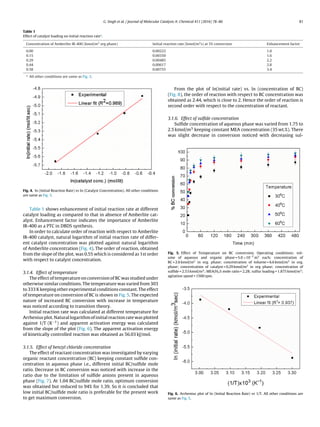
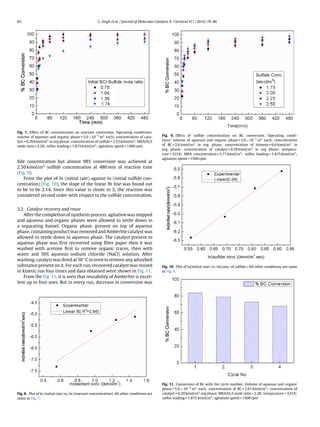
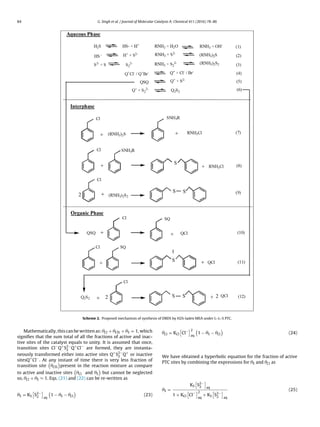
Journal of Molecular Catalysis A: Chemical 411 (2016) 78–86
Contents lists available at ScienceDirect
Journal of Molecular Catalysis A: Chemical
journal homepage: www.elsevier.com/locate/molcata
Kinetic investigation on liquid–liquid–solid phase transfer catalyzed
synthesis of dibenzyl disulfide with H2S-laden monoethanolamine
Gaurav Singh, Priya G. Nakade, Pratik Mishra, Preeti Jha, Sujit Sen∗
, Ujjal Mondal
Catalysis Research Laboratory, Department of Chemical Engineering, National Institute of Technology, Rourkela 769008, India
a r t i c l e i n f o
Article history:
Received 6 September 2015
Received in revised form 11 October 2015
Accepted 12 October 2015
Available online 17 October 2015
Keywords:
Dibenzyl disulfide
Liquid–liquid–solid phase transfer catalyst
Hydrogen sulphide
Kinetics
a b s t r a c t
An investigation has been done on the utilization of H2S for the synthesis of dibenzyl disulfide
(DBDS) using Amberlite IR-400 as a phase transfer catalyst. This involves absorption of H2S in aque-
ous monoethanolamine (MEA) followed by reaction of this H2S-laden MEA with organic reactant benzyl
chloride (BC) to yield DBDS under liquid–liquid–solid (L–L–S) phase transfer catalysis condition. The
effect of various parameters on the conversion of BC was studied and the selectivity of desired product
was 100% at some level of process parameters. A suitable reaction mechanism has been proposed and a
mathematical model has been developed to explain the kinetics of the reaction. Waste minimization was
therefore affected with the utilization of H2S-laden gas for production of a value-added fine chemical.
© 2015 Elsevier B.V. All rights reserved.
1. Introduction
Due to decline in light-to-process crude, refineries around the
world are forced to process heavy crude that contains substantial
amount of organo-sulfur and organo-nitrogen compounds. Typ-
ically hydro-desulfurization process converts those organosulfur
compounds to form hydrogen sulfide (H2S) and ammonia (NH3).
H2S is a toxic gas, poisonous even in a very small concentration,
corrosive in presence of water and classified as a hazardous indus-
trial waste [1,2]. Lots of work has already been done on removal
and recovery of hydrogen sulfide so far. Vilmain removed hydro-
gen sulfide using aqueous chlorine solution by reactive absorption
in a mechanically agitated gas- liquid reactor [3]. Copper–zinc oxide
supported on mesoporous silica reported good absorption capacity
for hydrogen sulfide [4]. Ferrous and alum water were also used for
the removal of hydrogen sulfide [5].
The removal of H2S from various gas streams using aqueous
solution of alkanolamines is a commercialized industrial process
since early thirties [6]. In refineries and natural gas processing
industries, removal of NH3 and H2S are done by scrubbing with
water and amine respectively. Once H2S is absorbed, it is converted
into element sulfur using Claus process, which is a conventional
method to produce elemental sulfur from H2S but it is very energy
expensive. Another disadvantage of this method is high production
rate of elemental sulfur in comparison to the rate of consumption,
∗ Corresponding author. Fax: +91 661 2462999.
E-mail addresses: sensujit@nitrkl.ac.in, sensujit@gmail.com (S. Sen).
so the disposal of elemental sulfur is a severe problem for refiner-
ies. Thus, an alternative process to Claus process has been in high
demand for better utilization of hydrogen sulfide. The present work
was undertaken to develop substitute of Claus process. This work
dealt with the synthesis of dibenzyl disulfide from hydrogen sulfide
in the presence Amberlite IR- 400 as phase transfer catalyst.
Dibenzyl disulfide is very important compound and having
very diversified applications in the field of organic synthesis. Sev-
eral methods have been described for the preparation of organic
disulfides using different reagents and catalysts. Dhar synthesized
disulfide by alkylation of alkyl halides with tetrathiotungstate and
tetrathiomolybdates [7]. Benzyltriethylammonium tetracosathio-
heptamolybdate [(C6H5CH2N(Et)3) 6Mo7S24] was found to be a
good reagent for the synthesis of disulfide from alkyl halides [8].
Disulfides were synthesized by oxidative coupling of thiols in pres-
ence of air using Fe (III)/NaI as a catalyst [9]. Thiols were oxidized
into their corresponding disulfides through oxidative coupling in
presence of potassium phosphate as a catalyst [10]. Disulfides were
also synthesized by oxidative cleavage of aryl or alkyl tert-butyl
sulfide [11]. Landini and Rolla synthesized primary and secondary
dialkyl and aryl alkyl sulfides by using sodium sulfide in presence of
Phase transfer catalyst (PTC) [12]. In the same way Wang and Tsang
prepared symmetrical thioethers using sodium sulphide (Na2S) and
n-bromobutane [13]. Sen reported synthesis of dibenzyl sulfide
from benzyl chloride using H2S-rich aqueous monoethanolamine
[14] . A few literatures are available on the preparation of sym-
metrical thioethers from H2S-laden alkanolamine in presence of
PTC. Na2S was also used for preparation of aliphatic polysulfides in
presence of quaternary onium salt and for reduction of nitroarenes
http://dx.doi.org/10.1016/j.molcata.2015.10.013
1381-1169/© 2015 Elsevier B.V. All rights reserved.
G. Singh et al. / Journal of Molecular Catalysis A: Chemical 411 (2016) 78–86 79
Nomenclature
MEA Monoethanolamine
BC Benzyl chloride
PTC Phase transfer catalyst
H2S Hydrogen sulfide
DBS Dibenzyl sulfide
DBDS Dibenzyl disulfide
S2−
Sulfide anion
S2−
2 Disulfide anion
QSQ Catalyst active intermediate
Q2S2 Catalyst active intermediate
S2−
2 concentration of disulfide anion (kmol/m3)
[Cl−
] concentration of chloride anion (kmol/m3)
[RCl]org,0 initial concentration of organic substrate in organic
phase (kmol/m3)
[RCl]org concentration of organic substrate in organic phase
at any time t (kmol/m3)
Q+
tot
total concentration of catalyst per total system vol-
ume (kmol/m3)
kapp apparent reaction rate constant [min−1]
korg overall reaction rate constant [m3/(kmol of catalyst
.min)]
KCl equilibrium attachment/detachment constant for
S2−
2 ions [m3/(kmol of catalyst min)]
KS equilibrium attachment/detachment constant for
Cl−
ions [m3/(kmol of catalyst min)]
ÂS fraction of total number of catalyst cation attached
to S2−
2
ÂCl fraction of total number of catalyst cation attached
to Cl−
ÂClS fraction of total number of catalyst cation attached
to both S2−
2 and Cl−
XRCl fractional conversion of reactant
t time (min)
to anilines under PTC condition [15,16]. Bandgar reported synthe-
sis of variety of symmetrical disulfides from aryl alkyl halides by
reduction of sulfur with borohydride exchange resin in methanol
[17].
Phase transfer catalysis is a technique to lead a reaction from
the reactants present in two mutually insoluble phases under mild
operating conditions. It is now commercially mature discipline hav-
ing wide range of industrial applications such as intermediates,
perfumes, agrochemicals, pharmaceuticals and polymers [18,19].
Many organic compounds have been synthesized under the pres-
ence of different PTC [20–24]. Sonavane also developed a one-pot
method for synthesis of disulfides from the reaction of sulfur with
sodium sulfide in the presence of didecyldimethylamonium bro-
mide (DDAB) as a PTC [25,26] . Disulfides were also synthesized
from alkyl halides using thiourea and elemental sulfur in presence
of polyethylene glycol (PEG 200) [27]. The conventional soluble
PTCs are having one disadvantage of separation. Distillation or
extraction can be used for the separation of the catalyst but it may
increase complexity of the process and may affect purity and cost
of the product. These drawbacks can be overcome with the use of
solid PTC such as polymeric resins and the phenomenon is known
as liquid–liquid–solid (L–L–S) Tri-phase catalysis. Tri-phase PTC has
several other advantages over soluble PTC in terms of recovery and
reusability of the catalyst. Amberlite IR-400 resin has been used for
sometimes as a heterogeneous catalyst for the synthesis of organic
compounds [28]. The aim of the work is to utilize H2S to synthe-
size fine chemical dibenzyl disulfide selectively. This work has a
great industrial relevance as it could replace the conventional Claus
method followed in most refineries.
2. Experimental
2.1. Chemicals
Toluene (≥99%), Monoethanolamine (MEA) (≥99%) and Benzyl
Chloride of analytical grade were procured from Rankem (India),
New Delhi, India. Amberlite IR-400 (Cl− form) was obtained from
Merck (India) Ltd., Mumbai, India.
2.2. Experimental setup
All the reactions were carried out in a 6.5 cm internal diame-
ter, fully baffled mechanically agitated batch reactor of capacity
250 cm3. 2 cm diameter six-bladed glass disk turbine impeller with
digital speed regulation system, kept at a height of 1.5 cm from the
bottom of the reactor, was used for stirring the reaction mixture.
The reactor was kept in an isothermal water bath (±1 ◦C) having
PID controller.
2.3. Preparation of H2S-laden aqueous MEA
30–35 wt.% aqueous MEA solution was prepared by adding ade-
quate quantity of raw MEA in measured amount of distilled water.
Then H2S gas was bubbled through the aqueous MEA solution in a
gas bubbler, placed in an ice bath. This gas bubbling process was
continued till desired sulfide concentration was attained. Sulfide
concentration was estimated using iodometric titration
2.4. Experimental procedure
In each experimental run, 50 cm3 of aqueous alkanolamine solu-
tion containing a known concentration of sulfide was taken into the
250 cm3 reactor and kept well agitated by stirrer until the steady
state temperature was reached. Then 50 cm3 of the organic phase
containing measured quantity of organic reactant (benzyl chloride)
was dissolved in the solvent (toluene) and the catalyst (Amberlite
IR-400) was added into the reactor. The reaction mixture was then
agitated at a constant speed of stirring. Minimal amount of sample
from the organic phase was withdrawn by micropipette at regular
time intervals after stopping the agitation and allowing the phases
to separate (Scheme 1).
2.5. Organic phase analysis
In the present work, analysis of organic phase was performed
on GC (Agilent GC 7890B) by using a capillary column DB-5MS,
2 m × 3 mm, coupled with flame ionization detector. The product
was further confirmed by GC–MS (Agilent 5977A).
3. Result and discussion
3.1. Parametric study.
3.1.1. Effect of stirring speed.
The speed of agitation was varied from 1000 to 2500 rpm in
both the conditions, with and without catalyst to determine effect
of mass transfer resistance of reactants on the reaction rate. Fig. 1
shows that rate of reaction is practically same in all stirring speeds.
Therefore, it can be assumed that beyond 1500 rpm, increase in
stirring speed has no influence on reaction rate, so reaction can be
safely considered as a kinetically controlled reaction. Thus, the fur-
ther synthesis was carried out at 1500 rpm to remove mass transfer
80 G. Singh et al. / Journal of Molecular Catalysis A: Chemical 411 (2016) 78–86
Scheme 1. Overall reaction system.
Fig. 1. Effect of stirring speed on the rate of reaction. Operating conditions: volume
of aqueous and organic phase = 5.0×10⁻⁵
m3
each; concentration of BC = 2.6 kmol/m3
in org. phase; concentration of toluene = 6.6 kmol/m3
in org. phase; concentration
of catalyst = 0.29 kmol/m3
in org. phase; concentration of sulfide = 2.53 kmol/m3
,
MEA/H2S mole ratio = 2.28; temperature = 323 K; sulfur loading = 1.875 kmol/m3
.
resistance. In absence of catalyst the rate of reaction is very low,
therefore, further experiments have been performed in presence
of catalyst only.
3.1.2. Effect of sulfur loading
Disulfide and polysulfide anions can easily be obtained by dis-
solving elemental sulfur powder in S2− anion rich aqueous phase
[25]. The effect of this elemental sulfur loading on synthesis of
DBDS was investigated by adding different concentration of sul-
fur powder in H2S-laden MEA. The color of aqueous MEA changed
from greenish to reddish brown indicating formation of polysulfide
anions S2−
x (where x = 1–4) depending on sulfur loading.
At low sulfur loading, hydrosulfide (HS−) and sulfide (S2−) ions
are the dominating sulfur species giving BM and DBS respectively as
the product [29]. So the selectivity of DBDS at 0.25 and 0.49 of sulfur
to sulfide mole ratio was found to be low and it was almost neg-
ligible in absence of sulfur loading (Fig. 2). Whereas at high sulfur
loading, polysulfide anions S2−
3,4,5 are the dominating sulfur species,
giving unwanted products like trisulfidse and polysulfides, which
consequently gives again low DBDS selectivity. 100% selectivity of
DBDS was observed at 1.875 kmol/m3 of sulfur due to the presence
of only disulfide anions S2−
2 . So 1.875 kmol/m3 of sulfur was consid-
ered as an optimum reaction parameter and further experiments
were performed at this condition.
3.1.3. Effect of catalyst concentration
The influence of catalyst loading on BC conversion was deter-
mined both in presence and absence of catalyst keeping other
reaction condition constant (Fig. 3). It was noticed that BC con-
version was only 61% in absence of catalyst even after 480 min of
reaction. A drastic increase in BC conversion was observed with
catalyst loading and conversion was observed to increase with
increase in catalyst loading.
In the presence of catalyst, sulfide (S2−) and disulfide S2−
2
anions of aqueous phase react with quaternary ammonium halide
Fig. 2. Effect of sulfur powder loading on DBDS Selectivity. Operating condi-
tions: volume of aqueous and organic phase = 5.0×10⁻⁵
m3
each; concentration
of BC = 2.6 kmol/m3
in org. phase; concentration of toluene = 6.6 kmol/m3
in org.
phase; concentration of catalyst = 0.29 kmol/m3
in org phase; concentration of
sulfide = 2.53 kmol/m3
; MEA/H2S mole ratio = 2.28; temperature = 323 K; agitation
speed = 1500 rpm.
(Q+) to give catalyst active intermediates QSQ and Q2S2 respec-
tively. These catalyst intermediates then migrate from aqueous to
organic phase to react with BC to give DBS and DBDS respectively.
With increase in catalyst concentration, more catalyst interme-
diates are formed and travel to organic phase giving increased
conversion of BC.
In present work, 100% selectivity of DBDS was observed due to
adequate quantity of sulfur powder in aqueous phase giving only
disulfide S2−
2 anions.
Fig. 3. Effect of catalyst loading on BC conversion. Operating conditions: volume of
aqueous and organic phase = 5.0×10⁻⁵
m3
each; concentration of BC = 2.6 kmol/m3
in org. phase; concentration of toluene = 6.6 kmol/m3
in org. phase; concentration
of sulfide = 2.53 kmol/m3
; MEA/H2S mole ratio = 2.28; temperature = 323 K; sulfur
loading = 1.875 kmol/m3
; agitation speed = 1500 rpm.
G. Singh et al. / Journal of Molecular Catalysis A: Chemical 411 (2016) 78–86 81
Table 1
Effect of catalyst loading on initial reaction ratea
.
Concentration of Amberlite IR-400 (kmol/m3
org phase) Initial reaction rate (kmol/m3
s) at 5% conversion Enhancement factor
0.00 0.00222 1.0
0.15 0.00350 1.6
0.29 0.00485 2.2
0.44 0.00617 2.8
0.58 0.00755 3.4
a
All other conditions are same as Fig. 3.
Fig. 4. ln (Initial Reaction Rate) vs ln (Catalyst Concentration). All other conditions
are same as Fig. 3.
Table 1 shows enhancement of initial reaction rate at different
catalyst loading as compared to that in absence of Amberlite cat-
alyst. Enhancement factor indicates the importance of Amberlite
IR-400 as a PTC in DBDS synthesis.
In order to calculate order of reaction with respect to Amberlite
IR-400 catalyst, natural logarithm of initial reaction rate of differ-
ent catalyst concentration was plotted against natural logarithm
of Amberlite concentration (Fig. 4). The order of reaction, obtained
from the slope of the plot, was 0.55 which is considered as 1st order
with respect to catalyst concentration.
3.1.4. Effect of temperature
The effect of temperature on conversion of BC was studied under
otherwise similar conditions. The temperature was varied from 303
to 333 K keeping other experimental conditions constant. The effect
of temperature on conversion of BC is shown in Fig. 5. The expected
nature of increased BC conversion with increase in temperature
was noticed according to transition theory.
Initial reaction rate was calculated at different temperature for
Arrhenius plot. Natural logarithm of initial reaction rate was plotted
against 1/T (K−1) and apparent activation energy was calculated
from the slope of the plot (Fig. 6). The apparent activation energy
of kinetically controlled reaction was obtained as 56.03 kJ/mol.
3.1.5. Effect of benzyl chloride concentration
The effect of reactant concentration was investigated by varying
organic reactant concentration (BC) keeping constant sulfide con-
centration in aqueous phase i.e., different initial BC/sulfide mole
ratio. Decrease in BC conversion was noticed with increase in the
ratio due to the limitation of sulfide anions present in aqueous
phase (Fig. 7). At 1.04 BC/sulfide mole ratio, optimum conversion
was obtained but reduced to 94% for 1.39. So it is concluded that
low initial BC/sulfide mole ratio is preferable for the present work
to get maximum conversion.
From the plot of ln(initial rate) vs. ln (concentration of BC)
(Fig. 8), the order of reaction with respect to BC concentration was
obtained as 2.44, which is close to 2. Hence the order of reaction is
second order with respect to the concentration of reactant.
3.1.6. Effect of sulfide concentration
Sulfide concentration of aqueous phase was varied from 1.75 to
2.5 kmol/m3 keeping constant MEA concentration (35 wt.%). There
was slight decrease in conversion noticed with decreasing sul-
Fig. 5. Effect of Temperature on BC conversion. Operating conditions: vol-
ume of aqueous and organic phase = 5.0 ×10⁻⁵
m3
each; concentration of
BC = 2.6 kmol/m3
in org. phase; concentration of toluene = 6.6 kmol/m3
in org.
phase; concentration of catalyst = 0.29 kmol/m3
in org phase; concentration of
sulfide = 2.53 kmol/m3
; MEA/H2S mole ratio = 2.28; sulfur loading = 1.875 kmol/m3
;
agitation speed = 1500 rpm.
Fig. 6. Arrhenius plot of ln (Initial Reaction Rate) vs 1/T. All other conditions are
same as Fig. 5.
82 G. Singh et al. / Journal of Molecular Catalysis A: Chemical 411 (2016) 78–86
Fig. 7. Effect of BC concentration on reactant conversion. Operating conditions:
volume of aqueous and organic phase = 5.0 ×10⁻⁵
m3
each; concentration of cata-
lyst = 0.29 kmol/m3
in org phase; concentration of sulfide = 2.53 kmol/m3
; MEA/H2S
mole ratio = 2.28; sulfur loading = 1.875 kmol/m3
; agitation speed = 1500 rpm.
fide concentration but almost 98% conversion was achieved at
2.50 kmol/m3 sulfide concentration at 480 min of reaction time
(Fig. 9).
From the plot of ln (initial rate) against ln (initial sulfide con-
centration) (Fig. 10), the slope of the linear fit line was found out
to be to be 2.14. Since this value is closer to 2, the reaction was
considered second order with respect to the sulfide concentration.
3.2. Catalyst recovery and reuse
After the completion of synthesis process, agitation was stopped
and aqueous and organic phases were allowed to settle down in
a separating funnel. Organic phase, present on top of aqueous
phase, containing product was removed and Amberlite catalyst was
allowed to settle down in aqueous phase. The catalyst present in
aqueous phase was first recovered using filter paper then it was
washed with acetone first to remove organic traces, then with
water and 50% aqueous sodium chloride (NaCl) solution. After
washing, catalyst was dried at 50 ◦C in oven to remove any adsorbed
substance present on it. For each run, recovered catalyst was reused
in kinetic run four times and data obtained were shown in Fig. 11.
From the Fig. 11, it is seen that reusability of Amberlite is excel-
lent up to four uses. But in every run, decrease in conversion was
Fig. 8. Plot of ln (initial rate) vs. ln (reactant concentration). All other conditions are
same as Fig. 7.
Fig. 9. Effect of sulfide concentration on BC conversion. Operating condi-
tions: volume of aqueous and organic phase = 5.0 ×10⁻⁵
m3
each; concentration
of BC = 2.6 kmol/m3
in org. phase; concentration of toluene = 6.6 kmol/m3
in
org. phase; concentration of catalyst = 0.29 kmol/m3
in org phase; tempera-
ture = 323 K; MEA concentration = 5.77 kmol/m3
; sulfur loading = 1.875 kmol/m3
;
agitation speed = 1500 rpm.
Fig. 10. Plot of ln(initial rate) vs. ln(conc. of sulfide). All other conditions are same
as Fig. 9.
Fig. 11. Conversion of BC with the cycle number. Volume of aqueous and organic
phase = 5.0 × 10⁻⁵
m3
each; concentration of BC = 2.61 kmol/m3
; concentration of
catalyst = 0.29 kmol/m3
org phase; MEA/H2S mole ratio = 2.28; temperature = 323 K;
sulfur loading = 1.875 kmol/m3
, agitation speed = 1500 rpm
G. Singh et al. / Journal of Molecular Catalysis A: Chemical 411 (2016) 78–86 83
observed due to loss of catalyst in aqueous and organic phase and
during catalyst washing process.
3.3. Proposed mechanism of synthesis of dibenzyl disulfide under
L–L–S PTC
The mechanism of the reaction between BC with H2S- laden
MEA and sulfur powder in aqueous phase using Amberlite IR-400
as a PTC is shown in Scheme 2. Generally aqueous phase reactions
are faster as compare to organic phase reactions, so an ionic equi-
librium exists in aqueous phase between RNH2 (MEA)-H2O–H2S
which results in formation of three active inorganic nucleophiles
namely hydroxide (OH)−, sulfide (S2−) and disulfide (S2−
2 ) as repre-
sented in aqueous phase. In the present system, hydrosulfide anion
(HS−) is not expected to stay due to the presence of sulfur powder in
aqueous phase. Sulfur shifts the ionic equilibrium to the right giv-
ing only sulfide (S2−) and disulfide (S2−
2 ) anions in aqueous phase.
The product was obtained from both catalytic and non-catalytic
contribution.
3.3.1. Non-catalytic contribution
Ethanolamine sulfide ((RNH3)2S) and ethanolamine disulfide
((RNH3)2S2), formed in aqueous phase via Reaction (2) and (3)
respectively in Scheme 2, are insoluble in organic phase. So they
are expected to react with BC in aqueous–organic interface to give
DBS and DBDS respectively as shown in Reaction (7)–(9). Due to
2nd order reaction rate of nucleophilic reaction, DBS is expected to
form via formation of intermediate product C6H5CH2SNH3R which
again reacts with BC to give desired DBS. The formed product trav-
els from interface to organic phase from where selective separation
of products takes place.
3.3.2. Catalytic contribution
Mass transfer and surface reaction are two important steps in
presence of solid catalyst in L–L–S PTC [30] . Synthesis steps involve:
Step 1: Diffusion of aqueous anions S2−and S2−
2 from bulk aque-
ous phase to PTC.
Step 2: Ion exchange reaction of these nucleophiles with catalyst
cation (Q+) to form catalyst active intermediates QSQ and Q2S2 as
shown in Reaction (4)–(6) and leaving Cl− anion.
Step 3: Diffusion of organic reactant BC from bulk organic phase
to PTC.
Step 4: Synthesis reaction of BC at catalyst active site present
at aqueous organic interphase to give desired products (Reaction
(10)–(12).
Step 5: Diffusion of anion Cl− and product from interface to
aqueous and organic phase respectively as shown in Scheme 2.
3.4. Kinetic modeling
The GC analysis shows that the formation of DBS is very less
as compared to DBDS. This observation can be attributed to less
diffusion of aqueous sulfide (S2−) anion in comparison to disulfide
S2−
2 anion in the aqueous phase and the corresponding insignif-
icant formation of catalyst active intermediate QSQ as compare to
Q2S2 in the ion exchange step. The overall rate of reaction between
the organic substrate RCl and a di-ionic inorganic nucleophile S2−
2 to
form organic product RS2R in the presence of PTC, Q+
Cl−
then can be
expressed as a function of the concentrations of RCl andQ+
S2−
2 Q+
,
i.e.,
2RCl + Q+
S2−
2 Q+
→ RS2R + 2Q+
Cl−
(13)
Rate, −rorg = −
d[RCl]org
dt
= korg[RCl]
2
org Q+
S2−
2 Q+
s
(14)
In the present work, a rigorous model based on the modification of
the Langmuir–Hinshelwood/Eley–Rideal mechanism will be devel-
oped and experimental data from the reaction between benzyl
chloride in the organic phase and disulfide in the aqueous phase
to yield dibenzyl disulfide will be used to verify it. This reaction
system belongs to a general class of esterification reactions where
the nucleophile is extracted from the aqueous phase using a phase
transfer catalyst. The reaction is mediated by polymer-supported
quaternary ammonium chloride and conducted in the batch slurry
mode.
The whole reaction can be compared to the Eley–Rideal reac-
tion mechanism [30], which includes reaction between an adsorbed
reactant with an un-adsorbed reactant from the bulk phase. Here,
the ion-exchange step can be considered as the adsorption of first
reactant to convert inactive sites into active sites, and in organic
phase reaction step, second reactant reacts with adsorbed reactant
to yield desired product RS2R.
We assume that the reaction mechanism consist of an ion-
exchange reaction step between S2−
2 and Q+
X−
to form an active
site, Q+
S2−
2 Q+
followed by reaction of RCl at this site to form a
final product, RS2R, and an inactive site, Q+
Cl−
. These steps may
be described as follows:
Ion Exchange step:
2 Q+
Cl−
s
+ S2−
2 aq
↔ Q+
S2−
2 Q+
s
+ 2 Cl−
aq
(15)
Organic phase reaction step:
Q+
S2−
2 Q+
s
+ 2(RCl)org ↔ 2 Q+
Cl−
s
+ (RS2R)org (16)
The reversible ion-exchange step may be compared to the
Langmuir–Hinshelwood adsorption/desorption mechanism. We
can express the Eq. (15) using traditional notations of heteroge-
neous catalysis as,
S2−
2
+ 2 Q+
Cl−
↔ 2(Cl−
) + Q+
S2−
2 Q+
(17)
where Q+
is catalyst’s cation.
Assuming the formation of transitional site Cl−
Q+
S2−
2 Q+
Cl−
between the forward and backward reaction steps, the whole reac-
tion can be written as,
S2−
2
+ 2 Q+
Cl−
↔ Cl−
Q+
S2−
2 Q+
Cl−
↔ 2 Cl−
+ Q+
S2−
2 Q+
(18)
We can split the ion exchange step as two separate equilib-
rium attachment/detachment steps. The attachment/detachment
of S2−
2 anion on the inactive site of Q+
Cl−
can be seen in the forward
reaction step as,
2 Q+
Cl−
s
+ S2−
2 aq
↔ Cl−
Q+
S2−
2 Q+
Cl−
(19)
Similarly, attachment/detachment of Cl−
anion on an active site of
Q+
S2−
2 Q+
can be seen in the backward reaction step as,
Q+
S2−
2 Q+
s
+ 2 Cl−
aq
↔ Cl−
Q+
S2−
2 Q−
Cl−
(20)
Assuming the rates of attachment/detachment are in equilib-
rium, Eqs. (21) and (22) can be obtained from Eqs. (19) and (20),
respectively as,
ÂClS = KS S2−
2 aq
1 − ÂS − ÂClS (21)
ÂClS = KCl Cl− 2
aq
1 − ÂCl − ÂClS (22)
where, KS and KCl are the equilibrium attachment/detachment con-
stants for S2−
2 and Cl−
anions, respectively; S2−
2 and Cl−
are the
concentrations of S2−
2 and Cl−
anions in the aqueous phase, respec-
tively; and ÂS, ÂCl, ÂClS are the fractions of total number of triphase
catalyst cations attached to S2−
2 , Cl−
and both S2−
2 and Cl−
anions,
respectively.
84 G. Singh et al. / Journal of Molecular Catalysis A: Chemical 411 (2016) 78–86
Scheme 2. Proposed mechanism of synthesis of DBDS by H2S-laden MEA under L–L–S PTC.
Mathematically, this can be written as: ÂCl + ÂClS + ÂS = 1, which
signifies that the sum total of all the fractions of active and inac-
tive sites of the catalyst equals to unity. It is assumed that once,
transition sites Cl−
Q+
S2−
2 Q+
Cl−
are formed, they are instanta-
neously transformed either into active sites Q+
S2−
2 Q+
or inactive
sitesQ+
Cl−
. At any instant of time there is very less fraction of
transition site ÂClS present in the reaction mixture as compare
to active and inactive sites ÂCl and ÂS but cannot be neglected
so, ÂCl + ÂS ≈ 1. Eqs. (21) and (22) can be re-written as
ÂS = KS S2−
2 aq
1 − ÂS − ÂCl (23)
ÂCl = KCl Cl− 2
aq
1 − ÂS − ÂCl (24)
We have obtained a hyperbolic equation for the fraction of active
PTC sites by combining the expressions for ÂS and ÂCl as
ÂS =
KS S2−
2 aq
1 + KCl Cl− 2
aq
+ KS S2−
2 aq
(25)
G. Singh et al. / Journal of Molecular Catalysis A: Chemical 411 (2016) 78–86 85
We can also write above equation in terms of catalyst concentra-
tion,
Q+
S2−
2
Q+
= Q+
tot
KS S2−
2 aq
1 + KCl[Cl−]
2
aq + KS S2−
2 aq
(26)
where, Q+
tot
and Q+
S2−
2 Q+
are the total concentrations of cat-
alyst and the concentration of catalyst attached to S2−
2 anions,
respectively.
We obtain Eq. (27) for the rate of the organic reactions by com-
bining Eqs. (14) and (26) as,
−rorg = −
d[RCl]org
dt
= korg[RCl]
2
org Q+
tot
KS S2−
2 aq
1 + KCl Cl− 2
aq
+ KS S2−
2 aq
(27)
−
d[RCl]org
dt
= kogr[RCl]
2
org Q+
tot
Ks S2−
2 aq
1 + KCl Cl− 2
aq
+ Ks S2−
2 aq
(28)
Let us introduce fractional conversion of reactant (XRCl), which can
be calculated as
XRCl =
[RCl]org,0 − [RCl]org
[RCl]org,0
(29)
where, [RCl]org,0and [RCl]org represents initial concentration of
benzyl chloride and concentration at any time respectively. Now
we can write Eq. (28) in the form of fractional conversion as
−rorg =
dXRCl
dt
= korg[RCl]org,0 Q+
tot
KS S2−
2 aq
(1 − XRCl)2
1 + KCl Cl− 2
aq
+ KS S2−
2 aq
(30)
=
dXRCl
(1 − XRCl)2
= korg[RCl]org,0 Q+
tot
KS S2−
2 aq
1 + KCl Cl− 2
aq
+ KS S2−
2 aq
dt
(31)
=
dXRCl
(1 − XRCl)2
= kappdt (32)
where kapp = korg[RCl]org,0 Q+
tot
KS S2−
2 aq
1+KCl[Cl−
]
2
aq
+KS S2−
2 aq
.The terms
in the kapp can be calculated experimentally. Thus, after integration
of Eq. (32) we get,
XRCL
1 − XRCL
= kappt (33)
From the Eq. (33) it is clear that the reaction follows second
order kinetics.
3.5. Validation of kinetic model
The kinetic model was validated by considering Eq. (33) was
valid at different temperatures by plotting of XRCl/(1−XRCl) against
time (Fig. 12). The slope of each line gives the apparent rate constant
kapp at different temperatures as shown in Table 2. Fig. 13 shows
comparison of calculated conversions of BC based on app. rate
constants and experimentally obtained conversions of BC. Good
agreement has been observed between calculated and experimen-
tal conversions.
Fig. 12. Validation of the kinetic model with experimental data at differ-
ent temperature. Volume of organic phase = 5.0 × 10⁻⁵
m3
, volume of aqueous
phase = 5.0 × 10⁻⁵
m3
, concentration of toluene = 6.6 kmol/m3
in org. phase, concen-
tration of BC = 2.6 kmol/m3
in org. phase, concentration of catalyst = 0.29 kmol/m3
org. phase; sulfide conc. = 2.53 kmol/m3
, MEA/H2S mole ratio = 2.28, sulfur load-
ing = 1.875 kmol/m3
, stirring speed = 1500 rpm.
Table 2
Apparent rate constants (kapp) at different temperaturesb
.
Temperature (◦
C) 30 40 50 60
kapp (min−1
) 0.01673 0.03276 0.05033 0.10171
b
All the considerations are same as mentioned in Fig. 12.
Fig. 13. Comparison of calculated and experimental BC conversions at 480 min dif-
ferent temperatures and all conditions are as same as Fig. 12.
4. Conclusion
A detailed study has been carried out on the synthesis of DBDS
from BC using Amberlite IR-400 as a solid phase transfer catalyst.
It is seen that at different speed of agitation there was no signifi-
cant change on the rate of reaction so the reaction was found to be
kinetically controlled and all experiments were done at a speed of
1500 rpm. The reaction was found to be approximately first order
with respect the concentration of the catalyst, second order with
respect to the reactant concentration and second order with respect
to the sulfide concentration. 100% selectivity of DBDS was observed
at 1.875 kmol/m3 of sulfur loading. The obtained activation energy,
for DBDS synthesis, from Arrhenius plot was 56.03 kJ/mol. Catalyst
86 G. Singh et al. / Journal of Molecular Catalysis A: Chemical 411 (2016) 78–86
was recovered and reused four times with successive decrease in
the conversion of BC. A mathematical model was developed, based
on kinetic study and proposed mechanism, to account for the calcu-
lation of the rate constant and it was validated using experimental
data.
Acknowledgment
We appreciate the technical support provided by Department
of Chemical Engineering of the institute in identifying the product
using NMR.
Appendix A. Supplementary data
Supplementary data associated with this article can be found, in
the online version, at http://dx.doi.org/10.1016/j.molcata.2015.10.
013.
References
[1] L.J. Keras, US Patent NO. US2011/0155646 (2011).
[2] H. Huang, Y. Yu, K.H. Chung, Energy Fuels 23 (2009) 4420.
[3] J.B. Vilmain, V. Couroussea, P.F. Biarda, M. Azizia, A. Couvert, Chem. Eng. Res.
Des. 92 (2014) 191.
[4] B. Elyassi, Y.A. Wahedi, N. Rajabbeigi, P. Kumar, J.S. Jeong, X. Zhang, P. Kumar,
V.V. Balasubramanian, M.S. Katsiotis, K.A. Mkhoyan, N. Boukos, S.A. Hashimi,
M. Tsapatsis, Microporous Mesoporous Mater. 190 (2014) 152.
[5] C. Wang, Y. Pei, Chemosphere 88 (2012) 1178.
[6] A.L. Kohl, R.B. Nielsen, Gas Purification, Gulf Publishing Company, Houston,
Texas, 1997.
[7] P. Dhar, S. Chandrasekaran, J. Org. Chem. 54 (13) (1989) 2998.
[8] V. Polshettivar, M. Nivsarkar, J. Acharya, M.P. Kaushik, Tetrahedron Lett. 44
(2003) 887.
[9] N. Iranpoor, B. Zeynizadeh, Synthesis (1999) 49.
[10] A.V. Joshi, S. Bhusare, M. Baidossi, N. Qafisheh, Y. Sesson, Tetrahedron Lett. 46
(2005) 3583.
[11] D.A. Dickman, S. Chemburkar, D.B. Konopacki, E.M. Elisseou, Synthesis 6
(1993) 573.
[12] D. Landini, F. Rolla, Synthesis (1974) 565.
[13] M.L. Wang, Y.H. Tseng, J. Mol. Catal. A: Chem. 203 (2003) 79.
[14] S. Sen, N.C. Pradhan, A.V. Patwardhan, Asia-Pac. J. Chem. Eng. 6 (2011) 257.
[15] M. Ueda, Y. Oishi, N. Sakai, Y. Imai, Macromolecules 15 (1982) 248.
[16] N.C. Pradhan, M.M. Sharma, Ind. Eng. Chem. Res. 31 (1992) 1606.
[17] B.P. Bandgar, L.S. Uppala, V.S. Sadavarte, Tetrahedron Lett. 42 (2001) 6741.
[18] C.M. Starks, C.L. Liotta, M. Halpern, Phase-transfer Catalysis: Fundamentals,
Applications and Industrial Perspectives, Chapman and Hall, London, 1994.
[19] Y. Sasson, R. Neumann, Handbook of Phase transfer Catalysis, Blackie
Academic and Professional, London, 1997.
[20] G.D. Yadav, N.M. Desai, Catal. Commun. 7 (2006) 325.
[21] G.D. Yadav, B.G. Motirale, Chem. Eng. J. 156 (2010) 328.
[22] G.D. Yadav, S.V. Lande, J. Mol. Catal. A: Chem. 244 (2006) 271.
[23] G.D. Yadav, P.R. Sowbna, Chem. Eng. J. 179 (2012) 221.
[24] G.D. Yadav, P.R. Sowbna, Chem. Eng. Res. Des. 90 (2012) 1281.
[25] S.U. Sonavane, M. Chidambaram, J. Among, Y. Sasson, Tetrahedron Lett. 48
(2007) 6048.
[26] S.U. Sonavane, M. Chidambaram, S. Khalil, J. Among, Y. Sasson, Tetrahedron
Lett. 49 (2008) 520.
[27] M. Abbasi, M.R. Mohammadizadeh, Z.K. Taghavi, J. Iran Chem. Soc. 10 (2013)
201.
[28] H. Gurusamy, P. Parkunan, K. Madasamy, S. Ponnusamy, Tetrahedron Lett. 56
(2015) 150.
[29] S. Sen, S.K. Maity, N.C. Pradhan, A.V. Patwardhan, Int. J. Chem. Sci. 5 (2007)
1569.
[30] J.A.B. Satrio, H.J. Glatzer, L.K. Doraiswamy, Chem. Eng. Sci. 55 (2000) 5013.

Published paper

  • 1.
    Journal of MolecularCatalysis A: Chemical 411 (2016) 78–86 Contents lists available at ScienceDirect Journal of Molecular Catalysis A: Chemical journal homepage: www.elsevier.com/locate/molcata Kinetic investigation on liquid–liquid–solid phase transfer catalyzed synthesis of dibenzyl disulfide with H2S-laden monoethanolamine Gaurav Singh, Priya G. Nakade, Pratik Mishra, Preeti Jha, Sujit Sen∗ , Ujjal Mondal Catalysis Research Laboratory, Department of Chemical Engineering, National Institute of Technology, Rourkela 769008, India a r t i c l e i n f o Article history: Received 6 September 2015 Received in revised form 11 October 2015 Accepted 12 October 2015 Available online 17 October 2015 Keywords: Dibenzyl disulfide Liquid–liquid–solid phase transfer catalyst Hydrogen sulphide Kinetics a b s t r a c t An investigation has been done on the utilization of H2S for the synthesis of dibenzyl disulfide (DBDS) using Amberlite IR-400 as a phase transfer catalyst. This involves absorption of H2S in aque- ous monoethanolamine (MEA) followed by reaction of this H2S-laden MEA with organic reactant benzyl chloride (BC) to yield DBDS under liquid–liquid–solid (L–L–S) phase transfer catalysis condition. The effect of various parameters on the conversion of BC was studied and the selectivity of desired product was 100% at some level of process parameters. A suitable reaction mechanism has been proposed and a mathematical model has been developed to explain the kinetics of the reaction. Waste minimization was therefore affected with the utilization of H2S-laden gas for production of a value-added fine chemical. © 2015 Elsevier B.V. All rights reserved. 1. Introduction Due to decline in light-to-process crude, refineries around the world are forced to process heavy crude that contains substantial amount of organo-sulfur and organo-nitrogen compounds. Typ- ically hydro-desulfurization process converts those organosulfur compounds to form hydrogen sulfide (H2S) and ammonia (NH3). H2S is a toxic gas, poisonous even in a very small concentration, corrosive in presence of water and classified as a hazardous indus- trial waste [1,2]. Lots of work has already been done on removal and recovery of hydrogen sulfide so far. Vilmain removed hydro- gen sulfide using aqueous chlorine solution by reactive absorption in a mechanically agitated gas- liquid reactor [3]. Copper–zinc oxide supported on mesoporous silica reported good absorption capacity for hydrogen sulfide [4]. Ferrous and alum water were also used for the removal of hydrogen sulfide [5]. The removal of H2S from various gas streams using aqueous solution of alkanolamines is a commercialized industrial process since early thirties [6]. In refineries and natural gas processing industries, removal of NH3 and H2S are done by scrubbing with water and amine respectively. Once H2S is absorbed, it is converted into element sulfur using Claus process, which is a conventional method to produce elemental sulfur from H2S but it is very energy expensive. Another disadvantage of this method is high production rate of elemental sulfur in comparison to the rate of consumption, ∗ Corresponding author. Fax: +91 661 2462999. E-mail addresses: sensujit@nitrkl.ac.in, sensujit@gmail.com (S. Sen). so the disposal of elemental sulfur is a severe problem for refiner- ies. Thus, an alternative process to Claus process has been in high demand for better utilization of hydrogen sulfide. The present work was undertaken to develop substitute of Claus process. This work dealt with the synthesis of dibenzyl disulfide from hydrogen sulfide in the presence Amberlite IR- 400 as phase transfer catalyst. Dibenzyl disulfide is very important compound and having very diversified applications in the field of organic synthesis. Sev- eral methods have been described for the preparation of organic disulfides using different reagents and catalysts. Dhar synthesized disulfide by alkylation of alkyl halides with tetrathiotungstate and tetrathiomolybdates [7]. Benzyltriethylammonium tetracosathio- heptamolybdate [(C6H5CH2N(Et)3) 6Mo7S24] was found to be a good reagent for the synthesis of disulfide from alkyl halides [8]. Disulfides were synthesized by oxidative coupling of thiols in pres- ence of air using Fe (III)/NaI as a catalyst [9]. Thiols were oxidized into their corresponding disulfides through oxidative coupling in presence of potassium phosphate as a catalyst [10]. Disulfides were also synthesized by oxidative cleavage of aryl or alkyl tert-butyl sulfide [11]. Landini and Rolla synthesized primary and secondary dialkyl and aryl alkyl sulfides by using sodium sulfide in presence of Phase transfer catalyst (PTC) [12]. In the same way Wang and Tsang prepared symmetrical thioethers using sodium sulphide (Na2S) and n-bromobutane [13]. Sen reported synthesis of dibenzyl sulfide from benzyl chloride using H2S-rich aqueous monoethanolamine [14] . A few literatures are available on the preparation of sym- metrical thioethers from H2S-laden alkanolamine in presence of PTC. Na2S was also used for preparation of aliphatic polysulfides in presence of quaternary onium salt and for reduction of nitroarenes http://dx.doi.org/10.1016/j.molcata.2015.10.013 1381-1169/© 2015 Elsevier B.V. All rights reserved.
  • 2.
    G. Singh etal. / Journal of Molecular Catalysis A: Chemical 411 (2016) 78–86 79 Nomenclature MEA Monoethanolamine BC Benzyl chloride PTC Phase transfer catalyst H2S Hydrogen sulfide DBS Dibenzyl sulfide DBDS Dibenzyl disulfide S2− Sulfide anion S2− 2 Disulfide anion QSQ Catalyst active intermediate Q2S2 Catalyst active intermediate S2− 2 concentration of disulfide anion (kmol/m3) [Cl− ] concentration of chloride anion (kmol/m3) [RCl]org,0 initial concentration of organic substrate in organic phase (kmol/m3) [RCl]org concentration of organic substrate in organic phase at any time t (kmol/m3) Q+ tot total concentration of catalyst per total system vol- ume (kmol/m3) kapp apparent reaction rate constant [min−1] korg overall reaction rate constant [m3/(kmol of catalyst .min)] KCl equilibrium attachment/detachment constant for S2− 2 ions [m3/(kmol of catalyst min)] KS equilibrium attachment/detachment constant for Cl− ions [m3/(kmol of catalyst min)] ÂS fraction of total number of catalyst cation attached to S2− 2 ÂCl fraction of total number of catalyst cation attached to Cl− ÂClS fraction of total number of catalyst cation attached to both S2− 2 and Cl− XRCl fractional conversion of reactant t time (min) to anilines under PTC condition [15,16]. Bandgar reported synthe- sis of variety of symmetrical disulfides from aryl alkyl halides by reduction of sulfur with borohydride exchange resin in methanol [17]. Phase transfer catalysis is a technique to lead a reaction from the reactants present in two mutually insoluble phases under mild operating conditions. It is now commercially mature discipline hav- ing wide range of industrial applications such as intermediates, perfumes, agrochemicals, pharmaceuticals and polymers [18,19]. Many organic compounds have been synthesized under the pres- ence of different PTC [20–24]. Sonavane also developed a one-pot method for synthesis of disulfides from the reaction of sulfur with sodium sulfide in the presence of didecyldimethylamonium bro- mide (DDAB) as a PTC [25,26] . Disulfides were also synthesized from alkyl halides using thiourea and elemental sulfur in presence of polyethylene glycol (PEG 200) [27]. The conventional soluble PTCs are having one disadvantage of separation. Distillation or extraction can be used for the separation of the catalyst but it may increase complexity of the process and may affect purity and cost of the product. These drawbacks can be overcome with the use of solid PTC such as polymeric resins and the phenomenon is known as liquid–liquid–solid (L–L–S) Tri-phase catalysis. Tri-phase PTC has several other advantages over soluble PTC in terms of recovery and reusability of the catalyst. Amberlite IR-400 resin has been used for sometimes as a heterogeneous catalyst for the synthesis of organic compounds [28]. The aim of the work is to utilize H2S to synthe- size fine chemical dibenzyl disulfide selectively. This work has a great industrial relevance as it could replace the conventional Claus method followed in most refineries. 2. Experimental 2.1. Chemicals Toluene (≥99%), Monoethanolamine (MEA) (≥99%) and Benzyl Chloride of analytical grade were procured from Rankem (India), New Delhi, India. Amberlite IR-400 (Cl− form) was obtained from Merck (India) Ltd., Mumbai, India. 2.2. Experimental setup All the reactions were carried out in a 6.5 cm internal diame- ter, fully baffled mechanically agitated batch reactor of capacity 250 cm3. 2 cm diameter six-bladed glass disk turbine impeller with digital speed regulation system, kept at a height of 1.5 cm from the bottom of the reactor, was used for stirring the reaction mixture. The reactor was kept in an isothermal water bath (±1 ◦C) having PID controller. 2.3. Preparation of H2S-laden aqueous MEA 30–35 wt.% aqueous MEA solution was prepared by adding ade- quate quantity of raw MEA in measured amount of distilled water. Then H2S gas was bubbled through the aqueous MEA solution in a gas bubbler, placed in an ice bath. This gas bubbling process was continued till desired sulfide concentration was attained. Sulfide concentration was estimated using iodometric titration 2.4. Experimental procedure In each experimental run, 50 cm3 of aqueous alkanolamine solu- tion containing a known concentration of sulfide was taken into the 250 cm3 reactor and kept well agitated by stirrer until the steady state temperature was reached. Then 50 cm3 of the organic phase containing measured quantity of organic reactant (benzyl chloride) was dissolved in the solvent (toluene) and the catalyst (Amberlite IR-400) was added into the reactor. The reaction mixture was then agitated at a constant speed of stirring. Minimal amount of sample from the organic phase was withdrawn by micropipette at regular time intervals after stopping the agitation and allowing the phases to separate (Scheme 1). 2.5. Organic phase analysis In the present work, analysis of organic phase was performed on GC (Agilent GC 7890B) by using a capillary column DB-5MS, 2 m × 3 mm, coupled with flame ionization detector. The product was further confirmed by GC–MS (Agilent 5977A). 3. Result and discussion 3.1. Parametric study. 3.1.1. Effect of stirring speed. The speed of agitation was varied from 1000 to 2500 rpm in both the conditions, with and without catalyst to determine effect of mass transfer resistance of reactants on the reaction rate. Fig. 1 shows that rate of reaction is practically same in all stirring speeds. Therefore, it can be assumed that beyond 1500 rpm, increase in stirring speed has no influence on reaction rate, so reaction can be safely considered as a kinetically controlled reaction. Thus, the fur- ther synthesis was carried out at 1500 rpm to remove mass transfer
  • 3.
    80 G. Singhet al. / Journal of Molecular Catalysis A: Chemical 411 (2016) 78–86 Scheme 1. Overall reaction system. Fig. 1. Effect of stirring speed on the rate of reaction. Operating conditions: volume of aqueous and organic phase = 5.0×10⁻⁵ m3 each; concentration of BC = 2.6 kmol/m3 in org. phase; concentration of toluene = 6.6 kmol/m3 in org. phase; concentration of catalyst = 0.29 kmol/m3 in org. phase; concentration of sulfide = 2.53 kmol/m3 , MEA/H2S mole ratio = 2.28; temperature = 323 K; sulfur loading = 1.875 kmol/m3 . resistance. In absence of catalyst the rate of reaction is very low, therefore, further experiments have been performed in presence of catalyst only. 3.1.2. Effect of sulfur loading Disulfide and polysulfide anions can easily be obtained by dis- solving elemental sulfur powder in S2− anion rich aqueous phase [25]. The effect of this elemental sulfur loading on synthesis of DBDS was investigated by adding different concentration of sul- fur powder in H2S-laden MEA. The color of aqueous MEA changed from greenish to reddish brown indicating formation of polysulfide anions S2− x (where x = 1–4) depending on sulfur loading. At low sulfur loading, hydrosulfide (HS−) and sulfide (S2−) ions are the dominating sulfur species giving BM and DBS respectively as the product [29]. So the selectivity of DBDS at 0.25 and 0.49 of sulfur to sulfide mole ratio was found to be low and it was almost neg- ligible in absence of sulfur loading (Fig. 2). Whereas at high sulfur loading, polysulfide anions S2− 3,4,5 are the dominating sulfur species, giving unwanted products like trisulfidse and polysulfides, which consequently gives again low DBDS selectivity. 100% selectivity of DBDS was observed at 1.875 kmol/m3 of sulfur due to the presence of only disulfide anions S2− 2 . So 1.875 kmol/m3 of sulfur was consid- ered as an optimum reaction parameter and further experiments were performed at this condition. 3.1.3. Effect of catalyst concentration The influence of catalyst loading on BC conversion was deter- mined both in presence and absence of catalyst keeping other reaction condition constant (Fig. 3). It was noticed that BC con- version was only 61% in absence of catalyst even after 480 min of reaction. A drastic increase in BC conversion was observed with catalyst loading and conversion was observed to increase with increase in catalyst loading. In the presence of catalyst, sulfide (S2−) and disulfide S2− 2 anions of aqueous phase react with quaternary ammonium halide Fig. 2. Effect of sulfur powder loading on DBDS Selectivity. Operating condi- tions: volume of aqueous and organic phase = 5.0×10⁻⁵ m3 each; concentration of BC = 2.6 kmol/m3 in org. phase; concentration of toluene = 6.6 kmol/m3 in org. phase; concentration of catalyst = 0.29 kmol/m3 in org phase; concentration of sulfide = 2.53 kmol/m3 ; MEA/H2S mole ratio = 2.28; temperature = 323 K; agitation speed = 1500 rpm. (Q+) to give catalyst active intermediates QSQ and Q2S2 respec- tively. These catalyst intermediates then migrate from aqueous to organic phase to react with BC to give DBS and DBDS respectively. With increase in catalyst concentration, more catalyst interme- diates are formed and travel to organic phase giving increased conversion of BC. In present work, 100% selectivity of DBDS was observed due to adequate quantity of sulfur powder in aqueous phase giving only disulfide S2− 2 anions. Fig. 3. Effect of catalyst loading on BC conversion. Operating conditions: volume of aqueous and organic phase = 5.0×10⁻⁵ m3 each; concentration of BC = 2.6 kmol/m3 in org. phase; concentration of toluene = 6.6 kmol/m3 in org. phase; concentration of sulfide = 2.53 kmol/m3 ; MEA/H2S mole ratio = 2.28; temperature = 323 K; sulfur loading = 1.875 kmol/m3 ; agitation speed = 1500 rpm.
  • 4.
    G. Singh etal. / Journal of Molecular Catalysis A: Chemical 411 (2016) 78–86 81 Table 1 Effect of catalyst loading on initial reaction ratea . Concentration of Amberlite IR-400 (kmol/m3 org phase) Initial reaction rate (kmol/m3 s) at 5% conversion Enhancement factor 0.00 0.00222 1.0 0.15 0.00350 1.6 0.29 0.00485 2.2 0.44 0.00617 2.8 0.58 0.00755 3.4 a All other conditions are same as Fig. 3. Fig. 4. ln (Initial Reaction Rate) vs ln (Catalyst Concentration). All other conditions are same as Fig. 3. Table 1 shows enhancement of initial reaction rate at different catalyst loading as compared to that in absence of Amberlite cat- alyst. Enhancement factor indicates the importance of Amberlite IR-400 as a PTC in DBDS synthesis. In order to calculate order of reaction with respect to Amberlite IR-400 catalyst, natural logarithm of initial reaction rate of differ- ent catalyst concentration was plotted against natural logarithm of Amberlite concentration (Fig. 4). The order of reaction, obtained from the slope of the plot, was 0.55 which is considered as 1st order with respect to catalyst concentration. 3.1.4. Effect of temperature The effect of temperature on conversion of BC was studied under otherwise similar conditions. The temperature was varied from 303 to 333 K keeping other experimental conditions constant. The effect of temperature on conversion of BC is shown in Fig. 5. The expected nature of increased BC conversion with increase in temperature was noticed according to transition theory. Initial reaction rate was calculated at different temperature for Arrhenius plot. Natural logarithm of initial reaction rate was plotted against 1/T (K−1) and apparent activation energy was calculated from the slope of the plot (Fig. 6). The apparent activation energy of kinetically controlled reaction was obtained as 56.03 kJ/mol. 3.1.5. Effect of benzyl chloride concentration The effect of reactant concentration was investigated by varying organic reactant concentration (BC) keeping constant sulfide con- centration in aqueous phase i.e., different initial BC/sulfide mole ratio. Decrease in BC conversion was noticed with increase in the ratio due to the limitation of sulfide anions present in aqueous phase (Fig. 7). At 1.04 BC/sulfide mole ratio, optimum conversion was obtained but reduced to 94% for 1.39. So it is concluded that low initial BC/sulfide mole ratio is preferable for the present work to get maximum conversion. From the plot of ln(initial rate) vs. ln (concentration of BC) (Fig. 8), the order of reaction with respect to BC concentration was obtained as 2.44, which is close to 2. Hence the order of reaction is second order with respect to the concentration of reactant. 3.1.6. Effect of sulfide concentration Sulfide concentration of aqueous phase was varied from 1.75 to 2.5 kmol/m3 keeping constant MEA concentration (35 wt.%). There was slight decrease in conversion noticed with decreasing sul- Fig. 5. Effect of Temperature on BC conversion. Operating conditions: vol- ume of aqueous and organic phase = 5.0 ×10⁻⁵ m3 each; concentration of BC = 2.6 kmol/m3 in org. phase; concentration of toluene = 6.6 kmol/m3 in org. phase; concentration of catalyst = 0.29 kmol/m3 in org phase; concentration of sulfide = 2.53 kmol/m3 ; MEA/H2S mole ratio = 2.28; sulfur loading = 1.875 kmol/m3 ; agitation speed = 1500 rpm. Fig. 6. Arrhenius plot of ln (Initial Reaction Rate) vs 1/T. All other conditions are same as Fig. 5.
  • 5.
    82 G. Singhet al. / Journal of Molecular Catalysis A: Chemical 411 (2016) 78–86 Fig. 7. Effect of BC concentration on reactant conversion. Operating conditions: volume of aqueous and organic phase = 5.0 ×10⁻⁵ m3 each; concentration of cata- lyst = 0.29 kmol/m3 in org phase; concentration of sulfide = 2.53 kmol/m3 ; MEA/H2S mole ratio = 2.28; sulfur loading = 1.875 kmol/m3 ; agitation speed = 1500 rpm. fide concentration but almost 98% conversion was achieved at 2.50 kmol/m3 sulfide concentration at 480 min of reaction time (Fig. 9). From the plot of ln (initial rate) against ln (initial sulfide con- centration) (Fig. 10), the slope of the linear fit line was found out to be to be 2.14. Since this value is closer to 2, the reaction was considered second order with respect to the sulfide concentration. 3.2. Catalyst recovery and reuse After the completion of synthesis process, agitation was stopped and aqueous and organic phases were allowed to settle down in a separating funnel. Organic phase, present on top of aqueous phase, containing product was removed and Amberlite catalyst was allowed to settle down in aqueous phase. The catalyst present in aqueous phase was first recovered using filter paper then it was washed with acetone first to remove organic traces, then with water and 50% aqueous sodium chloride (NaCl) solution. After washing, catalyst was dried at 50 ◦C in oven to remove any adsorbed substance present on it. For each run, recovered catalyst was reused in kinetic run four times and data obtained were shown in Fig. 11. From the Fig. 11, it is seen that reusability of Amberlite is excel- lent up to four uses. But in every run, decrease in conversion was Fig. 8. Plot of ln (initial rate) vs. ln (reactant concentration). All other conditions are same as Fig. 7. Fig. 9. Effect of sulfide concentration on BC conversion. Operating condi- tions: volume of aqueous and organic phase = 5.0 ×10⁻⁵ m3 each; concentration of BC = 2.6 kmol/m3 in org. phase; concentration of toluene = 6.6 kmol/m3 in org. phase; concentration of catalyst = 0.29 kmol/m3 in org phase; tempera- ture = 323 K; MEA concentration = 5.77 kmol/m3 ; sulfur loading = 1.875 kmol/m3 ; agitation speed = 1500 rpm. Fig. 10. Plot of ln(initial rate) vs. ln(conc. of sulfide). All other conditions are same as Fig. 9. Fig. 11. Conversion of BC with the cycle number. Volume of aqueous and organic phase = 5.0 × 10⁻⁵ m3 each; concentration of BC = 2.61 kmol/m3 ; concentration of catalyst = 0.29 kmol/m3 org phase; MEA/H2S mole ratio = 2.28; temperature = 323 K; sulfur loading = 1.875 kmol/m3 , agitation speed = 1500 rpm
  • 6.
    G. Singh etal. / Journal of Molecular Catalysis A: Chemical 411 (2016) 78–86 83 observed due to loss of catalyst in aqueous and organic phase and during catalyst washing process. 3.3. Proposed mechanism of synthesis of dibenzyl disulfide under L–L–S PTC The mechanism of the reaction between BC with H2S- laden MEA and sulfur powder in aqueous phase using Amberlite IR-400 as a PTC is shown in Scheme 2. Generally aqueous phase reactions are faster as compare to organic phase reactions, so an ionic equi- librium exists in aqueous phase between RNH2 (MEA)-H2O–H2S which results in formation of three active inorganic nucleophiles namely hydroxide (OH)−, sulfide (S2−) and disulfide (S2− 2 ) as repre- sented in aqueous phase. In the present system, hydrosulfide anion (HS−) is not expected to stay due to the presence of sulfur powder in aqueous phase. Sulfur shifts the ionic equilibrium to the right giv- ing only sulfide (S2−) and disulfide (S2− 2 ) anions in aqueous phase. The product was obtained from both catalytic and non-catalytic contribution. 3.3.1. Non-catalytic contribution Ethanolamine sulfide ((RNH3)2S) and ethanolamine disulfide ((RNH3)2S2), formed in aqueous phase via Reaction (2) and (3) respectively in Scheme 2, are insoluble in organic phase. So they are expected to react with BC in aqueous–organic interface to give DBS and DBDS respectively as shown in Reaction (7)–(9). Due to 2nd order reaction rate of nucleophilic reaction, DBS is expected to form via formation of intermediate product C6H5CH2SNH3R which again reacts with BC to give desired DBS. The formed product trav- els from interface to organic phase from where selective separation of products takes place. 3.3.2. Catalytic contribution Mass transfer and surface reaction are two important steps in presence of solid catalyst in L–L–S PTC [30] . Synthesis steps involve: Step 1: Diffusion of aqueous anions S2−and S2− 2 from bulk aque- ous phase to PTC. Step 2: Ion exchange reaction of these nucleophiles with catalyst cation (Q+) to form catalyst active intermediates QSQ and Q2S2 as shown in Reaction (4)–(6) and leaving Cl− anion. Step 3: Diffusion of organic reactant BC from bulk organic phase to PTC. Step 4: Synthesis reaction of BC at catalyst active site present at aqueous organic interphase to give desired products (Reaction (10)–(12). Step 5: Diffusion of anion Cl− and product from interface to aqueous and organic phase respectively as shown in Scheme 2. 3.4. Kinetic modeling The GC analysis shows that the formation of DBS is very less as compared to DBDS. This observation can be attributed to less diffusion of aqueous sulfide (S2−) anion in comparison to disulfide S2− 2 anion in the aqueous phase and the corresponding insignif- icant formation of catalyst active intermediate QSQ as compare to Q2S2 in the ion exchange step. The overall rate of reaction between the organic substrate RCl and a di-ionic inorganic nucleophile S2− 2 to form organic product RS2R in the presence of PTC, Q+ Cl− then can be expressed as a function of the concentrations of RCl andQ+ S2− 2 Q+ , i.e., 2RCl + Q+ S2− 2 Q+ → RS2R + 2Q+ Cl− (13) Rate, −rorg = − d[RCl]org dt = korg[RCl] 2 org Q+ S2− 2 Q+ s (14) In the present work, a rigorous model based on the modification of the Langmuir–Hinshelwood/Eley–Rideal mechanism will be devel- oped and experimental data from the reaction between benzyl chloride in the organic phase and disulfide in the aqueous phase to yield dibenzyl disulfide will be used to verify it. This reaction system belongs to a general class of esterification reactions where the nucleophile is extracted from the aqueous phase using a phase transfer catalyst. The reaction is mediated by polymer-supported quaternary ammonium chloride and conducted in the batch slurry mode. The whole reaction can be compared to the Eley–Rideal reac- tion mechanism [30], which includes reaction between an adsorbed reactant with an un-adsorbed reactant from the bulk phase. Here, the ion-exchange step can be considered as the adsorption of first reactant to convert inactive sites into active sites, and in organic phase reaction step, second reactant reacts with adsorbed reactant to yield desired product RS2R. We assume that the reaction mechanism consist of an ion- exchange reaction step between S2− 2 and Q+ X− to form an active site, Q+ S2− 2 Q+ followed by reaction of RCl at this site to form a final product, RS2R, and an inactive site, Q+ Cl− . These steps may be described as follows: Ion Exchange step: 2 Q+ Cl− s + S2− 2 aq ↔ Q+ S2− 2 Q+ s + 2 Cl− aq (15) Organic phase reaction step: Q+ S2− 2 Q+ s + 2(RCl)org ↔ 2 Q+ Cl− s + (RS2R)org (16) The reversible ion-exchange step may be compared to the Langmuir–Hinshelwood adsorption/desorption mechanism. We can express the Eq. (15) using traditional notations of heteroge- neous catalysis as, S2− 2 + 2 Q+ Cl− ↔ 2(Cl− ) + Q+ S2− 2 Q+ (17) where Q+ is catalyst’s cation. Assuming the formation of transitional site Cl− Q+ S2− 2 Q+ Cl− between the forward and backward reaction steps, the whole reac- tion can be written as, S2− 2 + 2 Q+ Cl− ↔ Cl− Q+ S2− 2 Q+ Cl− ↔ 2 Cl− + Q+ S2− 2 Q+ (18) We can split the ion exchange step as two separate equilib- rium attachment/detachment steps. The attachment/detachment of S2− 2 anion on the inactive site of Q+ Cl− can be seen in the forward reaction step as, 2 Q+ Cl− s + S2− 2 aq ↔ Cl− Q+ S2− 2 Q+ Cl− (19) Similarly, attachment/detachment of Cl− anion on an active site of Q+ S2− 2 Q+ can be seen in the backward reaction step as, Q+ S2− 2 Q+ s + 2 Cl− aq ↔ Cl− Q+ S2− 2 Q− Cl− (20) Assuming the rates of attachment/detachment are in equilib- rium, Eqs. (21) and (22) can be obtained from Eqs. (19) and (20), respectively as, ÂClS = KS S2− 2 aq 1 − ÂS − ÂClS (21) ÂClS = KCl Cl− 2 aq 1 − ÂCl − ÂClS (22) where, KS and KCl are the equilibrium attachment/detachment con- stants for S2− 2 and Cl− anions, respectively; S2− 2 and Cl− are the concentrations of S2− 2 and Cl− anions in the aqueous phase, respec- tively; and ÂS, ÂCl, ÂClS are the fractions of total number of triphase catalyst cations attached to S2− 2 , Cl− and both S2− 2 and Cl− anions, respectively.
  • 7.
    84 G. Singhet al. / Journal of Molecular Catalysis A: Chemical 411 (2016) 78–86 Scheme 2. Proposed mechanism of synthesis of DBDS by H2S-laden MEA under L–L–S PTC. Mathematically, this can be written as: ÂCl + ÂClS + ÂS = 1, which signifies that the sum total of all the fractions of active and inac- tive sites of the catalyst equals to unity. It is assumed that once, transition sites Cl− Q+ S2− 2 Q+ Cl− are formed, they are instanta- neously transformed either into active sites Q+ S2− 2 Q+ or inactive sitesQ+ Cl− . At any instant of time there is very less fraction of transition site ÂClS present in the reaction mixture as compare to active and inactive sites ÂCl and ÂS but cannot be neglected so, ÂCl + ÂS ≈ 1. Eqs. (21) and (22) can be re-written as ÂS = KS S2− 2 aq 1 − ÂS − ÂCl (23) ÂCl = KCl Cl− 2 aq 1 − ÂS − ÂCl (24) We have obtained a hyperbolic equation for the fraction of active PTC sites by combining the expressions for ÂS and ÂCl as ÂS = KS S2− 2 aq 1 + KCl Cl− 2 aq + KS S2− 2 aq (25)
  • 8.
    G. Singh etal. / Journal of Molecular Catalysis A: Chemical 411 (2016) 78–86 85 We can also write above equation in terms of catalyst concentra- tion, Q+ S2− 2 Q+ = Q+ tot KS S2− 2 aq 1 + KCl[Cl−] 2 aq + KS S2− 2 aq (26) where, Q+ tot and Q+ S2− 2 Q+ are the total concentrations of cat- alyst and the concentration of catalyst attached to S2− 2 anions, respectively. We obtain Eq. (27) for the rate of the organic reactions by com- bining Eqs. (14) and (26) as, −rorg = − d[RCl]org dt = korg[RCl] 2 org Q+ tot KS S2− 2 aq 1 + KCl Cl− 2 aq + KS S2− 2 aq (27) − d[RCl]org dt = kogr[RCl] 2 org Q+ tot Ks S2− 2 aq 1 + KCl Cl− 2 aq + Ks S2− 2 aq (28) Let us introduce fractional conversion of reactant (XRCl), which can be calculated as XRCl = [RCl]org,0 − [RCl]org [RCl]org,0 (29) where, [RCl]org,0and [RCl]org represents initial concentration of benzyl chloride and concentration at any time respectively. Now we can write Eq. (28) in the form of fractional conversion as −rorg = dXRCl dt = korg[RCl]org,0 Q+ tot KS S2− 2 aq (1 − XRCl)2 1 + KCl Cl− 2 aq + KS S2− 2 aq (30) = dXRCl (1 − XRCl)2 = korg[RCl]org,0 Q+ tot KS S2− 2 aq 1 + KCl Cl− 2 aq + KS S2− 2 aq dt (31) = dXRCl (1 − XRCl)2 = kappdt (32) where kapp = korg[RCl]org,0 Q+ tot KS S2− 2 aq 1+KCl[Cl− ] 2 aq +KS S2− 2 aq .The terms in the kapp can be calculated experimentally. Thus, after integration of Eq. (32) we get, XRCL 1 − XRCL = kappt (33) From the Eq. (33) it is clear that the reaction follows second order kinetics. 3.5. Validation of kinetic model The kinetic model was validated by considering Eq. (33) was valid at different temperatures by plotting of XRCl/(1−XRCl) against time (Fig. 12). The slope of each line gives the apparent rate constant kapp at different temperatures as shown in Table 2. Fig. 13 shows comparison of calculated conversions of BC based on app. rate constants and experimentally obtained conversions of BC. Good agreement has been observed between calculated and experimen- tal conversions. Fig. 12. Validation of the kinetic model with experimental data at differ- ent temperature. Volume of organic phase = 5.0 × 10⁻⁵ m3 , volume of aqueous phase = 5.0 × 10⁻⁵ m3 , concentration of toluene = 6.6 kmol/m3 in org. phase, concen- tration of BC = 2.6 kmol/m3 in org. phase, concentration of catalyst = 0.29 kmol/m3 org. phase; sulfide conc. = 2.53 kmol/m3 , MEA/H2S mole ratio = 2.28, sulfur load- ing = 1.875 kmol/m3 , stirring speed = 1500 rpm. Table 2 Apparent rate constants (kapp) at different temperaturesb . Temperature (◦ C) 30 40 50 60 kapp (min−1 ) 0.01673 0.03276 0.05033 0.10171 b All the considerations are same as mentioned in Fig. 12. Fig. 13. Comparison of calculated and experimental BC conversions at 480 min dif- ferent temperatures and all conditions are as same as Fig. 12. 4. Conclusion A detailed study has been carried out on the synthesis of DBDS from BC using Amberlite IR-400 as a solid phase transfer catalyst. It is seen that at different speed of agitation there was no signifi- cant change on the rate of reaction so the reaction was found to be kinetically controlled and all experiments were done at a speed of 1500 rpm. The reaction was found to be approximately first order with respect the concentration of the catalyst, second order with respect to the reactant concentration and second order with respect to the sulfide concentration. 100% selectivity of DBDS was observed at 1.875 kmol/m3 of sulfur loading. The obtained activation energy, for DBDS synthesis, from Arrhenius plot was 56.03 kJ/mol. Catalyst
  • 9.
    86 G. Singhet al. / Journal of Molecular Catalysis A: Chemical 411 (2016) 78–86 was recovered and reused four times with successive decrease in the conversion of BC. A mathematical model was developed, based on kinetic study and proposed mechanism, to account for the calcu- lation of the rate constant and it was validated using experimental data. Acknowledgment We appreciate the technical support provided by Department of Chemical Engineering of the institute in identifying the product using NMR. Appendix A. Supplementary data Supplementary data associated with this article can be found, in the online version, at http://dx.doi.org/10.1016/j.molcata.2015.10. 013. References [1] L.J. Keras, US Patent NO. US2011/0155646 (2011). [2] H. Huang, Y. Yu, K.H. Chung, Energy Fuels 23 (2009) 4420. [3] J.B. Vilmain, V. Couroussea, P.F. Biarda, M. Azizia, A. Couvert, Chem. Eng. Res. Des. 92 (2014) 191. [4] B. Elyassi, Y.A. Wahedi, N. Rajabbeigi, P. Kumar, J.S. Jeong, X. Zhang, P. Kumar, V.V. Balasubramanian, M.S. Katsiotis, K.A. Mkhoyan, N. Boukos, S.A. Hashimi, M. Tsapatsis, Microporous Mesoporous Mater. 190 (2014) 152. [5] C. Wang, Y. Pei, Chemosphere 88 (2012) 1178. [6] A.L. Kohl, R.B. Nielsen, Gas Purification, Gulf Publishing Company, Houston, Texas, 1997. [7] P. Dhar, S. Chandrasekaran, J. Org. Chem. 54 (13) (1989) 2998. [8] V. Polshettivar, M. Nivsarkar, J. Acharya, M.P. Kaushik, Tetrahedron Lett. 44 (2003) 887. [9] N. Iranpoor, B. Zeynizadeh, Synthesis (1999) 49. [10] A.V. Joshi, S. Bhusare, M. Baidossi, N. Qafisheh, Y. Sesson, Tetrahedron Lett. 46 (2005) 3583. [11] D.A. Dickman, S. Chemburkar, D.B. Konopacki, E.M. Elisseou, Synthesis 6 (1993) 573. [12] D. Landini, F. Rolla, Synthesis (1974) 565. [13] M.L. Wang, Y.H. Tseng, J. Mol. Catal. A: Chem. 203 (2003) 79. [14] S. Sen, N.C. Pradhan, A.V. Patwardhan, Asia-Pac. J. Chem. Eng. 6 (2011) 257. [15] M. Ueda, Y. Oishi, N. Sakai, Y. Imai, Macromolecules 15 (1982) 248. [16] N.C. Pradhan, M.M. Sharma, Ind. Eng. Chem. Res. 31 (1992) 1606. [17] B.P. Bandgar, L.S. Uppala, V.S. Sadavarte, Tetrahedron Lett. 42 (2001) 6741. [18] C.M. Starks, C.L. Liotta, M. Halpern, Phase-transfer Catalysis: Fundamentals, Applications and Industrial Perspectives, Chapman and Hall, London, 1994. [19] Y. Sasson, R. Neumann, Handbook of Phase transfer Catalysis, Blackie Academic and Professional, London, 1997. [20] G.D. Yadav, N.M. Desai, Catal. Commun. 7 (2006) 325. [21] G.D. Yadav, B.G. Motirale, Chem. Eng. J. 156 (2010) 328. [22] G.D. Yadav, S.V. Lande, J. Mol. Catal. A: Chem. 244 (2006) 271. [23] G.D. Yadav, P.R. Sowbna, Chem. Eng. J. 179 (2012) 221. [24] G.D. Yadav, P.R. Sowbna, Chem. Eng. Res. Des. 90 (2012) 1281. [25] S.U. Sonavane, M. Chidambaram, J. Among, Y. Sasson, Tetrahedron Lett. 48 (2007) 6048. [26] S.U. Sonavane, M. Chidambaram, S. Khalil, J. Among, Y. Sasson, Tetrahedron Lett. 49 (2008) 520. [27] M. Abbasi, M.R. Mohammadizadeh, Z.K. Taghavi, J. Iran Chem. Soc. 10 (2013) 201. [28] H. Gurusamy, P. Parkunan, K. Madasamy, S. Ponnusamy, Tetrahedron Lett. 56 (2015) 150. [29] S. Sen, S.K. Maity, N.C. Pradhan, A.V. Patwardhan, Int. J. Chem. Sci. 5 (2007) 1569. [30] J.A.B. Satrio, H.J. Glatzer, L.K. Doraiswamy, Chem. Eng. Sci. 55 (2000) 5013.