IOSR Journal of Engineering (IOSRJEN) www.iosrjen.org
ISSN (e): 2250-3021, ISSN (p): 2278-8719
Vol. 05, Issue 09 (September. 2015), ||V2|| PP 01-09
International organization of Scientific Research 1 | P a g e
Random Fixed Point TheoremsIn Metric Space
Balaji R Wadkar1
, Ramakant Bhardwaj2
, Basantkumar Singh3
1
(Dept. of Mathematics, “S R C O E” Lonikand, Pune & Research scholar of “AISECT University”, Bhopal,
India) wbrlatur@gmail.com
2
(Dept. of Mathematics, “TIT Group of Institutes (TIT &E)” Bhopal (M.P), India) rkbhardwaj100@gmail.com
3
(Principal, “AISECT University”, Bhopal-Chiklod Road, Near BangrasiaChouraha, Bhopal, (M.P), India)
dr.basantsingh73@gmail.com
Abstract: - The present paper deals with some fixed point theorem for Random operator in metric spaces. We
find unique Random fixed point operator in closed subsets of metric spaces by considering a sequence of
measurable functions.
AMS Subject Classification: 47H10, 54H25.
Keywords: Fixed point,Common fixed point,Metric space, Borelsubset, Random Operator.
I. INTRODUCTION
Fixed point theory is one of the most dynamic research subjects in nonlinear sciences. Regarding the
feasibility of application of it to the various disciplines, a number of authors have contributed to this theory with
a number of publications. The most impressing result in this direction was given by Banach, called the Banach
contraction mapping principle: Every contraction in a complete metric space has a unique fixed point. In fact,
Banach demonstrated how to find the desired fixed point by offering a smart and plain technique. This
elementary technique leads to increasing of the possibility of solving various problems in different research
fields. This celebrated result has been generalized in many abstract spaces for distinct operators.
Random fixed point theory is playing an important role in mathematics and applied sciences. At present it
received considerable attentation due to enormous applications in many important areas such as nonlinear
analysis, probability theory and for thestudy of Random equations arising in various applied areas.
In recent years, the study of random fixed point has attracted much attention some of the recent
literature in random fixed point may be noted in [1, 5, 6, 8]. The aimof this paper is to prove some random
fixed point theorem.Before presenting our results we need some preliminaries that include relevant definition.
II. PRELIMINARIES
Throughout this paper, (Ω,Σ)denotes a measurable space, X be a metric space andC is non-empty subset of X.
Definition 2.1: A function f:Ω→C is said to be measurable if f '(B∩C)∈ Σfor every Borelsubset B of X.
Definition 2.2: A function f:Ω×C →C is said to be random operator, iff (.,X):Ω→C is measurable for every X
∈ C.
Definition 2.3: A random operator f:Ω×C →C is said to be continuous if for fixedt ∈ Ω,f(t,.):C×C is continuous.
Definition 2.4: A measurable function g:Ω→C is said to be random fixed pointof the random operator f:Ω×C
→C, if f (t, g(t) )=g(t), ∀ t ∈ Ω.
III. Main Results
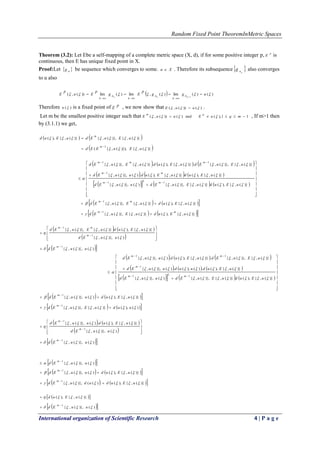
Theorem (3.1): Let (X, d) be a complete metric space and E be a continuous self-mappings such that
    
   ])}(,{),()}(,{),([
)}(,{),()}(,{),(


gEhdhEgd
hEhdgEgd


     
     
     

















)}(,{),()}(,{),(])(),([
2
)}(,{),()}(,{),()(),(
)}(,{),()}(,{),()}(,{),(
)})(,{)},(,{(




hEhdhEgdhgd
hEhdgEhdhgd
hEgdhEhdgEgd
hEgEd
Random Fixed Point TheoremInMetric Spaces
International organization of Scientific Research 2 | P a g e
   
 
 ])(),([
)(),(
)}(,{),()}(,{),(




hgd
hgd
hEhdgEgd


(3.1.1)
Forall )(g ) and Xh )( with )()(  hg  , where )1,0[:,,,, 

R are such that
122   , then E has a unique fixed point in X.
Proof:Let {gn}be a sequence, define d as follows
)}(
1
,{}{  g n
Eg n 
 , n = 1,2,3,4…
If }{
1
}{  g ng n 
 for some n then the result follows immediately.
So let )()( 1   nn gg for all n then
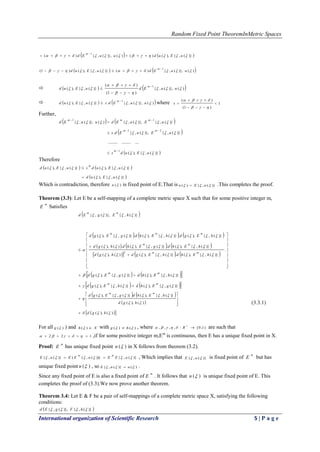
   )}(,{)},(,{)(),( 11  nnnn gEgEdggd  
     
     
      




















)}(,{),()}(,{),()(),(
)}(,{),()}(,{),()(),(
)}(,{),()}(,{),()}(,{),(
1
2
1
11
111




nnnnnn
nnnnnn
nnnnnn
gEgdgEgdggd
gEgdgEgdggd
gEgdgEgdgEgd
    
    )}(,{),()}(,{),(
)}(,{),()}(,{),(
11
11






nnnn
nnnn
gEgdgEgd
gEgdgEgd
   
 
 )(),(.
)(),(
)}(,{),()}(,{),(
1
1
11




nn
nn
nnnn
ggd
ggd
gEgdgEgd





     
     
      




















)(),()(),()(),(
)(),()(),()(),(
)(),()(),()(),(
111
2
1
11
1111




nnnnnn
nnnnnn
nnnnnn
ggdggdggd
ggdggdggd
ggdggdggd
    
    )(),()(),(
)(),()(),(
11
11


nnnn
nnnn
ggdggd
ggdggd




   
 
 )(),(.
)(),(
)(),()(),(
1
1
11




nn
nn
nnnn
ggd
ggd
ggdggd





     
   









)(),()(),(
)(),()(),()(),(
111
1111



nnnn
nnnnnn
ggdggd
ggdggdggd
    
    )(),()(),(
)(),()(),(
11
11






nnnn
nnnn
ggdggd
ggdggd
 
 )(),(.
)(),(.
1
1


nn
nn
ggd
ggd




Random Fixed Point TheoremInMetric Spaces
International organization of Scientific Research 3 | P a g e
       
      
 )(),(.
)(),(.)(),()(),(
)(),()(),()(),(
1
111
111



nn
nnnnnn
nnnnnn
ggd
ggdggdggd
ggdggdggd






   )(),()()(),().( 11    nnnn ggdggd
    )(),().()(),()1( 11  nnnn ggdggd  
    )(),(
)1(
).(
)(),( 11 


 nnnn ggdggd 



 )(),(
)1(
).(
............
10 


ggd



Thus by triangle inequality, we have for nm 
       
 )(),()....(
)(),(.......)(),()(),()(),(
10
121
1211


ggdssss
ggdggdggdggd
mnnn
mmnnnnmn




Where 1
)1(
).(






s since 122  
Therefore
    

 nmggd
s
s
ggd
n
mn ,as,0)(),(
1
)(),( 10  . Hence the sequence {gn}is a Cauchy sequence, X
being complete, there exist some Xp  such that
)()(lim)}(,{.lim)(lim))(,( 1  uggEgEuE n
n
n
n
n
n






 

Therefore )(u is a fixed point of E.
Uniqueness:Let if possible there exist another fixed point )(v of E in X, such that )()(  vu  then from
(3.1.1) we have
   )}(,{)},(,{)(),(  vEuEdvud 
     
     
     

















)}(,{),()}(,{),(])(),([
)}(,{),()}(,{),()(),(
)}(,{),()}(,{),()}(,{),(
2




vEvdvEudvud
vEvduEvdvud
vEudvEvduEud
    
    )}(,{),()}(,{),(
)}(,{),()}(,{),(


uEvdvEud
vEvduEud


   
 
 )(),(.
)(),(
)}(,{),()}(,{),(




vud
vud
vEvduEud


      
 )(),()2(
)(),(.)(),()(),(


vud
vuduvdvud


   )(),()2()(),(  vudvud 
Since 12122   
    )(),()(),(  vudvud 
This is contradiction, so )()(  vu  .
This completes the proof of the theorem (3.1.1). We now prove another theorem.
Random Fixed Point TheoremInMetric Spaces
International organization of Scientific Research 4 | P a g e
Theorem (3.2): Let Ebe a self-mapping of a complete metric space (X, d), if for some positive integer p, p
E is
continuous, then E has unique fixed point in X.
Proof:Let  ng be sequence which converges to some. Xu  . Therefore its subsequence kn
g also converges
to u also
  )()(lim)(,lim)(lim))(,(
1
 ugg
p
Eg
p
Eu
p
E
kkk n
k
n
k
n
k



Therefore )(u is a fixed point of E
p , we now show that )())(,(  uuE  .
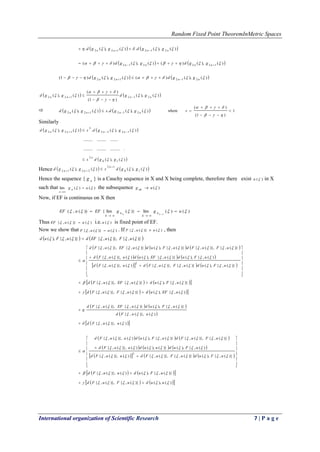
Let m be the smallest positive integer such that 11),(and)())(,(  mquEuuE
qm
 , If m>1 then
by (3.1.1) we get,
   
 )}(,{)}),(,{(
)}(,{)},(,{)}(,{),(
1


uEuEEd
uEuEduEud
m
m



     
     
      






















)}(,{),()}(,{)},(,{)()},(,{
)}(,{),()}(,{),(.)()},(,{
)}(,{)},(,{.)}(,{),(.)}(,{)},(,{
121
1
11




uEuduEuEduuEd
uEuduEuduuEd
uEuEduEuduEuEd
mm
mm
mmm
    
    )}(,{),()}(,{)},(,{
)}(,{),()}(,{)},(,{
1
1


uEuduEuEd
uEuduEuEd
mm
mm




   
 
  )()},(,{
)()},(,{
)}(,{),()}(,{)},(,{
1
1
1




uuEd
uuEd
uEuduEuEd
m
m
mm













     
     
      






















)}(,{),()}(,{)},(,{)()},(,{
)}(,{),(.)(),(.)()},(,{
)}(,{)},(,{.)}(,{),(.)()},(,{
121
1
11




uEuduEuEduuEd
uEuduuduuEd
uEuEduEuduuEd
mm
m
mm
    
    )(),()}(,{)},(,{
)}(,{),()()},(,{
1
1


uuduEuEd
uEuduuEd
m
m




   
 
  )()},(,{
)()},(,{
)}(,{),(.)()},(,{
1
1
1




uuEd
uuEd
uEuduuEd
m
m
m













  )()},(,{
1
 uuEd
m 

    
    )}(,{),(.)(()},(,{
)}(,{),()()},(,{
1
1


uEududuEd
uEuduuEd
m
m




  
  )()},(,{
)}(,{),(
1


uuEd
uEud
m 


Random Fixed Point TheoremInMetric Spaces
International organization of Scientific Research 5 | P a g e
   )}(,{),()()()},(,{)(
1
 uEuduuEd
m


   )()},(,{)()}(,{),()1(
1
 uuEduEud
m 

    )()},(,{
)1(
)(
)}(,{),(
1



 uuEduEud
m 



    )()},(,{.)}(,{),(
1
 uuEdsuEud
m 
 where 1
)1(
)(






s
Further,
   
 
 )}(,{),(
........................
)}(,{)},(,{.
)}(,{)},(,{)()},(,{
1
21
11



uEuds
uEuEds
uEuEduuEd
m
mm
mmm






Therefore
   
 )}(,{),(
)}(,{),()}(,{),(


uEud
uEudsuEud
m


Which is contradiction, therefore )(u is fixed point of E.That is )}(,{)(  uEu  .This completes the proof.
Theorem (3.3): Let E be a self-mapping of a complete metric space X such that for some positive integer m,
m
E Satisfies
 
     
     
      


















 .
)}(,{),(.)}(,{),()(),(
)}(,{),(.)}(,{),(.)(),(
)}(,{),(.)}(,{),(.)}(,{),(
)}(,{)},(,{
2





hEhdhEgdhgd
hEhdgEhdhgd
hEgdhEhdgEgd
hEgEd
mm
mm
mmm
mm
    
    )}(,{),()}(,{),(
)}(,{),()}(,{),(


gEhdhEgd
hEhdgEgd
mm
mm


   
 
  )(),(
)(),(
)}(,{),()}(,{),(




hgd
hgd
hEhdgEgd
mm










(3.3.1)
For all )(g ) and Xh )( with )()(  hg  , where )1,0[:,,,, 

R are such that
122   ,if for some positive integer m,Em
is continuous, then E has a unique fixed point in X.
Proof:
m
E has unique fixed point )(u in X follows from theorem (3.2).
)}(,{)))(,(()}(,{  uEEuEEuE
mm
 , Which implies that )}(,{  uE is fixed point of
m
E but has
unique fixed point )(u , so )()}(,{  uuE  .
Since any fixed point of E is also a fixed point of
m
E . It follows that )(u is unique fixed point of E. This
completes the proof of (3.3).We now prove another theorem.
Theorem 3.4: Let E & F be a pair of self-mappings of a complete metric space X, satisfying the following
conditions:
 )}(,{)},(,{  hFgEd
Random Fixed Point TheoremInMetric Spaces
International organization of Scientific Research 6 | P a g e
     
     
     

















)}(,{),(.)}(,{),(])(),([
)}(,{),(.)}(,{),(.)(),(
)}(,{),(.)}(,{),(.)}(,{),(
2




hFhdhFgdhgd
hFhdgEhdhgd
hFgdhFhdgEgd
    
    )}(,{),()}(,{),(
)}(,{),()}(,{),(


gEhdhFgd
hFhdgEgd


   
 
 )(),(.
)(),(
)}(,{),()}(,{),(




hgd
hgd
hFhdgEgd


(3.4.1)
For all )(g ), Xh )( with )()(  hg  ,where )1,0[:,,,, 

R are such that 122  
,if E & F are continuous on X , then E& F have a unique fixed point in X.
Proof:Let  ng be a continuous sequence defined as
 
 
{
evenisn)(,
oddisn)(,
1
1
)(






n
n
gE
gF
ng and }{}{ 1   nn gg for all n.
Now    )}(,{)},(,{)(),( 212122  nnnn gFgEdggd  
     
     
      




















.)}(,{),(.)}(,{),()(),(
)}(,{),()}(,{),(.)(),(
)}(,{),(.)}(,{),(.)}(,{),(
22212
2
212
22122212
212221212




nnnnnn
nnnnnn
nnnnnn
gFgdgFgdggd
gFgdgEgdggd
gFgdgFgdgEgd
    
    )}(,{),()}(,{),(
)}(,{),(.)}(,{),(
122212
221212






nnnn
nnnn
gEgdgEgd
gFgdgEgd
   
 
 )(),(.
)(),(
)}(,{),(.)}(,{),(
212
212
221212




nn
nn
nnnn
ggd
ggd
gFgdgEgd





     
     
      




















)(),(.)(),()(),(
)(),()(),(.)(),(
)(),(.)(),(.)(),(
1221212
2
212
12222212
1212122212




nnnnnn
nnnnnn
nnnnnn
ggdggdggd
ggdggdggd
ggdggdggd
    
    )(),()(),(
)(),()(),(
221212
122212


nnnn
nnnn
ggdggd
ggdggd




   
 
 )(),(.
)(),(
)(),(.)(),(
212
212
122212




nn
nn
nnnn
ggd
ggd
ggdggd





  
    
    )(),()(),(
)(),()(),(
)(),(
122212
122212
212









nnnn
nnnn
nn
ggdggd
ggdggd
gg
Random Fixed Point TheoremInMetric Spaces
International organization of Scientific Research 7 | P a g e
   )(),(.)(),(. 212122  nnnn ggdggd  
   )(),()()(),()( 122212    nnnn ggdggd
   )(),()()(),()1( 212122  nnnn ggdggd  
   )(),(
)1(
)(
)(),( 212122 


 nnnn ggdggd 



    )(),(.)(),( 212122  nnnn ggdsggd   1
)1(
)(
where 





s
Similarly
   
 )(),(
...............................
............................
)(),(.)(),(
10
.2
1222
2
122


ggds
ggdsggd
n
nnnn

 
Hence    )(),()(),( 10
.12
2212  ggdsggd
n
nn

 
Hence the sequence { n
g } is a Cauchy sequence in X and X being complete, therefore there exist )(u in X
such that )()(lim  ug n
n


the subsequence )(ug nk 
Now, if EF is continuous on X then
)()(lim)}(lim{))(,(
1
 uggEFuEF
kk n
k
n
k



Thus )()}(,{  uuEF  i.e. )(u is fixed point of EF.
Now we show that )()}(,{  uuF  . If )()}(,{  uuF  , then
   )}(,{)},(,{)}(,{),(  uFuEFduFud 
     
     
      

















)}(,{),()}(,{)},(,{)()},(,{
)(,{),()}(,{),()()},(,{
)}(,{)},(,{)}(,{),()}(,{)},(,{
2




uFuduFuFduuFd
uFuduEFuduuFd
uFuFduFuduEFuFd
    
    )(,{),()}(,{)},(,{
)}(,{),()}(,{)},(,{


uEFuduFuFd
uFuduEFuFd


   
 
  )()},(,{
)()},(,{
)}(,{),()}(,{)},(,{




uuFd
uuFd
uFuduEFuFd


     
     
      

















)}(,{),()}(,{)},(,{)()},(,{
)(,{),()}(),()()},(,{
)}(,{)},(,{)}(,{),()()},(,{
2




uFuduFuFduuFd
uFuduuduuFd
uFuFduFuduuFd
    
    )(),()}(,{)},(,{
)}(,{),()()},(,{


uuduFuFd
uFuduuFd


Random Fixed Point TheoremInMetric Spaces
International organization of Scientific Research 8 | P a g e
   
 
  )()},(,{
)()},(,{
)}(,{),()()},(,{




uuFd
uuFd
uFuduuFd


     
   








2
)()},(,{
)}(,{)},(,{)}(,{),()()},(,{



uuFd
uFuFduFuduuFd
         )()},(,{)()},(,{.0)()},(,{2  uuFduuFduuFd 
   )()},(,{2  uuFd
     
 )()},(,{
)()},(,{2)()},(,{


uuFd
uuFduuFd


Since 122   implies that   12  
Hence )()}(,{  uuF  .
Further    )()},(,{)()},(,{  uuEduuEd  implies that )()}(,{  uuE  .
So u is common fixed point of E & F
Uniqueness:
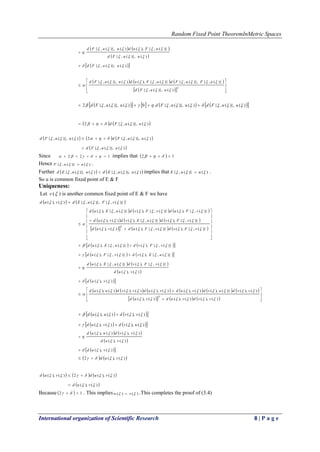
Let )(v is another common fixed point of E & F we have
   )}(,{)},(,{)(),(  vFuEdvud 
     
     
      

















)}(,{),()}(,{),()(),(
)}(,{),()}(,{),()(),(
)}(,{),()}(,{),()}(,{),(
2




vFvdvFudvud
vFvduEvdvud
vFudvFvduEud
    
    
   
 
  )(),(
)(),(
)}(,{),()}(,{),(
)}(,{),()}(,{),(
)}(,{),()}(,{),(






vud
vud
vFvduEud
uEvdvFud
vFvduEud




           
       










)(),()(),()(),(
)(),()}(),()(),()(),()(),()(),(
2



vvdvudvud
vvduvdvudvudvvduud
    
    )(),()(),(
)(),()(),(


uvdvud
vvduud


   
 
  )(),(
)(),(
)(),()(),(




vud
vud
vvduud


   )(),(2  vud
     
 )(),(
)(),(2)(),(


vud
vudvud


Because   12   . This implies )()(  vu  .This completes the proof of (3.4)
Random Fixed Point TheoremInMetric Spaces
International organization of Scientific Research 9 | P a g e
REFERENCES
[1]. Beg, I. and Shahzad, N. “Random approximations and random fixed point theorems,” J. Appl. Math.
Stochastic Anal. 7(1994). No.2, 145-150.
[2]. Bharucha-Reid, A.T. “Fixed point theorems in probabilistic analysis,” Bull. Amer. Math. Soc. 82(1976),
641-657.
[3]. Choudhary B.S. and Ray,M. “Convergence of an iteration leading to a solution of a random operator
equation,”J. Appl. Stochastic Anal. 12(1999). No. 2, 161-168.
[4]. Dhagat V.B., Sharma A. and BhardwajR.K. “Fixed point theorems for random operators in Hilbert
spaces,” International Journal of Math. Anal.2(2008).No.12,557-561.
[5]. O’Regan,D. “A continuous type result for random operators,” Proc. Amer. Math, Soc. 126(1998), 1963-
1971.
[6]. SehgalV.M. andWaters,C. “Some random fixed point theorems for condensing operators,” Proc. Amer.
Math. Soc. 90(1984). No.3, 425-429.
[7]. SushantkumarMohanta “Random fixed point in Banach spaces” Inter. J of Math Analysis Vol. 5 (2011)
No. 10, 451-461.
[8]. B. R wadkar,Ramakant Bhardwaj, Rajesh Shrivastava, “Some NewResult In Topological Space For Non-
Symmetric RationalExpression Concerning Banach Space” ,International Journal of Theoretical and
Applied Science 3(2): 65-78(2011).

A05920109

  • 1.
    IOSR Journal ofEngineering (IOSRJEN) www.iosrjen.org ISSN (e): 2250-3021, ISSN (p): 2278-8719 Vol. 05, Issue 09 (September. 2015), ||V2|| PP 01-09 International organization of Scientific Research 1 | P a g e Random Fixed Point TheoremsIn Metric Space Balaji R Wadkar1 , Ramakant Bhardwaj2 , Basantkumar Singh3 1 (Dept. of Mathematics, “S R C O E” Lonikand, Pune & Research scholar of “AISECT University”, Bhopal, India) wbrlatur@gmail.com 2 (Dept. of Mathematics, “TIT Group of Institutes (TIT &E)” Bhopal (M.P), India) rkbhardwaj100@gmail.com 3 (Principal, “AISECT University”, Bhopal-Chiklod Road, Near BangrasiaChouraha, Bhopal, (M.P), India) dr.basantsingh73@gmail.com Abstract: - The present paper deals with some fixed point theorem for Random operator in metric spaces. We find unique Random fixed point operator in closed subsets of metric spaces by considering a sequence of measurable functions. AMS Subject Classification: 47H10, 54H25. Keywords: Fixed point,Common fixed point,Metric space, Borelsubset, Random Operator. I. INTRODUCTION Fixed point theory is one of the most dynamic research subjects in nonlinear sciences. Regarding the feasibility of application of it to the various disciplines, a number of authors have contributed to this theory with a number of publications. The most impressing result in this direction was given by Banach, called the Banach contraction mapping principle: Every contraction in a complete metric space has a unique fixed point. In fact, Banach demonstrated how to find the desired fixed point by offering a smart and plain technique. This elementary technique leads to increasing of the possibility of solving various problems in different research fields. This celebrated result has been generalized in many abstract spaces for distinct operators. Random fixed point theory is playing an important role in mathematics and applied sciences. At present it received considerable attentation due to enormous applications in many important areas such as nonlinear analysis, probability theory and for thestudy of Random equations arising in various applied areas. In recent years, the study of random fixed point has attracted much attention some of the recent literature in random fixed point may be noted in [1, 5, 6, 8]. The aimof this paper is to prove some random fixed point theorem.Before presenting our results we need some preliminaries that include relevant definition. II. PRELIMINARIES Throughout this paper, (Ω,Σ)denotes a measurable space, X be a metric space andC is non-empty subset of X. Definition 2.1: A function f:Ω→C is said to be measurable if f '(B∩C)∈ Σfor every Borelsubset B of X. Definition 2.2: A function f:Ω×C →C is said to be random operator, iff (.,X):Ω→C is measurable for every X ∈ C. Definition 2.3: A random operator f:Ω×C →C is said to be continuous if for fixedt ∈ Ω,f(t,.):C×C is continuous. Definition 2.4: A measurable function g:Ω→C is said to be random fixed pointof the random operator f:Ω×C →C, if f (t, g(t) )=g(t), ∀ t ∈ Ω. III. Main Results Theorem (3.1): Let (X, d) be a complete metric space and E be a continuous self-mappings such that         ])}(,{),()}(,{),([ )}(,{),()}(,{),(   gEhdhEgd hEhdgEgd                                      )}(,{),()}(,{),(])(),([ 2 )}(,{),()}(,{),()(),( )}(,{),()}(,{),()}(,{),( )})(,{)},(,{(     hEhdhEgdhgd hEhdgEhdhgd hEgdhEhdgEgd hEgEd
  • 2.
    Random Fixed PointTheoremInMetric Spaces International organization of Scientific Research 2 | P a g e        ])(),([ )(),( )}(,{),()}(,{),(     hgd hgd hEhdgEgd   (3.1.1) Forall )(g ) and Xh )( with )()(  hg  , where )1,0[:,,,,   R are such that 122   , then E has a unique fixed point in X. Proof:Let {gn}be a sequence, define d as follows )}( 1 ,{}{  g n Eg n   , n = 1,2,3,4… If }{ 1 }{  g ng n   for some n then the result follows immediately. So let )()( 1   nn gg for all n then    )}(,{)},(,{)(),( 11  nnnn gEgEdggd                                          )}(,{),()}(,{),()(),( )}(,{),()}(,{),()(),( )}(,{),()}(,{),()}(,{),( 1 2 1 11 111     nnnnnn nnnnnn nnnnnn gEgdgEgdggd gEgdgEgdggd gEgdgEgdgEgd          )}(,{),()}(,{),( )}(,{),()}(,{),( 11 11       nnnn nnnn gEgdgEgd gEgdgEgd        )(),(. )(),( )}(,{),()}(,{),( 1 1 11     nn nn nnnn ggd ggd gEgdgEgd                                             )(),()(),()(),( )(),()(),()(),( )(),()(),()(),( 111 2 1 11 1111     nnnnnn nnnnnn nnnnnn ggdggdggd ggdggdggd ggdggdggd          )(),()(),( )(),()(),( 11 11   nnnn nnnn ggdggd ggdggd            )(),(. )(),( )(),()(),( 1 1 11     nn nn nnnn ggd ggd ggdggd                         )(),()(),( )(),()(),()(),( 111 1111    nnnn nnnnnn ggdggd ggdggdggd          )(),()(),( )(),()(),( 11 11       nnnn nnnn ggdggd ggdggd    )(),(. )(),(. 1 1   nn nn ggd ggd    
  • 3.
    Random Fixed PointTheoremInMetric Spaces International organization of Scientific Research 3 | P a g e                 )(),(. )(),(.)(),()(),( )(),()(),()(),( 1 111 111    nn nnnnnn nnnnnn ggd ggdggdggd ggdggdggd          )(),()()(),().( 11    nnnn ggdggd     )(),().()(),()1( 11  nnnn ggdggd       )(),( )1( ).( )(),( 11     nnnn ggdggd      )(),( )1( ).( ............ 10    ggd    Thus by triangle inequality, we have for nm           )(),()....( )(),(.......)(),()(),()(),( 10 121 1211   ggdssss ggdggdggdggd mnnn mmnnnnmn     Where 1 )1( ).(       s since 122   Therefore        nmggd s s ggd n mn ,as,0)(),( 1 )(),( 10  . Hence the sequence {gn}is a Cauchy sequence, X being complete, there exist some Xp  such that )()(lim)}(,{.lim)(lim))(,( 1  uggEgEuE n n n n n n          Therefore )(u is a fixed point of E. Uniqueness:Let if possible there exist another fixed point )(v of E in X, such that )()(  vu  then from (3.1.1) we have    )}(,{)},(,{)(),(  vEuEdvud                                     )}(,{),()}(,{),(])(),([ )}(,{),()}(,{),()(),( )}(,{),()}(,{),()}(,{),( 2     vEvdvEudvud vEvduEvdvud vEudvEvduEud          )}(,{),()}(,{),( )}(,{),()}(,{),(   uEvdvEud vEvduEud          )(),(. )(),( )}(,{),()}(,{),(     vud vud vEvduEud           )(),()2( )(),(.)(),()(),(   vud vuduvdvud      )(),()2()(),(  vudvud  Since 12122        )(),()(),(  vudvud  This is contradiction, so )()(  vu  . This completes the proof of the theorem (3.1.1). We now prove another theorem.
  • 4.
    Random Fixed PointTheoremInMetric Spaces International organization of Scientific Research 4 | P a g e Theorem (3.2): Let Ebe a self-mapping of a complete metric space (X, d), if for some positive integer p, p E is continuous, then E has unique fixed point in X. Proof:Let  ng be sequence which converges to some. Xu  . Therefore its subsequence kn g also converges to u also   )()(lim)(,lim)(lim))(,( 1  ugg p Eg p Eu p E kkk n k n k n k    Therefore )(u is a fixed point of E p , we now show that )())(,(  uuE  . Let m be the smallest positive integer such that 11),(and)())(,(  mquEuuE qm  , If m>1 then by (3.1.1) we get,      )}(,{)}),(,{( )}(,{)},(,{)}(,{),( 1   uEuEEd uEuEduEud m m                                             )}(,{),()}(,{)},(,{)()},(,{ )}(,{),()}(,{),(.)()},(,{ )}(,{)},(,{.)}(,{),(.)}(,{)},(,{ 121 1 11     uEuduEuEduuEd uEuduEuduuEd uEuEduEuduEuEd mm mm mmm          )}(,{),()}(,{)},(,{ )}(,{),()}(,{)},(,{ 1 1   uEuduEuEd uEuduEuEd mm mm             )()},(,{ )()},(,{ )}(,{),()}(,{)},(,{ 1 1 1     uuEd uuEd uEuduEuEd m m mm                                                       )}(,{),()}(,{)},(,{)()},(,{ )}(,{),(.)(),(.)()},(,{ )}(,{)},(,{.)}(,{),(.)()},(,{ 121 1 11     uEuduEuEduuEd uEuduuduuEd uEuEduEuduuEd mm m mm          )(),()}(,{)},(,{ )}(,{),()()},(,{ 1 1   uuduEuEd uEuduuEd m m             )()},(,{ )()},(,{ )}(,{),(.)()},(,{ 1 1 1     uuEd uuEd uEuduuEd m m m                )()},(,{ 1  uuEd m            )}(,{),(.)(()},(,{ )}(,{),()()},(,{ 1 1   uEududuEd uEuduuEd m m          )()},(,{ )}(,{),( 1   uuEd uEud m   
  • 5.
    Random Fixed PointTheoremInMetric Spaces International organization of Scientific Research 5 | P a g e    )}(,{),()()()},(,{)( 1  uEuduuEd m      )()},(,{)()}(,{),()1( 1  uuEduEud m       )()},(,{ )1( )( )}(,{),( 1     uuEduEud m         )()},(,{.)}(,{),( 1  uuEdsuEud m   where 1 )1( )(       s Further,        )}(,{),( ........................ )}(,{)},(,{. )}(,{)},(,{)()},(,{ 1 21 11    uEuds uEuEds uEuEduuEd m mm mmm       Therefore      )}(,{),( )}(,{),()}(,{),(   uEud uEudsuEud m   Which is contradiction, therefore )(u is fixed point of E.That is )}(,{)(  uEu  .This completes the proof. Theorem (3.3): Let E be a self-mapping of a complete metric space X such that for some positive integer m, m E Satisfies                                         . )}(,{),(.)}(,{),()(),( )}(,{),(.)}(,{),(.)(),( )}(,{),(.)}(,{),(.)}(,{),( )}(,{)},(,{ 2      hEhdhEgdhgd hEhdgEhdhgd hEgdhEhdgEgd hEgEd mm mm mmm mm          )}(,{),()}(,{),( )}(,{),()}(,{),(   gEhdhEgd hEhdgEgd mm mm           )(),( )(),( )}(,{),()}(,{),(     hgd hgd hEhdgEgd mm           (3.3.1) For all )(g ) and Xh )( with )()(  hg  , where )1,0[:,,,,   R are such that 122   ,if for some positive integer m,Em is continuous, then E has a unique fixed point in X. Proof: m E has unique fixed point )(u in X follows from theorem (3.2). )}(,{)))(,(()}(,{  uEEuEEuE mm  , Which implies that )}(,{  uE is fixed point of m E but has unique fixed point )(u , so )()}(,{  uuE  . Since any fixed point of E is also a fixed point of m E . It follows that )(u is unique fixed point of E. This completes the proof of (3.3).We now prove another theorem. Theorem 3.4: Let E & F be a pair of self-mappings of a complete metric space X, satisfying the following conditions:  )}(,{)},(,{  hFgEd
  • 6.
    Random Fixed PointTheoremInMetric Spaces International organization of Scientific Research 6 | P a g e                                    )}(,{),(.)}(,{),(])(),([ )}(,{),(.)}(,{),(.)(),( )}(,{),(.)}(,{),(.)}(,{),( 2     hFhdhFgdhgd hFhdgEhdhgd hFgdhFhdgEgd          )}(,{),()}(,{),( )}(,{),()}(,{),(   gEhdhFgd hFhdgEgd          )(),(. )(),( )}(,{),()}(,{),(     hgd hgd hFhdgEgd   (3.4.1) For all )(g ), Xh )( with )()(  hg  ,where )1,0[:,,,,   R are such that 122   ,if E & F are continuous on X , then E& F have a unique fixed point in X. Proof:Let  ng be a continuous sequence defined as     { evenisn)(, oddisn)(, 1 1 )(       n n gE gF ng and }{}{ 1   nn gg for all n. Now    )}(,{)},(,{)(),( 212122  nnnn gFgEdggd                                          .)}(,{),(.)}(,{),()(),( )}(,{),()}(,{),(.)(),( )}(,{),(.)}(,{),(.)}(,{),( 22212 2 212 22122212 212221212     nnnnnn nnnnnn nnnnnn gFgdgFgdggd gFgdgEgdggd gFgdgFgdgEgd          )}(,{),()}(,{),( )}(,{),(.)}(,{),( 122212 221212       nnnn nnnn gEgdgEgd gFgdgEgd        )(),(. )(),( )}(,{),(.)}(,{),( 212 212 221212     nn nn nnnn ggd ggd gFgdgEgd                                             )(),(.)(),()(),( )(),()(),(.)(),( )(),(.)(),(.)(),( 1221212 2 212 12222212 1212122212     nnnnnn nnnnnn nnnnnn ggdggdggd ggdggdggd ggdggdggd          )(),()(),( )(),()(),( 221212 122212   nnnn nnnn ggdggd ggdggd            )(),(. )(),( )(),(.)(),( 212 212 122212     nn nn nnnn ggd ggd ggdggd                  )(),()(),( )(),()(),( )(),( 122212 122212 212          nnnn nnnn nn ggdggd ggdggd gg
  • 7.
    Random Fixed PointTheoremInMetric Spaces International organization of Scientific Research 7 | P a g e    )(),(.)(),(. 212122  nnnn ggdggd      )(),()()(),()( 122212    nnnn ggdggd    )(),()()(),()1( 212122  nnnn ggdggd      )(),( )1( )( )(),( 212122     nnnn ggdggd         )(),(.)(),( 212122  nnnn ggdsggd   1 )1( )( where       s Similarly      )(),( ............................... ............................ )(),(.)(),( 10 .2 1222 2 122   ggds ggdsggd n nnnn    Hence    )(),()(),( 10 .12 2212  ggdsggd n nn    Hence the sequence { n g } is a Cauchy sequence in X and X being complete, therefore there exist )(u in X such that )()(lim  ug n n   the subsequence )(ug nk  Now, if EF is continuous on X then )()(lim)}(lim{))(,( 1  uggEFuEF kk n k n k    Thus )()}(,{  uuEF  i.e. )(u is fixed point of EF. Now we show that )()}(,{  uuF  . If )()}(,{  uuF  , then    )}(,{)},(,{)}(,{),(  uFuEFduFud                                      )}(,{),()}(,{)},(,{)()},(,{ )(,{),()}(,{),()()},(,{ )}(,{)},(,{)}(,{),()}(,{)},(,{ 2     uFuduFuFduuFd uFuduEFuduuFd uFuFduFuduEFuFd          )(,{),()}(,{)},(,{ )}(,{),()}(,{)},(,{   uEFuduFuFd uFuduEFuFd           )()},(,{ )()},(,{ )}(,{),()}(,{)},(,{     uuFd uuFd uFuduEFuFd                                       )}(,{),()}(,{)},(,{)()},(,{ )(,{),()}(),()()},(,{ )}(,{)},(,{)}(,{),()()},(,{ 2     uFuduFuFduuFd uFuduuduuFd uFuFduFuduuFd          )(),()}(,{)},(,{ )}(,{),()()},(,{   uuduFuFd uFuduuFd  
  • 8.
    Random Fixed PointTheoremInMetric Spaces International organization of Scientific Research 8 | P a g e         )()},(,{ )()},(,{ )}(,{),()()},(,{     uuFd uuFd uFuduuFd                     2 )()},(,{ )}(,{)},(,{)}(,{),()()},(,{    uuFd uFuFduFuduuFd          )()},(,{)()},(,{.0)()},(,{2  uuFduuFduuFd     )()},(,{2  uuFd        )()},(,{ )()},(,{2)()},(,{   uuFd uuFduuFd   Since 122   implies that   12   Hence )()}(,{  uuF  . Further    )()},(,{)()},(,{  uuEduuEd  implies that )()}(,{  uuE  . So u is common fixed point of E & F Uniqueness: Let )(v is another common fixed point of E & F we have    )}(,{)},(,{)(),(  vFuEdvud                                      )}(,{),()}(,{),()(),( )}(,{),()}(,{),()(),( )}(,{),()}(,{),()}(,{),( 2     vFvdvFudvud vFvduEvdvud vFudvFvduEud                   )(),( )(),( )}(,{),()}(,{),( )}(,{),()}(,{),( )}(,{),()}(,{),(       vud vud vFvduEud uEvdvFud vFvduEud                                   )(),()(),()(),( )(),()}(),()(),()(),()(),()(),( 2    vvdvudvud vvduvdvudvudvvduud          )(),()(),( )(),()(),(   uvdvud vvduud           )(),( )(),( )(),()(),(     vud vud vvduud      )(),(2  vud        )(),( )(),(2)(),(   vud vudvud   Because   12   . This implies )()(  vu  .This completes the proof of (3.4)
  • 9.
    Random Fixed PointTheoremInMetric Spaces International organization of Scientific Research 9 | P a g e REFERENCES [1]. Beg, I. and Shahzad, N. “Random approximations and random fixed point theorems,” J. Appl. Math. Stochastic Anal. 7(1994). No.2, 145-150. [2]. Bharucha-Reid, A.T. “Fixed point theorems in probabilistic analysis,” Bull. Amer. Math. Soc. 82(1976), 641-657. [3]. Choudhary B.S. and Ray,M. “Convergence of an iteration leading to a solution of a random operator equation,”J. Appl. Stochastic Anal. 12(1999). No. 2, 161-168. [4]. Dhagat V.B., Sharma A. and BhardwajR.K. “Fixed point theorems for random operators in Hilbert spaces,” International Journal of Math. Anal.2(2008).No.12,557-561. [5]. O’Regan,D. “A continuous type result for random operators,” Proc. Amer. Math, Soc. 126(1998), 1963- 1971. [6]. SehgalV.M. andWaters,C. “Some random fixed point theorems for condensing operators,” Proc. Amer. Math. Soc. 90(1984). No.3, 425-429. [7]. SushantkumarMohanta “Random fixed point in Banach spaces” Inter. J of Math Analysis Vol. 5 (2011) No. 10, 451-461. [8]. B. R wadkar,Ramakant Bhardwaj, Rajesh Shrivastava, “Some NewResult In Topological Space For Non- Symmetric RationalExpression Concerning Banach Space” ,International Journal of Theoretical and Applied Science 3(2): 65-78(2011).