1
Electrical and Electronic Measurements Laboratory (2020309)
INDEX
S.NO LIST OF EXPERIMENTS Page No.
1. Use voltmeter and ammeter method for measurement of medium resistance. 2
2. Use Megger for insulation resistance measurements. 4
3. Use two watt-meters for measuring active power of three-phase balanced load. 6
4. Use electro-dynamic watt-meter for measurement of power in a single-phase circuit 8
5. Use Kelvin’s double bridge for measurement of low resistance. 10
6. Use earth tester for measurement of earth resistance. 13
7. Use digital multi-meter for measurement of AC/DC current, AC/DC voltage. 15
8. Identify the components of PMMC and MI instruments. 17
9. Use Tri-vector meter for measuring kW, and kVA of a power line. 20
10. Troubleshoot electro dynamic watt-meter for measurement of power in a single-phase
circuit
22
11. Measure AC and DC quantities in a working circuit. 23
2
Electrical and Electronic Measurements Laboratory (2020309)
1. Measurement of Medium Resistances
The resistances that range from about 1Ω to about 100 kΩ are classified as medium resistances. The
resistances of most of electrical apparatus are the examples of medium resistances.
Measurement of Medium Resistances
To measure the medium resistances following methods are used −
 Ammeter-Voltmeter Method
 Substitution Method
 Wheatstone Bridge
Ammeter-Voltmeter Method
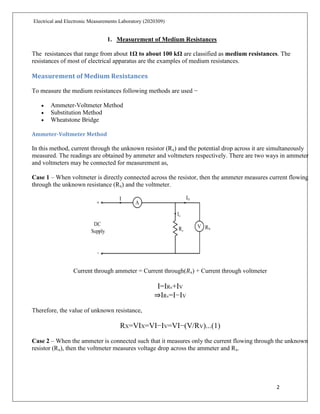
In this method, current through the unknown resistor (Rx) and the potential drop across it are simultaneously
measured. The readings are obtained by ammeter and voltmeters respectively. There are two ways in ammeter
and voltmeters may be connected for measurement as,
Case 1 – When voltmeter is directly connected across the resistor, then the ammeter measures current flowing
through the unknown resistance (Rx) and the voltmeter.
Current through ammeter = Current through( x) + Current through voltmeter
I=IRx+IV
⇒IRx=I−IV
Therefore, the value of unknown resistance,
RX=VIX=VI−IV=VI−(V/RV)...(1)
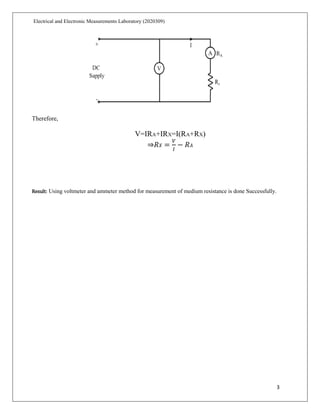
Case 2 – When the ammeter is connected such that it measures only the current flowing through the unknown
resistor (Rx), then the voltmeter measures voltage drop across the ammeter and Rx.
3
Electrical and Electronic Measurements Laboratory (2020309)
Therefore,
V=IRA+IRX=I(RA+RX)
⇒
Result: Using voltmeter and ammeter method for measurement of medium resistance is done Successfully.
4
Electrical and Electronic Measurements Laboratory (2020309)
2. USE OF MEGGER FOR INSULATION RESISTANCE MEASUREMENT
Megger:
Megger is used for the measurement of insulation resistance. It also measures the resistance of
the insulator. The megger measures insulation or high resistance in terms of mega ohms.
There are different types of megger instruments depending upon on the voltage rating such as:
 500V
 1000V
 5 KV
Megger Construction:
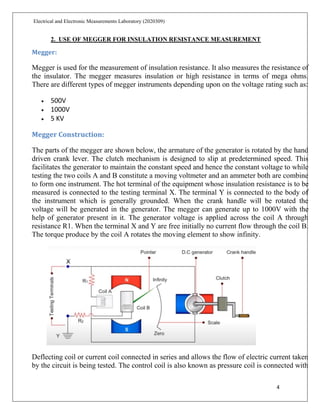
The parts of the megger are shown below, the armature of the generator is rotated by the hand
driven crank lever. The clutch mechanism is designed to slip at predetermined speed. This
facilitates the generator to maintain the constant speed and hence the constant voltage to while
testing the two coils A and B constitute a moving voltmeter and an ammeter both are combine
to form one instrument. The hot terminal of the equipment whose insulation resistance is to be
measured is connected to the testing terminal X. The terminal Y is connected to the body of
the instrument which is generally grounded. When the crank handle will be rotated the
voltage will be generated in the generator. The megger can generate up to 1000V with the
help of generator present in it. The generator voltage is applied across the coil A through
resistance R1. When the terminal X and Y are free initially no current flow through the coil B.
The torque produce by the coil A rotates the moving element to show infinity.
Deflecting coil or current coil connected in series and allows the flow of electric current taken
by the circuit is being tested. The control coil is also known as pressure coil is connected with
5
Electrical and Electronic Measurements Laboratory (2020309)
across the circuit. Current limiting resistor connected with the control coil and deflecting coil
to protect damage in case of very low resistance in external circuit.
As the voltage increases the in external circuit the deflection of the pointer increases of
current. This shows that when current increases the resistance will decreases and vice versa.
Working Principal of the meggar:
The principal of megger is based on the moving coil in the instrument. When current is
flowing in a conductor which is placed in magnetic field it will experience a torque.
A torque is developed due to the interaction of the current flowing through the pressure coil
and current coil. Flux is produced by the permanent magnet. The deflection of these coils is
proportional to the resistance to be measured.
Torque developed due to current in the pressure coil.
I1=torque developed to current in coil 1
I2=torque developed to current in coil 2
Both the torques will be equal.
T1= T2
Due to the interaction current flowing through the pressure coil and current coil. The torque
will be develop due to the current flowing in the pressure coil and current coil.
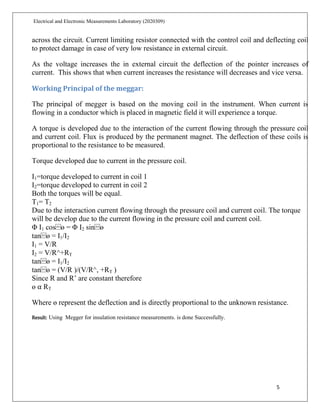
Φ I1 cos⁡ɵ = Φ I2 sin⁡ɵ
tan⁡ɵ = I1/I2
I1 = V/R
I2 = V/R^+RT
tan⁡ɵ = I1/I2
tan⁡ɵ = (V/R )/(V/R^, +RT )
Since R and R’ are constant therefore
ɵ ⍺ RT
Where ɵ represent the deflection and is directly proportional to the unknown resistance.
Result: Using Megger for insulation resistance measurements. is done Successfully.
6
Electrical and Electronic Measurements Laboratory (2020309)
3. THREE PHASE SYSTEM BY TWO WATTMETER METHOD
AIM: - To measurement of power in three phase system by two wattmeter method.
APPARATUS REQUIRED:- Ammeter (Two),Voltmeter, Wattmeter(Two),Three phase
supply, Three phase inductive load, Three phase variac , multimeter
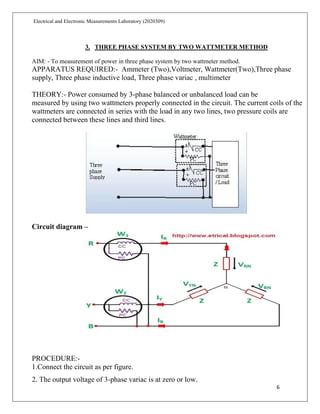
THEORY:- Power consumed by 3-phase balanced or unbalanced load can be
measured by using two wattmeters properly connected in the circuit. The current coils of the
wattmeters are connected in series with the load in any two lines, two pressure coils are
connected between these lines and third lines.
Circuit diagram –
PROCEDURE:-
1.Connect the circuit as per figure.
2. The output voltage of 3-phase variac is at zero or low.
7
Electrical and Electronic Measurements Laboratory (2020309)
3. Switch on the 3- phase supply.
4. Apply a certain voltage to the circuit and note down the readings of all the meters
connected in the circuit.
5. Reduce the voltage applied to 3-phase load and then switch off the supply.
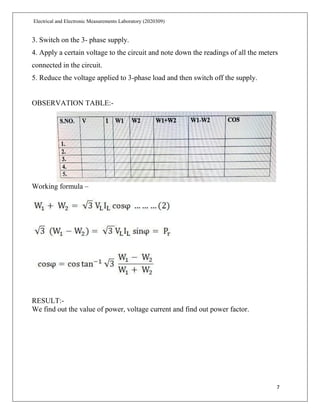
OBSERVATION TABLE:-
Working formula –
RESULT:-
We find out the value of power, voltage current and find out power factor.
8
Electrical and Electronic Measurements Laboratory (2020309)
4. CALIBRATION OF DYNAMOMETER TYPE POWER FACTOR METER
AIM : To calibrate a given single phase power factor meter.
Apparatus :
1. Variac, single phase, 10A
2. Voltmeter, 300V AC
3. Ammeter, 0-10A, AC
4. Rheostat
5. Wattmeter, LPF, 300V, 10A
6. Dynamometer type power factor meter
Theory :
The error made by the Power factor meter can be calculated by noting down the readings
of various meters and error can be calculated by using formula
Actual reading = Power factor meter reading
Single percentage of error = Actual reading – T reading X 100
Theoretical reading
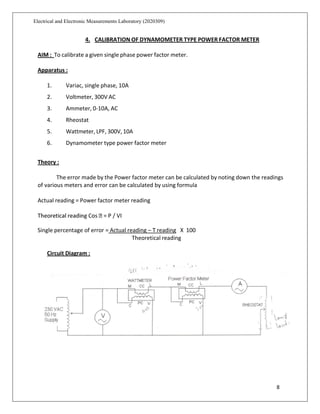
Circuit Diagram :
9
Electrical and Electronic Measurements Laboratory (2020309)
Procedure :
 Keep the Auto transformer at Zero position
 Make connections as per Circuit diagram shown below.
 Switch on the 230 VAC, 50 Hz, Power supply.
 Increase the input voltage gradually by rotating the auto transformer in clockwise
direction 220V.
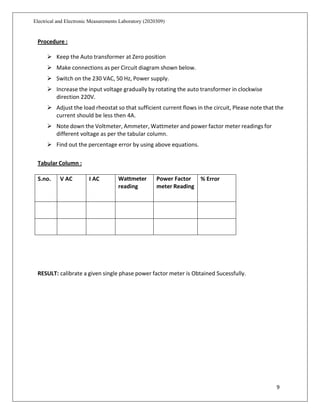
 Adjust the load rheostat so that sufficient current flows in the circuit, Please note that the
current should be less then 4A.
 Note down the Voltmeter, Ammeter, Wattmeter and power factor meter readings for
different voltage as per the tabular column.
 Find out the percentage error by using above equations.
Tabular Column :
S.no. V AC I AC Wattmeter
reading
Power Factor
meter Reading
% Error
RESULT: calibrate a given single phase power factor meter is Obtained Sucessfully.
10
Electrical and Electronic Measurements Laboratory (2020309)
5. KELVINS DOUBLE BRIDGE
AIM : To determine the resistance using Kelvins double bridge.
Apparatus :
Main dial : 100 divisions of side wire are equal to 0.1 Ohms. Each main division is equal to
0.01 ohm. Each sub – division is equal to 0.0005 ohm. The readings to the left of zero is to be
subtracted from the main dial readings & that of the right of zero is to be added to main dial
reading.
Range switch : arrange multiplier witch furnishers 5 ranges of X 100, X 10, XZI & X 0.001. The
value of unknown resistance is given by sum of main dial & slide wire reading multiplied by range
used.
Theory :
The kelvins bridge is a modification of the wheat stone bridge & provides greatly
increased accuracy in measurement of low resistances.
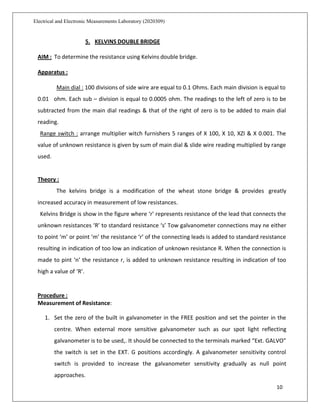
Kelvins Bridge is show in the figure where ‘r’ represents resistance of the lead that connects the
unknown resistances ‘R’ to standard resistance ‘s’ Tow galvanometer connections may ne either
to point ‘m’ or point ‘m’ the resistance ‘r’ of the connecting leads is added to standard resistance
resulting in indication of too low an indication of unknown resistance R. When the connection is
made to pint ‘n’ the resistance r, is added to unknown resistance resulting in indication of too
high a value of ‘R’.
Procedure :
Measurement of Resistance:
1. Set the zero of the built in galvanometer in the FREE position and set the pointer in the
centre. When external more sensitive galvanometer such as our spot light reflecting
galvanometer is to be used,. It should be connected to the terminals marked “Ext. GALVO”
the switch is set in the EXT. G positions accordingly. A galvanometer sensitivity control
switch is provided to increase the galvanometer sensitivity gradually as null point
approaches.
11
Electrical and Electronic Measurements Laboratory (2020309)
2. On the left-side of bridge there are 2 current terminal marked C & -C & 2 potential
terminals marked + p& -P. Four leads are provided, one fair is called current leas. The
second pair is called potential lead. Resistance of each potential lead is 10 milli ohms.
3. If The resistance to be measure is in the form of 2-terminals resistance the leads from –C &
P are connected to one terminal & those from - & P are connected to the other terminal of
unknown resistance. If the resistance to be measured is in the form of 4 terminal
resistance then leads from –C -+ -C –P should be connected to respective terminals of the
unknown resistance taking proper care for polarity.
4. It the resistance is in the form of wire or ca coil connect one end of the wire to –C & the
other end to –C & connect +C to +P & -C to –P with the helo of leads provided. The
resistance of wire b/w +C & -C will be measured.
5. When the unknown resistance has been suitable connected, choose the suitable range
multiplier depending upon the magnitude of the unknown resistance.
6. The zero of the slide wire should be checked OFF & ON. For doing so, the leads from +C P –
C & -P are shorted together. The null point should be obtained it the main dial & slide wire
both reading zero.
Connect the main leads to 220v AC mains.
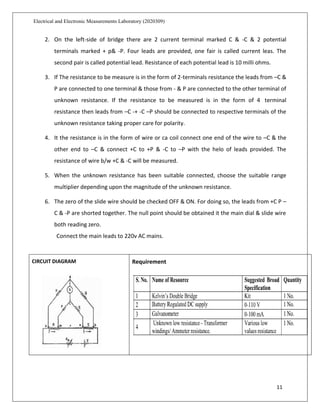
CIRCUIT DIAGRAM Requirement
12
Electrical and Electronic Measurements Laboratory (2020309)
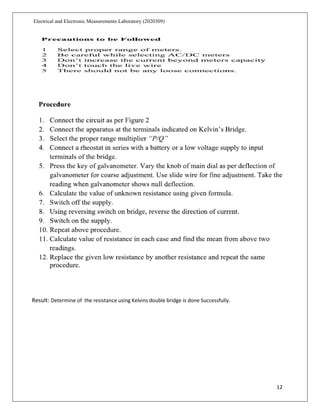
Result: Determine of the resistance using Kelvins double bridge is done Successfully.
13
Electrical and Electronic Measurements Laboratory (2020309)
6.Earth Tester for earth resistance measurement
Theory :The Earth Resistance Tester uses a hand-driven generator. The rectifier and the rotational current
reverser are the two principal components of the Earth Tester. The rectifier converts AC (Alternating Current)
into DC.
The Earth Tester works only on DC (Direct Current). The rectifier and current reverser have clambered on the
shaft of the DC generator.
The tester has two commutators installed simultaneously with the current reverser and rectifier. Each
commutator consists of four fixed brushes.
Definition: A commutator is a device used for switching the direction flow of the current.
It is connected in a series combination with the armature of the generator.
The brushes are used for transferring the power from stationary components to the moving portion of the
device. The brushes and commutator are always connected to facilitate the continuous flow of current.
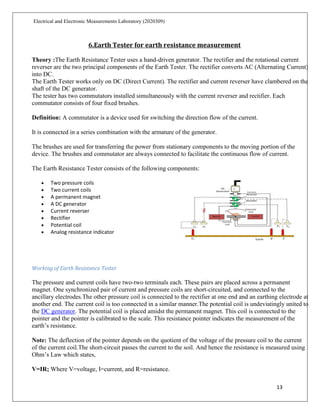
The Earth Resistance Tester consists of the following components:
 Two pressure coils
 Two current coils
 A permanent magnet
 A DC generator
 Current reverser
 Rectifier
 Potential coil
 Analog resistance indicator
Working of Earth Resistance Tester
The pressure and current coils have two-two terminals each. These pairs are placed across a permanent
magnet. One synchronized pair of current and pressure coils are short-circuited, and connected to the
ancillary electrodes.The other pressure coil is connected to the rectifier at one end and an earthing electrode at
another end. The current coil is too connected in a similar manner.The potential coil is undeviatingly united to
the DC generator. The potential coil is placed amidst the permanent magnet. This coil is connected to the
pointer and the pointer is calibrated to the scale. This resistance pointer indicates the measurement of the
earth’s resistance.
Note: The deflection of the pointer depends on the quotient of the voltage of the pressure coil to the current
of the current coil.The short-circuit passes the current to the soil. And hence the resistance is measured using
Ohm’s Law which states,
V=IR; Where V=voltage, I=current, and R=resistance.
14
Electrical and Electronic Measurements Laboratory (2020309)
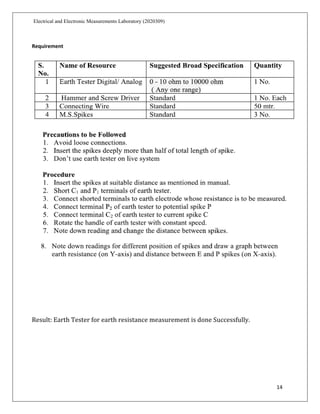
Requirement
Result: Earth Tester for earth resistance measurement is done Successfully.
15
Electrical and Electronic Measurements Laboratory (2020309)
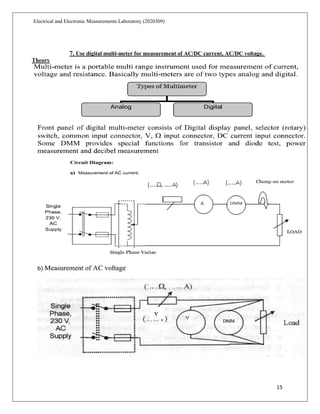
7. Use digital multi-meter for measurement of AC/DC current, AC/DC voltage.
Theory
16
Electrical and Electronic Measurements Laboratory (2020309)
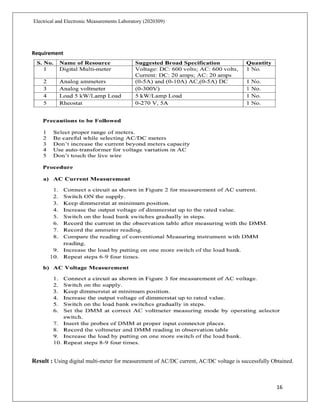
Requirement
Result : Using digital multi-meter for measurement of AC/DC current, AC/DC voltage is successfully Obtained.
17
Electrical and Electronic Measurements Laboratory (2020309)
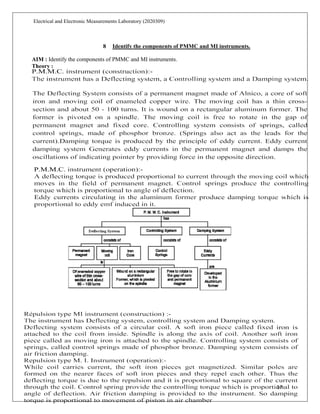
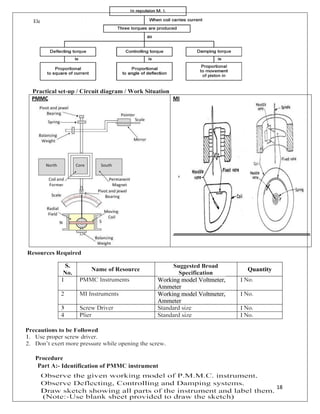
8 Identify the components of PMMC and MI instruments.
AIM : Identify the components of PMMC and MI instruments.
Theory :
18
Electrical and Electronic Measurements Laboratory (2020309)
PMMC MI
19
Electrical and Electronic Measurements Laboratory (2020309)
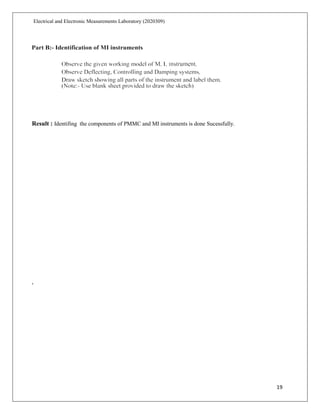
Result : Identifing the components of PMMC and MI instruments is done Sucessfully.
‘
20
Electrical and Electronic Measurements Laboratory (2020309)
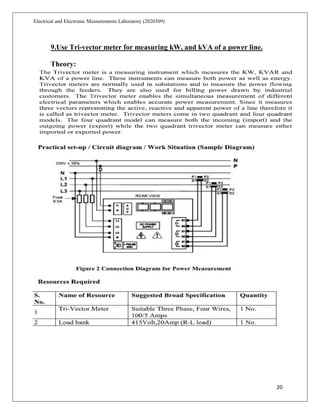
9.Use Tri-vector meter for measuring kW, and kVA of a power line.
Theory:
21
Electrical and Electronic Measurements Laboratory (2020309)
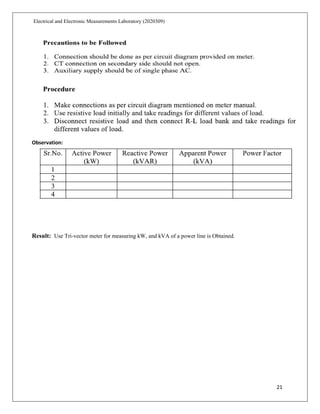
Observation:
Result: Use Tri-vector meter for measuring kW, and kVA of a power line is Obtained.
22
Electrical and Electronic Measurements Laboratory (2020309)
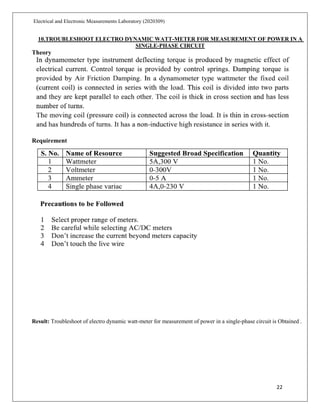
10.TROUBLESHOOT ELECTRO DYNAMIC WATT-METER FOR MEASUREMENT OF POWER IN A
SINGLE-PHASE CIRCUIT
Theory
Requirement
Result: Troubleshoot of electro dynamic watt-meter for measurement of power in a single-phase circuit is Obtained .
23
Electrical and Electronic Measurements Laboratory (2020309)
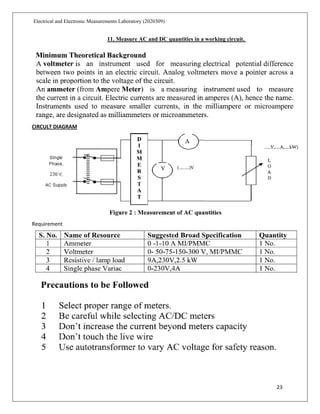
11. Measure AC and DC quantities in a working circuit.
CIRCULT DIAGRAM
Requirement
24
Electrical and Electronic Measurements Laboratory (2020309)
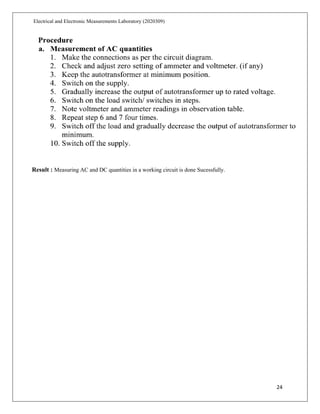
Result : Measuring AC and DC quantities in a working circuit is done Sucessfully.

eem-2020309.pdf

  • 1.
    1 Electrical and ElectronicMeasurements Laboratory (2020309) INDEX S.NO LIST OF EXPERIMENTS Page No. 1. Use voltmeter and ammeter method for measurement of medium resistance. 2 2. Use Megger for insulation resistance measurements. 4 3. Use two watt-meters for measuring active power of three-phase balanced load. 6 4. Use electro-dynamic watt-meter for measurement of power in a single-phase circuit 8 5. Use Kelvin’s double bridge for measurement of low resistance. 10 6. Use earth tester for measurement of earth resistance. 13 7. Use digital multi-meter for measurement of AC/DC current, AC/DC voltage. 15 8. Identify the components of PMMC and MI instruments. 17 9. Use Tri-vector meter for measuring kW, and kVA of a power line. 20 10. Troubleshoot electro dynamic watt-meter for measurement of power in a single-phase circuit 22 11. Measure AC and DC quantities in a working circuit. 23
  • 2.
    2 Electrical and ElectronicMeasurements Laboratory (2020309) 1. Measurement of Medium Resistances The resistances that range from about 1Ω to about 100 kΩ are classified as medium resistances. The resistances of most of electrical apparatus are the examples of medium resistances. Measurement of Medium Resistances To measure the medium resistances following methods are used −  Ammeter-Voltmeter Method  Substitution Method  Wheatstone Bridge Ammeter-Voltmeter Method In this method, current through the unknown resistor (Rx) and the potential drop across it are simultaneously measured. The readings are obtained by ammeter and voltmeters respectively. There are two ways in ammeter and voltmeters may be connected for measurement as, Case 1 – When voltmeter is directly connected across the resistor, then the ammeter measures current flowing through the unknown resistance (Rx) and the voltmeter. Current through ammeter = Current through( x) + Current through voltmeter I=IRx+IV ⇒IRx=I−IV Therefore, the value of unknown resistance, RX=VIX=VI−IV=VI−(V/RV)...(1) Case 2 – When the ammeter is connected such that it measures only the current flowing through the unknown resistor (Rx), then the voltmeter measures voltage drop across the ammeter and Rx.
  • 3.
    3 Electrical and ElectronicMeasurements Laboratory (2020309) Therefore, V=IRA+IRX=I(RA+RX) ⇒ Result: Using voltmeter and ammeter method for measurement of medium resistance is done Successfully.
  • 4.
    4 Electrical and ElectronicMeasurements Laboratory (2020309) 2. USE OF MEGGER FOR INSULATION RESISTANCE MEASUREMENT Megger: Megger is used for the measurement of insulation resistance. It also measures the resistance of the insulator. The megger measures insulation or high resistance in terms of mega ohms. There are different types of megger instruments depending upon on the voltage rating such as:  500V  1000V  5 KV Megger Construction: The parts of the megger are shown below, the armature of the generator is rotated by the hand driven crank lever. The clutch mechanism is designed to slip at predetermined speed. This facilitates the generator to maintain the constant speed and hence the constant voltage to while testing the two coils A and B constitute a moving voltmeter and an ammeter both are combine to form one instrument. The hot terminal of the equipment whose insulation resistance is to be measured is connected to the testing terminal X. The terminal Y is connected to the body of the instrument which is generally grounded. When the crank handle will be rotated the voltage will be generated in the generator. The megger can generate up to 1000V with the help of generator present in it. The generator voltage is applied across the coil A through resistance R1. When the terminal X and Y are free initially no current flow through the coil B. The torque produce by the coil A rotates the moving element to show infinity. Deflecting coil or current coil connected in series and allows the flow of electric current taken by the circuit is being tested. The control coil is also known as pressure coil is connected with
  • 5.
    5 Electrical and ElectronicMeasurements Laboratory (2020309) across the circuit. Current limiting resistor connected with the control coil and deflecting coil to protect damage in case of very low resistance in external circuit. As the voltage increases the in external circuit the deflection of the pointer increases of current. This shows that when current increases the resistance will decreases and vice versa. Working Principal of the meggar: The principal of megger is based on the moving coil in the instrument. When current is flowing in a conductor which is placed in magnetic field it will experience a torque. A torque is developed due to the interaction of the current flowing through the pressure coil and current coil. Flux is produced by the permanent magnet. The deflection of these coils is proportional to the resistance to be measured. Torque developed due to current in the pressure coil. I1=torque developed to current in coil 1 I2=torque developed to current in coil 2 Both the torques will be equal. T1= T2 Due to the interaction current flowing through the pressure coil and current coil. The torque will be develop due to the current flowing in the pressure coil and current coil. Φ I1 cos⁡ɵ = Φ I2 sin⁡ɵ tan⁡ɵ = I1/I2 I1 = V/R I2 = V/R^+RT tan⁡ɵ = I1/I2 tan⁡ɵ = (V/R )/(V/R^, +RT ) Since R and R’ are constant therefore ɵ ⍺ RT Where ɵ represent the deflection and is directly proportional to the unknown resistance. Result: Using Megger for insulation resistance measurements. is done Successfully.
  • 6.
    6 Electrical and ElectronicMeasurements Laboratory (2020309) 3. THREE PHASE SYSTEM BY TWO WATTMETER METHOD AIM: - To measurement of power in three phase system by two wattmeter method. APPARATUS REQUIRED:- Ammeter (Two),Voltmeter, Wattmeter(Two),Three phase supply, Three phase inductive load, Three phase variac , multimeter THEORY:- Power consumed by 3-phase balanced or unbalanced load can be measured by using two wattmeters properly connected in the circuit. The current coils of the wattmeters are connected in series with the load in any two lines, two pressure coils are connected between these lines and third lines. Circuit diagram – PROCEDURE:- 1.Connect the circuit as per figure. 2. The output voltage of 3-phase variac is at zero or low.
  • 7.
    7 Electrical and ElectronicMeasurements Laboratory (2020309) 3. Switch on the 3- phase supply. 4. Apply a certain voltage to the circuit and note down the readings of all the meters connected in the circuit. 5. Reduce the voltage applied to 3-phase load and then switch off the supply. OBSERVATION TABLE:- Working formula – RESULT:- We find out the value of power, voltage current and find out power factor.
  • 8.
    8 Electrical and ElectronicMeasurements Laboratory (2020309) 4. CALIBRATION OF DYNAMOMETER TYPE POWER FACTOR METER AIM : To calibrate a given single phase power factor meter. Apparatus : 1. Variac, single phase, 10A 2. Voltmeter, 300V AC 3. Ammeter, 0-10A, AC 4. Rheostat 5. Wattmeter, LPF, 300V, 10A 6. Dynamometer type power factor meter Theory : The error made by the Power factor meter can be calculated by noting down the readings of various meters and error can be calculated by using formula Actual reading = Power factor meter reading Single percentage of error = Actual reading – T reading X 100 Theoretical reading Circuit Diagram :
  • 9.
    9 Electrical and ElectronicMeasurements Laboratory (2020309) Procedure :  Keep the Auto transformer at Zero position  Make connections as per Circuit diagram shown below.  Switch on the 230 VAC, 50 Hz, Power supply.  Increase the input voltage gradually by rotating the auto transformer in clockwise direction 220V.  Adjust the load rheostat so that sufficient current flows in the circuit, Please note that the current should be less then 4A.  Note down the Voltmeter, Ammeter, Wattmeter and power factor meter readings for different voltage as per the tabular column.  Find out the percentage error by using above equations. Tabular Column : S.no. V AC I AC Wattmeter reading Power Factor meter Reading % Error RESULT: calibrate a given single phase power factor meter is Obtained Sucessfully.
  • 10.
    10 Electrical and ElectronicMeasurements Laboratory (2020309) 5. KELVINS DOUBLE BRIDGE AIM : To determine the resistance using Kelvins double bridge. Apparatus : Main dial : 100 divisions of side wire are equal to 0.1 Ohms. Each main division is equal to 0.01 ohm. Each sub – division is equal to 0.0005 ohm. The readings to the left of zero is to be subtracted from the main dial readings & that of the right of zero is to be added to main dial reading. Range switch : arrange multiplier witch furnishers 5 ranges of X 100, X 10, XZI & X 0.001. The value of unknown resistance is given by sum of main dial & slide wire reading multiplied by range used. Theory : The kelvins bridge is a modification of the wheat stone bridge & provides greatly increased accuracy in measurement of low resistances. Kelvins Bridge is show in the figure where ‘r’ represents resistance of the lead that connects the unknown resistances ‘R’ to standard resistance ‘s’ Tow galvanometer connections may ne either to point ‘m’ or point ‘m’ the resistance ‘r’ of the connecting leads is added to standard resistance resulting in indication of too low an indication of unknown resistance R. When the connection is made to pint ‘n’ the resistance r, is added to unknown resistance resulting in indication of too high a value of ‘R’. Procedure : Measurement of Resistance: 1. Set the zero of the built in galvanometer in the FREE position and set the pointer in the centre. When external more sensitive galvanometer such as our spot light reflecting galvanometer is to be used,. It should be connected to the terminals marked “Ext. GALVO” the switch is set in the EXT. G positions accordingly. A galvanometer sensitivity control switch is provided to increase the galvanometer sensitivity gradually as null point approaches.
  • 11.
    11 Electrical and ElectronicMeasurements Laboratory (2020309) 2. On the left-side of bridge there are 2 current terminal marked C & -C & 2 potential terminals marked + p& -P. Four leads are provided, one fair is called current leas. The second pair is called potential lead. Resistance of each potential lead is 10 milli ohms. 3. If The resistance to be measure is in the form of 2-terminals resistance the leads from –C & P are connected to one terminal & those from - & P are connected to the other terminal of unknown resistance. If the resistance to be measured is in the form of 4 terminal resistance then leads from –C -+ -C –P should be connected to respective terminals of the unknown resistance taking proper care for polarity. 4. It the resistance is in the form of wire or ca coil connect one end of the wire to –C & the other end to –C & connect +C to +P & -C to –P with the helo of leads provided. The resistance of wire b/w +C & -C will be measured. 5. When the unknown resistance has been suitable connected, choose the suitable range multiplier depending upon the magnitude of the unknown resistance. 6. The zero of the slide wire should be checked OFF & ON. For doing so, the leads from +C P – C & -P are shorted together. The null point should be obtained it the main dial & slide wire both reading zero. Connect the main leads to 220v AC mains. CIRCUIT DIAGRAM Requirement
  • 12.
    12 Electrical and ElectronicMeasurements Laboratory (2020309) Result: Determine of the resistance using Kelvins double bridge is done Successfully.
  • 13.
    13 Electrical and ElectronicMeasurements Laboratory (2020309) 6.Earth Tester for earth resistance measurement Theory :The Earth Resistance Tester uses a hand-driven generator. The rectifier and the rotational current reverser are the two principal components of the Earth Tester. The rectifier converts AC (Alternating Current) into DC. The Earth Tester works only on DC (Direct Current). The rectifier and current reverser have clambered on the shaft of the DC generator. The tester has two commutators installed simultaneously with the current reverser and rectifier. Each commutator consists of four fixed brushes. Definition: A commutator is a device used for switching the direction flow of the current. It is connected in a series combination with the armature of the generator. The brushes are used for transferring the power from stationary components to the moving portion of the device. The brushes and commutator are always connected to facilitate the continuous flow of current. The Earth Resistance Tester consists of the following components:  Two pressure coils  Two current coils  A permanent magnet  A DC generator  Current reverser  Rectifier  Potential coil  Analog resistance indicator Working of Earth Resistance Tester The pressure and current coils have two-two terminals each. These pairs are placed across a permanent magnet. One synchronized pair of current and pressure coils are short-circuited, and connected to the ancillary electrodes.The other pressure coil is connected to the rectifier at one end and an earthing electrode at another end. The current coil is too connected in a similar manner.The potential coil is undeviatingly united to the DC generator. The potential coil is placed amidst the permanent magnet. This coil is connected to the pointer and the pointer is calibrated to the scale. This resistance pointer indicates the measurement of the earth’s resistance. Note: The deflection of the pointer depends on the quotient of the voltage of the pressure coil to the current of the current coil.The short-circuit passes the current to the soil. And hence the resistance is measured using Ohm’s Law which states, V=IR; Where V=voltage, I=current, and R=resistance.
  • 14.
    14 Electrical and ElectronicMeasurements Laboratory (2020309) Requirement Result: Earth Tester for earth resistance measurement is done Successfully.
  • 15.
    15 Electrical and ElectronicMeasurements Laboratory (2020309) 7. Use digital multi-meter for measurement of AC/DC current, AC/DC voltage. Theory
  • 16.
    16 Electrical and ElectronicMeasurements Laboratory (2020309) Requirement Result : Using digital multi-meter for measurement of AC/DC current, AC/DC voltage is successfully Obtained.
  • 17.
    17 Electrical and ElectronicMeasurements Laboratory (2020309) 8 Identify the components of PMMC and MI instruments. AIM : Identify the components of PMMC and MI instruments. Theory :
  • 18.
    18 Electrical and ElectronicMeasurements Laboratory (2020309) PMMC MI
  • 19.
    19 Electrical and ElectronicMeasurements Laboratory (2020309) Result : Identifing the components of PMMC and MI instruments is done Sucessfully. ‘
  • 20.
    20 Electrical and ElectronicMeasurements Laboratory (2020309) 9.Use Tri-vector meter for measuring kW, and kVA of a power line. Theory:
  • 21.
    21 Electrical and ElectronicMeasurements Laboratory (2020309) Observation: Result: Use Tri-vector meter for measuring kW, and kVA of a power line is Obtained.
  • 22.
    22 Electrical and ElectronicMeasurements Laboratory (2020309) 10.TROUBLESHOOT ELECTRO DYNAMIC WATT-METER FOR MEASUREMENT OF POWER IN A SINGLE-PHASE CIRCUIT Theory Requirement Result: Troubleshoot of electro dynamic watt-meter for measurement of power in a single-phase circuit is Obtained .
  • 23.
    23 Electrical and ElectronicMeasurements Laboratory (2020309) 11. Measure AC and DC quantities in a working circuit. CIRCULT DIAGRAM Requirement
  • 24.
    24 Electrical and ElectronicMeasurements Laboratory (2020309) Result : Measuring AC and DC quantities in a working circuit is done Sucessfully.