Metre Bridge
By
S.Chinnamuthammal
Introduction
 The meter bridge works on the principle of Wheatstone
Bridge that is named after the scientist who came up with
the concept, Sir Charles Wheatstone. In grade 12, the
meter bridge practical is a particularly important physics
laboratory experiment. In this article, we shall learn more
about the meter bridge experiment and see how it
functions. If you missed out on your meter bridge
practical, then you will find a quick refresher of the whole
process here.
Meter Bridge Definition
 The meter bridge is an apparatus used in laboratories to
find the resistance of a metal coil (or any other substance).
It is referred to as a meter bridge because it consists of a
constantan (or manganin) wire that is 1 meter long and has
a uniform CSA
Meter Bridge Principle
 The meter bridge principle is based on the Wheatstone
Bridge circuit which says that if at any point or length (of
a wire), the ratio of two resistances (say R1 and R2) is
equal to the ratio of another two resistances (say R3 and
R4 where R4 is the unknown resistance), then there shall
be no flow of current at that point between those points
and the edges containing the resistances (R1/R2 and
R3/R4). Therefore, applying it to the Meter Bridge, at any
such point, the galvanometer will show zero deflection.
Meter Bridge Components
 A meter bridge consists of the following components:
 Meter bridge
 Jockey
 Key
 Leclanche Cell
 Connecting Wires
 Galvanometer
 Resistance Box
 Unknown Resistance Wire
Meter Bridge Diagram
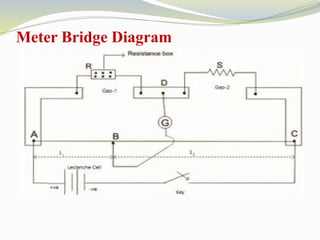
 The constantan wire extends from point A to point C,
where point B is where the knife-end of the jockey is
pointed. The jockey wire is connected to the
galvanometer (G), which is connected to the central
terminal of the meter bridge (point D). The ‘R’ is the
resistance box which can vary (and is hence the
variable resistance) while ‘S’ is the unknown resistance.
You can see that point A of the meter bridge is
connected to the positive terminal of a battery (usually
a Leclanche Cell) and the other point of the battery (the
negative terminal) is connected to a Key which in turn
is connected to point C of the meter bridge.
Meter Bridge Setup
 If you missed your meter bridge experiment practical, you
could refer to the steps mentioned here to understand how to
set up the apparatus and perform the experiment. Ensure that
you have the required materials to set up the experiment
apparatus. Once you do, follow the steps below:
 Connect one end of the connecting wire to point A of the meter
bridge and the other to the Leclanche cell’s positive terminal.
 Take another connecting wire and connect it to one end of the
Key and the other to the negative terminal of the Leclanche
cell.
 Take a third connecting wire and connect it to point C of
the meter bridge and the other end of the Key.
 Connect the variable resistance (R) to both ends of the
meter bridge in Gap-1. Do the same with the unknown
resistance wire (or coil) in Gap-2.
 Connect the central terminal of the meter bridge (D) with
the positive terminal of the galvanometer (G). Connect the
negative terminal of the galvanometer (G) with the jockey
(B).
Meter Bridge Experiment
 The meter bridge class 12 experiment includes the following steps;
do them once your meter bridge experiment setup is all checked and
ready (double-check the positive and negative terminals).
 Touchpoint A and point C of the meter bridge with the jockey B and
ensure that the galvanometer G shows deflections on opposite sides.
 Touch a point of the constantan wire (do not slide it) and introduce a
resistance from variable resistance R such that the galvanometer
shows zero deflection at that point (make a note of the resistance
value; you will need it later). You can take note of the point length
because you have a measuring scale in front of the meter-long wire.
Note down this measurement from point A. This point is known as
the ‘balancing point’ or ‘l1’.
 Change the positions of the unknown resistance ‘S’ and
resistance box ‘R’ so that Gap-1 has the unknown resistance
now and Gap-2 has the resistance box. Remove the Key
before you do this and put it back once the positions have
been changed.
 Measure the distance of terminal point C of the meter bridge
from the balancing point (where the galvanometer showed
zero deflection). This length is ‘l2’.Compute the average
length ‘l’ of l1 and l2 using the formula: (l1 + l2)/2.
 Use the formula to compute the value of unknown resistance
S: S = [l / (100 – l)] *R
 Repeat the whole experiment for a few more values of R. This
means steps 2 – 6 must be repeated for 5 more readings. Note
down the values of R for each case as well as the average
length ‘l’ that you found.
 Compute the mean value of unknown resistance with the 5 – 6
readings you have just taken.
 Use a screw gauge to measure the radius ‘r’ of the unknown
resistance wire (you can remove the wire from the meter
bridge once the 6 readings in total have been completed).
 Apply the formula below to compute the specific resistance ρ
of the wire is computed by: ρ = (π*r*r*S)/l
 Here, S is the unknown resistance (the mean value you
have computed), l is the length of the wire (also the mean
value you have computed), and r is the radius of the wire
which was measured by the screw gauge.
 Thus, we have computed the specific resistance of the
unknown resistance wire.

Current Electricity- Meter bridge Construction

  • 1.
  • 2.
    Introduction  The meterbridge works on the principle of Wheatstone Bridge that is named after the scientist who came up with the concept, Sir Charles Wheatstone. In grade 12, the meter bridge practical is a particularly important physics laboratory experiment. In this article, we shall learn more about the meter bridge experiment and see how it functions. If you missed out on your meter bridge practical, then you will find a quick refresher of the whole process here.
  • 3.
    Meter Bridge Definition The meter bridge is an apparatus used in laboratories to find the resistance of a metal coil (or any other substance). It is referred to as a meter bridge because it consists of a constantan (or manganin) wire that is 1 meter long and has a uniform CSA
  • 4.
    Meter Bridge Principle The meter bridge principle is based on the Wheatstone Bridge circuit which says that if at any point or length (of a wire), the ratio of two resistances (say R1 and R2) is equal to the ratio of another two resistances (say R3 and R4 where R4 is the unknown resistance), then there shall be no flow of current at that point between those points and the edges containing the resistances (R1/R2 and R3/R4). Therefore, applying it to the Meter Bridge, at any such point, the galvanometer will show zero deflection.
  • 5.
    Meter Bridge Components A meter bridge consists of the following components:  Meter bridge  Jockey  Key  Leclanche Cell  Connecting Wires  Galvanometer  Resistance Box  Unknown Resistance Wire
  • 6.
  • 7.
     The constantanwire extends from point A to point C, where point B is where the knife-end of the jockey is pointed. The jockey wire is connected to the galvanometer (G), which is connected to the central terminal of the meter bridge (point D). The ‘R’ is the resistance box which can vary (and is hence the variable resistance) while ‘S’ is the unknown resistance. You can see that point A of the meter bridge is connected to the positive terminal of a battery (usually a Leclanche Cell) and the other point of the battery (the negative terminal) is connected to a Key which in turn is connected to point C of the meter bridge.
  • 8.
    Meter Bridge Setup If you missed your meter bridge experiment practical, you could refer to the steps mentioned here to understand how to set up the apparatus and perform the experiment. Ensure that you have the required materials to set up the experiment apparatus. Once you do, follow the steps below:  Connect one end of the connecting wire to point A of the meter bridge and the other to the Leclanche cell’s positive terminal.  Take another connecting wire and connect it to one end of the Key and the other to the negative terminal of the Leclanche cell.
  • 9.
     Take athird connecting wire and connect it to point C of the meter bridge and the other end of the Key.  Connect the variable resistance (R) to both ends of the meter bridge in Gap-1. Do the same with the unknown resistance wire (or coil) in Gap-2.  Connect the central terminal of the meter bridge (D) with the positive terminal of the galvanometer (G). Connect the negative terminal of the galvanometer (G) with the jockey (B).
  • 10.
    Meter Bridge Experiment The meter bridge class 12 experiment includes the following steps; do them once your meter bridge experiment setup is all checked and ready (double-check the positive and negative terminals).  Touchpoint A and point C of the meter bridge with the jockey B and ensure that the galvanometer G shows deflections on opposite sides.  Touch a point of the constantan wire (do not slide it) and introduce a resistance from variable resistance R such that the galvanometer shows zero deflection at that point (make a note of the resistance value; you will need it later). You can take note of the point length because you have a measuring scale in front of the meter-long wire. Note down this measurement from point A. This point is known as the ‘balancing point’ or ‘l1’.
  • 11.
     Change thepositions of the unknown resistance ‘S’ and resistance box ‘R’ so that Gap-1 has the unknown resistance now and Gap-2 has the resistance box. Remove the Key before you do this and put it back once the positions have been changed.  Measure the distance of terminal point C of the meter bridge from the balancing point (where the galvanometer showed zero deflection). This length is ‘l2’.Compute the average length ‘l’ of l1 and l2 using the formula: (l1 + l2)/2.  Use the formula to compute the value of unknown resistance S: S = [l / (100 – l)] *R
  • 12.
     Repeat thewhole experiment for a few more values of R. This means steps 2 – 6 must be repeated for 5 more readings. Note down the values of R for each case as well as the average length ‘l’ that you found.  Compute the mean value of unknown resistance with the 5 – 6 readings you have just taken.  Use a screw gauge to measure the radius ‘r’ of the unknown resistance wire (you can remove the wire from the meter bridge once the 6 readings in total have been completed).  Apply the formula below to compute the specific resistance ρ of the wire is computed by: ρ = (π*r*r*S)/l
  • 13.
     Here, Sis the unknown resistance (the mean value you have computed), l is the length of the wire (also the mean value you have computed), and r is the radius of the wire which was measured by the screw gauge.  Thus, we have computed the specific resistance of the unknown resistance wire.