Multilayer Coating on Aluminum
7075Offered By: Air Weapon Complex
SUBMITTED BY:
MUHAMMAD HAMZA 2014215
MAJID ALI TAJWALI 2014159
ADVISOR: DR RASHID ALI
CO ADVISOR: MAHBOOB ALAM (AWC)
Background:
Aluminum 7075
-Physical aspects and its application
Coating Techniques:
-Zincate
Applied Coatings
Characterization:
-Wear resistance - Accelerated Corrosion (Tafel Polarization)
-Vacuum Heat Treatment (Hardening of Nickel) -Optical Microscopy
Objectives:
•To develop multilayer coating of electroless nickel and electrolytic Cr/Cu and investigate its
adhesion, wear and corrosion resistance.
•Enhancing Conductivity.
•To achieve coating of 10 micron size.
•Develop reproducible coating procedure for industrial scale.
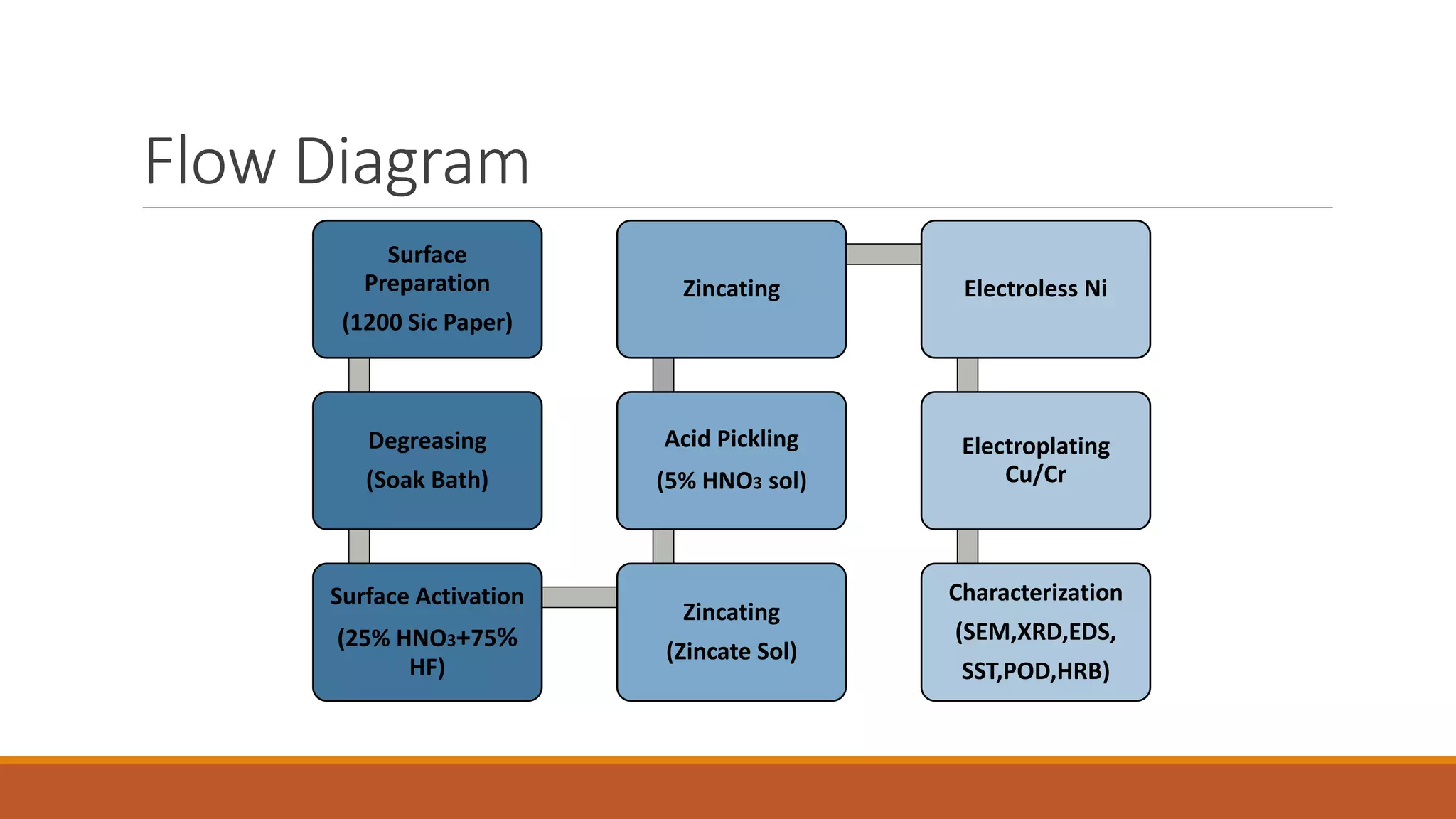
Flow Diagram
Surface
Preparation
(1200 Sic Paper)
Degreasing
(Soak Bath)
Surface Activation
(25% HNO3+75%
HF)
Zincating
(Zincate Sol)
Acid Pickling
(5% HNO3 sol)
Zincating Electroless Ni
Electroplating
Cu/Cr
Characterization
(SEM,XRD,EDS,
SST,POD,HRB)
Sample Preparation:
1
• Workpiece
2
• Cutting
• Grinding
3
• Polishing
Coating Techniques:
Zincating of Aluminum
Coating applied
-Nickel (Electro-less) + Chromium (Chemical Deposition method)
-Chromium + Nickel (Electrolytic)
-Electrolytic Nickel
-Electroless Nickel
EXPERIMENTAL SETUP
Zincate process
Why Zincate process ?
The main reason for selecting this
process is that the present method they used
for coating is anodizing it oxidized the surface of
substrate and make it non conductor but for
aerospace applications we need material to be
conductive.
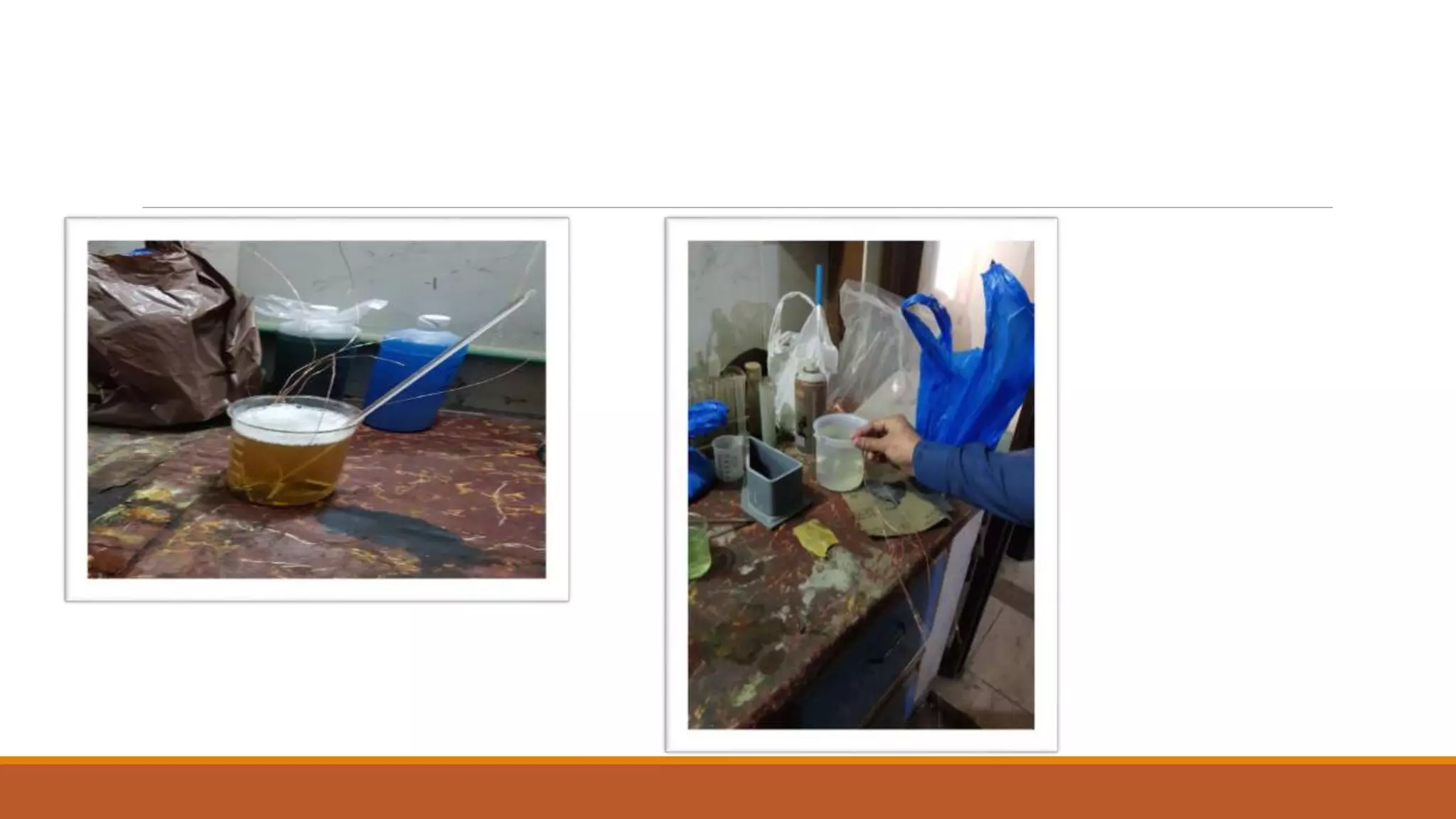
1
• Soak Cleaner 60C for 2 min
• Rinse it with distilled water
2
•Activate the surface for 30 sec in 25%HF +
75% HNO3
•Rinse it with distilled water
3
• Apply Zincate treatment for 2 min
• Wash it properly
4
•Dip into 5% HNO3 solution and wash
•Apply zincate treatment for 2nd time and
rinse it with distilled water.
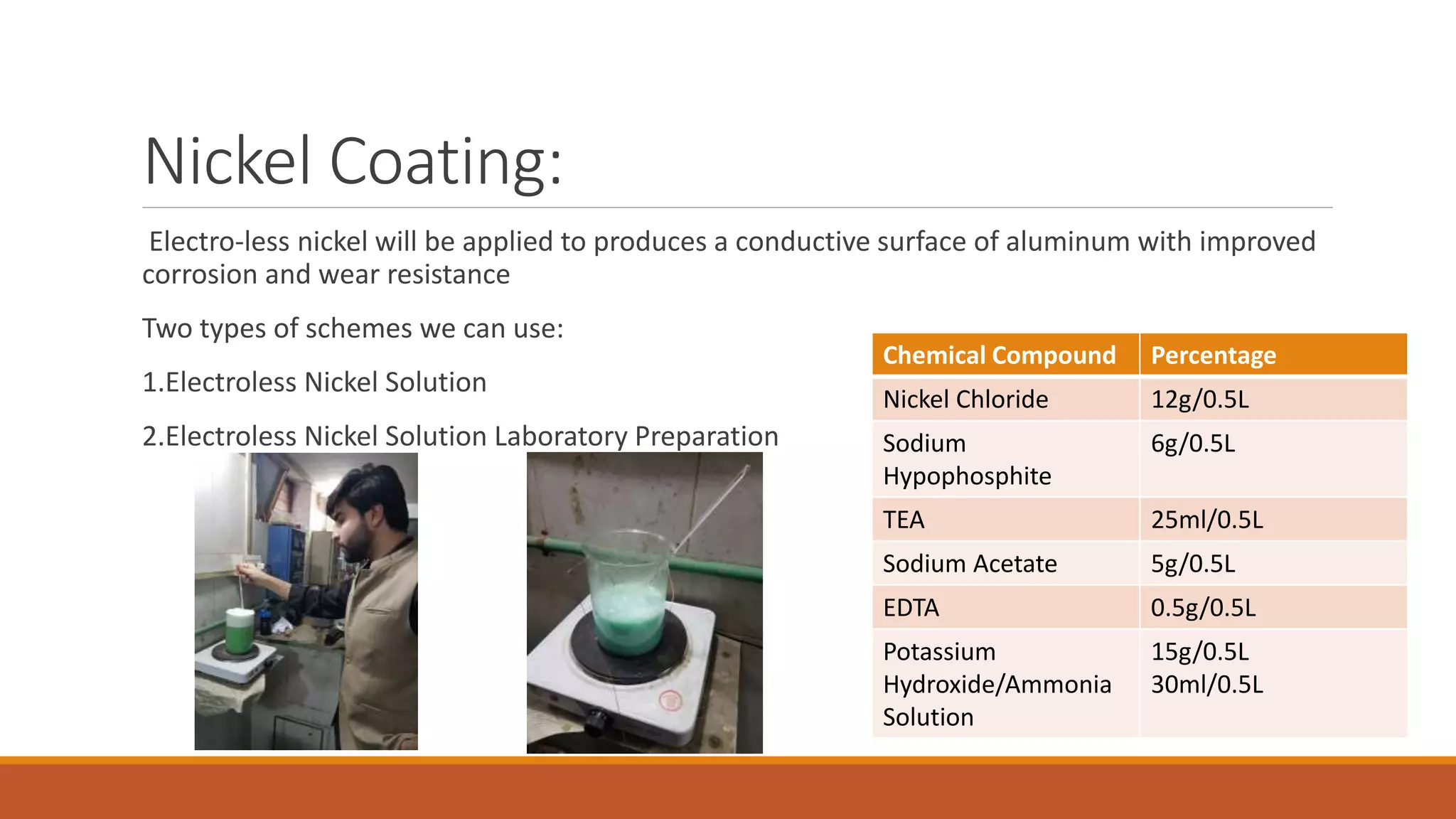
Nickel Coating:
Electro-less nickel will be applied to produces a conductive surface of aluminum with improved
corrosion and wear resistance
Two types of schemes we can use:
1.Electroless Nickel Solution
2.Electroless Nickel Solution Laboratory Preparation
Chemical Compound Percentage
Nickel Chloride 12g/0.5L
Sodium
Hypophosphite
6g/0.5L
TEA 25ml/0.5L
Sodium Acetate 5g/0.5L
EDTA 0.5g/0.5L
Potassium
Hydroxide/Ammonia
Solution
15g/0.5L
30ml/0.5L
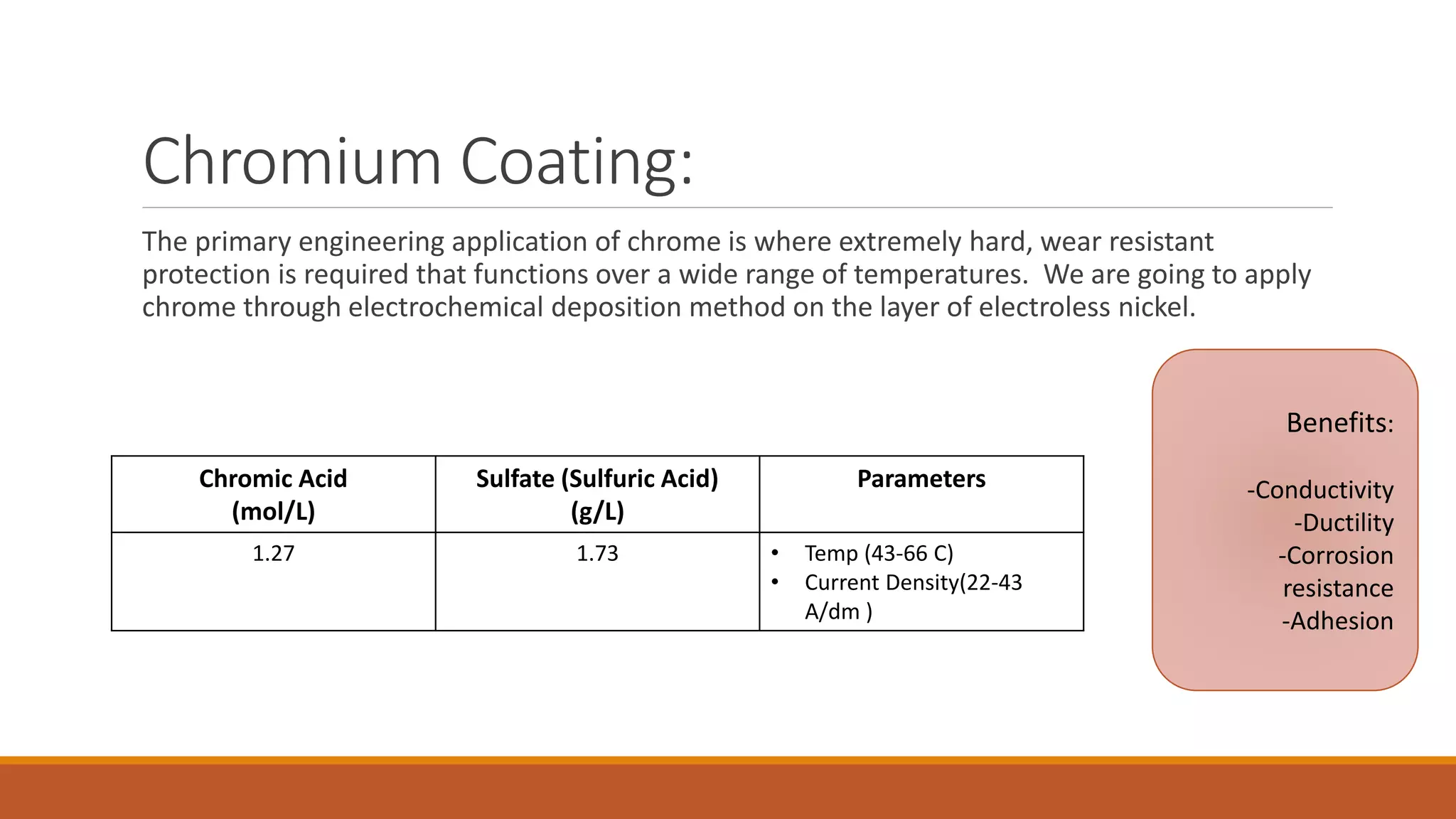
Chromium Coating:
The primary engineering application of chrome is where extremely hard, wear resistant
protection is required that functions over a wide range of temperatures. We are going to apply
chrome through electrochemical deposition method on the layer of electroless nickel.
Benefits:
-Conductivity
-Ductility
-Corrosion
resistance
-Adhesion
4 1 3 2 5
Chromic Acid
(mol/L)
Sulfate (Sulfuric Acid)
(g/L)
Parameters
1.27 1.73 • Temp (43-66 C)
• Current Density(22-43
A/dm )
Procedure
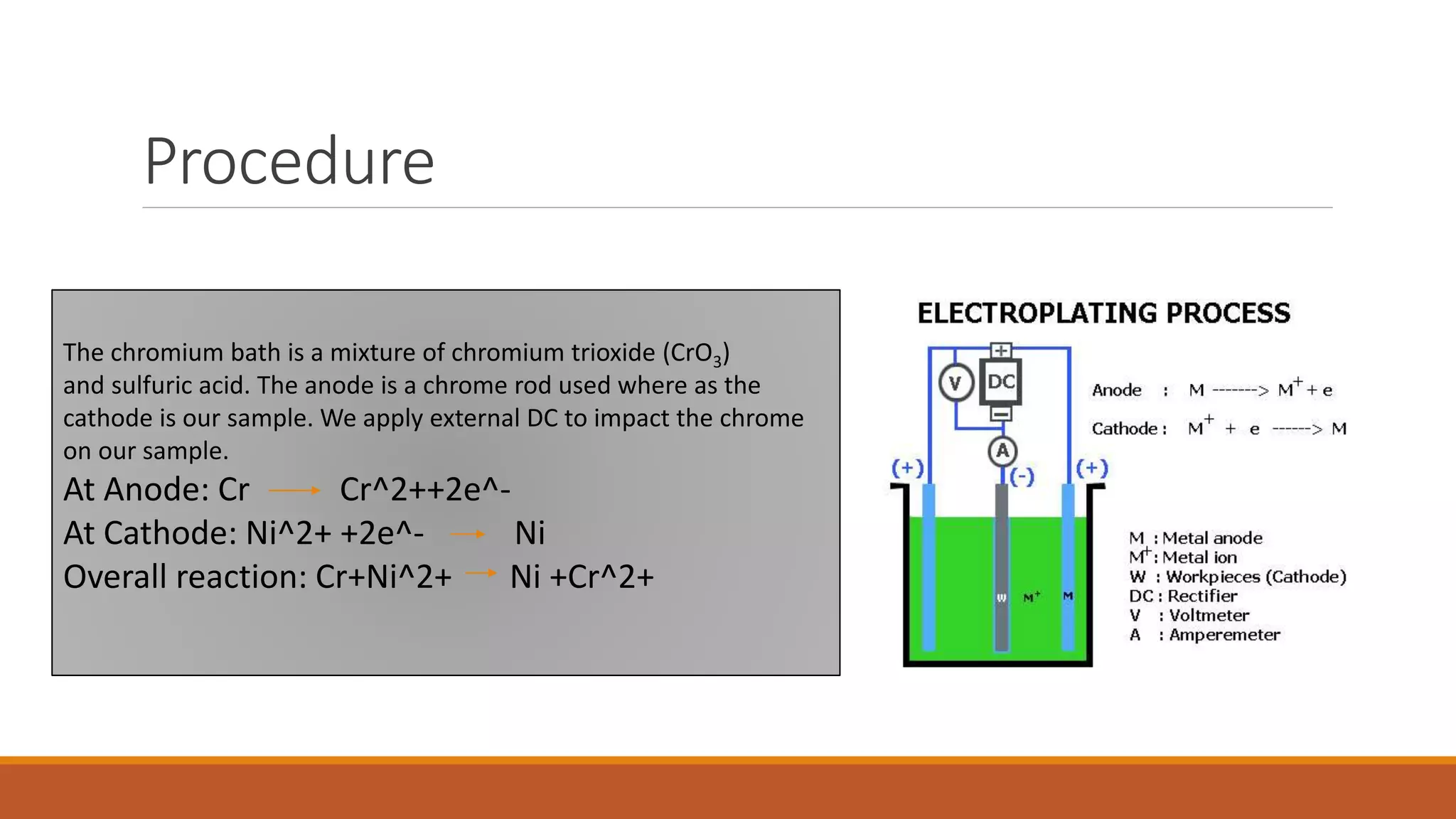
The chromium bath is a mixture of chromium trioxide (CrO3)
and sulfuric acid. The anode is a chrome rod used where as the
cathode is our sample. We apply external DC to impact the chrome
on our sample.
At Anode: Cr Cr^2++2e^-
At Cathode: Ni^2+ +2e^- Ni
Overall reaction: Cr+Ni^2+ Ni +Cr^2+
Characterization:
Corrosion Test:
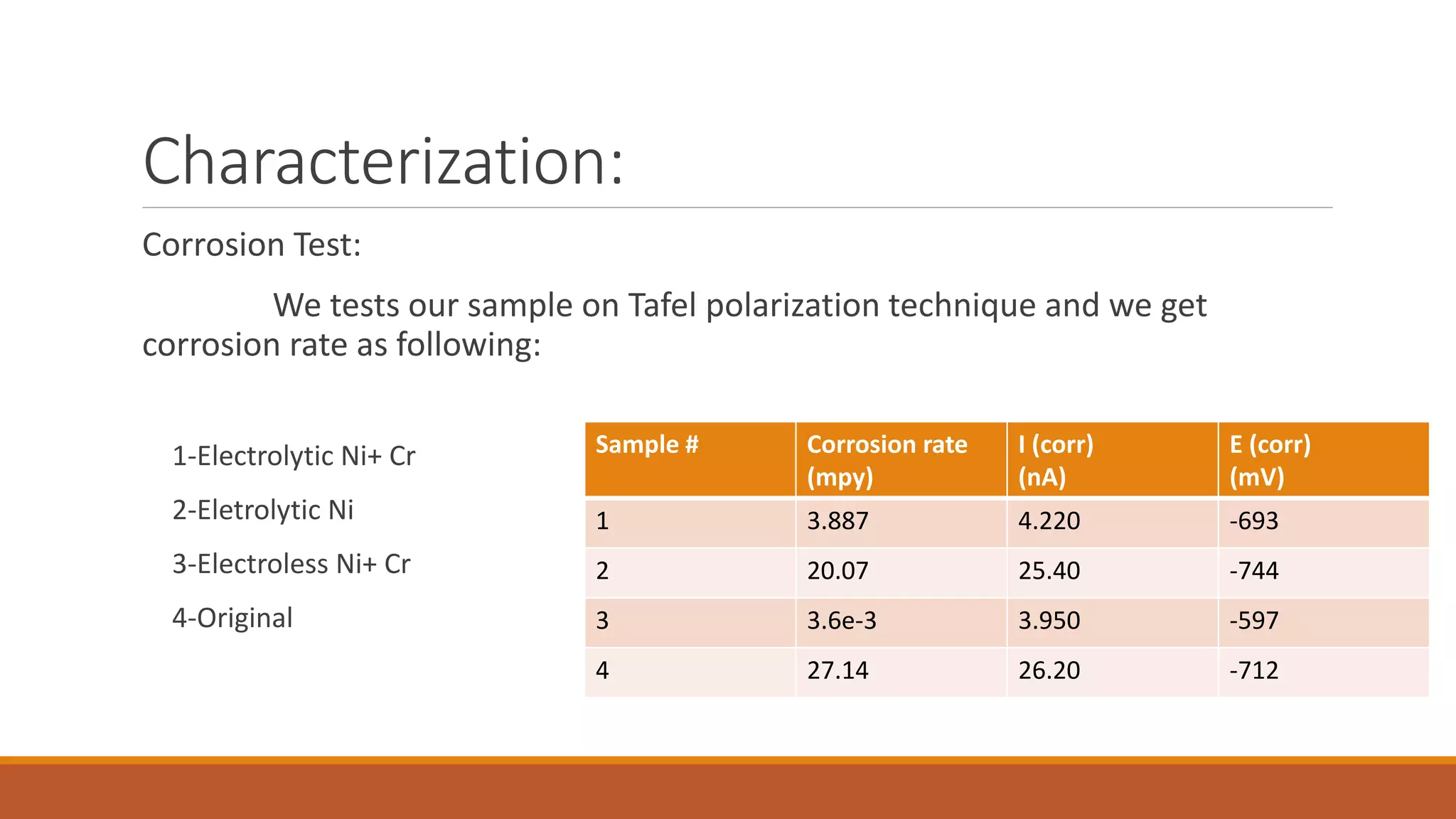
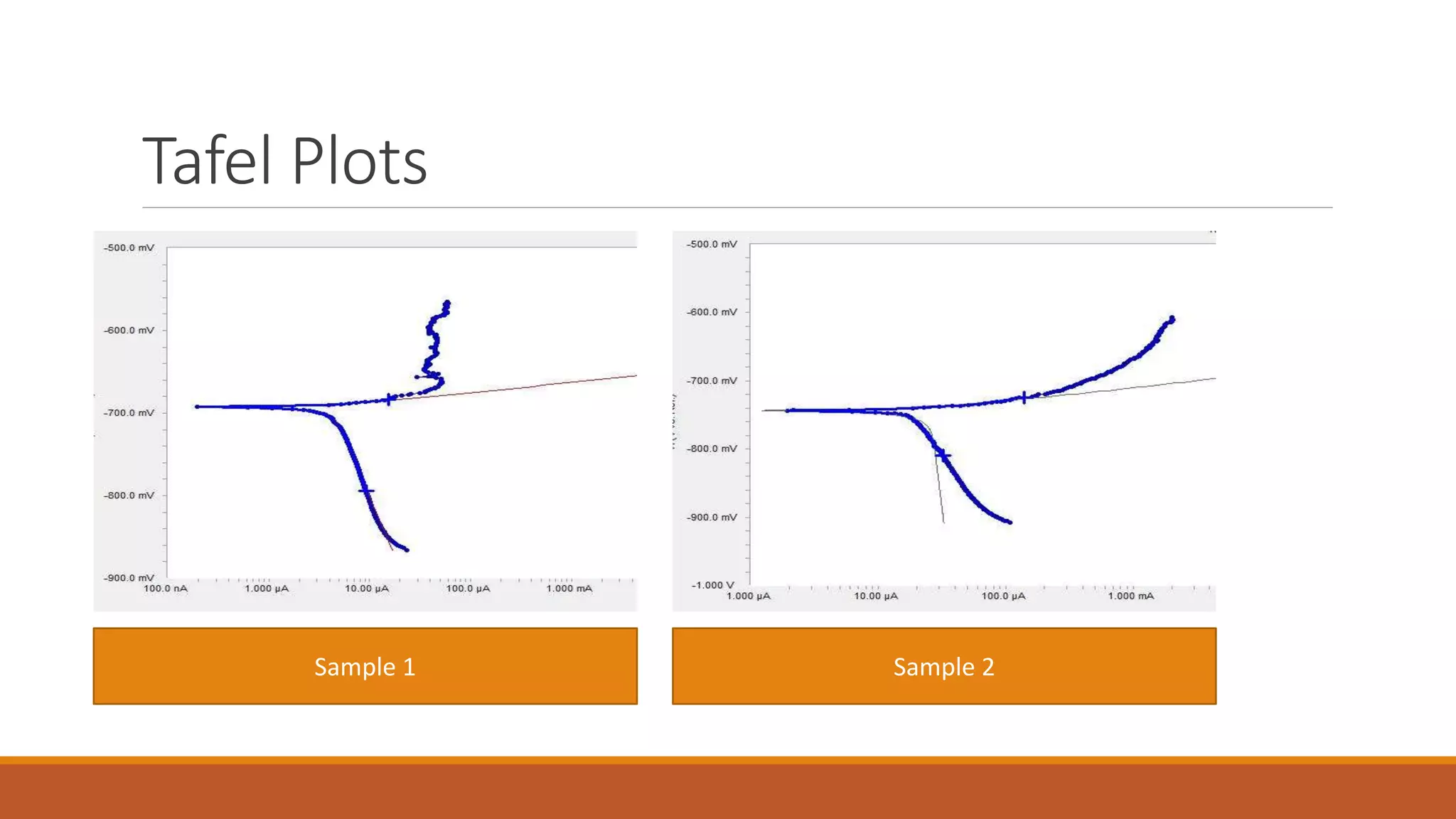
We tests our sample on Tafel polarization technique and we get
corrosion rate as following:
1-Electrolytic Ni+ Cr
2-Eletrolytic Ni
3-Electroless Ni+ Cr
4-Original
Sample # Corrosion rate
(mpy)
I (corr)
(nA)
E (corr)
(mV)
1 3.887 4.220 -693
2 20.07 25.40 -744
3 3.6e-3 3.950 -597
4 27.14 26.20 -712
Tafel Plots
Sample 1 Sample 2
Sample 3 Sample 4
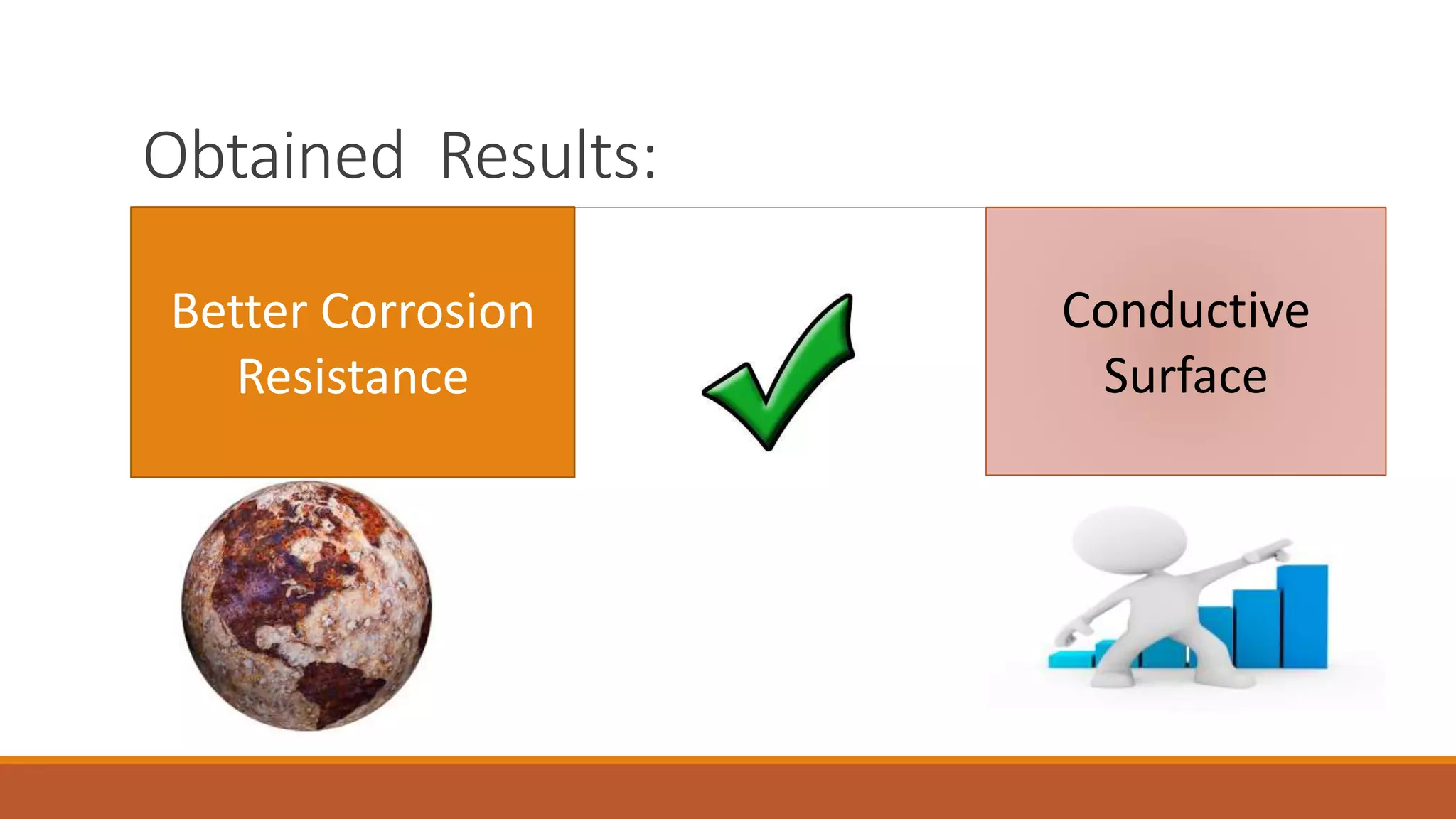
Obtained Results:
Better Corrosion
Resistance
Conductive
Surface
SEM Images
EDS Results
Original Sample Coated Sample
Hardness Results
Sample Hardness (HRB)
Coated Sample 67.3
Original Sample 46.6
Conclusion:
•Required thickness of coating was achieved with better corrosion resistance and conductive
surface.
•Better Hardness.
•Technique for reproducibility is developed.
Problems faced:
-Power adhesion.
-KOH act as a foam forming agent.
-When we exceed the time and temperature for electroless nickel solution the coating starts
breaking.
-Ph is difficult to maintain.
-Oxide layer can be visible on some samples.
Future Plans:
-To find out wear resistance.
-To Find out hardness after heat treatment.
-Enhance adhesion.
References:
J. R. Davis, Ed., Corrosion of Aluminium and Aluminium Alloys, ASM International, New York, NY, USA, 1999.
C. Vargel, M. Jacques, and M. P. Schmidt, Corrosion of Aluminium, Elsevier, London, UK, 2004.
G. Bierwagen, “Next generation of aircraft coatings systems,” Journal of Coatings Technology, vol. 73, no. 915, pp. 45–52, 2001. View at
Google Scholar · View at Scopus
R. Rabicot, R. Brown, and S. C. Yang, “Corrosion protection of aluminum alloys by double-strand polyaniline,” Synthetic Metals, vol. 85, no.
1–3, p. 1263, 1997. View at Publisher · View at Google Scholar
F. Andreatta, H. Terryn, and J. H. W. de Wit, “Corrosion behaviour of different tempers of AA7075 aluminium alloy,” Electrochimica Acta,
vol. 49, no. 17-18, pp. 2851–2862, 2004. View at Publisher · View at Google Scholar · View at Scopus
Q. Meng and G. S. Frankel, “Characterization of chromate conversion coating on AA7075-T6 aluminum alloy,” Surface and Interface
Analysis, vol. 36, no. 1, pp. 30–42, 2004. View at Publisher · View at Google Scholar · View at Scopus
K. Jones and D. W. Hoeppner, “Pit-to-crack transition in pre-corroded 7075-T6 aluminum alloy under cyclic loading,” Corrosion Science,
vol. 47, no. 9, pp. 2185–2198, 2005. View at Publisher · View at Google Scholar · View at Scopus
K. H. Na and S. I. Pyun, “Comparison of susceptibility to pitting corrosion of AA2024-T4, AA7075-T651 and AA7475-T761
aluminium alloys in neutral chloride solutions using electrochemical noise analysis,” Corrosion Science, vol. 50, no. 1, pp. 248–
258, 2008. View at Publisher · View at Google Scholar · View at Scopus
Fyp 3

Fyp 3

  • 1.
    Multilayer Coating onAluminum 7075Offered By: Air Weapon Complex SUBMITTED BY: MUHAMMAD HAMZA 2014215 MAJID ALI TAJWALI 2014159 ADVISOR: DR RASHID ALI CO ADVISOR: MAHBOOB ALAM (AWC)
  • 2.
    Background: Aluminum 7075 -Physical aspectsand its application Coating Techniques: -Zincate Applied Coatings Characterization: -Wear resistance - Accelerated Corrosion (Tafel Polarization) -Vacuum Heat Treatment (Hardening of Nickel) -Optical Microscopy
  • 3.
    Objectives: •To develop multilayercoating of electroless nickel and electrolytic Cr/Cu and investigate its adhesion, wear and corrosion resistance. •Enhancing Conductivity. •To achieve coating of 10 micron size. •Develop reproducible coating procedure for industrial scale.
  • 4.
    Flow Diagram Surface Preparation (1200 SicPaper) Degreasing (Soak Bath) Surface Activation (25% HNO3+75% HF) Zincating (Zincate Sol) Acid Pickling (5% HNO3 sol) Zincating Electroless Ni Electroplating Cu/Cr Characterization (SEM,XRD,EDS, SST,POD,HRB)
  • 5.
    Sample Preparation: 1 • Workpiece 2 •Cutting • Grinding 3 • Polishing
  • 6.
    Coating Techniques: Zincating ofAluminum Coating applied -Nickel (Electro-less) + Chromium (Chemical Deposition method) -Chromium + Nickel (Electrolytic) -Electrolytic Nickel -Electroless Nickel
  • 7.
  • 8.
    Zincate process Why Zincateprocess ? The main reason for selecting this process is that the present method they used for coating is anodizing it oxidized the surface of substrate and make it non conductor but for aerospace applications we need material to be conductive. 1 • Soak Cleaner 60C for 2 min • Rinse it with distilled water 2 •Activate the surface for 30 sec in 25%HF + 75% HNO3 •Rinse it with distilled water 3 • Apply Zincate treatment for 2 min • Wash it properly 4 •Dip into 5% HNO3 solution and wash •Apply zincate treatment for 2nd time and rinse it with distilled water.
  • 10.
    Nickel Coating: Electro-less nickelwill be applied to produces a conductive surface of aluminum with improved corrosion and wear resistance Two types of schemes we can use: 1.Electroless Nickel Solution 2.Electroless Nickel Solution Laboratory Preparation Chemical Compound Percentage Nickel Chloride 12g/0.5L Sodium Hypophosphite 6g/0.5L TEA 25ml/0.5L Sodium Acetate 5g/0.5L EDTA 0.5g/0.5L Potassium Hydroxide/Ammonia Solution 15g/0.5L 30ml/0.5L
  • 11.
    Chromium Coating: The primaryengineering application of chrome is where extremely hard, wear resistant protection is required that functions over a wide range of temperatures. We are going to apply chrome through electrochemical deposition method on the layer of electroless nickel. Benefits: -Conductivity -Ductility -Corrosion resistance -Adhesion 4 1 3 2 5 Chromic Acid (mol/L) Sulfate (Sulfuric Acid) (g/L) Parameters 1.27 1.73 • Temp (43-66 C) • Current Density(22-43 A/dm )
  • 12.
    Procedure The chromium bathis a mixture of chromium trioxide (CrO3) and sulfuric acid. The anode is a chrome rod used where as the cathode is our sample. We apply external DC to impact the chrome on our sample. At Anode: Cr Cr^2++2e^- At Cathode: Ni^2+ +2e^- Ni Overall reaction: Cr+Ni^2+ Ni +Cr^2+
  • 13.
    Characterization: Corrosion Test: We testsour sample on Tafel polarization technique and we get corrosion rate as following: 1-Electrolytic Ni+ Cr 2-Eletrolytic Ni 3-Electroless Ni+ Cr 4-Original Sample # Corrosion rate (mpy) I (corr) (nA) E (corr) (mV) 1 3.887 4.220 -693 2 20.07 25.40 -744 3 3.6e-3 3.950 -597 4 27.14 26.20 -712
  • 14.
  • 15.
  • 16.
  • 17.
  • 18.
  • 19.
    Hardness Results Sample Hardness(HRB) Coated Sample 67.3 Original Sample 46.6
  • 20.
    Conclusion: •Required thickness ofcoating was achieved with better corrosion resistance and conductive surface. •Better Hardness. •Technique for reproducibility is developed.
  • 21.
    Problems faced: -Power adhesion. -KOHact as a foam forming agent. -When we exceed the time and temperature for electroless nickel solution the coating starts breaking. -Ph is difficult to maintain. -Oxide layer can be visible on some samples.
  • 22.
    Future Plans: -To findout wear resistance. -To Find out hardness after heat treatment. -Enhance adhesion.
  • 23.
    References: J. R. Davis,Ed., Corrosion of Aluminium and Aluminium Alloys, ASM International, New York, NY, USA, 1999. C. Vargel, M. Jacques, and M. P. Schmidt, Corrosion of Aluminium, Elsevier, London, UK, 2004. G. Bierwagen, “Next generation of aircraft coatings systems,” Journal of Coatings Technology, vol. 73, no. 915, pp. 45–52, 2001. View at Google Scholar · View at Scopus R. Rabicot, R. Brown, and S. C. Yang, “Corrosion protection of aluminum alloys by double-strand polyaniline,” Synthetic Metals, vol. 85, no. 1–3, p. 1263, 1997. View at Publisher · View at Google Scholar F. Andreatta, H. Terryn, and J. H. W. de Wit, “Corrosion behaviour of different tempers of AA7075 aluminium alloy,” Electrochimica Acta, vol. 49, no. 17-18, pp. 2851–2862, 2004. View at Publisher · View at Google Scholar · View at Scopus Q. Meng and G. S. Frankel, “Characterization of chromate conversion coating on AA7075-T6 aluminum alloy,” Surface and Interface Analysis, vol. 36, no. 1, pp. 30–42, 2004. View at Publisher · View at Google Scholar · View at Scopus K. Jones and D. W. Hoeppner, “Pit-to-crack transition in pre-corroded 7075-T6 aluminum alloy under cyclic loading,” Corrosion Science, vol. 47, no. 9, pp. 2185–2198, 2005. View at Publisher · View at Google Scholar · View at Scopus K. H. Na and S. I. Pyun, “Comparison of susceptibility to pitting corrosion of AA2024-T4, AA7075-T651 and AA7475-T761 aluminium alloys in neutral chloride solutions using electrochemical noise analysis,” Corrosion Science, vol. 50, no. 1, pp. 248– 258, 2008. View at Publisher · View at Google Scholar · View at Scopus