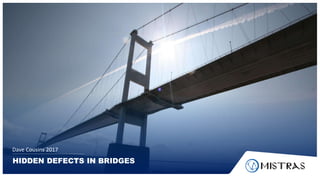
HIDDEN DEFECTS IN BRIDGES
Dave Cousins 2017
www.mistrasgroup.co.uk
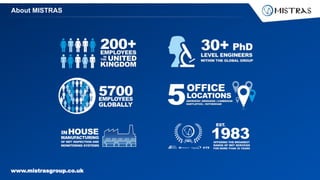
About MISTRAS
MISTRAS Cambridge
Norman Way Industrial Estate
Over, Cambridge
CB24 5QE, UK
T: 01954 231612
E: info@mistrasgroup.co.uk
MISTRAS Rotherham
Unit 21 Aspen Court
Rotherham, South Yorkshire
S60 1FB, UK
T: 01709 377443
E: info.rotherham@mistrasgroup.co.uk
MISTRAS Hartlepool
108 Graythorp Industrial Estate
Hartlepool, Cleveland
TS25 2DF, UK
T: 01429 233323
E: info.hartlepool@mistrasgroup.co.uk
MISTRAS Aberdeen
Howe Moss Crescent
Kirkhill Industrial Estate, Dyce
Aberdeen, AB21 0GN
T: 01224 725277
E: info.aberdeen@mistrasgroup.co.uk
MISTRAS Bridgend
17 Village Farm Industrial Estate
Pyle, Bridgend
CF33 6BL, UK
T: 01656 740232
E: info.bridgend@mistrasgroup.co.uk
www.mistrasgroup.co.uk
UK Office Locations
www.mistrasgroup.co.uk
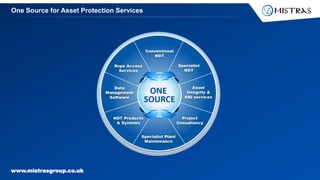
One Source for Asset Protection Services
www.mistrasgroup.co.uk
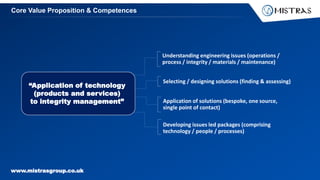
Understanding engineering issues (operations /
process / integrity / materials / maintenance)
Selecting / designing solutions (finding & assessing)
Application of solutions (bespoke, one source,
single point of contact)
Developing issues led packages (comprising
technology / people / processes)
“Application of technology
(products and services)
to integrity management”
Core Value Proposition & Competences
Hidden Defects in Bridges
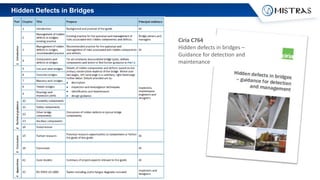
Ciria C764
Hidden defects in bridges –
Guidance for detection and
maintenance
Hidden Defects
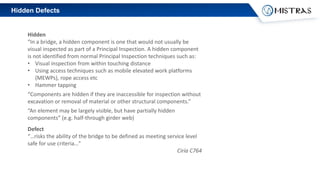
Hidden
“In a bridge, a hidden component is one that would not usually be
visual inspected as part of a Principal Inspection. A hidden component
is not identified from normal Principal Inspection techniques such as:
• Visual inspection from within touching distance
• Using access techniques such as mobile elevated work platforms
(MEWPs), rope access etc
• Hammer tapping
“Components are hidden if they are inaccessible for inspection without
excavation or removal of material or other structural components.”
“An element may be largely visible, but have partially hidden
components” (e.g. half-through girder web)
Defect
“…risks the ability of the bridge to be defined as meeting service level
safe for use criteria…”
Ciria C764
Hidden Defects
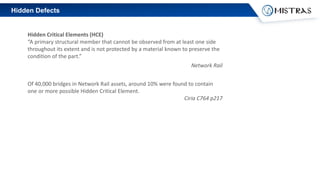
Hidden Critical Elements (HCE)
“A primary structural member that cannot be observed from at least one side
throughout its extent and is not protected by a material known to preserve the
condition of the part.”
Network Rail
Of 40,000 bridges in Network Rail assets, around 10% were found to contain
one or more possible Hidden Critical Element.
Ciria C764 p217
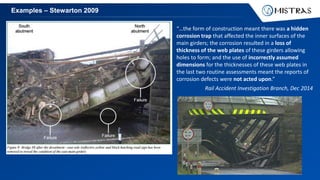
Examples – Stewarton 2009
“…the form of construction meant there was a hidden
corrosion trap that affected the inner surfaces of the
main girders; the corrosion resulted in a loss of
thickness of the web plates of these girders allowing
holes to form; and the use of incorrectly assumed
dimensions for the thicknesses of these web plates in
the last two routine assessments meant the reports of
corrosion defects were not acted upon.”
Rail Accident Investigation Branch, Dec 2014
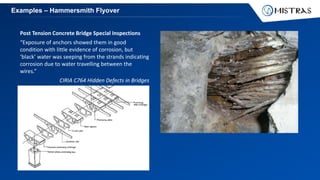
Examples – Hammersmith Flyover
Post Tension Concrete Bridge Special Inspections
“Exposure of anchors showed them in good
condition with little evidence of corrosion, but
‘black’ water was seeping from the strands indicating
corrosion due to water travelling between the
wires.”
CIRIA C764 Hidden Defects in Bridges
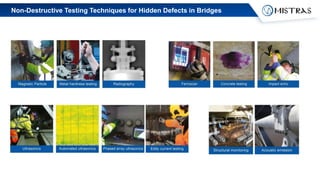
Non-Destructive Testing Techniques for Hidden Defects in Bridges
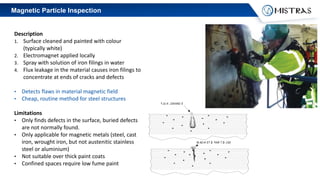
Magnetic Particle Inspection
Description
1. Surface cleaned and painted with colour
(typically white)
2. Electromagnet applied locally
3. Spray with solution of iron filings in water
4. Flux leakage in the material causes iron filings to
concentrate at ends of cracks and defects
• Detects flaws in material magnetic field
• Cheap, routine method for steel structures
Limitations
• Only finds defects in the surface, buried defects
are not normally found.
• Only applicable for magnetic metals (steel, cast
iron, wrought iron, but not austenitic stainless
steel or aluminium)
• Not suitable over thick paint coats
• Confined spaces require low fume paint
M AG N ET IC PAR T IC LES
F LU X LEAKAG E
L IN ES O FM AG N ET IC F LU X
M AG N ET IC PAR T IC LES
F LU X LEAKAG E
L IN ES O FM AG N ET IC F LU X
Metal Hardness Testing
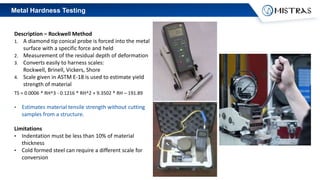
Description – Rockwell Method
1. A diamond tip conical probe is forced into the metal
surface with a specific force and held
2. Measurement of the residual depth of deformation
3. Converts easily to harness scales:
Rockwell, Brinell, Vickers, Shore
4. Scale given in ASTM E-18 is used to estimate yield
strength of material
TS = 0.0006 * RH^3 - 0.1216 * RH^2 + 9.3502 * RH – 191.89
• Estimates material tensile strength without cutting
samples from a structure.
Limitations
• Indentation must be less than 10% of material
thickness
• Cold formed steel can require a different scale for
conversion
Radiography
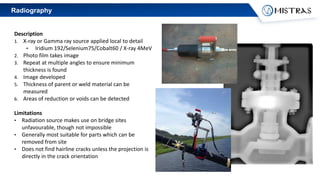
Description
1. X-ray or Gamma ray source applied local to detail
• Iridium 192/Selenium75/Cobalt60 / X-ray 4MeV
2. Photo film takes image
3. Repeat at multiple angles to ensure minimum
thickness is found
4. Image developed
5. Thickness of parent or weld material can be
measured
6. Areas of reduction or voids can be detected
Limitations
• Radiation source makes use on bridge sites
unfavourable, though not impossible
• Generally most suitable for parts which can be
removed from site
• Does not find hairline cracks unless the projection is
directly in the crack orientation
Ferroscan
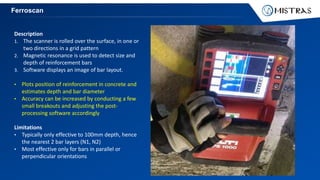
Description
1. The scanner is rolled over the surface, in one or
two directions in a grid pattern
2. Magnetic resonance is used to detect size and
depth of reinforcement bars
3. Software displays an image of bar layout.
• Plots position of reinforcement in concrete and
estimates depth and bar diameter
• Accuracy can be increased by conducting a few
small breakouts and adjusting the post-
processing software accordingly
Limitations
• Typically only effective to 100mm depth, hence
the nearest 2 bar layers (N1, N2)
• Most effective only for bars in parallel or
perpendicular orientations
Concrete Tests
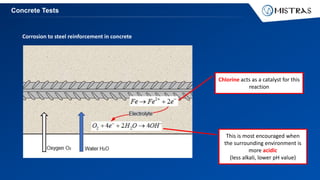
Corrosion to steel reinforcement in concrete
This is most encouraged when
the surrounding environment is
more acidic
(less alkali, lower pH value)
Chlorine acts as a catalyst for this
reaction
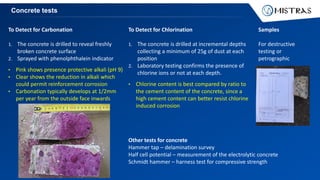
Concrete tests
To Detect for Chlorination
1. The concrete is drilled at incremental depths
collecting a minimum of 25g of dust at each
position
2. Laboratory testing confirms the presence of
chlorine ions or not at each depth.
• Chlorine content is best compared by ratio to
the cement content of the concrete, since a
high cement content can better resist chlorine
induced corrosion
To Detect for Carbonation
1. The concrete is drilled to reveal freshly
broken concrete surface
2. Sprayed with phenolphthalein indicator
• Pink shows presence protective alkali (pH 9)
• Clear shows the reduction in alkali which
could permit reinforcement corrosion
• Carbonation typically develops at 1/2mm
per year from the outside face inwards
Samples
For destructive
testing or
petrographic
Other tests for concrete
Hammer tap – delamination survey
Half cell potential – measurement of the electrolytic concrete
Schmidt hammer – harness test for compressive strength
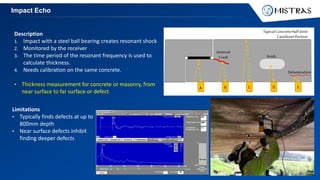
Impact Echo
Description
1. Impact with a steel ball bearing creates resonant shock
2. Monitored by the receiver
3. The time period of the resonant frequency is used to
calculate thickness.
4. Needs calibration on the same concrete.
• Thickness measurement for concrete or masonry, from
near surface to far surface or defect
Limitations
• Typically finds defects at up to
800mm depth
• Near surface defects inhibit
finding deeper defects
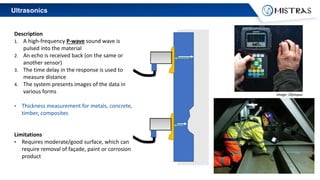
Ultrasonics
Description
1. A high-frequency P-wave sound wave is
pulsed into the material
2. An echo is received back (on the same or
another sensor)
3. The time delay in the response is used to
measure distance
4. The system presents images of the data in
various forms
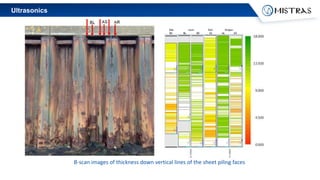
• Thickness measurement for metals, concrete,
timber, composites
Limitations
• Requires moderate/good surface, which can
require removal of façade, paint or corrosion
product
image: Olympus
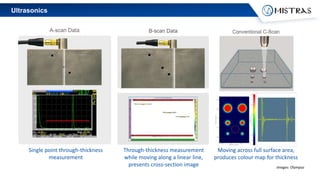
Ultrasonics
Single point through-thickness
measurement
Through-thickness measurement
while moving along a linear line,
presents cross-section image
Moving across full surface area,
produces colour map for thickness
images: Olympus
Ultrasonics
B-scan images of thickness down vertical lines of the sheet piling faces
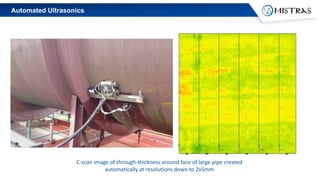
Automated Ultrasonics
C-scan image of through-thickness around face of large pipe created
automatically at resolutions down to 2x5mm
Ultrasonics – Phased Array
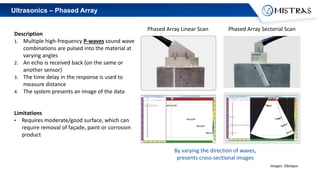
By varying the direction of waves,
presents cross-sectional images
images: Olympus
Phased Array Linear Scan
Description
1. Multiple high-frequency P-waves sound wave
combinations are pulsed into the material at
varying angles
2. An echo is received back (on the same or
another sensor)
3. The time delay in the response is used to
measure distance
4. The system presents an image of the data
Limitations
• Requires moderate/good surface, which can
require removal of façade, paint or corrosion
product
Phased Array Sectorial Scan
Ultrasonics – Phased Array
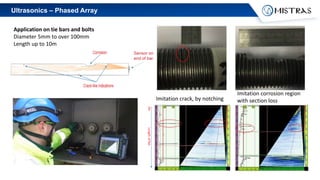
Imitation crack, by notching
Imitation corrosion region
with section loss
0mLengthofBar
Application on tie bars and bolts
Diameter 5mm to over 100mm
Length up to 10m
Description
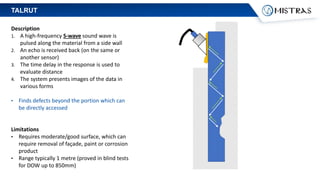
1. A high-frequency S-wave sound wave is
pulsed along the material from a side wall
2. An echo is received back (on the same or
another sensor)
3. The time delay in the response is used to
evaluate distance
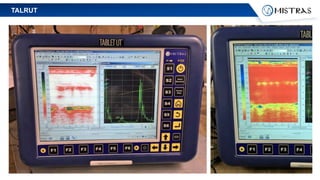
4. The system presents images of the data in
various forms
• Finds defects beyond the portion which can
be directly accessed
Limitations
• Requires moderate/good surface, which can
require removal of façade, paint or corrosion
product
• Range typically 1 metre (proved in blind tests
for DOW up to 850mm)
TALRUT
TALRUT
Eddy Current Testing
Description
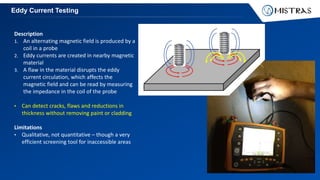
1. An alternating magnetic field is produced by a
coil in a probe
2. Eddy currents are created in nearby magnetic
material
3. A flaw in the material disrupts the eddy
current circulation, which affects the
magnetic field and can be read by measuring
the impedance in the coil of the probe
• Can detect cracks, flaws and reductions in
thickness without removing paint or cladding
Limitations
• Qualitative, not quantitative – though a very
efficient screening tool for inaccessible areas
Eddy Current Testing
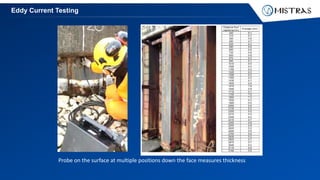
Probe on the surface at multiple positions down the face measures thickness
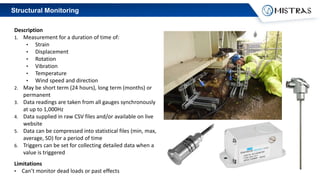
Structural Monitoring
Description
1. Measurement for a duration of time of:
• Strain
• Displacement
• Rotation
• Vibration
• Temperature
• Wind speed and direction
2. May be short term (24 hours), long term (months) or
permanent
3. Data readings are taken from all gauges synchronously
at up to 1,000Hz
4. Data supplied in raw CSV files and/or available on live
website
5. Data can be compressed into statistical files (min, max,
average, SD) for a period of time
6. Triggers can be set for collecting detailed data when a
value is triggered
Limitations
• Can’t monitor dead loads or past effects
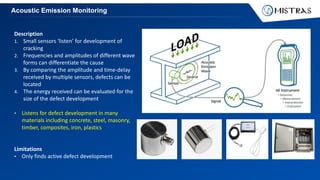
Acoustic Emission Monitoring
Description
1. Small sensors ‘listen’ for development of
cracking
2. Frequencies and amplitudes of different wave
forms can differentiate the cause
3. By comparing the amplitude and time-delay
received by multiple sensors, defects can be
located
4. The energy received can be evaluated for the
size of the defect development
• Listens for defect development in many
materials including concrete, steel, masonry,
timber, composites, iron, plastics
Limitations
• Only finds active defect development
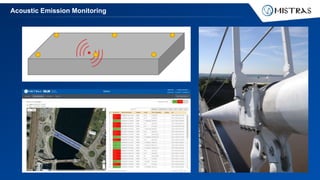
Acoustic Emission Monitoring
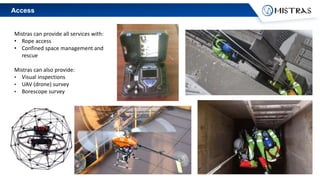
Access
Mistras can provide all services with:
• Rope access
• Confined space management and
rescue
Mistras can also provide:
• Visual inspections
• UAV (drone) survey
• Borescope survey
Where to start to seek out hidden defects
1. What do you not know from the Principal Inspection?
2. What components are hidden?
3. Does the condition of those parts matter to the structural
performance?
4. What investigation techniques are available?
What will they tell you?
What won’t they tell you?
5. What will you do with that information?
Can you define trigger levels for action?
Or minimum requirements for capacity?
6. Is the investigation work sufficiently quick and cost effective?
www.mistrasgroup.co.uk
Dave Cousins CEng MICE
Infrastructure Engineer
T: 01954 231612
E: Dave.Cousins@MistrasGroup.co.uk

Mistras l&l hidden defects rev2 mistras

  • 1.
    HIDDEN DEFECTS INBRIDGES Dave Cousins 2017
  • 2.
  • 3.
    MISTRAS Cambridge Norman WayIndustrial Estate Over, Cambridge CB24 5QE, UK T: 01954 231612 E: info@mistrasgroup.co.uk MISTRAS Rotherham Unit 21 Aspen Court Rotherham, South Yorkshire S60 1FB, UK T: 01709 377443 E: info.rotherham@mistrasgroup.co.uk MISTRAS Hartlepool 108 Graythorp Industrial Estate Hartlepool, Cleveland TS25 2DF, UK T: 01429 233323 E: info.hartlepool@mistrasgroup.co.uk MISTRAS Aberdeen Howe Moss Crescent Kirkhill Industrial Estate, Dyce Aberdeen, AB21 0GN T: 01224 725277 E: info.aberdeen@mistrasgroup.co.uk MISTRAS Bridgend 17 Village Farm Industrial Estate Pyle, Bridgend CF33 6BL, UK T: 01656 740232 E: info.bridgend@mistrasgroup.co.uk www.mistrasgroup.co.uk UK Office Locations
  • 4.
    www.mistrasgroup.co.uk One Source forAsset Protection Services
  • 5.
    www.mistrasgroup.co.uk Understanding engineering issues(operations / process / integrity / materials / maintenance) Selecting / designing solutions (finding & assessing) Application of solutions (bespoke, one source, single point of contact) Developing issues led packages (comprising technology / people / processes) “Application of technology (products and services) to integrity management” Core Value Proposition & Competences
  • 6.
    Hidden Defects inBridges Ciria C764 Hidden defects in bridges – Guidance for detection and maintenance
  • 7.
    Hidden Defects Hidden “In abridge, a hidden component is one that would not usually be visual inspected as part of a Principal Inspection. A hidden component is not identified from normal Principal Inspection techniques such as: • Visual inspection from within touching distance • Using access techniques such as mobile elevated work platforms (MEWPs), rope access etc • Hammer tapping “Components are hidden if they are inaccessible for inspection without excavation or removal of material or other structural components.” “An element may be largely visible, but have partially hidden components” (e.g. half-through girder web) Defect “…risks the ability of the bridge to be defined as meeting service level safe for use criteria…” Ciria C764
  • 8.
    Hidden Defects Hidden CriticalElements (HCE) “A primary structural member that cannot be observed from at least one side throughout its extent and is not protected by a material known to preserve the condition of the part.” Network Rail Of 40,000 bridges in Network Rail assets, around 10% were found to contain one or more possible Hidden Critical Element. Ciria C764 p217
  • 9.
    Examples – Stewarton2009 “…the form of construction meant there was a hidden corrosion trap that affected the inner surfaces of the main girders; the corrosion resulted in a loss of thickness of the web plates of these girders allowing holes to form; and the use of incorrectly assumed dimensions for the thicknesses of these web plates in the last two routine assessments meant the reports of corrosion defects were not acted upon.” Rail Accident Investigation Branch, Dec 2014
  • 10.
    Examples – HammersmithFlyover Post Tension Concrete Bridge Special Inspections “Exposure of anchors showed them in good condition with little evidence of corrosion, but ‘black’ water was seeping from the strands indicating corrosion due to water travelling between the wires.” CIRIA C764 Hidden Defects in Bridges
  • 11.
    Non-Destructive Testing Techniquesfor Hidden Defects in Bridges
  • 12.
    Magnetic Particle Inspection Description 1.Surface cleaned and painted with colour (typically white) 2. Electromagnet applied locally 3. Spray with solution of iron filings in water 4. Flux leakage in the material causes iron filings to concentrate at ends of cracks and defects • Detects flaws in material magnetic field • Cheap, routine method for steel structures Limitations • Only finds defects in the surface, buried defects are not normally found. • Only applicable for magnetic metals (steel, cast iron, wrought iron, but not austenitic stainless steel or aluminium) • Not suitable over thick paint coats • Confined spaces require low fume paint M AG N ET IC PAR T IC LES F LU X LEAKAG E L IN ES O FM AG N ET IC F LU X M AG N ET IC PAR T IC LES F LU X LEAKAG E L IN ES O FM AG N ET IC F LU X
  • 13.
    Metal Hardness Testing Description– Rockwell Method 1. A diamond tip conical probe is forced into the metal surface with a specific force and held 2. Measurement of the residual depth of deformation 3. Converts easily to harness scales: Rockwell, Brinell, Vickers, Shore 4. Scale given in ASTM E-18 is used to estimate yield strength of material TS = 0.0006 * RH^3 - 0.1216 * RH^2 + 9.3502 * RH – 191.89 • Estimates material tensile strength without cutting samples from a structure. Limitations • Indentation must be less than 10% of material thickness • Cold formed steel can require a different scale for conversion
  • 14.
    Radiography Description 1. X-ray orGamma ray source applied local to detail • Iridium 192/Selenium75/Cobalt60 / X-ray 4MeV 2. Photo film takes image 3. Repeat at multiple angles to ensure minimum thickness is found 4. Image developed 5. Thickness of parent or weld material can be measured 6. Areas of reduction or voids can be detected Limitations • Radiation source makes use on bridge sites unfavourable, though not impossible • Generally most suitable for parts which can be removed from site • Does not find hairline cracks unless the projection is directly in the crack orientation
  • 15.
    Ferroscan Description 1. The scanneris rolled over the surface, in one or two directions in a grid pattern 2. Magnetic resonance is used to detect size and depth of reinforcement bars 3. Software displays an image of bar layout. • Plots position of reinforcement in concrete and estimates depth and bar diameter • Accuracy can be increased by conducting a few small breakouts and adjusting the post- processing software accordingly Limitations • Typically only effective to 100mm depth, hence the nearest 2 bar layers (N1, N2) • Most effective only for bars in parallel or perpendicular orientations
  • 16.
    Concrete Tests Corrosion tosteel reinforcement in concrete This is most encouraged when the surrounding environment is more acidic (less alkali, lower pH value) Chlorine acts as a catalyst for this reaction
  • 17.
    Concrete tests To Detectfor Chlorination 1. The concrete is drilled at incremental depths collecting a minimum of 25g of dust at each position 2. Laboratory testing confirms the presence of chlorine ions or not at each depth. • Chlorine content is best compared by ratio to the cement content of the concrete, since a high cement content can better resist chlorine induced corrosion To Detect for Carbonation 1. The concrete is drilled to reveal freshly broken concrete surface 2. Sprayed with phenolphthalein indicator • Pink shows presence protective alkali (pH 9) • Clear shows the reduction in alkali which could permit reinforcement corrosion • Carbonation typically develops at 1/2mm per year from the outside face inwards Samples For destructive testing or petrographic Other tests for concrete Hammer tap – delamination survey Half cell potential – measurement of the electrolytic concrete Schmidt hammer – harness test for compressive strength
  • 18.
    Impact Echo Description 1. Impactwith a steel ball bearing creates resonant shock 2. Monitored by the receiver 3. The time period of the resonant frequency is used to calculate thickness. 4. Needs calibration on the same concrete. • Thickness measurement for concrete or masonry, from near surface to far surface or defect Limitations • Typically finds defects at up to 800mm depth • Near surface defects inhibit finding deeper defects
  • 19.
    Ultrasonics Description 1. A high-frequencyP-wave sound wave is pulsed into the material 2. An echo is received back (on the same or another sensor) 3. The time delay in the response is used to measure distance 4. The system presents images of the data in various forms • Thickness measurement for metals, concrete, timber, composites Limitations • Requires moderate/good surface, which can require removal of façade, paint or corrosion product image: Olympus
  • 20.
    Ultrasonics Single point through-thickness measurement Through-thicknessmeasurement while moving along a linear line, presents cross-section image Moving across full surface area, produces colour map for thickness images: Olympus
  • 21.
    Ultrasonics B-scan images ofthickness down vertical lines of the sheet piling faces
  • 22.
    Automated Ultrasonics C-scan imageof through-thickness around face of large pipe created automatically at resolutions down to 2x5mm
  • 23.
    Ultrasonics – PhasedArray By varying the direction of waves, presents cross-sectional images images: Olympus Phased Array Linear Scan Description 1. Multiple high-frequency P-waves sound wave combinations are pulsed into the material at varying angles 2. An echo is received back (on the same or another sensor) 3. The time delay in the response is used to measure distance 4. The system presents an image of the data Limitations • Requires moderate/good surface, which can require removal of façade, paint or corrosion product Phased Array Sectorial Scan
  • 24.
    Ultrasonics – PhasedArray Imitation crack, by notching Imitation corrosion region with section loss 0mLengthofBar Application on tie bars and bolts Diameter 5mm to over 100mm Length up to 10m
  • 25.
    Description 1. A high-frequencyS-wave sound wave is pulsed along the material from a side wall 2. An echo is received back (on the same or another sensor) 3. The time delay in the response is used to evaluate distance 4. The system presents images of the data in various forms • Finds defects beyond the portion which can be directly accessed Limitations • Requires moderate/good surface, which can require removal of façade, paint or corrosion product • Range typically 1 metre (proved in blind tests for DOW up to 850mm) TALRUT
  • 26.
  • 27.
    Eddy Current Testing Description 1.An alternating magnetic field is produced by a coil in a probe 2. Eddy currents are created in nearby magnetic material 3. A flaw in the material disrupts the eddy current circulation, which affects the magnetic field and can be read by measuring the impedance in the coil of the probe • Can detect cracks, flaws and reductions in thickness without removing paint or cladding Limitations • Qualitative, not quantitative – though a very efficient screening tool for inaccessible areas
  • 28.
    Eddy Current Testing Probeon the surface at multiple positions down the face measures thickness
  • 29.
    Structural Monitoring Description 1. Measurementfor a duration of time of: • Strain • Displacement • Rotation • Vibration • Temperature • Wind speed and direction 2. May be short term (24 hours), long term (months) or permanent 3. Data readings are taken from all gauges synchronously at up to 1,000Hz 4. Data supplied in raw CSV files and/or available on live website 5. Data can be compressed into statistical files (min, max, average, SD) for a period of time 6. Triggers can be set for collecting detailed data when a value is triggered Limitations • Can’t monitor dead loads or past effects
  • 30.
    Acoustic Emission Monitoring Description 1.Small sensors ‘listen’ for development of cracking 2. Frequencies and amplitudes of different wave forms can differentiate the cause 3. By comparing the amplitude and time-delay received by multiple sensors, defects can be located 4. The energy received can be evaluated for the size of the defect development • Listens for defect development in many materials including concrete, steel, masonry, timber, composites, iron, plastics Limitations • Only finds active defect development
  • 31.
  • 32.
    Access Mistras can provideall services with: • Rope access • Confined space management and rescue Mistras can also provide: • Visual inspections • UAV (drone) survey • Borescope survey
  • 33.
    Where to startto seek out hidden defects 1. What do you not know from the Principal Inspection? 2. What components are hidden? 3. Does the condition of those parts matter to the structural performance? 4. What investigation techniques are available? What will they tell you? What won’t they tell you? 5. What will you do with that information? Can you define trigger levels for action? Or minimum requirements for capacity? 6. Is the investigation work sufficiently quick and cost effective?
  • 34.
    www.mistrasgroup.co.uk Dave Cousins CEngMICE Infrastructure Engineer T: 01954 231612 E: Dave.Cousins@MistrasGroup.co.uk