International Journal of Electrical and Computer Engineering (IJECE)
Vol. 8, No. 3, June 2018, pp. 1863~1869
ISSN: 2088-8708, DOI: 10.11591/ijece.v8i3.pp1863-1869  1863
Journal homepage: http://iaescore.com/journals/index.php/IJECE
Fuzzy Logic based Edge Detection Method for Image Processing
Abdulrahman Moffaq Alawad1
, Farah Diyana Abdul Rahman2
, Othman O. Khalifa3
,
Norun Abdul Malek4
1
Faculity of Electrical and Computer Engineering, International Islamic University Malaysia, Malaysia
2, 3, 4
Department of Electrical and Computer Engineering, International Islamic University Malaysia, Malaysia
Article Info ABSTRACT
Article history:
Received Nov 9, 2017
Revised Feb 22, 2018
Accepted Feb 28, 2018
Edge detection is the first step in image recognition systems in a digital
image processing. An effective way to resolve many information from an
image such depth, curves and its surface is by analyzing its edges, because
that can elucidate these characteristic when color, texture, shade or light
changes slightly. Thiscan lead to misconception image or vision as it based
on faulty method. This work presentsa new fuzzy logic method with an
implemention. The objective of this method is to improve the edge detection
task. The results are comparable to similar techniques in particular for
medical images because it does not take the uncertain part into its account.
Keyword:
Edge detection
Fuzzy divergence
Fuzzy logic
Image processing
Thresholding Copyright © 2018 Institute of Advanced Engineering and Science.
All rights reserved.
Corresponding Author:
Farah Diyana Abdul Rahman,
Department of Electrical and Computer Engineering,
Kulliyyah of Engineering,
International Islamic University Malaysia,
Malaysia.
Email: farahdy@iium.edu.my
1. INTRODUCTION
In current meltimedia applications, it is an important task determining the difference between the
backgrounds and the objects, and between every objects. Edges are one of the most important visual
evidences in imaging. Thus, in order to extract an information of an object, the object‟s edge should be
known. An edge is described as the wide variation among many pixels within an image while the detection of
the boundary among the objects and its background is known as edge detection.Therefore, detection gedges
is an important operation in image processing. Edge detection method is very important due to its property to
discover edge, its ability to separate between noise and edge and to find out edges in high uncertainty
situations [1]-[4].
Fuzzy logic method has been used widely in many fields since ithas been introducedby Zadehin
1965 in a seminal article entitled “Fuzzy Sets” [5]. His main goal was that the natural language has
irregularities which can be handled or shaped by using the fuzzy theory. The Fuzzy theory is highly
dependent on statistics which change into fuzzy values by “fuzzification process”. By separating any theory
into intervals that can be using to elicit its continuous form from the discrete form.Thestenghts of fuzzy logic
over other methods is the ability to think, solve and handle problems with human perspective rather than the
traditional logics which are all about “1 and 0”, “black and white” or “true and false”.In the edge detection
field, there are many methods that used to estimate edge of an image such as Canny, Sobel, Robert, Prewitt,
Zero cross and Marr-Hilderith. Each method of those has its own procedures to get edge, for example, some
of them as Sobel and Robert operate different masks over the original image to get the edge, while Marr-
Hilderith method evaluates edge of an image depending on the Laplaceian of image.In order to evaluate the
edge detection technology performance, it has selected several factors like the quality in numerous natures,
 ISSN: 2088-8708
Int J Elec & Comp Eng, Vol. 8, No. 3, June 2018 : 1863 – 1869
1864
noisy image or dealing with accurate details while take into account getting low probability of errors. By
comparison, Canny method gets best performance over the rest of methods. Figure 1 shows a various Edge
Detection Techniques.
1.1. Fuzzy logic applications in edge detection
Since the concept of Fuzzy logic was formulated, many researchers have accomplished a significant
number of researches on this area in order to apply it in different areas such as edge detection, object
recolonization, image segmentation, and as such. Various approaches have applied in [6]-[8].
In [9] the work done by dividing image into three levels. Using the two dissimilar techniques among
possibility region and three fuzzy regions and also minimum entropy rule, a method to decide the parameters
of greatest three fuzzy regions is projected. The needed condition for maximizing entropy function is also
articulated. Based on this condition, an active process for three level thresholding is obtained.
Figure 1. Various Edge Detection Techniques
If-then rules method considers as the most common algorithm in edge detection algorithms based on
fuzzy logic. Specifically, assuming neighbors pixels of the center pixel is the first step, then applying fuzzy
system interference with a certain membership function that allows fuzzy edge detection to be more fixable.
Moreover, restricting the function of fuzzy membership to detect edge allows rules to realize that the specific
change among those pixels known as an edge.
In this work, we present an algorithm which is based on fuzzy logic. The fuzzy logic rules used are
improved in order to detect edges from an image. We used 16 fuzzy tamplats, change their domain into fuzzy
domain, then preproces byenlargingthe image in order to use the mask easily, discoveringhesitation degree or
intuitionistic fuzzy index, discoveringout of the highestof the divergence value between every tamplaet and
the original image, chosing the minimum divergence values from every pixelthat has been scanned, then we
have to transform it back to the original domain (0 – 255)and established the threshold.
Int J Elec & Comp Eng ISSN: 2088-8708 
Fuzzy Logic based Edge Detection Method for Image Processing (Abdulrahman Moffaq Alawad)
1865
2. FUZZY LOGIC TECHNIQUE
It can define fuzzy image processingas the whole assemblage of all methods that apprehend,
represent and process the images, their segments and features as fuzzy sets. The most important steps on the
fuzzy image processing; represent and processing are depend on the selected fuzzy technique and on the
problem to be solved. Fuzzy image processing has three main stages: image fuzzification, modification of
membership values, and, if needed, image defuzzification .The fuzzification and defuzzification steps are
coding of image data (fuzzification) and decoding of the results (defuzzification). These steps make possible
to process images with fuzzy technique. Therefore, the coding of image data (fuzzification) and decoding of
the results (defuzzification) are the most important stages that provides us with the ability to handle the
image with techniques as shown in Figure 2 [10].
Figure 2. Steps involved in Fuzzy image processing
The most effective elementof fuzzy image processing is that we can observe it in the middle stage,
which is modification of membership values or we can call it the intelligence step, because this steps makes
the difference between approached and another one. Fuzzy logic is characterized by a large variety of
memberships function as shown in Figure 3, each one of them has its distinctive effect. Utilizing appropriate
membership by fuzzy system inference is increased the effectiveness of the method. This method assumes the
adjacent points of pixels then divide them into classes by using membership function [11].
Figure 3. Types of fuzzy membership functions
An image to be handle in the fuzzy logic technology, it has to be converted as a gray level
thenconvered it into a membership function (Fuzzification step) where its value can be readily adjusted by
fuzzy technology. This could either be called a fuzzy clustering, a fuzzy rule-based approach ora fuzzy
integration approach. Fuzzy image processing is essential to find out the uncertainty data. There are many
advantages of image processing based on fuzzy logic such as:
a. Fuzzy techniques are predominating tools in order to represent and processing an image.
b. It provides us a way to handle and mange obscurity efficiency.
c. The concept of the fuzzy logic is easy to be undersood.
d. Fuzzy logic provides a huge flexibility.
e. Fuzzy logic is effective even if the data was inaccurate.
 ISSN: 2088-8708
Int J Elec & Comp Eng, Vol. 8, No. 3, June 2018 : 1863 – 1869
1866
The reason why fuzzy logic is better than others, because everything is suffered from lacking of
exactness while fuzzy logic structures its understanding with taking into account.
In several image processing applications, to handle various types of complexities such as object
recognition and scene analysis, it is suggested to utilize the human logic according to if-then rules which can
be offered by fuzzy sit theory and fuzzy logic. On the other hand, many reasons such randomness, ambiguity
and vagueness lead to uncertainty in image processing result and data. Moreover, those uncertainties have a
negative impact on image processing progress that leads to many difficulties [12], [13].
3. PROPOSED METHOD
In this paper, at first an input image is read and get its dimensions in 2D. Then, carrying out a 3x3
mask convolution, usingthe templates are shown in Figure 4.
These16 fuzzy templatesrepresenting the edge shapes of possibility dissimilar.Selecting templates to
imitate the type and direction of edges that may occur. Templates are the example of the edges, which are
also the images. „a‟, „b‟, and 0 characterize the pixels of the edge templates. The values of and
are selected by experimental method. These values are fixed for all images. It is supplementary
understand that if we increase the number of templates more than 16, there is no notable improvement in the
edge results and if we decrease the number of templates, many edges will be missed.
Figure 4. 16 templates used in detection method
It is possible to say that with 16 templates we can almost detect all the edges. We center each center
of the templates at position (i,j) over the image that will get processing.
a. Finding hesitation degree or intuitionistic fuzzy index using the following relationship:
b.
(1)
Note: we put c = 1 or c=0.2 which is the hesitation constant for image as shown in images.
c. Compute the intuitionistic fuzzy divergence (IFD) between each elements at template and the image
window (same size as that of template) and pick the minimum IFD value using max-min relationship as
follows :
(2)
d. Place the highestconsequence at the point where we centered over in the image.
e. Now we transform back the edge image from fuzzy domain matrix into the image pixel domain in the
interval (1 – 255)by multiplying it with 255.
f. Set a threshold, and applying the morphological operators of MATLAB.
Int J Elec & Comp Eng ISSN: 2088-8708 
Fuzzy Logic based Edge Detection Method for Image Processing (Abdulrahman Moffaq Alawad)
1867
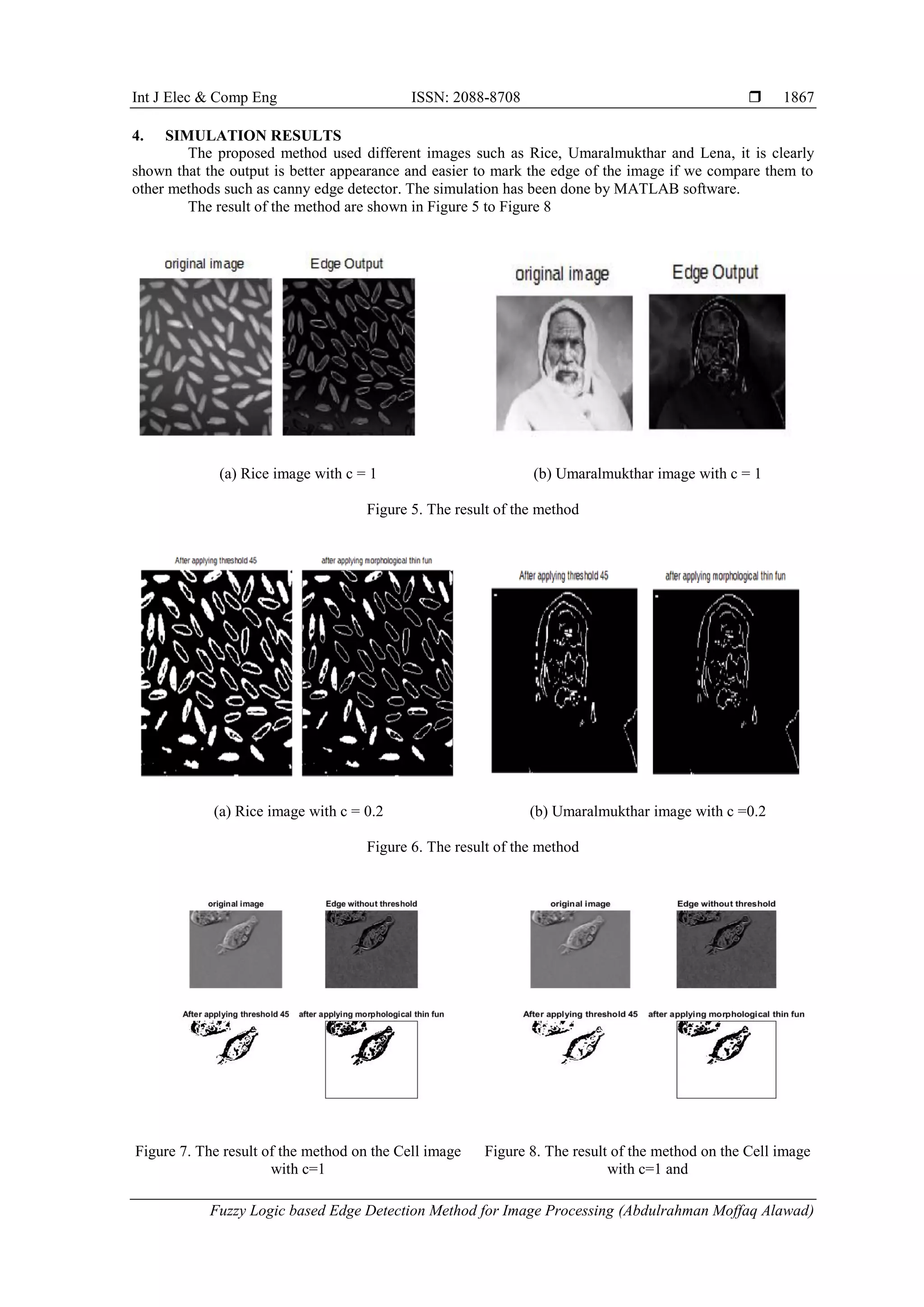
4. SIMULATION RESULTS
The proposed method used different images such as Rice, Umaralmukthar and Lena, it is clearly
shown that the output is better appearance and easier to mark the edge of the image if we compare them to
other methods such as canny edge detector. The simulation has been done by MATLAB software.
The result of the method are shown in Figure 5 to Figure 8
(a) Rice image with c = 1 (b) Umaralmukthar image with c = 1
Figure 5. The result of the method
(a) Rice image with c = 0.2 (b) Umaralmukthar image with c =0.2
Figure 6. The result of the method
Figure 7. The result of the method on the Cell image
with c=1
Figure 8. The result of the method on the Cell image
with c=1 and
 ISSN: 2088-8708
Int J Elec & Comp Eng, Vol. 8, No. 3, June 2018 : 1863 – 1869
1868
Table 1 show the observations with different Hesitation constant.
Table 1. The Observations with different Hesitation Constant
Image Hesitation
constant
Thresholding Observation
Rice image 0.2 45 Clear edge
Umaralmukhtar
image
0.2 45 Less accuracy
Cell image 1/ 0.2 45 High accuracy
Cell image 1 / 0.2 35 Small details
have appeared
5. CONCLUSION
Fuzzy image processing is abeneficial technology of an edge detection and formulation of expert
knowledge and the combination of imprecise information from different sources. It can be reported that the
results of this algorithm showa good image detection as the medical images where the accuracy of edges is
the main objective of the process. Moreover, in this method, the intuitionistic fuzzy set theory was used to
threshold image and we get a better result as images shown. Advantage of this technique over the rest of
fuzzy techniques is itsability to be adaptive by changingthe hesitation constant for the image or change the
threshold level instead of having a constant method with constant rules as in many fuzzy methods.
ACKNOWLEDGEMENTS
The authors acknowledge the financial assistance of thisresearch which is supported by the Research
Initiative Grant Scheme (RIGS) with the grant number RIGS16-087-0251 and International Islamic
University Malaysia (IIUM).
REFERENCES
[1] C. Suliman, C. Boldişor, R. Băzăvan, F. Moldoveanu, "A Fuzzy Logic Based Method," Engineering Sciences,
pp. 159-166, 2011.
[2] P. Melin, I. Claudia, J. R. Gonzalez, Juan R. Castro, Olivia Mendoza, and Oscar Castillo, "Edge-Detection Method
for Image Processing Based on Generalized Type-2 Fuzzy Logic," IEEE Transactions on Fuzzy Systems, vol. 22,
no. 6, 2014.
[3] D. M. Vikram, "Methods of Image Edge Detection: A Review," Journal of Electrical & Electronic Systems, vol. 4,
no. 2, 2015.
[4] Perez-Ornelas F, Mendoza O, Melin P, Castro JR, Rodriguez-Diaz A, Castillo O, "Fuzzy Index to Evaluate Edge
Detection in Digital Images," PloS one 10.6 : e0131161, 2015.
[5] Zadeh, L. A., "Fuzzy sets. Information and Control," vol. 8, pp. 338-353, 1965.
[6] JanakiramannS, J. Gowri, "A Novel Method for Image Segmentation Using Fuzzy Threshold Selection,"
International Journal of Emerging Technologies in Computational, p. 101, 2014.
[7] S. El-Khamy, N. El-Yamany, M. Lotfy, "A Modified Fuzzy Sobel Edge Detector," Seventeenth National Radio,
2000.
[8] Ajay Khunteta, D. Ghosh, "Edge Detection via Edge-Strength Estimation Using Fuzzy Reasoning and Optimal
Threshold Selection Using Particle Swarm Optimization," Advances in Fuzzy Systems, 2014.
[9] M. Zhao, A. Fu, H. Yan, "A Technique of Three-Level Thresholding Based on Probability Partition a Fuzzy 3-
Partition," IEEE Trans. on Fuzzy Systems, pp. 469-479, June 2011.
[10] Shaveta Arora and Amanpreet Kaur,"Modified Edge Detection Technique using Fuzzy Inference
System,"International Journal of Computer Applications, pp. 9-12, 2012.
[11] K. Anindyaguna, N. C. Basjaruddin and D. Saefudin, "Overtaking assistant system (OAS) with fuzzy logic method
using camera sensor," 2016 2nd International Conference of Industrial, Mechanical, Electrical, and Chemical
Engineering (ICIMECE), Yogyakarta, pp. 89-94, 2016.
[12] B. Wang and Y. Gao, "An Image Compression Scheme Based on Fuzzy Neural Network", TELKOMNIKA
(Telecommunication Computing Electronics and Control), vol. 13, no. 1, p. 137, 2015.
[13] Z. Feng and B. Zhang, "Fuzzy Clustering Image Segmentation Based on Particle Swarm Optimization",
TELKOMNIKA (Telecommunication Computing Electronics and Control), vol. 13, no. 1, p. 128, 2015.
[14] Tehrani, Iman Omidvar, Subariah Ibrahim, and Habib Haron. "New Method to Optimize Initial Point Values of
Spatial Fuzzy c-means Algorithm." International Journal of Electrical and Computer Engineering, vol. 5, no. 5,
2015.
Int J Elec & Comp Eng ISSN: 2088-8708 
Fuzzy Logic based Edge Detection Method for Image Processing (Abdulrahman Moffaq Alawad)
1869
BIOGRAPHIES OF AUTHORS
Abdulrahman Mefaq Alawad received the Bachelor degree in Communication Engineering from
the University of Science and TechnologyYemen (USTY), in 2013. Currently he is pursuing the
MSc degree in Communication Engineering at International Islamic University Malaysia (IIUM).
His research interests include the cryptography, network security and measure their impact on the
network.
Farah Diyana Abdul Rahman obtained her PhD degree from Department of Electrical and
Electronic Engineering, University of Bristol, UK in 2015. She has been appointed as an Assistant
Professor in Electrical and Computer Engineering Department, Faculty of Engineering,
International Islamic University Malaysia (IIUM). Her research interest includes image and video
processing, video quality evaluation, multimedia transmission and wireless communication
systems. She is an active member of the IEEE, a registered member of the Board of Engineers
Malaysia (BEM) and Institute of Engineers Malaysia (IEM).
Othman Omran Khalifa received his Bachelor‟s degree in Electronic Engineering from the
Garyounis University, Libya in 1986. He obtained his Master degree in Electronics Science
Engineering and PhD in Digital Image Processing from Newcastle University, UK in 1996 and
2000 respectively. He worked in industrial for eight years and he is currently a Professor at
Electrical and Computer Engineering Department, International Islamic University Malaysia. His
area of research interest is communication systems, information theory and coding, digital image
and video processing, coding and compression, wavelets, fractal and pattern recognition. He
published more than 150 papers in international journals and conferences. He is SIEEE member,
IEEE Computer, Image Processing and Communication Society member.
Norun Abdul Malek obtained her PhD degree from School of Electronic, Electrical and Systems
Engineering, Loughborough University, UK in 2013. She has been appointed as an Assistant
Professor in Electrical and Computer Engineering Department, Faculty of Engineering,
International Islamic University Malaysia (IIUM). Her research interest includes to antenna and
propagation, signal processing particularly of antenna arrays, algorithms and wireless
communication systems. She is an active member of the IEEE, a registered member of the Board
of Engineers Malaysia (BEM) and Institute of Engineers Malaysia (IEM).

Fuzzy Logic based Edge Detection Method for Image Processing

  • 1.
    International Journal ofElectrical and Computer Engineering (IJECE) Vol. 8, No. 3, June 2018, pp. 1863~1869 ISSN: 2088-8708, DOI: 10.11591/ijece.v8i3.pp1863-1869  1863 Journal homepage: http://iaescore.com/journals/index.php/IJECE Fuzzy Logic based Edge Detection Method for Image Processing Abdulrahman Moffaq Alawad1 , Farah Diyana Abdul Rahman2 , Othman O. Khalifa3 , Norun Abdul Malek4 1 Faculity of Electrical and Computer Engineering, International Islamic University Malaysia, Malaysia 2, 3, 4 Department of Electrical and Computer Engineering, International Islamic University Malaysia, Malaysia Article Info ABSTRACT Article history: Received Nov 9, 2017 Revised Feb 22, 2018 Accepted Feb 28, 2018 Edge detection is the first step in image recognition systems in a digital image processing. An effective way to resolve many information from an image such depth, curves and its surface is by analyzing its edges, because that can elucidate these characteristic when color, texture, shade or light changes slightly. Thiscan lead to misconception image or vision as it based on faulty method. This work presentsa new fuzzy logic method with an implemention. The objective of this method is to improve the edge detection task. The results are comparable to similar techniques in particular for medical images because it does not take the uncertain part into its account. Keyword: Edge detection Fuzzy divergence Fuzzy logic Image processing Thresholding Copyright © 2018 Institute of Advanced Engineering and Science. All rights reserved. Corresponding Author: Farah Diyana Abdul Rahman, Department of Electrical and Computer Engineering, Kulliyyah of Engineering, International Islamic University Malaysia, Malaysia. Email: farahdy@iium.edu.my 1. INTRODUCTION In current meltimedia applications, it is an important task determining the difference between the backgrounds and the objects, and between every objects. Edges are one of the most important visual evidences in imaging. Thus, in order to extract an information of an object, the object‟s edge should be known. An edge is described as the wide variation among many pixels within an image while the detection of the boundary among the objects and its background is known as edge detection.Therefore, detection gedges is an important operation in image processing. Edge detection method is very important due to its property to discover edge, its ability to separate between noise and edge and to find out edges in high uncertainty situations [1]-[4]. Fuzzy logic method has been used widely in many fields since ithas been introducedby Zadehin 1965 in a seminal article entitled “Fuzzy Sets” [5]. His main goal was that the natural language has irregularities which can be handled or shaped by using the fuzzy theory. The Fuzzy theory is highly dependent on statistics which change into fuzzy values by “fuzzification process”. By separating any theory into intervals that can be using to elicit its continuous form from the discrete form.Thestenghts of fuzzy logic over other methods is the ability to think, solve and handle problems with human perspective rather than the traditional logics which are all about “1 and 0”, “black and white” or “true and false”.In the edge detection field, there are many methods that used to estimate edge of an image such as Canny, Sobel, Robert, Prewitt, Zero cross and Marr-Hilderith. Each method of those has its own procedures to get edge, for example, some of them as Sobel and Robert operate different masks over the original image to get the edge, while Marr- Hilderith method evaluates edge of an image depending on the Laplaceian of image.In order to evaluate the edge detection technology performance, it has selected several factors like the quality in numerous natures,
  • 2.
     ISSN: 2088-8708 IntJ Elec & Comp Eng, Vol. 8, No. 3, June 2018 : 1863 – 1869 1864 noisy image or dealing with accurate details while take into account getting low probability of errors. By comparison, Canny method gets best performance over the rest of methods. Figure 1 shows a various Edge Detection Techniques. 1.1. Fuzzy logic applications in edge detection Since the concept of Fuzzy logic was formulated, many researchers have accomplished a significant number of researches on this area in order to apply it in different areas such as edge detection, object recolonization, image segmentation, and as such. Various approaches have applied in [6]-[8]. In [9] the work done by dividing image into three levels. Using the two dissimilar techniques among possibility region and three fuzzy regions and also minimum entropy rule, a method to decide the parameters of greatest three fuzzy regions is projected. The needed condition for maximizing entropy function is also articulated. Based on this condition, an active process for three level thresholding is obtained. Figure 1. Various Edge Detection Techniques If-then rules method considers as the most common algorithm in edge detection algorithms based on fuzzy logic. Specifically, assuming neighbors pixels of the center pixel is the first step, then applying fuzzy system interference with a certain membership function that allows fuzzy edge detection to be more fixable. Moreover, restricting the function of fuzzy membership to detect edge allows rules to realize that the specific change among those pixels known as an edge. In this work, we present an algorithm which is based on fuzzy logic. The fuzzy logic rules used are improved in order to detect edges from an image. We used 16 fuzzy tamplats, change their domain into fuzzy domain, then preproces byenlargingthe image in order to use the mask easily, discoveringhesitation degree or intuitionistic fuzzy index, discoveringout of the highestof the divergence value between every tamplaet and the original image, chosing the minimum divergence values from every pixelthat has been scanned, then we have to transform it back to the original domain (0 – 255)and established the threshold.
  • 3.
    Int J Elec& Comp Eng ISSN: 2088-8708  Fuzzy Logic based Edge Detection Method for Image Processing (Abdulrahman Moffaq Alawad) 1865 2. FUZZY LOGIC TECHNIQUE It can define fuzzy image processingas the whole assemblage of all methods that apprehend, represent and process the images, their segments and features as fuzzy sets. The most important steps on the fuzzy image processing; represent and processing are depend on the selected fuzzy technique and on the problem to be solved. Fuzzy image processing has three main stages: image fuzzification, modification of membership values, and, if needed, image defuzzification .The fuzzification and defuzzification steps are coding of image data (fuzzification) and decoding of the results (defuzzification). These steps make possible to process images with fuzzy technique. Therefore, the coding of image data (fuzzification) and decoding of the results (defuzzification) are the most important stages that provides us with the ability to handle the image with techniques as shown in Figure 2 [10]. Figure 2. Steps involved in Fuzzy image processing The most effective elementof fuzzy image processing is that we can observe it in the middle stage, which is modification of membership values or we can call it the intelligence step, because this steps makes the difference between approached and another one. Fuzzy logic is characterized by a large variety of memberships function as shown in Figure 3, each one of them has its distinctive effect. Utilizing appropriate membership by fuzzy system inference is increased the effectiveness of the method. This method assumes the adjacent points of pixels then divide them into classes by using membership function [11]. Figure 3. Types of fuzzy membership functions An image to be handle in the fuzzy logic technology, it has to be converted as a gray level thenconvered it into a membership function (Fuzzification step) where its value can be readily adjusted by fuzzy technology. This could either be called a fuzzy clustering, a fuzzy rule-based approach ora fuzzy integration approach. Fuzzy image processing is essential to find out the uncertainty data. There are many advantages of image processing based on fuzzy logic such as: a. Fuzzy techniques are predominating tools in order to represent and processing an image. b. It provides us a way to handle and mange obscurity efficiency. c. The concept of the fuzzy logic is easy to be undersood. d. Fuzzy logic provides a huge flexibility. e. Fuzzy logic is effective even if the data was inaccurate.
  • 4.
     ISSN: 2088-8708 IntJ Elec & Comp Eng, Vol. 8, No. 3, June 2018 : 1863 – 1869 1866 The reason why fuzzy logic is better than others, because everything is suffered from lacking of exactness while fuzzy logic structures its understanding with taking into account. In several image processing applications, to handle various types of complexities such as object recognition and scene analysis, it is suggested to utilize the human logic according to if-then rules which can be offered by fuzzy sit theory and fuzzy logic. On the other hand, many reasons such randomness, ambiguity and vagueness lead to uncertainty in image processing result and data. Moreover, those uncertainties have a negative impact on image processing progress that leads to many difficulties [12], [13]. 3. PROPOSED METHOD In this paper, at first an input image is read and get its dimensions in 2D. Then, carrying out a 3x3 mask convolution, usingthe templates are shown in Figure 4. These16 fuzzy templatesrepresenting the edge shapes of possibility dissimilar.Selecting templates to imitate the type and direction of edges that may occur. Templates are the example of the edges, which are also the images. „a‟, „b‟, and 0 characterize the pixels of the edge templates. The values of and are selected by experimental method. These values are fixed for all images. It is supplementary understand that if we increase the number of templates more than 16, there is no notable improvement in the edge results and if we decrease the number of templates, many edges will be missed. Figure 4. 16 templates used in detection method It is possible to say that with 16 templates we can almost detect all the edges. We center each center of the templates at position (i,j) over the image that will get processing. a. Finding hesitation degree or intuitionistic fuzzy index using the following relationship: b. (1) Note: we put c = 1 or c=0.2 which is the hesitation constant for image as shown in images. c. Compute the intuitionistic fuzzy divergence (IFD) between each elements at template and the image window (same size as that of template) and pick the minimum IFD value using max-min relationship as follows : (2) d. Place the highestconsequence at the point where we centered over in the image. e. Now we transform back the edge image from fuzzy domain matrix into the image pixel domain in the interval (1 – 255)by multiplying it with 255. f. Set a threshold, and applying the morphological operators of MATLAB.
  • 5.
    Int J Elec& Comp Eng ISSN: 2088-8708  Fuzzy Logic based Edge Detection Method for Image Processing (Abdulrahman Moffaq Alawad) 1867 4. SIMULATION RESULTS The proposed method used different images such as Rice, Umaralmukthar and Lena, it is clearly shown that the output is better appearance and easier to mark the edge of the image if we compare them to other methods such as canny edge detector. The simulation has been done by MATLAB software. The result of the method are shown in Figure 5 to Figure 8 (a) Rice image with c = 1 (b) Umaralmukthar image with c = 1 Figure 5. The result of the method (a) Rice image with c = 0.2 (b) Umaralmukthar image with c =0.2 Figure 6. The result of the method Figure 7. The result of the method on the Cell image with c=1 Figure 8. The result of the method on the Cell image with c=1 and
  • 6.
     ISSN: 2088-8708 IntJ Elec & Comp Eng, Vol. 8, No. 3, June 2018 : 1863 – 1869 1868 Table 1 show the observations with different Hesitation constant. Table 1. The Observations with different Hesitation Constant Image Hesitation constant Thresholding Observation Rice image 0.2 45 Clear edge Umaralmukhtar image 0.2 45 Less accuracy Cell image 1/ 0.2 45 High accuracy Cell image 1 / 0.2 35 Small details have appeared 5. CONCLUSION Fuzzy image processing is abeneficial technology of an edge detection and formulation of expert knowledge and the combination of imprecise information from different sources. It can be reported that the results of this algorithm showa good image detection as the medical images where the accuracy of edges is the main objective of the process. Moreover, in this method, the intuitionistic fuzzy set theory was used to threshold image and we get a better result as images shown. Advantage of this technique over the rest of fuzzy techniques is itsability to be adaptive by changingthe hesitation constant for the image or change the threshold level instead of having a constant method with constant rules as in many fuzzy methods. ACKNOWLEDGEMENTS The authors acknowledge the financial assistance of thisresearch which is supported by the Research Initiative Grant Scheme (RIGS) with the grant number RIGS16-087-0251 and International Islamic University Malaysia (IIUM). REFERENCES [1] C. Suliman, C. Boldişor, R. Băzăvan, F. Moldoveanu, "A Fuzzy Logic Based Method," Engineering Sciences, pp. 159-166, 2011. [2] P. Melin, I. Claudia, J. R. Gonzalez, Juan R. Castro, Olivia Mendoza, and Oscar Castillo, "Edge-Detection Method for Image Processing Based on Generalized Type-2 Fuzzy Logic," IEEE Transactions on Fuzzy Systems, vol. 22, no. 6, 2014. [3] D. M. Vikram, "Methods of Image Edge Detection: A Review," Journal of Electrical & Electronic Systems, vol. 4, no. 2, 2015. [4] Perez-Ornelas F, Mendoza O, Melin P, Castro JR, Rodriguez-Diaz A, Castillo O, "Fuzzy Index to Evaluate Edge Detection in Digital Images," PloS one 10.6 : e0131161, 2015. [5] Zadeh, L. A., "Fuzzy sets. Information and Control," vol. 8, pp. 338-353, 1965. [6] JanakiramannS, J. Gowri, "A Novel Method for Image Segmentation Using Fuzzy Threshold Selection," International Journal of Emerging Technologies in Computational, p. 101, 2014. [7] S. El-Khamy, N. El-Yamany, M. Lotfy, "A Modified Fuzzy Sobel Edge Detector," Seventeenth National Radio, 2000. [8] Ajay Khunteta, D. Ghosh, "Edge Detection via Edge-Strength Estimation Using Fuzzy Reasoning and Optimal Threshold Selection Using Particle Swarm Optimization," Advances in Fuzzy Systems, 2014. [9] M. Zhao, A. Fu, H. Yan, "A Technique of Three-Level Thresholding Based on Probability Partition a Fuzzy 3- Partition," IEEE Trans. on Fuzzy Systems, pp. 469-479, June 2011. [10] Shaveta Arora and Amanpreet Kaur,"Modified Edge Detection Technique using Fuzzy Inference System,"International Journal of Computer Applications, pp. 9-12, 2012. [11] K. Anindyaguna, N. C. Basjaruddin and D. Saefudin, "Overtaking assistant system (OAS) with fuzzy logic method using camera sensor," 2016 2nd International Conference of Industrial, Mechanical, Electrical, and Chemical Engineering (ICIMECE), Yogyakarta, pp. 89-94, 2016. [12] B. Wang and Y. Gao, "An Image Compression Scheme Based on Fuzzy Neural Network", TELKOMNIKA (Telecommunication Computing Electronics and Control), vol. 13, no. 1, p. 137, 2015. [13] Z. Feng and B. Zhang, "Fuzzy Clustering Image Segmentation Based on Particle Swarm Optimization", TELKOMNIKA (Telecommunication Computing Electronics and Control), vol. 13, no. 1, p. 128, 2015. [14] Tehrani, Iman Omidvar, Subariah Ibrahim, and Habib Haron. "New Method to Optimize Initial Point Values of Spatial Fuzzy c-means Algorithm." International Journal of Electrical and Computer Engineering, vol. 5, no. 5, 2015.
  • 7.
    Int J Elec& Comp Eng ISSN: 2088-8708  Fuzzy Logic based Edge Detection Method for Image Processing (Abdulrahman Moffaq Alawad) 1869 BIOGRAPHIES OF AUTHORS Abdulrahman Mefaq Alawad received the Bachelor degree in Communication Engineering from the University of Science and TechnologyYemen (USTY), in 2013. Currently he is pursuing the MSc degree in Communication Engineering at International Islamic University Malaysia (IIUM). His research interests include the cryptography, network security and measure their impact on the network. Farah Diyana Abdul Rahman obtained her PhD degree from Department of Electrical and Electronic Engineering, University of Bristol, UK in 2015. She has been appointed as an Assistant Professor in Electrical and Computer Engineering Department, Faculty of Engineering, International Islamic University Malaysia (IIUM). Her research interest includes image and video processing, video quality evaluation, multimedia transmission and wireless communication systems. She is an active member of the IEEE, a registered member of the Board of Engineers Malaysia (BEM) and Institute of Engineers Malaysia (IEM). Othman Omran Khalifa received his Bachelor‟s degree in Electronic Engineering from the Garyounis University, Libya in 1986. He obtained his Master degree in Electronics Science Engineering and PhD in Digital Image Processing from Newcastle University, UK in 1996 and 2000 respectively. He worked in industrial for eight years and he is currently a Professor at Electrical and Computer Engineering Department, International Islamic University Malaysia. His area of research interest is communication systems, information theory and coding, digital image and video processing, coding and compression, wavelets, fractal and pattern recognition. He published more than 150 papers in international journals and conferences. He is SIEEE member, IEEE Computer, Image Processing and Communication Society member. Norun Abdul Malek obtained her PhD degree from School of Electronic, Electrical and Systems Engineering, Loughborough University, UK in 2013. She has been appointed as an Assistant Professor in Electrical and Computer Engineering Department, Faculty of Engineering, International Islamic University Malaysia (IIUM). Her research interest includes to antenna and propagation, signal processing particularly of antenna arrays, algorithms and wireless communication systems. She is an active member of the IEEE, a registered member of the Board of Engineers Malaysia (BEM) and Institute of Engineers Malaysia (IEM).