SUBMITTED BY-BISWARUP DAS
SEMESTER-10TH
ROLL NO-04
PRESENTATION
ON
FUZZY EXPERT SYSTEM
*INTRODUCTION
*OVERVIEW OF EXPERT SYSTEM
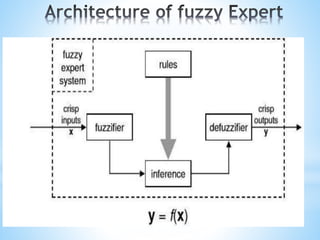
*COMPONENTS OF FUZZY EXPERT SYSTEM
*FUZZY RULES
*LINGUISTIC VARIABLES
*FUZZY EXPERT SYSTEM
*CONSTRUCTION OF FUZZY EXPERT SYSTEM
*DESIGN PROCEDURE
*APPLICATIONS
*CONCLUSION
*REFERENCES
*According to Webster an EXPERT is –
“One with special skill or knowledge representing mastery of
particular subject”.
In every domain, there exist someone who has adequate
knowledge about certain parts of that domain.
However it is not possible for every person to master every
knowledge of that domain.
Experts is being defined as per their capabilities to solve
particular task of that domain.
*Problems that are often tackled by human experts are handled
by expert systems.
*It requires the following:-
- a substantial knowledge base
- a good inference engine
- an effective user interface that can engage with
consumers to address issues related to the
specific area for which it was created.
*It acquires knowledge from human experts through the
knowledge acquisition process.
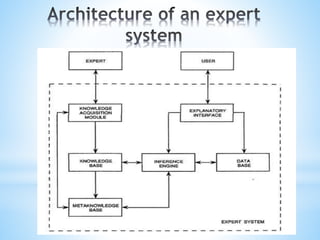
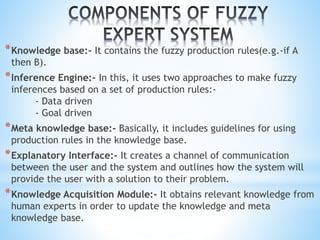
*Knowledge base:- It contains the fuzzy production rules(e.g.-if A
then B).
*Inference Engine:- In this, it uses two approaches to make fuzzy
inferences based on a set of production rules:-
- Data driven
- Goal driven
*Meta knowledge base:- Basically, it includes guidelines for using
production rules in the knowledge base.
*Explanatory Interface:- It creates a channel of communication
between the user and the system and outlines how the system will
provide the user with a solution to their problem.
*Knowledge Acquisition Module:- It obtains relevant knowledge from
human experts in order to update the knowledge and meta
knowledge base.
*A fuzzy rule is a conditional statement in the form of:
- IF x is A
- THEN y is B
* x and y are linguistic variables.
*A and B are linguistic values determined by fuzzy sets
on the universe of discourses X and Y respectively.
*A linguistic variable is fuzzy variable
-e.g. the fact “Jack is tall” implies linguistic variable
“Jack” takes the linguistic value “tall”.
*Use linguistic variables to form fuzzy rules:
- If ‘project duration’ is long
THEN ‘risk’ is high
- If risk is very high
THEN ‘project funding’ is very low
*A fuzzy expert system is an expert system that uses
fuzzy rules, fuzzy logic, and fuzzy sets.
*A fuzzy logic system will occasionally activate many
rules
- If the antecedent is true to some degree of
membership, then the consequent is true to same
degree.
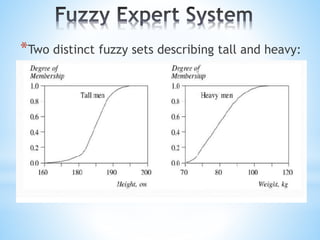
*Two distinct fuzzy sets describing tall and heavy:
IF height is tall
THEN weight is heavy
*Other Examples (multiple antecedents)
-e.g. IF ‘Project duration’ is long
AND ‘Project staffing’ is large
AND ‘Project funding’ is inadequate
THEN risk is high
*e.g. IF service is excellent
OR food is delicious
THEN tip is generous
*Knowledge Representation:-
-- knowledge can be represented by three ways-
1. Rules: If PREMISE then CONCLUSION
2. SEMANTIC NET: Class of knowledge representation formalism
using nodes and arcs.
3.Frame: Using slots and values, a data structure can represent
typical scenarios .
*Inference Engine:- Uses knowledge in a specific representation to
reach an expert conclusion or provide expert advice.
-- Operates on two basic ways-
1) Forward Chaining: Data Driven(e.g. XCON)
2) Backward Chaining: Goal Driven(e.g. MYCIN)
*Starting with some level of preparation and pre-processing is
necessary to identify the issue.
*Next, inference method has to be determined. Basically there are
two methods-
1) Mamdani Method
2) Takegi- sugeno- kang Method
*The choice of inference method is entirely dependent on the choice
of defuzzification method.
*The process of enumerating linguistic variable is to be carried out
after these selections have been made.
*Next stage is to determine membership functions and the fuzzy rules
that maps fuzzy facts to fuzzy conclusions.
*After creating the rules, they are tested against some desired
outputs in order to do optimization and accuracy.
*Agricultural Field:-
- VARIEX:- It enables selection of best cultivators for diverse
agricultural situations.
*Sports:-
-Goalkeeper quality recognition(Bazmara, jafari).
*Computer Engineering:-
- Fuzzy Controllers.
*Mechanical Engineering:-
- Emulation of complex production system.
*Fuzzy expert system are one of the most significant game changers
in the field of computation.
*However, it has a number of drawbacks and difficulties.
*To design a system that overcomes these drawbacks and provides an
efficient solution regarding its task domain is a very important and
challenging task.
*If we can able to do so, then it will provide an unmatched power to
the problem solving domain.
*Rich, Elain; Knight, kevin; Artificial Intelligence, Third edition.
*Klir, George J,; Yuan, Bo; fuzzy sets and Fuzzy Logic –Theory
and applications.
*Garibaldi, Jonathan M.; Fuzzy Expert Systems.
*Kandel, Abraham ; Fuzzy Expert Systems; CRC press.
*Web References
*https://www.merriam-webster.com/dictionary/expert
FUZZY EXPERT SYSTEM.pptx

FUZZY EXPERT SYSTEM.pptx

  • 1.
    SUBMITTED BY-BISWARUP DAS SEMESTER-10TH ROLLNO-04 PRESENTATION ON FUZZY EXPERT SYSTEM
  • 2.
    *INTRODUCTION *OVERVIEW OF EXPERTSYSTEM *COMPONENTS OF FUZZY EXPERT SYSTEM *FUZZY RULES *LINGUISTIC VARIABLES *FUZZY EXPERT SYSTEM *CONSTRUCTION OF FUZZY EXPERT SYSTEM *DESIGN PROCEDURE *APPLICATIONS *CONCLUSION *REFERENCES
  • 3.
    *According to Websteran EXPERT is – “One with special skill or knowledge representing mastery of particular subject”. In every domain, there exist someone who has adequate knowledge about certain parts of that domain. However it is not possible for every person to master every knowledge of that domain. Experts is being defined as per their capabilities to solve particular task of that domain.
  • 4.
    *Problems that areoften tackled by human experts are handled by expert systems. *It requires the following:- - a substantial knowledge base - a good inference engine - an effective user interface that can engage with consumers to address issues related to the specific area for which it was created. *It acquires knowledge from human experts through the knowledge acquisition process.
  • 7.
    *Knowledge base:- Itcontains the fuzzy production rules(e.g.-if A then B). *Inference Engine:- In this, it uses two approaches to make fuzzy inferences based on a set of production rules:- - Data driven - Goal driven *Meta knowledge base:- Basically, it includes guidelines for using production rules in the knowledge base. *Explanatory Interface:- It creates a channel of communication between the user and the system and outlines how the system will provide the user with a solution to their problem. *Knowledge Acquisition Module:- It obtains relevant knowledge from human experts in order to update the knowledge and meta knowledge base.
  • 8.
    *A fuzzy ruleis a conditional statement in the form of: - IF x is A - THEN y is B * x and y are linguistic variables. *A and B are linguistic values determined by fuzzy sets on the universe of discourses X and Y respectively.
  • 9.
    *A linguistic variableis fuzzy variable -e.g. the fact “Jack is tall” implies linguistic variable “Jack” takes the linguistic value “tall”. *Use linguistic variables to form fuzzy rules: - If ‘project duration’ is long THEN ‘risk’ is high - If risk is very high THEN ‘project funding’ is very low
  • 10.
    *A fuzzy expertsystem is an expert system that uses fuzzy rules, fuzzy logic, and fuzzy sets. *A fuzzy logic system will occasionally activate many rules - If the antecedent is true to some degree of membership, then the consequent is true to same degree.
  • 11.
    *Two distinct fuzzysets describing tall and heavy:
  • 12.
    IF height istall THEN weight is heavy
  • 13.
    *Other Examples (multipleantecedents) -e.g. IF ‘Project duration’ is long AND ‘Project staffing’ is large AND ‘Project funding’ is inadequate THEN risk is high *e.g. IF service is excellent OR food is delicious THEN tip is generous
  • 14.
    *Knowledge Representation:- -- knowledgecan be represented by three ways- 1. Rules: If PREMISE then CONCLUSION 2. SEMANTIC NET: Class of knowledge representation formalism using nodes and arcs. 3.Frame: Using slots and values, a data structure can represent typical scenarios . *Inference Engine:- Uses knowledge in a specific representation to reach an expert conclusion or provide expert advice. -- Operates on two basic ways- 1) Forward Chaining: Data Driven(e.g. XCON) 2) Backward Chaining: Goal Driven(e.g. MYCIN)
  • 15.
    *Starting with somelevel of preparation and pre-processing is necessary to identify the issue. *Next, inference method has to be determined. Basically there are two methods- 1) Mamdani Method 2) Takegi- sugeno- kang Method *The choice of inference method is entirely dependent on the choice of defuzzification method. *The process of enumerating linguistic variable is to be carried out after these selections have been made. *Next stage is to determine membership functions and the fuzzy rules that maps fuzzy facts to fuzzy conclusions. *After creating the rules, they are tested against some desired outputs in order to do optimization and accuracy.
  • 16.
    *Agricultural Field:- - VARIEX:-It enables selection of best cultivators for diverse agricultural situations. *Sports:- -Goalkeeper quality recognition(Bazmara, jafari). *Computer Engineering:- - Fuzzy Controllers. *Mechanical Engineering:- - Emulation of complex production system.
  • 17.
    *Fuzzy expert systemare one of the most significant game changers in the field of computation. *However, it has a number of drawbacks and difficulties. *To design a system that overcomes these drawbacks and provides an efficient solution regarding its task domain is a very important and challenging task. *If we can able to do so, then it will provide an unmatched power to the problem solving domain.
  • 18.
    *Rich, Elain; Knight,kevin; Artificial Intelligence, Third edition. *Klir, George J,; Yuan, Bo; fuzzy sets and Fuzzy Logic –Theory and applications. *Garibaldi, Jonathan M.; Fuzzy Expert Systems. *Kandel, Abraham ; Fuzzy Expert Systems; CRC press. *Web References *https://www.merriam-webster.com/dictionary/expert