Organizational Development
Let’s Start
1
General Introduction
 This is a course about OD— to help organizations build their
capacity to change.
 Achieve greater effectiveness.
 The focus is on building the organization’s ability to assess its
current functioning and to achieve its goals.
 Moreover, OD is oriented to improving the total system—the
organization and its parts in the context of the larger
environment that affects them.
2
What is OD?
Organization development is a system wide application and
transfer of behavioral science knowledge to the planned
development, improvement, and reinforcement of the
strategies, structures, and processes that lead to organization
effectiveness.
 It is different from change management and organizational
change.
3
What is OD?
 OD applies to changes in the strategy, structure, and/or
processes of an entire organization.
 OD is based on the application and transfer of behavioral
science knowledge and practice.
 Two concepts:
Micro concepts (leadership, group dynamics, and work
design).
Macro concepts (strategy, organization design, and
international relations).
4
What is OD?
 OD is concerned with managing planned change.
 OD involves the design, implementation, and the subsequent
reinforcement of change.
 OD is oriented to improving organizational effectiveness.
 Three dimensions of effectiveness:
• Adaptability
• High financial and technical performance
• Satisfied and loyal customers or other external stakeholders and an engaged,
satisfied, and learning workforce.
5
OD V/S Change Management
 Both address the effective implementation of planned change.
 Both are concerned with organization’s improvement.
 Difference is in underlying value orientation.
 OD is related to human potential, participation, development,
performance and competitive advantage.
 Change focus on values of cost, quality, and schedule.
• OD’s distinguishing feature is its concern with the transfer of
knowledge and skill so that the system is more able to manage
change in the future. OD involves change management.
6
Relevance of OD
 Organizations in the midst of unprecedented uncertainty and
chaos.
 A ‘management revolution’ will save them.
 Three major trends: globalization, information technology,
and managerial innovation.
 OD helps organization members go beyond surface changes to
transform.
7
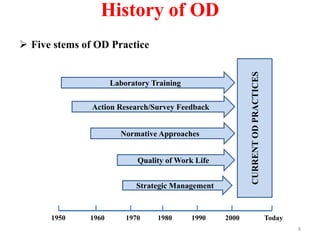
History of OD
 Five stems of OD Practice
1950 1960 1970 1980 1990 2000 Today
8
Laboratory Training
Action Research/Survey Feedback
Normative Approaches
Quality of Work Life
Strategic Management
CURRENTODPRACTICES
History of OD
9
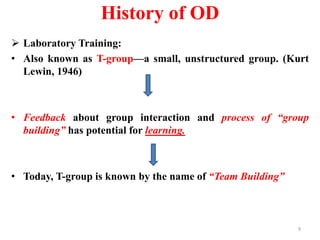
 Laboratory Training:
• Also known as T-group—a small, unstructured group. (Kurt
Lewin, 1946)
• Feedback about group interaction and process of “group
building” has potential for learning.
• Today, T-group is known by the name of “Team Building”
History of OD
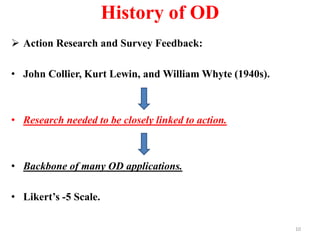
 Action Research and Survey Feedback:
• John Collier, Kurt Lewin, and William Whyte (1940s).
• Research needed to be closely linked to action.
• Backbone of many OD applications.
• Likert’s -5 Scale.
10
History of OD
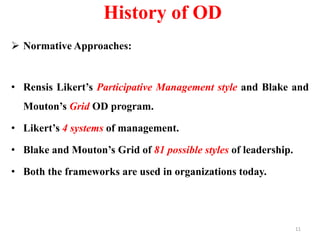
 Normative Approaches:
• Rensis Likert’s Participative Management style and Blake and
Mouton’s Grid OD program.
• Likert’s 4 systems of management.
• Blake and Mouton’s Grid of 81 possible styles of leadership.
• Both the frameworks are used in organizations today.
11
History of OD
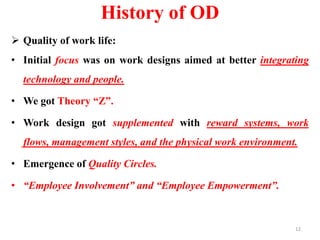
 Quality of work life:
• Initial focus was on work designs aimed at better integrating
technology and people.
• We got Theory “Z”.
• Work design got supplemented with reward systems, work
flows, management styles, and the physical work environment.
• Emergence of Quality Circles.
• “Employee Involvement” and “Employee Empowerment”.
12
History of OD
 Strategic Management:
• Alignment among an organization’s environment, strategy, and
organization design.
• Familiarity with competitive strategy, finance, and marketing,
as well as team building, action research, and survey feedback.
• Together, these skills have improved OD’s relevance to
organizations and their managers.
13
Assumptions and Values
 Assumptions, values and beliefs are integral parts of OD.
 A belief is a proposition about how the world works. (true)
 Values are beliefs about- what is “desirable” and
“undesirable”.
 Assumptions are valuable and correct beliefs taken for granted.
 Values, beliefs and assumptions provide structure and stability
for people.
14
Assumptions and Values
 OD values tend to be humanistic, optimistic and democratic.
 Humanistic value are about the importance of individuals.
 Optimistic value posit that people are basically good.
 Democratic values assert the sanctity of the individuals.
 Past researches are witness to these values.
 These are formed from zeitgist.
15
Assumptions and Values
 Early Impetus:
• Warren Bennis- mechanical system v/s organic system.
• Richard Beckhard- emphasis on groups.
• Robert Tannenbaum and Sheldon Davis- shift in values is
continuously occurring.
 Present status:
• With humanistic values- a concern for improving
organizational effectiveness and performance. To optimize both
human benefits and production objectives.
16
Assumptions and Values
 This is the biggest challenge- a conflict between employees’ needs for
greater meaning and the organization’s need for more effective and
efficient use of its resources.
 Value dilemmas:
• Should efficiency be maximized at the expense of people’s satisfaction?
• Can technology be changed to make it more humanly satisfying while
remaining efficient?
• What compromises are possible?
• How do these trade-offs shift when they are applied in different social
cultures?
17
Assumptions and Values
Individuals
 Primarily considerations of theory “Y”.
• People have drives towards personal growth and are capable
of making a higher level of contribution.
• Ask, support, challenge, encourage risk taking, permit failure,
remove obstacles, give autonomy and responsibility, set high
standards and reward success.
18
Assumptions and Values
Groups
 Work group, including peers and boss.
• Let teams flourish.
• Leaders should invest in groups.
• Adopt a team leadership style.
 Help each other.
 Alter mutual relationships.
 View problems and solutions as transactional and embedded
in a system.
19
Assumptions and Values
Organizational systems
 Traditional hierarchical forms are obsolete.
 “Win-Win” in place of “Win-Lose”.
 Optimistic and developmental set of assumptions about
people.
 “Putting people first”.
20
Assumptions and Values
Values in client organization
 Increasing efficiency and effectiveness.
 Openness in communication.
 Empowering employees to act.
 Enhancing productivity.
 Promoting organizational participation.
21
Assumptions and Values
Values of OD Practitioner
 Create change.
 Positively impact people in the organizations.
 Enhance the effectiveness and profitability of
organizations.
 Learn and grow.
 Exercise power and influence.
22
Assumptions and Values
Values of change agent
 Empowering employees to act.
 Openness in communication.
 Facilitating ownership of process and outcome.
 Promoting a culture of collaboration.
 Promoting inquiry and continuous learning.
23

Oragnization development OD (INTRODUCTION)

  • 1.
  • 2.
    General Introduction  Thisis a course about OD— to help organizations build their capacity to change.  Achieve greater effectiveness.  The focus is on building the organization’s ability to assess its current functioning and to achieve its goals.  Moreover, OD is oriented to improving the total system—the organization and its parts in the context of the larger environment that affects them. 2
  • 3.
    What is OD? Organizationdevelopment is a system wide application and transfer of behavioral science knowledge to the planned development, improvement, and reinforcement of the strategies, structures, and processes that lead to organization effectiveness.  It is different from change management and organizational change. 3
  • 4.
    What is OD? OD applies to changes in the strategy, structure, and/or processes of an entire organization.  OD is based on the application and transfer of behavioral science knowledge and practice.  Two concepts: Micro concepts (leadership, group dynamics, and work design). Macro concepts (strategy, organization design, and international relations). 4
  • 5.
    What is OD? OD is concerned with managing planned change.  OD involves the design, implementation, and the subsequent reinforcement of change.  OD is oriented to improving organizational effectiveness.  Three dimensions of effectiveness: • Adaptability • High financial and technical performance • Satisfied and loyal customers or other external stakeholders and an engaged, satisfied, and learning workforce. 5
  • 6.
    OD V/S ChangeManagement  Both address the effective implementation of planned change.  Both are concerned with organization’s improvement.  Difference is in underlying value orientation.  OD is related to human potential, participation, development, performance and competitive advantage.  Change focus on values of cost, quality, and schedule. • OD’s distinguishing feature is its concern with the transfer of knowledge and skill so that the system is more able to manage change in the future. OD involves change management. 6
  • 7.
    Relevance of OD Organizations in the midst of unprecedented uncertainty and chaos.  A ‘management revolution’ will save them.  Three major trends: globalization, information technology, and managerial innovation.  OD helps organization members go beyond surface changes to transform. 7
  • 8.
    History of OD Five stems of OD Practice 1950 1960 1970 1980 1990 2000 Today 8 Laboratory Training Action Research/Survey Feedback Normative Approaches Quality of Work Life Strategic Management CURRENTODPRACTICES
  • 9.
    History of OD 9 Laboratory Training: • Also known as T-group—a small, unstructured group. (Kurt Lewin, 1946) • Feedback about group interaction and process of “group building” has potential for learning. • Today, T-group is known by the name of “Team Building”
  • 10.
    History of OD Action Research and Survey Feedback: • John Collier, Kurt Lewin, and William Whyte (1940s). • Research needed to be closely linked to action. • Backbone of many OD applications. • Likert’s -5 Scale. 10
  • 11.
    History of OD Normative Approaches: • Rensis Likert’s Participative Management style and Blake and Mouton’s Grid OD program. • Likert’s 4 systems of management. • Blake and Mouton’s Grid of 81 possible styles of leadership. • Both the frameworks are used in organizations today. 11
  • 12.
    History of OD Quality of work life: • Initial focus was on work designs aimed at better integrating technology and people. • We got Theory “Z”. • Work design got supplemented with reward systems, work flows, management styles, and the physical work environment. • Emergence of Quality Circles. • “Employee Involvement” and “Employee Empowerment”. 12
  • 13.
    History of OD Strategic Management: • Alignment among an organization’s environment, strategy, and organization design. • Familiarity with competitive strategy, finance, and marketing, as well as team building, action research, and survey feedback. • Together, these skills have improved OD’s relevance to organizations and their managers. 13
  • 14.
    Assumptions and Values Assumptions, values and beliefs are integral parts of OD.  A belief is a proposition about how the world works. (true)  Values are beliefs about- what is “desirable” and “undesirable”.  Assumptions are valuable and correct beliefs taken for granted.  Values, beliefs and assumptions provide structure and stability for people. 14
  • 15.
    Assumptions and Values OD values tend to be humanistic, optimistic and democratic.  Humanistic value are about the importance of individuals.  Optimistic value posit that people are basically good.  Democratic values assert the sanctity of the individuals.  Past researches are witness to these values.  These are formed from zeitgist. 15
  • 16.
    Assumptions and Values Early Impetus: • Warren Bennis- mechanical system v/s organic system. • Richard Beckhard- emphasis on groups. • Robert Tannenbaum and Sheldon Davis- shift in values is continuously occurring.  Present status: • With humanistic values- a concern for improving organizational effectiveness and performance. To optimize both human benefits and production objectives. 16
  • 17.
    Assumptions and Values This is the biggest challenge- a conflict between employees’ needs for greater meaning and the organization’s need for more effective and efficient use of its resources.  Value dilemmas: • Should efficiency be maximized at the expense of people’s satisfaction? • Can technology be changed to make it more humanly satisfying while remaining efficient? • What compromises are possible? • How do these trade-offs shift when they are applied in different social cultures? 17
  • 18.
    Assumptions and Values Individuals Primarily considerations of theory “Y”. • People have drives towards personal growth and are capable of making a higher level of contribution. • Ask, support, challenge, encourage risk taking, permit failure, remove obstacles, give autonomy and responsibility, set high standards and reward success. 18
  • 19.
    Assumptions and Values Groups Work group, including peers and boss. • Let teams flourish. • Leaders should invest in groups. • Adopt a team leadership style.  Help each other.  Alter mutual relationships.  View problems and solutions as transactional and embedded in a system. 19
  • 20.
    Assumptions and Values Organizationalsystems  Traditional hierarchical forms are obsolete.  “Win-Win” in place of “Win-Lose”.  Optimistic and developmental set of assumptions about people.  “Putting people first”. 20
  • 21.
    Assumptions and Values Valuesin client organization  Increasing efficiency and effectiveness.  Openness in communication.  Empowering employees to act.  Enhancing productivity.  Promoting organizational participation. 21
  • 22.
    Assumptions and Values Valuesof OD Practitioner  Create change.  Positively impact people in the organizations.  Enhance the effectiveness and profitability of organizations.  Learn and grow.  Exercise power and influence. 22
  • 23.
    Assumptions and Values Valuesof change agent  Empowering employees to act.  Openness in communication.  Facilitating ownership of process and outcome.  Promoting a culture of collaboration.  Promoting inquiry and continuous learning. 23