Week 1
Introduction to
Organizational
Development
Dr Najmunnisa Khan
Session 1& 2 Objectives
To provide a definition of Organization
Development (OD)
• To discuss the objectives, values, beliefs
and assumptions of organizational
development
To describe the characteristics of
Organizational Development
To distinguish OD and planned change from
other forms of organization change
• To describe the historical development of
OD
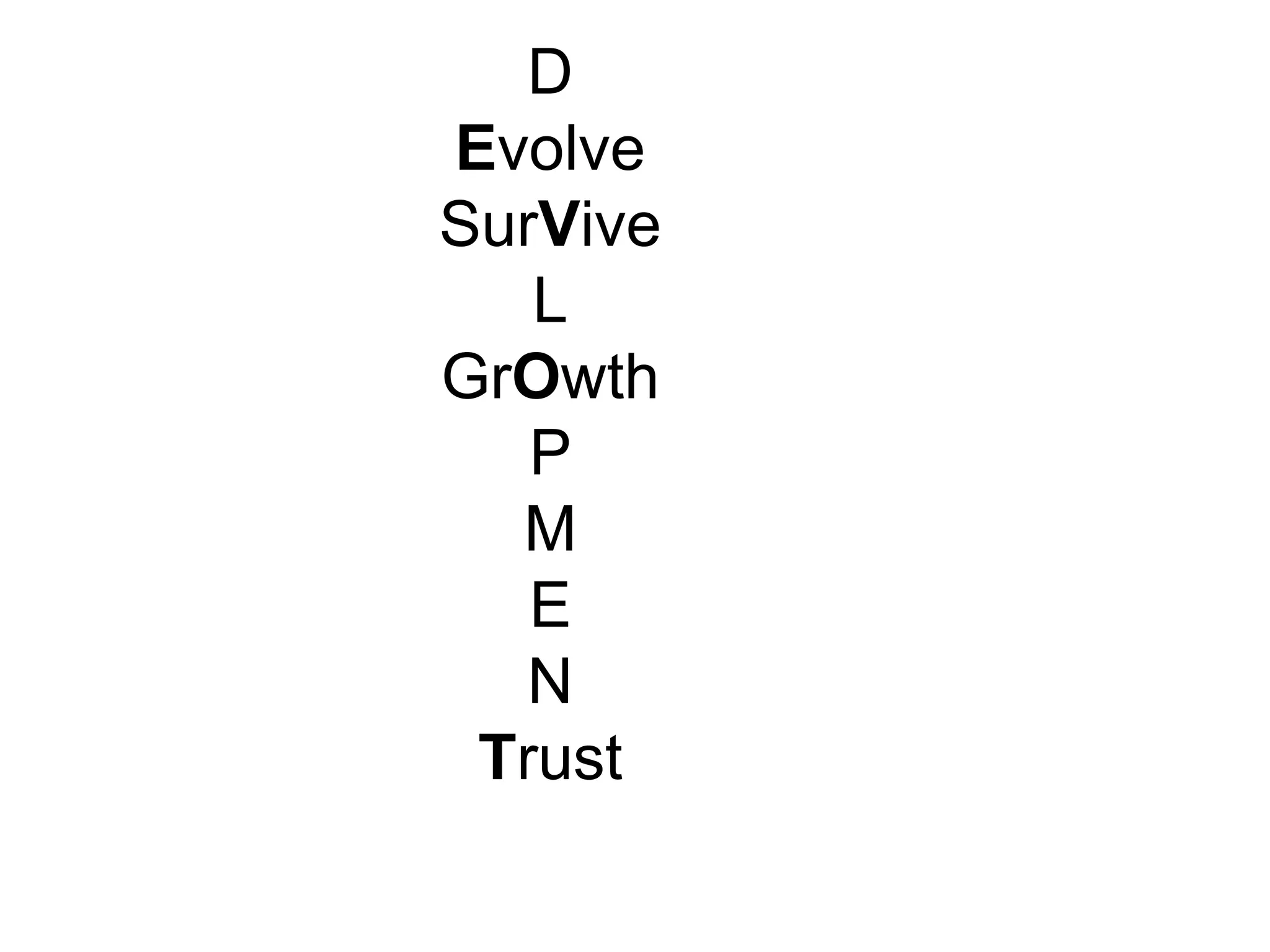
Development
D
Evolve
SurVive
L
GrOwth
P
M
E
N
Trust
Organization
INTRODUCTION TO OD:
The term organizational development was coined by Richard
Beckhard in the mid-1950s.Organizational development is an
acronym of two words i.e., organization and development.
• Organization: A social unit of people that is structured
and managed to meet a need or to pursue collective goals.
• Development: The systematic use of scientific and
technical knowledge to meet specific objectives or
requirements.
.
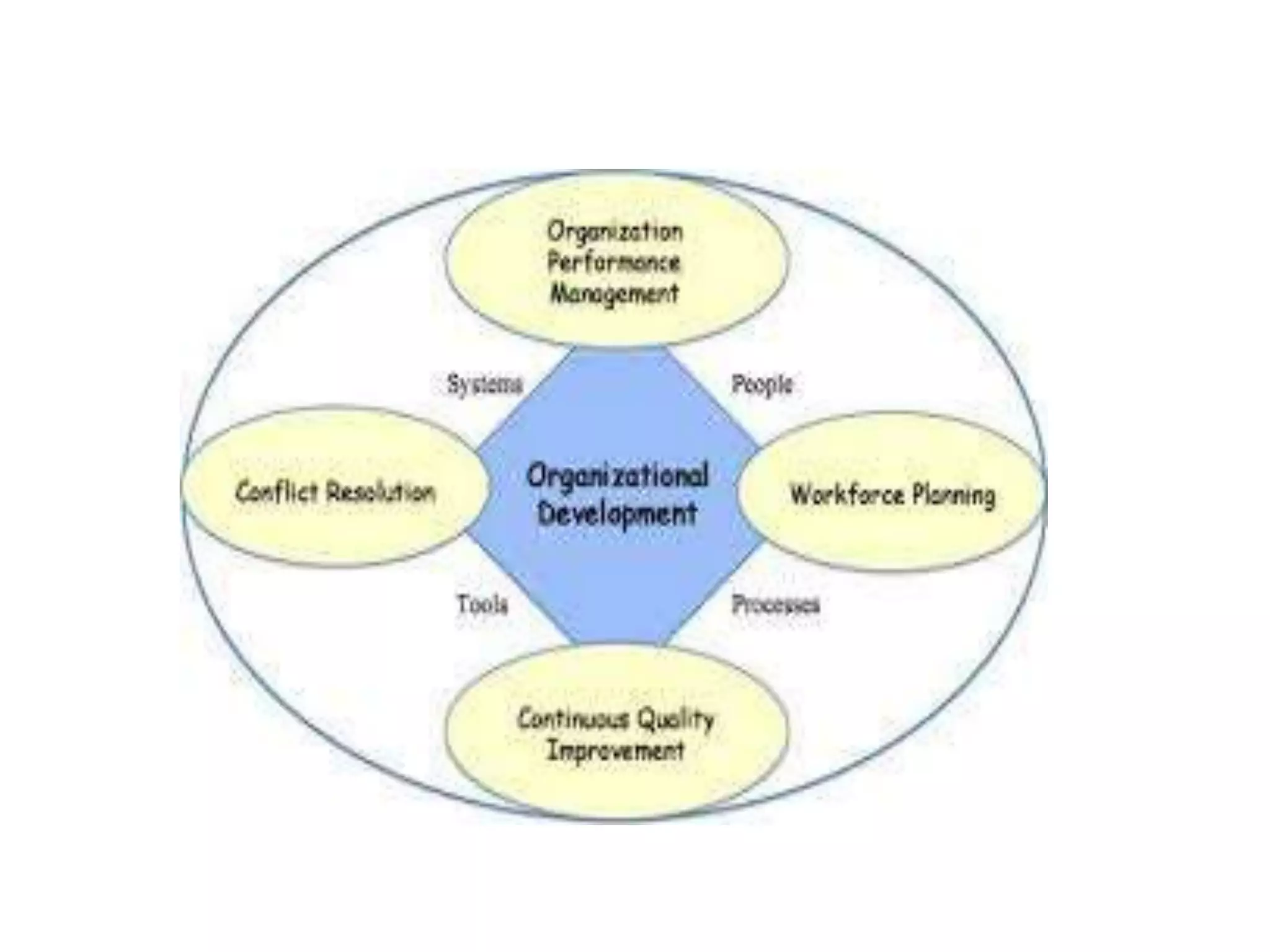
What is OD?
Organization development (OD) is about
taking systematic steps to improve
organizational capability. It is concerned with
process – how things get done.
Themes of OD
Employee Engagement
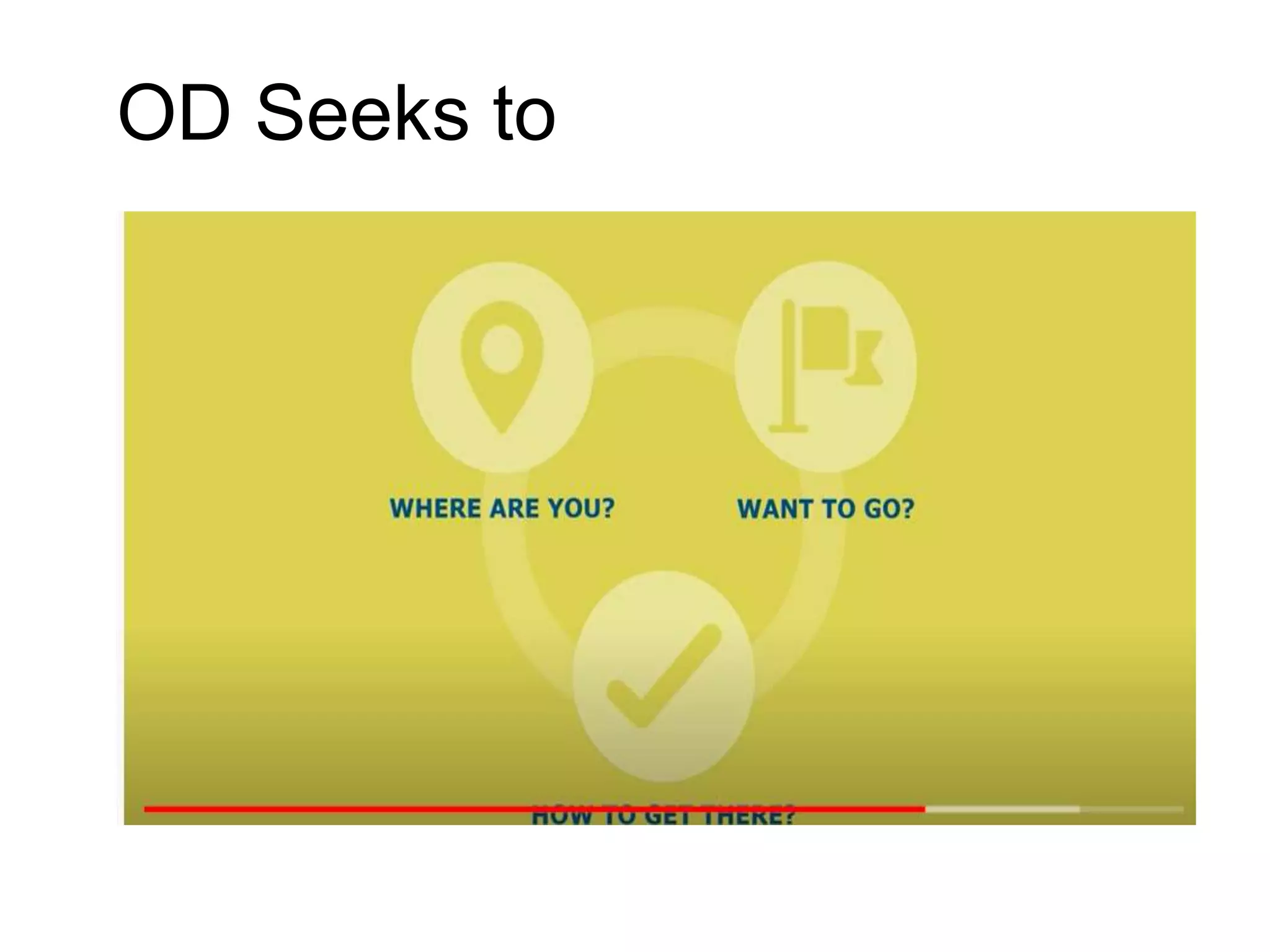
OD Seeks to
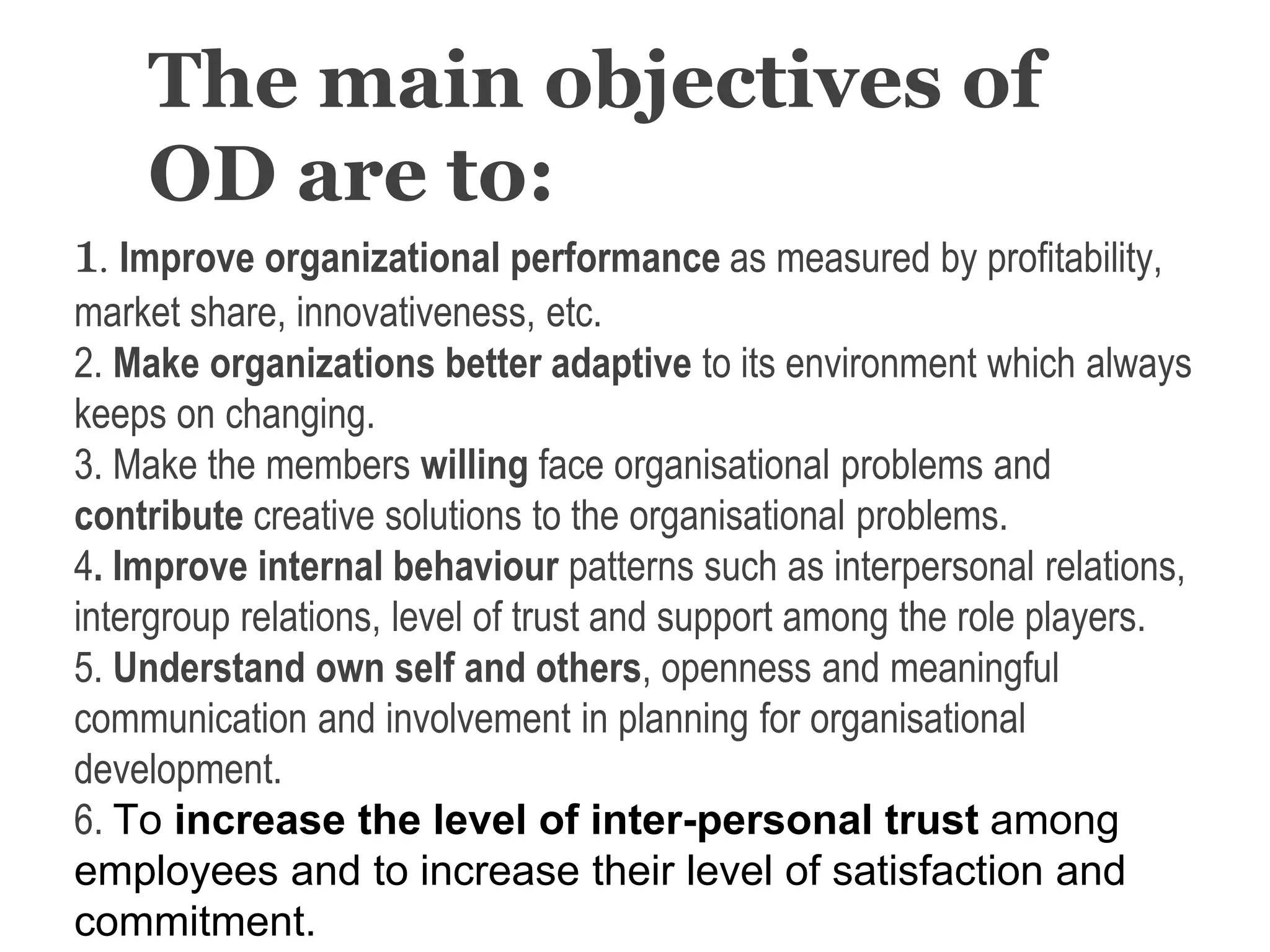
The main objectives of
OD are to:
1. Improve organizational performance as measured by profitability,
market share, innovativeness, etc.
2. Make organizations better adaptive to its environment which always
keeps on changing.
3. Make the members willing face organisational problems and
contribute creative solutions to the organisational problems.
4. Improve internal behaviour patterns such as interpersonal relations,
intergroup relations, level of trust and support among the role players.
5. Understand own self and others, openness and meaningful
communication and involvement in planning for organisational
development.
6. To increase the level of inter-personal trust among
employees and to increase their level of satisfaction and
commitment.
Values Assumptions and Beliefs
of OD
Belief: A belief is a proposition about how the
world works that the individual accepts as
true; it is a cognitive fact for the person.
Values: Values are also beliefs and are
defined as “ beliefs about what is desirable or
a ‘good’ and what is undesirable or a ‘bad’.
Assumptions: Assumptions are beliefs that
are regarded as so valuable and obviously
correct that they are taken for granted and
rarely examined or questioned.
Thus, values, assumptions, and beliefs
are all cognitive facts or propositions, with
values being beliefs about good and bad,
and assumptions being strongly held,
relatively unexamined belief accepted as
the truth.
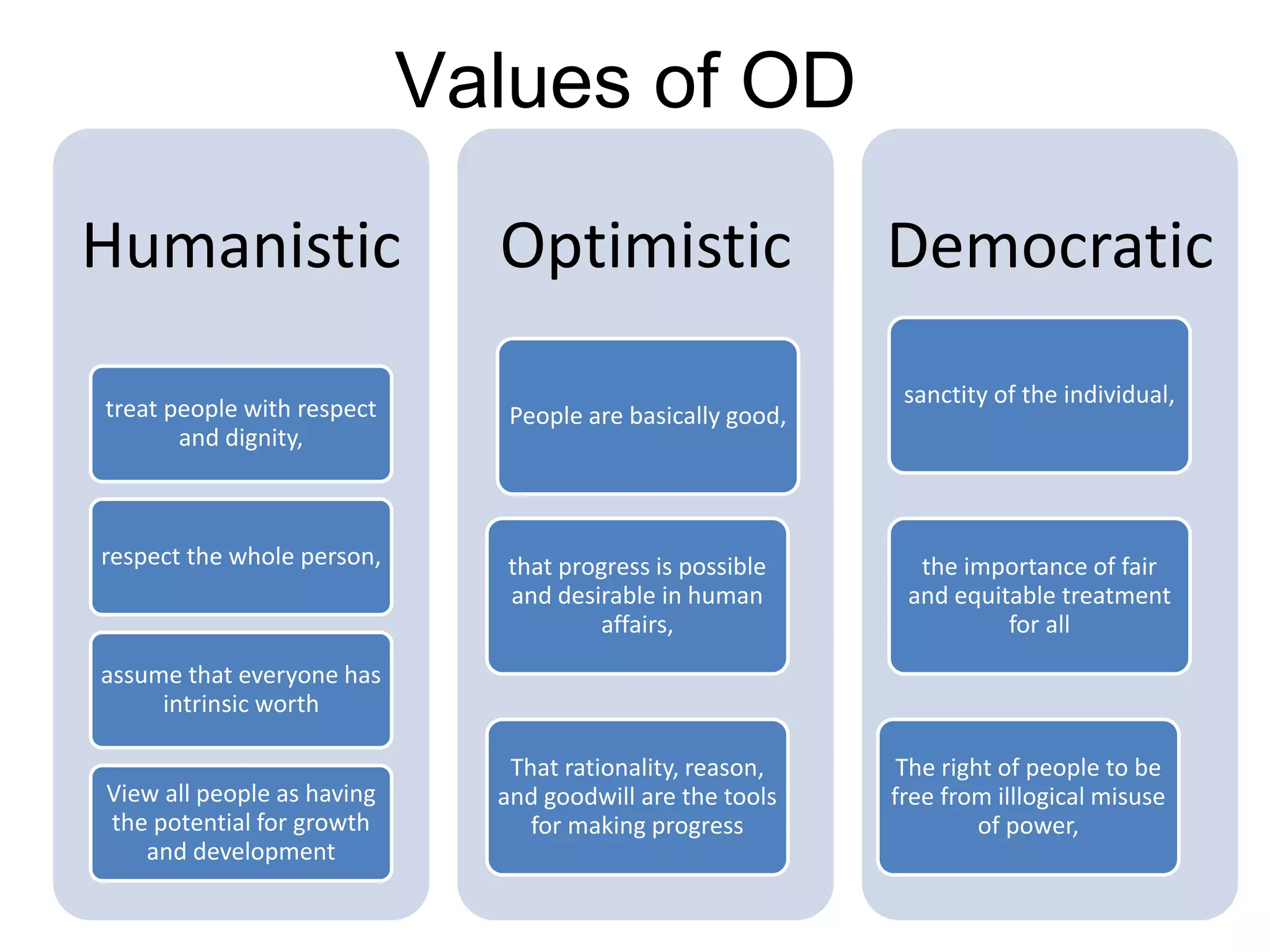
Humanistic
treat people with respect
and dignity,
respect the whole person,
assume that everyone has
intrinsic worth
View all people as having
the potential for growth
and development
Optimistic
That rationality, reason,
and goodwill are the tools
for making progress
that progress is possible
and desirable in human
affairs,
People are basically good,
Democratic
the importance of fair
and equitable treatment
for all
The right of people to be
free from illlogical misuse
of power,
sanctity of the individual,
Values of OD
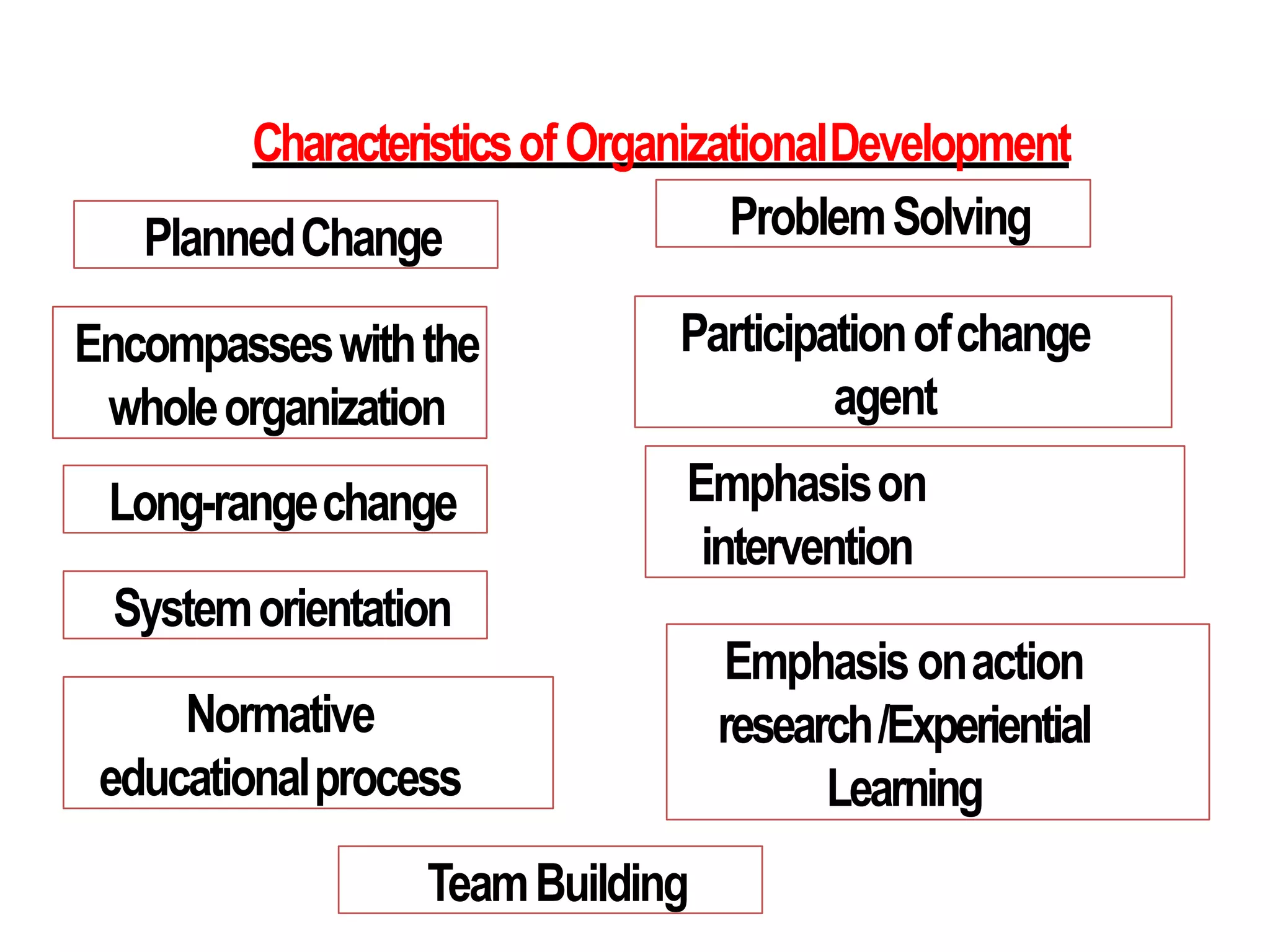
CharacteristicsofOrganizationalDevelopment
PlannedChange
Encompasseswiththe
wholeorganization
Long-rangechange
Systemorientation
Participationofchange
agent
Emphasison
intervention
Emphasisonaction
research/Experiential
Learning
Normative
educationalprocess
ProblemSolving
TeamBuilding
Role Play on Characteristics of OD
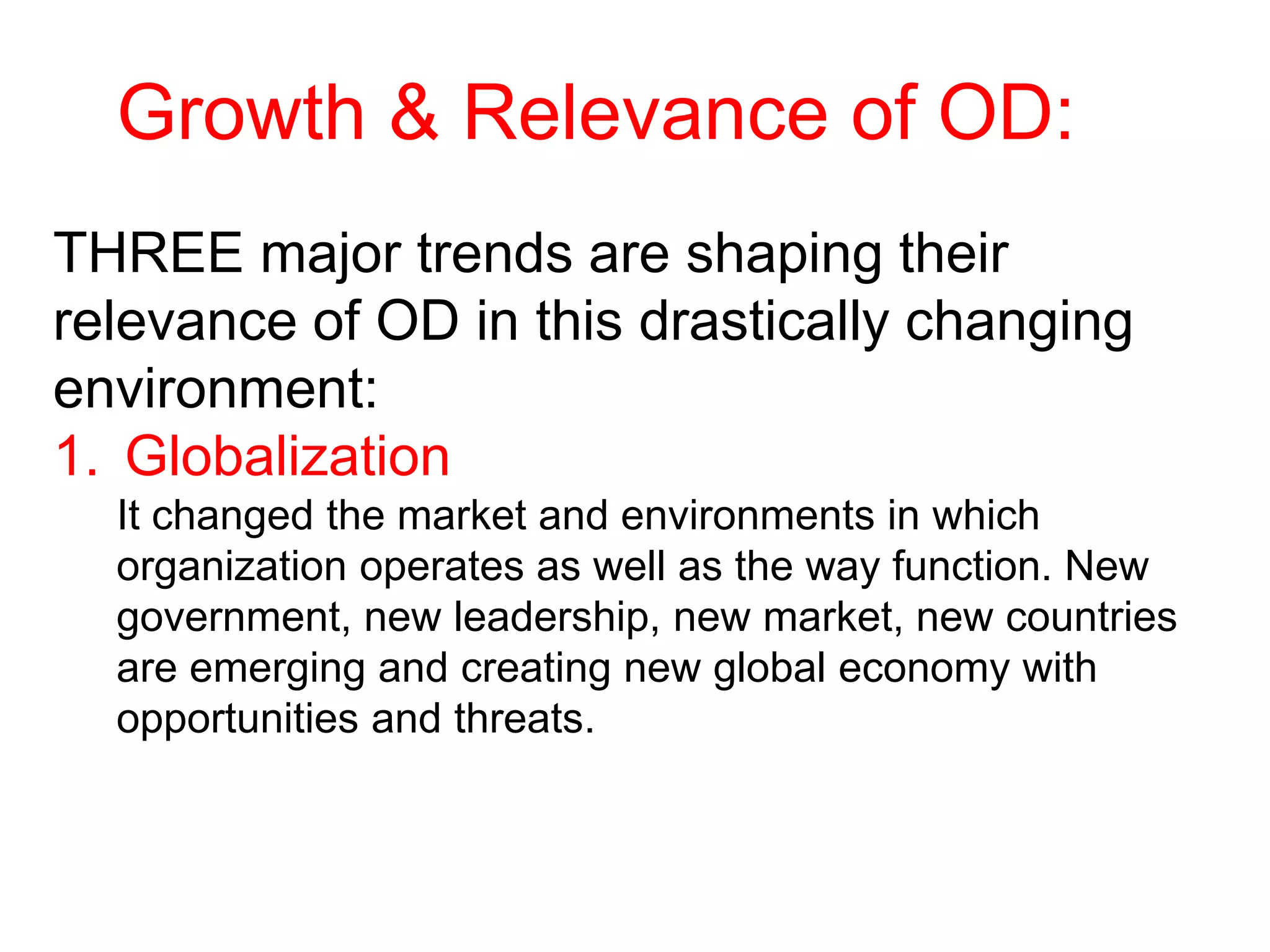
Growth & Relevance of OD:
THREE major trends are shaping their
relevance of OD in this drastically changing
environment:
1. Globalization
It changed the market and environments in which
organization operates as well as the way function. New
government, new leadership, new market, new countries
are emerging and creating new global economy with
opportunities and threats.
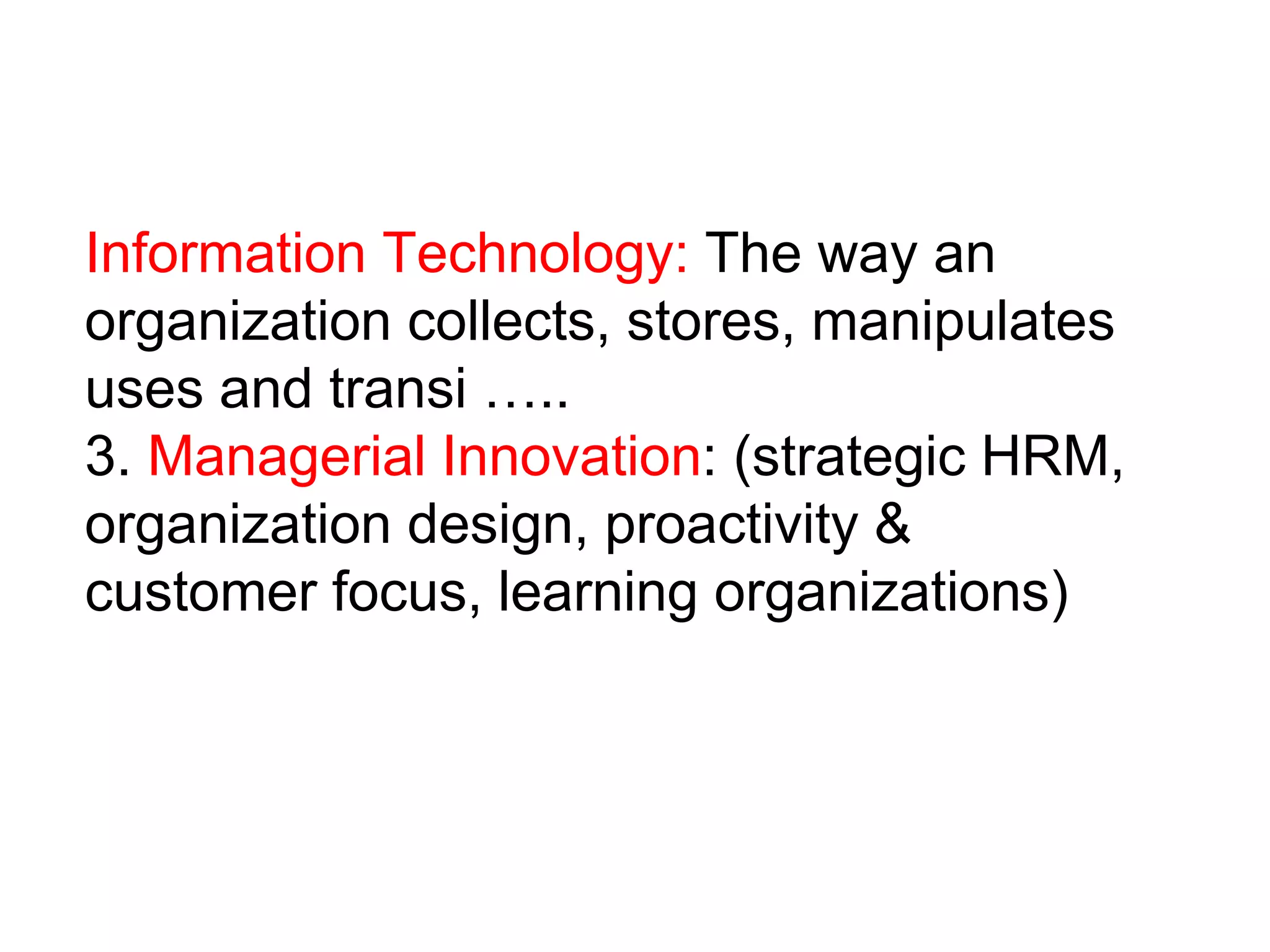
Information Technology: The way an
organization collects, stores, manipulates
uses and transi …..
3. Managerial Innovation: (strategic HRM,
organization design, proactivity &
customer focus, learning organizations)
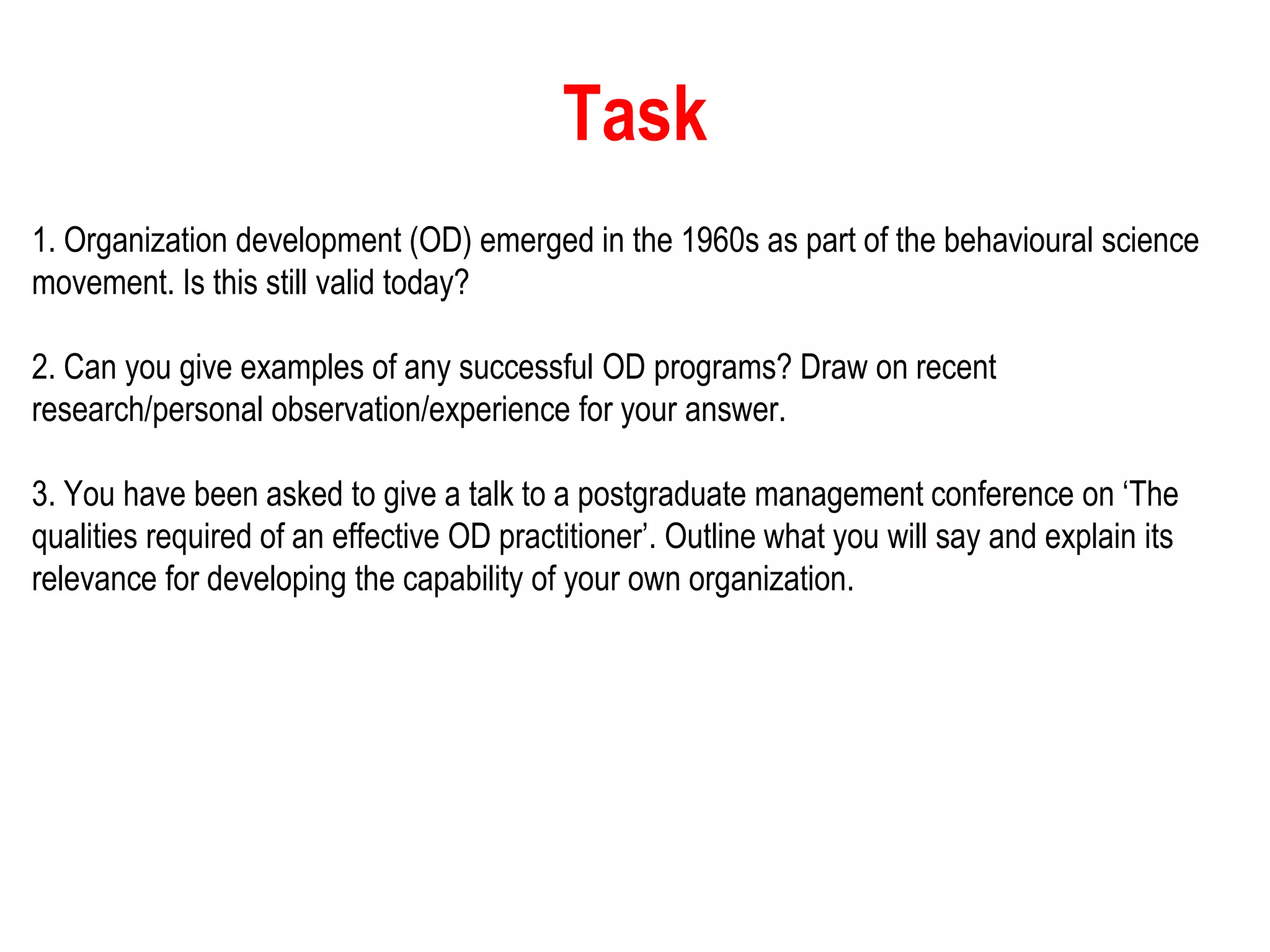
Task
1. Organization development (OD) emerged in the 1960s as part of the behavioural science
movement. Is this still valid today?
2. Can you give examples of any successful OD programs? Draw on recent
research/personal observation/experience for your answer.
3. You have been asked to give a talk to a postgraduate management conference on ‘The
qualities required of an effective OD practitioner’. Outline what you will say and explain its
relevance for developing the capability of your own organization.
(c)2005
Cummings & Worley, 8e
Thomson/South-Western
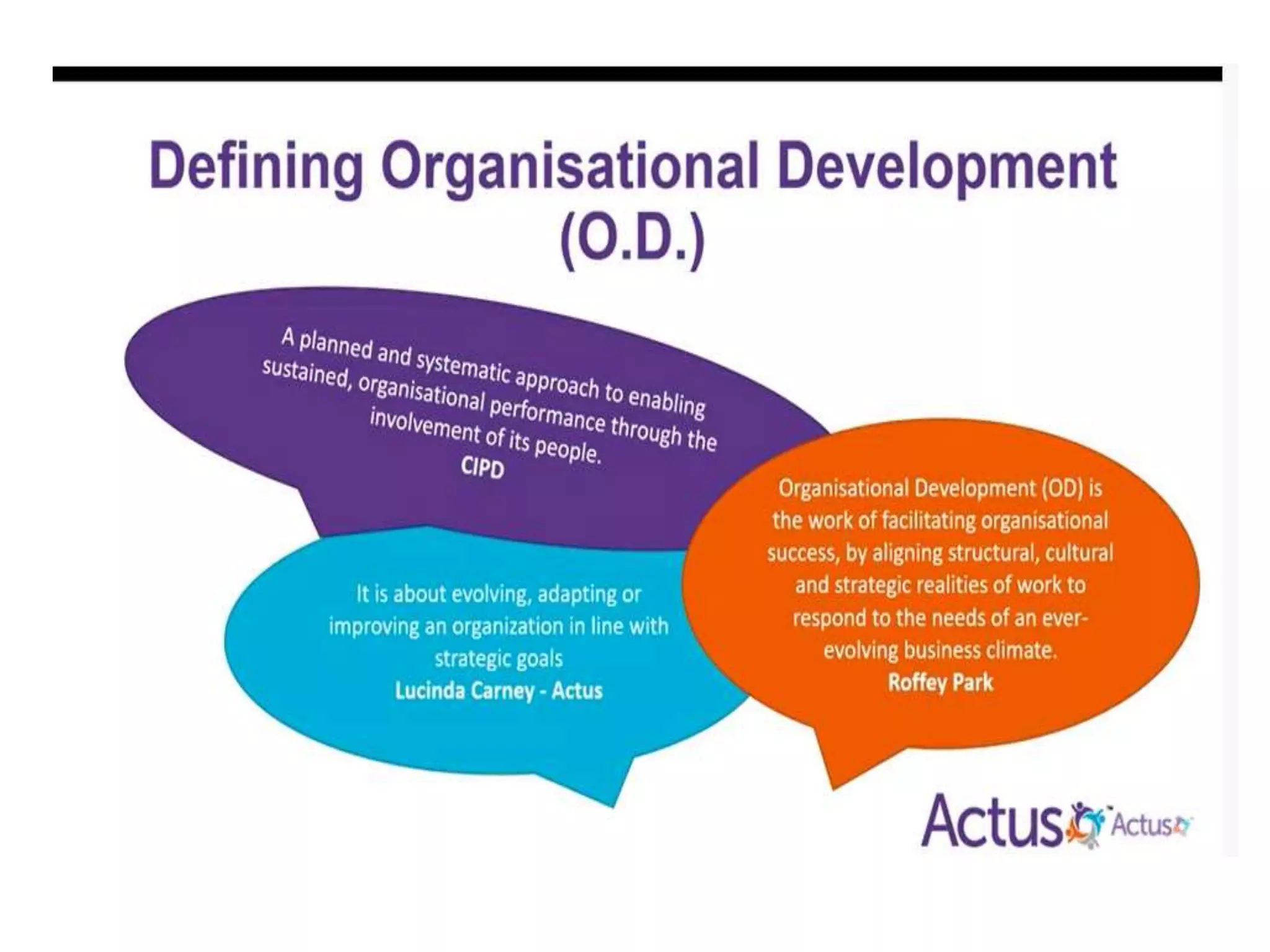
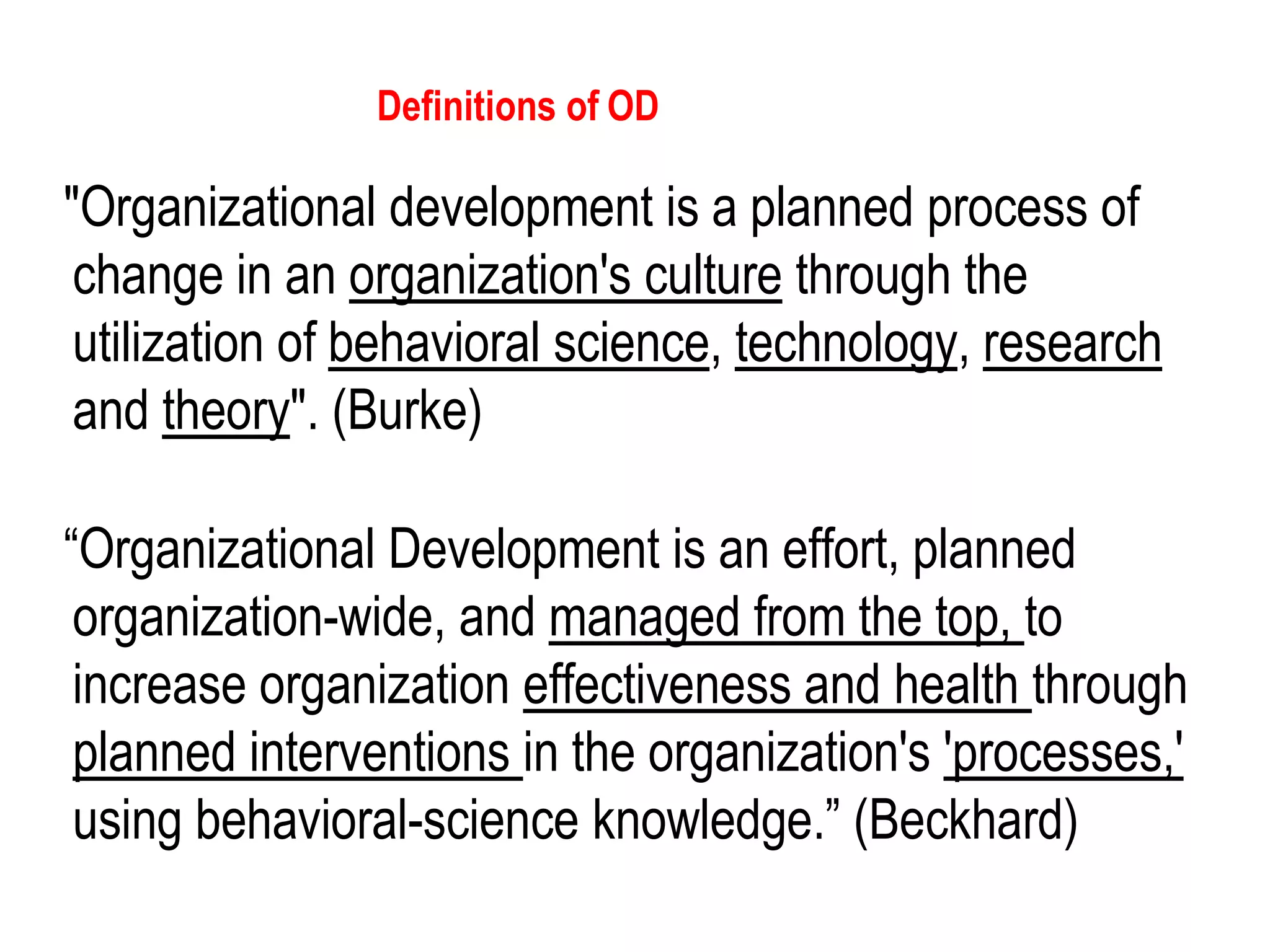
"Organizational development is a planned process of
change in an organization's culture through the
utilization of behavioral science, technology, research
and theory". (Burke)
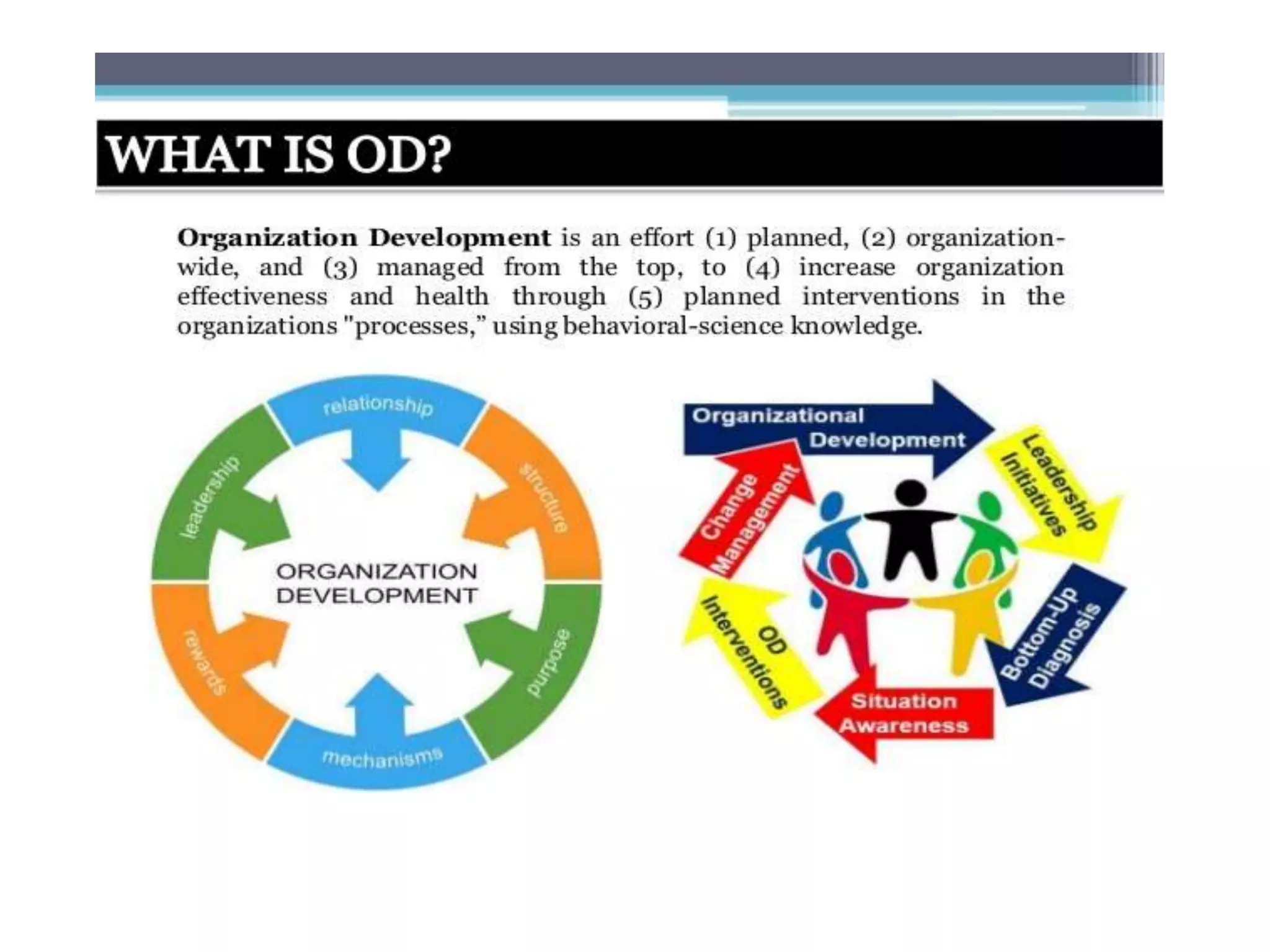
“Organizational Development is an effort, planned
organization-wide, and managed from the top, to
increase organization effectiveness and health through
planned interventions in the organization's 'processes,'
using behavioral-science knowledge.” (Beckhard)
Definitions of OD

INtroduction to Organizational development

  • 1.
  • 2.
    Session 1& 2Objectives To provide a definition of Organization Development (OD) • To discuss the objectives, values, beliefs and assumptions of organizational development To describe the characteristics of Organizational Development To distinguish OD and planned change from other forms of organization change • To describe the historical development of OD
  • 3.
  • 4.
  • 5.
  • 6.
    INTRODUCTION TO OD: Theterm organizational development was coined by Richard Beckhard in the mid-1950s.Organizational development is an acronym of two words i.e., organization and development. • Organization: A social unit of people that is structured and managed to meet a need or to pursue collective goals. • Development: The systematic use of scientific and technical knowledge to meet specific objectives or requirements. .
  • 7.
    What is OD? Organizationdevelopment (OD) is about taking systematic steps to improve organizational capability. It is concerned with process – how things get done.
  • 10.
  • 11.
  • 12.
    The main objectivesof OD are to: 1. Improve organizational performance as measured by profitability, market share, innovativeness, etc. 2. Make organizations better adaptive to its environment which always keeps on changing. 3. Make the members willing face organisational problems and contribute creative solutions to the organisational problems. 4. Improve internal behaviour patterns such as interpersonal relations, intergroup relations, level of trust and support among the role players. 5. Understand own self and others, openness and meaningful communication and involvement in planning for organisational development. 6. To increase the level of inter-personal trust among employees and to increase their level of satisfaction and commitment.
  • 15.
    Values Assumptions andBeliefs of OD Belief: A belief is a proposition about how the world works that the individual accepts as true; it is a cognitive fact for the person. Values: Values are also beliefs and are defined as “ beliefs about what is desirable or a ‘good’ and what is undesirable or a ‘bad’.
  • 16.
    Assumptions: Assumptions arebeliefs that are regarded as so valuable and obviously correct that they are taken for granted and rarely examined or questioned.
  • 17.
    Thus, values, assumptions,and beliefs are all cognitive facts or propositions, with values being beliefs about good and bad, and assumptions being strongly held, relatively unexamined belief accepted as the truth.
  • 18.
    Humanistic treat people withrespect and dignity, respect the whole person, assume that everyone has intrinsic worth View all people as having the potential for growth and development Optimistic That rationality, reason, and goodwill are the tools for making progress that progress is possible and desirable in human affairs, People are basically good, Democratic the importance of fair and equitable treatment for all The right of people to be free from illlogical misuse of power, sanctity of the individual, Values of OD
  • 20.
  • 21.
    Role Play onCharacteristics of OD
  • 22.
    Growth & Relevanceof OD: THREE major trends are shaping their relevance of OD in this drastically changing environment: 1. Globalization It changed the market and environments in which organization operates as well as the way function. New government, new leadership, new market, new countries are emerging and creating new global economy with opportunities and threats.
  • 23.
    Information Technology: Theway an organization collects, stores, manipulates uses and transi ….. 3. Managerial Innovation: (strategic HRM, organization design, proactivity & customer focus, learning organizations)
  • 25.
    Task 1. Organization development(OD) emerged in the 1960s as part of the behavioural science movement. Is this still valid today? 2. Can you give examples of any successful OD programs? Draw on recent research/personal observation/experience for your answer. 3. You have been asked to give a talk to a postgraduate management conference on ‘The qualities required of an effective OD practitioner’. Outline what you will say and explain its relevance for developing the capability of your own organization.
  • 26.
    (c)2005 Cummings & Worley,8e Thomson/South-Western "Organizational development is a planned process of change in an organization's culture through the utilization of behavioral science, technology, research and theory". (Burke) “Organizational Development is an effort, planned organization-wide, and managed from the top, to increase organization effectiveness and health through planned interventions in the organization's 'processes,' using behavioral-science knowledge.” (Beckhard) Definitions of OD

Editor's Notes

  • #5 Change, Innovation, Efficiency, reforms, system, framework, leadership,, participation, collaboration, objectives, performance, trust, communication, problem solving, planning planned change; long range; organizational improvement in problem solving, communication, collaboration, participation, trust, and uncovering and confronting conflict; a focus on human processes and technostructural factors in order to improve both task accomplishment and the quality of life of individuals; assistance of a change agent or catalyst; use of behavioral science techniques to gather valid data in a reflexive, self-analytic fashion
  • #25 An organizational structure is a system that outlines how certain activities are directed in order to achieve the goals of an organization. These activities can include rules, roles, and responsibilities. The organizational structure also determines how information flows between levels within the company.