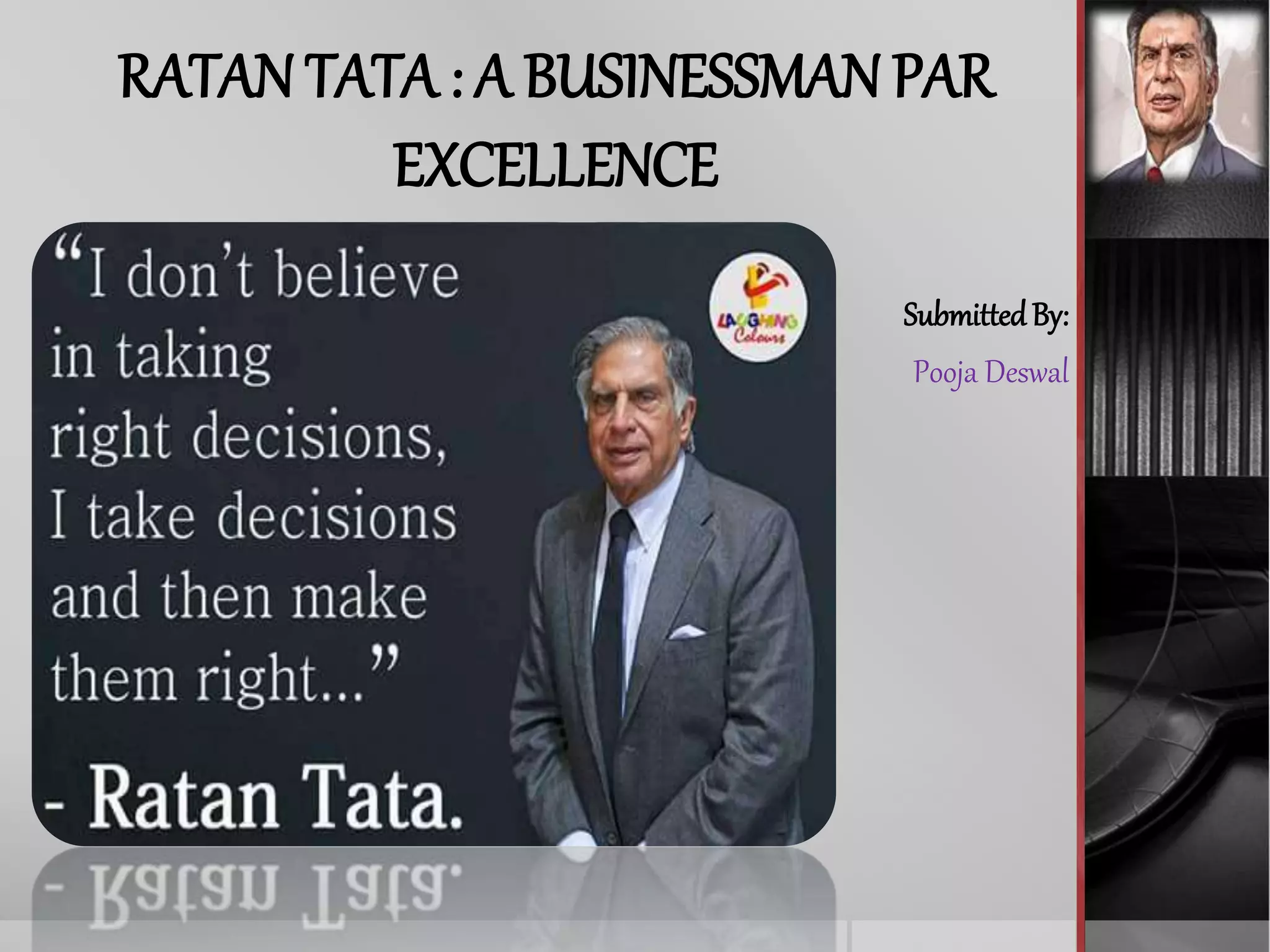
RATAN TATA : A BUSINESSMAN PAR
EXCELLENCE
SubmittedBy:
Pooja Deswal
Early life
 Ratan Tata is the son of Naval Tata, who had been
adopted from J. N. Petit Parsi Orphanage by Navajbai
Tata.
 His parents Naval and Sonoo separated in the mid-
1940s when he was ten and his younger brother,
Jimmy, was seven years old. Both he and his brother
were raised by their grandmother Navajbai Tata.
 He has a half-brother Noel Tata from Naval Tata's
second marriage to Simone Tata.
Early Carrier
 Ratan Tata completed his schooling from Campion School in
Mumbai.
 He completed his BSc degree in architecture with structural
engineering from Cornell University in 1962.
 And the Advanced Management Program from Harvard
Business School in 1975.
 He joined the Tata Group in December 1962, after turning
down a job with IBM on the advice of JRD Tata. He was first
sent to Jamshedpur to work at Tata Steel.
Ratan Tata as Chairman
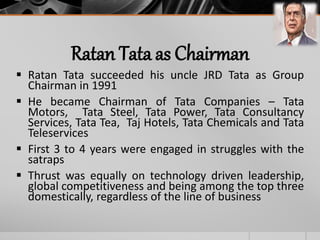
 Ratan Tata succeeded his uncle JRD Tata as Group
Chairman in 1991
 He became Chairman of Tata Companies – Tata
Motors, Tata Steel, Tata Power, Tata Consultancy
Services, Tata Tea, Taj Hotels, Tata Chemicals and Tata
Teleservices
 First 3 to 4 years were engaged in struggles with the
satraps
 Thrust was equally on technology driven leadership,
global competitiveness and being among the top three
domestically, regardless of the line of business
Achievements
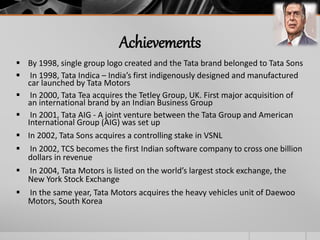
 By 1998, single group logo created and the Tata brand belonged to Tata Sons
 In 1998, Tata Indica – India’s first indigenously designed and manufactured
car launched by Tata Motors
 In 2000, Tata Tea acquires the Tetley Group, UK. First major acquisition of
an international brand by an Indian Business Group
 In 2001, Tata AIG - A joint venture between the Tata Group and American
International Group (AIG) was set up
 In 2002, Tata Sons acquires a controlling stake in VSNL
 In 2002, TCS becomes the first Indian software company to cross one billion
dollars in revenue
 In 2004, Tata Motors is listed on the world’s largest stock exchange, the
New York Stock Exchange
 In the same year, Tata Motors acquires the heavy vehicles unit of Daewoo
Motors, South Korea
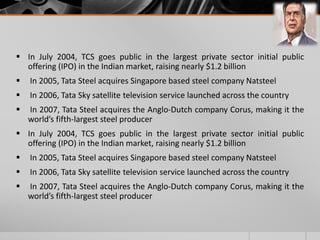
 In July 2004, TCS goes public in the largest private sector initial public
offering (IPO) in the Indian market, raising nearly $1.2 billion
 In 2005, Tata Steel acquires Singapore based steel company Natsteel
 In 2006, Tata Sky satellite television service launched across the country
 In 2007, Tata Steel acquires the Anglo-Dutch company Corus, making it the
world’s fifth-largest steel producer
 In July 2004, TCS goes public in the largest private sector initial public
offering (IPO) in the Indian market, raising nearly $1.2 billion
 In 2005, Tata Steel acquires Singapore based steel company Natsteel
 In 2006, Tata Sky satellite television service launched across the country
 In 2007, Tata Steel acquires the Anglo-Dutch company Corus, making it the
world’s fifth-largest steel producer
Awards & Recognition
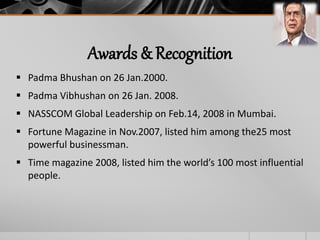
 Padma Bhushan on 26 Jan.2000.
 Padma Vibhushan on 26 Jan. 2008.
 NASSCOM Global Leadership on Feb.14, 2008 in Mumbai.
 Fortune Magazine in Nov.2007, listed him among the25 most
powerful businessman.
 Time magazine 2008, listed him the world’s 100 most influential
people.
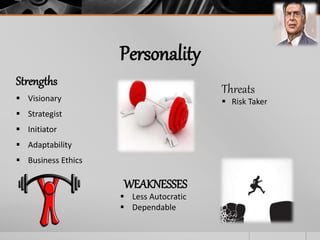
Personality
Strengths
 Visionary
 Strategist
 Initiator
 Adaptability
 Business Ethics
WEAKNESSES
 Less Autocratic
 Dependable
Threats
 Risk Taker
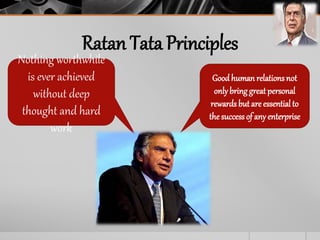
Ratan Tata Principles
Good human relationsnot
onlybringgreat personal
rewards but are essential to
the success of any enterprise
Nothing worthwhile
is ever achieved
without deep
thought and hard
work
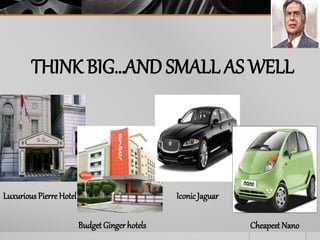
THINK BIG…AND SMALL AS WELL
LuxuriousPierre Hotel
Budget Ginger hotels
Iconic Jaguar
Cheapest Nano
The spectrum of success
 The “collaborative work”.
 New product development.
 High manufacturing quality.
 Sales improvement.
 Build a web of network outside the Country.
 Consider the “people factor.”
 Proper use of the Raw Materials.
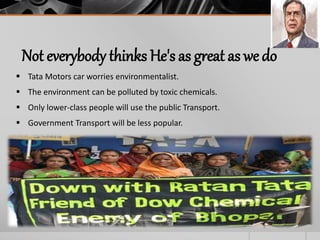
Not everybody thinks He's as great as wedo
 Tata Motors car worries environmentalist.
 The environment can be polluted by toxic chemicals.
 Only lower-class people will use the public Transport.
 Government Transport will be less popular.
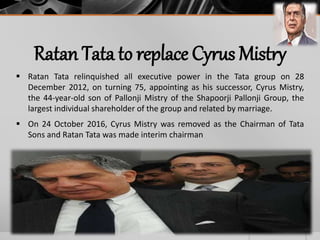
Ratan Tata to replace Cyrus Mistry
 Ratan Tata relinquished all executive power in the Tata group on 28
December 2012, on turning 75, appointing as his successor, Cyrus Mistry,
the 44-year-old son of Pallonji Mistry of the Shapoorji Pallonji Group, the
largest individual shareholder of the group and related by marriage.
 On 24 October 2016, Cyrus Mistry was removed as the Chairman of Tata
Sons and Ratan Tata was made interim chairman
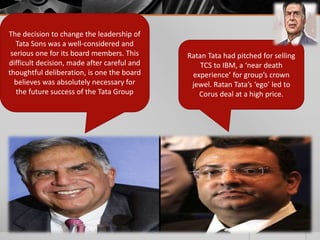
The decision to change the leadership of
Tata Sons was a well-considered and
serious one for its board members. This
difficult decision, made after careful and
thoughtful deliberation, is one the board
believes was absolutely necessary for
the future success of the Tata Group
Ratan Tata had pitched for selling
TCS to IBM, a ‘near death
experience’ for group’s crown
jewel. Ratan Tata’s ‘ego’ led to
Corus deal at a high price.
Any Queries
THANK YOU!

Ratan tata

  • 1.
    RATAN TATA :A BUSINESSMAN PAR EXCELLENCE SubmittedBy: Pooja Deswal
  • 2.
    Early life  RatanTata is the son of Naval Tata, who had been adopted from J. N. Petit Parsi Orphanage by Navajbai Tata.  His parents Naval and Sonoo separated in the mid- 1940s when he was ten and his younger brother, Jimmy, was seven years old. Both he and his brother were raised by their grandmother Navajbai Tata.  He has a half-brother Noel Tata from Naval Tata's second marriage to Simone Tata.
  • 3.
    Early Carrier  RatanTata completed his schooling from Campion School in Mumbai.  He completed his BSc degree in architecture with structural engineering from Cornell University in 1962.  And the Advanced Management Program from Harvard Business School in 1975.  He joined the Tata Group in December 1962, after turning down a job with IBM on the advice of JRD Tata. He was first sent to Jamshedpur to work at Tata Steel.
  • 4.
    Ratan Tata asChairman  Ratan Tata succeeded his uncle JRD Tata as Group Chairman in 1991  He became Chairman of Tata Companies – Tata Motors, Tata Steel, Tata Power, Tata Consultancy Services, Tata Tea, Taj Hotels, Tata Chemicals and Tata Teleservices  First 3 to 4 years were engaged in struggles with the satraps  Thrust was equally on technology driven leadership, global competitiveness and being among the top three domestically, regardless of the line of business
  • 5.
    Achievements  By 1998,single group logo created and the Tata brand belonged to Tata Sons  In 1998, Tata Indica – India’s first indigenously designed and manufactured car launched by Tata Motors  In 2000, Tata Tea acquires the Tetley Group, UK. First major acquisition of an international brand by an Indian Business Group  In 2001, Tata AIG - A joint venture between the Tata Group and American International Group (AIG) was set up  In 2002, Tata Sons acquires a controlling stake in VSNL  In 2002, TCS becomes the first Indian software company to cross one billion dollars in revenue  In 2004, Tata Motors is listed on the world’s largest stock exchange, the New York Stock Exchange  In the same year, Tata Motors acquires the heavy vehicles unit of Daewoo Motors, South Korea
  • 6.
     In July2004, TCS goes public in the largest private sector initial public offering (IPO) in the Indian market, raising nearly $1.2 billion  In 2005, Tata Steel acquires Singapore based steel company Natsteel  In 2006, Tata Sky satellite television service launched across the country  In 2007, Tata Steel acquires the Anglo-Dutch company Corus, making it the world’s fifth-largest steel producer  In July 2004, TCS goes public in the largest private sector initial public offering (IPO) in the Indian market, raising nearly $1.2 billion  In 2005, Tata Steel acquires Singapore based steel company Natsteel  In 2006, Tata Sky satellite television service launched across the country  In 2007, Tata Steel acquires the Anglo-Dutch company Corus, making it the world’s fifth-largest steel producer
  • 7.
    Awards & Recognition Padma Bhushan on 26 Jan.2000.  Padma Vibhushan on 26 Jan. 2008.  NASSCOM Global Leadership on Feb.14, 2008 in Mumbai.  Fortune Magazine in Nov.2007, listed him among the25 most powerful businessman.  Time magazine 2008, listed him the world’s 100 most influential people.
  • 8.
    Personality Strengths  Visionary  Strategist Initiator  Adaptability  Business Ethics WEAKNESSES  Less Autocratic  Dependable Threats  Risk Taker
  • 9.
    Ratan Tata Principles Goodhuman relationsnot onlybringgreat personal rewards but are essential to the success of any enterprise Nothing worthwhile is ever achieved without deep thought and hard work
  • 10.
    THINK BIG…AND SMALLAS WELL LuxuriousPierre Hotel Budget Ginger hotels Iconic Jaguar Cheapest Nano
  • 11.
    The spectrum ofsuccess  The “collaborative work”.  New product development.  High manufacturing quality.  Sales improvement.  Build a web of network outside the Country.  Consider the “people factor.”  Proper use of the Raw Materials.
  • 12.
    Not everybody thinksHe's as great as wedo  Tata Motors car worries environmentalist.  The environment can be polluted by toxic chemicals.  Only lower-class people will use the public Transport.  Government Transport will be less popular.
  • 13.
    Ratan Tata toreplace Cyrus Mistry  Ratan Tata relinquished all executive power in the Tata group on 28 December 2012, on turning 75, appointing as his successor, Cyrus Mistry, the 44-year-old son of Pallonji Mistry of the Shapoorji Pallonji Group, the largest individual shareholder of the group and related by marriage.  On 24 October 2016, Cyrus Mistry was removed as the Chairman of Tata Sons and Ratan Tata was made interim chairman
  • 14.
    The decision tochange the leadership of Tata Sons was a well-considered and serious one for its board members. This difficult decision, made after careful and thoughtful deliberation, is one the board believes was absolutely necessary for the future success of the Tata Group Ratan Tata had pitched for selling TCS to IBM, a ‘near death experience’ for group’s crown jewel. Ratan Tata’s ‘ego’ led to Corus deal at a high price.
  • 15.