As ARCHTECTURAL & CONSTRUCTION
technique
BY-
SHUBHAM SRIVASTAVA
(1509100921)
7TH B
Contents
 What is 3D Printing?
 How 3D Printer Works?
 Methodology
 Existing Structures
 Applications in Construction Industry
 Advantages
 Disadvantages
 Conclusion
What is 3D Printing?
 3D Printing or Additive Manufacturing is a process of making three dimensional
solid objects from a digital from a digital file.
 In an additive process an object is created by laying down successive layers of
material until the entire object is created.
 In construction industry, it refers to various technologies that use 3D printing as
a core method to fabricate buildings and construction components.
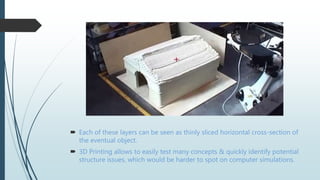
 Each of these layers can be seen as thinly sliced horizontal cross-section of
the eventual object.
 3D Printing allows to easily test many concepts & quickly identify potential
structure issues, which would be harder to spot on computer simulations.
How 3D Printing Works?
 A virtual design of the object is created.
 CAD uses a 3D Modeling Program or 3D Scanner for virtual design.
 The software slices the final model into hundreds or thousands of horizontal
layers.
 The printer creates the object layer by layer, resulting in one 3-dimensional
object.
 In construction of complex structures multiple 3D Printers are used
simultaneously.
WORK FLOW
METHODS OF 3D PRINTING
 Selective Laser Sintering (SLS)
 Stereo Lithography (SL)
 Fused Deposition Modeling (FDM)
Fused Deposition Modeling (FDM)
 FDM is an additive manufacturing technology commonly used for
modeling, prototyping & production applications.
STEREOLITHOGRAPHY
 SL is an additive manufacturing process using a vat of liquid UV-
curable photopolymer “resin” and a UV laser to build parts a layer
at a time.
SELECTIVE LASER SINTERING
 SLS is an additive manufacturing technology that uses a high power laser
to fuse small particles of plastic, metal, ceramic, or glass powders into a
mass that has a desired three-dimensional shape. The laser selectively
fuses powdered material by scanning cross-sections generated from a 3-D
digital description of the part on the surface of a powder bed. After each
cross-section is scanned, the powder bed is lowered by one layer
thickness, a new layer of material is applied on top, and the process is
repeated until the part is completed.
EXISTING STRUCTURES
APPLICATIONS
 Printed Soil
 Emergency Accommodation
 Cool bricks
ADVANTAGES
 Higher Productivity
 Lower Production Cost
 Manufacturing Complex Structures
 Design Flexibility
 Optimizing Construction Time
 Less Material Wastage
Higher Productivity
 3D printing saves time in the early design and creation phases by reducing the
lead time for model production.
Take several days Take several hours
Lower Production Cost
 The 3D Printer Manufacturer STRATASYS claims that modeling cost can be
reduced up to 75% by using 3D Printing.
Manufacturing Complex Structures
 It is possible to create architectural models of complex structures.
 MX3D recently worked to 3D print an actual metal bridge in Amsterdam. They
used an innovative 3d printing system which extrudes melted metals.
CONVENTIONAL VS PRINTER
DISADVANTAGES
 Reduce employees in the industry, since 3D printer does most of the work.
 A limited number of materials can be used, since the same printer may not be
able to print the required multiple materials.
 Higher risks- any risk in the digital model can result in problematic issues on
site during the printing/construction phase.
 Conventional product manufacturing &renting companies could suffer as their
products are no longer required.
 Can not print all materials.
 Require area for movable retractable rails.
CONCLUSION
 The buildings are designed by computer and are built by computer, 3D printing
in architecture was restricted to the production of models and small-scale
models, but now it is possible to print 3D houses.
 We can say that it is a revolution in the world of Civil Engineering
 Being eco-friendly, it provides a good quality of work at lower construction cost.
 Allows creating buildings of complicated shapes.
Thank You

3-D PRINTING AS A CONSTRUCTION TECHNIQUE

  • 1.
    As ARCHTECTURAL &CONSTRUCTION technique BY- SHUBHAM SRIVASTAVA (1509100921) 7TH B
  • 2.
    Contents  What is3D Printing?  How 3D Printer Works?  Methodology  Existing Structures  Applications in Construction Industry  Advantages  Disadvantages  Conclusion
  • 3.
    What is 3DPrinting?  3D Printing or Additive Manufacturing is a process of making three dimensional solid objects from a digital from a digital file.  In an additive process an object is created by laying down successive layers of material until the entire object is created.  In construction industry, it refers to various technologies that use 3D printing as a core method to fabricate buildings and construction components.
  • 4.
     Each ofthese layers can be seen as thinly sliced horizontal cross-section of the eventual object.  3D Printing allows to easily test many concepts & quickly identify potential structure issues, which would be harder to spot on computer simulations.
  • 5.
    How 3D PrintingWorks?  A virtual design of the object is created.  CAD uses a 3D Modeling Program or 3D Scanner for virtual design.  The software slices the final model into hundreds or thousands of horizontal layers.  The printer creates the object layer by layer, resulting in one 3-dimensional object.  In construction of complex structures multiple 3D Printers are used simultaneously.
  • 6.
  • 7.
    METHODS OF 3DPRINTING  Selective Laser Sintering (SLS)  Stereo Lithography (SL)  Fused Deposition Modeling (FDM)
  • 8.
    Fused Deposition Modeling(FDM)  FDM is an additive manufacturing technology commonly used for modeling, prototyping & production applications.
  • 9.
    STEREOLITHOGRAPHY  SL isan additive manufacturing process using a vat of liquid UV- curable photopolymer “resin” and a UV laser to build parts a layer at a time.
  • 10.
    SELECTIVE LASER SINTERING SLS is an additive manufacturing technology that uses a high power laser to fuse small particles of plastic, metal, ceramic, or glass powders into a mass that has a desired three-dimensional shape. The laser selectively fuses powdered material by scanning cross-sections generated from a 3-D digital description of the part on the surface of a powder bed. After each cross-section is scanned, the powder bed is lowered by one layer thickness, a new layer of material is applied on top, and the process is repeated until the part is completed.
  • 11.
  • 13.
    APPLICATIONS  Printed Soil Emergency Accommodation  Cool bricks
  • 14.
    ADVANTAGES  Higher Productivity Lower Production Cost  Manufacturing Complex Structures  Design Flexibility  Optimizing Construction Time  Less Material Wastage
  • 15.
    Higher Productivity  3Dprinting saves time in the early design and creation phases by reducing the lead time for model production. Take several days Take several hours
  • 16.
    Lower Production Cost The 3D Printer Manufacturer STRATASYS claims that modeling cost can be reduced up to 75% by using 3D Printing.
  • 17.
    Manufacturing Complex Structures It is possible to create architectural models of complex structures.  MX3D recently worked to 3D print an actual metal bridge in Amsterdam. They used an innovative 3d printing system which extrudes melted metals.
  • 18.
  • 19.
    DISADVANTAGES  Reduce employeesin the industry, since 3D printer does most of the work.  A limited number of materials can be used, since the same printer may not be able to print the required multiple materials.  Higher risks- any risk in the digital model can result in problematic issues on site during the printing/construction phase.  Conventional product manufacturing &renting companies could suffer as their products are no longer required.  Can not print all materials.  Require area for movable retractable rails.
  • 20.
    CONCLUSION  The buildingsare designed by computer and are built by computer, 3D printing in architecture was restricted to the production of models and small-scale models, but now it is possible to print 3D houses.  We can say that it is a revolution in the world of Civil Engineering  Being eco-friendly, it provides a good quality of work at lower construction cost.  Allows creating buildings of complicated shapes.
  • 21.