ANTI FUNGAL DRUGS AFFECTING
CELL MEMBRANE AND CELL WALL BIOSYNTHESIS
MOHAMMAD BILAL KAKAR
SCHOLAR
DEPARTMENT OF MICROBIOLOGY
MOLECULAR MECHANISM OF DRUG ACTION
UNIVERSITY OF BALOCHISTAN QUETTA.
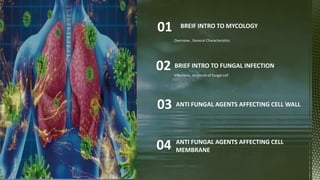
Agenda
Infographic
Overview , General Characteristics
BREIF INTRO TO MYCOLOGY
01
Infections, structure of fungal cell
BRIEF INTRO TO FUNGAL INFECTION
02
ANTI FUNGAL AGENTS AFFECTING CELL WALL
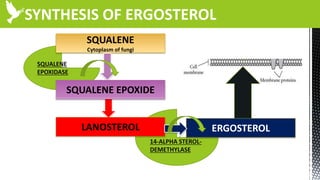
03
.
ANTI FUNGAL AGENTS AFFECTING CELL
MEMBRANE
04
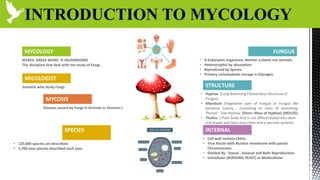
INTRODUCTION TO MYCOLOGY
FUNGUS
• A Eukaryotic organisms. Neither a plants nor animals.
• Heterotrophic by absorption
• Reproduced by Spores.
• Primary carbohydrate storage is Glycogen.
MYCOLOGY
MYKES: GREEK WORD  MUSHROOMS
The discipline that deal with the study of Fungi.
SPECIES
• 120,000 species are described
• 1,700 new species described each year..
INTERNAL
• Cell wall contain Chitin.
• True Nuclei with Nuclear membrane with paired
Chromosomes.
• Divided By : Sexual , Asexual and Both Reproduction.
• Unicellular (BUDDING YEAST) or Multicellular
MICOLOGIST
Scientist who study Fungi.
MYCOSIS
Disease caused by Fungi in Animals or Humans by Fungi.
STRUCTURE
• Hyphae (Long Branching Filamentous Structure of
Fungus)
• Mycelium (Vegetative part of Fungus or Fungus like
bacterial Colony , Consisting of mass of branching,
Thread – Like Hyphae. (Shiro: Mass of Hyphae) (MOLDS)
• Thallus ( Plant body that is not differentiated Into stem
and leaves and lacks true roots and a vascular system).
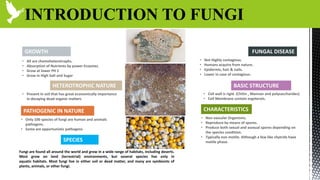
INTRODUCTION TO FUNGI
FUNGAL DISEASE
• Not Highly contagious.
• Humans acquire from nature.
• Epidermis, hair & nails.
• Lower in case of contagious.
GROWTH
• All are chemoheterotrophs.
• Absorption of Nutrients by power Enzymes.
• Grow at lower PH 5
• Grow in High Salt and Sugar
SPECIES
CHARACTERISTICS
• Non vascular Organisms.
• Reproduce by means of spores.
• Produce both sexual and asexual spores depending on
the species condition.
• Typically non motile. Although a few like chytrids have
motile phase.
HETEROTROPHIC NATURE
• Present in soil that has great economically importance
in decaying dead organic matters
PATHOGENIC IN NATURE
• Only 100 species of fungi are human and animals
pathogens.
• Some are opportunistic pathogens
BASIC STRUCTURE
• Cell wall is rigid. (Chitin , Mannan and polysaccharides)
• Cell Membrane contain ergoterols.
Fungi are found all around the world and grow in a wide range of habitats, including deserts.
Most grow on land (terrestrial) environments, but several species live only in
aquatic habitats. Most fungi live in either soil or dead matter, and many are symbionts of
plants, animals, or other fungi.
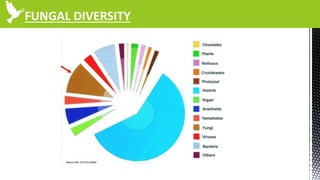
FUNGAL DIVERSITY
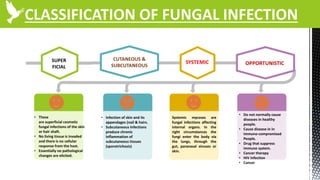
CLASSIFICATION OF FUNGAL INFECTION
CUTANEOUS &
SUBCUTANEOUS
SUPER
FICIAL
SYSTEMIC OPPORTUNISTIC
• These
are superficial cosmetic
fungal infections of the skin
or hair shaft.
• No living tissue is invaded
and there is no cellular
response from the host.
• Essentially no pathological
changes are elicited.
• Infection of skin and its
appendages (nail & hairs.
• Subcutaneous Infections
produce chronic
inflammation of
subcutaneous tissues
(sporotrichosis)
Systemic mycoses are
fungal infections affecting
internal organs. In the
right circumstances the
fungi enter the body via
the lungs, through the
gut, paranasal sinuses or
skin.
• Do not normally cause
diseases in healthy
people.
• Cause disease in in
immuno-compromised
People.
• Drug that suppress
immune system.
• Cancer therapy
• HIV Infection
• Cancer
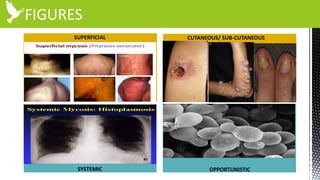
FIGURES
SUPERFICIAL CUTANEOUS/ SUB-CUTANEOUS
SYSTEMIC OPPORTUNISTIC
FUNGAL INFECTION
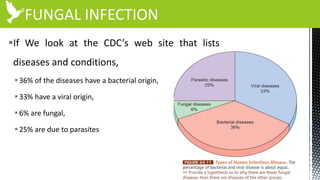
If We look at the CDC’s web site that lists
diseases and conditions,
36% of the diseases have a bacterial origin,
33% have a viral origin,
6% are fungal,
25% are due to parasites
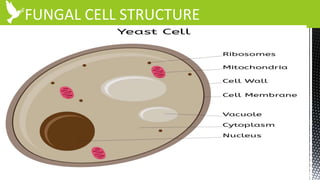
FUNGAL CELL STRUCTURE
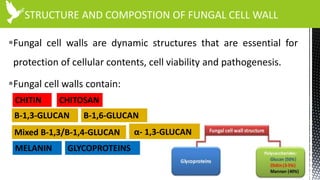
STRUCTURE AND COMPOSTION OF FUNGAL CELL WALL
Fungal cell walls are dynamic structures that are essential for
protection of cellular contents, cell viability and pathogenesis.
Fungal cell walls contain:
CHITIN CHITOSAN
Β-1,3-GLUCAN Β-1,6-GLUCAN
Mixed Β-1,3/B-1,4-GLUCAN
MELANIN GLYCOPROTEINS
α- 1,3-GLUCAN
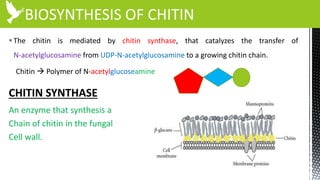
BIOSYNTHESIS OF CHITIN
The chitin is mediated by chitin synthase, that catalyzes the transfer of
N-acetylglucosamine from UDP-N-acetylglucosamine to a growing chitin chain.
Chitin  Polymer of N-acetylglucoseamine
CHITIN SYNTHASE
An enzyme that synthesis a
Chain of chitin in the fungal
Cell wall.
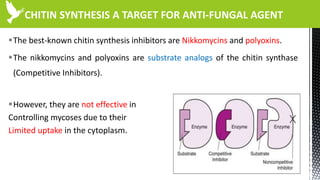
CHITIN SYNTHESIS A TARGET FOR ANTI-FUNGAL AGENT
The best-known chitin synthesis inhibitors are Nikkomycins and polyoxins.
The nikkomycins and polyoxins are substrate analogs of the chitin synthase
(Competitive Inhibitors).
However, they are not effective in
Controlling mycoses due to their
Limited uptake in the cytoplasm.
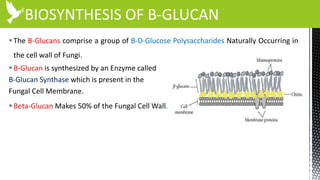
BIOSYNTHESIS OF B-GLUCAN
The B-Glucans comprise a group of B-D-Glucose Polysaccharides Naturally Occurring in
the cell wall of Fungi.
B-Glucan is synthesized by an Enzyme called
B-Glucan Synthase which is present in the
Fungal Cell Membrane.
Beta-Glucan Makes 50% of the Fungal Cell Wall.
GLUCAN SYNTHESIS A TARGET FOR ANTI-FUNGAL AGENTS.
The Inhibition of B-Glucan synthesis has been Extensively pursued as a means of
disrupting fungal growth and cell wall formation. This results in cell permeability and
Cell Lysis.
The Echinocandins are non-Competitive inhibitors of the B-Glucan Synthase.
Although Not Fully Understood the Echinocandins are known to bind the Glucan
Synthase.
Treatment with the Echinocandins is a promising therapy for Aspergillosis and
Candidiasis.
Echinocandins Caspofungin  Micafungin/Anidulafungin
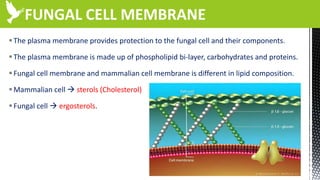
FUNGAL CELL MEMBRANE
The plasma membrane provides protection to the fungal cell and their components.
The plasma membrane is made up of phospholipid bi-layer, carbohydrates and proteins.
Fungal cell membrane and mammalian cell membrane is different in lipid composition.
Mammalian cell  sterols (Cholesterol)
Fungal cell  ergosterols.
14-ALPHA STEROL-
DEMETHYLASE
SQUALENE
EPOXIDASE
SYNTHESIS OF ERGOSTEROL
SQUALENE
Cytoplasm of fungi
ERGOSTEROL
SQUALENE EPOXIDE
LANOSTEROL
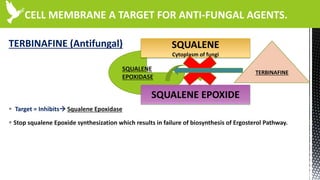
CELL MEMBRANE A TARGET FOR ANTI-FUNGAL AGENTS.
TERBINAFINE (Antifungal)
 Target = Inhibits Squalene Epoxidase
 Stop squalene Epoxide synthesization which results in failure of biosynthesis of Ergosterol Pathway.
SQUALENE
EPOXIDASE
SQUALENE
Cytoplasm of fungi
SQUALENE EPOXIDE
TERBINAFINE
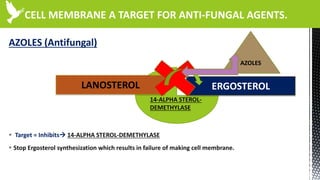
CELL MEMBRANE A TARGET FOR ANTI-FUNGAL AGENTS.
AZOLES (Antifungal)
 Target = Inhibits 14-ALPHA STEROL-DEMETHYLASE
 Stop Ergosterol synthesization which results in failure of making cell membrane.
14-ALPHA STEROL-
DEMETHYLASE
ERGOSTEROL
LANOSTEROL
AZOLES
AZOLES
CELL MEMBRANE A TARGET FOR ANTI-FUNGAL AGENTS.
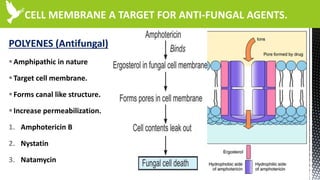
POLYENES (Antifungal)
Amphipathic in nature
Target cell membrane.
Forms canal like structure.
Increase permeabilization.
1. Amphotericin B
2. Nystatin
3. Natamycin
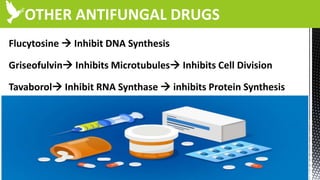
OTHER ANTIFUNGAL DRUGS
Flucytosine  Inhibit DNA Synthesis
Griseofulvin Inhibits Microtubules Inhibits Cell Division
Tavaborol Inhibit RNA Synthase  inhibits Protein Synthesis

ANTI FUNGAL DRUGS AFFECTING CELL MEMBRANE AND CELL WALL.

  • 1.
    ANTI FUNGAL DRUGSAFFECTING CELL MEMBRANE AND CELL WALL BIOSYNTHESIS MOHAMMAD BILAL KAKAR SCHOLAR DEPARTMENT OF MICROBIOLOGY MOLECULAR MECHANISM OF DRUG ACTION UNIVERSITY OF BALOCHISTAN QUETTA.
  • 2.
    Agenda Infographic Overview , GeneralCharacteristics BREIF INTRO TO MYCOLOGY 01 Infections, structure of fungal cell BRIEF INTRO TO FUNGAL INFECTION 02 ANTI FUNGAL AGENTS AFFECTING CELL WALL 03 . ANTI FUNGAL AGENTS AFFECTING CELL MEMBRANE 04
  • 3.
    INTRODUCTION TO MYCOLOGY FUNGUS •A Eukaryotic organisms. Neither a plants nor animals. • Heterotrophic by absorption • Reproduced by Spores. • Primary carbohydrate storage is Glycogen. MYCOLOGY MYKES: GREEK WORD  MUSHROOMS The discipline that deal with the study of Fungi. SPECIES • 120,000 species are described • 1,700 new species described each year.. INTERNAL • Cell wall contain Chitin. • True Nuclei with Nuclear membrane with paired Chromosomes. • Divided By : Sexual , Asexual and Both Reproduction. • Unicellular (BUDDING YEAST) or Multicellular MICOLOGIST Scientist who study Fungi. MYCOSIS Disease caused by Fungi in Animals or Humans by Fungi. STRUCTURE • Hyphae (Long Branching Filamentous Structure of Fungus) • Mycelium (Vegetative part of Fungus or Fungus like bacterial Colony , Consisting of mass of branching, Thread – Like Hyphae. (Shiro: Mass of Hyphae) (MOLDS) • Thallus ( Plant body that is not differentiated Into stem and leaves and lacks true roots and a vascular system).
  • 4.
    INTRODUCTION TO FUNGI FUNGALDISEASE • Not Highly contagious. • Humans acquire from nature. • Epidermis, hair & nails. • Lower in case of contagious. GROWTH • All are chemoheterotrophs. • Absorption of Nutrients by power Enzymes. • Grow at lower PH 5 • Grow in High Salt and Sugar SPECIES CHARACTERISTICS • Non vascular Organisms. • Reproduce by means of spores. • Produce both sexual and asexual spores depending on the species condition. • Typically non motile. Although a few like chytrids have motile phase. HETEROTROPHIC NATURE • Present in soil that has great economically importance in decaying dead organic matters PATHOGENIC IN NATURE • Only 100 species of fungi are human and animals pathogens. • Some are opportunistic pathogens BASIC STRUCTURE • Cell wall is rigid. (Chitin , Mannan and polysaccharides) • Cell Membrane contain ergoterols. Fungi are found all around the world and grow in a wide range of habitats, including deserts. Most grow on land (terrestrial) environments, but several species live only in aquatic habitats. Most fungi live in either soil or dead matter, and many are symbionts of plants, animals, or other fungi.
  • 5.
  • 6.
    CLASSIFICATION OF FUNGALINFECTION CUTANEOUS & SUBCUTANEOUS SUPER FICIAL SYSTEMIC OPPORTUNISTIC • These are superficial cosmetic fungal infections of the skin or hair shaft. • No living tissue is invaded and there is no cellular response from the host. • Essentially no pathological changes are elicited. • Infection of skin and its appendages (nail & hairs. • Subcutaneous Infections produce chronic inflammation of subcutaneous tissues (sporotrichosis) Systemic mycoses are fungal infections affecting internal organs. In the right circumstances the fungi enter the body via the lungs, through the gut, paranasal sinuses or skin. • Do not normally cause diseases in healthy people. • Cause disease in in immuno-compromised People. • Drug that suppress immune system. • Cancer therapy • HIV Infection • Cancer
  • 7.
  • 8.
    FUNGAL INFECTION If Welook at the CDC’s web site that lists diseases and conditions, 36% of the diseases have a bacterial origin, 33% have a viral origin, 6% are fungal, 25% are due to parasites
  • 9.
  • 10.
    STRUCTURE AND COMPOSTIONOF FUNGAL CELL WALL Fungal cell walls are dynamic structures that are essential for protection of cellular contents, cell viability and pathogenesis. Fungal cell walls contain: CHITIN CHITOSAN Β-1,3-GLUCAN Β-1,6-GLUCAN Mixed Β-1,3/B-1,4-GLUCAN MELANIN GLYCOPROTEINS α- 1,3-GLUCAN
  • 11.
    BIOSYNTHESIS OF CHITIN Thechitin is mediated by chitin synthase, that catalyzes the transfer of N-acetylglucosamine from UDP-N-acetylglucosamine to a growing chitin chain. Chitin  Polymer of N-acetylglucoseamine CHITIN SYNTHASE An enzyme that synthesis a Chain of chitin in the fungal Cell wall.
  • 12.
    CHITIN SYNTHESIS ATARGET FOR ANTI-FUNGAL AGENT The best-known chitin synthesis inhibitors are Nikkomycins and polyoxins. The nikkomycins and polyoxins are substrate analogs of the chitin synthase (Competitive Inhibitors). However, they are not effective in Controlling mycoses due to their Limited uptake in the cytoplasm.
  • 13.
    BIOSYNTHESIS OF B-GLUCAN TheB-Glucans comprise a group of B-D-Glucose Polysaccharides Naturally Occurring in the cell wall of Fungi. B-Glucan is synthesized by an Enzyme called B-Glucan Synthase which is present in the Fungal Cell Membrane. Beta-Glucan Makes 50% of the Fungal Cell Wall.
  • 14.
    GLUCAN SYNTHESIS ATARGET FOR ANTI-FUNGAL AGENTS. The Inhibition of B-Glucan synthesis has been Extensively pursued as a means of disrupting fungal growth and cell wall formation. This results in cell permeability and Cell Lysis. The Echinocandins are non-Competitive inhibitors of the B-Glucan Synthase. Although Not Fully Understood the Echinocandins are known to bind the Glucan Synthase. Treatment with the Echinocandins is a promising therapy for Aspergillosis and Candidiasis. Echinocandins Caspofungin  Micafungin/Anidulafungin
  • 15.
    FUNGAL CELL MEMBRANE Theplasma membrane provides protection to the fungal cell and their components. The plasma membrane is made up of phospholipid bi-layer, carbohydrates and proteins. Fungal cell membrane and mammalian cell membrane is different in lipid composition. Mammalian cell  sterols (Cholesterol) Fungal cell  ergosterols.
  • 16.
    14-ALPHA STEROL- DEMETHYLASE SQUALENE EPOXIDASE SYNTHESIS OFERGOSTEROL SQUALENE Cytoplasm of fungi ERGOSTEROL SQUALENE EPOXIDE LANOSTEROL
  • 17.
    CELL MEMBRANE ATARGET FOR ANTI-FUNGAL AGENTS. TERBINAFINE (Antifungal)  Target = Inhibits Squalene Epoxidase  Stop squalene Epoxide synthesization which results in failure of biosynthesis of Ergosterol Pathway. SQUALENE EPOXIDASE SQUALENE Cytoplasm of fungi SQUALENE EPOXIDE TERBINAFINE
  • 18.
    CELL MEMBRANE ATARGET FOR ANTI-FUNGAL AGENTS. AZOLES (Antifungal)  Target = Inhibits 14-ALPHA STEROL-DEMETHYLASE  Stop Ergosterol synthesization which results in failure of making cell membrane. 14-ALPHA STEROL- DEMETHYLASE ERGOSTEROL LANOSTEROL AZOLES
  • 19.
  • 20.
    CELL MEMBRANE ATARGET FOR ANTI-FUNGAL AGENTS. POLYENES (Antifungal) Amphipathic in nature Target cell membrane. Forms canal like structure. Increase permeabilization. 1. Amphotericin B 2. Nystatin 3. Natamycin
  • 21.
    OTHER ANTIFUNGAL DRUGS Flucytosine Inhibit DNA Synthesis Griseofulvin Inhibits Microtubules Inhibits Cell Division Tavaborol Inhibit RNA Synthase  inhibits Protein Synthesis