Antifungal Agents
Prepared by:
Ms. Navdha Soni
Asst. Professor
L J Institute of Pharmacy
Introduction
§ Fungi are Eukaryotic cells.They possess mitochondria, nuclei & cell membranes.
§ They have rigid cell walls containing chitin as well as polysaccharides, and a cell
membrane composed of ergosterol.
§ While bacterial cells are prokaryotic. So, antibacterial agents can exhibit Selective
toxicity. In contrast, similarity between fungal & mammalian cells makes Antifungal
drugs nonselective.
§ Thus,Antifungal drugs are in general more toxic than antibacterial agents.
§ Depending upon some basic differences, fungi may be classified as
a. Phycomycetes (algae like),
b. Ascomycetes (sac like),
c. Basidiomycetes (mushrooms) &
d. Dueteromycetes 2
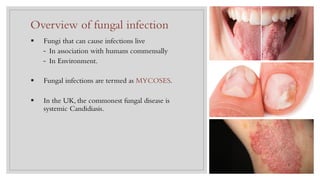
§ Fungi that can cause infections live
⎯ In association with humans commensally
⎯ In Environment.
§ Fungal infections are termed as MYCOSES.
§ In the UK, the commonest fungal disease is
systemic Candidiasis.
Overview of fungal infection
3
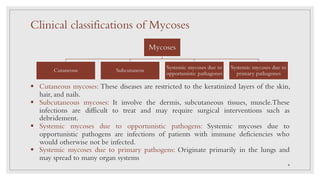
Mycoses
Cutaneous Subcutaneos
Systemic mycoses due to
opportunistic pathagones
Systemic mycoses due to
primary pathagones
§ Cutaneous mycoses: These diseases are restricted to the keratinized layers of the skin,
hair, and nails.
§ Subcutaneous mycoses: It involve the dermis, subcutaneous tissues, muscle.These
infections are difficult to treat and may require surgical interventions such as
debridement.
§ Systemic mycoses due to opportunistic pathogens: Systemic mycoses due to
opportunistic pathogens are infections of patients with immune deficiencies who
would otherwise not be infected.
§ Systemic mycoses due to primary pathogens: Originate primarily in the lungs and
may spread to many organ systems
Clinical classifications of Mycoses
4
BiologicalTargets for AntifungalTherapy
§ Anti Fungal Therapy depends upon biochemical difference between fungal and
mammalian cell.
§ On cellular level fungal cell have cell wall where as mammal cell doesn’t have cell wall
so fungal cell is the target for those chemicals which inhibits cell wall synthesis.
§ Cell membrane of fungal cell contain different sterols which are essential for structure
of cell membrane.
§ Other target include inhibition of DNA biosynthesis , disruption of mycotic spindle
and interference of metabolism.
5
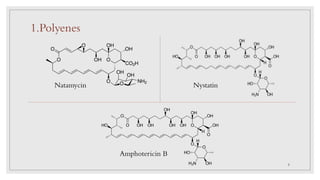
§ Polyenes (Mostly antibiotics)
§ Azoles
⎯ Triazoles
⎯ Imidazoles
§ Fluorinated Pyrimidines
§ Natural Products
§ Chitin Synthetase Inhibitors
§ Peptide/Proteins
§ Miscellaneous Agents
Classification of Antifungal Agents
6
Amphotericin B
NystatinNatamycin
1.Polyenes
7
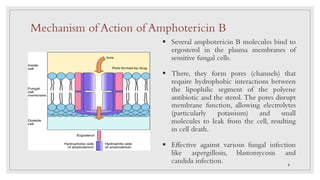
§ Several amphotericin B molecules bind to
ergosterol in the plasma membranes of
sensitive fungal cells.
§ There, they form pores (channels) that
require hydrophobic interactions between
the lipophilic segment of the polyene
antibiotic and the sterol. The pores disrupt
membrane function, allowing electrolytes
(particularly potassium) and small
molecules to leak from the cell, resulting
in cell death.
§ Effective against various fungal infection
like aspergillosis, blastomycosis and
candida infection.
Mechanism of Action of Amphotericin B
8
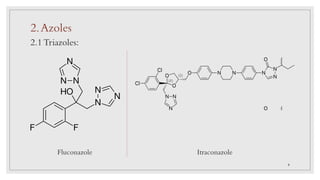
2.1 Triazoles:
Fluconazole Itraconazole
2.Azoles
9
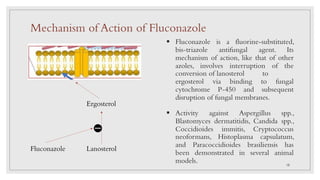
§ Fluconazole is a fluorine-substituted,
bis-triazole antifungal agent. Its
mechanism of action, like that of other
azoles, involves interruption of the
conversion of lanosterol to
ergosterol via binding to fungal
cytochrome P-450 and subsequent
disruption of fungal membranes.
§ Activity against Aspergillus spp.,
Blastomyces dermatitidis, Candida spp.,
Coccidioides immitis, Cryptococcus
neoformans, Histoplasma capsulatum,
and Paracoccidioides brasiliensis has
been demonstrated in several animal
models.
Ergosterol
LanosterolFluconazole
Mechanism of Action of Fluconazole
10
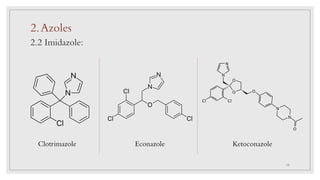
Clotrimazole Econazole Ketoconazole
2.Azoles
2.2 Imidazole:
11
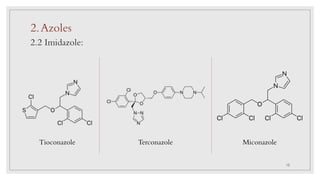
Tioconazole Terconazole Miconazole
2.Azoles
2.2 Imidazole:
12
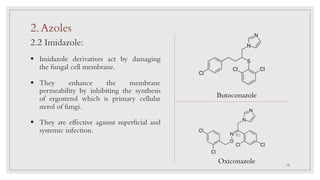
Butoconazole
Oxiconazole
§ Imidazole derivatives act by damaging
the fungal cell membrane.
§ They enhance the membrane
permeability by inhibiting the synthesis
of ergosterol which is primary cellular
sterol of fungi.
§ They are effective against superficial and
systemic infection.
2.Azoles
2.2 Imidazole:
13
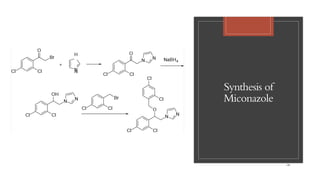
Synthesis of
Miconazole
14
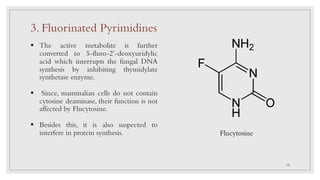
Flucytosine
§ The active metabolite is further
converted to 5-fluro-2’-deoxyuridylic
acid which interrupts the fungal DNA
synthesis by inhibiting thymidylate
synthetase enzyme.
§ Since, mammalian cells do not contain
cytosine deaminase, their function is not
affected by Flucytosine.
§ Besides this, it is also suspected to
interfere in protein synthesis.
3. Fluorinated Pyrimidines
15
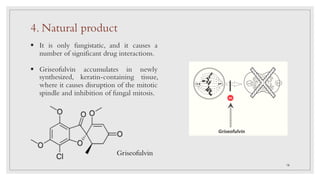
Griseofulvin
4. Natural product
§ It is only fungistatic, and it causes a
number of significant drug interactions.
§ Griseofulvin accumulates in newly
synthesized, keratin-containing tissue,
where it causes disruption of the mitotic
spindle and inhibition of fungal mitosis.
16
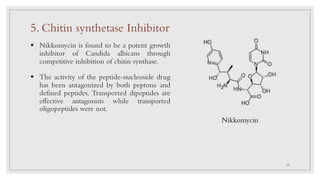
Nikkomycin
§ Nikkomycin is found to be a potent growth
inhibitor of Candida albicans through
competitive inhibition of chitin synthase.
§ The activity of the peptide-nucleoside drug
has been antagonized by both peptone and
defined peptides. Transported dipeptides are
effective antagonists while transported
oligopeptides were not.
5. Chitin synthetase Inhibitor
17
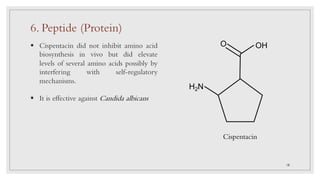
Cispentacin
§ Cispentacin did not inhibit amino acid
biosynthesis in vivo but did elevate
levels of several amino acids possibly by
interfering with self-regulatory
mechanisms.
§ It is effective against Candida albicans
6. Peptide (Protein)
18
H2N
OHO
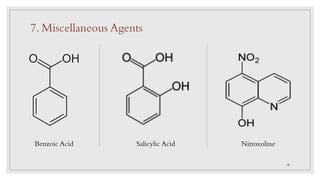
Benzoic Acid Salicylic Acid Nitroxoline
7. Miscellaneous Agents
19
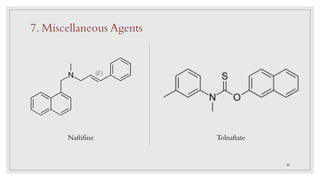
Naftifine Tolnaftate
7. Miscellaneous Agents
20
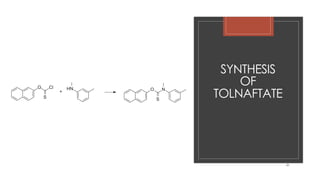
SYNTHESIS
OF
TOLNAFTATE
21
THANK YOU

Anti-fungal Agents

  • 1.
    Antifungal Agents Prepared by: Ms.Navdha Soni Asst. Professor L J Institute of Pharmacy
  • 2.
    Introduction § Fungi areEukaryotic cells.They possess mitochondria, nuclei & cell membranes. § They have rigid cell walls containing chitin as well as polysaccharides, and a cell membrane composed of ergosterol. § While bacterial cells are prokaryotic. So, antibacterial agents can exhibit Selective toxicity. In contrast, similarity between fungal & mammalian cells makes Antifungal drugs nonselective. § Thus,Antifungal drugs are in general more toxic than antibacterial agents. § Depending upon some basic differences, fungi may be classified as a. Phycomycetes (algae like), b. Ascomycetes (sac like), c. Basidiomycetes (mushrooms) & d. Dueteromycetes 2
  • 3.
    § Fungi thatcan cause infections live ⎯ In association with humans commensally ⎯ In Environment. § Fungal infections are termed as MYCOSES. § In the UK, the commonest fungal disease is systemic Candidiasis. Overview of fungal infection 3
  • 4.
    Mycoses Cutaneous Subcutaneos Systemic mycosesdue to opportunistic pathagones Systemic mycoses due to primary pathagones § Cutaneous mycoses: These diseases are restricted to the keratinized layers of the skin, hair, and nails. § Subcutaneous mycoses: It involve the dermis, subcutaneous tissues, muscle.These infections are difficult to treat and may require surgical interventions such as debridement. § Systemic mycoses due to opportunistic pathogens: Systemic mycoses due to opportunistic pathogens are infections of patients with immune deficiencies who would otherwise not be infected. § Systemic mycoses due to primary pathogens: Originate primarily in the lungs and may spread to many organ systems Clinical classifications of Mycoses 4
  • 5.
    BiologicalTargets for AntifungalTherapy §Anti Fungal Therapy depends upon biochemical difference between fungal and mammalian cell. § On cellular level fungal cell have cell wall where as mammal cell doesn’t have cell wall so fungal cell is the target for those chemicals which inhibits cell wall synthesis. § Cell membrane of fungal cell contain different sterols which are essential for structure of cell membrane. § Other target include inhibition of DNA biosynthesis , disruption of mycotic spindle and interference of metabolism. 5
  • 6.
    § Polyenes (Mostlyantibiotics) § Azoles ⎯ Triazoles ⎯ Imidazoles § Fluorinated Pyrimidines § Natural Products § Chitin Synthetase Inhibitors § Peptide/Proteins § Miscellaneous Agents Classification of Antifungal Agents 6
  • 7.
  • 8.
    § Several amphotericinB molecules bind to ergosterol in the plasma membranes of sensitive fungal cells. § There, they form pores (channels) that require hydrophobic interactions between the lipophilic segment of the polyene antibiotic and the sterol. The pores disrupt membrane function, allowing electrolytes (particularly potassium) and small molecules to leak from the cell, resulting in cell death. § Effective against various fungal infection like aspergillosis, blastomycosis and candida infection. Mechanism of Action of Amphotericin B 8
  • 9.
  • 10.
    § Fluconazole isa fluorine-substituted, bis-triazole antifungal agent. Its mechanism of action, like that of other azoles, involves interruption of the conversion of lanosterol to ergosterol via binding to fungal cytochrome P-450 and subsequent disruption of fungal membranes. § Activity against Aspergillus spp., Blastomyces dermatitidis, Candida spp., Coccidioides immitis, Cryptococcus neoformans, Histoplasma capsulatum, and Paracoccidioides brasiliensis has been demonstrated in several animal models. Ergosterol LanosterolFluconazole Mechanism of Action of Fluconazole 10
  • 11.
  • 12.
  • 13.
    Butoconazole Oxiconazole § Imidazole derivativesact by damaging the fungal cell membrane. § They enhance the membrane permeability by inhibiting the synthesis of ergosterol which is primary cellular sterol of fungi. § They are effective against superficial and systemic infection. 2.Azoles 2.2 Imidazole: 13
  • 14.
  • 15.
    Flucytosine § The activemetabolite is further converted to 5-fluro-2’-deoxyuridylic acid which interrupts the fungal DNA synthesis by inhibiting thymidylate synthetase enzyme. § Since, mammalian cells do not contain cytosine deaminase, their function is not affected by Flucytosine. § Besides this, it is also suspected to interfere in protein synthesis. 3. Fluorinated Pyrimidines 15
  • 16.
    Griseofulvin 4. Natural product §It is only fungistatic, and it causes a number of significant drug interactions. § Griseofulvin accumulates in newly synthesized, keratin-containing tissue, where it causes disruption of the mitotic spindle and inhibition of fungal mitosis. 16
  • 17.
    Nikkomycin § Nikkomycin isfound to be a potent growth inhibitor of Candida albicans through competitive inhibition of chitin synthase. § The activity of the peptide-nucleoside drug has been antagonized by both peptone and defined peptides. Transported dipeptides are effective antagonists while transported oligopeptides were not. 5. Chitin synthetase Inhibitor 17
  • 18.
    Cispentacin § Cispentacin didnot inhibit amino acid biosynthesis in vivo but did elevate levels of several amino acids possibly by interfering with self-regulatory mechanisms. § It is effective against Candida albicans 6. Peptide (Protein) 18 H2N OHO
  • 19.
    Benzoic Acid SalicylicAcid Nitroxoline 7. Miscellaneous Agents 19
  • 20.
  • 21.
  • 22.