Course “Fundamentals of Structural Dynamics”
An-Najah National University
April 19 - April 23, 2013
Lecturer: Dr. Alessandro Dazio, UME School
A. Dazio, April 19, 2013 Page 1/2
Fundamentals of Structural Dynamics
1 Course description
Aim of the course is that students develop a “feeling for dynamic problems” and acquire the theoretical
background and the tools to understand and to solve important problems relevant to the linear and, in
part, to the nonlinear dynamic behaviour of structures, especially under seismic excitation.
The course will start with the analysis of single-degree-of-freedom (SDoF) systems by discussing: (i)
Modelling, (ii) equations of motion, (iii) free vibrations with and without damping, (iv) harmonic, pe-
riodic and short excitations, (v) Fourier series, (vi) impacts, (vii) linear and nonlinear time history anal-
ysis, and (viii) elastic and inelastic response spectra.
Afterwards, multi-degree-of-freedom (MDoF) systems will be considered and the following topics will
be discussed: (i) Equation of motion, (ii) free vibrations, (iii) modal analysis, (iv) damping, (v) Rayleigh’s
quotient, and (vi) seismic behaviour through response spectrum method and time history analysis.
To supplement the suggested reading, handouts with class notes and calculation spreadsheets with se-
lected analysis cases to self-training purposes will be distributed.
Lecturer: Dr. Alessandro Dazio, UME School
2 Suggested reading
[Cho11] Chopra A., “Dynamics of Structures”, Prentice Hall, Fourth Edition, 2011.
[CP03] Clough R., Penzien J., “Dynamics of Structures”, Second Edition (revised), Computer and
Structures Inc., 2003.
[Hum12] Humar J.L., “Dynamics of Structures”. Third Edition. CRC Press, 2012.
3 Software
In the framework of the course the following software will be used by the lecturer to solve selected ex-
amples:
[Map10] Maplesoft: “Maple 14”. User Manual. 2010
[Mic07] Microsoft: “Excel 2007”. User Manual. 2007
[VN12] Visual Numerics: “PV Wave”. User Manual. 2012
As an alternative to [VN12] and [Map10] it is recommended that students make use of the following
software, or a previous version thereof, to deal with coursework:
[Mat12] MathWorks: “MATLAB 2012”. User Manual. 2012
Course “Fundamentals of Structural Dynamics” April 19 - April 23, 2013
Page 2/2
4 Schedule of classes
Date Time Topic
Day 1
Fri. April 19
2013
09:00 - 10:30 1. Introduction
2. SDoF systems: Equation of motion and modelling
11:00 - 12:30 3. Free vibrations
14:30 - 16:00 Assignment 1
16:30 - 18:00 Assignment 1
Day 2
Sat. April 20
2013
9:00 - 10:30 4. Harmonic excitation
11:00 - 12:30 5. Transfer functions
14:30 - 16:00 6. Forced vibrations (Part 1)
16:30 - 18:00 6. Forced vibrations (Part 2)
Day 3
Sun. April 21
2013
09:00 - 10:30 7. Seismic excitation (Part 1)
11:00 - 12:30 7. Seismic excitation (Part 2)
14:30 - 16:00 Assignment 2
16:30 - 18:00 Assignment 2
Day 4
Mon. April 22
2013
9:00 - 10:30 8. MDoF systems: Equation of motion
11:00 - 12:30 9. Free vibrations
14:30 - 16:00 10. Damping
11. Forced vibrations
16:30 - 18:00 11. Forced vibrations
Day 5
Tue. April 23
2013
09:00 - 10:30 12. Seismic excitation (Part 1)
11:00 - 12:30 12. Seismic excitation (Part 2)
14:30 - 16:00 Assignment 3
16:30 - 18:00 Assignment 3
Course “Fundamentals of Structural Dynamics” An-Najah 2013
Table of Contents Pagei
Table of Contents
Table of Contents......................................................................i
1 Introduction
1.1 Goals of the course.............................................................................. 1-1
1.2 Limitations of the course..................................................................... 1-1
1.3 Topics of the course ............................................................................ 1-2
1.4 References ............................................................................................ 1-3
2 Single Degree of Freedom Systems
2.1 Formulation of the equation of motion............................................... 2-1
2.1.1 Direct formulation......................................................................................... 2-1
2.1.2 Principle of virtual work............................................................................... 2-3
2.1.3 Energy Formulation...................................................................................... 2-3
2.2 Example “Inverted Pendulum”............................................................ 2-4
2.3 Modelling............................................................................................. 2-10
2.3.1 Structures with concentrated mass.......................................................... 2-10
2.3.2 Structures with distributed mass ............................................................. 2-11
2.3.3 Damping ...................................................................................................... 2-20
3 Free Vibrations
3.1 Undamped free vibrations ................................................................... 3-1
3.1.1 Formulation 1: Amplitude and phase angle............................................... 3-1
3.1.2 Formulation 2: Trigonometric functions .................................................... 3-3
3.1.3 Formulation 3: Exponential Functions....................................................... 3-4
Course “Fundamentals of Structural Dynamics” An-Najah 2013
Table of Contents Pageii
3.2 Damped free vibrations ....................................................................... 3-6
3.2.1 Formulation 3: Exponential Functions....................................................... 3-6
3.2.2 Formulation 1: Amplitude and phase angle............................................. 3-10
3.3 The logarithmic decrement .............................................................. 3-12
3.4 Friction damping ............................................................................... 3-15
4 Response to Harmonic Excitation
4.1 Undamped harmonic vibrations ......................................................... 4-3
4.1.1 Interpretation as a beat................................................................................ 4-5
4.1.2 Resonant excitation (ω = ωn) ....................................................................... 4-8
4.2 Damped harmonic vibration.............................................................. 4-10
4.2.1 Resonant excitation (ω = ωn) ..................................................................... 4-13
5 Transfer Functions
5.1 Force excitation.................................................................................... 5-1
5.1.1 Comments on the amplification factor V.................................................... 5-4
5.1.2 Steady-state displacement quantities ........................................................ 5-8
5.1.3 Derivating properties of SDoF systems from harmonic vibrations....... 5-10
5.2 Force transmission (vibration isolation) ......................................... 5-12
5.3 Base excitation (vibration isolation)................................................. 5-15
5.3.1 Displacement excitation ........................................................................... 5-15
5.3.2 Acceleration excitation ............................................................................. 5-17
5.3.3 Example transmissibility by base excitation .......................................... 5-20
5.4 Summary Transfer Functions ........................................................... 5-26
6 Forced Vibrations
6.1 Periodic excitation .............................................................................. 6-1
6.1.1 Steady state response due to periodic excitation..................................... 6-4
Course “Fundamentals of Structural Dynamics” An-Najah 2013
Table of Contents Pageiii
6.1.2 Half-sine ........................................................................................................ 6-5
6.1.3 Example: “Jumping on a reinforced concrete beam”............................... 6-7
6.2 Short excitation .................................................................................. 6-12
6.2.1 Step force.................................................................................................... 6-12
6.2.2 Rectangular pulse force excitation .......................................................... 6-14
6.2.3 Example “blast action” .............................................................................. 6-21
7 Seismic Excitation
7.1 Introduction .......................................................................................... 7-1
7.2 Time-history analysis of linear SDoF systems ................................. 7-3
7.2.1 Newmark’s method (see [New59]) .............................................................. 7-4
7.2.2 Implementation of Newmark’s integration scheme within
the Excel-Table “SDOF_TH.xls”.................................................................. 7-8
7.2.3 Alternative formulation of Newmark’s Method........................................ 7-10
7.3 Time-history analysis of nonlinear SDoF systems ......................... 7-12
7.3.1 Equation of motion of nonlinear SDoF systems ..................................... 7-13
7.3.2 Hysteretic rules........................................................................................... 7-14
7.3.3 Newmark’s method for inelastic systems................................................ 7-18
7.3.4 Example 1: One-storey, one-bay frame ................................................... 7-19
7.3.5 Example 2: A 3-storey RC wall.................................................................. 7-23
7.4 Solution algorithms for nonlinear analysis problems .................... 7-26
7.4.1 General equilibrium condition................................................................. 7-26
7.4.2 Nonlinear static analysis ........................................................................... 7-26
7.4.3 The Newton-Raphson Algorithm............................................................... 7-28
7.4.4 Nonlinear dynamic analyses ..................................................................... 7-35
7.4.5 Comments on the solution algorithms for
nonlinear analysis problems..................................................................... 7-38
7.4.6 Simplified iteration procedure for SDoF systems with
idealised rule-based force-deformation relationships............................ 7-41
Course “Fundamentals of Structural Dynamics” An-Najah 2013
Table of Contents Pageiv
7.5 Elastic response spectra ................................................................... 7-42
7.5.1 Computation of response spectra ............................................................ 7-42
7.5.2 Pseudo response quantities...................................................................... 7-45
7.5.3 Properties of linear response spectra ..................................................... 7-49
7.5.4 Newmark’s elastic design spectra ([Cho11]) ........................................... 7-50
7.5.5 Elastic design spectra in ADRS-format (e.g. [Faj99])
(Acceleration-Displacement-Response Spectra) .................................... 7-56
7.6 Strength and Ductility ........................................................................ 7-58
7.6.1 Illustrative example .................................................................................... 7-58
7.6.2 “Seismic behaviour equation” .................................................................. 7-61
7.6.3 Inelastic behaviour of a RC wall during an earthquake ........................ 7-63
7.6.4 Static-cyclic behaviour of a RC wall ........................................................ 7-64
7.6.5 General definition of ductility ................................................................... 7-66
7.6.6 Types of ductilities .................................................................................... 7-67
7.7 Inelastic response spectra ............................................................... 7-68
7.7.1 Inelastic design spectra............................................................................. 7-71
7.7.2 Determining the response of an inelastic SDOF system
by means of inelastic design spectra in ADRS-format........................... 7-80
7.7.3 Inelastic design spectra: An important note............................................ 7-87
7.7.4 Behaviour factor q according to SIA 261 ................................................. 7-88
7.8 Linear equivalent SDOF system (SDOFe) ....................................... 7-89
7.8.1 Elastic design spectra for high damping values..................................... 7-99
7.8.2 Determining the response of inelastic SDOF systems
by means of a linear equivalent SDOF system and
elastic design spectra with high damping ............................................. 7-103
7.9 References ........................................................................................ 7-108
8 Multi Degree of Freedom Systems
8.1 Formulation of the equation of motion............................................... 8-1
8.1.1 Equilibrium formulation............................................................................... 8-1
8.1.2 Stiffness formulation ................................................................................... 8-2
Course “Fundamentals of Structural Dynamics” An-Najah 2013
Table of Contents Pagev
8.1.3 Flexibility formulation ................................................................................. 8-3
8.1.4 Principle of virtual work............................................................................... 8-5
8.1.5 Energie formulation...................................................................................... 8-5
8.1.6 “Direct Stiffness Method”............................................................................ 8-6
8.1.7 Change of degrees of freedom.................................................................. 8-11
8.1.8 Systems incorporating rigid elements with distributed mass ............... 8-14
9 Free Vibrations
9.1 Natural vibrations................................................................................. 9-1
9.2 Example: 2-DoF system ...................................................................... 9-4
9.2.1 Eigenvalues ................................................................................................ 9-4
9.2.2 Fundamental mode of vibration.................................................................. 9-5
9.2.3 Higher modes of vibration........................................................................... 9-7
9.2.4 Free vibrations of the 2-DoF system .......................................................... 9-8
9.3 Modal matrix and Spectral matrix..................................................... 9-12
9.4 Properties of the eigenvectors.......................................................... 9-13
9.4.1 Orthogonality of eigenvectors .................................................................. 9-13
9.4.2 Linear independence of the eigenvectors................................................ 9-16
9.5 Decoupling of the equation of motion.............................................. 9-17
9.6 Free vibration response..................................................................... 9-22
9.6.1 Systems without damping......................................................................... 9-22
9.6.2 Classically damped systems..................................................................... 9-24
10Damping
10.1Free vibrations with damping ........................................................... 10-1
10.2Example .............................................................................................. 10-2
10.2.1 Non-classical damping ............................................................................ 10-3
10.2.2 Classical damping.................................................................................... 10-4
Course “Fundamentals of Structural Dynamics” An-Najah 2013
Table of Contents Pagevi
10.3Classical damping matrices .............................................................. 10-5
10.3.1 Mass proportional damping (MpD) ......................................................... 10-5
10.3.2 Stiffness proportional damping (SpD).................................................... 10-5
10.3.3 Rayleigh damping..................................................................................... 10-6
10.3.4 Example....................................................................................................... 10-7
11Forced Vibrations
11.1Forced vibrations without damping ................................................. 11-1
11.1.1 Introduction ................................................................................................ 11-1
11.1.2 Example 1: 2-DoF system.......................................................................... 11-3
11.1.3 Example 2: RC beam with Tuned Mass Damper (TMD) without damping...
11-7
11.2Forced vibrations with damping ..................................................... 11-13
11.2.1 Introduction .............................................................................................. 11-13
11.3Modal analysis: A summary ............................................................ 11-15
12Seismic Excitation
12.1Equation of motion............................................................................. 12-1
12.1.1 Introduction................................................................................................. 12-1
12.1.2 Synchronous Ground motion.................................................................... 12-3
12.1.3 Multiple support ground motion ............................................................... 12-8
12.2Time-history of the response of elastic systems .......................... 12-18
12.3Response spectrum method ........................................................... 12-23
12.3.1 Definition and characteristics ................................................................. 12-23
12.3.2 Step-by-step procedure ......................................................................... 12-27
12.4Practical application of the response spectrum method
to a 2-DoF system ............................................................................ 12-29
12.4.1 Dynamic properties ................................................................................. 12-29
12.4.2 Free vibrations.......................................................................................... 12-31
Course “Fundamentals of Structural Dynamics” An-Najah 2013
Table of Contents Pagevii
12.4.3 Equation of motion in modal coordinates.............................................. 12-38
12.4.4 Response spectrum method ................................................................... 12-41
12.4.5 Response spectrum method vs. time-history analysis ........................ 12-50
13Vibration Problems in Structures
13.1Introduction ........................................................................................ 13-1
13.1.1 Dynamic action........................................................................................... 13-2
13.1.2 References .................................................................................................. 13-3
13.2Vibration limitation............................................................................. 13-4
13.2.1 Verification strategies................................................................................ 13-4
13.2.2 Countermeasures....................................................................................... 13-5
13.2.3 Calculation methods .................................................................................. 13-6
13.3People induced vibrations................................................................. 13-8
13.3.1 Excitation forces......................................................................................... 13-8
13.3.2 Example: Jumping on an RC beam....................................................... 13-15
13.3.3 Footbridges............................................................................................... 13-18
13.3.4 Floors in residential and office buildings .............................................. 13-26
13.3.5 Gyms and dance halls.............................................................................. 13-29
13.3.6 Concert halls, stands and diving platforms........................................... 13-30
13.4Machinery induced vibrations......................................................... 13-30
13.5Wind induced vibrations.................................................................. 13-31
13.5.1 Possible effects ........................................................................................ 13-31
13.6Tuned Mass Dampers (TMD) ........................................................... 13-34
13.6.1 Introduction............................................................................................... 13-34
13.6.2 2-DoF system ........................................................................................... 13-35
13.6.3 Optimum TMD parameters....................................................................... 13-39
13.6.4 Important remarks on TMD...................................................................... 13-39
Course “Fundamentals of Structural Dynamics” An-Najah 2013
Table of Contents Pageviii
14Pedestrian Footbridge with TMD
14.1Test unit and instrumentation........................................................... 14-1
14.2Parameters.......................................................................................... 14-4
14.2.1 Footbridge (Computed, without TMD)...................................................... 14-4
14.2.2 Tuned Mass Damper (Computed) ............................................................. 14-4
14.3Test programme ................................................................................. 14-5
14.4Free decay test with locked TMD...................................................... 14-6
14.5Sandbag test....................................................................................... 14-8
14.5.1 Locked TMD, Excitation at midspan ....................................................... 14-9
14.5.2 Locked TMD, Excitation at quarter-point of the span .......................... 14-12
14.5.3 Free TMD: Excitation at midspan .......................................................... 14-15
14.6One person walking with 3 Hz......................................................... 14-17
14.7One person walking with 2 Hz......................................................... 14-20
14.7.1 Locked TMD (Measured).......................................................................... 14-20
14.7.2 Locked TMD (ABAQUS-Simulation) ...................................................... 14-22
14.7.3 Free TMD .................................................................................................. 14-24
14.7.4 Remarks about “One person walking with 2 Hz” .................................. 14-25
14.8Group walking with 2 Hz.................................................................. 14-26
14.8.1 Locked TMD ............................................................................................ 14-29
14.8.2 Free TMD ................................................................................................. 14-30
14.9One person jumping with 2 Hz........................................................ 14-31
14.9.1 Locked TMD .............................................................................................. 14-31
14.9.2 Free TMD ................................................................................................. 14-33
14.9.3 Remarks about “One person jumping with 2 Hz” ................................. 14-34
Course “Fundamentals of Structural Dynamics” An-Najah 2013
1 Introduction Page1-1
1 Introduction
1.1 Goals of the course
• Presentation of the theoretical basis and of the relevant tools;
• General understanding of phenomena related to structural dy-
namics;
• Focus on earthquake engineering;
• Development of a “Dynamic Feeling”;
• Detection of frequent dynamic problems and application of ap-
propriate solutions.
1.2 Limitations of the course
• Only an introduction to the broadly developed field of structural
dynamics (due to time constraints);
• Only deterministic excitation;
• No soil-dynamics and no dynamic soil-structure interaction will
be treated (this is the topic of another course);
• Numerical methods of structural dynamics are treated only
partially (No FE analysis. This is also the topic of another
course);
• Recommendation of further readings to solve more advanced
problems.
Course “Fundamentals of Structural Dynamics” An-Najah 2013
1 Introduction Page1-2
1.3 Topics of the course
1) Systems with one degree of freedom
- Modelling and equation of motion
- Free vibrations with and without damping
- Harmonic excitation
2) Forced oscillations
- Periodic excitation, Fourier series, short excitation
- Linear and nonlinear time history-analysis
- Elastic and inelastic response spectra
3) Systems with many degree of freedom
- Modelling and equation of motion
- Modal analysis, consideration of damping
- Forced oscillations,
- Seismic response through response spectrum method and
time-history analysis
4) Continuous systems
- Generalised Systems
5) Measures against vibrations
- Criteria, frequency tuning, vibration limitation
Course “Fundamentals of Structural Dynamics” An-Najah 2013
1 Introduction Page1-3
1.4 References
Theory
[Bat96] Bathe KJ: “Finite Element Procedures”. Prentice Hall, Upper
Saddle River, 1996.
[CF06] Christopoulos C, Filiatrault A: "Principles of Passive Supple-
mental Damping and Seismic Isolation". ISBN 88-7358-037-
8. IUSSPress, 2006.
[Cho11] Chopra AK: “Dynamics of Structures”. Fourth Edition.
Prentice Hall, 2011.
[CP03] Clough R, Penzien J: “Dynamics of Structures”. Second Edi-
tion (Revised). Computer and Structures, 2003.
(http://www.csiberkeley.com)
[Den85] Den Hartog JP: “Mechanical Vibrations”. Reprint of the fourth
edition (1956). Dover Publications, 1985.
[Hum12] Humar JL: “Dynamics of Structures”. Third Edition. CRC
Press, 2012.
[Inm01] Inman D: “Engineering Vibration”. Prentice Hall, 2001.
[Prz85] Przemieniecki JS: “Theory of Matrix Structural Analysis”. Do-
ver Publications, New York 1985.
[WTY90] Weawer W, Timoshenko SP, Young DH: “Vibration problems
in Engineering”. Fifth Edition. John Wiley & Sons, 1990.
Practical cases (Vibration problems)
[Bac+97] Bachmann H et al.: “Vibration Problems in Structures”.
Birkhäuser Verlag 1997.
Course “Fundamentals of Structural Dynamics” An-Najah 2013
1 Introduction Page1-4
Blank page
Course “Fundamentals of Structural Dynamics” An-Najah 2013
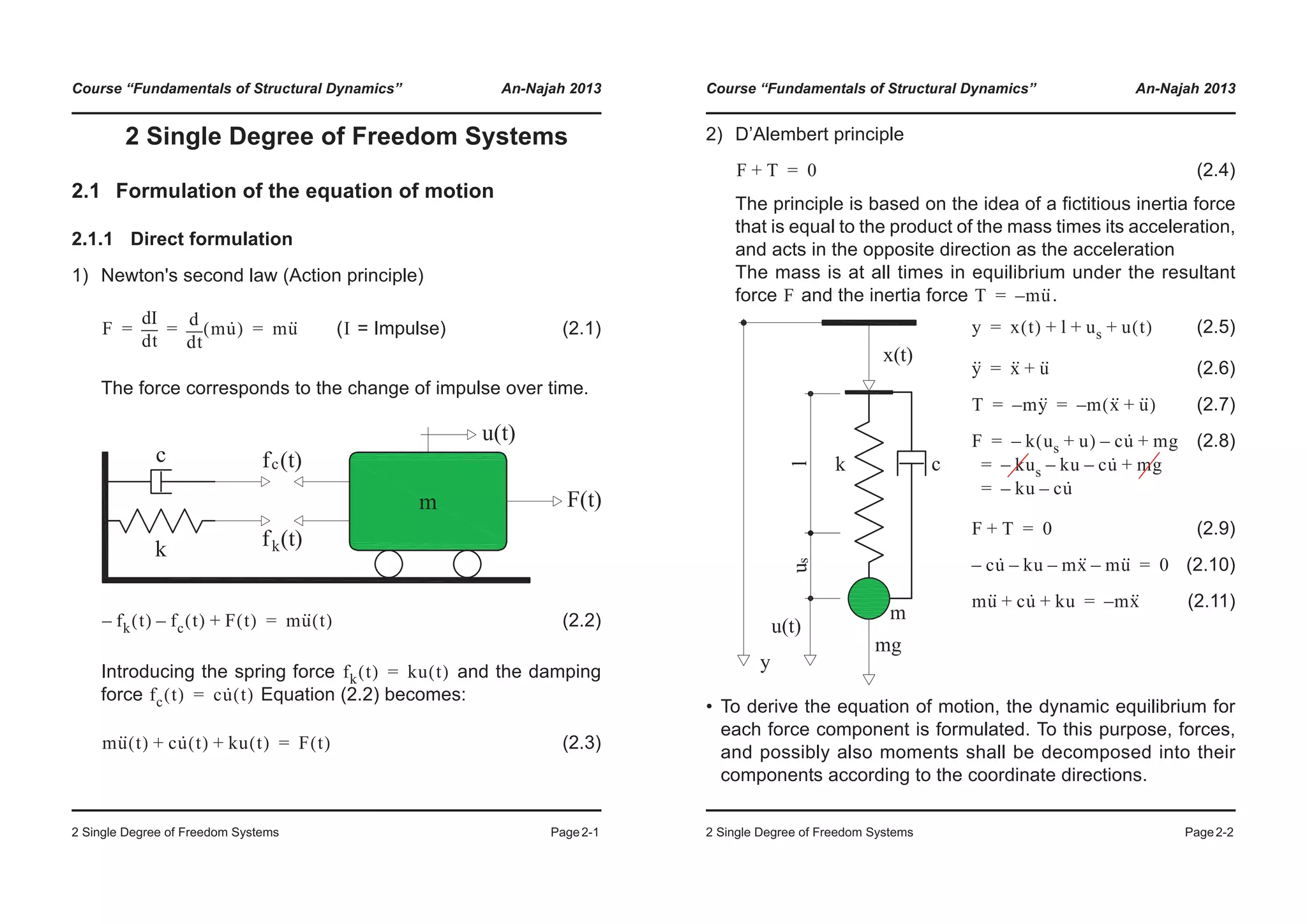
2 Single Degree of Freedom Systems Page2-1
2 Single Degree of Freedom Systems
2.1 Formulation of the equation of motion
2.1.1 Direct formulation
1) Newton's second law (Action principle)
( = Impulse) (2.1)
The force corresponds to the change of impulse over time.
(2.2)
Introducing the spring force and the damping
force Equation (2.2) becomes:
(2.3)
F
td
dI
td
d
mu·( ) mu··= = = I
fk t( )– fc t( )– F t( )+ mu·· t( )=
fk t( ) ku t( )=
fc t( ) cu· t( )=
mu·· t( ) cu· t( ) ku t( )+ + F t( )=
Course “Fundamentals of Structural Dynamics” An-Najah 2013
2 Single Degree of Freedom Systems Page2-2
2) D’Alembert principle
(2.4)
The principle is based on the idea of a fictitious inertia force
that is equal to the product of the mass times its acceleration,
and acts in the opposite direction as the acceleration
The mass is at all times in equilibrium under the resultant
force and the inertia force .
• To derive the equation of motion, the dynamic equilibrium for
each force component is formulated. To this purpose, forces,
and possibly also moments shall be decomposed into their
components according to the coordinate directions.
(2.5)
(2.6)
(2.7)
(2.8)
(2.9)
(2.10)
(2.11)
F T+ 0=
F T mu··–=
y x t( ) l us u t( )+ + +=
y·· x·· u··+=
T my··– m x·· u··+( )–= =
F k us u+( )– cu·– mg+
kus– ku– cu·– mg+
ku– cu·–
=
=
=
F T+ 0=
cu·– ku– mx·· mu··–– 0=
mu·· cu· ku+ + mx··–=
Course “Fundamentals of Structural Dynamics” An-Najah 2013
2 Single Degree of Freedom Systems Page2-3
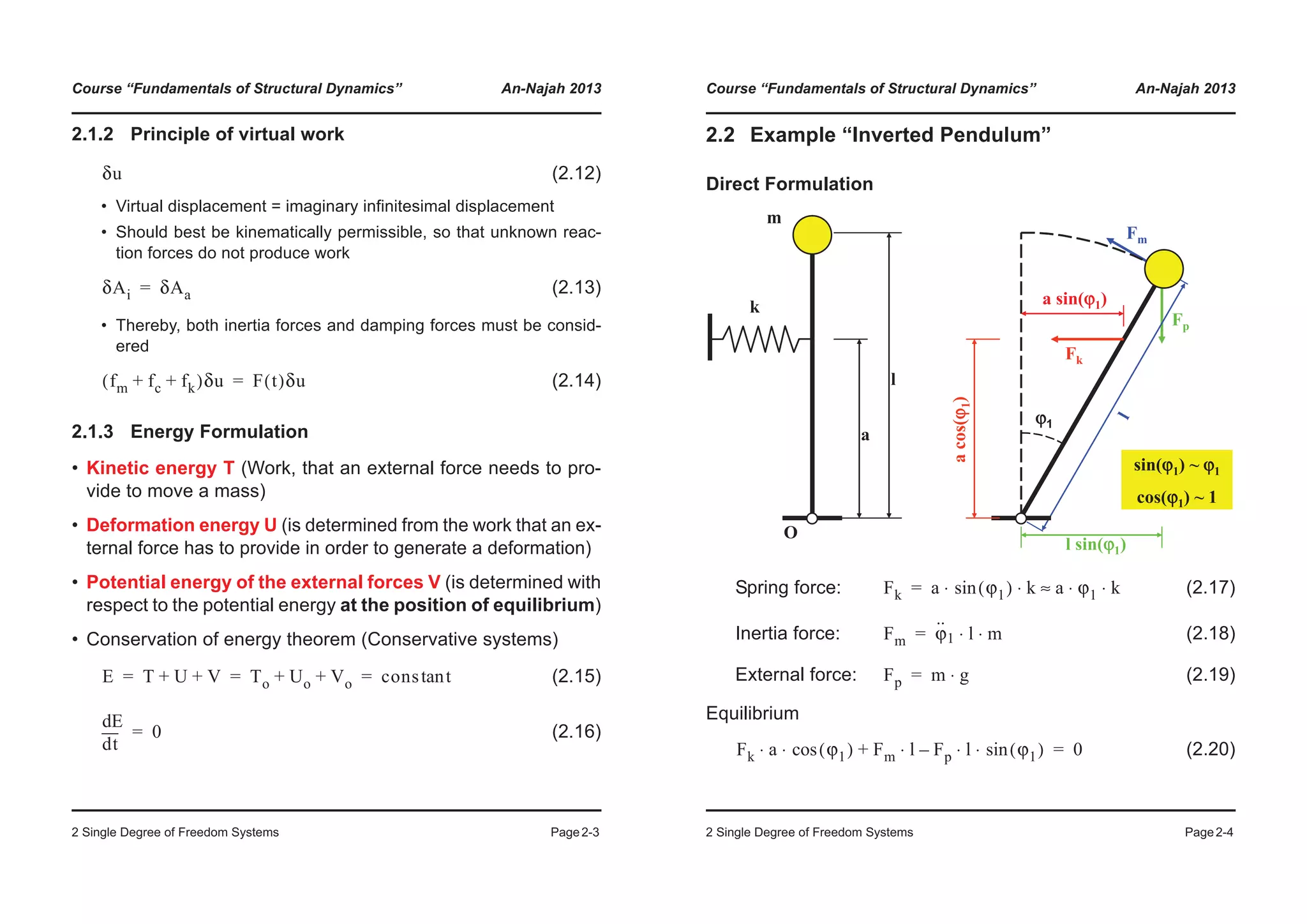
2.1.2 Principle of virtual work
(2.12)
• Virtual displacement = imaginary infinitesimal displacement
• Should best be kinematically permissible, so that unknown reac-
tion forces do not produce work
(2.13)
• Thereby, both inertia forces and damping forces must be consid-
ered
(2.14)
2.1.3 Energy Formulation
• Kinetic energy T (Work, that an external force needs to pro-
vide to move a mass)
• Deformation energy U (is determined from the work that an ex-
ternal force has to provide in order to generate a deformation)
• Potential energy of the external forces V (is determined with
respect to the potential energy at the position of equilibrium)
• Conservation of energy theorem (Conservative systems)
(2.15)
(2.16)
δu
δAi δAa=
fm fc fk+ +( )δu F t( )δu=
E T U V+ + To Uo Vo+ + cons ttan= = =
td
dE
0=
Course “Fundamentals of Structural Dynamics” An-Najah 2013
2 Single Degree of Freedom Systems Page2-4
2.2 Example “Inverted Pendulum”
Direct Formulation
Spring force: (2.17)
Inertia force: (2.18)
External force: (2.19)
Equilibrium
(2.20)
k
m
O
a
l
Fp
l sin(ϕϕ1)
Fm
l
sin(ϕ1) ~ ϕ1
cos(ϕ1) ~ 1
ϕ1
Fk
acos(ϕ1)
a sin(ϕ1)
Fk a ϕ1( )sin k a ϕ1 k⋅ ⋅≈⋅ ⋅=
Fm ϕ
··
1 l m⋅ ⋅=
Fp m g⋅=
Fk a ϕ1( )cos⋅ ⋅ Fm l Fp l ϕ1( )sin⋅ ⋅–⋅+ 0=
Course “Fundamentals of Structural Dynamics” An-Najah 2013
2 Single Degree of Freedom Systems Page2-5
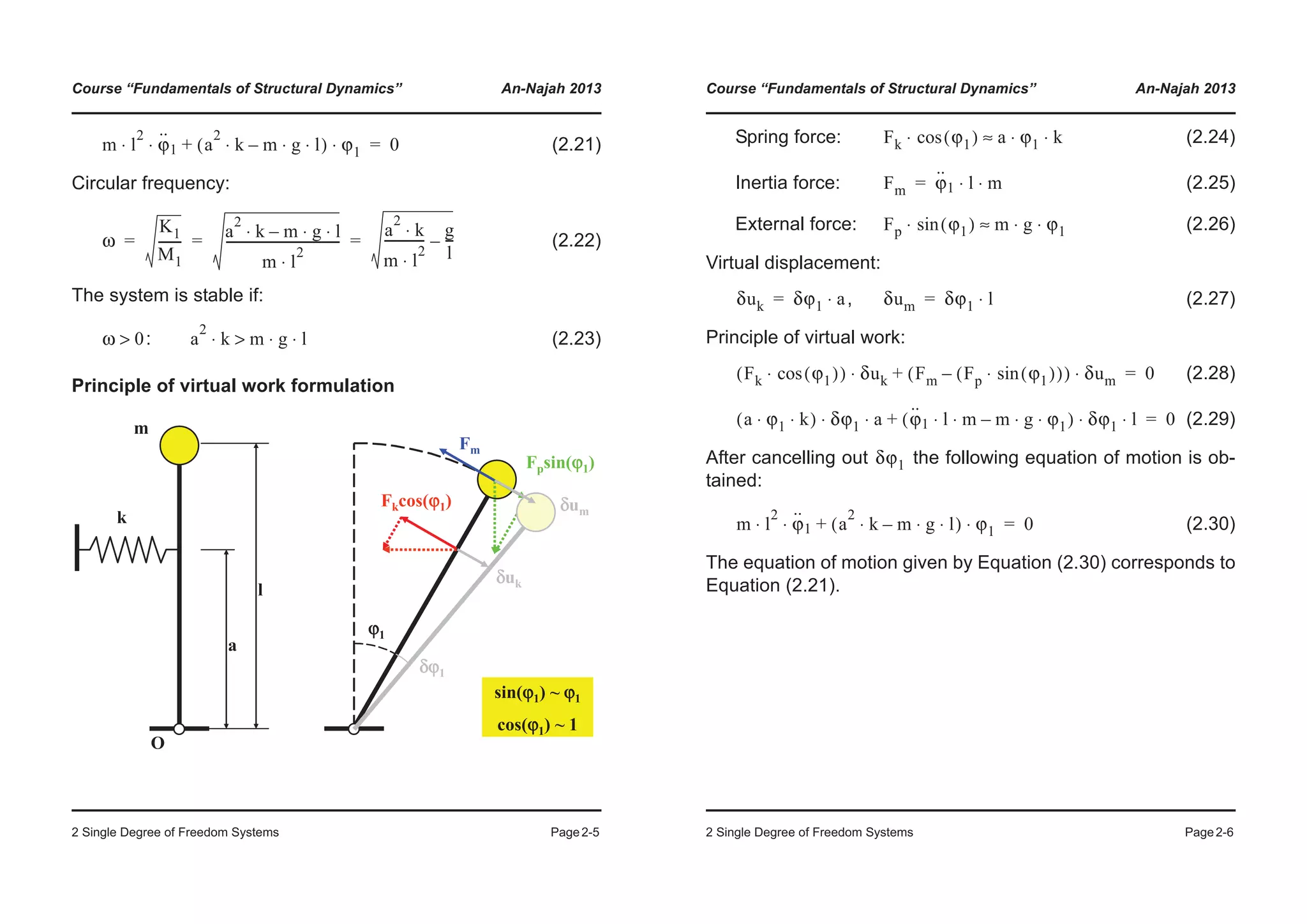
(2.21)
Circular frequency:
(2.22)
The system is stable if:
: (2.23)
Principle of virtual work formulation
m l
2
ϕ
··
1⋅ ⋅ a
2
k m g l⋅ ⋅–⋅( ) ϕ1⋅+ 0=
ω
K1
M1
-------
a
2
k m g l⋅ ⋅–⋅
m l
2
⋅
-------------------------------------
a
2
k⋅
m l
2
⋅
------------- g
l
---–= = =
ω 0> a
2
k⋅ m g l⋅ ⋅>
k
m
O
a
l
ϕϕ1
Fkcos(ϕ1)
Fm
Fpsin(ϕ1)
δϕ1
δuk
δum
sin(ϕ1) ~ ϕ1
cos(ϕ1) ~ 1
Course “Fundamentals of Structural Dynamics” An-Najah 2013
2 Single Degree of Freedom Systems Page2-6
Spring force: (2.24)
Inertia force: (2.25)
External force: (2.26)
Virtual displacement:
, (2.27)
Principle of virtual work:
(2.28)
(2.29)
After cancelling out the following equation of motion is ob-
tained:
(2.30)
The equation of motion given by Equation (2.30) corresponds to
Equation (2.21).
Fk ϕ1( )cos⋅ a ϕ1 k⋅ ⋅≈
Fm ϕ
··
1 l m⋅ ⋅=
Fp ϕ1( )sin⋅ m g ϕ1⋅ ⋅≈
δuk δϕ1 a⋅= δum δϕ1 l⋅=
Fk ϕ1( )cos⋅( ) δuk⋅ Fm Fp ϕ1( )sin⋅( )–( ) δum⋅+ 0=
a ϕ1 k⋅ ⋅( ) δϕ1 a⋅ ⋅ ϕ
··
1 l m⋅ ⋅ m g ϕ1⋅ ⋅–( ) δϕ1 l⋅ ⋅+ 0=
δϕ1
m l
2
ϕ
··
1⋅ ⋅ a
2
k m g l⋅ ⋅–⋅( ) ϕ1⋅+ 0=
Course “Fundamentals of Structural Dynamics” An-Najah 2013
2 Single Degree of Freedom Systems Page2-7
Energy Formulation
Spring: (2.31)
Mass: (2.32)
(2.33)
by means of a series development, can be
expressed as:
(2.34)
k
m
O
a
l
ϕϕ1
Edef,k
a sin(ϕ1)
vm
Ekin,m
Epot,p
(1-cos(ϕ1)) l
~
0.5 l ϕ1
2
sin(ϕ1) ~ ϕ1
cos(ϕ1) ~ 1
Edef,k
1
2
--- k a ϕ1( )sin⋅[ ]
2
⋅ ⋅
1
2
--- k a ϕ1⋅( )
2
⋅ ⋅= =
Ekin,m
1
2
--- m vm
2
⋅ ⋅
1
2
--- m ϕ
·
1 l⋅( )
2
⋅ ⋅= =
Epot,p m g⋅( )– 1 ϕ1( )cos–( ) l⋅ ⋅=
ϕ1( )cos
ϕ1( )cos 1
ϕ1
2
2!
------–
ϕ1
4
4!
------ …– 1–( )
k x
2k
2k( )!
-------------⋅ …+ + +=
Course “Fundamentals of Structural Dynamics” An-Najah 2013
2 Single Degree of Freedom Systems Page2-8
for small angles we have:
and (2.35)
and Equation (2.33) becomes:
(2.36)
Energy conservation:
(2.37)
(2.38)
Derivative of the energy with respect to time:
Derivation rule: (2.39)
(2.40)
After cancelling out the velocity :
(2.41)
The equation of motion given by Equation (2.41) corresponds to
Equations (2.21) and (2.30).
ϕ1
ϕ1( )cos 1
ϕ1
2
2
------–=
ϕ1
2
2
------ 1 ϕ1( )cos–=
Epot,p m g 0.5 l ϕ1
2
⋅ ⋅ ⋅ ⋅( )–=
Etot Edef,k Ekin,m Epot,p+ + constant= =
E
1
2
--- m l
2
⋅( ) ϕ
·
1
2
⋅
1
2
--- k a
2
⋅ m g l⋅ ⋅–( ) ϕ1
2
⋅+ constant= =
td
dE
0= g f•( )' g' f•( ) f'⋅=
m l
2
⋅( ) ϕ
·
1 ϕ
··
1⋅ ⋅ k a
2
⋅ m g l⋅ ⋅–( ) ϕ1 ϕ
·
1⋅ ⋅+ 0=
ϕ
·
1
m l
2
ϕ
··
1⋅ ⋅ a
2
k m g l⋅ ⋅–⋅( ) ϕ1⋅+ 0=
Course “Fundamentals of Structural Dynamics” An-Najah 2013
2 Single Degree of Freedom Systems Page2-9
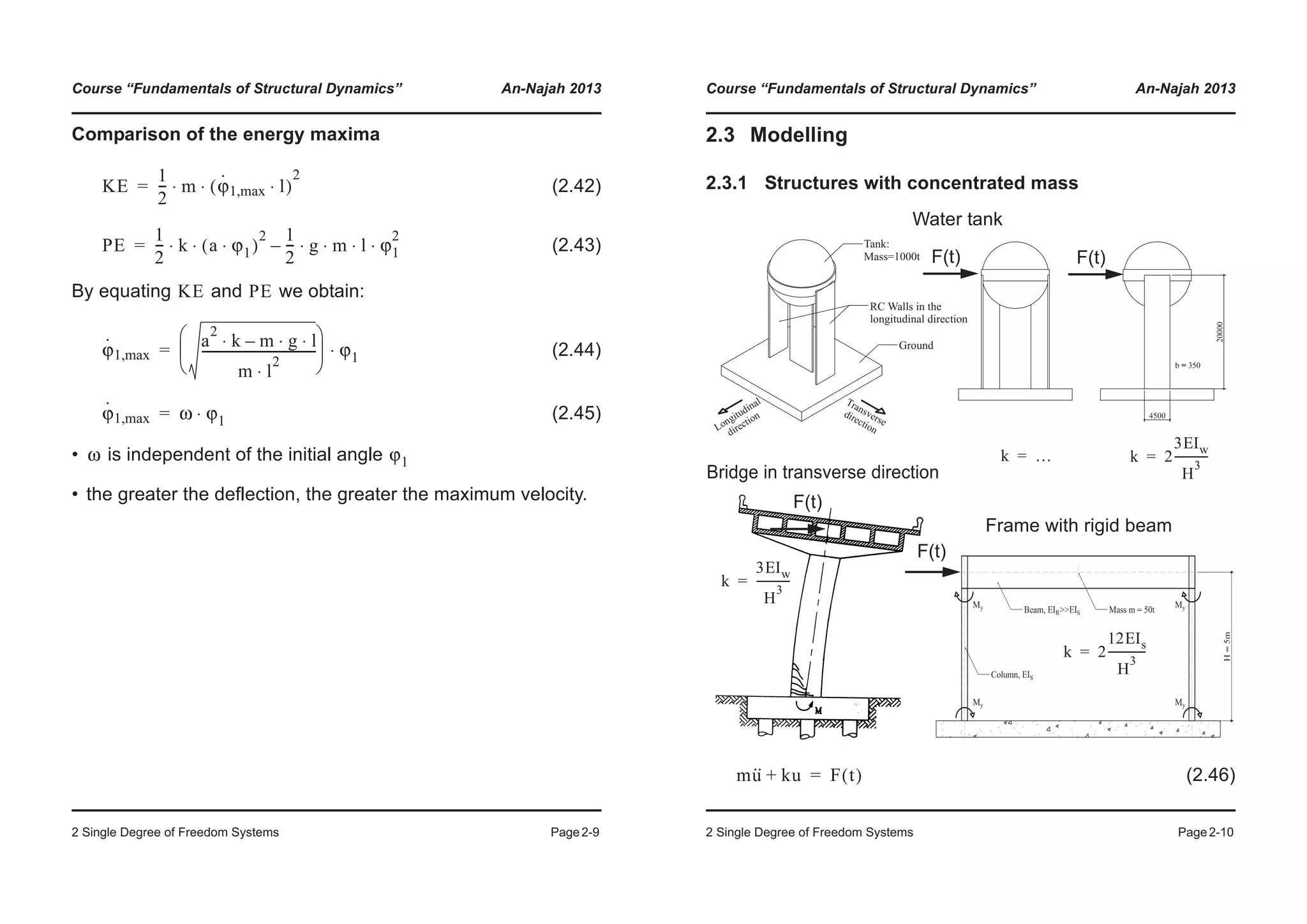
Comparison of the energy maxima
(2.42)
(2.43)
By equating and we obtain:
(2.44)
(2.45)
• is independent of the initial angle
• the greater the deflection, the greater the maximum velocity.
KE
1
2
--- m ϕ
·
1,max l⋅( )
2
⋅ ⋅=
PE
1
2
--- k a ϕ1⋅( )
2
⋅ ⋅
1
2
--- g m l ϕ1
2
⋅ ⋅ ⋅ ⋅–=
KE PE
ϕ
·
1,max
a
2
k m g l⋅ ⋅–⋅
m l
2
⋅
-------------------------------------
© ¹
¨ ¸
§ ·
ϕ1⋅=
ϕ
·
1,max ω ϕ1⋅=
ω ϕ1
Course “Fundamentals of Structural Dynamics” An-Najah 2013
2 Single Degree of Freedom Systems Page2-10
2.3 Modelling
2.3.1 Structures with concentrated mass
(2.46)
Tank:
Mass=1000t
Ground
RC Walls in the
longitudinal direction
Longitudinal
direction
Transverse
direction
Frame with rigid beam
F(t)
Bridge in transverse direction
F(t)
k
3EIw
H
3
------------=
k 2
12EIs
H
3
--------------=
k 2
3EIw
H
3
------------=
Water tank
F(t)F(t)
k …=
mu·· ku+ F t( )=
Course “Fundamentals of Structural Dynamics” An-Najah 2013
2 Single Degree of Freedom Systems Page2-11
2.3.2 Structures with distributed mass
Deformation: (2.47)
External forces:
(2.48)
• Principle of virtual work
(2.49)
(2.50)
where: (2.51)
and (2.52)
u x t,( ) ψ x( )U t( )=
t x t,( ) mu·· x t,( )–=
f x t,( )
δAi δAa=
δAa t δu⋅( ) xd
0
L
³ f δu⋅( ) xd
0
L
³+
mu·· δu⋅( ) xd
0
L
³– f δu⋅( ) xd
0
L
³+
=
=
δAi M δϕ⋅( ) xd
0
L
³=
M EIu''= δϕ δ u''[ ]=
Course “Fundamentals of Structural Dynamics” An-Najah 2013
2 Single Degree of Freedom Systems Page2-12
(2.53)
• Transformations:
and (2.54)
• The virtual displacement is affine to the selected deformation:
and (2.55)
• Using Equations (2.54) and (2.55), the work produced by the
external forces is:
(2.56)
• Using Equations (2.54) and (2.55) the work produced by the
internal forces is:
(2.57)
• Equation (2.49) is valid for all virtual displacements, therefore:
(2.58)
(2.59)
δAi EIu'' δ u''[ ]⋅( ) xd
0
L
³=
u'' ψ''U= u·· ψU··=
δu ψδU= δ u''[ ] ψ''δU=
δAa
δAa mψU·· ψδU⋅( ) xd
0
L
³– f ψδU⋅( ) xd
0
L
³+
δU U·· mψ
2
xd
0
L
³– fψ xd
0
L
³+
=
=
δAi
δAi EIψ''U ψ''δU⋅( ) xd
0
L
³ δU U EI ψ''( )2( ) xd
0
L
³= =
U EI ψ''( )2( ) xd
0
L
³ U·· mψ
2
xd
0
L
³– fψ xd
0
L
³+=
m
*
U·· k
*
U+ F
*
=
Course “Fundamentals of Structural Dynamics” An-Najah 2013
2 Single Degree of Freedom Systems Page2-13
• Circular frequency
(2.60)
-> Rayleigh-Quotient
• Choosing the deformation figure
- The accuracy of the modelling depends on the assumed
deformation figure;
- The best results are obtained when the deformation figure
fulfills all boundary conditions;
- The boundary conditions are automatically satisfied if the
deformation figure corresponds to the deformed shape due
to an external force;
- A possible external force is the weight of the structure act-
ing in the considered direction.
• Properties of the Rayleigh-Quotient
- The estimated natural frequency is always larger than the
exact one (Minimization of the quotient!);
- Useful results can be obtained even if the assumed defor-
mation figure is not very realistic.
ωn
2 k
*
m
*
-------
EI ψ''( )2( ) xd
0
L
³
mψ
2
xd
0
L
³
-------------------------------------= =
Course “Fundamentals of Structural Dynamics” An-Najah 2013
2 Single Degree of Freedom Systems Page2-14
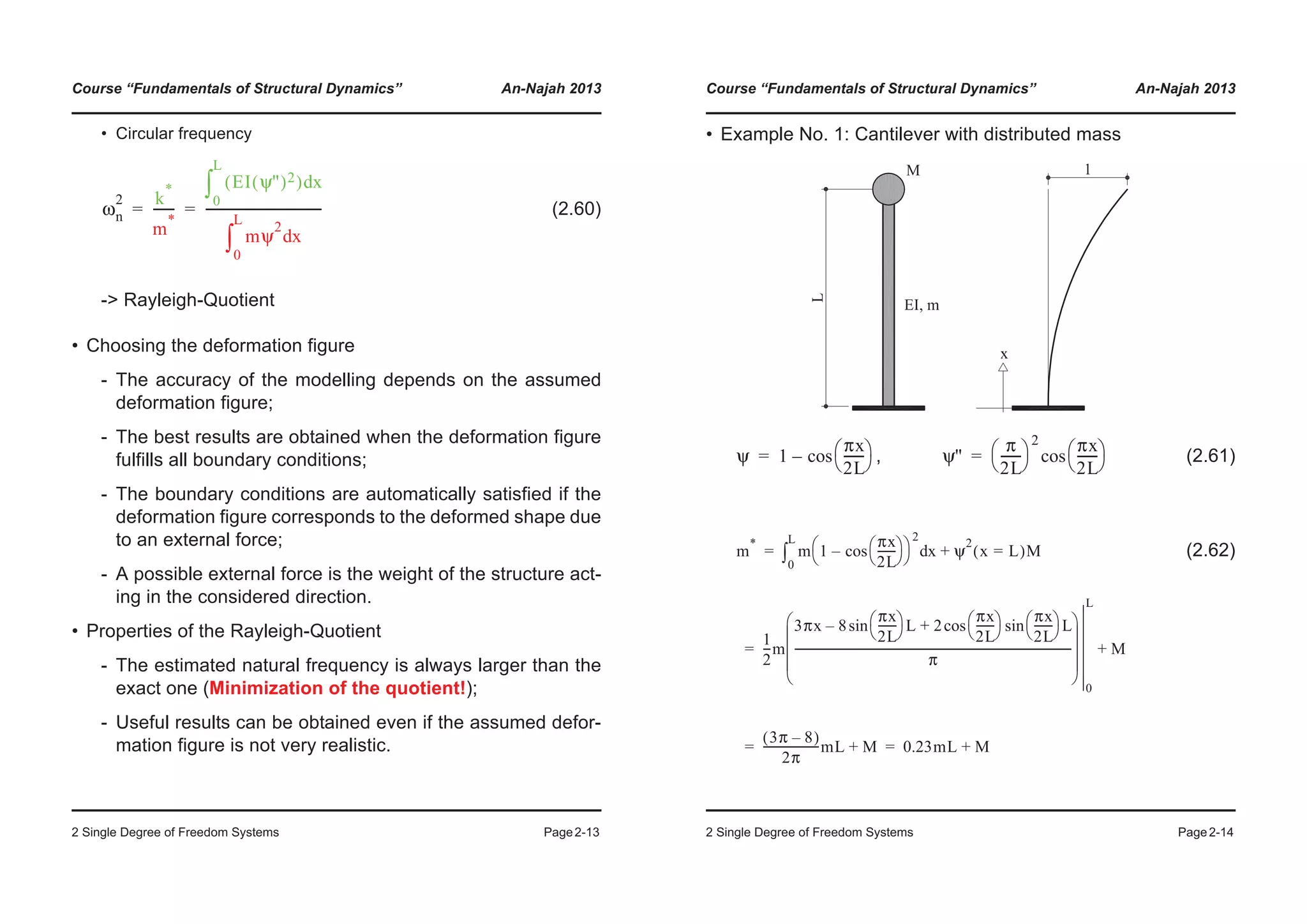
• Example No. 1: Cantilever with distributed mass
, (2.61)
(2.62)
ψ 1
πx
2L
-------
© ¹
§ ·cos–= ψ''
π
2L
-------
© ¹
§ ·
2 πx
2L
-------
© ¹
§ ·cos=
m
*
m 1
πx
2L
-------
© ¹
§ ·cos–
© ¹
§ ·
2
xd
0
L
³ ψ
2
x L=( )M+
1
2
---m
3πx 8
πx
2L
-------
© ¹
§ · Lsin– 2
πx
2L
-------
© ¹
§ · πx
2L
-------
© ¹
§ · Lsincos+
π
----------------------------------------------------------------------------------------------------
© ¹
¨ ¸
¨ ¸
¨ ¸
§ ·
0
L
M+
3π 8–( )
2π
--------------------mL M+ 0.23mL M+
=
=
= =
Course “Fundamentals of Structural Dynamics” An-Najah 2013
2 Single Degree of Freedom Systems Page2-15
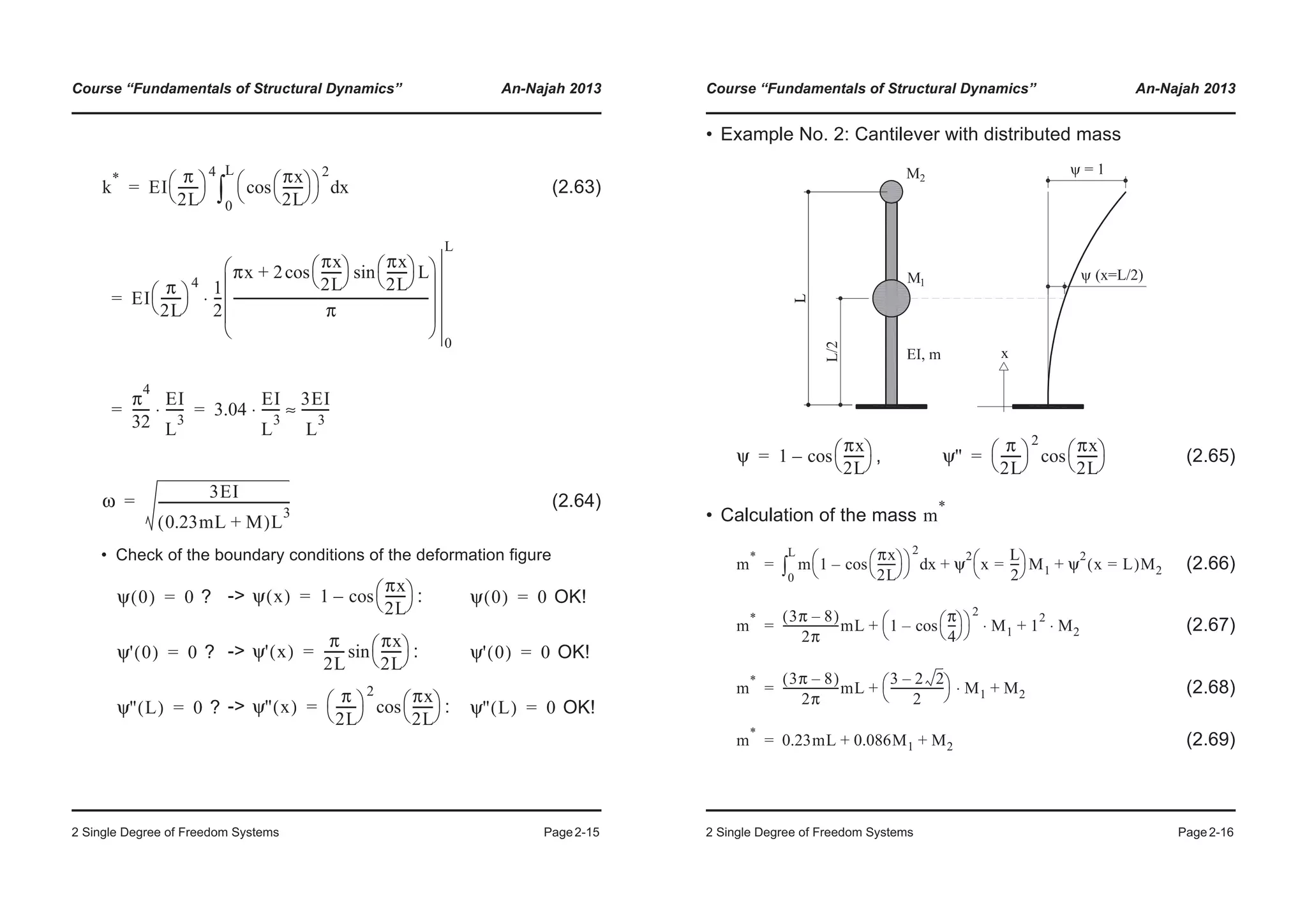
(2.63)
(2.64)
• Check of the boundary conditions of the deformation figure
? -> : OK!
? -> : OK!
? -> : OK!
k
*
EI
π
2L
-------
© ¹
§ ·
4 πx
2L
-------
© ¹
§ ·cos
© ¹
§ ·
2
xd
0
L
³
EI
π
2L
-------
© ¹
§ ·
4 1
2
---
πx 2
πx
2L
-------
© ¹
§ · πx
2L
-------
© ¹
§ · Lsincos+
π
---------------------------------------------------------------
© ¹
¨ ¸
¨ ¸
¨ ¸
§ ·
0
L
⋅
π
4
32
------
EI
L
3
------⋅ 3.04
EI
L
3
------⋅
3EI
L
3
---------≈
=
=
= =
ω
3EI
0.23mL M+( )L
3
------------------------------------------=
ψ 0( ) 0= ψ x( ) 1
πx
2L
-------
© ¹
§ ·cos–= ψ 0( ) 0=
ψ' 0( ) 0= ψ' x( )
π
2L
-------
πx
2L
-------
© ¹
§ ·sin= ψ' 0( ) 0=
ψ'' L( ) 0= ψ'' x( )
π
2L
-------
© ¹
§ ·
2 πx
2L
-------
© ¹
§ ·cos= ψ'' L( ) 0=
Course “Fundamentals of Structural Dynamics” An-Najah 2013
2 Single Degree of Freedom Systems Page2-16
• Example No. 2: Cantilever with distributed mass
, (2.65)
• Calculation of the mass
(2.66)
(2.67)
(2.68)
(2.69)
ψ 1
πx
2L
-------
© ¹
§ ·cos–= ψ''
π
2L
-------
© ¹
§ ·
2 πx
2L
-------
© ¹
§ ·cos=
m
*
m
*
m 1
πx
2L
-------
© ¹
§ ·cos–
© ¹
§ ·
2
xd
0
L
³ ψ
2
x
L
2
---=
© ¹
§ · M1 ψ
2
x L=( )M2+ +=
m
* 3π 8–( )
2π
--------------------mL 1
π
4
---
© ¹
§ ·cos–
© ¹
§ ·
2
M1⋅ 1
2
M2⋅+ +=
m
* 3π 8–( )
2π
--------------------mL
3 2 2–
2
-------------------
© ¹
§ · M1⋅ M2+ +=
m
*
0.23mL 0.086M1 M2+ +=
Course “Fundamentals of Structural Dynamics” An-Najah 2013
2 Single Degree of Freedom Systems Page2-17
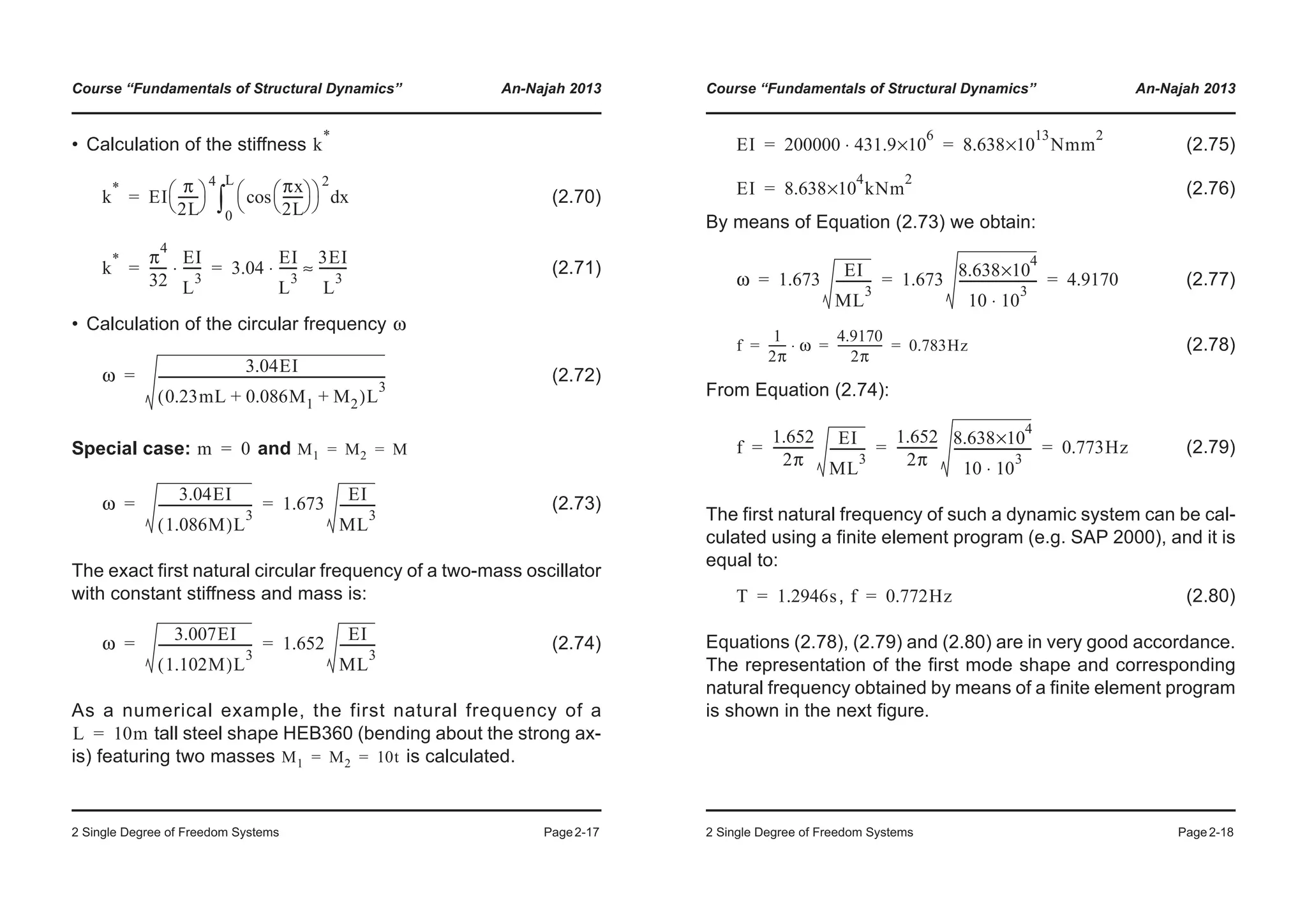
• Calculation of the stiffness
(2.70)
(2.71)
• Calculation of the circular frequency
(2.72)
Special case: and
(2.73)
The exact first natural circular frequency of a two-mass oscillator
with constant stiffness and mass is:
(2.74)
As a numerical example, the first natural frequency of a
tall steel shape HEB360 (bending about the strong ax-
is) featuring two masses is calculated.
k
*
k
*
EI
π
2L
-------
© ¹
§ ·
4 πx
2L
-------
© ¹
§ ·cos
© ¹
§ ·
2
xd
0
L
³=
k
* π
4
32
------
EI
L
3
------⋅ 3.04
EI
L
3
------⋅
3EI
L
3
---------≈= =
ω
ω
3.04EI
0.23mL 0.086M1 M2+ +( )L
3
-------------------------------------------------------------------------=
m 0= M1 M2 M= =
ω
3.04EI
1.086M( )L
3
------------------------------ 1.673
EI
ML
3
-----------= =
ω
3.007EI
1.102M( )L
3
------------------------------ 1.652
EI
ML
3
-----------= =
L 10m=
M1 M2 10t= =
Course “Fundamentals of Structural Dynamics” An-Najah 2013
2 Single Degree of Freedom Systems Page2-18
(2.75)
(2.76)
By means of Equation (2.73) we obtain:
(2.77)
(2.78)
From Equation (2.74):
(2.79)
The first natural frequency of such a dynamic system can be cal-
culated using a finite element program (e.g. SAP 2000), and it is
equal to:
, (2.80)
Equations (2.78), (2.79) and (2.80) are in very good accordance.
The representation of the first mode shape and corresponding
natural frequency obtained by means of a finite element program
is shown in the next figure.
EI 200000 431.9
6
×10⋅ 8.638
13
×10 Nmm
2
= =
EI 8.638
4
×10 kNm
2
=
ω 1.673
EI
ML
3
----------- 1.673
8.638
4
×10
10 10⋅
3
------------------------- 4.9170= = =
f
1
2π
------ ω⋅
4.9170
2π
---------------- 0.783Hz= = =
f
1.652
2π
------------- EI
ML
3
-----------
1.652
2π
------------- 8.638
4
×10
10 10⋅
3
------------------------- 0.773Hz= = =
T 1.2946s= f 0.772Hz=
Course “Fundamentals of Structural Dynamics” An-Najah 2013
2 Single Degree of Freedom Systems Page2-19
SAP2000 v8 - File:HEB_360 - Mode 1 Period 1.2946 seconds - KN-m Units
HEB 360
M = 10t
M = 10t
Course “Fundamentals of Structural Dynamics” An-Najah 2013
2 Single Degree of Freedom Systems Page2-20
2.3.3 Damping
• Types of damping
• Typical values of damping in structures
Material Damping ζ
Reinforced concrete (uncraked)
Reinforced concrete (craked
Reinforced concrete (PT)
Reinforced concrete (partially PT)
Composite components
Steel
0.007 - 0.010
0.010 - 0.040
0.004 - 0.007
0.008 - 0.012
0.002 - 0.003
0.001 - 0.002
Table C.1 from [Bac+97]
Damping
Internal External
Material
Contact areas
within the structure
Hysteretic
(Viscous,
Friction,
Yielding)
Relative
movements
between parts of
the structure
(Bearings, Joints,
etc.)
External contact
(Non-structural
elements, Energy
radiation in the
ground, etc.)
Course “Fundamentals of Structural Dynamics” An-Najah 2013
2 Single Degree of Freedom Systems Page2-21
• Bearings
Source: A. Marioni: “Innovative Anti-seismic Devices for Bridges”.
[SIA03]
Course “Fundamentals of Structural Dynamics” An-Najah 2013
2 Single Degree of Freedom Systems Page2-22
• Dissipators
Source: A. Marioni: “Innovative Anti-seismic Devices for Bridges”.
[SIA03]
Course “Fundamentals of Structural Dynamics” An-Najah 2013
3 Free Vibrations Page3-1
3 Free Vibrations
“A structure undergoes free vibrations when it is brought out of
its static equilibrium, and can then oscillate without any external
dynamic excitation”
3.1 Undamped free vibrations
(3.1)
3.1.1 Formulation 1: Amplitude and phase angle
• Ansatz:
(3.2)
(3.3)
By substituting Equations (3.2) and (3.3) in (3.1):
(3.4)
(3.5)
“Natural circular frequency” (3.6)
mu·· t( ) ku t( )+ 0=
u t( ) A ωnt φ–( )cos=
u·· t( ) A– ωn
2
ωnt φ–( )cos=
A ωn
2
m– k+( ) ωnt φ–( )cos 0=
ωn
2
m– k+ 0=
ωn k m⁄=
Course “Fundamentals of Structural Dynamics” An-Najah 2013
3 Free Vibrations Page3-2
• Relationships
[rad/s]: Angular velocity (3.7)
[1/s], [Hz]: Number of revolutions per time (3.8)
[s]: Time required per revolution (3.9)
• Transformation of the equation of motion
(3.10)
• Determination of the unknowns and :
The static equilibrium is disturbed by the initial displacement
and the initial velocity :
, (3.11)
• Visualization of the solution by means of the Excel file given on
the web page of the course (SD_FV_viscous.xlsx)
ωn k m⁄=
fn
ωn
2π
------=
Tn
2π
ωn
------=
u·· t( ) ωn
2
u t( )+ 0=
A φ
u 0( ) u0= u· 0( ) v0=
A u0
2 v0
ωn
------
© ¹
§ ·
2
+= φtan
v0
u0ωn
------------=
Course “Fundamentals of Structural Dynamics” An-Najah 2013
3 Free Vibrations Page3-3
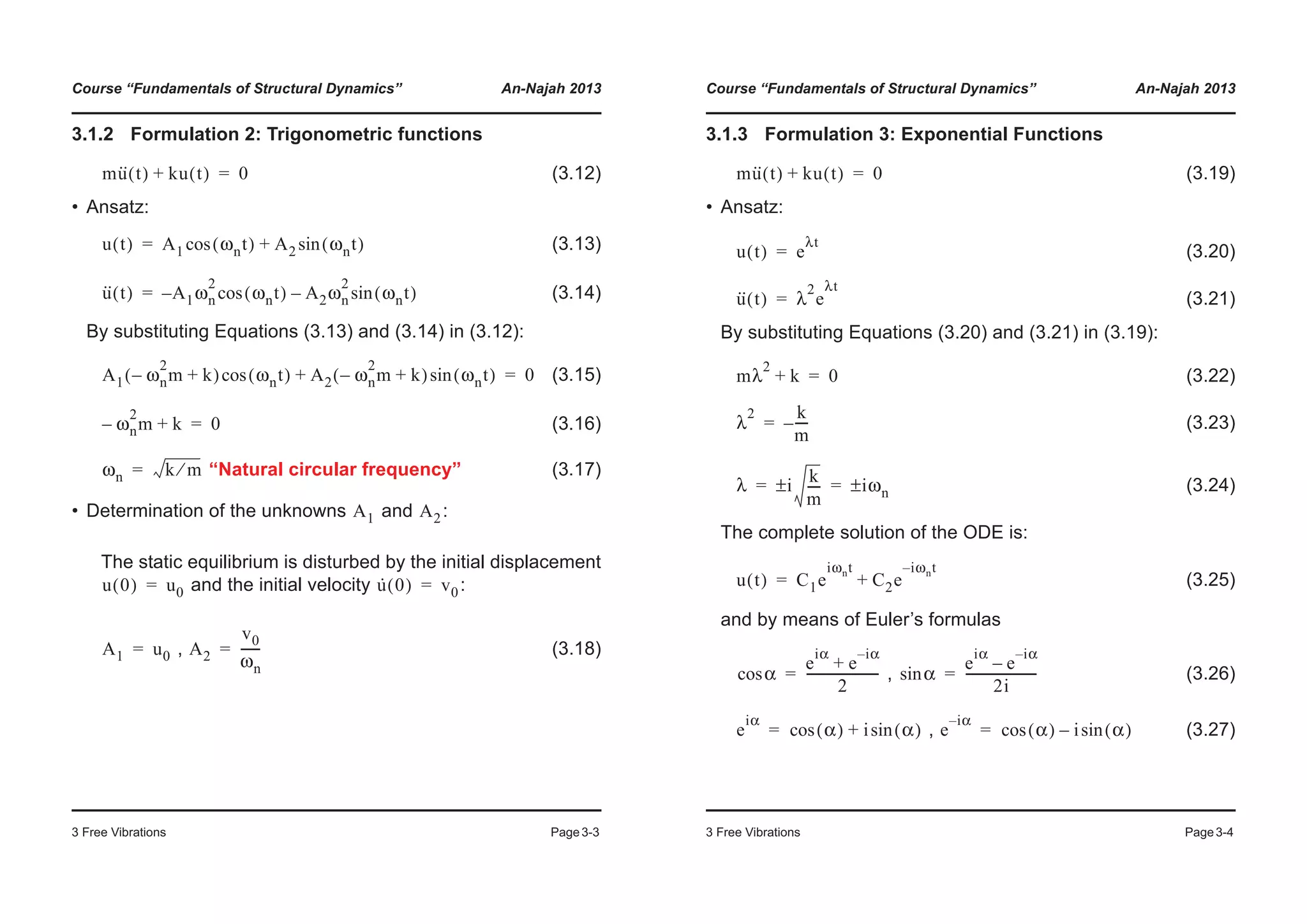
3.1.2 Formulation 2: Trigonometric functions
(3.12)
• Ansatz:
(3.13)
(3.14)
By substituting Equations (3.13) and (3.14) in (3.12):
(3.15)
(3.16)
“Natural circular frequency” (3.17)
• Determination of the unknowns and :
The static equilibrium is disturbed by the initial displacement
and the initial velocity :
, (3.18)
mu·· t( ) ku t( )+ 0=
u t( ) A1 ωnt( )cos A2 ωnt( )sin+=
u·· t( ) A1– ωn
2
ωnt( )cos A2ωn
2
ωnt( )sin–=
A1 ωn
2
m– k+( ) ωnt( )cos A2 ωn
2
m– k+( ) ωnt( )sin+ 0=
ωn
2
m– k+ 0=
ωn k m⁄=
A1 A2
u 0( ) u0= u· 0( ) v0=
A1 u0= A2
v0
ωn
------=
Course “Fundamentals of Structural Dynamics” An-Najah 2013
3 Free Vibrations Page3-4
3.1.3 Formulation 3: Exponential Functions
(3.19)
• Ansatz:
(3.20)
(3.21)
By substituting Equations (3.20) and (3.21) in (3.19):
(3.22)
(3.23)
(3.24)
The complete solution of the ODE is:
(3.25)
and by means of Euler’s formulas
, (3.26)
, (3.27)
mu·· t( ) ku t( )+ 0=
u t( ) e
λt
=
u·· t( ) λ
2
e
λt
=
mλ
2
k+ 0=
λ
2 k
m
----–=
λ i
k
m
----± iωn±= =
u t( ) C1e
iωnt
C2e
i– ωnt
+=
αcos
e
iα
e
i– α
+
2
-----------------------= αsin
e
iα
e
i– α
–
2i
-----------------------=
e
iα
α( )cos i α( )sin+= e
i– α
α( )cos i α( )sin–=
Course “Fundamentals of Structural Dynamics” An-Najah 2013
3 Free Vibrations Page3-5
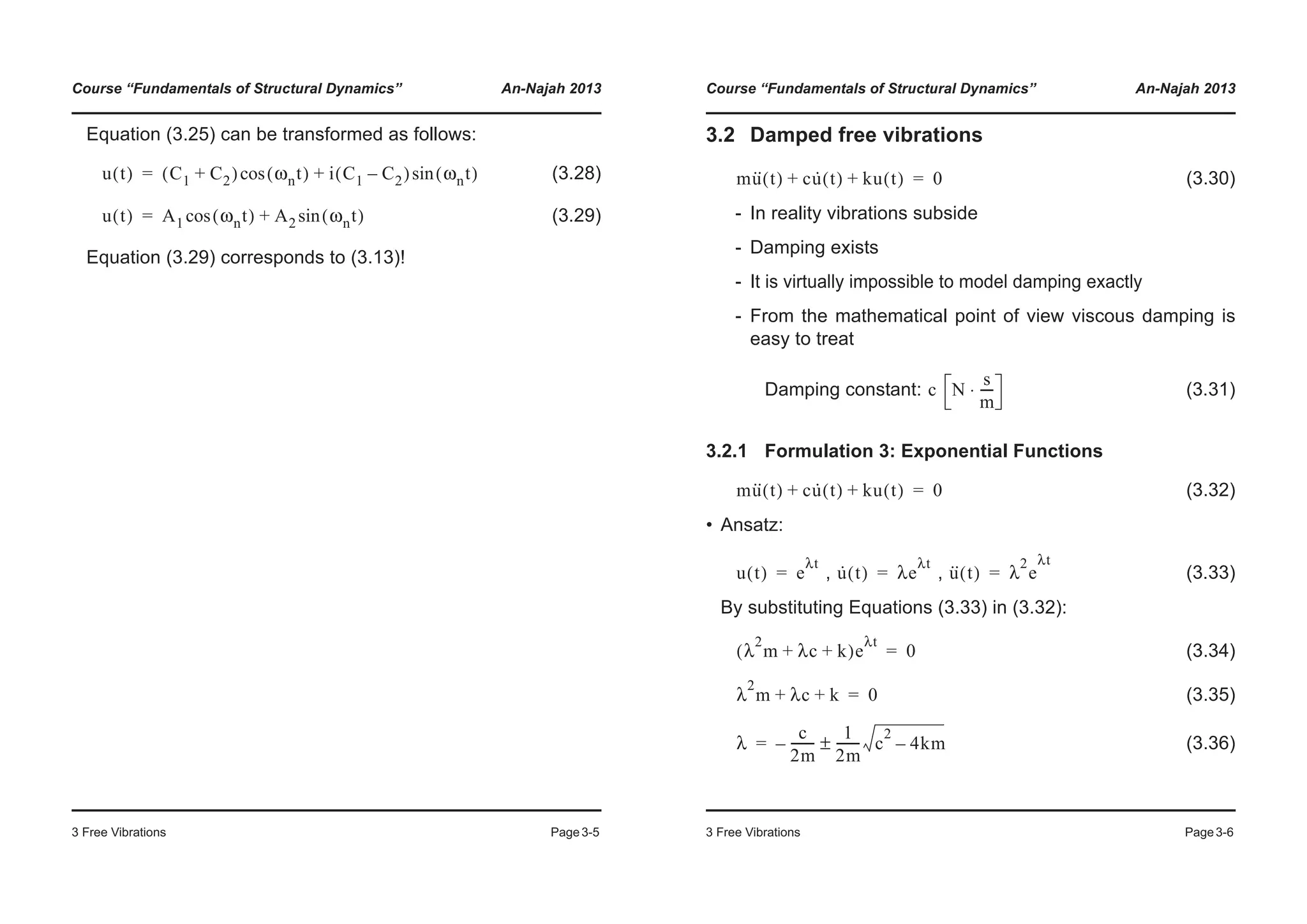
Equation (3.25) can be transformed as follows:
(3.28)
(3.29)
Equation (3.29) corresponds to (3.13)!
u t( ) C1 C2+( ) ωnt( )cos i C1 C2–( ) ωnt( )sin+=
u t( ) A1 ωnt( )cos A2 ωnt( )sin+=
Course “Fundamentals of Structural Dynamics” An-Najah 2013
3 Free Vibrations Page3-6
3.2 Damped free vibrations
(3.30)
- In reality vibrations subside
- Damping exists
- It is virtually impossible to model damping exactly
- From the mathematical point of view viscous damping is
easy to treat
Damping constant: (3.31)
3.2.1 Formulation 3: Exponential Functions
(3.32)
• Ansatz:
, , (3.33)
By substituting Equations (3.33) in (3.32):
(3.34)
(3.35)
(3.36)
mu·· t( ) cu· t( ) ku t( )+ + 0=
c N
s
m
----⋅
mu·· t( ) cu· t( ) ku t( )+ + 0=
u t( ) e
λt
= u· t( ) λe
λt
= u·· t( ) λ
2
e
λt
=
λ
2
m λc k+ +( )e
λt
0=
λ
2
m λc k+ + 0=
λ
c
2m
--------–
1
2m
-------- c
2
4km–±=
Course “Fundamentals of Structural Dynamics” An-Najah 2013
3 Free Vibrations Page3-7
• Critical damping when:
(3.37)
• Damping ratio
(3.38)
• Transformation of the equation of motion
(3.39)
(3.40)
(3.41)
• Types of vibrations:
: Underdamped free vibrations
: Critically damped free vibrations
: Overdamped free vibrations
c2 4km– 0=
ccr 2 km 2ωnm= =
ζ
c
ccr
------
c
2 km
---------------
c
2ωnm
--------------= = =
mu·· t( ) cu· t( ) ku t( )+ + 0=
u·· t( )
c
m
----u· t( )
k
m
----u t( )+ + 0=
u·· t( ) 2ζωnu· t( ) ωn
2
u t( )+ + 0=
ζ
c
ccr
------ 1<=
ζ
c
ccr
------ 1= =
ζ
c
ccr
------ 1>=
Course “Fundamentals of Structural Dynamics” An-Najah 2013
3 Free Vibrations Page3-8
• Types of vibrations
0
0.5
1
u(t)/u0[-]
Underdamped vibration
Critically damped vibration
Overdamped vibration
-1
-0.5
0 0.5 1 1.5 2 2.5 3 3.5 4
t/Tn [-]
Course “Fundamentals of Structural Dynamics” An-Najah 2013
3 Free Vibrations Page3-9
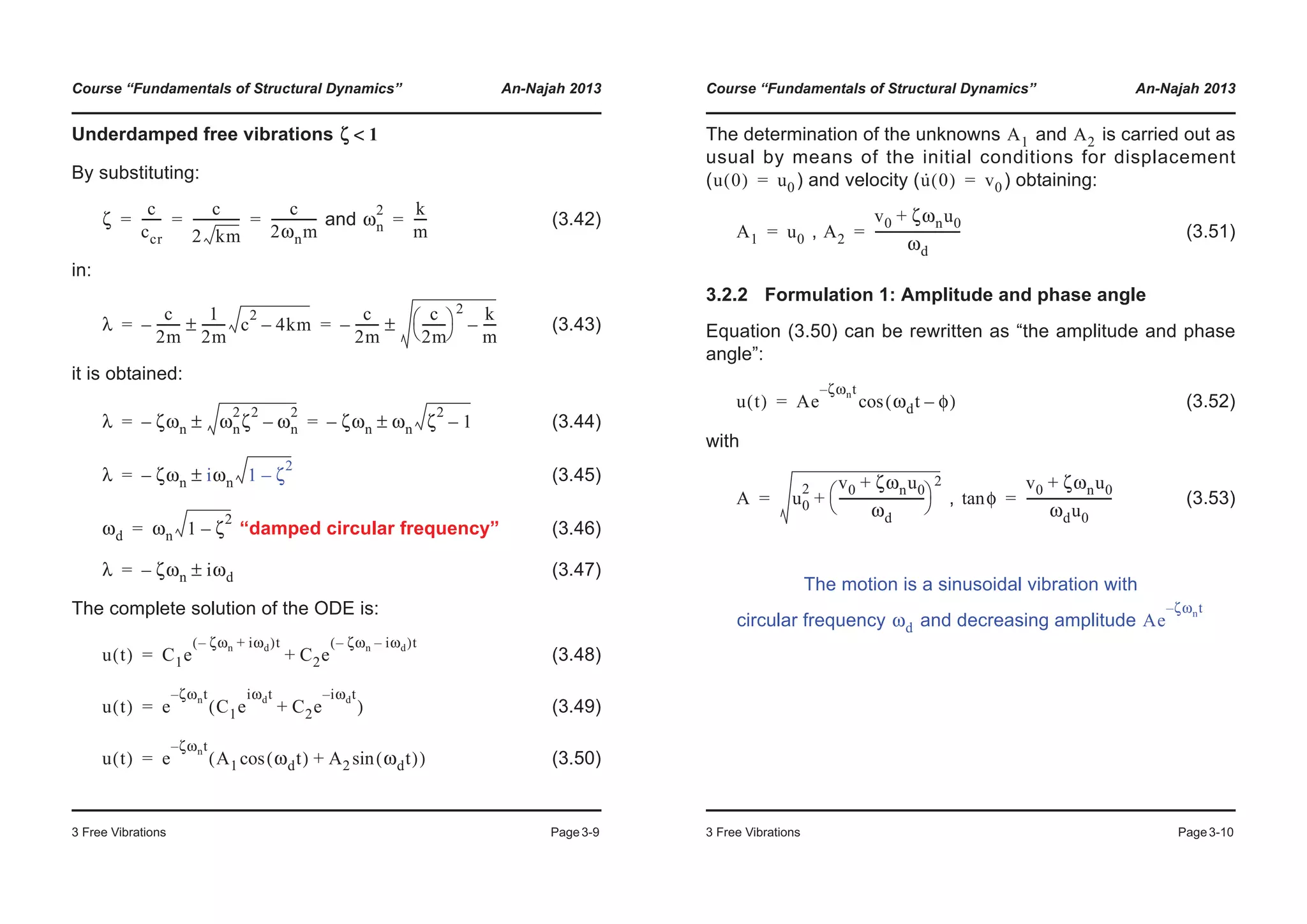
Underdamped free vibrations
By substituting:
and (3.42)
in:
(3.43)
it is obtained:
(3.44)
(3.45)
“damped circular frequency” (3.46)
(3.47)
The complete solution of the ODE is:
(3.48)
(3.49)
(3.50)
ζ 1<
ζ
c
ccr
------
c
2 km
---------------
c
2ωnm
---------------= = = ωn
2 k
m
----=
λ
c
2m
--------–
1
2m
-------- c
2
4km–±
c
2m
--------–
c
2m
--------
© ¹
§ ·
2 k
m
----–±= =
λ ζωn– ωn
2
ζ
2
ωn
2
–± ζωn– ωn ζ
2
1–±= =
λ ζωn– iωn 1 ζ
2
–±=
ωd ωn 1 ζ
2
–=
λ ζωn– iωd±=
u t( ) C1e
ζωn– iωd+( )t
C2e
ζωn– iωd–( )t
+=
u t( ) e
ζωnt–
C1e
iωdt
C2e
i– ωdt
+( )=
u t( ) e
ζωnt–
A1 ωdt( )cos A2 ωdt( )sin+( )=
Course “Fundamentals of Structural Dynamics” An-Najah 2013
3 Free Vibrations Page3-10
The determination of the unknowns and is carried out as
usual by means of the initial conditions for displacement
( ) and velocity ( ) obtaining:
, (3.51)
3.2.2 Formulation 1: Amplitude and phase angle
Equation (3.50) can be rewritten as “the amplitude and phase
angle”:
(3.52)
with
, (3.53)
The motion is a sinusoidal vibration with
circular frequency and decreasing amplitude
A1 A2
u 0( ) u0= u· 0( ) v0=
A1 u0= A2
v0 ζωnu0+
ωd
---------------------------=
u t( ) Ae
ζωnt–
ωdt φ–( )cos=
A u0
2 v0 ζωnu0+
ωd
---------------------------
© ¹
§ ·
2
+= φtan
v0 ζωnu0+
ωdu0
---------------------------=
ωd Ae
ζωnt–
Course “Fundamentals of Structural Dynamics” An-Najah 2013
3 Free Vibrations Page3-11
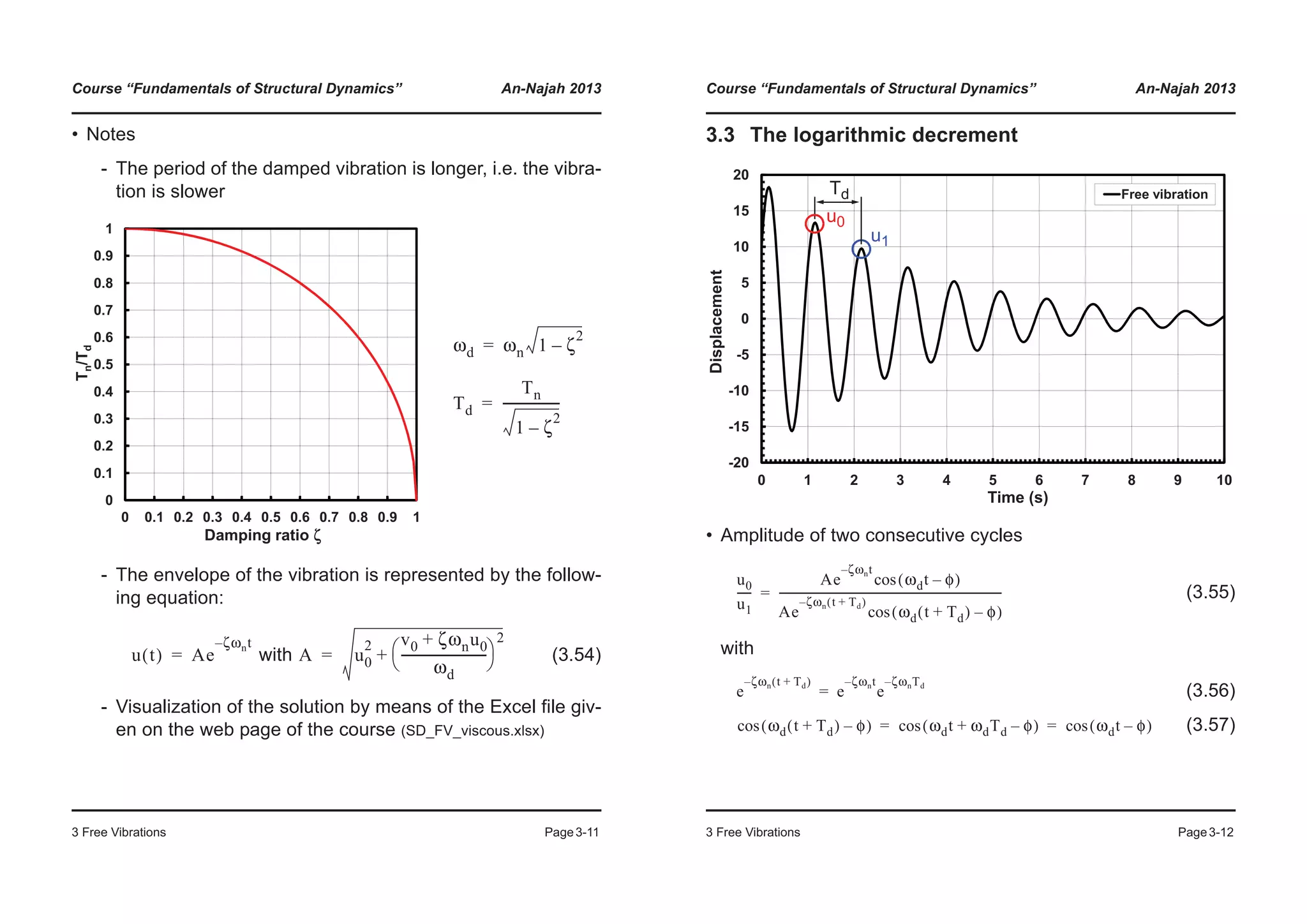
• Notes
- The period of the damped vibration is longer, i.e. the vibra-
tion is slower
- The envelope of the vibration is represented by the follow-
ing equation:
with (3.54)
- Visualization of the solution by means of the Excel file giv-
en on the web page of the course (SD_FV_viscous.xlsx)
0 3
0.4
0.5
0.6
0.7
0.8
0.9
1
Tn/Td
0
0.1
0.2
0.3
0 0.1 0.2 0.3 0.4 0.5 0.6 0.7 0.8 0.9 1
Damping ratio ζ
ωd ωn 1 ζ
2
–=
Td
Tn
1 ζ
2
–
------------------=
u t( ) Ae
ζωnt–
= A u0
2 v0 ζωnu0+
ωd
---------------------------
© ¹
§ ·
2
+=
Course “Fundamentals of Structural Dynamics” An-Najah 2013
3 Free Vibrations Page3-12
3.3 The logarithmic decrement
• Amplitude of two consecutive cycles
(3.55)
with
(3.56)
(3.57)
-5
0
5
10
15
20
Displacement
Free vibration
-20
-15
-10
0 1 2 3 4 5 6 7 8 9 10
Time (s)
u0
u1
Td
u0
u1
-----
Ae
ζωnt–
ωdt φ–( )cos
Ae
ζωn t Td+( )–
ωd t Td+( ) φ–( )cos
--------------------------------------------------------------------------------=
e
ζωn t Td+( )–
e
ζωnt–
e
ζωnTd–
=
ωd t Td+( ) φ–( )cos ωdt ωdTd φ–+( )cos ωdt φ–( )cos= =
Course “Fundamentals of Structural Dynamics” An-Najah 2013
3 Free Vibrations Page3-13
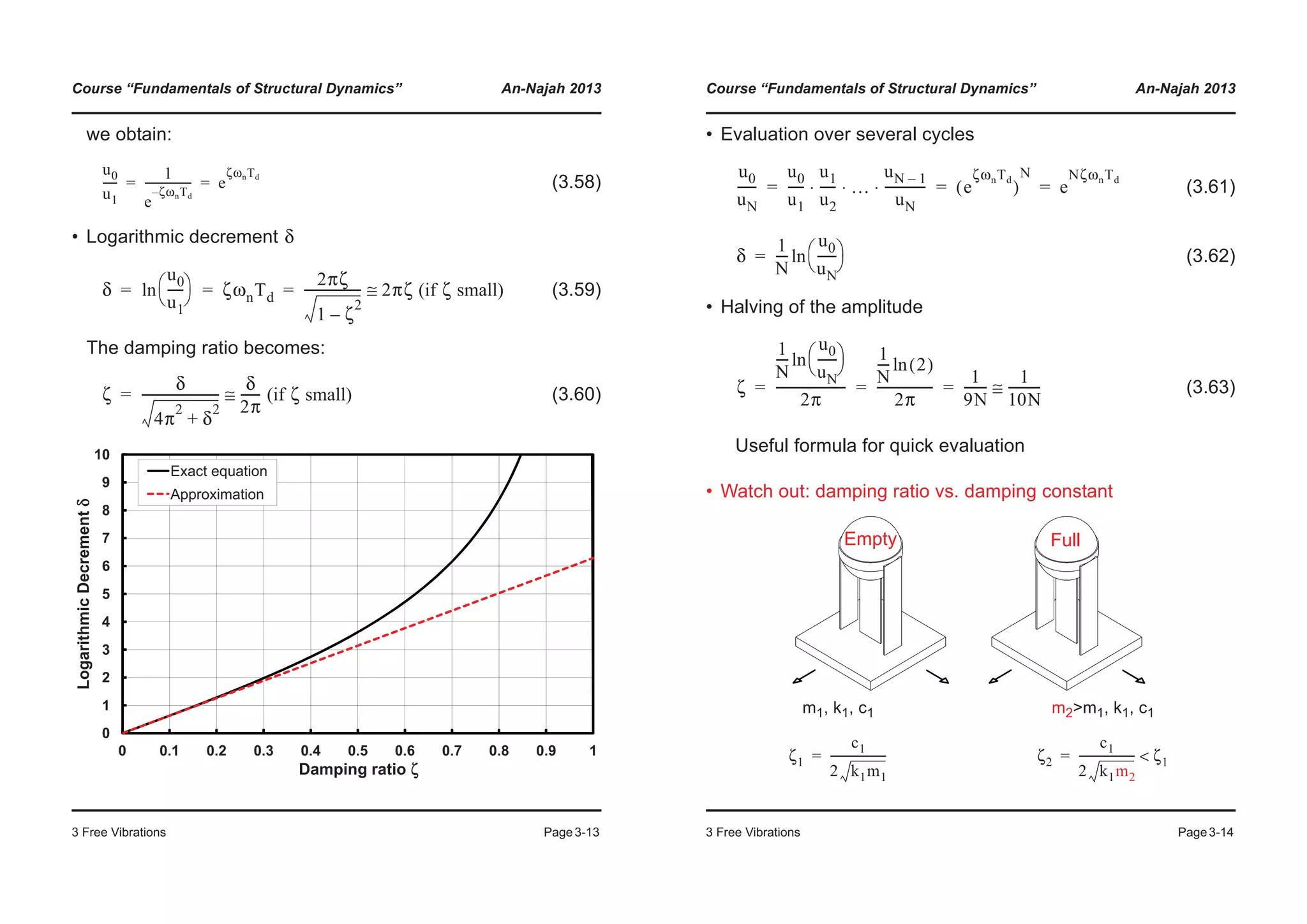
we obtain:
(3.58)
• Logarithmic decrement
(3.59)
The damping ratio becomes:
(3.60)
u0
u1
-----
1
e
ζωnTd–
----------------- e
ζωnTd
= =
δ
δ
u0
u1
-----
© ¹
§ ·ln ζωnTd
2πζ
1 ζ
2
–
------------------ 2πζ (if ζ small)≅= = =
ζ
δ
4π
2
δ
2
+
-------------------------
δ
2π
------ (if ζ small)≅=
3
4
5
6
7
8
9
10
ithmicDecrementδ
Exact equation
Approximation
0
1
2
3
0 0.1 0.2 0.3 0.4 0.5 0.6 0.7 0.8 0.9 1
Logar
Damping ratio ζ
Course “Fundamentals of Structural Dynamics” An-Najah 2013
3 Free Vibrations Page3-14
• Evaluation over several cycles
(3.61)
(3.62)
• Halving of the amplitude
(3.63)
Useful formula for quick evaluation
• Watch out: damping ratio vs. damping constant
m1, k1, c1 m2>m1, k1, c1
u0
uN
------
u0
u1
-----
u1
u2
----- …
uN 1–
uN
-------------⋅ ⋅ ⋅ e
ζωnTd
( )
N
e
NζωnTd
= = =
δ
1
N
----
u0
uN
------
© ¹
§ ·ln=
ζ
1
N
----
u0
uN
------
© ¹
§ ·ln
2π
----------------------
1
N
---- 2( )ln
2π
------------------
1
9N
-------
1
10N
----------≅= = =
Empty Full
ζ1
c1
2 k1m1
--------------------= ζ2
c1
2 k1m2
-------------------- ζ1<=
Course “Fundamentals of Structural Dynamics” An-Najah 2013
3 Free Vibrations Page3-15
3.4 Friction damping
• Solution of b)
with (3.64)
(3.65)
by means of the initial conditions , we ob-
tain the constants:
,
• Solution of a): Similar, with instead of
a) b)
fk t( )– fμ– mu·· t( )=
mu·· t( ) ku t( )+ fμ–=
fk t( )– fμ+ mu·· t( )=
mu·· t( ) ku t( )+ fμ=
u t( ) A1 ωnt( )cos A2 ωnt( )sin uμ+ += uμ
fμ
k
----=
u· t( ) ωnA1 ωnt( )sin– ωnA2 ωnt( )cos+=
u 0( ) u0= u· 0( ) v0=
A1 u0 uμ–= A2 v0 ωn⁄=
uμ– +uμ
Course “Fundamentals of Structural Dynamics” An-Najah 2013
3 Free Vibrations Page3-16
• Free vibrations
It is a nonlinear problem!
• Calculation example:
- Step 1:
Initial conditions ,
, (3.66)
(3.67)
End displacement:
Figure: f=0.5 Hz , u0=10 , v0 = 50, uf = 1
-5
0
5
10
15
20
Displacement
Free vibration
Friction force
-20
-15
-10
0 1 2 3 4 5 6 7 8 9 10
Time (s)
u 0( ) u0= u· 0( ) 0=
A1 u0 uμ–= A2 0=
u t( ) u0 uμ–[ ] ωnt( )cos uμ+= 0 t
π
ωn
------<≤
u
π
ωn
------
© ¹
§ · u0 uμ–[ ] 1–( ) uμ+ u0– 2uμ+= =
Course “Fundamentals of Structural Dynamics” An-Najah 2013
3 Free Vibrations Page3-17
- Step 2:
Initial conditions ,
, (3.68)
(3.69)
End displacement:
- Step 3:
Initial conditions ....
• Important note:
The change between case a) and case b) occurs at velocity re-
versals. In order to avoid the build-up of inaccuracies, the dis-
placement at velocity reversal should be identified with
adequate precision (iterate!)
• Visualization of the solution by means of the Excel file given on
the web page of the course (SD_FV_friction.xlsx)
• Characteristics of friction damping
- Linear decrease in amplitude by at each cycle
- The period of the damped and of the undamped oscillator
is the same:
u 0( ) u0– 2uμ+= u· 0( ) 0=
A1 u 0( ) uμ+ u0– 2uμ uμ+ + u0– 3uμ+= = = A2 0=
u t( ) u0– 3uμ+[ ] ωnt( )cos uμ–= 0 t
π
ωn
------<≤
u
π
ωn
------
© ¹
§ · u0– 3uμ+[ ] 1–( ) uμ– u0 4uμ–= =
4uμ
Tn
2π
ωn
------=
Course “Fundamentals of Structural Dynamics” An-Najah 2013
3 Free Vibrations Page3-18
• Comparison Viscous damping vs. Friction damping
Free vibration: f=0.5 Hz , u0=10 , v0 = 50, uf = 1
Logarithmic decrement:
Comparison:
U0 UN N δ ζ [%]
1 18.35 14.35 1 0.245 3.91
2 18.35 10.35 2 0.286 4.56
3 18.35 6.35 3 0.354 5.63
4 18.35 2.35 4 0.514 8.18
Average 5.57
-5
0
5
10
15
20
Displacement
Friction damping
Viscous damping
-20
-15
-10
0 1 2 3 4 5 6 7 8 9 10
Time (s)
Course “Fundamentals of Structural Dynamics” An-Najah 2013
4 Response to Harmonic Excitation Page4-1
4 Response to Harmonic Excitation
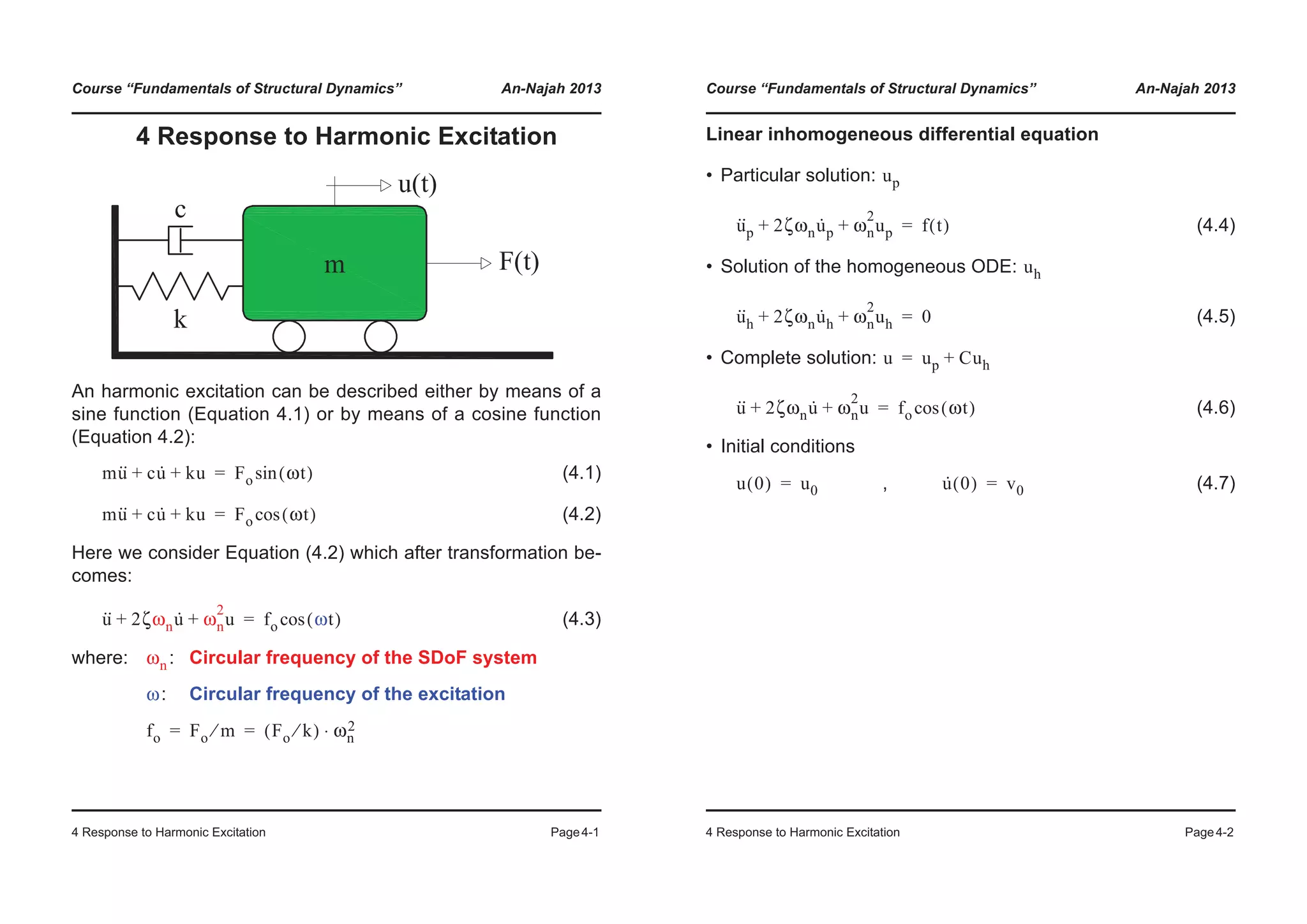
An harmonic excitation can be described either by means of a
sine function (Equation 4.1) or by means of a cosine function
(Equation 4.2):
(4.1)
(4.2)
Here we consider Equation (4.2) which after transformation be-
comes:
(4.3)
where: : Circular frequency of the SDoF system
: Circular frequency of the excitation
mu·· cu· ku+ + Fo ωt( )sin=
mu·· cu· ku+ + Fo ωt( )cos=
u·· 2ζωnu· ωn
2
u+ + fo ωt( )cos=
ωn
ω
fo Fo m⁄ Fo k⁄( ) ωn
2⋅= =
Course “Fundamentals of Structural Dynamics” An-Najah 2013
4 Response to Harmonic Excitation Page4-2
Linear inhomogeneous differential equation
• Particular solution:
(4.4)
• Solution of the homogeneous ODE:
(4.5)
• Complete solution:
(4.6)
• Initial conditions
, (4.7)
up
u··
p 2ζωnu·
p ωn
2
up+ + f t( )=
uh
u··
h 2ζωnu·
h ωn
2
uh+ + 0=
u up Cuh+=
u·· 2ζωnu· ωn
2
u+ + fo ωt( )cos=
u 0( ) u0= u· 0( ) v0=
Course “Fundamentals of Structural Dynamics” An-Najah 2013
4 Response to Harmonic Excitation Page4-3
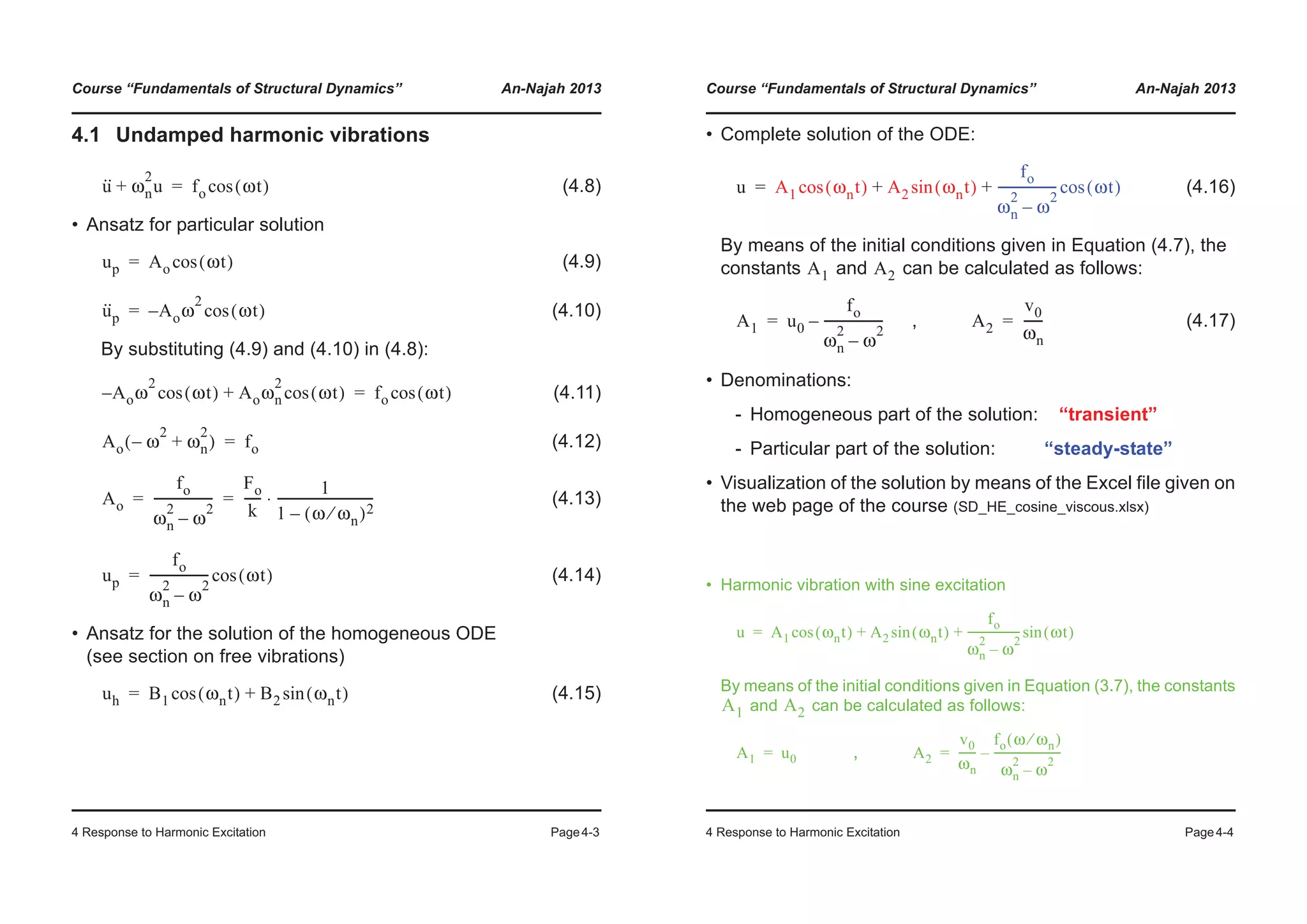
4.1 Undamped harmonic vibrations
(4.8)
• Ansatz for particular solution
(4.9)
(4.10)
By substituting (4.9) and (4.10) in (4.8):
(4.11)
(4.12)
(4.13)
(4.14)
• Ansatz for the solution of the homogeneous ODE
(see section on free vibrations)
(4.15)
u·· ωn
2
u+ fo ωt( )cos=
up Ao ωt( )cos=
u··
p A– oω
2
ωt( )cos=
A– oω
2
ωt( )cos Aoωn
2
ωt( )cos+ fo ωt( )cos=
Ao ω
2
– ωn
2
+( ) fo=
Ao
fo
ωn
2
ω
2
–
-------------------
Fo
k
-----
1
1 ω ωn⁄( )2–
-------------------------------⋅= =
up
fo
ωn
2
ω
2
–
------------------- ωt( )cos=
uh B1 ωnt( )cos B2 ωnt( )sin+=
Course “Fundamentals of Structural Dynamics” An-Najah 2013
4 Response to Harmonic Excitation Page4-4
• Complete solution of the ODE:
(4.16)
By means of the initial conditions given in Equation (4.7), the
constants and can be calculated as follows:
, (4.17)
• Denominations:
- Homogeneous part of the solution: “transient”
- Particular part of the solution: “steady-state”
• Visualization of the solution by means of the Excel file given on
the web page of the course (SD_HE_cosine_viscous.xlsx)
• Harmonic vibration with sine excitation
By means of the initial conditions given in Equation (3.7), the constants
and can be calculated as follows:
,
u A1 ωnt( )cos A2 ωnt( )sin
fo
ωn
2
ω
2
–
------------------- ωt( )cos+ +=
A1 A2
A1 u0
fo
ωn
2
ω
2
–
-------------------–= A2
v0
ωn
------=
u A1 ωnt( )cos A2 ωnt( )sin
fo
ωn
2
ω
2
–
------------------- ωt( )sin+ +=
A1 A2
A1 u0= A2
v0
ωn
------
fo ω ωn⁄( )
ωn
2
ω
2
–
------------------------–=
Course “Fundamentals of Structural Dynamics” An-Najah 2013
4 Response to Harmonic Excitation Page4-5
4.1.1 Interpretation as a beat
with (4.18)
The solution is:
(4.19)
and using the trigonometric identity
(4.20)
one gets the equation
(4.21)
that describes a beat with:
Fundamental vibration: (4.22)
Envelope: (4.23)
A beat is always present, but is only evident when the natural fre-
quency of the SDoF system and the excitation frequency are
close (see figures on the next page)
u·· ωn
2
u+ fo ωt( )cos= u 0( ) u· 0( ) 0= =
u t( )
fo
ωn
2
ω
2
–
------------------- ωt( )cos ωnt( )cos–[ ]⋅=
α( )cos β( )cos– 2
α β–
2
-------------t
© ¹
§ · α β+
2
-------------t
© ¹
§ ·sinsin–=
u t( )
2fo
ω
2
ωn
2
–
-------------------
ω ωn–
2
----------------t
© ¹
§ · ω ωn+
2
-----------------t
© ¹
§ ·sinsin⋅=
fG
f fn+
2
------------=
fU
f fn–
2
------------=
Course “Fundamentals of Structural Dynamics” An-Najah 2013
4 Response to Harmonic Excitation Page4-6
• Case 1: Natural frequency SDoF 0.2 Hz, excitation frequency 0.4 Hz
• Case 2: Natural frequency SDoF 2.0 Hz, excitation frequency 2.2 Hz
-200
-100
0
100
200
300
400
500
Displacement
Total response Envelope
-500
-400
-300
-200
0 2 4 6 8 10 12 14 16 18 20
Time [s]
-20
0
20
40
60
80
Displacement
Total response Envelope
-80
-60
-40
0 2 4 6 8 10 12 14 16 18 20
Time [s]
Course “Fundamentals of Structural Dynamics” An-Najah 2013
4 Response to Harmonic Excitation Page4-7
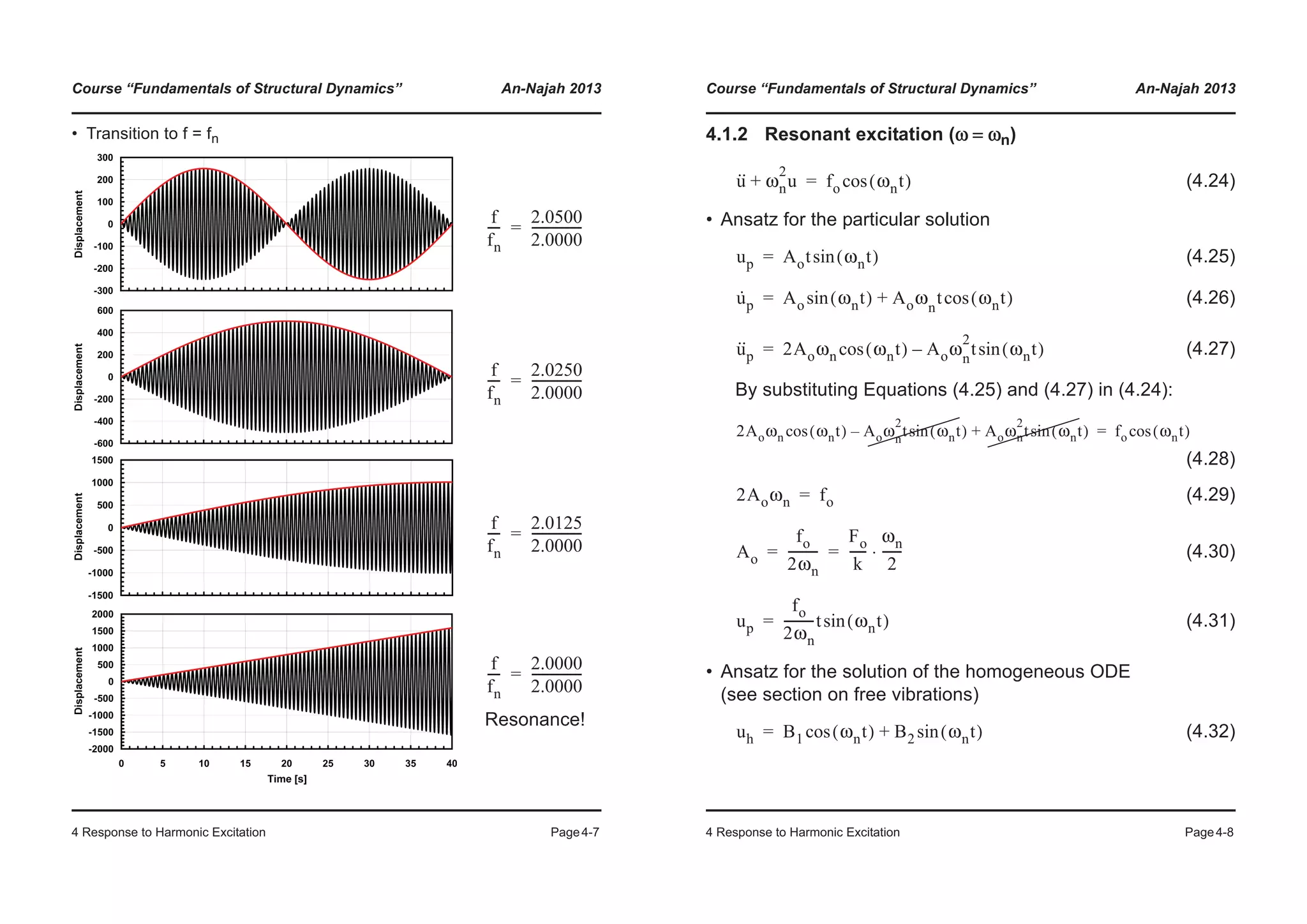
• Transition to f = fn
Resonance!
f
fn
----
2.0500
2.0000
----------------=
f
fn
----
2.0250
2.0000
----------------=
f
fn
----
2.0125
2.0000
----------------=
f
fn
----
2.0000
2.0000
----------------=
Course “Fundamentals of Structural Dynamics” An-Najah 2013
4 Response to Harmonic Excitation Page4-8
4.1.2 Resonant excitation (ω = ωn)
(4.24)
• Ansatz for the particular solution
(4.25)
(4.26)
(4.27)
By substituting Equations (4.25) and (4.27) in (4.24):
(4.28)
(4.29)
(4.30)
(4.31)
• Ansatz for the solution of the homogeneous ODE
(see section on free vibrations)
(4.32)
u·· ωn
2
u+ fo ωnt( )cos=
up Aot ωnt( )sin=
u·
p Ao ωnt( )sin Aoωn
t ωnt( )cos+=
u··
p 2Aoωn ωnt( )cos Aoωn
2
t ωnt( )sin–=
2Aoωn ωnt( )cos Aoωn
2
t ωnt( )sin– Aoωn
2
t ωnt( )sin+ fo ωnt( )cos=
2Aoωn fo=
Ao
fo
2ωn
----------
Fo
k
-----
ωn
2
------⋅= =
up
fo
2ωn
----------t ωnt( )sin=
uh B1 ωnt( )cos B2 ωnt( )sin+=
Course “Fundamentals of Structural Dynamics” An-Najah 2013
4 Response to Harmonic Excitation Page4-9
• Complete solution of the ODE:
(4.33)
By means of the initial conditions given in Equation (4.7), the
constants and can be calculated as follows:
, (4.34)
• Special case
(The homogeneous part of the solution falls away)
(4.35)
Is a sinusoidal vibration with amplitude:
(4.36)
- The amplitude grows linearly with time (see last picture of
interpretation “beat”);
- We have when , i.e. after infinite time the am-
plitude of the vibration is infinite as well.
• Visualization of the solution by means of the Excel file given on
the web page of the course (SD_HE_cosine_viscous.xlsx)
u A1 ωnt( )cos A2 ωnt( )sin
fo
2ωn
----------t ωnt( )sin+ +=
A1 A2
A1 u0= A2
v0
ωn
------=
u0 v0 0= =
u
fo
2ωn
----------t ωnt( )sin=
A
fo
2ωn
----------t=
A ∞→ t ∞→
Course “Fundamentals of Structural Dynamics” An-Najah 2013
4 Response to Harmonic Excitation Page4-10
4.2 Damped harmonic vibration
(4.37)
• Ansatz for particular solution
(4.38)
(4.39)
(4.40)
By substitution Equations (4.38) to (4.40) in (4.37):
(4.41)
Equation (4.41) shall be true for all times and for all
constants and , therefore Equations (4.42) and (4.43)
can be written as follows:
(4.42)
(4.43)
The solution of the system [(4.42), (4.43)] allows the
calculations of the constants and as:
,
(4.44)
u·· 2ζωnu· ωn
2
u+ + fo ωt( )cos=
up A3 ωt( )cos A4 ωt( )sin+=
u·
p A– 3ω ωt( )sin A4ω ωt( )cos+=
u··
p A– 3ω
2
ωt( )cos A4ω
2
ωt( )sin–=
ωn
2
ω
2
–( )A3 2ζωnωA4+[ ] ωt( )cos 2ζωnωA3– ωn
2
ω
2
–( )A4+[ ] ωt( )sin+ fo ωt( )cos=
t
A3 A4
ωn
2
ω
2
–( )A3 2ζωnωA4+ fo=
2ζωnωA3– ωn
2
ω
2
–( )A4+ 0=
A3 A4
A3 fo
ωn
2
ω
2
–
ωn
2
ω
2
–( )
2
2ζωnω( )
2
+
----------------------------------------------------------= A4 fo
2ζωnω
ωn
2
ω
2
–( )
2
2ζωnω( )
2
+
----------------------------------------------------------=
Course “Fundamentals of Structural Dynamics” An-Najah 2013
4 Response to Harmonic Excitation Page4-11
• Ansatz for the solution of the homogeneous ODE
(see Section 3.2 on damped free vibrations)
(4.45)
with:
“damped circular frequency” (4.46)
• Complete solution of the ODE:
(4.47)
By means of the initial conditions of Equation (4.7), the con-
stants and can be calculated. The calculation is labo-
rious and should be best carried out with a mathematics pro-
gram (e.g. Maple).
• Denominations:
- Homogeneous part of the solution: “transient”
- Particular part of the solution: “steady-state”
• Visualization of the solution by means of the Excel file given on
the web page of the course (SD_HE_cosine_viscous.xlsx)
uh e
ζωnt–
B1 ωdt( )cos B2 ωdt( )sin+( )=
ωd ωn 1 ζ
2
–=
u e
ζωnt–
A1 ωdt( )cos A2 ωdt( )sin+( ) A3 ωt( )cos A4 ωt( )sin+ +=
A1 A2
Course “Fundamentals of Structural Dynamics” An-Najah 2013
4 Response to Harmonic Excitation Page4-12
• Example 1: fn = 1Hz, f = 0.2Hz, ζ = 5%, fo = 1000, u0 = 0, v0 = fo/ωn
• Example 2: Like 1 but with F(t) = Fosin(ωt) instead of Focos(ωt)
-20
0
20
40
60
Displacement
Steady-state response
Total response
-60
-40
0 2 4 6 8 10 12 14 16 18 20
Time [s]
-20
-10
0
10
20
30
40
50
Displacement
Steady-state response
Total response
-50
-40
-30
20
0 2 4 6 8 10 12 14 16 18 20
Time [s]
Course “Fundamentals of Structural Dynamics” An-Najah 2013
4 Response to Harmonic Excitation Page4-13
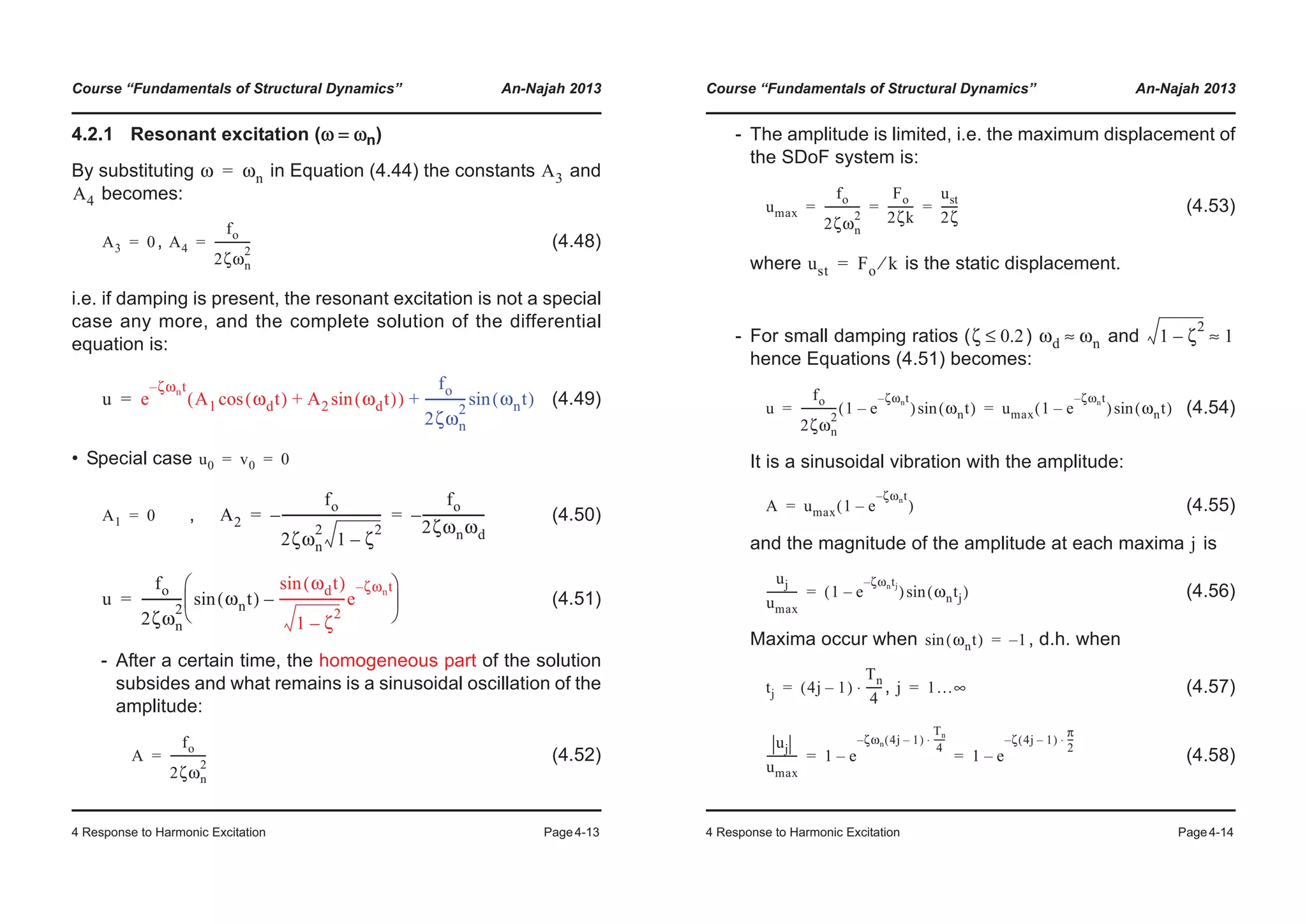
4.2.1 Resonant excitation (ω = ωn)
By substituting in Equation (4.44) the constants and
becomes:
, (4.48)
i.e. if damping is present, the resonant excitation is not a special
case any more, and the complete solution of the differential
equation is:
(4.49)
• Special case
, (4.50)
(4.51)
- After a certain time, the homogeneous part of the solution
subsides and what remains is a sinusoidal oscillation of the
amplitude:
(4.52)
ω ωn= A3
A4
A3 0= A4
fo
2ζωn
2
-------------=
u e
ζωnt–
A1 ωdt( )cos A2 ωdt( )sin+( )
fo
2ζωn
2
------------- ωnt( )sin+=
u0 v0 0= =
A1 0= A2
fo
2ζωn
2
1 ζ
2
–
--------------------------------–
fo
2ζωnωd
--------------------–= =
u
fo
2ζωn
2
------------- ωnt( )sin
ωdt( )sin
1 ζ
2
–
---------------------e
ζωnt–
–
© ¹
¨ ¸
§ ·
=
A
fo
2ζωn
2
-------------=
Course “Fundamentals of Structural Dynamics” An-Najah 2013
4 Response to Harmonic Excitation Page4-14
- The amplitude is limited, i.e. the maximum displacement of
the SDoF system is:
(4.53)
where is the static displacement.
- For small damping ratios ( ) and
hence Equations (4.51) becomes:
(4.54)
It is a sinusoidal vibration with the amplitude:
(4.55)
and the magnitude of the amplitude at each maxima is
(4.56)
Maxima occur when , d.h. when
, (4.57)
(4.58)
umax
fo
2ζωn
2
-------------
Fo
2ζk
---------
ust
2ζ
------= = =
ust Fo k⁄=
ζ 0.2≤ ωd ωn≈ 1 ζ
2
– 1≈
u
fo
2ζωn
2
------------- 1 e
ζωnt–
–( ) ωnt( )sin umax 1 e
ζωnt–
–( ) ωnt( )sin= =
A umax 1 e
ζωnt–
–( )=
j
uj
umax
----------- 1 e
ζωntj–
–( ) ωntj( )sin=
ωnt( )sin 1–=
tj 4j 1–( )
Tn
4
------⋅= j 1…∞=
uj
umax
----------- 1 e
ζωn 4j 1–( )
Tn
4
-----⋅–
– 1 e
ζ 4j 1–( )
π
2
---⋅–
–= =
Course “Fundamentals of Structural Dynamics” An-Najah 2013
4 Response to Harmonic Excitation Page4-15
• Dynamic amplification
• Magnitude of the amplitude after each cycle: f(umax)
20
30
40
50
umax/ust
0
10
0 0.05 0.1 0.15 0.2
Damping ratio ζ [-]
0.4
0.6
0.8
1
abs(uj)/umax
ζ = 0.01
0.02
0.050.1
0.2
0
0.2
0 5 10 15 20 25 30 35 40 45 50
Cycle
Course “Fundamentals of Structural Dynamics” An-Najah 2013
4 Response to Harmonic Excitation Page4-16
• Magnitude of the amplitude after each cycle: f(ust)
20
30
40
50
abs(uj)/ust
ζ = 0.01
0.02
0
10
0 5 10 15 20 25 30 35 40 45 50
Cycle
0.05
0.10
0.20
Course “Fundamentals of Structural Dynamics” An-Najah 2013
5 Transfer Functions Page5-1
5 Transfer Functions
5.1 Force excitation
The steady-state displacement of a system due to harmonic ex-
citation is (see Section 4.2 on harmonic excitation):
(5.1)
with
, (5.2)
By means of the trigonometric identity
where (5.3)
Equation (5.1) can be transformed as follows:
(5.4)
It is a cosine vibration with the maximum dynamic amplitude
:
(5.5)
and the phase angle obtained from:
(5.6)
up a1 ωt( )cos a2 ωt( )sin+=
a1 fo
ωn
2
ω
2
–
ωn
2
ω
2
–( )
2
2ζωnω( )
2
+
----------------------------------------------------------= a2 fo
2ζωnω
ωn
2
ω
2
–( )
2
2ζωnω( )
2
+
----------------------------------------------------------=
a α( )cos b α( )sin+ a
2
b
2
+ α φ–( )cos⋅= φtan
b
a
---=
up umax ωt φ–( )cos=
umax
umax a1
2
a2
2
+=
φ
φtan
a2
a1
-----=
Course “Fundamentals of Structural Dynamics” An-Najah 2013
5 Transfer Functions Page5-2
The maximum dynamic amplitude given by Equation (5.5)
can be transformed to:
(5.7)
(5.8)
(5.9)
(5.10)
Introducing the maximum static amplitude the
dynamic amplification factor can be defined as:
(5.11)
The maximum amplification factor occurs when its deriva-
tive, given by Equation (5.12), is equal to zero.
umax
umax fo
ωn
2
ω
2
–
ωn
2
ω
2
–( )
2
2ζωnω( )
2
+
----------------------------------------------------------
© ¹
¨ ¸
§ ·
2
fo
2ζωnω
ωn
2
ω
2
–( )
2
2ζωnω( )
2
+
----------------------------------------------------------
© ¹
¨ ¸
§ ·2
+=
umax fo
ωn
2
ω
2
–( )
2
2ζωnω( )
2
+
ωn
2
ω
2
–( )
2
2ζωnω( )
2
+[ ]
2
-----------------------------------------------------------------=
umax fo
1
ωn
2
ω
2
–( )
2
2ζωnω( )
2
+
--------------------------------------------------------------=
umax
fo
ωn
2
------
1
1 ω ωn⁄( )
2
–[ ]
2
2ζ ω ωn⁄( )[ ]
2
+
----------------------------------------------------------------------------------=
uo Fo k⁄ fo ωn
2
⁄= =
V ω( )
V ω( )
umax
uo
-----------
1
1 ω ωn⁄( )
2
–[ ]
2
2ζ ω ωn⁄( )[ ]
2
+
-----------------------------------------------------------------------------------= =
V ω( )
Course “Fundamentals of Structural Dynamics” An-Najah 2013
5 Transfer Functions Page5-3
(5.12)
when: , (5.13)
The maximum amplification factor occurs when:
for (5.14)
and we have:
: (5.15)
: (5.16)
From Equation (5.6), the phase angle is:
(5.17)
The phase angle has the following interesting property:
(5.18)
at we have: (= when in deg)
(5.19)
ωd
dV 2ωωn
2
ω
2
ωn
2
1 2ζ
2
–( )–[ ]
ω
4
2 1 2ζ
2
–( )ω
2
ωn
2
– ωn
4
+[ ]
3 2⁄( )
---------------------------------------------------------------------------------=
ωd
dV
0= ω 0= ω ωn 1 2ζ
2
–±=
V ω( )
ω ωn 1 2ζ
2
–= ζ
1
2
-------< 0.71≈
ω ωn= V
1
2ζ
------=
ω ωn 1 2ζ
2
–= V
1
2ζ 1 ζ
2
–
-------------------------=
φ
φtan
2ζωnω
ωn
2
ω
2
–
-------------------
2ζ ω ωn⁄( )
1 ω ωn⁄( )
2
–
-------------------------------= =
ω ωn⁄( )d
dφ 2ζ 1 ω ωn⁄( )
2
+[ ]
1 2 ω ωn⁄( )
2
– ω ωn⁄( )
4
4ζ
2
ω ωn⁄( )
2
+ +
----------------------------------------------------------------------------------------------------=
ω ωn⁄ 1=
ω ωn⁄( )d
dφ 1
ζ
---=
1
ζ
---
180
π
---------⋅ φ
Course “Fundamentals of Structural Dynamics” An-Najah 2013
5 Transfer Functions Page5-4
5.1.1 Comments on the amplification factor V
(5.20)
• : Slow variation of the excitation (ζ not important)
• therefore:
• : Motion and excitation force are in phase
• : Quick variation of the excitation (ζ not important)
•
• : Mass controls the behaviour
• : Motion and excitation force are opposite
• : (ζ very important)
•
• : Damping controls the behaviour
• : zero displacement when excitation force is maximum
V ω( )
1
1 ω ωn⁄( )
2
–[ ]
2
2ζ ω ωn⁄( )[ ]
2
+
-----------------------------------------------------------------------------------=
ω ωn⁄ 1«
V ω( ) 1≈ umax uo≈
φ 0≈
ω ωn⁄ 1»
V ω( )
ωn
ω
------
© ¹
§ ·
2
≈
umax uo
ωn
ω
------
© ¹
§ ·
2
⋅≈ Fo mω
2
( )⁄=
φ 180≈
ω ωn⁄( ) 1≈
V ω( )
1
2ζ
------≈
umax uo 2ζ( )⁄≈ Fo cωn( )⁄=
φ 90≈
Course “Fundamentals of Structural Dynamics” An-Najah 2013
5 Transfer Functions Page5-5
• Amplification factor
• Phase angle
3
4
5
6
7
8
9
10
lificationfactorV(ω)
0.00
0.10
0.01
ζ = 0.05
0
1
2
3
0 0.5 1 1.5 2
Amp
ω/ωn
0.20
0.50
0.70
90
180
PhaseAngleI
0.00
0.10 0.20 0.50
0.70
0.01
] = 0.05
0
0 0.5 1 1.5 2
Z/Zn
Course “Fundamentals of Structural Dynamics” An-Najah 2013
5 Transfer Functions Page5-6
• Example:
An excitation produces the static displacement
(5.21)
and its maximum is:
(5.22)
The steady-state dynamic response of the system is:
(5.23)
therefore:
, (5.24)
In the next plots the time histories of and are
represented and compared.
The phase angle is always positive and because of the mi-
nus sign in Equation (5.24) it shows how much the response
to the excitation lags behind.
ust
Fo ωt( )cos
k
--------------------------=
uo
Fo
k
-----=
up umax ωt φ–( )cos=
ust
uo
------ ωt( )cos=
up
uo
----- V ωt φ–( )cos=
ust uo⁄ up uo⁄
φ
Course “Fundamentals of Structural Dynamics” An-Najah 2013
5 Transfer Functions Page5-7
Frequency of SDoF System fn = 1Hz (ωn = 6.28rad/s), Damping ζ = 0.1
-5
-4
-3
-2
-1
0
1
2
3
4
5
0.00 0.25 0.50 0.75 1.00 1.25 1.50 1.75 2.00
u/uo
Time [s]
Excitation
Steady-state response
-1
0
1
2
3
4
5
u/uo
-5
-4
-3
-2
0.00 0.25 0.50 0.75 1.00 1.25 1.50 1.75 2.00
Time [s]
Excitation
Steady-state response
-5
-4
-3
-2
-1
0
1
2
3
4
5
0.00 0.25 0.50 0.75 1.00 1.25 1.50 1.75 2.00
u/uo
Time [s]
Excitation
Steady-state response
V
Δt
Δt
V
V
Δt
ω ωn⁄ 0.9=
ω 0.9 6.28⋅
5.65 rad/s
=
=
V 3.82=
φ 43.45°
0.76 rad
=
=
Δt
φ
ω
----
0.76
5.65
----------
0.14 s
= =
=
ω ωn⁄ 1.0=
ω 1.0 6.28⋅
6.28 rad/s
=
=
V 5.00=
φ 90.00°
1.57 rad
=
=
Δt
φ
ω
----
1.57
6.28
----------
0.25 s
= =
=
ω ωn⁄ 1.1=
ω 1.1 6.28⋅
6.91 rad/s
=
=
V 3.28=
φ 133.66°
2.33 rad
=
=
Δt
φ
ω
----
2.33
6.91
----------
0.34 s
= =
=
Course “Fundamentals of Structural Dynamics” An-Najah 2013
5 Transfer Functions Page5-8
5.1.2 Steady-state displacement quantities
• Displacement: Corresponds to Equation (5.4)
(5.25)
• Velocity: Obtained by derivating Equation (5.25)
(5.26)
(5.27)
with (5.28)
• Acceleration: Obtained by derivating Equation (5.26)
(5.29)
(5.30)
with (5.31)
up
Fo k⁄
------------ V ω( ) ωt φ–( )cos=
u·
p
Fo k⁄
------------ V ω( )ω ωt φ–( )sin–=
u·
p
Fo k⁄( )ωn
------------------------ V ω( )
ω
ωn
------ ωt φ–( )sin–=
u·
p
Fo km⁄
---------------------- Vv ω( ) ωt φ–( )sin–= Vv ω( )
ω
ωn
------V ω( )=
u··
p
Fo k⁄
------------ V ω( )ω
2
ωt φ–( )cos–=
u··
p
Fo k⁄( )ωn
2
------------------------ V ω( )
ω
2
ωn
2
------ ωt φ–( )cos–=
u··
p
Fo m⁄
-------------- Va ω( ) ωt φ–( )cos–= Va ω( )
ω
2
ωn
2
------V ω( )=
Course “Fundamentals of Structural Dynamics” An-Najah 2013
5 Transfer Functions Page5-9
• Amplification factors
Resonant
displacement
Resonant
velocity
Resonant
acceleration
0
1
2
3
4
5
6
7
8
9
10
0 0.5 1 1.5 2
AmplificationFactorV(ω)
ω/ωn
0.00
0.10
0.20
0.50
0.70
0.01
ζ = 0.05
4
5
6
7
8
9
10
cationfactorVv(ω)
0.00
0 10
0.01
ζ = 0.05
0
1
2
3
4
0 0.5 1 1.5 2
Amplificati
ω/ωn
0.10
0.20
0.50
0.70
0
1
2
3
4
5
6
7
8
9
10
0 0.5 1 1.5 2
AmplificationfactorVa(ω)
ω/ωn
0.00
0.10
0.20
0.50
0.70
0.01
ζ = 0.05
ω ωn 1 2ζ
2
–=
V
1
2ζ 1 ζ–
----------------------=
ω ωn=
V
1
2ζ
------=
ω
ωn
1 2ζ
2
–
----------------------=
V
1
2ζ 1 ζ–
----------------------=
Course “Fundamentals of Structural Dynamics” An-Najah 2013
5 Transfer Functions Page5-10
5.1.3 Derivating properties of SDoF systems from
harmonic vibrations
• Half-power bandwidth
Condition:
(5.32)
(5.33)
(5.34)
(5.35)
3
4
5
6
7
8
9
10
plificationfactorV(ω)
0
1
2
3
0 0.5 1 1.5 2
Amp
ω/ωn
ζ = 0.05
V(Resonance)
V(Resonance)
2
2ζ
ωa ωb
V ω( )
V ω ωn⁄ 1 2ζ
2
–=( )
2
-----------------------------------------------------
1
2
-------
1
2ζ 1 ζ–
----------------------⋅= =
1
1 ω ωn⁄( )
2
–[ ]
2
2ζ ω ωn⁄( )[ ]
2
+
----------------------------------------------------------------------------------
1
2
-------
1
2ζ 1 ζ–
----------------------⋅=
ω
ωn
------
© ¹
§ ·4
2 1 2ζ
2
–( )
ω
ωn
------
© ¹
§ ·2
– 1 8ζ
2
1 ζ
2
–( )–+ 0=
ω
ωn
------
© ¹
§ ·2
1 2ζ
2
– 2ζ 1 ζ
2
–±=
Course “Fundamentals of Structural Dynamics” An-Najah 2013
5 Transfer Functions Page5-11
For small damping, the terms featuring can be neglected:
(5.36)
This yield the solution for the half-power bandwidth:
(5.37)
• Remarks on the frequency response curve
• The natural frequency of the system can be derived from the res-
onant response. However, it is sometimes problematic to build the
whole frequency response curve because at resonance the sys-
tem could be damaged. For this reason it is often better to deter-
mine the properties of a system based on vibration decay tests
(see section on free vibration)
• The natural frequency can be estimated by varying the Excita-
tion until a phase shift in the response occurs.
• Damping can be calculated by means of Equation (5.15) as:
However, it is sometimes difficult to determine the static deflection
, therefore, the definition of half-power bandwidth is used to
estimate the damping.
• Damping can be determined from the slope of the phase angle
curve using Equation (5.19).
ζ
2
ω
ωn
------ 1 2ζ± 1 ζ±≈ ≈
2ζ
ωb ωa–
ωn
-------------------=
ωn
90°
ζ
1
2
---
uo
umax
-----------⋅=
uo
Course “Fundamentals of Structural Dynamics” An-Najah 2013
5 Transfer Functions Page5-12
5.2 Force transmission (vibration isolation)
The reaction force results from the sum of the spring force
and the damper’s force
(5.38)
The steady-state deformation of the system due to harmonic ex-
citation is according to Equation (5.4):
with (5.39)
By substituting Equation (5.39) and its derivative into Equation
(5.38) we obtain:
(5.40)
The mass-spring-damper system,
shown here on the right, is excited
by the harmonic force
What is the reaction force ,
which is introduced in the founda-
tion?
F t( ) Fo ωt( )cos=
FT t( )
FT t( )
Fs Fc
FT t( ) Fs t( ) Fc t( )+ ku t( ) cu· t( )+= =
F t( )
up umax ωt φ–( )cos= umax uoV ω( )
Fo
k
-----V ω( )= =
FT t( )
Fo
k
-----V ω( ) k ωt φ–( )cos cω ωt φ–( )sin–[ ]=
Course “Fundamentals of Structural Dynamics” An-Najah 2013
5 Transfer Functions Page5-13
with the trigonometric identity from Equation (5.3):
(5.41)
and by substituting the identity :
(5.42)
the maximum reaction force becomes:
(5.43)
where the quantity is called Transmissibility and it is
equal to:
(5.44)
Special case:
(5.45)
FT t( )
Fo
k
-----V ω( ) k
2
c
2
ω
2
+ ωt φ–( )cos[ ]=
c 2ζk( ) ωn⁄=
FT t( ) FoV ω( ) 1 2ζ
ω
ωn
------
© ¹
§ ·2
+ ωt φ–( )cos=
FT,max
Fo
--------------- TR ω( )=
TR ω( )
TR ω( ) V ω( ) 1 2ζ
ω
ωn
------
© ¹
§ ·2
+
1 2ζ ω ωn⁄( )[ ]
2
+
1 ω ωn⁄( )
2
–[ ]
2
2ζ ω ωn⁄( )[ ]
2
+
------------------------------------------------------------------------------
=
=
TR
ω
ωn
------ 1=
© ¹
§ · 1 4ζ
2
+
2ζ
----------------------=
Course “Fundamentals of Structural Dynamics” An-Najah 2013
5 Transfer Functions Page5-14
• Representation of the transmissibility TR
- When then : Vibration isolation
- When damping has a stiffening effect
- High tuning (sub-critical excitation)
- Low tuning (super-critical excitation):
Pay attention to the starting phase!
3
4
5
6
7
8
9
10
rasmissibilityTR
0.00
0.10
0.01
ζ = 0.05
0
1
2
3
0 0.5 1 1.5 2 2.5 3 3.5 4
Tr
ω/ωn
0.20
0.50
0.70 2
ω ωn⁄ 2> TR 1<
ω ωn⁄ 2>
Course “Fundamentals of Structural Dynamics” An-Najah 2013
5 Transfer Functions Page5-15
5.3 Base excitation (vibration isolation)
5.3.1 Displacement excitation
The mass-spring-damper system, shown here above is excited
by the harmonic vertical ground displacement
(5.46)
What is the absolute vertical displacement of the system?
The differential equation of the system is:
(5.47)
after rearrangement:
(5.48)
yg t( ) ygo ωt( )cos=
u t( )
mu·· c u· y·–( ) k u y–( )+ + 0=
mu·· cu· ku+ + ky cy·+=
Course “Fundamentals of Structural Dynamics” An-Najah 2013
5 Transfer Functions Page5-16
The right hand side of the ODE (5.48) can be interpreted as an
external excitation force :
(5.49)
The external excitation force is harmonic with amplitude:
(5.50)
According to Equations (5.10) and (5.11) the maximum displace-
ment of the system due to such a force is equal to:
(5.51)
By substituting Equation (5.44) we obtain:
(5.52)
where again is the transmissibility given by Equation
(5.44).
F t( ) ky cy·+=
F t( ) kygo ωt( )cos cygoω ωt( )sin–
kygo ωt( )cos 2ζ
ω
ωn
------ ωt( )sin–
kygo 1 2ζ
ω
ωn
------
© ¹
§ ·2
+ ωt φ+( )cos
=
=
=
F t( )
Fo kygo 1 2ζ
ω
ωn
------
© ¹
§ ·2
+=
umax
Fo
k
-----V ω( ) ygo 1 2ζ
ω
ωn
------
© ¹
§ ·2
+ V ω( )= =
umax
ygo
----------- TR ω( )=
TR ω( )
Course “Fundamentals of Structural Dynamics” An-Najah 2013
5 Transfer Functions Page5-17
5.3.2 Acceleration excitation
The mass-spring-damper system, shown above here, is excited
by the harmonic vertical ground acceleration.
(5.53)
What is the absolute vertical acceleration of the system?
The differential equation of the system is:
(5.54)
after rearrangement:
(5.55)
(5.56)
(5.57)
(5.58)
Pay attention:
This base excitation, like
the excitation discussed
in the previous Section
5.3.1, is an harmonic ex-
citation and not an arbi-
trary excitation like e.g.
an earthquake (see Sec-
tion 7).
y··
g t( ) y··
go ωt( )cos=
u·· t( )
mu·· c u· y·–( ) k u y–( )+ + 0=
mu·· c u· y·–( ) k u y–( ) my··–+ + my··–=
m u·· y··–( ) c u· y·–( ) k u y–( )+ + my··–=
mu··
rel cu·
rel kurel+ + my··
g–=
mu··
rel cu·
rel kurel+ + my··
go ωt( )cos–=
Course “Fundamentals of Structural Dynamics” An-Najah 2013
5 Transfer Functions Page5-18
The steady-state relative deformation of the system due to
the harmonic ground acceleration is given by Equation (5.1):
(5.59)
with the constants and according to Equation (5.2), and
with:
(5.60)
By double derivation of Equation (5.59), the relative acceleration
can be calculated as:
(5.61)
The desired absolute acceleration is:
(5.62)
By substituting the constants , and given by Equations
(5.2) and (5.60), and after a long but simple rearrangement, the
equations for the maximum absolute vertical acceleration of the
system is obtained as:
(5.63)
where again is the transmissibility given by Equation
(5.44).
urel
y··
g
urel a1 ωt( )cos a2 ωt( )sin+=
a1 a2
fo
Fo
m
-----
my··
go–
m
---------------- y··
go–= = =
u··
rel
u··
rel a1ω
2
ωt( )cos– a2ω
2
ωt( )sin–=
u·· u··
rel y··
g+ a1ω
2
ωt( )cos– a2ω
2
ωt( )sin– y··
go ωt( )cos+= =
a1 a2 fo
u··
max
y··
go
----------- TR ω( )=
TR ω( )
Course “Fundamentals of Structural Dynamics” An-Najah 2013
5 Transfer Functions Page5-19
• Additional derivation:
The maximum relative displacement given by Equation (5.58)
can be easily determined by means of Equations (5.10), (5.11)
and (5.60) as:
(5.64)
(5.65)
urel max,
fo
ωn
2
------V ω( )
y··
go–
ωn
2
--------------V ω( )= =
urel max,
y··
go ωn
2
⁄( )
----------------------- V ω( )=
Course “Fundamentals of Structural Dynamics” An-Najah 2013
5 Transfer Functions Page5-20
5.3.3 Example transmissibility by base excitation
• Natural frequency SDoF system:
• Excitation frequency:
• Excitation amplitude:
Sought is the maximum absolute acceleration of the SDoF
system for and for .
• The steady-state maximum absolute acceleration is:
• , : and
• , : and
• Is the steady-state maximum absolute acceleration really the
maximum absolute acceleration or at start even larger abso-
lute accelerations may result?
• Assumptions: starting time , sinusoidal start function for
excitation frequency and excitation amplitude.
• Numerical computation using Newmark’s Method (see Section 7)
Vertical base excitation:
y··
g t( ) A0 ω0t( )cos=
fn 0.5Hz=
f0 2.0Hz=
A0 10m s2⁄=
u··
max
ζ 2%= ζ 20%=
ζ 2%= ω0 ωn⁄ 4= TR 0.068= u··
max 0.68m s
2
⁄=
ζ 20%= ω0 ωn⁄ 4= TR 0.125= u··
max 1.25m s
2
⁄=
ta 80s=
Course “Fundamentals of Structural Dynamics” An-Najah 2013
5 Transfer Functions Page5-21
• Case 1: Initial situation with ζ = 2%
0 10 20 30 40 50 60 70 80 90 100
0
1
2
Excitationfreq.[Hz]
0 10 20 30 40 50 60 70 80 90 100
0
5
10
Excitationamplitude[m/s2
]
0 10 20 30 40 50 60 70 80 90 100
-10
-5
0
5
10
Excitation[m/s2
]
0 10 20 30 40 50 60 70 80 90 100
Time [s]
-20
-10
0
10
20
Aabs
SDoF[m/s2
]
f=fn=0.5Hz
Course “Fundamentals of Structural Dynamics” An-Najah 2013
5 Transfer Functions Page5-22
• Case 2: Increase of the damping rate from ζ = 2% to ζ = 20%
0 10 20 30 40 50 60 70 80 90 100
0
1
2
Excitationfreq.[Hz]
0 10 20 30 40 50 60 70 80 90 100
0
5
10
Excitationamplitude[m/s2
]
0 10 20 30 40 50 60 70 80 90 100
-10
-5
0
5
10
Excitation[m/s2
]
0 10 20 30 40 50 60 70 80 90 100
Time [s]
-20
-10
0
10
20
Aabs
SDoF[m/s2
]
f=fn=0.5Hz
Course “Fundamentals of Structural Dynamics” An-Najah 2013
5 Transfer Functions Page5-23
• Case 3: Reduction of starting time from ta = 80s to ta = 20s (ζ = 2%)
0 10 20 30 40 50 60 70 80 90 100
0
1
2
Excitationfreq.[Hz]
0 10 20 30 40 50 60 70 80 90 100
0
5
10
Excitationamplitude[m/s2
]
0 10 20 30 40 50 60 70 80 90 100
-10
-5
0
5
10
Excitation[m/s2
]
0 10 20 30 40 50 60 70 80 90 100
Time [s]
-20
-10
0
10
20
Aabs
SDoF[m/s2
]
f=fn=0.5Hz
Course “Fundamentals of Structural Dynamics” An-Najah 2013
5 Transfer Functions Page5-24
• Case 4: Change the start function for the amplitude (ζ = 2%)
0 10 20 30 40 50 60 70 80 90 100
0
1
2
Excitationfreq.[Hz]
0 10 20 30 40 50 60 70 80 90 100
0
5
10
Excitationamplitude[m/s2
]
0 10 20 30 40 50 60 70 80 90 100
-10
-5
0
5
10
Excitation[m/s2
]
0 10 20 30 40 50 60 70 80 90 100
Time [s]
-20
-10
0
10
20
Aabs
SDoF[m/s2
]
f=fn=0.5Hz
Course “Fundamentals of Structural Dynamics” An-Najah 2013
5 Transfer Functions Page5-25
• Notes
The excitation function in the starting phase has the form:
(5.66)
The excitation angular frequency varies with time, and is:
(5.67)
• Linear variation of the excitation circular frequency
: (5.68)
• Parabolic variation of the excitation circular frequency
: (5.69)
• Sinusoidal variation of the excitation circular frequency
:
(5.70)
• Double-sinusoidal variation of the excitation circular frequency
: (5.71)
• Visualization of the solution by means of the Excel file given on
the web page of the course (SD_HE_Starting_Phase.xlsx)
y··
g t( ) A t( ) Ω t( ) t⋅( )cos=
ω t( )
td
d
Ω t( ) t⋅( )=
Ω t( )
ω0
2ta
------- t⋅= ω t( ) ω0
t
ta
---⋅= 0 t ta≤ ≤( )
Ω t( )
ω0
3ta
2
------- t
2
⋅= ω t( ) ω0
t
ta
---
© ¹
§ ·2
⋅= 0 t ta≤ ≤( )
Ω t( )
2ω0ta
πt
-------------- π
2
---
t
ta
---⋅
© ¹
§ ·cos–= ω t( ) ω0
π
2
---
t
ta
---⋅
© ¹
§ ·sin⋅= 0 t ta≤ ≤( )
Ω t( )
ω0
2
------ 1
π
t
ta
---⋅
© ¹
§ · tasin
πt
-----------------------------–= ω t( ) ω0 1 π
t
ta
---⋅
© ¹
§ ·cos–=
Course “Fundamentals of Structural Dynamics” An-Najah 2013
5 Transfer Functions Page5-26
5.4 Summary Transfer Functions
(5.72)
(5.73)
• Force excitation:
• Force transmission:
• Displacement excitation:
• Acceleration excitation
• For further cases check the literature.
V ω( )
1
1 ω ωn⁄( )
2
–[ ]
2
2ζ ω ωn⁄( )[ ]
2
+
-----------------------------------------------------------------------------------=
TR ω( )
1 2ζ ω ωn⁄( )[ ]
2
+
1 ω ωn⁄( )
2
–[ ]
2
2ζ ω ωn⁄( )[ ]
2
+
------------------------------------------------------------------------------=
umax
uo
----------- V ω( )=
FT,max
Fo
--------------- TR ω( )=
umax
ygo
----------- TR ω( )=
u··
max
y··
go
----------- TR ω( )=
urel max,
y··
go ωn
2
⁄( )
----------------------- V ω( )=
Course “Fundamentals of Structural Dynamics” An-Najah 2013
6 Forced Vibrations Page6-1
6 Forced Vibrations
6.1 Periodic excitation
An excitation is periodic if:
for (6.1)
The function can be represented as a sum of several har-
monic functions in the form of a Fourier series, namely:
(6.2)
1.5
2.0
2.5
3.0
3.5
4.0
ForceF(t)[kN]
Half-sine excitation
0.0
0.5
1.0
0 0.1 0.2 0.3 0.4 0.5 0.6 0.7 0.8 0.9 1
F
Time (s)
T0
F t nT0+( ) F t( )= n ∞– … 1– 0 1 … ∞, , , , , ,=
F t( )
F t( ) a0
an nω0t( )cos bn nω0t( )sin+[ ]
n 1=
∞
¦+=
Course “Fundamentals of Structural Dynamics” An-Najah 2013
6 Forced Vibrations Page6-2
with the fundamental frequency
(6.3)
Taking into account the orthogonality relations:
(6.4)
(6.5)
(6.6)
the Fourier coefficients can be computed by multiplying Equation
(6.2) by first, and then integrating it over the period .
•
(6.7)
(6.8)
(6.9)
ω0
2π
T0
------=
nω0t( ) jω0t( )sinsin td
0
T0
³
0 for n j≠
T0 2⁄ for n j=¯
®
­
=
nω0t( )cos jω0t( )cos td
0
T0
³
0 for n j≠
T0 2⁄ for n j=¯
®
­
=
nω0t( )cos jω0t( )sin td
0
T0
³ 0=
an
jω0t( )cos T0
j 0=
F t( ) jω0t( )cos td
0
T0
³ a0 jω0t( )cos td
0
T0
³
an nω0t( )cos jω0t( )cos td
0
T0
³ bn nω0t( )sin jω0t( )cos td
0
T0
³+
n 1=
∞
¦+
=
F t( ) td
0
T0
³ a0 td
0
T0
³ a0T0= =
a0
1
T0
------ F t( ) td
0
T0
³⋅=
Course “Fundamentals of Structural Dynamics” An-Najah 2013
6 Forced Vibrations Page6-3
•
(6.10)
(6.11)
(6.12)
Similarly, the Fourier coefficients can be computed by first
multiplying Equation (6.2) by and then integrating it
over the period .
(6.13)
• Notes
- is the mean value of the function
- The integrals can also be calculated over the interval
- For no b-coefficient exists
j n=
F t( ) jω0t( )cos td
0
T0
³ a0 jω0t( )cos td
0
T0
³
an nω0t( )cos jω0t( )cos td
0
T0
³ bn nω0t( )sin jω0t( )cos td
0
T0
³+
n 1=
∞
¦+
=
F t( ) nω0t( )cos td
0
T0
³ an
T0
2
-----⋅=
an
2
T0
------ F t( ) nω0t( )cos td
0
T0
³⋅=
bn
jω0t( )sin
T0
bn
2
T0
------ F t( ) nω0t( )sin td
0
T0
³⋅=
a0 F t( )
T0 2⁄– T0 2⁄[ , ]
j 0=
Course “Fundamentals of Structural Dynamics” An-Najah 2013
6 Forced Vibrations Page6-4
6.1.1 Steady state response due to periodic excitation
(6.14)
(6.15)
(6.16)
• Static Part ( )
(6.17)
• Harmonic part “cosine” (see harmonic excitation)
,
(6.18)
• Harmonic part “sine” (similar as “cosine”)
,
(6.19)
• The steady-state response of a damped SDoF system un-
der the periodic excitation force is equal to the sum of the
terms of the Fourier series.
(6.20)
mu·· cu· ku+ + F t( )=
u·· 2ζωnu· ωn
2
u+ +
F t( )
m
----------=
F t( ) a0 an nω0t( )cos bn nω0t( )sin+[ ]
n 1=
∞
¦+=
a0
u0 t( )
a0
k
-----=
un
Co esin
t( )
an
k
-----
2ζβn nω0t( )sin 1 βn
2
–( ) nω0t( )cos+
1 βn
2
–( )
2
2ζβn( )
2
+
-----------------------------------------------------------------------------------------⋅= βn
nω0
ωn
---------=
un
Sine
t( )
bn
k
-----
1 βn
2
–( ) nω0t( )sin 2ζβn nω0t( )cos–
1 βn
2
–( )
2
2ζβn( )
2
+
-----------------------------------------------------------------------------------------⋅= βn
nω0
ωn
---------=
u t( )
F t( )
u t( ) u0 t( ) un
Co esin
t( )
n 1=
∞
¦ un
Sine
t( )
n 1=
∞
¦+ +=
Course “Fundamentals of Structural Dynamics” An-Najah 2013
6 Forced Vibrations Page6-5
6.1.2 Half-sine
A series of half-sine functions is a good model for the force that
is generated by a person jumping.
(6.21)
The Fourier coefficients can be calculated at the best using a
mathematics program:
with (6.22)
1.5
2.0
2.5
3.0
3.5
4.0
ForceF(t)[kN]
Half-sine excitation
0.0
0.5
1.0
0 0.1 0.2 0.3 0.4 0.5 0.6 0.7 0.8 0.9 1
F
Time (s)
T0
tp
F t( )
A
πt
tp
-----
© ¹
§ · for 0 t tp<≤sin
0 for tp t T0<≤¯
°
®
°
­
=
a0
A
T0
------
πt
tp
-----
© ¹
§ ·sin td
0
tp
³⋅
2Aτ
π
----------= = τ
tp
T0
------=
Course “Fundamentals of Structural Dynamics” An-Najah 2013
6 Forced Vibrations Page6-6
(6.23)
(6.24)
The approximation of the half-sine model for and
by means of 6 Fourier terms is as follows:
• Note
The static term corresponds to the weight of
the person jumping.
an
2A
T0
-------
πt
tp
-----
© ¹
§ ·sin nω0t( ) tdcos
0
tp
³⋅
4Aτ nπτ( )cos
2
π 1 4n
2
τ
2
–( )
-------------------------------------= =
bn
2A
T0
-------
πt
tp
-----
© ¹
§ ·sin nω0t( ) tdsin
0
tp
³⋅
4Aτ nπτ( )sin nπτ( )cos
π 1 4n
2
τ
2
–( )
---------------------------------------------------------= =
T0 0.5s=
tp 0.16s=
0.0
1.0
2.0
3.0
4.0
ForceF(t)[kN]
Static term (n=0)
First harmonic (n=1)
Second harmonic (n=2)
Third harmonic (n=3)
Total (6 harmonics)
-2.0
-1.0
0 0.1 0.2 0.3 0.4 0.5 0.6 0.7 0.8 0.9 1
F
Time (s)
T0
a0 2Aτ π⁄ G= =
Course “Fundamentals of Structural Dynamics” An-Najah 2013
6 Forced Vibrations Page6-7
6.1.3 Example: “Jumping on a reinforced concrete beam”
• Beam
• Excitation (similar to page 186 of [Bac+97])
• Young’s Modulus:
• Density:
• Bending stiffness:
• Damping rate
• Modal mass
• Modal stiffness
• Jumping frequency:
• Period:
• Contact time:
• Person’s weight:
• Amplitude:
E 23500MPa=
ρ 20.6kN m3⁄=
EI 124741kNm2=
ζ 0.017=
Mn 0.5Mtot=
Kn
π4
2
----- EI
L3
------⋅=
1.5
2.0
2.5
3.0
3.5
4.0
ForceF(t)[kN]
Half-sine excitation
0.0
0.5
1.0
0 0.1 0.2 0.3 0.4 0.5 0.6 0.7 0.8 0.9 1
F
Time (s)
f0 2Hz=
T0 0.5s=
tp 0.16s=
G 0.70kN=
A 3.44kN=
Course “Fundamentals of Structural Dynamics” An-Najah 2013
6 Forced Vibrations Page6-8
• Maximum deflections
Static:
Dynamic: with from Equation (6.20)
Ratio:
• Investigated cases
• Notes
- When the excitation frequency is twice as large as the
natural frequency of the beam, the magnification factor
is small.
- Taking into account the higher harmonics can be impor-
tant!
Length
[m]
Frequency fn
[Hz]
umax
[m] [-]
26.80 1 0.003 1.37
19.00 2 0.044 55.94
15.50 3 0.002 3.62
13.42 4 0.012 41.61
12.01 5 0.001 4.20
10.96 6 0.004 25.02
ust
G
Kn
------=
umax max u t( )( )= u t( )
V
umax
ust
-----------=
V
f0
fn
V
Course “Fundamentals of Structural Dynamics” An-Najah 2013
6 Forced Vibrations Page6-9
• Case1: f0 = 2Hz, fn = 1Hz
• Case 2: f0 = 2Hz, fn = 2Hz
0 0000
0.0005
0.0010
0.0015
0.0020
0.0025
0.0030
0.0035
Displacement[m]
Static term (n=0)
First harmonic (n=1)
Second harmonic (n=2)
Third harmonic (n=3)
Total (6 harmonics)
-0.0015
-0.0010
-0.0005
0.0000
0 0.1 0.2 0.3 0.4 0.5 0.6 0.7 0.8 0.9 1
D
Time (s)
0 0200
-0.0100
0.0000
0.0100
0.0200
0.0300
0.0400
0.0500
Displacement[m]
-0.0500
-0.0400
-0.0300
-0.0200
0 0.1 0.2 0.3 0.4 0.5 0.6 0.7 0.8 0.9 1
D
Time (s)
Static term (n=0)
First harmonic (n=1)
Second harmonic (n=2)
Third harmonic (n=3)
Total (6 harmonics)
Course “Fundamentals of Structural Dynamics” An-Najah 2013
6 Forced Vibrations Page6-10
• Case 3: f0 = 2Hz, fn = 3Hz
• Case 4: f0 = 2Hz, fn = 4Hz
0.0000
0.0005
0.0010
0.0015
0.0020
Displacement[m]
Static term (n=0)
First harmonic (n=1)
Second harmonic (n=2)
Third harmonic (n=3)
Total (6 harmonics)
-0.0010
-0.0005
0 0.1 0.2 0.3 0.4 0.5 0.6 0.7 0.8 0.9 1
D
Time (s)
-0.0050
0.0000
0.0050
0.0100
0.0150
Displacement[m]
Static term (n=0)
First harmonic (n=1)
Second harmonic (n=2)
Third harmonic (n=3)
Total (6 harmonics)
-0.0150
-0.0100
0 0.1 0.2 0.3 0.4 0.5 0.6 0.7 0.8 0.9 1
D
Time (s)
Course “Fundamentals of Structural Dynamics” An-Najah 2013
6 Forced Vibrations Page6-11
• Case 5: f0 = 2Hz, fn = 5Hz
• Case 6: f0 = 2Hz, fn = 6Hz
-0.0002
0.0000
0.0002
0.0004
0.0006
0.0008
0.0010
Displacement[m]
Static term (n=0)
First harmonic (n=1)
Second harmonic (n=2)
Third harmonic (n=3)
Total (6 harmonics)
-0.0008
-0.0006
-0.0004
0 0.1 0.2 0.3 0.4 0.5 0.6 0.7 0.8 0.9 1
D
Time (s)
-0.0010
0.0000
0.0010
0.0020
0.0030
0.0040
0.0050
Displacement[m]
Static term (n=0)
First harmonic (n=1)
Second harmonic (n=2)
Third harmonic (n=3)
Total (6 harmonics)
-0.0040
-0.0030
-0.0020
0 0.1 0.2 0.3 0.4 0.5 0.6 0.7 0.8 0.9 1
D
Time (s)
Course “Fundamentals of Structural Dynamics” An-Najah 2013
6 Forced Vibrations Page6-12
6.2 Short excitation
6.2.1 Step force
The differential equation of an undamped SDoF System loaded
with a force which is applied suddenly at the time is:
(6.25)
There is a homogeneous and a particular solution
(see free vibrations) (6.26)
(6.27)
The overall solution is completely defined by the in-
itial conditions and it is:
(6.28)
• Notes
• The damped case can be solved in the exact same way. On the
web page of the course there is an Excel file to illustrate this exci-
tation.
• The maximum displacement of an undamped SDoF System under
a step force is twice the static deflection .
• The deflection at the time of a damped SDoF System under
a step force is equal to the static deflection .
F0 t 0=
mu·· ku+ F0=
uh A1 ωnt( )cos A2 ωnt( )sin+=
up F0 k⁄=
u t( ) uh up+=
u 0( ) u· 0( ) 0= =
u t( )
F0
k
----- 1 ωnt( )cos–[ ]=
ust F0 k⁄=
t ∞=
ust F0 k⁄=
Course “Fundamentals of Structural Dynamics” An-Najah 2013
6 Forced Vibrations Page6-13
• Step force: Tn=2s, Fo/k=2, ζ=0
• Step force: Tn=2s, Fo/k=2, ζ=10%
1.5
2
2.5
3
3.5
4
4.5
Displacement
Dynamic response
Excitation
0
0.5
1
0 1 2 3 4 5 6 7 8 9 10
Time (s)
1.5
2
2.5
3
3.5
4
Displacement
Dynamic response
Excitation
0
0.5
1
0 1 2 3 4 5 6 7 8 9 10
Time (s)
Course “Fundamentals of Structural Dynamics” An-Najah 2013
6 Forced Vibrations Page6-14
6.2.2 Rectangular pulse force excitation
The differential equation of an undamped SDoF system under a
rectangular pulse force excitation is:
(6.29)
Up to time the solution of the ODE corresponds to Equa-
tion (6.28). From time onwards, it is a free vibration with
the following initial conditions:
(6.30)
(6.31)
The free vibration is described by the following equation:
(6.32)
and through the initial conditions (6.30) and (6.31), the constants
and can be determined.
mu·· ku+ F0 for t t1≤=
mu·· ku+ 0 for t t1>=¯
®
­
t t1=
t t1=
u t1( )
F0
k
----- 1 ωnt1( )cos–[ ]=
u· t1( )
F0
k
-----ωn ωnt1( )sin=
uh A1 ωn t t1–( )( )cos A2 ωn t t1–( )( )cos+=
A1 A2
Course “Fundamentals of Structural Dynamics” An-Najah 2013
6 Forced Vibrations Page6-15
• Short duration of excitation ( is small)
The series expansion of sine and cosine is:
(6.33)
(6.34)
and for small the expressions simplifies to:
, (6.35)
By substituting Equation (6.35) in Equations (6.30) and (6.31) it
follows that:
, (6.36)
Equation (6.36) shows, that a short excitation can be interpreted
as a free vibration with initial velocity
(6.37)
where is the impulse generated by the force over the time .
• Rectangular pulse force excitation:
• Triangular pulse force excitation:
• Arbitrary short excitation:
t1 Tn⁄
ωnt1( )cos
2π
Tn
------t1© ¹
§ ·cos 1
ωnt1( )2
2
------------------– …+= =
ωnt1( )sin
2π
Tn
------t1© ¹
§ ·sin ωnt1
ωnt1( )3
6
------------------ …+ += =
t1 Tn⁄
ωnt1( )cos 1≅ ωnt1( )sin ωnt1≅
u t1( ) 0= u· t1( )
F0
k
-----ωn
2
t1
F0t1
m
----------= =
v0 I m⁄=
I F0 t1
I F0t1=
I 0.5F0t1=
I F t( ) td0
t1
³=
Course “Fundamentals of Structural Dynamics” An-Najah 2013
6 Forced Vibrations Page6-16
The equation of an undamped free vibration is:
with and
(6.38)
therefore, the maximum amplitude of a short excitation is:
(6.39)
• Notes
• The damped case can be solved in the exact same way. On the web
page of the course there is an Excel file to illustrate this excitation.
• Rectangular pulse force excitation: When , the maximum
response of the SDoF system is equal to two times the static de-
flection .
• Rectangular pulse force excitation: When , for some
ratios (z.B.: 0.5, 1.5, ...) the maximum response of the SDoF
system can even be as large as .
• Rectangular pulse force excitation: try yourself using the provided
Excel spreadsheet.
• Short excitation: The shape of the excitation has virtually no effect
on the maximum response of the SDoF system. Important is the
impulse.
• Short excitation: Equation (6.59) is exact only for
and . For all other cases, it is only an approximation, which
overestimates the actual maximum deflection.
u t( ) A ωnt φ–( )cos= A u0
v0
ωn
------
© ¹
§ ·
2
+= φtan
v0
ωnu0
------------=
A
v0
ωn
------=
t1 Tn 2⁄>
ust F0 k⁄=
t1 Tn 2⁄>
t1 Tn⁄
4F0 k⁄
t1 Tn⁄ 0→
ζ 0=
Course “Fundamentals of Structural Dynamics” An-Najah 2013
6 Forced Vibrations Page6-17
• Rectangular pulse: Tn=2s, t1=0.5s (t1/Tn=0.25), Fo/k=2, ζ=0%
• Rectangular pulse: Tn=2s, t1=1s (t1/Tn=0.50), Fo/k=2, ζ=0%
-1
0
1
2
3
4
Displacement
Dynamic response
Excitation
-4
-3
-2
0 1 2 3 4 5 6 7 8 9 10
Time (s)
-2
-1
0
1
2
3
4
5
Displacement
Dynamic response
Excitation
-5
-4
-3
-2
0 1 2 3 4 5 6 7 8 9 10
Time (s)
Course “Fundamentals of Structural Dynamics” An-Najah 2013
6 Forced Vibrations Page6-18
• Rectangular pulse: Tn=2s, t1=2s (t1/Tn=1.00), Fo/k=2, ζ=0%
• Rectangular pulse: Tn=2s, t1=3s (t1/Tn=1.50), Fo/k=2, ζ=0%
1
1.5
2
2.5
3
3.5
4
4.5
Displacement
Dynamic response
Excitation
-0.5
0
0.5
1
0 1 2 3 4 5 6 7 8 9 10
Time (s)
-2
-1
0
1
2
3
4
5
Displacement
Dynamic response
Excitation
-5
-4
-3
-2
0 1 2 3 4 5 6 7 8 9 10
Time (s)
Course “Fundamentals of Structural Dynamics” An-Najah 2013
6 Forced Vibrations Page6-19
• Rectangular pulse: Tn=2s, t1=3.5s (t1/Tn=1.75), Fo/k=2, ζ=0%
• Rectangular pulse: Tn=2s, t1=4s (t1/Tn=2.00), Fo/k=2, ζ=0%
-1
0
1
2
3
4
5
Displacement
Dynamic response
Excitation
-4
-3
-2
0 1 2 3 4 5 6 7 8 9 10
Time (s)
1
1.5
2
2.5
3
3.5
4
4.5
Displacement
Dynamic response
Excitation
-0.5
0
0.5
1
0 1 2 3 4 5 6 7 8 9 10
Time (s)
Course “Fundamentals of Structural Dynamics” An-Najah 2013
6 Forced Vibrations Page6-20
• Short rectangular pulse: Tn=2s, t1=0.05s, Fo/k=2, ζ=0%
• Short rectangular pulse: Tn=2s, t1=0.05s, Fo/k=2, ζ=5%
0.5
1
1.5
2
2.5
Displacement
Dynamic response
Excitation
-0.5
0
0 1 2 3 4 5 6 7 8 9 10
Time (s)
0.5
1
1.5
2
2.5
Displacement
Dynamic response
Excitation
-0.5
0
0 1 2 3 4 5 6 7 8 9 10
Time (s)
Course “Fundamentals of Structural Dynamics” An-Najah 2013
6 Forced Vibrations Page6-21
6.2.3 Example “blast action”
• Test
• Modelling option 1
Within a simplified modelling approach, it is assumed that the
slab remains elastic during loading. Sought is the maximum de-
flection of the slab due to the explosion.
- Simplified system
Cross-Section
Course “Fundamentals of Structural Dynamics” An-Najah 2013
6 Forced Vibrations Page6-22
Mass:
Concrete ,
Stiffness
(due to cracking!)
- Action
- Equivalent modal SDoF system (see Section “Modelling”)
Ansatz for the deformed shape:
(6.40)
is by sure much
shorter than the period
of the slab (see
Equation (6.51)). There-
fore, the excitation can be
considered as short.
m 3.05 0.276 2.45⋅ ⋅ 2.06t m⁄= =
fc' 41.4MPa= Ec 5000 fc'⋅ 32172MPa= =
Io 3050 276
3
⋅( ) 12⁄ 5344
6
×10 mm
4
= =
EcIo 171.9kNm2=
EcI 0.30EcIo 52184kNm2= =
t1 0.3ms≈
Tn 64ms=
ψ C1 βx( )sin⋅ C2 βx( )cos⋅ C3 h βx( )sin⋅ C4 h βx( )cos⋅+ + +=
Course “Fundamentals of Structural Dynamics” An-Najah 2013
6 Forced Vibrations Page6-23
Boundary conditions:
, , , (6.41)
By means of the mathematics program “Maple” Equation (6.40)
can be solved for the boundary conditions (6.41) and we get:
(6.42)
with
(6.43)
The shape of the function is:
And with the equations given in Section “Modelling”, the modal
properties of the equivalent SDoF system are determined:
(6.44)
ψ 0( ) 0= ψ L( ) 0= ψ' 0( ) 0= ψ'' L( ) 0=
1.508 ψ⋅ βx( )sin h βx( )sin–
βL( )sin h βL( )sin+[ ] βx( )cos h βx( )cos–[ ]⋅
βL( )cos– h βL( )cos–
------------------------------------------------------------------------------------------------------------------+=
βL 3.927=
ψ
0
0.2
0.4
0.6
0.8
1
0 0.1 0.2 0.3 0.4 0.5 0.6 0.7 0.8 0.9 1
x/L [-]
[-]
m* m ψ
2
xd⋅ ⋅
0
L
³ 0.439mL= =
Course “Fundamentals of Structural Dynamics” An-Najah 2013
6 Forced Vibrations Page6-24
(6.45)
(6.46)
For this example, the modal properties characterizing the equiv-
alent modal SDoF system are:
(6.47)
(6.48)
(6.49)
(6.50)
(6.51)
The maximum elastic deformation of the SDoF system can be
calculated using the modal pulse as follows:
(6.52)
The initial velocity of the free vibration is:
(6.53)
The maximum elastic deflection is:
(6.54)
k* EI ψ''( )
2
xd⋅ ⋅( )
0
L
³ 104.37
EI
L3
------⋅= =
P* p ψ xd⋅ ⋅( )
L1=1.55m
L2=3.45m
³ 0.888 Ptot⋅= =
m* 0.439 2.06 5⋅ ⋅ 4.52t= =
k* 104.37
52184
53
---------------⋅ 43571kN/m= =
P* 0.888 192000⋅ 170496kN= =
ω k* m*⁄ 43571 4.52⁄ 98.18rad/s= = =
Tn 2π ω⁄ 0.064s= =
I* 0.5 P* t0⋅ ⋅ 0.5 170496 0.3
3–
×10⋅ ⋅ 25.6kNs= = =
v0
I*
m*
-------
25.6
4.52
---------- 5.66m/s= = =
Δm e, v0 ω⁄ 5.66 98.18⁄ 0.058m= = =
Course “Fundamentals of Structural Dynamics” An-Najah 2013
6 Forced Vibrations Page6-25
• Modelling option 2
Within a simplified modelling approach, it is assumed that the
slab remains elastic during loading. Sought is the maximum de-
flection of the slab due to the explosion.
- Simplified system
- Equivalent modal SDoF system (see Section “Modelling”)
Ansatz for the deformed shape:
(6.55)
Boundary conditions:
, , , (6.56)
The shape of the function is:
ψ
2πx
L
----------
© ¹
§ ·sin–=
ψ 0( ) 0= ψ L( ) 0= ψ'' 0( ) 0= ψ'' L( ) 0=
ψ
Course “Fundamentals of Structural Dynamics” An-Najah 2013
6 Forced Vibrations Page6-26
And with the equations given in Section “Modelling”, the modal
properties of the equivalent SDoF system are determined:
(6.57)
(6.58)
(6.59)
For this example, the modal properties characterizing the equiv-
alent modal SDoF system are:
(6.60)
(6.61)
(6.62)
(6.63)
-1
-0.8
-0.6
-0.4
-0.2
0
0.2
0.4
0.6
0.8
1
0 0.1 0.2 0.3 0.4 0.5 0.6 0.7 0.8 0.9 1
x/L [-]
ψ[-]
m* m ψ
2
xd⋅ ⋅
0
L
³ 0.5mL= =
k* EI ψ''( )
2
xd⋅ ⋅( )
0
L
³ 8π
4 EI
L3
------⋅ 779.27
EI
L3
------⋅= = =
P* p ψ xd⋅ ⋅( )
L1=6.55m
L2=8.45m
³ 0.941 Ptot⋅= =
m* 0.5 2.06 10⋅ ⋅ 10.3t= =
k* 779.27
52184
103
---------------⋅ 40666kN/m= =
P* 0.941 192000⋅ 180672kN= =
ω k* m*⁄ 40666 10.3⁄ 62.83rad/s= = =
Course “Fundamentals of Structural Dynamics” An-Najah 2013
6 Forced Vibrations Page6-27
(6.64)
The maximum elastic deformation of the SDoF system can be
calculated using the modal pulse as follows:
(6.65)
The initial velocity of the free vibration is:
(6.66)
The maximum elastic deflection is:
(6.67)
Tn 2π ω⁄ 0.10s= =
I* 0.5 P* t0⋅ ⋅ 0.5 180672 0.3
3–
×10⋅ ⋅ 27.1kNs= = =
v0
I*
m*
-------
27.1
10.3
---------- 2.63m/s= = =
Δm e, v0 ω⁄ 2.63 62.83⁄ 0.042m= = =
Course “Fundamentals of Structural Dynamics” An-Najah 2013
6 Forced Vibrations Page6-28
• Modelling option 3
As a third option, the slab is modelled using the commercial finite
element software SAP 2000.
- Numerical Model
The distributed load is replaced by concentrated forc-
es :
(6.68)
The first period of the system is:
(6.69)
which corresponds to Equation (6.64).
q n 19=
Fi
Fi
192000
19
------------------ 10105kN= =
T1 0.100s=
Course “Fundamentals of Structural Dynamics” An-Najah 2013
6 Forced Vibrations Page6-29
And the time-history of the elastic deflection is:
The effect of the higher modes can be clearly seen!
• Comparison
System
[t] [kN/m] [P] [s] [m]
4.52 43571 0.888 0.064 0.058
10.30 40666 0.941 0.100 0.042
- - - 0.100 0.064
-0.02
0
0.02
0.04
0.06
0.08
cdeformation[m]
-0.08
-0.06
-0.04
0.00 0.05 0.10 0.15 0.20 0.25 0.30 0.35 0.40 0.45 0.50
Elastic
Time [s]
m* k* P* T Δm e,
Course “Fundamentals of Structural Dynamics” An-Najah 2013
6 Forced Vibrations Page6-30
Blank Page
Course “Fundamentals of Structural Dynamics” An-Najah 2013
7 Seismic Excitation Page7-1
7 Seismic Excitation
7.1 Introduction
The equation of motion for a base point excitation through an ac-
celeration time-history can be derived from the equilibrium
of forces (see Section 2.1.1) as:
(7.1)
where , and are motion quantities relative to the base point
of the SDoF system, while is the spring force of the system
that can be linear or nonlinear in function of time and space. The
time-history of the motion quantities , and for a given SDoF
system are calculated by solving Equation (7.1).
u··
g t( )
mu·· cu· fs u t( , )+ + mu··
g–=
u·· u· u
fs u t( , )
u·· u· u
-4
-2
0
2
4
0 10 20 30 40
Zeit [s]
xg[m/s
2
]
-4
-2
0
2
4
0 10 20 30 40
Zeit [s]
x[m/s
2
]
Ground acceleration
Response of a T=0.5s SDoF system
Time [s]
Time [s]
üü
Course “Fundamentals of Structural Dynamics” An-Najah 2013
7 Seismic Excitation Page7-2
From the previous figure it can be clearly seen that the time-his-
tory of an earthquake ground acceleration can not be described
by a simple mathematical formula. Time-histories are therefore
usually expressed as sequence of discrete sample values and
hence Equation (7.1) must therefore be solved numerically.
The sample values of the ground acceleration are known
from beginning to end of the earthquake at each increment of
time (“time step”). The solution strategy assumes that the mo-
tion quantities of the SDoF system at the time are known, and
that those at the time can be computed. Calculations start
at the time (at which the SDoF system is subjected to
known initial conditions) and are carried out time step after time
step until the entire time-history of the motion quantities is com-
puted, like e.g. the acceleration shown in the figure on page 7-1.
-2
-1
0
1
2
9.5 9.6
Zeit [s]
xg[m/s2
]
-2
-1
0
1
2
9.5 9.6
Zeit [s]
x[m/s2
]
t t+Δt
Δüg
Δü
Time [s]
üü
u··
g t( )
Δt
t
t Δt+
t 0=
Course “Fundamentals of Structural Dynamics” An-Najah 2013
7 Seismic Excitation Page7-3
7.2 Time-history analysis of linear SDoF systems
In the case of a linear SDoF system Equation (7.1) becomes:
(7.2)
and by introducing the definitions of natural circular frequency
and of damping ratio , Equation (7.1)
can be rearranged as:
(7.3)
The response to an arbitrarily time-varying force can be comput-
ed using:
• Convolution integral ([Cho11] Chapter 4.2)
• Numerical integration of the differential equation of motion
([Cho11] Chapter 5)
mu·· cu· ku+ + mu··
g–=
ωn k m⁄= ζ c 2mωn( )⁄=
u·· 2ζωnu ωn
2
u+ + u··
g–=
Course “Fundamentals of Structural Dynamics” An-Najah 2013
7 Seismic Excitation Page7-4
7.2.1 Newmark’s method (see [New59])
• Incremental formulation of the equation of motion
(7.4)
, , (7.5)
• Assumption of the acceleration variation over the time step:
(7.6)
(7.7)
(7.8)
mΔu·· cΔu· kΔu+ + mΔu··
g–=
u
t Δt+
u
t
Δu+= u·t Δt+
u·t
Δu·+= u··t Δt+
u··t
Δu··+=
u·· τ( )
1
2
--- u··t
u··t Δt+
+( ) u··t Δu··
2
-------+= =
u· τ( ) u·t
u·· τ( ) τd
t
τ
³+ u·t
u··t Δu··
2
-------+
© ¹
§ · τ t–( )+= =
u τ( ) u
t
u· τ( ) τd
t
τ
³+ u
t
u·t
u··t Δu··
2
-------+
© ¹
§ · τ t–( )+ τd
t
τ
³+= =
Course “Fundamentals of Structural Dynamics” An-Najah 2013
7 Seismic Excitation Page7-5
(7.9)
The increments of acceleration, velocity and displacement dur-
ing the time step are:
(7.10)
(7.11)
(7.12)
Introducing the parameters and into Equations (7.11) and
(7.12) for and , respectively, can be generalized as follows:
(7.13)
(7.14)
where different values of the parameters and correspond to
different assumptions regarding the variation of the acceleration
within the time step:
Average Acceleration:
,
u τ( ) u
t
u·t
τ t–( ) u··t Δu··
2
-------+
© ¹
§ · τ t–( )
2
2
-----------------+ +=
Δu·· u··t Δt+
u··t
– Δu··= =
Δu· u·t Δt+
u·t
– u··t Δu··
2
-------+
© ¹
§ · Δt= =
Δu u·t
Δt u··t Δu··
2
-------+
© ¹
§ · Δt
2
2
--------+=
γ β
Δu· Δu
Δu· u··t
γΔu··+( )Δt=
Δu u·t
Δt u··t
2βΔu··+( )
Δt
2
2
--------+=
γ β
β
1
4
---= γ
1
2
---=
Δt
T
----- ∞≤
Course “Fundamentals of Structural Dynamics” An-Najah 2013
7 Seismic Excitation Page7-6
It is important to note that the “average acceleration”-method is
unconditionally stable, while the “linear acceleration”-method is
only stable if the condition is fulfilled.
However, the “linear acceleration”-method is typically more ac-
curate and should be preferred if there are no stability concerns.
For a discussion on stability and accuracy of the Newmark’s
methods see e.g. [Cho11] and [Bat96].
• Solution of the differential equation: Option 1
Substituting Equations (7.13) and (7.14) into Equation (7.4)
gives Equation (7.15), which can be solved for the only remain-
ing variable :
(7.15)
or in compact form:
(7.16)
Substituting into Equations (7.11) and (7.12) gives the incre-
ments of the velocity and of the displacement . In conjunc-
tion with Equation (7.5), these increments yield the dynamic re-
sponse of the SDoF system at the end of the time step .
Linear Acceleration:
,β
1
6
---= γ
1
2
---=
Δt
T
----- 0.551≤
Δt T⁄ 0.551≤
Δu··
m cγΔt kβΔt
2
+ +( )Δu·· mΔu··
g– c u··t
Δt– k u·t
Δt u··t Δt
2
2
--------+
© ¹
§ ·–=
m˜ Δu·· Δp˜=
Δu··
Δu· Δu
t Δt+
Course “Fundamentals of Structural Dynamics” An-Najah 2013
7 Seismic Excitation Page7-7
• Solution of the differential equation: Option 2
Equation (7.14) can be transformed to:
(7.17)
and substituting Equation (7.17) into (7.13) we obtain:
(7.18)
Substituting Equations (7.17) and (7.18) into Equation (7.4)
gives Equation (7.19), which can be solved for the only remain-
ing variable :
(7.19)
or in compact form:
(7.20)
Substituting into Equations (7.18) and (7.17) gives the incre-
ments of the velocity and of the acceleration . In conjunc-
tion with Equation (7.5), these increments yield the dynamic re-
sponse of the SDoF system at the end of the time step .
For linear systems we have:
• , and are constant throughout the whole time-history.
• in Equation (7.15), as well as in Equation (7.20), are also
constant and have to be computed only once.
Δu·· Δu
βΔt
2
-----------
u·t
βΔt
---------–
u··t
2β
------–=
Δu· γΔu
βΔt
---------
γ u·t
β
------- Δt 1
γ
2β
------–
© ¹
§ · u··t
+–=
Δu
k
m
βΔt
2
-----------
γc
βΔt
---------+ +
© ¹
§ · Δu mΔu··
g–
m
βΔt
---------
γc
β
-----+
© ¹
§ · u·t m
2β
------ Δt 1
γ
2β
------–
© ¹
§ · c–
© ¹
§ · u··t
+ +=
kΔu Δp=
Δu
Δu· Δx··
t Δt+
m c k
m˜ k
Course “Fundamentals of Structural Dynamics” An-Najah 2013
7 Seismic Excitation Page7-8
7.2.2 Implementation of Newmark’s integration scheme
within the Excel-Table “SDOF_TH.xls”
Equation (7.15) is implemented in the Excel-Table as follows:
• In the columns C to E the so-called “predictors” dd, dv and da
are computed first:
(“delta-displacement”)
(“delta-velocity”)
(“delta-acceleration”)
• Afterwards, in the columns F to H the ground motion quantities
at the time step are computed by means of so-called
“correctors:
m cγΔt kβΔt
2
+ +( )
meq
Δu··
da
mΔu··
g–
ΔF t( )
c
u··t
Δt
dv
– k
u·t
Δt u··t Δt
2
2
--------+
© ¹
§ ·
dd
–=
­
°
°
°
®
°
°
°
¯
­
®
¯
­
®
¯
­
®
¯
­
°
°
®
°
°
¯
dd u·t
Δt u··t Δt
2
2
--------+=
dv u··t
Δt=
da
mΔu··
g– c dv⋅– k dd⋅–
meq
------------------------------------------------------ Δu··= =
t Δt+
u··t Δt+
u··t
da+=
u·t Δt+
u·t
dv da γ Δt⋅ ⋅( )++=
­
°
°
®
°
°
¯
Δu
u
t Δt+
u
t
dd da β Δt
2
⋅ ⋅( )++=
­
°
°
°
®
°
°
°
¯
Δu
Course “Fundamentals of Structural Dynamics” An-Najah 2013
7 Seismic Excitation Page7-9
• Finally, in column I the absolute acceleration at the time
step is computed as follows:
Observations about the use of the Excel-Table
• Only the yellow cells should be modified:
• The columns A and B contain the time vector and the ground ac-
celeration at intervals ; for this ground motion the re-
sponse of a Single-Degree-of-Freedom (SDoF) system will be
computed. To compute the response of the SDoF system for a dif-
ferent ground motion , the time and acceleration vector of the
new ground motion have to be pasted into columns A and B.
• For a given ground motion , the response of a linear SDoF
system is only dependent on its period and its damp-
ing . For this reason, the period and the damping can be cho-
sen freely in the Excel-Table.
• The mass is only used to define the actual stiffness of the SDoF
system and to compute from it the correct spring force
. However, is not needed in any of the presented plots,
hence the defaults value can be kept for all computations.
• In the field “Number of periods” (cell V19) one can enter the
number of periods for which the response of the SDoF is to be
computed in order to draw the corresponding response spectra.
• The response spectra are computed if the button “compute re-
sponse spectra” is pressed. The macro pastes the different pe-
riods into cell S3, computes the response of the SDoF system,
reads the maximum response quantities from the cells F6, G6,
H6 and I6 and writes these value into the columns L to P.
u··
abs
t Δt+
u··t Δt+
abs u··t Δt+
u··t Δt+
g+=
u··
g t( ) Δt
u··
g t( )
u··
g t( )
T 2π ωn⁄=
ζ T ζ
m
k m ωn
2
⋅=
fs k u⋅= fs
m 1=
Ti
Ti
Course “Fundamentals of Structural Dynamics” An-Najah 2013
7 Seismic Excitation Page7-10
7.2.3 Alternative formulation of Newmark’s Method.
The formulation of the Newmark’s Method presented in Section
7.2.1 corresponds to an incremental formulation. It is possible to
rearrange the methodology to obtain a total formulation.
The equation of motion at the time can be written as:
(7.21)
where
(7.22)
(7.23)
Using the expressions for and given by Equations (7.17)
and (7.18), the acceleration and the velocity at the time
can be written as:
(7.24)
(7.25)
Introducing Equations (7.24) and (7.25) into Equation (7.21) and
solving for the only unknown we obtain:
(7.26)
where:
t Δt+
m u··t Δt+
c u·t Δt+
k u
t Δt+
+ + m u··t Δt+
g–=
u··t Δt+
u··t
Δu··+=
u·t Δt+
u·t
Δu·+=
Δu·· Δu·
t Δt+
u··t Δt+ 1
βΔt
2
----------- u
t Δt+
u
t
–( )
1
βΔt
--------- u·t
–
1
2β
------ 1–
© ¹
§ · u··t
–=
u·t Δt+ γ
βΔt
--------- u
t Δt+
u
t
–( ) 1
γ
β
---+
© ¹
§ · u·t
Δt 1
γ
2β
------–
© ¹
§ · u··t
+ +=
u
t Δt+
k u
t Δt+
⋅ p
t Δt+
=
Course “Fundamentals of Structural Dynamics” An-Najah 2013
7 Seismic Excitation Page7-11
(7.27)
(7.28)
(7.29)
(7.30)
(7.31)
This formulation corresponds to the implementation of New-
mark’s method presented in [Cho11].
k k a1+=
p
t Δt+
m u··t Δt+
g– a1 u
t
a2 u·t
a3 u··t
+ + +=
a1
m
βΔt
2
-----------
γc
βΔt
---------+=
a2
m
βΔt
---------
γ
β
--- 1–
© ¹
§ · c+=
a3
1
2β
------ 1–
© ¹
§ · m Δt
γ
2β
------ 1–
© ¹
§ · c+=
Course “Fundamentals of Structural Dynamics” An-Najah 2013
7 Seismic Excitation Page7-12
7.3 Time-history analysis of nonlinear SDoF systems
• Strength of the nonlinear SDoF system
(7.32)
• = force reduction factor
• = maximum spring force that a linear SDoF system of the
same period and damping would experience if submitted to
the same ground motion
• Maximum deformation of the nonlinear SDoF system
, hence (7.33)
• = yield displacement
• = displacement ductility
,fy
fel
Ry
------= μΔ
um
uy
------=
fy
fy
fel
Ry
------
kel uel⋅
Ry
------------------= =
Ry
fel fs
T ζ
u··
g
um
um μΔ uy⋅= μΔ um uy⁄=
uy
μΔ
Course “Fundamentals of Structural Dynamics” An-Najah 2013
7 Seismic Excitation Page7-13
7.3.1 Equation of motion of nonlinear SDoF systems
In the equation of motion for a base point excitation through an
acceleration time-history
(7.34)
of a nonlinear SDoF system, the spring force is no longer
constant and varies in function of time and location.
Most structural components are characterised by a continuously
curved force-deformation relationship like the one shown by
means of a thin line on the right of the figure on page 7-12, which
however is often approximated by a bilinear curve (thick line in
the same figure).
When the loading of the nonlinear SDoF system is cyclic, then
is no longer an unambiguous function of the location and also
for this reason Equation (7.34) shall be solved incrementally.
For this reason must be described in such a way, that
starting from a known spring force at the time , the still
unknown spring force at the time can eas-
ily be computed.
This description of the cyclic force-deformation relationship is
known as hysteretic rule. In the literature many different hyster-
etic rules for nonlinear SDoF systems are available (See e.g.
[Saa91]).
In the following section a few hysteretic rules are presented and
discussed.
u··
g t( )
mu·· cu· fs u t( , )+ + mu··
g–=
fs u t( , )
fs
u
fs u t( , )
fs u t( , ) t
fs x Δu+ t Δt+( , ) t Δt+
Course “Fundamentals of Structural Dynamics” An-Najah 2013
7 Seismic Excitation Page7-14
7.3.2 Hysteretic rules
The next figure shows typical hysteretic rules (or models) for
nonlinear SDoF systems.
Course “Fundamentals of Structural Dynamics” An-Najah 2013
7 Seismic Excitation Page7-15
In the following the often used Takeda hysteretic model is dis-
cussed in some detail.
The Takeda model was first described in [TSN70] and later mod-
ified by various authors. The assumed force-deformation rela-
tionship shown in the following figure was derived from the mo-
ment-curvature relationship described in [AP88].
The initial loading follows the bilinear force-deformation relation-
ship for monotonic loading mentioned in the previous section.
The exact definition of this so-called skeleton curve depends on
the structural element at hand. For example, in the case of Re-
inforced Concrete (RC) structural walls the elastic stiffness
corresponds to 20 to 30% of the uncracked stiffness, while the
plastic stiffness is approximated assuming an hard-
ening factor .
Large amplitude cycles
fs
u
ξp
+
β ξ⋅ p
+
β ξ⋅ p
+
uy
fy
β > 0 β < 0
ku
+
ku
-
kel
kpl=ro·kel
urev
urev
A+ B+ A+
fs
u
Small amplitude cycles
β > 0
ku
+
ku
-
kpl=ro·kel
urevurec
-
urec
+
β < 0
A+ B+
C+
B-
C-
β ξ⋅ p
+
β ξ⋅ p
-
β ξ⋅ p
-
x- x-
X-X-
kel
kpl ro k⋅= el
ro 0.01…0.05=
Course “Fundamentals of Structural Dynamics” An-Najah 2013
7 Seismic Excitation Page7-16
Unloading occurs along a straight line with stiffness . This un-
loading stiffness is computed by means of Equation (7.35) as a
function of the elastic stiffness and taking into softening ef-
fects in proportion of the previously reached maximum displace-
ment ductility . The parameter controls the unloading stiff-
ness reduction and varies from structural element to structural
element.
, (7.35)
Reloading follows a straight line which is defined by the force re-
versal point and the point A. The location of point A is de-
termined according to the figure on the previous page as a func-
tion of the last reversal point B, the plastic strain and the dam-
age influence parameter . The parameter allows taking into
account softening effects occurring during the reloading phase.
Again, in the case of RC walls meaningful parameters and
lay in the following ranges: and .
These rules, which are valid for cycles with large amplitude, are
typically based on observations of physical phenomena made
during experiments.
On the other hand, rules for small amplitude cycles are based on
engineering considerations rather than on exact observations.
They are designed to provide reasonable hysteresis lops during
an earthquake time-history, thus avoiding clearly incorrect be-
haviours like e.g. negative stiffnesses.
The rules for small amplitude cycles are shown on the right of the
figure on the previous page.
ku
kel
μΔ α
ku
+ kel max μΔ
+{ }( )
α–
⋅= ku
- kel max μΔ
-{ }( )
α–
⋅=
urev 0( , )
ξp
β β
α β
α 0.2…0.6= β 0.0… 0.3–=
Course “Fundamentals of Structural Dynamics” An-Najah 2013
7 Seismic Excitation Page7-17
If a reloading phase starts from a force reversal point lay-
ing between the two extreme force reversal point and
, then reloading does no longer occurs towards point A,
but towards a newly calculated point X, which lies between
points A and B. The position of point X is calculated using the
auxiliary variables and defined in Equation (7.36).
, (7.36)
When a load reversal occurs before point X is reached, a new
point C is defined as a temporary maximum and minimum. The
reloading in the subsequent cycles, which are smaller than the
temporary maximum and minimum is then always in the direc-
tion of point C.
These rules for cycles with a small amplitude are a simplification
of those described in [AP88], however they lead to very satisfac-
tory results and can be programmed very easily and efficiently.
urev 0( , )
urec
+
0( , )
urec
-
0( , )
x
+
x
-
x
+ urev urec
+
–
urec
-
urec
+
–
-------------------------
© ¹
¨ ¸
§ ·
βξp
+
⋅= x
- urev urec
-
–
urec
+
urec
-
–
-------------------------
© ¹
¨ ¸
§ ·
βξp
-
⋅=
Course “Fundamentals of Structural Dynamics” An-Najah 2013
7 Seismic Excitation Page7-18
7.3.3 Newmark’s method for inelastic systems
The Newmark’s numerical method discussed in Sections 7.2.1
to 7.2.3 can be easily modified for application to nonlinear sys-
tems. The following modifications are required:
• The mass and the damping are typically constant through-
out the whole time-history.
• The stiffness changes during the time-history, hence , re-
spectively , are no longer constant.
• If the stiffness changes within the time step iterations are need-
ed (e.g. Newton-Raphson).
• For nonlinear systems the second solution strategy presented
in Section 7.2.1 (Option 2) has the advantage that the factors
and
on the RHS of Equation (7.19) are constant throughout the
whole time-history and do not need to be recomputed at every
time step.
Remark
For the actual implementation of the nonlinear version of New-
mark’s time stepping method, it is suggested to use the formula-
tion presented in Section 7.4.4 in conjunction with the Newton-
Raphson algorithm described in Section 7.4.3.
m c
k m˜
k
a
m
βΔt
---------
γc
β
-----+
© ¹
§ ·= b
m
2β
------ Δt 1
γ
2β
------–
© ¹
§ · c–=
Course “Fundamentals of Structural Dynamics” An-Najah 2013
7 Seismic Excitation Page7-19
7.3.4 Example 1: One-storey, one-bay frame
, , , (7.37)
• Parameters
Columns k [kN/m] T [s] fy [MPa] Vy [kN] Vy/Vel [-] Δy [cm]
HEA 100 141 3.75 595 39.5 1.00 28.1
HEA 100 141 3.75 298 19.8 0.50 14.0
HEA 100 141 3.75 149 9.9 0.25 7.0
HEA 100 141 3.75 99 6.6 0.167 4.7
HEA 220 2181 0.95 543 246.7 1.00 11.3
HEA 220 2181 0.95 272 123.4 0.50 5.7
HEA 220 2181 0.95 136 61.7 0.25 2.8
HEA 220 2181 0.95 91 41.1 0.167 1.9
IPE 550 27055 0.27 185 411.4 1.00 1.52
IPE 550 27055 0.27 93 205.7 0.50 0.76
IPE 550 27055 0.27 43 102.9 0.25 0.38
IPE 550 27055 0.27 31 68.6 0.167 0.25
k 2
12EIs
H
3
--------------⋅= T 2π
m
k
----= Vy 2
My
H 2⁄
-----------⋅= Δy
Vy
k
------=
Course “Fundamentals of Structural Dynamics” An-Najah 2013
7 Seismic Excitation Page7-20
• Frames with , subjected to “El Centro”T 3.75s= ζ 5%=
0 10 20 30
−20
0
20
Displacement[cm]
−20 0 20
−40
−20
0
20
40
Shearforce[kN]
Vel=39.5kN
0 10 20 30
−20
0
20
Displacement[cm]
−20 0 20
−40
−20
0
20
40
Shearforce[kN]
Vy=19.8kN
0 10 20 30
−20
0
20
Displacement[cm]
−20 0 20
−40
−20
0
20
40
Shearforce[kN]
Vy=9.9kN
0 10 20 30
Time [s]
−20
0
20
Displacement[cm]
−20 0 20
Displacement [cm]
−40
−20
0
20
40
Shearforce[kN]
Vy=6.6kN
Δ=28.1cm
Δ=25.9cm
Δ=21.6cm
Δ=21.2cm
Course “Fundamentals of Structural Dynamics” An-Najah 2013
7 Seismic Excitation Page7-21
• Frames with , subjected to “El Centro”T 0.95s= ζ 5%=
0 10 20 30
−10
0
10
Displacement[cm]
−10 0 10
−200
0
200
Shearforce[kN]
Vel=246.7kN
0 10 20 30
−10
0
10
Displacement[cm]
−10 0 10
−200
0
200
Shearforce[kN]
Vy=123.4kN
0 10 20 30
−10
0
10
Displacement[cm]
−10 0 10
−200
0
200
Shearforce[kN]
Vy=61.7kN
0 10 20 30
Time [s]
−10
0
10
Displacement[cm]
−10 0 10
Displacement [cm]
−200
0
200
Shearforce[kN]
Vy=41.1kN
Δ=11.3cm
Δ=7.7cm
Δ=9.4cm
Δ=10.4cm
Course “Fundamentals of Structural Dynamics” An-Najah 2013
7 Seismic Excitation Page7-22
• Frames with , subjected to “El Centro”T 0.27s= ζ 5%=
0 10 20 30
−2
−1
0
1
2
Displacement[cm]
−2 −1 0 1 2
−400
−200
0
200
400
Shearforce[kN]
Vel=411.4kN
0 10 20 30
−2
−1
0
1
2
Displacement[cm]
−2 −1 0 1 2
−400
−200
0
200
400
Shearforce[kN]
Vy=205.7kN
0 10 20 30
−2
−1
0
1
2
Displacement[cm]
−2 −1 0 1 2
−400
−200
0
200
400
Shearforce[kN]
Vy=102.9kN
0 10 20 30
Time [s]
−2
−1
0
1
2
Displacement[cm]
−2 −1 0 1 2
Displacement [cm]
−400
−200
0
200
400
Shearforce[kN]
Vy=68.6kN
Δ=1.5cm
Δ=1.2cm
Δ=1.5cm
Δ=2.2cm
Course “Fundamentals of Structural Dynamics” An-Najah 2013
7 Seismic Excitation Page7-23
7.3.5 Example 2: A 3-storey RC wall
As a second example, the behaviour of the RC wall WDH4 pre-
sented in Section 7.6.3 is simulated. Wall WDH4 is actually a 3-
DoF system and its behaviour is simulated by means of an equiv-
alent SDoF system. For this reason the relative displacement of
the SDoF system shall be multiplied by the participation factor
to obtain an estimation of top displacement of WDH4.
To simulate the behaviour of WDH4 a nonlinear SDoF system
with Takeda hysteretic model is used. The parameter used to
characterise the SDoF system are:
, , , ,
, (7.38)
where is the damping rate, is the natural frequency of the
SDoF system for elastic deformations (i.e. with ), and
is the force reduction factor. The parameters given in (7.38) were
subsequently adjusted to obtain the best possible match be-
tween the simulation and the experiment. In a first phase, a cal-
culation using a linear SDoF system is performed. The latter has
the same damping rate and natural frequency as the Takeda
SDoF system and allows an estimation of the maximum elastic
spring force and of the maximum elastic deformation . The
yield force and the yield displacement of the Takeda SDoF
system are then estimated using the force reduction factor as
follows:
(7.39)
Γ˜ 1.291=
ζ 5%= fn 1.2Hz= Ry 2.5= ro 0.03=
α 0.2= β 0.15–=
ζ fn
k kel= Ry
fel uel
fy uy
Ry
Ry
fel
fy
-----
uel
uy
------= =
Course “Fundamentals of Structural Dynamics” An-Najah 2013
7 Seismic Excitation Page7-24
Time-history of the top displacement
The time-history of the top displacement (see below) shows that:
(i) plastic phenomena affect the behaviour of the wall WDH4 sig-
nificantly, and that (ii) the Takeda-SDoF System is able can de-
scribe the global behaviour of the wall WDH4 quite accurately.
-80
-60
-40
-20
0
20
40
60
80
WDH4: Experiment
Linear SDoF System
fn=1.2Hz, ζ=5%
fn=1.2Hz, ζ=5%, Ry=2.5,
ro=0.03, α=0.2, β=-0.15
Relativedisplacement[mm]
210 54321 54321 54321 543 7 10986 131211 161514 1817
Time [s]
-80
-60
-40
-20
0
20
40
60
80
Relativedisplacement[mm]
210 54321 54321 54321 543 7 10986 131211 161514 1817
Time [s]
WDH4: Experiment
Takeda SDoF System
Course “Fundamentals of Structural Dynamics” An-Najah 2013
7 Seismic Excitation Page7-25
Hysteretic behaviour of the nonlinear SDoF System
Force-deformation relationship of the Takeda-SDoF System
subjected to the same ground motion as Wall WDH4. In both di-
agrams the same curve is plotted: On the left in absolute units
and on the right in normalised units.
-80
-60
-40
-20
0
20
40
60
80
-1.0
-0.5
0.0
0.5
1.0
Springforcef[kN]s
Relative displacement x [mm]
-80 -60 -40 -20 0 20 40
Normalisedspringforcef/f[kN]sy
Displacement dutility =u/u [mm]mD y
-2.5 -2.0 -1.5 -1.0 0.0 0.5 1.0-0.5 1.5
Course “Fundamentals of Structural Dynamics” An-Najah 2013
7 Seismic Excitation Page7-26
7.4 Solution algorithms for nonlinear analysis
problems
In this section the more general case of system with multiple de-
grees of freedom is discussed. SDoF system can be seen as a
special case thereof.
7.4.1 General equilibrium condition
The general equilibrium condition for elastic and inelastic static
and dynamic systems is:
(7.40)
In this equation is the time-dependent vector of the internal
forces of all DoFs of the structure and the time-dependent
vector of the external forces.
The vector depends on the problem analysed and is known.
7.4.2 Nonlinear static analysis
For linear-elastic systems the internal forces can be computed
by means of Equation (7.41):
(7.41)
where is the vector of the displacements of the DoF and is
the stiffness matrix of the structure. Equation (7.40) can there-
fore be rewritten as
(7.42)
F t( ) R t( )=
F t( )
R t( )
R t( )
F KU=
U K
KU R=
Course “Fundamentals of Structural Dynamics” An-Najah 2013
7 Seismic Excitation Page7-27
In Equation (7.42) is known and is also known, therefore
the unknown vector can be computed by means of Equation
(7.43):
(7.43)
The equilibrium condition of Equation (7.40) can only be solved
for linear-elastic systems by means of Equation (7.43).
For inelastic systems, due to successive yielding of the struc-
ture, the stiffness matrix is not constant over the course of the
loading.
For this reason Equation (7.40) must be solved in increments
(=small load steps) and iteratively. The approach is as follows:
• The nodal displacements at the time are known from the
previous load step;
• The nodal displacements at the end of the load step
are determined by means of iterations of Equations (7.44)
and (7.45).
(7.44)
(7.45)
where:
(7.46)
and is the tangent stiffness matrix of the structure.
R K
U
U K
1–
R=
K
U
t
t
U
t Δt+
Δt
n
K
t Δt+ i 1–
T ΔU
i
ΔR
t Δt+ i 1–
=
U
t Δt+ i
U
t Δt+ i 1–
ΔU
i
+=
ΔR
t Δt+ i 1–
R F
t Δt+ i 1–
–
t Δt+
=
KT
Course “Fundamentals of Structural Dynamics” An-Najah 2013
7 Seismic Excitation Page7-28
The actual solution of the equilibrium conditions of Equation
(7.40) is often obtained by the numerical method for the iterative
solution of nonlinear equations that was originally developed by
Newton.
In the next section the so-called Newton-Raphson Algorithm for
the solution of Equation (7.40) will be discussed.
7.4.3 The Newton-Raphson Algorithm
The Newton-Raphson Algorithm allows the solution of the load-
ing of nonlinear springs with the following equilibrium condition:
(7.47)
represents the internal spring force, which is a
given nonlinear function of . The external force is a
function of the time .
For a system with 1 DOF the solution method of the Newton-
Raphson Algorithm can be illustrated by the figure on page 7-29.
The algorithm consists of the following steps:
0) Up to time step a solution was obtained and at time step t
the system is in equilibrium with ;
1) The initial conditions at the beginning of the iteration are de-
termined. The iteration commences with the nodal displace-
ment, the tangent stiffness and the internal force that have
resulted at the end of the previous time step . The external
initial loading increment within the time step is de-
termined by Equation (7.51).
F U t( )( ) R t( )=
F U t( )( ) R t( )=
U t( ) R t( )
t
t
U
t
R
t
( , )
t
ΔR
t Δt+ 0
Course “Fundamentals of Structural Dynamics” An-Najah 2013
7 Seismic Excitation Page7-29
Newton-Raphsonalgorithmtosolvesystemsofnonlinearequations(accordingto[AEM86])
U
R
tR
t+ΔtR
t+ΔtΔR0
tR=t+ΔtF0
tU=t+ΔtU0
t+ΔtKT
0
t+ΔtΔU1
t+ΔtKT
1
t+ΔtΔU2
t+ΔtKT
2
t+ΔtΔU3
t+ΔtU=t+ΔtUn
t+ΔtFn~t+ΔtF=t+ΔtR
t+ΔtU1
t+ΔtF1
t+ΔtΔR1
t+ΔtU2
t+ΔtF2
t+ΔtΔR2
Course “Fundamentals of Structural Dynamics” An-Najah 2013
7 Seismic Excitation Page7-30
ModifiedNewton-Raphsonalgorithmtosolvesystemsofnonlinearequations(accordingto[AEM86])
U
R
tR
t+ΔtR
t+ΔtΔR0
tR=t+ΔtF0
tU=t+ΔtU0
t+ΔtKT
0
t+ΔtΔU1t+ΔtΔU2
t+ΔtKT
0
t+ΔtU1
t+ΔtF1
t+ΔtΔR1
t+ΔtΔU3
t+ΔtKT
0
t+ΔtU=t+ΔtUn
t+ΔtFn~t+ΔtF=t+ΔtR
t+ΔtU2
t+ΔtF2
t+ΔtΔR2
Course “Fundamentals of Structural Dynamics” An-Najah 2013
7 Seismic Excitation Page7-31
Displacement: (7.48)
Tangent stiffness: (7.49)
Internal force: (7.50)
External force: (7.51)
2) Computation of the ith
-displacement increment by
means of Equation (7.52) (i starts from 1).
For systems with more DoFs, is a matrix (tangent
stiffness matrix) and Equation (7.52) is best solved by means
of a -decomposition of the matrix .
(7.52)
3) Computation of the displacement at the end of the ith-
iteration
(7.53)
4) Computation of the internal force and the new external
force (residual force)
(7.54)
5) If and/or are so small that they can be neglected:
Continue with Step 7;
6) Determine the new tangent stiffness and repeat from
Step 2;
7) If the analysis time has not yet ended, start a new time step
and start again the procedure at Step 1.
U
t Δt+ 0
U
t
=
K
t Δt+ 0
T K
t
T=
F
t Δt+ 0
F
t
=
ΔR
t Δt+ 0
R F
t Δt+ 0
–
t Δt+
=
ΔU
i
K
t Δt+ i 1–
T
LDL
T
K
t Δt+ i 1–
T
K
t Δt+ i 1–
T ΔU
i
ΔR
t Δt+ i 1–
=
U
t Δt+ i
U
t Δt+ i
U
t Δt+ i 1–
ΔU
i
+=
F
t Δt+ i
R
t Δt+ i
ΔR
t Δt+ i
R F
t Δt+ i
–
t Δt+
=
ΔU
i
ΔR
t Δt+ i
K
t Δt+ i
T
Course “Fundamentals of Structural Dynamics” An-Najah 2013
7 Seismic Excitation Page7-32
Comments on the Newton-Raphson Algorithm
• The Newton-Raphson Algorithm for systems with several or
many DoFs follows exactly the same procedure as the algo-
rithm for SDoF systems. Only difference: Scalar values are re-
placed by the corresponding vectorial quantities.
• Apart from the Newton-Raphson Approach (“Full Newton-
Raphson iteration”) the “Modified Newton-Raphson iteration”
is often applied. This algorithm is illustrated on page 7-30.
• Unlike in the Newton-Raphson Algorithm, in the Modified Newton-
Raphson Algorithm the tangent stiffness matrix is updated only
at the beginning of the time step and is kept constant over all the
iterations within this time step.
• To reach the target displacement more iterations are re-
quired for the Modified Newton-Raphson Algorithm than for the
Full Newton-Raphson Algorithm. However, these can be comput-
ed more quickly since assembling the tangent stiffness matrix
(Step 6) and in particular its -decomposition (Step 2) are
only required at the beginning of a time step and not at each itera-
tion within the time step. This is particularly advantageous for sys-
tems with many DoFs.
• In most FE-analysis programs both Newton-Raphson Algo-
rithms as well as other algorithms are typically combined in a
general solver in order to obtain a successful convergence of
the iteration process for many structural analysis problems.
• Other algorithms for the solution of the equilibrium conditions
can be found in Chapters 8 (static analysis) and 9 (dynamic
analysis) of [Bat96].
KT
U
t Δt+
KT
LDL
T
Course “Fundamentals of Structural Dynamics” An-Najah 2013
7 Seismic Excitation Page7-33
Convergence criteria
• A in-depth discussion of the convergence criteria can be found
in [Bat96] and [AEM86]. This section provides only a short
overview.
• In Step 5) criteria are required in order to decide whether con-
vergence of the iteration was obtained. Possible convergence
criteria can be based on displacements, force or energy con-
siderations.
• Since within the time step the unknown target displacement
needs to be determined, it makes sense to prescribe that
the target displacement is reached within a certain tolerance
interval. For this reason a possible displacement criterion for
the convergence is:
(7.55)
where is the displacement convergence tolerance.
• The vector is actually unknown and must therefore be ap-
proximated. Typically is used in conjunction with a suffi-
ciently small value of .
• It is important to note that in some cases – although the criteria de-
scribed by Equation (7.55) is satisfied – the wanted target dis-
placement has not been reached.
• This is the case when the computed displacements vary only
slightly during one iteration but these small increments are repeat-
ed over many iterations.
• Such a situation can result when the modified Newton-Raphson
Algorithm is used (see page 7-30).
U
t Δt+
ΔU
i
U
t Δt+
------------------- εD≤
εD
U
t Δt+
U
t Δt+ i
εD
U
t Δt+
Course “Fundamentals of Structural Dynamics” An-Najah 2013
7 Seismic Excitation Page7-34
• For this reason the displacement criterion is typically used in con-
junction with other convergence criteria.
• A force criterion, which checks the residual forces, is given in
Equation (7.56).
(7.56)
is the force convergence tolerance, which checks the mag-
nitude of the residual force after the ith-iteration against the first
load increment of the time step.
• As for the displacement criterion, this force criterion should not be
applied on its own because in some cases the target displacement
may not have been reached. This may happen for systems
with small post-yield stiffness.
• The energy criterion in Equation (7.57) has the advantage
that it checks the convergence of the displacements and the
forces simultaneously.
(7.57)
is the energy convergence tolerance, which checks the
work of the residual forces of the ith
-iteration against the work
of the residual forces of the first load increment of the time
step.
Choosing the tolerances , or too large, can yield wrong
results, which can lead to the divergence of the solution in the
following load steps.
R F
t Δt+ i
–
t Δt+
R F
t
–
t Δt+
---------------------------------------- εF≤
εF
U
t Δt+
ΔU
i
( )
T
R F
t Δt+ i 1–
–
t Δt+
( )
ΔU
1
( )
T
R F
t
–
t Δt+
( )
----------------------------------------------------------------- εE≤
εE
εD εF εE
Course “Fundamentals of Structural Dynamics” An-Najah 2013
7 Seismic Excitation Page7-35
Choosing the tolerances , or too small, results in an un-
necessary increase of the required iteration steps. The in-
creased accuracy is typically not useful.
For numerical reasons it can also happen that too small con-
vergence tolerances do not allow to reach convergence at all.
For strongly inelastic systems it is recommended to check
the sensitivity of the results to the chosen convergence
criteria and the chosen tolerances.
7.4.4 Nonlinear dynamic analyses
Similar to Equation (7.44) the equilibrium condition for nonlinear
dynamic analyses is:
(7.58)
(7.59)
For base excitation by means of ground accelerations the vector
of the external forces is computed according to Equation (7.60).
(7.60)
where is the mass matrix of the structure, the norm vector
with entries of unity for all DoFs in the direction of the excitation
and the ground acceleration at the time .
For this type of excitation the differential equation of motion
(7.58) has to be integrated numerically and – due to the inelas-
tic behaviour of the system – the equation must be solved itera-
tively and incrementally.
εD εF εE
M U··t Δt+ i
C U·t Δt+ i
F
t Δt+ i 1–
K
t Δt+ i 1–
T ΔU
i
+( )+ + R
t Δt+
=
U
t Δt+ i
U
t Δt+ i 1–
ΔU
i
+=
R
t Δt+
M– 1 a
t Δt+
g=
M 1
a
t Δt+
g t Δt+
Course “Fundamentals of Structural Dynamics” An-Najah 2013
7 Seismic Excitation Page7-36
The numerical time integration of Equation (7.58) is often per-
formed by means of the Newmark’s Algorithms ([New 59]). Ac-
cording to these algorithms the displacement vector at the time
is estimated as follows:
(7.61)
(7.62)
From Equation (7.61):
(7.63)
Substituting Equation (7.63) into (7.62):
(7.64)
The expressions for the displacement, the velocity and the acceler-
ation at the time from Equations (7.59), (7.64) and (7.63) can
be substituted into the differential equation of motion (7.58) which
can then be solved for the only remaining unknown :
(7.65)
t Δt+
U
t Δt+
U
t
U·t
tΔ 1 2β–( ) U··t
2β U··t tΔ+
+[ ]
t
2
Δ
2
-------+ +=
U·t Δt+
U·t
1 γ–( ) U··t
γ U··t tΔ+
+[ ] tΔ+=
U··t tΔ+ 1
β t
2
Δ
----------- U
t tΔ+
U
t
–( )
1
β tΔ
-------- U·t
–
1 2– β
2β
-------------
© ¹
§ · U··t
–=
U·t tΔ+ γ
β tΔ
-------- U
t tΔ+
U
t
–( ) 1
γ
β
---–
© ¹
§ · U·t
1
γ
2β
------–
© ¹
§ · U··t
tΔ+ +=
t Δt+
ΔU
i
K
t Δt+ i 1–
T
1
βΔt
2
-----------M
γ
βΔt
---------C+ +
© ¹
§ · ΔU
i
R
t Δt+
F
t Δt+ i 1–
–
M
1
βΔt
2
----------- U
t Δt+ i 1–
U
t
–( )
1
βΔt
--------- U·t
–
1
2β
------ 1–
© ¹
§ · U··t
–
–
C
γ
βΔt
--------- U
t Δt+ i 1–
U
t
–( ) 1
γ
β
---–
© ¹
§ · U·t
1
γ
2β
------–
© ¹
§ · U··t
tΔ+ +
–
=
Course “Fundamentals of Structural Dynamics” An-Najah 2013
7 Seismic Excitation Page7-37
or in a more compact format:
(7.66)
Equation (7.66) corresponds exactly to Equation (7.44) and is
also solved iteratively by the Newton-Raphson Algorithm.
When dynamic analyses are carried out, typical convergence
criteria also consider the inertia forces and, if present, damping
forces. Possible, often used convergence criteria are:
(7.67)
(7.68)
with
(7.69)
As alternative, depending at which point during the iteration proc-
ess convergence is checked, both criteria can be rewritten as:
(7.70)
(7.71)
As for static analyses, different convergence criteria exist also
for dynamic analyses and a discussion of these can also be
found in [Bat96].
K
˜
t tΔ+ i 1–
T U
i
Δ RΔ
˜
t tΔ+ i 1–
=
R
t Δt+
F
t Δt+ i 1–
– M U··t Δt+ i 1–
– C U·t Δt+ i 1–
–
RNORM
------------------------------------------------------------------------------------------------------------------- εF≤
ΔU
i
( )
T
R
t Δt+
F
t Δt+ i 1–
– M U··t Δt+ i 1–
– C U·t Δt+ i 1–
–( )
ΔU
1
( )
T
R
t Δt+
F
t
M U··t
– C U·t
––( )
------------------------------------------------------------------------------------------------------------------------------------- εE≤
RNORM mij¦ g⋅=
R
t Δt+
F
t Δt+ i
– M U··t Δt+ i
– C U·t Δt+ i
–
RNORM
----------------------------------------------------------------------------------------------- εF≤
ΔU
i
( )
T
R
t Δt+
F
t Δt+ i
– M U··t Δt+ i
– C U·t Δt+ i
–( )
ΔU
1
( )
T
R
t Δt+
F
t
M U··t
– C U·t
––( )
----------------------------------------------------------------------------------------------------------------- εE≤
Course “Fundamentals of Structural Dynamics” An-Najah 2013
7 Seismic Excitation Page7-38
7.4.5 Comments on the solution algorithms for nonlinear
analysis problems
• Contrary to the analysis of elastic systems, the analysis of in-
elastic systems is often interrupted before the targeted load or
deformation state is reached.
• This situation arises if in one of the time steps convergence cannot
be reached.
• Typical causes for the failing convergence
• The convergence tolerances are too small or too large;
• The chosen values for the parameters of the solution algorithm are
not appropriate;
• The solution algorithm is not suitable.
Typical example: If special measures are not taken, the algorithms
of the Newton family are not able to solve a system with a global
negative post-yield stiffness;
• Apart from the algorithms by Newmark, many other algorithms
have been developed for solving the differential equation of
motion (7.58) (e.g. “Houbolt Method”, “Wilson θ Method”, “α-
Method”). These methods are described in detail in [Bat96].
The “α-Method” allows to introduce numerical damping, which
can be useful. The “α-Method” is described in detail in
[HHT77].
• Choice of the time step for static analyses:
• For static analyses the time has no physical meaning. For this rea-
son the size of the time step can be chosen almost arbitrarily.
• As long as the algorithm converges and the variation of the exter-
nal loads is captured correctly, the size of the time step has only
a minor influence on the results.
Δt
t
Δt
Δt
Course “Fundamentals of Structural Dynamics” An-Najah 2013
7 Seismic Excitation Page7-39
• However, when geometric nonlinearities are considered or when
the constitutive laws are a function of the strain history, care should
be taken also for static analyses when choosing the size of the
time step.
• The time step size influences the convergence of the algorithm:
For small the algorithm converges more quickly; however, more
steps are required.
• Time steps of a variable size can be advantageous. If the system
is elastic or almost elastic, large times steps can be chosen. If the
system is close to its capacity, small time steps should be chosen.
• Certain analysis programs (see for example [HKS03]) determine
the time step size within chosen limits as a function of the conver-
gence and the number of required iterations.
• Choice of the time step for dynamic analyses
• The objective of the dynamic analyses is the solution of the differ-
ential equation of motion (7.58) between the time and the time
. For this reason the choice of the time step plays always
an important role regarding the accuracy of the solution.
• The accuracy of the integration of the differential equation of mo-
tion (7.58) depends on the chosen time-integration algorithm and
on the ratio given by Equation (7.72), where are the natural pe-
riods of the system. To capture the motion components due to
higher modes the time step has therefore to be reduced.
(7.72)
• Certain time-integration algorithms can become instable if the time
step size is too large.
Δt
Δt
t
t Δt+ Δt
Tn
Δt
Δt
Tn
------
Δt
Course “Fundamentals of Structural Dynamics” An-Najah 2013
7 Seismic Excitation Page7-40
• An in-depth discussion on the accuracy of time-integration meth-
ods and on so-called “conditionally stable” integration methods
can be found in [Bat96].
• Example:
The time-integration method by Newmark with and
(linear variation of the acceleration over the length of the
time step, see Section 7.2.1) is only stable if the criterion given in
Equation (7.73) is met for all natural periods of the system. For
systems with many DoFs, higher modes can be especially prob-
lematic and a very short time step is generally required when this
time-integration method is used.
(7.73)
• For this reason the “unconditionally stable” time-integration algo-
rithm by Newmark with and is often used in
seismic engineering.
γ 1 2⁄=
β 1 6⁄=
Tn
Δt
Tn
------ 0.551≤
γ 1 2⁄= β 1 4⁄=
Course “Fundamentals of Structural Dynamics” An-Najah 2013
7 Seismic Excitation Page7-41
7.4.6 Simplified iteration procedure for SDoF systems with
idealised rule-based force-deformation relationships
In the case that the hysteretic behaviour is described by a se-
quence of straight lines, a so called “idealized rule-based force-
deformation relationships” like the Takeda model presented in
Section 7.3.2, it is possible to avoid implementing a Newton-
Raphson Iteration strategy. In this case adjustments are needed
in the case of:
• Stiffness change during loading
• Velocity reversal
• Transition between unloading an reloading.
In first case a secant stiffness can be iteratively computed until
the target point lays on the backbone curve, while in the second
and third case it is often enough to reduce the size of the time
step to limit error. These strategies are shown in the following fig-
ure:
Course “Fundamentals of Structural Dynamics” An-Najah 2013
7 Seismic Excitation Page7-42
7.5 Elastic response spectra
7.5.1 Computation of response spectra
• Response spectra are used to represent the seismic demand
on structures due to a ground motion record and design spec-
tra are used for the seismic design of structures.
• Response spectra shall be computed for all periods and
damping rates likely to be found in structures.
• Unless specified otherwise, the response spectra presented in
the following belongs to the north-south component of the May
18, 1940 “El Centro” Earthquake (see [Cho11]).
• Additional ground motion records can be downloaded for free
from:
1) http://db.cosmos-eq.org/scripts/default.plx
2) http://peer.berkeley.edu/nga/
Course “Fundamentals of Structural Dynamics” An-Najah 2013
7 Seismic Excitation Page7-43
• “El Centro”: Linear response spectra
0.01 0.10 1.00 10.00 100.0
0
10
20
30
40
Absoluteacceleration[m/s2
]
0.01 0.10 1.00 10.00 100.0
0
1
2
3
Relativevelocity[m/s]
0.01 0.10 1.00 10.00 100.0
Period [s]
0.1
0.2
0.3
0.4
0.5
0.6
Relativedisplacement[m]
ζ 0%=
ζ 2%=
ζ 5%=
ζ 10%=
ζ 20%=
ζ 0%=
ζ 2%=
ζ 5%=
ζ 10%=
ζ 20%=
ζ 0%=
ζ 2%=
ζ 5%=
ζ 10%=
ζ 20%=
Course “Fundamentals of Structural Dynamics” An-Najah 2013
7 Seismic Excitation Page7-44
• Limits of response spectra
u··
a 2ζωu· ω2u++ 0=
u 0 u··
a t( )Ÿ u·· t( ) u··
g t( )+ u··
g t( )= = =
u··
a 2ζωu· ω2u++ 0=
u·· t( ) u··– g t( ) u t( )Ÿ u– g t( )= =
0 10 20 30
−2.0
0.0
2.0
ag[m/s2
]
0 10 20 30
−0.2
0.0
0.2
0.4
vg[m/s]
0 10 20 30
Time [s]
−0.1
0.0
0.1
0.2
dg[m]
vg,max = 36.1cm/s
dg,max = 21.1cm
ag,max = 3.13 m/s2
Baseline
correction!
Course “Fundamentals of Structural Dynamics” An-Najah 2013
7 Seismic Excitation Page7-45
7.5.2 Pseudo response quantities
• Pseudo-velocity
(7.74)
- has units of a velocity
- is related to the peak value of the strain energy
(7.75)
• Pseudo-acceleration
(7.76)
- has units of an acceleration
- is related to the peak value of the base shear
(7.77)
Spv
Spv ωSd=
Spv
Spv Es
Es
kSd
2
2
---------
k Spv ω⁄( )
2
2
---------------------------
mSpv
2
2
-------------= = =
Spa ω2Sd=
Spa
Spa V
V kSd k Spa ω2⁄( ) mSpa= = =
Course “Fundamentals of Structural Dynamics” An-Najah 2013
7 Seismic Excitation Page7-46
• True vs. Pseudo response quantities
• For are acceleration and pseudo-acceleration identical.
• For the pseudo-velocity tends to zero.
• Pseudo-velocity and pseudo-acceleration match well the true mo-
tion of a SDOF system with and
0.01 0.10 1.00 10.00 100.00
0
5
10
Absoluteacceleration[m/s2
]
0.01 0.10 1.00 10.00 100.00
Periode [s]
0.0
0.5
1.0
Relativevelocity[m/s]
Acceleration
Pseudo-acceleration
Velocity
Pseudo-velocity
ζ = 5%
ζ = 50%
ζ = 5%
ζ = 50%
ζ 0=
T ∞Ÿ
ζ 20%< T 1s<
Course “Fundamentals of Structural Dynamics” An-Najah 2013
7 Seismic Excitation Page7-47
• Remarks on the Pseudo-acceleration
• For :
• For : At : however
Shift of the location of the maxima through damping
(7.78)
0 5 10 15
−1.0
0.0
1.0
.../...max[−]
0 5 10 15
Time [s]
−1.0
0.0
1.0
.../...max[−]
Pseudo-acceleration
Pseudo-velocity
-1 x Displacement
Pseudo-acceleration
Pseudo-velocity
-1 x Displacement
ζ=0
ζ>0
u··
a t( ) ω2u t( )– 2ζωu· t( )–=
Time-history of the pseudo-acceleration A(t)
ζ 0= u t( ) A t( )=
ζ 0> umax ua A= A Amax<
Course “Fundamentals of Structural Dynamics” An-Najah 2013
7 Seismic Excitation Page7-48
• Combined D-V-A spectra
Spv ωSd= Spv( )log ω( )log Sd( )log+=
Spv( )log f( )log 2π( )log Sd( )log+ +=
Spv( )log T( )log– 2π( )log Sd( )log+ +=
Spv
Spa
ω
--------= Spv( )log ω( )log– Spa( )log+=
Spv( )log f( )log– 2π( )log– Spa( )log+=
Spv( )log T( )log 2π( )log– Spa( )log+=
0.1 1.0 10.0
Period [s]
1
10
100
Pseudo−velocitySpv[cm/s]
D
isplacem
entS
d
[cm
]
0.1
1
10
100
Pseudo−acc.Spa
[cm
/s
2]
1
10
100
1000
10000
Spv = 71 cm/s
T = 1 s
S
pa=
447
cm
/s2
Sd
=
11.2
cm
Course “Fundamentals of Structural Dynamics” An-Najah 2013
7 Seismic Excitation Page7-49
7.5.3 Properties of linear response spectra
• Response spectra typically show spectral regions where the re-
sponse is sensitive to different motion quantities, i.e. they show an
acceleration sensitive region (small periods), a displacement
sensitive region (large periods) and a velocity sensitive region
laying in between.
0.1 1.0 10.0
Period [s]
1
10
100
Pseudo−velocitySpv[cm/s]
D
isplacem
entS
d
[cm
]
0.1
1
10
100
Pseudo−acc.Spa
[cm
/s
2]
1
10
100
1000
10000a
g=
313
cm
/s2
vg = 36.1 cm/s
dg
=
21.1
cm
ζ 0%=
ζ 2%=
ζ 5%=
ζ 10%=
Course “Fundamentals of Structural Dynamics” An-Najah 2013
7 Seismic Excitation Page7-50
7.5.4 Newmark’s elastic design spectra ([Cho11])
T [s]
Spv/vg[-]
Spa
/ag
[-]
S
d/d
g[-]
T [s]
Spa/ag[-]
Course “Fundamentals of Structural Dynamics” An-Najah 2013
7 Seismic Excitation Page7-51
• Newmark’s elastic design spectra
Median(50%) One sigma (84%)
Damping
2% 2.74 2.03 1.63 3.66 2.92 2.42
5% 2.12 1.65 1.39 2.71 2.30 2.01
10% 1.64 1.37 1.20 1.99 1.84 1.69
20% 1.17 1.08 1.01 1.26 1.37 1.38
0.1 1.0 10.0
Period [s]
1
10
100
Pseudo−velocitySpv[cm/s]
D
isplacem
entS
d
[cm
]
0.1
1
10
100
Pseudo−acc.Spa
[cm
/s
2]
1
10
100
1000
10000
a
g
vg
dg
α
aa
g αvvg
αd
dg
TA=1/33s TB=1/8s TE=10s
TF=33s
B
A
F
C
D
E
ζ = 5%
ζ αa αv αd αa αv αd
Course “Fundamentals of Structural Dynamics” An-Najah 2013
7 Seismic Excitation Page7-52
• Elastic design spectra according to SIA 261 (Art. 16.2.3)
• Ground class A: firm or soft rock with a maximum soil cover of 5m
• Ground class B: deposit of extensive cemented gravel and sand
with a thickness >30m.
• Ground class C: deposits of normally consolidated and unce-
mented gravel and sand with a thickness >30m.
• Ground class D: deposits of unconsolidated fine sand, silt and
clay with a thickness >30m.
• Ground class E: alluvial surface layer of GC C or D, with a thick-
ness of 5 to 30m above a layer of GC A or B.
• Ground class F: deposits of structurally-sensitive and organic
deposits with a thickness >10m.
0.01 0.10 1.00 10.00
Period [s]
0
1
2
3
4
5
6
Pseudo−accelerationSpa[m/s2
]
Zone 3b, ζ = 5%
Ground Class A
Ground Class B
Ground Class C
Ground Class D
Ground Class E
Course “Fundamentals of Structural Dynamics” An-Najah 2013
7 Seismic Excitation Page7-53
• Displacement elastic design spectra according to SIA 261
• The displacement spectra are computed from the acceleration
spectra using equation (7.79)
(7.79)
• Displacement spectra are an important design tool (even within
force-based design procedures) because they allow a quick esti-
mate of the expected deformations, hence of the expected dam-
age.
0.01 0.10 1.00 10.00
Period [s]
0
5
10
15
20
25
DisplacementSd[cm]
Zone 3b, ζ = 5%
Ground Class A
Ground Class B
Ground Class C
Ground Class D
Ground Class E
Sd
Spa
ω
2
--------=
Course “Fundamentals of Structural Dynamics” An-Najah 2013
7 Seismic Excitation Page7-54
• Elastic design spectra according to SIA 261 (linear)
0.00 0.50 1.00 1.50 2.00 2.50 3.00
Period [s]
0
1
2
3
4
5
6
Pseudo−accelerationSpa[m/s2
]
Zone 3b, ζ = 5%
Ground Class A
Ground Class B
Ground Class C
Ground Class D
Ground Class E
0.00 0.50 1.00 1.50 2.00 2.50 3.00
Period [s]
0
5
10
15
20
25
DisplacementSd[cm]
Zone 3b, ζ = 5%
Ground Class A
Ground Class B
Ground Class C
Ground Class D
Ground Class E
Course “Fundamentals of Structural Dynamics” An-Najah 2013
7 Seismic Excitation Page7-55
• Elastic design spectra: Newmark vs. SIA 261
• The SIA 261 spectra, like the spectra of the majority of the stand-
ards worldwide, were defined using the same principles as New-
mark’s spectra.
• However, different ground motion were used:
- SIA 261 takes into account different ground classes;
- Different seismic sources were considered;
- A larger number of ground motions was considered.
• Note: in SIA 261 the corner period is not defined.
0.01 0.10 1.00 10.00
Period [s]
0.0
0.5
1.0
1.5
2.0
2.5
3.0
3.5
Spa/Ag[−]
Elastic design spectrum according to
SIA 261, Ground Type A
Elastic design spectrum according to
SIA 261, Ground Type B
Newmark’s elastic design spectrum
ζ = 5%
A
B C
D
TA
Course “Fundamentals of Structural Dynamics” An-Najah 2013
7 Seismic Excitation Page7-56
7.5.5 Elastic design spectra in ADRS-format (e.g. [Faj99])
(Acceleration-Displacement-Response Spectra)
Periods T correspond to lines running through the origin of the
axes, because:
and after reorganizing:
0 5 10 15
Sd [cm]
0.0
0.1
0.2
0.3
0.4
0.5
Spa[g]
0 1 2 3 4 5
Period [s]
0
5
10
15
Sd[cm]
0 1 2 3 4 5
Period [s]
0.0
0.1
0.2
0.3
0.4
0.5
Spa[g]
Spa ω2Sd=
T = const.
Spa ω2Sd= T 2π Sd Spa⁄=
Course “Fundamentals of Structural Dynamics” An-Najah 2013
7 Seismic Excitation Page7-57
• Elastic design spectra in ADRS-format
• Design spectra are defined based on averaged response spectra.
For this reason, the spectral values of single response spectra
may differ significantly from the design spectra.
• This is a crucial property of design spectra and should be
kept in mind during design!
0 5 10 15
Sd [cm]
0.0
0.1
0.2
0.3
0.4
0.5
Spa[g]
Elastic design spectrum of an
earthquake with equal ag,max
Elastic design spectrum according to
SIA 261, Ground Type B
ζ = 5%
T=0.87s: Underestimation
T=0.77s: Overestimation
Course “Fundamentals of Structural Dynamics” An-Najah 2013
7 Seismic Excitation Page7-58
7.6 Strength and Ductility
7.6.1 Illustrative example
Comparison of the time history analyses of an elastic and an in-
elastic single-degree-of-freedom system (SDOF system):
Where:
: Force reduction factor (7.80)
: Maximum restoring force that the elastic SDOF system
reaches over the course of the seismic excitation
(7.81)
: Yield force of the inelastic SDOF system (7.82)
:Displacement ductility (7.83)
: Maximum displacement that the inelastic SDOF system
reaches over the course of the seismic excitation
(7.84)
: Yield displacement of the inelastic SDOF system (7.85)
Telastic = Tinelastic
Ry
fel
fy
-----=
fel u··
g t( )
fy
μΔ
um
uy
------=
um u··
g t( )
uy
Course “Fundamentals of Structural Dynamics” An-Najah 2013
7 Seismic Excitation Page7-59
• Results
0 5 10 15 20 25 30 35 40
Time [s]
-0.15
-0.10
-0.05
0.00
0.05
0.10
0.15
Displacement[m]
Elastic SDOF system
Inelastic SDOF system (Ry=2)
Inelastic SDOF system (Ry=6)
-0.15 -0.10 -0.05 0.00 0.05 0.10 0.15
Displacement [m]
-150
-100
-50
0
50
100
150
Force[kN]
Elastic SDOF system
Inelastic SDOF system (Ry=2)
Inelastic SDOF system (Ry=6)
Course “Fundamentals of Structural Dynamics” An-Najah 2013
7 Seismic Excitation Page7-60
• Comments
• Both inelastic SDOF systems show a stable seismic response.
Quantity Elastic SDOF Inela. SDOF Ry=2 Inela. SDOF Ry=6
T [s] 2.0 2.0 2.0
Fmax [kN] 134.70 67.35 22.45
Ry [-] – 2.0 6.0
uy [m] – 0.068 0.023
um [m] 0.136 0.147 0.126
μΔ [-] – 2.16 5.54
Course “Fundamentals of Structural Dynamics” An-Najah 2013
7 Seismic Excitation Page7-61
7.6.2 “Seismic behaviour equation”
For seismic collapse prevention, the following approximate rela-
tionship applies
(7.86)
To survive an earthquake different combination of strength and
ductility are possible:
″quality″ of seismic behaviour strength ductility×≈
F
ΔΔ
Course “Fundamentals of Structural Dynamics” An-Najah 2013
7 Seismic Excitation Page7-62
• More realistic representation of the decision possibilities
• If the strength of the structure reduces, the stiffness typically re-
duces too.
• If the masses do not change significantly (which is typically the
case), the fundamental period T of the softer structure is longer.
• Structures with a longer fundamental period T are typically sub-
jected to larger deformations, i.e., the deformation demand is larg-
er.
F
ΔΔ
Course “Fundamentals of Structural Dynamics” An-Najah 2013
7 Seismic Excitation Page7-63
7.6.3 Inelastic behaviour of a RC wall during an earthquake
• Moment-curvature-relation-
ship at the base of the plas-
tic hinge zone.
• Despite reaching and ex-
ceeding its elastic limit the
wall did not collapse.
• The plastic deformation ca-
pacity of structures can real-
ly be taken into account for
seismic design purposes.
−30 −20 −10 0 10 20 30
Curvature [1/km]
−100
−50
0
50
100
Moment[kNm]
Wall WDH4
Course “Fundamentals of Structural Dynamics” An-Najah 2013
7 Seismic Excitation Page7-64
7.6.4 Static-cyclic behaviour of a RC wall
Wall WSH6 [DWB99]
Course “Fundamentals of Structural Dynamics” An-Najah 2013
7 Seismic Excitation Page7-65
• Hysteretic behaviour of the RC wall under static-cyclic loading
Plastic region of test unit WSH6 (left) and close-up of the left boundary region (right). Both pho-
tos were taken at displacement ductility 6.
−100 −80 −60 −40 −20 0 20 40 60 80 100
Top displacement [mm]
−500
−400
−300
−200
−100
0
100
200
300
400
500
Actuatorforce[kN]
−Fy
−0.75 Fy
0.75 Fy
Fy
μΔ=6 μΔ=5 μΔ=4 μΔ=3 μΔ=2 μΔ=1 μΔ=1 μΔ=2 μΔ=3 μΔ=4 μΔ=5 μΔ=6
Wall WSH3
Course “Fundamentals of Structural Dynamics” An-Najah 2013
7 Seismic Excitation Page7-66
7.6.5 General definition of ductility
• Comments
• The ductility capacity is a property of the structural member.
• The ductility demand is a result of the seismic excitation and also
a function of the dynamic properties of the structure.
• A structural member survives the earthquake if:
• The structural member fractures when locally the deformation ca-
pacity of the structural materials (i.e., their strain capacities) are
reached. The ductility capacity is therefore exhausted.
Ductility demand
Ductility capacity:
μ…
…m
…y
---------=
μ…
…u
…y
--------=
Ductility capacity Ductility demand≥
Course “Fundamentals of Structural Dynamics” An-Najah 2013
7 Seismic Excitation Page7-67
7.6.6 Types of ductilities
strain
ductility
curvature
ductility
rotation
ductility
displacement
ductility
με
εu
εy
-----=
μφ
φu
φy
-----=
μθ
θu
θy
-----=
μΔ
Δu
Δy
------=
Course “Fundamentals of Structural Dynamics” An-Najah 2013
7 Seismic Excitation Page7-68
7.7 Inelastic response spectra
,Ry
fel
fy
-----= μΔ
um
uy
------=
μΔ Ry( ) ?=
0.01 0.10 1.00 10.00 100.0
0
5
10
Sa[m/s2
]
0.01 0.10 1.00 10.00 100.0
0.0
0.5
1.0
Sv[m/s]
0.01 0.10 1.00 10.00 100.0
Period [s]
0.1
0.2
0.3
0.4
Sd[m]
μΔ=1
μΔ=2
μΔ=4
μΔ=6
μΔ=1
μΔ=2
μΔ=4
μΔ=6
μΔ=1
μΔ=2
μΔ=4
μΔ=6
ζ = 5%
ζ = 5%
ζ = 5%
Course “Fundamentals of Structural Dynamics” An-Najah 2013
7 Seismic Excitation Page7-69
Force reduction factor Ry
0.1 1.0 10.0
Period [s]
1
10
Ry[−]
μΔ=6
μΔ=4
μΔ=2
TA TB TC TD TE TF
Ry=μΔRy=(2μΔ-1)0.5
ζ = 5%
Ry 2μΔ 1–=Ry μΔ=
Course “Fundamentals of Structural Dynamics” An-Najah 2013
7 Seismic Excitation Page7-70
Displacement ductility
• In the small period range, already small reductions of the elastic
strength of the SDOF system yield very large ductility demands.
• If the ductility demand is very large, it can be difficult to provide the
structure with a sufficiently large ductility capacity. This problem will be
further discussed during the design classes.
• Also in the large period range – where the “equal displacement princi-
ple” applies – large discrepancies between real and estimated ductility
demand can occur.
• The “equal displacement principle” and the “equal energy principle”
are “historical” Ry-μΔ-Tn relationships. In recent years a lot of research
has been done to come up with more accurate formulations (see e.g.
works by Krawinkler [KN92], Fajfar [VFF94], Miranda [Mir01], ...)
μΔ
0.1 1.0 10.0
Period [s]
1
10
Displacementductility[−]
Ry=6
Ry=4
Ry=2
TA TB TC TD TE TF
ζ = 5%
Course “Fundamentals of Structural Dynamics” An-Najah 2013
7 Seismic Excitation Page7-71
7.7.1 Inelastic design spectra
• Inelastic design spectra in combined D-V-A format
Note the new axes: , ,
where: = yield displacement
0.1 1.0 10.0
Period [s]
1
10
100
Vy[cm/s]
D
y
[cm
]
0.1
1
10
100
Ay
[cm
/s
2]
1
10
100
1000
10000
g
ζ = 5% μΔ=1
μΔ=2
μΔ=4
μΔ=6
Dy uy= Vy ωnuy
= Ay ωn
2uy=
uy
Course “Fundamentals of Structural Dynamics” An-Najah 2013
7 Seismic Excitation Page7-72
• Newmark’s inelastic design spectra [NH82]
• Maximum displacement of the SDOF system
• Yield strength of the SDOF system:
0.1 1.0 10.0
Period [s]
1
10
100
Vy[cm/s]
D
y
[cm
]
0.1
1
10
100
Ay
[cm
/s
2]
1
10
100
1000
a
g
vg
dg
A=α
aa
g
V=αvvg
D
=αd
dg
g
TA=1/33s TB=1/8s TE=10s
TF=33s
B
A
F
C
D
E
ζ = 5%
B’
A’
F’
C’
D’
E’
D
=dg
A=a
g
A/(2μ
Δ-1)0.5
V/μΔ
D
/μΔ
D
/μΔ
Elastic design
spectrum
Inelastic
design spectrum
for μΔ=4
um μΔ Dy⋅=
fy m Ay⋅=
Course “Fundamentals of Structural Dynamics” An-Najah 2013
7 Seismic Excitation Page7-73
Construction of the spectra using Ry-μΔ-Tn relationships
The inelastic design spectra are computed by means of Ry-μΔ-
Tn relationships:
(7.87)
(7.88)
It should be noted that:
(7.89)
• Ry-μΔ-Tn relationship according to [NH82]
(7.90)
Where: (7.91)
, (7.92)
Corner period between the constant Spa and the
constant Spv regions
Corner period between the constant Spa and the
constant Spv regions of the inelastic spectrum
Ay Spa, inelastic
1
Ry
------ Spa, elastic⋅= =
D Sd, inelastic
μΔ
Ry
------ Sd, elastic⋅= =
Spa, inelastic ω2 Sd, inelastic⋅≠
Ry
1 Tn Ta<
2μΔ 1–( )
β 2⁄
Ta Tn Tb< <
2μΔ 1– Tb Tn Tc'< < (EE principle)
Tn
Tc
------μΔ Tc' Tn Tc< <
μΔ Tn Tc> (ED principle)
¯
°
°
°
°
°
®
°
°
°
°
°
­
=
β Tn Ta⁄( ) Tb Ta⁄( )log⁄log=
Ta 1 33s⁄= Tb 1 8s⁄=
Tc =
Tc' =
Course “Fundamentals of Structural Dynamics” An-Najah 2013
7 Seismic Excitation Page7-74
• Inelastic design spectra according to [NH82] (log. x-axis)
0.01 0.10 1.00 10.00 100.00
0
1
2
Ay/ag[−]
0.01 0.10 1.00 10.00 100.00
Period [s]
0
1
2
Sd/dg[−]
TA TB TC TD TE TF
TA TB TC TD TE TF
μΔ=1
μΔ=2
μΔ=4
μΔ=6
μΔ=1
μΔ=2
μΔ=4
μΔ=6
Equal displacement principle
Course “Fundamentals of Structural Dynamics” An-Najah 2013
7 Seismic Excitation Page7-75
• Inelastic design spectra according to [NH82] (linear x-axis)
0.0 0.5 1.0 1.5 2.0 2.5 3.0
0.0
1.0
2.0
3.0
4.0
5.0
Ay
[m/s2
]
0.0 0.5 1.0 1.5 2.0 2.5 3.0
Period [s]
0.00
0.05
0.10
0.15
D[m]
TB TC TD
TB TC TD
μΔ=1
μΔ=2
μΔ=4
μΔ=6
ζ = 5%
ζ = 5%
μΔ=1
μΔ=2
μΔ=4
μΔ=6
Course “Fundamentals of Structural Dynamics” An-Najah 2013
7 Seismic Excitation Page7-76
• Ry-μΔ-Tn relationships according to [VFF94]
In [VFF94] Ry-μΔ-Tn relationships are defined as follows:
The parameters , , and are defined as follows for 5%
damping:
and where the Q-hysteretic rule is a stiffness degrading rule sim-
ilar to the Takeda-hysteretic rule presented in Section 7.3.2.
The table shows the dependency of the Ry-μΔ-Tn relationships
both on damping and hysteretic model.
(7.93)
Where: (7.94)
Corner period between the constant Spa and the
constant Spv regions
Model
Hysteresis Damping
Q Mass 1.0 1.0 0.65 0.30
Q Tangent stiffness 0.75 1.0 0.65 0.30
Bilinear Mass 1.35 0.95 0.75 0.20
Bilinear Tangent stiffness 1.10 0.95 075 0.20
Ry
c1 μΔ 1–( )
cR
Tn
T0
------ 1+⋅ Tn T0≤
c1 μΔ 1–( )
cR
1+ Tn T0>
¯
°
°
®
°
°
­
=
T0 c2 μΔ
cT Tc⋅ ⋅ Tc≤=
Tc =
c1 c2 cR cT
c1 cR c2 cT
Course “Fundamentals of Structural Dynamics” An-Najah 2013
7 Seismic Excitation Page7-77
For the Q-hysteretic model and mass-proportional damping, the
Ry-μΔ-Tn relationships by [VFF94] specialise as:
The spectra depicted on the following pages correspond to this
case.
(7.95)
Where: (7.96)
Corner period between the constant Spa and the
constant Spv regions
Ry
μΔ 1–( )
Tn
T0
------ 1+⋅ Tn T0≤
μΔ Tn T0> (ED principle)¯
°
®
°
­
=
T0 0.65 μΔ
0.3 Tc⋅ ⋅ Tc≤=
Tc =
Course “Fundamentals of Structural Dynamics” An-Najah 2013
7 Seismic Excitation Page7-78
• Inelastic design spectra according to [VFF94]
0.0 0.5 1.0 1.5 2.0 2.5 3.0
0.0
1.0
2.0
3.0
4.0
5.0
Ay
[m/s2
]
0.0 0.5 1.0 1.5 2.0 2.5 3.0
Period [s]
0.00
0.05
0.10
0.15
D[m]
TB TC TD
TB TC TD
μΔ=1
μΔ=2
μΔ=4
μΔ=6
μΔ=1
μΔ=2
μΔ=4
μΔ=6
ζ = 5%
ζ = 5%
Course “Fundamentals of Structural Dynamics” An-Najah 2013
7 Seismic Excitation Page7-79
• Inelastic design spectra in ADRS-format
0.00 0.02 0.04 0.06 0.08 0.10 0.12
Sd
[m]
0.0
1.0
2.0
3.0
4.0
5.0
Spa
[m/s2
]
0.00 0.02 0.04 0.06 0.08 0.10 0.12
Sd
[m]
0.0
1.0
2.0
3.0
4.0
5.0
Spa
[m/s2
]
TB TC
TD
μΔ=1
μΔ=2
μΔ=4
μΔ=6
ζ = 5%
[VFF94]
TB TC
TD
ζ = 5%
μΔ=1
μΔ=2
μΔ=4
μΔ=6
[NH82]
Course “Fundamentals of Structural Dynamics” An-Najah 2013
7 Seismic Excitation Page7-80
7.7.2 Determining the response of an inelastic SDOF sys-
tem by means of inelastic design spectra in ADRS-
format
In this section the response of two example inelastic SDOF sys-
tems is determined by means of inelastic design spectra in
ADRS-format.
• SDOF system 1 with Tn = 0.9 s
• SDOF system 2 with Tn = 0.3 s
• The spectra according to [VFF94] will be used (see Section 7.7.1)
• Example 1: SDOF system with Tn= 0.9 s
• Response of the elastic SDOF system 1:
u
fs
umuy
fy
kpl
kel
C
k
m
properties:
m = 100 t
kel = 4874 kN/m
kpl = 0 kN/m
ζ = 5%
fy = 80 kN
uy = 0.016 m
Tn 2π
m
k
---- 2π
100
4874
------------ 0.9s= = =
Spa 2.62m/s2=
Sd 0.054m=
fel 261.7kN=
Course “Fundamentals of Structural Dynamics” An-Najah 2013
7 Seismic Excitation Page7-81
• Response of the inelastic SDOF system 1:
(From Equation (7.95) since )
Representation of the inelastic SDOF system 1 in the inelastic
design spectrum in ADRS-format:
• If the force-deformation relationship of the inelastic SDOF system
is divided by its mass m, the “capacity curve” is obtained, which
can be plotted on top of the spectrum in ADRS-format.
• The capacity curve and the inelastic spectrum intersect in the “per-
formance point”.
Ry
fel
fy
-----
261.7
80
------------- 3.27= = =
μΔ Ry 3.27= = Tn Tc> 0.5s=
um uy μΔ⋅ 0.016 3.27⋅ 0.054m Sd= = = =
0.00 0.02 0.04 0.06 0.08 0.10 0.12
Sd
[m]
0.0
1.0
2.0
3.0
4.0
5.0
Spa
[m/s2
]
Capacity curve
μΔ = 1
μΔ = 3.27 Tn = 0.9s
um = 0.054m
Performance point
Course “Fundamentals of Structural Dynamics” An-Najah 2013
7 Seismic Excitation Page7-82
• Example 2: SDOF system with Tn= 0.3 s
• Response of the elastic SDOF system 2
In this second example two different inelastic SDOF systems will
be considered: (a) A SDOF system with a rather low fy and (b) a
SDOF system with a rather high fy.
• Response of the second inelastic SDOF system 2a
In this case the resulting displacement ductility is so large, that
Equation (7.96) results. After rearranging Equa-
tion (7.95), the displacement ductility can be computed as:
u
fs
umuy
fy
kpl
kel
C
k
m
properties:
m = 100 t
kel = 43‘865 kN/m
kpl = 0 kN/m
ζ = 5%
fy,a = 120 kN
uy,a = 0.0027 m
fy,b = 300 kN
uy,b = 0.0068 m
Tn 2π
m
k
---- 2π
100
43865
--------------- 0.3s= = =
Spa 4.71m/s2=
Sd 0.011m=
fel 471kN=
Ry
fel
fy
-----
471
120
--------- 3.93= = =
μΔ
T0 Tc 0.5s= =
μΔ
Course “Fundamentals of Structural Dynamics” An-Najah 2013
7 Seismic Excitation Page7-83
Check that :
The maximum displacement response is therefore:
Representation of the inelastic SDOF system 2a in the inelastic
design spectrum in ADRS-format:
• Note that the line (*) is no longer vertical as in Example 1, but in-
clined according to the equation .
μΔ Ry 1–( )
Tc
Tn
------ 1+⋅ 3.93 1–( )
0.5
0.3
------- 1+⋅ 5.88= = =
T0 Tc>
T0 0.65 μΔ
0.3
Tc⋅ ⋅ 0.65 5.88
0.3
0.5⋅ ⋅ 0.553s Tc>= = =
um uy μΔ⋅ 0.0027 5.88⋅ 0.016m Sd>= = =
0.00 0.02 0.04 0.06 0.08 0.10 0.12
Sd
[m]
0.0
1.0
2.0
3.0
4.0
5.0
Spa
[m/s2
]
Capacity curve μΔ = 1
μΔ = 5.88
Tn = 0.3s
um = 0.016m
Performance point
(*)
μΔ Ry 1–( ) Tc Tn⁄( ) 1+⋅=
Course “Fundamentals of Structural Dynamics” An-Najah 2013
7 Seismic Excitation Page7-84
Now consider the SDOF system 2b:
• Response of the inelastic SDOF system 2b
In this case the displacement ductility will be such that Equation
(7.96) yields . To compute insert therefore Equa-
tion (7.96) in Equation (7.95). This results in following expression:
(7.97)
Equation (7.97) needs to be solved numerically.
Check that :
The maximum displacement response is therefore:
Ry
fel
fy
-----
471
300
--------- 1.57= = =
μΔ
T0 Tc< 0.5s= μΔ
μΔ 1–( )
Tn
0.65 μΔ
0.3
Tc⋅ ⋅
---------------------------------- 1+⋅ Ry=
μΔ Tn( 0.3 Tc, 0.5 Ry, 1.57) 1.73= = = =
T0 Tc<
T0 0.65 μΔ
0.3
Tc⋅ ⋅ 0.65 1.73
0.3
0.5⋅ ⋅ 0.383s Tc<= = =
μΔ 1–( )
Tn
T0
------ 1+⋅ 1.73 1–( )
0.3
0.383
------------- 1+⋅ 1.57 Ry= = =
um uy μΔ⋅ 0.0068 1.73⋅ 0.012m Sd>= = =
Course “Fundamentals of Structural Dynamics” An-Najah 2013
7 Seismic Excitation Page7-85
Representation of the inelastic SDOF system 2b in the inelastic
design spectrum in ADRS-format:
• Note that the curve (*) is no longer a straight line as in Examples
1 and 2a.
• In Example 2b the curve (*) needs to be computed numerically.
• In Example 2a the curve (*) is only an approximation of the curve
(*) in Example 2b. As soon as both curves are identical.
In Example 2 this is the case if .
• When (i.e. when ) the curve (*)2a predicts
larger maximum displacements than curve (*)2b. The differ-
ence is, however, small. For this reason, in most cases Equation
(7.95) can be approximated as:
0.00 0.02 0.04 0.06 0.08 0.10 0.12
Sd
[m]
0.0
1.0
2.0
3.0
4.0
5.0
Spa
[m/s2
]
Capacity curve
μΔ = 1
μΔ = 1.73
Tn = 0.3s
um = 0.012m
“Performance Point”
(*)
T0 Tc=
Spa 1.6m/s2<
T0 Tc< Spa 1.6m/s2>
um
Course “Fundamentals of Structural Dynamics” An-Najah 2013
7 Seismic Excitation Page7-86
(7.98)
This approximation is particularly satisfactory, if the large uncer-
tainties associated with smoothed spectra are considered.
• Comments
• A discussion of similar examples can be found in [Faj99].
• For computing the response of inelastic SDOF systems by means
of inelastic design spectra, the Ry-μΔ-Tn relationships in Section
7.7.1 are sufficient. The spectra in ADRS-format are not absolutely
necessary, but they illustrate the maximum response of inelastic
SDOF systems very well.
• Ry-μΔ-Tn relationships should only be used in conjunction with
smoothed spectra. They should not be used to derive the inelastic
response spectra of a single ground motion
• Remember:
- Design spectra are very useful tools to design structures for the expected
seismic demand. Design spectra represent the average effect of an
earthquake with design intensity.
- If a single earthquake is considered, the spectra may underestimate the
seismic demand for a certain period range (... overestimate ...).
- This characteristic of design spectra should be considered when design-
ing structures: The seismic design should aim at structures that are as
robust as possible.
Ry
μΔ 1–( )
Tn
Tc
------ 1+⋅ Tn Tc≤
μΔ Tn Tc> (ED principle)¯
°
®
°
­
=
Course “Fundamentals of Structural Dynamics” An-Najah 2013
7 Seismic Excitation Page7-87
7.7.3 Inelastic design spectra: An important note
• Design spectra are a powerful tool to design structures to resist
the expected seismic action. On average, design spectra are
a good representation of the expected peak behaviour of struc-
tures.
• However, if single ground motions are considered, then it can
easily be the case that design spectra significantly underesti-
mate the expected peak behaviour of structures.
• This characteristic of the design spectra shall be taken into ac-
count during design by aiming at robust structures.
The “equal displacement” and the “equal energy”
principles represent a strong simplification of the real
inelastic behaviour of SDOF systems.
Course “Fundamentals of Structural Dynamics” An-Najah 2013
7 Seismic Excitation Page7-88
7.7.4 Behaviour factor q according to SIA 261
• Design spectra according to SIA 261
Φ0 = Overstrength
q ΦoRy=
0.01 0.10 1.00 10.00
Period [s]
0
1
2
3
4
Sd
/agd
[-]
TB TC TDGround Class B
Elastic design
spectrum
q=2
q=3
q=4
Φ0=1.5
q=1.5
Course “Fundamentals of Structural Dynamics” An-Najah 2013
7 Seismic Excitation Page7-89
7.8 Linear equivalent SDOF system (SDOFe)
It is postulated that the maximum response of an inelastic
SDOF system can be estimated by means of a linear equivalent
SDOF system (SDOFe). The properties of the SDOFe are:
Stiffness: (7.99)
Damping: (7.100)
The differential equation of the SDOFe is:
with (7.101)
The question is how the viscous damping of the SDOFe can
be determined so that .
u
fs
Elastic
(with elastic stiffness kel)
umuy
fy Inelastickpl
kel
-mug(t)
..
fs
u
cu
.
mu
..
ug(t)
..
ug(t)
kel
keff
Elastic
(with „effective stiffness“
or „secant stiffness“ keff)
fm
um
keff fm um⁄=
ζe
u·· t( ) 2ζeωeu· t( ) ωe
2u t( )+ + u··
g t( )–= ωe
2
keff m⁄=
ζe
max u t( )( ) um=
Course “Fundamentals of Structural Dynamics” An-Najah 2013
7 Seismic Excitation Page7-90
• Example: Inelastic SDOF system with Takeda-hyst. rule [TNS70]
The properties of the inelastic SDOF system are:
• Damping: (constant, proportional to kel)
• Mass:
• Stiffness:
• Yield force:
• Hysteresis: Takeda-hysteresis with , ,
The maximum response of the SDOF system when subjected to the NS-
component of the 1940 El Centro Earthquake is:
,
The properties of the corresponding SDOFe are:
,
, the viscous damping was determined iteratively!
ζ 5%=
m 100t=
kel 4874kN/m=
fy 80kN=
ro 0.05= α 0.5= β 0.0=
ku
+
kel max μΔ
+
{ }( )
α–
=
ku
-
kel max μΔ
-
{ }( )
α–
=
xm 0.073m= fm 93.0kN=
keff
fm
um
------
93.0
0.073
------------- 1274
kN
m
-------= = = Te 2π
m
keff
-------- 2π
100
1274
------------ 1.76s= = =
ζe 22.89%= ζe
Course “Fundamentals of Structural Dynamics” An-Najah 2013
7 Seismic Excitation Page7-91
Comparison between inelastic SDOF and SDOFe
-0.08 -0.06 -0.04 -0.02 0.00 0.02 0.04 0.06 0.08
Deformation [m]
-100
-50
0
50
100
Force[kN]
0 5 10 15 20 25 30 35 40
Time [s]
-0.08
-0.06
-0.04
-0.02
0.00
0.02
0.04
0.06
0.08
Deformation[m]
ζ = 5%
Inelastic SDOF
Equivalent SDOF
ζe = 22.89%
ζ = 5%
Inelastic SDOF
Equivalent SDOF
ζe = 22.89%
um
fm
um
Course “Fundamentals of Structural Dynamics” An-Najah 2013
7 Seismic Excitation Page7-92
Comments regarding the example:
• The damping is in general larger than the damping , since
of the SDOFe needs to compensate for the hysteretic energy ab-
sorption of the inelastic SDOF system.
• However, in rare cases it happens that . This shows again
the difficulties that are associated with the prediction of the seismic
response of inelastic SDOF systems.
• In the example, the viscous damping was determined iteratively
until a value for was found for which the response of the SDOFe
system was equal to the maximum response of the inelastic SDOF
system. Hence, if a method was available for estimating the vis-
cous damping , then the maximum response of the inelastic
SDOF system could indeed be estimated by means of the linear
equivalent SDOF system.
• The stiffness and the period of the SDOFe system are only
known once the maximum response of the inelastic SDOF system
are known. Section 7.8.2 shows how the equivalent viscous damp-
ing can be estimated without knowing the stiffness and the
period of the SDOFe system a priori.
• Estimating the damping
In particular in the sixties significant research has been dedicated to es-
timating the damping (see for example [Jac60], [Jen68] and [IG79]).
At that time the interest in linear equivalent systems was big because the
numerical computation of the response of inelastic systems was ex-
tremely expensive. The basic idea behind estimating the damping
was:
The inelastic SDOF system dissipates energy due to and due to the
inelastic deformations, which are a function of its inelastic force-defor-
mation relationship. The equivalent SDOF system, however, dissipates
energy solely due to its viscous damping. For this reason the following
relationship applies:
ζe ζ ζe
ζe ζ<
ζe
ζe
ζe
keff Te
ζe keff
Te
ζe
ζe
ζe
ζ
Course “Fundamentals of Structural Dynamics” An-Najah 2013
7 Seismic Excitation Page7-93
(7.102)
where is the viscous damping equivalent to the hysteretic energy ab-
sorption of the inelastic system.
The simplest method for estimating the equivalent viscous damping is to
assume that the inelastic system and the linear equivalent system dissi-
pate the same energy within one displacement cycle. According to this
assumption [Cho11] defines the equivalent elastic damping as:
(7.103)
Where:
The inelastic force-deformation relationship of many structural RC ele-
ments can be described by the “Takeda”-hysteresis rule. According to
Equation (7.103) the equivalent viscous damping of this hysteresis rule
is:
(7.104)
Where:
: Energy dissipated by the inelastic SDOF system due to the ine-
lastic deformation of the system. The dissipated energy corre-
sponds to the area of the force-displacement hysteresis of the
considered displacement cycle;
: Potential energy of the equivalent SDOF system at maximum dis-
placement:
ζe ζ ζeq+=
ζeq
ζeq
1
4π
------
Ah
Ae
------⋅=
Ah
Ae
Ae
keff um
2
⋅
2
--------------------=
ζeq,Tak
1
4π
------
fm fo+( )μΔuy f1u1 fmu2– fm fo+( )u3–+
fmμΔuy( ) 2⁄
-----------------------------------------------------------------------------------------------------⋅=
Course “Fundamentals of Structural Dynamics” An-Najah 2013
7 Seismic Excitation Page7-94
The equivalent viscous damping of other important hysteresis rules is:
Elasto-plastic (EP) rule:
(7.105)
Bilinear (BL) rule:
(7.106)
Rule according to Clough (Clo) [CP75]:
(7.107)
fm 1 ro μΔ 1–( )+[ ] fy⋅=
fo 1 ro–( ) fy⋅=
f1
u1
u1 u3+
----------------- f2⋅=
f2 1 ro μΔ 1–( ) 1 β–( )+[ ] fy⋅=
u1 μΔuy u2–=
u2
1 ro μΔ 1–( )+
μΔ
α–
---------------------------------- uy⋅=
u3 μΔ β μΔ 1–( )–[ ] uy⋅=
ζeq EP,
2
π
---
μΔ 1–
μΔ
---------------⋅=
ζeq BL,
2
π
---
μΔ 1–( ) 1 ro–( )
μΔ 1 roμΔ ro–+( )
------------------------------------------⋅=
ζeq Clo,
2
π
---
3
2π
------
μΔ 1–
μΔ
---------------⋅ ⋅=
Course “Fundamentals of Structural Dynamics” An-Najah 2013
7 Seismic Excitation Page7-95
- -relationship for these important hysteresis rules:
The next figure compares the theoretical value for for the Takeda-SDOF
(Equ. (7.104), ro=0.05, α=0.5, β=0) with the computed value (for El Centro):
ζeq μΔ
0 1 2 3 4 5 6 7 8 9 10
0
10
20
30
40
50
60
70
μΔ [-]
ζeq[-]
2/π
Elasto-plastic
Clough
Bilinear (ro=5%)
Bilinear (ro=20%)
Takeda (α=0.5, β=0.0, ro=5%)
ζe
0 1 2 3 4 5 6 7 8
0
10
20
30
40
50
0 1 2 3 4 5 6 7 8
0
1
2
3
4
5
6
7
8
9
10
11 Theory (Eq. (3.46))
Tn
=4.00s
Tn
=2.00s
Tn
=1.33s
Tn
=1.00s
Tn
=0.67s
Tn
=0.50s
Tn
=0.33s
Tn
=0.25s
μΔ,target [-]
ζe[-]
μΔ,target [-]
μΔ,actual[-]
Course “Fundamentals of Structural Dynamics” An-Najah 2013
7 Seismic Excitation Page7-96
Comments regarding the comparison of the theoretical value with the
computed value of for the Takeda-SDOF system when excited by the
El Centro earthquake:
• The computed value of was determined iteratively. Eight differ-
ent inelastic SDOF systems with different periods were consid-
ered. The strength of each inelastic SDOF system was varied in
such a way that seven different displacement ductilities resulted
( =2 to 8).
• The results show that is not only dependent on but also on
the period of the SDOF system. This effect is not considered by
Equations (7.103) and (7.104), respectively.
• In some cases the difference between the theoretical value and
the computed vale for is considerable. For this reason there are
also considerable differences between (target ductility)
and (actual ductility obtained from the time-history analy-
sis of the SDOFe system with the viscous damping according to
Equation (7.104)).
• Typically these differences increase as the target ductility increas-
es.
• Similar observations were made when the computation of the ine-
lastic spectra was discussed.
• This shows again the difficulties associated with the prediction of
the seismic response of inelastic SDOF system.
• Improved estimate for
Over the last years some researchers suggested improved formulas for by
carrying out statistical analyses of time-history responses of inelastic SDOF
systems (see [PCK07]). [GBP05] suggest for example the Equation (7.108).
where: (7.108)
ζe
ζe
Tn
μΔ
ζe μΔ
Tn
ζe
μΔ t etarg,
μΔ actual,
ζe
ζe
ζe
ζe ζ ζeq+= ζeq a 1
1
μΔ
b
------–
© ¹
¨ ¸
§ ·
1
1
Te c+( )
d
----------------------+
© ¹
¨ ¸
§ ·
=
Course “Fundamentals of Structural Dynamics” An-Najah 2013
7 Seismic Excitation Page7-97
The constants to are:
The hysteresis rules 1) to 6) were chosen because they can be used to
represent the hysteretic behaviour of typical structural types:
• Elasto-Plastic (EPP): Hysteretic rule that characterises systems
for the seismic isolation of structures (sliding systems that are
based on friction).
• Bilinear, ro=0.2 (BI): Hysteretic rule that also characterises sys-
tems for the seismic isolation of structures. The value of the post-
yield stiffness rokpl may vary significantly between different sys-
tems.
Hysteresis rule a b c d
1) Elasto-Plastic (EPP) 0.224 0.336 -0.002 0.250
2) Bilinear, ro=0.2 (BI) 0.262 0.655 0.813 4.890
3) Takeda Thin (TT) 0.215 0.642 0.824 6.444
4) Takeda Fat (TF) 0.305 0.492 0.790 4.463
5) Ramberg-Osgood (RO) 0.289 0.622 0.856 6.460
6) “Flag-Shaped”, β=0.35 (FS) 0.251 0.148 3.015 0.511
from [GBP05]
a d
Course “Fundamentals of Structural Dynamics” An-Najah 2013
7 Seismic Excitation Page7-98
• Takeda Thin (TT): Hysteretic rule that characterises RC struc-
tures which lateral stiffness is provided by walls and columns.
• Takeda Fat (TF): Hysteretic rule that characterises RC structures
which lateral stiffness is provided by frames.
• Ramberg-Osgood (RO): Hysteretic rule that characterises ductile
steel structures.
• “Flag-Shaped”, β=0.35 (FS): Hysteretic rule that characterises
prestressed structures with unbonded tendons.
- -relationships for the most important hysteresis rules according to
[GBP05]:
Important comments:
• With these relationships an in a statistical sense improved esti-
mate of the damping is obtained.
• For single systems subjected to a specific ground motion differenc-
es between the maximum response of the inelastic system and the
maximum response of the equivalent SDOF with according to
these improved - -relationships can still be significant!
ζeq μΔ
0 1 2 3 4 5 6
0
5
10
15
20
1) EPP
2) BL (ro
=0.2)
3) Takeda Thin
4) Takeda Fat
5) FS (beta=0.35)
6) RO
μΔ [-]
ζeq[-]
Te=2.0s
ζe
ζe
ζeq μΔ
Course “Fundamentals of Structural Dynamics” An-Najah 2013
7 Seismic Excitation Page7-99
7.8.1 Elastic design spectra for high damping values
To compute the response of the equivalent SDOF systems, elas-
tic design spectra can be used.
The damping values of equivalent SDOFe systems are in gener-
al larger than the typical 5%. For this reason the design spectra
needs to be computed for higher damping values.
The design spectra for higher values of damping are often ob-
tained by multiplying the design spectra for 5% damping with a
correction factor :
(7.109)
The literature provides different estimates for this correction fac-
tor . Two of these are:
[TF99]: where (7.110)
[BE99]: where (7.111)
Equation (7.111) corresponds to Equation (29) in the Swiss
Code SIA 261 [SIA03].
The correction factors obtained with Equ.s (7.110) and (7.111)
are plotted for different damping values in the next figure:
η
Spa Tn ζ( , ) η Spa Tn ζ 5%=( , )⋅=
η
η
1.5
1 10ζ+
------------------= 0.05 ζ 0.5≤ ≤
η
1
0.5 10ζ+
-----------------------= 0.05 ζ 0.3≤ ≤
η
ζ
Course “Fundamentals of Structural Dynamics” An-Najah 2013
7 Seismic Excitation Page7-100
Comments:
• A discussion of the different approaches for computing the design
spectra for high values of damping can be found in [PCK07].
• Equations (7.110) and (7.111) were derived for ground motions
without near-field effects.
• Equations (7.110) and (7.111) were derived from the statistical
analysis of several response spectra for different ground motions.
For this reason Equ.s (7.110) and (7.111) should only be used in
conjunction with smoothed response or design spectra.
• As for all statistical analyses the resulting design spectra corre-
spond only in average with the true highly damped spectral ordi-
nates. For single periods and ground motions the differences
between the highly damped spectral ordinates obtained by Equ.s
(7.110)/(7.111) and by time-history analyses of SDOF systems can
be significant.
0.00 0.05 0.10 0.15 0.20 0.25 0.30 0.35 0.40 0.45 0.50
0.0
0.1
0.2
0.3
0.4
0.5
0.6
0.7
0.8
0.9
1.0
[BE99]
[TF99]
Damping ζ [-]
Correctionfactorη[-]
Course “Fundamentals of Structural Dynamics” An-Najah 2013
7 Seismic Excitation Page7-101
• Elastic design spectra according to [BE99]
0.0 0.5 1.0 1.5 2.0 2.5 3.0
0.0
1.0
2.0
3.0
4.0
5.0
Ay
[m/s2
]
0.0 0.5 1.0 1.5 2.0 2.5 3.0
Period [s]
0.00
0.05
0.10
0.15
D[m]
TB TC TD
TB TC TD
ζ = 5%
ζ = 5%
10%
20%
30%
10%
20%
30%
Course “Fundamentals of Structural Dynamics” An-Najah 2013
7 Seismic Excitation Page7-102
• Elastic design spectra in ADRS-format
0.00 0.02 0.04 0.06 0.08 0.10 0.12
Sd
[m]
0.0
1.0
2.0
3.0
4.0
5.0
Spa
[m/s2
]
0.00 0.02 0.04 0.06 0.08 0.10 0.12
Sd
[m]
0.0
1.0
2.0
3.0
4.0
5.0
Spa
[m/s2
]
TB TC
TD
ζ = 5%
[TF99]
TB TC
TD
ζ = 5%
[BE99]
10%
20%
30%
10%
20%
50%
30
40
Course “Fundamentals of Structural Dynamics” An-Najah 2013
7 Seismic Excitation Page7-103
7.8.2 Determining the response of inelastic SDOF systems
by means of a linear equivalent SDOF system and
elastic design spectra with high damping
The computation of the seismic response of inelastic systems by
means of linear equivalent systems was studied by Sozen and
his co-workers in the seventies (see for example [GS74], [SS76]
and [SS81]).
Today this approach gains new attention since the “Direct Dis-
placement-Based Design (DDBD)” approach, which was devel-
oped by Priestley and his co-workers, is based on the idea of the
linear equivalent system ([PCK07]).
This sections outlines the procedure for computing the response
of an inelastic SDOF system by means of an linear equivalent
SDOF system and elastic design spectra with high damping.
• Example: SDOF system with Tn= 0.9 s
For the example the spectra according to [BE99] will be used (Section 7.8.1).
u
fs
um
uy
fy
kpl
kel
C
k
m
Properties:
m = 100 t
kel = 4874 kN/m
kpl = 244 kN/m
ζ = 5%
fy = 80 kN
uy = 0.016 m
Takeda hysteresis
(α=0.5, β=0.0, ro=0.05)
Course “Fundamentals of Structural Dynamics” An-Najah 2013
7 Seismic Excitation Page7-104
• Response of the elastic SDOF system
• Response of the inelastic SDOF system
The maximum response of the inelastic SDOF system will be com-
puted by means of the ADRS-spectra (page 7-106).
Step 1: The capacity curve of the SDOF system is plotted on top
of the ADRS spectra.
Step 2: By means of Equ.s (7.102) and (7.104) the nonlinear
scale, which represents the damping as a function of the maxi-
mum response of the SDOF system, is plotted along the capacity
curve.
Step 3: Several spectra for different values of damping are plotted.
Step 4: The “Performance Point” is the point where the spectrum
with damping intersects the capacity curve at the same value of
.
For the considered example the maxmimum response of the ine-
lastic SDOF system is:
Comments regarding the example:
• To determine the “Performance Point” exactly, an iterativ approach
is typically required.
• The linear equivalent SDOF system is fully defined by the period
and the damping . The period results from the slope of the
line that connects the origin with the “Performance Point”.
Tn 2π
m
k
---- 2π
100
4874
------------ 0.9s= = =
Spa 2.62m/s2=
Sd 0.054m=
ζe
ζe
ζe
Sd 0.065m=
Te ζe Te
Course “Fundamentals of Structural Dynamics” An-Najah 2013
7 Seismic Excitation Page7-105
• The damping values used in the figures on page 7-106 were
determined according to Equation (7.104). In the figures on page
7-107 the damping was determined using Equation (7.108).
The difference is, however, rather small.
• It should be noted that in both cases the computed maximum re-
sponse of the inelastic SDOF system does not comply with the
“equal displacement principle”.
• The linear equivalent SDOF system leads often to results that do
not agree with the “equal displacement principle”. This applies in
particular to SDOF systems with long periods or systems with
large ductility demands.
• A second example is presented on page 7-107. It is a SDOF sys-
tem with a shorter period and a smaller ductility demand than in
Example 1. In this second example the “equal displacement prin-
ciple” is approximately confirmed.
ζeq
ζeq
Course “Fundamentals of Structural Dynamics” An-Najah 2013
7 Seismic Excitation Page7-106
Determining the SDOF behaviour by means of elastic ADRS-spectra
Alternative representation:
0.00 0.02 0.04 0.06 0.08 0.10 0.12
Sd
[m]
0.0
1.0
2.0
3.0
4.0
5.0
Spa
[m/s2
]
Capacity curve
ζe = 5%
10%
Performance point
15%
25%
20%
ζ = 18.5%
10% 15%
20%
ζe = 18.5%
ζ = 5%
0.00 0.02 0.04 0.06 0.08 0.10 0.12
Sd
[m]
0.0
1.0
2.0
3.0
4.0
5.0
Spa
[m/s2
]
Performance pointζ = 18.5%
uy = 0.016m
ζ = 5%
Tn = 0.9s
Te = 1.67s
um = 0.065m
μΔ = 3.98 ζe= 18.5%
Course “Fundamentals of Structural Dynamics” An-Najah 2013
7 Seismic Excitation Page7-107
Recalculate the example with according to [GBP05]:
Second example with smaller ductility demand:
ζeq
0.00 0.02 0.04 0.06 0.08 0.10 0.12
Sd
[m]
0.0
1.0
2.0
3.0
4.0
5.0
Spa
[m/s2
]
Performance point
ζ = 17.8%
uy = 0.016m
ζ = 5%
Tn = 0.90s
Te = 1.69s
um = 0.067m
μΔ = 4.07 ζe= 17.8%
0.00 0.02 0.04 0.06 0.08 0.10 0.12
Sd
[m]
0.0
1.0
2.0
3.0
4.0
5.0
Spa
[m/s2
]
Performance point
ζ = 12.8%
uy = 0.02m
ζ = 5%
Tn = 0.63s
Te = 0.88s
um = 0.039m
μΔ = 1.97 ζe= 12.8%
Course “Fundamentals of Structural Dynamics” An-Najah 2013
7 Seismic Excitation Page7-108
7.9 References
[AEM 86] Anderheggen E., Elmer H., Maag H.: “Nichtlineare Finite El-
ement Methoden: Eine Einführung für Ingenieure”. IBK Vor-
lesungsskript. Institut für Baustatik und Konstruktion (IBK),
ETH Zürich. 1986.
[AP88] Allahabadi R., Powell G.: “Drain-2DX, User Guide”. Report
UBC/EERC-88/06. Earthquake Engineering Research Cent-
er, University of California, Berkeley 1988.
[Bat96] Bathe K-J.: Finite Element Procedures. ISBN 0-13-301458-4.
Prentice-Hall, Upper Saddle River, New Jersey 1996.
[BE99] Bommer J.J., Elnashai A.S.: “Displacement spectra for seis-
mic design”. Journal of Earthquake Engineering vol. 3, No. 1,
1999.
[Cho11] Chopra A.K.: “Dynamics of Structures”. Fourth Edition. Pren-
tice Hall, 2011.
[DWB99] Dazio A., Wenk T., Bachmann H.: “Versuche an Stahlbeton-
tragwänden unter zyklisch-statischer Einwirkung. (Tests on
RC Structural Walls under Cyclic-Static Action)”. IBK-Report
No. 239, IBK-ETH Zurich. Birkhäuser Verlag, Basel 1999.
(http://e-collection.ethbib.ethz.ch/view/eth:23296)
[Faj99] Fajfar P.: “Capacity Spectrum Method Based on Inelastic De-
mand Spectra”. Earthquake Engineering and Structural Dy-
namics, 28, 979-993, 1999.
[HHT77] Hilber H.M., Hughes T.J.R, Taylor R.L.: “Improved Numerical
Dissipation for Time Integration Algorithms in Structural Dy-
namics”. Journal of Earthquake Engineering and Structural
Dynamics, Vol. 5, 1977.
[HKS03] Hibbit Karlsson & Sorensen: “ABAQUS Version 6.4 - User’s
Manual”. Pawtucket, RI, 2003.
Course “Fundamentals of Structural Dynamics” An-Najah 2013
7 Seismic Excitation Page7-109
[KN92] Krawinkler H., Nassar A.A.: “Seismic design based on ductil-
ity and cumulative damage demands and capacities”. Nonlin-
ear Seismic Analysis and Design of Reinforced Concrete
Buildings, eds P. Fajfar and H. Krawinkler. New York: Elsevier
Applied Science. 1992.
[GBP05] Grant D.N., Blandon C.A., Priestley M.J.N.: “Modelling Ine-
lastic Response in Direct Displacement-Based Design”.
Rose School, Report 2005/03, IUSS Press, Pavia, 2005.
[GS74] Gulkan P., Sozen M.: “Inelastic Responses of Reinforced
Concrete Structures to Earthquake Motions”. ACI Journal, Ti-
tle No. 71-41. December 1974.
[IG79] Iwan W.D., Gates N.C.: “Estimating Earthquake Response of
Simple Hysteretic Structures”. ASCE, Journal of the Engi-
neering Mechanics Division, Vol. 105, EM3, June 1979.
[Jac60] Jacobsen L.S.: “Damping in composite structures”. Proceed-
ings of the 2nd
World Conference in Earthquake Engineering.
Vol. 2. Tokio and Kyoto, Japan, 1960.
[Jen68] Jennings P.C.: “Equivalent Viscous Damping for Yielding
Structures”. ASCE, Journal of the Engineering Mechanics Di-
vision, Vol. 94, No. EM1, February 1968.
[Mir01] Miranda E.: “Estimation of inelastic defromation demands of
SDOF Systems”. ASCE, Journal of structural engineering,
Vol. 127, No. 9, 2001.
[New59] Newmark N.M.: “A Method of Computation for Structural Dy-
namics”. ASCE, Journal of the Engineering Mechanics Divi-
sion, Vol. 85, No. 3, July 1959.
[NH82] Newmark N.M., Hall W.J.: “Earthquake Spectra and Design”.
Earthquake Engineering Research Institute (www.eeri.org),
1982.
Course “Fundamentals of Structural Dynamics” An-Najah 2013
7 Seismic Excitation Page7-110
[PCK07] Priestley M.J.N., Calvi G.M., Kowalsky M.J.: “Displacement-
Based Seismic Design of Structures”. IUSS Press, 2007.
[Saa91] Saatcioglu M.: “Modeling Hysteretic Force-Deformation Re-
lationships for Reinforced Concrete Elements”. In Publication
SP 127 “Earthquake-Resistant Concrete Structures, Inelastic
Response and Design”, ACI, Detroit 1991.
[SIA03] Swiss standard SIA 261: “Actions on structures”. SIA, Zürich
2003.
[SS81] Saiidi A., Sozen M.: “Simple Nonlinear Seismic Analysis of
R/C Structures”. ASCE, Journal of the Structural Division,
Vol. 107, No. 5, May 1981.
[SS76] Shibata A., Sozen M.: “Substitute Structure Method for Seis-
mic Design in R/C”. ASCE, Journal of the Structural Division,
Vol. 102, No. 1, January 1976.
[TF99] Tolis S.V., Faccioli E.: “Displacement design spectra”. Jour-
nal of Earthquake Engineering vol. 3, No. 1, 1999.
[TSN70] Takeda T., Sozen M.A., Nielsen N.N.: “Reinforced Concrete
Response to Simulated Earthquakes”. ASCE, Journal of
Structural Engineering, Vol. 96, No. 12, December 1970.
[VFF94] Vidic T., Fajfar P., Fischinger M.: “Consistent inelastic design
spectra: strength and displacement”. Earthquake Engineer-
ing and Structural Dynamics 23(5) 507-521. 1994.
Course “Fundamentals of Structural Dynamics” An-Najah 2013
8 Multi Degree of Freedom Systems Page8-1
8 Multi Degree of Freedom Systems
8.1 Formulation of the equation of motion
8.1.1 Equilibrium formulation
(8.1)
(8.2)
(8.3)
(8.4)
m1u··
1 c1u·
1 k1u1+ + f1 t( ) c2 u·
2 u·
1–( ) k2 u2 u1–( )+ +=
m2u··
2 c2 u·
2 u·
1–( ) k2 u2 u1–( )+ + f2 t( )=¯
®
­
m1u··
1 c1 c2+( )u·
1 c2u·
2– k1 k2+( )u1 k2u2–+ + f1 t( )=
m2u··
2 c2u·
1– c2u·
2 k2u1– k2u2+ + f2 t( )=¯
®
­
m1 0
0 m2
u··
1
u··
2
c1 c2+( ) c2–
c2– c2
u·
1
u·
2
k1 k2+( ) k2–
k2– k2
u1
u2
+ +
f1 t( )
f2 t( )
=
Mu·· Cu· Ku+ + f t( )=
Course “Fundamentals of Structural Dynamics” An-Najah 2013
8 Multi Degree of Freedom Systems Page8-2
8.1.2 Stiffness formulation
• Stiffness matrix
(8.5)
The degrees of freedoms are
the horizontal displacements
and at the level of the
masses and
Unit displacement Unit displacement
u1 u2
m1 m2
K
k11 k12
k21 k22
k1 k2+( ) k2–
k2– k2
= =
u1 1= u2 1=
Course “Fundamentals of Structural Dynamics” An-Najah 2013
8 Multi Degree of Freedom Systems Page8-3
• Mass matrix
(8.6)
• Equation of motion
(8.7)
(8.8)
8.1.3 Flexibility formulation
• Flexibility matrix
M
M
m1 0
0 m2
=
m1 0
0 m2
u··
1
u··
2
k1 k2+( ) k2–
k2– k2
u1
u2
+ 0
0
=
Mu·· Ku+ 0=
D
Course “Fundamentals of Structural Dynamics” An-Najah 2013
8 Multi Degree of Freedom Systems Page8-4
By means of the principle of virtual forces the vertical displace-
ment at location due to a unit force acting at location
can be readily determined.
with and (8.9)
The flexibilty matrix consists of the following elemnts:
(8.10)
(8.11)
The factors can be computed by means of Equation (8.9) as
follows:
(8.12)
(8.13)
(8.14)
(8.15)
and the flexibilty matrix becomes:
(8.16)
Δ d F 1=
a
Δ α δ( , ) α– δ α2 δ2 1–+( )
FL3
6EI
---------⋅= α
a
L
---= δ
d
L
---=
u DF=
u1
u2
d11 d12
d21 d22
F1
F2
⋅=
dij
d11 Δ 1 3⁄ 2 3⁄( , )
4
243
---------
L3
EI
------⋅= =
d12 Δ 2 3⁄ 2 3⁄( , )
7
486
---------
L3
EI
------⋅= =
d21 Δ 1 3⁄ 1 3⁄( , )
7
486
---------
L3
EI
------⋅= =
d22 Δ 2 3⁄ 1 3⁄( , )
4
243
---------
L3
EI
------⋅= =
D
D
L3
486EI
--------------- 8 7
7 8
⋅=
Course “Fundamentals of Structural Dynamics” An-Najah 2013
8 Multi Degree of Freedom Systems Page8-5
• Stiffness matrix
(8.17)
• Mass matrix
(8.18)
• Equation of motion
(8.19)
(8.20)
8.1.4 Principle of virtual work
• See e.g. [Hum12]
8.1.5 Energie formulation
• See e.g. [Hum12]
K
K D 1– 162
5
---------
EI
L3
------ 8 7–
7– 8
⋅ ⋅= =
M
M
m1 0
0 m2
=
m1 0
0 m2
u··
1
u··
2
162
5
---------
EI
L3
------ 8 7–
7– 8
⋅ ⋅
u1
u2
+ 0
0
=
Mu·· Ku+ 0=
Course “Fundamentals of Structural Dynamics” An-Najah 2013
8 Multi Degree of Freedom Systems Page8-6
8.1.6 “Direct Stiffness Method”
• Stiffness matrix of a beam element
The stiffness matrix of a beam element with constant flexural
and axial stiffness is well known:
(8.21)
(8.22)
If the axial elongation of the beam is not considered, the matrix
can be further simplified as follows:
K
F Ku=
F1
F2
F3
F4
F5
F6
EA
L
-------- 0 0
EA
L
--------– 0 0
0
12EI
L3
------------
6EI
L2
--------- 0
12EI
L3
------------–
6EI
L2
---------
0
6EI
L2
---------
4EI
L
--------- 0
6EI
L2
---------–
2EI
L
---------
EA
L
--------– 0 0
EA
L
-------- 0 0
0
12EI
L3
------------–
6EI
L2
---------– 0
12EI
L3
------------
6EI
L2
---------–
0
6EI
L2
---------
2EI
L
--------- 0
6EI
L2
---------–
4EI
L
---------
u1
u2
u3
u4
u5
u6
⋅=
Course “Fundamentals of Structural Dynamics” An-Najah 2013
8 Multi Degree of Freedom Systems Page8-7
(8.23)
• Example: Cantilever
Assemblage of the stiffness matrix
(8.24)
with
K
EI
L3
------
12 6L 12– 6L
6L 4L2 6L– 2L2
12– 6L– 12 6L–
6L 2L2 6L– 4L2
⋅=
F1
F2
F3
F4
EI
L3
------
12 12+ 6– L 6L+ 12– 6L
6– L 6L+ 4L2 4L2+ 6L– 2L2
12– 6L– 12 6L–
6L 2L2 6L– 4L2
u1
u2
u3
u4
⋅ ⋅=
L L 2⁄=
Course “Fundamentals of Structural Dynamics” An-Najah 2013
8 Multi Degree of Freedom Systems Page8-8
Equation of motion:
(8.25)
(8.26)
Static condensation:
(8.27)
(8.28)
mL 0 0 0
0 0 0 0
0 0
mL
2
-------- 0
0 0 0 0
u··
1
u··
2
u··
3
u··
4
⋅
EI
L3
------
24 0 12– 6L
0 8L2 6L– 2L2
12– 6L– 12 6L–
6L 2L2 6L– 4L2
u1
u2
u3
u4
⋅ ⋅+
0
0
0
0
=
mL 0 0 0
0
mL
2
-------- 0 0
0 0 0 0
0 0 0 0
u··
1
u··
3
u··
2
u··
4
⋅
EI
L3
------
24 12– 0 6L
12– 12 6L– 6L–
0 6L– 8L2 2L2
6L 6L– 2L2 4L2
u1
u3
u2
u4
⋅ ⋅+
0
0
0
0
=
mL 0 0 0
0
mL
2
-------- 0 0
0 0 0 0
0 0 0 0
u··
1
u··
3
u··
2
u··
4
⋅
EI
L3
------
24 12– 0 6L
12– 12 6L– 6L–
0 6L– 8L2 2L2
6L 6L– 2L2 4L2
u1
u3
u2
u4
⋅ ⋅+
0
0
0
0
=
mtt 0
0 0
u··
t
u··
0
⋅
ktt kt0
k0t k00
ut
u0
⋅+ 0
0
=
Course “Fundamentals of Structural Dynamics” An-Najah 2013
8 Multi Degree of Freedom Systems Page8-9
(8.29)
From the second row of Equation (8.29) the following expression
can be derived:
(8.30)
Substituting Equation (8.30) in the first line of Equation (8.29) we
obtain:
(8.31)
(8.32)
and with :
(8.33)
with (8.34)
Where is the condensed stiffness matrix, and in our case it is
equal to:
(8.35)
mttu··
t kttut kt0u0+ + 0=
k0tut k00u0+ 0=¯
®
­
u0 k– 00
1–
k0tut=
mttu··
t kttut kt0k00
1–
k0tut–+ 0=
mttu··
t ktt kt0k00
1–
k0t–( )ut+ 0=
kt0 k0t
T
=
mttu··
t ktt k0t
T
k00
1–
k0t–( )ut+ 0=
mttu··
t kˆ ttut+ 0= kˆ
tt ktt k0t
T
k00
1–
k0t–=
kˆ
tt
kˆ
tt
EI
L3
------ 24 12–
12– 12
0 6L
6– L 6– L
1
7L2
---------
1
14L2
------------–
1
14L2
------------–
2
7L2
---------
0 6– L
6L 6– L
⋅ ⋅–
© ¹
¨ ¸
¨ ¸
¨ ¸
¨ ¸
§ ·
⋅=
Course “Fundamentals of Structural Dynamics” An-Najah 2013
8 Multi Degree of Freedom Systems Page8-10
(8.36)
after substituting :
(8.37)
The final equation of motion of the cantilever is therefore:
(8.38)
• Notes
• The “Direct Stiffness Method” is often used in the Finite Element
Method.
• The derivation of the stiffness matrix for a beam element and in-
structions for assembling the stiffness matrix of entire structures
can be found e.g. in the following references:
[Prz85] Przemieniecki J.S.: “Theory of Matrix Structural Analy-
sis”. Dover Publications, New York 1985.
[Bat96] Bathe K-J.: “Finite Element Procedures”. Prentice Hall,
Upper Saddle River, 1996.
kˆ
tt
EI
L3
------
6
7
--- 16 5–
5– 2
⋅ ⋅=
L L 2⁄=
kˆ
tt
EI
L3
------
48
7
------ 16 5–
5– 2
⋅ ⋅=
mL
2
-------- 0
0
mL
4
--------
u··
1
u··
3
⋅
EI
L3
------
48
7
------ 16 5–
5– 2
u1
u3
⋅ ⋅ ⋅+ 0
0
=
K
Course “Fundamentals of Structural Dynamics” An-Najah 2013
8 Multi Degree of Freedom Systems Page8-11
8.1.7 Change of degrees of freedom
The equation of motion for free vibration of the 2-DoF system de-
picted in the following can be immediately set up if the DoFs
and are considered.
Using Equation (8.23), the equation of motion for free vibrations
of the system becomes
(8.39)
u1
θ1
3m
2
-------- 0
0
mL
2
8
-----------
u··
1
θ
··
1
⋅
EI
L3
------
12 6L–
6L– 4L
2
u1
θ1
⋅ ⋅+ 0
0
=
Course “Fundamentals of Structural Dynamics” An-Najah 2013
8 Multi Degree of Freedom Systems Page8-12
or:
(8.40)
As an alternative, the motion of the system can be also expressed
in terms of the DoFs and . To this purpose, the relationship
between the two sets of DoFs can be immediately written as:
(8.41)
which in matricial form yields the following system of equations:
or (8.42)
The matrix is called coordinate transformation matrix and can
be used to transform the mass matrix, the stiffness matrix and
the load vector from one set of DoF to the other, i.e.
(8.43)
(8.44)
(8.45)
M
u··
1
θ
··
1
⋅ K
u1
θ1
⋅+ 0
0
=
u1 u2
u1 u1=
u2
L
2
--- θ1⋅=
¯
°
®
°
­
u1
θ1
1 0
0 2 L⁄
A
u1
u2
⋅=
­
°
®
°
¯
u Au=
A
K A
T
KA=
M A
T
MA=
F A
T
F=
Course “Fundamentals of Structural Dynamics” An-Najah 2013
8 Multi Degree of Freedom Systems Page8-13
For the example at hand, the stiffness matrix expressed in the
set of DoFs and becomes:
(8.46)
(8.47)
while the mass matrix becomes:
(8.48)
(8.49)
which yields the equation of motion of the 2-DoF systems ex-
pressed in terms of the DoFs and
(8.50)
K
u1 u2
K A
T
KA 1 0
0 2 L⁄
EI
L3
------
12 6L–
6L– 4L
2
1 0
0 2 L⁄
⋅ ⋅ ⋅= =
K
EI
L3
------ 12 12–
12– 16
⋅=
M
M A
T
MA 1 0
0 2 L⁄
3m
2
-------- 0
0
mL
2
8
-----------
1 0
0 2 L⁄
⋅ ⋅= =
M
3m
2
-------- 0
0
m
2
----
=
u1 u2
3m
2
-------- 0
0
m
2
----
u··
1
u··
2
⋅
EI
L3
------ 12 12–
12– 16
u1
u2
⋅ ⋅+ 0
0
=
Course “Fundamentals of Structural Dynamics” An-Najah 2013
8 Multi Degree of Freedom Systems Page8-14
8.1.8 Systems incorporating rigid elements with distribut-
ed mass
The 2-DoF system depicted in the following incorporates a rigid
element with distributed mass .
The elements of the 2x2 mass matrix can be determined by
imparting a unit acceleration üa=1 to one degree of freedom
while keeping the acceleration of the other degree of free-
dom equal to zero (üb=0).
The resulting inertia forces are then applied as static forces
acting onto the system, and the elements of the mass matrix
are computed as the reactions to these static forces.
μ
Course “Fundamentals of Structural Dynamics” An-Najah 2013
8 Multi Degree of Freedom Systems Page8-15
In the example at hand, if the DoFs and are considered,
the elements of the mass matrix can be easily computed as fol-
lows:
(8.51)
(8.52)
(8.53)
(8.54)
Hence the mass matrix becomes:
(8.55)
Due to the fact that the mass is distributed, off-diagonal terms
are present and therefore the mass matrix is coupled.
The stiffness matrix of the 2-DoF system can be easily computed
by means of the methods discussed so far as:
(8.56)
and the equation of motion of the system for free vibration be-
comes:
u1 u2
m11
2
3
---μL=
m21
1
3
---μL=
m12
1
3
---μL=
m22
2
3
---μL=
M
μL
6
------- 2 1
1 2
⋅=
K
EI
L
3
------ 28 10–
10– 4
⋅=
Course “Fundamentals of Structural Dynamics” An-Najah 2013
8 Multi Degree of Freedom Systems Page8-16
(8.57)
μL
6
------- 2 1
1 2
u··
1
u··
2
⋅ ⋅
EI
L
3
------ 28 10–
10– 4
u1
u2
⋅ ⋅+ 0
0
=
Course “Fundamentals of Structural Dynamics” An-Najah 2013
9 Free Vibrations Page9-1
9 Free Vibrations
9.1 Natural vibrations
(9.1)
Ansatz:
where (9.2)
The double derivation of Equation (9.2) yields:
(9.3)
(9.4)
and by substituting Equations (9.2) and (9.4) in (9.1) we obtain:
(9.5)
Equation (9.5) is satisfied if , which is a trivial solution
meaning that there is no movement, because .
To obtain a nontrivial solution the term in brackets in Equation
(9.5) must be equal to zero, i.e.:
(9.6)
or:
with (9.7)
Mu·· Ku+ 0=
u t( ) qn t( )φφn= qn t( ) An ωnt( )cos Bn ωnt( )sin+=
q··
n t( ) ωn
2
An ωnt( )cos Bn ωnt( )sin+[ ]– ωn
2
qn t( )–= =
u·· t( ) ωn
2
qn t( )– φn=
ωn
2
Mφn– Kφn+[ ]qn t( ) 0=
qn t( ) 0=
u t( ) qn t( )φφn 0= =
ωn
2
M– K+[ ]φφn 0=
Aφn 0= A ωn
2
M– K+=
Course “Fundamentals of Structural Dynamics” An-Najah 2013
9 Free Vibrations Page9-2
Also in the case of Equation (9.7), there is always the trivial so-
lution , which corresponds to an absence of movement.
If the matrix has an inverse , then Equation (9.7) can be
rearranged as follows:
(9.8)
and therefore
(9.9)
This means that if matrix has an inverse , then Equations (9.6)
and (9.7) have only the trivial solution given by Equation (9.9).
The inverse of Matrix has the form:
(9.10)
If the determinant is equal to zero, then the matrix is singular
and has no inverse.
Therefore, Equation (9.6) has a nontrivial solution only if:
(9.11)
The determinant yields a polynomial of order in which is
called characteristic equation. The roots of the characteris-
tic equation are called eigenvalues and allow the calculation of
the natural circular frequencies of the system.
φn 0=
A A
1–
A
1–
Aφn A
1–
0=
φn 0=
A A
1–
A
A
1– 1
A
-------Aˆ=
A
ωn
2
M– K+ 0=
N ωn
2
N
N ωn
Course “Fundamentals of Structural Dynamics” An-Najah 2013
9 Free Vibrations Page9-3
As soon as the natural circular frequencies are computed,
also the vectors can be computed within a multiplicative con-
stant by means of Equation (9.6). There are independent Vec-
tors which are called eigenvectors or natural modes of vibra-
tion of the system.
Summary
• A MDoF system with degrees of freedom has circular fre-
quencies ( ) and eigenvectors. Each ei-
genvector has elements. The circular frequencies are
arranged in ascending order, i.e.: .
• Natural circular frequencies and eigenvectors are properties of
the MDoF system and depends only from its mass and stiff-
ness properties.
• The index refers to the numbering of the eigenvectors and
the first mode of vibration ( ) is commonly referred to as
the fundamental mode of vibration.
ωn
φn
N
N N
ωn n 1 2 3 … N, , , ,= N
N
ω1 ω2 … ωn< < <
n
n 1=
Course “Fundamentals of Structural Dynamics” An-Najah 2013
9 Free Vibrations Page9-4
9.2 Example: 2-DoF system
The equation of motion of the system corresponds to equation
(8.7):
(9.12)
9.2.1 Eigenvalues
The eigenvalues are calculated from the determinant:
(9.13)
which gives a quadratic equation in
(9.14)
We consider a regular 2-DoF
oscillator with
and
m1 m2 m= =
k1 k2 k= =
m 1 0
0 1
u··
1
u··
2
k 2 1–
1– 1
u1
u2
+ 0
0
=
K ωn
2
M–
2k ωn
2
m– k–
k– k ωn
2
m–
0= =
ωn
2
2k ωn
2
m–( ) k ωn
2
m–( )⋅ k–( ) k–( )⋅– m
2
ωn
4
3kmωn
2
– k
2
+ 0= =
Course “Fundamentals of Structural Dynamics” An-Najah 2013
9 Free Vibrations Page9-5
and both solutions yield the following eigenvalues:
(9.15)
For each eigenvalue we can now compute an eigenvector
and a natural circular frequency.
9.2.2 Fundamental mode of vibration
With the smallest eigenvalue we obtain the
1. circular frequency (9.16)
By substituting this eigenvalue into the system of equations
(9.17)
we obtain two independent equations that can be used to deter-
mine the elements of the first eigenvector . The first row of the
system yield the equation:
and (9.18)
and by substituting this into the second row we obtain:
ωn
2 3km 9k
2
m
2
4k
2
m
2
–±
2m
2
------------------------------------------------------------
3 5±
2
----------------
k
m
----⋅= =
ωn
2
ω1
2 3 5–
2
----------------
k
m
----⋅=
ω1
3 5–
2
----------------
k
m
----⋅ 0.618
k
m
----= =
ω1
2
K ω1
2
M–[ ]φφ1
2k
3 5–
2
----------------
k
m
----⋅
© ¹
§ · m– k–
k– k
3 5–
2
----------------
k
m
----⋅
© ¹
§ · m–
φ11
φ21
⋅ 0
0
= =
φ1
1 5+( )k
2
------------------------φ11 kφ21– 0= φ21
1 5+( )
2
---------------------φ11=
Course “Fundamentals of Structural Dynamics” An-Najah 2013
9 Free Vibrations Page9-6
(9.19)
As expected, the eigenvector is determined within a multiplica-
tive constant, and can therefore be arbitrarily normalized as fol-
lows:
• so that the largest element of the eigenvector is equal to 1
• so that one particular element of the eigenvector is equal to 1
• so that the norm of the eigenvector is equal to 1
• ...
Fundamental mode:
kφ11–
1– 5+( )k
2
-----------------------------
1 5+( )
2
---------------------φ11© ¹
§ ·+ 0
kφ11– kφ11+ 0
φ11 φ11
=
=
=
“Degree of freedom”
“Mode”
ω1
3 5–
2
----------------
k
m
----⋅ 0.618
k
m
----= =
φ1
φ11
φ21
2
1 5+
----------------
1
0.618
1
= = =
Course “Fundamentals of Structural Dynamics” An-Najah 2013
9 Free Vibrations Page9-7
9.2.3 Higher modes of vibration
Additionally to the fundamental mode of vibration, the consid-
ered 2-DoF system has a second mode of vibration.
The properties of this second mode of vibration can be comput-
ed in analogy to the fundamental mode and the following results
are obtained:
Second mode
“Degree of freedom”
“Mode”
ω2
3 5+
2
----------------
k
m
----⋅ 1.618
k
m
----= =
φ2
φ12
φ22
1
1 5–
2
----------------
1
0.618–
= = =
Course “Fundamentals of Structural Dynamics” An-Najah 2013
9 Free Vibrations Page9-8
9.2.4 Free vibrations of the 2-DoF system
According to Equation (9.2), the free vibration of the 2-DoF sys-
tem is:
(9.20)
(9.21)
The still unknown constants to can be computed using the
initial conditions given by Equation (9.24) and become:
, (9.22)
, (9.23)
Initial conditions: (9.24)
For an alternative methodology to compute the constants to
see Section 9.6.
u C1 ω1t( )cos C2 ω1t( )sin+[ ]φφ1 C3 ω2t( )cos C4 ω2t( )sin+[ ]φφ2+=
u1
u2
C1 ω1t( )cos C2 ω1t( )sin+[ ]
φ11
φ21
C3 ω2t( )cos C4 ω2t( )sin+[ ]
φ12
φ22
+
=
C1 C4
C1
φ22u1 φ12u2–
φ11φ22
φ21φ12
–
--------------------------------------= C2
φ22v1 φ12v2–
φ11φ22
φ21φ12
–( )ω1
-------------------------------------------------=
C3
φ11u2 φ21u1–
φ11φ22
φ21φ12
–
--------------------------------------= C4
φ11v2 φ21v1–
φ11φ22
φ21φ12
–( )ω2
-------------------------------------------------=
u1 0( ) u1=
u2 0( ) u2=
u·
1 0( ) v1=
u·
2 0( ) v2=¯
°
°
®
°
°
­
C1
C4
Course “Fundamentals of Structural Dynamics” An-Najah 2013
9 Free Vibrations Page9-9
• Case 1: , ,u1 0.618= u2 1.000= v1 v2 0= =
-0.4
-0.2
0.0
0.2
0.4
0.6
0.8
1.0
1.2
splacementu2[m]
First mode
Second mode
Total displacement
-1.2
-1.0
-0.8
-0.6
0 5 10 15 20
Dis
Time [s]
-0.4
-0.2
0.0
0.2
0.4
0.6
0.8
1.0
1.2
splacementu1[m]
First mode
Second mode
Total displacement
-1.2
-1.0
-0.8
-0.6
0 5 10 15 20
Dis
Time [s]
Course “Fundamentals of Structural Dynamics” An-Najah 2013
9 Free Vibrations Page9-10
• Case 2: , ,u1 1.000= u2 0.618–= v1 v2 0= =
-0.4
-0.2
0.0
0.2
0.4
0.6
0.8
1.0
1.2
splacementu2[m]
First mode
Second mode
Total displacement
-1.2
-1.0
-0.8
-0.6
0 5 10 15 20
Dis
Time [s]
-0.4
-0.2
0.0
0.2
0.4
0.6
0.8
1.0
1.2
splacementu1[m]
First mode
Second mode
Total displacement
-1.2
-1.0
-0.8
-0.6
0 5 10 15 20
Dis
Time [s]
Course “Fundamentals of Structural Dynamics” An-Najah 2013
9 Free Vibrations Page9-11
• Case 3: , ,u1 0.618= u2 0.000= v1 v2 0= =
-0.2
0.0
0.2
0.4
0.6
0.8
splacementu2[m]
First mode
Second mode
Total displacement
-0.8
-0.6
-0.4
0 5 10 15 20
Dis
Time [s]
-0.2
0.0
0.2
0.4
0.6
0.8
splacementu1[m]
First mode
Second mode
Total displacement
-0.8
-0.6
-0.4
0 5 10 15 20
Dis
Time [s]
Course “Fundamentals of Structural Dynamics” An-Najah 2013
9 Free Vibrations Page9-12
9.3 Modal matrix and Spectral matrix
All eigenvalues and all eigenvectors can be compactly rep-
resented in matricial form:
• Modal matrix
(9.25)
• Spectral matrix
(9.26)
Equation (9.6) can therefore be rearranged as follows:
(9.27)
and it is immediately apparent that the equation for all eigenval-
ues and all eigenvectors can be expressed in terms of modal
and the spectral matrices, as follows:
(9.28)
N N
Φ φjn[ ]
φ11 φ12 … φ1N
φ21 φ22 … φ2N
… … … …
φN1 φN2 … φNN
= =
Ω
2
ω1
2 0 … 0
0 ω2
2 … 0
… … … …
0 0 … ωN
2
=
Kφn Mφnωn
2=
KΦ MΦΩ
2
=
Course “Fundamentals of Structural Dynamics” An-Najah 2013
9 Free Vibrations Page9-13
9.4 Properties of the eigenvectors
9.4.1 Orthogonality of eigenvectors
The orthogonality conditions of the eigenvectors are:
and for (9.29)
and can be proven by means of Equation (9.27). Equation (9.27)
is first to be set up for the eigenvector vector , and then pre-
multiplied with on both sides:
(9.30)
Afterwards, Equation (9.30) shall be transposed making use of
the symmetry properties of the matrices and :
(9.31)
Now, Equation (9.27) shall be set up for the eigenvector vector
, and then pre-multiplied with on both sides:
(9.32)
Equation (9.32) can now be subtracted from Equation (9.31)
yielding the following equation:
(9.33)
In the case that the eigenvalues are different, then for we
have and the expression must be zero. In
the case that an eigenvalue occurs more than once, the eigen-
φn
T
Kφr 0= φn
T
Mφr 0= n r≠
n
φr
T
φr
T
Kφn ωn
2φr
T
Mφn=
K
T
K= M
T
M=
φn
T
Kφr ωn
2φn
T
Mφr=
r φn
T
φn
T
Kφr ωr
2φn
T
Mφr=
ωn
2 ωr
2–( )φφn
T
Mφr 0=
n r≠
ωn
2 ωr
2–( ) 0≠ φn
T
Mφr
Course “Fundamentals of Structural Dynamics” An-Najah 2013
9 Free Vibrations Page9-14
vectors are linearly independent and can be chosen so that they
are orthogonal (proof complicated).
So far we have shown that for . By means of
Equation (9.32) we can prove also the for . We
have already seen that for the right hand side of Equation
(9.32) is equal to zero. For this reason also the left hand side of
Equation (9.32) must be equal to zero, which conclude the veri-
fication.
Example: 2-DoF system
In the following the orthogonality of the eigenvectors of the 2-
DoF system presented in Section 9.2 is checked:
• Relative to the mass matrix
(9.34)
(9.35)
(9.36)
φn
T
Mφr 0= n r≠
φn
T
Kφr 0= n r≠
n r≠
φ1
T
Mφ1
2
1 5+
---------------- 1
m 0
0 m
2
1 5+
----------------
1
⋅ ⋅
2m 5 5+( )
1 5+( )
2
----------------------------- 1.382m≅= =
φ1
T
Mφ2
2
1 5+
---------------- 1
m 0
0 m
1
1 5–
2
----------------
⋅ ⋅ 0= =
φ2
T
Mφ1 1
1 5–
2
----------------
m 0
0 m
2
1 5+
----------------
1
⋅ ⋅ 0= =
Course “Fundamentals of Structural Dynamics” An-Najah 2013
9 Free Vibrations Page9-15
(9.37)
• Relative to the stiffness matrix
(9.38)
(9.39)
(9.40)
(9.41)
φ2
T
Mφ2 1
1 5–
2
----------------
m 0
0 m
1
1 5–
2
----------------
⋅ ⋅
m
2
---- 5 5–( ) 1.382m≈= =
φ1
T
Kφ1
2
1 5+
---------------- 1
2k k–
k– k
2
1 5+
----------------
1
⋅ ⋅
2k 5 5–( )
1 5+( )
2
--------------------------- 0.528k≅= =
φ1
T
Kφ2
2
1 5+
---------------- 1
2k k–
k– k
1
1 5–
2
----------------
⋅ ⋅ 0= =
φ2
T
Kφ1 1
1 5–
2
----------------
2k k–
k– k
2
1 5+
----------------
1
⋅ ⋅ 0= =
φ2
T
Kφ2 1
1 5–
2
----------------
2k k–
k– k
1
1 5–
2
----------------
⋅ ⋅
k
2
--- 5 5+( ) 3.618k≈= =
Course “Fundamentals of Structural Dynamics” An-Najah 2013
9 Free Vibrations Page9-16
9.4.2 Linear independence of the eigenvectors
The eigenvectors are linearly independent. To prove this, it
needs to be shown that if
(9.42)
then all scalars must be equal to zero.
To this purpose, we left-multiply Equation (9.42) by and we
obtain:
(9.43)
In Section 9.4.1 we have shown that , therefore
meaning that the eigenvectors are linearly independent.
The property that the eigenvectors are linearly independent,
is very important because it allows to represent any dis-
placement vector as a linear combination of the eigenvec-
tors.
α1φ1 α2φ2 … αnφn+ + + 0=
αi
φi
T
M
φi
T
M α1φ1 α2φ2 … αnφn+ + +( ) φφi
T
Mφiαi 0= =
φi
T
Mφi 0≠
αi 0=
Course “Fundamentals of Structural Dynamics” An-Najah 2013
9 Free Vibrations Page9-17
9.5 Decoupling of the equation of motion
The equation of motion for free vibrations is
(9.44)
and as a possible solution the displacement vector
(9.45)
can be assumed, where:
: linearly independent eigenvectors of the system
: modal coordinates
The displacement vector and its double derivative
(9.46)
can be substituted into Equation (9.44), and the latter can be left-
multiplied by yielding the following equation:
(9.47)
Because of the orthogonality properties of the eigenvectors only
one term of the summations remains, i.e.:
(9.48)
where:
Mu·· Ku+ 0=
u t( ) qi t( )φφi
i
¦=
φi
qi
u t( )
u·· t( ) q··
i t( )φφi
i
¦=
φn
T
φn
T
M q··
i t( )φφi
i
¦© ¹
§ · φn
T
K qi t( )φφi
i
¦© ¹
§ ·+ 0=
φn
T
Mφnq··
n t( ) φφn
T
Kφnqn t( )+ 0=
Course “Fundamentals of Structural Dynamics” An-Najah 2013
9 Free Vibrations Page9-18
Modal mass: (9.49)
Modal stiffness: (9.50)
and Equation (9.48) can be rewritten as follows:
(9.51)
For each we can set up such an equation, which yields to
decoupled Single Degree of Freedom systems. The total dis-
placement of the system can then be computes as the sum of
the contribution of all decoupled SDoF systems, i.e.:
(9.52)
in matricial form:
with (9.53)
(9.54)
with
and
(9.55)
mn
* φn
T
Mφn=
kn
* φn
T
Kφn=
mn
*q··
n t( ) kn
*qn t( )+ 0=
n N
u t( ) qi t( )φφi
i 1=
N
¦=
u t( ) ΦΦq t( )= q
q1 t( )
…
qN t( )
=
M*q·· K*q+ 0=
M* Φ
T
MΦ
m1
* … 0
… … …
0 … mn
*
= = K* Φ
T
KΦ
k1
* … 0
… … …
0 … kn
*
= =
Course “Fundamentals of Structural Dynamics” An-Najah 2013
9 Free Vibrations Page9-19
In Equations (9.52) and (9.53) are rewritten
(9.56)
the LHS and the RHS of the resulting equation can be pre-mul-
tiplied by and we obtain:
(9.57)
Because of the orthogonality of the eigenvectors (see Section
9.4.1), Equation can be further simplified to:
(9.58)
which yields the following relationship between and
(9.59)
or introducing the definition of the modal mass given by Equation
(9.49) we obtain the equivalent expression
(9.60)
Equations (9.59) and (9.60) will be later used to compute the re-
sponse of MDoF systems.
u t( ) qi t( )φφi
i 1=
N
¦ Φq t( )= =
φn
T
M
φn
T
Mu t( ) φφn
T
Mφiqi t( )
i 1=
N
¦=
φn
T
Mu t( ) φφn
T
Mφnqn t( )=
qn t( ) u t( )
qn t( )
φn
T
Mu t( )
φn
T
Mφn
-----------------------=
qn t( )
φn
T
Mu t( )
mn
*
-----------------------=
Course “Fundamentals of Structural Dynamics” An-Najah 2013
9 Free Vibrations Page9-20
Example: 2-DoF system
The modal masses and modal stiffness of the 2-DoF system of
Section 9.2 were already checked during the verification of the
orthogonality of the eigenvectors (See Equations (9.34), (9.37),
(9.38) and (9.41)). They are:
(9.61)
(9.62)
(9.63)
(9.64)
• First modal SDoF system:
(9.65)
(9.66)
(9.67)
The natural frequency corresponds to equation (9.16) of this
chapter
m1
* φ1
T
Mφ1
2m 5 5+( )
1 5–( )
2
----------------------------- 1.382m≈= =
m2
* φ2
T
Mφ2
m
2
---- 5 5–( ) 1.382m≈= =
k1
* φ1
T
Kφ1
2k 5 5–( )
1 5–( )
2
--------------------------- 0.528k≅= =
k2
* φ2
T
Kφ2
k
2
--- 5 5+( ) 3.618k≈= =
m1
*q··
1 t( ) k1
*q1 t( )+ 0=
1.382mq··
1 t( ) 0.528kq1 t( )+ 0=
ω1
k1
*
m1
*
-------
0.528k
1.382m
------------------ 0.618
k
m
----= = =
Course “Fundamentals of Structural Dynamics” An-Najah 2013
9 Free Vibrations Page9-21
• Second modal SDoF system:
(9.68)
(9.69)
(9.70)
The natural frequency corresponds to the result shown on page
9-7.
m2
*q··
2 t( ) k2
*q2 t( )+ 0=
1.382mq··
2 t( ) 3.618kq2 t( )+ 0=
ω2
k2
*
m2
*
-------
3.618k
1.382m
------------------ 1.618
k
m
----= = =
Course “Fundamentals of Structural Dynamics” An-Najah 2013
9 Free Vibrations Page9-22
9.6 Free vibration response
9.6.1 Systems without damping
The equation of motion for free vibration of a system without
damping is
(9.71)
and making use of the possibility of decoupling of the equation
of motion, the total deformation under free vibration can be
computed as the sum of the contribution of all modes. The equa-
tion of motion of the nth
decoupled SDoF system is:
(9.72)
and its solution can be computed as discussed in Chapter 3 for
SDoF systems. If we make use of the second formulation with
“trigonometric functions” (see Section 3.1.2), the solution is:
(9.73)
The the total deformation under free vibration is hence
(9.74)
The constants and can be computed by means of the
initial conditions and .
To this purpose, the vector of the velocity is needed and can
easily be computed by deriving Equation (9.74), i.e.:
Mu·· Ku+ 0=
u t( )
mn
*q··
n t( ) kn
*qn t( )+ 0=
qn t( ) An ωnt( )cos Bn ωnt( )sin+=
u t( )
u t( ) φφiqi
t( )
i 1=
N
¦ φi Ai ωit( )cos Bi ωit( )sin+[ ]
i 1=
N
¦= =
2 N⋅ Ai Bi
u 0( ) u0= u· 0( ) v0=
Course “Fundamentals of Structural Dynamics” An-Najah 2013
9 Free Vibrations Page9-23
(9.75)
Considering Equations (9.74) and (9.75) at the time , we
have.
and (9.76)
Making use of Equation (9.59) we can now write the equations
to compute the initial conditions of the nth
decoupled SDoF sys-
tem as:
(9.77)
(9.78)
In Section 3.1.2 (see Equation 3.18) it as been shown that the
constants and are equal to and , respec-
tively, hence Equation (9.74) can be rewritten as:
(9.79)
u· t( ) φφiq·
i
t( )
i 1=
N
¦ φiωi A– i ωit( )sin Bi ωit( )cos+[ ]
i 1=
N
¦= =
t 0=
u 0( ) φφiqi
0( )
i 1=
N
¦= u· 0( ) φφiq·
i
0( )
i 1=
N
¦=
qn 0( )
φn
T
Mu 0( )
φn
T
Mφn
------------------------=
q·
n 0( )
φn
T
Mu· 0( )
φn
T
Mφn
------------------------=
An Bn qn 0( ) q·
n 0( ) ωn⁄
u t( ) φφi qi 0( ) ωit( )cos
q·
i 0( )
ωi
------------ ωit( )sin+
i 1=
N
¦=
Course “Fundamentals of Structural Dynamics” An-Najah 2013
9 Free Vibrations Page9-24
9.6.2 Classically damped systems
The equation of motion for free vibration of a system with damp-
ing is
(9.80)
As it will be shown in Chapter 10, if the MDoF system is classi-
cally damped, the equation of motion can be decoupled analo-
gously to system without damping, and the total deformation
under free vibration can be computed again as the sum of the
contribution of all modes. The equation of motion of the nth de-
coupled SDoF system is:
(9.81)
or
(9.82)
where
and , respectively. (9.83)
The solution of Equation (9.82) can be computed as discussed
in Chapter 3 for SDoF systems. According to Equation (3.50) we
have:
(9.84)
where:
Mu·· Cu·+ Ku+ 0=
u t( )
mn
*q··
n t( ) cn
*q·
n t( ) kn
*qn t( )+ + 0=
q··
n t( ) 2ωnζnqn
t( ) ωn
2
qn t( )+ + 0=
cn
* φn
T
Cφn= ζn
cn
*
2mn
*ωn
-----------------=
qn t( ) e
ζωnt–
An ωndt( )cos Bn ωndt( )sin+[ ]=
Course “Fundamentals of Structural Dynamics” An-Najah 2013
9 Free Vibrations Page9-25
“damped circular frequency of the nth mode”
(9.85)
The the total deformation under free vibration is hence
(9.86)
As in the case of the undamped systems, the constants
and can be computed by means of the initial conditions
and .
For the nth decoupled SDoF system according to Equation (3.51)
the constants and can be expressed in function of the in-
itial conditions of the modal coordinate as follows:
(9.87)
(9.88)
where the initial displacement and the initial velocity
can be computed by means of Equations (9.77) and (9.78).
Hence, the total displacement of a classically damped MDoF
system under free vibration can be computed as:
(9.89)
For nonclassically damped system see e.g. [Cho11], Chapter 14.
ωnd ωn 1 ζ
2
–=
u t( )
u t( ) φφiqi
t( )
i 1=
N
¦ φie
ζωnt–
Ai ωidt( )cos Bi ωidt( )sin+[ ]
i 1=
N
¦= =
2 N⋅ Ai
Bi
u 0( ) u0= u· 0( ) v0=
An Bn
q
An qn 0( )=
Bn
q·
n 0( ) ζωnqn 0( )+
ωnd
--------------------------------------------=
qn 0( ) q·
n 0( )
u t( ) φφie
ζωnt–
qi 0( ) ωidt( )cos
q·
i 0( ) ζωiqi 0( )+
ωid
----------------------------------------- ωidt( )sin+
i 1=
N
¦=
Course “Fundamentals of Structural Dynamics” An-Najah 2013
9 Free Vibrations Page9-26
Blank Page
Course “Fundamentals of Structural Dynamics” An-Najah 2013
10 Damping Page10-1
10 Damping
10.1 Free vibrations with damping
The differential equation to compute the free vibrations of a
MDoF system is:
(10.1)
with the initial conditions:
and (10.2)
The displacement vector may be expressed as linear com-
bination of the eigenvectors, i.e. , and Equation
(10.1) becomes:
(10.3)
Equation (10.3) may be further multiplied by yielding the fol-
lowing equations:
(10.4)
(10.5)
Definition:
• A system is classically damped if the matrix is diagonal
• A system is non-classically damped if the matrix is not di-
agonal
Mu·· Cu· Ku+ + 0=
u 0( ) u0= u· 0( ) v0=
u t( )
u t( ) ΦΦq t( )=
MΦq·· CΦq· KΦq+ + 0=
Φ
T
Φ
T
MΦq·· Φ
T
CΦq· Φ
T
KΦq+ + 0=
M*q·· C*q· K*q+ + 0=
C*
C*
Course “Fundamentals of Structural Dynamics” An-Najah 2013
10 Damping Page10-2
10.2 Example
The properties of the 2-DoF system are:
, (10.6)
, (10.7)
while the damping characteristics will be defined later.
• Natural frequencies and eigenvectors
The natural frequencies and the eigenvectors of the 2-DoF sys-
tem can be easily computed as:
Natural frequencies: , (10.8)
Eigenvectors: , (10.9)
m1 2m= m2 m=
k1 2k= k2 k=
ω1
k
2m
--------= ω2
2k
m
------=
φ1
1 2⁄
1
= φ2
1–
1
=
Course “Fundamentals of Structural Dynamics” An-Najah 2013
10 Damping Page10-3
10.2.1 Non-classical damping
The damping characteristics of the 2-DoF system are chosen as:
, (10.10)
The equation of motion of the system can be easily assembled
by means of the equilibrium formulation:
(10.11)
It is now attempted to decouple the equations by computing the
modal properties of the 2-DoF system:
(10.12)
(10.13)
(10.14)
The Matrix is not diagonal, hence it is not possible to decou-
ple the equations!
c1 c= c2 4c=
m 2 0
0 1
u··
1
u··
2
c 5 4–
4– 4
u·
1
u·
2
3 1–
1– 1
u1
u2
+ + 0
0
=
M* Φ
T
MΦ
1
2
--- 1
1– 1
2m 0
0 m
1
2
--- 1–
1 1
⋅ ⋅
3
2
---m 0
0 3m
= = =
K* Φ
T
KΦ
1
2
--- 1
1– 1
3k k–
k– k
1
2
--- 1–
1 1
⋅ ⋅
3
4
---k 0
0 6k
= = =
C* Φ
T
CΦ
1
2
--- 1
1– 1
5c 4c–
4c– 4c
1
2
--- 1–
1 1
⋅ ⋅
5
4
---c
7
2
---c
7
2
---c 17c
= = =
C*
Course “Fundamentals of Structural Dynamics” An-Najah 2013
10 Damping Page10-4
10.2.2 Classical damping
The damping characteristics of the 2-DoF system are chosen as:
, (10.15)
The equation of motion of the system can be easily assembled
by means of the equilibrium formulation:
(10.16)
It is now attempted to decouple the equations by computing the
modal properties of the 2-DoF system:
, (10.17)
(10.18)
The Matrix is diagonal, hence it is possible to decouple the
equations!
c1 4c= c2 2c=
m 2 0
0 1
u··
1
u··
2
c 6 2–
2– 2
u·
1
u·
2
3 1–
1– 1
u1
u2
+ + 0
0
=
M*
3
2
---m 0
0 3m
= K*
3k
4
------ 0
0 6k
=
C* Φ
T
CΦ
1
2
--- 1
1– 1
6c 2c–
2c– 2c
1
2
--- 1–
1 1
⋅ ⋅
3
2
---c 0
0 12c
= = =
C*
Course “Fundamentals of Structural Dynamics” An-Najah 2013
10 Damping Page10-5
10.3 Classical damping matrices
10.3.1 Mass proportional damping (MpD)
(10.19)
The damping constant of each mode of vibration is therefore:
(10.20)
and the corresponding damping ratio becomes (see Section 3.2):
(10.21)
10.3.2 Stiffness proportional damping (SpD)
(10.22)
The damping constant of each mode of vibration is therefore:
(10.23)
and the corresponding damping ratio becomes:
(10.24)
Remark
Both MpD and SpD, taken alone, are not a good approximation
of the behaviour of real structures. Studies have shown that dif-
ferent modes of vibration exhibit similar damping ratios.
C a0M=
cn
* a0mn
*=
ζn
ζn
cn
*
2ωnmn
*
-----------------
a0mn
*
2ωnmn
*
-----------------
a0
2ωn
---------= = =
C a1K=
cn
* a1kn
* a1ωn
2
mn
*= =
ζn
ζn
cn
*
2ωnmn
*
-----------------
a1ωn
2
mn
*
2ωnmn
*
-------------------
a1
2
-----ωn= = =
Course “Fundamentals of Structural Dynamics” An-Najah 2013
10 Damping Page10-6
10.3.3 Rayleigh damping
(10.25)
The damping constant of each mode of vibration is therefore:
(10.26)
and using the results for MpD and SpD damping ratio be-
comes:
(10.27)
The coefficients and may be computed for vibration modes
and by means of equation (10.28):
(10.28)
In the case that , coefficients and can be com-
puted as follows:
(10.29)
C a0M a1K+=
cn
* a0mn
* a1kn
*+ a0 a1ωn
2
+( )mn
*= =
ζn
ζn
a0
2ωn
---------
a1
2
-----ωn+=
a0 a1
i j
a0
2
-----
1
ωi
-----⋅
a1
2
----- ωi⋅+ ζi=
a0
2
-----
1
ωj
-----⋅
a1
2
----- ωj⋅+ ζj=
¯
°
°
®
°
°
­
ζi ζj ζ= = a0 a1
a0 ζ
2ωiωj
ωi ωj+
-----------------⋅= a1 ζ
2
ωi ωj+
-----------------⋅=
Course “Fundamentals of Structural Dynamics” An-Najah 2013
10 Damping Page10-7
10.3.4 Example
A damping matrix shall be assembled so that in the case of the
2-DoF system shown on page 10-2 both modes of vibration are
characterised by the same damping ratio .
The natural frequencies are:
, (10.30)
hence the coefficients and become:
, (10.31)
yielding the damping matrix equal to:
(10.32)
Check:
(10.33)
The damping matrix is indeed diagonal.
ζ
ω1
k
2m
--------= ω2
2k
m
------=
a0 a1
a0
4ζ
3
------ m
2k
------
k
m
----⋅ ⋅= a1
4ζ
3
------ m
2k
------⋅=
C a0M a1K+=
C
4ζ
3
------ m
2k
------
k
m
---- 2m 3k+⋅ 0 k–
0 k–
k
m
---- m k+⋅
⋅ ⋅
4ζ
3
------ mk
2
-------- 5 1–
1– 2
⋅ ⋅= =
C* Φ
T
CΦ
1
2
--- 1
1– 1
4ζ
3
------ mk
2
-------- 5 1–
1– 2
1
2
--- 1–
1 1
⋅ ⋅ ⋅ ⋅ ζ
mk
2
-------- 3 0
0 12
⋅ ⋅= = =
Course “Fundamentals of Structural Dynamics” An-Najah 2013
10 Damping Page10-8
If we choose values for , and so that
, , (10.34)
the coefficients and become:
, (10.35)
and the representation of the damping ratio in function of the nat-
ural circular frequency is:
Remarks
- If there are more than 2 modes of vibrations, then not all of
them will have the same damping ratio.
- If more than 2 modes of vibrations should have the same
damping, then a different damping modal shall be used. To
this purpose see e.g. “Caughey-Damping” in [Cho11].
m k ζ
ω1 2rad s⁄= ω2 5rad s⁄= ζ 5%=
a0 a1
a0 14.287= a1 1.429=
4
5
6
7
8
9
10
mpingratioζn[%]
Mass proportional damping
Stiffness proportional damping
Rayleigh Damping
0
1
2
3
0 1 2 3 4 5 6 7 8 9 10
Dam
Circular frequency ω
CCourse “Fundamentals of Structural Dynamics” An-Najah 2013
11 Forced Vibrations Page11-1
11 Forced Vibrations
11.1 Forced vibrations without damping
11.1.1 Introduction
Sought is the response of the 2-DoF system as a result of the ex-
ternal excitation force given by Equation (11.1)
(11.1)
The equation of motion of the system is:
(11.2)
The displacement vector can be represented as a linear
combination of the eigenvectors of the 2-DoF system,
, and Equation (11.2) becomes:
(11.3)
We can now multiply Equation (11.3) by obtaining:
F t( )
F t( )
F1 t( )
F2 t( )
=
Mu·· t( ) Ku t( )+ F t( )=
u t( )
u t( ) ΦΦq t( )=
MΦq·· KΦq+ F t( )=
Φ
T
CCourse “Fundamentals of Structural Dynamics” An-Najah 2013
11 Forced Vibrations Page11-2
(11.4)
(11.5)
Where
- : Diagonal matrix of the modal masses
- : Diagonal matrix of the modal stiffnesses
- : Vector of the modal forces
For the considered 2-DoF system, Equation (11.5) can be rear-
ranged as:
(11.6)
or as alternative:
(11.7)
The two equations of the system (11.7) are decoupled and can
be solved independently. The constants resulting from the solu-
tion of the system can be determined by means of the initial con-
ditions and .
Φ
T
MΦq·· Φ
T
KΦq+ Φ
T
F t( )=
M*q·· K*q+ F* t( )=
M* mn
*
K* kn
*
F* Fn
*
m1
*q··
1 k1
*q1+ F1
*=
m2
*q··
2 k2
*q2+ F2
*=¯
®
­
q··
1 ω1
2
q1+
F1
*
m1
*
-------=
q··
2 ω2
2
q2+
F2
*
m2
*
-------=
¯
°
°
®
°
°
­
u 0( ) u0= u· 0( ) v0=
CCourse “Fundamentals of Structural Dynamics” An-Najah 2013
11 Forced Vibrations Page11-3
11.1.2 Example 1: 2-DoF system
The properties of the 2-DoF system are:
, (11.8)
, (11.9)
, (11.10)
The external excitation is:
(11.11)
and the modal excitation force is calculated using the modal ma-
trix:
(11.12)
The system of equations becomes:
m1 2m= m2 m=
k1 2k= k2 k=
c1 0= c2 0=
F t( )
F0 ωt( )sin
0
=
F* t( ) ΦΦ
T
F t( )
1
2
--- 1
1– 1
F0 ωt( )sin
0
F0 ωt( )sin
2
-------------------------
F– 0 ωt( )sin
= = =
CCourse “Fundamentals of Structural Dynamics” An-Najah 2013
11 Forced Vibrations Page11-4
(11.13)
with
and (11.14)
Each equation of the system (11.13) corresponds to the equation
of motion of an undamped SDoF system under an harmonic sine
excitation. The complete solution of these differential equations
has been discussed in Chapter 4 and it is:
(11.15)
The two equations have the following solutions:
(11.16)
The 4 constants to can be easily computed for the initial
conditions by means of the mathematical soft-
ware “Maple”. They are:
q··
1 ω1
2
q1+
F0 ωt( )sin
2 3 2⁄( )m⋅
---------------------------
F0 ωt( )sin
3m
------------------------- f1 ωt( )sin= = =
q··
2 ω2
2
q2+
F– 0 ωt( )sin
3m
----------------------------
F– 0 ωt( )sin
3m
---------------------------- f2 ωt( )sin= = =
¯
°
°
®
°
°
­
f1
F0
3m
--------= f2
F0
3m
--------–=
qn A1 ωnt( )cos A2 ωnt( )sin
fn
ωn
2
ω
2
–
------------------- ωt( )sin+ +=
q1 A1 ω1t( )cos A2 ω1t( )sin
f1
ω1
2
ω
2
–
------------------- ωt( )sin+ +=
q2 A3 ω2t( )cos A4 ω2t( )sin
f2
ω2
2
ω
2
–
------------------- ωt( )sin+ +=
¯
°
°
®
°
°
­
A1 A4
u 0( ) u· 0( ) 0= =
CCourse “Fundamentals of Structural Dynamics” An-Najah 2013
11 Forced Vibrations Page11-5
(11.17)
(11.18)
(11.19)
(11.20)
The displacements becomes:
(11.21)
or
(11.22)
Therefore, the total displacement becomes:
A1 0=
A2
ω ω1⁄
ω1
2
ω
2
–
-------------------–
F0
3m
--------⋅
ω ω1⁄
ω1
2
ω
2
–
-------------------– f1⋅= =
A3 0=
A4
ω ω2⁄
ω2
2
ω
2
–
-------------------
F0
3m
--------⋅
ω ω2⁄
ω2
2
ω
2
–
-------------------– f2⋅= =
qn
q1
ω ω1⁄
ω1
2
ω
2
–
-------------------– f1⋅
© ¹
¨ ¸
§ ·
ω1t( )sin
f1
ω1
2
ω
2
–
------------------- ωt( )sin+=
q2
ω ω2⁄
ω2
2
ω
2
–
-------------------– f2⋅
© ¹
¨ ¸
§ ·
ω2t( )sin
f2
ω2
2
ω
2
–
------------------- ωt( )sin+=
¯
°
°
°
®
°
°
°
­
q1 f1
ωt( )sin ω ω1⁄( ) ω1t( )sin–
ω1
2
ω
2
–
------------------------------------------------------------------=
q2 f2
ωt( )sin ω ω2⁄( ) ω2t( )sin–
ω2
2
ω
2
–
------------------------------------------------------------------=
¯
°
°
°
®
°
°
°
­
u t( )
CCourse “Fundamentals of Structural Dynamics” An-Najah 2013
11 Forced Vibrations Page11-6
(11.23)
(11.24)
where:
, , , (11.25)
u t( ) ΦΦq t( ) φnqn t( )
n
¦ φ1q1 t( ) φ2q2 t( )+= = =
u
1
2
---
1
f1
ωt( )sin ω ω1⁄( ) ω1t( )sin–
ω1
2
ω
2
–
------------------------------------------------------------------
© ¹
¨ ¸
§ ·
1–
1
f2
ωt( )sin ω ω2⁄( ) ω1t( )sin–
ω2
2
ω
2
–
------------------------------------------------------------------
© ¹
¨ ¸
§ ·
+=
f1
F0
3m
--------= f2
F0
3m
--------–= ω1
k
2m
--------= ω2
2k
m
------=
CCourse “Fundamentals of Structural Dynamics” An-Najah 2013
11 Forced Vibrations Page11-7
11.1.3 Example 2: RC beam with Tuned Mass Damper (TMD)
without damping
• RC Beam
• TMD (In this case damping is neglected)
• Damping ratio
• Modal mass
• Modal stiffness
• Natural frequency
• Damping ratio
• Mass
• Stiffness
• Natural frequency
ζn 0.0=
Mn 5.626t=
Kn 886kN m⁄=
fn 2Hz=
ζT 0.0=
MT 0.310t=
KT 44kN m⁄=
fT 1.90Hz=
CCourse “Fundamentals of Structural Dynamics” An-Najah 2013
11 Forced Vibrations Page11-8
• RC beam with TMD
• Excitation
As excitation a vertical harmonic sine force acting only on the
beam is assumed.
(11.26)
with: : excitation frequency
: static excitation force:
• Solution
Both the transient and the steady-state part of the solution are
considered.
F t( ) Fo ωt( )sin=
ω
Fo Fo 0.8kN=
CCourse “Fundamentals of Structural Dynamics” An-Najah 2013
11 Forced Vibrations Page11-9
• Case 1: , excitation frequencyKT 10000kN m⁄= f 2Hz=
-0.01
0
0.01
0.02
0.03
0.04
placementu1(t)[m]
Displacement of the beam
-0.04
-0.03
-0.02
0 1 2 3 4 5 6 7 8 9 10 11 12 13 14 15 16 17 18 19 20
Disp
Time [s]
-0.01
0
0.01
0.02
0.03
0.04
splacementu2[m]
Displacement of the TMD
-0.04
-0.03
-0.02
0 1 2 3 4 5 6 7 8 9 10 11 12 13 14 15 16 17 18 19 20
Dis
Time [s]
CCourse “Fundamentals of Structural Dynamics” An-Najah 2013
11 Forced Vibrations Page11-10
• Remarks
- The amplification factor is defined as:
,
where
- The solution was computed by means of the Excel file giv-
en on the web page of the course (SD_MDOF_TMD.xlsx)
- The Tuned Mass Damper (TMD) is blocked
- The natural frequency of the beam with TMD is:
- At resonance occurs. In the diagram above the am-
plification factor is limited, because the response of the
system was only calculated during 60 seconds.
60
80
100
120
140
plificationfactorA[-]
Displacement of the beam (u1)
Displacement of the TMD (u2)
0
20
40
0.5 0.6 0.7 0.8 0.9 1 1.1 1.2 1.3 1.4 1.5
Amp
Excitation frequency / Natural frequency of the beam [-]
A
ATMD u2 ust⁄= ABeam u1 ust⁄=
ust Fo Kn⁄=
fn 1.94Hz=
f fn=
CCourse “Fundamentals of Structural Dynamics” An-Najah 2013
11 Forced Vibrations Page11-11
• Case 2: , excitation frequencyKT 44kN m⁄= f 2Hz=
-0.002
0
0.002
0.004
0.006
0.008
placementu1(t)[m]
Displacement of the beam
-0.008
-0.006
-0.004
0 1 2 3 4 5 6 7 8 9 10 11 12 13 14 15 16 17 18 19 20
Disp
Time [s]
-0.01
0
0.01
0.02
0.03
0.04
splacementu2[m]
Displacement of the TMD
-0.04
-0.03
-0.02
0 1 2 3 4 5 6 7 8 9 10 11 12 13 14 15 16 17 18 19 20
Dis
Time [s]
CCourse “Fundamentals of Structural Dynamics” An-Najah 2013
11 Forced Vibrations Page11-12
• Remarks
- The amplification factor is defined as:
,
where
- The solution was computed by means of the Excel file giv-
en on the web page of the course (SD_MDOF_TMD.xlsx)
- The Tuned Mass Damper (TMD) is free to move
- No resonance at occurs. Resonance occurs in corre-
spondence of the first and of the second natural frequen-
cies of the 2-DoF system.
In the diagram above the factor is limited, because the
response of the system was only calculated during 60s.
150
200
250
300
350
plificationfactorA[-]
Displacement of the beam (u1)
Displacement of the TMD (u2)
0
50
100
0.5 0.6 0.7 0.8 0.9 1 1.1 1.2 1.3 1.4 1.5
Amp
Excitation frequency / Natural frequency of the beam [-]
A
ATMD u2 ust⁄= ABeam u1 ust⁄=
ust Fo Kn⁄=
f fn=
A
CCourse “Fundamentals of Structural Dynamics” An-Najah 2013
11 Forced Vibrations Page11-13
11.2 Forced vibrations with damping
11.2.1 Introduction
Sought is the response of the 2-DoF system as a result of the ex-
ternal excitation force given by Equation (11.27)
(11.27)
The equation of motion of the system is:
(11.28)
The displacement vector can be represented as a linear
combination of the eigenvectors of the 2-DoF system,
, and Equation (11.28) becomes:
(11.29)
We can now multiply Equation (11.29) by obtaining:
(11.30)
(11.31)
F t( )
F t( )
F1 t( )
F2 t( )
=
Mu·· t( ) Cu· t( ) Ku t( )+ + F t( )=
u t( )
u t( ) ΦΦq t( )=
MΦq·· CΦq· KΦq+ + F t( )=
Φ
T
Φ
T
MΦq·· Φ
T
CΦq· Φ
T
KΦq+ + Φ
T
F t( )=
M*q·· C*q· K*q+ + F* t( )=
CCourse “Fundamentals of Structural Dynamics” An-Najah 2013
11 Forced Vibrations Page11-14
Where:
- : Diagonal matrix of the modal masses
- : Diagonal matrix of the modal stiffnesses
- : Vector of the modal forces
- : Matrix of the modal damping constants. It is diagonal
only if the system is classically damped (see Chapter 10).
For the considered classically damped 2-DoF system, Equation
(11.31) can be rearranged as:
(11.32)
or as alternative:
(11.33)
The two equations of the system (11.33) are decoupled and can
be solved independently. The constants resulting from the solu-
tion of the system can be determined by means of the initial con-
ditions and .
M* mn
*
K* kn
*
F* Fn
*
C*
m1
*q··
1 c1
*q·
1 k1
*q1+ + F1
*=
m2
*q··
2 c2
*q·
2 k2
*q2+ + F2
*=¯
®
­
q··
1 2ζ1ω1q·
1
ω1
2
q1+ +
F1
*
m1
*
-------=
q··
2 2ζ2ω2q·
2
ω2
2
q2+ +
F2
*
m2
*
-------=
¯
°
°
®
°
°
­
u 0( ) u0= u· 0( ) v0=
CCourse “Fundamentals of Structural Dynamics” An-Najah 2013
11 Forced Vibrations Page11-15
11.3 Modal analysis: A summary
The dynamic response of a Multi-Degree of Freedom (MDoF)
system due to an external force can be computed by means
of modal analysis. The required steps are:
1) Compute the properties of the MDoF system
- Compute the mass matrix and the stiffness matrix .
- Estimate the modal damping ratios
2) Compute the natural circular frequencies and the eigen-
vectors
- Compute the modal properties of the MDoF system ( ,
)
3) Compute the response of every mode of vibration
- Set up the equation of motion of the modal SDoF systems
and solve it for
- Compute the modal displacements
- Compute the sectional forces by means of the static equiv-
alent forces
4) Sum up (respectively combine) the contribution from all
modes of vibration to obtain the total response of the system.
F t( )
M K
ζn
*
ωn
φn
M*
K*
q··
n 2ζn
*ωnq·
n
ωn
2qn+ +
Fn
*
mn
*
-------= qn
un t( ) φφnqn=
Fn t( ) Kun t( ) Kφnqn ωn
2Mφnqn t( )= = =
CCourse “Fundamentals of Structural Dynamics” An-Najah 2013
11 Forced Vibrations Page11-16
Blank Page
Course “Fundamentals of Structural Dynamics” An-Najah 2013
12 Seismic Excitation Page12-1
12 Seismic Excitation
12.1 Equation of motion
12.1.1 Introduction
In analogy to Section 2.1.1, the equation of motion of the system
depicted here can be formulated by means of the d’Alembert
principle applied to each one of the masses.F T+ 0=
y1 x t( ) l1 us1 u1 t( )+ + +=
y··
1 x·· t( ) u··
1 t( )+=
T1 m1y··
1– m1 x·· u··
1+( )–= =
F1 k1 us1 u1+( )– c1u·
1– m1g
k2 us2 u2 u1–+( ) c2 u·
2 u·
1–( )
+
+ +
=
F1 k1 k2+( )u1– k2u2 c1 c2+( )u·
1– c2u·
2+ +=
y2 x t( ) l1 us1 l2 us2 u2 t( )+ + + + +=
y··
2 x·· t( ) u··
2 t( )+=
T2 m2y··
2– m2 x·· u··
2+( )–= =
F2 k2 us2 u2 u1–+( )– c2 u·
2 u·
1–( )– m1g+=
F2 k2u1 k2u2– c2u·
1 c2u·
2–+=
Course “Fundamentals of Structural Dynamics” An-Najah 2013
12 Seismic Excitation Page12-2
The system of equations governing the motion of the system is
(12.1)
(12.2)
and in matricial form:
(12.3)
or:
(12.4)
or:
(12.5)
which is similar to Equation (8.3) meaning that the base point ex-
citation can be considered equivalent to two external forces
and acting on the masses and
. This is the same interpretation given in Section 2.1.1 for
SDoF systems.
F1 T1+ 0=
F2 T2+ 0=¯
®
­
m1 x·· u··
1+( )– c1 c2+( )u·
1– c2u·
2 k1 k2+( )u1– k2u2+ + 0=
m2 x·· u··
2+( )– c2u·
1 c2u·
2– k2u1 k2u2–+ + 0=¯
®
­
m1 0
0 m2
–
x·· u··+ 1
x·· u··+ 2
c1 c2+ c2–
c2– c2
–
u·
1
u·
2
k1 k2+ k2–
k2– k2
–
u1
u2
0
0
=
m1 0
0 m2
x·· u··+ 1
x·· u··+ 2
c1 c2+ c2–
c2– c2
u·
1
u·
2
k1 k2+ k2–
k2– k2
u1
u2
+ + 0
0
=
m1 0
0 m2
u··
1
u··
2
c1 c2+ c2–
c2– c2
u·
1
u·
2
k1 k2+ k2–
k2– k2
u1
u2
+ +
m1 0
0 m2
x··
x··
–=
x t( )
f1 t( ) m1x·· t( )= f2 t( ) m2x·· t( )= m1
m2
Course “Fundamentals of Structural Dynamics” An-Najah 2013
12 Seismic Excitation Page12-3
12.1.2 Synchronous Ground motion
As shown in the previous section, the equation of motion of a
system subjected to a base excitation is:
(12.6)
where is vector of the absolute accelerations of the DoFs of
the system while and are the vectors of the relative veloci-
ties and of the relative displacements of the DoFs of the system,
respectively.
The absolute displacement of the system can be expressed
as:
(12.7)
where is displacement of the DoFs due to the static applica-
tion (i.e. very slow so that no inertia and damping forces are gen-
erated) of the ground motion, and is again the vector of the rel-
ative displacements of the DoFs of the system.
The “static displacements” can now be expressed in func-
tion of the ground displacement as follows:
(12.8)
where is the so-called influence vector. Equation (12.6) can
now be rewritten as:
(12.9)
(12.10)
Mu··
a Cu· Ku+ + 0=
u··
a
u· u
ua
ua us u+=
us
u
us t( )
ug t( )
us t( ) ιιug t( )=
ι
M ιu··
g u··+( ) Cu· Ku+ + 0=
Mu·· Cu· Ku+ + Mιu··
g t( )–=
Course “Fundamentals of Structural Dynamics” An-Najah 2013
12 Seismic Excitation Page12-4
Influence vector for some typical cases
• Planar system with translational ground motion (Case 1)
• Planar system with translational ground motion (Case 2)
In this case all DoFs of the system undergo
static displacements which are equal
to the ground displacement , hence:
(12.11)
where is a vector of order , i.e. the
number of DoFs, with all elements equal to 1.
The axial flexibility of the elements
of the depicted system can be ne-
glected, hence 3 DoFs are defined.
In this case DoFs 1 and 2 undergo
static displacements which are
equal to the ground displacement,
while the static displacement of
DoF 3 is equal to 0, i.e.:
(12.12)
us t( )
ug t( )
ι
1
1
…
1
1= =
1 N
ι
1
1
0
=
Course “Fundamentals of Structural Dynamics” An-Najah 2013
12 Seismic Excitation Page12-5
• Planar system with rotational ground motion.
The depicted system is subjected to a rotational ground motion
which generates the following static displacements of the DoFs:
hence (12.13)
Remark
If the planar system with rotational ground motion has more than
one support and every support is subjected only to the base ro-
tation , then the static application of the base rotations typical-
ly create stresses within the system. Such a case must be con-
sidered like a multiple support excitation (see Section 12.1.3).
θg
us t( )
h1
h2
L
θg t( )= ι
h1
h2
L
=
θg
Course “Fundamentals of Structural Dynamics” An-Najah 2013
12 Seismic Excitation Page12-6
• Spatial system with multiple translational ground motion
Consider the spatial frame depicted here:
The equation of motion of the frame structure for the ground mo-
tions and neglecting damping is:
Picture from: Chaudat T., Pilakoutas K., Papastergiou P., Ciupala M. A. (2006) “Shaking Table
Tests on Reinforced Concrete Retrofitted Frame With Carbon Fibre Reinforced Polymers
(CFRP),” Proceedings of the First European Conference on Earthquake Engineering and
Seismology, Geneva, Switzerland, 3-8 September 2006
U1U2
U3
U4U5
U6
Excitation in
the x-direction
ugx(t)
ugy(t)
Excitation in
the y-direction
ugx t( ) ugy t( )
Course “Fundamentals of Structural Dynamics” An-Najah 2013
12 Seismic Excitation Page12-7
(12.14)
(12.15)
and with
we obtain
(12.16)
Remarks
• For other cases see [Cho11] Sections 9.4 to 9.6.
M
u··
1
u··
2
u··
3
u··
4
u··
5
u··
6
K
u1
u2
u3
u4
u5
u6
+ Mιxu··
gx
t( ) Mιyu··
gy
t( )––=
M
u··
1
u··
2
u··
3
u··
4
u··
5
u··
6
K
u1
u2
u3
u4
u5
u6
+ M
0
1
0
0
1
0
u··
gx t( )
1
0
0
1
0
0
u··
gy t( )+
© ¹
¨ ¸
¨ ¸
¨ ¸
¨ ¸
¨ ¸
¨ ¸
¨ ¸
§ ·
–=
M
m1
m2 0
I3
m4
0 m5
I6
= M
u··
1
u··
2
u··
3
u··
4
u··
5
u··
6
K
u1
u2
u3
u4
u5
u6
+
m1u··
gy–
m2u··
gx–
0
m4u··
gy–
m5u··
gx–
0
=
Course “Fundamentals of Structural Dynamics” An-Najah 2013
12 Seismic Excitation Page12-8
12.1.3 Multiple support ground motion
Structures with a significative spatial extension may be subject-
ed to ground motion time-histories that are different from support
to support. A typical example for such structures is the bridge
shown in the following figure.
In this case it is distinguished between the DoFs of the structure
, which are free to move and whose displacements are ex-
pressed in absolute coordinates, and those of the ground ,
which undergo the displacements imposed to the support. The
vector containing the displacements of all DoFs is hence:
(12.17)
The equation of motion of the system can hence be expressed
as (see [Cho11]):
(12.18)
Example of structure where often multiple support excitation is applied: Plan view of the
dynamic model for the seismic analysis of a bridge in the transverse direction.
The springs represent the piers.
ua
ug
u
ua
ug
=
m mg
mg
T
mgg
u··
a
u··
g
c cg
cg
T
cgg
u·
a
u·
g
k kg
kg
T
kgg
ua
ug
+ +
0
pg t( )
=
Course “Fundamentals of Structural Dynamics” An-Najah 2013
12 Seismic Excitation Page12-9
Where are the forces resulting at the supports when the
supports undergo the displacements .
In Equation (12.18) the different matrices , are not com-
puted separately, they just result form the partition of the overall
system of equations when the DoFs of the structure and of the
ground are collected as it is shown in the example of page 12-12.
The vector of Equation (12.17) can be rewritten as:
(12.19)
where is the vector of the displacements of the DoFs of the
structure when the ground displacements are applied stat-
ically, and is the vector of the relative displacements of the
DoFs of the structure.
The relationship between and is given by the following
system of equation:
(12.20)
where is the vector of the support forces needed to impose
the displacements statically. If the system is statically deter-
minated, is equal to zero (See example of page 12-12).
By introducing Equation (12.19) into Equation (12.18) we obtain
the new system of equations:
pg t( )
ug t( )
…g …gg
u
ua
ug
us
ug
u
0
+= =
us
ug t( )
u
us ug t( )
k kg
kg
T
kgg
us
ug
0
pg s,
=
pg s,
ug
pg s,
Course “Fundamentals of Structural Dynamics” An-Najah 2013
12 Seismic Excitation Page12-10
(12.21)
The first line of the system can be rearranged to:
(12.22)
According to the first line of Equation (12.20)
and hence Equation (12.22) becomes:
(12.23)
If we now express the vector in function of the vector as
(12.24)
the so-called influence matrix can be computed, again mak-
ing use of the first line of Equation (12.20), i.e.:
(12.25)
and after rearranging we obtain:
(12.26)
The influence matrix is a matrix where is the number
of DoFs of the structure and is the number of DoFs of the
supports.
By introducing Equation (12.26) into Equation (12.23) the final
equation of motion of the system is obtained:
m mg
mg
T
mgg
u··
s u··+
u··
g
c cg
cg
T
cgg
u·
s u·+
u·
g
k kg
kg
T
kgg
us u+
ug
+ +
0
pg t( )
=
mu·· cu· ku+ + mu··
s mgu··
g+( )– cu·
s cgu·
g+( ) kus kgug+( )––=
kus kgug+ 0=
mu·· cu· ku+ + mu··
s mgu··
g+( )– cu·
s cgu·
g+( )–=
us ug
us ιug=
ι
kg– ug kus kιug= =
ι k
1–
kg–=
ι N Ng× N
Ng
Course “Fundamentals of Structural Dynamics” An-Najah 2013
12 Seismic Excitation Page12-11
(12.27)
Analogously, with the second line of Equation (12.21), an equa-
tion for the computation of the forces at the supports can
be setup and solved.
Remarks
In Equation (12.27), the masses associated with the support are
often equal to zero, i.e. . If this is the case, Equation
(12.27) simplifies to:
(12.28)
And considering that in most cases the damping forces on the
LHS of the equation are small (and they are zero if no damping
is present) compared to the inertia forces (see [Cho11]), Equa-
tion (12.28) can be further simplified to:
(12.29)
In the case that the movement of the supports is the same at all
supports, becomes:
(12.30)
and with Equation (12.29) becomes
(12.31)
which is the same as Equation (12.10).
mu·· cu· ku+ + mι mg+( )u··
g– cι cg+( )u·
g–=
pg t( )
mg 0=
mu·· cu· ku+ + mιu··
g– cι cg+( )u·
g–=
mu·· cu· ku+ + mιu··
g–=
ug
ug 1ug=
ι ι1=
mu·· cu· ku+ + mιu··
g–=
Course “Fundamentals of Structural Dynamics” An-Najah 2013
12 Seismic Excitation Page12-12
Example: 2-DoF system
The following 2-DoF system is subjected to multiple support
ground motion. Two different ground motions are applied to the
degrees of freedom and . Sought is the equation of motion
of the system:
The stiffness matrix of the system is assembled by means of the
Direct Stiffness Method and the following degrees of freedom
are considered:
: displacements of the structure (12.32)
: displacements of the supports (excited, massless)
(12.33)
: displacements of the supports (not excited, massless)
(12.34)
The stiffness matrix of the system is:
u1 u5
u
u3
u4
=
ug
u1
u5
=
u0
u2
u6
=
K
Course “Fundamentals of Structural Dynamics” An-Najah 2013
12 Seismic Excitation Page12-13
,
(12.35)
, (12.36)
with
By swapping DoF 1 and 3 we obtain:
, (12.37)
K
EI
L
3
------
12 6L 12– 6L 0 0
6L 4L
2
6L– 2L
2
0 0
12– 6L– 12 12+ 6L– 6L+ 12– 6L
6L 2L
2
6L– 6L+ 4L
2
4L
2
+ 6L– 2L
2
0 0 12– 6L– 12 6L–
0 0 6L 2L
2
6L– 4L
2
⋅= U
u1
u2
u3
u4
u5
u6
=
K
EI
L
3
------
12 6L 12– 6L 0 0
6L 4L
2
6L– 2L
2
0 0
12– 6L– 24 0 12– 6L
6L 2L
2
0 8L
2
6L– 2L
2
0 0 12– 6L– 12 6L–
0 0 6L 2L
2
6L– 4L
2
⋅= U
u1
u2
u3
u4
u5
u6
=
L L 2⁄=
K
EI
L
3
------
24 6L– 12– 0 12– 6L
6L– 4L
2
6L 2L
2
0 0
12– 6L 12 6L 0 0
0 2L
2
6L 8L
2
6L– 2L
2
12– 0 0 6L– 12 6L–
6L 0 0 2L
2
6L– 4L
2
⋅= U
u3
u2
u1
u4
u5
u6
=
Course “Fundamentals of Structural Dynamics” An-Najah 2013
12 Seismic Excitation Page12-14
By swapping DoF 2 and 4 we obtain:
, (12.38)
By swapping DoF 2 and 5 we obtain:
, (12.39)
By means of static condensation we can now eliminate DoF 2
and 6. We racall that:
, (12.40)
K
EI
L
3
------
24 0 12– 6L– 12– 6L
0 8L
2
6L 2L
2
6L– 2L
2
12– 6L 12 6L 0 0
6L– 2L
2
6L 4L
2
0 0
12– 6L– 0 0 12 6L–
6L 2L
2
0 0 6L– 4L
2
⋅= U
u3
u4
u1
u2
u5
u6
=
K
EI
L
3
------
24 0 12– 12– 6L– 6L
0 8L
2
6L 6L– 2L
2
2L
2
12– 6L 12 0 6L 0
12– 6L– 0 12 0 6L–
6L– 2L
2
6L 0 4L
2
0
6L 2L
2
0 6L– 0 4L
2
⋅= U
u3
u4
u1
u5
u2
u6
=
K
EI
L
3
------
ktt kt0
k0t k00
⋅= ktt
ˆ EI
L
3
------ ktt k0t
T
k00
1–
k0t–( )⋅=
Course “Fundamentals of Structural Dynamics” An-Najah 2013
12 Seismic Excitation Page12-15
By performig the needed calculations we obtain:
(12.41)
(12.42)
(12.43)
(12.44)
(12.45)
k00
1– 1
k00
----------- k00
ˆ
⋅
1
16L
4
------------ 4L
2
0
0 4L
2
⋅
1
4L
2
--------- 0
0
1
4L
2
---------
= = =
k0t
T
k00
1–
k0t
6L– 6L
2L
2
2L
2
6L 0
0 6L–
1
4L
2
--------- 0
0
1
4L
2
---------
6L– 2L
2
6L 0
6L 2L
2
0 6L–
⋅ ⋅=
k0t
T
k00
1–
k0t
18 0 9– 9–
0 2L
2
3L 3L
9– 3L 9 0
9– 3L 0 9
=
ktt
ˆ EI
L
3
------
24 0 12– 12–
0 8L
2
6L 6L–
12– 6L 12 0
12– 6L– 0 12
18 0 9– 9–
0 2L
2
3L 3L
9– 3L 9 0
9– 3L 0 9
–
© ¹
¨ ¸
¨ ¸
¨ ¸
¨ ¸
¨ ¸
§ ·
⋅=
ktt
ˆ EI
L
3
------
6 0 3– 3–
0 6L
2
3L 3L–
3– 3L 3 0
3– 3L– 0 3
⋅=
Course “Fundamentals of Structural Dynamics” An-Najah 2013
12 Seismic Excitation Page12-16
The equation of motion of the system becomes:
(12.46)
We racall that:
, (12.47)
By performig the needed calculations we obtain:
(12.48)
(12.49)
M 0 0 0
0 I 0 0
0 0 0 0
0 0 0 0
u··
3
u··
4
u··
1
u··
5
EI
L
3
------
6 0 3– 3–
0 6L
2
3L 3L–
3– 3L 3 0
3– 3L– 0 3
u3
u4
u1
u5
⋅ ⋅+⋅
0
0
p1 t( )
p5 t( )
=
ktt
ˆ EI
L
3
------
k kg
kg
T
kgg
⋅= ι k
1–
kg–=
k
1– 1
k
------ kˆ⋅
L
3
EI
------
1
6
--- 0
0
1
6L
2
---------
⋅= =
ι k
1–
kg–
L
3
EI
------–
1
6
--- 0
0
1
6L
2
---------
EI
L
3
------ 3– 3–
3L 3L
⋅ ⋅ ⋅
1
2
---
1
2
---
1
2L
-------–
1
2L
-------
= = =
Course “Fundamentals of Structural Dynamics” An-Najah 2013
12 Seismic Excitation Page12-17
The vector of the effective forces becomes:
(12.50)
And the equation of motion of the system finally becomes:
(12.51)
The following drawings show the interpretation of the elements
of the influence matrix :
Remarks:
• See Section 9.7 of [Cho11] for an example with a statically in-
determinated system.
• In Finite Element analysis, when applying multiple support ex-
citation, support displacements instead of support acceleration
are often used. For more details see [Bat96].
if then:
and
if then:
and
peff t( ) mι mg+( )u··
g t( )–
M
2
-----
M
2
-----
I
2L
-------–
I
2L
-------
–
u··
g1
u··
g5
⋅= =
M 0
0 I
u··
3
u··
4
EI
L
3
------
6 0
0 6L
2
u3
u4
⋅ ⋅+⋅
M
2
-----
M
2
-----
I
2L
-------–
I
2L
-------
–
u··
g1
u··
g5
⋅=
ι
ug1 1=
u3
1
2
---= u4
1
2L
-------–=
ug5 1=
u3
1
2
---= u4
1
2L
-------=
Course “Fundamentals of Structural Dynamics” An-Najah 2013
12 Seismic Excitation Page12-18
12.2 Time-history of the response of elastic systems
As discussed in the previous sections, the equation of motion of
a MDoF system under base excitation is:
(12.52)
Where:
: Mass matrix (symmetric and positive-definite, or diag-
onal if only lumped masses are present)
: Stiffness matrix (symmetric and positive-definite)
: Damping matrix (Classical damping: is typically a
linear combination of and )
: Ground acceleration
: Influence vector of order . In the simplest case of a
planar system under translational ground motion .
If the damping of the MDoF system is classical, Equation (12.52)
can be written in the form of decoupled modal equations,
where is the number of modes of the system. The modal
equations are of the following form:
(12.53)
or:
(12.54)
The dynamic response of the MDoF system can be written as:
Mu·· Cu· Ku+ + Mιu··
g t( )–=
M
K
C C
M K
u··
g t( )
ι N
ι 1=
N
N
mn
*q··
n cn
*q·
n kn
*qn+ + φn
T
Mιu··
g–=
q··
n 2ζn
*ωnq·
n ωn
2
qn+ +
φn
T
Mι
φn
T
Mφn
------------------u··
g–=
Course “Fundamentals of Structural Dynamics” An-Najah 2013
12 Seismic Excitation Page12-19
(12.55)
: nth
eigenvector of the MDoF system
: nth
modal coordinate of the MDoF system
Further variables in Equation (12.53) are the modal mass
and the modal stiffness of the nth
mode. These parameters
are defined as follows:
(12.56)
(12.57)
: nth
modal circular frequency of the MDOF system
The modal participation factor is a measure for the contribu-
tion of the n-th mode to the total response of the system. It is de-
fined as follows:
(12.58)
In addition the so-called effective modal mass of the nth
mode
is defined as:
(12.59)
u t( ) φnqn t( )
n 1=
N
¦=
φn
qn t( )
mn
*
kn
*
mn
* φn
T
M φn⋅ ⋅=
kn
* φn
T
K φn⋅ ⋅ ωn
2
mn
*⋅= =
ωn
Γn
Γn
φn
T
Mι
φn
T
Mφn
------------------=
mn eff,
* Γn
2
mn
*⋅=
Course “Fundamentals of Structural Dynamics” An-Najah 2013
12 Seismic Excitation Page12-20
Unlike the modal mass and the modal participation factor ,
the effective modal mass is independent of the normaliza-
tion of the eigenvectors. The following equation holds:
(12.60)
where is the total mass of the dynamic system.
The effective modal height of the nth mode is:
with and (12.61)
• Significance of the effective modal mass
The effective modal mass is the lumped mass of a single-
storey substitute system which is subjected to a base shear
force equal to the nth
modal base shear force of a multi-sto-
rey system.
If in addition the height of the single storey substitute system with
the lumped mass equals the modal height , the single-
storey system is subjected to a base moment which is equal
to the nth modal base moment of the multi-storey system.
The following holds:
(12.62)
mn
* Γn
mn eff,
*
mn eff,
*
n 1=
N
¦ mn
n 1=
N
¦ mtot= =
mtot
hn
*
hn
* Ln
θ
Ln
------= Ln
θ
hj mj φjn⋅ ⋅
j 1=
N
¦= Ln φn
T
Mι⋅=
mn eff,
*
mn eff,
*
Vbn
mn eff,
* hn
*
Mbn
Vbn mn eff,
* Spa n,⋅ fjn
j 1=
N
¦= =
Course “Fundamentals of Structural Dynamics” An-Najah 2013
12 Seismic Excitation Page12-21
(12.63)
where is the pseudo-acceleration of the nth
mode.
• Distribution of the internal forces
If the internal forces of the entire system are to be determined,
the modal equivalent static forces should be computed first:
(12.64)
where
(12.65)
The excitation vector is defined according to equation (12.66)
and specifies the distribution of the inertia forces due to excita-
tion of the nth mode:
(12.66)
is independent on the normalization of the eigenvector and
we have that:
(12.67)
Mbn mn eff,
* Spa n, hn
*
⋅ ⋅ fjn hj⋅
j 1=
N
¦= =
Spa n,
fjn
fn sn Spa n,⋅=
fn f1n f2n … fnn
=
sn
sn ΓnMφn=
sn φn
sn
n 1=
N
¦ Mι=
Course “Fundamentals of Structural Dynamics” An-Najah 2013
12 Seismic Excitation Page12-22
• MDoF system with eigenmodes and equivalent SDoF systems
Vb1
Mb1
f11
f21
f31
f22
Vb2
Mb2
f12
f32
Vb3
Mb3
f13
f23
f33
h1
h2
h3
MDOF
System
m1*=2.180m
m2*=0.646m
m3*=0.174m
Vb1
Mb1
Vb2
Mb2
Vb3
Mb3
h1*=2.50hs
h2*=0.72hs
h3*=0.48hs
m1*Sa1
m2*Sa2
m3*Sa3
EI1* EI2* EI3*
EI
h
hs
hs
hs
Vb
Mb
m1
m2
m3
Eigenmodes and
equivalent static forces
Set of equivalent SDOF systems
and equivalent static forces
MDOF
System
EI
h
hs
hs
hs
Vb
Mb
m1
m2
m3
Course “Fundamentals of Structural Dynamics” An-Najah 2013
12 Seismic Excitation Page12-23
12.3 Response spectrum method
12.3.1 Definition and characteristics
If the maximum response only and not the response to the entire
time history according to Equation (12.55) is of interest, the re-
sponse spectrum method can be applied.
The response spectrum can be computed for the considered
seismic excitation and the maximum value of the modal coordi-
nate can be determined as follows:
(12.68)
where:
: modal participation factor of the n-th mode
: Spectral displacement for the circular eigenfre-
quency and the modal damping rate .
: Spectral pseudo-acceleration for the circular ei-
genfrequency and the modal damping rate .
The contribution of the nth
mode to the total displacement is:
(12.69)
The maxima of different modes do not occur at the same instant.
An exact computation of the total maximum response on the ba-
sis of the maximum modal responses is hence impossible. Dif-
ferent methods have been developed to estimate the total max-
imum response from the maximum modal responses.
qn max,
qn max, Γn Sd ωn ζn
*( , )⋅ Γn
1
ωn
2
------ Spa ωn ζn
*( , )⋅ ⋅= =
Γn
Sd ωn ζn
*( , )
ωn ζn
*
Spa ωn ζn
*( , )
ωn ζn
*
un max, φn qn max,⋅=
Course “Fundamentals of Structural Dynamics” An-Najah 2013
12 Seismic Excitation Page12-24
• “Absolute Sum (ABSSUM)” Combination Rule
(12.70)
The assumption that all maxima occur at the same instant and in
the same direction yields an upper bound value for the response
quantity. This assumption is commonly too conservative.
• “Square-Root-of Sum-of-Squares (SRSS)” Combination Rule
(12.71)
This rule is often used as the standard combination method and
yields very good estimates of the total maximum response if the
modes of the system are well separated. If the system has sev-
eral modes with similar frequencies the SRSS rule might yield
estimates which are significantly lower than the actual total max-
imum response.
• “Complete Quadratic Combination (CQC)” Combination Rule
(12.72)
where
and are the max. modal responses of modes and
is the correlation coefficient between nodes and :
ui max, φin qn max,⋅
n 1=
N
¦≤
ui max, φin qn max,⋅( )
2
n 1=
N
¦≈
ui max, ui max,
j( )
ρjk ui max,
k( )
⋅ ⋅
k 1=
N
¦
j 1=
N
¦≈
ui max,
j( )
ui max,
k( )
j k
ρjk j k
Course “Fundamentals of Structural Dynamics” An-Najah 2013
12 Seismic Excitation Page12-25
with
(12.73)
This method based on random vibration theory gives exact re-
sults if the excitation is represented by a white noise. If the fre-
quencies of the modes are well spaced apart, the result converge
to those of the SRSS rule. More detailed information on this and
other combination rules can be found in [Cho11] Chapter 13.7.
• Internal forces
The aforementioned combination rules cannot only be applied
on displacements but also on internal forces.
The maximum modal internal forces can be determined from
equivalent static forces
, (12.74)
which, as a first option, are computed from the equivalent static
displacements. Alternatively, the equivalent static forces can be
determined from the inertia forces:
(12.75)
with being the excitation vector which represents the distribu-
tion of the inertia forces of the nth
mode (see Equation 12.67).
Attention:
It is wrong to compute the maximum internal forces from the
maximum displacement of the total response .
ρjk
8 ζiζk ζi rζk+( )r3 2⁄
1 r2–( )2 4ζiζkr 1 r2+( ) 4 ζi
2 ζk
2+( )r2+ +
----------------------------------------------------------------------------------------------------= r
ωk
ωj
------=
Fn max, K un max,⋅=
Fn max, sn Spa ωn ζn
*( , )⋅ ΓnMφn Spa ωn ζn
*( , )⋅= =
sn
umax
Course “Fundamentals of Structural Dynamics” An-Najah 2013
12 Seismic Excitation Page12-26
• Number of modes to be considered.
All modes which contribute to the dynamic response of the sys-
tem should be considered. In practical applications, however,
only those modes are considered which contribution to the total
response is above a certain threshold. It should be noted that in
order to achieve the same accuracy for different response meas-
ures (e.g. displacements, shear forces, bending moments, etc.)
different numbers of modes might need to be considered in the
computation.
For a regular building the top displacement can be estimated
fairly well on the basis of the fundamental mode only. To esti-
mate the internal forces, however, higher modes need to be con-
sidered too.
According to Eurocode 8 “Design of Structures for Earthquake
Resistance” [CEN04] all modes should be considered (starting
from the lowest) until the sum of the effective modal masses
of all considered modes corresponds to at least 90% of
the total mass . As an alternative, Eurocode 8 allows the de-
signer to show that all modes with were consid-
ered in the computation.
mn eff,
mtot
mn eff,
* 0.05mtot>
Course “Fundamentals of Structural Dynamics” An-Najah 2013
12 Seismic Excitation Page12-27
12.3.2 Step-by-step procedure
The maximum response of a N-storey building can be estimated
according to the following procedure:
1) Determine the properties of the MDOF system
• Choose DOFs
• Determine mass matrix and stiffness matrix .
• Estimate modal damping ratios
2) Carry out modal analysis of the MDOF system
• Determine circular eigenfrequencies and eigenvectors
• Compute the modal properties of the MDOF system ( , )
,
• Compute the modal participation factor
3) The maximum response of the n-th mode should be deter-
mined as described in the following. This should be done for
all modes which require consideration.
• For all periods and for the corresponding damping ratios ,
the spectral response should be determined from the
M K
ζn
*
ωn φn
K ωn
2
M–( ) φφn⋅ 0=
M* K*
mn
* φn
T
Mφn= kn
* φn
T
Kφn=
Γn
Γn
φn
T
Mι
φn
T
Mφn
------------------=
n 1 2 … N, , ,=
Tn ζn
*
Sa ωn ζn,( )
Course “Fundamentals of Structural Dynamics” An-Najah 2013
12 Seismic Excitation Page12-28
response spectrum for pseudo-accelerations. (The spectral dis-
placement should be determined in the same manner)
• Computation of the maximum displacements
• Computation of the maximum equivalent static forces
• Computation of the maximum internal forces on the basis of the
forces
4) Estimate the total response in terms of displacements and in-
ternal forces by means of suitable combination rules. Differ-
ent combination rules might be applied (ABSSUM, SRSS,
CQC).
Comment
In order to consider the non-linear behaviour of the structure the
equivalent lateral static forces can be determined from
the spectral ordinate of the design spectrum for
pseudo-accelerations:
(12.76)
Sd ωn ζn
*( , )
un max, φn Γn Sd ωn ζn
*( , )⋅ ⋅=
Fn max, sn Spa ωn ζn,( )⋅ ΓnMφn Spa ωn ζn,( )⋅= =
Fn max,
Fn max,
Spa ωn ζn q, ,( )
Fn max, sn Spa ωn ζn q, ,( )⋅ ΓnMφn Spa ωn ζn q, ,( )⋅= =
Course “Fundamentals of Structural Dynamics” An-Najah 2013
12 Seismic Excitation Page12-29
12.4 Practical application of the response spectrum
method to a 2-DoF system
12.4.1 Dynamic properties
This 2-DoF system corresponds to the system presented in
Chapter 9 with the only difference that the 2 DoFs are swapped.
• Degrees of freedom (DoF)
Horizontal displacements and in correspondence of the
masses and
• Masses
Both story masses have unit value, i.e. , hence
the mass matrix is:
(12.77)
u1 u2
m1 m2
m1 m2 1= =
M
M
m1 0
0 m2
1 0
0 1
= =
Course “Fundamentals of Structural Dynamics” An-Najah 2013
12 Seismic Excitation Page12-30
• Stiffness
The horizontal stiffness of each story is , hence the stiff-
ness matrix is:
(12.78)
1. unit displacement
2. unit displacement
• Damping
Damping is small and is neglected, hence the damping matrix is:
(12.79)
k 1=
K
K
k11 k12
k21 k22
1 1–
1– 2
= =
u1 1=
u2 1=
C
C 0 0
0 0
=
Course “Fundamentals of Structural Dynamics” An-Najah 2013
12 Seismic Excitation Page12-31
12.4.2 Free vibrations
1) Matrix eigenvalue problem
(12.80)
The nontrivial solution for the eigenvector exists if
the determinant is equal to zero:
(12.81)
(12.82)
This leads to the quadratic equation in :
(12.83)
or
(12.84)
The solution of the quadratic equation yield the eigenvalues:
(12.85)
K ω
2
M–( )
φ1
φ2
0=⋅
φ
φ1
φ2
0≠=
det K ω
2
M–( ) 0=
det K ω
2
M–( ) det 1 ω
2
– 1–
1– 2 ω
2
–
0= =
ω
2
1 ω
2
–( ) 2 ω
2
–( ) 1–( ) 1–( )⋅–⋅ 2 3ω
2
– ω
4
1 0=–+=
ω
4
3ω
2
1+ 0=–
ω
2 3 9 4–+−
2
-------------------------
3 5+−
2
----------------= =
Course “Fundamentals of Structural Dynamics” An-Najah 2013
12 Seismic Excitation Page12-32
2) Natural modes of vibration and natural frequencies
For each eigenvalue a natural mode of vibration and a natu-
ral frequency can be computed.
• Fundamental mode (first natural mode of vibration)
The smallest eigenvalue leads to the
1. circular natural frequency (12.86)
When the eigenvalue is known, the system
(12.87)
can be solved for the corresponding vector (fundamental
mode) to within a multiplicative constant:
(12.88)
The first row yields following equation:
(12.89)
ω
2
ω1
2 3 5–
2
----------------=
ω1
3 5–
2
---------------- 0.62= =
ω1
2
K ω1
2
M–( )
φ1
φ2
0=⋅
φ11
φ21
1
3 5–
2
----------------– 1–
1– 2
3 5–
2
----------------–
φ11
φ21
⋅ 0
0
=
2 3 5–( )–
2
---------------------------φ11 1φ21– 0=
Course “Fundamentals of Structural Dynamics” An-Najah 2013
12 Seismic Excitation Page12-33
Normalizing the largest coordinate of the eigenvector to unity
( ), becomes:
(12.90)
or
(12.91)
Hence the first natural mode of vibration is:
(12.92)
φ11 1= φ21
2 3 5–( )–
2
--------------------------- φ21– 0=
φ21
5 1–
2
---------------- 0.62= =
φ11
φ21
1
5 1–
2
----------------
1
0.62
= =
Course “Fundamentals of Structural Dynamics” An-Najah 2013
12 Seismic Excitation Page12-34
• Higher mode of vibration
The largest eigenvalue leads to the
2. circular natural frequency (12.93)
In analogy to the fundamental mode, the second mode of vibra-
tion can be computed introducing the second eigenvalue into
the system of equations:
(12.94)
The first row yields following equation:
(12.95)
Normalizing the largest coordinate of the eigenvector to unity
( ), becomes:
(12.96)
or:
(12.97)
ω2
2 3 5+
2
----------------=
ω2
3 5+
2
---------------- 1.62= =
ω2
2
1
3 5+
2
----------------– 1–
1– 2
3 5+
2
----------------–
φ12
φ22
⋅ 0
0
=
2 3 5+( )–
2
----------------------------φ12 1φ22– 0=
φ22 1= φ12
2 3 5+( )–
2
----------------------------φ12 1– 0=
φ12
2–
1 5+
----------------
1 5–
2
---------------- 0.62–= = =
Course “Fundamentals of Structural Dynamics” An-Najah 2013
12 Seismic Excitation Page12-35
Hence the second natural mode of vibration is:
3) Orthogonality of modes
In the following the orthogonality of the modes of vibration
should be checked.
Hence, following matrix of the eigenvectors is needed:
(12.99)
(12.98)
φ12
φ22
1 5–
2
-------------
1
0.62–
1
= =
Φ
φ11 φ12
φ21 φ22
1
5 1–
2
----------------–
5 1–
2
---------------- 1
= =
Course “Fundamentals of Structural Dynamics” An-Najah 2013
12 Seismic Excitation Page12-36
• Orthogonality with respect to the mass matrix
The modal mass matrix is:
(12.100)
i.e. the matrix is diagonal.
M*
M* Φ
T
MΦ
1
5 1–
2
----------------
5 1–
2
----------------– 1
1 0
0 1
1
5 1–
2
----------------–
5 1–
2
---------------- 1
⋅ ⋅
1
5 1–
2
----------------
5 1–
2
----------------– 1
1
5 1–
2
----------------–
5 1–
2
---------------- 1
⋅
1
5 1–
2
----------------
© ¹
§ ·
2
+ 0
0 1
5 1–
2
----------------
© ¹
§ ·
2
+
1.38 0
0 1.38
= =
=
= =
M*
Course “Fundamentals of Structural Dynamics” An-Najah 2013
12 Seismic Excitation Page12-37
• Orthogonality with respect to the stiffness matrix
The modal stiffness matrix is:
(12.101)
Computation of the single elements of :
(12.102)
(12.103)
(12.104)
K*
K* Φ
T
KΦ
1
5 1–
2
----------------
5 1–
2
----------------– 1
1 1–
1– 2
1
5 1–
2
----------------–
5 1–
2
---------------- 1
⋅ ⋅
1
5 1–
2
----------------– 1– 5 1–( )+
5 1–
2
----------------– 1–
5 1–
2
---------------- 2+
1
5 1–
2
----------------–
5 1–
2
---------------- 1
⋅
1 5 1–( )– 2
5 1–
2
----------------
© ¹
§ ·
2
+
5 1–
2
----------------
5 1–
2
----------------
© ¹
§ ·
2
1–+
5 1–
2
----------------
5 1–
2
----------------
© ¹
§ ·
2
1–+ 2 5 1–( )
5 1–
2
----------------
© ¹
§ ·
2
+ +
= =
=
=
K*
k*11 1 5 1–( )– 2
5 1–
2
----------------
© ¹
§ ·
2
5–
5 2 5 1+–
2
----------------------------+ 0.528==+=
k*12
5 1–
2
----------------
5 1–
2
----------------
© ¹
§ ·
2
1
2 5 2 5 2 5 1 4–+–+–
4
--------------------------------------------------------------- 0==–+=
k*21 k*12 0= =
Course “Fundamentals of Structural Dynamics” An-Najah 2013
12 Seismic Excitation Page12-38
(12.105)
(12.106)
i.e. the matrix is diagonal.
12.4.3 Equation of motion in modal coordinates
The equation of motion in modal coordinates of a system without
damping ( ) is:
(12.107)
where:
, and is the vector of the modal coordinates
Computation of the elements of the vector :
(12.108)
k*22 2 5 1–( )
5 1–
2
----------------
© ¹
§ ·
2
1 5
5 2 5 1+–
4
----------------------------+ + 3.618==+ +=
K* 0.528 0
0 3.618
=
K*
C* 0=
M* q··⋅ K* q⋅+ L– u··
g t( )⋅=
L
L1
L2
= q
q1
q2
=
L
L Φ
T
M ι⋅ ⋅
1
5 1–
2
----------------
5 1–
2
----------------– 1
1 0
0 1
1
1
⋅ ⋅ 1.62
0.382
= = =
Course “Fundamentals of Structural Dynamics” An-Najah 2013
12 Seismic Excitation Page12-39
(12.110)
leads to:
(12.111)
Checking the circular natural frequency computed using modal
coordinates against the results of Section 12.4.2:
OK! (12.112)
OK! (12.113)
The influence vector represents the dis-
placement of the masses resulting from the
static application of a unit ground displace-
ment :
(12.109)
The substitution of into the equation of
motion in modal coordinates
ι
ug 1=
ι 1
1
=
L
M* q··⋅ K* q⋅+ L– u··
g t( )⋅=
1.38 0
0 1.38
q··
1
q··
2
⋅ 0.528 0
0 3.618
q1
q2
⋅+ 1.62
0.382
– u··
g t( )⋅=
ω1
k11*
m11*
------------
0.528
1.38
------------- 0.62= = =
ω2
k22*
m22*
------------
3.618
1.38
------------- 1.62= = =
Course “Fundamentals of Structural Dynamics” An-Najah 2013
12 Seismic Excitation Page12-40
• Additional important modal quantities
The modal participation factor is defined as:
(12.114)
and substituting and into this definition gives following
values for and :
(12.115)
(12.116)
The effective modal mass is defined as:
(12.117)
and substituting and into this definition gives following
values for and :
(12.118)
(12.119)
OK! (12.120)
Γn
Γn
Ln
mn*
----------=
Ln mn*
Γ1 Γ2
Γ1
L1
m1*
----------
1.62
1.38
---------- 1.17= = =
Γ2
L2
m2*
----------
0.382
1.38
------------- 0.28= = =
mn eff,
* Γn
2
mn
*⋅=
Γn mn*
m1 eff,
* m2 eff,
*
m1 eff,
* Γ1
2
m1
*⋅ 1.172 1.38⋅ 1.894= = =
m2 eff,
* Γ2
2
m2
*⋅ 0.282 1.38⋅ 0.106= = =
m1 eff, m+ 2 eff,
* 1.894 0.106+ 2.000= =
Course “Fundamentals of Structural Dynamics” An-Najah 2013
12 Seismic Excitation Page12-41
12.4.4 Response spectrum method
The 2-DoF system analysed in the previous Sections shall be
used to illustrate the response spectrum method. For this reason
real masses and stiffnesses shall be assumed. The seismic ac-
tion on the 2-DoF system is represented by the elastic response
spectrum of the “El Centro” earthquake.
1) Model
The stiffness chosen for each story is
and an appropriate units transformation leads to:
(12.121)
Hence, the stiffness matrix is:
(12.122)
Similar to Section 12.4.1,
however with a new definition
of masses and stiffnesses:
Hence, the mass matrix is:
m1 m2 1kg= =
M
m1 0
0 m2
1 0
0 1
kg= =
k1 k2 k 100 N/m= = =
k 100 N/m 100 kgm/s2m 1– 100 kg/s2= = =
K
k11 k12
k21 k22
100 100–
100– 200
kg/s2= =
Course “Fundamentals of Structural Dynamics” An-Najah 2013
12 Seismic Excitation Page12-42
2) Natural modes of vibration and natural frequencies
The results of the previous Sections computed using unit mass-
es and unit stiffnesses shall be multiplied by the factor:
(12.123)
• Fundamental mode
Natural frequency:
Natural period:
• Higher vibration mode
Natural frequency:
Natural period:
The eigenvectors are dimensionless quantities and remain un-
changed:
(12.124)
k
m
----
100kg s
2
⁄
1kg
------------------------ 100s
1–
==
ω1 0.62 100s
1–
⋅ 6.2 Hz= =
T1
2π
ω1
------
2π
6.2 Hz
---------------- 1.02 s= = =
ω2 1.62 100s
1–
⋅ 16.2 Hz= =
T2
2π
ω2
------
2π
16.2 Hz
------------------- 0.39 s= = =
Φ
φ11 φ12
φ21 φ22
1
5 1–
2
----------------–
5 1–
2
---------------- 1
= =
Course “Fundamentals of Structural Dynamics” An-Najah 2013
12 Seismic Excitation Page12-43
3) Modal analysis
Equation of motion in - -coordinates (without damping):
(12.125)
(12.126)
Variables transformation in modal coordinates and :
(12.127)
where:
: Modal Matrix, i.e. the matrix of the eigenvectors
The equation of motion in modal coordinates and (without
damping) is:
(12.128)
(12.129)
yielding the equation of motion in modal coordinates of two inde-
pendent SDoF systems.
u1 u2
M u··⋅ K u⋅+ M 1⋅– u··
gt⋅=
1 0
0 1
kg
u··
1
u··
2
⋅ 100 100–
100– 200
kg s
2
⁄
u1
u2
⋅+ 1 0
0 1
kg 1
1
– u··
g t( )⋅=
q1 q2
u Φ q⋅=
Φ
q1 q2
M* q··⋅ K* q⋅+ L– u··
g t( )⋅=
1.38 0
0 1.38
kg
q··
1
q··
2
⋅ 52.8 0
0 362
kg s
2
⁄
q1
q2
⋅+ 1.62
0.382
kg– u··
g t( )⋅=
Course “Fundamentals of Structural Dynamics” An-Najah 2013
12 Seismic Excitation Page12-44
4) Peak modal response
The peak modal response of both vibration modes can be com-
puted like in the case of SDoF systems using the spectral value
given by the relevant response spectrum.
The peak value of the modal coordinate is:
(12.130)
where:
: spectral displacement for a natural frequency
and a damping (here )
If an acceleration instead of a displacement response spectrum
is used, then the peak value of the modal coordinate is:
(12.131)
where:
: spectral pseudo-acceleration for a natural fre-
quency and a damping (here )
q1
q1 max,
L1
m1*
---------- Sd ω1 ζ1,( )⋅ Γ1 Sd ω1 ζ1,( )⋅= =
Sd ω1 ζ1,( )
ω1 ζ1 ζ1 5%=
q1
q1 max,
L1
m1*
----------
1
ω1
2
------ Spa⋅ ω1 ζ1,( )⋅
Γ1
ω1
2
------ Spa ω1 ζ1,( )⋅= =
Spa ω1 ζ1,( )
ω1 ζ1 ζ1 5%=
Course “Fundamentals of Structural Dynamics” An-Najah 2013
12 Seismic Excitation Page12-45
The spectral values given by the elastic acceleration response
spectrum of the “El Centro” earthquake for the periods and
are:
and (12.132)
(12.133)
(12.134)
(12.135)
T1
T2
Spa1 4.25 m/s2=
Spa2 7.34 m/s2=
0.01 0.10 1.00 10.0
Period [s]
0
5
10
Pseudoacceleration[m/s]2
Spa2 = 7.34 m/s2
Spa1 = 4.25 m/s2
T2 = 0.39 s T1 = 1.02 s
ζ = 5%
q1 max,
1.62kg
1.38kg
-----------------
1
6.2Hz( )2
---------------------- 4.25 m/s2⋅ ⋅ 0.130m= =
q2 max,
0.38kg
1.38kg
-----------------
1
16.2Hz( )2
------------------------- 7.34 m/s2⋅ ⋅ 0.008m= =
Course “Fundamentals of Structural Dynamics” An-Najah 2013
12 Seismic Excitation Page12-46
5) Inverse transformation
The peak deformations and internal forces belonging to each mode of vibra-
tion in the original reference system are obtained by multiplying the relevant
eigenvector with the corresponding peak value of the modal coordinate.
• Fundamental mode
(12.136)
(12.137)
Alternatively (allow an approximate consideration of nonlinearities):
(12.138)
(12.139)
umax
1( )
q1 max, φ1⋅ 0.130m 1
0.62
⋅ 130
81
mm= = =
fmax
1( )
K umax
1( )
⋅ 100 100–
100 200
0.130
0.081
⋅ 13.0 8.1–
13.0– 16.2+
4.9
3.2
N= = = =
s1 Γ1Mφ1 1.17 1 0
0 1
1
0.62
⋅ ⋅ 1.17
0.725
= = =
fmax
1( )
s1 Spa1⋅ 4.25 1.17
0.725
4.9
3.2
N= = =
Course “Fundamentals of Structural Dynamics” An-Najah 2013
12 Seismic Excitation Page12-47
• Higher vibration mode
(12.140)
(12.141)
Alternatively (allow an approximate consideration of nonlinearities):
(12.142)
(12.143)
umax
2( )
q2 max, φ2⋅ 0.008m 0.62–
1
⋅ 5.0–
8.0
mm= = =
fmax
2( )
K umax
2( )
⋅ 100 100–
100 200
0.005–
0.008
⋅ 0.5– 0.8–
0.5 1.6+
1.3–
2.1
N= = = =
s2 Γ2Mφ2 0.28 1 0
0 1
0.62–
1
⋅ ⋅ 0.173–
0.28
= = =
fmax
1( )
s2 Spa2⋅ 7.34 0.173–
0.28
1.3–
2.1
N= = =
Course “Fundamentals of Structural Dynamics” An-Najah 2013
12 Seismic Excitation Page12-48
6) Combination
The total peak response is obtained from the peak response of
the single vibration modes using e.g. the SRSS combination rule
(SRSS = Square Root of the Sum of Squares).
• Peak displacements
(12.144)
(12.145)
In this case the total peak displacements are almost identical to
the peak displacements of the fundamental mode. The relatively
small contributions due to the second vibration mode basically
disappear because of the SRSS combination rule.
u1 max, u1
n( )
( )
2
k 1=
2
¦ 130mm( )
2
5– mm( )
2
+ 130mm= = =
u2 max, u2
n( )
( )
2
k 1=
2
¦ 81mm( )
2
8mm( )
2
+ 81mm= = =
Course “Fundamentals of Structural Dynamics” An-Najah 2013
12 Seismic Excitation Page12-49
• Peak sectional forces (Shear force V)
Compared to the peak sectional forces due to the fundamental
mode, the total peak sectional forces show a slight increase in
the upper story of the 2-DoF system.
Pay attention to following pitfall!
It is wrong to compute the total peak sectional forces using the
total peak displacements:
(12.148)
(12.149)
The sectional forces would be underestimated.
Upper shear force:
(12.146)
Lower shear force:
(12.147)
V1 max, 4.9N( )
2
1.3N–( )
2
+ 5.1N= =
V2 max, 8.1N( )
2
0.8N( )
2
+ 8.1N= =
V1 max, 100N m⁄ 0.130m 0.081m–( )⋅ 4.9N=≠
V2 max, 100N m⁄ 0.081m⋅ 8.1N=≠
Course “Fundamentals of Structural Dynamics” An-Najah 2013
12 Seismic Excitation Page12-50
12.4.5 Response spectrum method vs. time-history analysis
1) Model
Case study 1 corresponds to the model analysed in Section
12.4.4. Case study 2 represents a dynamic system where the
second vibration mode is important.
Case study 1 Case study 2
Masses: Masses:
Stiffnesses: Stiffnesses:
m1 1.0kg=
m2 1.0kg=
m1 0.1kg=
m2 1.0kg=
k1 100N/m=
k2 100N/m=
k1 10N/m=
k2 100N/m=
Course “Fundamentals of Structural Dynamics” An-Najah 2013
12 Seismic Excitation Page12-51
2) Results
• Dynamic properties
• Note that in this case the eigenvectors are normalized to yield
unit displacement at the top of the second story. Therefore, the
eigenvectors and the participation factors of case study 1 differ
from the values obtained in previous sections.
Case study 1 Case study 2
Periods: Periods:
Eigenvectors:
1: ,
2: ,
Eigenvectors:
1: ,
2: ,
Part. factors: Part. factors:
T1 1.02s=
T2 0.39s=
T1 0.74s=
T2 0.54s=
φ11 1= φ21 0.62=
φ12 1= φ22 1.62–=
φ11 1= φ21 0.27=
φ12 1= φ22 0.37–=
Γ1 1.17=
Γ2 0.17–=
Γ1 2.14=
Γ2 1.14–=
Course “Fundamentals of Structural Dynamics” An-Najah 2013
12 Seismic Excitation Page12-52
• Demand
Case study 1 Case study 2
Displacements:
1:
2:
Sum:
SRSS:
Time-history:
Displacements:
1:
2:
Sum:
SRSS:
Time-history:
Upper shear force:
SRSS:
Time-history:
Upper shear force:
SRSS:
Time-history:
Lower shear force:
SRSS:
Time-history:
Lower shear force:
SRSS:
Time-history:
Δ 0.129m=
Δ 0.005m=
Δ 0.134m=
Δ 0.130m=
Δ 0.130m=
Δ 0.130m=
Δ 0.072m=
Δ 0.202m=
Δ 0.148m=
Δ 0.165m=
V 5.10N=
V 5.69N=
V 1.36N=
V 1.51N=
V 8.05N=
V 8.44N=
V 4.40N=
V 4.92N=
Course “Fundamentals of Structural Dynamics” An-Najah 2013
12 Seismic Excitation Page12-53
• Time-histories: Case study 1
0 5 10 15 20
−20
−10
0
10
20
Displacement[cm]
0 5 10 15 20
−20
−10
0
10
20
Displacement[cm]
0 5 10 15 20
Time [s]
−20
−10
0
10
20
Displacement[cm]
First mode
Second mode
Sum
Course “Fundamentals of Structural Dynamics” An-Najah 2013
12 Seismic Excitation Page12-54
• Time-histories: Case study 2
0 5 10 15 20
−20
−10
0
10
20
Displacement[cm]
0 5 10 15 20
−20
−10
0
10
20
Displacement[cm]
0 5 10 15 20
Time [s]
−20
−10
0
10
20
Displacement[cm]
First mode
Second mode
Sum
Peak values don’t occur at the same time!
Course “Fundamentals of Structural Dynamics” An-Najah 2013
12 Seismic Excitation Page12-55
• Time-histories: Summary
0 5 10 15 20
−20
−10
0
10
20
Displacement[cm]
0 5 10 15 20
Time [s]
−20
−10
0
10
20
Displacement[cm]
First mode
Second mode
Sum
First mode
Second mode
Sum
Case study 1
Case study 2
Course “Fundamentals of Structural Dynamics” An-Najah 2013
12 Seismic Excitation Page12-56
Blank page
Course “Fundamentals of Structural Dynamics” An-Najah 2013
13 Vibration Problems Page13-1
13 Vibration Problems in Structures
13.1 Introduction
There are more and more vibration problems in structures
because:
• Higher quality materials with higher exploitation
- slender constructions
- smaller stiffnesses and masses
• More intensive dynamic excitations
• Increased sensitivity of people
Goal of this chapter
• Give an overview of possible causes of vibration problems in
buildings and of potential countermeasures
• Description of practical cases with vibration rehabilitation
Nevertheless vibration sensitive structures are
often designed for static loads only
Course “Fundamentals of Structural Dynamics” An-Najah 2013
13 Vibration Problems Page13-2
13.1.1 Dynamic action
a) People-induced vibrations
- Pedestrian bridges
- Floors with walking people
- Floors for sport or dance activities
- Floor with fixed seating and spectator galleries
- High-diving platforms
b) Machinery-induced vibrations
- Machine foundations and supports
- Bell towers
- Structure-borne sound
- Ground-transmitted vibrations
c) Wind-induced vibrations
- Buildings
- Towers, chimneys and masts
- Bridges
- Cantilevered roofs
d) Vibrations induced by traffic and construction activity
- Roads and bridges
- Railways
- Construction works
Course “Fundamentals of Structural Dynamics” An-Najah 2013
13 Vibration Problems Page13-3
13.1.2 References
[Bac+97] Bachmann et al.:”Vibration Problems in Structures”.
ISBN 3-7643-5148-9. Birkhäuser Verlag, Basel 1997.
[BB88] Baumann K., Bachmann H.: “Durch Menschen verursachte
dynamische Lasten und deren Auswirkungen auf Balkentrag-
werke”. IBK Bericht Nr. 7501-3, 1988.
[BW95] Bachmann H., Weber B.: “Tuned Vibration Absorbers for
Damping of Lively Structures”. Structural Engineering Inter-
national, No. 1, 1995.
[SIA06] SIA: “Wind – Kommentar zum Kapitel 6 der Normen SIA 261
und 261/1 (2003) Einwirkungen auf Tragwerke”. SIA Doku-
mentation D0188. Zürich 2006.
[SIA03] SIA: “Aktuelle Probleme der Brückendynamik”. SIA Doku-
mentation D0198. Zürich 2003.
[SIA96] SIA: “Dynamische Probleme bei Brücken- und Hochbauten”.
SIA Dokumentation D0138. Zürich 1996.
[VB87] Vogt R., Bachmann H.: “Dynamische Kräfte beim Klatschen,
Fussstampfen und Wippen”. IBK Bericht Nr. 7501-4, 1987.
Course “Fundamentals of Structural Dynamics” An-Najah 2013
13 Vibration Problems Page13-4
13.2 Vibration limitation
13.2.1 Verification strategies
• Frequency tuning
- High tuning (subcritical excitation)
- Low tuning (supercritical excitation)
• Amplitude limitation
3
4
5
6
7
8
9
10
rasmissibilityTR
0.00
0.10
0.01
ζ = 0.05
0
1
2
3
0 0.5 1 1.5 2 2.5 3 3.5 4
Tr
ω/ωn
0.20
0.50
0.70 2
Course “Fundamentals of Structural Dynamics” An-Najah 2013
13 Vibration Problems Page13-5
13.2.2 Countermeasures
• Change of the natural frequency
• Increase of the damping
- Installation of dampers or absorbers
- Plastic energy dissipation
• Tuned Mass Dampers
Strategy Effects
( = distributed mass)
( )
( )
( )
Stiffness: I bh
3
∼
Mass: A bh∼ ¿
¾
½
f
I
A
---- h∼ ∼Ÿ
fa 1,
π
2
2πL
2
------------- EI
μ
------⋅= μ
fb 1,
3.93
2
2πL
2
------------- EI
μ
------⋅ 1.56fa 1,= = 2.45 EI⋅
fc 1,
4.73
2
2πL
2
------------- EI
μ
------⋅ 2.27fa 1,= = 5.14 EI⋅
fd 1,
π
2
2π L 2⁄( )
2
------------------------- EI
μ
------⋅ 4fa 1,= = 16 EI⋅
Course “Fundamentals of Structural Dynamics” An-Najah 2013
13 Vibration Problems Page13-6
13.2.3 Calculation methods
• Computation of the natural frequencies
The natural frequencies of structures have to be determined by
means of realistic models. Approximate formulas that are often
found in design codes and literature shall be checked carefully.
• Computation of the Amplitude
If the frequency of a harmonic of the excitation coincides with a
natural frequency of the structure (resonance), the maximum de-
flection of the structure can be estimated as follows (See Chap-
ter 5):
(13.1)
for we have and:
(13.2)
The maximum velocity and the maximum acceleration can be
determined from Equation (13.2) as follows:
(13.3)
(13.4)
up
Fo
k
----- V ω( ) ωt φ–( )cos⋅ ⋅=
ω ωn= V ω( ) 1 2ζ( )⁄=
umax
Fo
k
-----
1
2ζ
------⋅=
u·
max ω u⋅ max ω
Fo
k
-----
1
2ζ
------⋅ ⋅= =
u··
max ω
2
u⋅ max ω
2 Fo
k
-----
1
2ζ
------⋅ ⋅= =
Course “Fundamentals of Structural Dynamics” An-Najah 2013
13 Vibration Problems Page13-7
The amplitude of the nth harmonic component of a force gener-
ated by people excitation is proportional to the mass of the per-
son ( , see Equation (13.8)).
(13.5)
(13.6)
• Remarks
- A soft structure is more prone to vibration than a rigid one.
See Equations (13.2) to (13.4).
- The acceleration amplitude is directly proportional on the
ratio of the mass of the people to the building mass.
Fo G αn⋅ g M αn⋅ ⋅= =
u··
max ω
2 g M αn⋅ ⋅
k
-----------------------
1
2ζ
------⋅ ⋅
k
m
----
g M αn⋅ ⋅
k
-----------------------
1
2ζ
------⋅ ⋅
M
m
-----
g αn⋅
2ζ
-------------⋅= = =
u··
max
M
m
-----
g αn⋅
2ζ
-------------⋅=
Course “Fundamentals of Structural Dynamics” An-Najah 2013
13 Vibration Problems Page13-8
13.3 People induced vibrations
13.3.1 Excitation forces
In Chapter 6 “Forced Vibrations” it has been already mentioned
that excitation due to people, like e.g. walking, running, jumping,
and so on, can be represented as Fourier-series:
(13.7)
Equation (13.7) can also be represented in a form according to
Equation (13.8):
(13.8)
Where:
- = Weight of the person
- = Fourier coefficient for the nth harmonic
- = Amplitude of the nth
harmonic of the excitation force
- = Step frequency of the excitation force
- = Phase shift of the nth harmonic ( )
- = Number of the nth
harmonic
- = Number of considered harmonics
F t( ) a0 an nω0t( )cos bn nω0t( )sin+[ ]
n 1=
∞
¦+=
F t( ) G G αn n 2πf0 t φn–⋅ ⋅( )sin⋅ ⋅
n 1=
N
¦+=
G
αn
G αn⋅
f0
φn φ1 0=
n
N
Course “Fundamentals of Structural Dynamics” An-Najah 2013
13 Vibration Problems Page13-9
The steady-state response of a SDoF system under periodic ex-
citation can be computed in analogy to Chapter 6 as:
(13.9)
Where
(Static displacement) (13.10)
(13.11)
, (13.12)
• Measurement of forces (Example)
u t( ) u0 t( ) un t( )
n 1=
N
¦+=
u0 t( )
G
k
----=
un t( )
G αn⋅
k
---------------
1 βn
2
–( ) nω0t φn–( )sin 2ζβn nω0t φn–( )cos–
1 βn
2
–( )
2
2ζβn( )
2
+
----------------------------------------------------------------------------------------------------------------⋅=
ω0 2πf0= βn
nω0
ωn
---------=
Course “Fundamentals of Structural Dynamics” An-Najah 2013
13 Vibration Problems Page13-10
• Jumping (left) and walking (right), see [BB88]
• Clapping, foot stomping and rocking, see [VB87]
Course “Fundamentals of Structural Dynamics” An-Najah 2013
13 Vibration Problems Page13-11
• Walking (see [Bac+97] Figure G.1)
• Clapping (see [Bac+97] Figure G.3)
Course “Fundamentals of Structural Dynamics” An-Najah 2013
13 Vibration Problems Page13-12
• Jumping (see [Bac+97] Figure G.2)
• Jumping: Fourier amplitude spectrum (see [Bac+97] Figure G.2)
Course “Fundamentals of Structural Dynamics” An-Najah 2013
13 Vibration Problems Page13-13
Characterisationofhumanactivitiesaccordingto[Bac+97]TableG.1
Course “Fundamentals of Structural Dynamics” An-Najah 2013
13 Vibration Problems Page13-14
Fourier-coefficientsforhumanactivitiesaccordingto[Bac+97]TableG.2
Course “Fundamentals of Structural Dynamics” An-Najah 2013
13 Vibration Problems Page13-15
• Remarks regarding Table G.2
- Coefficients and phase angles represent averages.
- Phase angles have strong scattering and therefore, in
many cases, it is difficult to provide reasonable values. In
such cases (e.g,. running and dancing) in Table G.2 no val-
ues are specified.
- Decisive are cases in which resonance occurs. In such
cases the phase angle no longer plays a role.
- Coefficients and phase were checked and discussed inter-
nationally.
13.3.2 Example: Jumping on an RC beam
Here the same example as in Section 6.1.3 is considered again:
Course “Fundamentals of Structural Dynamics” An-Najah 2013
13 Vibration Problems Page13-16
• RC Beam
The RC beam has a length of 19 meters. The natural frequency
is thus:
. (13.13)
• Excitation
Here “jumping” is described by means of the Fourier-series giv-
en in Table G.2. In Section 6.1 “periodic excitation”, “jumping”
was described by means of a half-sine function.
Jumping frequency: (13.14)
Contact time: (phase angle computation)
(13.15)
Weight of the person: (13.16)
• Results
Excel Table: (13.17)
Equation (13.2):
(13.18)
• Remarks
- Shape of the excitation “similar” as half-sine
- Maximum deflection very close to the solution obtained by
means of the half-sine function
fn 2Hz=
f0 2Hz=
tp 0.16s=
G 0.70kN=
umax 0.043m=
umax
F
k
---
1
2ζ
------⋅
1.8 0.70⋅
886
----------------------
1
2 0.017⋅
---------------------⋅ 0.042m= = =
Course “Fundamentals of Structural Dynamics” An-Najah 2013
13 Vibration Problems Page13-17
• Excitation
• Response
0 0
0.5
1.0
1.5
2.0
2.5
3.0
3.5
ForceF(t)[kN]
Static component (n=0)
First harmonics (n=1)
Second harmonics (n=2)
Third harmonics (n=3)
Total (3 harmonics)
-1.5
-1.0
-0.5
0.0
0 0.1 0.2 0.3 0.4 0.5 0.6 0.7 0.8 0.9 1
Time (s)
0 0200
-0.0100
0.0000
0.0100
0.0200
0.0300
0.0400
0.0500
Displacement[m]
Static component (n=0)
First harmonics (n=1)
Second harmonics (n=2)
Third harmonics (n=3)
Total (3 harmonics)
-0.0500
-0.0400
-0.0300
-0.0200
0 0.1 0.2 0.3 0.4 0.5 0.6 0.7 0.8 0.9 1
D
Time (s)
Course “Fundamentals of Structural Dynamics” An-Najah 2013
13 Vibration Problems Page13-18
13.3.3 Footbridges
• Frequency tuning
- Vertical: Avoid natural frequencies between 1.6 and
2.4Hz. In the case of structures with low damping (Steel),
avoid also natural frequencies from 3.5 to 4.5Hz.
- Horizontal transverse: Avoid natural frequencies be-
tween 0.7 and 1.3Hz (absolutely safe: fht,1 > 3.4Hz).
- Horizontal longitudinal: Avoid natural frequencies be-
tween 1.6 and 2.4Hz.
• Amplitude limitation
- Calculation of the acceleration maximum amplitude.
(13.19)
• Special features of the amplitude limitation
- When walking or running, the effectiveness of people is lim-
ited, because the forces are not always applied at midspan;
System
Equivalent
SDoF system
amax ca. 0.5m s
2
⁄< 5% g=
Course “Fundamentals of Structural Dynamics” An-Najah 2013
13 Vibration Problems Page13-19
- People need a finite number of steps in order to cross the
bridge (This limited excitation time may be too short to
reach the maximum amplitude)
- Not all people walk in the step (Exception: Lateral vibra-
tions Synchronisation effect)
To take into account the specificities of the amplitude limitation,
sophisticated methods are available. From [Bac+97] the follow-
ing one is adopted:
(13.20)
Where:
- : Static deflection at half the span
- : Fourier coefficient
- : dynamic amplification factor
0.4
0.6
0.8
1
abs(uj)/umax
ζ = 0.01
0.02
0.050.1
0.2
0
0.2
0 5 10 15 20 25 30 35 40 45 50
Cycle
→
amax 4π
2
f
2
y α Φ⋅ ⋅ ⋅ ⋅= m s
2
⁄[ ]
y
α
Φ
Course “Fundamentals of Structural Dynamics” An-Najah 2013
13 Vibration Problems Page13-20
The acceleration given in Equation (13.20) is the accelera-
tion generated by one person crossing the footbridge. If people
are on the bridge at the same time, the maximum acceleration is
typically less than because not all people walk in step
across the bridge.
.
The square root of the number of people is often
chosen as the multiplication factor, i.e.
amax
n
n amax⋅
n amax⋅
Course “Fundamentals of Structural Dynamics” An-Najah 2013
13 Vibration Problems Page13-21
Example: “Walking on an RC beam”
• Situation
- Stiffness at mid span:
- Natural frequency:
- Damping:
• Excitation
- Walking with according to Table G.2.
- Step length:
- Weight of the Person:
Discretisation for FE Analysis
System
Kn 886kN m⁄=
fn 2Hz=
ζ 0.017=
f0 2Hz=
S 0.70m=
G 1kN=
Course “Fundamentals of Structural Dynamics” An-Najah 2013
13 Vibration Problems Page13-22
• Rough estimate of maximum displacement and acceleration
The maximum displacement, and the maximum acceleration can
be estimated by means of Equations (13.2) and (13.4):
(13.21)
(13.22)
(13.23)
(13.24)
• Estimate of the maximum displacement and acceleration using
the improved method
The maximum acceleration is computed by means of Equation
(13.20) as follows:
Walking-velocity: (13.25)
Crossing time: (13.26)
Number of cycles: (13.27)
Amplification factor: (13.28)
From Equation (13.20):
(13.29)
umax,st
G
Kn
------
1
886
--------- 0.001128m 0.11cm= = = =
umax,1
G α1⋅
Kn
---------------
1
2ζ
------⋅
1 0.4⋅
886
---------------
1
2 0.017⋅
---------------------⋅ 0.0133m 1.33cm= = = =
umax 0.11 1.33+ 1.44cm= =
amax ω
2
umax,1 2π 2⋅( )
2
0.0133⋅ 2.10m s
2
⁄= = =
v S f0⋅ 0.7 2⋅ 1.4m s⁄= = =
Δt L v⁄ 19 1.4⁄ 13.57s= = =
N Δt fn⋅ 13.57 2⋅ 27= = =
Φ 23=
amax 4π
2
2
2 1.00
886
---------- 0.40 23⋅ ⋅ ⋅ ⋅ 1.64m s
2
⁄= =
Course “Fundamentals of Structural Dynamics” An-Najah 2013
13 Vibration Problems Page13-23
• Computation of displacements and accelerations by means of
the FE Programme ABAQUS
Displacements and accelerations are computed by means of
time-history analysis:
- Excitation
0.6
0.8
1
1.2
1.4
1.6
ce/Staticweight[-]
F1
F2
F3
F15
F28
0
0.2
0.4
0 2 4 6 8 10 12 14 16
Forc
Time [s]
Course “Fundamentals of Structural Dynamics” An-Najah 2013
13 Vibration Problems Page13-24
- Time history of the displacement
- Time history of the acceleration
-0.5
0
0.5
1
1.5
displacementum[cm]
Displacement at mid span
-1.5
-1
0 5 10 15 20 25 30 35 40
Vertical
Time [s]
-0.5
0
0.5
1
1.5
2
accelerationam[m/s2]
Acceleration at mid span
-2
-1.5
-1
0 5 10 15 20 25 30 35 40
Verticala
Time [s]
Course “Fundamentals of Structural Dynamics” An-Najah 2013
13 Vibration Problems Page13-25
• Remarks
- The refined method and the time history calculations show
lower values compared to the rough method;
- The refined method and the time history calculations are in
good agreement;
- The time history of the displacement is not symmetric
compared to the time axis, because of the static compo-
nent of the displacement caused by the weigh of the cross-
ing person;
- The time history of the acceleration is symmetric com-
pared to the time axis, because there is no static compo-
nent of the acceleration.
• Swinging footbridge on the Internet
http://www.londonmillenniumbridge.com/
http://www.youtube.com
Course “Fundamentals of Structural Dynamics” An-Najah 2013
13 Vibration Problems Page13-26
13.3.4 Floors in residential and office buildings
• Frequency tuning
- If the excitation is generated by walking ( ), the
following natural frequencies shall be exceeded:
• Amplitude limitation
- Calculation of the acceleration maximum amplitude
(13.30)
- Because of the many non-structural components (wallpa-
per, furniture, suspended ceilings, technical floors, parti-
tions, ....) it is difficult to estimate the dynamic properties of
the floors.
- Where possible measure the dynamic properties.
Response of people to vibrations
The sensitivity of people to vibration depends on many parame-
ters:
Damping
Natural frequency
[Hz]
Remark
> 5% > 5
Avoid resonance due to the
second harmonic
< 5% > 7.5
Avoid resonance due to the
third harmonic
fmax 2.4Hz≅
amax ca. 0.05m s
2
⁄< 0.5% g=
Course “Fundamentals of Structural Dynamics” An-Najah 2013
13 Vibration Problems Page13-27
- Position (standing, sitting, lying)
- Direction of the action compared to the spinal column
- Activity (resting, walking, running, ...)
- Type of vibration
- ....
• ISO 2631 standard
(13.31)
Where is the period of time over which the effective accelera-
tion was measured.
3 limits are defined:
- G1: Reduced comfort boundary
- G2: Fatigue-decreased proficiency boundary ~ 3 x G1
- G3: Exposure limit ~ 6 x G1
Description
Frequency 1 to 10 Hz
amax [m/s2
]
Frequency 10 to 100 Hz
vmax [m/s]
Barely noticeable
Clearly noticeable
Disturbing
Not tolerable
0.034
0.1
0.55
1.8
0.0005
0.0013
0.0068
0.0138
Vertical harmonic vibration action on a standing person. Accepted averages; scat-
ters up to a factor of 2 is possible (from [Bac+97])
aeff
1
T
--- a
2
t( ) td
0
T
³=
T
Course “Fundamentals of Structural Dynamics” An-Najah 2013
13 Vibration Problems Page13-28
• G2 limit for vibrations parallel to the spinal column
• G2 limit for vibrations transverse to the spinal column
Course “Fundamentals of Structural Dynamics” An-Najah 2013
13 Vibration Problems Page13-29
13.3.5 Gyms and dance halls
Due to gymnastics or dancing, very large dynamic forces are
generated. This is readily understandable when the Fourier co-
efficients in Table G2 are considered:
- Walking: , ,
- Running: , ,
- Jumping: , ,
- Dancing: , ,
(however: a - many people moving rhythmically. b - certain
dances are very similar to jumping)
• Frequency tuning
- If the excitation is generated through jumping ( )
or dancing ( ), then the following natural frequen-
cies shall be exceeded:
Construction
Gyms
Natural frequency
[Hz]
Dance halls
Natural frequency
[Hz]
Reinforced concrete
Prestressed concrete
Composite structures
Steel
> 7.5
> 8.0
> 8.5
> 9.0
> 6.5
> 7.0
> 7.5
> 8.0
α1 0.4= α2 0.1= α3 0.1=
α1 1.6= α2 0.7= α3 0.2=
α1 1.9= α2 1.6= α3 1.1=
α1 0.5= α2 0.15= α3 0.1=
fmax 3.4Hz≅
fmax 3.0Hz≅
Course “Fundamentals of Structural Dynamics” An-Najah 2013
13 Vibration Problems Page13-30
• Amplitude limitation
- Calculation of the acceleration maximum amplitude
(13.32)
- Limits depend on the activity, if e.g. people are sitting in the
dance hall, as well, this limit shall be reduced.
- Because of the large forces that can be generated through
these activities, the dynamic characteristics of the structure
shall be estimated as precisely as possible.
13.3.6 Concert halls, stands and diving platforms
See [Bac+97].
13.4 Machinery induced vibrations
It is not possible to carry out here a detailed treatment of machin-
ery induced vibrations. Therefore, reference to [Bac+97] is
made.
amax ca. 0.5m s
2
⁄< 5% g=
Course “Fundamentals of Structural Dynamics” An-Najah 2013
13 Vibration Problems Page13-31
13.5 Wind induced vibrations
Wind-induced vibrations cover a challenging and wide area. It is
not possible to carry out here their detailed treatment. Therefore,
reference is made to the relevant literature:
• [Bac+97]
• Simiu E., Scanlan R.H.: “Wind Effects on Structures”. Third
Edition. John Wiley & Sons, 1996.
13.5.1 Possible effects
• Gusts: Stochastic effects in wind direction
- Turbulent wind with spatially and temporally variable wind
speed.
Course “Fundamentals of Structural Dynamics” An-Najah 2013
13 Vibration Problems Page13-32
• Vortex shedding: Periodic action transversely to the wind di-
rection
- Vortex are not shedded left and right at the same time. If the
time-interval of the vortex shedding is equal to the oscilla-
tion period of the structure, resonance excitation occurs.
(13.33)
Where
: Critical wind velocity
: Natural frequency of the structure transverse to the
wind direction
: Diameter of the structure
: Strouhal number (about 0.2 for circular cross sections)
• Buffeting: Periodic action in wind direction
- Vortex detached from an obstacle hit the structure
ucrit
fe d⋅
S
-----------=
ucrit
fe
d
S
Course “Fundamentals of Structural Dynamics” An-Najah 2013
13 Vibration Problems Page13-33
• “Gallopping” and “Flutter”:
Unstable interaction between wind flow and structural motion
- Gallopping: Motion of the structure transversely to the flow
direction.
- Flutter: Combined flexural-torsional motion of the structure.
Work done by wind forces during flutter
Stability curves for bridge cross-sections
Course “Fundamentals of Structural Dynamics” An-Najah 2013
13 Vibration Problems Page13-34
13.6 Tuned Mass Dampers (TMD)
13.6.1 Introduction
When discussing MDoF systems, in Section 11.1.3 a Tuned
Mass Damper (TMD) has already been discussed. However, in
that case zero damping was assumed for both the structure and
the TMD.
Here the theory of the TMD with damping is treated. As we shall
see, the damping of the two degrees of freedom is a design pa-
rameter, and it shall be possible to chose it freely, therefore:
• References
[BW95] Bachmann H., Weber B.: “Tuned Vibration Absorbers for
Damping of Lively Structures”. Structural Engineering Inter-
national, No. 1, 1995.
[Den85] Den Hartog J.P.: “Mechanical Vibrations”. ISBN 0-486-
64785-4. Dover Publications,1985. (Reprint of the original
fourth edition of 1956)
There it was possible to solve the equation of
motion simply by means of modal analysis.
In the case of TMD with damping
modal analysis can not be used
Course “Fundamentals of Structural Dynamics” An-Najah 2013
13 Vibration Problems Page13-35
13.6.2 2-DoF system
The equations of motion of the 2-DoF system shown above are:
(13.34)
For an harmonic excitation of the type , a possi-
ble ansatz for the steady-state part of the solution is:
, , , (13.35)
Using the complex numbers formulation allows a particularly el-
egant solution to the problem. The equations of motion become:
mHu··
H cHu·
H cT u·
H u·
T–( ) kHuH kT uH uT–( )+ + + + F t( )=
mTu··
T cT u·
T u·
H–( ) kT uT uH–( )+ + 0=¯
®
­
F t( ) FH ωt( )cos=
uH UHe
iωt
= uT UTe
iωt
= F t( ) FHe
iωt
=
Course “Fundamentals of Structural Dynamics” An-Najah 2013
13 Vibration Problems Page13-36
(13.36)
To facilitate the solution of the system, some dimensionless pa-
rameters are now introduced:
: Mass ratio (TMD Mass/Mass of the structure)
: Natural frequency of the TMD
: Natural frequency of the structure without TMD
: Ratio of the natural frequencies
: Ratio of the excitation frequency to the natural
frequency of the structure
: Damping ratio of the TMD
: Damping ratio of the structure
: Static deformation of the structure
Substituting these dimensionless parameters into Equation
(13.36) we obtain:
(13.37)
ω
2
mH– iω cH cT+( ) kH kT+( )+ +[ ]UH iωcT– kT–[ ]UT+ FH=
iωcT– kT–[ ]UH ω
2
mT– iωcT kT+ +[ ]UT+ 0=
¯
°
®
°
­
γ mT mH⁄=
ωT kT mT⁄=
ωH kH mH⁄=
β ωT ωH⁄=
Ω ω ωH⁄=
ζT
ζH
UH0 FH kH⁄=
Ω
2
– 2iΩ ζH βγζT+( ) 1 β
2
γ+( )+ +[ ]UH 2iΩβγζT– β
2
γ–[ ]UT+ UH0=
2iΩβγζT– β
2
γ–[ ]UH Ω
2
γ– 2iΩβγζT β
2
γ+ +[ ]UT+ 0=
¯
°
®
°
­
Course “Fundamentals of Structural Dynamics” An-Najah 2013
13 Vibration Problems Page13-37
The system of equation can be easily solved using “Maple”, and
we obtain the following expression for the amplification function
:
(13.38)
The complex expression given in Equation (13.38) shall now be
converted into the form:
or (13.39)
The displacement has therefore two components: 1) One
that is in phase with the displacement and 2) one with a
phase shift equal to . From the vectorial sum of these two
components the norm of can be computed as:
(13.40)
Equation (13.38) has however the form
(13.41)
and must be first rearranged as follows:
(13.42)
(13.43)
UH UH0⁄
UH
UH0
---------
β
2
Ω
2
–( ) 2iΩβζT+
β
2
Ω
2
–( ) Ω
2
β
2
1 γ–( )– Ω
2
Ω
2
4βζHζT–( )+[ ] 2i β
2
Ω
2
–( )ζH 1 Ω
2
Ω
2
γ––( )βζT+[ ]+
-------------------------------------------------------------------------------------------------------------------------------------------------------------------------------------------------------------------=
z x iy+= UH UH0 x iy+( )=
UH
UH0
π 4⁄
UH
UH UH0 x
2
y
2
+=
UH UH0
A iB+( )
C iD+( )
---------------------=
UH UH0
A iB+( ) C iD–( )⋅
C iD+( ) C iD–( )⋅
----------------------------------------------- UH0
AC BD+( ) i BC AD–( )+
C
2
D
2
+
-----------------------------------------------------------------= =
UH UH0
A
2
B
2
+
C
2
D
2
+
-------------------=
Course “Fundamentals of Structural Dynamics” An-Najah 2013
13 Vibration Problems Page13-38
Thus, the norm of the dynamic amplification function
can be easily calculated:
(13.44)
A similar procedure can be followed to compute the dynamic am-
plification function .
Next figure show a representation of Equation (13.44) in function
of for an undamped structure . Curves for different val-
ues of the parameters , and are provided.
UH UH0⁄
UH
UH0
---------
β
2
Ω
2
–( )
2
2ΩβζT( )
2
+
β
2
Ω
2
–( ) Ω
2
β
2
1 γ–( )– Ω
2
Ω
2
4βζHζT–( )+[ ]
2
4 β
2
Ω
2
–( )ζH 1 Ω
2
Ω
2
γ––( )βζT+[ ]
2
+
---------------------------------------------------------------------------------------------------------------------------------------------------------------------------------------------------------------------=
UT UH0⁄
Ω ζH 0=
β γ ζT
0
4
8
12
16
0.6 0.7 0.8 0.9 1 1.1 1.2 1.3
: [-]
UH/UH0[-]
]T=0 ]T=inf.
]T=0.10
]T=0.32
P
Q
J = 1/20
E = 1
Course “Fundamentals of Structural Dynamics” An-Najah 2013
13 Vibration Problems Page13-39
13.6.3 Optimum TMD parameters
Based on observations and consideration at the previous image
Den Hartog found optimum TMD parameters for an undamped
structure:
or (13.45)
(13.46)
These optimum TMD parameters can be applied also to lowly
damped structures providing good response results.
13.6.4 Important remarks on TMD
• The frequency tuning of the TMD shall be quite precise
• The compliance with the optimum damping is less important
• Design charts for TMDs shall be computed numerically
• TMDs are most effective when the damping of the structure is low
• It is not worth increasing the mass ratio too much
• For large mass ratios, the amplitude of the TMD oscillations reduce
• Meaningful mass ratios are 3-5%
• The exact tuning of the TMD occurs experimentally, therefore
great care should be paid to construction details.
fT opt,
fH
1 mT mH⁄+
-----------------------------
fH
1 γ+
-----------= = βopt
1
1 γ+
-----------=
ζT opt,
3mT mH⁄
8 1 mT mH⁄+( )
3
---------------------------------------
3γ
8 1 γ+( )
3
----------------------= =
γ
Course “Fundamentals of Structural Dynamics” An-Najah 2013
13 Vibration Problems Page13-40
• Amplification function with TMD: Variation of TMD frequency
• Amplification function with TMD: Variation of TMD damping
20
30
40
50
UH/UH0[-]
No TMD (ζT=inf.)
γ = 0.01
ζΗ = 0.01
fT=0.98fT,optfT=1.02fT opt
0
10
0.6 0.7 0.8 0.9 1 1.1 1.2 1.3
Ω [-]
fT=fT,opt
fT 1.02fT,opt
20
30
40
50
UH/UH0[-]
No TMD (ζT=inf.)
γ = 0.01
ζΗ = 0.01
ζT=1 5ζT t
ζT=0.5ζT opt
0
10
0.6 0.7 0.8 0.9 1 1.1 1.2 1.3
Ω [-]
ζT 1.5ζT,opt
ζT=ζT,opt
ζT 0 5ζT,opt
Course “Fundamentals of Structural Dynamics” An-Najah 2013
13 Vibration Problems Page13-41
• Design charts: Displacement of the structure (from [BW95])
• Design charts: Relative TMD displacement (from [BW95])
Course “Fundamentals of Structural Dynamics” An-Najah 2013
13 Vibration Problems Page13-42
Blank page
Course “Fundamentals of Structural Dynamics” An-Najah 2013
14 Pedestrian Footbridge with TMD Page14-1
14 Pedestrian Footbridge with TMD
14.1 Test unit and instrumentation
The test unit is a post-tensioned RC beam. The beam is made
of lightweight concrete and the post-tensioning is without bond.
The dimension of the beam were chosen to make it particularly
prone to vibrations induced by pedestrians. A Tuned Mass
Damper (TMD) is mounted at midspan.
On the test unit the following quantities are measured:
• Displacement at midspan
• Acceleration at midspan
• Acceleration at quarter point of the span
Course “Fundamentals of Structural Dynamics” An-Najah 2013
14 Pedestrian Footbridge with TMD Page14-2
Figure14.1:Viewofthetestsetup.
Course “Fundamentals of Structural Dynamics” An-Najah 2013
14 Pedestrian Footbridge with TMD Page14-3
• Characteristics of the TMD
A close-up of the TMD is shown in Figure 14.2. We can see:
• The 4 springs that define the stiffness of the TMD
• The 4 viscous dampers that define the damping constant of
the TMD
• The mass , which is made up by a concrete block and two side
container filled with lead spheres. The lead spheres are used for
the fine-tuning of the TMD.
The properties of the TMD are given in Section 14.2.
Figure 14.2: Close-up of the TMD.
KT
copt
MT
Course “Fundamentals of Structural Dynamics” An-Najah 2013
14 Pedestrian Footbridge with TMD Page14-4
14.2 Parameters
14.2.1 Footbridge (Computed, without TMD)
Modal mass:
Modal stiffness:
Natural frequency:
(Computed with TMD mass: )
14.2.2 Tuned Mass Damper (Computed)
Mass:
Mass ratio:
Natural frequency:
(Measured: )
Stiffness:
Damping rate
(Measured: )
Damping constant:
MH 5300kg=
KH 861kN m⁄=
fH 2.03Hz=
f 1.97Hz=
MT 310kg=
μ
MT
MH
-------- 0.0585 5.85%= = =
fopt
fH
1 μ+
------------ 1.92Hz= =
fT 1.91Hz=
KT MT 2πfopt( )
2
⋅ 50.9kN/m= =
ζopt
3μ
8 1 μ+( )3
----------------------- 0.14 14%= = =
ζT 13%=
copt 2ζopt KTMT 1.18kNs/m= =
Course “Fundamentals of Structural Dynamics” An-Najah 2013
14 Pedestrian Footbridge with TMD Page14-5
14.3 Test programme
Following tests are carried out:
Typical results of the experiments are presented and briefly
commented in the following sections.
No. Test Action location TMD
1 Free decay Midspan Locked
2 Sandbag Midspan Locked
3 Sandbag Quarter-point Locked
4 Sandbag Midspan Free
5 Walking 1 Person 3Hz Along the beam Locked
6 Walking 1 Person 2Hz Along the beam Locked
7 Walking 1 Person 2Hz Along the beam Free
8 Walking in group 2Hz Along the beam Locked
9 Walking in group 2Hz Along the beam Free
10 Jumping 1 Person 2Hz Midspan Locked
11 Jumping 1 Person 2Hz Midspan Free
Course “Fundamentals of Structural Dynamics” An-Najah 2013
14 Pedestrian Footbridge with TMD Page14-6
14.4 Free decay test with locked TMD
Time history of the displacement at midspan
Evaluation:
Figure 14.3: Free decay test with locked TMD: Displacement at
midspan.
Logarithmic
decrement
Damping ratio
Region 1
Average amplitude: ~30mm
Region 2
Average amplitude: ~14mm
Region 3
Average amplitude: ~6mm
0 5 10 15 20
Time [s]
-40
-30
-20
-10
0
10
20
30
40
Displacementatmidspan[mm]
δ
1
8
--- 41.36
21.66
-------------ln 0.081= = ζH
0.081
2π
------------- 1.29%= =
δ
1
8
--- 19.91
9.68
-------------ln 0.090= = ζH
0.090
2π
------------- 1.43%= =
δ
1
8
--- 8.13
3.90
----------ln 0.092= = ζH
0.092
2π
------------- 1.46%= =
Course “Fundamentals of Structural Dynamics” An-Najah 2013
14 Pedestrian Footbridge with TMD Page14-7
Fourier-spectrum of the displacement at midspan
The measured natural frequency of the footbridge with locked
TMD is equal to:
(14.1)
This value is less than the value given in Section 14.2.1. This
can be explained with the large amplitude of vibration at the start
of the test, which causing the opening of cracks in the web of the
beam, hence reducing its stiffness.
The second peak in the spectrum corresponds to ,
wich is in good agreement with Section 14.2.1.
Figure 14.4: Free decay test with locked TMD: Fourier-spectrum of the
displacement at midspan.
0.0 0.5 1.0 1.5 2.0 2.5 3.0 3.5 4.0
Frequency [Hz]
0.0
0.5
1.0
1.5
2.0
"Spectraldisplacement"
f 1.89Hz=
f 1.98Hz=
Course “Fundamentals of Structural Dynamics” An-Najah 2013
14 Pedestrian Footbridge with TMD Page14-8
14.5 Sandbag test
The sandbag test consists in hanging a 20 kg sandbag 1 meter
above the footbridge, letting it fall down and measuring the re-
sponse of the system.
In order to excite the different modes of vibration of the foot-
bridge, the test is repeated several times changing the position
of the impact of the sandbag on the bridge. The considered lo-
cations are:
- at midspan (Section 14.5.1)
- at quarter-point of the span (Section 14.5.2).
These tests are carried out with locked TMD. In order to investi-
gate the effect of the TMD on the vibrations of the system, the
test of Section 14.5.1 is repeated with free TMD (see Section
14.5.3).
Remark
• The results presented in Section 14.5.1 and those presented
in Section 14.5.2 and 14.5.3 belongs to two different series of
tests carried out at different point in time. Between these test
series the test setup was completely disassembled and reas-
sembled. Slight differences in the assemblage of the test setup
(support!) may have led to slightly different natural frequencies
of the system.
Course “Fundamentals of Structural Dynamics” An-Najah 2013
14 Pedestrian Footbridge with TMD Page14-9
14.5.1 Locked TMD, Excitation at midspan
Figure 14.5: Sandbag test with locked TMD: Acceleration at midspan.
Figure 14.6: Sandbag test with locked TMD: Fourier-spectrum of the
acceleration at midspan.
0 1 2 3 4 5 6 7 8 9 10
Time [s]
-1.0
-0.5
0.0
0.5
1.0
Accelerationanmidspan[m/s2
]
0 5 10 15 20
Frequency [Hz]
0.000
0.010
0.020
0.030
0.040
"Spectralacceleration"
f1=2.00Hz
f3=18.06Hz
Course “Fundamentals of Structural Dynamics” An-Najah 2013
14 Pedestrian Footbridge with TMD Page14-10
Figure 14.7: Sandbag test with locked TMD: Acceleration at quarter-
point of the span.
Figure 14.8: Sandbag test with locked TMD: Fourier-spectrum of the
acceleration at quarter-point of the span.
0 1 2 3 4 5 6 7 8 9 10
Time [s]
-1.0
-0.5
0.0
0.5
1.0
Acc.atquarter-point[m/s2
]
0 5 10 15 20
Frequency [Hz]
0.000
0.010
0.020
0.030
0.040
"Spectralacceleration"
f1=2.00Hz
f3=18.06Hz
Course “Fundamentals of Structural Dynamics” An-Najah 2013
14 Pedestrian Footbridge with TMD Page14-11
Remarks
• With the sandbag test in principle all frequencies can be excit-
ed. Figures 14.5 and 14.7 show a high-frequency vibration,
which is superimposed on a fundamental vibration;
• The Fourier amplitude spectrum shows prominent peaks at the
first and third natural frequencies of the system (Footbridge
with locked TMD);
• The second mode of vibration of the system is not excited, be-
cause the sandbag lands in a node of the second eigenvector.
• At midspan, the amplitude of the vibration due to the first mode
of vibration is greater than at quarter-point. The amplitude of
the vibration due to the third mode of vibration, however, is
about the same in both places. This is to be expected, if the
shape of the first and third eigenvectors is considered.
• The vibration amplitude is relatively small, therefore, the meas-
ured first natural frequency in good agreement with
the computation provided in Section 14.2.1.
f1 2.0Hz=
Course “Fundamentals of Structural Dynamics” An-Najah 2013
14 Pedestrian Footbridge with TMD Page14-12
14.5.2 Locked TMD, Excitation at quarter-point of the span
Figure 14.9: Sandbag test with locked TMD: Acceleration at midspan.
Figure 14.10: Sandbag test with locked TMD: Fourier-spectrum of the
acceleration at midspan.
0 1 2 3 4 5 6 7 8 9 10
Time [s]
-1.0
-0.5
0.0
0.5
1.0
Accelerationatmidspan[m/s2
]
0 5 10 15 20
Frequency [Hz]
0.000
0.010
0.020
0.030
0.040
"Spectralacceleration"
f1=2.00Hz
f3=18.31Hz
Course “Fundamentals of Structural Dynamics” An-Najah 2013
14 Pedestrian Footbridge with TMD Page14-13
Figure 14.11: Sandbag test with locked TMD: Acceleration at quarter-
point of the span.
Figure 14.12: Sandbag test with locked TMD: Fourier-spectrum of the
acceleration at quarter-point of the span.
0 1 2 3 4 5 6 7 8 9 10
Time [s]
-1.0
-0.5
0.0
0.5
1.0
Acc.atquarter-point[m/s2
]
0 5 10 15 20
Frequency [Hz]
0.000
0.010
0.020
0.030
0.040
"Spectralacceleration"
f1=2.00Hz
f3=18.31Hz
f2=8.84Hz
Course “Fundamentals of Structural Dynamics” An-Najah 2013
14 Pedestrian Footbridge with TMD Page14-14
Remarks
• When the sandbag lands at quarter-point of the bridge, the
second mode of vibration of the system is strongly excited. Its
contribution to the overall vibration at quarter-point of the foot-
bridge is clearly shown in Figures 14.11 and 14.12.
• The acceleration sensor located at midspan of the footbridge
lays in a node of the second mode of vibration, and as expect-
ed in figures 14.9 and 14.10 the contribution of the second
mode is vanishingly small.
Course “Fundamentals of Structural Dynamics” An-Najah 2013
14 Pedestrian Footbridge with TMD Page14-15
14.5.3 Free TMD: Excitation at midspan
Figure 14.13: Sandbag test with free TMD: Acceleration at midspan.
Figure 14.14: Sandbag test with free TMD: Fourier-spectrum of the
acceleration at midspan.
0 1 2 3 4 5 6 7 8 9 10
Time [s]
-1.0
-0.5
0.0
0.5
1.0
Accelerationatmidspan[m/s2
]
0 5 10 15 20
Frequency [Hz]
0.000
0.010
0.020
0.030
0.040
"Spectralacceleration"
“f1=2.05Hz”
“f3=19.04Hz”
Course “Fundamentals of Structural Dynamics” An-Najah 2013
14 Pedestrian Footbridge with TMD Page14-16
Remarks
• With active (free) TMD the “first” and the “third “natural fre-
quencies of the bridge are excited. As expected, these fre-
quencies are slightly larger than the natural frequencies of the
system (bridge with locked TMD), which are given in Figure
14.6. This is because the mass of the TMD is no longer locked
and can vibrate freely.
• The effect of the TMD is clearly shown in Figure 14.14. The
amplitude of the peak in the “first natural frequency” is much
smaller than in Figure 14.6. The amplitude of the peak at the
“third natural frequency” is practically the same. The “third
mode of vibration” is only marginally damped by the TMD.
• In the two comments above, the natural frequencies are men-
tioned in quotes, because by releasing the TMD number and
properties of the natural vibrations of the system change. A di-
rect comparison with the natural vibrations of system with
locked TMD is only qualitatively possible.
Course “Fundamentals of Structural Dynamics” An-Najah 2013
14 Pedestrian Footbridge with TMD Page14-17
14.6 One person walking with 3 Hz
One 65 kg-heavy person (G = 0.64 kN) crosses the footbridge.
He walks with a frequency of about 3 Hz, which is significantly
larger than the first natural frequency of the bridge.
Remarks
• The static deflection of the bridge when the person stands at
midspan is:
• The maximum measured displacement at midspan of the
bridge is about 2 mm (see Figure 14.15), which corresponds to
about 2.5 times . As expected, the impact of dynamic effects
is rather small.
• In the Fourier spectrum of the acceleration at midspan of the
bridge (see Figure 14.17), the frequencies that are represent-
ed the most correspond to the first, the second and the third
harmonics of the excitation. However, frequencies correspond-
ing to the natural modes of vibrations of the system are also
visible.
dst
G
KH
-------
0.69
861
---------- 0.00080m 0.80mm= = = =
dst
Course “Fundamentals of Structural Dynamics” An-Najah 2013
14 Pedestrian Footbridge with TMD Page14-18
Test results
Figure 14.15: One person walking with 3 Hz: Displacement at midspan
with locked TMD.
Figure 14.16: One person walking with 3 Hz: Acceleration at midspan
with locked TMD.
0 5 10 15 20 25 30 35 40
Time [s]
-2.0
-1.0
0.0
1.0
2.0
Displacementatmidspan[mm]
0 5 10 15 20 25 30 35 40
Time [s]
-1.0
-0.5
0.0
0.5
1.0
Accelerationatmidspan[m/s2
]
Course “Fundamentals of Structural Dynamics” An-Najah 2013
14 Pedestrian Footbridge with TMD Page14-19
Figure 14.17: One person walking with 3 Hz: Fourier-Spectrum of the
acceleration at midspan with locked TMD.
0 5 10 15 20
Frequency [Hz]
0.000
0.005
0.010
0.015
"Spectralacceleration"
Course “Fundamentals of Structural Dynamics” An-Najah 2013
14 Pedestrian Footbridge with TMD Page14-20
14.7 One person walking with 2 Hz
One 95 kg-heavy person (G = 0.93 kN) crosses the footbridge. He
walks with a frequency of 1.95 Hz, which is approximately equal to the
first natural frequency of the bridge. The length of the step is 0.70 m.
Sought is the response of the bridge under this excitation. A
similar problem was solved theoretically in Section 13.3.3.
14.7.1 Locked TMD (Measured)
First the maximum amplitudes are calculated by hand:
Static displacement:
(Measured: )
Walking velocity:
Crossing time:
Number of cycles:
Amplification factor: (From page 13-20 with )
Max. acceleration:
(Measured: )
Max. dyn. displ.:
Max. displacement:
(Measured: )
dst
G
KH
-------
0.93
861
---------- 0.00108m 1.08mm= = = =
dst 1.22mm=
v S f0⋅ 0.7 1.95⋅ 1.365m s⁄= = =
Δt L v⁄ 17.40 1.365⁄ 12.74s= = =
N Δt fn⋅ 12.74 1.95⋅ 25= = =
Φ 22= ζH 1.6%=
amax 4π
2
1.95
2
0.00108 0.4 22⋅ ⋅ ⋅ ⋅
1.43m s2⁄
=
=
amax 1.63m s2⁄=
ddyn,max 1.08 0.4 22⋅ ⋅ 9.50mm= =
dmax 9.50 1.08+ 10.58mm= =
dmax 12.04mm=
Course “Fundamentals of Structural Dynamics” An-Najah 2013
14 Pedestrian Footbridge with TMD Page14-21
Test results
Figure 14.18: One person walking with 2 Hz: Displacement at midspan
with locked TMD.
Figure 14.19: One person walking with 2 Hz: Acceleration at midspan
with locked TMD.
0 5 10 15 20 25 30 35 40
Time [s]
-10
-5
0
5
10
Displacementatmidspan[mm]
0 5 10 15 20 25 30 35 40
Time [s]
-2.0
-1.5
-1.0
-0.5
0.0
0.5
1.0
1.5
2.0
Accelerationatmidspan[m/s2
]
Course “Fundamentals of Structural Dynamics” An-Najah 2013
14 Pedestrian Footbridge with TMD Page14-22
14.7.2 Locked TMD (ABAQUS-Simulation)
Figure 14.20: One person walking with 2 Hz: Displacement at midspan
with locked TMD. (ABAQUS-Simulation).
Figure 14.21: One person walking with 2 Hz: Acceleration at midspan
with locked TMD. (ABAQUS-Simulation).
0 5 10 15 20 25 30 35 40
Time [s]
-10
-5
0
5
10
Displacementatmidspan[mm]
0 5 10 15 20 25 30 35 40
Time [s]
-2.0
-1.5
-1.0
-0.5
0.0
0.5
1.0
1.5
2.0
Accelerationatmidspan[m/s2
]
Course “Fundamentals of Structural Dynamics” An-Najah 2013
14 Pedestrian Footbridge with TMD Page14-23
The curves in Figures 14.20 and 14.21 were computed using the
FE program ABAQUS. A similar calculation is described in detail
in Section 13.3.3. The input data used in that section were only
slightly adjusted here in order to better describe the properties of
the test.
Maximum vibration amplitude
Static displacement:
(Measured: )
Maximum displacement:
(Measured: )
Amplification factor:
Maximum acceleration:
(Measured: )
The maximum amplitudes of the numerical simulation and of the
experiment agree quite well and also the time-histories shown in
Figures 14.18 and 14.21 look quite similar.
Please note that during the first 2 seconds of the experiment,
displacements and accelerations are zero, because the person
started to walk with a slight delay.
dst 1.08mm=
dst 1.22mm=
dmax 11.30mm=
dmax 12.04mm=
V
dmax
dst
-----------
11.30
1.08
------------- 10.5= = =
amax 1.68m s2⁄=
amax 1.63m s2⁄=
Course “Fundamentals of Structural Dynamics” An-Najah 2013
14 Pedestrian Footbridge with TMD Page14-24
14.7.3 Free TMD
Figure 14.22: One person walking with 2 Hz: Displacement at midspan
with free TMD.
Figure 14.23: One person walking with 2 Hz: Acceleration at midspan
with free TMD.
0 5 10 15 20 25 30 35 40
Time [s]
-10
-5
0
5
10
Displacementatmidspan[mm]
0 5 10 15 20 25 30 35 40
time [s]
-2.0
-1.5
-1.0
-0.5
0.0
0.5
1.0
1.5
2.0
Accelerationatmidspan[m/s2
]
Course “Fundamentals of Structural Dynamics” An-Najah 2013
14 Pedestrian Footbridge with TMD Page14-25
Estimate of the maximum vibration amplitude
Amplification factor: about 5.5 (from page 13-41)
Maximum dyn. displ.:
Maximum displacement:
(Measured: )
Maximum acceleration.:
(Measured: )
14.7.4 Remarks about “One person walking with 2 Hz”
• The effect of the TMD can be easily seen in Figures 14.22 and
14.23. The maximum acceleration at midspan reduces from
to , which corresponds to a permissible
value.
ddyn,max 1.08 0.4 5.5⋅ ⋅ 2.38mm= =
dmax 2.38 1.08+ 3.46mm= =
dmax 3.27mm=
amax 4π
2
1.95
2
0.00108 0.4 5.5⋅ ⋅ ⋅ ⋅
0.36m s2⁄
=
=
amax 0.34m s2⁄=
1.63m s2⁄ 0.34m s2⁄
Course “Fundamentals of Structural Dynamics” An-Najah 2013
14 Pedestrian Footbridge with TMD Page14-26
14.8 Group walking with 2 Hz
All student participating to the test (24 people) cross the foot-
bridge in a continuous flow. A metronome is turned on to ensure
that all students walk in the same step and with a frequency of
about 2 Hz.
The test is carried out both with locked (Section 14.8.1) and free
(Section 14.8.2) TMD.
In Figures 14.24 to 14.27 the first 40 seconds of the response of
the bridge are shown.
Remarks
The results of the experiments with several people walking on
the bridge are commented by using the results of tests with one
person walking (see Section 14.7) as comparison. For this rea-
son the maximum vibration amplitudes shown in Figures 14.18,
14.19, 14.22, 14.23 and 14.24 to 14.27 are summarised in Ta-
bles 14.1 and 14.2.
Case Group 1 person ratio
Maximum acceleration at
midspan. Locked TMD
2.05 m/s2
1.63 m/s2
1.26
Maximum acceleration at
midspan. Free TMD
0.96 m/s2
0.34 m/s2
2.82
Ratio 2.14 4.79
Table 14.1: Comparison of the accelerations at midspan.
Course “Fundamentals of Structural Dynamics” An-Najah 2013
14 Pedestrian Footbridge with TMD Page14-27
It is further assumed that only about 16 of the 24 persons are on
the footbridge at the same time.
The following remarks can thereby be made:
• The maximum acceleration measured at midspan of the bridge
with locked TMD is only about 1.26-times greater than the ac-
celeration which has been generated by the single person. Ac-
cording to section 13.3.3 we could have expected a larger
acceleration from the group ( ). One reason why the
maximum acceleration is still relatively small, is the difficulty to
walk in the step when the “ground is unsteady.” With a little
more practice, the group could probably have achieved much
larger accelerations. It is further to note that the person who
walked of the bridge for the test presented in Section 14.7 was
with his 95 kg probably much heavier than the average of the
group.
• The maximum displacement measured at midspan of the
bridge with locked TMD is 1.70 times larger than the displace-
ment generated by the single person. The amplification factor
Case Group 1 person ratio
Maximum displacement at
midspan. Locked TMD
20.52 mm 12.04 mm 1.70
Maximum displacement at
midspan. Free TMD
12.28 mm 3.27 mm 3.76
Ratio 1.67 3.68
Table 14.2: Comparison of the displacements at midspan.
16 4=
Course “Fundamentals of Structural Dynamics” An-Najah 2013
14 Pedestrian Footbridge with TMD Page14-28
of the displacement is larger that the amplification factor of the
accelerations, because the static deflection caused by the
group is significantly larger than that caused by the single per-
son.
• The activation of the TMD results in a reduction of the maxi-
mum acceleration caused by the single person by a factor of
4.79. In the case of the group the reduction factor is only 2.14.
It should be noted here that when the TMD is active (free), the
vibrations are significantly smaller, and therefore it is much
easier for the group to walk in step. It is therefore to be as-
sumed that in the case of the free TMD, the action was strong-
er than in the case of the locked TMD. This could explain the
seemingly minor effectiveness of the TMD in the case of the
group.
Course “Fundamentals of Structural Dynamics” An-Najah 2013
14 Pedestrian Footbridge with TMD Page14-29
14.8.1 Locked TMD
Figure 14.24: Group walking with 2 Hz: Displacement at midspan with
locked TMD.
Figure 14.25: Group walking with 2 Hz: Acceleration at midspan with
locked TMD.
0 5 10 15 20 25 30 35 40
Time [s]
-20
-10
0
10
Displacementatmidspan[mm]
0 5 10 15 20 25 30 35 40
time [s]
-2.0
-1.0
0.0
1.0
2.0
Accelerationatmidspan[m/s2
]
Course “Fundamentals of Structural Dynamics” An-Najah 2013
14 Pedestrian Footbridge with TMD Page14-30
14.8.2 Free TMD
Figure 14.26: Group walking with 2 Hz: Displacement at midspan with
free TMD.
Figure 14.27: Group walking with 2 Hz: Acceleration at midspan with
free TMD.
0 5 10 15 20 25 30 35 40
Time [s]
-20
-10
0
10
Displacementatmidspan[mm]
0 5 10 15 20 25 30 35 40
Time [s]
-2.0
-1.0
0.0
1.0
2.0
Accelerationatmidspan[m/s2
]
Course “Fundamentals of Structural Dynamics” An-Najah 2013
14 Pedestrian Footbridge with TMD Page14-31
14.9 One person jumping with 2 Hz
One 72 kg-heavy person (G = 0.71 kN) keeps jumping at mid-
span of the footbridge. He is jumping with a frequency of
1.95 Hz, which is approximately equal to the first natural fre-
quency of the bridge.
Sought is the response of the bridge under this excitation. A
similar problem was solved theoretically in Section 6.1.3.
14.9.1 Locked TMD
First the maximum amplitudes are calculated by hand:
Static displacement:
(Measured: )
Amplification factor:
Maximum acceleration:
(Measured: )
Max. dyn. displacement:
Maximum displacement:
(Measured: )
dst
G
KH
-------
0.71
861
---------- 0.0008m 0.82mm= = = =
dst 0.93mm=
V
1
2ζ
------
1
2 0.016⋅( )
------------------------- 31.25= = =
amax 4π
2
1.95
2
0.0008 1.8 31.25⋅ ⋅ ⋅ ⋅
6.92m s2⁄
=
=
amax 7.18m s2⁄=
ddyn,max 0.82 1.8 31.25⋅ ⋅ 46.13mm= =
dmax 46.13 0.82+ 46.95mm= =
dmax 51.08mm=
Course “Fundamentals of Structural Dynamics” An-Najah 2013
14 Pedestrian Footbridge with TMD Page14-32
Test results
Figure 14.28: One person jumping with 2 Hz: Displacement at midspan
with locked TMD.
Figure 14.29: One person jumping with 2 Hz: Acceleration at midspan
with locked TMD.
0 5 10 15 20 25 30 35 40
Time [s]
-60
-40
-20
0
20
40
60
Displacementatmidspan[mm]
0 5 10 15 20 25 30 35 40
Time [s]
-8.0
-6.0
-4.0
-2.0
0.0
2.0
4.0
6.0
8.0
Accelerationatmidspan[m/s2
]
Course “Fundamentals of Structural Dynamics” An-Najah 2013
14 Pedestrian Footbridge with TMD Page14-33
14.9.2 Free TMD
Figure 14.30: One person jumping with 2 Hz: Displacement at midspan
with free TMD.
Figure 14.31: One person jumping with 2 Hz: Acceleration at midspan
with free TMD.
0 5 10 15 20 25 30 35 40
Time [s]
-60
-40
-20
0
20
40
60
Displacementatmidspan[mm]
0 5 10 15 20 25 30 35 40
Time [s]
-8.0
-6.0
-4.0
-2.0
0.0
2.0
4.0
6.0
8.0
Accelerationatmidspan[m/s2
]
Course “Fundamentals of Structural Dynamics” An-Najah 2013
14 Pedestrian Footbridge with TMD Page14-34
Estimate of the maximum vibration amplitude
Amplification factor: about 5.5 (from page 13-41)
Maximum dyn. displ.:
Maximum displacement:
(Measured: )
Maximum acceleration:
(Measured: )
14.9.3 Remarks about “One person jumping with 2 Hz”
• When jumping, the footbridge can be much strongly excited
than when walking.
• The achieved acceleration is very
large and two jumping people could easily produce the lift-off
of the footbridge.
• The effect of the TMD can be easily seen in Figures 14.30 and
14.31. The maximum acceleration at midspan reduces from
to , what, however, is still perceived as un-
pleasant.
ddyn,max 0.82 1.8 5.5⋅ ⋅ 8.12mm= =
dmax 8.12 0.82+ 8.94mm= =
dmax 8.12mm=
amax 4π
2
1.95
2
0.0008 1.8 5.5⋅ ⋅ ⋅ ⋅
1.22m s2⁄
=
=
amax 1.04m s2⁄=
amax 7.18m s2⁄ 73% g= =
7.18m s2⁄ 1.04m s2⁄

Fundamentals of structural dynamics

  • 1.
    Course “Fundamentals ofStructural Dynamics” An-Najah National University April 19 - April 23, 2013 Lecturer: Dr. Alessandro Dazio, UME School A. Dazio, April 19, 2013 Page 1/2 Fundamentals of Structural Dynamics 1 Course description Aim of the course is that students develop a “feeling for dynamic problems” and acquire the theoretical background and the tools to understand and to solve important problems relevant to the linear and, in part, to the nonlinear dynamic behaviour of structures, especially under seismic excitation. The course will start with the analysis of single-degree-of-freedom (SDoF) systems by discussing: (i) Modelling, (ii) equations of motion, (iii) free vibrations with and without damping, (iv) harmonic, pe- riodic and short excitations, (v) Fourier series, (vi) impacts, (vii) linear and nonlinear time history anal- ysis, and (viii) elastic and inelastic response spectra. Afterwards, multi-degree-of-freedom (MDoF) systems will be considered and the following topics will be discussed: (i) Equation of motion, (ii) free vibrations, (iii) modal analysis, (iv) damping, (v) Rayleigh’s quotient, and (vi) seismic behaviour through response spectrum method and time history analysis. To supplement the suggested reading, handouts with class notes and calculation spreadsheets with se- lected analysis cases to self-training purposes will be distributed. Lecturer: Dr. Alessandro Dazio, UME School 2 Suggested reading [Cho11] Chopra A., “Dynamics of Structures”, Prentice Hall, Fourth Edition, 2011. [CP03] Clough R., Penzien J., “Dynamics of Structures”, Second Edition (revised), Computer and Structures Inc., 2003. [Hum12] Humar J.L., “Dynamics of Structures”. Third Edition. CRC Press, 2012. 3 Software In the framework of the course the following software will be used by the lecturer to solve selected ex- amples: [Map10] Maplesoft: “Maple 14”. User Manual. 2010 [Mic07] Microsoft: “Excel 2007”. User Manual. 2007 [VN12] Visual Numerics: “PV Wave”. User Manual. 2012 As an alternative to [VN12] and [Map10] it is recommended that students make use of the following software, or a previous version thereof, to deal with coursework: [Mat12] MathWorks: “MATLAB 2012”. User Manual. 2012 Course “Fundamentals of Structural Dynamics” April 19 - April 23, 2013 Page 2/2 4 Schedule of classes Date Time Topic Day 1 Fri. April 19 2013 09:00 - 10:30 1. Introduction 2. SDoF systems: Equation of motion and modelling 11:00 - 12:30 3. Free vibrations 14:30 - 16:00 Assignment 1 16:30 - 18:00 Assignment 1 Day 2 Sat. April 20 2013 9:00 - 10:30 4. Harmonic excitation 11:00 - 12:30 5. Transfer functions 14:30 - 16:00 6. Forced vibrations (Part 1) 16:30 - 18:00 6. Forced vibrations (Part 2) Day 3 Sun. April 21 2013 09:00 - 10:30 7. Seismic excitation (Part 1) 11:00 - 12:30 7. Seismic excitation (Part 2) 14:30 - 16:00 Assignment 2 16:30 - 18:00 Assignment 2 Day 4 Mon. April 22 2013 9:00 - 10:30 8. MDoF systems: Equation of motion 11:00 - 12:30 9. Free vibrations 14:30 - 16:00 10. Damping 11. Forced vibrations 16:30 - 18:00 11. Forced vibrations Day 5 Tue. April 23 2013 09:00 - 10:30 12. Seismic excitation (Part 1) 11:00 - 12:30 12. Seismic excitation (Part 2) 14:30 - 16:00 Assignment 3 16:30 - 18:00 Assignment 3
  • 2.
    Course “Fundamentals ofStructural Dynamics” An-Najah 2013 Table of Contents Pagei Table of Contents Table of Contents......................................................................i 1 Introduction 1.1 Goals of the course.............................................................................. 1-1 1.2 Limitations of the course..................................................................... 1-1 1.3 Topics of the course ............................................................................ 1-2 1.4 References ............................................................................................ 1-3 2 Single Degree of Freedom Systems 2.1 Formulation of the equation of motion............................................... 2-1 2.1.1 Direct formulation......................................................................................... 2-1 2.1.2 Principle of virtual work............................................................................... 2-3 2.1.3 Energy Formulation...................................................................................... 2-3 2.2 Example “Inverted Pendulum”............................................................ 2-4 2.3 Modelling............................................................................................. 2-10 2.3.1 Structures with concentrated mass.......................................................... 2-10 2.3.2 Structures with distributed mass ............................................................. 2-11 2.3.3 Damping ...................................................................................................... 2-20 3 Free Vibrations 3.1 Undamped free vibrations ................................................................... 3-1 3.1.1 Formulation 1: Amplitude and phase angle............................................... 3-1 3.1.2 Formulation 2: Trigonometric functions .................................................... 3-3 3.1.3 Formulation 3: Exponential Functions....................................................... 3-4 Course “Fundamentals of Structural Dynamics” An-Najah 2013 Table of Contents Pageii 3.2 Damped free vibrations ....................................................................... 3-6 3.2.1 Formulation 3: Exponential Functions....................................................... 3-6 3.2.2 Formulation 1: Amplitude and phase angle............................................. 3-10 3.3 The logarithmic decrement .............................................................. 3-12 3.4 Friction damping ............................................................................... 3-15 4 Response to Harmonic Excitation 4.1 Undamped harmonic vibrations ......................................................... 4-3 4.1.1 Interpretation as a beat................................................................................ 4-5 4.1.2 Resonant excitation (ω = ωn) ....................................................................... 4-8 4.2 Damped harmonic vibration.............................................................. 4-10 4.2.1 Resonant excitation (ω = ωn) ..................................................................... 4-13 5 Transfer Functions 5.1 Force excitation.................................................................................... 5-1 5.1.1 Comments on the amplification factor V.................................................... 5-4 5.1.2 Steady-state displacement quantities ........................................................ 5-8 5.1.3 Derivating properties of SDoF systems from harmonic vibrations....... 5-10 5.2 Force transmission (vibration isolation) ......................................... 5-12 5.3 Base excitation (vibration isolation)................................................. 5-15 5.3.1 Displacement excitation ........................................................................... 5-15 5.3.2 Acceleration excitation ............................................................................. 5-17 5.3.3 Example transmissibility by base excitation .......................................... 5-20 5.4 Summary Transfer Functions ........................................................... 5-26 6 Forced Vibrations 6.1 Periodic excitation .............................................................................. 6-1 6.1.1 Steady state response due to periodic excitation..................................... 6-4
  • 3.
    Course “Fundamentals ofStructural Dynamics” An-Najah 2013 Table of Contents Pageiii 6.1.2 Half-sine ........................................................................................................ 6-5 6.1.3 Example: “Jumping on a reinforced concrete beam”............................... 6-7 6.2 Short excitation .................................................................................. 6-12 6.2.1 Step force.................................................................................................... 6-12 6.2.2 Rectangular pulse force excitation .......................................................... 6-14 6.2.3 Example “blast action” .............................................................................. 6-21 7 Seismic Excitation 7.1 Introduction .......................................................................................... 7-1 7.2 Time-history analysis of linear SDoF systems ................................. 7-3 7.2.1 Newmark’s method (see [New59]) .............................................................. 7-4 7.2.2 Implementation of Newmark’s integration scheme within the Excel-Table “SDOF_TH.xls”.................................................................. 7-8 7.2.3 Alternative formulation of Newmark’s Method........................................ 7-10 7.3 Time-history analysis of nonlinear SDoF systems ......................... 7-12 7.3.1 Equation of motion of nonlinear SDoF systems ..................................... 7-13 7.3.2 Hysteretic rules........................................................................................... 7-14 7.3.3 Newmark’s method for inelastic systems................................................ 7-18 7.3.4 Example 1: One-storey, one-bay frame ................................................... 7-19 7.3.5 Example 2: A 3-storey RC wall.................................................................. 7-23 7.4 Solution algorithms for nonlinear analysis problems .................... 7-26 7.4.1 General equilibrium condition................................................................. 7-26 7.4.2 Nonlinear static analysis ........................................................................... 7-26 7.4.3 The Newton-Raphson Algorithm............................................................... 7-28 7.4.4 Nonlinear dynamic analyses ..................................................................... 7-35 7.4.5 Comments on the solution algorithms for nonlinear analysis problems..................................................................... 7-38 7.4.6 Simplified iteration procedure for SDoF systems with idealised rule-based force-deformation relationships............................ 7-41 Course “Fundamentals of Structural Dynamics” An-Najah 2013 Table of Contents Pageiv 7.5 Elastic response spectra ................................................................... 7-42 7.5.1 Computation of response spectra ............................................................ 7-42 7.5.2 Pseudo response quantities...................................................................... 7-45 7.5.3 Properties of linear response spectra ..................................................... 7-49 7.5.4 Newmark’s elastic design spectra ([Cho11]) ........................................... 7-50 7.5.5 Elastic design spectra in ADRS-format (e.g. [Faj99]) (Acceleration-Displacement-Response Spectra) .................................... 7-56 7.6 Strength and Ductility ........................................................................ 7-58 7.6.1 Illustrative example .................................................................................... 7-58 7.6.2 “Seismic behaviour equation” .................................................................. 7-61 7.6.3 Inelastic behaviour of a RC wall during an earthquake ........................ 7-63 7.6.4 Static-cyclic behaviour of a RC wall ........................................................ 7-64 7.6.5 General definition of ductility ................................................................... 7-66 7.6.6 Types of ductilities .................................................................................... 7-67 7.7 Inelastic response spectra ............................................................... 7-68 7.7.1 Inelastic design spectra............................................................................. 7-71 7.7.2 Determining the response of an inelastic SDOF system by means of inelastic design spectra in ADRS-format........................... 7-80 7.7.3 Inelastic design spectra: An important note............................................ 7-87 7.7.4 Behaviour factor q according to SIA 261 ................................................. 7-88 7.8 Linear equivalent SDOF system (SDOFe) ....................................... 7-89 7.8.1 Elastic design spectra for high damping values..................................... 7-99 7.8.2 Determining the response of inelastic SDOF systems by means of a linear equivalent SDOF system and elastic design spectra with high damping ............................................. 7-103 7.9 References ........................................................................................ 7-108 8 Multi Degree of Freedom Systems 8.1 Formulation of the equation of motion............................................... 8-1 8.1.1 Equilibrium formulation............................................................................... 8-1 8.1.2 Stiffness formulation ................................................................................... 8-2
  • 4.
    Course “Fundamentals ofStructural Dynamics” An-Najah 2013 Table of Contents Pagev 8.1.3 Flexibility formulation ................................................................................. 8-3 8.1.4 Principle of virtual work............................................................................... 8-5 8.1.5 Energie formulation...................................................................................... 8-5 8.1.6 “Direct Stiffness Method”............................................................................ 8-6 8.1.7 Change of degrees of freedom.................................................................. 8-11 8.1.8 Systems incorporating rigid elements with distributed mass ............... 8-14 9 Free Vibrations 9.1 Natural vibrations................................................................................. 9-1 9.2 Example: 2-DoF system ...................................................................... 9-4 9.2.1 Eigenvalues ................................................................................................ 9-4 9.2.2 Fundamental mode of vibration.................................................................. 9-5 9.2.3 Higher modes of vibration........................................................................... 9-7 9.2.4 Free vibrations of the 2-DoF system .......................................................... 9-8 9.3 Modal matrix and Spectral matrix..................................................... 9-12 9.4 Properties of the eigenvectors.......................................................... 9-13 9.4.1 Orthogonality of eigenvectors .................................................................. 9-13 9.4.2 Linear independence of the eigenvectors................................................ 9-16 9.5 Decoupling of the equation of motion.............................................. 9-17 9.6 Free vibration response..................................................................... 9-22 9.6.1 Systems without damping......................................................................... 9-22 9.6.2 Classically damped systems..................................................................... 9-24 10Damping 10.1Free vibrations with damping ........................................................... 10-1 10.2Example .............................................................................................. 10-2 10.2.1 Non-classical damping ............................................................................ 10-3 10.2.2 Classical damping.................................................................................... 10-4 Course “Fundamentals of Structural Dynamics” An-Najah 2013 Table of Contents Pagevi 10.3Classical damping matrices .............................................................. 10-5 10.3.1 Mass proportional damping (MpD) ......................................................... 10-5 10.3.2 Stiffness proportional damping (SpD).................................................... 10-5 10.3.3 Rayleigh damping..................................................................................... 10-6 10.3.4 Example....................................................................................................... 10-7 11Forced Vibrations 11.1Forced vibrations without damping ................................................. 11-1 11.1.1 Introduction ................................................................................................ 11-1 11.1.2 Example 1: 2-DoF system.......................................................................... 11-3 11.1.3 Example 2: RC beam with Tuned Mass Damper (TMD) without damping... 11-7 11.2Forced vibrations with damping ..................................................... 11-13 11.2.1 Introduction .............................................................................................. 11-13 11.3Modal analysis: A summary ............................................................ 11-15 12Seismic Excitation 12.1Equation of motion............................................................................. 12-1 12.1.1 Introduction................................................................................................. 12-1 12.1.2 Synchronous Ground motion.................................................................... 12-3 12.1.3 Multiple support ground motion ............................................................... 12-8 12.2Time-history of the response of elastic systems .......................... 12-18 12.3Response spectrum method ........................................................... 12-23 12.3.1 Definition and characteristics ................................................................. 12-23 12.3.2 Step-by-step procedure ......................................................................... 12-27 12.4Practical application of the response spectrum method to a 2-DoF system ............................................................................ 12-29 12.4.1 Dynamic properties ................................................................................. 12-29 12.4.2 Free vibrations.......................................................................................... 12-31
  • 5.
    Course “Fundamentals ofStructural Dynamics” An-Najah 2013 Table of Contents Pagevii 12.4.3 Equation of motion in modal coordinates.............................................. 12-38 12.4.4 Response spectrum method ................................................................... 12-41 12.4.5 Response spectrum method vs. time-history analysis ........................ 12-50 13Vibration Problems in Structures 13.1Introduction ........................................................................................ 13-1 13.1.1 Dynamic action........................................................................................... 13-2 13.1.2 References .................................................................................................. 13-3 13.2Vibration limitation............................................................................. 13-4 13.2.1 Verification strategies................................................................................ 13-4 13.2.2 Countermeasures....................................................................................... 13-5 13.2.3 Calculation methods .................................................................................. 13-6 13.3People induced vibrations................................................................. 13-8 13.3.1 Excitation forces......................................................................................... 13-8 13.3.2 Example: Jumping on an RC beam....................................................... 13-15 13.3.3 Footbridges............................................................................................... 13-18 13.3.4 Floors in residential and office buildings .............................................. 13-26 13.3.5 Gyms and dance halls.............................................................................. 13-29 13.3.6 Concert halls, stands and diving platforms........................................... 13-30 13.4Machinery induced vibrations......................................................... 13-30 13.5Wind induced vibrations.................................................................. 13-31 13.5.1 Possible effects ........................................................................................ 13-31 13.6Tuned Mass Dampers (TMD) ........................................................... 13-34 13.6.1 Introduction............................................................................................... 13-34 13.6.2 2-DoF system ........................................................................................... 13-35 13.6.3 Optimum TMD parameters....................................................................... 13-39 13.6.4 Important remarks on TMD...................................................................... 13-39 Course “Fundamentals of Structural Dynamics” An-Najah 2013 Table of Contents Pageviii 14Pedestrian Footbridge with TMD 14.1Test unit and instrumentation........................................................... 14-1 14.2Parameters.......................................................................................... 14-4 14.2.1 Footbridge (Computed, without TMD)...................................................... 14-4 14.2.2 Tuned Mass Damper (Computed) ............................................................. 14-4 14.3Test programme ................................................................................. 14-5 14.4Free decay test with locked TMD...................................................... 14-6 14.5Sandbag test....................................................................................... 14-8 14.5.1 Locked TMD, Excitation at midspan ....................................................... 14-9 14.5.2 Locked TMD, Excitation at quarter-point of the span .......................... 14-12 14.5.3 Free TMD: Excitation at midspan .......................................................... 14-15 14.6One person walking with 3 Hz......................................................... 14-17 14.7One person walking with 2 Hz......................................................... 14-20 14.7.1 Locked TMD (Measured).......................................................................... 14-20 14.7.2 Locked TMD (ABAQUS-Simulation) ...................................................... 14-22 14.7.3 Free TMD .................................................................................................. 14-24 14.7.4 Remarks about “One person walking with 2 Hz” .................................. 14-25 14.8Group walking with 2 Hz.................................................................. 14-26 14.8.1 Locked TMD ............................................................................................ 14-29 14.8.2 Free TMD ................................................................................................. 14-30 14.9One person jumping with 2 Hz........................................................ 14-31 14.9.1 Locked TMD .............................................................................................. 14-31 14.9.2 Free TMD ................................................................................................. 14-33 14.9.3 Remarks about “One person jumping with 2 Hz” ................................. 14-34
  • 6.
    Course “Fundamentals ofStructural Dynamics” An-Najah 2013 1 Introduction Page1-1 1 Introduction 1.1 Goals of the course • Presentation of the theoretical basis and of the relevant tools; • General understanding of phenomena related to structural dy- namics; • Focus on earthquake engineering; • Development of a “Dynamic Feeling”; • Detection of frequent dynamic problems and application of ap- propriate solutions. 1.2 Limitations of the course • Only an introduction to the broadly developed field of structural dynamics (due to time constraints); • Only deterministic excitation; • No soil-dynamics and no dynamic soil-structure interaction will be treated (this is the topic of another course); • Numerical methods of structural dynamics are treated only partially (No FE analysis. This is also the topic of another course); • Recommendation of further readings to solve more advanced problems. Course “Fundamentals of Structural Dynamics” An-Najah 2013 1 Introduction Page1-2 1.3 Topics of the course 1) Systems with one degree of freedom - Modelling and equation of motion - Free vibrations with and without damping - Harmonic excitation 2) Forced oscillations - Periodic excitation, Fourier series, short excitation - Linear and nonlinear time history-analysis - Elastic and inelastic response spectra 3) Systems with many degree of freedom - Modelling and equation of motion - Modal analysis, consideration of damping - Forced oscillations, - Seismic response through response spectrum method and time-history analysis 4) Continuous systems - Generalised Systems 5) Measures against vibrations - Criteria, frequency tuning, vibration limitation
  • 7.
    Course “Fundamentals ofStructural Dynamics” An-Najah 2013 1 Introduction Page1-3 1.4 References Theory [Bat96] Bathe KJ: “Finite Element Procedures”. Prentice Hall, Upper Saddle River, 1996. [CF06] Christopoulos C, Filiatrault A: "Principles of Passive Supple- mental Damping and Seismic Isolation". ISBN 88-7358-037- 8. IUSSPress, 2006. [Cho11] Chopra AK: “Dynamics of Structures”. Fourth Edition. Prentice Hall, 2011. [CP03] Clough R, Penzien J: “Dynamics of Structures”. Second Edi- tion (Revised). Computer and Structures, 2003. (http://www.csiberkeley.com) [Den85] Den Hartog JP: “Mechanical Vibrations”. Reprint of the fourth edition (1956). Dover Publications, 1985. [Hum12] Humar JL: “Dynamics of Structures”. Third Edition. CRC Press, 2012. [Inm01] Inman D: “Engineering Vibration”. Prentice Hall, 2001. [Prz85] Przemieniecki JS: “Theory of Matrix Structural Analysis”. Do- ver Publications, New York 1985. [WTY90] Weawer W, Timoshenko SP, Young DH: “Vibration problems in Engineering”. Fifth Edition. John Wiley & Sons, 1990. Practical cases (Vibration problems) [Bac+97] Bachmann H et al.: “Vibration Problems in Structures”. Birkhäuser Verlag 1997. Course “Fundamentals of Structural Dynamics” An-Najah 2013 1 Introduction Page1-4 Blank page
  • 8.
    Course “Fundamentals ofStructural Dynamics” An-Najah 2013 2 Single Degree of Freedom Systems Page2-1 2 Single Degree of Freedom Systems 2.1 Formulation of the equation of motion 2.1.1 Direct formulation 1) Newton's second law (Action principle) ( = Impulse) (2.1) The force corresponds to the change of impulse over time. (2.2) Introducing the spring force and the damping force Equation (2.2) becomes: (2.3) F td dI td d mu·( ) mu··= = = I fk t( )– fc t( )– F t( )+ mu·· t( )= fk t( ) ku t( )= fc t( ) cu· t( )= mu·· t( ) cu· t( ) ku t( )+ + F t( )= Course “Fundamentals of Structural Dynamics” An-Najah 2013 2 Single Degree of Freedom Systems Page2-2 2) D’Alembert principle (2.4) The principle is based on the idea of a fictitious inertia force that is equal to the product of the mass times its acceleration, and acts in the opposite direction as the acceleration The mass is at all times in equilibrium under the resultant force and the inertia force . • To derive the equation of motion, the dynamic equilibrium for each force component is formulated. To this purpose, forces, and possibly also moments shall be decomposed into their components according to the coordinate directions. (2.5) (2.6) (2.7) (2.8) (2.9) (2.10) (2.11) F T+ 0= F T mu··–= y x t( ) l us u t( )+ + += y·· x·· u··+= T my··– m x·· u··+( )–= = F k us u+( )– cu·– mg+ kus– ku– cu·– mg+ ku– cu·– = = = F T+ 0= cu·– ku– mx·· mu··–– 0= mu·· cu· ku+ + mx··–=
  • 9.
    Course “Fundamentals ofStructural Dynamics” An-Najah 2013 2 Single Degree of Freedom Systems Page2-3 2.1.2 Principle of virtual work (2.12) • Virtual displacement = imaginary infinitesimal displacement • Should best be kinematically permissible, so that unknown reac- tion forces do not produce work (2.13) • Thereby, both inertia forces and damping forces must be consid- ered (2.14) 2.1.3 Energy Formulation • Kinetic energy T (Work, that an external force needs to pro- vide to move a mass) • Deformation energy U (is determined from the work that an ex- ternal force has to provide in order to generate a deformation) • Potential energy of the external forces V (is determined with respect to the potential energy at the position of equilibrium) • Conservation of energy theorem (Conservative systems) (2.15) (2.16) δu δAi δAa= fm fc fk+ +( )δu F t( )δu= E T U V+ + To Uo Vo+ + cons ttan= = = td dE 0= Course “Fundamentals of Structural Dynamics” An-Najah 2013 2 Single Degree of Freedom Systems Page2-4 2.2 Example “Inverted Pendulum” Direct Formulation Spring force: (2.17) Inertia force: (2.18) External force: (2.19) Equilibrium (2.20) k m O a l Fp l sin(ϕϕ1) Fm l sin(ϕ1) ~ ϕ1 cos(ϕ1) ~ 1 ϕ1 Fk acos(ϕ1) a sin(ϕ1) Fk a ϕ1( )sin k a ϕ1 k⋅ ⋅≈⋅ ⋅= Fm ϕ ·· 1 l m⋅ ⋅= Fp m g⋅= Fk a ϕ1( )cos⋅ ⋅ Fm l Fp l ϕ1( )sin⋅ ⋅–⋅+ 0=
  • 10.
    Course “Fundamentals ofStructural Dynamics” An-Najah 2013 2 Single Degree of Freedom Systems Page2-5 (2.21) Circular frequency: (2.22) The system is stable if: : (2.23) Principle of virtual work formulation m l 2 ϕ ·· 1⋅ ⋅ a 2 k m g l⋅ ⋅–⋅( ) ϕ1⋅+ 0= ω K1 M1 ------- a 2 k m g l⋅ ⋅–⋅ m l 2 ⋅ ------------------------------------- a 2 k⋅ m l 2 ⋅ ------------- g l ---–= = = ω 0> a 2 k⋅ m g l⋅ ⋅> k m O a l ϕϕ1 Fkcos(ϕ1) Fm Fpsin(ϕ1) δϕ1 δuk δum sin(ϕ1) ~ ϕ1 cos(ϕ1) ~ 1 Course “Fundamentals of Structural Dynamics” An-Najah 2013 2 Single Degree of Freedom Systems Page2-6 Spring force: (2.24) Inertia force: (2.25) External force: (2.26) Virtual displacement: , (2.27) Principle of virtual work: (2.28) (2.29) After cancelling out the following equation of motion is ob- tained: (2.30) The equation of motion given by Equation (2.30) corresponds to Equation (2.21). Fk ϕ1( )cos⋅ a ϕ1 k⋅ ⋅≈ Fm ϕ ·· 1 l m⋅ ⋅= Fp ϕ1( )sin⋅ m g ϕ1⋅ ⋅≈ δuk δϕ1 a⋅= δum δϕ1 l⋅= Fk ϕ1( )cos⋅( ) δuk⋅ Fm Fp ϕ1( )sin⋅( )–( ) δum⋅+ 0= a ϕ1 k⋅ ⋅( ) δϕ1 a⋅ ⋅ ϕ ·· 1 l m⋅ ⋅ m g ϕ1⋅ ⋅–( ) δϕ1 l⋅ ⋅+ 0= δϕ1 m l 2 ϕ ·· 1⋅ ⋅ a 2 k m g l⋅ ⋅–⋅( ) ϕ1⋅+ 0=
  • 11.
    Course “Fundamentals ofStructural Dynamics” An-Najah 2013 2 Single Degree of Freedom Systems Page2-7 Energy Formulation Spring: (2.31) Mass: (2.32) (2.33) by means of a series development, can be expressed as: (2.34) k m O a l ϕϕ1 Edef,k a sin(ϕ1) vm Ekin,m Epot,p (1-cos(ϕ1)) l ~ 0.5 l ϕ1 2 sin(ϕ1) ~ ϕ1 cos(ϕ1) ~ 1 Edef,k 1 2 --- k a ϕ1( )sin⋅[ ] 2 ⋅ ⋅ 1 2 --- k a ϕ1⋅( ) 2 ⋅ ⋅= = Ekin,m 1 2 --- m vm 2 ⋅ ⋅ 1 2 --- m ϕ · 1 l⋅( ) 2 ⋅ ⋅= = Epot,p m g⋅( )– 1 ϕ1( )cos–( ) l⋅ ⋅= ϕ1( )cos ϕ1( )cos 1 ϕ1 2 2! ------– ϕ1 4 4! ------ …– 1–( ) k x 2k 2k( )! -------------⋅ …+ + += Course “Fundamentals of Structural Dynamics” An-Najah 2013 2 Single Degree of Freedom Systems Page2-8 for small angles we have: and (2.35) and Equation (2.33) becomes: (2.36) Energy conservation: (2.37) (2.38) Derivative of the energy with respect to time: Derivation rule: (2.39) (2.40) After cancelling out the velocity : (2.41) The equation of motion given by Equation (2.41) corresponds to Equations (2.21) and (2.30). ϕ1 ϕ1( )cos 1 ϕ1 2 2 ------–= ϕ1 2 2 ------ 1 ϕ1( )cos–= Epot,p m g 0.5 l ϕ1 2 ⋅ ⋅ ⋅ ⋅( )–= Etot Edef,k Ekin,m Epot,p+ + constant= = E 1 2 --- m l 2 ⋅( ) ϕ · 1 2 ⋅ 1 2 --- k a 2 ⋅ m g l⋅ ⋅–( ) ϕ1 2 ⋅+ constant= = td dE 0= g f•( )' g' f•( ) f'⋅= m l 2 ⋅( ) ϕ · 1 ϕ ·· 1⋅ ⋅ k a 2 ⋅ m g l⋅ ⋅–( ) ϕ1 ϕ · 1⋅ ⋅+ 0= ϕ · 1 m l 2 ϕ ·· 1⋅ ⋅ a 2 k m g l⋅ ⋅–⋅( ) ϕ1⋅+ 0=
  • 12.
    Course “Fundamentals ofStructural Dynamics” An-Najah 2013 2 Single Degree of Freedom Systems Page2-9 Comparison of the energy maxima (2.42) (2.43) By equating and we obtain: (2.44) (2.45) • is independent of the initial angle • the greater the deflection, the greater the maximum velocity. KE 1 2 --- m ϕ · 1,max l⋅( ) 2 ⋅ ⋅= PE 1 2 --- k a ϕ1⋅( ) 2 ⋅ ⋅ 1 2 --- g m l ϕ1 2 ⋅ ⋅ ⋅ ⋅–= KE PE ϕ · 1,max a 2 k m g l⋅ ⋅–⋅ m l 2 ⋅ ------------------------------------- © ¹ ¨ ¸ § · ϕ1⋅= ϕ · 1,max ω ϕ1⋅= ω ϕ1 Course “Fundamentals of Structural Dynamics” An-Najah 2013 2 Single Degree of Freedom Systems Page2-10 2.3 Modelling 2.3.1 Structures with concentrated mass (2.46) Tank: Mass=1000t Ground RC Walls in the longitudinal direction Longitudinal direction Transverse direction Frame with rigid beam F(t) Bridge in transverse direction F(t) k 3EIw H 3 ------------= k 2 12EIs H 3 --------------= k 2 3EIw H 3 ------------= Water tank F(t)F(t) k …= mu·· ku+ F t( )=
  • 13.
    Course “Fundamentals ofStructural Dynamics” An-Najah 2013 2 Single Degree of Freedom Systems Page2-11 2.3.2 Structures with distributed mass Deformation: (2.47) External forces: (2.48) • Principle of virtual work (2.49) (2.50) where: (2.51) and (2.52) u x t,( ) ψ x( )U t( )= t x t,( ) mu·· x t,( )–= f x t,( ) δAi δAa= δAa t δu⋅( ) xd 0 L ³ f δu⋅( ) xd 0 L ³+ mu·· δu⋅( ) xd 0 L ³– f δu⋅( ) xd 0 L ³+ = = δAi M δϕ⋅( ) xd 0 L ³= M EIu''= δϕ δ u''[ ]= Course “Fundamentals of Structural Dynamics” An-Najah 2013 2 Single Degree of Freedom Systems Page2-12 (2.53) • Transformations: and (2.54) • The virtual displacement is affine to the selected deformation: and (2.55) • Using Equations (2.54) and (2.55), the work produced by the external forces is: (2.56) • Using Equations (2.54) and (2.55) the work produced by the internal forces is: (2.57) • Equation (2.49) is valid for all virtual displacements, therefore: (2.58) (2.59) δAi EIu'' δ u''[ ]⋅( ) xd 0 L ³= u'' ψ''U= u·· ψU··= δu ψδU= δ u''[ ] ψ''δU= δAa δAa mψU·· ψδU⋅( ) xd 0 L ³– f ψδU⋅( ) xd 0 L ³+ δU U·· mψ 2 xd 0 L ³– fψ xd 0 L ³+ = = δAi δAi EIψ''U ψ''δU⋅( ) xd 0 L ³ δU U EI ψ''( )2( ) xd 0 L ³= = U EI ψ''( )2( ) xd 0 L ³ U·· mψ 2 xd 0 L ³– fψ xd 0 L ³+= m * U·· k * U+ F * =
  • 14.
    Course “Fundamentals ofStructural Dynamics” An-Najah 2013 2 Single Degree of Freedom Systems Page2-13 • Circular frequency (2.60) -> Rayleigh-Quotient • Choosing the deformation figure - The accuracy of the modelling depends on the assumed deformation figure; - The best results are obtained when the deformation figure fulfills all boundary conditions; - The boundary conditions are automatically satisfied if the deformation figure corresponds to the deformed shape due to an external force; - A possible external force is the weight of the structure act- ing in the considered direction. • Properties of the Rayleigh-Quotient - The estimated natural frequency is always larger than the exact one (Minimization of the quotient!); - Useful results can be obtained even if the assumed defor- mation figure is not very realistic. ωn 2 k * m * ------- EI ψ''( )2( ) xd 0 L ³ mψ 2 xd 0 L ³ -------------------------------------= = Course “Fundamentals of Structural Dynamics” An-Najah 2013 2 Single Degree of Freedom Systems Page2-14 • Example No. 1: Cantilever with distributed mass , (2.61) (2.62) ψ 1 πx 2L ------- © ¹ § ·cos–= ψ'' π 2L ------- © ¹ § · 2 πx 2L ------- © ¹ § ·cos= m * m 1 πx 2L ------- © ¹ § ·cos– © ¹ § · 2 xd 0 L ³ ψ 2 x L=( )M+ 1 2 ---m 3πx 8 πx 2L ------- © ¹ § · Lsin– 2 πx 2L ------- © ¹ § · πx 2L ------- © ¹ § · Lsincos+ π ---------------------------------------------------------------------------------------------------- © ¹ ¨ ¸ ¨ ¸ ¨ ¸ § · 0 L M+ 3π 8–( ) 2π --------------------mL M+ 0.23mL M+ = = = =
  • 15.
    Course “Fundamentals ofStructural Dynamics” An-Najah 2013 2 Single Degree of Freedom Systems Page2-15 (2.63) (2.64) • Check of the boundary conditions of the deformation figure ? -> : OK! ? -> : OK! ? -> : OK! k * EI π 2L ------- © ¹ § · 4 πx 2L ------- © ¹ § ·cos © ¹ § · 2 xd 0 L ³ EI π 2L ------- © ¹ § · 4 1 2 --- πx 2 πx 2L ------- © ¹ § · πx 2L ------- © ¹ § · Lsincos+ π --------------------------------------------------------------- © ¹ ¨ ¸ ¨ ¸ ¨ ¸ § · 0 L ⋅ π 4 32 ------ EI L 3 ------⋅ 3.04 EI L 3 ------⋅ 3EI L 3 ---------≈ = = = = ω 3EI 0.23mL M+( )L 3 ------------------------------------------= ψ 0( ) 0= ψ x( ) 1 πx 2L ------- © ¹ § ·cos–= ψ 0( ) 0= ψ' 0( ) 0= ψ' x( ) π 2L ------- πx 2L ------- © ¹ § ·sin= ψ' 0( ) 0= ψ'' L( ) 0= ψ'' x( ) π 2L ------- © ¹ § · 2 πx 2L ------- © ¹ § ·cos= ψ'' L( ) 0= Course “Fundamentals of Structural Dynamics” An-Najah 2013 2 Single Degree of Freedom Systems Page2-16 • Example No. 2: Cantilever with distributed mass , (2.65) • Calculation of the mass (2.66) (2.67) (2.68) (2.69) ψ 1 πx 2L ------- © ¹ § ·cos–= ψ'' π 2L ------- © ¹ § · 2 πx 2L ------- © ¹ § ·cos= m * m * m 1 πx 2L ------- © ¹ § ·cos– © ¹ § · 2 xd 0 L ³ ψ 2 x L 2 ---= © ¹ § · M1 ψ 2 x L=( )M2+ += m * 3π 8–( ) 2π --------------------mL 1 π 4 --- © ¹ § ·cos– © ¹ § · 2 M1⋅ 1 2 M2⋅+ += m * 3π 8–( ) 2π --------------------mL 3 2 2– 2 ------------------- © ¹ § · M1⋅ M2+ += m * 0.23mL 0.086M1 M2+ +=
  • 16.
    Course “Fundamentals ofStructural Dynamics” An-Najah 2013 2 Single Degree of Freedom Systems Page2-17 • Calculation of the stiffness (2.70) (2.71) • Calculation of the circular frequency (2.72) Special case: and (2.73) The exact first natural circular frequency of a two-mass oscillator with constant stiffness and mass is: (2.74) As a numerical example, the first natural frequency of a tall steel shape HEB360 (bending about the strong ax- is) featuring two masses is calculated. k * k * EI π 2L ------- © ¹ § · 4 πx 2L ------- © ¹ § ·cos © ¹ § · 2 xd 0 L ³= k * π 4 32 ------ EI L 3 ------⋅ 3.04 EI L 3 ------⋅ 3EI L 3 ---------≈= = ω ω 3.04EI 0.23mL 0.086M1 M2+ +( )L 3 -------------------------------------------------------------------------= m 0= M1 M2 M= = ω 3.04EI 1.086M( )L 3 ------------------------------ 1.673 EI ML 3 -----------= = ω 3.007EI 1.102M( )L 3 ------------------------------ 1.652 EI ML 3 -----------= = L 10m= M1 M2 10t= = Course “Fundamentals of Structural Dynamics” An-Najah 2013 2 Single Degree of Freedom Systems Page2-18 (2.75) (2.76) By means of Equation (2.73) we obtain: (2.77) (2.78) From Equation (2.74): (2.79) The first natural frequency of such a dynamic system can be cal- culated using a finite element program (e.g. SAP 2000), and it is equal to: , (2.80) Equations (2.78), (2.79) and (2.80) are in very good accordance. The representation of the first mode shape and corresponding natural frequency obtained by means of a finite element program is shown in the next figure. EI 200000 431.9 6 ×10⋅ 8.638 13 ×10 Nmm 2 = = EI 8.638 4 ×10 kNm 2 = ω 1.673 EI ML 3 ----------- 1.673 8.638 4 ×10 10 10⋅ 3 ------------------------- 4.9170= = = f 1 2π ------ ω⋅ 4.9170 2π ---------------- 0.783Hz= = = f 1.652 2π ------------- EI ML 3 ----------- 1.652 2π ------------- 8.638 4 ×10 10 10⋅ 3 ------------------------- 0.773Hz= = = T 1.2946s= f 0.772Hz=
  • 17.
    Course “Fundamentals ofStructural Dynamics” An-Najah 2013 2 Single Degree of Freedom Systems Page2-19 SAP2000 v8 - File:HEB_360 - Mode 1 Period 1.2946 seconds - KN-m Units HEB 360 M = 10t M = 10t Course “Fundamentals of Structural Dynamics” An-Najah 2013 2 Single Degree of Freedom Systems Page2-20 2.3.3 Damping • Types of damping • Typical values of damping in structures Material Damping ζ Reinforced concrete (uncraked) Reinforced concrete (craked Reinforced concrete (PT) Reinforced concrete (partially PT) Composite components Steel 0.007 - 0.010 0.010 - 0.040 0.004 - 0.007 0.008 - 0.012 0.002 - 0.003 0.001 - 0.002 Table C.1 from [Bac+97] Damping Internal External Material Contact areas within the structure Hysteretic (Viscous, Friction, Yielding) Relative movements between parts of the structure (Bearings, Joints, etc.) External contact (Non-structural elements, Energy radiation in the ground, etc.)
  • 18.
    Course “Fundamentals ofStructural Dynamics” An-Najah 2013 2 Single Degree of Freedom Systems Page2-21 • Bearings Source: A. Marioni: “Innovative Anti-seismic Devices for Bridges”. [SIA03] Course “Fundamentals of Structural Dynamics” An-Najah 2013 2 Single Degree of Freedom Systems Page2-22 • Dissipators Source: A. Marioni: “Innovative Anti-seismic Devices for Bridges”. [SIA03]
  • 19.
    Course “Fundamentals ofStructural Dynamics” An-Najah 2013 3 Free Vibrations Page3-1 3 Free Vibrations “A structure undergoes free vibrations when it is brought out of its static equilibrium, and can then oscillate without any external dynamic excitation” 3.1 Undamped free vibrations (3.1) 3.1.1 Formulation 1: Amplitude and phase angle • Ansatz: (3.2) (3.3) By substituting Equations (3.2) and (3.3) in (3.1): (3.4) (3.5) “Natural circular frequency” (3.6) mu·· t( ) ku t( )+ 0= u t( ) A ωnt φ–( )cos= u·· t( ) A– ωn 2 ωnt φ–( )cos= A ωn 2 m– k+( ) ωnt φ–( )cos 0= ωn 2 m– k+ 0= ωn k m⁄= Course “Fundamentals of Structural Dynamics” An-Najah 2013 3 Free Vibrations Page3-2 • Relationships [rad/s]: Angular velocity (3.7) [1/s], [Hz]: Number of revolutions per time (3.8) [s]: Time required per revolution (3.9) • Transformation of the equation of motion (3.10) • Determination of the unknowns and : The static equilibrium is disturbed by the initial displacement and the initial velocity : , (3.11) • Visualization of the solution by means of the Excel file given on the web page of the course (SD_FV_viscous.xlsx) ωn k m⁄= fn ωn 2π ------= Tn 2π ωn ------= u·· t( ) ωn 2 u t( )+ 0= A φ u 0( ) u0= u· 0( ) v0= A u0 2 v0 ωn ------ © ¹ § · 2 += φtan v0 u0ωn ------------=
  • 20.
    Course “Fundamentals ofStructural Dynamics” An-Najah 2013 3 Free Vibrations Page3-3 3.1.2 Formulation 2: Trigonometric functions (3.12) • Ansatz: (3.13) (3.14) By substituting Equations (3.13) and (3.14) in (3.12): (3.15) (3.16) “Natural circular frequency” (3.17) • Determination of the unknowns and : The static equilibrium is disturbed by the initial displacement and the initial velocity : , (3.18) mu·· t( ) ku t( )+ 0= u t( ) A1 ωnt( )cos A2 ωnt( )sin+= u·· t( ) A1– ωn 2 ωnt( )cos A2ωn 2 ωnt( )sin–= A1 ωn 2 m– k+( ) ωnt( )cos A2 ωn 2 m– k+( ) ωnt( )sin+ 0= ωn 2 m– k+ 0= ωn k m⁄= A1 A2 u 0( ) u0= u· 0( ) v0= A1 u0= A2 v0 ωn ------= Course “Fundamentals of Structural Dynamics” An-Najah 2013 3 Free Vibrations Page3-4 3.1.3 Formulation 3: Exponential Functions (3.19) • Ansatz: (3.20) (3.21) By substituting Equations (3.20) and (3.21) in (3.19): (3.22) (3.23) (3.24) The complete solution of the ODE is: (3.25) and by means of Euler’s formulas , (3.26) , (3.27) mu·· t( ) ku t( )+ 0= u t( ) e λt = u·· t( ) λ 2 e λt = mλ 2 k+ 0= λ 2 k m ----–= λ i k m ----± iωn±= = u t( ) C1e iωnt C2e i– ωnt += αcos e iα e i– α + 2 -----------------------= αsin e iα e i– α – 2i -----------------------= e iα α( )cos i α( )sin+= e i– α α( )cos i α( )sin–=
  • 21.
    Course “Fundamentals ofStructural Dynamics” An-Najah 2013 3 Free Vibrations Page3-5 Equation (3.25) can be transformed as follows: (3.28) (3.29) Equation (3.29) corresponds to (3.13)! u t( ) C1 C2+( ) ωnt( )cos i C1 C2–( ) ωnt( )sin+= u t( ) A1 ωnt( )cos A2 ωnt( )sin+= Course “Fundamentals of Structural Dynamics” An-Najah 2013 3 Free Vibrations Page3-6 3.2 Damped free vibrations (3.30) - In reality vibrations subside - Damping exists - It is virtually impossible to model damping exactly - From the mathematical point of view viscous damping is easy to treat Damping constant: (3.31) 3.2.1 Formulation 3: Exponential Functions (3.32) • Ansatz: , , (3.33) By substituting Equations (3.33) in (3.32): (3.34) (3.35) (3.36) mu·· t( ) cu· t( ) ku t( )+ + 0= c N s m ----⋅ mu·· t( ) cu· t( ) ku t( )+ + 0= u t( ) e λt = u· t( ) λe λt = u·· t( ) λ 2 e λt = λ 2 m λc k+ +( )e λt 0= λ 2 m λc k+ + 0= λ c 2m --------– 1 2m -------- c 2 4km–±=
  • 22.
    Course “Fundamentals ofStructural Dynamics” An-Najah 2013 3 Free Vibrations Page3-7 • Critical damping when: (3.37) • Damping ratio (3.38) • Transformation of the equation of motion (3.39) (3.40) (3.41) • Types of vibrations: : Underdamped free vibrations : Critically damped free vibrations : Overdamped free vibrations c2 4km– 0= ccr 2 km 2ωnm= = ζ c ccr ------ c 2 km --------------- c 2ωnm --------------= = = mu·· t( ) cu· t( ) ku t( )+ + 0= u·· t( ) c m ----u· t( ) k m ----u t( )+ + 0= u·· t( ) 2ζωnu· t( ) ωn 2 u t( )+ + 0= ζ c ccr ------ 1<= ζ c ccr ------ 1= = ζ c ccr ------ 1>= Course “Fundamentals of Structural Dynamics” An-Najah 2013 3 Free Vibrations Page3-8 • Types of vibrations 0 0.5 1 u(t)/u0[-] Underdamped vibration Critically damped vibration Overdamped vibration -1 -0.5 0 0.5 1 1.5 2 2.5 3 3.5 4 t/Tn [-]
  • 23.
    Course “Fundamentals ofStructural Dynamics” An-Najah 2013 3 Free Vibrations Page3-9 Underdamped free vibrations By substituting: and (3.42) in: (3.43) it is obtained: (3.44) (3.45) “damped circular frequency” (3.46) (3.47) The complete solution of the ODE is: (3.48) (3.49) (3.50) ζ 1< ζ c ccr ------ c 2 km --------------- c 2ωnm ---------------= = = ωn 2 k m ----= λ c 2m --------– 1 2m -------- c 2 4km–± c 2m --------– c 2m -------- © ¹ § · 2 k m ----–±= = λ ζωn– ωn 2 ζ 2 ωn 2 –± ζωn– ωn ζ 2 1–±= = λ ζωn– iωn 1 ζ 2 –±= ωd ωn 1 ζ 2 –= λ ζωn– iωd±= u t( ) C1e ζωn– iωd+( )t C2e ζωn– iωd–( )t += u t( ) e ζωnt– C1e iωdt C2e i– ωdt +( )= u t( ) e ζωnt– A1 ωdt( )cos A2 ωdt( )sin+( )= Course “Fundamentals of Structural Dynamics” An-Najah 2013 3 Free Vibrations Page3-10 The determination of the unknowns and is carried out as usual by means of the initial conditions for displacement ( ) and velocity ( ) obtaining: , (3.51) 3.2.2 Formulation 1: Amplitude and phase angle Equation (3.50) can be rewritten as “the amplitude and phase angle”: (3.52) with , (3.53) The motion is a sinusoidal vibration with circular frequency and decreasing amplitude A1 A2 u 0( ) u0= u· 0( ) v0= A1 u0= A2 v0 ζωnu0+ ωd ---------------------------= u t( ) Ae ζωnt– ωdt φ–( )cos= A u0 2 v0 ζωnu0+ ωd --------------------------- © ¹ § · 2 += φtan v0 ζωnu0+ ωdu0 ---------------------------= ωd Ae ζωnt–
  • 24.
    Course “Fundamentals ofStructural Dynamics” An-Najah 2013 3 Free Vibrations Page3-11 • Notes - The period of the damped vibration is longer, i.e. the vibra- tion is slower - The envelope of the vibration is represented by the follow- ing equation: with (3.54) - Visualization of the solution by means of the Excel file giv- en on the web page of the course (SD_FV_viscous.xlsx) 0 3 0.4 0.5 0.6 0.7 0.8 0.9 1 Tn/Td 0 0.1 0.2 0.3 0 0.1 0.2 0.3 0.4 0.5 0.6 0.7 0.8 0.9 1 Damping ratio ζ ωd ωn 1 ζ 2 –= Td Tn 1 ζ 2 – ------------------= u t( ) Ae ζωnt– = A u0 2 v0 ζωnu0+ ωd --------------------------- © ¹ § · 2 += Course “Fundamentals of Structural Dynamics” An-Najah 2013 3 Free Vibrations Page3-12 3.3 The logarithmic decrement • Amplitude of two consecutive cycles (3.55) with (3.56) (3.57) -5 0 5 10 15 20 Displacement Free vibration -20 -15 -10 0 1 2 3 4 5 6 7 8 9 10 Time (s) u0 u1 Td u0 u1 ----- Ae ζωnt– ωdt φ–( )cos Ae ζωn t Td+( )– ωd t Td+( ) φ–( )cos --------------------------------------------------------------------------------= e ζωn t Td+( )– e ζωnt– e ζωnTd– = ωd t Td+( ) φ–( )cos ωdt ωdTd φ–+( )cos ωdt φ–( )cos= =
  • 25.
    Course “Fundamentals ofStructural Dynamics” An-Najah 2013 3 Free Vibrations Page3-13 we obtain: (3.58) • Logarithmic decrement (3.59) The damping ratio becomes: (3.60) u0 u1 ----- 1 e ζωnTd– ----------------- e ζωnTd = = δ δ u0 u1 ----- © ¹ § ·ln ζωnTd 2πζ 1 ζ 2 – ------------------ 2πζ (if ζ small)≅= = = ζ δ 4π 2 δ 2 + ------------------------- δ 2π ------ (if ζ small)≅= 3 4 5 6 7 8 9 10 ithmicDecrementδ Exact equation Approximation 0 1 2 3 0 0.1 0.2 0.3 0.4 0.5 0.6 0.7 0.8 0.9 1 Logar Damping ratio ζ Course “Fundamentals of Structural Dynamics” An-Najah 2013 3 Free Vibrations Page3-14 • Evaluation over several cycles (3.61) (3.62) • Halving of the amplitude (3.63) Useful formula for quick evaluation • Watch out: damping ratio vs. damping constant m1, k1, c1 m2>m1, k1, c1 u0 uN ------ u0 u1 ----- u1 u2 ----- … uN 1– uN -------------⋅ ⋅ ⋅ e ζωnTd ( ) N e NζωnTd = = = δ 1 N ---- u0 uN ------ © ¹ § ·ln= ζ 1 N ---- u0 uN ------ © ¹ § ·ln 2π ---------------------- 1 N ---- 2( )ln 2π ------------------ 1 9N ------- 1 10N ----------≅= = = Empty Full ζ1 c1 2 k1m1 --------------------= ζ2 c1 2 k1m2 -------------------- ζ1<=
  • 26.
    Course “Fundamentals ofStructural Dynamics” An-Najah 2013 3 Free Vibrations Page3-15 3.4 Friction damping • Solution of b) with (3.64) (3.65) by means of the initial conditions , we ob- tain the constants: , • Solution of a): Similar, with instead of a) b) fk t( )– fμ– mu·· t( )= mu·· t( ) ku t( )+ fμ–= fk t( )– fμ+ mu·· t( )= mu·· t( ) ku t( )+ fμ= u t( ) A1 ωnt( )cos A2 ωnt( )sin uμ+ += uμ fμ k ----= u· t( ) ωnA1 ωnt( )sin– ωnA2 ωnt( )cos+= u 0( ) u0= u· 0( ) v0= A1 u0 uμ–= A2 v0 ωn⁄= uμ– +uμ Course “Fundamentals of Structural Dynamics” An-Najah 2013 3 Free Vibrations Page3-16 • Free vibrations It is a nonlinear problem! • Calculation example: - Step 1: Initial conditions , , (3.66) (3.67) End displacement: Figure: f=0.5 Hz , u0=10 , v0 = 50, uf = 1 -5 0 5 10 15 20 Displacement Free vibration Friction force -20 -15 -10 0 1 2 3 4 5 6 7 8 9 10 Time (s) u 0( ) u0= u· 0( ) 0= A1 u0 uμ–= A2 0= u t( ) u0 uμ–[ ] ωnt( )cos uμ+= 0 t π ωn ------<≤ u π ωn ------ © ¹ § · u0 uμ–[ ] 1–( ) uμ+ u0– 2uμ+= =
  • 27.
    Course “Fundamentals ofStructural Dynamics” An-Najah 2013 3 Free Vibrations Page3-17 - Step 2: Initial conditions , , (3.68) (3.69) End displacement: - Step 3: Initial conditions .... • Important note: The change between case a) and case b) occurs at velocity re- versals. In order to avoid the build-up of inaccuracies, the dis- placement at velocity reversal should be identified with adequate precision (iterate!) • Visualization of the solution by means of the Excel file given on the web page of the course (SD_FV_friction.xlsx) • Characteristics of friction damping - Linear decrease in amplitude by at each cycle - The period of the damped and of the undamped oscillator is the same: u 0( ) u0– 2uμ+= u· 0( ) 0= A1 u 0( ) uμ+ u0– 2uμ uμ+ + u0– 3uμ+= = = A2 0= u t( ) u0– 3uμ+[ ] ωnt( )cos uμ–= 0 t π ωn ------<≤ u π ωn ------ © ¹ § · u0– 3uμ+[ ] 1–( ) uμ– u0 4uμ–= = 4uμ Tn 2π ωn ------= Course “Fundamentals of Structural Dynamics” An-Najah 2013 3 Free Vibrations Page3-18 • Comparison Viscous damping vs. Friction damping Free vibration: f=0.5 Hz , u0=10 , v0 = 50, uf = 1 Logarithmic decrement: Comparison: U0 UN N δ ζ [%] 1 18.35 14.35 1 0.245 3.91 2 18.35 10.35 2 0.286 4.56 3 18.35 6.35 3 0.354 5.63 4 18.35 2.35 4 0.514 8.18 Average 5.57 -5 0 5 10 15 20 Displacement Friction damping Viscous damping -20 -15 -10 0 1 2 3 4 5 6 7 8 9 10 Time (s)
  • 28.
    Course “Fundamentals ofStructural Dynamics” An-Najah 2013 4 Response to Harmonic Excitation Page4-1 4 Response to Harmonic Excitation An harmonic excitation can be described either by means of a sine function (Equation 4.1) or by means of a cosine function (Equation 4.2): (4.1) (4.2) Here we consider Equation (4.2) which after transformation be- comes: (4.3) where: : Circular frequency of the SDoF system : Circular frequency of the excitation mu·· cu· ku+ + Fo ωt( )sin= mu·· cu· ku+ + Fo ωt( )cos= u·· 2ζωnu· ωn 2 u+ + fo ωt( )cos= ωn ω fo Fo m⁄ Fo k⁄( ) ωn 2⋅= = Course “Fundamentals of Structural Dynamics” An-Najah 2013 4 Response to Harmonic Excitation Page4-2 Linear inhomogeneous differential equation • Particular solution: (4.4) • Solution of the homogeneous ODE: (4.5) • Complete solution: (4.6) • Initial conditions , (4.7) up u·· p 2ζωnu· p ωn 2 up+ + f t( )= uh u·· h 2ζωnu· h ωn 2 uh+ + 0= u up Cuh+= u·· 2ζωnu· ωn 2 u+ + fo ωt( )cos= u 0( ) u0= u· 0( ) v0=
  • 29.
    Course “Fundamentals ofStructural Dynamics” An-Najah 2013 4 Response to Harmonic Excitation Page4-3 4.1 Undamped harmonic vibrations (4.8) • Ansatz for particular solution (4.9) (4.10) By substituting (4.9) and (4.10) in (4.8): (4.11) (4.12) (4.13) (4.14) • Ansatz for the solution of the homogeneous ODE (see section on free vibrations) (4.15) u·· ωn 2 u+ fo ωt( )cos= up Ao ωt( )cos= u·· p A– oω 2 ωt( )cos= A– oω 2 ωt( )cos Aoωn 2 ωt( )cos+ fo ωt( )cos= Ao ω 2 – ωn 2 +( ) fo= Ao fo ωn 2 ω 2 – ------------------- Fo k ----- 1 1 ω ωn⁄( )2– -------------------------------⋅= = up fo ωn 2 ω 2 – ------------------- ωt( )cos= uh B1 ωnt( )cos B2 ωnt( )sin+= Course “Fundamentals of Structural Dynamics” An-Najah 2013 4 Response to Harmonic Excitation Page4-4 • Complete solution of the ODE: (4.16) By means of the initial conditions given in Equation (4.7), the constants and can be calculated as follows: , (4.17) • Denominations: - Homogeneous part of the solution: “transient” - Particular part of the solution: “steady-state” • Visualization of the solution by means of the Excel file given on the web page of the course (SD_HE_cosine_viscous.xlsx) • Harmonic vibration with sine excitation By means of the initial conditions given in Equation (3.7), the constants and can be calculated as follows: , u A1 ωnt( )cos A2 ωnt( )sin fo ωn 2 ω 2 – ------------------- ωt( )cos+ += A1 A2 A1 u0 fo ωn 2 ω 2 – -------------------–= A2 v0 ωn ------= u A1 ωnt( )cos A2 ωnt( )sin fo ωn 2 ω 2 – ------------------- ωt( )sin+ += A1 A2 A1 u0= A2 v0 ωn ------ fo ω ωn⁄( ) ωn 2 ω 2 – ------------------------–=
  • 30.
    Course “Fundamentals ofStructural Dynamics” An-Najah 2013 4 Response to Harmonic Excitation Page4-5 4.1.1 Interpretation as a beat with (4.18) The solution is: (4.19) and using the trigonometric identity (4.20) one gets the equation (4.21) that describes a beat with: Fundamental vibration: (4.22) Envelope: (4.23) A beat is always present, but is only evident when the natural fre- quency of the SDoF system and the excitation frequency are close (see figures on the next page) u·· ωn 2 u+ fo ωt( )cos= u 0( ) u· 0( ) 0= = u t( ) fo ωn 2 ω 2 – ------------------- ωt( )cos ωnt( )cos–[ ]⋅= α( )cos β( )cos– 2 α β– 2 -------------t © ¹ § · α β+ 2 -------------t © ¹ § ·sinsin–= u t( ) 2fo ω 2 ωn 2 – ------------------- ω ωn– 2 ----------------t © ¹ § · ω ωn+ 2 -----------------t © ¹ § ·sinsin⋅= fG f fn+ 2 ------------= fU f fn– 2 ------------= Course “Fundamentals of Structural Dynamics” An-Najah 2013 4 Response to Harmonic Excitation Page4-6 • Case 1: Natural frequency SDoF 0.2 Hz, excitation frequency 0.4 Hz • Case 2: Natural frequency SDoF 2.0 Hz, excitation frequency 2.2 Hz -200 -100 0 100 200 300 400 500 Displacement Total response Envelope -500 -400 -300 -200 0 2 4 6 8 10 12 14 16 18 20 Time [s] -20 0 20 40 60 80 Displacement Total response Envelope -80 -60 -40 0 2 4 6 8 10 12 14 16 18 20 Time [s]
  • 31.
    Course “Fundamentals ofStructural Dynamics” An-Najah 2013 4 Response to Harmonic Excitation Page4-7 • Transition to f = fn Resonance! f fn ---- 2.0500 2.0000 ----------------= f fn ---- 2.0250 2.0000 ----------------= f fn ---- 2.0125 2.0000 ----------------= f fn ---- 2.0000 2.0000 ----------------= Course “Fundamentals of Structural Dynamics” An-Najah 2013 4 Response to Harmonic Excitation Page4-8 4.1.2 Resonant excitation (ω = ωn) (4.24) • Ansatz for the particular solution (4.25) (4.26) (4.27) By substituting Equations (4.25) and (4.27) in (4.24): (4.28) (4.29) (4.30) (4.31) • Ansatz for the solution of the homogeneous ODE (see section on free vibrations) (4.32) u·· ωn 2 u+ fo ωnt( )cos= up Aot ωnt( )sin= u· p Ao ωnt( )sin Aoωn t ωnt( )cos+= u·· p 2Aoωn ωnt( )cos Aoωn 2 t ωnt( )sin–= 2Aoωn ωnt( )cos Aoωn 2 t ωnt( )sin– Aoωn 2 t ωnt( )sin+ fo ωnt( )cos= 2Aoωn fo= Ao fo 2ωn ---------- Fo k ----- ωn 2 ------⋅= = up fo 2ωn ----------t ωnt( )sin= uh B1 ωnt( )cos B2 ωnt( )sin+=
  • 32.
    Course “Fundamentals ofStructural Dynamics” An-Najah 2013 4 Response to Harmonic Excitation Page4-9 • Complete solution of the ODE: (4.33) By means of the initial conditions given in Equation (4.7), the constants and can be calculated as follows: , (4.34) • Special case (The homogeneous part of the solution falls away) (4.35) Is a sinusoidal vibration with amplitude: (4.36) - The amplitude grows linearly with time (see last picture of interpretation “beat”); - We have when , i.e. after infinite time the am- plitude of the vibration is infinite as well. • Visualization of the solution by means of the Excel file given on the web page of the course (SD_HE_cosine_viscous.xlsx) u A1 ωnt( )cos A2 ωnt( )sin fo 2ωn ----------t ωnt( )sin+ += A1 A2 A1 u0= A2 v0 ωn ------= u0 v0 0= = u fo 2ωn ----------t ωnt( )sin= A fo 2ωn ----------t= A ∞→ t ∞→ Course “Fundamentals of Structural Dynamics” An-Najah 2013 4 Response to Harmonic Excitation Page4-10 4.2 Damped harmonic vibration (4.37) • Ansatz for particular solution (4.38) (4.39) (4.40) By substitution Equations (4.38) to (4.40) in (4.37): (4.41) Equation (4.41) shall be true for all times and for all constants and , therefore Equations (4.42) and (4.43) can be written as follows: (4.42) (4.43) The solution of the system [(4.42), (4.43)] allows the calculations of the constants and as: , (4.44) u·· 2ζωnu· ωn 2 u+ + fo ωt( )cos= up A3 ωt( )cos A4 ωt( )sin+= u· p A– 3ω ωt( )sin A4ω ωt( )cos+= u·· p A– 3ω 2 ωt( )cos A4ω 2 ωt( )sin–= ωn 2 ω 2 –( )A3 2ζωnωA4+[ ] ωt( )cos 2ζωnωA3– ωn 2 ω 2 –( )A4+[ ] ωt( )sin+ fo ωt( )cos= t A3 A4 ωn 2 ω 2 –( )A3 2ζωnωA4+ fo= 2ζωnωA3– ωn 2 ω 2 –( )A4+ 0= A3 A4 A3 fo ωn 2 ω 2 – ωn 2 ω 2 –( ) 2 2ζωnω( ) 2 + ----------------------------------------------------------= A4 fo 2ζωnω ωn 2 ω 2 –( ) 2 2ζωnω( ) 2 + ----------------------------------------------------------=
  • 33.
    Course “Fundamentals ofStructural Dynamics” An-Najah 2013 4 Response to Harmonic Excitation Page4-11 • Ansatz for the solution of the homogeneous ODE (see Section 3.2 on damped free vibrations) (4.45) with: “damped circular frequency” (4.46) • Complete solution of the ODE: (4.47) By means of the initial conditions of Equation (4.7), the con- stants and can be calculated. The calculation is labo- rious and should be best carried out with a mathematics pro- gram (e.g. Maple). • Denominations: - Homogeneous part of the solution: “transient” - Particular part of the solution: “steady-state” • Visualization of the solution by means of the Excel file given on the web page of the course (SD_HE_cosine_viscous.xlsx) uh e ζωnt– B1 ωdt( )cos B2 ωdt( )sin+( )= ωd ωn 1 ζ 2 –= u e ζωnt– A1 ωdt( )cos A2 ωdt( )sin+( ) A3 ωt( )cos A4 ωt( )sin+ += A1 A2 Course “Fundamentals of Structural Dynamics” An-Najah 2013 4 Response to Harmonic Excitation Page4-12 • Example 1: fn = 1Hz, f = 0.2Hz, ζ = 5%, fo = 1000, u0 = 0, v0 = fo/ωn • Example 2: Like 1 but with F(t) = Fosin(ωt) instead of Focos(ωt) -20 0 20 40 60 Displacement Steady-state response Total response -60 -40 0 2 4 6 8 10 12 14 16 18 20 Time [s] -20 -10 0 10 20 30 40 50 Displacement Steady-state response Total response -50 -40 -30 20 0 2 4 6 8 10 12 14 16 18 20 Time [s]
  • 34.
    Course “Fundamentals ofStructural Dynamics” An-Najah 2013 4 Response to Harmonic Excitation Page4-13 4.2.1 Resonant excitation (ω = ωn) By substituting in Equation (4.44) the constants and becomes: , (4.48) i.e. if damping is present, the resonant excitation is not a special case any more, and the complete solution of the differential equation is: (4.49) • Special case , (4.50) (4.51) - After a certain time, the homogeneous part of the solution subsides and what remains is a sinusoidal oscillation of the amplitude: (4.52) ω ωn= A3 A4 A3 0= A4 fo 2ζωn 2 -------------= u e ζωnt– A1 ωdt( )cos A2 ωdt( )sin+( ) fo 2ζωn 2 ------------- ωnt( )sin+= u0 v0 0= = A1 0= A2 fo 2ζωn 2 1 ζ 2 – --------------------------------– fo 2ζωnωd --------------------–= = u fo 2ζωn 2 ------------- ωnt( )sin ωdt( )sin 1 ζ 2 – ---------------------e ζωnt– – © ¹ ¨ ¸ § · = A fo 2ζωn 2 -------------= Course “Fundamentals of Structural Dynamics” An-Najah 2013 4 Response to Harmonic Excitation Page4-14 - The amplitude is limited, i.e. the maximum displacement of the SDoF system is: (4.53) where is the static displacement. - For small damping ratios ( ) and hence Equations (4.51) becomes: (4.54) It is a sinusoidal vibration with the amplitude: (4.55) and the magnitude of the amplitude at each maxima is (4.56) Maxima occur when , d.h. when , (4.57) (4.58) umax fo 2ζωn 2 ------------- Fo 2ζk --------- ust 2ζ ------= = = ust Fo k⁄= ζ 0.2≤ ωd ωn≈ 1 ζ 2 – 1≈ u fo 2ζωn 2 ------------- 1 e ζωnt– –( ) ωnt( )sin umax 1 e ζωnt– –( ) ωnt( )sin= = A umax 1 e ζωnt– –( )= j uj umax ----------- 1 e ζωntj– –( ) ωntj( )sin= ωnt( )sin 1–= tj 4j 1–( ) Tn 4 ------⋅= j 1…∞= uj umax ----------- 1 e ζωn 4j 1–( ) Tn 4 -----⋅– – 1 e ζ 4j 1–( ) π 2 ---⋅– –= =
  • 35.
    Course “Fundamentals ofStructural Dynamics” An-Najah 2013 4 Response to Harmonic Excitation Page4-15 • Dynamic amplification • Magnitude of the amplitude after each cycle: f(umax) 20 30 40 50 umax/ust 0 10 0 0.05 0.1 0.15 0.2 Damping ratio ζ [-] 0.4 0.6 0.8 1 abs(uj)/umax ζ = 0.01 0.02 0.050.1 0.2 0 0.2 0 5 10 15 20 25 30 35 40 45 50 Cycle Course “Fundamentals of Structural Dynamics” An-Najah 2013 4 Response to Harmonic Excitation Page4-16 • Magnitude of the amplitude after each cycle: f(ust) 20 30 40 50 abs(uj)/ust ζ = 0.01 0.02 0 10 0 5 10 15 20 25 30 35 40 45 50 Cycle 0.05 0.10 0.20
  • 36.
    Course “Fundamentals ofStructural Dynamics” An-Najah 2013 5 Transfer Functions Page5-1 5 Transfer Functions 5.1 Force excitation The steady-state displacement of a system due to harmonic ex- citation is (see Section 4.2 on harmonic excitation): (5.1) with , (5.2) By means of the trigonometric identity where (5.3) Equation (5.1) can be transformed as follows: (5.4) It is a cosine vibration with the maximum dynamic amplitude : (5.5) and the phase angle obtained from: (5.6) up a1 ωt( )cos a2 ωt( )sin+= a1 fo ωn 2 ω 2 – ωn 2 ω 2 –( ) 2 2ζωnω( ) 2 + ----------------------------------------------------------= a2 fo 2ζωnω ωn 2 ω 2 –( ) 2 2ζωnω( ) 2 + ----------------------------------------------------------= a α( )cos b α( )sin+ a 2 b 2 + α φ–( )cos⋅= φtan b a ---= up umax ωt φ–( )cos= umax umax a1 2 a2 2 += φ φtan a2 a1 -----= Course “Fundamentals of Structural Dynamics” An-Najah 2013 5 Transfer Functions Page5-2 The maximum dynamic amplitude given by Equation (5.5) can be transformed to: (5.7) (5.8) (5.9) (5.10) Introducing the maximum static amplitude the dynamic amplification factor can be defined as: (5.11) The maximum amplification factor occurs when its deriva- tive, given by Equation (5.12), is equal to zero. umax umax fo ωn 2 ω 2 – ωn 2 ω 2 –( ) 2 2ζωnω( ) 2 + ---------------------------------------------------------- © ¹ ¨ ¸ § · 2 fo 2ζωnω ωn 2 ω 2 –( ) 2 2ζωnω( ) 2 + ---------------------------------------------------------- © ¹ ¨ ¸ § ·2 += umax fo ωn 2 ω 2 –( ) 2 2ζωnω( ) 2 + ωn 2 ω 2 –( ) 2 2ζωnω( ) 2 +[ ] 2 -----------------------------------------------------------------= umax fo 1 ωn 2 ω 2 –( ) 2 2ζωnω( ) 2 + --------------------------------------------------------------= umax fo ωn 2 ------ 1 1 ω ωn⁄( ) 2 –[ ] 2 2ζ ω ωn⁄( )[ ] 2 + ----------------------------------------------------------------------------------= uo Fo k⁄ fo ωn 2 ⁄= = V ω( ) V ω( ) umax uo ----------- 1 1 ω ωn⁄( ) 2 –[ ] 2 2ζ ω ωn⁄( )[ ] 2 + -----------------------------------------------------------------------------------= = V ω( )
  • 37.
    Course “Fundamentals ofStructural Dynamics” An-Najah 2013 5 Transfer Functions Page5-3 (5.12) when: , (5.13) The maximum amplification factor occurs when: for (5.14) and we have: : (5.15) : (5.16) From Equation (5.6), the phase angle is: (5.17) The phase angle has the following interesting property: (5.18) at we have: (= when in deg) (5.19) ωd dV 2ωωn 2 ω 2 ωn 2 1 2ζ 2 –( )–[ ] ω 4 2 1 2ζ 2 –( )ω 2 ωn 2 – ωn 4 +[ ] 3 2⁄( ) ---------------------------------------------------------------------------------= ωd dV 0= ω 0= ω ωn 1 2ζ 2 –±= V ω( ) ω ωn 1 2ζ 2 –= ζ 1 2 -------< 0.71≈ ω ωn= V 1 2ζ ------= ω ωn 1 2ζ 2 –= V 1 2ζ 1 ζ 2 – -------------------------= φ φtan 2ζωnω ωn 2 ω 2 – ------------------- 2ζ ω ωn⁄( ) 1 ω ωn⁄( ) 2 – -------------------------------= = ω ωn⁄( )d dφ 2ζ 1 ω ωn⁄( ) 2 +[ ] 1 2 ω ωn⁄( ) 2 – ω ωn⁄( ) 4 4ζ 2 ω ωn⁄( ) 2 + + ----------------------------------------------------------------------------------------------------= ω ωn⁄ 1= ω ωn⁄( )d dφ 1 ζ ---= 1 ζ --- 180 π ---------⋅ φ Course “Fundamentals of Structural Dynamics” An-Najah 2013 5 Transfer Functions Page5-4 5.1.1 Comments on the amplification factor V (5.20) • : Slow variation of the excitation (ζ not important) • therefore: • : Motion and excitation force are in phase • : Quick variation of the excitation (ζ not important) • • : Mass controls the behaviour • : Motion and excitation force are opposite • : (ζ very important) • • : Damping controls the behaviour • : zero displacement when excitation force is maximum V ω( ) 1 1 ω ωn⁄( ) 2 –[ ] 2 2ζ ω ωn⁄( )[ ] 2 + -----------------------------------------------------------------------------------= ω ωn⁄ 1« V ω( ) 1≈ umax uo≈ φ 0≈ ω ωn⁄ 1» V ω( ) ωn ω ------ © ¹ § · 2 ≈ umax uo ωn ω ------ © ¹ § · 2 ⋅≈ Fo mω 2 ( )⁄= φ 180≈ ω ωn⁄( ) 1≈ V ω( ) 1 2ζ ------≈ umax uo 2ζ( )⁄≈ Fo cωn( )⁄= φ 90≈
  • 38.
    Course “Fundamentals ofStructural Dynamics” An-Najah 2013 5 Transfer Functions Page5-5 • Amplification factor • Phase angle 3 4 5 6 7 8 9 10 lificationfactorV(ω) 0.00 0.10 0.01 ζ = 0.05 0 1 2 3 0 0.5 1 1.5 2 Amp ω/ωn 0.20 0.50 0.70 90 180 PhaseAngleI 0.00 0.10 0.20 0.50 0.70 0.01 ] = 0.05 0 0 0.5 1 1.5 2 Z/Zn Course “Fundamentals of Structural Dynamics” An-Najah 2013 5 Transfer Functions Page5-6 • Example: An excitation produces the static displacement (5.21) and its maximum is: (5.22) The steady-state dynamic response of the system is: (5.23) therefore: , (5.24) In the next plots the time histories of and are represented and compared. The phase angle is always positive and because of the mi- nus sign in Equation (5.24) it shows how much the response to the excitation lags behind. ust Fo ωt( )cos k --------------------------= uo Fo k -----= up umax ωt φ–( )cos= ust uo ------ ωt( )cos= up uo ----- V ωt φ–( )cos= ust uo⁄ up uo⁄ φ
  • 39.
    Course “Fundamentals ofStructural Dynamics” An-Najah 2013 5 Transfer Functions Page5-7 Frequency of SDoF System fn = 1Hz (ωn = 6.28rad/s), Damping ζ = 0.1 -5 -4 -3 -2 -1 0 1 2 3 4 5 0.00 0.25 0.50 0.75 1.00 1.25 1.50 1.75 2.00 u/uo Time [s] Excitation Steady-state response -1 0 1 2 3 4 5 u/uo -5 -4 -3 -2 0.00 0.25 0.50 0.75 1.00 1.25 1.50 1.75 2.00 Time [s] Excitation Steady-state response -5 -4 -3 -2 -1 0 1 2 3 4 5 0.00 0.25 0.50 0.75 1.00 1.25 1.50 1.75 2.00 u/uo Time [s] Excitation Steady-state response V Δt Δt V V Δt ω ωn⁄ 0.9= ω 0.9 6.28⋅ 5.65 rad/s = = V 3.82= φ 43.45° 0.76 rad = = Δt φ ω ---- 0.76 5.65 ---------- 0.14 s = = = ω ωn⁄ 1.0= ω 1.0 6.28⋅ 6.28 rad/s = = V 5.00= φ 90.00° 1.57 rad = = Δt φ ω ---- 1.57 6.28 ---------- 0.25 s = = = ω ωn⁄ 1.1= ω 1.1 6.28⋅ 6.91 rad/s = = V 3.28= φ 133.66° 2.33 rad = = Δt φ ω ---- 2.33 6.91 ---------- 0.34 s = = = Course “Fundamentals of Structural Dynamics” An-Najah 2013 5 Transfer Functions Page5-8 5.1.2 Steady-state displacement quantities • Displacement: Corresponds to Equation (5.4) (5.25) • Velocity: Obtained by derivating Equation (5.25) (5.26) (5.27) with (5.28) • Acceleration: Obtained by derivating Equation (5.26) (5.29) (5.30) with (5.31) up Fo k⁄ ------------ V ω( ) ωt φ–( )cos= u· p Fo k⁄ ------------ V ω( )ω ωt φ–( )sin–= u· p Fo k⁄( )ωn ------------------------ V ω( ) ω ωn ------ ωt φ–( )sin–= u· p Fo km⁄ ---------------------- Vv ω( ) ωt φ–( )sin–= Vv ω( ) ω ωn ------V ω( )= u·· p Fo k⁄ ------------ V ω( )ω 2 ωt φ–( )cos–= u·· p Fo k⁄( )ωn 2 ------------------------ V ω( ) ω 2 ωn 2 ------ ωt φ–( )cos–= u·· p Fo m⁄ -------------- Va ω( ) ωt φ–( )cos–= Va ω( ) ω 2 ωn 2 ------V ω( )=
  • 40.
    Course “Fundamentals ofStructural Dynamics” An-Najah 2013 5 Transfer Functions Page5-9 • Amplification factors Resonant displacement Resonant velocity Resonant acceleration 0 1 2 3 4 5 6 7 8 9 10 0 0.5 1 1.5 2 AmplificationFactorV(ω) ω/ωn 0.00 0.10 0.20 0.50 0.70 0.01 ζ = 0.05 4 5 6 7 8 9 10 cationfactorVv(ω) 0.00 0 10 0.01 ζ = 0.05 0 1 2 3 4 0 0.5 1 1.5 2 Amplificati ω/ωn 0.10 0.20 0.50 0.70 0 1 2 3 4 5 6 7 8 9 10 0 0.5 1 1.5 2 AmplificationfactorVa(ω) ω/ωn 0.00 0.10 0.20 0.50 0.70 0.01 ζ = 0.05 ω ωn 1 2ζ 2 –= V 1 2ζ 1 ζ– ----------------------= ω ωn= V 1 2ζ ------= ω ωn 1 2ζ 2 – ----------------------= V 1 2ζ 1 ζ– ----------------------= Course “Fundamentals of Structural Dynamics” An-Najah 2013 5 Transfer Functions Page5-10 5.1.3 Derivating properties of SDoF systems from harmonic vibrations • Half-power bandwidth Condition: (5.32) (5.33) (5.34) (5.35) 3 4 5 6 7 8 9 10 plificationfactorV(ω) 0 1 2 3 0 0.5 1 1.5 2 Amp ω/ωn ζ = 0.05 V(Resonance) V(Resonance) 2 2ζ ωa ωb V ω( ) V ω ωn⁄ 1 2ζ 2 –=( ) 2 ----------------------------------------------------- 1 2 ------- 1 2ζ 1 ζ– ----------------------⋅= = 1 1 ω ωn⁄( ) 2 –[ ] 2 2ζ ω ωn⁄( )[ ] 2 + ---------------------------------------------------------------------------------- 1 2 ------- 1 2ζ 1 ζ– ----------------------⋅= ω ωn ------ © ¹ § ·4 2 1 2ζ 2 –( ) ω ωn ------ © ¹ § ·2 – 1 8ζ 2 1 ζ 2 –( )–+ 0= ω ωn ------ © ¹ § ·2 1 2ζ 2 – 2ζ 1 ζ 2 –±=
  • 41.
    Course “Fundamentals ofStructural Dynamics” An-Najah 2013 5 Transfer Functions Page5-11 For small damping, the terms featuring can be neglected: (5.36) This yield the solution for the half-power bandwidth: (5.37) • Remarks on the frequency response curve • The natural frequency of the system can be derived from the res- onant response. However, it is sometimes problematic to build the whole frequency response curve because at resonance the sys- tem could be damaged. For this reason it is often better to deter- mine the properties of a system based on vibration decay tests (see section on free vibration) • The natural frequency can be estimated by varying the Excita- tion until a phase shift in the response occurs. • Damping can be calculated by means of Equation (5.15) as: However, it is sometimes difficult to determine the static deflection , therefore, the definition of half-power bandwidth is used to estimate the damping. • Damping can be determined from the slope of the phase angle curve using Equation (5.19). ζ 2 ω ωn ------ 1 2ζ± 1 ζ±≈ ≈ 2ζ ωb ωa– ωn -------------------= ωn 90° ζ 1 2 --- uo umax -----------⋅= uo Course “Fundamentals of Structural Dynamics” An-Najah 2013 5 Transfer Functions Page5-12 5.2 Force transmission (vibration isolation) The reaction force results from the sum of the spring force and the damper’s force (5.38) The steady-state deformation of the system due to harmonic ex- citation is according to Equation (5.4): with (5.39) By substituting Equation (5.39) and its derivative into Equation (5.38) we obtain: (5.40) The mass-spring-damper system, shown here on the right, is excited by the harmonic force What is the reaction force , which is introduced in the founda- tion? F t( ) Fo ωt( )cos= FT t( ) FT t( ) Fs Fc FT t( ) Fs t( ) Fc t( )+ ku t( ) cu· t( )+= = F t( ) up umax ωt φ–( )cos= umax uoV ω( ) Fo k -----V ω( )= = FT t( ) Fo k -----V ω( ) k ωt φ–( )cos cω ωt φ–( )sin–[ ]=
  • 42.
    Course “Fundamentals ofStructural Dynamics” An-Najah 2013 5 Transfer Functions Page5-13 with the trigonometric identity from Equation (5.3): (5.41) and by substituting the identity : (5.42) the maximum reaction force becomes: (5.43) where the quantity is called Transmissibility and it is equal to: (5.44) Special case: (5.45) FT t( ) Fo k -----V ω( ) k 2 c 2 ω 2 + ωt φ–( )cos[ ]= c 2ζk( ) ωn⁄= FT t( ) FoV ω( ) 1 2ζ ω ωn ------ © ¹ § ·2 + ωt φ–( )cos= FT,max Fo --------------- TR ω( )= TR ω( ) TR ω( ) V ω( ) 1 2ζ ω ωn ------ © ¹ § ·2 + 1 2ζ ω ωn⁄( )[ ] 2 + 1 ω ωn⁄( ) 2 –[ ] 2 2ζ ω ωn⁄( )[ ] 2 + ------------------------------------------------------------------------------ = = TR ω ωn ------ 1= © ¹ § · 1 4ζ 2 + 2ζ ----------------------= Course “Fundamentals of Structural Dynamics” An-Najah 2013 5 Transfer Functions Page5-14 • Representation of the transmissibility TR - When then : Vibration isolation - When damping has a stiffening effect - High tuning (sub-critical excitation) - Low tuning (super-critical excitation): Pay attention to the starting phase! 3 4 5 6 7 8 9 10 rasmissibilityTR 0.00 0.10 0.01 ζ = 0.05 0 1 2 3 0 0.5 1 1.5 2 2.5 3 3.5 4 Tr ω/ωn 0.20 0.50 0.70 2 ω ωn⁄ 2> TR 1< ω ωn⁄ 2>
  • 43.
    Course “Fundamentals ofStructural Dynamics” An-Najah 2013 5 Transfer Functions Page5-15 5.3 Base excitation (vibration isolation) 5.3.1 Displacement excitation The mass-spring-damper system, shown here above is excited by the harmonic vertical ground displacement (5.46) What is the absolute vertical displacement of the system? The differential equation of the system is: (5.47) after rearrangement: (5.48) yg t( ) ygo ωt( )cos= u t( ) mu·· c u· y·–( ) k u y–( )+ + 0= mu·· cu· ku+ + ky cy·+= Course “Fundamentals of Structural Dynamics” An-Najah 2013 5 Transfer Functions Page5-16 The right hand side of the ODE (5.48) can be interpreted as an external excitation force : (5.49) The external excitation force is harmonic with amplitude: (5.50) According to Equations (5.10) and (5.11) the maximum displace- ment of the system due to such a force is equal to: (5.51) By substituting Equation (5.44) we obtain: (5.52) where again is the transmissibility given by Equation (5.44). F t( ) ky cy·+= F t( ) kygo ωt( )cos cygoω ωt( )sin– kygo ωt( )cos 2ζ ω ωn ------ ωt( )sin– kygo 1 2ζ ω ωn ------ © ¹ § ·2 + ωt φ+( )cos = = = F t( ) Fo kygo 1 2ζ ω ωn ------ © ¹ § ·2 += umax Fo k -----V ω( ) ygo 1 2ζ ω ωn ------ © ¹ § ·2 + V ω( )= = umax ygo ----------- TR ω( )= TR ω( )
  • 44.
    Course “Fundamentals ofStructural Dynamics” An-Najah 2013 5 Transfer Functions Page5-17 5.3.2 Acceleration excitation The mass-spring-damper system, shown above here, is excited by the harmonic vertical ground acceleration. (5.53) What is the absolute vertical acceleration of the system? The differential equation of the system is: (5.54) after rearrangement: (5.55) (5.56) (5.57) (5.58) Pay attention: This base excitation, like the excitation discussed in the previous Section 5.3.1, is an harmonic ex- citation and not an arbi- trary excitation like e.g. an earthquake (see Sec- tion 7). y·· g t( ) y·· go ωt( )cos= u·· t( ) mu·· c u· y·–( ) k u y–( )+ + 0= mu·· c u· y·–( ) k u y–( ) my··–+ + my··–= m u·· y··–( ) c u· y·–( ) k u y–( )+ + my··–= mu·· rel cu· rel kurel+ + my·· g–= mu·· rel cu· rel kurel+ + my·· go ωt( )cos–= Course “Fundamentals of Structural Dynamics” An-Najah 2013 5 Transfer Functions Page5-18 The steady-state relative deformation of the system due to the harmonic ground acceleration is given by Equation (5.1): (5.59) with the constants and according to Equation (5.2), and with: (5.60) By double derivation of Equation (5.59), the relative acceleration can be calculated as: (5.61) The desired absolute acceleration is: (5.62) By substituting the constants , and given by Equations (5.2) and (5.60), and after a long but simple rearrangement, the equations for the maximum absolute vertical acceleration of the system is obtained as: (5.63) where again is the transmissibility given by Equation (5.44). urel y·· g urel a1 ωt( )cos a2 ωt( )sin+= a1 a2 fo Fo m ----- my·· go– m ---------------- y·· go–= = = u·· rel u·· rel a1ω 2 ωt( )cos– a2ω 2 ωt( )sin–= u·· u·· rel y·· g+ a1ω 2 ωt( )cos– a2ω 2 ωt( )sin– y·· go ωt( )cos+= = a1 a2 fo u·· max y·· go ----------- TR ω( )= TR ω( )
  • 45.
    Course “Fundamentals ofStructural Dynamics” An-Najah 2013 5 Transfer Functions Page5-19 • Additional derivation: The maximum relative displacement given by Equation (5.58) can be easily determined by means of Equations (5.10), (5.11) and (5.60) as: (5.64) (5.65) urel max, fo ωn 2 ------V ω( ) y·· go– ωn 2 --------------V ω( )= = urel max, y·· go ωn 2 ⁄( ) ----------------------- V ω( )= Course “Fundamentals of Structural Dynamics” An-Najah 2013 5 Transfer Functions Page5-20 5.3.3 Example transmissibility by base excitation • Natural frequency SDoF system: • Excitation frequency: • Excitation amplitude: Sought is the maximum absolute acceleration of the SDoF system for and for . • The steady-state maximum absolute acceleration is: • , : and • , : and • Is the steady-state maximum absolute acceleration really the maximum absolute acceleration or at start even larger abso- lute accelerations may result? • Assumptions: starting time , sinusoidal start function for excitation frequency and excitation amplitude. • Numerical computation using Newmark’s Method (see Section 7) Vertical base excitation: y·· g t( ) A0 ω0t( )cos= fn 0.5Hz= f0 2.0Hz= A0 10m s2⁄= u·· max ζ 2%= ζ 20%= ζ 2%= ω0 ωn⁄ 4= TR 0.068= u·· max 0.68m s 2 ⁄= ζ 20%= ω0 ωn⁄ 4= TR 0.125= u·· max 1.25m s 2 ⁄= ta 80s=
  • 46.
    Course “Fundamentals ofStructural Dynamics” An-Najah 2013 5 Transfer Functions Page5-21 • Case 1: Initial situation with ζ = 2% 0 10 20 30 40 50 60 70 80 90 100 0 1 2 Excitationfreq.[Hz] 0 10 20 30 40 50 60 70 80 90 100 0 5 10 Excitationamplitude[m/s2 ] 0 10 20 30 40 50 60 70 80 90 100 -10 -5 0 5 10 Excitation[m/s2 ] 0 10 20 30 40 50 60 70 80 90 100 Time [s] -20 -10 0 10 20 Aabs SDoF[m/s2 ] f=fn=0.5Hz Course “Fundamentals of Structural Dynamics” An-Najah 2013 5 Transfer Functions Page5-22 • Case 2: Increase of the damping rate from ζ = 2% to ζ = 20% 0 10 20 30 40 50 60 70 80 90 100 0 1 2 Excitationfreq.[Hz] 0 10 20 30 40 50 60 70 80 90 100 0 5 10 Excitationamplitude[m/s2 ] 0 10 20 30 40 50 60 70 80 90 100 -10 -5 0 5 10 Excitation[m/s2 ] 0 10 20 30 40 50 60 70 80 90 100 Time [s] -20 -10 0 10 20 Aabs SDoF[m/s2 ] f=fn=0.5Hz
  • 47.
    Course “Fundamentals ofStructural Dynamics” An-Najah 2013 5 Transfer Functions Page5-23 • Case 3: Reduction of starting time from ta = 80s to ta = 20s (ζ = 2%) 0 10 20 30 40 50 60 70 80 90 100 0 1 2 Excitationfreq.[Hz] 0 10 20 30 40 50 60 70 80 90 100 0 5 10 Excitationamplitude[m/s2 ] 0 10 20 30 40 50 60 70 80 90 100 -10 -5 0 5 10 Excitation[m/s2 ] 0 10 20 30 40 50 60 70 80 90 100 Time [s] -20 -10 0 10 20 Aabs SDoF[m/s2 ] f=fn=0.5Hz Course “Fundamentals of Structural Dynamics” An-Najah 2013 5 Transfer Functions Page5-24 • Case 4: Change the start function for the amplitude (ζ = 2%) 0 10 20 30 40 50 60 70 80 90 100 0 1 2 Excitationfreq.[Hz] 0 10 20 30 40 50 60 70 80 90 100 0 5 10 Excitationamplitude[m/s2 ] 0 10 20 30 40 50 60 70 80 90 100 -10 -5 0 5 10 Excitation[m/s2 ] 0 10 20 30 40 50 60 70 80 90 100 Time [s] -20 -10 0 10 20 Aabs SDoF[m/s2 ] f=fn=0.5Hz
  • 48.
    Course “Fundamentals ofStructural Dynamics” An-Najah 2013 5 Transfer Functions Page5-25 • Notes The excitation function in the starting phase has the form: (5.66) The excitation angular frequency varies with time, and is: (5.67) • Linear variation of the excitation circular frequency : (5.68) • Parabolic variation of the excitation circular frequency : (5.69) • Sinusoidal variation of the excitation circular frequency : (5.70) • Double-sinusoidal variation of the excitation circular frequency : (5.71) • Visualization of the solution by means of the Excel file given on the web page of the course (SD_HE_Starting_Phase.xlsx) y·· g t( ) A t( ) Ω t( ) t⋅( )cos= ω t( ) td d Ω t( ) t⋅( )= Ω t( ) ω0 2ta ------- t⋅= ω t( ) ω0 t ta ---⋅= 0 t ta≤ ≤( ) Ω t( ) ω0 3ta 2 ------- t 2 ⋅= ω t( ) ω0 t ta --- © ¹ § ·2 ⋅= 0 t ta≤ ≤( ) Ω t( ) 2ω0ta πt -------------- π 2 --- t ta ---⋅ © ¹ § ·cos–= ω t( ) ω0 π 2 --- t ta ---⋅ © ¹ § ·sin⋅= 0 t ta≤ ≤( ) Ω t( ) ω0 2 ------ 1 π t ta ---⋅ © ¹ § · tasin πt -----------------------------–= ω t( ) ω0 1 π t ta ---⋅ © ¹ § ·cos–= Course “Fundamentals of Structural Dynamics” An-Najah 2013 5 Transfer Functions Page5-26 5.4 Summary Transfer Functions (5.72) (5.73) • Force excitation: • Force transmission: • Displacement excitation: • Acceleration excitation • For further cases check the literature. V ω( ) 1 1 ω ωn⁄( ) 2 –[ ] 2 2ζ ω ωn⁄( )[ ] 2 + -----------------------------------------------------------------------------------= TR ω( ) 1 2ζ ω ωn⁄( )[ ] 2 + 1 ω ωn⁄( ) 2 –[ ] 2 2ζ ω ωn⁄( )[ ] 2 + ------------------------------------------------------------------------------= umax uo ----------- V ω( )= FT,max Fo --------------- TR ω( )= umax ygo ----------- TR ω( )= u·· max y·· go ----------- TR ω( )= urel max, y·· go ωn 2 ⁄( ) ----------------------- V ω( )=
  • 49.
    Course “Fundamentals ofStructural Dynamics” An-Najah 2013 6 Forced Vibrations Page6-1 6 Forced Vibrations 6.1 Periodic excitation An excitation is periodic if: for (6.1) The function can be represented as a sum of several har- monic functions in the form of a Fourier series, namely: (6.2) 1.5 2.0 2.5 3.0 3.5 4.0 ForceF(t)[kN] Half-sine excitation 0.0 0.5 1.0 0 0.1 0.2 0.3 0.4 0.5 0.6 0.7 0.8 0.9 1 F Time (s) T0 F t nT0+( ) F t( )= n ∞– … 1– 0 1 … ∞, , , , , ,= F t( ) F t( ) a0 an nω0t( )cos bn nω0t( )sin+[ ] n 1= ∞ ¦+= Course “Fundamentals of Structural Dynamics” An-Najah 2013 6 Forced Vibrations Page6-2 with the fundamental frequency (6.3) Taking into account the orthogonality relations: (6.4) (6.5) (6.6) the Fourier coefficients can be computed by multiplying Equation (6.2) by first, and then integrating it over the period . • (6.7) (6.8) (6.9) ω0 2π T0 ------= nω0t( ) jω0t( )sinsin td 0 T0 ³ 0 for n j≠ T0 2⁄ for n j=¯ ® ­ = nω0t( )cos jω0t( )cos td 0 T0 ³ 0 for n j≠ T0 2⁄ for n j=¯ ® ­ = nω0t( )cos jω0t( )sin td 0 T0 ³ 0= an jω0t( )cos T0 j 0= F t( ) jω0t( )cos td 0 T0 ³ a0 jω0t( )cos td 0 T0 ³ an nω0t( )cos jω0t( )cos td 0 T0 ³ bn nω0t( )sin jω0t( )cos td 0 T0 ³+ n 1= ∞ ¦+ = F t( ) td 0 T0 ³ a0 td 0 T0 ³ a0T0= = a0 1 T0 ------ F t( ) td 0 T0 ³⋅=
  • 50.
    Course “Fundamentals ofStructural Dynamics” An-Najah 2013 6 Forced Vibrations Page6-3 • (6.10) (6.11) (6.12) Similarly, the Fourier coefficients can be computed by first multiplying Equation (6.2) by and then integrating it over the period . (6.13) • Notes - is the mean value of the function - The integrals can also be calculated over the interval - For no b-coefficient exists j n= F t( ) jω0t( )cos td 0 T0 ³ a0 jω0t( )cos td 0 T0 ³ an nω0t( )cos jω0t( )cos td 0 T0 ³ bn nω0t( )sin jω0t( )cos td 0 T0 ³+ n 1= ∞ ¦+ = F t( ) nω0t( )cos td 0 T0 ³ an T0 2 -----⋅= an 2 T0 ------ F t( ) nω0t( )cos td 0 T0 ³⋅= bn jω0t( )sin T0 bn 2 T0 ------ F t( ) nω0t( )sin td 0 T0 ³⋅= a0 F t( ) T0 2⁄– T0 2⁄[ , ] j 0= Course “Fundamentals of Structural Dynamics” An-Najah 2013 6 Forced Vibrations Page6-4 6.1.1 Steady state response due to periodic excitation (6.14) (6.15) (6.16) • Static Part ( ) (6.17) • Harmonic part “cosine” (see harmonic excitation) , (6.18) • Harmonic part “sine” (similar as “cosine”) , (6.19) • The steady-state response of a damped SDoF system un- der the periodic excitation force is equal to the sum of the terms of the Fourier series. (6.20) mu·· cu· ku+ + F t( )= u·· 2ζωnu· ωn 2 u+ + F t( ) m ----------= F t( ) a0 an nω0t( )cos bn nω0t( )sin+[ ] n 1= ∞ ¦+= a0 u0 t( ) a0 k -----= un Co esin t( ) an k ----- 2ζβn nω0t( )sin 1 βn 2 –( ) nω0t( )cos+ 1 βn 2 –( ) 2 2ζβn( ) 2 + -----------------------------------------------------------------------------------------⋅= βn nω0 ωn ---------= un Sine t( ) bn k ----- 1 βn 2 –( ) nω0t( )sin 2ζβn nω0t( )cos– 1 βn 2 –( ) 2 2ζβn( ) 2 + -----------------------------------------------------------------------------------------⋅= βn nω0 ωn ---------= u t( ) F t( ) u t( ) u0 t( ) un Co esin t( ) n 1= ∞ ¦ un Sine t( ) n 1= ∞ ¦+ +=
  • 51.
    Course “Fundamentals ofStructural Dynamics” An-Najah 2013 6 Forced Vibrations Page6-5 6.1.2 Half-sine A series of half-sine functions is a good model for the force that is generated by a person jumping. (6.21) The Fourier coefficients can be calculated at the best using a mathematics program: with (6.22) 1.5 2.0 2.5 3.0 3.5 4.0 ForceF(t)[kN] Half-sine excitation 0.0 0.5 1.0 0 0.1 0.2 0.3 0.4 0.5 0.6 0.7 0.8 0.9 1 F Time (s) T0 tp F t( ) A πt tp ----- © ¹ § · for 0 t tp<≤sin 0 for tp t T0<≤¯ ° ® ° ­ = a0 A T0 ------ πt tp ----- © ¹ § ·sin td 0 tp ³⋅ 2Aτ π ----------= = τ tp T0 ------= Course “Fundamentals of Structural Dynamics” An-Najah 2013 6 Forced Vibrations Page6-6 (6.23) (6.24) The approximation of the half-sine model for and by means of 6 Fourier terms is as follows: • Note The static term corresponds to the weight of the person jumping. an 2A T0 ------- πt tp ----- © ¹ § ·sin nω0t( ) tdcos 0 tp ³⋅ 4Aτ nπτ( )cos 2 π 1 4n 2 τ 2 –( ) -------------------------------------= = bn 2A T0 ------- πt tp ----- © ¹ § ·sin nω0t( ) tdsin 0 tp ³⋅ 4Aτ nπτ( )sin nπτ( )cos π 1 4n 2 τ 2 –( ) ---------------------------------------------------------= = T0 0.5s= tp 0.16s= 0.0 1.0 2.0 3.0 4.0 ForceF(t)[kN] Static term (n=0) First harmonic (n=1) Second harmonic (n=2) Third harmonic (n=3) Total (6 harmonics) -2.0 -1.0 0 0.1 0.2 0.3 0.4 0.5 0.6 0.7 0.8 0.9 1 F Time (s) T0 a0 2Aτ π⁄ G= =
  • 52.
    Course “Fundamentals ofStructural Dynamics” An-Najah 2013 6 Forced Vibrations Page6-7 6.1.3 Example: “Jumping on a reinforced concrete beam” • Beam • Excitation (similar to page 186 of [Bac+97]) • Young’s Modulus: • Density: • Bending stiffness: • Damping rate • Modal mass • Modal stiffness • Jumping frequency: • Period: • Contact time: • Person’s weight: • Amplitude: E 23500MPa= ρ 20.6kN m3⁄= EI 124741kNm2= ζ 0.017= Mn 0.5Mtot= Kn π4 2 ----- EI L3 ------⋅= 1.5 2.0 2.5 3.0 3.5 4.0 ForceF(t)[kN] Half-sine excitation 0.0 0.5 1.0 0 0.1 0.2 0.3 0.4 0.5 0.6 0.7 0.8 0.9 1 F Time (s) f0 2Hz= T0 0.5s= tp 0.16s= G 0.70kN= A 3.44kN= Course “Fundamentals of Structural Dynamics” An-Najah 2013 6 Forced Vibrations Page6-8 • Maximum deflections Static: Dynamic: with from Equation (6.20) Ratio: • Investigated cases • Notes - When the excitation frequency is twice as large as the natural frequency of the beam, the magnification factor is small. - Taking into account the higher harmonics can be impor- tant! Length [m] Frequency fn [Hz] umax [m] [-] 26.80 1 0.003 1.37 19.00 2 0.044 55.94 15.50 3 0.002 3.62 13.42 4 0.012 41.61 12.01 5 0.001 4.20 10.96 6 0.004 25.02 ust G Kn ------= umax max u t( )( )= u t( ) V umax ust -----------= V f0 fn V
  • 53.
    Course “Fundamentals ofStructural Dynamics” An-Najah 2013 6 Forced Vibrations Page6-9 • Case1: f0 = 2Hz, fn = 1Hz • Case 2: f0 = 2Hz, fn = 2Hz 0 0000 0.0005 0.0010 0.0015 0.0020 0.0025 0.0030 0.0035 Displacement[m] Static term (n=0) First harmonic (n=1) Second harmonic (n=2) Third harmonic (n=3) Total (6 harmonics) -0.0015 -0.0010 -0.0005 0.0000 0 0.1 0.2 0.3 0.4 0.5 0.6 0.7 0.8 0.9 1 D Time (s) 0 0200 -0.0100 0.0000 0.0100 0.0200 0.0300 0.0400 0.0500 Displacement[m] -0.0500 -0.0400 -0.0300 -0.0200 0 0.1 0.2 0.3 0.4 0.5 0.6 0.7 0.8 0.9 1 D Time (s) Static term (n=0) First harmonic (n=1) Second harmonic (n=2) Third harmonic (n=3) Total (6 harmonics) Course “Fundamentals of Structural Dynamics” An-Najah 2013 6 Forced Vibrations Page6-10 • Case 3: f0 = 2Hz, fn = 3Hz • Case 4: f0 = 2Hz, fn = 4Hz 0.0000 0.0005 0.0010 0.0015 0.0020 Displacement[m] Static term (n=0) First harmonic (n=1) Second harmonic (n=2) Third harmonic (n=3) Total (6 harmonics) -0.0010 -0.0005 0 0.1 0.2 0.3 0.4 0.5 0.6 0.7 0.8 0.9 1 D Time (s) -0.0050 0.0000 0.0050 0.0100 0.0150 Displacement[m] Static term (n=0) First harmonic (n=1) Second harmonic (n=2) Third harmonic (n=3) Total (6 harmonics) -0.0150 -0.0100 0 0.1 0.2 0.3 0.4 0.5 0.6 0.7 0.8 0.9 1 D Time (s)
  • 54.
    Course “Fundamentals ofStructural Dynamics” An-Najah 2013 6 Forced Vibrations Page6-11 • Case 5: f0 = 2Hz, fn = 5Hz • Case 6: f0 = 2Hz, fn = 6Hz -0.0002 0.0000 0.0002 0.0004 0.0006 0.0008 0.0010 Displacement[m] Static term (n=0) First harmonic (n=1) Second harmonic (n=2) Third harmonic (n=3) Total (6 harmonics) -0.0008 -0.0006 -0.0004 0 0.1 0.2 0.3 0.4 0.5 0.6 0.7 0.8 0.9 1 D Time (s) -0.0010 0.0000 0.0010 0.0020 0.0030 0.0040 0.0050 Displacement[m] Static term (n=0) First harmonic (n=1) Second harmonic (n=2) Third harmonic (n=3) Total (6 harmonics) -0.0040 -0.0030 -0.0020 0 0.1 0.2 0.3 0.4 0.5 0.6 0.7 0.8 0.9 1 D Time (s) Course “Fundamentals of Structural Dynamics” An-Najah 2013 6 Forced Vibrations Page6-12 6.2 Short excitation 6.2.1 Step force The differential equation of an undamped SDoF System loaded with a force which is applied suddenly at the time is: (6.25) There is a homogeneous and a particular solution (see free vibrations) (6.26) (6.27) The overall solution is completely defined by the in- itial conditions and it is: (6.28) • Notes • The damped case can be solved in the exact same way. On the web page of the course there is an Excel file to illustrate this exci- tation. • The maximum displacement of an undamped SDoF System under a step force is twice the static deflection . • The deflection at the time of a damped SDoF System under a step force is equal to the static deflection . F0 t 0= mu·· ku+ F0= uh A1 ωnt( )cos A2 ωnt( )sin+= up F0 k⁄= u t( ) uh up+= u 0( ) u· 0( ) 0= = u t( ) F0 k ----- 1 ωnt( )cos–[ ]= ust F0 k⁄= t ∞= ust F0 k⁄=
  • 55.
    Course “Fundamentals ofStructural Dynamics” An-Najah 2013 6 Forced Vibrations Page6-13 • Step force: Tn=2s, Fo/k=2, ζ=0 • Step force: Tn=2s, Fo/k=2, ζ=10% 1.5 2 2.5 3 3.5 4 4.5 Displacement Dynamic response Excitation 0 0.5 1 0 1 2 3 4 5 6 7 8 9 10 Time (s) 1.5 2 2.5 3 3.5 4 Displacement Dynamic response Excitation 0 0.5 1 0 1 2 3 4 5 6 7 8 9 10 Time (s) Course “Fundamentals of Structural Dynamics” An-Najah 2013 6 Forced Vibrations Page6-14 6.2.2 Rectangular pulse force excitation The differential equation of an undamped SDoF system under a rectangular pulse force excitation is: (6.29) Up to time the solution of the ODE corresponds to Equa- tion (6.28). From time onwards, it is a free vibration with the following initial conditions: (6.30) (6.31) The free vibration is described by the following equation: (6.32) and through the initial conditions (6.30) and (6.31), the constants and can be determined. mu·· ku+ F0 for t t1≤= mu·· ku+ 0 for t t1>=¯ ® ­ t t1= t t1= u t1( ) F0 k ----- 1 ωnt1( )cos–[ ]= u· t1( ) F0 k -----ωn ωnt1( )sin= uh A1 ωn t t1–( )( )cos A2 ωn t t1–( )( )cos+= A1 A2
  • 56.
    Course “Fundamentals ofStructural Dynamics” An-Najah 2013 6 Forced Vibrations Page6-15 • Short duration of excitation ( is small) The series expansion of sine and cosine is: (6.33) (6.34) and for small the expressions simplifies to: , (6.35) By substituting Equation (6.35) in Equations (6.30) and (6.31) it follows that: , (6.36) Equation (6.36) shows, that a short excitation can be interpreted as a free vibration with initial velocity (6.37) where is the impulse generated by the force over the time . • Rectangular pulse force excitation: • Triangular pulse force excitation: • Arbitrary short excitation: t1 Tn⁄ ωnt1( )cos 2π Tn ------t1© ¹ § ·cos 1 ωnt1( )2 2 ------------------– …+= = ωnt1( )sin 2π Tn ------t1© ¹ § ·sin ωnt1 ωnt1( )3 6 ------------------ …+ += = t1 Tn⁄ ωnt1( )cos 1≅ ωnt1( )sin ωnt1≅ u t1( ) 0= u· t1( ) F0 k -----ωn 2 t1 F0t1 m ----------= = v0 I m⁄= I F0 t1 I F0t1= I 0.5F0t1= I F t( ) td0 t1 ³= Course “Fundamentals of Structural Dynamics” An-Najah 2013 6 Forced Vibrations Page6-16 The equation of an undamped free vibration is: with and (6.38) therefore, the maximum amplitude of a short excitation is: (6.39) • Notes • The damped case can be solved in the exact same way. On the web page of the course there is an Excel file to illustrate this excitation. • Rectangular pulse force excitation: When , the maximum response of the SDoF system is equal to two times the static de- flection . • Rectangular pulse force excitation: When , for some ratios (z.B.: 0.5, 1.5, ...) the maximum response of the SDoF system can even be as large as . • Rectangular pulse force excitation: try yourself using the provided Excel spreadsheet. • Short excitation: The shape of the excitation has virtually no effect on the maximum response of the SDoF system. Important is the impulse. • Short excitation: Equation (6.59) is exact only for and . For all other cases, it is only an approximation, which overestimates the actual maximum deflection. u t( ) A ωnt φ–( )cos= A u0 v0 ωn ------ © ¹ § · 2 += φtan v0 ωnu0 ------------= A v0 ωn ------= t1 Tn 2⁄> ust F0 k⁄= t1 Tn 2⁄> t1 Tn⁄ 4F0 k⁄ t1 Tn⁄ 0→ ζ 0=
  • 57.
    Course “Fundamentals ofStructural Dynamics” An-Najah 2013 6 Forced Vibrations Page6-17 • Rectangular pulse: Tn=2s, t1=0.5s (t1/Tn=0.25), Fo/k=2, ζ=0% • Rectangular pulse: Tn=2s, t1=1s (t1/Tn=0.50), Fo/k=2, ζ=0% -1 0 1 2 3 4 Displacement Dynamic response Excitation -4 -3 -2 0 1 2 3 4 5 6 7 8 9 10 Time (s) -2 -1 0 1 2 3 4 5 Displacement Dynamic response Excitation -5 -4 -3 -2 0 1 2 3 4 5 6 7 8 9 10 Time (s) Course “Fundamentals of Structural Dynamics” An-Najah 2013 6 Forced Vibrations Page6-18 • Rectangular pulse: Tn=2s, t1=2s (t1/Tn=1.00), Fo/k=2, ζ=0% • Rectangular pulse: Tn=2s, t1=3s (t1/Tn=1.50), Fo/k=2, ζ=0% 1 1.5 2 2.5 3 3.5 4 4.5 Displacement Dynamic response Excitation -0.5 0 0.5 1 0 1 2 3 4 5 6 7 8 9 10 Time (s) -2 -1 0 1 2 3 4 5 Displacement Dynamic response Excitation -5 -4 -3 -2 0 1 2 3 4 5 6 7 8 9 10 Time (s)
  • 58.
    Course “Fundamentals ofStructural Dynamics” An-Najah 2013 6 Forced Vibrations Page6-19 • Rectangular pulse: Tn=2s, t1=3.5s (t1/Tn=1.75), Fo/k=2, ζ=0% • Rectangular pulse: Tn=2s, t1=4s (t1/Tn=2.00), Fo/k=2, ζ=0% -1 0 1 2 3 4 5 Displacement Dynamic response Excitation -4 -3 -2 0 1 2 3 4 5 6 7 8 9 10 Time (s) 1 1.5 2 2.5 3 3.5 4 4.5 Displacement Dynamic response Excitation -0.5 0 0.5 1 0 1 2 3 4 5 6 7 8 9 10 Time (s) Course “Fundamentals of Structural Dynamics” An-Najah 2013 6 Forced Vibrations Page6-20 • Short rectangular pulse: Tn=2s, t1=0.05s, Fo/k=2, ζ=0% • Short rectangular pulse: Tn=2s, t1=0.05s, Fo/k=2, ζ=5% 0.5 1 1.5 2 2.5 Displacement Dynamic response Excitation -0.5 0 0 1 2 3 4 5 6 7 8 9 10 Time (s) 0.5 1 1.5 2 2.5 Displacement Dynamic response Excitation -0.5 0 0 1 2 3 4 5 6 7 8 9 10 Time (s)
  • 59.
    Course “Fundamentals ofStructural Dynamics” An-Najah 2013 6 Forced Vibrations Page6-21 6.2.3 Example “blast action” • Test • Modelling option 1 Within a simplified modelling approach, it is assumed that the slab remains elastic during loading. Sought is the maximum de- flection of the slab due to the explosion. - Simplified system Cross-Section Course “Fundamentals of Structural Dynamics” An-Najah 2013 6 Forced Vibrations Page6-22 Mass: Concrete , Stiffness (due to cracking!) - Action - Equivalent modal SDoF system (see Section “Modelling”) Ansatz for the deformed shape: (6.40) is by sure much shorter than the period of the slab (see Equation (6.51)). There- fore, the excitation can be considered as short. m 3.05 0.276 2.45⋅ ⋅ 2.06t m⁄= = fc' 41.4MPa= Ec 5000 fc'⋅ 32172MPa= = Io 3050 276 3 ⋅( ) 12⁄ 5344 6 ×10 mm 4 = = EcIo 171.9kNm2= EcI 0.30EcIo 52184kNm2= = t1 0.3ms≈ Tn 64ms= ψ C1 βx( )sin⋅ C2 βx( )cos⋅ C3 h βx( )sin⋅ C4 h βx( )cos⋅+ + +=
  • 60.
    Course “Fundamentals ofStructural Dynamics” An-Najah 2013 6 Forced Vibrations Page6-23 Boundary conditions: , , , (6.41) By means of the mathematics program “Maple” Equation (6.40) can be solved for the boundary conditions (6.41) and we get: (6.42) with (6.43) The shape of the function is: And with the equations given in Section “Modelling”, the modal properties of the equivalent SDoF system are determined: (6.44) ψ 0( ) 0= ψ L( ) 0= ψ' 0( ) 0= ψ'' L( ) 0= 1.508 ψ⋅ βx( )sin h βx( )sin– βL( )sin h βL( )sin+[ ] βx( )cos h βx( )cos–[ ]⋅ βL( )cos– h βL( )cos– ------------------------------------------------------------------------------------------------------------------+= βL 3.927= ψ 0 0.2 0.4 0.6 0.8 1 0 0.1 0.2 0.3 0.4 0.5 0.6 0.7 0.8 0.9 1 x/L [-] [-] m* m ψ 2 xd⋅ ⋅ 0 L ³ 0.439mL= = Course “Fundamentals of Structural Dynamics” An-Najah 2013 6 Forced Vibrations Page6-24 (6.45) (6.46) For this example, the modal properties characterizing the equiv- alent modal SDoF system are: (6.47) (6.48) (6.49) (6.50) (6.51) The maximum elastic deformation of the SDoF system can be calculated using the modal pulse as follows: (6.52) The initial velocity of the free vibration is: (6.53) The maximum elastic deflection is: (6.54) k* EI ψ''( ) 2 xd⋅ ⋅( ) 0 L ³ 104.37 EI L3 ------⋅= = P* p ψ xd⋅ ⋅( ) L1=1.55m L2=3.45m ³ 0.888 Ptot⋅= = m* 0.439 2.06 5⋅ ⋅ 4.52t= = k* 104.37 52184 53 ---------------⋅ 43571kN/m= = P* 0.888 192000⋅ 170496kN= = ω k* m*⁄ 43571 4.52⁄ 98.18rad/s= = = Tn 2π ω⁄ 0.064s= = I* 0.5 P* t0⋅ ⋅ 0.5 170496 0.3 3– ×10⋅ ⋅ 25.6kNs= = = v0 I* m* ------- 25.6 4.52 ---------- 5.66m/s= = = Δm e, v0 ω⁄ 5.66 98.18⁄ 0.058m= = =
  • 61.
    Course “Fundamentals ofStructural Dynamics” An-Najah 2013 6 Forced Vibrations Page6-25 • Modelling option 2 Within a simplified modelling approach, it is assumed that the slab remains elastic during loading. Sought is the maximum de- flection of the slab due to the explosion. - Simplified system - Equivalent modal SDoF system (see Section “Modelling”) Ansatz for the deformed shape: (6.55) Boundary conditions: , , , (6.56) The shape of the function is: ψ 2πx L ---------- © ¹ § ·sin–= ψ 0( ) 0= ψ L( ) 0= ψ'' 0( ) 0= ψ'' L( ) 0= ψ Course “Fundamentals of Structural Dynamics” An-Najah 2013 6 Forced Vibrations Page6-26 And with the equations given in Section “Modelling”, the modal properties of the equivalent SDoF system are determined: (6.57) (6.58) (6.59) For this example, the modal properties characterizing the equiv- alent modal SDoF system are: (6.60) (6.61) (6.62) (6.63) -1 -0.8 -0.6 -0.4 -0.2 0 0.2 0.4 0.6 0.8 1 0 0.1 0.2 0.3 0.4 0.5 0.6 0.7 0.8 0.9 1 x/L [-] ψ[-] m* m ψ 2 xd⋅ ⋅ 0 L ³ 0.5mL= = k* EI ψ''( ) 2 xd⋅ ⋅( ) 0 L ³ 8π 4 EI L3 ------⋅ 779.27 EI L3 ------⋅= = = P* p ψ xd⋅ ⋅( ) L1=6.55m L2=8.45m ³ 0.941 Ptot⋅= = m* 0.5 2.06 10⋅ ⋅ 10.3t= = k* 779.27 52184 103 ---------------⋅ 40666kN/m= = P* 0.941 192000⋅ 180672kN= = ω k* m*⁄ 40666 10.3⁄ 62.83rad/s= = =
  • 62.
    Course “Fundamentals ofStructural Dynamics” An-Najah 2013 6 Forced Vibrations Page6-27 (6.64) The maximum elastic deformation of the SDoF system can be calculated using the modal pulse as follows: (6.65) The initial velocity of the free vibration is: (6.66) The maximum elastic deflection is: (6.67) Tn 2π ω⁄ 0.10s= = I* 0.5 P* t0⋅ ⋅ 0.5 180672 0.3 3– ×10⋅ ⋅ 27.1kNs= = = v0 I* m* ------- 27.1 10.3 ---------- 2.63m/s= = = Δm e, v0 ω⁄ 2.63 62.83⁄ 0.042m= = = Course “Fundamentals of Structural Dynamics” An-Najah 2013 6 Forced Vibrations Page6-28 • Modelling option 3 As a third option, the slab is modelled using the commercial finite element software SAP 2000. - Numerical Model The distributed load is replaced by concentrated forc- es : (6.68) The first period of the system is: (6.69) which corresponds to Equation (6.64). q n 19= Fi Fi 192000 19 ------------------ 10105kN= = T1 0.100s=
  • 63.
    Course “Fundamentals ofStructural Dynamics” An-Najah 2013 6 Forced Vibrations Page6-29 And the time-history of the elastic deflection is: The effect of the higher modes can be clearly seen! • Comparison System [t] [kN/m] [P] [s] [m] 4.52 43571 0.888 0.064 0.058 10.30 40666 0.941 0.100 0.042 - - - 0.100 0.064 -0.02 0 0.02 0.04 0.06 0.08 cdeformation[m] -0.08 -0.06 -0.04 0.00 0.05 0.10 0.15 0.20 0.25 0.30 0.35 0.40 0.45 0.50 Elastic Time [s] m* k* P* T Δm e, Course “Fundamentals of Structural Dynamics” An-Najah 2013 6 Forced Vibrations Page6-30 Blank Page
  • 64.
    Course “Fundamentals ofStructural Dynamics” An-Najah 2013 7 Seismic Excitation Page7-1 7 Seismic Excitation 7.1 Introduction The equation of motion for a base point excitation through an ac- celeration time-history can be derived from the equilibrium of forces (see Section 2.1.1) as: (7.1) where , and are motion quantities relative to the base point of the SDoF system, while is the spring force of the system that can be linear or nonlinear in function of time and space. The time-history of the motion quantities , and for a given SDoF system are calculated by solving Equation (7.1). u·· g t( ) mu·· cu· fs u t( , )+ + mu·· g–= u·· u· u fs u t( , ) u·· u· u -4 -2 0 2 4 0 10 20 30 40 Zeit [s] xg[m/s 2 ] -4 -2 0 2 4 0 10 20 30 40 Zeit [s] x[m/s 2 ] Ground acceleration Response of a T=0.5s SDoF system Time [s] Time [s] üü Course “Fundamentals of Structural Dynamics” An-Najah 2013 7 Seismic Excitation Page7-2 From the previous figure it can be clearly seen that the time-his- tory of an earthquake ground acceleration can not be described by a simple mathematical formula. Time-histories are therefore usually expressed as sequence of discrete sample values and hence Equation (7.1) must therefore be solved numerically. The sample values of the ground acceleration are known from beginning to end of the earthquake at each increment of time (“time step”). The solution strategy assumes that the mo- tion quantities of the SDoF system at the time are known, and that those at the time can be computed. Calculations start at the time (at which the SDoF system is subjected to known initial conditions) and are carried out time step after time step until the entire time-history of the motion quantities is com- puted, like e.g. the acceleration shown in the figure on page 7-1. -2 -1 0 1 2 9.5 9.6 Zeit [s] xg[m/s2 ] -2 -1 0 1 2 9.5 9.6 Zeit [s] x[m/s2 ] t t+Δt Δüg Δü Time [s] üü u·· g t( ) Δt t t Δt+ t 0=
  • 65.
    Course “Fundamentals ofStructural Dynamics” An-Najah 2013 7 Seismic Excitation Page7-3 7.2 Time-history analysis of linear SDoF systems In the case of a linear SDoF system Equation (7.1) becomes: (7.2) and by introducing the definitions of natural circular frequency and of damping ratio , Equation (7.1) can be rearranged as: (7.3) The response to an arbitrarily time-varying force can be comput- ed using: • Convolution integral ([Cho11] Chapter 4.2) • Numerical integration of the differential equation of motion ([Cho11] Chapter 5) mu·· cu· ku+ + mu·· g–= ωn k m⁄= ζ c 2mωn( )⁄= u·· 2ζωnu ωn 2 u+ + u·· g–= Course “Fundamentals of Structural Dynamics” An-Najah 2013 7 Seismic Excitation Page7-4 7.2.1 Newmark’s method (see [New59]) • Incremental formulation of the equation of motion (7.4) , , (7.5) • Assumption of the acceleration variation over the time step: (7.6) (7.7) (7.8) mΔu·· cΔu· kΔu+ + mΔu·· g–= u t Δt+ u t Δu+= u·t Δt+ u·t Δu·+= u··t Δt+ u··t Δu··+= u·· τ( ) 1 2 --- u··t u··t Δt+ +( ) u··t Δu·· 2 -------+= = u· τ( ) u·t u·· τ( ) τd t τ ³+ u·t u··t Δu·· 2 -------+ © ¹ § · τ t–( )+= = u τ( ) u t u· τ( ) τd t τ ³+ u t u·t u··t Δu·· 2 -------+ © ¹ § · τ t–( )+ τd t τ ³+= =
  • 66.
    Course “Fundamentals ofStructural Dynamics” An-Najah 2013 7 Seismic Excitation Page7-5 (7.9) The increments of acceleration, velocity and displacement dur- ing the time step are: (7.10) (7.11) (7.12) Introducing the parameters and into Equations (7.11) and (7.12) for and , respectively, can be generalized as follows: (7.13) (7.14) where different values of the parameters and correspond to different assumptions regarding the variation of the acceleration within the time step: Average Acceleration: , u τ( ) u t u·t τ t–( ) u··t Δu·· 2 -------+ © ¹ § · τ t–( ) 2 2 -----------------+ += Δu·· u··t Δt+ u··t – Δu··= = Δu· u·t Δt+ u·t – u··t Δu·· 2 -------+ © ¹ § · Δt= = Δu u·t Δt u··t Δu·· 2 -------+ © ¹ § · Δt 2 2 --------+= γ β Δu· Δu Δu· u··t γΔu··+( )Δt= Δu u·t Δt u··t 2βΔu··+( ) Δt 2 2 --------+= γ β β 1 4 ---= γ 1 2 ---= Δt T ----- ∞≤ Course “Fundamentals of Structural Dynamics” An-Najah 2013 7 Seismic Excitation Page7-6 It is important to note that the “average acceleration”-method is unconditionally stable, while the “linear acceleration”-method is only stable if the condition is fulfilled. However, the “linear acceleration”-method is typically more ac- curate and should be preferred if there are no stability concerns. For a discussion on stability and accuracy of the Newmark’s methods see e.g. [Cho11] and [Bat96]. • Solution of the differential equation: Option 1 Substituting Equations (7.13) and (7.14) into Equation (7.4) gives Equation (7.15), which can be solved for the only remain- ing variable : (7.15) or in compact form: (7.16) Substituting into Equations (7.11) and (7.12) gives the incre- ments of the velocity and of the displacement . In conjunc- tion with Equation (7.5), these increments yield the dynamic re- sponse of the SDoF system at the end of the time step . Linear Acceleration: ,β 1 6 ---= γ 1 2 ---= Δt T ----- 0.551≤ Δt T⁄ 0.551≤ Δu·· m cγΔt kβΔt 2 + +( )Δu·· mΔu·· g– c u··t Δt– k u·t Δt u··t Δt 2 2 --------+ © ¹ § ·–= m˜ Δu·· Δp˜= Δu·· Δu· Δu t Δt+
  • 67.
    Course “Fundamentals ofStructural Dynamics” An-Najah 2013 7 Seismic Excitation Page7-7 • Solution of the differential equation: Option 2 Equation (7.14) can be transformed to: (7.17) and substituting Equation (7.17) into (7.13) we obtain: (7.18) Substituting Equations (7.17) and (7.18) into Equation (7.4) gives Equation (7.19), which can be solved for the only remain- ing variable : (7.19) or in compact form: (7.20) Substituting into Equations (7.18) and (7.17) gives the incre- ments of the velocity and of the acceleration . In conjunc- tion with Equation (7.5), these increments yield the dynamic re- sponse of the SDoF system at the end of the time step . For linear systems we have: • , and are constant throughout the whole time-history. • in Equation (7.15), as well as in Equation (7.20), are also constant and have to be computed only once. Δu·· Δu βΔt 2 ----------- u·t βΔt ---------– u··t 2β ------–= Δu· γΔu βΔt --------- γ u·t β ------- Δt 1 γ 2β ------– © ¹ § · u··t +–= Δu k m βΔt 2 ----------- γc βΔt ---------+ + © ¹ § · Δu mΔu·· g– m βΔt --------- γc β -----+ © ¹ § · u·t m 2β ------ Δt 1 γ 2β ------– © ¹ § · c– © ¹ § · u··t + += kΔu Δp= Δu Δu· Δx·· t Δt+ m c k m˜ k Course “Fundamentals of Structural Dynamics” An-Najah 2013 7 Seismic Excitation Page7-8 7.2.2 Implementation of Newmark’s integration scheme within the Excel-Table “SDOF_TH.xls” Equation (7.15) is implemented in the Excel-Table as follows: • In the columns C to E the so-called “predictors” dd, dv and da are computed first: (“delta-displacement”) (“delta-velocity”) (“delta-acceleration”) • Afterwards, in the columns F to H the ground motion quantities at the time step are computed by means of so-called “correctors: m cγΔt kβΔt 2 + +( ) meq Δu·· da mΔu·· g– ΔF t( ) c u··t Δt dv – k u·t Δt u··t Δt 2 2 --------+ © ¹ § · dd –= ­ ° ° ° ® ° ° ° ¯ ­ ® ¯ ­ ® ¯ ­ ® ¯ ­ ° ° ® ° ° ¯ dd u·t Δt u··t Δt 2 2 --------+= dv u··t Δt= da mΔu·· g– c dv⋅– k dd⋅– meq ------------------------------------------------------ Δu··= = t Δt+ u··t Δt+ u··t da+= u·t Δt+ u·t dv da γ Δt⋅ ⋅( )++= ­ ° ° ® ° ° ¯ Δu u t Δt+ u t dd da β Δt 2 ⋅ ⋅( )++= ­ ° ° ° ® ° ° ° ¯ Δu
  • 68.
    Course “Fundamentals ofStructural Dynamics” An-Najah 2013 7 Seismic Excitation Page7-9 • Finally, in column I the absolute acceleration at the time step is computed as follows: Observations about the use of the Excel-Table • Only the yellow cells should be modified: • The columns A and B contain the time vector and the ground ac- celeration at intervals ; for this ground motion the re- sponse of a Single-Degree-of-Freedom (SDoF) system will be computed. To compute the response of the SDoF system for a dif- ferent ground motion , the time and acceleration vector of the new ground motion have to be pasted into columns A and B. • For a given ground motion , the response of a linear SDoF system is only dependent on its period and its damp- ing . For this reason, the period and the damping can be cho- sen freely in the Excel-Table. • The mass is only used to define the actual stiffness of the SDoF system and to compute from it the correct spring force . However, is not needed in any of the presented plots, hence the defaults value can be kept for all computations. • In the field “Number of periods” (cell V19) one can enter the number of periods for which the response of the SDoF is to be computed in order to draw the corresponding response spectra. • The response spectra are computed if the button “compute re- sponse spectra” is pressed. The macro pastes the different pe- riods into cell S3, computes the response of the SDoF system, reads the maximum response quantities from the cells F6, G6, H6 and I6 and writes these value into the columns L to P. u·· abs t Δt+ u··t Δt+ abs u··t Δt+ u··t Δt+ g+= u·· g t( ) Δt u·· g t( ) u·· g t( ) T 2π ωn⁄= ζ T ζ m k m ωn 2 ⋅= fs k u⋅= fs m 1= Ti Ti Course “Fundamentals of Structural Dynamics” An-Najah 2013 7 Seismic Excitation Page7-10 7.2.3 Alternative formulation of Newmark’s Method. The formulation of the Newmark’s Method presented in Section 7.2.1 corresponds to an incremental formulation. It is possible to rearrange the methodology to obtain a total formulation. The equation of motion at the time can be written as: (7.21) where (7.22) (7.23) Using the expressions for and given by Equations (7.17) and (7.18), the acceleration and the velocity at the time can be written as: (7.24) (7.25) Introducing Equations (7.24) and (7.25) into Equation (7.21) and solving for the only unknown we obtain: (7.26) where: t Δt+ m u··t Δt+ c u·t Δt+ k u t Δt+ + + m u··t Δt+ g–= u··t Δt+ u··t Δu··+= u·t Δt+ u·t Δu·+= Δu·· Δu· t Δt+ u··t Δt+ 1 βΔt 2 ----------- u t Δt+ u t –( ) 1 βΔt --------- u·t – 1 2β ------ 1– © ¹ § · u··t –= u·t Δt+ γ βΔt --------- u t Δt+ u t –( ) 1 γ β ---+ © ¹ § · u·t Δt 1 γ 2β ------– © ¹ § · u··t + += u t Δt+ k u t Δt+ ⋅ p t Δt+ =
  • 69.
    Course “Fundamentals ofStructural Dynamics” An-Najah 2013 7 Seismic Excitation Page7-11 (7.27) (7.28) (7.29) (7.30) (7.31) This formulation corresponds to the implementation of New- mark’s method presented in [Cho11]. k k a1+= p t Δt+ m u··t Δt+ g– a1 u t a2 u·t a3 u··t + + += a1 m βΔt 2 ----------- γc βΔt ---------+= a2 m βΔt --------- γ β --- 1– © ¹ § · c+= a3 1 2β ------ 1– © ¹ § · m Δt γ 2β ------ 1– © ¹ § · c+= Course “Fundamentals of Structural Dynamics” An-Najah 2013 7 Seismic Excitation Page7-12 7.3 Time-history analysis of nonlinear SDoF systems • Strength of the nonlinear SDoF system (7.32) • = force reduction factor • = maximum spring force that a linear SDoF system of the same period and damping would experience if submitted to the same ground motion • Maximum deformation of the nonlinear SDoF system , hence (7.33) • = yield displacement • = displacement ductility ,fy fel Ry ------= μΔ um uy ------= fy fy fel Ry ------ kel uel⋅ Ry ------------------= = Ry fel fs T ζ u·· g um um μΔ uy⋅= μΔ um uy⁄= uy μΔ
  • 70.
    Course “Fundamentals ofStructural Dynamics” An-Najah 2013 7 Seismic Excitation Page7-13 7.3.1 Equation of motion of nonlinear SDoF systems In the equation of motion for a base point excitation through an acceleration time-history (7.34) of a nonlinear SDoF system, the spring force is no longer constant and varies in function of time and location. Most structural components are characterised by a continuously curved force-deformation relationship like the one shown by means of a thin line on the right of the figure on page 7-12, which however is often approximated by a bilinear curve (thick line in the same figure). When the loading of the nonlinear SDoF system is cyclic, then is no longer an unambiguous function of the location and also for this reason Equation (7.34) shall be solved incrementally. For this reason must be described in such a way, that starting from a known spring force at the time , the still unknown spring force at the time can eas- ily be computed. This description of the cyclic force-deformation relationship is known as hysteretic rule. In the literature many different hyster- etic rules for nonlinear SDoF systems are available (See e.g. [Saa91]). In the following section a few hysteretic rules are presented and discussed. u·· g t( ) mu·· cu· fs u t( , )+ + mu·· g–= fs u t( , ) fs u fs u t( , ) fs u t( , ) t fs x Δu+ t Δt+( , ) t Δt+ Course “Fundamentals of Structural Dynamics” An-Najah 2013 7 Seismic Excitation Page7-14 7.3.2 Hysteretic rules The next figure shows typical hysteretic rules (or models) for nonlinear SDoF systems.
  • 71.
    Course “Fundamentals ofStructural Dynamics” An-Najah 2013 7 Seismic Excitation Page7-15 In the following the often used Takeda hysteretic model is dis- cussed in some detail. The Takeda model was first described in [TSN70] and later mod- ified by various authors. The assumed force-deformation rela- tionship shown in the following figure was derived from the mo- ment-curvature relationship described in [AP88]. The initial loading follows the bilinear force-deformation relation- ship for monotonic loading mentioned in the previous section. The exact definition of this so-called skeleton curve depends on the structural element at hand. For example, in the case of Re- inforced Concrete (RC) structural walls the elastic stiffness corresponds to 20 to 30% of the uncracked stiffness, while the plastic stiffness is approximated assuming an hard- ening factor . Large amplitude cycles fs u ξp + β ξ⋅ p + β ξ⋅ p + uy fy β > 0 β < 0 ku + ku - kel kpl=ro·kel urev urev A+ B+ A+ fs u Small amplitude cycles β > 0 ku + ku - kpl=ro·kel urevurec - urec + β < 0 A+ B+ C+ B- C- β ξ⋅ p + β ξ⋅ p - β ξ⋅ p - x- x- X-X- kel kpl ro k⋅= el ro 0.01…0.05= Course “Fundamentals of Structural Dynamics” An-Najah 2013 7 Seismic Excitation Page7-16 Unloading occurs along a straight line with stiffness . This un- loading stiffness is computed by means of Equation (7.35) as a function of the elastic stiffness and taking into softening ef- fects in proportion of the previously reached maximum displace- ment ductility . The parameter controls the unloading stiff- ness reduction and varies from structural element to structural element. , (7.35) Reloading follows a straight line which is defined by the force re- versal point and the point A. The location of point A is de- termined according to the figure on the previous page as a func- tion of the last reversal point B, the plastic strain and the dam- age influence parameter . The parameter allows taking into account softening effects occurring during the reloading phase. Again, in the case of RC walls meaningful parameters and lay in the following ranges: and . These rules, which are valid for cycles with large amplitude, are typically based on observations of physical phenomena made during experiments. On the other hand, rules for small amplitude cycles are based on engineering considerations rather than on exact observations. They are designed to provide reasonable hysteresis lops during an earthquake time-history, thus avoiding clearly incorrect be- haviours like e.g. negative stiffnesses. The rules for small amplitude cycles are shown on the right of the figure on the previous page. ku kel μΔ α ku + kel max μΔ +{ }( ) α– ⋅= ku - kel max μΔ -{ }( ) α– ⋅= urev 0( , ) ξp β β α β α 0.2…0.6= β 0.0… 0.3–=
  • 72.
    Course “Fundamentals ofStructural Dynamics” An-Najah 2013 7 Seismic Excitation Page7-17 If a reloading phase starts from a force reversal point lay- ing between the two extreme force reversal point and , then reloading does no longer occurs towards point A, but towards a newly calculated point X, which lies between points A and B. The position of point X is calculated using the auxiliary variables and defined in Equation (7.36). , (7.36) When a load reversal occurs before point X is reached, a new point C is defined as a temporary maximum and minimum. The reloading in the subsequent cycles, which are smaller than the temporary maximum and minimum is then always in the direc- tion of point C. These rules for cycles with a small amplitude are a simplification of those described in [AP88], however they lead to very satisfac- tory results and can be programmed very easily and efficiently. urev 0( , ) urec + 0( , ) urec - 0( , ) x + x - x + urev urec + – urec - urec + – ------------------------- © ¹ ¨ ¸ § · βξp + ⋅= x - urev urec - – urec + urec - – ------------------------- © ¹ ¨ ¸ § · βξp - ⋅= Course “Fundamentals of Structural Dynamics” An-Najah 2013 7 Seismic Excitation Page7-18 7.3.3 Newmark’s method for inelastic systems The Newmark’s numerical method discussed in Sections 7.2.1 to 7.2.3 can be easily modified for application to nonlinear sys- tems. The following modifications are required: • The mass and the damping are typically constant through- out the whole time-history. • The stiffness changes during the time-history, hence , re- spectively , are no longer constant. • If the stiffness changes within the time step iterations are need- ed (e.g. Newton-Raphson). • For nonlinear systems the second solution strategy presented in Section 7.2.1 (Option 2) has the advantage that the factors and on the RHS of Equation (7.19) are constant throughout the whole time-history and do not need to be recomputed at every time step. Remark For the actual implementation of the nonlinear version of New- mark’s time stepping method, it is suggested to use the formula- tion presented in Section 7.4.4 in conjunction with the Newton- Raphson algorithm described in Section 7.4.3. m c k m˜ k a m βΔt --------- γc β -----+ © ¹ § ·= b m 2β ------ Δt 1 γ 2β ------– © ¹ § · c–=
  • 73.
    Course “Fundamentals ofStructural Dynamics” An-Najah 2013 7 Seismic Excitation Page7-19 7.3.4 Example 1: One-storey, one-bay frame , , , (7.37) • Parameters Columns k [kN/m] T [s] fy [MPa] Vy [kN] Vy/Vel [-] Δy [cm] HEA 100 141 3.75 595 39.5 1.00 28.1 HEA 100 141 3.75 298 19.8 0.50 14.0 HEA 100 141 3.75 149 9.9 0.25 7.0 HEA 100 141 3.75 99 6.6 0.167 4.7 HEA 220 2181 0.95 543 246.7 1.00 11.3 HEA 220 2181 0.95 272 123.4 0.50 5.7 HEA 220 2181 0.95 136 61.7 0.25 2.8 HEA 220 2181 0.95 91 41.1 0.167 1.9 IPE 550 27055 0.27 185 411.4 1.00 1.52 IPE 550 27055 0.27 93 205.7 0.50 0.76 IPE 550 27055 0.27 43 102.9 0.25 0.38 IPE 550 27055 0.27 31 68.6 0.167 0.25 k 2 12EIs H 3 --------------⋅= T 2π m k ----= Vy 2 My H 2⁄ -----------⋅= Δy Vy k ------= Course “Fundamentals of Structural Dynamics” An-Najah 2013 7 Seismic Excitation Page7-20 • Frames with , subjected to “El Centro”T 3.75s= ζ 5%= 0 10 20 30 −20 0 20 Displacement[cm] −20 0 20 −40 −20 0 20 40 Shearforce[kN] Vel=39.5kN 0 10 20 30 −20 0 20 Displacement[cm] −20 0 20 −40 −20 0 20 40 Shearforce[kN] Vy=19.8kN 0 10 20 30 −20 0 20 Displacement[cm] −20 0 20 −40 −20 0 20 40 Shearforce[kN] Vy=9.9kN 0 10 20 30 Time [s] −20 0 20 Displacement[cm] −20 0 20 Displacement [cm] −40 −20 0 20 40 Shearforce[kN] Vy=6.6kN Δ=28.1cm Δ=25.9cm Δ=21.6cm Δ=21.2cm
  • 74.
    Course “Fundamentals ofStructural Dynamics” An-Najah 2013 7 Seismic Excitation Page7-21 • Frames with , subjected to “El Centro”T 0.95s= ζ 5%= 0 10 20 30 −10 0 10 Displacement[cm] −10 0 10 −200 0 200 Shearforce[kN] Vel=246.7kN 0 10 20 30 −10 0 10 Displacement[cm] −10 0 10 −200 0 200 Shearforce[kN] Vy=123.4kN 0 10 20 30 −10 0 10 Displacement[cm] −10 0 10 −200 0 200 Shearforce[kN] Vy=61.7kN 0 10 20 30 Time [s] −10 0 10 Displacement[cm] −10 0 10 Displacement [cm] −200 0 200 Shearforce[kN] Vy=41.1kN Δ=11.3cm Δ=7.7cm Δ=9.4cm Δ=10.4cm Course “Fundamentals of Structural Dynamics” An-Najah 2013 7 Seismic Excitation Page7-22 • Frames with , subjected to “El Centro”T 0.27s= ζ 5%= 0 10 20 30 −2 −1 0 1 2 Displacement[cm] −2 −1 0 1 2 −400 −200 0 200 400 Shearforce[kN] Vel=411.4kN 0 10 20 30 −2 −1 0 1 2 Displacement[cm] −2 −1 0 1 2 −400 −200 0 200 400 Shearforce[kN] Vy=205.7kN 0 10 20 30 −2 −1 0 1 2 Displacement[cm] −2 −1 0 1 2 −400 −200 0 200 400 Shearforce[kN] Vy=102.9kN 0 10 20 30 Time [s] −2 −1 0 1 2 Displacement[cm] −2 −1 0 1 2 Displacement [cm] −400 −200 0 200 400 Shearforce[kN] Vy=68.6kN Δ=1.5cm Δ=1.2cm Δ=1.5cm Δ=2.2cm
  • 75.
    Course “Fundamentals ofStructural Dynamics” An-Najah 2013 7 Seismic Excitation Page7-23 7.3.5 Example 2: A 3-storey RC wall As a second example, the behaviour of the RC wall WDH4 pre- sented in Section 7.6.3 is simulated. Wall WDH4 is actually a 3- DoF system and its behaviour is simulated by means of an equiv- alent SDoF system. For this reason the relative displacement of the SDoF system shall be multiplied by the participation factor to obtain an estimation of top displacement of WDH4. To simulate the behaviour of WDH4 a nonlinear SDoF system with Takeda hysteretic model is used. The parameter used to characterise the SDoF system are: , , , , , (7.38) where is the damping rate, is the natural frequency of the SDoF system for elastic deformations (i.e. with ), and is the force reduction factor. The parameters given in (7.38) were subsequently adjusted to obtain the best possible match be- tween the simulation and the experiment. In a first phase, a cal- culation using a linear SDoF system is performed. The latter has the same damping rate and natural frequency as the Takeda SDoF system and allows an estimation of the maximum elastic spring force and of the maximum elastic deformation . The yield force and the yield displacement of the Takeda SDoF system are then estimated using the force reduction factor as follows: (7.39) Γ˜ 1.291= ζ 5%= fn 1.2Hz= Ry 2.5= ro 0.03= α 0.2= β 0.15–= ζ fn k kel= Ry fel uel fy uy Ry Ry fel fy ----- uel uy ------= = Course “Fundamentals of Structural Dynamics” An-Najah 2013 7 Seismic Excitation Page7-24 Time-history of the top displacement The time-history of the top displacement (see below) shows that: (i) plastic phenomena affect the behaviour of the wall WDH4 sig- nificantly, and that (ii) the Takeda-SDoF System is able can de- scribe the global behaviour of the wall WDH4 quite accurately. -80 -60 -40 -20 0 20 40 60 80 WDH4: Experiment Linear SDoF System fn=1.2Hz, ζ=5% fn=1.2Hz, ζ=5%, Ry=2.5, ro=0.03, α=0.2, β=-0.15 Relativedisplacement[mm] 210 54321 54321 54321 543 7 10986 131211 161514 1817 Time [s] -80 -60 -40 -20 0 20 40 60 80 Relativedisplacement[mm] 210 54321 54321 54321 543 7 10986 131211 161514 1817 Time [s] WDH4: Experiment Takeda SDoF System
  • 76.
    Course “Fundamentals ofStructural Dynamics” An-Najah 2013 7 Seismic Excitation Page7-25 Hysteretic behaviour of the nonlinear SDoF System Force-deformation relationship of the Takeda-SDoF System subjected to the same ground motion as Wall WDH4. In both di- agrams the same curve is plotted: On the left in absolute units and on the right in normalised units. -80 -60 -40 -20 0 20 40 60 80 -1.0 -0.5 0.0 0.5 1.0 Springforcef[kN]s Relative displacement x [mm] -80 -60 -40 -20 0 20 40 Normalisedspringforcef/f[kN]sy Displacement dutility =u/u [mm]mD y -2.5 -2.0 -1.5 -1.0 0.0 0.5 1.0-0.5 1.5 Course “Fundamentals of Structural Dynamics” An-Najah 2013 7 Seismic Excitation Page7-26 7.4 Solution algorithms for nonlinear analysis problems In this section the more general case of system with multiple de- grees of freedom is discussed. SDoF system can be seen as a special case thereof. 7.4.1 General equilibrium condition The general equilibrium condition for elastic and inelastic static and dynamic systems is: (7.40) In this equation is the time-dependent vector of the internal forces of all DoFs of the structure and the time-dependent vector of the external forces. The vector depends on the problem analysed and is known. 7.4.2 Nonlinear static analysis For linear-elastic systems the internal forces can be computed by means of Equation (7.41): (7.41) where is the vector of the displacements of the DoF and is the stiffness matrix of the structure. Equation (7.40) can there- fore be rewritten as (7.42) F t( ) R t( )= F t( ) R t( ) R t( ) F KU= U K KU R=
  • 77.
    Course “Fundamentals ofStructural Dynamics” An-Najah 2013 7 Seismic Excitation Page7-27 In Equation (7.42) is known and is also known, therefore the unknown vector can be computed by means of Equation (7.43): (7.43) The equilibrium condition of Equation (7.40) can only be solved for linear-elastic systems by means of Equation (7.43). For inelastic systems, due to successive yielding of the struc- ture, the stiffness matrix is not constant over the course of the loading. For this reason Equation (7.40) must be solved in increments (=small load steps) and iteratively. The approach is as follows: • The nodal displacements at the time are known from the previous load step; • The nodal displacements at the end of the load step are determined by means of iterations of Equations (7.44) and (7.45). (7.44) (7.45) where: (7.46) and is the tangent stiffness matrix of the structure. R K U U K 1– R= K U t t U t Δt+ Δt n K t Δt+ i 1– T ΔU i ΔR t Δt+ i 1– = U t Δt+ i U t Δt+ i 1– ΔU i += ΔR t Δt+ i 1– R F t Δt+ i 1– – t Δt+ = KT Course “Fundamentals of Structural Dynamics” An-Najah 2013 7 Seismic Excitation Page7-28 The actual solution of the equilibrium conditions of Equation (7.40) is often obtained by the numerical method for the iterative solution of nonlinear equations that was originally developed by Newton. In the next section the so-called Newton-Raphson Algorithm for the solution of Equation (7.40) will be discussed. 7.4.3 The Newton-Raphson Algorithm The Newton-Raphson Algorithm allows the solution of the load- ing of nonlinear springs with the following equilibrium condition: (7.47) represents the internal spring force, which is a given nonlinear function of . The external force is a function of the time . For a system with 1 DOF the solution method of the Newton- Raphson Algorithm can be illustrated by the figure on page 7-29. The algorithm consists of the following steps: 0) Up to time step a solution was obtained and at time step t the system is in equilibrium with ; 1) The initial conditions at the beginning of the iteration are de- termined. The iteration commences with the nodal displace- ment, the tangent stiffness and the internal force that have resulted at the end of the previous time step . The external initial loading increment within the time step is de- termined by Equation (7.51). F U t( )( ) R t( )= F U t( )( ) R t( )= U t( ) R t( ) t t U t R t ( , ) t ΔR t Δt+ 0
  • 78.
    Course “Fundamentals ofStructural Dynamics” An-Najah 2013 7 Seismic Excitation Page7-29 Newton-Raphsonalgorithmtosolvesystemsofnonlinearequations(accordingto[AEM86]) U R tR t+ΔtR t+ΔtΔR0 tR=t+ΔtF0 tU=t+ΔtU0 t+ΔtKT 0 t+ΔtΔU1 t+ΔtKT 1 t+ΔtΔU2 t+ΔtKT 2 t+ΔtΔU3 t+ΔtU=t+ΔtUn t+ΔtFn~t+ΔtF=t+ΔtR t+ΔtU1 t+ΔtF1 t+ΔtΔR1 t+ΔtU2 t+ΔtF2 t+ΔtΔR2 Course “Fundamentals of Structural Dynamics” An-Najah 2013 7 Seismic Excitation Page7-30 ModifiedNewton-Raphsonalgorithmtosolvesystemsofnonlinearequations(accordingto[AEM86]) U R tR t+ΔtR t+ΔtΔR0 tR=t+ΔtF0 tU=t+ΔtU0 t+ΔtKT 0 t+ΔtΔU1t+ΔtΔU2 t+ΔtKT 0 t+ΔtU1 t+ΔtF1 t+ΔtΔR1 t+ΔtΔU3 t+ΔtKT 0 t+ΔtU=t+ΔtUn t+ΔtFn~t+ΔtF=t+ΔtR t+ΔtU2 t+ΔtF2 t+ΔtΔR2
  • 79.
    Course “Fundamentals ofStructural Dynamics” An-Najah 2013 7 Seismic Excitation Page7-31 Displacement: (7.48) Tangent stiffness: (7.49) Internal force: (7.50) External force: (7.51) 2) Computation of the ith -displacement increment by means of Equation (7.52) (i starts from 1). For systems with more DoFs, is a matrix (tangent stiffness matrix) and Equation (7.52) is best solved by means of a -decomposition of the matrix . (7.52) 3) Computation of the displacement at the end of the ith- iteration (7.53) 4) Computation of the internal force and the new external force (residual force) (7.54) 5) If and/or are so small that they can be neglected: Continue with Step 7; 6) Determine the new tangent stiffness and repeat from Step 2; 7) If the analysis time has not yet ended, start a new time step and start again the procedure at Step 1. U t Δt+ 0 U t = K t Δt+ 0 T K t T= F t Δt+ 0 F t = ΔR t Δt+ 0 R F t Δt+ 0 – t Δt+ = ΔU i K t Δt+ i 1– T LDL T K t Δt+ i 1– T K t Δt+ i 1– T ΔU i ΔR t Δt+ i 1– = U t Δt+ i U t Δt+ i U t Δt+ i 1– ΔU i += F t Δt+ i R t Δt+ i ΔR t Δt+ i R F t Δt+ i – t Δt+ = ΔU i ΔR t Δt+ i K t Δt+ i T Course “Fundamentals of Structural Dynamics” An-Najah 2013 7 Seismic Excitation Page7-32 Comments on the Newton-Raphson Algorithm • The Newton-Raphson Algorithm for systems with several or many DoFs follows exactly the same procedure as the algo- rithm for SDoF systems. Only difference: Scalar values are re- placed by the corresponding vectorial quantities. • Apart from the Newton-Raphson Approach (“Full Newton- Raphson iteration”) the “Modified Newton-Raphson iteration” is often applied. This algorithm is illustrated on page 7-30. • Unlike in the Newton-Raphson Algorithm, in the Modified Newton- Raphson Algorithm the tangent stiffness matrix is updated only at the beginning of the time step and is kept constant over all the iterations within this time step. • To reach the target displacement more iterations are re- quired for the Modified Newton-Raphson Algorithm than for the Full Newton-Raphson Algorithm. However, these can be comput- ed more quickly since assembling the tangent stiffness matrix (Step 6) and in particular its -decomposition (Step 2) are only required at the beginning of a time step and not at each itera- tion within the time step. This is particularly advantageous for sys- tems with many DoFs. • In most FE-analysis programs both Newton-Raphson Algo- rithms as well as other algorithms are typically combined in a general solver in order to obtain a successful convergence of the iteration process for many structural analysis problems. • Other algorithms for the solution of the equilibrium conditions can be found in Chapters 8 (static analysis) and 9 (dynamic analysis) of [Bat96]. KT U t Δt+ KT LDL T
  • 80.
    Course “Fundamentals ofStructural Dynamics” An-Najah 2013 7 Seismic Excitation Page7-33 Convergence criteria • A in-depth discussion of the convergence criteria can be found in [Bat96] and [AEM86]. This section provides only a short overview. • In Step 5) criteria are required in order to decide whether con- vergence of the iteration was obtained. Possible convergence criteria can be based on displacements, force or energy con- siderations. • Since within the time step the unknown target displacement needs to be determined, it makes sense to prescribe that the target displacement is reached within a certain tolerance interval. For this reason a possible displacement criterion for the convergence is: (7.55) where is the displacement convergence tolerance. • The vector is actually unknown and must therefore be ap- proximated. Typically is used in conjunction with a suffi- ciently small value of . • It is important to note that in some cases – although the criteria de- scribed by Equation (7.55) is satisfied – the wanted target dis- placement has not been reached. • This is the case when the computed displacements vary only slightly during one iteration but these small increments are repeat- ed over many iterations. • Such a situation can result when the modified Newton-Raphson Algorithm is used (see page 7-30). U t Δt+ ΔU i U t Δt+ ------------------- εD≤ εD U t Δt+ U t Δt+ i εD U t Δt+ Course “Fundamentals of Structural Dynamics” An-Najah 2013 7 Seismic Excitation Page7-34 • For this reason the displacement criterion is typically used in con- junction with other convergence criteria. • A force criterion, which checks the residual forces, is given in Equation (7.56). (7.56) is the force convergence tolerance, which checks the mag- nitude of the residual force after the ith-iteration against the first load increment of the time step. • As for the displacement criterion, this force criterion should not be applied on its own because in some cases the target displacement may not have been reached. This may happen for systems with small post-yield stiffness. • The energy criterion in Equation (7.57) has the advantage that it checks the convergence of the displacements and the forces simultaneously. (7.57) is the energy convergence tolerance, which checks the work of the residual forces of the ith -iteration against the work of the residual forces of the first load increment of the time step. Choosing the tolerances , or too large, can yield wrong results, which can lead to the divergence of the solution in the following load steps. R F t Δt+ i – t Δt+ R F t – t Δt+ ---------------------------------------- εF≤ εF U t Δt+ ΔU i ( ) T R F t Δt+ i 1– – t Δt+ ( ) ΔU 1 ( ) T R F t – t Δt+ ( ) ----------------------------------------------------------------- εE≤ εE εD εF εE
  • 81.
    Course “Fundamentals ofStructural Dynamics” An-Najah 2013 7 Seismic Excitation Page7-35 Choosing the tolerances , or too small, results in an un- necessary increase of the required iteration steps. The in- creased accuracy is typically not useful. For numerical reasons it can also happen that too small con- vergence tolerances do not allow to reach convergence at all. For strongly inelastic systems it is recommended to check the sensitivity of the results to the chosen convergence criteria and the chosen tolerances. 7.4.4 Nonlinear dynamic analyses Similar to Equation (7.44) the equilibrium condition for nonlinear dynamic analyses is: (7.58) (7.59) For base excitation by means of ground accelerations the vector of the external forces is computed according to Equation (7.60). (7.60) where is the mass matrix of the structure, the norm vector with entries of unity for all DoFs in the direction of the excitation and the ground acceleration at the time . For this type of excitation the differential equation of motion (7.58) has to be integrated numerically and – due to the inelas- tic behaviour of the system – the equation must be solved itera- tively and incrementally. εD εF εE M U··t Δt+ i C U·t Δt+ i F t Δt+ i 1– K t Δt+ i 1– T ΔU i +( )+ + R t Δt+ = U t Δt+ i U t Δt+ i 1– ΔU i += R t Δt+ M– 1 a t Δt+ g= M 1 a t Δt+ g t Δt+ Course “Fundamentals of Structural Dynamics” An-Najah 2013 7 Seismic Excitation Page7-36 The numerical time integration of Equation (7.58) is often per- formed by means of the Newmark’s Algorithms ([New 59]). Ac- cording to these algorithms the displacement vector at the time is estimated as follows: (7.61) (7.62) From Equation (7.61): (7.63) Substituting Equation (7.63) into (7.62): (7.64) The expressions for the displacement, the velocity and the acceler- ation at the time from Equations (7.59), (7.64) and (7.63) can be substituted into the differential equation of motion (7.58) which can then be solved for the only remaining unknown : (7.65) t Δt+ U t Δt+ U t U·t tΔ 1 2β–( ) U··t 2β U··t tΔ+ +[ ] t 2 Δ 2 -------+ += U·t Δt+ U·t 1 γ–( ) U··t γ U··t tΔ+ +[ ] tΔ+= U··t tΔ+ 1 β t 2 Δ ----------- U t tΔ+ U t –( ) 1 β tΔ -------- U·t – 1 2– β 2β ------------- © ¹ § · U··t –= U·t tΔ+ γ β tΔ -------- U t tΔ+ U t –( ) 1 γ β ---– © ¹ § · U·t 1 γ 2β ------– © ¹ § · U··t tΔ+ += t Δt+ ΔU i K t Δt+ i 1– T 1 βΔt 2 -----------M γ βΔt ---------C+ + © ¹ § · ΔU i R t Δt+ F t Δt+ i 1– – M 1 βΔt 2 ----------- U t Δt+ i 1– U t –( ) 1 βΔt --------- U·t – 1 2β ------ 1– © ¹ § · U··t – – C γ βΔt --------- U t Δt+ i 1– U t –( ) 1 γ β ---– © ¹ § · U·t 1 γ 2β ------– © ¹ § · U··t tΔ+ + – =
  • 82.
    Course “Fundamentals ofStructural Dynamics” An-Najah 2013 7 Seismic Excitation Page7-37 or in a more compact format: (7.66) Equation (7.66) corresponds exactly to Equation (7.44) and is also solved iteratively by the Newton-Raphson Algorithm. When dynamic analyses are carried out, typical convergence criteria also consider the inertia forces and, if present, damping forces. Possible, often used convergence criteria are: (7.67) (7.68) with (7.69) As alternative, depending at which point during the iteration proc- ess convergence is checked, both criteria can be rewritten as: (7.70) (7.71) As for static analyses, different convergence criteria exist also for dynamic analyses and a discussion of these can also be found in [Bat96]. K ˜ t tΔ+ i 1– T U i Δ RΔ ˜ t tΔ+ i 1– = R t Δt+ F t Δt+ i 1– – M U··t Δt+ i 1– – C U·t Δt+ i 1– – RNORM ------------------------------------------------------------------------------------------------------------------- εF≤ ΔU i ( ) T R t Δt+ F t Δt+ i 1– – M U··t Δt+ i 1– – C U·t Δt+ i 1– –( ) ΔU 1 ( ) T R t Δt+ F t M U··t – C U·t ––( ) ------------------------------------------------------------------------------------------------------------------------------------- εE≤ RNORM mij¦ g⋅= R t Δt+ F t Δt+ i – M U··t Δt+ i – C U·t Δt+ i – RNORM ----------------------------------------------------------------------------------------------- εF≤ ΔU i ( ) T R t Δt+ F t Δt+ i – M U··t Δt+ i – C U·t Δt+ i –( ) ΔU 1 ( ) T R t Δt+ F t M U··t – C U·t ––( ) ----------------------------------------------------------------------------------------------------------------- εE≤ Course “Fundamentals of Structural Dynamics” An-Najah 2013 7 Seismic Excitation Page7-38 7.4.5 Comments on the solution algorithms for nonlinear analysis problems • Contrary to the analysis of elastic systems, the analysis of in- elastic systems is often interrupted before the targeted load or deformation state is reached. • This situation arises if in one of the time steps convergence cannot be reached. • Typical causes for the failing convergence • The convergence tolerances are too small or too large; • The chosen values for the parameters of the solution algorithm are not appropriate; • The solution algorithm is not suitable. Typical example: If special measures are not taken, the algorithms of the Newton family are not able to solve a system with a global negative post-yield stiffness; • Apart from the algorithms by Newmark, many other algorithms have been developed for solving the differential equation of motion (7.58) (e.g. “Houbolt Method”, “Wilson θ Method”, “α- Method”). These methods are described in detail in [Bat96]. The “α-Method” allows to introduce numerical damping, which can be useful. The “α-Method” is described in detail in [HHT77]. • Choice of the time step for static analyses: • For static analyses the time has no physical meaning. For this rea- son the size of the time step can be chosen almost arbitrarily. • As long as the algorithm converges and the variation of the exter- nal loads is captured correctly, the size of the time step has only a minor influence on the results. Δt t Δt Δt
  • 83.
    Course “Fundamentals ofStructural Dynamics” An-Najah 2013 7 Seismic Excitation Page7-39 • However, when geometric nonlinearities are considered or when the constitutive laws are a function of the strain history, care should be taken also for static analyses when choosing the size of the time step. • The time step size influences the convergence of the algorithm: For small the algorithm converges more quickly; however, more steps are required. • Time steps of a variable size can be advantageous. If the system is elastic or almost elastic, large times steps can be chosen. If the system is close to its capacity, small time steps should be chosen. • Certain analysis programs (see for example [HKS03]) determine the time step size within chosen limits as a function of the conver- gence and the number of required iterations. • Choice of the time step for dynamic analyses • The objective of the dynamic analyses is the solution of the differ- ential equation of motion (7.58) between the time and the time . For this reason the choice of the time step plays always an important role regarding the accuracy of the solution. • The accuracy of the integration of the differential equation of mo- tion (7.58) depends on the chosen time-integration algorithm and on the ratio given by Equation (7.72), where are the natural pe- riods of the system. To capture the motion components due to higher modes the time step has therefore to be reduced. (7.72) • Certain time-integration algorithms can become instable if the time step size is too large. Δt Δt t t Δt+ Δt Tn Δt Δt Tn ------ Δt Course “Fundamentals of Structural Dynamics” An-Najah 2013 7 Seismic Excitation Page7-40 • An in-depth discussion on the accuracy of time-integration meth- ods and on so-called “conditionally stable” integration methods can be found in [Bat96]. • Example: The time-integration method by Newmark with and (linear variation of the acceleration over the length of the time step, see Section 7.2.1) is only stable if the criterion given in Equation (7.73) is met for all natural periods of the system. For systems with many DoFs, higher modes can be especially prob- lematic and a very short time step is generally required when this time-integration method is used. (7.73) • For this reason the “unconditionally stable” time-integration algo- rithm by Newmark with and is often used in seismic engineering. γ 1 2⁄= β 1 6⁄= Tn Δt Tn ------ 0.551≤ γ 1 2⁄= β 1 4⁄=
  • 84.
    Course “Fundamentals ofStructural Dynamics” An-Najah 2013 7 Seismic Excitation Page7-41 7.4.6 Simplified iteration procedure for SDoF systems with idealised rule-based force-deformation relationships In the case that the hysteretic behaviour is described by a se- quence of straight lines, a so called “idealized rule-based force- deformation relationships” like the Takeda model presented in Section 7.3.2, it is possible to avoid implementing a Newton- Raphson Iteration strategy. In this case adjustments are needed in the case of: • Stiffness change during loading • Velocity reversal • Transition between unloading an reloading. In first case a secant stiffness can be iteratively computed until the target point lays on the backbone curve, while in the second and third case it is often enough to reduce the size of the time step to limit error. These strategies are shown in the following fig- ure: Course “Fundamentals of Structural Dynamics” An-Najah 2013 7 Seismic Excitation Page7-42 7.5 Elastic response spectra 7.5.1 Computation of response spectra • Response spectra are used to represent the seismic demand on structures due to a ground motion record and design spec- tra are used for the seismic design of structures. • Response spectra shall be computed for all periods and damping rates likely to be found in structures. • Unless specified otherwise, the response spectra presented in the following belongs to the north-south component of the May 18, 1940 “El Centro” Earthquake (see [Cho11]). • Additional ground motion records can be downloaded for free from: 1) http://db.cosmos-eq.org/scripts/default.plx 2) http://peer.berkeley.edu/nga/
  • 85.
    Course “Fundamentals ofStructural Dynamics” An-Najah 2013 7 Seismic Excitation Page7-43 • “El Centro”: Linear response spectra 0.01 0.10 1.00 10.00 100.0 0 10 20 30 40 Absoluteacceleration[m/s2 ] 0.01 0.10 1.00 10.00 100.0 0 1 2 3 Relativevelocity[m/s] 0.01 0.10 1.00 10.00 100.0 Period [s] 0.1 0.2 0.3 0.4 0.5 0.6 Relativedisplacement[m] ζ 0%= ζ 2%= ζ 5%= ζ 10%= ζ 20%= ζ 0%= ζ 2%= ζ 5%= ζ 10%= ζ 20%= ζ 0%= ζ 2%= ζ 5%= ζ 10%= ζ 20%= Course “Fundamentals of Structural Dynamics” An-Najah 2013 7 Seismic Excitation Page7-44 • Limits of response spectra u·· a 2ζωu· ω2u++ 0= u 0 u·· a t( )Ÿ u·· t( ) u·· g t( )+ u·· g t( )= = = u·· a 2ζωu· ω2u++ 0= u·· t( ) u··– g t( ) u t( )Ÿ u– g t( )= = 0 10 20 30 −2.0 0.0 2.0 ag[m/s2 ] 0 10 20 30 −0.2 0.0 0.2 0.4 vg[m/s] 0 10 20 30 Time [s] −0.1 0.0 0.1 0.2 dg[m] vg,max = 36.1cm/s dg,max = 21.1cm ag,max = 3.13 m/s2 Baseline correction!
  • 86.
    Course “Fundamentals ofStructural Dynamics” An-Najah 2013 7 Seismic Excitation Page7-45 7.5.2 Pseudo response quantities • Pseudo-velocity (7.74) - has units of a velocity - is related to the peak value of the strain energy (7.75) • Pseudo-acceleration (7.76) - has units of an acceleration - is related to the peak value of the base shear (7.77) Spv Spv ωSd= Spv Spv Es Es kSd 2 2 --------- k Spv ω⁄( ) 2 2 --------------------------- mSpv 2 2 -------------= = = Spa ω2Sd= Spa Spa V V kSd k Spa ω2⁄( ) mSpa= = = Course “Fundamentals of Structural Dynamics” An-Najah 2013 7 Seismic Excitation Page7-46 • True vs. Pseudo response quantities • For are acceleration and pseudo-acceleration identical. • For the pseudo-velocity tends to zero. • Pseudo-velocity and pseudo-acceleration match well the true mo- tion of a SDOF system with and 0.01 0.10 1.00 10.00 100.00 0 5 10 Absoluteacceleration[m/s2 ] 0.01 0.10 1.00 10.00 100.00 Periode [s] 0.0 0.5 1.0 Relativevelocity[m/s] Acceleration Pseudo-acceleration Velocity Pseudo-velocity ζ = 5% ζ = 50% ζ = 5% ζ = 50% ζ 0= T ∞Ÿ ζ 20%< T 1s<
  • 87.
    Course “Fundamentals ofStructural Dynamics” An-Najah 2013 7 Seismic Excitation Page7-47 • Remarks on the Pseudo-acceleration • For : • For : At : however Shift of the location of the maxima through damping (7.78) 0 5 10 15 −1.0 0.0 1.0 .../...max[−] 0 5 10 15 Time [s] −1.0 0.0 1.0 .../...max[−] Pseudo-acceleration Pseudo-velocity -1 x Displacement Pseudo-acceleration Pseudo-velocity -1 x Displacement ζ=0 ζ>0 u·· a t( ) ω2u t( )– 2ζωu· t( )–= Time-history of the pseudo-acceleration A(t) ζ 0= u t( ) A t( )= ζ 0> umax ua A= A Amax< Course “Fundamentals of Structural Dynamics” An-Najah 2013 7 Seismic Excitation Page7-48 • Combined D-V-A spectra Spv ωSd= Spv( )log ω( )log Sd( )log+= Spv( )log f( )log 2π( )log Sd( )log+ += Spv( )log T( )log– 2π( )log Sd( )log+ += Spv Spa ω --------= Spv( )log ω( )log– Spa( )log+= Spv( )log f( )log– 2π( )log– Spa( )log+= Spv( )log T( )log 2π( )log– Spa( )log+= 0.1 1.0 10.0 Period [s] 1 10 100 Pseudo−velocitySpv[cm/s] D isplacem entS d [cm ] 0.1 1 10 100 Pseudo−acc.Spa [cm /s 2] 1 10 100 1000 10000 Spv = 71 cm/s T = 1 s S pa= 447 cm /s2 Sd = 11.2 cm
  • 88.
    Course “Fundamentals ofStructural Dynamics” An-Najah 2013 7 Seismic Excitation Page7-49 7.5.3 Properties of linear response spectra • Response spectra typically show spectral regions where the re- sponse is sensitive to different motion quantities, i.e. they show an acceleration sensitive region (small periods), a displacement sensitive region (large periods) and a velocity sensitive region laying in between. 0.1 1.0 10.0 Period [s] 1 10 100 Pseudo−velocitySpv[cm/s] D isplacem entS d [cm ] 0.1 1 10 100 Pseudo−acc.Spa [cm /s 2] 1 10 100 1000 10000a g= 313 cm /s2 vg = 36.1 cm/s dg = 21.1 cm ζ 0%= ζ 2%= ζ 5%= ζ 10%= Course “Fundamentals of Structural Dynamics” An-Najah 2013 7 Seismic Excitation Page7-50 7.5.4 Newmark’s elastic design spectra ([Cho11]) T [s] Spv/vg[-] Spa /ag [-] S d/d g[-] T [s] Spa/ag[-]
  • 89.
    Course “Fundamentals ofStructural Dynamics” An-Najah 2013 7 Seismic Excitation Page7-51 • Newmark’s elastic design spectra Median(50%) One sigma (84%) Damping 2% 2.74 2.03 1.63 3.66 2.92 2.42 5% 2.12 1.65 1.39 2.71 2.30 2.01 10% 1.64 1.37 1.20 1.99 1.84 1.69 20% 1.17 1.08 1.01 1.26 1.37 1.38 0.1 1.0 10.0 Period [s] 1 10 100 Pseudo−velocitySpv[cm/s] D isplacem entS d [cm ] 0.1 1 10 100 Pseudo−acc.Spa [cm /s 2] 1 10 100 1000 10000 a g vg dg α aa g αvvg αd dg TA=1/33s TB=1/8s TE=10s TF=33s B A F C D E ζ = 5% ζ αa αv αd αa αv αd Course “Fundamentals of Structural Dynamics” An-Najah 2013 7 Seismic Excitation Page7-52 • Elastic design spectra according to SIA 261 (Art. 16.2.3) • Ground class A: firm or soft rock with a maximum soil cover of 5m • Ground class B: deposit of extensive cemented gravel and sand with a thickness >30m. • Ground class C: deposits of normally consolidated and unce- mented gravel and sand with a thickness >30m. • Ground class D: deposits of unconsolidated fine sand, silt and clay with a thickness >30m. • Ground class E: alluvial surface layer of GC C or D, with a thick- ness of 5 to 30m above a layer of GC A or B. • Ground class F: deposits of structurally-sensitive and organic deposits with a thickness >10m. 0.01 0.10 1.00 10.00 Period [s] 0 1 2 3 4 5 6 Pseudo−accelerationSpa[m/s2 ] Zone 3b, ζ = 5% Ground Class A Ground Class B Ground Class C Ground Class D Ground Class E
  • 90.
    Course “Fundamentals ofStructural Dynamics” An-Najah 2013 7 Seismic Excitation Page7-53 • Displacement elastic design spectra according to SIA 261 • The displacement spectra are computed from the acceleration spectra using equation (7.79) (7.79) • Displacement spectra are an important design tool (even within force-based design procedures) because they allow a quick esti- mate of the expected deformations, hence of the expected dam- age. 0.01 0.10 1.00 10.00 Period [s] 0 5 10 15 20 25 DisplacementSd[cm] Zone 3b, ζ = 5% Ground Class A Ground Class B Ground Class C Ground Class D Ground Class E Sd Spa ω 2 --------= Course “Fundamentals of Structural Dynamics” An-Najah 2013 7 Seismic Excitation Page7-54 • Elastic design spectra according to SIA 261 (linear) 0.00 0.50 1.00 1.50 2.00 2.50 3.00 Period [s] 0 1 2 3 4 5 6 Pseudo−accelerationSpa[m/s2 ] Zone 3b, ζ = 5% Ground Class A Ground Class B Ground Class C Ground Class D Ground Class E 0.00 0.50 1.00 1.50 2.00 2.50 3.00 Period [s] 0 5 10 15 20 25 DisplacementSd[cm] Zone 3b, ζ = 5% Ground Class A Ground Class B Ground Class C Ground Class D Ground Class E
  • 91.
    Course “Fundamentals ofStructural Dynamics” An-Najah 2013 7 Seismic Excitation Page7-55 • Elastic design spectra: Newmark vs. SIA 261 • The SIA 261 spectra, like the spectra of the majority of the stand- ards worldwide, were defined using the same principles as New- mark’s spectra. • However, different ground motion were used: - SIA 261 takes into account different ground classes; - Different seismic sources were considered; - A larger number of ground motions was considered. • Note: in SIA 261 the corner period is not defined. 0.01 0.10 1.00 10.00 Period [s] 0.0 0.5 1.0 1.5 2.0 2.5 3.0 3.5 Spa/Ag[−] Elastic design spectrum according to SIA 261, Ground Type A Elastic design spectrum according to SIA 261, Ground Type B Newmark’s elastic design spectrum ζ = 5% A B C D TA Course “Fundamentals of Structural Dynamics” An-Najah 2013 7 Seismic Excitation Page7-56 7.5.5 Elastic design spectra in ADRS-format (e.g. [Faj99]) (Acceleration-Displacement-Response Spectra) Periods T correspond to lines running through the origin of the axes, because: and after reorganizing: 0 5 10 15 Sd [cm] 0.0 0.1 0.2 0.3 0.4 0.5 Spa[g] 0 1 2 3 4 5 Period [s] 0 5 10 15 Sd[cm] 0 1 2 3 4 5 Period [s] 0.0 0.1 0.2 0.3 0.4 0.5 Spa[g] Spa ω2Sd= T = const. Spa ω2Sd= T 2π Sd Spa⁄=
  • 92.
    Course “Fundamentals ofStructural Dynamics” An-Najah 2013 7 Seismic Excitation Page7-57 • Elastic design spectra in ADRS-format • Design spectra are defined based on averaged response spectra. For this reason, the spectral values of single response spectra may differ significantly from the design spectra. • This is a crucial property of design spectra and should be kept in mind during design! 0 5 10 15 Sd [cm] 0.0 0.1 0.2 0.3 0.4 0.5 Spa[g] Elastic design spectrum of an earthquake with equal ag,max Elastic design spectrum according to SIA 261, Ground Type B ζ = 5% T=0.87s: Underestimation T=0.77s: Overestimation Course “Fundamentals of Structural Dynamics” An-Najah 2013 7 Seismic Excitation Page7-58 7.6 Strength and Ductility 7.6.1 Illustrative example Comparison of the time history analyses of an elastic and an in- elastic single-degree-of-freedom system (SDOF system): Where: : Force reduction factor (7.80) : Maximum restoring force that the elastic SDOF system reaches over the course of the seismic excitation (7.81) : Yield force of the inelastic SDOF system (7.82) :Displacement ductility (7.83) : Maximum displacement that the inelastic SDOF system reaches over the course of the seismic excitation (7.84) : Yield displacement of the inelastic SDOF system (7.85) Telastic = Tinelastic Ry fel fy -----= fel u·· g t( ) fy μΔ um uy ------= um u·· g t( ) uy
  • 93.
    Course “Fundamentals ofStructural Dynamics” An-Najah 2013 7 Seismic Excitation Page7-59 • Results 0 5 10 15 20 25 30 35 40 Time [s] -0.15 -0.10 -0.05 0.00 0.05 0.10 0.15 Displacement[m] Elastic SDOF system Inelastic SDOF system (Ry=2) Inelastic SDOF system (Ry=6) -0.15 -0.10 -0.05 0.00 0.05 0.10 0.15 Displacement [m] -150 -100 -50 0 50 100 150 Force[kN] Elastic SDOF system Inelastic SDOF system (Ry=2) Inelastic SDOF system (Ry=6) Course “Fundamentals of Structural Dynamics” An-Najah 2013 7 Seismic Excitation Page7-60 • Comments • Both inelastic SDOF systems show a stable seismic response. Quantity Elastic SDOF Inela. SDOF Ry=2 Inela. SDOF Ry=6 T [s] 2.0 2.0 2.0 Fmax [kN] 134.70 67.35 22.45 Ry [-] – 2.0 6.0 uy [m] – 0.068 0.023 um [m] 0.136 0.147 0.126 μΔ [-] – 2.16 5.54
  • 94.
    Course “Fundamentals ofStructural Dynamics” An-Najah 2013 7 Seismic Excitation Page7-61 7.6.2 “Seismic behaviour equation” For seismic collapse prevention, the following approximate rela- tionship applies (7.86) To survive an earthquake different combination of strength and ductility are possible: ″quality″ of seismic behaviour strength ductility×≈ F ΔΔ Course “Fundamentals of Structural Dynamics” An-Najah 2013 7 Seismic Excitation Page7-62 • More realistic representation of the decision possibilities • If the strength of the structure reduces, the stiffness typically re- duces too. • If the masses do not change significantly (which is typically the case), the fundamental period T of the softer structure is longer. • Structures with a longer fundamental period T are typically sub- jected to larger deformations, i.e., the deformation demand is larg- er. F ΔΔ
  • 95.
    Course “Fundamentals ofStructural Dynamics” An-Najah 2013 7 Seismic Excitation Page7-63 7.6.3 Inelastic behaviour of a RC wall during an earthquake • Moment-curvature-relation- ship at the base of the plas- tic hinge zone. • Despite reaching and ex- ceeding its elastic limit the wall did not collapse. • The plastic deformation ca- pacity of structures can real- ly be taken into account for seismic design purposes. −30 −20 −10 0 10 20 30 Curvature [1/km] −100 −50 0 50 100 Moment[kNm] Wall WDH4 Course “Fundamentals of Structural Dynamics” An-Najah 2013 7 Seismic Excitation Page7-64 7.6.4 Static-cyclic behaviour of a RC wall Wall WSH6 [DWB99]
  • 96.
    Course “Fundamentals ofStructural Dynamics” An-Najah 2013 7 Seismic Excitation Page7-65 • Hysteretic behaviour of the RC wall under static-cyclic loading Plastic region of test unit WSH6 (left) and close-up of the left boundary region (right). Both pho- tos were taken at displacement ductility 6. −100 −80 −60 −40 −20 0 20 40 60 80 100 Top displacement [mm] −500 −400 −300 −200 −100 0 100 200 300 400 500 Actuatorforce[kN] −Fy −0.75 Fy 0.75 Fy Fy μΔ=6 μΔ=5 μΔ=4 μΔ=3 μΔ=2 μΔ=1 μΔ=1 μΔ=2 μΔ=3 μΔ=4 μΔ=5 μΔ=6 Wall WSH3 Course “Fundamentals of Structural Dynamics” An-Najah 2013 7 Seismic Excitation Page7-66 7.6.5 General definition of ductility • Comments • The ductility capacity is a property of the structural member. • The ductility demand is a result of the seismic excitation and also a function of the dynamic properties of the structure. • A structural member survives the earthquake if: • The structural member fractures when locally the deformation ca- pacity of the structural materials (i.e., their strain capacities) are reached. The ductility capacity is therefore exhausted. Ductility demand Ductility capacity: μ… …m …y ---------= μ… …u …y --------= Ductility capacity Ductility demand≥
  • 97.
    Course “Fundamentals ofStructural Dynamics” An-Najah 2013 7 Seismic Excitation Page7-67 7.6.6 Types of ductilities strain ductility curvature ductility rotation ductility displacement ductility με εu εy -----= μφ φu φy -----= μθ θu θy -----= μΔ Δu Δy ------= Course “Fundamentals of Structural Dynamics” An-Najah 2013 7 Seismic Excitation Page7-68 7.7 Inelastic response spectra ,Ry fel fy -----= μΔ um uy ------= μΔ Ry( ) ?= 0.01 0.10 1.00 10.00 100.0 0 5 10 Sa[m/s2 ] 0.01 0.10 1.00 10.00 100.0 0.0 0.5 1.0 Sv[m/s] 0.01 0.10 1.00 10.00 100.0 Period [s] 0.1 0.2 0.3 0.4 Sd[m] μΔ=1 μΔ=2 μΔ=4 μΔ=6 μΔ=1 μΔ=2 μΔ=4 μΔ=6 μΔ=1 μΔ=2 μΔ=4 μΔ=6 ζ = 5% ζ = 5% ζ = 5%
  • 98.
    Course “Fundamentals ofStructural Dynamics” An-Najah 2013 7 Seismic Excitation Page7-69 Force reduction factor Ry 0.1 1.0 10.0 Period [s] 1 10 Ry[−] μΔ=6 μΔ=4 μΔ=2 TA TB TC TD TE TF Ry=μΔRy=(2μΔ-1)0.5 ζ = 5% Ry 2μΔ 1–=Ry μΔ= Course “Fundamentals of Structural Dynamics” An-Najah 2013 7 Seismic Excitation Page7-70 Displacement ductility • In the small period range, already small reductions of the elastic strength of the SDOF system yield very large ductility demands. • If the ductility demand is very large, it can be difficult to provide the structure with a sufficiently large ductility capacity. This problem will be further discussed during the design classes. • Also in the large period range – where the “equal displacement princi- ple” applies – large discrepancies between real and estimated ductility demand can occur. • The “equal displacement principle” and the “equal energy principle” are “historical” Ry-μΔ-Tn relationships. In recent years a lot of research has been done to come up with more accurate formulations (see e.g. works by Krawinkler [KN92], Fajfar [VFF94], Miranda [Mir01], ...) μΔ 0.1 1.0 10.0 Period [s] 1 10 Displacementductility[−] Ry=6 Ry=4 Ry=2 TA TB TC TD TE TF ζ = 5%
  • 99.
    Course “Fundamentals ofStructural Dynamics” An-Najah 2013 7 Seismic Excitation Page7-71 7.7.1 Inelastic design spectra • Inelastic design spectra in combined D-V-A format Note the new axes: , , where: = yield displacement 0.1 1.0 10.0 Period [s] 1 10 100 Vy[cm/s] D y [cm ] 0.1 1 10 100 Ay [cm /s 2] 1 10 100 1000 10000 g ζ = 5% μΔ=1 μΔ=2 μΔ=4 μΔ=6 Dy uy= Vy ωnuy = Ay ωn 2uy= uy Course “Fundamentals of Structural Dynamics” An-Najah 2013 7 Seismic Excitation Page7-72 • Newmark’s inelastic design spectra [NH82] • Maximum displacement of the SDOF system • Yield strength of the SDOF system: 0.1 1.0 10.0 Period [s] 1 10 100 Vy[cm/s] D y [cm ] 0.1 1 10 100 Ay [cm /s 2] 1 10 100 1000 a g vg dg A=α aa g V=αvvg D =αd dg g TA=1/33s TB=1/8s TE=10s TF=33s B A F C D E ζ = 5% B’ A’ F’ C’ D’ E’ D =dg A=a g A/(2μ Δ-1)0.5 V/μΔ D /μΔ D /μΔ Elastic design spectrum Inelastic design spectrum for μΔ=4 um μΔ Dy⋅= fy m Ay⋅=
  • 100.
    Course “Fundamentals ofStructural Dynamics” An-Najah 2013 7 Seismic Excitation Page7-73 Construction of the spectra using Ry-μΔ-Tn relationships The inelastic design spectra are computed by means of Ry-μΔ- Tn relationships: (7.87) (7.88) It should be noted that: (7.89) • Ry-μΔ-Tn relationship according to [NH82] (7.90) Where: (7.91) , (7.92) Corner period between the constant Spa and the constant Spv regions Corner period between the constant Spa and the constant Spv regions of the inelastic spectrum Ay Spa, inelastic 1 Ry ------ Spa, elastic⋅= = D Sd, inelastic μΔ Ry ------ Sd, elastic⋅= = Spa, inelastic ω2 Sd, inelastic⋅≠ Ry 1 Tn Ta< 2μΔ 1–( ) β 2⁄ Ta Tn Tb< < 2μΔ 1– Tb Tn Tc'< < (EE principle) Tn Tc ------μΔ Tc' Tn Tc< < μΔ Tn Tc> (ED principle) ¯ ° ° ° ° ° ® ° ° ° ° ° ­ = β Tn Ta⁄( ) Tb Ta⁄( )log⁄log= Ta 1 33s⁄= Tb 1 8s⁄= Tc = Tc' = Course “Fundamentals of Structural Dynamics” An-Najah 2013 7 Seismic Excitation Page7-74 • Inelastic design spectra according to [NH82] (log. x-axis) 0.01 0.10 1.00 10.00 100.00 0 1 2 Ay/ag[−] 0.01 0.10 1.00 10.00 100.00 Period [s] 0 1 2 Sd/dg[−] TA TB TC TD TE TF TA TB TC TD TE TF μΔ=1 μΔ=2 μΔ=4 μΔ=6 μΔ=1 μΔ=2 μΔ=4 μΔ=6 Equal displacement principle Equal displacement principle
  • 101.
    Course “Fundamentals ofStructural Dynamics” An-Najah 2013 7 Seismic Excitation Page7-75 • Inelastic design spectra according to [NH82] (linear x-axis) 0.0 0.5 1.0 1.5 2.0 2.5 3.0 0.0 1.0 2.0 3.0 4.0 5.0 Ay [m/s2 ] 0.0 0.5 1.0 1.5 2.0 2.5 3.0 Period [s] 0.00 0.05 0.10 0.15 D[m] TB TC TD TB TC TD μΔ=1 μΔ=2 μΔ=4 μΔ=6 ζ = 5% ζ = 5% μΔ=1 μΔ=2 μΔ=4 μΔ=6 Course “Fundamentals of Structural Dynamics” An-Najah 2013 7 Seismic Excitation Page7-76 • Ry-μΔ-Tn relationships according to [VFF94] In [VFF94] Ry-μΔ-Tn relationships are defined as follows: The parameters , , and are defined as follows for 5% damping: and where the Q-hysteretic rule is a stiffness degrading rule sim- ilar to the Takeda-hysteretic rule presented in Section 7.3.2. The table shows the dependency of the Ry-μΔ-Tn relationships both on damping and hysteretic model. (7.93) Where: (7.94) Corner period between the constant Spa and the constant Spv regions Model Hysteresis Damping Q Mass 1.0 1.0 0.65 0.30 Q Tangent stiffness 0.75 1.0 0.65 0.30 Bilinear Mass 1.35 0.95 0.75 0.20 Bilinear Tangent stiffness 1.10 0.95 075 0.20 Ry c1 μΔ 1–( ) cR Tn T0 ------ 1+⋅ Tn T0≤ c1 μΔ 1–( ) cR 1+ Tn T0> ¯ ° ° ® ° ° ­ = T0 c2 μΔ cT Tc⋅ ⋅ Tc≤= Tc = c1 c2 cR cT c1 cR c2 cT
  • 102.
    Course “Fundamentals ofStructural Dynamics” An-Najah 2013 7 Seismic Excitation Page7-77 For the Q-hysteretic model and mass-proportional damping, the Ry-μΔ-Tn relationships by [VFF94] specialise as: The spectra depicted on the following pages correspond to this case. (7.95) Where: (7.96) Corner period between the constant Spa and the constant Spv regions Ry μΔ 1–( ) Tn T0 ------ 1+⋅ Tn T0≤ μΔ Tn T0> (ED principle)¯ ° ® ° ­ = T0 0.65 μΔ 0.3 Tc⋅ ⋅ Tc≤= Tc = Course “Fundamentals of Structural Dynamics” An-Najah 2013 7 Seismic Excitation Page7-78 • Inelastic design spectra according to [VFF94] 0.0 0.5 1.0 1.5 2.0 2.5 3.0 0.0 1.0 2.0 3.0 4.0 5.0 Ay [m/s2 ] 0.0 0.5 1.0 1.5 2.0 2.5 3.0 Period [s] 0.00 0.05 0.10 0.15 D[m] TB TC TD TB TC TD μΔ=1 μΔ=2 μΔ=4 μΔ=6 μΔ=1 μΔ=2 μΔ=4 μΔ=6 ζ = 5% ζ = 5%
  • 103.
    Course “Fundamentals ofStructural Dynamics” An-Najah 2013 7 Seismic Excitation Page7-79 • Inelastic design spectra in ADRS-format 0.00 0.02 0.04 0.06 0.08 0.10 0.12 Sd [m] 0.0 1.0 2.0 3.0 4.0 5.0 Spa [m/s2 ] 0.00 0.02 0.04 0.06 0.08 0.10 0.12 Sd [m] 0.0 1.0 2.0 3.0 4.0 5.0 Spa [m/s2 ] TB TC TD μΔ=1 μΔ=2 μΔ=4 μΔ=6 ζ = 5% [VFF94] TB TC TD ζ = 5% μΔ=1 μΔ=2 μΔ=4 μΔ=6 [NH82] Course “Fundamentals of Structural Dynamics” An-Najah 2013 7 Seismic Excitation Page7-80 7.7.2 Determining the response of an inelastic SDOF sys- tem by means of inelastic design spectra in ADRS- format In this section the response of two example inelastic SDOF sys- tems is determined by means of inelastic design spectra in ADRS-format. • SDOF system 1 with Tn = 0.9 s • SDOF system 2 with Tn = 0.3 s • The spectra according to [VFF94] will be used (see Section 7.7.1) • Example 1: SDOF system with Tn= 0.9 s • Response of the elastic SDOF system 1: u fs umuy fy kpl kel C k m properties: m = 100 t kel = 4874 kN/m kpl = 0 kN/m ζ = 5% fy = 80 kN uy = 0.016 m Tn 2π m k ---- 2π 100 4874 ------------ 0.9s= = = Spa 2.62m/s2= Sd 0.054m= fel 261.7kN=
  • 104.
    Course “Fundamentals ofStructural Dynamics” An-Najah 2013 7 Seismic Excitation Page7-81 • Response of the inelastic SDOF system 1: (From Equation (7.95) since ) Representation of the inelastic SDOF system 1 in the inelastic design spectrum in ADRS-format: • If the force-deformation relationship of the inelastic SDOF system is divided by its mass m, the “capacity curve” is obtained, which can be plotted on top of the spectrum in ADRS-format. • The capacity curve and the inelastic spectrum intersect in the “per- formance point”. Ry fel fy ----- 261.7 80 ------------- 3.27= = = μΔ Ry 3.27= = Tn Tc> 0.5s= um uy μΔ⋅ 0.016 3.27⋅ 0.054m Sd= = = = 0.00 0.02 0.04 0.06 0.08 0.10 0.12 Sd [m] 0.0 1.0 2.0 3.0 4.0 5.0 Spa [m/s2 ] Capacity curve μΔ = 1 μΔ = 3.27 Tn = 0.9s um = 0.054m Performance point Course “Fundamentals of Structural Dynamics” An-Najah 2013 7 Seismic Excitation Page7-82 • Example 2: SDOF system with Tn= 0.3 s • Response of the elastic SDOF system 2 In this second example two different inelastic SDOF systems will be considered: (a) A SDOF system with a rather low fy and (b) a SDOF system with a rather high fy. • Response of the second inelastic SDOF system 2a In this case the resulting displacement ductility is so large, that Equation (7.96) results. After rearranging Equa- tion (7.95), the displacement ductility can be computed as: u fs umuy fy kpl kel C k m properties: m = 100 t kel = 43‘865 kN/m kpl = 0 kN/m ζ = 5% fy,a = 120 kN uy,a = 0.0027 m fy,b = 300 kN uy,b = 0.0068 m Tn 2π m k ---- 2π 100 43865 --------------- 0.3s= = = Spa 4.71m/s2= Sd 0.011m= fel 471kN= Ry fel fy ----- 471 120 --------- 3.93= = = μΔ T0 Tc 0.5s= = μΔ
  • 105.
    Course “Fundamentals ofStructural Dynamics” An-Najah 2013 7 Seismic Excitation Page7-83 Check that : The maximum displacement response is therefore: Representation of the inelastic SDOF system 2a in the inelastic design spectrum in ADRS-format: • Note that the line (*) is no longer vertical as in Example 1, but in- clined according to the equation . μΔ Ry 1–( ) Tc Tn ------ 1+⋅ 3.93 1–( ) 0.5 0.3 ------- 1+⋅ 5.88= = = T0 Tc> T0 0.65 μΔ 0.3 Tc⋅ ⋅ 0.65 5.88 0.3 0.5⋅ ⋅ 0.553s Tc>= = = um uy μΔ⋅ 0.0027 5.88⋅ 0.016m Sd>= = = 0.00 0.02 0.04 0.06 0.08 0.10 0.12 Sd [m] 0.0 1.0 2.0 3.0 4.0 5.0 Spa [m/s2 ] Capacity curve μΔ = 1 μΔ = 5.88 Tn = 0.3s um = 0.016m Performance point (*) μΔ Ry 1–( ) Tc Tn⁄( ) 1+⋅= Course “Fundamentals of Structural Dynamics” An-Najah 2013 7 Seismic Excitation Page7-84 Now consider the SDOF system 2b: • Response of the inelastic SDOF system 2b In this case the displacement ductility will be such that Equation (7.96) yields . To compute insert therefore Equa- tion (7.96) in Equation (7.95). This results in following expression: (7.97) Equation (7.97) needs to be solved numerically. Check that : The maximum displacement response is therefore: Ry fel fy ----- 471 300 --------- 1.57= = = μΔ T0 Tc< 0.5s= μΔ μΔ 1–( ) Tn 0.65 μΔ 0.3 Tc⋅ ⋅ ---------------------------------- 1+⋅ Ry= μΔ Tn( 0.3 Tc, 0.5 Ry, 1.57) 1.73= = = = T0 Tc< T0 0.65 μΔ 0.3 Tc⋅ ⋅ 0.65 1.73 0.3 0.5⋅ ⋅ 0.383s Tc<= = = μΔ 1–( ) Tn T0 ------ 1+⋅ 1.73 1–( ) 0.3 0.383 ------------- 1+⋅ 1.57 Ry= = = um uy μΔ⋅ 0.0068 1.73⋅ 0.012m Sd>= = =
  • 106.
    Course “Fundamentals ofStructural Dynamics” An-Najah 2013 7 Seismic Excitation Page7-85 Representation of the inelastic SDOF system 2b in the inelastic design spectrum in ADRS-format: • Note that the curve (*) is no longer a straight line as in Examples 1 and 2a. • In Example 2b the curve (*) needs to be computed numerically. • In Example 2a the curve (*) is only an approximation of the curve (*) in Example 2b. As soon as both curves are identical. In Example 2 this is the case if . • When (i.e. when ) the curve (*)2a predicts larger maximum displacements than curve (*)2b. The differ- ence is, however, small. For this reason, in most cases Equation (7.95) can be approximated as: 0.00 0.02 0.04 0.06 0.08 0.10 0.12 Sd [m] 0.0 1.0 2.0 3.0 4.0 5.0 Spa [m/s2 ] Capacity curve μΔ = 1 μΔ = 1.73 Tn = 0.3s um = 0.012m “Performance Point” (*) T0 Tc= Spa 1.6m/s2< T0 Tc< Spa 1.6m/s2> um Course “Fundamentals of Structural Dynamics” An-Najah 2013 7 Seismic Excitation Page7-86 (7.98) This approximation is particularly satisfactory, if the large uncer- tainties associated with smoothed spectra are considered. • Comments • A discussion of similar examples can be found in [Faj99]. • For computing the response of inelastic SDOF systems by means of inelastic design spectra, the Ry-μΔ-Tn relationships in Section 7.7.1 are sufficient. The spectra in ADRS-format are not absolutely necessary, but they illustrate the maximum response of inelastic SDOF systems very well. • Ry-μΔ-Tn relationships should only be used in conjunction with smoothed spectra. They should not be used to derive the inelastic response spectra of a single ground motion • Remember: - Design spectra are very useful tools to design structures for the expected seismic demand. Design spectra represent the average effect of an earthquake with design intensity. - If a single earthquake is considered, the spectra may underestimate the seismic demand for a certain period range (... overestimate ...). - This characteristic of design spectra should be considered when design- ing structures: The seismic design should aim at structures that are as robust as possible. Ry μΔ 1–( ) Tn Tc ------ 1+⋅ Tn Tc≤ μΔ Tn Tc> (ED principle)¯ ° ® ° ­ =
  • 107.
    Course “Fundamentals ofStructural Dynamics” An-Najah 2013 7 Seismic Excitation Page7-87 7.7.3 Inelastic design spectra: An important note • Design spectra are a powerful tool to design structures to resist the expected seismic action. On average, design spectra are a good representation of the expected peak behaviour of struc- tures. • However, if single ground motions are considered, then it can easily be the case that design spectra significantly underesti- mate the expected peak behaviour of structures. • This characteristic of the design spectra shall be taken into ac- count during design by aiming at robust structures. The “equal displacement” and the “equal energy” principles represent a strong simplification of the real inelastic behaviour of SDOF systems. Course “Fundamentals of Structural Dynamics” An-Najah 2013 7 Seismic Excitation Page7-88 7.7.4 Behaviour factor q according to SIA 261 • Design spectra according to SIA 261 Φ0 = Overstrength q ΦoRy= 0.01 0.10 1.00 10.00 Period [s] 0 1 2 3 4 Sd /agd [-] TB TC TDGround Class B Elastic design spectrum q=2 q=3 q=4 Φ0=1.5 q=1.5
  • 108.
    Course “Fundamentals ofStructural Dynamics” An-Najah 2013 7 Seismic Excitation Page7-89 7.8 Linear equivalent SDOF system (SDOFe) It is postulated that the maximum response of an inelastic SDOF system can be estimated by means of a linear equivalent SDOF system (SDOFe). The properties of the SDOFe are: Stiffness: (7.99) Damping: (7.100) The differential equation of the SDOFe is: with (7.101) The question is how the viscous damping of the SDOFe can be determined so that . u fs Elastic (with elastic stiffness kel) umuy fy Inelastickpl kel -mug(t) .. fs u cu . mu .. ug(t) .. ug(t) kel keff Elastic (with „effective stiffness“ or „secant stiffness“ keff) fm um keff fm um⁄= ζe u·· t( ) 2ζeωeu· t( ) ωe 2u t( )+ + u·· g t( )–= ωe 2 keff m⁄= ζe max u t( )( ) um= Course “Fundamentals of Structural Dynamics” An-Najah 2013 7 Seismic Excitation Page7-90 • Example: Inelastic SDOF system with Takeda-hyst. rule [TNS70] The properties of the inelastic SDOF system are: • Damping: (constant, proportional to kel) • Mass: • Stiffness: • Yield force: • Hysteresis: Takeda-hysteresis with , , The maximum response of the SDOF system when subjected to the NS- component of the 1940 El Centro Earthquake is: , The properties of the corresponding SDOFe are: , , the viscous damping was determined iteratively! ζ 5%= m 100t= kel 4874kN/m= fy 80kN= ro 0.05= α 0.5= β 0.0= ku + kel max μΔ + { }( ) α– = ku - kel max μΔ - { }( ) α– = xm 0.073m= fm 93.0kN= keff fm um ------ 93.0 0.073 ------------- 1274 kN m -------= = = Te 2π m keff -------- 2π 100 1274 ------------ 1.76s= = = ζe 22.89%= ζe
  • 109.
    Course “Fundamentals ofStructural Dynamics” An-Najah 2013 7 Seismic Excitation Page7-91 Comparison between inelastic SDOF and SDOFe -0.08 -0.06 -0.04 -0.02 0.00 0.02 0.04 0.06 0.08 Deformation [m] -100 -50 0 50 100 Force[kN] 0 5 10 15 20 25 30 35 40 Time [s] -0.08 -0.06 -0.04 -0.02 0.00 0.02 0.04 0.06 0.08 Deformation[m] ζ = 5% Inelastic SDOF Equivalent SDOF ζe = 22.89% ζ = 5% Inelastic SDOF Equivalent SDOF ζe = 22.89% um fm um Course “Fundamentals of Structural Dynamics” An-Najah 2013 7 Seismic Excitation Page7-92 Comments regarding the example: • The damping is in general larger than the damping , since of the SDOFe needs to compensate for the hysteretic energy ab- sorption of the inelastic SDOF system. • However, in rare cases it happens that . This shows again the difficulties that are associated with the prediction of the seismic response of inelastic SDOF systems. • In the example, the viscous damping was determined iteratively until a value for was found for which the response of the SDOFe system was equal to the maximum response of the inelastic SDOF system. Hence, if a method was available for estimating the vis- cous damping , then the maximum response of the inelastic SDOF system could indeed be estimated by means of the linear equivalent SDOF system. • The stiffness and the period of the SDOFe system are only known once the maximum response of the inelastic SDOF system are known. Section 7.8.2 shows how the equivalent viscous damp- ing can be estimated without knowing the stiffness and the period of the SDOFe system a priori. • Estimating the damping In particular in the sixties significant research has been dedicated to es- timating the damping (see for example [Jac60], [Jen68] and [IG79]). At that time the interest in linear equivalent systems was big because the numerical computation of the response of inelastic systems was ex- tremely expensive. The basic idea behind estimating the damping was: The inelastic SDOF system dissipates energy due to and due to the inelastic deformations, which are a function of its inelastic force-defor- mation relationship. The equivalent SDOF system, however, dissipates energy solely due to its viscous damping. For this reason the following relationship applies: ζe ζ ζe ζe ζ< ζe ζe ζe keff Te ζe keff Te ζe ζe ζe ζ
  • 110.
    Course “Fundamentals ofStructural Dynamics” An-Najah 2013 7 Seismic Excitation Page7-93 (7.102) where is the viscous damping equivalent to the hysteretic energy ab- sorption of the inelastic system. The simplest method for estimating the equivalent viscous damping is to assume that the inelastic system and the linear equivalent system dissi- pate the same energy within one displacement cycle. According to this assumption [Cho11] defines the equivalent elastic damping as: (7.103) Where: The inelastic force-deformation relationship of many structural RC ele- ments can be described by the “Takeda”-hysteresis rule. According to Equation (7.103) the equivalent viscous damping of this hysteresis rule is: (7.104) Where: : Energy dissipated by the inelastic SDOF system due to the ine- lastic deformation of the system. The dissipated energy corre- sponds to the area of the force-displacement hysteresis of the considered displacement cycle; : Potential energy of the equivalent SDOF system at maximum dis- placement: ζe ζ ζeq+= ζeq ζeq 1 4π ------ Ah Ae ------⋅= Ah Ae Ae keff um 2 ⋅ 2 --------------------= ζeq,Tak 1 4π ------ fm fo+( )μΔuy f1u1 fmu2– fm fo+( )u3–+ fmμΔuy( ) 2⁄ -----------------------------------------------------------------------------------------------------⋅= Course “Fundamentals of Structural Dynamics” An-Najah 2013 7 Seismic Excitation Page7-94 The equivalent viscous damping of other important hysteresis rules is: Elasto-plastic (EP) rule: (7.105) Bilinear (BL) rule: (7.106) Rule according to Clough (Clo) [CP75]: (7.107) fm 1 ro μΔ 1–( )+[ ] fy⋅= fo 1 ro–( ) fy⋅= f1 u1 u1 u3+ ----------------- f2⋅= f2 1 ro μΔ 1–( ) 1 β–( )+[ ] fy⋅= u1 μΔuy u2–= u2 1 ro μΔ 1–( )+ μΔ α– ---------------------------------- uy⋅= u3 μΔ β μΔ 1–( )–[ ] uy⋅= ζeq EP, 2 π --- μΔ 1– μΔ ---------------⋅= ζeq BL, 2 π --- μΔ 1–( ) 1 ro–( ) μΔ 1 roμΔ ro–+( ) ------------------------------------------⋅= ζeq Clo, 2 π --- 3 2π ------ μΔ 1– μΔ ---------------⋅ ⋅=
  • 111.
    Course “Fundamentals ofStructural Dynamics” An-Najah 2013 7 Seismic Excitation Page7-95 - -relationship for these important hysteresis rules: The next figure compares the theoretical value for for the Takeda-SDOF (Equ. (7.104), ro=0.05, α=0.5, β=0) with the computed value (for El Centro): ζeq μΔ 0 1 2 3 4 5 6 7 8 9 10 0 10 20 30 40 50 60 70 μΔ [-] ζeq[-] 2/π Elasto-plastic Clough Bilinear (ro=5%) Bilinear (ro=20%) Takeda (α=0.5, β=0.0, ro=5%) ζe 0 1 2 3 4 5 6 7 8 0 10 20 30 40 50 0 1 2 3 4 5 6 7 8 0 1 2 3 4 5 6 7 8 9 10 11 Theory (Eq. (3.46)) Tn =4.00s Tn =2.00s Tn =1.33s Tn =1.00s Tn =0.67s Tn =0.50s Tn =0.33s Tn =0.25s μΔ,target [-] ζe[-] μΔ,target [-] μΔ,actual[-] Course “Fundamentals of Structural Dynamics” An-Najah 2013 7 Seismic Excitation Page7-96 Comments regarding the comparison of the theoretical value with the computed value of for the Takeda-SDOF system when excited by the El Centro earthquake: • The computed value of was determined iteratively. Eight differ- ent inelastic SDOF systems with different periods were consid- ered. The strength of each inelastic SDOF system was varied in such a way that seven different displacement ductilities resulted ( =2 to 8). • The results show that is not only dependent on but also on the period of the SDOF system. This effect is not considered by Equations (7.103) and (7.104), respectively. • In some cases the difference between the theoretical value and the computed vale for is considerable. For this reason there are also considerable differences between (target ductility) and (actual ductility obtained from the time-history analy- sis of the SDOFe system with the viscous damping according to Equation (7.104)). • Typically these differences increase as the target ductility increas- es. • Similar observations were made when the computation of the ine- lastic spectra was discussed. • This shows again the difficulties associated with the prediction of the seismic response of inelastic SDOF system. • Improved estimate for Over the last years some researchers suggested improved formulas for by carrying out statistical analyses of time-history responses of inelastic SDOF systems (see [PCK07]). [GBP05] suggest for example the Equation (7.108). where: (7.108) ζe ζe Tn μΔ ζe μΔ Tn ζe μΔ t etarg, μΔ actual, ζe ζe ζe ζe ζ ζeq+= ζeq a 1 1 μΔ b ------– © ¹ ¨ ¸ § · 1 1 Te c+( ) d ----------------------+ © ¹ ¨ ¸ § · =
  • 112.
    Course “Fundamentals ofStructural Dynamics” An-Najah 2013 7 Seismic Excitation Page7-97 The constants to are: The hysteresis rules 1) to 6) were chosen because they can be used to represent the hysteretic behaviour of typical structural types: • Elasto-Plastic (EPP): Hysteretic rule that characterises systems for the seismic isolation of structures (sliding systems that are based on friction). • Bilinear, ro=0.2 (BI): Hysteretic rule that also characterises sys- tems for the seismic isolation of structures. The value of the post- yield stiffness rokpl may vary significantly between different sys- tems. Hysteresis rule a b c d 1) Elasto-Plastic (EPP) 0.224 0.336 -0.002 0.250 2) Bilinear, ro=0.2 (BI) 0.262 0.655 0.813 4.890 3) Takeda Thin (TT) 0.215 0.642 0.824 6.444 4) Takeda Fat (TF) 0.305 0.492 0.790 4.463 5) Ramberg-Osgood (RO) 0.289 0.622 0.856 6.460 6) “Flag-Shaped”, β=0.35 (FS) 0.251 0.148 3.015 0.511 from [GBP05] a d Course “Fundamentals of Structural Dynamics” An-Najah 2013 7 Seismic Excitation Page7-98 • Takeda Thin (TT): Hysteretic rule that characterises RC struc- tures which lateral stiffness is provided by walls and columns. • Takeda Fat (TF): Hysteretic rule that characterises RC structures which lateral stiffness is provided by frames. • Ramberg-Osgood (RO): Hysteretic rule that characterises ductile steel structures. • “Flag-Shaped”, β=0.35 (FS): Hysteretic rule that characterises prestressed structures with unbonded tendons. - -relationships for the most important hysteresis rules according to [GBP05]: Important comments: • With these relationships an in a statistical sense improved esti- mate of the damping is obtained. • For single systems subjected to a specific ground motion differenc- es between the maximum response of the inelastic system and the maximum response of the equivalent SDOF with according to these improved - -relationships can still be significant! ζeq μΔ 0 1 2 3 4 5 6 0 5 10 15 20 1) EPP 2) BL (ro =0.2) 3) Takeda Thin 4) Takeda Fat 5) FS (beta=0.35) 6) RO μΔ [-] ζeq[-] Te=2.0s ζe ζe ζeq μΔ
  • 113.
    Course “Fundamentals ofStructural Dynamics” An-Najah 2013 7 Seismic Excitation Page7-99 7.8.1 Elastic design spectra for high damping values To compute the response of the equivalent SDOF systems, elas- tic design spectra can be used. The damping values of equivalent SDOFe systems are in gener- al larger than the typical 5%. For this reason the design spectra needs to be computed for higher damping values. The design spectra for higher values of damping are often ob- tained by multiplying the design spectra for 5% damping with a correction factor : (7.109) The literature provides different estimates for this correction fac- tor . Two of these are: [TF99]: where (7.110) [BE99]: where (7.111) Equation (7.111) corresponds to Equation (29) in the Swiss Code SIA 261 [SIA03]. The correction factors obtained with Equ.s (7.110) and (7.111) are plotted for different damping values in the next figure: η Spa Tn ζ( , ) η Spa Tn ζ 5%=( , )⋅= η η 1.5 1 10ζ+ ------------------= 0.05 ζ 0.5≤ ≤ η 1 0.5 10ζ+ -----------------------= 0.05 ζ 0.3≤ ≤ η ζ Course “Fundamentals of Structural Dynamics” An-Najah 2013 7 Seismic Excitation Page7-100 Comments: • A discussion of the different approaches for computing the design spectra for high values of damping can be found in [PCK07]. • Equations (7.110) and (7.111) were derived for ground motions without near-field effects. • Equations (7.110) and (7.111) were derived from the statistical analysis of several response spectra for different ground motions. For this reason Equ.s (7.110) and (7.111) should only be used in conjunction with smoothed response or design spectra. • As for all statistical analyses the resulting design spectra corre- spond only in average with the true highly damped spectral ordi- nates. For single periods and ground motions the differences between the highly damped spectral ordinates obtained by Equ.s (7.110)/(7.111) and by time-history analyses of SDOF systems can be significant. 0.00 0.05 0.10 0.15 0.20 0.25 0.30 0.35 0.40 0.45 0.50 0.0 0.1 0.2 0.3 0.4 0.5 0.6 0.7 0.8 0.9 1.0 [BE99] [TF99] Damping ζ [-] Correctionfactorη[-]
  • 114.
    Course “Fundamentals ofStructural Dynamics” An-Najah 2013 7 Seismic Excitation Page7-101 • Elastic design spectra according to [BE99] 0.0 0.5 1.0 1.5 2.0 2.5 3.0 0.0 1.0 2.0 3.0 4.0 5.0 Ay [m/s2 ] 0.0 0.5 1.0 1.5 2.0 2.5 3.0 Period [s] 0.00 0.05 0.10 0.15 D[m] TB TC TD TB TC TD ζ = 5% ζ = 5% 10% 20% 30% 10% 20% 30% Course “Fundamentals of Structural Dynamics” An-Najah 2013 7 Seismic Excitation Page7-102 • Elastic design spectra in ADRS-format 0.00 0.02 0.04 0.06 0.08 0.10 0.12 Sd [m] 0.0 1.0 2.0 3.0 4.0 5.0 Spa [m/s2 ] 0.00 0.02 0.04 0.06 0.08 0.10 0.12 Sd [m] 0.0 1.0 2.0 3.0 4.0 5.0 Spa [m/s2 ] TB TC TD ζ = 5% [TF99] TB TC TD ζ = 5% [BE99] 10% 20% 30% 10% 20% 50% 30 40
  • 115.
    Course “Fundamentals ofStructural Dynamics” An-Najah 2013 7 Seismic Excitation Page7-103 7.8.2 Determining the response of inelastic SDOF systems by means of a linear equivalent SDOF system and elastic design spectra with high damping The computation of the seismic response of inelastic systems by means of linear equivalent systems was studied by Sozen and his co-workers in the seventies (see for example [GS74], [SS76] and [SS81]). Today this approach gains new attention since the “Direct Dis- placement-Based Design (DDBD)” approach, which was devel- oped by Priestley and his co-workers, is based on the idea of the linear equivalent system ([PCK07]). This sections outlines the procedure for computing the response of an inelastic SDOF system by means of an linear equivalent SDOF system and elastic design spectra with high damping. • Example: SDOF system with Tn= 0.9 s For the example the spectra according to [BE99] will be used (Section 7.8.1). u fs um uy fy kpl kel C k m Properties: m = 100 t kel = 4874 kN/m kpl = 244 kN/m ζ = 5% fy = 80 kN uy = 0.016 m Takeda hysteresis (α=0.5, β=0.0, ro=0.05) Course “Fundamentals of Structural Dynamics” An-Najah 2013 7 Seismic Excitation Page7-104 • Response of the elastic SDOF system • Response of the inelastic SDOF system The maximum response of the inelastic SDOF system will be com- puted by means of the ADRS-spectra (page 7-106). Step 1: The capacity curve of the SDOF system is plotted on top of the ADRS spectra. Step 2: By means of Equ.s (7.102) and (7.104) the nonlinear scale, which represents the damping as a function of the maxi- mum response of the SDOF system, is plotted along the capacity curve. Step 3: Several spectra for different values of damping are plotted. Step 4: The “Performance Point” is the point where the spectrum with damping intersects the capacity curve at the same value of . For the considered example the maxmimum response of the ine- lastic SDOF system is: Comments regarding the example: • To determine the “Performance Point” exactly, an iterativ approach is typically required. • The linear equivalent SDOF system is fully defined by the period and the damping . The period results from the slope of the line that connects the origin with the “Performance Point”. Tn 2π m k ---- 2π 100 4874 ------------ 0.9s= = = Spa 2.62m/s2= Sd 0.054m= ζe ζe ζe Sd 0.065m= Te ζe Te
  • 116.
    Course “Fundamentals ofStructural Dynamics” An-Najah 2013 7 Seismic Excitation Page7-105 • The damping values used in the figures on page 7-106 were determined according to Equation (7.104). In the figures on page 7-107 the damping was determined using Equation (7.108). The difference is, however, rather small. • It should be noted that in both cases the computed maximum re- sponse of the inelastic SDOF system does not comply with the “equal displacement principle”. • The linear equivalent SDOF system leads often to results that do not agree with the “equal displacement principle”. This applies in particular to SDOF systems with long periods or systems with large ductility demands. • A second example is presented on page 7-107. It is a SDOF sys- tem with a shorter period and a smaller ductility demand than in Example 1. In this second example the “equal displacement prin- ciple” is approximately confirmed. ζeq ζeq Course “Fundamentals of Structural Dynamics” An-Najah 2013 7 Seismic Excitation Page7-106 Determining the SDOF behaviour by means of elastic ADRS-spectra Alternative representation: 0.00 0.02 0.04 0.06 0.08 0.10 0.12 Sd [m] 0.0 1.0 2.0 3.0 4.0 5.0 Spa [m/s2 ] Capacity curve ζe = 5% 10% Performance point 15% 25% 20% ζ = 18.5% 10% 15% 20% ζe = 18.5% ζ = 5% 0.00 0.02 0.04 0.06 0.08 0.10 0.12 Sd [m] 0.0 1.0 2.0 3.0 4.0 5.0 Spa [m/s2 ] Performance pointζ = 18.5% uy = 0.016m ζ = 5% Tn = 0.9s Te = 1.67s um = 0.065m μΔ = 3.98 ζe= 18.5%
  • 117.
    Course “Fundamentals ofStructural Dynamics” An-Najah 2013 7 Seismic Excitation Page7-107 Recalculate the example with according to [GBP05]: Second example with smaller ductility demand: ζeq 0.00 0.02 0.04 0.06 0.08 0.10 0.12 Sd [m] 0.0 1.0 2.0 3.0 4.0 5.0 Spa [m/s2 ] Performance point ζ = 17.8% uy = 0.016m ζ = 5% Tn = 0.90s Te = 1.69s um = 0.067m μΔ = 4.07 ζe= 17.8% 0.00 0.02 0.04 0.06 0.08 0.10 0.12 Sd [m] 0.0 1.0 2.0 3.0 4.0 5.0 Spa [m/s2 ] Performance point ζ = 12.8% uy = 0.02m ζ = 5% Tn = 0.63s Te = 0.88s um = 0.039m μΔ = 1.97 ζe= 12.8% Course “Fundamentals of Structural Dynamics” An-Najah 2013 7 Seismic Excitation Page7-108 7.9 References [AEM 86] Anderheggen E., Elmer H., Maag H.: “Nichtlineare Finite El- ement Methoden: Eine Einführung für Ingenieure”. IBK Vor- lesungsskript. Institut für Baustatik und Konstruktion (IBK), ETH Zürich. 1986. [AP88] Allahabadi R., Powell G.: “Drain-2DX, User Guide”. Report UBC/EERC-88/06. Earthquake Engineering Research Cent- er, University of California, Berkeley 1988. [Bat96] Bathe K-J.: Finite Element Procedures. ISBN 0-13-301458-4. Prentice-Hall, Upper Saddle River, New Jersey 1996. [BE99] Bommer J.J., Elnashai A.S.: “Displacement spectra for seis- mic design”. Journal of Earthquake Engineering vol. 3, No. 1, 1999. [Cho11] Chopra A.K.: “Dynamics of Structures”. Fourth Edition. Pren- tice Hall, 2011. [DWB99] Dazio A., Wenk T., Bachmann H.: “Versuche an Stahlbeton- tragwänden unter zyklisch-statischer Einwirkung. (Tests on RC Structural Walls under Cyclic-Static Action)”. IBK-Report No. 239, IBK-ETH Zurich. Birkhäuser Verlag, Basel 1999. (http://e-collection.ethbib.ethz.ch/view/eth:23296) [Faj99] Fajfar P.: “Capacity Spectrum Method Based on Inelastic De- mand Spectra”. Earthquake Engineering and Structural Dy- namics, 28, 979-993, 1999. [HHT77] Hilber H.M., Hughes T.J.R, Taylor R.L.: “Improved Numerical Dissipation for Time Integration Algorithms in Structural Dy- namics”. Journal of Earthquake Engineering and Structural Dynamics, Vol. 5, 1977. [HKS03] Hibbit Karlsson & Sorensen: “ABAQUS Version 6.4 - User’s Manual”. Pawtucket, RI, 2003.
  • 118.
    Course “Fundamentals ofStructural Dynamics” An-Najah 2013 7 Seismic Excitation Page7-109 [KN92] Krawinkler H., Nassar A.A.: “Seismic design based on ductil- ity and cumulative damage demands and capacities”. Nonlin- ear Seismic Analysis and Design of Reinforced Concrete Buildings, eds P. Fajfar and H. Krawinkler. New York: Elsevier Applied Science. 1992. [GBP05] Grant D.N., Blandon C.A., Priestley M.J.N.: “Modelling Ine- lastic Response in Direct Displacement-Based Design”. Rose School, Report 2005/03, IUSS Press, Pavia, 2005. [GS74] Gulkan P., Sozen M.: “Inelastic Responses of Reinforced Concrete Structures to Earthquake Motions”. ACI Journal, Ti- tle No. 71-41. December 1974. [IG79] Iwan W.D., Gates N.C.: “Estimating Earthquake Response of Simple Hysteretic Structures”. ASCE, Journal of the Engi- neering Mechanics Division, Vol. 105, EM3, June 1979. [Jac60] Jacobsen L.S.: “Damping in composite structures”. Proceed- ings of the 2nd World Conference in Earthquake Engineering. Vol. 2. Tokio and Kyoto, Japan, 1960. [Jen68] Jennings P.C.: “Equivalent Viscous Damping for Yielding Structures”. ASCE, Journal of the Engineering Mechanics Di- vision, Vol. 94, No. EM1, February 1968. [Mir01] Miranda E.: “Estimation of inelastic defromation demands of SDOF Systems”. ASCE, Journal of structural engineering, Vol. 127, No. 9, 2001. [New59] Newmark N.M.: “A Method of Computation for Structural Dy- namics”. ASCE, Journal of the Engineering Mechanics Divi- sion, Vol. 85, No. 3, July 1959. [NH82] Newmark N.M., Hall W.J.: “Earthquake Spectra and Design”. Earthquake Engineering Research Institute (www.eeri.org), 1982. Course “Fundamentals of Structural Dynamics” An-Najah 2013 7 Seismic Excitation Page7-110 [PCK07] Priestley M.J.N., Calvi G.M., Kowalsky M.J.: “Displacement- Based Seismic Design of Structures”. IUSS Press, 2007. [Saa91] Saatcioglu M.: “Modeling Hysteretic Force-Deformation Re- lationships for Reinforced Concrete Elements”. In Publication SP 127 “Earthquake-Resistant Concrete Structures, Inelastic Response and Design”, ACI, Detroit 1991. [SIA03] Swiss standard SIA 261: “Actions on structures”. SIA, Zürich 2003. [SS81] Saiidi A., Sozen M.: “Simple Nonlinear Seismic Analysis of R/C Structures”. ASCE, Journal of the Structural Division, Vol. 107, No. 5, May 1981. [SS76] Shibata A., Sozen M.: “Substitute Structure Method for Seis- mic Design in R/C”. ASCE, Journal of the Structural Division, Vol. 102, No. 1, January 1976. [TF99] Tolis S.V., Faccioli E.: “Displacement design spectra”. Jour- nal of Earthquake Engineering vol. 3, No. 1, 1999. [TSN70] Takeda T., Sozen M.A., Nielsen N.N.: “Reinforced Concrete Response to Simulated Earthquakes”. ASCE, Journal of Structural Engineering, Vol. 96, No. 12, December 1970. [VFF94] Vidic T., Fajfar P., Fischinger M.: “Consistent inelastic design spectra: strength and displacement”. Earthquake Engineer- ing and Structural Dynamics 23(5) 507-521. 1994.
  • 119.
    Course “Fundamentals ofStructural Dynamics” An-Najah 2013 8 Multi Degree of Freedom Systems Page8-1 8 Multi Degree of Freedom Systems 8.1 Formulation of the equation of motion 8.1.1 Equilibrium formulation (8.1) (8.2) (8.3) (8.4) m1u·· 1 c1u· 1 k1u1+ + f1 t( ) c2 u· 2 u· 1–( ) k2 u2 u1–( )+ += m2u·· 2 c2 u· 2 u· 1–( ) k2 u2 u1–( )+ + f2 t( )=¯ ® ­ m1u·· 1 c1 c2+( )u· 1 c2u· 2– k1 k2+( )u1 k2u2–+ + f1 t( )= m2u·· 2 c2u· 1– c2u· 2 k2u1– k2u2+ + f2 t( )=¯ ® ­ m1 0 0 m2 u·· 1 u·· 2 c1 c2+( ) c2– c2– c2 u· 1 u· 2 k1 k2+( ) k2– k2– k2 u1 u2 + + f1 t( ) f2 t( ) = Mu·· Cu· Ku+ + f t( )= Course “Fundamentals of Structural Dynamics” An-Najah 2013 8 Multi Degree of Freedom Systems Page8-2 8.1.2 Stiffness formulation • Stiffness matrix (8.5) The degrees of freedoms are the horizontal displacements and at the level of the masses and Unit displacement Unit displacement u1 u2 m1 m2 K k11 k12 k21 k22 k1 k2+( ) k2– k2– k2 = = u1 1= u2 1=
  • 120.
    Course “Fundamentals ofStructural Dynamics” An-Najah 2013 8 Multi Degree of Freedom Systems Page8-3 • Mass matrix (8.6) • Equation of motion (8.7) (8.8) 8.1.3 Flexibility formulation • Flexibility matrix M M m1 0 0 m2 = m1 0 0 m2 u·· 1 u·· 2 k1 k2+( ) k2– k2– k2 u1 u2 + 0 0 = Mu·· Ku+ 0= D Course “Fundamentals of Structural Dynamics” An-Najah 2013 8 Multi Degree of Freedom Systems Page8-4 By means of the principle of virtual forces the vertical displace- ment at location due to a unit force acting at location can be readily determined. with and (8.9) The flexibilty matrix consists of the following elemnts: (8.10) (8.11) The factors can be computed by means of Equation (8.9) as follows: (8.12) (8.13) (8.14) (8.15) and the flexibilty matrix becomes: (8.16) Δ d F 1= a Δ α δ( , ) α– δ α2 δ2 1–+( ) FL3 6EI ---------⋅= α a L ---= δ d L ---= u DF= u1 u2 d11 d12 d21 d22 F1 F2 ⋅= dij d11 Δ 1 3⁄ 2 3⁄( , ) 4 243 --------- L3 EI ------⋅= = d12 Δ 2 3⁄ 2 3⁄( , ) 7 486 --------- L3 EI ------⋅= = d21 Δ 1 3⁄ 1 3⁄( , ) 7 486 --------- L3 EI ------⋅= = d22 Δ 2 3⁄ 1 3⁄( , ) 4 243 --------- L3 EI ------⋅= = D D L3 486EI --------------- 8 7 7 8 ⋅=
  • 121.
    Course “Fundamentals ofStructural Dynamics” An-Najah 2013 8 Multi Degree of Freedom Systems Page8-5 • Stiffness matrix (8.17) • Mass matrix (8.18) • Equation of motion (8.19) (8.20) 8.1.4 Principle of virtual work • See e.g. [Hum12] 8.1.5 Energie formulation • See e.g. [Hum12] K K D 1– 162 5 --------- EI L3 ------ 8 7– 7– 8 ⋅ ⋅= = M M m1 0 0 m2 = m1 0 0 m2 u·· 1 u·· 2 162 5 --------- EI L3 ------ 8 7– 7– 8 ⋅ ⋅ u1 u2 + 0 0 = Mu·· Ku+ 0= Course “Fundamentals of Structural Dynamics” An-Najah 2013 8 Multi Degree of Freedom Systems Page8-6 8.1.6 “Direct Stiffness Method” • Stiffness matrix of a beam element The stiffness matrix of a beam element with constant flexural and axial stiffness is well known: (8.21) (8.22) If the axial elongation of the beam is not considered, the matrix can be further simplified as follows: K F Ku= F1 F2 F3 F4 F5 F6 EA L -------- 0 0 EA L --------– 0 0 0 12EI L3 ------------ 6EI L2 --------- 0 12EI L3 ------------– 6EI L2 --------- 0 6EI L2 --------- 4EI L --------- 0 6EI L2 ---------– 2EI L --------- EA L --------– 0 0 EA L -------- 0 0 0 12EI L3 ------------– 6EI L2 ---------– 0 12EI L3 ------------ 6EI L2 ---------– 0 6EI L2 --------- 2EI L --------- 0 6EI L2 ---------– 4EI L --------- u1 u2 u3 u4 u5 u6 ⋅=
  • 122.
    Course “Fundamentals ofStructural Dynamics” An-Najah 2013 8 Multi Degree of Freedom Systems Page8-7 (8.23) • Example: Cantilever Assemblage of the stiffness matrix (8.24) with K EI L3 ------ 12 6L 12– 6L 6L 4L2 6L– 2L2 12– 6L– 12 6L– 6L 2L2 6L– 4L2 ⋅= F1 F2 F3 F4 EI L3 ------ 12 12+ 6– L 6L+ 12– 6L 6– L 6L+ 4L2 4L2+ 6L– 2L2 12– 6L– 12 6L– 6L 2L2 6L– 4L2 u1 u2 u3 u4 ⋅ ⋅= L L 2⁄= Course “Fundamentals of Structural Dynamics” An-Najah 2013 8 Multi Degree of Freedom Systems Page8-8 Equation of motion: (8.25) (8.26) Static condensation: (8.27) (8.28) mL 0 0 0 0 0 0 0 0 0 mL 2 -------- 0 0 0 0 0 u·· 1 u·· 2 u·· 3 u·· 4 ⋅ EI L3 ------ 24 0 12– 6L 0 8L2 6L– 2L2 12– 6L– 12 6L– 6L 2L2 6L– 4L2 u1 u2 u3 u4 ⋅ ⋅+ 0 0 0 0 = mL 0 0 0 0 mL 2 -------- 0 0 0 0 0 0 0 0 0 0 u·· 1 u·· 3 u·· 2 u·· 4 ⋅ EI L3 ------ 24 12– 0 6L 12– 12 6L– 6L– 0 6L– 8L2 2L2 6L 6L– 2L2 4L2 u1 u3 u2 u4 ⋅ ⋅+ 0 0 0 0 = mL 0 0 0 0 mL 2 -------- 0 0 0 0 0 0 0 0 0 0 u·· 1 u·· 3 u·· 2 u·· 4 ⋅ EI L3 ------ 24 12– 0 6L 12– 12 6L– 6L– 0 6L– 8L2 2L2 6L 6L– 2L2 4L2 u1 u3 u2 u4 ⋅ ⋅+ 0 0 0 0 = mtt 0 0 0 u·· t u·· 0 ⋅ ktt kt0 k0t k00 ut u0 ⋅+ 0 0 =
  • 123.
    Course “Fundamentals ofStructural Dynamics” An-Najah 2013 8 Multi Degree of Freedom Systems Page8-9 (8.29) From the second row of Equation (8.29) the following expression can be derived: (8.30) Substituting Equation (8.30) in the first line of Equation (8.29) we obtain: (8.31) (8.32) and with : (8.33) with (8.34) Where is the condensed stiffness matrix, and in our case it is equal to: (8.35) mttu·· t kttut kt0u0+ + 0= k0tut k00u0+ 0=¯ ® ­ u0 k– 00 1– k0tut= mttu·· t kttut kt0k00 1– k0tut–+ 0= mttu·· t ktt kt0k00 1– k0t–( )ut+ 0= kt0 k0t T = mttu·· t ktt k0t T k00 1– k0t–( )ut+ 0= mttu·· t kˆ ttut+ 0= kˆ tt ktt k0t T k00 1– k0t–= kˆ tt kˆ tt EI L3 ------ 24 12– 12– 12 0 6L 6– L 6– L 1 7L2 --------- 1 14L2 ------------– 1 14L2 ------------– 2 7L2 --------- 0 6– L 6L 6– L ⋅ ⋅– © ¹ ¨ ¸ ¨ ¸ ¨ ¸ ¨ ¸ § · ⋅= Course “Fundamentals of Structural Dynamics” An-Najah 2013 8 Multi Degree of Freedom Systems Page8-10 (8.36) after substituting : (8.37) The final equation of motion of the cantilever is therefore: (8.38) • Notes • The “Direct Stiffness Method” is often used in the Finite Element Method. • The derivation of the stiffness matrix for a beam element and in- structions for assembling the stiffness matrix of entire structures can be found e.g. in the following references: [Prz85] Przemieniecki J.S.: “Theory of Matrix Structural Analy- sis”. Dover Publications, New York 1985. [Bat96] Bathe K-J.: “Finite Element Procedures”. Prentice Hall, Upper Saddle River, 1996. kˆ tt EI L3 ------ 6 7 --- 16 5– 5– 2 ⋅ ⋅= L L 2⁄= kˆ tt EI L3 ------ 48 7 ------ 16 5– 5– 2 ⋅ ⋅= mL 2 -------- 0 0 mL 4 -------- u·· 1 u·· 3 ⋅ EI L3 ------ 48 7 ------ 16 5– 5– 2 u1 u3 ⋅ ⋅ ⋅+ 0 0 = K
  • 124.
    Course “Fundamentals ofStructural Dynamics” An-Najah 2013 8 Multi Degree of Freedom Systems Page8-11 8.1.7 Change of degrees of freedom The equation of motion for free vibration of the 2-DoF system de- picted in the following can be immediately set up if the DoFs and are considered. Using Equation (8.23), the equation of motion for free vibrations of the system becomes (8.39) u1 θ1 3m 2 -------- 0 0 mL 2 8 ----------- u·· 1 θ ·· 1 ⋅ EI L3 ------ 12 6L– 6L– 4L 2 u1 θ1 ⋅ ⋅+ 0 0 = Course “Fundamentals of Structural Dynamics” An-Najah 2013 8 Multi Degree of Freedom Systems Page8-12 or: (8.40) As an alternative, the motion of the system can be also expressed in terms of the DoFs and . To this purpose, the relationship between the two sets of DoFs can be immediately written as: (8.41) which in matricial form yields the following system of equations: or (8.42) The matrix is called coordinate transformation matrix and can be used to transform the mass matrix, the stiffness matrix and the load vector from one set of DoF to the other, i.e. (8.43) (8.44) (8.45) M u·· 1 θ ·· 1 ⋅ K u1 θ1 ⋅+ 0 0 = u1 u2 u1 u1= u2 L 2 --- θ1⋅= ¯ ° ® ° ­ u1 θ1 1 0 0 2 L⁄ A u1 u2 ⋅= ­ ° ® ° ¯ u Au= A K A T KA= M A T MA= F A T F=
  • 125.
    Course “Fundamentals ofStructural Dynamics” An-Najah 2013 8 Multi Degree of Freedom Systems Page8-13 For the example at hand, the stiffness matrix expressed in the set of DoFs and becomes: (8.46) (8.47) while the mass matrix becomes: (8.48) (8.49) which yields the equation of motion of the 2-DoF systems ex- pressed in terms of the DoFs and (8.50) K u1 u2 K A T KA 1 0 0 2 L⁄ EI L3 ------ 12 6L– 6L– 4L 2 1 0 0 2 L⁄ ⋅ ⋅ ⋅= = K EI L3 ------ 12 12– 12– 16 ⋅= M M A T MA 1 0 0 2 L⁄ 3m 2 -------- 0 0 mL 2 8 ----------- 1 0 0 2 L⁄ ⋅ ⋅= = M 3m 2 -------- 0 0 m 2 ---- = u1 u2 3m 2 -------- 0 0 m 2 ---- u·· 1 u·· 2 ⋅ EI L3 ------ 12 12– 12– 16 u1 u2 ⋅ ⋅+ 0 0 = Course “Fundamentals of Structural Dynamics” An-Najah 2013 8 Multi Degree of Freedom Systems Page8-14 8.1.8 Systems incorporating rigid elements with distribut- ed mass The 2-DoF system depicted in the following incorporates a rigid element with distributed mass . The elements of the 2x2 mass matrix can be determined by imparting a unit acceleration üa=1 to one degree of freedom while keeping the acceleration of the other degree of free- dom equal to zero (üb=0). The resulting inertia forces are then applied as static forces acting onto the system, and the elements of the mass matrix are computed as the reactions to these static forces. μ
  • 126.
    Course “Fundamentals ofStructural Dynamics” An-Najah 2013 8 Multi Degree of Freedom Systems Page8-15 In the example at hand, if the DoFs and are considered, the elements of the mass matrix can be easily computed as fol- lows: (8.51) (8.52) (8.53) (8.54) Hence the mass matrix becomes: (8.55) Due to the fact that the mass is distributed, off-diagonal terms are present and therefore the mass matrix is coupled. The stiffness matrix of the 2-DoF system can be easily computed by means of the methods discussed so far as: (8.56) and the equation of motion of the system for free vibration be- comes: u1 u2 m11 2 3 ---μL= m21 1 3 ---μL= m12 1 3 ---μL= m22 2 3 ---μL= M μL 6 ------- 2 1 1 2 ⋅= K EI L 3 ------ 28 10– 10– 4 ⋅= Course “Fundamentals of Structural Dynamics” An-Najah 2013 8 Multi Degree of Freedom Systems Page8-16 (8.57) μL 6 ------- 2 1 1 2 u·· 1 u·· 2 ⋅ ⋅ EI L 3 ------ 28 10– 10– 4 u1 u2 ⋅ ⋅+ 0 0 =
  • 127.
    Course “Fundamentals ofStructural Dynamics” An-Najah 2013 9 Free Vibrations Page9-1 9 Free Vibrations 9.1 Natural vibrations (9.1) Ansatz: where (9.2) The double derivation of Equation (9.2) yields: (9.3) (9.4) and by substituting Equations (9.2) and (9.4) in (9.1) we obtain: (9.5) Equation (9.5) is satisfied if , which is a trivial solution meaning that there is no movement, because . To obtain a nontrivial solution the term in brackets in Equation (9.5) must be equal to zero, i.e.: (9.6) or: with (9.7) Mu·· Ku+ 0= u t( ) qn t( )φφn= qn t( ) An ωnt( )cos Bn ωnt( )sin+= q·· n t( ) ωn 2 An ωnt( )cos Bn ωnt( )sin+[ ]– ωn 2 qn t( )–= = u·· t( ) ωn 2 qn t( )– φn= ωn 2 Mφn– Kφn+[ ]qn t( ) 0= qn t( ) 0= u t( ) qn t( )φφn 0= = ωn 2 M– K+[ ]φφn 0= Aφn 0= A ωn 2 M– K+= Course “Fundamentals of Structural Dynamics” An-Najah 2013 9 Free Vibrations Page9-2 Also in the case of Equation (9.7), there is always the trivial so- lution , which corresponds to an absence of movement. If the matrix has an inverse , then Equation (9.7) can be rearranged as follows: (9.8) and therefore (9.9) This means that if matrix has an inverse , then Equations (9.6) and (9.7) have only the trivial solution given by Equation (9.9). The inverse of Matrix has the form: (9.10) If the determinant is equal to zero, then the matrix is singular and has no inverse. Therefore, Equation (9.6) has a nontrivial solution only if: (9.11) The determinant yields a polynomial of order in which is called characteristic equation. The roots of the characteris- tic equation are called eigenvalues and allow the calculation of the natural circular frequencies of the system. φn 0= A A 1– A 1– Aφn A 1– 0= φn 0= A A 1– A A 1– 1 A -------Aˆ= A ωn 2 M– K+ 0= N ωn 2 N N ωn
  • 128.
    Course “Fundamentals ofStructural Dynamics” An-Najah 2013 9 Free Vibrations Page9-3 As soon as the natural circular frequencies are computed, also the vectors can be computed within a multiplicative con- stant by means of Equation (9.6). There are independent Vec- tors which are called eigenvectors or natural modes of vibra- tion of the system. Summary • A MDoF system with degrees of freedom has circular fre- quencies ( ) and eigenvectors. Each ei- genvector has elements. The circular frequencies are arranged in ascending order, i.e.: . • Natural circular frequencies and eigenvectors are properties of the MDoF system and depends only from its mass and stiff- ness properties. • The index refers to the numbering of the eigenvectors and the first mode of vibration ( ) is commonly referred to as the fundamental mode of vibration. ωn φn N N N ωn n 1 2 3 … N, , , ,= N N ω1 ω2 … ωn< < < n n 1= Course “Fundamentals of Structural Dynamics” An-Najah 2013 9 Free Vibrations Page9-4 9.2 Example: 2-DoF system The equation of motion of the system corresponds to equation (8.7): (9.12) 9.2.1 Eigenvalues The eigenvalues are calculated from the determinant: (9.13) which gives a quadratic equation in (9.14) We consider a regular 2-DoF oscillator with and m1 m2 m= = k1 k2 k= = m 1 0 0 1 u·· 1 u·· 2 k 2 1– 1– 1 u1 u2 + 0 0 = K ωn 2 M– 2k ωn 2 m– k– k– k ωn 2 m– 0= = ωn 2 2k ωn 2 m–( ) k ωn 2 m–( )⋅ k–( ) k–( )⋅– m 2 ωn 4 3kmωn 2 – k 2 + 0= =
  • 129.
    Course “Fundamentals ofStructural Dynamics” An-Najah 2013 9 Free Vibrations Page9-5 and both solutions yield the following eigenvalues: (9.15) For each eigenvalue we can now compute an eigenvector and a natural circular frequency. 9.2.2 Fundamental mode of vibration With the smallest eigenvalue we obtain the 1. circular frequency (9.16) By substituting this eigenvalue into the system of equations (9.17) we obtain two independent equations that can be used to deter- mine the elements of the first eigenvector . The first row of the system yield the equation: and (9.18) and by substituting this into the second row we obtain: ωn 2 3km 9k 2 m 2 4k 2 m 2 –± 2m 2 ------------------------------------------------------------ 3 5± 2 ---------------- k m ----⋅= = ωn 2 ω1 2 3 5– 2 ---------------- k m ----⋅= ω1 3 5– 2 ---------------- k m ----⋅ 0.618 k m ----= = ω1 2 K ω1 2 M–[ ]φφ1 2k 3 5– 2 ---------------- k m ----⋅ © ¹ § · m– k– k– k 3 5– 2 ---------------- k m ----⋅ © ¹ § · m– φ11 φ21 ⋅ 0 0 = = φ1 1 5+( )k 2 ------------------------φ11 kφ21– 0= φ21 1 5+( ) 2 ---------------------φ11= Course “Fundamentals of Structural Dynamics” An-Najah 2013 9 Free Vibrations Page9-6 (9.19) As expected, the eigenvector is determined within a multiplica- tive constant, and can therefore be arbitrarily normalized as fol- lows: • so that the largest element of the eigenvector is equal to 1 • so that one particular element of the eigenvector is equal to 1 • so that the norm of the eigenvector is equal to 1 • ... Fundamental mode: kφ11– 1– 5+( )k 2 ----------------------------- 1 5+( ) 2 ---------------------φ11© ¹ § ·+ 0 kφ11– kφ11+ 0 φ11 φ11 = = = “Degree of freedom” “Mode” ω1 3 5– 2 ---------------- k m ----⋅ 0.618 k m ----= = φ1 φ11 φ21 2 1 5+ ---------------- 1 0.618 1 = = =
  • 130.
    Course “Fundamentals ofStructural Dynamics” An-Najah 2013 9 Free Vibrations Page9-7 9.2.3 Higher modes of vibration Additionally to the fundamental mode of vibration, the consid- ered 2-DoF system has a second mode of vibration. The properties of this second mode of vibration can be comput- ed in analogy to the fundamental mode and the following results are obtained: Second mode “Degree of freedom” “Mode” ω2 3 5+ 2 ---------------- k m ----⋅ 1.618 k m ----= = φ2 φ12 φ22 1 1 5– 2 ---------------- 1 0.618– = = = Course “Fundamentals of Structural Dynamics” An-Najah 2013 9 Free Vibrations Page9-8 9.2.4 Free vibrations of the 2-DoF system According to Equation (9.2), the free vibration of the 2-DoF sys- tem is: (9.20) (9.21) The still unknown constants to can be computed using the initial conditions given by Equation (9.24) and become: , (9.22) , (9.23) Initial conditions: (9.24) For an alternative methodology to compute the constants to see Section 9.6. u C1 ω1t( )cos C2 ω1t( )sin+[ ]φφ1 C3 ω2t( )cos C4 ω2t( )sin+[ ]φφ2+= u1 u2 C1 ω1t( )cos C2 ω1t( )sin+[ ] φ11 φ21 C3 ω2t( )cos C4 ω2t( )sin+[ ] φ12 φ22 + = C1 C4 C1 φ22u1 φ12u2– φ11φ22 φ21φ12 – --------------------------------------= C2 φ22v1 φ12v2– φ11φ22 φ21φ12 –( )ω1 -------------------------------------------------= C3 φ11u2 φ21u1– φ11φ22 φ21φ12 – --------------------------------------= C4 φ11v2 φ21v1– φ11φ22 φ21φ12 –( )ω2 -------------------------------------------------= u1 0( ) u1= u2 0( ) u2= u· 1 0( ) v1= u· 2 0( ) v2=¯ ° ° ® ° ° ­ C1 C4
  • 131.
    Course “Fundamentals ofStructural Dynamics” An-Najah 2013 9 Free Vibrations Page9-9 • Case 1: , ,u1 0.618= u2 1.000= v1 v2 0= = -0.4 -0.2 0.0 0.2 0.4 0.6 0.8 1.0 1.2 splacementu2[m] First mode Second mode Total displacement -1.2 -1.0 -0.8 -0.6 0 5 10 15 20 Dis Time [s] -0.4 -0.2 0.0 0.2 0.4 0.6 0.8 1.0 1.2 splacementu1[m] First mode Second mode Total displacement -1.2 -1.0 -0.8 -0.6 0 5 10 15 20 Dis Time [s] Course “Fundamentals of Structural Dynamics” An-Najah 2013 9 Free Vibrations Page9-10 • Case 2: , ,u1 1.000= u2 0.618–= v1 v2 0= = -0.4 -0.2 0.0 0.2 0.4 0.6 0.8 1.0 1.2 splacementu2[m] First mode Second mode Total displacement -1.2 -1.0 -0.8 -0.6 0 5 10 15 20 Dis Time [s] -0.4 -0.2 0.0 0.2 0.4 0.6 0.8 1.0 1.2 splacementu1[m] First mode Second mode Total displacement -1.2 -1.0 -0.8 -0.6 0 5 10 15 20 Dis Time [s]
  • 132.
    Course “Fundamentals ofStructural Dynamics” An-Najah 2013 9 Free Vibrations Page9-11 • Case 3: , ,u1 0.618= u2 0.000= v1 v2 0= = -0.2 0.0 0.2 0.4 0.6 0.8 splacementu2[m] First mode Second mode Total displacement -0.8 -0.6 -0.4 0 5 10 15 20 Dis Time [s] -0.2 0.0 0.2 0.4 0.6 0.8 splacementu1[m] First mode Second mode Total displacement -0.8 -0.6 -0.4 0 5 10 15 20 Dis Time [s] Course “Fundamentals of Structural Dynamics” An-Najah 2013 9 Free Vibrations Page9-12 9.3 Modal matrix and Spectral matrix All eigenvalues and all eigenvectors can be compactly rep- resented in matricial form: • Modal matrix (9.25) • Spectral matrix (9.26) Equation (9.6) can therefore be rearranged as follows: (9.27) and it is immediately apparent that the equation for all eigenval- ues and all eigenvectors can be expressed in terms of modal and the spectral matrices, as follows: (9.28) N N Φ φjn[ ] φ11 φ12 … φ1N φ21 φ22 … φ2N … … … … φN1 φN2 … φNN = = Ω 2 ω1 2 0 … 0 0 ω2 2 … 0 … … … … 0 0 … ωN 2 = Kφn Mφnωn 2= KΦ MΦΩ 2 =
  • 133.
    Course “Fundamentals ofStructural Dynamics” An-Najah 2013 9 Free Vibrations Page9-13 9.4 Properties of the eigenvectors 9.4.1 Orthogonality of eigenvectors The orthogonality conditions of the eigenvectors are: and for (9.29) and can be proven by means of Equation (9.27). Equation (9.27) is first to be set up for the eigenvector vector , and then pre- multiplied with on both sides: (9.30) Afterwards, Equation (9.30) shall be transposed making use of the symmetry properties of the matrices and : (9.31) Now, Equation (9.27) shall be set up for the eigenvector vector , and then pre-multiplied with on both sides: (9.32) Equation (9.32) can now be subtracted from Equation (9.31) yielding the following equation: (9.33) In the case that the eigenvalues are different, then for we have and the expression must be zero. In the case that an eigenvalue occurs more than once, the eigen- φn T Kφr 0= φn T Mφr 0= n r≠ n φr T φr T Kφn ωn 2φr T Mφn= K T K= M T M= φn T Kφr ωn 2φn T Mφr= r φn T φn T Kφr ωr 2φn T Mφr= ωn 2 ωr 2–( )φφn T Mφr 0= n r≠ ωn 2 ωr 2–( ) 0≠ φn T Mφr Course “Fundamentals of Structural Dynamics” An-Najah 2013 9 Free Vibrations Page9-14 vectors are linearly independent and can be chosen so that they are orthogonal (proof complicated). So far we have shown that for . By means of Equation (9.32) we can prove also the for . We have already seen that for the right hand side of Equation (9.32) is equal to zero. For this reason also the left hand side of Equation (9.32) must be equal to zero, which conclude the veri- fication. Example: 2-DoF system In the following the orthogonality of the eigenvectors of the 2- DoF system presented in Section 9.2 is checked: • Relative to the mass matrix (9.34) (9.35) (9.36) φn T Mφr 0= n r≠ φn T Kφr 0= n r≠ n r≠ φ1 T Mφ1 2 1 5+ ---------------- 1 m 0 0 m 2 1 5+ ---------------- 1 ⋅ ⋅ 2m 5 5+( ) 1 5+( ) 2 ----------------------------- 1.382m≅= = φ1 T Mφ2 2 1 5+ ---------------- 1 m 0 0 m 1 1 5– 2 ---------------- ⋅ ⋅ 0= = φ2 T Mφ1 1 1 5– 2 ---------------- m 0 0 m 2 1 5+ ---------------- 1 ⋅ ⋅ 0= =
  • 134.
    Course “Fundamentals ofStructural Dynamics” An-Najah 2013 9 Free Vibrations Page9-15 (9.37) • Relative to the stiffness matrix (9.38) (9.39) (9.40) (9.41) φ2 T Mφ2 1 1 5– 2 ---------------- m 0 0 m 1 1 5– 2 ---------------- ⋅ ⋅ m 2 ---- 5 5–( ) 1.382m≈= = φ1 T Kφ1 2 1 5+ ---------------- 1 2k k– k– k 2 1 5+ ---------------- 1 ⋅ ⋅ 2k 5 5–( ) 1 5+( ) 2 --------------------------- 0.528k≅= = φ1 T Kφ2 2 1 5+ ---------------- 1 2k k– k– k 1 1 5– 2 ---------------- ⋅ ⋅ 0= = φ2 T Kφ1 1 1 5– 2 ---------------- 2k k– k– k 2 1 5+ ---------------- 1 ⋅ ⋅ 0= = φ2 T Kφ2 1 1 5– 2 ---------------- 2k k– k– k 1 1 5– 2 ---------------- ⋅ ⋅ k 2 --- 5 5+( ) 3.618k≈= = Course “Fundamentals of Structural Dynamics” An-Najah 2013 9 Free Vibrations Page9-16 9.4.2 Linear independence of the eigenvectors The eigenvectors are linearly independent. To prove this, it needs to be shown that if (9.42) then all scalars must be equal to zero. To this purpose, we left-multiply Equation (9.42) by and we obtain: (9.43) In Section 9.4.1 we have shown that , therefore meaning that the eigenvectors are linearly independent. The property that the eigenvectors are linearly independent, is very important because it allows to represent any dis- placement vector as a linear combination of the eigenvec- tors. α1φ1 α2φ2 … αnφn+ + + 0= αi φi T M φi T M α1φ1 α2φ2 … αnφn+ + +( ) φφi T Mφiαi 0= = φi T Mφi 0≠ αi 0=
  • 135.
    Course “Fundamentals ofStructural Dynamics” An-Najah 2013 9 Free Vibrations Page9-17 9.5 Decoupling of the equation of motion The equation of motion for free vibrations is (9.44) and as a possible solution the displacement vector (9.45) can be assumed, where: : linearly independent eigenvectors of the system : modal coordinates The displacement vector and its double derivative (9.46) can be substituted into Equation (9.44), and the latter can be left- multiplied by yielding the following equation: (9.47) Because of the orthogonality properties of the eigenvectors only one term of the summations remains, i.e.: (9.48) where: Mu·· Ku+ 0= u t( ) qi t( )φφi i ¦= φi qi u t( ) u·· t( ) q·· i t( )φφi i ¦= φn T φn T M q·· i t( )φφi i ¦© ¹ § · φn T K qi t( )φφi i ¦© ¹ § ·+ 0= φn T Mφnq·· n t( ) φφn T Kφnqn t( )+ 0= Course “Fundamentals of Structural Dynamics” An-Najah 2013 9 Free Vibrations Page9-18 Modal mass: (9.49) Modal stiffness: (9.50) and Equation (9.48) can be rewritten as follows: (9.51) For each we can set up such an equation, which yields to decoupled Single Degree of Freedom systems. The total dis- placement of the system can then be computes as the sum of the contribution of all decoupled SDoF systems, i.e.: (9.52) in matricial form: with (9.53) (9.54) with and (9.55) mn * φn T Mφn= kn * φn T Kφn= mn *q·· n t( ) kn *qn t( )+ 0= n N u t( ) qi t( )φφi i 1= N ¦= u t( ) ΦΦq t( )= q q1 t( ) … qN t( ) = M*q·· K*q+ 0= M* Φ T MΦ m1 * … 0 … … … 0 … mn * = = K* Φ T KΦ k1 * … 0 … … … 0 … kn * = =
  • 136.
    Course “Fundamentals ofStructural Dynamics” An-Najah 2013 9 Free Vibrations Page9-19 In Equations (9.52) and (9.53) are rewritten (9.56) the LHS and the RHS of the resulting equation can be pre-mul- tiplied by and we obtain: (9.57) Because of the orthogonality of the eigenvectors (see Section 9.4.1), Equation can be further simplified to: (9.58) which yields the following relationship between and (9.59) or introducing the definition of the modal mass given by Equation (9.49) we obtain the equivalent expression (9.60) Equations (9.59) and (9.60) will be later used to compute the re- sponse of MDoF systems. u t( ) qi t( )φφi i 1= N ¦ Φq t( )= = φn T M φn T Mu t( ) φφn T Mφiqi t( ) i 1= N ¦= φn T Mu t( ) φφn T Mφnqn t( )= qn t( ) u t( ) qn t( ) φn T Mu t( ) φn T Mφn -----------------------= qn t( ) φn T Mu t( ) mn * -----------------------= Course “Fundamentals of Structural Dynamics” An-Najah 2013 9 Free Vibrations Page9-20 Example: 2-DoF system The modal masses and modal stiffness of the 2-DoF system of Section 9.2 were already checked during the verification of the orthogonality of the eigenvectors (See Equations (9.34), (9.37), (9.38) and (9.41)). They are: (9.61) (9.62) (9.63) (9.64) • First modal SDoF system: (9.65) (9.66) (9.67) The natural frequency corresponds to equation (9.16) of this chapter m1 * φ1 T Mφ1 2m 5 5+( ) 1 5–( ) 2 ----------------------------- 1.382m≈= = m2 * φ2 T Mφ2 m 2 ---- 5 5–( ) 1.382m≈= = k1 * φ1 T Kφ1 2k 5 5–( ) 1 5–( ) 2 --------------------------- 0.528k≅= = k2 * φ2 T Kφ2 k 2 --- 5 5+( ) 3.618k≈= = m1 *q·· 1 t( ) k1 *q1 t( )+ 0= 1.382mq·· 1 t( ) 0.528kq1 t( )+ 0= ω1 k1 * m1 * ------- 0.528k 1.382m ------------------ 0.618 k m ----= = =
  • 137.
    Course “Fundamentals ofStructural Dynamics” An-Najah 2013 9 Free Vibrations Page9-21 • Second modal SDoF system: (9.68) (9.69) (9.70) The natural frequency corresponds to the result shown on page 9-7. m2 *q·· 2 t( ) k2 *q2 t( )+ 0= 1.382mq·· 2 t( ) 3.618kq2 t( )+ 0= ω2 k2 * m2 * ------- 3.618k 1.382m ------------------ 1.618 k m ----= = = Course “Fundamentals of Structural Dynamics” An-Najah 2013 9 Free Vibrations Page9-22 9.6 Free vibration response 9.6.1 Systems without damping The equation of motion for free vibration of a system without damping is (9.71) and making use of the possibility of decoupling of the equation of motion, the total deformation under free vibration can be computed as the sum of the contribution of all modes. The equa- tion of motion of the nth decoupled SDoF system is: (9.72) and its solution can be computed as discussed in Chapter 3 for SDoF systems. If we make use of the second formulation with “trigonometric functions” (see Section 3.1.2), the solution is: (9.73) The the total deformation under free vibration is hence (9.74) The constants and can be computed by means of the initial conditions and . To this purpose, the vector of the velocity is needed and can easily be computed by deriving Equation (9.74), i.e.: Mu·· Ku+ 0= u t( ) mn *q·· n t( ) kn *qn t( )+ 0= qn t( ) An ωnt( )cos Bn ωnt( )sin+= u t( ) u t( ) φφiqi t( ) i 1= N ¦ φi Ai ωit( )cos Bi ωit( )sin+[ ] i 1= N ¦= = 2 N⋅ Ai Bi u 0( ) u0= u· 0( ) v0=
  • 138.
    Course “Fundamentals ofStructural Dynamics” An-Najah 2013 9 Free Vibrations Page9-23 (9.75) Considering Equations (9.74) and (9.75) at the time , we have. and (9.76) Making use of Equation (9.59) we can now write the equations to compute the initial conditions of the nth decoupled SDoF sys- tem as: (9.77) (9.78) In Section 3.1.2 (see Equation 3.18) it as been shown that the constants and are equal to and , respec- tively, hence Equation (9.74) can be rewritten as: (9.79) u· t( ) φφiq· i t( ) i 1= N ¦ φiωi A– i ωit( )sin Bi ωit( )cos+[ ] i 1= N ¦= = t 0= u 0( ) φφiqi 0( ) i 1= N ¦= u· 0( ) φφiq· i 0( ) i 1= N ¦= qn 0( ) φn T Mu 0( ) φn T Mφn ------------------------= q· n 0( ) φn T Mu· 0( ) φn T Mφn ------------------------= An Bn qn 0( ) q· n 0( ) ωn⁄ u t( ) φφi qi 0( ) ωit( )cos q· i 0( ) ωi ------------ ωit( )sin+ i 1= N ¦= Course “Fundamentals of Structural Dynamics” An-Najah 2013 9 Free Vibrations Page9-24 9.6.2 Classically damped systems The equation of motion for free vibration of a system with damp- ing is (9.80) As it will be shown in Chapter 10, if the MDoF system is classi- cally damped, the equation of motion can be decoupled analo- gously to system without damping, and the total deformation under free vibration can be computed again as the sum of the contribution of all modes. The equation of motion of the nth de- coupled SDoF system is: (9.81) or (9.82) where and , respectively. (9.83) The solution of Equation (9.82) can be computed as discussed in Chapter 3 for SDoF systems. According to Equation (3.50) we have: (9.84) where: Mu·· Cu·+ Ku+ 0= u t( ) mn *q·· n t( ) cn *q· n t( ) kn *qn t( )+ + 0= q·· n t( ) 2ωnζnqn t( ) ωn 2 qn t( )+ + 0= cn * φn T Cφn= ζn cn * 2mn *ωn -----------------= qn t( ) e ζωnt– An ωndt( )cos Bn ωndt( )sin+[ ]=
  • 139.
    Course “Fundamentals ofStructural Dynamics” An-Najah 2013 9 Free Vibrations Page9-25 “damped circular frequency of the nth mode” (9.85) The the total deformation under free vibration is hence (9.86) As in the case of the undamped systems, the constants and can be computed by means of the initial conditions and . For the nth decoupled SDoF system according to Equation (3.51) the constants and can be expressed in function of the in- itial conditions of the modal coordinate as follows: (9.87) (9.88) where the initial displacement and the initial velocity can be computed by means of Equations (9.77) and (9.78). Hence, the total displacement of a classically damped MDoF system under free vibration can be computed as: (9.89) For nonclassically damped system see e.g. [Cho11], Chapter 14. ωnd ωn 1 ζ 2 –= u t( ) u t( ) φφiqi t( ) i 1= N ¦ φie ζωnt– Ai ωidt( )cos Bi ωidt( )sin+[ ] i 1= N ¦= = 2 N⋅ Ai Bi u 0( ) u0= u· 0( ) v0= An Bn q An qn 0( )= Bn q· n 0( ) ζωnqn 0( )+ ωnd --------------------------------------------= qn 0( ) q· n 0( ) u t( ) φφie ζωnt– qi 0( ) ωidt( )cos q· i 0( ) ζωiqi 0( )+ ωid ----------------------------------------- ωidt( )sin+ i 1= N ¦= Course “Fundamentals of Structural Dynamics” An-Najah 2013 9 Free Vibrations Page9-26 Blank Page
  • 140.
    Course “Fundamentals ofStructural Dynamics” An-Najah 2013 10 Damping Page10-1 10 Damping 10.1 Free vibrations with damping The differential equation to compute the free vibrations of a MDoF system is: (10.1) with the initial conditions: and (10.2) The displacement vector may be expressed as linear com- bination of the eigenvectors, i.e. , and Equation (10.1) becomes: (10.3) Equation (10.3) may be further multiplied by yielding the fol- lowing equations: (10.4) (10.5) Definition: • A system is classically damped if the matrix is diagonal • A system is non-classically damped if the matrix is not di- agonal Mu·· Cu· Ku+ + 0= u 0( ) u0= u· 0( ) v0= u t( ) u t( ) ΦΦq t( )= MΦq·· CΦq· KΦq+ + 0= Φ T Φ T MΦq·· Φ T CΦq· Φ T KΦq+ + 0= M*q·· C*q· K*q+ + 0= C* C* Course “Fundamentals of Structural Dynamics” An-Najah 2013 10 Damping Page10-2 10.2 Example The properties of the 2-DoF system are: , (10.6) , (10.7) while the damping characteristics will be defined later. • Natural frequencies and eigenvectors The natural frequencies and the eigenvectors of the 2-DoF sys- tem can be easily computed as: Natural frequencies: , (10.8) Eigenvectors: , (10.9) m1 2m= m2 m= k1 2k= k2 k= ω1 k 2m --------= ω2 2k m ------= φ1 1 2⁄ 1 = φ2 1– 1 =
  • 141.
    Course “Fundamentals ofStructural Dynamics” An-Najah 2013 10 Damping Page10-3 10.2.1 Non-classical damping The damping characteristics of the 2-DoF system are chosen as: , (10.10) The equation of motion of the system can be easily assembled by means of the equilibrium formulation: (10.11) It is now attempted to decouple the equations by computing the modal properties of the 2-DoF system: (10.12) (10.13) (10.14) The Matrix is not diagonal, hence it is not possible to decou- ple the equations! c1 c= c2 4c= m 2 0 0 1 u·· 1 u·· 2 c 5 4– 4– 4 u· 1 u· 2 3 1– 1– 1 u1 u2 + + 0 0 = M* Φ T MΦ 1 2 --- 1 1– 1 2m 0 0 m 1 2 --- 1– 1 1 ⋅ ⋅ 3 2 ---m 0 0 3m = = = K* Φ T KΦ 1 2 --- 1 1– 1 3k k– k– k 1 2 --- 1– 1 1 ⋅ ⋅ 3 4 ---k 0 0 6k = = = C* Φ T CΦ 1 2 --- 1 1– 1 5c 4c– 4c– 4c 1 2 --- 1– 1 1 ⋅ ⋅ 5 4 ---c 7 2 ---c 7 2 ---c 17c = = = C* Course “Fundamentals of Structural Dynamics” An-Najah 2013 10 Damping Page10-4 10.2.2 Classical damping The damping characteristics of the 2-DoF system are chosen as: , (10.15) The equation of motion of the system can be easily assembled by means of the equilibrium formulation: (10.16) It is now attempted to decouple the equations by computing the modal properties of the 2-DoF system: , (10.17) (10.18) The Matrix is diagonal, hence it is possible to decouple the equations! c1 4c= c2 2c= m 2 0 0 1 u·· 1 u·· 2 c 6 2– 2– 2 u· 1 u· 2 3 1– 1– 1 u1 u2 + + 0 0 = M* 3 2 ---m 0 0 3m = K* 3k 4 ------ 0 0 6k = C* Φ T CΦ 1 2 --- 1 1– 1 6c 2c– 2c– 2c 1 2 --- 1– 1 1 ⋅ ⋅ 3 2 ---c 0 0 12c = = = C*
  • 142.
    Course “Fundamentals ofStructural Dynamics” An-Najah 2013 10 Damping Page10-5 10.3 Classical damping matrices 10.3.1 Mass proportional damping (MpD) (10.19) The damping constant of each mode of vibration is therefore: (10.20) and the corresponding damping ratio becomes (see Section 3.2): (10.21) 10.3.2 Stiffness proportional damping (SpD) (10.22) The damping constant of each mode of vibration is therefore: (10.23) and the corresponding damping ratio becomes: (10.24) Remark Both MpD and SpD, taken alone, are not a good approximation of the behaviour of real structures. Studies have shown that dif- ferent modes of vibration exhibit similar damping ratios. C a0M= cn * a0mn *= ζn ζn cn * 2ωnmn * ----------------- a0mn * 2ωnmn * ----------------- a0 2ωn ---------= = = C a1K= cn * a1kn * a1ωn 2 mn *= = ζn ζn cn * 2ωnmn * ----------------- a1ωn 2 mn * 2ωnmn * ------------------- a1 2 -----ωn= = = Course “Fundamentals of Structural Dynamics” An-Najah 2013 10 Damping Page10-6 10.3.3 Rayleigh damping (10.25) The damping constant of each mode of vibration is therefore: (10.26) and using the results for MpD and SpD damping ratio be- comes: (10.27) The coefficients and may be computed for vibration modes and by means of equation (10.28): (10.28) In the case that , coefficients and can be com- puted as follows: (10.29) C a0M a1K+= cn * a0mn * a1kn *+ a0 a1ωn 2 +( )mn *= = ζn ζn a0 2ωn --------- a1 2 -----ωn+= a0 a1 i j a0 2 ----- 1 ωi -----⋅ a1 2 ----- ωi⋅+ ζi= a0 2 ----- 1 ωj -----⋅ a1 2 ----- ωj⋅+ ζj= ¯ ° ° ® ° ° ­ ζi ζj ζ= = a0 a1 a0 ζ 2ωiωj ωi ωj+ -----------------⋅= a1 ζ 2 ωi ωj+ -----------------⋅=
  • 143.
    Course “Fundamentals ofStructural Dynamics” An-Najah 2013 10 Damping Page10-7 10.3.4 Example A damping matrix shall be assembled so that in the case of the 2-DoF system shown on page 10-2 both modes of vibration are characterised by the same damping ratio . The natural frequencies are: , (10.30) hence the coefficients and become: , (10.31) yielding the damping matrix equal to: (10.32) Check: (10.33) The damping matrix is indeed diagonal. ζ ω1 k 2m --------= ω2 2k m ------= a0 a1 a0 4ζ 3 ------ m 2k ------ k m ----⋅ ⋅= a1 4ζ 3 ------ m 2k ------⋅= C a0M a1K+= C 4ζ 3 ------ m 2k ------ k m ---- 2m 3k+⋅ 0 k– 0 k– k m ---- m k+⋅ ⋅ ⋅ 4ζ 3 ------ mk 2 -------- 5 1– 1– 2 ⋅ ⋅= = C* Φ T CΦ 1 2 --- 1 1– 1 4ζ 3 ------ mk 2 -------- 5 1– 1– 2 1 2 --- 1– 1 1 ⋅ ⋅ ⋅ ⋅ ζ mk 2 -------- 3 0 0 12 ⋅ ⋅= = = Course “Fundamentals of Structural Dynamics” An-Najah 2013 10 Damping Page10-8 If we choose values for , and so that , , (10.34) the coefficients and become: , (10.35) and the representation of the damping ratio in function of the nat- ural circular frequency is: Remarks - If there are more than 2 modes of vibrations, then not all of them will have the same damping ratio. - If more than 2 modes of vibrations should have the same damping, then a different damping modal shall be used. To this purpose see e.g. “Caughey-Damping” in [Cho11]. m k ζ ω1 2rad s⁄= ω2 5rad s⁄= ζ 5%= a0 a1 a0 14.287= a1 1.429= 4 5 6 7 8 9 10 mpingratioζn[%] Mass proportional damping Stiffness proportional damping Rayleigh Damping 0 1 2 3 0 1 2 3 4 5 6 7 8 9 10 Dam Circular frequency ω
  • 144.
    CCourse “Fundamentals ofStructural Dynamics” An-Najah 2013 11 Forced Vibrations Page11-1 11 Forced Vibrations 11.1 Forced vibrations without damping 11.1.1 Introduction Sought is the response of the 2-DoF system as a result of the ex- ternal excitation force given by Equation (11.1) (11.1) The equation of motion of the system is: (11.2) The displacement vector can be represented as a linear combination of the eigenvectors of the 2-DoF system, , and Equation (11.2) becomes: (11.3) We can now multiply Equation (11.3) by obtaining: F t( ) F t( ) F1 t( ) F2 t( ) = Mu·· t( ) Ku t( )+ F t( )= u t( ) u t( ) ΦΦq t( )= MΦq·· KΦq+ F t( )= Φ T CCourse “Fundamentals of Structural Dynamics” An-Najah 2013 11 Forced Vibrations Page11-2 (11.4) (11.5) Where - : Diagonal matrix of the modal masses - : Diagonal matrix of the modal stiffnesses - : Vector of the modal forces For the considered 2-DoF system, Equation (11.5) can be rear- ranged as: (11.6) or as alternative: (11.7) The two equations of the system (11.7) are decoupled and can be solved independently. The constants resulting from the solu- tion of the system can be determined by means of the initial con- ditions and . Φ T MΦq·· Φ T KΦq+ Φ T F t( )= M*q·· K*q+ F* t( )= M* mn * K* kn * F* Fn * m1 *q·· 1 k1 *q1+ F1 *= m2 *q·· 2 k2 *q2+ F2 *=¯ ® ­ q·· 1 ω1 2 q1+ F1 * m1 * -------= q·· 2 ω2 2 q2+ F2 * m2 * -------= ¯ ° ° ® ° ° ­ u 0( ) u0= u· 0( ) v0=
  • 145.
    CCourse “Fundamentals ofStructural Dynamics” An-Najah 2013 11 Forced Vibrations Page11-3 11.1.2 Example 1: 2-DoF system The properties of the 2-DoF system are: , (11.8) , (11.9) , (11.10) The external excitation is: (11.11) and the modal excitation force is calculated using the modal ma- trix: (11.12) The system of equations becomes: m1 2m= m2 m= k1 2k= k2 k= c1 0= c2 0= F t( ) F0 ωt( )sin 0 = F* t( ) ΦΦ T F t( ) 1 2 --- 1 1– 1 F0 ωt( )sin 0 F0 ωt( )sin 2 ------------------------- F– 0 ωt( )sin = = = CCourse “Fundamentals of Structural Dynamics” An-Najah 2013 11 Forced Vibrations Page11-4 (11.13) with and (11.14) Each equation of the system (11.13) corresponds to the equation of motion of an undamped SDoF system under an harmonic sine excitation. The complete solution of these differential equations has been discussed in Chapter 4 and it is: (11.15) The two equations have the following solutions: (11.16) The 4 constants to can be easily computed for the initial conditions by means of the mathematical soft- ware “Maple”. They are: q·· 1 ω1 2 q1+ F0 ωt( )sin 2 3 2⁄( )m⋅ --------------------------- F0 ωt( )sin 3m ------------------------- f1 ωt( )sin= = = q·· 2 ω2 2 q2+ F– 0 ωt( )sin 3m ---------------------------- F– 0 ωt( )sin 3m ---------------------------- f2 ωt( )sin= = = ¯ ° ° ® ° ° ­ f1 F0 3m --------= f2 F0 3m --------–= qn A1 ωnt( )cos A2 ωnt( )sin fn ωn 2 ω 2 – ------------------- ωt( )sin+ += q1 A1 ω1t( )cos A2 ω1t( )sin f1 ω1 2 ω 2 – ------------------- ωt( )sin+ += q2 A3 ω2t( )cos A4 ω2t( )sin f2 ω2 2 ω 2 – ------------------- ωt( )sin+ += ¯ ° ° ® ° ° ­ A1 A4 u 0( ) u· 0( ) 0= =
  • 146.
    CCourse “Fundamentals ofStructural Dynamics” An-Najah 2013 11 Forced Vibrations Page11-5 (11.17) (11.18) (11.19) (11.20) The displacements becomes: (11.21) or (11.22) Therefore, the total displacement becomes: A1 0= A2 ω ω1⁄ ω1 2 ω 2 – -------------------– F0 3m --------⋅ ω ω1⁄ ω1 2 ω 2 – -------------------– f1⋅= = A3 0= A4 ω ω2⁄ ω2 2 ω 2 – ------------------- F0 3m --------⋅ ω ω2⁄ ω2 2 ω 2 – -------------------– f2⋅= = qn q1 ω ω1⁄ ω1 2 ω 2 – -------------------– f1⋅ © ¹ ¨ ¸ § · ω1t( )sin f1 ω1 2 ω 2 – ------------------- ωt( )sin+= q2 ω ω2⁄ ω2 2 ω 2 – -------------------– f2⋅ © ¹ ¨ ¸ § · ω2t( )sin f2 ω2 2 ω 2 – ------------------- ωt( )sin+= ¯ ° ° ° ® ° ° ° ­ q1 f1 ωt( )sin ω ω1⁄( ) ω1t( )sin– ω1 2 ω 2 – ------------------------------------------------------------------= q2 f2 ωt( )sin ω ω2⁄( ) ω2t( )sin– ω2 2 ω 2 – ------------------------------------------------------------------= ¯ ° ° ° ® ° ° ° ­ u t( ) CCourse “Fundamentals of Structural Dynamics” An-Najah 2013 11 Forced Vibrations Page11-6 (11.23) (11.24) where: , , , (11.25) u t( ) ΦΦq t( ) φnqn t( ) n ¦ φ1q1 t( ) φ2q2 t( )+= = = u 1 2 --- 1 f1 ωt( )sin ω ω1⁄( ) ω1t( )sin– ω1 2 ω 2 – ------------------------------------------------------------------ © ¹ ¨ ¸ § · 1– 1 f2 ωt( )sin ω ω2⁄( ) ω1t( )sin– ω2 2 ω 2 – ------------------------------------------------------------------ © ¹ ¨ ¸ § · += f1 F0 3m --------= f2 F0 3m --------–= ω1 k 2m --------= ω2 2k m ------=
  • 147.
    CCourse “Fundamentals ofStructural Dynamics” An-Najah 2013 11 Forced Vibrations Page11-7 11.1.3 Example 2: RC beam with Tuned Mass Damper (TMD) without damping • RC Beam • TMD (In this case damping is neglected) • Damping ratio • Modal mass • Modal stiffness • Natural frequency • Damping ratio • Mass • Stiffness • Natural frequency ζn 0.0= Mn 5.626t= Kn 886kN m⁄= fn 2Hz= ζT 0.0= MT 0.310t= KT 44kN m⁄= fT 1.90Hz= CCourse “Fundamentals of Structural Dynamics” An-Najah 2013 11 Forced Vibrations Page11-8 • RC beam with TMD • Excitation As excitation a vertical harmonic sine force acting only on the beam is assumed. (11.26) with: : excitation frequency : static excitation force: • Solution Both the transient and the steady-state part of the solution are considered. F t( ) Fo ωt( )sin= ω Fo Fo 0.8kN=
  • 148.
    CCourse “Fundamentals ofStructural Dynamics” An-Najah 2013 11 Forced Vibrations Page11-9 • Case 1: , excitation frequencyKT 10000kN m⁄= f 2Hz= -0.01 0 0.01 0.02 0.03 0.04 placementu1(t)[m] Displacement of the beam -0.04 -0.03 -0.02 0 1 2 3 4 5 6 7 8 9 10 11 12 13 14 15 16 17 18 19 20 Disp Time [s] -0.01 0 0.01 0.02 0.03 0.04 splacementu2[m] Displacement of the TMD -0.04 -0.03 -0.02 0 1 2 3 4 5 6 7 8 9 10 11 12 13 14 15 16 17 18 19 20 Dis Time [s] CCourse “Fundamentals of Structural Dynamics” An-Najah 2013 11 Forced Vibrations Page11-10 • Remarks - The amplification factor is defined as: , where - The solution was computed by means of the Excel file giv- en on the web page of the course (SD_MDOF_TMD.xlsx) - The Tuned Mass Damper (TMD) is blocked - The natural frequency of the beam with TMD is: - At resonance occurs. In the diagram above the am- plification factor is limited, because the response of the system was only calculated during 60 seconds. 60 80 100 120 140 plificationfactorA[-] Displacement of the beam (u1) Displacement of the TMD (u2) 0 20 40 0.5 0.6 0.7 0.8 0.9 1 1.1 1.2 1.3 1.4 1.5 Amp Excitation frequency / Natural frequency of the beam [-] A ATMD u2 ust⁄= ABeam u1 ust⁄= ust Fo Kn⁄= fn 1.94Hz= f fn=
  • 149.
    CCourse “Fundamentals ofStructural Dynamics” An-Najah 2013 11 Forced Vibrations Page11-11 • Case 2: , excitation frequencyKT 44kN m⁄= f 2Hz= -0.002 0 0.002 0.004 0.006 0.008 placementu1(t)[m] Displacement of the beam -0.008 -0.006 -0.004 0 1 2 3 4 5 6 7 8 9 10 11 12 13 14 15 16 17 18 19 20 Disp Time [s] -0.01 0 0.01 0.02 0.03 0.04 splacementu2[m] Displacement of the TMD -0.04 -0.03 -0.02 0 1 2 3 4 5 6 7 8 9 10 11 12 13 14 15 16 17 18 19 20 Dis Time [s] CCourse “Fundamentals of Structural Dynamics” An-Najah 2013 11 Forced Vibrations Page11-12 • Remarks - The amplification factor is defined as: , where - The solution was computed by means of the Excel file giv- en on the web page of the course (SD_MDOF_TMD.xlsx) - The Tuned Mass Damper (TMD) is free to move - No resonance at occurs. Resonance occurs in corre- spondence of the first and of the second natural frequen- cies of the 2-DoF system. In the diagram above the factor is limited, because the response of the system was only calculated during 60s. 150 200 250 300 350 plificationfactorA[-] Displacement of the beam (u1) Displacement of the TMD (u2) 0 50 100 0.5 0.6 0.7 0.8 0.9 1 1.1 1.2 1.3 1.4 1.5 Amp Excitation frequency / Natural frequency of the beam [-] A ATMD u2 ust⁄= ABeam u1 ust⁄= ust Fo Kn⁄= f fn= A
  • 150.
    CCourse “Fundamentals ofStructural Dynamics” An-Najah 2013 11 Forced Vibrations Page11-13 11.2 Forced vibrations with damping 11.2.1 Introduction Sought is the response of the 2-DoF system as a result of the ex- ternal excitation force given by Equation (11.27) (11.27) The equation of motion of the system is: (11.28) The displacement vector can be represented as a linear combination of the eigenvectors of the 2-DoF system, , and Equation (11.28) becomes: (11.29) We can now multiply Equation (11.29) by obtaining: (11.30) (11.31) F t( ) F t( ) F1 t( ) F2 t( ) = Mu·· t( ) Cu· t( ) Ku t( )+ + F t( )= u t( ) u t( ) ΦΦq t( )= MΦq·· CΦq· KΦq+ + F t( )= Φ T Φ T MΦq·· Φ T CΦq· Φ T KΦq+ + Φ T F t( )= M*q·· C*q· K*q+ + F* t( )= CCourse “Fundamentals of Structural Dynamics” An-Najah 2013 11 Forced Vibrations Page11-14 Where: - : Diagonal matrix of the modal masses - : Diagonal matrix of the modal stiffnesses - : Vector of the modal forces - : Matrix of the modal damping constants. It is diagonal only if the system is classically damped (see Chapter 10). For the considered classically damped 2-DoF system, Equation (11.31) can be rearranged as: (11.32) or as alternative: (11.33) The two equations of the system (11.33) are decoupled and can be solved independently. The constants resulting from the solu- tion of the system can be determined by means of the initial con- ditions and . M* mn * K* kn * F* Fn * C* m1 *q·· 1 c1 *q· 1 k1 *q1+ + F1 *= m2 *q·· 2 c2 *q· 2 k2 *q2+ + F2 *=¯ ® ­ q·· 1 2ζ1ω1q· 1 ω1 2 q1+ + F1 * m1 * -------= q·· 2 2ζ2ω2q· 2 ω2 2 q2+ + F2 * m2 * -------= ¯ ° ° ® ° ° ­ u 0( ) u0= u· 0( ) v0=
  • 151.
    CCourse “Fundamentals ofStructural Dynamics” An-Najah 2013 11 Forced Vibrations Page11-15 11.3 Modal analysis: A summary The dynamic response of a Multi-Degree of Freedom (MDoF) system due to an external force can be computed by means of modal analysis. The required steps are: 1) Compute the properties of the MDoF system - Compute the mass matrix and the stiffness matrix . - Estimate the modal damping ratios 2) Compute the natural circular frequencies and the eigen- vectors - Compute the modal properties of the MDoF system ( , ) 3) Compute the response of every mode of vibration - Set up the equation of motion of the modal SDoF systems and solve it for - Compute the modal displacements - Compute the sectional forces by means of the static equiv- alent forces 4) Sum up (respectively combine) the contribution from all modes of vibration to obtain the total response of the system. F t( ) M K ζn * ωn φn M* K* q·· n 2ζn *ωnq· n ωn 2qn+ + Fn * mn * -------= qn un t( ) φφnqn= Fn t( ) Kun t( ) Kφnqn ωn 2Mφnqn t( )= = = CCourse “Fundamentals of Structural Dynamics” An-Najah 2013 11 Forced Vibrations Page11-16 Blank Page
  • 152.
    Course “Fundamentals ofStructural Dynamics” An-Najah 2013 12 Seismic Excitation Page12-1 12 Seismic Excitation 12.1 Equation of motion 12.1.1 Introduction In analogy to Section 2.1.1, the equation of motion of the system depicted here can be formulated by means of the d’Alembert principle applied to each one of the masses.F T+ 0= y1 x t( ) l1 us1 u1 t( )+ + += y·· 1 x·· t( ) u·· 1 t( )+= T1 m1y·· 1– m1 x·· u·· 1+( )–= = F1 k1 us1 u1+( )– c1u· 1– m1g k2 us2 u2 u1–+( ) c2 u· 2 u· 1–( ) + + + = F1 k1 k2+( )u1– k2u2 c1 c2+( )u· 1– c2u· 2+ += y2 x t( ) l1 us1 l2 us2 u2 t( )+ + + + += y·· 2 x·· t( ) u·· 2 t( )+= T2 m2y·· 2– m2 x·· u·· 2+( )–= = F2 k2 us2 u2 u1–+( )– c2 u· 2 u· 1–( )– m1g+= F2 k2u1 k2u2– c2u· 1 c2u· 2–+= Course “Fundamentals of Structural Dynamics” An-Najah 2013 12 Seismic Excitation Page12-2 The system of equations governing the motion of the system is (12.1) (12.2) and in matricial form: (12.3) or: (12.4) or: (12.5) which is similar to Equation (8.3) meaning that the base point ex- citation can be considered equivalent to two external forces and acting on the masses and . This is the same interpretation given in Section 2.1.1 for SDoF systems. F1 T1+ 0= F2 T2+ 0=¯ ® ­ m1 x·· u·· 1+( )– c1 c2+( )u· 1– c2u· 2 k1 k2+( )u1– k2u2+ + 0= m2 x·· u·· 2+( )– c2u· 1 c2u· 2– k2u1 k2u2–+ + 0=¯ ® ­ m1 0 0 m2 – x·· u··+ 1 x·· u··+ 2 c1 c2+ c2– c2– c2 – u· 1 u· 2 k1 k2+ k2– k2– k2 – u1 u2 0 0 = m1 0 0 m2 x·· u··+ 1 x·· u··+ 2 c1 c2+ c2– c2– c2 u· 1 u· 2 k1 k2+ k2– k2– k2 u1 u2 + + 0 0 = m1 0 0 m2 u·· 1 u·· 2 c1 c2+ c2– c2– c2 u· 1 u· 2 k1 k2+ k2– k2– k2 u1 u2 + + m1 0 0 m2 x·· x·· –= x t( ) f1 t( ) m1x·· t( )= f2 t( ) m2x·· t( )= m1 m2
  • 153.
    Course “Fundamentals ofStructural Dynamics” An-Najah 2013 12 Seismic Excitation Page12-3 12.1.2 Synchronous Ground motion As shown in the previous section, the equation of motion of a system subjected to a base excitation is: (12.6) where is vector of the absolute accelerations of the DoFs of the system while and are the vectors of the relative veloci- ties and of the relative displacements of the DoFs of the system, respectively. The absolute displacement of the system can be expressed as: (12.7) where is displacement of the DoFs due to the static applica- tion (i.e. very slow so that no inertia and damping forces are gen- erated) of the ground motion, and is again the vector of the rel- ative displacements of the DoFs of the system. The “static displacements” can now be expressed in func- tion of the ground displacement as follows: (12.8) where is the so-called influence vector. Equation (12.6) can now be rewritten as: (12.9) (12.10) Mu·· a Cu· Ku+ + 0= u·· a u· u ua ua us u+= us u us t( ) ug t( ) us t( ) ιιug t( )= ι M ιu·· g u··+( ) Cu· Ku+ + 0= Mu·· Cu· Ku+ + Mιu·· g t( )–= Course “Fundamentals of Structural Dynamics” An-Najah 2013 12 Seismic Excitation Page12-4 Influence vector for some typical cases • Planar system with translational ground motion (Case 1) • Planar system with translational ground motion (Case 2) In this case all DoFs of the system undergo static displacements which are equal to the ground displacement , hence: (12.11) where is a vector of order , i.e. the number of DoFs, with all elements equal to 1. The axial flexibility of the elements of the depicted system can be ne- glected, hence 3 DoFs are defined. In this case DoFs 1 and 2 undergo static displacements which are equal to the ground displacement, while the static displacement of DoF 3 is equal to 0, i.e.: (12.12) us t( ) ug t( ) ι 1 1 … 1 1= = 1 N ι 1 1 0 =
  • 154.
    Course “Fundamentals ofStructural Dynamics” An-Najah 2013 12 Seismic Excitation Page12-5 • Planar system with rotational ground motion. The depicted system is subjected to a rotational ground motion which generates the following static displacements of the DoFs: hence (12.13) Remark If the planar system with rotational ground motion has more than one support and every support is subjected only to the base ro- tation , then the static application of the base rotations typical- ly create stresses within the system. Such a case must be con- sidered like a multiple support excitation (see Section 12.1.3). θg us t( ) h1 h2 L θg t( )= ι h1 h2 L = θg Course “Fundamentals of Structural Dynamics” An-Najah 2013 12 Seismic Excitation Page12-6 • Spatial system with multiple translational ground motion Consider the spatial frame depicted here: The equation of motion of the frame structure for the ground mo- tions and neglecting damping is: Picture from: Chaudat T., Pilakoutas K., Papastergiou P., Ciupala M. A. (2006) “Shaking Table Tests on Reinforced Concrete Retrofitted Frame With Carbon Fibre Reinforced Polymers (CFRP),” Proceedings of the First European Conference on Earthquake Engineering and Seismology, Geneva, Switzerland, 3-8 September 2006 U1U2 U3 U4U5 U6 Excitation in the x-direction ugx(t) ugy(t) Excitation in the y-direction ugx t( ) ugy t( )
  • 155.
    Course “Fundamentals ofStructural Dynamics” An-Najah 2013 12 Seismic Excitation Page12-7 (12.14) (12.15) and with we obtain (12.16) Remarks • For other cases see [Cho11] Sections 9.4 to 9.6. M u·· 1 u·· 2 u·· 3 u·· 4 u·· 5 u·· 6 K u1 u2 u3 u4 u5 u6 + Mιxu·· gx t( ) Mιyu·· gy t( )––= M u·· 1 u·· 2 u·· 3 u·· 4 u·· 5 u·· 6 K u1 u2 u3 u4 u5 u6 + M 0 1 0 0 1 0 u·· gx t( ) 1 0 0 1 0 0 u·· gy t( )+ © ¹ ¨ ¸ ¨ ¸ ¨ ¸ ¨ ¸ ¨ ¸ ¨ ¸ ¨ ¸ § · –= M m1 m2 0 I3 m4 0 m5 I6 = M u·· 1 u·· 2 u·· 3 u·· 4 u·· 5 u·· 6 K u1 u2 u3 u4 u5 u6 + m1u·· gy– m2u·· gx– 0 m4u·· gy– m5u·· gx– 0 = Course “Fundamentals of Structural Dynamics” An-Najah 2013 12 Seismic Excitation Page12-8 12.1.3 Multiple support ground motion Structures with a significative spatial extension may be subject- ed to ground motion time-histories that are different from support to support. A typical example for such structures is the bridge shown in the following figure. In this case it is distinguished between the DoFs of the structure , which are free to move and whose displacements are ex- pressed in absolute coordinates, and those of the ground , which undergo the displacements imposed to the support. The vector containing the displacements of all DoFs is hence: (12.17) The equation of motion of the system can hence be expressed as (see [Cho11]): (12.18) Example of structure where often multiple support excitation is applied: Plan view of the dynamic model for the seismic analysis of a bridge in the transverse direction. The springs represent the piers. ua ug u ua ug = m mg mg T mgg u·· a u·· g c cg cg T cgg u· a u· g k kg kg T kgg ua ug + + 0 pg t( ) =
  • 156.
    Course “Fundamentals ofStructural Dynamics” An-Najah 2013 12 Seismic Excitation Page12-9 Where are the forces resulting at the supports when the supports undergo the displacements . In Equation (12.18) the different matrices , are not com- puted separately, they just result form the partition of the overall system of equations when the DoFs of the structure and of the ground are collected as it is shown in the example of page 12-12. The vector of Equation (12.17) can be rewritten as: (12.19) where is the vector of the displacements of the DoFs of the structure when the ground displacements are applied stat- ically, and is the vector of the relative displacements of the DoFs of the structure. The relationship between and is given by the following system of equation: (12.20) where is the vector of the support forces needed to impose the displacements statically. If the system is statically deter- minated, is equal to zero (See example of page 12-12). By introducing Equation (12.19) into Equation (12.18) we obtain the new system of equations: pg t( ) ug t( ) …g …gg u ua ug us ug u 0 += = us ug t( ) u us ug t( ) k kg kg T kgg us ug 0 pg s, = pg s, ug pg s, Course “Fundamentals of Structural Dynamics” An-Najah 2013 12 Seismic Excitation Page12-10 (12.21) The first line of the system can be rearranged to: (12.22) According to the first line of Equation (12.20) and hence Equation (12.22) becomes: (12.23) If we now express the vector in function of the vector as (12.24) the so-called influence matrix can be computed, again mak- ing use of the first line of Equation (12.20), i.e.: (12.25) and after rearranging we obtain: (12.26) The influence matrix is a matrix where is the number of DoFs of the structure and is the number of DoFs of the supports. By introducing Equation (12.26) into Equation (12.23) the final equation of motion of the system is obtained: m mg mg T mgg u·· s u··+ u·· g c cg cg T cgg u· s u·+ u· g k kg kg T kgg us u+ ug + + 0 pg t( ) = mu·· cu· ku+ + mu·· s mgu·· g+( )– cu· s cgu· g+( ) kus kgug+( )––= kus kgug+ 0= mu·· cu· ku+ + mu·· s mgu·· g+( )– cu· s cgu· g+( )–= us ug us ιug= ι kg– ug kus kιug= = ι k 1– kg–= ι N Ng× N Ng
  • 157.
    Course “Fundamentals ofStructural Dynamics” An-Najah 2013 12 Seismic Excitation Page12-11 (12.27) Analogously, with the second line of Equation (12.21), an equa- tion for the computation of the forces at the supports can be setup and solved. Remarks In Equation (12.27), the masses associated with the support are often equal to zero, i.e. . If this is the case, Equation (12.27) simplifies to: (12.28) And considering that in most cases the damping forces on the LHS of the equation are small (and they are zero if no damping is present) compared to the inertia forces (see [Cho11]), Equa- tion (12.28) can be further simplified to: (12.29) In the case that the movement of the supports is the same at all supports, becomes: (12.30) and with Equation (12.29) becomes (12.31) which is the same as Equation (12.10). mu·· cu· ku+ + mι mg+( )u·· g– cι cg+( )u· g–= pg t( ) mg 0= mu·· cu· ku+ + mιu·· g– cι cg+( )u· g–= mu·· cu· ku+ + mιu·· g–= ug ug 1ug= ι ι1= mu·· cu· ku+ + mιu·· g–= Course “Fundamentals of Structural Dynamics” An-Najah 2013 12 Seismic Excitation Page12-12 Example: 2-DoF system The following 2-DoF system is subjected to multiple support ground motion. Two different ground motions are applied to the degrees of freedom and . Sought is the equation of motion of the system: The stiffness matrix of the system is assembled by means of the Direct Stiffness Method and the following degrees of freedom are considered: : displacements of the structure (12.32) : displacements of the supports (excited, massless) (12.33) : displacements of the supports (not excited, massless) (12.34) The stiffness matrix of the system is: u1 u5 u u3 u4 = ug u1 u5 = u0 u2 u6 = K
  • 158.
    Course “Fundamentals ofStructural Dynamics” An-Najah 2013 12 Seismic Excitation Page12-13 , (12.35) , (12.36) with By swapping DoF 1 and 3 we obtain: , (12.37) K EI L 3 ------ 12 6L 12– 6L 0 0 6L 4L 2 6L– 2L 2 0 0 12– 6L– 12 12+ 6L– 6L+ 12– 6L 6L 2L 2 6L– 6L+ 4L 2 4L 2 + 6L– 2L 2 0 0 12– 6L– 12 6L– 0 0 6L 2L 2 6L– 4L 2 ⋅= U u1 u2 u3 u4 u5 u6 = K EI L 3 ------ 12 6L 12– 6L 0 0 6L 4L 2 6L– 2L 2 0 0 12– 6L– 24 0 12– 6L 6L 2L 2 0 8L 2 6L– 2L 2 0 0 12– 6L– 12 6L– 0 0 6L 2L 2 6L– 4L 2 ⋅= U u1 u2 u3 u4 u5 u6 = L L 2⁄= K EI L 3 ------ 24 6L– 12– 0 12– 6L 6L– 4L 2 6L 2L 2 0 0 12– 6L 12 6L 0 0 0 2L 2 6L 8L 2 6L– 2L 2 12– 0 0 6L– 12 6L– 6L 0 0 2L 2 6L– 4L 2 ⋅= U u3 u2 u1 u4 u5 u6 = Course “Fundamentals of Structural Dynamics” An-Najah 2013 12 Seismic Excitation Page12-14 By swapping DoF 2 and 4 we obtain: , (12.38) By swapping DoF 2 and 5 we obtain: , (12.39) By means of static condensation we can now eliminate DoF 2 and 6. We racall that: , (12.40) K EI L 3 ------ 24 0 12– 6L– 12– 6L 0 8L 2 6L 2L 2 6L– 2L 2 12– 6L 12 6L 0 0 6L– 2L 2 6L 4L 2 0 0 12– 6L– 0 0 12 6L– 6L 2L 2 0 0 6L– 4L 2 ⋅= U u3 u4 u1 u2 u5 u6 = K EI L 3 ------ 24 0 12– 12– 6L– 6L 0 8L 2 6L 6L– 2L 2 2L 2 12– 6L 12 0 6L 0 12– 6L– 0 12 0 6L– 6L– 2L 2 6L 0 4L 2 0 6L 2L 2 0 6L– 0 4L 2 ⋅= U u3 u4 u1 u5 u2 u6 = K EI L 3 ------ ktt kt0 k0t k00 ⋅= ktt ˆ EI L 3 ------ ktt k0t T k00 1– k0t–( )⋅=
  • 159.
    Course “Fundamentals ofStructural Dynamics” An-Najah 2013 12 Seismic Excitation Page12-15 By performig the needed calculations we obtain: (12.41) (12.42) (12.43) (12.44) (12.45) k00 1– 1 k00 ----------- k00 ˆ ⋅ 1 16L 4 ------------ 4L 2 0 0 4L 2 ⋅ 1 4L 2 --------- 0 0 1 4L 2 --------- = = = k0t T k00 1– k0t 6L– 6L 2L 2 2L 2 6L 0 0 6L– 1 4L 2 --------- 0 0 1 4L 2 --------- 6L– 2L 2 6L 0 6L 2L 2 0 6L– ⋅ ⋅= k0t T k00 1– k0t 18 0 9– 9– 0 2L 2 3L 3L 9– 3L 9 0 9– 3L 0 9 = ktt ˆ EI L 3 ------ 24 0 12– 12– 0 8L 2 6L 6L– 12– 6L 12 0 12– 6L– 0 12 18 0 9– 9– 0 2L 2 3L 3L 9– 3L 9 0 9– 3L 0 9 – © ¹ ¨ ¸ ¨ ¸ ¨ ¸ ¨ ¸ ¨ ¸ § · ⋅= ktt ˆ EI L 3 ------ 6 0 3– 3– 0 6L 2 3L 3L– 3– 3L 3 0 3– 3L– 0 3 ⋅= Course “Fundamentals of Structural Dynamics” An-Najah 2013 12 Seismic Excitation Page12-16 The equation of motion of the system becomes: (12.46) We racall that: , (12.47) By performig the needed calculations we obtain: (12.48) (12.49) M 0 0 0 0 I 0 0 0 0 0 0 0 0 0 0 u·· 3 u·· 4 u·· 1 u·· 5 EI L 3 ------ 6 0 3– 3– 0 6L 2 3L 3L– 3– 3L 3 0 3– 3L– 0 3 u3 u4 u1 u5 ⋅ ⋅+⋅ 0 0 p1 t( ) p5 t( ) = ktt ˆ EI L 3 ------ k kg kg T kgg ⋅= ι k 1– kg–= k 1– 1 k ------ kˆ⋅ L 3 EI ------ 1 6 --- 0 0 1 6L 2 --------- ⋅= = ι k 1– kg– L 3 EI ------– 1 6 --- 0 0 1 6L 2 --------- EI L 3 ------ 3– 3– 3L 3L ⋅ ⋅ ⋅ 1 2 --- 1 2 --- 1 2L -------– 1 2L ------- = = =
  • 160.
    Course “Fundamentals ofStructural Dynamics” An-Najah 2013 12 Seismic Excitation Page12-17 The vector of the effective forces becomes: (12.50) And the equation of motion of the system finally becomes: (12.51) The following drawings show the interpretation of the elements of the influence matrix : Remarks: • See Section 9.7 of [Cho11] for an example with a statically in- determinated system. • In Finite Element analysis, when applying multiple support ex- citation, support displacements instead of support acceleration are often used. For more details see [Bat96]. if then: and if then: and peff t( ) mι mg+( )u·· g t( )– M 2 ----- M 2 ----- I 2L -------– I 2L ------- – u·· g1 u·· g5 ⋅= = M 0 0 I u·· 3 u·· 4 EI L 3 ------ 6 0 0 6L 2 u3 u4 ⋅ ⋅+⋅ M 2 ----- M 2 ----- I 2L -------– I 2L ------- – u·· g1 u·· g5 ⋅= ι ug1 1= u3 1 2 ---= u4 1 2L -------–= ug5 1= u3 1 2 ---= u4 1 2L -------= Course “Fundamentals of Structural Dynamics” An-Najah 2013 12 Seismic Excitation Page12-18 12.2 Time-history of the response of elastic systems As discussed in the previous sections, the equation of motion of a MDoF system under base excitation is: (12.52) Where: : Mass matrix (symmetric and positive-definite, or diag- onal if only lumped masses are present) : Stiffness matrix (symmetric and positive-definite) : Damping matrix (Classical damping: is typically a linear combination of and ) : Ground acceleration : Influence vector of order . In the simplest case of a planar system under translational ground motion . If the damping of the MDoF system is classical, Equation (12.52) can be written in the form of decoupled modal equations, where is the number of modes of the system. The modal equations are of the following form: (12.53) or: (12.54) The dynamic response of the MDoF system can be written as: Mu·· Cu· Ku+ + Mιu·· g t( )–= M K C C M K u·· g t( ) ι N ι 1= N N mn *q·· n cn *q· n kn *qn+ + φn T Mιu·· g–= q·· n 2ζn *ωnq· n ωn 2 qn+ + φn T Mι φn T Mφn ------------------u·· g–=
  • 161.
    Course “Fundamentals ofStructural Dynamics” An-Najah 2013 12 Seismic Excitation Page12-19 (12.55) : nth eigenvector of the MDoF system : nth modal coordinate of the MDoF system Further variables in Equation (12.53) are the modal mass and the modal stiffness of the nth mode. These parameters are defined as follows: (12.56) (12.57) : nth modal circular frequency of the MDOF system The modal participation factor is a measure for the contribu- tion of the n-th mode to the total response of the system. It is de- fined as follows: (12.58) In addition the so-called effective modal mass of the nth mode is defined as: (12.59) u t( ) φnqn t( ) n 1= N ¦= φn qn t( ) mn * kn * mn * φn T M φn⋅ ⋅= kn * φn T K φn⋅ ⋅ ωn 2 mn *⋅= = ωn Γn Γn φn T Mι φn T Mφn ------------------= mn eff, * Γn 2 mn *⋅= Course “Fundamentals of Structural Dynamics” An-Najah 2013 12 Seismic Excitation Page12-20 Unlike the modal mass and the modal participation factor , the effective modal mass is independent of the normaliza- tion of the eigenvectors. The following equation holds: (12.60) where is the total mass of the dynamic system. The effective modal height of the nth mode is: with and (12.61) • Significance of the effective modal mass The effective modal mass is the lumped mass of a single- storey substitute system which is subjected to a base shear force equal to the nth modal base shear force of a multi-sto- rey system. If in addition the height of the single storey substitute system with the lumped mass equals the modal height , the single- storey system is subjected to a base moment which is equal to the nth modal base moment of the multi-storey system. The following holds: (12.62) mn * Γn mn eff, * mn eff, * n 1= N ¦ mn n 1= N ¦ mtot= = mtot hn * hn * Ln θ Ln ------= Ln θ hj mj φjn⋅ ⋅ j 1= N ¦= Ln φn T Mι⋅= mn eff, * mn eff, * Vbn mn eff, * hn * Mbn Vbn mn eff, * Spa n,⋅ fjn j 1= N ¦= =
  • 162.
    Course “Fundamentals ofStructural Dynamics” An-Najah 2013 12 Seismic Excitation Page12-21 (12.63) where is the pseudo-acceleration of the nth mode. • Distribution of the internal forces If the internal forces of the entire system are to be determined, the modal equivalent static forces should be computed first: (12.64) where (12.65) The excitation vector is defined according to equation (12.66) and specifies the distribution of the inertia forces due to excita- tion of the nth mode: (12.66) is independent on the normalization of the eigenvector and we have that: (12.67) Mbn mn eff, * Spa n, hn * ⋅ ⋅ fjn hj⋅ j 1= N ¦= = Spa n, fjn fn sn Spa n,⋅= fn f1n f2n … fnn = sn sn ΓnMφn= sn φn sn n 1= N ¦ Mι= Course “Fundamentals of Structural Dynamics” An-Najah 2013 12 Seismic Excitation Page12-22 • MDoF system with eigenmodes and equivalent SDoF systems Vb1 Mb1 f11 f21 f31 f22 Vb2 Mb2 f12 f32 Vb3 Mb3 f13 f23 f33 h1 h2 h3 MDOF System m1*=2.180m m2*=0.646m m3*=0.174m Vb1 Mb1 Vb2 Mb2 Vb3 Mb3 h1*=2.50hs h2*=0.72hs h3*=0.48hs m1*Sa1 m2*Sa2 m3*Sa3 EI1* EI2* EI3* EI h hs hs hs Vb Mb m1 m2 m3 Eigenmodes and equivalent static forces Set of equivalent SDOF systems and equivalent static forces MDOF System EI h hs hs hs Vb Mb m1 m2 m3
  • 163.
    Course “Fundamentals ofStructural Dynamics” An-Najah 2013 12 Seismic Excitation Page12-23 12.3 Response spectrum method 12.3.1 Definition and characteristics If the maximum response only and not the response to the entire time history according to Equation (12.55) is of interest, the re- sponse spectrum method can be applied. The response spectrum can be computed for the considered seismic excitation and the maximum value of the modal coordi- nate can be determined as follows: (12.68) where: : modal participation factor of the n-th mode : Spectral displacement for the circular eigenfre- quency and the modal damping rate . : Spectral pseudo-acceleration for the circular ei- genfrequency and the modal damping rate . The contribution of the nth mode to the total displacement is: (12.69) The maxima of different modes do not occur at the same instant. An exact computation of the total maximum response on the ba- sis of the maximum modal responses is hence impossible. Dif- ferent methods have been developed to estimate the total max- imum response from the maximum modal responses. qn max, qn max, Γn Sd ωn ζn *( , )⋅ Γn 1 ωn 2 ------ Spa ωn ζn *( , )⋅ ⋅= = Γn Sd ωn ζn *( , ) ωn ζn * Spa ωn ζn *( , ) ωn ζn * un max, φn qn max,⋅= Course “Fundamentals of Structural Dynamics” An-Najah 2013 12 Seismic Excitation Page12-24 • “Absolute Sum (ABSSUM)” Combination Rule (12.70) The assumption that all maxima occur at the same instant and in the same direction yields an upper bound value for the response quantity. This assumption is commonly too conservative. • “Square-Root-of Sum-of-Squares (SRSS)” Combination Rule (12.71) This rule is often used as the standard combination method and yields very good estimates of the total maximum response if the modes of the system are well separated. If the system has sev- eral modes with similar frequencies the SRSS rule might yield estimates which are significantly lower than the actual total max- imum response. • “Complete Quadratic Combination (CQC)” Combination Rule (12.72) where and are the max. modal responses of modes and is the correlation coefficient between nodes and : ui max, φin qn max,⋅ n 1= N ¦≤ ui max, φin qn max,⋅( ) 2 n 1= N ¦≈ ui max, ui max, j( ) ρjk ui max, k( ) ⋅ ⋅ k 1= N ¦ j 1= N ¦≈ ui max, j( ) ui max, k( ) j k ρjk j k
  • 164.
    Course “Fundamentals ofStructural Dynamics” An-Najah 2013 12 Seismic Excitation Page12-25 with (12.73) This method based on random vibration theory gives exact re- sults if the excitation is represented by a white noise. If the fre- quencies of the modes are well spaced apart, the result converge to those of the SRSS rule. More detailed information on this and other combination rules can be found in [Cho11] Chapter 13.7. • Internal forces The aforementioned combination rules cannot only be applied on displacements but also on internal forces. The maximum modal internal forces can be determined from equivalent static forces , (12.74) which, as a first option, are computed from the equivalent static displacements. Alternatively, the equivalent static forces can be determined from the inertia forces: (12.75) with being the excitation vector which represents the distribu- tion of the inertia forces of the nth mode (see Equation 12.67). Attention: It is wrong to compute the maximum internal forces from the maximum displacement of the total response . ρjk 8 ζiζk ζi rζk+( )r3 2⁄ 1 r2–( )2 4ζiζkr 1 r2+( ) 4 ζi 2 ζk 2+( )r2+ + ----------------------------------------------------------------------------------------------------= r ωk ωj ------= Fn max, K un max,⋅= Fn max, sn Spa ωn ζn *( , )⋅ ΓnMφn Spa ωn ζn *( , )⋅= = sn umax Course “Fundamentals of Structural Dynamics” An-Najah 2013 12 Seismic Excitation Page12-26 • Number of modes to be considered. All modes which contribute to the dynamic response of the sys- tem should be considered. In practical applications, however, only those modes are considered which contribution to the total response is above a certain threshold. It should be noted that in order to achieve the same accuracy for different response meas- ures (e.g. displacements, shear forces, bending moments, etc.) different numbers of modes might need to be considered in the computation. For a regular building the top displacement can be estimated fairly well on the basis of the fundamental mode only. To esti- mate the internal forces, however, higher modes need to be con- sidered too. According to Eurocode 8 “Design of Structures for Earthquake Resistance” [CEN04] all modes should be considered (starting from the lowest) until the sum of the effective modal masses of all considered modes corresponds to at least 90% of the total mass . As an alternative, Eurocode 8 allows the de- signer to show that all modes with were consid- ered in the computation. mn eff, mtot mn eff, * 0.05mtot>
  • 165.
    Course “Fundamentals ofStructural Dynamics” An-Najah 2013 12 Seismic Excitation Page12-27 12.3.2 Step-by-step procedure The maximum response of a N-storey building can be estimated according to the following procedure: 1) Determine the properties of the MDOF system • Choose DOFs • Determine mass matrix and stiffness matrix . • Estimate modal damping ratios 2) Carry out modal analysis of the MDOF system • Determine circular eigenfrequencies and eigenvectors • Compute the modal properties of the MDOF system ( , ) , • Compute the modal participation factor 3) The maximum response of the n-th mode should be deter- mined as described in the following. This should be done for all modes which require consideration. • For all periods and for the corresponding damping ratios , the spectral response should be determined from the M K ζn * ωn φn K ωn 2 M–( ) φφn⋅ 0= M* K* mn * φn T Mφn= kn * φn T Kφn= Γn Γn φn T Mι φn T Mφn ------------------= n 1 2 … N, , ,= Tn ζn * Sa ωn ζn,( ) Course “Fundamentals of Structural Dynamics” An-Najah 2013 12 Seismic Excitation Page12-28 response spectrum for pseudo-accelerations. (The spectral dis- placement should be determined in the same manner) • Computation of the maximum displacements • Computation of the maximum equivalent static forces • Computation of the maximum internal forces on the basis of the forces 4) Estimate the total response in terms of displacements and in- ternal forces by means of suitable combination rules. Differ- ent combination rules might be applied (ABSSUM, SRSS, CQC). Comment In order to consider the non-linear behaviour of the structure the equivalent lateral static forces can be determined from the spectral ordinate of the design spectrum for pseudo-accelerations: (12.76) Sd ωn ζn *( , ) un max, φn Γn Sd ωn ζn *( , )⋅ ⋅= Fn max, sn Spa ωn ζn,( )⋅ ΓnMφn Spa ωn ζn,( )⋅= = Fn max, Fn max, Spa ωn ζn q, ,( ) Fn max, sn Spa ωn ζn q, ,( )⋅ ΓnMφn Spa ωn ζn q, ,( )⋅= =
  • 166.
    Course “Fundamentals ofStructural Dynamics” An-Najah 2013 12 Seismic Excitation Page12-29 12.4 Practical application of the response spectrum method to a 2-DoF system 12.4.1 Dynamic properties This 2-DoF system corresponds to the system presented in Chapter 9 with the only difference that the 2 DoFs are swapped. • Degrees of freedom (DoF) Horizontal displacements and in correspondence of the masses and • Masses Both story masses have unit value, i.e. , hence the mass matrix is: (12.77) u1 u2 m1 m2 m1 m2 1= = M M m1 0 0 m2 1 0 0 1 = = Course “Fundamentals of Structural Dynamics” An-Najah 2013 12 Seismic Excitation Page12-30 • Stiffness The horizontal stiffness of each story is , hence the stiff- ness matrix is: (12.78) 1. unit displacement 2. unit displacement • Damping Damping is small and is neglected, hence the damping matrix is: (12.79) k 1= K K k11 k12 k21 k22 1 1– 1– 2 = = u1 1= u2 1= C C 0 0 0 0 =
  • 167.
    Course “Fundamentals ofStructural Dynamics” An-Najah 2013 12 Seismic Excitation Page12-31 12.4.2 Free vibrations 1) Matrix eigenvalue problem (12.80) The nontrivial solution for the eigenvector exists if the determinant is equal to zero: (12.81) (12.82) This leads to the quadratic equation in : (12.83) or (12.84) The solution of the quadratic equation yield the eigenvalues: (12.85) K ω 2 M–( ) φ1 φ2 0=⋅ φ φ1 φ2 0≠= det K ω 2 M–( ) 0= det K ω 2 M–( ) det 1 ω 2 – 1– 1– 2 ω 2 – 0= = ω 2 1 ω 2 –( ) 2 ω 2 –( ) 1–( ) 1–( )⋅–⋅ 2 3ω 2 – ω 4 1 0=–+= ω 4 3ω 2 1+ 0=– ω 2 3 9 4–+− 2 ------------------------- 3 5+− 2 ----------------= = Course “Fundamentals of Structural Dynamics” An-Najah 2013 12 Seismic Excitation Page12-32 2) Natural modes of vibration and natural frequencies For each eigenvalue a natural mode of vibration and a natu- ral frequency can be computed. • Fundamental mode (first natural mode of vibration) The smallest eigenvalue leads to the 1. circular natural frequency (12.86) When the eigenvalue is known, the system (12.87) can be solved for the corresponding vector (fundamental mode) to within a multiplicative constant: (12.88) The first row yields following equation: (12.89) ω 2 ω1 2 3 5– 2 ----------------= ω1 3 5– 2 ---------------- 0.62= = ω1 2 K ω1 2 M–( ) φ1 φ2 0=⋅ φ11 φ21 1 3 5– 2 ----------------– 1– 1– 2 3 5– 2 ----------------– φ11 φ21 ⋅ 0 0 = 2 3 5–( )– 2 ---------------------------φ11 1φ21– 0=
  • 168.
    Course “Fundamentals ofStructural Dynamics” An-Najah 2013 12 Seismic Excitation Page12-33 Normalizing the largest coordinate of the eigenvector to unity ( ), becomes: (12.90) or (12.91) Hence the first natural mode of vibration is: (12.92) φ11 1= φ21 2 3 5–( )– 2 --------------------------- φ21– 0= φ21 5 1– 2 ---------------- 0.62= = φ11 φ21 1 5 1– 2 ---------------- 1 0.62 = = Course “Fundamentals of Structural Dynamics” An-Najah 2013 12 Seismic Excitation Page12-34 • Higher mode of vibration The largest eigenvalue leads to the 2. circular natural frequency (12.93) In analogy to the fundamental mode, the second mode of vibra- tion can be computed introducing the second eigenvalue into the system of equations: (12.94) The first row yields following equation: (12.95) Normalizing the largest coordinate of the eigenvector to unity ( ), becomes: (12.96) or: (12.97) ω2 2 3 5+ 2 ----------------= ω2 3 5+ 2 ---------------- 1.62= = ω2 2 1 3 5+ 2 ----------------– 1– 1– 2 3 5+ 2 ----------------– φ12 φ22 ⋅ 0 0 = 2 3 5+( )– 2 ----------------------------φ12 1φ22– 0= φ22 1= φ12 2 3 5+( )– 2 ----------------------------φ12 1– 0= φ12 2– 1 5+ ---------------- 1 5– 2 ---------------- 0.62–= = =
  • 169.
    Course “Fundamentals ofStructural Dynamics” An-Najah 2013 12 Seismic Excitation Page12-35 Hence the second natural mode of vibration is: 3) Orthogonality of modes In the following the orthogonality of the modes of vibration should be checked. Hence, following matrix of the eigenvectors is needed: (12.99) (12.98) φ12 φ22 1 5– 2 ------------- 1 0.62– 1 = = Φ φ11 φ12 φ21 φ22 1 5 1– 2 ----------------– 5 1– 2 ---------------- 1 = = Course “Fundamentals of Structural Dynamics” An-Najah 2013 12 Seismic Excitation Page12-36 • Orthogonality with respect to the mass matrix The modal mass matrix is: (12.100) i.e. the matrix is diagonal. M* M* Φ T MΦ 1 5 1– 2 ---------------- 5 1– 2 ----------------– 1 1 0 0 1 1 5 1– 2 ----------------– 5 1– 2 ---------------- 1 ⋅ ⋅ 1 5 1– 2 ---------------- 5 1– 2 ----------------– 1 1 5 1– 2 ----------------– 5 1– 2 ---------------- 1 ⋅ 1 5 1– 2 ---------------- © ¹ § · 2 + 0 0 1 5 1– 2 ---------------- © ¹ § · 2 + 1.38 0 0 1.38 = = = = = M*
  • 170.
    Course “Fundamentals ofStructural Dynamics” An-Najah 2013 12 Seismic Excitation Page12-37 • Orthogonality with respect to the stiffness matrix The modal stiffness matrix is: (12.101) Computation of the single elements of : (12.102) (12.103) (12.104) K* K* Φ T KΦ 1 5 1– 2 ---------------- 5 1– 2 ----------------– 1 1 1– 1– 2 1 5 1– 2 ----------------– 5 1– 2 ---------------- 1 ⋅ ⋅ 1 5 1– 2 ----------------– 1– 5 1–( )+ 5 1– 2 ----------------– 1– 5 1– 2 ---------------- 2+ 1 5 1– 2 ----------------– 5 1– 2 ---------------- 1 ⋅ 1 5 1–( )– 2 5 1– 2 ---------------- © ¹ § · 2 + 5 1– 2 ---------------- 5 1– 2 ---------------- © ¹ § · 2 1–+ 5 1– 2 ---------------- 5 1– 2 ---------------- © ¹ § · 2 1–+ 2 5 1–( ) 5 1– 2 ---------------- © ¹ § · 2 + + = = = = K* k*11 1 5 1–( )– 2 5 1– 2 ---------------- © ¹ § · 2 5– 5 2 5 1+– 2 ----------------------------+ 0.528==+= k*12 5 1– 2 ---------------- 5 1– 2 ---------------- © ¹ § · 2 1 2 5 2 5 2 5 1 4–+–+– 4 --------------------------------------------------------------- 0==–+= k*21 k*12 0= = Course “Fundamentals of Structural Dynamics” An-Najah 2013 12 Seismic Excitation Page12-38 (12.105) (12.106) i.e. the matrix is diagonal. 12.4.3 Equation of motion in modal coordinates The equation of motion in modal coordinates of a system without damping ( ) is: (12.107) where: , and is the vector of the modal coordinates Computation of the elements of the vector : (12.108) k*22 2 5 1–( ) 5 1– 2 ---------------- © ¹ § · 2 1 5 5 2 5 1+– 4 ----------------------------+ + 3.618==+ += K* 0.528 0 0 3.618 = K* C* 0= M* q··⋅ K* q⋅+ L– u·· g t( )⋅= L L1 L2 = q q1 q2 = L L Φ T M ι⋅ ⋅ 1 5 1– 2 ---------------- 5 1– 2 ----------------– 1 1 0 0 1 1 1 ⋅ ⋅ 1.62 0.382 = = =
  • 171.
    Course “Fundamentals ofStructural Dynamics” An-Najah 2013 12 Seismic Excitation Page12-39 (12.110) leads to: (12.111) Checking the circular natural frequency computed using modal coordinates against the results of Section 12.4.2: OK! (12.112) OK! (12.113) The influence vector represents the dis- placement of the masses resulting from the static application of a unit ground displace- ment : (12.109) The substitution of into the equation of motion in modal coordinates ι ug 1= ι 1 1 = L M* q··⋅ K* q⋅+ L– u·· g t( )⋅= 1.38 0 0 1.38 q·· 1 q·· 2 ⋅ 0.528 0 0 3.618 q1 q2 ⋅+ 1.62 0.382 – u·· g t( )⋅= ω1 k11* m11* ------------ 0.528 1.38 ------------- 0.62= = = ω2 k22* m22* ------------ 3.618 1.38 ------------- 1.62= = = Course “Fundamentals of Structural Dynamics” An-Najah 2013 12 Seismic Excitation Page12-40 • Additional important modal quantities The modal participation factor is defined as: (12.114) and substituting and into this definition gives following values for and : (12.115) (12.116) The effective modal mass is defined as: (12.117) and substituting and into this definition gives following values for and : (12.118) (12.119) OK! (12.120) Γn Γn Ln mn* ----------= Ln mn* Γ1 Γ2 Γ1 L1 m1* ---------- 1.62 1.38 ---------- 1.17= = = Γ2 L2 m2* ---------- 0.382 1.38 ------------- 0.28= = = mn eff, * Γn 2 mn *⋅= Γn mn* m1 eff, * m2 eff, * m1 eff, * Γ1 2 m1 *⋅ 1.172 1.38⋅ 1.894= = = m2 eff, * Γ2 2 m2 *⋅ 0.282 1.38⋅ 0.106= = = m1 eff, m+ 2 eff, * 1.894 0.106+ 2.000= =
  • 172.
    Course “Fundamentals ofStructural Dynamics” An-Najah 2013 12 Seismic Excitation Page12-41 12.4.4 Response spectrum method The 2-DoF system analysed in the previous Sections shall be used to illustrate the response spectrum method. For this reason real masses and stiffnesses shall be assumed. The seismic ac- tion on the 2-DoF system is represented by the elastic response spectrum of the “El Centro” earthquake. 1) Model The stiffness chosen for each story is and an appropriate units transformation leads to: (12.121) Hence, the stiffness matrix is: (12.122) Similar to Section 12.4.1, however with a new definition of masses and stiffnesses: Hence, the mass matrix is: m1 m2 1kg= = M m1 0 0 m2 1 0 0 1 kg= = k1 k2 k 100 N/m= = = k 100 N/m 100 kgm/s2m 1– 100 kg/s2= = = K k11 k12 k21 k22 100 100– 100– 200 kg/s2= = Course “Fundamentals of Structural Dynamics” An-Najah 2013 12 Seismic Excitation Page12-42 2) Natural modes of vibration and natural frequencies The results of the previous Sections computed using unit mass- es and unit stiffnesses shall be multiplied by the factor: (12.123) • Fundamental mode Natural frequency: Natural period: • Higher vibration mode Natural frequency: Natural period: The eigenvectors are dimensionless quantities and remain un- changed: (12.124) k m ---- 100kg s 2 ⁄ 1kg ------------------------ 100s 1– == ω1 0.62 100s 1– ⋅ 6.2 Hz= = T1 2π ω1 ------ 2π 6.2 Hz ---------------- 1.02 s= = = ω2 1.62 100s 1– ⋅ 16.2 Hz= = T2 2π ω2 ------ 2π 16.2 Hz ------------------- 0.39 s= = = Φ φ11 φ12 φ21 φ22 1 5 1– 2 ----------------– 5 1– 2 ---------------- 1 = =
  • 173.
    Course “Fundamentals ofStructural Dynamics” An-Najah 2013 12 Seismic Excitation Page12-43 3) Modal analysis Equation of motion in - -coordinates (without damping): (12.125) (12.126) Variables transformation in modal coordinates and : (12.127) where: : Modal Matrix, i.e. the matrix of the eigenvectors The equation of motion in modal coordinates and (without damping) is: (12.128) (12.129) yielding the equation of motion in modal coordinates of two inde- pendent SDoF systems. u1 u2 M u··⋅ K u⋅+ M 1⋅– u·· gt⋅= 1 0 0 1 kg u·· 1 u·· 2 ⋅ 100 100– 100– 200 kg s 2 ⁄ u1 u2 ⋅+ 1 0 0 1 kg 1 1 – u·· g t( )⋅= q1 q2 u Φ q⋅= Φ q1 q2 M* q··⋅ K* q⋅+ L– u·· g t( )⋅= 1.38 0 0 1.38 kg q·· 1 q·· 2 ⋅ 52.8 0 0 362 kg s 2 ⁄ q1 q2 ⋅+ 1.62 0.382 kg– u·· g t( )⋅= Course “Fundamentals of Structural Dynamics” An-Najah 2013 12 Seismic Excitation Page12-44 4) Peak modal response The peak modal response of both vibration modes can be com- puted like in the case of SDoF systems using the spectral value given by the relevant response spectrum. The peak value of the modal coordinate is: (12.130) where: : spectral displacement for a natural frequency and a damping (here ) If an acceleration instead of a displacement response spectrum is used, then the peak value of the modal coordinate is: (12.131) where: : spectral pseudo-acceleration for a natural fre- quency and a damping (here ) q1 q1 max, L1 m1* ---------- Sd ω1 ζ1,( )⋅ Γ1 Sd ω1 ζ1,( )⋅= = Sd ω1 ζ1,( ) ω1 ζ1 ζ1 5%= q1 q1 max, L1 m1* ---------- 1 ω1 2 ------ Spa⋅ ω1 ζ1,( )⋅ Γ1 ω1 2 ------ Spa ω1 ζ1,( )⋅= = Spa ω1 ζ1,( ) ω1 ζ1 ζ1 5%=
  • 174.
    Course “Fundamentals ofStructural Dynamics” An-Najah 2013 12 Seismic Excitation Page12-45 The spectral values given by the elastic acceleration response spectrum of the “El Centro” earthquake for the periods and are: and (12.132) (12.133) (12.134) (12.135) T1 T2 Spa1 4.25 m/s2= Spa2 7.34 m/s2= 0.01 0.10 1.00 10.0 Period [s] 0 5 10 Pseudoacceleration[m/s]2 Spa2 = 7.34 m/s2 Spa1 = 4.25 m/s2 T2 = 0.39 s T1 = 1.02 s ζ = 5% q1 max, 1.62kg 1.38kg ----------------- 1 6.2Hz( )2 ---------------------- 4.25 m/s2⋅ ⋅ 0.130m= = q2 max, 0.38kg 1.38kg ----------------- 1 16.2Hz( )2 ------------------------- 7.34 m/s2⋅ ⋅ 0.008m= = Course “Fundamentals of Structural Dynamics” An-Najah 2013 12 Seismic Excitation Page12-46 5) Inverse transformation The peak deformations and internal forces belonging to each mode of vibra- tion in the original reference system are obtained by multiplying the relevant eigenvector with the corresponding peak value of the modal coordinate. • Fundamental mode (12.136) (12.137) Alternatively (allow an approximate consideration of nonlinearities): (12.138) (12.139) umax 1( ) q1 max, φ1⋅ 0.130m 1 0.62 ⋅ 130 81 mm= = = fmax 1( ) K umax 1( ) ⋅ 100 100– 100 200 0.130 0.081 ⋅ 13.0 8.1– 13.0– 16.2+ 4.9 3.2 N= = = = s1 Γ1Mφ1 1.17 1 0 0 1 1 0.62 ⋅ ⋅ 1.17 0.725 = = = fmax 1( ) s1 Spa1⋅ 4.25 1.17 0.725 4.9 3.2 N= = =
  • 175.
    Course “Fundamentals ofStructural Dynamics” An-Najah 2013 12 Seismic Excitation Page12-47 • Higher vibration mode (12.140) (12.141) Alternatively (allow an approximate consideration of nonlinearities): (12.142) (12.143) umax 2( ) q2 max, φ2⋅ 0.008m 0.62– 1 ⋅ 5.0– 8.0 mm= = = fmax 2( ) K umax 2( ) ⋅ 100 100– 100 200 0.005– 0.008 ⋅ 0.5– 0.8– 0.5 1.6+ 1.3– 2.1 N= = = = s2 Γ2Mφ2 0.28 1 0 0 1 0.62– 1 ⋅ ⋅ 0.173– 0.28 = = = fmax 1( ) s2 Spa2⋅ 7.34 0.173– 0.28 1.3– 2.1 N= = = Course “Fundamentals of Structural Dynamics” An-Najah 2013 12 Seismic Excitation Page12-48 6) Combination The total peak response is obtained from the peak response of the single vibration modes using e.g. the SRSS combination rule (SRSS = Square Root of the Sum of Squares). • Peak displacements (12.144) (12.145) In this case the total peak displacements are almost identical to the peak displacements of the fundamental mode. The relatively small contributions due to the second vibration mode basically disappear because of the SRSS combination rule. u1 max, u1 n( ) ( ) 2 k 1= 2 ¦ 130mm( ) 2 5– mm( ) 2 + 130mm= = = u2 max, u2 n( ) ( ) 2 k 1= 2 ¦ 81mm( ) 2 8mm( ) 2 + 81mm= = =
  • 176.
    Course “Fundamentals ofStructural Dynamics” An-Najah 2013 12 Seismic Excitation Page12-49 • Peak sectional forces (Shear force V) Compared to the peak sectional forces due to the fundamental mode, the total peak sectional forces show a slight increase in the upper story of the 2-DoF system. Pay attention to following pitfall! It is wrong to compute the total peak sectional forces using the total peak displacements: (12.148) (12.149) The sectional forces would be underestimated. Upper shear force: (12.146) Lower shear force: (12.147) V1 max, 4.9N( ) 2 1.3N–( ) 2 + 5.1N= = V2 max, 8.1N( ) 2 0.8N( ) 2 + 8.1N= = V1 max, 100N m⁄ 0.130m 0.081m–( )⋅ 4.9N=≠ V2 max, 100N m⁄ 0.081m⋅ 8.1N=≠ Course “Fundamentals of Structural Dynamics” An-Najah 2013 12 Seismic Excitation Page12-50 12.4.5 Response spectrum method vs. time-history analysis 1) Model Case study 1 corresponds to the model analysed in Section 12.4.4. Case study 2 represents a dynamic system where the second vibration mode is important. Case study 1 Case study 2 Masses: Masses: Stiffnesses: Stiffnesses: m1 1.0kg= m2 1.0kg= m1 0.1kg= m2 1.0kg= k1 100N/m= k2 100N/m= k1 10N/m= k2 100N/m=
  • 177.
    Course “Fundamentals ofStructural Dynamics” An-Najah 2013 12 Seismic Excitation Page12-51 2) Results • Dynamic properties • Note that in this case the eigenvectors are normalized to yield unit displacement at the top of the second story. Therefore, the eigenvectors and the participation factors of case study 1 differ from the values obtained in previous sections. Case study 1 Case study 2 Periods: Periods: Eigenvectors: 1: , 2: , Eigenvectors: 1: , 2: , Part. factors: Part. factors: T1 1.02s= T2 0.39s= T1 0.74s= T2 0.54s= φ11 1= φ21 0.62= φ12 1= φ22 1.62–= φ11 1= φ21 0.27= φ12 1= φ22 0.37–= Γ1 1.17= Γ2 0.17–= Γ1 2.14= Γ2 1.14–= Course “Fundamentals of Structural Dynamics” An-Najah 2013 12 Seismic Excitation Page12-52 • Demand Case study 1 Case study 2 Displacements: 1: 2: Sum: SRSS: Time-history: Displacements: 1: 2: Sum: SRSS: Time-history: Upper shear force: SRSS: Time-history: Upper shear force: SRSS: Time-history: Lower shear force: SRSS: Time-history: Lower shear force: SRSS: Time-history: Δ 0.129m= Δ 0.005m= Δ 0.134m= Δ 0.130m= Δ 0.130m= Δ 0.130m= Δ 0.072m= Δ 0.202m= Δ 0.148m= Δ 0.165m= V 5.10N= V 5.69N= V 1.36N= V 1.51N= V 8.05N= V 8.44N= V 4.40N= V 4.92N=
  • 178.
    Course “Fundamentals ofStructural Dynamics” An-Najah 2013 12 Seismic Excitation Page12-53 • Time-histories: Case study 1 0 5 10 15 20 −20 −10 0 10 20 Displacement[cm] 0 5 10 15 20 −20 −10 0 10 20 Displacement[cm] 0 5 10 15 20 Time [s] −20 −10 0 10 20 Displacement[cm] First mode Second mode Sum Course “Fundamentals of Structural Dynamics” An-Najah 2013 12 Seismic Excitation Page12-54 • Time-histories: Case study 2 0 5 10 15 20 −20 −10 0 10 20 Displacement[cm] 0 5 10 15 20 −20 −10 0 10 20 Displacement[cm] 0 5 10 15 20 Time [s] −20 −10 0 10 20 Displacement[cm] First mode Second mode Sum Peak values don’t occur at the same time!
  • 179.
    Course “Fundamentals ofStructural Dynamics” An-Najah 2013 12 Seismic Excitation Page12-55 • Time-histories: Summary 0 5 10 15 20 −20 −10 0 10 20 Displacement[cm] 0 5 10 15 20 Time [s] −20 −10 0 10 20 Displacement[cm] First mode Second mode Sum First mode Second mode Sum Case study 1 Case study 2 Course “Fundamentals of Structural Dynamics” An-Najah 2013 12 Seismic Excitation Page12-56 Blank page
  • 180.
    Course “Fundamentals ofStructural Dynamics” An-Najah 2013 13 Vibration Problems Page13-1 13 Vibration Problems in Structures 13.1 Introduction There are more and more vibration problems in structures because: • Higher quality materials with higher exploitation - slender constructions - smaller stiffnesses and masses • More intensive dynamic excitations • Increased sensitivity of people Goal of this chapter • Give an overview of possible causes of vibration problems in buildings and of potential countermeasures • Description of practical cases with vibration rehabilitation Nevertheless vibration sensitive structures are often designed for static loads only Course “Fundamentals of Structural Dynamics” An-Najah 2013 13 Vibration Problems Page13-2 13.1.1 Dynamic action a) People-induced vibrations - Pedestrian bridges - Floors with walking people - Floors for sport or dance activities - Floor with fixed seating and spectator galleries - High-diving platforms b) Machinery-induced vibrations - Machine foundations and supports - Bell towers - Structure-borne sound - Ground-transmitted vibrations c) Wind-induced vibrations - Buildings - Towers, chimneys and masts - Bridges - Cantilevered roofs d) Vibrations induced by traffic and construction activity - Roads and bridges - Railways - Construction works
  • 181.
    Course “Fundamentals ofStructural Dynamics” An-Najah 2013 13 Vibration Problems Page13-3 13.1.2 References [Bac+97] Bachmann et al.:”Vibration Problems in Structures”. ISBN 3-7643-5148-9. Birkhäuser Verlag, Basel 1997. [BB88] Baumann K., Bachmann H.: “Durch Menschen verursachte dynamische Lasten und deren Auswirkungen auf Balkentrag- werke”. IBK Bericht Nr. 7501-3, 1988. [BW95] Bachmann H., Weber B.: “Tuned Vibration Absorbers for Damping of Lively Structures”. Structural Engineering Inter- national, No. 1, 1995. [SIA06] SIA: “Wind – Kommentar zum Kapitel 6 der Normen SIA 261 und 261/1 (2003) Einwirkungen auf Tragwerke”. SIA Doku- mentation D0188. Zürich 2006. [SIA03] SIA: “Aktuelle Probleme der Brückendynamik”. SIA Doku- mentation D0198. Zürich 2003. [SIA96] SIA: “Dynamische Probleme bei Brücken- und Hochbauten”. SIA Dokumentation D0138. Zürich 1996. [VB87] Vogt R., Bachmann H.: “Dynamische Kräfte beim Klatschen, Fussstampfen und Wippen”. IBK Bericht Nr. 7501-4, 1987. Course “Fundamentals of Structural Dynamics” An-Najah 2013 13 Vibration Problems Page13-4 13.2 Vibration limitation 13.2.1 Verification strategies • Frequency tuning - High tuning (subcritical excitation) - Low tuning (supercritical excitation) • Amplitude limitation 3 4 5 6 7 8 9 10 rasmissibilityTR 0.00 0.10 0.01 ζ = 0.05 0 1 2 3 0 0.5 1 1.5 2 2.5 3 3.5 4 Tr ω/ωn 0.20 0.50 0.70 2
  • 182.
    Course “Fundamentals ofStructural Dynamics” An-Najah 2013 13 Vibration Problems Page13-5 13.2.2 Countermeasures • Change of the natural frequency • Increase of the damping - Installation of dampers or absorbers - Plastic energy dissipation • Tuned Mass Dampers Strategy Effects ( = distributed mass) ( ) ( ) ( ) Stiffness: I bh 3 ∼ Mass: A bh∼ ¿ ¾ ½ f I A ---- h∼ ∼Ÿ fa 1, π 2 2πL 2 ------------- EI μ ------⋅= μ fb 1, 3.93 2 2πL 2 ------------- EI μ ------⋅ 1.56fa 1,= = 2.45 EI⋅ fc 1, 4.73 2 2πL 2 ------------- EI μ ------⋅ 2.27fa 1,= = 5.14 EI⋅ fd 1, π 2 2π L 2⁄( ) 2 ------------------------- EI μ ------⋅ 4fa 1,= = 16 EI⋅ Course “Fundamentals of Structural Dynamics” An-Najah 2013 13 Vibration Problems Page13-6 13.2.3 Calculation methods • Computation of the natural frequencies The natural frequencies of structures have to be determined by means of realistic models. Approximate formulas that are often found in design codes and literature shall be checked carefully. • Computation of the Amplitude If the frequency of a harmonic of the excitation coincides with a natural frequency of the structure (resonance), the maximum de- flection of the structure can be estimated as follows (See Chap- ter 5): (13.1) for we have and: (13.2) The maximum velocity and the maximum acceleration can be determined from Equation (13.2) as follows: (13.3) (13.4) up Fo k ----- V ω( ) ωt φ–( )cos⋅ ⋅= ω ωn= V ω( ) 1 2ζ( )⁄= umax Fo k ----- 1 2ζ ------⋅= u· max ω u⋅ max ω Fo k ----- 1 2ζ ------⋅ ⋅= = u·· max ω 2 u⋅ max ω 2 Fo k ----- 1 2ζ ------⋅ ⋅= =
  • 183.
    Course “Fundamentals ofStructural Dynamics” An-Najah 2013 13 Vibration Problems Page13-7 The amplitude of the nth harmonic component of a force gener- ated by people excitation is proportional to the mass of the per- son ( , see Equation (13.8)). (13.5) (13.6) • Remarks - A soft structure is more prone to vibration than a rigid one. See Equations (13.2) to (13.4). - The acceleration amplitude is directly proportional on the ratio of the mass of the people to the building mass. Fo G αn⋅ g M αn⋅ ⋅= = u·· max ω 2 g M αn⋅ ⋅ k ----------------------- 1 2ζ ------⋅ ⋅ k m ---- g M αn⋅ ⋅ k ----------------------- 1 2ζ ------⋅ ⋅ M m ----- g αn⋅ 2ζ -------------⋅= = = u·· max M m ----- g αn⋅ 2ζ -------------⋅= Course “Fundamentals of Structural Dynamics” An-Najah 2013 13 Vibration Problems Page13-8 13.3 People induced vibrations 13.3.1 Excitation forces In Chapter 6 “Forced Vibrations” it has been already mentioned that excitation due to people, like e.g. walking, running, jumping, and so on, can be represented as Fourier-series: (13.7) Equation (13.7) can also be represented in a form according to Equation (13.8): (13.8) Where: - = Weight of the person - = Fourier coefficient for the nth harmonic - = Amplitude of the nth harmonic of the excitation force - = Step frequency of the excitation force - = Phase shift of the nth harmonic ( ) - = Number of the nth harmonic - = Number of considered harmonics F t( ) a0 an nω0t( )cos bn nω0t( )sin+[ ] n 1= ∞ ¦+= F t( ) G G αn n 2πf0 t φn–⋅ ⋅( )sin⋅ ⋅ n 1= N ¦+= G αn G αn⋅ f0 φn φ1 0= n N
  • 184.
    Course “Fundamentals ofStructural Dynamics” An-Najah 2013 13 Vibration Problems Page13-9 The steady-state response of a SDoF system under periodic ex- citation can be computed in analogy to Chapter 6 as: (13.9) Where (Static displacement) (13.10) (13.11) , (13.12) • Measurement of forces (Example) u t( ) u0 t( ) un t( ) n 1= N ¦+= u0 t( ) G k ----= un t( ) G αn⋅ k --------------- 1 βn 2 –( ) nω0t φn–( )sin 2ζβn nω0t φn–( )cos– 1 βn 2 –( ) 2 2ζβn( ) 2 + ----------------------------------------------------------------------------------------------------------------⋅= ω0 2πf0= βn nω0 ωn ---------= Course “Fundamentals of Structural Dynamics” An-Najah 2013 13 Vibration Problems Page13-10 • Jumping (left) and walking (right), see [BB88] • Clapping, foot stomping and rocking, see [VB87]
  • 185.
    Course “Fundamentals ofStructural Dynamics” An-Najah 2013 13 Vibration Problems Page13-11 • Walking (see [Bac+97] Figure G.1) • Clapping (see [Bac+97] Figure G.3) Course “Fundamentals of Structural Dynamics” An-Najah 2013 13 Vibration Problems Page13-12 • Jumping (see [Bac+97] Figure G.2) • Jumping: Fourier amplitude spectrum (see [Bac+97] Figure G.2)
  • 186.
    Course “Fundamentals ofStructural Dynamics” An-Najah 2013 13 Vibration Problems Page13-13 Characterisationofhumanactivitiesaccordingto[Bac+97]TableG.1 Course “Fundamentals of Structural Dynamics” An-Najah 2013 13 Vibration Problems Page13-14 Fourier-coefficientsforhumanactivitiesaccordingto[Bac+97]TableG.2
  • 187.
    Course “Fundamentals ofStructural Dynamics” An-Najah 2013 13 Vibration Problems Page13-15 • Remarks regarding Table G.2 - Coefficients and phase angles represent averages. - Phase angles have strong scattering and therefore, in many cases, it is difficult to provide reasonable values. In such cases (e.g,. running and dancing) in Table G.2 no val- ues are specified. - Decisive are cases in which resonance occurs. In such cases the phase angle no longer plays a role. - Coefficients and phase were checked and discussed inter- nationally. 13.3.2 Example: Jumping on an RC beam Here the same example as in Section 6.1.3 is considered again: Course “Fundamentals of Structural Dynamics” An-Najah 2013 13 Vibration Problems Page13-16 • RC Beam The RC beam has a length of 19 meters. The natural frequency is thus: . (13.13) • Excitation Here “jumping” is described by means of the Fourier-series giv- en in Table G.2. In Section 6.1 “periodic excitation”, “jumping” was described by means of a half-sine function. Jumping frequency: (13.14) Contact time: (phase angle computation) (13.15) Weight of the person: (13.16) • Results Excel Table: (13.17) Equation (13.2): (13.18) • Remarks - Shape of the excitation “similar” as half-sine - Maximum deflection very close to the solution obtained by means of the half-sine function fn 2Hz= f0 2Hz= tp 0.16s= G 0.70kN= umax 0.043m= umax F k --- 1 2ζ ------⋅ 1.8 0.70⋅ 886 ---------------------- 1 2 0.017⋅ ---------------------⋅ 0.042m= = =
  • 188.
    Course “Fundamentals ofStructural Dynamics” An-Najah 2013 13 Vibration Problems Page13-17 • Excitation • Response 0 0 0.5 1.0 1.5 2.0 2.5 3.0 3.5 ForceF(t)[kN] Static component (n=0) First harmonics (n=1) Second harmonics (n=2) Third harmonics (n=3) Total (3 harmonics) -1.5 -1.0 -0.5 0.0 0 0.1 0.2 0.3 0.4 0.5 0.6 0.7 0.8 0.9 1 Time (s) 0 0200 -0.0100 0.0000 0.0100 0.0200 0.0300 0.0400 0.0500 Displacement[m] Static component (n=0) First harmonics (n=1) Second harmonics (n=2) Third harmonics (n=3) Total (3 harmonics) -0.0500 -0.0400 -0.0300 -0.0200 0 0.1 0.2 0.3 0.4 0.5 0.6 0.7 0.8 0.9 1 D Time (s) Course “Fundamentals of Structural Dynamics” An-Najah 2013 13 Vibration Problems Page13-18 13.3.3 Footbridges • Frequency tuning - Vertical: Avoid natural frequencies between 1.6 and 2.4Hz. In the case of structures with low damping (Steel), avoid also natural frequencies from 3.5 to 4.5Hz. - Horizontal transverse: Avoid natural frequencies be- tween 0.7 and 1.3Hz (absolutely safe: fht,1 > 3.4Hz). - Horizontal longitudinal: Avoid natural frequencies be- tween 1.6 and 2.4Hz. • Amplitude limitation - Calculation of the acceleration maximum amplitude. (13.19) • Special features of the amplitude limitation - When walking or running, the effectiveness of people is lim- ited, because the forces are not always applied at midspan; System Equivalent SDoF system amax ca. 0.5m s 2 ⁄< 5% g=
  • 189.
    Course “Fundamentals ofStructural Dynamics” An-Najah 2013 13 Vibration Problems Page13-19 - People need a finite number of steps in order to cross the bridge (This limited excitation time may be too short to reach the maximum amplitude) - Not all people walk in the step (Exception: Lateral vibra- tions Synchronisation effect) To take into account the specificities of the amplitude limitation, sophisticated methods are available. From [Bac+97] the follow- ing one is adopted: (13.20) Where: - : Static deflection at half the span - : Fourier coefficient - : dynamic amplification factor 0.4 0.6 0.8 1 abs(uj)/umax ζ = 0.01 0.02 0.050.1 0.2 0 0.2 0 5 10 15 20 25 30 35 40 45 50 Cycle → amax 4π 2 f 2 y α Φ⋅ ⋅ ⋅ ⋅= m s 2 ⁄[ ] y α Φ Course “Fundamentals of Structural Dynamics” An-Najah 2013 13 Vibration Problems Page13-20 The acceleration given in Equation (13.20) is the accelera- tion generated by one person crossing the footbridge. If people are on the bridge at the same time, the maximum acceleration is typically less than because not all people walk in step across the bridge. . The square root of the number of people is often chosen as the multiplication factor, i.e. amax n n amax⋅ n amax⋅
  • 190.
    Course “Fundamentals ofStructural Dynamics” An-Najah 2013 13 Vibration Problems Page13-21 Example: “Walking on an RC beam” • Situation - Stiffness at mid span: - Natural frequency: - Damping: • Excitation - Walking with according to Table G.2. - Step length: - Weight of the Person: Discretisation for FE Analysis System Kn 886kN m⁄= fn 2Hz= ζ 0.017= f0 2Hz= S 0.70m= G 1kN= Course “Fundamentals of Structural Dynamics” An-Najah 2013 13 Vibration Problems Page13-22 • Rough estimate of maximum displacement and acceleration The maximum displacement, and the maximum acceleration can be estimated by means of Equations (13.2) and (13.4): (13.21) (13.22) (13.23) (13.24) • Estimate of the maximum displacement and acceleration using the improved method The maximum acceleration is computed by means of Equation (13.20) as follows: Walking-velocity: (13.25) Crossing time: (13.26) Number of cycles: (13.27) Amplification factor: (13.28) From Equation (13.20): (13.29) umax,st G Kn ------ 1 886 --------- 0.001128m 0.11cm= = = = umax,1 G α1⋅ Kn --------------- 1 2ζ ------⋅ 1 0.4⋅ 886 --------------- 1 2 0.017⋅ ---------------------⋅ 0.0133m 1.33cm= = = = umax 0.11 1.33+ 1.44cm= = amax ω 2 umax,1 2π 2⋅( ) 2 0.0133⋅ 2.10m s 2 ⁄= = = v S f0⋅ 0.7 2⋅ 1.4m s⁄= = = Δt L v⁄ 19 1.4⁄ 13.57s= = = N Δt fn⋅ 13.57 2⋅ 27= = = Φ 23= amax 4π 2 2 2 1.00 886 ---------- 0.40 23⋅ ⋅ ⋅ ⋅ 1.64m s 2 ⁄= =
  • 191.
    Course “Fundamentals ofStructural Dynamics” An-Najah 2013 13 Vibration Problems Page13-23 • Computation of displacements and accelerations by means of the FE Programme ABAQUS Displacements and accelerations are computed by means of time-history analysis: - Excitation 0.6 0.8 1 1.2 1.4 1.6 ce/Staticweight[-] F1 F2 F3 F15 F28 0 0.2 0.4 0 2 4 6 8 10 12 14 16 Forc Time [s] Course “Fundamentals of Structural Dynamics” An-Najah 2013 13 Vibration Problems Page13-24 - Time history of the displacement - Time history of the acceleration -0.5 0 0.5 1 1.5 displacementum[cm] Displacement at mid span -1.5 -1 0 5 10 15 20 25 30 35 40 Vertical Time [s] -0.5 0 0.5 1 1.5 2 accelerationam[m/s2] Acceleration at mid span -2 -1.5 -1 0 5 10 15 20 25 30 35 40 Verticala Time [s]
  • 192.
    Course “Fundamentals ofStructural Dynamics” An-Najah 2013 13 Vibration Problems Page13-25 • Remarks - The refined method and the time history calculations show lower values compared to the rough method; - The refined method and the time history calculations are in good agreement; - The time history of the displacement is not symmetric compared to the time axis, because of the static compo- nent of the displacement caused by the weigh of the cross- ing person; - The time history of the acceleration is symmetric com- pared to the time axis, because there is no static compo- nent of the acceleration. • Swinging footbridge on the Internet http://www.londonmillenniumbridge.com/ http://www.youtube.com Course “Fundamentals of Structural Dynamics” An-Najah 2013 13 Vibration Problems Page13-26 13.3.4 Floors in residential and office buildings • Frequency tuning - If the excitation is generated by walking ( ), the following natural frequencies shall be exceeded: • Amplitude limitation - Calculation of the acceleration maximum amplitude (13.30) - Because of the many non-structural components (wallpa- per, furniture, suspended ceilings, technical floors, parti- tions, ....) it is difficult to estimate the dynamic properties of the floors. - Where possible measure the dynamic properties. Response of people to vibrations The sensitivity of people to vibration depends on many parame- ters: Damping Natural frequency [Hz] Remark > 5% > 5 Avoid resonance due to the second harmonic < 5% > 7.5 Avoid resonance due to the third harmonic fmax 2.4Hz≅ amax ca. 0.05m s 2 ⁄< 0.5% g=
  • 193.
    Course “Fundamentals ofStructural Dynamics” An-Najah 2013 13 Vibration Problems Page13-27 - Position (standing, sitting, lying) - Direction of the action compared to the spinal column - Activity (resting, walking, running, ...) - Type of vibration - .... • ISO 2631 standard (13.31) Where is the period of time over which the effective accelera- tion was measured. 3 limits are defined: - G1: Reduced comfort boundary - G2: Fatigue-decreased proficiency boundary ~ 3 x G1 - G3: Exposure limit ~ 6 x G1 Description Frequency 1 to 10 Hz amax [m/s2 ] Frequency 10 to 100 Hz vmax [m/s] Barely noticeable Clearly noticeable Disturbing Not tolerable 0.034 0.1 0.55 1.8 0.0005 0.0013 0.0068 0.0138 Vertical harmonic vibration action on a standing person. Accepted averages; scat- ters up to a factor of 2 is possible (from [Bac+97]) aeff 1 T --- a 2 t( ) td 0 T ³= T Course “Fundamentals of Structural Dynamics” An-Najah 2013 13 Vibration Problems Page13-28 • G2 limit for vibrations parallel to the spinal column • G2 limit for vibrations transverse to the spinal column
  • 194.
    Course “Fundamentals ofStructural Dynamics” An-Najah 2013 13 Vibration Problems Page13-29 13.3.5 Gyms and dance halls Due to gymnastics or dancing, very large dynamic forces are generated. This is readily understandable when the Fourier co- efficients in Table G2 are considered: - Walking: , , - Running: , , - Jumping: , , - Dancing: , , (however: a - many people moving rhythmically. b - certain dances are very similar to jumping) • Frequency tuning - If the excitation is generated through jumping ( ) or dancing ( ), then the following natural frequen- cies shall be exceeded: Construction Gyms Natural frequency [Hz] Dance halls Natural frequency [Hz] Reinforced concrete Prestressed concrete Composite structures Steel > 7.5 > 8.0 > 8.5 > 9.0 > 6.5 > 7.0 > 7.5 > 8.0 α1 0.4= α2 0.1= α3 0.1= α1 1.6= α2 0.7= α3 0.2= α1 1.9= α2 1.6= α3 1.1= α1 0.5= α2 0.15= α3 0.1= fmax 3.4Hz≅ fmax 3.0Hz≅ Course “Fundamentals of Structural Dynamics” An-Najah 2013 13 Vibration Problems Page13-30 • Amplitude limitation - Calculation of the acceleration maximum amplitude (13.32) - Limits depend on the activity, if e.g. people are sitting in the dance hall, as well, this limit shall be reduced. - Because of the large forces that can be generated through these activities, the dynamic characteristics of the structure shall be estimated as precisely as possible. 13.3.6 Concert halls, stands and diving platforms See [Bac+97]. 13.4 Machinery induced vibrations It is not possible to carry out here a detailed treatment of machin- ery induced vibrations. Therefore, reference to [Bac+97] is made. amax ca. 0.5m s 2 ⁄< 5% g=
  • 195.
    Course “Fundamentals ofStructural Dynamics” An-Najah 2013 13 Vibration Problems Page13-31 13.5 Wind induced vibrations Wind-induced vibrations cover a challenging and wide area. It is not possible to carry out here their detailed treatment. Therefore, reference is made to the relevant literature: • [Bac+97] • Simiu E., Scanlan R.H.: “Wind Effects on Structures”. Third Edition. John Wiley & Sons, 1996. 13.5.1 Possible effects • Gusts: Stochastic effects in wind direction - Turbulent wind with spatially and temporally variable wind speed. Course “Fundamentals of Structural Dynamics” An-Najah 2013 13 Vibration Problems Page13-32 • Vortex shedding: Periodic action transversely to the wind di- rection - Vortex are not shedded left and right at the same time. If the time-interval of the vortex shedding is equal to the oscilla- tion period of the structure, resonance excitation occurs. (13.33) Where : Critical wind velocity : Natural frequency of the structure transverse to the wind direction : Diameter of the structure : Strouhal number (about 0.2 for circular cross sections) • Buffeting: Periodic action in wind direction - Vortex detached from an obstacle hit the structure ucrit fe d⋅ S -----------= ucrit fe d S
  • 196.
    Course “Fundamentals ofStructural Dynamics” An-Najah 2013 13 Vibration Problems Page13-33 • “Gallopping” and “Flutter”: Unstable interaction between wind flow and structural motion - Gallopping: Motion of the structure transversely to the flow direction. - Flutter: Combined flexural-torsional motion of the structure. Work done by wind forces during flutter Stability curves for bridge cross-sections Course “Fundamentals of Structural Dynamics” An-Najah 2013 13 Vibration Problems Page13-34 13.6 Tuned Mass Dampers (TMD) 13.6.1 Introduction When discussing MDoF systems, in Section 11.1.3 a Tuned Mass Damper (TMD) has already been discussed. However, in that case zero damping was assumed for both the structure and the TMD. Here the theory of the TMD with damping is treated. As we shall see, the damping of the two degrees of freedom is a design pa- rameter, and it shall be possible to chose it freely, therefore: • References [BW95] Bachmann H., Weber B.: “Tuned Vibration Absorbers for Damping of Lively Structures”. Structural Engineering Inter- national, No. 1, 1995. [Den85] Den Hartog J.P.: “Mechanical Vibrations”. ISBN 0-486- 64785-4. Dover Publications,1985. (Reprint of the original fourth edition of 1956) There it was possible to solve the equation of motion simply by means of modal analysis. In the case of TMD with damping modal analysis can not be used
  • 197.
    Course “Fundamentals ofStructural Dynamics” An-Najah 2013 13 Vibration Problems Page13-35 13.6.2 2-DoF system The equations of motion of the 2-DoF system shown above are: (13.34) For an harmonic excitation of the type , a possi- ble ansatz for the steady-state part of the solution is: , , , (13.35) Using the complex numbers formulation allows a particularly el- egant solution to the problem. The equations of motion become: mHu·· H cHu· H cT u· H u· T–( ) kHuH kT uH uT–( )+ + + + F t( )= mTu·· T cT u· T u· H–( ) kT uT uH–( )+ + 0=¯ ® ­ F t( ) FH ωt( )cos= uH UHe iωt = uT UTe iωt = F t( ) FHe iωt = Course “Fundamentals of Structural Dynamics” An-Najah 2013 13 Vibration Problems Page13-36 (13.36) To facilitate the solution of the system, some dimensionless pa- rameters are now introduced: : Mass ratio (TMD Mass/Mass of the structure) : Natural frequency of the TMD : Natural frequency of the structure without TMD : Ratio of the natural frequencies : Ratio of the excitation frequency to the natural frequency of the structure : Damping ratio of the TMD : Damping ratio of the structure : Static deformation of the structure Substituting these dimensionless parameters into Equation (13.36) we obtain: (13.37) ω 2 mH– iω cH cT+( ) kH kT+( )+ +[ ]UH iωcT– kT–[ ]UT+ FH= iωcT– kT–[ ]UH ω 2 mT– iωcT kT+ +[ ]UT+ 0= ¯ ° ® ° ­ γ mT mH⁄= ωT kT mT⁄= ωH kH mH⁄= β ωT ωH⁄= Ω ω ωH⁄= ζT ζH UH0 FH kH⁄= Ω 2 – 2iΩ ζH βγζT+( ) 1 β 2 γ+( )+ +[ ]UH 2iΩβγζT– β 2 γ–[ ]UT+ UH0= 2iΩβγζT– β 2 γ–[ ]UH Ω 2 γ– 2iΩβγζT β 2 γ+ +[ ]UT+ 0= ¯ ° ® ° ­
  • 198.
    Course “Fundamentals ofStructural Dynamics” An-Najah 2013 13 Vibration Problems Page13-37 The system of equation can be easily solved using “Maple”, and we obtain the following expression for the amplification function : (13.38) The complex expression given in Equation (13.38) shall now be converted into the form: or (13.39) The displacement has therefore two components: 1) One that is in phase with the displacement and 2) one with a phase shift equal to . From the vectorial sum of these two components the norm of can be computed as: (13.40) Equation (13.38) has however the form (13.41) and must be first rearranged as follows: (13.42) (13.43) UH UH0⁄ UH UH0 --------- β 2 Ω 2 –( ) 2iΩβζT+ β 2 Ω 2 –( ) Ω 2 β 2 1 γ–( )– Ω 2 Ω 2 4βζHζT–( )+[ ] 2i β 2 Ω 2 –( )ζH 1 Ω 2 Ω 2 γ––( )βζT+[ ]+ -------------------------------------------------------------------------------------------------------------------------------------------------------------------------------------------------------------------= z x iy+= UH UH0 x iy+( )= UH UH0 π 4⁄ UH UH UH0 x 2 y 2 += UH UH0 A iB+( ) C iD+( ) ---------------------= UH UH0 A iB+( ) C iD–( )⋅ C iD+( ) C iD–( )⋅ ----------------------------------------------- UH0 AC BD+( ) i BC AD–( )+ C 2 D 2 + -----------------------------------------------------------------= = UH UH0 A 2 B 2 + C 2 D 2 + -------------------= Course “Fundamentals of Structural Dynamics” An-Najah 2013 13 Vibration Problems Page13-38 Thus, the norm of the dynamic amplification function can be easily calculated: (13.44) A similar procedure can be followed to compute the dynamic am- plification function . Next figure show a representation of Equation (13.44) in function of for an undamped structure . Curves for different val- ues of the parameters , and are provided. UH UH0⁄ UH UH0 --------- β 2 Ω 2 –( ) 2 2ΩβζT( ) 2 + β 2 Ω 2 –( ) Ω 2 β 2 1 γ–( )– Ω 2 Ω 2 4βζHζT–( )+[ ] 2 4 β 2 Ω 2 –( )ζH 1 Ω 2 Ω 2 γ––( )βζT+[ ] 2 + ---------------------------------------------------------------------------------------------------------------------------------------------------------------------------------------------------------------------= UT UH0⁄ Ω ζH 0= β γ ζT 0 4 8 12 16 0.6 0.7 0.8 0.9 1 1.1 1.2 1.3 : [-] UH/UH0[-] ]T=0 ]T=inf. ]T=0.10 ]T=0.32 P Q J = 1/20 E = 1
  • 199.
    Course “Fundamentals ofStructural Dynamics” An-Najah 2013 13 Vibration Problems Page13-39 13.6.3 Optimum TMD parameters Based on observations and consideration at the previous image Den Hartog found optimum TMD parameters for an undamped structure: or (13.45) (13.46) These optimum TMD parameters can be applied also to lowly damped structures providing good response results. 13.6.4 Important remarks on TMD • The frequency tuning of the TMD shall be quite precise • The compliance with the optimum damping is less important • Design charts for TMDs shall be computed numerically • TMDs are most effective when the damping of the structure is low • It is not worth increasing the mass ratio too much • For large mass ratios, the amplitude of the TMD oscillations reduce • Meaningful mass ratios are 3-5% • The exact tuning of the TMD occurs experimentally, therefore great care should be paid to construction details. fT opt, fH 1 mT mH⁄+ ----------------------------- fH 1 γ+ -----------= = βopt 1 1 γ+ -----------= ζT opt, 3mT mH⁄ 8 1 mT mH⁄+( ) 3 --------------------------------------- 3γ 8 1 γ+( ) 3 ----------------------= = γ Course “Fundamentals of Structural Dynamics” An-Najah 2013 13 Vibration Problems Page13-40 • Amplification function with TMD: Variation of TMD frequency • Amplification function with TMD: Variation of TMD damping 20 30 40 50 UH/UH0[-] No TMD (ζT=inf.) γ = 0.01 ζΗ = 0.01 fT=0.98fT,optfT=1.02fT opt 0 10 0.6 0.7 0.8 0.9 1 1.1 1.2 1.3 Ω [-] fT=fT,opt fT 1.02fT,opt 20 30 40 50 UH/UH0[-] No TMD (ζT=inf.) γ = 0.01 ζΗ = 0.01 ζT=1 5ζT t ζT=0.5ζT opt 0 10 0.6 0.7 0.8 0.9 1 1.1 1.2 1.3 Ω [-] ζT 1.5ζT,opt ζT=ζT,opt ζT 0 5ζT,opt
  • 200.
    Course “Fundamentals ofStructural Dynamics” An-Najah 2013 13 Vibration Problems Page13-41 • Design charts: Displacement of the structure (from [BW95]) • Design charts: Relative TMD displacement (from [BW95]) Course “Fundamentals of Structural Dynamics” An-Najah 2013 13 Vibration Problems Page13-42 Blank page
  • 201.
    Course “Fundamentals ofStructural Dynamics” An-Najah 2013 14 Pedestrian Footbridge with TMD Page14-1 14 Pedestrian Footbridge with TMD 14.1 Test unit and instrumentation The test unit is a post-tensioned RC beam. The beam is made of lightweight concrete and the post-tensioning is without bond. The dimension of the beam were chosen to make it particularly prone to vibrations induced by pedestrians. A Tuned Mass Damper (TMD) is mounted at midspan. On the test unit the following quantities are measured: • Displacement at midspan • Acceleration at midspan • Acceleration at quarter point of the span Course “Fundamentals of Structural Dynamics” An-Najah 2013 14 Pedestrian Footbridge with TMD Page14-2 Figure14.1:Viewofthetestsetup.
  • 202.
    Course “Fundamentals ofStructural Dynamics” An-Najah 2013 14 Pedestrian Footbridge with TMD Page14-3 • Characteristics of the TMD A close-up of the TMD is shown in Figure 14.2. We can see: • The 4 springs that define the stiffness of the TMD • The 4 viscous dampers that define the damping constant of the TMD • The mass , which is made up by a concrete block and two side container filled with lead spheres. The lead spheres are used for the fine-tuning of the TMD. The properties of the TMD are given in Section 14.2. Figure 14.2: Close-up of the TMD. KT copt MT Course “Fundamentals of Structural Dynamics” An-Najah 2013 14 Pedestrian Footbridge with TMD Page14-4 14.2 Parameters 14.2.1 Footbridge (Computed, without TMD) Modal mass: Modal stiffness: Natural frequency: (Computed with TMD mass: ) 14.2.2 Tuned Mass Damper (Computed) Mass: Mass ratio: Natural frequency: (Measured: ) Stiffness: Damping rate (Measured: ) Damping constant: MH 5300kg= KH 861kN m⁄= fH 2.03Hz= f 1.97Hz= MT 310kg= μ MT MH -------- 0.0585 5.85%= = = fopt fH 1 μ+ ------------ 1.92Hz= = fT 1.91Hz= KT MT 2πfopt( ) 2 ⋅ 50.9kN/m= = ζopt 3μ 8 1 μ+( )3 ----------------------- 0.14 14%= = = ζT 13%= copt 2ζopt KTMT 1.18kNs/m= =
  • 203.
    Course “Fundamentals ofStructural Dynamics” An-Najah 2013 14 Pedestrian Footbridge with TMD Page14-5 14.3 Test programme Following tests are carried out: Typical results of the experiments are presented and briefly commented in the following sections. No. Test Action location TMD 1 Free decay Midspan Locked 2 Sandbag Midspan Locked 3 Sandbag Quarter-point Locked 4 Sandbag Midspan Free 5 Walking 1 Person 3Hz Along the beam Locked 6 Walking 1 Person 2Hz Along the beam Locked 7 Walking 1 Person 2Hz Along the beam Free 8 Walking in group 2Hz Along the beam Locked 9 Walking in group 2Hz Along the beam Free 10 Jumping 1 Person 2Hz Midspan Locked 11 Jumping 1 Person 2Hz Midspan Free Course “Fundamentals of Structural Dynamics” An-Najah 2013 14 Pedestrian Footbridge with TMD Page14-6 14.4 Free decay test with locked TMD Time history of the displacement at midspan Evaluation: Figure 14.3: Free decay test with locked TMD: Displacement at midspan. Logarithmic decrement Damping ratio Region 1 Average amplitude: ~30mm Region 2 Average amplitude: ~14mm Region 3 Average amplitude: ~6mm 0 5 10 15 20 Time [s] -40 -30 -20 -10 0 10 20 30 40 Displacementatmidspan[mm] δ 1 8 --- 41.36 21.66 -------------ln 0.081= = ζH 0.081 2π ------------- 1.29%= = δ 1 8 --- 19.91 9.68 -------------ln 0.090= = ζH 0.090 2π ------------- 1.43%= = δ 1 8 --- 8.13 3.90 ----------ln 0.092= = ζH 0.092 2π ------------- 1.46%= =
  • 204.
    Course “Fundamentals ofStructural Dynamics” An-Najah 2013 14 Pedestrian Footbridge with TMD Page14-7 Fourier-spectrum of the displacement at midspan The measured natural frequency of the footbridge with locked TMD is equal to: (14.1) This value is less than the value given in Section 14.2.1. This can be explained with the large amplitude of vibration at the start of the test, which causing the opening of cracks in the web of the beam, hence reducing its stiffness. The second peak in the spectrum corresponds to , wich is in good agreement with Section 14.2.1. Figure 14.4: Free decay test with locked TMD: Fourier-spectrum of the displacement at midspan. 0.0 0.5 1.0 1.5 2.0 2.5 3.0 3.5 4.0 Frequency [Hz] 0.0 0.5 1.0 1.5 2.0 "Spectraldisplacement" f 1.89Hz= f 1.98Hz= Course “Fundamentals of Structural Dynamics” An-Najah 2013 14 Pedestrian Footbridge with TMD Page14-8 14.5 Sandbag test The sandbag test consists in hanging a 20 kg sandbag 1 meter above the footbridge, letting it fall down and measuring the re- sponse of the system. In order to excite the different modes of vibration of the foot- bridge, the test is repeated several times changing the position of the impact of the sandbag on the bridge. The considered lo- cations are: - at midspan (Section 14.5.1) - at quarter-point of the span (Section 14.5.2). These tests are carried out with locked TMD. In order to investi- gate the effect of the TMD on the vibrations of the system, the test of Section 14.5.1 is repeated with free TMD (see Section 14.5.3). Remark • The results presented in Section 14.5.1 and those presented in Section 14.5.2 and 14.5.3 belongs to two different series of tests carried out at different point in time. Between these test series the test setup was completely disassembled and reas- sembled. Slight differences in the assemblage of the test setup (support!) may have led to slightly different natural frequencies of the system.
  • 205.
    Course “Fundamentals ofStructural Dynamics” An-Najah 2013 14 Pedestrian Footbridge with TMD Page14-9 14.5.1 Locked TMD, Excitation at midspan Figure 14.5: Sandbag test with locked TMD: Acceleration at midspan. Figure 14.6: Sandbag test with locked TMD: Fourier-spectrum of the acceleration at midspan. 0 1 2 3 4 5 6 7 8 9 10 Time [s] -1.0 -0.5 0.0 0.5 1.0 Accelerationanmidspan[m/s2 ] 0 5 10 15 20 Frequency [Hz] 0.000 0.010 0.020 0.030 0.040 "Spectralacceleration" f1=2.00Hz f3=18.06Hz Course “Fundamentals of Structural Dynamics” An-Najah 2013 14 Pedestrian Footbridge with TMD Page14-10 Figure 14.7: Sandbag test with locked TMD: Acceleration at quarter- point of the span. Figure 14.8: Sandbag test with locked TMD: Fourier-spectrum of the acceleration at quarter-point of the span. 0 1 2 3 4 5 6 7 8 9 10 Time [s] -1.0 -0.5 0.0 0.5 1.0 Acc.atquarter-point[m/s2 ] 0 5 10 15 20 Frequency [Hz] 0.000 0.010 0.020 0.030 0.040 "Spectralacceleration" f1=2.00Hz f3=18.06Hz
  • 206.
    Course “Fundamentals ofStructural Dynamics” An-Najah 2013 14 Pedestrian Footbridge with TMD Page14-11 Remarks • With the sandbag test in principle all frequencies can be excit- ed. Figures 14.5 and 14.7 show a high-frequency vibration, which is superimposed on a fundamental vibration; • The Fourier amplitude spectrum shows prominent peaks at the first and third natural frequencies of the system (Footbridge with locked TMD); • The second mode of vibration of the system is not excited, be- cause the sandbag lands in a node of the second eigenvector. • At midspan, the amplitude of the vibration due to the first mode of vibration is greater than at quarter-point. The amplitude of the vibration due to the third mode of vibration, however, is about the same in both places. This is to be expected, if the shape of the first and third eigenvectors is considered. • The vibration amplitude is relatively small, therefore, the meas- ured first natural frequency in good agreement with the computation provided in Section 14.2.1. f1 2.0Hz= Course “Fundamentals of Structural Dynamics” An-Najah 2013 14 Pedestrian Footbridge with TMD Page14-12 14.5.2 Locked TMD, Excitation at quarter-point of the span Figure 14.9: Sandbag test with locked TMD: Acceleration at midspan. Figure 14.10: Sandbag test with locked TMD: Fourier-spectrum of the acceleration at midspan. 0 1 2 3 4 5 6 7 8 9 10 Time [s] -1.0 -0.5 0.0 0.5 1.0 Accelerationatmidspan[m/s2 ] 0 5 10 15 20 Frequency [Hz] 0.000 0.010 0.020 0.030 0.040 "Spectralacceleration" f1=2.00Hz f3=18.31Hz
  • 207.
    Course “Fundamentals ofStructural Dynamics” An-Najah 2013 14 Pedestrian Footbridge with TMD Page14-13 Figure 14.11: Sandbag test with locked TMD: Acceleration at quarter- point of the span. Figure 14.12: Sandbag test with locked TMD: Fourier-spectrum of the acceleration at quarter-point of the span. 0 1 2 3 4 5 6 7 8 9 10 Time [s] -1.0 -0.5 0.0 0.5 1.0 Acc.atquarter-point[m/s2 ] 0 5 10 15 20 Frequency [Hz] 0.000 0.010 0.020 0.030 0.040 "Spectralacceleration" f1=2.00Hz f3=18.31Hz f2=8.84Hz Course “Fundamentals of Structural Dynamics” An-Najah 2013 14 Pedestrian Footbridge with TMD Page14-14 Remarks • When the sandbag lands at quarter-point of the bridge, the second mode of vibration of the system is strongly excited. Its contribution to the overall vibration at quarter-point of the foot- bridge is clearly shown in Figures 14.11 and 14.12. • The acceleration sensor located at midspan of the footbridge lays in a node of the second mode of vibration, and as expect- ed in figures 14.9 and 14.10 the contribution of the second mode is vanishingly small.
  • 208.
    Course “Fundamentals ofStructural Dynamics” An-Najah 2013 14 Pedestrian Footbridge with TMD Page14-15 14.5.3 Free TMD: Excitation at midspan Figure 14.13: Sandbag test with free TMD: Acceleration at midspan. Figure 14.14: Sandbag test with free TMD: Fourier-spectrum of the acceleration at midspan. 0 1 2 3 4 5 6 7 8 9 10 Time [s] -1.0 -0.5 0.0 0.5 1.0 Accelerationatmidspan[m/s2 ] 0 5 10 15 20 Frequency [Hz] 0.000 0.010 0.020 0.030 0.040 "Spectralacceleration" “f1=2.05Hz” “f3=19.04Hz” Course “Fundamentals of Structural Dynamics” An-Najah 2013 14 Pedestrian Footbridge with TMD Page14-16 Remarks • With active (free) TMD the “first” and the “third “natural fre- quencies of the bridge are excited. As expected, these fre- quencies are slightly larger than the natural frequencies of the system (bridge with locked TMD), which are given in Figure 14.6. This is because the mass of the TMD is no longer locked and can vibrate freely. • The effect of the TMD is clearly shown in Figure 14.14. The amplitude of the peak in the “first natural frequency” is much smaller than in Figure 14.6. The amplitude of the peak at the “third natural frequency” is practically the same. The “third mode of vibration” is only marginally damped by the TMD. • In the two comments above, the natural frequencies are men- tioned in quotes, because by releasing the TMD number and properties of the natural vibrations of the system change. A di- rect comparison with the natural vibrations of system with locked TMD is only qualitatively possible.
  • 209.
    Course “Fundamentals ofStructural Dynamics” An-Najah 2013 14 Pedestrian Footbridge with TMD Page14-17 14.6 One person walking with 3 Hz One 65 kg-heavy person (G = 0.64 kN) crosses the footbridge. He walks with a frequency of about 3 Hz, which is significantly larger than the first natural frequency of the bridge. Remarks • The static deflection of the bridge when the person stands at midspan is: • The maximum measured displacement at midspan of the bridge is about 2 mm (see Figure 14.15), which corresponds to about 2.5 times . As expected, the impact of dynamic effects is rather small. • In the Fourier spectrum of the acceleration at midspan of the bridge (see Figure 14.17), the frequencies that are represent- ed the most correspond to the first, the second and the third harmonics of the excitation. However, frequencies correspond- ing to the natural modes of vibrations of the system are also visible. dst G KH ------- 0.69 861 ---------- 0.00080m 0.80mm= = = = dst Course “Fundamentals of Structural Dynamics” An-Najah 2013 14 Pedestrian Footbridge with TMD Page14-18 Test results Figure 14.15: One person walking with 3 Hz: Displacement at midspan with locked TMD. Figure 14.16: One person walking with 3 Hz: Acceleration at midspan with locked TMD. 0 5 10 15 20 25 30 35 40 Time [s] -2.0 -1.0 0.0 1.0 2.0 Displacementatmidspan[mm] 0 5 10 15 20 25 30 35 40 Time [s] -1.0 -0.5 0.0 0.5 1.0 Accelerationatmidspan[m/s2 ]
  • 210.
    Course “Fundamentals ofStructural Dynamics” An-Najah 2013 14 Pedestrian Footbridge with TMD Page14-19 Figure 14.17: One person walking with 3 Hz: Fourier-Spectrum of the acceleration at midspan with locked TMD. 0 5 10 15 20 Frequency [Hz] 0.000 0.005 0.010 0.015 "Spectralacceleration" Course “Fundamentals of Structural Dynamics” An-Najah 2013 14 Pedestrian Footbridge with TMD Page14-20 14.7 One person walking with 2 Hz One 95 kg-heavy person (G = 0.93 kN) crosses the footbridge. He walks with a frequency of 1.95 Hz, which is approximately equal to the first natural frequency of the bridge. The length of the step is 0.70 m. Sought is the response of the bridge under this excitation. A similar problem was solved theoretically in Section 13.3.3. 14.7.1 Locked TMD (Measured) First the maximum amplitudes are calculated by hand: Static displacement: (Measured: ) Walking velocity: Crossing time: Number of cycles: Amplification factor: (From page 13-20 with ) Max. acceleration: (Measured: ) Max. dyn. displ.: Max. displacement: (Measured: ) dst G KH ------- 0.93 861 ---------- 0.00108m 1.08mm= = = = dst 1.22mm= v S f0⋅ 0.7 1.95⋅ 1.365m s⁄= = = Δt L v⁄ 17.40 1.365⁄ 12.74s= = = N Δt fn⋅ 12.74 1.95⋅ 25= = = Φ 22= ζH 1.6%= amax 4π 2 1.95 2 0.00108 0.4 22⋅ ⋅ ⋅ ⋅ 1.43m s2⁄ = = amax 1.63m s2⁄= ddyn,max 1.08 0.4 22⋅ ⋅ 9.50mm= = dmax 9.50 1.08+ 10.58mm= = dmax 12.04mm=
  • 211.
    Course “Fundamentals ofStructural Dynamics” An-Najah 2013 14 Pedestrian Footbridge with TMD Page14-21 Test results Figure 14.18: One person walking with 2 Hz: Displacement at midspan with locked TMD. Figure 14.19: One person walking with 2 Hz: Acceleration at midspan with locked TMD. 0 5 10 15 20 25 30 35 40 Time [s] -10 -5 0 5 10 Displacementatmidspan[mm] 0 5 10 15 20 25 30 35 40 Time [s] -2.0 -1.5 -1.0 -0.5 0.0 0.5 1.0 1.5 2.0 Accelerationatmidspan[m/s2 ] Course “Fundamentals of Structural Dynamics” An-Najah 2013 14 Pedestrian Footbridge with TMD Page14-22 14.7.2 Locked TMD (ABAQUS-Simulation) Figure 14.20: One person walking with 2 Hz: Displacement at midspan with locked TMD. (ABAQUS-Simulation). Figure 14.21: One person walking with 2 Hz: Acceleration at midspan with locked TMD. (ABAQUS-Simulation). 0 5 10 15 20 25 30 35 40 Time [s] -10 -5 0 5 10 Displacementatmidspan[mm] 0 5 10 15 20 25 30 35 40 Time [s] -2.0 -1.5 -1.0 -0.5 0.0 0.5 1.0 1.5 2.0 Accelerationatmidspan[m/s2 ]
  • 212.
    Course “Fundamentals ofStructural Dynamics” An-Najah 2013 14 Pedestrian Footbridge with TMD Page14-23 The curves in Figures 14.20 and 14.21 were computed using the FE program ABAQUS. A similar calculation is described in detail in Section 13.3.3. The input data used in that section were only slightly adjusted here in order to better describe the properties of the test. Maximum vibration amplitude Static displacement: (Measured: ) Maximum displacement: (Measured: ) Amplification factor: Maximum acceleration: (Measured: ) The maximum amplitudes of the numerical simulation and of the experiment agree quite well and also the time-histories shown in Figures 14.18 and 14.21 look quite similar. Please note that during the first 2 seconds of the experiment, displacements and accelerations are zero, because the person started to walk with a slight delay. dst 1.08mm= dst 1.22mm= dmax 11.30mm= dmax 12.04mm= V dmax dst ----------- 11.30 1.08 ------------- 10.5= = = amax 1.68m s2⁄= amax 1.63m s2⁄= Course “Fundamentals of Structural Dynamics” An-Najah 2013 14 Pedestrian Footbridge with TMD Page14-24 14.7.3 Free TMD Figure 14.22: One person walking with 2 Hz: Displacement at midspan with free TMD. Figure 14.23: One person walking with 2 Hz: Acceleration at midspan with free TMD. 0 5 10 15 20 25 30 35 40 Time [s] -10 -5 0 5 10 Displacementatmidspan[mm] 0 5 10 15 20 25 30 35 40 time [s] -2.0 -1.5 -1.0 -0.5 0.0 0.5 1.0 1.5 2.0 Accelerationatmidspan[m/s2 ]
  • 213.
    Course “Fundamentals ofStructural Dynamics” An-Najah 2013 14 Pedestrian Footbridge with TMD Page14-25 Estimate of the maximum vibration amplitude Amplification factor: about 5.5 (from page 13-41) Maximum dyn. displ.: Maximum displacement: (Measured: ) Maximum acceleration.: (Measured: ) 14.7.4 Remarks about “One person walking with 2 Hz” • The effect of the TMD can be easily seen in Figures 14.22 and 14.23. The maximum acceleration at midspan reduces from to , which corresponds to a permissible value. ddyn,max 1.08 0.4 5.5⋅ ⋅ 2.38mm= = dmax 2.38 1.08+ 3.46mm= = dmax 3.27mm= amax 4π 2 1.95 2 0.00108 0.4 5.5⋅ ⋅ ⋅ ⋅ 0.36m s2⁄ = = amax 0.34m s2⁄= 1.63m s2⁄ 0.34m s2⁄ Course “Fundamentals of Structural Dynamics” An-Najah 2013 14 Pedestrian Footbridge with TMD Page14-26 14.8 Group walking with 2 Hz All student participating to the test (24 people) cross the foot- bridge in a continuous flow. A metronome is turned on to ensure that all students walk in the same step and with a frequency of about 2 Hz. The test is carried out both with locked (Section 14.8.1) and free (Section 14.8.2) TMD. In Figures 14.24 to 14.27 the first 40 seconds of the response of the bridge are shown. Remarks The results of the experiments with several people walking on the bridge are commented by using the results of tests with one person walking (see Section 14.7) as comparison. For this rea- son the maximum vibration amplitudes shown in Figures 14.18, 14.19, 14.22, 14.23 and 14.24 to 14.27 are summarised in Ta- bles 14.1 and 14.2. Case Group 1 person ratio Maximum acceleration at midspan. Locked TMD 2.05 m/s2 1.63 m/s2 1.26 Maximum acceleration at midspan. Free TMD 0.96 m/s2 0.34 m/s2 2.82 Ratio 2.14 4.79 Table 14.1: Comparison of the accelerations at midspan.
  • 214.
    Course “Fundamentals ofStructural Dynamics” An-Najah 2013 14 Pedestrian Footbridge with TMD Page14-27 It is further assumed that only about 16 of the 24 persons are on the footbridge at the same time. The following remarks can thereby be made: • The maximum acceleration measured at midspan of the bridge with locked TMD is only about 1.26-times greater than the ac- celeration which has been generated by the single person. Ac- cording to section 13.3.3 we could have expected a larger acceleration from the group ( ). One reason why the maximum acceleration is still relatively small, is the difficulty to walk in the step when the “ground is unsteady.” With a little more practice, the group could probably have achieved much larger accelerations. It is further to note that the person who walked of the bridge for the test presented in Section 14.7 was with his 95 kg probably much heavier than the average of the group. • The maximum displacement measured at midspan of the bridge with locked TMD is 1.70 times larger than the displace- ment generated by the single person. The amplification factor Case Group 1 person ratio Maximum displacement at midspan. Locked TMD 20.52 mm 12.04 mm 1.70 Maximum displacement at midspan. Free TMD 12.28 mm 3.27 mm 3.76 Ratio 1.67 3.68 Table 14.2: Comparison of the displacements at midspan. 16 4= Course “Fundamentals of Structural Dynamics” An-Najah 2013 14 Pedestrian Footbridge with TMD Page14-28 of the displacement is larger that the amplification factor of the accelerations, because the static deflection caused by the group is significantly larger than that caused by the single per- son. • The activation of the TMD results in a reduction of the maxi- mum acceleration caused by the single person by a factor of 4.79. In the case of the group the reduction factor is only 2.14. It should be noted here that when the TMD is active (free), the vibrations are significantly smaller, and therefore it is much easier for the group to walk in step. It is therefore to be as- sumed that in the case of the free TMD, the action was strong- er than in the case of the locked TMD. This could explain the seemingly minor effectiveness of the TMD in the case of the group.
  • 215.
    Course “Fundamentals ofStructural Dynamics” An-Najah 2013 14 Pedestrian Footbridge with TMD Page14-29 14.8.1 Locked TMD Figure 14.24: Group walking with 2 Hz: Displacement at midspan with locked TMD. Figure 14.25: Group walking with 2 Hz: Acceleration at midspan with locked TMD. 0 5 10 15 20 25 30 35 40 Time [s] -20 -10 0 10 Displacementatmidspan[mm] 0 5 10 15 20 25 30 35 40 time [s] -2.0 -1.0 0.0 1.0 2.0 Accelerationatmidspan[m/s2 ] Course “Fundamentals of Structural Dynamics” An-Najah 2013 14 Pedestrian Footbridge with TMD Page14-30 14.8.2 Free TMD Figure 14.26: Group walking with 2 Hz: Displacement at midspan with free TMD. Figure 14.27: Group walking with 2 Hz: Acceleration at midspan with free TMD. 0 5 10 15 20 25 30 35 40 Time [s] -20 -10 0 10 Displacementatmidspan[mm] 0 5 10 15 20 25 30 35 40 Time [s] -2.0 -1.0 0.0 1.0 2.0 Accelerationatmidspan[m/s2 ]
  • 216.
    Course “Fundamentals ofStructural Dynamics” An-Najah 2013 14 Pedestrian Footbridge with TMD Page14-31 14.9 One person jumping with 2 Hz One 72 kg-heavy person (G = 0.71 kN) keeps jumping at mid- span of the footbridge. He is jumping with a frequency of 1.95 Hz, which is approximately equal to the first natural fre- quency of the bridge. Sought is the response of the bridge under this excitation. A similar problem was solved theoretically in Section 6.1.3. 14.9.1 Locked TMD First the maximum amplitudes are calculated by hand: Static displacement: (Measured: ) Amplification factor: Maximum acceleration: (Measured: ) Max. dyn. displacement: Maximum displacement: (Measured: ) dst G KH ------- 0.71 861 ---------- 0.0008m 0.82mm= = = = dst 0.93mm= V 1 2ζ ------ 1 2 0.016⋅( ) ------------------------- 31.25= = = amax 4π 2 1.95 2 0.0008 1.8 31.25⋅ ⋅ ⋅ ⋅ 6.92m s2⁄ = = amax 7.18m s2⁄= ddyn,max 0.82 1.8 31.25⋅ ⋅ 46.13mm= = dmax 46.13 0.82+ 46.95mm= = dmax 51.08mm= Course “Fundamentals of Structural Dynamics” An-Najah 2013 14 Pedestrian Footbridge with TMD Page14-32 Test results Figure 14.28: One person jumping with 2 Hz: Displacement at midspan with locked TMD. Figure 14.29: One person jumping with 2 Hz: Acceleration at midspan with locked TMD. 0 5 10 15 20 25 30 35 40 Time [s] -60 -40 -20 0 20 40 60 Displacementatmidspan[mm] 0 5 10 15 20 25 30 35 40 Time [s] -8.0 -6.0 -4.0 -2.0 0.0 2.0 4.0 6.0 8.0 Accelerationatmidspan[m/s2 ]
  • 217.
    Course “Fundamentals ofStructural Dynamics” An-Najah 2013 14 Pedestrian Footbridge with TMD Page14-33 14.9.2 Free TMD Figure 14.30: One person jumping with 2 Hz: Displacement at midspan with free TMD. Figure 14.31: One person jumping with 2 Hz: Acceleration at midspan with free TMD. 0 5 10 15 20 25 30 35 40 Time [s] -60 -40 -20 0 20 40 60 Displacementatmidspan[mm] 0 5 10 15 20 25 30 35 40 Time [s] -8.0 -6.0 -4.0 -2.0 0.0 2.0 4.0 6.0 8.0 Accelerationatmidspan[m/s2 ] Course “Fundamentals of Structural Dynamics” An-Najah 2013 14 Pedestrian Footbridge with TMD Page14-34 Estimate of the maximum vibration amplitude Amplification factor: about 5.5 (from page 13-41) Maximum dyn. displ.: Maximum displacement: (Measured: ) Maximum acceleration: (Measured: ) 14.9.3 Remarks about “One person jumping with 2 Hz” • When jumping, the footbridge can be much strongly excited than when walking. • The achieved acceleration is very large and two jumping people could easily produce the lift-off of the footbridge. • The effect of the TMD can be easily seen in Figures 14.30 and 14.31. The maximum acceleration at midspan reduces from to , what, however, is still perceived as un- pleasant. ddyn,max 0.82 1.8 5.5⋅ ⋅ 8.12mm= = dmax 8.12 0.82+ 8.94mm= = dmax 8.12mm= amax 4π 2 1.95 2 0.0008 1.8 5.5⋅ ⋅ ⋅ ⋅ 1.22m s2⁄ = = amax 1.04m s2⁄= amax 7.18m s2⁄ 73% g= = 7.18m s2⁄ 1.04m s2⁄