1
Course Title - Aerospace Structural Dynamics
Topic Title – OUTCOME BASED EDUCATION
Presenter’s Name –MR G SHIVA KRISHNA
Department Name – AERONAUTICAL ENGINEERING
Lecture Number –INTRODUCTION TO OBE
2
3
4
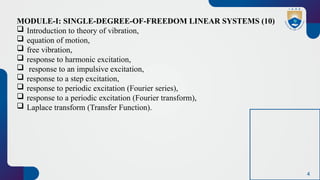
MODULE-I: SINGLE-DEGREE-OF-FREEDOM LINEAR SYSTEMS (10)
 Introduction to theory of vibration,
 equation of motion,
 free vibration,
 response to harmonic excitation,
 response to an impulsive excitation,
 response to a step excitation,
 response to periodic excitation (Fourier series),
 response to a periodic excitation (Fourier transform),
 Laplace transform (Transfer Function).
5
Introduction to theory of vibration
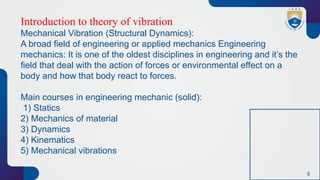
Mechanical Vibration (Structural Dynamics):
A broad field of engineering or applied mechanics Engineering
mechanics: It is one of the oldest disciplines in engineering and it’s the
field that deal with the action of forces or environmental effect on a
body and how that body react to forces.
Main courses in engineering mechanic (solid):
1) Statics
2) Mechanics of material
3) Dynamics
4) Kinematics
5) Mechanical vibrations
6
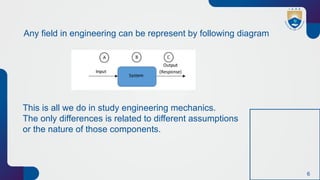
Any field in engineering can be represent by following diagram
This is all we do in study engineering mechanics.
The only differences is related to different assumptions
or the nature of those components.
7
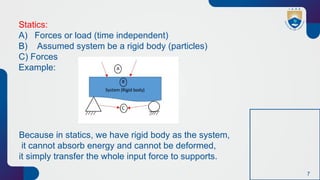
Statics:
A) Forces or load (time independent)
B) Assumed system be a rigid body (particles)
C) Forces
Example:
Because in statics, we have rigid body as the system,
it cannot absorb energy and cannot be deformed,
it simply transfer the whole input force to supports.
8
9
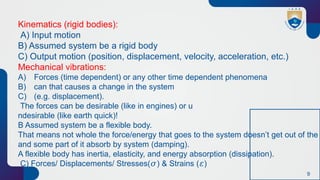
Kinematics (rigid bodies):
A) Input motion
B) Assumed system be a rigid body
C) Output motion (position, displacement, velocity, acceleration, etc.)
Mechanical vibrations:
A) Forces (time dependent) or any other time dependent phenomena
B) can that causes a change in the system
C) (e.g. displacement).
The forces can be desirable (like in engines) or u
ndesirable (like earth quick)!
B Assumed system be a flexible body.
That means not whole the force/energy that goes to the system doesn’t get out of the
and some part of it absorb by system (damping).
A flexible body has inertia, elasticity, and energy absorption (dissipation).
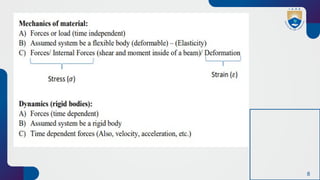
C) Forces/ Displacements/ Stresses( ) & Strains ( )
𝜎 𝜀
10
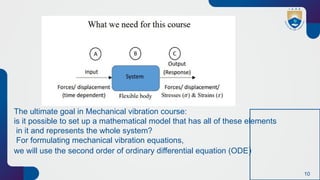
The ultimate goal in Mechanical vibration course:
is it possible to set up a mathematical model that has all of these elements
in it and represents the whole system?
For formulating mechanical vibration equations,
we will use the second order of ordinary differential equation (ODE)
11
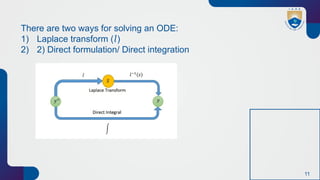
There are two ways for solving an ODE:
1) Laplace transform ( )
𝑙
2) 2) Direct formulation/ Direct integration
12
Rather than solving a very complicated integral,
in the Laplace transform method,
we are first mapped the equation to another domain
and then we doing inverse mapping to solve the problem.
In this course, we are dealing with some simple second order differential
equations, so we are using direct approach for solving the problems
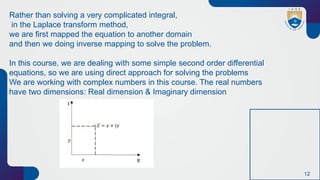
We are working with complex numbers in this course. The real numbers
have two dimensions: Real dimension & Imaginary dimension
13
Some number may have the imaginary part or may not
(for instance, 5 = 5 + (0))
𝑖
Complex algebra has its own operation:
1) Summation/ subtraction
If: 1 = 1 + 1 , 2 = 2 + 2
𝑍 𝑥 𝑖𝑦 𝑍 𝑥 𝑖𝑦
𝑍𝑡 = 1 + 2 = ( 1 + 2) + ( 1 + 2)
𝑍 𝑍 𝑥 𝑥 𝑖 𝑦 𝑦
2) Multiplication
Note: = √−1 so 2 = . = √−1.√−1 = −1
𝑖 𝑖 𝑖 𝑖
𝑍𝑡 = 1. 2 =( 1 + 1) . ( 2 + 2 ) = ( 1 2 −
𝑍 𝑍 𝑥 𝑖𝑦 𝑥 𝑖𝑦 𝑥 𝑥
1 2 ) + ( 1 2 + 2 1)
𝑦 𝑦 𝑖 𝑥 𝑦 𝑥 𝑦
14
3) Division
Note: If two complex numbers are equal that means
real parts of them are equal and imaginary parts of
them are equal too.
𝑍1 = 𝑍 1 = 2 & 1 = 2
𝑥 𝑥 𝑦 𝑦
15
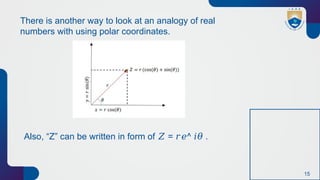
There is another way to look at an analogy of real
numbers with using polar coordinates.
Also, “Z” can be written in form of = ^ .
𝑍 𝑟𝑒 𝑖𝜃
16
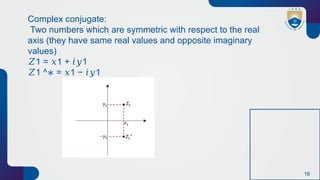
Complex conjugate:
Two numbers which are symmetric with respect to the real
axis (they have same real values and opposite imaginary
values)
𝑍1 = 1 + 1
𝑥 𝑖𝑦
𝑍1 ^ = 1 − 1
∗ 𝑥 𝑖𝑦
17
Mechanical Vibration
What is the objective? The objective of mechanical
vibration is we want to analyze and understand the
behavior of a system under the action of a
desirable/undesirable motion (to use this vibration in an
effective way or eliminate it from system)
In vibration we have focus on the system and that is the
most important part. Also, we have to understand how
model and present the force
System can be simple or very complex. For the complex
system, as an engineer we have to simplify the system to
be more understandable.
 Force is time dependent.
18
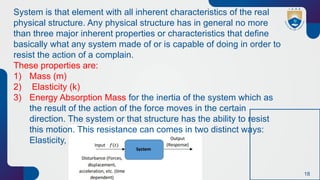
System is that element with all inherent characteristics of the real
physical structure. Any physical structure has in general no more
than three major inherent properties or characteristics that define
basically what any system made of or is capable of doing in order to
resist the action of a complain.
These properties are:
1) Mass (m)
2) Elasticity (k)
3) Energy Absorption Mass for the inertia of the system which as
the result of the action of the force moves in the certain
direction. The system or that structure has the ability to resist
this motion. This resistance can comes in two distinct ways:
Elasticity,
19
Mass for the inertia of the system which as the result of the action of the
force moves in the certain direction. The system or that structure has the
ability to resist this motion. This resistance can comes in two distinct
ways:
Elasticity which is the structure resists by going through some
deformation, bending, reacting to the action of the force or Energy
Absorption, that system or structure resist the imposed motion or the
force by trying to dissipate the effect of that action or dissipating energy
that resists that motion.
The goal of vibrations analysis, is finding the system as the
most appropriate mathematical model of a real/physical
structure or mechanism.
20
Idealization
Idealization: 1) Making logical assumptions based on knowing the
physics of the structure 2) Defining some things that can help us to
develop the proper mathematical model.
1) Disturbance ( ( )): This force has certain forms or a behavior
𝑓 𝑡
2) 2) Motion: We are dealing with two types of motion: Translational
and rotational
What is the main difference between translational and
rotational motion?
21
What is the main difference between translational and
rotational motion?
In both of them we are talking about the mass go to some
motion. But in translational motion we are look at the
motion in terms of what is happening to the center of mass.
The distribution of the mass or the way the mass is
distributed or the inertia are not so important in translational
motion while in rotational motion mass distribution is super
important.
22
Translational motion: Dealing with the mass or the center of
the mass or how the mass is lumped at one point.
Rotational motion: Dealing with mass moment of inertia
23
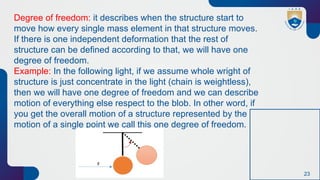
Degree of freedom: it describes when the structure start to
move how every single mass element in that structure moves.
If there is one independent deformation that the rest of
structure can be defined according to that, we will have one
degree of freedom.
Example: In the following light, if we assume whole wright of
structure is just concentrate in the light (chain is weightless),
then we will have one degree of freedom and we can describe
motion of everything else respect to the blob. In other word, if
you get the overall motion of a structure represented by the
motion of a single point we call this one degree of freedom.
24
If we can assume the entire mass of a structure or system is
lumped in a single point which moving in a certain direction (can
be a translational or rotational) then we will have a system with a
single degree of freedom.
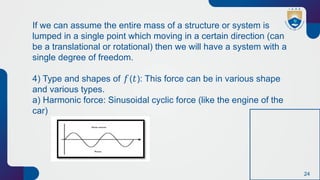
4) Type and shapes of ( ): This force can be in various shape
𝑓 𝑡
and various types.
a) Harmonic force: Sinusoidal cyclic force (like the engine of the
car)
25
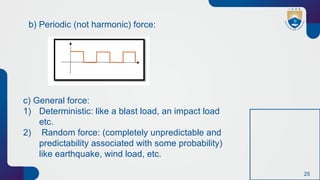
b) Periodic (not harmonic) force:
c) General force:
1) Deterministic: like a blast load, an impact load
etc.
2) Random force: (completely unpredictable and
predictability associated with some probability)
like earthquake, wind load, etc.
26
Mechanical vibration can be categorized on two distinct ways.
First, based on type of force that acts on the system. So, the system
can vibrating without the force acting on it and it is called free
vibration.
For instance, wind has been blowing and move the trees then wind
stops but trees still vibrating and moving. Or
the system is vibrating due to the action of the force that
continuously is acting on it and exist and it is called forced vibration.
27
Thank You - Arial 34 pt

Aerospace Structural Dynamics all athe chapters upted

  • 1.
    1 Course Title -Aerospace Structural Dynamics Topic Title – OUTCOME BASED EDUCATION Presenter’s Name –MR G SHIVA KRISHNA Department Name – AERONAUTICAL ENGINEERING Lecture Number –INTRODUCTION TO OBE
  • 2.
  • 3.
  • 4.
    4 MODULE-I: SINGLE-DEGREE-OF-FREEDOM LINEARSYSTEMS (10)  Introduction to theory of vibration,  equation of motion,  free vibration,  response to harmonic excitation,  response to an impulsive excitation,  response to a step excitation,  response to periodic excitation (Fourier series),  response to a periodic excitation (Fourier transform),  Laplace transform (Transfer Function).
  • 5.
    5 Introduction to theoryof vibration Mechanical Vibration (Structural Dynamics): A broad field of engineering or applied mechanics Engineering mechanics: It is one of the oldest disciplines in engineering and it’s the field that deal with the action of forces or environmental effect on a body and how that body react to forces. Main courses in engineering mechanic (solid): 1) Statics 2) Mechanics of material 3) Dynamics 4) Kinematics 5) Mechanical vibrations
  • 6.
    6 Any field inengineering can be represent by following diagram This is all we do in study engineering mechanics. The only differences is related to different assumptions or the nature of those components.
  • 7.
    7 Statics: A) Forces orload (time independent) B) Assumed system be a rigid body (particles) C) Forces Example: Because in statics, we have rigid body as the system, it cannot absorb energy and cannot be deformed, it simply transfer the whole input force to supports.
  • 8.
  • 9.
    9 Kinematics (rigid bodies): A)Input motion B) Assumed system be a rigid body C) Output motion (position, displacement, velocity, acceleration, etc.) Mechanical vibrations: A) Forces (time dependent) or any other time dependent phenomena B) can that causes a change in the system C) (e.g. displacement). The forces can be desirable (like in engines) or u ndesirable (like earth quick)! B Assumed system be a flexible body. That means not whole the force/energy that goes to the system doesn’t get out of the and some part of it absorb by system (damping). A flexible body has inertia, elasticity, and energy absorption (dissipation). C) Forces/ Displacements/ Stresses( ) & Strains ( ) 𝜎 𝜀
  • 10.
    10 The ultimate goalin Mechanical vibration course: is it possible to set up a mathematical model that has all of these elements in it and represents the whole system? For formulating mechanical vibration equations, we will use the second order of ordinary differential equation (ODE)
  • 11.
    11 There are twoways for solving an ODE: 1) Laplace transform ( ) 𝑙 2) 2) Direct formulation/ Direct integration
  • 12.
    12 Rather than solvinga very complicated integral, in the Laplace transform method, we are first mapped the equation to another domain and then we doing inverse mapping to solve the problem. In this course, we are dealing with some simple second order differential equations, so we are using direct approach for solving the problems We are working with complex numbers in this course. The real numbers have two dimensions: Real dimension & Imaginary dimension
  • 13.
    13 Some number mayhave the imaginary part or may not (for instance, 5 = 5 + (0)) 𝑖 Complex algebra has its own operation: 1) Summation/ subtraction If: 1 = 1 + 1 , 2 = 2 + 2 𝑍 𝑥 𝑖𝑦 𝑍 𝑥 𝑖𝑦 𝑍𝑡 = 1 + 2 = ( 1 + 2) + ( 1 + 2) 𝑍 𝑍 𝑥 𝑥 𝑖 𝑦 𝑦 2) Multiplication Note: = √−1 so 2 = . = √−1.√−1 = −1 𝑖 𝑖 𝑖 𝑖 𝑍𝑡 = 1. 2 =( 1 + 1) . ( 2 + 2 ) = ( 1 2 − 𝑍 𝑍 𝑥 𝑖𝑦 𝑥 𝑖𝑦 𝑥 𝑥 1 2 ) + ( 1 2 + 2 1) 𝑦 𝑦 𝑖 𝑥 𝑦 𝑥 𝑦
  • 14.
    14 3) Division Note: Iftwo complex numbers are equal that means real parts of them are equal and imaginary parts of them are equal too. 𝑍1 = 𝑍 1 = 2 & 1 = 2 𝑥 𝑥 𝑦 𝑦
  • 15.
    15 There is anotherway to look at an analogy of real numbers with using polar coordinates. Also, “Z” can be written in form of = ^ . 𝑍 𝑟𝑒 𝑖𝜃
  • 16.
    16 Complex conjugate: Two numberswhich are symmetric with respect to the real axis (they have same real values and opposite imaginary values) 𝑍1 = 1 + 1 𝑥 𝑖𝑦 𝑍1 ^ = 1 − 1 ∗ 𝑥 𝑖𝑦
  • 17.
    17 Mechanical Vibration What isthe objective? The objective of mechanical vibration is we want to analyze and understand the behavior of a system under the action of a desirable/undesirable motion (to use this vibration in an effective way or eliminate it from system) In vibration we have focus on the system and that is the most important part. Also, we have to understand how model and present the force System can be simple or very complex. For the complex system, as an engineer we have to simplify the system to be more understandable.  Force is time dependent.
  • 18.
    18 System is thatelement with all inherent characteristics of the real physical structure. Any physical structure has in general no more than three major inherent properties or characteristics that define basically what any system made of or is capable of doing in order to resist the action of a complain. These properties are: 1) Mass (m) 2) Elasticity (k) 3) Energy Absorption Mass for the inertia of the system which as the result of the action of the force moves in the certain direction. The system or that structure has the ability to resist this motion. This resistance can comes in two distinct ways: Elasticity,
  • 19.
    19 Mass for theinertia of the system which as the result of the action of the force moves in the certain direction. The system or that structure has the ability to resist this motion. This resistance can comes in two distinct ways: Elasticity which is the structure resists by going through some deformation, bending, reacting to the action of the force or Energy Absorption, that system or structure resist the imposed motion or the force by trying to dissipate the effect of that action or dissipating energy that resists that motion. The goal of vibrations analysis, is finding the system as the most appropriate mathematical model of a real/physical structure or mechanism.
  • 20.
    20 Idealization Idealization: 1) Makinglogical assumptions based on knowing the physics of the structure 2) Defining some things that can help us to develop the proper mathematical model. 1) Disturbance ( ( )): This force has certain forms or a behavior 𝑓 𝑡 2) 2) Motion: We are dealing with two types of motion: Translational and rotational What is the main difference between translational and rotational motion?
  • 21.
    21 What is themain difference between translational and rotational motion? In both of them we are talking about the mass go to some motion. But in translational motion we are look at the motion in terms of what is happening to the center of mass. The distribution of the mass or the way the mass is distributed or the inertia are not so important in translational motion while in rotational motion mass distribution is super important.
  • 22.
    22 Translational motion: Dealingwith the mass or the center of the mass or how the mass is lumped at one point. Rotational motion: Dealing with mass moment of inertia
  • 23.
    23 Degree of freedom:it describes when the structure start to move how every single mass element in that structure moves. If there is one independent deformation that the rest of structure can be defined according to that, we will have one degree of freedom. Example: In the following light, if we assume whole wright of structure is just concentrate in the light (chain is weightless), then we will have one degree of freedom and we can describe motion of everything else respect to the blob. In other word, if you get the overall motion of a structure represented by the motion of a single point we call this one degree of freedom.
  • 24.
    24 If we canassume the entire mass of a structure or system is lumped in a single point which moving in a certain direction (can be a translational or rotational) then we will have a system with a single degree of freedom. 4) Type and shapes of ( ): This force can be in various shape 𝑓 𝑡 and various types. a) Harmonic force: Sinusoidal cyclic force (like the engine of the car)
  • 25.
    25 b) Periodic (notharmonic) force: c) General force: 1) Deterministic: like a blast load, an impact load etc. 2) Random force: (completely unpredictable and predictability associated with some probability) like earthquake, wind load, etc.
  • 26.
    26 Mechanical vibration canbe categorized on two distinct ways. First, based on type of force that acts on the system. So, the system can vibrating without the force acting on it and it is called free vibration. For instance, wind has been blowing and move the trees then wind stops but trees still vibrating and moving. Or the system is vibrating due to the action of the force that continuously is acting on it and exist and it is called forced vibration.
  • 27.
    27 Thank You -Arial 34 pt