FUNDAMENTALS OF
MANAGEMENT
Marikriz M. Paulino, MBA
MANAGEMENT
WHAT IS MANAGEMENT?
Management is a science (knowledge) and art (skills) of
administration of tasks to achieve a goal.
Planning
Organizing
Leading
Controlling
Company Corona
Produces 10 Units with a
1 machine and 3 people
“EFFECTIVE” successful in
producing a desired or intended
result.
“EFFECTIVE & EFFICIENT” achieving
maximum productivity with
minimum wasted effort or
expense.
OF
Physical Resources
Human Resources
Financial Resources
Informational Resources
Company Virus
Produces 20 Units with a
1 machine and 3 people
TO Effective
Efficient
EskwelaCornerbyKriz
PLANNING ORGANIZING LEADING CONTROLLING
Process of
determining
objectives and
organizational goals,
establishing
strategies and
integrating
coordinated activities
in the organization to
achieve the goals and
objectives.
Process of establishing
a structure by assigning
tasks, assembling and
allocating resources to
achieve the
organizational goals
and objectives.
Process of
influencing people
to work in
achieving the
organizational
goal.
Process of
monitoring
performance and
taking a corrective
action when
necessary to ensure
that the objectives of
the organizational
will be achieved.
Provides a clear
direction to
organization.
Parts of it is staffing,
this is the process of
selecting, training and
evaluating employees.
MANAGEMENT FUNCTIONS
EskwelaCornerbyKriz
• First management should develop a precise, scientific approach for each
element of one’s work to replace general guidelines.
• Second, management should scientifically select, train, teach and develop
each worker so that the right person has the right job.
• Third management should cooperate with workers to ensure that jobs
match plans and principles.
• Lastly, management should ensure an appropriate division of work and
responsibility between managers and workers ( Bateman& Snell, 2008).
MANAGEMENT THEORIES:
EVOLUTION OF MANAGEMENT
EskwelaCornerbyKriz
A. SCIENTIFIC MANAGEMENT
Frederick Winslow Taylor (1856 – 1915 )
“Father of Scientific Management”
He focused on analyzing the work and how to
complete a task efficiently.
Taylor used scientific techniques in improving the
performance of the people in production,
emphasizing in maximizing the output.
B. MOTION STUDIES
The reducing or breaking a task to its
basic physical motion and eliminating
unnecessary or redundant motions.
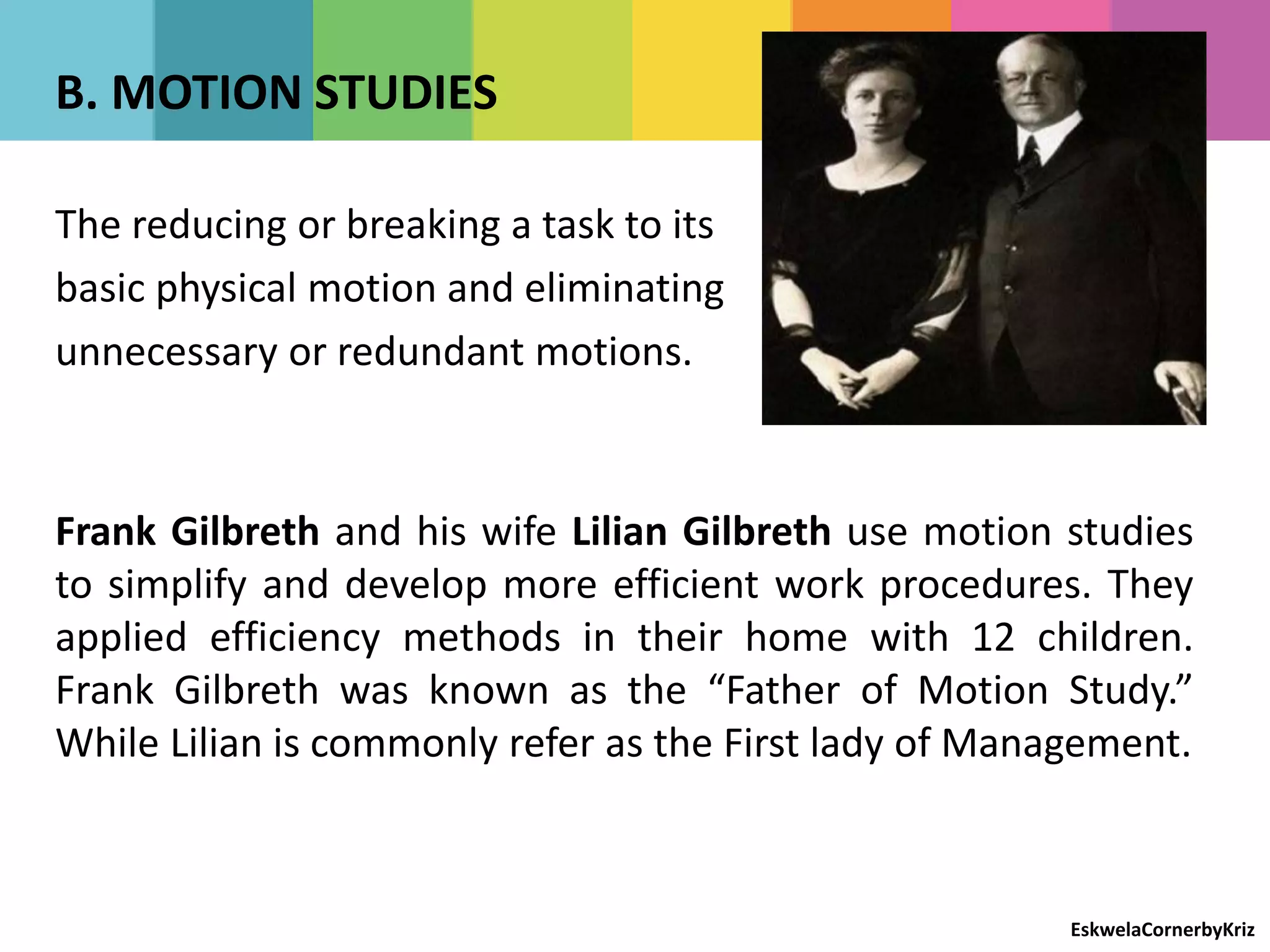
Frank Gilbreth and his wife Lilian Gilbreth use motion studies
to simplify and develop more efficient work procedures. They
applied efficiency methods in their home with 12 children.
Frank Gilbreth was known as the “Father of Motion Study.”
While Lilian is commonly refer as the First lady of Management.
EskwelaCornerbyKriz
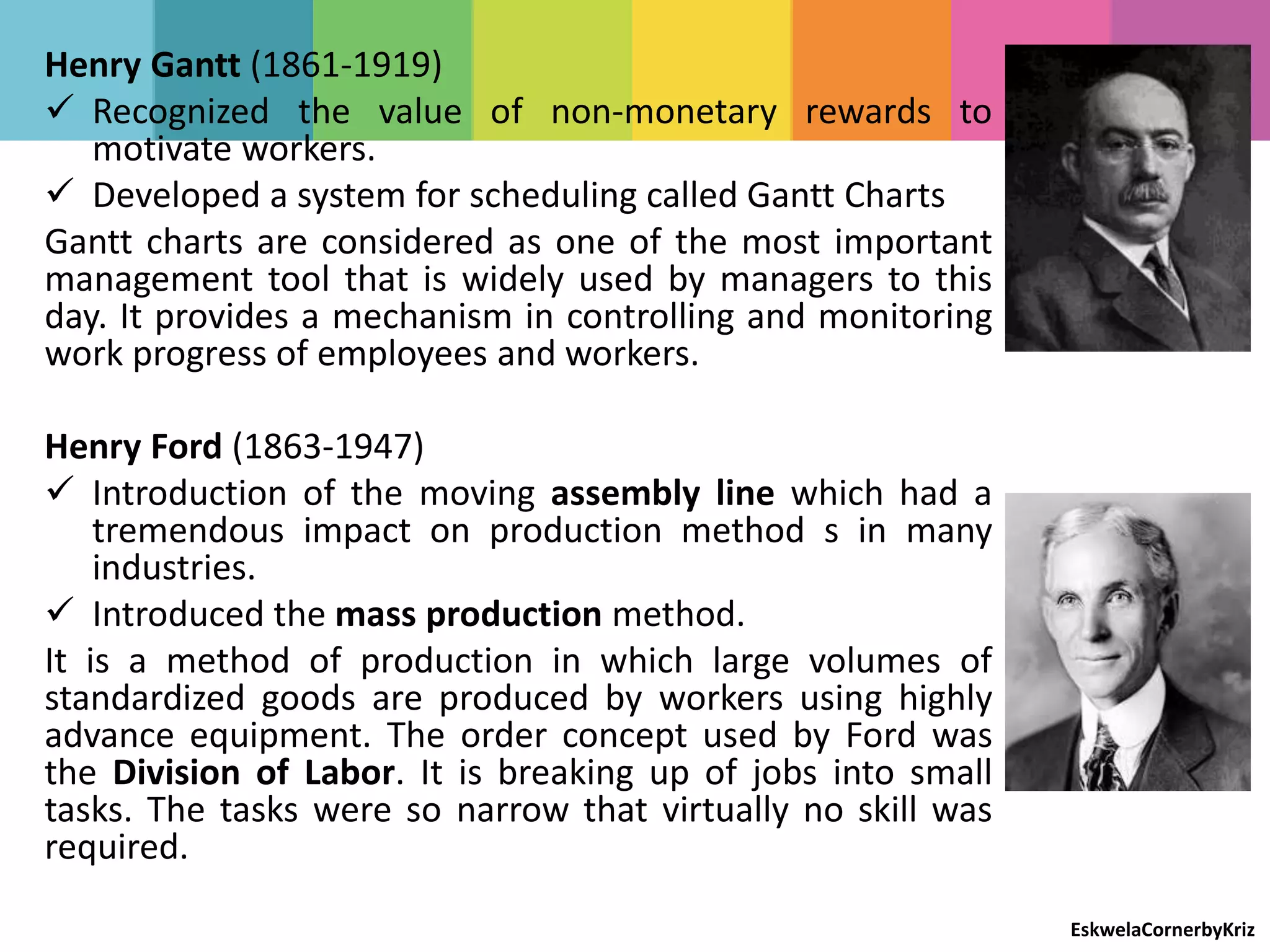
Henry Gantt (1861-1919)
 Recognized the value of non-monetary rewards to
motivate workers.
 Developed a system for scheduling called Gantt Charts
Gantt charts are considered as one of the most important
management tool that is widely used by managers to this
day. It provides a mechanism in controlling and monitoring
work progress of employees and workers.
Henry Ford (1863-1947)
 Introduction of the moving assembly line which had a
tremendous impact on production method s in many
industries.
 Introduced the mass production method.
It is a method of production in which large volumes of
standardized goods are produced by workers using highly
advance equipment. The order concept used by Ford was
the Division of Labor. It is breaking up of jobs into small
tasks. The tasks were so narrow that virtually no skill was
required.
EskwelaCornerbyKriz
C.ADMINISTRATIVE MANAGEMENT
This approach emphasized the perspective
of senior managers within the organization.
It is also argues that management is a
profession and could be taught.
Henry Fayol “Father of Modern Management”
 He published a book summarizing his management
experiences wherein he identified five management
functions.
EskwelaCornerbyKriz
D. BUREAUCRACY
Bureaucracy can be defined as a rational
and efficient form of organization founded
on logic, order, and legitimate authority
Max Weber(1864-1920)
 Introduces in the idea of a bureaucratic organization.
The aim of this concept is to create an organization that has
authority structures with a clear procedure of rules and
regulations.
EskwelaCornerbyKriz
E. BEHAVIORAL THEORY
Human Relations Management that emphasizes the
understanding the importance of human element in
a workplace. “Organizational Behavior” the study of
human behavior in organizational setting, of the
interface between human behavior and the
organization and of the organization itself.
Elton Mayo (1880-1949)
 Conducted studies at Hawthorne works Plant of Western
Electric in Chicago.
 He led a team who developed a research project known as
Hawthorne Studies also known as “Hawthorne Effect
It is a series of experiments in which the initial studies failed
because the team proposed that better lightning would improve
the performance of the workers but it is reasonable that better
lightning will have a positive effect in the increase of production.
EskwelaCornerbyKriz
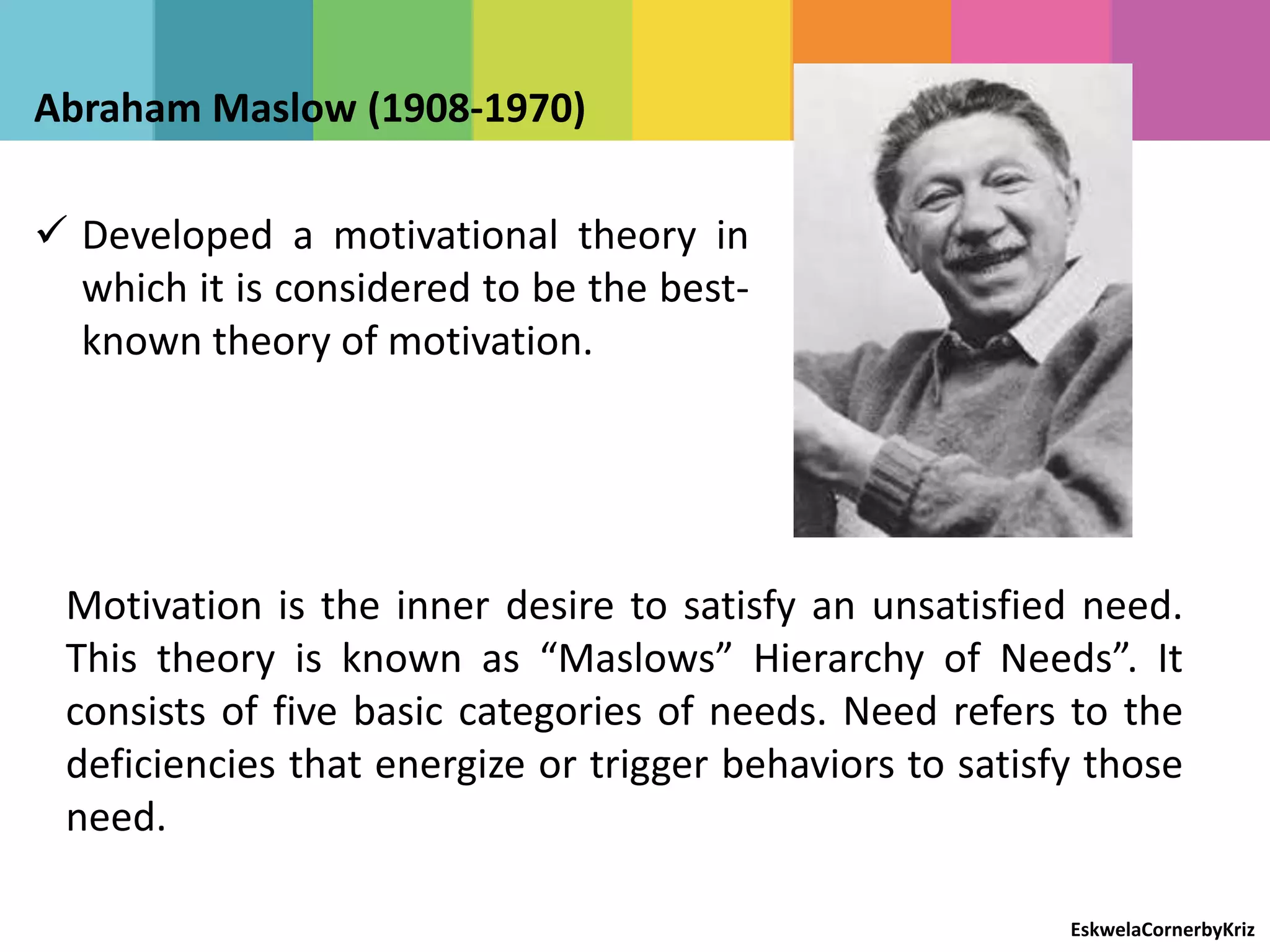
Abraham Maslow (1908-1970)
 Developed a motivational theory in
which it is considered to be the best-
known theory of motivation.
Motivation is the inner desire to satisfy an unsatisfied need.
This theory is known as “Maslows” Hierarchy of Needs”. It
consists of five basic categories of needs. Need refers to the
deficiencies that energize or trigger behaviors to satisfy those
need.
EskwelaCornerbyKriz
Frederick Herzberg (1923-2000)
Conducted a research where he
started interviewing 200 accountants
and engineers in Pittsburgh the result
led him to develop the Two- Factor
theory or better known as Motivation-
Hygiene Theory.
This theory proposes that employees are motivated
by intrinsic factors rather than extrinsic factors.
Intrinsic or Motivation factors are related to job
satisfaction such as achievement and recognition.
Extrinsic or Hygiene factors are associated with job
dissatisfaction such as working conditions, company
policies, pay and job security.
EskwelaCornerbyKriz
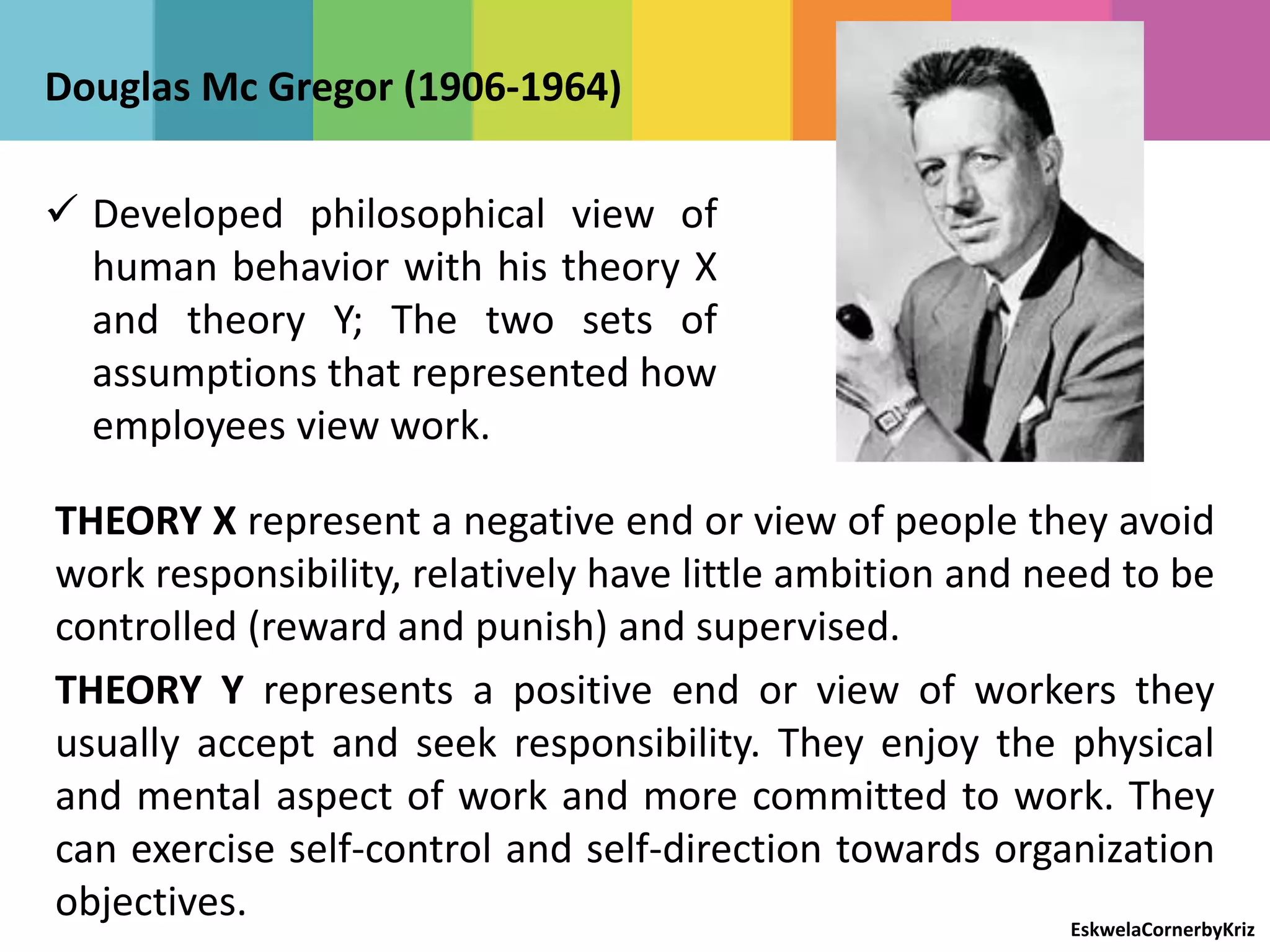
Douglas Mc Gregor (1906-1964)
 Developed philosophical view of
human behavior with his theory X
and theory Y; The two sets of
assumptions that represented how
employees view work.
THEORY X represent a negative end or view of people they avoid
work responsibility, relatively have little ambition and need to be
controlled (reward and punish) and supervised.
THEORY Y represents a positive end or view of workers they
usually accept and seek responsibility. They enjoy the physical
and mental aspect of work and more committed to work. They
can exercise self-control and self-direction towards organization
objectives. EskwelaCornerbyKriz
F. MANAGEMENT SCIENCE is an approach that emphasizes
the use of mathematics or quantitative techniques to analyze
and support management decisions and problems.
G. MODERN APPROACHES TO MANAGEMENT The system
theory focuses on viewing the organization as a whole and the
interrelationships of its parts. System is a collection of
interrelated elements that function as a whole. Subsystems
are small units of a larger system. Organizations are open
systems that process resources (inputs) into a product or
services (outputs) in which the environment reacts to the
output in the form of feedbacks.
EskwelaCornerbyKriz
References:
 Raw pictures by Google Image
 Wikipedia
 Robbins & Cuoutler; Bateman & Snell; Steven & Chong
 Series of presentation in management
END OF THE SLIDE
EskwelaCornerbyKriz

Fundamentals of management

  • 1.
  • 2.
    WHAT IS MANAGEMENT? Managementis a science (knowledge) and art (skills) of administration of tasks to achieve a goal. Planning Organizing Leading Controlling Company Corona Produces 10 Units with a 1 machine and 3 people “EFFECTIVE” successful in producing a desired or intended result. “EFFECTIVE & EFFICIENT” achieving maximum productivity with minimum wasted effort or expense. OF Physical Resources Human Resources Financial Resources Informational Resources Company Virus Produces 20 Units with a 1 machine and 3 people TO Effective Efficient EskwelaCornerbyKriz
  • 3.
    PLANNING ORGANIZING LEADINGCONTROLLING Process of determining objectives and organizational goals, establishing strategies and integrating coordinated activities in the organization to achieve the goals and objectives. Process of establishing a structure by assigning tasks, assembling and allocating resources to achieve the organizational goals and objectives. Process of influencing people to work in achieving the organizational goal. Process of monitoring performance and taking a corrective action when necessary to ensure that the objectives of the organizational will be achieved. Provides a clear direction to organization. Parts of it is staffing, this is the process of selecting, training and evaluating employees. MANAGEMENT FUNCTIONS EskwelaCornerbyKriz
  • 4.
    • First managementshould develop a precise, scientific approach for each element of one’s work to replace general guidelines. • Second, management should scientifically select, train, teach and develop each worker so that the right person has the right job. • Third management should cooperate with workers to ensure that jobs match plans and principles. • Lastly, management should ensure an appropriate division of work and responsibility between managers and workers ( Bateman& Snell, 2008). MANAGEMENT THEORIES: EVOLUTION OF MANAGEMENT EskwelaCornerbyKriz A. SCIENTIFIC MANAGEMENT Frederick Winslow Taylor (1856 – 1915 ) “Father of Scientific Management” He focused on analyzing the work and how to complete a task efficiently. Taylor used scientific techniques in improving the performance of the people in production, emphasizing in maximizing the output.
  • 5.
    B. MOTION STUDIES Thereducing or breaking a task to its basic physical motion and eliminating unnecessary or redundant motions. Frank Gilbreth and his wife Lilian Gilbreth use motion studies to simplify and develop more efficient work procedures. They applied efficiency methods in their home with 12 children. Frank Gilbreth was known as the “Father of Motion Study.” While Lilian is commonly refer as the First lady of Management. EskwelaCornerbyKriz
  • 6.
    Henry Gantt (1861-1919) Recognized the value of non-monetary rewards to motivate workers.  Developed a system for scheduling called Gantt Charts Gantt charts are considered as one of the most important management tool that is widely used by managers to this day. It provides a mechanism in controlling and monitoring work progress of employees and workers. Henry Ford (1863-1947)  Introduction of the moving assembly line which had a tremendous impact on production method s in many industries.  Introduced the mass production method. It is a method of production in which large volumes of standardized goods are produced by workers using highly advance equipment. The order concept used by Ford was the Division of Labor. It is breaking up of jobs into small tasks. The tasks were so narrow that virtually no skill was required. EskwelaCornerbyKriz
  • 7.
    C.ADMINISTRATIVE MANAGEMENT This approachemphasized the perspective of senior managers within the organization. It is also argues that management is a profession and could be taught. Henry Fayol “Father of Modern Management”  He published a book summarizing his management experiences wherein he identified five management functions. EskwelaCornerbyKriz
  • 8.
    D. BUREAUCRACY Bureaucracy canbe defined as a rational and efficient form of organization founded on logic, order, and legitimate authority Max Weber(1864-1920)  Introduces in the idea of a bureaucratic organization. The aim of this concept is to create an organization that has authority structures with a clear procedure of rules and regulations. EskwelaCornerbyKriz
  • 9.
    E. BEHAVIORAL THEORY HumanRelations Management that emphasizes the understanding the importance of human element in a workplace. “Organizational Behavior” the study of human behavior in organizational setting, of the interface between human behavior and the organization and of the organization itself. Elton Mayo (1880-1949)  Conducted studies at Hawthorne works Plant of Western Electric in Chicago.  He led a team who developed a research project known as Hawthorne Studies also known as “Hawthorne Effect It is a series of experiments in which the initial studies failed because the team proposed that better lightning would improve the performance of the workers but it is reasonable that better lightning will have a positive effect in the increase of production. EskwelaCornerbyKriz
  • 10.
    Abraham Maslow (1908-1970) Developed a motivational theory in which it is considered to be the best- known theory of motivation. Motivation is the inner desire to satisfy an unsatisfied need. This theory is known as “Maslows” Hierarchy of Needs”. It consists of five basic categories of needs. Need refers to the deficiencies that energize or trigger behaviors to satisfy those need. EskwelaCornerbyKriz
  • 11.
    Frederick Herzberg (1923-2000) Conducteda research where he started interviewing 200 accountants and engineers in Pittsburgh the result led him to develop the Two- Factor theory or better known as Motivation- Hygiene Theory. This theory proposes that employees are motivated by intrinsic factors rather than extrinsic factors. Intrinsic or Motivation factors are related to job satisfaction such as achievement and recognition. Extrinsic or Hygiene factors are associated with job dissatisfaction such as working conditions, company policies, pay and job security. EskwelaCornerbyKriz
  • 12.
    Douglas Mc Gregor(1906-1964)  Developed philosophical view of human behavior with his theory X and theory Y; The two sets of assumptions that represented how employees view work. THEORY X represent a negative end or view of people they avoid work responsibility, relatively have little ambition and need to be controlled (reward and punish) and supervised. THEORY Y represents a positive end or view of workers they usually accept and seek responsibility. They enjoy the physical and mental aspect of work and more committed to work. They can exercise self-control and self-direction towards organization objectives. EskwelaCornerbyKriz
  • 13.
    F. MANAGEMENT SCIENCEis an approach that emphasizes the use of mathematics or quantitative techniques to analyze and support management decisions and problems. G. MODERN APPROACHES TO MANAGEMENT The system theory focuses on viewing the organization as a whole and the interrelationships of its parts. System is a collection of interrelated elements that function as a whole. Subsystems are small units of a larger system. Organizations are open systems that process resources (inputs) into a product or services (outputs) in which the environment reacts to the output in the form of feedbacks. EskwelaCornerbyKriz
  • 14.
    References:  Raw picturesby Google Image  Wikipedia  Robbins & Cuoutler; Bateman & Snell; Steven & Chong  Series of presentation in management END OF THE SLIDE EskwelaCornerbyKriz