Table of Contents
MODULE 8
Chapter 7. ORGANIZING AND STAFFING
7.1 Organization Theories for Effective Business 1-3
Management
7.2 Staffing and its Concept 3-4
7.3 Nature of Staffing 4-5
Assessment Activities 6
MODULE 9
Chapter 8. STAFFING
8.1 Recruitment and Selection 7-8
8.2 Training Process 8-9
8.3 Compensation: Its Function and Importance 10-12
Assessment Activities 13-15
MODULE 10
Chapter 9. LEADING
9.1 Leading vs. Managing 16-17
9.2 Theories of Motivation 17-19
9.3 Styles of Leadership 19-20
Assessment Activities 22-23
MODULE 11
Chapter 10. CONTROLLING
10.1 Controlling and its Nature 24-25
10.2 Planning and Controlling 25-26
10.3 Importance of Control 26
10.4 The Control Process 26-27
10.5 Types of Control 27-28
10.6 Areas of Control 28-29
10.7 Control Methods and System 29-30
Assessment Activities 31-32
MODULE 12
Chapter 11. INTRODUCTION TO THE FUNCTIONAL AREAS OF MANAGEMENT
11.1 Human Resources Management 33-34
11.2 Marketing Management 34
11.3 Operations Management 34-35
11.4 Financial Management 35
11.5 Material and Procure Management 36
11.6 Office Management 36-37
11.7 Information and Communication Technology Management 37
Assessment Activities 39-40
MODULE 13
Chapter 12. SPECIAL TOPICS IN MANAGEMENT
12.1 The Family Business 41-42
12.2 Forms of Business and Legal Requirements 42
12.3 Roles of Family Business in an Improving Economic Status 42-43
Assessment Activities 44-45
Organization and Management Project Instructions 46-47
MODULE 14
Organization and Management 2nd Quarter Examination
ASIAN INSTITUTE OF COMPUTER STUDIES (AICS)
1
This module is clearly the continuation of the previous chapter, which is organizing.
However, this module also contains the next vital duty after planning and
organizing: staffing. For now, let us start where we left off last chapter.
Organizational theory is the sociological study of formal social organizations, such
as businesses and bureaucracies, and their interrelationship with the environment
in which they operate.
It complements the studies of organizational behavior and human resource
studies. Organization theory means the study of structure, functioning, and
performance of organization and the behavior of individual and groups within it.
Organizations are said to have risen in the United States within a variety of social
and historical contexts.
Several of those factors are
credited with making
organizations viable and
necessary options for citizens,
and they built on one another
to bring organizations to the
level of importance that they
are today.
In 1820, about 20% of the
United States population
was dependent on a
wage income. That
number increased to 90%
by 1950. Generally,
farmers and craftsmen
were the only ones by
1950 who were not
dependent or working for someone else; prior to that, most people were able to
survive by hunting and farming their own food, making their own supplies, and
remaining almost fully self-sufficient.
As transportation became more efficient and technologies further developed, self-
sufficiency became an economically poor choice.
The development of organizations demands a higher level of skillset from workers
as it continues to grow. It also builds precautionary measures on cutting edge
technology. It amplifies the need for specialization and accounts of functionalism
invarious organizations and their respective societies. Throughmuch advancement
in the interaction of capitalistic bureaucracies, the development organizations is
what has driven contemporary firms to thrive in its modern day society.
As organizations are implemented over time, many people experimented as to
which one was best. These theories of organizations include Bureaucracy,
2
nd
QUARTER
MODULE
8
WEEK:_____
At the end of this module, you are expected to:
• Apply organization theories for effective business management
• Discuss the staffing and its concept, and
• Evaluate the nature of staffing.
KEY QUESTIONS
• In your own perspective, what
do you think is the most
effective organization theory?
• Why is staffing considered as a
vital task in an organization?
CHAPTER 7. ORGANIZING AND STAFFING
7.1 Organization Theories for Effective Business
Management
ASIAN INSTITUTE OF COMPUTER STUDIES (AICS)
2
Rationalization (Scientific Management), and the Division of Labor. Each theory
provides distinct advantages and disadvantages when implemented.
Rational System Perspective:
In a rational organization system, there are two significant parts- specificity of goals
and formalization. Goal specification provides guidelines for specific tasks to be
completed along with a regulated way of resources to be allocated. Formalization
is a way to standardize organizational behavior. As a result, there will be stable
expectations, which create the rational organizational system.
Scientific Management:
Taylor analyzed how to maximize the amount of output with the least amount of
input. This was Taylor’s attempt to rationalize the individual worker:
i. Divide work between managers and workers
ii. Provide incentive system (based on performance)
iii. Scientifically trained workers
iv. Create a science for each individual’s responsibilities
v. Make sure work is done on time/efficiently
Division of Labor:
The division of labor is the specialization of individual labor roles. It is often
associated with increasing output and trade. According to Adam Smith, the division
of labor is efficient due to three reasons- occupational specializations, saving from
not changing tasks, and machines taking the place of human labor.
Occupational specialization leads to increased productivity and distinct skill. Also,
Smith argued that human and physical capital must be similar or matched; if the
skill workers were matched with technological improvements, there would be
major increase in productivity.
Although the division of labor is often viewed as inevitable in a capitalistic society,
there are several specific problems that may arise. They may include a lack of
creativity, monotony, and lack of mobility. Creativity will naturally suffer due to
monotonous atmosphere that the division of labor creates. Doing the same
routines may not be for everyone. Also, employees aren’t familiar with other parts
of the job. They cannot assist employers of different parts of the system.
Theory 1: Weber's Ideal of Bureaucracy
•Official Jurisdiction on all areas are ordered by rules or laws already
implemented, There is an office hierarchy; a system of super- and
subordination in which there is supervision of lower office by higher ones.
•The management of the modern office is based upon written rule, which are
preserved in original form. Office management requires that of training or
specialization. When the office is developed/established t requires the full
working capacity of individuals. Rules are stable and can be learned.
Knowledge of these rules can be viewed as expertise within the bureucracy
(these allow for the management of society).
•When a bureacracy is implemented, they can provide accountability,
responsibility, control, and consistency. The hiring of employees will be an
impersonal and equal system. Although the classical perspective encourages
efficiency, it is often criticized as ignoring human needs. Also, it rarely takes
into consideration human error or the variability of work performances
(each worker is diferent).
Theory 2: Modernization Theory
•Modernization "began when a nation's rural population started moving from
the countryside to cities". It deals with the cessation of traditional methods
in order to pursue more contemporary effective methods of organization.
•Modernization theory arose in the context of decolonization in Africa and
Asia and the early years of Cold War. It grew out efforts to understand how
recently independent nations and other 'Third World' countries might
achieve economic and political development similar to that of the US and
northern Europe, which were viewed as the products of a linear and
potentially universal process of rationalization and progress.
•Urbanization is an inevitable characteristic of society because the formation
of industries and factories induces profit maximization. It is fair to assume
that along with the increase in population, as a result of subseqeunt
urbanization, is the demand for an intelligent and educated labor force.
ASIAN INSTITUTE OF COMPUTER STUDIES (AICS)
3
Staffing can be defined as one of the most important functions of management. It
involves the process of filling the vacant position of the right personnel at the right
job, at the right time. Hence, everything will occur in the right manner.
It is a truth that human resource is one of the greatest for every organization
because in any organization all other resources like – money, material, machine,
etc., can be utilized effectively and efficiently by the positive efforts of human
resource.
Therefore, it is very important that each and every person should get right position
in the organization so as to get the right job, according to their ability, talent,
aptitude, and specializations so that it will help the organization to achieve the pre-
set goals in the proper way by the 100% contribution of manpower. Thus, it can be
said that staffing is an essential function of every business organization.
Functions of Staffing:
1. The first and foremost function of staffing is to obtain qualified personnel
for the right jobs, therefore, it leads to maximum productivity and higher
performance.
2. It helps promoting the optimum utilization of human resource through
various aspects.
3. Job satisfaction and morale of the workers increases through the
recruitment of the right person.
4. Staffing helps to ensure better utilization of human resources.
5. It ensures the continuity and growth of the organization, through
development managers.
It is clear that staffing is vested in the human resource (HR) unit, their selected
tasks include the following:
1. Recruitment – which involves activities related to the development of a
pool of applicants for jobs in the organization;
Theory 3: Hawthorne Study
•The hawthorne study suggested that employees have social and
psychological needs along with economic needs in order to be motivated to
complete their assigned tasks. This theory of management (as also discussed
in the first chapter) was a product of the strong opposition against the
'scientific and universal management theory of taylor and fayol'. This theory
was a response to the way employees and how they were deprived of their
needs and ambitions.
•In Hawthorne study, the management attempts to improve the
interpersonal skills through motivations, leading, communication, and
counseling.
•This study encourages managers to acquire minimal knowledge of
behavioral sciences to be able to understand and improve the interactions
between employees.
Theory 4: Contingency Theory
•The Contigency Theory is a class of behavioral theory that claims that there
is no best way to organize a corporation, to lead a company, or to make
decisions. An organizational, leadership, or decision making style that is
effective in some situations, may not be successful in other situations. The
optimal organization, leadership, or decision making style depends upon
various internal and external constraints (factors).
• The growth of modernization took place beginning in the 1950s. For the
ensuing decade, people analyzed the diffusion of technological innovations
within Western society and the communication that helped it disperse
globally. This first "wave" as it became known had some significant
ramifications.
• First, economic development was enhanced from the spread of new
technological techniques. and the second, modernization supported a more
educated and thus a more qualified labor force. The second wave took place
between the years 1960 and 1970.
7.2 Staffing and its Concept
ASIAN INSTITUTE OF COMPUTER STUDIES (AICS)
4
2. Selection – which is related to decisions on who to hire from the pool
created by recruitment tasks;
3. Training and Development – which involves the continuous development
of the workforce;
4. Performance Appraisal – the measurement of an employee’s performance;
and
5. Reward System Design – which includes the plans for monetary and fringe
between benefits of employees.
Importance of Staffing
Efficient Performance of Other Functions
For the efficient performance of other functions of management, staffing is its key.
Since, if an organization does not have the competent personnel, then it cannot
perform the functions of management like planning, organizing, and control
functions properly.
Effective Use of Technology and Other Resources
What is staffing and technology’s connection? Well, it is the human factor that is
instrumental in the effective utilization of the latest technology, capital, material,
etc. the management can ensure the right kinds of personnel by performing the
staffing function.
Optimum Utilization of Human Resources
The wage bill of big concerns is quite high. Also, a huge amount is spent of
recruitment, selection, training, and development of employees. To get the
optimum output, the staffing function should be performed in an efficient manner.
Development of Human Capital
Another function of staffing is concerned with human capital requirements. Since
the management is required to determine in advance the manpower
requirements. Therefore, it has also to train and develop the existing personnel for
career advancement. This will meet the requirements of the company in the future.
The Motivation of Human Resources
In an organization, the behavior of individuals is influenced by various factors which
are involved such as education levels, needs, socio-cultural factors, etc. Therefore,
the human aspects of the organization have become very important and so that
the workers can also be motivated by financial and non-financial incentives in order
to perform their functions properly in achieving the objectives.
Building Higher Morale
The right type of climate should be created for the workers to contribute to the
achievement of the organizational objectives. Therefore, by performing the
staffing function effectively and efficiently, the management is able to describe the
significance and importance which it attaches to the personnel working in the
enterprise.
• Blue-collar workers (i.e., those working on the machines and engaged in
loading, unloading, etc.) and white collar workers (i.e., clerical employees).
• Managerial and Non-Managerial Personnel
• Professionals (e.g., Chartered Accountant, Company Secretary)
People-Centered
Staffing can broadly view as people-
centered function and therefore it is
relevant for all types of organization. It
is concerned with categories of
personnel from top to bottom of the
organization.
7.3 Nature of Staffing
ASIAN INSTITUTE OF COMPUTER STUDIES (AICS)
5
REFERENCES
Books
Supplement to Chapter 4: Staffing, pp. 51-58, Organization and
Management: Concepts, Caselets, and Exercises (2016)
Electronic Source
Modernization Theory - International Encyclopedia of the Social and
Behavioral Sciences, 2001, retrieved from
https://www.sciencedirect.com/topics/economics-econometrics-and-
finance/modernization-theory
Organizational Theories by A. Bhardawaj retrieved from
https://www.economicdiscussion.net/organizational-
structure/organizational-theories/31783
Human Skills
Staffing function is mainly concerned with
different types of training and development
of human resource and therefore the
managers should use human relation skill in
providing guidance and training to the
subordinates. If the staffing function is
performed properly, then the human
relations in the organization will be cordial
and mutually performed In an organized
manner.
Responsibilityof Manager
Staffing is the basic function of management
which involves that the manager is
continuously engaged actively associated
with the recruitment, selection, training, and
appraisal of his subordinates.
Therefore, the activities are performed by the
chief executive, departmental managers, and
foremen in relation to their subordinates.
ContinuousFunction
Staffing Function is to be performed
continuously which is equally important for a
new and well-established organization. Since in
a newly established organization, there has to
be recruitment, selection, and training of
personnel. As we compare that, the
organization which is already a running
organization, then at that place every manager
is engaged in various staffing
activities.Therefore, he is responsible for
managing all the workers in order to get the
work done for the accomplishment of the
overall objectives of an organization.
ASIAN INSTITUTE OF COMPUTER STUDIES (AICS)
6
Directions. Identify what organization theory is asked based on the given
description. Write your answer on the space provided before each number.
Choices can be found on the box below.
__________1) This theory suggested that employees have social and psychological
needs along with economic needs to be motivated to complete their assigned
tasks.
__________2) A system wherein there are two significant parts- specificity of goals
and formalization.
__________3) This theory It deals with the cessation of traditional methods in
order to pursue more contemporary effective methods of organization.
__________4) It is often associated with increasing output and trade.
__________5) A behavioral theory that claims that there is no best way to organize
a corporation, to lead a company, or to make decisions.
__________6) Its attempt to rationalize the individual worker includes division of
work between managers and workers.
__________7) It is often viewed as inevitable in a capitalistic society.
__________8) A theory that grew out efforts to understand how recently
independent nations and other 'Third World' countries might achieve economic
and political development similar to that of the ‘First World’ countries.
__________9) This study encourages managers to acquire knowledge of behavioral
sciences to be able to understand and improve the interactions between
employees.
__________10) This theory emphasizes on the existence of office hierarchy; a
system of supervision and subordination.
Directions. Paste at least 5 cutouts or printed copies of job hiring
posters/advertisements. Make sure that it includes job description and job
specifications/qualifications. If the space provided is not enough, paste the
cutouts/printed copies on a separate sheet of bond paper to be passed along with
this activity sheet.
Activity 1: All About Theories
Weber’s Ideal of Bureaucracy Contingency Theory
Hawthorne Study Rational System Perspective
Division of Labor Modernization Theory
Scientific Management
Activity 2: Job Searching
ASIAN INSTITUTE OF COMPUTER STUDIES (AICS)
7
A business needs to establish procedures in the hiring of employees. The criteria as
to what are to be considered need to be set, including a job analysis requirement.
Job analysis is the procedure through which the duties of given job positions and
the characteristics of people who should fill them are determined. As job positions
need to be staffed, the job fill them are determined. As job positions need to be
staffed, the job requirements need to be spelled out and used to develop job
descriptions and specifications. A job description is a list of what the job entails,
while a job specification is a list of the kind of people for the job. Job descriptions
and specifications include the following:
1. Work Activities, like teaching, encoding, painting, and selling;
2. Human Behavior, like communicating, writing, and deciding;
3. Tools Used, such as computers, sewing machines, and power tools;
4. Performance Standards, like one hundred sewn dresses per eight-hour
shift and ten cars sold per month;
5. Job Context, like work at night, teaching on weekends and holidays, and
work from home; and
6. Human Requirements, like a master’s degree for college teachers, board
passers for accountants, work experience for supervisory work, specific
physical characteristics for computers, and computer literacy for most
jobs.
Job analysis information is used to decide or determine:
1. The person to hire;
2. The compensation for the job;
3. Job standards as basis for actual performance;
4. Training and development programs; and
5. Unassigned tasks and duplication of assignments.
Figure 1. The Recruitment Process Flowchart
8.1 Recruitment and Selection
2
nd
QUARTER
MODULE
9
WEEK:_____
At the end of this module, you are expected to:
• Analyze the process of recruiting, selecting, and training employee,
• Examine the functions and importance of compensation, and
• Differentiate wages and performance evaluation, appraisal, reward system, employee relations and
movement.
KEY QUESTIONS
• How does the recruitment and
training process differ from
one another?
• Why does the compensation
scheme play a big role in hiring
an applicant?
CHAPTER 8. STAFFING
Determine the job
positions to be
filled.
Build a pool of job
applicants.
Require the job
applicants to
submit application
forms.
Screen the
applicants.
Call selected
applicants to tests,
including medical
and drug tests.
Short list applicants
for interview.
Interview
applicants; make
final choice.
Hire chosen
applicant.
ASIAN INSTITUTE OF COMPUTER STUDIES (AICS)
8
Building a pool of applicants’, as shown in figure 1, is done through HELP WANTED
advertisements in newspapers, job recruitments websites, trade journals, flyers,
television advertisements, employment agencies, business associates, and friends.
Candidates for employment are required to submit application forms, resume,
curriculum vitae (CV), and/or biodata.
Most companies have pre-printed application forms. Pre-printed forms are also
shown available in office supplies stores. The prospective employers screen the
applicants from the pool, and subject them to a battery of tests. The tests may
include some of the following, dependent on the specifications of the job:
1. Intelligence Quotient (IQ) Test
2. Aptitude Test
3. Motor and Physical Abilities Test
4. Personality Test
5. Achievement Test
6. Work Sampling Test
7. Background and Reference Check
The candidates who pass the tests are made to go through the requisite medical
examinations and drug tests. The applicants who pass the medical tests are short-
listed for interviews, and subjected to interview sessions, again dependent on the
job level and/or job specifications, by supervisors and/or managers.
When the applicant passes all the aforementioned tests, the recruitment process
is completed, and the job applicant is hired.
After the applicant is hired, he/she goes through job orientation. Job orientation is
the procedure for providing new employees with basic background information
about the enterprise. This information covers personnel policies on working hours,
performance review, salaries and remuneration, vacation leaves and other
employee benefits, and safety rules and regulations. The company’s organization
charts and charts of operations are also provided during the orientation. The new
hire is introduced and to the persons with whom he/she will interact. This is
considered as the socialization phase of the orientation.
Many students see on-the-job training (OJT) as a school-related program. The OJT
program is, simultaneously, a training program where a new hire is tasked to learn
a job by actually doing it. The new hire or trainee usually assigned to an
experienced supervisor who acts as mentor. The understudy, trainee, or new hire,
is ‘coached’ by the mentor.
Job rotation is an OJT form. Under this program, an employee is moved from one
work assignment to another so that he/she can be trained in new job or work tasks.
Job rotation ensures a pool of employees trained in a multiple work assignment,
whereby replacement of tardy, absent, or resigned employees is possible.
Apprenticeship training involves having a trainee study under a master craftsman.
Most vocational school students divide their time and between classroom
instruction and apprenticeship training under a master craftsman.
Geographically separated employees may be trained through video conferencing.
This is called distanced learning and is usually done by multinational companies
and domestic enterprises with workplaces in different parts of the country, like the
Philippines. Distant groups of employees communicate with their lecturers and
with each other using audio-visual equipment. To enhance interaction, soft and
hard copies of learning manuals are sent to the training participants (sounds like
what you are doing right now with your schooling: distance learning, wherein you
are given modules and you study at home). Well-prepared training guides and well-
planned presentations are a must for distance learning programs.
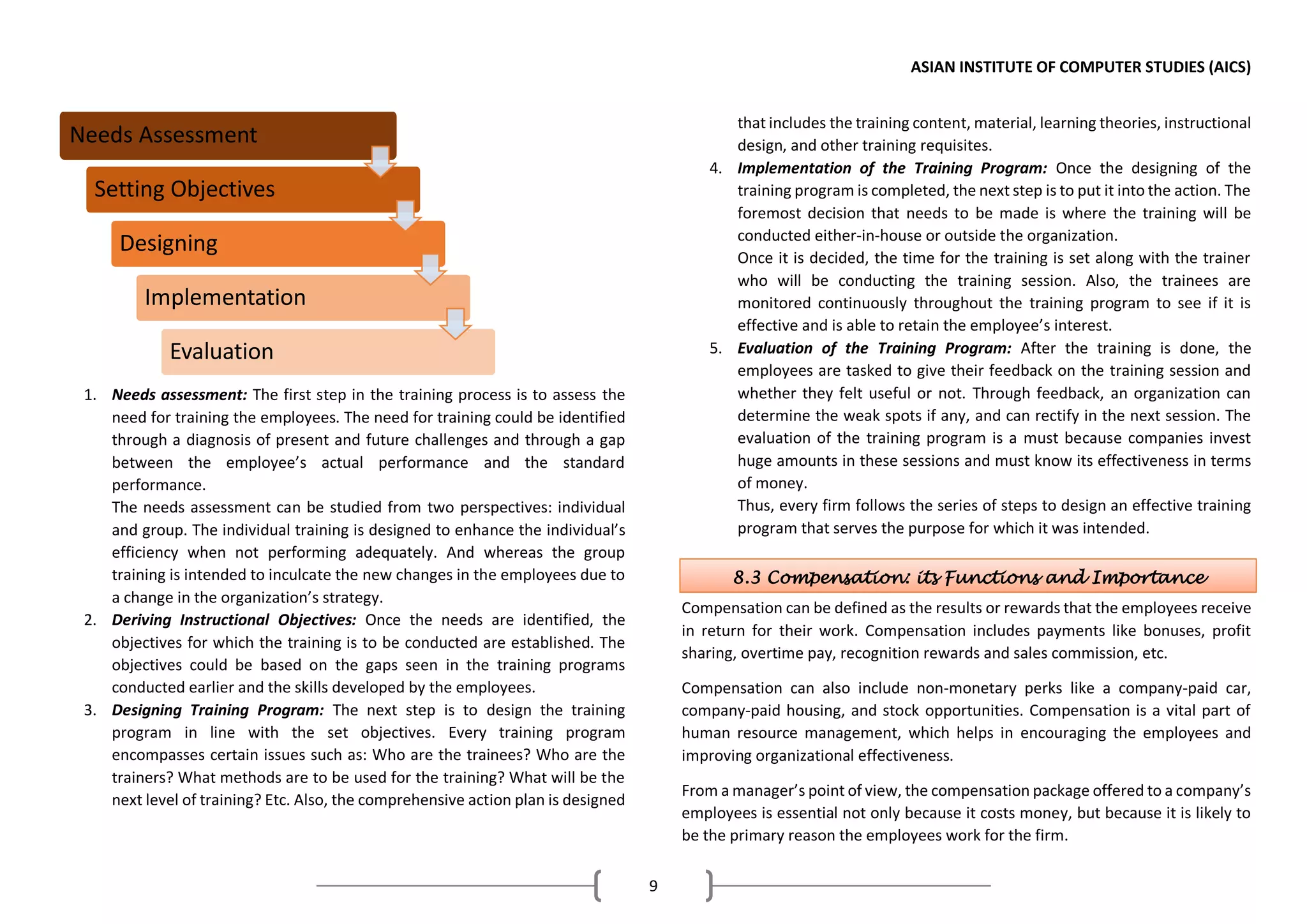
The training process comprises of a series of steps that needs to be followed
systematically to have an efficient training program. The training is a systematic
activity performed to modify the skills, attitudes and the behavior of an employee
to perform a particular job.
8.2 Training Process
ASIAN INSTITUTE OF COMPUTER STUDIES (AICS)
9
1. Needs assessment: The first step in the training process is to assess the
need for training the employees. The need for training could be identified
through a diagnosis of present and future challenges and through a gap
between the employee’s actual performance and the standard
performance.
The needs assessment can be studied from two perspectives: individual
and group. The individual training is designed to enhance the individual’s
efficiency when not performing adequately. And whereas the group
training is intended to inculcate the new changes in the employees due to
a change in the organization’s strategy.
2. Deriving Instructional Objectives: Once the needs are identified, the
objectives for which the training is to be conducted are established. The
objectives could be based on the gaps seen in the training programs
conducted earlier and the skills developed by the employees.
3. Designing Training Program: The next step is to design the training
program in line with the set objectives. Every training program
encompasses certain issues such as: Who are the trainees? Who are the
trainers? What methods are to be used for the training? What will be the
next level of training? Etc. Also, the comprehensive action plan is designed
that includes the training content, material, learning theories, instructional
design, and other training requisites.
4. Implementation of the Training Program: Once the designing of the
training program is completed, the next step is to put it into the action. The
foremost decision that needs to be made is where the training will be
conducted either-in-house or outside the organization.
Once it is decided, the time for the training is set along with the trainer
who will be conducting the training session. Also, the trainees are
monitored continuously throughout the training program to see if it is
effective and is able to retain the employee’s interest.
5. Evaluation of the Training Program: After the training is done, the
employees are tasked to give their feedback on the training session and
whether they felt useful or not. Through feedback, an organization can
determine the weak spots if any, and can rectify in the next session. The
evaluation of the training program is a must because companies invest
huge amounts in these sessions and must know its effectiveness in terms
of money.
Thus, every firm follows the series of steps to design an effective training
program that serves the purpose for which it was intended.
Compensation can be defined as the results or rewards that the employees receive
in return for their work. Compensation includes payments like bonuses, profit
sharing, overtime pay, recognition rewards and sales commission, etc.
Compensation can also include non-monetary perks like a company-paid car,
company-paid housing, and stock opportunities. Compensation is a vital part of
human resource management, which helps in encouraging the employees and
improving organizational effectiveness.
From a manager’s point of view, the compensation package offered to a company’s
employees is essential not only because it costs money, but because it is likely to
be the primary reason the employees work for the firm.
Needs Assessment
Setting Objectives
Designing
Implementation
Evaluation
8.3 Compensation: its Functions and Importance
ASIAN INSTITUTE OF COMPUTER STUDIES (AICS)
10
Compensation packages with good pay and advantages can help attract and retain
the best employees. A quick survey of employees about compensation is likely to
expose an expectation that wages are fair and cover basic living expenses, keep up
with inflation, leave some money for savings (perhaps for retirement) and leisure,
increment over time.
A company’s compensation scheme also informs a great deal about the firm’s
values and cultures. Employees often look at what a company pay rather than what
it says. In many aspects, people behave as they are rewarded.
A compensation scheme projects what the company expects of its employees. For
example, is quality is an essential value, then it should be implemented through
some element of the total compensation system.
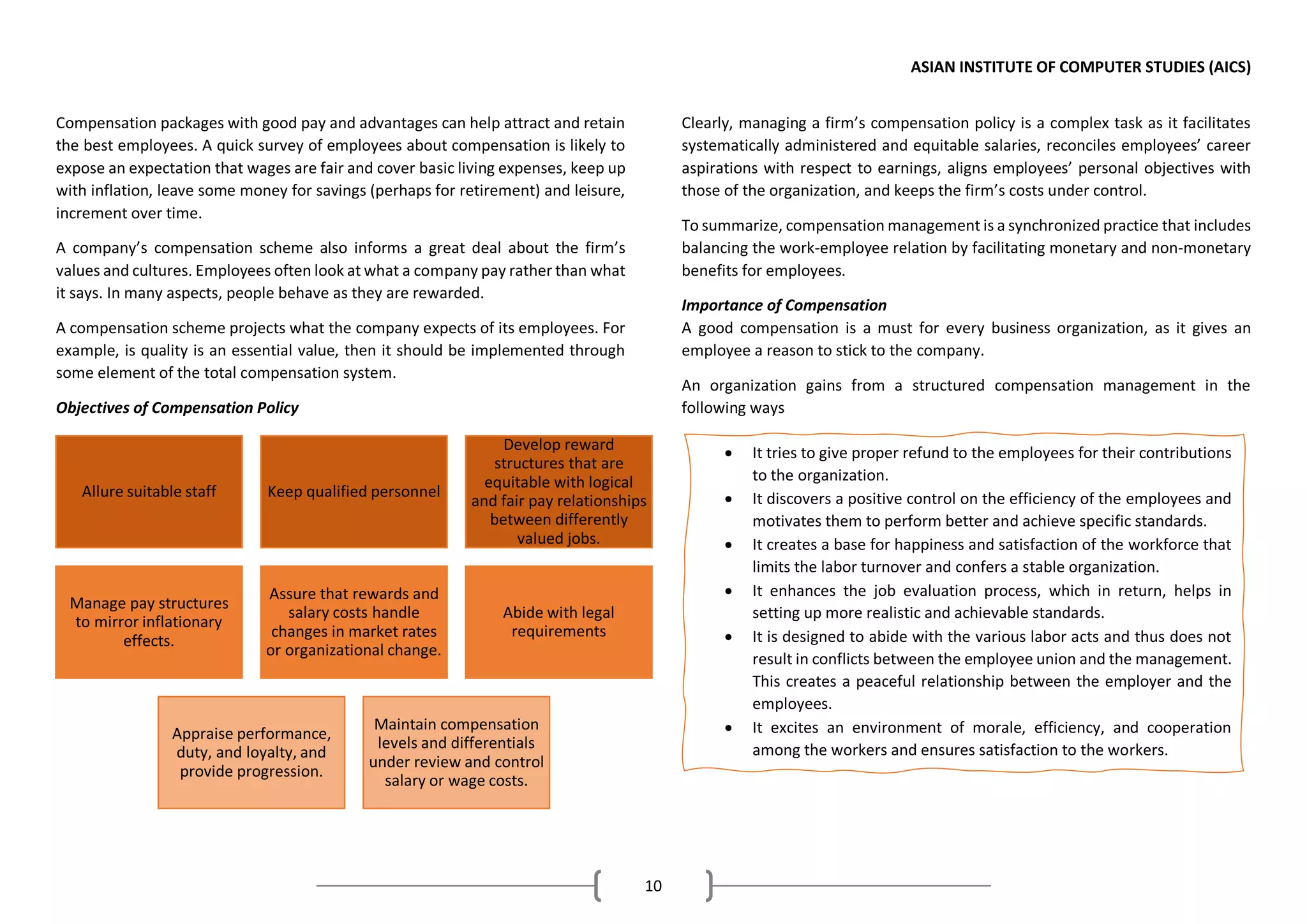
Objectives of Compensation Policy
Clearly, managing a firm’s compensation policy is a complex task as it facilitates
systematically administered and equitable salaries, reconciles employees’ career
aspirations with respect to earnings, aligns employees’ personal objectives with
those of the organization, and keeps the firm’s costs under control.
To summarize, compensation management is a synchronized practice that includes
balancing the work-employee relation by facilitating monetary and non-monetary
benefits for employees.
Importance of Compensation
A good compensation is a must for every business organization, as it gives an
employee a reason to stick to the company.
An organization gains from a structured compensation management in the
following ways
Allure suitable staff Keep qualified personnel
Develop reward
structures that are
equitable with logical
and fair pay relationships
between differently
valued jobs.
Manage pay structures
to mirror inflationary
effects.
Assure that rewards and
salary costs handle
changes in market rates
or organizational change.
Abide with legal
requirements
Appraise performance,
duty, and loyalty, and
provide progression.
Maintain compensation
levels and differentials
under review and control
salary or wage costs.
• It tries to give proper refund to the employees for their contributions
to the organization.
• It discovers a positive control on the efficiency of the employees and
motivates them to perform better and achieve specific standards.
• It creates a base for happiness and satisfaction of the workforce that
limits the labor turnover and confers a stable organization.
• It enhances the job evaluation process, which in return, helps in
setting up more realistic and achievable standards.
• It is designed to abide with the various labor acts and thus does not
result in conflicts between the employee union and the management.
This creates a peaceful relationship between the employer and the
employees.
• It excites an environment of morale, efficiency, and cooperation
among the workers and ensures satisfaction to the workers.
ASIAN INSTITUTE OF COMPUTER STUDIES (AICS)
11
In short, we can say that compensation management is required as it encourages
the employees to perform better and show their excellence as well as provides
growth and development options to the deserving employees.
Types of Compensations
We have learnt about what compensation is and its importance, However, when it
comes to an organization, be it private or public, compensations are further divided
into the following:
These are the two types of compensation that need to be managed and have its
own contribution in the development of the organization. Moving forward, we will
see the different components of compensation.
Components of Compensation
Components as a whole is made up of an employee after retirement or in case of
some accident or injury. Now we shall see the key elements or components that
make compensation.
Some of these allowances are as follows:
Dearness Allowance – this allowance is given to protect real income of an
employee against price rise. Dearness allowance (DA) is paid as a percentage of
basic pay.
House Rent Allowance – companies who do not provide living accommodation to
their employees pay house rent allowance (HRA) to employees. This allowance is
calculated as percentage of salary.
City Compensatory Allowance – this allowance is paid basically to employees in
metros and other big cities where cost of living is comparatively more. City
compensatory allowance (CCA) is normally fixed amount per month, like 30 per
cent of basic pay in case of government employees.
•Wages mark hourly rates of pay, and salary marks the monthly rate
of pay of an employee. It is irrelevant of the number of hours put in
by an employee working in the firm. These are subject to annual
increase.
Wages and Salary
•Allowances can be defined as the amount of something that is
allowed, especially within a set of rules and regulations or for a
specified purpose. Various allowances are paid in addition to basic
pay
Allowances
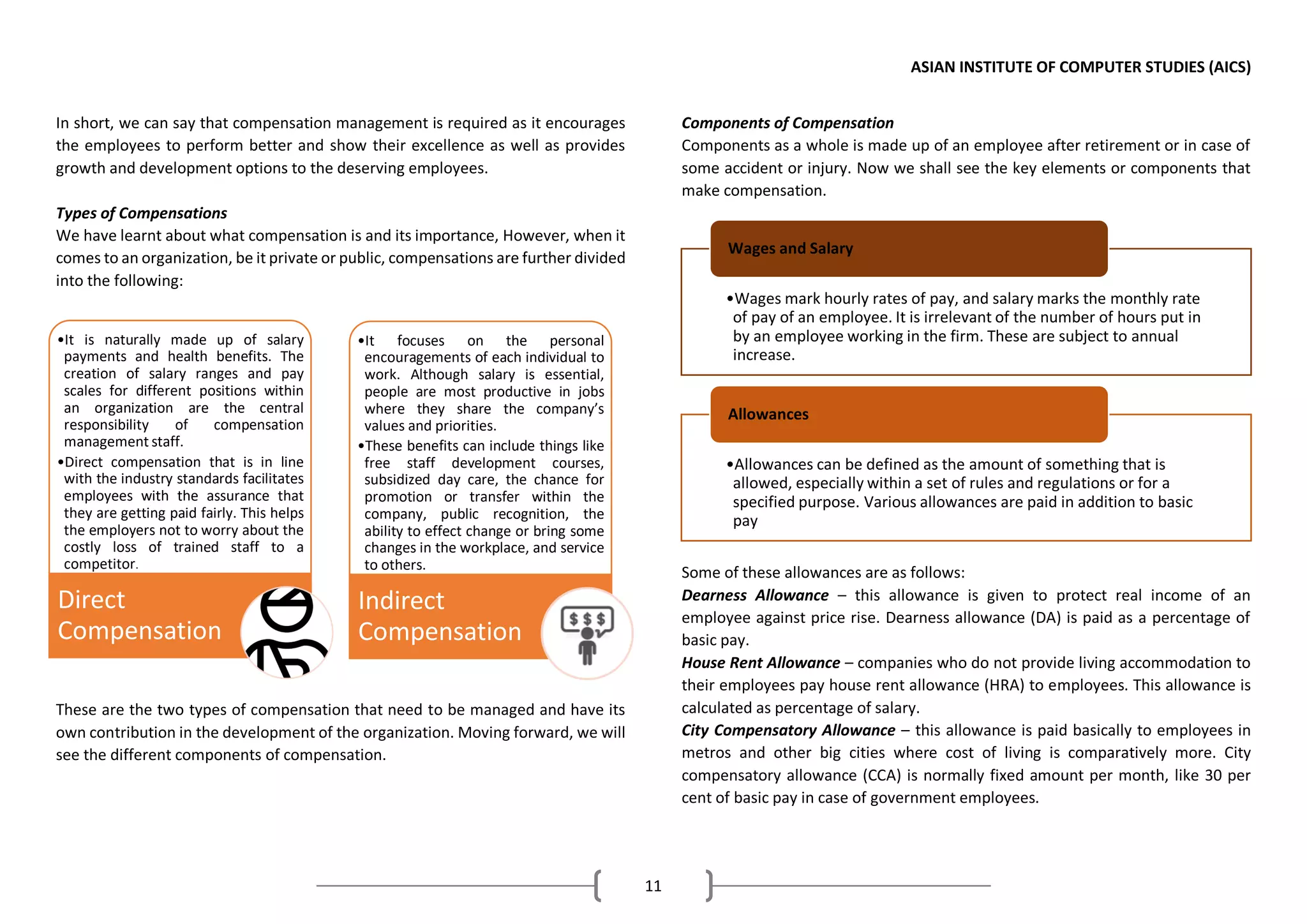
•It is naturally made up of salary
payments and health benefits. The
creation of salary ranges and pay
scales for different positions within
an organization are the central
responsibility of compensation
management staff.
•Direct compensation that is in line
with the industry standards facilitates
employees with the assurance that
they are getting paid fairly. This helps
the employers not to worry about the
costly loss of trained staff to a
competitor.
Direct
Compensation
•It focuses on the personal
encouragements of each individual to
work. Although salary is essential,
people are most productive in jobs
where they share the company’s
values and priorities.
•These benefits can include things like
free staff development courses,
subsidized day care, the chance for
promotion or transfer within the
company, public recognition, the
ability to effect change or bring some
changes in the workplace, and service
to others.
Indirect
Compensation
ASIAN INSTITUTE OF COMPUTER STUDIES (AICS)
12
Transport Allowance/Conveyance Allowance – some companies pay transport
allowance (TA) that accommodates travel from the employee’s house to the office.
A fixed amount is paid every month to cover a part of travelling expenses.
In recent years, a great deal of attention has been directed to the development of
compensation systems that go beyond just money. We can say that all the
components of compensation management play a very important role in the life of
an employee.
In particular, there has been a marked increase in the use of pay-for-performance
(PrP) for management and professional employees, especially for executive
management and senior managers. Compensation is a primary motivation for most
employees.
REFERENCES
Books
Supplement to Chapter 4: Staffing, pp. 51-58, Organization and
Management: Concepts, Caselets, and Exercises (2016)
Electronic Sources
HRM - Compensation Management retrieved from
https://www.tutorialspoint.com/human_resource_management_compe
nsation,html
Staffing: Definition, Meaning, and Functions retrieved from
https://www.toppr.com/guides/business-studies/staffing/introduction-
to-staffing-and-its-meaning/
Training Process retrieved from https://businessjargons.com/training-
process.html
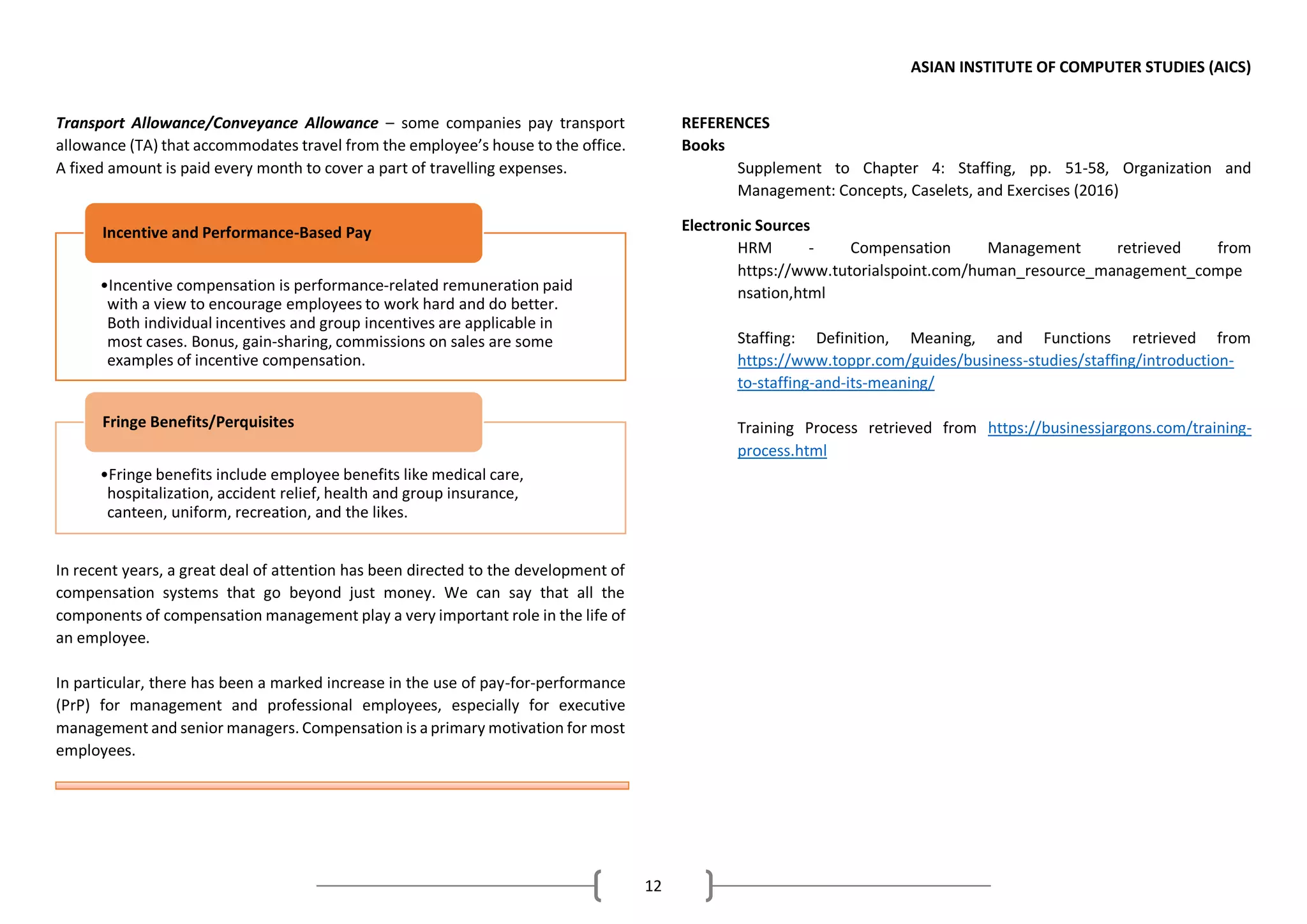
•Incentive compensation is performance-related remuneration paid
with a view to encourage employees to work hard and do better.
Both individual incentives and group incentives are applicable in
most cases. Bonus, gain-sharing, commissions on sales are some
examples of incentive compensation.
Incentive and Performance-Based Pay
•Fringe benefits include employee benefits like medical care,
hospitalization, accident relief, health and group insurance,
canteen, uniform, recreation, and the likes.
Fringe Benefits/Perquisites
ASIAN INSTITUTE OF COMPUTER STUDIES (AICS)
13
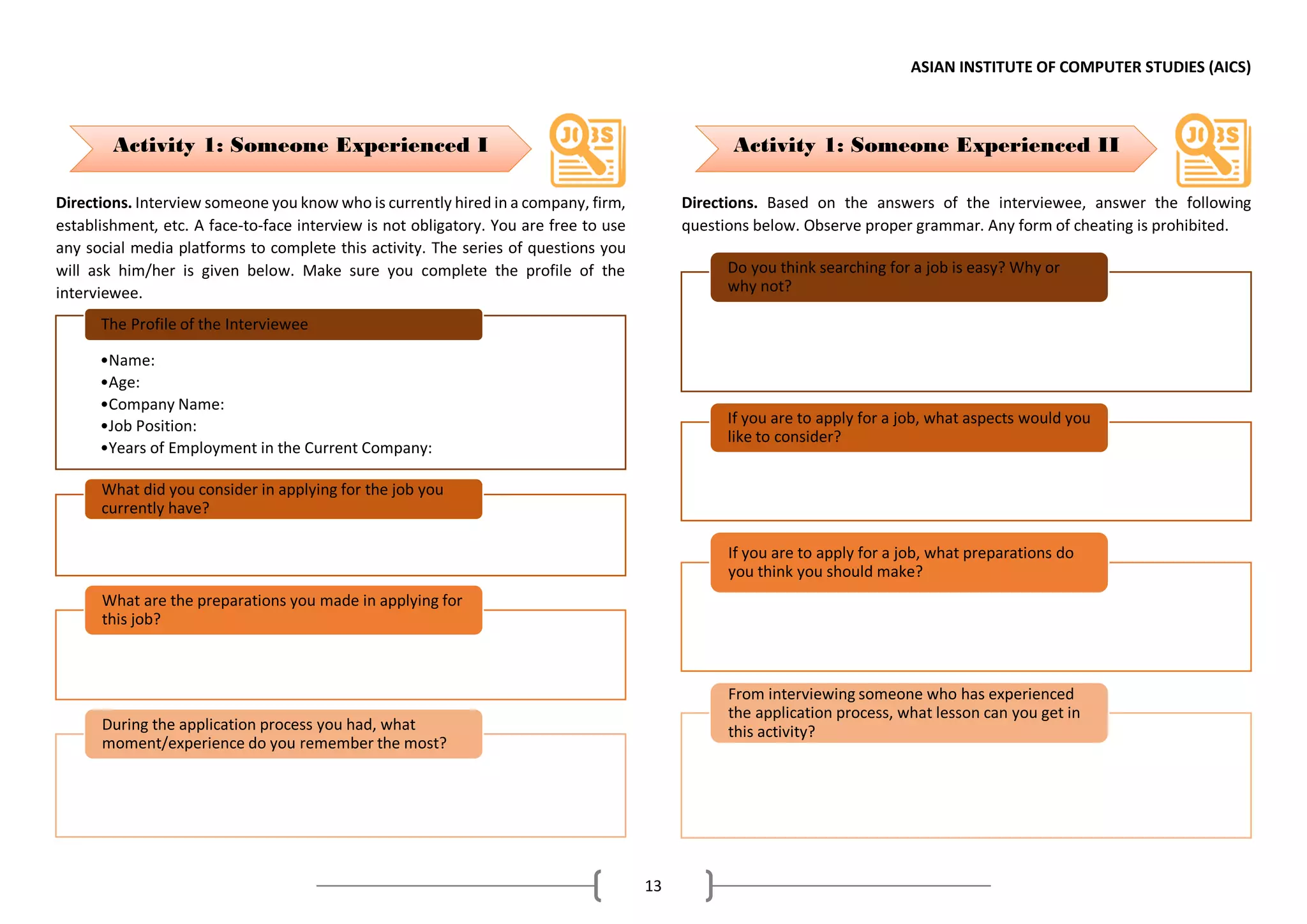
Directions. Interview someone you know who is currently hired in a company, firm,
establishment, etc. A face-to-face interview is not obligatory. You are free to use
any social media platforms to complete this activity. The series of questions you
will ask him/her is given below. Make sure you complete the profile of the
interviewee.
Directions. Based on the answers of the interviewee, answer the following
questions below. Observe proper grammar. Any form of cheating is prohibited.
•Name:
•Age:
•Company Name:
•Job Position:
•Years of Employment in the Current Company:
The Profile of the Interviewee
What did you consider in applying for the job you
currently have?
What are the preparations you made in applying for
this job?
During the application process you had, what
moment/experience do you remember the most?
Do you think searching for a job is easy? Why or
why not?
If you are to apply for a job, what aspects would you
like to consider?
If you are to apply for a job, what preparations do
you think you should make?
From interviewing someone who has experienced
the application process, what lesson can you get in
this activity?
Activity 1: Someone Experienced I Activity 1: Someone Experienced II
ASIAN INSTITUTE OF COMPUTER STUDIES (AICS)
14
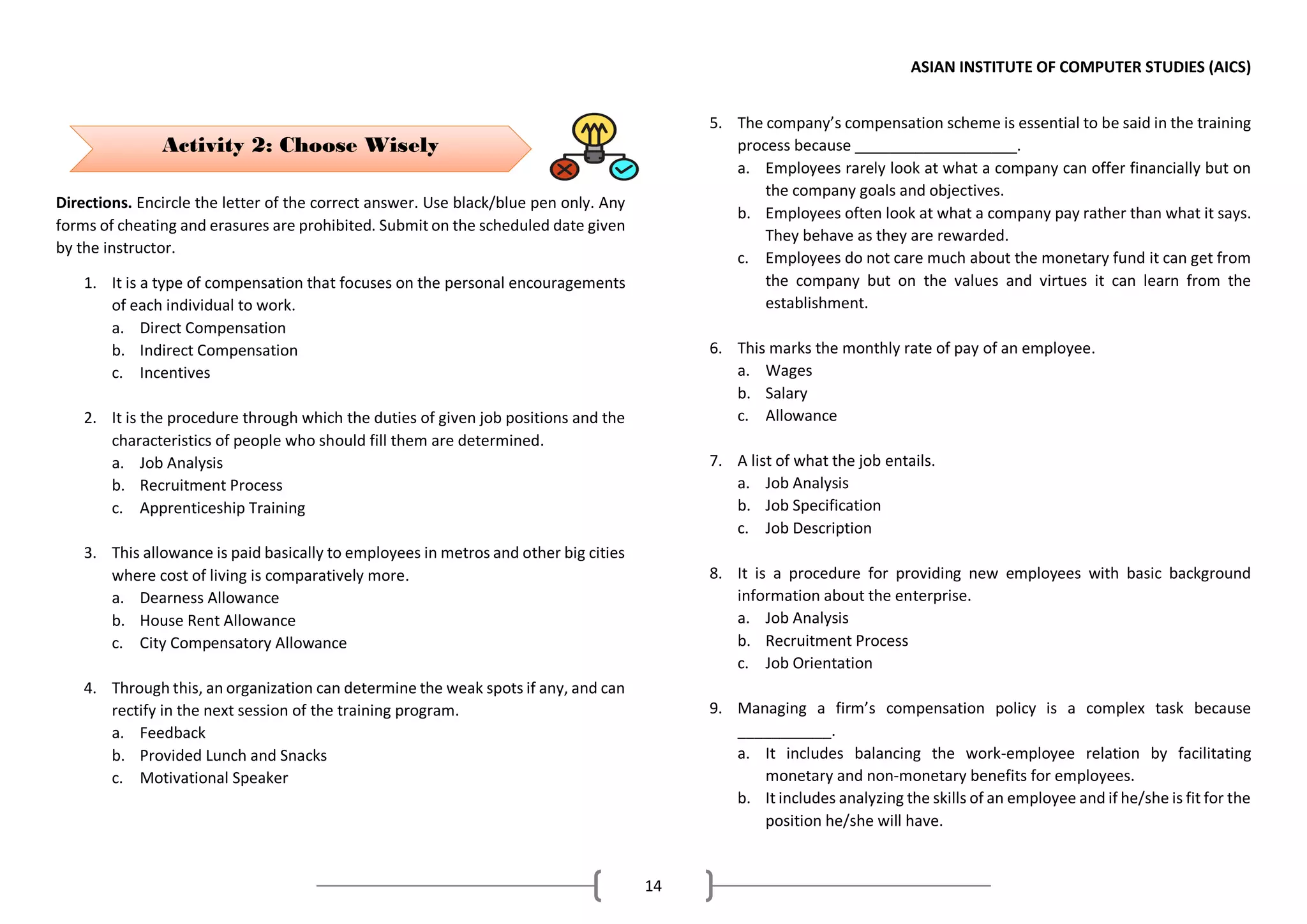
Directions. Encircle the letter of the correct answer. Use black/blue pen only. Any
forms of cheating and erasures are prohibited. Submit on the scheduled date given
by the instructor.
1. It is a type of compensation that focuses on the personal encouragements
of each individual to work.
a. Direct Compensation
b. Indirect Compensation
c. Incentives
2. It is the procedure through which the duties of given job positions and the
characteristics of people who should fill them are determined.
a. Job Analysis
b. Recruitment Process
c. Apprenticeship Training
3. This allowance is paid basically to employees in metros and other big cities
where cost of living is comparatively more.
a. Dearness Allowance
b. House Rent Allowance
c. City Compensatory Allowance
4. Through this, an organization can determine the weak spots if any, and can
rectify in the next session of the training program.
a. Feedback
b. Provided Lunch and Snacks
c. Motivational Speaker
5. The company’s compensation scheme is essential to be said in the training
process because ___________________.
a. Employees rarely look at what a company can offer financially but on
the company goals and objectives.
b. Employees often look at what a company pay rather than what it says.
They behave as they are rewarded.
c. Employees do not care much about the monetary fund it can get from
the company but on the values and virtues it can learn from the
establishment.
6. This marks the monthly rate of pay of an employee.
a. Wages
b. Salary
c. Allowance
7. A list of what the job entails.
a. Job Analysis
b. Job Specification
c. Job Description
8. It is a procedure for providing new employees with basic background
information about the enterprise.
a. Job Analysis
b. Recruitment Process
c. Job Orientation
9. Managing a firm’s compensation policy is a complex task because
___________.
a. It includes balancing the work-employee relation by facilitating
monetary and non-monetary benefits for employees.
b. It includes analyzing the skills of an employee and if he/she is fit for the
position he/she will have.
Activity 2: Choose Wisely
ASIAN INSTITUTE OF COMPUTER STUDIES (AICS)
15
c. It includes ensuring a training program for the newly hired employees
to their new working task/assignment.
10. Consider the following statements:
A: Compensation does not include non-monetary perks.
B: Direct Compensation helps the employers to worry about the costly loss
of trained staff to a competitor.
C: It is not an objective of a compensation policy to abide with legal
requirements.
a. Of the three statements, only statement A is true.
b. Of the three statements, only statement C is false.
c. None of the statements are true.
ASIAN INSTITUTE OF COMPUTER STUDIES (AICS)
16
Most of us often mistake leadership ang management as the same thing but in
essence, they are very different. The main difference between the two is that
leaders have people that follow them, while managers have people who simply
work for them.
Leadership is about getting people to comprehend and believe in the vision you set
for the company and to work with you on achieving your goals, while management
is more about administering and making sure the day-to-day activities are
happening as they should.
Though leadership and management are not the same thing, they must go hand in
hand. When you are trying to inspire, encourage, and engage your staff, you have
to be both a manager and a leader. When you want your employees, whether
permanent or temporary, to be more productive you have to know which role is
best suited to get them there. Managing a team is more about maintenance─
keeping a well-oiled machine going. However, when individual employees are in
need of new energy and a boost to morale, focusing on leadership is the way to go.
While leadership is about inspiring, management is about planning.
Managers are about business; leaders are about people. Management is the brain
behind the business. They strategize the plans and analyze statistics that boost the
bottom line and promote the company image.
Leaders hone in more on the individual workers, providing support and
encouragement they need to do their best work.
Managers oversee; leaders guide. Managers check in on their employees and
often observe from a distance, focusing on the overall process as a whole. Leaders
guide their staff through steps and stages, working with them to create a more
efficient and effective workplace. Of course, sometimes, these roles overlap, so it
is not uncommon for managers and leaders to wear interchangeable hats.
Managers are task-oriented; leaders are goal-oriented. Managers assign duties
and provide their employees on time and organized, as well as measure success by
examining the deliverables. Leaders look at the goal, the desired and result, and let
their employees accomplish their goals by choosing their own means. They provide
support and training when necessary but tend to work toward the bigger picture.
Managers plan projects; leaders motivate the team. While management outlines
the objectives for a new project or process, leaders motivate the team to get there.
Milestones are mapped out by managers, and they are often the ones to delegate
and assign the tasks. Leaders conduct the committee meetings, facilitate
collaboration and give the team feedback on their progress.
Managers measure value; leaders create it. When it comes down to
understanding if the job was done right, managers have the tools to get results.
They measure outcomes, analyze data and develop strategies for the next project
on the horizon. However, leaders are often in the thick of it working alongside their
9.1 Leading vs. Managing
2
nd
QUARTER
MODULE
10
WEEK:_____
At the end of this module, you are expected to:
• Differentiate leading to managing,
• Identify the different theories of motivation,
• Evaluate styles of leadership, and
• Appreciate the role of communication in directing people within the organization.
KEY QUESTIONS
• How can we say that someone
is a leader? Or a manager?
• Why is communication
considered a substantial part
of an organization?
CHAPTER 9. LEADING
ASIAN INSTITUTE OF COMPUTER STUDIES (AICS)
17
crew every step of the way. They enable their employees to be more productive by
leading by example.
Motivation plays a big role in boosting the employees’ morale. It is defined as the
physiological process of providing purpose and intention to behavior− it explains
why people behave the way they do. By using motivation theories, management
caninspire customers to choose the brandandencourage employees totake action
and become self-directed.
The most important motivational theories on describing people’s need are
Maslow’s Hierarchy of Needs, Alderfer’s ERG Theory, and McClelland’s Acquired
Needs Theory.
Maslow’s Hierarchy of Needs
This theory indicates that people satisfy their needs in a specific order, from
bottom to top, as follows:
1. Physiological Needs
- Food, water, sex, and
shelter;
2. Safety and Security
- Protection against threat
and deprivation;
3. Social Needs
- Friendship, affection,
belonging, and love;
4. Ego
- Independence,
achievement, freedom,
status, recognition, and
self-esteem;
5. Self-actualization
-Realizing one’s full potential, becoming everything one is capable of being.
The theory specifies that people satisfy their physiological needs first, then proceed
to gratify their safety and security needs, then social, ego, and then self-
actualization. Once a set of needs is satisfied, it is no longer considered as potent
motivator.
Maslow’s theory is considered simplistic and found to be an inaccurate human
motivation theory. For instance, workers in hazardous jobs often do not ignore
their safety and security needs because they need to fulfill their physiological
desires first.
An essential learning from this theory, however, is the need for self-actualization,
which directs organization to look at human resource not just as a business cost,
but an asset that should be developed.
Alderfer’s ERG Theory
Existence, relatedness, and growth (ERG) are the three sets of needs under the
Alderfer theory.
Existence needs are all material and physiological needs, relatedness needs are
satisfied through mutual sharing of thoughts and feelings, as they are about
9.2 Theories of Motivation
Self-
Actualization
Esteem
Love/Belonging
Safety
Physiological
Existence
Needs
Relatedness
Needs
Growth
Needs
ASIAN INSTITUTE OF COMPUTER STUDIES (AICS)
18
Need for
Achievement
Need for
Affiliation
Need for
Power
relationships, while growth needs encourage people to creatively and efficiently
change themselves or their environments.
Existence Needs
These are constantly and pervasively important in the work setting. Some of them
are job security, suitable working conditions, reasonable working hours, pay and
fringe benefits.
• Provide our basic material existence requirements.
• They include Maslow’s physiological and safety needs.
Relatedness Needs
These needs focus on how people relate to their social environment.
It involves the relationship with significant others─ family, supervisors, co-workers,
subordinates, friends, and so on.
• The desire we have for maintaining important interpersonal relationships.
• These social and status desires require interaction with others.
• They align with Maslow’s social need and the external component.
Growth Needs
These needs are those that compel a person to make creative or productive efforts
for him or herself.
The satisfaction of growth is what a person needs to experience in a sense of
completeness as a human being.
• An intrinsic desire for personal development. These include the intrinsic
component from Maslow’s esteem category and the characteristics
included under self-actualization.
The ERG theory postulates that the needs can occur simultaneously unlike
Maslow’s theory. The importance of both theories for managers in their leadership
functions is the knowledge that self-actualization and/or growth needs are
essential motivators for work accomplishment.
McClelland’s Acquired Need Theory
The key needs for managers, according to McClelland, are achievement, affiliation,
and power needs. Achievement means an orientation toward success and goal
realization. Affiliation reflects a strong wish to be liked, while power refers to the
need to persuade or be in command of other people.
The need theories have been used in job design, training needs, and empowerment
advances by managers and leaders of diverse industries.
1. Need for Achievement (nAch)
The drive to excel, to achieve a set of standards, to strive to succeed.
Features of people with Need for Achievement (nAch) includes:
• They seek personal responsibility for finding solutions to problems,
• They want to receive rapid feedback on their performance so they
can tell easily when they are improving or not.
• They can set moderately challenging goals. High achievers are not
gamblers; the dislike succeeding by chance.
• High achievers perform best when they perceive their probability
of success as 50-50.
Personal Power
Institutional Power
Which needs make the
best manager?
ASIAN INSTITUTE OF COMPUTER STUDIES (AICS)
19
• They like to set goals that require stretching themselves a little.
2. Need for Power (nPow)
The need to make others behave in a way that they would not have
behaved otherwise. Need for Power (nPow) features are:
• The desire to have an impact, to be influential, and to control
others.
• Individuals high in nPow enjoy being ‘in-charge’.
• Strive for influence over others.
• Prefer to be placed into competitive and status-oriented
situations.
• Tend to be more concerned with prestige and gaining influence
over others than with effective performance.
3. Need for Affiliation (nAfl) are:
• This need has received the least attention from researchers.
• Individuals with a high affiliation motive strive for friendship.
• Prefer cooperative situations rather than competitive ones.
• Desire relationships involving a high degree of mutual
understanding.
Leadership style is the manner and approach providing direction, implementing
plans, and motivating people. As seen by the employees, it includes the total
pattern of explicit and implicit actions performed by their leader.
Leadership styles are on a continuum, ranging from autocratic at one end, to
laissez-faire at the other, with a variety of styles in between. Great leaders can
inspire political movements and social change. They can also motivate others to
perform, create and innovate.
As you start to consider some of the people who you think of as great leaders, you
can immediately see that there are often vast differences in how each person leads.
Fortunately, researchers have developed different theories and frameworks that
allow us to better identify and understand these different leadership styles.
Illustration by Joshua Seong, Verywell
Lewin’s Leadership Styles
In 1939, a group of researchers led by psychologist Kurt Lewin set out to identify
different styles of leadership. While further research has identified more distinct
types of leadership, this early study was very influential and established three
major leadership styles that have provided a springboard for more defined
leadership theories.
Autocratic
Authoritarian
Leadership
•Authoritarian leaders, also known as autocratic leaders, provide clear
expectations for what needs to be done, and how it should be done. This style
of leadership is strongly focused on both command by the leader and control of
the followers. There is also a clear division between the leader and the
members. Authoritarian leaders make decisions independently, with little or no
input from the rest of the group.
9.3 Styles of Leadership
ASIAN INSTITUTE OF COMPUTER STUDIES (AICS)
20
Leaders and their leadership skills plays an important role in the growth of any
organization. A leader should then have the ability to maintain good interpersonal
relations with the followers or subordinates and motivate them to help in achieving
the organizational objectives.
Now that it has been clear to us the importance of motivation and leadership in
the organization, it is time to focus on the role of communication and its
significance in the organization.
Effective communication is a building block of successful organization. In other
words, communication acts as organizational blood. The importance of
communication in an organization can be summarized as follows:
1. Communication promotes motivation by informing and clarifying the
employees about the task to be done, the manner they are performing, the
task, and how to improve their performance if it is not up to the mark.
2. Communication is a source of information to the organizational members
for decision-making process as it helps identifying and assessing alternative
course of actions.
3. Communication also plays a crucial role in altering individual’s attitudes
i.e., a well-informed individual will have better attitude than a less-
informed individual. Organizational magazines, journals, meetings and
various other forms of oral and written communication help in molding
employee’s attitudes.
4. Communication also helps in socializing. One cannot survive without
communication.
5. Communication also assists in controlling process. It helps controlling
organizational members behavior in various ways. There are various levels
of hierarchy and certain principles and guidelines that employees must
follow in an organization. They must comply with organizational policies,
perform their job role efficiently and communicate any work problem and
grievance to their superiors. Thus, communication helps in controlling
function of the management.
An effective and efficient
communication system requires
managerial proficiency in delivering
and receiving messages. A manager
must discover various barriers to
communication, analyze the reasons
for their occurrence and take
preventive steps to avoid those
barriers. Thus, the primary
responsibility of a manager is to
develop and maintain an effective communication system in the organization.
9.4 Role of Communication
Democratic
Participative
Leadership
•Participative leadership, also known as democratic leadership, is typically the
most effective leadership style. Democratic leaders offer guidance to group
members, but they also partici pate in the group and allow input from other
group members. Participative leaders encourage group members to participate,
but retain the final say in the decision-making process. Group members feel
engaged in the process and are motivated and creative. Democratic leaders
tend to make followers feel like they are an important part of the team, which
helps foster commitment to the goals of the group.
Laissez-Faire
Delegative
Leadership
•Delegative leaders offer little or no guidance to group members and leave the
decision-making up to group members. While this style can be useful in
situations involving highly-qualified experts, it often leads to poorly defined
roles and a lack of motivation.
ASIAN INSTITUTE OF COMPUTER STUDIES (AICS)
21
REFERENCES
Books
Leading, Chapter 5, pp. 62-68, Organization and Management: Concepts,
Caselets, and Exercises (2016)
Electronic Sources
Acquired Needs Theory – Need for Achievement, Power and Affiliation
retrieved from https://www.iedunote.com/acquired-needs-theory
Chapter 1: Introducing Organizational Communication, Zink, J. retrieved
from
https://granite.pressbooks.pub/organizationalcommunication/chapter/ch
apter-1/
ERG Theory of Motivation retrieved from https://www.iedunote.com/erg-
theory
Leadership retrieved from https://www.toppr.com/guides/business-
studies/directing/leadership/#:~:text=Leaders%20and%20their%20leader
ship%20skills,the%20growth%20of%20any%20organization.&text=A%20l
eader%20should%20have%20the,in%20achieving%20the%20organization
al%20objectives.
Leadership Styles retrieved from
http://www.nwlink.com/~donclark/leader/leadstl.html
Leadership Styles and Frameworks You Should Know (2020, August 3)
retrieved from https://www.verywellmind.com/leadership-styles-
2795312
The Difference Between Leadership and Management (2018) retrieved
from https://www.nextgeneration.ie/blog/2018/03/the-difference-
between-leadership-and-
management#:~:text=Leadership%20is%20about%20getting%20people,a
re%20happening%20as%20they%20should.
The Difference Between Leading and Managing retrieved from
https://burnettspecialists.com/the-difference-between-leading-and-managing/
ASIAN INSTITUTE OF COMPUTER STUDIES (AICS)
22
Directions. Think of someone you consider as a leader: whether it is someone you
know, someone in your family, or in your friends and neighborhood, or someone
in the politics, business, sports entertainment, or other industries. Complete the
table below with his/her profile.
Directions. Make a poster on a separate sheet of short bond paper about the
essence of communication in an organization. The poster will then be passed
along with this activity sheet. (15 points)
Your post will be graded based on this rubric.
Criteria Very Good
5
Good
4
Fair
3
Poor
2
Score
Required
Elements
The poster
includes all
required
elements as
well as
additional
information.
All required
elements are
included on
the poster.
Only few
required
elements are
missing on
the poster.
Several
required
elements are
missing on
the poster.
Attractiveness The poster is
exceptionally
attractive in
terms of
design, layout
and neatness.
The poster is
attractive in
terms of
design,
layout and
neatness.
The poster is
acceptably
attractive
though it
may be a bit
messy.
The poster is
distractingly
messy or
very poorly
designed. It
is not
attractive.
Graphics
Relevance
All graphics
are related to
the topic and
make it easier
to
understand.
Most of the
graphics are
related to
the topic
and make it
easier to
understand.
Some of the
graphics are
related to
the topic
and make it
easy to
understand.
Graphics do
not relate to
the topic
and it is hard
to
understand.
Activity 1: A Leader’s Profile
Insert Picture
Name:
Age:
Industry:
Why do you consider him/her as a
leader?
What do you think is his/her
leadership style? Why do you
consider this as his/her style?
Is he a good leader? Why or why
not?
Activity 2: A Leader’s Profile
ASIAN INSTITUTE OF COMPUTER STUDIES (AICS)
23
Directions. On the space provided before each number, write T if the statement is
true, and F if the statement is false.
__________1) Management is more about boosting the employee’s moral while
leadership focuses on the maintenance of the team.
__________2) Based on Lewin’s study on leadership styles, democratic leadership
is the most effective style.
__________3) Maslow’s hierarchy of needs specifies that people satisfy their
safety and security first then proceed to gratify their physiological needs.
__________4) Like Maslow’s theory, Alderfer’s ERG theory postulates that the
needs cannot occur simultaneously.
__________5) The desire we have for maintaining important interpersonal
relationships is under the existence needs.
__________6) As for McClelland’s Acquired Needs Theory, people with Need for
Achievement (nAch) feature seeking personal responsibility for finding solutions to
problems.
__________7) A well-informed individual has a better attitude than a less-informed
individual.
__________8) Authoritarian leaders consider the suggestions of his team members
and make decisions based on his findings with the team’s suggestions.
__________9) An intrinsic desire for personal development is what growth needs
are implying.
__________10) Maslow’s theory is considered simplistic and found to be an
accurate human motivation theory.
Activity 3: Choose Wisely
ASIAN INSTITUTE OF COMPUTER STUDIES (AICS)
24
After discussing the importance of choosing tasks and assigning these developed
tasks to people, as well as the putting of the right man in the right job, it is now
time to focus on the nature of controlling.
Controlling is known as an essential feature of scientific management. In fact, much
of the precision of managerial education is focused on the improvement of control
techniques. It is generally used for putting restraints over the elements of being
controlled. In managerial terminology, control is ensuring work accomplishment
according to plans. It is a process that
guides activity towards some
predetermined goals.
Without control, a manager cannot do
the complete job for managing. All the
other functions are the preparatory steps
for getting the work done and controlling
is concerned with making sure that there
is proper execution of these functions. It
ensures work accomplishment according
to plans.
Managerial control is defined as the
systematic process through which
managers regulate organizational activities to make them consistent with
established expectations detailed in plans, targets, and standards of performance.
Ernest Dale defines it as “the modern concept of control envisages system that not
only provides a historical record of what has happened and provides data that
enable the chief executive or the departmental head to take corrective steps if he
finds he is on the wrong track.”
Based on the above definitions the following natures or characteristics of
controlling can be presented below:
•Actually control is a follow-up action to the other functions of
management performed by managers to control the activities
assigned to them in the organization.
1. Control is a Function of a Management
•Control is designed to evaluate the actual performance against
predetermined standards set-up in the organization. Plans serve as
the standards of desired performance. Planning sets the course in
the organization and control ensures action according to the chosen
course of action in the organization.
2. Control is Based on Planning
10.1 Controlling and its Nature
2
nd
QUARTER
MODULE
11
WEEK:_____
At the end of this module, you are expected to:
• Discuss the nature of controlling,
• Describe the link between planning and controlling,
• Distinguish control methods and systems, and
• Apply management control methods and techniques in accounting and management.
KEY QUESTIONS
• How importantis controlling in
the organization?
• Is there a relationship
between planning and
controlling?
CHAPTER 10. CONTROLLING
ASIAN INSTITUTE OF COMPUTER STUDIES (AICS)
25
Planning and controlling are closely linked. They are inter-related to each other. In
fact, the two are rightly called as ‘Siamese Twins’ of management. Every objective,
every goal, every policy, every procedure, and every budget become standard
against which actual performance is compared.
Planning sets the ship’s course and controlling keeps it on course. When the ship
begins to veer off the course, the navigator notices it and recommends a new
heading designed to return the ship to its proper course. Once control process is
over its findings are integrated into planning to prescribe new standards for
control.
•It involves continuous review of standards pf performance and
results in corrective action, which may lead to changes in other
functions of management.
3. Control is a Dynamic Process
•Control depends upon the information regarding actual
performance. Accurate and timely availability of feedback is
essential for effective control action. An efficient system of
reporting is required for a sound control system. This requires
continuing monitoring and review of the operations.
4. Information is the Guide to Control
•The performance of control is achieved only when corrective action
is taken on the basis of feedback information. It is only action,
which adjust performance to predetermined standards whenever
deviations occur. A good system of control facilities timely action so
that there is minimun waste of time and energy.
5. The Essence of Control is Action
•Control is not a one-step process but a continuous process. It
involves constant revision and analysis of standards resulting from
the deviations between actual and planned performance.
6. It is a Continuous Activity
•An executive can take corrective action only when he has been
delegated necessary authority for it. A person has authority to
control these functions for which he is directly accountable.
Moreover, control becomes necessary when authority is delegated
because the delegator remains responsible for the duty. Control
standards help a manager expad his span of management.
7. Delegation is the Key to Control
•Control involves comparison between actual and standards. So,
corrective action is designed to improve performance in future.
8. Control Aims at Future
•Control is a basic or primary function of management. Every
manager has to exercise control over the subordinates'
performance, no manager can get things done without the process
of controlling. Once a plan becomes operational, follow-up action is
required to measure progress, to uncover deficiencies and to take
corrective actions.
•Therefpre, control is an essential managerial function at every level.
The process of management is incomplete without controlling.
9. Control is a Universal Function of Management
•The function of controlling is positive. It is to make things happen
i.e., to achieve goal with instead constraints, or by means of the
planned activites. Controlling should never be viewed as being
negative in character.
10. Controlling is Positive
10.2 Planning and Controlling
ASIAN INSTITUTE OF COMPUTER STUDIES (AICS)
26
Without the basis of planning, controlling activities becomes baseless and without
controlling, planning becomes a meaningless exercise. In absence of controlling, no
purpose can be served by.
The Control Process
Following are the steps involved into the process of control:
1. Establish the Standards:
Within an organization’s overall strategic plan, managers define goals for
organizational departments in specific, precise, operational terms that
include standards of performance to compare with organizational
activities. However, for some of the activities the standards cannot be
specific and precise.
10.3 Importance of Control
10.4 The Control Process
Establish performance
standards.
Measure actual performance.
Compare actual performance
versus performance standards.
Take corrective action.
Revise standards when
necessary.
Guides the
Management in
Achieving Pre-
determined
Goals:
•The continuous flow of information about projects
keeps the long range of planning on the right track. It
helps in taking corrective actions in future if the
performance is not up to the mark.
Ensure Effective
Use of Scarce
and Valuable
Resources
•The control system helps in improving organizational
efficiency. Various control devices act as motivators
to managers. The performance of every person is
regularly monitored and any deficiency if present is
corrected at the earliest.
Facilitates
Coordination
•Control helps in coordination of activities through
unity of action. Every manager will try to coordinate
the activities of his subordinates in order to achieve
departmental goals.
Leads to
Delegation and
Decentralization
of Authority
•A decision about follow-up action is also facilitated.
Control makes delegation easier/better.
Decentralization of authority is necessary in big
enterprises. The management cannot delegate
authority without ensuring proper control.
Spares Top
Management to
Concentrate on
Policy Making
•For control processes management’s attention is not
required every now and then. The management by
exception enables top management to concentrate
on policy formulation.
ASIAN INSTITUTE OF COMPUTER STUDIES (AICS)
27
Standards, against which actual performance will be compared, may be
derived from past experiences, statistical methods, and benchmarking
(based upon industry practices). As far as possible, the standards are
developed bilaterally rather than top management deciding unilaterally,
keeping in view the organization’s goals. These standards may be tangible
or intangible.
2. Measure Actual Performance:
Most organizations prepare formal reports of performance measurements
both quantitative and qualitative (where quantificationis possible) that the
managers review regularly. These measurements should be related to the
standards set in the first step of the control process.
3. Compare Performance with the Standards:
This step compares actual activities to performance standards. When
managers read computer reports or walk through their plans, they identify
whether actual performance meets, exceeds, or falls short of standards.
Typically, performance reports simplify such comparison by placing the
performance standards for the reporting period alongside the actual
performance for the same period and by computing the variance─ that is,
the difference between each actual amount and the associated standard.
The manager must know of the standard permitted variation (both positive
and negative). Management by exception is most appropriate and practical
to keep insignificant deviations away.
4. Take Corrective Action Then Revise Standards When Necessary:
When performance deviates from standards, managers must determine
what changes, if any, are necessary and how to apply them. In the
productivity and quality-centered environment, workers and managers are
often empowered to evaluate their own work. After the evaluator
determines the cause or causes of deviation, he or she can take the fourth
step─ corrective action.
The corrective action may be to maintain status quo (reinforcing success),
correcting the deviation, or changing standards. The most effective course
may be prescribed by policies or may be best left up to employees’
judgment and initiative. The corrective action may be immediate or basic
(modifying the standards themselves).
Since problems can occur at any time during a process, it is important to have a few
different ways to manage issues. A manager’s toolbox should be equipped with
three types of controls: Feed Forward Control, Concurrent Control, and Feedback
Control.
Here are some examples of how a proactive and preventative approach can help
to avoid problems later on:
• Thoroughly interviewing a candidate can tell a human resource manager much
about how this person would fit into the organization. A rushed interview may
result in hiring the wrong person for the job.
Feed Forward or Preliminary
Quality Control
•This type of control involves
identifying and preventing
problems in an organization
before they occur. This is a focus
on inputs.
•Feed forward controls are
proactive and preventative. These
controls are helpful to the
manager since it allows the
manager to plan a work
effectively: they can regulate
resources like employees, raw
materials and capital ahead of
time. This means that future
problems can be avoided.
Concurrent Control
•Concurrent controls involve
identifying and preventing
problems in an organization as the
occur. This means that systems
are monitored in real-time.
•Concurrent controls begin with
standards and all employee
activity is measured against the
standard. Usually these include
quality control standards. This
means that products and services
can be checked as they are being
produced or performed to be sure
that the highest quality product or
service is being produced or
provided.
10.5 Types of Control
ASIAN INSTITUTE OF COMPUTER STUDIES (AICS)
28
• Running a background checks and drug testing employees is important. An
emergency room is no place for employees with criminal backgrounds or drug
problems. For example, hiring a drug user can result in patient medication
discrepancies, employee accidents and injuries, higher liability claims and
absenteeism.
• Another feedforward control might be offering employees a good health
insurance plan. When employees are healthy, they reliably come to work. This
cuts down on absenteeism.
Control system ensures (1) orderly efficient conduct of business and (2) adherence
to management policies. The areas of control are (1) information, (2) finance, (3)
employee behavior, and (4) operations.
Information should be available at the right time and the right place. Often, in the
desire to have complete and accurate information, there is a need to wait long to
the point that information become stale. Internal and external deadlines are
imposed on financial reporting. For example, at the end of each banking day, the
bank balances actual cash with balance per records. At the end of the month, result
of operations and financial position are determined. The deadlines set by the SEC,
BIR, SSS, PhilHealth, and HDMF are to be met monthly, quarterly, and annually.
Failure to meet deadlines means penalties and interestfor the delayed compliance.
In obtaining loans, reports to prove credit worthiness are required by credit
grantors.
The accounting andgovernmentforms are designed to containinformation needed
by internal users as well as external users. The sales invoice, for example, shows
relevant data for the seller and buyer. Signatures on business forms (1) pinpoint
responsibility, (2) grant authority, and (3) consummate a transaction as when the
buyer acknowledges delivery of products in good condition.
Review of forms is done by
systems analysts and
government units to
better serve their
purpose. Frequently used
government forms are
those of the BIR for tax
compliance and those of
SSS, HDMF, and PhilHealth
for reports on employees.
Finance controls include
budgets. Actual
transactions are
compared with budget. Overbudget and underbudget call for explanations.
Standard costs are set and compared with actual costs. Variances are analyzed and
explained. There should be immediate recording of transactions to minimize
opportunity for manipulation. No one person should be in control of a transaction.
There should be counterchecking. However, make sure that controls do not lead to
too much delay.
Feedback or Output Control
•Feedback is a process in which information about the past or the present is
used to influence the present or the future. As part of a chain of cause-and-
effect that forms a circuit or loop, actions are said to 'feed back' into
themselves.
•Feedback helps an organization seeking to improve its performance make the
necessary adjustments. Feedback serves as motivation for many people in the
workplace. When employees receive negative or positive feedback, they
decide how to apply it in their daily work. Feedback for a system as a whole
also provides common points of discussion for management and allows a
holistic appraisal of how processses can be improved.
10.6 Areas of Control
Control
System
Information
Finance
Employee
Behavior
Operations
Areas of Control
ASIAN INSTITUTE OF COMPUTER STUDIES (AICS)
29
Equipment enhances control. Use of computers speedsup recording and reporting.
Equipment leads to efficiency in operations, producing outputs on scheduled time
and at budgeted costs.
Another significant control area is employee behavior. At point of entry, the
employee fills up an application form and submits papers to support resume.
Employee is subjected to tests and interviews. Physical medical examinations cap
the hiring process. The documents form part of the hiree’s permanent file. This file
together with current file keep track of the employee’s performance. The
permanent file as well as the current file become a monitoring file.
Now that we have clear idea of how a control system works, we can look at the
different ways inwhich managers can regulate the activities of individuals and units
so that they are consistent with organization goals and standards. Here we review
six main ways of achieving control: personal controls, bureaucratic controls,
outputs control, cultural controls, control through incentives, and market controls.
Personal Controls
As the name implies, personal control is control by personal contact with and direct
supervision of subordinates. Personal control consists of making sure through
personal inspection and direct supervision that individuals and units behave in a
way that is consistent with the goals of the organization. Personal control can be
very subjective, with the manager assessing how well subordinates are performing
by observing and interpreting their behavior.
Bureaucratic Controls
Bureaucratic Control, following Max Weber, is typically defined as control through
a formal system of written rules and procedures. This control consists of the
standard operating procedures and policies that prescribe correct employee
behavior. Bureaucratic control methods rely primarily on prescribing what
individuals and units can and cannot do─ that is, on establishing bureaucratic
standards. Examples of these are the use of timecards for attendance, wearing of
uniform, proper use of company facilities, among others. A reward system
recognizes employees’ adherence to company rules and regulations.
Output Controls
Output controls can be used when managers can identify tasks that are complete
in themselves in the sense of having a measurable output or criterion of overall
achievement that is visible. For example, the overall achievement of an automobile
factory might be measured by the (measure of productivity) and the number of
defects found per 100 cars produced by the factory (a measure of quality).
Cultural Control
Organizational culture consists of the values and assumptions that are shared
among employees of an organization. Cultural control involves regulating behavior
by socializing employees so that they internalize the values and assumptions of the
organization and act in a manner that is consistent with them. When this occurs,
employees tend to engage in self-control─ they regulate their own behavior so that
it is congruent with organizational goals.
Control through Incentives
Incentives are devices used to encourage and reward appropriate employee
behavior. Many employees receive incentives in the form of annual bonus pay.
Incentives are usually tied to the performance metrics used for output controls. For
example, targets linked to profitability might be set to measure the performance
of a subunit, such as a product division. To create positive incentives for employees
to work hard to exceed those targets, they may be given a share of any profits
above those targeted.
Market Controls
Market controls involve regulating the behavior of individuals and units within an
enterprise by setting up an internal market for some valuable resource such as
capital. Market controls are usually found within diversified enterprises organized
into product divisions, where the head office might act as an internal investment
bank, allocating capital funds between the competing claims of the different
product divisions based on an assessment of their likely future performance.
10.7 Control Methods and Systems
ASIAN INSTITUTE OF COMPUTER STUDIES (AICS)
30
Within this internal market, all cash generated by the divisions is viewed as
belonging tithe head office. The division then have to compete for access to the
capital resources controlled by the head office. Because they need that capital to
grow their divisions, the assumption is that this internal competition will drive
divisional managers to look forays to improve the efficiency of their units.
Managers can use six different control methods to regulate the behavior of
individuals and units within their organization. In practice, few managers rely on
just one control method.
Most organizations mix methods to achieve control. Some personal controls might
be used to manage relationships with direct reports; bureaucratic controls are
frequently used to set standards for budgets and capital spending; output controls
aroused for relatively self-contained units that produce a measurable output; and
incentives may be also tied to the metrics used for output controls.
Both cultural and incentive controls can induce employees to regulate their own
behavior in a manner that is consistent with the goals of the organization, and
market controls might help allocate capital resources between competing divisions
within diversified enterprises. Each control method has its own advantages and
disadvantages.
REFERENCES
Books
Controlling, Chapter 6, pp. 72-79, Organization and Management:
Concepts, Caselets, and Exercises (2016)
Electronic Sources
Controlling: Meaning, Nature, and Principles (Diksha, S.) retrieved from
https://www.businessmanagementideas.com/management/functions/co
ntrolling-meaning-nature-and-principles/3576
Managerial Control, (Salini, S.) retrieved from
https://www.businessmanagementideas.com/management/controlling/
managerial-control/20469
Managerial Control Process: It’s Characteristics, Importance, Techniques
and other Details, (Chand, S.) retrieved from
https://www.yourarticlelibrary.com/management/managerial-control-
process-its-characteristics-importance-techniques-and-other-
details/5383
Methods of Control – Principles of Management retrieved from
https://www.wisdomjobs.com/e-university/principles-of-management-
tutorial-293/methods-of-control-9415.html
Organizational Controls: Feedforward, Concurrent & Feedback. (2012,
December 11). Retrieved from
https://study.com/academy/lesson/organizational-controls-feedforward-
concurrent-feedback.html.
Relationship Between Planning and Controlling retrieved from
https://www.managementstudyguide.com/relationship-planning-
controlling.htm
Types of Control retrieved from
https://courses.lumenlearning.com/boundless-
management/chapter/types-of-control/
ASIAN INSTITUTE OF COMPUTER STUDIES (AICS)
31
Directions. Search for any movie line that suggests being in or out of control. Paste
five screenshots of movie lines on the space provided below. Examples are given.
Berlin from Money Heist
Nick Dunne from Gone Girl
Activity 1: Movie Lines
ASIAN INSTITUTE OF COMPUTER STUDIES (AICS)
32
Directions. Identify what is asked based on the given description. Write your
answers on the space provided before each number.
__________1) A process in which information about the past or the present is used
to influence the present or the future.
__________2) These are devices used to encourage and reward appropriate
employee behavior.
__________3) Without the basis of this, controlling activities becomes baseless.
__________4) To this is where actual performance will be compared, may be
derived from past experiences, statistical methods, andbenchmarking (based upon
industry practices).
__________5) Is defined as the systematic process through which managers
regulate organizational activities to make them consistent with established
expectations detailed in plans, targets, and standards of performance.
__________6) Type of control which are proactive and preventative.
__________7) Consists of the values and assumptions that are shared among
employees of an organization.
__________8) This control consists of the standard operating procedures and
policies that prescribe correct employee behavior.
__________9) In the control process, this is a step next to comparing actual
performance versus performance standards.
__________10) Type of control that is on-going and is monitored in real-time.
Directions. Below are example scenarios of different types of control:
Feedforward, Concurrent, and Feedback Controls. Identify what type of control is
implied on each statement. Rewrite them under their control type.
1. At St. Joseph’s Hospital, a new facility was designed with identical rooms,
non-slip floors, and glass walls to reduce errors in patient care and to
increase employee safety.
2. Pete works for Home Depot at the paint counter. Customers often ask to
match a color already in their home—a fabric, a rug, or an older paint. He
has a talent for this and can do it quickly if the base colors are standardized.
His first step is a visual check of his base colors—a white, a blue, a red, and
a yellow.
3. Running background checks and drug testing employees before hiring
them.
4. Many manufacturing operations include devices that measure whether the
items being produced meet quality standard.
5. An organization establishes a goal of increasing its profit by 12 percent next
year. To ensure that this goal is reached, the organization must monitor its
profit on a monthly basis. After three months, if profit has increased by 3
percent, management might assume that plans are going according to
schedule.
Feedforward Control
•
•
•
Concurrent Control
•
•
•
Feedback Control
•
•
•
Activity 2: Identification
Activity 3: Control Scenarios
ASIAN INSTITUTE OF COMPUTER STUDIES (AICS)
33
Human Resources Management (HRM) deals with formal system for the
management of people within an organization. In the past, HRM was called
personnel management. Every employee’s initial interaction is with the HRM
personnel, and each employee’s work life is purposely tracked by HRM units and
activities.
It is often repeated that the human resource is the most important asset of all
organizations. Financial statements attest to this declaration─ the highest cost
percentages are attributed to salaries, wages, and benefits of personnel.
Manpower, after all, is required to run the machines, design the work areas,
interact with clientele, and deliver the goods and services of enterprises.
The nature of the human resource management has been highlighted in its
following features:
1. Inherent Part of Management: Human resource management is inherent
in the process of management. This function is performed by all the
managers throughout the organization rather that by the personnel
department only. If a manager is to get the best of his people, he must
undertake the basic responsibility of selecting people who will work under
him.
2. Pervasive Function: Human Resource Management is a pervasive function
of management. It is performed by all managers at various levels in the
organization. It is not a responsibility that a manager can leave completely
to someone else. However,
he may secure advice and
help in managing people
from experts who have
special competence in
personnel management and
industrial relations.
3. Basic to all Functional
Areas: Human Resource
Management permeates all
the functional area of
management such as production management, financial management,
and marketing management. That is every manager from top to bottom,
working in any department must perform the personnel functions.
4. People Centered: Human Resource Management is people centered and is
relevant in all types of organizations. It is concerned with all categories of
personnel from top to the bottom of the organization. The broad
classification of personnel in an industrial enterprise may be as follows : (i)
Blue-collar workers (i.e. those working on machines and engaged in
loading, unloading etc.) and white-collar workers (i.e. clerical employees),
(ii) Managerial and non-managerial personnel, (iii) Professionals (such as
Chartered Accountant, Company Secretary, Lawyer, etc.) and non-
professional personnel.
11.1 Human Resources Management
2
nd
QUARTER
MODULE
12
WEEK:_____
At the end of this module, you are expected to:
• Explain the nature and role in the firm of the following functional areas of management:
(a) Human Resources Management, (b) Marketing Management, (c) Operations Management,
(d) Financial Management, (e) Material and Procurement Management, (f) Office Management, and
(g) Information and Communication Technology Management.
KEY QUESTIONS
• How do these different areas
sync to the success of the
organization?
• What area do you think is the
most crucial part of the
organization?
CHAPTER 11. INTRODUCTION TO THE FUNCTIONAL AREAS OF MANAGEMENT
ASIAN INSTITUTE OF COMPUTER STUDIES (AICS)
34
5. Personnel Activities or Functions: Human Resource Management involves
several functions concerned with the management of people at work. It
includes manpower planning, employment, placement, training, appraisal
and compensation of employees. For the performance of these activities
efficiently, a separate department known as Personnel Department is
created in most of the organizations.
6. Continuous Process: Human Resource Management is not a one-shot
function. It must be performed continuously if the organizational
objectives are to be achieved smoothly.
7. Based on Human Relations: Human Resource Management is concerned
with the motivation of human resources in the organization. The human
beings cannot be dealt with like physical factors of production. Every
person has different needs, perceptions, and expectations. The managers
should give due attention to these factors. They require human relations
skills to deal with the people at work. Human relations skills are also
required in training performance appraisal, transfer, and promotion of
subordinates.
Marketing management is
the functional management
area that is closest to
customers. Its activities
relate to identifying
customer’s needs and
interpret these back to the
enterprise for its business
reaction. That is why it is
deeply considered both as a
science and an art. Its two primary roles are to attain and retain target customers.
The following are the features of marketing concept:
1. Focus on Customer Needs – The needs of consumer are studied, and these
become the basis of all product related activities such as designing, pricing,
distribution, packaging, etc.
2. Providing Consumer Satisfaction – Every organization aims at providing
maximum consumer satisfaction by understanding his needs and designing
an appropriate product. The success of an organization is directly related
to the consumer satisfaction it provides.
3. Integrated Marketing Management – Marketing management is only a
part of the total managerial functions of an organization such as finance
management, production management, human resources management,
etc. All these functions are integrated in order to provide maximum
satisfaction to the consumer. Thus, all the functional areas of an
organization are integrated.
4. Achieving Organizational Goals – Modern marketing states that an
organization must aim at maximizing consumer satisfaction and in the
process enable itself to achieve its goals such as growth, market share and
reasonable amount of profit or return on investment.
5. Innovation – Innovation is an important tool to provide consumer
satisfaction. Innovative methods must be used to understand the
consumer, design an appropriate product and offer it to the consumer.
Operation Management (OM) is the functional management area that is
responsible for managing the process of creation of goods and services. It involves
planning, organizing, coordinating, and controlling all the resources needed to
produce a company’s goods and services. It plays a critical role in the organization
and supply chain. Without OM, there would be no products to sell.
A few Operations Management jobs include transaction processing (banks), crew
scheduling, communications, and dispatching (transport services), and efficient use
of machines, space, and personnel (manufacturing).
11.2 Marketing Management
11.3 Operations Management
ASIAN INSTITUTE OF COMPUTER STUDIES (AICS)
35
The nature of operations can be better understood by viewing the manufacturing
function as:
1. Operations as a System – A system is
defined as the collection of
interrelated entities. The system
approach views any organization as an
arrangement of interrelated parts that
interact in ways that can be
specified and to some extent,
predicted. Production is viewed as a
system which converts a set of inputs
into a set of desired outputs.
2. Operations as a Conversion/Transformation Process - The
conversion/transformation sub-system can be considered as the core of
the Operations since it consists of processes or activities wherein workers,
materials, machines, and equipment are used to convert inputs into
outputs.
3. Operations as a Means of Creating Utility – ‘Utility’ is the power of
satisfying human needs. During the process of converting raw materials
into finished goods, various types of utilities are created while adding value
to the outputs.
It is obvious that finance is the lifeline of any business─ that is why financial
management is an organic function of an organization. Any organization needs
finances to obtain physical resources, carry out the production activities and other
business operations, pay compensation to the suppliers, etc. In other words,
financial management is the area concerned mainly with raising funds in the most
economic and suitable manner, using these funds as profitably as possible.
The nature of financial management are:
1. Financial Management as an
Integral Part of Overall
Management - Just like the other
areas of management, financial
management is an integral part of
overall management. Financial
considerations are involved in all
business decisions, that is why it
really is significant throughout the
organization.
2. Its Essence: Valuation of the Firm – the central focus of financial
management is valuation of the firm. That is financial decisions are
directed at increasing/maximization/optimizing the value of the firm.
3. It involves risk-return tradeoff – decisions on investment involve choosing
of types of assets which generate returns accompanied by risks. The higher
the risk, returns might be higher and vice versa. So, financial manager has
to decide the level of risk the firm can assume and satisfy with the
accompanying return.
4. It affects the survival, growth, and vitality of the firm – It is indeed the
lifeline of the business. The amount, type, sources, conditions, and cost of
finance squarely influence the functioning of the unit.
5. Financial management is a concern of every concern – finance functions,
i.e., investment, rising of capital, distribution of profit, are performed in all
firms – business or non-business, big or small, proprietary or corporate
undertakings.
6. It has a system on its own – financial management is a sub-system of the
business which has other subsystems like production, marketing, etc. In
systems arrangement financial sub-system is to be well-coordinated with
others and other sub-systems well matched with the financial subsystem.
11.4 Financial Management
ASIAN INSTITUTE OF COMPUTER STUDIES (AICS)
36
Material and procurement
management ensures that all the
products are at the right place at the
right time. This area oversees
inventory management, managing
and planning materials, the logical
procurement of goods and services,
and delivering 𝑘 + 𝑠 products to
customers. The employees in this area
develop and implement important
guidelines and processes so that
logistics, supply chain, materials management, and procurement are more
effective and efficient.
Material management covers all aspect of material costs, supply, and utilization.
The following functions are assigned for material management:
1. Production and Material Control – on the basis of orders received or
anticipated demand for goods, production schedules are prepared. With
these production schedules, the requirement of parts and materials are
determined. The material and procurement management ensures that
every type or part of material is made available so that production is
carried on smoothly.
2. Purchasing – on the basis of requisitions issued by other departments, the
purchasing department is authorized to make buying arrangements. In
regular intervals, this department keeps contracts with suppliers and
collect quotations. It is possible for the organization to purchase proper
quality goods at reasonable prices by the effort of this department.
3. Non-production Stores – non-production materials like office supplies,
perishable tools and maintenance, repair and operating supplies are
maintained as per the needs of the business. The availability of these stores
is essential though they may not be required daily. The non-availability of
such stores may lead to stoppage of work.
4. Transportation – transporting of materials from suppliers is an extensive
function of the material and procurement management. The traffic
department is responsible for arranging transportation service. The
vehicles may be purchased for the business or these may be chartered
from outside. It all depends upon the quantity and frequency of buying
materials. The purpose is to arrange cheap and quick transport facilities for
incoming materials.
5. Materials Handling – another concern of the material and procurement
management is the movement of materials within a manufacturing
establishment and the cost of handling materials is keptunder control. This
departmentensure that there are no wastages or losses of materials during
their movement.
6. Receiving – the receiving department is responsible for the unloading of
materials, counting the units, determining their quality, and sending them
to stores, etc. The purchasing department is also informed about the
receipt of various materials.
Office management is not only necessary
to business organization but also essential
to non-business organization. This part of
management is concerned with the
systematic management of office work in
order to achieve the objective of the office.
The office management is mainly
concerned with achieving a specified purpose and make the best use of the
personnel by using the most appropriate machines, and equipment, the best
possible methods of work and by providing the most suitable environment.
Following are the essential elements of office management:
11.5 Material and Procurement Management
11.6 Office Management
ASIAN INSTITUTE OF COMPUTER STUDIES (AICS)
37
1. Personnel – Office personnel are actually the ones performing the office
work. Office work is to be performed by allocating the work to each
individual according to their efficiency, guide the personnel to do the work
with the help of means available in an office within a specified time and
control the activities of office personnel.
2. Means – these refer to the tools used to perform the office work. As for
material and procurement, these are the non-production materials i.e.,
pen, pencil, paper, ink, typewriter, printer, calculator, and the like.
Adequate tools have been supplied in an office and put them to the most
efficient and economical use for achieving objectives.
3. Environment – what determines the environment of the office is the
nature of the business. The various office works have to be carried on
under a particular condition or environment. A working environment is
created and maintained for the smooth performance of office work.
4. Purpose – the office personnel must be solely aware of the purpose for
which a particular work is carried on and the impact of such work on
others’ performance. If not so, the performance of office work does not
bring the most efficient and economical use of office resources and achieve
the objectives.
This area of management perhaps is the most intimidating because of its dizzying
pace and scope of influence. Technology is often synonymous with innovation or
change. In fact, with more innovation in technology, new businesses are created.
With more business, technology comes to the rescue by making things easier. The
two exist in something of a symbiotic relationship that ensures they will always
coexist.
The nature of information and communication technology is highlighted in these
following features:
1. Technology is Necessary in Business – it is not new that we consider
technology as a means of greater efficiency for conducting business. Some
of the areas in which technology is crucial to business include point of sales
systems, the use of ICT in management, accounting systems, and other
complex aspects of everyday business activities. Even something simple as
a calculator, which was revolutionary in its time, came about because of
technology.
2. Technology as a Source of Support and Security – technology enables the
organization to automate numerous process, which thereby increases
productivity. This is possible in such way that it enables us to use fewer
resources, thereby enabling us to improve on quality at a low cost and to
improve the speed with which we can deliver to customers. In the process,
it has become possible to serve even more clients. Also, with the means of
technology, it makes it easy to store more information while maintaining
the integrity of that information. The info can be retrieved instantly when
needed, and it can be analyzed not only to past trends but also to forecast
the future.
3. Technology as a Link to the World – it is discussed earlier that
communication is a part of business. With technology, it has been possible
to globalize business operations. Now, anyone can do business practically
anywhere, from any room in their house. Technology has made it possible
for businesses to have a wider reach in the world. The best example of this
is the internet and the World Wide Web. The internet is now a crucial part
of any businesses’ marketing campaign, as it enables the business to
attract customers worldwide.
Technology, when well-integrated with business, has made itself worth living.
But it is safe to note that, however, there are also threats to business brought
about by technology. With the good that technology brings, there is some bad
that must also be dealt with. All the same, it is something that is worth all of
the baggage, and we must acknowledge and responsibly utilize it to make our
businesses better.
11.7 Information and Communication Technology
Management
ASIAN INSTITUTE OF COMPUTER STUDIES (AICS)
38
REFERENCES
Books
Introduction to the Functional Areas of Management, Chapter 7, pp. 81-
88, Organization and Management: Concepts, Caselets, and Exercises
(2016)
Electronic Sources
5 Main Functional Areas of Management | Business Management, Lapana,
R., retrieved from
https://www.businessmanagementideas.com/management/5-main-
functional-areas-of-management-business-management/512
Concept and Importance of Office Management retrieved from
https://www.kullabs.com/classes/subjects/units/lessons/notes/note-
detail/5713
Financial Management retrieved from
https://www.toppr.com/guides/business-environment/business-
functions/financial-management/
Financial Management: Meaning, Nature and Scope, retrieved from
https://freebcomnotes.blogspot.com/2016/11/financial-management-
meaning-nature-and.html#
Human Resource Management – Nature, Scope, Objectives and Function
(1) retrieved from https://th.jobsdb.com/en-th/articles/human-resource-
management-nature-scope-objectives-function-1/
Information Technology & Its Uses in Business Management, LaMarco, N.
(2018, October 23) retrieved from
https://smallbusiness.chron.com/information-technology-its-uses-
business-management-51648.html
Materials Management: Meaning, Importance and Functions, Venkatesh,
retrieved from https://www.yourarticlelibrary.com/material-
management/materials-management-meaning-importance-and-
functions/53156
Materials Management: Objectives, Scope and Functions, Kashyap, D.
retrieved from https://www.yourarticlelibrary.com/material-
management/materials-management-objectives-scope-and-
functions/57432
Materials Management, Procurement & Logistics retrieved from
https://www.kpluss.com/en-us/career/working-at-ks/work-
fields/material-management-procurement-logistics/
Nature and Scope of Production and Operation Management retrieved
from https://theintactone.com/2018/02/21/om-u1-topic-1-nature-and-
scope-of-production-and-operation-management/
Nature of Human Resource Management, West, M. (2015) retrieved from
https://www.linkedin.com/pulse/nature-human-resource-management-
monty-west
Office Management | Meaning and Definition | Elements retrieved from
https://accountlearning.com/office-management-meaning-definition-
elements/
Operations Management Defined, CSCMP & Sanders, N. (2014, January 23)
retrieved from
https://www.informit.com/articles/article.aspx?p=2167438#:~:text=Oper
ations%20management%20(OM)%20is%20the,a%20company's%20goods
%20and%20services.&text=Consider%20a%20pharmaceutical%20compan
y%20such%20as%20Merck.
What is Marketing Management? – Bhardawaj, A., retrieved from
https://www.economicsdiscussion.net/marketing-management/what-is-
marketing-management/31788
ASIAN INSTITUTE OF COMPUTER STUDIES (AICS)
39
Directions. Identify which functional area is being described in each of the
statements. Write your answers on the space provided.
Directions. Below are classic films and movies that shows the effect of
technologies on jobs and organizations. Choose one movie to watch and then write
a reflection about the impact of technology on the organization and its settings.
Write your reflection on a short bond paper to be passed along this activity sheet.
A rubric for grading will be given below.
Suggested film shows include:
• The Saint (Fusion Technology)
• The Net (Internet)
• Person of Interest (Satellite Imaging)
CRITERIA 10 7 5 3
Content The insights
were discussed
clearly and
concisely.
The insights
were discussed
clearly but the
output is too
wordy.
The insights are
unclear, and the
output is too
wordy.
The insights are
irrelevant to the
given concept.
Grammar and
Vocabulary
The insights
were explained
using proper
grammar and
correct spelling
of words.
The insights
were explained
using correct
spelling of
words. However,
there are some
errors in
grammar.
There are
minimal errors
in grammar and
spelling of
words.
Th output has
too many errors
in grammar and
spelling.
Mechanics The task
outcome
The task
outcome
The task
outcome
The task
outcome
1. __________
•A functional area of management which is centered
on people; concerned with all categories of
personnel from top to the bottom of the
organization.
2. __________
•A functional area of management which is
considered as lifeline of any business organization.
3. __________
•With this area of management, business operations
can be globalized and can attract customers
worldwide.
4. __________
•This functional area of management is considered as
the closest to the customers.
5. __________
•A functional area of management which sole
purpose is to identify the needs of the customers
and interpret these needs to the organization for
proper reaction.
6. __________
•This functional area of management is concerned
with the transportation, handling, and receiving of
materials, goods, and services.
7. __________
•A functional area that is designed with a systematic
management of working in order to attain a specified
purpose of the organization.
8. __________
•A functional area of management that is assiged for
managing the process creation of goods and services.
Activity 1: What am I? 9. __________
•This functional area of management enables the
organization to store more information whilst
keeping the integrity of the information.
10. __________
•Is often repeated as the most important asset of
organizations.
Activity 2: Movie Review
ASIAN INSTITUTE OF COMPUTER STUDIES (AICS)
40
showed that the
student followed
all the
instructions
correctly.
showed that the
student followed
most of the
instruction
correctly.
showed that the
student did not
follow the
instructions
correctly. Some
parts are either
missing or
unclear.
showed that the
student did not
follow any
instruction
correctly.
Directions. Encircle the letter of the correct answer. Use black/blue pen only. Any
form of cheating is prohibited. Submit on the scheduled date given by the
instructor.
1. It somehow determines the environment of the office.
a. Nature of Business
b. Transportation of Products and Goods
c. Level of Technology the Business Have
2. In today’s setting, anyone can do business practically anywhere, from any
room in their house and have customers from any part of the world. This
implies that:
a. With technology, anyone can open a business starting on their garages.
b. With technology, it has been possible to globalize business operations.
c. With technology, a lot of people shop and order online.
3. Human Resource Management is __________.
a. People-centered
b. Business-centered
c. A Decision-Making Process
4. These refer to the tools used to perform the office work.
a. Utility
b. Means
c. Personnel
5. While the purchasing department is involved with buying arrangements,
this department responsible for the unloading of materials, counting the
units, determining their quality, and sending them to stores, etc.
a. Production and Material Control
b. Materials Handling Department
c. Receiving Department
6. The amount, type, sources, conditions, and cost of finance squarely
influence the functioning of the unit. That is why finance is greatly
considered as ________.
a. Sub-Part of an Organization
b. Important Only to Stockholders and Shareholders
c. Lifeline of the Business
7. Office Management is mainly concerned with achieving the organization’s
__________.
a. Purpose
b. Quota
c. Debt Decrease
8. The sole purpose of the marketing management is to _____________.
a. Deliver and receive products and goods
b. Satisfy consumer needs
c. Interview and hire the right personnel
9. Material and procurement management ensures that all the ______ are at
the right place at the right time.
a. Products
b. Personnel
c. Finance
10. The highest cost percentages are attributed to salaries, wages, and
benefits of personnel. What department is this?
a. Financial Department
b. Human Resource Management
c. Material and Procure Management
Activity 3: Assessment
ASIAN INSTITUTE OF COMPUTER STUDIES (AICS)
41
The family business is an entity in which members of the family are directly
involved in its operations. Ownership is within the family. Family values affect
business decisions. Relationship among members of the family affects the
functioning of the organization. Generations of family business exist. Young family
members plan for their participation in their parents’ business while pursuing the
academic studies. Participation may be full time or part time.
Family business passes from one generation to another. At the start they may be
small, but the opportunity to grow and to exist in succeeding generations are
always possible. We see them in the business of cars, hotels, supermarkets,
educational institutions, among others. Concerns on survival and profitably go
hand in hand with keeping family values and relationship. Hopefully, individual
needs are not in conflict with business needs. Disciplining employees who are
family business can be more problematic compared to dealing with employees who
are non-family members.
Advantages of Family Business:
1. Willingness of family members to sacrifice when the need arises like
foregoing perks, freezing salary adjustments, extending working hours.
2. Strong family relationship and values influence company culture more by
doing than talking.
3. Desire to preserve family asset and desire to preserve family reputation
impact positively on the business.
4. Family name is itself an advertisement for commitment to quality and
value of product and service.
5. Family name is symbol of high ethical standard.
6. Positive results from collaboration of family members.
Disadvantages of Family Business:
1. Passing the leadership from one generation to the next is complicated. It
entails legal, tax, and relationship problems.
2. Professional abilities may be better be obtained from nonfamily members.
3. Successors may find it difficult to introduce changes.
4. Extended working hours of parents put pressure on their children.
5. Differences in opinion on business matters may strain family life.
6. Tendency to push hesitant children to family business careers.
7. Siblings and in-laws rivalry.
8. Family members not active in the business have stake as partial owners.
9. Family feuds threaten employees who are nonfamily members.
To address concerns of family businesses, the following are to be adopted:
1. Rely on competent professional and management personnel.
2. Avoid favoritism.
3. Promote healthy relationships.
4. Plan and effect professional development.
5. Draw vision-mission statements understandable to family members and
nonfamily members.
6. Plan for succession.
12.1 The Family Business
2
nd
QUARTER
MODULE
13
WEEK:_____
At the end of this module, you are expected to:
• Explain how to start a small-family business,
• Identify the business legal forms and requirements, and
• Appreciate the role of small-family business in an improving economic status.
KEY QUESTIONS
• Why is family business a vital
part of the economy?
• How can one start a legal
family business? What are the
aspects to consider in starting
one?
CHAPTER 12. SPECIAL TOPICS IN MANAGEMENT
ASIAN INSTITUTE OF COMPUTER STUDIES (AICS)
42
7. Study the legal requirements of transfer of ownership.
Chapter 4 introduced the forms of business─ sole proprietorship, partnership, and
corporation, including their advantages and disadvantages.
In the Philippines, the Department of Trade and Industry (DTI) administers Business
Name Application Forms for Sole Proprietor (BTRCP Form No. 18A). Online
registration of enterprises may be done through the Business Name Registration
System (BNRS). For food establishments, petition for barangay business permits,
and the requisite information sheets and licenses to operate are being issued by
the Bureau of Food and Drug under the Department of Health.
The DTI administers R.A. 10644, otherwise, known as the Go, Negosyo Act. R.A.
10644 seeks to strengthen micro, small, and medium enterprises (MSMEs) to
create job opportunities in the Philippines.
The Go Negosyo Act establishes MSME or Business Assistance Centers, also called
Negosyo Centers in collaboration with local governments units (LGUs) and other
agencies.
The value of the enterprises that may avail of the Negosyo Centers are the
following:
• Micro: not more than ₱3,000.000
• Small: ₱3,000,001 - ₱15,000,000
• Medium: ₱15,000,001 - ₱100,000,000
Corporations comply with registration requirements administered by the Securities
and Exchange Commission (SEC). The SEC also offers e-Services for companies, as
follows:
1. Reserve a Company, through SECiRegister, the web-based company
registration;
2. Search Registered Companies, which gives information on whether a
corporation or partnership is registered with the SEC under the
Corporation Code of the Philippines;
3. SEC iView, offers companies the convenience of getting copies of their
documents, twenty-four hours a day, seven days a week, via Internet.
4. SEC Express System, an alternative mode of securing copies of corporate or
partnership without having to go personally to the SEC; and
5. Registration Calculator, which computes the approximate registration fees
of registering stock corporate.
It is mentioned on Glen Muske’s article ‘Family Business Play Important Role in
Economy’ that you will find a family business in one out of every 10 households.
Family businesses are found in all segments of the economy: from large to micro in
size. In almost every segment of the economy, we can find a family business, but
dominating in farming and retail.
The family business is considered a unique entity because it combines the
traditional business system with the family system. And all of this is done while
being a part of the larger community system.
Since the business is run by the family, with their connections, they can, and do,
have the ability to use resources and time of family members in helping get work
done. Family businesses are found to be more successful when the community they
are surrounded is supportive of their business.
Yet this intermingling and exchange of resources is often a two-way street, with
businesses providing resources, beyond a paycheck, to the family, as well as being
a supporter of the community. Such community support, though, often is
tempered by the perception of the business owner as to how much the community
12.2 Forms of Business and Legal Requirements
12.3 Role of Family Business in an Improving Economic
Status
ASIAN INSTITUTE OF COMPUTER STUDIES (AICS)
43
is supporting the business. Community support also tempered by business
revenue, and the age of the owner and the business.
The most common community support provided by family businesses includes
direct and indirect financial support. In communities that are struggling, the
amount of this support only grows, as does the involvement in community
leadershiproles of family members. Technical assistance is another form of support
offered by family businesses to communities.
With the help given by family businesses into communities, they have become a
vital economic engine. The importance of family business to our economy and
society is exceeded only by the importance of the family unit itself.
REFERENCES
Books
Special Topics in Management, Chapter 8, pp. 90-99 Organization and
Management: Concepts, Caselets, and Exercises (2016)
Electronic Sources
Family Business Play Important Role in Economy, Muske, G., (2016,
October 27) retrieved from https://www.inforum.com/business/4146214-
family-businesses-play-important-role-economy#
ASIAN INSTITUTE OF COMPUTER STUDIES (AICS)
44
Directions. Search for 10 successful family businesses in the Philippines. Complete
the table below.
Business/Company/Organization Family (Owner)
Example: SM Investments Corp. Sy Family
1.
2.
3.
4.
5.
6.
7.
8.
9.
10.
Directions. On a short bond paper, draw a poster of a family business that
expresses harmonious relationship between family members. This art poster will
then be passed along this activity sheet. You will then be graded based on this
rubric. (20 points)
Category 5 4 3 2 Score
Content
Poster contains
appropriate
items and
information
(information is
appropriate to
assigned topic).
Content is
accurate and
all required
information is
presented in a
logical order.
Content is
accurate but
some required
information is
missing
and/or not
presented in a
logical order,
but is still
generally
Content is
accurate but
some required
information is
missing and/or
not presented
in a logical
order, making it
difficult to
follow.
Content is
either
questionable
or
incomplete.
Information is
not presented
in a logical
order, making
it difficult to
follow.
Presentation
Poster is clean,
neat, and
creative. The
information is
well organized,
interesting,
accurate, and
reflects an
understanding
of the topic.
Presentation
is neat, clean,
well-organized
and presented
in a creative
way.
Presentation
is colorful and
creative.
Information is
interesting
and accurate.
Presentation
is mostly neat
and clean.
Information is
organized in a
logical manner
and shows
some degree
of creativity.
The overall
presentation
is interesting.
Presentation
flows well.
Some tools are
used to show
acceptable
understanding.
Presentation
is
unorganized.
Tools are not
used in a
relevant
manner.
Artwork
Drawn artwork
are colorful and
appropriate to
the assigned
topic. The
layout flows
well and shows
creativity. The
Drawn
artwork are
colorful,
appropriate to
the topic.
Layout flows
well, shows,
creativity, and
Drawn
artwork are
mostly
colorful and
appropriate.
Layout may
show some
degree of
creativity but
Most of the
drawn artwork
are colorful and
appropriate.
The layout
shows little
creativity
and/or is not
organized
Artwork
shows little, if
any,
creativity. The
layout is
messy,
disorganized,
or cluttered.
Activity 1: It Runs in the Family Activity 2: The
ASIAN INSTITUTE OF COMPUTER STUDIES (AICS)
45
overall result is
pleasing to the
eye.
is pleasing to
the eye.
is not
organized
logically
and/or is
cluttered.
logically or
cluttered.
Overall
Presentation
The poster
fulfills all
requirements
of the
assignment and
shows the
student’s full
potential.
The poster
fulfills all
requirements
of the
assignment
and
represents the
student’s full
potential.
The poster
fulfills all but
one of the
requirements
of the
assignment
and shows
that the
student put
forth an
honest effort
to complete
the
assignment.
The poster
fulfills some of
the
requirement of
the poster and
shows the some
of the student’s
potential.
The poster
fulfills very
little of the
requirement
of the poster
and shows
little of the
student’s
potential.
TOTAL:
ASIAN INSTITUTE OF COMPUTER STUDIES (AICS)
46
ORGANIZATION AND MANAGEMENT PROJECT INSTRUCTIONS:
“My Family Business”
1. This is an individual project. Students can choose to do the project in two
different mediums:
A. Softcopy Material – for those who have access to any gadgets (i.e.,
smartphones, tablets, or laptops)
B. Hardcopy Material – handwritten on a short bond paper.
2. Think of a business you would like to start with your family: a coffee shop,
an online clothes store, a resort, etc. This project will contain the profile of
your desired family business, that, if given the opportunity, will soon open.
3. Either the project is a softcopy or a hardcopy, this should be what page
should contain:
Page 1: Title Page
Your family business should have a name. For example, I’d like to
open a bookshop: The Nerd. This page serves as the title page which
includes the business name in the center, and your name and section in
the lower right.
Page 2: Business Profile
This is the part in where it should be indicated what your business
is all about. You can narrate why you wanted to have this as your family
business, your goals, as well as your plans on achieving these goals. Be
creative and detailed on what you write. Put in mind that this is not just a
project: this is possible.
This essay-type description should be in a minimum of 500 words.
Page 3: Family Picture
Since this is a family business, included in this page is your family
picture. Below it, describe each member and his/her role in your family
business. Elaborate why this family member is suitable in this position:
state the aspects in which he/she is best at.
4. If the student has chosen medium A, this project should be in Microsoft
Word Format. Otherwise, if the student has chosen medium B, he/she
should pass the project neatly handwritten on a short bond paper.
5. Project should be submitted on time, depending on the schedule chosen
by the instructor. This project will then be graded based on this rubric:
Category 10 8 6 Score
TITLE PAGE
Business
Name
The name of
the business
is indeed
unique and
is easy to
remember.
The name is
also suitable
for the
business
type.
Though the
name of the
business is
quite catchy
and is easy
to
remember,
it is not
suitable for
the business
type.
The name of
the business
is dull and
has no
evident
connection
to the
business
type.
BUSINESS PROFILE
Goals and
Plans
The essay-
type
description
contains
concrete
plain in
achieving
the goals
stated.
The essay-
type
description
contains
plans quite
aligned with
the goals
stated.
The essay-
type
description
does not
include plans
that are
aligned with
the goals
stated.
FAMILY PICTURE
ASIAN INSTITUTE OF COMPUTER STUDIES (AICS)
47
Accuracy of
Content
The family
members
are
introduced
well, and the
student
clearly
explained
their roles
and position.
Though the
family
members
are
introduced,
their roles
and position
are not
explained
well.
The family
members are
introduced
but the
description
of their roles
and position
are not
elaborated
thoroughly.
TOTAL
Sample Computation:
If, for example, the student got the score:
Title Page: 8/10
Business Profile: 6/10
Family Picture: 10/10
Total: 24/30
24 ÷ 30 = 0.8
0.8 × 100 = 80
Final Grade: 80

MGT111.pdf

  • 1.
    Table of Contents MODULE8 Chapter 7. ORGANIZING AND STAFFING 7.1 Organization Theories for Effective Business 1-3 Management 7.2 Staffing and its Concept 3-4 7.3 Nature of Staffing 4-5 Assessment Activities 6 MODULE 9 Chapter 8. STAFFING 8.1 Recruitment and Selection 7-8 8.2 Training Process 8-9 8.3 Compensation: Its Function and Importance 10-12 Assessment Activities 13-15 MODULE 10 Chapter 9. LEADING 9.1 Leading vs. Managing 16-17 9.2 Theories of Motivation 17-19 9.3 Styles of Leadership 19-20 Assessment Activities 22-23 MODULE 11 Chapter 10. CONTROLLING 10.1 Controlling and its Nature 24-25 10.2 Planning and Controlling 25-26 10.3 Importance of Control 26 10.4 The Control Process 26-27 10.5 Types of Control 27-28 10.6 Areas of Control 28-29 10.7 Control Methods and System 29-30 Assessment Activities 31-32 MODULE 12 Chapter 11. INTRODUCTION TO THE FUNCTIONAL AREAS OF MANAGEMENT 11.1 Human Resources Management 33-34 11.2 Marketing Management 34 11.3 Operations Management 34-35 11.4 Financial Management 35 11.5 Material and Procure Management 36 11.6 Office Management 36-37 11.7 Information and Communication Technology Management 37 Assessment Activities 39-40 MODULE 13 Chapter 12. SPECIAL TOPICS IN MANAGEMENT 12.1 The Family Business 41-42 12.2 Forms of Business and Legal Requirements 42 12.3 Roles of Family Business in an Improving Economic Status 42-43 Assessment Activities 44-45 Organization and Management Project Instructions 46-47 MODULE 14 Organization and Management 2nd Quarter Examination
  • 2.
    ASIAN INSTITUTE OFCOMPUTER STUDIES (AICS) 1 This module is clearly the continuation of the previous chapter, which is organizing. However, this module also contains the next vital duty after planning and organizing: staffing. For now, let us start where we left off last chapter. Organizational theory is the sociological study of formal social organizations, such as businesses and bureaucracies, and their interrelationship with the environment in which they operate. It complements the studies of organizational behavior and human resource studies. Organization theory means the study of structure, functioning, and performance of organization and the behavior of individual and groups within it. Organizations are said to have risen in the United States within a variety of social and historical contexts. Several of those factors are credited with making organizations viable and necessary options for citizens, and they built on one another to bring organizations to the level of importance that they are today. In 1820, about 20% of the United States population was dependent on a wage income. That number increased to 90% by 1950. Generally, farmers and craftsmen were the only ones by 1950 who were not dependent or working for someone else; prior to that, most people were able to survive by hunting and farming their own food, making their own supplies, and remaining almost fully self-sufficient. As transportation became more efficient and technologies further developed, self- sufficiency became an economically poor choice. The development of organizations demands a higher level of skillset from workers as it continues to grow. It also builds precautionary measures on cutting edge technology. It amplifies the need for specialization and accounts of functionalism invarious organizations and their respective societies. Throughmuch advancement in the interaction of capitalistic bureaucracies, the development organizations is what has driven contemporary firms to thrive in its modern day society. As organizations are implemented over time, many people experimented as to which one was best. These theories of organizations include Bureaucracy, 2 nd QUARTER MODULE 8 WEEK:_____ At the end of this module, you are expected to: • Apply organization theories for effective business management • Discuss the staffing and its concept, and • Evaluate the nature of staffing. KEY QUESTIONS • In your own perspective, what do you think is the most effective organization theory? • Why is staffing considered as a vital task in an organization? CHAPTER 7. ORGANIZING AND STAFFING 7.1 Organization Theories for Effective Business Management
  • 3.
    ASIAN INSTITUTE OFCOMPUTER STUDIES (AICS) 2 Rationalization (Scientific Management), and the Division of Labor. Each theory provides distinct advantages and disadvantages when implemented. Rational System Perspective: In a rational organization system, there are two significant parts- specificity of goals and formalization. Goal specification provides guidelines for specific tasks to be completed along with a regulated way of resources to be allocated. Formalization is a way to standardize organizational behavior. As a result, there will be stable expectations, which create the rational organizational system. Scientific Management: Taylor analyzed how to maximize the amount of output with the least amount of input. This was Taylor’s attempt to rationalize the individual worker: i. Divide work between managers and workers ii. Provide incentive system (based on performance) iii. Scientifically trained workers iv. Create a science for each individual’s responsibilities v. Make sure work is done on time/efficiently Division of Labor: The division of labor is the specialization of individual labor roles. It is often associated with increasing output and trade. According to Adam Smith, the division of labor is efficient due to three reasons- occupational specializations, saving from not changing tasks, and machines taking the place of human labor. Occupational specialization leads to increased productivity and distinct skill. Also, Smith argued that human and physical capital must be similar or matched; if the skill workers were matched with technological improvements, there would be major increase in productivity. Although the division of labor is often viewed as inevitable in a capitalistic society, there are several specific problems that may arise. They may include a lack of creativity, monotony, and lack of mobility. Creativity will naturally suffer due to monotonous atmosphere that the division of labor creates. Doing the same routines may not be for everyone. Also, employees aren’t familiar with other parts of the job. They cannot assist employers of different parts of the system. Theory 1: Weber's Ideal of Bureaucracy •Official Jurisdiction on all areas are ordered by rules or laws already implemented, There is an office hierarchy; a system of super- and subordination in which there is supervision of lower office by higher ones. •The management of the modern office is based upon written rule, which are preserved in original form. Office management requires that of training or specialization. When the office is developed/established t requires the full working capacity of individuals. Rules are stable and can be learned. Knowledge of these rules can be viewed as expertise within the bureucracy (these allow for the management of society). •When a bureacracy is implemented, they can provide accountability, responsibility, control, and consistency. The hiring of employees will be an impersonal and equal system. Although the classical perspective encourages efficiency, it is often criticized as ignoring human needs. Also, it rarely takes into consideration human error or the variability of work performances (each worker is diferent). Theory 2: Modernization Theory •Modernization "began when a nation's rural population started moving from the countryside to cities". It deals with the cessation of traditional methods in order to pursue more contemporary effective methods of organization. •Modernization theory arose in the context of decolonization in Africa and Asia and the early years of Cold War. It grew out efforts to understand how recently independent nations and other 'Third World' countries might achieve economic and political development similar to that of the US and northern Europe, which were viewed as the products of a linear and potentially universal process of rationalization and progress. •Urbanization is an inevitable characteristic of society because the formation of industries and factories induces profit maximization. It is fair to assume that along with the increase in population, as a result of subseqeunt urbanization, is the demand for an intelligent and educated labor force.
  • 4.
    ASIAN INSTITUTE OFCOMPUTER STUDIES (AICS) 3 Staffing can be defined as one of the most important functions of management. It involves the process of filling the vacant position of the right personnel at the right job, at the right time. Hence, everything will occur in the right manner. It is a truth that human resource is one of the greatest for every organization because in any organization all other resources like – money, material, machine, etc., can be utilized effectively and efficiently by the positive efforts of human resource. Therefore, it is very important that each and every person should get right position in the organization so as to get the right job, according to their ability, talent, aptitude, and specializations so that it will help the organization to achieve the pre- set goals in the proper way by the 100% contribution of manpower. Thus, it can be said that staffing is an essential function of every business organization. Functions of Staffing: 1. The first and foremost function of staffing is to obtain qualified personnel for the right jobs, therefore, it leads to maximum productivity and higher performance. 2. It helps promoting the optimum utilization of human resource through various aspects. 3. Job satisfaction and morale of the workers increases through the recruitment of the right person. 4. Staffing helps to ensure better utilization of human resources. 5. It ensures the continuity and growth of the organization, through development managers. It is clear that staffing is vested in the human resource (HR) unit, their selected tasks include the following: 1. Recruitment – which involves activities related to the development of a pool of applicants for jobs in the organization; Theory 3: Hawthorne Study •The hawthorne study suggested that employees have social and psychological needs along with economic needs in order to be motivated to complete their assigned tasks. This theory of management (as also discussed in the first chapter) was a product of the strong opposition against the 'scientific and universal management theory of taylor and fayol'. This theory was a response to the way employees and how they were deprived of their needs and ambitions. •In Hawthorne study, the management attempts to improve the interpersonal skills through motivations, leading, communication, and counseling. •This study encourages managers to acquire minimal knowledge of behavioral sciences to be able to understand and improve the interactions between employees. Theory 4: Contingency Theory •The Contigency Theory is a class of behavioral theory that claims that there is no best way to organize a corporation, to lead a company, or to make decisions. An organizational, leadership, or decision making style that is effective in some situations, may not be successful in other situations. The optimal organization, leadership, or decision making style depends upon various internal and external constraints (factors). • The growth of modernization took place beginning in the 1950s. For the ensuing decade, people analyzed the diffusion of technological innovations within Western society and the communication that helped it disperse globally. This first "wave" as it became known had some significant ramifications. • First, economic development was enhanced from the spread of new technological techniques. and the second, modernization supported a more educated and thus a more qualified labor force. The second wave took place between the years 1960 and 1970. 7.2 Staffing and its Concept
  • 5.
    ASIAN INSTITUTE OFCOMPUTER STUDIES (AICS) 4 2. Selection – which is related to decisions on who to hire from the pool created by recruitment tasks; 3. Training and Development – which involves the continuous development of the workforce; 4. Performance Appraisal – the measurement of an employee’s performance; and 5. Reward System Design – which includes the plans for monetary and fringe between benefits of employees. Importance of Staffing Efficient Performance of Other Functions For the efficient performance of other functions of management, staffing is its key. Since, if an organization does not have the competent personnel, then it cannot perform the functions of management like planning, organizing, and control functions properly. Effective Use of Technology and Other Resources What is staffing and technology’s connection? Well, it is the human factor that is instrumental in the effective utilization of the latest technology, capital, material, etc. the management can ensure the right kinds of personnel by performing the staffing function. Optimum Utilization of Human Resources The wage bill of big concerns is quite high. Also, a huge amount is spent of recruitment, selection, training, and development of employees. To get the optimum output, the staffing function should be performed in an efficient manner. Development of Human Capital Another function of staffing is concerned with human capital requirements. Since the management is required to determine in advance the manpower requirements. Therefore, it has also to train and develop the existing personnel for career advancement. This will meet the requirements of the company in the future. The Motivation of Human Resources In an organization, the behavior of individuals is influenced by various factors which are involved such as education levels, needs, socio-cultural factors, etc. Therefore, the human aspects of the organization have become very important and so that the workers can also be motivated by financial and non-financial incentives in order to perform their functions properly in achieving the objectives. Building Higher Morale The right type of climate should be created for the workers to contribute to the achievement of the organizational objectives. Therefore, by performing the staffing function effectively and efficiently, the management is able to describe the significance and importance which it attaches to the personnel working in the enterprise. • Blue-collar workers (i.e., those working on the machines and engaged in loading, unloading, etc.) and white collar workers (i.e., clerical employees). • Managerial and Non-Managerial Personnel • Professionals (e.g., Chartered Accountant, Company Secretary) People-Centered Staffing can broadly view as people- centered function and therefore it is relevant for all types of organization. It is concerned with categories of personnel from top to bottom of the organization. 7.3 Nature of Staffing
  • 6.
    ASIAN INSTITUTE OFCOMPUTER STUDIES (AICS) 5 REFERENCES Books Supplement to Chapter 4: Staffing, pp. 51-58, Organization and Management: Concepts, Caselets, and Exercises (2016) Electronic Source Modernization Theory - International Encyclopedia of the Social and Behavioral Sciences, 2001, retrieved from https://www.sciencedirect.com/topics/economics-econometrics-and- finance/modernization-theory Organizational Theories by A. Bhardawaj retrieved from https://www.economicdiscussion.net/organizational- structure/organizational-theories/31783 Human Skills Staffing function is mainly concerned with different types of training and development of human resource and therefore the managers should use human relation skill in providing guidance and training to the subordinates. If the staffing function is performed properly, then the human relations in the organization will be cordial and mutually performed In an organized manner. Responsibilityof Manager Staffing is the basic function of management which involves that the manager is continuously engaged actively associated with the recruitment, selection, training, and appraisal of his subordinates. Therefore, the activities are performed by the chief executive, departmental managers, and foremen in relation to their subordinates. ContinuousFunction Staffing Function is to be performed continuously which is equally important for a new and well-established organization. Since in a newly established organization, there has to be recruitment, selection, and training of personnel. As we compare that, the organization which is already a running organization, then at that place every manager is engaged in various staffing activities.Therefore, he is responsible for managing all the workers in order to get the work done for the accomplishment of the overall objectives of an organization.
  • 7.
    ASIAN INSTITUTE OFCOMPUTER STUDIES (AICS) 6 Directions. Identify what organization theory is asked based on the given description. Write your answer on the space provided before each number. Choices can be found on the box below. __________1) This theory suggested that employees have social and psychological needs along with economic needs to be motivated to complete their assigned tasks. __________2) A system wherein there are two significant parts- specificity of goals and formalization. __________3) This theory It deals with the cessation of traditional methods in order to pursue more contemporary effective methods of organization. __________4) It is often associated with increasing output and trade. __________5) A behavioral theory that claims that there is no best way to organize a corporation, to lead a company, or to make decisions. __________6) Its attempt to rationalize the individual worker includes division of work between managers and workers. __________7) It is often viewed as inevitable in a capitalistic society. __________8) A theory that grew out efforts to understand how recently independent nations and other 'Third World' countries might achieve economic and political development similar to that of the ‘First World’ countries. __________9) This study encourages managers to acquire knowledge of behavioral sciences to be able to understand and improve the interactions between employees. __________10) This theory emphasizes on the existence of office hierarchy; a system of supervision and subordination. Directions. Paste at least 5 cutouts or printed copies of job hiring posters/advertisements. Make sure that it includes job description and job specifications/qualifications. If the space provided is not enough, paste the cutouts/printed copies on a separate sheet of bond paper to be passed along with this activity sheet. Activity 1: All About Theories Weber’s Ideal of Bureaucracy Contingency Theory Hawthorne Study Rational System Perspective Division of Labor Modernization Theory Scientific Management Activity 2: Job Searching
  • 8.
    ASIAN INSTITUTE OFCOMPUTER STUDIES (AICS) 7 A business needs to establish procedures in the hiring of employees. The criteria as to what are to be considered need to be set, including a job analysis requirement. Job analysis is the procedure through which the duties of given job positions and the characteristics of people who should fill them are determined. As job positions need to be staffed, the job fill them are determined. As job positions need to be staffed, the job requirements need to be spelled out and used to develop job descriptions and specifications. A job description is a list of what the job entails, while a job specification is a list of the kind of people for the job. Job descriptions and specifications include the following: 1. Work Activities, like teaching, encoding, painting, and selling; 2. Human Behavior, like communicating, writing, and deciding; 3. Tools Used, such as computers, sewing machines, and power tools; 4. Performance Standards, like one hundred sewn dresses per eight-hour shift and ten cars sold per month; 5. Job Context, like work at night, teaching on weekends and holidays, and work from home; and 6. Human Requirements, like a master’s degree for college teachers, board passers for accountants, work experience for supervisory work, specific physical characteristics for computers, and computer literacy for most jobs. Job analysis information is used to decide or determine: 1. The person to hire; 2. The compensation for the job; 3. Job standards as basis for actual performance; 4. Training and development programs; and 5. Unassigned tasks and duplication of assignments. Figure 1. The Recruitment Process Flowchart 8.1 Recruitment and Selection 2 nd QUARTER MODULE 9 WEEK:_____ At the end of this module, you are expected to: • Analyze the process of recruiting, selecting, and training employee, • Examine the functions and importance of compensation, and • Differentiate wages and performance evaluation, appraisal, reward system, employee relations and movement. KEY QUESTIONS • How does the recruitment and training process differ from one another? • Why does the compensation scheme play a big role in hiring an applicant? CHAPTER 8. STAFFING Determine the job positions to be filled. Build a pool of job applicants. Require the job applicants to submit application forms. Screen the applicants. Call selected applicants to tests, including medical and drug tests. Short list applicants for interview. Interview applicants; make final choice. Hire chosen applicant.
  • 9.
    ASIAN INSTITUTE OFCOMPUTER STUDIES (AICS) 8 Building a pool of applicants’, as shown in figure 1, is done through HELP WANTED advertisements in newspapers, job recruitments websites, trade journals, flyers, television advertisements, employment agencies, business associates, and friends. Candidates for employment are required to submit application forms, resume, curriculum vitae (CV), and/or biodata. Most companies have pre-printed application forms. Pre-printed forms are also shown available in office supplies stores. The prospective employers screen the applicants from the pool, and subject them to a battery of tests. The tests may include some of the following, dependent on the specifications of the job: 1. Intelligence Quotient (IQ) Test 2. Aptitude Test 3. Motor and Physical Abilities Test 4. Personality Test 5. Achievement Test 6. Work Sampling Test 7. Background and Reference Check The candidates who pass the tests are made to go through the requisite medical examinations and drug tests. The applicants who pass the medical tests are short- listed for interviews, and subjected to interview sessions, again dependent on the job level and/or job specifications, by supervisors and/or managers. When the applicant passes all the aforementioned tests, the recruitment process is completed, and the job applicant is hired. After the applicant is hired, he/she goes through job orientation. Job orientation is the procedure for providing new employees with basic background information about the enterprise. This information covers personnel policies on working hours, performance review, salaries and remuneration, vacation leaves and other employee benefits, and safety rules and regulations. The company’s organization charts and charts of operations are also provided during the orientation. The new hire is introduced and to the persons with whom he/she will interact. This is considered as the socialization phase of the orientation. Many students see on-the-job training (OJT) as a school-related program. The OJT program is, simultaneously, a training program where a new hire is tasked to learn a job by actually doing it. The new hire or trainee usually assigned to an experienced supervisor who acts as mentor. The understudy, trainee, or new hire, is ‘coached’ by the mentor. Job rotation is an OJT form. Under this program, an employee is moved from one work assignment to another so that he/she can be trained in new job or work tasks. Job rotation ensures a pool of employees trained in a multiple work assignment, whereby replacement of tardy, absent, or resigned employees is possible. Apprenticeship training involves having a trainee study under a master craftsman. Most vocational school students divide their time and between classroom instruction and apprenticeship training under a master craftsman. Geographically separated employees may be trained through video conferencing. This is called distanced learning and is usually done by multinational companies and domestic enterprises with workplaces in different parts of the country, like the Philippines. Distant groups of employees communicate with their lecturers and with each other using audio-visual equipment. To enhance interaction, soft and hard copies of learning manuals are sent to the training participants (sounds like what you are doing right now with your schooling: distance learning, wherein you are given modules and you study at home). Well-prepared training guides and well- planned presentations are a must for distance learning programs. The training process comprises of a series of steps that needs to be followed systematically to have an efficient training program. The training is a systematic activity performed to modify the skills, attitudes and the behavior of an employee to perform a particular job. 8.2 Training Process
  • 10.
    ASIAN INSTITUTE OFCOMPUTER STUDIES (AICS) 9 1. Needs assessment: The first step in the training process is to assess the need for training the employees. The need for training could be identified through a diagnosis of present and future challenges and through a gap between the employee’s actual performance and the standard performance. The needs assessment can be studied from two perspectives: individual and group. The individual training is designed to enhance the individual’s efficiency when not performing adequately. And whereas the group training is intended to inculcate the new changes in the employees due to a change in the organization’s strategy. 2. Deriving Instructional Objectives: Once the needs are identified, the objectives for which the training is to be conducted are established. The objectives could be based on the gaps seen in the training programs conducted earlier and the skills developed by the employees. 3. Designing Training Program: The next step is to design the training program in line with the set objectives. Every training program encompasses certain issues such as: Who are the trainees? Who are the trainers? What methods are to be used for the training? What will be the next level of training? Etc. Also, the comprehensive action plan is designed that includes the training content, material, learning theories, instructional design, and other training requisites. 4. Implementation of the Training Program: Once the designing of the training program is completed, the next step is to put it into the action. The foremost decision that needs to be made is where the training will be conducted either-in-house or outside the organization. Once it is decided, the time for the training is set along with the trainer who will be conducting the training session. Also, the trainees are monitored continuously throughout the training program to see if it is effective and is able to retain the employee’s interest. 5. Evaluation of the Training Program: After the training is done, the employees are tasked to give their feedback on the training session and whether they felt useful or not. Through feedback, an organization can determine the weak spots if any, and can rectify in the next session. The evaluation of the training program is a must because companies invest huge amounts in these sessions and must know its effectiveness in terms of money. Thus, every firm follows the series of steps to design an effective training program that serves the purpose for which it was intended. Compensation can be defined as the results or rewards that the employees receive in return for their work. Compensation includes payments like bonuses, profit sharing, overtime pay, recognition rewards and sales commission, etc. Compensation can also include non-monetary perks like a company-paid car, company-paid housing, and stock opportunities. Compensation is a vital part of human resource management, which helps in encouraging the employees and improving organizational effectiveness. From a manager’s point of view, the compensation package offered to a company’s employees is essential not only because it costs money, but because it is likely to be the primary reason the employees work for the firm. Needs Assessment Setting Objectives Designing Implementation Evaluation 8.3 Compensation: its Functions and Importance
  • 11.
    ASIAN INSTITUTE OFCOMPUTER STUDIES (AICS) 10 Compensation packages with good pay and advantages can help attract and retain the best employees. A quick survey of employees about compensation is likely to expose an expectation that wages are fair and cover basic living expenses, keep up with inflation, leave some money for savings (perhaps for retirement) and leisure, increment over time. A company’s compensation scheme also informs a great deal about the firm’s values and cultures. Employees often look at what a company pay rather than what it says. In many aspects, people behave as they are rewarded. A compensation scheme projects what the company expects of its employees. For example, is quality is an essential value, then it should be implemented through some element of the total compensation system. Objectives of Compensation Policy Clearly, managing a firm’s compensation policy is a complex task as it facilitates systematically administered and equitable salaries, reconciles employees’ career aspirations with respect to earnings, aligns employees’ personal objectives with those of the organization, and keeps the firm’s costs under control. To summarize, compensation management is a synchronized practice that includes balancing the work-employee relation by facilitating monetary and non-monetary benefits for employees. Importance of Compensation A good compensation is a must for every business organization, as it gives an employee a reason to stick to the company. An organization gains from a structured compensation management in the following ways Allure suitable staff Keep qualified personnel Develop reward structures that are equitable with logical and fair pay relationships between differently valued jobs. Manage pay structures to mirror inflationary effects. Assure that rewards and salary costs handle changes in market rates or organizational change. Abide with legal requirements Appraise performance, duty, and loyalty, and provide progression. Maintain compensation levels and differentials under review and control salary or wage costs. • It tries to give proper refund to the employees for their contributions to the organization. • It discovers a positive control on the efficiency of the employees and motivates them to perform better and achieve specific standards. • It creates a base for happiness and satisfaction of the workforce that limits the labor turnover and confers a stable organization. • It enhances the job evaluation process, which in return, helps in setting up more realistic and achievable standards. • It is designed to abide with the various labor acts and thus does not result in conflicts between the employee union and the management. This creates a peaceful relationship between the employer and the employees. • It excites an environment of morale, efficiency, and cooperation among the workers and ensures satisfaction to the workers.
  • 12.
    ASIAN INSTITUTE OFCOMPUTER STUDIES (AICS) 11 In short, we can say that compensation management is required as it encourages the employees to perform better and show their excellence as well as provides growth and development options to the deserving employees. Types of Compensations We have learnt about what compensation is and its importance, However, when it comes to an organization, be it private or public, compensations are further divided into the following: These are the two types of compensation that need to be managed and have its own contribution in the development of the organization. Moving forward, we will see the different components of compensation. Components of Compensation Components as a whole is made up of an employee after retirement or in case of some accident or injury. Now we shall see the key elements or components that make compensation. Some of these allowances are as follows: Dearness Allowance – this allowance is given to protect real income of an employee against price rise. Dearness allowance (DA) is paid as a percentage of basic pay. House Rent Allowance – companies who do not provide living accommodation to their employees pay house rent allowance (HRA) to employees. This allowance is calculated as percentage of salary. City Compensatory Allowance – this allowance is paid basically to employees in metros and other big cities where cost of living is comparatively more. City compensatory allowance (CCA) is normally fixed amount per month, like 30 per cent of basic pay in case of government employees. •Wages mark hourly rates of pay, and salary marks the monthly rate of pay of an employee. It is irrelevant of the number of hours put in by an employee working in the firm. These are subject to annual increase. Wages and Salary •Allowances can be defined as the amount of something that is allowed, especially within a set of rules and regulations or for a specified purpose. Various allowances are paid in addition to basic pay Allowances •It is naturally made up of salary payments and health benefits. The creation of salary ranges and pay scales for different positions within an organization are the central responsibility of compensation management staff. •Direct compensation that is in line with the industry standards facilitates employees with the assurance that they are getting paid fairly. This helps the employers not to worry about the costly loss of trained staff to a competitor. Direct Compensation •It focuses on the personal encouragements of each individual to work. Although salary is essential, people are most productive in jobs where they share the company’s values and priorities. •These benefits can include things like free staff development courses, subsidized day care, the chance for promotion or transfer within the company, public recognition, the ability to effect change or bring some changes in the workplace, and service to others. Indirect Compensation
  • 13.
    ASIAN INSTITUTE OFCOMPUTER STUDIES (AICS) 12 Transport Allowance/Conveyance Allowance – some companies pay transport allowance (TA) that accommodates travel from the employee’s house to the office. A fixed amount is paid every month to cover a part of travelling expenses. In recent years, a great deal of attention has been directed to the development of compensation systems that go beyond just money. We can say that all the components of compensation management play a very important role in the life of an employee. In particular, there has been a marked increase in the use of pay-for-performance (PrP) for management and professional employees, especially for executive management and senior managers. Compensation is a primary motivation for most employees. REFERENCES Books Supplement to Chapter 4: Staffing, pp. 51-58, Organization and Management: Concepts, Caselets, and Exercises (2016) Electronic Sources HRM - Compensation Management retrieved from https://www.tutorialspoint.com/human_resource_management_compe nsation,html Staffing: Definition, Meaning, and Functions retrieved from https://www.toppr.com/guides/business-studies/staffing/introduction- to-staffing-and-its-meaning/ Training Process retrieved from https://businessjargons.com/training- process.html •Incentive compensation is performance-related remuneration paid with a view to encourage employees to work hard and do better. Both individual incentives and group incentives are applicable in most cases. Bonus, gain-sharing, commissions on sales are some examples of incentive compensation. Incentive and Performance-Based Pay •Fringe benefits include employee benefits like medical care, hospitalization, accident relief, health and group insurance, canteen, uniform, recreation, and the likes. Fringe Benefits/Perquisites
  • 14.
    ASIAN INSTITUTE OFCOMPUTER STUDIES (AICS) 13 Directions. Interview someone you know who is currently hired in a company, firm, establishment, etc. A face-to-face interview is not obligatory. You are free to use any social media platforms to complete this activity. The series of questions you will ask him/her is given below. Make sure you complete the profile of the interviewee. Directions. Based on the answers of the interviewee, answer the following questions below. Observe proper grammar. Any form of cheating is prohibited. •Name: •Age: •Company Name: •Job Position: •Years of Employment in the Current Company: The Profile of the Interviewee What did you consider in applying for the job you currently have? What are the preparations you made in applying for this job? During the application process you had, what moment/experience do you remember the most? Do you think searching for a job is easy? Why or why not? If you are to apply for a job, what aspects would you like to consider? If you are to apply for a job, what preparations do you think you should make? From interviewing someone who has experienced the application process, what lesson can you get in this activity? Activity 1: Someone Experienced I Activity 1: Someone Experienced II
  • 15.
    ASIAN INSTITUTE OFCOMPUTER STUDIES (AICS) 14 Directions. Encircle the letter of the correct answer. Use black/blue pen only. Any forms of cheating and erasures are prohibited. Submit on the scheduled date given by the instructor. 1. It is a type of compensation that focuses on the personal encouragements of each individual to work. a. Direct Compensation b. Indirect Compensation c. Incentives 2. It is the procedure through which the duties of given job positions and the characteristics of people who should fill them are determined. a. Job Analysis b. Recruitment Process c. Apprenticeship Training 3. This allowance is paid basically to employees in metros and other big cities where cost of living is comparatively more. a. Dearness Allowance b. House Rent Allowance c. City Compensatory Allowance 4. Through this, an organization can determine the weak spots if any, and can rectify in the next session of the training program. a. Feedback b. Provided Lunch and Snacks c. Motivational Speaker 5. The company’s compensation scheme is essential to be said in the training process because ___________________. a. Employees rarely look at what a company can offer financially but on the company goals and objectives. b. Employees often look at what a company pay rather than what it says. They behave as they are rewarded. c. Employees do not care much about the monetary fund it can get from the company but on the values and virtues it can learn from the establishment. 6. This marks the monthly rate of pay of an employee. a. Wages b. Salary c. Allowance 7. A list of what the job entails. a. Job Analysis b. Job Specification c. Job Description 8. It is a procedure for providing new employees with basic background information about the enterprise. a. Job Analysis b. Recruitment Process c. Job Orientation 9. Managing a firm’s compensation policy is a complex task because ___________. a. It includes balancing the work-employee relation by facilitating monetary and non-monetary benefits for employees. b. It includes analyzing the skills of an employee and if he/she is fit for the position he/she will have. Activity 2: Choose Wisely
  • 16.
    ASIAN INSTITUTE OFCOMPUTER STUDIES (AICS) 15 c. It includes ensuring a training program for the newly hired employees to their new working task/assignment. 10. Consider the following statements: A: Compensation does not include non-monetary perks. B: Direct Compensation helps the employers to worry about the costly loss of trained staff to a competitor. C: It is not an objective of a compensation policy to abide with legal requirements. a. Of the three statements, only statement A is true. b. Of the three statements, only statement C is false. c. None of the statements are true.
  • 17.
    ASIAN INSTITUTE OFCOMPUTER STUDIES (AICS) 16 Most of us often mistake leadership ang management as the same thing but in essence, they are very different. The main difference between the two is that leaders have people that follow them, while managers have people who simply work for them. Leadership is about getting people to comprehend and believe in the vision you set for the company and to work with you on achieving your goals, while management is more about administering and making sure the day-to-day activities are happening as they should. Though leadership and management are not the same thing, they must go hand in hand. When you are trying to inspire, encourage, and engage your staff, you have to be both a manager and a leader. When you want your employees, whether permanent or temporary, to be more productive you have to know which role is best suited to get them there. Managing a team is more about maintenance─ keeping a well-oiled machine going. However, when individual employees are in need of new energy and a boost to morale, focusing on leadership is the way to go. While leadership is about inspiring, management is about planning. Managers are about business; leaders are about people. Management is the brain behind the business. They strategize the plans and analyze statistics that boost the bottom line and promote the company image. Leaders hone in more on the individual workers, providing support and encouragement they need to do their best work. Managers oversee; leaders guide. Managers check in on their employees and often observe from a distance, focusing on the overall process as a whole. Leaders guide their staff through steps and stages, working with them to create a more efficient and effective workplace. Of course, sometimes, these roles overlap, so it is not uncommon for managers and leaders to wear interchangeable hats. Managers are task-oriented; leaders are goal-oriented. Managers assign duties and provide their employees on time and organized, as well as measure success by examining the deliverables. Leaders look at the goal, the desired and result, and let their employees accomplish their goals by choosing their own means. They provide support and training when necessary but tend to work toward the bigger picture. Managers plan projects; leaders motivate the team. While management outlines the objectives for a new project or process, leaders motivate the team to get there. Milestones are mapped out by managers, and they are often the ones to delegate and assign the tasks. Leaders conduct the committee meetings, facilitate collaboration and give the team feedback on their progress. Managers measure value; leaders create it. When it comes down to understanding if the job was done right, managers have the tools to get results. They measure outcomes, analyze data and develop strategies for the next project on the horizon. However, leaders are often in the thick of it working alongside their 9.1 Leading vs. Managing 2 nd QUARTER MODULE 10 WEEK:_____ At the end of this module, you are expected to: • Differentiate leading to managing, • Identify the different theories of motivation, • Evaluate styles of leadership, and • Appreciate the role of communication in directing people within the organization. KEY QUESTIONS • How can we say that someone is a leader? Or a manager? • Why is communication considered a substantial part of an organization? CHAPTER 9. LEADING
  • 18.
    ASIAN INSTITUTE OFCOMPUTER STUDIES (AICS) 17 crew every step of the way. They enable their employees to be more productive by leading by example. Motivation plays a big role in boosting the employees’ morale. It is defined as the physiological process of providing purpose and intention to behavior− it explains why people behave the way they do. By using motivation theories, management caninspire customers to choose the brandandencourage employees totake action and become self-directed. The most important motivational theories on describing people’s need are Maslow’s Hierarchy of Needs, Alderfer’s ERG Theory, and McClelland’s Acquired Needs Theory. Maslow’s Hierarchy of Needs This theory indicates that people satisfy their needs in a specific order, from bottom to top, as follows: 1. Physiological Needs - Food, water, sex, and shelter; 2. Safety and Security - Protection against threat and deprivation; 3. Social Needs - Friendship, affection, belonging, and love; 4. Ego - Independence, achievement, freedom, status, recognition, and self-esteem; 5. Self-actualization -Realizing one’s full potential, becoming everything one is capable of being. The theory specifies that people satisfy their physiological needs first, then proceed to gratify their safety and security needs, then social, ego, and then self- actualization. Once a set of needs is satisfied, it is no longer considered as potent motivator. Maslow’s theory is considered simplistic and found to be an inaccurate human motivation theory. For instance, workers in hazardous jobs often do not ignore their safety and security needs because they need to fulfill their physiological desires first. An essential learning from this theory, however, is the need for self-actualization, which directs organization to look at human resource not just as a business cost, but an asset that should be developed. Alderfer’s ERG Theory Existence, relatedness, and growth (ERG) are the three sets of needs under the Alderfer theory. Existence needs are all material and physiological needs, relatedness needs are satisfied through mutual sharing of thoughts and feelings, as they are about 9.2 Theories of Motivation Self- Actualization Esteem Love/Belonging Safety Physiological Existence Needs Relatedness Needs Growth Needs
  • 19.
    ASIAN INSTITUTE OFCOMPUTER STUDIES (AICS) 18 Need for Achievement Need for Affiliation Need for Power relationships, while growth needs encourage people to creatively and efficiently change themselves or their environments. Existence Needs These are constantly and pervasively important in the work setting. Some of them are job security, suitable working conditions, reasonable working hours, pay and fringe benefits. • Provide our basic material existence requirements. • They include Maslow’s physiological and safety needs. Relatedness Needs These needs focus on how people relate to their social environment. It involves the relationship with significant others─ family, supervisors, co-workers, subordinates, friends, and so on. • The desire we have for maintaining important interpersonal relationships. • These social and status desires require interaction with others. • They align with Maslow’s social need and the external component. Growth Needs These needs are those that compel a person to make creative or productive efforts for him or herself. The satisfaction of growth is what a person needs to experience in a sense of completeness as a human being. • An intrinsic desire for personal development. These include the intrinsic component from Maslow’s esteem category and the characteristics included under self-actualization. The ERG theory postulates that the needs can occur simultaneously unlike Maslow’s theory. The importance of both theories for managers in their leadership functions is the knowledge that self-actualization and/or growth needs are essential motivators for work accomplishment. McClelland’s Acquired Need Theory The key needs for managers, according to McClelland, are achievement, affiliation, and power needs. Achievement means an orientation toward success and goal realization. Affiliation reflects a strong wish to be liked, while power refers to the need to persuade or be in command of other people. The need theories have been used in job design, training needs, and empowerment advances by managers and leaders of diverse industries. 1. Need for Achievement (nAch) The drive to excel, to achieve a set of standards, to strive to succeed. Features of people with Need for Achievement (nAch) includes: • They seek personal responsibility for finding solutions to problems, • They want to receive rapid feedback on their performance so they can tell easily when they are improving or not. • They can set moderately challenging goals. High achievers are not gamblers; the dislike succeeding by chance. • High achievers perform best when they perceive their probability of success as 50-50. Personal Power Institutional Power Which needs make the best manager?
  • 20.
    ASIAN INSTITUTE OFCOMPUTER STUDIES (AICS) 19 • They like to set goals that require stretching themselves a little. 2. Need for Power (nPow) The need to make others behave in a way that they would not have behaved otherwise. Need for Power (nPow) features are: • The desire to have an impact, to be influential, and to control others. • Individuals high in nPow enjoy being ‘in-charge’. • Strive for influence over others. • Prefer to be placed into competitive and status-oriented situations. • Tend to be more concerned with prestige and gaining influence over others than with effective performance. 3. Need for Affiliation (nAfl) are: • This need has received the least attention from researchers. • Individuals with a high affiliation motive strive for friendship. • Prefer cooperative situations rather than competitive ones. • Desire relationships involving a high degree of mutual understanding. Leadership style is the manner and approach providing direction, implementing plans, and motivating people. As seen by the employees, it includes the total pattern of explicit and implicit actions performed by their leader. Leadership styles are on a continuum, ranging from autocratic at one end, to laissez-faire at the other, with a variety of styles in between. Great leaders can inspire political movements and social change. They can also motivate others to perform, create and innovate. As you start to consider some of the people who you think of as great leaders, you can immediately see that there are often vast differences in how each person leads. Fortunately, researchers have developed different theories and frameworks that allow us to better identify and understand these different leadership styles. Illustration by Joshua Seong, Verywell Lewin’s Leadership Styles In 1939, a group of researchers led by psychologist Kurt Lewin set out to identify different styles of leadership. While further research has identified more distinct types of leadership, this early study was very influential and established three major leadership styles that have provided a springboard for more defined leadership theories. Autocratic Authoritarian Leadership •Authoritarian leaders, also known as autocratic leaders, provide clear expectations for what needs to be done, and how it should be done. This style of leadership is strongly focused on both command by the leader and control of the followers. There is also a clear division between the leader and the members. Authoritarian leaders make decisions independently, with little or no input from the rest of the group. 9.3 Styles of Leadership
  • 21.
    ASIAN INSTITUTE OFCOMPUTER STUDIES (AICS) 20 Leaders and their leadership skills plays an important role in the growth of any organization. A leader should then have the ability to maintain good interpersonal relations with the followers or subordinates and motivate them to help in achieving the organizational objectives. Now that it has been clear to us the importance of motivation and leadership in the organization, it is time to focus on the role of communication and its significance in the organization. Effective communication is a building block of successful organization. In other words, communication acts as organizational blood. The importance of communication in an organization can be summarized as follows: 1. Communication promotes motivation by informing and clarifying the employees about the task to be done, the manner they are performing, the task, and how to improve their performance if it is not up to the mark. 2. Communication is a source of information to the organizational members for decision-making process as it helps identifying and assessing alternative course of actions. 3. Communication also plays a crucial role in altering individual’s attitudes i.e., a well-informed individual will have better attitude than a less- informed individual. Organizational magazines, journals, meetings and various other forms of oral and written communication help in molding employee’s attitudes. 4. Communication also helps in socializing. One cannot survive without communication. 5. Communication also assists in controlling process. It helps controlling organizational members behavior in various ways. There are various levels of hierarchy and certain principles and guidelines that employees must follow in an organization. They must comply with organizational policies, perform their job role efficiently and communicate any work problem and grievance to their superiors. Thus, communication helps in controlling function of the management. An effective and efficient communication system requires managerial proficiency in delivering and receiving messages. A manager must discover various barriers to communication, analyze the reasons for their occurrence and take preventive steps to avoid those barriers. Thus, the primary responsibility of a manager is to develop and maintain an effective communication system in the organization. 9.4 Role of Communication Democratic Participative Leadership •Participative leadership, also known as democratic leadership, is typically the most effective leadership style. Democratic leaders offer guidance to group members, but they also partici pate in the group and allow input from other group members. Participative leaders encourage group members to participate, but retain the final say in the decision-making process. Group members feel engaged in the process and are motivated and creative. Democratic leaders tend to make followers feel like they are an important part of the team, which helps foster commitment to the goals of the group. Laissez-Faire Delegative Leadership •Delegative leaders offer little or no guidance to group members and leave the decision-making up to group members. While this style can be useful in situations involving highly-qualified experts, it often leads to poorly defined roles and a lack of motivation.
  • 22.
    ASIAN INSTITUTE OFCOMPUTER STUDIES (AICS) 21 REFERENCES Books Leading, Chapter 5, pp. 62-68, Organization and Management: Concepts, Caselets, and Exercises (2016) Electronic Sources Acquired Needs Theory – Need for Achievement, Power and Affiliation retrieved from https://www.iedunote.com/acquired-needs-theory Chapter 1: Introducing Organizational Communication, Zink, J. retrieved from https://granite.pressbooks.pub/organizationalcommunication/chapter/ch apter-1/ ERG Theory of Motivation retrieved from https://www.iedunote.com/erg- theory Leadership retrieved from https://www.toppr.com/guides/business- studies/directing/leadership/#:~:text=Leaders%20and%20their%20leader ship%20skills,the%20growth%20of%20any%20organization.&text=A%20l eader%20should%20have%20the,in%20achieving%20the%20organization al%20objectives. Leadership Styles retrieved from http://www.nwlink.com/~donclark/leader/leadstl.html Leadership Styles and Frameworks You Should Know (2020, August 3) retrieved from https://www.verywellmind.com/leadership-styles- 2795312 The Difference Between Leadership and Management (2018) retrieved from https://www.nextgeneration.ie/blog/2018/03/the-difference- between-leadership-and- management#:~:text=Leadership%20is%20about%20getting%20people,a re%20happening%20as%20they%20should. The Difference Between Leading and Managing retrieved from https://burnettspecialists.com/the-difference-between-leading-and-managing/
  • 23.
    ASIAN INSTITUTE OFCOMPUTER STUDIES (AICS) 22 Directions. Think of someone you consider as a leader: whether it is someone you know, someone in your family, or in your friends and neighborhood, or someone in the politics, business, sports entertainment, or other industries. Complete the table below with his/her profile. Directions. Make a poster on a separate sheet of short bond paper about the essence of communication in an organization. The poster will then be passed along with this activity sheet. (15 points) Your post will be graded based on this rubric. Criteria Very Good 5 Good 4 Fair 3 Poor 2 Score Required Elements The poster includes all required elements as well as additional information. All required elements are included on the poster. Only few required elements are missing on the poster. Several required elements are missing on the poster. Attractiveness The poster is exceptionally attractive in terms of design, layout and neatness. The poster is attractive in terms of design, layout and neatness. The poster is acceptably attractive though it may be a bit messy. The poster is distractingly messy or very poorly designed. It is not attractive. Graphics Relevance All graphics are related to the topic and make it easier to understand. Most of the graphics are related to the topic and make it easier to understand. Some of the graphics are related to the topic and make it easy to understand. Graphics do not relate to the topic and it is hard to understand. Activity 1: A Leader’s Profile Insert Picture Name: Age: Industry: Why do you consider him/her as a leader? What do you think is his/her leadership style? Why do you consider this as his/her style? Is he a good leader? Why or why not? Activity 2: A Leader’s Profile
  • 24.
    ASIAN INSTITUTE OFCOMPUTER STUDIES (AICS) 23 Directions. On the space provided before each number, write T if the statement is true, and F if the statement is false. __________1) Management is more about boosting the employee’s moral while leadership focuses on the maintenance of the team. __________2) Based on Lewin’s study on leadership styles, democratic leadership is the most effective style. __________3) Maslow’s hierarchy of needs specifies that people satisfy their safety and security first then proceed to gratify their physiological needs. __________4) Like Maslow’s theory, Alderfer’s ERG theory postulates that the needs cannot occur simultaneously. __________5) The desire we have for maintaining important interpersonal relationships is under the existence needs. __________6) As for McClelland’s Acquired Needs Theory, people with Need for Achievement (nAch) feature seeking personal responsibility for finding solutions to problems. __________7) A well-informed individual has a better attitude than a less-informed individual. __________8) Authoritarian leaders consider the suggestions of his team members and make decisions based on his findings with the team’s suggestions. __________9) An intrinsic desire for personal development is what growth needs are implying. __________10) Maslow’s theory is considered simplistic and found to be an accurate human motivation theory. Activity 3: Choose Wisely
  • 25.
    ASIAN INSTITUTE OFCOMPUTER STUDIES (AICS) 24 After discussing the importance of choosing tasks and assigning these developed tasks to people, as well as the putting of the right man in the right job, it is now time to focus on the nature of controlling. Controlling is known as an essential feature of scientific management. In fact, much of the precision of managerial education is focused on the improvement of control techniques. It is generally used for putting restraints over the elements of being controlled. In managerial terminology, control is ensuring work accomplishment according to plans. It is a process that guides activity towards some predetermined goals. Without control, a manager cannot do the complete job for managing. All the other functions are the preparatory steps for getting the work done and controlling is concerned with making sure that there is proper execution of these functions. It ensures work accomplishment according to plans. Managerial control is defined as the systematic process through which managers regulate organizational activities to make them consistent with established expectations detailed in plans, targets, and standards of performance. Ernest Dale defines it as “the modern concept of control envisages system that not only provides a historical record of what has happened and provides data that enable the chief executive or the departmental head to take corrective steps if he finds he is on the wrong track.” Based on the above definitions the following natures or characteristics of controlling can be presented below: •Actually control is a follow-up action to the other functions of management performed by managers to control the activities assigned to them in the organization. 1. Control is a Function of a Management •Control is designed to evaluate the actual performance against predetermined standards set-up in the organization. Plans serve as the standards of desired performance. Planning sets the course in the organization and control ensures action according to the chosen course of action in the organization. 2. Control is Based on Planning 10.1 Controlling and its Nature 2 nd QUARTER MODULE 11 WEEK:_____ At the end of this module, you are expected to: • Discuss the nature of controlling, • Describe the link between planning and controlling, • Distinguish control methods and systems, and • Apply management control methods and techniques in accounting and management. KEY QUESTIONS • How importantis controlling in the organization? • Is there a relationship between planning and controlling? CHAPTER 10. CONTROLLING
  • 26.
    ASIAN INSTITUTE OFCOMPUTER STUDIES (AICS) 25 Planning and controlling are closely linked. They are inter-related to each other. In fact, the two are rightly called as ‘Siamese Twins’ of management. Every objective, every goal, every policy, every procedure, and every budget become standard against which actual performance is compared. Planning sets the ship’s course and controlling keeps it on course. When the ship begins to veer off the course, the navigator notices it and recommends a new heading designed to return the ship to its proper course. Once control process is over its findings are integrated into planning to prescribe new standards for control. •It involves continuous review of standards pf performance and results in corrective action, which may lead to changes in other functions of management. 3. Control is a Dynamic Process •Control depends upon the information regarding actual performance. Accurate and timely availability of feedback is essential for effective control action. An efficient system of reporting is required for a sound control system. This requires continuing monitoring and review of the operations. 4. Information is the Guide to Control •The performance of control is achieved only when corrective action is taken on the basis of feedback information. It is only action, which adjust performance to predetermined standards whenever deviations occur. A good system of control facilities timely action so that there is minimun waste of time and energy. 5. The Essence of Control is Action •Control is not a one-step process but a continuous process. It involves constant revision and analysis of standards resulting from the deviations between actual and planned performance. 6. It is a Continuous Activity •An executive can take corrective action only when he has been delegated necessary authority for it. A person has authority to control these functions for which he is directly accountable. Moreover, control becomes necessary when authority is delegated because the delegator remains responsible for the duty. Control standards help a manager expad his span of management. 7. Delegation is the Key to Control •Control involves comparison between actual and standards. So, corrective action is designed to improve performance in future. 8. Control Aims at Future •Control is a basic or primary function of management. Every manager has to exercise control over the subordinates' performance, no manager can get things done without the process of controlling. Once a plan becomes operational, follow-up action is required to measure progress, to uncover deficiencies and to take corrective actions. •Therefpre, control is an essential managerial function at every level. The process of management is incomplete without controlling. 9. Control is a Universal Function of Management •The function of controlling is positive. It is to make things happen i.e., to achieve goal with instead constraints, or by means of the planned activites. Controlling should never be viewed as being negative in character. 10. Controlling is Positive 10.2 Planning and Controlling
  • 27.
    ASIAN INSTITUTE OFCOMPUTER STUDIES (AICS) 26 Without the basis of planning, controlling activities becomes baseless and without controlling, planning becomes a meaningless exercise. In absence of controlling, no purpose can be served by. The Control Process Following are the steps involved into the process of control: 1. Establish the Standards: Within an organization’s overall strategic plan, managers define goals for organizational departments in specific, precise, operational terms that include standards of performance to compare with organizational activities. However, for some of the activities the standards cannot be specific and precise. 10.3 Importance of Control 10.4 The Control Process Establish performance standards. Measure actual performance. Compare actual performance versus performance standards. Take corrective action. Revise standards when necessary. Guides the Management in Achieving Pre- determined Goals: •The continuous flow of information about projects keeps the long range of planning on the right track. It helps in taking corrective actions in future if the performance is not up to the mark. Ensure Effective Use of Scarce and Valuable Resources •The control system helps in improving organizational efficiency. Various control devices act as motivators to managers. The performance of every person is regularly monitored and any deficiency if present is corrected at the earliest. Facilitates Coordination •Control helps in coordination of activities through unity of action. Every manager will try to coordinate the activities of his subordinates in order to achieve departmental goals. Leads to Delegation and Decentralization of Authority •A decision about follow-up action is also facilitated. Control makes delegation easier/better. Decentralization of authority is necessary in big enterprises. The management cannot delegate authority without ensuring proper control. Spares Top Management to Concentrate on Policy Making •For control processes management’s attention is not required every now and then. The management by exception enables top management to concentrate on policy formulation.
  • 28.
    ASIAN INSTITUTE OFCOMPUTER STUDIES (AICS) 27 Standards, against which actual performance will be compared, may be derived from past experiences, statistical methods, and benchmarking (based upon industry practices). As far as possible, the standards are developed bilaterally rather than top management deciding unilaterally, keeping in view the organization’s goals. These standards may be tangible or intangible. 2. Measure Actual Performance: Most organizations prepare formal reports of performance measurements both quantitative and qualitative (where quantificationis possible) that the managers review regularly. These measurements should be related to the standards set in the first step of the control process. 3. Compare Performance with the Standards: This step compares actual activities to performance standards. When managers read computer reports or walk through their plans, they identify whether actual performance meets, exceeds, or falls short of standards. Typically, performance reports simplify such comparison by placing the performance standards for the reporting period alongside the actual performance for the same period and by computing the variance─ that is, the difference between each actual amount and the associated standard. The manager must know of the standard permitted variation (both positive and negative). Management by exception is most appropriate and practical to keep insignificant deviations away. 4. Take Corrective Action Then Revise Standards When Necessary: When performance deviates from standards, managers must determine what changes, if any, are necessary and how to apply them. In the productivity and quality-centered environment, workers and managers are often empowered to evaluate their own work. After the evaluator determines the cause or causes of deviation, he or she can take the fourth step─ corrective action. The corrective action may be to maintain status quo (reinforcing success), correcting the deviation, or changing standards. The most effective course may be prescribed by policies or may be best left up to employees’ judgment and initiative. The corrective action may be immediate or basic (modifying the standards themselves). Since problems can occur at any time during a process, it is important to have a few different ways to manage issues. A manager’s toolbox should be equipped with three types of controls: Feed Forward Control, Concurrent Control, and Feedback Control. Here are some examples of how a proactive and preventative approach can help to avoid problems later on: • Thoroughly interviewing a candidate can tell a human resource manager much about how this person would fit into the organization. A rushed interview may result in hiring the wrong person for the job. Feed Forward or Preliminary Quality Control •This type of control involves identifying and preventing problems in an organization before they occur. This is a focus on inputs. •Feed forward controls are proactive and preventative. These controls are helpful to the manager since it allows the manager to plan a work effectively: they can regulate resources like employees, raw materials and capital ahead of time. This means that future problems can be avoided. Concurrent Control •Concurrent controls involve identifying and preventing problems in an organization as the occur. This means that systems are monitored in real-time. •Concurrent controls begin with standards and all employee activity is measured against the standard. Usually these include quality control standards. This means that products and services can be checked as they are being produced or performed to be sure that the highest quality product or service is being produced or provided. 10.5 Types of Control
  • 29.
    ASIAN INSTITUTE OFCOMPUTER STUDIES (AICS) 28 • Running a background checks and drug testing employees is important. An emergency room is no place for employees with criminal backgrounds or drug problems. For example, hiring a drug user can result in patient medication discrepancies, employee accidents and injuries, higher liability claims and absenteeism. • Another feedforward control might be offering employees a good health insurance plan. When employees are healthy, they reliably come to work. This cuts down on absenteeism. Control system ensures (1) orderly efficient conduct of business and (2) adherence to management policies. The areas of control are (1) information, (2) finance, (3) employee behavior, and (4) operations. Information should be available at the right time and the right place. Often, in the desire to have complete and accurate information, there is a need to wait long to the point that information become stale. Internal and external deadlines are imposed on financial reporting. For example, at the end of each banking day, the bank balances actual cash with balance per records. At the end of the month, result of operations and financial position are determined. The deadlines set by the SEC, BIR, SSS, PhilHealth, and HDMF are to be met monthly, quarterly, and annually. Failure to meet deadlines means penalties and interestfor the delayed compliance. In obtaining loans, reports to prove credit worthiness are required by credit grantors. The accounting andgovernmentforms are designed to containinformation needed by internal users as well as external users. The sales invoice, for example, shows relevant data for the seller and buyer. Signatures on business forms (1) pinpoint responsibility, (2) grant authority, and (3) consummate a transaction as when the buyer acknowledges delivery of products in good condition. Review of forms is done by systems analysts and government units to better serve their purpose. Frequently used government forms are those of the BIR for tax compliance and those of SSS, HDMF, and PhilHealth for reports on employees. Finance controls include budgets. Actual transactions are compared with budget. Overbudget and underbudget call for explanations. Standard costs are set and compared with actual costs. Variances are analyzed and explained. There should be immediate recording of transactions to minimize opportunity for manipulation. No one person should be in control of a transaction. There should be counterchecking. However, make sure that controls do not lead to too much delay. Feedback or Output Control •Feedback is a process in which information about the past or the present is used to influence the present or the future. As part of a chain of cause-and- effect that forms a circuit or loop, actions are said to 'feed back' into themselves. •Feedback helps an organization seeking to improve its performance make the necessary adjustments. Feedback serves as motivation for many people in the workplace. When employees receive negative or positive feedback, they decide how to apply it in their daily work. Feedback for a system as a whole also provides common points of discussion for management and allows a holistic appraisal of how processses can be improved. 10.6 Areas of Control Control System Information Finance Employee Behavior Operations Areas of Control
  • 30.
    ASIAN INSTITUTE OFCOMPUTER STUDIES (AICS) 29 Equipment enhances control. Use of computers speedsup recording and reporting. Equipment leads to efficiency in operations, producing outputs on scheduled time and at budgeted costs. Another significant control area is employee behavior. At point of entry, the employee fills up an application form and submits papers to support resume. Employee is subjected to tests and interviews. Physical medical examinations cap the hiring process. The documents form part of the hiree’s permanent file. This file together with current file keep track of the employee’s performance. The permanent file as well as the current file become a monitoring file. Now that we have clear idea of how a control system works, we can look at the different ways inwhich managers can regulate the activities of individuals and units so that they are consistent with organization goals and standards. Here we review six main ways of achieving control: personal controls, bureaucratic controls, outputs control, cultural controls, control through incentives, and market controls. Personal Controls As the name implies, personal control is control by personal contact with and direct supervision of subordinates. Personal control consists of making sure through personal inspection and direct supervision that individuals and units behave in a way that is consistent with the goals of the organization. Personal control can be very subjective, with the manager assessing how well subordinates are performing by observing and interpreting their behavior. Bureaucratic Controls Bureaucratic Control, following Max Weber, is typically defined as control through a formal system of written rules and procedures. This control consists of the standard operating procedures and policies that prescribe correct employee behavior. Bureaucratic control methods rely primarily on prescribing what individuals and units can and cannot do─ that is, on establishing bureaucratic standards. Examples of these are the use of timecards for attendance, wearing of uniform, proper use of company facilities, among others. A reward system recognizes employees’ adherence to company rules and regulations. Output Controls Output controls can be used when managers can identify tasks that are complete in themselves in the sense of having a measurable output or criterion of overall achievement that is visible. For example, the overall achievement of an automobile factory might be measured by the (measure of productivity) and the number of defects found per 100 cars produced by the factory (a measure of quality). Cultural Control Organizational culture consists of the values and assumptions that are shared among employees of an organization. Cultural control involves regulating behavior by socializing employees so that they internalize the values and assumptions of the organization and act in a manner that is consistent with them. When this occurs, employees tend to engage in self-control─ they regulate their own behavior so that it is congruent with organizational goals. Control through Incentives Incentives are devices used to encourage and reward appropriate employee behavior. Many employees receive incentives in the form of annual bonus pay. Incentives are usually tied to the performance metrics used for output controls. For example, targets linked to profitability might be set to measure the performance of a subunit, such as a product division. To create positive incentives for employees to work hard to exceed those targets, they may be given a share of any profits above those targeted. Market Controls Market controls involve regulating the behavior of individuals and units within an enterprise by setting up an internal market for some valuable resource such as capital. Market controls are usually found within diversified enterprises organized into product divisions, where the head office might act as an internal investment bank, allocating capital funds between the competing claims of the different product divisions based on an assessment of their likely future performance. 10.7 Control Methods and Systems
  • 31.
    ASIAN INSTITUTE OFCOMPUTER STUDIES (AICS) 30 Within this internal market, all cash generated by the divisions is viewed as belonging tithe head office. The division then have to compete for access to the capital resources controlled by the head office. Because they need that capital to grow their divisions, the assumption is that this internal competition will drive divisional managers to look forays to improve the efficiency of their units. Managers can use six different control methods to regulate the behavior of individuals and units within their organization. In practice, few managers rely on just one control method. Most organizations mix methods to achieve control. Some personal controls might be used to manage relationships with direct reports; bureaucratic controls are frequently used to set standards for budgets and capital spending; output controls aroused for relatively self-contained units that produce a measurable output; and incentives may be also tied to the metrics used for output controls. Both cultural and incentive controls can induce employees to regulate their own behavior in a manner that is consistent with the goals of the organization, and market controls might help allocate capital resources between competing divisions within diversified enterprises. Each control method has its own advantages and disadvantages. REFERENCES Books Controlling, Chapter 6, pp. 72-79, Organization and Management: Concepts, Caselets, and Exercises (2016) Electronic Sources Controlling: Meaning, Nature, and Principles (Diksha, S.) retrieved from https://www.businessmanagementideas.com/management/functions/co ntrolling-meaning-nature-and-principles/3576 Managerial Control, (Salini, S.) retrieved from https://www.businessmanagementideas.com/management/controlling/ managerial-control/20469 Managerial Control Process: It’s Characteristics, Importance, Techniques and other Details, (Chand, S.) retrieved from https://www.yourarticlelibrary.com/management/managerial-control- process-its-characteristics-importance-techniques-and-other- details/5383 Methods of Control – Principles of Management retrieved from https://www.wisdomjobs.com/e-university/principles-of-management- tutorial-293/methods-of-control-9415.html Organizational Controls: Feedforward, Concurrent & Feedback. (2012, December 11). Retrieved from https://study.com/academy/lesson/organizational-controls-feedforward- concurrent-feedback.html. Relationship Between Planning and Controlling retrieved from https://www.managementstudyguide.com/relationship-planning- controlling.htm Types of Control retrieved from https://courses.lumenlearning.com/boundless- management/chapter/types-of-control/
  • 32.
    ASIAN INSTITUTE OFCOMPUTER STUDIES (AICS) 31 Directions. Search for any movie line that suggests being in or out of control. Paste five screenshots of movie lines on the space provided below. Examples are given. Berlin from Money Heist Nick Dunne from Gone Girl Activity 1: Movie Lines
  • 33.
    ASIAN INSTITUTE OFCOMPUTER STUDIES (AICS) 32 Directions. Identify what is asked based on the given description. Write your answers on the space provided before each number. __________1) A process in which information about the past or the present is used to influence the present or the future. __________2) These are devices used to encourage and reward appropriate employee behavior. __________3) Without the basis of this, controlling activities becomes baseless. __________4) To this is where actual performance will be compared, may be derived from past experiences, statistical methods, andbenchmarking (based upon industry practices). __________5) Is defined as the systematic process through which managers regulate organizational activities to make them consistent with established expectations detailed in plans, targets, and standards of performance. __________6) Type of control which are proactive and preventative. __________7) Consists of the values and assumptions that are shared among employees of an organization. __________8) This control consists of the standard operating procedures and policies that prescribe correct employee behavior. __________9) In the control process, this is a step next to comparing actual performance versus performance standards. __________10) Type of control that is on-going and is monitored in real-time. Directions. Below are example scenarios of different types of control: Feedforward, Concurrent, and Feedback Controls. Identify what type of control is implied on each statement. Rewrite them under their control type. 1. At St. Joseph’s Hospital, a new facility was designed with identical rooms, non-slip floors, and glass walls to reduce errors in patient care and to increase employee safety. 2. Pete works for Home Depot at the paint counter. Customers often ask to match a color already in their home—a fabric, a rug, or an older paint. He has a talent for this and can do it quickly if the base colors are standardized. His first step is a visual check of his base colors—a white, a blue, a red, and a yellow. 3. Running background checks and drug testing employees before hiring them. 4. Many manufacturing operations include devices that measure whether the items being produced meet quality standard. 5. An organization establishes a goal of increasing its profit by 12 percent next year. To ensure that this goal is reached, the organization must monitor its profit on a monthly basis. After three months, if profit has increased by 3 percent, management might assume that plans are going according to schedule. Feedforward Control • • • Concurrent Control • • • Feedback Control • • • Activity 2: Identification Activity 3: Control Scenarios
  • 34.
    ASIAN INSTITUTE OFCOMPUTER STUDIES (AICS) 33 Human Resources Management (HRM) deals with formal system for the management of people within an organization. In the past, HRM was called personnel management. Every employee’s initial interaction is with the HRM personnel, and each employee’s work life is purposely tracked by HRM units and activities. It is often repeated that the human resource is the most important asset of all organizations. Financial statements attest to this declaration─ the highest cost percentages are attributed to salaries, wages, and benefits of personnel. Manpower, after all, is required to run the machines, design the work areas, interact with clientele, and deliver the goods and services of enterprises. The nature of the human resource management has been highlighted in its following features: 1. Inherent Part of Management: Human resource management is inherent in the process of management. This function is performed by all the managers throughout the organization rather that by the personnel department only. If a manager is to get the best of his people, he must undertake the basic responsibility of selecting people who will work under him. 2. Pervasive Function: Human Resource Management is a pervasive function of management. It is performed by all managers at various levels in the organization. It is not a responsibility that a manager can leave completely to someone else. However, he may secure advice and help in managing people from experts who have special competence in personnel management and industrial relations. 3. Basic to all Functional Areas: Human Resource Management permeates all the functional area of management such as production management, financial management, and marketing management. That is every manager from top to bottom, working in any department must perform the personnel functions. 4. People Centered: Human Resource Management is people centered and is relevant in all types of organizations. It is concerned with all categories of personnel from top to the bottom of the organization. The broad classification of personnel in an industrial enterprise may be as follows : (i) Blue-collar workers (i.e. those working on machines and engaged in loading, unloading etc.) and white-collar workers (i.e. clerical employees), (ii) Managerial and non-managerial personnel, (iii) Professionals (such as Chartered Accountant, Company Secretary, Lawyer, etc.) and non- professional personnel. 11.1 Human Resources Management 2 nd QUARTER MODULE 12 WEEK:_____ At the end of this module, you are expected to: • Explain the nature and role in the firm of the following functional areas of management: (a) Human Resources Management, (b) Marketing Management, (c) Operations Management, (d) Financial Management, (e) Material and Procurement Management, (f) Office Management, and (g) Information and Communication Technology Management. KEY QUESTIONS • How do these different areas sync to the success of the organization? • What area do you think is the most crucial part of the organization? CHAPTER 11. INTRODUCTION TO THE FUNCTIONAL AREAS OF MANAGEMENT
  • 35.
    ASIAN INSTITUTE OFCOMPUTER STUDIES (AICS) 34 5. Personnel Activities or Functions: Human Resource Management involves several functions concerned with the management of people at work. It includes manpower planning, employment, placement, training, appraisal and compensation of employees. For the performance of these activities efficiently, a separate department known as Personnel Department is created in most of the organizations. 6. Continuous Process: Human Resource Management is not a one-shot function. It must be performed continuously if the organizational objectives are to be achieved smoothly. 7. Based on Human Relations: Human Resource Management is concerned with the motivation of human resources in the organization. The human beings cannot be dealt with like physical factors of production. Every person has different needs, perceptions, and expectations. The managers should give due attention to these factors. They require human relations skills to deal with the people at work. Human relations skills are also required in training performance appraisal, transfer, and promotion of subordinates. Marketing management is the functional management area that is closest to customers. Its activities relate to identifying customer’s needs and interpret these back to the enterprise for its business reaction. That is why it is deeply considered both as a science and an art. Its two primary roles are to attain and retain target customers. The following are the features of marketing concept: 1. Focus on Customer Needs – The needs of consumer are studied, and these become the basis of all product related activities such as designing, pricing, distribution, packaging, etc. 2. Providing Consumer Satisfaction – Every organization aims at providing maximum consumer satisfaction by understanding his needs and designing an appropriate product. The success of an organization is directly related to the consumer satisfaction it provides. 3. Integrated Marketing Management – Marketing management is only a part of the total managerial functions of an organization such as finance management, production management, human resources management, etc. All these functions are integrated in order to provide maximum satisfaction to the consumer. Thus, all the functional areas of an organization are integrated. 4. Achieving Organizational Goals – Modern marketing states that an organization must aim at maximizing consumer satisfaction and in the process enable itself to achieve its goals such as growth, market share and reasonable amount of profit or return on investment. 5. Innovation – Innovation is an important tool to provide consumer satisfaction. Innovative methods must be used to understand the consumer, design an appropriate product and offer it to the consumer. Operation Management (OM) is the functional management area that is responsible for managing the process of creation of goods and services. It involves planning, organizing, coordinating, and controlling all the resources needed to produce a company’s goods and services. It plays a critical role in the organization and supply chain. Without OM, there would be no products to sell. A few Operations Management jobs include transaction processing (banks), crew scheduling, communications, and dispatching (transport services), and efficient use of machines, space, and personnel (manufacturing). 11.2 Marketing Management 11.3 Operations Management
  • 36.
    ASIAN INSTITUTE OFCOMPUTER STUDIES (AICS) 35 The nature of operations can be better understood by viewing the manufacturing function as: 1. Operations as a System – A system is defined as the collection of interrelated entities. The system approach views any organization as an arrangement of interrelated parts that interact in ways that can be specified and to some extent, predicted. Production is viewed as a system which converts a set of inputs into a set of desired outputs. 2. Operations as a Conversion/Transformation Process - The conversion/transformation sub-system can be considered as the core of the Operations since it consists of processes or activities wherein workers, materials, machines, and equipment are used to convert inputs into outputs. 3. Operations as a Means of Creating Utility – ‘Utility’ is the power of satisfying human needs. During the process of converting raw materials into finished goods, various types of utilities are created while adding value to the outputs. It is obvious that finance is the lifeline of any business─ that is why financial management is an organic function of an organization. Any organization needs finances to obtain physical resources, carry out the production activities and other business operations, pay compensation to the suppliers, etc. In other words, financial management is the area concerned mainly with raising funds in the most economic and suitable manner, using these funds as profitably as possible. The nature of financial management are: 1. Financial Management as an Integral Part of Overall Management - Just like the other areas of management, financial management is an integral part of overall management. Financial considerations are involved in all business decisions, that is why it really is significant throughout the organization. 2. Its Essence: Valuation of the Firm – the central focus of financial management is valuation of the firm. That is financial decisions are directed at increasing/maximization/optimizing the value of the firm. 3. It involves risk-return tradeoff – decisions on investment involve choosing of types of assets which generate returns accompanied by risks. The higher the risk, returns might be higher and vice versa. So, financial manager has to decide the level of risk the firm can assume and satisfy with the accompanying return. 4. It affects the survival, growth, and vitality of the firm – It is indeed the lifeline of the business. The amount, type, sources, conditions, and cost of finance squarely influence the functioning of the unit. 5. Financial management is a concern of every concern – finance functions, i.e., investment, rising of capital, distribution of profit, are performed in all firms – business or non-business, big or small, proprietary or corporate undertakings. 6. It has a system on its own – financial management is a sub-system of the business which has other subsystems like production, marketing, etc. In systems arrangement financial sub-system is to be well-coordinated with others and other sub-systems well matched with the financial subsystem. 11.4 Financial Management
  • 37.
    ASIAN INSTITUTE OFCOMPUTER STUDIES (AICS) 36 Material and procurement management ensures that all the products are at the right place at the right time. This area oversees inventory management, managing and planning materials, the logical procurement of goods and services, and delivering 𝑘 + 𝑠 products to customers. The employees in this area develop and implement important guidelines and processes so that logistics, supply chain, materials management, and procurement are more effective and efficient. Material management covers all aspect of material costs, supply, and utilization. The following functions are assigned for material management: 1. Production and Material Control – on the basis of orders received or anticipated demand for goods, production schedules are prepared. With these production schedules, the requirement of parts and materials are determined. The material and procurement management ensures that every type or part of material is made available so that production is carried on smoothly. 2. Purchasing – on the basis of requisitions issued by other departments, the purchasing department is authorized to make buying arrangements. In regular intervals, this department keeps contracts with suppliers and collect quotations. It is possible for the organization to purchase proper quality goods at reasonable prices by the effort of this department. 3. Non-production Stores – non-production materials like office supplies, perishable tools and maintenance, repair and operating supplies are maintained as per the needs of the business. The availability of these stores is essential though they may not be required daily. The non-availability of such stores may lead to stoppage of work. 4. Transportation – transporting of materials from suppliers is an extensive function of the material and procurement management. The traffic department is responsible for arranging transportation service. The vehicles may be purchased for the business or these may be chartered from outside. It all depends upon the quantity and frequency of buying materials. The purpose is to arrange cheap and quick transport facilities for incoming materials. 5. Materials Handling – another concern of the material and procurement management is the movement of materials within a manufacturing establishment and the cost of handling materials is keptunder control. This departmentensure that there are no wastages or losses of materials during their movement. 6. Receiving – the receiving department is responsible for the unloading of materials, counting the units, determining their quality, and sending them to stores, etc. The purchasing department is also informed about the receipt of various materials. Office management is not only necessary to business organization but also essential to non-business organization. This part of management is concerned with the systematic management of office work in order to achieve the objective of the office. The office management is mainly concerned with achieving a specified purpose and make the best use of the personnel by using the most appropriate machines, and equipment, the best possible methods of work and by providing the most suitable environment. Following are the essential elements of office management: 11.5 Material and Procurement Management 11.6 Office Management
  • 38.
    ASIAN INSTITUTE OFCOMPUTER STUDIES (AICS) 37 1. Personnel – Office personnel are actually the ones performing the office work. Office work is to be performed by allocating the work to each individual according to their efficiency, guide the personnel to do the work with the help of means available in an office within a specified time and control the activities of office personnel. 2. Means – these refer to the tools used to perform the office work. As for material and procurement, these are the non-production materials i.e., pen, pencil, paper, ink, typewriter, printer, calculator, and the like. Adequate tools have been supplied in an office and put them to the most efficient and economical use for achieving objectives. 3. Environment – what determines the environment of the office is the nature of the business. The various office works have to be carried on under a particular condition or environment. A working environment is created and maintained for the smooth performance of office work. 4. Purpose – the office personnel must be solely aware of the purpose for which a particular work is carried on and the impact of such work on others’ performance. If not so, the performance of office work does not bring the most efficient and economical use of office resources and achieve the objectives. This area of management perhaps is the most intimidating because of its dizzying pace and scope of influence. Technology is often synonymous with innovation or change. In fact, with more innovation in technology, new businesses are created. With more business, technology comes to the rescue by making things easier. The two exist in something of a symbiotic relationship that ensures they will always coexist. The nature of information and communication technology is highlighted in these following features: 1. Technology is Necessary in Business – it is not new that we consider technology as a means of greater efficiency for conducting business. Some of the areas in which technology is crucial to business include point of sales systems, the use of ICT in management, accounting systems, and other complex aspects of everyday business activities. Even something simple as a calculator, which was revolutionary in its time, came about because of technology. 2. Technology as a Source of Support and Security – technology enables the organization to automate numerous process, which thereby increases productivity. This is possible in such way that it enables us to use fewer resources, thereby enabling us to improve on quality at a low cost and to improve the speed with which we can deliver to customers. In the process, it has become possible to serve even more clients. Also, with the means of technology, it makes it easy to store more information while maintaining the integrity of that information. The info can be retrieved instantly when needed, and it can be analyzed not only to past trends but also to forecast the future. 3. Technology as a Link to the World – it is discussed earlier that communication is a part of business. With technology, it has been possible to globalize business operations. Now, anyone can do business practically anywhere, from any room in their house. Technology has made it possible for businesses to have a wider reach in the world. The best example of this is the internet and the World Wide Web. The internet is now a crucial part of any businesses’ marketing campaign, as it enables the business to attract customers worldwide. Technology, when well-integrated with business, has made itself worth living. But it is safe to note that, however, there are also threats to business brought about by technology. With the good that technology brings, there is some bad that must also be dealt with. All the same, it is something that is worth all of the baggage, and we must acknowledge and responsibly utilize it to make our businesses better. 11.7 Information and Communication Technology Management
  • 39.
    ASIAN INSTITUTE OFCOMPUTER STUDIES (AICS) 38 REFERENCES Books Introduction to the Functional Areas of Management, Chapter 7, pp. 81- 88, Organization and Management: Concepts, Caselets, and Exercises (2016) Electronic Sources 5 Main Functional Areas of Management | Business Management, Lapana, R., retrieved from https://www.businessmanagementideas.com/management/5-main- functional-areas-of-management-business-management/512 Concept and Importance of Office Management retrieved from https://www.kullabs.com/classes/subjects/units/lessons/notes/note- detail/5713 Financial Management retrieved from https://www.toppr.com/guides/business-environment/business- functions/financial-management/ Financial Management: Meaning, Nature and Scope, retrieved from https://freebcomnotes.blogspot.com/2016/11/financial-management- meaning-nature-and.html# Human Resource Management – Nature, Scope, Objectives and Function (1) retrieved from https://th.jobsdb.com/en-th/articles/human-resource- management-nature-scope-objectives-function-1/ Information Technology & Its Uses in Business Management, LaMarco, N. (2018, October 23) retrieved from https://smallbusiness.chron.com/information-technology-its-uses- business-management-51648.html Materials Management: Meaning, Importance and Functions, Venkatesh, retrieved from https://www.yourarticlelibrary.com/material- management/materials-management-meaning-importance-and- functions/53156 Materials Management: Objectives, Scope and Functions, Kashyap, D. retrieved from https://www.yourarticlelibrary.com/material- management/materials-management-objectives-scope-and- functions/57432 Materials Management, Procurement & Logistics retrieved from https://www.kpluss.com/en-us/career/working-at-ks/work- fields/material-management-procurement-logistics/ Nature and Scope of Production and Operation Management retrieved from https://theintactone.com/2018/02/21/om-u1-topic-1-nature-and- scope-of-production-and-operation-management/ Nature of Human Resource Management, West, M. (2015) retrieved from https://www.linkedin.com/pulse/nature-human-resource-management- monty-west Office Management | Meaning and Definition | Elements retrieved from https://accountlearning.com/office-management-meaning-definition- elements/ Operations Management Defined, CSCMP & Sanders, N. (2014, January 23) retrieved from https://www.informit.com/articles/article.aspx?p=2167438#:~:text=Oper ations%20management%20(OM)%20is%20the,a%20company's%20goods %20and%20services.&text=Consider%20a%20pharmaceutical%20compan y%20such%20as%20Merck. What is Marketing Management? – Bhardawaj, A., retrieved from https://www.economicsdiscussion.net/marketing-management/what-is- marketing-management/31788
  • 40.
    ASIAN INSTITUTE OFCOMPUTER STUDIES (AICS) 39 Directions. Identify which functional area is being described in each of the statements. Write your answers on the space provided. Directions. Below are classic films and movies that shows the effect of technologies on jobs and organizations. Choose one movie to watch and then write a reflection about the impact of technology on the organization and its settings. Write your reflection on a short bond paper to be passed along this activity sheet. A rubric for grading will be given below. Suggested film shows include: • The Saint (Fusion Technology) • The Net (Internet) • Person of Interest (Satellite Imaging) CRITERIA 10 7 5 3 Content The insights were discussed clearly and concisely. The insights were discussed clearly but the output is too wordy. The insights are unclear, and the output is too wordy. The insights are irrelevant to the given concept. Grammar and Vocabulary The insights were explained using proper grammar and correct spelling of words. The insights were explained using correct spelling of words. However, there are some errors in grammar. There are minimal errors in grammar and spelling of words. Th output has too many errors in grammar and spelling. Mechanics The task outcome The task outcome The task outcome The task outcome 1. __________ •A functional area of management which is centered on people; concerned with all categories of personnel from top to the bottom of the organization. 2. __________ •A functional area of management which is considered as lifeline of any business organization. 3. __________ •With this area of management, business operations can be globalized and can attract customers worldwide. 4. __________ •This functional area of management is considered as the closest to the customers. 5. __________ •A functional area of management which sole purpose is to identify the needs of the customers and interpret these needs to the organization for proper reaction. 6. __________ •This functional area of management is concerned with the transportation, handling, and receiving of materials, goods, and services. 7. __________ •A functional area that is designed with a systematic management of working in order to attain a specified purpose of the organization. 8. __________ •A functional area of management that is assiged for managing the process creation of goods and services. Activity 1: What am I? 9. __________ •This functional area of management enables the organization to store more information whilst keeping the integrity of the information. 10. __________ •Is often repeated as the most important asset of organizations. Activity 2: Movie Review
  • 41.
    ASIAN INSTITUTE OFCOMPUTER STUDIES (AICS) 40 showed that the student followed all the instructions correctly. showed that the student followed most of the instruction correctly. showed that the student did not follow the instructions correctly. Some parts are either missing or unclear. showed that the student did not follow any instruction correctly. Directions. Encircle the letter of the correct answer. Use black/blue pen only. Any form of cheating is prohibited. Submit on the scheduled date given by the instructor. 1. It somehow determines the environment of the office. a. Nature of Business b. Transportation of Products and Goods c. Level of Technology the Business Have 2. In today’s setting, anyone can do business practically anywhere, from any room in their house and have customers from any part of the world. This implies that: a. With technology, anyone can open a business starting on their garages. b. With technology, it has been possible to globalize business operations. c. With technology, a lot of people shop and order online. 3. Human Resource Management is __________. a. People-centered b. Business-centered c. A Decision-Making Process 4. These refer to the tools used to perform the office work. a. Utility b. Means c. Personnel 5. While the purchasing department is involved with buying arrangements, this department responsible for the unloading of materials, counting the units, determining their quality, and sending them to stores, etc. a. Production and Material Control b. Materials Handling Department c. Receiving Department 6. The amount, type, sources, conditions, and cost of finance squarely influence the functioning of the unit. That is why finance is greatly considered as ________. a. Sub-Part of an Organization b. Important Only to Stockholders and Shareholders c. Lifeline of the Business 7. Office Management is mainly concerned with achieving the organization’s __________. a. Purpose b. Quota c. Debt Decrease 8. The sole purpose of the marketing management is to _____________. a. Deliver and receive products and goods b. Satisfy consumer needs c. Interview and hire the right personnel 9. Material and procurement management ensures that all the ______ are at the right place at the right time. a. Products b. Personnel c. Finance 10. The highest cost percentages are attributed to salaries, wages, and benefits of personnel. What department is this? a. Financial Department b. Human Resource Management c. Material and Procure Management Activity 3: Assessment
  • 42.
    ASIAN INSTITUTE OFCOMPUTER STUDIES (AICS) 41 The family business is an entity in which members of the family are directly involved in its operations. Ownership is within the family. Family values affect business decisions. Relationship among members of the family affects the functioning of the organization. Generations of family business exist. Young family members plan for their participation in their parents’ business while pursuing the academic studies. Participation may be full time or part time. Family business passes from one generation to another. At the start they may be small, but the opportunity to grow and to exist in succeeding generations are always possible. We see them in the business of cars, hotels, supermarkets, educational institutions, among others. Concerns on survival and profitably go hand in hand with keeping family values and relationship. Hopefully, individual needs are not in conflict with business needs. Disciplining employees who are family business can be more problematic compared to dealing with employees who are non-family members. Advantages of Family Business: 1. Willingness of family members to sacrifice when the need arises like foregoing perks, freezing salary adjustments, extending working hours. 2. Strong family relationship and values influence company culture more by doing than talking. 3. Desire to preserve family asset and desire to preserve family reputation impact positively on the business. 4. Family name is itself an advertisement for commitment to quality and value of product and service. 5. Family name is symbol of high ethical standard. 6. Positive results from collaboration of family members. Disadvantages of Family Business: 1. Passing the leadership from one generation to the next is complicated. It entails legal, tax, and relationship problems. 2. Professional abilities may be better be obtained from nonfamily members. 3. Successors may find it difficult to introduce changes. 4. Extended working hours of parents put pressure on their children. 5. Differences in opinion on business matters may strain family life. 6. Tendency to push hesitant children to family business careers. 7. Siblings and in-laws rivalry. 8. Family members not active in the business have stake as partial owners. 9. Family feuds threaten employees who are nonfamily members. To address concerns of family businesses, the following are to be adopted: 1. Rely on competent professional and management personnel. 2. Avoid favoritism. 3. Promote healthy relationships. 4. Plan and effect professional development. 5. Draw vision-mission statements understandable to family members and nonfamily members. 6. Plan for succession. 12.1 The Family Business 2 nd QUARTER MODULE 13 WEEK:_____ At the end of this module, you are expected to: • Explain how to start a small-family business, • Identify the business legal forms and requirements, and • Appreciate the role of small-family business in an improving economic status. KEY QUESTIONS • Why is family business a vital part of the economy? • How can one start a legal family business? What are the aspects to consider in starting one? CHAPTER 12. SPECIAL TOPICS IN MANAGEMENT
  • 43.
    ASIAN INSTITUTE OFCOMPUTER STUDIES (AICS) 42 7. Study the legal requirements of transfer of ownership. Chapter 4 introduced the forms of business─ sole proprietorship, partnership, and corporation, including their advantages and disadvantages. In the Philippines, the Department of Trade and Industry (DTI) administers Business Name Application Forms for Sole Proprietor (BTRCP Form No. 18A). Online registration of enterprises may be done through the Business Name Registration System (BNRS). For food establishments, petition for barangay business permits, and the requisite information sheets and licenses to operate are being issued by the Bureau of Food and Drug under the Department of Health. The DTI administers R.A. 10644, otherwise, known as the Go, Negosyo Act. R.A. 10644 seeks to strengthen micro, small, and medium enterprises (MSMEs) to create job opportunities in the Philippines. The Go Negosyo Act establishes MSME or Business Assistance Centers, also called Negosyo Centers in collaboration with local governments units (LGUs) and other agencies. The value of the enterprises that may avail of the Negosyo Centers are the following: • Micro: not more than ₱3,000.000 • Small: ₱3,000,001 - ₱15,000,000 • Medium: ₱15,000,001 - ₱100,000,000 Corporations comply with registration requirements administered by the Securities and Exchange Commission (SEC). The SEC also offers e-Services for companies, as follows: 1. Reserve a Company, through SECiRegister, the web-based company registration; 2. Search Registered Companies, which gives information on whether a corporation or partnership is registered with the SEC under the Corporation Code of the Philippines; 3. SEC iView, offers companies the convenience of getting copies of their documents, twenty-four hours a day, seven days a week, via Internet. 4. SEC Express System, an alternative mode of securing copies of corporate or partnership without having to go personally to the SEC; and 5. Registration Calculator, which computes the approximate registration fees of registering stock corporate. It is mentioned on Glen Muske’s article ‘Family Business Play Important Role in Economy’ that you will find a family business in one out of every 10 households. Family businesses are found in all segments of the economy: from large to micro in size. In almost every segment of the economy, we can find a family business, but dominating in farming and retail. The family business is considered a unique entity because it combines the traditional business system with the family system. And all of this is done while being a part of the larger community system. Since the business is run by the family, with their connections, they can, and do, have the ability to use resources and time of family members in helping get work done. Family businesses are found to be more successful when the community they are surrounded is supportive of their business. Yet this intermingling and exchange of resources is often a two-way street, with businesses providing resources, beyond a paycheck, to the family, as well as being a supporter of the community. Such community support, though, often is tempered by the perception of the business owner as to how much the community 12.2 Forms of Business and Legal Requirements 12.3 Role of Family Business in an Improving Economic Status
  • 44.
    ASIAN INSTITUTE OFCOMPUTER STUDIES (AICS) 43 is supporting the business. Community support also tempered by business revenue, and the age of the owner and the business. The most common community support provided by family businesses includes direct and indirect financial support. In communities that are struggling, the amount of this support only grows, as does the involvement in community leadershiproles of family members. Technical assistance is another form of support offered by family businesses to communities. With the help given by family businesses into communities, they have become a vital economic engine. The importance of family business to our economy and society is exceeded only by the importance of the family unit itself. REFERENCES Books Special Topics in Management, Chapter 8, pp. 90-99 Organization and Management: Concepts, Caselets, and Exercises (2016) Electronic Sources Family Business Play Important Role in Economy, Muske, G., (2016, October 27) retrieved from https://www.inforum.com/business/4146214- family-businesses-play-important-role-economy#
  • 45.
    ASIAN INSTITUTE OFCOMPUTER STUDIES (AICS) 44 Directions. Search for 10 successful family businesses in the Philippines. Complete the table below. Business/Company/Organization Family (Owner) Example: SM Investments Corp. Sy Family 1. 2. 3. 4. 5. 6. 7. 8. 9. 10. Directions. On a short bond paper, draw a poster of a family business that expresses harmonious relationship between family members. This art poster will then be passed along this activity sheet. You will then be graded based on this rubric. (20 points) Category 5 4 3 2 Score Content Poster contains appropriate items and information (information is appropriate to assigned topic). Content is accurate and all required information is presented in a logical order. Content is accurate but some required information is missing and/or not presented in a logical order, but is still generally Content is accurate but some required information is missing and/or not presented in a logical order, making it difficult to follow. Content is either questionable or incomplete. Information is not presented in a logical order, making it difficult to follow. Presentation Poster is clean, neat, and creative. The information is well organized, interesting, accurate, and reflects an understanding of the topic. Presentation is neat, clean, well-organized and presented in a creative way. Presentation is colorful and creative. Information is interesting and accurate. Presentation is mostly neat and clean. Information is organized in a logical manner and shows some degree of creativity. The overall presentation is interesting. Presentation flows well. Some tools are used to show acceptable understanding. Presentation is unorganized. Tools are not used in a relevant manner. Artwork Drawn artwork are colorful and appropriate to the assigned topic. The layout flows well and shows creativity. The Drawn artwork are colorful, appropriate to the topic. Layout flows well, shows, creativity, and Drawn artwork are mostly colorful and appropriate. Layout may show some degree of creativity but Most of the drawn artwork are colorful and appropriate. The layout shows little creativity and/or is not organized Artwork shows little, if any, creativity. The layout is messy, disorganized, or cluttered. Activity 1: It Runs in the Family Activity 2: The
  • 46.
    ASIAN INSTITUTE OFCOMPUTER STUDIES (AICS) 45 overall result is pleasing to the eye. is pleasing to the eye. is not organized logically and/or is cluttered. logically or cluttered. Overall Presentation The poster fulfills all requirements of the assignment and shows the student’s full potential. The poster fulfills all requirements of the assignment and represents the student’s full potential. The poster fulfills all but one of the requirements of the assignment and shows that the student put forth an honest effort to complete the assignment. The poster fulfills some of the requirement of the poster and shows the some of the student’s potential. The poster fulfills very little of the requirement of the poster and shows little of the student’s potential. TOTAL:
  • 47.
    ASIAN INSTITUTE OFCOMPUTER STUDIES (AICS) 46 ORGANIZATION AND MANAGEMENT PROJECT INSTRUCTIONS: “My Family Business” 1. This is an individual project. Students can choose to do the project in two different mediums: A. Softcopy Material – for those who have access to any gadgets (i.e., smartphones, tablets, or laptops) B. Hardcopy Material – handwritten on a short bond paper. 2. Think of a business you would like to start with your family: a coffee shop, an online clothes store, a resort, etc. This project will contain the profile of your desired family business, that, if given the opportunity, will soon open. 3. Either the project is a softcopy or a hardcopy, this should be what page should contain: Page 1: Title Page Your family business should have a name. For example, I’d like to open a bookshop: The Nerd. This page serves as the title page which includes the business name in the center, and your name and section in the lower right. Page 2: Business Profile This is the part in where it should be indicated what your business is all about. You can narrate why you wanted to have this as your family business, your goals, as well as your plans on achieving these goals. Be creative and detailed on what you write. Put in mind that this is not just a project: this is possible. This essay-type description should be in a minimum of 500 words. Page 3: Family Picture Since this is a family business, included in this page is your family picture. Below it, describe each member and his/her role in your family business. Elaborate why this family member is suitable in this position: state the aspects in which he/she is best at. 4. If the student has chosen medium A, this project should be in Microsoft Word Format. Otherwise, if the student has chosen medium B, he/she should pass the project neatly handwritten on a short bond paper. 5. Project should be submitted on time, depending on the schedule chosen by the instructor. This project will then be graded based on this rubric: Category 10 8 6 Score TITLE PAGE Business Name The name of the business is indeed unique and is easy to remember. The name is also suitable for the business type. Though the name of the business is quite catchy and is easy to remember, it is not suitable for the business type. The name of the business is dull and has no evident connection to the business type. BUSINESS PROFILE Goals and Plans The essay- type description contains concrete plain in achieving the goals stated. The essay- type description contains plans quite aligned with the goals stated. The essay- type description does not include plans that are aligned with the goals stated. FAMILY PICTURE
  • 48.
    ASIAN INSTITUTE OFCOMPUTER STUDIES (AICS) 47 Accuracy of Content The family members are introduced well, and the student clearly explained their roles and position. Though the family members are introduced, their roles and position are not explained well. The family members are introduced but the description of their roles and position are not elaborated thoroughly. TOTAL Sample Computation: If, for example, the student got the score: Title Page: 8/10 Business Profile: 6/10 Family Picture: 10/10 Total: 24/30 24 ÷ 30 = 0.8 0.8 × 100 = 80 Final Grade: 80