Asian Institute of Computer Studies
1
MODULE 1
Lesson 1: Forms of Business Organization according
to ownership …….…………....................................................................2-3
Lesson 2: Core Principles of a Good Corporate
Governance ………..…….……………………………………………………………………….3
Activities and Assessment ………….………………………….……………..……5-6
MODULE 2
Lesson 1: Business Ethics ….……….…………………...….…………………….7-8
Lesson 2: How can Business be considered as an
Ethical Organization …..……..…....……………………………………………………8
Lesson 3: Ethical Code or Code of Ethics ….…………………………8-9
Lesson 4: Ethical Principle for Business...………………...........…9-10
Lesson 5: Legal Responsibilities...………………...........……………….10
Activities and Assessment …………………….……………….………. ….…12-14
MODULE 3
Lesson 1: Classical Philosophies……………………………………….……15-17
Lesson 2: value system of Filipinos ………………………….............17-18
Activities and Assessment …………….………….……………….……...……19-20
3rd
Quarter Project ……………….………….……………………………………...…21
Asian Institute of Computer Studies
2
At the end of this module, you are expected to:
• Identify forms of business organizations and their
characteristics
• Explain the purpose of business organizations and their role
in socioeconomic development
• Explain the core principles of fairness, accountability, and
transparency in the socioeconomic development of a
country
Business Organizations
Overview:
Business is an organization, but an organization is not necessarily a
business. The business may not be the whole organization, but just a part.
A business is a person or group of people, aligned in whatever format,
engaged in buying and selling goods or services for the purpose of making a profit.
This may include making those goods, or outsourcing service provision. It is usually
done in exchange for money, but sometimes in return for some good or service of
a similar value. But it is all about the money - even in a socially responsible business
Meanwhile, an organization is also a group of people who work together,
like a neighborhood association, a charity, a union, or a corporation. Some
organization are non-profit, therefore, non-profit itself is not a business
Forms of Business Organization According to Ownership
Business organization, an entity formed for the purpose of carrying on
commercial enterprise. Such an organization is predicated on systems of law
governing contract and exchange, property rights, and incorporation.
Sole Proprietorship – is the type of business entity owned
and operated by a single person.
Partnership – is a business owned by two or more person who
contribute resources into the entity. The partners divide the profits
of the business among themselves.
Corporation – is an enterprise chartered by law with most of
the legal rights of a person including to conduct a business, to
own and sell property, to borrow money, to sue and be sued.
A corporation is a business organization that has a separate
legal personality from its owners. Ownership in a stock
corporation is represented by shares of stock
U N I T O N E
MODULE
1
Inclusive dates:
WEEK 1-2
Asian Institute of Computer Studies
3
Comparative Analysis
Forms of Business Organization
Sole Proprietorship Partnership Corporation
Easiest to establish It could be easily to
establish like sole
proprietorship
Hard to establish
Limited Life Limited life Life is 50 years and can
be extended
Small amount of capital
is needed to start a
business
Large amount of capital Large amount of capital
Ownership
Of all profits/losses
Share of profit/losses Proportion to each
stockholder’s
percentage of
ownership interest
Unlimited Liability Unlimited liability of the
partners
Stockholders have
limited liability
Minimum legal
requirements
Subject to minimum
government regulation
Subject to numerous
government regulation
Business secrecy Business secrecy Lack of secrecy
Personal interest in
managing the business
Each partner has a right
to participate
Lack of personal interest
Tax savings Tax savings Several taxes to pay as
mandated by laws and
ordinances.
Major Contributions of Forms of Business Organization in Socio Economic
Development Business are considered the engine of the economy because
they contributed to the economy of our country through paying corporate taxes so
that the government can provide the promote social welfare of its citizens.
Business also provides job opportunities which compensates the people in the
society.
Core Principles of a Good Corporate Governance
A Good Corporate Governance in all businesses and even in non-profit
organizations such as foundations is very important to build trust and confidence
with the investors, donors, and the community in general. A good corporate
governance builds the integrity of the institution.
FAIRNESS
Fairness comes from the old English word faeger, which means “pleasing
or attractive.” It is the quality of making judgments that are free from
discrimination.
Fairness in the context of a business organization involves balancing the
interests involved in all decision-making including any decisions related to hiring,
firing (including the investigatory process), and the compensation and rewards
system. Hiring the right people is one of the most important decisions an
organization makes.
ACCOUNTABILITY
Accountability is the obligation of an individual or organization to account
for its activities, accept responsibility for them, and to disclose the results in a
transparent manner.
Accountability in the context of a business organization is the obligation to
demonstrate that work has been conducted in compliance with agreed rules and
standards or to report fairly and accurately on performance results vis-à-vis
mandated roles and/or plans.
TRANSPARENCY
Transparency is defined as being authentic in the way an organization
message themselves externally – to stakeholders, to prospective customers and
talent, and within the community. It allows stakeholders to understand whether
the activities of social institutions provide a genuine service to civil society and
whether money is used appropriately.
Thus, transparency means there is lack of hidden agendas or conditions,
accompanied by the availability of full information required of collaboration,
cooperation, and collective decision-making
Asian Institute of Computer Studies
4
STEWARDSHIP
In Biblical terms, stewardship is defined as utilizing and managing all
resources God provides for the glory of God and the betterment of His creation.
That definition plays a critical role in today’s business landscape. In the context of
business organization, stewardship refers to taking responsibility for the business
and the effects it has on the world around it. This involves considering more than
just the bottom line and looking at elements such as values, ethics, and morals.
Reference links:
Above image retrieved from: https://www.hrmexam.com/2019/12/27/key-hr-roles-in-a-
business-organization/
https://www.britannica.com/topic/business-organization
https://images.app.goo.gl/TAUeJZEaykx7nMA26
https://images.app.goo.gl/FKuBnKhNGYXA7W5k9
https://images.app.goo.gl/oJXDynTMZbRz33CE9
https://images.app.goo.gl/CD7Dkw6HxrmAaZ629
https://jslco.wordpress.com/2017/02/05/how-to-start-a-sari-sari-store-business/
https://www.economicsdiscussion.net/organisation/organisation-definitions/32336
Asian Institute of Computer Studies
5
Important Reminders
• Tear this activity sheet and submit on the scheduled date along
with the other activity (ies) the instructor may have asked the students to
do on a separate paper.
• If you are sending something you’ve done online such as MS
presentation (s), pictures, pdfs and alike as an attachment, then you may send
them to my email at ____________________________________________
following this format: (SECTION_LASTNAME_FIRSTNAME_ACTIVITYNAME), or
send a digital copy from your flash drive together with this activity sheet.
ACTIVITY 1:
Business as Usual
Nowadays, many businesses are closed due to the COVID -19 pandemic and only
those businesses which are considered essential such as food businesses and
medical services remained.
Can you list down the name/s of business/es which is/are still in operation during
the quarantine period? Identify the services/ products they offer.
Name of Business Products/Services offered
1.
2.
3.
4.
5.
ACTIVITY 2:
Case Study: MANG EUGENIO VENTURA: FILIPINO TAXI DRIVER WITH A
GOLDEN HEART
The story of Mang Eugenio Ventura, an extraordinary
cab driver, went viral in the social media when a passenger
spread the good work about him, not rejecting passengers
(despite heavy traffic in Metro Manila) and declining tips.
Apart from being fair and honest, he is the jolly type – he just
laughs off the congestion on the main roads of the city. He
got featured in an episode of the TV Program “Mission
Possible.”
You can read the full story here: https://www.wheninmanila.com/mang-eugenio-cab-driver-every-
taxi-driver-should-strive-to-be-like/
Questions:
1. What do you think has molded the fair, honest and cheerful behavior of
Mang Eugenio?
2. What lesson have you learned from the good example of Mang Eugenio?
Asian Institute of Computer Studies
6
MODULE 1: Assessment
Test I. Multiple Choice. Write the letter of your chosen answer on the space
provided.
1. What is fairness?
a. Something that is beneficial for you
b. Something that is beneficial for all society
c. The quality of treating people equally
d. None of the above
2. Stewardship is not limited to money. What other thing that God expects
you to manage?
a. Education b. Time c. Health
3. What does Accountability refer to?
a. Being responsible for one’s action
b. Providing access to information
c. The ability to hire and fire employee
d. All the above
4. Which is considered unethical business practice?
a. Training employees unfairly c. Good word of mouth from customers
b. Selling quality product d. All the above
5. All the following are considered abusive conduct in the workplace EXCEPT
a. Invading the personal space of co-workers
b. Insulting co-workers
c. Receiving a performance review from a supervisor
d. Giving nasty gestures at co-workers
6. A business organization which is easiest to establish and has limited
liabilities
a. Corporation b. Sole proprietorship c. Partnership
7. A business organization of two or more people as partners who shares the
profit and liabilities of the company.
a. Corporation b. Sole proprietorship c. Partnership
8. A business organization which is hard to establish and is subject to
numerous government regulation.
a. Corporation b. Sole proprietorship c. Partnership
9. Ely is always late coming to work yet she has no recorded tardiness because
she and the timekeeper are best friends. What character trait does she
possess?
a. Dishonesty c. Hardworking
b. Decency d. Friendly
10. The class adviser of Grade 12 – ABM 1, Mrs. Tamayo, always makes sure
that whenever there are school activities, she gives all the members of the
class chance to participate because she always believes that everyone has
his/her own talents and potentials. Based on the paragraph, what does
Mrs. Tamayo want to imply to her students?
a. Firmness c. Fairness
b. Gentleness d. Politeness
Asian Institute of Computer Studies
7
Business Ethics and Code of Ethics
Overview:
Business and Ethics are always interrelated. Ethics guides us that we are
doing the right thing. In the conduct of our business, we need to follow ethical
standards of the company. Ethics is derived from the Greek word “ethikos” which
means “having to do with character. The Latin word for ethos is “mos” (or
“mores”). That is why we known Ethics as the Moral Science or Moral Philosophy.
It refers to the theory of morality of right conduct.
Business Ethics
Let us define Business Ethics
1. Business Ethics is the study of what is right and wrong on human behavior
and conduct in business.
2. Business Ethics is the study of perceptions of people about morality, moral
norms, moral rules, and ethical principles as they apply to peoples and
institutions in business.
3. Business Ethics is the study, evaluation, analysis and questioning of ethical
standards, policies, moral norms, and ethical theories that managers and
decision makers use in resolving moral issues and ethical dilemmas affecting
business.
Types of Business Ethics
1. Personal Responsibilities: This refers to the personal beliefs of an individual.
Every individual has certain firm beliefs on certain matters’ such as honesty,
avoiding criminal acts, obedience to elders, willing to perform accepted duties,
promptly settling the dues etc.
2. Official Responsibilities: Only persons or human beings occupy positions. A
person who-is occupying a certain position should strictly follow certain norms
and other standards set for that official capacity.
3. Personal Loyalties: These include loyalties of a subordinate to his superior. So
long as the superior is just and honest, the subordinates shall not face any
problem.
4. Corporate Responsibilities: Corporations, as separate legal entities, have
certain moral responsibilities. The responsibilities may not be identical with the
personal moral codes of the managers who run the company. These
responsibilities may be internal or external.
5. Organizational Loyalties: Many people develop a deep sense of loyalty
towards the organization as an entity that goes beyond their personal interest.
This loyalty has arisen out of love and affection. This factor can be stimulated
effectively. If so, the employees will work hard and help the enterprise in
achieving its objectives.
U N I T O N E
MODULE
2
Inclusive dates:
WEEK 3-5
At the end of this module, you are expected to:
• Understand the common practices in business
organizations
• Appreciate the importance of Code of Ethics in
business organizations
• Craft a simple “Codes of Ethics” or “Codes of Right
Conduct”
Asian Institute of Computer Studies
8
6. Economic Responsibilities: This type of morality guides the individual actions
of an economic nature. For instance, some businessmen think it immoral to
borrow. However, this type of people is very rare to see.
7. Technical Morality: Professional people should adhere to certain ethical
standards established by competent bodies or persons or by customs. The Code
of Conduct set for them by the concerned institutions governing the profession
binds lawyers, chartered accountants, doctors etc.
8. Legal Responsibility: It refers to the responsibility imposed by law. Does all
illegal are supposed to be unethical also? Everyone should be a law-abiding
citizen.
How can Business be considered as an Ethical
Organization?
Ethical organizations are based on these core principles. A business with
good practice of accountability makes sure that all the financial obligations from
its debtors are paid on time. Accountability of a company can also be shown in
proper planning, hiring, and keeping employees, and budget management and
reporting. An ethical organization also based on the principles of fairness.
Employees who feel secured, because there is no impartiality, often stays with the
company organization build. Meanwhile, transparency and stewardship also are
known characteristics of good governance in an organization. Transparency in
business builds the trust of the employees to the company, and the stakeholders
such as the suppliers, investors, and of course the customers. Whereas
stewardship is an ethical practice of managing the resources of the company well.
Ethical Code or Code of ethics
To ensure that all those principles are practiced by all employees in the
organization, Code of Ethics, or Code of Conduct are crafted to be the guiding light
of the business in ensuring good ethical practice. Code of ethics are principles
adopted by an organization to assist those in the organization called upon to
decide; it is about understanding the difference between “right” and “wrong” and
to apply this understanding to their decision. In addition, Code of ethics is a written
set of guidelines issued by an organization to its workers and management to help
them conduct their actions in accordance with its primary values and ethical
standards.
CODE OF CONDUCT – it is a document designed to influence the behavior of
employees. They set out the procedures to be used in specific ethical situations and
delineate whether a violation of the code of ethics occurred and, if so, remedies
should be imposed.
CODE OF PRACTICE – it is adopted by a profession or by a governmental or non-
governmental organization to regulate that profession. It may be styled as a code
of professional responsibility, which will discuss difficult issues, difficult decisions
that will often need to be made, and provide a clear account of what behavior is
considered “ethical” or “correct” or “right” in the circumstances.
CODE OF ETHICS – is not written solely for the purpose of doing ethical business
practice. It can also be applied and practiced in school, government, and even
professional groups. There is code of ethics for teachers, accountants, engineers,
lawyers, doctors, nurses, and all other professionals to ensure that they are
following the same ethical standards in their professional practice.
Each individual needs ethics to live in a disciplined manner. Because of the
significance of ethics in day-to-day living, some are put into law. However, it may
be difficult for some to be legislated.
Some individuals act incorrectly because their ethical standards differ from
society, or because they choose to be self-seeking. Professionals, especially those
dealing with businesses and businessmen, often face the tough task of pursuing
ethical practices.
In the Philippines, the Management Association of the Philippines (MAP)
has taken the lead in the practice and inculcation of business ethics through its
member-companies. The regular sessions of the organization allow for evaluations
of the individual practice of business ethics in member-companies against MAP
standards.
Asian Institute of Computer Studies
9
Another important business ethics organization in the Philippines is the
Philippine Chamber of Food manufacturers, Inc. (Food Chamber). Selected Food
chamber committees indicate participation of the organization and its members in
the task of responsible, self-imposed moral guidelines, such as the following:
1. Regulatory and Scientific Affairs: These provide linkage with institutions
and its attached agencies, i.e., Department of Health – Food and Drug
Administration (DOH-FDA), Food and Drug Administration –
Noncommissioned Officer (FDA-NCO), Department of Science and
Technology (DOST), World Health Organization (WHO), Foreign
Investments Act (FIA), and more, to be able to provide technical support
and enable members and other stakeholders to improve product quality,
production capability, cost competitiveness, market share, environmental
issues, and more.
2. Small and Medium Enterprise (SME) Group: As seen in the Big Brother-
Small Brother Programs with SMEs – assisting members and stakeholders
in market-matching activities, as well as in securing appropriate raw
material sourcing and allocation at preferential arrangements – participate
in both local and international events to promote our Philippine products.
3. Legislative: This is tasked to contribute in the formulation of resolutions,
sustaining advocacies, and lobbying activities with the government as
contained in the legislative agenda, packaging, trade regulations and
standards, critical to attain sustained growth of the food and agricultural
industry. The legislature helps obtain maximum support in terms of fiscal
and non-fiscal incentives and other related benefits, i.e., FDA laws, position
statements, constitutions and by-laws, House Bills, Senate Bills o Food
Chamber industry position i.e., health, environment, and food
Ethical principles for Business
✓ Honesty
✓ Integrity
✓ Promise-keeping and trustworthiness
✓ Loyalty
✓ Fairness
✓ Concern for Others
✓ Respect for Others
✓ Law abiding
✓ Commitment to excellence
✓ Leadership
✓ Reputation and Morale
✓ Accountability
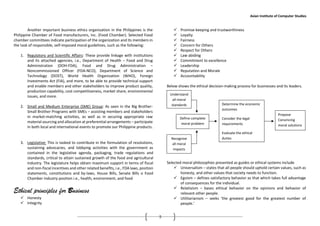
Below shows the ethical decision-making process for businesses and its leaders.
Selected moral philosophies presented as guides or ethical systems include
✓ Universalism – states that all people should uphold certain values, such as
honesty, and other values that society needs to function.
✓ Egoism – defines satisfactory behavior as that which takes full advantage
of consequences for the individual.
✓ Relativism – bases ethical behavior on the opinions and behavior of
relevant other people.
✓ Utilitarianism – seeks ‘the greatest good for the greatest number of
people.’
Understand
all moral
standards
Recognize
all moral
impacts
Define complete
moral problem
Determine the economic
outcomes
Consider the legal
requirements
Evaluate the ethical
duties
Propose
Convincing
moral solutions
Asian Institute of Computer Studies
10
The impact shown on the diagram measures and answers the following questions
1. Who will benefit?
2. Who will be harmed?
3. Whose right will be denied.
4. Who can exercise their right?
As shown in the ethical decision-making process above, after understanding moral
standards and assessing moral impact, the problem is identified and the evaluation
begins, with focus on the following:
1. Economic outcomes or costs and/or potential profit of an option
2. Legal requirements or compliance with laws
3. Ethical duties which identify actions that have the following characteristics
• Proud to receive acceptance thereof
• Capable of building a sense of community
• Can generate the greatest social good
• Willing to share benefits
• Does not harm, especially the least among us
• Does not interfere with the right of everyone to develop their skills
completely.
The process, as detailed, is complex and intimidating, but it is a useful
guide for business to arrive at realistic moral solutions.
The measurement of moral impact serves as the basis of rules that
individuals may use, as dictated by society. However, personal values vary.
Lawrence Kohlberg’s model of cognitive moral development presents different
levels of moral reasoning that people progress through as they age.
The categories based on level of moral judgment are the following:
1. Pre-conventional stage – where people make decisions based on concrete
rewards and punishments and pressing self-interest.
2. Conventional stage – where people observe the rules according to the
potentials of ethical behavior held by groups or civilizations, such as
society, family, or peers.
3. Post-conventional stage – where people see beyond authority, laws, and
norms and follow their self-chosen ethical principle.
The Kohlberg model states that over time, through academic learnings and
know-how, people change their ideals and behavior. When combined with the
regular and disciplined use of moral impact measures, the Kohlberg model allows
for movement into the post-conventional category.
Legal Responsibilities
All business enterprises need to comply with country’s laws and
regulations. Obedience to local, national, and relevant international laws
constitutes legal responsibilities. A selection of essential laws that explain legal
responsibilities of Philippine enterprises includes the following
1. Corporation Code (Batas Pambansa Bilang 68)
2. Consumer Act of The Philippines (R.A. 7894)
3. Minimum Wage Law
4. Migrant Workers and Overseas Filipino Act of 1995 (R.A. 8042)
5. Environmental legislation, which include the following:
• Presidential Decree (P.D.) 1586: established an environmental impact
statement system.
• R.A. 6969 is concerned with the Toxic Substances and Hazardous and
Nuclear Waste Control Act of 1990
• R.A. 8749 includes the Clean Air Act of 1990
• R.A. 9003 is concerned with the Philippine Ecological Solid Waste
Management Act of 2000
• R.A. 9725 looks at the Clean Water Act of 2004
• R.A. 9512 gives permission for the Environmental Awareness and
Education Act of 2008
Asian Institute of Computer Studies
11
Reference links:
Above Image retrieved from: https://www.transcell.com/our-commitment-to-business-
ethics/
https://interaksyon.philstar.com/entertainment/2020/02/21/162759/sarah-geronimo-
matteo-guidicellis-civil-wedding-stuns-local-social-media/
https://accountlearning.com/types-of-business-ethics/
https://www.southuniversity.edu/news-and-blogs/2017/07/ethical-principles-for-
business-38725
Garlde-Orjalo, V., Frias, S. (2016) Business Ethics and Social Responsibility: Principles,
Policies, Programs, and Practice. Quezon City, Phoenix Publishing House Inc.
Asian Institute of Computer Studies
12
Important Reminders
• Tear this activity sheet and submit on the scheduled date along
with the other activity (ies) the instructor may have asked the students to
do on a separate paper.
• If you are sending something you’ve done online such as MS
presentation (s), pictures, pdfs and alike as an attachment, then you may send
them to my email at ____________________________________________
following this format: (SECTION_LASTNAME_FIRSTNAME_ACTIVITYNAME), or
send a digital copy from your flash drive together with this activity sheet.
ACTIVITY 1:
Case Study:Sarah-Matteo Wedding
Sarah Geronimo and
Matteo Guidicelli have a “secret
marriage,” as the media described
it, last Feb. 20 at the Victory
Christian Fellowship Church,
followed by a “secret” post-
marriage dinner with Matteo’s
family and very close friends
(including Swatch Lady Virgie
Ramos who reportedly reserved
the venue) at the Ministry of Crab
restaurant in Shangri-La at the
Fort, BGC. However, Atty. Romy
Macalintal asserts that there is no such thing as ‘secret marriage’ because a
marriage cannot be celebrated without at least two witnesses and the person
authorized to solemnize it. Hence, the Sarah-Matteo marriage cannot be secret
because of the presence of those witnesses aside from some friends or relatives
who might have been invited to attend the ceremony. He added that it might be
“secret” to the parents of the bride (Divine and Delfin) but not to the entire world.
It is a common knowledge that Sarah’s parents are against Matteo (and all the
other actors linked to her before). Was Sarah’s decision to marry Matteo, morally
right? Did she disobey her parents? In Ephesians 6: 1-3 it says, “Children, obey your
parents in the Lord, for this is right. Honor your father and mother, which is the
first commandment with promise: that it may be well with you and you may live
long on earth.”
Question: If you were Sarah, whom do you follow? Your heart or the law of God?
Expound your answer.
__________________________________________________________________
__________________________________________________________________
__________________________________________________________________
__________________________________________________________________
__________________________________________________________________
__________________________________________________________________
__________________________________________________________________
__________________________________________________________________
ACTIVITY 2:
Code of Ethics
Assuming that you are staring a new company. Write a code of ethics for
the firm.
ACTIVITY 3:
Code of Ethics
Analyze the situations based on the statements provided. Answer the
questions asked and write it on the space provided.
Business Scenario Answer
1. An employee realized that he gave a
shortchange to a customer who
already left the store premises. The
right change is 694 pesos, but he only
gave 194 pesos. Discuss what business
ethics issues present on this situation.
What can be done?
Asian Institute of Computer Studies
13
2. A pregnant employee who violated
several attendance rules due to her
physical conditions. She is about to get
fire by the HR manager of the
company. Discuss what business ethics
issues present on this situation. What
can be done?
3. A homeless who found shelter and
comfort within the Mc Do Store
perimeter or premises. Some
customers complained on the smell.
Some give him food to eat. Discuss
what business ethics issues present on
this situation. What can be done?
4. Drinking session every Friday night
after work is normal in Company A.
Those who join the drinking session get
to have a favor from the management.
Those who do not join are already
subjected to heightened scrutiny on
normal things that they do in the
workplace every day. Discuss what
business ethics issues present on this
situation. What can be done?
5. To get permits and licenses renewed
on time, Company Y availed the
services of fixers to do transactions in
some government offices for the
speedy renewal of permits and
licenses. Extra money is paid then.
Discuss what business ethics issues
present on this situation. What can be
done?
Asian Institute of Computer Studies
14
MODULE 2: Assessment
Test I. Finding the Ethical and Unethical. Write ETH if the statement is ETHICAL and
UNETH if the statement is UNETHICAL.
________1. Obeying company’s rules and regulations.
________2. Developing professional relationships with co-workers.
________3. Taking credit for others hard work.
________4. Using or taking company’s supplies for personal purposes.
________5. Conducting personal business during working hour.
________6. Engaging in negative gossip about someone you work with.
________7. Extending lunch/ snack breaks.
________8. Showing initiative without being told.
________9. Lying inside and outside the workplace.
________10. Using foul language on co-workers in and out of the workplace
Test II. Finding LIE and Truth. Write LIE if the statement is FALSE; TRUTH is the
statement is TRUE.
__________1. Ethics is a set of principles of conduct governing an individual or
group.
__________2. Code of Ethics is a written statement of policies and principles that
guides the behavior of all employees or members of an organization.
__________3. Employees should obey only written work rules.
__________4. Ethical character traits include integrity, honesty, and justice.
__________5. To enhance the profits of the business continuously is the objective
of the Code of Ethics.
Test III. Multiple Choice. Write the letter of your chosen answer on the space
provided
_____1. Which of the following are the functions of a Code of Ethics?
a. It can express a shared commitment on the part of a professional society’s
members to strive and to satisfy certain ethical standards and principles.
b. It can help foster an environment in which ethical behavior is the norm.
c. It can serve as a guide or reminder in specific situations.
d. All the above.
_____2. Which of the following is a practice of fair treatment of workers at
workplace?
a. Recreation facilities at the workplace.
b. Rights of workers to fairness and dignity.
c. Right of workers to have a share in company’s profit.
d. None of the above.
_____3. Ethical issues do not exist in accounting because the field involves
primarily objective data.
a. True b. False
_____4. Which of the following is the study and practice of decisions about what is
good or right?
a. Law b. Morals c. Ethics d. Business
_____5. A businessman who owns a medical store in a small town is the only outlet
that sells face mask. There is a great necessity and high demand for the use of the
item due to COVID-19 pandemic, so he charges irrational amount of doubling the
price. The community gets mad of the situation. This business practice is most
likely:
a. Ethical because it is not illegal for the owner to set its prices based on
maximizing profits.
b. Ethical because the owner focuses only on the impact of decisions on his
business.
c. Unethical because business operates in a community and communities
have expectations for behavior of individuals, groups, and businesses.
d. None of the above.
Asian Institute of Computer Studies
15
Classical Philosophies and Belief System
Overview:
Business owners can always have something to learn from our classical
philosophers in terms of running their organizations. Ethical principles have
evolved from classical philosophies and belief systems. Some basic concepts of the
classical philosophies of Rufus, Plutarch, Socrates, Aristotle, and Epicurus are
summarized in this module. The lives and the belief systems of a few truth-seekers
– St. Augustine, Buddha, Confucius, and Muhammad.
Rufus(30–62 CE), on keeping track of one’s ethical progress
Musonius Rufus was known as the Socrates of Rome.
He was another Stoic, who taught that philosophy cannot just
be theoretical. If you want to be an ethical individual or an
ethical company, you cannot just study ethics, you must
practice it, every day, to get into good habits. The ancient Greek
word for ethics is the same word for habit. (The Guardian,
2020) You also need to keep track of your progress, to see how
you are performing. You cannot just rely on your intuitions because they are often
wrong. So, the ancient Greeks learned to keep accounts of themselves. They would
track their daily behavior in journals, keeping account of how many times they lost
their temper, for example, or got too drunk. Then they could see if they were really
improving their behavior, or just going around in circles. (The Guardian, 2020) In
organizational terms, keeping track of ourselves means trying to take an evidence-
based assessment of our performance. We might say we are a green company, but
how do we know if we are making progress? We might say we are a happy
organization, but how do we know? We can keep track of this, for example by
asking our employees (anonymously) how worthwhile they feel their job is. Then
see if, in a year, we have managed to enhance their sense of purpose. (The
Guardian, 2020) Today, we use balanced score card, where we keep track on our
performance from begging one cycle to the end.
Plutarch(45–120 CE), on being a good role model
Plutarch, the ancient Greek historian, and educator
understood that humans are incredibly social creatures, who
constantly observe the people around them and imitate them.
(The Guardian, 2020) Unfortunately, people often grow up
surrounded by bad role models. However, we can steer people,
by providing them with better patterns to imitate. That's what
Plutarch tried to do with his famous work, Parallel Lives, which
offered biographical sketches of some of the great Greek and Roman heroes –
Cicero, Caesar, Alexander the Great, Pericles – to give young people something to
emulate. (The Guardian, 2020) In organizational terms, that means what you say
to your employees is less important than what you do. They will watch how you
behave, how you treat others, how you cope with pressure and whether you follow
through on your promises. And they will imitate you. If you talk about ethics and
then cut corners at the first opportunity, they will follow your lead. Set a good
example and they will follow it. Plutarch would also warn that your best young
employees will use you as a bar to aim for and exceed. That is natural. Let them
compete with you and encourage them to go further. (The Guardian, 2020)
U N I T O N E
MODULE
3
Inclusive dates:
WEEK 6-7
At the end of this module, you are expected to:
• Illustrate how certain philosophies are reflected into
business practices
• Relate the topic in real life experiences
• Describe how the Filipino value system affects the attitudes of
business constituents.
Asian Institute of Computer Studies
16
Aristotle(384–322 BC), on letting people seek fulfillment
Aristotle was a great biologist as well as a great
philosopher. He based his ethics on a psychological theory of
human nature, insisting that we are naturally virtuous, rational,
social and happiness-seeking. Governments and organizations
need to build the best systems to let humans fulfill their natural
drives. Aristotle's philosophy was an influence on Edward Deci
and Richard Ryan's Self-determination Theory, which suggests
that employees will work harder for you, and perform better, if
you give them tasks, they find meaningful and morally worthwhile. (The Guardian,
2020) Humans want to believe in something and to serve it. Appeal to your
employees' best nature and they will answer that call. Our employees will also be
more motivated if you give them the opportunity to feed their natural curiosity
through learning opportunities. That could be vocational training, but it could also
simply be learning about the world, ideas, culture. Does your company have an
evening or lunch-time lecture series, such as Google Talks? Could it give credits for
evening adult learning classes, as companies such as Cadbury and Ford once did?
(The Guardian, 2020)
Socrates(469-399 B.C.), on daring to disagree
Socrates, one of the first philosophers, insisted on our
right to think for ourselves. Too often, he warned, humans
sleepwalk through life, simply going along with the crowd. (The
Guardian, 2020) This is dangerous in questions of morality, and
particularly in corporate governance. When corruption is
uncovered, too often people say, "everyone else was doing it". But
our characters are our responsibility. Socrates was prepared to die
rather than go against his conscience. Does your organization encourage
independent thinkers, and people who follow their conscience? Does it allow
people to give critical feedback to managers? Does it create opportunities for good
people to blow the whistle on bad behavior? (The Guardian, 2020)
Epicurus(341-270 B.C.), on the art of happiness
Epicurus was a fourth century Greek philosopher who
taught, rather scandalously, that the aim of life was simply to be
as happy as possible here on Earth, before we die and dissolve
back into the atomic universe. He warned that humans are very
bad at being happy, and very good at inventing reasons to be
miserable. Philosophy should teach us how to be happy, he
suggested. For example, it could teach us how to bring our
attention to the present moment, to savor it. It could also teach us to limit our
desires to what is easy to get, not inflating our needs with endless artificially
stimulated desires. (The Guardian, 2020) Today, some companies are embracing
Epicurus' philosophy, and trying to teach their employees the art of happiness.
Tony Hsieh, the CEO of American shoe company Zappos, is so committed to the
company's courses in happiness that he sold the company to Amazon on the
agreement it would be able to continue with its unique happy culture. (The
Guardian, 2020) The Guardian Author Says that companies should be careful about
forcing all their employees to follow one philosophy of the good life. As we have
seen, there are many different approaches to achieving happiness or welfare.
Perhaps companies could create an ethical culture that embraces all these
different ways of living. (The Guardian, 2020)
Epictetus(50 – 135 AD) build a resilient mind-set
Epictetus grew up a slave in Rome, and then became a
Stoic philosopher. Both positions were incredibly precarious –
slaves could be abused or killed by their owners, while Stoic
philosophers were constantly falling foul of the imperial
authorities (Epictetus himself was eventually exiled). Epictetus
coped with this insecurity by constantly reminding himself what
he could control and what he could not. We can control our
thoughts, beliefs, and attitudes, but everything else is to some
extent out of our control – other people's perceptions and behavior, the economy,
Asian Institute of Computer Studies
17
the weather, the future, and the past. If you focus on what is beyond your control,
and obsess over it, you will end up feeling helpless. Focus on what you can control,
and you will feel a measure of autonomy even in chaotic situations.
Value System of Filipinos
Strong Religious Faith
The visit of Pope Francis to the Philippines in 2015, coming closely the
heels of natural and man-made disasters – earthquake damage in Bohol, Cebu, and
other provinces in the Visayan region; typhoon and storm surge damage in the
Bicol and Visayas regions; and the Zamboanga siege – attest to the strong personal
faith of Filipinos.
Recovery efforts and the trials that accompany loss of family and property
were not easy, and many still face formidable challenges. However, this admirable
faith may deteriorate into fatalism, or the Bahala na ang Diyos (God will take care
of things0 mentality. Video clips on interviews of those who survived the disasters,
in fact show some of them speak of faith, that their creator will look after their
needs.
Respect for Authority
Respect for authority in the Philippines is founded on the explicit honor
paid to elder members of the family, and often, to anyone in a position of power.
This is evident in the ‘fawning admiration’ accorded to popular political,
entertainment, and sports personalities. When taken to extreme, this trait can be
developed into an oppression the discourages self-regulating decisions and
individual initiative.
Some celebrities have, however, taken advantage of the oftentimes
militant admiration by leading their followers to more insightful issues as
volunteerism. For example, at the wake assistance operations after Typhoon
Yolanda, entertainment figures gathered their fan bases for the repacking and
distributing of donations.
High Regard for Amor Proprio
Filipinos are sensitives to attacks on their own self-esteem and develop
and understanding of the self-esteem of others as well. Anything that might hurt
another’s self-esteem is avoided or else, the relationship may come to an end.
Some manifestations of this trait may be traced to the characteristics
attributed to certain regions or provinces. For example, the Ilocos region takes
pride in their hardworking and penny-pinching ways. Those with roots in
Pampanga are recognized for their prowess in the culinary arts, and the Cebu
region is well-known for its stunning and affable women.
This concern for self-esteem helps to maintain harmony in society and
within one’s circle. It may, however, encourage a readiness to sacrifice personal
integrity to remain in the good graces of the group.
Smooth Interpersonal Relationships
Indeed, unity exists in the Philippines. However, this often takes more work
outside regions and circles. There is, for instance, the so-called religious sector
vote, the provincial vote, or the entertainment personality vote that remains to be
significant factor in the conduct of elections. Man-made and natural calamities in
recent years have, however, attested to the care given to those affected. This
synergy is seen across regions, coming from different income levels and
professions. Technology and the evolving population may well assist in a steady
journey toward a Philippine society that agrees across perceived boundaries.
The personal alliance systems arise from real and ritual bonds, sponsors,
friends, and market exchange partners.
A Filipino’s loyalty goes first to the immediate family. One’s support,
loyalty, and trust are given to immediate family members. Beyond the closest kin,
Filipinos habitually do not assume the same degree of support, loyalty, and trust.
The mutual kinship system, known as compadrazgo, means
godparenthood or sponsorship. Ritual kinship bonds are a primary method of
extending the group from which one can expect help in the way of favors, such as
jobs, loans, or just simple gifts on special occasions. The ritual bonds are often
sealed in ceremonial occasions (e.g., baptism, confirmation, and marriage). It is
common to ask acquaintances who are of higher economic or social status than
oneself to be sponsors.
Asian Institute of Computer Studies
18
Debt of Gratitude
Under the concept of utang na loob (debt of gratitude), it is expected that
the debtor will attempt repayment. Saving another’s life, providing employment,
or making it possible for another to become educated are “gifts” of favors that
create utang na loob.
This concept of debt of gratitude occasionally extends over years and
decades, where even the subsequent generations of debtors still attempt
repayment to those who provided “gifts” to their ancestors.
Filipinos also extend the circle of social alliances with friendship. Friendship
is often placed at the same level with kinship as the most central of Filipino
relationships. Certainly, ties among those within one’s group of friends are an
important factor in the development of personal alliances systems. Here, as in
other categories, readiness to help one another provides the prime motivation for
the relationship.
In the commercial context, suki relationships (market-exchange
partnerships) may develop between two people who agree to become regular
customer and suppliers who will give them, in return, reduced prices, good quality,
and often, credit.
Reference links:
Above Image retrieved from:
https://thefinancialexpress.com.bd/education/understanding-entrepreneurship-
1541654371
https://www.theguardian.com/sustainable-business/business-learn-from-ancient-
philosophers
https://images.app.goo.gl/QtvJuYWhPegQLbCu7
https://images.app.goo.gl/2xkLaHHvBaWT7yR99
https://images.app.goo.gl/2fauT7PMscK2ACUu7
https://images.app.goo.gl/pGGQ97bL8NUEP9cY9
https://www.scribd.com/doc/137901811/Filipino-Value-System
Garalde-Orjalo, V., Frias, S. (2016) Business Ethics and Social Responsibility: Principles,
Policies, Programs, and Practice. Quezon City, Phoenix Publishing House Inc.
Asian Institute of Computer Studies
19
Important Reminders
• Tear this activity sheet and submit on the scheduled date along
with the other activity (ies) the instructor may have asked the students to
do on a separate paper.
• If you are sending something you’ve done online such as MS
presentation (s), pictures, pdfs and alike as an attachment, then you may send
them to my email at ____________________________________________
following this format: (SECTION_LASTNAME_FIRSTNAME_ACTIVITYNAME), or
send a digital copy from your flash drive together with this activity sheet.
ACTIVITY 1:
Company A and Company B
Demonstrate the learning on philosophies reflected in business using a
Venn Diagram.
Procedures:
1. Draw two overlapping circles. Label each circle
2. In each circle, fill in the characteristics of each item.
3. Identify which characteristics appear in two circles. These characteristics go in
the intersection (where the two circles overlap).
4. What are the similarities and differences that the Venn diagram illustrates?
5. After comparing the ideas, come up with your own idea on which philosophy is
the soundest for the company and explain why?
Guide
a. Characteristics of the company in terms of keeping track ethical progress of each
applicant of the company.
b. Characteristics of the company in terms of keeping track ethical progress of each
individual member of the company.
c. Methods of the company on how to promote each employee to a role model for
everyone.
d. How does the company deal with employees who seem to be unsatisfied with
the salaries and wages offered by the company?
e. How does the company deal with the employees who always oppose to
suggestions and changes in the management or operations?
f. How does the company manage to have a happy culture for all employees?
Company A: McDonalds
Company B: Jollibee
ACTIVITY 2:
Philosophies in Business
Write a reflective learning on the (topic) by answering the questions inside
the box. You may express your answers in a more critical and creative presentation
of your great learning. Have fun and enjoy!
Philosophies reflect in
business practices guide
me to ponder on…
What learnings have
I found from this
lesson?
What other
examples can I
contribute to explore
and think more?
What learnings can I
share with my
family and peers?
Asian Institute of Computer Studies
20
MODULE 3: Assessment
In 3-7 sentences, Answer the questions below. Your output will be graded based
on this rubric:
5 – Excellent 4 – Good 3 – Adequate 2 – Marginal 1 – No credit /
unacceptable
Criteria 5 4 3 2 1
Quality of writing (Informative, well organized
etc.)
Grammar usage and Mechanics (spelling,
punctuations, grammatical errors)
Following the instructions.
1. In your own words, discuss as to how philosophies are reflected into
business practices. Give concrete examples.
2. Given the problem on proper waste disposal in our city, how does your
learning of this lesson can be of help to solve this environmental problem?
3. How does learning this lesson can shape your life and can create an impact
to the lives of your family? Be Specific. Ask an elder at home to comment
on your answers and it being useful in your daily life as a student.
3rd
Quarter Project
For your 3rd
quarter project, your subject instructor will give you the instructions.
What good character
have I developed
from this lesson?
What is my
conclusion on the
lesson?

ETHICS.pdf

  • 1.
    Asian Institute ofComputer Studies 1 MODULE 1 Lesson 1: Forms of Business Organization according to ownership …….…………....................................................................2-3 Lesson 2: Core Principles of a Good Corporate Governance ………..…….……………………………………………………………………….3 Activities and Assessment ………….………………………….……………..……5-6 MODULE 2 Lesson 1: Business Ethics ….……….…………………...….…………………….7-8 Lesson 2: How can Business be considered as an Ethical Organization …..……..…....……………………………………………………8 Lesson 3: Ethical Code or Code of Ethics ….…………………………8-9 Lesson 4: Ethical Principle for Business...………………...........…9-10 Lesson 5: Legal Responsibilities...………………...........……………….10 Activities and Assessment …………………….……………….………. ….…12-14 MODULE 3 Lesson 1: Classical Philosophies……………………………………….……15-17 Lesson 2: value system of Filipinos ………………………….............17-18 Activities and Assessment …………….………….……………….……...……19-20 3rd Quarter Project ……………….………….……………………………………...…21
  • 2.
    Asian Institute ofComputer Studies 2 At the end of this module, you are expected to: • Identify forms of business organizations and their characteristics • Explain the purpose of business organizations and their role in socioeconomic development • Explain the core principles of fairness, accountability, and transparency in the socioeconomic development of a country Business Organizations Overview: Business is an organization, but an organization is not necessarily a business. The business may not be the whole organization, but just a part. A business is a person or group of people, aligned in whatever format, engaged in buying and selling goods or services for the purpose of making a profit. This may include making those goods, or outsourcing service provision. It is usually done in exchange for money, but sometimes in return for some good or service of a similar value. But it is all about the money - even in a socially responsible business Meanwhile, an organization is also a group of people who work together, like a neighborhood association, a charity, a union, or a corporation. Some organization are non-profit, therefore, non-profit itself is not a business Forms of Business Organization According to Ownership Business organization, an entity formed for the purpose of carrying on commercial enterprise. Such an organization is predicated on systems of law governing contract and exchange, property rights, and incorporation. Sole Proprietorship – is the type of business entity owned and operated by a single person. Partnership – is a business owned by two or more person who contribute resources into the entity. The partners divide the profits of the business among themselves. Corporation – is an enterprise chartered by law with most of the legal rights of a person including to conduct a business, to own and sell property, to borrow money, to sue and be sued. A corporation is a business organization that has a separate legal personality from its owners. Ownership in a stock corporation is represented by shares of stock U N I T O N E MODULE 1 Inclusive dates: WEEK 1-2
  • 3.
    Asian Institute ofComputer Studies 3 Comparative Analysis Forms of Business Organization Sole Proprietorship Partnership Corporation Easiest to establish It could be easily to establish like sole proprietorship Hard to establish Limited Life Limited life Life is 50 years and can be extended Small amount of capital is needed to start a business Large amount of capital Large amount of capital Ownership Of all profits/losses Share of profit/losses Proportion to each stockholder’s percentage of ownership interest Unlimited Liability Unlimited liability of the partners Stockholders have limited liability Minimum legal requirements Subject to minimum government regulation Subject to numerous government regulation Business secrecy Business secrecy Lack of secrecy Personal interest in managing the business Each partner has a right to participate Lack of personal interest Tax savings Tax savings Several taxes to pay as mandated by laws and ordinances. Major Contributions of Forms of Business Organization in Socio Economic Development Business are considered the engine of the economy because they contributed to the economy of our country through paying corporate taxes so that the government can provide the promote social welfare of its citizens. Business also provides job opportunities which compensates the people in the society. Core Principles of a Good Corporate Governance A Good Corporate Governance in all businesses and even in non-profit organizations such as foundations is very important to build trust and confidence with the investors, donors, and the community in general. A good corporate governance builds the integrity of the institution. FAIRNESS Fairness comes from the old English word faeger, which means “pleasing or attractive.” It is the quality of making judgments that are free from discrimination. Fairness in the context of a business organization involves balancing the interests involved in all decision-making including any decisions related to hiring, firing (including the investigatory process), and the compensation and rewards system. Hiring the right people is one of the most important decisions an organization makes. ACCOUNTABILITY Accountability is the obligation of an individual or organization to account for its activities, accept responsibility for them, and to disclose the results in a transparent manner. Accountability in the context of a business organization is the obligation to demonstrate that work has been conducted in compliance with agreed rules and standards or to report fairly and accurately on performance results vis-à-vis mandated roles and/or plans. TRANSPARENCY Transparency is defined as being authentic in the way an organization message themselves externally – to stakeholders, to prospective customers and talent, and within the community. It allows stakeholders to understand whether the activities of social institutions provide a genuine service to civil society and whether money is used appropriately. Thus, transparency means there is lack of hidden agendas or conditions, accompanied by the availability of full information required of collaboration, cooperation, and collective decision-making
  • 4.
    Asian Institute ofComputer Studies 4 STEWARDSHIP In Biblical terms, stewardship is defined as utilizing and managing all resources God provides for the glory of God and the betterment of His creation. That definition plays a critical role in today’s business landscape. In the context of business organization, stewardship refers to taking responsibility for the business and the effects it has on the world around it. This involves considering more than just the bottom line and looking at elements such as values, ethics, and morals. Reference links: Above image retrieved from: https://www.hrmexam.com/2019/12/27/key-hr-roles-in-a- business-organization/ https://www.britannica.com/topic/business-organization https://images.app.goo.gl/TAUeJZEaykx7nMA26 https://images.app.goo.gl/FKuBnKhNGYXA7W5k9 https://images.app.goo.gl/oJXDynTMZbRz33CE9 https://images.app.goo.gl/CD7Dkw6HxrmAaZ629 https://jslco.wordpress.com/2017/02/05/how-to-start-a-sari-sari-store-business/ https://www.economicsdiscussion.net/organisation/organisation-definitions/32336
  • 5.
    Asian Institute ofComputer Studies 5 Important Reminders • Tear this activity sheet and submit on the scheduled date along with the other activity (ies) the instructor may have asked the students to do on a separate paper. • If you are sending something you’ve done online such as MS presentation (s), pictures, pdfs and alike as an attachment, then you may send them to my email at ____________________________________________ following this format: (SECTION_LASTNAME_FIRSTNAME_ACTIVITYNAME), or send a digital copy from your flash drive together with this activity sheet. ACTIVITY 1: Business as Usual Nowadays, many businesses are closed due to the COVID -19 pandemic and only those businesses which are considered essential such as food businesses and medical services remained. Can you list down the name/s of business/es which is/are still in operation during the quarantine period? Identify the services/ products they offer. Name of Business Products/Services offered 1. 2. 3. 4. 5. ACTIVITY 2: Case Study: MANG EUGENIO VENTURA: FILIPINO TAXI DRIVER WITH A GOLDEN HEART The story of Mang Eugenio Ventura, an extraordinary cab driver, went viral in the social media when a passenger spread the good work about him, not rejecting passengers (despite heavy traffic in Metro Manila) and declining tips. Apart from being fair and honest, he is the jolly type – he just laughs off the congestion on the main roads of the city. He got featured in an episode of the TV Program “Mission Possible.” You can read the full story here: https://www.wheninmanila.com/mang-eugenio-cab-driver-every- taxi-driver-should-strive-to-be-like/ Questions: 1. What do you think has molded the fair, honest and cheerful behavior of Mang Eugenio? 2. What lesson have you learned from the good example of Mang Eugenio?
  • 6.
    Asian Institute ofComputer Studies 6 MODULE 1: Assessment Test I. Multiple Choice. Write the letter of your chosen answer on the space provided. 1. What is fairness? a. Something that is beneficial for you b. Something that is beneficial for all society c. The quality of treating people equally d. None of the above 2. Stewardship is not limited to money. What other thing that God expects you to manage? a. Education b. Time c. Health 3. What does Accountability refer to? a. Being responsible for one’s action b. Providing access to information c. The ability to hire and fire employee d. All the above 4. Which is considered unethical business practice? a. Training employees unfairly c. Good word of mouth from customers b. Selling quality product d. All the above 5. All the following are considered abusive conduct in the workplace EXCEPT a. Invading the personal space of co-workers b. Insulting co-workers c. Receiving a performance review from a supervisor d. Giving nasty gestures at co-workers 6. A business organization which is easiest to establish and has limited liabilities a. Corporation b. Sole proprietorship c. Partnership 7. A business organization of two or more people as partners who shares the profit and liabilities of the company. a. Corporation b. Sole proprietorship c. Partnership 8. A business organization which is hard to establish and is subject to numerous government regulation. a. Corporation b. Sole proprietorship c. Partnership 9. Ely is always late coming to work yet she has no recorded tardiness because she and the timekeeper are best friends. What character trait does she possess? a. Dishonesty c. Hardworking b. Decency d. Friendly 10. The class adviser of Grade 12 – ABM 1, Mrs. Tamayo, always makes sure that whenever there are school activities, she gives all the members of the class chance to participate because she always believes that everyone has his/her own talents and potentials. Based on the paragraph, what does Mrs. Tamayo want to imply to her students? a. Firmness c. Fairness b. Gentleness d. Politeness
  • 7.
    Asian Institute ofComputer Studies 7 Business Ethics and Code of Ethics Overview: Business and Ethics are always interrelated. Ethics guides us that we are doing the right thing. In the conduct of our business, we need to follow ethical standards of the company. Ethics is derived from the Greek word “ethikos” which means “having to do with character. The Latin word for ethos is “mos” (or “mores”). That is why we known Ethics as the Moral Science or Moral Philosophy. It refers to the theory of morality of right conduct. Business Ethics Let us define Business Ethics 1. Business Ethics is the study of what is right and wrong on human behavior and conduct in business. 2. Business Ethics is the study of perceptions of people about morality, moral norms, moral rules, and ethical principles as they apply to peoples and institutions in business. 3. Business Ethics is the study, evaluation, analysis and questioning of ethical standards, policies, moral norms, and ethical theories that managers and decision makers use in resolving moral issues and ethical dilemmas affecting business. Types of Business Ethics 1. Personal Responsibilities: This refers to the personal beliefs of an individual. Every individual has certain firm beliefs on certain matters’ such as honesty, avoiding criminal acts, obedience to elders, willing to perform accepted duties, promptly settling the dues etc. 2. Official Responsibilities: Only persons or human beings occupy positions. A person who-is occupying a certain position should strictly follow certain norms and other standards set for that official capacity. 3. Personal Loyalties: These include loyalties of a subordinate to his superior. So long as the superior is just and honest, the subordinates shall not face any problem. 4. Corporate Responsibilities: Corporations, as separate legal entities, have certain moral responsibilities. The responsibilities may not be identical with the personal moral codes of the managers who run the company. These responsibilities may be internal or external. 5. Organizational Loyalties: Many people develop a deep sense of loyalty towards the organization as an entity that goes beyond their personal interest. This loyalty has arisen out of love and affection. This factor can be stimulated effectively. If so, the employees will work hard and help the enterprise in achieving its objectives. U N I T O N E MODULE 2 Inclusive dates: WEEK 3-5 At the end of this module, you are expected to: • Understand the common practices in business organizations • Appreciate the importance of Code of Ethics in business organizations • Craft a simple “Codes of Ethics” or “Codes of Right Conduct”
  • 8.
    Asian Institute ofComputer Studies 8 6. Economic Responsibilities: This type of morality guides the individual actions of an economic nature. For instance, some businessmen think it immoral to borrow. However, this type of people is very rare to see. 7. Technical Morality: Professional people should adhere to certain ethical standards established by competent bodies or persons or by customs. The Code of Conduct set for them by the concerned institutions governing the profession binds lawyers, chartered accountants, doctors etc. 8. Legal Responsibility: It refers to the responsibility imposed by law. Does all illegal are supposed to be unethical also? Everyone should be a law-abiding citizen. How can Business be considered as an Ethical Organization? Ethical organizations are based on these core principles. A business with good practice of accountability makes sure that all the financial obligations from its debtors are paid on time. Accountability of a company can also be shown in proper planning, hiring, and keeping employees, and budget management and reporting. An ethical organization also based on the principles of fairness. Employees who feel secured, because there is no impartiality, often stays with the company organization build. Meanwhile, transparency and stewardship also are known characteristics of good governance in an organization. Transparency in business builds the trust of the employees to the company, and the stakeholders such as the suppliers, investors, and of course the customers. Whereas stewardship is an ethical practice of managing the resources of the company well. Ethical Code or Code of ethics To ensure that all those principles are practiced by all employees in the organization, Code of Ethics, or Code of Conduct are crafted to be the guiding light of the business in ensuring good ethical practice. Code of ethics are principles adopted by an organization to assist those in the organization called upon to decide; it is about understanding the difference between “right” and “wrong” and to apply this understanding to their decision. In addition, Code of ethics is a written set of guidelines issued by an organization to its workers and management to help them conduct their actions in accordance with its primary values and ethical standards. CODE OF CONDUCT – it is a document designed to influence the behavior of employees. They set out the procedures to be used in specific ethical situations and delineate whether a violation of the code of ethics occurred and, if so, remedies should be imposed. CODE OF PRACTICE – it is adopted by a profession or by a governmental or non- governmental organization to regulate that profession. It may be styled as a code of professional responsibility, which will discuss difficult issues, difficult decisions that will often need to be made, and provide a clear account of what behavior is considered “ethical” or “correct” or “right” in the circumstances. CODE OF ETHICS – is not written solely for the purpose of doing ethical business practice. It can also be applied and practiced in school, government, and even professional groups. There is code of ethics for teachers, accountants, engineers, lawyers, doctors, nurses, and all other professionals to ensure that they are following the same ethical standards in their professional practice. Each individual needs ethics to live in a disciplined manner. Because of the significance of ethics in day-to-day living, some are put into law. However, it may be difficult for some to be legislated. Some individuals act incorrectly because their ethical standards differ from society, or because they choose to be self-seeking. Professionals, especially those dealing with businesses and businessmen, often face the tough task of pursuing ethical practices. In the Philippines, the Management Association of the Philippines (MAP) has taken the lead in the practice and inculcation of business ethics through its member-companies. The regular sessions of the organization allow for evaluations of the individual practice of business ethics in member-companies against MAP standards.
  • 9.
    Asian Institute ofComputer Studies 9 Another important business ethics organization in the Philippines is the Philippine Chamber of Food manufacturers, Inc. (Food Chamber). Selected Food chamber committees indicate participation of the organization and its members in the task of responsible, self-imposed moral guidelines, such as the following: 1. Regulatory and Scientific Affairs: These provide linkage with institutions and its attached agencies, i.e., Department of Health – Food and Drug Administration (DOH-FDA), Food and Drug Administration – Noncommissioned Officer (FDA-NCO), Department of Science and Technology (DOST), World Health Organization (WHO), Foreign Investments Act (FIA), and more, to be able to provide technical support and enable members and other stakeholders to improve product quality, production capability, cost competitiveness, market share, environmental issues, and more. 2. Small and Medium Enterprise (SME) Group: As seen in the Big Brother- Small Brother Programs with SMEs – assisting members and stakeholders in market-matching activities, as well as in securing appropriate raw material sourcing and allocation at preferential arrangements – participate in both local and international events to promote our Philippine products. 3. Legislative: This is tasked to contribute in the formulation of resolutions, sustaining advocacies, and lobbying activities with the government as contained in the legislative agenda, packaging, trade regulations and standards, critical to attain sustained growth of the food and agricultural industry. The legislature helps obtain maximum support in terms of fiscal and non-fiscal incentives and other related benefits, i.e., FDA laws, position statements, constitutions and by-laws, House Bills, Senate Bills o Food Chamber industry position i.e., health, environment, and food Ethical principles for Business ✓ Honesty ✓ Integrity ✓ Promise-keeping and trustworthiness ✓ Loyalty ✓ Fairness ✓ Concern for Others ✓ Respect for Others ✓ Law abiding ✓ Commitment to excellence ✓ Leadership ✓ Reputation and Morale ✓ Accountability Below shows the ethical decision-making process for businesses and its leaders. Selected moral philosophies presented as guides or ethical systems include ✓ Universalism – states that all people should uphold certain values, such as honesty, and other values that society needs to function. ✓ Egoism – defines satisfactory behavior as that which takes full advantage of consequences for the individual. ✓ Relativism – bases ethical behavior on the opinions and behavior of relevant other people. ✓ Utilitarianism – seeks ‘the greatest good for the greatest number of people.’ Understand all moral standards Recognize all moral impacts Define complete moral problem Determine the economic outcomes Consider the legal requirements Evaluate the ethical duties Propose Convincing moral solutions
  • 10.
    Asian Institute ofComputer Studies 10 The impact shown on the diagram measures and answers the following questions 1. Who will benefit? 2. Who will be harmed? 3. Whose right will be denied. 4. Who can exercise their right? As shown in the ethical decision-making process above, after understanding moral standards and assessing moral impact, the problem is identified and the evaluation begins, with focus on the following: 1. Economic outcomes or costs and/or potential profit of an option 2. Legal requirements or compliance with laws 3. Ethical duties which identify actions that have the following characteristics • Proud to receive acceptance thereof • Capable of building a sense of community • Can generate the greatest social good • Willing to share benefits • Does not harm, especially the least among us • Does not interfere with the right of everyone to develop their skills completely. The process, as detailed, is complex and intimidating, but it is a useful guide for business to arrive at realistic moral solutions. The measurement of moral impact serves as the basis of rules that individuals may use, as dictated by society. However, personal values vary. Lawrence Kohlberg’s model of cognitive moral development presents different levels of moral reasoning that people progress through as they age. The categories based on level of moral judgment are the following: 1. Pre-conventional stage – where people make decisions based on concrete rewards and punishments and pressing self-interest. 2. Conventional stage – where people observe the rules according to the potentials of ethical behavior held by groups or civilizations, such as society, family, or peers. 3. Post-conventional stage – where people see beyond authority, laws, and norms and follow their self-chosen ethical principle. The Kohlberg model states that over time, through academic learnings and know-how, people change their ideals and behavior. When combined with the regular and disciplined use of moral impact measures, the Kohlberg model allows for movement into the post-conventional category. Legal Responsibilities All business enterprises need to comply with country’s laws and regulations. Obedience to local, national, and relevant international laws constitutes legal responsibilities. A selection of essential laws that explain legal responsibilities of Philippine enterprises includes the following 1. Corporation Code (Batas Pambansa Bilang 68) 2. Consumer Act of The Philippines (R.A. 7894) 3. Minimum Wage Law 4. Migrant Workers and Overseas Filipino Act of 1995 (R.A. 8042) 5. Environmental legislation, which include the following: • Presidential Decree (P.D.) 1586: established an environmental impact statement system. • R.A. 6969 is concerned with the Toxic Substances and Hazardous and Nuclear Waste Control Act of 1990 • R.A. 8749 includes the Clean Air Act of 1990 • R.A. 9003 is concerned with the Philippine Ecological Solid Waste Management Act of 2000 • R.A. 9725 looks at the Clean Water Act of 2004 • R.A. 9512 gives permission for the Environmental Awareness and Education Act of 2008
  • 11.
    Asian Institute ofComputer Studies 11 Reference links: Above Image retrieved from: https://www.transcell.com/our-commitment-to-business- ethics/ https://interaksyon.philstar.com/entertainment/2020/02/21/162759/sarah-geronimo- matteo-guidicellis-civil-wedding-stuns-local-social-media/ https://accountlearning.com/types-of-business-ethics/ https://www.southuniversity.edu/news-and-blogs/2017/07/ethical-principles-for- business-38725 Garlde-Orjalo, V., Frias, S. (2016) Business Ethics and Social Responsibility: Principles, Policies, Programs, and Practice. Quezon City, Phoenix Publishing House Inc.
  • 12.
    Asian Institute ofComputer Studies 12 Important Reminders • Tear this activity sheet and submit on the scheduled date along with the other activity (ies) the instructor may have asked the students to do on a separate paper. • If you are sending something you’ve done online such as MS presentation (s), pictures, pdfs and alike as an attachment, then you may send them to my email at ____________________________________________ following this format: (SECTION_LASTNAME_FIRSTNAME_ACTIVITYNAME), or send a digital copy from your flash drive together with this activity sheet. ACTIVITY 1: Case Study:Sarah-Matteo Wedding Sarah Geronimo and Matteo Guidicelli have a “secret marriage,” as the media described it, last Feb. 20 at the Victory Christian Fellowship Church, followed by a “secret” post- marriage dinner with Matteo’s family and very close friends (including Swatch Lady Virgie Ramos who reportedly reserved the venue) at the Ministry of Crab restaurant in Shangri-La at the Fort, BGC. However, Atty. Romy Macalintal asserts that there is no such thing as ‘secret marriage’ because a marriage cannot be celebrated without at least two witnesses and the person authorized to solemnize it. Hence, the Sarah-Matteo marriage cannot be secret because of the presence of those witnesses aside from some friends or relatives who might have been invited to attend the ceremony. He added that it might be “secret” to the parents of the bride (Divine and Delfin) but not to the entire world. It is a common knowledge that Sarah’s parents are against Matteo (and all the other actors linked to her before). Was Sarah’s decision to marry Matteo, morally right? Did she disobey her parents? In Ephesians 6: 1-3 it says, “Children, obey your parents in the Lord, for this is right. Honor your father and mother, which is the first commandment with promise: that it may be well with you and you may live long on earth.” Question: If you were Sarah, whom do you follow? Your heart or the law of God? Expound your answer. __________________________________________________________________ __________________________________________________________________ __________________________________________________________________ __________________________________________________________________ __________________________________________________________________ __________________________________________________________________ __________________________________________________________________ __________________________________________________________________ ACTIVITY 2: Code of Ethics Assuming that you are staring a new company. Write a code of ethics for the firm. ACTIVITY 3: Code of Ethics Analyze the situations based on the statements provided. Answer the questions asked and write it on the space provided. Business Scenario Answer 1. An employee realized that he gave a shortchange to a customer who already left the store premises. The right change is 694 pesos, but he only gave 194 pesos. Discuss what business ethics issues present on this situation. What can be done?
  • 13.
    Asian Institute ofComputer Studies 13 2. A pregnant employee who violated several attendance rules due to her physical conditions. She is about to get fire by the HR manager of the company. Discuss what business ethics issues present on this situation. What can be done? 3. A homeless who found shelter and comfort within the Mc Do Store perimeter or premises. Some customers complained on the smell. Some give him food to eat. Discuss what business ethics issues present on this situation. What can be done? 4. Drinking session every Friday night after work is normal in Company A. Those who join the drinking session get to have a favor from the management. Those who do not join are already subjected to heightened scrutiny on normal things that they do in the workplace every day. Discuss what business ethics issues present on this situation. What can be done? 5. To get permits and licenses renewed on time, Company Y availed the services of fixers to do transactions in some government offices for the speedy renewal of permits and licenses. Extra money is paid then. Discuss what business ethics issues present on this situation. What can be done?
  • 14.
    Asian Institute ofComputer Studies 14 MODULE 2: Assessment Test I. Finding the Ethical and Unethical. Write ETH if the statement is ETHICAL and UNETH if the statement is UNETHICAL. ________1. Obeying company’s rules and regulations. ________2. Developing professional relationships with co-workers. ________3. Taking credit for others hard work. ________4. Using or taking company’s supplies for personal purposes. ________5. Conducting personal business during working hour. ________6. Engaging in negative gossip about someone you work with. ________7. Extending lunch/ snack breaks. ________8. Showing initiative without being told. ________9. Lying inside and outside the workplace. ________10. Using foul language on co-workers in and out of the workplace Test II. Finding LIE and Truth. Write LIE if the statement is FALSE; TRUTH is the statement is TRUE. __________1. Ethics is a set of principles of conduct governing an individual or group. __________2. Code of Ethics is a written statement of policies and principles that guides the behavior of all employees or members of an organization. __________3. Employees should obey only written work rules. __________4. Ethical character traits include integrity, honesty, and justice. __________5. To enhance the profits of the business continuously is the objective of the Code of Ethics. Test III. Multiple Choice. Write the letter of your chosen answer on the space provided _____1. Which of the following are the functions of a Code of Ethics? a. It can express a shared commitment on the part of a professional society’s members to strive and to satisfy certain ethical standards and principles. b. It can help foster an environment in which ethical behavior is the norm. c. It can serve as a guide or reminder in specific situations. d. All the above. _____2. Which of the following is a practice of fair treatment of workers at workplace? a. Recreation facilities at the workplace. b. Rights of workers to fairness and dignity. c. Right of workers to have a share in company’s profit. d. None of the above. _____3. Ethical issues do not exist in accounting because the field involves primarily objective data. a. True b. False _____4. Which of the following is the study and practice of decisions about what is good or right? a. Law b. Morals c. Ethics d. Business _____5. A businessman who owns a medical store in a small town is the only outlet that sells face mask. There is a great necessity and high demand for the use of the item due to COVID-19 pandemic, so he charges irrational amount of doubling the price. The community gets mad of the situation. This business practice is most likely: a. Ethical because it is not illegal for the owner to set its prices based on maximizing profits. b. Ethical because the owner focuses only on the impact of decisions on his business. c. Unethical because business operates in a community and communities have expectations for behavior of individuals, groups, and businesses. d. None of the above.
  • 15.
    Asian Institute ofComputer Studies 15 Classical Philosophies and Belief System Overview: Business owners can always have something to learn from our classical philosophers in terms of running their organizations. Ethical principles have evolved from classical philosophies and belief systems. Some basic concepts of the classical philosophies of Rufus, Plutarch, Socrates, Aristotle, and Epicurus are summarized in this module. The lives and the belief systems of a few truth-seekers – St. Augustine, Buddha, Confucius, and Muhammad. Rufus(30–62 CE), on keeping track of one’s ethical progress Musonius Rufus was known as the Socrates of Rome. He was another Stoic, who taught that philosophy cannot just be theoretical. If you want to be an ethical individual or an ethical company, you cannot just study ethics, you must practice it, every day, to get into good habits. The ancient Greek word for ethics is the same word for habit. (The Guardian, 2020) You also need to keep track of your progress, to see how you are performing. You cannot just rely on your intuitions because they are often wrong. So, the ancient Greeks learned to keep accounts of themselves. They would track their daily behavior in journals, keeping account of how many times they lost their temper, for example, or got too drunk. Then they could see if they were really improving their behavior, or just going around in circles. (The Guardian, 2020) In organizational terms, keeping track of ourselves means trying to take an evidence- based assessment of our performance. We might say we are a green company, but how do we know if we are making progress? We might say we are a happy organization, but how do we know? We can keep track of this, for example by asking our employees (anonymously) how worthwhile they feel their job is. Then see if, in a year, we have managed to enhance their sense of purpose. (The Guardian, 2020) Today, we use balanced score card, where we keep track on our performance from begging one cycle to the end. Plutarch(45–120 CE), on being a good role model Plutarch, the ancient Greek historian, and educator understood that humans are incredibly social creatures, who constantly observe the people around them and imitate them. (The Guardian, 2020) Unfortunately, people often grow up surrounded by bad role models. However, we can steer people, by providing them with better patterns to imitate. That's what Plutarch tried to do with his famous work, Parallel Lives, which offered biographical sketches of some of the great Greek and Roman heroes – Cicero, Caesar, Alexander the Great, Pericles – to give young people something to emulate. (The Guardian, 2020) In organizational terms, that means what you say to your employees is less important than what you do. They will watch how you behave, how you treat others, how you cope with pressure and whether you follow through on your promises. And they will imitate you. If you talk about ethics and then cut corners at the first opportunity, they will follow your lead. Set a good example and they will follow it. Plutarch would also warn that your best young employees will use you as a bar to aim for and exceed. That is natural. Let them compete with you and encourage them to go further. (The Guardian, 2020) U N I T O N E MODULE 3 Inclusive dates: WEEK 6-7 At the end of this module, you are expected to: • Illustrate how certain philosophies are reflected into business practices • Relate the topic in real life experiences • Describe how the Filipino value system affects the attitudes of business constituents.
  • 16.
    Asian Institute ofComputer Studies 16 Aristotle(384–322 BC), on letting people seek fulfillment Aristotle was a great biologist as well as a great philosopher. He based his ethics on a psychological theory of human nature, insisting that we are naturally virtuous, rational, social and happiness-seeking. Governments and organizations need to build the best systems to let humans fulfill their natural drives. Aristotle's philosophy was an influence on Edward Deci and Richard Ryan's Self-determination Theory, which suggests that employees will work harder for you, and perform better, if you give them tasks, they find meaningful and morally worthwhile. (The Guardian, 2020) Humans want to believe in something and to serve it. Appeal to your employees' best nature and they will answer that call. Our employees will also be more motivated if you give them the opportunity to feed their natural curiosity through learning opportunities. That could be vocational training, but it could also simply be learning about the world, ideas, culture. Does your company have an evening or lunch-time lecture series, such as Google Talks? Could it give credits for evening adult learning classes, as companies such as Cadbury and Ford once did? (The Guardian, 2020) Socrates(469-399 B.C.), on daring to disagree Socrates, one of the first philosophers, insisted on our right to think for ourselves. Too often, he warned, humans sleepwalk through life, simply going along with the crowd. (The Guardian, 2020) This is dangerous in questions of morality, and particularly in corporate governance. When corruption is uncovered, too often people say, "everyone else was doing it". But our characters are our responsibility. Socrates was prepared to die rather than go against his conscience. Does your organization encourage independent thinkers, and people who follow their conscience? Does it allow people to give critical feedback to managers? Does it create opportunities for good people to blow the whistle on bad behavior? (The Guardian, 2020) Epicurus(341-270 B.C.), on the art of happiness Epicurus was a fourth century Greek philosopher who taught, rather scandalously, that the aim of life was simply to be as happy as possible here on Earth, before we die and dissolve back into the atomic universe. He warned that humans are very bad at being happy, and very good at inventing reasons to be miserable. Philosophy should teach us how to be happy, he suggested. For example, it could teach us how to bring our attention to the present moment, to savor it. It could also teach us to limit our desires to what is easy to get, not inflating our needs with endless artificially stimulated desires. (The Guardian, 2020) Today, some companies are embracing Epicurus' philosophy, and trying to teach their employees the art of happiness. Tony Hsieh, the CEO of American shoe company Zappos, is so committed to the company's courses in happiness that he sold the company to Amazon on the agreement it would be able to continue with its unique happy culture. (The Guardian, 2020) The Guardian Author Says that companies should be careful about forcing all their employees to follow one philosophy of the good life. As we have seen, there are many different approaches to achieving happiness or welfare. Perhaps companies could create an ethical culture that embraces all these different ways of living. (The Guardian, 2020) Epictetus(50 – 135 AD) build a resilient mind-set Epictetus grew up a slave in Rome, and then became a Stoic philosopher. Both positions were incredibly precarious – slaves could be abused or killed by their owners, while Stoic philosophers were constantly falling foul of the imperial authorities (Epictetus himself was eventually exiled). Epictetus coped with this insecurity by constantly reminding himself what he could control and what he could not. We can control our thoughts, beliefs, and attitudes, but everything else is to some extent out of our control – other people's perceptions and behavior, the economy,
  • 17.
    Asian Institute ofComputer Studies 17 the weather, the future, and the past. If you focus on what is beyond your control, and obsess over it, you will end up feeling helpless. Focus on what you can control, and you will feel a measure of autonomy even in chaotic situations. Value System of Filipinos Strong Religious Faith The visit of Pope Francis to the Philippines in 2015, coming closely the heels of natural and man-made disasters – earthquake damage in Bohol, Cebu, and other provinces in the Visayan region; typhoon and storm surge damage in the Bicol and Visayas regions; and the Zamboanga siege – attest to the strong personal faith of Filipinos. Recovery efforts and the trials that accompany loss of family and property were not easy, and many still face formidable challenges. However, this admirable faith may deteriorate into fatalism, or the Bahala na ang Diyos (God will take care of things0 mentality. Video clips on interviews of those who survived the disasters, in fact show some of them speak of faith, that their creator will look after their needs. Respect for Authority Respect for authority in the Philippines is founded on the explicit honor paid to elder members of the family, and often, to anyone in a position of power. This is evident in the ‘fawning admiration’ accorded to popular political, entertainment, and sports personalities. When taken to extreme, this trait can be developed into an oppression the discourages self-regulating decisions and individual initiative. Some celebrities have, however, taken advantage of the oftentimes militant admiration by leading their followers to more insightful issues as volunteerism. For example, at the wake assistance operations after Typhoon Yolanda, entertainment figures gathered their fan bases for the repacking and distributing of donations. High Regard for Amor Proprio Filipinos are sensitives to attacks on their own self-esteem and develop and understanding of the self-esteem of others as well. Anything that might hurt another’s self-esteem is avoided or else, the relationship may come to an end. Some manifestations of this trait may be traced to the characteristics attributed to certain regions or provinces. For example, the Ilocos region takes pride in their hardworking and penny-pinching ways. Those with roots in Pampanga are recognized for their prowess in the culinary arts, and the Cebu region is well-known for its stunning and affable women. This concern for self-esteem helps to maintain harmony in society and within one’s circle. It may, however, encourage a readiness to sacrifice personal integrity to remain in the good graces of the group. Smooth Interpersonal Relationships Indeed, unity exists in the Philippines. However, this often takes more work outside regions and circles. There is, for instance, the so-called religious sector vote, the provincial vote, or the entertainment personality vote that remains to be significant factor in the conduct of elections. Man-made and natural calamities in recent years have, however, attested to the care given to those affected. This synergy is seen across regions, coming from different income levels and professions. Technology and the evolving population may well assist in a steady journey toward a Philippine society that agrees across perceived boundaries. The personal alliance systems arise from real and ritual bonds, sponsors, friends, and market exchange partners. A Filipino’s loyalty goes first to the immediate family. One’s support, loyalty, and trust are given to immediate family members. Beyond the closest kin, Filipinos habitually do not assume the same degree of support, loyalty, and trust. The mutual kinship system, known as compadrazgo, means godparenthood or sponsorship. Ritual kinship bonds are a primary method of extending the group from which one can expect help in the way of favors, such as jobs, loans, or just simple gifts on special occasions. The ritual bonds are often sealed in ceremonial occasions (e.g., baptism, confirmation, and marriage). It is common to ask acquaintances who are of higher economic or social status than oneself to be sponsors.
  • 18.
    Asian Institute ofComputer Studies 18 Debt of Gratitude Under the concept of utang na loob (debt of gratitude), it is expected that the debtor will attempt repayment. Saving another’s life, providing employment, or making it possible for another to become educated are “gifts” of favors that create utang na loob. This concept of debt of gratitude occasionally extends over years and decades, where even the subsequent generations of debtors still attempt repayment to those who provided “gifts” to their ancestors. Filipinos also extend the circle of social alliances with friendship. Friendship is often placed at the same level with kinship as the most central of Filipino relationships. Certainly, ties among those within one’s group of friends are an important factor in the development of personal alliances systems. Here, as in other categories, readiness to help one another provides the prime motivation for the relationship. In the commercial context, suki relationships (market-exchange partnerships) may develop between two people who agree to become regular customer and suppliers who will give them, in return, reduced prices, good quality, and often, credit. Reference links: Above Image retrieved from: https://thefinancialexpress.com.bd/education/understanding-entrepreneurship- 1541654371 https://www.theguardian.com/sustainable-business/business-learn-from-ancient- philosophers https://images.app.goo.gl/QtvJuYWhPegQLbCu7 https://images.app.goo.gl/2xkLaHHvBaWT7yR99 https://images.app.goo.gl/2fauT7PMscK2ACUu7 https://images.app.goo.gl/pGGQ97bL8NUEP9cY9 https://www.scribd.com/doc/137901811/Filipino-Value-System Garalde-Orjalo, V., Frias, S. (2016) Business Ethics and Social Responsibility: Principles, Policies, Programs, and Practice. Quezon City, Phoenix Publishing House Inc.
  • 19.
    Asian Institute ofComputer Studies 19 Important Reminders • Tear this activity sheet and submit on the scheduled date along with the other activity (ies) the instructor may have asked the students to do on a separate paper. • If you are sending something you’ve done online such as MS presentation (s), pictures, pdfs and alike as an attachment, then you may send them to my email at ____________________________________________ following this format: (SECTION_LASTNAME_FIRSTNAME_ACTIVITYNAME), or send a digital copy from your flash drive together with this activity sheet. ACTIVITY 1: Company A and Company B Demonstrate the learning on philosophies reflected in business using a Venn Diagram. Procedures: 1. Draw two overlapping circles. Label each circle 2. In each circle, fill in the characteristics of each item. 3. Identify which characteristics appear in two circles. These characteristics go in the intersection (where the two circles overlap). 4. What are the similarities and differences that the Venn diagram illustrates? 5. After comparing the ideas, come up with your own idea on which philosophy is the soundest for the company and explain why? Guide a. Characteristics of the company in terms of keeping track ethical progress of each applicant of the company. b. Characteristics of the company in terms of keeping track ethical progress of each individual member of the company. c. Methods of the company on how to promote each employee to a role model for everyone. d. How does the company deal with employees who seem to be unsatisfied with the salaries and wages offered by the company? e. How does the company deal with the employees who always oppose to suggestions and changes in the management or operations? f. How does the company manage to have a happy culture for all employees? Company A: McDonalds Company B: Jollibee ACTIVITY 2: Philosophies in Business Write a reflective learning on the (topic) by answering the questions inside the box. You may express your answers in a more critical and creative presentation of your great learning. Have fun and enjoy! Philosophies reflect in business practices guide me to ponder on… What learnings have I found from this lesson? What other examples can I contribute to explore and think more? What learnings can I share with my family and peers?
  • 20.
    Asian Institute ofComputer Studies 20 MODULE 3: Assessment In 3-7 sentences, Answer the questions below. Your output will be graded based on this rubric: 5 – Excellent 4 – Good 3 – Adequate 2 – Marginal 1 – No credit / unacceptable Criteria 5 4 3 2 1 Quality of writing (Informative, well organized etc.) Grammar usage and Mechanics (spelling, punctuations, grammatical errors) Following the instructions. 1. In your own words, discuss as to how philosophies are reflected into business practices. Give concrete examples. 2. Given the problem on proper waste disposal in our city, how does your learning of this lesson can be of help to solve this environmental problem? 3. How does learning this lesson can shape your life and can create an impact to the lives of your family? Be Specific. Ask an elder at home to comment on your answers and it being useful in your daily life as a student. 3rd Quarter Project For your 3rd quarter project, your subject instructor will give you the instructions. What good character have I developed from this lesson? What is my conclusion on the lesson?