Drives & Controls 2014 - Functional Safety of Machinery 1
Click to edit
Master text
styles
Functional Safety
Standards for
Machinery
Stewart Robinson
MIET MInstMC
Current Functional Safety Standards for Machinery
TÜV SÜD Product Service Slide 2Drives & Controls 2014 - Functional Safety of Machinery
• Since 2007 there has been a choice of harmonised standards
to use for Functional Safety in the machinery sector.
• The choices are:
– ISO standard EN ISO 13849-1
– IEC standard EN 62061.
• Whilst both standards have essentially the same basic
requirements there are differences in the detail of these
standards.
Current Functional Safety Standards for Machinery
TÜV SÜD Product Service Slide 3Drives & Controls 2014 - Functional Safety of Machinery
• The intention is that the standards will be combined into a
single standard at some point?
• The new standard will be ISO/IEC 17305
• This presentation will explain some of the techniques and
approaches that can be used now to comply with the current
standards whilst preparing for the introduction of a single
standard.
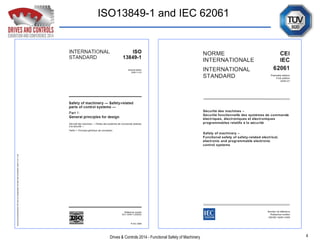
ISO13849-1 and IEC 62061
4Drives & Controls 2014 - Functional Safety of Machinery
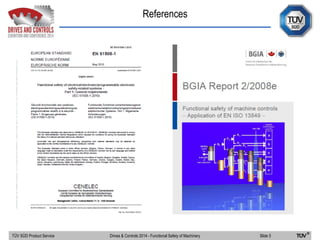
References
TÜV SÜD Product Service Slide 5Drives & Controls 2014 - Functional Safety of Machinery
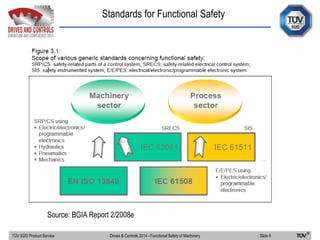
Standards for Functional Safety
Source: BGIA Report 2/2008e
TÜV SÜD Product Service Slide 6Drives & Controls 2014 - Functional Safety of Machinery
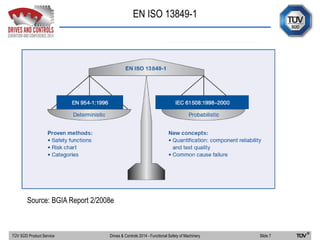
EN ISO 13849-1
Source: BGIA Report 2/2008e
TÜV SÜD Product Service Slide 7Drives & Controls 2014 - Functional Safety of Machinery
ISO/IEC Technical reports
TÜV SÜD Product Service Slide 8Drives & Controls 2014 - Functional Safety of Machinery
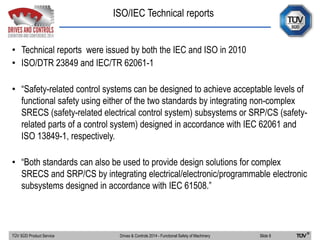
• Technical reports were issued by both the IEC and ISO in 2010
• ISO/DTR 23849 and IEC/TR 62061-1
• “Safety-related control systems can be designed to achieve acceptable levels of
functional safety using either of the two standards by integrating non-complex
SRECS (safety-related electrical control system) subsystems or SRP/CS (safety-
related parts of a control system) designed in accordance with IEC 62061 and
ISO 13849-1, respectively.
• “Both standards can also be used to provide design solutions for complex
SRECS and SRP/CS by integrating electrical/electronic/programmable electronic
subsystems designed in accordance with IEC 61508.”
ISO/IEC Technical reports
TÜV SÜD Product Service Slide 9Drives & Controls 2014 - Functional Safety of Machinery
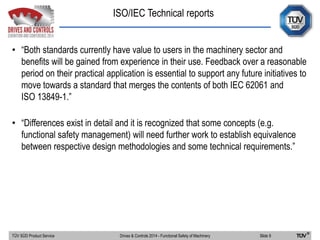
• “Both standards currently have value to users in the machinery sector and
benefits will be gained from experience in their use. Feedback over a reasonable
period on their practical application is essential to support any future initiatives to
move towards a standard that merges the contents of both IEC 62061 and
ISO 13849-1.”
• “Differences exist in detail and it is recognized that some concepts (e.g.
functional safety management) will need further work to establish equivalence
between respective design methodologies and some technical requirements.”
TÜV SÜD Product Service
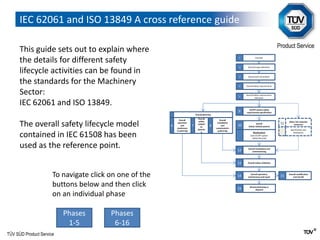
IEC 62061 and ISO 13849 A cross reference guide
1 Concept
3 Hazard and risk analysis
4 Overallsafety requirements
5
Overallsafety requirements
allocation
2 Overallscope definition
Phases
1-5
Phases
6-16
This guide sets out to explain where
the details for different safety
lifecycle activities can be found in
the standards for the Machinery
Sector:
IEC 62061 and ISO 13849.
The overall safety lifecycle model
contained in IEC 61508 has been
used as the reference point.
To navigate click on one of the
buttons below and then click
on an individual phase
9 E/E/PE system safety
requirementsspecification
10 E/E/PE
Safety-related systems
Realisation
(see E/E/PE system
safety lifecycle)
6
Overall
operation
and
maintenan
ce planning
11 Other risk reduction
measures
Specificationand
Realisation
7
Overall
safety
validati
on
plannin
g
8
Overall
installation
and
commissionin
g planning
Overall planning
12 Overall installation and
commissioning
13 Overall safety validation
14 Overall operation,
maintenanceand repair
16 Decommissioning or
disposal
15 Overall modification
and retrofit
TÜV SÜD Product Service
Home
Phases
1-5
Phases
6-16
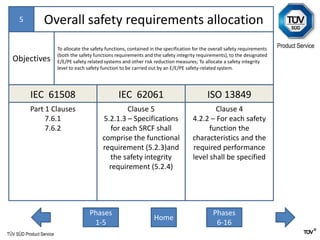
5
Objectives
To allocate the safety functions, contained in the specification for the overall safety requirements
(both the safety functions requirements and the safety integrity requirements), to the designated
E/E/PE safety related systems and other risk reduction measures; To allocate a safety integrity
level to each safety function to be carried out by an E/E/PE safety-related system.
IEC 61508
Part 1 Clauses
7.6.1
7.6.2
IEC 62061
Clause 5
5.2.1.3 – Specifications
for each SRCF shall
comprise the functional
requirement (5.2.3)and
the safety integrity
requirement (5.2.4)
ISO 13849
Clause 4
4.2.2 – For each safety
function the
characteristics and the
required performance
level shall be specified
Overall safety requirements allocation
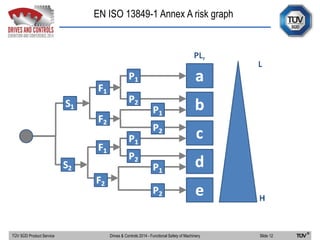
EN ISO 13849-1 Annex A risk graph
TÜV SÜD Product Service Slide 12Drives & Controls 2014 - Functional Safety of Machinery
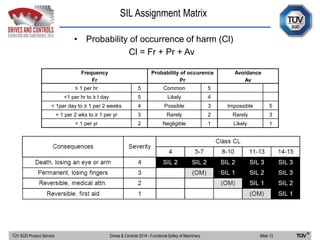
SIL Assignment Matrix
TÜV SÜD Product Service Slide 13Drives & Controls 2014 - Functional Safety of Machinery
• Probability of occurrence of harm (Cl)
Cl = Fr + Pr + Av
Frequency
Fr
Probability of occurence
Pr
Avoidance
Av
≤ 1 per hr 5 Common 5
<1 per hr to ≥ I day 5 Likely 4
< 1per day to ≥ 1 per 2 weeks 4 Possible 3 Impossible 5
< 1 per 2 wks to ≥ 1 per yr 3 Rarely 2 Rarely 3
< 1 per yr 2 Negligible 1 Likely 1
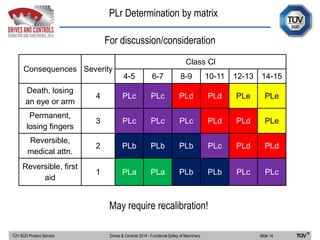
PLr Determination by matrix
TÜV SÜD Product Service Slide 14Drives & Controls 2014 - Functional Safety of Machinery
Consequences Severity
Class Cl
4-5 6-7 8-9 10-11 12-13 14-15
Death, losing
an eye or arm
4 PLc PLc PLd PLd PLe PLe
Permanent,
losing fingers
3 PLc PLc PLc PLd PLd PLe
Reversible,
medical attn.
2 PLb PLb PLb PLc PLd PLd
Reversible, first
aid
1 PLa PLa PLb PLb PLc PLc
May require recalibration!
For discussion/consideration
PL and SIL
TÜV SÜD Product Service Slide 15Drives & Controls 2014 - Functional Safety of Machinery
EN ISO 13849-1
Performance Level
(PL)
Average
probability of a
dangerous failure
per hour [1/h]
EN 62061
Safety Integrity
Level (SIL)
a ≥ 10-5 to < 10-4 no special safety
requirements
b ≥ 3 x 10⁻⁶ to < 10-5 1
c ≥ 10-6 to < 3 x 10⁻⁶ 1
d ≥ 10-7 to < 10-6 2
e ≥ 10-8 to < 10-7 3
TÜV SÜD Product Service
Home
Phases
1-5
Phases
6-16
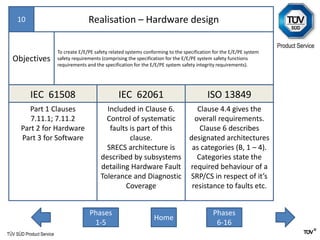
10
Objectives
To create E/E/PE safety related systems conforming to the specification for the E/E/PE system
safety requirements (comprising the specification for the E/E/PE system safety functions
requirements and the specification for the E/E/PE system safety integrity requirements).
IEC 61508
Part 1 Clauses
7.11.1; 7.11.2
Part 2 for Hardware
Part 3 for Software
IEC 62061
Included in Clause 6.
Control of systematic
faults is part of this
clause.
SRECS architecture is
described by subsystems
detailing Hardware Fault
Tolerance and Diagnostic
Coverage
ISO 13849
Clause 4.4 gives the
overall requirements.
Clause 6 describes
designated architectures
as categories (B, 1 – 4).
Categories state the
required behaviour of a
SRP/CS in respect of it’s
resistance to faults etc.
Realisation – Hardware design
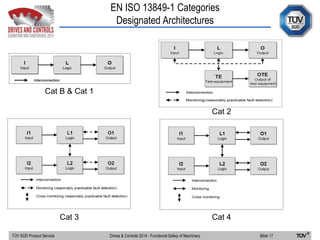
EN ISO 13849-1 Categories
Designated Architectures
TÜV SÜD Product Service Slide 17Drives & Controls 2014 - Functional Safety of Machinery
Cat B & Cat 1
Cat 2
Cat 3 Cat 4
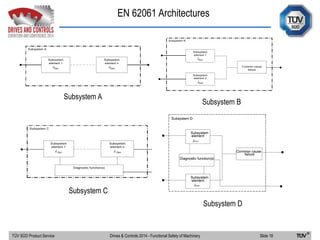
EN 62061 Architectures
TÜV SÜD Product Service Slide 18Drives & Controls 2014 - Functional Safety of Machinery
Subsystem A
Subsystem B
Subsystem C
Subsystem D
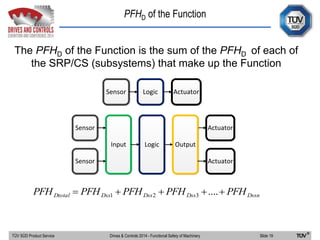
PFHD of the Function
TÜV SÜD Product Service Slide 19Drives & Controls 2014 - Functional Safety of Machinery
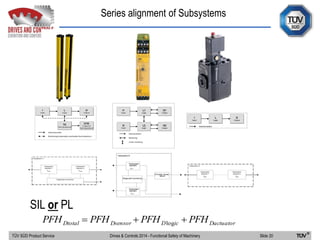
The PFHD of the Function is the sum of the PFHD of each of
the SRP/CS (subsystems) that make up the Function
DssnDssDssDssDtotal PFHPFHPFHPFHPFH  ....321
Sensor Logic Actuator
Sensor
Sensor
Input Logic Output
Actuator
Actuator
Series alignment of Subsystems
TÜV SÜD Product Service Slide 20Drives & Controls 2014 - Functional Safety of Machinery
DactuatoricDDsensorDtotal PFHPFHPFHPFH  log
SIL or PL
PFH Verification
TÜV SÜD Product Service Slide 21Drives & Controls 2014 - Functional Safety of Machinery
DeDeDeDssD TDCTDC   })]1([
2
]2{[)1( 1
222 2
hPFH DD 1 
8760
1


d
D
MTTF
PFHCategory 1
Or
Subsystem A
Subsystem D
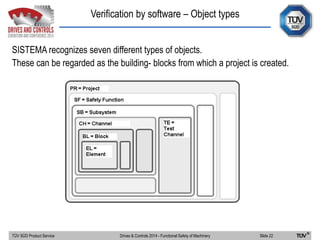
Verification by software – Object types
SISTEMA recognizes seven different types of objects.
These can be regarded as the building- blocks from which a project is created.
TÜV SÜD Product Service Slide 22Drives & Controls 2014 - Functional Safety of Machinery
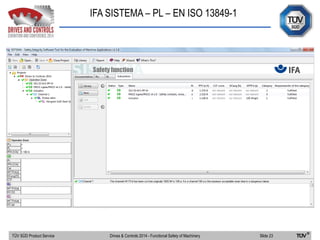
IFA SISTEMA – PL – EN ISO 13849-1
TÜV SÜD Product Service Slide 23Drives & Controls 2014 - Functional Safety of Machinery
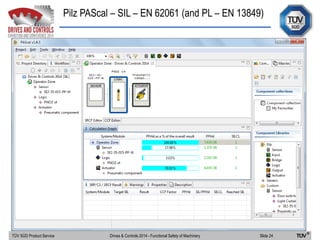
Pilz PAScal – SIL – EN 62061 (and PL – EN 13849)
TÜV SÜD Product Service Slide 24Drives & Controls 2014 - Functional Safety of Machinery
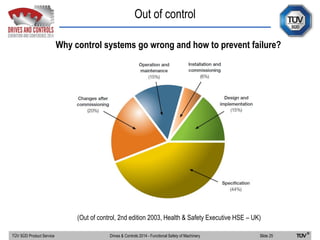
Out of control
Why control systems go wrong and how to prevent failure?
(Out of control, 2nd edition 2003, Health & Safety Executive HSE – UK)
TÜV SÜD Product Service Slide 25Drives & Controls 2014 - Functional Safety of Machinery
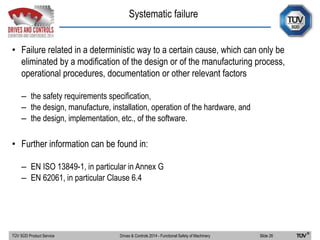
Systematic failure
• Failure related in a deterministic way to a certain cause, which can only be
eliminated by a modification of the design or of the manufacturing process,
operational procedures, documentation or other relevant factors
– the safety requirements specification,
– the design, manufacture, installation, operation of the hardware, and
– the design, implementation, etc., of the software.
• Further information can be found in:
– EN ISO 13849-1, in particular in Annex G
– EN 62061, in particular Clause 6.4
TÜV SÜD Product Service Slide 26Drives & Controls 2014 - Functional Safety of Machinery
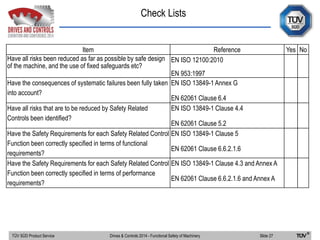
Check Lists
TÜV SÜD Product Service Slide 27Drives & Controls 2014 - Functional Safety of Machinery
Item Reference Yes No
Have all risks been reduced as far as possible by safe design
of the machine, and the use of fixed safeguards etc?
EN ISO 12100:2010
EN 953:1997
Have the consequences of systematic failures been fully taken
into account?
EN ISO 13849-1 Annex G
EN 62061 Clause 6.4
Have all risks that are to be reduced by Safety Related
Controls been identified?
EN ISO 13849-1 Clause 4.4
EN 62061 Clause 5.2
Have the Safety Requirements for each Safety Related Control
Function been correctly specified in terms of functional
requirements?
EN ISO 13849-1 Clause 5
EN 62061 Clause 6.6.2.1.6
Have the Safety Requirements for each Safety Related Control
Function been correctly specified in terms of performance
requirements?
EN ISO 13849-1 Clause 4.3 and Annex A
EN 62061 Clause 6.6.2.1.6 and Annex A
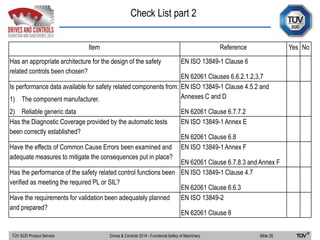
Check List part 2
TÜV SÜD Product Service Slide 28Drives & Controls 2014 - Functional Safety of Machinery
Item Reference Yes No
Has an appropriate architecture for the design of the safety
related controls been chosen?
EN ISO 13849-1 Clause 6
EN 62061 Clauses 6.6.2.1.2,3,7
Is performance data available for safety related components from:
1) The component manufacturer.
2) Reliable generic data
EN ISO 13849-1 Clause 4.5.2 and
Annexes C and D
EN 62061 Clause 6.7.7.2
Has the Diagnostic Coverage provided by the automatic tests
been correctly established?
EN ISO 13849-1 Annex E
EN 62061 Clause 6.8
Have the effects of Common Cause Errors been examined and
adequate measures to mitigate the consequences put in place?
EN ISO 13849-1 Annex F
EN 62061 Clause 6.7.8.3 and Annex F
Has the performance of the safety related control functions been
verified as meeting the required PL or SIL?
EN ISO 13849-1 Clause 4.7
EN 62061 Clause 6.6.3
Have the requirements for validation been adequately planned
and prepared?
EN ISO 13849-2
EN 62061 Clause 8
TÜV SÜD Product Service
Thank you for listening
For more information
please visit our stand:
D261
TÜV SÜD Drives & Controls 2014 - Functional Safety of Machinery Slide 29

Functional safety standards_for_machinery

  • 1.
    Drives & Controls2014 - Functional Safety of Machinery 1 Click to edit Master text styles Functional Safety Standards for Machinery Stewart Robinson MIET MInstMC
  • 2.
    Current Functional SafetyStandards for Machinery TÜV SÜD Product Service Slide 2Drives & Controls 2014 - Functional Safety of Machinery • Since 2007 there has been a choice of harmonised standards to use for Functional Safety in the machinery sector. • The choices are: – ISO standard EN ISO 13849-1 – IEC standard EN 62061. • Whilst both standards have essentially the same basic requirements there are differences in the detail of these standards.
  • 3.
    Current Functional SafetyStandards for Machinery TÜV SÜD Product Service Slide 3Drives & Controls 2014 - Functional Safety of Machinery • The intention is that the standards will be combined into a single standard at some point? • The new standard will be ISO/IEC 17305 • This presentation will explain some of the techniques and approaches that can be used now to comply with the current standards whilst preparing for the introduction of a single standard.
  • 4.
    ISO13849-1 and IEC62061 4Drives & Controls 2014 - Functional Safety of Machinery
  • 5.
    References TÜV SÜD ProductService Slide 5Drives & Controls 2014 - Functional Safety of Machinery
  • 6.
    Standards for FunctionalSafety Source: BGIA Report 2/2008e TÜV SÜD Product Service Slide 6Drives & Controls 2014 - Functional Safety of Machinery
  • 7.
    EN ISO 13849-1 Source:BGIA Report 2/2008e TÜV SÜD Product Service Slide 7Drives & Controls 2014 - Functional Safety of Machinery
  • 8.
    ISO/IEC Technical reports TÜVSÜD Product Service Slide 8Drives & Controls 2014 - Functional Safety of Machinery • Technical reports were issued by both the IEC and ISO in 2010 • ISO/DTR 23849 and IEC/TR 62061-1 • “Safety-related control systems can be designed to achieve acceptable levels of functional safety using either of the two standards by integrating non-complex SRECS (safety-related electrical control system) subsystems or SRP/CS (safety- related parts of a control system) designed in accordance with IEC 62061 and ISO 13849-1, respectively. • “Both standards can also be used to provide design solutions for complex SRECS and SRP/CS by integrating electrical/electronic/programmable electronic subsystems designed in accordance with IEC 61508.”
  • 9.
    ISO/IEC Technical reports TÜVSÜD Product Service Slide 9Drives & Controls 2014 - Functional Safety of Machinery • “Both standards currently have value to users in the machinery sector and benefits will be gained from experience in their use. Feedback over a reasonable period on their practical application is essential to support any future initiatives to move towards a standard that merges the contents of both IEC 62061 and ISO 13849-1.” • “Differences exist in detail and it is recognized that some concepts (e.g. functional safety management) will need further work to establish equivalence between respective design methodologies and some technical requirements.”
  • 10.
    TÜV SÜD ProductService IEC 62061 and ISO 13849 A cross reference guide 1 Concept 3 Hazard and risk analysis 4 Overallsafety requirements 5 Overallsafety requirements allocation 2 Overallscope definition Phases 1-5 Phases 6-16 This guide sets out to explain where the details for different safety lifecycle activities can be found in the standards for the Machinery Sector: IEC 62061 and ISO 13849. The overall safety lifecycle model contained in IEC 61508 has been used as the reference point. To navigate click on one of the buttons below and then click on an individual phase 9 E/E/PE system safety requirementsspecification 10 E/E/PE Safety-related systems Realisation (see E/E/PE system safety lifecycle) 6 Overall operation and maintenan ce planning 11 Other risk reduction measures Specificationand Realisation 7 Overall safety validati on plannin g 8 Overall installation and commissionin g planning Overall planning 12 Overall installation and commissioning 13 Overall safety validation 14 Overall operation, maintenanceand repair 16 Decommissioning or disposal 15 Overall modification and retrofit
  • 11.
    TÜV SÜD ProductService Home Phases 1-5 Phases 6-16 5 Objectives To allocate the safety functions, contained in the specification for the overall safety requirements (both the safety functions requirements and the safety integrity requirements), to the designated E/E/PE safety related systems and other risk reduction measures; To allocate a safety integrity level to each safety function to be carried out by an E/E/PE safety-related system. IEC 61508 Part 1 Clauses 7.6.1 7.6.2 IEC 62061 Clause 5 5.2.1.3 – Specifications for each SRCF shall comprise the functional requirement (5.2.3)and the safety integrity requirement (5.2.4) ISO 13849 Clause 4 4.2.2 – For each safety function the characteristics and the required performance level shall be specified Overall safety requirements allocation
  • 12.
    EN ISO 13849-1Annex A risk graph TÜV SÜD Product Service Slide 12Drives & Controls 2014 - Functional Safety of Machinery
  • 13.
    SIL Assignment Matrix TÜVSÜD Product Service Slide 13Drives & Controls 2014 - Functional Safety of Machinery • Probability of occurrence of harm (Cl) Cl = Fr + Pr + Av Frequency Fr Probability of occurence Pr Avoidance Av ≤ 1 per hr 5 Common 5 <1 per hr to ≥ I day 5 Likely 4 < 1per day to ≥ 1 per 2 weeks 4 Possible 3 Impossible 5 < 1 per 2 wks to ≥ 1 per yr 3 Rarely 2 Rarely 3 < 1 per yr 2 Negligible 1 Likely 1
  • 14.
    PLr Determination bymatrix TÜV SÜD Product Service Slide 14Drives & Controls 2014 - Functional Safety of Machinery Consequences Severity Class Cl 4-5 6-7 8-9 10-11 12-13 14-15 Death, losing an eye or arm 4 PLc PLc PLd PLd PLe PLe Permanent, losing fingers 3 PLc PLc PLc PLd PLd PLe Reversible, medical attn. 2 PLb PLb PLb PLc PLd PLd Reversible, first aid 1 PLa PLa PLb PLb PLc PLc May require recalibration! For discussion/consideration
  • 15.
    PL and SIL TÜVSÜD Product Service Slide 15Drives & Controls 2014 - Functional Safety of Machinery EN ISO 13849-1 Performance Level (PL) Average probability of a dangerous failure per hour [1/h] EN 62061 Safety Integrity Level (SIL) a ≥ 10-5 to < 10-4 no special safety requirements b ≥ 3 x 10⁻⁶ to < 10-5 1 c ≥ 10-6 to < 3 x 10⁻⁶ 1 d ≥ 10-7 to < 10-6 2 e ≥ 10-8 to < 10-7 3
  • 16.
    TÜV SÜD ProductService Home Phases 1-5 Phases 6-16 10 Objectives To create E/E/PE safety related systems conforming to the specification for the E/E/PE system safety requirements (comprising the specification for the E/E/PE system safety functions requirements and the specification for the E/E/PE system safety integrity requirements). IEC 61508 Part 1 Clauses 7.11.1; 7.11.2 Part 2 for Hardware Part 3 for Software IEC 62061 Included in Clause 6. Control of systematic faults is part of this clause. SRECS architecture is described by subsystems detailing Hardware Fault Tolerance and Diagnostic Coverage ISO 13849 Clause 4.4 gives the overall requirements. Clause 6 describes designated architectures as categories (B, 1 – 4). Categories state the required behaviour of a SRP/CS in respect of it’s resistance to faults etc. Realisation – Hardware design
  • 17.
    EN ISO 13849-1Categories Designated Architectures TÜV SÜD Product Service Slide 17Drives & Controls 2014 - Functional Safety of Machinery Cat B & Cat 1 Cat 2 Cat 3 Cat 4
  • 18.
    EN 62061 Architectures TÜVSÜD Product Service Slide 18Drives & Controls 2014 - Functional Safety of Machinery Subsystem A Subsystem B Subsystem C Subsystem D
  • 19.
    PFHD of theFunction TÜV SÜD Product Service Slide 19Drives & Controls 2014 - Functional Safety of Machinery The PFHD of the Function is the sum of the PFHD of each of the SRP/CS (subsystems) that make up the Function DssnDssDssDssDtotal PFHPFHPFHPFHPFH  ....321 Sensor Logic Actuator Sensor Sensor Input Logic Output Actuator Actuator
  • 20.
    Series alignment ofSubsystems TÜV SÜD Product Service Slide 20Drives & Controls 2014 - Functional Safety of Machinery DactuatoricDDsensorDtotal PFHPFHPFHPFH  log SIL or PL
  • 21.
    PFH Verification TÜV SÜDProduct Service Slide 21Drives & Controls 2014 - Functional Safety of Machinery DeDeDeDssD TDCTDC   })]1([ 2 ]2{[)1( 1 222 2 hPFH DD 1  8760 1   d D MTTF PFHCategory 1 Or Subsystem A Subsystem D
  • 22.
    Verification by software– Object types SISTEMA recognizes seven different types of objects. These can be regarded as the building- blocks from which a project is created. TÜV SÜD Product Service Slide 22Drives & Controls 2014 - Functional Safety of Machinery
  • 23.
    IFA SISTEMA –PL – EN ISO 13849-1 TÜV SÜD Product Service Slide 23Drives & Controls 2014 - Functional Safety of Machinery
  • 24.
    Pilz PAScal –SIL – EN 62061 (and PL – EN 13849) TÜV SÜD Product Service Slide 24Drives & Controls 2014 - Functional Safety of Machinery
  • 25.
    Out of control Whycontrol systems go wrong and how to prevent failure? (Out of control, 2nd edition 2003, Health & Safety Executive HSE – UK) TÜV SÜD Product Service Slide 25Drives & Controls 2014 - Functional Safety of Machinery
  • 26.
    Systematic failure • Failurerelated in a deterministic way to a certain cause, which can only be eliminated by a modification of the design or of the manufacturing process, operational procedures, documentation or other relevant factors – the safety requirements specification, – the design, manufacture, installation, operation of the hardware, and – the design, implementation, etc., of the software. • Further information can be found in: – EN ISO 13849-1, in particular in Annex G – EN 62061, in particular Clause 6.4 TÜV SÜD Product Service Slide 26Drives & Controls 2014 - Functional Safety of Machinery
  • 27.
    Check Lists TÜV SÜDProduct Service Slide 27Drives & Controls 2014 - Functional Safety of Machinery Item Reference Yes No Have all risks been reduced as far as possible by safe design of the machine, and the use of fixed safeguards etc? EN ISO 12100:2010 EN 953:1997 Have the consequences of systematic failures been fully taken into account? EN ISO 13849-1 Annex G EN 62061 Clause 6.4 Have all risks that are to be reduced by Safety Related Controls been identified? EN ISO 13849-1 Clause 4.4 EN 62061 Clause 5.2 Have the Safety Requirements for each Safety Related Control Function been correctly specified in terms of functional requirements? EN ISO 13849-1 Clause 5 EN 62061 Clause 6.6.2.1.6 Have the Safety Requirements for each Safety Related Control Function been correctly specified in terms of performance requirements? EN ISO 13849-1 Clause 4.3 and Annex A EN 62061 Clause 6.6.2.1.6 and Annex A
  • 28.
    Check List part2 TÜV SÜD Product Service Slide 28Drives & Controls 2014 - Functional Safety of Machinery Item Reference Yes No Has an appropriate architecture for the design of the safety related controls been chosen? EN ISO 13849-1 Clause 6 EN 62061 Clauses 6.6.2.1.2,3,7 Is performance data available for safety related components from: 1) The component manufacturer. 2) Reliable generic data EN ISO 13849-1 Clause 4.5.2 and Annexes C and D EN 62061 Clause 6.7.7.2 Has the Diagnostic Coverage provided by the automatic tests been correctly established? EN ISO 13849-1 Annex E EN 62061 Clause 6.8 Have the effects of Common Cause Errors been examined and adequate measures to mitigate the consequences put in place? EN ISO 13849-1 Annex F EN 62061 Clause 6.7.8.3 and Annex F Has the performance of the safety related control functions been verified as meeting the required PL or SIL? EN ISO 13849-1 Clause 4.7 EN 62061 Clause 6.6.3 Have the requirements for validation been adequately planned and prepared? EN ISO 13849-2 EN 62061 Clause 8
  • 29.
    TÜV SÜD ProductService Thank you for listening For more information please visit our stand: D261 TÜV SÜD Drives & Controls 2014 - Functional Safety of Machinery Slide 29