Functional Safety and
Gas Detection Systems
Safety Integrity Level – SIL
DETECTION
ST-1220-2007
Tel: +44 (0)191 490 1547
Fax: +44 (0)191 477 5371
Email: northernsales@thorneandderrick.co.uk
Website: www.heattracing.co.uk
www.thorneanderrick.co.uk
02 | RISK REDUCTION | SIL - SAFETY INTEGRITY LEVEL AND FUNCTIONAL SAFETY
Safety Instrumented Systems are used to reduce the risk
for the protection of people, plants, and environment.
Depending on the way a process is designed and what kind of dangerous goods (especially
gases and vapours) are involved, industrial plants might pose a high risk to persons, property,
and environment. In order to reduce the risk arising from those plants it might be necessary
to automatically activate safety measures to avoid dangerous situations.
Depending on the acceptable risk the
required reliability of protection systems
can be ensured by employing the effective
measures of
– failure avoidance,
– failure detection, and
– failure tolerance
This to a degree depends on the actual
risk, the so-called Safety Integrity Level.
For gas detection systems, which have to
activate safety relevant countermeasures in
case of pre-defined gas concentrations, an
important question comes up: What is the
probability of failing to perform the required
countermeasure (safety function) in case
of a demand from the process (means
when pre-defined gas concentrations have
been exceeded) if an undetectable danger-
ous failure has occurred?
So, during development and design of
devices and subsystems of safety relevant
systems the main target is to keep the
probability of failure as low as possible
(failure avoidance), or to detect failures by
diagnostic functions (failure detection)
and – in case of a detected failure –
to force the safety system to go into a safe
state (failure tolerance).
Risk analysis
Depending on the extent of threat to per-
sons, property and environment there are
four different classes of risk. Generally a
risk is a combination of the consequence
to be expected and the probability of
occurrence of such an unwanted hazard.
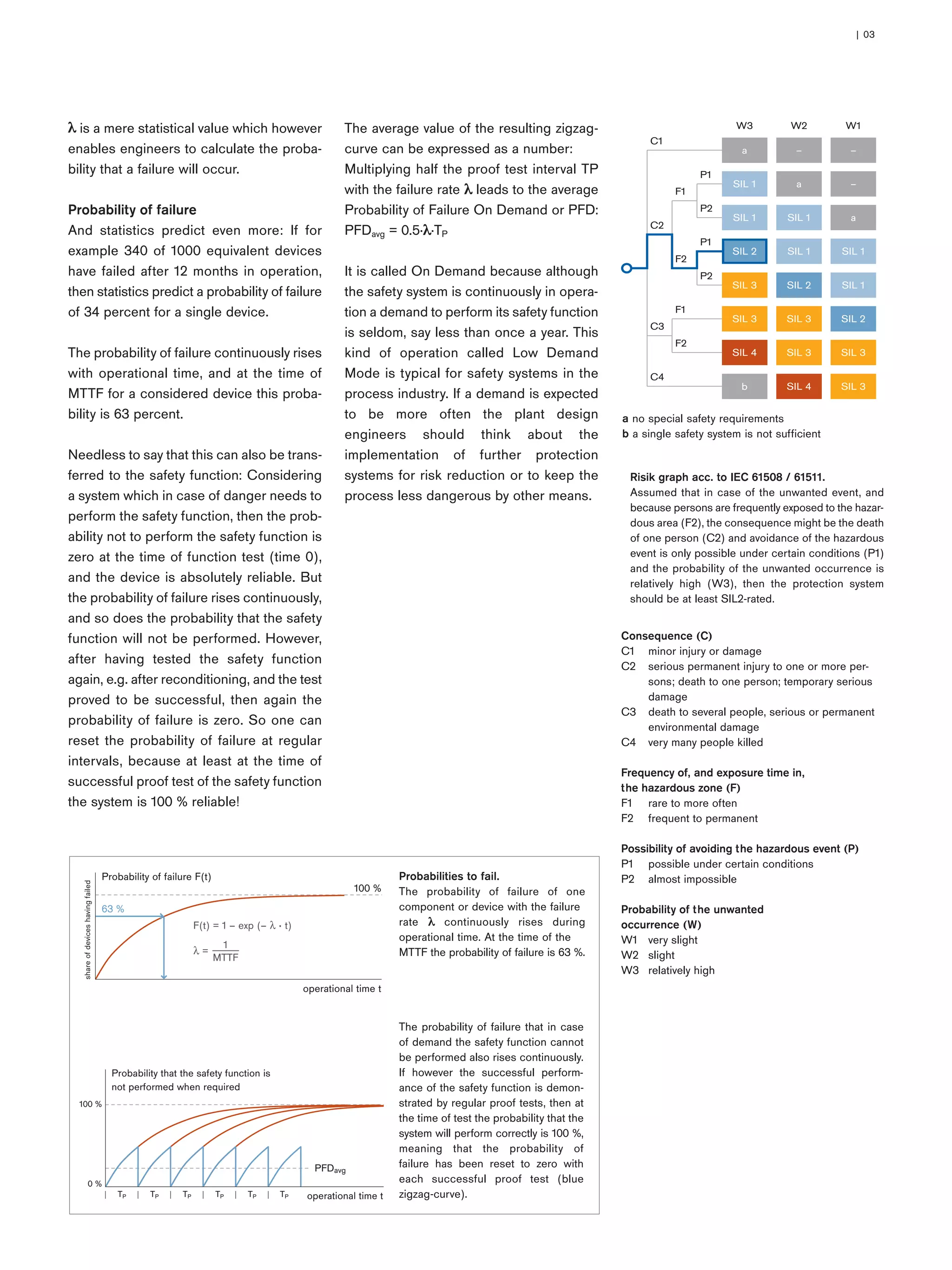
To classify the actual risk structured
methods are used, e.g. the risk graph. The
risk graph is based on four different
consequence categories, and the probability
aspect is implemented by the criteria
“frequency of exposure of persons” and the
“possibility of avoiding the hazardous
event”.
Such risk analysis can only be conducted
by highly qualified persons who are familiar
with the process-specific conditions.
As a result the risk analysis leads to the
definition of the necessary risk-reducing
measures, combined with the
– definition of the safety function and the
– required Safety Integrity Level
Residual risk
If the functional safety is realized by an
electrical, electronic or programmable
electronic system (“E/E/PES”), the appli-
cable standard IEC 61508 or EN 61508
requires evidence of the remaining residual
risk by identifying the so-called dangerous
probability of failure as a measure of the
protection system’s reliability.
Failures
Considering the entire operational time no
E/E/PES is absolutely free of failures.
Always there might be systematic or
accidental failures, and wear-out parts
need to be considered. However, consum-
able components are not subject to the
SIL-consideration – they have to be
replaced ensuring failures caused by
consumption shall not occur.
Systematic failures
… are design- or development-failures,
which already exist at the time of delivery
and which are reproducible (e.g. software
failures, incorrect rating or the operation
of electronic components outside of
their specification). By organizational
measures and safety-orientated develop-
ment procedures, systematic failures,
especially software failures, can be mini-
mized.
Accidental failures
… are inevitable characteristic properties
of components. They do not exist at the
time of delivery, but will occur at any time
during operation. Accidental failures are
specified by a so-called constant failure
rate which says that during equivalent
time intervals always the same percentage
of components will fail. The manufacturer
derives this failure rate by means of
special stress tests with a large number of
components and determines or forecasts
the time at which 63 percent of the com-
ponents have failed. The reciprocal value
of the resulting time, the so-called MTTF +
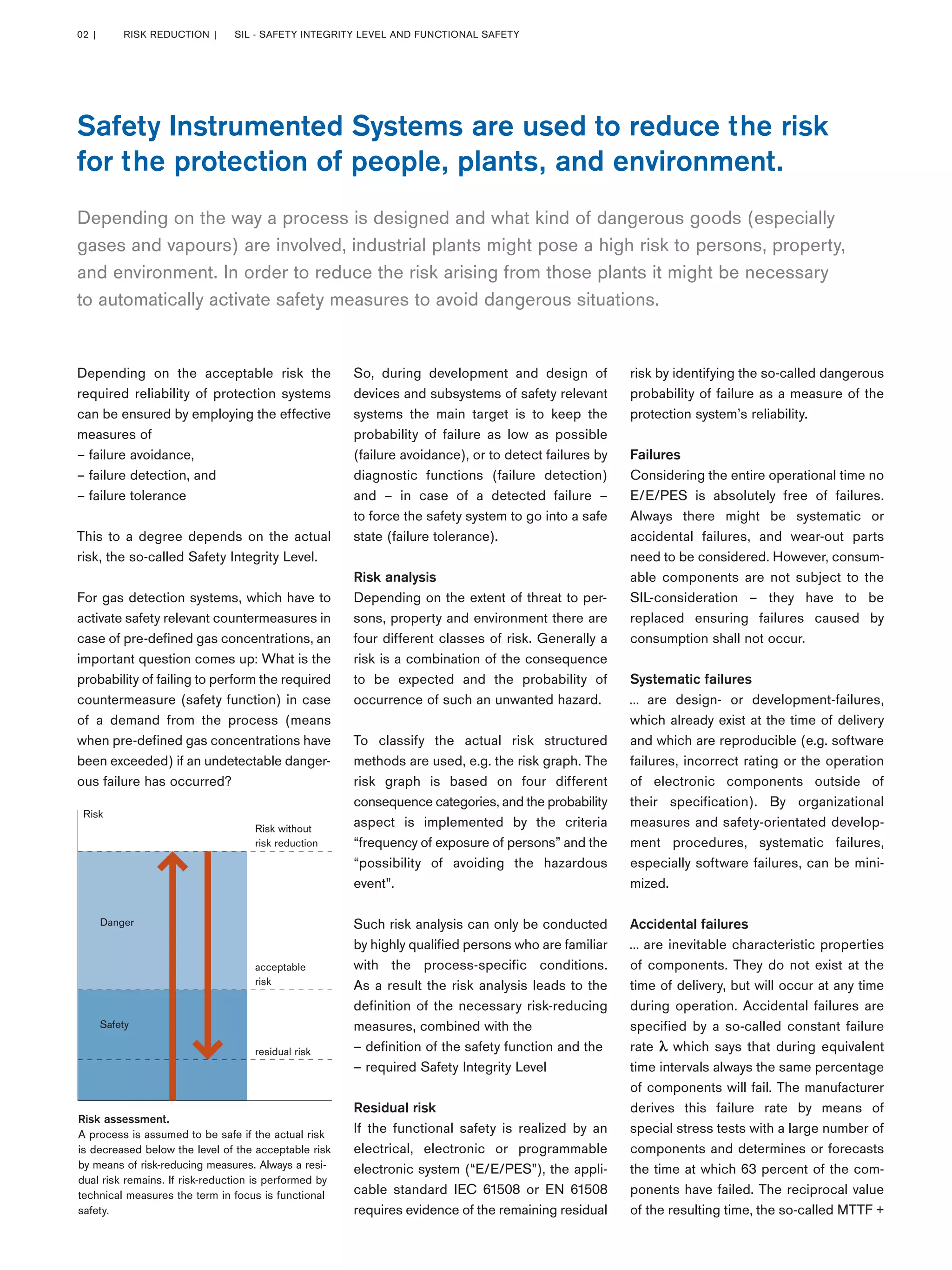
Risk assessment.
A process is assumed to be safe if the actual risk
is decreased below the level of the acceptable risk
by means of risk-reducing measures. Always a resi-
dual risk remains. If risk-reduction is performed by
technical measures the term in focus is functional
safety.
Risk without
risk reduction
Danger
Safety
acceptable
risk
Risk
residual risk
is a mere statistical value which however
enables engineers to calculate the proba-
bility that a failure will occur.
Probability of failure
And statistics predict even more: If for
example 340 of 1000 equivalent devices
have failed after 12 months in operation,
then statistics predict a probability of failure
of 34 percent for a single device.
The probability of failure continuously rises
with operational time, and at the time of
MTTF for a considered device this proba-
bility is 63 percent.
Needless to say that this can also be trans-
ferred to the safety function: Considering
a system which in case of danger needs to
perform the safety function, then the prob-
ability not to perform the safety function is
zero at the time of function test (time 0),
and the device is absolutely reliable. But
the probability of failure rises continuously,
and so does the probability that the safety
function will not be performed. However,
after having tested the safety function
again, e.g. after reconditioning, and the test
proved to be successful, then again the
probability of failure is zero. So one can
reset the probability of failure at regular
intervals, because at least at the time of
successful proof test of the safety function
the system is 100 % reliable!
The average value of the resulting zigzag-
curve can be expressed as a number:
Multiplying half the proof test interval TP
with the failure rate leads to the average
Probability of Failure On Demand or PFD:
PFDavg = 0.5· ·TP
It is called On Demand because although
the safety system is continuously in opera-
tion a demand to perform its safety function
is seldom, say less than once a year. This
kind of operation called Low Demand
Mode is typical for safety systems in the
process industry. If a demand is expected
to be more often the plant design
engineers should think about the
implementation of further protection
systems for risk reduction or to keep the
process less dangerous by other means.
Probabilities to fail.
The probability of failure of one
component or device with the failure
rate continuously rises during
operational time. At the time of the
MTTF the probability of failure is 63 %.
The probability of failure that in case
of demand the safety function cannot
be performed also rises continuously.
If however the successful perform-
ance of the safety function is demon-
strated by regular proof tests, then at
the time of test the probability that the
system will perform correctly is 100 %,
meaning that the probability of
failure has been reset to zero with
each successful proof test (blue
zigzag-curve).
Probability of failure F(t)
shareofdeviceshavingfailed
operational time t
63 %
100 %
Probability that the safety function is
not performed when required
operational time t
PFDavg
100 %
0 %
TP TP TP TP TP TP
| 03
Consequence (C)
C1 minor injury or damage
C2 serious permanent injury to one or more per-
sons; death to one person; temporary serious
damage
C3 death to several people, serious or permanent
environmental damage
C4 very many people killed
Frequency of, and exposure time in,
the hazardous zone (F)
F1 rare to more often
F2 frequent to permanent
Possibility of avoiding the hazardous event (P)
P1 possible under certain conditions
P2 almost impossible
Probability of the unwanted
occurrence (W)
W1 very slight
W2 slight
W3 relatively high
––a
W1W2W3
C1
F1
P1
P2
P1
P2
F2
F1
F2
C2
C3
C4
–aSIL 1
aSIL 1SIL 1
SIL 1SIL 1SIL 2
SIL 1SIL 2SIL 3
SIL 2SIL 3SIL 3
SIL 3SIL 3SIL 4
SIL 3SIL 4b
a no special safety requirements
b a single safety system is not sufficient
Risik graph acc. to IEC 61508 / 61511.
Assumed that in case of the unwanted event, and
because persons are frequently exposed to the hazar-
dous area (F2), the consequence might be the death
of one person (C2) and avoidance of the hazardous
event is only possible under certain conditions (P1)
and the probability of the unwanted occurrence is
relatively high (W3), then the protection system
should be at least SIL2-rated.
Safety Function
The safety function or Safety Instrumented
Function SIF of a gas detection system is
to trigger gas alarm if gas concentrations
exceed the alarm thresholds. If – in case of
failure – the system cannot trigger gas
alarms it must go into the safe state.
The safe state of a gas detection system is
defined as an action which is equivalent to
gas alarm. At least the same measures as
for gas alarm are activated, and additionally
a fault signal is generated e.g. to ensure
maintenance and repair promptly being
performed.
But to achieve a safe state at all, failures
need to be reliably detectable. This is
why the failure analysis (Failure Modes,
Effects and Diagnostic Analysis FMEDA)
concerning the effects differentiates
between detectable and undetectable and
between safe and dangerous failures.
Safety-related failures
Surely there is no problem with a failure of
type SD which signals itself, and moreover
is not dangerous at all because the safety
function can be performed even if this kind
of failure occurs. As a system can always
achieve a safe state as long as a failure
is detectable, any detectable failure ( SD
and DD), independent of the fact whether
it impacts the performance of the safety
function or not, is tolerable.
However, dangerous failures ( DU), which
cannot be revealed by any diagnostic
measure, can derogate the entire safety
system’s concept. They may occur at any
time and can only be discovered by regular
inspection and proof test. Performing
periodical proof tests is the one and only
method to discover failures which cannot
be revealed by diagnostics, at a stage so
early that severe consequences can be
avoided with sufficiently high probability.
The DU-failure is in focus
In the statistical mean the DU-failures
occur at half of the interval between two
tests (proof test interval):
PFDavg = 0.5· DU·TP
The proof test interval TP implies the
periodical test of the safety function per-
formed by the customer. Not only the
PFDavg must not exceed certain values for
a given SIL, but also the Safe Failure
Fraction SFF, a measure for the share of
tolerable failures, needs to be regarded
when designing a safety relevant system
with SIL-requirement.
safe state
system remains in unsafe state
failure is detected
failure detectedfailure occurs without notice
failure detected during
proof test and remedied
failure remedied by
instant repair
failure occurs but system remains
in the safe state
S-Failure Safety
DD-Failure
Danger
DU-Failure
unsafe state time
MTTR*
MTTR*
Proof test interval TP
safe state
safe state
unsafe state
unsafe state time
time
* MTTR = Mean Time To Repair (mostly 8 h)
Failures are allowed …
… as long as the safety system provides a safe condition.
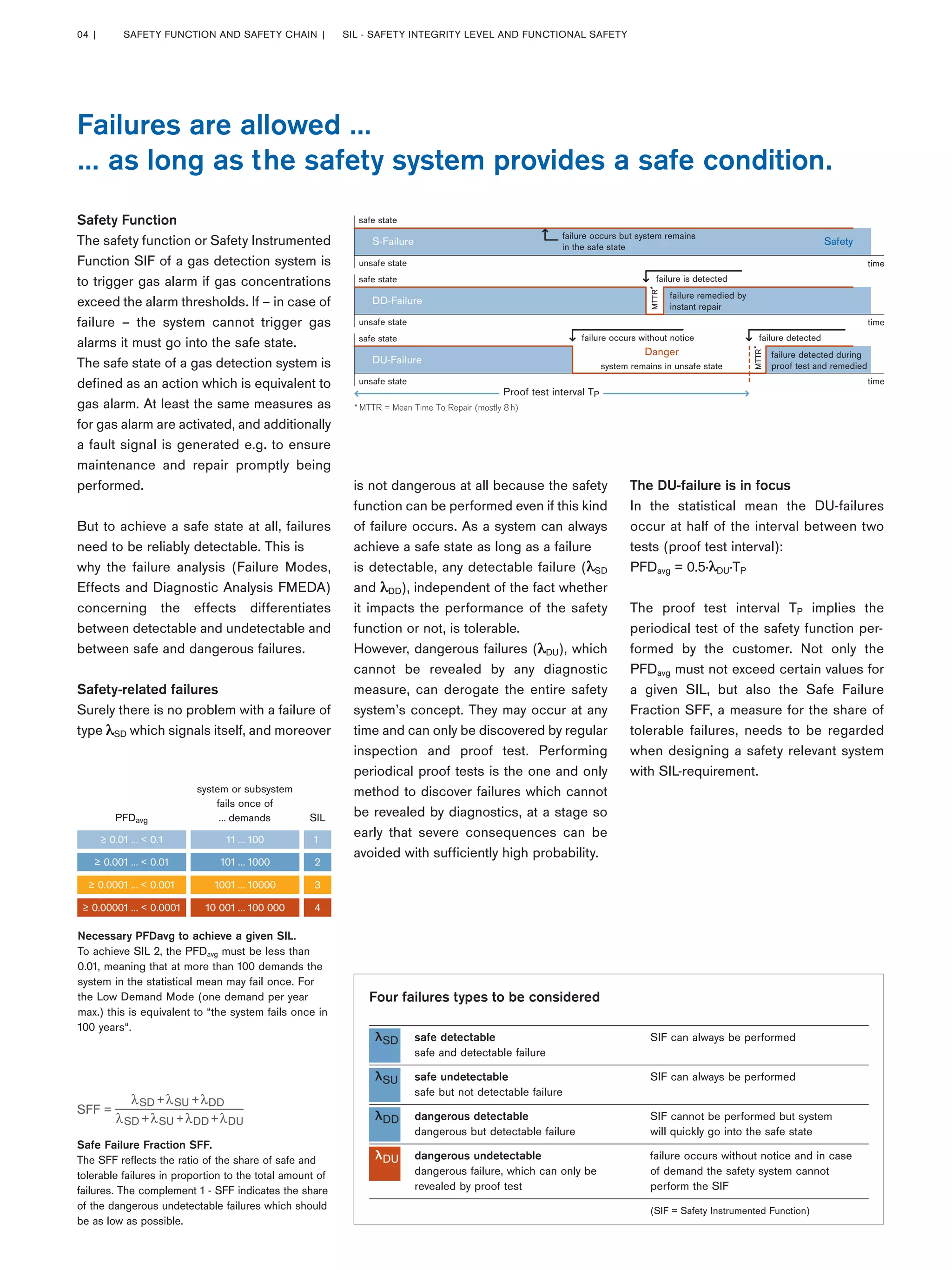
Necessary PFDavg to achieve a given SIL.
To achieve SIL 2, the PFDavg must be less than
0.01, meaning that at more than 100 demands the
system in the statistical mean may fail once. For
the Low Demand Mode (one demand per year
max.) this is equivalent to “the system fails once in
100 years“.
Safe Failure Fraction SFF.
The SFF reflects the ratio of the share of safe and
tolerable failures in proportion to the total amount of
failures. The complement 1 - SFF indicates the share
of the dangerous undetectable failures which should
be as low as possible.
PFDavg
system or subsystem
fails once of
… demands SIL
410 001 … 100 000≥ 0.00001 … < 0.0001
31001 … 10000≥ 0.0001 … < 0.001
2101 … 1000≥ 0.001 … < 0.01
111 … 100≥ 0.01 … < 0.1
SD +
SFF =
λ SU +λ DDλ
SD +λ SU +λ DDλ + DUλ
Four failures types to be considered
λSD safe detectable SIF can always be performed
safe and detectable failure
λSU safe undetectable SIF can always be performed
safe but not detectable failure
λDD dangerous detectable SIF cannot be performed but system
dangerous but detectable failure will quickly go into the safe state
λDU dangerous undetectable failure occurs without notice and in case
dangerous failure, which can only be of demand the safety system cannot
revealed by proof test perform the SIF
(SIF = Safety Instrumented Function)
04 | SAFETY FUNCTION AND SAFETY CHAIN | SIL - SAFETY INTEGRITY LEVEL AND FUNCTIONAL SAFETY
Subsystems
A safety-relevant system or Safety Instru-
mented System, SIS, consists of
– sensors (transducers), which make a
potential danger detectable and pro-
duce an appropriate electrical signal,
– logic controllers, which detect the
electrical signal exceeding a given
threshold, and
– actuators to perform the safety function.
In the simplest case a SIS is a single chan-
nel or linear system, e.g. a gas detection
system consisting of gas detection trans-
mitter, central controller unit, and relay.
Depending on the subsystem’s type (com-
plex or not) the subsystem must feature a
certain minimum SFF. If there is no high-
complex or programmable electronics the
subsystem is mostly considered to be
simple or type A.
The HFT (hardware fault tolerance) can be
increased by means of the system’s archi-
tecture. If two sensing elements are oper-
ated redundantly, one may fail without
affecting the performance of the safety
function. As one failure does not impact
safety the HFT is 1 in case of redundancy
or a 2-out-of-3-voting (“2oo3”). A triple
redundancy (“1oo3”) will result in an HFT
of even 2.
Even if two sensing elements fail the safety
function can still be performed. When
designing redundancies failures need to be
considered which can impair redundancy
if both the sensors are affected by the
same cause. These are common-cause-
failures, mostly only estimated as a share
of e.g. = 1, 2, 5, or 10 % of the DU-failure.
True redundancy without common-cause-
failures can only be obtained by diversity,
meaning the use of different products, and
even of different manufacturers, if possible.
Single channel system (HFT = 0)
By means of a FMEDA each subsystem
needs to be assessed concerning its safety-
relevant parameters, and when combining
three subsystems to an entire system their
individual PFDavg have to be added to
obtain the PFDsys of the system:
PFDsys = PFDSE + PFDLS + PFDFE
where the individual PFDs are the product
of half the proof test interval and the DU-
failure rate. E.g. to obtain SIL 2 it is neces-
sary to have PFDsys < 0.01 and (because
the HFT is 0) the individual SFF for com-
plex subsystems must be higher than 90,
for simple subsystems higher than 60 %.
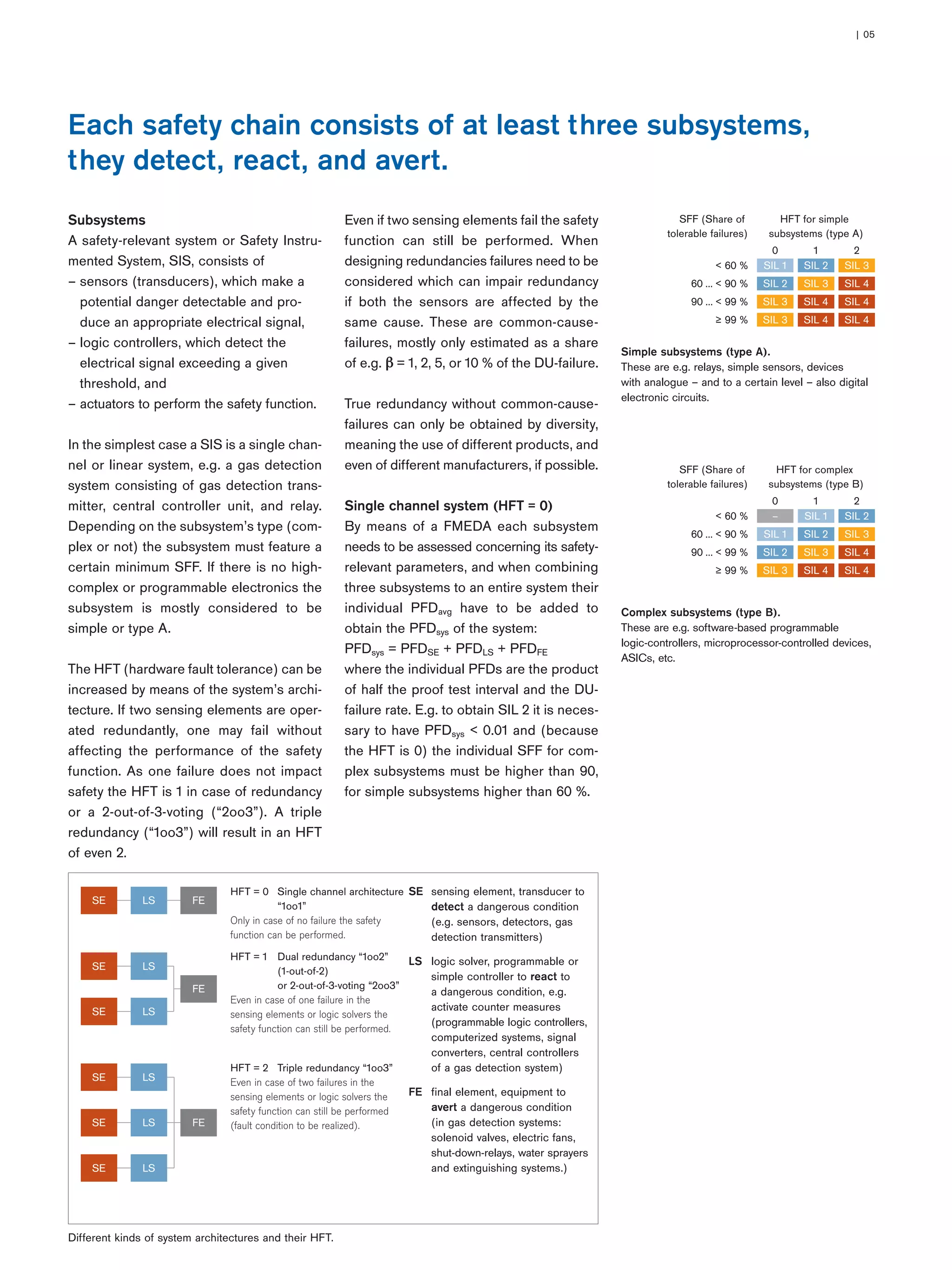
SE sensing element, transducer to
detect a dangerous condition
(e.g. sensors, detectors, gas
detection transmitters)
LS logic solver, programmable or
simple controller to react to
a dangerous condition, e.g.
activate counter measures
(programmable logic controllers,
computerized systems, signal
converters, central controllers
of a gas detection system)
FE final element, equipment to
avert a dangerous condition
(in gas detection systems:
solenoid valves, electric fans,
shut-down-relays, water sprayers
and extinguishing systems.)
Different kinds of system architectures and their HFT.
Simple subsystems (type A).
These are e.g. relays, simple sensors, devices
with analogue – and to a certain level – also digital
electronic circuits.
Complex subsystems (type B).
These are e.g. software-based programmable
logic-controllers, microprocessor-controlled devices,
ASICs, etc.
FELSSE
HFT = 0 Single channel architecture
“1oo1”
Only in case of no failure the safety
function can be performed.
FE
LSSE
LSSE
HFT = 1 Dual redundancy “1oo2”
(1-out-of-2)
or 2-out-of-3-voting “2oo3”
Even in case of one failure in the
sensing elements or logic solvers the
safety function can still be performed.
FE
LSSE
LSSE
LSSE
HFT = 2 Triple redundancy “1oo3”
Even in case of two failures in the
sensing elements or logic solvers the
safety function can still be performed
(fault condition to be realized).
SFF (Share of
tolerable failures)
21
HFT for simple
subsystems (type A)
0
SIL 4≥ 99 %
SIL 490 … < 99 %
SIL 460 … < 90 %
SIL 3
SIL 4
SIL 4
SIL 3
SIL 2
SIL 3
SIL 3
SIL 2
SIL 1< 60 %
SFF (Share of
tolerable failures)
21
HFT for complex
subsystems (type B)
0
SIL 4≥ 99 %
SIL 490 … < 99 %
SIL 360 … < 90 %
SIL 2
SIL 4
SIL 3
SIL 2
SIL 1
SIL 3
SIL 2
SIL 1
–< 60 %
Each safety chain consists of at least three subsystems,
they detect, react, and avert.
| 05
Dual redundancy (HFT = 1)
At first the PFDs of the redundantly
designed subsystems have to be calculat-
ed and to be introduced as PFDSE, PFDLS,
or PFDFE into the equation
PFDsys = PFDSE + PFDLS + PFDFE.
Because of HFT = 1 the SFF of redundantly
designed subsystems may be less than 90
or 60 % resp. to achieve SIL 2. For non-
diverse redundancies always the common
cause failures need to be considered, e.g.
as 5 %, meaning = 0.05.
SIL-conformity
With the declaration of SIL-conformity a
manufacturer of subsystems publishes the
essential data necessary to design a safety
chain by means of subsystems.
Furthermore there are hints included to
indicate under which circumstances the
Safety Integrity Level is obtained, which
maintenance actions have to be performed
(especially if wear parts are included) and
how to test the safety function during the
proof test procedure.
SIL for gas detection systems
Example of a safety chain.
Redundant subsystem
Using similar products (e.g. gas detection
transmitters) to achieve redundancy the
PFD is calculated by:
PFDavg =
1
3
. ( DU
. TP)
2
+ . TP
Using however different products (with
failure rates DU1 und DU2) one achieves
diverse redundancy and thus the common
cause failure β can be neglected:
PFDavg =
1
3
. DU1
. DU2
. TP
2
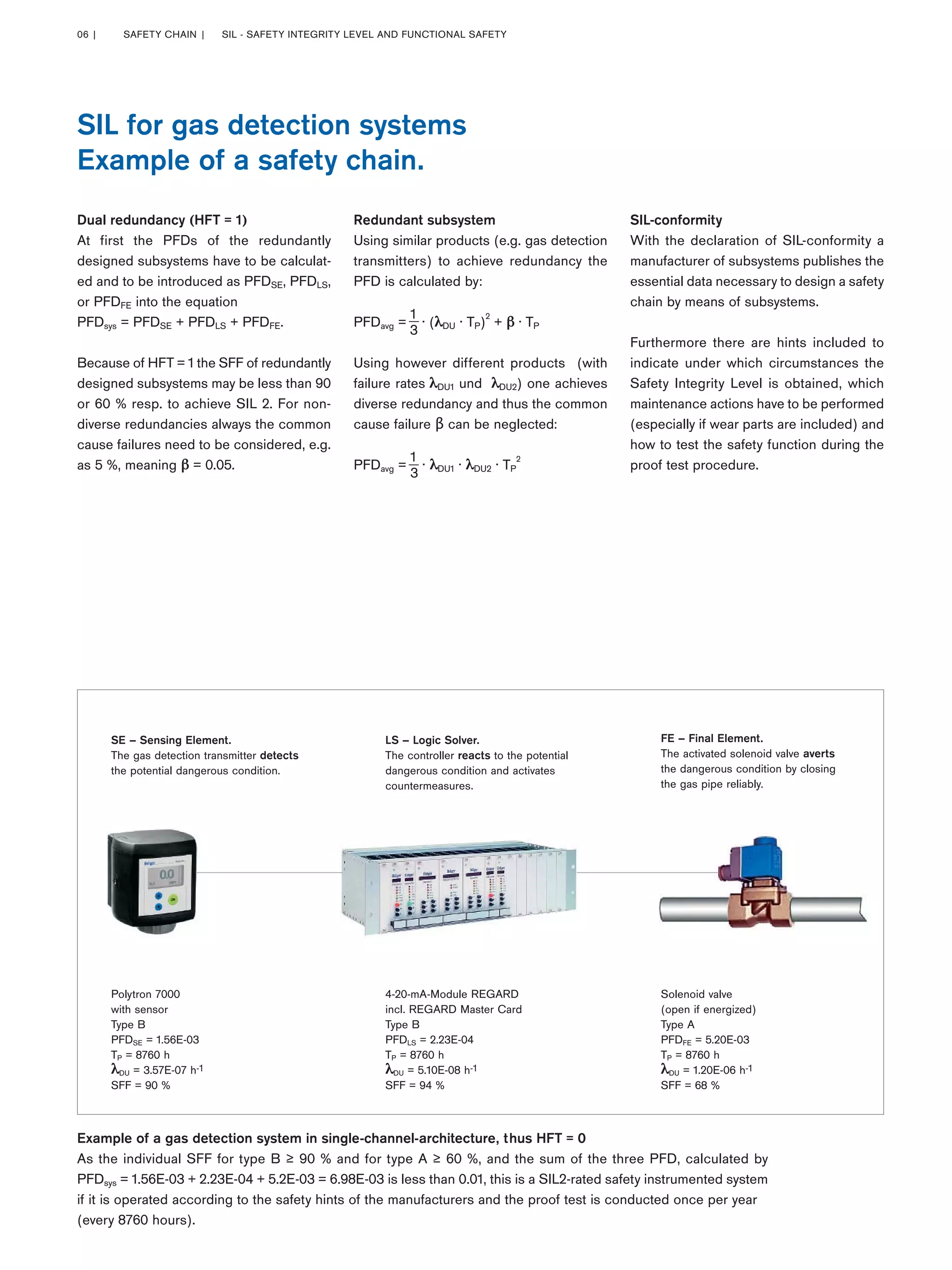
Example of a gas detection system in single-channel-architecture, thus HFT = 0
As the individual SFF for type B ≥ 90 % and for type A ≥ 60 %, and the sum of the three PFD, calculated by
PFDsys = 1.56E-03 + 2.23E-04 + 5.2E-03 = 6.98E-03 is less than 0.01, this is a SIL2-rated safety instrumented system
if it is operated according to the safety hints of the manufacturers and the proof test is conducted once per year
(every 8760 hours).
SE – Sensing Element.
The gas detection transmitter detects
the potential dangerous condition.
Polytron 7000
with sensor
Type B
PFDSE = 1.56E-03
TP = 8760 h
DU = 3.57E-07 h-1
SFF = 90 %
LS – Logic Solver.
The controller reacts to the potential
dangerous condition and activates
countermeasures.
FE – Final Element.
The activated solenoid valve averts
the dangerous condition by closing
the gas pipe reliably.
Solenoid valve
(open if energized)
Type A
PFDFE = 5.20E-03
TP = 8760 h
DU = 1.20E-06 h-1
SFF = 68 %
4-20-mA-Module REGARD
incl. REGARD Master Card
Type B
PFDLS = 2.23E-04
TP = 8760 h
DU = 5.10E-08 h-1
SFF = 94 %
06 | SAFETY CHAIN | SIL - SAFETY INTEGRITY LEVEL AND FUNCTIONAL SAFETY
Lifecycle of a SIS
Commonly a SIS is planned, designed,
installed and commissioned by experi-
enced system engineers. Just this process
requires a high degree of diligence, docu-
mentation depth and verification.
During operation a SIS must be serviced
according to the manufacturer’s guidelines
given in the safety operating manual and to
be put into quasi-new-condition if neces-
sary. Further on the periodically performed
proof test of the safety function must be
conducted in the compulsory intervals TP,
and organizational measures must be met
to ensure prompt repair and spare part
delivery in case of need.
Safety Integrity from Dräger
Not only is Dräger the manufacturer of sub-
systems such as sensors, gas detection
transmitters and central controllers, but
also Dräger system engineers can design
complete safety related gas detection
systems including documentation, SIL-
evidence, installation, commissioning, and
maintenance.
Our system engineers will competently
give advice if safety integrity needs to be
implemented in a system’s safety concept.
SIL is not a product’s property but a continuous sustaining
process - a system’s lifecycle.
DRÄGER-TRANSMITTERS FOR THE USE IN SIL2-RATED SYSTEMS AND THEIR “SIL-PARAMETERS”
Transmitter Measuring principle SFF DU PFDSE
at HFT = 0 for TP = 1 year
Dräger Polytron IR Type 334 Infrared, for the detection of flammable gases and vapours 96 % 3.00E-08 h-1 1.28E-04
Dräger Polytron 7000 Electrochemical, for toxic gases and oxygen 90 % 3.57E-07 h-1 1.56E-03
Dräger Polytron Pulsar Open-Path infrared, for the detection of flammable gases 92 % 1.09E-07 h-1 4.77E-04
Dräger PIR 7000 Infrared, for the detection of flammable gases and vapours 94 % 4.70E-08 h-1 2.04E-04
Dräger PIR 7200 Infrared, for the detection of carbon dioxide 94 % 4.70E-08 h-1 2.04E-04
| 07
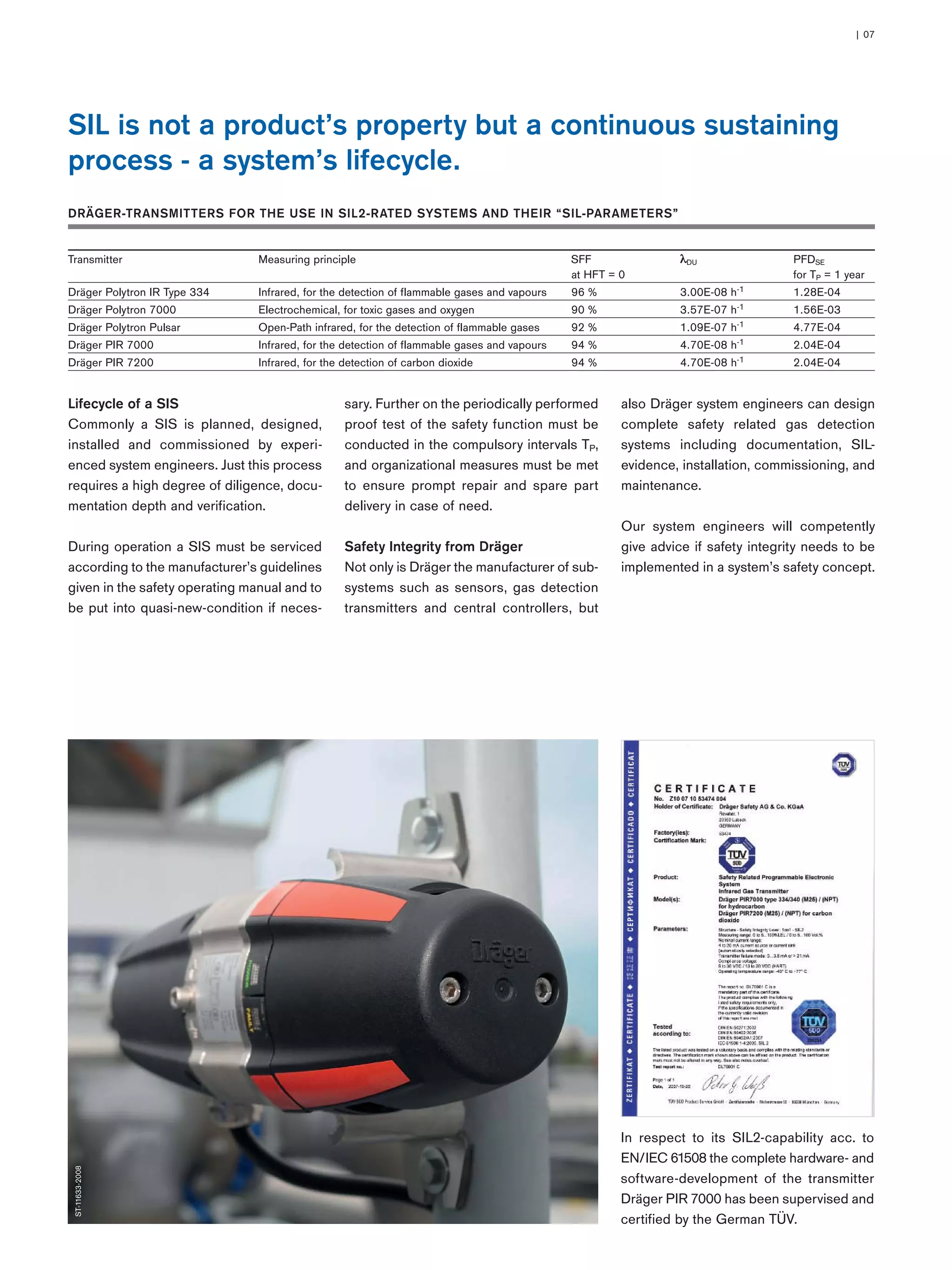
In respect to its SIL2-capability acc. to
EN/IEC 61508 the complete hardware- and
software-development of the transmitter
Dräger PIR 7000 has been supervised and
certified by the German TÜV.
ST-11633-2008

Drager Fixed Gas Detector - Functional Safety & Gas Detection Systems - SIL Brochure

  • 1.
    Functional Safety and GasDetection Systems Safety Integrity Level – SIL DETECTION ST-1220-2007 Tel: +44 (0)191 490 1547 Fax: +44 (0)191 477 5371 Email: northernsales@thorneandderrick.co.uk Website: www.heattracing.co.uk www.thorneanderrick.co.uk
  • 2.
    02 | RISKREDUCTION | SIL - SAFETY INTEGRITY LEVEL AND FUNCTIONAL SAFETY Safety Instrumented Systems are used to reduce the risk for the protection of people, plants, and environment. Depending on the way a process is designed and what kind of dangerous goods (especially gases and vapours) are involved, industrial plants might pose a high risk to persons, property, and environment. In order to reduce the risk arising from those plants it might be necessary to automatically activate safety measures to avoid dangerous situations. Depending on the acceptable risk the required reliability of protection systems can be ensured by employing the effective measures of – failure avoidance, – failure detection, and – failure tolerance This to a degree depends on the actual risk, the so-called Safety Integrity Level. For gas detection systems, which have to activate safety relevant countermeasures in case of pre-defined gas concentrations, an important question comes up: What is the probability of failing to perform the required countermeasure (safety function) in case of a demand from the process (means when pre-defined gas concentrations have been exceeded) if an undetectable danger- ous failure has occurred? So, during development and design of devices and subsystems of safety relevant systems the main target is to keep the probability of failure as low as possible (failure avoidance), or to detect failures by diagnostic functions (failure detection) and – in case of a detected failure – to force the safety system to go into a safe state (failure tolerance). Risk analysis Depending on the extent of threat to per- sons, property and environment there are four different classes of risk. Generally a risk is a combination of the consequence to be expected and the probability of occurrence of such an unwanted hazard. To classify the actual risk structured methods are used, e.g. the risk graph. The risk graph is based on four different consequence categories, and the probability aspect is implemented by the criteria “frequency of exposure of persons” and the “possibility of avoiding the hazardous event”. Such risk analysis can only be conducted by highly qualified persons who are familiar with the process-specific conditions. As a result the risk analysis leads to the definition of the necessary risk-reducing measures, combined with the – definition of the safety function and the – required Safety Integrity Level Residual risk If the functional safety is realized by an electrical, electronic or programmable electronic system (“E/E/PES”), the appli- cable standard IEC 61508 or EN 61508 requires evidence of the remaining residual risk by identifying the so-called dangerous probability of failure as a measure of the protection system’s reliability. Failures Considering the entire operational time no E/E/PES is absolutely free of failures. Always there might be systematic or accidental failures, and wear-out parts need to be considered. However, consum- able components are not subject to the SIL-consideration – they have to be replaced ensuring failures caused by consumption shall not occur. Systematic failures … are design- or development-failures, which already exist at the time of delivery and which are reproducible (e.g. software failures, incorrect rating or the operation of electronic components outside of their specification). By organizational measures and safety-orientated develop- ment procedures, systematic failures, especially software failures, can be mini- mized. Accidental failures … are inevitable characteristic properties of components. They do not exist at the time of delivery, but will occur at any time during operation. Accidental failures are specified by a so-called constant failure rate which says that during equivalent time intervals always the same percentage of components will fail. The manufacturer derives this failure rate by means of special stress tests with a large number of components and determines or forecasts the time at which 63 percent of the com- ponents have failed. The reciprocal value of the resulting time, the so-called MTTF + Risk assessment. A process is assumed to be safe if the actual risk is decreased below the level of the acceptable risk by means of risk-reducing measures. Always a resi- dual risk remains. If risk-reduction is performed by technical measures the term in focus is functional safety. Risk without risk reduction Danger Safety acceptable risk Risk residual risk
  • 3.
    is a merestatistical value which however enables engineers to calculate the proba- bility that a failure will occur. Probability of failure And statistics predict even more: If for example 340 of 1000 equivalent devices have failed after 12 months in operation, then statistics predict a probability of failure of 34 percent for a single device. The probability of failure continuously rises with operational time, and at the time of MTTF for a considered device this proba- bility is 63 percent. Needless to say that this can also be trans- ferred to the safety function: Considering a system which in case of danger needs to perform the safety function, then the prob- ability not to perform the safety function is zero at the time of function test (time 0), and the device is absolutely reliable. But the probability of failure rises continuously, and so does the probability that the safety function will not be performed. However, after having tested the safety function again, e.g. after reconditioning, and the test proved to be successful, then again the probability of failure is zero. So one can reset the probability of failure at regular intervals, because at least at the time of successful proof test of the safety function the system is 100 % reliable! The average value of the resulting zigzag- curve can be expressed as a number: Multiplying half the proof test interval TP with the failure rate leads to the average Probability of Failure On Demand or PFD: PFDavg = 0.5· ·TP It is called On Demand because although the safety system is continuously in opera- tion a demand to perform its safety function is seldom, say less than once a year. This kind of operation called Low Demand Mode is typical for safety systems in the process industry. If a demand is expected to be more often the plant design engineers should think about the implementation of further protection systems for risk reduction or to keep the process less dangerous by other means. Probabilities to fail. The probability of failure of one component or device with the failure rate continuously rises during operational time. At the time of the MTTF the probability of failure is 63 %. The probability of failure that in case of demand the safety function cannot be performed also rises continuously. If however the successful perform- ance of the safety function is demon- strated by regular proof tests, then at the time of test the probability that the system will perform correctly is 100 %, meaning that the probability of failure has been reset to zero with each successful proof test (blue zigzag-curve). Probability of failure F(t) shareofdeviceshavingfailed operational time t 63 % 100 % Probability that the safety function is not performed when required operational time t PFDavg 100 % 0 % TP TP TP TP TP TP | 03 Consequence (C) C1 minor injury or damage C2 serious permanent injury to one or more per- sons; death to one person; temporary serious damage C3 death to several people, serious or permanent environmental damage C4 very many people killed Frequency of, and exposure time in, the hazardous zone (F) F1 rare to more often F2 frequent to permanent Possibility of avoiding the hazardous event (P) P1 possible under certain conditions P2 almost impossible Probability of the unwanted occurrence (W) W1 very slight W2 slight W3 relatively high ––a W1W2W3 C1 F1 P1 P2 P1 P2 F2 F1 F2 C2 C3 C4 –aSIL 1 aSIL 1SIL 1 SIL 1SIL 1SIL 2 SIL 1SIL 2SIL 3 SIL 2SIL 3SIL 3 SIL 3SIL 3SIL 4 SIL 3SIL 4b a no special safety requirements b a single safety system is not sufficient Risik graph acc. to IEC 61508 / 61511. Assumed that in case of the unwanted event, and because persons are frequently exposed to the hazar- dous area (F2), the consequence might be the death of one person (C2) and avoidance of the hazardous event is only possible under certain conditions (P1) and the probability of the unwanted occurrence is relatively high (W3), then the protection system should be at least SIL2-rated.
  • 4.
    Safety Function The safetyfunction or Safety Instrumented Function SIF of a gas detection system is to trigger gas alarm if gas concentrations exceed the alarm thresholds. If – in case of failure – the system cannot trigger gas alarms it must go into the safe state. The safe state of a gas detection system is defined as an action which is equivalent to gas alarm. At least the same measures as for gas alarm are activated, and additionally a fault signal is generated e.g. to ensure maintenance and repair promptly being performed. But to achieve a safe state at all, failures need to be reliably detectable. This is why the failure analysis (Failure Modes, Effects and Diagnostic Analysis FMEDA) concerning the effects differentiates between detectable and undetectable and between safe and dangerous failures. Safety-related failures Surely there is no problem with a failure of type SD which signals itself, and moreover is not dangerous at all because the safety function can be performed even if this kind of failure occurs. As a system can always achieve a safe state as long as a failure is detectable, any detectable failure ( SD and DD), independent of the fact whether it impacts the performance of the safety function or not, is tolerable. However, dangerous failures ( DU), which cannot be revealed by any diagnostic measure, can derogate the entire safety system’s concept. They may occur at any time and can only be discovered by regular inspection and proof test. Performing periodical proof tests is the one and only method to discover failures which cannot be revealed by diagnostics, at a stage so early that severe consequences can be avoided with sufficiently high probability. The DU-failure is in focus In the statistical mean the DU-failures occur at half of the interval between two tests (proof test interval): PFDavg = 0.5· DU·TP The proof test interval TP implies the periodical test of the safety function per- formed by the customer. Not only the PFDavg must not exceed certain values for a given SIL, but also the Safe Failure Fraction SFF, a measure for the share of tolerable failures, needs to be regarded when designing a safety relevant system with SIL-requirement. safe state system remains in unsafe state failure is detected failure detectedfailure occurs without notice failure detected during proof test and remedied failure remedied by instant repair failure occurs but system remains in the safe state S-Failure Safety DD-Failure Danger DU-Failure unsafe state time MTTR* MTTR* Proof test interval TP safe state safe state unsafe state unsafe state time time * MTTR = Mean Time To Repair (mostly 8 h) Failures are allowed … … as long as the safety system provides a safe condition. Necessary PFDavg to achieve a given SIL. To achieve SIL 2, the PFDavg must be less than 0.01, meaning that at more than 100 demands the system in the statistical mean may fail once. For the Low Demand Mode (one demand per year max.) this is equivalent to “the system fails once in 100 years“. Safe Failure Fraction SFF. The SFF reflects the ratio of the share of safe and tolerable failures in proportion to the total amount of failures. The complement 1 - SFF indicates the share of the dangerous undetectable failures which should be as low as possible. PFDavg system or subsystem fails once of … demands SIL 410 001 … 100 000≥ 0.00001 … < 0.0001 31001 … 10000≥ 0.0001 … < 0.001 2101 … 1000≥ 0.001 … < 0.01 111 … 100≥ 0.01 … < 0.1 SD + SFF = λ SU +λ DDλ SD +λ SU +λ DDλ + DUλ Four failures types to be considered λSD safe detectable SIF can always be performed safe and detectable failure λSU safe undetectable SIF can always be performed safe but not detectable failure λDD dangerous detectable SIF cannot be performed but system dangerous but detectable failure will quickly go into the safe state λDU dangerous undetectable failure occurs without notice and in case dangerous failure, which can only be of demand the safety system cannot revealed by proof test perform the SIF (SIF = Safety Instrumented Function) 04 | SAFETY FUNCTION AND SAFETY CHAIN | SIL - SAFETY INTEGRITY LEVEL AND FUNCTIONAL SAFETY
  • 5.
    Subsystems A safety-relevant systemor Safety Instru- mented System, SIS, consists of – sensors (transducers), which make a potential danger detectable and pro- duce an appropriate electrical signal, – logic controllers, which detect the electrical signal exceeding a given threshold, and – actuators to perform the safety function. In the simplest case a SIS is a single chan- nel or linear system, e.g. a gas detection system consisting of gas detection trans- mitter, central controller unit, and relay. Depending on the subsystem’s type (com- plex or not) the subsystem must feature a certain minimum SFF. If there is no high- complex or programmable electronics the subsystem is mostly considered to be simple or type A. The HFT (hardware fault tolerance) can be increased by means of the system’s archi- tecture. If two sensing elements are oper- ated redundantly, one may fail without affecting the performance of the safety function. As one failure does not impact safety the HFT is 1 in case of redundancy or a 2-out-of-3-voting (“2oo3”). A triple redundancy (“1oo3”) will result in an HFT of even 2. Even if two sensing elements fail the safety function can still be performed. When designing redundancies failures need to be considered which can impair redundancy if both the sensors are affected by the same cause. These are common-cause- failures, mostly only estimated as a share of e.g. = 1, 2, 5, or 10 % of the DU-failure. True redundancy without common-cause- failures can only be obtained by diversity, meaning the use of different products, and even of different manufacturers, if possible. Single channel system (HFT = 0) By means of a FMEDA each subsystem needs to be assessed concerning its safety- relevant parameters, and when combining three subsystems to an entire system their individual PFDavg have to be added to obtain the PFDsys of the system: PFDsys = PFDSE + PFDLS + PFDFE where the individual PFDs are the product of half the proof test interval and the DU- failure rate. E.g. to obtain SIL 2 it is neces- sary to have PFDsys < 0.01 and (because the HFT is 0) the individual SFF for com- plex subsystems must be higher than 90, for simple subsystems higher than 60 %. SE sensing element, transducer to detect a dangerous condition (e.g. sensors, detectors, gas detection transmitters) LS logic solver, programmable or simple controller to react to a dangerous condition, e.g. activate counter measures (programmable logic controllers, computerized systems, signal converters, central controllers of a gas detection system) FE final element, equipment to avert a dangerous condition (in gas detection systems: solenoid valves, electric fans, shut-down-relays, water sprayers and extinguishing systems.) Different kinds of system architectures and their HFT. Simple subsystems (type A). These are e.g. relays, simple sensors, devices with analogue – and to a certain level – also digital electronic circuits. Complex subsystems (type B). These are e.g. software-based programmable logic-controllers, microprocessor-controlled devices, ASICs, etc. FELSSE HFT = 0 Single channel architecture “1oo1” Only in case of no failure the safety function can be performed. FE LSSE LSSE HFT = 1 Dual redundancy “1oo2” (1-out-of-2) or 2-out-of-3-voting “2oo3” Even in case of one failure in the sensing elements or logic solvers the safety function can still be performed. FE LSSE LSSE LSSE HFT = 2 Triple redundancy “1oo3” Even in case of two failures in the sensing elements or logic solvers the safety function can still be performed (fault condition to be realized). SFF (Share of tolerable failures) 21 HFT for simple subsystems (type A) 0 SIL 4≥ 99 % SIL 490 … < 99 % SIL 460 … < 90 % SIL 3 SIL 4 SIL 4 SIL 3 SIL 2 SIL 3 SIL 3 SIL 2 SIL 1< 60 % SFF (Share of tolerable failures) 21 HFT for complex subsystems (type B) 0 SIL 4≥ 99 % SIL 490 … < 99 % SIL 360 … < 90 % SIL 2 SIL 4 SIL 3 SIL 2 SIL 1 SIL 3 SIL 2 SIL 1 –< 60 % Each safety chain consists of at least three subsystems, they detect, react, and avert. | 05
  • 6.
    Dual redundancy (HFT= 1) At first the PFDs of the redundantly designed subsystems have to be calculat- ed and to be introduced as PFDSE, PFDLS, or PFDFE into the equation PFDsys = PFDSE + PFDLS + PFDFE. Because of HFT = 1 the SFF of redundantly designed subsystems may be less than 90 or 60 % resp. to achieve SIL 2. For non- diverse redundancies always the common cause failures need to be considered, e.g. as 5 %, meaning = 0.05. SIL-conformity With the declaration of SIL-conformity a manufacturer of subsystems publishes the essential data necessary to design a safety chain by means of subsystems. Furthermore there are hints included to indicate under which circumstances the Safety Integrity Level is obtained, which maintenance actions have to be performed (especially if wear parts are included) and how to test the safety function during the proof test procedure. SIL for gas detection systems Example of a safety chain. Redundant subsystem Using similar products (e.g. gas detection transmitters) to achieve redundancy the PFD is calculated by: PFDavg = 1 3 . ( DU . TP) 2 + . TP Using however different products (with failure rates DU1 und DU2) one achieves diverse redundancy and thus the common cause failure β can be neglected: PFDavg = 1 3 . DU1 . DU2 . TP 2 Example of a gas detection system in single-channel-architecture, thus HFT = 0 As the individual SFF for type B ≥ 90 % and for type A ≥ 60 %, and the sum of the three PFD, calculated by PFDsys = 1.56E-03 + 2.23E-04 + 5.2E-03 = 6.98E-03 is less than 0.01, this is a SIL2-rated safety instrumented system if it is operated according to the safety hints of the manufacturers and the proof test is conducted once per year (every 8760 hours). SE – Sensing Element. The gas detection transmitter detects the potential dangerous condition. Polytron 7000 with sensor Type B PFDSE = 1.56E-03 TP = 8760 h DU = 3.57E-07 h-1 SFF = 90 % LS – Logic Solver. The controller reacts to the potential dangerous condition and activates countermeasures. FE – Final Element. The activated solenoid valve averts the dangerous condition by closing the gas pipe reliably. Solenoid valve (open if energized) Type A PFDFE = 5.20E-03 TP = 8760 h DU = 1.20E-06 h-1 SFF = 68 % 4-20-mA-Module REGARD incl. REGARD Master Card Type B PFDLS = 2.23E-04 TP = 8760 h DU = 5.10E-08 h-1 SFF = 94 % 06 | SAFETY CHAIN | SIL - SAFETY INTEGRITY LEVEL AND FUNCTIONAL SAFETY
  • 7.
    Lifecycle of aSIS Commonly a SIS is planned, designed, installed and commissioned by experi- enced system engineers. Just this process requires a high degree of diligence, docu- mentation depth and verification. During operation a SIS must be serviced according to the manufacturer’s guidelines given in the safety operating manual and to be put into quasi-new-condition if neces- sary. Further on the periodically performed proof test of the safety function must be conducted in the compulsory intervals TP, and organizational measures must be met to ensure prompt repair and spare part delivery in case of need. Safety Integrity from Dräger Not only is Dräger the manufacturer of sub- systems such as sensors, gas detection transmitters and central controllers, but also Dräger system engineers can design complete safety related gas detection systems including documentation, SIL- evidence, installation, commissioning, and maintenance. Our system engineers will competently give advice if safety integrity needs to be implemented in a system’s safety concept. SIL is not a product’s property but a continuous sustaining process - a system’s lifecycle. DRÄGER-TRANSMITTERS FOR THE USE IN SIL2-RATED SYSTEMS AND THEIR “SIL-PARAMETERS” Transmitter Measuring principle SFF DU PFDSE at HFT = 0 for TP = 1 year Dräger Polytron IR Type 334 Infrared, for the detection of flammable gases and vapours 96 % 3.00E-08 h-1 1.28E-04 Dräger Polytron 7000 Electrochemical, for toxic gases and oxygen 90 % 3.57E-07 h-1 1.56E-03 Dräger Polytron Pulsar Open-Path infrared, for the detection of flammable gases 92 % 1.09E-07 h-1 4.77E-04 Dräger PIR 7000 Infrared, for the detection of flammable gases and vapours 94 % 4.70E-08 h-1 2.04E-04 Dräger PIR 7200 Infrared, for the detection of carbon dioxide 94 % 4.70E-08 h-1 2.04E-04 | 07 In respect to its SIL2-capability acc. to EN/IEC 61508 the complete hardware- and software-development of the transmitter Dräger PIR 7000 has been supervised and certified by the German TÜV. ST-11633-2008