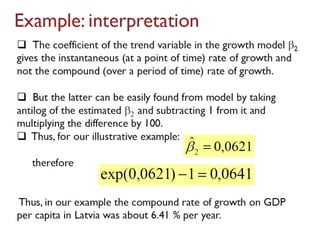
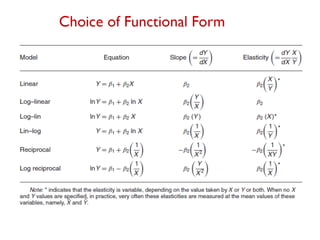
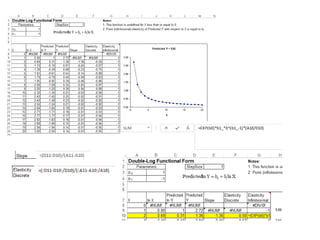
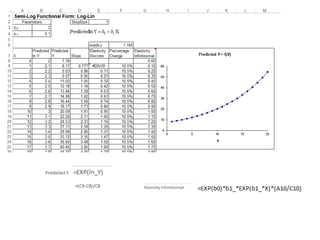
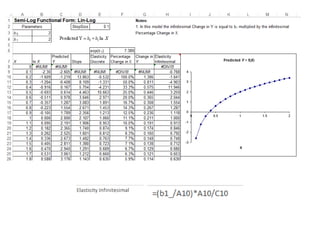
Functional forms of regression
models:
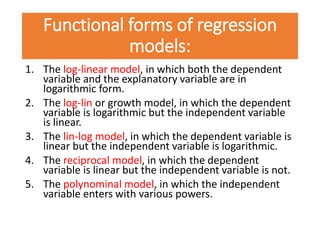
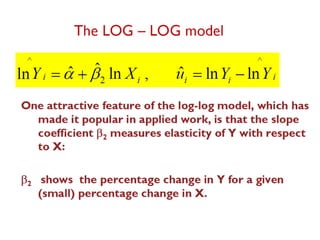
1. The log-linear model, in which both the dependent
variable and the explanatory variable are in
logarithmic form.
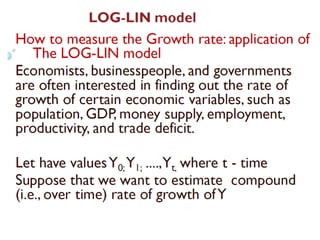
2. The log-lin or growth model, in which the dependent
variable is logarithmic but the independent variable
is linear.
3. The lin-log model, in which the dependent variable is
linear but the independent variable is logarithmic.
4. The reciprocal model, in which the dependent
variable is linear but the independent variable is not.
5. The polynominal model, in which the independent
variable enters with various powers.
Log and Natural log
• For Log, the base is (usually) 10.
• So, if the acreage of cotton in Junagadh is 28250 ha
and you wanna work log of it – then what actually
you are doing is that you are seeing 10 raised to
the power of what gives you 28250.
• LOG(28250) is 4.451018452.
• In case of natural log, the base is e and its value
being 2.718.
• So, ln (28250) = 10.24885.
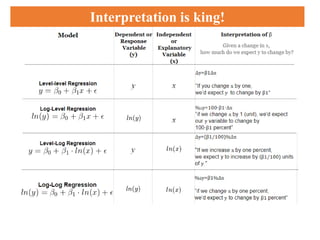
Interpretation is king!
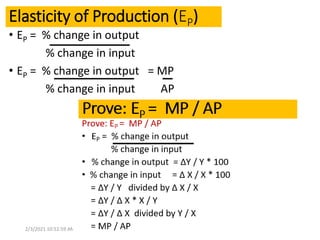
Elasticity of Production (EP)
• EP = % change in output
% change in input
• EP = % change in output = MP
% change in input AP
2/3/2021 10:52:59 AM 21
Functional forms in regression

Functional forms in regression

  • 1.
    Functional forms ofregression models: 1. The log-linear model, in which both the dependent variable and the explanatory variable are in logarithmic form. 2. The log-lin or growth model, in which the dependent variable is logarithmic but the independent variable is linear. 3. The lin-log model, in which the dependent variable is linear but the independent variable is logarithmic. 4. The reciprocal model, in which the dependent variable is linear but the independent variable is not. 5. The polynominal model, in which the independent variable enters with various powers.
  • 2.
    Log and Naturallog • For Log, the base is (usually) 10. • So, if the acreage of cotton in Junagadh is 28250 ha and you wanna work log of it – then what actually you are doing is that you are seeing 10 raised to the power of what gives you 28250. • LOG(28250) is 4.451018452. • In case of natural log, the base is e and its value being 2.718. • So, ln (28250) = 10.24885.
  • 17.
  • 21.
    Elasticity of Production(EP) • EP = % change in output % change in input • EP = % change in output = MP % change in input AP 2/3/2021 10:52:59 AM 21