Functional Anatomy
Level 3 PE
What should you know
• Names of Bones and Joints
• Types of Synovial Joints and Names of joints
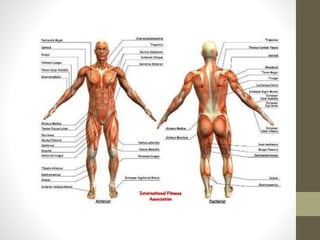
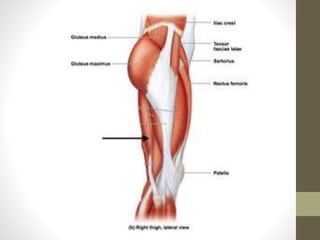
• Names of Muscles
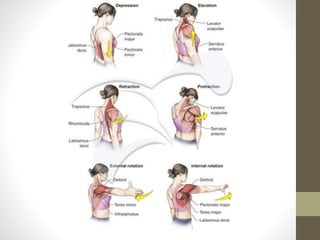
• Muscle Actions
• How muscles work
• Types of Contractions
Anatomical Terms: Planes and
Movement Technology
• In order to avoid confusion when describing various body
movements and positions of the musculoskeletal system, standard
anatomical terminology is used.
• Medial – towards the midline or middle of the body
• Lateral – towards the side of the body – away from the middle
• Superficial – any feature that is closer to the surface of the body
• Deep – any feature that is further away from the surface of the body.
• Proximal and Distal – refers to the limbs. Proximal means closer to
the point where the limb attaches to the body, Distal means further
away from the point of attachment.
• Superior – A position towards the head
• Inferior – A position away from the head
• Prone – Lying face down
• Supine – Lying face up
• Anterior – on the front of the body
• Posterior – on the back of the body
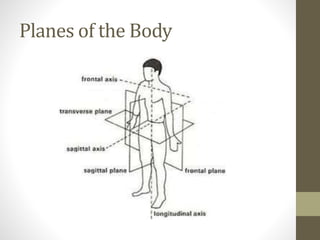
Planes of the Body
The Skeletal System: An
Overview
• Human body consists of 206 bones
• Functions of the bones:
• Support
• Protection
• Movement
• Storage of Minerals
• Blood Cell Production
• Ligaments: Cords of thick, strong fibres that connect bone to
bone
• Tendons: Cords of thick, strong fibres that connect muscle to
bone.
Divisions of the
Skeleton
• The skeleton is divided into 2
parts: Axial and Appendicular.
• Axial = all the bones that are
grouped along the midline of
the body – Spinal Column,
Skull, Chest.
• Appendicular = appendages –
pelvic girdle, shoulder girdle
and arms and legs (126 bones)
Vertebral
Column
• Divided into 5 sections
• 7 Cervical
• 12 Thoracic
• 5 Lumbar
• Scrum (5 fused)
• Coccyx (4 fused)
Joints and Movements of the
Body
• Joints are where two bones meet.
• Held together by ligaments and essential for movement, as
muscles need to pass over them for contraction to occur.
• The type of joint will determine hoe moveable the bones are.
• Fibrous joints – immoveable
• Cartilagenous – partly moveable
• Synovial – Freely moveable – these are the joints that we are
concerned with in relation to movement.
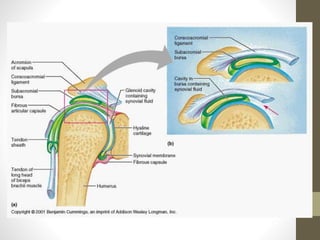
Structure of a Synovial Joint
SynovialJoints
Joint Movements
The Muscular System: An
Overview
• The muscles have 3 main functions:
• Movement
• Posture
• Production of body heat
• Three Types of muscles:
• Voluntary – Skeletal muscles
• Cardiac Muscle – Involuntary
• Smooth Muscle - Involuntary
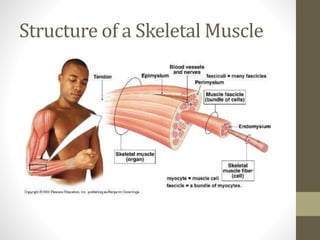
Structure of a Skeletal Muscle
• Skeletal muscle is made up of thousands of cylindrical muscle
cells (fibers) often running all the way from origin, where the
muscle attaches to a usually stationary bone, across a joint to
insertion, where the muscle attaches to the bone that moves
on contraction of the muscle. The fibers are bound together
by connective tissue through which run blood vessels and
nerves. Skeletal muscle cells are often called striated muscle
cells due to the hundreds of parallel, striated myofibrils in
each cell.
Functional Anatomy
Functional Anatomy
Functional Anatomy
Functional Anatomy
Functional Anatomy
Functional Anatomy
Functional Anatomy

Functional Anatomy

  • 1.
  • 2.
    What should youknow • Names of Bones and Joints • Types of Synovial Joints and Names of joints • Names of Muscles • Muscle Actions • How muscles work • Types of Contractions
  • 3.
    Anatomical Terms: Planesand Movement Technology • In order to avoid confusion when describing various body movements and positions of the musculoskeletal system, standard anatomical terminology is used. • Medial – towards the midline or middle of the body • Lateral – towards the side of the body – away from the middle • Superficial – any feature that is closer to the surface of the body • Deep – any feature that is further away from the surface of the body. • Proximal and Distal – refers to the limbs. Proximal means closer to the point where the limb attaches to the body, Distal means further away from the point of attachment. • Superior – A position towards the head • Inferior – A position away from the head • Prone – Lying face down • Supine – Lying face up • Anterior – on the front of the body • Posterior – on the back of the body
  • 5.
  • 6.
    The Skeletal System:An Overview • Human body consists of 206 bones • Functions of the bones: • Support • Protection • Movement • Storage of Minerals • Blood Cell Production • Ligaments: Cords of thick, strong fibres that connect bone to bone • Tendons: Cords of thick, strong fibres that connect muscle to bone.
  • 8.
    Divisions of the Skeleton •The skeleton is divided into 2 parts: Axial and Appendicular. • Axial = all the bones that are grouped along the midline of the body – Spinal Column, Skull, Chest. • Appendicular = appendages – pelvic girdle, shoulder girdle and arms and legs (126 bones)
  • 9.
    Vertebral Column • Divided into5 sections • 7 Cervical • 12 Thoracic • 5 Lumbar • Scrum (5 fused) • Coccyx (4 fused)
  • 10.
    Joints and Movementsof the Body • Joints are where two bones meet. • Held together by ligaments and essential for movement, as muscles need to pass over them for contraction to occur. • The type of joint will determine hoe moveable the bones are. • Fibrous joints – immoveable • Cartilagenous – partly moveable • Synovial – Freely moveable – these are the joints that we are concerned with in relation to movement.
  • 11.
    Structure of aSynovial Joint
  • 13.
  • 15.
  • 16.
    The Muscular System:An Overview • The muscles have 3 main functions: • Movement • Posture • Production of body heat • Three Types of muscles: • Voluntary – Skeletal muscles • Cardiac Muscle – Involuntary • Smooth Muscle - Involuntary
  • 17.
    Structure of aSkeletal Muscle
  • 18.
    • Skeletal muscleis made up of thousands of cylindrical muscle cells (fibers) often running all the way from origin, where the muscle attaches to a usually stationary bone, across a joint to insertion, where the muscle attaches to the bone that moves on contraction of the muscle. The fibers are bound together by connective tissue through which run blood vessels and nerves. Skeletal muscle cells are often called striated muscle cells due to the hundreds of parallel, striated myofibrils in each cell.