V. Santhosh Kumar Int. Journal of Engineering Research and Applications www.ijera.com
ISSN : 2248-9622, Vol. 5, Issue 1( Part 5), January 2015, pp.31-40
www.ijera.com 31 | P a g e
Fully Homomorphic Encryption Using Low Power Multiplier
V. Santhosh kumar*, R. Mohan**
*(PG Scholar, Department of Electronics and Communications Engineering, M. P. Nachimuthu M .Jaganathan
Engineering College, Chennimalai-638051.Erode, Tamilnadu, India)
**(Associate Professor, Department of Electronics and Communications Engineering, M. P. Nachimuthu
M. Jaganathan Engineering College, Chennimalai-638051.Erode, Tamilnadu, India)
ABSTRACT
The design of a power and area efficient high speed 768 000-bit multiplier based on Fast Fourier Transform
(FFT) multiplication for fully homomorphic encryption operations. Memory based in-place architecture is
presented for the FFT processor that performs 64 000-point finite-field FFT operations using a radix-16
computing unit and 16 dual-port SRAMs. By adopting a special prime as the base of the finite field, the radix-16
calculations are simplified to requiring only additions and shift operations. A two-stage carry-look-ahead scheme
is employed to resolve carries and obtain the multiplication result. The multiplier design is validated by
comparing its results with the GNU Multiple Precision (GMP) arithmetic library. The proposed design has been
synthesized using 90-nm process technology with an estimated die area of 45.3 mm2
. At 200 MHz, the large-
number multiplier offers roughly twice the performance of a previous implementation on an NVIDIA C2050
graphics processor unit and is 29 times faster than the Xeon X5650 CPU, while at the same time consuming a
modest 0.97 W.
Keywords - Fully Homomorphic Encryption (FHE), large-number multiplication, VLSI design.
I. INTRODUCTION
The growth of cloud computing is deepening
concerns over data privacy, especially when
outsourcing computations to an entrusted service,
which typically involves allowing the service to
work with client data in decrypted form. Fully
Homomorphic Encryption (FHE) is a technique
enabling computation to be performed directly on
encrypted data, thereby preserving privacy. The
Gentry-Halevy scheme was the first software
implementation of FHE but its computing latency is
prohibitive for practical applications due to its
intensive use of large-number (hundreds of
thousands of bits) multiplications. Subsequent
research has shown that performance can be
improved through the use of parallelism on a general
purpose Graphics Processor Unit (GPU). However,
the 200-400W power consumption of a typical GPU
makes it impractical to employ such an approach at
data center scales. Because multiplication is the
dominating component of FHE operations, it will be
a significant step toward practical application of FHE
if a high-performance, low-power, area efficient, and
high precision integer multiplier architecture can be
developed.
Enabling general purpose computation on
encrypted data was a problem introduced in [1] about
three decades ago. In a major breakthrough, Gentry
[2] introduced the first plausible FHE scheme in
2009. Using FHE, one may perform arbitrary
computations directly on encrypted data without
having access to the secret key. Thus an untrusted
party, such as a cloud server, may perform
computations on behalf of a client without
compromising privacy. This property of FHE makes
it potentially very valuable for the fast-growing
cloud computing industry.
Although Gentry’s FHE scheme is theoretically
promising, it has been impractical for actual
deployment. For instance, Gentry and Halevi [3]
presented the first implementation of an FHE variant
using software. They used sophisticated
optimizations to reduce the size of the public key and
the com-puting time of the large-number primitives
based on the GMP library [4]. For the lowest security
setting of dimension 2048, every source bit becomes
encrypted as about 760 000 bits. The encryption of
one bit took 1.69 s on a high-end Xeon processor,
while the recryption primitive took 27.68 s. After
every few bit-AND operations, a recrypt operation
must be applied to reduce the noise in the ciphertext
to a manageable level, thus inducing significant
overhead.
Subsequently, we took Gentry and Halevi’s FHE
algorithm and accelerated it on a GPU platform [5].
Targeted to an NVIDIA C2050 GPU with 448 cores
running at 1.15 GHz, the processing time for 1-bit
encryption was reduced to 45 ms and the recyption
was reduced to 1.8 s, which are about 37.6 and 15.4
times faster than the original implementation on the
CPU. Although the GPU trial provided significant
acceleration, the major problem remains that the
power consumption of a high-end GPU today is
about 200–400 W. Using GPUs to scale FHE up to
data center levels is thus infeasible. The solution is to
RESEARCH ARTICLE OPEN ACCESS
V. Santhosh Kumar Int. Journal of Engineering Research and Applications www.ijera.com
ISSN : 2248-9622, Vol. 5, Issue 1( Part 5), January 2015, pp.31-40
www.ijera.com 32 | P a g e
build low-power customized circuits that can provide
comparable or superior performance to the fastest
GPU while reducing power consumption by orders
of magnitude.
Previously, the general-purpose GPU had also
been used for acceleration of security algorithms
such as elliptic curve cryp-tography [6]. But the GPU
architecture was originally geared for graphics
operations and later extended for general-purpose
computations. It is not the most power-efficient
architecture for a specific algorithm or applications.
One approach is to attach an application-specific
integrated circuit (ASIC) to the CPU which is
dedicated to encryption/decryption operations. At the
microarchitectural level, it can be implemented as an
extension of the instruction set. Previously,
customized ASIC or IP blocks have been designed to
accelerate the well-known encryption schemes such
as the Advanced Encryption Standard (AES) and
Rivest-Shamir-Adleman (RSA) [7], [8]. Today,
many embedded processors have AES or RSA cores
included. This paper is aimed at taking a similar
approach and designing a specific hardware or IP
blocks for accelerating the core computations in
FHE.
Since the most computationally intensive
operations in the FHE primitives are large-number
modular multiplications, our initial attempt is to
tackle the design of a large-number multiplier that
can handle 768 000 bits, in support of the 2048-
dimension FHE scheme demonstrated by Gentry and
Halevi. In addition to FHE, large-number arithmetic
also has other important applications in science,
engineering, and math-ematics. Specifically, when
we need exact results or the results that exceed the
range of floating point standards, we usually turn to
multiprecision arithmetic [9]. An example
application is in robust geometric algorithms [10]–
[12]. Replacing exact arithmetic with fixed-precision
arithmetic introduces numerical errors that lead to
nonrobust geometric computations. High-precision
arithmetic is a primary means of addressing the
nonrobustness problem in such geometric algorithms
[10].
The rest of this paper is organized as follows.
Section II gives a brief introduction to FHE. Section
III presents Strassen’s fast Fourier transform (FFT)
based multiplication algorithm. Section IV shows the
architecture of the VLSI design of the finite-field
FFT engine and the multiplier. Section V gives
results based on VLSI synthesis and simulation.
Conclusions follow in Section VI.
II. GENTRY’S FHE
One of the holy grails of modern cryptography is
FHE, which allows arbitrary computation on
encrypted data. Given a need to perform a binary
operation on the plaintext, FHE enables that to be
accomplished via manipulation of the cipher-text
without the knowledge of the encryption key. For
example,
E(x1) + E(x2) = E(x1 + x2) and E(x1) _ E(x2) = E(x1*x2).
The first FHE was proposed by Gentry in [2]
and [13] and was seen as a major breakthrough in
cryptography. However, its preliminary
implementation is too inefficient to be used in any
practical applications. A number of optimizations
were used in the Gentry–Halevi FHE variant, and the
results of a reference implementation were presented
in [3]. Due to limited space, here we only provide a
high-level overview of the primitives.
Encryption: To encrypt a bit b ∈ {0, 1} with a
public key (d, r), encryption first generates a random
“noise vector” u = u0, u1, . . . , un−1 , with each entry
chosen as 0 with the probability p and as ±1 with
probability (1 − p)/2 each. Gentry [3] showed that u
can contain a large number of zeros without
impacting the security level, i.e., p could be very
large. A message bit b is then encrypted by
computing
n−1
c = [u (r )]d = [b + 2 ∑ui r i
] (1)
i=1 d
where d and r are parts of the public key. For the
small setting with a lattice dimension of 2048, d and
r have a size of about 785 000 bits [3].
When encrypted, arithmetic operations can be
performed directly on the ciphertext with the
corresponding modular operations. Suppose c1 =
Encrypt(m1) and c2 = Encrypt(m2); then we have
Encrypt(b1 + b2) = (c1 + c2) mod d (2)
Encrypt(b1 *b2) = (c1 * c2) mod d. (3)
Decryption: The source bit b can be recovered by
computing
b = [c · w]d mod 2 (4)
where w is the private key. The size of the w is the
same as that of d and r.
Recryption: Briefly, the recyption process is simply
the homomorphic decryption of the ciphertext. The
actual pro-cedure of recyption is very complicated,
so we choose not to explain it here. But from the
brief description above, we can see that the
fundamental operations for FHE are large-number
addition and multiplication. Addition has far less
computing complexity than multiplication, so we
focus on the hardware architecture of the
multiplication using VLSI design.
III. LARGE-INTEGER MODULAR
MULTIPLICATION
A. Multiplication Algorithms
Large-integer multiplication is by far the most
V. Santhosh Kumar Int. Journal of Engineering Research and Applications www.ijera.com
ISSN : 2248-9622, Vol. 5, Issue 1( Part 5), January 2015, pp.31-40
www.ijera.com 33 | P a g e
time-consuming operation in the FHE scheme.
Therefore, we have selected it as the first block for
hardware acceleration. A review of the literature
shows that there is a hierarchy of multiplication
algorithms. The simplest algorithm is the naive O(
N2
) algorithm (often called the grade school
algorithm).
The first improvement to the grade school
algorithm was due to Karatsuba [14] in 1962. It is a
recursive divide-and-conquer algorithm, solving an
N bit multiplication with three N/2 bit
multiplications, giving rise to an asymptotic
complexity of O( Nlog2 3
). Toom and Cook
generalized Karatsuba’s approach, using
polynomials to break each N bit number into three or
more pieces. Once the subproblems have been
solved, the Toom–Cook method uses polynomial
interpolation to construct the desired result of the N
bit multiplication [15]. The asymptotic complexity
of the Toom–Cook algorithm depends on k (the
number of pieces) and is O( Nlog(2k−1)/ log(k)
).
The next set of algorithms in the hierarchy are
based on using FFTs to compute convolutions.
According to Knuth [15], Strassen came up with the
idea of using FFTs for multi-plcation in 1968, and
worked with Schönhage to generalize the approach,
resulting in the famous Schönhage–Strassen
algorithm [16], with an asymptotic complexity of O(
N ·log N · log log N).
All the operations in FHE are modular
operations. Usually, two different approaches are
used to address the modular multiplication. The first
is to do multiplication first, followed by modular
reduction. The other approach, proposed in [17],
interleaves the multiplication with modular
reduction. This is an efficient grade-school approach,
performing the equivalent of two O( N2
)
multiplications. The interleaved Montgomery
approach is quite commonly used for modular
multiplication in the RSA algorithm, see [8] and
[18].
TABLE I
OPERATION COUNTS FOR A 786 432-bit
MODULAR MULTIPLICATION
To understand the arithmetic cost of different
multiplication algorithms, we implement three
different modular multiplication algorithms in
carefully tuned MIPS 64 assembly and count the
number of ALU operations for each. The first
algorithm uses the interleaved version of
Montgomery multiplication proposed in [17]. This is
an efficient grade-school approach, performing the
equivalent of two O( N2
) multiplications. The
second algorithm uses the noninterleaved three-
multiplication Montgomery reduction implemented
with Karatsuba multiplication (it uses the Karatsuba
method if the arguments are larger than three words,
and switches to grade-school multiplication to handle
the base case when the arguments are small). The
third algorithm adopted in this paper is based on FFT
multiplication and is described in detail in the next
section. This algorithm also uses a traditional three-
multiplication Montgomery reduction. The operation
counts of the three algorithms are presented in Table
I.
Comparing the Karatsuba and FFT multipliers,
both of which compute the product and then reduce
the result mod-ulo N, we can see that FFT
multiplication is faster, requiring only one-third of
the number of instructions as the Karatsuba
multiplier. Comparing the FFT multiplier with
interleaved Montgomery approach which is widely
used in RSA for mod-ular multiplication, we see that
the FFT multiplier uses only 1/20th of the number of
instructions. The interleaved version of Montgomery
multiplication is popular and efficient in RSA, but it
is no longer efficient for the modular multiplication
in FHE. In all, the approach we adopt for modular
multiplication is the most efficient algorithm. From
above, we can see that large-number multiplication is
the most crucial part for the modular multiplication.
Therefore, we take the first step to design a fast
multiplier for hardware implementation.
For further reading, there are a number of papers
that cover hardware implementation of large-number
multiplication. Yazaki and Abe [19] implement a
1024-bit Karatsuba multiplier, and in [20] they
investigate a hardware implementation of FFT
multiplication. Kalach [21] investigates a hardware
implementation of finite field FFT multiplication.
However, that paper does not present any
information about the hardware resources and
performance.
B. FFT Multiplication
FFT multiplication is based on convolutions. For
example, to compute the product A times B, we
express the numbers A and B as sequences of digits
(in some base b) and then compute the convolution
of the two sequences using FFTs.
Once we have the convolution of the digits, the
product A times B can be found by resolving the
carries between digits. The FFT multiplication
algorithm is presented in Fig. 1 and as a diagram in
Fig. 2.
V. Santhosh Kumar Int. Journal of Engineering Research and Applications www.ijera.com
ISSN : 2248-9622, Vol. 5, Issue 1( Part 5), January 2015, pp.31-40
www.ijera.com 34 | P a g e
Fig. 1. FFT multiplication.
Fig. 2. FFT-based multiplication algorithm.
The FFT computations can done either in the
domain of complex numbers or in a finite field or
ring. In the complex number domain, it is trivial to
construct the roots of unity required for the FFT, but
the computations must be done with floating point
arithmetic and the round-off error analysis is quite
involved. In the finite field/ring case, all the
computations are done with integer arithmetic and
are exact. However, the existence and the calculation
of the required root of unity will depend heavily on
the structure of the chosen finite field/ring.
For our FFT multiplier, we follow the steps of
our previous work [9] and implement the FFT in the
finite field Z/ pZ, where p is the prime 264
–232
+ 1.
This prime is from a special class of numbers called
Solinas primes (see [22]). As we shall see, this
choice of p has three compelling advantages for
FFTs.
1) We can do very large FFTs in Z/ pZ. Since 232
divides p − 1, we can do any power-of-2-sized
FFT up to 232
.
2) There exists a very fast procedure for computing
x modulo p for any x .
3) For small FFTs (up to size 64), the roots of unity
are all powers of 2. This means that small FFTs
can be done entirely with shifting and addition,
rather than requiring expensive 64-bit
multiplications.
C. FFTs in the Finite Field Z/pZ
To perform FFTs in a finite field, we need three
operators: addition, subtraction, and multiplication,
all modulo p, where p = 2 64
–232
+ 1. Addition and
subtraction are straightforward (if the result is larger
than p then subtract p, and if the result is negative,
then add p). For multiplication, if X and Y arein Z/
pZ, then X ∗ Y will be a 128-bit number, which we
can represent as X ∗ Y = 296
a + 264
b + 232
c + d
(where a, b, c,and d are each 32-bit values). Next,
using two identities of p, namely, 296
mod p = −1 and
264
mod p = 232
− 1, we can
rewrite the product of X ∗ Y as
X ∗ Y ≡ 296
a + 264
b + 232
c + d(mod p)
≡ −1(a) + (232
− 1)b + (232
)c + d
≡ (232
)(b + c) − a − b + d.
This means that a 128-bit number can be
reduced modulo p to just a few 32-bit additions and
subtractions. Further, note that 2192
mod p = 1, 296
mod p = −1, 2384
mod p = 1, etc. This leads to a fast
method to reduce any sized value modulo p. Break
the value up into 96-bit chunks and compute the
alternating sum of the chunks. Then reduce the result
as above.
In addition to the arithmetic operator, there are
three other criteria in order to perform multiplication
with finite field FFTs. First, to compute an FFT of
size k, a primitive root of unity rk must exist such
that rk
∧ k mod p = 1 and rk
∧i mod p = 1 for all i
between 1 and k−1. Second, the value k−1
must exist
in the field. Third, we must ensure that the
convolution does not overflow, i.e., k/2(b − 1)2
< p,
where k is the FFT size and b is the base used in the
sampling. Finally, ensure that the numbers are
multiplying are less than bk/2
.
In a finite field, the process for doing an FFT is
analogous to FFTs in the complex domain, thus
k-1
Xi=∑xj(rk)ij
(mod p ) (5)
j=0
The inverse FFT (IFFT) is just
k-1
xi=k -1
∑Xj(rk)-ij
(mod p ) (6)
j=0
for all the usual methods for decomposing FFTs,
such as Cooley-turkey, except(rk)j
takes the place of
ej2πi/k
. With large FFTs, the primitive roots almost
always look like random 64-bit numbers, e.g., the r65
536 that is 0xE9653C8DEFA860A9. However, for
FFTs of size 64 or less, the roots of unity always be
powers of 2. As mentioned above the equation 5.2,
2192
mod p=1, which mean (23
)64
mod p=1and
therefore r64=23
=0x08. Likewise, r16=212
.
For our hardware implementation, choose k=65
536 and b=224
. These values meet the criteria above
and allow us to multiply two numbers up to
bk/2
=2786432
,i.e., 786432 bit in length, which is
V. Santhosh Kumar Int. Journal of Engineering Research and Applications www.ijera.com
ISSN : 2248-9622, Vol. 5, Issue 1( Part 5), January 2015, pp.31-40
www.ijera.com 35 | P a g e
sufficient to support Gentry Halevy’s FHE scheme
for small setting with a lattice dimension of 2048.
D. 192-bit Wide Pipelines
It is often the case in our hardware FFT
implementation that we need to perform a sequence
of modular operations (additions, subtractions, and
multiplications by powers of 2).
If we were to implement this as 64-bitwide
operations, we would need to reduce the result
modulo p between each stage of the pipe. Although
the process to reduce a value modulo p is quite fast,
it still requires a lot of hardware. It turns out that, if
we extend each 64-bit value to 192 bits (by padding
with zeros on the left) and run the pipeline with 192-
bitwide values, then we can avoid the modulo p
operations after each pipeline stage by taking
advantage of the fact that 2192
mod p is 1. We do this
as follows:
1) Addition: Suppose we wish to compute x + y.
There are two cases: If we get a carry out from the
192nd bit, then we have trunc(x + y) + 2192
, which is
the same as trunc(x + y) + 1 modulo p (where
trunc(z) returns the least significant 192 bits of z). If
it did not carry out, then the result is just x + y. We
can implement this efficiently in hardware using
circular shifting operations.
2) Multiplication by a Power of 2: First, let us
consider multiplication by 2. Suppose we have a
192-bit value x and we wish to compute 2x . There
two cases. If the most significant bit of x is zero, then
we simply shift all 1-bits to the left. If the top bit is
set, then we need to compute trunc(2x ) + 2192
,
which is the same as trunc(2x ) + 1 modulo p. In both
jcase,it is just a left circular shift by 1 bit. Thus to
compute 2j
* x, we simply do a left circular shift by j
bits.
3) Since 296
mod p=-1, we can simply rewrite x-y as
x+296
y. This 296
is a constant shift. For the final
reduction from 192 bits back down to 64 bits, as
above, represent a 192-bit number z as
z=2160
a+2128
b+296
c+264
d +232
e+f, where a,b,c,d,e and
f are each 32 bits.
Z ≡ 2160
a+2128
b+296
c+264
d +232
e+f
Z ≡ -(232
-1)a-232
b-c+(232
-1)d+232
e+f
Z ≡ (232
e+f)+ (232
d+a)-( 232
b+c)- (232
a+d). (7)
IV. VLSI DESIGN OF THE LARGE
NUMBER MULTIPLIER
For high-throughput applications, a pipelined
FFT architecture is often used however, the
pipelined design requires a memory buffer at every
stage, which becomes problematic in the context of
large-integer operations. For a 64000 FFT and 64
bits per data sample, 4 Mbits of memory after each
stage. Generally, a large FFT involves numerous
stages, which makes the total area for memory too
large to be considered for hardware implementation.
In contrast to the pipelined FFT design, a memory
based FFT architecture adopts an in place strategy,
which allows us to store the intermediate results into
the same memory as the input data. Doing so
effectively minimizes the memory requirement for
the FFT computation. To improve throughput,
multiple memory banks can be used for parallel
access. In our 64 000 FFT architecture, a total of 16
dual-port memory banks are used, and each memory
bank is 256 000 bits in size. Fundamentally, the 64
000 FFT is implemented using four stages of 16-
point FFTs. The basic concept of a stage is to
perform 4096 16-point FFTs, followed by
application of twiddle factors and then transposition.
If we repeat that process four times (164
= 64 000),
then the result is a 64 000 FFT. Using an in-place
memory-based design, these four stages are
computed sequentially using the same hardware unit
and memory.
A. Radix-16 FFT Unit
One of the key elements of our design is a high-
throughput 16-point FFT engine. As discussed in
Section III-C, for small (k ≤ 64) FFTs, the root of
unity will always be a power of 2.
In a finite field based on the Solinas prime p, a 16-
point FFT can be performed using just shift and
modulo addition operations. A 16-point FFT can be
expressed as (8), noting 409616
mod p = 2192
mod p =
1. As discussed above, for 192-bit operations, any
carry-out bit can be simply routed back as a carry-in
bit, which is particularly suitable for hardware
design
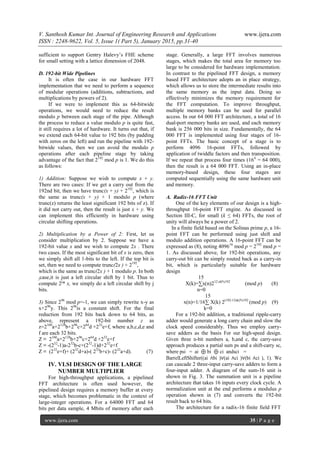
15
X(k)=∑x(n)212.nk%192
(mod p) (8)
n=0
15
x(n)=1/16∑ X(k) 2(192-12nk)%192
(mod p) (9)
k=0
For a 192-bit addition, a traditional ripple-carry
adder would generate a long carry chain and slow the
clock speed considerably. Thus we employ carry-
save adders as the basis For our high-speed design.
Given three n-bit numbers a, b,and c, the carry-save
approach produces a partial sum ps and a shift-carry sc,
where psi = ai ⊕ bi ⊕ ci andsci =
BarrelLeftShifter((ai ∧bi )∨(ai ∧ci )∨(bi ∧ci ), 1). We
can cascade 2 three-input carry-save adders to form a
four-input adder. A diagram of the sum-16 unit is
shown in Fig. 3. The summation unit is a pipeline
architecture that takes 16 inputs every clock cycle. A
normalization unit at the end performs a modulus p
operation shown in (7) and converts the 192-bit
result back to 64 bits.
The architecture for a radix-16 finite field FFT
V. Santhosh Kumar Int. Journal of Engineering Research and Applications www.ijera.com
ISSN : 2248-9622, Vol. 5, Issue 1( Part 5), January 2015, pp.31-40
www.ijera.com 36 | P a g e
unit is shown in Fig. 4. It consists of 16 shifters and
16 summation units. At each clock cycle, the radix-
16 unit takes 16 data inputs and outputs the 16-point
FFT results after a few cycles of pipeline delay.
B. 64 000-Point FFT Processor
The 64 000-point FFT can be decomposed into
four stages of 16-point FFTs. At each stage, a total
of 64 000 samples are processed through the radix-
16 FFT unit. At 16 samples per cycle, that gives a
total of 4096 cycles per stage. This architecture reads
16 input values from memory and writes 16 output
values to the memory every clock cycle. Therefore,
the memory needs to be partitioned into 16 banks.
An in-place memory addressing scheme is applied to
ensure there is no memory access conflict. With
reference to the derivation in [25] and [26], a
conflict-free in-place scheme for radix-16
Fig. 3. Diagram of sum-16 unit.
Fig. 4. Architecture of the radix-16 FFT unit.
Fig. 5. Data storage pattern in the memory banks.
FFT can be described as follows:
DataCount = [d15 , d14 , . . . , d0] (10)
BankNum = ([d15, d14, d13,d12] +[d11,d10,d9,d8] [d7,
d6, d5, d4] + [d3, d2, d1, d0]) mod 16 (11)
Address = [d15 , d14 , . . . , d4]. (12)
DataCount denotes the original address of the
input data sample. BankNum is the corresponding
bank assignment after partitioning. Address is the
new address in the assigned bank. For 64 000
samples, the memory is partitioned into 16 banks,
and each bank has 4096 samples. The data storage
pattern in the memory banks is shown in Fig. 5.
The overall architecture of the FFT processor is
shown in Fig. 6. Before entering the processor, the
data has been
Fig. 6. Architecture of the 64 000-point FFT
processor.
Fig. 7. Architecture of modular multiplication unit.
reshuffled according to (11) and (12). The
Address generation unit generates the corresponding
bank number and address for each data sample. After
all 64 000 samples have been received and stored in
the memory banks, the FFT processor begins the
computation. At each clock cycle, it reads 16
samples from the memory banks according to the
BankNo and Address generated by the address
generation uinit. These 16 values are then permuted
into a proper order by the interchange unit and fed to
the Radix-16 unit. Subsequently, the radix-16 FFT
results are modular-multiplied with twiddle factors
supplied from ROMs. The final results of each stage
are permuted to the desired order before being stored
V. Santhosh Kumar Int. Journal of Engineering Research and Applications www.ijera.com
ISSN : 2248-9622, Vol. 5, Issue 1( Part 5), January 2015, pp.31-40
www.ijera.com 37 | P a g e
back into the memory banks.The modular multiplier
is designed as shown in Fig. 7. The 64-bit multiplier
has four pipeline stages. The 128-bit multiplication
result is then split into four 32-bit components a, b,
c, and d. After going through the addition, shifting,
and subtraction as in Fig. 7, a 64-bit modular
multiplication result is obtained.
C. Large-Number Multiplier
The high-level architecture of the large-number
multiplier is shown in Fig. 8. It consists of two FFT
processors for computing the FFTs of the two inputs
a and b. Then a component-wise product is
performed on the two FFT results. Subsequently, we
reuse one of the FFT processors to perform the IFFT
operation. The operations in each step are described
as follows.
Fig. 8. Architecture of the large-number multiplier.
1) Data Input: The input data samples from a and b
are reshuffled and stored in the corresponding
addresses in the memory banks.
2) FFT: Two 64 000-point FFT processors are used
in the architecture. To reduce the hardware
needed, both FFT processors share the twiddle
factor ROMs. They also share the control signals
generated by the Controller.
3) Component-Wise Product: For the pointwise
product, we reuse the modular multipliers in the
FFT processor. Specifically, at the fourth stage
of FFT(a), instead of multiplying by constant 1,
the result of FFT(b) is fed to the modular
multipliers. Effectively this computes the
component-by-component pointwise product of
FFT(a) and FFT(b). We thus avoid adding
another set of multi-pliers into the design and
thereby save chip area.
4) IFFT : One of the FFT processors is reused for
the IFFT computation. This reuse effectively
saves about one-third of the chip area.
5) Resolve Carries: A customized Resolve
Carries unit produces the final result of large-
number multiplication.
D. Resolve Carries
To further explain the process of resolving
carries, we take the 768 000-bit Strassen’s multiplier
as an example. But note that the design approach is
general. We first decompose each 768 000-bit
multiplicand into 32 000 groups of 24-bit numbers.
Each 24-bit number is then extended to a 64-bit data
sample. Owing to the convolution property of
multiplication, the multiplication results are expected
to be 64 000 groups of 24-bit numbers, or up to 1
536 000 bits, which leads to the 64 000 FFT in the
design. Following Strassen’s algorithm, the IFFT
output is 64 000 samples of 64-bit data. The Resolve
Carries unit must then obtain the actual 1 536 000
bits results from the IFFT output data.
Since each group of data is supposed to be 24-
bits, each 64-bit value in the IFFT output is actually
overlapped by
Fig. 9. Two-stage pipeline carry resolving unit
40 bits with the next value. For our design, we
extend the 64-bit numbers into a 72-bit format
having three blocks of 24-bit numbers. The
alignment among the words is illustrated in Fig. 9.
Recall that the IFFT module outputs 16 data
samples per clock cycle. A total of 64 000 data
values are output in 4096 consecutive cycles.
Therefore, we must resolve the carries quickly to
match the pipeline throughput. A traditional ripple-
carry adder is again too slow to add 16 numbers in a
row. Thus, a hierarchical carry-look-ahead scheme is
employed as in Fig. 9. The algorithm has two steps.
It first adds the words in parallel, followed by
resolving the carry chain in one cycle [27]. The carry
look-ahead function is shown in (13) carry = ((c <<
1) + carryin + critical) XOR critical (13)
where critical[i ] and c[i ] are two Boolean arrays and
carryin is a single carry bit from the previous word.
If zi is critical(zi = MAX_INT), the i th bit of
critical[i ] is set, while the i th
bit of c[i ] is set if zi
always generates a carry (zi >MAX_INT). For a 24-
V. Santhosh Kumar Int. Journal of Engineering Research and Applications www.ijera.com
ISSN : 2248-9622, Vol. 5, Issue 1( Part 5), January 2015, pp.31-40
www.ijera.com 38 | P a g e
bit word, MAX_INT = 0 xFFFFFF. For a best
performance, we use a two-stage pipeline design for
the Resolve Carries unit as shown in Fig. 9. The
carry-look-ahead scheme and two-stage pipeline
enable the Resolve Carries unit to match the
throughput of the FFT/IFFT processor output data at
a high clock speed.
V. EXPERIMENTAL RESULTS
The design of the large-number multiplier was
implemented using System Verilog. The multiplier
ASIC was synthesized for 90-nm technology, using
the Synopsys Design Compiler, the DesignWare
building block libraries, and IBM 90-nm CMOS 9
FLP standard-cell library. Table II lists the synthesis
results for the radix-16 unit, the 64 000 FFT
processor, and the multiplier. The number of logic
equivalent gates (two-input NAND) of the chip is
20.6 M gates. A large portion of the chip area is
occupied by the memories. For the large-number
multiplier, we have two FFT processors, each of
which has16 dual port SRAM banks of size 4096 ×
64 bits. The esti-mated area of each SRAM is about
1.07 mm2
, so the total area for the SRAMs is about
34.24 mm2
. In addition, the FFT/IFFT processors
also require a set of 30 ROMs to store the twiddle
factors.
TABLE II
SYNTHESIS RESULTS USING 90-NM CMOS
TECHNOLOGY
(IBM 90-nm 9 FLP PROCESS)
TABLE III
SYNTHESIS RESULTS ON ALTERA’S
STRATIX-V FPGA
TABLE IV
PERFORMANCE COMPARISON BETWEEN THE
PROPOSED DESIGN, CPU, AND GPU
Fig. 10. Graphical representation of the Proposed
Design Performance.
16 dual port SRAM banks of size 4096 × 64
bits. The esti-mated area of each SRAM is about
1.07 mm2
, so the total area for the SRAMs is about
34.24 mm2
. In addition, the FFT/IFFT processors
also require a set of 30 ROMs to store the twiddle
factors. Each ROM is 4096 × 64 bits with an
estimated chip area of 0.154 mm2
. So the total area
for the ROMs is about 4.63 mm2
. If combined, the
total area for the RAMs and ROMs is about 38.87
mm2
, which occupies 85.8% of the chip. Thus, the
architecture of the large-number multiplier is
memory-constrained. In fact, the optimized radix-16
units occupy just 5% of the entire multiplier area.
The proposed multiplier was also synthesized using
Altera Quartus-II synthe-size tool. After place and
route, the design is implemented on Altera’s Stratix-
V 5SGXMABN1F45I2 field-programmable gate
array (FPGA). The resources utilized by the
multiplier are listed in Table III.
We validated the simulation results for the
hardware multiplier against a software
implementation using the GMP library [4]. Random
numbers generated by C code were used as test
vectors. The results match perfectly, thus showing
that the architecture as well as the synthesized design
of the large-number multiplier operates correctly.
For performance evaluation, we compare the
throughput of our multiplier with the software
implementations on CPU and GPU. The 768 000-bit
multiplication was evaluated on a high-end server
with an Intel Xeon X5650 processor running at 2.67
GHz with 24 GB RAM using the GMP library,
which supports arbitrary precision arithmetic, and is
carefully designed using fast algorithms and highly
optimized assembly code, as necessary [4]. The
execution time on the CPU is about 6 ms. The same
Strassen’s multiplication algorithm was also
implemented on an NVIDA Tesla C2050 GPU,
which has 448 cores running at 1.15 GHz as in [5]. It
V. Santhosh Kumar Int. Journal of Engineering Research and Applications www.ijera.com
ISSN : 2248-9622, Vol. 5, Issue 1( Part 5), January 2015, pp.31-40
www.ijera.com 39 | P a g e
takes 0.0657 ms to transfer a 786 432-bit number
from Xeon processor to the GPU or transfer a 786
432-bit number from the GPU back to the Xeon
processor. When the data has been transferred to the
GPU, we measure the runtime of the GPU kernel,
and then transfer the results back to the GPU. The
GPU kernel execu-tion time is 0.42 ms, excluding
the data transfer time between CPU and GPU. For
our hardware implementation, it takes 4096 cycles to
load the samples into SRAMs, eight stages of
FFT/IFFT with 4119 cycles per stage, and 4098
cycles to read the multiplication results out of the
memory. At 200 MHz, the execution time of the
VLSI implementation is 0.206 ms, which is twice as
fast as the GPU and 29 times faster than the CPU as
listed in Table IV. More importantly, the proposed
VLSI implementation uses approximately 0.97 W,
which is significantly less than either the GPU or
CPU, making it more suitable for scaling up. For
comparison,Yazaaki and Abe[20] implemented a
32768-bit FFT-based multiplier in hardware in an
area of 9.05 mm2 using a 0.18-μm process. They
achieved a runtime 1.02 ms for a 32 768-bit
multiplication. Our multiplier handles numbers 24
times larger and at 5 times the speed.
VI. CONCLUSION AND FUTURE
ENHANCEMENT
In this paper, an efficient VLSI implementation
of a large-number multiplier was presented using
Strassen’s FFT-based multiplication algorithm. To
the best of our knowledge, this is the largest
multiplier that has been implemented using VLSI
design. Because of memory constraints, a memory-
based in-place FFT architecture was used for the
FFT processor. A set of design optimization
strategies were applied to improve the performance
and reduce the area of both the Radix-16 unit and the
Resolve Carries unit. The multiplier was synthesized
for 90-nm technology with an estimated core area
45.3 mm2
. Experimental results showed that the
proposed multiplier was about 2 times faster than
GPU and 29 times faster than CPU and its power
consumption was less than 1 W.
The accuracy of the proposed model achieves a
better accuracy. In order to make the system to
achieve a good performance in future, three FFT
processors will be introduced. Finally, the outputs of
both the methods will be combined as a hybrid
model to achieve a good performance.
VII.Acknowledgements
We heartily convey our gratitude to Prof. K. G.
Parthiban, ASP & HoD /ECE, M. P. N. M. J.
Engg. College, for guiding us to develop this project
and also encouraged us throughout the project.
REFERENCES
[1] R. Rivest, L. Adleman, and M. Dertouzos,
“On data banks and privacy
homomorphisms,” Found. Secure Comput.,
vol. 32, no. 4, pp. 169–178, 1978.
[2] C. Gentry, “Fully homomorphic encryption
using ideal lattices,” in Proc. 41st Annu.
ACM Symp. Theory Comput., Jun. 2009, pp.
169–178.
[3] C. Gentry and S. Halevi, “Implementing
Gentry’s fully-homomorphic encryption
scheme,” in Advances Cryptology–
EUROCRYPT (Lecture Notes in Computer
Science). New York, NY, USA: Springer-
Verlag, 2011, pp. 129–148.
[4] (2010). The GNU Multiple Precision
Arithmetic Library[Online]. Available:
http://gmplib.org/
[5] W. Wang, Y. Hu, L. Chen, X. Huang, and
B. Sunar, “Accelerating fully homomorphic
encryption using GPU,” in Proc. IEEE
Conf. HPEC, Sep. 2012, pp. 1–5.
[6] A. Cohen and K. Parhi, “GPU accelerated
elliptic curve cryptography in GF(2m
),” in
Proc. 53rd IEEE Int. MWSCAS, Aug. 2010,
pp. 57–60.
[7] X. Zhang and K. Parhi, “High-speed VLSI
architectures for the AES algorithm,” IEEE
Trans. Very Large Scale Integr. (VLSI)
Syst., vol. 12, no. 9, pp. 957–967, Sep.
2004.
pp. M.-D. Shieh, J.-H. Chen, H.-H. Wu, and
W.-C. Lin, “A new modular exponentiation
architecture for efficient design of RSA
cryptosystem,” IEEE Trans. Very Large
Scale Integr. (VLSI) Syst., vol. 16, no. 9,
1151–1161, Sep. 2008.
[8] N. Emmart and C. C. Weems, “High
precision integer multiplication with a GPU
using Strassen’s algorithm with multiple
FFT sizes,” Parallel Process. Lett., vol. 21,
no. 3, pp. 359–375, Jul. 2011.
[9] C. Burnikel, R. Fleischer, K. Mehlhorn, and
S. Schirra, “Efficient exact geometric
computation made easy,” in Proc. 15th
Annu. Symp. Comput. Geometry, 1999, pp.
341–350.
[10] C. K. Yap and V. Sharma, Robust
Geometric Computation. New York, NY,
USA: Springer-Verlag, 2008.
[11] V. Karamcheti, C. Li, I. Pechtchanski, and
C. Yap, “A core library for robust numeric
and geometric computation,” in Proc. 15th
Annu. Symp. Comput. Geometry, 1999, pp.
351–359.
[12] C. Gentry, “A fully homomorphic
encryption scheme,” Ph.D. dis-sertation,
Dept. Comp. Sci., Stanford Univ., Stanford,
V. Santhosh Kumar Int. Journal of Engineering Research and Applications www.ijera.com
ISSN : 2248-9622, Vol. 5, Issue 1( Part 5), January 2015, pp.31-40
www.ijera.com 40 | P a g e
CA, USA, 2009.
[13] A. Karatsuba and Y. Ofman,
“Multiplication of many-digital numbers by
automatic computers,” in Proc. USSR,
1962, pp. 293–294.
[14] D. Knuth, The Art of Computer
Programming, vol. 2. Reading, MA, USA:
Addison-Wesley, 2006.
[15] A. Schönhage and V. Strassen, “Schnelle
Multiplikation Großer Zahlen,” Computing,
vol. 7, no. 3, pp. 281–292, 1971.
[16] P. Montgomery, “Modular multiplication
without trial division,” Math. Comput., vol.
44, no. 170, pp. 519–521, 1985.
[17] G. D. Sutter, J.-P. Deschamps, and J. L.
Imaña, “Modular multiplication and
exponentiation architectures for fast RSA
cryptosystem based on digit serial
computation,” IEEE Trans. Ind. Electron.,
vol. 58, no. 7,
pp. 3101–3109, Jul. 2011.
[18] S. Yazaki and K. Abe, “VLSI design of
Karatsuba integer multipliers and its
evaluation,” IEEE Trans. Electron., Inf.
Syst., vol. 128, no. 2,
pp. 220–230, Feb. 2008.
[19] S. Yazaki and K. Abe, “An optimum design
of FFT multi-digit multiplier and its VLSI
implementation,” Bull. Univ. Electro-
Commun., vol. 18, no. 1, pp. 39–45, 2006.
[20] K. Kalach and J. P. David, “Hardware
implementation of large number
multiplication by FFT with modular
arithmetic,” in Proc. 3rd Int. IEEE-
NEWCAS Conf., Jun. 2005, pp. 267–270.
[21] J. Solinas, “Generalized mersenne
numbers,” Blekinge College Technol.,
Karlskrona, Sweden, Tech. Rep. 06/MI/006,
1999.
[22] J. W. Cooley and J. W. Tukey, “An
algorithm for the machine calculation of
complex Fourier series,” Math. Comput.,
vol. 19, no. 90, pp. 297–301, 1965.
[23] L. Jia, Y. Gao, and H. Tenhunen, “A
pipelined shared-memory architec-ture for
FFT processors,” in Proc. 42nd IEEE
Midwest Symp. Circuits Syst., vol. 2. Aug.
1999, pp. 804–807.
[24] L. Johnson, “Conflict free memory
addressing for dedicated FFT hard-ware,”
IEEE Trans. Circuits Syst. II, Analog Dig.
Signal Process., vol. 39, no. 5, pp. 312–316,
May 1992.
[25] H. Lo, M. Shieh, and C. Wu, “Design of an
efficient FFT processor for DAB system,” in
Proc. IEEE ISCAS, vol. 4. May 2001, pp.
654–657.
[26] N. Emmart and C. Weems, “High precision
integer addition, subtraction and
multiplication with a graphics processing
unit,” Parallel Process. Lett., vol. 20, no. 4,
pp. 293–306, Jun. 2010.
[27] Wei Wang, Xinming Huang, Niall Emmart,
and Charles Weems, Sept 2014,”VLSI
Design of a Large-Number Multiplier for
Fully Homomorphism Encryption” in
Proc.IEEE Conf. on VLSI Systems, vol.22,
no.9, pp. 1879-1887.
BIOGRAPHY
Mr. V. Santhosh Kumar is studying
M.E. (VLSI DESIGN) in
M.P.Nachimuthu M.Jaganathan
Engineering College. Chennimalai-
638112. Tamilnadu, India. He has
presented 8 papers in National
Conference. He presented many projects in reputed
institutions. He attended an International Technical
Seminar on “Green Light for a Greener World” by
Indian Society of Lighting Engineers, Chennai. He
attended many workshops likes Image Processing
Using MATLAB, Electromagnetic Simulation Tools,
Emerging Trends in Digital Image Processing, VLSI
Design and Simulation, Television Servicing and
Maintenance, Recent Trends in Optical
Communications. He has undergone skill
development training program on “Cell phone
Technology” at Waves Technology, Chennai. He has
undergone the prescribed course of training in “PCB
Designing and fabrication” and “Embedded System”
in Ccube Technologies, Southern Railways and
Bharat Sanchar Nigam Limited at Erode. His area of
interest is Embedded System. He is one of the
members in IETE.
Mr.R. Mohan completed his M.E
Applied Electronics in Karunya
Institute of Technology, Completed
B.E Electrical and Electronics
Engineering in Government College
of Engineering, Coimbatore and has
11 years of teaching experience. Now
Working as an associate professor in ECE
department in M.P.Nachimuthu M.Jaganathan
Engineering College, Erode.

Fully Homomorphic Encryption Using Low Power Multiplier

  • 1.
    V. Santhosh KumarInt. Journal of Engineering Research and Applications www.ijera.com ISSN : 2248-9622, Vol. 5, Issue 1( Part 5), January 2015, pp.31-40 www.ijera.com 31 | P a g e Fully Homomorphic Encryption Using Low Power Multiplier V. Santhosh kumar*, R. Mohan** *(PG Scholar, Department of Electronics and Communications Engineering, M. P. Nachimuthu M .Jaganathan Engineering College, Chennimalai-638051.Erode, Tamilnadu, India) **(Associate Professor, Department of Electronics and Communications Engineering, M. P. Nachimuthu M. Jaganathan Engineering College, Chennimalai-638051.Erode, Tamilnadu, India) ABSTRACT The design of a power and area efficient high speed 768 000-bit multiplier based on Fast Fourier Transform (FFT) multiplication for fully homomorphic encryption operations. Memory based in-place architecture is presented for the FFT processor that performs 64 000-point finite-field FFT operations using a radix-16 computing unit and 16 dual-port SRAMs. By adopting a special prime as the base of the finite field, the radix-16 calculations are simplified to requiring only additions and shift operations. A two-stage carry-look-ahead scheme is employed to resolve carries and obtain the multiplication result. The multiplier design is validated by comparing its results with the GNU Multiple Precision (GMP) arithmetic library. The proposed design has been synthesized using 90-nm process technology with an estimated die area of 45.3 mm2 . At 200 MHz, the large- number multiplier offers roughly twice the performance of a previous implementation on an NVIDIA C2050 graphics processor unit and is 29 times faster than the Xeon X5650 CPU, while at the same time consuming a modest 0.97 W. Keywords - Fully Homomorphic Encryption (FHE), large-number multiplication, VLSI design. I. INTRODUCTION The growth of cloud computing is deepening concerns over data privacy, especially when outsourcing computations to an entrusted service, which typically involves allowing the service to work with client data in decrypted form. Fully Homomorphic Encryption (FHE) is a technique enabling computation to be performed directly on encrypted data, thereby preserving privacy. The Gentry-Halevy scheme was the first software implementation of FHE but its computing latency is prohibitive for practical applications due to its intensive use of large-number (hundreds of thousands of bits) multiplications. Subsequent research has shown that performance can be improved through the use of parallelism on a general purpose Graphics Processor Unit (GPU). However, the 200-400W power consumption of a typical GPU makes it impractical to employ such an approach at data center scales. Because multiplication is the dominating component of FHE operations, it will be a significant step toward practical application of FHE if a high-performance, low-power, area efficient, and high precision integer multiplier architecture can be developed. Enabling general purpose computation on encrypted data was a problem introduced in [1] about three decades ago. In a major breakthrough, Gentry [2] introduced the first plausible FHE scheme in 2009. Using FHE, one may perform arbitrary computations directly on encrypted data without having access to the secret key. Thus an untrusted party, such as a cloud server, may perform computations on behalf of a client without compromising privacy. This property of FHE makes it potentially very valuable for the fast-growing cloud computing industry. Although Gentry’s FHE scheme is theoretically promising, it has been impractical for actual deployment. For instance, Gentry and Halevi [3] presented the first implementation of an FHE variant using software. They used sophisticated optimizations to reduce the size of the public key and the com-puting time of the large-number primitives based on the GMP library [4]. For the lowest security setting of dimension 2048, every source bit becomes encrypted as about 760 000 bits. The encryption of one bit took 1.69 s on a high-end Xeon processor, while the recryption primitive took 27.68 s. After every few bit-AND operations, a recrypt operation must be applied to reduce the noise in the ciphertext to a manageable level, thus inducing significant overhead. Subsequently, we took Gentry and Halevi’s FHE algorithm and accelerated it on a GPU platform [5]. Targeted to an NVIDIA C2050 GPU with 448 cores running at 1.15 GHz, the processing time for 1-bit encryption was reduced to 45 ms and the recyption was reduced to 1.8 s, which are about 37.6 and 15.4 times faster than the original implementation on the CPU. Although the GPU trial provided significant acceleration, the major problem remains that the power consumption of a high-end GPU today is about 200–400 W. Using GPUs to scale FHE up to data center levels is thus infeasible. The solution is to RESEARCH ARTICLE OPEN ACCESS
  • 2.
    V. Santhosh KumarInt. Journal of Engineering Research and Applications www.ijera.com ISSN : 2248-9622, Vol. 5, Issue 1( Part 5), January 2015, pp.31-40 www.ijera.com 32 | P a g e build low-power customized circuits that can provide comparable or superior performance to the fastest GPU while reducing power consumption by orders of magnitude. Previously, the general-purpose GPU had also been used for acceleration of security algorithms such as elliptic curve cryp-tography [6]. But the GPU architecture was originally geared for graphics operations and later extended for general-purpose computations. It is not the most power-efficient architecture for a specific algorithm or applications. One approach is to attach an application-specific integrated circuit (ASIC) to the CPU which is dedicated to encryption/decryption operations. At the microarchitectural level, it can be implemented as an extension of the instruction set. Previously, customized ASIC or IP blocks have been designed to accelerate the well-known encryption schemes such as the Advanced Encryption Standard (AES) and Rivest-Shamir-Adleman (RSA) [7], [8]. Today, many embedded processors have AES or RSA cores included. This paper is aimed at taking a similar approach and designing a specific hardware or IP blocks for accelerating the core computations in FHE. Since the most computationally intensive operations in the FHE primitives are large-number modular multiplications, our initial attempt is to tackle the design of a large-number multiplier that can handle 768 000 bits, in support of the 2048- dimension FHE scheme demonstrated by Gentry and Halevi. In addition to FHE, large-number arithmetic also has other important applications in science, engineering, and math-ematics. Specifically, when we need exact results or the results that exceed the range of floating point standards, we usually turn to multiprecision arithmetic [9]. An example application is in robust geometric algorithms [10]– [12]. Replacing exact arithmetic with fixed-precision arithmetic introduces numerical errors that lead to nonrobust geometric computations. High-precision arithmetic is a primary means of addressing the nonrobustness problem in such geometric algorithms [10]. The rest of this paper is organized as follows. Section II gives a brief introduction to FHE. Section III presents Strassen’s fast Fourier transform (FFT) based multiplication algorithm. Section IV shows the architecture of the VLSI design of the finite-field FFT engine and the multiplier. Section V gives results based on VLSI synthesis and simulation. Conclusions follow in Section VI. II. GENTRY’S FHE One of the holy grails of modern cryptography is FHE, which allows arbitrary computation on encrypted data. Given a need to perform a binary operation on the plaintext, FHE enables that to be accomplished via manipulation of the cipher-text without the knowledge of the encryption key. For example, E(x1) + E(x2) = E(x1 + x2) and E(x1) _ E(x2) = E(x1*x2). The first FHE was proposed by Gentry in [2] and [13] and was seen as a major breakthrough in cryptography. However, its preliminary implementation is too inefficient to be used in any practical applications. A number of optimizations were used in the Gentry–Halevi FHE variant, and the results of a reference implementation were presented in [3]. Due to limited space, here we only provide a high-level overview of the primitives. Encryption: To encrypt a bit b ∈ {0, 1} with a public key (d, r), encryption first generates a random “noise vector” u = u0, u1, . . . , un−1 , with each entry chosen as 0 with the probability p and as ±1 with probability (1 − p)/2 each. Gentry [3] showed that u can contain a large number of zeros without impacting the security level, i.e., p could be very large. A message bit b is then encrypted by computing n−1 c = [u (r )]d = [b + 2 ∑ui r i ] (1) i=1 d where d and r are parts of the public key. For the small setting with a lattice dimension of 2048, d and r have a size of about 785 000 bits [3]. When encrypted, arithmetic operations can be performed directly on the ciphertext with the corresponding modular operations. Suppose c1 = Encrypt(m1) and c2 = Encrypt(m2); then we have Encrypt(b1 + b2) = (c1 + c2) mod d (2) Encrypt(b1 *b2) = (c1 * c2) mod d. (3) Decryption: The source bit b can be recovered by computing b = [c · w]d mod 2 (4) where w is the private key. The size of the w is the same as that of d and r. Recryption: Briefly, the recyption process is simply the homomorphic decryption of the ciphertext. The actual pro-cedure of recyption is very complicated, so we choose not to explain it here. But from the brief description above, we can see that the fundamental operations for FHE are large-number addition and multiplication. Addition has far less computing complexity than multiplication, so we focus on the hardware architecture of the multiplication using VLSI design. III. LARGE-INTEGER MODULAR MULTIPLICATION A. Multiplication Algorithms Large-integer multiplication is by far the most
  • 3.
    V. Santhosh KumarInt. Journal of Engineering Research and Applications www.ijera.com ISSN : 2248-9622, Vol. 5, Issue 1( Part 5), January 2015, pp.31-40 www.ijera.com 33 | P a g e time-consuming operation in the FHE scheme. Therefore, we have selected it as the first block for hardware acceleration. A review of the literature shows that there is a hierarchy of multiplication algorithms. The simplest algorithm is the naive O( N2 ) algorithm (often called the grade school algorithm). The first improvement to the grade school algorithm was due to Karatsuba [14] in 1962. It is a recursive divide-and-conquer algorithm, solving an N bit multiplication with three N/2 bit multiplications, giving rise to an asymptotic complexity of O( Nlog2 3 ). Toom and Cook generalized Karatsuba’s approach, using polynomials to break each N bit number into three or more pieces. Once the subproblems have been solved, the Toom–Cook method uses polynomial interpolation to construct the desired result of the N bit multiplication [15]. The asymptotic complexity of the Toom–Cook algorithm depends on k (the number of pieces) and is O( Nlog(2k−1)/ log(k) ). The next set of algorithms in the hierarchy are based on using FFTs to compute convolutions. According to Knuth [15], Strassen came up with the idea of using FFTs for multi-plcation in 1968, and worked with Schönhage to generalize the approach, resulting in the famous Schönhage–Strassen algorithm [16], with an asymptotic complexity of O( N ·log N · log log N). All the operations in FHE are modular operations. Usually, two different approaches are used to address the modular multiplication. The first is to do multiplication first, followed by modular reduction. The other approach, proposed in [17], interleaves the multiplication with modular reduction. This is an efficient grade-school approach, performing the equivalent of two O( N2 ) multiplications. The interleaved Montgomery approach is quite commonly used for modular multiplication in the RSA algorithm, see [8] and [18]. TABLE I OPERATION COUNTS FOR A 786 432-bit MODULAR MULTIPLICATION To understand the arithmetic cost of different multiplication algorithms, we implement three different modular multiplication algorithms in carefully tuned MIPS 64 assembly and count the number of ALU operations for each. The first algorithm uses the interleaved version of Montgomery multiplication proposed in [17]. This is an efficient grade-school approach, performing the equivalent of two O( N2 ) multiplications. The second algorithm uses the noninterleaved three- multiplication Montgomery reduction implemented with Karatsuba multiplication (it uses the Karatsuba method if the arguments are larger than three words, and switches to grade-school multiplication to handle the base case when the arguments are small). The third algorithm adopted in this paper is based on FFT multiplication and is described in detail in the next section. This algorithm also uses a traditional three- multiplication Montgomery reduction. The operation counts of the three algorithms are presented in Table I. Comparing the Karatsuba and FFT multipliers, both of which compute the product and then reduce the result mod-ulo N, we can see that FFT multiplication is faster, requiring only one-third of the number of instructions as the Karatsuba multiplier. Comparing the FFT multiplier with interleaved Montgomery approach which is widely used in RSA for mod-ular multiplication, we see that the FFT multiplier uses only 1/20th of the number of instructions. The interleaved version of Montgomery multiplication is popular and efficient in RSA, but it is no longer efficient for the modular multiplication in FHE. In all, the approach we adopt for modular multiplication is the most efficient algorithm. From above, we can see that large-number multiplication is the most crucial part for the modular multiplication. Therefore, we take the first step to design a fast multiplier for hardware implementation. For further reading, there are a number of papers that cover hardware implementation of large-number multiplication. Yazaki and Abe [19] implement a 1024-bit Karatsuba multiplier, and in [20] they investigate a hardware implementation of FFT multiplication. Kalach [21] investigates a hardware implementation of finite field FFT multiplication. However, that paper does not present any information about the hardware resources and performance. B. FFT Multiplication FFT multiplication is based on convolutions. For example, to compute the product A times B, we express the numbers A and B as sequences of digits (in some base b) and then compute the convolution of the two sequences using FFTs. Once we have the convolution of the digits, the product A times B can be found by resolving the carries between digits. The FFT multiplication algorithm is presented in Fig. 1 and as a diagram in Fig. 2.
  • 4.
    V. Santhosh KumarInt. Journal of Engineering Research and Applications www.ijera.com ISSN : 2248-9622, Vol. 5, Issue 1( Part 5), January 2015, pp.31-40 www.ijera.com 34 | P a g e Fig. 1. FFT multiplication. Fig. 2. FFT-based multiplication algorithm. The FFT computations can done either in the domain of complex numbers or in a finite field or ring. In the complex number domain, it is trivial to construct the roots of unity required for the FFT, but the computations must be done with floating point arithmetic and the round-off error analysis is quite involved. In the finite field/ring case, all the computations are done with integer arithmetic and are exact. However, the existence and the calculation of the required root of unity will depend heavily on the structure of the chosen finite field/ring. For our FFT multiplier, we follow the steps of our previous work [9] and implement the FFT in the finite field Z/ pZ, where p is the prime 264 –232 + 1. This prime is from a special class of numbers called Solinas primes (see [22]). As we shall see, this choice of p has three compelling advantages for FFTs. 1) We can do very large FFTs in Z/ pZ. Since 232 divides p − 1, we can do any power-of-2-sized FFT up to 232 . 2) There exists a very fast procedure for computing x modulo p for any x . 3) For small FFTs (up to size 64), the roots of unity are all powers of 2. This means that small FFTs can be done entirely with shifting and addition, rather than requiring expensive 64-bit multiplications. C. FFTs in the Finite Field Z/pZ To perform FFTs in a finite field, we need three operators: addition, subtraction, and multiplication, all modulo p, where p = 2 64 –232 + 1. Addition and subtraction are straightforward (if the result is larger than p then subtract p, and if the result is negative, then add p). For multiplication, if X and Y arein Z/ pZ, then X ∗ Y will be a 128-bit number, which we can represent as X ∗ Y = 296 a + 264 b + 232 c + d (where a, b, c,and d are each 32-bit values). Next, using two identities of p, namely, 296 mod p = −1 and 264 mod p = 232 − 1, we can rewrite the product of X ∗ Y as X ∗ Y ≡ 296 a + 264 b + 232 c + d(mod p) ≡ −1(a) + (232 − 1)b + (232 )c + d ≡ (232 )(b + c) − a − b + d. This means that a 128-bit number can be reduced modulo p to just a few 32-bit additions and subtractions. Further, note that 2192 mod p = 1, 296 mod p = −1, 2384 mod p = 1, etc. This leads to a fast method to reduce any sized value modulo p. Break the value up into 96-bit chunks and compute the alternating sum of the chunks. Then reduce the result as above. In addition to the arithmetic operator, there are three other criteria in order to perform multiplication with finite field FFTs. First, to compute an FFT of size k, a primitive root of unity rk must exist such that rk ∧ k mod p = 1 and rk ∧i mod p = 1 for all i between 1 and k−1. Second, the value k−1 must exist in the field. Third, we must ensure that the convolution does not overflow, i.e., k/2(b − 1)2 < p, where k is the FFT size and b is the base used in the sampling. Finally, ensure that the numbers are multiplying are less than bk/2 . In a finite field, the process for doing an FFT is analogous to FFTs in the complex domain, thus k-1 Xi=∑xj(rk)ij (mod p ) (5) j=0 The inverse FFT (IFFT) is just k-1 xi=k -1 ∑Xj(rk)-ij (mod p ) (6) j=0 for all the usual methods for decomposing FFTs, such as Cooley-turkey, except(rk)j takes the place of ej2πi/k . With large FFTs, the primitive roots almost always look like random 64-bit numbers, e.g., the r65 536 that is 0xE9653C8DEFA860A9. However, for FFTs of size 64 or less, the roots of unity always be powers of 2. As mentioned above the equation 5.2, 2192 mod p=1, which mean (23 )64 mod p=1and therefore r64=23 =0x08. Likewise, r16=212 . For our hardware implementation, choose k=65 536 and b=224 . These values meet the criteria above and allow us to multiply two numbers up to bk/2 =2786432 ,i.e., 786432 bit in length, which is
  • 5.
    V. Santhosh KumarInt. Journal of Engineering Research and Applications www.ijera.com ISSN : 2248-9622, Vol. 5, Issue 1( Part 5), January 2015, pp.31-40 www.ijera.com 35 | P a g e sufficient to support Gentry Halevy’s FHE scheme for small setting with a lattice dimension of 2048. D. 192-bit Wide Pipelines It is often the case in our hardware FFT implementation that we need to perform a sequence of modular operations (additions, subtractions, and multiplications by powers of 2). If we were to implement this as 64-bitwide operations, we would need to reduce the result modulo p between each stage of the pipe. Although the process to reduce a value modulo p is quite fast, it still requires a lot of hardware. It turns out that, if we extend each 64-bit value to 192 bits (by padding with zeros on the left) and run the pipeline with 192- bitwide values, then we can avoid the modulo p operations after each pipeline stage by taking advantage of the fact that 2192 mod p is 1. We do this as follows: 1) Addition: Suppose we wish to compute x + y. There are two cases: If we get a carry out from the 192nd bit, then we have trunc(x + y) + 2192 , which is the same as trunc(x + y) + 1 modulo p (where trunc(z) returns the least significant 192 bits of z). If it did not carry out, then the result is just x + y. We can implement this efficiently in hardware using circular shifting operations. 2) Multiplication by a Power of 2: First, let us consider multiplication by 2. Suppose we have a 192-bit value x and we wish to compute 2x . There two cases. If the most significant bit of x is zero, then we simply shift all 1-bits to the left. If the top bit is set, then we need to compute trunc(2x ) + 2192 , which is the same as trunc(2x ) + 1 modulo p. In both jcase,it is just a left circular shift by 1 bit. Thus to compute 2j * x, we simply do a left circular shift by j bits. 3) Since 296 mod p=-1, we can simply rewrite x-y as x+296 y. This 296 is a constant shift. For the final reduction from 192 bits back down to 64 bits, as above, represent a 192-bit number z as z=2160 a+2128 b+296 c+264 d +232 e+f, where a,b,c,d,e and f are each 32 bits. Z ≡ 2160 a+2128 b+296 c+264 d +232 e+f Z ≡ -(232 -1)a-232 b-c+(232 -1)d+232 e+f Z ≡ (232 e+f)+ (232 d+a)-( 232 b+c)- (232 a+d). (7) IV. VLSI DESIGN OF THE LARGE NUMBER MULTIPLIER For high-throughput applications, a pipelined FFT architecture is often used however, the pipelined design requires a memory buffer at every stage, which becomes problematic in the context of large-integer operations. For a 64000 FFT and 64 bits per data sample, 4 Mbits of memory after each stage. Generally, a large FFT involves numerous stages, which makes the total area for memory too large to be considered for hardware implementation. In contrast to the pipelined FFT design, a memory based FFT architecture adopts an in place strategy, which allows us to store the intermediate results into the same memory as the input data. Doing so effectively minimizes the memory requirement for the FFT computation. To improve throughput, multiple memory banks can be used for parallel access. In our 64 000 FFT architecture, a total of 16 dual-port memory banks are used, and each memory bank is 256 000 bits in size. Fundamentally, the 64 000 FFT is implemented using four stages of 16- point FFTs. The basic concept of a stage is to perform 4096 16-point FFTs, followed by application of twiddle factors and then transposition. If we repeat that process four times (164 = 64 000), then the result is a 64 000 FFT. Using an in-place memory-based design, these four stages are computed sequentially using the same hardware unit and memory. A. Radix-16 FFT Unit One of the key elements of our design is a high- throughput 16-point FFT engine. As discussed in Section III-C, for small (k ≤ 64) FFTs, the root of unity will always be a power of 2. In a finite field based on the Solinas prime p, a 16- point FFT can be performed using just shift and modulo addition operations. A 16-point FFT can be expressed as (8), noting 409616 mod p = 2192 mod p = 1. As discussed above, for 192-bit operations, any carry-out bit can be simply routed back as a carry-in bit, which is particularly suitable for hardware design 15 X(k)=∑x(n)212.nk%192 (mod p) (8) n=0 15 x(n)=1/16∑ X(k) 2(192-12nk)%192 (mod p) (9) k=0 For a 192-bit addition, a traditional ripple-carry adder would generate a long carry chain and slow the clock speed considerably. Thus we employ carry- save adders as the basis For our high-speed design. Given three n-bit numbers a, b,and c, the carry-save approach produces a partial sum ps and a shift-carry sc, where psi = ai ⊕ bi ⊕ ci andsci = BarrelLeftShifter((ai ∧bi )∨(ai ∧ci )∨(bi ∧ci ), 1). We can cascade 2 three-input carry-save adders to form a four-input adder. A diagram of the sum-16 unit is shown in Fig. 3. The summation unit is a pipeline architecture that takes 16 inputs every clock cycle. A normalization unit at the end performs a modulus p operation shown in (7) and converts the 192-bit result back to 64 bits. The architecture for a radix-16 finite field FFT
  • 6.
    V. Santhosh KumarInt. Journal of Engineering Research and Applications www.ijera.com ISSN : 2248-9622, Vol. 5, Issue 1( Part 5), January 2015, pp.31-40 www.ijera.com 36 | P a g e unit is shown in Fig. 4. It consists of 16 shifters and 16 summation units. At each clock cycle, the radix- 16 unit takes 16 data inputs and outputs the 16-point FFT results after a few cycles of pipeline delay. B. 64 000-Point FFT Processor The 64 000-point FFT can be decomposed into four stages of 16-point FFTs. At each stage, a total of 64 000 samples are processed through the radix- 16 FFT unit. At 16 samples per cycle, that gives a total of 4096 cycles per stage. This architecture reads 16 input values from memory and writes 16 output values to the memory every clock cycle. Therefore, the memory needs to be partitioned into 16 banks. An in-place memory addressing scheme is applied to ensure there is no memory access conflict. With reference to the derivation in [25] and [26], a conflict-free in-place scheme for radix-16 Fig. 3. Diagram of sum-16 unit. Fig. 4. Architecture of the radix-16 FFT unit. Fig. 5. Data storage pattern in the memory banks. FFT can be described as follows: DataCount = [d15 , d14 , . . . , d0] (10) BankNum = ([d15, d14, d13,d12] +[d11,d10,d9,d8] [d7, d6, d5, d4] + [d3, d2, d1, d0]) mod 16 (11) Address = [d15 , d14 , . . . , d4]. (12) DataCount denotes the original address of the input data sample. BankNum is the corresponding bank assignment after partitioning. Address is the new address in the assigned bank. For 64 000 samples, the memory is partitioned into 16 banks, and each bank has 4096 samples. The data storage pattern in the memory banks is shown in Fig. 5. The overall architecture of the FFT processor is shown in Fig. 6. Before entering the processor, the data has been Fig. 6. Architecture of the 64 000-point FFT processor. Fig. 7. Architecture of modular multiplication unit. reshuffled according to (11) and (12). The Address generation unit generates the corresponding bank number and address for each data sample. After all 64 000 samples have been received and stored in the memory banks, the FFT processor begins the computation. At each clock cycle, it reads 16 samples from the memory banks according to the BankNo and Address generated by the address generation uinit. These 16 values are then permuted into a proper order by the interchange unit and fed to the Radix-16 unit. Subsequently, the radix-16 FFT results are modular-multiplied with twiddle factors supplied from ROMs. The final results of each stage are permuted to the desired order before being stored
  • 7.
    V. Santhosh KumarInt. Journal of Engineering Research and Applications www.ijera.com ISSN : 2248-9622, Vol. 5, Issue 1( Part 5), January 2015, pp.31-40 www.ijera.com 37 | P a g e back into the memory banks.The modular multiplier is designed as shown in Fig. 7. The 64-bit multiplier has four pipeline stages. The 128-bit multiplication result is then split into four 32-bit components a, b, c, and d. After going through the addition, shifting, and subtraction as in Fig. 7, a 64-bit modular multiplication result is obtained. C. Large-Number Multiplier The high-level architecture of the large-number multiplier is shown in Fig. 8. It consists of two FFT processors for computing the FFTs of the two inputs a and b. Then a component-wise product is performed on the two FFT results. Subsequently, we reuse one of the FFT processors to perform the IFFT operation. The operations in each step are described as follows. Fig. 8. Architecture of the large-number multiplier. 1) Data Input: The input data samples from a and b are reshuffled and stored in the corresponding addresses in the memory banks. 2) FFT: Two 64 000-point FFT processors are used in the architecture. To reduce the hardware needed, both FFT processors share the twiddle factor ROMs. They also share the control signals generated by the Controller. 3) Component-Wise Product: For the pointwise product, we reuse the modular multipliers in the FFT processor. Specifically, at the fourth stage of FFT(a), instead of multiplying by constant 1, the result of FFT(b) is fed to the modular multipliers. Effectively this computes the component-by-component pointwise product of FFT(a) and FFT(b). We thus avoid adding another set of multi-pliers into the design and thereby save chip area. 4) IFFT : One of the FFT processors is reused for the IFFT computation. This reuse effectively saves about one-third of the chip area. 5) Resolve Carries: A customized Resolve Carries unit produces the final result of large- number multiplication. D. Resolve Carries To further explain the process of resolving carries, we take the 768 000-bit Strassen’s multiplier as an example. But note that the design approach is general. We first decompose each 768 000-bit multiplicand into 32 000 groups of 24-bit numbers. Each 24-bit number is then extended to a 64-bit data sample. Owing to the convolution property of multiplication, the multiplication results are expected to be 64 000 groups of 24-bit numbers, or up to 1 536 000 bits, which leads to the 64 000 FFT in the design. Following Strassen’s algorithm, the IFFT output is 64 000 samples of 64-bit data. The Resolve Carries unit must then obtain the actual 1 536 000 bits results from the IFFT output data. Since each group of data is supposed to be 24- bits, each 64-bit value in the IFFT output is actually overlapped by Fig. 9. Two-stage pipeline carry resolving unit 40 bits with the next value. For our design, we extend the 64-bit numbers into a 72-bit format having three blocks of 24-bit numbers. The alignment among the words is illustrated in Fig. 9. Recall that the IFFT module outputs 16 data samples per clock cycle. A total of 64 000 data values are output in 4096 consecutive cycles. Therefore, we must resolve the carries quickly to match the pipeline throughput. A traditional ripple- carry adder is again too slow to add 16 numbers in a row. Thus, a hierarchical carry-look-ahead scheme is employed as in Fig. 9. The algorithm has two steps. It first adds the words in parallel, followed by resolving the carry chain in one cycle [27]. The carry look-ahead function is shown in (13) carry = ((c << 1) + carryin + critical) XOR critical (13) where critical[i ] and c[i ] are two Boolean arrays and carryin is a single carry bit from the previous word. If zi is critical(zi = MAX_INT), the i th bit of critical[i ] is set, while the i th bit of c[i ] is set if zi always generates a carry (zi >MAX_INT). For a 24-
  • 8.
    V. Santhosh KumarInt. Journal of Engineering Research and Applications www.ijera.com ISSN : 2248-9622, Vol. 5, Issue 1( Part 5), January 2015, pp.31-40 www.ijera.com 38 | P a g e bit word, MAX_INT = 0 xFFFFFF. For a best performance, we use a two-stage pipeline design for the Resolve Carries unit as shown in Fig. 9. The carry-look-ahead scheme and two-stage pipeline enable the Resolve Carries unit to match the throughput of the FFT/IFFT processor output data at a high clock speed. V. EXPERIMENTAL RESULTS The design of the large-number multiplier was implemented using System Verilog. The multiplier ASIC was synthesized for 90-nm technology, using the Synopsys Design Compiler, the DesignWare building block libraries, and IBM 90-nm CMOS 9 FLP standard-cell library. Table II lists the synthesis results for the radix-16 unit, the 64 000 FFT processor, and the multiplier. The number of logic equivalent gates (two-input NAND) of the chip is 20.6 M gates. A large portion of the chip area is occupied by the memories. For the large-number multiplier, we have two FFT processors, each of which has16 dual port SRAM banks of size 4096 × 64 bits. The esti-mated area of each SRAM is about 1.07 mm2 , so the total area for the SRAMs is about 34.24 mm2 . In addition, the FFT/IFFT processors also require a set of 30 ROMs to store the twiddle factors. TABLE II SYNTHESIS RESULTS USING 90-NM CMOS TECHNOLOGY (IBM 90-nm 9 FLP PROCESS) TABLE III SYNTHESIS RESULTS ON ALTERA’S STRATIX-V FPGA TABLE IV PERFORMANCE COMPARISON BETWEEN THE PROPOSED DESIGN, CPU, AND GPU Fig. 10. Graphical representation of the Proposed Design Performance. 16 dual port SRAM banks of size 4096 × 64 bits. The esti-mated area of each SRAM is about 1.07 mm2 , so the total area for the SRAMs is about 34.24 mm2 . In addition, the FFT/IFFT processors also require a set of 30 ROMs to store the twiddle factors. Each ROM is 4096 × 64 bits with an estimated chip area of 0.154 mm2 . So the total area for the ROMs is about 4.63 mm2 . If combined, the total area for the RAMs and ROMs is about 38.87 mm2 , which occupies 85.8% of the chip. Thus, the architecture of the large-number multiplier is memory-constrained. In fact, the optimized radix-16 units occupy just 5% of the entire multiplier area. The proposed multiplier was also synthesized using Altera Quartus-II synthe-size tool. After place and route, the design is implemented on Altera’s Stratix- V 5SGXMABN1F45I2 field-programmable gate array (FPGA). The resources utilized by the multiplier are listed in Table III. We validated the simulation results for the hardware multiplier against a software implementation using the GMP library [4]. Random numbers generated by C code were used as test vectors. The results match perfectly, thus showing that the architecture as well as the synthesized design of the large-number multiplier operates correctly. For performance evaluation, we compare the throughput of our multiplier with the software implementations on CPU and GPU. The 768 000-bit multiplication was evaluated on a high-end server with an Intel Xeon X5650 processor running at 2.67 GHz with 24 GB RAM using the GMP library, which supports arbitrary precision arithmetic, and is carefully designed using fast algorithms and highly optimized assembly code, as necessary [4]. The execution time on the CPU is about 6 ms. The same Strassen’s multiplication algorithm was also implemented on an NVIDA Tesla C2050 GPU, which has 448 cores running at 1.15 GHz as in [5]. It
  • 9.
    V. Santhosh KumarInt. Journal of Engineering Research and Applications www.ijera.com ISSN : 2248-9622, Vol. 5, Issue 1( Part 5), January 2015, pp.31-40 www.ijera.com 39 | P a g e takes 0.0657 ms to transfer a 786 432-bit number from Xeon processor to the GPU or transfer a 786 432-bit number from the GPU back to the Xeon processor. When the data has been transferred to the GPU, we measure the runtime of the GPU kernel, and then transfer the results back to the GPU. The GPU kernel execu-tion time is 0.42 ms, excluding the data transfer time between CPU and GPU. For our hardware implementation, it takes 4096 cycles to load the samples into SRAMs, eight stages of FFT/IFFT with 4119 cycles per stage, and 4098 cycles to read the multiplication results out of the memory. At 200 MHz, the execution time of the VLSI implementation is 0.206 ms, which is twice as fast as the GPU and 29 times faster than the CPU as listed in Table IV. More importantly, the proposed VLSI implementation uses approximately 0.97 W, which is significantly less than either the GPU or CPU, making it more suitable for scaling up. For comparison,Yazaaki and Abe[20] implemented a 32768-bit FFT-based multiplier in hardware in an area of 9.05 mm2 using a 0.18-μm process. They achieved a runtime 1.02 ms for a 32 768-bit multiplication. Our multiplier handles numbers 24 times larger and at 5 times the speed. VI. CONCLUSION AND FUTURE ENHANCEMENT In this paper, an efficient VLSI implementation of a large-number multiplier was presented using Strassen’s FFT-based multiplication algorithm. To the best of our knowledge, this is the largest multiplier that has been implemented using VLSI design. Because of memory constraints, a memory- based in-place FFT architecture was used for the FFT processor. A set of design optimization strategies were applied to improve the performance and reduce the area of both the Radix-16 unit and the Resolve Carries unit. The multiplier was synthesized for 90-nm technology with an estimated core area 45.3 mm2 . Experimental results showed that the proposed multiplier was about 2 times faster than GPU and 29 times faster than CPU and its power consumption was less than 1 W. The accuracy of the proposed model achieves a better accuracy. In order to make the system to achieve a good performance in future, three FFT processors will be introduced. Finally, the outputs of both the methods will be combined as a hybrid model to achieve a good performance. VII.Acknowledgements We heartily convey our gratitude to Prof. K. G. Parthiban, ASP & HoD /ECE, M. P. N. M. J. Engg. College, for guiding us to develop this project and also encouraged us throughout the project. REFERENCES [1] R. Rivest, L. Adleman, and M. Dertouzos, “On data banks and privacy homomorphisms,” Found. Secure Comput., vol. 32, no. 4, pp. 169–178, 1978. [2] C. Gentry, “Fully homomorphic encryption using ideal lattices,” in Proc. 41st Annu. ACM Symp. Theory Comput., Jun. 2009, pp. 169–178. [3] C. Gentry and S. Halevi, “Implementing Gentry’s fully-homomorphic encryption scheme,” in Advances Cryptology– EUROCRYPT (Lecture Notes in Computer Science). New York, NY, USA: Springer- Verlag, 2011, pp. 129–148. [4] (2010). The GNU Multiple Precision Arithmetic Library[Online]. Available: http://gmplib.org/ [5] W. Wang, Y. Hu, L. Chen, X. Huang, and B. Sunar, “Accelerating fully homomorphic encryption using GPU,” in Proc. IEEE Conf. HPEC, Sep. 2012, pp. 1–5. [6] A. Cohen and K. Parhi, “GPU accelerated elliptic curve cryptography in GF(2m ),” in Proc. 53rd IEEE Int. MWSCAS, Aug. 2010, pp. 57–60. [7] X. Zhang and K. Parhi, “High-speed VLSI architectures for the AES algorithm,” IEEE Trans. Very Large Scale Integr. (VLSI) Syst., vol. 12, no. 9, pp. 957–967, Sep. 2004. pp. M.-D. Shieh, J.-H. Chen, H.-H. Wu, and W.-C. Lin, “A new modular exponentiation architecture for efficient design of RSA cryptosystem,” IEEE Trans. Very Large Scale Integr. (VLSI) Syst., vol. 16, no. 9, 1151–1161, Sep. 2008. [8] N. Emmart and C. C. Weems, “High precision integer multiplication with a GPU using Strassen’s algorithm with multiple FFT sizes,” Parallel Process. Lett., vol. 21, no. 3, pp. 359–375, Jul. 2011. [9] C. Burnikel, R. Fleischer, K. Mehlhorn, and S. Schirra, “Efficient exact geometric computation made easy,” in Proc. 15th Annu. Symp. Comput. Geometry, 1999, pp. 341–350. [10] C. K. Yap and V. Sharma, Robust Geometric Computation. New York, NY, USA: Springer-Verlag, 2008. [11] V. Karamcheti, C. Li, I. Pechtchanski, and C. Yap, “A core library for robust numeric and geometric computation,” in Proc. 15th Annu. Symp. Comput. Geometry, 1999, pp. 351–359. [12] C. Gentry, “A fully homomorphic encryption scheme,” Ph.D. dis-sertation, Dept. Comp. Sci., Stanford Univ., Stanford,
  • 10.
    V. Santhosh KumarInt. Journal of Engineering Research and Applications www.ijera.com ISSN : 2248-9622, Vol. 5, Issue 1( Part 5), January 2015, pp.31-40 www.ijera.com 40 | P a g e CA, USA, 2009. [13] A. Karatsuba and Y. Ofman, “Multiplication of many-digital numbers by automatic computers,” in Proc. USSR, 1962, pp. 293–294. [14] D. Knuth, The Art of Computer Programming, vol. 2. Reading, MA, USA: Addison-Wesley, 2006. [15] A. Schönhage and V. Strassen, “Schnelle Multiplikation Großer Zahlen,” Computing, vol. 7, no. 3, pp. 281–292, 1971. [16] P. Montgomery, “Modular multiplication without trial division,” Math. Comput., vol. 44, no. 170, pp. 519–521, 1985. [17] G. D. Sutter, J.-P. Deschamps, and J. L. Imaña, “Modular multiplication and exponentiation architectures for fast RSA cryptosystem based on digit serial computation,” IEEE Trans. Ind. Electron., vol. 58, no. 7, pp. 3101–3109, Jul. 2011. [18] S. Yazaki and K. Abe, “VLSI design of Karatsuba integer multipliers and its evaluation,” IEEE Trans. Electron., Inf. Syst., vol. 128, no. 2, pp. 220–230, Feb. 2008. [19] S. Yazaki and K. Abe, “An optimum design of FFT multi-digit multiplier and its VLSI implementation,” Bull. Univ. Electro- Commun., vol. 18, no. 1, pp. 39–45, 2006. [20] K. Kalach and J. P. David, “Hardware implementation of large number multiplication by FFT with modular arithmetic,” in Proc. 3rd Int. IEEE- NEWCAS Conf., Jun. 2005, pp. 267–270. [21] J. Solinas, “Generalized mersenne numbers,” Blekinge College Technol., Karlskrona, Sweden, Tech. Rep. 06/MI/006, 1999. [22] J. W. Cooley and J. W. Tukey, “An algorithm for the machine calculation of complex Fourier series,” Math. Comput., vol. 19, no. 90, pp. 297–301, 1965. [23] L. Jia, Y. Gao, and H. Tenhunen, “A pipelined shared-memory architec-ture for FFT processors,” in Proc. 42nd IEEE Midwest Symp. Circuits Syst., vol. 2. Aug. 1999, pp. 804–807. [24] L. Johnson, “Conflict free memory addressing for dedicated FFT hard-ware,” IEEE Trans. Circuits Syst. II, Analog Dig. Signal Process., vol. 39, no. 5, pp. 312–316, May 1992. [25] H. Lo, M. Shieh, and C. Wu, “Design of an efficient FFT processor for DAB system,” in Proc. IEEE ISCAS, vol. 4. May 2001, pp. 654–657. [26] N. Emmart and C. Weems, “High precision integer addition, subtraction and multiplication with a graphics processing unit,” Parallel Process. Lett., vol. 20, no. 4, pp. 293–306, Jun. 2010. [27] Wei Wang, Xinming Huang, Niall Emmart, and Charles Weems, Sept 2014,”VLSI Design of a Large-Number Multiplier for Fully Homomorphism Encryption” in Proc.IEEE Conf. on VLSI Systems, vol.22, no.9, pp. 1879-1887. BIOGRAPHY Mr. V. Santhosh Kumar is studying M.E. (VLSI DESIGN) in M.P.Nachimuthu M.Jaganathan Engineering College. Chennimalai- 638112. Tamilnadu, India. He has presented 8 papers in National Conference. He presented many projects in reputed institutions. He attended an International Technical Seminar on “Green Light for a Greener World” by Indian Society of Lighting Engineers, Chennai. He attended many workshops likes Image Processing Using MATLAB, Electromagnetic Simulation Tools, Emerging Trends in Digital Image Processing, VLSI Design and Simulation, Television Servicing and Maintenance, Recent Trends in Optical Communications. He has undergone skill development training program on “Cell phone Technology” at Waves Technology, Chennai. He has undergone the prescribed course of training in “PCB Designing and fabrication” and “Embedded System” in Ccube Technologies, Southern Railways and Bharat Sanchar Nigam Limited at Erode. His area of interest is Embedded System. He is one of the members in IETE. Mr.R. Mohan completed his M.E Applied Electronics in Karunya Institute of Technology, Completed B.E Electrical and Electronics Engineering in Government College of Engineering, Coimbatore and has 11 years of teaching experience. Now Working as an associate professor in ECE department in M.P.Nachimuthu M.Jaganathan Engineering College, Erode.