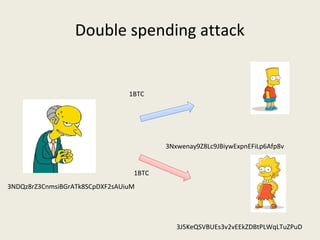
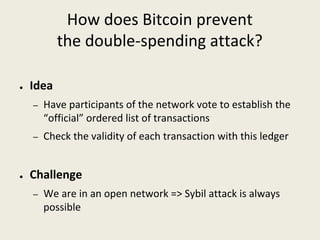
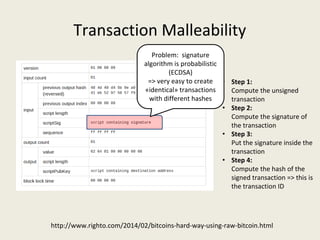
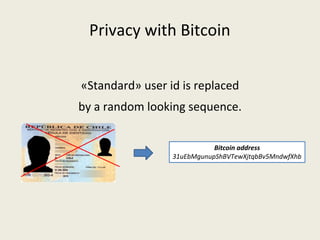
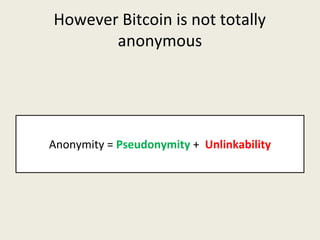
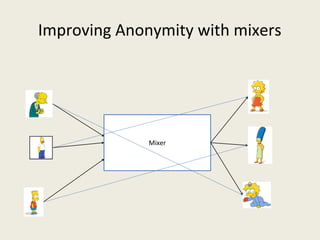
This document analyzes the security of Bitcoin by summarizing its key components and attacks. It describes Bitcoin's peer-to-peer network, blockchain, proof-of-work system, incentives for mining, and known attacks like double-spending, 51% attacks, selfish mining, and transaction malleability. It also discusses anonymity, alternatives to proof-of-work, and open problems regarding Bitcoin's scalability, centralization, and ASIC resistance.
![Proof of Work [Back2002]
00000
00001
00010
00011
00100
00101
00110
00111
01000
01001
01010
01011
01100
01101
01110
01111
10000
10001
10010
10011
10100
10101
10110
10111
11000
11001
11010
11011
11100
11101
11110
11111
H1001101|| x 000||10
Find value x so
that the output
begins with 3 zeros.](https://image.slidesharecdn.com/analyzingbitcoinsecurity-160620230311/85/Analyzing-Bitcoin-Security-14-320.jpg)
![On the limits of the Random Oracle
● Approximate Bitcoin Mining
[LH2015,VDR2015]
● Patent pending AsicBoost.com
● Enable to increase profitability of miners by
20%~30%](https://image.slidesharecdn.com/analyzingbitcoinsecurity-160620230311/85/Analyzing-Bitcoin-Security-15-320.jpg)
![51% attack [Nakamoto2008]
I will try to catch
up with 3 blocks
and rewrite the
history of
transactions](https://image.slidesharecdn.com/analyzingbitcoinsecurity-160620230311/85/Analyzing-Bitcoin-Security-22-320.jpg)
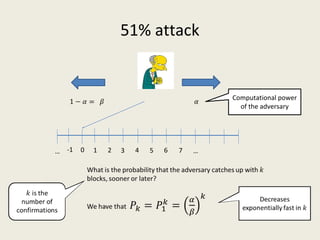
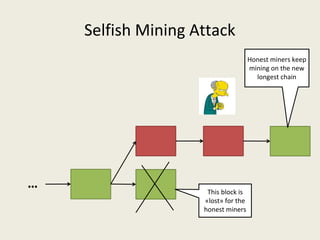
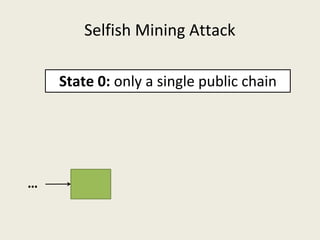
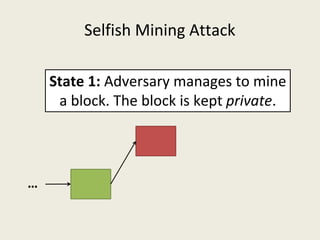
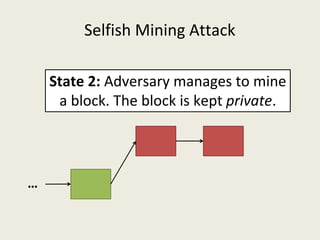
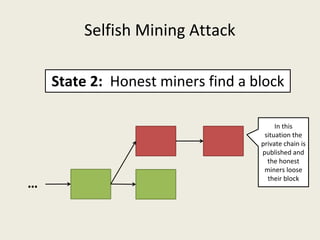
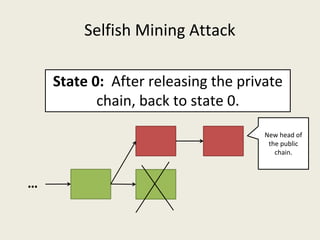
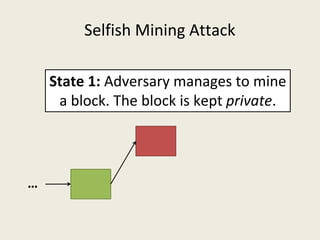
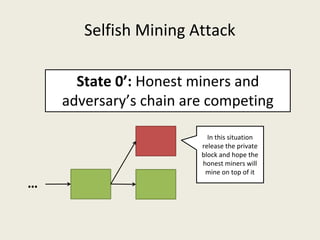
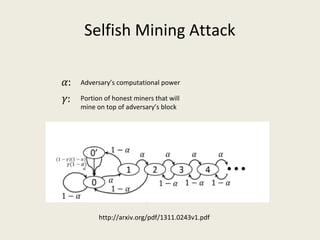
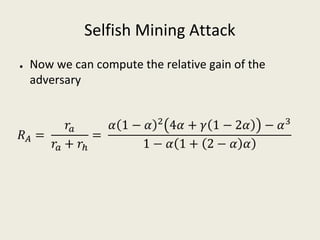
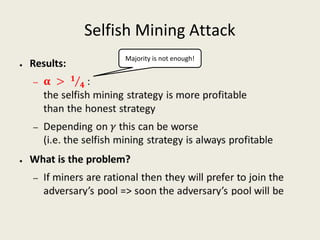
![Selfish Mining Attack [ES2014]
● Idea: The attacker will mine his blocks privately and
release them at the right time so that honest miners
waste their computational power.](https://image.slidesharecdn.com/analyzingbitcoinsecurity-160620230311/85/Analyzing-Bitcoin-Security-25-320.jpg)
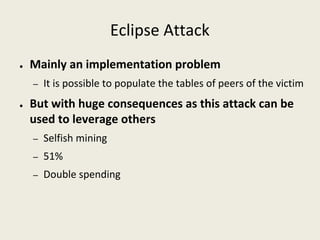
![Eclipse Attack [HKZG2015]
The attacker
surrounds the victim
in the P2P network
so that it can filter
his view on the
events.](https://image.slidesharecdn.com/analyzingbitcoinsecurity-160620230311/85/Analyzing-Bitcoin-Security-38-320.jpg)
![Other initiatives: Zerocash [BCG+2014]
• + Uses of near to practical
«universal» zero-knowlege proofs (ZK-SNARKs)
• + Provides a much higher level of anonymity
than mixers
• - Requires to change bitcoin source code
• - Requires a trusted setup](https://image.slidesharecdn.com/analyzingbitcoinsecurity-160620230311/85/Analyzing-Bitcoin-Security-45-320.jpg)
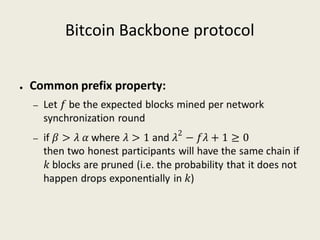
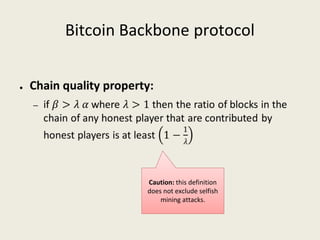
![Bitcoin Backbone protocol [GKL2014]
● Purpose: models the problem that occurs when the
time of mining a block becomes small
● Security model: synchronous setting (*)
(*) Asynchronous setting is even more complex and analyzed in [PSS2016].](https://image.slidesharecdn.com/analyzingbitcoinsecurity-160620230311/85/Analyzing-Bitcoin-Security-46-320.jpg)
![References
● [LH2015] Lerner, S. D., & HANKE, T. T. (2015). Block mining methods and
apparatus. Retrieved from
http://www.google.com/patents/WO2015077378A1?cl=en
● [VDR2015] Vilim, M., Duwe, H., & Kumar Rakesh. (2015). Approximate
Bitcoin Mining.
● [HKZG2015] Heilman, E., Kendler, A., Zohar, A., & Goldberg, S. (2015).
Eclipse Attacks on Bitcoin’s Peer-to-Peer Network. In USENIX Security
Symposium (pp. 129–144).
● [Back2002] Back, A. (2002). Hashcash - A Denial of Service Counter-
Measure.](https://image.slidesharecdn.com/analyzingbitcoinsecurity-160620230311/85/Analyzing-Bitcoin-Security-50-320.jpg)
![References
● [Nakamoto2008] Nakamoto, S. (2008). Bitcoin: A Peer-to-Peer Electronic
Cash System. Consulted. http://doi.org/10.1007/s10838-008-9062-0
● [ES2014] Eyal, I., & Sirer, E. G. (2014). Majority is not enough: Bitcoin
mining is vulnerable. Lecture Notes in Computer Science (Including
Subseries Lecture Notes in Artificial Intelligence and Lecture Notes in
Bioinformatics), 8437(.0243v1), 436–454. Cryptography and Security.
http://doi.org/10.1007/978-3-662-45472-5_28
● [BCG+2014] Ben-Sasson, E., Chiesa, A., Garman, C., Green, M., Miers, I.,
Tromer, E., & Virza, M. (2014). Zerocash: Decentralized Anonymous
Payments from Bitcoin. Retrieved from https://eprint.iacr.org/2014/349
● [GKL2014] Garay, J., Kiayias, A., & Leonardos, N. (2014). The Bitcoin
Backbone Protocol: Analysis and Applications. Retrieved from
https://eprint.iacr.org/2014/765
● [PSS2016] Pass, R., Seeman, L., & shelat, abhi. (n.d.). Analysis of the
Blockchain Protocol in Asynchronous Networks. Retrieved from
http://eprint.iacr.org/2016/454](https://image.slidesharecdn.com/analyzingbitcoinsecurity-160620230311/85/Analyzing-Bitcoin-Security-51-320.jpg)


![20260201 [FOSDEM] gomodjail - library sandboxing for Go modules.pdf](https://cdn.slidesharecdn.com/ss_thumbnails/20260201fosdemgomodjail-librarysandboxingforgomodules-260201225659-76609ec4-thumbnail.jpg?width=640&height=640&fit=bounds)


