A seminar presented in the partial fulfillment for the requirements of the internal
assessment of M.Sc. 3rd semester.
Presented by
Uttam Hazarika
Enrolment No. : ABHS510008
Department of Chemistry
Arunachal University of Studies, Namsai
15th Sept. 2018
Introduction 1
Types of Solid fuels 2
Primary solid fuels 3
Secondary Solid fuels 5
Advantages 7
Disadvantages 8
Conclusion 9
Acknowledgement 10
 Fuel is a combustible substance, containing carbon as a main
constituent, which on proper burning gives large amount of
heat, which can be used economically for domestic and
industrial purpose.
 Fossil fuels are those, which have been derived from fossil
of plant and animal life.
 Fossil fuels are found in the earth’s crust.
1/10
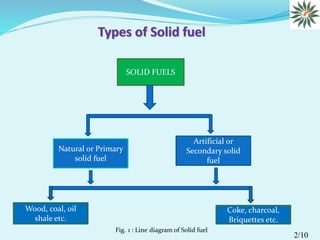
Fig. 1 : Line diagram of Solid fuel
SOLID FUELS
Natural or Primary
solid fuel
Artificial or
Secondary solid
fuel
Wood, coal, oil
shale etc.
Coke, charcoal,
Briquettes etc.
2/10
 The most commonly used and easily obtainable solid
fuel is wood.
 It is the oldest type of fuel which man had used for
centuries after the discovery of the fire itself.
 The ash content of wood is negligible.
3/10
Coal is a mineral substance of plant matter origin. It is
classified on the basis of its rank.
Plant matter
Peat
Natural
coal Lignite
Bituminous
Anthracite 4/10
It is obtained from destructive distillation of coal, being left in
the shape of solid residue. Coke can be classified into two
categories and hard coke.
 Soft coke
 Hard coke
Soft coke is obtained as the solid residue from the destructive
distillation of coal in the temperature range of 600-650oC. It contains 5
to 10% volatile matter. It burns without smoke. It is extensively used as
domestic fuel.
Hard coke is obtained as solid residue from the destructive distillation
of coal in the temperature range of 1200-1400oC. It burns with smoke
and is a useful fuel for metallurgical process.
5/10
Charcoal is a solid product left after produce derived from
destructive distillation of wood, being left in the shape of solid
residue. Charcoal burns rapidly with a clear flame, producing no
smoke and developing heat of about 6,050 Cal/kg.
Charcoal is used as
 Metallurgical fuel
 Industrial fuel
 Cooking fuel
 Carbon source
6/10
 They are easy to transport.
 They are convenient to store without any risk of
spontaneous explosion.
 Their cost of production is low.
 They posses moderate ignition temperature.
7/10
 Large proportion of heat is wasted.
 Burn with clinker formation.
 Combustion operation cannot be controlled easily.
 Cost of handling is high.
8/10
 Solid fuels have been used throughout human history to
create fire.
 Solid fuels are cheaper as compared to gaseous or liquid
fuels and it is easier to extract, more stable to transport in
many places are more readily available.
 Coal represents by far the largest component of the
world’s fossil fuel reserves.
9/10
I would like to express my sincere gratitude to respected
Prof. Poonam Rishishwar (Dean, Science),
Dr. Manjit singh Chhetri (H.O.D. ,Chemistry),
Dr. Md. Juned K. Ahmed (Asst. Professor, Chemistry),
Dr. Sanjay Singh, Deptt. Of Physics.
For providing me an opportunity to do my presentation and
help to make it and also thanks to Manash Jyoti Gogoi and my
classmates.
10/10
References
1. Sarkar, Samir;”Fuels and Combustion”, 3rd edition, 2009,
Universities press(India) private limited India.
2. https://en.wikipedia.org/wiki/Solid_fuel
3.https://www.springer.com/cda/content/document/cda.../978
3642028557-c1.pdf
4. nptel.ac.in/courses/103105110/m1l4.pdf
THANK YOU

Solid fuel

  • 1.
    A seminar presentedin the partial fulfillment for the requirements of the internal assessment of M.Sc. 3rd semester. Presented by Uttam Hazarika Enrolment No. : ABHS510008 Department of Chemistry Arunachal University of Studies, Namsai 15th Sept. 2018
  • 2.
    Introduction 1 Types ofSolid fuels 2 Primary solid fuels 3 Secondary Solid fuels 5 Advantages 7 Disadvantages 8 Conclusion 9 Acknowledgement 10
  • 3.
     Fuel isa combustible substance, containing carbon as a main constituent, which on proper burning gives large amount of heat, which can be used economically for domestic and industrial purpose.  Fossil fuels are those, which have been derived from fossil of plant and animal life.  Fossil fuels are found in the earth’s crust. 1/10
  • 4.
    Fig. 1 :Line diagram of Solid fuel SOLID FUELS Natural or Primary solid fuel Artificial or Secondary solid fuel Wood, coal, oil shale etc. Coke, charcoal, Briquettes etc. 2/10
  • 5.
     The mostcommonly used and easily obtainable solid fuel is wood.  It is the oldest type of fuel which man had used for centuries after the discovery of the fire itself.  The ash content of wood is negligible. 3/10
  • 6.
    Coal is amineral substance of plant matter origin. It is classified on the basis of its rank. Plant matter Peat Natural coal Lignite Bituminous Anthracite 4/10
  • 7.
    It is obtainedfrom destructive distillation of coal, being left in the shape of solid residue. Coke can be classified into two categories and hard coke.  Soft coke  Hard coke Soft coke is obtained as the solid residue from the destructive distillation of coal in the temperature range of 600-650oC. It contains 5 to 10% volatile matter. It burns without smoke. It is extensively used as domestic fuel. Hard coke is obtained as solid residue from the destructive distillation of coal in the temperature range of 1200-1400oC. It burns with smoke and is a useful fuel for metallurgical process. 5/10
  • 8.
    Charcoal is asolid product left after produce derived from destructive distillation of wood, being left in the shape of solid residue. Charcoal burns rapidly with a clear flame, producing no smoke and developing heat of about 6,050 Cal/kg. Charcoal is used as  Metallurgical fuel  Industrial fuel  Cooking fuel  Carbon source 6/10
  • 9.
     They areeasy to transport.  They are convenient to store without any risk of spontaneous explosion.  Their cost of production is low.  They posses moderate ignition temperature. 7/10
  • 10.
     Large proportionof heat is wasted.  Burn with clinker formation.  Combustion operation cannot be controlled easily.  Cost of handling is high. 8/10
  • 11.
     Solid fuelshave been used throughout human history to create fire.  Solid fuels are cheaper as compared to gaseous or liquid fuels and it is easier to extract, more stable to transport in many places are more readily available.  Coal represents by far the largest component of the world’s fossil fuel reserves. 9/10
  • 12.
    I would liketo express my sincere gratitude to respected Prof. Poonam Rishishwar (Dean, Science), Dr. Manjit singh Chhetri (H.O.D. ,Chemistry), Dr. Md. Juned K. Ahmed (Asst. Professor, Chemistry), Dr. Sanjay Singh, Deptt. Of Physics. For providing me an opportunity to do my presentation and help to make it and also thanks to Manash Jyoti Gogoi and my classmates. 10/10
  • 13.
    References 1. Sarkar, Samir;”Fuelsand Combustion”, 3rd edition, 2009, Universities press(India) private limited India. 2. https://en.wikipedia.org/wiki/Solid_fuel 3.https://www.springer.com/cda/content/document/cda.../978 3642028557-c1.pdf 4. nptel.ac.in/courses/103105110/m1l4.pdf
  • 14.