The Regulatory
Reform (Fire Safety)
    Order 2005
•To whom does it apply?
•The responsible/competent/relevant/person
•Fire Risk Assessment
•The role of the fire service
•Enforcement
•Guidance
•FDS
•Q & A
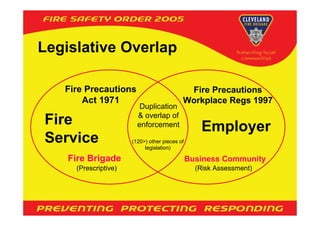
Legislative Overlap

   Fire Precautions                         Fire Precautions
       Act 1971                            Workplace Regs 1997
                         Duplication
                        & overlap of
Fire                    enforcement
                                                  Employer
Service               (120>) other pieces of
                           legislation)

    Fire Brigade                               Business Community
     (Prescriptive)                              (Risk Assessment)
Simplification,
Rationalisation, & Clarification


      Regulatory Reform
   (Fire Safety) Order 2005
Objectives of the Order

• To focus resources for fire prevention on
  premises which present the greatest risk

• Ensure that fire safety facilities and equipment
  (including fire alarms) are well maintained

• Overall aim is to reduce avoidable fires
To Whom & Where…

…does the RR(FS)O legislation apply?

 All “premises” defined in the order and
 includes any place and in particular any
 workplace, vehicle, vessel, aircraft or
 hovercraft; any installation on land and
 any tent or moveable structure.
Who & Where….

Does the RR(FS)O legislation apply to?


 All “premises”
 except!
It does not apply to:

• Domestic premises
• Offshore installations
• Ships (unless permanently moored)
• Fields, woods or land (forestry/agricultural)
• Aircraft, locomotive, rolling stock, trailer or semi-
  trailer (when used as a means of transport)
• Mines
• Boreholes
Responsible Person role:
Comply with articles 8 to 22
That responsible person must ensure that either he or another
  responsible (competent) person:
•   Carries out a Fire Risk Assessment
•   Records significant findings and subsequent control measures
•   Provides adequate general fire precautions
•   Considers the safety of all relevant persons
•   Provides adequate staff training
•   Appoints competent persons
Responsible Person
Defined as:
a) In relation to a workplace, the employer, if the
    workplace is to any extent under his control

b)        In relation to premises not falling within paragraph (a)

     i)     The person who has control over the premises (as an
            occupier or otherwise) in connection with the carrying on by
            him of a trade or business or other undertaking for profit or not
     OR
     ii)    The owner where the person in control of the premises does
            not have control in connection with the carrying on by that
            person of a trade or business or other undertaking
Responsible Person

 • Employer

 • Person in control of premises

 • Owner

 (NB the responsible person must appoint
   a competent person)
General Fire Precautions

•   Reduction of ignition sources
•   Provision of means of escape
•   Protection of means of escape
•   Provide fire fighting measures
•   Detection and warning
•   Staff training
•   Measures to mitigate the effects of fire
Relevant Person
 • Lawfully on the premises


 • In the vicinity of the premises who is
   at risk from a fire on the premises
Competent Person
• Sufficient training and experience or
  knowledge and other qualities to enable
  him to properly assist in undertaking the
  preventive and protective measures
• Responsible Person appoint themselves
• Employee
• Externally e.g. contractors
Fire Risk Assessment
5 Steps
 1. Identify Fire Hazards
 2. Identify People at Risk
 3. Evaluate, Remove, Reduce and Protect from Risk
    • Preventive
    • Protective
 4. Record, Plan, Instruct, Inform and Train
 5. Review and revise
The role of the Fire Service


•   Premises Audit Strategy
•   17 premises types
•   5 Risk Ratings
•   Very High to Very Low
•   Acceptable risk varies between premises type
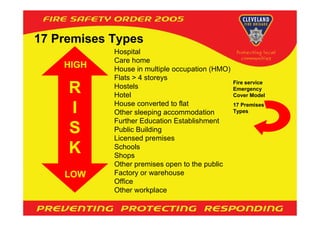
17 Premises Types
            Hospital
            Care home
    HIGH    House in multiple occupation (HMO)
            Flats > 4 storeys
                                                 Fire service
     R      Hostels
            Hotel
                                                 Emergency
                                                 Cover Model
            House converted to flat
     I      Other sleeping accommodation
                                                 17 Premises
                                                 Types
            Further Education Establishment
     S      Public Building
            Licensed premises
     K      Schools
            Shops
            Other premises open to the public
    LOW     Factory or warehouse
            Office
            Other workplace
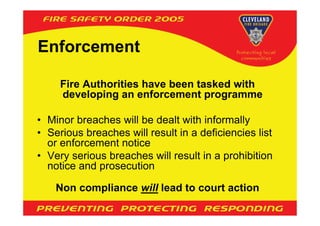
Enforcement

     Fire Authorities have been tasked with
     developing an enforcement programme

• Minor breaches will be dealt with informally
• Serious breaches will result in a deficiencies list
  or enforcement notice
• Very serious breaches will result in a prohibition
  notice and prosecution

    Non compliance will lead to court action
Enforcement
• By the local Fire Authority


• HSE - nuclear facilities, ships and construction sites


• Local councils – sports grounds


• Crown Premises Inspection Group – Crown Buildings
Types of Audit/Inspection

•   Initial Audit
•   Re-audit
•   Post Fire Analysis
•   Unwanted Fire Signal (False Alarms)
•   Arson Audit
•   Specific inspection
Records

• All records assist in proving due diligence
  •   Fire Risk Assessment
  •   Fire Warning System
  •   Emergency Lighting System
  •   Fire Fighting Equipment
  •   Staff Training
       • Theory
       • Practical (Drills)
Guidance:
Regulatory Reform (Fire Safety) Order 2005


     “A short guide to making your
        premises safe from fire”

    HM Government in partnership with
     Chief Fire Officers Association
• Offices and Shops
• Factories and Warehouses
• Sleeping Accommodation (excluding hospitals, care homes &
  private dwellings)
• Residential Care Premises
• Educational Premises (from Crèches up to Universities)
• Small and medium places of public assembly
  (pubs,clubs,restaurants, cafes churches, village halls etc)
• Large places of public assembly (300+) (shopping centres,
  conference centres, sports stadia etc)
• Theatres, Cinemas and similar premises
• Transport premises and facilities
• Open air events and venues (theme parks, zoos, fairgrounds etc)
• Healthcare Premises
• Animals Premises and Stables
• Means of escape for disabled people
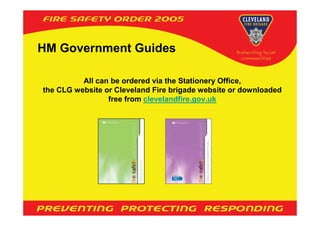
HM Government Guides

          All can be ordered via the Stationery Office,
the CLG website or Cleveland Fire brigade website or downloaded
                 free from clevelandfire.gov.uk
Q&A
Terry Connor

Cleveland Fire Brigade
 tconnor@clevelandfire.gov.uk

FSO Presentation June 2011

  • 1.
    The Regulatory Reform (FireSafety) Order 2005
  • 2.
    •To whom doesit apply? •The responsible/competent/relevant/person •Fire Risk Assessment •The role of the fire service •Enforcement •Guidance •FDS •Q & A
  • 3.
    Legislative Overlap Fire Precautions Fire Precautions Act 1971 Workplace Regs 1997 Duplication & overlap of Fire enforcement Employer Service (120>) other pieces of legislation) Fire Brigade Business Community (Prescriptive) (Risk Assessment)
  • 4.
    Simplification, Rationalisation, & Clarification Regulatory Reform (Fire Safety) Order 2005
  • 5.
    Objectives of theOrder • To focus resources for fire prevention on premises which present the greatest risk • Ensure that fire safety facilities and equipment (including fire alarms) are well maintained • Overall aim is to reduce avoidable fires
  • 6.
    To Whom &Where… …does the RR(FS)O legislation apply? All “premises” defined in the order and includes any place and in particular any workplace, vehicle, vessel, aircraft or hovercraft; any installation on land and any tent or moveable structure.
  • 7.
    Who & Where…. Doesthe RR(FS)O legislation apply to? All “premises” except!
  • 8.
    It does notapply to: • Domestic premises • Offshore installations • Ships (unless permanently moored) • Fields, woods or land (forestry/agricultural) • Aircraft, locomotive, rolling stock, trailer or semi- trailer (when used as a means of transport) • Mines • Boreholes
  • 9.
    Responsible Person role: Complywith articles 8 to 22 That responsible person must ensure that either he or another responsible (competent) person: • Carries out a Fire Risk Assessment • Records significant findings and subsequent control measures • Provides adequate general fire precautions • Considers the safety of all relevant persons • Provides adequate staff training • Appoints competent persons
  • 10.
    Responsible Person Defined as: a)In relation to a workplace, the employer, if the workplace is to any extent under his control b) In relation to premises not falling within paragraph (a) i) The person who has control over the premises (as an occupier or otherwise) in connection with the carrying on by him of a trade or business or other undertaking for profit or not OR ii) The owner where the person in control of the premises does not have control in connection with the carrying on by that person of a trade or business or other undertaking
  • 11.
    Responsible Person •Employer • Person in control of premises • Owner (NB the responsible person must appoint a competent person)
  • 12.
    General Fire Precautions • Reduction of ignition sources • Provision of means of escape • Protection of means of escape • Provide fire fighting measures • Detection and warning • Staff training • Measures to mitigate the effects of fire
  • 13.
    Relevant Person •Lawfully on the premises • In the vicinity of the premises who is at risk from a fire on the premises
  • 14.
    Competent Person • Sufficienttraining and experience or knowledge and other qualities to enable him to properly assist in undertaking the preventive and protective measures • Responsible Person appoint themselves • Employee • Externally e.g. contractors
  • 15.
    Fire Risk Assessment 5Steps 1. Identify Fire Hazards 2. Identify People at Risk 3. Evaluate, Remove, Reduce and Protect from Risk • Preventive • Protective 4. Record, Plan, Instruct, Inform and Train 5. Review and revise
  • 16.
    The role ofthe Fire Service • Premises Audit Strategy • 17 premises types • 5 Risk Ratings • Very High to Very Low • Acceptable risk varies between premises type
  • 17.
    17 Premises Types Hospital Care home HIGH House in multiple occupation (HMO) Flats > 4 storeys Fire service R Hostels Hotel Emergency Cover Model House converted to flat I Other sleeping accommodation 17 Premises Types Further Education Establishment S Public Building Licensed premises K Schools Shops Other premises open to the public LOW Factory or warehouse Office Other workplace
  • 18.
    Enforcement Fire Authorities have been tasked with developing an enforcement programme • Minor breaches will be dealt with informally • Serious breaches will result in a deficiencies list or enforcement notice • Very serious breaches will result in a prohibition notice and prosecution Non compliance will lead to court action
  • 19.
    Enforcement • By thelocal Fire Authority • HSE - nuclear facilities, ships and construction sites • Local councils – sports grounds • Crown Premises Inspection Group – Crown Buildings
  • 20.
    Types of Audit/Inspection • Initial Audit • Re-audit • Post Fire Analysis • Unwanted Fire Signal (False Alarms) • Arson Audit • Specific inspection
  • 21.
    Records • All recordsassist in proving due diligence • Fire Risk Assessment • Fire Warning System • Emergency Lighting System • Fire Fighting Equipment • Staff Training • Theory • Practical (Drills)
  • 22.
    Guidance: Regulatory Reform (FireSafety) Order 2005 “A short guide to making your premises safe from fire” HM Government in partnership with Chief Fire Officers Association
  • 23.
    • Offices andShops • Factories and Warehouses • Sleeping Accommodation (excluding hospitals, care homes & private dwellings) • Residential Care Premises • Educational Premises (from Crèches up to Universities) • Small and medium places of public assembly (pubs,clubs,restaurants, cafes churches, village halls etc) • Large places of public assembly (300+) (shopping centres, conference centres, sports stadia etc) • Theatres, Cinemas and similar premises • Transport premises and facilities • Open air events and venues (theme parks, zoos, fairgrounds etc) • Healthcare Premises • Animals Premises and Stables • Means of escape for disabled people
  • 24.
    HM Government Guides All can be ordered via the Stationery Office, the CLG website or Cleveland Fire brigade website or downloaded free from clevelandfire.gov.uk
  • 25.
  • 26.
    Terry Connor Cleveland FireBrigade tconnor@clevelandfire.gov.uk