Professionalism ▪ Integrity ▪ Trust ▪ Team Spirit
Work at Height - Scaffold
Working at height is the major cause of deaths in the construction industry and to mitigate the
risks, it is common practice for safe working platforms to be provided in the form of scaffolding.
When correctly erected and used these are a good solution to the problems of working at
height. But just because you have been provided with some form of scaffolding access and
working platform, do not just assume everything is OK and safe.
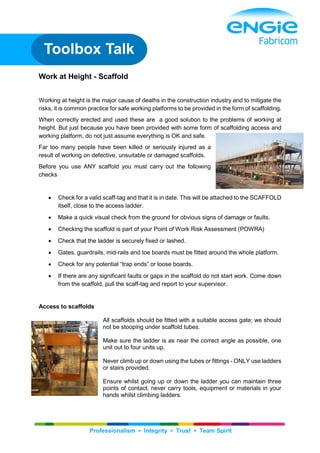
Far too many people have been killed or seriously injured as a
result of working on defective, unsuitable or damaged scaffolds.
Before you use ANY scaffold you must carry out the following
checks
 Check for a valid scaff-tag and that it is in date. This will be attached to the SCAFFOLD
itself, close to the access ladder.
 Make a quick visual check from the ground for obvious signs of damage or faults.
 Checking the scaffold is part of your Point of Work Risk Assessment (POWRA)
 Check that the ladder is securely fixed or lashed.
 Gates, guardrails, mid-rails and toe boards must be fitted around the whole platform.
 Check for any potential “trap ends” or loose boards.
 If there are any significant faults or gaps in the scaffold do not start work. Come down
from the scaffold, pull the scaff-tag and report to your supervisor.
Access to scaffolds
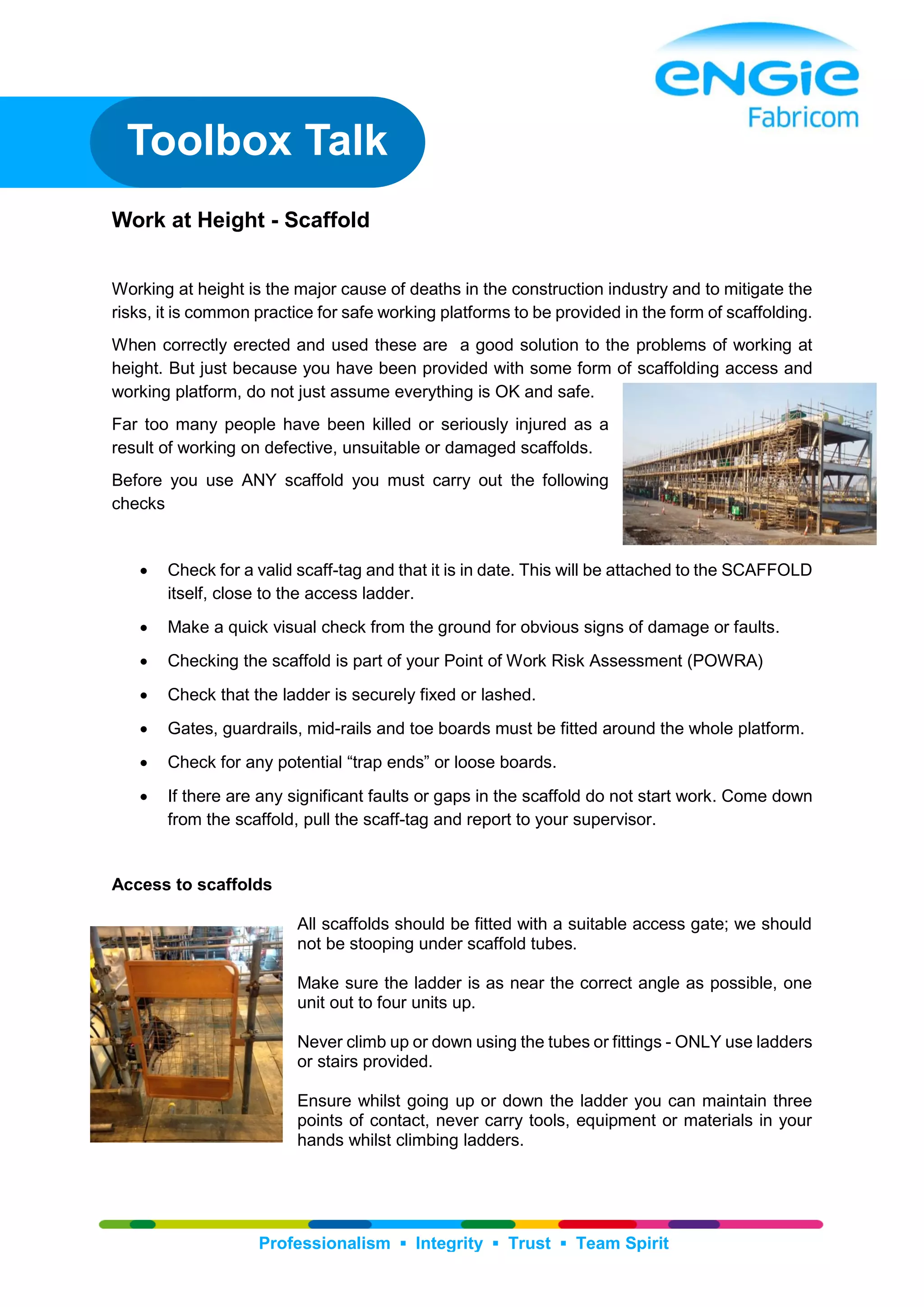
All scaffolds should be fitted with a suitable access gate; we should
not be stooping under scaffold tubes.
Make sure the ladder is as near the correct angle as possible, one
unit out to four units up.
Never climb up or down using the tubes or fittings - ONLY use ladders
or stairs provided.
Ensure whilst going up or down the ladder you can maintain three
points of contact, never carry tools, equipment or materials in your
hands whilst climbing ladders.
Toolbox Talk
Professionalism ▪ Integrity ▪ Trust ▪ Team Spirit
Always use suitable bags and hand lines for lifting / lowering anything required on the scaffold.
Never stand on the toe boards, mid or handrails to gain extra height to reach a job.
Never lean out from the scaffold platform, if you cannot safely reach your entire job STOP!
See your supervisor and either get the scaffold altered or reassess the risk assessment to
allow for a harness to be worn for leaning out, remember tool lanyards must be used if leaning
out from a scaffold.
Winter Working
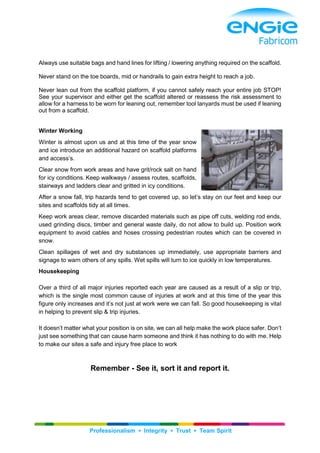
Winter is almost upon us and at this time of the year snow
and ice introduce an additional hazard on scaffold platforms
and access’s.
Clear snow from work areas and have grit/rock salt on hand
for icy conditions. Keep walkways / assess routes, scaffolds,
stairways and ladders clear and gritted in icy conditions.
After a snow fall, trip hazards tend to get covered up, so let’s stay on our feet and keep our
sites and scaffolds tidy at all times.
Keep work areas clear, remove discarded materials such as pipe off cuts, welding rod ends,
used grinding discs, timber and general waste daily, do not allow to build up. Position work
equipment to avoid cables and hoses crossing pedestrian routes which can be covered in
snow.
Clean spillages of wet and dry substances up immediately, use appropriate barriers and
signage to warn others of any spills. Wet spills will turn to ice quickly in low temperatures.
Housekeeping
Over a third of all major injuries reported each year are caused as a result of a slip or trip,
which is the single most common cause of injuries at work and at this time of the year this
figure only increases and it’s not just at work were we can fall. So good housekeeping is vital
in helping to prevent slip & trip injuries.
It doesn’t matter what your position is on site, we can all help make the work place safer. Don’t
just see something that can cause harm someone and think it has nothing to do with me. Help
to make our sites a safe and injury free place to work
Remember - See it, sort it and report it.

40. work at height scaffold

  • 1.
    Professionalism ▪ Integrity▪ Trust ▪ Team Spirit Work at Height - Scaffold Working at height is the major cause of deaths in the construction industry and to mitigate the risks, it is common practice for safe working platforms to be provided in the form of scaffolding. When correctly erected and used these are a good solution to the problems of working at height. But just because you have been provided with some form of scaffolding access and working platform, do not just assume everything is OK and safe. Far too many people have been killed or seriously injured as a result of working on defective, unsuitable or damaged scaffolds. Before you use ANY scaffold you must carry out the following checks  Check for a valid scaff-tag and that it is in date. This will be attached to the SCAFFOLD itself, close to the access ladder.  Make a quick visual check from the ground for obvious signs of damage or faults.  Checking the scaffold is part of your Point of Work Risk Assessment (POWRA)  Check that the ladder is securely fixed or lashed.  Gates, guardrails, mid-rails and toe boards must be fitted around the whole platform.  Check for any potential “trap ends” or loose boards.  If there are any significant faults or gaps in the scaffold do not start work. Come down from the scaffold, pull the scaff-tag and report to your supervisor. Access to scaffolds All scaffolds should be fitted with a suitable access gate; we should not be stooping under scaffold tubes. Make sure the ladder is as near the correct angle as possible, one unit out to four units up. Never climb up or down using the tubes or fittings - ONLY use ladders or stairs provided. Ensure whilst going up or down the ladder you can maintain three points of contact, never carry tools, equipment or materials in your hands whilst climbing ladders. Toolbox Talk
  • 2.
    Professionalism ▪ Integrity▪ Trust ▪ Team Spirit Always use suitable bags and hand lines for lifting / lowering anything required on the scaffold. Never stand on the toe boards, mid or handrails to gain extra height to reach a job. Never lean out from the scaffold platform, if you cannot safely reach your entire job STOP! See your supervisor and either get the scaffold altered or reassess the risk assessment to allow for a harness to be worn for leaning out, remember tool lanyards must be used if leaning out from a scaffold. Winter Working Winter is almost upon us and at this time of the year snow and ice introduce an additional hazard on scaffold platforms and access’s. Clear snow from work areas and have grit/rock salt on hand for icy conditions. Keep walkways / assess routes, scaffolds, stairways and ladders clear and gritted in icy conditions. After a snow fall, trip hazards tend to get covered up, so let’s stay on our feet and keep our sites and scaffolds tidy at all times. Keep work areas clear, remove discarded materials such as pipe off cuts, welding rod ends, used grinding discs, timber and general waste daily, do not allow to build up. Position work equipment to avoid cables and hoses crossing pedestrian routes which can be covered in snow. Clean spillages of wet and dry substances up immediately, use appropriate barriers and signage to warn others of any spills. Wet spills will turn to ice quickly in low temperatures. Housekeeping Over a third of all major injuries reported each year are caused as a result of a slip or trip, which is the single most common cause of injuries at work and at this time of the year this figure only increases and it’s not just at work were we can fall. So good housekeeping is vital in helping to prevent slip & trip injuries. It doesn’t matter what your position is on site, we can all help make the work place safer. Don’t just see something that can cause harm someone and think it has nothing to do with me. Help to make our sites a safe and injury free place to work Remember - See it, sort it and report it.