Topic:
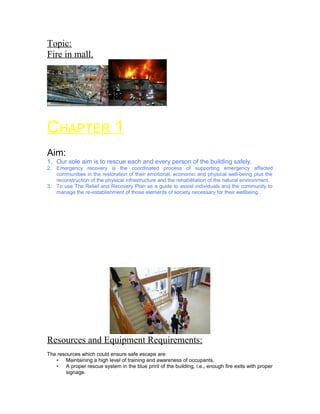
Fire in mall.


CHAPTER 1
Aim:
1. Our sole aim is to rescue each and every person of the building safely.
2. Emergency recovery is the coordinated process of supporting emergency affected
   communities in the restoration of their emotional, economic and physical well-being plus the
   reconstruction of the physical infrastructure and the rehabilitation of the natural environment.
3. To use The Relief and Recovery Plan as a guide to assist individuals and the community to
   manage the re-establishment of those elements of society necessary for their wellbeing..


Resources and Equipment Requirements:
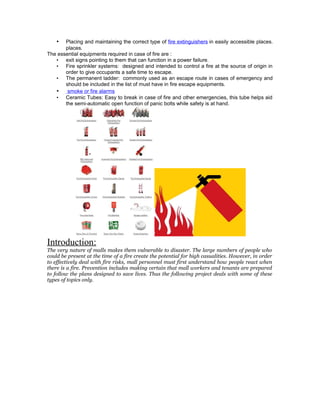
The resources which could ensure safe escape are:
   • Maintaining a high level of training and awareness of occupants.
   • A proper rescue system in the blue print of the building, i.e., enough fire exits with proper
       signage.
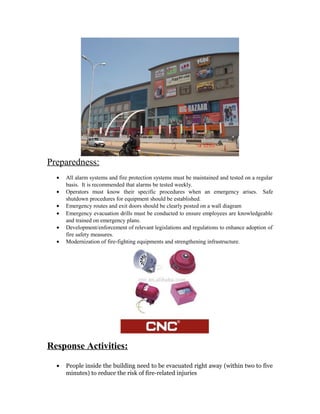
•  Placing and maintaining the correct type of fire extinguishers in easily accessible places.
       places.
The essential equipments required in case of fire are :
   • exit signs pointing to them that can function in a power failure.
   • Fire sprinkler systems: designed and intended to control a fire at the source of origin in
       order to give occupants a safe time to escape.
   • The permanent ladder: commonly used as an escape route in cases of emergency and
       should be included in the list of must have in fire escape equipments.
   • smoke or fire alarms
   • Ceramic Tubes: Easy to break in case of fire and other emergencies, this tube helps aid
       the semi-automatic open function of panic bolts while safety is at hand.


Introduction:
The very nature of malls makes them vulnerable to disaster. The large numbers of people who
could be present at the time of a fire create the potential for high casualities. However, in order
to effectively deal with fire risks, mall personnel must first understand how people react when
there is a fire. Prevention includes making certain that mall workers and tenants are prepared
to follow the plans designed to save lives. Thus the following project deals with some of these
types of topics only.
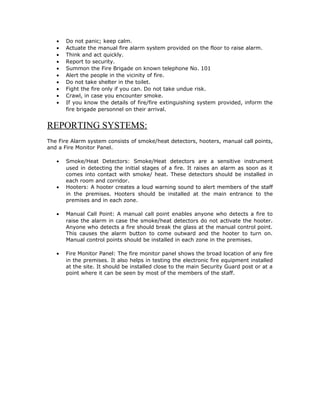
Preparedness:
  •   All alarm systems and fire protection systems must be maintained and tested on a regular
      basis. It is recommended that alarms be tested weekly.
  •   Operators must know their specific procedures when an emergency arises. Safe
      shutdown procedures for equipment should be established.
  •   Emergency routes and exit doors should be clearly posted on a wall diagram
  •   Emergency evacuation drills must be conducted to ensure employees are knowledgeable
      and trained on emergency plans.
  •   Development/enforcement of relevant legislations and regulations to enhance adoption of
      fire safety measures.
  •   Modernization of fire-fighting equipments and strengthening infrastructure.


Response Activities:

  •   People inside the building need to be evacuated right away (within two to five
      minutes) to reduce the risk of fire-related injuries
•   Do not panic; keep calm.
   •   Actuate the manual fire alarm system provided on the floor to raise alarm.
   •   Think and act quickly.
   •   Report to security.
   •   Summon the Fire Brigade on known telephone No. 101
   •   Alert the people in the vicinity of fire.
   •   Do not take shelter in the toilet.
   •   Fight the fire only if you can. Do not take undue risk.
   •   Crawl, in case you encounter smoke.
   •   If you know the details of fire/fire extinguishing system provided, inform the
       fire brigade personnel on their arrival.


REPORTING SYSTEMS:
The Fire Alarm system consists of smoke/heat detectors, hooters, manual call points,
and a Fire Monitor Panel.

   •   Smoke/Heat Detectors: Smoke/Heat detectors are a sensitive instrument
       used in detecting the initial stages of a fire. It raises an alarm as soon as it
       comes into contact with smoke/ heat. These detectors should be installed in
       each room and corridor.
   •   Hooters: A hooter creates a loud warning sound to alert members of the staff
       in the premises. Hooters should be installed at the main entrance to the
       premises and in each zone.

   •   Manual Call Point: A manual call point enables anyone who detects a fire to
       raise the alarm in case the smoke/heat detectors do not activate the hooter.
       Anyone who detects a fire should break the glass at the manual control point.
       This causes the alarm button to come outward and the hooter to turn on.
       Manual control points should be installed in each zone in the premises.

   •   Fire Monitor Panel: The fire monitor panel shows the broad location of any fire
       in the premises. It also helps in testing the electronic fire equipment installed
       at the site. It should be installed close to the main Security Guard post or at a
       point where it can be seen by most of the members of the staff.
RECOMMENDATIONS:
  1. Acquaint yourself with the layout of the escape routes, staircases, refuge areas
     and the location of fire alarms.
  2. All the fire protection installations such as fire pumps, wet riser-cum-down
     comer, sprinkler installation, fire extinguishers etc should be kept in a good
     state.
  3. Ground all the lifts, including FIRE LIFT, in case of a fire.
  4. Practice evacuation drills periodically.
  5. Irrespective of the magnitude of fire, summon the Fire Brigade at the earliest.


Don’ts
  1. Do not allow storages or obstructions in the common corridors and staircases.
  2. Do not allow the Fire doors of the staircases to be kept open. In case of fire,
     heat and smoke enters the staircases and prevent the escape of people.
  3. Do not allow Electric Meter Rooms to be used as storages, dumping places or
     as living quarters for servants. They are potential fire hazards.
  4. Never paint or coat fire detectors or sprinkler heads. If done, they will become
     ineffective.
  5. Do not allow Fire fighting tanks to be misused or remain empty
  6. Do not 'switch off' Fire/Smoke Detection System. This may lead to fire
     remaining unnoticed till it assumed large magnitude
Role of Govt. Agencies:
 Under the new Act of Fire Service, Fire and rescue Authorities now have a range of
statutory duties to:-

   •       Promote Fire Safety; and
   •       To prepare for:
              o fighting fires and protecting people and property from fires;
              o In addition, all Fire and Rescue authorities will be able to do other
                  things to respond to the particular needs of their communities and the
                  risks they face.
       •     At the site of an emergency or disaster, a local authority must
   (a) Carry out an action;
   (b) Cease an action it is carrying out; or

   (c) Change the way it is carrying out an action;
       •     To provide standby fire-safety arrangements at large gatherings and
             important public and private functions by charging a nominal amount for
             the service rendered.

       •     To provide Ambulance-service for rushing the sick and the injured
             to hospital.


       •     To educate and train people in fire prevention and fire-fighting in
             order to reduce risk by fire.
•    Fire Prevention is an elementary function of Fire Service Department.
           In order to intensify fire prevention work, Fire Prevention Wings have
           been formed.    These Wings undertake propagation of fire prevention
           methods to the rural and urban population and address specified target
           groups so that risks by fire are minimized.


Relief and Recovery Plan:
  •       Contact the mall’s insurance provider once everyone is safely out of the mall
          in a safe place.
  •       If the mall does not have insurance, some aid may be received through the
          local Red Cross chapters and the fire department.
  •       Make an account of all structural damage and damage to the possessions. If
          the mall or possessions are burned or destroyed, a written account must be
          made. Taking photos is also a good way to document any damage.
  •       After documenting damage, extract any goods or possessions that are in fairly
          good condition and store the rest together in the home out of view.
  •       Provide your insurance provider or Red Cross with a full account of damages
          and possessions that need replacing. Repairs and recovery will come quickest
          if the mall is insured.
  •
Co-Ordination Among Various Agencies:
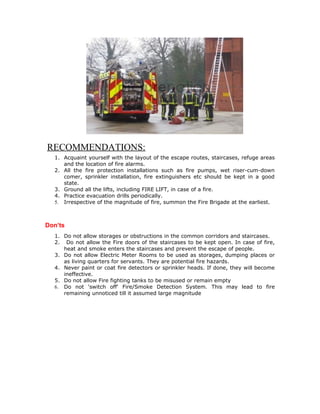
We fight fires in residential and commercial occupancies from single family
homes to packed apartment complexes to high rise office buildings to factories
and shopping malls. We perform rescues extracting people

QUICK RESPONSE SYSTEM:


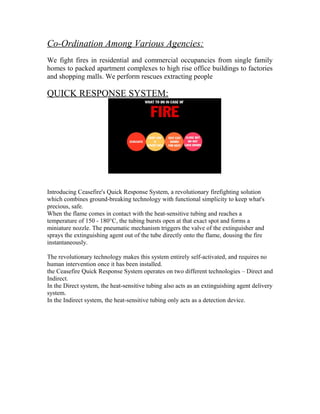
Introducing Ceasefire's Quick Response System, a revolutionary firefighting solution
which combines ground-breaking technology with functional simplicity to keep what's
precious, safe.
When the flame comes in contact with the heat-sensitive tubing and reaches a
temperature of 150 - 180°C, the tubing bursts open at that exact spot and forms a
miniature nozzle. The pneumatic mechanism triggers the valve of the extinguisher and
sprays the extinguishing agent out of the tube directly onto the flame, dousing the fire
instantaneously.

The revolutionary technology makes this system entirely self-activated, and requires no
human intervention once it has been installed.
the Ceasefire Quick Response System operates on two different technologies – Direct and
Indirect.
In the Direct system, the heat-sensitive tubing also acts as an extinguishing agent delivery
system.
In the Indirect system, the heat-sensitive tubing only acts as a detection device.
Preparedness fire

Preparedness fire

  • 1.
    Topic: Fire in mall. CHAPTER1 Aim: 1. Our sole aim is to rescue each and every person of the building safely. 2. Emergency recovery is the coordinated process of supporting emergency affected communities in the restoration of their emotional, economic and physical well-being plus the reconstruction of the physical infrastructure and the rehabilitation of the natural environment. 3. To use The Relief and Recovery Plan as a guide to assist individuals and the community to manage the re-establishment of those elements of society necessary for their wellbeing.. Resources and Equipment Requirements: The resources which could ensure safe escape are: • Maintaining a high level of training and awareness of occupants. • A proper rescue system in the blue print of the building, i.e., enough fire exits with proper signage.
  • 2.
    • Placingand maintaining the correct type of fire extinguishers in easily accessible places. places. The essential equipments required in case of fire are : • exit signs pointing to them that can function in a power failure. • Fire sprinkler systems: designed and intended to control a fire at the source of origin in order to give occupants a safe time to escape. • The permanent ladder: commonly used as an escape route in cases of emergency and should be included in the list of must have in fire escape equipments. • smoke or fire alarms • Ceramic Tubes: Easy to break in case of fire and other emergencies, this tube helps aid the semi-automatic open function of panic bolts while safety is at hand. Introduction: The very nature of malls makes them vulnerable to disaster. The large numbers of people who could be present at the time of a fire create the potential for high casualities. However, in order to effectively deal with fire risks, mall personnel must first understand how people react when there is a fire. Prevention includes making certain that mall workers and tenants are prepared to follow the plans designed to save lives. Thus the following project deals with some of these types of topics only.
  • 3.
    Preparedness: • All alarm systems and fire protection systems must be maintained and tested on a regular basis. It is recommended that alarms be tested weekly. • Operators must know their specific procedures when an emergency arises. Safe shutdown procedures for equipment should be established. • Emergency routes and exit doors should be clearly posted on a wall diagram • Emergency evacuation drills must be conducted to ensure employees are knowledgeable and trained on emergency plans. • Development/enforcement of relevant legislations and regulations to enhance adoption of fire safety measures. • Modernization of fire-fighting equipments and strengthening infrastructure. Response Activities: • People inside the building need to be evacuated right away (within two to five minutes) to reduce the risk of fire-related injuries
  • 4.
    • Do not panic; keep calm. • Actuate the manual fire alarm system provided on the floor to raise alarm. • Think and act quickly. • Report to security. • Summon the Fire Brigade on known telephone No. 101 • Alert the people in the vicinity of fire. • Do not take shelter in the toilet. • Fight the fire only if you can. Do not take undue risk. • Crawl, in case you encounter smoke. • If you know the details of fire/fire extinguishing system provided, inform the fire brigade personnel on their arrival. REPORTING SYSTEMS: The Fire Alarm system consists of smoke/heat detectors, hooters, manual call points, and a Fire Monitor Panel. • Smoke/Heat Detectors: Smoke/Heat detectors are a sensitive instrument used in detecting the initial stages of a fire. It raises an alarm as soon as it comes into contact with smoke/ heat. These detectors should be installed in each room and corridor. • Hooters: A hooter creates a loud warning sound to alert members of the staff in the premises. Hooters should be installed at the main entrance to the premises and in each zone. • Manual Call Point: A manual call point enables anyone who detects a fire to raise the alarm in case the smoke/heat detectors do not activate the hooter. Anyone who detects a fire should break the glass at the manual control point. This causes the alarm button to come outward and the hooter to turn on. Manual control points should be installed in each zone in the premises. • Fire Monitor Panel: The fire monitor panel shows the broad location of any fire in the premises. It also helps in testing the electronic fire equipment installed at the site. It should be installed close to the main Security Guard post or at a point where it can be seen by most of the members of the staff.
  • 5.
    RECOMMENDATIONS: 1.Acquaint yourself with the layout of the escape routes, staircases, refuge areas and the location of fire alarms. 2. All the fire protection installations such as fire pumps, wet riser-cum-down comer, sprinkler installation, fire extinguishers etc should be kept in a good state. 3. Ground all the lifts, including FIRE LIFT, in case of a fire. 4. Practice evacuation drills periodically. 5. Irrespective of the magnitude of fire, summon the Fire Brigade at the earliest. Don’ts 1. Do not allow storages or obstructions in the common corridors and staircases. 2. Do not allow the Fire doors of the staircases to be kept open. In case of fire, heat and smoke enters the staircases and prevent the escape of people. 3. Do not allow Electric Meter Rooms to be used as storages, dumping places or as living quarters for servants. They are potential fire hazards. 4. Never paint or coat fire detectors or sprinkler heads. If done, they will become ineffective. 5. Do not allow Fire fighting tanks to be misused or remain empty 6. Do not 'switch off' Fire/Smoke Detection System. This may lead to fire remaining unnoticed till it assumed large magnitude
  • 6.
    Role of Govt.Agencies: Under the new Act of Fire Service, Fire and rescue Authorities now have a range of statutory duties to:- • Promote Fire Safety; and • To prepare for: o fighting fires and protecting people and property from fires; o In addition, all Fire and Rescue authorities will be able to do other things to respond to the particular needs of their communities and the risks they face. • At the site of an emergency or disaster, a local authority must (a) Carry out an action; (b) Cease an action it is carrying out; or (c) Change the way it is carrying out an action; • To provide standby fire-safety arrangements at large gatherings and important public and private functions by charging a nominal amount for the service rendered. • To provide Ambulance-service for rushing the sick and the injured to hospital. • To educate and train people in fire prevention and fire-fighting in order to reduce risk by fire.
  • 7.
    • Fire Prevention is an elementary function of Fire Service Department. In order to intensify fire prevention work, Fire Prevention Wings have been formed. These Wings undertake propagation of fire prevention methods to the rural and urban population and address specified target groups so that risks by fire are minimized. Relief and Recovery Plan: • Contact the mall’s insurance provider once everyone is safely out of the mall in a safe place. • If the mall does not have insurance, some aid may be received through the local Red Cross chapters and the fire department. • Make an account of all structural damage and damage to the possessions. If the mall or possessions are burned or destroyed, a written account must be made. Taking photos is also a good way to document any damage. • After documenting damage, extract any goods or possessions that are in fairly good condition and store the rest together in the home out of view. • Provide your insurance provider or Red Cross with a full account of damages and possessions that need replacing. Repairs and recovery will come quickest if the mall is insured. •
  • 8.
    Co-Ordination Among VariousAgencies: We fight fires in residential and commercial occupancies from single family homes to packed apartment complexes to high rise office buildings to factories and shopping malls. We perform rescues extracting people QUICK RESPONSE SYSTEM: Introducing Ceasefire's Quick Response System, a revolutionary firefighting solution which combines ground-breaking technology with functional simplicity to keep what's precious, safe. When the flame comes in contact with the heat-sensitive tubing and reaches a temperature of 150 - 180°C, the tubing bursts open at that exact spot and forms a miniature nozzle. The pneumatic mechanism triggers the valve of the extinguisher and sprays the extinguishing agent out of the tube directly onto the flame, dousing the fire instantaneously. The revolutionary technology makes this system entirely self-activated, and requires no human intervention once it has been installed. the Ceasefire Quick Response System operates on two different technologies – Direct and Indirect. In the Direct system, the heat-sensitive tubing also acts as an extinguishing agent delivery system. In the Indirect system, the heat-sensitive tubing only acts as a detection device.