FIRE SAFETY LOG BOOK 
Hospitality	Manuals	2012	 Page	1	
 
Fire Safety Log Book
Premises Name:
Premises Address:
Date From:
Date To:
Location of Log Book:
   
FIRE SAFETY LOG BOOK 
Hospitality	Manuals	2012	 Page	2	
 
 
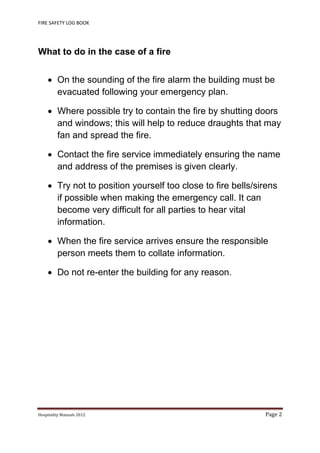
What to do in the case of a fire
 On the sounding of the fire alarm the building must be
evacuated following your emergency plan.
 Where possible try to contain the fire by shutting doors
and windows; this will help to reduce draughts that may
fan and spread the fire.
 Contact the fire service immediately ensuring the name
and address of the premises is given clearly.
 Try not to position yourself too close to fire bells/sirens
if possible when making the emergency call. It can
become very difficult for all parties to hear vital
information.
 When the fire service arrives ensure the responsible
person meets them to collate information.
 Do not re-enter the building for any reason.
   
FIRE SAFETY LOG BOOK 
Hospitality	Manuals	2012	 Page	3	
 
FIRE	SAFETY	LOG	BOOK	
The fire safety records included in this logbook, a suitable and sufficient fire risk assessment and well 
thought out emergency plans will lead to a good fire safety culture and a quality safety management 
structure.  
Record keeping will provide valuable resources to assist you in two areas: 
 Effectively managing the fire strategy for your Hotel premises; and 
 Providing evidence to enforcing authorities or the courts that you have done everything that 
could be reasonably expected to ensure safety within the business premises and to comply 
with the law. 
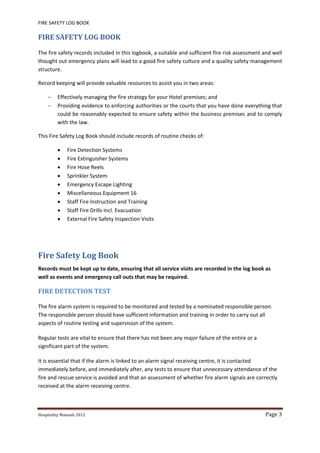
This Fire Safety Log Book should include records of routine checks of: 
 Fire Detection Systems 
 Fire Extinguisher Systems 
 Fire Hose Reels 
 Sprinkler System 
 Emergency Escape Lighting 
 Miscellaneous Equipment 16 
 Staff Fire Instruction and Training 
 Staff Fire Drills incl. Evacuation 
 External Fire Safety Inspection Visits 
 
Fire	Safety	Log	Book	
Records must be kept up to date, ensuring that all service visits are recorded in the log book as 
well as events and emergency call outs that may be required.  
FIRE	DETECTION	TEST		
The fire alarm system is required to be monitored and tested by a nominated responsible person. 
The responsible person should have sufficient information and training in order to carry out all 
aspects of routine testing and supervision of the system. 
Regular tests are vital to ensure that there has not been any major failure of the entire or a 
significant part of the system. 
It is essential that if the alarm is linked to an alarm signal receiving centre, it is contacted 
immediately before, and immediately after, any tests to ensure that unnecessary attendance of the 
fire and rescue service is avoided and that an assessment of whether fire alarm signals are correctly 
received at the alarm receiving centre. 
FIRE SAFETY LOG BOOK 
Hospitality	Manuals	2012	 Page	4	
 
 Inspect the alarm panel daily for normal operation of the system (this does not have to be 
recorded). If any defects are found then record in the log book and report it to a responsible 
person. It should be ensured that any faults recorded have received appropriate attention. 
 Every week a different manual call point should be operated (same time each week) during 
normal working hours. In premises where employees work out of these hours, an additional test 
should be carried out at least once a month to ensure familiarity with the sound of the fire 
alarm. There is no maximum limit for the period of time it takes to test the system in rotation. 
 Automatic door releases that are connected to the fire alarm system should be tested weekly in 
conjunction with the fire alarm test, checking that all doors are being released and close fully 
onto the door rebates. 
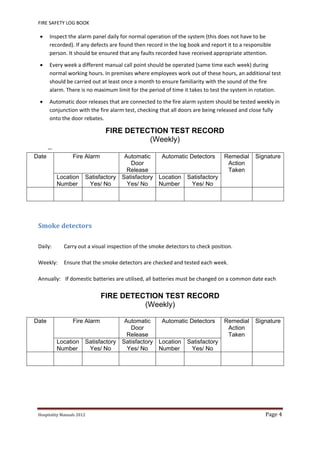
FIRE DETECTION TEST RECORD
(Weekly)

Date Fire Alarm Automatic
Door
Release
Automatic Detectors Remedial
Action
Taken
Signature
Location
Number
Satisfactory
Yes/ No
Satisfactory
Yes/ No
Location
Number
Satisfactory
Yes/ No
 
Smoke	detectors	
 
Daily:   Carry out a visual inspection of the smoke detectors to check position. 
Weekly:   Ensure that the smoke detectors are checked and tested each week. 
Annually:   If domestic batteries are utilised, all batteries must be changed on a common date each 
FIRE DETECTION TEST RECORD
(Weekly)
Date Fire Alarm Automatic
Door
Release
Automatic Detectors Remedial
Action
Taken
Signature
Location
Number
Satisfactory
Yes/ No
Satisfactory
Yes/ No
Location
Number
Satisfactory
Yes/ No


FIRE SAFETY LOG BOOK 
Hospitality	Manuals	2012	 Page	5	
 
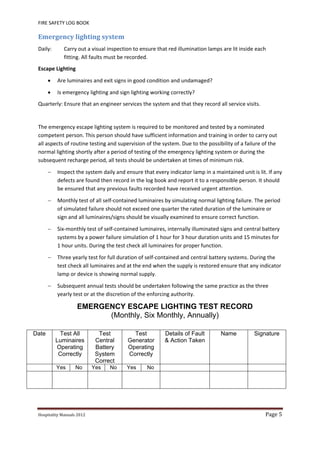
Emergency	lighting	system	
Daily:  Carry out a visual inspection to ensure that red illumination lamps are lit inside each 
fitting. All faults must be recorded. 
Escape Lighting 
 Are luminaires and exit signs in good condition and undamaged? 
 Is emergency lighting and sign lighting working correctly? 
Quarterly: Ensure that an engineer services the system and that they record all service visits. 
 
The emergency escape lighting system is required to be monitored and tested by a nominated 
competent person. This person should have sufficient information and training in order to carry out 
all aspects of routine testing and supervision of the system. Due to the possibility of a failure of the 
normal lighting shortly after a period of testing of the emergency lighting system or during the 
subsequent recharge period, all tests should be undertaken at times of minimum risk. 
 Inspect the system daily and ensure that every indicator lamp in a maintained unit is lit. If any 
defects are found then record in the log book and report it to a responsible person. It should 
be ensured that any previous faults recorded have received urgent attention. 
 Monthly test of all self‐contained luminaires by simulating normal lighting failure. The period 
of simulated failure should not exceed one quarter the rated duration of the luminaire or 
sign and all luminaires/signs should be visually examined to ensure correct function. 
 Six‐monthly test of self‐contained luminaires, internally illuminated signs and central battery 
systems by a power failure simulation of 1 hour for 3 hour duration units and 15 minutes for 
1 hour units. During the test check all luminaires for proper function. 
 Three yearly test for full duration of self‐contained and central battery systems. During the 
test check all luminaires and at the end when the supply is restored ensure that any indicator 
lamp or device is showing normal supply. 
 Subsequent annual tests should be undertaken following the same practice as the three 
yearly test or at the discretion of the enforcing authority. 
EMERGENCY ESCAPE LIGHTING TEST RECORD
(Monthly, Six Monthly, Annually)
Date Test All
Luminaires
Operating
Correctly
Test
Central
Battery
System
Correct
Test
Generator
Operating
Correctly
Details of Fault
& Action Taken
Name Signature
Yes No Yes No Yes No
 
FIRE SAFETY LOG BOOK 
Hospitality	Manuals	2012	 Page	6	
 
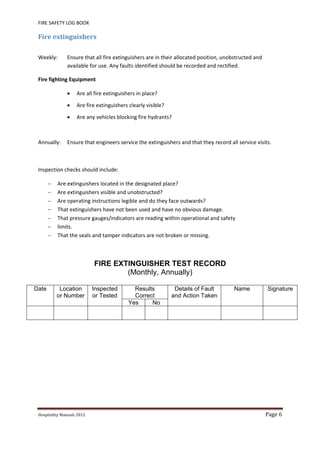
Fire	extinguishers	
 
Weekly:   Ensure that all fire extinguishers are in their allocated position, unobstructed and 
available for use. Any faults identified should be recorded and rectified. 
Fire fighting Equipment 
 Are all fire extinguishers in place? 
 Are fire extinguishers clearly visible? 
 Are any vehicles blocking fire hydrants? 
 
Annually:   Ensure that engineers service the extinguishers and that they record all service visits. 
 
Inspection checks should include: 
 Are extinguishers located in the designated place? 
 Are extinguishers visible and unobstructed? 
 Are operating instructions legible and do they face outwards? 
 That extinguishers have not been used and have no obvious damage. 
 That pressure gauges/indicators are reading within operational and safety 
 limits. 
 That the seals and tamper indicators are not broken or missing. 
 
FIRE EXTINGUISHER TEST RECORD
(Monthly, Annually)
Date Location
or Number
Inspected
or Tested
Results
Correct
Details of Fault
and Action Taken
Name Signature
Yes No
 
 
FIRE SAFETY LOG BOOK 
Hospitality	Manuals	2012	 Page	7	
 
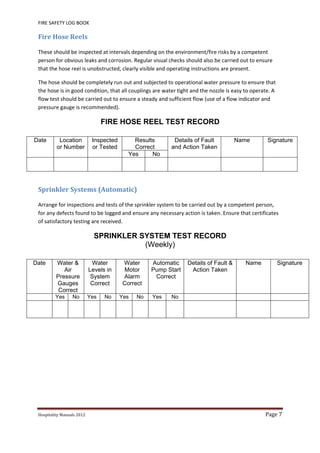
Fire	Hose	Reels	
These should be inspected at intervals depending on the environment/fire risks by a competent 
person for obvious leaks and corrosion. Regular visual checks should also be carried out to ensure 
that the hose reel is unobstructed, clearly visible and operating instructions are present. 
The hose should be completely run out and subjected to operational water pressure to ensure that 
the hose is in good condition, that all couplings are water tight and the nozzle is easy to operate. A 
flow test should be carried out to ensure a steady and sufficient flow (use of a flow indicator and 
pressure gauge is recommended). 
FIRE HOSE REEL TEST RECORD
Date Location
or Number
Inspected
or Tested
Results
Correct
Details of Fault
and Action Taken
Name Signature
Yes No
 
Sprinkler	Systems	(Automatic)	
Arrange for inspections and tests of the sprinkler system to be carried out by a competent person, 
for any defects found to be logged and ensure any necessary action is taken. Ensure that certificates 
of satisfactory testing are received. 
SPRINKLER SYSTEM TEST RECORD
(Weekly)
Date Water &
Air
Pressure
Gauges
Correct
Water
Levels in
System
Correct
Water
Motor
Alarm
Correct
Automatic
Pump Start
Correct
Details of Fault &
Action Taken
Name Signature
Yes No Yes No Yes No Yes No
 
   
FIRE SAFETY LOG BOOK 
Hospitality	Manuals	2012	 Page	8	
 
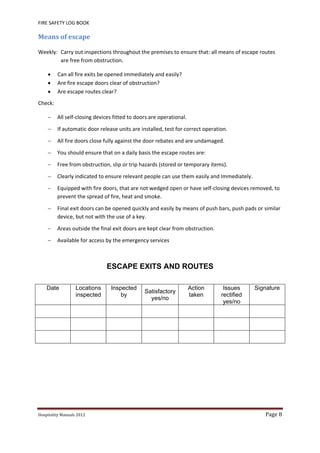
Means	of	escape	
Weekly:  Carry out inspections throughout the premises to ensure that: all means of escape routes 
are free from obstruction. 
 Can all fire exits be opened immediately and easily? 
 Are fire escape doors clear of obstruction? 
 Are escape routes clear? 
Check:   
 All self‐closing devices fitted to doors are operational. 
 If automatic door release units are installed, test for correct operation. 
 All fire doors close fully against the door rebates and are undamaged. 
 You should ensure that on a daily basis the escape routes are: 
 Free from obstruction, slip or trip hazards (stored or temporary items). 
 Clearly indicated to ensure relevant people can use them easily and Immediately. 
 Equipped with fire doors, that are not wedged open or have self‐closing devices removed, to 
prevent the spread of fire, heat and smoke. 
 Final exit doors can be opened quickly and easily by means of push bars, push pads or similar 
device, but not with the use of a key. 
 Areas outside the final exit doors are kept clear from obstruction. 
 Available for access by the emergency services 
 
ESCAPE EXITS AND ROUTES
 
Date Locations
inspected
Inspected
by
Satisfactory
yes/no
Action
taken
Issues
rectified
yes/no
Signature


FIRE SAFETY LOG BOOK 
Hospitality	Manuals	2012	 Page	9	
 
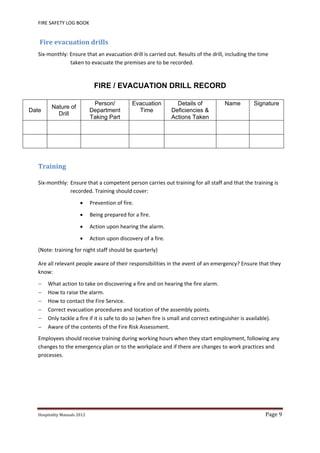
	Fire	evacuation	drills	
Six‐monthly: Ensure that an evacuation drill is carried out. Results of the drill, including the time 
taken to evacuate the premises are to be recorded. 
 
FIRE / EVACUATION DRILL RECORD
Date
Nature of
Drill
Person/
Department
Taking Part
Evacuation
Time
Details of
Deficiencies &
Actions Taken
Name Signature
 
Training	
 
Six‐monthly:  Ensure that a competent person carries out training for all staff and that the training is 
recorded. Training should cover: 
 Prevention of fire. 
 Being prepared for a fire. 
 Action upon hearing the alarm. 
 Action upon discovery of a fire. 
(Note: training for night staff should be quarterly) 
Are all relevant people aware of their responsibilities in the event of an emergency? Ensure that they 
know: 
 What action to take on discovering a fire and on hearing the fire alarm. 
 How to raise the alarm. 
 How to contact the Fire Service. 
 Correct evacuation procedures and location of the assembly points. 
 Only tackle a fire if it is safe to do so (when fire is small and correct extinguisher is available). 
 Aware of the contents of the Fire Risk Assessment. 
Employees should receive training during working hours when they start employment, following any 
changes to the emergency plan or to the workplace and if there are changes to work practices and 
processes. 
FIRE SAFETY LOG BOOK 
Hospitality	Manuals	2012	 Page	10	
 
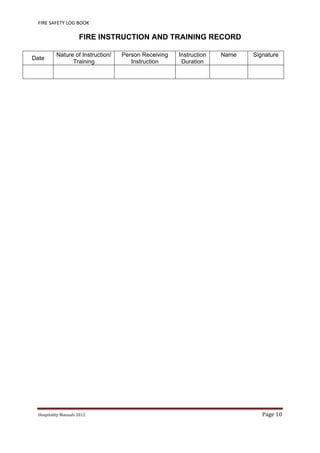
FIRE INSTRUCTION AND TRAINING RECORD
Date
Nature of Instruction/
Training
Person Receiving
Instruction
Instruction
Duration
Name Signature
 
 
FIRE SAFETY LOG BOOK 
Hospitality	Manuals	2012	 Page	11	
 
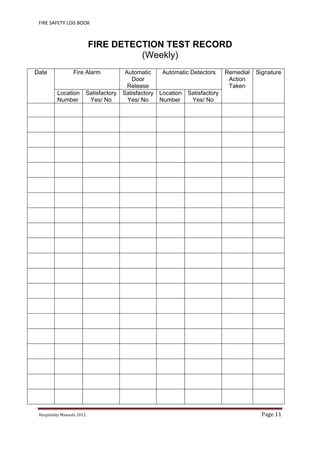
FIRE DETECTION TEST RECORD
(Weekly)
Date Fire Alarm Automatic
Door
Release
Automatic Detectors Remedial
Action
Taken
Signature
Location
Number
Satisfactory
Yes/ No
Satisfactory
Yes/ No
Location
Number
Satisfactory
Yes/ No
FIRE SAFETY LOG BOOK 
Hospitality	Manuals	2012	 Page	12	
 
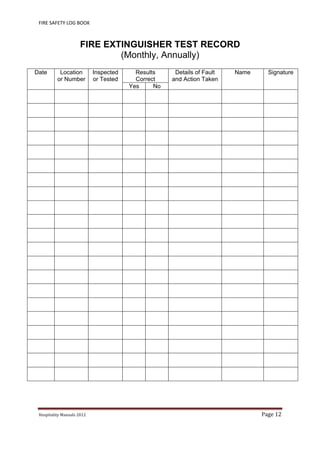
FIRE EXTINGUISHER TEST RECORD
(Monthly, Annually)
Date Location
or Number
Inspected
or Tested
Results
Correct
Details of Fault
and Action Taken
Name Signature
Yes No
FIRE SAFETY LOG BOOK 
Hospitality	Manuals	2012	 Page	13	
 
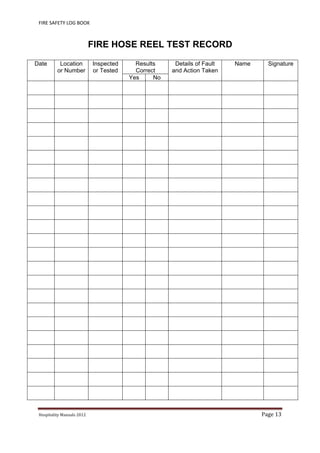
FIRE HOSE REEL TEST RECORD
Date Location
or Number
Inspected
or Tested
Results
Correct
Details of Fault
and Action Taken
Name Signature
Yes No
FIRE SAFETY LOG BOOK 
Hospitality	Manuals	2012	 Page	14	
 
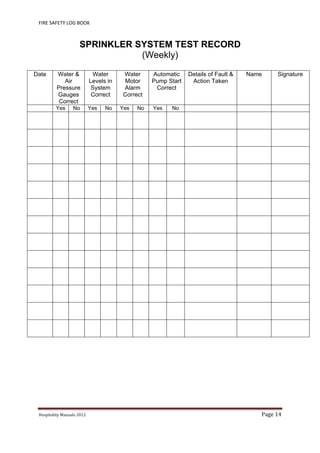
SPRINKLER SYSTEM TEST RECORD
(Weekly)
Date Water &
Air
Pressure
Gauges
Correct
Water
Levels in
System
Correct
Water
Motor
Alarm
Correct
Automatic
Pump Start
Correct
Details of Fault &
Action Taken
Name Signature
Yes No Yes No Yes No Yes No
FIRE SAFETY LOG BOOK 
Hospitality	Manuals	2012	 Page	15	
 
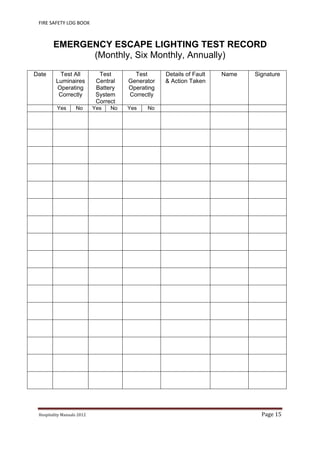
EMERGENCY ESCAPE LIGHTING TEST RECORD
(Monthly, Six Monthly, Annually)
Date Test All
Luminaires
Operating
Correctly
Test
Central
Battery
System
Correct
Test
Generator
Operating
Correctly
Details of Fault
& Action Taken
Name Signature
Yes No Yes No Yes No
FIRE SAFETY LOG BOOK 
Hospitality	Manuals	2012	 Page	16	
 
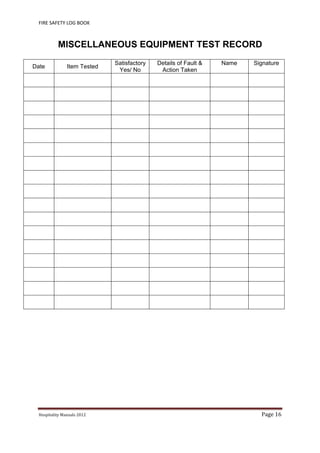
MISCELLANEOUS EQUIPMENT TEST RECORD
Date Item Tested
Satisfactory
Yes/ No
Details of Fault &
Action Taken
Name Signature
FIRE SAFETY LOG BOOK 
Hospitality	Manuals	2012	 Page	17	
 
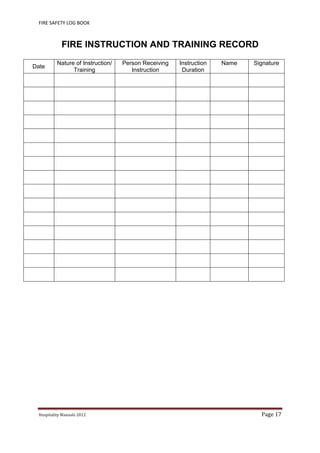
FIRE INSTRUCTION AND TRAINING RECORD
Date
Nature of Instruction/
Training
Person Receiving
Instruction
Instruction
Duration
Name Signature
FIRE SAFETY LOG BOOK 
Hospitality	Manuals	2012	 Page	18	
 
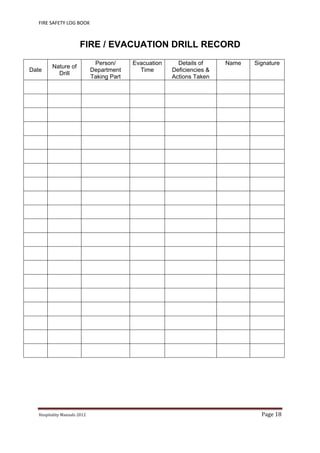
FIRE / EVACUATION DRILL RECORD
Date
Nature of
Drill
Person/
Department
Taking Part
Evacuation
Time
Details of
Deficiencies &
Actions Taken
Name Signature
FIRE SAFETY LOG BOOK 
Hospitality	Manuals	2012	 Page	19	
 
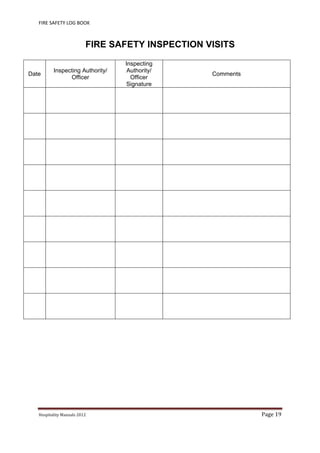
FIRE SAFETY INSPECTION VISITS
Date
Inspecting Authority/
Officer
Inspecting
Authority/
Officer
Signature
Comments

Fire safety-log-book-2012