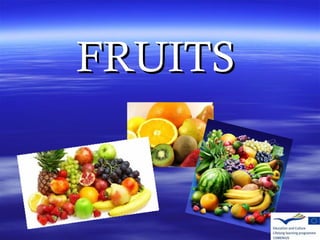
FRUITSFRUITS
FruitsFruits
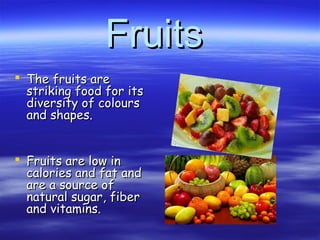
 The fruits areThe fruits are
striking food for itsstriking food for its
diversity of coloursdiversity of colours
and shapes.and shapes.
 Fruits are low inFruits are low in
calories and fat andcalories and fat and
are a source ofare a source of
natural sugar, fibernatural sugar, fiber
and vitamins.and vitamins.
Fruit groupsFruit groups
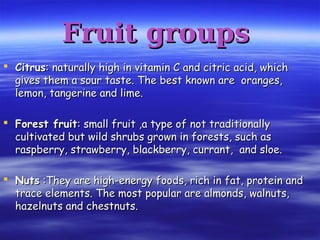
 CitrusCitrus: naturally high in vitamin C and citric acid, which: naturally high in vitamin C and citric acid, which
gives them a sour taste. The best known are oranges,gives them a sour taste. The best known are oranges,
lemon, tangerine and lime.lemon, tangerine and lime.
 Forest fruitForest fruit: small fruit ,a type of not traditionally: small fruit ,a type of not traditionally
cultivated but wild shrubs grown in forests, such ascultivated but wild shrubs grown in forests, such as
raspberry, strawberry, blackberry, currant, and sloe.raspberry, strawberry, blackberry, currant, and sloe.
 NutsNuts :They are high-energy foods, rich in fat, protein and:They are high-energy foods, rich in fat, protein and
trace elements. The most popular are almonds, walnuts,trace elements. The most popular are almonds, walnuts,
hazelnuts and chestnuts.hazelnuts and chestnuts.
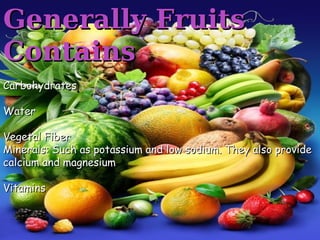
Generally FruitsGenerally Fruits
ContainsContains
CarbohydratesCarbohydrates
WaterWater
Vegetal FiberVegetal Fiber
Minerals: Such as potassium and low sodium. They also provideMinerals: Such as potassium and low sodium. They also provide
calcium and magnesiumcalcium and magnesium
VitaminsVitamins
TheyThey
 Provide soluble plant fibers.Provide soluble plant fibers.
 Hydrate the body quickly.Hydrate the body quickly.
 Vitamin C has a highVitamin C has a high
antioxidant, which becomesantioxidant, which becomes
protective of tissues and cellsprotective of tissues and cells
of our body.of our body.
 Prevent illnesses like: Diabetes,Prevent illnesses like: Diabetes,
Hypertension, Cancer andHypertension, Cancer and
ObesityObesity..
RecommendationsRecommendations
 The recommended daily allowance is 3-4The recommended daily allowance is 3-4
servings per day to cover the dailyservings per day to cover the daily
requirements of vitamins and minerals.requirements of vitamins and minerals.
 Diets that include a sufficient amount ofDiets that include a sufficient amount of
potassium from fruits and vegetables alsopotassium from fruits and vegetables also
help reduce the chance of developinghelp reduce the chance of developing
kidney stones and may help reduce thekidney stones and may help reduce the
effects of bone-loss.effects of bone-loss.
RecommendationsRecommendations
 The recommended daily allowance is 3-4The recommended daily allowance is 3-4
servings per day to cover the dailyservings per day to cover the daily
requirements of vitamins and minerals.requirements of vitamins and minerals.
 Diets that include a sufficient amount ofDiets that include a sufficient amount of
potassium from fruits and vegetables alsopotassium from fruits and vegetables also
help reduce the chance of developinghelp reduce the chance of developing
kidney stones and may help reduce thekidney stones and may help reduce the
effects of bone-loss.effects of bone-loss.

Fruits[1]

  • 1.
  • 2.
    FruitsFruits  The fruitsareThe fruits are striking food for itsstriking food for its diversity of coloursdiversity of colours and shapes.and shapes.  Fruits are low inFruits are low in calories and fat andcalories and fat and are a source ofare a source of natural sugar, fibernatural sugar, fiber and vitamins.and vitamins.
  • 3.
    Fruit groupsFruit groups CitrusCitrus: naturally high in vitamin C and citric acid, which: naturally high in vitamin C and citric acid, which gives them a sour taste. The best known are oranges,gives them a sour taste. The best known are oranges, lemon, tangerine and lime.lemon, tangerine and lime.  Forest fruitForest fruit: small fruit ,a type of not traditionally: small fruit ,a type of not traditionally cultivated but wild shrubs grown in forests, such ascultivated but wild shrubs grown in forests, such as raspberry, strawberry, blackberry, currant, and sloe.raspberry, strawberry, blackberry, currant, and sloe.  NutsNuts :They are high-energy foods, rich in fat, protein and:They are high-energy foods, rich in fat, protein and trace elements. The most popular are almonds, walnuts,trace elements. The most popular are almonds, walnuts, hazelnuts and chestnuts.hazelnuts and chestnuts.
  • 4.
    Generally FruitsGenerally Fruits ContainsContains CarbohydratesCarbohydrates WaterWater VegetalFiberVegetal Fiber Minerals: Such as potassium and low sodium. They also provideMinerals: Such as potassium and low sodium. They also provide calcium and magnesiumcalcium and magnesium VitaminsVitamins
  • 5.
    TheyThey  Provide solubleplant fibers.Provide soluble plant fibers.  Hydrate the body quickly.Hydrate the body quickly.  Vitamin C has a highVitamin C has a high antioxidant, which becomesantioxidant, which becomes protective of tissues and cellsprotective of tissues and cells of our body.of our body.  Prevent illnesses like: Diabetes,Prevent illnesses like: Diabetes, Hypertension, Cancer andHypertension, Cancer and ObesityObesity..
  • 6.
    RecommendationsRecommendations  The recommendeddaily allowance is 3-4The recommended daily allowance is 3-4 servings per day to cover the dailyservings per day to cover the daily requirements of vitamins and minerals.requirements of vitamins and minerals.  Diets that include a sufficient amount ofDiets that include a sufficient amount of potassium from fruits and vegetables alsopotassium from fruits and vegetables also help reduce the chance of developinghelp reduce the chance of developing kidney stones and may help reduce thekidney stones and may help reduce the effects of bone-loss.effects of bone-loss.
  • 7.
    RecommendationsRecommendations  The recommendeddaily allowance is 3-4The recommended daily allowance is 3-4 servings per day to cover the dailyservings per day to cover the daily requirements of vitamins and minerals.requirements of vitamins and minerals.  Diets that include a sufficient amount ofDiets that include a sufficient amount of potassium from fruits and vegetables alsopotassium from fruits and vegetables also help reduce the chance of developinghelp reduce the chance of developing kidney stones and may help reduce thekidney stones and may help reduce the effects of bone-loss.effects of bone-loss.