CASACASA
BATLLÓBATLLÓ
Ruth Cisuelo
HistoryHistory
 The Casa Batllo,
designed by Emili Sala,
was built in 1877 and its
owner, the textile
manufacturer Josep
Batlló i Casanovas,
commissioned Gaudí to
remodel the façade and
to redistribute the
courtyards in 1905.
Gaudí gave his personal
touch and the Batlló
house became one of the
most emblematic
projects of his career.
 It is an exponent of the Catalan Modernism,
between 1905 and 1907. Located at number
43 Paseo de Gracia,its most famous part is
the façade, considered one of the most
creative and original work of the architect
who combined stone, wrought iron, glass
and brittle ceramics.
InformationInformation
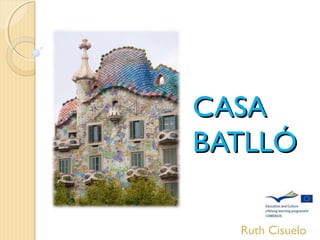
The poetry of the façade
culminates in the roof, which
is topped with pinkish-blue
ceramic pieces in the form of
scales and evokes the back of
a dragon.
There is a tower crowned by
a small, convex cross.
The chimneys and water
tanks on the roof are
recovered with pieces of
glass and coloured tile on a
mortar base.

Casa batllo comenius[1]

  • 1.
  • 2.
    HistoryHistory  The CasaBatllo, designed by Emili Sala, was built in 1877 and its owner, the textile manufacturer Josep Batlló i Casanovas, commissioned Gaudí to remodel the façade and to redistribute the courtyards in 1905. Gaudí gave his personal touch and the Batlló house became one of the most emblematic projects of his career.
  • 3.
     It isan exponent of the Catalan Modernism, between 1905 and 1907. Located at number 43 Paseo de Gracia,its most famous part is the façade, considered one of the most creative and original work of the architect who combined stone, wrought iron, glass and brittle ceramics.
  • 4.
    InformationInformation The poetry ofthe façade culminates in the roof, which is topped with pinkish-blue ceramic pieces in the form of scales and evokes the back of a dragon. There is a tower crowned by a small, convex cross. The chimneys and water tanks on the roof are recovered with pieces of glass and coloured tile on a mortar base.