10/6/2017
1
From NEC3 to NEC4 (ECC)
Presented by: 
Albert YEU
MHKIE, MICE, FCIArb, Construction Arbitrator, 
Accredited Adjudicator and Mediator
Ove Arup and Partners Hong Kong Limited
Outlines…
1. Terminology
2. Compensation Event
3. Programme
4. Schedule of Cost Components (SCC)
5. Payment Application
6. Progressive Agreement of Defined Cost and Final Assessment
7. Value Engineering Proposal
8. Acceleration
9. Dispute Avoidance Procedure
10. Contractor’s Design
11. Contract Termination
12. Other New Clauses
Terminology
• Employer  Client
• Clause 16 ‐ Risk Register  Early Warning Register
• Clause 11 ‐ Works Information  Scope
• Clause 4 ‐ Testing and Defects  Quality Management
• Clause 8‐ Risks and Insurance  Liabilities and Insurance
• Gender Neutral – ‘He/She’  ‘It’
10/6/2017
2
Compensation Event
• NEC4 Clause 60.1(20) – PM notifies that a proposed
instruction is not accepted
NEC3 ECC Option A Clause 11.2(22) and Option B Clause 11.2(23) – “Defined Cost is the
cost of the components in the Shorter Schedule of Cost Components whether work is
subcontracted or not excluding the cost of preparing quotations for compensation
events.”
• NEC4 Clause 60.1(21) – additional compensation events to be
agreed between the parties and stated in the Contract Data
19 CE in NEC3 ECC including Clause 60.1(18) – “A breach of contract by the Employer
which is not one of the other compensation events in this contract.”
Programme
NEC3 Clause 31.3 – “Within two weeks of the Contractor submitting a programme to him for
acceptance, the Project Manager either accepts the programme or notifies the Contractor of his
reasons for no accepting it. A reason for not accepting a programme is that
• the Contractor’s plans which it shows are not practicable,
• it does not show the information which this contract requires,
• it does not represent the Contractor’s plans realistically or
• it does not comply with the Works Information.”
• NEC4 Clause 31.3 – the Contractor can now seek deemed
acceptance of the programme if the PM fails to notify
acceptance or non‐acceptance
• NEC4 Clause 31.1 – the original programme issued for
acceptance must be in the form stated in the Scope which
provides the opportunity for greater clarity as to the
acceptability of the programme
Schedule of Cost Components
• NEC3 – Schedule of Cost Components (SCC) and Shorter SCC
NEC3 Clause 50.2 – “The amount due is:
• the Price for Work Done to Date
• Plus other amounts to be paid to the Contractor
• Less amounts to be paid by or retained from the Contractor”
• PWDD:
• Option A: Total of the Prices for completed activities
• Option B: Quality of work multiplied by the bill rate, proportion of
lump sums
• Option C‐E : Defined Cost plus Fee
• Defined Cost:
• Option A: “…the cost of the components in SSCC whether work is
subcontracted or not….”
• Option B: “…the cost of the components in SSCC whether work is
subcontracted or not….”
• Option C‐E: “…the amount of payments due to Subcontractors for work
which is subcontracted…”
10/6/2017
3
Schedule of Cost Components
• Option A&B – Defined Cost is only used for assessing CEs,
therefore the SSCC is used
• Option C‐E – Defined Cost is used for assessing CEs and for
assessing the PWDD, therefore the SCC is used
• Clause 52.1 – “All the Contractor’s costs which are not
included in the Defined Cost are treated as included in the
Fee…”
• Clause 26.1 – “… This contract applies as if a Subcontractor’s
employees and equipment were the Contractor’s.”
What’s in NEC4???
• NEC4 – only one version used for each contract (SSCC no
longer applies to Options C‐E)
• Only one fee percentage applied to Defined Cost
• Subcontractor’s cost moved from Defined Cost to SCC
Payment Application
• NEC3 Clause 50.1 – “The PM assesses the amount due at each
assessment date…”
• NEC3 Clause 50.4 – “In assessing the amount due, the PM
considers any application for payment the Contractor has
submitted on or before the assessment date…”
• NEC4 – The Contractor submits an application for payment
otherwise he will not be paid!
Progressive Agreement of Defined Cost 
and Final Assessment
NEC3 – No separate final assessment procedure
NEC4
• Option C‐E – the Contractor requests an early review and
acceptance of some Defined Cost by the PM. PM to review
within 13 weeks and to accept or advise any error and the
Contractor re‐submit within four weeks, otherwise deemed
acceptance
• PM to issue a final assessment of payment due to the
Contractor within four weeks of the issue of the Defects
Certificate or 13 weeks after termination notice, otherwise
the Contractor issue its own final assessment. This final
assessment is conclusive if not challenged by either party by
referring it to dispute resolution within four weeks of
issuance.
10/6/2017
4
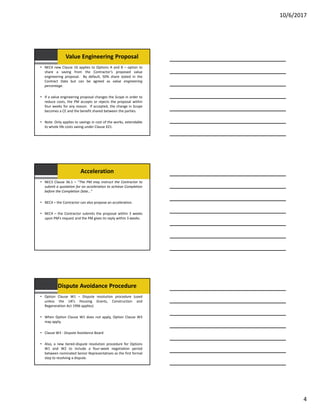
Value Engineering Proposal
• NEC4 new Clause 16 applies to Options A and B – option to
share a saving from the Contractor’s proposed value
engineering proposal. By default, 50% share stated in the
Contract Data but can be agreed as value engineering
percentage.
• If a value engineering proposal changes the Scope in order to
reduce costs, the PM accepts or rejects the proposal within
four weeks for any reason. If accepted, the change in Scope
becomes a CE and the benefit shared between the parties.
• Note: Only applies to savings in cost of the works, extendable
to whole life costs saving under Clause X21.
Acceleration
• NEC3 Clause 36.1 – “The PM may instruct the Contractor to
submit a quotation for an acceleration to achieve Completion
before the Completion Date…”
• NEC4 – the Contractor can also propose an acceleration.
• NEC4 – the Contractor submits the proposal within 3 weeks
upon PM’s request and the PM gives its reply within 3 weeks.
Dispute Avoidance Procedure
• Option Clause W1 – Dispute resolution procedure (used
unless the UK’s Housing Grants, Construction and
Regeneration Act 1996 applies)
• When Option Clause W1 does not apply, Option Clause W3
may apply.
• Clause W3 ‐ Dispute Avoidance Board
• Also, a new tiered‐dispute resolution procedure for Options
W1 and W2 to include a four‐week negotiation period
between nominated Senior Representatives as the first formal
step to resolving a dispute.
10/6/2017
5
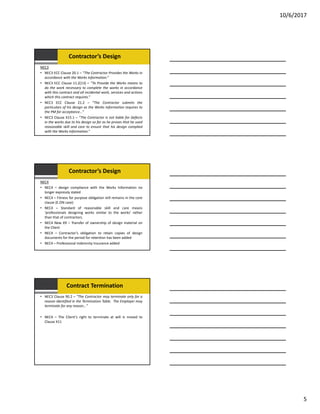
Contractor’s Design
NEC3
• NEC3 ECC Clause 20.1 – “The Contractor Provides the Works in
accordance with the Works Information.”
• NEC3 ECC Clause 11.2(13) – “To Provide the Works means to
do the work necessary to complete the works in accordance
with this contract and all incidental work, services and actions
which this contract requires.”
• NEC3 ECC Clause 21.2 – “The Contractor submits the
particulars of his design as the Works Information requires to
the PM for acceptance…”
• NEC3 Clause X15.1 – “The Contractor is not liable for Defects
in the works due to his design so far as he proves that he used
reasonable skill and care to ensure that his design complied
with the Works Information.”
Contractor’s Design
NEC4
• NEC4 – design compliance with the Works Information no
longer expressly stated
• NEC4 – Fitness for purpose obligation still remains in the core
clause (E.ON case)
• NEC4 – Standard of reasonable skill and care means
‘professionals designing works similar to the works’ rather
than that of contractors.
• NEC4 New X9 – Transfer of ownership of design material on
the Client
• NEC4 – Contractor’s obligation to retain copies of design
documents for the period for retention has been added
• NEC4 – Professional Indemnity Insurance added
Contract Termination
• NEC3 Clause 90.2 – “The Contractor may terminate only for a
reason identified in the Termination Table. The Employer may
terminate for any reason…”
• NEC4 – The Client’s right to terminate at will is moved to
Clause X11
10/6/2017
6
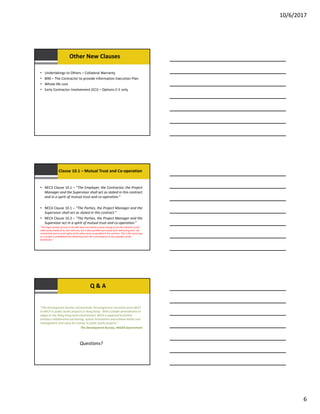
Other New Clauses
• Undertakings to Others – Collateral Warranty
• BIM – The Contractor to provide Information Execution Plan
• Whole life cost
• Early Contractor Involvement (ECI) – Options C‐E only
Clause 10.1 – Mutual Trust and Co‐operation
• NEC3 Clause 10.1 – “The Employer, the Contractor, the Project
Manager and the Supervisor shall act as stated in this contract
and in a spirit of mutual trust and co‐operation.”
• NEC4 Clause 10.1 – “The Parties, the Project Manager and the
Supervisor shall act as stated in this contract.”
• NEC4 Clause 10.2 – “The Parties, the Project Manager and the
Supervisor act in a spirit of mutual trust and co‐operation.”
“The legal concept of trust in the NEC does not involve a party having to put the interests of the 
other party ahead of its own interests, but it does prohibit each party from detracting from  the 
contractual and accrued rights of the other party as specified in the contract. This is the same way 
as a trustee is prohibited from detracting from the trust property to the prejudice of the 
beneficiary.”
Q & A
“The Development Bureau recommends the progressive transition from NEC3 
to NEC4 in public works projects in Hong Kong.  With suitable amendments to 
adapt to the Hong Kong local environment, NEC4 is expected to further 
enhance collaborative partnering, unlock innovations and achieve better cost 
management and value for money in public works projects.”
The Development Bureau, HKSAR Government
Questions?

From NEC3 to NEC4 ECC

  • 1.
    10/6/2017 1 From NEC3 to NEC4 (ECC) Presented by:  Albert YEU MHKIE, MICE, FCIArb, Construction Arbitrator,  Accredited Adjudicator and Mediator Ove Arup and Partners Hong Kong Limited Outlines… 1. Terminology 2. CompensationEvent 3. Programme 4. Schedule of Cost Components (SCC) 5. Payment Application 6. Progressive Agreement of Defined Cost and Final Assessment 7. Value Engineering Proposal 8. Acceleration 9. Dispute Avoidance Procedure 10. Contractor’s Design 11. Contract Termination 12. Other New Clauses Terminology • Employer  Client • Clause 16 ‐ Risk Register  Early Warning Register • Clause 11 ‐ Works Information  Scope • Clause 4 ‐ Testing and Defects  Quality Management • Clause 8‐ Risks and Insurance  Liabilities and Insurance • Gender Neutral – ‘He/She’  ‘It’
  • 2.
    10/6/2017 2 Compensation Event • NEC4 Clause60.1(20) – PM notifies that a proposed instruction is not accepted NEC3 ECC Option A Clause 11.2(22) and Option B Clause 11.2(23) – “Defined Cost is the cost of the components in the Shorter Schedule of Cost Components whether work is subcontracted or not excluding the cost of preparing quotations for compensation events.” • NEC4 Clause 60.1(21) – additional compensation events to be agreed between the parties and stated in the Contract Data 19 CE in NEC3 ECC including Clause 60.1(18) – “A breach of contract by the Employer which is not one of the other compensation events in this contract.” Programme NEC3 Clause 31.3 – “Within two weeks of the Contractor submitting a programme to him for acceptance, the Project Manager either accepts the programme or notifies the Contractor of his reasons for no accepting it. A reason for not accepting a programme is that • the Contractor’s plans which it shows are not practicable, • it does not show the information which this contract requires, • it does not represent the Contractor’s plans realistically or • it does not comply with the Works Information.” • NEC4 Clause 31.3 – the Contractor can now seek deemed acceptance of the programme if the PM fails to notify acceptance or non‐acceptance • NEC4 Clause 31.1 – the original programme issued for acceptance must be in the form stated in the Scope which provides the opportunity for greater clarity as to the acceptability of the programme Schedule of Cost Components • NEC3 – Schedule of Cost Components (SCC) and Shorter SCC NEC3 Clause 50.2 – “The amount due is: • the Price for Work Done to Date • Plus other amounts to be paid to the Contractor • Less amounts to be paid by or retained from the Contractor” • PWDD: • Option A: Total of the Prices for completed activities • Option B: Quality of work multiplied by the bill rate, proportion of lump sums • Option C‐E : Defined Cost plus Fee • Defined Cost: • Option A: “…the cost of the components in SSCC whether work is subcontracted or not….” • Option B: “…the cost of the components in SSCC whether work is subcontracted or not….” • Option C‐E: “…the amount of payments due to Subcontractors for work which is subcontracted…”
  • 3.
    10/6/2017 3 Schedule of Cost Components • Option A&B– Defined Cost is only used for assessing CEs, therefore the SSCC is used • Option C‐E – Defined Cost is used for assessing CEs and for assessing the PWDD, therefore the SCC is used • Clause 52.1 – “All the Contractor’s costs which are not included in the Defined Cost are treated as included in the Fee…” • Clause 26.1 – “… This contract applies as if a Subcontractor’s employees and equipment were the Contractor’s.” What’s in NEC4??? • NEC4 – only one version used for each contract (SSCC no longer applies to Options C‐E) • Only one fee percentage applied to Defined Cost • Subcontractor’s cost moved from Defined Cost to SCC Payment Application • NEC3 Clause 50.1 – “The PM assesses the amount due at each assessment date…” • NEC3 Clause 50.4 – “In assessing the amount due, the PM considers any application for payment the Contractor has submitted on or before the assessment date…” • NEC4 – The Contractor submits an application for payment otherwise he will not be paid! Progressive Agreement of Defined Cost  and Final Assessment NEC3 – No separate final assessment procedure NEC4 • Option C‐E – the Contractor requests an early review and acceptance of some Defined Cost by the PM. PM to review within 13 weeks and to accept or advise any error and the Contractor re‐submit within four weeks, otherwise deemed acceptance • PM to issue a final assessment of payment due to the Contractor within four weeks of the issue of the Defects Certificate or 13 weeks after termination notice, otherwise the Contractor issue its own final assessment. This final assessment is conclusive if not challenged by either party by referring it to dispute resolution within four weeks of issuance.
  • 4.
    10/6/2017 4 Value Engineering Proposal • NEC4 newClause 16 applies to Options A and B – option to share a saving from the Contractor’s proposed value engineering proposal. By default, 50% share stated in the Contract Data but can be agreed as value engineering percentage. • If a value engineering proposal changes the Scope in order to reduce costs, the PM accepts or rejects the proposal within four weeks for any reason. If accepted, the change in Scope becomes a CE and the benefit shared between the parties. • Note: Only applies to savings in cost of the works, extendable to whole life costs saving under Clause X21. Acceleration • NEC3 Clause 36.1 – “The PM may instruct the Contractor to submit a quotation for an acceleration to achieve Completion before the Completion Date…” • NEC4 – the Contractor can also propose an acceleration. • NEC4 – the Contractor submits the proposal within 3 weeks upon PM’s request and the PM gives its reply within 3 weeks. Dispute Avoidance Procedure • Option Clause W1 – Dispute resolution procedure (used unless the UK’s Housing Grants, Construction and Regeneration Act 1996 applies) • When Option Clause W1 does not apply, Option Clause W3 may apply. • Clause W3 ‐ Dispute Avoidance Board • Also, a new tiered‐dispute resolution procedure for Options W1 and W2 to include a four‐week negotiation period between nominated Senior Representatives as the first formal step to resolving a dispute.
  • 5.
    10/6/2017 5 Contractor’s Design NEC3 • NEC3 ECCClause 20.1 – “The Contractor Provides the Works in accordance with the Works Information.” • NEC3 ECC Clause 11.2(13) – “To Provide the Works means to do the work necessary to complete the works in accordance with this contract and all incidental work, services and actions which this contract requires.” • NEC3 ECC Clause 21.2 – “The Contractor submits the particulars of his design as the Works Information requires to the PM for acceptance…” • NEC3 Clause X15.1 – “The Contractor is not liable for Defects in the works due to his design so far as he proves that he used reasonable skill and care to ensure that his design complied with the Works Information.” Contractor’s Design NEC4 • NEC4 – design compliance with the Works Information no longer expressly stated • NEC4 – Fitness for purpose obligation still remains in the core clause (E.ON case) • NEC4 – Standard of reasonable skill and care means ‘professionals designing works similar to the works’ rather than that of contractors. • NEC4 New X9 – Transfer of ownership of design material on the Client • NEC4 – Contractor’s obligation to retain copies of design documents for the period for retention has been added • NEC4 – Professional Indemnity Insurance added Contract Termination • NEC3 Clause 90.2 – “The Contractor may terminate only for a reason identified in the Termination Table. The Employer may terminate for any reason…” • NEC4 – The Client’s right to terminate at will is moved to Clause X11
  • 6.
    10/6/2017 6 Other New Clauses • Undertakings toOthers – Collateral Warranty • BIM – The Contractor to provide Information Execution Plan • Whole life cost • Early Contractor Involvement (ECI) – Options C‐E only Clause 10.1 – Mutual Trust and Co‐operation • NEC3 Clause 10.1 – “The Employer, the Contractor, the Project Manager and the Supervisor shall act as stated in this contract and in a spirit of mutual trust and co‐operation.” • NEC4 Clause 10.1 – “The Parties, the Project Manager and the Supervisor shall act as stated in this contract.” • NEC4 Clause 10.2 – “The Parties, the Project Manager and the Supervisor act in a spirit of mutual trust and co‐operation.” “The legal concept of trust in the NEC does not involve a party having to put the interests of the  other party ahead of its own interests, but it does prohibit each party from detracting from  the  contractual and accrued rights of the other party as specified in the contract. This is the same way  as a trustee is prohibited from detracting from the trust property to the prejudice of the  beneficiary.” Q & A “The Development Bureau recommends the progressive transition from NEC3  to NEC4 in public works projects in Hong Kong.  With suitable amendments to  adapt to the Hong Kong local environment, NEC4 is expected to further  enhance collaborative partnering, unlock innovations and achieve better cost  management and value for money in public works projects.” The Development Bureau, HKSAR Government Questions?