The NEC4 engineering and construction contract :
a commentary Third Edition Eggleston download
https://textbookfull.com/product/the-nec4-engineering-and-
construction-contract-a-commentary-third-edition-eggleston/
Download more ebook from https://textbookfull.com
We believe these products will be a great fit for you. Click
the link to download now, or visit textbookfull.com
to discover even more!
Construction Contract Claims Changes and Dispute
Resolution 3rd Edition Paul Levin
https://textbookfull.com/product/construction-contract-claims-
changes-and-dispute-resolution-3rd-edition-paul-levin/
Coulson and Richardson’s Chemical Engineering, Fourth
Edition: Volume 3A: Chemical and Biochemical Reactors
and Reaction Engineering R. Ravi
https://textbookfull.com/product/coulson-and-richardsons-
chemical-engineering-fourth-edition-volume-3a-chemical-and-
biochemical-reactors-and-reaction-engineering-r-ravi/
Recommended contract practices for underground
construction Second Edition Sarah H. Wilson (Editor)
https://textbookfull.com/product/recommended-contract-practices-
for-underground-construction-second-edition-sarah-h-wilson-
editor/
The Gypsum Construction Handbook Rsmeans Engineering
https://textbookfull.com/product/the-gypsum-construction-
handbook-rsmeans-engineering/
Sustainable landscape construction a guide to green
building outdoors Third Edition Farnsworth
https://textbookfull.com/product/sustainable-landscape-
construction-a-guide-to-green-building-outdoors-third-edition-
farnsworth/
A casebook on contract 7th Edition A S Burrows
https://textbookfull.com/product/a-casebook-on-contract-7th-
edition-a-s-burrows/
A restatement of the English law of contract First
Edition Andrew Burrows
https://textbookfull.com/product/a-restatement-of-the-english-
law-of-contract-first-edition-andrew-burrows/
Food Process Engineering and Technology Third Edition
Berk
https://textbookfull.com/product/food-process-engineering-and-
technology-third-edition-berk/
Underground engineering planning design construction
and operation of the underground space 1st Edition Bai
Yun
https://textbookfull.com/product/underground-engineering-
planning-design-construction-and-operation-of-the-underground-
space-1st-edition-bai-yun/
The NEC4 Engineering and
Construction Contract
The NEC4 Engineering and
Construction Contract
A Commentary
Third Edition
Brian Eggleston‡
CEng, FICE, FIStructE, FCIArb
This edition first published 2019
© 2019 John Wiley & Sons Ltd
Edition History
First published in 1996 by Blackwell Science as The New Engineering Contract: A Commentary
Second edition published in 2006 by Blackwell Science retitled as The NEC3 Engineering and Construction
Contract: A Commentary
Third retitled edition published in 2019 by John Wiley & Sons Ltd
All rights reserved. No part of this publication may be reproduced, stored in a retrieval system, or
transmitted, in any form or by any means, electronic, mechanical, photocopying, recording or otherwise,
except as permitted by law. Advice on how to obtain permission to reuse material from this title is
available at http://www.wiley.com/go/permissions.
The right of Brian Eggleston to be identified as the author of this work has been asserted in accordance
with law.
Registered Office(s)
John Wiley & Sons, Inc., 111 River Street, Hoboken, NJ 07030, USA
John Wiley & Sons Ltd, The Atrium, Southern Gate, Chichester, West Sussex, PO19 8SQ, UK
Editorial Office
9600 Garsington Road, Oxford, OX4 2DQ, UK
For details of our global editorial offices, customer services, and more information about Wiley products
visit us at www.wiley.com.
Wiley also publishes its books in a variety of electronic formats and by print-on-demand. Some content
that appears in standard print versions of this book may not be available in other formats.
Limit of Liability/Disclaimer of Warranty
While the publisher and authors have used their best efforts in preparing this work, they make no
representations or warranties with respect to the accuracy or completeness of the contents of this work
and specifically disclaim all warranties, including without limitation any implied warranties of
merchantability or fitness for a particular purpose. No warranty may be created or extended by sales
representatives, written sales materials or promotional statements for this work. The fact that an
organization, website, or product is referred to in this work as a citation and/or potential source of
further information does not mean that the publisher and authors endorse the information or services
the organization, website, or product may provide or recommendations it may make. This work is sold
with the understanding that the publisher is not engaged in rendering professional services. The advice
and strategies contained herein may not be suitable for your situation. You should consult with a
specialist where appropriate. Further, readers should be aware that websites listed in this work may have
changed or disappeared between when this work was written and when it is read. Neither the publisher
nor authors shall be liable for any loss of profit or any other commercial damages, including but not
limited to special, incidental, consequential, or other damages.
Library of Congress Cataloging-in-Publication Data applied for.
Hardback: 9781119478751
Cover Design: Wiley
Cover Image: © ivanastar/iStock/Getty Images Plus
Set in 10/12pt PalatinoLTStd by Aptara Inc., New Delhi, India
10 9 8 7 6 5 4 3 2 1
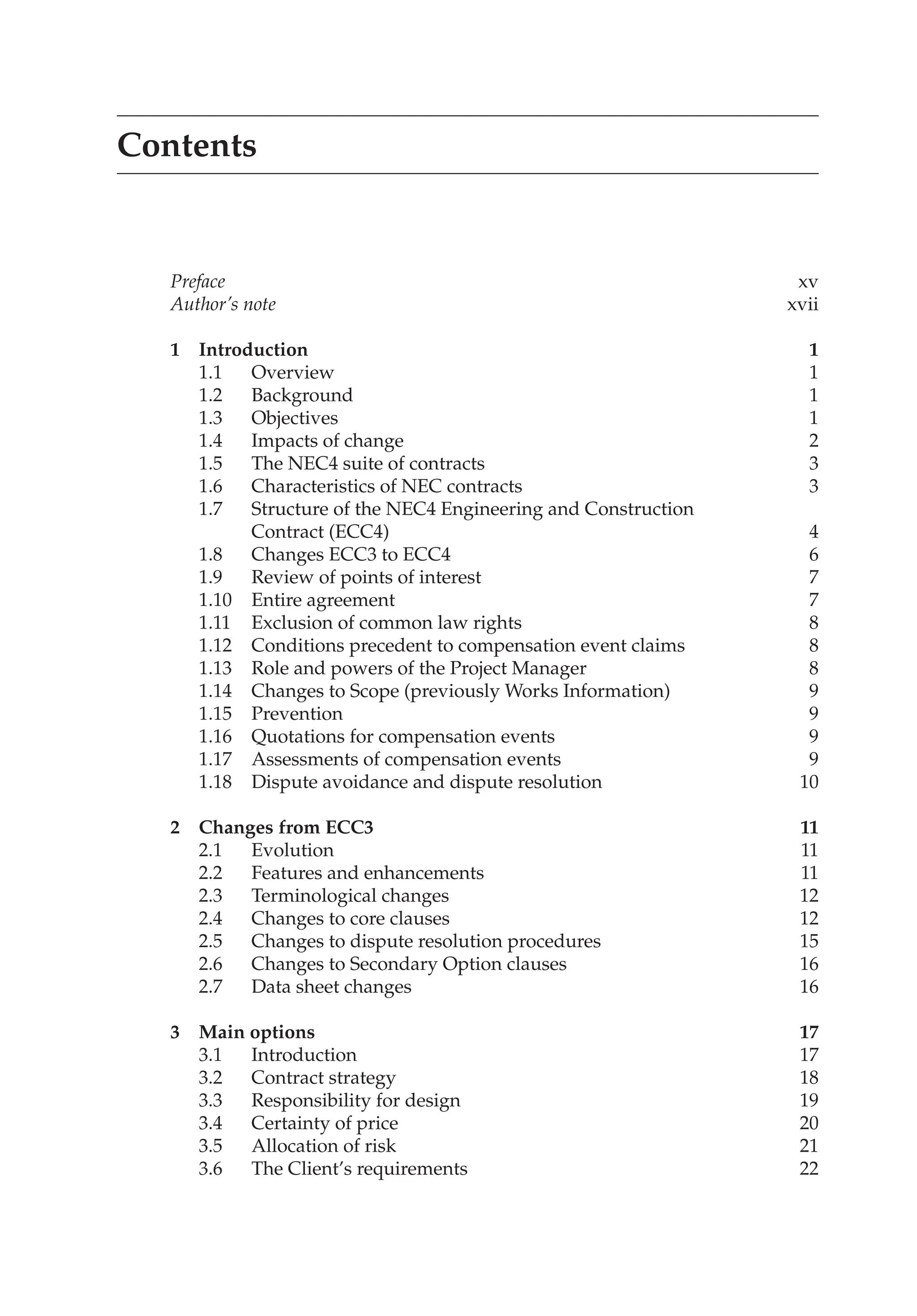
Contents
Preface xv
Author’s note xvii
1 Introduction 1
1.1 Overview 1
1.2 Background 1
1.3 Objectives 1
1.4 Impacts of change 2
1.5 The NEC4 suite of contracts 3
1.6 Characteristics of NEC contracts 3
1.7 Structure of the NEC4 Engineering and Construction
Contract (ECC4) 4
1.8 Changes ECC3 to ECC4 6
1.9 Review of points of interest 7
1.10 Entire agreement 7
1.11 Exclusion of common law rights 8
1.12 Conditions precedent to compensation event claims 8
1.13 Role and powers of the Project Manager 8
1.14 Changes to Scope (previously Works Information) 9
1.15 Prevention 9
1.16 Quotations for compensation events 9
1.17 Assessments of compensation events 9
1.18 Dispute avoidance and dispute resolution 10
2 Changes from ECC3 11
2.1 Evolution 11
2.2 Features and enhancements 11
2.3 Terminological changes 12
2.4 Changes to core clauses 12
2.5 Changes to dispute resolution procedures 15
2.6 Changes to Secondary Option clauses 16
2.7 Data sheet changes 16
3 Main options 17
3.1 Introduction 17
3.2 Contract strategy 18
3.3 Responsibility for design 19
3.4 Certainty of price 20
3.5 Allocation of risk 21
3.6 The Client’s requirements 22
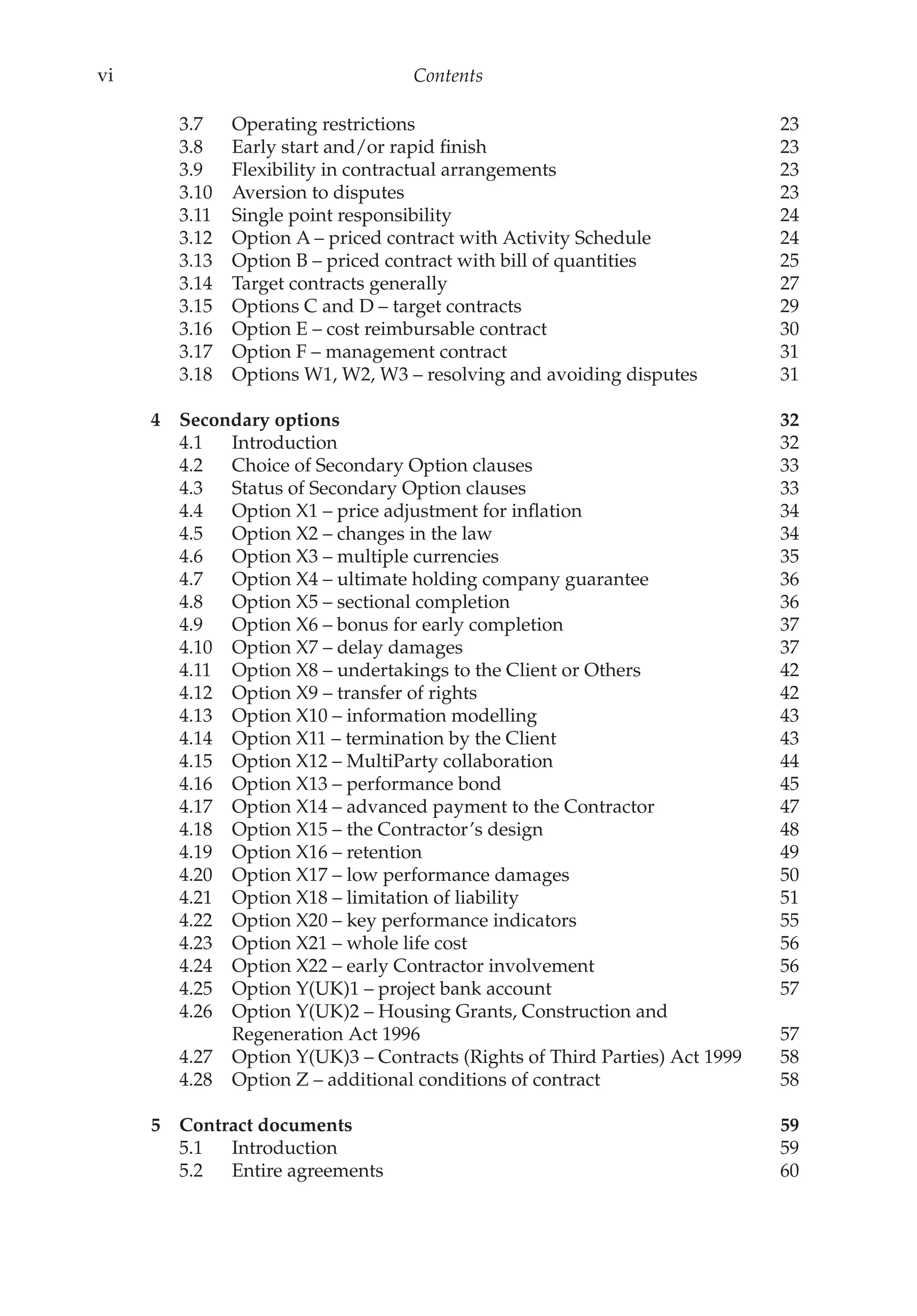
vi Contents
3.7 Operating restrictions 23
3.8 Early start and/or rapid finish 23
3.9 Flexibility in contractual arrangements 23
3.10 Aversion to disputes 23
3.11 Single point responsibility 24
3.12 Option A – priced contract with Activity Schedule 24
3.13 Option B – priced contract with bill of quantities 25
3.14 Target contracts generally 27
3.15 Options C and D – target contracts 29
3.16 Option E – cost reimbursable contract 30
3.17 Option F – management contract 31
3.18 Options W1, W2, W3 – resolving and avoiding disputes 31
4 Secondary options 32
4.1 Introduction 32
4.2 Choice of Secondary Option clauses 33
4.3 Status of Secondary Option clauses 33
4.4 Option X1 – price adjustment for inflation 34
4.5 Option X2 – changes in the law 34
4.6 Option X3 – multiple currencies 35
4.7 Option X4 – ultimate holding company guarantee 36
4.8 Option X5 – sectional completion 36
4.9 Option X6 – bonus for early completion 37
4.10 Option X7 – delay damages 37
4.11 Option X8 – undertakings to the Client or Others 42
4.12 Option X9 – transfer of rights 42
4.13 Option X10 – information modelling 43
4.14 Option X11 – termination by the Client 43
4.15 Option X12 – MultiParty collaboration 44
4.16 Option X13 – performance bond 45
4.17 Option X14 – advanced payment to the Contractor 47
4.18 Option X15 – the Contractor’s design 48
4.19 Option X16 – retention 49
4.20 Option X17 – low performance damages 50
4.21 Option X18 – limitation of liability 51
4.22 Option X20 – key performance indicators 55
4.23 Option X21 – whole life cost 56
4.24 Option X22 – early Contractor involvement 56
4.25 Option Y(UK)1 – project bank account 57
4.26 Option Y(UK)2 – Housing Grants, Construction and
Regeneration Act 1996 57
4.27 Option Y(UK)3 – Contracts (Rights of Third Parties) Act 1999 58
4.28 Option Z – additional conditions of contract 58
5 Contract documents 59
5.1 Introduction 59
5.2 Entire agreements 60
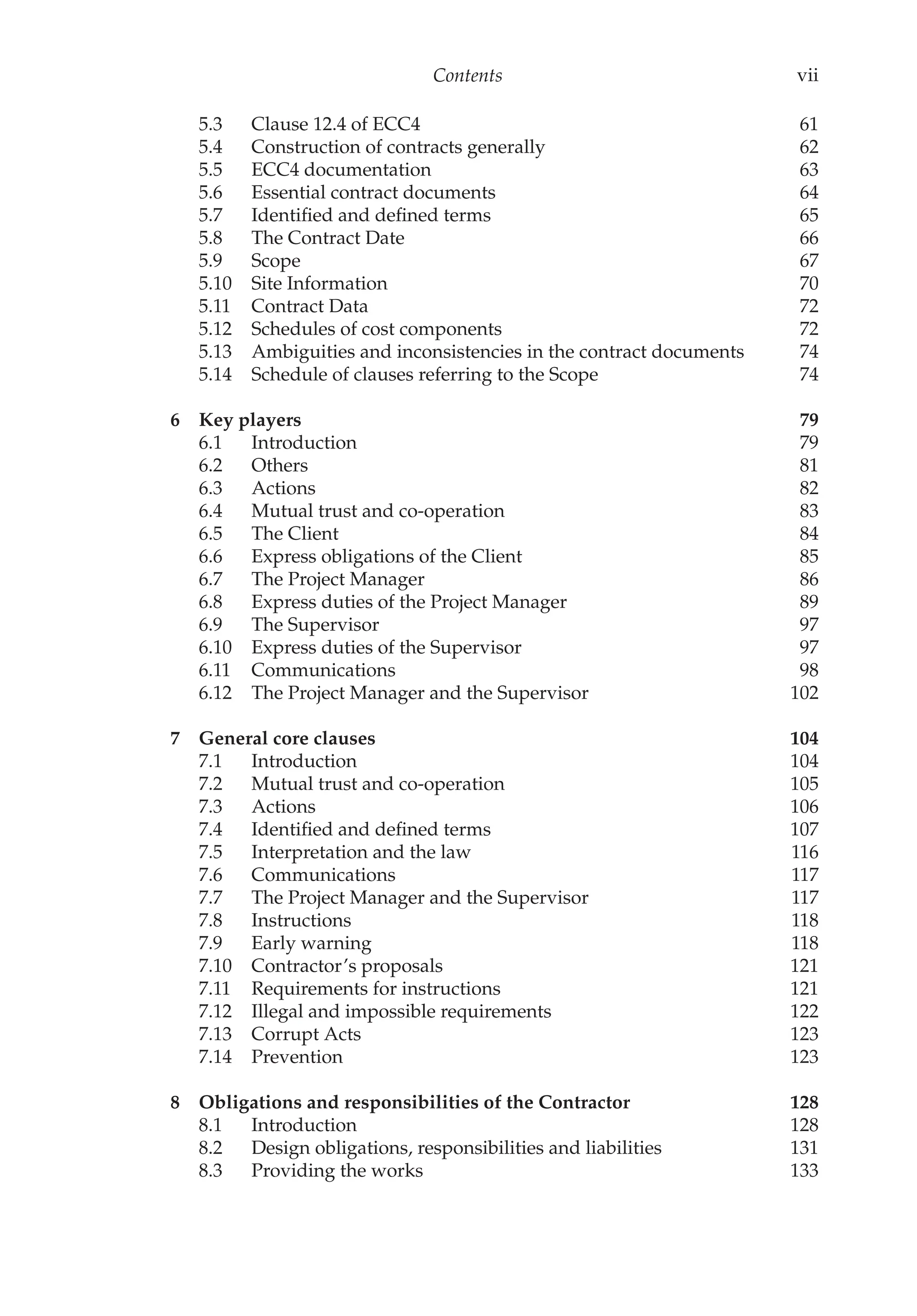
Contents vii
5.3 Clause 12.4 of ECC4 61
5.4 Construction of contracts generally 62
5.5 ECC4 documentation 63
5.6 Essential contract documents 64
5.7 Identified and defined terms 65
5.8 The Contract Date 66
5.9 Scope 67
5.10 Site Information 70
5.11 Contract Data 72
5.12 Schedules of cost components 72
5.13 Ambiguities and inconsistencies in the contract documents 74
5.14 Schedule of clauses referring to the Scope 74
6 Key players 79
6.1 Introduction 79
6.2 Others 81
6.3 Actions 82
6.4 Mutual trust and co-operation 83
6.5 The Client 84
6.6 Express obligations of the Client 85
6.7 The Project Manager 86
6.8 Express duties of the Project Manager 89
6.9 The Supervisor 97
6.10 Express duties of the Supervisor 97
6.11 Communications 98
6.12 The Project Manager and the Supervisor 102
7 General core clauses 104
7.1 Introduction 104
7.2 Mutual trust and co-operation 105
7.3 Actions 106
7.4 Identified and defined terms 107
7.5 Interpretation and the law 116
7.6 Communications 117
7.7 The Project Manager and the Supervisor 117
7.8 Instructions 118
7.9 Early warning 118
7.10 Contractor’s proposals 121
7.11 Requirements for instructions 121
7.12 Illegal and impossible requirements 122
7.13 Corrupt Acts 123
7.14 Prevention 123
8 Obligations and responsibilities of the Contractor 128
8.1 Introduction 128
8.2 Design obligations, responsibilities and liabilities 131
8.3 Providing the works 133
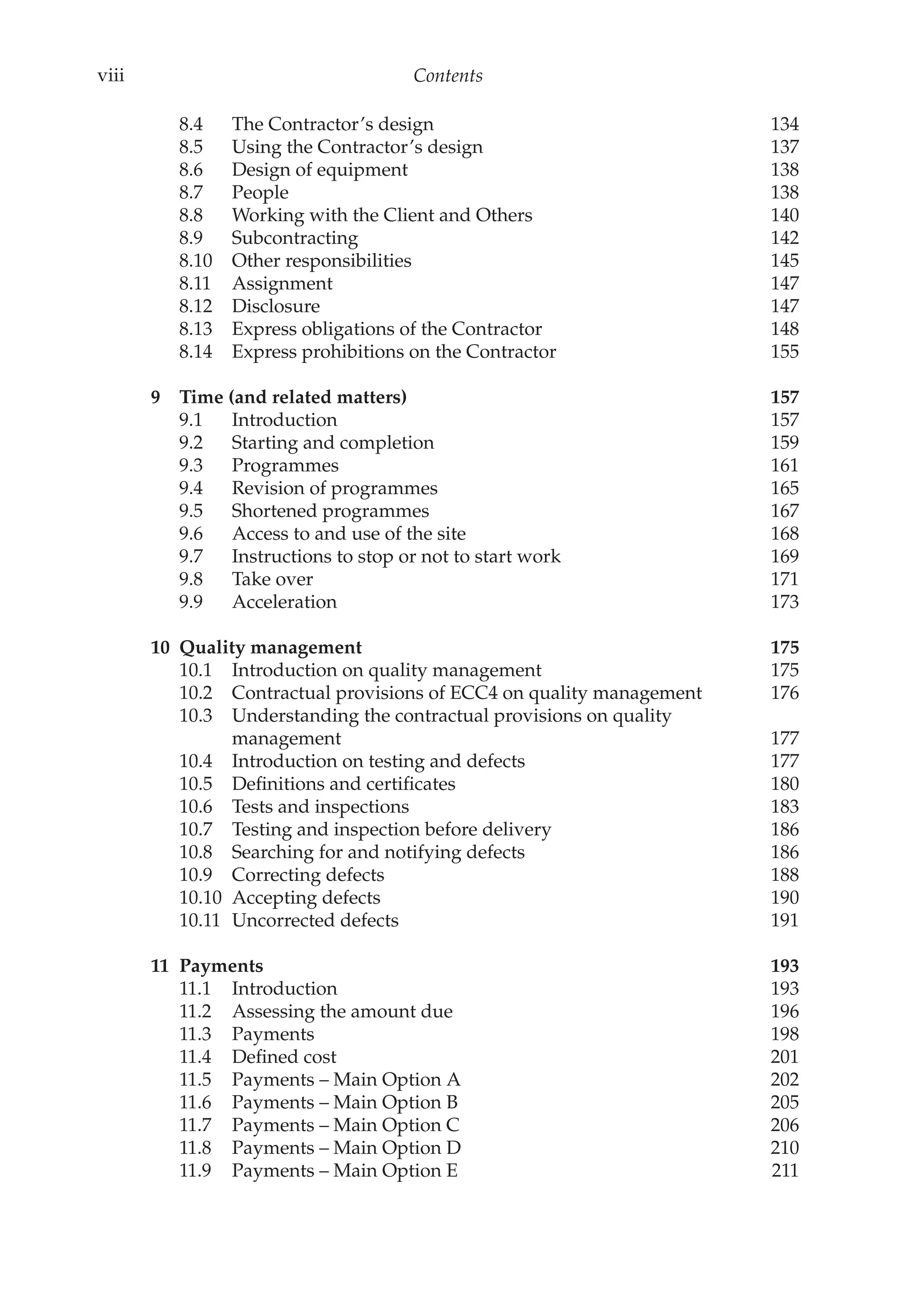
viii Contents
8.4 The Contractor’s design 134
8.5 Using the Contractor’s design 137
8.6 Design of equipment 138
8.7 People 138
8.8 Working with the Client and Others 140
8.9 Subcontracting 142
8.10 Other responsibilities 145
8.11 Assignment 147
8.12 Disclosure 147
8.13 Express obligations of the Contractor 148
8.14 Express prohibitions on the Contractor 155
9 Time (and related matters) 157
9.1 Introduction 157
9.2 Starting and completion 159
9.3 Programmes 161
9.4 Revision of programmes 165
9.5 Shortened programmes 167
9.6 Access to and use of the site 168
9.7 Instructions to stop or not to start work 169
9.8 Take over 171
9.9 Acceleration 173
10 Quality management 175
10.1 Introduction on quality management 175
10.2 Contractual provisions of ECC4 on quality management 176
10.3 Understanding the contractual provisions on quality
management 177
10.4 Introduction on testing and defects 177
10.5 Definitions and certificates 180
10.6 Tests and inspections 183
10.7 Testing and inspection before delivery 186
10.8 Searching for and notifying defects 186
10.9 Correcting defects 188
10.10 Accepting defects 190
10.11 Uncorrected defects 191
11 Payments 193
11.1 Introduction 193
11.2 Assessing the amount due 196
11.3 Payments 198
11.4 Defined cost 201
11.5 Payments – Main Option A 202
11.6 Payments – Main Option B 205
11.7 Payments – Main Option C 206
11.8 Payments – Main Option D 210
11.9 Payments – Main Option E 211
Contents ix
11.10 Payments – Main Option F 211
11.11 Final assessment 212
11.12 Status of and disputes on final assessments 213
12 ECC4 compensation event schemes 215
12.1 Introduction 215
12.2 Structure of ECC4 compensation events schemes 217
12.3 Amendments and additions 217
12.4 Outline of procedures 219
12.5 Defining a compensation event 220
12.6 Compensation events as exclusive remedies 220
12.7 Fairness of the compensation event procedures 222
12.8 Unusual features of the compensation event procedures 222
13 Listed compensation events 223
13.1 Introduction 223
13.2 Omissions from the listed events 224
13.3 Scope-related events 224
13.4 Client’s default events 226
13.5 Client’s liability events 229
13.6 Project Manager/Supervisor-related events 230
13.7 Physical conditions 233
13.8 Adverse weather 236
13.9 Prevention 237
13.10 Measurement-related events 238
13.11 Secondary Option clause events 240
14 Notifying compensation events 242
14.1 Introduction 242
14.2 Notifications by the Project Manager 242
14.3 Notifications by the Contractor 244
14.4 Project Manager’s response to notifications 248
14.5 Last date for notification of compensation events 250
15 Quotations for compensation events 252
15.1 Introduction 252
15.2 Instructions to submit quotations 253
15.3 Failure to give early warning 253
15.4 Assumptions for assessment of quotations 254
15.5 Primary clauses on quotations 255
15.6 Submissions of quotations 255
15.7 Revised quotations 256
15.8 Failure to reply to quotations 256
15.9 General comment on ECC4’s assessment and
quotation systems 256
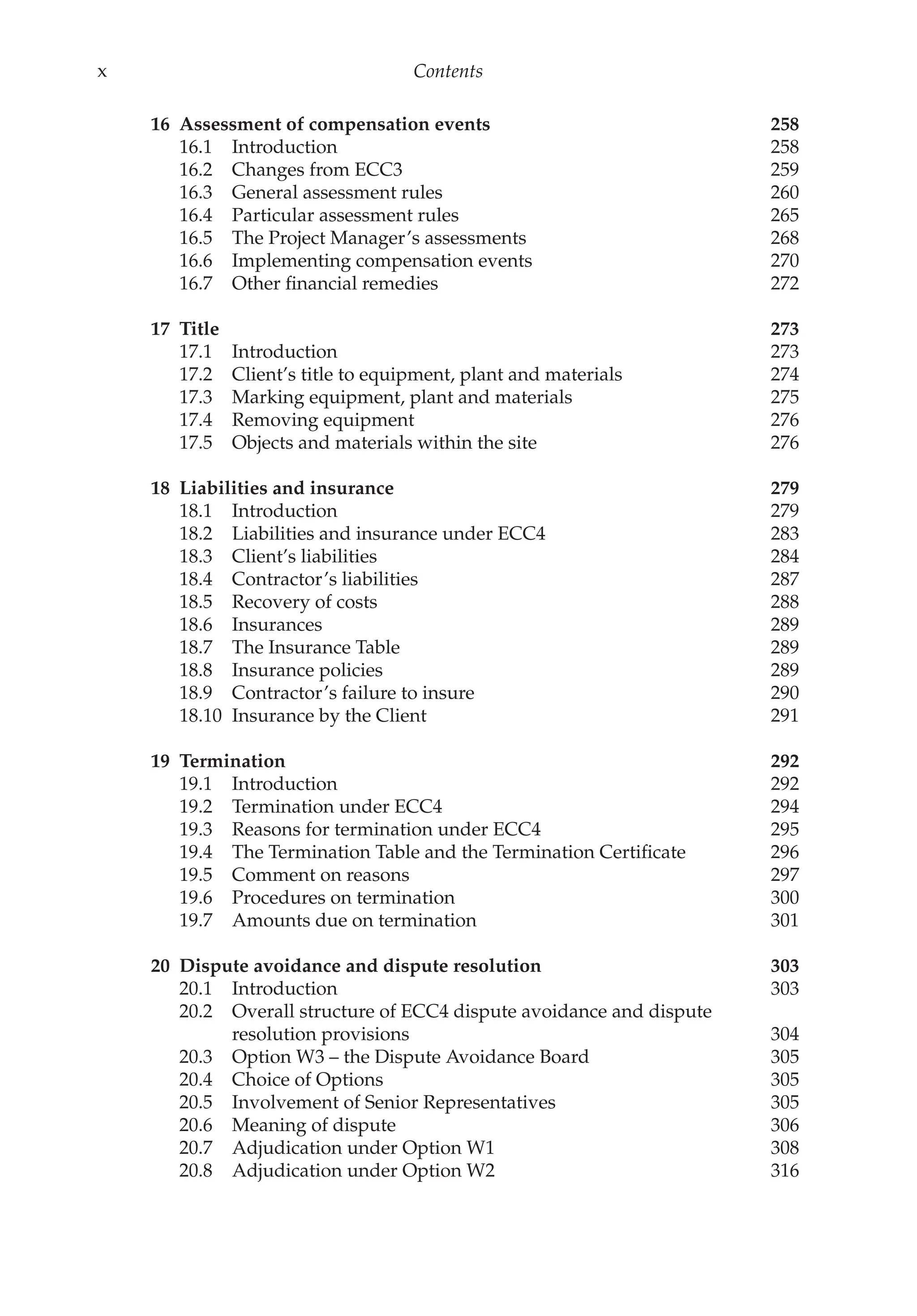
x Contents
16 Assessment of compensation events 258
16.1 Introduction 258
16.2 Changes from ECC3 259
16.3 General assessment rules 260
16.4 Particular assessment rules 265
16.5 The Project Manager’s assessments 268
16.6 Implementing compensation events 270
16.7 Other financial remedies 272
17 Title 273
17.1 Introduction 273
17.2 Client’s title to equipment, plant and materials 274
17.3 Marking equipment, plant and materials 275
17.4 Removing equipment 276
17.5 Objects and materials within the site 276
18 Liabilities and insurance 279
18.1 Introduction 279
18.2 Liabilities and insurance under ECC4 283
18.3 Client’s liabilities 284
18.4 Contractor’s liabilities 287
18.5 Recovery of costs 288
18.6 Insurances 289
18.7 The Insurance Table 289
18.8 Insurance policies 289
18.9 Contractor’s failure to insure 290
18.10 Insurance by the Client 291
19 Termination 292
19.1 Introduction 292
19.2 Termination under ECC4 294
19.3 Reasons for termination under ECC4 295
19.4 The Termination Table and the Termination Certificate 296
19.5 Comment on reasons 297
19.6 Procedures on termination 300
19.7 Amounts due on termination 301
20 Dispute avoidance and dispute resolution 303
20.1 Introduction 303
20.2 Overall structure of ECC4 dispute avoidance and dispute
resolution provisions 304
20.3 Option W3 – the Dispute Avoidance Board 305
20.4 Choice of Options 305
20.5 Involvement of Senior Representatives 305
20.6 Meaning of dispute 306
20.7 Adjudication under Option W1 308
20.8 Adjudication under Option W2 316
Contents xi
20.9 Review by the tribunal 320
20.10 The Adjudicator’s contract 323
21 NEC4 Engineering and Construction Subcontract 324
21.1 Introduction 324
21.2 Structure of the ECC4 subcontract 325
21.3 Common core clause grouping 326
21.4 Core clauses – general 327
21.5 Core clauses – the Subcontractor’s main responsibilities 327
21.6 Core clauses – time 328
21.7 Core clauses – quality management 329
21.8 Core clauses – payment 329
21.9 Core clauses – compensation events 330
21.10 Core clauses – title 330
21.11 Core clauses – liabilities and insurances 331
21.12 Core clauses – termination 331
21.13 Resolving and avoiding disputes 331
22 Legal decisions on NEC-based contracts 333
22.1 Introduction 333
22.2 ABB Limited v. Bam Nuttall Ltd [2013] EWHC 1983 (TCC) 333
22.3 Amey LG Ltd v. Cumbria County Council [2016]
EWHC 2856 (TCC) 333
22.4 Amey Wye Valley Ltd v. The County of Herefordshire
District Council (Rev1) [2016] EWHC 2368 (TCC) 334
22.5 Anglian Water Services Ltd v. Laing O’Rourke Utilities Ltd
[2010] EWHC 1529 (TCC) 334
22.6 Arbitration Application No 2 of 2016 & [2017] Scot CS CSOH
23 (P1039/16) 335
22.7 Arcadis UK Ltd v. May and Baker Ltd (t/a Sanofi) [2013]
EWHC 87 335
22.8 AMEC Group Ltd v. Secretary of State for Defence [2013]
EWHC 110 (TCC) 335
22.9 Aecom Design Build Ltd v. Staptina Engineering Services
Ltd [2017] EWHC 723 (TCC) 336
22.10 Atkins Ltd v. Secretary of State for Transport [2013] EWHC
139 (TCC) 336
22.11 Balfour Beatty Ltd v. Gilcomston North Ltd and O Turner
Insulation Ltd [2006] Scot CS CSOH 81 337
22.12 Cleveland Bridge UK Ltd v. Sarens (UK) Ltd [2018] EWHC
751 (TCC) 337
22.13 Beumer Group UK Ltd v. Vinci Construction UK Ltd [2016]
EWHC 2283 (TCC) 338
22.14 Costain Ltd v. Tarmac Holdings Ltd [2017] EWHC 319 (TCC) 338
22.15 Dynniq UK Ltd v. Lancashire County Council [2017]
EWHC 3173 (TCC) 339
xii Contents
22.16 Costain Ltd & O’Rourke Civil Engineering Ltd & Bachy
Soletance Ltd & Emcor Drake and Scull Group PLC v.
Bechtel Ltd & Mr Fady Bassily [2005] EWHC 1018 (TCC) 339
22.17 Ecovision Systems Ltd v. Vinci Construction UK Ltd (Rev1)
[2015] EWHC 587 (TCC) 340
22.18 Farelly (M&E) Building Services Limited v. Byrne Brothers
(Formwork) Ltd [2013] EWHC 1186 (TCC) 340
22.19 Fermanagh District Council v. Gibson (Banbridge) Ltd [2014]
NICA 46 341
22.20 Ground Developments Ltd v. FCC Construction SA & Ors
[2016] EWHC 1946 (TCC) 341
22.21 Henry Brothers (Magherafelt) Ltd & Ors v. Department of
Education for Northern Ireland [2007] NIQB 116, [2008]
NIQB 105 341
22.22 Imtech Inviron Ltd v. Loppingdale Plant Ltd [2014] EWHC
4006 (TCC) 342
22.23 Imperial Chemical Industries Ltd v. Merit Merrell
Technology Ltd [2018] EWHC 1577 (TCC) 342
22.24 Imperial Chemical Industries Ltd v. Merit Merrell
Technology Ltd [2016] EWHC B30 (TCC) [2017] EWHC 1763
(TCC) 342
22.25 Imperial Chemical Industries Ltd v. Merit Merrell
Technology Ltd [2015] EWHC 2915 (TCC) 343
22.26 Liberty Mercian Ltd v. Cuddy Civil Engineering Ltd & Anor
[2013] EWHC 2688 (TCC), [2013] EWHC 4110 (TCC), [2014]
EWHC 3584 (TCC) 343
22.27 McAlpine PPS Pipeline Systems Joint Venture v. Transco PLC
[2004] EWHC 2030 (TCC) 344
22.28 FP McCann Ltd v. The Department for Regional
Development [2016] NICh 12 344
22.29 McConnell Dowell Constructors (Aust) Pty Ltd v. National
Grid Gas PLC [2006] EWHC 2551 (TCC) 344
22.30 Mears Ltd v. Shoreline Housing Partnership Ltd [2013]
EWHC 27, [2015] EWHC 1396 345
22.31 Maersk Oil UK Ltd (formerly Kerr-McGee Oil (UK) PLC) v.
Dresser-Rand (UK) Ltd [2007] EWHC 752 (TCC) 345
22.32 J Murphy & Sons Ltd v. W. Maher and Sons Ltd [2016]
EWHC 1148 (TCC) 345
22.33 Northern Ireland Housing Executive v. Combined Facilities
Management [2014] NIQB 75 [2015] 346
22.34 Northern Ireland Housing Executive v. Healthy Buildings
Ltd [2013] NIQB 124/[2017] NIQB 43 346
22.35 ROK Building Limited v. Celtic Composting Systems Ltd
[2009] EWHC 2664 (TCC), [2010] EWHC 66 347
22.36 RWE Npower Renewables Ltd v. JN Bentley Ltd [2013]
EWHC 978 (TCC) 347
Contents xiii
22.37 RWE Npower Renewables Ltd v. JN Bentley Ltd [2014]
EWCA Civ 150 347
22.38 Secretary of State for Defence v. Turner Estate Solutions
Limited [2015] EWHC 1150 (TCC) 348
22.39 SGL Carbon Fibres Ltd v. RBG Ltd [2012] Scot CS CSOH 19,
[2010] CSOH 77 348
22.40 Stork Technical Services (RBG) Ltd v. Ros [2015] CSOH 10A 348
22.41 Shepherd Construction Ltd v. Pinsent Masons LLP [2012]
EWHC 43 (TCC) BLR 213, 141 Con LR 232 348
22.42 Seele Austria GmbH & Co Kg v. Tokio Marine Europe
Insurance Ltd [2009] EWHC 2066 (TCC) 349
22.43 SSE General Ltd v. Hochtief Solutions AG & Anor [2015] Scot
CS CSOH 92 349
22.44 Vinci Construction UK Ltd v. Beumer Group UK Ltd [2017]
EWHC 2196 (TCC) 350
22.45 Volker Stevin Limited v. Holystone Contracts Limited [2010]
EWHC 2344 (TCC) 350
22.46 Wales and West Utilities Limited v. PPS Pipeline Systems
GmbH [2014] EWHC 54 (TCC) 351
22.47 Walker Construction (UK) Ltd v. Quayside Homes Ltd and
Peter Brett Associates LLP [2014] EWCA Civ 93 351
22.48 (1) Walter Llewellyn & Sons Limited (2) ROK Building
Limited v. Excel Brickwork Limited [2010] EWHC 3415
(TCC) 352
22.49 AE Yates Trenchless Solutions Ltd v. Black & Veatch Ltd
[2008] EWHC 3183 (TCC) 352
22.50 Weatherford Global Products Ltd v. Hydropath Holdings
Ltd & Ors [2014] EWHC 2725 (TCC) 352
22.51 WSP Cel Ltd v. Dalkia Utilities Services PLC [2012] EWHC
2428 (TCC) 353
Table of cases 355
Table of clause references 359
Preface
Throughout the fifty year period from 1945 to 1995, the ICE Conditions of
Contract provided the standard form for most civil engineering contracts in the
UK. But by 1999 when the Seventh Edition of those Conditions was produced
it was becoming clear that the New Engineering Contract, first published in
consultative form in 1991, was establishing itself as the market leader.
The initial driving force for this change was not so much dissatisfaction with
the ICE Conditions; indeed they had served the construction industry well and
were respected as being fair, workable and straightforward in their presenta-
tion. Disputes which arose between the Parties were mostly settled by deci-
sions of the Engineer, and few progressed to arbitration or the Courts. How-
ever, linked to some extent by changes in the 1980s such as privatisation and
the growth of project management as a specialised career, and a perception by
some that ICE Conditions focused more on the obligations and responsibilities
of the Parties than on good management, the Institution of Civil Engineers took
the bold step of producing an alternative standard form (the NEC), designed
for major works and justifying the appointment of a full-time Project Manager.
When the NEC was first released it was said by the Institution of Civil Engi-
neers that the NEC would provide an alternative to, not a replacement for, the
ICE Conditions of Contract. But that promise, if it was such, did not last for
long once it became clear that the NEC, after a shaky start, had the support
of government ministries, impressed by the recommendations in Sir Michael
Latham’s 1994 government sponsored report Constructing the Team. Thereafter,
it was simply a matter of time before publication of the ICE Conditions of Con-
tract ceased and the field was left clear for the NEC to prosper. And there can
be little doubt that the NEC has made remarkable progress.
Credit for the momentum of that progress must go principally to the pro-
moters of NEC. No effort has been spared in putting across the message that
NEC has special qualities which bring benefits to all users, not the least of
those qualities being the NEC’s opening requirements of mutual trust and co-
operation. Those expressly stated contractual requirements, whether achiev-
able or not, set the NEC forms on a different plane from other standard forms.
And although much is made of improved management procedures in the pack-
ages covering the new suite of NEC4 contracts, the principal driving force for
their ongoing use is likely to be hope or expectation that the projects they apply
to will end in cheers rather than in tears.
Author’s note
Content
It is not my intention in writing this book to attempt to examine and comment
on the full set of sixteen contracts which comprises the NEC4 suite of contracts.
I intend, in this book, to do no more than provide a commentary confined to the
main contract of the suite, the NEC4 Engineering and Construction Contract
(ECC4).
In doing so I will undertake a clause by clause study of the provisions of
ECC4. Additionally, I will draw attention to significant changes from the pre-
ceding ECC3, and I will consider the implications of such changes. However,
as ECC4 has adopted various terminology changes affecting the precise word-
ing of most of its clauses, it would possibly be a distraction to readers for me
to include comment on, or to catalogue, all of these. The full detail of these
terminological changes, and other changes, can be found in the useful NEC
publication NEC3 and NEC4 Compared by Robert Gerrard.
In my books on earlier NEC contracts I included, occasionally by reference
to potentially applicable case law, comments of a general nature on the provi-
sions of those contracts. Where appropriate, I have repeated those comments,
sometimes verbatim, in this book.
Style
NEC4 retains the characteristic of earlier NEC contracts that ‘defined terms’
have capital initials, and ‘identified terms’ are in italics.
Text
Very little of the text of ECC4 is quoted in this book. I have assumed that
readers will have to hand a copy of NEC4 and other contracts of the suite as
appropriate.
Indexing
The published version of the ECC4 Engineering and Construction Contract
contains a comprehensive index of subjects referenced to clause numbers. In
this book a full table of clause numbers with descriptions is referenced to chap-
ter sections. Accordingly, readers of this book who wish to have the benefit of
a subject index will find it a straightforward matter to move from the subjects
in the ECC4 contract to the chapter sections in this book.
Chapter 1
Introduction
1.1 Overview
NEC4 is a generic name for a suite of contracts developed by the Institution
of Civil Engineers, and published by its wholly owned subsidiary Thomas
Telford Ltd. NEC stands for New Engineering Contract, a name originating
from the publication in January 1991 of a consultative version of what was
then a new approach to the drafting of construction contracts.
1.2 Background
The background to the development of the New Engineering Contract (NEC)
does much to explain its style and content. In the 1980s there was ongoing
debate within the Institution of Civil Engineers (ICE), the lead body for the
production of the ICE Conditions of Contract – at that time the standard form
used for most civil engineering works in the UK – as to the direction of future
contract strategies. At issue were questions as to whether the then existing
standard forms adequately served the best interests of the Parties by focus-
ing on the obligations and responsibilities of the Parties rather than on good
management, and whether an entirely new approach was needed to promote
co-operation and to reduce confrontation. The prevailing view was that some-
thing new was needed, particularly for sizeable contracts where attention to
good project management was the key to successful completion.
1.3 Objectives
The drafting team for the first version of the NEC was charged with three
specific objectives for the new contract:
r that it should be more flexible in its scope than existing standard forms
r that it should provide greater stimulus to good project management than
existing standard forms
r that it should be expressed more simply and clearly than existing forms.
Maintenance of those ambitions has been the bedrock of the 1993, 1995, 2005,
2013 and now 2017 editions of the NEC contracts.
The NEC4 Engineering and Construction Contract: A Commentary, Third Edition. Brian Eggleston.
© 2019 John Wiley & Sons Ltd. Published 2019 by John Wiley & Sons Ltd.
2 1.4 Impacts of change
For the 2017 edition, those ambitions have been expanded:
r to provide even greater stimulus to good management
r to support new approaches to procurement which improve contract man-
agement
r to inspire increased use of NEC in new markets and sectors.
1.4 Impacts of change
As evident from the above, it was a matter of policy from the outset that NEC
contracts should be different in form and content from other standard forms
of construction contracts. And they certainly are.
The early editions of the NEC were greeted with mixed reviews varying
from effusive praise to shock and horror. But such a range of reactions was
inevitable given the extent to which the NEC differed from traditional standard
forms of construction contracts in its procedural and terminological changes,
and the extent to which it required changes in attitudes and long-standing
practices. Moreover, there were those who recognised that change, however
well intended, can bring with it unintended consequences, and that effecting
change in the construction industry has never been easy to achieve. For, as
Rudyard Kipling wrote a century or so ago in his bricklayer’s tale:
I tell this tale, which is strictly true,
Just by way of convincing you
How very little since things were made
Things have altered in the building trade.
Not surprisingly, therefore, ambitious expectations that improved contract
management and reduction of conflict could be achieved with a contract that
was deliberately different from previously used construction contracts have
not all been achieved. In particular, moving the focus of the conditions of con-
tract from detailing the obligations and liabilities of the Parties to detailing the
particulars of project management seems to have overlooked some of the more
obvious consequences of such a change.
It used to be said that a good contract was never taken out of the drawer until
it was needed. That axiom, however, has no application to NEC contracts. Such
contracts are not simply sets of conditions of contract, they are also manuals
of project management and, as such, they should never be taken off the desk,
less still put in a drawer.
And one clearly unintended impact of the NEC changes to project man-
agement is that the scope for disputes has been greatly increased. Thus, it is
now commonplace for pleadings/submissions in respect of formalised dis-
putes arising under NEC contracts to cover differences not only on substantive
matters but also administrative/procedural matters. And, not infrequently, the
latter types of disputes seem to be the ones that generate most animosity, con-
flict and lack of trust between the Parties. Some of this arises where the Parties
are not equally matched in relation to dealing with the procedural burdens of
1.6 Characteristics of NEC contracts 3
their NEC contract, and that imbalance, of itself, generates not only hostility
but also more disputes.
There is additionally another unintended factor which surfaces in many
NEC adjudications. It can be summarised as disappointment, at various
levels within the Parties’ management structures, that the NEC require-
ments for mutual trust and co-operation have not produced the financial
and time-related outcomes that were expected. And then the blame games
commence.
1.5 The NEC4 suite of contracts
Within the NEC4 Engineering and Construction Contract, hereafter in this
book ECC4, there are six Primary Options, which include priced contracts, tar-
get cost contracts, a cost reimbursable contract, and a management contract.
However, these simply reflect the flexibility of scope of ECC4 itself. They do
not count separately as part of the ever-growing suite (or family as it was pre-
viously called) of NEC contracts. That suite, with the introduction of NEC4,
numbers sixteen separate contracts:
1. Engineering and Construction Contract (ECC)
2. Engineering and Construction Subcontract (ECS)
3. Engineering and Construction Short Contract (ECSC)
4. Engineering and Construction Short Subcontract (ECSS)
5. Professional Service Contract (PSC)
6. Professional Service Subcontract (PSS)
7. Professional Service Short Subcontract (PSSC)
8. Term Service Contract (TSC)
9. Term Service Subcontract (TSS)
10. Term Service Short Contract (TSSC)
11. Supply Contract (SC)
12. Supply Short Contract (SSC)
13. Design Build and Operate Contract (DBO)
14. Alliance Contract (ALC)
15. Framework Contract (FC)
16. Dispute Resolution Service Contract (DRSC).
1.6 Characteristics of NEC contracts
As noted above, NEC contracts are drafted with the objectives of achieving
flexibility, stimulus to good project management, clarity and simplicity.
Flexibility is pursued partly by drafting which avoids terminology specific
to the practices of particular industries, but principally by providing primary
and Secondary Option clauses which allow contracts to be built up by the selec-
tion of pricing mechanisms and contractual provisions deemed appropriate for
any particular project.
4 1.7 Structure of the NEC4 Engineering and Construction Contract (ECC4)
Stimulus to good project management is pursued by the emphasis that NEC
contracts place on communications, co-operation, programming and risk man-
agement.
Clarity and simplicity objectives are pursued by drafting which is inten-
tionally and conspicuously different from that of other standard forms in style
and structure. Short sentences are used, cross-referencing is avoided and so too
is technical and legal jargon. And, to assist in understanding and application
of the provisions of NEC contracts, User Guides and Flow Charts are available
from the publishers. However, the differences of opinion which surfaced when
NEC contracts were first published as to whether their drafting achieved clar-
ity and simplicity remain. The charge made by an eminent lawyer of the time
that the draftsmen had used ‘ladybird language’ may have been a little unfair
in the light of the NEC’s subsequent progress. But, more recently, the comment
by His Honour Mr Justice Edwards-Stuart in the case of Anglian Water Services
Ltd v. Laing O’Rourke Utilities Ltd (2010) that the drafting of an NEC2 contract
seemed to represent ‘a triumph of form over substance’ will probably be recog-
nised by many involved in the use or interpretation of NEC contracts as fair
comment.
1.7 Structure of the NEC4 Engineering and Construction
Contract (ECC4)
Option and clause structure
In order to create a set of ECC4 conditions for a particular contract, the Client
(previously the Employer):
r makes a selection from the six Main Options as to which type of pricing
mechanism is to apply
r includes in the contract the nine sections of common Core Clauses, and the
Main Option clauses applicable to the selected Main Option (the pricing
option)
r specifies which of the three options for resolving and avoiding disputes
applies
r selects and includes within the contract which, if any, of the twenty-two
Secondary Option clauses are to apply, and
r includes in the contract, under Secondary Option Z, any Additional Condi-
tions of Contract.
The six Main Options of ECC4 are:
r Option A – Priced contract with activity schedule
r Option B – Priced contract with bill of quantities
r Option C – Target contract with activity schedule
r Option D – Target contract with bill of quantities
r Option E – Cost reimbursable contract
r Option F – Management contract.
1.7 Structure of the NEC4 Engineering and Construction Contract (ECC4) 5
Each of the Main Options is published in a separate volume which includes the
relevant Core Clauses for the particular option. Additionally there is a single
volume covering all six options.
The clauses for any particular ECC4 contract are assembled by incorpora-
tion of:
r Core Clauses
r Main Option clauses
r Secondary Option clauses.
The Core Clauses are standardised terms, grouped into sections, under nine
headings:
r General
r The Contractor’s main responsibilities
r Time
r Quality management
r Payment
r Compensation events
r Title
r Liabilities and insurance
r Termination.
The Main Option clauses are, in effect, Core Clauses particular to each of the
Main Options, A to F. They are not optional in themselves.
The Secondary Option clauses, which, in ECC4, are prefaced X1–X22, Y (UK)
1–3, and Z, are optional in the sense that to be incorporated into the contract
they have to be listed in the Contract Data. However, some of the Secondary
Option clauses such as X7 for delay damages and X16 for retention, would be
regarded in most construction contracts as essential rather than optional, so
care needs to be taken in their selection, and/or omission.
Care also needs to be taken in respect of Options W1, W2, and W3, which
relate to resolving and avoiding disputes. These appear in ECC4 between the
Core Clauses and the Secondary Option clauses and it is mandatory to select
one of these options for inclusion in the contract.
The full list of Secondary Option clauses in ECC4 is:
Option X1 – Price adjustment for inflation
Option X2 – Changes in the law
Option X3 – Multiple currencies
Option X4 – Ultimate holding company guarantee
Option X5 – Sectional completion
Option X6 – Bonus for early completion
Option X7 – Delay damages
Option X8 – Undertakings to the Client or Others
Option X9 – Transfer of rights
Option X10 – Information modelling
6 1.8 Changes ECC3 to ECC4
Option X11 – Termination by the Client
Option X12 – Multiparty collaboration
Option X13 – Performance bond
Option X14 – Advanced payment to the Contractor
Option X15 – The Contractor’s design
Option X16 – Retention
Option X17 – Low performance damages
Option X18 – Limitation of liability
Option X19 – Not used
Option X20 – Key Performance Indicators
Option X21 – Whole life cost
Option X22 – Early Contractor involvement
Option Y (UK) 1 – Project Bank Account
Option Y (UK) 2 – The Housing Grants, Construction and Regeneration
Act 1996
Option Y (UK) 3 – The Contracts (Rights of Third Parties) Act 1999
Option Z – Additional conditions of contract.
1.8 Changes ECC3 to ECC4
Because the full extent of the changes from ECC3 to ECC4 is extensive and
complex, they are identified and considered in Chapter 2 and other parts of
this book. But, in summary, the obvious and the important core clause changes
are:
1. ECC4 retitles and expands the ECC3 section 4 clauses on ‘Testing and
Defects’. In ECC4 the new title of section 4 is ‘Quality Management’ and
within that expanded section there are requirements for operation by the
Contractor of a quality management system, which incidentally are also
passed down to Subcontractors and sub-Subcontractors.
2. ECC4 has new dispute and avoidance procedures which include the
involvement of Senior Representatives and the use of Dispute Avoidance
Boards.
3. ECC4 requires the Contractor to submit applications for interim payments.
4. ECC4 introduces a set of new provisions on assessment and payment of
the final amount due.
5. ECC4 uses a new term ‘the dividing date’ for determining when actual
Defined Cost changes to forecast Defined Cost for the purposes of assess-
ments of compensation events.
6. ECC4 renames the ECC3 provisions on risk reduction meetings and risk
registers as early warning meetings and early warning registers.
7. ECC4 replaces the ECC3 term ‘risks’ with ‘liabilities’ and retitles section 8
‘Liabilities and Insurance’.
8. ECC4 defines ‘a Corrupt Act’ and has provisions relating thereto.
9. ECC4 lists two additional compensation events, the first covering the Con-
tractor’s costs when a requested quotation for a proposed instruction is not
1.10 Entire agreement 7
accepted, the second covering, as a matter of formality, additional compen-
sation events stated in the Contract Data.
10. ECC4 permits the Contractor, as well as the Project Manager, to propose
acceleration to achieve earlier Completion Dates and changes to Key Dates.
However, it should not be taken from the above list that all other changes are
insignificant, even if at first sight they may appear so. Thus, the terminologi-
cal change from ‘Works Information’ in ECC3 to ‘Scope’ in ECC4, which runs
through the entirety of ECC4, will generally be of no contractual consequence.
But in the context of clause 14.3, which in ECC3 empowers the Project Man-
ager to change the ‘Works Information’ and where the corresponding clause in
ECC4 empowers the Project Manager to change the ‘Scope’, there is evidently
room for debate on how far it is wise to depart from the legal principle that
words should be given their ordinary meaning. No Contractor of right mind
would enter into a contract where the scope of the works (in its ordinary mean-
ing) could be changed at the will of the Client or the Project Manager.
1.9 Review of points of interest
In Chapter 1 (Introduction) of my book on NEC3, I identified under the follow-
ing headings nine ‘points of interest’ arising from studies of NEC3 and earlier
editions of NEC contracts:
1. Entire Agreement
2. Exclusion of common law rights
3. Conditions precedent to compensation event entitlements
4. Role and powers of the Project Manager
5. Changes to Works Information (now Scope)
6. Prevention
7. Quotations for compensation events
8. Assessment of compensation events
9. Dispute resolution.
All of these will be reviewed in detail in later chapters of this book, but by way
of summary, and in the light of the provisions of ECC4, judicial comments on
ECC3, and personal experience in ECC3 arbitrations and adjudications, the
observations set out in the following sections can be made.
1.10 Entire agreement
ECC4 retains, with a very minor change of wording, the provision introduced
in ECC3 at clause 12.4 that the contract is the ‘entire agreement between the
Parties’. Nothing of note has changed in the meantime, and it remains the case
that it is still open to debate as to what is intended by the provision. It may
be that it is intended to exclude common law remedies for breach, or it may be
8 1.13 Role and powers of the Project Manager
that its purpose is to emphasise that the obligations and liabilities of the Parties
are confined strictly to the four corners of the signed contract.
Further comment on this is provided in Chapter 5, but it is worth noting here
that arguments about the application of clause 12.4 have surfaced in numerous
adjudications under ECC3 contracts where disputes have arisen as to whether
certain agreements between the Parties are of contractual effect, and as to the
extent to which a distinction is intended between the terms ‘entire agreement’
as found in clause 12.4 and ‘complete contract’ as found in the Contract Data
Sheet, Part one.
The Parties to ECC4 contracts should, therefore, exercise great caution in
reaching what are sometimes called ‘supplementary agreements’ and would
be wise to enter into such agreements only after taking legal advice.
1.11 Exclusion of common law rights
The debate as to whether NEC contracts exclude the Parties’ rights to sue for
damages for breaches of contract remains unsettled. There is a good case for
saying that in main contracts, the intention is that the Contractor’s rights are
so curtailed by the contractual rights provided in the compensation event pro-
cedures of the contract, particularly as one such event is expressed as breach
of contract by the Client. That, however, does not dispose of the Client’s rights.
And when stepped down into the ECC4 subcontract, that same point applies
to the Contractor’s rights.
1.12 Conditions precedent to compensation event claims
The question as to whether or not, or when, claims, valid on their facts, can be
invalidated by failure to comply with time-bars, goes well beyond examination
of the time-bars in respect of the compensation events stated in ECC4. It is a
question applicable to all types of commercial contracts. More is said on this
in Chapter 14.
For all NEC contracts, time-bars in respect of claims have, from the out-
set, been treated as an integral part of maintaining good project management.
However, achieving incorporation into the contracts of workable and legally
acceptable provisions has proved a difficult task, as is evident from each new
version of the ECC.
ECC4 retains, subject to a minor wording change, the ECC3 requirement for
compensation events to be notified within eight weeks (clause 61.3). But, for a
possible exception to this rule, see the comments in Chapter 22 on the decision
of the Northern Ireland Court of Appeal in the case of Northern Ireland Housing
Executive v. Healthy Buildings (Ireland) Limited.
1.13 Role and powers of the Project Manager
There was some doubt in the early years of ECC contracts as to whether
the Project Manager was to act more as the Employer’s agent than as an
1.17 Assessments of compensation events 9
independent contract administrator. That point was considered in the 2005 case
of Costain Ltd (Corber), where Mr Justice Jackson reasserted the long-standing
legal rule that certifiers, including Project Managers, have a duty to act fairly
and honestly as between the Parties. The second point was clarified by the
inclusion in ECC3 of a new clause 12.3 requiring changes to the contract to be
signed by the Parties. That clause remains unchanged in ECC4.
1.14 Changes to Scope (previously Works Information)
ECC4 retains, in clause 14.3, the curiously simplistic statement that the Project
Manager may give an instruction which changes the Scope (previously Works
Information). Further comment on this is provided in Chapter 6.
1.15 Prevention
Concerns were expressed in many quarters when a set of provisions was
introduced in clause 19 of ECC3 defining ‘Prevention’ in a manner which
could be taken as going well beyond ‘force majeure’ or ‘beyond the control
of the Parties’, and which potentially placed responsibility for all such
matters on the Employer. The corresponding ECC4 clause 19 contains some
minor changes, but they are unlikely to be sufficient to halt the practice of
some Clients of deleting the clause in its entirety. For further comment see
Chapter 7.
1.16 Quotations for compensation events
ECC4 retains, with some minor drafting changes, the provisions in clause 62.6
of ECC3 whereby unless the Project Manager responds to the Contractor’s quo-
tation for a compensation event within three weeks, it is deemed to be accepted
by the Project Manager. The oddity that such quotations can be disputed by the
Client and altered by an Adjudicator apparently remains.
1.17 Assessments of compensation events
The basics of the ECC3 clause 63 provisions on assessments of compensation
events, including those for division between forecast cost and actual cost are
retained in ECC4, albeit with various drafting changes. However, see Chap-
ter 22 for comment on the Northern Ireland High Court judgment in a second
Northern Ireland Housing Executive v. Healthy Buildings Limited case. Put simply,
the Judge held in favour of actual cost assessment over forecast cost assess-
ment in circumstances where actual cost was available at the time the assess-
ment was made, quoting from an earlier case: ‘why should I shut my eyes and
grope in the dark when the material is available to show what work they actu-
ally did and how much it cost them’.
10 1.18 Dispute avoidance and dispute resolution
1.18 Dispute avoidance and dispute resolution
For contracts which expressly required the Parties to act in a spirit of mutual
trust and co-operation, ECC3 and preceding ECC contracts had surprisingly
little to offer by way of non-adversarial dispute avoidance and dispute res-
olution procedures. ECC4, however, rectifies that with its new, structured
approach to such matters.
If properly applied, the new approach should:
1. Reduce the number of disputes going to adjudication
2. Improve on-site and off-site relationships between the Parties
3. Ensure that senior management becomes aware of developing problems –
factual, contractual and financial – before they get out of hand.
Should these improvements be achieved, that alone would make production
of ECC4 well worthwhile.
Chapter 2
Changes from ECC3
2.1 Evolution
ECC4 uses as a marketing slogan the catchy phrase ‘evolution not revolution’.
And, as will be seen from the detail which follows in this chapter, that is gen-
erally a fair statement of what was intended and what has been achieved.
The underlying principles, the drafting style, and the option structure
format of ECC4 remain as in previous editions of ECC. However, ECC4 has an
increased range of Secondary Option clauses and a completely new approach
to avoiding and resolving disputes. Apart from this, there are few great sur-
prises. However, there are a good number of minor improvements drafted to
clarify clauses which, in previous editions, have been sources of concern. And,
strikingly, there are a great many textual changes between ECC4 and its prede-
cessors, which may prove troublesome if users of ECC4 do not adjust rapidly
to the new order.
2.2 Features and enhancements
The preface to ECC4 lists as ‘features’ and ‘enhancements’:
r a new design, build and operate contract
r a new multiparty alliance contract
r new forms of subcontract
r finalisation of cost elements during the contract
r party-led dispute avoidance
r increased standardisation between contracts
r enhanced guidance to users.
These are, however, high-level changes applicable to the suite of NEC4
contracts, and although some items in the list may impact indirectly on ECC4,
only two items in the above list impact directly on ECC4. These items are:
finalisation of cost elements and party-led dispute avoidance.
Important as these two items are, it would be imprudent to assume that
they are indicative of the full amount of change between ECC3 and ECC4. The
reality is that the majority of clauses in ECC4 differ, albeit in the main slightly,
from the wording of the corresponding clauses in ECC3.
The NEC4 Engineering and Construction Contract: A Commentary, Third Edition. Brian Eggleston.
© 2019 John Wiley & Sons Ltd. Published 2019 by John Wiley & Sons Ltd.
12 2.4 Changes to core clauses
2.3 Terminological changes
The majority of the textual changes are no more than terminological, thus:
r ‘the Employer’ is changed to ‘the Client’
r ‘Works Information’ is changed to ‘Scope’
r ‘risk reduction meeting’ is changed to ‘early warning meeting’
r ‘Risk Register’ is changed to ‘early warning register’
r ‘notifies’ is changed to ‘informs’.
Additionally, all gender-specific terms in ECC3, such as ‘he’ and ‘his’ are
replaced in ECC4 with gender-neutral wording.
Few, if any, of these terminological text changes are likely to have signifi-
cant impact on the Parties’ contractual obligations and liabilities but, given the
importance that NEC contracts place on written notices and communications,
it is essential that the new terminology is adopted and put into use from the
outset. And similarly it needs to be recognised from the outset that a certain
amount of clause renumbering and rearrangement has taken place.
The ECC4 changes which do have the capacity to create contractual change
are to be found in the Core clauses, the Dispute Resolution clauses, and the
Secondary Option clauses of the contract.
2.4 Changes to core clauses
The grouping of the nine sets of core clauses in ECC4 (the Sections, as hereafter
referred to) is the same as the grouping in ECC3. But, two of the Sections are
retitled in ECC4. Thus, in ECC4, section 4 is titled ‘Quality Management’ and
section 8 is titled ‘Liabilities and Insurance’. In ECC3 those titles were ‘Testing
and Defects’ and ‘Risks and Insurance’.
In ECC4, the Sections and the clauses therein are numbered and listed as
follows:
1. General: clauses 10.1–19.1
2. The Contractor’s Main Responsibilities: clauses 20.1–29.2
3. Time: clauses 30.1–36.3
4. Quality Management: clauses 40.1–46.2
5. Payment: clauses 50.1–53.4
6. Compensation Events: clauses 60.1–66.3
7. Title: clauses 70.1–74.1
8. Liabilities and Insurance: clauses 80.1–86.3
9. Termination: clauses 90.1–93.2.
The significant changes in the core clauses from ECC3 to ECC4, taking
them section by section, and without at this stage any commentary, are as
follows.
2.4 Changes to core clauses 13
General
Clause 10.1 of ECC3 stated, in a single sentence, that the Employer, the Contrac-
tor, the Project Manager and the Supervisor ‘shall act’ as stated in the contract,
and in a spirit of mutual trust and co-operation. In ECC4 those obligations, if
they are such, are redrafted and split between clauses 10.1 and 10.2. Clause 10.1
states that the Parties, the Project Manager and the Supervisor ‘shall act’ as
stated in the contract. Clause 10.2 states that the Parties, the Project Manager
and the Supervisor shall ‘act’ in a spirit of mutual trust and co-operation. More
is said on this interesting change in Chapter 6.
Clause 11.2, listing ‘Identified and defined terms’ has, in ECC4, a new
subclause defining ‘a Corrupt Act’. Additionally, ECC4 clauses 15.1 and 15.2
replace the ECC3 references to ‘the Risk Register’ and ‘risk reduction meetings’
with references to ‘the Early Warning Register’ and ‘early warning meetings’.
Further changes appear in the definitions of ‘The fee’ and of ‘ASubcontractor’.
Clause 14.2 of ECC4, relating to delegation, has considerably more points of
detail than the corresponding clause of ECC3.
Clauses 15, 16, 17, 18 and 19 of ECC3 deal in turn with ‘Adding to the
Working Areas’, ‘Early warning’, ‘Ambiguities and inconsistencies’, ‘Illegal
and impossible requirements’, and ‘Prevention’. ECC4 rearranges and changes
clauses 15–19 such that they deal in turn with: Early warning, Contractor’s pro-
posals, Requirements for instructions, Corrupt Acts, and Prevention. Each of
these clauses relates to matters of potential importance.
The Contractor’s Main Responsibilities
For the most part, clauses 20.1–29.2 of ECC4 match the corresponding section
clauses of ECC3. However, clauses 28 and 29 of ECC4, dealing respectively
with Assignment and Disclosure have no ECC3 equivalents. And, although
both concern legalistic matters rather than day-to-day construction matters,
these clauses also relate to matters of potential importance.
Time
Clauses 30–36 of ECC4 cover, under the section heading ‘Time’, such matters as
starting, completion, programmes, access, suspensions, take over and acceler-
ation. There are a few textual changes from ECC3 but none are of any great sig-
nificance. There are, however, some important new provisions within the ECC4
batch of clauses. Thus, clause 31.3 of ECC4 now provides for deemed accep-
tance of a programme if the Project Manager does not notify acceptance or
non-acceptance within a stipulated time-limit. Clause 34.1 requires that if the
Project Manager has given instructions to stop or not to start work, instructions
must subsequently be given to restart or remove the work. And clause 36.1 of
ECC4 now permits the Contractor as well as the Project Manager to propose
acceleration to achieve completion before the completion date.
14 2.4 Changes to core clauses
Quality Management
In ECC3, section 4 clauses 40.1–45.2 came under the heading ‘Testing and
Defects’. In ECC4, the section is retitled ‘Quality Management’. The ECC3
clauses are retained in ECC4 without any significant change as clauses 41.1–
46.2. However, in ECC4, section 4 commences with three new clauses (40.1–
40.3) subtitled ‘Quality Management System’. These clauses contain contrac-
tual provisions, new to ECC contracts, that the Contractor should operate such
a system, and should do so in compliance with stipulated requirements.
Payment
The ten clauses 50.1–52.1 in the ‘Payment’ section of ECC3 principally con-
cerned the mechanism and rules for interim payments. The sixteen clauses in
the ‘Payment’ section of ECC4 cover both interim payments and rules for mak-
ing assessments of the final amount due. Most of the ECC3 clauses which are
retained in ECC4 are modified in some respect, but these changes are points
of detail rather than substantive change. The big change between ECC3 and
ECC4 comes in the new group of clauses, 53.1–53.4, which provide in ECC4 a
comprehensive and extensive set of provisions for making, and dealing with,
the assessment and payment of the final amount due to the Contractor.
Compensation Events
Section 6 of ECC3 contained thirty-one numbered clauses, excluding the
nineteen numbered compensation events. It was, by far, the largest group of
clauses in the contract. That remains the case in ECC4, which has thirty-seven
numbered clauses, excluding twenty-one numbered compensation events.
The two additional compensation events in ECC4 concern quotations for
proposed instructions which are not instructed, and additional compensation
events stated in the Contract Data.
However, there has also been a considerable amount of redrafting through-
out the ECC4 compensation event clauses, most of which is inconsequential,
but some of which, in certain circumstances, could be important.
Title
The ECC3 clauses 70.1–73.2 covering matters relating to plant, materials, and
objects on the site are replicated in ECC4 with terminological changes and
only two changes worthy of note. The first of those changes is that whereas
by clause 73.2 of ECC3 the Contractor has title to materials from excavation
and demolition only as stated in the Works Information, under clause 73.2
of ECC4 the Contractor has title unless the Scope states otherwise. The sec-
ond change is that ECC4 has an additional clause, 74.1, which states that the
Discovering Diverse Content Through
Random Scribd Documents
From Damiani’s stricken thoughts upon the wickedness of the age,
we may turn to the more personal disclosures of one who wrote
himself Petrus peccator monachus. There is one tell-tale letter of
confession to his brother Damianus, whom he loved and revered:
“To my lord Damianus, my best loved brother, Peter, sinner and
monk, his servant and son.
“I would not have it hid from thee, my sweetest father and lord
in Christ, that my mind is cast down with sadness while it
contemplates its own exit which is so near. For I count now many
long years that I wait to be thrown to dogs; and I notice that in
whatever monastery I come nearly all are younger than myself.
When I consider this, I ponder upon death alone, I meditate
upon my tomb; I do not withdraw the eyes of my mind from my
tomb. Nor is my mind content to limit its fear and its
consideration to the death of the body; for it is at once haled to
judgment, and meditates with terror upon what might be its plea
and defence. Wretched me! with what fountains of tears must I
lament! I who have done every evil, and through my long life
have fulfilled scarce one commandment of the divine law. For
what evil have not I, miserable man, committed? Where are the
vices, where are the crimes in which I am not implicated; I
confess my life has fallen in a lake of misery; my soul is taken in
its iniquities. Pride, lust, anger, impatience, malice, envy,
gluttony, drunkenness, concupiscence, robbery, lying, perjury,
idle talking, scurrility, ignorance, negligence, and other pests
have overthrown me, and all the vices like ravening beasts have
devoured my soul. My heart and my lips are defiled. I am
contaminate in sight, hearing, taste, smell, and touch. And in
every way, in cogitation, in speech or action, I am lost. All these
evils have I done; and alas! alas! I have brought forth no fruit
meet for repentance.
“One pernicious fault, among others, I acknowledge: scurrility
has been my besetting sin; it has never really left me. For
howsoever I have fought against this monster, and broken its
wicked teeth with the hammer of austerity, and at times repelled
it, I have never won the full victory. When, in the ways of
spiritual gladness, I wish to show myself cheerful to the brethren,
I drop into words of vanity; and when as it were discreetly for
the sake of brotherly love, I think to throw off my severity, then
indiscreetly my tongue unbridled utters foolishness. If the Lord
said: ‘Blessed are they that mourn, for they shall be comforted,’
what judgment hangs over those who not only are slack at
weeping, but act like buffoons with laughter and vain giggling.
Consolation is due to those who weep, not to those who rejoice;
what consolation may be expected from that future Judge by
those who now are given to foolish mirth and vain jocularity? If
the Truth says: ‘Woe unto ye who laugh, for ye shall weep,’ what
fearful judgment shall be theirs who not only laugh themselves,
but with scurrilities drag laughter from their listeners?”
The penitent saint then shows from Scripture how that our hearts
ought to be vessels of tears, and concludes with casting himself at
the feet of his beloved “father” in entreaty that he would interpose
the shield of his holy prayers between his petitioner and that
monster, and exorcise its serpentine poison, and also that he would
ever pour forth prayers to God, and beseech the divine mercy in
behalf of all the other vices confessed in this letter.[332]
A strange confession this—or, indeed, is it strange? This cowled
Peter Damiani who passes from community to community, seeing
more keenly than others may, denouncing, execrating every vice
existent or imagined, who wears haircloth, goes barefoot, lives on
bread and water, scourges himself with daily flagellations, urging
others to do likewise,—this Peter Damiani is yet unable quite to
scourge out the human nature from him, and evidently cannot
always refrain from that jocularity and inepta laetitia for which the
Abbess Hildegard also saw sundry souls in hell.[333] Perhaps, with
Peter, revulsions from the strain of austerity took the form of sudden
laughter. His imagination was fine, his wit too quick for his soul’s
safety. His confession was no matter of mock humility, nor did he
deem laughter vulgar or in bad taste. He feared to imperil his soul
through it. Of course, in accusing himself of other, and as we should
think more serious crimes—drunkenness, robbery, perjury—Peter
was merely carrying to an extreme the monkish conventions of self-
vilification.
If it appears from this letter that Damiani had been unable quite to
scourge his wit out of him, another letter, to a young countess, will
show more touchingly that he had been unable quite to fast out of
him his human heart.
“To Guilla, most illustrious countess, Peter, monk and sinner,
[sends] the instancy of prayer.
“Since of a thing out of which will issue conflict it is better to
have ignorance without cost, than with dear-bought forgetting
wage hard war, we prudently accord to young women, whose
aspect we fear, audience by letter. Certainly I, who now am an
old man, may safely look upon the seared and wrinkled visage of
a blear-eyed crone. Yet from sight of the more comely and
adorned I guard my eyes as boys from fire. Alas my wretched
heart which cannot hold Scriptural mysteries read through a
hundred times, and will not lose the memory of a form seen but
once! There where the divine law remains not, no oblivion blurs
vanity’s image. But of this another time. Here I have not to write
of what is hurtful to me but of what may be salutary for thee.”
Peter then continues with excellent advice for the young
noblewoman, exhorting her to deeds of mercy and kindness, and
warning her against the enjoyment of revenues wrung from the
poor.[334] Indeed Damiani’s writings contain much that still is wise.
His advice to the great and noble of the world was admirable,[335]
and though couched in austere phrase, it demanded what many men
feel bound to fulfil in the twentieth century. His little work on
Almsgiving[336] contains sentences which might be spoken to-day.
He has been pointing out that no one can be exercising the ascetic
virtues all the time: no one can be always praying and fasting,
washing feet and subjecting the body to pain. Some people,
moreover, shun such self-castigation. But one can always be
benevolent; and, though fearing to afflict the body, can stretch forth
his hand in charity: “Those then who are rich should seek to be
dispensers rather than possessors. They ought not to regard what
they have as their own: for they did not receive this transitory
wealth in order to revel in luxury, but that they should administer it
so long as they continue in their stewardship. Whoever gives to the
poor does not distribute his own but restores another’s.”[337]
This sounds modern—it also sounds like Seneca.[338] Yet Damiani
was no modern man, nor was he antique, but very fearful of the
classics. Having been a rhetorician and grammarian, when he
became a hermit-monk he made Christ his grammar (mea
grammatica Christus est).[339] Horror-stricken at the world, and
writhing under his own contamination, he cast body and soul into
the ascetic life. That was the harbour of escape from the carnal
temptations which threatened the soul’s hope of pardon from the
Judge at the Last Day. Therefore Peter is fierce in execration of all
lapses from the hermit-life, so rapturously praised with its contrition,
its penitence, and tears. His ascetic rhapsodies, with which, as a
poet might, he delighted or relieved his soul, are eloquent
illustrations of the monastic ideal.[340]
Other men in Italy less intelligent than Damiani, but equally
picturesque, were held by like ascetic and emotional obsession.
Intellectual interest, however, in theology was less prominent,
because the Italian concern with religion was either emotional or
ecclesiastical, which is to say, political. The philosophic or dialectical
treatment of the Faith was to run its course north of the Alps; and
those men of Italian birth—Anselm, Peter Lombard, Bonaventura,
and Aquinas—who contributed to Christian thought, early left their
native land, and accomplished their careers under intellectual
conditions which did not obtain in Italy. Nevertheless, Anselm and
Bonaventura at least did not lose their Italian qualities; and it is as
representative of what might come out of Italy in the eleventh
century that the former may detain us here.
The story of Anselm is told well and lovingly by his companion
Eadmer.[341] His life, although it was drawn within the currents of
affairs, remained intellectual and aloof, a meditation upon God. It
opens with a dream of climbing the mountain to God’s palace-seat.
For Anselm’s boyhood was passed at Aosta, within the shadows of
the Graian Alps.[342] Surely the heaven rested upon them. Might he
not then go up to the hall where God, above in the heaven, as the
boy’s mother taught, ruled and held all?
“So one night it seemed he must ascend to the summit of the
mountains, and go to the hall of the great King. In the plain at
the first slopes, he saw women, the servants of the King, reaping
grain carelessly and idly. He would accuse them to their Lord. He
went up across the summit and came to the King’s hall. He found
Him there alone with His seneschal, for it was autumn and He
had sent His servants to gather the harvest. The Lord called the
boy as he entered; and he went and sat at His feet. The Lord
asked kindly (jucunda affabilitate) whence he came and what he
wished. He replied just as he knew the thing to be (juxta quod
rem esse sciebat). Then, at the Lord’s command, the Seneschal
brought him bread of the whitest, and he was there refreshed in
His presence. In the morning he verily believed that he had been
in Heaven and had been refreshed with the bread of the Lord.”
A pious mother had been the boy’s first teacher. Others taught him
Letters, till he became proficient, and beloved by those who knew
him. He wished to be made a monk, but a neighbouring abbot
refused his request, fearing the displeasure of Anselm’s father, of
whom the biographer has nothing good to say. The youth fell sick,
but with returning health the joy of living drew his mind from study
and his pious purpose. Love for his mother held him from over-
indulgence in pastimes. She died, and with this sheet-anchor lost,
Anselm’s ship was near to drifting out on the world’s slippery flood.
But here the impossible temper of the father wrought as God’s
providence, and Anselm, unable to stay with him, left his home, and
set out across Mount Senis attended by one clericus. For three years
he moved through Burgundy and Francia, till Lanfranc’s repute drew
him to Bec. Day and night he studied beneath that master, and also
taught. The desire to be a monk returned; and he began to direct
his purpose toward pleasing God and spurning the world.
But where? At either Cluny or Bec he feared to lose the fruit of his
studies; for at Cluny there was the strictness of the rule,[343] and at
Bec Lanfranc’s eminent learning would “make mine of little value.”
Anselm says that he was not yet subdued, nor had the contempt of
the world become strong in him. Then the thought came: “Is this to
be a monk to wish to be set before others and magnified above
them? Nay,—become a monk where, for the sake of God, you will be
put after all and be held viler than all. And where can this be? Surely
at Bec. I shall be of no weight while he is here, whose wisdom and
repute are enough for all. Here then is my rest, here God alone will
be my purpose, here the single love of Him will be my thought, and
here the constant remembrance of Him will be a happy consolation.”
Scripture bade him: Do all things with counsel. Whom but Lanfranc
should he consult? So he laid three plans before him—to become a
monk, a hermit, or (his father being dead) for the sake of God
administer his patrimony for the poor. Lanfranc persuaded Anselm to
refer the decision to the venerable Archbishop of Rouen. Together
they went to him, and such, says the biographer, was Anselm’s
reverence for Lanfranc, that on the way, passing through the wood
near Bec, had Lanfranc bade him stay in that wood, he would not
have left it all his days.
The archbishop decided for the monastic life. So Anslem took the
vows of a monk at Bec, being twenty-seven years of age. Lanfranc
was then Prior, but soon left to become Abbot of St. Stephen’s at
Caen.[344] Made Prior in his place, Anselm devoted himself in
gentleness and wisdom to the care of the monks and to meditation
upon God and the divine truths. He was especially considerate of the
younger monks, whose waywardness he guided and whose love he
won. The envy of cavillers was stilled. Yet the business of office
harassed one whose thoughts dwelled more gladly in the blue
heaven with God. Again he sought the counsel of the archbishop; for
Herluin, the first Abbot and founder of Bec, still lived on, old and
unlettered, and apparently no great fount of wisdom. The
archbishop commanded him per sanctam obedientiam not to
renounce his office, nor refuse if called to a higher one. So, sad but
resolute, he returned to the convent, and resumed his burdens in
such wise as to be held by all as a loved father. It was at this period
that he wrote several treatises upon the high doctrinal themes which
filled his thoughts. Gradually his mind settled to the search after
some single proof of that which is believed concerning God—that He
exists, and is eternal, unchanging, omnipotent, just, and pitying, and
is truth and goodness. This thing caused him great difficulty. Not
only it kept him from food and drink and sleep, but what weighed
upon him more, it interfered with his devotion to God’s service.
Reflecting thus, and unable to reach a valid conclusion, he decided
that such speculation was a temptation of the devil, and tried to
drive it from his thoughts. But the more he struggled, the more it
beset him. And one night, at the time of the nocturnal vigils, the
grace of God shed light in his heart, and the argument was clear to
his mind, and filled his inmost being with an immense jubilation. All
the more now was he confirmed in the love of God and the
contempt of the world, of which one night he had a vision as of a
torrent filled with obscene filth, and carrying in its flood the
countless host of people of the world, while apart and aloof from its
slime rose the sweet cloister, with its walls of silver, surrounded by
silvery herbage, all delectable beyond conception.
In the year 1078 old Herluin died. Anselm long had guided the
convent, and with one voice the brethren chose him Abbot. He
reasoned and argued, but could not dissuade them, and in his
anxiety he knew not what to do. Some days passed. He had
recourse to entreaties; with tears he flung himself prostrate before
them all, praying and protesting in the name of God, and beseeching
them, if they had any bowels of compassion, to permit him to
remain free from this great burden. But they only cast themselves
upon the earth, and prayed that he would rather commiserate them,
and not disregard the convent’s good. At length he yielded, for the
command of the archbishop came to his mind. Such a scene occurs
often in monastic history. None the less is it moving when the
participants are in earnest, as Anselm was, and his monks.
So Anselm’s life opened; so it sought counsel, gathered strength,
and centred to its purpose, pursuing as its goal the thought of God.
Anselm had love and gentleness for his fellows; he drew their love
and reverence. Yet, aloof, he lived within his spirit. Did he open its
hidden places even to Lanfranc? Although one who in his humility
always desired counsel, perhaps neither Lanfranc nor Eadmer, the
friend whom the Pope gave him for an adviser, knew the meditations
of his heart. We at all events should discern little of them by
following the outer story of his life. It might even be fruitless to sail
with him across the channel to visit Lanfranc, now Primate of
England. The biographer has nothing to tell of the converse between
the two, although quite rightly impressed at the meeting between
him who was pre-eminent in auctoritas and scientia and him who
excelled in sanctitas and sapientia Dei. Nor would it enlighten us to
follow Anselm’s archiepiscopal career, save so far as to realize that
he who lives in the thought of God will fear no brutal earthly
majesty, such as that of William Rufus, to admonish whom Anselm
once more crossed the Channel after Lanfranc’s death. Whatever this
despoiler of bishoprics then thought, he fell sick afterwards, and,
being terrified, named Anselm archbishop, this being in the year
1093. One may imagine the unison between them! and how little the
Red King’s ways would turn the enskied steadfastness of Anselm’s
soul. But the king had the power, and could keep the archbishop in
trouble and in peril. Anselm asked and asked again for leave to go to
Rome, and the king refused. After more than one stormy scene—the
storm being always on the Red King’s part—Anselm made it plain
that he would obey God rather than man in the matter. At the very
last he went in to the king and his Court, and seating himself quietly
at the king’s right he said: “I, my lord, shall go, as I have
determined. But first, if you do not decline it, I will give you my
blessing.” So the king acquiesced.
The archbishop went first to Canterbury, to comfort and strengthen
his monks, and spoke to them assembled together:
“Dearly beloved brothers and sons, I am, as you know, about to
leave this kingdom. The contention with our lord the king as to
Christian discipline, has reached this pass that I must either do
what is contrary to God and my own honour, or leave the realm.
Gladly I go, hoping through the mercy of God that my journey
may advance the Church’s liberty hereafter. I am moved to pity
you, upon whom greater tribulations will come in my absence.
Even with me here you have not been unoppressed, yet I think I
have given you more peace than you have had since the death of
our Father Lanfranc. I think those who molest you will rage the
more with me away. You, however, are not undisciplined in the
school of the Lord. Nevertheless I will say something, because,
since you have come together within the close of this monastery
to fight for God, you should always have before your eyes how
you should fight.
“All retainers do not fight in the same way either for an earthly
prince, or for God whose are all things that are. The angels
established in eternal beatitude wait upon Him. He has also men
who serve Him for earthly benefits, like hired knights. He has
also some who, cleaving to His will, contend to reach the
kingdom of heaven, which they have forfeited through Adam’s
fault. Observe the knights who are in God’s pay. Many you see
leading a secular life and cleaving to the household of God for
the good things which they gain in His service. But when, by
God’s judgment, trial comes to them, and disaster, they fly from
His love and accuse Him of injustice. We monks—would that we
were such as not to be like them! For those who cannot stand to
their professed purpose unless they have all things comfortable,
and do not wish to suffer destitution for God, how shall they not
be held like to these? And shall such be heirs of the kingdom of
heaven? Faithfully I say, No, never, unless they repent.
“He who truly contends toward recovering the kingdom of life,
strives to cleave to God through all; no adversity draws him from
God’s service, no pleasure lures him from the love of Him. Per
dura et aspera he treads the way of His commands, and from
hope of the reward to come, his heart is aflame with the ardour
of love, and sings with the Psalmist, Great is the glory of the
Lord. Which glory he tastes in this pilgrimage, and tasting, he
desires, and desiring, salutes as from afar. Supported by the
hope of attaining, he is consoled amid the perils of the world and
gladly sings, Great is the glory of the Lord. Know that this one
will in no way be defrauded of that glory of the Lord, since all
that is in him serves the Lord, and is directed to winning this
reward. But I see that there is no need to say to you another
word. My brothers, since we are separated now in grief, I
beseech you so to strive that hereafter we may be united joyfully
before God. Be ye those who truly wish to be made heirs of
God.”
The clarity and gentle love of this high argument is Anselm. Now the
story follows of Anselm and Eadmer and another monk travelling on,
sometimes unknown, sometimes acclaimed, through France to Italy
and Rome. Anselm’s face inspired reverence in those who did not
know him, and the peace of his countenance attracted even
Saracens. Had he been born and bred in England, he might have
managed better with the Red King. He never got an English point of
view, but remained a Churchman with Italian-Hildebrandine
convictions. Of course, two policies were clashing then in England,
where it happened that there was on one side an able and rapacious
tyrant, while the other was represented by a man with the
countenance and temperament of an angel. But we may leave
Anselm now in Italy, where he is beyond the Red King’s molestation,
and turn to his writings.
Their choice and treatment of subject was partly guided by the
needs of his pupils and friends at Bec and elsewhere in Normandy or
Francia or England. For he wrote much at their solicitation; and the
theological problems of which solutions were requested, suggest the
intellectual temper of those regions, rather than of Italy. In a way
Anselm’s works, treating of separate and selected Christian
questions, are a proper continuation of those composed by northern
theologians in the ninth century on Predestination and the Eucharist.
[345] Only Anselm’s were not evoked by the exigency of actual
controversy as much as by the insistency of the eleventh-century
mind, and the need it felt of some adjustment regarding certain
problems. Anselm’s theological and philosophic consciousness is
clear and confident. His faculties are formative and creative, quite
different from the compiling instincts of Alcuin or Rabanus. The
matter of his argument has become his own; it has been remade in
his thinking, and is presented as from himself—and God. He no
longer conceives himself as one searching through the “pantries” of
the Fathers or culling the choice flowers of their “meadows.” He will
set forth the matter as God has deigned to disclose it to him. In the
Cur Deus homo he begins by saying that he has been urged by
many, verbally and by letter, to consider the reasons why God
became man and suffered, and then, assenting, says: “Although,
from the holy Fathers on, what should suffice has been said, yet
concerning this question I will endeavour to set forth for my
inquirers what God shall deign to disclose to me.”[346]
Certain works of Anselm, the Monologion, for instance, present the
dry and the formal method of reasoning which was to make its chief
home in France; others, like the Proslogion, seem to be Italian in a
certain beautiful emotionalism. The feeling is very lofty, even lifted
out of the human, very skyey, even. The Proslogion, the
Meditationes, do not throb with the red blood of Augustine’s
Confessions, the writing which influenced them most. The quality of
their feeling suggests rather Dante’s Paradiso; and sometimes with
Anselm a sense of formal beauty and perfection seems to disclose
the mind of Italy. Moreover, Anselm’s Latin style appears Italian. It is
elastic, even apparently idiomatic, and varies with the temper and
character of his different works. Throughout, it shows in Latin the
fluency and simple word-order natural to an author whose vulgaris
eloquentia was even closer to Latin in the time of Anselm than when
Dante wrote.
So Anselm’s writings were intimately part of their author, and very
part of his life-long meditation upon God. Led by the solicitations of
others, as well as impelled by the needs of his own faculties and
nature, he takes up one Christian problem after another, and sets
forth his understanding of it with his conclusion. He is devout, an
absolute believer; and he is wonderfully metaphysical. He is a
beautiful, a sublimated, and idealizing reasoner, convinced that a
divine reality must exist in correspondence with his thought, which
projects itself aloft to evoke from the blue an answering reality. The
inspiration, the radiating point of Anselm’s intellectual interest, is
clearly given—to understand that which he first believes. It is a
spontaneous intellectual interest, not altogether springing from a
desire to know how to be saved. It does not seek to understand in
order to believe; but seeks the happiness of knowing and
understanding that which it believes and loves. Listen to some
sentences from the opening of the Proslogion:
“Come now, mannikin, flee thy occupations for a little, and hide
from the confusion of thy cares. Be vacant a little while for God,
and for a little rest in Him.... Now, O Lord my God, teach my
heart where and how to seek thee, where and how to find thee.
Lord, Lord, illuminate us; show us thyself. Pity us labouring
toward thee, impotent without thee.... Teach me to seek thee,
and show thyself to my search; for I cannot seek thee unless
thou dost teach, nor find thee unless thou dost show thyself.... I
make no attempt, Lord, to penetrate thy depths, for my intellect
has no such reach; but I desire to understand some measure of
thy truth, which my heart believes and loves. I do not seek to
know in order that I may believe; but I believe, that I may know.
For I believe this also, that unless I shall have believed, I shall
not understand.”[347]
So Anselm is first a believer, then a theologian; and his reason
devotes itself to the elucidation of his faith. Faith prescribes his
intellectual interests, and sets their bounds. His thought does not
occupy itself with matters beyond. But it takes a pure intellectual
delight in reasoning upon the God which his faith presents and his
heart cleaves to. The motive is the intellectual and loving delight
which his mind takes in this pursuit. His faith was sure and
undisturbed, and ample for his salvation. His intellect, affected by no
motive beyond its own strength and joy, delights in reasoning upon
the matter of his faith.[348]
We may still linger for a moment to observe how closely part of
Anselm’s nature was his proof of the existence of God.[349] It sprang
directly from his saintly soul and the compelling idealism of his
reason. In the Monologion Anselm ranged his many arguments
concerning the nature and attributes of the summum bonum which
is God. Its chain of inductions failed to satisfy him and his pupils. So
he set his mind to seek a sole and unconditioned proof (as Eadmer
states in the Vita) of God’s existence and the attributes which faith
ascribes to Him. Anselm says the same in the Preface to the
Proslogion:
“Considering that the prior work was woven out of a
concatenation of many arguments, I set to seek within myself
(mecum) whether I might not discover one argument which
needed nothing else than itself alone for its proof; and which by
itself might suffice to show that God truly exists, and that He is
the summum bonum needing nothing else, but needed by all
things in order that they may exist and have well-being (ut sint
et bene sint); and whatever we believe concerning the divine
substance.”
The famous proof which at length flashed upon him is substantially
this: By very definition the word God means the greatest conceivable
being. This conception exists even in the atheist’s mind, for he
knows what is meant by the words, the absolutely greatest. But the
greatest cannot be in the intellect alone, for then conceivably there
would be a greater which would exist in reality as well. And since, by
definition, God is the absolutely greatest, He must exist in reality as
well as in the mind.[350] Carrying out the scholia to this argument,
Anselm then proves that God possesses the various attributes
ascribed to Him by the Christian Faith.
That from a definition one may not infer the existence of the thing
defined, was pointed out by a certain monk Gaunilo almost as soon
as the Proslogion appeared. Anselm answered him that the
argument applied only to the greatest conceivable being. Since that
time Anselm’s proof has been upheld and disproved many times. It
was at all events a great dialectic leap; but likely one may not with
such a bound cross the chasm from definition to existence—at least
one will be less bold to try when he realizes that this chasm is there.
Temperamentally, at least, this proof was the summit of Anselm’s
idealism: he could not but conceive things to exist in correspondence
to the demands of his conceptions. He never made another so
palpable leap from conception to conviction as in this proof of God’s
existence; yet his theology proceeded through like processes of
thought. For example, he is sure of God’s omnipotence, and also
sure that God can do nothing which would detract from the
perfection of His nature: God cannot lie: “For it does not follow, if
God wills to lie that it is just to lie; but rather that He is not God. For
only that will can will to lie in which truth is corrupted, or rather
which is corrupted by forsaking truth. Therefore when one says ‘if
God wills to lie,’ he says in substance, ‘if God is of such a nature as
to will to lie.’”[351]
Anselm’s other famous work was the Cur Deus homo, upon the
problem why God became man to redeem mankind. It was
connected with his view of sin, and the fall of the angels, as set forth
chiefly in his dialogue De casu Diaboli. One may note certain cardinal
points in his exposition: Man could be redeemed only by God; for he
would have been the bond-servant of whoever redeemed him, and
to have been the servant of any one except God would not have
restored him to the dignity which would have been his had he not
sinned.[352] Or again: The devil had no rights over man, which he
lost by unjustly slaying God. For man was not the devil’s, nor does
the devil belong to himself but to God.[353] Evidently Anselm frees
himself from the conception of any ransom paid to the devil, or any
trickery put on him—thoughts which had lowered current views of
the Atonement. Anselm’s arguments (which are too large, and too
interwoven with his views upon connected subjects, to be done
justice to by any casual statement) are free from degrading
foolishness. His reasonings were deeply felt, as one may see in his
Meditationes, where thought and feeling mutually support and
enhance each other. So he recalls Augustine, the great model and
predecessor whom he followed and revered. And still the feeling in
Anselm’s Meditationes, as in the Proslogion, is somewhat sublimated
and lifted above human heart-throbs. Perhaps it may seem
rhetorical, and intentionally stimulated in order to edify. Even in the
Meditationes upon the humanity and passion of Jesus, Anselm is not
very close to the quivering tenderness of St. Bernard, and very far
from the impulsive and passionate love of Francis of Assisi. One
thinks that his feelings rarely distorted his countenance or wet it
with tears.[354]
CHAPTER XII
MENTAL ASPECTS OF THE ELEVENTH CENTURY:
FRANCE
I. Gerbert.
II. Odilo of Cluny.
III. Fulbert and the School of Chartres; Trivium and Quadrivium.
IV. Berengar of Tours, Roscellin, and the coming time.
I
It appeared in the last chapter that Anselm’s choice of topic was not
uninfluenced by his northern domicile at Bec in Normandy, from
which, one may add, it was no far cry to the monastery
(Marmoutier) of Anselm’s sharp critic Gaunilo. These places lay
within the confines of central and northern France, the home of the
most originative mediaeval development. For this region, the
renewed studies of the Carolingian period were the proper
antecedents of the efforts of the eleventh century. The topics of
study still remained substantially the same; yet the later time
represents a further stage in the appropriation of the antique and
patristic material, and its productions show the genius of the authors
more clearly than Carolingian writings, which were taken piecemeal
from patristic sources or made of borrowed antique phrase.
The difference is seen in the personality and writings of Gerbert of
Aurillac,[355] the man who with such intellectual catholicity opens the
story of this period. One will be struck with the apparently arid
crudity of his intellectual processes. Crude they were, and of
necessity; arid they were not, being an unavoidable stage in the
progress of mediaeval thinking. Yet it is a touch of fate’s irony that
such an interesting personality should have been afflicted with them.
For Gerbert was the redeeming intellect of the last part of the tenth
century. The cravings of his mind compassed the intellectual
predilections of his contemporaries in their entirety. Secular and by
no means priestly they appear in him; and it is clear that religious
motives did not dominate this extraordinary individual who was
reared among monks, became Abbot of Bobbio, Archbishop of
Rheims, Archbishop of Ravenna, and pope at last.
He appears to have been born shortly before the year 950. From the
ignorance in which we are left as to his parents and the exact place
of his birth in Aquitaine, it may be inferred that his origin was
humble. While still a boy he was received into the Benedictine
monastery of St. Geraldus at Aurillac in Auvergne. There he studied
grammar (in the extended mediaeval sense), under a monk named
Raymund, and grew to love the classics. A loyal affectionateness was
a life-long trait of Gerbert, and more than one letter in after life
bears witness to the love which he never ceased to feel for the
monks of Aurillac among whom his youthful years were passed, and
especially for this brother Raymund from whom he received his first
instruction.
Raymund afterwards became abbot of the convent. But it was his
predecessor, Gerald, who had received the boy Gerbert, and was still
to do something of moment in directing his career. A certain duke of
the Spanish March came on a pilgrimage to Aurillac; and Gerald
besought him to take Gerbert back with him to Spain for such
further instruction as the convent did not afford. The duke departed,
taking Gerbert, and placed him under the tuition of the Bishop of
Vich, a town near Barcelona. Here he studied mathematics. The
tradition that he travelled through Spain and learned from the Arabs
lacks probability. But in the course of time the duke and bishop set
forth to pray for sundry material objects at the fountainhead of
Catholicism, and took their protégé with them to Rome.
In Rome, Gerbert’s destiny advanced apace. His patrons, doubtless
proud of their young scholar, introduced him to the Pope, John XIII.,
who also was impressed by Gerbert’s personality and learning. John
told his own protector, the great Otto, and informed him of Gerbert’s
ability to teach mathematics; and the two kept Gerbert in Rome,
when the Spanish duke and bishop returned to their country. Gerbert
began to teach, and either at this time or later had among his pupils
the young Augustus, Otto II. But he was more anxious to study logic
than to teach mathematics, even under imperial favour. He
persuaded the old emperor to let him go to Rheims with a certain
archdeacon from that place, who was skilled in the science which he
lacked. The emperor dismissed him, with a liberal hand. In his new
home Gerbert rapidly mastered logic, and impressed all with his
genius. He won the love of the archbishop, Adalberon, who shortly
set the now triply accomplished scholar at the head of the episcopal
school. Gerbert’s education was complete, in letters, in mathematics
including music, and in logic. Thenceforth for ten years (972-982),
the happiest of his life, he studied and also taught the whole range
of academic knowledge.
Fortune, not altogether kind, bestowed on Gerbert the favour of
three emperors. The graciousness of the first Otto had enabled him
to proceed to Rheims. The second Otto listened to his teaching,
admired the teacher, and early in the year 983 made him Abbot and
Count of Bobbio. Long afterwards the third Otto made him
Archbishop of Ravenna, and then pope.
Bobbio, the chief foundation of Columbanus, situated not far from
Genoa, was powerful and rich; but its vast possessions, scattered
throughout Italy, had been squandered by worthless abbots or
seized by lawless nobles. The new count-abbot, eager to fulfil the
ecclesiastical and feudal functions of his position, strove to reclaim
the monastery’s property and bring back its monks to decency and
learning. In vain. Now, as more than once in Gerbert’s later life,
brute circumstances proved too strong. Otto died. Gerbert was
unsupported. He struggled and wrote many letters which serve to
set forth the situation for us, though they did not win the battle for
their writer:
“According to the largeness of my mind, my lord (Otto II.) has
enriched me with most ample honours. For what part of Italy
does not hold the possessions of the blessed Columbanus? So
should this be, from the generosity and benevolence of our
Caesar. Fortune, indeed, ordains it otherwise. Forsooth according
to the largeness of my mind she has loaded me with most ample
stores of enemies. For what part of Italy has not my enemies?
My strength is unequal to the strength of Italy! There is peace on
this condition: if I, despoiled, submit, they cease to strike;
intractable in my vested rights, they attack with the sword. When
they do not strike with the sword, they thrust with javelins of
words.”[356]
Within a year Gerbert gave up the struggle at Bobbio, and returned
to Rheims to resume his duties as head of the school, and secretary
and intimate adviser of Adalberon. Politically the time was one of
uncertainty and turmoil. The Carolingian house was crumbling, and
the house of Capet was scheming and struggling on to a royalty
scarcely more considerable. In Germany intrigue and revolt
threatened the rights of the child Otto III. Archbishop Adalberon,
guided by Gerbert, was a powerful factor in the dynastic change in
France; and the two were zealous for Otto. Throughout these
troubles Gerbert constantly appears, directing projected measures
and divining courses of events, yet somehow, in spite of his
unmatched intelligence, failing to control them.
Time passed, and Adalberon died at the beginning of the year 989.
His successor, Arnulf, a scion of the falling Carolingian house, was
subsequently unseated for treason to the new-sprung house of
Capet. In 991 Gerbert himself was made archbishop. But although
seeming to reach his longed-for goal, troubles redoubled on his
head. There was rage at the choice of one so lowly born for the
princely dignity. The storm gathered around the new archbishop,
and the See of Rome was moved to interfere, which it did gladly,
since at Rome Gerbert was hated for the reproaches cast upon its
ignorance and corruption by bishops at the council which elected
him and deposed his predecessor. In that deposition and election
Rome had not acquiesced; and we read the words of the papal
legate:
“The acts of your synod against Arnulf, or rather against the
Roman Church, astound me with their insults and blasphemies.
Truly is the word of the Gospel fulfilled in you, ‘There shall be
many anti-Christs.’... Your anti-Christs say that Rome is as a
temple of idols, an image of stone. Because the vicars of Peter
and their disciples will not have as master Plato, Virgil, Terence
or the rest of the herd of Philosophers, ye say they are not
worthy to be door-keepers—because they have no part in such
song.”[357]
The battle went against Gerbert. Interdicted from his archiepiscopal
functions, he left France for the Court of Otto III., where his intellect
at once dominated the aspirations of the young monarch. Otto and
Gerbert went together to Italy, and the emperor made his friend
Archbishop of Ravenna. The next year, 999, Gregory V. died, and the
archbishop became Pope Sylvester II. For three short years the
glorious young imperial dreamer and his peerless counsellor planned
and wrought for a great united Empire and Papacy on earth. Then
death took first the emperor and soon afterwards the pope-
philosopher.
Gerbert was the first mind of his time, its greatest teacher, its most
eager learner, and most universal scholar. His pregnant letters reflect
a finished man who has mastered his acquired knowledge and
transformed it into power. They also evince the authorship of one
who had uniquely profited from the power and spirit of the great
minds of the pagan past, had imbibed their sense of form and
pertinency, and with them had become self-contained and self-
controlled, master of himself and of all that had entered in and
made him what he was. Notice how the personality of the writer,
with his capacities, tastes, and temperament, is unfolded before us
in a letter to a close friend, abbot of a monastery at Tours:
“Since you hold my memory in honour, and in virtue of
relationship declare great friendship, I deem that I shall be happy
for your opinion, if only I am one who in the judgment of so
great a man is found worthy to be loved. But since I am not one
who, with Panetius, would sometimes separate the good from
the useful, but rather with Tully would mingle it with everything
useful, I wish these best and holiest friendships never to be void
of reciprocal utility. And as morality and the art of speech are not
to be severed from philosophy, I have always joined the study of
speaking well with the study of living well. For although by itself
living well may be nobler than speaking well, and may suffice
without its fellow for one absolved from the direction of affairs;
yet for us, busied with the State, both are needed. For it is of the
greatest utility to speak appositely when persuading, and with
mild discourse check the fury of angry men. In preparing for
such business, I am eagerly collecting a library; and as formerly
at Rome and elsewhere in Italy, so likewise in Germany and
Belgium, I have obtained copyists and manuscripts with a mass
of money, and the help of friends in those parts. Permit me
likewise to beg of you also to promote this end. We will append
at the end of this letter a list of those writers we wish copied. We
have sent for your disposal parchment for the scribes and money
to defray the cost, not unmindful of your goodness. Finally, lest
by saying more we should abuse epistolary convenances, the
cause of so much trouble is contempt of faithless fortune; a
contempt which not nature alone has given to us—as to many
men—but careful study. Consequently when at leisure and when
busied in affairs, we teach what we know, and learn where we
are ignorant.”[358]
Gerbert’s letters are concise, even elliptical to the verge of obscurity.
He discloses himself in a few words to his old friend Raymund at the
monastery of Aurillac: “With what love we are bound to you, the
Latins know and also the barbarians,[359] who share the fruit of our
studies. Their vows demand your presence. Amid public cares
philosophy is the sole solace; and from her study we have often
been the gainer, when in this stormy time we have thus broken the
attack of fortune raging grievously against others or
ourselves....”[360]
Save for the language, one might fancy Cicero speaking to some
friend, and not the future pope of the year 1000 to a monk. The
sentiment is quite antique. And Gerbert not only uses antique phrase
but is touched, like many a mediaeval man, with the antique spirit.
In another letter he writes of friendship, and queries whether the
divinity has given anything better to mortals. He refers to his
prospects, and remarks: “sed involvit mundum caeca fortuna,” and
he is not certain whither it will cast him.[361]
Doubtless such antique sentiments were a matter of mood with
Gerbert; he can readily express others of a Christian colour, and turn
again to still other topics very readily, as in the following letter—a
curious one. It is to a monk:
“Think not, sweetest brother, that it is through my fault I lack my
brethren’s society. After leaving thee, I had to undertake many
journeys in the business of my father Columbanus.[362] The
ambitions of the powers, the hard and wretched times, turn right
to wrong. No one keeps faith. Yet since I know that all things
hang on the decree of God, who changes both hearts and the
kingdoms of the sons of men, I patiently await the end of things.
I admonish and exhort thee, brother, to do the same. In the
meanwhile one thing I beg, which may be accomplished without
danger or loss to thee, and will make me thy friend forever. Thou
knowest with what zeal I gather books everywhere, and thou
knowest how many scribes there are in Italy, in town and
country. Come then, quietly procure me copies of Manlius’s
(Boëthius) De astrologia, Victorinus’s Rhetoric, Demosthenes’s
Optalmicus.[363] I promise thee, brother, and will keep my word,
to preserve a sacred silence as to thy praiseworthy compliance,
and will remit twofold whatever thou dost demand. Let this much
be known to the man, and the pay too, and cheer us more
frequently with a letter; and have no fear that knowledge will
come to any one of any matter thou mayest confide to our good
faith.”[364]
When he wrote this letter, about the year 988, Gerbert was
dangerously deep in politics, and great was the power of this low-
born titular Abbot of Bobbio, head of the school at Rheims and
secretary to the archbishop. The tortuous statecraft and startling
many-sidedness of this “scholar in politics” must have disturbed his
contemporaries, and may have roused the suspicions from which
grew the stories, told by future men, that this scholar, statesman,
and philosopher-pope was a magician who had learned from
forbidden sources much that should be veiled. Withal, however, one
may deem that the most veritable inner bit of Gerbert was his love
of knowledge and of antique literature, and that the letters
disclosing this are the subtlest revelation of the man who was ever
transmuting his well-guarded knowledge into himself and his most
personal moods.
“For there is nothing more noble for us in human affairs than a
knowledge of the most distinguished men; and may it be
displayed in volumes upon volumes multiplied. Go on then, as
you have begun, and bring the streams of Cicero to one who
thirsts. Let M. Tullius thrust himself into the midst of the anxieties
which have enveloped us since the betrayal of our city, so that in
the happy eyes of men we are held unhappy through our
sentence. What things are of the world we have sought, we have
found, we have accomplished, and, as I will say, we have
become chief among the wicked. Lend aid, father, in order that
divinity, expelled by the multitude of sinners, bent by thy prayers,
may return, may visit us, may dwell with us—and if possible, may
we who mourn the absence of the blessed father Adalberon, be
rejoiced by thy presence.”[365]
So Gerbert wrote from Rheims, himself a chief intriguer in a city full
of treason.
Gerbert was a power making for letters. The best scholars sat at his
feet; he was an inspiration at the Courts of the second and third
Ottos, who loved learning and died so young; and the great school
of Chartres, under the headship of his pupil Fulbert, was the direct
heir to his instruction. At Rheims, where he taught so many years,
he left to others the elementary instruction in Latin. A pupil, Richer,
who wrote his history, speaks of courses in rhetoric and literature, to
which he introduced his pupils after instructing them in logic:
“When he wished to lead them on from such studies to rhetoric,
he put in practice his opinion that one cannot attain the art of
oratory without a previous knowledge of the modes of diction
which are to be learned from the poets. So he brought forward
those with whom he thought his pupils should be conversant. He
read and explained the poets Virgil, Statius, and Terence, the
satirists Juvenal and Persius and Horace, also Lucan the
historiographer. Familiarized with these, and practised in their
locutions, he taught his pupils rhetoric. After they were instructed
in this art, he brought up a sophist, to practise them in
disputation, so that practised in this art as well, they might seem
to argue artlessly, which he deemed the height of oratory.”[366]
So Gerbert used the classic poets in teaching rhetoric, and doubtless
the great prose writers too, with whom he was familiar. Following
Cicero’s precept that the orator should be a proficient reasoner, he
prepared his young rhetoricians by a course in logic, and completed
their discipline with exercises in disputation.
Richer also speaks of Gerbert’s epoch-making mathematical
knowledge.[367] In arithmetic he improved the current methods of
computation; in geometry he taught the traditional methods of
measurement descended from the Roman surveyors, and compiled a
work from Boëthius and other sources. For astronomy he made
spheres and other instruments, and in music his teaching was the
best obtainable. In none of these provinces was he an original
inventor; nor did he exhaust the knowledge had by men before him.
He was, however, the embodiment of mediaeval progress, in that he
drew intelligently upon the sources within his reach, and then taught
with understanding and enthusiasm. Richer’s praise is unstinted:
“He began with arithmetic; then taught music, of which there
had long been ignorance in Gaul.... With what pains he set forth
the method of astronomy, it may be well to state, so that the
reader may perceive the sagacity and skill of this great man. This
difficult subject he explained by means of admirable instruments.
First he illustrated the world’s sphere by one of solid wood, the
greater by the less. He fixed it obliquely as to the horizon with
two poles, and near the upper pole set the northern
constellations, and by the lower one those of the south. He
determined its position by means of the circle called by the
Greeks orizon and by the Latins limitans, because it divides the
constellations which are seen from those which are not. By his
sphere thus fixed, he demonstrated the rising and setting of the
stars, and taught his disciples to recognize them. And at night he
followed their courses and marked the place of their rising and
setting upon the different regions of his model.”
The historian passes on to tell how Gerbert with ingenious devices
showed on his sphere the imaginary circles called parallels, and on
another the movements of the planets, and on still another marked
the constellations of the heavens, so that even a beginner, upon
having one constellation pointed out, could find the others.[368]
In the province of philosophy, Gerbert’s labours extended little
beyond formal logic, philosophy’s instrument. He could do no more
than understand and apply as much of Boëthius’s rendering of the
Aristotelian Organon as he was acquainted with. Yet he appears to
have used more of the Boëthian writings than any man before him,
or for a hundred and fifty years after his death. Richer gives the list.
Beyond this evidence, curious testimony is borne to the nature of
Gerbert’s dialectic by Richer’s account of a notable debate. The year
was 980, when the fame of the brilliant young scholasticus of
Rheims had spread through Gaul and penetrated Germany. A certain
master of repute at Magdeburg, named Otric, sent one of his pupils
to report on Gerbert’s teaching, and especially as to his method of
laying out the divisions of philosophy as “the science of things divine
and human.” The pupil returned with notes of Gerbert’s
classification, in which, by error or intention, it was made to appear
that he subordinated physics to mathematics, as species to genus,
whereas, in truth, he made them of equal rank. Otric thought to
catch him tripping, and so managed that a disputation was held
between them at a time when Adalberon and Gerbert were in Italy
Welcome to our website – the ideal destination for book lovers and
knowledge seekers. With a mission to inspire endlessly, we offer a
vast collection of books, ranging from classic literary works to
specialized publications, self-development books, and children's
literature. Each book is a new journey of discovery, expanding
knowledge and enriching the soul of the reade
Our website is not just a platform for buying books, but a bridge
connecting readers to the timeless values of culture and wisdom. With
an elegant, user-friendly interface and an intelligent search system,
we are committed to providing a quick and convenient shopping
experience. Additionally, our special promotions and home delivery
services ensure that you save time and fully enjoy the joy of reading.
Let us accompany you on the journey of exploring knowledge and
personal growth!
textbookfull.com

The NEC4 engineering and construction contract : a commentary Third Edition Eggleston

  • 1.
    The NEC4 engineeringand construction contract : a commentary Third Edition Eggleston download https://textbookfull.com/product/the-nec4-engineering-and- construction-contract-a-commentary-third-edition-eggleston/ Download more ebook from https://textbookfull.com
  • 2.
    We believe theseproducts will be a great fit for you. Click the link to download now, or visit textbookfull.com to discover even more! Construction Contract Claims Changes and Dispute Resolution 3rd Edition Paul Levin https://textbookfull.com/product/construction-contract-claims- changes-and-dispute-resolution-3rd-edition-paul-levin/ Coulson and Richardson’s Chemical Engineering, Fourth Edition: Volume 3A: Chemical and Biochemical Reactors and Reaction Engineering R. Ravi https://textbookfull.com/product/coulson-and-richardsons- chemical-engineering-fourth-edition-volume-3a-chemical-and- biochemical-reactors-and-reaction-engineering-r-ravi/ Recommended contract practices for underground construction Second Edition Sarah H. Wilson (Editor) https://textbookfull.com/product/recommended-contract-practices- for-underground-construction-second-edition-sarah-h-wilson- editor/ The Gypsum Construction Handbook Rsmeans Engineering https://textbookfull.com/product/the-gypsum-construction- handbook-rsmeans-engineering/
  • 3.
    Sustainable landscape constructiona guide to green building outdoors Third Edition Farnsworth https://textbookfull.com/product/sustainable-landscape- construction-a-guide-to-green-building-outdoors-third-edition- farnsworth/ A casebook on contract 7th Edition A S Burrows https://textbookfull.com/product/a-casebook-on-contract-7th- edition-a-s-burrows/ A restatement of the English law of contract First Edition Andrew Burrows https://textbookfull.com/product/a-restatement-of-the-english- law-of-contract-first-edition-andrew-burrows/ Food Process Engineering and Technology Third Edition Berk https://textbookfull.com/product/food-process-engineering-and- technology-third-edition-berk/ Underground engineering planning design construction and operation of the underground space 1st Edition Bai Yun https://textbookfull.com/product/underground-engineering- planning-design-construction-and-operation-of-the-underground- space-1st-edition-bai-yun/
  • 5.
    The NEC4 Engineeringand Construction Contract
  • 6.
    The NEC4 Engineeringand Construction Contract A Commentary Third Edition Brian Eggleston‡ CEng, FICE, FIStructE, FCIArb
  • 7.
    This edition firstpublished 2019 © 2019 John Wiley & Sons Ltd Edition History First published in 1996 by Blackwell Science as The New Engineering Contract: A Commentary Second edition published in 2006 by Blackwell Science retitled as The NEC3 Engineering and Construction Contract: A Commentary Third retitled edition published in 2019 by John Wiley & Sons Ltd All rights reserved. No part of this publication may be reproduced, stored in a retrieval system, or transmitted, in any form or by any means, electronic, mechanical, photocopying, recording or otherwise, except as permitted by law. Advice on how to obtain permission to reuse material from this title is available at http://www.wiley.com/go/permissions. The right of Brian Eggleston to be identified as the author of this work has been asserted in accordance with law. Registered Office(s) John Wiley & Sons, Inc., 111 River Street, Hoboken, NJ 07030, USA John Wiley & Sons Ltd, The Atrium, Southern Gate, Chichester, West Sussex, PO19 8SQ, UK Editorial Office 9600 Garsington Road, Oxford, OX4 2DQ, UK For details of our global editorial offices, customer services, and more information about Wiley products visit us at www.wiley.com. Wiley also publishes its books in a variety of electronic formats and by print-on-demand. Some content that appears in standard print versions of this book may not be available in other formats. Limit of Liability/Disclaimer of Warranty While the publisher and authors have used their best efforts in preparing this work, they make no representations or warranties with respect to the accuracy or completeness of the contents of this work and specifically disclaim all warranties, including without limitation any implied warranties of merchantability or fitness for a particular purpose. No warranty may be created or extended by sales representatives, written sales materials or promotional statements for this work. The fact that an organization, website, or product is referred to in this work as a citation and/or potential source of further information does not mean that the publisher and authors endorse the information or services the organization, website, or product may provide or recommendations it may make. This work is sold with the understanding that the publisher is not engaged in rendering professional services. The advice and strategies contained herein may not be suitable for your situation. You should consult with a specialist where appropriate. Further, readers should be aware that websites listed in this work may have changed or disappeared between when this work was written and when it is read. Neither the publisher nor authors shall be liable for any loss of profit or any other commercial damages, including but not limited to special, incidental, consequential, or other damages. Library of Congress Cataloging-in-Publication Data applied for. Hardback: 9781119478751 Cover Design: Wiley Cover Image: © ivanastar/iStock/Getty Images Plus Set in 10/12pt PalatinoLTStd by Aptara Inc., New Delhi, India 10 9 8 7 6 5 4 3 2 1
  • 8.
    Contents Preface xv Author’s notexvii 1 Introduction 1 1.1 Overview 1 1.2 Background 1 1.3 Objectives 1 1.4 Impacts of change 2 1.5 The NEC4 suite of contracts 3 1.6 Characteristics of NEC contracts 3 1.7 Structure of the NEC4 Engineering and Construction Contract (ECC4) 4 1.8 Changes ECC3 to ECC4 6 1.9 Review of points of interest 7 1.10 Entire agreement 7 1.11 Exclusion of common law rights 8 1.12 Conditions precedent to compensation event claims 8 1.13 Role and powers of the Project Manager 8 1.14 Changes to Scope (previously Works Information) 9 1.15 Prevention 9 1.16 Quotations for compensation events 9 1.17 Assessments of compensation events 9 1.18 Dispute avoidance and dispute resolution 10 2 Changes from ECC3 11 2.1 Evolution 11 2.2 Features and enhancements 11 2.3 Terminological changes 12 2.4 Changes to core clauses 12 2.5 Changes to dispute resolution procedures 15 2.6 Changes to Secondary Option clauses 16 2.7 Data sheet changes 16 3 Main options 17 3.1 Introduction 17 3.2 Contract strategy 18 3.3 Responsibility for design 19 3.4 Certainty of price 20 3.5 Allocation of risk 21 3.6 The Client’s requirements 22
  • 9.
    vi Contents 3.7 Operatingrestrictions 23 3.8 Early start and/or rapid finish 23 3.9 Flexibility in contractual arrangements 23 3.10 Aversion to disputes 23 3.11 Single point responsibility 24 3.12 Option A – priced contract with Activity Schedule 24 3.13 Option B – priced contract with bill of quantities 25 3.14 Target contracts generally 27 3.15 Options C and D – target contracts 29 3.16 Option E – cost reimbursable contract 30 3.17 Option F – management contract 31 3.18 Options W1, W2, W3 – resolving and avoiding disputes 31 4 Secondary options 32 4.1 Introduction 32 4.2 Choice of Secondary Option clauses 33 4.3 Status of Secondary Option clauses 33 4.4 Option X1 – price adjustment for inflation 34 4.5 Option X2 – changes in the law 34 4.6 Option X3 – multiple currencies 35 4.7 Option X4 – ultimate holding company guarantee 36 4.8 Option X5 – sectional completion 36 4.9 Option X6 – bonus for early completion 37 4.10 Option X7 – delay damages 37 4.11 Option X8 – undertakings to the Client or Others 42 4.12 Option X9 – transfer of rights 42 4.13 Option X10 – information modelling 43 4.14 Option X11 – termination by the Client 43 4.15 Option X12 – MultiParty collaboration 44 4.16 Option X13 – performance bond 45 4.17 Option X14 – advanced payment to the Contractor 47 4.18 Option X15 – the Contractor’s design 48 4.19 Option X16 – retention 49 4.20 Option X17 – low performance damages 50 4.21 Option X18 – limitation of liability 51 4.22 Option X20 – key performance indicators 55 4.23 Option X21 – whole life cost 56 4.24 Option X22 – early Contractor involvement 56 4.25 Option Y(UK)1 – project bank account 57 4.26 Option Y(UK)2 – Housing Grants, Construction and Regeneration Act 1996 57 4.27 Option Y(UK)3 – Contracts (Rights of Third Parties) Act 1999 58 4.28 Option Z – additional conditions of contract 58 5 Contract documents 59 5.1 Introduction 59 5.2 Entire agreements 60
  • 10.
    Contents vii 5.3 Clause12.4 of ECC4 61 5.4 Construction of contracts generally 62 5.5 ECC4 documentation 63 5.6 Essential contract documents 64 5.7 Identified and defined terms 65 5.8 The Contract Date 66 5.9 Scope 67 5.10 Site Information 70 5.11 Contract Data 72 5.12 Schedules of cost components 72 5.13 Ambiguities and inconsistencies in the contract documents 74 5.14 Schedule of clauses referring to the Scope 74 6 Key players 79 6.1 Introduction 79 6.2 Others 81 6.3 Actions 82 6.4 Mutual trust and co-operation 83 6.5 The Client 84 6.6 Express obligations of the Client 85 6.7 The Project Manager 86 6.8 Express duties of the Project Manager 89 6.9 The Supervisor 97 6.10 Express duties of the Supervisor 97 6.11 Communications 98 6.12 The Project Manager and the Supervisor 102 7 General core clauses 104 7.1 Introduction 104 7.2 Mutual trust and co-operation 105 7.3 Actions 106 7.4 Identified and defined terms 107 7.5 Interpretation and the law 116 7.6 Communications 117 7.7 The Project Manager and the Supervisor 117 7.8 Instructions 118 7.9 Early warning 118 7.10 Contractor’s proposals 121 7.11 Requirements for instructions 121 7.12 Illegal and impossible requirements 122 7.13 Corrupt Acts 123 7.14 Prevention 123 8 Obligations and responsibilities of the Contractor 128 8.1 Introduction 128 8.2 Design obligations, responsibilities and liabilities 131 8.3 Providing the works 133
  • 11.
    viii Contents 8.4 TheContractor’s design 134 8.5 Using the Contractor’s design 137 8.6 Design of equipment 138 8.7 People 138 8.8 Working with the Client and Others 140 8.9 Subcontracting 142 8.10 Other responsibilities 145 8.11 Assignment 147 8.12 Disclosure 147 8.13 Express obligations of the Contractor 148 8.14 Express prohibitions on the Contractor 155 9 Time (and related matters) 157 9.1 Introduction 157 9.2 Starting and completion 159 9.3 Programmes 161 9.4 Revision of programmes 165 9.5 Shortened programmes 167 9.6 Access to and use of the site 168 9.7 Instructions to stop or not to start work 169 9.8 Take over 171 9.9 Acceleration 173 10 Quality management 175 10.1 Introduction on quality management 175 10.2 Contractual provisions of ECC4 on quality management 176 10.3 Understanding the contractual provisions on quality management 177 10.4 Introduction on testing and defects 177 10.5 Definitions and certificates 180 10.6 Tests and inspections 183 10.7 Testing and inspection before delivery 186 10.8 Searching for and notifying defects 186 10.9 Correcting defects 188 10.10 Accepting defects 190 10.11 Uncorrected defects 191 11 Payments 193 11.1 Introduction 193 11.2 Assessing the amount due 196 11.3 Payments 198 11.4 Defined cost 201 11.5 Payments – Main Option A 202 11.6 Payments – Main Option B 205 11.7 Payments – Main Option C 206 11.8 Payments – Main Option D 210 11.9 Payments – Main Option E 211
  • 12.
    Contents ix 11.10 Payments– Main Option F 211 11.11 Final assessment 212 11.12 Status of and disputes on final assessments 213 12 ECC4 compensation event schemes 215 12.1 Introduction 215 12.2 Structure of ECC4 compensation events schemes 217 12.3 Amendments and additions 217 12.4 Outline of procedures 219 12.5 Defining a compensation event 220 12.6 Compensation events as exclusive remedies 220 12.7 Fairness of the compensation event procedures 222 12.8 Unusual features of the compensation event procedures 222 13 Listed compensation events 223 13.1 Introduction 223 13.2 Omissions from the listed events 224 13.3 Scope-related events 224 13.4 Client’s default events 226 13.5 Client’s liability events 229 13.6 Project Manager/Supervisor-related events 230 13.7 Physical conditions 233 13.8 Adverse weather 236 13.9 Prevention 237 13.10 Measurement-related events 238 13.11 Secondary Option clause events 240 14 Notifying compensation events 242 14.1 Introduction 242 14.2 Notifications by the Project Manager 242 14.3 Notifications by the Contractor 244 14.4 Project Manager’s response to notifications 248 14.5 Last date for notification of compensation events 250 15 Quotations for compensation events 252 15.1 Introduction 252 15.2 Instructions to submit quotations 253 15.3 Failure to give early warning 253 15.4 Assumptions for assessment of quotations 254 15.5 Primary clauses on quotations 255 15.6 Submissions of quotations 255 15.7 Revised quotations 256 15.8 Failure to reply to quotations 256 15.9 General comment on ECC4’s assessment and quotation systems 256
  • 13.
    x Contents 16 Assessmentof compensation events 258 16.1 Introduction 258 16.2 Changes from ECC3 259 16.3 General assessment rules 260 16.4 Particular assessment rules 265 16.5 The Project Manager’s assessments 268 16.6 Implementing compensation events 270 16.7 Other financial remedies 272 17 Title 273 17.1 Introduction 273 17.2 Client’s title to equipment, plant and materials 274 17.3 Marking equipment, plant and materials 275 17.4 Removing equipment 276 17.5 Objects and materials within the site 276 18 Liabilities and insurance 279 18.1 Introduction 279 18.2 Liabilities and insurance under ECC4 283 18.3 Client’s liabilities 284 18.4 Contractor’s liabilities 287 18.5 Recovery of costs 288 18.6 Insurances 289 18.7 The Insurance Table 289 18.8 Insurance policies 289 18.9 Contractor’s failure to insure 290 18.10 Insurance by the Client 291 19 Termination 292 19.1 Introduction 292 19.2 Termination under ECC4 294 19.3 Reasons for termination under ECC4 295 19.4 The Termination Table and the Termination Certificate 296 19.5 Comment on reasons 297 19.6 Procedures on termination 300 19.7 Amounts due on termination 301 20 Dispute avoidance and dispute resolution 303 20.1 Introduction 303 20.2 Overall structure of ECC4 dispute avoidance and dispute resolution provisions 304 20.3 Option W3 – the Dispute Avoidance Board 305 20.4 Choice of Options 305 20.5 Involvement of Senior Representatives 305 20.6 Meaning of dispute 306 20.7 Adjudication under Option W1 308 20.8 Adjudication under Option W2 316
  • 14.
    Contents xi 20.9 Reviewby the tribunal 320 20.10 The Adjudicator’s contract 323 21 NEC4 Engineering and Construction Subcontract 324 21.1 Introduction 324 21.2 Structure of the ECC4 subcontract 325 21.3 Common core clause grouping 326 21.4 Core clauses – general 327 21.5 Core clauses – the Subcontractor’s main responsibilities 327 21.6 Core clauses – time 328 21.7 Core clauses – quality management 329 21.8 Core clauses – payment 329 21.9 Core clauses – compensation events 330 21.10 Core clauses – title 330 21.11 Core clauses – liabilities and insurances 331 21.12 Core clauses – termination 331 21.13 Resolving and avoiding disputes 331 22 Legal decisions on NEC-based contracts 333 22.1 Introduction 333 22.2 ABB Limited v. Bam Nuttall Ltd [2013] EWHC 1983 (TCC) 333 22.3 Amey LG Ltd v. Cumbria County Council [2016] EWHC 2856 (TCC) 333 22.4 Amey Wye Valley Ltd v. The County of Herefordshire District Council (Rev1) [2016] EWHC 2368 (TCC) 334 22.5 Anglian Water Services Ltd v. Laing O’Rourke Utilities Ltd [2010] EWHC 1529 (TCC) 334 22.6 Arbitration Application No 2 of 2016 & [2017] Scot CS CSOH 23 (P1039/16) 335 22.7 Arcadis UK Ltd v. May and Baker Ltd (t/a Sanofi) [2013] EWHC 87 335 22.8 AMEC Group Ltd v. Secretary of State for Defence [2013] EWHC 110 (TCC) 335 22.9 Aecom Design Build Ltd v. Staptina Engineering Services Ltd [2017] EWHC 723 (TCC) 336 22.10 Atkins Ltd v. Secretary of State for Transport [2013] EWHC 139 (TCC) 336 22.11 Balfour Beatty Ltd v. Gilcomston North Ltd and O Turner Insulation Ltd [2006] Scot CS CSOH 81 337 22.12 Cleveland Bridge UK Ltd v. Sarens (UK) Ltd [2018] EWHC 751 (TCC) 337 22.13 Beumer Group UK Ltd v. Vinci Construction UK Ltd [2016] EWHC 2283 (TCC) 338 22.14 Costain Ltd v. Tarmac Holdings Ltd [2017] EWHC 319 (TCC) 338 22.15 Dynniq UK Ltd v. Lancashire County Council [2017] EWHC 3173 (TCC) 339
  • 15.
    xii Contents 22.16 CostainLtd & O’Rourke Civil Engineering Ltd & Bachy Soletance Ltd & Emcor Drake and Scull Group PLC v. Bechtel Ltd & Mr Fady Bassily [2005] EWHC 1018 (TCC) 339 22.17 Ecovision Systems Ltd v. Vinci Construction UK Ltd (Rev1) [2015] EWHC 587 (TCC) 340 22.18 Farelly (M&E) Building Services Limited v. Byrne Brothers (Formwork) Ltd [2013] EWHC 1186 (TCC) 340 22.19 Fermanagh District Council v. Gibson (Banbridge) Ltd [2014] NICA 46 341 22.20 Ground Developments Ltd v. FCC Construction SA & Ors [2016] EWHC 1946 (TCC) 341 22.21 Henry Brothers (Magherafelt) Ltd & Ors v. Department of Education for Northern Ireland [2007] NIQB 116, [2008] NIQB 105 341 22.22 Imtech Inviron Ltd v. Loppingdale Plant Ltd [2014] EWHC 4006 (TCC) 342 22.23 Imperial Chemical Industries Ltd v. Merit Merrell Technology Ltd [2018] EWHC 1577 (TCC) 342 22.24 Imperial Chemical Industries Ltd v. Merit Merrell Technology Ltd [2016] EWHC B30 (TCC) [2017] EWHC 1763 (TCC) 342 22.25 Imperial Chemical Industries Ltd v. Merit Merrell Technology Ltd [2015] EWHC 2915 (TCC) 343 22.26 Liberty Mercian Ltd v. Cuddy Civil Engineering Ltd & Anor [2013] EWHC 2688 (TCC), [2013] EWHC 4110 (TCC), [2014] EWHC 3584 (TCC) 343 22.27 McAlpine PPS Pipeline Systems Joint Venture v. Transco PLC [2004] EWHC 2030 (TCC) 344 22.28 FP McCann Ltd v. The Department for Regional Development [2016] NICh 12 344 22.29 McConnell Dowell Constructors (Aust) Pty Ltd v. National Grid Gas PLC [2006] EWHC 2551 (TCC) 344 22.30 Mears Ltd v. Shoreline Housing Partnership Ltd [2013] EWHC 27, [2015] EWHC 1396 345 22.31 Maersk Oil UK Ltd (formerly Kerr-McGee Oil (UK) PLC) v. Dresser-Rand (UK) Ltd [2007] EWHC 752 (TCC) 345 22.32 J Murphy & Sons Ltd v. W. Maher and Sons Ltd [2016] EWHC 1148 (TCC) 345 22.33 Northern Ireland Housing Executive v. Combined Facilities Management [2014] NIQB 75 [2015] 346 22.34 Northern Ireland Housing Executive v. Healthy Buildings Ltd [2013] NIQB 124/[2017] NIQB 43 346 22.35 ROK Building Limited v. Celtic Composting Systems Ltd [2009] EWHC 2664 (TCC), [2010] EWHC 66 347 22.36 RWE Npower Renewables Ltd v. JN Bentley Ltd [2013] EWHC 978 (TCC) 347
  • 16.
    Contents xiii 22.37 RWENpower Renewables Ltd v. JN Bentley Ltd [2014] EWCA Civ 150 347 22.38 Secretary of State for Defence v. Turner Estate Solutions Limited [2015] EWHC 1150 (TCC) 348 22.39 SGL Carbon Fibres Ltd v. RBG Ltd [2012] Scot CS CSOH 19, [2010] CSOH 77 348 22.40 Stork Technical Services (RBG) Ltd v. Ros [2015] CSOH 10A 348 22.41 Shepherd Construction Ltd v. Pinsent Masons LLP [2012] EWHC 43 (TCC) BLR 213, 141 Con LR 232 348 22.42 Seele Austria GmbH & Co Kg v. Tokio Marine Europe Insurance Ltd [2009] EWHC 2066 (TCC) 349 22.43 SSE General Ltd v. Hochtief Solutions AG & Anor [2015] Scot CS CSOH 92 349 22.44 Vinci Construction UK Ltd v. Beumer Group UK Ltd [2017] EWHC 2196 (TCC) 350 22.45 Volker Stevin Limited v. Holystone Contracts Limited [2010] EWHC 2344 (TCC) 350 22.46 Wales and West Utilities Limited v. PPS Pipeline Systems GmbH [2014] EWHC 54 (TCC) 351 22.47 Walker Construction (UK) Ltd v. Quayside Homes Ltd and Peter Brett Associates LLP [2014] EWCA Civ 93 351 22.48 (1) Walter Llewellyn & Sons Limited (2) ROK Building Limited v. Excel Brickwork Limited [2010] EWHC 3415 (TCC) 352 22.49 AE Yates Trenchless Solutions Ltd v. Black & Veatch Ltd [2008] EWHC 3183 (TCC) 352 22.50 Weatherford Global Products Ltd v. Hydropath Holdings Ltd & Ors [2014] EWHC 2725 (TCC) 352 22.51 WSP Cel Ltd v. Dalkia Utilities Services PLC [2012] EWHC 2428 (TCC) 353 Table of cases 355 Table of clause references 359
  • 17.
    Preface Throughout the fiftyyear period from 1945 to 1995, the ICE Conditions of Contract provided the standard form for most civil engineering contracts in the UK. But by 1999 when the Seventh Edition of those Conditions was produced it was becoming clear that the New Engineering Contract, first published in consultative form in 1991, was establishing itself as the market leader. The initial driving force for this change was not so much dissatisfaction with the ICE Conditions; indeed they had served the construction industry well and were respected as being fair, workable and straightforward in their presenta- tion. Disputes which arose between the Parties were mostly settled by deci- sions of the Engineer, and few progressed to arbitration or the Courts. How- ever, linked to some extent by changes in the 1980s such as privatisation and the growth of project management as a specialised career, and a perception by some that ICE Conditions focused more on the obligations and responsibilities of the Parties than on good management, the Institution of Civil Engineers took the bold step of producing an alternative standard form (the NEC), designed for major works and justifying the appointment of a full-time Project Manager. When the NEC was first released it was said by the Institution of Civil Engi- neers that the NEC would provide an alternative to, not a replacement for, the ICE Conditions of Contract. But that promise, if it was such, did not last for long once it became clear that the NEC, after a shaky start, had the support of government ministries, impressed by the recommendations in Sir Michael Latham’s 1994 government sponsored report Constructing the Team. Thereafter, it was simply a matter of time before publication of the ICE Conditions of Con- tract ceased and the field was left clear for the NEC to prosper. And there can be little doubt that the NEC has made remarkable progress. Credit for the momentum of that progress must go principally to the pro- moters of NEC. No effort has been spared in putting across the message that NEC has special qualities which bring benefits to all users, not the least of those qualities being the NEC’s opening requirements of mutual trust and co- operation. Those expressly stated contractual requirements, whether achiev- able or not, set the NEC forms on a different plane from other standard forms. And although much is made of improved management procedures in the pack- ages covering the new suite of NEC4 contracts, the principal driving force for their ongoing use is likely to be hope or expectation that the projects they apply to will end in cheers rather than in tears.
  • 18.
    Author’s note Content It isnot my intention in writing this book to attempt to examine and comment on the full set of sixteen contracts which comprises the NEC4 suite of contracts. I intend, in this book, to do no more than provide a commentary confined to the main contract of the suite, the NEC4 Engineering and Construction Contract (ECC4). In doing so I will undertake a clause by clause study of the provisions of ECC4. Additionally, I will draw attention to significant changes from the pre- ceding ECC3, and I will consider the implications of such changes. However, as ECC4 has adopted various terminology changes affecting the precise word- ing of most of its clauses, it would possibly be a distraction to readers for me to include comment on, or to catalogue, all of these. The full detail of these terminological changes, and other changes, can be found in the useful NEC publication NEC3 and NEC4 Compared by Robert Gerrard. In my books on earlier NEC contracts I included, occasionally by reference to potentially applicable case law, comments of a general nature on the provi- sions of those contracts. Where appropriate, I have repeated those comments, sometimes verbatim, in this book. Style NEC4 retains the characteristic of earlier NEC contracts that ‘defined terms’ have capital initials, and ‘identified terms’ are in italics. Text Very little of the text of ECC4 is quoted in this book. I have assumed that readers will have to hand a copy of NEC4 and other contracts of the suite as appropriate. Indexing The published version of the ECC4 Engineering and Construction Contract contains a comprehensive index of subjects referenced to clause numbers. In this book a full table of clause numbers with descriptions is referenced to chap- ter sections. Accordingly, readers of this book who wish to have the benefit of a subject index will find it a straightforward matter to move from the subjects in the ECC4 contract to the chapter sections in this book.
  • 19.
    Chapter 1 Introduction 1.1 Overview NEC4is a generic name for a suite of contracts developed by the Institution of Civil Engineers, and published by its wholly owned subsidiary Thomas Telford Ltd. NEC stands for New Engineering Contract, a name originating from the publication in January 1991 of a consultative version of what was then a new approach to the drafting of construction contracts. 1.2 Background The background to the development of the New Engineering Contract (NEC) does much to explain its style and content. In the 1980s there was ongoing debate within the Institution of Civil Engineers (ICE), the lead body for the production of the ICE Conditions of Contract – at that time the standard form used for most civil engineering works in the UK – as to the direction of future contract strategies. At issue were questions as to whether the then existing standard forms adequately served the best interests of the Parties by focus- ing on the obligations and responsibilities of the Parties rather than on good management, and whether an entirely new approach was needed to promote co-operation and to reduce confrontation. The prevailing view was that some- thing new was needed, particularly for sizeable contracts where attention to good project management was the key to successful completion. 1.3 Objectives The drafting team for the first version of the NEC was charged with three specific objectives for the new contract: r that it should be more flexible in its scope than existing standard forms r that it should provide greater stimulus to good project management than existing standard forms r that it should be expressed more simply and clearly than existing forms. Maintenance of those ambitions has been the bedrock of the 1993, 1995, 2005, 2013 and now 2017 editions of the NEC contracts. The NEC4 Engineering and Construction Contract: A Commentary, Third Edition. Brian Eggleston. © 2019 John Wiley & Sons Ltd. Published 2019 by John Wiley & Sons Ltd.
  • 20.
    2 1.4 Impactsof change For the 2017 edition, those ambitions have been expanded: r to provide even greater stimulus to good management r to support new approaches to procurement which improve contract man- agement r to inspire increased use of NEC in new markets and sectors. 1.4 Impacts of change As evident from the above, it was a matter of policy from the outset that NEC contracts should be different in form and content from other standard forms of construction contracts. And they certainly are. The early editions of the NEC were greeted with mixed reviews varying from effusive praise to shock and horror. But such a range of reactions was inevitable given the extent to which the NEC differed from traditional standard forms of construction contracts in its procedural and terminological changes, and the extent to which it required changes in attitudes and long-standing practices. Moreover, there were those who recognised that change, however well intended, can bring with it unintended consequences, and that effecting change in the construction industry has never been easy to achieve. For, as Rudyard Kipling wrote a century or so ago in his bricklayer’s tale: I tell this tale, which is strictly true, Just by way of convincing you How very little since things were made Things have altered in the building trade. Not surprisingly, therefore, ambitious expectations that improved contract management and reduction of conflict could be achieved with a contract that was deliberately different from previously used construction contracts have not all been achieved. In particular, moving the focus of the conditions of con- tract from detailing the obligations and liabilities of the Parties to detailing the particulars of project management seems to have overlooked some of the more obvious consequences of such a change. It used to be said that a good contract was never taken out of the drawer until it was needed. That axiom, however, has no application to NEC contracts. Such contracts are not simply sets of conditions of contract, they are also manuals of project management and, as such, they should never be taken off the desk, less still put in a drawer. And one clearly unintended impact of the NEC changes to project man- agement is that the scope for disputes has been greatly increased. Thus, it is now commonplace for pleadings/submissions in respect of formalised dis- putes arising under NEC contracts to cover differences not only on substantive matters but also administrative/procedural matters. And, not infrequently, the latter types of disputes seem to be the ones that generate most animosity, con- flict and lack of trust between the Parties. Some of this arises where the Parties are not equally matched in relation to dealing with the procedural burdens of
  • 21.
    1.6 Characteristics ofNEC contracts 3 their NEC contract, and that imbalance, of itself, generates not only hostility but also more disputes. There is additionally another unintended factor which surfaces in many NEC adjudications. It can be summarised as disappointment, at various levels within the Parties’ management structures, that the NEC require- ments for mutual trust and co-operation have not produced the financial and time-related outcomes that were expected. And then the blame games commence. 1.5 The NEC4 suite of contracts Within the NEC4 Engineering and Construction Contract, hereafter in this book ECC4, there are six Primary Options, which include priced contracts, tar- get cost contracts, a cost reimbursable contract, and a management contract. However, these simply reflect the flexibility of scope of ECC4 itself. They do not count separately as part of the ever-growing suite (or family as it was pre- viously called) of NEC contracts. That suite, with the introduction of NEC4, numbers sixteen separate contracts: 1. Engineering and Construction Contract (ECC) 2. Engineering and Construction Subcontract (ECS) 3. Engineering and Construction Short Contract (ECSC) 4. Engineering and Construction Short Subcontract (ECSS) 5. Professional Service Contract (PSC) 6. Professional Service Subcontract (PSS) 7. Professional Service Short Subcontract (PSSC) 8. Term Service Contract (TSC) 9. Term Service Subcontract (TSS) 10. Term Service Short Contract (TSSC) 11. Supply Contract (SC) 12. Supply Short Contract (SSC) 13. Design Build and Operate Contract (DBO) 14. Alliance Contract (ALC) 15. Framework Contract (FC) 16. Dispute Resolution Service Contract (DRSC). 1.6 Characteristics of NEC contracts As noted above, NEC contracts are drafted with the objectives of achieving flexibility, stimulus to good project management, clarity and simplicity. Flexibility is pursued partly by drafting which avoids terminology specific to the practices of particular industries, but principally by providing primary and Secondary Option clauses which allow contracts to be built up by the selec- tion of pricing mechanisms and contractual provisions deemed appropriate for any particular project.
  • 22.
    4 1.7 Structureof the NEC4 Engineering and Construction Contract (ECC4) Stimulus to good project management is pursued by the emphasis that NEC contracts place on communications, co-operation, programming and risk man- agement. Clarity and simplicity objectives are pursued by drafting which is inten- tionally and conspicuously different from that of other standard forms in style and structure. Short sentences are used, cross-referencing is avoided and so too is technical and legal jargon. And, to assist in understanding and application of the provisions of NEC contracts, User Guides and Flow Charts are available from the publishers. However, the differences of opinion which surfaced when NEC contracts were first published as to whether their drafting achieved clar- ity and simplicity remain. The charge made by an eminent lawyer of the time that the draftsmen had used ‘ladybird language’ may have been a little unfair in the light of the NEC’s subsequent progress. But, more recently, the comment by His Honour Mr Justice Edwards-Stuart in the case of Anglian Water Services Ltd v. Laing O’Rourke Utilities Ltd (2010) that the drafting of an NEC2 contract seemed to represent ‘a triumph of form over substance’ will probably be recog- nised by many involved in the use or interpretation of NEC contracts as fair comment. 1.7 Structure of the NEC4 Engineering and Construction Contract (ECC4) Option and clause structure In order to create a set of ECC4 conditions for a particular contract, the Client (previously the Employer): r makes a selection from the six Main Options as to which type of pricing mechanism is to apply r includes in the contract the nine sections of common Core Clauses, and the Main Option clauses applicable to the selected Main Option (the pricing option) r specifies which of the three options for resolving and avoiding disputes applies r selects and includes within the contract which, if any, of the twenty-two Secondary Option clauses are to apply, and r includes in the contract, under Secondary Option Z, any Additional Condi- tions of Contract. The six Main Options of ECC4 are: r Option A – Priced contract with activity schedule r Option B – Priced contract with bill of quantities r Option C – Target contract with activity schedule r Option D – Target contract with bill of quantities r Option E – Cost reimbursable contract r Option F – Management contract.
  • 23.
    1.7 Structure ofthe NEC4 Engineering and Construction Contract (ECC4) 5 Each of the Main Options is published in a separate volume which includes the relevant Core Clauses for the particular option. Additionally there is a single volume covering all six options. The clauses for any particular ECC4 contract are assembled by incorpora- tion of: r Core Clauses r Main Option clauses r Secondary Option clauses. The Core Clauses are standardised terms, grouped into sections, under nine headings: r General r The Contractor’s main responsibilities r Time r Quality management r Payment r Compensation events r Title r Liabilities and insurance r Termination. The Main Option clauses are, in effect, Core Clauses particular to each of the Main Options, A to F. They are not optional in themselves. The Secondary Option clauses, which, in ECC4, are prefaced X1–X22, Y (UK) 1–3, and Z, are optional in the sense that to be incorporated into the contract they have to be listed in the Contract Data. However, some of the Secondary Option clauses such as X7 for delay damages and X16 for retention, would be regarded in most construction contracts as essential rather than optional, so care needs to be taken in their selection, and/or omission. Care also needs to be taken in respect of Options W1, W2, and W3, which relate to resolving and avoiding disputes. These appear in ECC4 between the Core Clauses and the Secondary Option clauses and it is mandatory to select one of these options for inclusion in the contract. The full list of Secondary Option clauses in ECC4 is: Option X1 – Price adjustment for inflation Option X2 – Changes in the law Option X3 – Multiple currencies Option X4 – Ultimate holding company guarantee Option X5 – Sectional completion Option X6 – Bonus for early completion Option X7 – Delay damages Option X8 – Undertakings to the Client or Others Option X9 – Transfer of rights Option X10 – Information modelling
  • 24.
    6 1.8 ChangesECC3 to ECC4 Option X11 – Termination by the Client Option X12 – Multiparty collaboration Option X13 – Performance bond Option X14 – Advanced payment to the Contractor Option X15 – The Contractor’s design Option X16 – Retention Option X17 – Low performance damages Option X18 – Limitation of liability Option X19 – Not used Option X20 – Key Performance Indicators Option X21 – Whole life cost Option X22 – Early Contractor involvement Option Y (UK) 1 – Project Bank Account Option Y (UK) 2 – The Housing Grants, Construction and Regeneration Act 1996 Option Y (UK) 3 – The Contracts (Rights of Third Parties) Act 1999 Option Z – Additional conditions of contract. 1.8 Changes ECC3 to ECC4 Because the full extent of the changes from ECC3 to ECC4 is extensive and complex, they are identified and considered in Chapter 2 and other parts of this book. But, in summary, the obvious and the important core clause changes are: 1. ECC4 retitles and expands the ECC3 section 4 clauses on ‘Testing and Defects’. In ECC4 the new title of section 4 is ‘Quality Management’ and within that expanded section there are requirements for operation by the Contractor of a quality management system, which incidentally are also passed down to Subcontractors and sub-Subcontractors. 2. ECC4 has new dispute and avoidance procedures which include the involvement of Senior Representatives and the use of Dispute Avoidance Boards. 3. ECC4 requires the Contractor to submit applications for interim payments. 4. ECC4 introduces a set of new provisions on assessment and payment of the final amount due. 5. ECC4 uses a new term ‘the dividing date’ for determining when actual Defined Cost changes to forecast Defined Cost for the purposes of assess- ments of compensation events. 6. ECC4 renames the ECC3 provisions on risk reduction meetings and risk registers as early warning meetings and early warning registers. 7. ECC4 replaces the ECC3 term ‘risks’ with ‘liabilities’ and retitles section 8 ‘Liabilities and Insurance’. 8. ECC4 defines ‘a Corrupt Act’ and has provisions relating thereto. 9. ECC4 lists two additional compensation events, the first covering the Con- tractor’s costs when a requested quotation for a proposed instruction is not
  • 25.
    1.10 Entire agreement7 accepted, the second covering, as a matter of formality, additional compen- sation events stated in the Contract Data. 10. ECC4 permits the Contractor, as well as the Project Manager, to propose acceleration to achieve earlier Completion Dates and changes to Key Dates. However, it should not be taken from the above list that all other changes are insignificant, even if at first sight they may appear so. Thus, the terminologi- cal change from ‘Works Information’ in ECC3 to ‘Scope’ in ECC4, which runs through the entirety of ECC4, will generally be of no contractual consequence. But in the context of clause 14.3, which in ECC3 empowers the Project Man- ager to change the ‘Works Information’ and where the corresponding clause in ECC4 empowers the Project Manager to change the ‘Scope’, there is evidently room for debate on how far it is wise to depart from the legal principle that words should be given their ordinary meaning. No Contractor of right mind would enter into a contract where the scope of the works (in its ordinary mean- ing) could be changed at the will of the Client or the Project Manager. 1.9 Review of points of interest In Chapter 1 (Introduction) of my book on NEC3, I identified under the follow- ing headings nine ‘points of interest’ arising from studies of NEC3 and earlier editions of NEC contracts: 1. Entire Agreement 2. Exclusion of common law rights 3. Conditions precedent to compensation event entitlements 4. Role and powers of the Project Manager 5. Changes to Works Information (now Scope) 6. Prevention 7. Quotations for compensation events 8. Assessment of compensation events 9. Dispute resolution. All of these will be reviewed in detail in later chapters of this book, but by way of summary, and in the light of the provisions of ECC4, judicial comments on ECC3, and personal experience in ECC3 arbitrations and adjudications, the observations set out in the following sections can be made. 1.10 Entire agreement ECC4 retains, with a very minor change of wording, the provision introduced in ECC3 at clause 12.4 that the contract is the ‘entire agreement between the Parties’. Nothing of note has changed in the meantime, and it remains the case that it is still open to debate as to what is intended by the provision. It may be that it is intended to exclude common law remedies for breach, or it may be
  • 26.
    8 1.13 Roleand powers of the Project Manager that its purpose is to emphasise that the obligations and liabilities of the Parties are confined strictly to the four corners of the signed contract. Further comment on this is provided in Chapter 5, but it is worth noting here that arguments about the application of clause 12.4 have surfaced in numerous adjudications under ECC3 contracts where disputes have arisen as to whether certain agreements between the Parties are of contractual effect, and as to the extent to which a distinction is intended between the terms ‘entire agreement’ as found in clause 12.4 and ‘complete contract’ as found in the Contract Data Sheet, Part one. The Parties to ECC4 contracts should, therefore, exercise great caution in reaching what are sometimes called ‘supplementary agreements’ and would be wise to enter into such agreements only after taking legal advice. 1.11 Exclusion of common law rights The debate as to whether NEC contracts exclude the Parties’ rights to sue for damages for breaches of contract remains unsettled. There is a good case for saying that in main contracts, the intention is that the Contractor’s rights are so curtailed by the contractual rights provided in the compensation event pro- cedures of the contract, particularly as one such event is expressed as breach of contract by the Client. That, however, does not dispose of the Client’s rights. And when stepped down into the ECC4 subcontract, that same point applies to the Contractor’s rights. 1.12 Conditions precedent to compensation event claims The question as to whether or not, or when, claims, valid on their facts, can be invalidated by failure to comply with time-bars, goes well beyond examination of the time-bars in respect of the compensation events stated in ECC4. It is a question applicable to all types of commercial contracts. More is said on this in Chapter 14. For all NEC contracts, time-bars in respect of claims have, from the out- set, been treated as an integral part of maintaining good project management. However, achieving incorporation into the contracts of workable and legally acceptable provisions has proved a difficult task, as is evident from each new version of the ECC. ECC4 retains, subject to a minor wording change, the ECC3 requirement for compensation events to be notified within eight weeks (clause 61.3). But, for a possible exception to this rule, see the comments in Chapter 22 on the decision of the Northern Ireland Court of Appeal in the case of Northern Ireland Housing Executive v. Healthy Buildings (Ireland) Limited. 1.13 Role and powers of the Project Manager There was some doubt in the early years of ECC contracts as to whether the Project Manager was to act more as the Employer’s agent than as an
  • 27.
    1.17 Assessments ofcompensation events 9 independent contract administrator. That point was considered in the 2005 case of Costain Ltd (Corber), where Mr Justice Jackson reasserted the long-standing legal rule that certifiers, including Project Managers, have a duty to act fairly and honestly as between the Parties. The second point was clarified by the inclusion in ECC3 of a new clause 12.3 requiring changes to the contract to be signed by the Parties. That clause remains unchanged in ECC4. 1.14 Changes to Scope (previously Works Information) ECC4 retains, in clause 14.3, the curiously simplistic statement that the Project Manager may give an instruction which changes the Scope (previously Works Information). Further comment on this is provided in Chapter 6. 1.15 Prevention Concerns were expressed in many quarters when a set of provisions was introduced in clause 19 of ECC3 defining ‘Prevention’ in a manner which could be taken as going well beyond ‘force majeure’ or ‘beyond the control of the Parties’, and which potentially placed responsibility for all such matters on the Employer. The corresponding ECC4 clause 19 contains some minor changes, but they are unlikely to be sufficient to halt the practice of some Clients of deleting the clause in its entirety. For further comment see Chapter 7. 1.16 Quotations for compensation events ECC4 retains, with some minor drafting changes, the provisions in clause 62.6 of ECC3 whereby unless the Project Manager responds to the Contractor’s quo- tation for a compensation event within three weeks, it is deemed to be accepted by the Project Manager. The oddity that such quotations can be disputed by the Client and altered by an Adjudicator apparently remains. 1.17 Assessments of compensation events The basics of the ECC3 clause 63 provisions on assessments of compensation events, including those for division between forecast cost and actual cost are retained in ECC4, albeit with various drafting changes. However, see Chap- ter 22 for comment on the Northern Ireland High Court judgment in a second Northern Ireland Housing Executive v. Healthy Buildings Limited case. Put simply, the Judge held in favour of actual cost assessment over forecast cost assess- ment in circumstances where actual cost was available at the time the assess- ment was made, quoting from an earlier case: ‘why should I shut my eyes and grope in the dark when the material is available to show what work they actu- ally did and how much it cost them’.
  • 28.
    10 1.18 Disputeavoidance and dispute resolution 1.18 Dispute avoidance and dispute resolution For contracts which expressly required the Parties to act in a spirit of mutual trust and co-operation, ECC3 and preceding ECC contracts had surprisingly little to offer by way of non-adversarial dispute avoidance and dispute res- olution procedures. ECC4, however, rectifies that with its new, structured approach to such matters. If properly applied, the new approach should: 1. Reduce the number of disputes going to adjudication 2. Improve on-site and off-site relationships between the Parties 3. Ensure that senior management becomes aware of developing problems – factual, contractual and financial – before they get out of hand. Should these improvements be achieved, that alone would make production of ECC4 well worthwhile.
  • 29.
    Chapter 2 Changes fromECC3 2.1 Evolution ECC4 uses as a marketing slogan the catchy phrase ‘evolution not revolution’. And, as will be seen from the detail which follows in this chapter, that is gen- erally a fair statement of what was intended and what has been achieved. The underlying principles, the drafting style, and the option structure format of ECC4 remain as in previous editions of ECC. However, ECC4 has an increased range of Secondary Option clauses and a completely new approach to avoiding and resolving disputes. Apart from this, there are few great sur- prises. However, there are a good number of minor improvements drafted to clarify clauses which, in previous editions, have been sources of concern. And, strikingly, there are a great many textual changes between ECC4 and its prede- cessors, which may prove troublesome if users of ECC4 do not adjust rapidly to the new order. 2.2 Features and enhancements The preface to ECC4 lists as ‘features’ and ‘enhancements’: r a new design, build and operate contract r a new multiparty alliance contract r new forms of subcontract r finalisation of cost elements during the contract r party-led dispute avoidance r increased standardisation between contracts r enhanced guidance to users. These are, however, high-level changes applicable to the suite of NEC4 contracts, and although some items in the list may impact indirectly on ECC4, only two items in the above list impact directly on ECC4. These items are: finalisation of cost elements and party-led dispute avoidance. Important as these two items are, it would be imprudent to assume that they are indicative of the full amount of change between ECC3 and ECC4. The reality is that the majority of clauses in ECC4 differ, albeit in the main slightly, from the wording of the corresponding clauses in ECC3. The NEC4 Engineering and Construction Contract: A Commentary, Third Edition. Brian Eggleston. © 2019 John Wiley & Sons Ltd. Published 2019 by John Wiley & Sons Ltd.
  • 30.
    12 2.4 Changesto core clauses 2.3 Terminological changes The majority of the textual changes are no more than terminological, thus: r ‘the Employer’ is changed to ‘the Client’ r ‘Works Information’ is changed to ‘Scope’ r ‘risk reduction meeting’ is changed to ‘early warning meeting’ r ‘Risk Register’ is changed to ‘early warning register’ r ‘notifies’ is changed to ‘informs’. Additionally, all gender-specific terms in ECC3, such as ‘he’ and ‘his’ are replaced in ECC4 with gender-neutral wording. Few, if any, of these terminological text changes are likely to have signifi- cant impact on the Parties’ contractual obligations and liabilities but, given the importance that NEC contracts place on written notices and communications, it is essential that the new terminology is adopted and put into use from the outset. And similarly it needs to be recognised from the outset that a certain amount of clause renumbering and rearrangement has taken place. The ECC4 changes which do have the capacity to create contractual change are to be found in the Core clauses, the Dispute Resolution clauses, and the Secondary Option clauses of the contract. 2.4 Changes to core clauses The grouping of the nine sets of core clauses in ECC4 (the Sections, as hereafter referred to) is the same as the grouping in ECC3. But, two of the Sections are retitled in ECC4. Thus, in ECC4, section 4 is titled ‘Quality Management’ and section 8 is titled ‘Liabilities and Insurance’. In ECC3 those titles were ‘Testing and Defects’ and ‘Risks and Insurance’. In ECC4, the Sections and the clauses therein are numbered and listed as follows: 1. General: clauses 10.1–19.1 2. The Contractor’s Main Responsibilities: clauses 20.1–29.2 3. Time: clauses 30.1–36.3 4. Quality Management: clauses 40.1–46.2 5. Payment: clauses 50.1–53.4 6. Compensation Events: clauses 60.1–66.3 7. Title: clauses 70.1–74.1 8. Liabilities and Insurance: clauses 80.1–86.3 9. Termination: clauses 90.1–93.2. The significant changes in the core clauses from ECC3 to ECC4, taking them section by section, and without at this stage any commentary, are as follows.
  • 31.
    2.4 Changes tocore clauses 13 General Clause 10.1 of ECC3 stated, in a single sentence, that the Employer, the Contrac- tor, the Project Manager and the Supervisor ‘shall act’ as stated in the contract, and in a spirit of mutual trust and co-operation. In ECC4 those obligations, if they are such, are redrafted and split between clauses 10.1 and 10.2. Clause 10.1 states that the Parties, the Project Manager and the Supervisor ‘shall act’ as stated in the contract. Clause 10.2 states that the Parties, the Project Manager and the Supervisor shall ‘act’ in a spirit of mutual trust and co-operation. More is said on this interesting change in Chapter 6. Clause 11.2, listing ‘Identified and defined terms’ has, in ECC4, a new subclause defining ‘a Corrupt Act’. Additionally, ECC4 clauses 15.1 and 15.2 replace the ECC3 references to ‘the Risk Register’ and ‘risk reduction meetings’ with references to ‘the Early Warning Register’ and ‘early warning meetings’. Further changes appear in the definitions of ‘The fee’ and of ‘ASubcontractor’. Clause 14.2 of ECC4, relating to delegation, has considerably more points of detail than the corresponding clause of ECC3. Clauses 15, 16, 17, 18 and 19 of ECC3 deal in turn with ‘Adding to the Working Areas’, ‘Early warning’, ‘Ambiguities and inconsistencies’, ‘Illegal and impossible requirements’, and ‘Prevention’. ECC4 rearranges and changes clauses 15–19 such that they deal in turn with: Early warning, Contractor’s pro- posals, Requirements for instructions, Corrupt Acts, and Prevention. Each of these clauses relates to matters of potential importance. The Contractor’s Main Responsibilities For the most part, clauses 20.1–29.2 of ECC4 match the corresponding section clauses of ECC3. However, clauses 28 and 29 of ECC4, dealing respectively with Assignment and Disclosure have no ECC3 equivalents. And, although both concern legalistic matters rather than day-to-day construction matters, these clauses also relate to matters of potential importance. Time Clauses 30–36 of ECC4 cover, under the section heading ‘Time’, such matters as starting, completion, programmes, access, suspensions, take over and acceler- ation. There are a few textual changes from ECC3 but none are of any great sig- nificance. There are, however, some important new provisions within the ECC4 batch of clauses. Thus, clause 31.3 of ECC4 now provides for deemed accep- tance of a programme if the Project Manager does not notify acceptance or non-acceptance within a stipulated time-limit. Clause 34.1 requires that if the Project Manager has given instructions to stop or not to start work, instructions must subsequently be given to restart or remove the work. And clause 36.1 of ECC4 now permits the Contractor as well as the Project Manager to propose acceleration to achieve completion before the completion date.
  • 32.
    14 2.4 Changesto core clauses Quality Management In ECC3, section 4 clauses 40.1–45.2 came under the heading ‘Testing and Defects’. In ECC4, the section is retitled ‘Quality Management’. The ECC3 clauses are retained in ECC4 without any significant change as clauses 41.1– 46.2. However, in ECC4, section 4 commences with three new clauses (40.1– 40.3) subtitled ‘Quality Management System’. These clauses contain contrac- tual provisions, new to ECC contracts, that the Contractor should operate such a system, and should do so in compliance with stipulated requirements. Payment The ten clauses 50.1–52.1 in the ‘Payment’ section of ECC3 principally con- cerned the mechanism and rules for interim payments. The sixteen clauses in the ‘Payment’ section of ECC4 cover both interim payments and rules for mak- ing assessments of the final amount due. Most of the ECC3 clauses which are retained in ECC4 are modified in some respect, but these changes are points of detail rather than substantive change. The big change between ECC3 and ECC4 comes in the new group of clauses, 53.1–53.4, which provide in ECC4 a comprehensive and extensive set of provisions for making, and dealing with, the assessment and payment of the final amount due to the Contractor. Compensation Events Section 6 of ECC3 contained thirty-one numbered clauses, excluding the nineteen numbered compensation events. It was, by far, the largest group of clauses in the contract. That remains the case in ECC4, which has thirty-seven numbered clauses, excluding twenty-one numbered compensation events. The two additional compensation events in ECC4 concern quotations for proposed instructions which are not instructed, and additional compensation events stated in the Contract Data. However, there has also been a considerable amount of redrafting through- out the ECC4 compensation event clauses, most of which is inconsequential, but some of which, in certain circumstances, could be important. Title The ECC3 clauses 70.1–73.2 covering matters relating to plant, materials, and objects on the site are replicated in ECC4 with terminological changes and only two changes worthy of note. The first of those changes is that whereas by clause 73.2 of ECC3 the Contractor has title to materials from excavation and demolition only as stated in the Works Information, under clause 73.2 of ECC4 the Contractor has title unless the Scope states otherwise. The sec- ond change is that ECC4 has an additional clause, 74.1, which states that the
  • 33.
    Discovering Diverse ContentThrough Random Scribd Documents
  • 34.
    From Damiani’s strickenthoughts upon the wickedness of the age, we may turn to the more personal disclosures of one who wrote himself Petrus peccator monachus. There is one tell-tale letter of confession to his brother Damianus, whom he loved and revered: “To my lord Damianus, my best loved brother, Peter, sinner and monk, his servant and son. “I would not have it hid from thee, my sweetest father and lord in Christ, that my mind is cast down with sadness while it contemplates its own exit which is so near. For I count now many long years that I wait to be thrown to dogs; and I notice that in whatever monastery I come nearly all are younger than myself. When I consider this, I ponder upon death alone, I meditate upon my tomb; I do not withdraw the eyes of my mind from my tomb. Nor is my mind content to limit its fear and its consideration to the death of the body; for it is at once haled to judgment, and meditates with terror upon what might be its plea and defence. Wretched me! with what fountains of tears must I lament! I who have done every evil, and through my long life have fulfilled scarce one commandment of the divine law. For what evil have not I, miserable man, committed? Where are the vices, where are the crimes in which I am not implicated; I confess my life has fallen in a lake of misery; my soul is taken in its iniquities. Pride, lust, anger, impatience, malice, envy, gluttony, drunkenness, concupiscence, robbery, lying, perjury, idle talking, scurrility, ignorance, negligence, and other pests have overthrown me, and all the vices like ravening beasts have devoured my soul. My heart and my lips are defiled. I am contaminate in sight, hearing, taste, smell, and touch. And in every way, in cogitation, in speech or action, I am lost. All these evils have I done; and alas! alas! I have brought forth no fruit meet for repentance. “One pernicious fault, among others, I acknowledge: scurrility has been my besetting sin; it has never really left me. For howsoever I have fought against this monster, and broken its
  • 35.
    wicked teeth withthe hammer of austerity, and at times repelled it, I have never won the full victory. When, in the ways of spiritual gladness, I wish to show myself cheerful to the brethren, I drop into words of vanity; and when as it were discreetly for the sake of brotherly love, I think to throw off my severity, then indiscreetly my tongue unbridled utters foolishness. If the Lord said: ‘Blessed are they that mourn, for they shall be comforted,’ what judgment hangs over those who not only are slack at weeping, but act like buffoons with laughter and vain giggling. Consolation is due to those who weep, not to those who rejoice; what consolation may be expected from that future Judge by those who now are given to foolish mirth and vain jocularity? If the Truth says: ‘Woe unto ye who laugh, for ye shall weep,’ what fearful judgment shall be theirs who not only laugh themselves, but with scurrilities drag laughter from their listeners?” The penitent saint then shows from Scripture how that our hearts ought to be vessels of tears, and concludes with casting himself at the feet of his beloved “father” in entreaty that he would interpose the shield of his holy prayers between his petitioner and that monster, and exorcise its serpentine poison, and also that he would ever pour forth prayers to God, and beseech the divine mercy in behalf of all the other vices confessed in this letter.[332] A strange confession this—or, indeed, is it strange? This cowled Peter Damiani who passes from community to community, seeing more keenly than others may, denouncing, execrating every vice existent or imagined, who wears haircloth, goes barefoot, lives on bread and water, scourges himself with daily flagellations, urging others to do likewise,—this Peter Damiani is yet unable quite to scourge out the human nature from him, and evidently cannot always refrain from that jocularity and inepta laetitia for which the Abbess Hildegard also saw sundry souls in hell.[333] Perhaps, with Peter, revulsions from the strain of austerity took the form of sudden laughter. His imagination was fine, his wit too quick for his soul’s safety. His confession was no matter of mock humility, nor did he
  • 36.
    deem laughter vulgaror in bad taste. He feared to imperil his soul through it. Of course, in accusing himself of other, and as we should think more serious crimes—drunkenness, robbery, perjury—Peter was merely carrying to an extreme the monkish conventions of self- vilification. If it appears from this letter that Damiani had been unable quite to scourge his wit out of him, another letter, to a young countess, will show more touchingly that he had been unable quite to fast out of him his human heart. “To Guilla, most illustrious countess, Peter, monk and sinner, [sends] the instancy of prayer. “Since of a thing out of which will issue conflict it is better to have ignorance without cost, than with dear-bought forgetting wage hard war, we prudently accord to young women, whose aspect we fear, audience by letter. Certainly I, who now am an old man, may safely look upon the seared and wrinkled visage of a blear-eyed crone. Yet from sight of the more comely and adorned I guard my eyes as boys from fire. Alas my wretched heart which cannot hold Scriptural mysteries read through a hundred times, and will not lose the memory of a form seen but once! There where the divine law remains not, no oblivion blurs vanity’s image. But of this another time. Here I have not to write of what is hurtful to me but of what may be salutary for thee.” Peter then continues with excellent advice for the young noblewoman, exhorting her to deeds of mercy and kindness, and warning her against the enjoyment of revenues wrung from the poor.[334] Indeed Damiani’s writings contain much that still is wise. His advice to the great and noble of the world was admirable,[335] and though couched in austere phrase, it demanded what many men feel bound to fulfil in the twentieth century. His little work on Almsgiving[336] contains sentences which might be spoken to-day. He has been pointing out that no one can be exercising the ascetic virtues all the time: no one can be always praying and fasting,
  • 37.
    washing feet andsubjecting the body to pain. Some people, moreover, shun such self-castigation. But one can always be benevolent; and, though fearing to afflict the body, can stretch forth his hand in charity: “Those then who are rich should seek to be dispensers rather than possessors. They ought not to regard what they have as their own: for they did not receive this transitory wealth in order to revel in luxury, but that they should administer it so long as they continue in their stewardship. Whoever gives to the poor does not distribute his own but restores another’s.”[337] This sounds modern—it also sounds like Seneca.[338] Yet Damiani was no modern man, nor was he antique, but very fearful of the classics. Having been a rhetorician and grammarian, when he became a hermit-monk he made Christ his grammar (mea grammatica Christus est).[339] Horror-stricken at the world, and writhing under his own contamination, he cast body and soul into the ascetic life. That was the harbour of escape from the carnal temptations which threatened the soul’s hope of pardon from the Judge at the Last Day. Therefore Peter is fierce in execration of all lapses from the hermit-life, so rapturously praised with its contrition, its penitence, and tears. His ascetic rhapsodies, with which, as a poet might, he delighted or relieved his soul, are eloquent illustrations of the monastic ideal.[340] Other men in Italy less intelligent than Damiani, but equally picturesque, were held by like ascetic and emotional obsession. Intellectual interest, however, in theology was less prominent, because the Italian concern with religion was either emotional or ecclesiastical, which is to say, political. The philosophic or dialectical treatment of the Faith was to run its course north of the Alps; and those men of Italian birth—Anselm, Peter Lombard, Bonaventura, and Aquinas—who contributed to Christian thought, early left their native land, and accomplished their careers under intellectual conditions which did not obtain in Italy. Nevertheless, Anselm and Bonaventura at least did not lose their Italian qualities; and it is as
  • 38.
    representative of whatmight come out of Italy in the eleventh century that the former may detain us here. The story of Anselm is told well and lovingly by his companion Eadmer.[341] His life, although it was drawn within the currents of affairs, remained intellectual and aloof, a meditation upon God. It opens with a dream of climbing the mountain to God’s palace-seat. For Anselm’s boyhood was passed at Aosta, within the shadows of the Graian Alps.[342] Surely the heaven rested upon them. Might he not then go up to the hall where God, above in the heaven, as the boy’s mother taught, ruled and held all? “So one night it seemed he must ascend to the summit of the mountains, and go to the hall of the great King. In the plain at the first slopes, he saw women, the servants of the King, reaping grain carelessly and idly. He would accuse them to their Lord. He went up across the summit and came to the King’s hall. He found Him there alone with His seneschal, for it was autumn and He had sent His servants to gather the harvest. The Lord called the boy as he entered; and he went and sat at His feet. The Lord asked kindly (jucunda affabilitate) whence he came and what he wished. He replied just as he knew the thing to be (juxta quod rem esse sciebat). Then, at the Lord’s command, the Seneschal brought him bread of the whitest, and he was there refreshed in His presence. In the morning he verily believed that he had been in Heaven and had been refreshed with the bread of the Lord.” A pious mother had been the boy’s first teacher. Others taught him Letters, till he became proficient, and beloved by those who knew him. He wished to be made a monk, but a neighbouring abbot refused his request, fearing the displeasure of Anselm’s father, of whom the biographer has nothing good to say. The youth fell sick, but with returning health the joy of living drew his mind from study and his pious purpose. Love for his mother held him from over- indulgence in pastimes. She died, and with this sheet-anchor lost, Anselm’s ship was near to drifting out on the world’s slippery flood. But here the impossible temper of the father wrought as God’s
  • 39.
    providence, and Anselm,unable to stay with him, left his home, and set out across Mount Senis attended by one clericus. For three years he moved through Burgundy and Francia, till Lanfranc’s repute drew him to Bec. Day and night he studied beneath that master, and also taught. The desire to be a monk returned; and he began to direct his purpose toward pleasing God and spurning the world. But where? At either Cluny or Bec he feared to lose the fruit of his studies; for at Cluny there was the strictness of the rule,[343] and at Bec Lanfranc’s eminent learning would “make mine of little value.” Anselm says that he was not yet subdued, nor had the contempt of the world become strong in him. Then the thought came: “Is this to be a monk to wish to be set before others and magnified above them? Nay,—become a monk where, for the sake of God, you will be put after all and be held viler than all. And where can this be? Surely at Bec. I shall be of no weight while he is here, whose wisdom and repute are enough for all. Here then is my rest, here God alone will be my purpose, here the single love of Him will be my thought, and here the constant remembrance of Him will be a happy consolation.” Scripture bade him: Do all things with counsel. Whom but Lanfranc should he consult? So he laid three plans before him—to become a monk, a hermit, or (his father being dead) for the sake of God administer his patrimony for the poor. Lanfranc persuaded Anselm to refer the decision to the venerable Archbishop of Rouen. Together they went to him, and such, says the biographer, was Anselm’s reverence for Lanfranc, that on the way, passing through the wood near Bec, had Lanfranc bade him stay in that wood, he would not have left it all his days. The archbishop decided for the monastic life. So Anslem took the vows of a monk at Bec, being twenty-seven years of age. Lanfranc was then Prior, but soon left to become Abbot of St. Stephen’s at Caen.[344] Made Prior in his place, Anselm devoted himself in gentleness and wisdom to the care of the monks and to meditation upon God and the divine truths. He was especially considerate of the younger monks, whose waywardness he guided and whose love he
  • 40.
    won. The envyof cavillers was stilled. Yet the business of office harassed one whose thoughts dwelled more gladly in the blue heaven with God. Again he sought the counsel of the archbishop; for Herluin, the first Abbot and founder of Bec, still lived on, old and unlettered, and apparently no great fount of wisdom. The archbishop commanded him per sanctam obedientiam not to renounce his office, nor refuse if called to a higher one. So, sad but resolute, he returned to the convent, and resumed his burdens in such wise as to be held by all as a loved father. It was at this period that he wrote several treatises upon the high doctrinal themes which filled his thoughts. Gradually his mind settled to the search after some single proof of that which is believed concerning God—that He exists, and is eternal, unchanging, omnipotent, just, and pitying, and is truth and goodness. This thing caused him great difficulty. Not only it kept him from food and drink and sleep, but what weighed upon him more, it interfered with his devotion to God’s service. Reflecting thus, and unable to reach a valid conclusion, he decided that such speculation was a temptation of the devil, and tried to drive it from his thoughts. But the more he struggled, the more it beset him. And one night, at the time of the nocturnal vigils, the grace of God shed light in his heart, and the argument was clear to his mind, and filled his inmost being with an immense jubilation. All the more now was he confirmed in the love of God and the contempt of the world, of which one night he had a vision as of a torrent filled with obscene filth, and carrying in its flood the countless host of people of the world, while apart and aloof from its slime rose the sweet cloister, with its walls of silver, surrounded by silvery herbage, all delectable beyond conception. In the year 1078 old Herluin died. Anselm long had guided the convent, and with one voice the brethren chose him Abbot. He reasoned and argued, but could not dissuade them, and in his anxiety he knew not what to do. Some days passed. He had recourse to entreaties; with tears he flung himself prostrate before them all, praying and protesting in the name of God, and beseeching them, if they had any bowels of compassion, to permit him to
  • 41.
    remain free fromthis great burden. But they only cast themselves upon the earth, and prayed that he would rather commiserate them, and not disregard the convent’s good. At length he yielded, for the command of the archbishop came to his mind. Such a scene occurs often in monastic history. None the less is it moving when the participants are in earnest, as Anselm was, and his monks. So Anselm’s life opened; so it sought counsel, gathered strength, and centred to its purpose, pursuing as its goal the thought of God. Anselm had love and gentleness for his fellows; he drew their love and reverence. Yet, aloof, he lived within his spirit. Did he open its hidden places even to Lanfranc? Although one who in his humility always desired counsel, perhaps neither Lanfranc nor Eadmer, the friend whom the Pope gave him for an adviser, knew the meditations of his heart. We at all events should discern little of them by following the outer story of his life. It might even be fruitless to sail with him across the channel to visit Lanfranc, now Primate of England. The biographer has nothing to tell of the converse between the two, although quite rightly impressed at the meeting between him who was pre-eminent in auctoritas and scientia and him who excelled in sanctitas and sapientia Dei. Nor would it enlighten us to follow Anselm’s archiepiscopal career, save so far as to realize that he who lives in the thought of God will fear no brutal earthly majesty, such as that of William Rufus, to admonish whom Anselm once more crossed the Channel after Lanfranc’s death. Whatever this despoiler of bishoprics then thought, he fell sick afterwards, and, being terrified, named Anselm archbishop, this being in the year 1093. One may imagine the unison between them! and how little the Red King’s ways would turn the enskied steadfastness of Anselm’s soul. But the king had the power, and could keep the archbishop in trouble and in peril. Anselm asked and asked again for leave to go to Rome, and the king refused. After more than one stormy scene—the storm being always on the Red King’s part—Anselm made it plain that he would obey God rather than man in the matter. At the very last he went in to the king and his Court, and seating himself quietly at the king’s right he said: “I, my lord, shall go, as I have
  • 42.
    determined. But first,if you do not decline it, I will give you my blessing.” So the king acquiesced. The archbishop went first to Canterbury, to comfort and strengthen his monks, and spoke to them assembled together: “Dearly beloved brothers and sons, I am, as you know, about to leave this kingdom. The contention with our lord the king as to Christian discipline, has reached this pass that I must either do what is contrary to God and my own honour, or leave the realm. Gladly I go, hoping through the mercy of God that my journey may advance the Church’s liberty hereafter. I am moved to pity you, upon whom greater tribulations will come in my absence. Even with me here you have not been unoppressed, yet I think I have given you more peace than you have had since the death of our Father Lanfranc. I think those who molest you will rage the more with me away. You, however, are not undisciplined in the school of the Lord. Nevertheless I will say something, because, since you have come together within the close of this monastery to fight for God, you should always have before your eyes how you should fight. “All retainers do not fight in the same way either for an earthly prince, or for God whose are all things that are. The angels established in eternal beatitude wait upon Him. He has also men who serve Him for earthly benefits, like hired knights. He has also some who, cleaving to His will, contend to reach the kingdom of heaven, which they have forfeited through Adam’s fault. Observe the knights who are in God’s pay. Many you see leading a secular life and cleaving to the household of God for the good things which they gain in His service. But when, by God’s judgment, trial comes to them, and disaster, they fly from His love and accuse Him of injustice. We monks—would that we were such as not to be like them! For those who cannot stand to their professed purpose unless they have all things comfortable, and do not wish to suffer destitution for God, how shall they not
  • 43.
    be held liketo these? And shall such be heirs of the kingdom of heaven? Faithfully I say, No, never, unless they repent. “He who truly contends toward recovering the kingdom of life, strives to cleave to God through all; no adversity draws him from God’s service, no pleasure lures him from the love of Him. Per dura et aspera he treads the way of His commands, and from hope of the reward to come, his heart is aflame with the ardour of love, and sings with the Psalmist, Great is the glory of the Lord. Which glory he tastes in this pilgrimage, and tasting, he desires, and desiring, salutes as from afar. Supported by the hope of attaining, he is consoled amid the perils of the world and gladly sings, Great is the glory of the Lord. Know that this one will in no way be defrauded of that glory of the Lord, since all that is in him serves the Lord, and is directed to winning this reward. But I see that there is no need to say to you another word. My brothers, since we are separated now in grief, I beseech you so to strive that hereafter we may be united joyfully before God. Be ye those who truly wish to be made heirs of God.” The clarity and gentle love of this high argument is Anselm. Now the story follows of Anselm and Eadmer and another monk travelling on, sometimes unknown, sometimes acclaimed, through France to Italy and Rome. Anselm’s face inspired reverence in those who did not know him, and the peace of his countenance attracted even Saracens. Had he been born and bred in England, he might have managed better with the Red King. He never got an English point of view, but remained a Churchman with Italian-Hildebrandine convictions. Of course, two policies were clashing then in England, where it happened that there was on one side an able and rapacious tyrant, while the other was represented by a man with the countenance and temperament of an angel. But we may leave Anselm now in Italy, where he is beyond the Red King’s molestation, and turn to his writings.
  • 44.
    Their choice andtreatment of subject was partly guided by the needs of his pupils and friends at Bec and elsewhere in Normandy or Francia or England. For he wrote much at their solicitation; and the theological problems of which solutions were requested, suggest the intellectual temper of those regions, rather than of Italy. In a way Anselm’s works, treating of separate and selected Christian questions, are a proper continuation of those composed by northern theologians in the ninth century on Predestination and the Eucharist. [345] Only Anselm’s were not evoked by the exigency of actual controversy as much as by the insistency of the eleventh-century mind, and the need it felt of some adjustment regarding certain problems. Anselm’s theological and philosophic consciousness is clear and confident. His faculties are formative and creative, quite different from the compiling instincts of Alcuin or Rabanus. The matter of his argument has become his own; it has been remade in his thinking, and is presented as from himself—and God. He no longer conceives himself as one searching through the “pantries” of the Fathers or culling the choice flowers of their “meadows.” He will set forth the matter as God has deigned to disclose it to him. In the Cur Deus homo he begins by saying that he has been urged by many, verbally and by letter, to consider the reasons why God became man and suffered, and then, assenting, says: “Although, from the holy Fathers on, what should suffice has been said, yet concerning this question I will endeavour to set forth for my inquirers what God shall deign to disclose to me.”[346] Certain works of Anselm, the Monologion, for instance, present the dry and the formal method of reasoning which was to make its chief home in France; others, like the Proslogion, seem to be Italian in a certain beautiful emotionalism. The feeling is very lofty, even lifted out of the human, very skyey, even. The Proslogion, the Meditationes, do not throb with the red blood of Augustine’s Confessions, the writing which influenced them most. The quality of their feeling suggests rather Dante’s Paradiso; and sometimes with Anselm a sense of formal beauty and perfection seems to disclose the mind of Italy. Moreover, Anselm’s Latin style appears Italian. It is
  • 45.
    elastic, even apparentlyidiomatic, and varies with the temper and character of his different works. Throughout, it shows in Latin the fluency and simple word-order natural to an author whose vulgaris eloquentia was even closer to Latin in the time of Anselm than when Dante wrote. So Anselm’s writings were intimately part of their author, and very part of his life-long meditation upon God. Led by the solicitations of others, as well as impelled by the needs of his own faculties and nature, he takes up one Christian problem after another, and sets forth his understanding of it with his conclusion. He is devout, an absolute believer; and he is wonderfully metaphysical. He is a beautiful, a sublimated, and idealizing reasoner, convinced that a divine reality must exist in correspondence with his thought, which projects itself aloft to evoke from the blue an answering reality. The inspiration, the radiating point of Anselm’s intellectual interest, is clearly given—to understand that which he first believes. It is a spontaneous intellectual interest, not altogether springing from a desire to know how to be saved. It does not seek to understand in order to believe; but seeks the happiness of knowing and understanding that which it believes and loves. Listen to some sentences from the opening of the Proslogion: “Come now, mannikin, flee thy occupations for a little, and hide from the confusion of thy cares. Be vacant a little while for God, and for a little rest in Him.... Now, O Lord my God, teach my heart where and how to seek thee, where and how to find thee. Lord, Lord, illuminate us; show us thyself. Pity us labouring toward thee, impotent without thee.... Teach me to seek thee, and show thyself to my search; for I cannot seek thee unless thou dost teach, nor find thee unless thou dost show thyself.... I make no attempt, Lord, to penetrate thy depths, for my intellect has no such reach; but I desire to understand some measure of thy truth, which my heart believes and loves. I do not seek to know in order that I may believe; but I believe, that I may know.
  • 46.
    For I believethis also, that unless I shall have believed, I shall not understand.”[347] So Anselm is first a believer, then a theologian; and his reason devotes itself to the elucidation of his faith. Faith prescribes his intellectual interests, and sets their bounds. His thought does not occupy itself with matters beyond. But it takes a pure intellectual delight in reasoning upon the God which his faith presents and his heart cleaves to. The motive is the intellectual and loving delight which his mind takes in this pursuit. His faith was sure and undisturbed, and ample for his salvation. His intellect, affected by no motive beyond its own strength and joy, delights in reasoning upon the matter of his faith.[348] We may still linger for a moment to observe how closely part of Anselm’s nature was his proof of the existence of God.[349] It sprang directly from his saintly soul and the compelling idealism of his reason. In the Monologion Anselm ranged his many arguments concerning the nature and attributes of the summum bonum which is God. Its chain of inductions failed to satisfy him and his pupils. So he set his mind to seek a sole and unconditioned proof (as Eadmer states in the Vita) of God’s existence and the attributes which faith ascribes to Him. Anselm says the same in the Preface to the Proslogion: “Considering that the prior work was woven out of a concatenation of many arguments, I set to seek within myself (mecum) whether I might not discover one argument which needed nothing else than itself alone for its proof; and which by itself might suffice to show that God truly exists, and that He is the summum bonum needing nothing else, but needed by all things in order that they may exist and have well-being (ut sint et bene sint); and whatever we believe concerning the divine substance.” The famous proof which at length flashed upon him is substantially this: By very definition the word God means the greatest conceivable
  • 47.
    being. This conceptionexists even in the atheist’s mind, for he knows what is meant by the words, the absolutely greatest. But the greatest cannot be in the intellect alone, for then conceivably there would be a greater which would exist in reality as well. And since, by definition, God is the absolutely greatest, He must exist in reality as well as in the mind.[350] Carrying out the scholia to this argument, Anselm then proves that God possesses the various attributes ascribed to Him by the Christian Faith. That from a definition one may not infer the existence of the thing defined, was pointed out by a certain monk Gaunilo almost as soon as the Proslogion appeared. Anselm answered him that the argument applied only to the greatest conceivable being. Since that time Anselm’s proof has been upheld and disproved many times. It was at all events a great dialectic leap; but likely one may not with such a bound cross the chasm from definition to existence—at least one will be less bold to try when he realizes that this chasm is there. Temperamentally, at least, this proof was the summit of Anselm’s idealism: he could not but conceive things to exist in correspondence to the demands of his conceptions. He never made another so palpable leap from conception to conviction as in this proof of God’s existence; yet his theology proceeded through like processes of thought. For example, he is sure of God’s omnipotence, and also sure that God can do nothing which would detract from the perfection of His nature: God cannot lie: “For it does not follow, if God wills to lie that it is just to lie; but rather that He is not God. For only that will can will to lie in which truth is corrupted, or rather which is corrupted by forsaking truth. Therefore when one says ‘if God wills to lie,’ he says in substance, ‘if God is of such a nature as to will to lie.’”[351] Anselm’s other famous work was the Cur Deus homo, upon the problem why God became man to redeem mankind. It was connected with his view of sin, and the fall of the angels, as set forth chiefly in his dialogue De casu Diaboli. One may note certain cardinal points in his exposition: Man could be redeemed only by God; for he
  • 48.
    would have beenthe bond-servant of whoever redeemed him, and to have been the servant of any one except God would not have restored him to the dignity which would have been his had he not sinned.[352] Or again: The devil had no rights over man, which he lost by unjustly slaying God. For man was not the devil’s, nor does the devil belong to himself but to God.[353] Evidently Anselm frees himself from the conception of any ransom paid to the devil, or any trickery put on him—thoughts which had lowered current views of the Atonement. Anselm’s arguments (which are too large, and too interwoven with his views upon connected subjects, to be done justice to by any casual statement) are free from degrading foolishness. His reasonings were deeply felt, as one may see in his Meditationes, where thought and feeling mutually support and enhance each other. So he recalls Augustine, the great model and predecessor whom he followed and revered. And still the feeling in Anselm’s Meditationes, as in the Proslogion, is somewhat sublimated and lifted above human heart-throbs. Perhaps it may seem rhetorical, and intentionally stimulated in order to edify. Even in the Meditationes upon the humanity and passion of Jesus, Anselm is not very close to the quivering tenderness of St. Bernard, and very far from the impulsive and passionate love of Francis of Assisi. One thinks that his feelings rarely distorted his countenance or wet it with tears.[354] CHAPTER XII MENTAL ASPECTS OF THE ELEVENTH CENTURY: FRANCE
  • 49.
    I. Gerbert. II. Odiloof Cluny. III. Fulbert and the School of Chartres; Trivium and Quadrivium. IV. Berengar of Tours, Roscellin, and the coming time. I It appeared in the last chapter that Anselm’s choice of topic was not uninfluenced by his northern domicile at Bec in Normandy, from which, one may add, it was no far cry to the monastery (Marmoutier) of Anselm’s sharp critic Gaunilo. These places lay within the confines of central and northern France, the home of the most originative mediaeval development. For this region, the renewed studies of the Carolingian period were the proper antecedents of the efforts of the eleventh century. The topics of study still remained substantially the same; yet the later time represents a further stage in the appropriation of the antique and patristic material, and its productions show the genius of the authors more clearly than Carolingian writings, which were taken piecemeal from patristic sources or made of borrowed antique phrase. The difference is seen in the personality and writings of Gerbert of Aurillac,[355] the man who with such intellectual catholicity opens the story of this period. One will be struck with the apparently arid crudity of his intellectual processes. Crude they were, and of necessity; arid they were not, being an unavoidable stage in the progress of mediaeval thinking. Yet it is a touch of fate’s irony that such an interesting personality should have been afflicted with them. For Gerbert was the redeeming intellect of the last part of the tenth century. The cravings of his mind compassed the intellectual predilections of his contemporaries in their entirety. Secular and by no means priestly they appear in him; and it is clear that religious motives did not dominate this extraordinary individual who was
  • 50.
    reared among monks,became Abbot of Bobbio, Archbishop of Rheims, Archbishop of Ravenna, and pope at last. He appears to have been born shortly before the year 950. From the ignorance in which we are left as to his parents and the exact place of his birth in Aquitaine, it may be inferred that his origin was humble. While still a boy he was received into the Benedictine monastery of St. Geraldus at Aurillac in Auvergne. There he studied grammar (in the extended mediaeval sense), under a monk named Raymund, and grew to love the classics. A loyal affectionateness was a life-long trait of Gerbert, and more than one letter in after life bears witness to the love which he never ceased to feel for the monks of Aurillac among whom his youthful years were passed, and especially for this brother Raymund from whom he received his first instruction. Raymund afterwards became abbot of the convent. But it was his predecessor, Gerald, who had received the boy Gerbert, and was still to do something of moment in directing his career. A certain duke of the Spanish March came on a pilgrimage to Aurillac; and Gerald besought him to take Gerbert back with him to Spain for such further instruction as the convent did not afford. The duke departed, taking Gerbert, and placed him under the tuition of the Bishop of Vich, a town near Barcelona. Here he studied mathematics. The tradition that he travelled through Spain and learned from the Arabs lacks probability. But in the course of time the duke and bishop set forth to pray for sundry material objects at the fountainhead of Catholicism, and took their protégé with them to Rome. In Rome, Gerbert’s destiny advanced apace. His patrons, doubtless proud of their young scholar, introduced him to the Pope, John XIII., who also was impressed by Gerbert’s personality and learning. John told his own protector, the great Otto, and informed him of Gerbert’s ability to teach mathematics; and the two kept Gerbert in Rome, when the Spanish duke and bishop returned to their country. Gerbert began to teach, and either at this time or later had among his pupils the young Augustus, Otto II. But he was more anxious to study logic
  • 51.
    than to teachmathematics, even under imperial favour. He persuaded the old emperor to let him go to Rheims with a certain archdeacon from that place, who was skilled in the science which he lacked. The emperor dismissed him, with a liberal hand. In his new home Gerbert rapidly mastered logic, and impressed all with his genius. He won the love of the archbishop, Adalberon, who shortly set the now triply accomplished scholar at the head of the episcopal school. Gerbert’s education was complete, in letters, in mathematics including music, and in logic. Thenceforth for ten years (972-982), the happiest of his life, he studied and also taught the whole range of academic knowledge. Fortune, not altogether kind, bestowed on Gerbert the favour of three emperors. The graciousness of the first Otto had enabled him to proceed to Rheims. The second Otto listened to his teaching, admired the teacher, and early in the year 983 made him Abbot and Count of Bobbio. Long afterwards the third Otto made him Archbishop of Ravenna, and then pope. Bobbio, the chief foundation of Columbanus, situated not far from Genoa, was powerful and rich; but its vast possessions, scattered throughout Italy, had been squandered by worthless abbots or seized by lawless nobles. The new count-abbot, eager to fulfil the ecclesiastical and feudal functions of his position, strove to reclaim the monastery’s property and bring back its monks to decency and learning. In vain. Now, as more than once in Gerbert’s later life, brute circumstances proved too strong. Otto died. Gerbert was unsupported. He struggled and wrote many letters which serve to set forth the situation for us, though they did not win the battle for their writer: “According to the largeness of my mind, my lord (Otto II.) has enriched me with most ample honours. For what part of Italy does not hold the possessions of the blessed Columbanus? So should this be, from the generosity and benevolence of our Caesar. Fortune, indeed, ordains it otherwise. Forsooth according to the largeness of my mind she has loaded me with most ample
  • 52.
    stores of enemies.For what part of Italy has not my enemies? My strength is unequal to the strength of Italy! There is peace on this condition: if I, despoiled, submit, they cease to strike; intractable in my vested rights, they attack with the sword. When they do not strike with the sword, they thrust with javelins of words.”[356] Within a year Gerbert gave up the struggle at Bobbio, and returned to Rheims to resume his duties as head of the school, and secretary and intimate adviser of Adalberon. Politically the time was one of uncertainty and turmoil. The Carolingian house was crumbling, and the house of Capet was scheming and struggling on to a royalty scarcely more considerable. In Germany intrigue and revolt threatened the rights of the child Otto III. Archbishop Adalberon, guided by Gerbert, was a powerful factor in the dynastic change in France; and the two were zealous for Otto. Throughout these troubles Gerbert constantly appears, directing projected measures and divining courses of events, yet somehow, in spite of his unmatched intelligence, failing to control them. Time passed, and Adalberon died at the beginning of the year 989. His successor, Arnulf, a scion of the falling Carolingian house, was subsequently unseated for treason to the new-sprung house of Capet. In 991 Gerbert himself was made archbishop. But although seeming to reach his longed-for goal, troubles redoubled on his head. There was rage at the choice of one so lowly born for the princely dignity. The storm gathered around the new archbishop, and the See of Rome was moved to interfere, which it did gladly, since at Rome Gerbert was hated for the reproaches cast upon its ignorance and corruption by bishops at the council which elected him and deposed his predecessor. In that deposition and election Rome had not acquiesced; and we read the words of the papal legate: “The acts of your synod against Arnulf, or rather against the Roman Church, astound me with their insults and blasphemies. Truly is the word of the Gospel fulfilled in you, ‘There shall be
  • 53.
    many anti-Christs.’... Youranti-Christs say that Rome is as a temple of idols, an image of stone. Because the vicars of Peter and their disciples will not have as master Plato, Virgil, Terence or the rest of the herd of Philosophers, ye say they are not worthy to be door-keepers—because they have no part in such song.”[357] The battle went against Gerbert. Interdicted from his archiepiscopal functions, he left France for the Court of Otto III., where his intellect at once dominated the aspirations of the young monarch. Otto and Gerbert went together to Italy, and the emperor made his friend Archbishop of Ravenna. The next year, 999, Gregory V. died, and the archbishop became Pope Sylvester II. For three short years the glorious young imperial dreamer and his peerless counsellor planned and wrought for a great united Empire and Papacy on earth. Then death took first the emperor and soon afterwards the pope- philosopher. Gerbert was the first mind of his time, its greatest teacher, its most eager learner, and most universal scholar. His pregnant letters reflect a finished man who has mastered his acquired knowledge and transformed it into power. They also evince the authorship of one who had uniquely profited from the power and spirit of the great minds of the pagan past, had imbibed their sense of form and pertinency, and with them had become self-contained and self- controlled, master of himself and of all that had entered in and made him what he was. Notice how the personality of the writer, with his capacities, tastes, and temperament, is unfolded before us in a letter to a close friend, abbot of a monastery at Tours: “Since you hold my memory in honour, and in virtue of relationship declare great friendship, I deem that I shall be happy for your opinion, if only I am one who in the judgment of so great a man is found worthy to be loved. But since I am not one who, with Panetius, would sometimes separate the good from the useful, but rather with Tully would mingle it with everything useful, I wish these best and holiest friendships never to be void
  • 54.
    of reciprocal utility.And as morality and the art of speech are not to be severed from philosophy, I have always joined the study of speaking well with the study of living well. For although by itself living well may be nobler than speaking well, and may suffice without its fellow for one absolved from the direction of affairs; yet for us, busied with the State, both are needed. For it is of the greatest utility to speak appositely when persuading, and with mild discourse check the fury of angry men. In preparing for such business, I am eagerly collecting a library; and as formerly at Rome and elsewhere in Italy, so likewise in Germany and Belgium, I have obtained copyists and manuscripts with a mass of money, and the help of friends in those parts. Permit me likewise to beg of you also to promote this end. We will append at the end of this letter a list of those writers we wish copied. We have sent for your disposal parchment for the scribes and money to defray the cost, not unmindful of your goodness. Finally, lest by saying more we should abuse epistolary convenances, the cause of so much trouble is contempt of faithless fortune; a contempt which not nature alone has given to us—as to many men—but careful study. Consequently when at leisure and when busied in affairs, we teach what we know, and learn where we are ignorant.”[358] Gerbert’s letters are concise, even elliptical to the verge of obscurity. He discloses himself in a few words to his old friend Raymund at the monastery of Aurillac: “With what love we are bound to you, the Latins know and also the barbarians,[359] who share the fruit of our studies. Their vows demand your presence. Amid public cares philosophy is the sole solace; and from her study we have often been the gainer, when in this stormy time we have thus broken the attack of fortune raging grievously against others or ourselves....”[360] Save for the language, one might fancy Cicero speaking to some friend, and not the future pope of the year 1000 to a monk. The sentiment is quite antique. And Gerbert not only uses antique phrase
  • 55.
    but is touched,like many a mediaeval man, with the antique spirit. In another letter he writes of friendship, and queries whether the divinity has given anything better to mortals. He refers to his prospects, and remarks: “sed involvit mundum caeca fortuna,” and he is not certain whither it will cast him.[361] Doubtless such antique sentiments were a matter of mood with Gerbert; he can readily express others of a Christian colour, and turn again to still other topics very readily, as in the following letter—a curious one. It is to a monk: “Think not, sweetest brother, that it is through my fault I lack my brethren’s society. After leaving thee, I had to undertake many journeys in the business of my father Columbanus.[362] The ambitions of the powers, the hard and wretched times, turn right to wrong. No one keeps faith. Yet since I know that all things hang on the decree of God, who changes both hearts and the kingdoms of the sons of men, I patiently await the end of things. I admonish and exhort thee, brother, to do the same. In the meanwhile one thing I beg, which may be accomplished without danger or loss to thee, and will make me thy friend forever. Thou knowest with what zeal I gather books everywhere, and thou knowest how many scribes there are in Italy, in town and country. Come then, quietly procure me copies of Manlius’s (Boëthius) De astrologia, Victorinus’s Rhetoric, Demosthenes’s Optalmicus.[363] I promise thee, brother, and will keep my word, to preserve a sacred silence as to thy praiseworthy compliance, and will remit twofold whatever thou dost demand. Let this much be known to the man, and the pay too, and cheer us more frequently with a letter; and have no fear that knowledge will come to any one of any matter thou mayest confide to our good faith.”[364] When he wrote this letter, about the year 988, Gerbert was dangerously deep in politics, and great was the power of this low- born titular Abbot of Bobbio, head of the school at Rheims and secretary to the archbishop. The tortuous statecraft and startling
  • 56.
    many-sidedness of this“scholar in politics” must have disturbed his contemporaries, and may have roused the suspicions from which grew the stories, told by future men, that this scholar, statesman, and philosopher-pope was a magician who had learned from forbidden sources much that should be veiled. Withal, however, one may deem that the most veritable inner bit of Gerbert was his love of knowledge and of antique literature, and that the letters disclosing this are the subtlest revelation of the man who was ever transmuting his well-guarded knowledge into himself and his most personal moods. “For there is nothing more noble for us in human affairs than a knowledge of the most distinguished men; and may it be displayed in volumes upon volumes multiplied. Go on then, as you have begun, and bring the streams of Cicero to one who thirsts. Let M. Tullius thrust himself into the midst of the anxieties which have enveloped us since the betrayal of our city, so that in the happy eyes of men we are held unhappy through our sentence. What things are of the world we have sought, we have found, we have accomplished, and, as I will say, we have become chief among the wicked. Lend aid, father, in order that divinity, expelled by the multitude of sinners, bent by thy prayers, may return, may visit us, may dwell with us—and if possible, may we who mourn the absence of the blessed father Adalberon, be rejoiced by thy presence.”[365] So Gerbert wrote from Rheims, himself a chief intriguer in a city full of treason. Gerbert was a power making for letters. The best scholars sat at his feet; he was an inspiration at the Courts of the second and third Ottos, who loved learning and died so young; and the great school of Chartres, under the headship of his pupil Fulbert, was the direct heir to his instruction. At Rheims, where he taught so many years, he left to others the elementary instruction in Latin. A pupil, Richer, who wrote his history, speaks of courses in rhetoric and literature, to which he introduced his pupils after instructing them in logic:
  • 57.
    “When he wishedto lead them on from such studies to rhetoric, he put in practice his opinion that one cannot attain the art of oratory without a previous knowledge of the modes of diction which are to be learned from the poets. So he brought forward those with whom he thought his pupils should be conversant. He read and explained the poets Virgil, Statius, and Terence, the satirists Juvenal and Persius and Horace, also Lucan the historiographer. Familiarized with these, and practised in their locutions, he taught his pupils rhetoric. After they were instructed in this art, he brought up a sophist, to practise them in disputation, so that practised in this art as well, they might seem to argue artlessly, which he deemed the height of oratory.”[366] So Gerbert used the classic poets in teaching rhetoric, and doubtless the great prose writers too, with whom he was familiar. Following Cicero’s precept that the orator should be a proficient reasoner, he prepared his young rhetoricians by a course in logic, and completed their discipline with exercises in disputation. Richer also speaks of Gerbert’s epoch-making mathematical knowledge.[367] In arithmetic he improved the current methods of computation; in geometry he taught the traditional methods of measurement descended from the Roman surveyors, and compiled a work from Boëthius and other sources. For astronomy he made spheres and other instruments, and in music his teaching was the best obtainable. In none of these provinces was he an original inventor; nor did he exhaust the knowledge had by men before him. He was, however, the embodiment of mediaeval progress, in that he drew intelligently upon the sources within his reach, and then taught with understanding and enthusiasm. Richer’s praise is unstinted: “He began with arithmetic; then taught music, of which there had long been ignorance in Gaul.... With what pains he set forth the method of astronomy, it may be well to state, so that the reader may perceive the sagacity and skill of this great man. This difficult subject he explained by means of admirable instruments. First he illustrated the world’s sphere by one of solid wood, the
  • 58.
    greater by theless. He fixed it obliquely as to the horizon with two poles, and near the upper pole set the northern constellations, and by the lower one those of the south. He determined its position by means of the circle called by the Greeks orizon and by the Latins limitans, because it divides the constellations which are seen from those which are not. By his sphere thus fixed, he demonstrated the rising and setting of the stars, and taught his disciples to recognize them. And at night he followed their courses and marked the place of their rising and setting upon the different regions of his model.” The historian passes on to tell how Gerbert with ingenious devices showed on his sphere the imaginary circles called parallels, and on another the movements of the planets, and on still another marked the constellations of the heavens, so that even a beginner, upon having one constellation pointed out, could find the others.[368] In the province of philosophy, Gerbert’s labours extended little beyond formal logic, philosophy’s instrument. He could do no more than understand and apply as much of Boëthius’s rendering of the Aristotelian Organon as he was acquainted with. Yet he appears to have used more of the Boëthian writings than any man before him, or for a hundred and fifty years after his death. Richer gives the list. Beyond this evidence, curious testimony is borne to the nature of Gerbert’s dialectic by Richer’s account of a notable debate. The year was 980, when the fame of the brilliant young scholasticus of Rheims had spread through Gaul and penetrated Germany. A certain master of repute at Magdeburg, named Otric, sent one of his pupils to report on Gerbert’s teaching, and especially as to his method of laying out the divisions of philosophy as “the science of things divine and human.” The pupil returned with notes of Gerbert’s classification, in which, by error or intention, it was made to appear that he subordinated physics to mathematics, as species to genus, whereas, in truth, he made them of equal rank. Otric thought to catch him tripping, and so managed that a disputation was held between them at a time when Adalberon and Gerbert were in Italy
  • 59.
    Welcome to ourwebsite – the ideal destination for book lovers and knowledge seekers. With a mission to inspire endlessly, we offer a vast collection of books, ranging from classic literary works to specialized publications, self-development books, and children's literature. Each book is a new journey of discovery, expanding knowledge and enriching the soul of the reade Our website is not just a platform for buying books, but a bridge connecting readers to the timeless values of culture and wisdom. With an elegant, user-friendly interface and an intelligent search system, we are committed to providing a quick and convenient shopping experience. Additionally, our special promotions and home delivery services ensure that you save time and fully enjoy the joy of reading. Let us accompany you on the journey of exploring knowledge and personal growth! textbookfull.com